Download to read offline
![Angelina Tomova, Mariya Petkova, Mihail Antchev, Hristo Antchev / International Journal of
Engineering Research and Applications (IJERA) ISSN: 2248-9622 www.ijera.com
Vol. 3, Issue 1, January -February 2013, pp.726-728
Computer investigation of a sine and cosine based phase-locked
loop for single phase grid connected inverter
Angelina Tomova, Mariya Petkova, Mihail Antchev, Hristo Antchev
*(Power Electronics Department, Technical University-Sofia, Bulgaria
ABSTRACT
This paper presents a new approach for instantaneous grid voltage phase [2], [3]. Improved
PLL for synchronization with the public grid version of the SRF-PLL is the proposed in [4]
phase and frequency of grid-connected single adaptive synchronous-reference-frame PLL which
phase inverter. The approach uses trigonometric purpose is to reject disturbances introduced by the
transformations of the inverter output voltage and voltage harmonic distortion. The system is based on
the grid voltage. The proposed mathematical adaptive filtering of the harmonics of the grid voltage
model is then studied by means of computer projected to the SRF in case of unbalanced grid or
simulation for different voltage amplitudes of the distortion in the grid voltage.
grid voltage as well as the inverter output voltage. Another method for stability in the adaptive process
is the positive-negative sequence of grid components
Keywords–grid-connected inverter, PLL, proposed in [5] or the fundamental frequency
trigonometric transformations detection of the utility grid voltage in [6].
New approach recently presented uses frequency-
I. Introduction locking loop instead of traditionally used phase-
Due to the constant decrease of conventional locking loop. Its main idea is based on the operation
fuels, the use of renewable distributed energy sources of the PLL presented in [6] e.g. adaptive filter.
constantly increases. These systems are interfaced by This paper presents another approach for PLL
power electronic converters in order to connect to the technique for synchronization of single-phase on-grid
utility grid. Different standards and requirements are inverter with the public grid. Its PD block operation
applicable to these systems in order to maintain grid is based on sinus and cosines transformations of the
energy quality. That is why a very good voltage of the inverter and a reference voltage signal
synchronization between the power system of the which is the grid voltage.
renewable energy source and the utility grid at the This paper is organized as follows: Section II
point of common coupling (PCC) is needed. described the sinus and cosines PLL for single-phase
Widely used traditional synchronization methods of on-grid inverter. Section III presents the simulation
the control system and the grid voltage are algorithms results of the proposed algorithm of PLL and Section
based on the phase-locked loops (PLL). Various PLL IV is the conclusion.
techniques have been proposed and are used because
of the efficiency and robustness of the algorithm, but II. Operation
all of them contain the basic PLL blocks- phase The operation scheme of the proposed PLL
detector (PD), loop filter (LF) and voltage-controlled is synthesized on the following assumption -the input
oscillator (VCO) [1], [2]. The block diagram of such voltage contains only sinusoidal component or
a PLL is presented in Fig.1 Major difference in the 𝑣 𝑖𝑛 = 𝑉 𝑚 sin 𝜃.;the output voltage is obtained as
different proposed PLLs is the phase-detector block. 𝑣 𝑠𝑦𝑛𝑐 = 1. sin 𝜃 .
Then the following two trigonometric equations are
used:
1
sin 𝜃 . cos 𝜃 = 2 sin 𝜃 + 𝜃 + sin 𝜃 − 𝜃
(1)
1
−cos 𝜃 . sin 𝜃 = − 2 sin 𝜃 + 𝜃 − sin 𝜃 − 𝜃
(2)
Fig.1 Block diagram of PLL If we make the sum of (1) and (2) we can obtain the
following result sin 𝜃 − 𝜃 .
One of the state-of-the-art used PLL techniques is the
synchronous-reference-frame (SRF) phase-locked III. Simulation results
loop (SRF-PLL) which can estimate Computer simulation of the mathematical
model is done with the software product PSIM. The
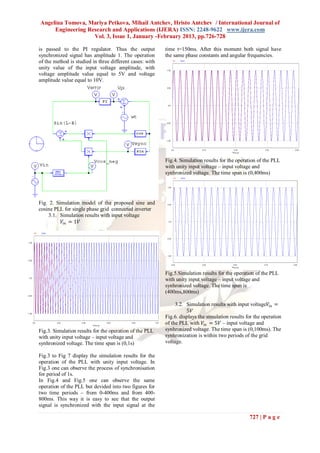
simulation model is presented in Fig.2. The obtained
sine 𝑉𝑖𝑛𝑀 sin 𝜃 − 𝜃 is compared to 0 and the result
726 | P a g e](https://image.slidesharecdn.com/de31726728-130219232833-phpapp01/85/De31726728-1-320.jpg)
![Angelina Tomova, Mariya Petkova, Mihail Antchev, Hristo Antchev / International Journal of
Engineering Research and Applications (IJERA) ISSN: 2248-9622 www.ijera.com
Vol. 3, Issue 1, January -February 2013, pp.726-728
Computer investigation of a sine and cosine based phase-locked
loop for single phase grid connected inverter
Angelina Tomova, Mariya Petkova, Mihail Antchev, Hristo Antchev
*(Power Electronics Department, Technical University-Sofia, Bulgaria
ABSTRACT
This paper presents a new approach for instantaneous grid voltage phase [2], [3]. Improved
PLL for synchronization with the public grid version of the SRF-PLL is the proposed in [4]
phase and frequency of grid-connected single adaptive synchronous-reference-frame PLL which
phase inverter. The approach uses trigonometric purpose is to reject disturbances introduced by the
transformations of the inverter output voltage and voltage harmonic distortion. The system is based on
the grid voltage. The proposed mathematical adaptive filtering of the harmonics of the grid voltage
model is then studied by means of computer projected to the SRF in case of unbalanced grid or
simulation for different voltage amplitudes of the distortion in the grid voltage.
grid voltage as well as the inverter output voltage. Another method for stability in the adaptive process
is the positive-negative sequence of grid components
Keywords–grid-connected inverter, PLL, proposed in [5] or the fundamental frequency
trigonometric transformations detection of the utility grid voltage in [6].
New approach recently presented uses frequency-
I. Introduction locking loop instead of traditionally used phase-
Due to the constant decrease of conventional locking loop. Its main idea is based on the operation
fuels, the use of renewable distributed energy sources of the PLL presented in [6] e.g. adaptive filter.
constantly increases. These systems are interfaced by This paper presents another approach for PLL
power electronic converters in order to connect to the technique for synchronization of single-phase on-grid
utility grid. Different standards and requirements are inverter with the public grid. Its PD block operation
applicable to these systems in order to maintain grid is based on sinus and cosines transformations of the
energy quality. That is why a very good voltage of the inverter and a reference voltage signal
synchronization between the power system of the which is the grid voltage.
renewable energy source and the utility grid at the This paper is organized as follows: Section II
point of common coupling (PCC) is needed. described the sinus and cosines PLL for single-phase
Widely used traditional synchronization methods of on-grid inverter. Section III presents the simulation
the control system and the grid voltage are algorithms results of the proposed algorithm of PLL and Section
based on the phase-locked loops (PLL). Various PLL IV is the conclusion.
techniques have been proposed and are used because
of the efficiency and robustness of the algorithm, but II. Operation
all of them contain the basic PLL blocks- phase The operation scheme of the proposed PLL
detector (PD), loop filter (LF) and voltage-controlled is synthesized on the following assumption -the input
oscillator (VCO) [1], [2]. The block diagram of such voltage contains only sinusoidal component or
a PLL is presented in Fig.1 Major difference in the 𝑣 𝑖𝑛 = 𝑉 𝑚 sin 𝜃.;the output voltage is obtained as
different proposed PLLs is the phase-detector block. 𝑣 𝑠𝑦𝑛𝑐 = 1. sin 𝜃 .
Then the following two trigonometric equations are
used:
1
sin 𝜃 . cos 𝜃 = 2 sin 𝜃 + 𝜃 + sin 𝜃 − 𝜃
(1)
1
−cos 𝜃 . sin 𝜃 = − 2 sin 𝜃 + 𝜃 − sin 𝜃 − 𝜃
(2)
Fig.1 Block diagram of PLL If we make the sum of (1) and (2) we can obtain the
following result sin 𝜃 − 𝜃 .
One of the state-of-the-art used PLL techniques is the
synchronous-reference-frame (SRF) phase-locked III. Simulation results
loop (SRF-PLL) which can estimate Computer simulation of the mathematical
model is done with the software product PSIM. The
simulation model is presented in Fig.2. The obtained
sine 𝑉𝑖𝑛𝑀 sin 𝜃 − 𝜃 is compared to 0 and the result
726 | P a g e](https://image.slidesharecdn.com/de31726728-130219232833-phpapp01/75/De31726728-1-2048.jpg)
![Angelina Tomova, Mariya Petkova, Mihail Antchev, Hristo Antchev / International Journal of
Engineering Research and Applications (IJERA) ISSN: 2248-9622 www.ijera.com
Vol. 3, Issue 1, January -February 2013, pp.726-728
IV. Conclusion
Based on the presented results of the
computer simulation above we can conclude that the
proposed PLL technique achieve excellent results in
the synchronization of the both signals. We can
observe that the bigger the amplitude of the input
voltage is the faster the synchronization is done- for
𝑉𝑖𝑛 = 1𝑉 the synchronisation is done for 150ms, for
𝑉𝑖𝑛 = 5𝑉the synchronisation is done for 40ms and
for 𝑉𝑖𝑛 = 10𝑉the synchronisation is done for 28ms.
We recommend during the practical realization to use
an input signal with amplitude of 10V which in case
of fluctuation of the grid voltage by ±10% is going
to assure the synchronization for a time
Fig.6.Simulation results for the operation of the PLL approximately equal to the duration of one and a half
with 𝑉𝑖𝑛 = 5𝑉 – input voltage and synhronized period. It is necessary of course to take into account
voltage. The time span is (0,100ms) the acceptable input voltage for the elements used for
3.3. Simulation results with input voltage𝑉𝑖𝑛 = the realization.
10𝑉
REFERENCES
[1] S. Golestan, M. Monfared, F. Freijedo, J.
Guerrero, Design and tuning of a modified
power-based PLL for single-phase grid-
connected power conditioning systems, IEEE
Transactions on Power Electronics, 27(8),
2012, 3639-3650.
[2] G.-C. Hsieh, J.C. Hung, Phase-locked loop
techniques. A survey, IEEE Transactions on
Industrial Electronics, 43(6),1996, 609-615.
[3] D. Velasco, C. Trujillo, G. Garcera, E.Figueres,
An active anti-islanding method based on
phase-PLL perturbation, IEEE Transactions on
Power Electronics, 26(4), 2011, 1056-1066.
[4] F. Espin, E. Figueres, G. Garcera, An adaptive
Fig. 7. Simulation results for the operation of the PLL
synchronous-reference-frame phase-locked
with 𝑉𝑖𝑛 = 10𝑉 – input voltage and synhronized loop for power quality improvement in polluted
voltage. The time span is (0,60ms) utility grid, IEEE Transactions on Industrial
Electronics, 59(6), 2012, 2718-2731.
[5] P. Rodriguez, J. Pou, J. Bergas, J. I. Candela,
R. P. Burgos, D. Boroyevich, Decoupled
double synchronous reference frame PLL for
power converters control, IEEE Transactions
on Power Electronics, 22(2), 2007, 584-592.
[6] P. Rodriguez, A. Luna, I. Candela, R. Mujal,
R. Teodorescu, F. Blaabjerg, Multi-resonant
frequency-locked loop for grid synchronization
of power converters under distorted grid
conditions, IEEE Transactions on Industrial
Electronics, 58(1), 2011, 127-138.
[7] P. Rodriguez, A. Luna, R. Aguilar, I. Otadui,
Fig.8. Simulation results for the operation of the PLL R. Teodorescu, F. Blaabjerg, A stationary
with 𝑉𝑖𝑛 = 10𝑉 – input voltage and synhronized reference frame grid synchronization system
voltage. The time span is (0,1s) for three-phase grid-connected power
Fig.7. and Fig.8 display the simulation resultsfor the converters under adverse grid conditions, IEEE
operation of the PLL with 𝑉𝑖𝑛 = 10𝑉 – input voltage Transactions on Power Electronics, 27(1),
and synhronized voltage. The time span is (0,60ms) 2012, 99-112.
for Fig.7 and (0,1s) for Fig.8. The synhronization is
within a period and a half of the grid voltage
728 | P a g e](https://image.slidesharecdn.com/de31726728-130219232833-phpapp01/85/De31726728-3-320.jpg)

The document presents a new adaptive synchronization technique for single-phase grid-connected inverters using a phase-locked loop (PLL) based on sine and cosine transformations. It includes simulation results that demonstrate the effectiveness of the proposed PLL in synchronizing the inverter output with the utility grid at varying input voltage amplitudes. The findings suggest that higher input voltage amplitudes lead to faster synchronization times, with the recommendation to use an input signal amplitude of 10V for optimal performance.


![[IJCT-V3I2P23] Authors: Baljinder Kaur, Narinder Sharma](https://cdn.slidesharecdn.com/ss_thumbnails/ijct-v3i2p23-160609062619-thumbnail.jpg?width=640&height=640&fit=bounds)


![Convenio canada1976[1] impuesto s r](https://cdn.slidesharecdn.com/ss_thumbnails/conveniocanada19761impuestosr-110123080138-phpapp02-thumbnail.jpg?width=640&height=640&fit=bounds)


![Convenio canada1976[1] impuesto s r](https://cdn.slidesharecdn.com/ss_thumbnails/conveniocanada19761impuestosr-110123081849-phpapp02-thumbnail.jpg?width=640&height=640&fit=bounds)


![Final presentation [Autosaved].pptxFinal presentation [Autosaved].pptxFinal p...](https://cdn.slidesharecdn.com/ss_thumbnails/finalpresentationautosaved-250527075000-e9e51fee-thumbnail.jpg?width=640&height=640&fit=bounds)


