Dynamic Cone Penetrometer (DCP) Testing
On State Contract
DCP Testing is a valuable tool for evaluating the strength of subsurface soils to depths of 30 feet or more. DCP Testing has been used
in the US for over 15 years to evaluate the strength and bearing capacities of soils beneath pavement systems and building
foundations.
DCP test equipment is small, lightweight, and portable. It is ideal for use in confined areas
(inside a building to evaluate foundation settlement issues), congested areas (near trees, in
and around existing structures), and hard to reach areas (on steep slopes or soft surface
soils). The equipment is electrically operated and hydraulically actuated, requiring only 110
VAC.
DCP Test Procedure:
•   Utilities must be identified
•   A 3.81 cm / 1.5 inch diameter hole is drilled through the pavement
•   1 Meter rods are inserted in the hole on top of a sacrificial cone
•   A 30 kg / 66 pound percussive head is used to drive the rods and cone into the soil
in a calibrated and consistent manner
•   The number of percussive blows required to drive the cone and rods into the soil
each 10 cm / 3.937 inches is recorded
•   These blow counts provide an indication of soil strength. The blow counts can be
correlated to the N-value associated with the Standard Penetration Test (SPT) by
using a relationship developed by the manufacturer: N (SPT) = 0.766 x N (DCP)
•   The sacrificial cone remains in the soil and the rods are extracted
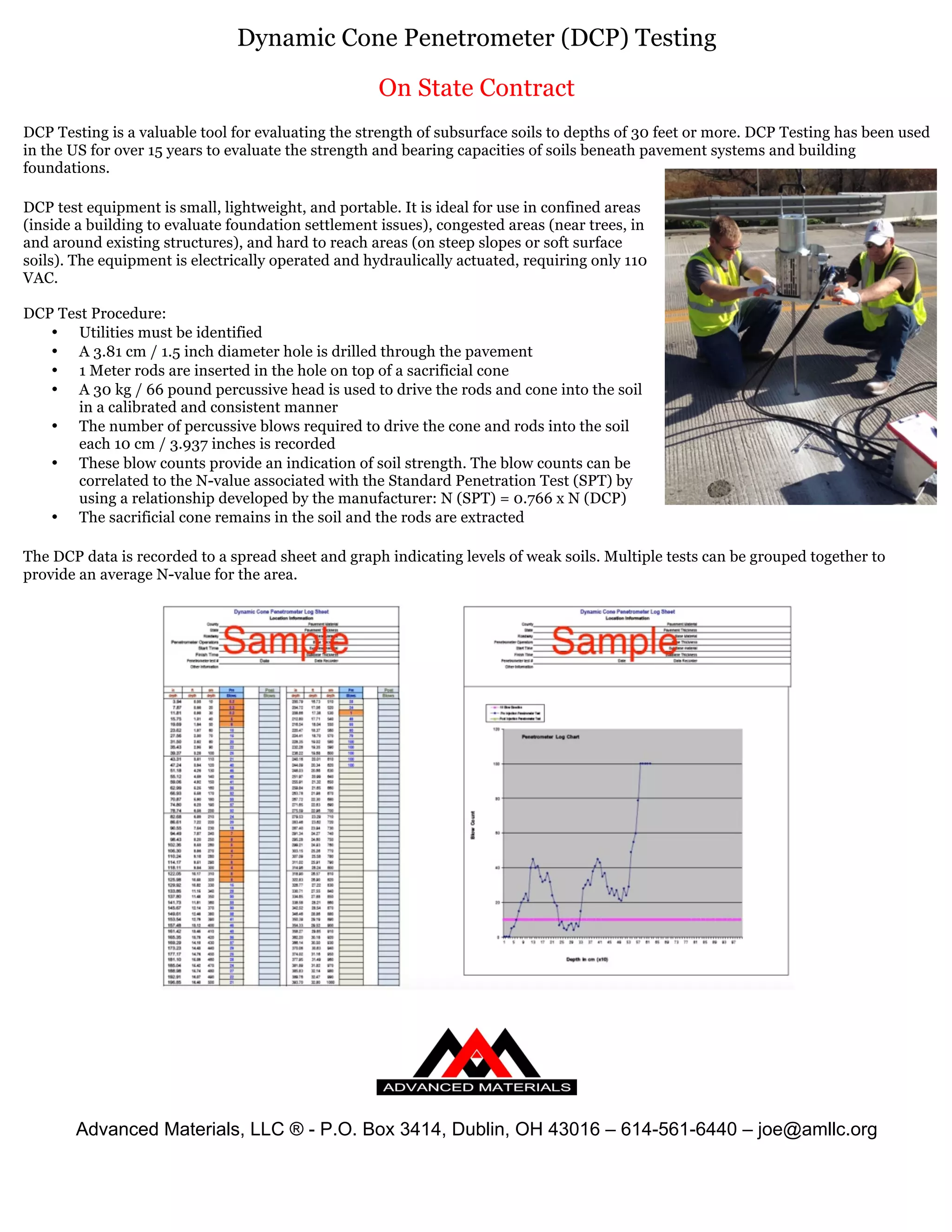
The DCP data is recorded to a spread sheet and graph indicating levels of weak soils. Multiple tests can be grouped together to
provide an average N-value for the area.


Advanced  Materials,  LLC  ®  -­  P.O.  Box  3414,  Dublin,  OH  43016  –  614-­561-­6440  –  joe@amllc.org  

DCP Spec Sheet 16.1

  • 1.
    Dynamic Cone Penetrometer(DCP) Testing On State Contract DCP Testing is a valuable tool for evaluating the strength of subsurface soils to depths of 30 feet or more. DCP Testing has been used in the US for over 15 years to evaluate the strength and bearing capacities of soils beneath pavement systems and building foundations. DCP test equipment is small, lightweight, and portable. It is ideal for use in confined areas (inside a building to evaluate foundation settlement issues), congested areas (near trees, in and around existing structures), and hard to reach areas (on steep slopes or soft surface soils). The equipment is electrically operated and hydraulically actuated, requiring only 110 VAC. DCP Test Procedure: •   Utilities must be identified •   A 3.81 cm / 1.5 inch diameter hole is drilled through the pavement •   1 Meter rods are inserted in the hole on top of a sacrificial cone •   A 30 kg / 66 pound percussive head is used to drive the rods and cone into the soil in a calibrated and consistent manner •   The number of percussive blows required to drive the cone and rods into the soil each 10 cm / 3.937 inches is recorded •   These blow counts provide an indication of soil strength. The blow counts can be correlated to the N-value associated with the Standard Penetration Test (SPT) by using a relationship developed by the manufacturer: N (SPT) = 0.766 x N (DCP) •   The sacrificial cone remains in the soil and the rods are extracted The DCP data is recorded to a spread sheet and graph indicating levels of weak soils. Multiple tests can be grouped together to provide an average N-value for the area.         Advanced  Materials,  LLC  ®  -­  P.O.  Box  3414,  Dublin,  OH  43016  –  614-­561-­6440  –  joe@amllc.org