Soil Testing
Many soil testing procedures and equipment are standardized by the American Society for
Testing and Materials (ASTM). Other agencies and their corresponding standardization
includes AASHTO and local State Department of Transportation. The following soil tests with
ASTM designation are provided.
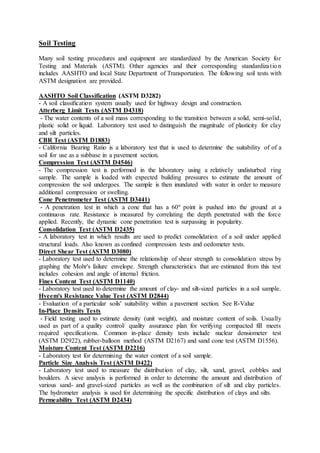
AASHTO Soil Classification (ASTM D3282)
- A soil classification system usually used for highway design and construction.
Atterberg Limit Tests (ASTM D4318)
- The water contents of a soil mass corresponding to the transition between a solid, semi-solid,
plastic solid or liquid. Laboratory test used to distinguish the magnitude of plasticity for clay
and silt particles.
CBR Test (ASTM D1883)
- California Bearing Ratio is a laboratory test that is used to determine the suitability of of a
soil for use as a subbase in a pavement section.
Compression Test (ASTM D4546)
- The compression test is performed in the laboratory using a relatively undisturbed ring
sample. The sample is loaded with expected building pressures to estimate the amount of
compression the soil undergoes. The sample is then inundated with water in order to measure
additional compression or swelling.
Cone Penetrometer Test (ASTM D3441)
- A penetration test in which a cone that has a 60º point is pushed into the ground at a
continuous rate. Resistance is measured by correlating the depth penetrated with the force
applied. Recently, the dynamic cone penetration test is surpassing in popularity.
Consolidation Test (ASTM D2435)
- A laboratory test in which results are used to predict consolidation of a soil under applied
structural loads. Also known as confined compression tests and oedometer tests.
Direct Shear Test (ASTM D3080)
- Laboratory test used to determine the relationship of shear strength to consolidation stress by
graphing the Mohr's failure envelope. Strength characteristics that are estimated from this test
includes cohesion and angle of internal friction.
Fines Content Test (ASTM D1140)
- Laboratory test used to determine the amount of clay- and silt-sized particles in a soil sample.
Hveem's Resistance Value Test (ASTM D2844)
- Evaluation of a particular soils' suitability within a pavement section. See R-Value
In-Place Density Tests
- Field testing used to estimate density (unit weight), and moisture content of soils. Usually
used as part of a quality control/ quality assurance plan for verifying compacted fill meets
required specifications. Common in-place density tests include nuclear densiometer test
(ASTM D2922), rubber-balloon method (ASTM D2167) and sand cone test (ASTM D1556).
Moisture Content Test (ASTM D2216)
- Laboratory test for determining the water content of a soil sample.
Particle Size Analysis Test (ASTM D422)
- Laboratory test used to measure the distribution of clay, silt, sand, gravel, cobbles and
boulders. A sieve analysis is performed in order to determine the amount and distribution of
various sand- and gravel-sized particles as well as the combination of silt and clay particles.
The hydrometer analysis is used for determining the specific distribution of clays and silts.
Permeability Test (ASTM D2434)
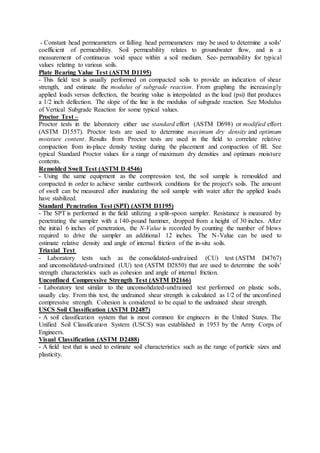
- Constant head permeameters or falling head permeameters may be used to determine a soils'
coefficient of permeability. Soil permeability relates to groundwater flow, and is a
measurement of continuous void space within a soil medium. See- permeability for typical
values relating to various soils.
Plate Bearing Value Test (ASTM D1195)
- This field test is usually performed on compacted soils to provide an indication of shear
strength, and estimate the modulus of subgrade reaction. From graphing the increasingly
applied loads versus deflection, the bearing value is interpolated as the load (psi) that produces
a 1/2 inch deflection. The slope of the line is the modulus of subgrade reaction. See Modulus
of Vertical Subgrade Reaction for some typical values.
Proctor Test –
Proctor tests in the laboratory either use standard effort (ASTM D698) or modified effort
(ASTM D1557). Proctor tests are used to determine maximum dry density and optimum
moisture content. Results from Proctor tests are used in the field to correlate relative
compaction from in-place density testing during the placement and compaction of fill. See
typical Standard Proctor values for a range of maximum dry densities and optimum moisture
contents.
Remolded Swell Test (ASTM D 4546)
- Using the same equipment as the compression test, the soil sample is remoulded and
compacted in order to achieve similar earthwork conditions for the project's soils. The amount
of swell can be measured after inundating the soil sample with water after the applied loads
have stabilized.
Standard Penetration Test (SPT) (ASTM D1195)
- The SPT is performed in the field utilizing a split-spoon sampler. Resistance is measured by
penetrating the sampler with a 140-pound hammer, dropped from a height of 30 inches. After
the initial 6 inches of penetration, the N-Value is recorded by counting the number of blows
required to drive the sampler an additional 12 inches. The N-Value can be used to
estimate relative density and angle of internal friction of the in-situ soils.
Triaxial Test
- Laboratory tests such as the consolidated-undrained (CU) test (ASTM D4767)
and unconsolidated-undrained (UU) test (ASTM D2850) that are used to determine the soils'
strength characteristics such as cohesion and angle of internal friction.
Unconfined Compressive Strength Test (ASTM D2166)
- Laboratory test similar to the unconsolidated-undrained test performed on plastic soils,
usually clay. From this test, the undrained shear strength is calculated as 1/2 of the unconfined
compressive strength. Cohesion is considered to be equal to the undrained shear strength.
USCS Soil Classification (ASTM D2487)
- A soil classification system that is most common for engineers in the United States. The
Unified Soil Classification System (USCS) was established in 1953 by the Army Corps of
Engineers.
Visual Classification (ASTM D2488)
- A field test that is used to estimate soil characteristics such as the range of particle sizes and
plasticity.
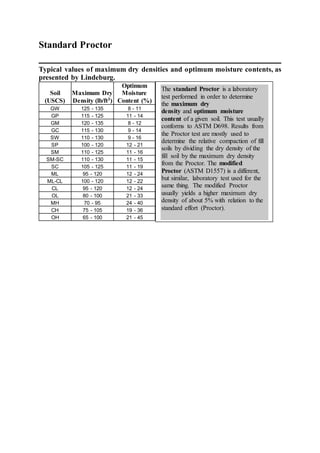
Standard Proctor
Typical values of maximum dry densities and optimum moisture contents, as
presented by Lindeburg.
Soil
(USCS)
Maximum Dry
Density (lb/ft3)
Optimum
Moisture
Content (%)
GW 125 - 135 8 - 11
GP 115 - 125 11 - 14
GM 120 - 135 8 - 12
GC 115 - 130 9 - 14
SW 110 - 130 9 - 16
SP 100 - 120 12 - 21
SM 110 - 125 11 - 16
SM-SC 110 - 130 11 - 15
SC 105 - 125 11 - 19
ML 95 - 120 12 - 24
ML-CL 100 - 120 12 - 22
CL 95 - 120 12 - 24
OL 80 - 100 21 - 33
MH 70 - 95 24 - 40
CH 75 - 105 19 - 36
OH 65 - 100 21 - 45
The standard Proctor is a laboratory
test performed in order to determine
the maximum dry
density and optimum moisture
content of a given soil. This test usually
conforms to ASTM D698. Results from
the Proctor test are mostly used to
determine the relative compaction of fill
soils by dividing the dry density of the
fill soil by the maximum dry density
from the Proctor. The modified
Proctor (ASTM D1557) is a different,
but similar, laboratory test used for the
same thing. The modified Proctor
usually yields a higher maximum dry
density of about 5% with relation to the
standard effort (Proctor).
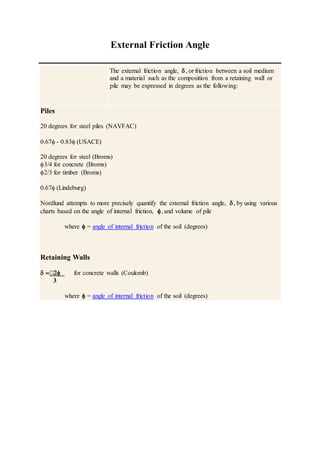
External Friction Angle
The external friction angle, , or friction between a soil medium
and a material such as the composition from a retaining wall or
pile may be expressed in degrees as the following:
Piles
20 degrees for steel piles (NAVFAC)
0.67 - 0.83 (USACE)
20 degrees for steel (Broms)
3/4 for concrete (Broms)
2/3 for timber (Broms)
0.67 (Lindeburg)
Nordlund attempts to more precisely quantify the external friction angle, , by using various
charts based on the angle of internal friction, , and volume of pile
where  = angle of internal friction of the soil (degrees)
Retaining Walls
  for concrete walls (Coulomb)
3
where  = angle of internal friction of the soil (degrees)

Soil testing

  • 1.
    Soil Testing Many soiltesting procedures and equipment are standardized by the American Society for Testing and Materials (ASTM). Other agencies and their corresponding standardization includes AASHTO and local State Department of Transportation. The following soil tests with ASTM designation are provided. AASHTO Soil Classification (ASTM D3282) - A soil classification system usually used for highway design and construction. Atterberg Limit Tests (ASTM D4318) - The water contents of a soil mass corresponding to the transition between a solid, semi-solid, plastic solid or liquid. Laboratory test used to distinguish the magnitude of plasticity for clay and silt particles. CBR Test (ASTM D1883) - California Bearing Ratio is a laboratory test that is used to determine the suitability of of a soil for use as a subbase in a pavement section. Compression Test (ASTM D4546) - The compression test is performed in the laboratory using a relatively undisturbed ring sample. The sample is loaded with expected building pressures to estimate the amount of compression the soil undergoes. The sample is then inundated with water in order to measure additional compression or swelling. Cone Penetrometer Test (ASTM D3441) - A penetration test in which a cone that has a 60º point is pushed into the ground at a continuous rate. Resistance is measured by correlating the depth penetrated with the force applied. Recently, the dynamic cone penetration test is surpassing in popularity. Consolidation Test (ASTM D2435) - A laboratory test in which results are used to predict consolidation of a soil under applied structural loads. Also known as confined compression tests and oedometer tests. Direct Shear Test (ASTM D3080) - Laboratory test used to determine the relationship of shear strength to consolidation stress by graphing the Mohr's failure envelope. Strength characteristics that are estimated from this test includes cohesion and angle of internal friction. Fines Content Test (ASTM D1140) - Laboratory test used to determine the amount of clay- and silt-sized particles in a soil sample. Hveem's Resistance Value Test (ASTM D2844) - Evaluation of a particular soils' suitability within a pavement section. See R-Value In-Place Density Tests - Field testing used to estimate density (unit weight), and moisture content of soils. Usually used as part of a quality control/ quality assurance plan for verifying compacted fill meets required specifications. Common in-place density tests include nuclear densiometer test (ASTM D2922), rubber-balloon method (ASTM D2167) and sand cone test (ASTM D1556). Moisture Content Test (ASTM D2216) - Laboratory test for determining the water content of a soil sample. Particle Size Analysis Test (ASTM D422) - Laboratory test used to measure the distribution of clay, silt, sand, gravel, cobbles and boulders. A sieve analysis is performed in order to determine the amount and distribution of various sand- and gravel-sized particles as well as the combination of silt and clay particles. The hydrometer analysis is used for determining the specific distribution of clays and silts. Permeability Test (ASTM D2434)
  • 2.
    - Constant headpermeameters or falling head permeameters may be used to determine a soils' coefficient of permeability. Soil permeability relates to groundwater flow, and is a measurement of continuous void space within a soil medium. See- permeability for typical values relating to various soils. Plate Bearing Value Test (ASTM D1195) - This field test is usually performed on compacted soils to provide an indication of shear strength, and estimate the modulus of subgrade reaction. From graphing the increasingly applied loads versus deflection, the bearing value is interpolated as the load (psi) that produces a 1/2 inch deflection. The slope of the line is the modulus of subgrade reaction. See Modulus of Vertical Subgrade Reaction for some typical values. Proctor Test – Proctor tests in the laboratory either use standard effort (ASTM D698) or modified effort (ASTM D1557). Proctor tests are used to determine maximum dry density and optimum moisture content. Results from Proctor tests are used in the field to correlate relative compaction from in-place density testing during the placement and compaction of fill. See typical Standard Proctor values for a range of maximum dry densities and optimum moisture contents. Remolded Swell Test (ASTM D 4546) - Using the same equipment as the compression test, the soil sample is remoulded and compacted in order to achieve similar earthwork conditions for the project's soils. The amount of swell can be measured after inundating the soil sample with water after the applied loads have stabilized. Standard Penetration Test (SPT) (ASTM D1195) - The SPT is performed in the field utilizing a split-spoon sampler. Resistance is measured by penetrating the sampler with a 140-pound hammer, dropped from a height of 30 inches. After the initial 6 inches of penetration, the N-Value is recorded by counting the number of blows required to drive the sampler an additional 12 inches. The N-Value can be used to estimate relative density and angle of internal friction of the in-situ soils. Triaxial Test - Laboratory tests such as the consolidated-undrained (CU) test (ASTM D4767) and unconsolidated-undrained (UU) test (ASTM D2850) that are used to determine the soils' strength characteristics such as cohesion and angle of internal friction. Unconfined Compressive Strength Test (ASTM D2166) - Laboratory test similar to the unconsolidated-undrained test performed on plastic soils, usually clay. From this test, the undrained shear strength is calculated as 1/2 of the unconfined compressive strength. Cohesion is considered to be equal to the undrained shear strength. USCS Soil Classification (ASTM D2487) - A soil classification system that is most common for engineers in the United States. The Unified Soil Classification System (USCS) was established in 1953 by the Army Corps of Engineers. Visual Classification (ASTM D2488) - A field test that is used to estimate soil characteristics such as the range of particle sizes and plasticity.
  • 3.
    Standard Proctor Typical valuesof maximum dry densities and optimum moisture contents, as presented by Lindeburg. Soil (USCS) Maximum Dry Density (lb/ft3) Optimum Moisture Content (%) GW 125 - 135 8 - 11 GP 115 - 125 11 - 14 GM 120 - 135 8 - 12 GC 115 - 130 9 - 14 SW 110 - 130 9 - 16 SP 100 - 120 12 - 21 SM 110 - 125 11 - 16 SM-SC 110 - 130 11 - 15 SC 105 - 125 11 - 19 ML 95 - 120 12 - 24 ML-CL 100 - 120 12 - 22 CL 95 - 120 12 - 24 OL 80 - 100 21 - 33 MH 70 - 95 24 - 40 CH 75 - 105 19 - 36 OH 65 - 100 21 - 45 The standard Proctor is a laboratory test performed in order to determine the maximum dry density and optimum moisture content of a given soil. This test usually conforms to ASTM D698. Results from the Proctor test are mostly used to determine the relative compaction of fill soils by dividing the dry density of the fill soil by the maximum dry density from the Proctor. The modified Proctor (ASTM D1557) is a different, but similar, laboratory test used for the same thing. The modified Proctor usually yields a higher maximum dry density of about 5% with relation to the standard effort (Proctor).
  • 4.
    External Friction Angle Theexternal friction angle, , or friction between a soil medium and a material such as the composition from a retaining wall or pile may be expressed in degrees as the following: Piles 20 degrees for steel piles (NAVFAC) 0.67 - 0.83 (USACE) 20 degrees for steel (Broms) 3/4 for concrete (Broms) 2/3 for timber (Broms) 0.67 (Lindeburg) Nordlund attempts to more precisely quantify the external friction angle, , by using various charts based on the angle of internal friction, , and volume of pile where  = angle of internal friction of the soil (degrees) Retaining Walls   for concrete walls (Coulomb) 3 where  = angle of internal friction of the soil (degrees)