
Represented By
M.Yameen Shakir
Email: Yami.Shakir786@gmail.com
University of Education Okara campus
Renala Khurd
Outline
 Information
systems
 Components of
IS
 Types of IS
 TPS
 Definition of TPS
 Function of TPS
 Types of TPS
 Features of TPS
 Properties of
TPS
 Example of TPS
 Storing &
Retrieving data
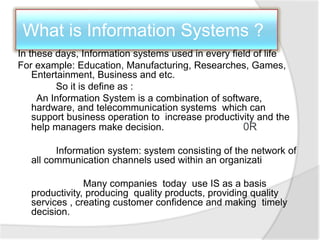
What is Information Systems ?
In these days, Information systems used in every field of life
For example: Education, Manufacturing, Researches, Games,
Entertainment, Business and etc.
So it is define as :
An Information System is a combination of software,
hardware, and telecommunication systems which can
support business operation to increase productivity and the
help managers make decision. 0R
Information system: system consisting of the network of
all communication channels used within an organizati
Many companies today use IS as a basis
productivity, producing quality products, providing quality
services , creating customer confidence and making timely
decision.
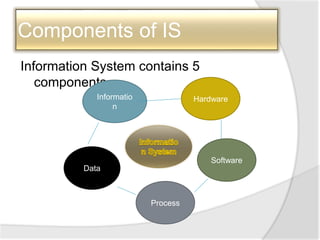
Components of IS
Information System contains 5
components
Data
Process
Informatio
n
Software
Hardware
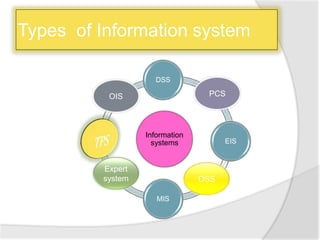
Types of Information system
Information
systems
DSS
EIS
MIS
OSS
PCSOIS
Expert
system
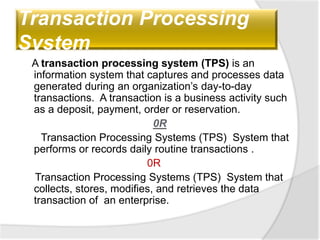
Transaction Processing
System
A transaction processing system (TPS) is an
information system that captures and processes data
generated during an organization’s day-to-day
transactions. A transaction is a business activity such
as a deposit, payment, order or reservation.
0R
Transaction Processing Systems (TPS) System that
performs or records daily routine transactions .
0R
Transaction Processing Systems (TPS) System that
collects, stores, modifies, and retrieves the data
transaction of an enterprise.
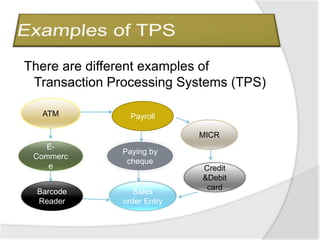
There are different examples of
Transaction Processing Systems (TPS)
Paying by
cheque
Credit
&Debit
card
E-
Commerc
e
MICR
Barcode
Reader
Payroll
Sales
order Entry
ATM
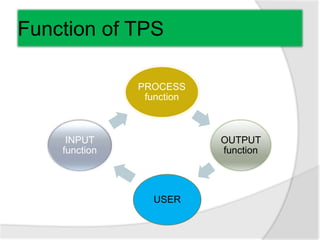
Function of TPS
PROCESS
function
OUTPUT
function
USER
INPUT
function
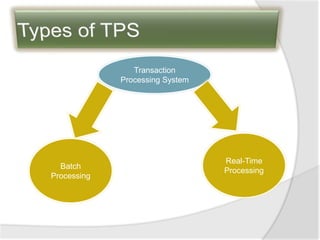
Transaction
Processing System
Real-Time
Processing
Batch
Processing
Batch Processing
Batch processing transaction is the
processing as collects the data/ store at
a time of the event with actual updating
of the database later when it is schedule
or there is enough data.
An example may be accounts which are
make to be easily stored & update due
to amount and type of data. Example of
this maybe telephone
Real-Time Processing
Real time Processing is the processing as
real time transaction processing as
immediate processing of data with the
database update as the transaction is
being carried out.
An example maybe ATM or POS terminal.
Both have user input which require
feedback.
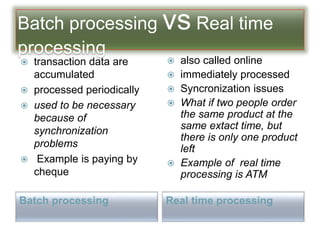
Batch processing vs Real time
processing
Batch processing Real time processing
 transaction data are
accumulated
 processed periodically
 used to be necessary
because of
synchronization
problems
 Example is paying by
cheque
 also called online
 immediately processed
 Syncronization issues
 What if two people order
the same product at the
same extact time, but
there is only one product
left
 Example of real time
processing is ATM
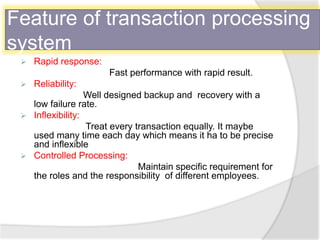
Feature of transaction processing
system
 Rapid response:
Fast performance with rapid result.
 Reliability:
Well designed backup and recovery with a
low failure rate.
 Inflexibility:
Treat every transaction equally. It maybe
used many time each day which means it ha to be precise
and inflexible
 Controlled Processing:
Maintain specific requirement for
the roles and the responsibility of different employees.
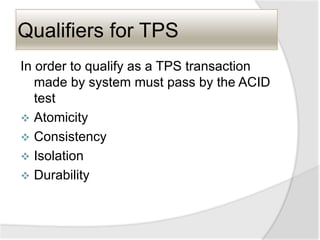
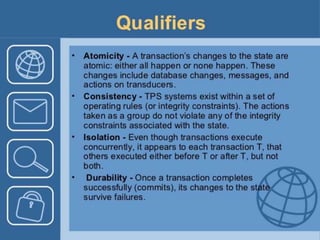
Qualifiers for TPS
In order to qualify as a TPS transaction
made by system must pass by the ACID
test
 Atomicity
 Consistency
 Isolation
 Durability
STAGES OF TRANSACTION
PROCESSING
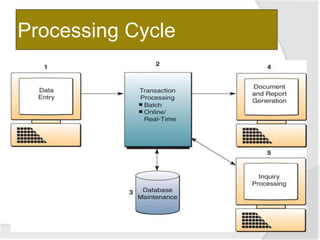
Five Stages Of Transaction Processing
 Data Entry
 Processing
 Database Maintenance
 Document And Report Generation
 Inquiry Processing
Processing cycle
Data Entry Transaction Processing
 Collecting and capturing
transactions
 No longer manual:
Old technologies Bar
Codes, Magnetic Strips
(credit cards)
New technologies RFID,
Smart Cards,
 Synchronization Issues:
Which transaction to
process next.
Breaking ties
Dependencies
○ Can’t schedule delivery
before credit approval.
Processing Cycle
Database Maintenance Document/Report
Generation
 TPS helps ensure the
databases are up-to-date
and correct.
 Multiple databases
 A single purchase
decreases quantity –
Inventory Database
decrease credit – Credit
Card Database
sales – Sales Database
Document/Report
Generation
 Examples
purchase orders
pay checks
sales receipts
invoices
bank statements
An MIS also generates
reports, but TPS
reports are operational
(no analysis).
Inquiry Processing
 Examples
when was a purchase made
does a customer have any credits on their
account
was an item scheduled for delivery
was a package signed for
An MIS also allows for inquiries, but the
information available is summarized (or
aggregated), i.e., What are the total sales
for a whole department? What is the best
selling product?
Processing Cycle
 Every organisation needs to be aware and conscious of development,
 especially in the fields of computing and information technology, to ensure
 that they would not be left behind and fail in the competition to move
 forward.
 • To compete in business, the management needs to provide the necessary
 infrastructure so that the information technology environment can be
 developed. This includes the provision of the information system
 components.
 • To realise information systems in business, an information system expert
 needs to model a business process, i.e. to determine what are the business
 activities for an organisation, and what are the processes involved in the
 implementation activity. With this kind of specification, a new information
 system can be developed.
 • Information systems play a very important role in the management aspect of
 an organisation. By looking at the functions and the scope of its use, an
 information system can be divided into two main support systems, i.e.
 Operation Support System and Management Support System.
Peace, Love and Serve

TPS by M.Yameen Shakir

  • 1.
    Represented By M.Yameen Shakir Email:Yami.Shakir786@gmail.com University of Education Okara campus Renala Khurd
  • 2.
    Outline  Information systems  Componentsof IS  Types of IS  TPS  Definition of TPS  Function of TPS  Types of TPS  Features of TPS  Properties of TPS  Example of TPS  Storing & Retrieving data
  • 3.
    What is InformationSystems ? In these days, Information systems used in every field of life For example: Education, Manufacturing, Researches, Games, Entertainment, Business and etc. So it is define as : An Information System is a combination of software, hardware, and telecommunication systems which can support business operation to increase productivity and the help managers make decision. 0R Information system: system consisting of the network of all communication channels used within an organizati Many companies today use IS as a basis productivity, producing quality products, providing quality services , creating customer confidence and making timely decision.
  • 4.
    Components of IS InformationSystem contains 5 components Data Process Informatio n Software Hardware
  • 5.
    Types of Informationsystem Information systems DSS EIS MIS OSS PCSOIS Expert system
  • 6.
    Transaction Processing System A transactionprocessing system (TPS) is an information system that captures and processes data generated during an organization’s day-to-day transactions. A transaction is a business activity such as a deposit, payment, order or reservation. 0R Transaction Processing Systems (TPS) System that performs or records daily routine transactions . 0R Transaction Processing Systems (TPS) System that collects, stores, modifies, and retrieves the data transaction of an enterprise.
  • 7.
    There are differentexamples of Transaction Processing Systems (TPS) Paying by cheque Credit &Debit card E- Commerc e MICR Barcode Reader Payroll Sales order Entry ATM
  • 8.
  • 9.
  • 10.
    Batch Processing Batch processingtransaction is the processing as collects the data/ store at a time of the event with actual updating of the database later when it is schedule or there is enough data. An example may be accounts which are make to be easily stored & update due to amount and type of data. Example of this maybe telephone
  • 11.
    Real-Time Processing Real timeProcessing is the processing as real time transaction processing as immediate processing of data with the database update as the transaction is being carried out. An example maybe ATM or POS terminal. Both have user input which require feedback.
  • 12.
    Batch processing vsReal time processing Batch processing Real time processing  transaction data are accumulated  processed periodically  used to be necessary because of synchronization problems  Example is paying by cheque  also called online  immediately processed  Syncronization issues  What if two people order the same product at the same extact time, but there is only one product left  Example of real time processing is ATM
  • 13.
    Feature of transactionprocessing system  Rapid response: Fast performance with rapid result.  Reliability: Well designed backup and recovery with a low failure rate.  Inflexibility: Treat every transaction equally. It maybe used many time each day which means it ha to be precise and inflexible  Controlled Processing: Maintain specific requirement for the roles and the responsibility of different employees.
  • 14.
    Qualifiers for TPS Inorder to qualify as a TPS transaction made by system must pass by the ACID test  Atomicity  Consistency  Isolation  Durability
  • 16.
    STAGES OF TRANSACTION PROCESSING FiveStages Of Transaction Processing  Data Entry  Processing  Database Maintenance  Document And Report Generation  Inquiry Processing
  • 17.
    Processing cycle Data EntryTransaction Processing  Collecting and capturing transactions  No longer manual: Old technologies Bar Codes, Magnetic Strips (credit cards) New technologies RFID, Smart Cards,  Synchronization Issues: Which transaction to process next. Breaking ties Dependencies ○ Can’t schedule delivery before credit approval.
  • 18.
    Processing Cycle Database MaintenanceDocument/Report Generation  TPS helps ensure the databases are up-to-date and correct.  Multiple databases  A single purchase decreases quantity – Inventory Database decrease credit – Credit Card Database sales – Sales Database Document/Report Generation  Examples purchase orders pay checks sales receipts invoices bank statements An MIS also generates reports, but TPS reports are operational (no analysis).
  • 19.
    Inquiry Processing  Examples whenwas a purchase made does a customer have any credits on their account was an item scheduled for delivery was a package signed for An MIS also allows for inquiries, but the information available is summarized (or aggregated), i.e., What are the total sales for a whole department? What is the best selling product?
  • 20.
  • 21.
     Every organisationneeds to be aware and conscious of development,  especially in the fields of computing and information technology, to ensure  that they would not be left behind and fail in the competition to move  forward.  • To compete in business, the management needs to provide the necessary  infrastructure so that the information technology environment can be  developed. This includes the provision of the information system  components.  • To realise information systems in business, an information system expert  needs to model a business process, i.e. to determine what are the business  activities for an organisation, and what are the processes involved in the  implementation activity. With this kind of specification, a new information  system can be developed.  • Information systems play a very important role in the management aspect of  an organisation. By looking at the functions and the scope of its use, an  information system can be divided into two main support systems, i.e.  Operation Support System and Management Support System.
  • 22.