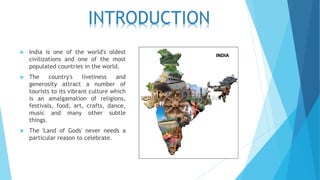
 India is one of the world's oldest
civilizations and one of the most
populated countries in the world.
 The country's liveliness and
generosity attract a number of
tourists to its vibrant culture which
is an amalgamation of religions,
festivals, food, art, crafts, dance,
music and many other subtle
things.
 The 'Land of Gods' never needs a
particular reason to celebrate.
INTRODUCTION
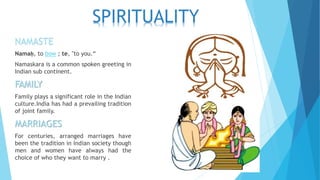
NAMASTE
Namaḥ, to bow ; te, "to you.“
Namaskara is a common spoken greeting in
Indian sub continent.
FAMILY
Family plays a significant role in the Indian
culture.India has had a prevailing tradition
of joint family.
MARRIAGES
For centuries, arranged marriages have
been the tradition in Indian society though
men and women have always had the
choice of who they want to marry .
SPIRITUALITY
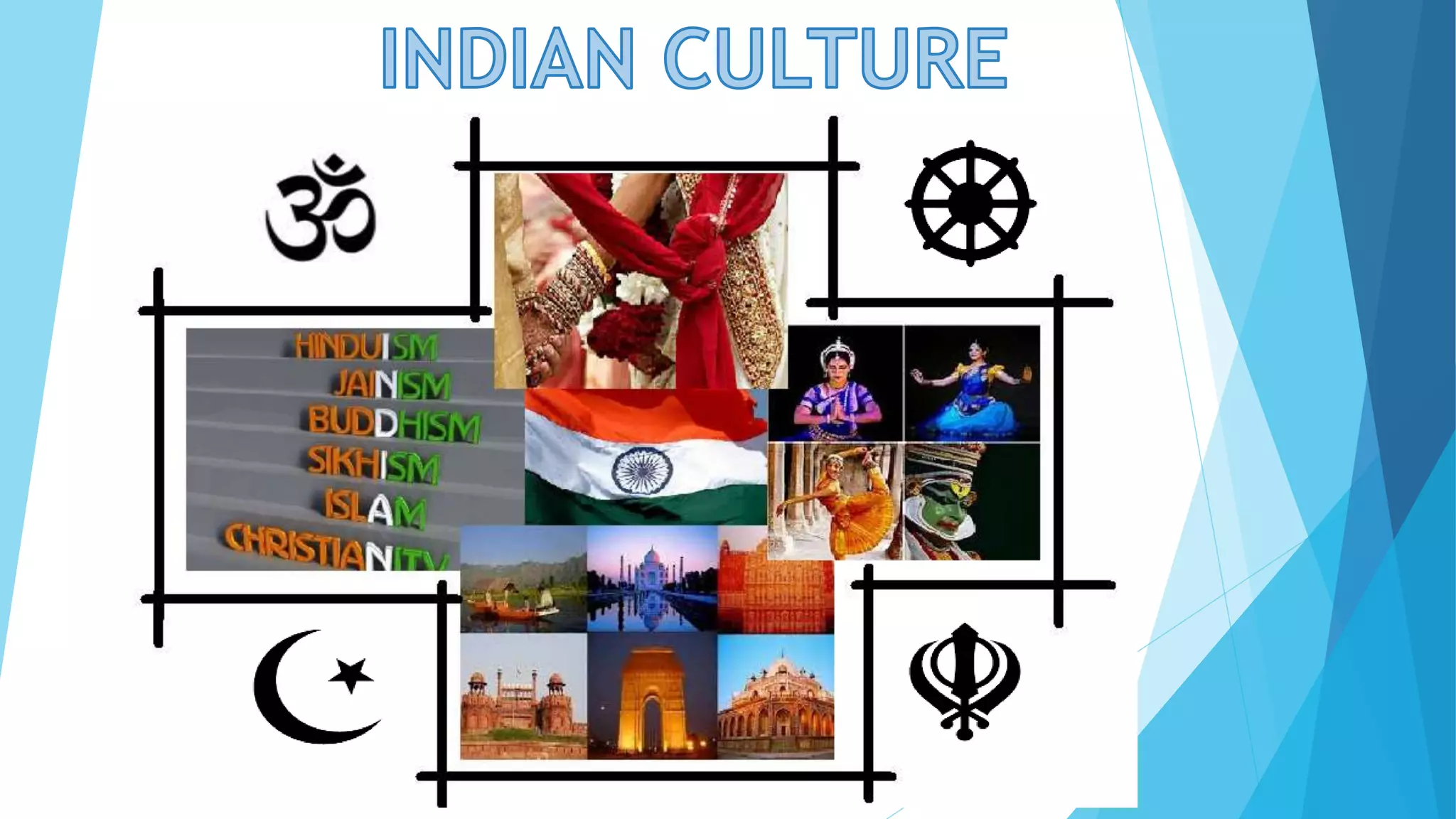
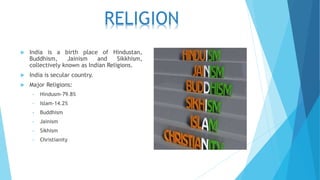
 India is a birth place of Hindustan,
Buddhism, Jainism and Sikkhism,
collectively known as Indian Religions.
 India is secular country.
 Major Religions:
• Hindusm-79.8%
• Islam-14.2%
• Buddhism
• Jainism
• Sikhism
• Christianity
RELIGION
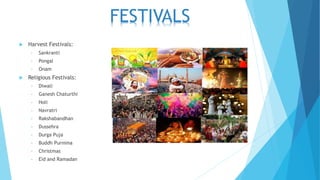
 Harvest Festivals:
• Sankranti
• Pongal
• Onam
 Religious Festivals:
• Diwali
• Ganesh Chaturthi
• Holi
• Navratri
• Rakshabandhan
• Dussehra
• Durga Puja
• Buddh Purnima
• Christmas
• Eid and Ramadan
FESTIVALS
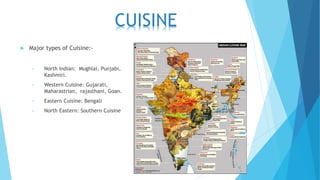
 Major types of Cuisine:-
• North Indian: Mughlai, Punjabi,
Kashmiri.
• Western Cuisine: Gujarati,
Maharastrian, rajasthani, Goan.
• Eastern Cuisine: Bengali
• North Eastern: Southern Cuisine
CUISINE
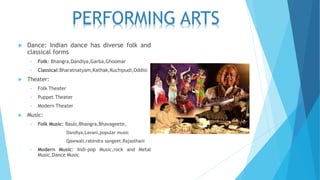
 Dance: Indian dance has diverse folk and
classical forms
• Folk: Bhangra,Dandiya,Garba,Ghoomar
• Classical:Bharatnatyam,Kathak,Kuchipudi,Oddisi
 Theater:
• Folk Theater
• Puppet Theater
• Modern Theater
 Music:
• Folk Music: Bauls,Bhangra,Bhavageete,
Dandiya,Lavani,popular music
Qawwali,rabindra sangeet,Rajasthani
• Modern Music: Indi-pop Music,rock and Metal
Music,Dance Music
PERFORMING ARTS
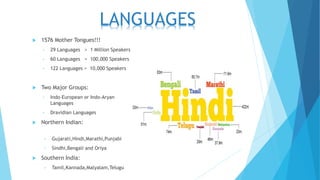
 1576 Mother Tongues!!!
• 29 Languages > 1 Million Speakers
• 60 Languages > 100,000 Speakers
• 122 Languages > 10,000 Speakers
 Two Major Groups:
• Indo-European or Indo-Aryan
Languages
• Dravidian Languages
 Northern Indian:
• Gujarati,Hindi,Marathi,Punjabi
• Sindhi,Bengali and Oriya
 Southern India:
• Tamil,Kannada,Malyalam,Telugu
LANGUAGES
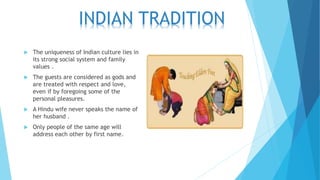
 The uniqueness of Indian culture lies in
its strong social system and family
values .
 The guests are considered as gods and
are treated with respect and love,
even if by foregoing some of the
personal pleasures.
 A Hindu wife never speaks the name of
her husband .
 Only people of the same age will
address each other by first name.
INDIAN TRADITION
There is a great diversity among different regions of India in terms of
language, cuisine, culture and dress, but though we all are different we
all are Indians. We owe a lot of the Indians who taught us how to count,
without which no worthwhile scientific discovery could have been made.
-Albert Einstein
Presented By:
KOMAL AKHANI
CONCLUSION

DB9132

  • 2.
     India isone of the world's oldest civilizations and one of the most populated countries in the world.  The country's liveliness and generosity attract a number of tourists to its vibrant culture which is an amalgamation of religions, festivals, food, art, crafts, dance, music and many other subtle things.  The 'Land of Gods' never needs a particular reason to celebrate. INTRODUCTION
  • 3.
    NAMASTE Namaḥ, to bow; te, "to you.“ Namaskara is a common spoken greeting in Indian sub continent. FAMILY Family plays a significant role in the Indian culture.India has had a prevailing tradition of joint family. MARRIAGES For centuries, arranged marriages have been the tradition in Indian society though men and women have always had the choice of who they want to marry . SPIRITUALITY
  • 4.
     India isa birth place of Hindustan, Buddhism, Jainism and Sikkhism, collectively known as Indian Religions.  India is secular country.  Major Religions: • Hindusm-79.8% • Islam-14.2% • Buddhism • Jainism • Sikhism • Christianity RELIGION
  • 5.
     Harvest Festivals: •Sankranti • Pongal • Onam  Religious Festivals: • Diwali • Ganesh Chaturthi • Holi • Navratri • Rakshabandhan • Dussehra • Durga Puja • Buddh Purnima • Christmas • Eid and Ramadan FESTIVALS
  • 6.
     Major typesof Cuisine:- • North Indian: Mughlai, Punjabi, Kashmiri. • Western Cuisine: Gujarati, Maharastrian, rajasthani, Goan. • Eastern Cuisine: Bengali • North Eastern: Southern Cuisine CUISINE
  • 7.
     Dance: Indiandance has diverse folk and classical forms • Folk: Bhangra,Dandiya,Garba,Ghoomar • Classical:Bharatnatyam,Kathak,Kuchipudi,Oddisi  Theater: • Folk Theater • Puppet Theater • Modern Theater  Music: • Folk Music: Bauls,Bhangra,Bhavageete, Dandiya,Lavani,popular music Qawwali,rabindra sangeet,Rajasthani • Modern Music: Indi-pop Music,rock and Metal Music,Dance Music PERFORMING ARTS
  • 8.
     1576 MotherTongues!!! • 29 Languages > 1 Million Speakers • 60 Languages > 100,000 Speakers • 122 Languages > 10,000 Speakers  Two Major Groups: • Indo-European or Indo-Aryan Languages • Dravidian Languages  Northern Indian: • Gujarati,Hindi,Marathi,Punjabi • Sindhi,Bengali and Oriya  Southern India: • Tamil,Kannada,Malyalam,Telugu LANGUAGES
  • 9.
     The uniquenessof Indian culture lies in its strong social system and family values .  The guests are considered as gods and are treated with respect and love, even if by foregoing some of the personal pleasures.  A Hindu wife never speaks the name of her husband .  Only people of the same age will address each other by first name. INDIAN TRADITION
  • 10.
    There is agreat diversity among different regions of India in terms of language, cuisine, culture and dress, but though we all are different we all are Indians. We owe a lot of the Indians who taught us how to count, without which no worthwhile scientific discovery could have been made. -Albert Einstein Presented By: KOMAL AKHANI CONCLUSION