Made by: Aarush Jain
Class: 6-C
 India is a diverse country
with all the major
religions of the world.
There are close to 1600
languages spoken in India.
India has geographical
diversity in the form of
mountains, plains,
plateaus, deserts and
islands. Apart from these,
India has different ethnic
groups due to migration
from around the world. So
let’s learn about them all.
 According to the 2011
census, 79.8% of the
population of India
practices Hinduism,
14.2% adheres to
Islam, 2.3% adheres to
Christianity, 1.7%
adheres to Sikhism,
0.7% adheres to
Buddhism and 0.4%
adheres to Jainism.
Which refers that India
is also religiously
diversed.

 India is called the 'land of
diversity' because we
have various types of
food, speak different
languages, celebrate
different festivals, and
practice different
religions and traditions.
 The North, South and
Northeast have their own
distinct culture. There is
hardly any culture in the
world that is varied and
unique as India’s culture.
 India is a vast country
with a variety of
geographical features
and climatic
conditions. India, a
place of infinite
variety, is fascinating
with its ancient and
complex culture,
dazzling contrasts and
breathtaking physical
beauty
 Among a number of
architectural styles and
traditions, the best-known
include the many varieties
of Hindu temple
architecture, Indo-
Islamic architecture,
especially Mughal
architecture, Rajput
architecture and Indo-
Saracenic architecture.
Much early Indian
architecture was in wood,
which has not survived.
 Clothing in India is
dependent upon the
different ethnicities,
geography, climate,
and cultural
traditions of the
people of each region
of India. Historically,
male and female
clothing has evolved
from simple garments
like kaupina, langota,
achkann, lungi, sari,
well as rituals and
dance performances.
 The Sangeet Natak
Akademi currently
confers classical status
on eight Indian classical
dance styles:
Bharatanatyam (Tamil
Nadu), Kathak (North,
West and Central India),
Kathakali (Kerala),
Kuchipudi (Andhra),
Odissi (Odisha),
Manipuri (Manipur),
Mohiniyattam (Kerala),
and Sattriya (Assam).
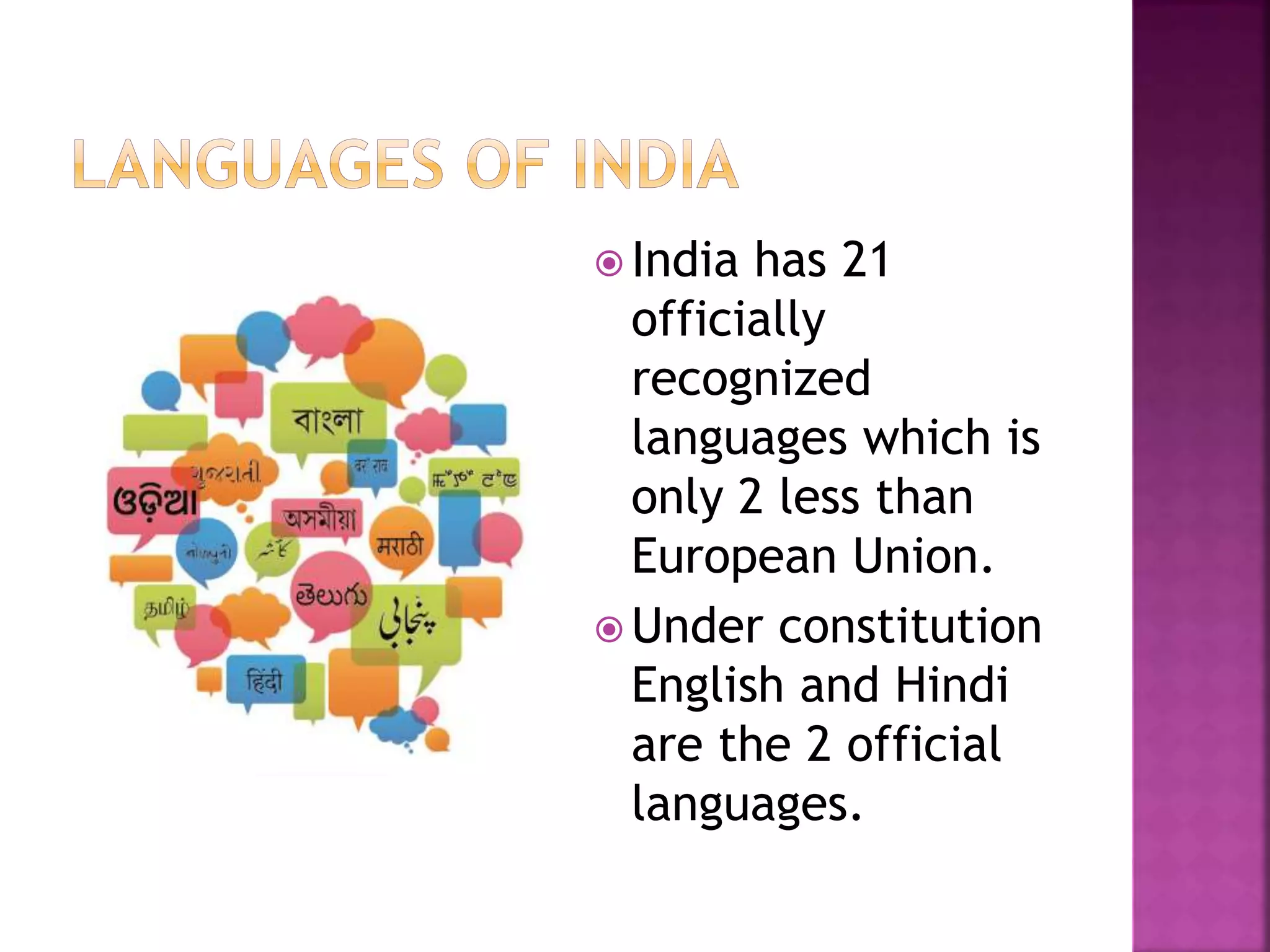
 India has 21
officially
recognized
languages which is
only 2 less than
European Union.
 Under constitution
English and Hindi
are the 2 official
languages.
 The religious festivals
are one of the most
famous festivals not
only throughout India
but over the world.
Some of the most
prominent religious
festivals are Diwali,
Eid-Ul-Fitr, Christmas,
Guru Nanak Jayanti,
Holi and many more.
Diwali and Holi are the
most prominent
festivals of the Hindu
religion.
Diversity of india.pptx

Diversity of india.pptx

  • 1.
    Made by: AarushJain Class: 6-C
  • 2.
     India isa diverse country with all the major religions of the world. There are close to 1600 languages spoken in India. India has geographical diversity in the form of mountains, plains, plateaus, deserts and islands. Apart from these, India has different ethnic groups due to migration from around the world. So let’s learn about them all.
  • 3.
     According tothe 2011 census, 79.8% of the population of India practices Hinduism, 14.2% adheres to Islam, 2.3% adheres to Christianity, 1.7% adheres to Sikhism, 0.7% adheres to Buddhism and 0.4% adheres to Jainism. Which refers that India is also religiously diversed. 
  • 4.
     India iscalled the 'land of diversity' because we have various types of food, speak different languages, celebrate different festivals, and practice different religions and traditions.  The North, South and Northeast have their own distinct culture. There is hardly any culture in the world that is varied and unique as India’s culture.
  • 5.
     India isa vast country with a variety of geographical features and climatic conditions. India, a place of infinite variety, is fascinating with its ancient and complex culture, dazzling contrasts and breathtaking physical beauty
  • 6.
     Among anumber of architectural styles and traditions, the best-known include the many varieties of Hindu temple architecture, Indo- Islamic architecture, especially Mughal architecture, Rajput architecture and Indo- Saracenic architecture. Much early Indian architecture was in wood, which has not survived.
  • 7.
     Clothing inIndia is dependent upon the different ethnicities, geography, climate, and cultural traditions of the people of each region of India. Historically, male and female clothing has evolved from simple garments like kaupina, langota, achkann, lungi, sari, well as rituals and dance performances.
  • 8.
     The SangeetNatak Akademi currently confers classical status on eight Indian classical dance styles: Bharatanatyam (Tamil Nadu), Kathak (North, West and Central India), Kathakali (Kerala), Kuchipudi (Andhra), Odissi (Odisha), Manipuri (Manipur), Mohiniyattam (Kerala), and Sattriya (Assam).
  • 9.
     India has21 officially recognized languages which is only 2 less than European Union.  Under constitution English and Hindi are the 2 official languages.
  • 10.
     The religiousfestivals are one of the most famous festivals not only throughout India but over the world. Some of the most prominent religious festivals are Diwali, Eid-Ul-Fitr, Christmas, Guru Nanak Jayanti, Holi and many more. Diwali and Holi are the most prominent festivals of the Hindu religion.