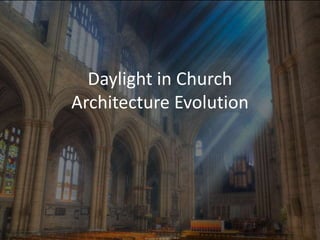
Daylight in Church
Architecture Evolution
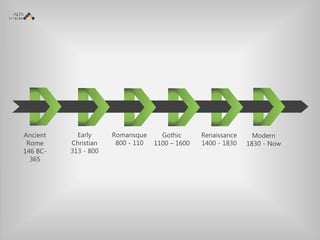
Ancient
Rome
146 BC-
365
Early
Christian
313 - 800
Romansque
800 - 110
Gothic
1100 – 1600
Renaissance
1400 - 1830
Modern
1830 - Now
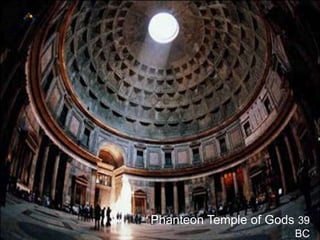
Phanteon Temple of Gods 39
BC
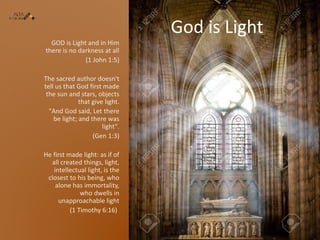
GOD is Light and in Him
there is no darkness at all
(1 John 1:5)
The sacred author doesn't
tell us that God first made
the sun and stars, objects
that give light.
"And God said, Let there
be light; and there was
light".
(Gen 1:3)
He first made light: as if of
all created things, light,
intellectual light, is the
closest to his being, who
alone has immortality,
who dwells in
unapproachable light
(1 Timothy 6:16))
God is Light
God is Light
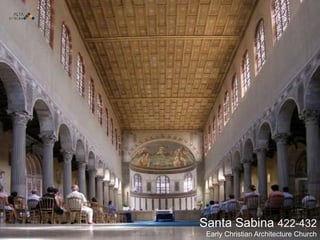
Santa Sabina 422-432
Early Christian Architecture Church
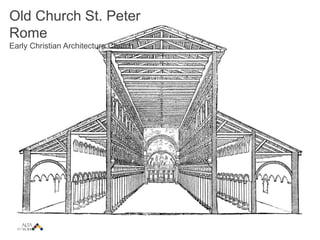
Old Church St. Peter
Rome
Early Christian Architecture Church
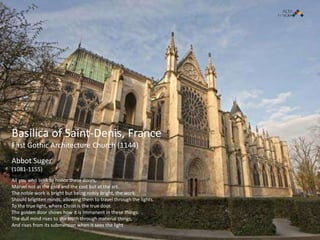
All you who seek to honor these doors,
Marvel not at the gold and the cost but at the art.
The noble work is bright but being nobly bright, the work.
Should brighten minds, allowing them to travel through the lights.
To the true light, where Christ is the true door.
The golden door shows how it is immanent in these things.
The dull mind rises to the truth through material things,
And rises from its submersion when it sees the light
Abbot Suger
(1081-1155)
Basilica of Saint-Denis, France
First Gothic Architecture Church (1144)
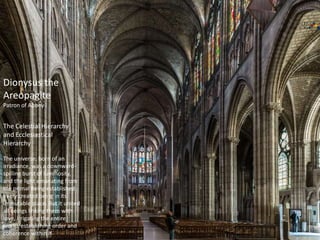
Dionysus the
Areopagite
Patron of Abbey
The Celestial Hierarchy
and Ecclesiastical
Hierarchy
The universe, born of an
irradiance, was a downward-
spilling burst of luminosity,
and the light emanating from
the primal Being established
every created being in its
immutable place. But it united
all beings linking them with
love, irrigating the entire
world, establishing order and
coherence within it.
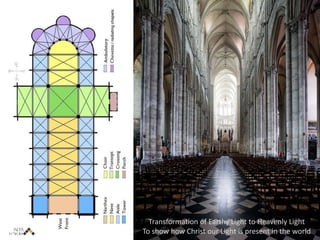
Transformation of Earthy Light to Heavenly Light
To show how Christ our Light is present in the world
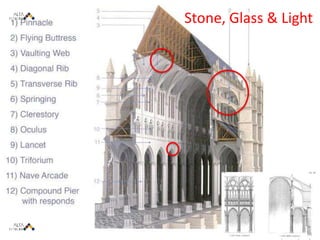
Stone, Glass & Light
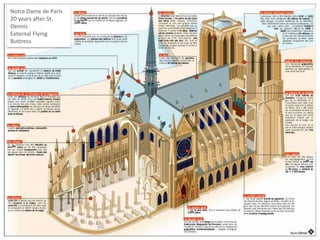
Notre Dame de Paris
20 years after St.
Dennis
External Flying
Buttress
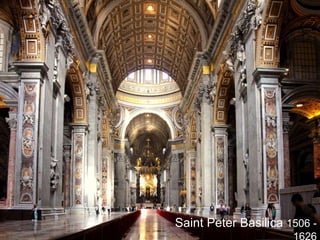
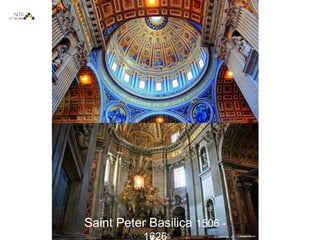
Saint Peter Basilica 1506 -
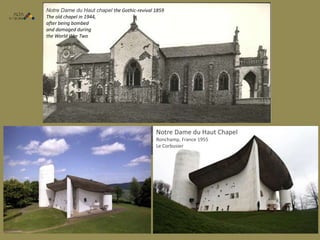
Notre Dame du Haut Chapel
Ronchamp, France 1955
Le Corbusier
Notre Dame du Haut chapel the Gothic-revival 1859
The old chapel in 1944,
after being bombed
and damaged during
the World War Two
.
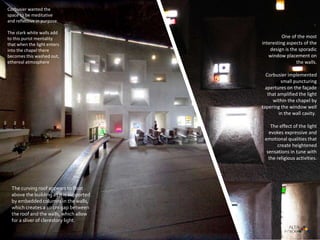
One of the most
interesting aspects of the
design is the sporadic
window placement on
the walls.
Corbusier implemented
small puncturing
apertures on the façade
that amplified the light
within the chapel by
tapering the window well
in the wall cavity.
The effect of the light
evokes expressive and
emotional qualities that
create heightened
sensations in tune with
the religious activities.
The curving roof appears to float
above the building as it is supported
by embedded columns in the walls,
which creates a 10 cm gap between
the roof and the walls, which allow
for a sliver of clerestory light.
Corbusier wanted the
space to be meditative
and reflective in purpose.
The stark white walls add
to this purist mentality
that when the light enters
into the chapel there
becomes this washed out,
ethereal atmosphere
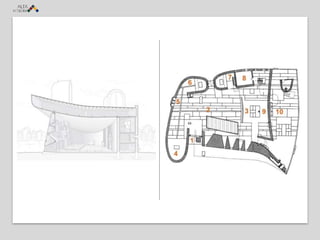
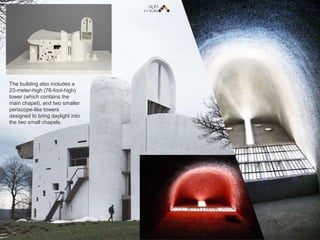
The building also includes a
23-meter-high (76-foot-high)
tower (which contains the
main chapel), and two smaller
periscope-like towers
designed to bring daylight into
the two small chapels.
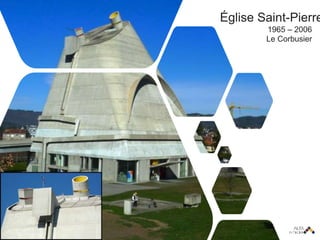
Église Saint-Pierre
1965 – 2006
Le Corbusier
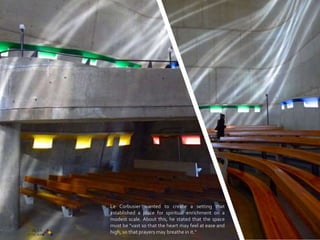
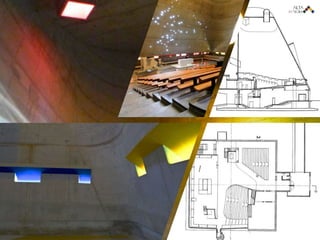
Le Corbusier wanted to create a setting that
established a place for spiritual enrichment on a
modest scale. About this, he stated that the space
must be "vast so that the heart may feel at ease and
high, so that prayers may breathe in it."
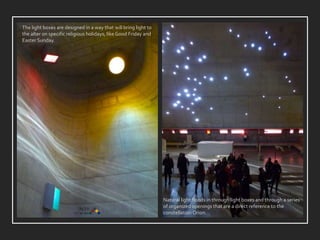
Natural light floods in through light boxes and through a series
of organized openings that are a direct reference to the
constellation Orion.
The light boxes are designed in a way that will bring light to
the alter on specific religious holidays, like Good Friday and
Easter Sunday.
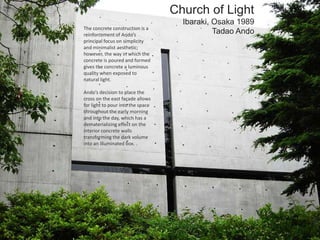
Church of Light
Ibaraki, Osaka 1989
Tadao AndoThe concrete construction is a
reinforcement of Ando’s
principal focus on simplicity
and minimalist aesthetic;
however, the way in which the
concrete is poured and formed
gives the concrete a luminous
quality when exposed to
natural light.
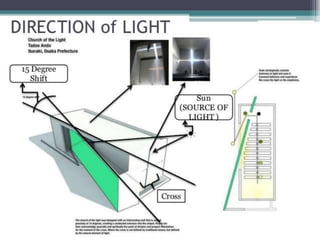
Ando’s decision to place the
cross on the east façade allows
for light to pour into the space
throughout the early morning
and into the day, which has a
dematerializing effect on the
interior concrete walls
transforming the dark volume
into an illuminated box. .
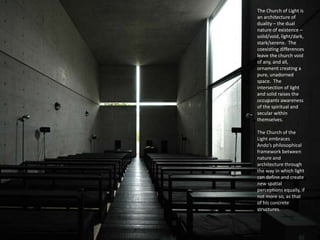
The Church of Light is
an architecture of
duality – the dual
nature of existence –
solid/void, light/dark,
stark/serene. The
coexisting differences
leave the church void
of any, and all,
ornament creating a
pure, unadorned
space. The
intersection of light
and solid raises the
occupants awareness
of the spiritual and
secular within
themselves.
The Church of the
Light embraces
Ando’s philosophical
framework between
nature and
architecture through
the way in which light
can define and create
new spatial
perceptions equally, if
not more so, as that
of his concrete
structures.
Daylight in Church Architecture Evolution

Daylight in Church Architecture Evolution

  • 1.
  • 2.
    Ancient Rome 146 BC- 365 Early Christian 313 -800 Romansque 800 - 110 Gothic 1100 – 1600 Renaissance 1400 - 1830 Modern 1830 - Now
  • 3.
  • 4.
    GOD is Lightand in Him there is no darkness at all (1 John 1:5) The sacred author doesn't tell us that God first made the sun and stars, objects that give light. "And God said, Let there be light; and there was light". (Gen 1:3) He first made light: as if of all created things, light, intellectual light, is the closest to his being, who alone has immortality, who dwells in unapproachable light (1 Timothy 6:16)) God is Light
  • 5.
    God is Light SantaSabina 422-432 Early Christian Architecture Church
  • 6.
    Old Church St.Peter Rome Early Christian Architecture Church
  • 7.
    All you whoseek to honor these doors, Marvel not at the gold and the cost but at the art. The noble work is bright but being nobly bright, the work. Should brighten minds, allowing them to travel through the lights. To the true light, where Christ is the true door. The golden door shows how it is immanent in these things. The dull mind rises to the truth through material things, And rises from its submersion when it sees the light Abbot Suger (1081-1155) Basilica of Saint-Denis, France First Gothic Architecture Church (1144)
  • 8.
    Dionysus the Areopagite Patron ofAbbey The Celestial Hierarchy and Ecclesiastical Hierarchy The universe, born of an irradiance, was a downward- spilling burst of luminosity, and the light emanating from the primal Being established every created being in its immutable place. But it united all beings linking them with love, irrigating the entire world, establishing order and coherence within it.
  • 9.
    Transformation of EarthyLight to Heavenly Light To show how Christ our Light is present in the world
  • 10.
  • 11.
    Notre Dame deParis 20 years after St. Dennis External Flying Buttress
  • 12.
  • 13.
  • 14.
    Notre Dame duHaut Chapel Ronchamp, France 1955 Le Corbusier Notre Dame du Haut chapel the Gothic-revival 1859 The old chapel in 1944, after being bombed and damaged during the World War Two
  • 16.
    . One of themost interesting aspects of the design is the sporadic window placement on the walls. Corbusier implemented small puncturing apertures on the façade that amplified the light within the chapel by tapering the window well in the wall cavity. The effect of the light evokes expressive and emotional qualities that create heightened sensations in tune with the religious activities. The curving roof appears to float above the building as it is supported by embedded columns in the walls, which creates a 10 cm gap between the roof and the walls, which allow for a sliver of clerestory light. Corbusier wanted the space to be meditative and reflective in purpose. The stark white walls add to this purist mentality that when the light enters into the chapel there becomes this washed out, ethereal atmosphere
  • 17.
    The building alsoincludes a 23-meter-high (76-foot-high) tower (which contains the main chapel), and two smaller periscope-like towers designed to bring daylight into the two small chapels.
  • 18.
  • 19.
    Le Corbusier wantedto create a setting that established a place for spiritual enrichment on a modest scale. About this, he stated that the space must be "vast so that the heart may feel at ease and high, so that prayers may breathe in it."
  • 20.
    Natural light floodsin through light boxes and through a series of organized openings that are a direct reference to the constellation Orion. The light boxes are designed in a way that will bring light to the alter on specific religious holidays, like Good Friday and Easter Sunday.
  • 22.
    Church of Light Ibaraki,Osaka 1989 Tadao AndoThe concrete construction is a reinforcement of Ando’s principal focus on simplicity and minimalist aesthetic; however, the way in which the concrete is poured and formed gives the concrete a luminous quality when exposed to natural light. Ando’s decision to place the cross on the east façade allows for light to pour into the space throughout the early morning and into the day, which has a dematerializing effect on the interior concrete walls transforming the dark volume into an illuminated box. .
  • 23.
    The Church ofLight is an architecture of duality – the dual nature of existence – solid/void, light/dark, stark/serene. The coexisting differences leave the church void of any, and all, ornament creating a pure, unadorned space. The intersection of light and solid raises the occupants awareness of the spiritual and secular within themselves. The Church of the Light embraces Ando’s philosophical framework between nature and architecture through the way in which light can define and create new spatial perceptions equally, if not more so, as that of his concrete structures.