Understanding Frequency
Correlation between Music Frequency Range and
Room Acoustic Behaviour Frequency Zone
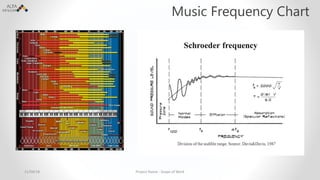
Music Frequency Chart
Project Name - Scope of Work21/09/18
Frequency Identification
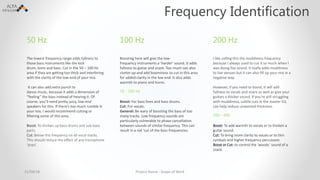
The lowest frequency range adds fullness to
those bass instruments like the kick
drum, toms and bass. Cut in the 50 – 100 Hz
area if they are getting too thick and interfering
with the clarity of the low-end of your mix.
It can also add extra punch to
dance music, because it adds a dimension of
“feeling” the bass instead of hearing it. Of
course, you’ll need pretty juicy, low-end
speakers for this. If there’s too much rumble in
your mix, I would recommend cutting or
filtering some of this area.
Boost: To thicken up bass drums and sub-bass
parts.
Cut: Below this frequency on all vocal tracks.
This should reduce the effect of any microphone
‘pops’.
Boosting here will give the low-
frequency instruments a ‘harder’ sound. It adds
fullness to guitar and snare. Too much can also
clutter up and add boominess so cut in this area
for added clarity in the low end. It also adds
warmth to piano and horns.
70 - 100 Hz
Boost: For bass lines and bass drums.
Cut: For vocals.
General: Be wary of boosting the bass of too
many tracks. Low frequency sounds are
particularly vulnerable to phase cancellation
between sounds of similar frequency. This can
result in a net ‘cut of the bass frequencies.
I like calling this the muddiness frequency
because I always used to cut it so much when I
was doing live sound. It really adds muddiness
to live venues but it can also fill up your mix in a
negative way.
However, if you need to boost, it will add
fullness to vocals and snare as well as give your
guitars a thicker sound. If you’re still struggling
with muddiness, subtle cuts in the master EQ
can help reduce unwanted thickness.
200 - 400
Boost: To add warmth to vocals or to thicken a
guitar sound.
Cut: To bring more clarity to vocals or to thin
cymbals and higher frequency percussion.
Boost or Cut: to control the ‘woody’ sound of a
snare.
50 Hz 100 Hz 200 Hz
Project Name - Scope of Work21/09/18
Frequency Identification
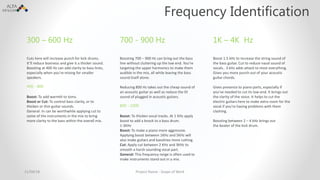
Cuts here will increase punch for kick drums.
It’ll reduce boxiness and give it a thicker sound.
Boosting at 400 Hz can add clarity to bass lines,
especially when you’re mixing for smaller
speakers.
400 - 800
Boost: To add warmth to toms.
Boost or Cut: To control bass clarity, or to
thicken or thin guitar sounds.
General: In can be worthwhile applying cut to
some of the instruments in the mix to bring
more clarity to the bass within the overall mix.
Boosting 700 – 900 Hz can bring out the bass
line without cluttering up the low end. You’re
targeting the upper harmonics to make them
audible in the mix, all while leaving the bass
sound itself alone.
Reducing 800 Hz takes out the cheap sound of
an acoustic guitar as well as reduce the DI
sound of plugged in acoustic guitars.
800 - 1000
Boost: To thicken vocal tracks. At 1 KHz apply
boost to add a knock to a bass drum.
1-3KHz
Boost: To make a piano more aggressive.
Applying boost between 1KHz and 5KHz will
also make guitars and basslines more cutting.
Cut: Apply cut between 2 KHz and 3KHz to
smooth a harsh sounding vocal part.
General: This frequency range is often used to
make instruments stand out in a mix.
Boost 1.5 kHz to increase the string sound of
the bass guitar. Cut to reduce nasal sound of
vocals.. 3 kHz adds attack to most everything.
Gives you more punch out of your acoustic
guitar chords.
Gives presence to piano parts, especially if
you’ve needed to cut its low-end. It brings out
the clarity of the voice. It helps to cut the
electric guitars here to make extra room for the
vocal if you’re having problems with them
clashing.
Boosting between 2 – 4 kHz brings out
the beater of the kick drum.
300 – 600 Hz 700 - 900 Hz 1K – 4K Hz
Project Name - Scope of Work21/09/18
Frequency Identification
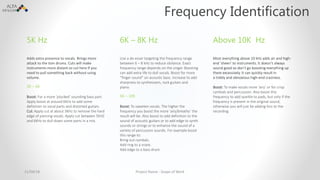
Adds extra presence to vocals. Brings more
attack to the tom drums. Cuts will make
instruments more distant so cut here if you
need to pull something back without using
volume.
3K – 6K
Boost: For a more ‘plucked’ sounding bass part.
Apply boost at around 6KHz to add some
definition to vocal parts and distorted guitars.
Cut: Apply cut at about 3KHz to remove the hard
edge of piercing vocals. Apply cut between 5KHZ
and 6KHz to dull down some parts in a mix.
Use a de-esser targeting the frequency range
between 6 – 8 kHz to reduce sibilance. Exact
frequency range depends on the singer. Boosting
can add extra life to dull vocals. Boost for more
“finger sound” on acoustic bass. Increase to add
sharpness to synthesizers, rock guitars and
piano.
6K – 10K
Boost: To sweeten vocals. The higher the
frequency you boost the more ‘airy/breathy’ the
result will be. Also boost to add definition to the
sound of acoustic guitars or to add edge to synth
sounds or strings or to enhance the sound of a
variety of percussion sounds. For example boost
this range to:
Bring out cymbals.
Add ring to a snare.
Add edge to a bass drum.
Most everything above 10 kHz adds air and high-
end ‘sheen’ to instruments. It doesn’t always
sound good so don’t go boosting everything up
there excessively. It can quickly result in
a trebly and obnoxious high-end craziness.
Boost: To make vocals more ‘airy’ or for crisp
cymbals and percussion. Also boost this
frequency to add sparkle to pads, but only if the
frequency is present in the original sound,
otherwise you will just be adding hiss to the
recording.
5K Hz 6K – 8K Hz Above 10K Hz
Project Name - Scope of Work21/09/18

Understanding frequency for Audio Lover

  • 1.
    Understanding Frequency Correlation betweenMusic Frequency Range and Room Acoustic Behaviour Frequency Zone
  • 2.
    Music Frequency Chart ProjectName - Scope of Work21/09/18
  • 3.
    Frequency Identification The lowestfrequency range adds fullness to those bass instruments like the kick drum, toms and bass. Cut in the 50 – 100 Hz area if they are getting too thick and interfering with the clarity of the low-end of your mix. It can also add extra punch to dance music, because it adds a dimension of “feeling” the bass instead of hearing it. Of course, you’ll need pretty juicy, low-end speakers for this. If there’s too much rumble in your mix, I would recommend cutting or filtering some of this area. Boost: To thicken up bass drums and sub-bass parts. Cut: Below this frequency on all vocal tracks. This should reduce the effect of any microphone ‘pops’. Boosting here will give the low- frequency instruments a ‘harder’ sound. It adds fullness to guitar and snare. Too much can also clutter up and add boominess so cut in this area for added clarity in the low end. It also adds warmth to piano and horns. 70 - 100 Hz Boost: For bass lines and bass drums. Cut: For vocals. General: Be wary of boosting the bass of too many tracks. Low frequency sounds are particularly vulnerable to phase cancellation between sounds of similar frequency. This can result in a net ‘cut of the bass frequencies. I like calling this the muddiness frequency because I always used to cut it so much when I was doing live sound. It really adds muddiness to live venues but it can also fill up your mix in a negative way. However, if you need to boost, it will add fullness to vocals and snare as well as give your guitars a thicker sound. If you’re still struggling with muddiness, subtle cuts in the master EQ can help reduce unwanted thickness. 200 - 400 Boost: To add warmth to vocals or to thicken a guitar sound. Cut: To bring more clarity to vocals or to thin cymbals and higher frequency percussion. Boost or Cut: to control the ‘woody’ sound of a snare. 50 Hz 100 Hz 200 Hz Project Name - Scope of Work21/09/18
  • 4.
    Frequency Identification Cuts herewill increase punch for kick drums. It’ll reduce boxiness and give it a thicker sound. Boosting at 400 Hz can add clarity to bass lines, especially when you’re mixing for smaller speakers. 400 - 800 Boost: To add warmth to toms. Boost or Cut: To control bass clarity, or to thicken or thin guitar sounds. General: In can be worthwhile applying cut to some of the instruments in the mix to bring more clarity to the bass within the overall mix. Boosting 700 – 900 Hz can bring out the bass line without cluttering up the low end. You’re targeting the upper harmonics to make them audible in the mix, all while leaving the bass sound itself alone. Reducing 800 Hz takes out the cheap sound of an acoustic guitar as well as reduce the DI sound of plugged in acoustic guitars. 800 - 1000 Boost: To thicken vocal tracks. At 1 KHz apply boost to add a knock to a bass drum. 1-3KHz Boost: To make a piano more aggressive. Applying boost between 1KHz and 5KHz will also make guitars and basslines more cutting. Cut: Apply cut between 2 KHz and 3KHz to smooth a harsh sounding vocal part. General: This frequency range is often used to make instruments stand out in a mix. Boost 1.5 kHz to increase the string sound of the bass guitar. Cut to reduce nasal sound of vocals.. 3 kHz adds attack to most everything. Gives you more punch out of your acoustic guitar chords. Gives presence to piano parts, especially if you’ve needed to cut its low-end. It brings out the clarity of the voice. It helps to cut the electric guitars here to make extra room for the vocal if you’re having problems with them clashing. Boosting between 2 – 4 kHz brings out the beater of the kick drum. 300 – 600 Hz 700 - 900 Hz 1K – 4K Hz Project Name - Scope of Work21/09/18
  • 5.
    Frequency Identification Adds extrapresence to vocals. Brings more attack to the tom drums. Cuts will make instruments more distant so cut here if you need to pull something back without using volume. 3K – 6K Boost: For a more ‘plucked’ sounding bass part. Apply boost at around 6KHz to add some definition to vocal parts and distorted guitars. Cut: Apply cut at about 3KHz to remove the hard edge of piercing vocals. Apply cut between 5KHZ and 6KHz to dull down some parts in a mix. Use a de-esser targeting the frequency range between 6 – 8 kHz to reduce sibilance. Exact frequency range depends on the singer. Boosting can add extra life to dull vocals. Boost for more “finger sound” on acoustic bass. Increase to add sharpness to synthesizers, rock guitars and piano. 6K – 10K Boost: To sweeten vocals. The higher the frequency you boost the more ‘airy/breathy’ the result will be. Also boost to add definition to the sound of acoustic guitars or to add edge to synth sounds or strings or to enhance the sound of a variety of percussion sounds. For example boost this range to: Bring out cymbals. Add ring to a snare. Add edge to a bass drum. Most everything above 10 kHz adds air and high- end ‘sheen’ to instruments. It doesn’t always sound good so don’t go boosting everything up there excessively. It can quickly result in a trebly and obnoxious high-end craziness. Boost: To make vocals more ‘airy’ or for crisp cymbals and percussion. Also boost this frequency to add sparkle to pads, but only if the frequency is present in the original sound, otherwise you will just be adding hiss to the recording. 5K Hz 6K – 8K Hz Above 10K Hz Project Name - Scope of Work21/09/18