


CONTINUE PART 2 : USING REMOTE
APIS
2- GUZZLE
WHAT IS GUZZLE ?
Guzzle is a PHP HTTP client that makes it easy to
send HTTP requests and trivial to integrate with
web services.
Secondly, Guzzle provides a very clean API to work
with. Documentation is very important when
working with a library.Guzzle has done a very good
job by providing a comprehensive documentation
INSTALLING GUZZLE USING COMPOSER
Wait a minute what is composer ????
OVERVIEW OF COMPOSER
● It's a dependancy manager tool it is used
everywhere in the PHP World. All large
and well-known website components in
other ward it will help you do the
following :
● 1- Install 3rd party php tools and
framewords
● 2- Update version of the tools you use
● 3- Auto load your own code (so in the
future you will only use composer‘s
autoloader!!! Cool ?
●
● Composer has two separate elements :
✔ The first is Composer itself which is a
command line tool for grabbing and installing
what you want to install.
✔ The second is Packagist - the main composer
repository. This is where the packages you
may want to use are stored.
✔ Every thing Composer installs does that in a
directory names vendor which shouldn‘t has
any of your code
WORKING WITH COMPOSER
 Working with composer will has only 3 task types :
 1- Define what you want to install (frame work or tool) in json format file
 2- Define where your classes files and configuration file or in the future name
spaces which you want to load in json file
 3- Some command files to make composer run the settings you define
 4- Require the autoloader of composer in your code
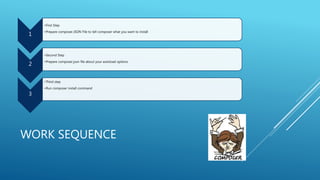
WORK SEQUENCE
1
•First Step
•Prepare composer.JSON File to tell composer what you want to install
2
•Second Step
•Prepare composer.json file about your autoload options
3
•Third step
•Run composer install command
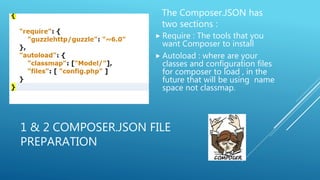
1 & 2 COMPOSER.JSON FILE
PREPARATION
The Composer.JSON has
two sections :
 Require : The tools that you
want Composer to install
 Autoload : where are your
classes and configuration files
for composer to load , in the
future that will be using name
space not classmap.
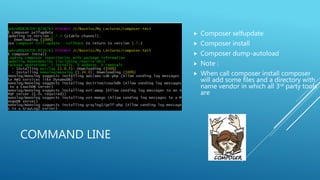
COMMAND LINE
 Composer selfupdate
 Composer install
 Composer dump-autoload
 Note :
 When call composer install composer
will add some files and a directory with
name vendor in which all 3rd party tools
are
Composer dump-autoload
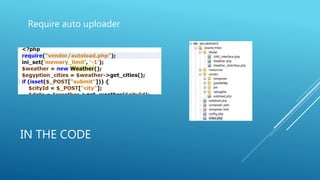
IN THE CODE
Require auto uploader
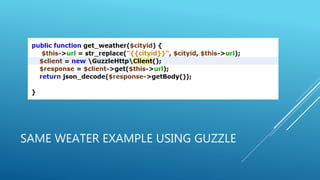
SAME WEATER EXAMPLE USING GUZZLE
USING GUZZLE YOU CAN DO ASYNC AND
CONCURRENT REQUESTS
<<ADVANCED BEGIN>>
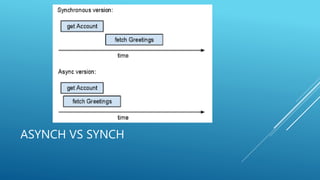
ASYNCH VS SYNCH
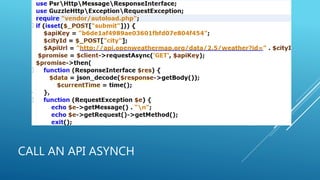
CALL AN API ASYNCH
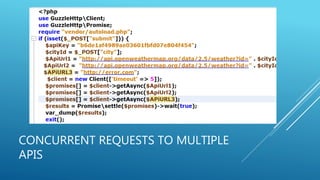
CONCURRENT REQUESTS TO MULTIPLE
APIS
USING GUZZLE YOU CAN DO ASYNC AND
CONCURRENT REQUESTS FINISHED
<<ADVANCED FINISHED>>
PART 3 : REST APIS
REST has become the default for most Web and
mobile apps, 70% of public API are RESTFUL
CONCEPTS >> BIG PICTURE >> CODE
CODE IS SO EASY   BUT UNDERSTAND
THE BEST PRACTICES TO HELP CLIENTS (I.E
MOBILE DEVELOPERS , FRONT END)
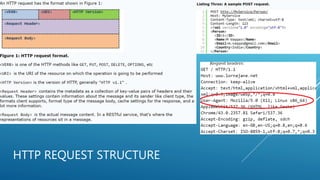
HTTP REQUEST STRUCTURE
FAKING THE USER AGENT VIA PHP
REMEMBER :
$_SERVER[“HTTP_USER_AGENT”]
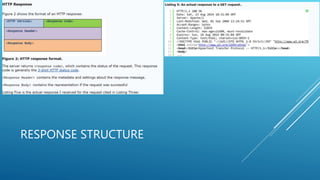
RESPONSE STRUCTURE
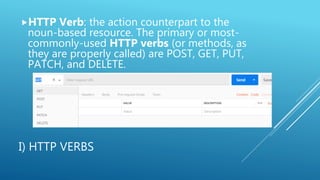
I) HTTP VERBS
HTTP Verb: the action counterpart to the
noun-based resource. The primary or most-
commonly-used HTTP verbs (or methods, as
they are properly called) are POST, GET, PUT,
PATCH, and DELETE.
GET /addresses.php?id=1
Retrieve the address which number is 1
POST : causes changes in the server
(most cases in create, so it shouldn’t be
repeated, it has a body $_POST
POST /addresses.php
Create new address with the data stored
in the post body
Are there other HTTP verbs ???
 PUT : The PUT method replaces all current representations of the target resource with the
request payload..
 Access PUT using PHP
 $_PUT= json_decode(file_get_contents("php://input"),true);
Delete /addresses.php?id=1
update the address which number is 1 with current payload
 $_SERVER[“REQUEST_METHOD”] : gives which verb was used GET OR POST,
Delete
 Delete : Request that a resource be removed; however, the resource
does not have to be removed immediately. It could be an
asynchronous or long-running request.
Delete /addresses.php?id=1
delete the address which number is 1
 $_SERVER[“REQUEST_METHOD”] : gives which verb was
used GET OR POST, Delete
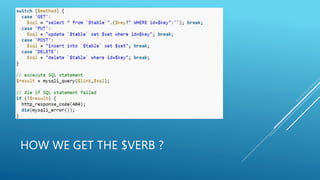
HOW WE GET THE $VERB ?
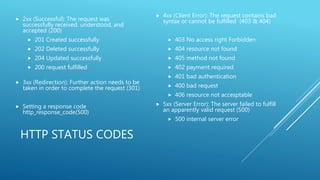
HTTP STATUS CODES
 2xx (Successful): The request was
successfully received, understood, and
accepted (200)
 201 Created successfully
 202 Deleted successfully
 204 Updated successfully
 200 request fulfilled
 3xx (Redirection): Further action needs to be
taken in order to complete the request (301)
 Setting a response code
http_response_code(500)
 4xx (Client Error): The request contains bad
syntax or cannot be fulfilled (403 & 404)
 403 No access right Forbidden
 404 resource not found
 405 method not found
 402 payment required
 401 bad authentication
 400 bad request
 406 resource not accesptable
 5xx (Server Error): The server failed to fulfill
an apparently valid request (500)
 500 internal server error
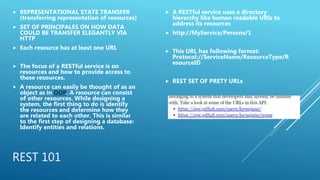
REST 101
 REPRESENTATIONAL STATE TRANSFER
(transferring representation of resources)
 SET OF PRINCIPALES ON HOW DATA
COULD BE TRANSFER ELEGANTLY VIA
HTTP
 Each resource has at least one URL
 The focus of a RESTful service is on
resources and how to provide access to
these resources.
 A resource can easily be thought of as an
object as in OOP. A resource can consist
of other resources. While designing a
system, the first thing to do is identify
the resources and determine how they
are related to each other. This is similar
to the first step of designing a database:
Identify entities and relations.
 A RESTful service uses a directory
hierarchy like human readable URIs to
address its resources
 http://MyService/Persons/1
 This URL has following format:
Protocol://ServiceName/ResourceType/R
esourceID
 REST SET OF PRETY URLs
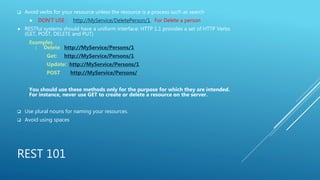
REST 101
 Avoid verbs for your resource unless the resource is a process such as search
 DON’T USE : http://MyService/DeletePerson/1. For Delete a person
 RESTful systems should have a uniform interface. HTTP 1.1 provides a set of HTTP Verbs
(GET, POST, DELETE and PUT)
Examples
: Delete http://MyService/Persons/1
Get: http://MyService/Persons/1
Update: http://MyService/Persons/1
POST http://MyService/Persons/
You should use these methods only for the purpose for which they are intended.
For instance, never use GET to create or delete a resource on the server.
 Use plural nouns for naming your resources.
 Avoid using spaces
http://MyService/Persons?id=1
OR http://MyService/Persons/1
The query parameter approach works just fine and REST does not stop you from using
query parameters. However, this approach has a few disadvantages.
Increased complexity and reduced readability, which will increase if you have more
parameters
Use http://localhost/rest01.php/items/10
Not http://localhost/rest01.php?Resources=items&&id=10
$url_piecies = explode("/",$_SERVER["REQUEST_URI"]);
$resource = (isset($url_piecies[2]))? $url_piecies[2] : "" ;
$resource_id =(isset($url_piecies[3]) && is_numeric($url_piecies[3]) ) ?$url_piecies[3] : 0;
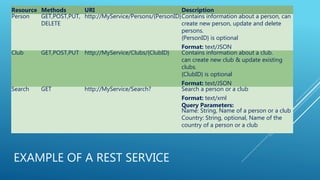
EXAMPLE OF A REST SERVICE
Resource Methods URI Description
Person GET,POST,PUT,
DELETE
http://MyService/Persons/{PersonID}Contains information about a person, can
create new person, update and delete
persons.
{PersonID} is optional
Format: text/JSON
Club GET,POST,PUT http://MyService/Clubs/{ClubID} Contains information about a club.
can create new club & update existing
clubs.
{ClubID} is optional
Format: text/JSON
Search GET http://MyService/Search? Search a person or a club
Format: text/xml
Query Parameters:
Name: String, Name of a person or a club
Country: String, optional, Name of the
country of a person or a club
REST SERVICE STEPS
 Receiving the request & identifying it’s parameters ( VERB, RESOURCE, RESOURCE ID,
PARAMETERS)
 Logging the request (why?)
 Validating the request
 If not valid request , send appropriate code and message
 If valid request , start dispatching (initialize data access and business logic objects which will
handle the request)
 Prepare the response based on the verb (Handler for GET, POST, PUT and DELETE)
 If you have a valid response send it with appropriate response after logging it, why?
 If you don’t have a valid response response is not of valid, send response code and error after
logging it
 Try drawing a flow chart for it
FINALLY CODE
CREARTING A RESTFUL API USING PHP
REMEMBER BEFORE SEE THE WHOLE
THING THAT
$method = $_SERVER['REQUEST_METHOD’];
Use http://localhost/rest01.php/items/10
Not http://localhost/rest01.php?Resources=items&&id=10
$url_piecies = explode("/",$_SERVER["REQUEST_URI"]);
$resource = (isset($url_piecies[2]))? $url_piecies[2] : "" ;
$resource_id =(isset($url_piecies[3]) && is_numeric($url_piecies[3]) ) ?$url_piecies[3] : 0;
header (“Content-Type: application/json”);
$input = json_decode(file_get_contents('php://input'),true);
http_response_code(404)
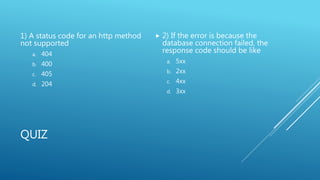
QUIZ
1) A status code for an http method
not supported
a. 404
b. 400
c. 405
d. 204
 2) If the error is because the
database connection failed, the
response code should be like
a. 5xx
b. 2xx
c. 4xx
d. 3xx
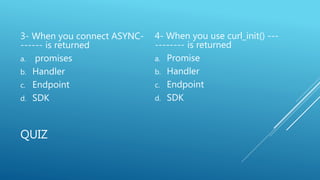
QUIZ
3- When you connect ASYNC-
------ is returned
a. promises
b. Handler
c. Endpoint
d. SDK
4- When you use curl_init() ---
-------- is returned
a. Promise
b. Handler
c. Endpoint
d. SDK
 5- Using Guzzle you can
a. Connect to multiple webservices
concurrently
b. Connect to a webservice
Asynchrounsoly
c. Send GET, POST or any other
HTTP requests
d. All the above
6- if parameter validation failes
because the user sends wrong email
address formats then appropriate
response code is
A. 403
B. 404
C. 400
D. 401
7) HTTP Method that is Read
Only
 GET
 GET & DELETE
 PUT
 POST
8) HTTP Method that if
repeated can create many
new resources
 PUT
 POST
 GET
 DELETE
9) REST has
a. Representational URLS
b. A single endpoint
c. Only JSON formats for communications
d. HTTP and other protocols such as SMTP
10) Attributes of a RESTFUL Request includes all
these except
a. Requested Resource
b. Request Method
c. Status code
d. Request Header
e. Resource ID
f. Parameters
g. Body
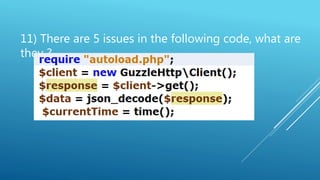
11) There are 5 issues in the following code, what are
they ?
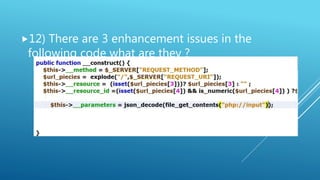
12) There are 3 enhancement issues in the
following code what are they ?
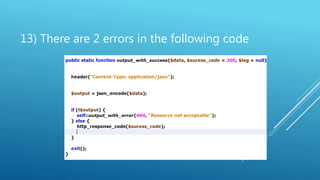
13) There are 2 errors in the following code
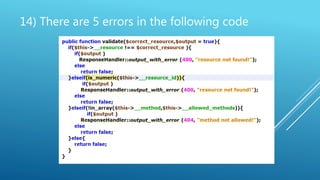
14) There are 5 errors in the following code
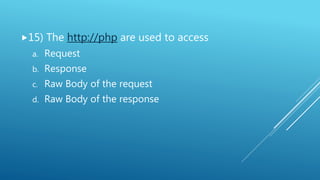
15) The http://php are used to access
a. Request
b. Response
c. Raw Body of the request
d. Raw Body of the response

Day02 a pi.

  • 1.
    CONTINUE PART 2: USING REMOTE APIS
  • 2.
  • 3.
    WHAT IS GUZZLE? Guzzle is a PHP HTTP client that makes it easy to send HTTP requests and trivial to integrate with web services. Secondly, Guzzle provides a very clean API to work with. Documentation is very important when working with a library.Guzzle has done a very good job by providing a comprehensive documentation
  • 4.
    INSTALLING GUZZLE USINGCOMPOSER Wait a minute what is composer ????
  • 5.
    OVERVIEW OF COMPOSER ●It's a dependancy manager tool it is used everywhere in the PHP World. All large and well-known website components in other ward it will help you do the following : ● 1- Install 3rd party php tools and framewords ● 2- Update version of the tools you use ● 3- Auto load your own code (so in the future you will only use composer‘s autoloader!!! Cool ? ● ● Composer has two separate elements : ✔ The first is Composer itself which is a command line tool for grabbing and installing what you want to install. ✔ The second is Packagist - the main composer repository. This is where the packages you may want to use are stored. ✔ Every thing Composer installs does that in a directory names vendor which shouldn‘t has any of your code
  • 6.
    WORKING WITH COMPOSER Working with composer will has only 3 task types :  1- Define what you want to install (frame work or tool) in json format file  2- Define where your classes files and configuration file or in the future name spaces which you want to load in json file  3- Some command files to make composer run the settings you define  4- Require the autoloader of composer in your code
  • 7.
    WORK SEQUENCE 1 •First Step •Preparecomposer.JSON File to tell composer what you want to install 2 •Second Step •Prepare composer.json file about your autoload options 3 •Third step •Run composer install command
  • 8.
    1 & 2COMPOSER.JSON FILE PREPARATION The Composer.JSON has two sections :  Require : The tools that you want Composer to install  Autoload : where are your classes and configuration files for composer to load , in the future that will be using name space not classmap.
  • 9.
    COMMAND LINE  Composerselfupdate  Composer install  Composer dump-autoload  Note :  When call composer install composer will add some files and a directory with name vendor in which all 3rd party tools are
  • 10.
  • 11.
    IN THE CODE Requireauto uploader
  • 12.
    SAME WEATER EXAMPLEUSING GUZZLE
  • 13.
    USING GUZZLE YOUCAN DO ASYNC AND CONCURRENT REQUESTS <<ADVANCED BEGIN>>
  • 14.
  • 15.
  • 16.
  • 17.
    USING GUZZLE YOUCAN DO ASYNC AND CONCURRENT REQUESTS FINISHED <<ADVANCED FINISHED>>
  • 18.
    PART 3 :REST APIS REST has become the default for most Web and mobile apps, 70% of public API are RESTFUL
  • 19.
    CONCEPTS >> BIGPICTURE >> CODE CODE IS SO EASY   BUT UNDERSTAND THE BEST PRACTICES TO HELP CLIENTS (I.E MOBILE DEVELOPERS , FRONT END)
  • 20.
  • 21.
    FAKING THE USERAGENT VIA PHP REMEMBER : $_SERVER[“HTTP_USER_AGENT”]
  • 22.
  • 23.
    I) HTTP VERBS HTTPVerb: the action counterpart to the noun-based resource. The primary or most- commonly-used HTTP verbs (or methods, as they are properly called) are POST, GET, PUT, PATCH, and DELETE.
  • 24.
    GET /addresses.php?id=1 Retrieve theaddress which number is 1 POST : causes changes in the server (most cases in create, so it shouldn’t be repeated, it has a body $_POST POST /addresses.php Create new address with the data stored in the post body Are there other HTTP verbs ???
  • 25.
     PUT :The PUT method replaces all current representations of the target resource with the request payload..  Access PUT using PHP  $_PUT= json_decode(file_get_contents("php://input"),true); Delete /addresses.php?id=1 update the address which number is 1 with current payload  $_SERVER[“REQUEST_METHOD”] : gives which verb was used GET OR POST, Delete
  • 26.
     Delete :Request that a resource be removed; however, the resource does not have to be removed immediately. It could be an asynchronous or long-running request. Delete /addresses.php?id=1 delete the address which number is 1  $_SERVER[“REQUEST_METHOD”] : gives which verb was used GET OR POST, Delete
  • 27.
    HOW WE GETTHE $VERB ?
  • 28.
    HTTP STATUS CODES 2xx (Successful): The request was successfully received, understood, and accepted (200)  201 Created successfully  202 Deleted successfully  204 Updated successfully  200 request fulfilled  3xx (Redirection): Further action needs to be taken in order to complete the request (301)  Setting a response code http_response_code(500)  4xx (Client Error): The request contains bad syntax or cannot be fulfilled (403 & 404)  403 No access right Forbidden  404 resource not found  405 method not found  402 payment required  401 bad authentication  400 bad request  406 resource not accesptable  5xx (Server Error): The server failed to fulfill an apparently valid request (500)  500 internal server error
  • 29.
    REST 101  REPRESENTATIONALSTATE TRANSFER (transferring representation of resources)  SET OF PRINCIPALES ON HOW DATA COULD BE TRANSFER ELEGANTLY VIA HTTP  Each resource has at least one URL  The focus of a RESTful service is on resources and how to provide access to these resources.  A resource can easily be thought of as an object as in OOP. A resource can consist of other resources. While designing a system, the first thing to do is identify the resources and determine how they are related to each other. This is similar to the first step of designing a database: Identify entities and relations.  A RESTful service uses a directory hierarchy like human readable URIs to address its resources  http://MyService/Persons/1  This URL has following format: Protocol://ServiceName/ResourceType/R esourceID  REST SET OF PRETY URLs
  • 30.
    REST 101  Avoidverbs for your resource unless the resource is a process such as search  DON’T USE : http://MyService/DeletePerson/1. For Delete a person  RESTful systems should have a uniform interface. HTTP 1.1 provides a set of HTTP Verbs (GET, POST, DELETE and PUT) Examples : Delete http://MyService/Persons/1 Get: http://MyService/Persons/1 Update: http://MyService/Persons/1 POST http://MyService/Persons/ You should use these methods only for the purpose for which they are intended. For instance, never use GET to create or delete a resource on the server.  Use plural nouns for naming your resources.  Avoid using spaces
  • 31.
    http://MyService/Persons?id=1 OR http://MyService/Persons/1 The queryparameter approach works just fine and REST does not stop you from using query parameters. However, this approach has a few disadvantages. Increased complexity and reduced readability, which will increase if you have more parameters Use http://localhost/rest01.php/items/10 Not http://localhost/rest01.php?Resources=items&&id=10 $url_piecies = explode("/",$_SERVER["REQUEST_URI"]); $resource = (isset($url_piecies[2]))? $url_piecies[2] : "" ; $resource_id =(isset($url_piecies[3]) && is_numeric($url_piecies[3]) ) ?$url_piecies[3] : 0;
  • 32.
    EXAMPLE OF AREST SERVICE Resource Methods URI Description Person GET,POST,PUT, DELETE http://MyService/Persons/{PersonID}Contains information about a person, can create new person, update and delete persons. {PersonID} is optional Format: text/JSON Club GET,POST,PUT http://MyService/Clubs/{ClubID} Contains information about a club. can create new club & update existing clubs. {ClubID} is optional Format: text/JSON Search GET http://MyService/Search? Search a person or a club Format: text/xml Query Parameters: Name: String, Name of a person or a club Country: String, optional, Name of the country of a person or a club
  • 33.
    REST SERVICE STEPS Receiving the request & identifying it’s parameters ( VERB, RESOURCE, RESOURCE ID, PARAMETERS)  Logging the request (why?)  Validating the request  If not valid request , send appropriate code and message  If valid request , start dispatching (initialize data access and business logic objects which will handle the request)  Prepare the response based on the verb (Handler for GET, POST, PUT and DELETE)  If you have a valid response send it with appropriate response after logging it, why?  If you don’t have a valid response response is not of valid, send response code and error after logging it  Try drawing a flow chart for it
  • 34.
    FINALLY CODE CREARTING ARESTFUL API USING PHP
  • 35.
    REMEMBER BEFORE SEETHE WHOLE THING THAT $method = $_SERVER['REQUEST_METHOD’]; Use http://localhost/rest01.php/items/10 Not http://localhost/rest01.php?Resources=items&&id=10 $url_piecies = explode("/",$_SERVER["REQUEST_URI"]); $resource = (isset($url_piecies[2]))? $url_piecies[2] : "" ; $resource_id =(isset($url_piecies[3]) && is_numeric($url_piecies[3]) ) ?$url_piecies[3] : 0; header (“Content-Type: application/json”); $input = json_decode(file_get_contents('php://input'),true); http_response_code(404)
  • 36.
    QUIZ 1) A statuscode for an http method not supported a. 404 b. 400 c. 405 d. 204  2) If the error is because the database connection failed, the response code should be like a. 5xx b. 2xx c. 4xx d. 3xx
  • 37.
    QUIZ 3- When youconnect ASYNC- ------ is returned a. promises b. Handler c. Endpoint d. SDK 4- When you use curl_init() --- -------- is returned a. Promise b. Handler c. Endpoint d. SDK
  • 38.
     5- UsingGuzzle you can a. Connect to multiple webservices concurrently b. Connect to a webservice Asynchrounsoly c. Send GET, POST or any other HTTP requests d. All the above 6- if parameter validation failes because the user sends wrong email address formats then appropriate response code is A. 403 B. 404 C. 400 D. 401
  • 39.
    7) HTTP Methodthat is Read Only  GET  GET & DELETE  PUT  POST 8) HTTP Method that if repeated can create many new resources  PUT  POST  GET  DELETE
  • 40.
    9) REST has a.Representational URLS b. A single endpoint c. Only JSON formats for communications d. HTTP and other protocols such as SMTP 10) Attributes of a RESTFUL Request includes all these except a. Requested Resource b. Request Method c. Status code d. Request Header e. Resource ID f. Parameters g. Body
  • 41.
    11) There are5 issues in the following code, what are they ?
  • 42.
    12) There are3 enhancement issues in the following code what are they ?
  • 43.
    13) There are2 errors in the following code
  • 44.
    14) There are5 errors in the following code
  • 45.
    15) The http://phpare used to access a. Request b. Response c. Raw Body of the request d. Raw Body of the response