Commanding a More
Meaningful REST API
Brandon Mueller
@fatmuemoo
fatmuemoo.com
Panhandle Web Tech
http://www.meetup.com/Panhandle-Web-Tech/
6:30 on the Third Tuesday of the Month
@ Firebrand Media
229 East Martin St, Suite 5
Martinsburg, WV 25401
What is covered
● API Basics
● API Good Practices
● CRUD API Examples
● Commanding API Explained
● Commanding API Examples
● CRUD and Commanding Coexistence
What is NOT covered
● Security or Authentication
● HAL or HATEOAS
● CQRS* or DDD*
● Nitty-Gritty Implementation Details
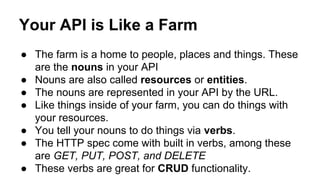
● The farm is a home to people, places and things. These
are the nouns in your API
● Nouns are also called resources or entities.
● The nouns are represented in your API by the URL.
● Like things inside of your farm, you can do things with
your resources.
● You tell your nouns to do things via verbs.
● The HTTP spec come with built in verbs, among these
are GET, PUT, POST, and DELETE
● These verbs are great for CRUD functionality.
Your API is Like a Farm
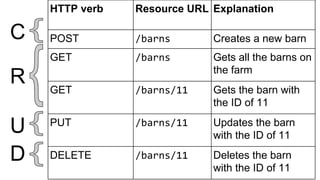
HTTP verb Resource URL Explanation
POST /barns Creates a new barn
GET /barns Gets all the barns on
the farm
GET /barns/11 Gets the barn with
the ID of 11
PUT /barns/11 Updates the barn
with the ID of 11
DELETE /barns/11 Deletes the barn
with the ID of 11
C
R
U
D
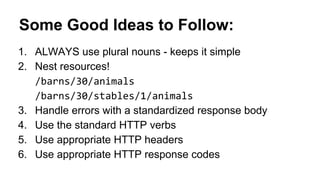
Some Good Ideas to Follow:
1. ALWAYS use plural nouns - keeps it simple
2. Nest resources!
/barns/30/animals
/barns/30/stables/1/animals
3. Handle errors with a standardized response body
4. Use the standard HTTP verbs
5. Use appropriate HTTP headers
6. Use appropriate HTTP response codes
Read The Spec
Status Codes: http://www.w3.org/Protocols/rfc2616/rfc2616-sec10.html
Headers: http://www.w3.org/Protocols/rfc2616/rfc2616-sec14.html
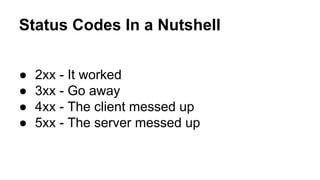
Status Codes In a Nutshell
● 2xx - It worked
● 3xx - Go away
● 4xx - The client messed up
● 5xx - The server messed up
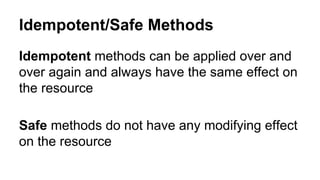
Idempotent/Safe Methods
Idempotent methods can be applied over and
over again and always have the same effect on
the resource
Safe methods do not have any modifying effect
on the resource
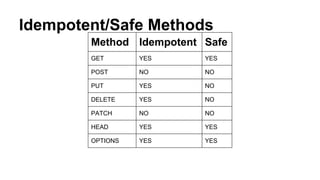
Idempotent/Safe Methods
Method Idempotent Safe
GET YES YES
POST NO NO
PUT YES NO
DELETE YES NO
PATCH NO NO
HEAD YES YES
OPTIONS YES YES
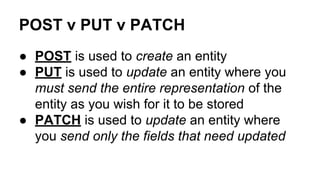
POST v PUT v PATCH
● POST is used to create an entity
● PUT is used to update an entity where you
must send the entire representation of the
entity as you wish for it to be stored
● PATCH is used to update an entity where
you send only the fields that need updated
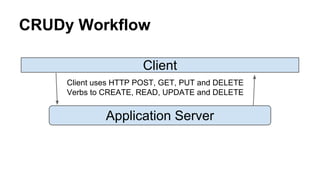
CRUDy Workflow
Client
Application Server
Client uses HTTP POST, GET, PUT and DELETE
Verbs to CREATE, READ, UPDATE and DELETE
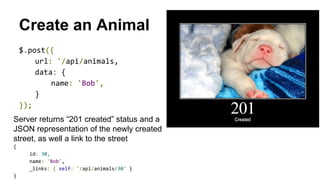
Create an Animal
$.post({
url: '/api/animals,
data: {
name: 'Bob',
}
});
Server returns “201 created” status and a
JSON representation of the newly created
street, as well a link to the street
{
id: 30,
name: 'Bob',
_links: { self: '/api/animals/30' }
}
Read Animals
$.get({
url: '/api/animals,
});
Server returns “200 OK”, and a JSON
representation of the streets
{
page: 1,
total_pages: 10,
items: [
{id: 30, 'name': 'Bob', _links: { self: '/api/animals/30' },
....
]
}
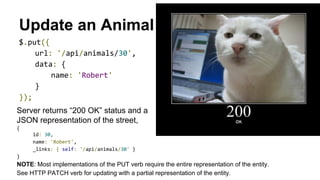
Update an Animal
$.put({
url: '/api/animals/30',
data: {
name: 'Robert'
}
});
Server returns “200 OK” status and a
JSON representation of the street,
{
id: 30,
name: 'Robert',
_links: { self: '/api/animals/30' }
}
NOTE: Most implementations of the PUT verb require the entire representation of the entity.
See HTTP PATCH verb for updating with a partial representation of the entity.
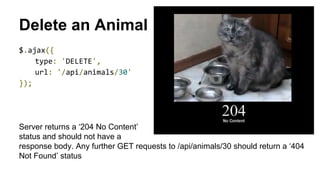
Delete an Animal
$.ajax({
type: 'DELETE',
url: '/api/animals/30'
});
Server returns a ‘204 No Content’
status and should not have a
response body. Any further GET requests to /api/animals/30 should return a ‘404
Not Found’ status
Awesome!
● We can create some really awesome APIs
where we can create, read, update, and
delete entities in a standard way.
● These standards have lead to some very
powerful libraries that can help you create
and consume CRUD APIs
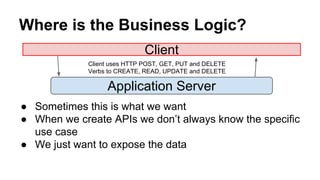
Where is the Business Logic?
Client
Application Server
Client uses HTTP POST, GET, PUT and DELETE
Verbs to CREATE, READ, UPDATE and DELETE
● Sometimes this is what we want
● When we create APIs we don’t always know the specific
use case
● We just want to expose the data
Business Logic on The Client Side?
● A CRUD API is a really good way to expose
meaningful data in a flexible way
● You make few assumptions on how the data
will be displayed or used
● Fosters innovation and allows for really
interesting clients
Really? Client Side?
● Stopping at CRUD functionality limits what
your API can actually do
● Complex business problems should not rely
on client side implementations
● Only implementing CRUD functionality can
lead to an API that doesn't know what it
does, it only knows about the data it stores
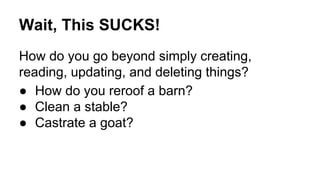
Wait, This SUCKS!
How do you go beyond simply creating,
reading, updating, and deleting things?
● How do you reroof a barn?
● Clean a stable?
● Castrate a goat?
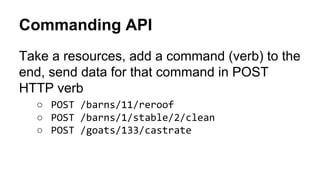
Commanding API
Take a resources, add a command (verb) to the
end, send data for that command in POST
HTTP verb
○ POST /barns/11/reroof
○ POST /barns/1/stable/2/clean
○ POST /goats/133/castrate
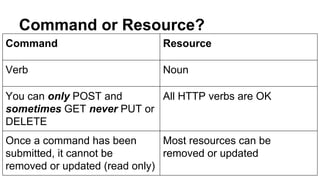
Command or Resource?
Command Resource
Verb Noun
You can only POST and
sometimes GET never PUT or
DELETE
All HTTP verbs are OK
Once a command has been
submitted, it cannot be
removed or updated (read only)
Most resources can be
removed or updated
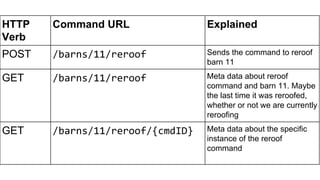
HTTP
Verb
Command URL Explained
POST /barns/11/reroof Sends the command to reroof
barn 11
GET /barns/11/reroof Meta data about reroof
command and barn 11. Maybe
the last time it was reroofed,
whether or not we are currently
reroofing
GET /barns/11/reroof/{cmdID} Meta data about the specific
instance of the reroof
command
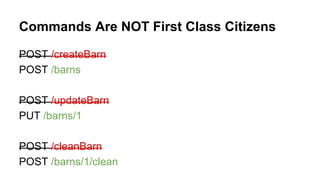
Commands Are NOT First Class Citizens
POST /createBarn
POST /barns
POST /updateBarn
PUT /barns/1
POST /cleanBarn
POST /barns/1/clean
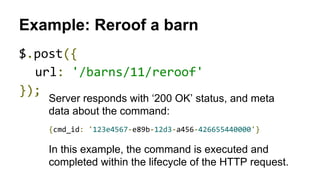
Example: Reroof a barn
$.post({
url: '/barns/11/reroof'
});
Server responds with ‘200 OK’ status, and meta
data about the command:
{cmd_id: '123e4567-e89b-12d3-a456-426655440000'}
In this example, the command is executed and
completed within the lifecycle of the HTTP request.
Wait: That’s Not The Whole Story
We use a Commanding Pattern because we
are performing an action on a resource. In the
real word, these actions can take time.
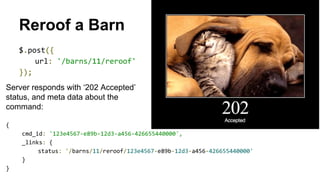
Reroof a Barn
$.post({
url: '/barns/11/reroof'
});
Server responds with ‘202 Accepted’
status, and meta data about the
command:
{
cmd_id: '123e4567-e89b-12d3-a456-426655440000',
_links: {
status: '/barns/11/reroof/123e4567-e89b-12d3-a456-426655440000'
}
}
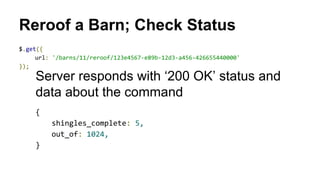
Reroof a Barn; Check Status
$.get({
url: '/barns/11/reroof/123e4567-e89b-12d3-a456-426655440000'
});
Server responds with ‘200 OK’ status and
data about the command
{
shingles_complete: 5,
out_of: 1024,
}
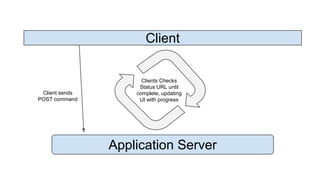
Client
Application Server
Client sends
POST command
Clients Checks
Status URL until
complete, updating
UI with progress
What About Querying?
● Sometimes a query request cannot be
completed in a reasonable amount of time
● Sometimes you have to send a POST
payload in order to send enough data for the
server to process a query
● This is a special case of a command
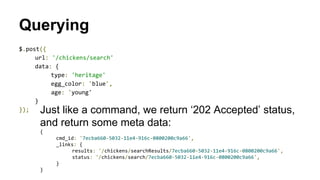
Querying
$.post({
url: '/chickens/search'
data: {
type: 'heritage'
egg_color: 'blue',
age: 'young'
}
}); Just like a command, we return ‘202 Accepted’ status,
and return some meta data:
{
cmd_id: '7ecba660-5032-11e4-916c-0800200c9a66',
_links: {
results: '/chickens/searchResults/7ecba660-5032-11e4-916c-0800200c9a66',
status: '/chickens/search/7ecba660-5032-11e4-916c-0800200c9a66',
}
}
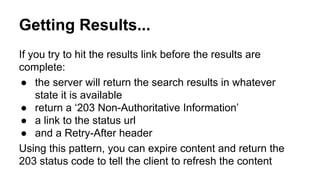
Getting Results...
If you try to hit the results link before the results are
complete:
● the server will return the search results in whatever
state it is available
● return a ‘203 Non-Authoritative Information’
● a link to the status url
● and a Retry-After header
Using this pattern, you can expire content and return the
203 status code to tell the client to refresh the content
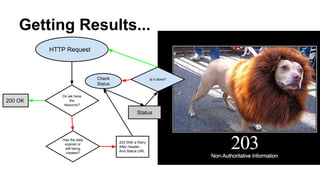
Getting Results...
HTTP Request
Do we have
the
resource?
203 With a Retry
After Header
And Status URL
200 OK
Has the data
expired or
still being
created?
Check
Status
Status
Is it done?
Separating Command and
Queries...
Developing expressive and
meaningful endpoints...
Using nouns and verbs that
reflect what your API
actually does...
Proudly Inspired by Others
ENTERING
BUZZWORD ZONE!
CQRS Martin Fowler
CQRS stands for Command Query Responsibility
Segregation. It's a pattern that I first heard described by
Greg Young. At its heart is a simple notion that you can use
a different model to update information than the model you
use to read information. This simple notion leads to some
profound consequences for the design of information
systems.
http://martinfowler.com/bliki/CQRS.html
DDD Wikipedia
Domain-driven design (DDD) is an approach to software
development for complex needs by connecting the
implementation to an evolving model. The premise of
domain-driven design is the following:
1. Placing the project's primary focus on the core domain
and domain logic.
2. Basing complex designs on a model of the domain.
3. Initiating a creative collaboration between technical and
domain experts to iteratively refine a conceptual model
that addresses particular domain problems.
http://en.wikipedia.org/wiki/Domain-driven_design
DDD and CQRS in My Own Words...
● Domain Driven Design is a philosophy and methodology
in which your domain model should represent the
business problems that your app is actually solving
● Command Query Responsibility Segregation is the
strategy of separating commands from queries, as
opposed to CRUD functionality which is represented in
the same object. CQRS can help you follow the SOLID
principle
DDD - Know Your Role!
● Talk to stakeholders and domain
experts
● Strive for a ubiquitous language
● Know the context in which your
API endpoints will be used
● Use this knowledge to develop
your endpoints
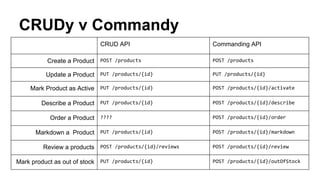
CRUD API Commanding API
Create a Product POST /products POST /products
Update a Product PUT /products/{id} PUT /products/{id}
Mark Product as Active PUT /products/{id} POST /products/{id}/activate
Describe a Product PUT /products/{id} POST /products/{id}/describe
Order a Product ???? POST /products/{id}/order
Markdown a Product PUT /products/{id} POST /products/{id}/markdown
Review a products POST /products/{id}/reviews POST /products/{id}/review
Mark product as out of stock PUT /products/{id} POST /products/{id}/outOfStock
CRUDy v Commandy
CQRS and CRUD, Mutually
Exclusive?
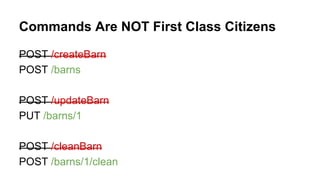
Commands Are NOT First Class Citizens
POST /createBarn
POST /barns
POST /updateBarn
PUT /barns/1
POST /cleanBarn
POST /barns/1/clean
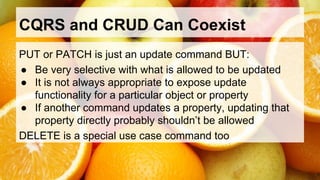
CQRS and CRUD Can Coexist
PUT or PATCH is just an update command BUT:
● Be very selective with what is allowed to be updated
● It is not always appropriate to expose update
functionality for a particular object or property
● If another command updates a property, updating that
property directly probably shouldn’t be allowed
DELETE is a special use case command too
Brandon Mueller
@fatmuemoo
fatmuemoo.com
END
BUZZWORDS

Cqrs api v2

  • 1.
    Commanding a More MeaningfulREST API Brandon Mueller @fatmuemoo fatmuemoo.com
  • 2.
    Panhandle Web Tech http://www.meetup.com/Panhandle-Web-Tech/ 6:30on the Third Tuesday of the Month @ Firebrand Media 229 East Martin St, Suite 5 Martinsburg, WV 25401
  • 3.
    What is covered ●API Basics ● API Good Practices ● CRUD API Examples ● Commanding API Explained ● Commanding API Examples ● CRUD and Commanding Coexistence
  • 4.
    What is NOTcovered ● Security or Authentication ● HAL or HATEOAS ● CQRS* or DDD* ● Nitty-Gritty Implementation Details
  • 5.
    ● The farmis a home to people, places and things. These are the nouns in your API ● Nouns are also called resources or entities. ● The nouns are represented in your API by the URL. ● Like things inside of your farm, you can do things with your resources. ● You tell your nouns to do things via verbs. ● The HTTP spec come with built in verbs, among these are GET, PUT, POST, and DELETE ● These verbs are great for CRUD functionality. Your API is Like a Farm
  • 6.
    HTTP verb ResourceURL Explanation POST /barns Creates a new barn GET /barns Gets all the barns on the farm GET /barns/11 Gets the barn with the ID of 11 PUT /barns/11 Updates the barn with the ID of 11 DELETE /barns/11 Deletes the barn with the ID of 11 C R U D
  • 7.
    Some Good Ideasto Follow: 1. ALWAYS use plural nouns - keeps it simple 2. Nest resources! /barns/30/animals /barns/30/stables/1/animals 3. Handle errors with a standardized response body 4. Use the standard HTTP verbs 5. Use appropriate HTTP headers 6. Use appropriate HTTP response codes
  • 8.
    Read The Spec StatusCodes: http://www.w3.org/Protocols/rfc2616/rfc2616-sec10.html Headers: http://www.w3.org/Protocols/rfc2616/rfc2616-sec14.html
  • 9.
    Status Codes Ina Nutshell ● 2xx - It worked ● 3xx - Go away ● 4xx - The client messed up ● 5xx - The server messed up
  • 10.
    Idempotent/Safe Methods Idempotent methodscan be applied over and over again and always have the same effect on the resource Safe methods do not have any modifying effect on the resource
  • 11.
    Idempotent/Safe Methods Method IdempotentSafe GET YES YES POST NO NO PUT YES NO DELETE YES NO PATCH NO NO HEAD YES YES OPTIONS YES YES
  • 12.
    POST v PUTv PATCH ● POST is used to create an entity ● PUT is used to update an entity where you must send the entire representation of the entity as you wish for it to be stored ● PATCH is used to update an entity where you send only the fields that need updated
  • 13.
    CRUDy Workflow Client Application Server Clientuses HTTP POST, GET, PUT and DELETE Verbs to CREATE, READ, UPDATE and DELETE
  • 14.
    Create an Animal $.post({ url:'/api/animals, data: { name: 'Bob', } }); Server returns “201 created” status and a JSON representation of the newly created street, as well a link to the street { id: 30, name: 'Bob', _links: { self: '/api/animals/30' } }
  • 15.
    Read Animals $.get({ url: '/api/animals, }); Serverreturns “200 OK”, and a JSON representation of the streets { page: 1, total_pages: 10, items: [ {id: 30, 'name': 'Bob', _links: { self: '/api/animals/30' }, .... ] }
  • 16.
    Update an Animal $.put({ url:'/api/animals/30', data: { name: 'Robert' } }); Server returns “200 OK” status and a JSON representation of the street, { id: 30, name: 'Robert', _links: { self: '/api/animals/30' } } NOTE: Most implementations of the PUT verb require the entire representation of the entity. See HTTP PATCH verb for updating with a partial representation of the entity.
  • 17.
    Delete an Animal $.ajax({ type:'DELETE', url: '/api/animals/30' }); Server returns a ‘204 No Content’ status and should not have a response body. Any further GET requests to /api/animals/30 should return a ‘404 Not Found’ status
  • 18.
    Awesome! ● We cancreate some really awesome APIs where we can create, read, update, and delete entities in a standard way. ● These standards have lead to some very powerful libraries that can help you create and consume CRUD APIs
  • 19.
    Where is theBusiness Logic? Client Application Server Client uses HTTP POST, GET, PUT and DELETE Verbs to CREATE, READ, UPDATE and DELETE ● Sometimes this is what we want ● When we create APIs we don’t always know the specific use case ● We just want to expose the data
  • 20.
    Business Logic onThe Client Side? ● A CRUD API is a really good way to expose meaningful data in a flexible way ● You make few assumptions on how the data will be displayed or used ● Fosters innovation and allows for really interesting clients
  • 21.
    Really? Client Side? ●Stopping at CRUD functionality limits what your API can actually do ● Complex business problems should not rely on client side implementations ● Only implementing CRUD functionality can lead to an API that doesn't know what it does, it only knows about the data it stores
  • 22.
    Wait, This SUCKS! Howdo you go beyond simply creating, reading, updating, and deleting things? ● How do you reroof a barn? ● Clean a stable? ● Castrate a goat?
  • 23.
    Commanding API Take aresources, add a command (verb) to the end, send data for that command in POST HTTP verb ○ POST /barns/11/reroof ○ POST /barns/1/stable/2/clean ○ POST /goats/133/castrate
  • 24.
    Command or Resource? CommandResource Verb Noun You can only POST and sometimes GET never PUT or DELETE All HTTP verbs are OK Once a command has been submitted, it cannot be removed or updated (read only) Most resources can be removed or updated
  • 25.
    HTTP Verb Command URL Explained POST/barns/11/reroof Sends the command to reroof barn 11 GET /barns/11/reroof Meta data about reroof command and barn 11. Maybe the last time it was reroofed, whether or not we are currently reroofing GET /barns/11/reroof/{cmdID} Meta data about the specific instance of the reroof command
  • 26.
    Commands Are NOTFirst Class Citizens POST /createBarn POST /barns POST /updateBarn PUT /barns/1 POST /cleanBarn POST /barns/1/clean
  • 27.
    Example: Reroof abarn $.post({ url: '/barns/11/reroof' }); Server responds with ‘200 OK’ status, and meta data about the command: {cmd_id: '123e4567-e89b-12d3-a456-426655440000'} In this example, the command is executed and completed within the lifecycle of the HTTP request.
  • 28.
    Wait: That’s NotThe Whole Story We use a Commanding Pattern because we are performing an action on a resource. In the real word, these actions can take time.
  • 29.
    Reroof a Barn $.post({ url:'/barns/11/reroof' }); Server responds with ‘202 Accepted’ status, and meta data about the command: { cmd_id: '123e4567-e89b-12d3-a456-426655440000', _links: { status: '/barns/11/reroof/123e4567-e89b-12d3-a456-426655440000' } }
  • 30.
    Reroof a Barn;Check Status $.get({ url: '/barns/11/reroof/123e4567-e89b-12d3-a456-426655440000' }); Server responds with ‘200 OK’ status and data about the command { shingles_complete: 5, out_of: 1024, }
  • 31.
    Client Application Server Client sends POSTcommand Clients Checks Status URL until complete, updating UI with progress
  • 32.
    What About Querying? ●Sometimes a query request cannot be completed in a reasonable amount of time ● Sometimes you have to send a POST payload in order to send enough data for the server to process a query ● This is a special case of a command
  • 33.
    Querying $.post({ url: '/chickens/search' data: { type:'heritage' egg_color: 'blue', age: 'young' } }); Just like a command, we return ‘202 Accepted’ status, and return some meta data: { cmd_id: '7ecba660-5032-11e4-916c-0800200c9a66', _links: { results: '/chickens/searchResults/7ecba660-5032-11e4-916c-0800200c9a66', status: '/chickens/search/7ecba660-5032-11e4-916c-0800200c9a66', } }
  • 34.
    Getting Results... If youtry to hit the results link before the results are complete: ● the server will return the search results in whatever state it is available ● return a ‘203 Non-Authoritative Information’ ● a link to the status url ● and a Retry-After header Using this pattern, you can expire content and return the 203 status code to tell the client to refresh the content
  • 35.
    Getting Results... HTTP Request Dowe have the resource? 203 With a Retry After Header And Status URL 200 OK Has the data expired or still being created? Check Status Status Is it done?
  • 36.
    Separating Command and Queries... Developingexpressive and meaningful endpoints... Using nouns and verbs that reflect what your API actually does... Proudly Inspired by Others
  • 37.
  • 38.
    CQRS Martin Fowler CQRSstands for Command Query Responsibility Segregation. It's a pattern that I first heard described by Greg Young. At its heart is a simple notion that you can use a different model to update information than the model you use to read information. This simple notion leads to some profound consequences for the design of information systems. http://martinfowler.com/bliki/CQRS.html
  • 39.
    DDD Wikipedia Domain-driven design(DDD) is an approach to software development for complex needs by connecting the implementation to an evolving model. The premise of domain-driven design is the following: 1. Placing the project's primary focus on the core domain and domain logic. 2. Basing complex designs on a model of the domain. 3. Initiating a creative collaboration between technical and domain experts to iteratively refine a conceptual model that addresses particular domain problems. http://en.wikipedia.org/wiki/Domain-driven_design
  • 40.
    DDD and CQRSin My Own Words... ● Domain Driven Design is a philosophy and methodology in which your domain model should represent the business problems that your app is actually solving ● Command Query Responsibility Segregation is the strategy of separating commands from queries, as opposed to CRUD functionality which is represented in the same object. CQRS can help you follow the SOLID principle
  • 41.
    DDD - KnowYour Role! ● Talk to stakeholders and domain experts ● Strive for a ubiquitous language ● Know the context in which your API endpoints will be used ● Use this knowledge to develop your endpoints
  • 42.
    CRUD API CommandingAPI Create a Product POST /products POST /products Update a Product PUT /products/{id} PUT /products/{id} Mark Product as Active PUT /products/{id} POST /products/{id}/activate Describe a Product PUT /products/{id} POST /products/{id}/describe Order a Product ???? POST /products/{id}/order Markdown a Product PUT /products/{id} POST /products/{id}/markdown Review a products POST /products/{id}/reviews POST /products/{id}/review Mark product as out of stock PUT /products/{id} POST /products/{id}/outOfStock CRUDy v Commandy
  • 43.
    CQRS and CRUD,Mutually Exclusive?
  • 44.
    Commands Are NOTFirst Class Citizens POST /createBarn POST /barns POST /updateBarn PUT /barns/1 POST /cleanBarn POST /barns/1/clean
  • 45.
    CQRS and CRUDCan Coexist PUT or PATCH is just an update command BUT: ● Be very selective with what is allowed to be updated ● It is not always appropriate to expose update functionality for a particular object or property ● If another command updates a property, updating that property directly probably shouldn’t be allowed DELETE is a special use case command too
  • 46.