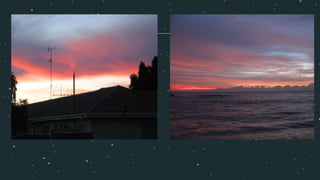
The Earth And
Beyond
Here is where your
presentation begins
Where does the Sun Go at Night ?
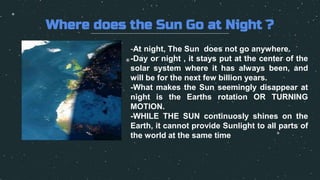
-At night, The Sun does not go anywhere.
-Day or night , it stays put at the center of the
solar system where it has always been, and
will be for the next few billion years.
-What makes the Sun seemingly disappear at
night is the Earths rotation OR TURNING
MOTION.
-WHILE THE SUN continuosly shines on the
Earth, it cannot provide Sunlight to all parts of
the world at the same time
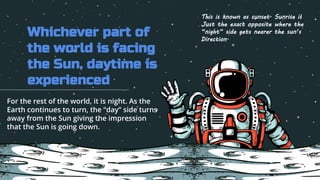
Whichever part of
the world is facing
the Sun, daytime is
experienced
For the rest of the world, it is night. As the
Earth continues to turn, the “day” side turns
away from the Sun giving the impression
that the Sun is going down.
This is known as sunset. Sunrise is
Just the exact opposite where the
“night” side gets nearer the sun’s
Direction.
This Day and Night
cycle just goes on
For as long as the world keeps on
turning. The Sun just stays where it is.
From time to time, the moon gets in
between the Sun and the Earth
YOUR LOGO
the moon deflects the sunlight
When this
happen
which would otherwise be reflected on a particular area of the world. This is known as a solar eclipse
and results to a night-like phenomenon on the area deprived of sunlight.
The Sun is a young star that
actively burns hydrogen
How does the Sun work?
• in a continuing process and stays as it is because of thermonuclear reactions.
• The Sun will keep on producing energy for as long as it has hydrogen to burn.
And because the Sun is mostly made up of hydrogen gas, it will take billions
of years to fully deplete it.
• Once the Sun stops burning, it will transform into a red giant and its surface
will start to expand continuously and will eventually be large enough to engulf
the Earth.
—Someone Famous
“This is a quote, words full of
wisdom that someone important
said and can make the reader get
inspired.”
The Earth Rotates on its Axis
Next
Axis , Rotate, Angle
Awesome Words
1. We spend our lived on a spinning globe – it takes only 24 hours to notice that, as night follows day
and the cycle repeats.
2. The Earth turns around or rotates on its axis.
3. The earth’s axis is tilted at an angle.
4. The Earth takes 24 hours to make one complete rotation.
5. We have day and night on Earth because of the Earth’s rotation on its own axis.
6. By definition, the Earth’s rotation is the amount of time that it takes to rotate once on its axis. This
is, apparently, accomplished once a day – i.e. every 24 hours. However, there are actually two
different kinds of rotation that need to be considered here. For one, there’s the amount of time it
take for the Earth to turn once on its axis so that it returns to the same orientation compared to
the rest of the Universe. Then there’s how long it takes for the Earth to turn so that the Sun
returns to the same spot in the sky.
Why does the Earth Rotate ?
The Earth's Orbit
- The Earth rotates on its own axis and, as a result, we have day and night on Earth.
At the same time as it is rotating on its axis, the Earth is also moving around the
Sun.
- The Earth moves in an ORBIT around the Sun. An ORBIT is a path that an object
takes around something else.
- It takes one year (365 days, or 12 months) for the Earth to orbit the Sun.
- As a result of these movements and the fact that the Earh is tilted, we have day
and night and also different temperatures on Earth.
- THE EARTH’S ORBIT AROUND THE SUN IS LIKE AN OVAL RATHER THAN LIKE A
CIRCLE
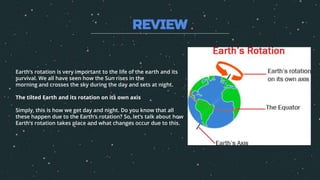
Earth’s rotation is very important to the life of the earth and its
survival. We all have seen how the Sun rises in the
morning and crosses the sky during the day and sets at night.
The tilted Earth and its rotation on its own axis
Simply, this is how we get day and night. Do you know that all
these happen due to the Earth’s rotation? So, let’s talk about how
Earth’s rotation takes place and what changes occur due to this.
REVIEW
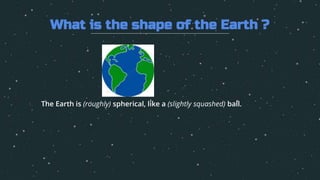
1. The Earth is (roughly) spherical, like a (slightly squashed) ball.
What is the shape of the Earth ?
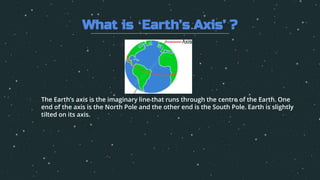
1. The Earth’s axis is the imaginary line that runs through the centre of the Earth. One
end of the axis is the North Pole and the other end is the South Pole. Earth is slightly
tilted on its axis.
What is ‘Earth’s Axis’ ?
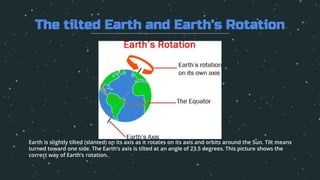
Earth is slightly tilted (slanted) on its axis as it rotates on its axis and orbits around the Sun. Tilt means
turned toward one side. The Earth’s axis is tilted at an angle of 23.5 degrees. This picture shows the
correct way of Earth’s rotation.
The tilted Earth and Earth’s Rotation
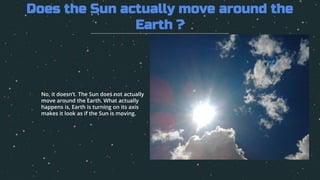
1. No, it doesn’t. The Sun does not actually
move around the Earth. What actually
happens is, Earth is turning on its axis
makes it look as if the Sun is moving.
Does the Sun actually move around the
Earth ?
1. The Earth rotates slowly all the time, but we
don’t feel any movement because it turns
smoothly and at the same speed.
Why dont we feel the Earth’s rotation ?
1. The Earth spins (turn or rotate) on its own axis once every 24 hours (The Earth takes 24 hours to
completely rotate on its axis). That means one whole day. This makes day and night on Earth. As
Earth turns, half of the Earth faces the Sun, and the other half faces away. On the half of the Earth
that is facing the sun is having daytime. On the half of the Earth that is facing away from the sun is
having night.
2. E.g. – 1) You are going to school during daytime. That time, the part of the Earth which you live on faces the
Sun.
3. 2) You are going to bed at night. That time, the part of the Earth which you live on faces away from the
Sun.
4. So this means, our Earth is rotating on its own axis while it is rotating around the Sun, not the Sun
is rotating around the Earth.
What makes day and night ?
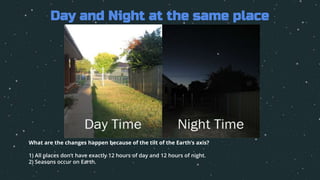
What are the changes happen because of the tilt of the Earth’s axis?
1) All places don’t have exactly 12 hours of day and 12 hours of night.
2) Seasons occur on Earth.
Day and Night at the same place
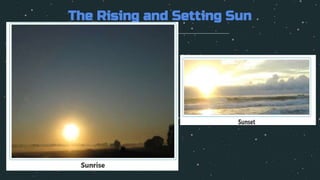
The Rising and Setting Sun
At Sunrise and Sunset Sun’s
rays shining from a low angle
and tint (shade) the
undersides of the clouds with
beautiful colours.
Science the earth and beyond

Science the earth and beyond

  • 1.
    The Earth And Beyond Hereis where your presentation begins
  • 2.
    Where does theSun Go at Night ? -At night, The Sun does not go anywhere. -Day or night , it stays put at the center of the solar system where it has always been, and will be for the next few billion years. -What makes the Sun seemingly disappear at night is the Earths rotation OR TURNING MOTION. -WHILE THE SUN continuosly shines on the Earth, it cannot provide Sunlight to all parts of the world at the same time
  • 3.
    Whichever part of theworld is facing the Sun, daytime is experienced For the rest of the world, it is night. As the Earth continues to turn, the “day” side turns away from the Sun giving the impression that the Sun is going down. This is known as sunset. Sunrise is Just the exact opposite where the “night” side gets nearer the sun’s Direction.
  • 4.
    This Day andNight cycle just goes on For as long as the world keeps on turning. The Sun just stays where it is. From time to time, the moon gets in between the Sun and the Earth YOUR LOGO
  • 5.
    the moon deflectsthe sunlight When this happen which would otherwise be reflected on a particular area of the world. This is known as a solar eclipse and results to a night-like phenomenon on the area deprived of sunlight.
  • 6.
    The Sun isa young star that actively burns hydrogen How does the Sun work? • in a continuing process and stays as it is because of thermonuclear reactions. • The Sun will keep on producing energy for as long as it has hydrogen to burn. And because the Sun is mostly made up of hydrogen gas, it will take billions of years to fully deplete it. • Once the Sun stops burning, it will transform into a red giant and its surface will start to expand continuously and will eventually be large enough to engulf the Earth.
  • 7.
    —Someone Famous “This isa quote, words full of wisdom that someone important said and can make the reader get inspired.”
  • 8.
    The Earth Rotateson its Axis Next Axis , Rotate, Angle
  • 9.
  • 10.
    1. We spendour lived on a spinning globe – it takes only 24 hours to notice that, as night follows day and the cycle repeats. 2. The Earth turns around or rotates on its axis. 3. The earth’s axis is tilted at an angle. 4. The Earth takes 24 hours to make one complete rotation. 5. We have day and night on Earth because of the Earth’s rotation on its own axis. 6. By definition, the Earth’s rotation is the amount of time that it takes to rotate once on its axis. This is, apparently, accomplished once a day – i.e. every 24 hours. However, there are actually two different kinds of rotation that need to be considered here. For one, there’s the amount of time it take for the Earth to turn once on its axis so that it returns to the same orientation compared to the rest of the Universe. Then there’s how long it takes for the Earth to turn so that the Sun returns to the same spot in the sky. Why does the Earth Rotate ?
  • 11.
  • 12.
    - The Earthrotates on its own axis and, as a result, we have day and night on Earth. At the same time as it is rotating on its axis, the Earth is also moving around the Sun. - The Earth moves in an ORBIT around the Sun. An ORBIT is a path that an object takes around something else. - It takes one year (365 days, or 12 months) for the Earth to orbit the Sun. - As a result of these movements and the fact that the Earh is tilted, we have day and night and also different temperatures on Earth. - THE EARTH’S ORBIT AROUND THE SUN IS LIKE AN OVAL RATHER THAN LIKE A CIRCLE
  • 13.
    Earth’s rotation isvery important to the life of the earth and its survival. We all have seen how the Sun rises in the morning and crosses the sky during the day and sets at night. The tilted Earth and its rotation on its own axis Simply, this is how we get day and night. Do you know that all these happen due to the Earth’s rotation? So, let’s talk about how Earth’s rotation takes place and what changes occur due to this. REVIEW
  • 14.
    1. The Earthis (roughly) spherical, like a (slightly squashed) ball. What is the shape of the Earth ?
  • 15.
    1. The Earth’saxis is the imaginary line that runs through the centre of the Earth. One end of the axis is the North Pole and the other end is the South Pole. Earth is slightly tilted on its axis. What is ‘Earth’s Axis’ ?
  • 16.
    Earth is slightlytilted (slanted) on its axis as it rotates on its axis and orbits around the Sun. Tilt means turned toward one side. The Earth’s axis is tilted at an angle of 23.5 degrees. This picture shows the correct way of Earth’s rotation. The tilted Earth and Earth’s Rotation
  • 17.
    1. No, itdoesn’t. The Sun does not actually move around the Earth. What actually happens is, Earth is turning on its axis makes it look as if the Sun is moving. Does the Sun actually move around the Earth ?
  • 18.
    1. The Earthrotates slowly all the time, but we don’t feel any movement because it turns smoothly and at the same speed. Why dont we feel the Earth’s rotation ?
  • 19.
    1. The Earthspins (turn or rotate) on its own axis once every 24 hours (The Earth takes 24 hours to completely rotate on its axis). That means one whole day. This makes day and night on Earth. As Earth turns, half of the Earth faces the Sun, and the other half faces away. On the half of the Earth that is facing the sun is having daytime. On the half of the Earth that is facing away from the sun is having night. 2. E.g. – 1) You are going to school during daytime. That time, the part of the Earth which you live on faces the Sun. 3. 2) You are going to bed at night. That time, the part of the Earth which you live on faces away from the Sun. 4. So this means, our Earth is rotating on its own axis while it is rotating around the Sun, not the Sun is rotating around the Earth. What makes day and night ?
  • 20.
    What are thechanges happen because of the tilt of the Earth’s axis? 1) All places don’t have exactly 12 hours of day and 12 hours of night. 2) Seasons occur on Earth. Day and Night at the same place
  • 21.
    The Rising andSetting Sun
  • 24.
    At Sunrise andSunset Sun’s rays shining from a low angle and tint (shade) the undersides of the clouds with beautiful colours.