INTODUCTION TO THE CSIRT
                     SETTING UP GUIDE


http://www.enisa.europa.eu/act/cert/support/guide
Agenda

How it all started
 What do CERTs do?
 How is Incident Response functioning
 CERT cooperation
 ENISA and CERTs


                                         2
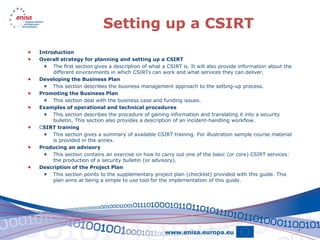
Setting up a CSIRT
   Introduction
   Overall strategy for planning and setting up a CSIRT
      The first section gives a description of what a CSIRT is. It will also provide information about the
         different environments in which CSIRTs can work and what services they can deliver.
   Developing the Business Plan
      This section describes the business management approach to the setting-up process.
   Promoting the Business Plan
      This section deal with the business case and funding issues.
   Examples of operational and technical procedures
      This section describes the procedure of gaining information and translating it into a security
         bulletin. This section also provides a description of an incident-handling workflow.
   CSIRT training
      This section gives a summary of available CSIRT training. For illustration sample course material
         is provided in the annex.
   Producing an advisory
      This section contains an exercise on how to carry out one of the basic (or core) CSIRT services:
         the production of a security bulletin (or advisory).
   Description of the Project Plan
      This section points to the supplementary project plan (checklist) provided with this guide. This
         plan aims at being a simple to use tool for the implementation of this guide.


                                                                                                              3
The early days of internet

 First idea of an Internet in
  1960:
  "A network of such [computers], connected to one
  another by wideband communication lines" which
  provided "the functions of present-day libraries
  together with anticipated advances in information
  storage and retrieval and [other] symbiotic functions.
  ” by .C.R. Licklider


 Beginning of Internet by the
  Defense Advanced Research
  Projects Agency (DARPA) in
  1981.
                                                           Map of the TCP/IP test network in January 1982


                                                                                                       4
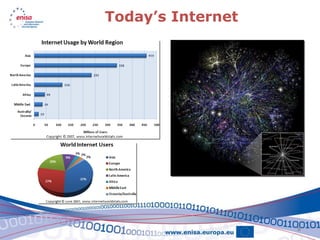
Today’s Internet


                   5
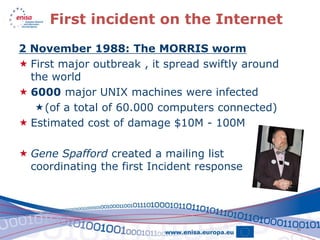
First incident on the Internet
2 November 1988: The MORRIS worm
 First major outbreak , it spread swiftly around
  the world
 6000 major UNIX machines were infected
   (of a total of 60.000 computers connected)
 Estimated cost of damage $10M - 100M

 Gene Spafford created a mailing list
  coordinating the first Incident response


                                                    6
The First CERT

After incident people realized they
where in need for:
Timely response
Structured and organized approach
Central coordination

This incident in the history of Internet security
led directly to the founding of the CERT/CC©


                                                    7
Europe and CSIRT’s

This model was soon adopted in Europe

1992 Surfnet launched the first CSIRT
  in Europe SURFnet-CERT


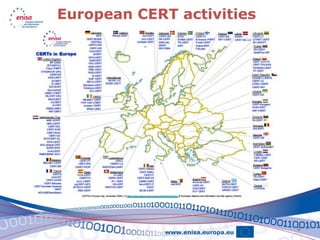
At present ENISAs inventory of CERT
 activities in Europe list over 140 CSIRTs


                                             8
European CERT activities


                           9
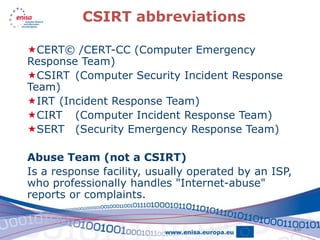
CSIRT abbreviations

CERT© /CERT-CC (Computer Emergency
Response Team)
CSIRT (Computer Security Incident Response
Team)
IRT (Incident Response Team)
CIRT (Computer Incident Response Team)
SERT (Security Emergency Response Team)

Abuse Team (not a CSIRT)
Is a response facility, usually operated by an ISP,
who professionally handles "Internet-abuse"
reports or complaints.


                                                      10
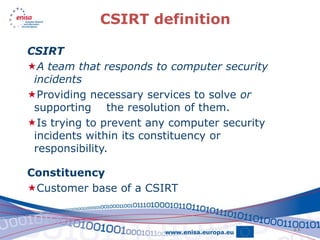
CSIRT definition

CSIRT
A team that responds to computer security
 incidents
Providing necessary services to solve or
 supporting the resolution of them.
Is trying to prevent any computer security
 incidents within its constituency or
 responsibility.

Constituency
Customer base of a CSIRT


                                              11
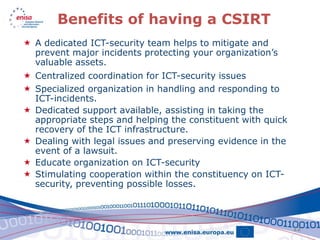
Benefits of having a CSIRT
 A dedicated ICT-security team helps to mitigate and
  prevent major incidents protecting your organization’s
  valuable assets.
 Centralized coordination for ICT-security issues
 Specialized organization in handling and responding to
  ICT-incidents.
 Dedicated support available, assisting in taking the
  appropriate steps and helping the constituent with quick
  recovery of the ICT infrastructure.
 Dealing with legal issues and preserving evidence in the
  event of a lawsuit.
 Educate organization on ICT-security
 Stimulating cooperation within the constituency on ICT-
  security, preventing possible losses.


                                                             12
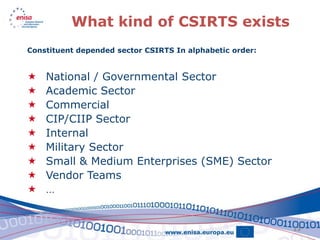
What kind of CSIRTS exists
Constituent depended sector CSIRTS In alphabetic order:


   National / Governmental Sector
   Academic Sector
   Commercial
   CIP/CIIP Sector
   Internal
   Military Sector
   Small & Medium Enterprises (SME) Sector
   Vendor Teams
   …


                                                          13
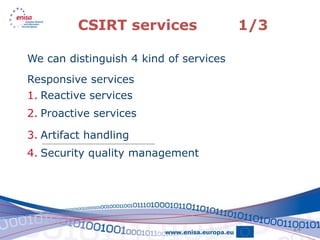
CSIRT services                 1/3

We can distinguish 4 kind of services
Responsive services
1. Reactive services
2. Proactive services

3. Artifact handling
4. Security quality management


                                              14
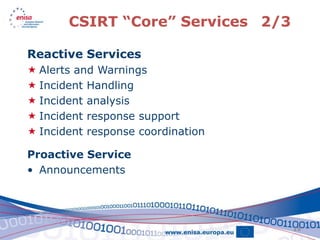
CSIRT “Core” Services 2/3

Reactive Services
 Alerts and Warnings
 Incident Handling
 Incident analysis
 Incident response support
 Incident response coordination

Proactive Service
• Announcements


                                   15
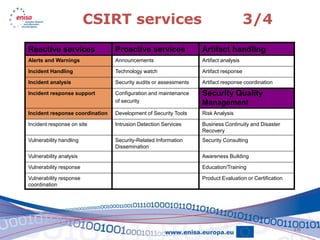
CSIRT services                                               3/4
Reactive services                Proactive services               Artifact handling
Alerts and Warnings              Announcements                    Artifact analysis

Incident Handling                Technology watch                 Artifact response

Incident analysis                Security audits or assessments   Artifact response coordination

Incident response support        Configuration and maintenance    Security Quality
                                 of security                      Management
Incident response coordination   Development of Security Tools    Risk Analysis

Incident response on site        Intrusion Detection Services     Business Continuity and Disaster
                                                                  Recovery
Vulnerability handling           Security-Related Information     Security Consulting
                                 Dissemination
Vulnerability analysis                                            Awareness Building

Vulnerability response                                            Education/Training

Vulnerability response                                            Product Evaluation or Certification
coordination


                                                                                                        16
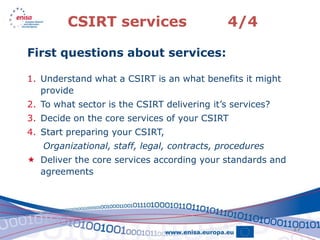
CSIRT services                       4/4

First questions about services:

1. Understand what a CSIRT is an what benefits it might
   provide
2. To what sector is the CSIRT delivering it’s services?
3. Decide on the core services of your CSIRT
4. Start preparing your CSIRT,
   Organizational, staff, legal, contracts, procedures
 Deliver the core services according your standards and
  agreements


                                                           17
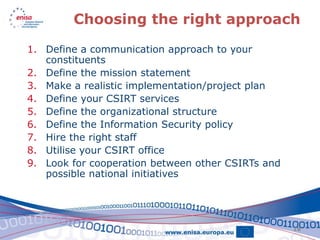
Choosing the right approach

1. Define a communication approach to your
   constituents
2. Define the mission statement
3. Make a realistic implementation/project plan
4. Define your CSIRT services
5. Define the organizational structure
6. Define the Information Security policy
7. Hire the right staff
8. Utilise your CSIRT office
9. Look for cooperation between other CSIRTs and
   possible national initiatives


                                                   18
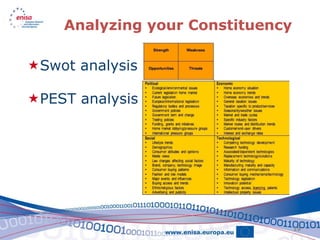
Analyzing your Constituency

Swot analysis

PEST analysis


                                  19
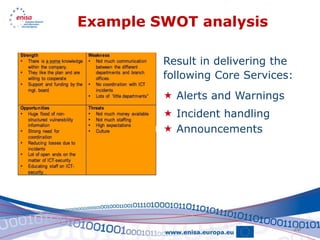
Example SWOT analysis

         Result in delivering the
         following Core Services:
          Alerts and Warnings
          Incident handling
          Announcements


                                    20
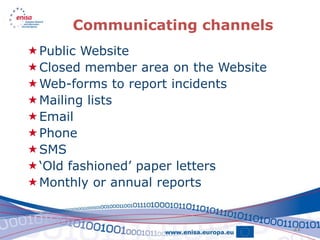
Communicating channels
Public Website
Closed member area on the Website
Web-forms to report incidents
Mailing lists
Email
Phone
SMS
‘Old fashioned’ paper letters
Monthly or annual reports


                                     21
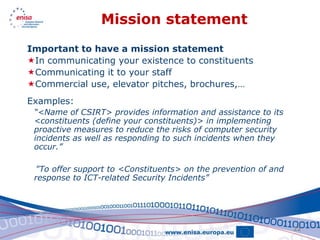
Mission statement
Important to have a mission statement
In communicating your existence to constituents
Communicating it to your staff
Commercial use, elevator pitches, brochures,…
Examples:
 “<Name of CSIRT> provides information and assistance to its
 <constituents (define your constituents)> in implementing
 proactive measures to reduce the risks of computer security
 incidents as well as responding to such incidents when they
 occur.”

 "To offer support to <Constituents> on the prevention of and
 response to ICT-related Security Incidents”


                                                                22
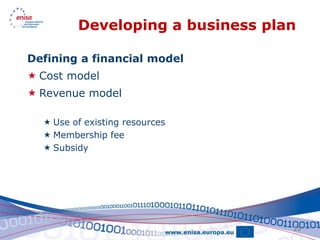
Developing a business plan

Defining a financial model
 Cost model
 Revenue model

   Use of existing resources
   Membership fee
   Subsidy


                                  23
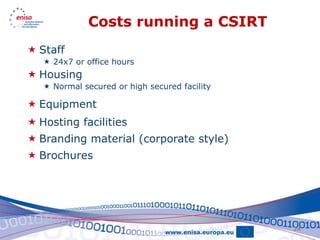
Costs running a CSIRT
 Staff
    24x7 or office hours
 Housing
    Normal secured or high secured facility

 Equipment
 Hosting facilities
 Branding material (corporate style)
 Brochures


                                               24
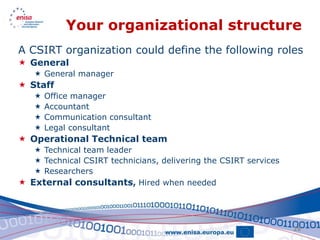
Your organizational structure
A CSIRT organization could define the following roles
 General
    General manager
 Staff
      Office manager
      Accountant
      Communication consultant
      Legal consultant
 Operational Technical team
    Technical team leader
    Technical CSIRT technicians, delivering the CSIRT services
    Researchers
 External consultants, Hired when needed


                                                                  25
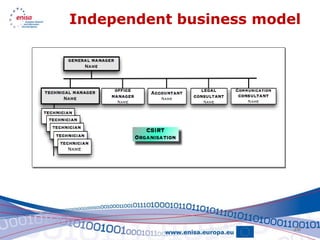
Independent business model


                         26
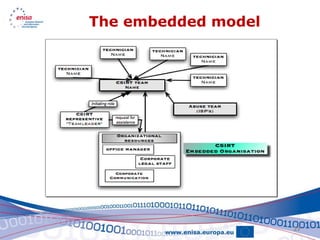
The embedded model


                     27
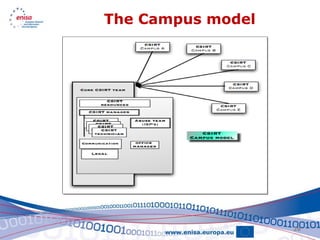
The Campus model


                   28
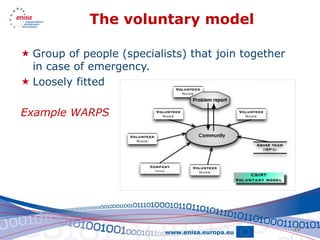
The voluntary model

 Group of people (specialists) that join together
  in case of emergency.
 Loosely fitted

Example WARPS


                                                     29
Hiring the right staff
                ( the hot picks)
 Flexible, creative, good teams spirit
 Strong analytical skills,
 Ability to explain difficult technical matter into
  easy wording
 Good organizational skills and stress durable
 Technical knowledge (deep specialist + broad
  general internet technology knowledge)
 Willingness to work 24x7
 Loving to do the job! ;)


                                                       30
Utilization & equipping the office
 Hardening the building
  See ISO17799
 Maintaining communication channels
 Record tracking system(s)
 Use the corporate style from the beginning!
 Foresee out-of-band communication in case of
  attacks
 Check redundancy on internet connectivity
  and office in case of emergencies


                                                 31
Information security policy

Information handling policy
1. How is incoming information "tagged" or
   "classified"?
2. How is information handled, especially with
   regard to exclusivity?
3. What considerations are adopted for the
   disclosure of information "when what?"
   especially incident related information passed
   on to other teams or to sites?


                                                    32
Information security policy

4.   Are there legal considerations to take into
     account with regard to information handling?
5.   Do you have a policy on use of cryptography
     to shield exclusivity & integrity in archives
     and/or data communication, especially e-
     mail.
6.   This policy must include possible legal
     boundary conditions such as key escrow or
     enforceability of decryption in case of
     lawsuits.


                                                     33
Information Security policy
 National
    Laws on information technology
    Laws on data protection and privacy
    Codes of conduct for corporate governance and IT
     Governance
 European directives
    Directives on data protection and electronic
     communication
 International
    Basel II, Eu. Convention on Cybercrime
 Standards
    BS 7799
    ISO 27001


                                                        34
Search for cooperation

ENISA
National initiatives
TF-CSIRT
WARPS
FIRST


                               35
Promoting your business plan

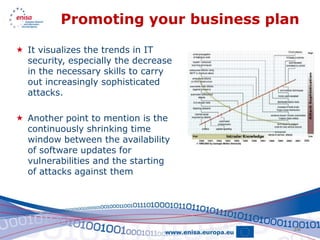
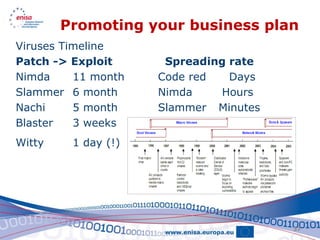
 It visualizes the trends in IT
  security, especially the decrease
  in the necessary skills to carry
  out increasingly sophisticated
  attacks.

 Another point to mention is the
  continuously shrinking time
  window between the availability
  of software updates for
  vulnerabilities and the starting
  of attacks against them


                                      36
Promoting your business plan
Viruses Timeline
Patch -> Exploit      Spreading rate
Nimda     11 month   Code red   Days
Slammer 6 month      Nimda    Hours
Nachi     5 month    Slammer Minutes
Blaster   3 weeks
Witty    1 day (!)


                                       37
Business plan & Management

What is the problem?
What would you like to achieve with
 your constituents?
What happens if you do nothing?
What happens if you take action?
What is it going to cost?
What is going to gain?
When do you start and when is it
 finished?

                                       38
Short wrap-up
 How is information handled within your
  organization
 Do you have a Information security policy?
 Do you know other CSIRTs?
 Could you share incidents that can help the
  promotion of a CSIRT business plan?
 Discuss your potential business plan


                                                39
Operational Procedures

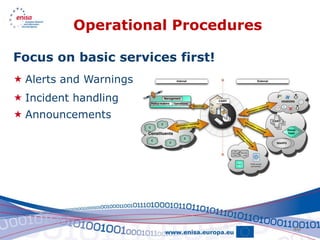
Focus on basic services first!
 Alerts and Warnings
 Incident handling
 Announcements


                                   40
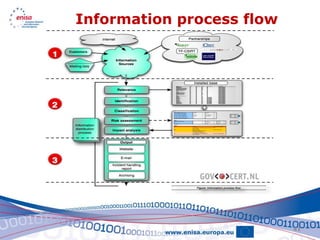
Information process flow


                           41
Information process flow
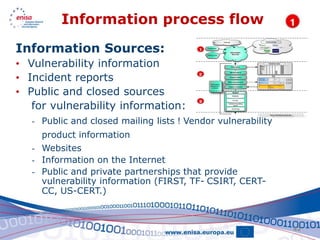
Information Sources:
• Vulnerability information
• Incident reports
• Public and closed sources
   for vulnerability information:
   - Public and closed mailing lists ! Vendor vulnerability
     product information
   - Websites
   - Information on the Internet
   - Public and private partnerships that provide
     vulnerability information (FIRST, TF- CSIRT, CERT-
     CC, US-CERT.)


                                                              42
Information process flow

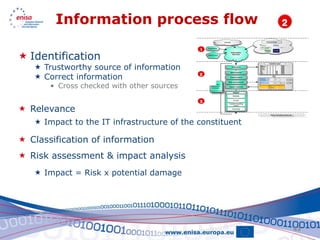
 Identification
    Trustworthy source of information
    Correct information
       • Cross checked with other sources


 Relevance
    Impact to the IT infrastructure of the constituent

 Classification of information
 Risk assessment & impact analysis
    Impact = Risk x potential damage


                                                          43
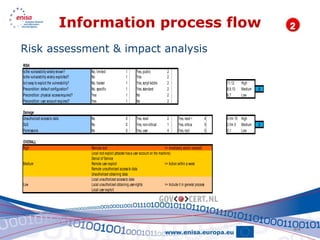
Information process flow
Risk assessment & impact analysis
RISK
Is the vulnarability widely known?         No, limited                1        Yes, public              2
Is the vulnarability widely exploited?     No                         1        Yes                      2
Is it easy to exploit the vulnerability?   No, hacker                 1        Yes, script kiddie       2                                    11,12    High
Precondition: default configuration?       No. specific               1        Yes, standard            2                                    8,9,10   Medium   0
Precondition: physical access required?    Yes                        1        No                       2                                    6,7      Low
Precondition: user account required?       Yes                        1        No                       2

Damage
Unauthorized access to data                No                         0        Yes, read                2        Yes, read + write       4   6 t/m 15 High
DoS                                        No                         0        Yes, non-critical        1        Yes, critical           5   2 t/m 5 Medium    0
Permissions                                No                         0        Yes, user                4        Yes, root               6   0,1      Low

OVERALL
High                                       Remote root                                                >> Imediately action needed!
                                           Local root exploit (attacker has a user account on the machine)
                                           Denial of Service
Medium                                     Remote user exploit                                        >> Action within a week
                                           Remote unauthorized access to data
                                           Unauthorized obtaining data
                                           Local unauthorized access to data
Low                                        Local unauthorized obtaining user-rights                   >> Include it in general process
                                           Local user exploit


                                                                                                                                                                   44
Information process flow

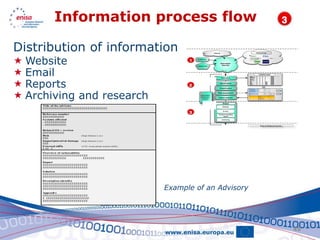
Distribution of information
 Website
 Email
 Reports
 Archiving and research
     Title of the advisory
     ÉÉÉÉÉÉÉÉÉÉÉÉÉÉÉÉÉÉÉÉÉÉÉÉÉÉÉÉÉÉÉÉÉ

     Reference number
     ÉÉÉÉÉÉÉÉÉÉÉ
     S ystems affected
     - ÉÉÉÉÉÉÉÉÉÉÉ
     - ÉÉÉÉÉÉÉÉÉÉÉ

     Related OS + ve rsion
     ÉÉÉÉÉÉÉÉÉÉÉ
     Risk                       (Hi gh-Medium-Low)
     ÉÉÉ
     Impact/potenti al damage   (Hi gh-Medium-Low)
     ÉÉÉ
     External idÕs
                 :              (CVE, Vu lnerabi lity bullet in IDÕs)
     É ÉÉ   É

     Overview of vu lnerability
     ÉÉÉÉÉÉÉÉÉÉÉÉÉÉÉÉÉÉÉÉÉÉÉ
     ÉÉÉÉÉÉÉÉÉÉÉÉ               ÉÉÉÉÉÉÉÉÉÉÉ
     Impact
     ÉÉÉÉÉÉÉÉÉÉÉÉÉÉÉÉÉÉÉÉÉÉÉ
     ÉÉÉÉÉÉÉÉÉÉÉÉÉÉÉÉÉÉÉÉÉÉÉ
     S olution
     ÉÉÉÉÉÉÉÉÉÉÉÉÉÉÉÉÉÉÉÉÉÉÉ
     ÉÉÉÉÉÉÉÉÉÉÉÉÉÉÉÉÉÉÉÉÉÉÉ
     Description (details)
     ÉÉÉÉÉÉÉÉÉÉÉÉÉÉÉÉÉÉÉÉÉÉÉ
     ÉÉÉÉÉÉÉÉÉÉÉÉÉÉÉÉÉÉÉÉÉÉÉ
     ÉÉÉÉÉÉÉÉÉÉÉÉÉÉÉÉÉÉÉÉÉÉÉ                                            Example of an Advisory
     Appendi x
     ÉÉÉÉÉÉÉÉÉÉÉÉÉÉÉÉÉÉÉÉÉÉÉ
     É ÉÉÉÉÉÉÉÉÉÉÉÉÉÉÉÉÉÉÉÉÉÉ
     ÉÉÉÉÉÉÉÉÉÉÉÉÉÉÉÉÉÉÉÉÉÉÉ


                                                                                                 45
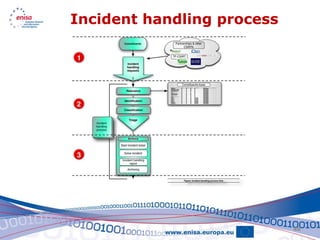
Incident handling process


                            46
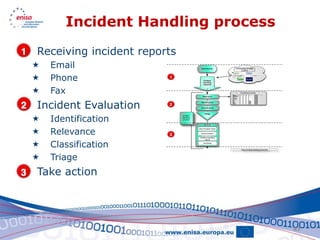
Incident Handling process
1.   Receiving incident reports
        Email
        Phone
        Fax
2.   Incident Evaluation
        Identification
        Relevance
        Classification
        Triage
3.   Take action


                                        47
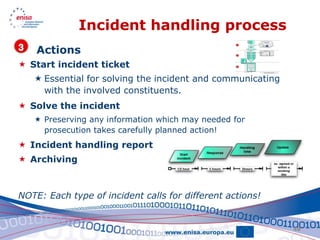
Incident handling process
    Actions
 Start incident ticket
    Essential for solving the incident and communicating
     with the involved constituents.
 Solve the incident
    Preserving any information which may needed for
     prosecution takes carefully planned action!
 Incident handling report
 Archiving


NOTE: Each type of incident calls for different actions!


                                                            48
Wrap-up
1.       Understanding what a CSIRT is.
2.       What sector do you deliver your services to?
3.       What kinds of services can a CSIRT provide to its
         constituents?
     -      Analysis of the environment and constituents
     -      Defining the mission statement
4.       Defining your goals
     -      Defining your Cost model
     -      Defining the organizational model
     -      Starting to hire your staff
     -      Utilizing your office
     -      Defining the needed Security policy
     -      Looking for cooperation partners
5.       Dealing with matters of project management
     -      Have the business case approved
     -      Fit everything into a project plan
6.       Making the CSIRT operational.
     -      Creating workflows
     -      Implementing CSIRT tooling

The next step is: training your staff


                                                             49
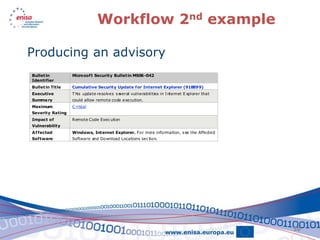
Workflow 2nd example

Producing an advisory
Bullet in         Microsoft Security Bullet in MS06-042
Identifier
Bullet in Title   Cumulative Security Update for Internet Explorer (918899)
Executive         T his update resolves s e
                                          veral vulnerabilities in I nternet E xplorer that
Summa ry          could allow remote code execution.
Maximum           C riti al
                       c
Severity Rating
Impact of         Remote Code Exec ut
                                    ion
Vulnerability
A f fected        Windows, Internet Explorer. For mo information, s ee the Affected
                                                    re
Software          Software and Download Locations sec t
                                                      ion.


                                                                                              50
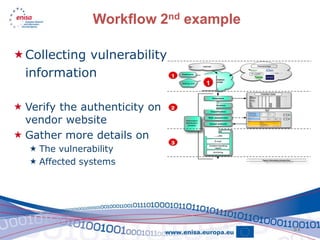
Workflow 2nd example

Collecting vulnerability
 information

 Verify the authenticity on
  vendor website
 Gather more details on
    The vulnerability
    Affected systems


                                        51
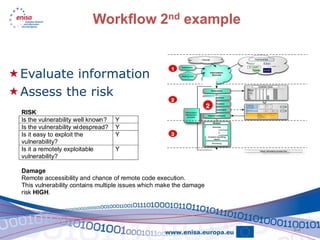
Workflow 2nd example


Evaluate information
Assess the risk
 RISK
 Is the vulnerability well known?   Y
 Is the vulnerability widespread?   Y
 Is it easy to exploit the          Y
 vulnerability?
 Is it a remotely exploitable       Y
 vulnerability?

 Damage
 Remote accessibility and chance of remote code execution.
 This vulnerability contains multiple issues which make the damage
 risk HIGH.


                                                                     52
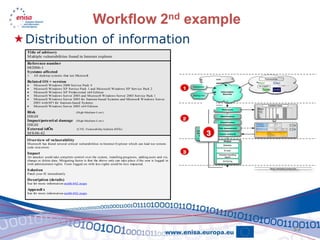
Workflow 2nd example
Distribution of information
  Title of advisory
  M ultiple vulnerabilities found in Internet explorer
  Reference number
  082006-1
  S ystems affected
  1.   All desktop systems that run Microsoft

  Related OS + version
      Microsoft Windows 2000 Service Pack 4
      Microsoft Windows XP Service Pack 1 and Microsoft Windows XP Service Pack 2
      Microsoft Windows XP Profes sional x64 Edition
      Microsoft Windows Server 2003 and Microsoft Windows Server 2003 Service Pack 1
      Microsoft Windows Server 2003 for Itanium-based Systems and Microsoft Windows Server
       2003 with SP1 for Itanium-based Systems
      Microsoft Windows Server 2003 x64 Edition

  Risk                               (High-Medium-Low)
  HIGH
  Impact/potenti al damage           (High-Medium-Low)
  HIGH
  External idÕs
              :                       (CVE, Vu lnerability bulletin IDÕs)
  M S-06-42
  Overview of vu lnerability
  Microsoft has found several critical vulnerabilities in Internet Explorer which can lead too remote
  code execution.

  Impact
  An attacker could take complete control over the system, installing programs, adding users and vie,
  change or delete data. Mitigating factor is that the above only can take place if the user is logged in
  with administrator rights. Users logged on with less rights could be less impacted.

  S olution
  Patch your IE immediately

  Description (details)
  See for more information ms06-042.mspx

  Appendi x
  See for more information ms06-042.mspx


                                                                                                            53
ENISA and CSIRTs

                                Mission
 Promote and facilitate good practice in setting-up and running of
CSIRTs / WARPs / Abuse Teams / etc.

 Encourage cooperation between different actors

 Develop relations to the various CERT/CSIRT communities

 Support their activities

 Run a Working-Group with external experts
How ENISA supports CSIRT community?
              Promote best practice!
2005:          2006:          2007:       2008:            2009:       2009:
Stocktaking    Setting up &   Support     CERT Exercises   CERT        CERT Baseline
               Cooperation    Operation                    Exercises   Capabilities
                              Quality                      Report      Document
                              Assurance


                                                                       […]
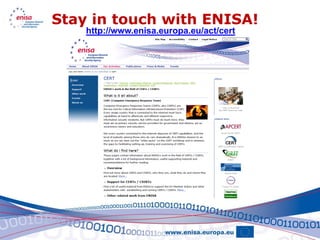
Stay in touch with ENISA!
    http://www.enisa.europa.eu/act/cert
THANK YOU!


             Contact:
         Andrea DUFKOVA
Section for Computer Security and
        Incident Response
              ENISA

 cert-relations@enisa.europa.eu

Day 1 Enisa Setting Up A Csirt

  • 1.
    INTODUCTION TO THECSIRT SETTING UP GUIDE http://www.enisa.europa.eu/act/cert/support/guide
  • 2.
    Agenda How it allstarted  What do CERTs do?  How is Incident Response functioning  CERT cooperation  ENISA and CERTs 2
  • 3.
    Setting up aCSIRT  Introduction  Overall strategy for planning and setting up a CSIRT  The first section gives a description of what a CSIRT is. It will also provide information about the different environments in which CSIRTs can work and what services they can deliver.  Developing the Business Plan  This section describes the business management approach to the setting-up process.  Promoting the Business Plan  This section deal with the business case and funding issues.  Examples of operational and technical procedures  This section describes the procedure of gaining information and translating it into a security bulletin. This section also provides a description of an incident-handling workflow.  CSIRT training  This section gives a summary of available CSIRT training. For illustration sample course material is provided in the annex.  Producing an advisory  This section contains an exercise on how to carry out one of the basic (or core) CSIRT services: the production of a security bulletin (or advisory).  Description of the Project Plan  This section points to the supplementary project plan (checklist) provided with this guide. This plan aims at being a simple to use tool for the implementation of this guide. 3
  • 4.
    The early daysof internet  First idea of an Internet in 1960: "A network of such [computers], connected to one another by wideband communication lines" which provided "the functions of present-day libraries together with anticipated advances in information storage and retrieval and [other] symbiotic functions. ” by .C.R. Licklider  Beginning of Internet by the Defense Advanced Research Projects Agency (DARPA) in 1981. Map of the TCP/IP test network in January 1982 4
  • 5.
  • 6.
    First incident onthe Internet 2 November 1988: The MORRIS worm  First major outbreak , it spread swiftly around the world  6000 major UNIX machines were infected (of a total of 60.000 computers connected)  Estimated cost of damage $10M - 100M  Gene Spafford created a mailing list coordinating the first Incident response 6
  • 7.
    The First CERT Afterincident people realized they where in need for: Timely response Structured and organized approach Central coordination This incident in the history of Internet security led directly to the founding of the CERT/CC© 7
  • 8.
    Europe and CSIRT’s Thismodel was soon adopted in Europe 1992 Surfnet launched the first CSIRT in Europe SURFnet-CERT At present ENISAs inventory of CERT activities in Europe list over 140 CSIRTs 8
  • 9.
  • 10.
    CSIRT abbreviations CERT© /CERT-CC(Computer Emergency Response Team) CSIRT (Computer Security Incident Response Team) IRT (Incident Response Team) CIRT (Computer Incident Response Team) SERT (Security Emergency Response Team) Abuse Team (not a CSIRT) Is a response facility, usually operated by an ISP, who professionally handles "Internet-abuse" reports or complaints. 10
  • 11.
    CSIRT definition CSIRT A teamthat responds to computer security incidents Providing necessary services to solve or supporting the resolution of them. Is trying to prevent any computer security incidents within its constituency or responsibility. Constituency Customer base of a CSIRT 11
  • 12.
    Benefits of havinga CSIRT  A dedicated ICT-security team helps to mitigate and prevent major incidents protecting your organization’s valuable assets.  Centralized coordination for ICT-security issues  Specialized organization in handling and responding to ICT-incidents.  Dedicated support available, assisting in taking the appropriate steps and helping the constituent with quick recovery of the ICT infrastructure.  Dealing with legal issues and preserving evidence in the event of a lawsuit.  Educate organization on ICT-security  Stimulating cooperation within the constituency on ICT- security, preventing possible losses. 12
  • 13.
    What kind ofCSIRTS exists Constituent depended sector CSIRTS In alphabetic order:  National / Governmental Sector  Academic Sector  Commercial  CIP/CIIP Sector  Internal  Military Sector  Small & Medium Enterprises (SME) Sector  Vendor Teams  … 13
  • 14.
    CSIRT services 1/3 We can distinguish 4 kind of services Responsive services 1. Reactive services 2. Proactive services 3. Artifact handling 4. Security quality management 14
  • 15.
    CSIRT “Core” Services2/3 Reactive Services  Alerts and Warnings  Incident Handling  Incident analysis  Incident response support  Incident response coordination Proactive Service • Announcements 15
  • 16.
    CSIRT services 3/4 Reactive services Proactive services Artifact handling Alerts and Warnings Announcements Artifact analysis Incident Handling Technology watch Artifact response Incident analysis Security audits or assessments Artifact response coordination Incident response support Configuration and maintenance Security Quality of security Management Incident response coordination Development of Security Tools Risk Analysis Incident response on site Intrusion Detection Services Business Continuity and Disaster Recovery Vulnerability handling Security-Related Information Security Consulting Dissemination Vulnerability analysis Awareness Building Vulnerability response Education/Training Vulnerability response Product Evaluation or Certification coordination 16
  • 17.
    CSIRT services 4/4 First questions about services: 1. Understand what a CSIRT is an what benefits it might provide 2. To what sector is the CSIRT delivering it’s services? 3. Decide on the core services of your CSIRT 4. Start preparing your CSIRT, Organizational, staff, legal, contracts, procedures  Deliver the core services according your standards and agreements 17
  • 18.
    Choosing the rightapproach 1. Define a communication approach to your constituents 2. Define the mission statement 3. Make a realistic implementation/project plan 4. Define your CSIRT services 5. Define the organizational structure 6. Define the Information Security policy 7. Hire the right staff 8. Utilise your CSIRT office 9. Look for cooperation between other CSIRTs and possible national initiatives 18
  • 19.
    Analyzing your Constituency Swotanalysis PEST analysis 19
  • 20.
    Example SWOT analysis Result in delivering the following Core Services:  Alerts and Warnings  Incident handling  Announcements 20
  • 21.
    Communicating channels Public Website Closedmember area on the Website Web-forms to report incidents Mailing lists Email Phone SMS ‘Old fashioned’ paper letters Monthly or annual reports 21
  • 22.
    Mission statement Important tohave a mission statement In communicating your existence to constituents Communicating it to your staff Commercial use, elevator pitches, brochures,… Examples: “<Name of CSIRT> provides information and assistance to its <constituents (define your constituents)> in implementing proactive measures to reduce the risks of computer security incidents as well as responding to such incidents when they occur.” "To offer support to <Constituents> on the prevention of and response to ICT-related Security Incidents” 22
  • 23.
    Developing a businessplan Defining a financial model  Cost model  Revenue model  Use of existing resources  Membership fee  Subsidy 23
  • 24.
    Costs running aCSIRT  Staff  24x7 or office hours  Housing  Normal secured or high secured facility  Equipment  Hosting facilities  Branding material (corporate style)  Brochures 24
  • 25.
    Your organizational structure ACSIRT organization could define the following roles  General  General manager  Staff  Office manager  Accountant  Communication consultant  Legal consultant  Operational Technical team  Technical team leader  Technical CSIRT technicians, delivering the CSIRT services  Researchers  External consultants, Hired when needed 25
  • 26.
  • 27.
  • 28.
  • 29.
    The voluntary model Group of people (specialists) that join together in case of emergency.  Loosely fitted Example WARPS 29
  • 30.
    Hiring the rightstaff ( the hot picks)  Flexible, creative, good teams spirit  Strong analytical skills,  Ability to explain difficult technical matter into easy wording  Good organizational skills and stress durable  Technical knowledge (deep specialist + broad general internet technology knowledge)  Willingness to work 24x7  Loving to do the job! ;) 30
  • 31.
    Utilization & equippingthe office  Hardening the building See ISO17799  Maintaining communication channels  Record tracking system(s)  Use the corporate style from the beginning!  Foresee out-of-band communication in case of attacks  Check redundancy on internet connectivity and office in case of emergencies 31
  • 32.
    Information security policy Informationhandling policy 1. How is incoming information "tagged" or "classified"? 2. How is information handled, especially with regard to exclusivity? 3. What considerations are adopted for the disclosure of information "when what?" especially incident related information passed on to other teams or to sites? 32
  • 33.
    Information security policy 4. Are there legal considerations to take into account with regard to information handling? 5. Do you have a policy on use of cryptography to shield exclusivity & integrity in archives and/or data communication, especially e- mail. 6. This policy must include possible legal boundary conditions such as key escrow or enforceability of decryption in case of lawsuits. 33
  • 34.
    Information Security policy National  Laws on information technology  Laws on data protection and privacy  Codes of conduct for corporate governance and IT Governance  European directives  Directives on data protection and electronic communication  International  Basel II, Eu. Convention on Cybercrime  Standards  BS 7799  ISO 27001 34
  • 35.
    Search for cooperation ENISA Nationalinitiatives TF-CSIRT WARPS FIRST 35
  • 36.
    Promoting your businessplan  It visualizes the trends in IT security, especially the decrease in the necessary skills to carry out increasingly sophisticated attacks.  Another point to mention is the continuously shrinking time window between the availability of software updates for vulnerabilities and the starting of attacks against them 36
  • 37.
    Promoting your businessplan Viruses Timeline Patch -> Exploit Spreading rate Nimda 11 month Code red Days Slammer 6 month Nimda Hours Nachi 5 month Slammer Minutes Blaster 3 weeks Witty 1 day (!) 37
  • 38.
    Business plan &Management What is the problem? What would you like to achieve with your constituents? What happens if you do nothing? What happens if you take action? What is it going to cost? What is going to gain? When do you start and when is it finished? 38
  • 39.
    Short wrap-up  Howis information handled within your organization  Do you have a Information security policy?  Do you know other CSIRTs?  Could you share incidents that can help the promotion of a CSIRT business plan?  Discuss your potential business plan 39
  • 40.
    Operational Procedures Focus onbasic services first!  Alerts and Warnings  Incident handling  Announcements 40
  • 41.
  • 42.
    Information process flow InformationSources: • Vulnerability information • Incident reports • Public and closed sources for vulnerability information: - Public and closed mailing lists ! Vendor vulnerability product information - Websites - Information on the Internet - Public and private partnerships that provide vulnerability information (FIRST, TF- CSIRT, CERT- CC, US-CERT.) 42
  • 43.
    Information process flow Identification  Trustworthy source of information  Correct information • Cross checked with other sources  Relevance  Impact to the IT infrastructure of the constituent  Classification of information  Risk assessment & impact analysis  Impact = Risk x potential damage 43
  • 44.
    Information process flow Riskassessment & impact analysis RISK Is the vulnarability widely known? No, limited 1 Yes, public 2 Is the vulnarability widely exploited? No 1 Yes 2 Is it easy to exploit the vulnerability? No, hacker 1 Yes, script kiddie 2 11,12 High Precondition: default configuration? No. specific 1 Yes, standard 2 8,9,10 Medium 0 Precondition: physical access required? Yes 1 No 2 6,7 Low Precondition: user account required? Yes 1 No 2 Damage Unauthorized access to data No 0 Yes, read 2 Yes, read + write 4 6 t/m 15 High DoS No 0 Yes, non-critical 1 Yes, critical 5 2 t/m 5 Medium 0 Permissions No 0 Yes, user 4 Yes, root 6 0,1 Low OVERALL High Remote root >> Imediately action needed! Local root exploit (attacker has a user account on the machine) Denial of Service Medium Remote user exploit >> Action within a week Remote unauthorized access to data Unauthorized obtaining data Local unauthorized access to data Low Local unauthorized obtaining user-rights >> Include it in general process Local user exploit 44
  • 45.
    Information process flow Distributionof information  Website  Email  Reports  Archiving and research Title of the advisory ÉÉÉÉÉÉÉÉÉÉÉÉÉÉÉÉÉÉÉÉÉÉÉÉÉÉÉÉÉÉÉÉÉ Reference number ÉÉÉÉÉÉÉÉÉÉÉ S ystems affected - ÉÉÉÉÉÉÉÉÉÉÉ - ÉÉÉÉÉÉÉÉÉÉÉ Related OS + ve rsion ÉÉÉÉÉÉÉÉÉÉÉ Risk (Hi gh-Medium-Low) ÉÉÉ Impact/potenti al damage (Hi gh-Medium-Low) ÉÉÉ External idÕs : (CVE, Vu lnerabi lity bullet in IDÕs) É ÉÉ É Overview of vu lnerability ÉÉÉÉÉÉÉÉÉÉÉÉÉÉÉÉÉÉÉÉÉÉÉ ÉÉÉÉÉÉÉÉÉÉÉÉ ÉÉÉÉÉÉÉÉÉÉÉ Impact ÉÉÉÉÉÉÉÉÉÉÉÉÉÉÉÉÉÉÉÉÉÉÉ ÉÉÉÉÉÉÉÉÉÉÉÉÉÉÉÉÉÉÉÉÉÉÉ S olution ÉÉÉÉÉÉÉÉÉÉÉÉÉÉÉÉÉÉÉÉÉÉÉ ÉÉÉÉÉÉÉÉÉÉÉÉÉÉÉÉÉÉÉÉÉÉÉ Description (details) ÉÉÉÉÉÉÉÉÉÉÉÉÉÉÉÉÉÉÉÉÉÉÉ ÉÉÉÉÉÉÉÉÉÉÉÉÉÉÉÉÉÉÉÉÉÉÉ ÉÉÉÉÉÉÉÉÉÉÉÉÉÉÉÉÉÉÉÉÉÉÉ Example of an Advisory Appendi x ÉÉÉÉÉÉÉÉÉÉÉÉÉÉÉÉÉÉÉÉÉÉÉ É ÉÉÉÉÉÉÉÉÉÉÉÉÉÉÉÉÉÉÉÉÉÉ ÉÉÉÉÉÉÉÉÉÉÉÉÉÉÉÉÉÉÉÉÉÉÉ 45
  • 46.
  • 47.
    Incident Handling process 1. Receiving incident reports  Email  Phone  Fax 2. Incident Evaluation  Identification  Relevance  Classification  Triage 3. Take action 47
  • 48.
    Incident handling process Actions  Start incident ticket  Essential for solving the incident and communicating with the involved constituents.  Solve the incident  Preserving any information which may needed for prosecution takes carefully planned action!  Incident handling report  Archiving NOTE: Each type of incident calls for different actions! 48
  • 49.
    Wrap-up 1. Understanding what a CSIRT is. 2. What sector do you deliver your services to? 3. What kinds of services can a CSIRT provide to its constituents? - Analysis of the environment and constituents - Defining the mission statement 4. Defining your goals - Defining your Cost model - Defining the organizational model - Starting to hire your staff - Utilizing your office - Defining the needed Security policy - Looking for cooperation partners 5. Dealing with matters of project management - Have the business case approved - Fit everything into a project plan 6. Making the CSIRT operational. - Creating workflows - Implementing CSIRT tooling The next step is: training your staff 49
  • 50.
    Workflow 2nd example Producingan advisory Bullet in Microsoft Security Bullet in MS06-042 Identifier Bullet in Title Cumulative Security Update for Internet Explorer (918899) Executive T his update resolves s e veral vulnerabilities in I nternet E xplorer that Summa ry could allow remote code execution. Maximum C riti al c Severity Rating Impact of Remote Code Exec ut ion Vulnerability A f fected Windows, Internet Explorer. For mo information, s ee the Affected re Software Software and Download Locations sec t ion. 50
  • 51.
    Workflow 2nd example Collectingvulnerability information  Verify the authenticity on vendor website  Gather more details on  The vulnerability  Affected systems 51
  • 52.
    Workflow 2nd example Evaluateinformation Assess the risk RISK Is the vulnerability well known? Y Is the vulnerability widespread? Y Is it easy to exploit the Y vulnerability? Is it a remotely exploitable Y vulnerability? Damage Remote accessibility and chance of remote code execution. This vulnerability contains multiple issues which make the damage risk HIGH. 52
  • 53.
    Workflow 2nd example Distributionof information Title of advisory M ultiple vulnerabilities found in Internet explorer Reference number 082006-1 S ystems affected 1. All desktop systems that run Microsoft Related OS + version  Microsoft Windows 2000 Service Pack 4  Microsoft Windows XP Service Pack 1 and Microsoft Windows XP Service Pack 2  Microsoft Windows XP Profes sional x64 Edition  Microsoft Windows Server 2003 and Microsoft Windows Server 2003 Service Pack 1  Microsoft Windows Server 2003 for Itanium-based Systems and Microsoft Windows Server 2003 with SP1 for Itanium-based Systems  Microsoft Windows Server 2003 x64 Edition Risk (High-Medium-Low) HIGH Impact/potenti al damage (High-Medium-Low) HIGH External idÕs : (CVE, Vu lnerability bulletin IDÕs) M S-06-42 Overview of vu lnerability Microsoft has found several critical vulnerabilities in Internet Explorer which can lead too remote code execution. Impact An attacker could take complete control over the system, installing programs, adding users and vie, change or delete data. Mitigating factor is that the above only can take place if the user is logged in with administrator rights. Users logged on with less rights could be less impacted. S olution Patch your IE immediately Description (details) See for more information ms06-042.mspx Appendi x See for more information ms06-042.mspx 53
  • 54.
    ENISA and CSIRTs Mission  Promote and facilitate good practice in setting-up and running of CSIRTs / WARPs / Abuse Teams / etc.  Encourage cooperation between different actors  Develop relations to the various CERT/CSIRT communities  Support their activities  Run a Working-Group with external experts
  • 55.
    How ENISA supportsCSIRT community? Promote best practice! 2005: 2006: 2007: 2008: 2009: 2009: Stocktaking Setting up & Support CERT Exercises CERT CERT Baseline Cooperation Operation Exercises Capabilities Quality Report Document Assurance […]
  • 56.
    Stay in touchwith ENISA! http://www.enisa.europa.eu/act/cert
  • 57.
    THANK YOU! Contact: Andrea DUFKOVA Section for Computer Security and Incident Response ENISA cert-relations@enisa.europa.eu