Working collectively to make best use of
our resources across the NHS in
Scotland.
John Burns
Michael Cambridge   Gordon Beattie
Brendan Faulds      Lynn Marsland
East of Scotland Procurement
Consortium (ESPC)
Partners

•   NHS Borders
•   NHS Fife
•   NHS Forth Valley
•   NHS Grampian                 Heavy use of Video
                                 and
•   NHS Highland
                                 Teleconferencing
•   NHS Lothian
•   NHS Orkney
•   NHS Tayside
•   National Procurement/SG
Aims

•    Productive opportunities of sharing services
•    Test change
•    Build a consortium business model
•    Provide lessons learned for similar projects
•    Contractual economies are a given
•    Create value as well as savings
•    Shift from a „club‟ to a disciplined consortium
•    Reduce fixed costs

    Ensure we buy the “right thing” for the patient as well
                  as buy in the “right way”
What‟s it got to do with me?
• Integrates with overall improvement/quality plan
• Reinvesting savings in direct patient care
• Ensuring fit for purpose products
• Capturing end users clinical knowledge
• Refining Commodity Advisory Panel reps
• Pooling Clinical Procurement Specialist knowledge
• Effective Supply Chain reduces waste and saves you
  time – Closing the Gap, RTC, Productive Ward, 6S
• Continuous quality by contract/supplier management
• Corporate Governance and Legal risks
• Back office - but vital back office
Defining Drivers

•   Clinical Need
•   Clinical Pathways
•   Risk Management
•   Financial constraints
•   Policies
•   Procurement Strategies and Innovation
•   Competitive Tender requirements
•   Legal requirements (incl. E&D)
•   Logistics
Measures

• PCA score of 90% or more
• Price savings on aggregated contracting
• Reduced operating costs
• Savings are formally tracked
• Dashboards for budget control and predictive
  modelling
• Customer Surveys
Changes

•   Re-model/share resources to excel for all
•   Save time by using a “bottom-up approach”
•   Share and spread local innovation and success
•   Bank organic economies and cash efficiencies
•   Longer term – redesign?
•   What needs to be done x 8…?
•   TUGs/CAPs
Changes – Q‟s

•   Processes fit for purpose from a user's stance? RTC…
•   More freedom of product choice rather than less?
•   Regionalise supplier markets through MCNs - ie. endoscopy?
•   Do controls on waste and variation = negative impact on care?
•   Do controls on waste and variation really save money?
•   Can we incentivise clinical staff to change?
•   Horizon scanning - do our systems stifle new technology?
•   Clinical Procurement Specialists embedded?
•   Can we influence how suppliers influence clinicians?
•   Ageing population - are we forecasting demand impacts?
•   Too much bureaucracy? Will less bring clinical improvement ?
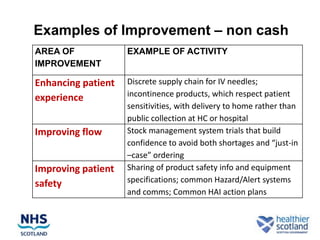
Examples of Improvement – non cash
AREA OF             EXAMPLE OF ACTIVITY
IMPROVEMENT

Enhancing patient   Discrete supply chain for IV needles;
experience          incontinence products, which respect patient
                    sensitivities, with delivery to home rather than
                    public collection at HC or hospital
Improving flow      Stock management system trials that build
                    confidence to avoid both shortages and “just-in
                    –case” ordering
Improving patient   Sharing of product safety info and equipment
safety              specifications; common Hazard/Alert systems
                    and comms; Common HAI action plans
Non Cash Benefits

•   Consistent reporting and systems
•   Enhanced and sustainable capability
•   Effective MI dashboards
•   Increased non-pay spend influence
•   Shared templates and T‟s & C‟s
•   Shared specifications
•   Shared learning and innovation
•   Better access for SMEs and Third Sector
•   Fosters wider public sector partnering
•   Improved compliance and governance
•   Reduced carbon footprint
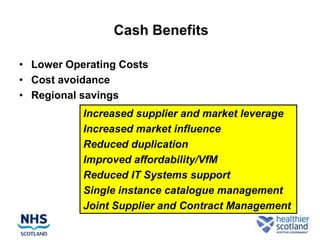
Cash Benefits

• Lower Operating Costs
• Cost avoidance
• Regional savings
           Increased supplier and market leverage
           Increased market influence
           Reduced duplication
           Improved affordability/VfM
           Reduced IT Systems support
           Single instance catalogue management
           Joint Supplier and Contract Management
Kotter‟s 8 steps for
               successful change
•   Increase urgency
•   Build a guiding team
•   Get the vision right
•   Communicate for buy-in
•   Empower action
•   Create short-term wins
•   Don‟t let up
•   Make change stick
Working Collectively to Make Best Use of Our
Resources Across NHSScotland

TECHNICAL USER GROUPS – HARNESSING
EXPERT OPINION
Technical User Groups (TUGS)

Back Ground:

•   New West of Scotland Project.
•   5 HB‟s working collectively.
•   Need to make effective decisions not just advise.
•   Geographically spread.
•   Different Organisations
•   No existing regional decision making forums.
•   Need to harness the expert knowledge of local product
    users
Technical User Groups (TUGS)

Creation of TUGS:

• Populated by expert users from each Health Board.
• Experts formally appointed to TUG.
• Each have DELEGATED AUTORITY OF CEO.
• Decisions made once covering all 5 HB‟s.
• Expert Users of the services to take primary responsibility
  for the selection of the supplier of the products/services
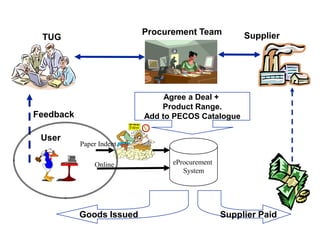
• Product decisions catalogued and loaded onto local
  PECOS /Cedar system.
• TUG experts maintain „formulary control‟ and review.
Procurement Team          Supplier
 TUG


                               Agree a Deal +
                              Product Range.
Feedback                  Add to PECOS Catalogue

 User
           Paper Indent

               Online           eProcurement
                                   System


           Goods Issued                        Supplier Paid
TUG : Continence Products
• West of Scotland Health Boards spend around £7m per year
• Supplied to Primary & Secondary care environments.
• TUG of senior Continence Advisors, Service Managers and
  Procurement Specialists.
• National multi –supplier framework let Dec 11.
• Mini Competition specification focused on service delivery and cost

Outcome
• Technical Users across the region worked closely together to
  establish the benefits of a regional approach.
• This collective approach delivered improved patient services while
  delivering enhanced savings through economies of scale and
  standardisation.
• The WoS regional approach to the implementation of this National
  Framework has also delivered saving of around £1.5M to the five
  Health Boards.
Question
Think about the people issues around change in
Procurement and HR.


What are the main people issues you see?
How do we best bridge the gap between early adopters
and those who are less keen to change?
Engaging Stakeholders to get
Better Value through Procurement
NHSScotland
Procurement
Supporting the Health and Wellbeing of the People of Scotland

             National Procurement – who are we?
    • We are NHSScotland‟s Centre of Procurement Expertise,
      set up in response to the McClelland Review of Public
      Procurement in Scotland (2006)
    • We provide goods, services and procurement expertise
      to NHSScotland‟s 14 Regional Health Boards and 8
      Special Health Boards
    • We are a Division of National Services Scotland and
      work closely with the Scottish Government‟s Health and
      Procurement Directorates
    • We strive towards procurement best practice and delivery
      of new, innovative ways of working that deliver significant
      financial and service efficiencies across NHSScotland
NHSScotland
Procurement
Supporting the Health and Wellbeing of the People of Scotland

                                                Our Key Aims
    • Become effective supply chain partner by working
      collaboratively with NHSS to identify and implement joint
      efficiency solutions
    • Provide a total customer service package including
      Logistics, Procurement, Systems, Improvement and
      Development Services
    • Be innovative and forward looking by assessing and
      implementing more effective ways of working through
      processes, systems and technology
    • Add value to Health Boards via improvement
      programmes to identify and deliver real solutions in
      support of our customers‟ challenges
NHSScotland
Procurement
Supporting the Health and Wellbeing of the People of Scotland

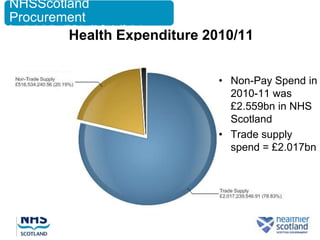
                           Health Expenditure 2010/11


                                                                • Non-Pay Spend in
                                                                  2010-11 was
                                                                  £2.559bn in NHS
                                                                  Scotland
                                                                • Trade supply
                                                                  spend = £2.017bn
NHSScotland
Procurement
Supporting the Health and Wellbeing of the People of Scotland


                             So that‟s the opportunity…..

                                  How do we engage to exploit it?
NHSScotland
Procurement
Supporting the Health and Wellbeing of the People of Scotland

                     Intensive Improvement Activity
    • A short, sharp consultancy engagement
    • Provides a focus and creates momentum for change
    • We guarantee to borrow your watch and tell you the time!
    • There will be very little in the way of surprises
    • You well get out of it what you put into it
    • Delivers detailed and specific recommendations
      recognising Risks, Challenges, Constraints and first
      steps to implementation
    • Planning & Preparation are PARAMOUNT
    • Needs executive engagement and organisational
      commitment to take responsibility to follow it through
NHSScotland
Procurement
Supporting the Health and Wellbeing of the People of Scotland

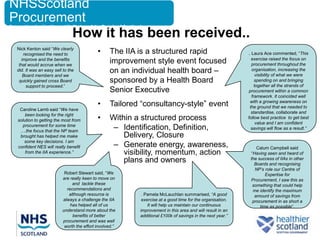
                                 How it has been received..
   Nick Kenton said “We clearly
      recognised the need to                 •      The IIA is a structured rapid                            . Laura Ace commented, “This
                                                                                                               exercise raised the focus on
     improve and the benefits
    that would accrue when we
                                                    improvement style event focused                            procurement throughout the
   did. It was an easy sell to the
      Board members and we
                                                    on an individual health board –                            organisation, increasing the
                                                                                                                  visibility of what we were
    quickly gained cross Board                      sponsored by a Health Board                                  spending on and bringing
        support to proceed.”                                                                                     together all the strands of
                                                    Senior Executive                                          procurement within a common
                                                                                                               framework. It coincided well
                                             •      Tailored “consultancy-style” event                        with a growing awareness on
                                                                                                              the ground that we needed to
    Caroline Lamb said “We have
                                                                                                               standardise, collaborate and
       been looking for the right
   solution to getting the most from         •      Within a structured process                              follow best practice to get best
                                                                                                                  value and I am confident
     procurement for some time
    ….the focus that the NP team
                                                     – Identification, Definition,                             savings will flow as a result.”
    brought has helped me make                          Delivery, Closure
                                                     – Generate energy, awareness,
      some key decisions. I am
   confident NES will really benefit                                                                             Calum Campbell said
       from the IIA experience.”                        visibility, momentum, action                          “Having seen and heard of
                                                        plans and owners                                      the success of IIAs in other
                                                                                                                Boards and recognising
                                                                                                                NP’s role our Centre of
                            Robert Stewart said, “We                                                                  Expertise for
                           are really keen to move on                                                         Procurement, I saw this as
                                and tackle these                                                               something that could help
                             recommendations and                                                               me identify the maximum
                              although resource is           . Pamela McLauchlan summarised, “A good            amount of savings from
                           always a challenge the IIA        exercise at a good time for the organisation.     procurement in as short a
                               has helped all of us             It will help us maintain our continuous            time as possible”.
                           understand more about the        improvement in this area and will result in an
                                benefits of better          additional £100k of savings in the next year.”
                           procurement and was well
                            worth the effort involved.”
NHSScotland
Procurement
Supporting the Health and Wellbeing of the People of Scotland

                                          Success so far….
    • 16 IIAs delivered since January 2010
    • 2 recent events targeted purely on identifying additional
      savings
       – £2.2M identified on top of existing projects
       – Equates to approx 1%-1.5% of targeted Trade Spend
    • Funding being sought to take this approach to remaining
      20 Health Board organisations
       – Using a conservative 1% estimate this would equate
         to £20M in additional savings
    • Beyond investment, it just needs engagement
      and a common purpose to realise the benefits!
NHSScotland Procurement
Supporting the Health and Wellbeing of the People of Scotland


                                 Thank You!
Question
Think about the people issues around change in
Procurement and HR.


What are the main people issues you see?
How do we best bridge the gap between early adopters
and those who are less keen to change?
HR Shared
 Services
Overarching Objectives
• Born out of Efficiency and Productivity agenda
• 1 of 3 strands to Shared Services
  -    Finance
  -    HR
  -    Facilities
• Balanced “scorecard” of benefits
  -    Quality of service (governance)
  -    Delivery of service (productivity)
  -    Cost (efficiency)
  -    People (value-add, career progression)
• Identify, quantify and realise benefits from eESS
• Support revised national Workforce Development Strategy
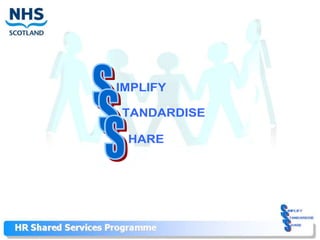
IMPLIFY

TANDARDISE

 HARE
Scope
if it sits in HR anywhere – its in!!
Programme Principles
• Openness and transparency: key stakeholders                indentified and all
   documentation is made accessible
• Partnership: with formal Partnership representatives, NHS staff and external partners
• Robust benchmarking and data analysis: establishing a baseline of current
   internal data as well as comparisons with external best practice
• Engagement: involving groups of HR staff from across NHS Scotland to ensure
   ownership for implementing the models developed
• Based on a future model where services are most appropriately delivered either locally,
  regionally or nationally
• Service and process redesign methodology: lean best practice and
   programme management disciplines
Risks and Interdependencies

• Implementation and functionality of eESS
• Leadership from HRDS, other Directors “in scope” and
  other HR staff
• Effective partnership working
• PIN policies
• Health and Social Care integration
• e-Payroll, e-Rostering etc
• Our “customers”
Workstreams and Timescales
Phase 1 – April 2012 to March 2013
•   Employee Services
•   Medical Staffing
•   Recruitment
•   Payroll and Benefits Advice
Phase 2 – April 2013 to March 2014
•   Organisation Development
•   Learning, Development and Education
•   Workforce Planning, Workforce Information etc
•   Occupational Health and Safety
What‟s happening now ..
• HRD lead for Phase 1 workstreams
    -   Ian Reid: Recruitment
    -   Kenny Small:       Medical Staffing
    -   Jacqui Jones:      Employee Services
    -   Annie Ingram:      Payroll and Advice

•   Baseline for current staffing levels etc
•   HR “Customer” survey baseline
•   Understand benefits from eESS implementation
•   Engage! – Communicate! – Change!
Any questions or comments?

Parallel Session 2.7 Working Collectively to Make Best Use of Our Resources Across NHSScotland

  • 1.
    Working collectively tomake best use of our resources across the NHS in Scotland. John Burns Michael Cambridge Gordon Beattie Brendan Faulds Lynn Marsland
  • 2.
    East of ScotlandProcurement Consortium (ESPC)
  • 3.
    Partners • NHS Borders • NHS Fife • NHS Forth Valley • NHS Grampian Heavy use of Video and • NHS Highland Teleconferencing • NHS Lothian • NHS Orkney • NHS Tayside • National Procurement/SG
  • 4.
    Aims • Productive opportunities of sharing services • Test change • Build a consortium business model • Provide lessons learned for similar projects • Contractual economies are a given • Create value as well as savings • Shift from a „club‟ to a disciplined consortium • Reduce fixed costs Ensure we buy the “right thing” for the patient as well as buy in the “right way”
  • 5.
    What‟s it gotto do with me? • Integrates with overall improvement/quality plan • Reinvesting savings in direct patient care • Ensuring fit for purpose products • Capturing end users clinical knowledge • Refining Commodity Advisory Panel reps • Pooling Clinical Procurement Specialist knowledge • Effective Supply Chain reduces waste and saves you time – Closing the Gap, RTC, Productive Ward, 6S • Continuous quality by contract/supplier management • Corporate Governance and Legal risks • Back office - but vital back office
  • 6.
    Defining Drivers • Clinical Need • Clinical Pathways • Risk Management • Financial constraints • Policies • Procurement Strategies and Innovation • Competitive Tender requirements • Legal requirements (incl. E&D) • Logistics
  • 7.
    Measures • PCA scoreof 90% or more • Price savings on aggregated contracting • Reduced operating costs • Savings are formally tracked • Dashboards for budget control and predictive modelling • Customer Surveys
  • 8.
    Changes • Re-model/share resources to excel for all • Save time by using a “bottom-up approach” • Share and spread local innovation and success • Bank organic economies and cash efficiencies • Longer term – redesign? • What needs to be done x 8…? • TUGs/CAPs
  • 9.
    Changes – Q‟s • Processes fit for purpose from a user's stance? RTC… • More freedom of product choice rather than less? • Regionalise supplier markets through MCNs - ie. endoscopy? • Do controls on waste and variation = negative impact on care? • Do controls on waste and variation really save money? • Can we incentivise clinical staff to change? • Horizon scanning - do our systems stifle new technology? • Clinical Procurement Specialists embedded? • Can we influence how suppliers influence clinicians? • Ageing population - are we forecasting demand impacts? • Too much bureaucracy? Will less bring clinical improvement ?
  • 10.
    Examples of Improvement– non cash AREA OF EXAMPLE OF ACTIVITY IMPROVEMENT Enhancing patient Discrete supply chain for IV needles; experience incontinence products, which respect patient sensitivities, with delivery to home rather than public collection at HC or hospital Improving flow Stock management system trials that build confidence to avoid both shortages and “just-in –case” ordering Improving patient Sharing of product safety info and equipment safety specifications; common Hazard/Alert systems and comms; Common HAI action plans
  • 11.
    Non Cash Benefits • Consistent reporting and systems • Enhanced and sustainable capability • Effective MI dashboards • Increased non-pay spend influence • Shared templates and T‟s & C‟s • Shared specifications • Shared learning and innovation • Better access for SMEs and Third Sector • Fosters wider public sector partnering • Improved compliance and governance • Reduced carbon footprint
  • 12.
    Cash Benefits • LowerOperating Costs • Cost avoidance • Regional savings Increased supplier and market leverage Increased market influence Reduced duplication Improved affordability/VfM Reduced IT Systems support Single instance catalogue management Joint Supplier and Contract Management
  • 13.
    Kotter‟s 8 stepsfor successful change • Increase urgency • Build a guiding team • Get the vision right • Communicate for buy-in • Empower action • Create short-term wins • Don‟t let up • Make change stick
  • 14.
    Working Collectively toMake Best Use of Our Resources Across NHSScotland TECHNICAL USER GROUPS – HARNESSING EXPERT OPINION
  • 15.
    Technical User Groups(TUGS) Back Ground: • New West of Scotland Project. • 5 HB‟s working collectively. • Need to make effective decisions not just advise. • Geographically spread. • Different Organisations • No existing regional decision making forums. • Need to harness the expert knowledge of local product users
  • 16.
    Technical User Groups(TUGS) Creation of TUGS: • Populated by expert users from each Health Board. • Experts formally appointed to TUG. • Each have DELEGATED AUTORITY OF CEO. • Decisions made once covering all 5 HB‟s. • Expert Users of the services to take primary responsibility for the selection of the supplier of the products/services • Product decisions catalogued and loaded onto local PECOS /Cedar system. • TUG experts maintain „formulary control‟ and review.
  • 17.
    Procurement Team Supplier TUG Agree a Deal + Product Range. Feedback Add to PECOS Catalogue User Paper Indent Online eProcurement System Goods Issued Supplier Paid
  • 18.
    TUG : ContinenceProducts • West of Scotland Health Boards spend around £7m per year • Supplied to Primary & Secondary care environments. • TUG of senior Continence Advisors, Service Managers and Procurement Specialists. • National multi –supplier framework let Dec 11. • Mini Competition specification focused on service delivery and cost Outcome • Technical Users across the region worked closely together to establish the benefits of a regional approach. • This collective approach delivered improved patient services while delivering enhanced savings through economies of scale and standardisation. • The WoS regional approach to the implementation of this National Framework has also delivered saving of around £1.5M to the five Health Boards.
  • 19.
    Question Think about thepeople issues around change in Procurement and HR. What are the main people issues you see? How do we best bridge the gap between early adopters and those who are less keen to change?
  • 20.
    Engaging Stakeholders toget Better Value through Procurement
  • 21.
    NHSScotland Procurement Supporting the Healthand Wellbeing of the People of Scotland National Procurement – who are we? • We are NHSScotland‟s Centre of Procurement Expertise, set up in response to the McClelland Review of Public Procurement in Scotland (2006) • We provide goods, services and procurement expertise to NHSScotland‟s 14 Regional Health Boards and 8 Special Health Boards • We are a Division of National Services Scotland and work closely with the Scottish Government‟s Health and Procurement Directorates • We strive towards procurement best practice and delivery of new, innovative ways of working that deliver significant financial and service efficiencies across NHSScotland
  • 22.
    NHSScotland Procurement Supporting the Healthand Wellbeing of the People of Scotland Our Key Aims • Become effective supply chain partner by working collaboratively with NHSS to identify and implement joint efficiency solutions • Provide a total customer service package including Logistics, Procurement, Systems, Improvement and Development Services • Be innovative and forward looking by assessing and implementing more effective ways of working through processes, systems and technology • Add value to Health Boards via improvement programmes to identify and deliver real solutions in support of our customers‟ challenges
  • 23.
    NHSScotland Procurement Supporting the Healthand Wellbeing of the People of Scotland Health Expenditure 2010/11 • Non-Pay Spend in 2010-11 was £2.559bn in NHS Scotland • Trade supply spend = £2.017bn
  • 24.
    NHSScotland Procurement Supporting the Healthand Wellbeing of the People of Scotland So that‟s the opportunity….. How do we engage to exploit it?
  • 25.
    NHSScotland Procurement Supporting the Healthand Wellbeing of the People of Scotland Intensive Improvement Activity • A short, sharp consultancy engagement • Provides a focus and creates momentum for change • We guarantee to borrow your watch and tell you the time! • There will be very little in the way of surprises • You well get out of it what you put into it • Delivers detailed and specific recommendations recognising Risks, Challenges, Constraints and first steps to implementation • Planning & Preparation are PARAMOUNT • Needs executive engagement and organisational commitment to take responsibility to follow it through
  • 26.
    NHSScotland Procurement Supporting the Healthand Wellbeing of the People of Scotland How it has been received.. Nick Kenton said “We clearly recognised the need to • The IIA is a structured rapid . Laura Ace commented, “This exercise raised the focus on improve and the benefits that would accrue when we improvement style event focused procurement throughout the did. It was an easy sell to the Board members and we on an individual health board – organisation, increasing the visibility of what we were quickly gained cross Board sponsored by a Health Board spending on and bringing support to proceed.” together all the strands of Senior Executive procurement within a common framework. It coincided well • Tailored “consultancy-style” event with a growing awareness on the ground that we needed to Caroline Lamb said “We have standardise, collaborate and been looking for the right solution to getting the most from • Within a structured process follow best practice to get best value and I am confident procurement for some time ….the focus that the NP team – Identification, Definition, savings will flow as a result.” brought has helped me make Delivery, Closure – Generate energy, awareness, some key decisions. I am confident NES will really benefit Calum Campbell said from the IIA experience.” visibility, momentum, action “Having seen and heard of plans and owners the success of IIAs in other Boards and recognising NP’s role our Centre of Robert Stewart said, “We Expertise for are really keen to move on Procurement, I saw this as and tackle these something that could help recommendations and me identify the maximum although resource is . Pamela McLauchlan summarised, “A good amount of savings from always a challenge the IIA exercise at a good time for the organisation. procurement in as short a has helped all of us It will help us maintain our continuous time as possible”. understand more about the improvement in this area and will result in an benefits of better additional £100k of savings in the next year.” procurement and was well worth the effort involved.”
  • 27.
    NHSScotland Procurement Supporting the Healthand Wellbeing of the People of Scotland Success so far…. • 16 IIAs delivered since January 2010 • 2 recent events targeted purely on identifying additional savings – £2.2M identified on top of existing projects – Equates to approx 1%-1.5% of targeted Trade Spend • Funding being sought to take this approach to remaining 20 Health Board organisations – Using a conservative 1% estimate this would equate to £20M in additional savings • Beyond investment, it just needs engagement and a common purpose to realise the benefits!
  • 28.
    NHSScotland Procurement Supporting theHealth and Wellbeing of the People of Scotland Thank You!
  • 29.
    Question Think about thepeople issues around change in Procurement and HR. What are the main people issues you see? How do we best bridge the gap between early adopters and those who are less keen to change?
  • 30.
  • 31.
    Overarching Objectives • Bornout of Efficiency and Productivity agenda • 1 of 3 strands to Shared Services - Finance - HR - Facilities • Balanced “scorecard” of benefits - Quality of service (governance) - Delivery of service (productivity) - Cost (efficiency) - People (value-add, career progression) • Identify, quantify and realise benefits from eESS • Support revised national Workforce Development Strategy
  • 32.
  • 33.
    Scope if it sitsin HR anywhere – its in!!
  • 34.
    Programme Principles • Opennessand transparency: key stakeholders indentified and all documentation is made accessible • Partnership: with formal Partnership representatives, NHS staff and external partners • Robust benchmarking and data analysis: establishing a baseline of current internal data as well as comparisons with external best practice • Engagement: involving groups of HR staff from across NHS Scotland to ensure ownership for implementing the models developed • Based on a future model where services are most appropriately delivered either locally, regionally or nationally • Service and process redesign methodology: lean best practice and programme management disciplines
  • 35.
    Risks and Interdependencies •Implementation and functionality of eESS • Leadership from HRDS, other Directors “in scope” and other HR staff • Effective partnership working • PIN policies • Health and Social Care integration • e-Payroll, e-Rostering etc • Our “customers”
  • 36.
    Workstreams and Timescales Phase1 – April 2012 to March 2013 • Employee Services • Medical Staffing • Recruitment • Payroll and Benefits Advice Phase 2 – April 2013 to March 2014 • Organisation Development • Learning, Development and Education • Workforce Planning, Workforce Information etc • Occupational Health and Safety
  • 37.
    What‟s happening now.. • HRD lead for Phase 1 workstreams - Ian Reid: Recruitment - Kenny Small: Medical Staffing - Jacqui Jones: Employee Services - Annie Ingram: Payroll and Advice • Baseline for current staffing levels etc • HR “Customer” survey baseline • Understand benefits from eESS implementation • Engage! – Communicate! – Change!
  • 38.