Healthcare Procurement:
Custom Contracting through GPOs
1
Rajib Saha Avi Seidmann Vera Tilson
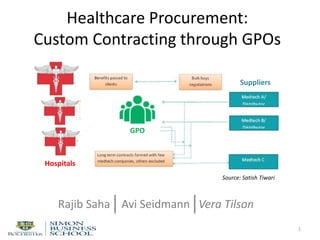
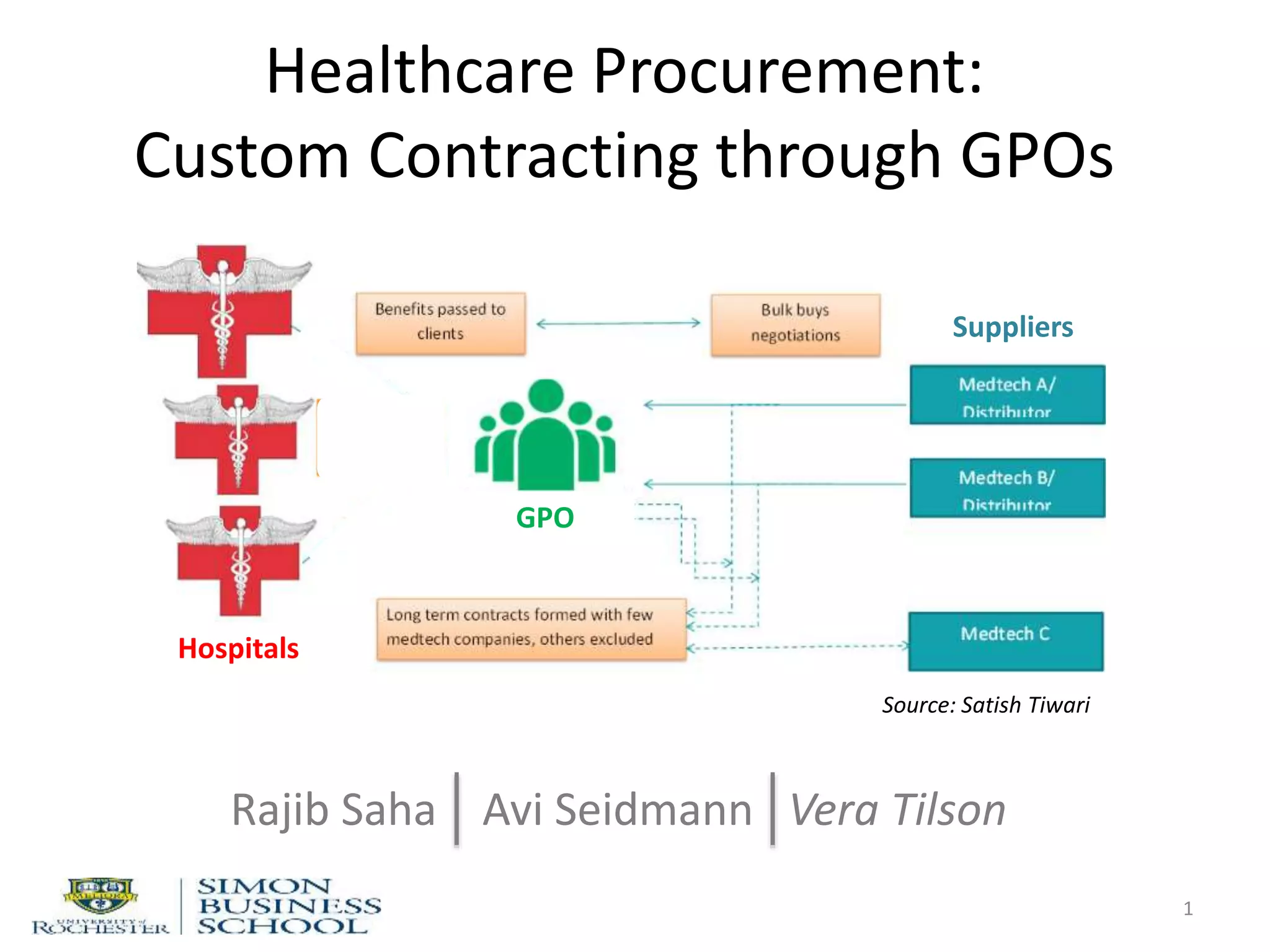
GPO
Hospitals
Suppliers
Source: Satish Tiwari
There are multiple procurement challenges for US
hospitals
1. Difficult to control labor costs,
employee:patient ratios are often mandated
2. Inelastic demand (hospitals must buy clinical
supplies)
3. Supplies are 25% of all hospital expenses
2
4. 3% of line items (mostly physician preference items) are
responsible for 40% of supply expenses
5. Difficult to standardize on expensive supplies because of
diverse physician preferences and training
6. Oligopoly manufacturers of the most expensive supplies e.g.
surgical implants.
7. Hospital industry is fragmented, over 5,000 hospitals in the US
There are multiple procurement challenges for US
hospitals
1. Difficult to control labor costs,
employee:patient ratios are often mandated
2. Inelastic demand (hospitals must buy clinical
supplies)
3. Supplies are 25% of all hospital expenses
3
4. 3% of line items (mostly physician preference items) are
responsible for 40% of supply expenses
5. Difficult to standardize on expensive supplies because of
diverse physician preferences and training
6. Oligopoly manufacturers of the most expensive supplies e.g.
surgical implants.
7. Hospital industry is fragmented, over 5,000 hospitals in the US
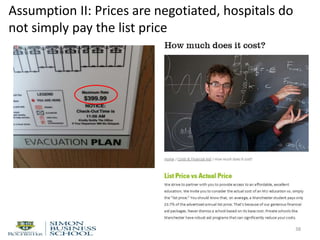
There are multiple procurement challenges for US
hospitals
1. Difficult to control labor costs,
employee:patient ratios are often mandated
2. Inelastic demand (hospitals must buy clinical
supplies)
3. Supplies are 25% of all hospital expenses
4
4. 3% of line items (mostly physician preference items) are
responsible for 40% of supply expenses
5. Difficult to standardize on expensive supplies because of
diverse physician preferences and training
6. Oligopoly manufacturers of the most expensive supplies e.g.
surgical implants.
7. Hospital industry is fragmented, over 5,000 hospitals in the US
Physician Preference:
•Orthopedic Implants
•Spinal Implants
•Pacemakers
•AICDs
•Coronary Stents
•Special Procedure Devices
•Heart Valves
•Endosurgical Supplies
•Bone Products
•Perfusion Supplies
•Pacemakers
•Contrast Media
•Balloons and Wires
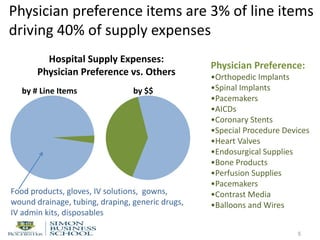
Physician preference items are 3% of line items
driving 40% of supply expenses
5
Hospital Supply Expenses:
Physician Preference vs. Others
by # Line Items by $$
Food products, gloves, IV solutions, gowns,
wound drainage, tubing, draping, generic drugs,
IV admin kits, disposables
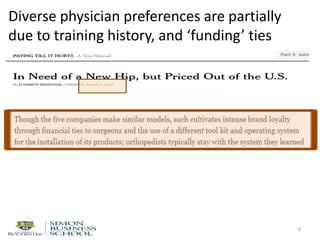
Diverse physician preferences are partially
due to training history, and ‘funding’ ties
6
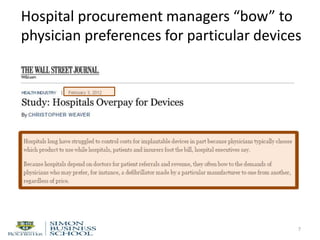
Hospital procurement managers “bow” to
physician preferences for particular devices
7
There are multiple procurement challenges for US
hospitals
1. Difficult to control labor costs,
employee:patient ratios are often mandated
2. Inelastic demand (hospitals must buy clinical
supplies)
3. Supplies are 25% of all hospital expenses
8
4. 3% of line items (mostly physician preference items) are
responsible for 40% of supply expenses
5. Difficult to standardize on expensive supplies because of
diverse physician preferences and training
6. Oligopoly manufacturers of the most expensive supplies e.g.
surgical implants.
7. Hospital industry is fragmented, over 5,000 hospitals in the US
There are multiple procurement challenges for US
hospitals
1. Difficult to control labor costs,
employee:patient ratios are often mandated
2. Inelastic demand (hospitals must buy clinical
supplies)
3. Supplies are 25% of all hospital expenses
9
4. 3% of line items (mostly physician preference items) are
responsible for 40% of supply expenses
5. Difficult to standardize on expensive supplies because of
diverse physician preferences and training
6. Oligopoly manufacturers of the most expensive supplies e.g.
surgical implants.
7. Hospital industry is fragmented, over 5,000 hospitals in the US
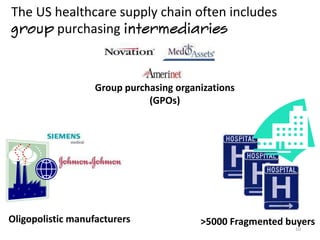
The US healthcare supply chain often includes
group purchasing intermediaries
10
Oligopolistic manufacturers >5000 Fragmented buyers
Group purchasing organizations
(GPOs)
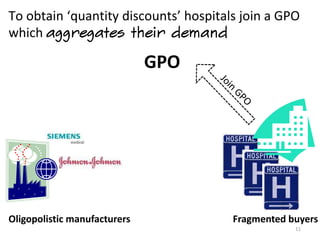
To obtain ‘quantity discounts’ hospitals join a GPO
which aggregates their demand
11
Oligopolistic manufacturers Fragmented buyers
GPO
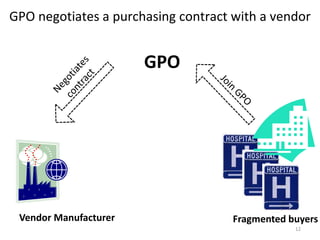
GPO negotiates a purchasing contract with a vendor
12
Vendor Manufacturer Fragmented buyers
GPO
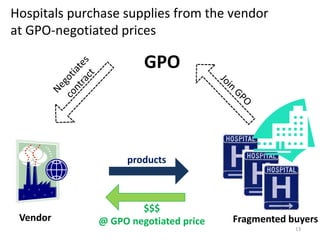
Hospitals purchase supplies from the vendor
at GPO-negotiated prices
13
Vendor Fragmented buyers
$$$
@ GPO negotiated price
products
GPO
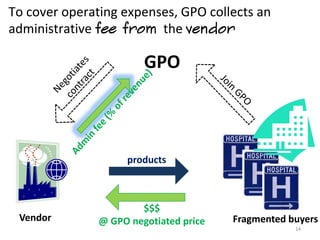
To cover operating expenses, GPO collects an
administrative fee from the vendor
14
Vendor Fragmented buyers
$$$
@ GPO negotiated price
products
GPO
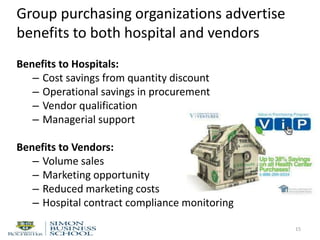
Group purchasing organizations advertise
benefits to both hospital and vendors
Benefits to Hospitals:
– Cost savings from quantity discount
– Operational savings in procurement
– Vendor qualification
– Managerial support
Benefits to Vendors:
– Volume sales
– Marketing opportunity
– Reduced marketing costs
– Hospital contract compliance monitoring
15
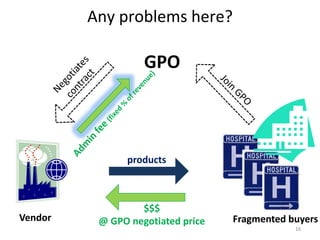
Any problems here?
16
Vendor Fragmented buyers
$$$
@ GPO negotiated price
products
GPO
17
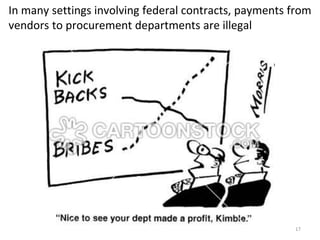
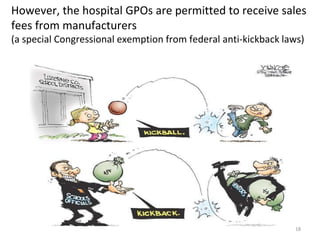
In many settings involving federal contracts, payments from
vendors to procurement departments are illegal
18
However, the hospital GPOs are permitted to receive sales
fees from manufacturers
(a special Congressional exemption from federal anti-kickback laws)
19
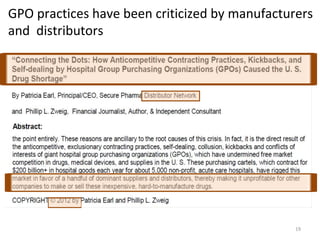
GPO practices have been criticized by manufacturers
and distributors
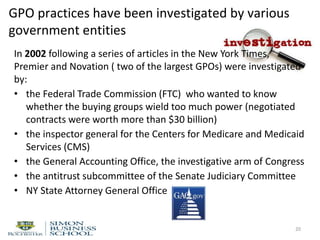
GPO practices have been investigated by various
government entities
In 2002 following a series of articles in the New York Times,
Premier and Novation ( two of the largest GPOs) were investigated
by:
• the Federal Trade Commission (FTC) who wanted to know
whether the buying groups wield too much power (negotiated
contracts were worth more than $30 billion)
• the inspector general for the Centers for Medicare and Medicaid
Services (CMS)
• the General Accounting Office, the investigative arm of Congress
• the antitrust subcommittee of the Senate Judiciary Committee
• NY State Attorney General Office
20
In response to the various investigations
GPOs promised to adopt a code of conduct
• Eliminate self-dealing, i.e. stop investing in supply
companies.
• Contract with more companies, no longer sign exclusive
contracts with single manufacturers for certain medical
supplies
• Limit the length of the contracts (long contracts protected
incumbents)
• Limit contracts that condition discounts on bundling of
unrelated products
21
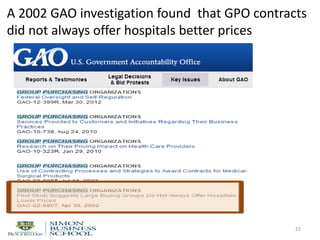
A 2002 GAO investigation found that GPO contracts
did not always offer hospitals better prices
22
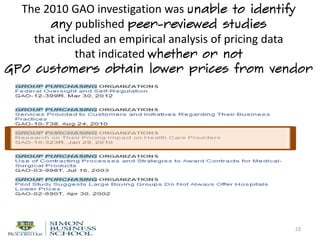
The 2010 GAO investigation was unable to identify
any published peer-reviewed studies
that included an empirical analysis of pricing data
that indicated whether or not
GPO customers obtain lower prices from vendor
23
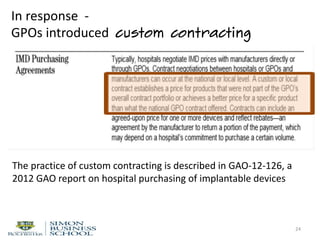
In response -
GPOs introduced custom contracting
The practice of custom contracting is described in GAO-12-126, a
2012 GAO report on hospital purchasing of implantable devices
24
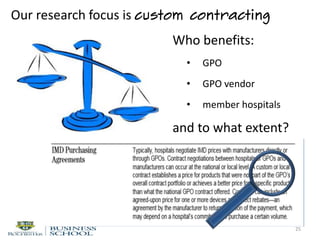
Our research focus is custom contracting
25
Who benefits:
• GPO
• GPO vendor
• member hospitals
and to what extent?
Relevant literature falls into four broad
categories
o Group purchasing:
• The mechanism for price reduction obtained through GPOs
• Effect of contract administration fees (CAF) on supply chain
participants
• Allocation of savings in group purchasing alliance
o Reasons for existence of supply chain intermediaries
26
Relevant literature falls into four broad
categories
o Group purchasing:
• The mechanism for price reduction obtained through GPOs
• Effect of contract administration fees (CAF) on supply chain
participants
• Allocation of savings in group purchasing alliance
o Reasons for existence of supply chain intermediaries
27
Analytical game-theoretic models have been used
to examine how GPOs provide savings when
dealing with multiple suppliers
O’Brien and Shaffer(1997), Dana (2003) prices are
lowered through the exclusive dealing mechanism, i.e.
ability to shift demand to a competitor
Marvel and Yang (2008) hospitals differ in preferences
for products from different supplies, price is lowered through
competition-intensifying effect of non-linear tariff.
Hu and Schwartz (2011) GPOs increase competition
between manufacturers and lower prices for healthcare
providers. However, GPOs reduce manufacturers' incentives to
introduce innovations to existing products.
28
Relevant literature falls into four broad
categories
o Group purchasing:
• The mechanism for price reduction obtained through GPOs
• Effect of contract administration fees (CAF) on supply chain
participants
• Allocation of savings in group purchasing alliance
o Reasons for existence of supply chain intermediaries
29
Hu, Schwartz (2011) conclude that elimination of contract
administration fee (CAF) would not affect any party's profits or
costs.
Hu, Schwartz, and Uhan (2012) conclude that CAF
does not affect hospital costs, but affects distribution of profits
between a GPO and vendors.
30
Relevant literature falls into four broad
categories
o Group purchasing:
• The mechanism for price reduction obtained through GPOs
• Effect of contract administration fees (CAF) on supply chain
participants
• Allocation of savings in group purchasing alliance
o Reasons for existence of supply chain intermediaries
31
Empirical and analytical studies examine
the stability of purchasing alliances:
• Survey-based studies identify drivers of success and failures of
alliances: Doucette (1997), Nollet & Beaulieu
(2003), Schotanus (2005). Unfair allocation of savings
is identified as one of the reasons for the failure of an alliance.
• Game-theoretic models are used to examine the trade-offs in
allocating cost savings to group members of alliances:
Heijboer (2002), Schotanus (2004), Schotanus
et al. (2008), Nagarajan et al. (2008), Chen et
al. (MSOM Conf., 2013)
32
Relevant literature falls into four broad
categories
o Group purchasing:
• The mechanism for price reduction obtained through GPOs
• Effect of contract administration fees (CAF) on supply chain
participants
• Allocation of savings in group purchasing alliance
o Reasons for existence of supply chain intermediaries
33
Wu (2004) categorizes supply chain
intermediaries into two broad types:
• Transactional intermediaries – aggregate supply and
demand, reduce costs associated with searching and
matching
• Informational intermediaries – synthesize dispersed
information or reduce information asymmetry, create trusted
institution
Other reasons for existence of intermediaries and intermediary
profits are examined in Belavina and Girotra (2012),
Yang and Babich (2013), Adida et al. (2013)
34
None of the literature explains the custom
contracting arrangement,
also healthcare GPOs are unlike most supply
chain intermediaries
• they aggregate demand, but do not hold inventory
• operate in a highly regulated environment
• margins are set externally
35
We create a game-theoretic model to
analyze the impact of custom contracting
36
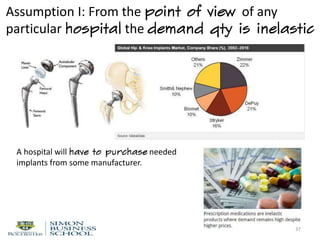
Assumption I: From the point of view of any
particular hospital the demand qty is inelastic
37
A hospital will have to purchase needed
implants from some manufacturer.
Assumption II: Prices are negotiated, hospitals do
not simply pay the list price
38
Assumption II: Price negotiations are costly
for both hospitals and vendors
39
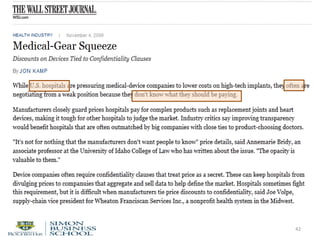
40
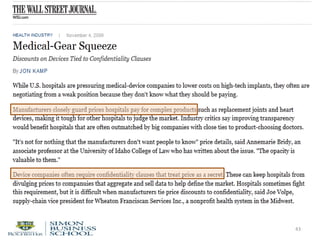
41
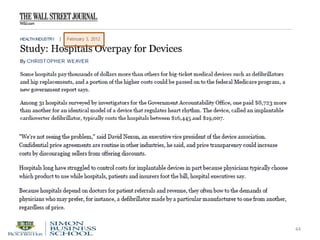
42
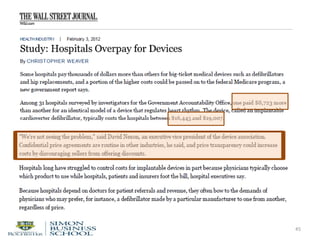
43
44
45
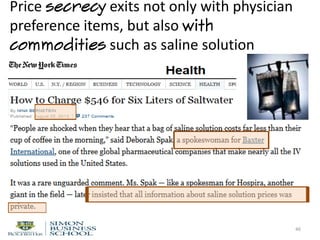
Price secrecy exits not only with physician
preference items, but also with
commodities such as saline solution
46
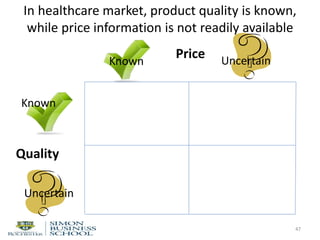
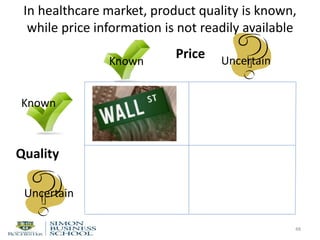
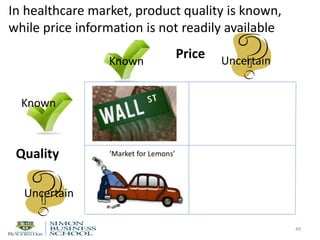
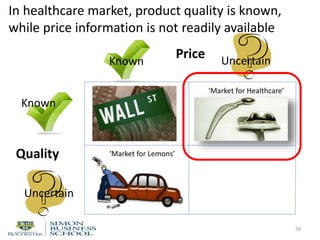
In healthcare market, product quality is known,
while price information is not readily available
47
Uncertain
Price
Quality
UncertainKnown
Known
In healthcare market, product quality is known,
while price information is not readily available
48
Uncertain
Price
Quality
UncertainKnown
Known
In healthcare market, product quality is known,
while price information is not readily available
49
Uncertain
Price
Quality
UncertainKnown
Known
‘Market for Lemons’
In healthcare market, product quality is known,
while price information is not readily available
50
Uncertain
Price
Quality
UncertainKnown
Known
‘Market for Lemons’
‘Market for Healthcare’
Assumption III: Price attainable through vendor-
hospital negotiations is random &
stochastically decreasing in demand
51
Upper limit on attainable
price
Lower limit on
attainable price
PurchasePrice,$/unit
Expected price
Hospitals’ purchase volume [units/period]
Assumption IV: GPO member hospitals are
heterogeneous in terms of demand volume.
This distribution is known to the GPO vendor.
52
#ofmemberhospitals
Hospitals’ purchase volumes [units/period]
Assumption V: Decision timing
53
TreePlan Trial Version, For Evaluation Only www.TreePlan.com
Hospital: don't negotiate
0
0 0
0.5
Negotiated price above GPO price
0
0 0
1
0 0 0 0.5
Negotiated price below GPO price
0
0 0
Hospital: negotiate 0.5
1 Negotiated price above GPO price
0 0 0
0 0
0 0 0.5
Negotiated price below GPO price
0
0 0
1
0 0 0.5
Negotiated price above GPO price
0
0 0
GPO vendor: participate
0.5
0 0 GPO vendor selected
0.5 0
0 0
0 0 0.5
GPO vendor not selected
0
0 0For Evaluation Only
GPO
vendor
set price
Pg
λ q P g q P g + c (k,0 )
0 q E [p (q,P g ,0 ) | p <P g ] + c (k,0 )
q P g - k v q E [p (q,P g ,1 ) | p <P g ] + c (k,1 )
Hospital:invite GPO
vendor
Hospital: don't
invite GPO vendor
GPO vendor: don't
participate
Negotiated price
below GPO price
λ q P g q P g + c (k,0 )
0 q E [p (q,P g ,0 ) | p <P g ] + c (k,0 )
λ q E [p (q,P g ,1 ) | p <P g ] - k v q E [p (q,P g ,1 ) | p <P g ] + c (k,1 )
GPO vendor payoff Hospital cost
λ q P g q P g
λ q P g - k v q P g + c (k,1 )
GPO-selected vendor sets the
GPO-wide contract price for all
members
Assumption V: Decision timing
54
TreePlan Trial Version, For Evaluation Only www.TreePlan.com
Hospital: don't negotiate
0
0 0
0.5
Negotiated price above GPO price
0
0 0
1
0 0 0 0.5
Negotiated price below GPO price
0
0 0
Hospital: negotiate 0.5
1 Negotiated price above GPO price
0 0 0
0 0
0 0 0.5
Negotiated price below GPO price
0
0 0
1
0 0 0.5
Negotiated price above GPO price
0
0 0
GPO vendor: participate
0.5
0 0 GPO vendor selected
0.5 0
0 0
0 0 0.5
GPO vendor not selected
0
0 0For Evaluation Only
GPO
vendor
set price
Pg
λ q P g q P g + c (k,0 )
0 q E [p (q,P g ,0 ) | p <P g ] + c (k,0 )
q P g - k v q E [p (q,P g ,1 ) | p <P g ] + c (k,1 )
Hospital:invite GPO
vendor
Hospital: don't
invite GPO vendor
GPO vendor: don't
participate
Negotiated price
below GPO price
λ q P g q P g + c (k,0 )
0 q E [p (q,P g ,0 ) | p <P g ] + c (k,0 )
λ q E [p (q,P g ,1 ) | p <P g ] - k v q E [p (q,P g ,1 ) | p <P g ] + c (k,1 )
GPO vendor payoff Hospital cost
λ q P g q P g
λ q P g - k v q P g + c (k,1 )
Hospital decides whether to
purchase supplies at this price,
or to negotiate with other
vendors
Assumption V: Decision timing
55
TreePlan Trial Version, For Evaluation Only www.TreePlan.com
Hospital: don't negotiate
0
0 0
0.5
Negotiated price above GPO price
0
0 0
1
0 0 0 0.5
Negotiated price below GPO price
0
0 0
Hospital: negotiate 0.5
1 Negotiated price above GPO price
0 0 0
0 0
0 0 0.5
Negotiated price below GPO price
0
0 0
1
0 0 0.5
Negotiated price above GPO price
0
0 0
GPO vendor: participate
0.5
0 0 GPO vendor selected
0.5 0
0 0
0 0 0.5
GPO vendor not selected
0
0 0For Evaluation Only
GPO
vendor
set price
Pg
λ q P g q P g + c (k,0 )
0 q E [p (q,P g ,0 ) | p <P g ] + c (k,0 )
q P g - k v q E [p (q,P g ,1 ) | p <P g ] + c (k,1 )
Hospital:invite GPO
vendor
Hospital: don't
invite GPO vendor
GPO vendor: don't
participate
Negotiated price
below GPO price
λ q P g q P g + c (k,0 )
0 q E [p (q,P g ,0 ) | p <P g ] + c (k,0 )
λ q E [p (q,P g ,1 ) | p <P g ] - k v q E [p (q,P g ,1 ) | p <P g ] + c (k,1 )
GPO vendor payoff Hospital cost
λ q P g q P g
λ q P g - k v q P g + c (k,1 )
If the hospital is able to find a
lower price from another vendor,
it purchases supplies from that
vendor. Otherwise, from the GPO
vendor at the general price
Assumption V: Decision timing
56
TreePlan Trial Version, For Evaluation Only www.TreePlan.com
Hospital: don't negotiate
0
0 0
0.5
Negotiated price above GPO price
0
0 0
1
0 0 0 0.5
Negotiated price below GPO price
0
0 0
Hospital: negotiate 0.5
1 Negotiated price above GPO price
0 0 0
0 0
0 0 0.5
Negotiated price below GPO price
0
0 0
1
0 0 0.5
Negotiated price above GPO price
0
0 0
GPO vendor: participate
0.5
0 0 GPO vendor selected
0.5 0
0 0
0 0 0.5
GPO vendor not selected
0
0 0For Evaluation Only
GPO
vendor
set price
Pg
λ q P g q P g + c (k,0 )
0 q E [p (q,P g ,0 ) | p <P g ] + c (k,0 )
q P g - k v q E [p (q,P g ,1 ) | p <P g ] + c (k,1 )
Hospital:invite GPO
vendor
Hospital: don't
invite GPO vendor
GPO vendor: don't
participate
Negotiated price
below GPO price
λ q P g q P g + c (k,0 )
0 q E [p (q,P g ,0 ) | p <P g ] + c (k,0 )
λ q E [p (q,P g ,1 ) | p <P g ] - k v q E [p (q,P g ,1 ) | p <P g ] + c (k,1 )
GPO vendor payoff Hospital cost
λ q P g q P g
λ q P g - k v q P g + c (k,1 )
When custom contracting is
allowed, a hospital can invite
the GPO vendor to
participate in custom
negotiations
Assumption V: Decision timing
57
TreePlan Trial Version, For Evaluation Only www.TreePlan.com
Hospital: don't negotiate
0
0 0
0.5
Negotiated price above GPO price
0
0 0
1
0 0 0 0.5
Negotiated price below GPO price
0
0 0
Hospital: negotiate 0.5
1 Negotiated price above GPO price
0 0 0
0 0
0 0 0.5
Negotiated price below GPO price
0
0 0
1
0 0 0.5
Negotiated price above GPO price
0
0 0
GPO vendor: participate
0.5
0 0 GPO vendor selected
0.5 0
0 0
0 0 0.5
GPO vendor not selected
0
0 0For Evaluation Only
GPO
vendor
set price
Pg
λ q P g q P g + c (k,0 )
0 q E [p (q,P g ,0 ) | p <P g ] + c (k,0 )
q P g - k v q E [p (q,P g ,1 ) | p <P g ] + c (k,1 )
Hospital:invite GPO
vendor
Hospital: don't
invite GPO vendor
GPO vendor: don't
participate
Negotiated price
below GPO price
λ q P g q P g + c (k,0 )
0 q E [p (q,P g ,0 ) | p <P g ] + c (k,0 )
λ q E [p (q,P g ,1 ) | p <P g ] - k v q E [p (q,P g ,1 ) | p <P g ] + c (k,1 )
GPO vendor payoff Hospital cost
λ q P g q P g
λ q P g - k v q P g + c (k,1 )
The GPO vendor can choose
to participate or not to
participate
Assumption V: Decision timing
58
TreePlan Trial Version, For Evaluation Only www.TreePlan.com
Hospital: don't negotiate
0
0 0
0.5
Negotiated price above GPO price
0
0 0
1
0 0 0 0.5
Negotiated price below GPO price
0
0 0
Hospital: negotiate 0.5
1 Negotiated price above GPO price
0 0 0
0 0
0 0 0.5
Negotiated price below GPO price
0
0 0
1
0 0 0.5
Negotiated price above GPO price
0
0 0
GPO vendor: participate
0.5
0 0 GPO vendor selected
0.5 0
0 0
0 0 0.5
GPO vendor not selected
0
0 0For Evaluation Only
GPO
vendor
set price
Pg
λ q P g q P g + c (k,0 )
0 q E [p (q,P g ,0 ) | p <P g ] + c (k,0 )
q P g - k v q E [p (q,P g ,1 ) | p <P g ] + c (k,1 )
Hospital:invite GPO
vendor
Hospital: don't
invite GPO vendor
GPO vendor: don't
participate
Negotiated price
below GPO price
λ q P g q P g + c (k,0 )
0 q E [p (q,P g ,0 ) | p <P g ] + c (k,0 )
λ q E [p (q,P g ,1 ) | p <P g ] - k v q E [p (q,P g ,1 ) | p <P g ] + c (k,1 )
GPO vendor payoff Hospital cost
λ q P g q P g
λ q P g - k v q P g + c (k,1 )
The hospital will purchase
supplies at the lowest
negotiated price
TreePlan Trial Version, For Evaluation Only www.TreePlan.com
Hospital: don't negotiate
0
0 0
0.5
Negotiated price above GPO price
0
0 0
1
0 0 0 0.5
Negotiated price below GPO price
0
0 0
Hospital: negotiate 0.5
1 Negotiated price above GPO price
0 0 0
0 0
0 0 0.5
Negotiated price below GPO price
0
0 0
1
0 0 0.5
Negotiated price above GPO price
0
0 0
GPO vendor: participate
0.5
0 0 GPO vendor selected
0.5 0
0 0
0 0 0.5
GPO vendor not selected
0
0 0For Evaluation Only
GPO
vendor
set price
Pg
λ q P g q P g + c (k,0 )
0 q E [p (q,P g ,0 ) | p <P g ] + c (k,0 )
q P g - k v q E [p (q,P g ,1 ) | p <P g ] + c (k,1 )
Hospital:invite GPO
vendor
Hospital: don't
invite GPO vendor
GPO vendor: don't
participate
Negotiated price
below GPO price
λ q P g q P g + c (k,0 )
0 q E [p (q,P g ,0 ) | p <P g ] + c (k,0 )
λ q E [p (q,P g ,1 ) | p <P g ] - k v q E [p (q,P g ,1 ) | p <P g ] + c (k,1 )
GPO vendor payoff Hospital cost
λ q P g q P g
λ q P g - k v q P g + c (k,1 )
Result I: The GPO vendor is never worse off
with custom contracting
59
The GPO vendor can always
refuse to participate in
custom negotiations
TreePlan Trial Version, For Evaluation Only www.TreePlan.com
Hospital: don't negotiate
0
0 0
0.5
Negotiated price above GPO price
0
0 0
1
0 0 0 0.5
Negotiated price below GPO price
0
0 0
Hospital: negotiate 0.5
1 Negotiated price above GPO price
0 0 0
0 0
0 0 0.5
Negotiated price below GPO price
0
0 0
1
0 0 0.5
Negotiated price above GPO price
0
0 0
GPO vendor: participate
0.5
0 0 GPO vendor selected
0.5 0
0 0
0 0 0.5
GPO vendor not selected
0
0 0For Evaluation Only
GPO
vendor
set price
Pg
λ q P g q P g + c (k,0 )
0 q E [p (q,P g ,0 ) | p <P g ] + c (k,0 )
q P g - k v q E [p (q,P g ,1 ) | p <P g ] + c (k,1 )
Hospital:invite GPO
vendor
Hospital: don't
invite GPO vendor
GPO vendor: don't
participate
Negotiated price
below GPO price
λ q P g q P g + c (k,0 )
0 q E [p (q,P g ,0 ) | p <P g ] + c (k,0 )
λ q E [p (q,P g ,1 ) | p <P g ] - k v q E [p (q,P g ,1 ) | p <P g ] + c (k,1 )
GPO vendor payoff Hospital cost
λ q P g q P g
λ q P g - k v q P g + c (k,1 )
Result II: The GPO is never worse off with
custom contracting
60
If the GPO vendor agreed to
participate means that its
expected revenue is higher
than when it does not
participate
Illustrative Example:
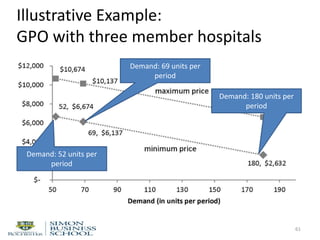
GPO with three member hospitals
61
Demand: 52 units per
period
Demand: 69 units per
period
Demand: 180 units per
period
Illustrative Example:
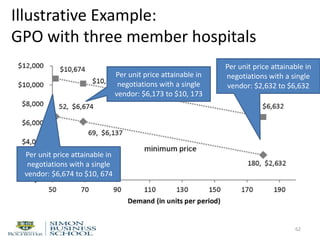
GPO with three member hospitals
62
Per unit price attainable in
negotiations with a single
vendor: $6,674 to $10, 674
Per unit price attainable in
negotiations with a single
vendor: $6,173 to $10, 173
Per unit price attainable in
negotiations with a single
vendor: $2,632 to $6,632
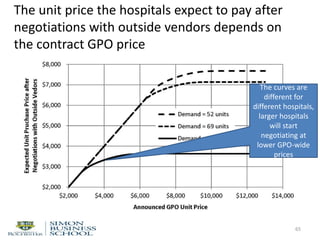
The unit price the hospitals expect to pay after
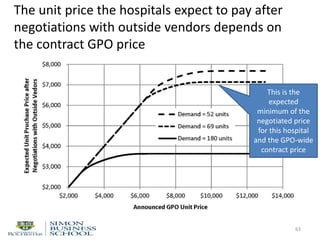
negotiations with outside vendors depends on
the contract GPO price
63
This is the
expected
minimum of the
negotiated price
for this hospital
and the GPO-wide
contract price
The unit price the hospitals expect to pay after
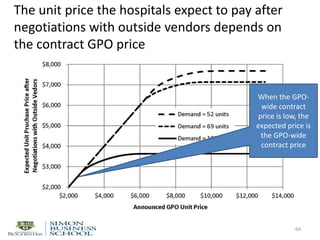
negotiations with outside vendors depends on
the contract GPO price
64
When the GPO-
wide contract
price is low, the
expected price is
the GPO-wide
contract price
The unit price the hospitals expect to pay after
negotiations with outside vendors depends on
the contract GPO price
65
The curves are
different for
different hospitals,
larger hospitals
will start
negotiating at
lower GPO-wide
prices
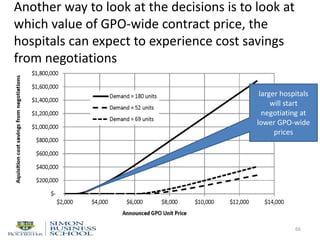
Another way to look at the decisions is to look at
which value of GPO-wide contract price, the
hospitals can expect to experience cost savings
from negotiations
66
larger hospitals
will start
negotiating at
lower GPO-wide
prices
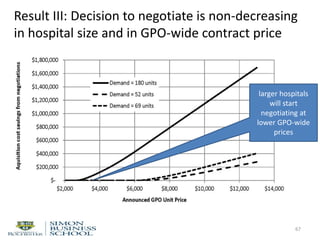
Result III: Decision to negotiate is non-decreasing
in hospital size and in GPO-wide contract price
67
larger hospitals
will start
negotiating at
lower GPO-wide
prices
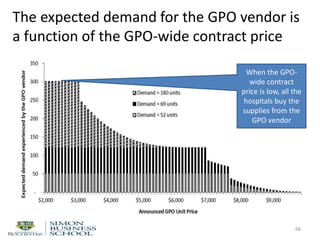
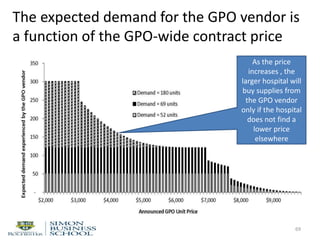
The expected demand for the GPO vendor is
a function of the GPO-wide contract price
68
When the GPO-
wide contract
price is low, all the
hospitals buy the
supplies from the
GPO vendor
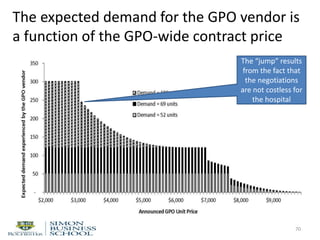
The expected demand for the GPO vendor is
a function of the GPO-wide contract price
69
As the price
increases , the
larger hospital will
buy supplies from
the GPO vendor
only if the hospital
does not find a
lower price
elsewhere
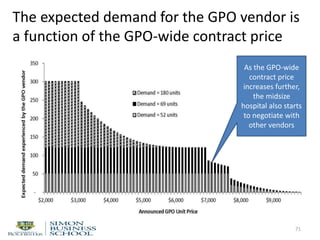
The expected demand for the GPO vendor is
a function of the GPO-wide contract price
70
The “jump” results
from the fact that
the negotiations
are not costless for
the hospital
The expected demand for the GPO vendor is
a function of the GPO-wide contract price
71
As the GPO-wide
contract price
increases further,
the midsize
hospital also starts
to negotiate with
other vendors
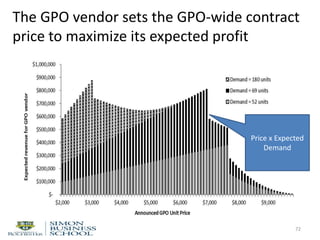
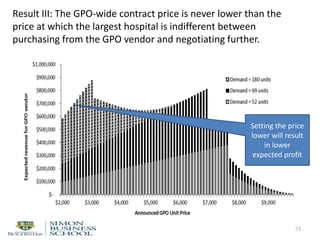
The GPO vendor sets the GPO-wide contract
price to maximize its expected profit
72
Price x Expected
Demand
Result III: The GPO-wide contract price is never lower than the
price at which the largest hospital is indifferent between
purchasing from the GPO vendor and negotiating further.
73
Setting the price
lower will result
in lower
expected profit
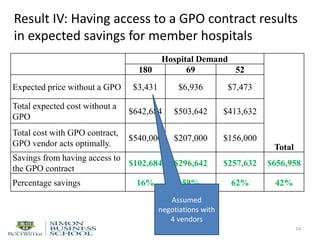
Result IV: Having access to a GPO contract results
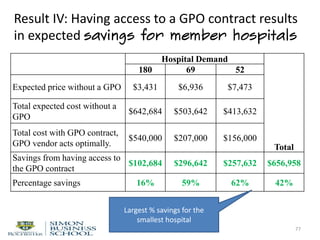
in expected savings for member hospitals
74
Hospital Demand
Total
180 69 52
Expected price without a GPO $3,431 $6,936 $7,473
Total expected cost without a
GPO
$642,684 $503,642 $413,632
Total cost with GPO contract,
GPO vendor acts optimally.
$540,000 $207,000 $156,000
Savings from having access to
the GPO contract
$102,684 $296,642 $257,632 $656,958
Percentage savings 16% 59% 62% 42%
Assumed
negotiations with
4 vendors
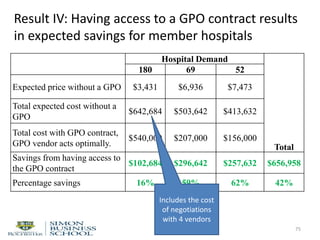
Result IV: Having access to a GPO contract results
in expected savings for member hospitals
75
Hospital Demand
Total
180 69 52
Expected price without a GPO $3,431 $6,936 $7,473
Total expected cost without a
GPO
$642,684 $503,642 $413,632
Total cost with GPO contract,
GPO vendor acts optimally.
$540,000 $207,000 $156,000
Savings from having access to
the GPO contract
$102,684 $296,642 $257,632 $656,958
Percentage savings 16% 59% 62% 42%
Includes the cost
of negotiations
with 4 vendors
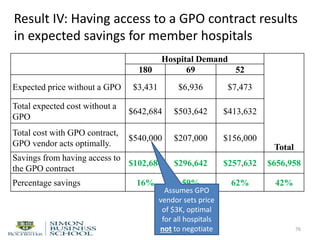
Result IV: Having access to a GPO contract results
in expected savings for member hospitals
76
Hospital Demand
Total
180 69 52
Expected price without a GPO $3,431 $6,936 $7,473
Total expected cost without a
GPO
$642,684 $503,642 $413,632
Total cost with GPO contract,
GPO vendor acts optimally.
$540,000 $207,000 $156,000
Savings from having access to
the GPO contract
$102,684 $296,642 $257,632 $656,958
Percentage savings 16% 59% 62% 42%
Assumes GPO
vendor sets price
of $3K, optimal
for all hospitals
not to negotiate
Result IV: Having access to a GPO contract results
in expected savings for member hospitals
77
Hospital Demand
Total
180 69 52
Expected price without a GPO $3,431 $6,936 $7,473
Total expected cost without a
GPO
$642,684 $503,642 $413,632
Total cost with GPO contract,
GPO vendor acts optimally.
$540,000 $207,000 $156,000
Savings from having access to
the GPO contract
$102,684 $296,642 $257,632 $656,958
Percentage savings 16% 59% 62% 42%
Largest % savings for the
smallest hospital
Result V: The GPO vendor benefits at the expense
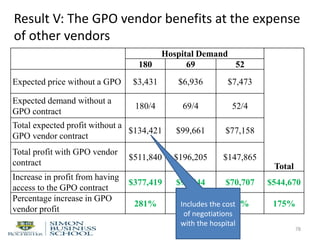
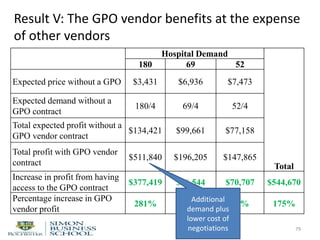
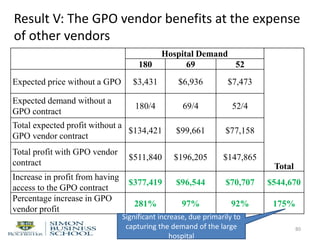
of other vendors
78
Hospital Demand
Total
180 69 52
Expected price without a GPO $3,431 $6,936 $7,473
Expected demand without a
GPO contract
180/4 69/4 52/4
Total expected profit without a
GPO vendor contract
$134,421 $99,661 $77,158
Total profit with GPO vendor
contract
$511,840 $196,205 $147,865
Increase in profit from having
access to the GPO contract
$377,419 $96,544 $70,707 $544,670
Percentage increase in GPO
vendor profit
281% 97% 92% 175%Includes the cost
of negotiations
with the hospital
Result V: The GPO vendor benefits at the expense
of other vendors
79
Hospital Demand
Total
180 69 52
Expected price without a GPO $3,431 $6,936 $7,473
Expected demand without a
GPO contract
180/4 69/4 52/4
Total expected profit without a
GPO vendor contract
$134,421 $99,661 $77,158
Total profit with GPO vendor
contract
$511,840 $196,205 $147,865
Increase in profit from having
access to the GPO contract
$377,419 $96,544 $70,707 $544,670
Percentage increase in GPO
vendor profit
281% 97% 92% 175%
Additional
demand plus
lower cost of
negotiations
Result V: The GPO vendor benefits at the expense
of other vendors
80
Hospital Demand
Total
180 69 52
Expected price without a GPO $3,431 $6,936 $7,473
Expected demand without a
GPO contract
180/4 69/4 52/4
Total expected profit without a
GPO vendor contract
$134,421 $99,661 $77,158
Total profit with GPO vendor
contract
$511,840 $196,205 $147,865
Increase in profit from having
access to the GPO contract
$377,419 $96,544 $70,707 $544,670
Percentage increase in GPO
vendor profit
281% 97% 92% 175%
Significant increase, due primarily to
capturing the demand of the large
hospital
TreePlan Trial Version, For Evaluation Only www.TreePlan.com
Hospital: don't negotiate
0
0 0
0.5
Negotiated price above GPO price
0
0 0
1
0 0 0 0.5
Negotiated price below GPO price
0
0 0
Hospital: negotiate 0.5
1 Negotiated price above GPO price
0 0 0
0 0
0 0 0.5
Negotiated price below GPO price
0
0 0
1
0 0 0.5
Negotiated price above GPO price
0
0 0
GPO vendor: participate
0.5
0 0 GPO vendor selected
0.5 0
0 0
0 0 0.5
GPO vendor not selected
0
0 0For Evaluation Only
GPO
vendor
set price
Pg
λ q P g q P g + c (k,0 )
0 q E [p (q,P g ,0 ) | p <P g ] + c (k,0 )
q P g - k v q E [p (q,P g ,1 ) | p <P g ] + c (k,1 )
Hospital:invite GPO
vendor
Hospital: don't
invite GPO vendor
GPO vendor: don't
participate
Negotiated price
below GPO price
λ q P g q P g + c (k,0 )
0 q E [p (q,P g ,0 ) | p <P g ] + c (k,0 )
λ q E [p (q,P g ,1 ) | p <P g ] - k v q E [p (q,P g ,1 ) | p <P g ] + c (k,1 )
GPO vendor payoff Hospital cost
λ q P g q P g
λ q P g - k v q P g + c (k,1 )
Next, we take a closer look at custom contracting
81
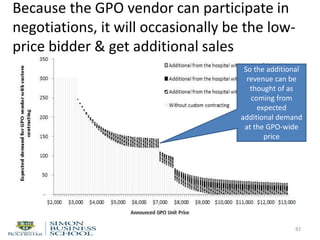
Because the GPO vendor can participate in
negotiations, it will occasionally be the low-
price bidder & get additional sales
82
So the additional
revenue can be
thought of as
coming from
expected
additional demand
at the GPO-wide
price
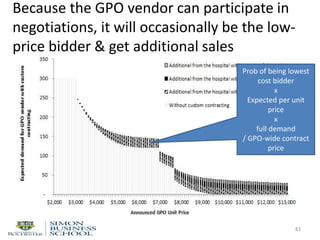
Because the GPO vendor can participate in
negotiations, it will occasionally be the low-
price bidder & get additional sales
83
Prob of being lowest
cost bidder
x
Expected per unit
price
x
full demand
/ GPO-wide contract
price
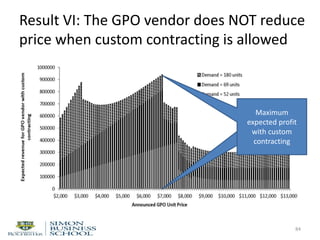
Result VI: The GPO vendor does NOT reduce
price when custom contracting is allowed
84
Prob of being
Maximum
expected profit
with custom
contracting
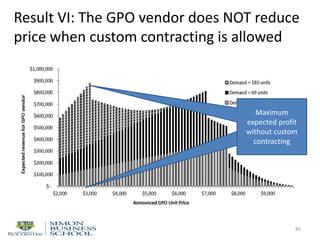
Result VI: The GPO vendor does NOT reduce
price when custom contracting is allowed
85
Prob of being
Maximum
expected profit
without custom
contracting
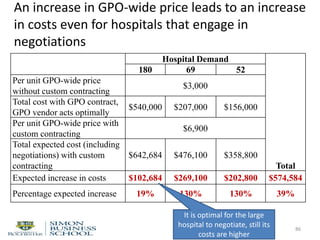
An increase in GPO-wide price leads to an increase
in costs even for hospitals that engage in
negotiations
86
Hospital Demand
Total
180 69 52
Per unit GPO-wide price
without custom contracting
$3,000
Total cost with GPO contract,
GPO vendor acts optimally
$540,000 $207,000 $156,000
Per unit GPO-wide price with
custom contracting
$6,900
Total expected cost (including
negotiations) with custom
contracting
$642,684 $476,100 $358,800
Expected increase in costs $102,684 $269,100 $202,800 $574,584
Percentage expected increase 19% 130% 130% 39%
It is optimal for the large
hospital to negotiate, still its
costs are higher
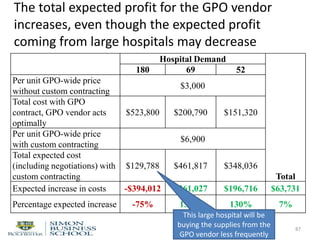
The total expected profit for the GPO vendor
increases, even though the expected profit
coming from large hospitals may decrease
87
Hospital Demand
Total
180 69 52
Per unit GPO-wide price
without custom contracting
$3,000
Total cost with GPO
contract, GPO vendor acts
optimally
$523,800 $200,790 $151,320
Per unit GPO-wide price
with custom contracting
$6,900
Total expected cost
(including negotiations) with
custom contracting
$129,788 $461,817 $348,036
Expected increase in costs -$394,012 $261,027 $196,716 $63,731
Percentage expected increase -75% 130% 130% 7%
This large hospital will be
buying the supplies from the
GPO vendor less frequently
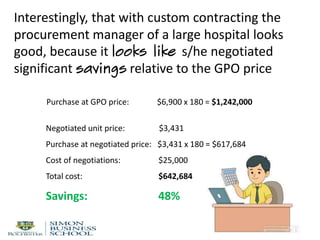
Interestingly, that with custom contracting the
procurement manager of a large hospital looks
good, because it looks like s/he negotiated
significant savings relative to the GPO price
88
Purchase at GPO price: $6,900 x 180 = $1,242,000
Negotiated unit price: $3,431
Purchase at negotiated price: $3,431 x 180 = $617,684
Cost of negotiations: $25,000
Total cost: $642,684
Savings: 48%
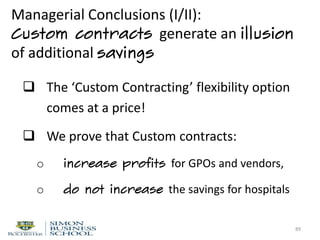
Managerial Conclusions (I/II):
Custom contracts generate an illusion
of additional savings
 The ‘Custom Contracting’ flexibility option
comes at a price!
 We prove that Custom contracts:
o increase profits for GPOs and vendors,
o do not increase the savings for hospitals
89
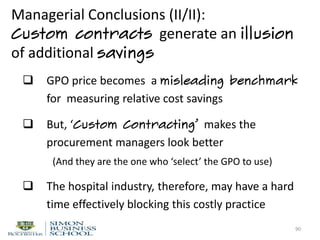
 GPO price becomes a misleading benchmark
for measuring relative cost savings
 But, ‘Custom Contracting’ makes the
procurement managers look better
(And they are the one who ‘select’ the GPO to use)
 The hospital industry, therefore, may have a hard
time effectively blocking this costly practice
90
Managerial Conclusions (II/II):
Custom contracts generate an illusion
of additional savings
Healthcare Procurement:
Custom Contracting through GPOs
91
Rajib Saha Vera Tilson Avi Seidmann

Healthcare Procurement - Custom Contracting through GPOs

  • 1.
    Healthcare Procurement: Custom Contractingthrough GPOs 1 Rajib Saha Avi Seidmann Vera Tilson GPO Hospitals Suppliers Source: Satish Tiwari
  • 2.
    There are multipleprocurement challenges for US hospitals 1. Difficult to control labor costs, employee:patient ratios are often mandated 2. Inelastic demand (hospitals must buy clinical supplies) 3. Supplies are 25% of all hospital expenses 2 4. 3% of line items (mostly physician preference items) are responsible for 40% of supply expenses 5. Difficult to standardize on expensive supplies because of diverse physician preferences and training 6. Oligopoly manufacturers of the most expensive supplies e.g. surgical implants. 7. Hospital industry is fragmented, over 5,000 hospitals in the US
  • 3.
    There are multipleprocurement challenges for US hospitals 1. Difficult to control labor costs, employee:patient ratios are often mandated 2. Inelastic demand (hospitals must buy clinical supplies) 3. Supplies are 25% of all hospital expenses 3 4. 3% of line items (mostly physician preference items) are responsible for 40% of supply expenses 5. Difficult to standardize on expensive supplies because of diverse physician preferences and training 6. Oligopoly manufacturers of the most expensive supplies e.g. surgical implants. 7. Hospital industry is fragmented, over 5,000 hospitals in the US
  • 4.
    There are multipleprocurement challenges for US hospitals 1. Difficult to control labor costs, employee:patient ratios are often mandated 2. Inelastic demand (hospitals must buy clinical supplies) 3. Supplies are 25% of all hospital expenses 4 4. 3% of line items (mostly physician preference items) are responsible for 40% of supply expenses 5. Difficult to standardize on expensive supplies because of diverse physician preferences and training 6. Oligopoly manufacturers of the most expensive supplies e.g. surgical implants. 7. Hospital industry is fragmented, over 5,000 hospitals in the US
  • 5.
    Physician Preference: •Orthopedic Implants •SpinalImplants •Pacemakers •AICDs •Coronary Stents •Special Procedure Devices •Heart Valves •Endosurgical Supplies •Bone Products •Perfusion Supplies •Pacemakers •Contrast Media •Balloons and Wires Physician preference items are 3% of line items driving 40% of supply expenses 5 Hospital Supply Expenses: Physician Preference vs. Others by # Line Items by $$ Food products, gloves, IV solutions, gowns, wound drainage, tubing, draping, generic drugs, IV admin kits, disposables
  • 6.
    Diverse physician preferencesare partially due to training history, and ‘funding’ ties 6
  • 7.
    Hospital procurement managers“bow” to physician preferences for particular devices 7
  • 8.
    There are multipleprocurement challenges for US hospitals 1. Difficult to control labor costs, employee:patient ratios are often mandated 2. Inelastic demand (hospitals must buy clinical supplies) 3. Supplies are 25% of all hospital expenses 8 4. 3% of line items (mostly physician preference items) are responsible for 40% of supply expenses 5. Difficult to standardize on expensive supplies because of diverse physician preferences and training 6. Oligopoly manufacturers of the most expensive supplies e.g. surgical implants. 7. Hospital industry is fragmented, over 5,000 hospitals in the US
  • 9.
    There are multipleprocurement challenges for US hospitals 1. Difficult to control labor costs, employee:patient ratios are often mandated 2. Inelastic demand (hospitals must buy clinical supplies) 3. Supplies are 25% of all hospital expenses 9 4. 3% of line items (mostly physician preference items) are responsible for 40% of supply expenses 5. Difficult to standardize on expensive supplies because of diverse physician preferences and training 6. Oligopoly manufacturers of the most expensive supplies e.g. surgical implants. 7. Hospital industry is fragmented, over 5,000 hospitals in the US
  • 10.
    The US healthcaresupply chain often includes group purchasing intermediaries 10 Oligopolistic manufacturers >5000 Fragmented buyers Group purchasing organizations (GPOs)
  • 11.
    To obtain ‘quantitydiscounts’ hospitals join a GPO which aggregates their demand 11 Oligopolistic manufacturers Fragmented buyers GPO
  • 12.
    GPO negotiates apurchasing contract with a vendor 12 Vendor Manufacturer Fragmented buyers GPO
  • 13.
    Hospitals purchase suppliesfrom the vendor at GPO-negotiated prices 13 Vendor Fragmented buyers $$$ @ GPO negotiated price products GPO
  • 14.
    To cover operatingexpenses, GPO collects an administrative fee from the vendor 14 Vendor Fragmented buyers $$$ @ GPO negotiated price products GPO
  • 15.
    Group purchasing organizationsadvertise benefits to both hospital and vendors Benefits to Hospitals: – Cost savings from quantity discount – Operational savings in procurement – Vendor qualification – Managerial support Benefits to Vendors: – Volume sales – Marketing opportunity – Reduced marketing costs – Hospital contract compliance monitoring 15
  • 16.
    Any problems here? 16 VendorFragmented buyers $$$ @ GPO negotiated price products GPO
  • 17.
    17 In many settingsinvolving federal contracts, payments from vendors to procurement departments are illegal
  • 18.
    18 However, the hospitalGPOs are permitted to receive sales fees from manufacturers (a special Congressional exemption from federal anti-kickback laws)
  • 19.
    19 GPO practices havebeen criticized by manufacturers and distributors
  • 20.
    GPO practices havebeen investigated by various government entities In 2002 following a series of articles in the New York Times, Premier and Novation ( two of the largest GPOs) were investigated by: • the Federal Trade Commission (FTC) who wanted to know whether the buying groups wield too much power (negotiated contracts were worth more than $30 billion) • the inspector general for the Centers for Medicare and Medicaid Services (CMS) • the General Accounting Office, the investigative arm of Congress • the antitrust subcommittee of the Senate Judiciary Committee • NY State Attorney General Office 20
  • 21.
    In response tothe various investigations GPOs promised to adopt a code of conduct • Eliminate self-dealing, i.e. stop investing in supply companies. • Contract with more companies, no longer sign exclusive contracts with single manufacturers for certain medical supplies • Limit the length of the contracts (long contracts protected incumbents) • Limit contracts that condition discounts on bundling of unrelated products 21
  • 22.
    A 2002 GAOinvestigation found that GPO contracts did not always offer hospitals better prices 22
  • 23.
    The 2010 GAOinvestigation was unable to identify any published peer-reviewed studies that included an empirical analysis of pricing data that indicated whether or not GPO customers obtain lower prices from vendor 23
  • 24.
    In response - GPOsintroduced custom contracting The practice of custom contracting is described in GAO-12-126, a 2012 GAO report on hospital purchasing of implantable devices 24
  • 25.
    Our research focusis custom contracting 25 Who benefits: • GPO • GPO vendor • member hospitals and to what extent?
  • 26.
    Relevant literature fallsinto four broad categories o Group purchasing: • The mechanism for price reduction obtained through GPOs • Effect of contract administration fees (CAF) on supply chain participants • Allocation of savings in group purchasing alliance o Reasons for existence of supply chain intermediaries 26
  • 27.
    Relevant literature fallsinto four broad categories o Group purchasing: • The mechanism for price reduction obtained through GPOs • Effect of contract administration fees (CAF) on supply chain participants • Allocation of savings in group purchasing alliance o Reasons for existence of supply chain intermediaries 27
  • 28.
    Analytical game-theoretic modelshave been used to examine how GPOs provide savings when dealing with multiple suppliers O’Brien and Shaffer(1997), Dana (2003) prices are lowered through the exclusive dealing mechanism, i.e. ability to shift demand to a competitor Marvel and Yang (2008) hospitals differ in preferences for products from different supplies, price is lowered through competition-intensifying effect of non-linear tariff. Hu and Schwartz (2011) GPOs increase competition between manufacturers and lower prices for healthcare providers. However, GPOs reduce manufacturers' incentives to introduce innovations to existing products. 28
  • 29.
    Relevant literature fallsinto four broad categories o Group purchasing: • The mechanism for price reduction obtained through GPOs • Effect of contract administration fees (CAF) on supply chain participants • Allocation of savings in group purchasing alliance o Reasons for existence of supply chain intermediaries 29
  • 30.
    Hu, Schwartz (2011)conclude that elimination of contract administration fee (CAF) would not affect any party's profits or costs. Hu, Schwartz, and Uhan (2012) conclude that CAF does not affect hospital costs, but affects distribution of profits between a GPO and vendors. 30
  • 31.
    Relevant literature fallsinto four broad categories o Group purchasing: • The mechanism for price reduction obtained through GPOs • Effect of contract administration fees (CAF) on supply chain participants • Allocation of savings in group purchasing alliance o Reasons for existence of supply chain intermediaries 31
  • 32.
    Empirical and analyticalstudies examine the stability of purchasing alliances: • Survey-based studies identify drivers of success and failures of alliances: Doucette (1997), Nollet & Beaulieu (2003), Schotanus (2005). Unfair allocation of savings is identified as one of the reasons for the failure of an alliance. • Game-theoretic models are used to examine the trade-offs in allocating cost savings to group members of alliances: Heijboer (2002), Schotanus (2004), Schotanus et al. (2008), Nagarajan et al. (2008), Chen et al. (MSOM Conf., 2013) 32
  • 33.
    Relevant literature fallsinto four broad categories o Group purchasing: • The mechanism for price reduction obtained through GPOs • Effect of contract administration fees (CAF) on supply chain participants • Allocation of savings in group purchasing alliance o Reasons for existence of supply chain intermediaries 33
  • 34.
    Wu (2004) categorizessupply chain intermediaries into two broad types: • Transactional intermediaries – aggregate supply and demand, reduce costs associated with searching and matching • Informational intermediaries – synthesize dispersed information or reduce information asymmetry, create trusted institution Other reasons for existence of intermediaries and intermediary profits are examined in Belavina and Girotra (2012), Yang and Babich (2013), Adida et al. (2013) 34
  • 35.
    None of theliterature explains the custom contracting arrangement, also healthcare GPOs are unlike most supply chain intermediaries • they aggregate demand, but do not hold inventory • operate in a highly regulated environment • margins are set externally 35
  • 36.
    We create agame-theoretic model to analyze the impact of custom contracting 36
  • 37.
    Assumption I: Fromthe point of view of any particular hospital the demand qty is inelastic 37 A hospital will have to purchase needed implants from some manufacturer.
  • 38.
    Assumption II: Pricesare negotiated, hospitals do not simply pay the list price 38
  • 39.
    Assumption II: Pricenegotiations are costly for both hospitals and vendors 39
  • 40.
  • 41.
  • 42.
  • 43.
  • 44.
  • 45.
  • 46.
    Price secrecy exitsnot only with physician preference items, but also with commodities such as saline solution 46
  • 47.
    In healthcare market,product quality is known, while price information is not readily available 47 Uncertain Price Quality UncertainKnown Known
  • 48.
    In healthcare market,product quality is known, while price information is not readily available 48 Uncertain Price Quality UncertainKnown Known
  • 49.
    In healthcare market,product quality is known, while price information is not readily available 49 Uncertain Price Quality UncertainKnown Known ‘Market for Lemons’
  • 50.
    In healthcare market,product quality is known, while price information is not readily available 50 Uncertain Price Quality UncertainKnown Known ‘Market for Lemons’ ‘Market for Healthcare’
  • 51.
    Assumption III: Priceattainable through vendor- hospital negotiations is random & stochastically decreasing in demand 51 Upper limit on attainable price Lower limit on attainable price PurchasePrice,$/unit Expected price Hospitals’ purchase volume [units/period]
  • 52.
    Assumption IV: GPOmember hospitals are heterogeneous in terms of demand volume. This distribution is known to the GPO vendor. 52 #ofmemberhospitals Hospitals’ purchase volumes [units/period]
  • 53.
    Assumption V: Decisiontiming 53 TreePlan Trial Version, For Evaluation Only www.TreePlan.com Hospital: don't negotiate 0 0 0 0.5 Negotiated price above GPO price 0 0 0 1 0 0 0 0.5 Negotiated price below GPO price 0 0 0 Hospital: negotiate 0.5 1 Negotiated price above GPO price 0 0 0 0 0 0 0 0.5 Negotiated price below GPO price 0 0 0 1 0 0 0.5 Negotiated price above GPO price 0 0 0 GPO vendor: participate 0.5 0 0 GPO vendor selected 0.5 0 0 0 0 0 0.5 GPO vendor not selected 0 0 0For Evaluation Only GPO vendor set price Pg λ q P g q P g + c (k,0 ) 0 q E [p (q,P g ,0 ) | p <P g ] + c (k,0 ) q P g - k v q E [p (q,P g ,1 ) | p <P g ] + c (k,1 ) Hospital:invite GPO vendor Hospital: don't invite GPO vendor GPO vendor: don't participate Negotiated price below GPO price λ q P g q P g + c (k,0 ) 0 q E [p (q,P g ,0 ) | p <P g ] + c (k,0 ) λ q E [p (q,P g ,1 ) | p <P g ] - k v q E [p (q,P g ,1 ) | p <P g ] + c (k,1 ) GPO vendor payoff Hospital cost λ q P g q P g λ q P g - k v q P g + c (k,1 ) GPO-selected vendor sets the GPO-wide contract price for all members
  • 54.
    Assumption V: Decisiontiming 54 TreePlan Trial Version, For Evaluation Only www.TreePlan.com Hospital: don't negotiate 0 0 0 0.5 Negotiated price above GPO price 0 0 0 1 0 0 0 0.5 Negotiated price below GPO price 0 0 0 Hospital: negotiate 0.5 1 Negotiated price above GPO price 0 0 0 0 0 0 0 0.5 Negotiated price below GPO price 0 0 0 1 0 0 0.5 Negotiated price above GPO price 0 0 0 GPO vendor: participate 0.5 0 0 GPO vendor selected 0.5 0 0 0 0 0 0.5 GPO vendor not selected 0 0 0For Evaluation Only GPO vendor set price Pg λ q P g q P g + c (k,0 ) 0 q E [p (q,P g ,0 ) | p <P g ] + c (k,0 ) q P g - k v q E [p (q,P g ,1 ) | p <P g ] + c (k,1 ) Hospital:invite GPO vendor Hospital: don't invite GPO vendor GPO vendor: don't participate Negotiated price below GPO price λ q P g q P g + c (k,0 ) 0 q E [p (q,P g ,0 ) | p <P g ] + c (k,0 ) λ q E [p (q,P g ,1 ) | p <P g ] - k v q E [p (q,P g ,1 ) | p <P g ] + c (k,1 ) GPO vendor payoff Hospital cost λ q P g q P g λ q P g - k v q P g + c (k,1 ) Hospital decides whether to purchase supplies at this price, or to negotiate with other vendors
  • 55.
    Assumption V: Decisiontiming 55 TreePlan Trial Version, For Evaluation Only www.TreePlan.com Hospital: don't negotiate 0 0 0 0.5 Negotiated price above GPO price 0 0 0 1 0 0 0 0.5 Negotiated price below GPO price 0 0 0 Hospital: negotiate 0.5 1 Negotiated price above GPO price 0 0 0 0 0 0 0 0.5 Negotiated price below GPO price 0 0 0 1 0 0 0.5 Negotiated price above GPO price 0 0 0 GPO vendor: participate 0.5 0 0 GPO vendor selected 0.5 0 0 0 0 0 0.5 GPO vendor not selected 0 0 0For Evaluation Only GPO vendor set price Pg λ q P g q P g + c (k,0 ) 0 q E [p (q,P g ,0 ) | p <P g ] + c (k,0 ) q P g - k v q E [p (q,P g ,1 ) | p <P g ] + c (k,1 ) Hospital:invite GPO vendor Hospital: don't invite GPO vendor GPO vendor: don't participate Negotiated price below GPO price λ q P g q P g + c (k,0 ) 0 q E [p (q,P g ,0 ) | p <P g ] + c (k,0 ) λ q E [p (q,P g ,1 ) | p <P g ] - k v q E [p (q,P g ,1 ) | p <P g ] + c (k,1 ) GPO vendor payoff Hospital cost λ q P g q P g λ q P g - k v q P g + c (k,1 ) If the hospital is able to find a lower price from another vendor, it purchases supplies from that vendor. Otherwise, from the GPO vendor at the general price
  • 56.
    Assumption V: Decisiontiming 56 TreePlan Trial Version, For Evaluation Only www.TreePlan.com Hospital: don't negotiate 0 0 0 0.5 Negotiated price above GPO price 0 0 0 1 0 0 0 0.5 Negotiated price below GPO price 0 0 0 Hospital: negotiate 0.5 1 Negotiated price above GPO price 0 0 0 0 0 0 0 0.5 Negotiated price below GPO price 0 0 0 1 0 0 0.5 Negotiated price above GPO price 0 0 0 GPO vendor: participate 0.5 0 0 GPO vendor selected 0.5 0 0 0 0 0 0.5 GPO vendor not selected 0 0 0For Evaluation Only GPO vendor set price Pg λ q P g q P g + c (k,0 ) 0 q E [p (q,P g ,0 ) | p <P g ] + c (k,0 ) q P g - k v q E [p (q,P g ,1 ) | p <P g ] + c (k,1 ) Hospital:invite GPO vendor Hospital: don't invite GPO vendor GPO vendor: don't participate Negotiated price below GPO price λ q P g q P g + c (k,0 ) 0 q E [p (q,P g ,0 ) | p <P g ] + c (k,0 ) λ q E [p (q,P g ,1 ) | p <P g ] - k v q E [p (q,P g ,1 ) | p <P g ] + c (k,1 ) GPO vendor payoff Hospital cost λ q P g q P g λ q P g - k v q P g + c (k,1 ) When custom contracting is allowed, a hospital can invite the GPO vendor to participate in custom negotiations
  • 57.
    Assumption V: Decisiontiming 57 TreePlan Trial Version, For Evaluation Only www.TreePlan.com Hospital: don't negotiate 0 0 0 0.5 Negotiated price above GPO price 0 0 0 1 0 0 0 0.5 Negotiated price below GPO price 0 0 0 Hospital: negotiate 0.5 1 Negotiated price above GPO price 0 0 0 0 0 0 0 0.5 Negotiated price below GPO price 0 0 0 1 0 0 0.5 Negotiated price above GPO price 0 0 0 GPO vendor: participate 0.5 0 0 GPO vendor selected 0.5 0 0 0 0 0 0.5 GPO vendor not selected 0 0 0For Evaluation Only GPO vendor set price Pg λ q P g q P g + c (k,0 ) 0 q E [p (q,P g ,0 ) | p <P g ] + c (k,0 ) q P g - k v q E [p (q,P g ,1 ) | p <P g ] + c (k,1 ) Hospital:invite GPO vendor Hospital: don't invite GPO vendor GPO vendor: don't participate Negotiated price below GPO price λ q P g q P g + c (k,0 ) 0 q E [p (q,P g ,0 ) | p <P g ] + c (k,0 ) λ q E [p (q,P g ,1 ) | p <P g ] - k v q E [p (q,P g ,1 ) | p <P g ] + c (k,1 ) GPO vendor payoff Hospital cost λ q P g q P g λ q P g - k v q P g + c (k,1 ) The GPO vendor can choose to participate or not to participate
  • 58.
    Assumption V: Decisiontiming 58 TreePlan Trial Version, For Evaluation Only www.TreePlan.com Hospital: don't negotiate 0 0 0 0.5 Negotiated price above GPO price 0 0 0 1 0 0 0 0.5 Negotiated price below GPO price 0 0 0 Hospital: negotiate 0.5 1 Negotiated price above GPO price 0 0 0 0 0 0 0 0.5 Negotiated price below GPO price 0 0 0 1 0 0 0.5 Negotiated price above GPO price 0 0 0 GPO vendor: participate 0.5 0 0 GPO vendor selected 0.5 0 0 0 0 0 0.5 GPO vendor not selected 0 0 0For Evaluation Only GPO vendor set price Pg λ q P g q P g + c (k,0 ) 0 q E [p (q,P g ,0 ) | p <P g ] + c (k,0 ) q P g - k v q E [p (q,P g ,1 ) | p <P g ] + c (k,1 ) Hospital:invite GPO vendor Hospital: don't invite GPO vendor GPO vendor: don't participate Negotiated price below GPO price λ q P g q P g + c (k,0 ) 0 q E [p (q,P g ,0 ) | p <P g ] + c (k,0 ) λ q E [p (q,P g ,1 ) | p <P g ] - k v q E [p (q,P g ,1 ) | p <P g ] + c (k,1 ) GPO vendor payoff Hospital cost λ q P g q P g λ q P g - k v q P g + c (k,1 ) The hospital will purchase supplies at the lowest negotiated price
  • 59.
    TreePlan Trial Version,For Evaluation Only www.TreePlan.com Hospital: don't negotiate 0 0 0 0.5 Negotiated price above GPO price 0 0 0 1 0 0 0 0.5 Negotiated price below GPO price 0 0 0 Hospital: negotiate 0.5 1 Negotiated price above GPO price 0 0 0 0 0 0 0 0.5 Negotiated price below GPO price 0 0 0 1 0 0 0.5 Negotiated price above GPO price 0 0 0 GPO vendor: participate 0.5 0 0 GPO vendor selected 0.5 0 0 0 0 0 0.5 GPO vendor not selected 0 0 0For Evaluation Only GPO vendor set price Pg λ q P g q P g + c (k,0 ) 0 q E [p (q,P g ,0 ) | p <P g ] + c (k,0 ) q P g - k v q E [p (q,P g ,1 ) | p <P g ] + c (k,1 ) Hospital:invite GPO vendor Hospital: don't invite GPO vendor GPO vendor: don't participate Negotiated price below GPO price λ q P g q P g + c (k,0 ) 0 q E [p (q,P g ,0 ) | p <P g ] + c (k,0 ) λ q E [p (q,P g ,1 ) | p <P g ] - k v q E [p (q,P g ,1 ) | p <P g ] + c (k,1 ) GPO vendor payoff Hospital cost λ q P g q P g λ q P g - k v q P g + c (k,1 ) Result I: The GPO vendor is never worse off with custom contracting 59 The GPO vendor can always refuse to participate in custom negotiations
  • 60.
    TreePlan Trial Version,For Evaluation Only www.TreePlan.com Hospital: don't negotiate 0 0 0 0.5 Negotiated price above GPO price 0 0 0 1 0 0 0 0.5 Negotiated price below GPO price 0 0 0 Hospital: negotiate 0.5 1 Negotiated price above GPO price 0 0 0 0 0 0 0 0.5 Negotiated price below GPO price 0 0 0 1 0 0 0.5 Negotiated price above GPO price 0 0 0 GPO vendor: participate 0.5 0 0 GPO vendor selected 0.5 0 0 0 0 0 0.5 GPO vendor not selected 0 0 0For Evaluation Only GPO vendor set price Pg λ q P g q P g + c (k,0 ) 0 q E [p (q,P g ,0 ) | p <P g ] + c (k,0 ) q P g - k v q E [p (q,P g ,1 ) | p <P g ] + c (k,1 ) Hospital:invite GPO vendor Hospital: don't invite GPO vendor GPO vendor: don't participate Negotiated price below GPO price λ q P g q P g + c (k,0 ) 0 q E [p (q,P g ,0 ) | p <P g ] + c (k,0 ) λ q E [p (q,P g ,1 ) | p <P g ] - k v q E [p (q,P g ,1 ) | p <P g ] + c (k,1 ) GPO vendor payoff Hospital cost λ q P g q P g λ q P g - k v q P g + c (k,1 ) Result II: The GPO is never worse off with custom contracting 60 If the GPO vendor agreed to participate means that its expected revenue is higher than when it does not participate
  • 61.
    Illustrative Example: GPO withthree member hospitals 61 Demand: 52 units per period Demand: 69 units per period Demand: 180 units per period
  • 62.
    Illustrative Example: GPO withthree member hospitals 62 Per unit price attainable in negotiations with a single vendor: $6,674 to $10, 674 Per unit price attainable in negotiations with a single vendor: $6,173 to $10, 173 Per unit price attainable in negotiations with a single vendor: $2,632 to $6,632
  • 63.
    The unit pricethe hospitals expect to pay after negotiations with outside vendors depends on the contract GPO price 63 This is the expected minimum of the negotiated price for this hospital and the GPO-wide contract price
  • 64.
    The unit pricethe hospitals expect to pay after negotiations with outside vendors depends on the contract GPO price 64 When the GPO- wide contract price is low, the expected price is the GPO-wide contract price
  • 65.
    The unit pricethe hospitals expect to pay after negotiations with outside vendors depends on the contract GPO price 65 The curves are different for different hospitals, larger hospitals will start negotiating at lower GPO-wide prices
  • 66.
    Another way tolook at the decisions is to look at which value of GPO-wide contract price, the hospitals can expect to experience cost savings from negotiations 66 larger hospitals will start negotiating at lower GPO-wide prices
  • 67.
    Result III: Decisionto negotiate is non-decreasing in hospital size and in GPO-wide contract price 67 larger hospitals will start negotiating at lower GPO-wide prices
  • 68.
    The expected demandfor the GPO vendor is a function of the GPO-wide contract price 68 When the GPO- wide contract price is low, all the hospitals buy the supplies from the GPO vendor
  • 69.
    The expected demandfor the GPO vendor is a function of the GPO-wide contract price 69 As the price increases , the larger hospital will buy supplies from the GPO vendor only if the hospital does not find a lower price elsewhere
  • 70.
    The expected demandfor the GPO vendor is a function of the GPO-wide contract price 70 The “jump” results from the fact that the negotiations are not costless for the hospital
  • 71.
    The expected demandfor the GPO vendor is a function of the GPO-wide contract price 71 As the GPO-wide contract price increases further, the midsize hospital also starts to negotiate with other vendors
  • 72.
    The GPO vendorsets the GPO-wide contract price to maximize its expected profit 72 Price x Expected Demand
  • 73.
    Result III: TheGPO-wide contract price is never lower than the price at which the largest hospital is indifferent between purchasing from the GPO vendor and negotiating further. 73 Setting the price lower will result in lower expected profit
  • 74.
    Result IV: Havingaccess to a GPO contract results in expected savings for member hospitals 74 Hospital Demand Total 180 69 52 Expected price without a GPO $3,431 $6,936 $7,473 Total expected cost without a GPO $642,684 $503,642 $413,632 Total cost with GPO contract, GPO vendor acts optimally. $540,000 $207,000 $156,000 Savings from having access to the GPO contract $102,684 $296,642 $257,632 $656,958 Percentage savings 16% 59% 62% 42% Assumed negotiations with 4 vendors
  • 75.
    Result IV: Havingaccess to a GPO contract results in expected savings for member hospitals 75 Hospital Demand Total 180 69 52 Expected price without a GPO $3,431 $6,936 $7,473 Total expected cost without a GPO $642,684 $503,642 $413,632 Total cost with GPO contract, GPO vendor acts optimally. $540,000 $207,000 $156,000 Savings from having access to the GPO contract $102,684 $296,642 $257,632 $656,958 Percentage savings 16% 59% 62% 42% Includes the cost of negotiations with 4 vendors
  • 76.
    Result IV: Havingaccess to a GPO contract results in expected savings for member hospitals 76 Hospital Demand Total 180 69 52 Expected price without a GPO $3,431 $6,936 $7,473 Total expected cost without a GPO $642,684 $503,642 $413,632 Total cost with GPO contract, GPO vendor acts optimally. $540,000 $207,000 $156,000 Savings from having access to the GPO contract $102,684 $296,642 $257,632 $656,958 Percentage savings 16% 59% 62% 42% Assumes GPO vendor sets price of $3K, optimal for all hospitals not to negotiate
  • 77.
    Result IV: Havingaccess to a GPO contract results in expected savings for member hospitals 77 Hospital Demand Total 180 69 52 Expected price without a GPO $3,431 $6,936 $7,473 Total expected cost without a GPO $642,684 $503,642 $413,632 Total cost with GPO contract, GPO vendor acts optimally. $540,000 $207,000 $156,000 Savings from having access to the GPO contract $102,684 $296,642 $257,632 $656,958 Percentage savings 16% 59% 62% 42% Largest % savings for the smallest hospital
  • 78.
    Result V: TheGPO vendor benefits at the expense of other vendors 78 Hospital Demand Total 180 69 52 Expected price without a GPO $3,431 $6,936 $7,473 Expected demand without a GPO contract 180/4 69/4 52/4 Total expected profit without a GPO vendor contract $134,421 $99,661 $77,158 Total profit with GPO vendor contract $511,840 $196,205 $147,865 Increase in profit from having access to the GPO contract $377,419 $96,544 $70,707 $544,670 Percentage increase in GPO vendor profit 281% 97% 92% 175%Includes the cost of negotiations with the hospital
  • 79.
    Result V: TheGPO vendor benefits at the expense of other vendors 79 Hospital Demand Total 180 69 52 Expected price without a GPO $3,431 $6,936 $7,473 Expected demand without a GPO contract 180/4 69/4 52/4 Total expected profit without a GPO vendor contract $134,421 $99,661 $77,158 Total profit with GPO vendor contract $511,840 $196,205 $147,865 Increase in profit from having access to the GPO contract $377,419 $96,544 $70,707 $544,670 Percentage increase in GPO vendor profit 281% 97% 92% 175% Additional demand plus lower cost of negotiations
  • 80.
    Result V: TheGPO vendor benefits at the expense of other vendors 80 Hospital Demand Total 180 69 52 Expected price without a GPO $3,431 $6,936 $7,473 Expected demand without a GPO contract 180/4 69/4 52/4 Total expected profit without a GPO vendor contract $134,421 $99,661 $77,158 Total profit with GPO vendor contract $511,840 $196,205 $147,865 Increase in profit from having access to the GPO contract $377,419 $96,544 $70,707 $544,670 Percentage increase in GPO vendor profit 281% 97% 92% 175% Significant increase, due primarily to capturing the demand of the large hospital
  • 81.
    TreePlan Trial Version,For Evaluation Only www.TreePlan.com Hospital: don't negotiate 0 0 0 0.5 Negotiated price above GPO price 0 0 0 1 0 0 0 0.5 Negotiated price below GPO price 0 0 0 Hospital: negotiate 0.5 1 Negotiated price above GPO price 0 0 0 0 0 0 0 0.5 Negotiated price below GPO price 0 0 0 1 0 0 0.5 Negotiated price above GPO price 0 0 0 GPO vendor: participate 0.5 0 0 GPO vendor selected 0.5 0 0 0 0 0 0.5 GPO vendor not selected 0 0 0For Evaluation Only GPO vendor set price Pg λ q P g q P g + c (k,0 ) 0 q E [p (q,P g ,0 ) | p <P g ] + c (k,0 ) q P g - k v q E [p (q,P g ,1 ) | p <P g ] + c (k,1 ) Hospital:invite GPO vendor Hospital: don't invite GPO vendor GPO vendor: don't participate Negotiated price below GPO price λ q P g q P g + c (k,0 ) 0 q E [p (q,P g ,0 ) | p <P g ] + c (k,0 ) λ q E [p (q,P g ,1 ) | p <P g ] - k v q E [p (q,P g ,1 ) | p <P g ] + c (k,1 ) GPO vendor payoff Hospital cost λ q P g q P g λ q P g - k v q P g + c (k,1 ) Next, we take a closer look at custom contracting 81
  • 82.
    Because the GPOvendor can participate in negotiations, it will occasionally be the low- price bidder & get additional sales 82 So the additional revenue can be thought of as coming from expected additional demand at the GPO-wide price
  • 83.
    Because the GPOvendor can participate in negotiations, it will occasionally be the low- price bidder & get additional sales 83 Prob of being lowest cost bidder x Expected per unit price x full demand / GPO-wide contract price
  • 84.
    Result VI: TheGPO vendor does NOT reduce price when custom contracting is allowed 84 Prob of being Maximum expected profit with custom contracting
  • 85.
    Result VI: TheGPO vendor does NOT reduce price when custom contracting is allowed 85 Prob of being Maximum expected profit without custom contracting
  • 86.
    An increase inGPO-wide price leads to an increase in costs even for hospitals that engage in negotiations 86 Hospital Demand Total 180 69 52 Per unit GPO-wide price without custom contracting $3,000 Total cost with GPO contract, GPO vendor acts optimally $540,000 $207,000 $156,000 Per unit GPO-wide price with custom contracting $6,900 Total expected cost (including negotiations) with custom contracting $642,684 $476,100 $358,800 Expected increase in costs $102,684 $269,100 $202,800 $574,584 Percentage expected increase 19% 130% 130% 39% It is optimal for the large hospital to negotiate, still its costs are higher
  • 87.
    The total expectedprofit for the GPO vendor increases, even though the expected profit coming from large hospitals may decrease 87 Hospital Demand Total 180 69 52 Per unit GPO-wide price without custom contracting $3,000 Total cost with GPO contract, GPO vendor acts optimally $523,800 $200,790 $151,320 Per unit GPO-wide price with custom contracting $6,900 Total expected cost (including negotiations) with custom contracting $129,788 $461,817 $348,036 Expected increase in costs -$394,012 $261,027 $196,716 $63,731 Percentage expected increase -75% 130% 130% 7% This large hospital will be buying the supplies from the GPO vendor less frequently
  • 88.
    Interestingly, that withcustom contracting the procurement manager of a large hospital looks good, because it looks like s/he negotiated significant savings relative to the GPO price 88 Purchase at GPO price: $6,900 x 180 = $1,242,000 Negotiated unit price: $3,431 Purchase at negotiated price: $3,431 x 180 = $617,684 Cost of negotiations: $25,000 Total cost: $642,684 Savings: 48%
  • 89.
    Managerial Conclusions (I/II): Customcontracts generate an illusion of additional savings  The ‘Custom Contracting’ flexibility option comes at a price!  We prove that Custom contracts: o increase profits for GPOs and vendors, o do not increase the savings for hospitals 89
  • 90.
     GPO pricebecomes a misleading benchmark for measuring relative cost savings  But, ‘Custom Contracting’ makes the procurement managers look better (And they are the one who ‘select’ the GPO to use)  The hospital industry, therefore, may have a hard time effectively blocking this costly practice 90 Managerial Conclusions (II/II): Custom contracts generate an illusion of additional savings
  • 91.
    Healthcare Procurement: Custom Contractingthrough GPOs 91 Rajib Saha Vera Tilson Avi Seidmann

Editor's Notes

  • #22 Eliminate self-dealing: not to steer contracts to a vendor in which the GPO holds a stake. Not to receive stock or other securities from vendors in exchange for business
  • #25 to the 2002 US GAO investigation
  • #26 to the 2002 US GAO investigation
  • #27  For example, Kaufmann & Wang (2001), Anand & Aron (2003), studies pricing in Internet-based group buying in a B2C context. Burns and Lee (2008) studies the effectiveness of healthcare GPOs in the Unites States. Schotanus (2004) identifies the unfair allocation of cost savings among members as one of the important reasons behind the failure of some consortia. Hu and Schwarz (2008) studies duopoly competition between GPO vendors to analyze the impact of group purchasing on cost of procurement, incentive to innovate, etc.
  • #28  For example, Kaufmann & Wang (2001), Anand & Aron (2003), studies pricing in Internet-based group buying in a B2C context. Burns and Lee (2008) studies the effectiveness of healthcare GPOs in the Unites States. Schotanus (2004) identifies the unfair allocation of cost savings among members as one of the important reasons behind the failure of some consortia. Hu and Schwarz (2008) studies duopoly competition between GPO vendors to analyze the impact of group purchasing on cost of procurement, incentive to innovate, etc.
  • #30  For example, Kaufmann & Wang (2001), Anand & Aron (2003), studies pricing in Internet-based group buying in a B2C context. Burns and Lee (2008) studies the effectiveness of healthcare GPOs in the Unites States. Schotanus (2004) identifies the unfair allocation of cost savings among members as one of the important reasons behind the failure of some consortia. Hu and Schwarz (2008) studies duopoly competition between GPO vendors to analyze the impact of group purchasing on cost of procurement, incentive to innovate, etc.
  • #32  For example, Kaufmann & Wang (2001), Anand & Aron (2003), studies pricing in Internet-based group buying in a B2C context. Burns and Lee (2008) studies the effectiveness of healthcare GPOs in the Unites States. Schotanus (2004) identifies the unfair allocation of cost savings among members as one of the important reasons behind the failure of some consortia. Hu and Schwarz (2008) studies duopoly competition between GPO vendors to analyze the impact of group purchasing on cost of procurement, incentive to innovate, etc.
  • #34  For example, Kaufmann & Wang (2001), Anand & Aron (2003), studies pricing in Internet-based group buying in a B2C context. Burns and Lee (2008) studies the effectiveness of healthcare GPOs in the Unites States. Schotanus (2004) identifies the unfair allocation of cost savings among members as one of the important reasons behind the failure of some consortia. Hu and Schwarz (2008) studies duopoly competition between GPO vendors to analyze the impact of group purchasing on cost of procurement, incentive to innovate, etc.
  • #48 Efficient Market: Both price and product quality are readily available (e.g., Securities) Opaque Pricing: Price is known but product details are not (e.g., HotWire, Priceline) Market for Lemons: Price is known but the product quality is hidden (e.g., used cars) Market for Health: Product quality is known but price information is not readily available (e.g., medical devices)
  • #49 Efficient Market: Both price and product quality are readily available (e.g., Securities) Opaque Pricing: Price is known but product details are not (e.g., HotWire, Priceline) Market for Lemons: Price is known but the product quality is hidden (e.g., used cars) Market for Health: Product quality is known but price information is not readily available (e.g., medical devices)
  • #50 Efficient Market: Both price and product quality are readily available (e.g., Securities) Opaque Pricing: Price is known but product details are not (e.g., HotWire, Priceline) Market for Lemons: Price is known but the product quality is hidden (e.g., used cars) Market for Health: Product quality is known but price information is not readily available (e.g., medical devices)
  • #51 Efficient Market: Both price and product quality are readily available (e.g., Securities) Opaque Pricing: Price is known but product details are not (e.g., HotWire, Priceline) Market for Lemons: Price is known but the product quality is hidden (e.g., used cars) Market for Health: Product quality is known but price information is not readily available (e.g., medical devices)
  • #90 GPO prices become a misleading benchmark for measuring cost savings. But, it makes the procurement managers look better. (And they are the one who ‘select’ the GOP to use)
  • #91 . The highly fragmented hospital industry may have a hard time effectively blocking this practice.