DSEAR & Gas Safety
1
Introduction
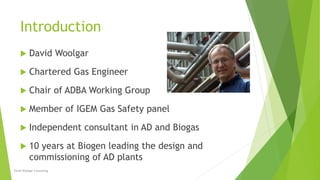
 David Woolgar
 Chartered Gas Engineer
 Chair of ADBA Working Group
 Member of IGEM Gas Safety panel
 Independent consultant in AD and Biogas
 10 years at Biogen leading the design and
commissioning of AD plants
David Woolgar Consulting
Agenda
 What is DSEAR
 Overview of Legislation & Regulations
 Site owners / operators responsibilities
 Examples
David Woolgar Consulting
Regulatory Background
 EU Directives
 ATEX ATmospheres EXplosibles
 ATEX 137 Workplace Directive - Protection of workers in potentially explosive areas
 Assess workplace for presence of potentially hazardous zones and classify them
 Prepare Explosion Protection Document (EPD)
 ATEX 95 The Equipment Directive - Equipment for use in potentially explosive areas
 Standards for Electrical and Mechanical Equipment and Protection Systems Ex & CE marked
David Woolgar Consulting
Regulatory Background
 EU Directives transposed in UK Law by DSEAR & EPS
 Dangerous Substances and Explosive Areas Regulations
 Identify Dangerous Substances at workplace
 Carry out Risk Assessment
 Reduce Risk
 Classify Hazardous Areas
 Inform & Train staff
 Equipment and Protective Systems for Use in Potentially
Explosive Atmospheres Regulations
 Sets out different protection concepts
David Woolgar Consulting
Biogas Plant
 Who supplied your plant
 Was it an EU supplier
 Lots of very good German, Dutch, Danish suppliers
 Probably complied with EU Directive – suitable for UK Market
 Possibly some gaps with respect to details of UK regulation
David Woolgar Consulting
Identification of Dangerous Substances
Dangerous Substance – Liquids, Gases, Vapours, Solids, Dusts
That can form explosive atmospheres when mixed with air.
Note - not Harmful Substance – COSHH
Gases – Biogas, Biomethane, Ammonia, H2S, LPG
Liquids – Diesel, Lube Oil, Solvents
Dust – Digestate Dryer
David Woolgar Consulting
Identification of Dangerous Substances
 Biogas is a fuel
supplies fires
forms explosive mixtures.
 Biogas safety is about
containment and
dispersion of leaks
 Leaks are expected
David Woolgar Consulting
Risk Assessment
 Regulation 5 requires employers and the self-employed to
assess risks to employees and others whose safety may be
affected by the use of presence of dangerous substances
at work.
 This is an iterative process with the following steps as
risks are identified and reduced, protected and mitigated.
 Identify safe work methods, maintenance requirements,
emergency procedures, training requirements
David Woolgar Consulting
Reduce Risk
 Regulation 6 sets out how the risk to safety from dangerous
substances should be eliminated or reduced.
 Hierarchy of controls
 Reduce quantities – minimum storage of biogas before use
 Avoid or minimise releases – secure containment, flare rather than vent
 Control release in safe place – vent at high level for safe dispersion, purge point
 Prevent formation of explosive atmosphere – ventilation
 Avoid ignition sources including static – ATEX equipment, equipotential bonding
David Woolgar Consulting
Mitigate consequences of fire or explosion
 Reduce employees exposed to risk – control access,
work permits, isolations
 Avoid propagation of fire – separation zones, barriers
 Explosion protection – physical strength, separation
 PPE
David Woolgar Consulting
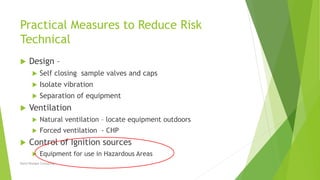
Practical Measures to Reduce Risk
Technical
 Design –
 Self closing sample valves and caps
 Isolate vibration
 Separation of equipment
 Ventilation
 Natural ventilation – locate equipment outdoors
 Forced ventilation - CHP
 Control of Ignition sources
 Equipment for use in Hazardous Areas
David Woolgar Consulting
Practical Measures to Reduce Risk
Organisational
 Training – understanding of what a Zone is
 Procedures – Site Rules, methods of work
 Inspections – check equipment
 Maintenance – isolations, purging
 Permit to Work – hot work
 Control of Change – review with design, HAZOP
David Woolgar Consulting
Classify Hazardous Areas -Zones
 Hazardous areas are classified into zones as follows:
 Zone 0: An area in which an explosive gas atmosphere is
present continuously or for long periods.
 Zone 1: An area in which an explosive gas atmosphere is
likely to occur in normal operation.
 Zone 2: An area in which an explosive gas atmosphere is not
likely to occur in normal operation and, if it occurs, will only
exist for a short time.
 Zone of Negligible Extent
David Woolgar Consulting
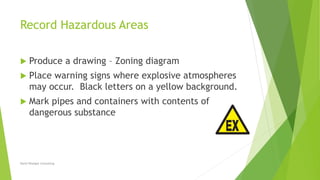
Record Hazardous Areas
 Produce a drawing – Zoning diagram
 Place warning signs where explosive atmospheres
may occur. Black letters on a yellow background.
 Mark pipes and containers with contents of
dangerous substance
David Woolgar Consulting
Control of Ignition Sources
 Lightning strikes.
 Open flames. This varies from a lit cigarette to welding activity.
 Mechanically generated friction sparks. More than one red hot spark is
often necessary in order to have an effective ignition source.
 Electric sparks. For example, a bad electrical connection or a faulty
pressure transmitter. The electric energy content of the spark determines
the effectiveness of the ignition source.
 High surface temperature. This can be the result mechanical friction in a
stuffing box or bearing, or boiler flue.
 Electrostatic discharge. Static electricity can be generated by a rotating
belt or a non-conductive liquid flowing through a filter screen.
David Woolgar Consulting
Inform & Train Staff
 Induction
 Site Rules
 Training
 Risk assessment
 Operating and Maintenance instructions
David Woolgar Consulting
Equipment for use in Hazardous Areas
 Equipment used in Hazardous Areas must be suitable for
the Zone class, selected on requirements of
Equipment and Protective Systems Intended for Use in
Potentially Explosive Atmospheres Regulations.
 in zone 0 - category 1 equipment,
 in zone 1 - category 1 or 2 equipment,
 in zone 2 - category 1, 2 or 3 equipment.
 This applies to both electrical and mechanical equipment
David Woolgar Consulting
Protection Types - Physical
 Protection can be broadly seen as 2 types
 Physical – the equipment is built in a specific way: 8 variants
 Ex ma – encapsulation – Category 1
 Ex d – flameproof enclosure – Category 2
 Ex e – increased safety – Category 2
 Ex o – oil immersion – Category 2
 Ex n – non sparking – Category 3
 Ex pz – pressurised enclosure – Category 3
 Must be installed as specified in certificate / instructions
David Woolgar Consulting
Example Motor Ex d
David Woolgar Consulting
Protection Types – Intrinsic Safety
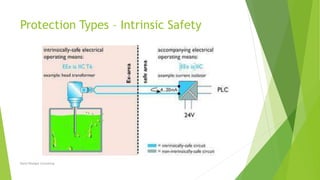
 This is a protection system for instrumentation
 Limits the electrical and thermal energy in the circuit
 Separated from normal power circuit by IS Barrier
 3 levels of protection - Ex ia, ib & ic for Zones 0, 1 & 2.
 The instruments and the IS Barrier must be certified
 Requires circuit documentation
 IS circuits should be identified and segregated
David Woolgar Consulting
Protection Types – Intrinsic Safety
David Woolgar Consulting
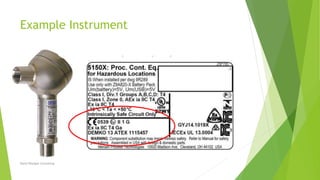
Example Instrument
David Woolgar Consulting
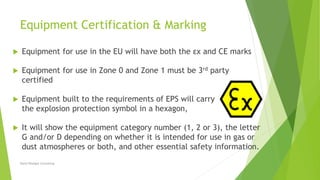
Equipment Certification & Marking
 Equipment for use in the EU will have both the εx and CE marks
 Equipment for use in Zone 0 and Zone 1 must be 3rd party
certified
 Equipment built to the requirements of EPS will carry
the explosion protection symbol in a hexagon,
 It will show the equipment category number (1, 2 or 3), the letter
G and/or D depending on whether it is intended for use in gas or
dust atmospheres or both, and other essential safety information.
David Woolgar Consulting
Equipment Marking
David Woolgar Consulting
Management of ATEX Equipment
 BS 60079:17 Inspections and Maintenance
 Keep a record of equipment and certification ATEX Register
 Set up schedule of periodic inspection
 Use competent person to inspect and maintain ATEX equipment
 Test critical instruments - Buncefield
David Woolgar Consulting
Hazardous Area Management
 Inspect gas system - IGEM recommend 6 monthly
 Identify and rectify any leaks
 Check key valves – isolation valves
 Review effect on Hazardous Areas of any modifications
 Consider effect on Hazardous Areas of any maintenance tasks
David Woolgar Consulting
Questions
David Woolgar Consulting
David Woolgar david@davidwoolgarconsulting.co.uk

David Woolgar DSEAR and gas safety

  • 1.
    DSEAR & GasSafety 1
  • 2.
    Introduction  David Woolgar Chartered Gas Engineer  Chair of ADBA Working Group  Member of IGEM Gas Safety panel  Independent consultant in AD and Biogas  10 years at Biogen leading the design and commissioning of AD plants David Woolgar Consulting
  • 3.
    Agenda  What isDSEAR  Overview of Legislation & Regulations  Site owners / operators responsibilities  Examples David Woolgar Consulting
  • 4.
    Regulatory Background  EUDirectives  ATEX ATmospheres EXplosibles  ATEX 137 Workplace Directive - Protection of workers in potentially explosive areas  Assess workplace for presence of potentially hazardous zones and classify them  Prepare Explosion Protection Document (EPD)  ATEX 95 The Equipment Directive - Equipment for use in potentially explosive areas  Standards for Electrical and Mechanical Equipment and Protection Systems Ex & CE marked David Woolgar Consulting
  • 5.
    Regulatory Background  EUDirectives transposed in UK Law by DSEAR & EPS  Dangerous Substances and Explosive Areas Regulations  Identify Dangerous Substances at workplace  Carry out Risk Assessment  Reduce Risk  Classify Hazardous Areas  Inform & Train staff  Equipment and Protective Systems for Use in Potentially Explosive Atmospheres Regulations  Sets out different protection concepts David Woolgar Consulting
  • 6.
    Biogas Plant  Whosupplied your plant  Was it an EU supplier  Lots of very good German, Dutch, Danish suppliers  Probably complied with EU Directive – suitable for UK Market  Possibly some gaps with respect to details of UK regulation David Woolgar Consulting
  • 7.
    Identification of DangerousSubstances Dangerous Substance – Liquids, Gases, Vapours, Solids, Dusts That can form explosive atmospheres when mixed with air. Note - not Harmful Substance – COSHH Gases – Biogas, Biomethane, Ammonia, H2S, LPG Liquids – Diesel, Lube Oil, Solvents Dust – Digestate Dryer David Woolgar Consulting
  • 8.
    Identification of DangerousSubstances  Biogas is a fuel supplies fires forms explosive mixtures.  Biogas safety is about containment and dispersion of leaks  Leaks are expected David Woolgar Consulting
  • 9.
    Risk Assessment  Regulation5 requires employers and the self-employed to assess risks to employees and others whose safety may be affected by the use of presence of dangerous substances at work.  This is an iterative process with the following steps as risks are identified and reduced, protected and mitigated.  Identify safe work methods, maintenance requirements, emergency procedures, training requirements David Woolgar Consulting
  • 10.
    Reduce Risk  Regulation6 sets out how the risk to safety from dangerous substances should be eliminated or reduced.  Hierarchy of controls  Reduce quantities – minimum storage of biogas before use  Avoid or minimise releases – secure containment, flare rather than vent  Control release in safe place – vent at high level for safe dispersion, purge point  Prevent formation of explosive atmosphere – ventilation  Avoid ignition sources including static – ATEX equipment, equipotential bonding David Woolgar Consulting
  • 11.
    Mitigate consequences offire or explosion  Reduce employees exposed to risk – control access, work permits, isolations  Avoid propagation of fire – separation zones, barriers  Explosion protection – physical strength, separation  PPE David Woolgar Consulting
  • 12.
    Practical Measures toReduce Risk Technical  Design –  Self closing sample valves and caps  Isolate vibration  Separation of equipment  Ventilation  Natural ventilation – locate equipment outdoors  Forced ventilation - CHP  Control of Ignition sources  Equipment for use in Hazardous Areas David Woolgar Consulting
  • 13.
    Practical Measures toReduce Risk Organisational  Training – understanding of what a Zone is  Procedures – Site Rules, methods of work  Inspections – check equipment  Maintenance – isolations, purging  Permit to Work – hot work  Control of Change – review with design, HAZOP David Woolgar Consulting
  • 14.
    Classify Hazardous Areas-Zones  Hazardous areas are classified into zones as follows:  Zone 0: An area in which an explosive gas atmosphere is present continuously or for long periods.  Zone 1: An area in which an explosive gas atmosphere is likely to occur in normal operation.  Zone 2: An area in which an explosive gas atmosphere is not likely to occur in normal operation and, if it occurs, will only exist for a short time.  Zone of Negligible Extent David Woolgar Consulting
  • 15.
    Record Hazardous Areas Produce a drawing – Zoning diagram  Place warning signs where explosive atmospheres may occur. Black letters on a yellow background.  Mark pipes and containers with contents of dangerous substance David Woolgar Consulting
  • 16.
    Control of IgnitionSources  Lightning strikes.  Open flames. This varies from a lit cigarette to welding activity.  Mechanically generated friction sparks. More than one red hot spark is often necessary in order to have an effective ignition source.  Electric sparks. For example, a bad electrical connection or a faulty pressure transmitter. The electric energy content of the spark determines the effectiveness of the ignition source.  High surface temperature. This can be the result mechanical friction in a stuffing box or bearing, or boiler flue.  Electrostatic discharge. Static electricity can be generated by a rotating belt or a non-conductive liquid flowing through a filter screen. David Woolgar Consulting
  • 17.
    Inform & TrainStaff  Induction  Site Rules  Training  Risk assessment  Operating and Maintenance instructions David Woolgar Consulting
  • 18.
    Equipment for usein Hazardous Areas  Equipment used in Hazardous Areas must be suitable for the Zone class, selected on requirements of Equipment and Protective Systems Intended for Use in Potentially Explosive Atmospheres Regulations.  in zone 0 - category 1 equipment,  in zone 1 - category 1 or 2 equipment,  in zone 2 - category 1, 2 or 3 equipment.  This applies to both electrical and mechanical equipment David Woolgar Consulting
  • 19.
    Protection Types -Physical  Protection can be broadly seen as 2 types  Physical – the equipment is built in a specific way: 8 variants  Ex ma – encapsulation – Category 1  Ex d – flameproof enclosure – Category 2  Ex e – increased safety – Category 2  Ex o – oil immersion – Category 2  Ex n – non sparking – Category 3  Ex pz – pressurised enclosure – Category 3  Must be installed as specified in certificate / instructions David Woolgar Consulting
  • 20.
    Example Motor Exd David Woolgar Consulting
  • 21.
    Protection Types –Intrinsic Safety  This is a protection system for instrumentation  Limits the electrical and thermal energy in the circuit  Separated from normal power circuit by IS Barrier  3 levels of protection - Ex ia, ib & ic for Zones 0, 1 & 2.  The instruments and the IS Barrier must be certified  Requires circuit documentation  IS circuits should be identified and segregated David Woolgar Consulting
  • 22.
    Protection Types –Intrinsic Safety David Woolgar Consulting
  • 23.
  • 24.
    Equipment Certification &Marking  Equipment for use in the EU will have both the εx and CE marks  Equipment for use in Zone 0 and Zone 1 must be 3rd party certified  Equipment built to the requirements of EPS will carry the explosion protection symbol in a hexagon,  It will show the equipment category number (1, 2 or 3), the letter G and/or D depending on whether it is intended for use in gas or dust atmospheres or both, and other essential safety information. David Woolgar Consulting
  • 25.
  • 26.
    Management of ATEXEquipment  BS 60079:17 Inspections and Maintenance  Keep a record of equipment and certification ATEX Register  Set up schedule of periodic inspection  Use competent person to inspect and maintain ATEX equipment  Test critical instruments - Buncefield David Woolgar Consulting
  • 27.
    Hazardous Area Management Inspect gas system - IGEM recommend 6 monthly  Identify and rectify any leaks  Check key valves – isolation valves  Review effect on Hazardous Areas of any modifications  Consider effect on Hazardous Areas of any maintenance tasks David Woolgar Consulting
  • 28.
    Questions David Woolgar Consulting DavidWoolgar david@davidwoolgarconsulting.co.uk

Editor's Notes

  • #3  David Woolgar Chair of the group took over from Terry Brown Been a member of the group from the early days Involved in AD since the early 90s most recently designing and commissioning foodwaste plants at Biogen Now an independent consultant focussing on AD and Biogas.
  • #9 I apologise that this slide is going to end up being very dense – I hope the information will be useful when the slides are circulated. The legal requirements are set out in DSEAR and ATEX but I have heard concerns that there is not a lot of technical guidance on how to build and maintain safe biogas systems. There is excellent technical guidance published by the Institution of Gas Engineers and Managers. The original guidance was developed by British Gas and following privatisation was taken over by IGEM and maintained and expanded by the professional engineering members. These are documents produced by gas engineers for industrial users. I admit to a bias – I have been involved in these documents for the past 15 years but I commend them to designers and operators. I am currently on the panel updating the guidance on hazardous areas and risk assessment.