Database Systems Design Implementation And
Management 13th Edition Coronel Solutions Manual
install download
https://testbankfan.com/product/database-systems-design-
implementation-and-management-13th-edition-coronel-solutions-
manual/
Download more testbank from https://testbankfan.com
We believe these products will be a great fit for you. Click
the link to download now, or visit testbankfan.com
to discover even more!
Database Systems Design Implementation And Management
13th Edition Coronel Test Bank
https://testbankfan.com/product/database-systems-design-
implementation-and-management-13th-edition-coronel-test-bank/
Database Systems Design Implementation and Management
12th Edition Coronel Solutions Manual
https://testbankfan.com/product/database-systems-design-
implementation-and-management-12th-edition-coronel-solutions-
manual/
Database Systems Design Implementation and Management
11th Edition Coronel Solutions Manual
https://testbankfan.com/product/database-systems-design-
implementation-and-management-11th-edition-coronel-solutions-
manual/
Database Systems Design Implementation and Management
12th Edition Coronel Test Bank
https://testbankfan.com/product/database-systems-design-
implementation-and-management-12th-edition-coronel-test-bank/
Database Systems Design Implementation and Management
11th Edition Coronel Test Bank
https://testbankfan.com/product/database-systems-design-
implementation-and-management-11th-edition-coronel-test-bank/
Database Processing Fundamentals Design and
Implementation 13th Edition Kroenke Solutions Manual
https://testbankfan.com/product/database-processing-fundamentals-
design-and-implementation-13th-edition-kroenke-solutions-manual/
Database Systems A Practical Approach to Design
Implementation and Management 6th Edition Connolly
Solutions Manual
https://testbankfan.com/product/database-systems-a-practical-
approach-to-design-implementation-and-management-6th-edition-
connolly-solutions-manual/
Database Processing Fundamentals Design and
Implementation 13th Edition Kroenke Test Bank
https://testbankfan.com/product/database-processing-fundamentals-
design-and-implementation-13th-edition-kroenke-test-bank/
Database Processing Fundamentals Design and
Implementation 15th Edition Kroenke Solutions Manual
https://testbankfan.com/product/database-processing-fundamentals-
design-and-implementation-15th-edition-kroenke-solutions-manual/
Chapter 9 Database Design
261
Chapter 9
Database Design
Discussion Focus
What is the relationship between a database and an information system, and how does this
relationship have a bearing on database design?
An information system performs three sets of services:
• It provides for data collection, storage, and retrieval.
• It facilitates the transformation of data into information.
• It provides the tools and conditions to manage both data and information.
Basically, a database is a fact (data) repository that serves an information system. If the database is designed
poorly, one can hardly expect that the data/information transformation will be successful, nor is it reasonable
to expect efficient and capable management of data and information.
The transformation of data into information is accomplished through application programs. It is impossible
to produce good information from poor data; and, no matter how sophisticated the application programs are,
it is impossible to use good application programs to overcome the effects of bad database design. In short:
Good database design is the foundation of a successful information system.
Database design must yield a database that:
• Does not fall prey to uncontrolled data duplication, thus preventing data anomalies and the attendant
lack of data integrity.
• Is efficient in its provision of data access.
• Serves the needs of the information system.
The last point deserves emphasis: even the best-designed database lacks value if it fails to meet information
system objectives. In short, good database designers must pay close attention to the information system
requirements.
Systems design and database design are usually tightly intertwined and are often performed in parallel.
Therefore, database and systems designers must cooperate and coordinate to yield the best possible
information system.
What is the relationship between the SDLC and the DBLC?
The SDLC traces the history (life cycle) of an information system. The DBLC traces the history (life cycle)
of a database system. Since we know that the database serves the information system, it is not surprising that
the two life cycles conform to the same basic phases.
Suggestion: Use Figure 9.8 as the basis for a discussion of the parallel activities.
Chapter 9 Database Design
262
What basic database design strategies exist, and how are such strategies executed?
Suggestion: Use Figure 9.14 as the basis for this discussion.
There are two basic approaches to database design: top-down and bottom-up.
Top-down design begins by identifying the different entity types and the definition of each entity's
attributes. In other words, top-down design:
• starts by defining the required data sets and then
• defines the data elements for each of those data sets.
Bottom-up design:
• first defines the required attributes and then
• groups the attributes to form entities.
Although the two methodologies tend to be complementary, database designers who deal with small
databases with relatively few entities, attributes, and transactions tend to emphasize the bottom-up
approach. Database designers who deal with large, complex databases usually find that a primarily top-down
design approach is more appropriate.
In spite of the frequent arguments concerning the best design approach, perhaps the top-down vs. bottom-up
distinction is quite artificial. The text's note is worth repeating:
NOTE
Even if a generally top-down approach is selected, the normalization process that revises existing
table structures is (inevitably) a bottom-up technique. E-R models constitute a top-down process
even if the selection of attributes and entities may be described as bottom-up. Since both the E-R
model and normalization techniques form the basis for most designs, the top-down vs. bottom-up
debate may be based on a distinction without a difference.
Chapter 9 Database Design
263
Answers to Review Questions
1. What is an information system? What is its purpose?
An information system is a system that
• provides the conditions for data collection, storage, and retrieval
• facilitates the transformation of data into information
• provides management of both data and information.
An information system is composed of hardware, software (DBMS and applications), the database(s),
procedures, and people.
Good decisions are generally based on good information. Ultimately, the purpose of an information
system is to facilitate good decision making by making relevant and timely information available to the
decision makers.
2. How do systems analysis and systems development fit into a discussion about information
systems?
Both systems analysis and systems development constitute part of the Systems Development Life Cycle,
or SDLC. Systems analysis, phase II of the SDLC, establishes the need for and the extent of an
information system by
• Establishing end-user requirements.
• Evaluating the existing system.
• Developing a logical systems design.
Systems development, based on the detailed systems design found in phase III of the SDLC, yields the
information system. The detailed system specifications are established during the systems design phase,
in which the designer completes the design of all required system processes.
3. What does the acronym SDLC mean, and what does an SDLC portray?
SDLC is the acronym that is used to label the System Development Life Cycle. The SDLC traces the
history of a information system from its inception to its obsolescence. The SDLC is composed of six
phases: planning, analysis, detailed system, design, implementation and maintenance.
4. What does the acronym DBLC mean, and what does a DBLC portray?
DBLC is the acronym that is used to label the Database Life Cycle. The DBLC traces the history of a
database system from its inception to its obsolescence. Since the database constitutes the core of an
information system, the DBLC is concurrent to the SDLC. The DBLC is composed of six phases: initial
study, design, implementation and loading, testing and evaluation, operation, and maintenance and
evolution.
Chapter 9 Database Design
264
5. Discuss the distinction between centralized and decentralized conceptual database design.
Centralized and decentralized design constitute variations on the bottom-up and top-down approaches
we discussed in the third question presented in the discussion focus. Basically, the centralized approach
is best suited to relatively small and simple databases that lend themselves well to a bird's-eye view of
the entire database. Such databases may be designed by a single person or by a small and informally
constituted design team. The company operations and the scope of its problems are sufficiently limited
to enable the designer(s) to perform all of the necessary database design tasks:
1. Define the problem(s).
2. Create the conceptual design.
3. Verify the conceptual design with all user views.
4. Define all system processes and data constraints.
5. Assure that the database design will comply with all achievable end user requirements.
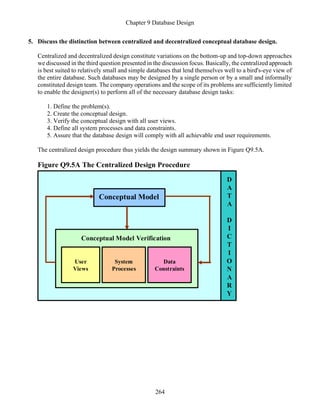
The centralized design procedure thus yields the design summary shown in Figure Q9.5A.
Figure Q9.5A The Centralized Design Procedure
Conceptual Model
Data
Constraints
System
Processes
User
Views
Conceptual Model Verification
D
A
T
A
D
I
C
T
I
O
N
A
R
Y
Chapter 9 Database Design
265
Note that the centralized design approach requires the completion and validation of a single conceptual
design.
NOTE
Use the text’s Figures 9.15 and 9.16 to contrast the two design approaches, then use Figure 9.6
to show the procedure flows; demonstrate that such procedure flows are independent of the
degree of centralization.
In contrast, when company operations are spread across multiple operational sites or when the database
has multiple entities that are subject to complex relations, the best approach is often based on the
decentralized design.
Typically, a decentralized design requires that the design task be divided into multiple modules, each
one of which is assigned to a design team. The design team activities are coordinated by the lead
designer, who must aggregate the design teams' efforts.
Since each team focuses on modeling a subset of the system, the definition of boundaries and the
interrelation between data subsets must be very precise. Each team creates a conceptual data model
corresponding to the subset being modeled. Each conceptual model is then verified individually against
the user views, processes, and constraints for each of the modules. After the verification process has
been completed, all modules are integrated in one conceptual model.
Since the data dictionary describes the characteristics of all the objects within the conceptual data model,
it plays a vital role in the integration process. Naturally, after the subsets have been aggregated into a
larger conceptual model, the lead designer must verify that the combined conceptual model is still able to
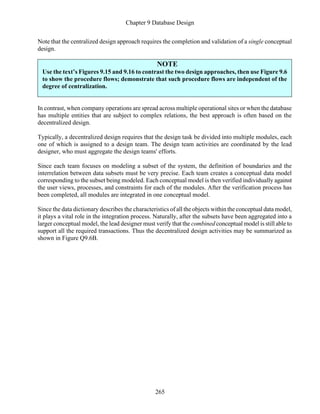
support all the required transactions. Thus the decentralized design activities may be summarized as
shown in Figure Q9.6B.
Chapter 9 Database Design
266
Figure Q9.6B The Decentralized Design Procedure
D
A
T
A
D
I
C
T
I
O
N
A
R
Y
Subset A
DATA COMPONENT
Views,
Processes,
Constraints
Views,
Processes,
Constraints
Views,
Processes,
Constraints
Aggregation
Subset B Subset C
Verification
Conceptual
Models
FINAL CONCEPTUAL MODEL
Keep in mind that the aggregation process requires the lead designer to assemble a single model in
which various aggregation problems must be addressed:
• synonyms and homonyms. Different departments may know the same object by different names
(synonyms), or they may use the same name to address different objects (homonyms.) The object
may be an entity, an attribute, or a relationship.
• entity and entity subclasses. An entity subset may be viewed as a separate entity by one or more
departments. The designer must integrate such subclasses into a higher-level entity.
• Conflicting object definitions. Attributes may be recorded as different types (character, numeric),
or different domains may be defined for the same attribute. Constraint definitions, too, may vary.
The designer must remove such conflicts from the model.
6. What is the minimal data rule in conceptual design? Why is it important?
The minimal data rule specifies that all the data defined in the data model are actually required to fit
present and expected future data requirements. This rule may be phrased as All that is needed is
there, and all that is there is needed.
Chapter 9 Database Design
267
7. Discuss the distinction between top-down and bottom-up approaches to database design.
There are two basic approaches to database design: top-down and bottom-up.
Top-down design begins by identifying the different entity types and the definition of each entity's
attributes. In other words, top-down design:
• starts by defining the required data sets and then
• defines the data elements for each of those data sets.
Bottom-up design:
• first defines the required attributes and then
• groups the attributes to form entities.
Although the two methodologies tend to be complementary, database designers who deal with small
databases with relatively few entities, attributes, and transactions tend to emphasize the bottom-up
approach. Database designers who deal with large, complex databases usually find that a primarily
top-down design approach is more appropriate.
8. What are business rules? Why are they important to a database designer?
Business rules are narrative descriptions of the business policies, procedures, or principles that are
derived from a detailed description of operations. Business rules are particularly valuable to database
designers, because they help define:
• Entities
• Attributes
• Relationships (1:1, 1:M, M:N, expressed through connectivities and cardinalities)
• Constraints
To develop an accurate data model, the database designer must have a thorough and complete
understanding of the organization's data requirements. The business rules are very important to the
designer because they enable the designer to fully understand how the business works and what role is
played by data within company operations.
NOTE
Do keep in mind that an ERD cannot always include all the applicable business rules. For
example, although constraints are often crucial, it is often not possible to model them. For
instance, there is no way to model a constraint such as “no pilot may be assigned to flight duties
more than ten hours during any 24-hour period.”
It is also worth emphasizing that the description of (company) operations must be done in
almost excruciating detail and it must be verified and re-verified. An inaccurate description of
operations yields inaccurate business rules that lead to database designs that are destined to
fail.
9. What is the data dictionary's function in database design?
Chapter 9 Database Design
268
A good data dictionary provides a precise description of the characteristics of all the entities and
attributes found within the database. The data dictionary thus makes it easier to check for the existence
of synonyms and homonyms, to check whether all attributes exist to support required reports, to verify
appropriate relationship representations, and so on. The data dictionary's contents are both developed
and used during the six DBLC phases:
DATABASE INITIAL STUDY
The basic data dictionary components are developed as the entities and attributes are defined during this
phase.
DATABASE DESIGN
The data dictionary contents are used to verify the database design components: entities, attributes, and
their relationships. The designer also uses the data dictionary to check the database design for
homonyms and synonyms and verifies that the entities and attributes will support all required query and
report requirements.
IMPLEMENTATION AND LOADING
The DBMS's data dictionary helps to resolve any remaining attribute definition inconsistencies.
TESTING AND EVALUATION
If problems develop during this phase, the data dictionary contents may be used to help restructure the
basic design components to make sure that they support all required operations.
OPERATION
If the database design still yields (the almost inevitable) operational glitches, the data dictionary may be
used as a quality control device to ensure that operational modifications to the database do not conflict
with existing components.
MAINTENANCE AND EVOLUTION
As users face inevitable changes in information needs, the database may be modified to support those
needs. Perhaps entities, attributes, and relationships must be added, or relationships must be changed. If
new database components are fit into the design, their introduction may produce conflict with existing
components. The data dictionary turns out to be a very useful tool to check whether a suggested change
invites conflicts within the database design and, if so, how such conflicts may be resolved.
10. What steps are required in the development of an ER diagram? (Hint: See Table 9.3.)
Table 9.3 is reproduced for your convenience.
Chapter 9 Database Design
269
TABLE 9.3 Developing the Conceptual Model, Using ER Diagrams
STEP ACTIVITY
1 Identify, analyze, and refine the business rules.
2 Identify the main entities, using the results of Step 1.
3 Define the relationships among the entities, using the results of Steps 1 and 2.
4 Define the attributes, primary keys, and foreign keys for each of the entities.
5 Normalize the entities. (Remember that entities are implemented as tables in an RDBMS.)
6 Complete the initial ER diagram.
7 Validate the ER model against the user’s information and processing requirements.
8 Modify the ER diagram, using the results of Step 7.
Point out that some of the steps listed in Table 9.3 take place concurrently. And some, such as the
normalization process, can generate a demand for additional entities and/or attributes, thereby causing
the designer to revise the ER model. For example, while identifying two main entities, the designer
might also identify the composite bridge entity that represents the many-to-many relationship between
those two main entities.
11. List and briefly explain the activities involved in the verification of an ER model.
Section 9-4c, “Data Model Verification,” includes a discussion on verification. In addition, Appendix C,
“The University Lab: Conceptual Design Verification, Logical Design, and Implementation,” covers the
verification process in detail. The verification process is detailed in the text’s Table 9.5, reproduced here
for your convenience.
TABLE 9.5 The ER Model Verification Process
STEP ACTIVITY
1 Identify the ER model’s central entity.
2 Identify each module and its components.
3 Identify each module’s transaction requirements:
Internal: Updates/Inserts/Deletes/Queries/Reports
External: Module interfaces
4 Verify all processes against the module’s processing
and reporting requirements.
5 Make all necessary changes suggested in Step 4.
6 Repeat Steps 2−5 for all modules.
Keep in mind that the verification process requires the continuous verification of business transactions as
well as system and user requirements. The verification sequence must be repeated for each of the
system’s modules.
12. What factors are important in a DBMS software selection?
The selection of DBMS software is critical to the information system’s smooth operation. Consequently,
the advantages and disadvantages of the proposed DBMS software should be carefully studied. To avoid
false expectations, the end user must be made aware of the limitations of both the DBMS and the
Chapter 9 Database Design
270
database.
Although the factors affecting the purchasing decision vary from company to company, some of the
most common are:
• Cost. Purchase, maintenance, operational, license, installation, training, and conversion costs.
• DBMS features and tools. Some database software includes a variety of tools that facilitate the
application development task. For example, the availability of query by example (QBE), screen
painters, report generators, application generators, data dictionaries, and so on, helps to create a
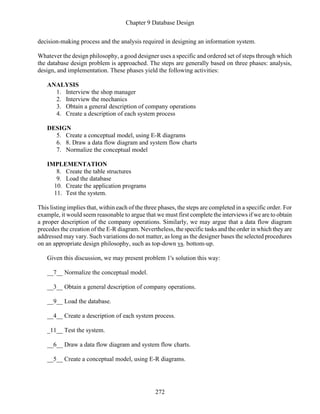
more pleasant work environment for both the end user and the application programmer. Database
administrator facilities, query facilities, ease of use, performance, security, concurrency control,
transaction processing, and third-party support also influence DBMS software selection.
• Underlying model. Hierarchical, network, relational, object/relational, or object.
• Portability. Across platforms, systems, and languages.
• DBMS hardware requirements. Processor(s), RAM, disk space, and so on.
13. List and briefly explain the four steps performed during the logical design stage.
1) Map conceptual model to logical model components.
In this step, the conceptual model is converted into a set of table definitions including table names,
column names, primary keys, and foreign keys to implement the entities and relationships specified in
the conceptual design.
2) Validate the logical model using normalization.
It is possible for normalization issues to be discovered during the process of mapping the conceptual
model to logical model components. Therefore, it is appropriate at this stage to validate that all of the
table definitions from the previous step conform to the appropriate normalization rules.
3) Validate logical model integrity constraints.
This step involves the conversion of attribute domains and constraints into constraint definitions that
can be implemented within the DBMS to enforce those domains. Also, entity and referential integrity
constraints are validated. Views may be defined to enforce security constraints.
4) Validate the logical model against the user requirements.
The final step of this stage is to ensure that all definitions created throughout the logical model are
validated against the users' data, transaction, and security requirements. Every component (table,
view, constraint, etc.) of the logical model must be associated with satisfying the user requirements,
and every user requirement should be addressed by the model components.
14. List and briefly explain the three steps performed during the physical design stage.
1) Define data storage organization.
Based on estimates of the data volume and growth, this step involves the determination of the
physical location and physical organization for each table. Also, which columns will be indexed and
the type of indexes to be used are determined. Finally, the type of implementation to be used for each
view is decided.
2) Define integrity and security measures.
This step involves creating users and security groups, and then assigning privileges and controls to
those users and group.
3) Determine performance measurements.
Chapter 9 Database Design
271
The actual performance of the physical database implementation must be measured and assessed for
compliance with user performance requirements.
15. What three levels of backup may be used in database recovery management? Briefly describe
what each of those three backup levels does.
A full backup of the database creates a backup copy of all database objects in their entirety.
A differential backup of the database creates a backup of only those database objects that have changed
since the last full backup.
A transaction log backup does not create a backup of database objects, but makes a backup of the log
of changes that have been applied to the database objects since the last backup.
Problem Solutions
1. The ABC Car Service & Repair Centers are owned by the SILENT car dealer; ABC services and
repairs only SILENT cars. Three ABC Car Service & Repair Centers provide service and repair
for the entire state.
Each of the three centers is independently managed and operated by a shop manager, a
receptionist, and at least eight mechanics. Each center maintains a fully stocked parts inventory.
Each center also maintains a manual file system in which each car’s maintenance history is kept:
repairs made, parts used, costs, service dates, owner, and so on. Files are also kept to track
inventory, purchasing, billing, employees’ hours, and payroll.
You have been contacted by the manager of one of the centers to design and implement a
computerized system. Given the preceding information, do the following:
a. Indicate the most appropriate sequence of activities by labeling each of the following steps in
the correct order. (For example, if you think that “Load the database.” is the appropriate first
step, label it “1.”)
____ Normalize the conceptual model.
____ Obtain a general description of company operations.
____ Load the database.
____ Create a description of each system process.
____ Test the system.
____ Draw a data flow diagram and system flowcharts.
____ Create a conceptual model, using ER diagrams.
____ Create the application programs.
____ Interview the mechanics.
____ Create the file (table) structures.
____ Interview the shop manager.
The answer to this question may vary slightly from one designer to the next, depending on the selected
design methodology and even on personal designer preferences. Yet, in spite of such differences, it is
possible to develop a common design methodology to permit the development of a basic
Chapter 9 Database Design
272
decision-making process and the analysis required in designing an information system.
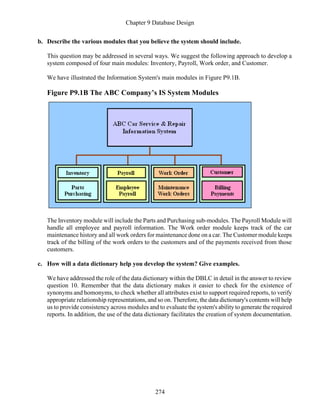
Whatever the design philosophy, a good designer uses a specific and ordered set of steps through which
the database design problem is approached. The steps are generally based on three phases: analysis,
design, and implementation. These phases yield the following activities:
ANALYSIS
1. Interview the shop manager
2. Interview the mechanics
3. Obtain a general description of company operations
4. Create a description of each system process
DESIGN
5. Create a conceptual model, using E-R diagrams
6. 8. Draw a data flow diagram and system flow charts
7. Normalize the conceptual model
IMPLEMENTATION
8. Create the table structures
9. Load the database
10. Create the application programs
11. Test the system.
This listing implies that, within each of the three phases, the steps are completed in a specific order. For
example, it would seem reasonable to argue that we must first complete the interviews if we are to obtain
a proper description of the company operations. Similarly, we may argue that a data flow diagram
precedes the creation of the E-R diagram. Nevertheless, the specific tasks and the order in which they are
addressed may vary. Such variations do not matter, as long as the designer bases the selected procedures
on an appropriate design philosophy, such as top-down vs. bottom-up.
Given this discussion, we may present problem 1's solution this way:
__7__ Normalize the conceptual model.
__3__ Obtain a general description of company operations.
__9__ Load the database.
__4__ Create a description of each system process.
_11__ Test the system.
__6__ Draw a data flow diagram and system flow charts.
__5__ Create a conceptual model, using E-R diagrams.
Chapter 9 Database Design
273
_10__ Create the application programs.
__2__ Interview the mechanics.
__8__ Create the file (table) structures.
__1__ Interview the shop manager.
Chapter 9 Database Design
274
b. Describe the various modules that you believe the system should include.
This question may be addressed in several ways. We suggest the following approach to develop a
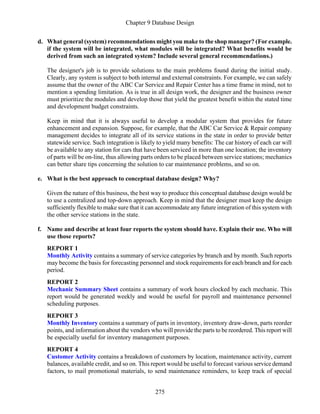
system composed of four main modules: Inventory, Payroll, Work order, and Customer.
We have illustrated the Information System's main modules in Figure P9.1B.
Figure P9.1B The ABC Company’s IS System Modules
The Inventory module will include the Parts and Purchasing sub-modules. The Payroll Module will
handle all employee and payroll information. The Work order module keeps track of the car
maintenance history and all work orders for maintenance done on a car. The Customer module keeps
track of the billing of the work orders to the customers and of the payments received from those
customers.
c. How will a data dictionary help you develop the system? Give examples.
We have addressed the role of the data dictionary within the DBLC in detail in the answer to review
question 10. Remember that the data dictionary makes it easier to check for the existence of
synonyms and homonyms, to check whether all attributes exist to support required reports, to verify
appropriate relationship representations, and so on. Therefore, the data dictionary's contents will help
us to provide consistency across modules and to evaluate the system's ability to generate the required
reports. In addition, the use of the data dictionary facilitates the creation of system documentation.
Chapter 9 Database Design
275
d. What general (system) recommendations might you make to the shop manager? (For example.
if the system will be integrated, what modules will be integrated? What benefits would be
derived from such an integrated system? Include several general recommendations.)
The designer's job is to provide solutions to the main problems found during the initial study.
Clearly, any system is subject to both internal and external constraints. For example, we can safely
assume that the owner of the ABC Car Service and Repair Center has a time frame in mind, not to
mention a spending limitation. As is true in all design work, the designer and the business owner
must prioritize the modules and develop those that yield the greatest benefit within the stated time
and development budget constraints.
Keep in mind that it is always useful to develop a modular system that provides for future
enhancement and expansion. Suppose, for example, that the ABC Car Service & Repair company
management decides to integrate all of its service stations in the state in order to provide better
statewide service. Such integration is likely to yield many benefits: The car history of each car will
be available to any station for cars that have been serviced in more than one location; the inventory
of parts will be on-line, thus allowing parts orders to be placed between service stations; mechanics
can better share tips concerning the solution to car maintenance problems, and so on.
e. What is the best approach to conceptual database design? Why?
Given the nature of this business, the best way to produce this conceptual database design would be
to use a centralized and top-down approach. Keep in mind that the designer must keep the design
sufficiently flexible to make sure that it can accommodate any future integration of this system with
the other service stations in the state.
f. Name and describe at least four reports the system should have. Explain their use. Who will
use those reports?
REPORT 1
Monthly Activity contains a summary of service categories by branch and by month. Such reports
may become the basis for forecasting personnel and stock requirements for each branch and for each
period.
REPORT 2
Mechanic Summary Sheet contains a summary of work hours clocked by each mechanic. This
report would be generated weekly and would be useful for payroll and maintenance personnel
scheduling purposes.
REPORT 3
Monthly Inventory contains a summary of parts in inventory, inventory draw-down, parts reorder
points, and information about the vendors who will provide the parts to be reordered. This report will
be especially useful for inventory management purposes.
REPORT 4
Customer Activity contains a breakdown of customers by location, maintenance activity, current
balances, available credit, and so on. This report would be useful to forecast various service demand
factors, to mail promotional materials, to send maintenance reminders, to keep track of special
Chapter 9 Database Design
276
customer requirements, and so on.
2. Suppose you have been asked to create an information system for a manufacturing plant that
produces nuts and bolts of many shapes, sizes, and functions. What questions would you ask, and
how would the answers to those questions affect the database design?
Basically, all answers to all (relevant) questions help shape the database design. In fact, all information
collected during the initial study and all subsequent phases will have an impact on the database design.
Keep in mind that the information is collected to establish the entities, attributes, and the relationships
among the entities. Specifically, the relationships, connectivities, and cardinalities are shaped by the
business rules that are derived from the information collected by the designer.
Sample questions and their likely impact on the design might be:
• Do you want to develop the database for all departments at once, or do you want to design and
implement the database for one department at a time?
• How will the design approach affect the design process? (In other words, assess top-down vs.
bottom-up, centralized or decentralized, system scope and boundaries.)
• Do you want to develop one module at a time, or do you want an integrated system? (Inventory,
production, shipping, billing, etc.)
• Do you want to keep track of the nuts and bolts by lot number, production shift, type, and
department? Impact: conceptual and logical database design.
• Do you want to keep track of the suppliers of each batch of raw material used in the production
of the nuts and bolts? Impact: conceptual and logical database design. E-R model.
• Do you want to keep track of the customers who received the batches of nuts and bolts? Impact:
conceptual and logical database design. ER model.
• What reports will you require, what will be the specific reporting requirements, and to whom
will these reports be distributed?
The answers to such questions affect the conceptual and logical database design, the database’s
implementation, its testing, and its subsequent operation.
a. What do you envision the SDLC to be?
The SDLC is not a function of the information collected. Regardless of the extent of the design or its
specific implementation, the SDLC phases remain:
PLANNING
Initial assessment
Feasibility study
ANALYSIS
User requirements
Study of existing systems
Logical system design
DETAILED SYSTEMS DESIGN
Detailed system specifications
Chapter 9 Database Design
277
IMPLEMENTATION
Coding, testing, debugging
Installation, fine-tuning
MAINTENANCE
Evaluation
Maintenance
Enhancements
b. What do you envision the DBLC to be?
As is true for the SDLC, the DBLC is not a function of the kind and extent of the collected
information. Thus, the DBLC phases and their activities remain as shown:
DATABASE INITIAL STUDY
Analyze the company situation
Define problems and constraints
Define objectives
Define scope and boundaries
DATABASE DESIGN
Create the conceptual design
Create the logical design
create the physical design
IMPLEMENTATION AND LOADING
Install the DBMS
Create the database(s)
Load or convert the data
TESTING AND EVALUATION
Test the database
Fine-tune the database
Evaluate the database and its application programs
OPERATION
Produce the required information flow
MAINTENANCE AND EVOLUTION
Introduce changes
Make enhancements
3. Suppose you perform the same functions noted in Problem 2 for a larger warehousing operation.
How are the two sets of procedures similar? How and why are they different?
The development of an information system will differ in the approach and philosophy used. More
Chapter 9 Database Design
278
precisely, the designer team will probably be formed by a group of system analysts and may decide to
use a decentralized approach to database design.
Also, as is true for any organization, the system scope and constraints may be very different for different
systems. Therefore, designers may opt to use different techniques at different stages. For example, the
database initial study phase may include separate studies carried out by separate design teams at several
geographically distant locations. Each of the findings of the design teams will later be integrated to
identify the main problems, solutions, and opportunities that will guide the design and development of
the system.
4. Using the same procedures and concepts employed in Problem 1, how would you create an
information system for the Tiny College example in Chapter 4?
Tiny College is a medium-sized educational institution that uses many database-intensive operations,
such as student registration, academic administration, inventory management, and payroll. To create an
information system, first perform an initial database study to determine the information system's
objectives.
Next, study Tiny College's operations and processes (flow of data) to identify the main problems,
constraints, and opportunities. A precise definition of the main problems and constraints will enable the
designer to make sure that the design improves Tiny College's operational efficiency. An improvement
in operational efficiency is likely to create opportunities to provide new services that will enhance Tiny
College's competitive position.
After the initial database study is done and the alternative solutions are presented, the end users
ultimately decide which one of the probable solutions is most appropriate for Tiny College. Keep in
mind that the development of a system this size will probably involve people who have quite different
backgrounds. For example, it is likely that the designer must work with people who play a managerial
role in communications and local area networks, as well as with the "troops in the trenches" such as
programmers and system operators. The designer should, therefore, expect that there will be a wide
range of opinions concerning the proposed system's features. It is the designer's job to reconcile the
many (and often conflicting) views of the "ideal" system.
Once a proposed solution has been agreed upon, the designer(s) may determine the proposed system's
scope and boundaries. We are then able to begin the design phase. As the design phase begins, keep in
mind that Tiny College's information system is likely to be used by many users (20 to 40 minimum) who
are located on distant sites across campus. Therefore, the designer must consider a range of
communication issues involving the use of such technologies as local area networks. These technologies
must be considered as the database designer(s) begin to develop the structure of the database to be
implemented.
The remaining development work conforms to the SDLC and the DBLC phases. Special attention must
be given to the system design's implementation and testing to ensure that all the system modules
interface properly.
Finally, the designer(s) must provide all the appropriate system documentation and ensure that all
Chapter 9 Database Design
279
appropriate system maintenance procedures (periodic backups, security checks, etc.) are in place to
ensure the system's proper operation.
Keep in mind that two very important issues in a university-wide system are end-user training and
support. Therefore, the system designer(s) must make sure that all end users know the system and know
how it is to be used to enjoy its benefits. In other words, make sure that end-user support programs are in
place when the system becomes operational.
5. Write the proper sequence of activities in the design of a video rental database. (The initial ERD
was shown in Figure 9.9.) The design must support all rental activities, customer payment
tracking, and employee work schedules, as well as track which employees checked out the videos
to the customers. After you finish writing the design activity sequence, complete the ERD to ensure
that the database design can be successfully implemented. (Make sure that the design is normalized
properly and that it can support the required transactions.
Given its level of detail and (relative) complexity, this problem would make an excellent class project.
Use the chapter’s coverage of the database life cycle (DBLC) as the procedural template. The text’s
Figure 9.3 is particularly useful as a procedural map for this problem’s solution and Figure 9.6 provides
a more detailed view of the database design’s procedural flow. Make sure that the students review
section 9-3b, “Database Design,” before they attempt to produce the problem solution.
Appendix B, “The University Lab: Conceptual Design,” and Appendix C “The University Lab:
Conceptual Design Verification, Logical Design, and Implementation” show a very detailed example of
the procedures required to deliver a completed database. You will find a more detailed video rental
database problem description in Appendix B, problem 4. This problem requires the completion of the
initial database design. The solution is shown in this manual’s Appendix B coverage. This design is
verified in Appendix C, Problem 2.
The Visio Professional files for the initial and verified designs are located on your instructor’s CD.
Select the FigB-P04a-The-Initial-Crows-Foot-ERD-for-the-Video-Rental-Store.vsd file to see the
initial design. Select the Fig-C-P02a-The-Revised-Video-Rental-Crows-Foot-ERD.vsd file to see the
verified design.
6. In a construction company, a new system has been in place for a few months and now there is a list
of possible changes/updates that need to be done. For each of the changes/updates, specify what
type of maintenance needs to be done: (a) corrective, (b) adaptive, and (c) perfective.
a. An error in the size of one of the fields has been identified and it needs to be updated
status field needs to be changed.
This is a change in response to a system error – corrective maintenance.
b. The company is expanding into a new type of service and this will require to enhancing
the system with a new set of tables to support this new service and integrate it with the
existing data.
This is a change to enhance the system – perfective maintenance.
Chapter 9 Database Design
280
c. The company has to comply with some government regulations. To do this, it will
require adding a couple of fields to the existing system tables.
This is a change in response to changes in the business environment – adaptive maintenance.
7. You have been assigned to design the database for a new soccer club. Indicate the most
appropriate sequence of activities by labeling each of the following steps in the correct order. (For
example, if you think that “Load the database” is the appropriate first step, label it “1.”)
_10__ Create the application programs.
__4__ Create a description of each system process.
_11__ Test the system.
__9__ Load the database.
__7__ Normalize the conceptual model.
__1__ Interview the soccer club president.
__5__ Create a conceptual model using ER diagrams.
__2__ Interview the soccer club director of coaching.
__8__ Create the file (table) structures.
__3__ Obtain a general description of the soccer club operations.
__6__ Draw a data flow diagram and system flowcharts.
Exploring the Variety of Random
Documents with Different Content
81
Robert Shafer 68, 69, 71, 75 Sewall-Belmont, 76 American Red Cross,
77 Library of Congress.
Smithsonian Institution 12 ambulance.
All other photographs come from the files of Clara Barton National
Historic Site and the National Park Service.
U.S. Department of the Interior
As the Nation’s principal conservation agency, the Department of the
Interior has responsibility for most of our nationally owned public
lands and natural resources. This includes fostering the wisest use of
our land and water resources, protecting our fish and wildlife,
preserving the environmental and cultural values of our national
parks and historical places, and providing for the enjoyment of life
through outdoor recreation. The Department assesses our energy
and mineral resources and works to assure that their development is
in the best interest of all our people. The Department also has a
major responsibility for American Indian reservation communities and
for people who live in island territories under U.S. administration.
Transcriber’s Notes
Retained publication information from the printed edition: this
eBook is public-domain in the country of publication.
Relocated all image captions to be immediately under the
corresponding images, removing redundant references like
”preceding page”.
Silently corrected a few palpable typos.
In the text versions only, text in italics is delimited by
_underscores_.
*** END OF THE PROJECT GUTENBERG EBOOK CLARA BARTON
NATIONAL HISTORIC SITE, MARYLAND ***
Updated editions will replace the previous one—the old editions
will be renamed.
Creating the works from print editions not protected by U.S.
copyright law means that no one owns a United States
copyright in these works, so the Foundation (and you!) can copy
and distribute it in the United States without permission and
without paying copyright royalties. Special rules, set forth in the
General Terms of Use part of this license, apply to copying and
distributing Project Gutenberg™ electronic works to protect the
PROJECT GUTENBERG™ concept and trademark. Project
Gutenberg is a registered trademark, and may not be used if
you charge for an eBook, except by following the terms of the
trademark license, including paying royalties for use of the
Project Gutenberg trademark. If you do not charge anything for
copies of this eBook, complying with the trademark license is
very easy. You may use this eBook for nearly any purpose such
as creation of derivative works, reports, performances and
research. Project Gutenberg eBooks may be modified and
printed and given away—you may do practically ANYTHING in
the United States with eBooks not protected by U.S. copyright
law. Redistribution is subject to the trademark license, especially
commercial redistribution.
START: FULL LICENSE
THE FULL PROJECT GUTENBERG LICENSE
PLEASE READ THIS BEFORE YOU DISTRIBUTE OR USE THIS WORK
To protect the Project Gutenberg™ mission of promoting the
free distribution of electronic works, by using or distributing this
work (or any other work associated in any way with the phrase
“Project Gutenberg”), you agree to comply with all the terms of
the Full Project Gutenberg™ License available with this file or
online at www.gutenberg.org/license.
Section 1. General Terms of Use and
Redistributing Project Gutenberg™
electronic works
1.A. By reading or using any part of this Project Gutenberg™
electronic work, you indicate that you have read, understand,
agree to and accept all the terms of this license and intellectual
property (trademark/copyright) agreement. If you do not agree
to abide by all the terms of this agreement, you must cease
using and return or destroy all copies of Project Gutenberg™
electronic works in your possession. If you paid a fee for
obtaining a copy of or access to a Project Gutenberg™
electronic work and you do not agree to be bound by the terms
of this agreement, you may obtain a refund from the person or
entity to whom you paid the fee as set forth in paragraph 1.E.8.
1.B. “Project Gutenberg” is a registered trademark. It may only
be used on or associated in any way with an electronic work by
people who agree to be bound by the terms of this agreement.
There are a few things that you can do with most Project
Gutenberg™ electronic works even without complying with the
full terms of this agreement. See paragraph 1.C below. There
are a lot of things you can do with Project Gutenberg™
electronic works if you follow the terms of this agreement and
help preserve free future access to Project Gutenberg™
electronic works. See paragraph 1.E below.
1.C. The Project Gutenberg Literary Archive Foundation (“the
Foundation” or PGLAF), owns a compilation copyright in the
collection of Project Gutenberg™ electronic works. Nearly all the
individual works in the collection are in the public domain in the
United States. If an individual work is unprotected by copyright
law in the United States and you are located in the United
States, we do not claim a right to prevent you from copying,
distributing, performing, displaying or creating derivative works
based on the work as long as all references to Project
Gutenberg are removed. Of course, we hope that you will
support the Project Gutenberg™ mission of promoting free
access to electronic works by freely sharing Project Gutenberg™
works in compliance with the terms of this agreement for
keeping the Project Gutenberg™ name associated with the
work. You can easily comply with the terms of this agreement
by keeping this work in the same format with its attached full
Project Gutenberg™ License when you share it without charge
with others.
1.D. The copyright laws of the place where you are located also
govern what you can do with this work. Copyright laws in most
countries are in a constant state of change. If you are outside
the United States, check the laws of your country in addition to
the terms of this agreement before downloading, copying,
displaying, performing, distributing or creating derivative works
based on this work or any other Project Gutenberg™ work. The
Foundation makes no representations concerning the copyright
status of any work in any country other than the United States.
1.E. Unless you have removed all references to Project
Gutenberg:
1.E.1. The following sentence, with active links to, or other
immediate access to, the full Project Gutenberg™ License must
appear prominently whenever any copy of a Project
Gutenberg™ work (any work on which the phrase “Project
Gutenberg” appears, or with which the phrase “Project
Gutenberg” is associated) is accessed, displayed, performed,
viewed, copied or distributed:
This eBook is for the use of anyone anywhere in the United
States and most other parts of the world at no cost and with
almost no restrictions whatsoever. You may copy it, give it
away or re-use it under the terms of the Project Gutenberg
License included with this eBook or online at
www.gutenberg.org. If you are not located in the United
States, you will have to check the laws of the country where
you are located before using this eBook.
1.E.2. If an individual Project Gutenberg™ electronic work is
derived from texts not protected by U.S. copyright law (does not
contain a notice indicating that it is posted with permission of
the copyright holder), the work can be copied and distributed to
anyone in the United States without paying any fees or charges.
If you are redistributing or providing access to a work with the
phrase “Project Gutenberg” associated with or appearing on the
work, you must comply either with the requirements of
paragraphs 1.E.1 through 1.E.7 or obtain permission for the use
of the work and the Project Gutenberg™ trademark as set forth
in paragraphs 1.E.8 or 1.E.9.
1.E.3. If an individual Project Gutenberg™ electronic work is
posted with the permission of the copyright holder, your use and
distribution must comply with both paragraphs 1.E.1 through
1.E.7 and any additional terms imposed by the copyright holder.
Additional terms will be linked to the Project Gutenberg™
License for all works posted with the permission of the copyright
holder found at the beginning of this work.
1.E.4. Do not unlink or detach or remove the full Project
Gutenberg™ License terms from this work, or any files
containing a part of this work or any other work associated with
Project Gutenberg™.
1.E.5. Do not copy, display, perform, distribute or redistribute
this electronic work, or any part of this electronic work, without
prominently displaying the sentence set forth in paragraph 1.E.1
with active links or immediate access to the full terms of the
Project Gutenberg™ License.
1.E.6. You may convert to and distribute this work in any binary,
compressed, marked up, nonproprietary or proprietary form,
including any word processing or hypertext form. However, if
you provide access to or distribute copies of a Project
Gutenberg™ work in a format other than “Plain Vanilla ASCII” or
other format used in the official version posted on the official
Project Gutenberg™ website (www.gutenberg.org), you must,
at no additional cost, fee or expense to the user, provide a copy,
a means of exporting a copy, or a means of obtaining a copy
upon request, of the work in its original “Plain Vanilla ASCII” or
other form. Any alternate format must include the full Project
Gutenberg™ License as specified in paragraph 1.E.1.
1.E.7. Do not charge a fee for access to, viewing, displaying,
performing, copying or distributing any Project Gutenberg™
works unless you comply with paragraph 1.E.8 or 1.E.9.
1.E.8. You may charge a reasonable fee for copies of or
providing access to or distributing Project Gutenberg™
electronic works provided that:
• You pay a royalty fee of 20% of the gross profits you derive
from the use of Project Gutenberg™ works calculated using the
method you already use to calculate your applicable taxes. The
fee is owed to the owner of the Project Gutenberg™ trademark,
but he has agreed to donate royalties under this paragraph to
the Project Gutenberg Literary Archive Foundation. Royalty
payments must be paid within 60 days following each date on
which you prepare (or are legally required to prepare) your
periodic tax returns. Royalty payments should be clearly marked
as such and sent to the Project Gutenberg Literary Archive
Foundation at the address specified in Section 4, “Information
about donations to the Project Gutenberg Literary Archive
Foundation.”
• You provide a full refund of any money paid by a user who
notifies you in writing (or by e-mail) within 30 days of receipt
that s/he does not agree to the terms of the full Project
Gutenberg™ License. You must require such a user to return or
destroy all copies of the works possessed in a physical medium
and discontinue all use of and all access to other copies of
Project Gutenberg™ works.
• You provide, in accordance with paragraph 1.F.3, a full refund of
any money paid for a work or a replacement copy, if a defect in
the electronic work is discovered and reported to you within 90
days of receipt of the work.
• You comply with all other terms of this agreement for free
distribution of Project Gutenberg™ works.
1.E.9. If you wish to charge a fee or distribute a Project
Gutenberg™ electronic work or group of works on different
terms than are set forth in this agreement, you must obtain
permission in writing from the Project Gutenberg Literary
Archive Foundation, the manager of the Project Gutenberg™
trademark. Contact the Foundation as set forth in Section 3
below.
1.F.
1.F.1. Project Gutenberg volunteers and employees expend
considerable effort to identify, do copyright research on,
transcribe and proofread works not protected by U.S. copyright
law in creating the Project Gutenberg™ collection. Despite these
efforts, Project Gutenberg™ electronic works, and the medium
on which they may be stored, may contain “Defects,” such as,
but not limited to, incomplete, inaccurate or corrupt data,
transcription errors, a copyright or other intellectual property
infringement, a defective or damaged disk or other medium, a
computer virus, or computer codes that damage or cannot be
read by your equipment.
1.F.2. LIMITED WARRANTY, DISCLAIMER OF DAMAGES - Except
for the “Right of Replacement or Refund” described in
paragraph 1.F.3, the Project Gutenberg Literary Archive
Foundation, the owner of the Project Gutenberg™ trademark,
and any other party distributing a Project Gutenberg™ electronic
work under this agreement, disclaim all liability to you for
damages, costs and expenses, including legal fees. YOU AGREE
THAT YOU HAVE NO REMEDIES FOR NEGLIGENCE, STRICT
LIABILITY, BREACH OF WARRANTY OR BREACH OF CONTRACT
EXCEPT THOSE PROVIDED IN PARAGRAPH 1.F.3. YOU AGREE
THAT THE FOUNDATION, THE TRADEMARK OWNER, AND ANY
DISTRIBUTOR UNDER THIS AGREEMENT WILL NOT BE LIABLE
TO YOU FOR ACTUAL, DIRECT, INDIRECT, CONSEQUENTIAL,
PUNITIVE OR INCIDENTAL DAMAGES EVEN IF YOU GIVE
NOTICE OF THE POSSIBILITY OF SUCH DAMAGE.
1.F.3. LIMITED RIGHT OF REPLACEMENT OR REFUND - If you
discover a defect in this electronic work within 90 days of
receiving it, you can receive a refund of the money (if any) you
paid for it by sending a written explanation to the person you
received the work from. If you received the work on a physical
medium, you must return the medium with your written
explanation. The person or entity that provided you with the
defective work may elect to provide a replacement copy in lieu
of a refund. If you received the work electronically, the person
or entity providing it to you may choose to give you a second
opportunity to receive the work electronically in lieu of a refund.
If the second copy is also defective, you may demand a refund
in writing without further opportunities to fix the problem.
1.F.4. Except for the limited right of replacement or refund set
forth in paragraph 1.F.3, this work is provided to you ‘AS-IS’,
WITH NO OTHER WARRANTIES OF ANY KIND, EXPRESS OR
IMPLIED, INCLUDING BUT NOT LIMITED TO WARRANTIES OF
MERCHANTABILITY OR FITNESS FOR ANY PURPOSE.
1.F.5. Some states do not allow disclaimers of certain implied
warranties or the exclusion or limitation of certain types of
damages. If any disclaimer or limitation set forth in this
agreement violates the law of the state applicable to this
agreement, the agreement shall be interpreted to make the
maximum disclaimer or limitation permitted by the applicable
state law. The invalidity or unenforceability of any provision of
this agreement shall not void the remaining provisions.
1.F.6. INDEMNITY - You agree to indemnify and hold the
Foundation, the trademark owner, any agent or employee of the
Foundation, anyone providing copies of Project Gutenberg™
electronic works in accordance with this agreement, and any
volunteers associated with the production, promotion and
distribution of Project Gutenberg™ electronic works, harmless
from all liability, costs and expenses, including legal fees, that
arise directly or indirectly from any of the following which you
do or cause to occur: (a) distribution of this or any Project
Gutenberg™ work, (b) alteration, modification, or additions or
deletions to any Project Gutenberg™ work, and (c) any Defect
you cause.
Section 2. Information about the Mission
of Project Gutenberg™
Project Gutenberg™ is synonymous with the free distribution of
electronic works in formats readable by the widest variety of
computers including obsolete, old, middle-aged and new
computers. It exists because of the efforts of hundreds of
volunteers and donations from people in all walks of life.
Volunteers and financial support to provide volunteers with the
assistance they need are critical to reaching Project
Gutenberg™’s goals and ensuring that the Project Gutenberg™
collection will remain freely available for generations to come. In
2001, the Project Gutenberg Literary Archive Foundation was
created to provide a secure and permanent future for Project
Gutenberg™ and future generations. To learn more about the
Project Gutenberg Literary Archive Foundation and how your
efforts and donations can help, see Sections 3 and 4 and the
Foundation information page at www.gutenberg.org.
Section 3. Information about the Project
Gutenberg Literary Archive Foundation
The Project Gutenberg Literary Archive Foundation is a non-
profit 501(c)(3) educational corporation organized under the
laws of the state of Mississippi and granted tax exempt status
by the Internal Revenue Service. The Foundation’s EIN or
federal tax identification number is 64-6221541. Contributions
to the Project Gutenberg Literary Archive Foundation are tax
deductible to the full extent permitted by U.S. federal laws and
your state’s laws.
The Foundation’s business office is located at 809 North 1500
West, Salt Lake City, UT 84116, (801) 596-1887. Email contact
links and up to date contact information can be found at the
Foundation’s website and official page at
www.gutenberg.org/contact
Section 4. Information about Donations to
the Project Gutenberg Literary Archive
Foundation
Project Gutenberg™ depends upon and cannot survive without
widespread public support and donations to carry out its mission
of increasing the number of public domain and licensed works
that can be freely distributed in machine-readable form
accessible by the widest array of equipment including outdated
equipment. Many small donations ($1 to $5,000) are particularly
important to maintaining tax exempt status with the IRS.
The Foundation is committed to complying with the laws
regulating charities and charitable donations in all 50 states of
the United States. Compliance requirements are not uniform
and it takes a considerable effort, much paperwork and many
fees to meet and keep up with these requirements. We do not
solicit donations in locations where we have not received written
confirmation of compliance. To SEND DONATIONS or determine
the status of compliance for any particular state visit
www.gutenberg.org/donate.
While we cannot and do not solicit contributions from states
where we have not met the solicitation requirements, we know
of no prohibition against accepting unsolicited donations from
donors in such states who approach us with offers to donate.
International donations are gratefully accepted, but we cannot
make any statements concerning tax treatment of donations
received from outside the United States. U.S. laws alone swamp
our small staff.
Please check the Project Gutenberg web pages for current
donation methods and addresses. Donations are accepted in a
number of other ways including checks, online payments and
credit card donations. To donate, please visit:
www.gutenberg.org/donate.
Section 5. General Information About
Project Gutenberg™ electronic works
Professor Michael S. Hart was the originator of the Project
Gutenberg™ concept of a library of electronic works that could
be freely shared with anyone. For forty years, he produced and
distributed Project Gutenberg™ eBooks with only a loose
network of volunteer support.
Project Gutenberg™ eBooks are often created from several
printed editions, all of which are confirmed as not protected by
copyright in the U.S. unless a copyright notice is included. Thus,
we do not necessarily keep eBooks in compliance with any
particular paper edition.
Most people start at our website which has the main PG search
facility: www.gutenberg.org.
This website includes information about Project Gutenberg™,
including how to make donations to the Project Gutenberg
Literary Archive Foundation, how to help produce our new
eBooks, and how to subscribe to our email newsletter to hear
about new eBooks.

Database Systems Design Implementation And Management 13th Edition Coronel Solutions Manual
  • 1.
    Database Systems DesignImplementation And Management 13th Edition Coronel Solutions Manual install download https://testbankfan.com/product/database-systems-design- implementation-and-management-13th-edition-coronel-solutions- manual/ Download more testbank from https://testbankfan.com

  • 2.
    We believe theseproducts will be a great fit for you. Click the link to download now, or visit testbankfan.com to discover even more! Database Systems Design Implementation And Management 13th Edition Coronel Test Bank https://testbankfan.com/product/database-systems-design- implementation-and-management-13th-edition-coronel-test-bank/ Database Systems Design Implementation and Management 12th Edition Coronel Solutions Manual https://testbankfan.com/product/database-systems-design- implementation-and-management-12th-edition-coronel-solutions- manual/ Database Systems Design Implementation and Management 11th Edition Coronel Solutions Manual https://testbankfan.com/product/database-systems-design- implementation-and-management-11th-edition-coronel-solutions- manual/ Database Systems Design Implementation and Management 12th Edition Coronel Test Bank https://testbankfan.com/product/database-systems-design- implementation-and-management-12th-edition-coronel-test-bank/
  • 3.
    Database Systems DesignImplementation and Management 11th Edition Coronel Test Bank https://testbankfan.com/product/database-systems-design- implementation-and-management-11th-edition-coronel-test-bank/ Database Processing Fundamentals Design and Implementation 13th Edition Kroenke Solutions Manual https://testbankfan.com/product/database-processing-fundamentals- design-and-implementation-13th-edition-kroenke-solutions-manual/ Database Systems A Practical Approach to Design Implementation and Management 6th Edition Connolly Solutions Manual https://testbankfan.com/product/database-systems-a-practical- approach-to-design-implementation-and-management-6th-edition- connolly-solutions-manual/ Database Processing Fundamentals Design and Implementation 13th Edition Kroenke Test Bank https://testbankfan.com/product/database-processing-fundamentals- design-and-implementation-13th-edition-kroenke-test-bank/ Database Processing Fundamentals Design and Implementation 15th Edition Kroenke Solutions Manual https://testbankfan.com/product/database-processing-fundamentals- design-and-implementation-15th-edition-kroenke-solutions-manual/


  • 4.
    Chapter 9 DatabaseDesign 261 Chapter 9 Database Design Discussion Focus What is the relationship between a database and an information system, and how does this relationship have a bearing on database design? An information system performs three sets of services: • It provides for data collection, storage, and retrieval. • It facilitates the transformation of data into information. • It provides the tools and conditions to manage both data and information. Basically, a database is a fact (data) repository that serves an information system. If the database is designed poorly, one can hardly expect that the data/information transformation will be successful, nor is it reasonable to expect efficient and capable management of data and information. The transformation of data into information is accomplished through application programs. It is impossible to produce good information from poor data; and, no matter how sophisticated the application programs are, it is impossible to use good application programs to overcome the effects of bad database design. In short: Good database design is the foundation of a successful information system. Database design must yield a database that: • Does not fall prey to uncontrolled data duplication, thus preventing data anomalies and the attendant lack of data integrity. • Is efficient in its provision of data access. • Serves the needs of the information system. The last point deserves emphasis: even the best-designed database lacks value if it fails to meet information system objectives. In short, good database designers must pay close attention to the information system requirements. Systems design and database design are usually tightly intertwined and are often performed in parallel. Therefore, database and systems designers must cooperate and coordinate to yield the best possible information system. What is the relationship between the SDLC and the DBLC? The SDLC traces the history (life cycle) of an information system. The DBLC traces the history (life cycle) of a database system. Since we know that the database serves the information system, it is not surprising that the two life cycles conform to the same basic phases. Suggestion: Use Figure 9.8 as the basis for a discussion of the parallel activities.
  • 5.
    Chapter 9 DatabaseDesign 262 What basic database design strategies exist, and how are such strategies executed? Suggestion: Use Figure 9.14 as the basis for this discussion. There are two basic approaches to database design: top-down and bottom-up. Top-down design begins by identifying the different entity types and the definition of each entity's attributes. In other words, top-down design: • starts by defining the required data sets and then • defines the data elements for each of those data sets. Bottom-up design: • first defines the required attributes and then • groups the attributes to form entities. Although the two methodologies tend to be complementary, database designers who deal with small databases with relatively few entities, attributes, and transactions tend to emphasize the bottom-up approach. Database designers who deal with large, complex databases usually find that a primarily top-down design approach is more appropriate. In spite of the frequent arguments concerning the best design approach, perhaps the top-down vs. bottom-up distinction is quite artificial. The text's note is worth repeating: NOTE Even if a generally top-down approach is selected, the normalization process that revises existing table structures is (inevitably) a bottom-up technique. E-R models constitute a top-down process even if the selection of attributes and entities may be described as bottom-up. Since both the E-R model and normalization techniques form the basis for most designs, the top-down vs. bottom-up debate may be based on a distinction without a difference.
  • 6.
    Chapter 9 DatabaseDesign 263 Answers to Review Questions 1. What is an information system? What is its purpose? An information system is a system that • provides the conditions for data collection, storage, and retrieval • facilitates the transformation of data into information • provides management of both data and information. An information system is composed of hardware, software (DBMS and applications), the database(s), procedures, and people. Good decisions are generally based on good information. Ultimately, the purpose of an information system is to facilitate good decision making by making relevant and timely information available to the decision makers. 2. How do systems analysis and systems development fit into a discussion about information systems? Both systems analysis and systems development constitute part of the Systems Development Life Cycle, or SDLC. Systems analysis, phase II of the SDLC, establishes the need for and the extent of an information system by • Establishing end-user requirements. • Evaluating the existing system. • Developing a logical systems design. Systems development, based on the detailed systems design found in phase III of the SDLC, yields the information system. The detailed system specifications are established during the systems design phase, in which the designer completes the design of all required system processes. 3. What does the acronym SDLC mean, and what does an SDLC portray? SDLC is the acronym that is used to label the System Development Life Cycle. The SDLC traces the history of a information system from its inception to its obsolescence. The SDLC is composed of six phases: planning, analysis, detailed system, design, implementation and maintenance. 4. What does the acronym DBLC mean, and what does a DBLC portray? DBLC is the acronym that is used to label the Database Life Cycle. The DBLC traces the history of a database system from its inception to its obsolescence. Since the database constitutes the core of an information system, the DBLC is concurrent to the SDLC. The DBLC is composed of six phases: initial study, design, implementation and loading, testing and evaluation, operation, and maintenance and evolution.
  • 7.
    Chapter 9 DatabaseDesign 264 5. Discuss the distinction between centralized and decentralized conceptual database design. Centralized and decentralized design constitute variations on the bottom-up and top-down approaches we discussed in the third question presented in the discussion focus. Basically, the centralized approach is best suited to relatively small and simple databases that lend themselves well to a bird's-eye view of the entire database. Such databases may be designed by a single person or by a small and informally constituted design team. The company operations and the scope of its problems are sufficiently limited to enable the designer(s) to perform all of the necessary database design tasks: 1. Define the problem(s). 2. Create the conceptual design. 3. Verify the conceptual design with all user views. 4. Define all system processes and data constraints. 5. Assure that the database design will comply with all achievable end user requirements. The centralized design procedure thus yields the design summary shown in Figure Q9.5A. Figure Q9.5A The Centralized Design Procedure Conceptual Model Data Constraints System Processes User Views Conceptual Model Verification D A T A D I C T I O N A R Y
  • 8.
    Chapter 9 DatabaseDesign 265 Note that the centralized design approach requires the completion and validation of a single conceptual design. NOTE Use the text’s Figures 9.15 and 9.16 to contrast the two design approaches, then use Figure 9.6 to show the procedure flows; demonstrate that such procedure flows are independent of the degree of centralization. In contrast, when company operations are spread across multiple operational sites or when the database has multiple entities that are subject to complex relations, the best approach is often based on the decentralized design. Typically, a decentralized design requires that the design task be divided into multiple modules, each one of which is assigned to a design team. The design team activities are coordinated by the lead designer, who must aggregate the design teams' efforts. Since each team focuses on modeling a subset of the system, the definition of boundaries and the interrelation between data subsets must be very precise. Each team creates a conceptual data model corresponding to the subset being modeled. Each conceptual model is then verified individually against the user views, processes, and constraints for each of the modules. After the verification process has been completed, all modules are integrated in one conceptual model. Since the data dictionary describes the characteristics of all the objects within the conceptual data model, it plays a vital role in the integration process. Naturally, after the subsets have been aggregated into a larger conceptual model, the lead designer must verify that the combined conceptual model is still able to support all the required transactions. Thus the decentralized design activities may be summarized as shown in Figure Q9.6B.
  • 9.
    Chapter 9 DatabaseDesign 266 Figure Q9.6B The Decentralized Design Procedure D A T A D I C T I O N A R Y Subset A DATA COMPONENT Views, Processes, Constraints Views, Processes, Constraints Views, Processes, Constraints Aggregation Subset B Subset C Verification Conceptual Models FINAL CONCEPTUAL MODEL Keep in mind that the aggregation process requires the lead designer to assemble a single model in which various aggregation problems must be addressed: • synonyms and homonyms. Different departments may know the same object by different names (synonyms), or they may use the same name to address different objects (homonyms.) The object may be an entity, an attribute, or a relationship. • entity and entity subclasses. An entity subset may be viewed as a separate entity by one or more departments. The designer must integrate such subclasses into a higher-level entity. • Conflicting object definitions. Attributes may be recorded as different types (character, numeric), or different domains may be defined for the same attribute. Constraint definitions, too, may vary. The designer must remove such conflicts from the model. 6. What is the minimal data rule in conceptual design? Why is it important? The minimal data rule specifies that all the data defined in the data model are actually required to fit present and expected future data requirements. This rule may be phrased as All that is needed is there, and all that is there is needed.
  • 10.
    Chapter 9 DatabaseDesign 267 7. Discuss the distinction between top-down and bottom-up approaches to database design. There are two basic approaches to database design: top-down and bottom-up. Top-down design begins by identifying the different entity types and the definition of each entity's attributes. In other words, top-down design: • starts by defining the required data sets and then • defines the data elements for each of those data sets. Bottom-up design: • first defines the required attributes and then • groups the attributes to form entities. Although the two methodologies tend to be complementary, database designers who deal with small databases with relatively few entities, attributes, and transactions tend to emphasize the bottom-up approach. Database designers who deal with large, complex databases usually find that a primarily top-down design approach is more appropriate. 8. What are business rules? Why are they important to a database designer? Business rules are narrative descriptions of the business policies, procedures, or principles that are derived from a detailed description of operations. Business rules are particularly valuable to database designers, because they help define: • Entities • Attributes • Relationships (1:1, 1:M, M:N, expressed through connectivities and cardinalities) • Constraints To develop an accurate data model, the database designer must have a thorough and complete understanding of the organization's data requirements. The business rules are very important to the designer because they enable the designer to fully understand how the business works and what role is played by data within company operations. NOTE Do keep in mind that an ERD cannot always include all the applicable business rules. For example, although constraints are often crucial, it is often not possible to model them. For instance, there is no way to model a constraint such as “no pilot may be assigned to flight duties more than ten hours during any 24-hour period.” It is also worth emphasizing that the description of (company) operations must be done in almost excruciating detail and it must be verified and re-verified. An inaccurate description of operations yields inaccurate business rules that lead to database designs that are destined to fail. 9. What is the data dictionary's function in database design?
  • 11.
    Chapter 9 DatabaseDesign 268 A good data dictionary provides a precise description of the characteristics of all the entities and attributes found within the database. The data dictionary thus makes it easier to check for the existence of synonyms and homonyms, to check whether all attributes exist to support required reports, to verify appropriate relationship representations, and so on. The data dictionary's contents are both developed and used during the six DBLC phases: DATABASE INITIAL STUDY The basic data dictionary components are developed as the entities and attributes are defined during this phase. DATABASE DESIGN The data dictionary contents are used to verify the database design components: entities, attributes, and their relationships. The designer also uses the data dictionary to check the database design for homonyms and synonyms and verifies that the entities and attributes will support all required query and report requirements. IMPLEMENTATION AND LOADING The DBMS's data dictionary helps to resolve any remaining attribute definition inconsistencies. TESTING AND EVALUATION If problems develop during this phase, the data dictionary contents may be used to help restructure the basic design components to make sure that they support all required operations. OPERATION If the database design still yields (the almost inevitable) operational glitches, the data dictionary may be used as a quality control device to ensure that operational modifications to the database do not conflict with existing components. MAINTENANCE AND EVOLUTION As users face inevitable changes in information needs, the database may be modified to support those needs. Perhaps entities, attributes, and relationships must be added, or relationships must be changed. If new database components are fit into the design, their introduction may produce conflict with existing components. The data dictionary turns out to be a very useful tool to check whether a suggested change invites conflicts within the database design and, if so, how such conflicts may be resolved. 10. What steps are required in the development of an ER diagram? (Hint: See Table 9.3.) Table 9.3 is reproduced for your convenience.
  • 12.
    Chapter 9 DatabaseDesign 269 TABLE 9.3 Developing the Conceptual Model, Using ER Diagrams STEP ACTIVITY 1 Identify, analyze, and refine the business rules. 2 Identify the main entities, using the results of Step 1. 3 Define the relationships among the entities, using the results of Steps 1 and 2. 4 Define the attributes, primary keys, and foreign keys for each of the entities. 5 Normalize the entities. (Remember that entities are implemented as tables in an RDBMS.) 6 Complete the initial ER diagram. 7 Validate the ER model against the user’s information and processing requirements. 8 Modify the ER diagram, using the results of Step 7. Point out that some of the steps listed in Table 9.3 take place concurrently. And some, such as the normalization process, can generate a demand for additional entities and/or attributes, thereby causing the designer to revise the ER model. For example, while identifying two main entities, the designer might also identify the composite bridge entity that represents the many-to-many relationship between those two main entities. 11. List and briefly explain the activities involved in the verification of an ER model. Section 9-4c, “Data Model Verification,” includes a discussion on verification. In addition, Appendix C, “The University Lab: Conceptual Design Verification, Logical Design, and Implementation,” covers the verification process in detail. The verification process is detailed in the text’s Table 9.5, reproduced here for your convenience. TABLE 9.5 The ER Model Verification Process STEP ACTIVITY 1 Identify the ER model’s central entity. 2 Identify each module and its components. 3 Identify each module’s transaction requirements: Internal: Updates/Inserts/Deletes/Queries/Reports External: Module interfaces 4 Verify all processes against the module’s processing and reporting requirements. 5 Make all necessary changes suggested in Step 4. 6 Repeat Steps 2−5 for all modules. Keep in mind that the verification process requires the continuous verification of business transactions as well as system and user requirements. The verification sequence must be repeated for each of the system’s modules. 12. What factors are important in a DBMS software selection? The selection of DBMS software is critical to the information system’s smooth operation. Consequently, the advantages and disadvantages of the proposed DBMS software should be carefully studied. To avoid false expectations, the end user must be made aware of the limitations of both the DBMS and the
  • 13.
    Chapter 9 DatabaseDesign 270 database. Although the factors affecting the purchasing decision vary from company to company, some of the most common are: • Cost. Purchase, maintenance, operational, license, installation, training, and conversion costs. • DBMS features and tools. Some database software includes a variety of tools that facilitate the application development task. For example, the availability of query by example (QBE), screen painters, report generators, application generators, data dictionaries, and so on, helps to create a more pleasant work environment for both the end user and the application programmer. Database administrator facilities, query facilities, ease of use, performance, security, concurrency control, transaction processing, and third-party support also influence DBMS software selection. • Underlying model. Hierarchical, network, relational, object/relational, or object. • Portability. Across platforms, systems, and languages. • DBMS hardware requirements. Processor(s), RAM, disk space, and so on. 13. List and briefly explain the four steps performed during the logical design stage. 1) Map conceptual model to logical model components. In this step, the conceptual model is converted into a set of table definitions including table names, column names, primary keys, and foreign keys to implement the entities and relationships specified in the conceptual design. 2) Validate the logical model using normalization. It is possible for normalization issues to be discovered during the process of mapping the conceptual model to logical model components. Therefore, it is appropriate at this stage to validate that all of the table definitions from the previous step conform to the appropriate normalization rules. 3) Validate logical model integrity constraints. This step involves the conversion of attribute domains and constraints into constraint definitions that can be implemented within the DBMS to enforce those domains. Also, entity and referential integrity constraints are validated. Views may be defined to enforce security constraints. 4) Validate the logical model against the user requirements. The final step of this stage is to ensure that all definitions created throughout the logical model are validated against the users' data, transaction, and security requirements. Every component (table, view, constraint, etc.) of the logical model must be associated with satisfying the user requirements, and every user requirement should be addressed by the model components. 14. List and briefly explain the three steps performed during the physical design stage. 1) Define data storage organization. Based on estimates of the data volume and growth, this step involves the determination of the physical location and physical organization for each table. Also, which columns will be indexed and the type of indexes to be used are determined. Finally, the type of implementation to be used for each view is decided. 2) Define integrity and security measures. This step involves creating users and security groups, and then assigning privileges and controls to those users and group. 3) Determine performance measurements.
  • 14.
    Chapter 9 DatabaseDesign 271 The actual performance of the physical database implementation must be measured and assessed for compliance with user performance requirements. 15. What three levels of backup may be used in database recovery management? Briefly describe what each of those three backup levels does. A full backup of the database creates a backup copy of all database objects in their entirety. A differential backup of the database creates a backup of only those database objects that have changed since the last full backup. A transaction log backup does not create a backup of database objects, but makes a backup of the log of changes that have been applied to the database objects since the last backup. Problem Solutions 1. The ABC Car Service & Repair Centers are owned by the SILENT car dealer; ABC services and repairs only SILENT cars. Three ABC Car Service & Repair Centers provide service and repair for the entire state. Each of the three centers is independently managed and operated by a shop manager, a receptionist, and at least eight mechanics. Each center maintains a fully stocked parts inventory. Each center also maintains a manual file system in which each car’s maintenance history is kept: repairs made, parts used, costs, service dates, owner, and so on. Files are also kept to track inventory, purchasing, billing, employees’ hours, and payroll. You have been contacted by the manager of one of the centers to design and implement a computerized system. Given the preceding information, do the following: a. Indicate the most appropriate sequence of activities by labeling each of the following steps in the correct order. (For example, if you think that “Load the database.” is the appropriate first step, label it “1.”) ____ Normalize the conceptual model. ____ Obtain a general description of company operations. ____ Load the database. ____ Create a description of each system process. ____ Test the system. ____ Draw a data flow diagram and system flowcharts. ____ Create a conceptual model, using ER diagrams. ____ Create the application programs. ____ Interview the mechanics. ____ Create the file (table) structures. ____ Interview the shop manager. The answer to this question may vary slightly from one designer to the next, depending on the selected design methodology and even on personal designer preferences. Yet, in spite of such differences, it is possible to develop a common design methodology to permit the development of a basic

  • 15.
    Chapter 9 DatabaseDesign 272 decision-making process and the analysis required in designing an information system. Whatever the design philosophy, a good designer uses a specific and ordered set of steps through which the database design problem is approached. The steps are generally based on three phases: analysis, design, and implementation. These phases yield the following activities: ANALYSIS 1. Interview the shop manager 2. Interview the mechanics 3. Obtain a general description of company operations 4. Create a description of each system process DESIGN 5. Create a conceptual model, using E-R diagrams 6. 8. Draw a data flow diagram and system flow charts 7. Normalize the conceptual model IMPLEMENTATION 8. Create the table structures 9. Load the database 10. Create the application programs 11. Test the system. This listing implies that, within each of the three phases, the steps are completed in a specific order. For example, it would seem reasonable to argue that we must first complete the interviews if we are to obtain a proper description of the company operations. Similarly, we may argue that a data flow diagram precedes the creation of the E-R diagram. Nevertheless, the specific tasks and the order in which they are addressed may vary. Such variations do not matter, as long as the designer bases the selected procedures on an appropriate design philosophy, such as top-down vs. bottom-up. Given this discussion, we may present problem 1's solution this way: __7__ Normalize the conceptual model. __3__ Obtain a general description of company operations. __9__ Load the database. __4__ Create a description of each system process. _11__ Test the system. __6__ Draw a data flow diagram and system flow charts. __5__ Create a conceptual model, using E-R diagrams.
  • 16.
    Chapter 9 DatabaseDesign 273 _10__ Create the application programs. __2__ Interview the mechanics. __8__ Create the file (table) structures. __1__ Interview the shop manager.
  • 17.
    Chapter 9 DatabaseDesign 274 b. Describe the various modules that you believe the system should include. This question may be addressed in several ways. We suggest the following approach to develop a system composed of four main modules: Inventory, Payroll, Work order, and Customer. We have illustrated the Information System's main modules in Figure P9.1B. Figure P9.1B The ABC Company’s IS System Modules The Inventory module will include the Parts and Purchasing sub-modules. The Payroll Module will handle all employee and payroll information. The Work order module keeps track of the car maintenance history and all work orders for maintenance done on a car. The Customer module keeps track of the billing of the work orders to the customers and of the payments received from those customers. c. How will a data dictionary help you develop the system? Give examples. We have addressed the role of the data dictionary within the DBLC in detail in the answer to review question 10. Remember that the data dictionary makes it easier to check for the existence of synonyms and homonyms, to check whether all attributes exist to support required reports, to verify appropriate relationship representations, and so on. Therefore, the data dictionary's contents will help us to provide consistency across modules and to evaluate the system's ability to generate the required reports. In addition, the use of the data dictionary facilitates the creation of system documentation.
  • 18.
    Chapter 9 DatabaseDesign 275 d. What general (system) recommendations might you make to the shop manager? (For example. if the system will be integrated, what modules will be integrated? What benefits would be derived from such an integrated system? Include several general recommendations.) The designer's job is to provide solutions to the main problems found during the initial study. Clearly, any system is subject to both internal and external constraints. For example, we can safely assume that the owner of the ABC Car Service and Repair Center has a time frame in mind, not to mention a spending limitation. As is true in all design work, the designer and the business owner must prioritize the modules and develop those that yield the greatest benefit within the stated time and development budget constraints. Keep in mind that it is always useful to develop a modular system that provides for future enhancement and expansion. Suppose, for example, that the ABC Car Service & Repair company management decides to integrate all of its service stations in the state in order to provide better statewide service. Such integration is likely to yield many benefits: The car history of each car will be available to any station for cars that have been serviced in more than one location; the inventory of parts will be on-line, thus allowing parts orders to be placed between service stations; mechanics can better share tips concerning the solution to car maintenance problems, and so on. e. What is the best approach to conceptual database design? Why? Given the nature of this business, the best way to produce this conceptual database design would be to use a centralized and top-down approach. Keep in mind that the designer must keep the design sufficiently flexible to make sure that it can accommodate any future integration of this system with the other service stations in the state. f. Name and describe at least four reports the system should have. Explain their use. Who will use those reports? REPORT 1 Monthly Activity contains a summary of service categories by branch and by month. Such reports may become the basis for forecasting personnel and stock requirements for each branch and for each period. REPORT 2 Mechanic Summary Sheet contains a summary of work hours clocked by each mechanic. This report would be generated weekly and would be useful for payroll and maintenance personnel scheduling purposes. REPORT 3 Monthly Inventory contains a summary of parts in inventory, inventory draw-down, parts reorder points, and information about the vendors who will provide the parts to be reordered. This report will be especially useful for inventory management purposes. REPORT 4 Customer Activity contains a breakdown of customers by location, maintenance activity, current balances, available credit, and so on. This report would be useful to forecast various service demand factors, to mail promotional materials, to send maintenance reminders, to keep track of special
  • 19.
    Chapter 9 DatabaseDesign 276 customer requirements, and so on. 2. Suppose you have been asked to create an information system for a manufacturing plant that produces nuts and bolts of many shapes, sizes, and functions. What questions would you ask, and how would the answers to those questions affect the database design? Basically, all answers to all (relevant) questions help shape the database design. In fact, all information collected during the initial study and all subsequent phases will have an impact on the database design. Keep in mind that the information is collected to establish the entities, attributes, and the relationships among the entities. Specifically, the relationships, connectivities, and cardinalities are shaped by the business rules that are derived from the information collected by the designer. Sample questions and their likely impact on the design might be: • Do you want to develop the database for all departments at once, or do you want to design and implement the database for one department at a time? • How will the design approach affect the design process? (In other words, assess top-down vs. bottom-up, centralized or decentralized, system scope and boundaries.) • Do you want to develop one module at a time, or do you want an integrated system? (Inventory, production, shipping, billing, etc.) • Do you want to keep track of the nuts and bolts by lot number, production shift, type, and department? Impact: conceptual and logical database design. • Do you want to keep track of the suppliers of each batch of raw material used in the production of the nuts and bolts? Impact: conceptual and logical database design. E-R model. • Do you want to keep track of the customers who received the batches of nuts and bolts? Impact: conceptual and logical database design. ER model. • What reports will you require, what will be the specific reporting requirements, and to whom will these reports be distributed? The answers to such questions affect the conceptual and logical database design, the database’s implementation, its testing, and its subsequent operation. a. What do you envision the SDLC to be? The SDLC is not a function of the information collected. Regardless of the extent of the design or its specific implementation, the SDLC phases remain: PLANNING Initial assessment Feasibility study ANALYSIS User requirements Study of existing systems Logical system design DETAILED SYSTEMS DESIGN Detailed system specifications
  • 20.
    Chapter 9 DatabaseDesign 277 IMPLEMENTATION Coding, testing, debugging Installation, fine-tuning MAINTENANCE Evaluation Maintenance Enhancements b. What do you envision the DBLC to be? As is true for the SDLC, the DBLC is not a function of the kind and extent of the collected information. Thus, the DBLC phases and their activities remain as shown: DATABASE INITIAL STUDY Analyze the company situation Define problems and constraints Define objectives Define scope and boundaries DATABASE DESIGN Create the conceptual design Create the logical design create the physical design IMPLEMENTATION AND LOADING Install the DBMS Create the database(s) Load or convert the data TESTING AND EVALUATION Test the database Fine-tune the database Evaluate the database and its application programs OPERATION Produce the required information flow MAINTENANCE AND EVOLUTION Introduce changes Make enhancements 3. Suppose you perform the same functions noted in Problem 2 for a larger warehousing operation. How are the two sets of procedures similar? How and why are they different? The development of an information system will differ in the approach and philosophy used. More
  • 21.
    Chapter 9 DatabaseDesign 278 precisely, the designer team will probably be formed by a group of system analysts and may decide to use a decentralized approach to database design. Also, as is true for any organization, the system scope and constraints may be very different for different systems. Therefore, designers may opt to use different techniques at different stages. For example, the database initial study phase may include separate studies carried out by separate design teams at several geographically distant locations. Each of the findings of the design teams will later be integrated to identify the main problems, solutions, and opportunities that will guide the design and development of the system. 4. Using the same procedures and concepts employed in Problem 1, how would you create an information system for the Tiny College example in Chapter 4? Tiny College is a medium-sized educational institution that uses many database-intensive operations, such as student registration, academic administration, inventory management, and payroll. To create an information system, first perform an initial database study to determine the information system's objectives. Next, study Tiny College's operations and processes (flow of data) to identify the main problems, constraints, and opportunities. A precise definition of the main problems and constraints will enable the designer to make sure that the design improves Tiny College's operational efficiency. An improvement in operational efficiency is likely to create opportunities to provide new services that will enhance Tiny College's competitive position. After the initial database study is done and the alternative solutions are presented, the end users ultimately decide which one of the probable solutions is most appropriate for Tiny College. Keep in mind that the development of a system this size will probably involve people who have quite different backgrounds. For example, it is likely that the designer must work with people who play a managerial role in communications and local area networks, as well as with the "troops in the trenches" such as programmers and system operators. The designer should, therefore, expect that there will be a wide range of opinions concerning the proposed system's features. It is the designer's job to reconcile the many (and often conflicting) views of the "ideal" system. Once a proposed solution has been agreed upon, the designer(s) may determine the proposed system's scope and boundaries. We are then able to begin the design phase. As the design phase begins, keep in mind that Tiny College's information system is likely to be used by many users (20 to 40 minimum) who are located on distant sites across campus. Therefore, the designer must consider a range of communication issues involving the use of such technologies as local area networks. These technologies must be considered as the database designer(s) begin to develop the structure of the database to be implemented. The remaining development work conforms to the SDLC and the DBLC phases. Special attention must be given to the system design's implementation and testing to ensure that all the system modules interface properly. Finally, the designer(s) must provide all the appropriate system documentation and ensure that all
  • 22.
    Chapter 9 DatabaseDesign 279 appropriate system maintenance procedures (periodic backups, security checks, etc.) are in place to ensure the system's proper operation. Keep in mind that two very important issues in a university-wide system are end-user training and support. Therefore, the system designer(s) must make sure that all end users know the system and know how it is to be used to enjoy its benefits. In other words, make sure that end-user support programs are in place when the system becomes operational. 5. Write the proper sequence of activities in the design of a video rental database. (The initial ERD was shown in Figure 9.9.) The design must support all rental activities, customer payment tracking, and employee work schedules, as well as track which employees checked out the videos to the customers. After you finish writing the design activity sequence, complete the ERD to ensure that the database design can be successfully implemented. (Make sure that the design is normalized properly and that it can support the required transactions. Given its level of detail and (relative) complexity, this problem would make an excellent class project. Use the chapter’s coverage of the database life cycle (DBLC) as the procedural template. The text’s Figure 9.3 is particularly useful as a procedural map for this problem’s solution and Figure 9.6 provides a more detailed view of the database design’s procedural flow. Make sure that the students review section 9-3b, “Database Design,” before they attempt to produce the problem solution. Appendix B, “The University Lab: Conceptual Design,” and Appendix C “The University Lab: Conceptual Design Verification, Logical Design, and Implementation” show a very detailed example of the procedures required to deliver a completed database. You will find a more detailed video rental database problem description in Appendix B, problem 4. This problem requires the completion of the initial database design. The solution is shown in this manual’s Appendix B coverage. This design is verified in Appendix C, Problem 2. The Visio Professional files for the initial and verified designs are located on your instructor’s CD. Select the FigB-P04a-The-Initial-Crows-Foot-ERD-for-the-Video-Rental-Store.vsd file to see the initial design. Select the Fig-C-P02a-The-Revised-Video-Rental-Crows-Foot-ERD.vsd file to see the verified design. 6. In a construction company, a new system has been in place for a few months and now there is a list of possible changes/updates that need to be done. For each of the changes/updates, specify what type of maintenance needs to be done: (a) corrective, (b) adaptive, and (c) perfective. a. An error in the size of one of the fields has been identified and it needs to be updated status field needs to be changed. This is a change in response to a system error – corrective maintenance. b. The company is expanding into a new type of service and this will require to enhancing the system with a new set of tables to support this new service and integrate it with the existing data. This is a change to enhance the system – perfective maintenance.
  • 23.
    Chapter 9 DatabaseDesign 280 c. The company has to comply with some government regulations. To do this, it will require adding a couple of fields to the existing system tables. This is a change in response to changes in the business environment – adaptive maintenance. 7. You have been assigned to design the database for a new soccer club. Indicate the most appropriate sequence of activities by labeling each of the following steps in the correct order. (For example, if you think that “Load the database” is the appropriate first step, label it “1.”) _10__ Create the application programs. __4__ Create a description of each system process. _11__ Test the system. __9__ Load the database. __7__ Normalize the conceptual model. __1__ Interview the soccer club president. __5__ Create a conceptual model using ER diagrams. __2__ Interview the soccer club director of coaching. __8__ Create the file (table) structures. __3__ Obtain a general description of the soccer club operations. __6__ Draw a data flow diagram and system flowcharts.
  • 24.
    Exploring the Varietyof Random Documents with Different Content
  • 25.
    81 Robert Shafer 68,69, 71, 75 Sewall-Belmont, 76 American Red Cross, 77 Library of Congress. Smithsonian Institution 12 ambulance. All other photographs come from the files of Clara Barton National Historic Site and the National Park Service.
  • 26.
    U.S. Department ofthe Interior As the Nation’s principal conservation agency, the Department of the Interior has responsibility for most of our nationally owned public lands and natural resources. This includes fostering the wisest use of our land and water resources, protecting our fish and wildlife, preserving the environmental and cultural values of our national parks and historical places, and providing for the enjoyment of life through outdoor recreation. The Department assesses our energy and mineral resources and works to assure that their development is in the best interest of all our people. The Department also has a major responsibility for American Indian reservation communities and for people who live in island territories under U.S. administration.
  • 27.
    Transcriber’s Notes Retained publicationinformation from the printed edition: this eBook is public-domain in the country of publication. Relocated all image captions to be immediately under the corresponding images, removing redundant references like ”preceding page”. Silently corrected a few palpable typos. In the text versions only, text in italics is delimited by _underscores_.
  • 28.
    *** END OFTHE PROJECT GUTENBERG EBOOK CLARA BARTON NATIONAL HISTORIC SITE, MARYLAND *** Updated editions will replace the previous one—the old editions will be renamed. Creating the works from print editions not protected by U.S. copyright law means that no one owns a United States copyright in these works, so the Foundation (and you!) can copy and distribute it in the United States without permission and without paying copyright royalties. Special rules, set forth in the General Terms of Use part of this license, apply to copying and distributing Project Gutenberg™ electronic works to protect the PROJECT GUTENBERG™ concept and trademark. Project Gutenberg is a registered trademark, and may not be used if you charge for an eBook, except by following the terms of the trademark license, including paying royalties for use of the Project Gutenberg trademark. If you do not charge anything for copies of this eBook, complying with the trademark license is very easy. You may use this eBook for nearly any purpose such as creation of derivative works, reports, performances and research. Project Gutenberg eBooks may be modified and printed and given away—you may do practically ANYTHING in the United States with eBooks not protected by U.S. copyright law. Redistribution is subject to the trademark license, especially commercial redistribution. START: FULL LICENSE
  • 29.
    THE FULL PROJECTGUTENBERG LICENSE
  • 30.
    PLEASE READ THISBEFORE YOU DISTRIBUTE OR USE THIS WORK To protect the Project Gutenberg™ mission of promoting the free distribution of electronic works, by using or distributing this work (or any other work associated in any way with the phrase “Project Gutenberg”), you agree to comply with all the terms of the Full Project Gutenberg™ License available with this file or online at www.gutenberg.org/license. Section 1. General Terms of Use and Redistributing Project Gutenberg™ electronic works 1.A. By reading or using any part of this Project Gutenberg™ electronic work, you indicate that you have read, understand, agree to and accept all the terms of this license and intellectual property (trademark/copyright) agreement. If you do not agree to abide by all the terms of this agreement, you must cease using and return or destroy all copies of Project Gutenberg™ electronic works in your possession. If you paid a fee for obtaining a copy of or access to a Project Gutenberg™ electronic work and you do not agree to be bound by the terms of this agreement, you may obtain a refund from the person or entity to whom you paid the fee as set forth in paragraph 1.E.8. 1.B. “Project Gutenberg” is a registered trademark. It may only be used on or associated in any way with an electronic work by people who agree to be bound by the terms of this agreement. There are a few things that you can do with most Project Gutenberg™ electronic works even without complying with the full terms of this agreement. See paragraph 1.C below. There are a lot of things you can do with Project Gutenberg™ electronic works if you follow the terms of this agreement and help preserve free future access to Project Gutenberg™ electronic works. See paragraph 1.E below.
  • 31.
    1.C. The ProjectGutenberg Literary Archive Foundation (“the Foundation” or PGLAF), owns a compilation copyright in the collection of Project Gutenberg™ electronic works. Nearly all the individual works in the collection are in the public domain in the United States. If an individual work is unprotected by copyright law in the United States and you are located in the United States, we do not claim a right to prevent you from copying, distributing, performing, displaying or creating derivative works based on the work as long as all references to Project Gutenberg are removed. Of course, we hope that you will support the Project Gutenberg™ mission of promoting free access to electronic works by freely sharing Project Gutenberg™ works in compliance with the terms of this agreement for keeping the Project Gutenberg™ name associated with the work. You can easily comply with the terms of this agreement by keeping this work in the same format with its attached full Project Gutenberg™ License when you share it without charge with others. 1.D. The copyright laws of the place where you are located also govern what you can do with this work. Copyright laws in most countries are in a constant state of change. If you are outside the United States, check the laws of your country in addition to the terms of this agreement before downloading, copying, displaying, performing, distributing or creating derivative works based on this work or any other Project Gutenberg™ work. The Foundation makes no representations concerning the copyright status of any work in any country other than the United States. 1.E. Unless you have removed all references to Project Gutenberg: 1.E.1. The following sentence, with active links to, or other immediate access to, the full Project Gutenberg™ License must appear prominently whenever any copy of a Project Gutenberg™ work (any work on which the phrase “Project
  • 32.
    Gutenberg” appears, orwith which the phrase “Project Gutenberg” is associated) is accessed, displayed, performed, viewed, copied or distributed: This eBook is for the use of anyone anywhere in the United States and most other parts of the world at no cost and with almost no restrictions whatsoever. You may copy it, give it away or re-use it under the terms of the Project Gutenberg License included with this eBook or online at www.gutenberg.org. If you are not located in the United States, you will have to check the laws of the country where you are located before using this eBook. 1.E.2. If an individual Project Gutenberg™ electronic work is derived from texts not protected by U.S. copyright law (does not contain a notice indicating that it is posted with permission of the copyright holder), the work can be copied and distributed to anyone in the United States without paying any fees or charges. If you are redistributing or providing access to a work with the phrase “Project Gutenberg” associated with or appearing on the work, you must comply either with the requirements of paragraphs 1.E.1 through 1.E.7 or obtain permission for the use of the work and the Project Gutenberg™ trademark as set forth in paragraphs 1.E.8 or 1.E.9. 1.E.3. If an individual Project Gutenberg™ electronic work is posted with the permission of the copyright holder, your use and distribution must comply with both paragraphs 1.E.1 through 1.E.7 and any additional terms imposed by the copyright holder. Additional terms will be linked to the Project Gutenberg™ License for all works posted with the permission of the copyright holder found at the beginning of this work. 1.E.4. Do not unlink or detach or remove the full Project Gutenberg™ License terms from this work, or any files
  • 33.
    containing a partof this work or any other work associated with Project Gutenberg™. 1.E.5. Do not copy, display, perform, distribute or redistribute this electronic work, or any part of this electronic work, without prominently displaying the sentence set forth in paragraph 1.E.1 with active links or immediate access to the full terms of the Project Gutenberg™ License. 1.E.6. You may convert to and distribute this work in any binary, compressed, marked up, nonproprietary or proprietary form, including any word processing or hypertext form. However, if you provide access to or distribute copies of a Project Gutenberg™ work in a format other than “Plain Vanilla ASCII” or other format used in the official version posted on the official Project Gutenberg™ website (www.gutenberg.org), you must, at no additional cost, fee or expense to the user, provide a copy, a means of exporting a copy, or a means of obtaining a copy upon request, of the work in its original “Plain Vanilla ASCII” or other form. Any alternate format must include the full Project Gutenberg™ License as specified in paragraph 1.E.1. 1.E.7. Do not charge a fee for access to, viewing, displaying, performing, copying or distributing any Project Gutenberg™ works unless you comply with paragraph 1.E.8 or 1.E.9. 1.E.8. You may charge a reasonable fee for copies of or providing access to or distributing Project Gutenberg™ electronic works provided that: • You pay a royalty fee of 20% of the gross profits you derive from the use of Project Gutenberg™ works calculated using the method you already use to calculate your applicable taxes. The fee is owed to the owner of the Project Gutenberg™ trademark, but he has agreed to donate royalties under this paragraph to the Project Gutenberg Literary Archive Foundation. Royalty
  • 34.
    payments must bepaid within 60 days following each date on which you prepare (or are legally required to prepare) your periodic tax returns. Royalty payments should be clearly marked as such and sent to the Project Gutenberg Literary Archive Foundation at the address specified in Section 4, “Information about donations to the Project Gutenberg Literary Archive Foundation.” • You provide a full refund of any money paid by a user who notifies you in writing (or by e-mail) within 30 days of receipt that s/he does not agree to the terms of the full Project Gutenberg™ License. You must require such a user to return or destroy all copies of the works possessed in a physical medium and discontinue all use of and all access to other copies of Project Gutenberg™ works. • You provide, in accordance with paragraph 1.F.3, a full refund of any money paid for a work or a replacement copy, if a defect in the electronic work is discovered and reported to you within 90 days of receipt of the work. • You comply with all other terms of this agreement for free distribution of Project Gutenberg™ works. 1.E.9. If you wish to charge a fee or distribute a Project Gutenberg™ electronic work or group of works on different terms than are set forth in this agreement, you must obtain permission in writing from the Project Gutenberg Literary Archive Foundation, the manager of the Project Gutenberg™ trademark. Contact the Foundation as set forth in Section 3 below. 1.F. 1.F.1. Project Gutenberg volunteers and employees expend considerable effort to identify, do copyright research on, transcribe and proofread works not protected by U.S. copyright
  • 35.
    law in creatingthe Project Gutenberg™ collection. Despite these efforts, Project Gutenberg™ electronic works, and the medium on which they may be stored, may contain “Defects,” such as, but not limited to, incomplete, inaccurate or corrupt data, transcription errors, a copyright or other intellectual property infringement, a defective or damaged disk or other medium, a computer virus, or computer codes that damage or cannot be read by your equipment. 1.F.2. LIMITED WARRANTY, DISCLAIMER OF DAMAGES - Except for the “Right of Replacement or Refund” described in paragraph 1.F.3, the Project Gutenberg Literary Archive Foundation, the owner of the Project Gutenberg™ trademark, and any other party distributing a Project Gutenberg™ electronic work under this agreement, disclaim all liability to you for damages, costs and expenses, including legal fees. YOU AGREE THAT YOU HAVE NO REMEDIES FOR NEGLIGENCE, STRICT LIABILITY, BREACH OF WARRANTY OR BREACH OF CONTRACT EXCEPT THOSE PROVIDED IN PARAGRAPH 1.F.3. YOU AGREE THAT THE FOUNDATION, THE TRADEMARK OWNER, AND ANY DISTRIBUTOR UNDER THIS AGREEMENT WILL NOT BE LIABLE TO YOU FOR ACTUAL, DIRECT, INDIRECT, CONSEQUENTIAL, PUNITIVE OR INCIDENTAL DAMAGES EVEN IF YOU GIVE NOTICE OF THE POSSIBILITY OF SUCH DAMAGE. 1.F.3. LIMITED RIGHT OF REPLACEMENT OR REFUND - If you discover a defect in this electronic work within 90 days of receiving it, you can receive a refund of the money (if any) you paid for it by sending a written explanation to the person you received the work from. If you received the work on a physical medium, you must return the medium with your written explanation. The person or entity that provided you with the defective work may elect to provide a replacement copy in lieu of a refund. If you received the work electronically, the person or entity providing it to you may choose to give you a second opportunity to receive the work electronically in lieu of a refund.
  • 36.
    If the secondcopy is also defective, you may demand a refund in writing without further opportunities to fix the problem. 1.F.4. Except for the limited right of replacement or refund set forth in paragraph 1.F.3, this work is provided to you ‘AS-IS’, WITH NO OTHER WARRANTIES OF ANY KIND, EXPRESS OR IMPLIED, INCLUDING BUT NOT LIMITED TO WARRANTIES OF MERCHANTABILITY OR FITNESS FOR ANY PURPOSE. 1.F.5. Some states do not allow disclaimers of certain implied warranties or the exclusion or limitation of certain types of damages. If any disclaimer or limitation set forth in this agreement violates the law of the state applicable to this agreement, the agreement shall be interpreted to make the maximum disclaimer or limitation permitted by the applicable state law. The invalidity or unenforceability of any provision of this agreement shall not void the remaining provisions. 1.F.6. INDEMNITY - You agree to indemnify and hold the Foundation, the trademark owner, any agent or employee of the Foundation, anyone providing copies of Project Gutenberg™ electronic works in accordance with this agreement, and any volunteers associated with the production, promotion and distribution of Project Gutenberg™ electronic works, harmless from all liability, costs and expenses, including legal fees, that arise directly or indirectly from any of the following which you do or cause to occur: (a) distribution of this or any Project Gutenberg™ work, (b) alteration, modification, or additions or deletions to any Project Gutenberg™ work, and (c) any Defect you cause. Section 2. Information about the Mission of Project Gutenberg™
  • 37.
    Project Gutenberg™ issynonymous with the free distribution of electronic works in formats readable by the widest variety of computers including obsolete, old, middle-aged and new computers. It exists because of the efforts of hundreds of volunteers and donations from people in all walks of life. Volunteers and financial support to provide volunteers with the assistance they need are critical to reaching Project Gutenberg™’s goals and ensuring that the Project Gutenberg™ collection will remain freely available for generations to come. In 2001, the Project Gutenberg Literary Archive Foundation was created to provide a secure and permanent future for Project Gutenberg™ and future generations. To learn more about the Project Gutenberg Literary Archive Foundation and how your efforts and donations can help, see Sections 3 and 4 and the Foundation information page at www.gutenberg.org. Section 3. Information about the Project Gutenberg Literary Archive Foundation The Project Gutenberg Literary Archive Foundation is a non- profit 501(c)(3) educational corporation organized under the laws of the state of Mississippi and granted tax exempt status by the Internal Revenue Service. The Foundation’s EIN or federal tax identification number is 64-6221541. Contributions to the Project Gutenberg Literary Archive Foundation are tax deductible to the full extent permitted by U.S. federal laws and your state’s laws. The Foundation’s business office is located at 809 North 1500 West, Salt Lake City, UT 84116, (801) 596-1887. Email contact links and up to date contact information can be found at the Foundation’s website and official page at www.gutenberg.org/contact
  • 38.
    Section 4. Informationabout Donations to the Project Gutenberg Literary Archive Foundation Project Gutenberg™ depends upon and cannot survive without widespread public support and donations to carry out its mission of increasing the number of public domain and licensed works that can be freely distributed in machine-readable form accessible by the widest array of equipment including outdated equipment. Many small donations ($1 to $5,000) are particularly important to maintaining tax exempt status with the IRS. The Foundation is committed to complying with the laws regulating charities and charitable donations in all 50 states of the United States. Compliance requirements are not uniform and it takes a considerable effort, much paperwork and many fees to meet and keep up with these requirements. We do not solicit donations in locations where we have not received written confirmation of compliance. To SEND DONATIONS or determine the status of compliance for any particular state visit www.gutenberg.org/donate. While we cannot and do not solicit contributions from states where we have not met the solicitation requirements, we know of no prohibition against accepting unsolicited donations from donors in such states who approach us with offers to donate. International donations are gratefully accepted, but we cannot make any statements concerning tax treatment of donations received from outside the United States. U.S. laws alone swamp our small staff. Please check the Project Gutenberg web pages for current donation methods and addresses. Donations are accepted in a number of other ways including checks, online payments and
  • 39.
    credit card donations.To donate, please visit: www.gutenberg.org/donate. Section 5. General Information About Project Gutenberg™ electronic works Professor Michael S. Hart was the originator of the Project Gutenberg™ concept of a library of electronic works that could be freely shared with anyone. For forty years, he produced and distributed Project Gutenberg™ eBooks with only a loose network of volunteer support. Project Gutenberg™ eBooks are often created from several printed editions, all of which are confirmed as not protected by copyright in the U.S. unless a copyright notice is included. Thus, we do not necessarily keep eBooks in compliance with any particular paper edition. Most people start at our website which has the main PG search facility: www.gutenberg.org. This website includes information about Project Gutenberg™, including how to make donations to the Project Gutenberg Literary Archive Foundation, how to help produce our new eBooks, and how to subscribe to our email newsletter to hear about new eBooks.