Database Systems Design Implementation and
Management 12th Edition Coronel Solutions Manual
download
https://testbankdeal.com/product/database-systems-design-
implementation-and-management-12th-edition-coronel-solutions-
manual/
Visit testbankdeal.com today to download the complete set of
test bank or solution manual
We have selected some products that you may be interested in
Click the link to download now or visit testbankdeal.com
for more options!.
Database Systems Design Implementation and Management 12th
Edition Coronel Test Bank
https://testbankdeal.com/product/database-systems-design-
implementation-and-management-12th-edition-coronel-test-bank/
Database Systems Design Implementation And Management 13th
Edition Coronel Solutions Manual
https://testbankdeal.com/product/database-systems-design-
implementation-and-management-13th-edition-coronel-solutions-manual/
Database Systems Design Implementation and Management 11th
Edition Coronel Solutions Manual
https://testbankdeal.com/product/database-systems-design-
implementation-and-management-11th-edition-coronel-solutions-manual/
Operations Management 8th Edition Alistair Solutions
Manual
https://testbankdeal.com/product/operations-management-8th-edition-
alistair-solutions-manual/
New Perspectives Microsoft Office 365 and Word 2016
Comprehensive 1st Edition Shaffer Test Bank
https://testbankdeal.com/product/new-perspectives-microsoft-
office-365-and-word-2016-comprehensive-1st-edition-shaffer-test-bank/
Communication Works 11th Edition Gamble Test Bank
https://testbankdeal.com/product/communication-works-11th-edition-
gamble-test-bank/
Children 13th Edition Santrock Test Bank
https://testbankdeal.com/product/children-13th-edition-santrock-test-
bank/
Accounting Information Systems 10th Edition Gelinas
Solutions Manual
https://testbankdeal.com/product/accounting-information-systems-10th-
edition-gelinas-solutions-manual/
Dosage Calculations 9th Edition Pickar Test Bank
https://testbankdeal.com/product/donursing-calculations-9th-edition-
pickar-test-bank/
Economics of Money Banking and Financial Markets The
Business School Edition 3rd Edition Mishkin Test Bank
https://testbankdeal.com/product/economics-of-money-banking-and-
financial-markets-the-business-school-edition-3rd-edition-mishkin-
test-bank/
Chapter 9 Database Design
362
Chapter 9
Database Design
Discussion Focus
What is the relationship between a database and an information system, and how does this
relationship have a bearing on database design?
An information system performs three sets of services:
 It provides for data collection, storage, and retrieval.
 It facilitates the transformation of data into information.
 It provides the tools and conditions to manage both data and information.
Basically, a database is a fact (data) repository that serves an information system. If the database is designed
poorly, one can hardly expect that the data/information transformation will be successful, nor is it reasonable
to expect efficient and capable management of data and information.
The transformation of data into information is accomplished through application programs. It is impossible
to produce good information from poor data; and, no matter how sophisticated the application programs are,
it is impossible to use good application programs to overcome the effects of bad database design. In short:
Good database design is the foundation of a successful information system.
Database design must yield a database that:
 Does not fall prey to uncontrolled data duplication, thus preventing data anomalies and the attendant
lack of data integrity.
 Is efficient in its provision of data access.
 Serves the needs of the information system.
The last point deserves emphasis: even the best-designed database lacks value if it fails to meet information
system objectives. In short, good database designers must pay close attention to the information system
requirements.
Systems design and database design are usually tightly intertwined and are often performed in parallel.
Therefore, database and systems designers must cooperate and coordinate to yield the best possible
information system.
What is the relationship between the SDLC and the DBLC?
The SDLC traces the history (life cycle) of an information system. The DBLC traces the history (life cycle)
of a database system. Since we know that the database serves the information system, it is not surprising that
the two life cycles conform to the same basic phases.
Chapter 9 Database Design
363
Suggestion: Use Figure 9.8 as the basis for a discussion of the parallel activities.
What basic database design strategies exist, and how are such strategies executed?
Suggestion: Use Figure 9.14 as the basis for this discussion.
There are two basic approaches to database design: top-down and bottom-up.
Top-down design begins by identifying the different entitytypes and the definition of each entity's attributes.
In other words, top-down design:
 starts by defining the required data sets and then
 defines the data elements for each of those data sets.
Bottom-up design:
 first defines the required attributes and then
 groups the attributes to form entities.
Although the two methodologies tend to be complementary, database designers who deal with small
databases with relatively few entities, attributes, and transactions tend to emphasize the bottom-up
approach. Database designers who deal with large, complex databases usuallyfind that a primarilytop-down
design approach is more appropriate.
In spite of the frequent arguments concerning the best design approach, perhaps the top-down vs. bottom-up
distinction is quite artificial. The text's note is worth repeating:
NOTE
Even if a generally top-down approach is selected, the normalization process that revises existing
table structures is (inevitably) a bottom-up technique. E-R models constitute a top-down process
even if the selection of attributes and entities may be described as bottom-up. Since both the E-R
model and normalization techniques form the basis for most designs, the top-down vs. bottom-up
debate may be based on a distinction without a difference.
Chapter 9 Database Design
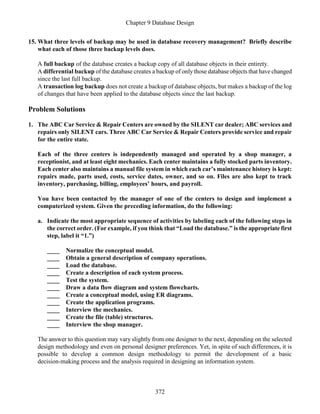
364
Answers to Review Questions
1. What is an information system? What is its purpose?
An information system is a system that
 provides the conditions for data collection, storage, and retrieval
 facilitates the transformation of data into information
 provides management of both data and information.
An information system is composed of hardware, software (DBMS and applications), the database(s),
procedures, and people.
Good decisions are generally based on good information. Ultimately, the purpose of an information
system is to facilitate good decision making by making relevant and timely information available to the
decision makers.
2. How do systems analysis and systems development fit into a discussion about information systems?
Both systems analysis and systems development constitute part of the Systems Development Life Cycle,
or SDLC. Systems analysis, phase II of the SDLC, establishes the need for and the extent of an
information system by
 Establishing end-user requirements.
 Evaluating the existing system.
 Developing a logical systems design.
Systems development, based on the detailed systems design found in phase III of the SDLC, yields the
information system. The detailed system specifications are established during the systems design phase,
in which the designer completes the design of all required system processes.
3. What does the acronym SDLC mean, and what does an SDLC portray?
SDLC is the acronym that is used to label the System Development Life Cycle. The SDLC traces the
history of a information system from its inception to its obsolescence. The SDLC is composed of six
phases: planning, analysis, detailed system, design, implementation and maintenance.
4. What does the acronym DBLC mean, and what does a DBLC portray?
DBLC is the acronym that is used to label the Database Life Cycle. The DBLC traces the history of a
database system from its inception to its obsolescence. Since the database constitutes the core of an
information system, the DBLC is concurrent to the SDLC. The DBLC is composed of six phases: initial
study, design, implementation and loading, testing and evaluation, operation, and maintenance and
evolution.
Chapter 9 Database Design
365
5. Discuss the distinction between centralized and decentralized conceptual database design.
Centralized and decentralized design constitute variations on the bottom-up and top-down approaches
we discussed in the third question presented in the discussion focus. Basically, the centralized approach
is best suited to relatively small and simple databases that lend themselves well to a bird's-eye view of
the entire database. Such databases may be designed by a single person or by a small and informally
constituted design team. The company operations and the scope of its problems are sufficientlylimited to
enable the designer(s) to perform all of the necessary database design tasks:
1. Define the problem(s).
2. Create the conceptual design.
3. Verify the conceptual design with all user views.
4. Define all system processes and data constraints.
5. Assure that the database design will comply with all achievable end user requirements.
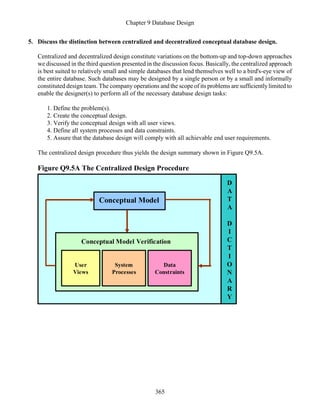
The centralized design procedure thus yields the design summary shown in Figure Q9.5A.
Figure Q9.5A The Centralized Design Procedure
Conceptual Model
Data
Constraints
System
Processes
User
Views
Conceptual Model Verification
D
A
T
A
D
I
C
T
I
O
N
A
R
Y
Chapter 9 Database Design
366
Note that the centralized design approach requires the completion and validation of a single conceptual
design.
NOTE
Use the text’s Figures 9.15 and 9.16 to contrast the two design approaches, then use Figure 9.6
to show the procedure flows; demonstrate that such procedure flows are independent of the
degree of centralization.
In contrast, when company operations are spread across multiple operational sites or when the database
has multiple entities that are subject to complex relations, the best approach is often based on the
decentralized design.
Typically, a decentralized design requires that the design task be divided into multiple modules, each one
of which is assigned to a design team. The design team activities are coordinated by the lead designer,
who must aggregate the design teams' efforts.
Since each team focuses on modeling a subset of the system, the definition of boundaries and the
interrelation between data subsets must be very precise. Each team creates a conceptual data model
corresponding to the subset being modeled. Each conceptual model is then verified individually against
the user views, processes, and constraints for each of the modules. After the verification process has
been completed, all modules are integrated in one conceptual model.
Since the data dictionary describes the characteristics of all the objects within the conceptual data model,
it plays a vital role in the integration process. Naturally, after the subsets have been aggregated into a
larger conceptual model, the lead designer must verify that the combined conceptual model is still able to
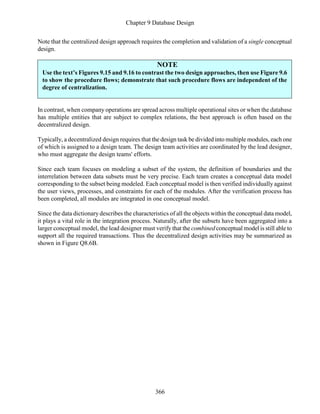
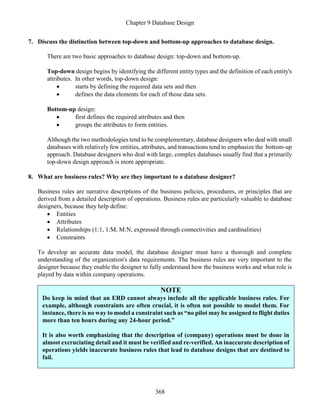
support all the required transactions. Thus the decentralized design activities may be summarized as
shown in Figure Q8.6B.
Chapter 9 Database Design
367
Figure Q9.6B The Decentralized Design Procedure
D
A
T
A
D
I
C
T
I
O
N
A
R
Y
Subset A
DATA COMPONENT
Views,
Processes,
Constraints
Views,
Processes,
Constraints
Views,
Processes,
Constraints
Aggregation
Subset B Subset C
Verification
Conceptual
Models
FINAL CONCEPTUAL MODEL
Keep in mind that the aggregation process requires the lead designer to assemble a single model in which
various aggregation problems must be addressed:
 synonyms and homonyms. Different departments may know the same object by different names
(synonyms), or they may use the same name to address different objects (homonyms.) The object
may be an entity, an attribute, or a relationship.
 entity and entity subclasses. An entity subset may be viewed as a separate entity by one or more
departments. The designer must integrate such subclasses into a higher-level entity.
 Conflicting object definitions. Attributes may be recorded as different types (character, numeric),
or different domains may be defined for the same attribute. Constraint definitions, too, may vary.
The designer must remove such conflicts from the model.
6. What is the minimal data rule in conceptual design? Why is it important?
The minimal data rule specifies that all the data defined in the data model are actually required to fit
present and expected future data requirements. This rule may be phrased as All that is needed is
there, and all that is there is needed.
Chapter 9 Database Design
368
7. Discuss the distinction between top-down and bottom-up approaches to database design.
There are two basic approaches to database design: top-down and bottom-up.
Top-down design begins by identifying the different entity types and the definition of each entity's
attributes. In other words, top-down design:
 starts by defining the required data sets and then
 defines the data elements for each of those data sets.
Bottom-up design:
 first defines the required attributes and then
 groups the attributes to form entities.
Although the two methodologies tend to be complementary, database designers who deal with small
databases with relatively few entities, attributes, and transactions tend to emphasize the bottom-up
approach. Database designers who deal with large, complex databases usually find that a primarily
top-down design approach is more appropriate.
8. What are business rules? Why are they important to a database designer?
Business rules are narrative descriptions of the business policies, procedures, or principles that are
derived from a detailed description of operations. Business rules are particularly valuable to database
designers, because they help define:
 Entities
 Attributes
 Relationships (1:1, 1:M, M:N, expressed through connectivities and cardinalities)
 Constraints
To develop an accurate data model, the database designer must have a thorough and complete
understanding of the organization's data requirements. The business rules are very important to the
designer because they enable the designer to fully understand how the business works and what role is
played by data within company operations.
NOTE
Do keep in mind that an ERD cannot always include all the applicable business rules. For
example, although constraints are often crucial, it is often not possible to model them. For
instance, there is no way to model a constraint such as “no pilot may be assigned to flight duties
more than ten hours during any 24-hour period.”
It is also worth emphasizing that the description of (company) operations must be done in
almost excruciating detail and it must be verified and re-verified. An inaccurate description of
operations yields inaccurate business rules that lead to database designs that are destined to
fail.
Chapter 9 Database Design
369
9. What is the data dictionary's function in database design?
A good data dictionary provides a precise description of the characteristics of all the entities and
attributes found within the database. The data dictionary thus makes it easier to check for the existence
of synonyms and homonyms, to check whether all attributes exist to support required reports, to verify
appropriate relationship representations, and so on. The data dictionary's contents are both developed and
used during the six DBLC phases:
DATABASE INITIAL STUDY
The basic data dictionary components are developed as the entities and attributes are defined during this
phase.
DATABASE DESIGN
The data dictionary contents are used to verify the database design components: entities, attributes, and
their relationships. The designer also uses the data dictionary to check the database design for
homonyms and synonyms and verifies that the entities and attributes will support all required query and
report requirements.
IMPLEMENTATION AND LOADING
The DBMS's data dictionary helps to resolve any remaining attribute definition inconsistencies.
TESTING AND EVALUATION
If problems develop during this phase, the data dictionary contents may be used to help restructure the
basic design components to make sure that they support all required operations.
OPERATION
If the database design still yields (the almost inevitable) operational glitches, the data dictionary may be
used as a quality control device to ensure that operational modifications to the database do not conflict
with existing components.
MAINTENANCE AND EVOLUTION
As users face inevitable changes in information needs, the database may be modified to support those
needs. Perhaps entities, attributes, and relationships must be added, or relationships must be changed. If
new database components are fit into the design, their introduction may produce conflict with existing
components. The data dictionary turns out to be a very useful tool to check whether a suggested change
invites conflicts within the database design and, if so, how such conflicts may be resolved.
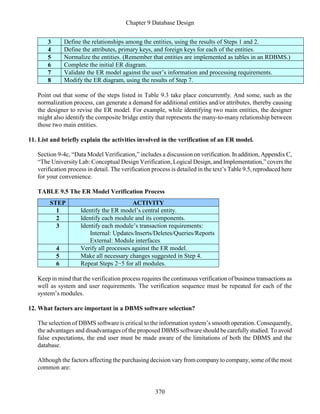
10. What steps are required in the development of an ER diagram? (Hint: See Table 9.3.)
Table 9.3 is reproduced for your convenience.
TABLE 9.3 Developing the Conceptual Model, Using ER Diagrams
STEP ACTIVITY
1 Identify, analyze, and refine the business rules.
2 Identify the main entities, using the results of Step 1.
Chapter 9 Database Design
370
3 Define the relationships among the entities, using the results of Steps 1 and 2.
4 Define the attributes, primary keys, and foreign keys for each of the entities.
5 Normalize the entities. (Remember that entities are implemented as tables in an RDBMS.)
6 Complete the initial ER diagram.
7 Validate the ER model against the user’s information and processing requirements.
8 Modify the ER diagram, using the results of Step 7.
Point out that some of the steps listed in Table 9.3 take place concurrently. And some, such as the
normalization process, can generate a demand for additional entities and/or attributes, thereby causing
the designer to revise the ER model. For example, while identifying two main entities, the designer
might also identify the composite bridge entity that represents the many-to-many relationship between
those two main entities.
11. List and briefly explain the activities involved in the verification of an ER model.
Section 9-4c, “Data Model Verification,” includes a discussion on verification. In addition, Appendix C,
“The University Lab: Conceptual Design Verification, Logical Design, and Implementation,” covers the
verification process in detail. The verification process is detailed in the text’s Table 9.5, reproduced here
for your convenience.
TABLE 9.5 The ER Model Verification Process
STEP ACTIVITY
1 Identify the ER model’s central entity.
2 Identify each module and its components.
3 Identify each module’s transaction requirements:
Internal: Updates/Inserts/Deletes/Queries/Reports
External: Module interfaces
4 Verify all processes against the ER model.
5 Make all necessary changes suggested in Step 4.
6 Repeat Steps 2−5 for all modules.
Keep in mind that the verification process requires the continuous verification of business transactions as
well as system and user requirements. The verification sequence must be repeated for each of the
system’s modules.
12. What factors are important in a DBMS software selection?
The selection of DBMS software is critical to the information system’s smooth operation. Consequently,
the advantages and disadvantages of the proposed DBMS software should be carefullystudied. To avoid
false expectations, the end user must be made aware of the limitations of both the DBMS and the
database.
Although the factors affecting the purchasing decision varyfrom companyto company, some of the most
common are:
Chapter 9 Database Design
371
 Cost. Purchase, maintenance, operational, license, installation, training, and conversion costs.
 DBMS features and tools. Some database software includes a variety of tools that facilitate the
application development task. For example, the availability of query by example (QBE), screen
painters, report generators, application generators, data dictionaries, and so on, helps to create a
more pleasant work environment for both the end user and the application programmer. Database
administrator facilities, query facilities, ease of use, performance, security, concurrencycontrol,
transaction processing, and third-party support also influence DBMS software selection.
 Underlying model. Hierarchical, network, relational, object/relational, or object.
 Portability. Across platforms, systems, and languages.
 DBMS hardware requirements. Processor(s), RAM, disk space, and so on.
13. List and briefly explain the four steps performed during the logical design stage.
1) Map conceptual model to logical model components.
In this step, the conceptual model is converted into a set of table definitions including table names,
column names, primary keys, and foreign keys to implement the entities and relationships specified in
the conceptual design.
2) Validate the logical model using normalization.
It is possible for normalization issues to be discovered during the process of mapping the conceptual
model to logical model components. Therefore, it is appropriate at this stage to validate that all of the
table definitions from the previous step conform to the appropriate normalization rules.
3) Validate logical model integrity constraints.
This step involves the conversion of attribute domains and constraints into constraint definitions that
can be implemented within the DBMS to enforce those domains. Also, entityand referential integrity
constraints are validated. Views may be defined to enforce security constraints.
4) Validate the logical model against the user requirements.
The final step of this stage is to ensure that all definitions created throughout the logical model are
validated against the users' data, transaction, and security requirements. Every component (table,
view, constraint, etc.) of the logical model must be associated with satisfying the user requirements,
and every user requirement should be addressed by the model components.
14. List and briefly explain the three steps performed during the physical design stage.
1) Define data storage organization.
Based on estimates of the data volume and growth, this step involves the determination of the
physical location and physical organization for each table. Also, which columns will be indexed and
the type of indexes to be used are determined. Finally, the type of implementation to be used for each
view is decided.
2) Define integrity and security measures.
This step involves creating users and security groups, and then assigning privileges and controls to
those users and group.
3) Determine performance measurements.
The actual performance of the physical database implementation must be measured and assessed for
compliance with user performance requirements.
Chapter 9 Database Design
372
15. What three levels of backup may be used in database recovery management? Briefly describe
what each of those three backup levels does.
A full backup of the database creates a backup copy of all database objects in their entirety.
A differential backup of the database creates a backup of onlythose database objects that have changed
since the last full backup.
A transaction log backup does not create a backup of database objects, but makes a backup of the log
of changes that have been applied to the database objects since the last backup.
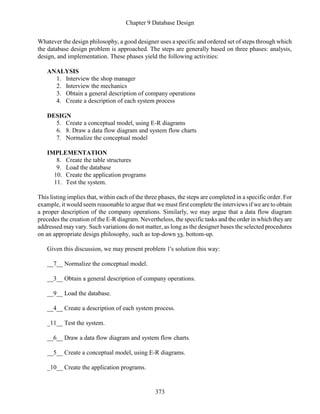
Problem Solutions
1. The ABC Car Service & Repair Centers are owned by the SILENT car dealer; ABC services and
repairs only SILENT cars. Three ABC Car Service & Repair Centers provide service and repair
for the entire state.
Each of the three centers is independently managed and operated by a shop manager, a
receptionist, and at least eight mechanics. Each center maintains a fully stocked parts inventory.
Each center also maintains a manual file system in which each car’s maintenance history is kept:
repairs made, parts used, costs, service dates, owner, and so on. Files are also kept to track
inventory, purchasing, billing, employees’ hours, and payroll.
You have been contacted by the manager of one of the centers to design and implement a
computerized system. Given the preceding information, do the following:
a. Indicate the most appropriate sequence of activities by labeling each of the following steps in
the correct order. (For example, if you think that “Load the database.” is the appropriate first
step, label it “1.”)
____ Normalize the conceptual model.
____ Obtain a general description of company operations.
____ Load the database.
____ Create a description of each system process.
____ Test the system.
____ Draw a data flow diagram and system flowcharts.
____ Create a conceptual model, using ER diagrams.
____ Create the application programs.
____ Interview the mechanics.
____ Create the file (table) structures.
____ Interview the shop manager.
The answer to this question may vary slightly from one designer to the next, depending on the selected
design methodology and even on personal designer preferences. Yet, in spite of such differences, it is
possible to develop a common design methodology to permit the development of a basic
decision-making process and the analysis required in designing an information system.
Chapter 9 Database Design
373
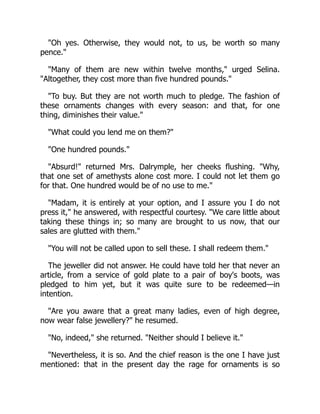
Whatever the design philosophy, a good designer uses a specific and ordered set of steps through which
the database design problem is approached. The steps are generally based on three phases: analysis,
design, and implementation. These phases yield the following activities:
ANALYSIS
1. Interview the shop manager
2. Interview the mechanics
3. Obtain a general description of company operations
4. Create a description of each system process
DESIGN
5. Create a conceptual model, using E-R diagrams
6. 8. Draw a data flow diagram and system flow charts
7. Normalize the conceptual model
IMPLEMENTATION
8. Create the table structures
9. Load the database
10. Create the application programs
11. Test the system.
This listing implies that, within each of the three phases, the steps are completed in a specific order. For
example, it would seem reasonable to argue that we must first complete the interviews if we are to obtain
a proper description of the company operations. Similarly, we may argue that a data flow diagram
precedes the creation of the E-R diagram. Nevertheless, the specific tasks and the order in which theyare
addressed may vary. Such variations do not matter, as long as the designer bases the selected procedures
on an appropriate design philosophy, such as top-down vs. bottom-up.
Given this discussion, we may present problem 1's solution this way:
__7__ Normalize the conceptual model.
__3__ Obtain a general description of company operations.
__9__ Load the database.
__4__ Create a description of each system process.
_11__ Test the system.
__6__ Draw a data flow diagram and system flow charts.
__5__ Create a conceptual model, using E-R diagrams.
_10__ Create the application programs.
Discovering Diverse Content Through
Random Scribd Documents
"Oh yes. Otherwise, they would not, to us, be worth so many
pence."
"Many of them are new within twelve months," urged Selina.
"Altogether, they cost more than five hundred pounds."
"To buy. But they are not worth much to pledge. The fashion of
these ornaments changes with every season: and that, for one
thing, diminishes their value."
"What could you lend me on them?"
"One hundred pounds."
"Absurd!" returned Mrs. Dalrymple, her cheeks flushing. "Why,
that one set of amethysts alone cost more. I could not let them go
for that. One hundred would be of no use to me."
"Madam, it is entirely at your option, and I assure you I do not
press it," he answered, with respectful courtesy. "We care little about
taking these things in; so many are brought to us now, that our
sales are glutted with them."
"You will not be called upon to sell these. I shall redeem them."
The jeweller did not answer. He could have told her that never an
article, from a service of gold plate to a pair of boy's boots, was
pledged to him yet, but it was quite sure to be redeemed—in
intention.
"Are you aware that a great many ladies, even of high degree,
now wear false jewellery?" he resumed.
"No, indeed," she returned. "Neither should I believe it."
"Nevertheless, it is so. And the chief reason is the one I have just
mentioned: that in the present day the rage for ornaments is so
great, and the fashion of them so continually changing, that to be in
the fashion, a lady must spend a fortune in ornaments alone. I give
you my word, madam, that in the fashionable world a great deal of
the jewellery now worn is false; though it may pass, there,
unsuspected. And this fact deteriorates from the value of real
stones, especially for the purpose of pledging."
He began, as he spoke, to put the articles into their cases again,
as if the negotiation were at an end.
"Can you lend me two hundred pounds upon them?" asked Mrs.
Dalrymple, after a blank pause.
He shook his head. "I can advance you what I have stated, if you
please; not a pound more. And I feel sure you will not be able to
obtain more on them anywhere, madam, take them where you will."
"But what am I to do?" returned she, betraying some excitement.
Very uselessly: but that room was no stranger to it. The jeweller was
firm, and Mrs. Dalrymple gathered up her ornaments, her first
feeling of despair lost in anger. She was leaving the room with her
parcel when it occurred to her to ask herself, in sober truth, WHAT
she was to do—how procure the remainder of the sum necessary to
appease Madame Damereau. She turned back, and finally left the
shop without her jewels, but with a hundred pounds in her pocket,
and her understanding considerably enlightened as to the relative
value of a jewel to buy and a jewel to pledge.
Now it happened that, if Mrs. Dalrymple had repented showing
her temper to Madame Damereau, that renowned artiste had equally
repented showing hers to Mrs. Dalrymple. She feared it might tell
against her with her customers, if it came to be known: for she
knew how popular Selina was; truth to say, she liked her herself.
Madame came to the determination of paying Mrs. Dalrymple a visit,
not exactly to apologize, but to soothe away certain words. And to
qualify the pressing for some money, which she meant to do
(whether she got it or not), she intended to announce that the
articles ordered for the wedding festivities would be supplied. "It's
only ninety pounds, more or less," thought madame, "and I suppose
I shall get the money some time."
She reached Mrs. Dalrymple's in the evening, soon after that lady
had departed on her secret expedition to the pawnbroker. Their
London lodgings were confined. The dining-room had Mr. Dalrymple
in it, so Madame Damereau was shown to the drawing-room, and
the maid went hunting about the house for her mistress.
Whilst she was on her useless search, Mr. Dalrymple entered the
drawing-room, expecting to find it tenanted by his wife. Instead of
that, some strange lady sat there, who rose at his entrance, made
him a swimming curtsy, the like of which he had never seen in a
ball-room, and threw off some rapid sentences in an unknown
tongue.
His perplexed look stopped her. "Ah," she said, changing her
language, "Monsieur, I fear, does not speak the French. I have the
honour, I believe, of addressing Mr. Dalreemp. I am covered with
contrition at intruding at this evening hour, but I know that Mrs.
Dalreemp is much out in the day; I thought I might perhaps get
speech of her as she was dressing for some soirée."
"Do you wish to see her? Have you seen her?" he asked.
"I wait now to see her," replied madame.
"Another of these milliner people, I suppose," thought Oscar to
himself, with not at all a polite word in connection with the
supposition. "Selina's mad to have the house beset with them; it's
like a swarm of flies. If she comes to town next year may I be shot!"
"Ann! tell your mistress she is wanted," he called out, opening the
door.
"I can't find my mistress, sir," said the servant, coming downstairs.
"I thought she must be in her own room, but she is not. I am sure
she is not gone out, because she said she meant to have a quiet
evening at home tonight, and she did not dress."
"She is somewhere about," said Mr. Dalrymple. "Go and look for
her."
Madame Damereau had been coming to the rapid conclusion that
this was an opportunity she should do injustice to herself to omit
using. And as Mr. Dalrymple was about to leave her to herself, she
stopped him.
"Sir—pardon me—but now that I have the happiness to see you, I
may ask if you will not use your influence with Mrs. Dalreemp to
think of my account. She does promise so often, so often, and I get
nothing. I have my heavy payments to make, and sometimes I do
not know where to find the money: though, if you saw my books,
your hairs would bristle, sir, at the sums owing to me."
"You are——?"
"I am Madame Damereau. If Mrs. Dalreemp would but give me a
few hundred pounds off her bill, it would be something."
A few hundred pounds! Oscar Dalrymple wondered what she
meant. He looked at her for some moments before he spoke.
"What is the amount of my wife's debt to you, madame?"
"Ah, it is—— But I cannot tell it you quite exactly: there are recent
items. The last note that went in to her was four thousand three
hundred and twenty-two pounds."
He had an impassive face, rarely showing emotion. It had
probably not been moved to it half-a-dozen times in the course of
his life. But now his lips gradually drew into a straight thin line, and
a red spot shone in his cheek.
"WHAT did you say? Do you speak of the account?"
"It was four thousand three hundred and twenty-two pounds,"
equably answered madame, who was not familiar with his
countenance. "And there have been a few trifles since, and her last
order this week will come to ninety pounds. If you wish for it exactly,
sir," added madame, seizing at an idea of hope, "I will have it sent to
you when I go home. Mrs. Dalreemp has the details up to very
recently."
"Four thousand pounds!" repeated Mr. Dalrymple, sitting down, in
a sort of helpless manner. "When could she have contracted it?"
"Last season, sir, chiefly. A little in the winter she had sent down
to her, and she has had things this spring: not so many."
He did not say more, save a mutter which madame could not
catch. She understood it to be that he would speak to Mrs.
Dalrymple. The maid returned, protesting that her mistress was not
in the house and must have changed her mind and gone out; and
Madame Damereau, thinking she might have gone out for the
evening, and that it was of no use waiting, made her adieu to Mr.
Dalrymple, with the remarkable curtsy more than once repeated.
He was sitting there still, in the same position, when his wife
appeared. She had entered the house stealthily, as she had left it,
had taken off her things, and now came into the room ready for tea,
as if she had only been upstairs to wash her hands. Scarcely had she
reached the middle of the room, when he rose and laid his hand
heavily on her shoulder. His face, as she turned to him in alarm, with
its drawn aspect, its mingled pallor and hectic, was so changed that
she could hardly recognize it for his.
"Oscar, you terrify me!" she cried out.
"What debts are these that you owe?" he asked, from between his
parted lips.
Was the dreaded moment come, then! A low moan escaped her.
"Four thousand and some hundred pounds to Damereau, the
milliner! How much more to others?"
"Oh, Oscar, if you look and speak like that, you will kill me."
"I ask how much more?" he repeated, passing by her words as the
idle wind. "Tell me the truth, or I shall feel tempted to thrust you
from my home, and advertise you."
She wished the carpet would open and let her in; she hid her face.
Oscar held her, and repeated the question: "How much?"
"Six thousand pounds—in all—about that. Not more, I think."
He released her then with a jerk. Selina began to cry like a school-
girl.
"Are you prepared to go out and work for your living, as I must
do?" he panted. "I have nothing to keep you on, and shall not have
for years. If they throw me into a debtor's prison tomorrow, I cannot
help it."
"Oh," shrieked silly Selina, "a prison! I'd go with you."
"I might have expected something of this when I married into
your branch of the family," returned Oscar, who, in good truth, was
nearly beside himself. "A mania follows it. Your uncle gambled his
means away, and then took his own life; your father hampered
himself with his brother's debts, and remained poor; your brother
followed in his uncle's wake; and now the mania is upon you!"
"Oh, please, Oscar, please!" pleaded Selina, who had no more
depth of feeling than a magpie, while Oscar had plenty of it. "I'll
never, never go in debt again."
"You shall never have the chance," he answered. And, there and
then, Oscar Dalrymple, summoning his household, gave orders for
their removal to the Grange. Selina cried her eyes out at having to
quit the season and its attractions summarily.
Thus, as a wreathing cloud suddenly appears in the sky, and as
suddenly fades sway, had Mrs. Dalrymple, like a bright vision,
appeared to the admiring eyes of the London world, and vanished
from it.
CHAPTER XVI.
THE DIAMOND BRACELET.
But, as you have heard, there is something yet to relate of that
hot June day, or, rather, of its evening, when poor Selina Dalrymple
had applied for help, and unsuccessfully, to her sister Alice.
The great world of London was beginning to think of dinner. In a
well-furnished dressing-room, the windows being open for air, and
the blinds drawn down to exclude the sun, stood a tall, stately lady,
whose maid was giving the last touch to her rich attire. It was Lady
Sarah Hope.
"What bracelets, my lady?" asked the maid, taking a small bunch
of keys from her pocket.
"Not any, now: it is so very hot. Alice," added Lady Sarah, turning
to Alice, who was leaning back on a sofa, "will you put all my
bracelets out for me against I come up? I will decide then."
"I put them out, Lady Sarah?" returned Alice. "Yes, certainly."
"If you will be so kind. Hughes, give the key to Miss Seaton." For
they did sometimes remember to address Alice by her adopted
name.
Lady Sarah left the room, and the maid, Hughes, began taking
one of the small keys off the ring. "I have leave to go out, miss," she
explained, "which is the reason why my lady has asked you to see to
her bracelets. My mother is not well, and wants to see me. This is
the key, ma'am."
As Alice took it, Lady Sarah reappeared at the door. "Alice, you
may as well bring the bracelet-box down to the back drawing-room,"
she said. "I shall not care to come up here after dinner: we shall be
late as it is."
"What's that about the bracelet-box?" inquired a pretty-looking
girl, who had come swiftly out of another apartment.
"Lady Sarah wishes me to bring her bracelets down to the
drawing-room, that she may choose which to put on. It was too hot
to wear them to dine in, she said."
"Are you not coming in to dinner, Alice?"
"No. I walked out, and it has tired me. I have had some tea
instead.".
"I would not be you for all the world, Alice! To possess so little
capability of enjoying life."
"Yet, if you were as I am, weak in health and strength, your lot
would have been so soothed to you, Frances, that you would not
repine at or regret it."
"You mean I should be content," laughed Frances, upon whom the
defection of Mr. Gerard Hope earlier in the year did not appear to
have made much impression: though perhaps she did not know its
particulars. "Well, there is nothing like contentment, the sages tell
us. One of my detestable schoolroom copies used to be
'Contentment is happiness.'"
"I can hear the dinner being taken in," said Alice. "You will be late
in the drawing-room."
Lady Frances Chenevix turned away to fly down the stairs. Her
light, rounded form, her elastic step, all telling of health and
enjoyment, presented a marked contrast to that of Alice Dalrymple.
Alice's face was indeed strangely beautiful, almost too refined and
delicate for the wear and tear of common life, but her figure was
weak and stooping, and her gait feeble.
Colonel Hope, thin and spare, with sharp brown eyes and sharp
features, sat at the foot of his table. He was beginning to look so
shrunk and short, that his friends jokingly told him he must have
been smuggled into the army, unless he had since been growing
downwards, for surely so little a commander could never expect to
be obeyed. No stranger could have believed him at ease in his
circumstances, any more than they would have believed him a
colonel who had seen hard service in India, for his clothes were
frequently threadbare. A black ribbon supplied the place of a gold
chain as guard to his watch, and a blue, tin-looking thing of a
galvanized ring did duty for any other ring on his finger. Yet he was
rich; of fabulous riches, people said; but he was of a close
disposition, especially as regarded his personal outlay. In his home
and to his wife he was liberal. A good husband; and, putting his
crustiness and his crotchets aside, a good man. It was the loss of his
two boys that had so tried and changed him. His large property was
not entailed: it had been thought his nephew, Gerard Hope, would
inherit it, but Gerard had been turned from the house. Lady Sarah
remarked that it was too hot to dine; but the colonel, in respect to
heat, was a salamander.
Alice meanwhile lay on the sofa for half-an-hour; and then, taking
the bracelet-box in her hands, descended to the drawing-rooms. It
was intensely hot, she thought; a sultry, breathless heat; and she
threw open the back window. Which in truth made it hotter, for the
sun gleamed right athwart the leads which stretched themselves
beyond the windows over the outbuildings at the back of the row of
houses.
Alice sat down near this back window, and began to put out some
of the bracelets on the table before it. They were rare and rich: of
plain gold, of silver, of pearl, of precious stones. One of them was of
gold links, studded with diamonds; it was very valuable, and had
been the present of Colonel Hope to his wife on her recent birthday.
Another diamond bracelet was there, but it was not so beautiful or
so costly as this. When her task was done, Alice passed into the
front drawing-room, and put up one of its large windows. Still there
was no air in the room.
As she stood at it, a handsome young man, tall and agile, who
was walking on the opposite side of the street, caught her eye. He
nodded, hesitated, and then crossed the street as if to enter.
"It is Gerard!" muttered Alice, under her breath. "Can he be
coming here?" She walked away from the window hastily, and sat
down by the bedecked table in the other room.
"Just as I supposed!" exclaimed Gerard Hope, entering, and
advancing to Alice with stealthy steps. "When I saw you at the
window, the thought struck me that you were alone here, and they
at dinner. Thomas happened to be airing himself at the door, so I
crossed over, found I was right, and came up. How are you, Alice?"
"Have you come to dinner?" inquired Alice, speaking at random,
and angry at her own agitation.
"I come to dinner!" repeated Gerard. "Why, you know they'd as
soon sit down with the renowned Mr. Ketch."
"Indeed I know nothing about it: we have been away in
Gloucestershire for months, as I dare say you are aware: I was
hoping that you and the colonel might have been reconciled. Why
did you come in, Gerard? Thomas may tell them."
"Thomas won't. I charged him not to. The idea of your never
coming up till June! Some whim of Lady Sarah's, I suppose. Two or
three times a-week for the last month have I been marching past
this house, wondering when it was going to show signs of life.
Frances is here still?"
"Oh yes. She remains here altogether."
"To make up for—— Alice, was it not a shame to turn me out?"
"I was extremely sorry for what happened, Mr. Hope, but I knew
nothing of the details. Lady Sarah said you had displeased herself
and the colonel, and after that she never mentioned your name."
"What a show of smart things you have here, Alice! Are you going
to set up a bazaar?"
"They are Lady Sarah's bracelets."
"So they are, I see! This is a gem," added Gerard, taking up the
fine diamond bracelet already mentioned. "I don't remember this
one."
"It is new. The colonel has just given it to her."
"What did it cost?"
Alice laughed. "Do you think it likely I have heard? I question if
Lady Sarah has."
"It never cost a farthing less than two hundred guineas," mused
Gerard, turning the bracelet in various directions, that its rich
diamonds might give out their gleaming light. "I wish it was mine."
"What should you do with it?" laughed Alice.
"Spout it."
"I do not understand," returned Alice. She really did not.
"I beg your pardon, Alice. I was thinking of the colloquial lingo
familiarly applied to such transactions, instead of to whom I was
talking. I mean raise money upon it."
"Oh, Mr. Hope!"
"Alice, that's twice you have called me 'Mr. Hope.' I thought I had
been 'Gerard' to you for many a year."
"Time changes things; and you seem more like a stranger than
you used to," returned Alice, a flush rising to her sensitive face. "But
you spoke of raising money: I hope you are not in temporary
embarrassment."
"A jolly good thing for me if it turns out only temporary," he
rejoined. "Look at my position! Debts hanging over my head—for
you may be sure, Alice, all young men, with a limited allowance and
large expectations, contract debts—and thrust out of my uncle's
home with just the loose cash I had in my pocket, and my clothes
sent packing after me."
"Has the colonel stopped your allowance?"
Gerard Hope laid down the bracelet from whence he had taken it,
before he replied.
"He stopped it then; it's months ago, you know; and I have not
had a shilling since, except from my own resources. I first went upon
tick; then I disposed of my watch and chain and all my other little
matters of value: and now I am upon tick again."
Alice did not answer. The light tone vexed her.
"Perhaps you don't understand these free terms, Alice," he said,
looking fondly at her, "and I hope you may never have occasion to.
Frances would: she has lived in their atmosphere."
"Yes, I know what an embarrassed man the earl often is. But I am
grieved to hear about yourself. Is the colonel implacable? What was
the cause of the quarrel?"
"You know I was to be his heir. Even if more children had come to
him, he undertook to provide amply for me. Last autumn he
suddenly sent for me to tell me it was his pleasure and Lady Sarah's
that I should take up my abode with them. So I did take it up, glad
to get into such good quarters; and stopped here like an innocent,
unsuspicious lamb, until—when was it, Alice? March? Then the plot
came out."
"The plot," exclaimed Alice.
"It was nothing less. They had fixed upon a wife for me; and I
was ordered to hold myself in readiness to marry her at any given
moment."
"Who was it?" inquired Alice, in a low tone, as she bent her head
over the bracelets.
"Never mind," laughed the young man; "it wasn't you. I said I
would not have her; and they both, he and Lady Sarah, pulled me
and my want of taste to pieces, assuring me I was a monster of
ingratitude. It provoked me into confessing that I liked some one
else better. And then the colonel turned me out."
Alice looked her sorrow, but she did not express it.
"Of course I saw the imprudence then of having thrown up my
place in the red-tape office; but it was done. And since then I have
been having a fight with my creditors, putting them off with fair
words and promises. But they have grown incredulous, and it has
come to dodging. In favour with my uncle, and his acknowledged
heir, they would have given me unlimited time and credit, but the
breach between us is known, and it makes all the difference. With
the value of that at my disposal"—nodding at the bracelet—"I should
stop a few pressing personal trifles and go on again for a while. So
you see, Alice, a diamond bracelet may be of use to a gentleman,
should some genial fortune drop one into his hands."
"I sympathize with you very much," said Alice, "and I would I had
it in my power to aid you."
"Thank you for your kind wishes; I know they are genuine. When
my uncle sees the name of Gerard Hope figuring in the insolvent list,
or amongst the outlaws, he—— Hark! Can they be coming up from
dinner?"
"Scarcely yet," said Alice, starting up simultaneously with himself,
and listening. "But they will not sit long today, because they are
going to the opera. Gerard, they must not find you here."
"It might get you turned out as well as myself! No, not if I can
help it. Alice!"—suddenly laying his hands upon her shoulders, and
gazing down into her eyes—"do you know who it was I had learnt to
love, instead of—of the other?"
She gasped for breath, and her colour went and came. "No—no;
do not tell me, Gerard."
"Why, no, I had better not, under present circumstances. But
when the good time comes—for all their high-roped indignation must
and will blow over—then I will; and here's the pledge of it." He bent
his head, took one long earnest kiss from her lips; and the next
moment was gone.
Agitated almost to sickness, trembling and confused, Alice stole to
look after him, terrified lest he might not escape unseen. She crept
partly down the stairs, so as to obtain sight of the hall-door, and
make sure that he got out in safety. As Gerard drew it quietly open,
there stood a lady just about to knock. It was Selina, waiting to
exchange a few words with Gerard. He waved his hand towards the
staircase. Alice met her, and took her into the front drawing-room.
"I cannot stay to sit down, Alice: I must hasten back to dress, for
I am engaged to three or four places tonight. Neither do I wish to
horrify Lady Sarah with a visit at this untoward hour. I had a request
to make to you, and thought to catch you in your room before you
went in to dinner."
"They are alone, and are dining earlier than usual. I was too tired
to appear. What can I do for you, Selina?"
Mrs. Oscar Dalrymple had come (as you have already heard) to try
that one hopeless task—the borrowing money of her sister.
"I am in pressing need of it, Alice," she said. "Can you lend it
me?"
"I wish I could," returned Alice; "I am so very sorry. I sent all I
had to poor mamma the day before we came to town. It was only
twenty-five pounds."
"That would have been of no use to me: I want more. I thought if
you had been misering up your salary, you might have had a
hundred pounds, or so, by you."
Alice shook her head. "I should be a long while saving up a
hundred pounds, even if dear mamma had no wants. But I send to
her what I can spare. Is it for—dresses, and that?"
"Yes," was Selina's laconic answer.
"I wish I had it to give you! Do not be in such a hurry," continued
Alice, as her sister was moving to the door. "At least wait one minute
while I fetch you a letter I received from mamma this morning, in
answer to mine. You will like to read it, for it is full of news of the
old place. You can take it home with you, Selina."
Alice left her sister standing in the front-room, and went upstairs.
But she was more than one minute away; she was three or four, for
she could not at first lay her hand upon the letter. When she
returned, her sister advanced to her from the back drawing-room,
the folding-doors between the two rooms being, as before, wide
open.
"What a fine collection of bracelets, Alice!" she exclaimed, as she
took the letter. "Are they spread out for show?"
"No," laughed Alice; "Lady Sarah is going to the opera, and will
have no time to spare when she comes up from dinner. She asked
me to bring them all down, as she had not decided which to wear."
"I like to dress entirely before dinner on my opera nights."
"Oh, so of course does Lady Sarah," returned Alice, as her sister
descended the stairs; "but she said it was too hot to dine in
bracelets."
"It is fearfully hot. Good-bye, Alice. Don't ring: I will let myself
out."
Alice returned to the front-room and looked from the window,
wondering whether her sister had come in her carriage. No. A trifling
evening breeze was rising and beginning to move the curtains about.
Gentle as it was, it was grateful, and Alice sat down in it. In a very
few minutes the ladies came up from dinner.
"Have you the bracelets, Alice. Oh, I see."
Lady Sarah went into the back-room as she spoke, and stood
before the table, looking at the bracelets. Alice rose to follow her,
when Lady Frances Chenevix caught her by the arm, and began to
speak in a covert whisper.
"Who was that at the door just now? It was a visitor's knock. Do
you know, Alice, every hour, since we came to town, I have fancied
Gerard might be calling. In the country he could not get to us, but
here—— Was it Gerard?"
"It—it was my sister," carelessly answered Alice. It was not a true
answer, for her sister had not knocked, and she did not know who
had. But it was the readiest that rose to her lips, and she wished to
escape the questioning, for more reasons than one.
"Only your sister," replied Frances, turning to the window with a
gesture of disappointment.
"Which have you put on?" inquired Alice, going towards Lady
Sarah.
"Those loose, fancy things; they are the coolest. I really am so
hot: the soup was that favourite soup of the colonel's, all capsicums
and cayenne, and the wine was hot; there had been a mistake about
the ice. Gill trusted to the new man, and he did not understand it. It
was all hot together. What the house will be tonight, I dread to think
of."
Lady Sarah, whilst she spoke, had been putting the bracelets into
the jewel-box, with very little care.
"I had better put them straight," remarked Alice, when she
reached the table.
"Do not trouble," returned Lady Sarah, shutting down the lid. "You
are looking flushed and feverish, Alice; you were wrong to walk so
far today. Hughes will set them to rights tomorrow morning; they
will do until then. Lock them up, and take possession of the key."
Alice did as she was bid. She locked the case and put the key in
her pocket. "Here is the carriage," exclaimed Lady Frances. "Are we
to wait for coffee?"
"Coffee in this heat!" retorted Lady Sarah; "it would be adding fuel
to fire. We will have some tea when we return. Alice, you must make
tea for the colonel; he will not come out without it. He thinks this
weather just what it ought to be: rather cold, if anything."
Alice had taken the bracelet-box in her hands as Lady Sarah
spoke; when they had departed, she carried it upstairs to its place in
Lady Sarah's bedroom. The colonel speedily rose from table, for his
wife had laid her commands on him to join them early. Alice helped
him to his tea, and as soon as he was gone she went upstairs to
bed.
To bed, but not to sleep. Tired as she was, and exhausted in
frame, sleep would not come to her. She was living over again her
interview with Gerard Hope. She could not, in her conscious heart,
affect to misunderstand his implied meaning—that she had been the
cause of his rejecting the union proposed to him. It diffused a
strange rapture within her; and, though she had not perhaps been
wholly blind and unconscious during the period of Gerard's stay with
them, and for some time before that, she now kept repeating the
words, "Can it be that he loves me? can it be?"
It certainly was so. Love plays strange pranks. There was Gerard
Hope—heir to the colonel's fabulous wealth, consciously proud of his
handsome person, his height and strength—called home and planted
down by the side of a pretty and noble lady on purpose that he
might fall in love with her: the Lady Frances Chenevix. And yet, the
well-laid project failed: failed because there happened to be another
at that young lady's side: a sad, quiet, feeble-framed girl, whose
very weakness may have seemed to others to place her beyond the
pale of man's love. But love thrives by contrasts; and it was the
feeble girl who won the love of the strong man.
Yes; the knowledge diffused a strange rapture within her, Alice
Dalrymple, as she lay that night; and she may be excused if, for a
brief period, she allowed range to the sweet fantasies it conjured up.
For a brief period only. Too soon the depressing consciousness
returned to her, that these thoughts of earthly happiness must be
subdued: for she, with her confirmed ailments and conspicuous
weakness, must never hope to marry, as did other women. She had
long known—her mother had prepared her for it—that one so
afflicted and frail as she, whose tenure of existence was likely to be
short, ought not to become a wife; and it had been her earnest hope
to pass through life unloving, in that one sense, and unloved. She
had striven to arm herself against the danger, against being thrown
into the perils of temptation. Alas! it had come insidiously upon her;
all her care had been set at naught; and she knew that she loved
Gerard Hope with a deep and fervent love. "It is but another cross,"
she sighed, "another burden to surmount and subdue, and I will set
myself from this night to the task. I have been a coward, shrinking
from self-examination; but now that Gerard has spoken out, I can
deceive myself no longer. I wish he had spoken more freely, that I
might have told him it was useless."
It was only towards morning that Alice dropped asleep: the
consequence was that long after her usual hour for rising she was
still sleeping. The opening of her door awoke her. It was Lady
Sarah's maid who stood there.
"Why, miss; are you not up? Well, I never! I wanted the key of the
small jewel-box; but I'd have waited, had I known."
"What do you say you want?" returned Alice, whose ideas were
confused; as is often the case on being suddenly awakened.
"The key of the bracelet-box, if you please."
"The key?" repeated Alice. "Oh, I remember," she added,
recollection returning to her. "Be at the trouble, will you, Hughes, of
taking it out of my pocket: it is on that chair, under my clothes."
The servant came to the pocket, and speedily found the key. "Are
you worse than usual, Miss Seaton, this morning," asked she, "or
have you overslept yourself?"
"I have overslept myself. Is it late?"
"Between nine and ten. My lady is up, and at breakfast with the
Colonel and Lady Frances."
Alice rose the instant the maid left the room, and made haste to
dress, vexed with herself for sleeping so long. She was nearly ready
when Hughes came in again.
"If ever I saw such confusion as that jewel-case was in!" cried
she, in as pert and grumbling a tone as she dared to use. "The
bracelets were thrown together without law or order—just as if they
had been so much glass and tinsel from the Lowther Arcade."
"It was Lady Sarah," replied Alice. "I would have put them
straight, but she told me to leave it for you. I thought she might
prefer that you should do it."
"Of course her ladyship is aware there's nobody but myself knows
their right places in it," returned Hughes, consequentially. "I could
go to that or to the other jewel-box in the dark, ma'am, and take out
any one thing my lady wanted, without disturbing the rest."
"I have observed that you have the gift of order," remarked Alice,
with a smile. "It is very useful to those who possess it, and saves
them much trouble and confusion."
"So it do, ma'am," said Hughes. "But I came to ask you for the
diamond bracelet."
"The diamond bracelet!" echoed Alice. "What diamond bracelet!
What do you mean, Hughes?"
"It is not in the box."
"The diamond bracelets are both in the box," rejoined Alice.
"The old one is there; not the new one. I thought you might have
taken it out to show some one, or to look at yourself, ma'am, for it's
just a sight for pleasant eyes."
"I can assure you it is in the case," said Alice. "All are there,
except the pair Lady Sarah had on. You must have overlooked it."
"I am a great donkey if I have," grumbled the girl. "It must be at
the very bottom, amongst the cotton," she soliloquized, as she
returned to Lady Sarah's apartments, "and I have just got to take
every individual article out, to get to it. This comes of giving up
one's keys to other folks."
Alice entered the breakfast-room, begging pardon for her late
appearance. It was readily accorded. Her office in the house was
nearly a sinecure. When she had first entered upon it Lady Sarah
was ill, and required some one to sit with and read to her: now that
she was well again, Alice had little to do.
Breakfast was scarcely over when Alice was called from the room.
Hughes stood outside the door.
"Miss Seaton," said she, with a long face, "the diamond bracelet is
not in the box. I thought I could not be mistaken."
"But it must be in the box," said Alice.
"But it is not," persisted Hughes, emphasizing the negative. "Can't
you believe me, ma'am? I want to know where it is, that I may put it
up and lock the box."
Alice Seaton looked at Hughes with a puzzled, dreamy look. She
was thinking matters over. Her face soon cleared again.
"Then Lady Sarah must have kept it out when she put in the rest.
It was she who returned them to the case; I did not. Perhaps she
wore it last night."
"No, miss, that she didn't. She wore only those two——"
"I saw what she had on," interrupted Alice. "But she might also
have put on the other, without my noticing. Or she may have kept it
out for some other purpose. I will ask her. Wait here an instant,
Hughes; for of course you will like to be at a certainty."
"That's cool," thought Hughes, as Alice went into the breakfast-
room, and the colonel came out of it, with his Times. "I should have
said it was somebody else would like to be at a certainty, instead of
me," continued the girl, indulging in soliloquy. "Thank goodness the
box wasn't in my charge last night, if anything dreadful has come to
pass. My lady don't keep out her bracelets for sport. Miss Seaton has
left the key about, that's what she has done, and it's hard to say
who hasn't been at it: I knew the box had been ransacked over."
"Lady Sarah," said Alice, "did you wear your new diamond bracelet
last night?"
"No."
"Then did you put it into the box with the others?"
"No," repeated Lady Sarah, who was languidly toying with a
basket of ferns.
"After you had chosen the bracelets you wished to wear, you put
the others into the box yourself," explained Alice, thinking she was
not understood. "Did you put in the new one, the diamond, or keep
it out?"
"The new one was not there."
Alice stood confounded. "It was lying on the table, at the back of
all the rest, Lady Sarah," she presently said. "Next the window."
"I tell you, Alice, it was not there. I don't know that I should have
worn it if it had been, but I certainly looked for it. Not seeing it, I
supposed you had not put it out; and I did not care sufficiently to
ask for it."
Alice felt in a mesh of perplexity; curious thoughts, and very
unpleasing ones, were beginning to dawn upon her. "But indeed the
bracelet was there when you went to the table," she urged. "I put it
there."
"I can assure you that you labour under a mistake, as to its being
there when I came up from dinner," answered Lady Sarah. "Why do
you ask?"
"Hughes has come to say it is not in the case. She is outside,
waiting."
"Outside, now? Let her come in. What's this about my bracelet,
Hughes?"
"I don't know, my lady. The bracelet is not in its place, so I asked
Miss Seaton for it. She thought your ladyship might have kept it out
yesterday evening."
"I neither touched it nor saw it," said Lady Sarah.
"Then we have had thieves at work," spoke Hughes, decisively;
who had been making up her mind to that as a fact.
"It must be in the box, Hughes," said Alice. "I laid it out on the
table in the back drawing-room; and it is impossible that thieves—as
you phrase it—could have come there."
"Oh yes, it is in the box, no doubt," said Lady Sarah, somewhat
crossly, for she disliked to be troubled, especially in hot weather.
"You have not searched properly, Hughes."
"My lady," answered Hughes, "I can trust my hands and I can
trust my eyes, and they have all four been into every hole and
crevice of the box."
Lady Frances Chenevix laid down the Morning Post, and advanced.
"Is the bracelet really lost?"
"It cannot be lost," returned Lady Sarah. "You are sure you put it
out, Alice?"
"I am quite sure of that. It was lying first in the case, and——"
"Yes, it was," interrupted Hughes. "That is its place."
"And was consequently the first that I took out," continued Alice.
"I put it on the table; and the others in a semicircle, nearer to me.
Why, as a proof that it lay there——"
What was Alice going to add? Was she going to adduce as a proof
that Gerard Hope had taken it up and made it a subject of
conversation? Recollection came to her in time; she faltered and
abruptly broke off. But a faint, horrible dread, to which she would
not give a shape, came stealing over her; her face turned white, and
she sank on a chair, trembling visibly.
"Now look at Alice!" uttered Frances Chenevix. "She is going into
one of her agitation fits."
"Do not agitate yourself, Alice," cried Lady Sarah; "that will do no
good. Besides, I feel sure the bracelet is all safe in the case: where
else can it be? Fetch the case, Hughes, and I will look for it myself."
Hughes whirled out of the room, inwardly resenting the doubt cast
on her eyesight.
"It is so strange," mused Alice, "that you did not see the bracelet
when you came up from dinner."
"It was certainly not there to see," returned Lady Sarah. "Perhaps
you'll now look for yourself, my lady," cried Hughes, returning with
the jewel-box in her hands.
The box was well searched. The bracelet was not there.
"This is very strange, Hughes," exclaimed Lady Sarah.
"It's very ugly also, my lady," answered Hughes, in a lofty tone,
"and I'm thankful to the presiding genuses which rules such things,
that I was not in charge when it happened. Though maybe, if I had
been, it never would have took place, for I can give a guess how it
was."
"Then you had better give it," said her mistress, curtly.
"If I do," returned Hughes, "I may offend Miss Seaton."
"No, you will not, Hughes," said Alice. "Say what you please: I
have need to wish this cleared up."
"Well, ma'am, if I may speak my thoughts, I think you must have
left the key about. And we have strange servants in the house, as
my lady knows. There's a kitchen-maid that only entered it when we
came up; and there's the new under-butler."
"Hughes, you are wrong," interrupted Alice. "The servants could
not have touched the box, for the key was never out of my
possession, and you know the lock is a Bramah. I locked the box last
night in her ladyship's presence, and the key was not out of my
pocket afterwards, until you took it from there this morning."
"The key seems to have had nothing to do with it," interposed
Frances. "Alice says she put the diamond bracelet on the table with
the rest; Lady Sarah says when she went to the table after dinner
the bracelet was not there. Were you in the room all the while,
Alice?"
"Not quite. Very nearly. But no one could possibly have gone in
without my seeing them. The folding-doors were open."
"It is quite a mystery," cried Lady Sarah.
"It beats conjuring, my lady," said Hughes. "Did any visitor come
upstairs, I wonder?"
"I did hear a visitor's knock while we were at dinner," said Lady
Sarah. "Don't you remember, Fanny You looked up as if you noticed
it."
"Did I?" answered Lady Frances, in a careless tone.
At that moment Thomas happened to enter with a letter; and his
mistress put the question to him: Who had knocked?
"Sir George Danvers, my lady," was the ready answer. "When I
said the colonel was at dinner, Sir George began to apologize for
calling; but I explained that you were dining earlier than usual,
because of the opera."
"No one else called?"
"Nobody knocked but Sir George, my lady."
"A covert answer," thought Alice. "But I am glad he is true to
Gerard."
"What an untruth!" thought Lady Frances, as she remembered
hearing of the visit of Alice's sister: "Thomas's memory must be
short." In point of fact, Thomas knew nothing of it.
All the talk—and it was much prolonged—did not tend to throw
any light upon the matter; and Alice, unhappy and ill, retired to her
own room. The agitation had brought on a nervous and violent
headache; she sat down in a low chair, and bent her forehead on her
hands. One belief alone possessed her: that the unfortunate Gerard
Hope had stolen the bracelet. Do as she would, she could not put it
out of her mind: she kept repeating that he was a gentleman, that
he was honourable, that he would never place her in so painful a
position. Common sense replied that the temptation was suddenly
laid before him, and he had confessed his pecuniary difficulties to be
great; nay, had he not wished for this very bracelet, that he might
make money——
A knock at the chamber-door. Alice lifted her sickly countenance,
and bade the intruder enter. It was Lady Frances Chenevix.
"I came to—— Alice, how wretched you look! You will torment
yourself into a fever."
"Can you wonder at my looking wretched?" returned Alice. "Place
yourself in my position, Frances: it must appear to Lady Sarah as if I
—I—had made away with the bracelet. I am sure Hughes thinks so."
"Don't you say unorthodox things, Alice. They would rather think
that I had done it, of the two, for I have more use for diamond
bracelets than you."
"It is kind of you to try to cheer me," sighed Alice.
"Just the thing I came to do. And to have a bit of chat with you as
well. If you will let me."
"Of course I will let you."
"I wish to tell you I will not mention that your sister was here last
evening. I promise you I will not."
Alice did not immediately reply. The words and their hushed tone
caused a new trouble, a fresh thought, to arise within her, one which
she had not glanced at. Was it possible that Frances could imagine
her sister to be the——
"Lady Frances Chenevix!" burst forth Alice. "You cannot think it!
She! my sister!—guilty of a despicable theft! Have you forgotten that
she moves in your own position in the world? that our family is
scarcely inferior to yours?"
"Alice, I forgive you for so misjudging me, because you are not
yourself just now. Of course, your sister cannot be suspected; I
know that. But as you did not mention her when they were
questioning Thomas, nor did he, I supposed you had some reason
for not wishing her visit spoken of."
"Believe me, Selina is not the guilty person," returned Alice. "I
have more cause to say so than you think for."
"What do you mean by that?" briskly cried Lady Frances. "You
surely have no clue?"
Alice shook her head, and her companion's eagerness was lulled
again. "It is well that Thomas was forgetful," remarked Frances.
"Was it forgetfulness, Alice; or did you contrive to telegraph to him
to be silent?"
"Thomas only spoke truth, as regards Selina: he did not let her in.
She came but for a minute, to ask me about a private matter, and
said there was no need to tell Lady Sarah she had been."
"Then it is all quite easy; and you and I can keep our own
counsel."
Quite easy, possibly, to the mind of Frances Chenevix. But
anything but easy to Alice Dalrymple: for the words of Lady Frances
had introduced an idea more repulsive, more terrifying even, than
that of suspecting Gerard Hope. Her sister acknowledged that she
was in need of money, "a hundred pounds, or so;" nay, Alice had
only too good cause to know that previously; and she had seen her
come from the back room where the jewels lay. Still—she take a
bracelet! Selina! It was preposterous.
Preposterous or not, Alice's torment was doubled. Which of the
two had been the black sheep? One of them it must have been.
Instinct, sisterly relationship, reason, and common sense, all
combined to turn the scale against Gerard. But that there should be
a doubt at all was not pleasant, and Alice started up impulsively and
put her bonnet on.
"Where now!" cried Lady Frances.
"I will go to Selina's and ask her—and ask her—if—she saw any
stranger here—any suspicious person in the hall or on the stairs,"
stammered Alice, making the best excuse she could make.
"But you know you were in or about the drawing-rooms all the
time, and no one came into them, suspicious or unsuspicious; so,
how will that aid you?"
Welcome to our website – the perfect destination for book lovers and
knowledge seekers. We believe that every book holds a new world,
offering opportunities for learning, discovery, and personal growth.
That’s why we are dedicated to bringing you a diverse collection of
books, ranging from classic literature and specialized publications to
self-development guides and children's books.
More than just a book-buying platform, we strive to be a bridge
connecting you with timeless cultural and intellectual values. With an
elegant, user-friendly interface and a smart search system, you can
quickly find the books that best suit your interests. Additionally,
our special promotions and home delivery services help you save time
and fully enjoy the joy of reading.
Join us on a journey of knowledge exploration, passion nurturing, and
personal growth every day!
testbankdeal.com

Database Systems Design Implementation and Management 12th Edition Coronel Solutions Manual

  • 1.
    Database Systems DesignImplementation and Management 12th Edition Coronel Solutions Manual download https://testbankdeal.com/product/database-systems-design- implementation-and-management-12th-edition-coronel-solutions- manual/ Visit testbankdeal.com today to download the complete set of test bank or solution manual

  • 2.
    We have selectedsome products that you may be interested in Click the link to download now or visit testbankdeal.com for more options!. Database Systems Design Implementation and Management 12th Edition Coronel Test Bank https://testbankdeal.com/product/database-systems-design- implementation-and-management-12th-edition-coronel-test-bank/ Database Systems Design Implementation And Management 13th Edition Coronel Solutions Manual https://testbankdeal.com/product/database-systems-design- implementation-and-management-13th-edition-coronel-solutions-manual/ Database Systems Design Implementation and Management 11th Edition Coronel Solutions Manual https://testbankdeal.com/product/database-systems-design- implementation-and-management-11th-edition-coronel-solutions-manual/ Operations Management 8th Edition Alistair Solutions Manual https://testbankdeal.com/product/operations-management-8th-edition- alistair-solutions-manual/

  • 3.
    New Perspectives MicrosoftOffice 365 and Word 2016 Comprehensive 1st Edition Shaffer Test Bank https://testbankdeal.com/product/new-perspectives-microsoft- office-365-and-word-2016-comprehensive-1st-edition-shaffer-test-bank/ Communication Works 11th Edition Gamble Test Bank https://testbankdeal.com/product/communication-works-11th-edition- gamble-test-bank/ Children 13th Edition Santrock Test Bank https://testbankdeal.com/product/children-13th-edition-santrock-test- bank/ Accounting Information Systems 10th Edition Gelinas Solutions Manual https://testbankdeal.com/product/accounting-information-systems-10th- edition-gelinas-solutions-manual/ Dosage Calculations 9th Edition Pickar Test Bank https://testbankdeal.com/product/donursing-calculations-9th-edition- pickar-test-bank/
  • 4.
    Economics of MoneyBanking and Financial Markets The Business School Edition 3rd Edition Mishkin Test Bank https://testbankdeal.com/product/economics-of-money-banking-and- financial-markets-the-business-school-edition-3rd-edition-mishkin- test-bank/
  • 5.
    Chapter 9 DatabaseDesign 362 Chapter 9 Database Design Discussion Focus What is the relationship between a database and an information system, and how does this relationship have a bearing on database design? An information system performs three sets of services:  It provides for data collection, storage, and retrieval.  It facilitates the transformation of data into information.  It provides the tools and conditions to manage both data and information. Basically, a database is a fact (data) repository that serves an information system. If the database is designed poorly, one can hardly expect that the data/information transformation will be successful, nor is it reasonable to expect efficient and capable management of data and information. The transformation of data into information is accomplished through application programs. It is impossible to produce good information from poor data; and, no matter how sophisticated the application programs are, it is impossible to use good application programs to overcome the effects of bad database design. In short: Good database design is the foundation of a successful information system. Database design must yield a database that:  Does not fall prey to uncontrolled data duplication, thus preventing data anomalies and the attendant lack of data integrity.  Is efficient in its provision of data access.  Serves the needs of the information system. The last point deserves emphasis: even the best-designed database lacks value if it fails to meet information system objectives. In short, good database designers must pay close attention to the information system requirements. Systems design and database design are usually tightly intertwined and are often performed in parallel. Therefore, database and systems designers must cooperate and coordinate to yield the best possible information system. What is the relationship between the SDLC and the DBLC? The SDLC traces the history (life cycle) of an information system. The DBLC traces the history (life cycle) of a database system. Since we know that the database serves the information system, it is not surprising that the two life cycles conform to the same basic phases.
  • 6.
    Chapter 9 DatabaseDesign 363 Suggestion: Use Figure 9.8 as the basis for a discussion of the parallel activities. What basic database design strategies exist, and how are such strategies executed? Suggestion: Use Figure 9.14 as the basis for this discussion. There are two basic approaches to database design: top-down and bottom-up. Top-down design begins by identifying the different entitytypes and the definition of each entity's attributes. In other words, top-down design:  starts by defining the required data sets and then  defines the data elements for each of those data sets. Bottom-up design:  first defines the required attributes and then  groups the attributes to form entities. Although the two methodologies tend to be complementary, database designers who deal with small databases with relatively few entities, attributes, and transactions tend to emphasize the bottom-up approach. Database designers who deal with large, complex databases usuallyfind that a primarilytop-down design approach is more appropriate. In spite of the frequent arguments concerning the best design approach, perhaps the top-down vs. bottom-up distinction is quite artificial. The text's note is worth repeating: NOTE Even if a generally top-down approach is selected, the normalization process that revises existing table structures is (inevitably) a bottom-up technique. E-R models constitute a top-down process even if the selection of attributes and entities may be described as bottom-up. Since both the E-R model and normalization techniques form the basis for most designs, the top-down vs. bottom-up debate may be based on a distinction without a difference.
  • 7.
    Chapter 9 DatabaseDesign 364 Answers to Review Questions 1. What is an information system? What is its purpose? An information system is a system that  provides the conditions for data collection, storage, and retrieval  facilitates the transformation of data into information  provides management of both data and information. An information system is composed of hardware, software (DBMS and applications), the database(s), procedures, and people. Good decisions are generally based on good information. Ultimately, the purpose of an information system is to facilitate good decision making by making relevant and timely information available to the decision makers. 2. How do systems analysis and systems development fit into a discussion about information systems? Both systems analysis and systems development constitute part of the Systems Development Life Cycle, or SDLC. Systems analysis, phase II of the SDLC, establishes the need for and the extent of an information system by  Establishing end-user requirements.  Evaluating the existing system.  Developing a logical systems design. Systems development, based on the detailed systems design found in phase III of the SDLC, yields the information system. The detailed system specifications are established during the systems design phase, in which the designer completes the design of all required system processes. 3. What does the acronym SDLC mean, and what does an SDLC portray? SDLC is the acronym that is used to label the System Development Life Cycle. The SDLC traces the history of a information system from its inception to its obsolescence. The SDLC is composed of six phases: planning, analysis, detailed system, design, implementation and maintenance. 4. What does the acronym DBLC mean, and what does a DBLC portray? DBLC is the acronym that is used to label the Database Life Cycle. The DBLC traces the history of a database system from its inception to its obsolescence. Since the database constitutes the core of an information system, the DBLC is concurrent to the SDLC. The DBLC is composed of six phases: initial study, design, implementation and loading, testing and evaluation, operation, and maintenance and evolution.
  • 8.
    Chapter 9 DatabaseDesign 365 5. Discuss the distinction between centralized and decentralized conceptual database design. Centralized and decentralized design constitute variations on the bottom-up and top-down approaches we discussed in the third question presented in the discussion focus. Basically, the centralized approach is best suited to relatively small and simple databases that lend themselves well to a bird's-eye view of the entire database. Such databases may be designed by a single person or by a small and informally constituted design team. The company operations and the scope of its problems are sufficientlylimited to enable the designer(s) to perform all of the necessary database design tasks: 1. Define the problem(s). 2. Create the conceptual design. 3. Verify the conceptual design with all user views. 4. Define all system processes and data constraints. 5. Assure that the database design will comply with all achievable end user requirements. The centralized design procedure thus yields the design summary shown in Figure Q9.5A. Figure Q9.5A The Centralized Design Procedure Conceptual Model Data Constraints System Processes User Views Conceptual Model Verification D A T A D I C T I O N A R Y
  • 9.
    Chapter 9 DatabaseDesign 366 Note that the centralized design approach requires the completion and validation of a single conceptual design. NOTE Use the text’s Figures 9.15 and 9.16 to contrast the two design approaches, then use Figure 9.6 to show the procedure flows; demonstrate that such procedure flows are independent of the degree of centralization. In contrast, when company operations are spread across multiple operational sites or when the database has multiple entities that are subject to complex relations, the best approach is often based on the decentralized design. Typically, a decentralized design requires that the design task be divided into multiple modules, each one of which is assigned to a design team. The design team activities are coordinated by the lead designer, who must aggregate the design teams' efforts. Since each team focuses on modeling a subset of the system, the definition of boundaries and the interrelation between data subsets must be very precise. Each team creates a conceptual data model corresponding to the subset being modeled. Each conceptual model is then verified individually against the user views, processes, and constraints for each of the modules. After the verification process has been completed, all modules are integrated in one conceptual model. Since the data dictionary describes the characteristics of all the objects within the conceptual data model, it plays a vital role in the integration process. Naturally, after the subsets have been aggregated into a larger conceptual model, the lead designer must verify that the combined conceptual model is still able to support all the required transactions. Thus the decentralized design activities may be summarized as shown in Figure Q8.6B.
  • 10.
    Chapter 9 DatabaseDesign 367 Figure Q9.6B The Decentralized Design Procedure D A T A D I C T I O N A R Y Subset A DATA COMPONENT Views, Processes, Constraints Views, Processes, Constraints Views, Processes, Constraints Aggregation Subset B Subset C Verification Conceptual Models FINAL CONCEPTUAL MODEL Keep in mind that the aggregation process requires the lead designer to assemble a single model in which various aggregation problems must be addressed:  synonyms and homonyms. Different departments may know the same object by different names (synonyms), or they may use the same name to address different objects (homonyms.) The object may be an entity, an attribute, or a relationship.  entity and entity subclasses. An entity subset may be viewed as a separate entity by one or more departments. The designer must integrate such subclasses into a higher-level entity.  Conflicting object definitions. Attributes may be recorded as different types (character, numeric), or different domains may be defined for the same attribute. Constraint definitions, too, may vary. The designer must remove such conflicts from the model. 6. What is the minimal data rule in conceptual design? Why is it important? The minimal data rule specifies that all the data defined in the data model are actually required to fit present and expected future data requirements. This rule may be phrased as All that is needed is there, and all that is there is needed.
  • 11.
    Chapter 9 DatabaseDesign 368 7. Discuss the distinction between top-down and bottom-up approaches to database design. There are two basic approaches to database design: top-down and bottom-up. Top-down design begins by identifying the different entity types and the definition of each entity's attributes. In other words, top-down design:  starts by defining the required data sets and then  defines the data elements for each of those data sets. Bottom-up design:  first defines the required attributes and then  groups the attributes to form entities. Although the two methodologies tend to be complementary, database designers who deal with small databases with relatively few entities, attributes, and transactions tend to emphasize the bottom-up approach. Database designers who deal with large, complex databases usually find that a primarily top-down design approach is more appropriate. 8. What are business rules? Why are they important to a database designer? Business rules are narrative descriptions of the business policies, procedures, or principles that are derived from a detailed description of operations. Business rules are particularly valuable to database designers, because they help define:  Entities  Attributes  Relationships (1:1, 1:M, M:N, expressed through connectivities and cardinalities)  Constraints To develop an accurate data model, the database designer must have a thorough and complete understanding of the organization's data requirements. The business rules are very important to the designer because they enable the designer to fully understand how the business works and what role is played by data within company operations. NOTE Do keep in mind that an ERD cannot always include all the applicable business rules. For example, although constraints are often crucial, it is often not possible to model them. For instance, there is no way to model a constraint such as “no pilot may be assigned to flight duties more than ten hours during any 24-hour period.” It is also worth emphasizing that the description of (company) operations must be done in almost excruciating detail and it must be verified and re-verified. An inaccurate description of operations yields inaccurate business rules that lead to database designs that are destined to fail.
  • 12.
    Chapter 9 DatabaseDesign 369 9. What is the data dictionary's function in database design? A good data dictionary provides a precise description of the characteristics of all the entities and attributes found within the database. The data dictionary thus makes it easier to check for the existence of synonyms and homonyms, to check whether all attributes exist to support required reports, to verify appropriate relationship representations, and so on. The data dictionary's contents are both developed and used during the six DBLC phases: DATABASE INITIAL STUDY The basic data dictionary components are developed as the entities and attributes are defined during this phase. DATABASE DESIGN The data dictionary contents are used to verify the database design components: entities, attributes, and their relationships. The designer also uses the data dictionary to check the database design for homonyms and synonyms and verifies that the entities and attributes will support all required query and report requirements. IMPLEMENTATION AND LOADING The DBMS's data dictionary helps to resolve any remaining attribute definition inconsistencies. TESTING AND EVALUATION If problems develop during this phase, the data dictionary contents may be used to help restructure the basic design components to make sure that they support all required operations. OPERATION If the database design still yields (the almost inevitable) operational glitches, the data dictionary may be used as a quality control device to ensure that operational modifications to the database do not conflict with existing components. MAINTENANCE AND EVOLUTION As users face inevitable changes in information needs, the database may be modified to support those needs. Perhaps entities, attributes, and relationships must be added, or relationships must be changed. If new database components are fit into the design, their introduction may produce conflict with existing components. The data dictionary turns out to be a very useful tool to check whether a suggested change invites conflicts within the database design and, if so, how such conflicts may be resolved. 10. What steps are required in the development of an ER diagram? (Hint: See Table 9.3.) Table 9.3 is reproduced for your convenience. TABLE 9.3 Developing the Conceptual Model, Using ER Diagrams STEP ACTIVITY 1 Identify, analyze, and refine the business rules. 2 Identify the main entities, using the results of Step 1.
  • 13.
    Chapter 9 DatabaseDesign 370 3 Define the relationships among the entities, using the results of Steps 1 and 2. 4 Define the attributes, primary keys, and foreign keys for each of the entities. 5 Normalize the entities. (Remember that entities are implemented as tables in an RDBMS.) 6 Complete the initial ER diagram. 7 Validate the ER model against the user’s information and processing requirements. 8 Modify the ER diagram, using the results of Step 7. Point out that some of the steps listed in Table 9.3 take place concurrently. And some, such as the normalization process, can generate a demand for additional entities and/or attributes, thereby causing the designer to revise the ER model. For example, while identifying two main entities, the designer might also identify the composite bridge entity that represents the many-to-many relationship between those two main entities. 11. List and briefly explain the activities involved in the verification of an ER model. Section 9-4c, “Data Model Verification,” includes a discussion on verification. In addition, Appendix C, “The University Lab: Conceptual Design Verification, Logical Design, and Implementation,” covers the verification process in detail. The verification process is detailed in the text’s Table 9.5, reproduced here for your convenience. TABLE 9.5 The ER Model Verification Process STEP ACTIVITY 1 Identify the ER model’s central entity. 2 Identify each module and its components. 3 Identify each module’s transaction requirements: Internal: Updates/Inserts/Deletes/Queries/Reports External: Module interfaces 4 Verify all processes against the ER model. 5 Make all necessary changes suggested in Step 4. 6 Repeat Steps 2−5 for all modules. Keep in mind that the verification process requires the continuous verification of business transactions as well as system and user requirements. The verification sequence must be repeated for each of the system’s modules. 12. What factors are important in a DBMS software selection? The selection of DBMS software is critical to the information system’s smooth operation. Consequently, the advantages and disadvantages of the proposed DBMS software should be carefullystudied. To avoid false expectations, the end user must be made aware of the limitations of both the DBMS and the database. Although the factors affecting the purchasing decision varyfrom companyto company, some of the most common are:
  • 14.
    Chapter 9 DatabaseDesign 371  Cost. Purchase, maintenance, operational, license, installation, training, and conversion costs.  DBMS features and tools. Some database software includes a variety of tools that facilitate the application development task. For example, the availability of query by example (QBE), screen painters, report generators, application generators, data dictionaries, and so on, helps to create a more pleasant work environment for both the end user and the application programmer. Database administrator facilities, query facilities, ease of use, performance, security, concurrencycontrol, transaction processing, and third-party support also influence DBMS software selection.  Underlying model. Hierarchical, network, relational, object/relational, or object.  Portability. Across platforms, systems, and languages.  DBMS hardware requirements. Processor(s), RAM, disk space, and so on. 13. List and briefly explain the four steps performed during the logical design stage. 1) Map conceptual model to logical model components. In this step, the conceptual model is converted into a set of table definitions including table names, column names, primary keys, and foreign keys to implement the entities and relationships specified in the conceptual design. 2) Validate the logical model using normalization. It is possible for normalization issues to be discovered during the process of mapping the conceptual model to logical model components. Therefore, it is appropriate at this stage to validate that all of the table definitions from the previous step conform to the appropriate normalization rules. 3) Validate logical model integrity constraints. This step involves the conversion of attribute domains and constraints into constraint definitions that can be implemented within the DBMS to enforce those domains. Also, entityand referential integrity constraints are validated. Views may be defined to enforce security constraints. 4) Validate the logical model against the user requirements. The final step of this stage is to ensure that all definitions created throughout the logical model are validated against the users' data, transaction, and security requirements. Every component (table, view, constraint, etc.) of the logical model must be associated with satisfying the user requirements, and every user requirement should be addressed by the model components. 14. List and briefly explain the three steps performed during the physical design stage. 1) Define data storage organization. Based on estimates of the data volume and growth, this step involves the determination of the physical location and physical organization for each table. Also, which columns will be indexed and the type of indexes to be used are determined. Finally, the type of implementation to be used for each view is decided. 2) Define integrity and security measures. This step involves creating users and security groups, and then assigning privileges and controls to those users and group. 3) Determine performance measurements. The actual performance of the physical database implementation must be measured and assessed for compliance with user performance requirements.
  • 15.
    Chapter 9 DatabaseDesign 372 15. What three levels of backup may be used in database recovery management? Briefly describe what each of those three backup levels does. A full backup of the database creates a backup copy of all database objects in their entirety. A differential backup of the database creates a backup of onlythose database objects that have changed since the last full backup. A transaction log backup does not create a backup of database objects, but makes a backup of the log of changes that have been applied to the database objects since the last backup. Problem Solutions 1. The ABC Car Service & Repair Centers are owned by the SILENT car dealer; ABC services and repairs only SILENT cars. Three ABC Car Service & Repair Centers provide service and repair for the entire state. Each of the three centers is independently managed and operated by a shop manager, a receptionist, and at least eight mechanics. Each center maintains a fully stocked parts inventory. Each center also maintains a manual file system in which each car’s maintenance history is kept: repairs made, parts used, costs, service dates, owner, and so on. Files are also kept to track inventory, purchasing, billing, employees’ hours, and payroll. You have been contacted by the manager of one of the centers to design and implement a computerized system. Given the preceding information, do the following: a. Indicate the most appropriate sequence of activities by labeling each of the following steps in the correct order. (For example, if you think that “Load the database.” is the appropriate first step, label it “1.”) ____ Normalize the conceptual model. ____ Obtain a general description of company operations. ____ Load the database. ____ Create a description of each system process. ____ Test the system. ____ Draw a data flow diagram and system flowcharts. ____ Create a conceptual model, using ER diagrams. ____ Create the application programs. ____ Interview the mechanics. ____ Create the file (table) structures. ____ Interview the shop manager. The answer to this question may vary slightly from one designer to the next, depending on the selected design methodology and even on personal designer preferences. Yet, in spite of such differences, it is possible to develop a common design methodology to permit the development of a basic decision-making process and the analysis required in designing an information system.
  • 16.
    Chapter 9 DatabaseDesign 373 Whatever the design philosophy, a good designer uses a specific and ordered set of steps through which the database design problem is approached. The steps are generally based on three phases: analysis, design, and implementation. These phases yield the following activities: ANALYSIS 1. Interview the shop manager 2. Interview the mechanics 3. Obtain a general description of company operations 4. Create a description of each system process DESIGN 5. Create a conceptual model, using E-R diagrams 6. 8. Draw a data flow diagram and system flow charts 7. Normalize the conceptual model IMPLEMENTATION 8. Create the table structures 9. Load the database 10. Create the application programs 11. Test the system. This listing implies that, within each of the three phases, the steps are completed in a specific order. For example, it would seem reasonable to argue that we must first complete the interviews if we are to obtain a proper description of the company operations. Similarly, we may argue that a data flow diagram precedes the creation of the E-R diagram. Nevertheless, the specific tasks and the order in which theyare addressed may vary. Such variations do not matter, as long as the designer bases the selected procedures on an appropriate design philosophy, such as top-down vs. bottom-up. Given this discussion, we may present problem 1's solution this way: __7__ Normalize the conceptual model. __3__ Obtain a general description of company operations. __9__ Load the database. __4__ Create a description of each system process. _11__ Test the system. __6__ Draw a data flow diagram and system flow charts. __5__ Create a conceptual model, using E-R diagrams. _10__ Create the application programs.
  • 17.
    Discovering Diverse ContentThrough Random Scribd Documents
  • 18.
    "Oh yes. Otherwise,they would not, to us, be worth so many pence." "Many of them are new within twelve months," urged Selina. "Altogether, they cost more than five hundred pounds." "To buy. But they are not worth much to pledge. The fashion of these ornaments changes with every season: and that, for one thing, diminishes their value." "What could you lend me on them?" "One hundred pounds." "Absurd!" returned Mrs. Dalrymple, her cheeks flushing. "Why, that one set of amethysts alone cost more. I could not let them go for that. One hundred would be of no use to me." "Madam, it is entirely at your option, and I assure you I do not press it," he answered, with respectful courtesy. "We care little about taking these things in; so many are brought to us now, that our sales are glutted with them." "You will not be called upon to sell these. I shall redeem them." The jeweller did not answer. He could have told her that never an article, from a service of gold plate to a pair of boy's boots, was pledged to him yet, but it was quite sure to be redeemed—in intention. "Are you aware that a great many ladies, even of high degree, now wear false jewellery?" he resumed. "No, indeed," she returned. "Neither should I believe it." "Nevertheless, it is so. And the chief reason is the one I have just mentioned: that in the present day the rage for ornaments is so
  • 19.
    great, and thefashion of them so continually changing, that to be in the fashion, a lady must spend a fortune in ornaments alone. I give you my word, madam, that in the fashionable world a great deal of the jewellery now worn is false; though it may pass, there, unsuspected. And this fact deteriorates from the value of real stones, especially for the purpose of pledging." He began, as he spoke, to put the articles into their cases again, as if the negotiation were at an end. "Can you lend me two hundred pounds upon them?" asked Mrs. Dalrymple, after a blank pause. He shook his head. "I can advance you what I have stated, if you please; not a pound more. And I feel sure you will not be able to obtain more on them anywhere, madam, take them where you will." "But what am I to do?" returned she, betraying some excitement. Very uselessly: but that room was no stranger to it. The jeweller was firm, and Mrs. Dalrymple gathered up her ornaments, her first feeling of despair lost in anger. She was leaving the room with her parcel when it occurred to her to ask herself, in sober truth, WHAT she was to do—how procure the remainder of the sum necessary to appease Madame Damereau. She turned back, and finally left the shop without her jewels, but with a hundred pounds in her pocket, and her understanding considerably enlightened as to the relative value of a jewel to buy and a jewel to pledge. Now it happened that, if Mrs. Dalrymple had repented showing her temper to Madame Damereau, that renowned artiste had equally repented showing hers to Mrs. Dalrymple. She feared it might tell against her with her customers, if it came to be known: for she knew how popular Selina was; truth to say, she liked her herself. Madame came to the determination of paying Mrs. Dalrymple a visit, not exactly to apologize, but to soothe away certain words. And to qualify the pressing for some money, which she meant to do
  • 20.
    (whether she gotit or not), she intended to announce that the articles ordered for the wedding festivities would be supplied. "It's only ninety pounds, more or less," thought madame, "and I suppose I shall get the money some time." She reached Mrs. Dalrymple's in the evening, soon after that lady had departed on her secret expedition to the pawnbroker. Their London lodgings were confined. The dining-room had Mr. Dalrymple in it, so Madame Damereau was shown to the drawing-room, and the maid went hunting about the house for her mistress. Whilst she was on her useless search, Mr. Dalrymple entered the drawing-room, expecting to find it tenanted by his wife. Instead of that, some strange lady sat there, who rose at his entrance, made him a swimming curtsy, the like of which he had never seen in a ball-room, and threw off some rapid sentences in an unknown tongue. His perplexed look stopped her. "Ah," she said, changing her language, "Monsieur, I fear, does not speak the French. I have the honour, I believe, of addressing Mr. Dalreemp. I am covered with contrition at intruding at this evening hour, but I know that Mrs. Dalreemp is much out in the day; I thought I might perhaps get speech of her as she was dressing for some soirée." "Do you wish to see her? Have you seen her?" he asked. "I wait now to see her," replied madame. "Another of these milliner people, I suppose," thought Oscar to himself, with not at all a polite word in connection with the supposition. "Selina's mad to have the house beset with them; it's like a swarm of flies. If she comes to town next year may I be shot!" "Ann! tell your mistress she is wanted," he called out, opening the door.
  • 21.
    "I can't findmy mistress, sir," said the servant, coming downstairs. "I thought she must be in her own room, but she is not. I am sure she is not gone out, because she said she meant to have a quiet evening at home tonight, and she did not dress." "She is somewhere about," said Mr. Dalrymple. "Go and look for her." Madame Damereau had been coming to the rapid conclusion that this was an opportunity she should do injustice to herself to omit using. And as Mr. Dalrymple was about to leave her to herself, she stopped him. "Sir—pardon me—but now that I have the happiness to see you, I may ask if you will not use your influence with Mrs. Dalreemp to think of my account. She does promise so often, so often, and I get nothing. I have my heavy payments to make, and sometimes I do not know where to find the money: though, if you saw my books, your hairs would bristle, sir, at the sums owing to me." "You are——?" "I am Madame Damereau. If Mrs. Dalreemp would but give me a few hundred pounds off her bill, it would be something." A few hundred pounds! Oscar Dalrymple wondered what she meant. He looked at her for some moments before he spoke. "What is the amount of my wife's debt to you, madame?" "Ah, it is—— But I cannot tell it you quite exactly: there are recent items. The last note that went in to her was four thousand three hundred and twenty-two pounds." He had an impassive face, rarely showing emotion. It had probably not been moved to it half-a-dozen times in the course of
  • 22.
    his life. Butnow his lips gradually drew into a straight thin line, and a red spot shone in his cheek. "WHAT did you say? Do you speak of the account?" "It was four thousand three hundred and twenty-two pounds," equably answered madame, who was not familiar with his countenance. "And there have been a few trifles since, and her last order this week will come to ninety pounds. If you wish for it exactly, sir," added madame, seizing at an idea of hope, "I will have it sent to you when I go home. Mrs. Dalreemp has the details up to very recently." "Four thousand pounds!" repeated Mr. Dalrymple, sitting down, in a sort of helpless manner. "When could she have contracted it?" "Last season, sir, chiefly. A little in the winter she had sent down to her, and she has had things this spring: not so many." He did not say more, save a mutter which madame could not catch. She understood it to be that he would speak to Mrs. Dalrymple. The maid returned, protesting that her mistress was not in the house and must have changed her mind and gone out; and Madame Damereau, thinking she might have gone out for the evening, and that it was of no use waiting, made her adieu to Mr. Dalrymple, with the remarkable curtsy more than once repeated. He was sitting there still, in the same position, when his wife appeared. She had entered the house stealthily, as she had left it, had taken off her things, and now came into the room ready for tea, as if she had only been upstairs to wash her hands. Scarcely had she reached the middle of the room, when he rose and laid his hand heavily on her shoulder. His face, as she turned to him in alarm, with its drawn aspect, its mingled pallor and hectic, was so changed that she could hardly recognize it for his. "Oscar, you terrify me!" she cried out.
  • 23.
    "What debts arethese that you owe?" he asked, from between his parted lips. Was the dreaded moment come, then! A low moan escaped her. "Four thousand and some hundred pounds to Damereau, the milliner! How much more to others?" "Oh, Oscar, if you look and speak like that, you will kill me." "I ask how much more?" he repeated, passing by her words as the idle wind. "Tell me the truth, or I shall feel tempted to thrust you from my home, and advertise you." She wished the carpet would open and let her in; she hid her face. Oscar held her, and repeated the question: "How much?" "Six thousand pounds—in all—about that. Not more, I think." He released her then with a jerk. Selina began to cry like a school- girl. "Are you prepared to go out and work for your living, as I must do?" he panted. "I have nothing to keep you on, and shall not have for years. If they throw me into a debtor's prison tomorrow, I cannot help it." "Oh," shrieked silly Selina, "a prison! I'd go with you." "I might have expected something of this when I married into your branch of the family," returned Oscar, who, in good truth, was nearly beside himself. "A mania follows it. Your uncle gambled his means away, and then took his own life; your father hampered himself with his brother's debts, and remained poor; your brother followed in his uncle's wake; and now the mania is upon you!"
  • 24.
    "Oh, please, Oscar,please!" pleaded Selina, who had no more depth of feeling than a magpie, while Oscar had plenty of it. "I'll never, never go in debt again." "You shall never have the chance," he answered. And, there and then, Oscar Dalrymple, summoning his household, gave orders for their removal to the Grange. Selina cried her eyes out at having to quit the season and its attractions summarily. Thus, as a wreathing cloud suddenly appears in the sky, and as suddenly fades sway, had Mrs. Dalrymple, like a bright vision, appeared to the admiring eyes of the London world, and vanished from it. CHAPTER XVI. THE DIAMOND BRACELET. But, as you have heard, there is something yet to relate of that hot June day, or, rather, of its evening, when poor Selina Dalrymple had applied for help, and unsuccessfully, to her sister Alice. The great world of London was beginning to think of dinner. In a well-furnished dressing-room, the windows being open for air, and the blinds drawn down to exclude the sun, stood a tall, stately lady, whose maid was giving the last touch to her rich attire. It was Lady Sarah Hope.
  • 25.
    "What bracelets, mylady?" asked the maid, taking a small bunch of keys from her pocket. "Not any, now: it is so very hot. Alice," added Lady Sarah, turning to Alice, who was leaning back on a sofa, "will you put all my bracelets out for me against I come up? I will decide then." "I put them out, Lady Sarah?" returned Alice. "Yes, certainly." "If you will be so kind. Hughes, give the key to Miss Seaton." For they did sometimes remember to address Alice by her adopted name. Lady Sarah left the room, and the maid, Hughes, began taking one of the small keys off the ring. "I have leave to go out, miss," she explained, "which is the reason why my lady has asked you to see to her bracelets. My mother is not well, and wants to see me. This is the key, ma'am." As Alice took it, Lady Sarah reappeared at the door. "Alice, you may as well bring the bracelet-box down to the back drawing-room," she said. "I shall not care to come up here after dinner: we shall be late as it is." "What's that about the bracelet-box?" inquired a pretty-looking girl, who had come swiftly out of another apartment. "Lady Sarah wishes me to bring her bracelets down to the drawing-room, that she may choose which to put on. It was too hot to wear them to dine in, she said." "Are you not coming in to dinner, Alice?" "No. I walked out, and it has tired me. I have had some tea instead.".
  • 26.
    "I would notbe you for all the world, Alice! To possess so little capability of enjoying life." "Yet, if you were as I am, weak in health and strength, your lot would have been so soothed to you, Frances, that you would not repine at or regret it." "You mean I should be content," laughed Frances, upon whom the defection of Mr. Gerard Hope earlier in the year did not appear to have made much impression: though perhaps she did not know its particulars. "Well, there is nothing like contentment, the sages tell us. One of my detestable schoolroom copies used to be 'Contentment is happiness.'" "I can hear the dinner being taken in," said Alice. "You will be late in the drawing-room." Lady Frances Chenevix turned away to fly down the stairs. Her light, rounded form, her elastic step, all telling of health and enjoyment, presented a marked contrast to that of Alice Dalrymple. Alice's face was indeed strangely beautiful, almost too refined and delicate for the wear and tear of common life, but her figure was weak and stooping, and her gait feeble. Colonel Hope, thin and spare, with sharp brown eyes and sharp features, sat at the foot of his table. He was beginning to look so shrunk and short, that his friends jokingly told him he must have been smuggled into the army, unless he had since been growing downwards, for surely so little a commander could never expect to be obeyed. No stranger could have believed him at ease in his circumstances, any more than they would have believed him a colonel who had seen hard service in India, for his clothes were frequently threadbare. A black ribbon supplied the place of a gold chain as guard to his watch, and a blue, tin-looking thing of a galvanized ring did duty for any other ring on his finger. Yet he was rich; of fabulous riches, people said; but he was of a close
  • 27.
    disposition, especially asregarded his personal outlay. In his home and to his wife he was liberal. A good husband; and, putting his crustiness and his crotchets aside, a good man. It was the loss of his two boys that had so tried and changed him. His large property was not entailed: it had been thought his nephew, Gerard Hope, would inherit it, but Gerard had been turned from the house. Lady Sarah remarked that it was too hot to dine; but the colonel, in respect to heat, was a salamander. Alice meanwhile lay on the sofa for half-an-hour; and then, taking the bracelet-box in her hands, descended to the drawing-rooms. It was intensely hot, she thought; a sultry, breathless heat; and she threw open the back window. Which in truth made it hotter, for the sun gleamed right athwart the leads which stretched themselves beyond the windows over the outbuildings at the back of the row of houses. Alice sat down near this back window, and began to put out some of the bracelets on the table before it. They were rare and rich: of plain gold, of silver, of pearl, of precious stones. One of them was of gold links, studded with diamonds; it was very valuable, and had been the present of Colonel Hope to his wife on her recent birthday. Another diamond bracelet was there, but it was not so beautiful or so costly as this. When her task was done, Alice passed into the front drawing-room, and put up one of its large windows. Still there was no air in the room. As she stood at it, a handsome young man, tall and agile, who was walking on the opposite side of the street, caught her eye. He nodded, hesitated, and then crossed the street as if to enter. "It is Gerard!" muttered Alice, under her breath. "Can he be coming here?" She walked away from the window hastily, and sat down by the bedecked table in the other room.
  • 28.
    "Just as Isupposed!" exclaimed Gerard Hope, entering, and advancing to Alice with stealthy steps. "When I saw you at the window, the thought struck me that you were alone here, and they at dinner. Thomas happened to be airing himself at the door, so I crossed over, found I was right, and came up. How are you, Alice?" "Have you come to dinner?" inquired Alice, speaking at random, and angry at her own agitation. "I come to dinner!" repeated Gerard. "Why, you know they'd as soon sit down with the renowned Mr. Ketch." "Indeed I know nothing about it: we have been away in Gloucestershire for months, as I dare say you are aware: I was hoping that you and the colonel might have been reconciled. Why did you come in, Gerard? Thomas may tell them." "Thomas won't. I charged him not to. The idea of your never coming up till June! Some whim of Lady Sarah's, I suppose. Two or three times a-week for the last month have I been marching past this house, wondering when it was going to show signs of life. Frances is here still?" "Oh yes. She remains here altogether." "To make up for—— Alice, was it not a shame to turn me out?" "I was extremely sorry for what happened, Mr. Hope, but I knew nothing of the details. Lady Sarah said you had displeased herself and the colonel, and after that she never mentioned your name." "What a show of smart things you have here, Alice! Are you going to set up a bazaar?" "They are Lady Sarah's bracelets."
  • 29.
    "So they are,I see! This is a gem," added Gerard, taking up the fine diamond bracelet already mentioned. "I don't remember this one." "It is new. The colonel has just given it to her." "What did it cost?" Alice laughed. "Do you think it likely I have heard? I question if Lady Sarah has." "It never cost a farthing less than two hundred guineas," mused Gerard, turning the bracelet in various directions, that its rich diamonds might give out their gleaming light. "I wish it was mine." "What should you do with it?" laughed Alice. "Spout it." "I do not understand," returned Alice. She really did not. "I beg your pardon, Alice. I was thinking of the colloquial lingo familiarly applied to such transactions, instead of to whom I was talking. I mean raise money upon it." "Oh, Mr. Hope!" "Alice, that's twice you have called me 'Mr. Hope.' I thought I had been 'Gerard' to you for many a year." "Time changes things; and you seem more like a stranger than you used to," returned Alice, a flush rising to her sensitive face. "But you spoke of raising money: I hope you are not in temporary embarrassment." "A jolly good thing for me if it turns out only temporary," he rejoined. "Look at my position! Debts hanging over my head—for you may be sure, Alice, all young men, with a limited allowance and
  • 30.
    large expectations, contractdebts—and thrust out of my uncle's home with just the loose cash I had in my pocket, and my clothes sent packing after me." "Has the colonel stopped your allowance?" Gerard Hope laid down the bracelet from whence he had taken it, before he replied. "He stopped it then; it's months ago, you know; and I have not had a shilling since, except from my own resources. I first went upon tick; then I disposed of my watch and chain and all my other little matters of value: and now I am upon tick again." Alice did not answer. The light tone vexed her. "Perhaps you don't understand these free terms, Alice," he said, looking fondly at her, "and I hope you may never have occasion to. Frances would: she has lived in their atmosphere." "Yes, I know what an embarrassed man the earl often is. But I am grieved to hear about yourself. Is the colonel implacable? What was the cause of the quarrel?" "You know I was to be his heir. Even if more children had come to him, he undertook to provide amply for me. Last autumn he suddenly sent for me to tell me it was his pleasure and Lady Sarah's that I should take up my abode with them. So I did take it up, glad to get into such good quarters; and stopped here like an innocent, unsuspicious lamb, until—when was it, Alice? March? Then the plot came out." "The plot," exclaimed Alice. "It was nothing less. They had fixed upon a wife for me; and I was ordered to hold myself in readiness to marry her at any given moment."
  • 31.
    "Who was it?"inquired Alice, in a low tone, as she bent her head over the bracelets. "Never mind," laughed the young man; "it wasn't you. I said I would not have her; and they both, he and Lady Sarah, pulled me and my want of taste to pieces, assuring me I was a monster of ingratitude. It provoked me into confessing that I liked some one else better. And then the colonel turned me out." Alice looked her sorrow, but she did not express it. "Of course I saw the imprudence then of having thrown up my place in the red-tape office; but it was done. And since then I have been having a fight with my creditors, putting them off with fair words and promises. But they have grown incredulous, and it has come to dodging. In favour with my uncle, and his acknowledged heir, they would have given me unlimited time and credit, but the breach between us is known, and it makes all the difference. With the value of that at my disposal"—nodding at the bracelet—"I should stop a few pressing personal trifles and go on again for a while. So you see, Alice, a diamond bracelet may be of use to a gentleman, should some genial fortune drop one into his hands." "I sympathize with you very much," said Alice, "and I would I had it in my power to aid you." "Thank you for your kind wishes; I know they are genuine. When my uncle sees the name of Gerard Hope figuring in the insolvent list, or amongst the outlaws, he—— Hark! Can they be coming up from dinner?" "Scarcely yet," said Alice, starting up simultaneously with himself, and listening. "But they will not sit long today, because they are going to the opera. Gerard, they must not find you here." "It might get you turned out as well as myself! No, not if I can help it. Alice!"—suddenly laying his hands upon her shoulders, and
  • 32.
    gazing down intoher eyes—"do you know who it was I had learnt to love, instead of—of the other?" She gasped for breath, and her colour went and came. "No—no; do not tell me, Gerard." "Why, no, I had better not, under present circumstances. But when the good time comes—for all their high-roped indignation must and will blow over—then I will; and here's the pledge of it." He bent his head, took one long earnest kiss from her lips; and the next moment was gone. Agitated almost to sickness, trembling and confused, Alice stole to look after him, terrified lest he might not escape unseen. She crept partly down the stairs, so as to obtain sight of the hall-door, and make sure that he got out in safety. As Gerard drew it quietly open, there stood a lady just about to knock. It was Selina, waiting to exchange a few words with Gerard. He waved his hand towards the staircase. Alice met her, and took her into the front drawing-room. "I cannot stay to sit down, Alice: I must hasten back to dress, for I am engaged to three or four places tonight. Neither do I wish to horrify Lady Sarah with a visit at this untoward hour. I had a request to make to you, and thought to catch you in your room before you went in to dinner." "They are alone, and are dining earlier than usual. I was too tired to appear. What can I do for you, Selina?" Mrs. Oscar Dalrymple had come (as you have already heard) to try that one hopeless task—the borrowing money of her sister. "I am in pressing need of it, Alice," she said. "Can you lend it me?" "I wish I could," returned Alice; "I am so very sorry. I sent all I had to poor mamma the day before we came to town. It was only
  • 33.
    twenty-five pounds." "That wouldhave been of no use to me: I want more. I thought if you had been misering up your salary, you might have had a hundred pounds, or so, by you." Alice shook her head. "I should be a long while saving up a hundred pounds, even if dear mamma had no wants. But I send to her what I can spare. Is it for—dresses, and that?" "Yes," was Selina's laconic answer. "I wish I had it to give you! Do not be in such a hurry," continued Alice, as her sister was moving to the door. "At least wait one minute while I fetch you a letter I received from mamma this morning, in answer to mine. You will like to read it, for it is full of news of the old place. You can take it home with you, Selina." Alice left her sister standing in the front-room, and went upstairs. But she was more than one minute away; she was three or four, for she could not at first lay her hand upon the letter. When she returned, her sister advanced to her from the back drawing-room, the folding-doors between the two rooms being, as before, wide open. "What a fine collection of bracelets, Alice!" she exclaimed, as she took the letter. "Are they spread out for show?" "No," laughed Alice; "Lady Sarah is going to the opera, and will have no time to spare when she comes up from dinner. She asked me to bring them all down, as she had not decided which to wear." "I like to dress entirely before dinner on my opera nights." "Oh, so of course does Lady Sarah," returned Alice, as her sister descended the stairs; "but she said it was too hot to dine in bracelets."
  • 34.
    "It is fearfullyhot. Good-bye, Alice. Don't ring: I will let myself out." Alice returned to the front-room and looked from the window, wondering whether her sister had come in her carriage. No. A trifling evening breeze was rising and beginning to move the curtains about. Gentle as it was, it was grateful, and Alice sat down in it. In a very few minutes the ladies came up from dinner. "Have you the bracelets, Alice. Oh, I see." Lady Sarah went into the back-room as she spoke, and stood before the table, looking at the bracelets. Alice rose to follow her, when Lady Frances Chenevix caught her by the arm, and began to speak in a covert whisper. "Who was that at the door just now? It was a visitor's knock. Do you know, Alice, every hour, since we came to town, I have fancied Gerard might be calling. In the country he could not get to us, but here—— Was it Gerard?" "It—it was my sister," carelessly answered Alice. It was not a true answer, for her sister had not knocked, and she did not know who had. But it was the readiest that rose to her lips, and she wished to escape the questioning, for more reasons than one. "Only your sister," replied Frances, turning to the window with a gesture of disappointment. "Which have you put on?" inquired Alice, going towards Lady Sarah. "Those loose, fancy things; they are the coolest. I really am so hot: the soup was that favourite soup of the colonel's, all capsicums and cayenne, and the wine was hot; there had been a mistake about the ice. Gill trusted to the new man, and he did not understand it. It
  • 35.
    was all hottogether. What the house will be tonight, I dread to think of." Lady Sarah, whilst she spoke, had been putting the bracelets into the jewel-box, with very little care. "I had better put them straight," remarked Alice, when she reached the table. "Do not trouble," returned Lady Sarah, shutting down the lid. "You are looking flushed and feverish, Alice; you were wrong to walk so far today. Hughes will set them to rights tomorrow morning; they will do until then. Lock them up, and take possession of the key." Alice did as she was bid. She locked the case and put the key in her pocket. "Here is the carriage," exclaimed Lady Frances. "Are we to wait for coffee?" "Coffee in this heat!" retorted Lady Sarah; "it would be adding fuel to fire. We will have some tea when we return. Alice, you must make tea for the colonel; he will not come out without it. He thinks this weather just what it ought to be: rather cold, if anything." Alice had taken the bracelet-box in her hands as Lady Sarah spoke; when they had departed, she carried it upstairs to its place in Lady Sarah's bedroom. The colonel speedily rose from table, for his wife had laid her commands on him to join them early. Alice helped him to his tea, and as soon as he was gone she went upstairs to bed. To bed, but not to sleep. Tired as she was, and exhausted in frame, sleep would not come to her. She was living over again her interview with Gerard Hope. She could not, in her conscious heart, affect to misunderstand his implied meaning—that she had been the cause of his rejecting the union proposed to him. It diffused a strange rapture within her; and, though she had not perhaps been wholly blind and unconscious during the period of Gerard's stay with
  • 36.
    them, and forsome time before that, she now kept repeating the words, "Can it be that he loves me? can it be?" It certainly was so. Love plays strange pranks. There was Gerard Hope—heir to the colonel's fabulous wealth, consciously proud of his handsome person, his height and strength—called home and planted down by the side of a pretty and noble lady on purpose that he might fall in love with her: the Lady Frances Chenevix. And yet, the well-laid project failed: failed because there happened to be another at that young lady's side: a sad, quiet, feeble-framed girl, whose very weakness may have seemed to others to place her beyond the pale of man's love. But love thrives by contrasts; and it was the feeble girl who won the love of the strong man. Yes; the knowledge diffused a strange rapture within her, Alice Dalrymple, as she lay that night; and she may be excused if, for a brief period, she allowed range to the sweet fantasies it conjured up. For a brief period only. Too soon the depressing consciousness returned to her, that these thoughts of earthly happiness must be subdued: for she, with her confirmed ailments and conspicuous weakness, must never hope to marry, as did other women. She had long known—her mother had prepared her for it—that one so afflicted and frail as she, whose tenure of existence was likely to be short, ought not to become a wife; and it had been her earnest hope to pass through life unloving, in that one sense, and unloved. She had striven to arm herself against the danger, against being thrown into the perils of temptation. Alas! it had come insidiously upon her; all her care had been set at naught; and she knew that she loved Gerard Hope with a deep and fervent love. "It is but another cross," she sighed, "another burden to surmount and subdue, and I will set myself from this night to the task. I have been a coward, shrinking from self-examination; but now that Gerard has spoken out, I can deceive myself no longer. I wish he had spoken more freely, that I might have told him it was useless."
  • 37.
    It was onlytowards morning that Alice dropped asleep: the consequence was that long after her usual hour for rising she was still sleeping. The opening of her door awoke her. It was Lady Sarah's maid who stood there. "Why, miss; are you not up? Well, I never! I wanted the key of the small jewel-box; but I'd have waited, had I known." "What do you say you want?" returned Alice, whose ideas were confused; as is often the case on being suddenly awakened. "The key of the bracelet-box, if you please." "The key?" repeated Alice. "Oh, I remember," she added, recollection returning to her. "Be at the trouble, will you, Hughes, of taking it out of my pocket: it is on that chair, under my clothes." The servant came to the pocket, and speedily found the key. "Are you worse than usual, Miss Seaton, this morning," asked she, "or have you overslept yourself?" "I have overslept myself. Is it late?" "Between nine and ten. My lady is up, and at breakfast with the Colonel and Lady Frances." Alice rose the instant the maid left the room, and made haste to dress, vexed with herself for sleeping so long. She was nearly ready when Hughes came in again. "If ever I saw such confusion as that jewel-case was in!" cried she, in as pert and grumbling a tone as she dared to use. "The bracelets were thrown together without law or order—just as if they had been so much glass and tinsel from the Lowther Arcade." "It was Lady Sarah," replied Alice. "I would have put them straight, but she told me to leave it for you. I thought she might
  • 38.
    prefer that youshould do it." "Of course her ladyship is aware there's nobody but myself knows their right places in it," returned Hughes, consequentially. "I could go to that or to the other jewel-box in the dark, ma'am, and take out any one thing my lady wanted, without disturbing the rest." "I have observed that you have the gift of order," remarked Alice, with a smile. "It is very useful to those who possess it, and saves them much trouble and confusion." "So it do, ma'am," said Hughes. "But I came to ask you for the diamond bracelet." "The diamond bracelet!" echoed Alice. "What diamond bracelet! What do you mean, Hughes?" "It is not in the box." "The diamond bracelets are both in the box," rejoined Alice. "The old one is there; not the new one. I thought you might have taken it out to show some one, or to look at yourself, ma'am, for it's just a sight for pleasant eyes." "I can assure you it is in the case," said Alice. "All are there, except the pair Lady Sarah had on. You must have overlooked it." "I am a great donkey if I have," grumbled the girl. "It must be at the very bottom, amongst the cotton," she soliloquized, as she returned to Lady Sarah's apartments, "and I have just got to take every individual article out, to get to it. This comes of giving up one's keys to other folks." Alice entered the breakfast-room, begging pardon for her late appearance. It was readily accorded. Her office in the house was nearly a sinecure. When she had first entered upon it Lady Sarah
  • 39.
    was ill, andrequired some one to sit with and read to her: now that she was well again, Alice had little to do. Breakfast was scarcely over when Alice was called from the room. Hughes stood outside the door. "Miss Seaton," said she, with a long face, "the diamond bracelet is not in the box. I thought I could not be mistaken." "But it must be in the box," said Alice. "But it is not," persisted Hughes, emphasizing the negative. "Can't you believe me, ma'am? I want to know where it is, that I may put it up and lock the box." Alice Seaton looked at Hughes with a puzzled, dreamy look. She was thinking matters over. Her face soon cleared again. "Then Lady Sarah must have kept it out when she put in the rest. It was she who returned them to the case; I did not. Perhaps she wore it last night." "No, miss, that she didn't. She wore only those two——" "I saw what she had on," interrupted Alice. "But she might also have put on the other, without my noticing. Or she may have kept it out for some other purpose. I will ask her. Wait here an instant, Hughes; for of course you will like to be at a certainty." "That's cool," thought Hughes, as Alice went into the breakfast- room, and the colonel came out of it, with his Times. "I should have said it was somebody else would like to be at a certainty, instead of me," continued the girl, indulging in soliloquy. "Thank goodness the box wasn't in my charge last night, if anything dreadful has come to pass. My lady don't keep out her bracelets for sport. Miss Seaton has left the key about, that's what she has done, and it's hard to say who hasn't been at it: I knew the box had been ransacked over."
  • 40.
    "Lady Sarah," saidAlice, "did you wear your new diamond bracelet last night?" "No." "Then did you put it into the box with the others?" "No," repeated Lady Sarah, who was languidly toying with a basket of ferns. "After you had chosen the bracelets you wished to wear, you put the others into the box yourself," explained Alice, thinking she was not understood. "Did you put in the new one, the diamond, or keep it out?" "The new one was not there." Alice stood confounded. "It was lying on the table, at the back of all the rest, Lady Sarah," she presently said. "Next the window." "I tell you, Alice, it was not there. I don't know that I should have worn it if it had been, but I certainly looked for it. Not seeing it, I supposed you had not put it out; and I did not care sufficiently to ask for it." Alice felt in a mesh of perplexity; curious thoughts, and very unpleasing ones, were beginning to dawn upon her. "But indeed the bracelet was there when you went to the table," she urged. "I put it there." "I can assure you that you labour under a mistake, as to its being there when I came up from dinner," answered Lady Sarah. "Why do you ask?" "Hughes has come to say it is not in the case. She is outside, waiting."
  • 41.
    "Outside, now? Lether come in. What's this about my bracelet, Hughes?" "I don't know, my lady. The bracelet is not in its place, so I asked Miss Seaton for it. She thought your ladyship might have kept it out yesterday evening." "I neither touched it nor saw it," said Lady Sarah. "Then we have had thieves at work," spoke Hughes, decisively; who had been making up her mind to that as a fact. "It must be in the box, Hughes," said Alice. "I laid it out on the table in the back drawing-room; and it is impossible that thieves—as you phrase it—could have come there." "Oh yes, it is in the box, no doubt," said Lady Sarah, somewhat crossly, for she disliked to be troubled, especially in hot weather. "You have not searched properly, Hughes." "My lady," answered Hughes, "I can trust my hands and I can trust my eyes, and they have all four been into every hole and crevice of the box." Lady Frances Chenevix laid down the Morning Post, and advanced. "Is the bracelet really lost?" "It cannot be lost," returned Lady Sarah. "You are sure you put it out, Alice?" "I am quite sure of that. It was lying first in the case, and——" "Yes, it was," interrupted Hughes. "That is its place." "And was consequently the first that I took out," continued Alice. "I put it on the table; and the others in a semicircle, nearer to me. Why, as a proof that it lay there——"
  • 42.
    What was Alicegoing to add? Was she going to adduce as a proof that Gerard Hope had taken it up and made it a subject of conversation? Recollection came to her in time; she faltered and abruptly broke off. But a faint, horrible dread, to which she would not give a shape, came stealing over her; her face turned white, and she sank on a chair, trembling visibly. "Now look at Alice!" uttered Frances Chenevix. "She is going into one of her agitation fits." "Do not agitate yourself, Alice," cried Lady Sarah; "that will do no good. Besides, I feel sure the bracelet is all safe in the case: where else can it be? Fetch the case, Hughes, and I will look for it myself." Hughes whirled out of the room, inwardly resenting the doubt cast on her eyesight. "It is so strange," mused Alice, "that you did not see the bracelet when you came up from dinner." "It was certainly not there to see," returned Lady Sarah. "Perhaps you'll now look for yourself, my lady," cried Hughes, returning with the jewel-box in her hands. The box was well searched. The bracelet was not there. "This is very strange, Hughes," exclaimed Lady Sarah. "It's very ugly also, my lady," answered Hughes, in a lofty tone, "and I'm thankful to the presiding genuses which rules such things, that I was not in charge when it happened. Though maybe, if I had been, it never would have took place, for I can give a guess how it was." "Then you had better give it," said her mistress, curtly. "If I do," returned Hughes, "I may offend Miss Seaton."
  • 43.
    "No, you willnot, Hughes," said Alice. "Say what you please: I have need to wish this cleared up." "Well, ma'am, if I may speak my thoughts, I think you must have left the key about. And we have strange servants in the house, as my lady knows. There's a kitchen-maid that only entered it when we came up; and there's the new under-butler." "Hughes, you are wrong," interrupted Alice. "The servants could not have touched the box, for the key was never out of my possession, and you know the lock is a Bramah. I locked the box last night in her ladyship's presence, and the key was not out of my pocket afterwards, until you took it from there this morning." "The key seems to have had nothing to do with it," interposed Frances. "Alice says she put the diamond bracelet on the table with the rest; Lady Sarah says when she went to the table after dinner the bracelet was not there. Were you in the room all the while, Alice?" "Not quite. Very nearly. But no one could possibly have gone in without my seeing them. The folding-doors were open." "It is quite a mystery," cried Lady Sarah. "It beats conjuring, my lady," said Hughes. "Did any visitor come upstairs, I wonder?" "I did hear a visitor's knock while we were at dinner," said Lady Sarah. "Don't you remember, Fanny You looked up as if you noticed it." "Did I?" answered Lady Frances, in a careless tone. At that moment Thomas happened to enter with a letter; and his mistress put the question to him: Who had knocked?
  • 44.
    "Sir George Danvers,my lady," was the ready answer. "When I said the colonel was at dinner, Sir George began to apologize for calling; but I explained that you were dining earlier than usual, because of the opera." "No one else called?" "Nobody knocked but Sir George, my lady." "A covert answer," thought Alice. "But I am glad he is true to Gerard." "What an untruth!" thought Lady Frances, as she remembered hearing of the visit of Alice's sister: "Thomas's memory must be short." In point of fact, Thomas knew nothing of it. All the talk—and it was much prolonged—did not tend to throw any light upon the matter; and Alice, unhappy and ill, retired to her own room. The agitation had brought on a nervous and violent headache; she sat down in a low chair, and bent her forehead on her hands. One belief alone possessed her: that the unfortunate Gerard Hope had stolen the bracelet. Do as she would, she could not put it out of her mind: she kept repeating that he was a gentleman, that he was honourable, that he would never place her in so painful a position. Common sense replied that the temptation was suddenly laid before him, and he had confessed his pecuniary difficulties to be great; nay, had he not wished for this very bracelet, that he might make money—— A knock at the chamber-door. Alice lifted her sickly countenance, and bade the intruder enter. It was Lady Frances Chenevix. "I came to—— Alice, how wretched you look! You will torment yourself into a fever." "Can you wonder at my looking wretched?" returned Alice. "Place yourself in my position, Frances: it must appear to Lady Sarah as if I
  • 45.
    —I—had made awaywith the bracelet. I am sure Hughes thinks so." "Don't you say unorthodox things, Alice. They would rather think that I had done it, of the two, for I have more use for diamond bracelets than you." "It is kind of you to try to cheer me," sighed Alice. "Just the thing I came to do. And to have a bit of chat with you as well. If you will let me." "Of course I will let you." "I wish to tell you I will not mention that your sister was here last evening. I promise you I will not." Alice did not immediately reply. The words and their hushed tone caused a new trouble, a fresh thought, to arise within her, one which she had not glanced at. Was it possible that Frances could imagine her sister to be the—— "Lady Frances Chenevix!" burst forth Alice. "You cannot think it! She! my sister!—guilty of a despicable theft! Have you forgotten that she moves in your own position in the world? that our family is scarcely inferior to yours?" "Alice, I forgive you for so misjudging me, because you are not yourself just now. Of course, your sister cannot be suspected; I know that. But as you did not mention her when they were questioning Thomas, nor did he, I supposed you had some reason for not wishing her visit spoken of." "Believe me, Selina is not the guilty person," returned Alice. "I have more cause to say so than you think for." "What do you mean by that?" briskly cried Lady Frances. "You surely have no clue?"
  • 46.
    Alice shook herhead, and her companion's eagerness was lulled again. "It is well that Thomas was forgetful," remarked Frances. "Was it forgetfulness, Alice; or did you contrive to telegraph to him to be silent?" "Thomas only spoke truth, as regards Selina: he did not let her in. She came but for a minute, to ask me about a private matter, and said there was no need to tell Lady Sarah she had been." "Then it is all quite easy; and you and I can keep our own counsel." Quite easy, possibly, to the mind of Frances Chenevix. But anything but easy to Alice Dalrymple: for the words of Lady Frances had introduced an idea more repulsive, more terrifying even, than that of suspecting Gerard Hope. Her sister acknowledged that she was in need of money, "a hundred pounds, or so;" nay, Alice had only too good cause to know that previously; and she had seen her come from the back room where the jewels lay. Still—she take a bracelet! Selina! It was preposterous. Preposterous or not, Alice's torment was doubled. Which of the two had been the black sheep? One of them it must have been. Instinct, sisterly relationship, reason, and common sense, all combined to turn the scale against Gerard. But that there should be a doubt at all was not pleasant, and Alice started up impulsively and put her bonnet on. "Where now!" cried Lady Frances. "I will go to Selina's and ask her—and ask her—if—she saw any stranger here—any suspicious person in the hall or on the stairs," stammered Alice, making the best excuse she could make. "But you know you were in or about the drawing-rooms all the time, and no one came into them, suspicious or unsuspicious; so, how will that aid you?"
  • 47.
    Welcome to ourwebsite – the perfect destination for book lovers and knowledge seekers. We believe that every book holds a new world, offering opportunities for learning, discovery, and personal growth. That’s why we are dedicated to bringing you a diverse collection of books, ranging from classic literature and specialized publications to self-development guides and children's books. More than just a book-buying platform, we strive to be a bridge connecting you with timeless cultural and intellectual values. With an elegant, user-friendly interface and a smart search system, you can quickly find the books that best suit your interests. Additionally, our special promotions and home delivery services help you save time and fully enjoy the joy of reading. Join us on a journey of knowledge exploration, passion nurturing, and personal growth every day! testbankdeal.com