Database Systems Design Implementation and
Management 12th Edition Coronel Solutions Manual
download pdf
https://testbankfan.com/product/database-systems-design-implementation-
and-management-12th-edition-coronel-solutions-manual/
Visit testbankfan.com today to download the complete set of
test banks or solution manuals!
We have selected some products that you may be interested in
Click the link to download now or visit testbankfan.com
for more options!.
Database Systems Design Implementation and Management 12th
Edition Coronel Test Bank
https://testbankfan.com/product/database-systems-design-
implementation-and-management-12th-edition-coronel-test-bank/
Database Systems Design Implementation And Management 13th
Edition Coronel Solutions Manual
https://testbankfan.com/product/database-systems-design-
implementation-and-management-13th-edition-coronel-solutions-manual/
Database Systems Design Implementation and Management 11th
Edition Coronel Solutions Manual
https://testbankfan.com/product/database-systems-design-
implementation-and-management-11th-edition-coronel-solutions-manual/
Concepts in Federal Taxation 2014 21st Edition Murphy Test
Bank
https://testbankfan.com/product/concepts-in-federal-
taxation-2014-21st-edition-murphy-test-bank/
LPN to RN Transitions 4th Edition Claywell Test Bank
https://testbankfan.com/product/lpn-to-rn-transitions-4th-edition-
claywell-test-bank/
Preliminary Edition of Statistics Learning from Data 1st
Edition Roxy Peck Test Bank
https://testbankfan.com/product/preliminary-edition-of-statistics-
learning-from-data-1st-edition-roxy-peck-test-bank/
Accounting Information Systems Basic Concepts and Current
Issues 4th Edition Hurt Test Bank
https://testbankfan.com/product/accounting-information-systems-basic-
concepts-and-current-issues-4th-edition-hurt-test-bank/
Financial Accounting An Introduction 2nd Edition Benedict
Solutions Manual
https://testbankfan.com/product/financial-accounting-an-
introduction-2nd-edition-benedict-solutions-manual/
Living in the Environment Canadian 3rd Edition Miller Test
Bank
https://testbankfan.com/product/living-in-the-environment-
canadian-3rd-edition-miller-test-bank/
Business Statistics A Decision Making Approach 10th
Edition Groebner Test Bank
https://testbankfan.com/product/business-statistics-a-decision-making-
approach-10th-edition-groebner-test-bank/
Chapter 9 Database Design
362
Chapter 9
Database Design
Discussion Focus
What is the relationship between a database and an information system, and how does this
relationship have a bearing on database design?
An information system performs three sets of services:
 It provides for data collection, storage, and retrieval.
 It facilitates the transformation of data into information.
 It provides the tools and conditions to manage both data and information.
Basically, a database is a fact (data) repository that serves an information system. If the database is designed
poorly, one can hardly expect that the data/information transformation will be successful, nor is it reasonable
to expect efficient and capable management of data and information.
The transformation of data into information is accomplished through application programs. It is impossible
to produce good information from poor data; and, no matter how sophisticated the application programs are,
it is impossible to use good application programs to overcome the effects of bad database design. In short:
Good database design is the foundation of a successful information system.
Database design must yield a database that:
 Does not fall prey to uncontrolled data duplication, thus preventing data anomalies and the attendant
lack of data integrity.
 Is efficient in its provision of data access.
 Serves the needs of the information system.
The last point deserves emphasis: even the best-designed database lacks value if it fails to meet information
system objectives. In short, good database designers must pay close attention to the information system
requirements.
Systems design and database design are usually tightly intertwined and are often performed in parallel.
Therefore, database and systems designers must cooperate and coordinate to yield the best possible
information system.
What is the relationship between the SDLC and the DBLC?
The SDLC traces the history (life cycle) of an information system. The DBLC traces the history (life cycle)
of a database system. Since we know that the database serves the information system, it is not surprising that
the two life cycles conform to the same basic phases.
Chapter 9 Database Design
363
Suggestion: Use Figure 9.8 as the basis for a discussion of the parallel activities.
What basic database design strategies exist, and how are such strategies executed?
Suggestion: Use Figure 9.14 as the basis for this discussion.
There are two basic approaches to database design: top-down and bottom-up.
Top-down design begins by identifying the different entitytypes and the definition of each entity's attributes.
In other words, top-down design:
 starts by defining the required data sets and then
 defines the data elements for each of those data sets.
Bottom-up design:
 first defines the required attributes and then
 groups the attributes to form entities.
Although the two methodologies tend to be complementary, database designers who deal with small
databases with relatively few entities, attributes, and transactions tend to emphasize the bottom-up
approach. Database designers who deal with large, complex databases usuallyfind that a primarilytop-down
design approach is more appropriate.
In spite of the frequent arguments concerning the best design approach, perhaps the top-down vs. bottom-up
distinction is quite artificial. The text's note is worth repeating:
NOTE
Even if a generally top-down approach is selected, the normalization process that revises existing
table structures is (inevitably) a bottom-up technique. E-R models constitute a top-down process
even if the selection of attributes and entities may be described as bottom-up. Since both the E-R
model and normalization techniques form the basis for most designs, the top-down vs. bottom-up
debate may be based on a distinction without a difference.
Chapter 9 Database Design
364
Answers to Review Questions
1. What is an information system? What is its purpose?
An information system is a system that
 provides the conditions for data collection, storage, and retrieval
 facilitates the transformation of data into information
 provides management of both data and information.
An information system is composed of hardware, software (DBMS and applications), the database(s),
procedures, and people.
Good decisions are generally based on good information. Ultimately, the purpose of an information
system is to facilitate good decision making by making relevant and timely information available to the
decision makers.
2. How do systems analysis and systems development fit into a discussion about information systems?
Both systems analysis and systems development constitute part of the Systems Development Life Cycle,
or SDLC. Systems analysis, phase II of the SDLC, establishes the need for and the extent of an
information system by
 Establishing end-user requirements.
 Evaluating the existing system.
 Developing a logical systems design.
Systems development, based on the detailed systems design found in phase III of the SDLC, yields the
information system. The detailed system specifications are established during the systems design phase,
in which the designer completes the design of all required system processes.
3. What does the acronym SDLC mean, and what does an SDLC portray?
SDLC is the acronym that is used to label the System Development Life Cycle. The SDLC traces the
history of a information system from its inception to its obsolescence. The SDLC is composed of six
phases: planning, analysis, detailed system, design, implementation and maintenance.
4. What does the acronym DBLC mean, and what does a DBLC portray?
DBLC is the acronym that is used to label the Database Life Cycle. The DBLC traces the history of a
database system from its inception to its obsolescence. Since the database constitutes the core of an
information system, the DBLC is concurrent to the SDLC. The DBLC is composed of six phases: initial
study, design, implementation and loading, testing and evaluation, operation, and maintenance and
evolution.
Chapter 9 Database Design
365
5. Discuss the distinction between centralized and decentralized conceptual database design.
Centralized and decentralized design constitute variations on the bottom-up and top-down approaches
we discussed in the third question presented in the discussion focus. Basically, the centralized approach
is best suited to relatively small and simple databases that lend themselves well to a bird's-eye view of
the entire database. Such databases may be designed by a single person or by a small and informally
constituted design team. The company operations and the scope of its problems are sufficientlylimited to
enable the designer(s) to perform all of the necessary database design tasks:
1. Define the problem(s).
2. Create the conceptual design.
3. Verify the conceptual design with all user views.
4. Define all system processes and data constraints.
5. Assure that the database design will comply with all achievable end user requirements.
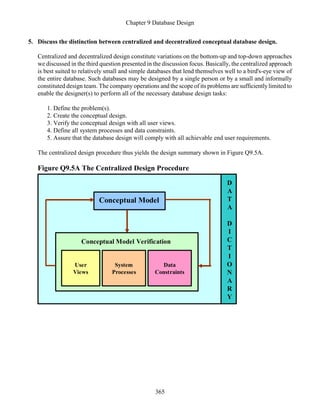
The centralized design procedure thus yields the design summary shown in Figure Q9.5A.
Figure Q9.5A The Centralized Design Procedure
Conceptual Model
Data
Constraints
System
Processes
User
Views
Conceptual Model Verification
D
A
T
A
D
I
C
T
I
O
N
A
R
Y
Chapter 9 Database Design
366
Note that the centralized design approach requires the completion and validation of a single conceptual
design.
NOTE
Use the text’s Figures 9.15 and 9.16 to contrast the two design approaches, then use Figure 9.6
to show the procedure flows; demonstrate that such procedure flows are independent of the
degree of centralization.
In contrast, when company operations are spread across multiple operational sites or when the database
has multiple entities that are subject to complex relations, the best approach is often based on the
decentralized design.
Typically, a decentralized design requires that the design task be divided into multiple modules, each one
of which is assigned to a design team. The design team activities are coordinated by the lead designer,
who must aggregate the design teams' efforts.
Since each team focuses on modeling a subset of the system, the definition of boundaries and the
interrelation between data subsets must be very precise. Each team creates a conceptual data model
corresponding to the subset being modeled. Each conceptual model is then verified individually against
the user views, processes, and constraints for each of the modules. After the verification process has
been completed, all modules are integrated in one conceptual model.
Since the data dictionary describes the characteristics of all the objects within the conceptual data model,
it plays a vital role in the integration process. Naturally, after the subsets have been aggregated into a
larger conceptual model, the lead designer must verify that the combined conceptual model is still able to
support all the required transactions. Thus the decentralized design activities may be summarized as
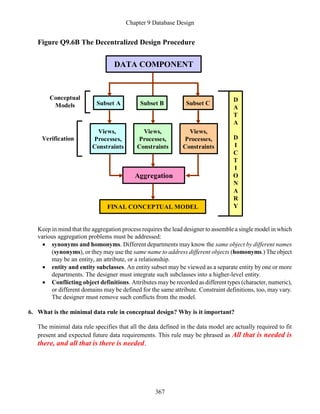
shown in Figure Q8.6B.
Chapter 9 Database Design
367
Figure Q9.6B The Decentralized Design Procedure
D
A
T
A
D
I
C
T
I
O
N
A
R
Y
Subset A
DATA COMPONENT
Views,
Processes,
Constraints
Views,
Processes,
Constraints
Views,
Processes,
Constraints
Aggregation
Subset B Subset C
Verification
Conceptual
Models
FINAL CONCEPTUAL MODEL
Keep in mind that the aggregation process requires the lead designer to assemble a single model in which
various aggregation problems must be addressed:
 synonyms and homonyms. Different departments may know the same object by different names
(synonyms), or they may use the same name to address different objects (homonyms.) The object
may be an entity, an attribute, or a relationship.
 entity and entity subclasses. An entity subset may be viewed as a separate entity by one or more
departments. The designer must integrate such subclasses into a higher-level entity.
 Conflicting object definitions. Attributes may be recorded as different types (character, numeric),
or different domains may be defined for the same attribute. Constraint definitions, too, may vary.
The designer must remove such conflicts from the model.
6. What is the minimal data rule in conceptual design? Why is it important?
The minimal data rule specifies that all the data defined in the data model are actually required to fit
present and expected future data requirements. This rule may be phrased as All that is needed is
there, and all that is there is needed.
Chapter 9 Database Design
368
7. Discuss the distinction between top-down and bottom-up approaches to database design.
There are two basic approaches to database design: top-down and bottom-up.
Top-down design begins by identifying the different entity types and the definition of each entity's
attributes. In other words, top-down design:
 starts by defining the required data sets and then
 defines the data elements for each of those data sets.
Bottom-up design:
 first defines the required attributes and then
 groups the attributes to form entities.
Although the two methodologies tend to be complementary, database designers who deal with small
databases with relatively few entities, attributes, and transactions tend to emphasize the bottom-up
approach. Database designers who deal with large, complex databases usually find that a primarily
top-down design approach is more appropriate.
8. What are business rules? Why are they important to a database designer?
Business rules are narrative descriptions of the business policies, procedures, or principles that are
derived from a detailed description of operations. Business rules are particularly valuable to database
designers, because they help define:
 Entities
 Attributes
 Relationships (1:1, 1:M, M:N, expressed through connectivities and cardinalities)
 Constraints
To develop an accurate data model, the database designer must have a thorough and complete
understanding of the organization's data requirements. The business rules are very important to the
designer because they enable the designer to fully understand how the business works and what role is
played by data within company operations.
NOTE
Do keep in mind that an ERD cannot always include all the applicable business rules. For
example, although constraints are often crucial, it is often not possible to model them. For
instance, there is no way to model a constraint such as “no pilot may be assigned to flight duties
more than ten hours during any 24-hour period.”
It is also worth emphasizing that the description of (company) operations must be done in
almost excruciating detail and it must be verified and re-verified. An inaccurate description of
operations yields inaccurate business rules that lead to database designs that are destined to
fail.
Chapter 9 Database Design
369
9. What is the data dictionary's function in database design?
A good data dictionary provides a precise description of the characteristics of all the entities and
attributes found within the database. The data dictionary thus makes it easier to check for the existence
of synonyms and homonyms, to check whether all attributes exist to support required reports, to verify
appropriate relationship representations, and so on. The data dictionary's contents are both developed and
used during the six DBLC phases:
DATABASE INITIAL STUDY
The basic data dictionary components are developed as the entities and attributes are defined during this
phase.
DATABASE DESIGN
The data dictionary contents are used to verify the database design components: entities, attributes, and
their relationships. The designer also uses the data dictionary to check the database design for
homonyms and synonyms and verifies that the entities and attributes will support all required query and
report requirements.
IMPLEMENTATION AND LOADING
The DBMS's data dictionary helps to resolve any remaining attribute definition inconsistencies.
TESTING AND EVALUATION
If problems develop during this phase, the data dictionary contents may be used to help restructure the
basic design components to make sure that they support all required operations.
OPERATION
If the database design still yields (the almost inevitable) operational glitches, the data dictionary may be
used as a quality control device to ensure that operational modifications to the database do not conflict
with existing components.
MAINTENANCE AND EVOLUTION
As users face inevitable changes in information needs, the database may be modified to support those
needs. Perhaps entities, attributes, and relationships must be added, or relationships must be changed. If
new database components are fit into the design, their introduction may produce conflict with existing
components. The data dictionary turns out to be a very useful tool to check whether a suggested change
invites conflicts within the database design and, if so, how such conflicts may be resolved.
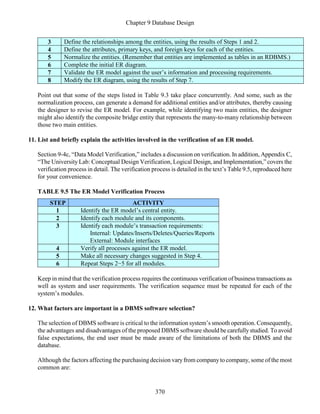
10. What steps are required in the development of an ER diagram? (Hint: See Table 9.3.)
Table 9.3 is reproduced for your convenience.
TABLE 9.3 Developing the Conceptual Model, Using ER Diagrams
STEP ACTIVITY
1 Identify, analyze, and refine the business rules.
2 Identify the main entities, using the results of Step 1.
Chapter 9 Database Design
370
3 Define the relationships among the entities, using the results of Steps 1 and 2.
4 Define the attributes, primary keys, and foreign keys for each of the entities.
5 Normalize the entities. (Remember that entities are implemented as tables in an RDBMS.)
6 Complete the initial ER diagram.
7 Validate the ER model against the user’s information and processing requirements.
8 Modify the ER diagram, using the results of Step 7.
Point out that some of the steps listed in Table 9.3 take place concurrently. And some, such as the
normalization process, can generate a demand for additional entities and/or attributes, thereby causing
the designer to revise the ER model. For example, while identifying two main entities, the designer
might also identify the composite bridge entity that represents the many-to-many relationship between
those two main entities.
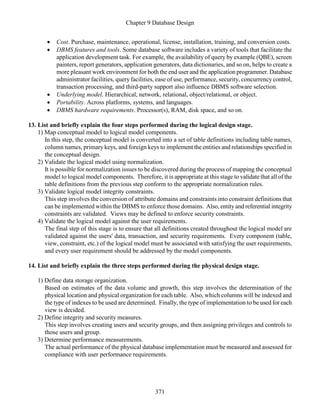
11. List and briefly explain the activities involved in the verification of an ER model.
Section 9-4c, “Data Model Verification,” includes a discussion on verification. In addition, Appendix C,
“The University Lab: Conceptual Design Verification, Logical Design, and Implementation,” covers the
verification process in detail. The verification process is detailed in the text’s Table 9.5, reproduced here
for your convenience.
TABLE 9.5 The ER Model Verification Process
STEP ACTIVITY
1 Identify the ER model’s central entity.
2 Identify each module and its components.
3 Identify each module’s transaction requirements:
Internal: Updates/Inserts/Deletes/Queries/Reports
External: Module interfaces
4 Verify all processes against the ER model.
5 Make all necessary changes suggested in Step 4.
6 Repeat Steps 2−5 for all modules.
Keep in mind that the verification process requires the continuous verification of business transactions as
well as system and user requirements. The verification sequence must be repeated for each of the
system’s modules.
12. What factors are important in a DBMS software selection?
The selection of DBMS software is critical to the information system’s smooth operation. Consequently,
the advantages and disadvantages of the proposed DBMS software should be carefullystudied. To avoid
false expectations, the end user must be made aware of the limitations of both the DBMS and the
database.
Although the factors affecting the purchasing decision varyfrom companyto company, some of the most
common are:
Chapter 9 Database Design
371
 Cost. Purchase, maintenance, operational, license, installation, training, and conversion costs.
 DBMS features and tools. Some database software includes a variety of tools that facilitate the
application development task. For example, the availability of query by example (QBE), screen
painters, report generators, application generators, data dictionaries, and so on, helps to create a
more pleasant work environment for both the end user and the application programmer. Database
administrator facilities, query facilities, ease of use, performance, security, concurrencycontrol,
transaction processing, and third-party support also influence DBMS software selection.
 Underlying model. Hierarchical, network, relational, object/relational, or object.
 Portability. Across platforms, systems, and languages.
 DBMS hardware requirements. Processor(s), RAM, disk space, and so on.
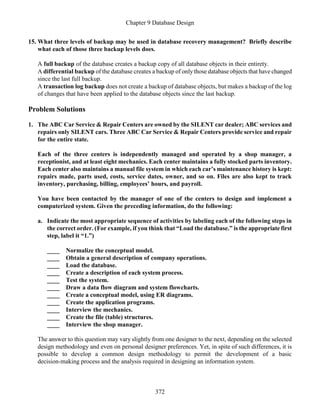
13. List and briefly explain the four steps performed during the logical design stage.
1) Map conceptual model to logical model components.
In this step, the conceptual model is converted into a set of table definitions including table names,
column names, primary keys, and foreign keys to implement the entities and relationships specified in
the conceptual design.
2) Validate the logical model using normalization.
It is possible for normalization issues to be discovered during the process of mapping the conceptual
model to logical model components. Therefore, it is appropriate at this stage to validate that all of the
table definitions from the previous step conform to the appropriate normalization rules.
3) Validate logical model integrity constraints.
This step involves the conversion of attribute domains and constraints into constraint definitions that
can be implemented within the DBMS to enforce those domains. Also, entityand referential integrity
constraints are validated. Views may be defined to enforce security constraints.
4) Validate the logical model against the user requirements.
The final step of this stage is to ensure that all definitions created throughout the logical model are
validated against the users' data, transaction, and security requirements. Every component (table,
view, constraint, etc.) of the logical model must be associated with satisfying the user requirements,
and every user requirement should be addressed by the model components.
14. List and briefly explain the three steps performed during the physical design stage.
1) Define data storage organization.
Based on estimates of the data volume and growth, this step involves the determination of the
physical location and physical organization for each table. Also, which columns will be indexed and
the type of indexes to be used are determined. Finally, the type of implementation to be used for each
view is decided.
2) Define integrity and security measures.
This step involves creating users and security groups, and then assigning privileges and controls to
those users and group.
3) Determine performance measurements.
The actual performance of the physical database implementation must be measured and assessed for
compliance with user performance requirements.
Chapter 9 Database Design
372
15. What three levels of backup may be used in database recovery management? Briefly describe
what each of those three backup levels does.
A full backup of the database creates a backup copy of all database objects in their entirety.
A differential backup of the database creates a backup of onlythose database objects that have changed
since the last full backup.
A transaction log backup does not create a backup of database objects, but makes a backup of the log
of changes that have been applied to the database objects since the last backup.
Problem Solutions
1. The ABC Car Service & Repair Centers are owned by the SILENT car dealer; ABC services and
repairs only SILENT cars. Three ABC Car Service & Repair Centers provide service and repair
for the entire state.
Each of the three centers is independently managed and operated by a shop manager, a
receptionist, and at least eight mechanics. Each center maintains a fully stocked parts inventory.
Each center also maintains a manual file system in which each car’s maintenance history is kept:
repairs made, parts used, costs, service dates, owner, and so on. Files are also kept to track
inventory, purchasing, billing, employees’ hours, and payroll.
You have been contacted by the manager of one of the centers to design and implement a
computerized system. Given the preceding information, do the following:
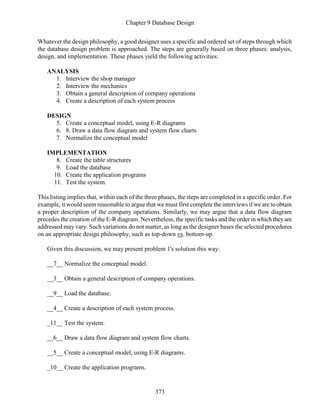
a. Indicate the most appropriate sequence of activities by labeling each of the following steps in
the correct order. (For example, if you think that “Load the database.” is the appropriate first
step, label it “1.”)
____ Normalize the conceptual model.
____ Obtain a general description of company operations.
____ Load the database.
____ Create a description of each system process.
____ Test the system.
____ Draw a data flow diagram and system flowcharts.
____ Create a conceptual model, using ER diagrams.
____ Create the application programs.
____ Interview the mechanics.
____ Create the file (table) structures.
____ Interview the shop manager.
The answer to this question may vary slightly from one designer to the next, depending on the selected
design methodology and even on personal designer preferences. Yet, in spite of such differences, it is
possible to develop a common design methodology to permit the development of a basic
decision-making process and the analysis required in designing an information system.
Chapter 9 Database Design
373
Whatever the design philosophy, a good designer uses a specific and ordered set of steps through which
the database design problem is approached. The steps are generally based on three phases: analysis,
design, and implementation. These phases yield the following activities:
ANALYSIS
1. Interview the shop manager
2. Interview the mechanics
3. Obtain a general description of company operations
4. Create a description of each system process
DESIGN
5. Create a conceptual model, using E-R diagrams
6. 8. Draw a data flow diagram and system flow charts
7. Normalize the conceptual model
IMPLEMENTATION
8. Create the table structures
9. Load the database
10. Create the application programs
11. Test the system.
This listing implies that, within each of the three phases, the steps are completed in a specific order. For
example, it would seem reasonable to argue that we must first complete the interviews if we are to obtain
a proper description of the company operations. Similarly, we may argue that a data flow diagram
precedes the creation of the E-R diagram. Nevertheless, the specific tasks and the order in which theyare
addressed may vary. Such variations do not matter, as long as the designer bases the selected procedures
on an appropriate design philosophy, such as top-down vs. bottom-up.
Given this discussion, we may present problem 1's solution this way:
__7__ Normalize the conceptual model.
__3__ Obtain a general description of company operations.
__9__ Load the database.
__4__ Create a description of each system process.
_11__ Test the system.
__6__ Draw a data flow diagram and system flow charts.
__5__ Create a conceptual model, using E-R diagrams.
_10__ Create the application programs.
Chapter 9 Database Design
374
__2__ Interview the mechanics.
__8__ Create the file (table) structures.
__1__ Interview the shop manager.
Chapter 9 Database Design
375
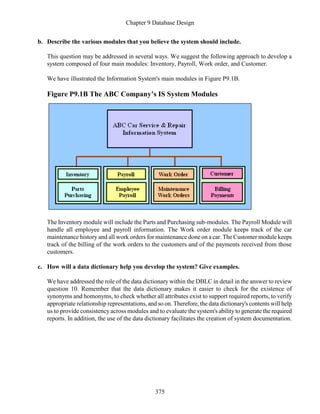
b. Describe the various modules that you believe the system should include.
This question may be addressed in several ways. We suggest the following approach to develop a
system composed of four main modules: Inventory, Payroll, Work order, and Customer.
We have illustrated the Information System's main modules in Figure P9.1B.
Figure P9.1B The ABC Company’s IS System Modules
The Inventory module will include the Parts and Purchasing sub-modules. The Payroll Module will
handle all employee and payroll information. The Work order module keeps track of the car
maintenance history and all work orders for maintenance done on a car. The Customer module keeps
track of the billing of the work orders to the customers and of the payments received from those
customers.
c. How will a data dictionary help you develop the system? Give examples.
We have addressed the role of the data dictionary within the DBLC in detail in the answer to review
question 10. Remember that the data dictionary makes it easier to check for the existence of
synonyms and homonyms, to check whether all attributes exist to support required reports, to verify
appropriate relationship representations, and so on. Therefore, the data dictionary's contents will help
us to provide consistency across modules and to evaluate the system's abilityto generate the required
reports. In addition, the use of the data dictionary facilitates the creation of system documentation.
Chapter 9 Database Design
376
d. What general (system) recommendations might you make to the shop manager? (For example.
if the system will be integrated, what modules will be integrated? What benefits would be
derived from such an integrated system? Include several general recommendations.)
The designer's job is to provide solutions to the main problems found during the initial study.
Clearly, any system is subject to both internal and external constraints. For example, we can safely
assume that the owner of the ABC Car Service and Repair Center has a time frame in mind, not to
mention a spending limitation. As is true in all design work, the designer and the business owner
must prioritize the modules and develop those that yield the greatest benefit within the stated time
and development budget constraints.
Keep in mind that it is always useful to develop a modular system that provides for future
enhancement and expansion. Suppose, for example, that the ABC Car Service & Repair company
management decides to integrate all of its service stations in the state in order to provide better
statewide service. Such integration is likely to yield many benefits: The car history of each car will
be available to any station for cars that have been serviced in more than one location; the inventory
of parts will be on-line, thus allowing parts orders to be placed between service stations; mechanics
can better share tips concerning the solution to car maintenance problems, and so on.
e. What is the best approach to conceptual database design? Why?
Given the nature of this business, the best way to produce this conceptual database design would be
to use a centralized and top-down approach. Keep in mind that the designer must keep the design
sufficiently flexible to make sure that it can accommodate any future integration of this system with
the other service stations in the state.
f. Name and describe at least four reports the system should have. Explain their use. Who will
use those reports?
REPORT 1
Monthly Activity contains a summary of service categories by branch and by month. Such reports
may become the basis for forecasting personnel and stock requirements for each branch and for each
period.
REPORT 2
Mechanic Summary Sheet contains a summary of work hours clocked by each mechanic. This
report would be generated weekly and would be useful for payroll and maintenance personnel
scheduling purposes.
REPORT 3
Monthly Inventory contains a summary of parts in inventory, inventory draw-down, parts reorder
points, and information about the vendors who will provide the parts to be reordered. This report will
be especially useful for inventory management purposes.
REPORT 4
Customer Activity contains a breakdown of customers by location, maintenance activity, current
balances, available credit, and so on. This report would be useful to forecast various service demand
Chapter 9 Database Design
377
factors, to mail promotional materials, to send maintenance reminders, to keep track of special
customer requirements, and so on.
2. Suppose you have been asked to create an information system for a manufacturing plant that
produces nuts and bolts of many shapes, sizes, and functions. What questions would you ask, and
how would the answers to those questions affect the database design?
Basically, all answers to all (relevant) questions help shape the database design. In fact, all information
collected during the initial study and all subsequent phases will have an impact on the database design.
Keep in mind that the information is collected to establish the entities, attributes, and the relationships
among the entities. Specifically, the relationships, connectivities, and cardinalities are shaped by the
business rules that are derived from the information collected by the designer.
Sample questions and their likely impact on the design might be:
 Do you want to develop the database for all departments at once, or do you want to design and
implement the database for one department at a time?
 How will the design approach affect the design process? (In other words, assess top-down vs.
bottom-up, centralized or decentralized, system scope and boundaries.)
 Do you want to develop one module at a time, or do you want an integrated system? (Inventory,
production, shipping, billing, etc.)
 Do you want to keep track of the nuts and bolts by lot number, production shift, type, and
department? Impact: conceptual and logical database design.
 Do you want to keep track of the suppliers of each batch of raw material used in the production
of the nuts and bolts? Impact: conceptual and logical database design. E-R model.
 Do you want to keep track of the customers who received the batches of nuts and bolts? Impact:
conceptual and logical database design. ER model.
 What reports will you require, what will be the specific reporting requirements, and to whom will
these reports be distributed?
The answers to such questions affect the conceptual and logical database design, the database’s
implementation, its testing, and its subsequent operation.
a. What do you envision the SDLC to be?
The SDLC is not a function of the information collected. Regardless of the extent of the design or its
specific implementation, the SDLC phases remain:
PLANNING
Initial assessment
Feasibility study
ANALYSIS
User requirements
Study of existing systems
Logical system design
Chapter 9 Database Design
378
DETAILED SYSTEMS DESIGN
Detailed system specifications
IMPLEMENTATION
Coding, testing, debugging
Installation, fine-tuning
MAINTENANCE
Evaluation
Maintenance
Enhancements
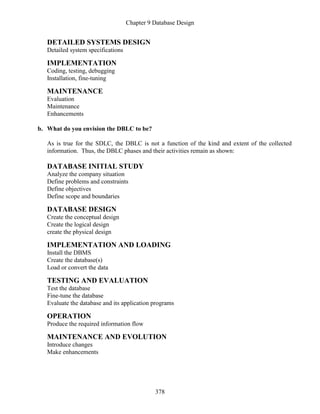
b. What do you envision the DBLC to be?
As is true for the SDLC, the DBLC is not a function of the kind and extent of the collected
information. Thus, the DBLC phases and their activities remain as shown:
DATABASE INITIAL STUDY
Analyze the company situation
Define problems and constraints
Define objectives
Define scope and boundaries
DATABASE DESIGN
Create the conceptual design
Create the logical design
create the physical design
IMPLEMENTATION AND LOADING
Install the DBMS
Create the database(s)
Load or convert the data
TESTING AND EVALUATION
Test the database
Fine-tune the database
Evaluate the database and its application programs
OPERATION
Produce the required information flow
MAINTENANCE AND EVOLUTION
Introduce changes
Make enhancements
Chapter 9 Database Design
379
3. Suppose you perform the same functions noted in Problem 2 for a larger warehousing operation.
How are the two sets of procedures similar? How and why are they different?
The development of an information system will differ in the approach and philosophy used. More
precisely, the designer team will probably be formed by a group of system analysts and may decide to
use a decentralized approach to database design.
Also, as is true for any organization, the system scope and constraints may be very different for different
systems. Therefore, designers may opt to use different techniques at different stages. For example, the
database initial study phase may include separate studies carried out by separate design teams at several
geographically distant locations. Each of the findings of the design teams will later be integrated to
identify the main problems, solutions, and opportunities that will guide the design and development of
the system.
4. Using the same procedures and concepts employed in Problem 1, how would you create an
information system for the Tiny College example in Chapter 4?
Tiny College is a medium-sized educational institution that uses many database-intensive operations,
such as student registration, academic administration, inventory management, and payroll. To create an
information system, first perform an initial database study to determine the information system's
objectives.
Next, study Tiny College's operations and processes (flow of data) to identify the main problems,
constraints, and opportunities. A precise definition of the main problems and constraints will enable the
designer to make sure that the design improves Tiny College's operational efficiency. An improvement
in operational efficiency is likely to create opportunities to provide new services that will enhance Tiny
College's competitive position.
After the initial database study is done and the alternative solutions are presented, the end users
ultimately decide which one of the probable solutions is most appropriate for Tiny College. Keep in
mind that the development of a system this size will probably involve people who have quite different
backgrounds. For example, it is likely that the designer must work with people who play a managerial
role in communications and local area networks, as well as with the "troops in the trenches" such as
programmers and system operators. The designer should, therefore, expect that there will be a wide range
of opinions concerning the proposed system's features. It is the designer's job to reconcile the many(and
often conflicting) views of the "ideal" system.
Once a proposed solution has been agreed upon, the designer(s) may determine the proposed system's
scope and boundaries. We are then able to begin the design phase. As the design phase begins, keep in
mind that Tiny College's information system is likely to be used by many users (20 to 40 minimum) who
are located on distant sites across campus. Therefore, the designer must consider a range of
communication issues involving the use of such technologies as local area networks. These technologies
must be considered as the database designer(s) begin to develop the structure of the database to be
implemented.
Chapter 9 Database Design
380
The remaining development work conforms to the SDLC and the DBLC phases. Special attention must
be given to the system design's implementation and testing to ensure that all the system modules
interface properly.
Finally, the designer(s) must provide all the appropriate system documentation and ensure that all
appropriate system maintenance procedures (periodic backups, security checks, etc.) are in place to
ensure the system's proper operation.
Keep in mind that two very important issues in a university-wide system are end-user training and
support. Therefore, the system designer(s) must make sure that all end users know the system and know
how it is to be used to enjoy its benefits. In other words, make sure that end-user support programs are in
place when the system becomes operational.
5. Write the proper sequence of activities in the design of a video rental database. (The initial ERD
was shown in Figure 9.9.) The design must support all rental activities, customer payment
tracking, and employee work schedules, as well as track which employees checked out the videos
to the customers. After you finish writing the design activity sequence, complete the ERD to ensure
that the database design can be successfully implemented. (Make sure that the design is normalized
properly and that it can support the required transactions.
Given its level of detail and (relative) complexity, this problem would make an excellent class project.
Use the chapter’s coverage of the database life cycle (DBLC) as the procedural template. The text’s
Figure 9.3 is particularly useful as a procedural map for this problem’s solution and Figure 9.6 provides a
more detailed view of the database design’s procedural flow. Make sure that the students review section
9-3b, “Database Design,” before they attempt to produce the problem solution.
Appendix B, “The University Lab: Conceptual Design,” and Appendix C “The University Lab:
Conceptual Design Verification, Logical Design, and Implementation” show a very detailed example of
the procedures required to deliver a completed database. You will find a more detailed video rental
database problem description in Appendix B, problem 4. This problem requires the completion of the
initial database design. The solution is shown in this manual’s Appendix B coverage. This design is
verified in Appendix C, Problem 2.
The Visio Professional files for the initial and verified designs are located on your instructor’s CD.
Select the FigB-P04a-The-Initial-Crows-Foot-ERD-for-the-Video-Rental-Store.vsd file to see the
initial design. Select the Fig-C-P02a-The-Revised-Video-Rental-Crows-Foot-ERD.vsd file to see the
verified design.
6. In a construction company, a new system has been in place for a few months and now there is a list
of possible changes/updates that need to be done. For each of the changes/updates, specify what
type of maintenance needs to be done: (a) corrective, (b) adaptive, and (c) perfective.
a. An error in the size of one of the fields has been identified and it needs to be updated
status field needs to be changed.
This is a change in response to a system error – corrective maintenance.
Chapter 9 Database Design
381
b. The company is expanding into a new type of service and this will require to enhancing
the system with a new set of tables to support this new service and integrate it with the
existing data.
This is a change to enhance the system – perfective maintenance.
c. The company has to comply with some government regulations. To do this, it will
require adding a couple of fields to the existing system tables.
This is a change in response to changes in the business environment – adaptive maintenance.
7. You have been assigned to design the database for a new soccer club. Indicate the most
appropriate sequence of activities by labeling each of the following steps in the correct order. (For
example, if you think that “Load the database” is the appropriate first step, label it “1.”)
_10__ Create the application programs.
__4__ Create a description of each system process.
_11__ Test the system.
__9__ Load the database.
__7__ Normalize the conceptual model.
__1__ Interview the soccer club president.
__5__ Create a conceptual model using ER diagrams.
__2__ Interview the soccer club director of coaching.
__8__ Create the file (table) structures.
__3__ Obtain a general description of the soccer club operations.
__6__ Draw a data flow diagram and system flowcharts.
Random documents with unrelated
content Scribd suggests to you:
21
essential and removable parts along with other appurtenances.
These were then transported to and installed at Animas Forks.
Joe Dresbach, the general manager of the time, has also stated that
essential and removable parts of the turntable at Corkscrew were
retrieved and installed at Animas Forks.
Charles Decker, an engineer, says that the housing and operating
parts of the turntable at Corkscrew were gone when he went there
for the first time in 1907. The train merely ran over the stationary
table onto a switchback that had been extended to hold several cars,
and then backed out.
After the turntable was abandoned a train leaving Red Mountain
headed into Corkscrew Gulch, backed down to Joker Tunnel, headed
into Corkscrew again and finally backed to Red Mountain. Or the
operation was reversed by backing out of Red Mountain to begin
with. As trains will not back through much snow downhill and
practically none uphill this railroad got into trouble in the winter no
matter how it started out or what it did.
Mears was employed by the D. & R. G. to reconstruct the railroad in
the Animas canyon after the disastrous flood of October 5, 1911. He
used S. Ry., S. G. & N. and S. N. engines and crews to work from the
north end. Trains went to Joker Tunnel to pick up rails that had been
brought that far by freight teams from Ouray. Silverton ran out of
coal, and some that had already been hauled to the Treasury Tunnel
at Red Mountain was brought back to town. In about 60 days the
line was open and the first two freight cars to arrive in Silverton
were one of caskets and one of beer.
Many derailments and minor accidents occurred but in its 39 years of
operation only one fatality. In 1902 or ’03 an engine ran off a short
rail at Sheridan Junction causing it to overturn. The engineer, Bally
Thompson, was caught and crushed under the boiler. The whole top
22
of his head and jaw were torn off and his skin was cooked like that
of a roasted turkey.
The year ending June 30, 1911 showed a cash balance of $9 while
the year ending December 31, 1917 turned up with a deficit of
$25,241. Regular operation ceased in 1921 and abandonment
proceedings were held in the early fall of 1922. All rolling stock,
including Engines 100 and 101 (1) were turned over to the S. N.
Below is the last station list ever published:
.00 Silverton 9,300
5.30 Burro Bridge 10,236
7.23 Chattanooga 10,400
10.64 Summit 11,235
11.97 Red Mountain 11,025
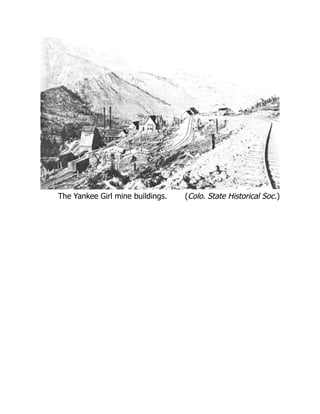
12.66 Vanderbilt
12.85 Yankee Girl
13.26 Robinson
13.46 Guston
13.93 Paymaster Coal Track
14.38 Corkscrew Gulch
14.81 Paymaster Ore Track
15.03 Silver Belle
16.06 Joker
As the track was not immediately removed an occasional train was
run to Red Mountain or even to the mines beyond. With the
salvaging of the rails in 1926 the Silverton Railroad made its last run.
The original Red Mountain Town was on the east side of the small
hill called the Knob. The place began declining about 1907 and the
time came when it was deserted and all structures were in a state of
23
25
near or complete collapse. The Idarado, the old Treasury Tunnel, to
the north side of the Knob, with all its prosperous looking mine and
mill buildings and its nice dwellings, most of which were moved
there from Eureka, now constitutes the town of Red Mountain. This
Tunnel is a World War II development and is famous because it
bores through the mountain to the mines on the Telluride side.
The new highway has almost obliterated the old railroad
grade. It may be seen crawling along on the sidehill up to
Burro Bridge, and again at Chattanooga Loop and overhead as it
climbs to the summit. It also may be seen curving around the Knob
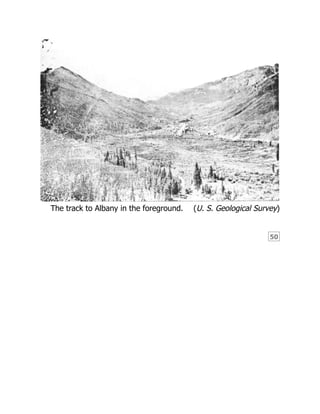
to old Red Mountain town, crawling along the mountain to
Corkscrew Gulch and dropping down to Joker Tunnel. Then all traces
of it are gone except some old grade at Albany. First a road, then a
railroad and again a road!
SILVERTON, GLADSTONE & NORTHERLY
The Gold King Mining Company, under President W. Z. Kinney,
promoted a railroad for the purpose of hauling concentrates from
mills along Cement Creek to the smelters at Silverton. According to
the Manual the railroad was chartered April 6, 1899 and completed
in July. James Dyson located the route and the Rocky Mountain
Construction Co., incorporated in Maine, constructed the 7.5 miles of
line and the one-half mile of sidings from Silverton to Gladstone.
Forty-five-pound rail was used. Track left the main line of the D. & R.
G. at the north end of Silverton and there a roundhouse was built.
San Juan County records show that the property was conveyed from
the construction company to the railroad company July 21, 1899.
Two figures, $247,838 and $252,979, have been given as the cost of
the job. The difference may have covered equipment.
The S. G. & N. bought Engine 32 from the Rio Grande Southern
through the D. & R. G. purchasing agent, C. M. Hobbs, for $3252.
Mr. Hobbs instructed Mr. Lee, general superintendent of the R. G. S.,
to letter it properly, deliver it to W. Z. Kinney at Silverton on August
1, 1899 and collect the money. Two very nice made-to-order
coaches, that had seats for passengers in one end and baggage
compartments in the other, were obtained. Two trains ran daily
consisting, generally, of an engine, two loads and a passenger
coach. The first year of operation showed a surplus of $35,366.21.
The company, evidently, did not have enough power and in October
1900 it was asking the R. G. S. for another locomotive like the one it
already had, but none was available. Meanwhile, a company in
Palestine, Texas had bought R. C. S. 33 (exactly like 32) but on
finding it unsatisfactory, had shipped it back. The R. G. S. placed it in
the Burnham Shops at Denver where, in 1902, it underwent
extensive repairs. Then it was sold to the S. G. & N.
26
The two locomotives mentioned above were sisters to the Silverton
Railroad’s No. 101 (1), formerly R. G. S. 34. All three were of the
same make and the same class and had the same owners at
the same time and in the same order—the D. & R. G., the R.
G. W. and the R. G. S. All of these engines ended up with the S. N.
(So did S. R. No. 100.) All had five owners. The 33 had six owners if
one would count the company in Texas but, as far as is known, no
money changed hands.
A new locomotive, No. 34, a Baldwin of the 100 class, was
purchased in 1904. The Manual of 1905 lists three engines, two
coaches, and twenty freight cars; the one of 1909 says two
locomotives, two coaches, ten box cars and twenty-one gondolas.
Engine 32 was the one out of service at this time. Eventually its
boiler went to a sawmill at Cascade. No. 33 lasted a few years
longer.
Except for Mr. Kinney of Silverton, the board of ten directors elected
in 1904 were all from Maine, Massachusetts or New Brunswick and
the trustee under the mortgage was the Newtonville Trust Co. of
Newtonville, Mass. In 1905 the funded debt was $100,000 and the
outstanding stock, $121,000. In the year ending June 30, 1909, the
railroad had carried 16,667 tons of freight and 3,916 passengers.
It was not uncommon for service to be discontinued for short or long
periods in any winter on account of snow blockades but the
suspension in the fall of 1911 was due to the extensive washouts on
the D. & R. G. in the Animas Canon. S. G. & N. men and equipment
were sent to assist in the reconstruction.
Excursions were often run to Gladstone for picnics or to gather
columbines either to send out of town for some special doings or for
any kind of local celebration.
According to the Official Guides of 1913, 1914 and 1915 mixed trains
ran thrice weekly—Monday, Wednesday and Friday. In 1913 trains
27
left Silverton at 1:00 P.M. and arrived at Gladstone at 1:45 P.M.; left
Gladstone at 2:15 P.M. and arrived at Silverton at 3:00 P.M. This was
a considerable decline from the original two trains per day.
About the first of January 1910, Mears, Slattery and Pitcher leased
the Gold King mine. On January 15 of the same year the Silverton
Northern Railroad leased the S. G. & N. and five years later, on June
10, 1915, bought it at auction. San Juan County records show
that the deed was made July 23. Mears then owned all three
railroads. Only one S. G. & N. engine, the 34, was in service. The
partners gave up the lease on the mine in 1917 and Mears, then 77
years old, left for California, never to return.
Mrs. Percy Airy has a little story to tell of this period. In 1911 her
husband was working at the Gold King mill at Gladstone and they
were living in a little cabin with almost no furniture and
conveniences. One morning while she was washing, Percy came
rushing in, saying he was bringing his uncle Jack Slattery, Otto
Mears, James Pitcher and Louis Quarnstrom in for dinner. Flustered
and dismayed were no words for it! At such a camp no fresh stuff
was available but she managed a dinner of ham, scalloped potatoes,
a canned vegetable, biscuits with butter and jam, fresh canned
mountain raspberries, cake and coffee. She had only two stool chairs
and one of them was occupied by the washtub which Mears urged
her not to move. She put one man on the other stool chair, two on
the bed and two in rockers. Being very young, only nineteen, she
was so embarrassed she wouldn’t sit down at the table. Everybody
praised her dinner and she felt better. When Mears left he presented
her with a very rich piece of gold ore, about the size of a large
orange, and told here if she’d always keep that she’d never be poor.
Later she engaged a jeweler to make a watch charm from it for her
husband. A small cracked charm and two small pieces of ore were all
that was returned to her. The fellow claimed he had had to break the
big chunk all to pieces to get the charm and had thrown the scraps
away. Of course every small grain of that ore was valuable.
28
29
Business kept dwindling until only an occasional train was run. The
following table indicates that the track was still lying in 1923.
SILVERTON, GLADSTONE & NORTHERLY
Official Roster 1923
0 Silverton 9,300
3.2 Yukon Mills
5.0 Porcupine Gulch
7.0 Fishers Mill
7.5 Gladstone 10,600
No exact date can be found for the tearing up of the rails but it
probably was in 1926, the same year the S. R. was dismantled. All
equipment went to the S. N. as it already belonged to it anyway.
The government, during our war with Japan, established military
posts in Alaska. The railroad up there, the White Pass and Yukon,
needed more locomotives and in 1942 it purchased all that were left
on the S.N.—the 3, 4 and 34. (The S. N. had ceased operation three
years previously.) The 34, as should be remembered, had belonged
to the S. G. & N. When the Alaskan railroad received the 34 it
numbered it “24”. After Diesel power was obtained there the 24 (nee
34), then about forty years old, was retired to the boneyard.
One of the original S. G. & N. coaches was bought from the S. N.,
moved to Durango and set up on Main Avenue as the “Pioneer
Diner”. Later, after changes and additions, it became the “Chief
Diner”. It is still operating and may be seen in Durango.
SILVERTON NORTHERN
Mears hoped to run a railroad from Silverton to Mineral Point and
possibly on to Lake City, following practically the same route as the
wagon road he had built twelve years previously. C. W. Gibbs, chief
engineer, made surveys from Silverton to Eureka in both 1889 and
’90 but nothing was immediately attempted, probably because of all
effort and money going toward the construction of the Rio Grande
Southern. However, two miles from Silverton to Waldheim were built
in 1893 as an extension of the Silverton Railroad.
According to San Juan County records the Silverton Northern was
incorporated on September 20, 1895. Fred Walsen was the
president, Otto Mears the vice-president and Alex Anderson the
secretary-treasurer.
Construction began at the North Star bridge, the end of the first
piece of railroad, in late April of 1896 and the 6½ miles were
completed to Eureka in late June. The transfer of the property from
the construction company to the railroad company was made on July
1st. Silverton Northern books gave the cost of construction as
$272,400. Meanwhile the first two miles had been transferred from
the Silverton Railroad to the Silverton Northern. A big celebration
took place at Eureka on the completion of the line and Mrs. Edward
G. Stoiber drove the golden spike. A picture is extant which shows
the crowd there.
S. R. Engine 101 was transferred to the S. N. but henceforth was to
go by the number of 1. Of course, the company could borrow a
locomotive or other equipment from the S. R. or the D. & R. G. as
needed.
30
Ever since the panic of 1893 with its demonetization of silver, mining
in the San Juan had been seriously crippled but, since the Sunnyside
mine near Eureka and the Silver Lake mine near Waldheim produced
good values in gold, the S. N. could make a profit.
Mining men, Mears among them, had great hopes that mining would
revive as of old if William Jennings Bryan could be elected as
president. Bryan, it should be remembered, was running in
1896 on a platform of silver coinage at 16 to 1 with gold.
When he was defeated Mears lost hope for any improvement in
mining and moved to the East where he took up several projects.
One was the building of the Chesapeake Beach railroad from
Washington to the beach. Another was the promotion of the Mack
Truck Co. with himself as the first president. He, at that early date,
saw the possibilities of automobile transportation.
Though Mears stayed in the east until 1907 he exercised a strong
supervision over his San Juan railroads and made a number of trips
back to the country to oversee them.
In 1901 the company owned one locomotive, one passenger coach,
ten box cars and one service car. For the year ending June 30, 1901
it had operated 3376 miles of mixed and 1310 miles of passenger
service. In 1902 it paid a dividend of 10%.
The Gold Prince mine, four miles up the Animas River canon from
Eureka, was then flourishing so Mears decided to build a railroad to
the place. He hired Thomas Wigglesworth as surveyor and
constructor. Construction from Silverton to Eureka had been easy—
no hard grading and only two small bridges—but from Eureka to
Animas Forks, the little town near the Gold Prince, it was to be very
difficult—up a rough canon and over 7% to 7½% grade, the very
maximum for a steam railroad.
Mr. Vest Day gives an account of its building:
31
“Mr. Thomas Wigglesworth, for whom I had worked several times
before, hired me to get stuff together and go up to Animas Forks to
establish a camp. Late in May of 1904 I loaded on the train at
Durango about a carload of surveyor’s equipment and camp
supplies, among which was a 350-lb. cook stove, all to be taken by
rail to Eureka. There the two Peck brothers packed it on burros and,
since the snow was deep and soft, they often had to spread gunny
sacks out for the burros to step on, especially for the one with the
stove, to keep them from sinking in too deeply. Everything arrived at
Animas Forks in good order.
“The snow was six feet deep around the cabins we were to occupy
so I had to shovel paths and dig down to get the doors open.
Then I had to gather wood out of the tree tops but had the
stove up and a good supper ready when Mr. Wigglesworth arrived
with three other young fellows.
“We first did some preliminary surveying, running a line from Animas
Forks to the divide in case Mr. Mears should decide on a railroad to
Lake City. The snow was so deep we could not drive the stakes so
we cut turning points in the hard crust with a hatchet.
“Then we started to work in the canon which was a hard problem
and had labored a month trying to get a line up the east side when
Mr. Wigglesworth remarked to Mr. Mears that he’d like to build the
railroad on the other side where the road was. Mears told him to go
ahead and take it as it was his road anyway. Even though we used
the road grade, still a lot of work had to be done and R. T. F.
Simpson, who was to run the commissary, brought with him from
New Mexico, 100 Navajo Indians to do the rough labor. About 25
whites were employed but they acted as powder men, clerks or
other such things. We were all finished in the fall.
“While we were there Mr. Wigglesworth procured for Roy Goodman
and me a railroad bicycle that Mears had had made for Mrs. Stoiber.
She was not at that time using it. This contraption had a framework
32
to which was fastened four light-weight flanged wheels with rubber
on them, that ran on the track. Above was a platform on which were
two stationary bicycles side by side. The riders treadled the bicycles
and the two chains that pulled the two rear wheels and were
connected with two small wheels on the axle of the car, drove the
car, so it ran nicely on the track. We had a grand time going back
and forth to Silverton on it.”
Marion A. Speer, a lad from Texas, went to work in the spring of
1904 as a nipper on the railroad which was building from Eureka to
Animas Forks. His job was to carry heavy tools such as drills and
picks from the blacksmith shop to the drilling and blasting crews,
and the dull ones back. The work was very hard but he had to have
the money if he expected to go to the Colorado School of Mines,
which was his intention. One day Wigglesworth, his boss, came to
him and told him he’d have to let him go as the work was too
heavy for him. Marion, then, proceeded to “bawl his eyes out”.
When Wigglesworth found out the reason he not only took him back
but hired a Mexican boy to help him.
The construction outfit used Engine 3 which was brand new that
year, was very powerful and a beauty and was called “Gold Prince”
after the mine at Animas Forks. That piece of railroad was completed
in the fall except for sidings which were laid the next year.
Young Speer worked at the Silver Lake mill for several summers and
often got to ride in Engine 100; he also went to Gladstone in the 34
and was on the S. N. coach, the Animas Forks, when it turned over
the first time. The track still lay to Albany in 1907 for a train took a
bunch of picnickers, of which he was one, down that way and let
them off.
The railroad workers, among whom was Speer, ate at the Silver
Wing (Condit) boarding house, and they were lolling around outside
one evening in June of 1904 when a terrific explosion took place at
33
the Toltec blacksmith shop, directly across the river, about 200 feet
away. Debris of all descriptions peppered the boarding house.
The Silverton Standard reported the event thus:
An Awful Explosion—“Three men, Percy Kemper, Edward Crane and
L. W. Lofgren, were killed last Sunday night about ten o’clock by a
powder explosion at the Toltec Tunnel of the Sioux Mining Company,
located above Eureka near the mouth of Picayune Gulch.
“Kemper and Crane were literally blown to pieces, parts of their
bodies being found in different places, 300 and 400 yards from the
scene of the explosion. The blacksmith shop was, of course,
demolished. When the sound of the explosion brought others to the
scene, Lofgren was still alive, but he died on the way to Silverton.
The remains of the other two unfortunate men were brought to this
city Monday afternoon.
“Lofgren, it seems, had been working behind a metal mine car which
absorbed much of the force of the explosion. This accounts for the
fact that Lofgren was not killed outright.
“At the coroner’s inquest held Monday a verdict was returned that
the three men came to their deaths by and through
carelessness in heating powder.
“The largely attended triple funeral was held Wednesday afternoon
under the auspices of the Miner’s Union of which all three of the
deceased were members in good standing, the local Odd Fellows,
however, turning out in honor of their deceased brother, Lofgren.
Reverend Shindler preached the funeral sermon.”
Vest Day reports that his survey crew helped pick up the pieces of
the bodies the next morning and put them into nail kegs.
Mr. Meyer, the locomotive engineer on the construction crew,
claimed the Indians would stop work on almost any pretext but
34
especially to chase ground hogs. Mears decided to put a stop to
such foolishness and hired 25 white kids and supplied them with
rifles to kill the animals. It didn’t help much because when they were
out of the way the Indians could find plenty of other excuses to
dawdle.
Mr. Arthur Ridgway stated that when he came to the S. N. in October
of 1904 work was still going on under the supervision of Marshall B.
Smith, Mears’s son-in-law, with Navajo labor. Operation of the line
began the next Spring after the snow went off.
In 1905 Mr. Ridgway surveyed and built a branch from Howardsville
up Cunningham Gulch to the Green Mountain and Old Hundred
mines, which added 1.3 miles of railroad to the system. The S. N.
must have been in financial straits at this time for Mears had to raise
money in New York to pay interest on the bonds.
This railroad went north from Silverton as did the other two. The
termini of the S. R. and S. N. were not much more than six air miles
apart with the S. G. & N. in between. Animas Forks is at the foot of
Mineral Point. One may ride out on the top of Mineral Point, as this
writer has done and see the waters divide, the Uncompahgre going
to the north and the Animas to the south. Mears never got the
courage to build a railroad up there as first projected nor on to Lake
City.
During the year ending June 30, 1905 the railroad carried 31,433
passengers and 43,349 tons of freight. The Manual or Guide lists for
1905, two engines, for 1909, three and for 1911, two. One or
two passenger cars, one or two baggage and several freight
cars were claimed. It should be remembered that equipment was
interchanged between these little lines and was also borrowed from
the D. & R. G.
The S. N. used or acquired S. R. Engines 100 and 1. Then it bought
an old one from the D. & R. G, which it numbered 2, but it was of
35
such little good it was soon scrapped. Mears bought the 3 new in
1904 and the 4 new in 1906, both Baldwins of the 76 class. In 1910
the S. N. leased and in 1915 bought the S. G. & N. and got its
engines, the 32, 33 and 34. Numbers 100, 32 and 33 were scrapped
between 1909 and 1912 but 1 was still in use in 1916 for it is shown
in the picture of the zinc train that was running at that time. All four
of those just noted sat for a number of years in the boneyard at
Silverton. Numbers 3 and 4 were used on the snow bucking because
34 was too large for the plow.
Mears could always think up something novel and smart. He had
already put out the silver and gold passes and had devised the
railroad bicycle but now he wanted to do something special in the
way of a passenger coach for this run. He bought an old narrow
gauge sleeper from the D. & R. G., that had been used on the run
from Pueblo via Salida to Alamosa after 1890 and is thought to have
been one of those that came to Durango and Silverton From ’81 to
’83. He had it painted a bright green, put the words in gold,
“Silverton Northern Railroad” over the windows and named it the
“Animas Forks”. It had four upper and four lower berths on each
side, half as many as a modern sleeper has. It was different also in
that the berths had wooden slat bottoms instead of solid metal as
we know them. Ten feet or less at one end was walled off for a
kitchen while 20 feet or more was equipped with seats and tables.
There was a menu card, lengthy and beautifully printed, and a liquor
list to delight a connoisseur. Of course a porter was present to
administer the drinks.
The engine pushed the cars from Eureka to Animas Forks. It
would not have done to have had them behind for, if a
coupling had broken, the brakes would not have been able to hold
them on such a steep grade and a runaway and wreck would have
resulted. As, at first, there was no way of turning at Animas Forks
the engine had to back down pulling the cars, a decidedly risky
business. A turntable was desperately needed and so, in 1906 or ’07,
Mears used certain parts of the one at Corkscrew Gulch to complete
36
the one he was building at Animas Forks. Then the engine could turn
and, by setting the cars on a spur, could get ahead and keep them
from running away. Before starting they tested the brakes most
thoroughly; then the brakeman stayed on top of the cars clubbing
them all the way down. Everybody breathed a sigh of relief when
they got stopped at Eureka.
They generally hauled a car of coal and an empty or a coach up and
three cars of ore down. The biggest load ever taken up was a car of
coal and a car of cement. Speed from Silverton to Eureka was ten
miles per hour but from Eureka to Animas Forks, four miles, and the
same on the return trips.
The Stoiber brothers had developed the Silver Lake mine in Arastra
Gulch and built the mill at the mouth of the gulch; later Ed took over
the mine and Gus the mill. Mr. and Mrs. Ed built a home they called
Waldheim which, because of its size—ball room, game rooms, etc.—
and its fine construction and expensive furnishings, became known
as the “Mansion”. There they entertained most lavishly, often passing
out expensive party or dinner favors. (The author acquired one of
them—a beautifully engraved solid silver dinner spoon.)
The madam undertook a good part of the management of the mine
herself, sometimes all of it, and was capable of subduing the most
obstreperous miner who ever landed there. She was the lady who,
to spite her neighbors, built the tall fence around her place in
Silverton.
They left Silverton about 1904 and, after Stoiber died, the madam
erected a fine home in Denver, surrounding it with a fence. She had
one husband before Stoiber and two others afterwards but no one
knows for sure what became of them. Her last home was a
villa in Italy where she died. A large fortune was left behind
which is still being handed down to heirs of heirs.
Mears signed a contract with the Gold Prince mine at Animas Forks,
to haul its ore to Silverton over the winter of 1906-07. Therefore, it
was necessary to prepare against the vicious snow slides between
Eureka and Animas Forks. He decided to build several heavily
timbered snow sheds and anchor them in rock in the hillsides. The
first, 500 feet long, at a bad place near the Silver Wing boarding
house, not far from Eureka, was completed in October. A slide that
winter smashed it and dumped it into the Animas River Canon.
Mears gave up on snow sheds.
On March 24, 1906 concussion, which is the rush of air at the edges
of a slide, did great damage to the Green Mountain mill in
Cunningham Gulch and killed the mine foreman. It also destroyed
several S. N. cars. At the same time a slide demolished the boarding
house at the Shenandoah mine and killed twelve men.
Near Animas Forks two men were asleep in the same bed. One was
thrown toward the center of the room and carried away while the
other was thrown toward the wall and was saved. In the same
season two men were killed at the Robert Bonner mine near Burro
Bridge on the S. R.
These are only samples of slides that happened nearly every winter.
Often bodies, frozen stiff, were recovered from slides and stood
against the handiest wall.
One summer a request came to Silverton for a great quantity of
columbines for some national convention that was to be held in
Denver. A “Columbine Special” train was run from Silverton to
Animas Forks for the purpose of procuring them. Mears donated the
use of the train, railroad men donated their services and
townspeople donated their time. They gathered what they estimated
to be 25,000. A hardware man supplied washtubs in which the
flowers were packed and shipped. They went out of Silverton on flat
cars but were transferred to box cars at Alamosa. The columbines
37
reached Denver and were displayed in front of the Denver Post
building.
The Pullman was in a couple of wrecks, the first in the summer of
1908. New rail was being laid and hadn’t, in one place, been
spiked. Meyer was the engineer and was pulling a train of
three coaches going south when the accident happened near Silver
Lake, two miles out of Silverton. The engine and one coach went
over the rail all right but the next coach caught on it, turned over
and took the Pullman with it. When Conductor Hudson came along
getting people out he found one woman with her head and
shoulders completely through a window on the under side. The car
had lit on a couple of ties, which held it up, preventing her from
being crushed. Only her hat was knocked off. When settlements
were made the worst casualty was found to be a box of peaches for
which the owner asked and received 75 cents.
Another time, about 1911, a train was going north when, near
Waldheim, the Pullman, which had too long a wheelbase for curves,
gave a swing and the top part left the trucks, flopping over and
taking a coach with it. Booker was the engineer this time, Hudson,
the conductor and Ruble, the fireman. When they arrived they found
the dust so thick they could scarcely see or breathe. Ruble and
Hudson walked along on the sides of the coaches pulling people out
of the windows. They came to Mrs. William Terry securely fastened
and soon found the trouble—her skirt was caught between a rock
and the side of the coach. Ruble used his pocket knife to cut a piece
out of the back. The poor fellow, easily embarrassed anyway, never
heard the end of cutting off the lady’s skirt.
How Mrs. Terry remembers it:
“It was a Saturday afternoon in the summer time and the train was
full of people going home from Silverton. In the Pullman everybody
was talking and joking and having a good time. Suddenly the car
gave a flop over on one side and everything was confusion. I was
38
thrown against the slats of the berth and got several bumps on the
head. I grabbed a handful of willows out the window which pulled
through my hand leaving green streaks that lasted for days. My skirt
was caught at the back and someone cut a chunk out of it. It had
been jerked loose from the waist anyway so it came off. But those
were the days when women wore petticoats and I had a nice one of
iridescent taffeta, that rustled and had reams of ruffles.
“Broken glass had flown in every direction and many people
had cuts. One woman who had on a white dress came up to
me and asked me if her hat was on straight. I told her it was but
that she had better look at her dress. The whole front of it was
covered with other people’s blood. Passengers sat on the hill waiting
for a train to come for them. Everybody was very excited and upset.
The porter went around offering drinks to help settle our nerves but
I didn’t take any. Cuts and bruises were the worst damages. The
injured were loaded in a box car and taken to the hospital.
“My garb was a towel around my head, the coat of my just-past
beautiful new plaid suit and the rustling ruffled petticoat. The suit, of
course, was ruined as a skirt to match could not be obtained. I never
got any damages, either, because I was riding on a pass. I lost two
combs, too, that had real gold trimming.”
The Pullman had made its last trip. It was pulled into the D. & R. G.
yards at Silverton where it sat for a while, was gradually dismantled
and finally burned. W. L. Bruce of Durango, about 1920, took some
parts of the doors and door casings and some of the slats of the
berths—all beautiful cherry wood—and made a porch swing.
A picture of the front part of the zinc or “Zinc Special” train of World
War I years is shown herein. A newspaper called the first shipment
of ten cars “the largest ever made in Colorado.” Zinc with copper
made the brass that was used in shells. A train of ten carloads of
rich concentrates was shipped about once a week from the
39
Sunnyside mill at Eureka, was picked up by the D. & R. G. at
Silverton and transported to a smelter at Pueblo in 48 hours.
The Terry family, owners of the famous Sunnyside mine, the biggest
shipper on the D. & R. G., was dickering with the U. S. Smelting and
Refining Company regarding the sale of the mine and chartered a
train for the use of those coming to investigate. A group of eastern
capitalists—seven of them millionaires—accompanied by mining
engineers, clerks, servants etc., made the trip in January or 1917.
The train was the D. & R. G. president’s narrow gauge special,
thought to be the only one of its kind in existence. The cars
were beautifully finished and furnished. It was so outstanding
and unique as to have been exhibited at the World’s Fair at San
Francisco in 1915.
Snow was pretty deep. Much good stuff was on the train and the
crew got slightly befuddled. Just at the north end of Silverton the
coupling back of the engine came loose and the engineer went
several miles before he noticed he had lost the train. He did some
quick thinking and plowed the track on to Eureka. When he came
back he told everybody that the snow was so deep he thought it
better to go ahead and clear the line and then come back and get
the train.
The outfit parked at Eureka for about a week while officials and
engineers made a thorough investigation of the Sunnyside which, a
few months later, resulted in the sale of the mine. On the way back
to Durango the train, called the “Million Dollar Special”, was wrecked
about a mile south of Rockwood. The engine and the three coaches
turned over. Nobody was seriously hurt but two of the cars caught
fire from the cookstove and completely burned.
In February 1906, three passenger trains on week days and two on
Sundays ran between Silverton and Eureka. In 1913 a train, running
six days per week, left Silverton at 8:30 A.M. and arrived at Eureka
at 9:15, left Eureka at 10:15 and arrived in Silverton at 11:00. In
40
1919 and ’20 a schedule as follows was in operation: leave Silverton
at 8:00 A.M. for Eureka, back at 10:00, leave for Joker Tunnel on the
S. R. at 10:00, back at 2:00; leave for Eureka at 3:00, back at 5:00;
—two trips to Eureka and one to Joker Tunnel seven days per week.
Though there seems to have been no scheduled service in 1923, at
least the track was still lying and trains must have been run as
needed. This period, it should be remembered, was one of hard
times following World War I.
SILVERTON NORTHERN
Official Roster, 1923
0. Silverton 9,300
1. Power
2. Waldheim
3. Robin
3.2 Collins
4.7 Howardsville
0. Howardsville
1.1 Old Hundred
1.3 Green Mountain
6.2 Hamlet
7.4 Minnie Gulch
8.5 Eureka 10,000
Astor
Lion Tunnel
12.5 Animas Forks 11,200
41
The branch to Green Mountain operated only a short time because
the mines up that way turned out to be poor producers. The part
from Eureka to Animas Forks is claimed never to have paid expenses
and soon quit regular operation though occasional trains ran up
there until sometime in the twenties. Mears offered the right-of-way
to the county if it would take up the track, which it did, and Mr.
Meyer hauled the junk down in 1936.
[4]
Like the S. R., it was a road
to begin with and ended up by being one again.
The section from Silverton to Eureka revived and lasted the longest
of any of the three little railroads. Ore was shipped over it from the
Sunnyside mine and mill until 1939 when the mine closed down
because of a miner’s strike.
In the summer of 1942 the property was advertised for sale for
$17,000 in delinquent taxes. Mrs. Cora Pitcher, Mears’s
daughter, sold it to the Dullen Steel Products Company and
paid the taxes. This company shipped the shop equipment, rails and
rolling stock out in October.
The United States had, after it became involved in war with Japan,
established military bases in Alaska. The railroad there, the White
Pass and Yukon, needed more motive power and the government
requisitioned the three locomotives, the 3, 4, and 34. There, so R. E.
Cooper states, they were re-numbered to 22, 23 and 24,
respectively. In 1947 word was received from the War Surplus Board
and the W. P. & Y. Ry. that twelve engines—7 D. & R. G., 2 C. & S.
and 3 S. N.—had been received by the Alaska Railroad but when
Diesel power was obtained there, all except No. 34 (24) were
returned to Seattle to M. Block & Co., a junking outfit. The last
known of the 34, it was sitting in the railroad yards at Skagway,
Alaska, in a state of dismantlement.
In 55 years, 1887 to 1942, the three little Silverton railroads started,
prospered, declined and perished and nothing, unless one considers
still discernible roadbeds and rotting ties, remains to attest their
existence. No equipment except one coach, which is scarcely
recognizable as such, has survived. A few little relics such as small
amounts of paper material, a goodly number of pictures and S. R.
buckskin, silver and gold passes have survived and they are
scattered from one end of the United States to the other. Pathetic
mementos they are, for agents that played such a large part in the
life and prosperity of their community.
42
THE FOLLOWING PAGES....
Views and Documents of Narrow Gauge
Railroading in the San Juan Mountains.
43
(Violight Productions)
44
PLATE XXI.
TRANS.AM.SOC.CIV.ENGRS.
VOL. XXIII. N
o.
450
GIBBS ON
SILVERTON RAILROAD.
Silverton
RAILROAD
1888
The two levels of track at Chattanooga Loop.
(Denver Public Library)
45
The first train to Red Mountain with Mears beside the engine pilot.
(C. W. Gibbs)
46
The Chattanooga Loop.
(R. A. Ronzio)
47
(C. W. Gibbs)
48
Passengers transferring from the train to the stage at Red Mountain.
The two levels of track approaching Corkscrew Gulch.
(U. S. Geological Survey)
49
Ironton and the turntable
(Colo. State Historical Soc.)
The Yankee Girl mine buildings.
(U. S. Geological Survey)
50
The track to Albany in the foreground.
Welcome to our website – the perfect destination for book lovers and
knowledge seekers. We believe that every book holds a new world,
offering opportunities for learning, discovery, and personal growth.
That’s why we are dedicated to bringing you a diverse collection of
books, ranging from classic literature and specialized publications to
self-development guides and children's books.
More than just a book-buying platform, we strive to be a bridge
connecting you with timeless cultural and intellectual values. With an
elegant, user-friendly interface and a smart search system, you can
quickly find the books that best suit your interests. Additionally,
our special promotions and home delivery services help you save time
and fully enjoy the joy of reading.
Join us on a journey of knowledge exploration, passion nurturing, and
personal growth every day!
testbankfan.com

Database Systems Design Implementation and Management 12th Edition Coronel Solutions Manual

  • 1.
    Database Systems DesignImplementation and Management 12th Edition Coronel Solutions Manual download pdf https://testbankfan.com/product/database-systems-design-implementation- and-management-12th-edition-coronel-solutions-manual/ Visit testbankfan.com today to download the complete set of test banks or solution manuals!

  • 2.
    We have selectedsome products that you may be interested in Click the link to download now or visit testbankfan.com for more options!. Database Systems Design Implementation and Management 12th Edition Coronel Test Bank https://testbankfan.com/product/database-systems-design- implementation-and-management-12th-edition-coronel-test-bank/ Database Systems Design Implementation And Management 13th Edition Coronel Solutions Manual https://testbankfan.com/product/database-systems-design- implementation-and-management-13th-edition-coronel-solutions-manual/ Database Systems Design Implementation and Management 11th Edition Coronel Solutions Manual https://testbankfan.com/product/database-systems-design- implementation-and-management-11th-edition-coronel-solutions-manual/ Concepts in Federal Taxation 2014 21st Edition Murphy Test Bank https://testbankfan.com/product/concepts-in-federal- taxation-2014-21st-edition-murphy-test-bank/

  • 3.
    LPN to RNTransitions 4th Edition Claywell Test Bank https://testbankfan.com/product/lpn-to-rn-transitions-4th-edition- claywell-test-bank/ Preliminary Edition of Statistics Learning from Data 1st Edition Roxy Peck Test Bank https://testbankfan.com/product/preliminary-edition-of-statistics- learning-from-data-1st-edition-roxy-peck-test-bank/ Accounting Information Systems Basic Concepts and Current Issues 4th Edition Hurt Test Bank https://testbankfan.com/product/accounting-information-systems-basic- concepts-and-current-issues-4th-edition-hurt-test-bank/ Financial Accounting An Introduction 2nd Edition Benedict Solutions Manual https://testbankfan.com/product/financial-accounting-an- introduction-2nd-edition-benedict-solutions-manual/ Living in the Environment Canadian 3rd Edition Miller Test Bank https://testbankfan.com/product/living-in-the-environment- canadian-3rd-edition-miller-test-bank/

  • 4.
    Business Statistics ADecision Making Approach 10th Edition Groebner Test Bank https://testbankfan.com/product/business-statistics-a-decision-making- approach-10th-edition-groebner-test-bank/
  • 5.
    Chapter 9 DatabaseDesign 362 Chapter 9 Database Design Discussion Focus What is the relationship between a database and an information system, and how does this relationship have a bearing on database design? An information system performs three sets of services:  It provides for data collection, storage, and retrieval.  It facilitates the transformation of data into information.  It provides the tools and conditions to manage both data and information. Basically, a database is a fact (data) repository that serves an information system. If the database is designed poorly, one can hardly expect that the data/information transformation will be successful, nor is it reasonable to expect efficient and capable management of data and information. The transformation of data into information is accomplished through application programs. It is impossible to produce good information from poor data; and, no matter how sophisticated the application programs are, it is impossible to use good application programs to overcome the effects of bad database design. In short: Good database design is the foundation of a successful information system. Database design must yield a database that:  Does not fall prey to uncontrolled data duplication, thus preventing data anomalies and the attendant lack of data integrity.  Is efficient in its provision of data access.  Serves the needs of the information system. The last point deserves emphasis: even the best-designed database lacks value if it fails to meet information system objectives. In short, good database designers must pay close attention to the information system requirements. Systems design and database design are usually tightly intertwined and are often performed in parallel. Therefore, database and systems designers must cooperate and coordinate to yield the best possible information system. What is the relationship between the SDLC and the DBLC? The SDLC traces the history (life cycle) of an information system. The DBLC traces the history (life cycle) of a database system. Since we know that the database serves the information system, it is not surprising that the two life cycles conform to the same basic phases.
  • 6.
    Chapter 9 DatabaseDesign 363 Suggestion: Use Figure 9.8 as the basis for a discussion of the parallel activities. What basic database design strategies exist, and how are such strategies executed? Suggestion: Use Figure 9.14 as the basis for this discussion. There are two basic approaches to database design: top-down and bottom-up. Top-down design begins by identifying the different entitytypes and the definition of each entity's attributes. In other words, top-down design:  starts by defining the required data sets and then  defines the data elements for each of those data sets. Bottom-up design:  first defines the required attributes and then  groups the attributes to form entities. Although the two methodologies tend to be complementary, database designers who deal with small databases with relatively few entities, attributes, and transactions tend to emphasize the bottom-up approach. Database designers who deal with large, complex databases usuallyfind that a primarilytop-down design approach is more appropriate. In spite of the frequent arguments concerning the best design approach, perhaps the top-down vs. bottom-up distinction is quite artificial. The text's note is worth repeating: NOTE Even if a generally top-down approach is selected, the normalization process that revises existing table structures is (inevitably) a bottom-up technique. E-R models constitute a top-down process even if the selection of attributes and entities may be described as bottom-up. Since both the E-R model and normalization techniques form the basis for most designs, the top-down vs. bottom-up debate may be based on a distinction without a difference.
  • 7.
    Chapter 9 DatabaseDesign 364 Answers to Review Questions 1. What is an information system? What is its purpose? An information system is a system that  provides the conditions for data collection, storage, and retrieval  facilitates the transformation of data into information  provides management of both data and information. An information system is composed of hardware, software (DBMS and applications), the database(s), procedures, and people. Good decisions are generally based on good information. Ultimately, the purpose of an information system is to facilitate good decision making by making relevant and timely information available to the decision makers. 2. How do systems analysis and systems development fit into a discussion about information systems? Both systems analysis and systems development constitute part of the Systems Development Life Cycle, or SDLC. Systems analysis, phase II of the SDLC, establishes the need for and the extent of an information system by  Establishing end-user requirements.  Evaluating the existing system.  Developing a logical systems design. Systems development, based on the detailed systems design found in phase III of the SDLC, yields the information system. The detailed system specifications are established during the systems design phase, in which the designer completes the design of all required system processes. 3. What does the acronym SDLC mean, and what does an SDLC portray? SDLC is the acronym that is used to label the System Development Life Cycle. The SDLC traces the history of a information system from its inception to its obsolescence. The SDLC is composed of six phases: planning, analysis, detailed system, design, implementation and maintenance. 4. What does the acronym DBLC mean, and what does a DBLC portray? DBLC is the acronym that is used to label the Database Life Cycle. The DBLC traces the history of a database system from its inception to its obsolescence. Since the database constitutes the core of an information system, the DBLC is concurrent to the SDLC. The DBLC is composed of six phases: initial study, design, implementation and loading, testing and evaluation, operation, and maintenance and evolution.
  • 8.
    Chapter 9 DatabaseDesign 365 5. Discuss the distinction between centralized and decentralized conceptual database design. Centralized and decentralized design constitute variations on the bottom-up and top-down approaches we discussed in the third question presented in the discussion focus. Basically, the centralized approach is best suited to relatively small and simple databases that lend themselves well to a bird's-eye view of the entire database. Such databases may be designed by a single person or by a small and informally constituted design team. The company operations and the scope of its problems are sufficientlylimited to enable the designer(s) to perform all of the necessary database design tasks: 1. Define the problem(s). 2. Create the conceptual design. 3. Verify the conceptual design with all user views. 4. Define all system processes and data constraints. 5. Assure that the database design will comply with all achievable end user requirements. The centralized design procedure thus yields the design summary shown in Figure Q9.5A. Figure Q9.5A The Centralized Design Procedure Conceptual Model Data Constraints System Processes User Views Conceptual Model Verification D A T A D I C T I O N A R Y
  • 9.
    Chapter 9 DatabaseDesign 366 Note that the centralized design approach requires the completion and validation of a single conceptual design. NOTE Use the text’s Figures 9.15 and 9.16 to contrast the two design approaches, then use Figure 9.6 to show the procedure flows; demonstrate that such procedure flows are independent of the degree of centralization. In contrast, when company operations are spread across multiple operational sites or when the database has multiple entities that are subject to complex relations, the best approach is often based on the decentralized design. Typically, a decentralized design requires that the design task be divided into multiple modules, each one of which is assigned to a design team. The design team activities are coordinated by the lead designer, who must aggregate the design teams' efforts. Since each team focuses on modeling a subset of the system, the definition of boundaries and the interrelation between data subsets must be very precise. Each team creates a conceptual data model corresponding to the subset being modeled. Each conceptual model is then verified individually against the user views, processes, and constraints for each of the modules. After the verification process has been completed, all modules are integrated in one conceptual model. Since the data dictionary describes the characteristics of all the objects within the conceptual data model, it plays a vital role in the integration process. Naturally, after the subsets have been aggregated into a larger conceptual model, the lead designer must verify that the combined conceptual model is still able to support all the required transactions. Thus the decentralized design activities may be summarized as shown in Figure Q8.6B.
  • 10.
    Chapter 9 DatabaseDesign 367 Figure Q9.6B The Decentralized Design Procedure D A T A D I C T I O N A R Y Subset A DATA COMPONENT Views, Processes, Constraints Views, Processes, Constraints Views, Processes, Constraints Aggregation Subset B Subset C Verification Conceptual Models FINAL CONCEPTUAL MODEL Keep in mind that the aggregation process requires the lead designer to assemble a single model in which various aggregation problems must be addressed:  synonyms and homonyms. Different departments may know the same object by different names (synonyms), or they may use the same name to address different objects (homonyms.) The object may be an entity, an attribute, or a relationship.  entity and entity subclasses. An entity subset may be viewed as a separate entity by one or more departments. The designer must integrate such subclasses into a higher-level entity.  Conflicting object definitions. Attributes may be recorded as different types (character, numeric), or different domains may be defined for the same attribute. Constraint definitions, too, may vary. The designer must remove such conflicts from the model. 6. What is the minimal data rule in conceptual design? Why is it important? The minimal data rule specifies that all the data defined in the data model are actually required to fit present and expected future data requirements. This rule may be phrased as All that is needed is there, and all that is there is needed.
  • 11.
    Chapter 9 DatabaseDesign 368 7. Discuss the distinction between top-down and bottom-up approaches to database design. There are two basic approaches to database design: top-down and bottom-up. Top-down design begins by identifying the different entity types and the definition of each entity's attributes. In other words, top-down design:  starts by defining the required data sets and then  defines the data elements for each of those data sets. Bottom-up design:  first defines the required attributes and then  groups the attributes to form entities. Although the two methodologies tend to be complementary, database designers who deal with small databases with relatively few entities, attributes, and transactions tend to emphasize the bottom-up approach. Database designers who deal with large, complex databases usually find that a primarily top-down design approach is more appropriate. 8. What are business rules? Why are they important to a database designer? Business rules are narrative descriptions of the business policies, procedures, or principles that are derived from a detailed description of operations. Business rules are particularly valuable to database designers, because they help define:  Entities  Attributes  Relationships (1:1, 1:M, M:N, expressed through connectivities and cardinalities)  Constraints To develop an accurate data model, the database designer must have a thorough and complete understanding of the organization's data requirements. The business rules are very important to the designer because they enable the designer to fully understand how the business works and what role is played by data within company operations. NOTE Do keep in mind that an ERD cannot always include all the applicable business rules. For example, although constraints are often crucial, it is often not possible to model them. For instance, there is no way to model a constraint such as “no pilot may be assigned to flight duties more than ten hours during any 24-hour period.” It is also worth emphasizing that the description of (company) operations must be done in almost excruciating detail and it must be verified and re-verified. An inaccurate description of operations yields inaccurate business rules that lead to database designs that are destined to fail.
  • 12.
    Chapter 9 DatabaseDesign 369 9. What is the data dictionary's function in database design? A good data dictionary provides a precise description of the characteristics of all the entities and attributes found within the database. The data dictionary thus makes it easier to check for the existence of synonyms and homonyms, to check whether all attributes exist to support required reports, to verify appropriate relationship representations, and so on. The data dictionary's contents are both developed and used during the six DBLC phases: DATABASE INITIAL STUDY The basic data dictionary components are developed as the entities and attributes are defined during this phase. DATABASE DESIGN The data dictionary contents are used to verify the database design components: entities, attributes, and their relationships. The designer also uses the data dictionary to check the database design for homonyms and synonyms and verifies that the entities and attributes will support all required query and report requirements. IMPLEMENTATION AND LOADING The DBMS's data dictionary helps to resolve any remaining attribute definition inconsistencies. TESTING AND EVALUATION If problems develop during this phase, the data dictionary contents may be used to help restructure the basic design components to make sure that they support all required operations. OPERATION If the database design still yields (the almost inevitable) operational glitches, the data dictionary may be used as a quality control device to ensure that operational modifications to the database do not conflict with existing components. MAINTENANCE AND EVOLUTION As users face inevitable changes in information needs, the database may be modified to support those needs. Perhaps entities, attributes, and relationships must be added, or relationships must be changed. If new database components are fit into the design, their introduction may produce conflict with existing components. The data dictionary turns out to be a very useful tool to check whether a suggested change invites conflicts within the database design and, if so, how such conflicts may be resolved. 10. What steps are required in the development of an ER diagram? (Hint: See Table 9.3.) Table 9.3 is reproduced for your convenience. TABLE 9.3 Developing the Conceptual Model, Using ER Diagrams STEP ACTIVITY 1 Identify, analyze, and refine the business rules. 2 Identify the main entities, using the results of Step 1.
  • 13.
    Chapter 9 DatabaseDesign 370 3 Define the relationships among the entities, using the results of Steps 1 and 2. 4 Define the attributes, primary keys, and foreign keys for each of the entities. 5 Normalize the entities. (Remember that entities are implemented as tables in an RDBMS.) 6 Complete the initial ER diagram. 7 Validate the ER model against the user’s information and processing requirements. 8 Modify the ER diagram, using the results of Step 7. Point out that some of the steps listed in Table 9.3 take place concurrently. And some, such as the normalization process, can generate a demand for additional entities and/or attributes, thereby causing the designer to revise the ER model. For example, while identifying two main entities, the designer might also identify the composite bridge entity that represents the many-to-many relationship between those two main entities. 11. List and briefly explain the activities involved in the verification of an ER model. Section 9-4c, “Data Model Verification,” includes a discussion on verification. In addition, Appendix C, “The University Lab: Conceptual Design Verification, Logical Design, and Implementation,” covers the verification process in detail. The verification process is detailed in the text’s Table 9.5, reproduced here for your convenience. TABLE 9.5 The ER Model Verification Process STEP ACTIVITY 1 Identify the ER model’s central entity. 2 Identify each module and its components. 3 Identify each module’s transaction requirements: Internal: Updates/Inserts/Deletes/Queries/Reports External: Module interfaces 4 Verify all processes against the ER model. 5 Make all necessary changes suggested in Step 4. 6 Repeat Steps 2−5 for all modules. Keep in mind that the verification process requires the continuous verification of business transactions as well as system and user requirements. The verification sequence must be repeated for each of the system’s modules. 12. What factors are important in a DBMS software selection? The selection of DBMS software is critical to the information system’s smooth operation. Consequently, the advantages and disadvantages of the proposed DBMS software should be carefullystudied. To avoid false expectations, the end user must be made aware of the limitations of both the DBMS and the database. Although the factors affecting the purchasing decision varyfrom companyto company, some of the most common are:
  • 14.
    Chapter 9 DatabaseDesign 371  Cost. Purchase, maintenance, operational, license, installation, training, and conversion costs.  DBMS features and tools. Some database software includes a variety of tools that facilitate the application development task. For example, the availability of query by example (QBE), screen painters, report generators, application generators, data dictionaries, and so on, helps to create a more pleasant work environment for both the end user and the application programmer. Database administrator facilities, query facilities, ease of use, performance, security, concurrencycontrol, transaction processing, and third-party support also influence DBMS software selection.  Underlying model. Hierarchical, network, relational, object/relational, or object.  Portability. Across platforms, systems, and languages.  DBMS hardware requirements. Processor(s), RAM, disk space, and so on. 13. List and briefly explain the four steps performed during the logical design stage. 1) Map conceptual model to logical model components. In this step, the conceptual model is converted into a set of table definitions including table names, column names, primary keys, and foreign keys to implement the entities and relationships specified in the conceptual design. 2) Validate the logical model using normalization. It is possible for normalization issues to be discovered during the process of mapping the conceptual model to logical model components. Therefore, it is appropriate at this stage to validate that all of the table definitions from the previous step conform to the appropriate normalization rules. 3) Validate logical model integrity constraints. This step involves the conversion of attribute domains and constraints into constraint definitions that can be implemented within the DBMS to enforce those domains. Also, entityand referential integrity constraints are validated. Views may be defined to enforce security constraints. 4) Validate the logical model against the user requirements. The final step of this stage is to ensure that all definitions created throughout the logical model are validated against the users' data, transaction, and security requirements. Every component (table, view, constraint, etc.) of the logical model must be associated with satisfying the user requirements, and every user requirement should be addressed by the model components. 14. List and briefly explain the three steps performed during the physical design stage. 1) Define data storage organization. Based on estimates of the data volume and growth, this step involves the determination of the physical location and physical organization for each table. Also, which columns will be indexed and the type of indexes to be used are determined. Finally, the type of implementation to be used for each view is decided. 2) Define integrity and security measures. This step involves creating users and security groups, and then assigning privileges and controls to those users and group. 3) Determine performance measurements. The actual performance of the physical database implementation must be measured and assessed for compliance with user performance requirements.
  • 15.
    Chapter 9 DatabaseDesign 372 15. What three levels of backup may be used in database recovery management? Briefly describe what each of those three backup levels does. A full backup of the database creates a backup copy of all database objects in their entirety. A differential backup of the database creates a backup of onlythose database objects that have changed since the last full backup. A transaction log backup does not create a backup of database objects, but makes a backup of the log of changes that have been applied to the database objects since the last backup. Problem Solutions 1. The ABC Car Service & Repair Centers are owned by the SILENT car dealer; ABC services and repairs only SILENT cars. Three ABC Car Service & Repair Centers provide service and repair for the entire state. Each of the three centers is independently managed and operated by a shop manager, a receptionist, and at least eight mechanics. Each center maintains a fully stocked parts inventory. Each center also maintains a manual file system in which each car’s maintenance history is kept: repairs made, parts used, costs, service dates, owner, and so on. Files are also kept to track inventory, purchasing, billing, employees’ hours, and payroll. You have been contacted by the manager of one of the centers to design and implement a computerized system. Given the preceding information, do the following: a. Indicate the most appropriate sequence of activities by labeling each of the following steps in the correct order. (For example, if you think that “Load the database.” is the appropriate first step, label it “1.”) ____ Normalize the conceptual model. ____ Obtain a general description of company operations. ____ Load the database. ____ Create a description of each system process. ____ Test the system. ____ Draw a data flow diagram and system flowcharts. ____ Create a conceptual model, using ER diagrams. ____ Create the application programs. ____ Interview the mechanics. ____ Create the file (table) structures. ____ Interview the shop manager. The answer to this question may vary slightly from one designer to the next, depending on the selected design methodology and even on personal designer preferences. Yet, in spite of such differences, it is possible to develop a common design methodology to permit the development of a basic decision-making process and the analysis required in designing an information system.
  • 16.
    Chapter 9 DatabaseDesign 373 Whatever the design philosophy, a good designer uses a specific and ordered set of steps through which the database design problem is approached. The steps are generally based on three phases: analysis, design, and implementation. These phases yield the following activities: ANALYSIS 1. Interview the shop manager 2. Interview the mechanics 3. Obtain a general description of company operations 4. Create a description of each system process DESIGN 5. Create a conceptual model, using E-R diagrams 6. 8. Draw a data flow diagram and system flow charts 7. Normalize the conceptual model IMPLEMENTATION 8. Create the table structures 9. Load the database 10. Create the application programs 11. Test the system. This listing implies that, within each of the three phases, the steps are completed in a specific order. For example, it would seem reasonable to argue that we must first complete the interviews if we are to obtain a proper description of the company operations. Similarly, we may argue that a data flow diagram precedes the creation of the E-R diagram. Nevertheless, the specific tasks and the order in which theyare addressed may vary. Such variations do not matter, as long as the designer bases the selected procedures on an appropriate design philosophy, such as top-down vs. bottom-up. Given this discussion, we may present problem 1's solution this way: __7__ Normalize the conceptual model. __3__ Obtain a general description of company operations. __9__ Load the database. __4__ Create a description of each system process. _11__ Test the system. __6__ Draw a data flow diagram and system flow charts. __5__ Create a conceptual model, using E-R diagrams. _10__ Create the application programs.
  • 17.
    Chapter 9 DatabaseDesign 374 __2__ Interview the mechanics. __8__ Create the file (table) structures. __1__ Interview the shop manager.
  • 18.
    Chapter 9 DatabaseDesign 375 b. Describe the various modules that you believe the system should include. This question may be addressed in several ways. We suggest the following approach to develop a system composed of four main modules: Inventory, Payroll, Work order, and Customer. We have illustrated the Information System's main modules in Figure P9.1B. Figure P9.1B The ABC Company’s IS System Modules The Inventory module will include the Parts and Purchasing sub-modules. The Payroll Module will handle all employee and payroll information. The Work order module keeps track of the car maintenance history and all work orders for maintenance done on a car. The Customer module keeps track of the billing of the work orders to the customers and of the payments received from those customers. c. How will a data dictionary help you develop the system? Give examples. We have addressed the role of the data dictionary within the DBLC in detail in the answer to review question 10. Remember that the data dictionary makes it easier to check for the existence of synonyms and homonyms, to check whether all attributes exist to support required reports, to verify appropriate relationship representations, and so on. Therefore, the data dictionary's contents will help us to provide consistency across modules and to evaluate the system's abilityto generate the required reports. In addition, the use of the data dictionary facilitates the creation of system documentation.
  • 19.
    Chapter 9 DatabaseDesign 376 d. What general (system) recommendations might you make to the shop manager? (For example. if the system will be integrated, what modules will be integrated? What benefits would be derived from such an integrated system? Include several general recommendations.) The designer's job is to provide solutions to the main problems found during the initial study. Clearly, any system is subject to both internal and external constraints. For example, we can safely assume that the owner of the ABC Car Service and Repair Center has a time frame in mind, not to mention a spending limitation. As is true in all design work, the designer and the business owner must prioritize the modules and develop those that yield the greatest benefit within the stated time and development budget constraints. Keep in mind that it is always useful to develop a modular system that provides for future enhancement and expansion. Suppose, for example, that the ABC Car Service & Repair company management decides to integrate all of its service stations in the state in order to provide better statewide service. Such integration is likely to yield many benefits: The car history of each car will be available to any station for cars that have been serviced in more than one location; the inventory of parts will be on-line, thus allowing parts orders to be placed between service stations; mechanics can better share tips concerning the solution to car maintenance problems, and so on. e. What is the best approach to conceptual database design? Why? Given the nature of this business, the best way to produce this conceptual database design would be to use a centralized and top-down approach. Keep in mind that the designer must keep the design sufficiently flexible to make sure that it can accommodate any future integration of this system with the other service stations in the state. f. Name and describe at least four reports the system should have. Explain their use. Who will use those reports? REPORT 1 Monthly Activity contains a summary of service categories by branch and by month. Such reports may become the basis for forecasting personnel and stock requirements for each branch and for each period. REPORT 2 Mechanic Summary Sheet contains a summary of work hours clocked by each mechanic. This report would be generated weekly and would be useful for payroll and maintenance personnel scheduling purposes. REPORT 3 Monthly Inventory contains a summary of parts in inventory, inventory draw-down, parts reorder points, and information about the vendors who will provide the parts to be reordered. This report will be especially useful for inventory management purposes. REPORT 4 Customer Activity contains a breakdown of customers by location, maintenance activity, current balances, available credit, and so on. This report would be useful to forecast various service demand
  • 20.
    Chapter 9 DatabaseDesign 377 factors, to mail promotional materials, to send maintenance reminders, to keep track of special customer requirements, and so on. 2. Suppose you have been asked to create an information system for a manufacturing plant that produces nuts and bolts of many shapes, sizes, and functions. What questions would you ask, and how would the answers to those questions affect the database design? Basically, all answers to all (relevant) questions help shape the database design. In fact, all information collected during the initial study and all subsequent phases will have an impact on the database design. Keep in mind that the information is collected to establish the entities, attributes, and the relationships among the entities. Specifically, the relationships, connectivities, and cardinalities are shaped by the business rules that are derived from the information collected by the designer. Sample questions and their likely impact on the design might be:  Do you want to develop the database for all departments at once, or do you want to design and implement the database for one department at a time?  How will the design approach affect the design process? (In other words, assess top-down vs. bottom-up, centralized or decentralized, system scope and boundaries.)  Do you want to develop one module at a time, or do you want an integrated system? (Inventory, production, shipping, billing, etc.)  Do you want to keep track of the nuts and bolts by lot number, production shift, type, and department? Impact: conceptual and logical database design.  Do you want to keep track of the suppliers of each batch of raw material used in the production of the nuts and bolts? Impact: conceptual and logical database design. E-R model.  Do you want to keep track of the customers who received the batches of nuts and bolts? Impact: conceptual and logical database design. ER model.  What reports will you require, what will be the specific reporting requirements, and to whom will these reports be distributed? The answers to such questions affect the conceptual and logical database design, the database’s implementation, its testing, and its subsequent operation. a. What do you envision the SDLC to be? The SDLC is not a function of the information collected. Regardless of the extent of the design or its specific implementation, the SDLC phases remain: PLANNING Initial assessment Feasibility study ANALYSIS User requirements Study of existing systems Logical system design
  • 21.
    Chapter 9 DatabaseDesign 378 DETAILED SYSTEMS DESIGN Detailed system specifications IMPLEMENTATION Coding, testing, debugging Installation, fine-tuning MAINTENANCE Evaluation Maintenance Enhancements b. What do you envision the DBLC to be? As is true for the SDLC, the DBLC is not a function of the kind and extent of the collected information. Thus, the DBLC phases and their activities remain as shown: DATABASE INITIAL STUDY Analyze the company situation Define problems and constraints Define objectives Define scope and boundaries DATABASE DESIGN Create the conceptual design Create the logical design create the physical design IMPLEMENTATION AND LOADING Install the DBMS Create the database(s) Load or convert the data TESTING AND EVALUATION Test the database Fine-tune the database Evaluate the database and its application programs OPERATION Produce the required information flow MAINTENANCE AND EVOLUTION Introduce changes Make enhancements
  • 22.
    Chapter 9 DatabaseDesign 379 3. Suppose you perform the same functions noted in Problem 2 for a larger warehousing operation. How are the two sets of procedures similar? How and why are they different? The development of an information system will differ in the approach and philosophy used. More precisely, the designer team will probably be formed by a group of system analysts and may decide to use a decentralized approach to database design. Also, as is true for any organization, the system scope and constraints may be very different for different systems. Therefore, designers may opt to use different techniques at different stages. For example, the database initial study phase may include separate studies carried out by separate design teams at several geographically distant locations. Each of the findings of the design teams will later be integrated to identify the main problems, solutions, and opportunities that will guide the design and development of the system. 4. Using the same procedures and concepts employed in Problem 1, how would you create an information system for the Tiny College example in Chapter 4? Tiny College is a medium-sized educational institution that uses many database-intensive operations, such as student registration, academic administration, inventory management, and payroll. To create an information system, first perform an initial database study to determine the information system's objectives. Next, study Tiny College's operations and processes (flow of data) to identify the main problems, constraints, and opportunities. A precise definition of the main problems and constraints will enable the designer to make sure that the design improves Tiny College's operational efficiency. An improvement in operational efficiency is likely to create opportunities to provide new services that will enhance Tiny College's competitive position. After the initial database study is done and the alternative solutions are presented, the end users ultimately decide which one of the probable solutions is most appropriate for Tiny College. Keep in mind that the development of a system this size will probably involve people who have quite different backgrounds. For example, it is likely that the designer must work with people who play a managerial role in communications and local area networks, as well as with the "troops in the trenches" such as programmers and system operators. The designer should, therefore, expect that there will be a wide range of opinions concerning the proposed system's features. It is the designer's job to reconcile the many(and often conflicting) views of the "ideal" system. Once a proposed solution has been agreed upon, the designer(s) may determine the proposed system's scope and boundaries. We are then able to begin the design phase. As the design phase begins, keep in mind that Tiny College's information system is likely to be used by many users (20 to 40 minimum) who are located on distant sites across campus. Therefore, the designer must consider a range of communication issues involving the use of such technologies as local area networks. These technologies must be considered as the database designer(s) begin to develop the structure of the database to be implemented.
  • 23.
    Chapter 9 DatabaseDesign 380 The remaining development work conforms to the SDLC and the DBLC phases. Special attention must be given to the system design's implementation and testing to ensure that all the system modules interface properly. Finally, the designer(s) must provide all the appropriate system documentation and ensure that all appropriate system maintenance procedures (periodic backups, security checks, etc.) are in place to ensure the system's proper operation. Keep in mind that two very important issues in a university-wide system are end-user training and support. Therefore, the system designer(s) must make sure that all end users know the system and know how it is to be used to enjoy its benefits. In other words, make sure that end-user support programs are in place when the system becomes operational. 5. Write the proper sequence of activities in the design of a video rental database. (The initial ERD was shown in Figure 9.9.) The design must support all rental activities, customer payment tracking, and employee work schedules, as well as track which employees checked out the videos to the customers. After you finish writing the design activity sequence, complete the ERD to ensure that the database design can be successfully implemented. (Make sure that the design is normalized properly and that it can support the required transactions. Given its level of detail and (relative) complexity, this problem would make an excellent class project. Use the chapter’s coverage of the database life cycle (DBLC) as the procedural template. The text’s Figure 9.3 is particularly useful as a procedural map for this problem’s solution and Figure 9.6 provides a more detailed view of the database design’s procedural flow. Make sure that the students review section 9-3b, “Database Design,” before they attempt to produce the problem solution. Appendix B, “The University Lab: Conceptual Design,” and Appendix C “The University Lab: Conceptual Design Verification, Logical Design, and Implementation” show a very detailed example of the procedures required to deliver a completed database. You will find a more detailed video rental database problem description in Appendix B, problem 4. This problem requires the completion of the initial database design. The solution is shown in this manual’s Appendix B coverage. This design is verified in Appendix C, Problem 2. The Visio Professional files for the initial and verified designs are located on your instructor’s CD. Select the FigB-P04a-The-Initial-Crows-Foot-ERD-for-the-Video-Rental-Store.vsd file to see the initial design. Select the Fig-C-P02a-The-Revised-Video-Rental-Crows-Foot-ERD.vsd file to see the verified design. 6. In a construction company, a new system has been in place for a few months and now there is a list of possible changes/updates that need to be done. For each of the changes/updates, specify what type of maintenance needs to be done: (a) corrective, (b) adaptive, and (c) perfective. a. An error in the size of one of the fields has been identified and it needs to be updated status field needs to be changed. This is a change in response to a system error – corrective maintenance.
  • 24.
    Chapter 9 DatabaseDesign 381 b. The company is expanding into a new type of service and this will require to enhancing the system with a new set of tables to support this new service and integrate it with the existing data. This is a change to enhance the system – perfective maintenance. c. The company has to comply with some government regulations. To do this, it will require adding a couple of fields to the existing system tables. This is a change in response to changes in the business environment – adaptive maintenance. 7. You have been assigned to design the database for a new soccer club. Indicate the most appropriate sequence of activities by labeling each of the following steps in the correct order. (For example, if you think that “Load the database” is the appropriate first step, label it “1.”) _10__ Create the application programs. __4__ Create a description of each system process. _11__ Test the system. __9__ Load the database. __7__ Normalize the conceptual model. __1__ Interview the soccer club president. __5__ Create a conceptual model using ER diagrams. __2__ Interview the soccer club director of coaching. __8__ Create the file (table) structures. __3__ Obtain a general description of the soccer club operations. __6__ Draw a data flow diagram and system flowcharts.
  • 25.
    Random documents withunrelated content Scribd suggests to you:
  • 26.
    21 essential and removableparts along with other appurtenances. These were then transported to and installed at Animas Forks. Joe Dresbach, the general manager of the time, has also stated that essential and removable parts of the turntable at Corkscrew were retrieved and installed at Animas Forks. Charles Decker, an engineer, says that the housing and operating parts of the turntable at Corkscrew were gone when he went there for the first time in 1907. The train merely ran over the stationary table onto a switchback that had been extended to hold several cars, and then backed out. After the turntable was abandoned a train leaving Red Mountain headed into Corkscrew Gulch, backed down to Joker Tunnel, headed into Corkscrew again and finally backed to Red Mountain. Or the operation was reversed by backing out of Red Mountain to begin with. As trains will not back through much snow downhill and practically none uphill this railroad got into trouble in the winter no matter how it started out or what it did. Mears was employed by the D. & R. G. to reconstruct the railroad in the Animas canyon after the disastrous flood of October 5, 1911. He used S. Ry., S. G. & N. and S. N. engines and crews to work from the north end. Trains went to Joker Tunnel to pick up rails that had been brought that far by freight teams from Ouray. Silverton ran out of coal, and some that had already been hauled to the Treasury Tunnel at Red Mountain was brought back to town. In about 60 days the line was open and the first two freight cars to arrive in Silverton were one of caskets and one of beer. Many derailments and minor accidents occurred but in its 39 years of operation only one fatality. In 1902 or ’03 an engine ran off a short rail at Sheridan Junction causing it to overturn. The engineer, Bally Thompson, was caught and crushed under the boiler. The whole top
  • 27.
    22 of his headand jaw were torn off and his skin was cooked like that of a roasted turkey. The year ending June 30, 1911 showed a cash balance of $9 while the year ending December 31, 1917 turned up with a deficit of $25,241. Regular operation ceased in 1921 and abandonment proceedings were held in the early fall of 1922. All rolling stock, including Engines 100 and 101 (1) were turned over to the S. N. Below is the last station list ever published: .00 Silverton 9,300 5.30 Burro Bridge 10,236 7.23 Chattanooga 10,400 10.64 Summit 11,235 11.97 Red Mountain 11,025 12.66 Vanderbilt 12.85 Yankee Girl 13.26 Robinson 13.46 Guston 13.93 Paymaster Coal Track 14.38 Corkscrew Gulch 14.81 Paymaster Ore Track 15.03 Silver Belle 16.06 Joker As the track was not immediately removed an occasional train was run to Red Mountain or even to the mines beyond. With the salvaging of the rails in 1926 the Silverton Railroad made its last run. The original Red Mountain Town was on the east side of the small hill called the Knob. The place began declining about 1907 and the time came when it was deserted and all structures were in a state of
  • 28.
    23 25 near or completecollapse. The Idarado, the old Treasury Tunnel, to the north side of the Knob, with all its prosperous looking mine and mill buildings and its nice dwellings, most of which were moved there from Eureka, now constitutes the town of Red Mountain. This Tunnel is a World War II development and is famous because it bores through the mountain to the mines on the Telluride side. The new highway has almost obliterated the old railroad grade. It may be seen crawling along on the sidehill up to Burro Bridge, and again at Chattanooga Loop and overhead as it climbs to the summit. It also may be seen curving around the Knob to old Red Mountain town, crawling along the mountain to Corkscrew Gulch and dropping down to Joker Tunnel. Then all traces of it are gone except some old grade at Albany. First a road, then a railroad and again a road!
  • 29.
    SILVERTON, GLADSTONE &NORTHERLY The Gold King Mining Company, under President W. Z. Kinney, promoted a railroad for the purpose of hauling concentrates from mills along Cement Creek to the smelters at Silverton. According to the Manual the railroad was chartered April 6, 1899 and completed in July. James Dyson located the route and the Rocky Mountain Construction Co., incorporated in Maine, constructed the 7.5 miles of line and the one-half mile of sidings from Silverton to Gladstone. Forty-five-pound rail was used. Track left the main line of the D. & R. G. at the north end of Silverton and there a roundhouse was built. San Juan County records show that the property was conveyed from the construction company to the railroad company July 21, 1899. Two figures, $247,838 and $252,979, have been given as the cost of the job. The difference may have covered equipment. The S. G. & N. bought Engine 32 from the Rio Grande Southern through the D. & R. G. purchasing agent, C. M. Hobbs, for $3252. Mr. Hobbs instructed Mr. Lee, general superintendent of the R. G. S., to letter it properly, deliver it to W. Z. Kinney at Silverton on August 1, 1899 and collect the money. Two very nice made-to-order coaches, that had seats for passengers in one end and baggage compartments in the other, were obtained. Two trains ran daily consisting, generally, of an engine, two loads and a passenger coach. The first year of operation showed a surplus of $35,366.21. The company, evidently, did not have enough power and in October 1900 it was asking the R. G. S. for another locomotive like the one it already had, but none was available. Meanwhile, a company in Palestine, Texas had bought R. C. S. 33 (exactly like 32) but on finding it unsatisfactory, had shipped it back. The R. G. S. placed it in the Burnham Shops at Denver where, in 1902, it underwent extensive repairs. Then it was sold to the S. G. & N.
  • 30.
    26 The two locomotivesmentioned above were sisters to the Silverton Railroad’s No. 101 (1), formerly R. G. S. 34. All three were of the same make and the same class and had the same owners at the same time and in the same order—the D. & R. G., the R. G. W. and the R. G. S. All of these engines ended up with the S. N. (So did S. R. No. 100.) All had five owners. The 33 had six owners if one would count the company in Texas but, as far as is known, no money changed hands. A new locomotive, No. 34, a Baldwin of the 100 class, was purchased in 1904. The Manual of 1905 lists three engines, two coaches, and twenty freight cars; the one of 1909 says two locomotives, two coaches, ten box cars and twenty-one gondolas. Engine 32 was the one out of service at this time. Eventually its boiler went to a sawmill at Cascade. No. 33 lasted a few years longer. Except for Mr. Kinney of Silverton, the board of ten directors elected in 1904 were all from Maine, Massachusetts or New Brunswick and the trustee under the mortgage was the Newtonville Trust Co. of Newtonville, Mass. In 1905 the funded debt was $100,000 and the outstanding stock, $121,000. In the year ending June 30, 1909, the railroad had carried 16,667 tons of freight and 3,916 passengers. It was not uncommon for service to be discontinued for short or long periods in any winter on account of snow blockades but the suspension in the fall of 1911 was due to the extensive washouts on the D. & R. G. in the Animas Canon. S. G. & N. men and equipment were sent to assist in the reconstruction. Excursions were often run to Gladstone for picnics or to gather columbines either to send out of town for some special doings or for any kind of local celebration. According to the Official Guides of 1913, 1914 and 1915 mixed trains ran thrice weekly—Monday, Wednesday and Friday. In 1913 trains
  • 31.
    27 left Silverton at1:00 P.M. and arrived at Gladstone at 1:45 P.M.; left Gladstone at 2:15 P.M. and arrived at Silverton at 3:00 P.M. This was a considerable decline from the original two trains per day. About the first of January 1910, Mears, Slattery and Pitcher leased the Gold King mine. On January 15 of the same year the Silverton Northern Railroad leased the S. G. & N. and five years later, on June 10, 1915, bought it at auction. San Juan County records show that the deed was made July 23. Mears then owned all three railroads. Only one S. G. & N. engine, the 34, was in service. The partners gave up the lease on the mine in 1917 and Mears, then 77 years old, left for California, never to return. Mrs. Percy Airy has a little story to tell of this period. In 1911 her husband was working at the Gold King mill at Gladstone and they were living in a little cabin with almost no furniture and conveniences. One morning while she was washing, Percy came rushing in, saying he was bringing his uncle Jack Slattery, Otto Mears, James Pitcher and Louis Quarnstrom in for dinner. Flustered and dismayed were no words for it! At such a camp no fresh stuff was available but she managed a dinner of ham, scalloped potatoes, a canned vegetable, biscuits with butter and jam, fresh canned mountain raspberries, cake and coffee. She had only two stool chairs and one of them was occupied by the washtub which Mears urged her not to move. She put one man on the other stool chair, two on the bed and two in rockers. Being very young, only nineteen, she was so embarrassed she wouldn’t sit down at the table. Everybody praised her dinner and she felt better. When Mears left he presented her with a very rich piece of gold ore, about the size of a large orange, and told here if she’d always keep that she’d never be poor. Later she engaged a jeweler to make a watch charm from it for her husband. A small cracked charm and two small pieces of ore were all that was returned to her. The fellow claimed he had had to break the big chunk all to pieces to get the charm and had thrown the scraps away. Of course every small grain of that ore was valuable.
  • 32.
    28 29 Business kept dwindlinguntil only an occasional train was run. The following table indicates that the track was still lying in 1923. SILVERTON, GLADSTONE & NORTHERLY Official Roster 1923 0 Silverton 9,300 3.2 Yukon Mills 5.0 Porcupine Gulch 7.0 Fishers Mill 7.5 Gladstone 10,600 No exact date can be found for the tearing up of the rails but it probably was in 1926, the same year the S. R. was dismantled. All equipment went to the S. N. as it already belonged to it anyway. The government, during our war with Japan, established military posts in Alaska. The railroad up there, the White Pass and Yukon, needed more locomotives and in 1942 it purchased all that were left on the S.N.—the 3, 4 and 34. (The S. N. had ceased operation three years previously.) The 34, as should be remembered, had belonged to the S. G. & N. When the Alaskan railroad received the 34 it numbered it “24”. After Diesel power was obtained there the 24 (nee 34), then about forty years old, was retired to the boneyard. One of the original S. G. & N. coaches was bought from the S. N., moved to Durango and set up on Main Avenue as the “Pioneer Diner”. Later, after changes and additions, it became the “Chief Diner”. It is still operating and may be seen in Durango.
  • 33.
    SILVERTON NORTHERN Mears hopedto run a railroad from Silverton to Mineral Point and possibly on to Lake City, following practically the same route as the wagon road he had built twelve years previously. C. W. Gibbs, chief engineer, made surveys from Silverton to Eureka in both 1889 and ’90 but nothing was immediately attempted, probably because of all effort and money going toward the construction of the Rio Grande Southern. However, two miles from Silverton to Waldheim were built in 1893 as an extension of the Silverton Railroad. According to San Juan County records the Silverton Northern was incorporated on September 20, 1895. Fred Walsen was the president, Otto Mears the vice-president and Alex Anderson the secretary-treasurer. Construction began at the North Star bridge, the end of the first piece of railroad, in late April of 1896 and the 6½ miles were completed to Eureka in late June. The transfer of the property from the construction company to the railroad company was made on July 1st. Silverton Northern books gave the cost of construction as $272,400. Meanwhile the first two miles had been transferred from the Silverton Railroad to the Silverton Northern. A big celebration took place at Eureka on the completion of the line and Mrs. Edward G. Stoiber drove the golden spike. A picture is extant which shows the crowd there. S. R. Engine 101 was transferred to the S. N. but henceforth was to go by the number of 1. Of course, the company could borrow a locomotive or other equipment from the S. R. or the D. & R. G. as needed.
  • 34.
    30 Ever since thepanic of 1893 with its demonetization of silver, mining in the San Juan had been seriously crippled but, since the Sunnyside mine near Eureka and the Silver Lake mine near Waldheim produced good values in gold, the S. N. could make a profit. Mining men, Mears among them, had great hopes that mining would revive as of old if William Jennings Bryan could be elected as president. Bryan, it should be remembered, was running in 1896 on a platform of silver coinage at 16 to 1 with gold. When he was defeated Mears lost hope for any improvement in mining and moved to the East where he took up several projects. One was the building of the Chesapeake Beach railroad from Washington to the beach. Another was the promotion of the Mack Truck Co. with himself as the first president. He, at that early date, saw the possibilities of automobile transportation. Though Mears stayed in the east until 1907 he exercised a strong supervision over his San Juan railroads and made a number of trips back to the country to oversee them. In 1901 the company owned one locomotive, one passenger coach, ten box cars and one service car. For the year ending June 30, 1901 it had operated 3376 miles of mixed and 1310 miles of passenger service. In 1902 it paid a dividend of 10%. The Gold Prince mine, four miles up the Animas River canon from Eureka, was then flourishing so Mears decided to build a railroad to the place. He hired Thomas Wigglesworth as surveyor and constructor. Construction from Silverton to Eureka had been easy— no hard grading and only two small bridges—but from Eureka to Animas Forks, the little town near the Gold Prince, it was to be very difficult—up a rough canon and over 7% to 7½% grade, the very maximum for a steam railroad. Mr. Vest Day gives an account of its building:
  • 35.
    31 “Mr. Thomas Wigglesworth,for whom I had worked several times before, hired me to get stuff together and go up to Animas Forks to establish a camp. Late in May of 1904 I loaded on the train at Durango about a carload of surveyor’s equipment and camp supplies, among which was a 350-lb. cook stove, all to be taken by rail to Eureka. There the two Peck brothers packed it on burros and, since the snow was deep and soft, they often had to spread gunny sacks out for the burros to step on, especially for the one with the stove, to keep them from sinking in too deeply. Everything arrived at Animas Forks in good order. “The snow was six feet deep around the cabins we were to occupy so I had to shovel paths and dig down to get the doors open. Then I had to gather wood out of the tree tops but had the stove up and a good supper ready when Mr. Wigglesworth arrived with three other young fellows. “We first did some preliminary surveying, running a line from Animas Forks to the divide in case Mr. Mears should decide on a railroad to Lake City. The snow was so deep we could not drive the stakes so we cut turning points in the hard crust with a hatchet. “Then we started to work in the canon which was a hard problem and had labored a month trying to get a line up the east side when Mr. Wigglesworth remarked to Mr. Mears that he’d like to build the railroad on the other side where the road was. Mears told him to go ahead and take it as it was his road anyway. Even though we used the road grade, still a lot of work had to be done and R. T. F. Simpson, who was to run the commissary, brought with him from New Mexico, 100 Navajo Indians to do the rough labor. About 25 whites were employed but they acted as powder men, clerks or other such things. We were all finished in the fall. “While we were there Mr. Wigglesworth procured for Roy Goodman and me a railroad bicycle that Mears had had made for Mrs. Stoiber. She was not at that time using it. This contraption had a framework
  • 36.
    32 to which wasfastened four light-weight flanged wheels with rubber on them, that ran on the track. Above was a platform on which were two stationary bicycles side by side. The riders treadled the bicycles and the two chains that pulled the two rear wheels and were connected with two small wheels on the axle of the car, drove the car, so it ran nicely on the track. We had a grand time going back and forth to Silverton on it.” Marion A. Speer, a lad from Texas, went to work in the spring of 1904 as a nipper on the railroad which was building from Eureka to Animas Forks. His job was to carry heavy tools such as drills and picks from the blacksmith shop to the drilling and blasting crews, and the dull ones back. The work was very hard but he had to have the money if he expected to go to the Colorado School of Mines, which was his intention. One day Wigglesworth, his boss, came to him and told him he’d have to let him go as the work was too heavy for him. Marion, then, proceeded to “bawl his eyes out”. When Wigglesworth found out the reason he not only took him back but hired a Mexican boy to help him. The construction outfit used Engine 3 which was brand new that year, was very powerful and a beauty and was called “Gold Prince” after the mine at Animas Forks. That piece of railroad was completed in the fall except for sidings which were laid the next year. Young Speer worked at the Silver Lake mill for several summers and often got to ride in Engine 100; he also went to Gladstone in the 34 and was on the S. N. coach, the Animas Forks, when it turned over the first time. The track still lay to Albany in 1907 for a train took a bunch of picnickers, of which he was one, down that way and let them off. The railroad workers, among whom was Speer, ate at the Silver Wing (Condit) boarding house, and they were lolling around outside one evening in June of 1904 when a terrific explosion took place at
  • 37.
    33 the Toltec blacksmithshop, directly across the river, about 200 feet away. Debris of all descriptions peppered the boarding house. The Silverton Standard reported the event thus: An Awful Explosion—“Three men, Percy Kemper, Edward Crane and L. W. Lofgren, were killed last Sunday night about ten o’clock by a powder explosion at the Toltec Tunnel of the Sioux Mining Company, located above Eureka near the mouth of Picayune Gulch. “Kemper and Crane were literally blown to pieces, parts of their bodies being found in different places, 300 and 400 yards from the scene of the explosion. The blacksmith shop was, of course, demolished. When the sound of the explosion brought others to the scene, Lofgren was still alive, but he died on the way to Silverton. The remains of the other two unfortunate men were brought to this city Monday afternoon. “Lofgren, it seems, had been working behind a metal mine car which absorbed much of the force of the explosion. This accounts for the fact that Lofgren was not killed outright. “At the coroner’s inquest held Monday a verdict was returned that the three men came to their deaths by and through carelessness in heating powder. “The largely attended triple funeral was held Wednesday afternoon under the auspices of the Miner’s Union of which all three of the deceased were members in good standing, the local Odd Fellows, however, turning out in honor of their deceased brother, Lofgren. Reverend Shindler preached the funeral sermon.” Vest Day reports that his survey crew helped pick up the pieces of the bodies the next morning and put them into nail kegs. Mr. Meyer, the locomotive engineer on the construction crew, claimed the Indians would stop work on almost any pretext but
  • 38.
    34 especially to chaseground hogs. Mears decided to put a stop to such foolishness and hired 25 white kids and supplied them with rifles to kill the animals. It didn’t help much because when they were out of the way the Indians could find plenty of other excuses to dawdle. Mr. Arthur Ridgway stated that when he came to the S. N. in October of 1904 work was still going on under the supervision of Marshall B. Smith, Mears’s son-in-law, with Navajo labor. Operation of the line began the next Spring after the snow went off. In 1905 Mr. Ridgway surveyed and built a branch from Howardsville up Cunningham Gulch to the Green Mountain and Old Hundred mines, which added 1.3 miles of railroad to the system. The S. N. must have been in financial straits at this time for Mears had to raise money in New York to pay interest on the bonds. This railroad went north from Silverton as did the other two. The termini of the S. R. and S. N. were not much more than six air miles apart with the S. G. & N. in between. Animas Forks is at the foot of Mineral Point. One may ride out on the top of Mineral Point, as this writer has done and see the waters divide, the Uncompahgre going to the north and the Animas to the south. Mears never got the courage to build a railroad up there as first projected nor on to Lake City. During the year ending June 30, 1905 the railroad carried 31,433 passengers and 43,349 tons of freight. The Manual or Guide lists for 1905, two engines, for 1909, three and for 1911, two. One or two passenger cars, one or two baggage and several freight cars were claimed. It should be remembered that equipment was interchanged between these little lines and was also borrowed from the D. & R. G. The S. N. used or acquired S. R. Engines 100 and 1. Then it bought an old one from the D. & R. G, which it numbered 2, but it was of
  • 39.
    35 such little goodit was soon scrapped. Mears bought the 3 new in 1904 and the 4 new in 1906, both Baldwins of the 76 class. In 1910 the S. N. leased and in 1915 bought the S. G. & N. and got its engines, the 32, 33 and 34. Numbers 100, 32 and 33 were scrapped between 1909 and 1912 but 1 was still in use in 1916 for it is shown in the picture of the zinc train that was running at that time. All four of those just noted sat for a number of years in the boneyard at Silverton. Numbers 3 and 4 were used on the snow bucking because 34 was too large for the plow. Mears could always think up something novel and smart. He had already put out the silver and gold passes and had devised the railroad bicycle but now he wanted to do something special in the way of a passenger coach for this run. He bought an old narrow gauge sleeper from the D. & R. G., that had been used on the run from Pueblo via Salida to Alamosa after 1890 and is thought to have been one of those that came to Durango and Silverton From ’81 to ’83. He had it painted a bright green, put the words in gold, “Silverton Northern Railroad” over the windows and named it the “Animas Forks”. It had four upper and four lower berths on each side, half as many as a modern sleeper has. It was different also in that the berths had wooden slat bottoms instead of solid metal as we know them. Ten feet or less at one end was walled off for a kitchen while 20 feet or more was equipped with seats and tables. There was a menu card, lengthy and beautifully printed, and a liquor list to delight a connoisseur. Of course a porter was present to administer the drinks. The engine pushed the cars from Eureka to Animas Forks. It would not have done to have had them behind for, if a coupling had broken, the brakes would not have been able to hold them on such a steep grade and a runaway and wreck would have resulted. As, at first, there was no way of turning at Animas Forks the engine had to back down pulling the cars, a decidedly risky business. A turntable was desperately needed and so, in 1906 or ’07, Mears used certain parts of the one at Corkscrew Gulch to complete
  • 40.
    36 the one hewas building at Animas Forks. Then the engine could turn and, by setting the cars on a spur, could get ahead and keep them from running away. Before starting they tested the brakes most thoroughly; then the brakeman stayed on top of the cars clubbing them all the way down. Everybody breathed a sigh of relief when they got stopped at Eureka. They generally hauled a car of coal and an empty or a coach up and three cars of ore down. The biggest load ever taken up was a car of coal and a car of cement. Speed from Silverton to Eureka was ten miles per hour but from Eureka to Animas Forks, four miles, and the same on the return trips. The Stoiber brothers had developed the Silver Lake mine in Arastra Gulch and built the mill at the mouth of the gulch; later Ed took over the mine and Gus the mill. Mr. and Mrs. Ed built a home they called Waldheim which, because of its size—ball room, game rooms, etc.— and its fine construction and expensive furnishings, became known as the “Mansion”. There they entertained most lavishly, often passing out expensive party or dinner favors. (The author acquired one of them—a beautifully engraved solid silver dinner spoon.) The madam undertook a good part of the management of the mine herself, sometimes all of it, and was capable of subduing the most obstreperous miner who ever landed there. She was the lady who, to spite her neighbors, built the tall fence around her place in Silverton. They left Silverton about 1904 and, after Stoiber died, the madam erected a fine home in Denver, surrounding it with a fence. She had one husband before Stoiber and two others afterwards but no one knows for sure what became of them. Her last home was a villa in Italy where she died. A large fortune was left behind which is still being handed down to heirs of heirs.
  • 41.
    Mears signed acontract with the Gold Prince mine at Animas Forks, to haul its ore to Silverton over the winter of 1906-07. Therefore, it was necessary to prepare against the vicious snow slides between Eureka and Animas Forks. He decided to build several heavily timbered snow sheds and anchor them in rock in the hillsides. The first, 500 feet long, at a bad place near the Silver Wing boarding house, not far from Eureka, was completed in October. A slide that winter smashed it and dumped it into the Animas River Canon. Mears gave up on snow sheds. On March 24, 1906 concussion, which is the rush of air at the edges of a slide, did great damage to the Green Mountain mill in Cunningham Gulch and killed the mine foreman. It also destroyed several S. N. cars. At the same time a slide demolished the boarding house at the Shenandoah mine and killed twelve men. Near Animas Forks two men were asleep in the same bed. One was thrown toward the center of the room and carried away while the other was thrown toward the wall and was saved. In the same season two men were killed at the Robert Bonner mine near Burro Bridge on the S. R. These are only samples of slides that happened nearly every winter. Often bodies, frozen stiff, were recovered from slides and stood against the handiest wall. One summer a request came to Silverton for a great quantity of columbines for some national convention that was to be held in Denver. A “Columbine Special” train was run from Silverton to Animas Forks for the purpose of procuring them. Mears donated the use of the train, railroad men donated their services and townspeople donated their time. They gathered what they estimated to be 25,000. A hardware man supplied washtubs in which the flowers were packed and shipped. They went out of Silverton on flat cars but were transferred to box cars at Alamosa. The columbines
  • 42.
    37 reached Denver andwere displayed in front of the Denver Post building. The Pullman was in a couple of wrecks, the first in the summer of 1908. New rail was being laid and hadn’t, in one place, been spiked. Meyer was the engineer and was pulling a train of three coaches going south when the accident happened near Silver Lake, two miles out of Silverton. The engine and one coach went over the rail all right but the next coach caught on it, turned over and took the Pullman with it. When Conductor Hudson came along getting people out he found one woman with her head and shoulders completely through a window on the under side. The car had lit on a couple of ties, which held it up, preventing her from being crushed. Only her hat was knocked off. When settlements were made the worst casualty was found to be a box of peaches for which the owner asked and received 75 cents. Another time, about 1911, a train was going north when, near Waldheim, the Pullman, which had too long a wheelbase for curves, gave a swing and the top part left the trucks, flopping over and taking a coach with it. Booker was the engineer this time, Hudson, the conductor and Ruble, the fireman. When they arrived they found the dust so thick they could scarcely see or breathe. Ruble and Hudson walked along on the sides of the coaches pulling people out of the windows. They came to Mrs. William Terry securely fastened and soon found the trouble—her skirt was caught between a rock and the side of the coach. Ruble used his pocket knife to cut a piece out of the back. The poor fellow, easily embarrassed anyway, never heard the end of cutting off the lady’s skirt. How Mrs. Terry remembers it: “It was a Saturday afternoon in the summer time and the train was full of people going home from Silverton. In the Pullman everybody was talking and joking and having a good time. Suddenly the car gave a flop over on one side and everything was confusion. I was
  • 43.
    38 thrown against theslats of the berth and got several bumps on the head. I grabbed a handful of willows out the window which pulled through my hand leaving green streaks that lasted for days. My skirt was caught at the back and someone cut a chunk out of it. It had been jerked loose from the waist anyway so it came off. But those were the days when women wore petticoats and I had a nice one of iridescent taffeta, that rustled and had reams of ruffles. “Broken glass had flown in every direction and many people had cuts. One woman who had on a white dress came up to me and asked me if her hat was on straight. I told her it was but that she had better look at her dress. The whole front of it was covered with other people’s blood. Passengers sat on the hill waiting for a train to come for them. Everybody was very excited and upset. The porter went around offering drinks to help settle our nerves but I didn’t take any. Cuts and bruises were the worst damages. The injured were loaded in a box car and taken to the hospital. “My garb was a towel around my head, the coat of my just-past beautiful new plaid suit and the rustling ruffled petticoat. The suit, of course, was ruined as a skirt to match could not be obtained. I never got any damages, either, because I was riding on a pass. I lost two combs, too, that had real gold trimming.” The Pullman had made its last trip. It was pulled into the D. & R. G. yards at Silverton where it sat for a while, was gradually dismantled and finally burned. W. L. Bruce of Durango, about 1920, took some parts of the doors and door casings and some of the slats of the berths—all beautiful cherry wood—and made a porch swing. A picture of the front part of the zinc or “Zinc Special” train of World War I years is shown herein. A newspaper called the first shipment of ten cars “the largest ever made in Colorado.” Zinc with copper made the brass that was used in shells. A train of ten carloads of rich concentrates was shipped about once a week from the
  • 44.
    39 Sunnyside mill atEureka, was picked up by the D. & R. G. at Silverton and transported to a smelter at Pueblo in 48 hours. The Terry family, owners of the famous Sunnyside mine, the biggest shipper on the D. & R. G., was dickering with the U. S. Smelting and Refining Company regarding the sale of the mine and chartered a train for the use of those coming to investigate. A group of eastern capitalists—seven of them millionaires—accompanied by mining engineers, clerks, servants etc., made the trip in January or 1917. The train was the D. & R. G. president’s narrow gauge special, thought to be the only one of its kind in existence. The cars were beautifully finished and furnished. It was so outstanding and unique as to have been exhibited at the World’s Fair at San Francisco in 1915. Snow was pretty deep. Much good stuff was on the train and the crew got slightly befuddled. Just at the north end of Silverton the coupling back of the engine came loose and the engineer went several miles before he noticed he had lost the train. He did some quick thinking and plowed the track on to Eureka. When he came back he told everybody that the snow was so deep he thought it better to go ahead and clear the line and then come back and get the train. The outfit parked at Eureka for about a week while officials and engineers made a thorough investigation of the Sunnyside which, a few months later, resulted in the sale of the mine. On the way back to Durango the train, called the “Million Dollar Special”, was wrecked about a mile south of Rockwood. The engine and the three coaches turned over. Nobody was seriously hurt but two of the cars caught fire from the cookstove and completely burned. In February 1906, three passenger trains on week days and two on Sundays ran between Silverton and Eureka. In 1913 a train, running six days per week, left Silverton at 8:30 A.M. and arrived at Eureka at 9:15, left Eureka at 10:15 and arrived in Silverton at 11:00. In
  • 45.
    40 1919 and ’20a schedule as follows was in operation: leave Silverton at 8:00 A.M. for Eureka, back at 10:00, leave for Joker Tunnel on the S. R. at 10:00, back at 2:00; leave for Eureka at 3:00, back at 5:00; —two trips to Eureka and one to Joker Tunnel seven days per week. Though there seems to have been no scheduled service in 1923, at least the track was still lying and trains must have been run as needed. This period, it should be remembered, was one of hard times following World War I. SILVERTON NORTHERN Official Roster, 1923 0. Silverton 9,300 1. Power 2. Waldheim 3. Robin 3.2 Collins 4.7 Howardsville 0. Howardsville 1.1 Old Hundred 1.3 Green Mountain 6.2 Hamlet 7.4 Minnie Gulch 8.5 Eureka 10,000 Astor Lion Tunnel 12.5 Animas Forks 11,200
  • 46.
    41 The branch toGreen Mountain operated only a short time because the mines up that way turned out to be poor producers. The part from Eureka to Animas Forks is claimed never to have paid expenses and soon quit regular operation though occasional trains ran up there until sometime in the twenties. Mears offered the right-of-way to the county if it would take up the track, which it did, and Mr. Meyer hauled the junk down in 1936. [4] Like the S. R., it was a road to begin with and ended up by being one again. The section from Silverton to Eureka revived and lasted the longest of any of the three little railroads. Ore was shipped over it from the Sunnyside mine and mill until 1939 when the mine closed down because of a miner’s strike. In the summer of 1942 the property was advertised for sale for $17,000 in delinquent taxes. Mrs. Cora Pitcher, Mears’s daughter, sold it to the Dullen Steel Products Company and paid the taxes. This company shipped the shop equipment, rails and rolling stock out in October. The United States had, after it became involved in war with Japan, established military bases in Alaska. The railroad there, the White Pass and Yukon, needed more motive power and the government requisitioned the three locomotives, the 3, 4, and 34. There, so R. E. Cooper states, they were re-numbered to 22, 23 and 24, respectively. In 1947 word was received from the War Surplus Board and the W. P. & Y. Ry. that twelve engines—7 D. & R. G., 2 C. & S. and 3 S. N.—had been received by the Alaska Railroad but when Diesel power was obtained there, all except No. 34 (24) were returned to Seattle to M. Block & Co., a junking outfit. The last known of the 34, it was sitting in the railroad yards at Skagway, Alaska, in a state of dismantlement. In 55 years, 1887 to 1942, the three little Silverton railroads started, prospered, declined and perished and nothing, unless one considers still discernible roadbeds and rotting ties, remains to attest their
  • 47.
    existence. No equipmentexcept one coach, which is scarcely recognizable as such, has survived. A few little relics such as small amounts of paper material, a goodly number of pictures and S. R. buckskin, silver and gold passes have survived and they are scattered from one end of the United States to the other. Pathetic mementos they are, for agents that played such a large part in the life and prosperity of their community.
  • 48.
    42 THE FOLLOWING PAGES.... Viewsand Documents of Narrow Gauge Railroading in the San Juan Mountains.
  • 50.
    43 (Violight Productions) 44 PLATE XXI. TRANS.AM.SOC.CIV.ENGRS. VOL.XXIII. N o. 450 GIBBS ON SILVERTON RAILROAD. Silverton RAILROAD 1888 The two levels of track at Chattanooga Loop.
  • 51.
    (Denver Public Library) 45 Thefirst train to Red Mountain with Mears beside the engine pilot.
  • 52.
    (C. W. Gibbs) 46 TheChattanooga Loop.
  • 53.
    (R. A. Ronzio) 47 (C.W. Gibbs) 48 Passengers transferring from the train to the stage at Red Mountain. The two levels of track approaching Corkscrew Gulch.
  • 54.
    (U. S. GeologicalSurvey) 49 Ironton and the turntable
  • 55.
    (Colo. State HistoricalSoc.) The Yankee Girl mine buildings.
  • 56.
    (U. S. GeologicalSurvey) 50 The track to Albany in the foreground.
  • 57.
    Welcome to ourwebsite – the perfect destination for book lovers and knowledge seekers. We believe that every book holds a new world, offering opportunities for learning, discovery, and personal growth. That’s why we are dedicated to bringing you a diverse collection of books, ranging from classic literature and specialized publications to self-development guides and children's books. More than just a book-buying platform, we strive to be a bridge connecting you with timeless cultural and intellectual values. With an elegant, user-friendly interface and a smart search system, you can quickly find the books that best suit your interests. Additionally, our special promotions and home delivery services help you save time and fully enjoy the joy of reading. Join us on a journey of knowledge exploration, passion nurturing, and personal growth every day! testbankfan.com