Database Systems Design Implementation and
Management 12th Edition Coronel Solutions Manual
download
https://testbankdeal.com/product/database-systems-design-
implementation-and-management-12th-edition-coronel-solutions-
manual/
Find test banks or solution manuals at testbankdeal.com today!
We have selected some products that you may be interested in
Click the link to download now or visit testbankdeal.com
for more options!.
Database Systems Design Implementation and Management 12th
Edition Coronel Test Bank
https://testbankdeal.com/product/database-systems-design-
implementation-and-management-12th-edition-coronel-test-bank/
Database Systems Design Implementation And Management 13th
Edition Coronel Solutions Manual
https://testbankdeal.com/product/database-systems-design-
implementation-and-management-13th-edition-coronel-solutions-manual/
Database Systems Design Implementation and Management 11th
Edition Coronel Solutions Manual
https://testbankdeal.com/product/database-systems-design-
implementation-and-management-11th-edition-coronel-solutions-manual/
Operations Management 8th Edition Alistair Solutions
Manual
https://testbankdeal.com/product/operations-management-8th-edition-
alistair-solutions-manual/
New Perspectives Microsoft Office 365 and Word 2016
Comprehensive 1st Edition Shaffer Test Bank
https://testbankdeal.com/product/new-perspectives-microsoft-
office-365-and-word-2016-comprehensive-1st-edition-shaffer-test-bank/
Communication Works 11th Edition Gamble Test Bank
https://testbankdeal.com/product/communication-works-11th-edition-
gamble-test-bank/
Children 13th Edition Santrock Test Bank
https://testbankdeal.com/product/children-13th-edition-santrock-test-
bank/
Accounting Information Systems 10th Edition Gelinas
Solutions Manual
https://testbankdeal.com/product/accounting-information-systems-10th-
edition-gelinas-solutions-manual/
Dosage Calculations 9th Edition Pickar Test Bank
https://testbankdeal.com/product/donursing-calculations-9th-edition-
pickar-test-bank/
Economics of Money Banking and Financial Markets The
Business School Edition 3rd Edition Mishkin Test Bank
https://testbankdeal.com/product/economics-of-money-banking-and-
financial-markets-the-business-school-edition-3rd-edition-mishkin-
test-bank/
Chapter 9 Database Design
362
Chapter 9
Database Design
Discussion Focus
What is the relationship between a database and an information system, and how does this
relationship have a bearing on database design?
An information system performs three sets of services:
 It provides for data collection, storage, and retrieval.
 It facilitates the transformation of data into information.
 It provides the tools and conditions to manage both data and information.
Basically, a database is a fact (data) repository that serves an information system. If the database is designed
poorly, one can hardly expect that the data/information transformation will be successful, nor is it reasonable
to expect efficient and capable management of data and information.
The transformation of data into information is accomplished through application programs. It is impossible
to produce good information from poor data; and, no matter how sophisticated the application programs are,
it is impossible to use good application programs to overcome the effects of bad database design. In short:
Good database design is the foundation of a successful information system.
Database design must yield a database that:
 Does not fall prey to uncontrolled data duplication, thus preventing data anomalies and the attendant
lack of data integrity.
 Is efficient in its provision of data access.
 Serves the needs of the information system.
The last point deserves emphasis: even the best-designed database lacks value if it fails to meet information
system objectives. In short, good database designers must pay close attention to the information system
requirements.
Systems design and database design are usually tightly intertwined and are often performed in parallel.
Therefore, database and systems designers must cooperate and coordinate to yield the best possible
information system.
What is the relationship between the SDLC and the DBLC?
The SDLC traces the history (life cycle) of an information system. The DBLC traces the history (life cycle)
of a database system. Since we know that the database serves the information system, it is not surprising that
the two life cycles conform to the same basic phases.
Chapter 9 Database Design
363
Suggestion: Use Figure 9.8 as the basis for a discussion of the parallel activities.
What basic database design strategies exist, and how are such strategies executed?
Suggestion: Use Figure 9.14 as the basis for this discussion.
There are two basic approaches to database design: top-down and bottom-up.
Top-down design begins by identifying the different entitytypes and the definition of each entity's attributes.
In other words, top-down design:
 starts by defining the required data sets and then
 defines the data elements for each of those data sets.
Bottom-up design:
 first defines the required attributes and then
 groups the attributes to form entities.
Although the two methodologies tend to be complementary, database designers who deal with small
databases with relatively few entities, attributes, and transactions tend to emphasize the bottom-up
approach. Database designers who deal with large, complex databases usuallyfind that a primarilytop-down
design approach is more appropriate.
In spite of the frequent arguments concerning the best design approach, perhaps the top-down vs. bottom-up
distinction is quite artificial. The text's note is worth repeating:
NOTE
Even if a generally top-down approach is selected, the normalization process that revises existing
table structures is (inevitably) a bottom-up technique. E-R models constitute a top-down process
even if the selection of attributes and entities may be described as bottom-up. Since both the E-R
model and normalization techniques form the basis for most designs, the top-down vs. bottom-up
debate may be based on a distinction without a difference.
Chapter 9 Database Design
364
Answers to Review Questions
1. What is an information system? What is its purpose?
An information system is a system that
 provides the conditions for data collection, storage, and retrieval
 facilitates the transformation of data into information
 provides management of both data and information.
An information system is composed of hardware, software (DBMS and applications), the database(s),
procedures, and people.
Good decisions are generally based on good information. Ultimately, the purpose of an information
system is to facilitate good decision making by making relevant and timely information available to the
decision makers.
2. How do systems analysis and systems development fit into a discussion about information systems?
Both systems analysis and systems development constitute part of the Systems Development Life Cycle,
or SDLC. Systems analysis, phase II of the SDLC, establishes the need for and the extent of an
information system by
 Establishing end-user requirements.
 Evaluating the existing system.
 Developing a logical systems design.
Systems development, based on the detailed systems design found in phase III of the SDLC, yields the
information system. The detailed system specifications are established during the systems design phase,
in which the designer completes the design of all required system processes.
3. What does the acronym SDLC mean, and what does an SDLC portray?
SDLC is the acronym that is used to label the System Development Life Cycle. The SDLC traces the
history of a information system from its inception to its obsolescence. The SDLC is composed of six
phases: planning, analysis, detailed system, design, implementation and maintenance.
4. What does the acronym DBLC mean, and what does a DBLC portray?
DBLC is the acronym that is used to label the Database Life Cycle. The DBLC traces the history of a
database system from its inception to its obsolescence. Since the database constitutes the core of an
information system, the DBLC is concurrent to the SDLC. The DBLC is composed of six phases: initial
study, design, implementation and loading, testing and evaluation, operation, and maintenance and
evolution.
Chapter 9 Database Design
365
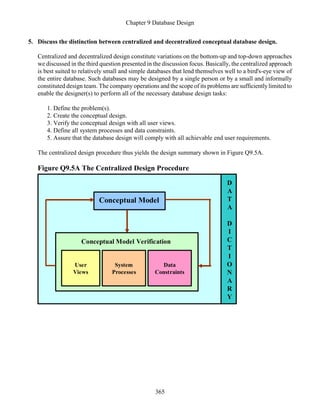
5. Discuss the distinction between centralized and decentralized conceptual database design.
Centralized and decentralized design constitute variations on the bottom-up and top-down approaches
we discussed in the third question presented in the discussion focus. Basically, the centralized approach
is best suited to relatively small and simple databases that lend themselves well to a bird's-eye view of
the entire database. Such databases may be designed by a single person or by a small and informally
constituted design team. The company operations and the scope of its problems are sufficientlylimited to
enable the designer(s) to perform all of the necessary database design tasks:
1. Define the problem(s).
2. Create the conceptual design.
3. Verify the conceptual design with all user views.
4. Define all system processes and data constraints.
5. Assure that the database design will comply with all achievable end user requirements.
The centralized design procedure thus yields the design summary shown in Figure Q9.5A.
Figure Q9.5A The Centralized Design Procedure
Conceptual Model
Data
Constraints
System
Processes
User
Views
Conceptual Model Verification
D
A
T
A
D
I
C
T
I
O
N
A
R
Y
Chapter 9 Database Design
366
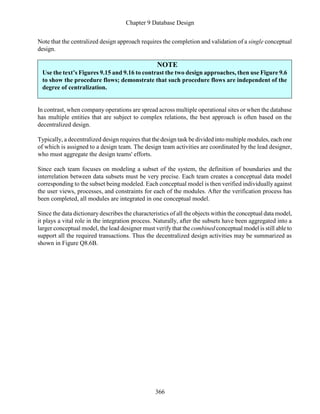
Note that the centralized design approach requires the completion and validation of a single conceptual
design.
NOTE
Use the text’s Figures 9.15 and 9.16 to contrast the two design approaches, then use Figure 9.6
to show the procedure flows; demonstrate that such procedure flows are independent of the
degree of centralization.
In contrast, when company operations are spread across multiple operational sites or when the database
has multiple entities that are subject to complex relations, the best approach is often based on the
decentralized design.
Typically, a decentralized design requires that the design task be divided into multiple modules, each one
of which is assigned to a design team. The design team activities are coordinated by the lead designer,
who must aggregate the design teams' efforts.
Since each team focuses on modeling a subset of the system, the definition of boundaries and the
interrelation between data subsets must be very precise. Each team creates a conceptual data model
corresponding to the subset being modeled. Each conceptual model is then verified individually against
the user views, processes, and constraints for each of the modules. After the verification process has
been completed, all modules are integrated in one conceptual model.
Since the data dictionary describes the characteristics of all the objects within the conceptual data model,
it plays a vital role in the integration process. Naturally, after the subsets have been aggregated into a
larger conceptual model, the lead designer must verify that the combined conceptual model is still able to
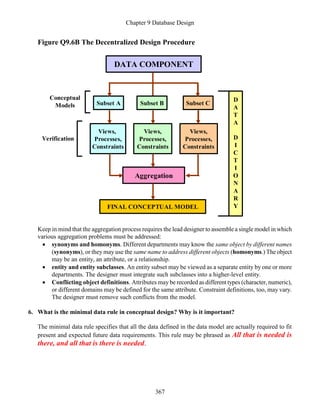
support all the required transactions. Thus the decentralized design activities may be summarized as
shown in Figure Q8.6B.
Chapter 9 Database Design
367
Figure Q9.6B The Decentralized Design Procedure
D
A
T
A
D
I
C
T
I
O
N
A
R
Y
Subset A
DATA COMPONENT
Views,
Processes,
Constraints
Views,
Processes,
Constraints
Views,
Processes,
Constraints
Aggregation
Subset B Subset C
Verification
Conceptual
Models
FINAL CONCEPTUAL MODEL
Keep in mind that the aggregation process requires the lead designer to assemble a single model in which
various aggregation problems must be addressed:
 synonyms and homonyms. Different departments may know the same object by different names
(synonyms), or they may use the same name to address different objects (homonyms.) The object
may be an entity, an attribute, or a relationship.
 entity and entity subclasses. An entity subset may be viewed as a separate entity by one or more
departments. The designer must integrate such subclasses into a higher-level entity.
 Conflicting object definitions. Attributes may be recorded as different types (character, numeric),
or different domains may be defined for the same attribute. Constraint definitions, too, may vary.
The designer must remove such conflicts from the model.
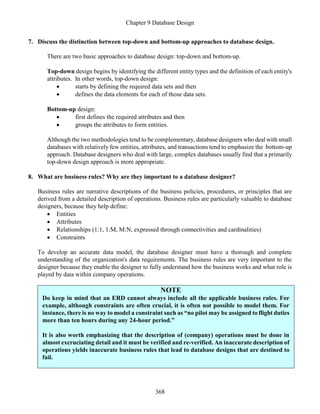
6. What is the minimal data rule in conceptual design? Why is it important?
The minimal data rule specifies that all the data defined in the data model are actually required to fit
present and expected future data requirements. This rule may be phrased as All that is needed is
there, and all that is there is needed.
Chapter 9 Database Design
368
7. Discuss the distinction between top-down and bottom-up approaches to database design.
There are two basic approaches to database design: top-down and bottom-up.
Top-down design begins by identifying the different entity types and the definition of each entity's
attributes. In other words, top-down design:
 starts by defining the required data sets and then
 defines the data elements for each of those data sets.
Bottom-up design:
 first defines the required attributes and then
 groups the attributes to form entities.
Although the two methodologies tend to be complementary, database designers who deal with small
databases with relatively few entities, attributes, and transactions tend to emphasize the bottom-up
approach. Database designers who deal with large, complex databases usually find that a primarily
top-down design approach is more appropriate.
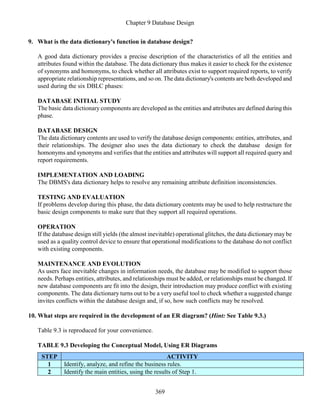
8. What are business rules? Why are they important to a database designer?
Business rules are narrative descriptions of the business policies, procedures, or principles that are
derived from a detailed description of operations. Business rules are particularly valuable to database
designers, because they help define:
 Entities
 Attributes
 Relationships (1:1, 1:M, M:N, expressed through connectivities and cardinalities)
 Constraints
To develop an accurate data model, the database designer must have a thorough and complete
understanding of the organization's data requirements. The business rules are very important to the
designer because they enable the designer to fully understand how the business works and what role is
played by data within company operations.
NOTE
Do keep in mind that an ERD cannot always include all the applicable business rules. For
example, although constraints are often crucial, it is often not possible to model them. For
instance, there is no way to model a constraint such as “no pilot may be assigned to flight duties
more than ten hours during any 24-hour period.”
It is also worth emphasizing that the description of (company) operations must be done in
almost excruciating detail and it must be verified and re-verified. An inaccurate description of
operations yields inaccurate business rules that lead to database designs that are destined to
fail.
Chapter 9 Database Design
369
9. What is the data dictionary's function in database design?
A good data dictionary provides a precise description of the characteristics of all the entities and
attributes found within the database. The data dictionary thus makes it easier to check for the existence
of synonyms and homonyms, to check whether all attributes exist to support required reports, to verify
appropriate relationship representations, and so on. The data dictionary's contents are both developed and
used during the six DBLC phases:
DATABASE INITIAL STUDY
The basic data dictionary components are developed as the entities and attributes are defined during this
phase.
DATABASE DESIGN
The data dictionary contents are used to verify the database design components: entities, attributes, and
their relationships. The designer also uses the data dictionary to check the database design for
homonyms and synonyms and verifies that the entities and attributes will support all required query and
report requirements.
IMPLEMENTATION AND LOADING
The DBMS's data dictionary helps to resolve any remaining attribute definition inconsistencies.
TESTING AND EVALUATION
If problems develop during this phase, the data dictionary contents may be used to help restructure the
basic design components to make sure that they support all required operations.
OPERATION
If the database design still yields (the almost inevitable) operational glitches, the data dictionary may be
used as a quality control device to ensure that operational modifications to the database do not conflict
with existing components.
MAINTENANCE AND EVOLUTION
As users face inevitable changes in information needs, the database may be modified to support those
needs. Perhaps entities, attributes, and relationships must be added, or relationships must be changed. If
new database components are fit into the design, their introduction may produce conflict with existing
components. The data dictionary turns out to be a very useful tool to check whether a suggested change
invites conflicts within the database design and, if so, how such conflicts may be resolved.
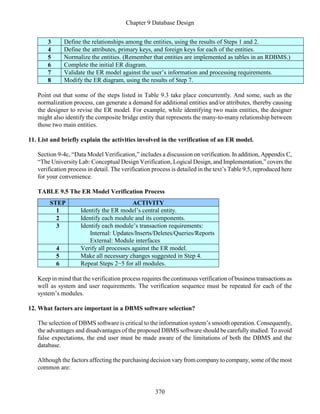
10. What steps are required in the development of an ER diagram? (Hint: See Table 9.3.)
Table 9.3 is reproduced for your convenience.
TABLE 9.3 Developing the Conceptual Model, Using ER Diagrams
STEP ACTIVITY
1 Identify, analyze, and refine the business rules.
2 Identify the main entities, using the results of Step 1.
Chapter 9 Database Design
370
3 Define the relationships among the entities, using the results of Steps 1 and 2.
4 Define the attributes, primary keys, and foreign keys for each of the entities.
5 Normalize the entities. (Remember that entities are implemented as tables in an RDBMS.)
6 Complete the initial ER diagram.
7 Validate the ER model against the user’s information and processing requirements.
8 Modify the ER diagram, using the results of Step 7.
Point out that some of the steps listed in Table 9.3 take place concurrently. And some, such as the
normalization process, can generate a demand for additional entities and/or attributes, thereby causing
the designer to revise the ER model. For example, while identifying two main entities, the designer
might also identify the composite bridge entity that represents the many-to-many relationship between
those two main entities.
11. List and briefly explain the activities involved in the verification of an ER model.
Section 9-4c, “Data Model Verification,” includes a discussion on verification. In addition, Appendix C,
“The University Lab: Conceptual Design Verification, Logical Design, and Implementation,” covers the
verification process in detail. The verification process is detailed in the text’s Table 9.5, reproduced here
for your convenience.
TABLE 9.5 The ER Model Verification Process
STEP ACTIVITY
1 Identify the ER model’s central entity.
2 Identify each module and its components.
3 Identify each module’s transaction requirements:
Internal: Updates/Inserts/Deletes/Queries/Reports
External: Module interfaces
4 Verify all processes against the ER model.
5 Make all necessary changes suggested in Step 4.
6 Repeat Steps 2−5 for all modules.
Keep in mind that the verification process requires the continuous verification of business transactions as
well as system and user requirements. The verification sequence must be repeated for each of the
system’s modules.
12. What factors are important in a DBMS software selection?
The selection of DBMS software is critical to the information system’s smooth operation. Consequently,
the advantages and disadvantages of the proposed DBMS software should be carefullystudied. To avoid
false expectations, the end user must be made aware of the limitations of both the DBMS and the
database.
Although the factors affecting the purchasing decision varyfrom companyto company, some of the most
common are:
Chapter 9 Database Design
371
 Cost. Purchase, maintenance, operational, license, installation, training, and conversion costs.
 DBMS features and tools. Some database software includes a variety of tools that facilitate the
application development task. For example, the availability of query by example (QBE), screen
painters, report generators, application generators, data dictionaries, and so on, helps to create a
more pleasant work environment for both the end user and the application programmer. Database
administrator facilities, query facilities, ease of use, performance, security, concurrencycontrol,
transaction processing, and third-party support also influence DBMS software selection.
 Underlying model. Hierarchical, network, relational, object/relational, or object.
 Portability. Across platforms, systems, and languages.
 DBMS hardware requirements. Processor(s), RAM, disk space, and so on.
13. List and briefly explain the four steps performed during the logical design stage.
1) Map conceptual model to logical model components.
In this step, the conceptual model is converted into a set of table definitions including table names,
column names, primary keys, and foreign keys to implement the entities and relationships specified in
the conceptual design.
2) Validate the logical model using normalization.
It is possible for normalization issues to be discovered during the process of mapping the conceptual
model to logical model components. Therefore, it is appropriate at this stage to validate that all of the
table definitions from the previous step conform to the appropriate normalization rules.
3) Validate logical model integrity constraints.
This step involves the conversion of attribute domains and constraints into constraint definitions that
can be implemented within the DBMS to enforce those domains. Also, entityand referential integrity
constraints are validated. Views may be defined to enforce security constraints.
4) Validate the logical model against the user requirements.
The final step of this stage is to ensure that all definitions created throughout the logical model are
validated against the users' data, transaction, and security requirements. Every component (table,
view, constraint, etc.) of the logical model must be associated with satisfying the user requirements,
and every user requirement should be addressed by the model components.
14. List and briefly explain the three steps performed during the physical design stage.
1) Define data storage organization.
Based on estimates of the data volume and growth, this step involves the determination of the
physical location and physical organization for each table. Also, which columns will be indexed and
the type of indexes to be used are determined. Finally, the type of implementation to be used for each
view is decided.
2) Define integrity and security measures.
This step involves creating users and security groups, and then assigning privileges and controls to
those users and group.
3) Determine performance measurements.
The actual performance of the physical database implementation must be measured and assessed for
compliance with user performance requirements.
Visit https://testbankdead.com
now to explore a rich
collection of testbank,
solution manual and enjoy
exciting offers!
Chapter 9 Database Design
372
15. What three levels of backup may be used in database recovery management? Briefly describe
what each of those three backup levels does.
A full backup of the database creates a backup copy of all database objects in their entirety.
A differential backup of the database creates a backup of onlythose database objects that have changed
since the last full backup.
A transaction log backup does not create a backup of database objects, but makes a backup of the log
of changes that have been applied to the database objects since the last backup.
Problem Solutions
1. The ABC Car Service & Repair Centers are owned by the SILENT car dealer; ABC services and
repairs only SILENT cars. Three ABC Car Service & Repair Centers provide service and repair
for the entire state.
Each of the three centers is independently managed and operated by a shop manager, a
receptionist, and at least eight mechanics. Each center maintains a fully stocked parts inventory.
Each center also maintains a manual file system in which each car’s maintenance history is kept:
repairs made, parts used, costs, service dates, owner, and so on. Files are also kept to track
inventory, purchasing, billing, employees’ hours, and payroll.
You have been contacted by the manager of one of the centers to design and implement a
computerized system. Given the preceding information, do the following:
a. Indicate the most appropriate sequence of activities by labeling each of the following steps in
the correct order. (For example, if you think that “Load the database.” is the appropriate first
step, label it “1.”)
____ Normalize the conceptual model.
____ Obtain a general description of company operations.
____ Load the database.
____ Create a description of each system process.
____ Test the system.
____ Draw a data flow diagram and system flowcharts.
____ Create a conceptual model, using ER diagrams.
____ Create the application programs.
____ Interview the mechanics.
____ Create the file (table) structures.
____ Interview the shop manager.
The answer to this question may vary slightly from one designer to the next, depending on the selected
design methodology and even on personal designer preferences. Yet, in spite of such differences, it is
possible to develop a common design methodology to permit the development of a basic
decision-making process and the analysis required in designing an information system.
Chapter 9 Database Design
373
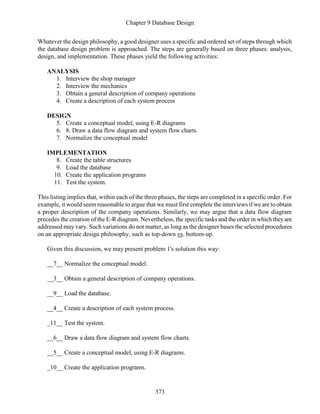
Whatever the design philosophy, a good designer uses a specific and ordered set of steps through which
the database design problem is approached. The steps are generally based on three phases: analysis,
design, and implementation. These phases yield the following activities:
ANALYSIS
1. Interview the shop manager
2. Interview the mechanics
3. Obtain a general description of company operations
4. Create a description of each system process
DESIGN
5. Create a conceptual model, using E-R diagrams
6. 8. Draw a data flow diagram and system flow charts
7. Normalize the conceptual model
IMPLEMENTATION
8. Create the table structures
9. Load the database
10. Create the application programs
11. Test the system.
This listing implies that, within each of the three phases, the steps are completed in a specific order. For
example, it would seem reasonable to argue that we must first complete the interviews if we are to obtain
a proper description of the company operations. Similarly, we may argue that a data flow diagram
precedes the creation of the E-R diagram. Nevertheless, the specific tasks and the order in which theyare
addressed may vary. Such variations do not matter, as long as the designer bases the selected procedures
on an appropriate design philosophy, such as top-down vs. bottom-up.
Given this discussion, we may present problem 1's solution this way:
__7__ Normalize the conceptual model.
__3__ Obtain a general description of company operations.
__9__ Load the database.
__4__ Create a description of each system process.
_11__ Test the system.
__6__ Draw a data flow diagram and system flow charts.
__5__ Create a conceptual model, using E-R diagrams.
_10__ Create the application programs.
Chapter 9 Database Design
374
__2__ Interview the mechanics.
__8__ Create the file (table) structures.
__1__ Interview the shop manager.
Chapter 9 Database Design
375
b. Describe the various modules that you believe the system should include.
This question may be addressed in several ways. We suggest the following approach to develop a
system composed of four main modules: Inventory, Payroll, Work order, and Customer.
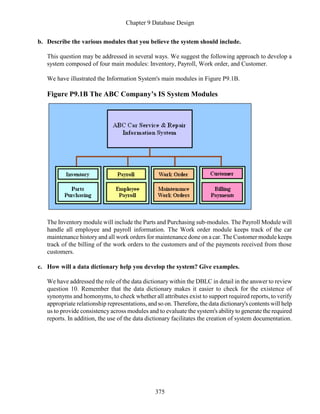
We have illustrated the Information System's main modules in Figure P9.1B.
Figure P9.1B The ABC Company’s IS System Modules
The Inventory module will include the Parts and Purchasing sub-modules. The Payroll Module will
handle all employee and payroll information. The Work order module keeps track of the car
maintenance history and all work orders for maintenance done on a car. The Customer module keeps
track of the billing of the work orders to the customers and of the payments received from those
customers.
c. How will a data dictionary help you develop the system? Give examples.
We have addressed the role of the data dictionary within the DBLC in detail in the answer to review
question 10. Remember that the data dictionary makes it easier to check for the existence of
synonyms and homonyms, to check whether all attributes exist to support required reports, to verify
appropriate relationship representations, and so on. Therefore, the data dictionary's contents will help
us to provide consistency across modules and to evaluate the system's abilityto generate the required
reports. In addition, the use of the data dictionary facilitates the creation of system documentation.
Chapter 9 Database Design
376
d. What general (system) recommendations might you make to the shop manager? (For example.
if the system will be integrated, what modules will be integrated? What benefits would be
derived from such an integrated system? Include several general recommendations.)
The designer's job is to provide solutions to the main problems found during the initial study.
Clearly, any system is subject to both internal and external constraints. For example, we can safely
assume that the owner of the ABC Car Service and Repair Center has a time frame in mind, not to
mention a spending limitation. As is true in all design work, the designer and the business owner
must prioritize the modules and develop those that yield the greatest benefit within the stated time
and development budget constraints.
Keep in mind that it is always useful to develop a modular system that provides for future
enhancement and expansion. Suppose, for example, that the ABC Car Service & Repair company
management decides to integrate all of its service stations in the state in order to provide better
statewide service. Such integration is likely to yield many benefits: The car history of each car will
be available to any station for cars that have been serviced in more than one location; the inventory
of parts will be on-line, thus allowing parts orders to be placed between service stations; mechanics
can better share tips concerning the solution to car maintenance problems, and so on.
e. What is the best approach to conceptual database design? Why?
Given the nature of this business, the best way to produce this conceptual database design would be
to use a centralized and top-down approach. Keep in mind that the designer must keep the design
sufficiently flexible to make sure that it can accommodate any future integration of this system with
the other service stations in the state.
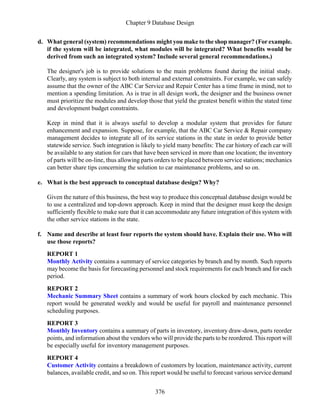
f. Name and describe at least four reports the system should have. Explain their use. Who will
use those reports?
REPORT 1
Monthly Activity contains a summary of service categories by branch and by month. Such reports
may become the basis for forecasting personnel and stock requirements for each branch and for each
period.
REPORT 2
Mechanic Summary Sheet contains a summary of work hours clocked by each mechanic. This
report would be generated weekly and would be useful for payroll and maintenance personnel
scheduling purposes.
REPORT 3
Monthly Inventory contains a summary of parts in inventory, inventory draw-down, parts reorder
points, and information about the vendors who will provide the parts to be reordered. This report will
be especially useful for inventory management purposes.
REPORT 4
Customer Activity contains a breakdown of customers by location, maintenance activity, current
balances, available credit, and so on. This report would be useful to forecast various service demand
Random documents with unrelated
content Scribd suggests to you:
harmonica."
"Really and truly!"
"Yes," answered Dean, laughing. "I don't wonder you are
surprised. But here, give away your papers to that newsboy across
the street and come to my hotel."
"But I haven't any money."
"I have enough for both."
Dean had the pleasure of restoring Guy to his family, who
received him kindly. It is safe to say that he will never again go West
in quest of Indians.
A little before noon on Saturday Dean reached Waterford, and
walked home. On the way he met Brandon Bates.
"Halloa, so you're back!" said Brandon, eying him curiously.
"Yes, Brandon. Thank you for your warm welcome."
"I didn't mean to give you a warm welcome," said Brandon,
ungraciously.
"I beg your pardon; I made a mistake."
"I suppose you came home without a cent."
"You're mistaken. I've got over a dollar in my pocket."
"What's a dollar?" sneered Brandon.
"It isn't much, to be sure."
"You won't hear very good news at your uncle's."
"Why? Is he sick—or my aunt?" asked Dean uneasily.
"No, but he can't pay the mortgage, and my father's going to
take possession of the place."
"Oh, is that all?" said Dean, relieved.
"I should think it was enough."
"Oh, perhaps your father will think better of it, as I am at home
now and can help Uncle Adin pay it off."
"What can you do?" asked Brandon, mockingly.
"That's the great question. However, I'm in a hurry to get home,
and must leave you. You are kind to be so much interested in me,
Brandon."
"I'm not interested in you at all," returned Brandon, tartly.
Dean laughed and passed on.
"That boy's as impudent as ever," soliloquized Brandon. "He'll
feel differently on Monday."
In the joy of seeing Dean again his uncle and aunt lost sight for
a time of their troubles, but after a while Adin Dunham said gravely,
"It's well you came home as you did, Dean, for the old home is
about to pass from me."
"How is that, Uncle Adin?"
"Squire Bates is going to foreclose the mortgage. He offers to
buy the place and give me eight hundred dollars over and above
what I owe him."
"Of course you declined?"
"It will do no good. I must yield to necessity."
"Squire Bates shall never have the place," said Dean, resolutely.
"Who will prevent it?"
"I will."
"But, Dean, what power have you? The squire is firmly
resolved."
"So am I."
"But——"
"Uncle Adin, ask me no questions, but rest easy in the thought
that you won't lose your home. Leave the matter in my hands. That
is all you need to do."
"Sarah, what does the boy mean?"
"He means something, Adin. We may as well leave it in his
hands as he asks."
"Very well, I don't know as he can do any harm—or good."
"That remains to be seen, uncle."
Dean went to church on Sunday, and received a warm welcome
from nearly all the congregation, for he was popular with those of all
ages. He wore a smiling, untroubled look which puzzled Squire Bates
and Brandon.
"Does he know that I am going to foreclose the mortgage?"
asked the squire of Brandon.
"Yes, for I told him."
"It seems strange that he should be so cheerful."
"He won't be—to-morrow."
"No, I apprehend not."
When Squire Bates called at the carpenter's modest home Dean
opened the door, and invited him into the sitting-room, where the
two found themselves alone.
"I want to see your uncle," said the squire.
"If it's about the mortgage, I will attend to that matter."
"You—a boy?"
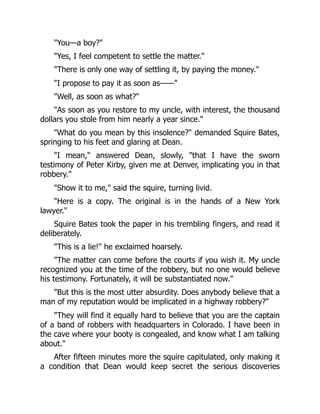
"Yes, I feel competent to settle the matter."
"There is only one way of settling it, by paying the money."
"I propose to pay it as soon as——"
"Well, as soon as what?"
"As soon as you restore to my uncle, with interest, the thousand
dollars you stole from him nearly a year since."
"What do you mean by this insolence?" demanded Squire Bates,
springing to his feet and glaring at Dean.
"I mean," answered Dean, slowly, "that I have the sworn
testimony of Peter Kirby, given me at Denver, implicating you in that
robbery."
"Show it to me," said the squire, turning livid.
"Here is a copy. The original is in the hands of a New York
lawyer."
Squire Bates took the paper in his trembling fingers, and read it
deliberately.
"This is a lie!" he exclaimed hoarsely.
"The matter can come before the courts if you wish it. My uncle
recognized you at the time of the robbery, but no one would believe
his testimony. Fortunately, it will be substantiated now."
"But this is the most utter absurdity. Does anybody believe that a
man of my reputation would be implicated in a highway robbery?"
"They will find it equally hard to believe that you are the captain
of a band of robbers with headquarters in Colorado. I have been in
the cave where your booty is congealed, and know what I am talking
about."
After fifteen minutes more the squire capitulated, only making it
a condition that Dean would keep secret the serious discoveries
which he had made.
"I will do so, unless I am summoned to testify in court," said
Dean.
"Leave me to explain matters to your uncle," said the squire.
Dean called the carpenter into the room.
"Mr. Dunham," said Squire Bates with his old suavity, "I have
arranged matters satisfactorily with your nephew. He has recovered
the large sum of which you were robbed a year ago, and paid the
mortgage, or is prepared to do so. Dean, if you will accompany me
to my office we will arrange this affair."
"But, who stole the money?" asked Adin Dunham, bewildered.
"I promised not to tell," said Dean. "Was I right?"
"Yes, yes, as long as you got the money back."
Dean received the mortgage back canceled, and something over
two hundred dollars besides, which he placed in his uncle's hands.
Adin Dunham looked ten years younger, and his face was radiant.
His joy was increased when Dean told him how he had prospered
out West, and gave his aunt five hundred dollars, reserving for
himself the remainder of the thousand which he had brought home.
Two months later Dean returned to Denver to find that his lots
had considerably increased in value. Gradually he sold them off for
twice what he paid, and entered business in the Queen City of
Colorado.
Squire Bates soon removed from Waterford, and the villagers
have heard nothing of him since. But Dean could tell them that his
connection with the band of robbers was discovered, and that he is
upon conviction serving a protracted term in a Western prison. What
has become of Brandon or his mother is not known to the general
public, but it is less than a year since Dean, while leaving the Denver
post-office, was accosted by a shabbily dressed young man who
asked for assistance.
"Are you not Brandon Bates?" asked Dean after a brief glance.
Brandon was about to hurry away, but Dean detained him.
"Don't go," he said. "I am glad to help you," and he placed two gold
eagles in the hands of the astonished Brandon.
"Come to me again if you are in need," said Dean in a friendly
manner.
"Thank you! I didn't expect this from you," said Brandon. "I
thought you would triumph over me."
"If I did I should show myself unworthy of the good fortune that
has come to me. I wish you good luck."
That was the last Dean has seen of Brandon. Let us hope that
he will deserve good luck, and attain it.
Adin Dunham still lives, happy in the companionship of his good
wife, and the prosperity of his nephew. But there is one thing that
puzzles him. He has never been able to solve The Waterford Mystery.
THE END.
T
THE CREAM OF JUVENILE FICTION
THE BOYS' OWN
LIBRARY
A Selection of the Best Books for Boys by the
Most Popular Authors
HE titles in this splendid juvenile series have been selected with
care, and as a result all the stories can be relied upon for their
excellence. They are bright and sparkling; not over-burdened with
lengthy descriptions, but brimful of adventure from the first page to
the last—in fact they are just the kind of yarns that appeal strongly
to the healthy boy who is fond of thrilling exploits and deeds of
heroism. Among the authors whose names are included in the Boys'
Own Library are Horatio Alger, Jr., Edward S. Ellis, James Otis, Capt.
Ralph Bonehill, Burt L. Standish, Gilbert Patten and Frank H.
Converse.
SPECIAL FEATURES OF THE
BOYS' OWN LIBRARY
All the books in this series are copyrighted, printed on good
paper, large type, illustrated, printed wrappers, handsome cloth
covers stamped in inks and gold—fifteen special cover designs.
146 Titles—Price, per Volume, 75 cents
For sale by all booksellers, or sent, postpaid, on receipt of price
by the publisher,
DAVID McKAY,
610 SO. WASHINGTON SQUARE, PHILADELPHIA, PA.
HORATIO ALGER, Jr.
One of the best known and most popular writers. Good, clean,
healthy stories for the American Boy.
Adventures of a Telegraph Boy
Dean Dunham
Erie Train Boy, The
Five Hundred Dollar Check
From Canal Boy to President
From Farm Boy to Senator
Backwoods Boy, The
Mark Stanton
Ned Newton
New York Boy
Tom Brace
Tom Tracy
Walter Griffith
Young Acrobat
C. B. ASHLEY.
One of the best stories ever written on hunting, trapping and
adventure in the West, after the Custer Massacre.
Gilbert, the Boy Trapper
ANNIE ASHMORE.
A splendid story, recording the adventures of a boy with
smugglers.
Smuggler's Cave, The
CAPT. RALPH BONEHILL.
Capt. Bonehill is in the very rank as an author of boys' stories.
These are two of his best works.
Neka, the Boy Conjurer
Tour of the Zero Club
WALTER F. BRUNS.
An excellent story of adventure in the celebrated Sunk Lands of
Missouri and Kansas.
In the Sunk Lands
FRANK H. CONVERSE.
This writer has established a splendid reputation as a boys'
author, and although his books usually command $1.25 per volume,
we offer the following at a more popular price.
Gold of Flat Top Mountain
Happy-Go-Lucky Jack
Heir to a Million
In Search of An Unknown Race
In Southern Seas
Mystery of a Diamond
That Treasure
Voyage to the Gold Coast
HARRY COLLINGWOOD.
One of England's most successful writers of stories for boys. His
best story is
Pirate Island
GEORGE H. COOMER.
Two books we highly recommend. One is a splendid story of
adventure at sea, when American ships were in every port in the
world, and the other tells of adventures while the first railway in the
Andes Mountains was being built.
Boys in the Forecastle
Old Man of the Mountain
WILLIAM DALTON.
Three stories by one of the very greatest writers for boys. The
stories deal with boys' adventures in India, China and Abyssinia.
These books are strongly recommended for boys' reading, as they
contain a large amount of historical information.
Tiger Prince
War Tiger
White Elephant
EDWARD S. ELLIS.
These books are considered the best works this well-known
writer ever produced. No better reading for bright young Americans.
Arthur Helmuth
Check No. 2134
From Tent to White House
Perils of the Jungle
On the Trail of Geronimo
White Mustang
GEORGE MANVILLE FENN.
For the past fifty years Mr. Fenn has been writing books for boys
and popular fiction. His books are justly popular throughout the
English-speaking world. We publish the following select list of his
boys' books, which we consider the best he ever wrote.
Commodore Junk
Dingo Boys
Golden Magnet
Grand Chaco
Weathercock
ENSIGN CLARKE FITCH, U. S. N.
A graduate of the U. S. Naval Academy at Annapolis, and
thoroughly familiar with all naval matters. Mr. Fitch has devoted
himself to literature, and has written a series of books for boys that
every young American should read. His stories are full of very
interesting information about the navy, training ships, etc.
Bound for Annapolis
Clif, the Naval Cadet
Cruise of the Training Ship
From Port to Port
Strange Cruise, A
WILLIAM MURRAY GRAYDON.
An author of world-wide popularity. Mr. Graydon is essentially a
friend of young people, and we offer herewith ten of his best works,
wherein he relates a great diversity of interesting adventures in
various parts of the world, combined with accurate historical data.
Butcher of Cawnpore, The
Camp in the Snow, The
Campaigning with Braddock
Cryptogram, The
From Lake to Wilderness
In Barracks and Wigwam
In Fort and Prison
Jungles and Traitors
Rajah's Fortress, The
White King of Africa, The
LIEUT. FREDERICK GARRISON, U. S. A.
Every American boy takes a keen interest in the affairs of West
Point. No more capable writer on this popular subject could be found
than Lieut. Garrison, who vividly describes the life, adventures and
unique incidents that have occurred in that great institution—in
these famous West Point stories.
Off for West Point
Cadet's Honor, A
On Guard
West Point Treasure, The
West Point Rivals, The
HEADON HILL.
The hunt for gold has always been a popular subject for
consideration, and Mr. Hill has added a splendid story on the subject
in this romance of the Klondyke.
Spectre Gold
HENRY HARRISON LEWIS.
Mr. Lewis is a graduate of the Naval Academy at Annapolis, and
has written a great many books for boys. Among his best works are
the following titles—the subjects include a vast series of adventures
in all parts of the world. The historical data is correct, and they
should be read by all boys, for the excellent information they
contain.
Centreboard Jim
King of the Island
Midshipman Merrill
Ensign Merrill
Sword and Pen
Valley of Mystery, The
Yankee Boys in Japan
LIEUT. LIONEL LOUNSBERRY.
A series of books embracing many adventures under our famous
naval commanders, and with our army during the War of 1812 and
the Civil War. Founded on sound history, these books are written for
boys, with the idea of combining pleasure with profit; to cultivate a
fondness for study—especially of what has been accomplished by
our army and navy.
Cadet Kit Carey
Captain Carey
Kit Carey's Protegé
Lieut. Carey's Luck
Out With Commodore Decatur
Randy, the Pilot
Tom Truxton's School Days
Tom Truxton's Ocean Trip
Treasure of the Golden Crater
Won at West Point
BROOKS McCORMICK.
Four splendid books of adventure on sea and land, by this well-
known writer for boys.
Giant Islanders, The
How He Won
Nature's Young Nobleman
Rival Battalions
WALTER MORRIS.
This charming story contains thirty-two chapters of just the sort
of school life that charms the boy readers.
Bob Porter at Lakeview Academy
STANLEY NORRIS.
Mr. Norris is without a rival as a writer of "Circus Stories" for
boys. These four books are full of thrilling adventures, but good,
wholesome reading for young Americans.
Phil, the Showman
Young Showman's Rivals, The
Young Showman's Pluck, The
Young Showman's Triumph
LIEUT. JAMES K. ORTON.
When a boy has read one of Lieut. Orton's books, it requires no
urging to induce him to read the others. Not a dull page in any of
them.
Beach Boy Joe
Last Chance Mine
Secret Chart, The
Tom Havens with the White Squadron
JAMES OTIS.
Mr. Otis is known by nearly every American boy, and needs no
introduction here. The following copyrights are among his best:
Chased Through Norway
Inland Waterways
Unprovoked Mutiny
Wheeling for Fortune
Reuben Green's Adventures at Yale
GILBERT PATTEN.
Mr. Patten has had the distinction of having his books adopted
by the U. S. Government for all naval libraries on board our war
ships. While aiming to avoid the extravagant and sensational, the
stories contain enough thrilling incidents to please the lad who loves
action and adventure. In the Rockspur stories the description of their
Baseball and Football Games and other contests with rival clubs and
teams make very exciting and absorbing reading; and few boys with
warm blood in their veins, having once begun the perusal of one of
these books, will willingly lay it down till it is finished.
Boy Boomers
Boy Cattle King
Boy from the West
Don Kirke's Mine
Jud and Joe
Rockspur Nine, The
Rockspur Eleven, The
Rockspur Rivals, The
ST. GEORGE RATHBORNE.
Mr. Rathborne's stories for boys have the peculiar charm of
dealing with localities and conditions with which he is thoroughly
familiar. The scenes of these excellent stories are along the Florida
coast and on the western prairies.
Canoe and Camp Fire
Paddling Under Palmettos
Rival Canoe Boys
Sunset Ranch
Chums of the Prairie
Young Range Riders
Gulf Cruisers
Shifting Winds
ARTHUR SEWELL.
An American story by an American author. It relates how a
Yankee boy overcame many obstacles in school and out. Thoroughly
interesting from start to finish.
Gay Dashleigh's Academy Days
CAPT. DAVID SOUTHWICK.
An exceptionally good story of frontier life among the Indians in
the far West, daring the early settlement period.
Jack Wheeler
The Famous Frank Merriwell Stories.
BURT L. STANDISH.
No modern series of tales for boys and youths has met with
anything like the cordial reception and popularity accorded to the
Frank Merriwell Stories. There must be a reason for this and there is.
Frank Merriwell, as portrayed by the author, is a jolly whole-souled,
honest, courageous American lad, who appeals to the hearts of the
boys. He has no bad habits, and his manliness inculcates the idea
that it is not necessary for a boy to indulge in petty vices to be a
hero. Frank Merriwell's example is a shining light for every ambitious
lad to follow. Six volumes now ready:
Frank Merriwell's School Days
Frank Merriwell's Chums
Frank Merriwell's Foes
Frank Merriwell's Trip West
Frank Merriwell Down South
Frank Merriwell's Bravery
Frank Merriwell's Hunting Tour
Frank Merriwell's Races
Frank Merriwell's Sports Afield
Frank Merriwell at Yale
VICTOR ST. CLAIR.
These books are full of good, clean adventure, thrilling enough
to please the full-blooded wide-awake boy, yet containing nothing to
which there can be any objection from those who are careful as to
the kind of books they put into the hands of the young.
Cast Away in the Jungle
Comrades Under Castro
For Home and Honor
From Switch to Lever
Little Snap, the Post Boy
Zig-Zag, the Boy Conjurer
Zip, the Acrobat
MATTHEW WHITE, JR.
Good, healthy, strong books for the American lad. No more
interesting books for the young appear on our lists.
Adventures of a Young Athlete
Eric Dane
Guy Hammersley
My Mysterious Fortune
Tour of a Private Car
Young Editor, The
ARTHUR M. WINFIELD.
One of the most popular authors of boys' books. Here are three
of his best.
Mark Dale's Stage Venture
Young Bank Clerk, The
Young Bridge Tender, The
GAYLE WINTERTON.
This very interesting story relates the trials and triumphs of a
Young American Actor, including the solution of a very puzzling
mystery.
Young Actor, The
ERNEST A. YOUNG.
This book is not a treatise on sports, as the title would indicate,
but relates a series of thrilling adventures among boy campers in the
woods of Maine.
Boats, Bats and Bicycles
DAVID McKAY, Publisher, Philadelphia.
Transcriber's Note
Obvious punctuation and spelling errors have been
corrected.
*** END OF THE PROJECT GUTENBERG EBOOK DEAN DUNHAM;
OR, THE WATERFORD MYSTERY ***
Updated editions will replace the previous one—the old editions will
be renamed.
Creating the works from print editions not protected by U.S.
copyright law means that no one owns a United States copyright in
these works, so the Foundation (and you!) can copy and distribute it
in the United States without permission and without paying
copyright royalties. Special rules, set forth in the General Terms of
Use part of this license, apply to copying and distributing Project
Gutenberg™ electronic works to protect the PROJECT GUTENBERG™
concept and trademark. Project Gutenberg is a registered trademark,
and may not be used if you charge for an eBook, except by following
the terms of the trademark license, including paying royalties for use
of the Project Gutenberg trademark. If you do not charge anything
for copies of this eBook, complying with the trademark license is
very easy. You may use this eBook for nearly any purpose such as
creation of derivative works, reports, performances and research.
Project Gutenberg eBooks may be modified and printed and given
away—you may do practically ANYTHING in the United States with
eBooks not protected by U.S. copyright law. Redistribution is subject
to the trademark license, especially commercial redistribution.
START: FULL LICENSE
THE FULL PROJECT GUTENBERG LICENSE
PLEASE READ THIS BEFORE YOU DISTRIBUTE OR USE THIS WORK
To protect the Project Gutenberg™ mission of promoting the free
distribution of electronic works, by using or distributing this work (or
any other work associated in any way with the phrase “Project
Gutenberg”), you agree to comply with all the terms of the Full
Project Gutenberg™ License available with this file or online at
www.gutenberg.org/license.
Section 1. General Terms of Use and
Redistributing Project Gutenberg™
electronic works
1.A. By reading or using any part of this Project Gutenberg™
electronic work, you indicate that you have read, understand, agree
to and accept all the terms of this license and intellectual property
(trademark/copyright) agreement. If you do not agree to abide by all
the terms of this agreement, you must cease using and return or
destroy all copies of Project Gutenberg™ electronic works in your
possession. If you paid a fee for obtaining a copy of or access to a
Project Gutenberg™ electronic work and you do not agree to be
bound by the terms of this agreement, you may obtain a refund
from the person or entity to whom you paid the fee as set forth in
paragraph 1.E.8.
1.B. “Project Gutenberg” is a registered trademark. It may only be
used on or associated in any way with an electronic work by people
who agree to be bound by the terms of this agreement. There are a
few things that you can do with most Project Gutenberg™ electronic
works even without complying with the full terms of this agreement.
See paragraph 1.C below. There are a lot of things you can do with
Project Gutenberg™ electronic works if you follow the terms of this
agreement and help preserve free future access to Project
Gutenberg™ electronic works. See paragraph 1.E below.
1.C. The Project Gutenberg Literary Archive Foundation (“the
Foundation” or PGLAF), owns a compilation copyright in the
collection of Project Gutenberg™ electronic works. Nearly all the
individual works in the collection are in the public domain in the
United States. If an individual work is unprotected by copyright law
in the United States and you are located in the United States, we do
not claim a right to prevent you from copying, distributing,
performing, displaying or creating derivative works based on the
work as long as all references to Project Gutenberg are removed. Of
course, we hope that you will support the Project Gutenberg™
mission of promoting free access to electronic works by freely
sharing Project Gutenberg™ works in compliance with the terms of
this agreement for keeping the Project Gutenberg™ name associated
with the work. You can easily comply with the terms of this
agreement by keeping this work in the same format with its attached
full Project Gutenberg™ License when you share it without charge
with others.
1.D. The copyright laws of the place where you are located also
govern what you can do with this work. Copyright laws in most
countries are in a constant state of change. If you are outside the
United States, check the laws of your country in addition to the
terms of this agreement before downloading, copying, displaying,
performing, distributing or creating derivative works based on this
work or any other Project Gutenberg™ work. The Foundation makes
no representations concerning the copyright status of any work in
any country other than the United States.
1.E. Unless you have removed all references to Project Gutenberg:
1.E.1. The following sentence, with active links to, or other
immediate access to, the full Project Gutenberg™ License must
appear prominently whenever any copy of a Project Gutenberg™
work (any work on which the phrase “Project Gutenberg” appears,
or with which the phrase “Project Gutenberg” is associated) is
accessed, displayed, performed, viewed, copied or distributed:
This eBook is for the use of anyone anywhere in the United
States and most other parts of the world at no cost and with
almost no restrictions whatsoever. You may copy it, give it
away or re-use it under the terms of the Project Gutenberg
License included with this eBook or online at
www.gutenberg.org. If you are not located in the United
States, you will have to check the laws of the country where
you are located before using this eBook.
1.E.2. If an individual Project Gutenberg™ electronic work is derived
from texts not protected by U.S. copyright law (does not contain a
notice indicating that it is posted with permission of the copyright
holder), the work can be copied and distributed to anyone in the
United States without paying any fees or charges. If you are
redistributing or providing access to a work with the phrase “Project
Gutenberg” associated with or appearing on the work, you must
comply either with the requirements of paragraphs 1.E.1 through
1.E.7 or obtain permission for the use of the work and the Project
Gutenberg™ trademark as set forth in paragraphs 1.E.8 or 1.E.9.
1.E.3. If an individual Project Gutenberg™ electronic work is posted
with the permission of the copyright holder, your use and distribution
must comply with both paragraphs 1.E.1 through 1.E.7 and any
additional terms imposed by the copyright holder. Additional terms
will be linked to the Project Gutenberg™ License for all works posted
with the permission of the copyright holder found at the beginning
of this work.
1.E.4. Do not unlink or detach or remove the full Project
Gutenberg™ License terms from this work, or any files containing a
part of this work or any other work associated with Project
Gutenberg™.
1.E.5. Do not copy, display, perform, distribute or redistribute this
electronic work, or any part of this electronic work, without
prominently displaying the sentence set forth in paragraph 1.E.1
with active links or immediate access to the full terms of the Project
Gutenberg™ License.
1.E.6. You may convert to and distribute this work in any binary,
compressed, marked up, nonproprietary or proprietary form,
including any word processing or hypertext form. However, if you
provide access to or distribute copies of a Project Gutenberg™ work
in a format other than “Plain Vanilla ASCII” or other format used in
the official version posted on the official Project Gutenberg™ website
(www.gutenberg.org), you must, at no additional cost, fee or
expense to the user, provide a copy, a means of exporting a copy, or
a means of obtaining a copy upon request, of the work in its original
“Plain Vanilla ASCII” or other form. Any alternate format must
include the full Project Gutenberg™ License as specified in
paragraph 1.E.1.
1.E.7. Do not charge a fee for access to, viewing, displaying,
performing, copying or distributing any Project Gutenberg™ works
unless you comply with paragraph 1.E.8 or 1.E.9.
1.E.8. You may charge a reasonable fee for copies of or providing
access to or distributing Project Gutenberg™ electronic works
provided that:
• You pay a royalty fee of 20% of the gross profits you derive
from the use of Project Gutenberg™ works calculated using the
method you already use to calculate your applicable taxes. The
fee is owed to the owner of the Project Gutenberg™ trademark,
but he has agreed to donate royalties under this paragraph to
the Project Gutenberg Literary Archive Foundation. Royalty
payments must be paid within 60 days following each date on
which you prepare (or are legally required to prepare) your
periodic tax returns. Royalty payments should be clearly marked
as such and sent to the Project Gutenberg Literary Archive
Foundation at the address specified in Section 4, “Information
about donations to the Project Gutenberg Literary Archive
Foundation.”
• You provide a full refund of any money paid by a user who
notifies you in writing (or by e-mail) within 30 days of receipt
that s/he does not agree to the terms of the full Project
Gutenberg™ License. You must require such a user to return or
destroy all copies of the works possessed in a physical medium
and discontinue all use of and all access to other copies of
Project Gutenberg™ works.
• You provide, in accordance with paragraph 1.F.3, a full refund of
any money paid for a work or a replacement copy, if a defect in
the electronic work is discovered and reported to you within 90
days of receipt of the work.
• You comply with all other terms of this agreement for free
distribution of Project Gutenberg™ works.
1.E.9. If you wish to charge a fee or distribute a Project Gutenberg™
electronic work or group of works on different terms than are set
forth in this agreement, you must obtain permission in writing from
the Project Gutenberg Literary Archive Foundation, the manager of
the Project Gutenberg™ trademark. Contact the Foundation as set
forth in Section 3 below.
1.F.
1.F.1. Project Gutenberg volunteers and employees expend
considerable effort to identify, do copyright research on, transcribe
and proofread works not protected by U.S. copyright law in creating
the Project Gutenberg™ collection. Despite these efforts, Project
Gutenberg™ electronic works, and the medium on which they may
be stored, may contain “Defects,” such as, but not limited to,
incomplete, inaccurate or corrupt data, transcription errors, a
copyright or other intellectual property infringement, a defective or
damaged disk or other medium, a computer virus, or computer
codes that damage or cannot be read by your equipment.
1.F.2. LIMITED WARRANTY, DISCLAIMER OF DAMAGES - Except for
the “Right of Replacement or Refund” described in paragraph 1.F.3,
the Project Gutenberg Literary Archive Foundation, the owner of the
Project Gutenberg™ trademark, and any other party distributing a
Project Gutenberg™ electronic work under this agreement, disclaim
all liability to you for damages, costs and expenses, including legal
fees. YOU AGREE THAT YOU HAVE NO REMEDIES FOR
NEGLIGENCE, STRICT LIABILITY, BREACH OF WARRANTY OR
BREACH OF CONTRACT EXCEPT THOSE PROVIDED IN PARAGRAPH
1.F.3. YOU AGREE THAT THE FOUNDATION, THE TRADEMARK
OWNER, AND ANY DISTRIBUTOR UNDER THIS AGREEMENT WILL
NOT BE LIABLE TO YOU FOR ACTUAL, DIRECT, INDIRECT,
CONSEQUENTIAL, PUNITIVE OR INCIDENTAL DAMAGES EVEN IF
YOU GIVE NOTICE OF THE POSSIBILITY OF SUCH DAMAGE.
1.F.3. LIMITED RIGHT OF REPLACEMENT OR REFUND - If you
discover a defect in this electronic work within 90 days of receiving
it, you can receive a refund of the money (if any) you paid for it by
sending a written explanation to the person you received the work
from. If you received the work on a physical medium, you must
return the medium with your written explanation. The person or
entity that provided you with the defective work may elect to provide
a replacement copy in lieu of a refund. If you received the work
electronically, the person or entity providing it to you may choose to
give you a second opportunity to receive the work electronically in
lieu of a refund. If the second copy is also defective, you may
demand a refund in writing without further opportunities to fix the
problem.
1.F.4. Except for the limited right of replacement or refund set forth
in paragraph 1.F.3, this work is provided to you ‘AS-IS’, WITH NO
OTHER WARRANTIES OF ANY KIND, EXPRESS OR IMPLIED,
INCLUDING BUT NOT LIMITED TO WARRANTIES OF
MERCHANTABILITY OR FITNESS FOR ANY PURPOSE.
1.F.5. Some states do not allow disclaimers of certain implied
warranties or the exclusion or limitation of certain types of damages.
If any disclaimer or limitation set forth in this agreement violates the
law of the state applicable to this agreement, the agreement shall be
interpreted to make the maximum disclaimer or limitation permitted
by the applicable state law. The invalidity or unenforceability of any
provision of this agreement shall not void the remaining provisions.
1.F.6. INDEMNITY - You agree to indemnify and hold the Foundation,
the trademark owner, any agent or employee of the Foundation,
anyone providing copies of Project Gutenberg™ electronic works in
accordance with this agreement, and any volunteers associated with
the production, promotion and distribution of Project Gutenberg™
electronic works, harmless from all liability, costs and expenses,
including legal fees, that arise directly or indirectly from any of the
following which you do or cause to occur: (a) distribution of this or
any Project Gutenberg™ work, (b) alteration, modification, or
additions or deletions to any Project Gutenberg™ work, and (c) any
Defect you cause.
Section 2. Information about the Mission
of Project Gutenberg™
Project Gutenberg™ is synonymous with the free distribution of
electronic works in formats readable by the widest variety of
computers including obsolete, old, middle-aged and new computers.
It exists because of the efforts of hundreds of volunteers and
donations from people in all walks of life.
Volunteers and financial support to provide volunteers with the
assistance they need are critical to reaching Project Gutenberg™’s
goals and ensuring that the Project Gutenberg™ collection will
Welcome to our website – the perfect destination for book lovers and
knowledge seekers. We believe that every book holds a new world,
offering opportunities for learning, discovery, and personal growth.
That’s why we are dedicated to bringing you a diverse collection of
books, ranging from classic literature and specialized publications to
self-development guides and children's books.
More than just a book-buying platform, we strive to be a bridge
connecting you with timeless cultural and intellectual values. With an
elegant, user-friendly interface and a smart search system, you can
quickly find the books that best suit your interests. Additionally,
our special promotions and home delivery services help you save time
and fully enjoy the joy of reading.
Join us on a journey of knowledge exploration, passion nurturing, and
personal growth every day!
testbankdeal.com

Database Systems Design Implementation and Management 12th Edition Coronel Solutions Manual
  • 1.
    Database Systems DesignImplementation and Management 12th Edition Coronel Solutions Manual download https://testbankdeal.com/product/database-systems-design- implementation-and-management-12th-edition-coronel-solutions- manual/ Find test banks or solution manuals at testbankdeal.com today!
  • 2.
    We have selectedsome products that you may be interested in Click the link to download now or visit testbankdeal.com for more options!. Database Systems Design Implementation and Management 12th Edition Coronel Test Bank https://testbankdeal.com/product/database-systems-design- implementation-and-management-12th-edition-coronel-test-bank/ Database Systems Design Implementation And Management 13th Edition Coronel Solutions Manual https://testbankdeal.com/product/database-systems-design- implementation-and-management-13th-edition-coronel-solutions-manual/ Database Systems Design Implementation and Management 11th Edition Coronel Solutions Manual https://testbankdeal.com/product/database-systems-design- implementation-and-management-11th-edition-coronel-solutions-manual/ Operations Management 8th Edition Alistair Solutions Manual https://testbankdeal.com/product/operations-management-8th-edition- alistair-solutions-manual/


  • 3.
    New Perspectives MicrosoftOffice 365 and Word 2016 Comprehensive 1st Edition Shaffer Test Bank https://testbankdeal.com/product/new-perspectives-microsoft- office-365-and-word-2016-comprehensive-1st-edition-shaffer-test-bank/ Communication Works 11th Edition Gamble Test Bank https://testbankdeal.com/product/communication-works-11th-edition- gamble-test-bank/ Children 13th Edition Santrock Test Bank https://testbankdeal.com/product/children-13th-edition-santrock-test- bank/ Accounting Information Systems 10th Edition Gelinas Solutions Manual https://testbankdeal.com/product/accounting-information-systems-10th- edition-gelinas-solutions-manual/ Dosage Calculations 9th Edition Pickar Test Bank https://testbankdeal.com/product/donursing-calculations-9th-edition- pickar-test-bank/

  • 4.
    Economics of MoneyBanking and Financial Markets The Business School Edition 3rd Edition Mishkin Test Bank https://testbankdeal.com/product/economics-of-money-banking-and- financial-markets-the-business-school-edition-3rd-edition-mishkin- test-bank/
  • 5.
    Chapter 9 DatabaseDesign 362 Chapter 9 Database Design Discussion Focus What is the relationship between a database and an information system, and how does this relationship have a bearing on database design? An information system performs three sets of services:  It provides for data collection, storage, and retrieval.  It facilitates the transformation of data into information.  It provides the tools and conditions to manage both data and information. Basically, a database is a fact (data) repository that serves an information system. If the database is designed poorly, one can hardly expect that the data/information transformation will be successful, nor is it reasonable to expect efficient and capable management of data and information. The transformation of data into information is accomplished through application programs. It is impossible to produce good information from poor data; and, no matter how sophisticated the application programs are, it is impossible to use good application programs to overcome the effects of bad database design. In short: Good database design is the foundation of a successful information system. Database design must yield a database that:  Does not fall prey to uncontrolled data duplication, thus preventing data anomalies and the attendant lack of data integrity.  Is efficient in its provision of data access.  Serves the needs of the information system. The last point deserves emphasis: even the best-designed database lacks value if it fails to meet information system objectives. In short, good database designers must pay close attention to the information system requirements. Systems design and database design are usually tightly intertwined and are often performed in parallel. Therefore, database and systems designers must cooperate and coordinate to yield the best possible information system. What is the relationship between the SDLC and the DBLC? The SDLC traces the history (life cycle) of an information system. The DBLC traces the history (life cycle) of a database system. Since we know that the database serves the information system, it is not surprising that the two life cycles conform to the same basic phases.
  • 6.
    Chapter 9 DatabaseDesign 363 Suggestion: Use Figure 9.8 as the basis for a discussion of the parallel activities. What basic database design strategies exist, and how are such strategies executed? Suggestion: Use Figure 9.14 as the basis for this discussion. There are two basic approaches to database design: top-down and bottom-up. Top-down design begins by identifying the different entitytypes and the definition of each entity's attributes. In other words, top-down design:  starts by defining the required data sets and then  defines the data elements for each of those data sets. Bottom-up design:  first defines the required attributes and then  groups the attributes to form entities. Although the two methodologies tend to be complementary, database designers who deal with small databases with relatively few entities, attributes, and transactions tend to emphasize the bottom-up approach. Database designers who deal with large, complex databases usuallyfind that a primarilytop-down design approach is more appropriate. In spite of the frequent arguments concerning the best design approach, perhaps the top-down vs. bottom-up distinction is quite artificial. The text's note is worth repeating: NOTE Even if a generally top-down approach is selected, the normalization process that revises existing table structures is (inevitably) a bottom-up technique. E-R models constitute a top-down process even if the selection of attributes and entities may be described as bottom-up. Since both the E-R model and normalization techniques form the basis for most designs, the top-down vs. bottom-up debate may be based on a distinction without a difference.
  • 7.
    Chapter 9 DatabaseDesign 364 Answers to Review Questions 1. What is an information system? What is its purpose? An information system is a system that  provides the conditions for data collection, storage, and retrieval  facilitates the transformation of data into information  provides management of both data and information. An information system is composed of hardware, software (DBMS and applications), the database(s), procedures, and people. Good decisions are generally based on good information. Ultimately, the purpose of an information system is to facilitate good decision making by making relevant and timely information available to the decision makers. 2. How do systems analysis and systems development fit into a discussion about information systems? Both systems analysis and systems development constitute part of the Systems Development Life Cycle, or SDLC. Systems analysis, phase II of the SDLC, establishes the need for and the extent of an information system by  Establishing end-user requirements.  Evaluating the existing system.  Developing a logical systems design. Systems development, based on the detailed systems design found in phase III of the SDLC, yields the information system. The detailed system specifications are established during the systems design phase, in which the designer completes the design of all required system processes. 3. What does the acronym SDLC mean, and what does an SDLC portray? SDLC is the acronym that is used to label the System Development Life Cycle. The SDLC traces the history of a information system from its inception to its obsolescence. The SDLC is composed of six phases: planning, analysis, detailed system, design, implementation and maintenance. 4. What does the acronym DBLC mean, and what does a DBLC portray? DBLC is the acronym that is used to label the Database Life Cycle. The DBLC traces the history of a database system from its inception to its obsolescence. Since the database constitutes the core of an information system, the DBLC is concurrent to the SDLC. The DBLC is composed of six phases: initial study, design, implementation and loading, testing and evaluation, operation, and maintenance and evolution.
  • 8.
    Chapter 9 DatabaseDesign 365 5. Discuss the distinction between centralized and decentralized conceptual database design. Centralized and decentralized design constitute variations on the bottom-up and top-down approaches we discussed in the third question presented in the discussion focus. Basically, the centralized approach is best suited to relatively small and simple databases that lend themselves well to a bird's-eye view of the entire database. Such databases may be designed by a single person or by a small and informally constituted design team. The company operations and the scope of its problems are sufficientlylimited to enable the designer(s) to perform all of the necessary database design tasks: 1. Define the problem(s). 2. Create the conceptual design. 3. Verify the conceptual design with all user views. 4. Define all system processes and data constraints. 5. Assure that the database design will comply with all achievable end user requirements. The centralized design procedure thus yields the design summary shown in Figure Q9.5A. Figure Q9.5A The Centralized Design Procedure Conceptual Model Data Constraints System Processes User Views Conceptual Model Verification D A T A D I C T I O N A R Y
  • 9.
    Chapter 9 DatabaseDesign 366 Note that the centralized design approach requires the completion and validation of a single conceptual design. NOTE Use the text’s Figures 9.15 and 9.16 to contrast the two design approaches, then use Figure 9.6 to show the procedure flows; demonstrate that such procedure flows are independent of the degree of centralization. In contrast, when company operations are spread across multiple operational sites or when the database has multiple entities that are subject to complex relations, the best approach is often based on the decentralized design. Typically, a decentralized design requires that the design task be divided into multiple modules, each one of which is assigned to a design team. The design team activities are coordinated by the lead designer, who must aggregate the design teams' efforts. Since each team focuses on modeling a subset of the system, the definition of boundaries and the interrelation between data subsets must be very precise. Each team creates a conceptual data model corresponding to the subset being modeled. Each conceptual model is then verified individually against the user views, processes, and constraints for each of the modules. After the verification process has been completed, all modules are integrated in one conceptual model. Since the data dictionary describes the characteristics of all the objects within the conceptual data model, it plays a vital role in the integration process. Naturally, after the subsets have been aggregated into a larger conceptual model, the lead designer must verify that the combined conceptual model is still able to support all the required transactions. Thus the decentralized design activities may be summarized as shown in Figure Q8.6B.
  • 10.
    Chapter 9 DatabaseDesign 367 Figure Q9.6B The Decentralized Design Procedure D A T A D I C T I O N A R Y Subset A DATA COMPONENT Views, Processes, Constraints Views, Processes, Constraints Views, Processes, Constraints Aggregation Subset B Subset C Verification Conceptual Models FINAL CONCEPTUAL MODEL Keep in mind that the aggregation process requires the lead designer to assemble a single model in which various aggregation problems must be addressed:  synonyms and homonyms. Different departments may know the same object by different names (synonyms), or they may use the same name to address different objects (homonyms.) The object may be an entity, an attribute, or a relationship.  entity and entity subclasses. An entity subset may be viewed as a separate entity by one or more departments. The designer must integrate such subclasses into a higher-level entity.  Conflicting object definitions. Attributes may be recorded as different types (character, numeric), or different domains may be defined for the same attribute. Constraint definitions, too, may vary. The designer must remove such conflicts from the model. 6. What is the minimal data rule in conceptual design? Why is it important? The minimal data rule specifies that all the data defined in the data model are actually required to fit present and expected future data requirements. This rule may be phrased as All that is needed is there, and all that is there is needed.
  • 11.
    Chapter 9 DatabaseDesign 368 7. Discuss the distinction between top-down and bottom-up approaches to database design. There are two basic approaches to database design: top-down and bottom-up. Top-down design begins by identifying the different entity types and the definition of each entity's attributes. In other words, top-down design:  starts by defining the required data sets and then  defines the data elements for each of those data sets. Bottom-up design:  first defines the required attributes and then  groups the attributes to form entities. Although the two methodologies tend to be complementary, database designers who deal with small databases with relatively few entities, attributes, and transactions tend to emphasize the bottom-up approach. Database designers who deal with large, complex databases usually find that a primarily top-down design approach is more appropriate. 8. What are business rules? Why are they important to a database designer? Business rules are narrative descriptions of the business policies, procedures, or principles that are derived from a detailed description of operations. Business rules are particularly valuable to database designers, because they help define:  Entities  Attributes  Relationships (1:1, 1:M, M:N, expressed through connectivities and cardinalities)  Constraints To develop an accurate data model, the database designer must have a thorough and complete understanding of the organization's data requirements. The business rules are very important to the designer because they enable the designer to fully understand how the business works and what role is played by data within company operations. NOTE Do keep in mind that an ERD cannot always include all the applicable business rules. For example, although constraints are often crucial, it is often not possible to model them. For instance, there is no way to model a constraint such as “no pilot may be assigned to flight duties more than ten hours during any 24-hour period.” It is also worth emphasizing that the description of (company) operations must be done in almost excruciating detail and it must be verified and re-verified. An inaccurate description of operations yields inaccurate business rules that lead to database designs that are destined to fail.
  • 12.
    Chapter 9 DatabaseDesign 369 9. What is the data dictionary's function in database design? A good data dictionary provides a precise description of the characteristics of all the entities and attributes found within the database. The data dictionary thus makes it easier to check for the existence of synonyms and homonyms, to check whether all attributes exist to support required reports, to verify appropriate relationship representations, and so on. The data dictionary's contents are both developed and used during the six DBLC phases: DATABASE INITIAL STUDY The basic data dictionary components are developed as the entities and attributes are defined during this phase. DATABASE DESIGN The data dictionary contents are used to verify the database design components: entities, attributes, and their relationships. The designer also uses the data dictionary to check the database design for homonyms and synonyms and verifies that the entities and attributes will support all required query and report requirements. IMPLEMENTATION AND LOADING The DBMS's data dictionary helps to resolve any remaining attribute definition inconsistencies. TESTING AND EVALUATION If problems develop during this phase, the data dictionary contents may be used to help restructure the basic design components to make sure that they support all required operations. OPERATION If the database design still yields (the almost inevitable) operational glitches, the data dictionary may be used as a quality control device to ensure that operational modifications to the database do not conflict with existing components. MAINTENANCE AND EVOLUTION As users face inevitable changes in information needs, the database may be modified to support those needs. Perhaps entities, attributes, and relationships must be added, or relationships must be changed. If new database components are fit into the design, their introduction may produce conflict with existing components. The data dictionary turns out to be a very useful tool to check whether a suggested change invites conflicts within the database design and, if so, how such conflicts may be resolved. 10. What steps are required in the development of an ER diagram? (Hint: See Table 9.3.) Table 9.3 is reproduced for your convenience. TABLE 9.3 Developing the Conceptual Model, Using ER Diagrams STEP ACTIVITY 1 Identify, analyze, and refine the business rules. 2 Identify the main entities, using the results of Step 1.
  • 13.
    Chapter 9 DatabaseDesign 370 3 Define the relationships among the entities, using the results of Steps 1 and 2. 4 Define the attributes, primary keys, and foreign keys for each of the entities. 5 Normalize the entities. (Remember that entities are implemented as tables in an RDBMS.) 6 Complete the initial ER diagram. 7 Validate the ER model against the user’s information and processing requirements. 8 Modify the ER diagram, using the results of Step 7. Point out that some of the steps listed in Table 9.3 take place concurrently. And some, such as the normalization process, can generate a demand for additional entities and/or attributes, thereby causing the designer to revise the ER model. For example, while identifying two main entities, the designer might also identify the composite bridge entity that represents the many-to-many relationship between those two main entities. 11. List and briefly explain the activities involved in the verification of an ER model. Section 9-4c, “Data Model Verification,” includes a discussion on verification. In addition, Appendix C, “The University Lab: Conceptual Design Verification, Logical Design, and Implementation,” covers the verification process in detail. The verification process is detailed in the text’s Table 9.5, reproduced here for your convenience. TABLE 9.5 The ER Model Verification Process STEP ACTIVITY 1 Identify the ER model’s central entity. 2 Identify each module and its components. 3 Identify each module’s transaction requirements: Internal: Updates/Inserts/Deletes/Queries/Reports External: Module interfaces 4 Verify all processes against the ER model. 5 Make all necessary changes suggested in Step 4. 6 Repeat Steps 2−5 for all modules. Keep in mind that the verification process requires the continuous verification of business transactions as well as system and user requirements. The verification sequence must be repeated for each of the system’s modules. 12. What factors are important in a DBMS software selection? The selection of DBMS software is critical to the information system’s smooth operation. Consequently, the advantages and disadvantages of the proposed DBMS software should be carefullystudied. To avoid false expectations, the end user must be made aware of the limitations of both the DBMS and the database. Although the factors affecting the purchasing decision varyfrom companyto company, some of the most common are:
  • 14.
    Chapter 9 DatabaseDesign 371  Cost. Purchase, maintenance, operational, license, installation, training, and conversion costs.  DBMS features and tools. Some database software includes a variety of tools that facilitate the application development task. For example, the availability of query by example (QBE), screen painters, report generators, application generators, data dictionaries, and so on, helps to create a more pleasant work environment for both the end user and the application programmer. Database administrator facilities, query facilities, ease of use, performance, security, concurrencycontrol, transaction processing, and third-party support also influence DBMS software selection.  Underlying model. Hierarchical, network, relational, object/relational, or object.  Portability. Across platforms, systems, and languages.  DBMS hardware requirements. Processor(s), RAM, disk space, and so on. 13. List and briefly explain the four steps performed during the logical design stage. 1) Map conceptual model to logical model components. In this step, the conceptual model is converted into a set of table definitions including table names, column names, primary keys, and foreign keys to implement the entities and relationships specified in the conceptual design. 2) Validate the logical model using normalization. It is possible for normalization issues to be discovered during the process of mapping the conceptual model to logical model components. Therefore, it is appropriate at this stage to validate that all of the table definitions from the previous step conform to the appropriate normalization rules. 3) Validate logical model integrity constraints. This step involves the conversion of attribute domains and constraints into constraint definitions that can be implemented within the DBMS to enforce those domains. Also, entityand referential integrity constraints are validated. Views may be defined to enforce security constraints. 4) Validate the logical model against the user requirements. The final step of this stage is to ensure that all definitions created throughout the logical model are validated against the users' data, transaction, and security requirements. Every component (table, view, constraint, etc.) of the logical model must be associated with satisfying the user requirements, and every user requirement should be addressed by the model components. 14. List and briefly explain the three steps performed during the physical design stage. 1) Define data storage organization. Based on estimates of the data volume and growth, this step involves the determination of the physical location and physical organization for each table. Also, which columns will be indexed and the type of indexes to be used are determined. Finally, the type of implementation to be used for each view is decided. 2) Define integrity and security measures. This step involves creating users and security groups, and then assigning privileges and controls to those users and group. 3) Determine performance measurements. The actual performance of the physical database implementation must be measured and assessed for compliance with user performance requirements.
  • 15.
    Visit https://testbankdead.com now toexplore a rich collection of testbank, solution manual and enjoy exciting offers!
  • 16.
    Chapter 9 DatabaseDesign 372 15. What three levels of backup may be used in database recovery management? Briefly describe what each of those three backup levels does. A full backup of the database creates a backup copy of all database objects in their entirety. A differential backup of the database creates a backup of onlythose database objects that have changed since the last full backup. A transaction log backup does not create a backup of database objects, but makes a backup of the log of changes that have been applied to the database objects since the last backup. Problem Solutions 1. The ABC Car Service & Repair Centers are owned by the SILENT car dealer; ABC services and repairs only SILENT cars. Three ABC Car Service & Repair Centers provide service and repair for the entire state. Each of the three centers is independently managed and operated by a shop manager, a receptionist, and at least eight mechanics. Each center maintains a fully stocked parts inventory. Each center also maintains a manual file system in which each car’s maintenance history is kept: repairs made, parts used, costs, service dates, owner, and so on. Files are also kept to track inventory, purchasing, billing, employees’ hours, and payroll. You have been contacted by the manager of one of the centers to design and implement a computerized system. Given the preceding information, do the following: a. Indicate the most appropriate sequence of activities by labeling each of the following steps in the correct order. (For example, if you think that “Load the database.” is the appropriate first step, label it “1.”) ____ Normalize the conceptual model. ____ Obtain a general description of company operations. ____ Load the database. ____ Create a description of each system process. ____ Test the system. ____ Draw a data flow diagram and system flowcharts. ____ Create a conceptual model, using ER diagrams. ____ Create the application programs. ____ Interview the mechanics. ____ Create the file (table) structures. ____ Interview the shop manager. The answer to this question may vary slightly from one designer to the next, depending on the selected design methodology and even on personal designer preferences. Yet, in spite of such differences, it is possible to develop a common design methodology to permit the development of a basic decision-making process and the analysis required in designing an information system.


  • 17.
    Chapter 9 DatabaseDesign 373 Whatever the design philosophy, a good designer uses a specific and ordered set of steps through which the database design problem is approached. The steps are generally based on three phases: analysis, design, and implementation. These phases yield the following activities: ANALYSIS 1. Interview the shop manager 2. Interview the mechanics 3. Obtain a general description of company operations 4. Create a description of each system process DESIGN 5. Create a conceptual model, using E-R diagrams 6. 8. Draw a data flow diagram and system flow charts 7. Normalize the conceptual model IMPLEMENTATION 8. Create the table structures 9. Load the database 10. Create the application programs 11. Test the system. This listing implies that, within each of the three phases, the steps are completed in a specific order. For example, it would seem reasonable to argue that we must first complete the interviews if we are to obtain a proper description of the company operations. Similarly, we may argue that a data flow diagram precedes the creation of the E-R diagram. Nevertheless, the specific tasks and the order in which theyare addressed may vary. Such variations do not matter, as long as the designer bases the selected procedures on an appropriate design philosophy, such as top-down vs. bottom-up. Given this discussion, we may present problem 1's solution this way: __7__ Normalize the conceptual model. __3__ Obtain a general description of company operations. __9__ Load the database. __4__ Create a description of each system process. _11__ Test the system. __6__ Draw a data flow diagram and system flow charts. __5__ Create a conceptual model, using E-R diagrams. _10__ Create the application programs.
  • 18.
    Chapter 9 DatabaseDesign 374 __2__ Interview the mechanics. __8__ Create the file (table) structures. __1__ Interview the shop manager.
  • 19.
    Chapter 9 DatabaseDesign 375 b. Describe the various modules that you believe the system should include. This question may be addressed in several ways. We suggest the following approach to develop a system composed of four main modules: Inventory, Payroll, Work order, and Customer. We have illustrated the Information System's main modules in Figure P9.1B. Figure P9.1B The ABC Company’s IS System Modules The Inventory module will include the Parts and Purchasing sub-modules. The Payroll Module will handle all employee and payroll information. The Work order module keeps track of the car maintenance history and all work orders for maintenance done on a car. The Customer module keeps track of the billing of the work orders to the customers and of the payments received from those customers. c. How will a data dictionary help you develop the system? Give examples. We have addressed the role of the data dictionary within the DBLC in detail in the answer to review question 10. Remember that the data dictionary makes it easier to check for the existence of synonyms and homonyms, to check whether all attributes exist to support required reports, to verify appropriate relationship representations, and so on. Therefore, the data dictionary's contents will help us to provide consistency across modules and to evaluate the system's abilityto generate the required reports. In addition, the use of the data dictionary facilitates the creation of system documentation.
  • 20.
    Chapter 9 DatabaseDesign 376 d. What general (system) recommendations might you make to the shop manager? (For example. if the system will be integrated, what modules will be integrated? What benefits would be derived from such an integrated system? Include several general recommendations.) The designer's job is to provide solutions to the main problems found during the initial study. Clearly, any system is subject to both internal and external constraints. For example, we can safely assume that the owner of the ABC Car Service and Repair Center has a time frame in mind, not to mention a spending limitation. As is true in all design work, the designer and the business owner must prioritize the modules and develop those that yield the greatest benefit within the stated time and development budget constraints. Keep in mind that it is always useful to develop a modular system that provides for future enhancement and expansion. Suppose, for example, that the ABC Car Service & Repair company management decides to integrate all of its service stations in the state in order to provide better statewide service. Such integration is likely to yield many benefits: The car history of each car will be available to any station for cars that have been serviced in more than one location; the inventory of parts will be on-line, thus allowing parts orders to be placed between service stations; mechanics can better share tips concerning the solution to car maintenance problems, and so on. e. What is the best approach to conceptual database design? Why? Given the nature of this business, the best way to produce this conceptual database design would be to use a centralized and top-down approach. Keep in mind that the designer must keep the design sufficiently flexible to make sure that it can accommodate any future integration of this system with the other service stations in the state. f. Name and describe at least four reports the system should have. Explain their use. Who will use those reports? REPORT 1 Monthly Activity contains a summary of service categories by branch and by month. Such reports may become the basis for forecasting personnel and stock requirements for each branch and for each period. REPORT 2 Mechanic Summary Sheet contains a summary of work hours clocked by each mechanic. This report would be generated weekly and would be useful for payroll and maintenance personnel scheduling purposes. REPORT 3 Monthly Inventory contains a summary of parts in inventory, inventory draw-down, parts reorder points, and information about the vendors who will provide the parts to be reordered. This report will be especially useful for inventory management purposes. REPORT 4 Customer Activity contains a breakdown of customers by location, maintenance activity, current balances, available credit, and so on. This report would be useful to forecast various service demand
  • 21.
    Random documents withunrelated content Scribd suggests to you:
  • 22.
    harmonica." "Really and truly!" "Yes,"answered Dean, laughing. "I don't wonder you are surprised. But here, give away your papers to that newsboy across the street and come to my hotel." "But I haven't any money." "I have enough for both." Dean had the pleasure of restoring Guy to his family, who received him kindly. It is safe to say that he will never again go West in quest of Indians. A little before noon on Saturday Dean reached Waterford, and walked home. On the way he met Brandon Bates. "Halloa, so you're back!" said Brandon, eying him curiously. "Yes, Brandon. Thank you for your warm welcome." "I didn't mean to give you a warm welcome," said Brandon, ungraciously. "I beg your pardon; I made a mistake." "I suppose you came home without a cent." "You're mistaken. I've got over a dollar in my pocket." "What's a dollar?" sneered Brandon. "It isn't much, to be sure." "You won't hear very good news at your uncle's." "Why? Is he sick—or my aunt?" asked Dean uneasily. "No, but he can't pay the mortgage, and my father's going to take possession of the place." "Oh, is that all?" said Dean, relieved. "I should think it was enough."
  • 23.
    "Oh, perhaps yourfather will think better of it, as I am at home now and can help Uncle Adin pay it off." "What can you do?" asked Brandon, mockingly. "That's the great question. However, I'm in a hurry to get home, and must leave you. You are kind to be so much interested in me, Brandon." "I'm not interested in you at all," returned Brandon, tartly. Dean laughed and passed on. "That boy's as impudent as ever," soliloquized Brandon. "He'll feel differently on Monday." In the joy of seeing Dean again his uncle and aunt lost sight for a time of their troubles, but after a while Adin Dunham said gravely, "It's well you came home as you did, Dean, for the old home is about to pass from me." "How is that, Uncle Adin?" "Squire Bates is going to foreclose the mortgage. He offers to buy the place and give me eight hundred dollars over and above what I owe him." "Of course you declined?" "It will do no good. I must yield to necessity." "Squire Bates shall never have the place," said Dean, resolutely. "Who will prevent it?" "I will." "But, Dean, what power have you? The squire is firmly resolved." "So am I." "But——"
  • 24.
    "Uncle Adin, askme no questions, but rest easy in the thought that you won't lose your home. Leave the matter in my hands. That is all you need to do." "Sarah, what does the boy mean?" "He means something, Adin. We may as well leave it in his hands as he asks." "Very well, I don't know as he can do any harm—or good." "That remains to be seen, uncle." Dean went to church on Sunday, and received a warm welcome from nearly all the congregation, for he was popular with those of all ages. He wore a smiling, untroubled look which puzzled Squire Bates and Brandon. "Does he know that I am going to foreclose the mortgage?" asked the squire of Brandon. "Yes, for I told him." "It seems strange that he should be so cheerful." "He won't be—to-morrow." "No, I apprehend not." When Squire Bates called at the carpenter's modest home Dean opened the door, and invited him into the sitting-room, where the two found themselves alone. "I want to see your uncle," said the squire. "If it's about the mortgage, I will attend to that matter."
  • 25.
    "You—a boy?" "Yes, Ifeel competent to settle the matter." "There is only one way of settling it, by paying the money." "I propose to pay it as soon as——" "Well, as soon as what?" "As soon as you restore to my uncle, with interest, the thousand dollars you stole from him nearly a year since." "What do you mean by this insolence?" demanded Squire Bates, springing to his feet and glaring at Dean. "I mean," answered Dean, slowly, "that I have the sworn testimony of Peter Kirby, given me at Denver, implicating you in that robbery." "Show it to me," said the squire, turning livid. "Here is a copy. The original is in the hands of a New York lawyer." Squire Bates took the paper in his trembling fingers, and read it deliberately. "This is a lie!" he exclaimed hoarsely. "The matter can come before the courts if you wish it. My uncle recognized you at the time of the robbery, but no one would believe his testimony. Fortunately, it will be substantiated now." "But this is the most utter absurdity. Does anybody believe that a man of my reputation would be implicated in a highway robbery?" "They will find it equally hard to believe that you are the captain of a band of robbers with headquarters in Colorado. I have been in the cave where your booty is congealed, and know what I am talking about." After fifteen minutes more the squire capitulated, only making it a condition that Dean would keep secret the serious discoveries
  • 26.
    which he hadmade. "I will do so, unless I am summoned to testify in court," said Dean. "Leave me to explain matters to your uncle," said the squire. Dean called the carpenter into the room. "Mr. Dunham," said Squire Bates with his old suavity, "I have arranged matters satisfactorily with your nephew. He has recovered the large sum of which you were robbed a year ago, and paid the mortgage, or is prepared to do so. Dean, if you will accompany me to my office we will arrange this affair." "But, who stole the money?" asked Adin Dunham, bewildered. "I promised not to tell," said Dean. "Was I right?" "Yes, yes, as long as you got the money back." Dean received the mortgage back canceled, and something over two hundred dollars besides, which he placed in his uncle's hands. Adin Dunham looked ten years younger, and his face was radiant. His joy was increased when Dean told him how he had prospered out West, and gave his aunt five hundred dollars, reserving for himself the remainder of the thousand which he had brought home. Two months later Dean returned to Denver to find that his lots had considerably increased in value. Gradually he sold them off for twice what he paid, and entered business in the Queen City of Colorado. Squire Bates soon removed from Waterford, and the villagers have heard nothing of him since. But Dean could tell them that his connection with the band of robbers was discovered, and that he is upon conviction serving a protracted term in a Western prison. What has become of Brandon or his mother is not known to the general public, but it is less than a year since Dean, while leaving the Denver post-office, was accosted by a shabbily dressed young man who asked for assistance.
  • 27.
    "Are you notBrandon Bates?" asked Dean after a brief glance. Brandon was about to hurry away, but Dean detained him. "Don't go," he said. "I am glad to help you," and he placed two gold eagles in the hands of the astonished Brandon. "Come to me again if you are in need," said Dean in a friendly manner. "Thank you! I didn't expect this from you," said Brandon. "I thought you would triumph over me." "If I did I should show myself unworthy of the good fortune that has come to me. I wish you good luck." That was the last Dean has seen of Brandon. Let us hope that he will deserve good luck, and attain it. Adin Dunham still lives, happy in the companionship of his good wife, and the prosperity of his nephew. But there is one thing that puzzles him. He has never been able to solve The Waterford Mystery. THE END.
  • 28.
    T THE CREAM OFJUVENILE FICTION THE BOYS' OWN LIBRARY A Selection of the Best Books for Boys by the Most Popular Authors HE titles in this splendid juvenile series have been selected with care, and as a result all the stories can be relied upon for their excellence. They are bright and sparkling; not over-burdened with lengthy descriptions, but brimful of adventure from the first page to the last—in fact they are just the kind of yarns that appeal strongly to the healthy boy who is fond of thrilling exploits and deeds of heroism. Among the authors whose names are included in the Boys' Own Library are Horatio Alger, Jr., Edward S. Ellis, James Otis, Capt. Ralph Bonehill, Burt L. Standish, Gilbert Patten and Frank H. Converse. SPECIAL FEATURES OF THE BOYS' OWN LIBRARY All the books in this series are copyrighted, printed on good paper, large type, illustrated, printed wrappers, handsome cloth covers stamped in inks and gold—fifteen special cover designs. 146 Titles—Price, per Volume, 75 cents
  • 29.
    For sale byall booksellers, or sent, postpaid, on receipt of price by the publisher, DAVID McKAY, 610 SO. WASHINGTON SQUARE, PHILADELPHIA, PA. HORATIO ALGER, Jr. One of the best known and most popular writers. Good, clean, healthy stories for the American Boy. Adventures of a Telegraph Boy Dean Dunham Erie Train Boy, The Five Hundred Dollar Check From Canal Boy to President From Farm Boy to Senator Backwoods Boy, The Mark Stanton Ned Newton New York Boy Tom Brace Tom Tracy Walter Griffith Young Acrobat
  • 30.
    C. B. ASHLEY. Oneof the best stories ever written on hunting, trapping and adventure in the West, after the Custer Massacre. Gilbert, the Boy Trapper ANNIE ASHMORE. A splendid story, recording the adventures of a boy with smugglers. Smuggler's Cave, The CAPT. RALPH BONEHILL. Capt. Bonehill is in the very rank as an author of boys' stories. These are two of his best works. Neka, the Boy Conjurer Tour of the Zero Club
  • 31.
    WALTER F. BRUNS. Anexcellent story of adventure in the celebrated Sunk Lands of Missouri and Kansas. In the Sunk Lands FRANK H. CONVERSE. This writer has established a splendid reputation as a boys' author, and although his books usually command $1.25 per volume, we offer the following at a more popular price. Gold of Flat Top Mountain Happy-Go-Lucky Jack Heir to a Million In Search of An Unknown Race In Southern Seas Mystery of a Diamond That Treasure Voyage to the Gold Coast HARRY COLLINGWOOD.
  • 32.
    One of England'smost successful writers of stories for boys. His best story is Pirate Island GEORGE H. COOMER. Two books we highly recommend. One is a splendid story of adventure at sea, when American ships were in every port in the world, and the other tells of adventures while the first railway in the Andes Mountains was being built. Boys in the Forecastle Old Man of the Mountain WILLIAM DALTON. Three stories by one of the very greatest writers for boys. The stories deal with boys' adventures in India, China and Abyssinia. These books are strongly recommended for boys' reading, as they contain a large amount of historical information. Tiger Prince War Tiger White Elephant
  • 33.
    EDWARD S. ELLIS. Thesebooks are considered the best works this well-known writer ever produced. No better reading for bright young Americans. Arthur Helmuth Check No. 2134 From Tent to White House Perils of the Jungle On the Trail of Geronimo White Mustang GEORGE MANVILLE FENN. For the past fifty years Mr. Fenn has been writing books for boys and popular fiction. His books are justly popular throughout the English-speaking world. We publish the following select list of his boys' books, which we consider the best he ever wrote. Commodore Junk Dingo Boys Golden Magnet Grand Chaco Weathercock
  • 34.
    ENSIGN CLARKE FITCH,U. S. N. A graduate of the U. S. Naval Academy at Annapolis, and thoroughly familiar with all naval matters. Mr. Fitch has devoted himself to literature, and has written a series of books for boys that every young American should read. His stories are full of very interesting information about the navy, training ships, etc. Bound for Annapolis Clif, the Naval Cadet Cruise of the Training Ship From Port to Port Strange Cruise, A WILLIAM MURRAY GRAYDON. An author of world-wide popularity. Mr. Graydon is essentially a friend of young people, and we offer herewith ten of his best works, wherein he relates a great diversity of interesting adventures in various parts of the world, combined with accurate historical data. Butcher of Cawnpore, The Camp in the Snow, The Campaigning with Braddock Cryptogram, The From Lake to Wilderness In Barracks and Wigwam In Fort and Prison Jungles and Traitors Rajah's Fortress, The White King of Africa, The
  • 35.
    LIEUT. FREDERICK GARRISON,U. S. A. Every American boy takes a keen interest in the affairs of West Point. No more capable writer on this popular subject could be found than Lieut. Garrison, who vividly describes the life, adventures and unique incidents that have occurred in that great institution—in these famous West Point stories. Off for West Point Cadet's Honor, A On Guard West Point Treasure, The West Point Rivals, The HEADON HILL. The hunt for gold has always been a popular subject for consideration, and Mr. Hill has added a splendid story on the subject in this romance of the Klondyke. Spectre Gold
  • 36.
    HENRY HARRISON LEWIS. Mr.Lewis is a graduate of the Naval Academy at Annapolis, and has written a great many books for boys. Among his best works are the following titles—the subjects include a vast series of adventures in all parts of the world. The historical data is correct, and they should be read by all boys, for the excellent information they contain. Centreboard Jim King of the Island Midshipman Merrill Ensign Merrill Sword and Pen Valley of Mystery, The Yankee Boys in Japan LIEUT. LIONEL LOUNSBERRY. A series of books embracing many adventures under our famous naval commanders, and with our army during the War of 1812 and the Civil War. Founded on sound history, these books are written for boys, with the idea of combining pleasure with profit; to cultivate a fondness for study—especially of what has been accomplished by our army and navy. Cadet Kit Carey Captain Carey Kit Carey's Protegé Lieut. Carey's Luck Out With Commodore Decatur
  • 37.
    Randy, the Pilot TomTruxton's School Days Tom Truxton's Ocean Trip Treasure of the Golden Crater Won at West Point BROOKS McCORMICK. Four splendid books of adventure on sea and land, by this well- known writer for boys. Giant Islanders, The How He Won Nature's Young Nobleman Rival Battalions WALTER MORRIS. This charming story contains thirty-two chapters of just the sort of school life that charms the boy readers. Bob Porter at Lakeview Academy
  • 38.
    STANLEY NORRIS. Mr. Norrisis without a rival as a writer of "Circus Stories" for boys. These four books are full of thrilling adventures, but good, wholesome reading for young Americans. Phil, the Showman Young Showman's Rivals, The Young Showman's Pluck, The Young Showman's Triumph LIEUT. JAMES K. ORTON. When a boy has read one of Lieut. Orton's books, it requires no urging to induce him to read the others. Not a dull page in any of them. Beach Boy Joe Last Chance Mine Secret Chart, The Tom Havens with the White Squadron
  • 39.
    JAMES OTIS. Mr. Otisis known by nearly every American boy, and needs no introduction here. The following copyrights are among his best: Chased Through Norway Inland Waterways Unprovoked Mutiny Wheeling for Fortune Reuben Green's Adventures at Yale GILBERT PATTEN. Mr. Patten has had the distinction of having his books adopted by the U. S. Government for all naval libraries on board our war ships. While aiming to avoid the extravagant and sensational, the stories contain enough thrilling incidents to please the lad who loves action and adventure. In the Rockspur stories the description of their Baseball and Football Games and other contests with rival clubs and teams make very exciting and absorbing reading; and few boys with warm blood in their veins, having once begun the perusal of one of these books, will willingly lay it down till it is finished. Boy Boomers Boy Cattle King Boy from the West Don Kirke's Mine Jud and Joe Rockspur Nine, The Rockspur Eleven, The Rockspur Rivals, The
  • 40.
    ST. GEORGE RATHBORNE. Mr.Rathborne's stories for boys have the peculiar charm of dealing with localities and conditions with which he is thoroughly familiar. The scenes of these excellent stories are along the Florida coast and on the western prairies. Canoe and Camp Fire Paddling Under Palmettos Rival Canoe Boys Sunset Ranch Chums of the Prairie Young Range Riders Gulf Cruisers Shifting Winds ARTHUR SEWELL. An American story by an American author. It relates how a Yankee boy overcame many obstacles in school and out. Thoroughly interesting from start to finish. Gay Dashleigh's Academy Days
  • 41.
    CAPT. DAVID SOUTHWICK. Anexceptionally good story of frontier life among the Indians in the far West, daring the early settlement period. Jack Wheeler The Famous Frank Merriwell Stories. BURT L. STANDISH. No modern series of tales for boys and youths has met with anything like the cordial reception and popularity accorded to the Frank Merriwell Stories. There must be a reason for this and there is. Frank Merriwell, as portrayed by the author, is a jolly whole-souled, honest, courageous American lad, who appeals to the hearts of the boys. He has no bad habits, and his manliness inculcates the idea that it is not necessary for a boy to indulge in petty vices to be a hero. Frank Merriwell's example is a shining light for every ambitious lad to follow. Six volumes now ready: Frank Merriwell's School Days Frank Merriwell's Chums Frank Merriwell's Foes Frank Merriwell's Trip West Frank Merriwell Down South Frank Merriwell's Bravery Frank Merriwell's Hunting Tour Frank Merriwell's Races Frank Merriwell's Sports Afield Frank Merriwell at Yale
  • 42.
    VICTOR ST. CLAIR. Thesebooks are full of good, clean adventure, thrilling enough to please the full-blooded wide-awake boy, yet containing nothing to which there can be any objection from those who are careful as to the kind of books they put into the hands of the young. Cast Away in the Jungle Comrades Under Castro For Home and Honor From Switch to Lever Little Snap, the Post Boy Zig-Zag, the Boy Conjurer Zip, the Acrobat MATTHEW WHITE, JR. Good, healthy, strong books for the American lad. No more interesting books for the young appear on our lists. Adventures of a Young Athlete Eric Dane Guy Hammersley My Mysterious Fortune Tour of a Private Car Young Editor, The
  • 43.
    ARTHUR M. WINFIELD. Oneof the most popular authors of boys' books. Here are three of his best. Mark Dale's Stage Venture Young Bank Clerk, The Young Bridge Tender, The GAYLE WINTERTON. This very interesting story relates the trials and triumphs of a Young American Actor, including the solution of a very puzzling mystery. Young Actor, The ERNEST A. YOUNG. This book is not a treatise on sports, as the title would indicate, but relates a series of thrilling adventures among boy campers in the woods of Maine.
  • 44.
    Boats, Bats andBicycles DAVID McKAY, Publisher, Philadelphia.
  • 45.
    Transcriber's Note Obvious punctuationand spelling errors have been corrected.
  • 46.
    *** END OFTHE PROJECT GUTENBERG EBOOK DEAN DUNHAM; OR, THE WATERFORD MYSTERY *** Updated editions will replace the previous one—the old editions will be renamed. Creating the works from print editions not protected by U.S. copyright law means that no one owns a United States copyright in these works, so the Foundation (and you!) can copy and distribute it in the United States without permission and without paying copyright royalties. Special rules, set forth in the General Terms of Use part of this license, apply to copying and distributing Project Gutenberg™ electronic works to protect the PROJECT GUTENBERG™ concept and trademark. Project Gutenberg is a registered trademark, and may not be used if you charge for an eBook, except by following the terms of the trademark license, including paying royalties for use of the Project Gutenberg trademark. If you do not charge anything for copies of this eBook, complying with the trademark license is very easy. You may use this eBook for nearly any purpose such as creation of derivative works, reports, performances and research. Project Gutenberg eBooks may be modified and printed and given away—you may do practically ANYTHING in the United States with eBooks not protected by U.S. copyright law. Redistribution is subject to the trademark license, especially commercial redistribution. START: FULL LICENSE
  • 47.
    THE FULL PROJECTGUTENBERG LICENSE
  • 48.
    PLEASE READ THISBEFORE YOU DISTRIBUTE OR USE THIS WORK To protect the Project Gutenberg™ mission of promoting the free distribution of electronic works, by using or distributing this work (or any other work associated in any way with the phrase “Project Gutenberg”), you agree to comply with all the terms of the Full Project Gutenberg™ License available with this file or online at www.gutenberg.org/license. Section 1. General Terms of Use and Redistributing Project Gutenberg™ electronic works 1.A. By reading or using any part of this Project Gutenberg™ electronic work, you indicate that you have read, understand, agree to and accept all the terms of this license and intellectual property (trademark/copyright) agreement. If you do not agree to abide by all the terms of this agreement, you must cease using and return or destroy all copies of Project Gutenberg™ electronic works in your possession. If you paid a fee for obtaining a copy of or access to a Project Gutenberg™ electronic work and you do not agree to be bound by the terms of this agreement, you may obtain a refund from the person or entity to whom you paid the fee as set forth in paragraph 1.E.8. 1.B. “Project Gutenberg” is a registered trademark. It may only be used on or associated in any way with an electronic work by people who agree to be bound by the terms of this agreement. There are a few things that you can do with most Project Gutenberg™ electronic works even without complying with the full terms of this agreement. See paragraph 1.C below. There are a lot of things you can do with Project Gutenberg™ electronic works if you follow the terms of this agreement and help preserve free future access to Project Gutenberg™ electronic works. See paragraph 1.E below.
  • 49.
    1.C. The ProjectGutenberg Literary Archive Foundation (“the Foundation” or PGLAF), owns a compilation copyright in the collection of Project Gutenberg™ electronic works. Nearly all the individual works in the collection are in the public domain in the United States. If an individual work is unprotected by copyright law in the United States and you are located in the United States, we do not claim a right to prevent you from copying, distributing, performing, displaying or creating derivative works based on the work as long as all references to Project Gutenberg are removed. Of course, we hope that you will support the Project Gutenberg™ mission of promoting free access to electronic works by freely sharing Project Gutenberg™ works in compliance with the terms of this agreement for keeping the Project Gutenberg™ name associated with the work. You can easily comply with the terms of this agreement by keeping this work in the same format with its attached full Project Gutenberg™ License when you share it without charge with others. 1.D. The copyright laws of the place where you are located also govern what you can do with this work. Copyright laws in most countries are in a constant state of change. If you are outside the United States, check the laws of your country in addition to the terms of this agreement before downloading, copying, displaying, performing, distributing or creating derivative works based on this work or any other Project Gutenberg™ work. The Foundation makes no representations concerning the copyright status of any work in any country other than the United States. 1.E. Unless you have removed all references to Project Gutenberg: 1.E.1. The following sentence, with active links to, or other immediate access to, the full Project Gutenberg™ License must appear prominently whenever any copy of a Project Gutenberg™ work (any work on which the phrase “Project Gutenberg” appears, or with which the phrase “Project Gutenberg” is associated) is accessed, displayed, performed, viewed, copied or distributed:
  • 50.
    This eBook isfor the use of anyone anywhere in the United States and most other parts of the world at no cost and with almost no restrictions whatsoever. You may copy it, give it away or re-use it under the terms of the Project Gutenberg License included with this eBook or online at www.gutenberg.org. If you are not located in the United States, you will have to check the laws of the country where you are located before using this eBook. 1.E.2. If an individual Project Gutenberg™ electronic work is derived from texts not protected by U.S. copyright law (does not contain a notice indicating that it is posted with permission of the copyright holder), the work can be copied and distributed to anyone in the United States without paying any fees or charges. If you are redistributing or providing access to a work with the phrase “Project Gutenberg” associated with or appearing on the work, you must comply either with the requirements of paragraphs 1.E.1 through 1.E.7 or obtain permission for the use of the work and the Project Gutenberg™ trademark as set forth in paragraphs 1.E.8 or 1.E.9. 1.E.3. If an individual Project Gutenberg™ electronic work is posted with the permission of the copyright holder, your use and distribution must comply with both paragraphs 1.E.1 through 1.E.7 and any additional terms imposed by the copyright holder. Additional terms will be linked to the Project Gutenberg™ License for all works posted with the permission of the copyright holder found at the beginning of this work. 1.E.4. Do not unlink or detach or remove the full Project Gutenberg™ License terms from this work, or any files containing a part of this work or any other work associated with Project Gutenberg™. 1.E.5. Do not copy, display, perform, distribute or redistribute this electronic work, or any part of this electronic work, without
  • 51.
    prominently displaying thesentence set forth in paragraph 1.E.1 with active links or immediate access to the full terms of the Project Gutenberg™ License. 1.E.6. You may convert to and distribute this work in any binary, compressed, marked up, nonproprietary or proprietary form, including any word processing or hypertext form. However, if you provide access to or distribute copies of a Project Gutenberg™ work in a format other than “Plain Vanilla ASCII” or other format used in the official version posted on the official Project Gutenberg™ website (www.gutenberg.org), you must, at no additional cost, fee or expense to the user, provide a copy, a means of exporting a copy, or a means of obtaining a copy upon request, of the work in its original “Plain Vanilla ASCII” or other form. Any alternate format must include the full Project Gutenberg™ License as specified in paragraph 1.E.1. 1.E.7. Do not charge a fee for access to, viewing, displaying, performing, copying or distributing any Project Gutenberg™ works unless you comply with paragraph 1.E.8 or 1.E.9. 1.E.8. You may charge a reasonable fee for copies of or providing access to or distributing Project Gutenberg™ electronic works provided that: • You pay a royalty fee of 20% of the gross profits you derive from the use of Project Gutenberg™ works calculated using the method you already use to calculate your applicable taxes. The fee is owed to the owner of the Project Gutenberg™ trademark, but he has agreed to donate royalties under this paragraph to the Project Gutenberg Literary Archive Foundation. Royalty payments must be paid within 60 days following each date on which you prepare (or are legally required to prepare) your periodic tax returns. Royalty payments should be clearly marked as such and sent to the Project Gutenberg Literary Archive Foundation at the address specified in Section 4, “Information
  • 52.
    about donations tothe Project Gutenberg Literary Archive Foundation.” • You provide a full refund of any money paid by a user who notifies you in writing (or by e-mail) within 30 days of receipt that s/he does not agree to the terms of the full Project Gutenberg™ License. You must require such a user to return or destroy all copies of the works possessed in a physical medium and discontinue all use of and all access to other copies of Project Gutenberg™ works. • You provide, in accordance with paragraph 1.F.3, a full refund of any money paid for a work or a replacement copy, if a defect in the electronic work is discovered and reported to you within 90 days of receipt of the work. • You comply with all other terms of this agreement for free distribution of Project Gutenberg™ works. 1.E.9. If you wish to charge a fee or distribute a Project Gutenberg™ electronic work or group of works on different terms than are set forth in this agreement, you must obtain permission in writing from the Project Gutenberg Literary Archive Foundation, the manager of the Project Gutenberg™ trademark. Contact the Foundation as set forth in Section 3 below. 1.F. 1.F.1. Project Gutenberg volunteers and employees expend considerable effort to identify, do copyright research on, transcribe and proofread works not protected by U.S. copyright law in creating the Project Gutenberg™ collection. Despite these efforts, Project Gutenberg™ electronic works, and the medium on which they may be stored, may contain “Defects,” such as, but not limited to, incomplete, inaccurate or corrupt data, transcription errors, a copyright or other intellectual property infringement, a defective or
  • 53.
    damaged disk orother medium, a computer virus, or computer codes that damage or cannot be read by your equipment. 1.F.2. LIMITED WARRANTY, DISCLAIMER OF DAMAGES - Except for the “Right of Replacement or Refund” described in paragraph 1.F.3, the Project Gutenberg Literary Archive Foundation, the owner of the Project Gutenberg™ trademark, and any other party distributing a Project Gutenberg™ electronic work under this agreement, disclaim all liability to you for damages, costs and expenses, including legal fees. YOU AGREE THAT YOU HAVE NO REMEDIES FOR NEGLIGENCE, STRICT LIABILITY, BREACH OF WARRANTY OR BREACH OF CONTRACT EXCEPT THOSE PROVIDED IN PARAGRAPH 1.F.3. YOU AGREE THAT THE FOUNDATION, THE TRADEMARK OWNER, AND ANY DISTRIBUTOR UNDER THIS AGREEMENT WILL NOT BE LIABLE TO YOU FOR ACTUAL, DIRECT, INDIRECT, CONSEQUENTIAL, PUNITIVE OR INCIDENTAL DAMAGES EVEN IF YOU GIVE NOTICE OF THE POSSIBILITY OF SUCH DAMAGE. 1.F.3. LIMITED RIGHT OF REPLACEMENT OR REFUND - If you discover a defect in this electronic work within 90 days of receiving it, you can receive a refund of the money (if any) you paid for it by sending a written explanation to the person you received the work from. If you received the work on a physical medium, you must return the medium with your written explanation. The person or entity that provided you with the defective work may elect to provide a replacement copy in lieu of a refund. If you received the work electronically, the person or entity providing it to you may choose to give you a second opportunity to receive the work electronically in lieu of a refund. If the second copy is also defective, you may demand a refund in writing without further opportunities to fix the problem. 1.F.4. Except for the limited right of replacement or refund set forth in paragraph 1.F.3, this work is provided to you ‘AS-IS’, WITH NO OTHER WARRANTIES OF ANY KIND, EXPRESS OR IMPLIED,
  • 54.
    INCLUDING BUT NOTLIMITED TO WARRANTIES OF MERCHANTABILITY OR FITNESS FOR ANY PURPOSE. 1.F.5. Some states do not allow disclaimers of certain implied warranties or the exclusion or limitation of certain types of damages. If any disclaimer or limitation set forth in this agreement violates the law of the state applicable to this agreement, the agreement shall be interpreted to make the maximum disclaimer or limitation permitted by the applicable state law. The invalidity or unenforceability of any provision of this agreement shall not void the remaining provisions. 1.F.6. INDEMNITY - You agree to indemnify and hold the Foundation, the trademark owner, any agent or employee of the Foundation, anyone providing copies of Project Gutenberg™ electronic works in accordance with this agreement, and any volunteers associated with the production, promotion and distribution of Project Gutenberg™ electronic works, harmless from all liability, costs and expenses, including legal fees, that arise directly or indirectly from any of the following which you do or cause to occur: (a) distribution of this or any Project Gutenberg™ work, (b) alteration, modification, or additions or deletions to any Project Gutenberg™ work, and (c) any Defect you cause. Section 2. Information about the Mission of Project Gutenberg™ Project Gutenberg™ is synonymous with the free distribution of electronic works in formats readable by the widest variety of computers including obsolete, old, middle-aged and new computers. It exists because of the efforts of hundreds of volunteers and donations from people in all walks of life. Volunteers and financial support to provide volunteers with the assistance they need are critical to reaching Project Gutenberg™’s goals and ensuring that the Project Gutenberg™ collection will
  • 55.
    Welcome to ourwebsite – the perfect destination for book lovers and knowledge seekers. We believe that every book holds a new world, offering opportunities for learning, discovery, and personal growth. That’s why we are dedicated to bringing you a diverse collection of books, ranging from classic literature and specialized publications to self-development guides and children's books. More than just a book-buying platform, we strive to be a bridge connecting you with timeless cultural and intellectual values. With an elegant, user-friendly interface and a smart search system, you can quickly find the books that best suit your interests. Additionally, our special promotions and home delivery services help you save time and fully enjoy the joy of reading. Join us on a journey of knowledge exploration, passion nurturing, and personal growth every day! testbankdeal.com