Download the full version and explore a variety of test banks
or solution manuals at https://testbankfan.com
Database Systems Design Implementation and
Management 12th Edition Coronel Solutions Manual
_____ Follow the link below to get your download now _____
https://testbankfan.com/product/database-systems-design-
implementation-and-management-12th-edition-coronel-
solutions-manual/
Access testbankfan.com now to download high-quality
test banks or solution manuals
We have selected some products that you may be interested in
Click the link to download now or visit testbankfan.com
for more options!.
Database Systems Design Implementation and Management 12th
Edition Coronel Test Bank
https://testbankfan.com/product/database-systems-design-
implementation-and-management-12th-edition-coronel-test-bank/
Database Systems Design Implementation And Management 13th
Edition Coronel Solutions Manual
https://testbankfan.com/product/database-systems-design-
implementation-and-management-13th-edition-coronel-solutions-manual/
Database Systems Design Implementation and Management 11th
Edition Coronel Solutions Manual
https://testbankfan.com/product/database-systems-design-
implementation-and-management-11th-edition-coronel-solutions-manual/
Concepts in Federal Taxation 2014 21st Edition Murphy Test
Bank
https://testbankfan.com/product/concepts-in-federal-
taxation-2014-21st-edition-murphy-test-bank/
LPN to RN Transitions 4th Edition Claywell Test Bank
https://testbankfan.com/product/lpn-to-rn-transitions-4th-edition-
claywell-test-bank/
Preliminary Edition of Statistics Learning from Data 1st
Edition Roxy Peck Test Bank
https://testbankfan.com/product/preliminary-edition-of-statistics-
learning-from-data-1st-edition-roxy-peck-test-bank/
Accounting Information Systems Basic Concepts and Current
Issues 4th Edition Hurt Test Bank
https://testbankfan.com/product/accounting-information-systems-basic-
concepts-and-current-issues-4th-edition-hurt-test-bank/
Financial Accounting An Introduction 2nd Edition Benedict
Solutions Manual
https://testbankfan.com/product/financial-accounting-an-
introduction-2nd-edition-benedict-solutions-manual/
Living in the Environment Canadian 3rd Edition Miller Test
Bank
https://testbankfan.com/product/living-in-the-environment-
canadian-3rd-edition-miller-test-bank/
Business Statistics A Decision Making Approach 10th
Edition Groebner Test Bank
https://testbankfan.com/product/business-statistics-a-decision-making-
approach-10th-edition-groebner-test-bank/
Chapter 9 Database Design
362
Chapter 9
Database Design
Discussion Focus
What is the relationship between a database and an information system, and how does this
relationship have a bearing on database design?
An information system performs three sets of services:
 It provides for data collection, storage, and retrieval.
 It facilitates the transformation of data into information.
 It provides the tools and conditions to manage both data and information.
Basically, a database is a fact (data) repository that serves an information system. If the database is designed
poorly, one can hardly expect that the data/information transformation will be successful, nor is it reasonable
to expect efficient and capable management of data and information.
The transformation of data into information is accomplished through application programs. It is impossible
to produce good information from poor data; and, no matter how sophisticated the application programs are,
it is impossible to use good application programs to overcome the effects of bad database design. In short:
Good database design is the foundation of a successful information system.
Database design must yield a database that:
 Does not fall prey to uncontrolled data duplication, thus preventing data anomalies and the attendant
lack of data integrity.
 Is efficient in its provision of data access.
 Serves the needs of the information system.
The last point deserves emphasis: even the best-designed database lacks value if it fails to meet information
system objectives. In short, good database designers must pay close attention to the information system
requirements.
Systems design and database design are usually tightly intertwined and are often performed in parallel.
Therefore, database and systems designers must cooperate and coordinate to yield the best possible
information system.
What is the relationship between the SDLC and the DBLC?
The SDLC traces the history (life cycle) of an information system. The DBLC traces the history (life cycle)
of a database system. Since we know that the database serves the information system, it is not surprising that
the two life cycles conform to the same basic phases.
Chapter 9 Database Design
363
Suggestion: Use Figure 9.8 as the basis for a discussion of the parallel activities.
What basic database design strategies exist, and how are such strategies executed?
Suggestion: Use Figure 9.14 as the basis for this discussion.
There are two basic approaches to database design: top-down and bottom-up.
Top-down design begins by identifying the different entitytypes and the definition of each entity's attributes.
In other words, top-down design:
 starts by defining the required data sets and then
 defines the data elements for each of those data sets.
Bottom-up design:
 first defines the required attributes and then
 groups the attributes to form entities.
Although the two methodologies tend to be complementary, database designers who deal with small
databases with relatively few entities, attributes, and transactions tend to emphasize the bottom-up
approach. Database designers who deal with large, complex databases usuallyfind that a primarilytop-down
design approach is more appropriate.
In spite of the frequent arguments concerning the best design approach, perhaps the top-down vs. bottom-up
distinction is quite artificial. The text's note is worth repeating:
NOTE
Even if a generally top-down approach is selected, the normalization process that revises existing
table structures is (inevitably) a bottom-up technique. E-R models constitute a top-down process
even if the selection of attributes and entities may be described as bottom-up. Since both the E-R
model and normalization techniques form the basis for most designs, the top-down vs. bottom-up
debate may be based on a distinction without a difference.
Chapter 9 Database Design
364
Answers to Review Questions
1. What is an information system? What is its purpose?
An information system is a system that
 provides the conditions for data collection, storage, and retrieval
 facilitates the transformation of data into information
 provides management of both data and information.
An information system is composed of hardware, software (DBMS and applications), the database(s),
procedures, and people.
Good decisions are generally based on good information. Ultimately, the purpose of an information
system is to facilitate good decision making by making relevant and timely information available to the
decision makers.
2. How do systems analysis and systems development fit into a discussion about information systems?
Both systems analysis and systems development constitute part of the Systems Development Life Cycle,
or SDLC. Systems analysis, phase II of the SDLC, establishes the need for and the extent of an
information system by
 Establishing end-user requirements.
 Evaluating the existing system.
 Developing a logical systems design.
Systems development, based on the detailed systems design found in phase III of the SDLC, yields the
information system. The detailed system specifications are established during the systems design phase,
in which the designer completes the design of all required system processes.
3. What does the acronym SDLC mean, and what does an SDLC portray?
SDLC is the acronym that is used to label the System Development Life Cycle. The SDLC traces the
history of a information system from its inception to its obsolescence. The SDLC is composed of six
phases: planning, analysis, detailed system, design, implementation and maintenance.
4. What does the acronym DBLC mean, and what does a DBLC portray?
DBLC is the acronym that is used to label the Database Life Cycle. The DBLC traces the history of a
database system from its inception to its obsolescence. Since the database constitutes the core of an
information system, the DBLC is concurrent to the SDLC. The DBLC is composed of six phases: initial
study, design, implementation and loading, testing and evaluation, operation, and maintenance and
evolution.
Chapter 9 Database Design
365
5. Discuss the distinction between centralized and decentralized conceptual database design.
Centralized and decentralized design constitute variations on the bottom-up and top-down approaches
we discussed in the third question presented in the discussion focus. Basically, the centralized approach
is best suited to relatively small and simple databases that lend themselves well to a bird's-eye view of
the entire database. Such databases may be designed by a single person or by a small and informally
constituted design team. The company operations and the scope of its problems are sufficientlylimited to
enable the designer(s) to perform all of the necessary database design tasks:
1. Define the problem(s).
2. Create the conceptual design.
3. Verify the conceptual design with all user views.
4. Define all system processes and data constraints.
5. Assure that the database design will comply with all achievable end user requirements.
The centralized design procedure thus yields the design summary shown in Figure Q9.5A.
Figure Q9.5A The Centralized Design Procedure
Conceptual Model
Data
Constraints
System
Processes
User
Views
Conceptual Model Verification
D
A
T
A
D
I
C
T
I
O
N
A
R
Y
Chapter 9 Database Design
366
Note that the centralized design approach requires the completion and validation of a single conceptual
design.
NOTE
Use the text’s Figures 9.15 and 9.16 to contrast the two design approaches, then use Figure 9.6
to show the procedure flows; demonstrate that such procedure flows are independent of the
degree of centralization.
In contrast, when company operations are spread across multiple operational sites or when the database
has multiple entities that are subject to complex relations, the best approach is often based on the
decentralized design.
Typically, a decentralized design requires that the design task be divided into multiple modules, each one
of which is assigned to a design team. The design team activities are coordinated by the lead designer,
who must aggregate the design teams' efforts.
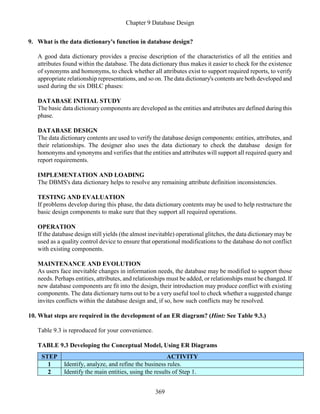
Since each team focuses on modeling a subset of the system, the definition of boundaries and the
interrelation between data subsets must be very precise. Each team creates a conceptual data model
corresponding to the subset being modeled. Each conceptual model is then verified individually against
the user views, processes, and constraints for each of the modules. After the verification process has
been completed, all modules are integrated in one conceptual model.
Since the data dictionary describes the characteristics of all the objects within the conceptual data model,
it plays a vital role in the integration process. Naturally, after the subsets have been aggregated into a
larger conceptual model, the lead designer must verify that the combined conceptual model is still able to
support all the required transactions. Thus the decentralized design activities may be summarized as
shown in Figure Q8.6B.
Chapter 9 Database Design
367
Figure Q9.6B The Decentralized Design Procedure
D
A
T
A
D
I
C
T
I
O
N
A
R
Y
Subset A
DATA COMPONENT
Views,
Processes,
Constraints
Views,
Processes,
Constraints
Views,
Processes,
Constraints
Aggregation
Subset B Subset C
Verification
Conceptual
Models
FINAL CONCEPTUAL MODEL
Keep in mind that the aggregation process requires the lead designer to assemble a single model in which
various aggregation problems must be addressed:
 synonyms and homonyms. Different departments may know the same object by different names
(synonyms), or they may use the same name to address different objects (homonyms.) The object
may be an entity, an attribute, or a relationship.
 entity and entity subclasses. An entity subset may be viewed as a separate entity by one or more
departments. The designer must integrate such subclasses into a higher-level entity.
 Conflicting object definitions. Attributes may be recorded as different types (character, numeric),
or different domains may be defined for the same attribute. Constraint definitions, too, may vary.
The designer must remove such conflicts from the model.
6. What is the minimal data rule in conceptual design? Why is it important?
The minimal data rule specifies that all the data defined in the data model are actually required to fit
present and expected future data requirements. This rule may be phrased as All that is needed is
there, and all that is there is needed.
Chapter 9 Database Design
368
7. Discuss the distinction between top-down and bottom-up approaches to database design.
There are two basic approaches to database design: top-down and bottom-up.
Top-down design begins by identifying the different entity types and the definition of each entity's
attributes. In other words, top-down design:
 starts by defining the required data sets and then
 defines the data elements for each of those data sets.
Bottom-up design:
 first defines the required attributes and then
 groups the attributes to form entities.
Although the two methodologies tend to be complementary, database designers who deal with small
databases with relatively few entities, attributes, and transactions tend to emphasize the bottom-up
approach. Database designers who deal with large, complex databases usually find that a primarily
top-down design approach is more appropriate.
8. What are business rules? Why are they important to a database designer?
Business rules are narrative descriptions of the business policies, procedures, or principles that are
derived from a detailed description of operations. Business rules are particularly valuable to database
designers, because they help define:
 Entities
 Attributes
 Relationships (1:1, 1:M, M:N, expressed through connectivities and cardinalities)
 Constraints
To develop an accurate data model, the database designer must have a thorough and complete
understanding of the organization's data requirements. The business rules are very important to the
designer because they enable the designer to fully understand how the business works and what role is
played by data within company operations.
NOTE
Do keep in mind that an ERD cannot always include all the applicable business rules. For
example, although constraints are often crucial, it is often not possible to model them. For
instance, there is no way to model a constraint such as “no pilot may be assigned to flight duties
more than ten hours during any 24-hour period.”
It is also worth emphasizing that the description of (company) operations must be done in
almost excruciating detail and it must be verified and re-verified. An inaccurate description of
operations yields inaccurate business rules that lead to database designs that are destined to
fail.
Chapter 9 Database Design
369
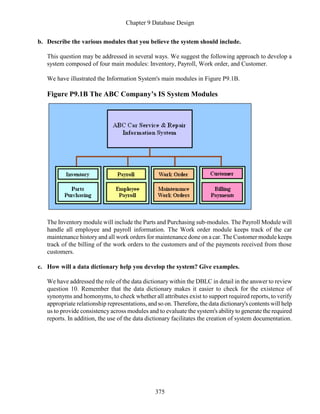
9. What is the data dictionary's function in database design?
A good data dictionary provides a precise description of the characteristics of all the entities and
attributes found within the database. The data dictionary thus makes it easier to check for the existence
of synonyms and homonyms, to check whether all attributes exist to support required reports, to verify
appropriate relationship representations, and so on. The data dictionary's contents are both developed and
used during the six DBLC phases:
DATABASE INITIAL STUDY
The basic data dictionary components are developed as the entities and attributes are defined during this
phase.
DATABASE DESIGN
The data dictionary contents are used to verify the database design components: entities, attributes, and
their relationships. The designer also uses the data dictionary to check the database design for
homonyms and synonyms and verifies that the entities and attributes will support all required query and
report requirements.
IMPLEMENTATION AND LOADING
The DBMS's data dictionary helps to resolve any remaining attribute definition inconsistencies.
TESTING AND EVALUATION
If problems develop during this phase, the data dictionary contents may be used to help restructure the
basic design components to make sure that they support all required operations.
OPERATION
If the database design still yields (the almost inevitable) operational glitches, the data dictionary may be
used as a quality control device to ensure that operational modifications to the database do not conflict
with existing components.
MAINTENANCE AND EVOLUTION
As users face inevitable changes in information needs, the database may be modified to support those
needs. Perhaps entities, attributes, and relationships must be added, or relationships must be changed. If
new database components are fit into the design, their introduction may produce conflict with existing
components. The data dictionary turns out to be a very useful tool to check whether a suggested change
invites conflicts within the database design and, if so, how such conflicts may be resolved.
10. What steps are required in the development of an ER diagram? (Hint: See Table 9.3.)
Table 9.3 is reproduced for your convenience.
TABLE 9.3 Developing the Conceptual Model, Using ER Diagrams
STEP ACTIVITY
1 Identify, analyze, and refine the business rules.
2 Identify the main entities, using the results of Step 1.
Chapter 9 Database Design
370
3 Define the relationships among the entities, using the results of Steps 1 and 2.
4 Define the attributes, primary keys, and foreign keys for each of the entities.
5 Normalize the entities. (Remember that entities are implemented as tables in an RDBMS.)
6 Complete the initial ER diagram.
7 Validate the ER model against the user’s information and processing requirements.
8 Modify the ER diagram, using the results of Step 7.
Point out that some of the steps listed in Table 9.3 take place concurrently. And some, such as the
normalization process, can generate a demand for additional entities and/or attributes, thereby causing
the designer to revise the ER model. For example, while identifying two main entities, the designer
might also identify the composite bridge entity that represents the many-to-many relationship between
those two main entities.
11. List and briefly explain the activities involved in the verification of an ER model.
Section 9-4c, “Data Model Verification,” includes a discussion on verification. In addition, Appendix C,
“The University Lab: Conceptual Design Verification, Logical Design, and Implementation,” covers the
verification process in detail. The verification process is detailed in the text’s Table 9.5, reproduced here
for your convenience.
TABLE 9.5 The ER Model Verification Process
STEP ACTIVITY
1 Identify the ER model’s central entity.
2 Identify each module and its components.
3 Identify each module’s transaction requirements:
Internal: Updates/Inserts/Deletes/Queries/Reports
External: Module interfaces
4 Verify all processes against the ER model.
5 Make all necessary changes suggested in Step 4.
6 Repeat Steps 2−5 for all modules.
Keep in mind that the verification process requires the continuous verification of business transactions as
well as system and user requirements. The verification sequence must be repeated for each of the
system’s modules.
12. What factors are important in a DBMS software selection?
The selection of DBMS software is critical to the information system’s smooth operation. Consequently,
the advantages and disadvantages of the proposed DBMS software should be carefullystudied. To avoid
false expectations, the end user must be made aware of the limitations of both the DBMS and the
database.
Although the factors affecting the purchasing decision varyfrom companyto company, some of the most
common are:
Chapter 9 Database Design
371
 Cost. Purchase, maintenance, operational, license, installation, training, and conversion costs.
 DBMS features and tools. Some database software includes a variety of tools that facilitate the
application development task. For example, the availability of query by example (QBE), screen
painters, report generators, application generators, data dictionaries, and so on, helps to create a
more pleasant work environment for both the end user and the application programmer. Database
administrator facilities, query facilities, ease of use, performance, security, concurrencycontrol,
transaction processing, and third-party support also influence DBMS software selection.
 Underlying model. Hierarchical, network, relational, object/relational, or object.
 Portability. Across platforms, systems, and languages.
 DBMS hardware requirements. Processor(s), RAM, disk space, and so on.
13. List and briefly explain the four steps performed during the logical design stage.
1) Map conceptual model to logical model components.
In this step, the conceptual model is converted into a set of table definitions including table names,
column names, primary keys, and foreign keys to implement the entities and relationships specified in
the conceptual design.
2) Validate the logical model using normalization.
It is possible for normalization issues to be discovered during the process of mapping the conceptual
model to logical model components. Therefore, it is appropriate at this stage to validate that all of the
table definitions from the previous step conform to the appropriate normalization rules.
3) Validate logical model integrity constraints.
This step involves the conversion of attribute domains and constraints into constraint definitions that
can be implemented within the DBMS to enforce those domains. Also, entityand referential integrity
constraints are validated. Views may be defined to enforce security constraints.
4) Validate the logical model against the user requirements.
The final step of this stage is to ensure that all definitions created throughout the logical model are
validated against the users' data, transaction, and security requirements. Every component (table,
view, constraint, etc.) of the logical model must be associated with satisfying the user requirements,
and every user requirement should be addressed by the model components.
14. List and briefly explain the three steps performed during the physical design stage.
1) Define data storage organization.
Based on estimates of the data volume and growth, this step involves the determination of the
physical location and physical organization for each table. Also, which columns will be indexed and
the type of indexes to be used are determined. Finally, the type of implementation to be used for each
view is decided.
2) Define integrity and security measures.
This step involves creating users and security groups, and then assigning privileges and controls to
those users and group.
3) Determine performance measurements.
The actual performance of the physical database implementation must be measured and assessed for
compliance with user performance requirements.
Chapter 9 Database Design
372
15. What three levels of backup may be used in database recovery management? Briefly describe
what each of those three backup levels does.
A full backup of the database creates a backup copy of all database objects in their entirety.
A differential backup of the database creates a backup of onlythose database objects that have changed
since the last full backup.
A transaction log backup does not create a backup of database objects, but makes a backup of the log
of changes that have been applied to the database objects since the last backup.
Problem Solutions
1. The ABC Car Service & Repair Centers are owned by the SILENT car dealer; ABC services and
repairs only SILENT cars. Three ABC Car Service & Repair Centers provide service and repair
for the entire state.
Each of the three centers is independently managed and operated by a shop manager, a
receptionist, and at least eight mechanics. Each center maintains a fully stocked parts inventory.
Each center also maintains a manual file system in which each car’s maintenance history is kept:
repairs made, parts used, costs, service dates, owner, and so on. Files are also kept to track
inventory, purchasing, billing, employees’ hours, and payroll.
You have been contacted by the manager of one of the centers to design and implement a
computerized system. Given the preceding information, do the following:
a. Indicate the most appropriate sequence of activities by labeling each of the following steps in
the correct order. (For example, if you think that “Load the database.” is the appropriate first
step, label it “1.”)
____ Normalize the conceptual model.
____ Obtain a general description of company operations.
____ Load the database.
____ Create a description of each system process.
____ Test the system.
____ Draw a data flow diagram and system flowcharts.
____ Create a conceptual model, using ER diagrams.
____ Create the application programs.
____ Interview the mechanics.
____ Create the file (table) structures.
____ Interview the shop manager.
The answer to this question may vary slightly from one designer to the next, depending on the selected
design methodology and even on personal designer preferences. Yet, in spite of such differences, it is
possible to develop a common design methodology to permit the development of a basic
decision-making process and the analysis required in designing an information system.
Chapter 9 Database Design
373
Whatever the design philosophy, a good designer uses a specific and ordered set of steps through which
the database design problem is approached. The steps are generally based on three phases: analysis,
design, and implementation. These phases yield the following activities:
ANALYSIS
1. Interview the shop manager
2. Interview the mechanics
3. Obtain a general description of company operations
4. Create a description of each system process
DESIGN
5. Create a conceptual model, using E-R diagrams
6. 8. Draw a data flow diagram and system flow charts
7. Normalize the conceptual model
IMPLEMENTATION
8. Create the table structures
9. Load the database
10. Create the application programs
11. Test the system.
This listing implies that, within each of the three phases, the steps are completed in a specific order. For
example, it would seem reasonable to argue that we must first complete the interviews if we are to obtain
a proper description of the company operations. Similarly, we may argue that a data flow diagram
precedes the creation of the E-R diagram. Nevertheless, the specific tasks and the order in which theyare
addressed may vary. Such variations do not matter, as long as the designer bases the selected procedures
on an appropriate design philosophy, such as top-down vs. bottom-up.
Given this discussion, we may present problem 1's solution this way:
__7__ Normalize the conceptual model.
__3__ Obtain a general description of company operations.
__9__ Load the database.
__4__ Create a description of each system process.
_11__ Test the system.
__6__ Draw a data flow diagram and system flow charts.
__5__ Create a conceptual model, using E-R diagrams.
_10__ Create the application programs.
Chapter 9 Database Design
374
__2__ Interview the mechanics.
__8__ Create the file (table) structures.
__1__ Interview the shop manager.
Chapter 9 Database Design
375
b. Describe the various modules that you believe the system should include.
This question may be addressed in several ways. We suggest the following approach to develop a
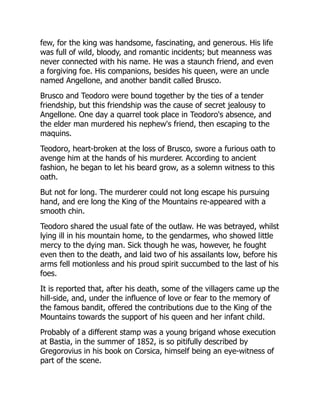
system composed of four main modules: Inventory, Payroll, Work order, and Customer.
We have illustrated the Information System's main modules in Figure P9.1B.
Figure P9.1B The ABC Company’s IS System Modules
The Inventory module will include the Parts and Purchasing sub-modules. The Payroll Module will
handle all employee and payroll information. The Work order module keeps track of the car
maintenance history and all work orders for maintenance done on a car. The Customer module keeps
track of the billing of the work orders to the customers and of the payments received from those
customers.
c. How will a data dictionary help you develop the system? Give examples.
We have addressed the role of the data dictionary within the DBLC in detail in the answer to review
question 10. Remember that the data dictionary makes it easier to check for the existence of
synonyms and homonyms, to check whether all attributes exist to support required reports, to verify
appropriate relationship representations, and so on. Therefore, the data dictionary's contents will help
us to provide consistency across modules and to evaluate the system's abilityto generate the required
reports. In addition, the use of the data dictionary facilitates the creation of system documentation.
Chapter 9 Database Design
376
d. What general (system) recommendations might you make to the shop manager? (For example.
if the system will be integrated, what modules will be integrated? What benefits would be
derived from such an integrated system? Include several general recommendations.)
The designer's job is to provide solutions to the main problems found during the initial study.
Clearly, any system is subject to both internal and external constraints. For example, we can safely
assume that the owner of the ABC Car Service and Repair Center has a time frame in mind, not to
mention a spending limitation. As is true in all design work, the designer and the business owner
must prioritize the modules and develop those that yield the greatest benefit within the stated time
and development budget constraints.
Keep in mind that it is always useful to develop a modular system that provides for future
enhancement and expansion. Suppose, for example, that the ABC Car Service & Repair company
management decides to integrate all of its service stations in the state in order to provide better
statewide service. Such integration is likely to yield many benefits: The car history of each car will
be available to any station for cars that have been serviced in more than one location; the inventory
of parts will be on-line, thus allowing parts orders to be placed between service stations; mechanics
can better share tips concerning the solution to car maintenance problems, and so on.
e. What is the best approach to conceptual database design? Why?
Given the nature of this business, the best way to produce this conceptual database design would be
to use a centralized and top-down approach. Keep in mind that the designer must keep the design
sufficiently flexible to make sure that it can accommodate any future integration of this system with
the other service stations in the state.
f. Name and describe at least four reports the system should have. Explain their use. Who will
use those reports?
REPORT 1
Monthly Activity contains a summary of service categories by branch and by month. Such reports
may become the basis for forecasting personnel and stock requirements for each branch and for each
period.
REPORT 2
Mechanic Summary Sheet contains a summary of work hours clocked by each mechanic. This
report would be generated weekly and would be useful for payroll and maintenance personnel
scheduling purposes.
REPORT 3
Monthly Inventory contains a summary of parts in inventory, inventory draw-down, parts reorder
points, and information about the vendors who will provide the parts to be reordered. This report will
be especially useful for inventory management purposes.
REPORT 4
Customer Activity contains a breakdown of customers by location, maintenance activity, current
balances, available credit, and so on. This report would be useful to forecast various service demand
Chapter 9 Database Design
377
factors, to mail promotional materials, to send maintenance reminders, to keep track of special
customer requirements, and so on.
2. Suppose you have been asked to create an information system for a manufacturing plant that
produces nuts and bolts of many shapes, sizes, and functions. What questions would you ask, and
how would the answers to those questions affect the database design?
Basically, all answers to all (relevant) questions help shape the database design. In fact, all information
collected during the initial study and all subsequent phases will have an impact on the database design.
Keep in mind that the information is collected to establish the entities, attributes, and the relationships
among the entities. Specifically, the relationships, connectivities, and cardinalities are shaped by the
business rules that are derived from the information collected by the designer.
Sample questions and their likely impact on the design might be:
 Do you want to develop the database for all departments at once, or do you want to design and
implement the database for one department at a time?
 How will the design approach affect the design process? (In other words, assess top-down vs.
bottom-up, centralized or decentralized, system scope and boundaries.)
 Do you want to develop one module at a time, or do you want an integrated system? (Inventory,
production, shipping, billing, etc.)
 Do you want to keep track of the nuts and bolts by lot number, production shift, type, and
department? Impact: conceptual and logical database design.
 Do you want to keep track of the suppliers of each batch of raw material used in the production
of the nuts and bolts? Impact: conceptual and logical database design. E-R model.
 Do you want to keep track of the customers who received the batches of nuts and bolts? Impact:
conceptual and logical database design. ER model.
 What reports will you require, what will be the specific reporting requirements, and to whom will
these reports be distributed?
The answers to such questions affect the conceptual and logical database design, the database’s
implementation, its testing, and its subsequent operation.
a. What do you envision the SDLC to be?
The SDLC is not a function of the information collected. Regardless of the extent of the design or its
specific implementation, the SDLC phases remain:
PLANNING
Initial assessment
Feasibility study
ANALYSIS
User requirements
Study of existing systems
Logical system design
Chapter 9 Database Design
378
DETAILED SYSTEMS DESIGN
Detailed system specifications
IMPLEMENTATION
Coding, testing, debugging
Installation, fine-tuning
MAINTENANCE
Evaluation
Maintenance
Enhancements
b. What do you envision the DBLC to be?
As is true for the SDLC, the DBLC is not a function of the kind and extent of the collected
information. Thus, the DBLC phases and their activities remain as shown:
DATABASE INITIAL STUDY
Analyze the company situation
Define problems and constraints
Define objectives
Define scope and boundaries
DATABASE DESIGN
Create the conceptual design
Create the logical design
create the physical design
IMPLEMENTATION AND LOADING
Install the DBMS
Create the database(s)
Load or convert the data
TESTING AND EVALUATION
Test the database
Fine-tune the database
Evaluate the database and its application programs
OPERATION
Produce the required information flow
MAINTENANCE AND EVOLUTION
Introduce changes
Make enhancements
Chapter 9 Database Design
379
3. Suppose you perform the same functions noted in Problem 2 for a larger warehousing operation.
How are the two sets of procedures similar? How and why are they different?
The development of an information system will differ in the approach and philosophy used. More
precisely, the designer team will probably be formed by a group of system analysts and may decide to
use a decentralized approach to database design.
Also, as is true for any organization, the system scope and constraints may be very different for different
systems. Therefore, designers may opt to use different techniques at different stages. For example, the
database initial study phase may include separate studies carried out by separate design teams at several
geographically distant locations. Each of the findings of the design teams will later be integrated to
identify the main problems, solutions, and opportunities that will guide the design and development of
the system.
4. Using the same procedures and concepts employed in Problem 1, how would you create an
information system for the Tiny College example in Chapter 4?
Tiny College is a medium-sized educational institution that uses many database-intensive operations,
such as student registration, academic administration, inventory management, and payroll. To create an
information system, first perform an initial database study to determine the information system's
objectives.
Next, study Tiny College's operations and processes (flow of data) to identify the main problems,
constraints, and opportunities. A precise definition of the main problems and constraints will enable the
designer to make sure that the design improves Tiny College's operational efficiency. An improvement
in operational efficiency is likely to create opportunities to provide new services that will enhance Tiny
College's competitive position.
After the initial database study is done and the alternative solutions are presented, the end users
ultimately decide which one of the probable solutions is most appropriate for Tiny College. Keep in
mind that the development of a system this size will probably involve people who have quite different
backgrounds. For example, it is likely that the designer must work with people who play a managerial
role in communications and local area networks, as well as with the "troops in the trenches" such as
programmers and system operators. The designer should, therefore, expect that there will be a wide range
of opinions concerning the proposed system's features. It is the designer's job to reconcile the many(and
often conflicting) views of the "ideal" system.
Once a proposed solution has been agreed upon, the designer(s) may determine the proposed system's
scope and boundaries. We are then able to begin the design phase. As the design phase begins, keep in
mind that Tiny College's information system is likely to be used by many users (20 to 40 minimum) who
are located on distant sites across campus. Therefore, the designer must consider a range of
communication issues involving the use of such technologies as local area networks. These technologies
must be considered as the database designer(s) begin to develop the structure of the database to be
implemented.
Chapter 9 Database Design
380
The remaining development work conforms to the SDLC and the DBLC phases. Special attention must
be given to the system design's implementation and testing to ensure that all the system modules
interface properly.
Finally, the designer(s) must provide all the appropriate system documentation and ensure that all
appropriate system maintenance procedures (periodic backups, security checks, etc.) are in place to
ensure the system's proper operation.
Keep in mind that two very important issues in a university-wide system are end-user training and
support. Therefore, the system designer(s) must make sure that all end users know the system and know
how it is to be used to enjoy its benefits. In other words, make sure that end-user support programs are in
place when the system becomes operational.
5. Write the proper sequence of activities in the design of a video rental database. (The initial ERD
was shown in Figure 9.9.) The design must support all rental activities, customer payment
tracking, and employee work schedules, as well as track which employees checked out the videos
to the customers. After you finish writing the design activity sequence, complete the ERD to ensure
that the database design can be successfully implemented. (Make sure that the design is normalized
properly and that it can support the required transactions.
Given its level of detail and (relative) complexity, this problem would make an excellent class project.
Use the chapter’s coverage of the database life cycle (DBLC) as the procedural template. The text’s
Figure 9.3 is particularly useful as a procedural map for this problem’s solution and Figure 9.6 provides a
more detailed view of the database design’s procedural flow. Make sure that the students review section
9-3b, “Database Design,” before they attempt to produce the problem solution.
Appendix B, “The University Lab: Conceptual Design,” and Appendix C “The University Lab:
Conceptual Design Verification, Logical Design, and Implementation” show a very detailed example of
the procedures required to deliver a completed database. You will find a more detailed video rental
database problem description in Appendix B, problem 4. This problem requires the completion of the
initial database design. The solution is shown in this manual’s Appendix B coverage. This design is
verified in Appendix C, Problem 2.
The Visio Professional files for the initial and verified designs are located on your instructor’s CD.
Select the FigB-P04a-The-Initial-Crows-Foot-ERD-for-the-Video-Rental-Store.vsd file to see the
initial design. Select the Fig-C-P02a-The-Revised-Video-Rental-Crows-Foot-ERD.vsd file to see the
verified design.
6. In a construction company, a new system has been in place for a few months and now there is a list
of possible changes/updates that need to be done. For each of the changes/updates, specify what
type of maintenance needs to be done: (a) corrective, (b) adaptive, and (c) perfective.
a. An error in the size of one of the fields has been identified and it needs to be updated
status field needs to be changed.
This is a change in response to a system error – corrective maintenance.
Chapter 9 Database Design
381
b. The company is expanding into a new type of service and this will require to enhancing
the system with a new set of tables to support this new service and integrate it with the
existing data.
This is a change to enhance the system – perfective maintenance.
c. The company has to comply with some government regulations. To do this, it will
require adding a couple of fields to the existing system tables.
This is a change in response to changes in the business environment – adaptive maintenance.
7. You have been assigned to design the database for a new soccer club. Indicate the most
appropriate sequence of activities by labeling each of the following steps in the correct order. (For
example, if you think that “Load the database” is the appropriate first step, label it “1.”)
_10__ Create the application programs.
__4__ Create a description of each system process.
_11__ Test the system.
__9__ Load the database.
__7__ Normalize the conceptual model.
__1__ Interview the soccer club president.
__5__ Create a conceptual model using ER diagrams.
__2__ Interview the soccer club director of coaching.
__8__ Create the file (table) structures.
__3__ Obtain a general description of the soccer club operations.
__6__ Draw a data flow diagram and system flowcharts.
Another Random Scribd Document
with Unrelated Content
few, for the king was handsome, fascinating, and generous. His life
was full of wild, bloody, and romantic incidents; but meanness was
never connected with his name. He was a staunch friend, and even
a forgiving foe. His companions, besides his queen, were an uncle
named Angellone, and another bandit called Brusco.
Brusco and Teodoro were bound together by the ties of a tender
friendship, but this friendship was the cause of secret jealousy to
Angellone. One day a quarrel took place in Teodoro's absence, and
the elder man murdered his nephew's friend, then escaping to the
maquins.
Teodoro, heart-broken at the loss of Brusco, swore a furious oath to
avenge him at the hands of his murderer. According to ancient
fashion, he began to let his beard grow, as a solemn witness to this
oath.
But not for long. The murderer could not long escape his pursuing
hand, and ere long the King of the Mountains re-appeared with a
smooth chin.
Teodoro shared the usual fate of the outlaw. He was betrayed, whilst
lying ill in his mountain home, to the gendarmes, who showed little
mercy to the dying man. Sick though he was, however, he fought
even then to the death, and laid two of his assailants low, before his
arms fell motionless and his proud spirit succumbed to the last of his
foes.
It is reported that, after his death, some of the villagers came up the
hill-side, and, under the influence of love or fear to the memory of
the famous bandit, offered the contributions due to the King of the
Mountains towards the support of his queen and her infant child.
Probably of a different stamp was a young brigand whose execution
at Bastia, in the summer of 1852, is so pitifully described by
Gregorovius in his book on Corsica, himself being an eye-witness of
part of the scene.
He was but three and twenty, beautiful of face, strong as a lion, and
brave and fierce as a wild beast; but the accusation against him was
that he had murdered ten men out of "caprice"!
What an extraordinary madness must that have been which incited
this poor young Corsican, probably from no reason but the insensate
lust of blood, for no purposes of robbery or even adequate anger, to
murder his fellow-men!
The very unnaturalness of the phenomenon arouses pity from those
whose bringing-up makes such a wild-beast madness
incomprehensible to them. One wonders in what atmosphere poor
Bracciamozzo had been reared—whether he had been brought up in
the bandit's cave, accustomed to sights of brutal ferocity and the
indulgence of every fierce passion, and growing up to find his hand
against every man.
This was the probable commencement of a life which, at three and
twenty, was to end stained by so much crime. That the young
brigand was all bad, it is impossible to believe, reading Gregorovius'
account.
Death was no terrible stranger to him; he had been accustomed to
its pale face from boyhood, and he was not likely to flinch even
before its more horrible appearance on the public scaffold.
With his one arm bound behind his back (for he had lost the other in
a fight with the gendarmes), he walked to his death firmly and
quietly. There was no vulgar air of braggadocio about him, no
attempt to excite any momentary popular sympathy by dramatic
means. He died unflinchingly, not as a hero, but as a penitent,
acknowledging his black deeds. "I pray God and the world for
forgiveness," said the young murderer, with native brevity, on the
scaffold, "for I acknowledge that I have done much evil."
I will not here stop to speak of the Bella Coschia brothers, the last
two bandits whose wild deeds have made them famous in Corsica.
They are yet alive, and not much beyond middle age; but their
history belongs to another part of the island, where I heard much of
them.
I must close this chapter with a dirge, or vocero, roughly translated
from the Corsican patois, and which was improvised at the funeral of
a bandit called Canino, some years ago.
These voceri are one of the peculiarities of Corsica. Until quite lately,
it was constantly the custom, at the funeral of any great or popular
person, or, indeed, over the coffin of any man, woman, or child
whose death was due to accident, murder, or any sudden and
terrible circumstance, for the nearest of kin (usually the sister or
mother of the dead person) to break out into some impromptu song
of lamentation, couched in rude but often stirring verse.
These mournful dirges were striking in their rugged but earnest
simplicity; and fortunately some of them have been preserved and
printed at Ajaccio.
The custom of singing the vocero, like most other ancient and
romantic customs, is now, however, slowly but surely dying out in
the island.
VOCERO OVER THE DEAD BODY OF CANINO, A BANDIT.
BY HIS SISTER.
Now shall my voice re-echo
Loud as the thunder roars,
Where San Pietro nestles,
Or Vizzavona soars;
By which to many a distant land
Gallona bears her witness grand.
In Luco Nazza see a crowd
Met together for the chase:
Bandits[2]
and soldiers all as one—
A right accursèd race:
With bloody hands but yesterday
They started all upon their way.
In the valley's deepest gorges
Might be heard the roaring wind,
From Ghisoni bringing evil—
Terror, in its wake behind—
In its hollow notes proclaiming
Coming treachery and wailing.
At the horn's shrill sounding gathered,
Wolves and lambs together showed:
Marched alongside in their union,
Quickly up the rocky road,
Till upon the pass they stood,
Where they shed thy heart's life blood.
When I heard the loud lamenting
I threw wide the lattice pane,
Asking, "What has happened? tell me?"
"'Tis your brother—he is slain!
Captured in his mountain lair,
He was foully slaughtered there!"
Now thy skill can spare thee nothing—
y p g
Of what use thy bravery?
What thy dagger or thy pistol
Now can do for thee?
What avail thy charm to wear,
Or to hug thy secret prayer?[3]
At the sight of all thy gashes,
Anguished grows my wailing.
Wherefore comes no answer from thee?
Is thy courage failing?
Cani, thy sister's heart grows strange
And all my nature seems to change.
In the neighbourhood of Nazza
A blackthorn I will grow,
To show that of our race no longer
Any shall come or go:
Because at last, not two or three,
But five opponents worsted thee!
Oh, for thy shoulders broad!
Oh, thine activity!
Like to a stalwart, budding branch—
None could compare to thee.
Save for thy memory alone,
My weary life could not drag on.
Beneath the flowering chestnut-tree,
There will I take my rest,
Because that there, O much beloved,
They pierced thy bleeding breast.
Now will I drop my woman's garb,
Take gun and pistol in my hand,
The tarzitta will buckle on,
And gird the weapon band.
Cani, a sister's heart will know
How to wreak vengeance on thy foe!
IN MORTE DI CANINO, BANDITO,
VOCERO DELLA SORELLA.
(Dialetto della pieve di Ghisoni.)
Eo buria che la me' voci
Fusse tamant'e lu tonu,
Chi passasse per la foci
Di San Petru e Vizzavonu;
Per chi soni in ogni locu
La gran prova di Gallonu.
Quandu intesi li brioni,
M'affaccai a lu purteddu
Dimandai: chi nova c'eni?—
Hanu tombu u to frateddu:
L'hanu presu in du la serra;
N'hanu fattu lu maceddu.
Nun ti valse lu curaggiu,
Nun ti valse la schiuppetta,
Nun ti valse lu pugnali,
Nun ti valse la tarzetta;
Nun ti valse ingermatura,
Nè razione binadetta.
A guardà le to ferite
Mi s'accresci lu dulori.
Perchè più nun mi rispondi?
Forse ti manca lu cori?
O Canì, cor di suredda,
Hai cambiatu di culori.
A lu paese di Nazza
Eo ci vogliu pianta un prunu,
Perchè di la nostra razza
Un ci passi più nisunu:
Perchè un funu duji nè treni,
Ma cinque omini contr'unu.
Tutti a lu Lucu de Nazza
Tutti s'eranu aduniti
Cun quella barbara zazza
Li sullati e li banditi:
Cu a tempesta d'eri mani
Tutt'insemme so partiti.
In fondi di lu rionu
Si sentia rugghia la ventu,
Chi purtava da Ghisoni
Lu malori e lu spaventu:
Si vidia chi per aria
Bèra accidiu e tradimentu.
Somo subitu partiti
Tutti i lupi cull'agneddi,
E merchiavanu aduniti
A lu son di cialambeddi.
Quandu junsenu a la serra
Ti taglionu i garganeddi.
Lu me' largu di spallera!
Lu me' minutu di vita!
Cume teni, nun ci n'era;
Parii una mazza fiurita.
Solu u pinzeru di teni
Or sustene la me' vita.
A lu pe' di stu pullonu
Ci ogliu piantà lu m'è lettu;
Parchì qui, u me' frateddonu,
Ti tironu a mezzu pettu.
Bogliu leche lu buneddu,
Bogliu armà schioppu e stilettu.
Bogliu cinghie la carchera,
Bogliu cinghie la tarzetta:
O Canì, cor di suredda,
Bogliu fà la to bindetta.
CHAPTER IX.
CORTE AND ITS HOTEL.
From Ponte alle Lecchia the road follows the course of the foaming
river Vecchio for a long way, along a wide valley, where the green
hills circling round are somewhat monotonous for a time, but
presently turn into handsome grey and white limestone cliffs,
hanging in one place in wild and curious peaks above the passing
carriage.
After the large village of Cabouralino, the scenery becomes tamer
again, the ground more cultivated, flocks of black and white silky
haired goats with silvery bells passing us constantly.
The road, too, was here alive with men riding mules, and leading
after them by a cord a string of other mules with packs on their
backs. It was a matter of difficulty to pass some of these mules, who
were not accustomed to "carriage company," and who backed
towards the precipice occasionally, kicking wildly, to the discomfiture
of their owners.
This part of the country was the scene of the battle of Ponte Nuovo,
in 1769, the last battle fought for Corsican independence; and the
date from which Corsica became a French province. It has a
touching interest for this reason, and on account of its being a
witness to the last vain effort of Paoli in his country's cause.
But now we were leaving the river, with its foaming waters and its
bloody memories, over which the fine thoughtful face of Pasquale
Paoli seemed to cast a humanizing influence, and were ascending
the mountains under a blue sky.
Vast quantities of handsome hellebore, with large ball-like clumps of
flowers, and of a species of pale green spurge (its flowers like a
number of yellow caterpillars attached to the stem), grew by the
roadside; ilex-trees scattered themselves up and down rocks of
every form and height, above and below the road, and the
mountains all round us became more and more covered with snow.
Here and there were placed villages in lofty and commanding
situations; one especially, named Suaria, which was perched just
above us on a conical green hill rising from the road-side. The village
was partially hidden by firs and ilexes crowning this pretty eminence;
but the high four-storied campanile of Suaria Church stood out,
white and imposing, above their sheltering branches. Very cold and
frosty was the wind, notwithstanding the brilliant sun, as we reached
the summit of the pass; but the view of mountain scenery spread
out beneath us was magnificent.
And now we began our descent through many a tree-covered hill,
towards Corte, its high, red-tiled houses visible miles before we
reached it. Corte, the central inland town of Corsica, is, after Bastia
and Ajaccio, the largest town in the island, and has a position
unequalled for wild beauty.
It lies in the very heart of the wildest mountains of Corsica,
surrounded on every side by their gaunt and precipitous flanks.
Monte Rotondo, one of the highest of the inland chain, raises its
snow-crowned head to look over the solemn blue-grey hills
immediately behind Corte; and two broad foaming rivers dash down
the gully beside the town, and unite, after passing under their
handsome stone bridges, in the narrow valley just beneath.
Corte is itself at no mean height above the sea level; and, at the
time of our first visit, was exceedingly cold, with a sharp north wind
rushing through the town from the numerous mountain ravines.
The citadel, which of itself is not much, is built, with extraordinarily
picturesque effect, upon the summit of a precipitous hill, rising from
the midst of the town; up whose sides run a few houses, until the
overhanging rocks force them to give place to the prickly pear. The
main streets in Corte are wide, and paved with rough stone, with
enormously high, factory-like houses, of seven or even eight stories,
on each side. The houses are remarkably hideous, even for Corsica;
built of dirty white stone, and red roofed, without any eaves, the
windows irregular and poor, and the open doorways (into large
buildings) often showing dirty and poverty-stricken interiors.
Very steep side streets, impassable for carriages, and sometimes
giving place to a series of stone steps, lead up into the higher parts
of the town, and towards the citadel and church.
Fine elm-trees make a nice avenue all up the main road, at the end
of which are the two respectable hotels of Corte, Hotels Pierracci
and Paoli, so precisely opposite that the rival guests can look into
each other's windows.
If it were not for its dirt, and its ugly houses, the beauty of Corte
would be almost unrivalled in European scenery. How one sighs in
Corsica for the lovely grey cottages with broad eaves, and for the
stately art-decorated mansions with graceful towers, of beauty-
loving Italy!
No such thing is to be seen here. I doubt if, from one end of Corsica
to the other, there is one building with any pretensions to real
architectural beauty.
Art has never been much cultivated in the island. A people who for
centuries have lived in a condition of incessant warfare and personal
insecurity have but little time or inclination to indulge in the peaceful
pursuits of their more luxurious neighbours; and Corsican
architecture partakes of the Corsican character, being stern, rugged,
and primitive. Many a village, nestled in some exquisite situation
among snow-capped hills and orange groves, we found perfectly
ruined, in an artistic point of view, by its ugly dwellings.
The churches are the only redeeming feature in Corsican
architecture. Their campaniles, or bell-towers, are generally lofty and
picturesque, divided into several stories, and standing apart from the
body of the church.
Hotel Pierracci, which had been recommended to us, we found a fair
hotel in many respects, but intensely national in its peculiarities. The
despotic Briton, coming straight from club luxuries and obsequious
attentions, would feel himself decidedly out of place there, and not a
little miserable.
It is a large hotel, with two handsome dining-rooms, and spacious,
well-furnished bedrooms; and although the broad stone staircase is
somewhat odoriferous and the passages not over clean, yet the
rooms are comfortable and perfectly above suspicion.
But, for the whole of this large establishment, generally well filled
with a constantly changing series of guests, there appeared to be
only one terribly overworked young waiter, and an elderly maid of all
work, (exclusive of the kitchen department).
The result was, that even if you had that un-Corsican luxury of a bell
in your room, which was not often, its repeated calls were
unheeded; and you had speedily to learn and put in practice that
great law of uncivilized regions, "If you want anything done, do it
yourself."
As, however, every domestic was in a gasping hurry, and the big
landlady—a mixture of sudden irascibility and occasional
benevolence—was apt to regard your wants as puerile, and, Corsican
fashion, to tell you so loudly to your face—a foray in dressing-gown
and slippers to the kitchen, after hot water, or cleaned boots, or any
other necessity of man and woman, was apt to end in ignominy and
the trial of English tempers. The crockery and cutlery of Hotel
Pierracci also run notably short.
It was a current joke amongst the English visitors, that the one
coffee-pot of the establishment not only supplied all the numerous
breakfast-tables of the different guests, but also did duty on
occasions for shaving and toilette water. And this fact I can believe;
for one morning, having by persistent obstinacy triumphed over the
difficulties of obtaining a little hot water for dressing purposes, my
tin jug was fetched away almost immediately afterwards, and I was
astonished to see it reappearing on the breakfast table ten minutes
later in its habitual guise of coffee-pot.
At breakfast this same coffee-pot was the cause of continual
contention between the worried little waiter and ourselves. When it
pleased him to give us our breakfast, he used to run in, fill our cups
hastily, and whisk out again with his precious pot; and no entreaties
or commands would persuade him to leave that invaluable and
useful little metal jug behind him, or even to return with it and refill
our cups. I think there was a bond of sympathy between that waiter
and his coffee-pot, both so terribly overworked.
The food at Hotel Pierracci was good, but rather scarce, and it was
difficult to make a dinner off the microscopic scraps which adorned
the dishes during the eight courses of the table d'hôte. We noticed
this particularly on our road home again, when perhaps our long
stay in mountain air and the fine Corsican climate had increased our
correct English appetites to a country voracity. But, on the whole, for
Corsica, Hotel Pierracci may be considered a very comfortable hotel;
and, excepting that at Sartene, which is also a good one, has the
reputation of being almost the only large and handsome hotel out of
Ajaccio.
Hotel Paoli, we were told afterwards by some French acquaintances,
was clean and well ordered, with good rooms and very moderate
charges; but we did not go inside the place.
CHAPTER X.
AN ENCOUNTER WITH STREET URCHINS.
Corte has one terrible drawback—nay, two: its extreme dirt and its
impudent children.
I have heard it said that the position of the town gives it the
advantage of being both a good summer and winter residence, the
climate being never too hot or too cold.
It may never be too hot, but it must undoubtedly be a very cold
place in winter, from its elevation among the numerous snow
mountains that surround it. This, of course, is a matter of taste. But
I should doubt extremely its being in any degree healthy in summer.
I heard vague rumours of malaria whilst we were there; and I
should not doubt the existence of fever in the hot weather.
I have been in a good many German, Italian, and Corsican towns;
but not one of them can vie with Corte in uncleanliness. Corte, I
should think, would carry off the palm in filthy pavements, and
putrid odours, from any town in Europe.
It was only the beginning of June when we visited it for the second
time, and yet there were certain streets, and those not insignificant
ones, where it was absolutely necessary to hold one's nose and run.
As there were waste rubbish places in many of these parts, which
were nothing at all but open drains, and receptacles for everything
horrid that could be thrown upon them from the windows and
balconies of the houses around, the objectionable odours were
neither astonishing nor unaccountable.
As regards the children of Corte, they are no small drawback to the
delights of the place.
The inhabitants are altogether a rough, uncivil set, far less courteous
than the generality of Corsicans, and have had an evil reputation
amongst strangers for many years.
It is not conducive to the enjoyment of beautiful scenery or a quiet
stroll, to be surrounded down the street, and followed far into the
country by a mocking, shouting horde of dancing dervishes, not
content with roaring out "Inglesé! Inglesé!" with unceasing energy,
but making occasional clutches at your dress or umbrella, and
stopping up the public way.
The ingenious youth of Corte has one especial diversion, retained for
the delectation of the stranger. This consists in holding a stout piece
of cord across the road, barring the path, with the shouted
intimation, "No pennies, no passage!" or, in their own words, "Sou,
sou, Inglese!"
English pride naturally determines that its owner will die sooner than
bestow the required penny on these little pests; but this righteous
wrath sometimes entails unpleasant results. An acquaintance of
ours, then at Corte, had, a few weeks before, been nearly mobbed
by the elder part of the community when he attempted to cut the
rope and offered to thrash the children. We ourselves came in for an
unpleasant encounter, that might have ended awkwardly. We were
taking a walk across the valley of the Tavignano, where it rushes,
boiling and foaming in splendid cascades over its green and grey
boulders, past the city, before joining the equally picturesque river
Restonico.
It was Sunday evening; and, unfortunately, we had chosen a time
when all the juvenile populace were out of school, and on the look-
out for a little innocent amusement.
I have noticed that a demoniac phase often comes over naughty
children on a Sunday evening. Be that as it may, a troop of about
twenty, chiefly boys, pursued us unrelentingly far outside the
precincts of the town, shouting their war-cry of "Sou, Inglese!" and
running round and round till we could neither see the views, nor
hear ourselves speak.
A rope which they stretched across the road for the customary
pastime fortunately broke, and we passed on through the gap; but
the broken remains, held by two youthful fiends, served as an
instrument of torture wherewith to wind us up and hopelessly
confuse our footsteps. Human endurance could bear no more; and,
after one or two stern warnings, No. 3, whose wrath had been
gradually gathering, suddenly saw her opportunity, and, darting
upon two small tormentors before they could escape, she brought
down her umbrella upon their degenerate backs with as much force
as nature had supplied to her.
Instantly, the attitude of these juvenile Corsicans changed. They had
been disporting themselves before: now they prepared for serious
warfare. There was a moment's pause; and then a volley of sharp
stones came after us.
We walked on quickly, but the charge increased instead of
decreasing, one striking No. 2 on the head, and another No. 3 on
the heel, but fortunately without inflicting any serious damage.
But flint stones from off a roadside are not pleasing weapons; and
things might have ended badly for us, but for a sudden diversion.
From a cottage by the roadside just before us, dashed out three big
boys, all over the humanizing age of thirteen; and, undertaking our
defence without a word, they made a sudden onslaught upon our
pursuers, and in two minutes had put them all to flight.
We were really relieved, and thanked the knights-errant warmly. Two
of them, boys of about fourteen or fifteen, had pipes in their
mouths; and one of them, a young man a year or two older,
remarked sagely, that it was always thus with visitors: "Les enfants
de Corte étaient terriblement méchants."
Having bade adieu to our gallant defenders, we were walking on,
and had almost forgotten them, when the noise of a terrific
struggling and scuffling behind us again attracted our attention.
Our friends had got a boy of about eleven between them, and were
dragging him along by the arms by main force.
The boy was resisting with all his power, and was being dragged
along almost double, his bare feet scraping the ground in a vain
effort not to move, whilst he sobbed and shouted in a passion of
rage and terror very unbecoming in one of his heroic race. He was a
ragged, dirty, pretty urchin, with large brown eyes, and a wicked
face that prophesied for him bigger scrapes some day than stone-
throwing.
The two boys who had him in custody brought the unfortunate imp
to our astonished feet, and rested there; still gripping him fast, and
demanding our good pleasure concerning his chastisement.
"Tenez, mademoiselle," said the third, holding up a big pointed
stone, "voilà la pierre qu'il a jetée!" Circumstantial evidence with a
vengeance; the culprit confronted with the instrument of his iniquity!
Perhaps we were weak; but we forgave that terror-stricken boy
(who, I verily believe, expected some vendetta-like vengeance at our
hands), and he was allowed to slink off with an admonition from us
to "do so no more."
Coming back, these same big boys again overtook us; and, quietly
remarking that they would see us safe home, they escorted us to the
door of our hotel with much polite conversation, and then made off,
raising their caps.
These boys were in the lower ranks of life, although decently
dressed; but it would have been an insult to offer them any
recompense. Their action proceeded from chivalry "pur et simple,"
and they had no notion of any reward.
Weeks afterwards, when two of us returned to Corte, a smiling face
suddenly attracted our attention in the streets one day, and we
recognized one of our boyish defenders. Of course we greeted him,
and he lifted his cap, remarking, "I have seen you for the last half
hour."
CHAPTER XI.
MANNERS AND CUSTOMS AT CORTE.
A good deal of historical interest is attached to Corte. From the
earliest times it has been the seat of the national government, and
the centre of the more important popular demonstrations. The old
town and citadel have undergone more sieges and been worn by
more numerous assaults than even Calvi or Bonifacio.
Here Paoli lived, and, from his modest home, regulated the
government of his country; and here was the home of the patriot
Gaffori.
An anecdote is told in connection with the latter which is truly
Corsican in its Spartan-like heroism.
It was in 1746, during one of the ceaseless conflicts with Genoa, and
Gaffori was storming the city. He had already made much progress,
and the Genoese commander was beginning to tremble for the fate
of his fort. Suddenly the Corsican firing ceased, and every gun was
silent, whilst the islanders gazed horror-struck on the walls. Upon
them was bound the young son of Gaffori, who had been taken
prisoner, and whom the Genoese general had commanded to be
placed there in order to deter the successful storming party, or as a
mark for his father's guns.
Gaffori paused a moment; but only a moment. In another minute he
gave the order, and the assault continued.
But the heroic father had his reward. The breach was made, Corte
fell, and Gaffori's son was rescued unhurt from his perilous situation.
Corte abounds in pointer dogs. Paoli had his six canine friends, who
kept house with him at Corte; but tradition tells not whether they,
too, were pointers or no.
The men of Corte struck me as being a finer race physically than any
other in the island. They are tall and well-made, with upright figures.
Corsicans, in face and figure, are more akin to the English than the
Italians: there is none of the soft roundness of the Italian about
them; they are bony, manly, and muscular.
But the Cortéans appeared to me to excel even their other
compatriots in idleness. As one of themselves said, "The young men
of Corte do nothing but walk the streets from morning till night, and
all they have to occupy them is to think of evil."
The Corsican women, however, at Corte as elsewhere, are essentially
domestic and retiring. Flaunting and finery have not yet become the
fashion among these simple-hearted daughters of Eve; and as long
as their lords require it of them, they will probably remain the same
light-hearted, energetic, hard-working family supporters that they
now are.
To them may be applied, with great accuracy, the old rhyme:—
"Good wives, like city clocks, should be
Exact with regularity;
Yet not, like city clocks so loud,
Be heard by all the vulgar crowd.
"Good wives to snails should be akin,
Always their houses keep within,—
Yet not to carry (fashion's hacks)
All they possess upon their backs."
The only occasion on which the women of Corsica appear to have an
outing is on Sunday morning, after early Mass, when, in their neat
attire of black and white, they sometimes take a quiet turn up and
down the main street or place.
A funeral, too, may bring them out. On passing through Olmeto
some weeks afterwards, we met half a dozen women coming down
the road together, dressed rather more gaily than usual; and our
driver immediately remarked, "There must be a funeral in Olmeto, or
the women would not be out."
"But," we asked, "do they not put on mourning for the occasion?"
"Oh no; only the relatives do that."
"But," we said, "there are so many people always dressed in black in
Corsica; how is that?"
"Well, people only go into mourning for a very near relation; but the
first time they wear it for three or four years, and the second time,
unless they are young children, for the rest of their life."
This accounts for the number of sombre female figures one sees in
this island, the black handkerchief which is worn over the head
rendering them peculiarly funereal-looking; and explains why you
never meet an elderly woman in any other attire.
But the group of women we met were evidently only acquaintances
or distant relations of the dead, for their costume was more than
usually lively, one or two of them wearing a blue or orange head-
gear and other unaccustomed bits of finery. The ceremony appeared
to them, no doubt, in the light of an agreeable dissipation, as it did
to a certain poor Welshwoman of my acquaintance, who remarked,
cheerfully, that "Mother had a' been quite gay lately; she'd a' been
to three funerals last week!"
The church at Corte is in the higher part of the town, surrounded by
narrow streets and houses that have lain in ruins ever since the last
bombardment of the town. It is not a pretentious building, either
within or without.
Poor paintings and gaudy images of saints bedecked every side altar,
and a highly coloured Madonna stood in a niche on either side of the
principal altar, where the tall candles shed artificial sunlight on
beautiful but badly arranged flowers.
The service was mumbled through by an old priest, less to our
edification than apparently to that of the reverent crowd of women
worshippers who filled the building.
Scarcely a man was to be seen in church. Their Sunday duties
appeared to consist in squatting in rows just outside the porch,
smoking their pipes, and watching the entrance of their better
halves.
In Corsica the men are not church-goers. Coming from North Italy,
where the congregations are composed more of men than of
women, one cannot fail to be struck by this fact.
Fillipini remarks of his countrymen that they are a religious
community. He would scarcely say so now. French influence and
French scepticism are already making themselves felt among the
Corsican men; and the priesthood on the island does not appear
sufficiently strong, as a body, intellectually or morally, to preserve
their fading influence. But the men in Corte, although they may not
Welcome to our website – the perfect destination for book lovers and
knowledge seekers. We believe that every book holds a new world,
offering opportunities for learning, discovery, and personal growth.
That’s why we are dedicated to bringing you a diverse collection of
books, ranging from classic literature and specialized publications to
self-development guides and children's books.
More than just a book-buying platform, we strive to be a bridge
connecting you with timeless cultural and intellectual values. With an
elegant, user-friendly interface and a smart search system, you can
quickly find the books that best suit your interests. Additionally,
our special promotions and home delivery services help you save time
and fully enjoy the joy of reading.
Join us on a journey of knowledge exploration, passion nurturing, and
personal growth every day!
testbankfan.com

Database Systems Design Implementation and Management 12th Edition Coronel Solutions Manual

  • 1.
    Download the fullversion and explore a variety of test banks or solution manuals at https://testbankfan.com Database Systems Design Implementation and Management 12th Edition Coronel Solutions Manual _____ Follow the link below to get your download now _____ https://testbankfan.com/product/database-systems-design- implementation-and-management-12th-edition-coronel- solutions-manual/ Access testbankfan.com now to download high-quality test banks or solution manuals

  • 2.
    We have selectedsome products that you may be interested in Click the link to download now or visit testbankfan.com for more options!. Database Systems Design Implementation and Management 12th Edition Coronel Test Bank https://testbankfan.com/product/database-systems-design- implementation-and-management-12th-edition-coronel-test-bank/ Database Systems Design Implementation And Management 13th Edition Coronel Solutions Manual https://testbankfan.com/product/database-systems-design- implementation-and-management-13th-edition-coronel-solutions-manual/ Database Systems Design Implementation and Management 11th Edition Coronel Solutions Manual https://testbankfan.com/product/database-systems-design- implementation-and-management-11th-edition-coronel-solutions-manual/ Concepts in Federal Taxation 2014 21st Edition Murphy Test Bank https://testbankfan.com/product/concepts-in-federal- taxation-2014-21st-edition-murphy-test-bank/


  • 3.
    LPN to RNTransitions 4th Edition Claywell Test Bank https://testbankfan.com/product/lpn-to-rn-transitions-4th-edition- claywell-test-bank/ Preliminary Edition of Statistics Learning from Data 1st Edition Roxy Peck Test Bank https://testbankfan.com/product/preliminary-edition-of-statistics- learning-from-data-1st-edition-roxy-peck-test-bank/ Accounting Information Systems Basic Concepts and Current Issues 4th Edition Hurt Test Bank https://testbankfan.com/product/accounting-information-systems-basic- concepts-and-current-issues-4th-edition-hurt-test-bank/ Financial Accounting An Introduction 2nd Edition Benedict Solutions Manual https://testbankfan.com/product/financial-accounting-an- introduction-2nd-edition-benedict-solutions-manual/ Living in the Environment Canadian 3rd Edition Miller Test Bank https://testbankfan.com/product/living-in-the-environment- canadian-3rd-edition-miller-test-bank/

  • 4.
    Business Statistics ADecision Making Approach 10th Edition Groebner Test Bank https://testbankfan.com/product/business-statistics-a-decision-making- approach-10th-edition-groebner-test-bank/
  • 5.
    Chapter 9 DatabaseDesign 362 Chapter 9 Database Design Discussion Focus What is the relationship between a database and an information system, and how does this relationship have a bearing on database design? An information system performs three sets of services:  It provides for data collection, storage, and retrieval.  It facilitates the transformation of data into information.  It provides the tools and conditions to manage both data and information. Basically, a database is a fact (data) repository that serves an information system. If the database is designed poorly, one can hardly expect that the data/information transformation will be successful, nor is it reasonable to expect efficient and capable management of data and information. The transformation of data into information is accomplished through application programs. It is impossible to produce good information from poor data; and, no matter how sophisticated the application programs are, it is impossible to use good application programs to overcome the effects of bad database design. In short: Good database design is the foundation of a successful information system. Database design must yield a database that:  Does not fall prey to uncontrolled data duplication, thus preventing data anomalies and the attendant lack of data integrity.  Is efficient in its provision of data access.  Serves the needs of the information system. The last point deserves emphasis: even the best-designed database lacks value if it fails to meet information system objectives. In short, good database designers must pay close attention to the information system requirements. Systems design and database design are usually tightly intertwined and are often performed in parallel. Therefore, database and systems designers must cooperate and coordinate to yield the best possible information system. What is the relationship between the SDLC and the DBLC? The SDLC traces the history (life cycle) of an information system. The DBLC traces the history (life cycle) of a database system. Since we know that the database serves the information system, it is not surprising that the two life cycles conform to the same basic phases.
  • 6.
    Chapter 9 DatabaseDesign 363 Suggestion: Use Figure 9.8 as the basis for a discussion of the parallel activities. What basic database design strategies exist, and how are such strategies executed? Suggestion: Use Figure 9.14 as the basis for this discussion. There are two basic approaches to database design: top-down and bottom-up. Top-down design begins by identifying the different entitytypes and the definition of each entity's attributes. In other words, top-down design:  starts by defining the required data sets and then  defines the data elements for each of those data sets. Bottom-up design:  first defines the required attributes and then  groups the attributes to form entities. Although the two methodologies tend to be complementary, database designers who deal with small databases with relatively few entities, attributes, and transactions tend to emphasize the bottom-up approach. Database designers who deal with large, complex databases usuallyfind that a primarilytop-down design approach is more appropriate. In spite of the frequent arguments concerning the best design approach, perhaps the top-down vs. bottom-up distinction is quite artificial. The text's note is worth repeating: NOTE Even if a generally top-down approach is selected, the normalization process that revises existing table structures is (inevitably) a bottom-up technique. E-R models constitute a top-down process even if the selection of attributes and entities may be described as bottom-up. Since both the E-R model and normalization techniques form the basis for most designs, the top-down vs. bottom-up debate may be based on a distinction without a difference.
  • 7.
    Chapter 9 DatabaseDesign 364 Answers to Review Questions 1. What is an information system? What is its purpose? An information system is a system that  provides the conditions for data collection, storage, and retrieval  facilitates the transformation of data into information  provides management of both data and information. An information system is composed of hardware, software (DBMS and applications), the database(s), procedures, and people. Good decisions are generally based on good information. Ultimately, the purpose of an information system is to facilitate good decision making by making relevant and timely information available to the decision makers. 2. How do systems analysis and systems development fit into a discussion about information systems? Both systems analysis and systems development constitute part of the Systems Development Life Cycle, or SDLC. Systems analysis, phase II of the SDLC, establishes the need for and the extent of an information system by  Establishing end-user requirements.  Evaluating the existing system.  Developing a logical systems design. Systems development, based on the detailed systems design found in phase III of the SDLC, yields the information system. The detailed system specifications are established during the systems design phase, in which the designer completes the design of all required system processes. 3. What does the acronym SDLC mean, and what does an SDLC portray? SDLC is the acronym that is used to label the System Development Life Cycle. The SDLC traces the history of a information system from its inception to its obsolescence. The SDLC is composed of six phases: planning, analysis, detailed system, design, implementation and maintenance. 4. What does the acronym DBLC mean, and what does a DBLC portray? DBLC is the acronym that is used to label the Database Life Cycle. The DBLC traces the history of a database system from its inception to its obsolescence. Since the database constitutes the core of an information system, the DBLC is concurrent to the SDLC. The DBLC is composed of six phases: initial study, design, implementation and loading, testing and evaluation, operation, and maintenance and evolution.
  • 8.
    Chapter 9 DatabaseDesign 365 5. Discuss the distinction between centralized and decentralized conceptual database design. Centralized and decentralized design constitute variations on the bottom-up and top-down approaches we discussed in the third question presented in the discussion focus. Basically, the centralized approach is best suited to relatively small and simple databases that lend themselves well to a bird's-eye view of the entire database. Such databases may be designed by a single person or by a small and informally constituted design team. The company operations and the scope of its problems are sufficientlylimited to enable the designer(s) to perform all of the necessary database design tasks: 1. Define the problem(s). 2. Create the conceptual design. 3. Verify the conceptual design with all user views. 4. Define all system processes and data constraints. 5. Assure that the database design will comply with all achievable end user requirements. The centralized design procedure thus yields the design summary shown in Figure Q9.5A. Figure Q9.5A The Centralized Design Procedure Conceptual Model Data Constraints System Processes User Views Conceptual Model Verification D A T A D I C T I O N A R Y
  • 9.
    Chapter 9 DatabaseDesign 366 Note that the centralized design approach requires the completion and validation of a single conceptual design. NOTE Use the text’s Figures 9.15 and 9.16 to contrast the two design approaches, then use Figure 9.6 to show the procedure flows; demonstrate that such procedure flows are independent of the degree of centralization. In contrast, when company operations are spread across multiple operational sites or when the database has multiple entities that are subject to complex relations, the best approach is often based on the decentralized design. Typically, a decentralized design requires that the design task be divided into multiple modules, each one of which is assigned to a design team. The design team activities are coordinated by the lead designer, who must aggregate the design teams' efforts. Since each team focuses on modeling a subset of the system, the definition of boundaries and the interrelation between data subsets must be very precise. Each team creates a conceptual data model corresponding to the subset being modeled. Each conceptual model is then verified individually against the user views, processes, and constraints for each of the modules. After the verification process has been completed, all modules are integrated in one conceptual model. Since the data dictionary describes the characteristics of all the objects within the conceptual data model, it plays a vital role in the integration process. Naturally, after the subsets have been aggregated into a larger conceptual model, the lead designer must verify that the combined conceptual model is still able to support all the required transactions. Thus the decentralized design activities may be summarized as shown in Figure Q8.6B.
  • 10.
    Chapter 9 DatabaseDesign 367 Figure Q9.6B The Decentralized Design Procedure D A T A D I C T I O N A R Y Subset A DATA COMPONENT Views, Processes, Constraints Views, Processes, Constraints Views, Processes, Constraints Aggregation Subset B Subset C Verification Conceptual Models FINAL CONCEPTUAL MODEL Keep in mind that the aggregation process requires the lead designer to assemble a single model in which various aggregation problems must be addressed:  synonyms and homonyms. Different departments may know the same object by different names (synonyms), or they may use the same name to address different objects (homonyms.) The object may be an entity, an attribute, or a relationship.  entity and entity subclasses. An entity subset may be viewed as a separate entity by one or more departments. The designer must integrate such subclasses into a higher-level entity.  Conflicting object definitions. Attributes may be recorded as different types (character, numeric), or different domains may be defined for the same attribute. Constraint definitions, too, may vary. The designer must remove such conflicts from the model. 6. What is the minimal data rule in conceptual design? Why is it important? The minimal data rule specifies that all the data defined in the data model are actually required to fit present and expected future data requirements. This rule may be phrased as All that is needed is there, and all that is there is needed.
  • 11.
    Chapter 9 DatabaseDesign 368 7. Discuss the distinction between top-down and bottom-up approaches to database design. There are two basic approaches to database design: top-down and bottom-up. Top-down design begins by identifying the different entity types and the definition of each entity's attributes. In other words, top-down design:  starts by defining the required data sets and then  defines the data elements for each of those data sets. Bottom-up design:  first defines the required attributes and then  groups the attributes to form entities. Although the two methodologies tend to be complementary, database designers who deal with small databases with relatively few entities, attributes, and transactions tend to emphasize the bottom-up approach. Database designers who deal with large, complex databases usually find that a primarily top-down design approach is more appropriate. 8. What are business rules? Why are they important to a database designer? Business rules are narrative descriptions of the business policies, procedures, or principles that are derived from a detailed description of operations. Business rules are particularly valuable to database designers, because they help define:  Entities  Attributes  Relationships (1:1, 1:M, M:N, expressed through connectivities and cardinalities)  Constraints To develop an accurate data model, the database designer must have a thorough and complete understanding of the organization's data requirements. The business rules are very important to the designer because they enable the designer to fully understand how the business works and what role is played by data within company operations. NOTE Do keep in mind that an ERD cannot always include all the applicable business rules. For example, although constraints are often crucial, it is often not possible to model them. For instance, there is no way to model a constraint such as “no pilot may be assigned to flight duties more than ten hours during any 24-hour period.” It is also worth emphasizing that the description of (company) operations must be done in almost excruciating detail and it must be verified and re-verified. An inaccurate description of operations yields inaccurate business rules that lead to database designs that are destined to fail.
  • 12.
    Chapter 9 DatabaseDesign 369 9. What is the data dictionary's function in database design? A good data dictionary provides a precise description of the characteristics of all the entities and attributes found within the database. The data dictionary thus makes it easier to check for the existence of synonyms and homonyms, to check whether all attributes exist to support required reports, to verify appropriate relationship representations, and so on. The data dictionary's contents are both developed and used during the six DBLC phases: DATABASE INITIAL STUDY The basic data dictionary components are developed as the entities and attributes are defined during this phase. DATABASE DESIGN The data dictionary contents are used to verify the database design components: entities, attributes, and their relationships. The designer also uses the data dictionary to check the database design for homonyms and synonyms and verifies that the entities and attributes will support all required query and report requirements. IMPLEMENTATION AND LOADING The DBMS's data dictionary helps to resolve any remaining attribute definition inconsistencies. TESTING AND EVALUATION If problems develop during this phase, the data dictionary contents may be used to help restructure the basic design components to make sure that they support all required operations. OPERATION If the database design still yields (the almost inevitable) operational glitches, the data dictionary may be used as a quality control device to ensure that operational modifications to the database do not conflict with existing components. MAINTENANCE AND EVOLUTION As users face inevitable changes in information needs, the database may be modified to support those needs. Perhaps entities, attributes, and relationships must be added, or relationships must be changed. If new database components are fit into the design, their introduction may produce conflict with existing components. The data dictionary turns out to be a very useful tool to check whether a suggested change invites conflicts within the database design and, if so, how such conflicts may be resolved. 10. What steps are required in the development of an ER diagram? (Hint: See Table 9.3.) Table 9.3 is reproduced for your convenience. TABLE 9.3 Developing the Conceptual Model, Using ER Diagrams STEP ACTIVITY 1 Identify, analyze, and refine the business rules. 2 Identify the main entities, using the results of Step 1.
  • 13.
    Chapter 9 DatabaseDesign 370 3 Define the relationships among the entities, using the results of Steps 1 and 2. 4 Define the attributes, primary keys, and foreign keys for each of the entities. 5 Normalize the entities. (Remember that entities are implemented as tables in an RDBMS.) 6 Complete the initial ER diagram. 7 Validate the ER model against the user’s information and processing requirements. 8 Modify the ER diagram, using the results of Step 7. Point out that some of the steps listed in Table 9.3 take place concurrently. And some, such as the normalization process, can generate a demand for additional entities and/or attributes, thereby causing the designer to revise the ER model. For example, while identifying two main entities, the designer might also identify the composite bridge entity that represents the many-to-many relationship between those two main entities. 11. List and briefly explain the activities involved in the verification of an ER model. Section 9-4c, “Data Model Verification,” includes a discussion on verification. In addition, Appendix C, “The University Lab: Conceptual Design Verification, Logical Design, and Implementation,” covers the verification process in detail. The verification process is detailed in the text’s Table 9.5, reproduced here for your convenience. TABLE 9.5 The ER Model Verification Process STEP ACTIVITY 1 Identify the ER model’s central entity. 2 Identify each module and its components. 3 Identify each module’s transaction requirements: Internal: Updates/Inserts/Deletes/Queries/Reports External: Module interfaces 4 Verify all processes against the ER model. 5 Make all necessary changes suggested in Step 4. 6 Repeat Steps 2−5 for all modules. Keep in mind that the verification process requires the continuous verification of business transactions as well as system and user requirements. The verification sequence must be repeated for each of the system’s modules. 12. What factors are important in a DBMS software selection? The selection of DBMS software is critical to the information system’s smooth operation. Consequently, the advantages and disadvantages of the proposed DBMS software should be carefullystudied. To avoid false expectations, the end user must be made aware of the limitations of both the DBMS and the database. Although the factors affecting the purchasing decision varyfrom companyto company, some of the most common are:
  • 14.
    Chapter 9 DatabaseDesign 371  Cost. Purchase, maintenance, operational, license, installation, training, and conversion costs.  DBMS features and tools. Some database software includes a variety of tools that facilitate the application development task. For example, the availability of query by example (QBE), screen painters, report generators, application generators, data dictionaries, and so on, helps to create a more pleasant work environment for both the end user and the application programmer. Database administrator facilities, query facilities, ease of use, performance, security, concurrencycontrol, transaction processing, and third-party support also influence DBMS software selection.  Underlying model. Hierarchical, network, relational, object/relational, or object.  Portability. Across platforms, systems, and languages.  DBMS hardware requirements. Processor(s), RAM, disk space, and so on. 13. List and briefly explain the four steps performed during the logical design stage. 1) Map conceptual model to logical model components. In this step, the conceptual model is converted into a set of table definitions including table names, column names, primary keys, and foreign keys to implement the entities and relationships specified in the conceptual design. 2) Validate the logical model using normalization. It is possible for normalization issues to be discovered during the process of mapping the conceptual model to logical model components. Therefore, it is appropriate at this stage to validate that all of the table definitions from the previous step conform to the appropriate normalization rules. 3) Validate logical model integrity constraints. This step involves the conversion of attribute domains and constraints into constraint definitions that can be implemented within the DBMS to enforce those domains. Also, entityand referential integrity constraints are validated. Views may be defined to enforce security constraints. 4) Validate the logical model against the user requirements. The final step of this stage is to ensure that all definitions created throughout the logical model are validated against the users' data, transaction, and security requirements. Every component (table, view, constraint, etc.) of the logical model must be associated with satisfying the user requirements, and every user requirement should be addressed by the model components. 14. List and briefly explain the three steps performed during the physical design stage. 1) Define data storage organization. Based on estimates of the data volume and growth, this step involves the determination of the physical location and physical organization for each table. Also, which columns will be indexed and the type of indexes to be used are determined. Finally, the type of implementation to be used for each view is decided. 2) Define integrity and security measures. This step involves creating users and security groups, and then assigning privileges and controls to those users and group. 3) Determine performance measurements. The actual performance of the physical database implementation must be measured and assessed for compliance with user performance requirements.
  • 15.
    Chapter 9 DatabaseDesign 372 15. What three levels of backup may be used in database recovery management? Briefly describe what each of those three backup levels does. A full backup of the database creates a backup copy of all database objects in their entirety. A differential backup of the database creates a backup of onlythose database objects that have changed since the last full backup. A transaction log backup does not create a backup of database objects, but makes a backup of the log of changes that have been applied to the database objects since the last backup. Problem Solutions 1. The ABC Car Service & Repair Centers are owned by the SILENT car dealer; ABC services and repairs only SILENT cars. Three ABC Car Service & Repair Centers provide service and repair for the entire state. Each of the three centers is independently managed and operated by a shop manager, a receptionist, and at least eight mechanics. Each center maintains a fully stocked parts inventory. Each center also maintains a manual file system in which each car’s maintenance history is kept: repairs made, parts used, costs, service dates, owner, and so on. Files are also kept to track inventory, purchasing, billing, employees’ hours, and payroll. You have been contacted by the manager of one of the centers to design and implement a computerized system. Given the preceding information, do the following: a. Indicate the most appropriate sequence of activities by labeling each of the following steps in the correct order. (For example, if you think that “Load the database.” is the appropriate first step, label it “1.”) ____ Normalize the conceptual model. ____ Obtain a general description of company operations. ____ Load the database. ____ Create a description of each system process. ____ Test the system. ____ Draw a data flow diagram and system flowcharts. ____ Create a conceptual model, using ER diagrams. ____ Create the application programs. ____ Interview the mechanics. ____ Create the file (table) structures. ____ Interview the shop manager. The answer to this question may vary slightly from one designer to the next, depending on the selected design methodology and even on personal designer preferences. Yet, in spite of such differences, it is possible to develop a common design methodology to permit the development of a basic decision-making process and the analysis required in designing an information system.
  • 16.
    Chapter 9 DatabaseDesign 373 Whatever the design philosophy, a good designer uses a specific and ordered set of steps through which the database design problem is approached. The steps are generally based on three phases: analysis, design, and implementation. These phases yield the following activities: ANALYSIS 1. Interview the shop manager 2. Interview the mechanics 3. Obtain a general description of company operations 4. Create a description of each system process DESIGN 5. Create a conceptual model, using E-R diagrams 6. 8. Draw a data flow diagram and system flow charts 7. Normalize the conceptual model IMPLEMENTATION 8. Create the table structures 9. Load the database 10. Create the application programs 11. Test the system. This listing implies that, within each of the three phases, the steps are completed in a specific order. For example, it would seem reasonable to argue that we must first complete the interviews if we are to obtain a proper description of the company operations. Similarly, we may argue that a data flow diagram precedes the creation of the E-R diagram. Nevertheless, the specific tasks and the order in which theyare addressed may vary. Such variations do not matter, as long as the designer bases the selected procedures on an appropriate design philosophy, such as top-down vs. bottom-up. Given this discussion, we may present problem 1's solution this way: __7__ Normalize the conceptual model. __3__ Obtain a general description of company operations. __9__ Load the database. __4__ Create a description of each system process. _11__ Test the system. __6__ Draw a data flow diagram and system flow charts. __5__ Create a conceptual model, using E-R diagrams. _10__ Create the application programs.
  • 17.
    Chapter 9 DatabaseDesign 374 __2__ Interview the mechanics. __8__ Create the file (table) structures. __1__ Interview the shop manager.
  • 18.
    Chapter 9 DatabaseDesign 375 b. Describe the various modules that you believe the system should include. This question may be addressed in several ways. We suggest the following approach to develop a system composed of four main modules: Inventory, Payroll, Work order, and Customer. We have illustrated the Information System's main modules in Figure P9.1B. Figure P9.1B The ABC Company’s IS System Modules The Inventory module will include the Parts and Purchasing sub-modules. The Payroll Module will handle all employee and payroll information. The Work order module keeps track of the car maintenance history and all work orders for maintenance done on a car. The Customer module keeps track of the billing of the work orders to the customers and of the payments received from those customers. c. How will a data dictionary help you develop the system? Give examples. We have addressed the role of the data dictionary within the DBLC in detail in the answer to review question 10. Remember that the data dictionary makes it easier to check for the existence of synonyms and homonyms, to check whether all attributes exist to support required reports, to verify appropriate relationship representations, and so on. Therefore, the data dictionary's contents will help us to provide consistency across modules and to evaluate the system's abilityto generate the required reports. In addition, the use of the data dictionary facilitates the creation of system documentation.
  • 19.
    Chapter 9 DatabaseDesign 376 d. What general (system) recommendations might you make to the shop manager? (For example. if the system will be integrated, what modules will be integrated? What benefits would be derived from such an integrated system? Include several general recommendations.) The designer's job is to provide solutions to the main problems found during the initial study. Clearly, any system is subject to both internal and external constraints. For example, we can safely assume that the owner of the ABC Car Service and Repair Center has a time frame in mind, not to mention a spending limitation. As is true in all design work, the designer and the business owner must prioritize the modules and develop those that yield the greatest benefit within the stated time and development budget constraints. Keep in mind that it is always useful to develop a modular system that provides for future enhancement and expansion. Suppose, for example, that the ABC Car Service & Repair company management decides to integrate all of its service stations in the state in order to provide better statewide service. Such integration is likely to yield many benefits: The car history of each car will be available to any station for cars that have been serviced in more than one location; the inventory of parts will be on-line, thus allowing parts orders to be placed between service stations; mechanics can better share tips concerning the solution to car maintenance problems, and so on. e. What is the best approach to conceptual database design? Why? Given the nature of this business, the best way to produce this conceptual database design would be to use a centralized and top-down approach. Keep in mind that the designer must keep the design sufficiently flexible to make sure that it can accommodate any future integration of this system with the other service stations in the state. f. Name and describe at least four reports the system should have. Explain their use. Who will use those reports? REPORT 1 Monthly Activity contains a summary of service categories by branch and by month. Such reports may become the basis for forecasting personnel and stock requirements for each branch and for each period. REPORT 2 Mechanic Summary Sheet contains a summary of work hours clocked by each mechanic. This report would be generated weekly and would be useful for payroll and maintenance personnel scheduling purposes. REPORT 3 Monthly Inventory contains a summary of parts in inventory, inventory draw-down, parts reorder points, and information about the vendors who will provide the parts to be reordered. This report will be especially useful for inventory management purposes. REPORT 4 Customer Activity contains a breakdown of customers by location, maintenance activity, current balances, available credit, and so on. This report would be useful to forecast various service demand
  • 20.
    Chapter 9 DatabaseDesign 377 factors, to mail promotional materials, to send maintenance reminders, to keep track of special customer requirements, and so on. 2. Suppose you have been asked to create an information system for a manufacturing plant that produces nuts and bolts of many shapes, sizes, and functions. What questions would you ask, and how would the answers to those questions affect the database design? Basically, all answers to all (relevant) questions help shape the database design. In fact, all information collected during the initial study and all subsequent phases will have an impact on the database design. Keep in mind that the information is collected to establish the entities, attributes, and the relationships among the entities. Specifically, the relationships, connectivities, and cardinalities are shaped by the business rules that are derived from the information collected by the designer. Sample questions and their likely impact on the design might be:  Do you want to develop the database for all departments at once, or do you want to design and implement the database for one department at a time?  How will the design approach affect the design process? (In other words, assess top-down vs. bottom-up, centralized or decentralized, system scope and boundaries.)  Do you want to develop one module at a time, or do you want an integrated system? (Inventory, production, shipping, billing, etc.)  Do you want to keep track of the nuts and bolts by lot number, production shift, type, and department? Impact: conceptual and logical database design.  Do you want to keep track of the suppliers of each batch of raw material used in the production of the nuts and bolts? Impact: conceptual and logical database design. E-R model.  Do you want to keep track of the customers who received the batches of nuts and bolts? Impact: conceptual and logical database design. ER model.  What reports will you require, what will be the specific reporting requirements, and to whom will these reports be distributed? The answers to such questions affect the conceptual and logical database design, the database’s implementation, its testing, and its subsequent operation. a. What do you envision the SDLC to be? The SDLC is not a function of the information collected. Regardless of the extent of the design or its specific implementation, the SDLC phases remain: PLANNING Initial assessment Feasibility study ANALYSIS User requirements Study of existing systems Logical system design
  • 21.
    Chapter 9 DatabaseDesign 378 DETAILED SYSTEMS DESIGN Detailed system specifications IMPLEMENTATION Coding, testing, debugging Installation, fine-tuning MAINTENANCE Evaluation Maintenance Enhancements b. What do you envision the DBLC to be? As is true for the SDLC, the DBLC is not a function of the kind and extent of the collected information. Thus, the DBLC phases and their activities remain as shown: DATABASE INITIAL STUDY Analyze the company situation Define problems and constraints Define objectives Define scope and boundaries DATABASE DESIGN Create the conceptual design Create the logical design create the physical design IMPLEMENTATION AND LOADING Install the DBMS Create the database(s) Load or convert the data TESTING AND EVALUATION Test the database Fine-tune the database Evaluate the database and its application programs OPERATION Produce the required information flow MAINTENANCE AND EVOLUTION Introduce changes Make enhancements
  • 22.
    Chapter 9 DatabaseDesign 379 3. Suppose you perform the same functions noted in Problem 2 for a larger warehousing operation. How are the two sets of procedures similar? How and why are they different? The development of an information system will differ in the approach and philosophy used. More precisely, the designer team will probably be formed by a group of system analysts and may decide to use a decentralized approach to database design. Also, as is true for any organization, the system scope and constraints may be very different for different systems. Therefore, designers may opt to use different techniques at different stages. For example, the database initial study phase may include separate studies carried out by separate design teams at several geographically distant locations. Each of the findings of the design teams will later be integrated to identify the main problems, solutions, and opportunities that will guide the design and development of the system. 4. Using the same procedures and concepts employed in Problem 1, how would you create an information system for the Tiny College example in Chapter 4? Tiny College is a medium-sized educational institution that uses many database-intensive operations, such as student registration, academic administration, inventory management, and payroll. To create an information system, first perform an initial database study to determine the information system's objectives. Next, study Tiny College's operations and processes (flow of data) to identify the main problems, constraints, and opportunities. A precise definition of the main problems and constraints will enable the designer to make sure that the design improves Tiny College's operational efficiency. An improvement in operational efficiency is likely to create opportunities to provide new services that will enhance Tiny College's competitive position. After the initial database study is done and the alternative solutions are presented, the end users ultimately decide which one of the probable solutions is most appropriate for Tiny College. Keep in mind that the development of a system this size will probably involve people who have quite different backgrounds. For example, it is likely that the designer must work with people who play a managerial role in communications and local area networks, as well as with the "troops in the trenches" such as programmers and system operators. The designer should, therefore, expect that there will be a wide range of opinions concerning the proposed system's features. It is the designer's job to reconcile the many(and often conflicting) views of the "ideal" system. Once a proposed solution has been agreed upon, the designer(s) may determine the proposed system's scope and boundaries. We are then able to begin the design phase. As the design phase begins, keep in mind that Tiny College's information system is likely to be used by many users (20 to 40 minimum) who are located on distant sites across campus. Therefore, the designer must consider a range of communication issues involving the use of such technologies as local area networks. These technologies must be considered as the database designer(s) begin to develop the structure of the database to be implemented.
  • 23.
    Chapter 9 DatabaseDesign 380 The remaining development work conforms to the SDLC and the DBLC phases. Special attention must be given to the system design's implementation and testing to ensure that all the system modules interface properly. Finally, the designer(s) must provide all the appropriate system documentation and ensure that all appropriate system maintenance procedures (periodic backups, security checks, etc.) are in place to ensure the system's proper operation. Keep in mind that two very important issues in a university-wide system are end-user training and support. Therefore, the system designer(s) must make sure that all end users know the system and know how it is to be used to enjoy its benefits. In other words, make sure that end-user support programs are in place when the system becomes operational. 5. Write the proper sequence of activities in the design of a video rental database. (The initial ERD was shown in Figure 9.9.) The design must support all rental activities, customer payment tracking, and employee work schedules, as well as track which employees checked out the videos to the customers. After you finish writing the design activity sequence, complete the ERD to ensure that the database design can be successfully implemented. (Make sure that the design is normalized properly and that it can support the required transactions. Given its level of detail and (relative) complexity, this problem would make an excellent class project. Use the chapter’s coverage of the database life cycle (DBLC) as the procedural template. The text’s Figure 9.3 is particularly useful as a procedural map for this problem’s solution and Figure 9.6 provides a more detailed view of the database design’s procedural flow. Make sure that the students review section 9-3b, “Database Design,” before they attempt to produce the problem solution. Appendix B, “The University Lab: Conceptual Design,” and Appendix C “The University Lab: Conceptual Design Verification, Logical Design, and Implementation” show a very detailed example of the procedures required to deliver a completed database. You will find a more detailed video rental database problem description in Appendix B, problem 4. This problem requires the completion of the initial database design. The solution is shown in this manual’s Appendix B coverage. This design is verified in Appendix C, Problem 2. The Visio Professional files for the initial and verified designs are located on your instructor’s CD. Select the FigB-P04a-The-Initial-Crows-Foot-ERD-for-the-Video-Rental-Store.vsd file to see the initial design. Select the Fig-C-P02a-The-Revised-Video-Rental-Crows-Foot-ERD.vsd file to see the verified design. 6. In a construction company, a new system has been in place for a few months and now there is a list of possible changes/updates that need to be done. For each of the changes/updates, specify what type of maintenance needs to be done: (a) corrective, (b) adaptive, and (c) perfective. a. An error in the size of one of the fields has been identified and it needs to be updated status field needs to be changed. This is a change in response to a system error – corrective maintenance.
  • 24.
    Chapter 9 DatabaseDesign 381 b. The company is expanding into a new type of service and this will require to enhancing the system with a new set of tables to support this new service and integrate it with the existing data. This is a change to enhance the system – perfective maintenance. c. The company has to comply with some government regulations. To do this, it will require adding a couple of fields to the existing system tables. This is a change in response to changes in the business environment – adaptive maintenance. 7. You have been assigned to design the database for a new soccer club. Indicate the most appropriate sequence of activities by labeling each of the following steps in the correct order. (For example, if you think that “Load the database” is the appropriate first step, label it “1.”) _10__ Create the application programs. __4__ Create a description of each system process. _11__ Test the system. __9__ Load the database. __7__ Normalize the conceptual model. __1__ Interview the soccer club president. __5__ Create a conceptual model using ER diagrams. __2__ Interview the soccer club director of coaching. __8__ Create the file (table) structures. __3__ Obtain a general description of the soccer club operations. __6__ Draw a data flow diagram and system flowcharts.
  • 25.
    Another Random ScribdDocument with Unrelated Content
  • 26.
    few, for theking was handsome, fascinating, and generous. His life was full of wild, bloody, and romantic incidents; but meanness was never connected with his name. He was a staunch friend, and even a forgiving foe. His companions, besides his queen, were an uncle named Angellone, and another bandit called Brusco. Brusco and Teodoro were bound together by the ties of a tender friendship, but this friendship was the cause of secret jealousy to Angellone. One day a quarrel took place in Teodoro's absence, and the elder man murdered his nephew's friend, then escaping to the maquins. Teodoro, heart-broken at the loss of Brusco, swore a furious oath to avenge him at the hands of his murderer. According to ancient fashion, he began to let his beard grow, as a solemn witness to this oath. But not for long. The murderer could not long escape his pursuing hand, and ere long the King of the Mountains re-appeared with a smooth chin. Teodoro shared the usual fate of the outlaw. He was betrayed, whilst lying ill in his mountain home, to the gendarmes, who showed little mercy to the dying man. Sick though he was, however, he fought even then to the death, and laid two of his assailants low, before his arms fell motionless and his proud spirit succumbed to the last of his foes. It is reported that, after his death, some of the villagers came up the hill-side, and, under the influence of love or fear to the memory of the famous bandit, offered the contributions due to the King of the Mountains towards the support of his queen and her infant child. Probably of a different stamp was a young brigand whose execution at Bastia, in the summer of 1852, is so pitifully described by Gregorovius in his book on Corsica, himself being an eye-witness of part of the scene.
  • 27.
    He was butthree and twenty, beautiful of face, strong as a lion, and brave and fierce as a wild beast; but the accusation against him was that he had murdered ten men out of "caprice"! What an extraordinary madness must that have been which incited this poor young Corsican, probably from no reason but the insensate lust of blood, for no purposes of robbery or even adequate anger, to murder his fellow-men! The very unnaturalness of the phenomenon arouses pity from those whose bringing-up makes such a wild-beast madness incomprehensible to them. One wonders in what atmosphere poor Bracciamozzo had been reared—whether he had been brought up in the bandit's cave, accustomed to sights of brutal ferocity and the indulgence of every fierce passion, and growing up to find his hand against every man. This was the probable commencement of a life which, at three and twenty, was to end stained by so much crime. That the young brigand was all bad, it is impossible to believe, reading Gregorovius' account. Death was no terrible stranger to him; he had been accustomed to its pale face from boyhood, and he was not likely to flinch even before its more horrible appearance on the public scaffold. With his one arm bound behind his back (for he had lost the other in a fight with the gendarmes), he walked to his death firmly and quietly. There was no vulgar air of braggadocio about him, no attempt to excite any momentary popular sympathy by dramatic means. He died unflinchingly, not as a hero, but as a penitent, acknowledging his black deeds. "I pray God and the world for forgiveness," said the young murderer, with native brevity, on the scaffold, "for I acknowledge that I have done much evil." I will not here stop to speak of the Bella Coschia brothers, the last two bandits whose wild deeds have made them famous in Corsica. They are yet alive, and not much beyond middle age; but their
  • 28.
    history belongs toanother part of the island, where I heard much of them. I must close this chapter with a dirge, or vocero, roughly translated from the Corsican patois, and which was improvised at the funeral of a bandit called Canino, some years ago. These voceri are one of the peculiarities of Corsica. Until quite lately, it was constantly the custom, at the funeral of any great or popular person, or, indeed, over the coffin of any man, woman, or child whose death was due to accident, murder, or any sudden and terrible circumstance, for the nearest of kin (usually the sister or mother of the dead person) to break out into some impromptu song of lamentation, couched in rude but often stirring verse. These mournful dirges were striking in their rugged but earnest simplicity; and fortunately some of them have been preserved and printed at Ajaccio. The custom of singing the vocero, like most other ancient and romantic customs, is now, however, slowly but surely dying out in the island. VOCERO OVER THE DEAD BODY OF CANINO, A BANDIT. BY HIS SISTER.
  • 29.
    Now shall myvoice re-echo Loud as the thunder roars, Where San Pietro nestles, Or Vizzavona soars; By which to many a distant land Gallona bears her witness grand. In Luco Nazza see a crowd Met together for the chase: Bandits[2] and soldiers all as one— A right accursèd race: With bloody hands but yesterday They started all upon their way. In the valley's deepest gorges Might be heard the roaring wind, From Ghisoni bringing evil— Terror, in its wake behind— In its hollow notes proclaiming Coming treachery and wailing. At the horn's shrill sounding gathered, Wolves and lambs together showed: Marched alongside in their union, Quickly up the rocky road, Till upon the pass they stood, Where they shed thy heart's life blood. When I heard the loud lamenting I threw wide the lattice pane, Asking, "What has happened? tell me?" "'Tis your brother—he is slain! Captured in his mountain lair, He was foully slaughtered there!" Now thy skill can spare thee nothing—
  • 30.
    y p g Ofwhat use thy bravery? What thy dagger or thy pistol Now can do for thee? What avail thy charm to wear, Or to hug thy secret prayer?[3] At the sight of all thy gashes, Anguished grows my wailing. Wherefore comes no answer from thee? Is thy courage failing? Cani, thy sister's heart grows strange And all my nature seems to change. In the neighbourhood of Nazza A blackthorn I will grow, To show that of our race no longer Any shall come or go: Because at last, not two or three, But five opponents worsted thee! Oh, for thy shoulders broad! Oh, thine activity! Like to a stalwart, budding branch— None could compare to thee. Save for thy memory alone, My weary life could not drag on. Beneath the flowering chestnut-tree, There will I take my rest, Because that there, O much beloved, They pierced thy bleeding breast. Now will I drop my woman's garb, Take gun and pistol in my hand, The tarzitta will buckle on, And gird the weapon band. Cani, a sister's heart will know How to wreak vengeance on thy foe!
  • 31.
    How to wreakvengeance on thy foe! IN MORTE DI CANINO, BANDITO, VOCERO DELLA SORELLA. (Dialetto della pieve di Ghisoni.)
  • 32.
    Eo buria chela me' voci Fusse tamant'e lu tonu, Chi passasse per la foci Di San Petru e Vizzavonu; Per chi soni in ogni locu La gran prova di Gallonu. Quandu intesi li brioni, M'affaccai a lu purteddu Dimandai: chi nova c'eni?— Hanu tombu u to frateddu: L'hanu presu in du la serra; N'hanu fattu lu maceddu. Nun ti valse lu curaggiu, Nun ti valse la schiuppetta, Nun ti valse lu pugnali, Nun ti valse la tarzetta; Nun ti valse ingermatura, Nè razione binadetta. A guardà le to ferite Mi s'accresci lu dulori. Perchè più nun mi rispondi? Forse ti manca lu cori? O Canì, cor di suredda, Hai cambiatu di culori. A lu paese di Nazza Eo ci vogliu pianta un prunu, Perchè di la nostra razza Un ci passi più nisunu: Perchè un funu duji nè treni, Ma cinque omini contr'unu. Tutti a lu Lucu de Nazza
  • 33.
    Tutti s'eranu aduniti Cunquella barbara zazza Li sullati e li banditi: Cu a tempesta d'eri mani Tutt'insemme so partiti. In fondi di lu rionu Si sentia rugghia la ventu, Chi purtava da Ghisoni Lu malori e lu spaventu: Si vidia chi per aria Bèra accidiu e tradimentu. Somo subitu partiti Tutti i lupi cull'agneddi, E merchiavanu aduniti A lu son di cialambeddi. Quandu junsenu a la serra Ti taglionu i garganeddi. Lu me' largu di spallera! Lu me' minutu di vita! Cume teni, nun ci n'era; Parii una mazza fiurita. Solu u pinzeru di teni Or sustene la me' vita. A lu pe' di stu pullonu Ci ogliu piantà lu m'è lettu; Parchì qui, u me' frateddonu, Ti tironu a mezzu pettu. Bogliu leche lu buneddu, Bogliu armà schioppu e stilettu. Bogliu cinghie la carchera, Bogliu cinghie la tarzetta:
  • 34.
    O Canì, cordi suredda, Bogliu fà la to bindetta.
  • 35.
    CHAPTER IX. CORTE ANDITS HOTEL. From Ponte alle Lecchia the road follows the course of the foaming river Vecchio for a long way, along a wide valley, where the green hills circling round are somewhat monotonous for a time, but presently turn into handsome grey and white limestone cliffs, hanging in one place in wild and curious peaks above the passing carriage. After the large village of Cabouralino, the scenery becomes tamer again, the ground more cultivated, flocks of black and white silky haired goats with silvery bells passing us constantly. The road, too, was here alive with men riding mules, and leading after them by a cord a string of other mules with packs on their backs. It was a matter of difficulty to pass some of these mules, who were not accustomed to "carriage company," and who backed towards the precipice occasionally, kicking wildly, to the discomfiture of their owners. This part of the country was the scene of the battle of Ponte Nuovo, in 1769, the last battle fought for Corsican independence; and the date from which Corsica became a French province. It has a touching interest for this reason, and on account of its being a witness to the last vain effort of Paoli in his country's cause. But now we were leaving the river, with its foaming waters and its bloody memories, over which the fine thoughtful face of Pasquale
  • 36.
    Paoli seemed tocast a humanizing influence, and were ascending the mountains under a blue sky. Vast quantities of handsome hellebore, with large ball-like clumps of flowers, and of a species of pale green spurge (its flowers like a number of yellow caterpillars attached to the stem), grew by the roadside; ilex-trees scattered themselves up and down rocks of every form and height, above and below the road, and the mountains all round us became more and more covered with snow. Here and there were placed villages in lofty and commanding situations; one especially, named Suaria, which was perched just above us on a conical green hill rising from the road-side. The village was partially hidden by firs and ilexes crowning this pretty eminence; but the high four-storied campanile of Suaria Church stood out, white and imposing, above their sheltering branches. Very cold and frosty was the wind, notwithstanding the brilliant sun, as we reached the summit of the pass; but the view of mountain scenery spread out beneath us was magnificent. And now we began our descent through many a tree-covered hill, towards Corte, its high, red-tiled houses visible miles before we reached it. Corte, the central inland town of Corsica, is, after Bastia and Ajaccio, the largest town in the island, and has a position unequalled for wild beauty. It lies in the very heart of the wildest mountains of Corsica, surrounded on every side by their gaunt and precipitous flanks. Monte Rotondo, one of the highest of the inland chain, raises its snow-crowned head to look over the solemn blue-grey hills immediately behind Corte; and two broad foaming rivers dash down the gully beside the town, and unite, after passing under their handsome stone bridges, in the narrow valley just beneath. Corte is itself at no mean height above the sea level; and, at the time of our first visit, was exceedingly cold, with a sharp north wind rushing through the town from the numerous mountain ravines.
  • 37.
    The citadel, whichof itself is not much, is built, with extraordinarily picturesque effect, upon the summit of a precipitous hill, rising from the midst of the town; up whose sides run a few houses, until the overhanging rocks force them to give place to the prickly pear. The main streets in Corte are wide, and paved with rough stone, with enormously high, factory-like houses, of seven or even eight stories, on each side. The houses are remarkably hideous, even for Corsica; built of dirty white stone, and red roofed, without any eaves, the windows irregular and poor, and the open doorways (into large buildings) often showing dirty and poverty-stricken interiors. Very steep side streets, impassable for carriages, and sometimes giving place to a series of stone steps, lead up into the higher parts of the town, and towards the citadel and church. Fine elm-trees make a nice avenue all up the main road, at the end of which are the two respectable hotels of Corte, Hotels Pierracci and Paoli, so precisely opposite that the rival guests can look into each other's windows. If it were not for its dirt, and its ugly houses, the beauty of Corte would be almost unrivalled in European scenery. How one sighs in Corsica for the lovely grey cottages with broad eaves, and for the stately art-decorated mansions with graceful towers, of beauty- loving Italy! No such thing is to be seen here. I doubt if, from one end of Corsica to the other, there is one building with any pretensions to real architectural beauty. Art has never been much cultivated in the island. A people who for centuries have lived in a condition of incessant warfare and personal insecurity have but little time or inclination to indulge in the peaceful pursuits of their more luxurious neighbours; and Corsican architecture partakes of the Corsican character, being stern, rugged, and primitive. Many a village, nestled in some exquisite situation
  • 38.
    among snow-capped hillsand orange groves, we found perfectly ruined, in an artistic point of view, by its ugly dwellings. The churches are the only redeeming feature in Corsican architecture. Their campaniles, or bell-towers, are generally lofty and picturesque, divided into several stories, and standing apart from the body of the church. Hotel Pierracci, which had been recommended to us, we found a fair hotel in many respects, but intensely national in its peculiarities. The despotic Briton, coming straight from club luxuries and obsequious attentions, would feel himself decidedly out of place there, and not a little miserable. It is a large hotel, with two handsome dining-rooms, and spacious, well-furnished bedrooms; and although the broad stone staircase is somewhat odoriferous and the passages not over clean, yet the rooms are comfortable and perfectly above suspicion. But, for the whole of this large establishment, generally well filled with a constantly changing series of guests, there appeared to be only one terribly overworked young waiter, and an elderly maid of all work, (exclusive of the kitchen department). The result was, that even if you had that un-Corsican luxury of a bell in your room, which was not often, its repeated calls were unheeded; and you had speedily to learn and put in practice that great law of uncivilized regions, "If you want anything done, do it yourself." As, however, every domestic was in a gasping hurry, and the big landlady—a mixture of sudden irascibility and occasional benevolence—was apt to regard your wants as puerile, and, Corsican fashion, to tell you so loudly to your face—a foray in dressing-gown and slippers to the kitchen, after hot water, or cleaned boots, or any other necessity of man and woman, was apt to end in ignominy and the trial of English tempers. The crockery and cutlery of Hotel Pierracci also run notably short.
  • 39.
    It was acurrent joke amongst the English visitors, that the one coffee-pot of the establishment not only supplied all the numerous breakfast-tables of the different guests, but also did duty on occasions for shaving and toilette water. And this fact I can believe; for one morning, having by persistent obstinacy triumphed over the difficulties of obtaining a little hot water for dressing purposes, my tin jug was fetched away almost immediately afterwards, and I was astonished to see it reappearing on the breakfast table ten minutes later in its habitual guise of coffee-pot. At breakfast this same coffee-pot was the cause of continual contention between the worried little waiter and ourselves. When it pleased him to give us our breakfast, he used to run in, fill our cups hastily, and whisk out again with his precious pot; and no entreaties or commands would persuade him to leave that invaluable and useful little metal jug behind him, or even to return with it and refill our cups. I think there was a bond of sympathy between that waiter and his coffee-pot, both so terribly overworked. The food at Hotel Pierracci was good, but rather scarce, and it was difficult to make a dinner off the microscopic scraps which adorned the dishes during the eight courses of the table d'hôte. We noticed this particularly on our road home again, when perhaps our long stay in mountain air and the fine Corsican climate had increased our correct English appetites to a country voracity. But, on the whole, for Corsica, Hotel Pierracci may be considered a very comfortable hotel; and, excepting that at Sartene, which is also a good one, has the reputation of being almost the only large and handsome hotel out of Ajaccio. Hotel Paoli, we were told afterwards by some French acquaintances, was clean and well ordered, with good rooms and very moderate charges; but we did not go inside the place.
  • 40.
    CHAPTER X. AN ENCOUNTERWITH STREET URCHINS. Corte has one terrible drawback—nay, two: its extreme dirt and its impudent children. I have heard it said that the position of the town gives it the advantage of being both a good summer and winter residence, the climate being never too hot or too cold. It may never be too hot, but it must undoubtedly be a very cold place in winter, from its elevation among the numerous snow mountains that surround it. This, of course, is a matter of taste. But I should doubt extremely its being in any degree healthy in summer. I heard vague rumours of malaria whilst we were there; and I should not doubt the existence of fever in the hot weather. I have been in a good many German, Italian, and Corsican towns; but not one of them can vie with Corte in uncleanliness. Corte, I should think, would carry off the palm in filthy pavements, and putrid odours, from any town in Europe. It was only the beginning of June when we visited it for the second time, and yet there were certain streets, and those not insignificant ones, where it was absolutely necessary to hold one's nose and run. As there were waste rubbish places in many of these parts, which were nothing at all but open drains, and receptacles for everything horrid that could be thrown upon them from the windows and
  • 41.
    balconies of thehouses around, the objectionable odours were neither astonishing nor unaccountable. As regards the children of Corte, they are no small drawback to the delights of the place. The inhabitants are altogether a rough, uncivil set, far less courteous than the generality of Corsicans, and have had an evil reputation amongst strangers for many years. It is not conducive to the enjoyment of beautiful scenery or a quiet stroll, to be surrounded down the street, and followed far into the country by a mocking, shouting horde of dancing dervishes, not content with roaring out "Inglesé! Inglesé!" with unceasing energy, but making occasional clutches at your dress or umbrella, and stopping up the public way. The ingenious youth of Corte has one especial diversion, retained for the delectation of the stranger. This consists in holding a stout piece of cord across the road, barring the path, with the shouted intimation, "No pennies, no passage!" or, in their own words, "Sou, sou, Inglese!" English pride naturally determines that its owner will die sooner than bestow the required penny on these little pests; but this righteous wrath sometimes entails unpleasant results. An acquaintance of ours, then at Corte, had, a few weeks before, been nearly mobbed by the elder part of the community when he attempted to cut the rope and offered to thrash the children. We ourselves came in for an unpleasant encounter, that might have ended awkwardly. We were taking a walk across the valley of the Tavignano, where it rushes, boiling and foaming in splendid cascades over its green and grey boulders, past the city, before joining the equally picturesque river Restonico. It was Sunday evening; and, unfortunately, we had chosen a time when all the juvenile populace were out of school, and on the look- out for a little innocent amusement.
  • 42.
    I have noticedthat a demoniac phase often comes over naughty children on a Sunday evening. Be that as it may, a troop of about twenty, chiefly boys, pursued us unrelentingly far outside the precincts of the town, shouting their war-cry of "Sou, Inglese!" and running round and round till we could neither see the views, nor hear ourselves speak. A rope which they stretched across the road for the customary pastime fortunately broke, and we passed on through the gap; but the broken remains, held by two youthful fiends, served as an instrument of torture wherewith to wind us up and hopelessly confuse our footsteps. Human endurance could bear no more; and, after one or two stern warnings, No. 3, whose wrath had been gradually gathering, suddenly saw her opportunity, and, darting upon two small tormentors before they could escape, she brought down her umbrella upon their degenerate backs with as much force as nature had supplied to her. Instantly, the attitude of these juvenile Corsicans changed. They had been disporting themselves before: now they prepared for serious warfare. There was a moment's pause; and then a volley of sharp stones came after us. We walked on quickly, but the charge increased instead of decreasing, one striking No. 2 on the head, and another No. 3 on the heel, but fortunately without inflicting any serious damage. But flint stones from off a roadside are not pleasing weapons; and things might have ended badly for us, but for a sudden diversion. From a cottage by the roadside just before us, dashed out three big boys, all over the humanizing age of thirteen; and, undertaking our defence without a word, they made a sudden onslaught upon our pursuers, and in two minutes had put them all to flight. We were really relieved, and thanked the knights-errant warmly. Two of them, boys of about fourteen or fifteen, had pipes in their mouths; and one of them, a young man a year or two older,
  • 43.
    remarked sagely, thatit was always thus with visitors: "Les enfants de Corte étaient terriblement méchants." Having bade adieu to our gallant defenders, we were walking on, and had almost forgotten them, when the noise of a terrific struggling and scuffling behind us again attracted our attention. Our friends had got a boy of about eleven between them, and were dragging him along by the arms by main force. The boy was resisting with all his power, and was being dragged along almost double, his bare feet scraping the ground in a vain effort not to move, whilst he sobbed and shouted in a passion of rage and terror very unbecoming in one of his heroic race. He was a ragged, dirty, pretty urchin, with large brown eyes, and a wicked face that prophesied for him bigger scrapes some day than stone- throwing. The two boys who had him in custody brought the unfortunate imp to our astonished feet, and rested there; still gripping him fast, and demanding our good pleasure concerning his chastisement. "Tenez, mademoiselle," said the third, holding up a big pointed stone, "voilà la pierre qu'il a jetée!" Circumstantial evidence with a vengeance; the culprit confronted with the instrument of his iniquity! Perhaps we were weak; but we forgave that terror-stricken boy (who, I verily believe, expected some vendetta-like vengeance at our hands), and he was allowed to slink off with an admonition from us to "do so no more." Coming back, these same big boys again overtook us; and, quietly remarking that they would see us safe home, they escorted us to the door of our hotel with much polite conversation, and then made off, raising their caps. These boys were in the lower ranks of life, although decently dressed; but it would have been an insult to offer them any
  • 44.
    recompense. Their actionproceeded from chivalry "pur et simple," and they had no notion of any reward. Weeks afterwards, when two of us returned to Corte, a smiling face suddenly attracted our attention in the streets one day, and we recognized one of our boyish defenders. Of course we greeted him, and he lifted his cap, remarking, "I have seen you for the last half hour."
  • 45.
    CHAPTER XI. MANNERS ANDCUSTOMS AT CORTE. A good deal of historical interest is attached to Corte. From the earliest times it has been the seat of the national government, and the centre of the more important popular demonstrations. The old town and citadel have undergone more sieges and been worn by more numerous assaults than even Calvi or Bonifacio. Here Paoli lived, and, from his modest home, regulated the government of his country; and here was the home of the patriot Gaffori. An anecdote is told in connection with the latter which is truly Corsican in its Spartan-like heroism. It was in 1746, during one of the ceaseless conflicts with Genoa, and Gaffori was storming the city. He had already made much progress, and the Genoese commander was beginning to tremble for the fate of his fort. Suddenly the Corsican firing ceased, and every gun was silent, whilst the islanders gazed horror-struck on the walls. Upon them was bound the young son of Gaffori, who had been taken prisoner, and whom the Genoese general had commanded to be placed there in order to deter the successful storming party, or as a mark for his father's guns. Gaffori paused a moment; but only a moment. In another minute he gave the order, and the assault continued.
  • 46.
    But the heroicfather had his reward. The breach was made, Corte fell, and Gaffori's son was rescued unhurt from his perilous situation. Corte abounds in pointer dogs. Paoli had his six canine friends, who kept house with him at Corte; but tradition tells not whether they, too, were pointers or no. The men of Corte struck me as being a finer race physically than any other in the island. They are tall and well-made, with upright figures. Corsicans, in face and figure, are more akin to the English than the Italians: there is none of the soft roundness of the Italian about them; they are bony, manly, and muscular. But the Cortéans appeared to me to excel even their other compatriots in idleness. As one of themselves said, "The young men of Corte do nothing but walk the streets from morning till night, and all they have to occupy them is to think of evil." The Corsican women, however, at Corte as elsewhere, are essentially domestic and retiring. Flaunting and finery have not yet become the fashion among these simple-hearted daughters of Eve; and as long as their lords require it of them, they will probably remain the same light-hearted, energetic, hard-working family supporters that they now are. To them may be applied, with great accuracy, the old rhyme:—
  • 47.
    "Good wives, likecity clocks, should be Exact with regularity; Yet not, like city clocks so loud, Be heard by all the vulgar crowd. "Good wives to snails should be akin, Always their houses keep within,— Yet not to carry (fashion's hacks) All they possess upon their backs." The only occasion on which the women of Corsica appear to have an outing is on Sunday morning, after early Mass, when, in their neat attire of black and white, they sometimes take a quiet turn up and down the main street or place. A funeral, too, may bring them out. On passing through Olmeto some weeks afterwards, we met half a dozen women coming down the road together, dressed rather more gaily than usual; and our driver immediately remarked, "There must be a funeral in Olmeto, or the women would not be out." "But," we asked, "do they not put on mourning for the occasion?" "Oh no; only the relatives do that." "But," we said, "there are so many people always dressed in black in Corsica; how is that?" "Well, people only go into mourning for a very near relation; but the first time they wear it for three or four years, and the second time, unless they are young children, for the rest of their life." This accounts for the number of sombre female figures one sees in this island, the black handkerchief which is worn over the head rendering them peculiarly funereal-looking; and explains why you never meet an elderly woman in any other attire.
  • 48.
    But the groupof women we met were evidently only acquaintances or distant relations of the dead, for their costume was more than usually lively, one or two of them wearing a blue or orange head- gear and other unaccustomed bits of finery. The ceremony appeared to them, no doubt, in the light of an agreeable dissipation, as it did to a certain poor Welshwoman of my acquaintance, who remarked, cheerfully, that "Mother had a' been quite gay lately; she'd a' been to three funerals last week!" The church at Corte is in the higher part of the town, surrounded by narrow streets and houses that have lain in ruins ever since the last bombardment of the town. It is not a pretentious building, either within or without. Poor paintings and gaudy images of saints bedecked every side altar, and a highly coloured Madonna stood in a niche on either side of the principal altar, where the tall candles shed artificial sunlight on beautiful but badly arranged flowers. The service was mumbled through by an old priest, less to our edification than apparently to that of the reverent crowd of women worshippers who filled the building. Scarcely a man was to be seen in church. Their Sunday duties appeared to consist in squatting in rows just outside the porch, smoking their pipes, and watching the entrance of their better halves. In Corsica the men are not church-goers. Coming from North Italy, where the congregations are composed more of men than of women, one cannot fail to be struck by this fact. Fillipini remarks of his countrymen that they are a religious community. He would scarcely say so now. French influence and French scepticism are already making themselves felt among the Corsican men; and the priesthood on the island does not appear sufficiently strong, as a body, intellectually or morally, to preserve their fading influence. But the men in Corte, although they may not
  • 49.
    Welcome to ourwebsite – the perfect destination for book lovers and knowledge seekers. We believe that every book holds a new world, offering opportunities for learning, discovery, and personal growth. That’s why we are dedicated to bringing you a diverse collection of books, ranging from classic literature and specialized publications to self-development guides and children's books. More than just a book-buying platform, we strive to be a bridge connecting you with timeless cultural and intellectual values. With an elegant, user-friendly interface and a smart search system, you can quickly find the books that best suit your interests. Additionally, our special promotions and home delivery services help you save time and fully enjoy the joy of reading. Join us on a journey of knowledge exploration, passion nurturing, and personal growth every day! testbankfan.com