Database Systems: Design,
Implementation, and
Management
Eighth Edition
Chapter 9
Database Design
Database Systems, 8th Edition 2
Objectives
• In this chapter, you will learn:
– That successful database design must reflect
the information system of which the database is
a part
– That successful information systems are
developed within a framework known as the
Systems Development Life Cycle (SDLC)
Database Systems, 8th Edition 3
Objectives (continued)
• In this chapter, you will learn: (continued)
– That within the information system, the most
successful databases are subject to frequent
evaluation and revision within a framework
known as the Database Life Cycle (DBLC)
– How to conduct evaluation and revision within
the SDLC and DBLC frameworks
– About database design strategies: top-down vs.
bottom-up design and centralized vs.
decentralized design
Database Systems, 8th Edition 4
The Information System
• Provides for data collection, storage, and
retrieval
• Composed of:
– People, hardware, software
– Database(s), application programs, procedures
• Systems analysis
– Process that establishes need for and extent of
information system
• Systems development
– Process of creating information system
Database Systems, 8th Edition 5
The Information System (continued)
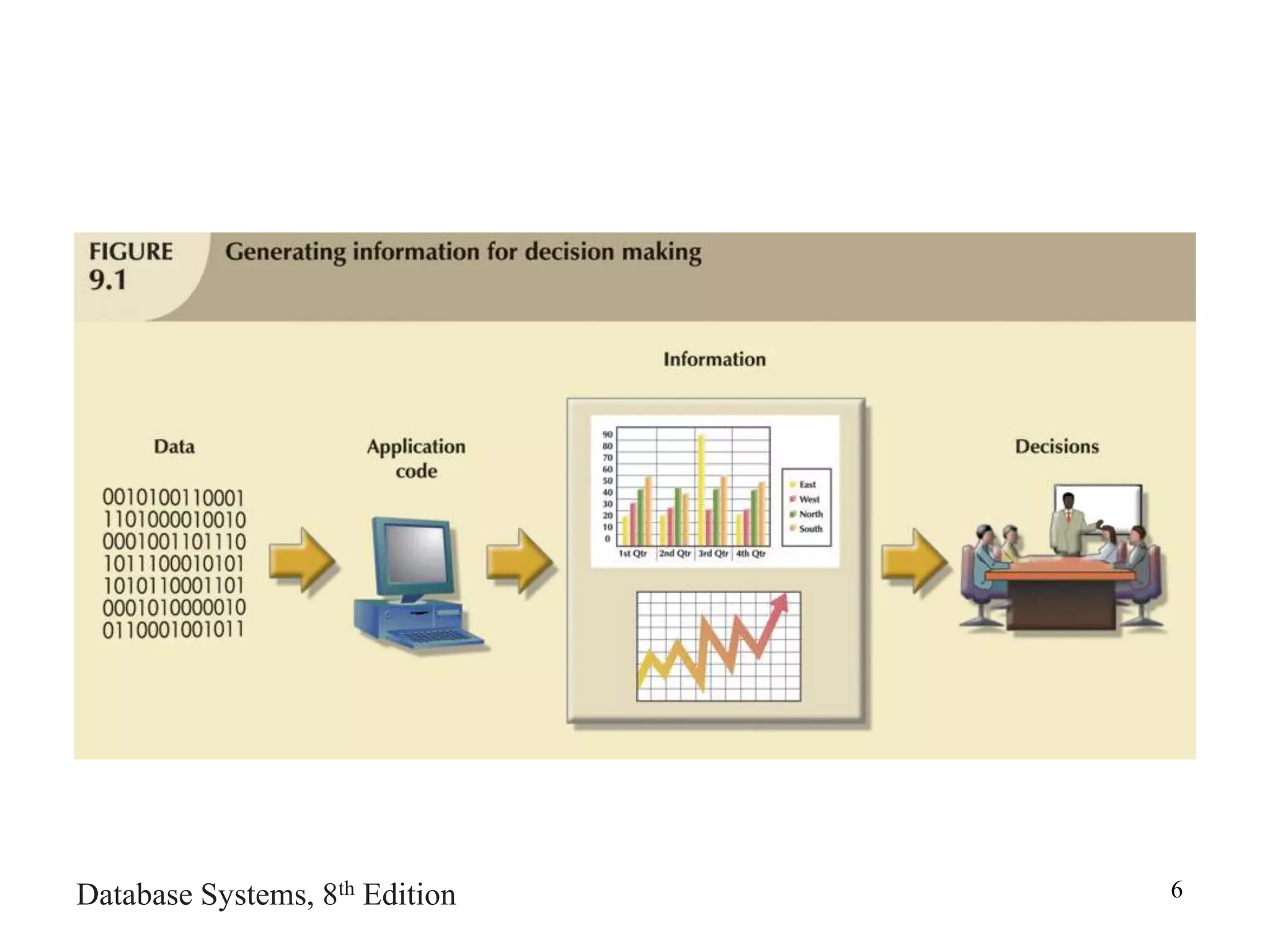
• Applications
– Transform data into information that forms basis
for decision making
– Usually produce the following:
• Formal report
• Tabulations
• Graphic displays
– Composed of following two parts:
• Data
• Code by which data are transformed into
information
Database Systems, 8th Edition 6
Database Systems, 8th Edition 7
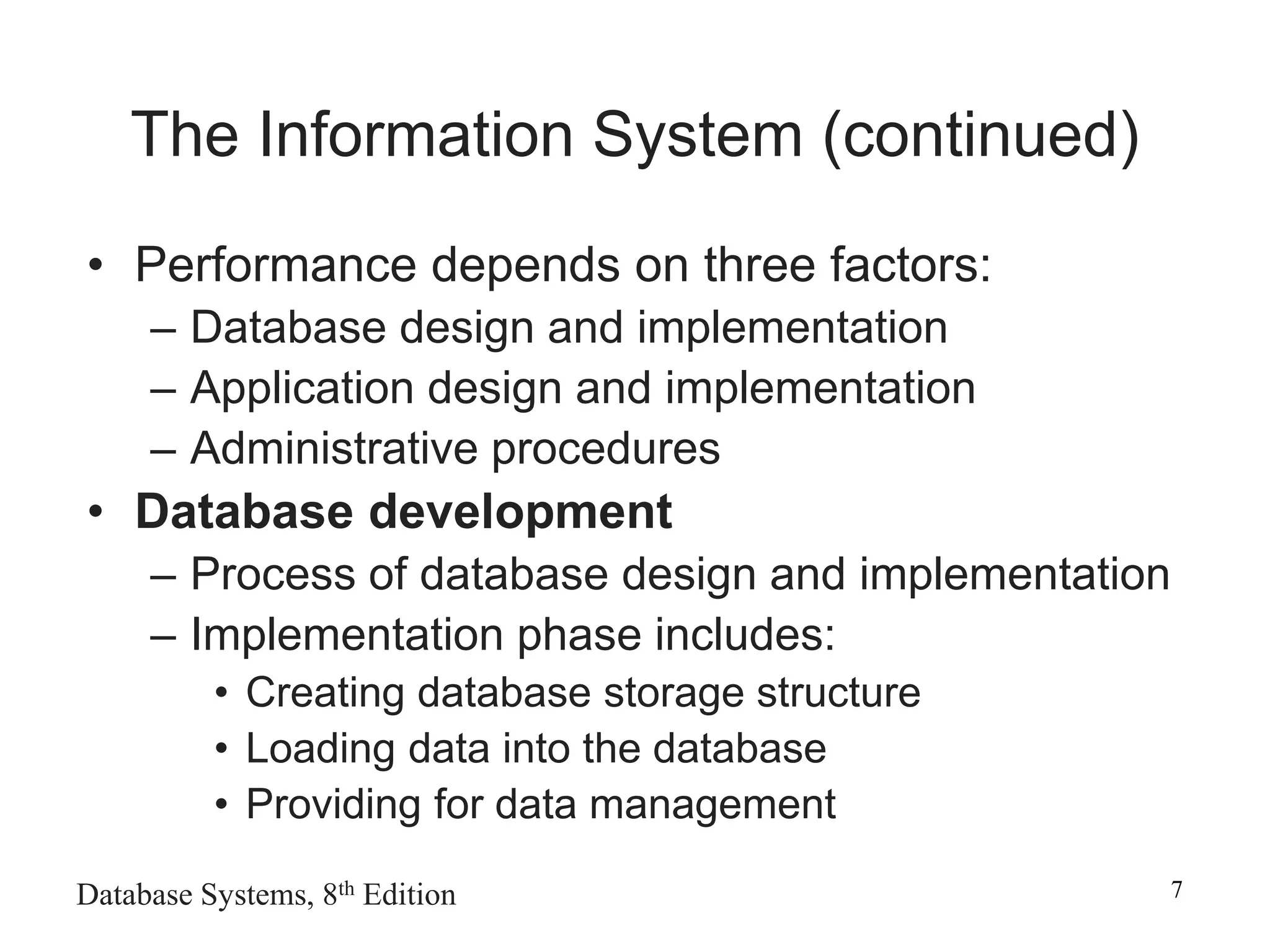
The Information System (continued)
• Performance depends on three factors:
– Database design and implementation
– Application design and implementation
– Administrative procedures
• Database development
– Process of database design and implementation
– Implementation phase includes:
• Creating database storage structure
• Loading data into the database
• Providing for data management
Database Systems, 8th Edition 8
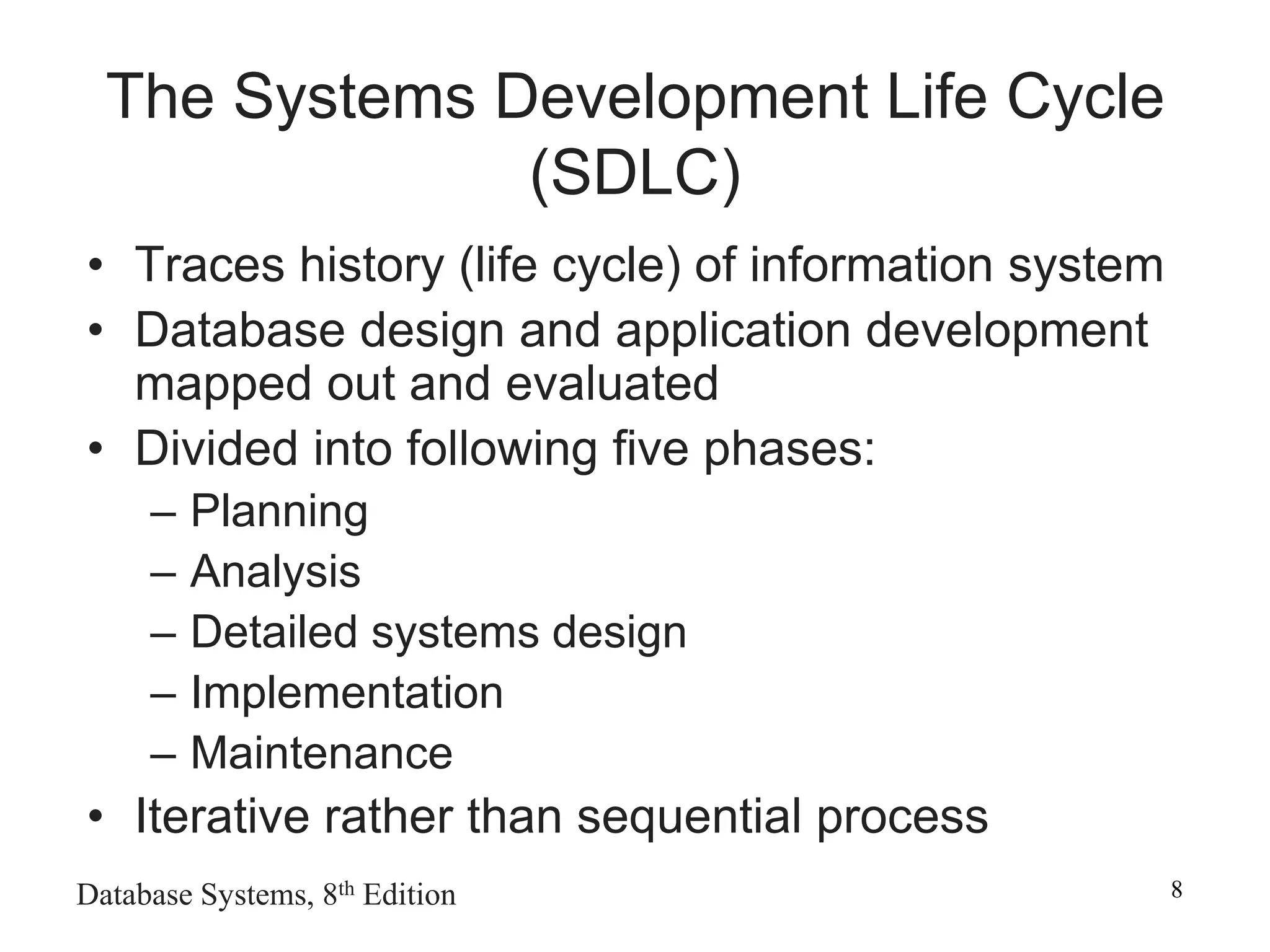
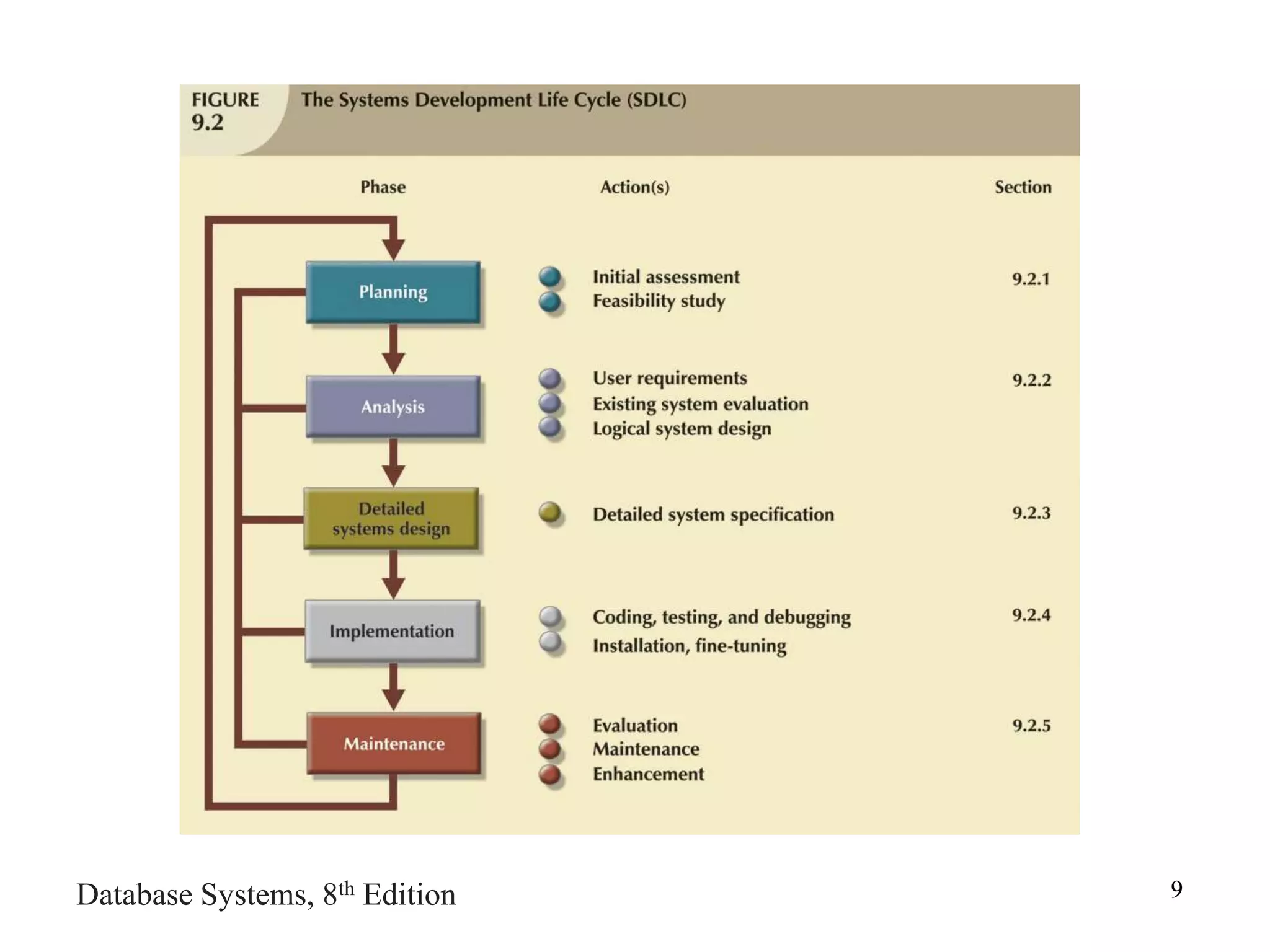
The Systems Development Life Cycle
(SDLC)
• Traces history (life cycle) of information system
• Database design and application development
mapped out and evaluated
• Divided into following five phases:
– Planning
– Analysis
– Detailed systems design
– Implementation
– Maintenance
• Iterative rather than sequential process
Database Systems, 8th Edition 9
Database Systems, 8th Edition 10
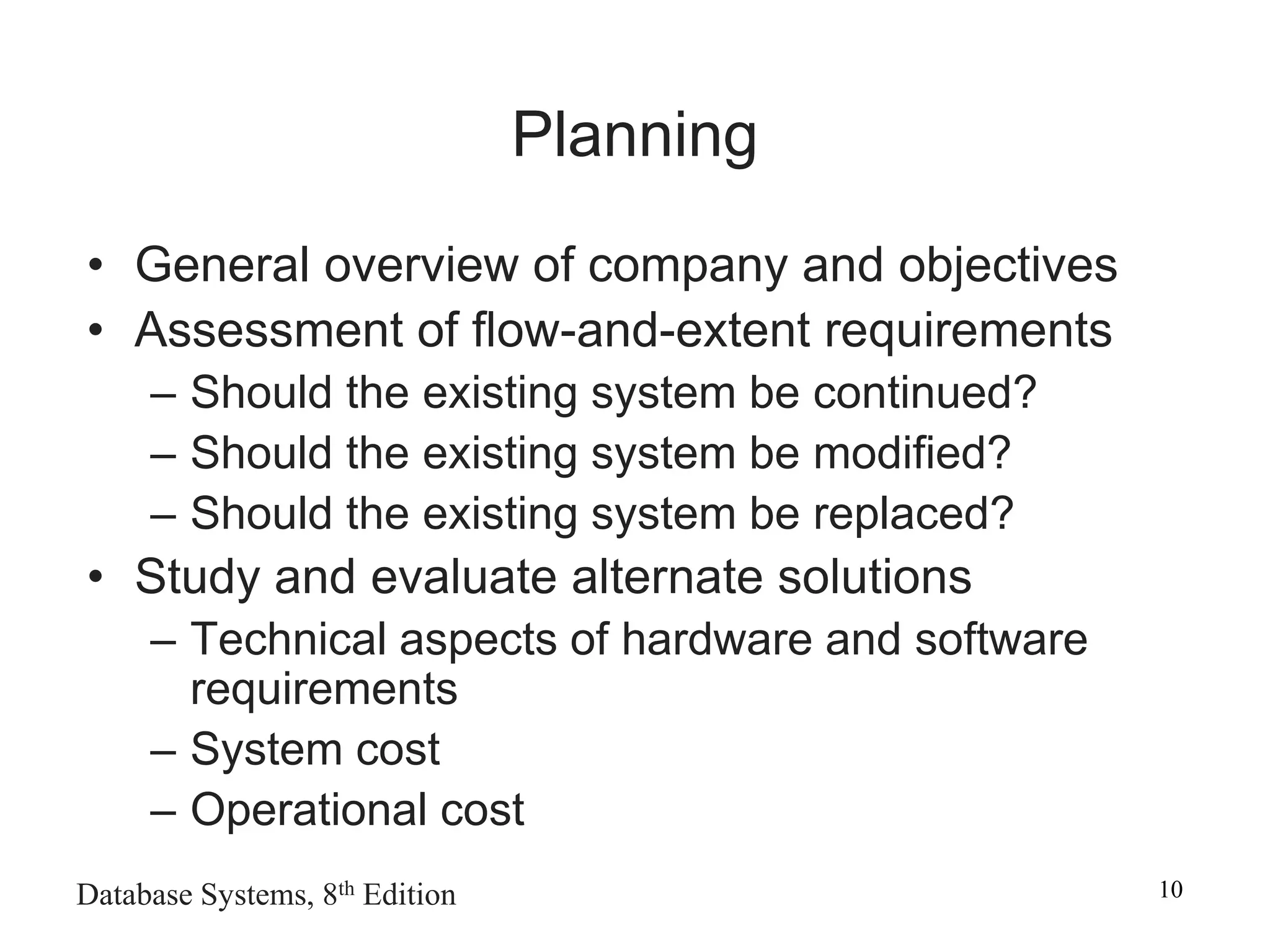
Planning
• General overview of company and objectives
• Assessment of flow-and-extent requirements
– Should the existing system be continued?
– Should the existing system be modified?
– Should the existing system be replaced?
• Study and evaluate alternate solutions
– Technical aspects of hardware and software
requirements
– System cost
– Operational cost
Database Systems, 8th Edition 11
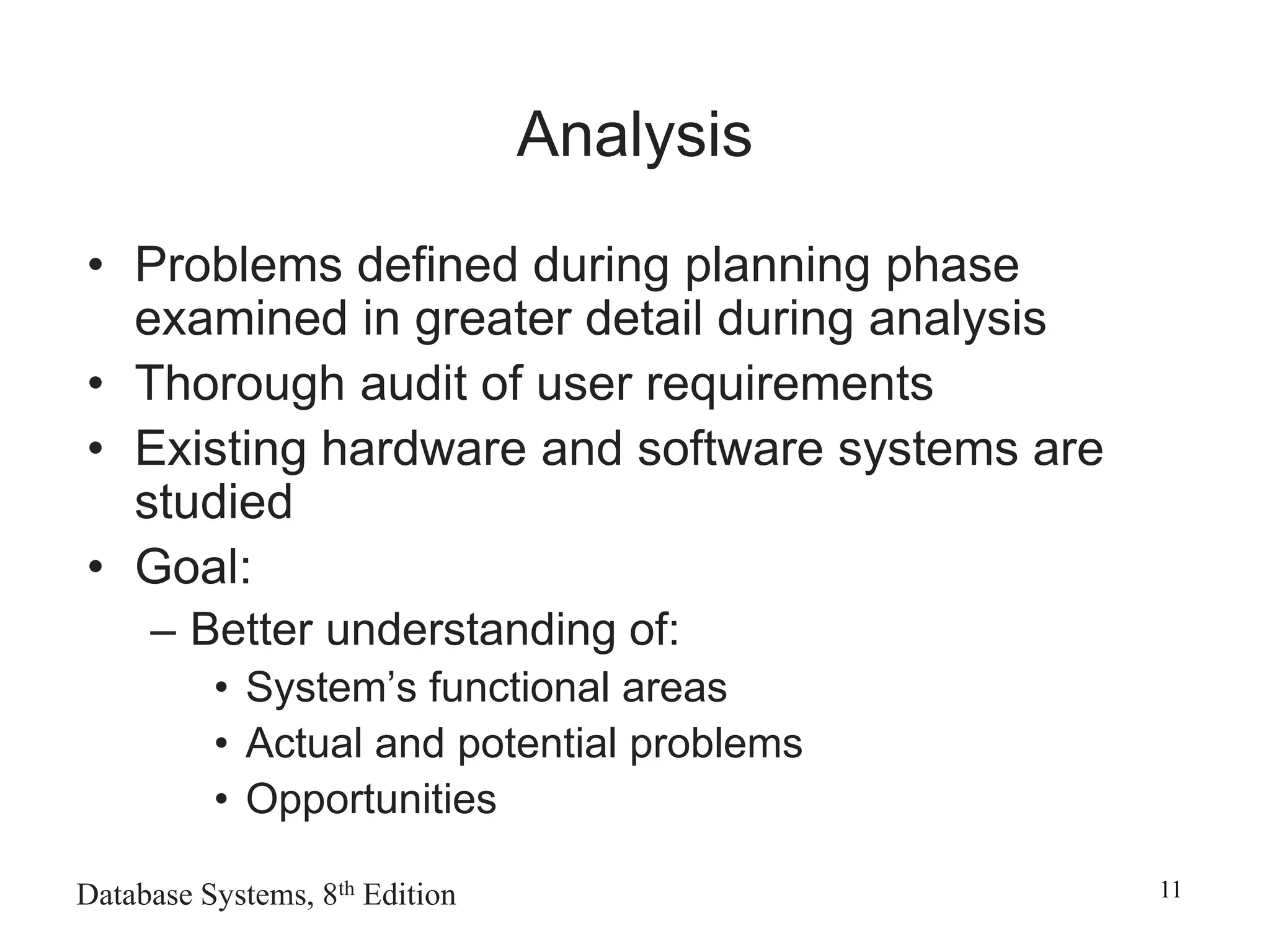
Analysis
• Problems defined during planning phase
examined in greater detail during analysis
• Thorough audit of user requirements
• Existing hardware and software systems are
studied
• Goal:
– Better understanding of:
• System’s functional areas
• Actual and potential problems
• Opportunities
Database Systems, 8th Edition 12
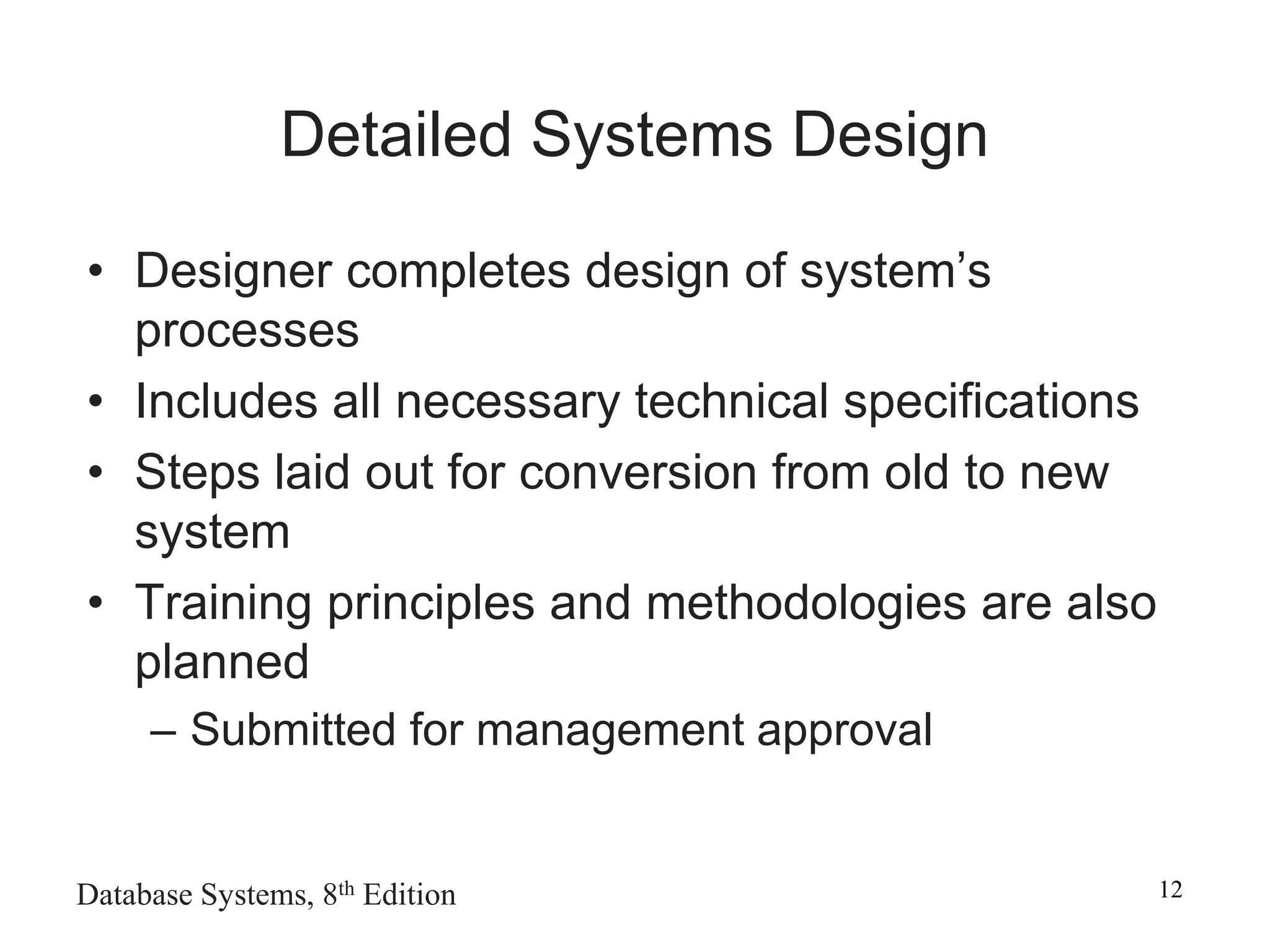
Detailed Systems Design
• Designer completes design of system’s
processes
• Includes all necessary technical specifications
• Steps laid out for conversion from old to new
system
• Training principles and methodologies are also
planned
– Submitted for management approval
Database Systems, 8th Edition 13
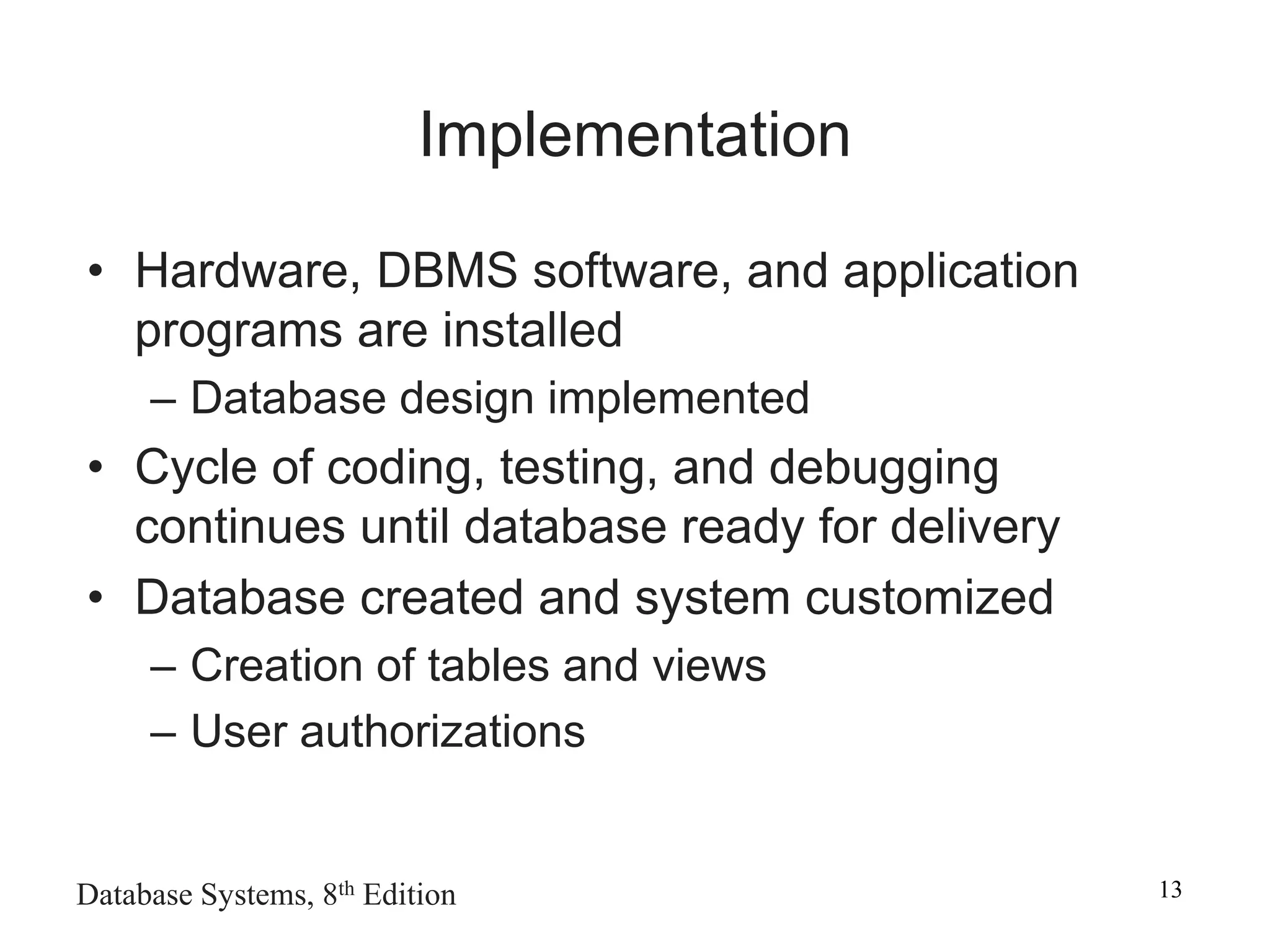
Implementation
• Hardware, DBMS software, and application
programs are installed
– Database design implemented
• Cycle of coding, testing, and debugging
continues until database ready for delivery
• Database created and system customized
– Creation of tables and views
– User authorizations
Database Systems, 8th Edition 14
Maintenance
• Three types of maintenance activity:
– Corrective maintenance
– Adaptive maintenance
– Perfective maintenance
• Computer-aided systems engineering
(CASE)
– Produce better systems within reasonable
amount of time and at reasonable cost
– CASE-produced applications are structured,
documented, standardized
Database Systems, 8th Edition 15
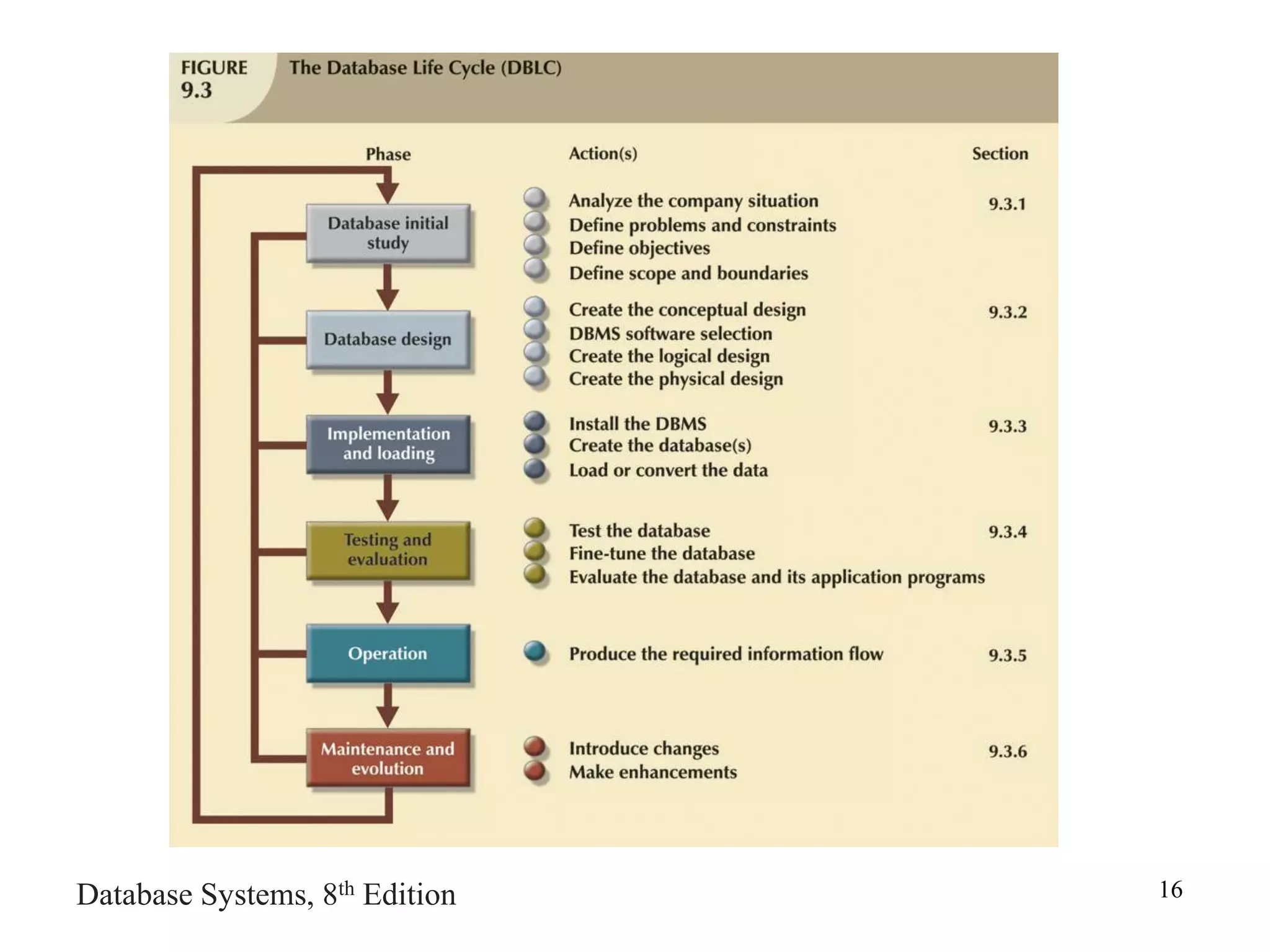
The Database Life Cycle (DBLC)
• Six phases:
– Database initial study
– Database design
– Implementation and loading
– Testing and evaluation
– Operation
– Maintenance and evolution
Database Systems, 8th Edition 16
Database Systems, 8th Edition 17
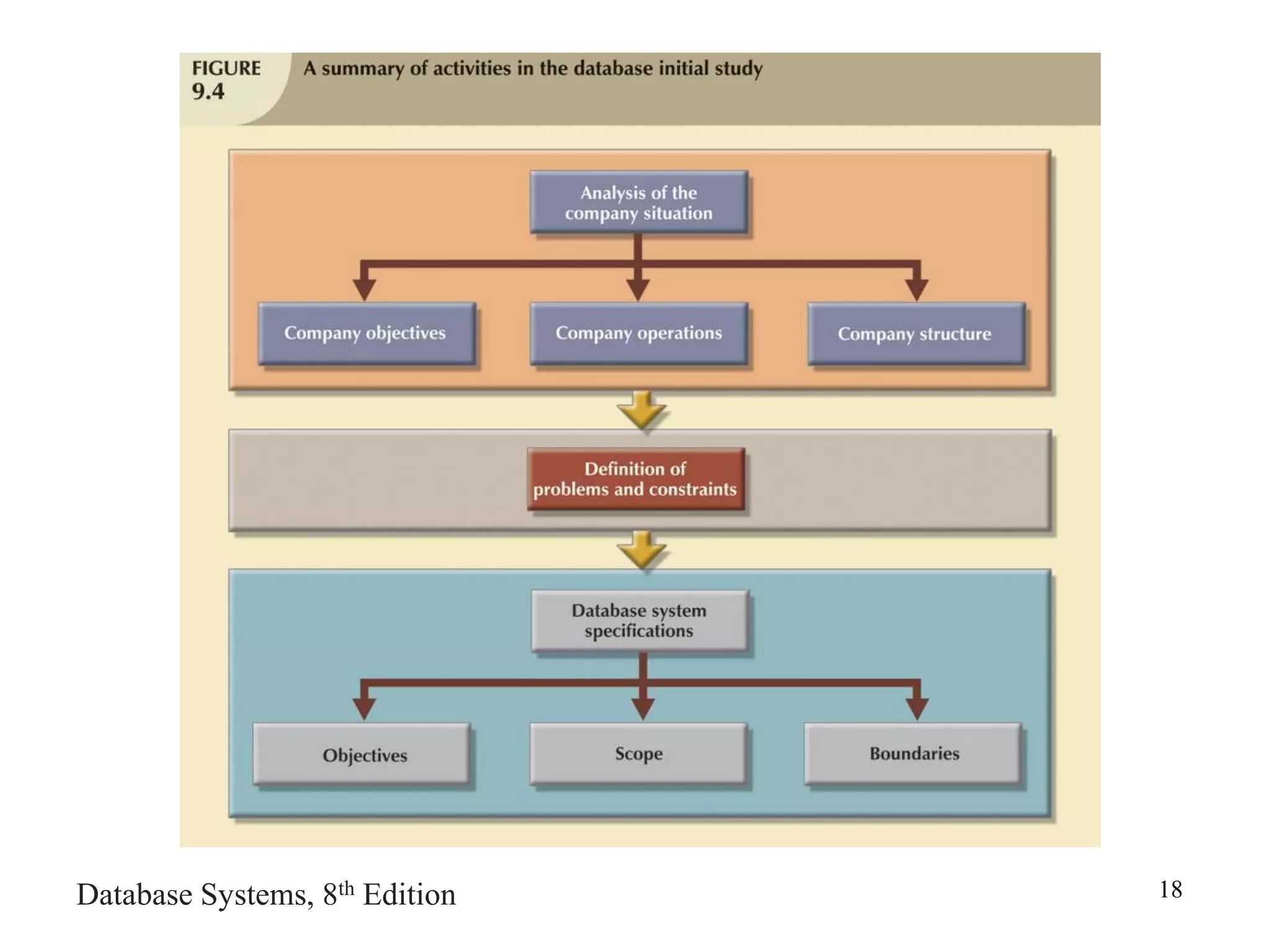
The Database Initial Study
• Overall purpose:
– Analyze company situation
– Define problems and constraints
– Define objectives
– Define scope and boundaries
• Interactive and iterative processes required to
complete first phase of DBLC successfully
Database Systems, 8th Edition 18
Database Systems, 8th Edition 19
The Database Initial Study (continued)
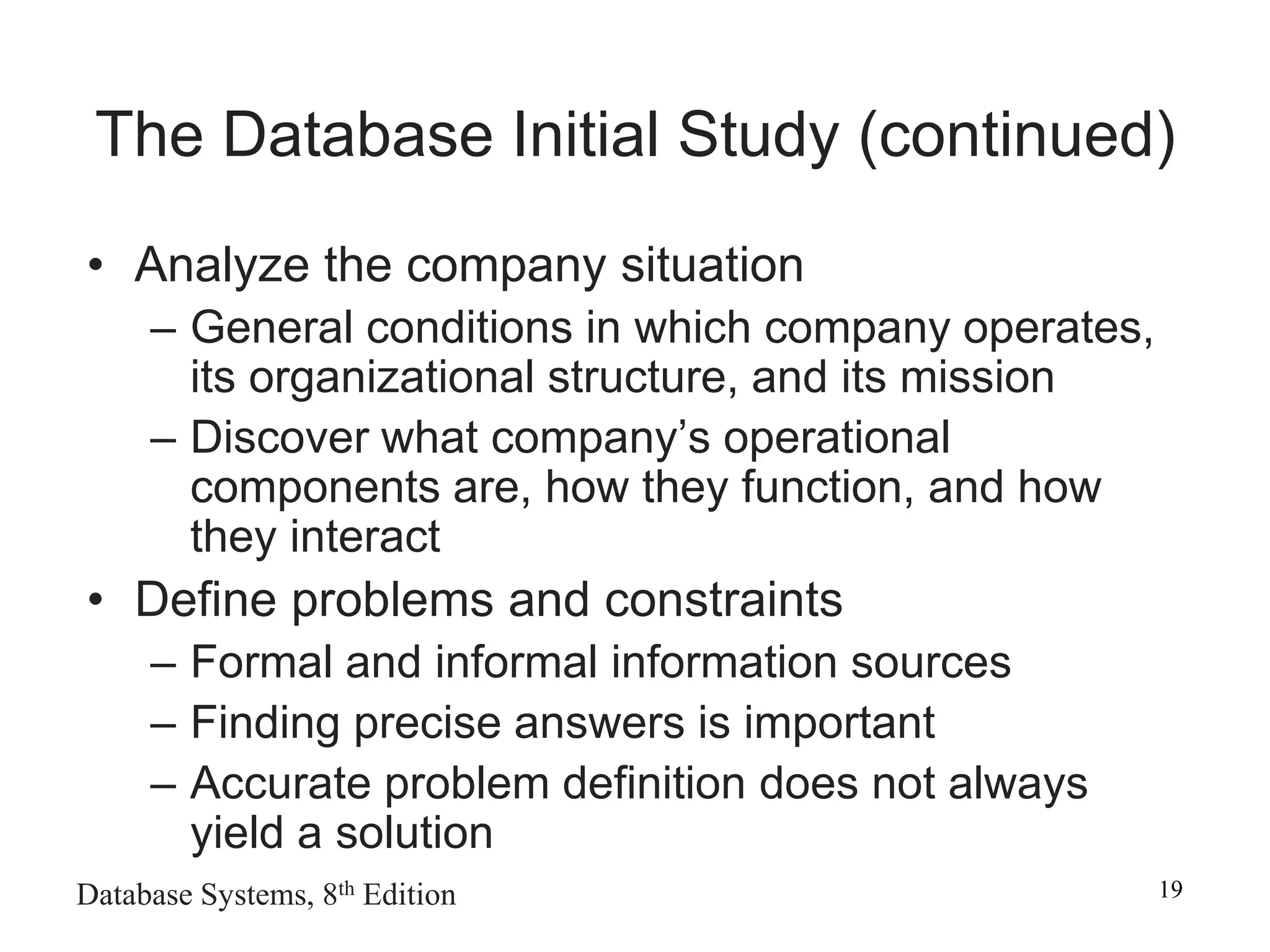
• Analyze the company situation
– General conditions in which company operates,
its organizational structure, and its mission
– Discover what company’s operational
components are, how they function, and how
they interact
• Define problems and constraints
– Formal and informal information sources
– Finding precise answers is important
– Accurate problem definition does not always
yield a solution
Database Systems, 8th Edition 20
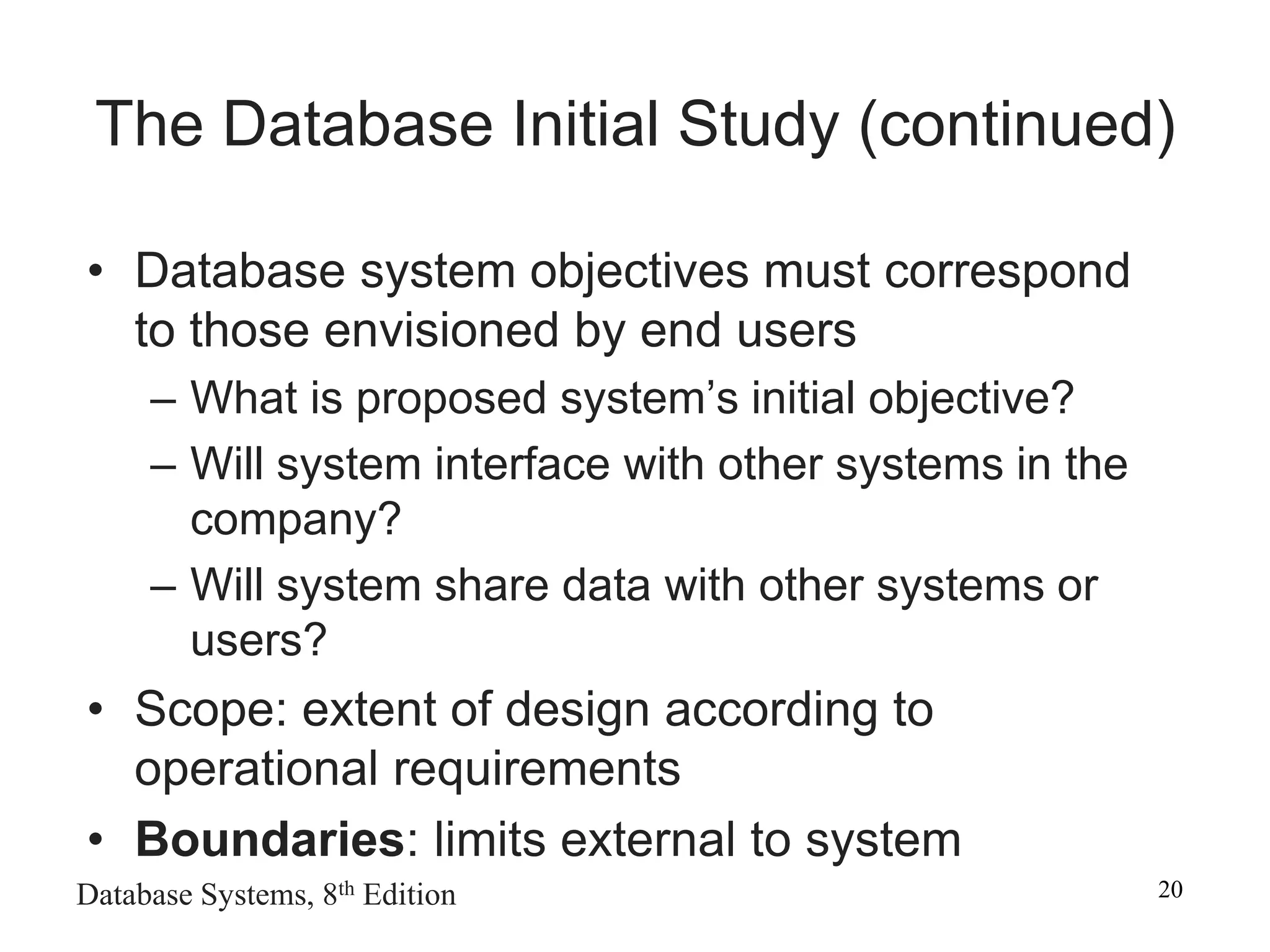
• Database system objectives must correspond
to those envisioned by end users
– What is proposed system’s initial objective?
– Will system interface with other systems in the
company?
– Will system share data with other systems or
users?
• Scope: extent of design according to
operational requirements
• Boundaries: limits external to system
The Database Initial Study (continued)
Database Systems, 8th Edition 21
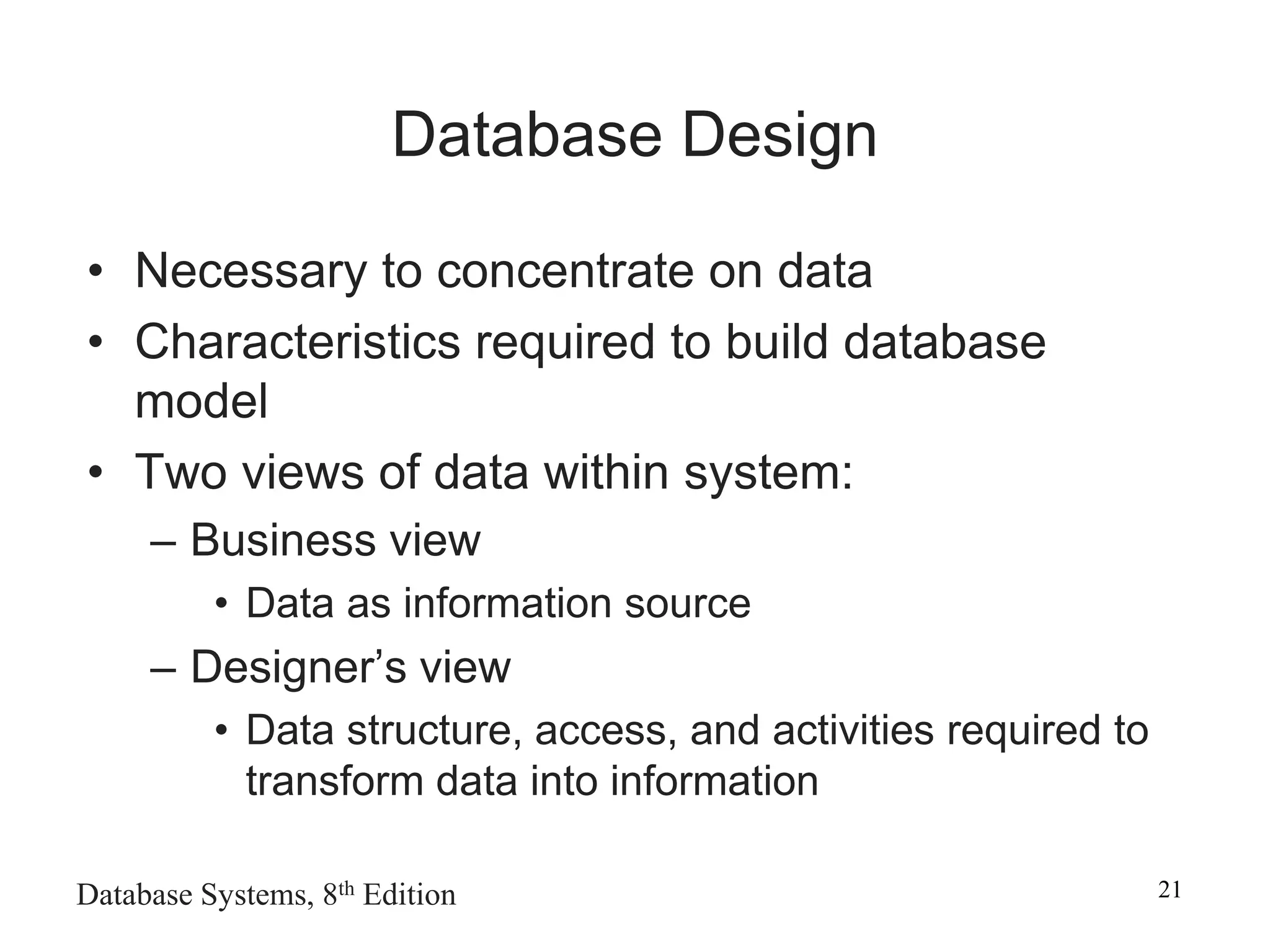
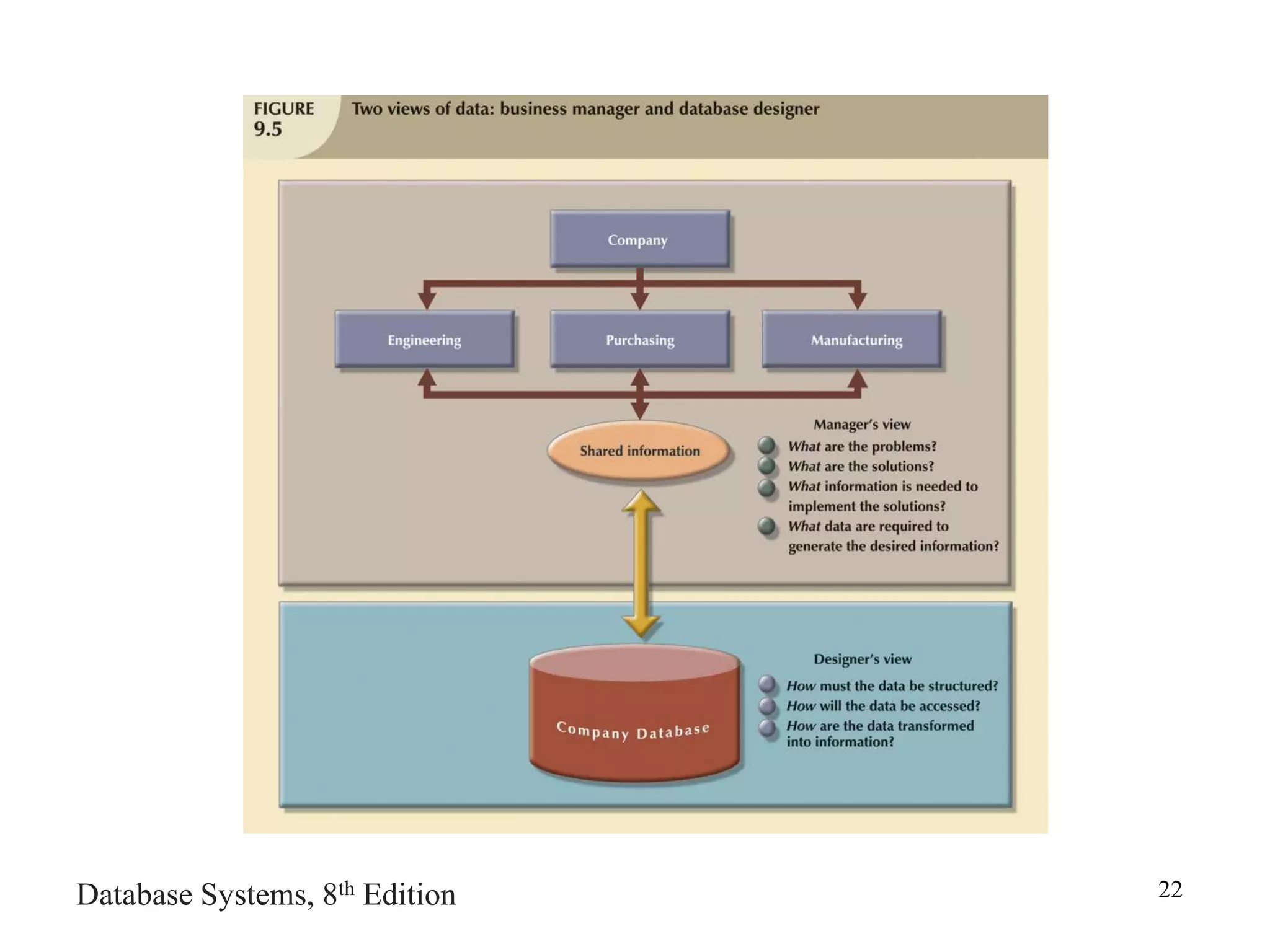
Database Design
• Necessary to concentrate on data
• Characteristics required to build database
model
• Two views of data within system:
– Business view
• Data as information source
– Designer’s view
• Data structure, access, and activities required to
transform data into information
Database Systems, 8th Edition 22
Database Systems, 8th Edition 23
Database Systems, 8th Edition 24
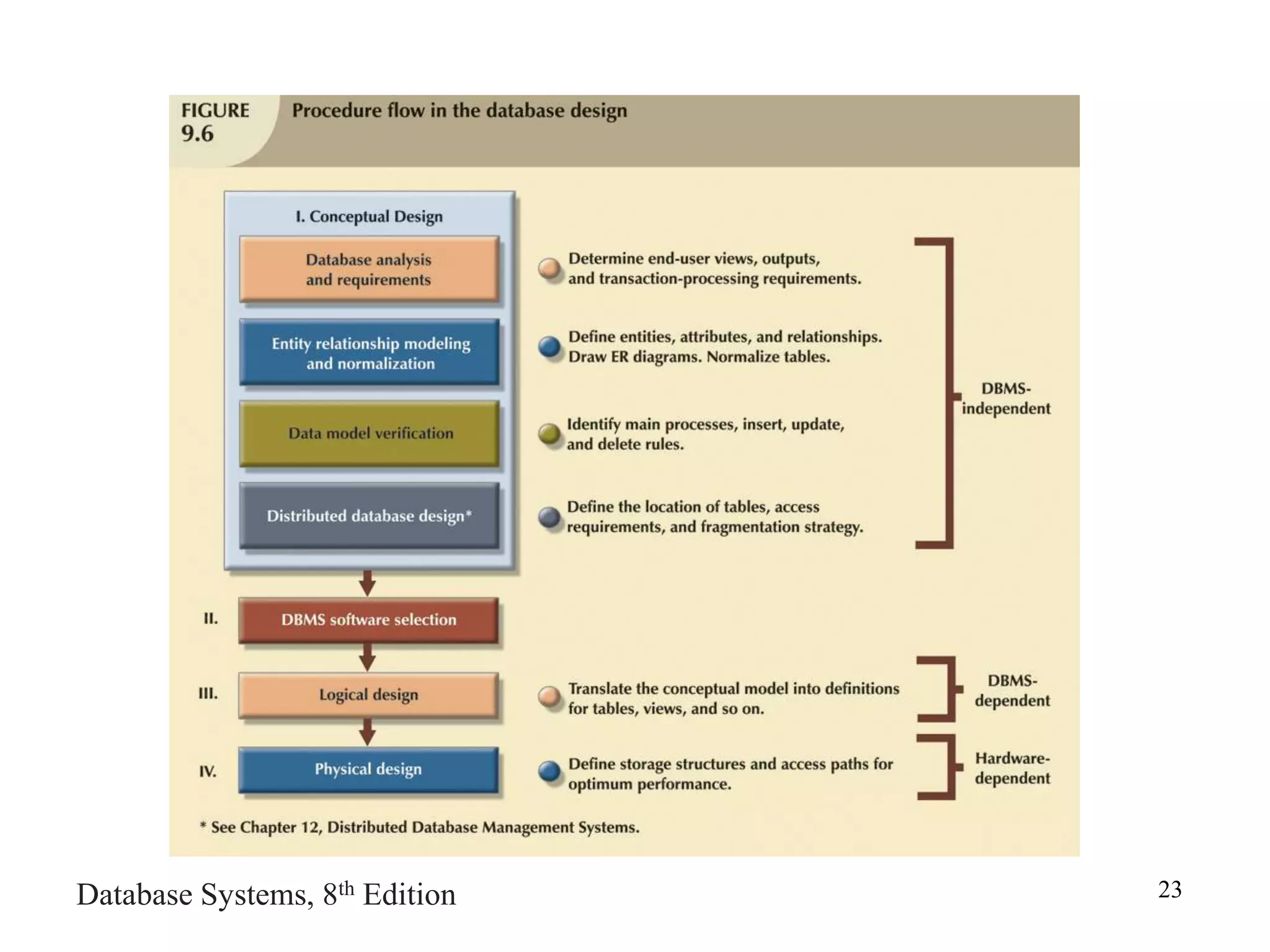
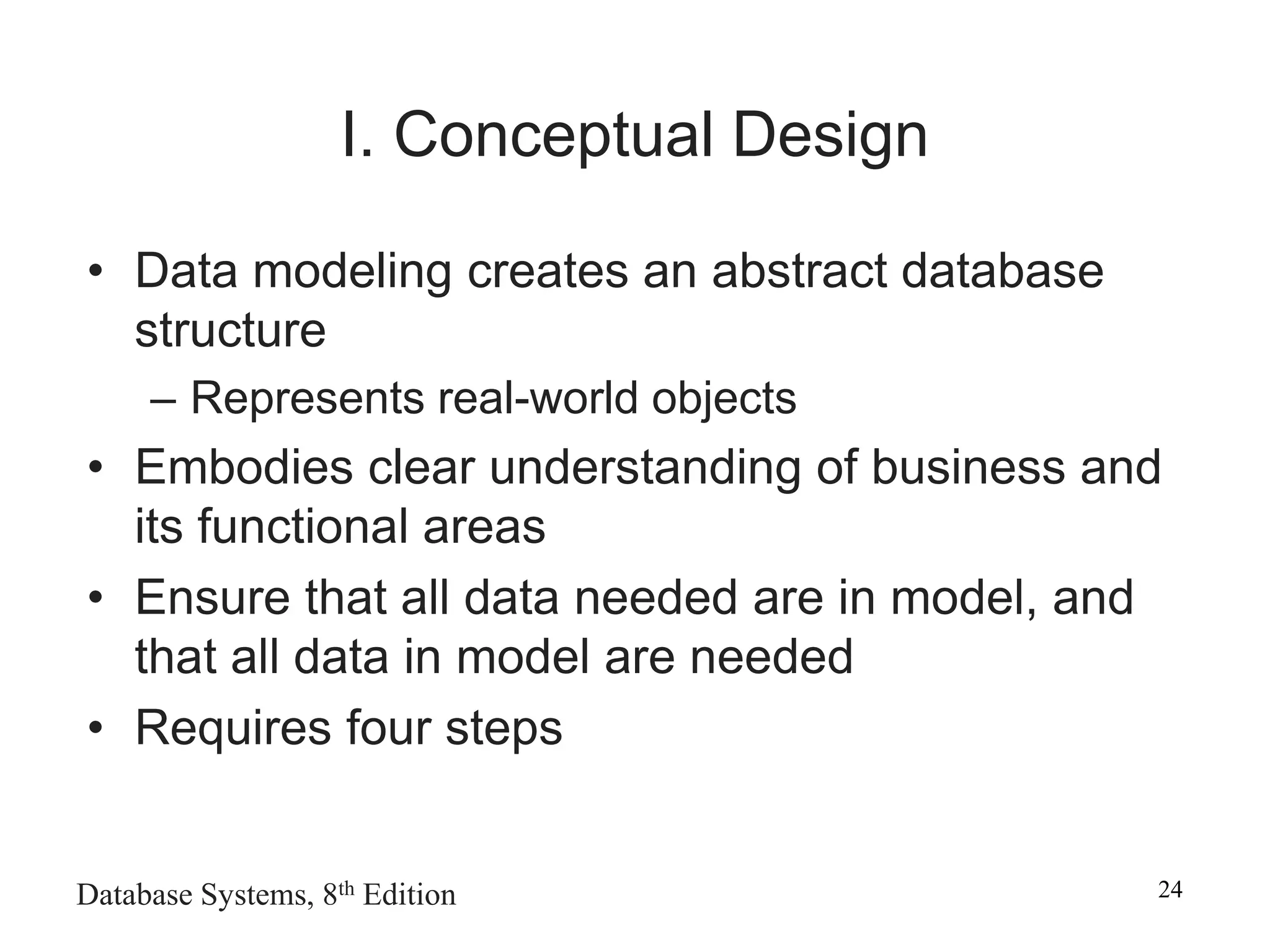
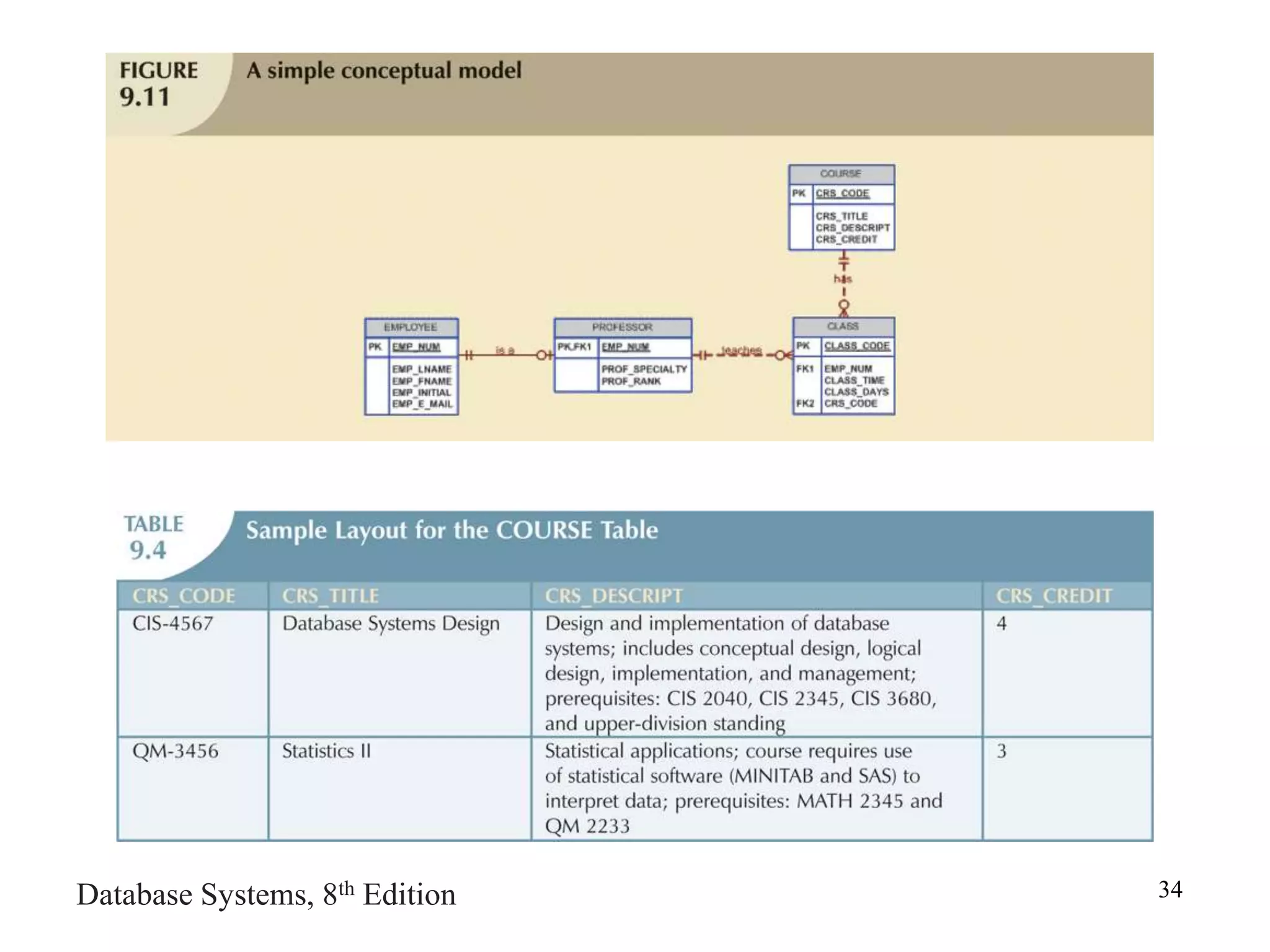
I. Conceptual Design
• Data modeling creates an abstract database
structure
– Represents real-world objects
• Embodies clear understanding of business and
its functional areas
• Ensure that all data needed are in model, and
that all data in model are needed
• Requires four steps
Database Systems, 8th Edition 25
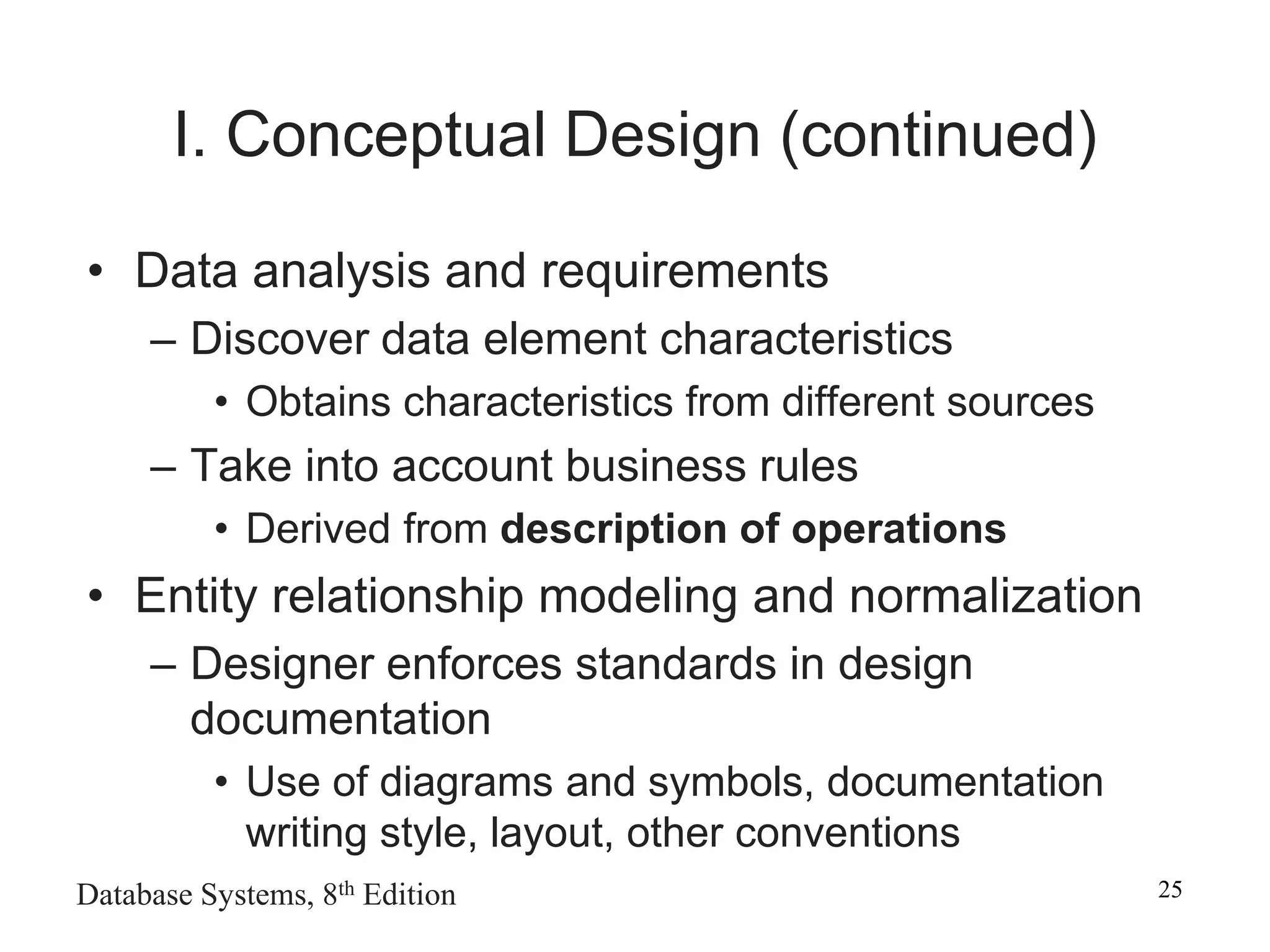
I. Conceptual Design (continued)
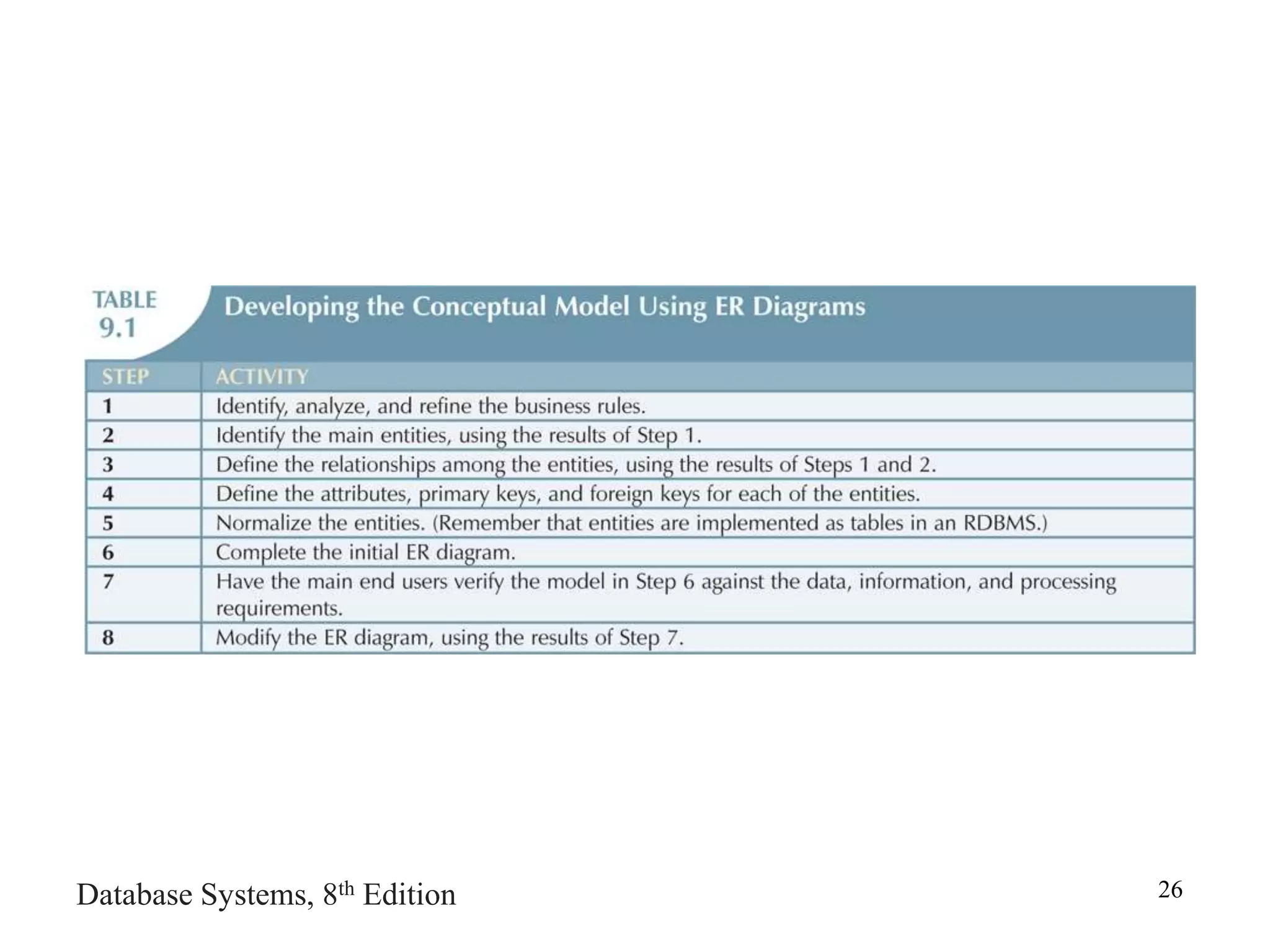
• Data analysis and requirements
– Discover data element characteristics
• Obtains characteristics from different sources
– Take into account business rules
• Derived from description of operations
• Entity relationship modeling and normalization
– Designer enforces standards in design
documentation
• Use of diagrams and symbols, documentation
writing style, layout, other conventions
Database Systems, 8th Edition 26
Database Systems, 8th Edition 27
I. Conceptual Design (continued)
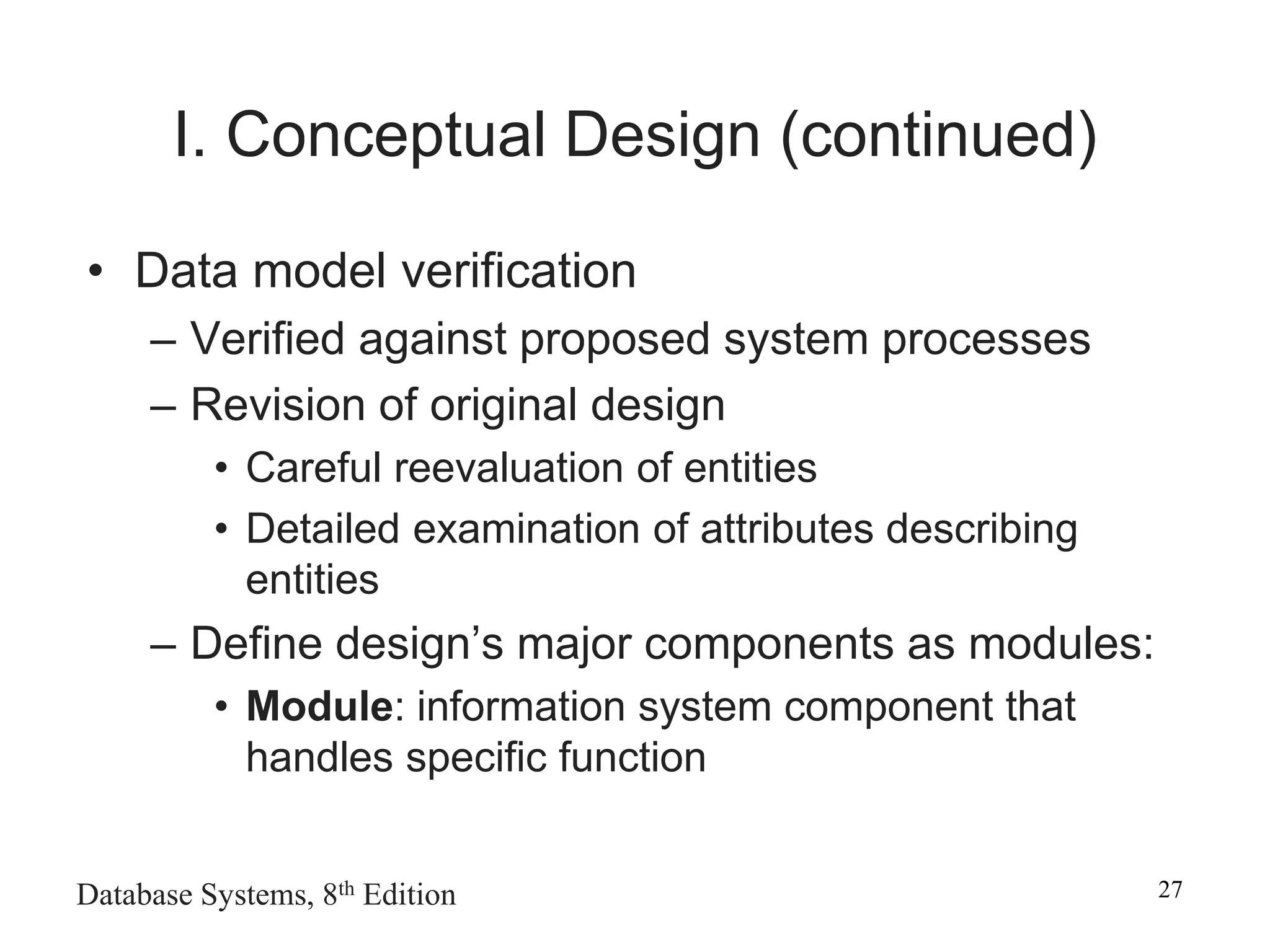
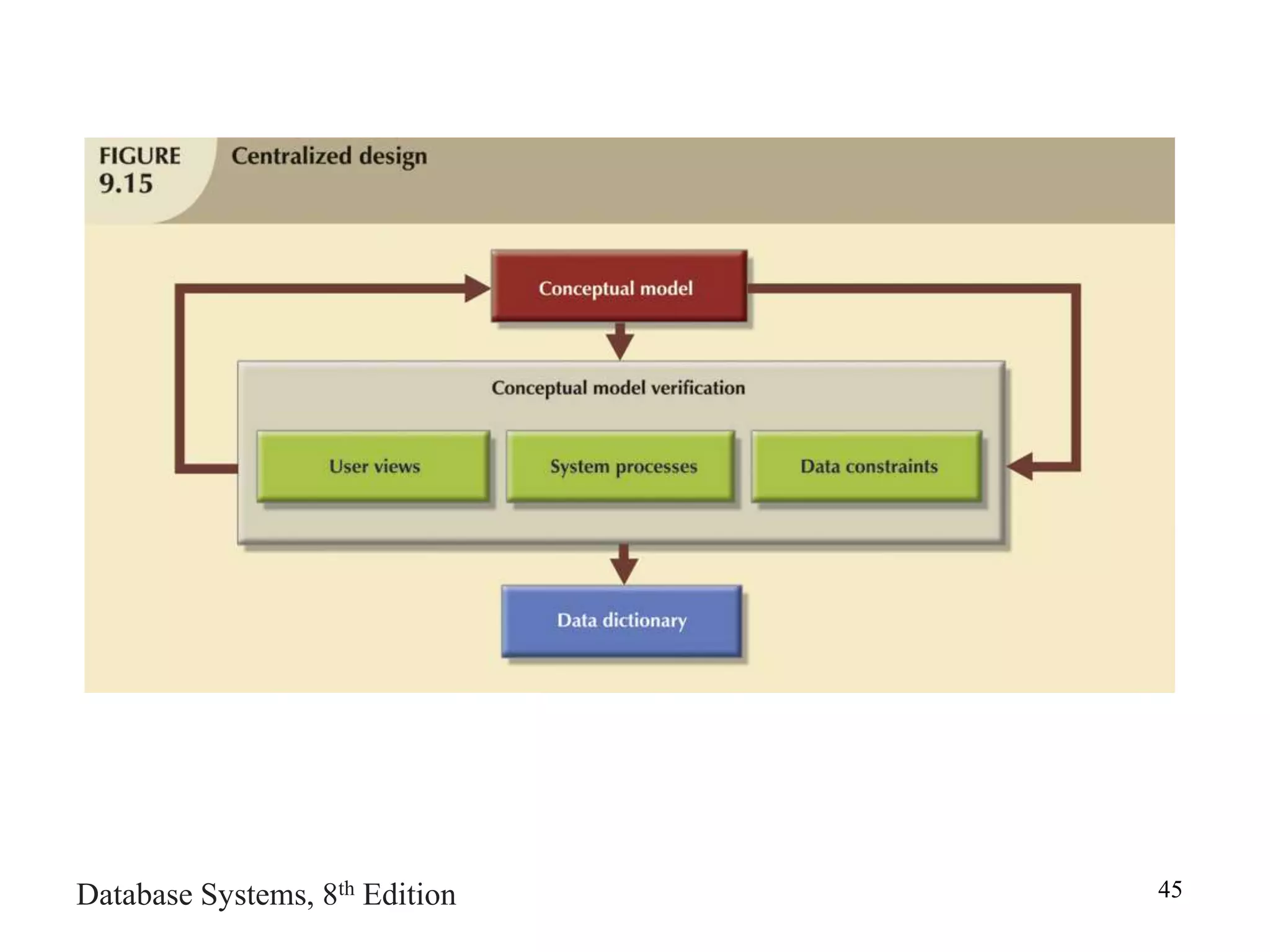
• Data model verification
– Verified against proposed system processes
– Revision of original design
• Careful reevaluation of entities
• Detailed examination of attributes describing
entities
– Define design’s major components as modules:
• Module: information system component that
handles specific function
Database Systems, 8th Edition 28
Database Systems, 8th Edition 29
Database Systems, 8th Edition 30
I. Conceptual Design (continued)
• Data model verification (continued)
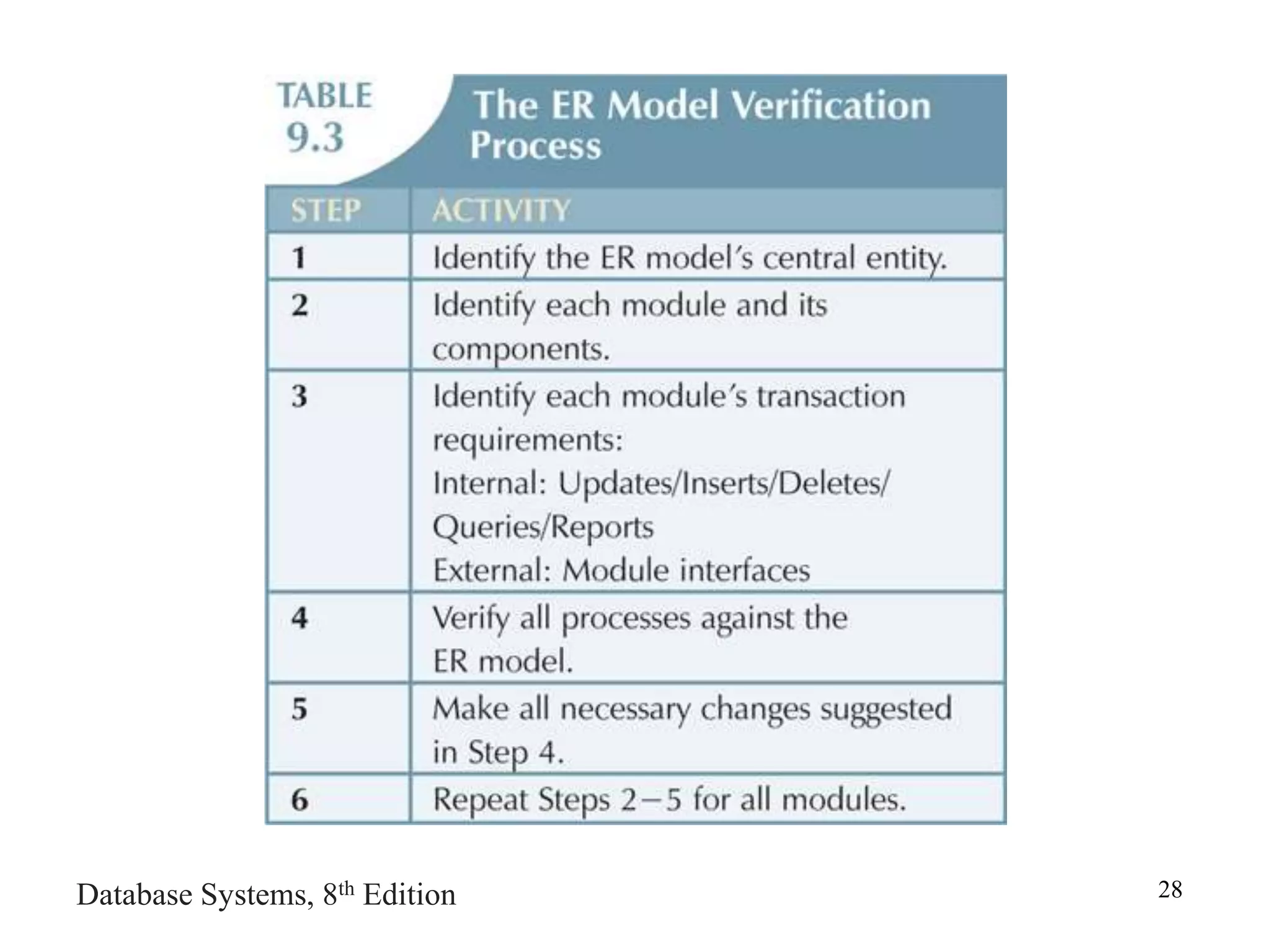
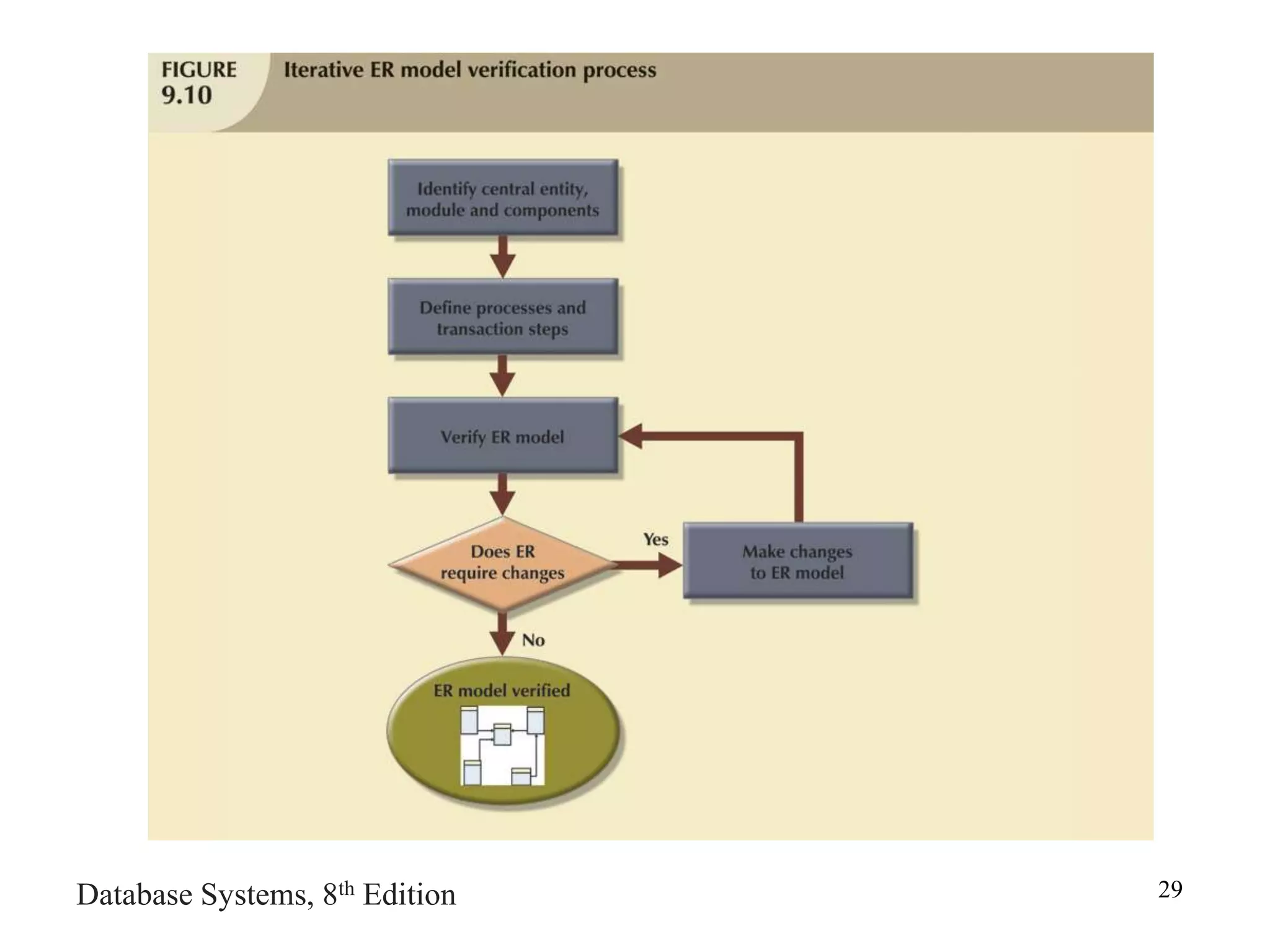
– Verification process
• Select central (most important) entity
– Defined in terms of its participation in most of
model’s relationships
• Identify module or subsystem to which central
entity belongs and define boundaries and scope
• Place central entity within module’s framework
Database Systems, 8th Edition 31
I. Conceptual Design (continued)
• Distributed database design
– Portions of database may reside in different
physical locations
– Processes accessing the database vary from
one location to another
– Designer must also develop data distribution
and allocation strategies
Database Systems, 8th Edition 32
II. DBMS Software Selection
• Critical to information system’s smooth
operation
• Common factors affecting purchasing
decisions:
– Cost
– DBMS features and tools
– Underlying model
– Portability
– DBMS hardware requirements
Database Systems, 8th Edition 33
III. Logical Design
• Translate conceptual design into internal model
• Logical design is software-dependent
• Requires all objects be mapped to specific
constructs used by selected database software
– Definition of attribute domains, design of
required tables, access restriction formats
– Tables must correspond to entities in conceptual
design
• Translates software-independent conceptual
model into software-dependent model
Database Systems, 8th Edition 34
Database Systems, 8th Edition 35
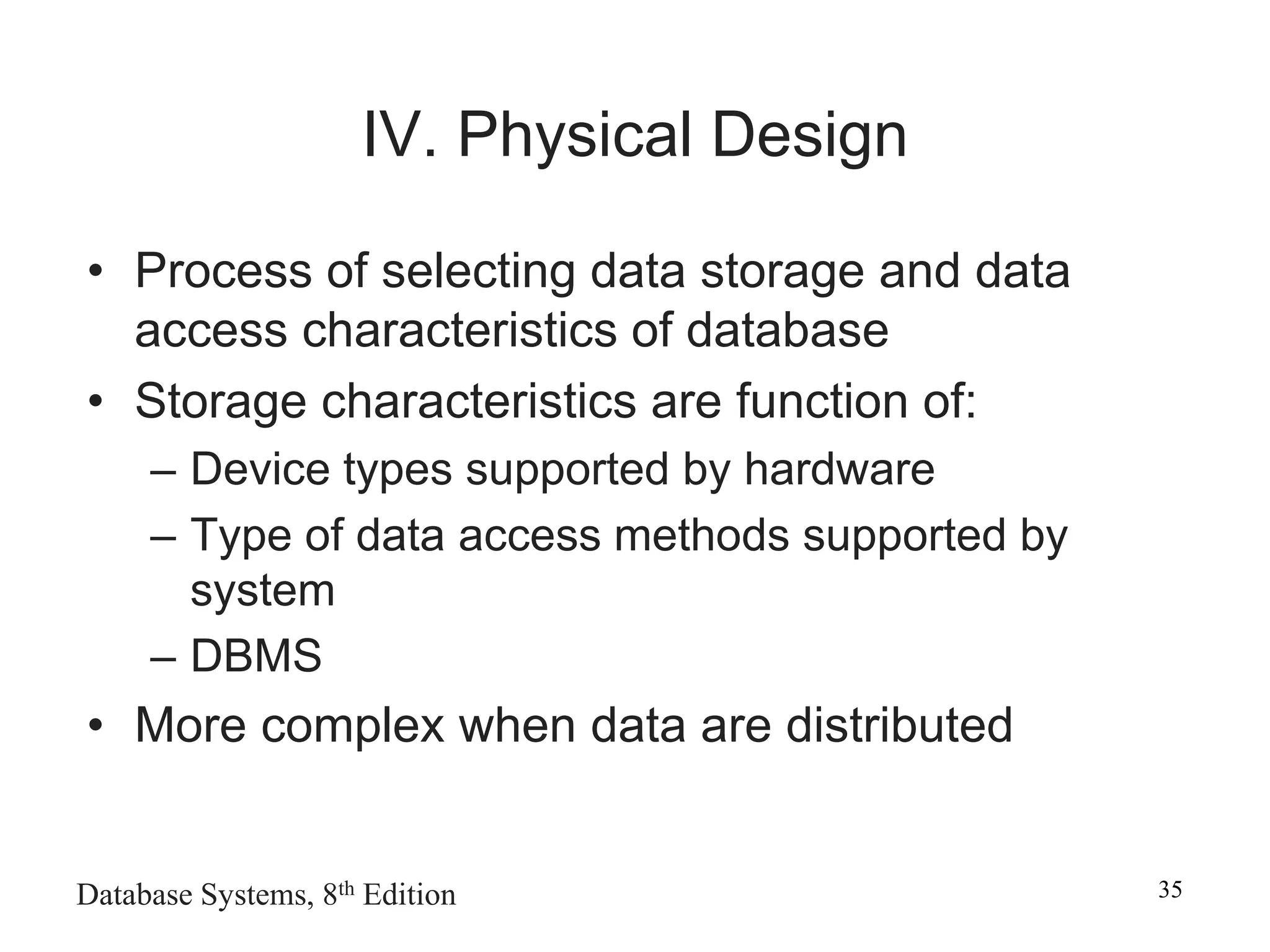
IV. Physical Design
• Process of selecting data storage and data
access characteristics of database
• Storage characteristics are function of:
– Device types supported by hardware
– Type of data access methods supported by
system
– DBMS
• More complex when data are distributed
Database Systems, 8th Edition 36
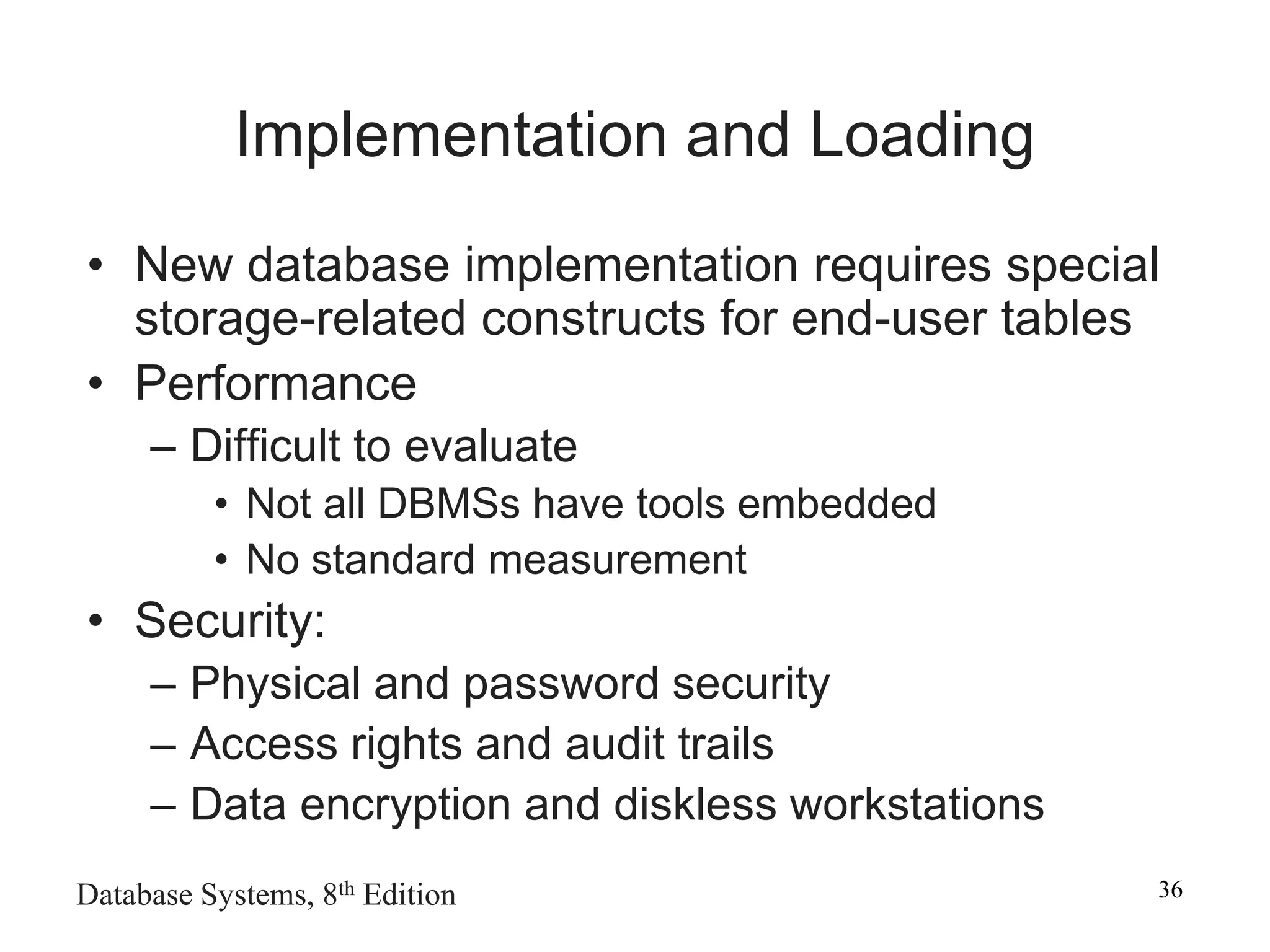
Implementation and Loading
• New database implementation requires special
storage-related constructs for end-user tables
• Performance
– Difficult to evaluate
• Not all DBMSs have tools embedded
• No standard measurement
• Security:
– Physical and password security
– Access rights and audit trails
– Data encryption and diskless workstations
Database Systems, 8th Edition 37
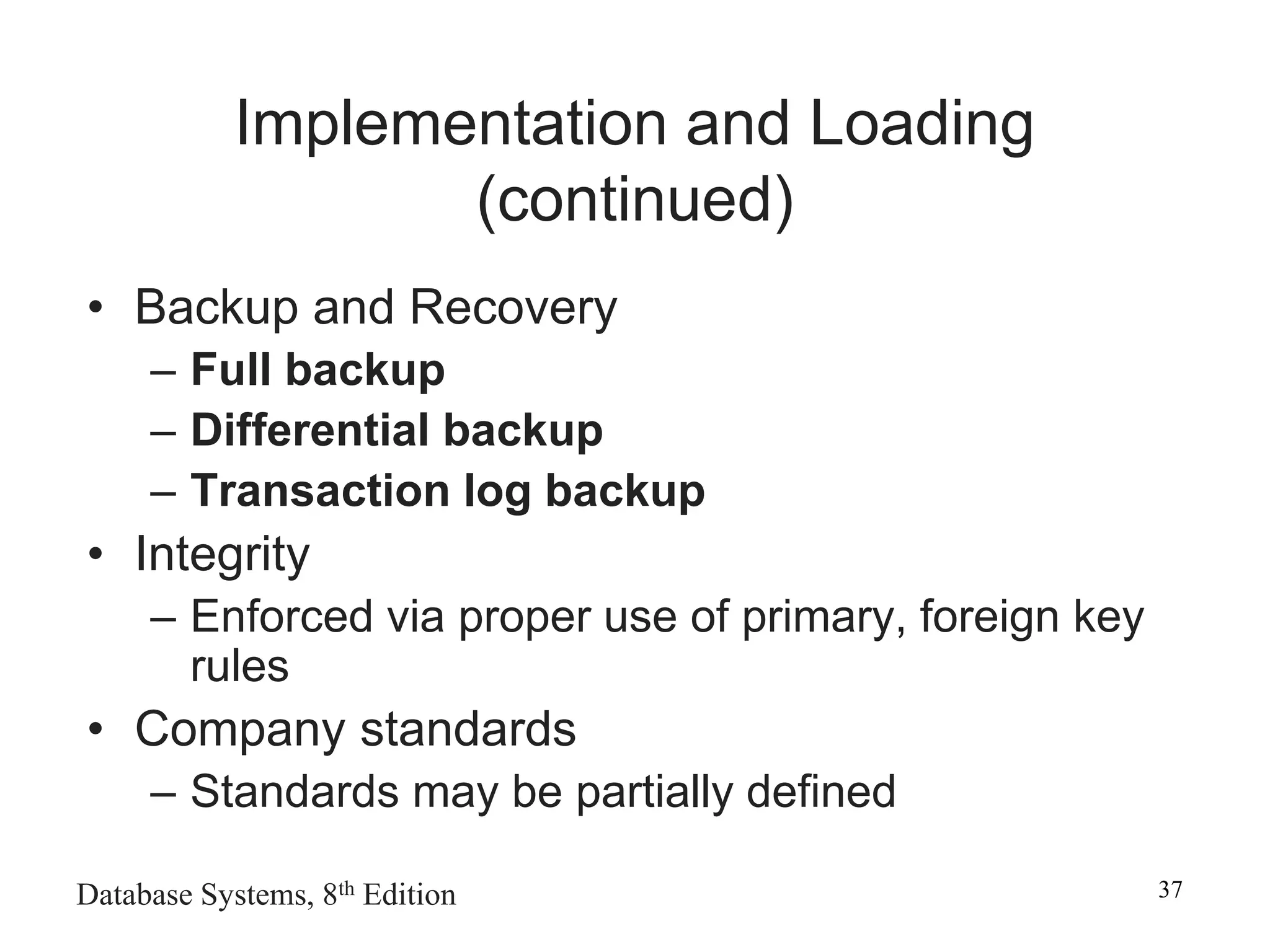
Implementation and Loading
(continued)
• Backup and Recovery
– Full backup
– Differential backup
– Transaction log backup
• Integrity
– Enforced via proper use of primary, foreign key
rules
• Company standards
– Standards may be partially defined
Database Systems, 8th Edition 38
Testing and Evaluation
• Occurs in parallel with applications
programming
• Database tools used to prototype applications
• If implementation fails to meet some of
system’s evaluation criteria:
– Fine-tune specific system and DBMS
configuration parameters
– Modify physical or logical design
– Upgrade software and/or hardware platform
Database Systems, 8th Edition 39
Operation
• Once database has passed evaluation stage, it
is considered operational
• Beginning of operational phase starts process
of system evolution
• Problems not foreseen during testing surface
• Solutions may include:
– Load-balancing software to distribute
transactions among multiple computers
– Increasing available cache
Database Systems, 8th Edition 40
Maintenance and Evolution
• Required periodic maintenance:
– Preventive maintenance (backup)
– Corrective maintenance (recovery)
– Adaptive maintenance
– Assignment of access permissions and their
maintenance for new and old users
– Generation of database access statistics
– Periodic security audits
– Periodic system-usage summaries
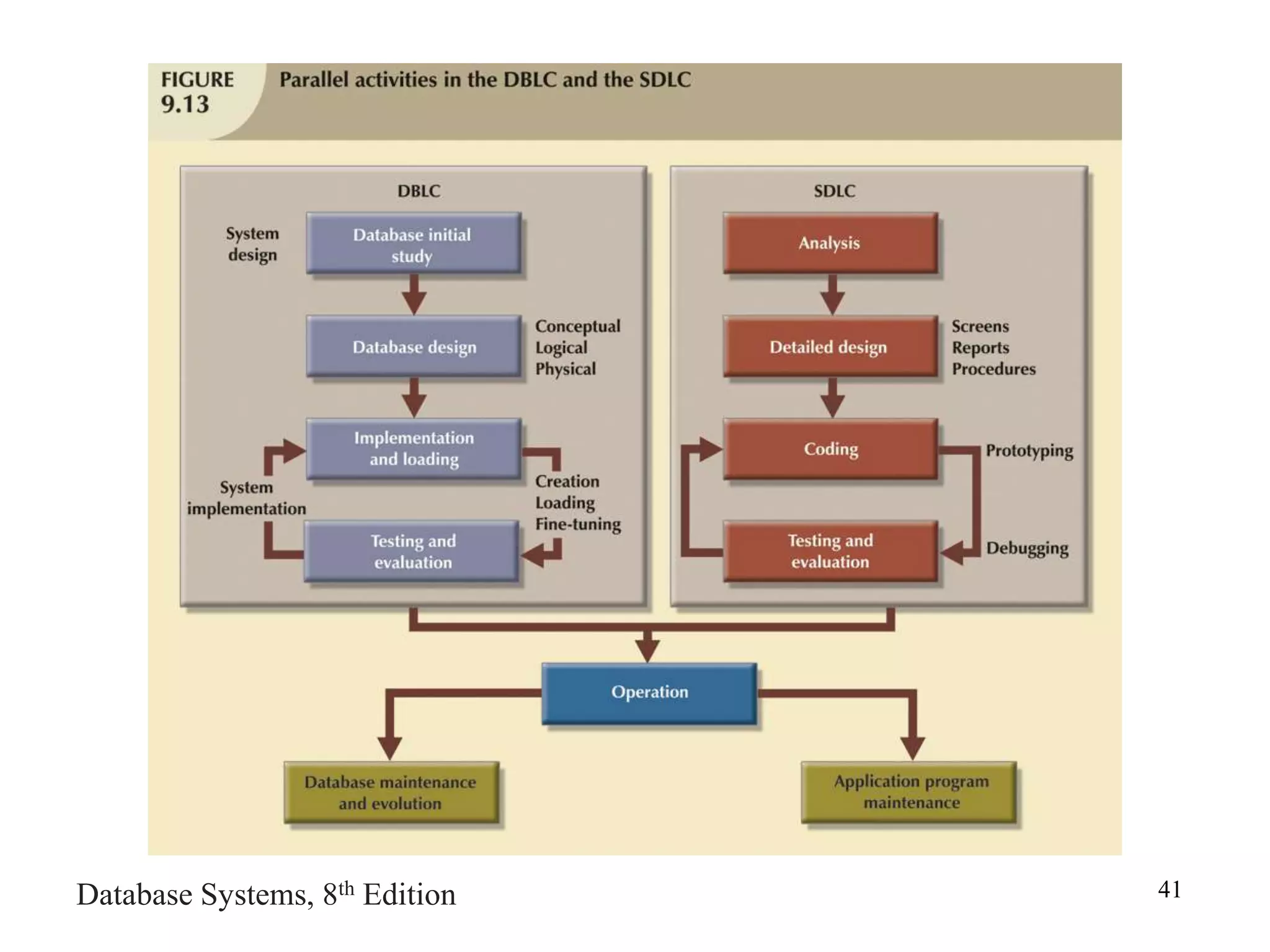
Database Systems, 8th Edition 41
Database Systems, 8th Edition 42
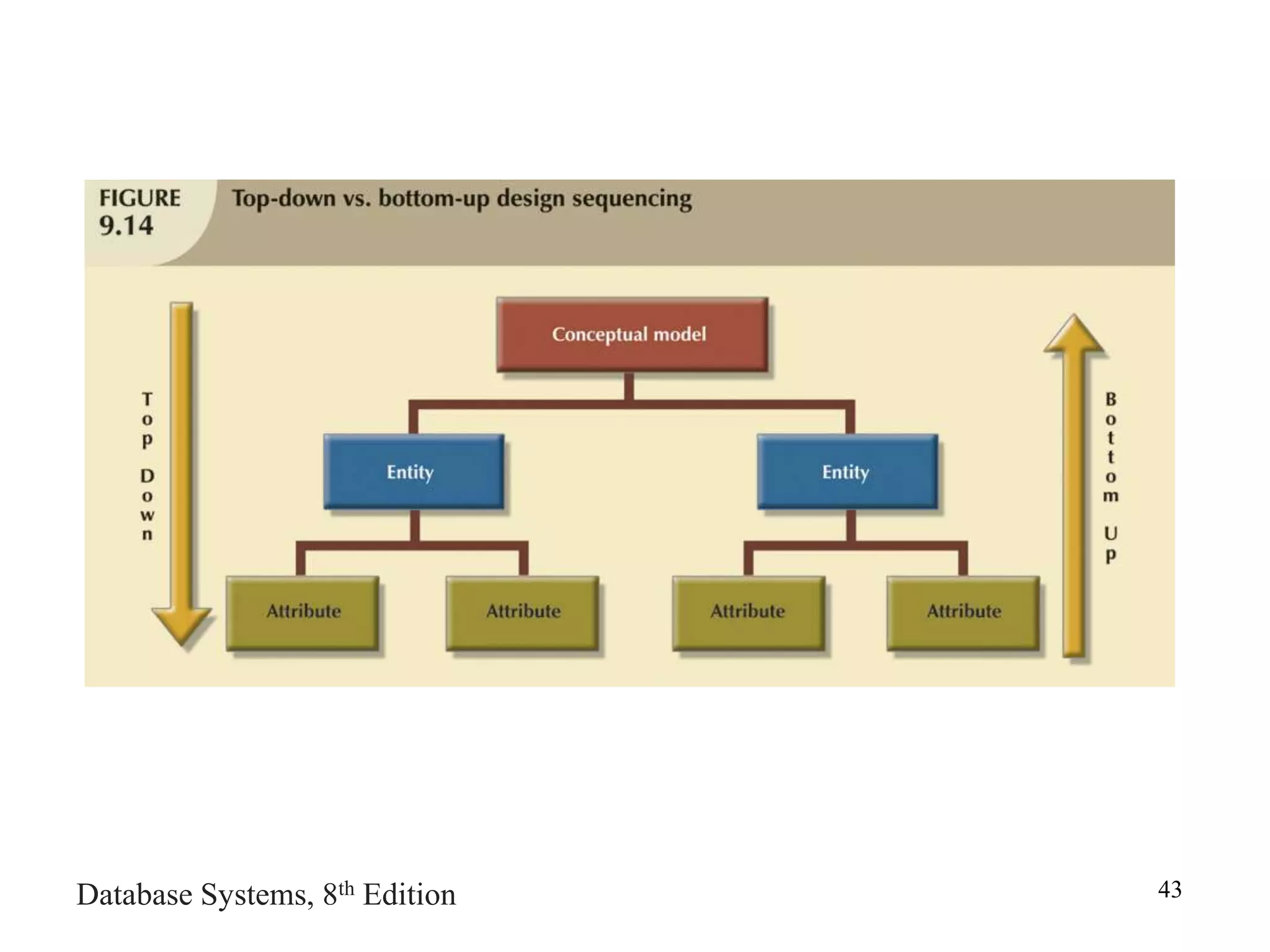
Database Design Strategies
• Top-down design
– Identifies data sets
– Defines data elements for each of those sets
• Definition of different entity types
• Definition of each entity’s attributes
• Bottom-up design
– Identifies data elements (items)
– Groups them together in data sets
Database Systems, 8th Edition 43
Database Systems, 8th Edition 44
Centralized vs. Decentralized Design
• Centralized design
– When data component is composed of small
number of objects and procedures
– Typical of small systems
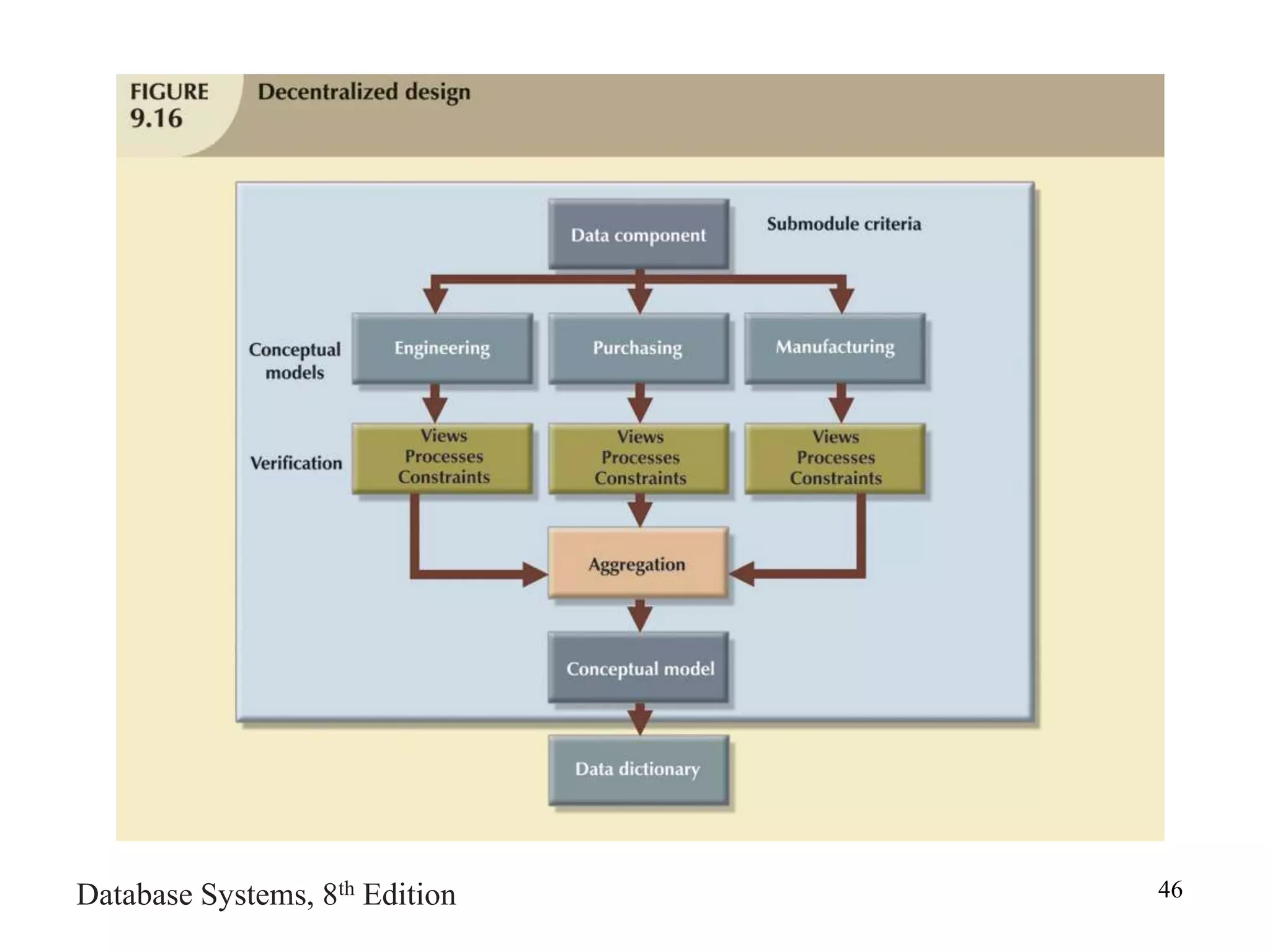
• Decentralized design
– Data component has large number of entities
– Complex relations on which complex operations
performed
– Problem spread across several operational sites
Database Systems, 8th Edition 45
Database Systems, 8th Edition 46
Database Systems, 8th Edition 47
Centralized vs. Decentralized Design
(continued)
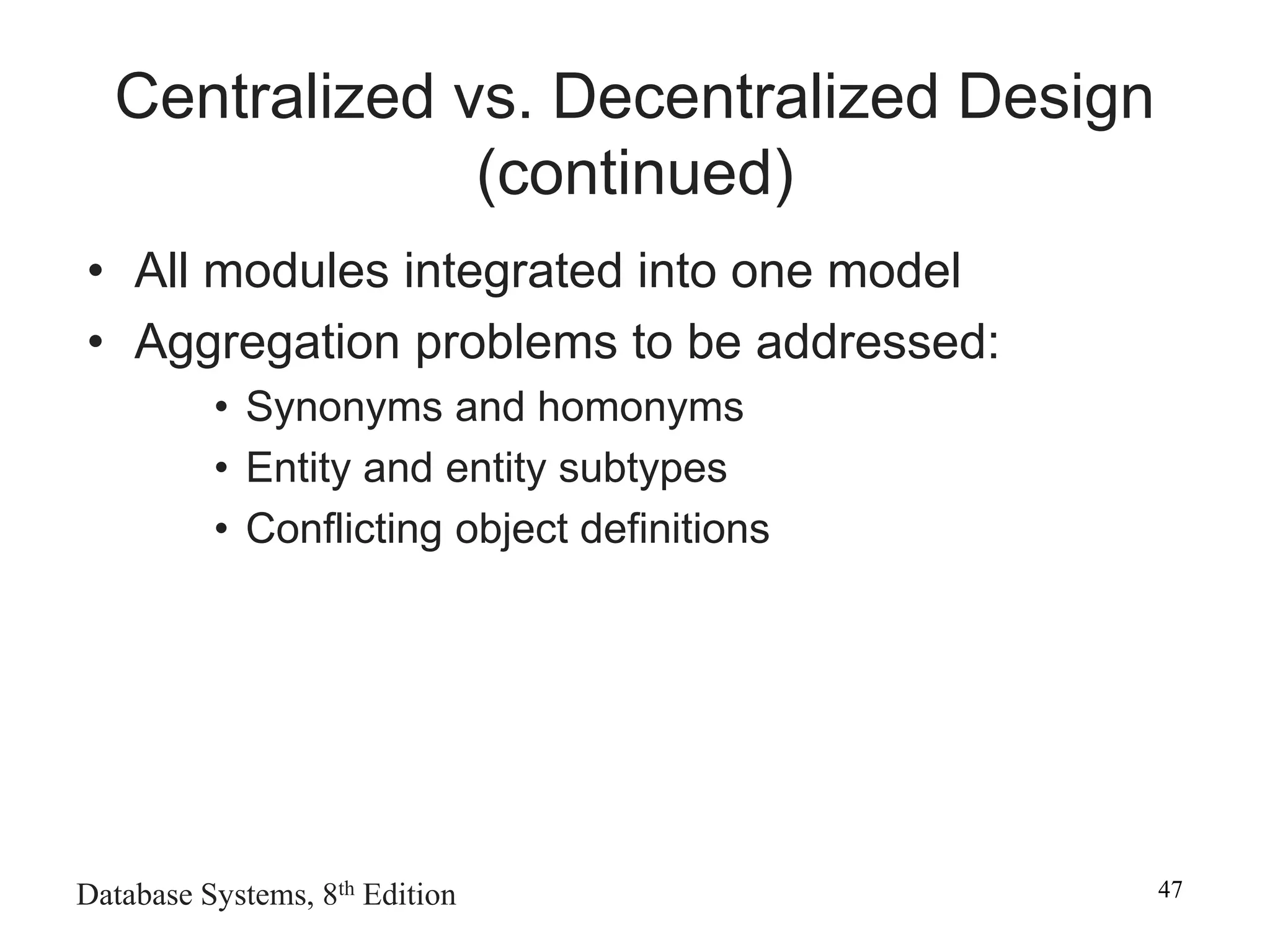
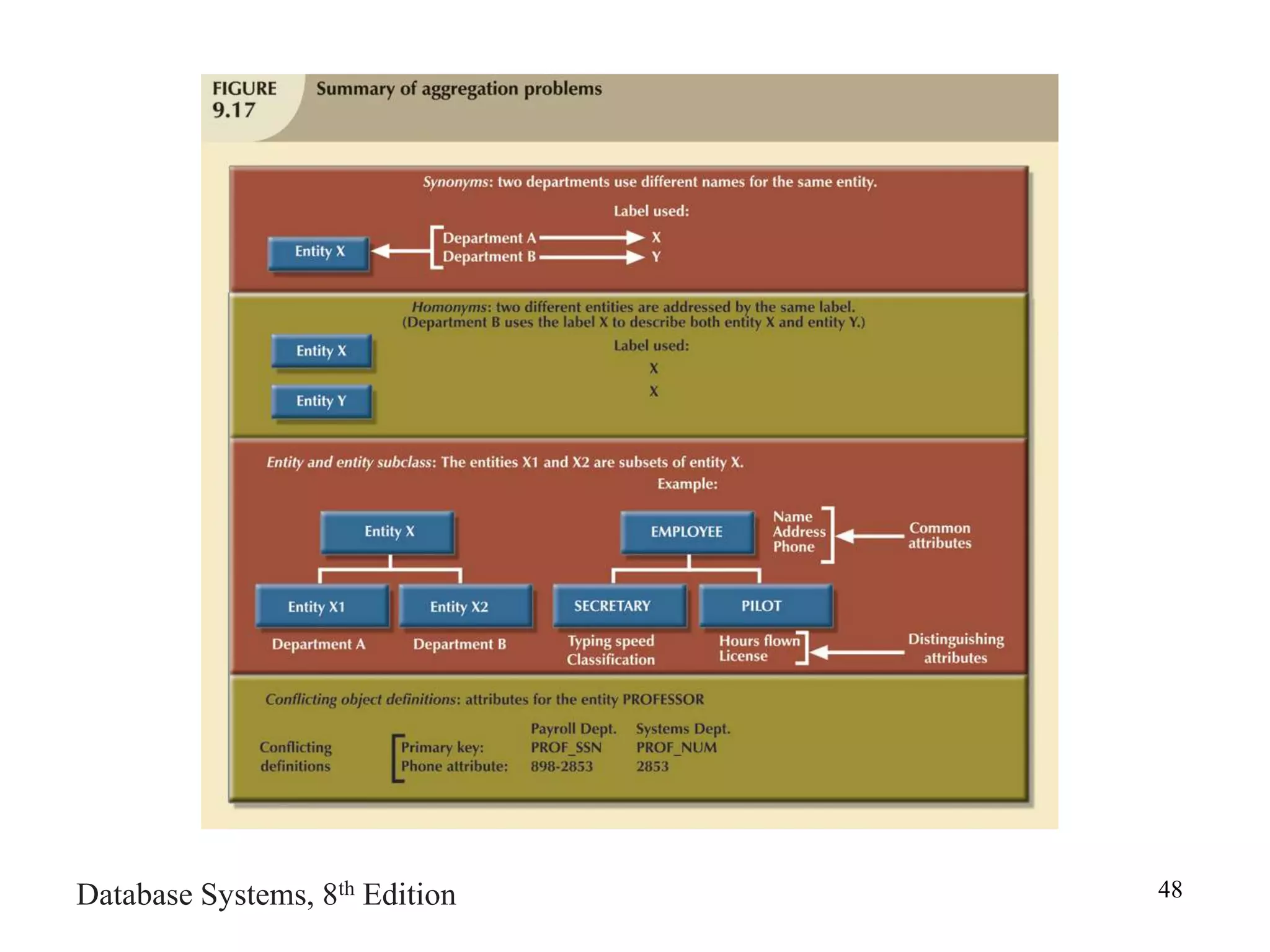
• All modules integrated into one model
• Aggregation problems to be addressed:
• Synonyms and homonyms
• Entity and entity subtypes
• Conflicting object definitions
Database Systems, 8th Edition 48
Database Systems, 8th Edition 49
Summary
• Information system facilitates transformation of
data into information
– Manages both data and information
• SDLC traces history (life cycle) of an
application within the information system
• DBLC describes history of database within the
information system
Database Systems, 8th Edition 50
Summary (continued)
• Database design and implementation process
moves through series of well-defined stages
• Conceptual design subject to several variations:
– Top-down vs. bottom-up
– Centralized vs. decentralized

Database_Design.ppt

  • 1.
    Database Systems: Design, Implementation,and Management Eighth Edition Chapter 9 Database Design
  • 2.
    Database Systems, 8thEdition 2 Objectives • In this chapter, you will learn: – That successful database design must reflect the information system of which the database is a part – That successful information systems are developed within a framework known as the Systems Development Life Cycle (SDLC)
  • 3.
    Database Systems, 8thEdition 3 Objectives (continued) • In this chapter, you will learn: (continued) – That within the information system, the most successful databases are subject to frequent evaluation and revision within a framework known as the Database Life Cycle (DBLC) – How to conduct evaluation and revision within the SDLC and DBLC frameworks – About database design strategies: top-down vs. bottom-up design and centralized vs. decentralized design
  • 4.
    Database Systems, 8thEdition 4 The Information System • Provides for data collection, storage, and retrieval • Composed of: – People, hardware, software – Database(s), application programs, procedures • Systems analysis – Process that establishes need for and extent of information system • Systems development – Process of creating information system
  • 5.
    Database Systems, 8thEdition 5 The Information System (continued) • Applications – Transform data into information that forms basis for decision making – Usually produce the following: • Formal report • Tabulations • Graphic displays – Composed of following two parts: • Data • Code by which data are transformed into information
  • 6.
  • 7.
    Database Systems, 8thEdition 7 The Information System (continued) • Performance depends on three factors: – Database design and implementation – Application design and implementation – Administrative procedures • Database development – Process of database design and implementation – Implementation phase includes: • Creating database storage structure • Loading data into the database • Providing for data management
  • 8.
    Database Systems, 8thEdition 8 The Systems Development Life Cycle (SDLC) • Traces history (life cycle) of information system • Database design and application development mapped out and evaluated • Divided into following five phases: – Planning – Analysis – Detailed systems design – Implementation – Maintenance • Iterative rather than sequential process
  • 9.
  • 10.
    Database Systems, 8thEdition 10 Planning • General overview of company and objectives • Assessment of flow-and-extent requirements – Should the existing system be continued? – Should the existing system be modified? – Should the existing system be replaced? • Study and evaluate alternate solutions – Technical aspects of hardware and software requirements – System cost – Operational cost
  • 11.
    Database Systems, 8thEdition 11 Analysis • Problems defined during planning phase examined in greater detail during analysis • Thorough audit of user requirements • Existing hardware and software systems are studied • Goal: – Better understanding of: • System’s functional areas • Actual and potential problems • Opportunities
  • 12.
    Database Systems, 8thEdition 12 Detailed Systems Design • Designer completes design of system’s processes • Includes all necessary technical specifications • Steps laid out for conversion from old to new system • Training principles and methodologies are also planned – Submitted for management approval
  • 13.
    Database Systems, 8thEdition 13 Implementation • Hardware, DBMS software, and application programs are installed – Database design implemented • Cycle of coding, testing, and debugging continues until database ready for delivery • Database created and system customized – Creation of tables and views – User authorizations
  • 14.
    Database Systems, 8thEdition 14 Maintenance • Three types of maintenance activity: – Corrective maintenance – Adaptive maintenance – Perfective maintenance • Computer-aided systems engineering (CASE) – Produce better systems within reasonable amount of time and at reasonable cost – CASE-produced applications are structured, documented, standardized
  • 15.
    Database Systems, 8thEdition 15 The Database Life Cycle (DBLC) • Six phases: – Database initial study – Database design – Implementation and loading – Testing and evaluation – Operation – Maintenance and evolution
  • 16.
  • 17.
    Database Systems, 8thEdition 17 The Database Initial Study • Overall purpose: – Analyze company situation – Define problems and constraints – Define objectives – Define scope and boundaries • Interactive and iterative processes required to complete first phase of DBLC successfully
  • 18.
  • 19.
    Database Systems, 8thEdition 19 The Database Initial Study (continued) • Analyze the company situation – General conditions in which company operates, its organizational structure, and its mission – Discover what company’s operational components are, how they function, and how they interact • Define problems and constraints – Formal and informal information sources – Finding precise answers is important – Accurate problem definition does not always yield a solution
  • 20.
    Database Systems, 8thEdition 20 • Database system objectives must correspond to those envisioned by end users – What is proposed system’s initial objective? – Will system interface with other systems in the company? – Will system share data with other systems or users? • Scope: extent of design according to operational requirements • Boundaries: limits external to system The Database Initial Study (continued)
  • 21.
    Database Systems, 8thEdition 21 Database Design • Necessary to concentrate on data • Characteristics required to build database model • Two views of data within system: – Business view • Data as information source – Designer’s view • Data structure, access, and activities required to transform data into information
  • 22.
  • 23.
  • 24.
    Database Systems, 8thEdition 24 I. Conceptual Design • Data modeling creates an abstract database structure – Represents real-world objects • Embodies clear understanding of business and its functional areas • Ensure that all data needed are in model, and that all data in model are needed • Requires four steps
  • 25.
    Database Systems, 8thEdition 25 I. Conceptual Design (continued) • Data analysis and requirements – Discover data element characteristics • Obtains characteristics from different sources – Take into account business rules • Derived from description of operations • Entity relationship modeling and normalization – Designer enforces standards in design documentation • Use of diagrams and symbols, documentation writing style, layout, other conventions
  • 26.
  • 27.
    Database Systems, 8thEdition 27 I. Conceptual Design (continued) • Data model verification – Verified against proposed system processes – Revision of original design • Careful reevaluation of entities • Detailed examination of attributes describing entities – Define design’s major components as modules: • Module: information system component that handles specific function
  • 28.
  • 29.
  • 30.
    Database Systems, 8thEdition 30 I. Conceptual Design (continued) • Data model verification (continued) – Verification process • Select central (most important) entity – Defined in terms of its participation in most of model’s relationships • Identify module or subsystem to which central entity belongs and define boundaries and scope • Place central entity within module’s framework
  • 31.
    Database Systems, 8thEdition 31 I. Conceptual Design (continued) • Distributed database design – Portions of database may reside in different physical locations – Processes accessing the database vary from one location to another – Designer must also develop data distribution and allocation strategies
  • 32.
    Database Systems, 8thEdition 32 II. DBMS Software Selection • Critical to information system’s smooth operation • Common factors affecting purchasing decisions: – Cost – DBMS features and tools – Underlying model – Portability – DBMS hardware requirements
  • 33.
    Database Systems, 8thEdition 33 III. Logical Design • Translate conceptual design into internal model • Logical design is software-dependent • Requires all objects be mapped to specific constructs used by selected database software – Definition of attribute domains, design of required tables, access restriction formats – Tables must correspond to entities in conceptual design • Translates software-independent conceptual model into software-dependent model
  • 34.
  • 35.
    Database Systems, 8thEdition 35 IV. Physical Design • Process of selecting data storage and data access characteristics of database • Storage characteristics are function of: – Device types supported by hardware – Type of data access methods supported by system – DBMS • More complex when data are distributed
  • 36.
    Database Systems, 8thEdition 36 Implementation and Loading • New database implementation requires special storage-related constructs for end-user tables • Performance – Difficult to evaluate • Not all DBMSs have tools embedded • No standard measurement • Security: – Physical and password security – Access rights and audit trails – Data encryption and diskless workstations
  • 37.
    Database Systems, 8thEdition 37 Implementation and Loading (continued) • Backup and Recovery – Full backup – Differential backup – Transaction log backup • Integrity – Enforced via proper use of primary, foreign key rules • Company standards – Standards may be partially defined
  • 38.
    Database Systems, 8thEdition 38 Testing and Evaluation • Occurs in parallel with applications programming • Database tools used to prototype applications • If implementation fails to meet some of system’s evaluation criteria: – Fine-tune specific system and DBMS configuration parameters – Modify physical or logical design – Upgrade software and/or hardware platform
  • 39.
    Database Systems, 8thEdition 39 Operation • Once database has passed evaluation stage, it is considered operational • Beginning of operational phase starts process of system evolution • Problems not foreseen during testing surface • Solutions may include: – Load-balancing software to distribute transactions among multiple computers – Increasing available cache
  • 40.
    Database Systems, 8thEdition 40 Maintenance and Evolution • Required periodic maintenance: – Preventive maintenance (backup) – Corrective maintenance (recovery) – Adaptive maintenance – Assignment of access permissions and their maintenance for new and old users – Generation of database access statistics – Periodic security audits – Periodic system-usage summaries
  • 41.
  • 42.
    Database Systems, 8thEdition 42 Database Design Strategies • Top-down design – Identifies data sets – Defines data elements for each of those sets • Definition of different entity types • Definition of each entity’s attributes • Bottom-up design – Identifies data elements (items) – Groups them together in data sets
  • 43.
  • 44.
    Database Systems, 8thEdition 44 Centralized vs. Decentralized Design • Centralized design – When data component is composed of small number of objects and procedures – Typical of small systems • Decentralized design – Data component has large number of entities – Complex relations on which complex operations performed – Problem spread across several operational sites
  • 45.
  • 46.
  • 47.
    Database Systems, 8thEdition 47 Centralized vs. Decentralized Design (continued) • All modules integrated into one model • Aggregation problems to be addressed: • Synonyms and homonyms • Entity and entity subtypes • Conflicting object definitions
  • 48.
  • 49.
    Database Systems, 8thEdition 49 Summary • Information system facilitates transformation of data into information – Manages both data and information • SDLC traces history (life cycle) of an application within the information system • DBLC describes history of database within the information system
  • 50.
    Database Systems, 8thEdition 50 Summary (continued) • Database design and implementation process moves through series of well-defined stages • Conceptual design subject to several variations: – Top-down vs. bottom-up – Centralized vs. decentralized