Welcome to my Presentation
Name: Shahadat Hossain
Id: 133-15-3031
Topic: Aggregate Functions
shahadat3031@gmail.com
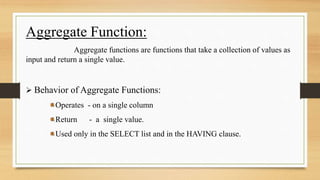
Aggregate Function:
Aggregate functions are functions that take a collection of values as
input and return a single value.
 Behavior of Aggregate Functions:
Operates - on a single column
Return - a single value.
Used only in the SELECT list and in the HAVING clause.
Types of SQL Aggregate Functions:
Aggregate
Functions:
Max()
Min()
Avg()
Sum()
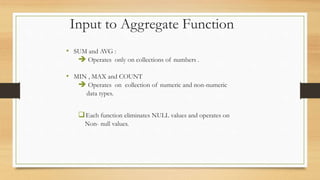
Input to Aggregate Function
• SUM and AVG :
 Operates only on collections of numbers .
• MIN , MAX and COUNT
 Operates on collection of numeric and non-numeric
data types.
Each function eliminates NULL values and operates on
Non- null values.
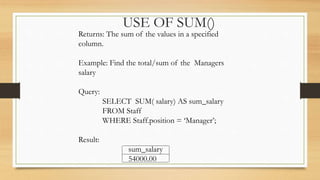
USE OF SUM()
Returns: The sum of the values in a specified
column.
Example: Find the total/sum of the Managers
salary
Query:
SELECT SUM( salary) AS sum_salary
FROM Staff
WHERE Staff.position = ‘Manager’;
Result:
sum_salary
54000.00
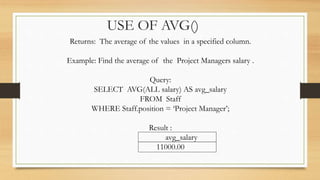
USE OF AVG()
Returns: The average of the values in a specified column.
Example: Find the average of the Project Managers salary .
Query:
SELECT AVG(ALL salary) AS avg_salary
FROM Staff
WHERE Staff.position = ‘Project Manager’;
Result :
avg_salary
11000.00
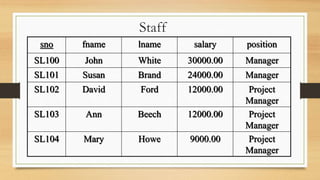
Staff
sno fname lname salary position
SL100 John White 30000.00 Manager
SL101 Susan Brand 24000.00 Manager
SL102 David Ford 12000.00 Project
Manager
SL103 Ann Beech 12000.00 Project
Manager
SL104 Mary Howe 9000.00 Project
Manager
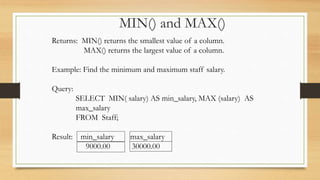
MIN() and MAX()
Returns: MIN() returns the smallest value of a column.
MAX() returns the largest value of a column.
Example: Find the minimum and maximum staff salary.
Query:
SELECT MIN( salary) AS min_salary, MAX (salary) AS
max_salary
FROM Staff;
Result: min_salary max_salary
9000.00 30000.00
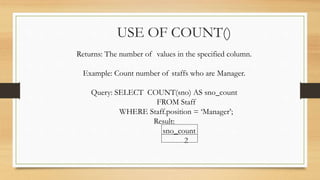
USE OF COUNT()
Returns: The number of values in the specified column.
Example: Count number of staffs who are Manager.
Query: SELECT COUNT(sno) AS sno_count
FROM Staff
WHERE Staff.position = ‘Manager’;
Result:
sno_count
2
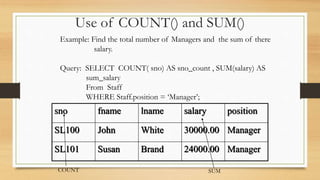
Use of COUNT() and SUM()
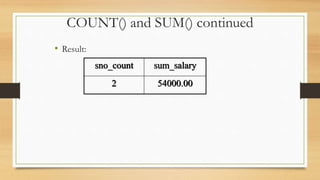
Example: Find the total number of Managers and the sum of there
salary.
Query: SELECT COUNT( sno) AS sno_count , SUM(salary) AS
sum_salary
From Staff
WHERE Staff.position = ‘Manager’;
sno fname lname salary position
SL100 John White 30000.00 Manager
SL101 Susan Brand 24000.00 Manager
SUMCOUNT
COUNT() and SUM() continued
• Result:
sno_count sum_salary
2 54000.00
Aggregate Function - Database

Aggregate Function - Database

  • 1.
    Welcome to myPresentation Name: Shahadat Hossain Id: 133-15-3031 Topic: Aggregate Functions shahadat3031@gmail.com
  • 2.
    Aggregate Function: Aggregate functionsare functions that take a collection of values as input and return a single value.  Behavior of Aggregate Functions: Operates - on a single column Return - a single value. Used only in the SELECT list and in the HAVING clause.
  • 3.
    Types of SQLAggregate Functions: Aggregate Functions: Max() Min() Avg() Sum()
  • 4.
    Input to AggregateFunction • SUM and AVG :  Operates only on collections of numbers . • MIN , MAX and COUNT  Operates on collection of numeric and non-numeric data types. Each function eliminates NULL values and operates on Non- null values.
  • 5.
    USE OF SUM() Returns:The sum of the values in a specified column. Example: Find the total/sum of the Managers salary Query: SELECT SUM( salary) AS sum_salary FROM Staff WHERE Staff.position = ‘Manager’; Result: sum_salary 54000.00
  • 6.
    USE OF AVG() Returns:The average of the values in a specified column. Example: Find the average of the Project Managers salary . Query: SELECT AVG(ALL salary) AS avg_salary FROM Staff WHERE Staff.position = ‘Project Manager’; Result : avg_salary 11000.00
  • 7.
    Staff sno fname lnamesalary position SL100 John White 30000.00 Manager SL101 Susan Brand 24000.00 Manager SL102 David Ford 12000.00 Project Manager SL103 Ann Beech 12000.00 Project Manager SL104 Mary Howe 9000.00 Project Manager
  • 8.
    MIN() and MAX() Returns:MIN() returns the smallest value of a column. MAX() returns the largest value of a column. Example: Find the minimum and maximum staff salary. Query: SELECT MIN( salary) AS min_salary, MAX (salary) AS max_salary FROM Staff; Result: min_salary max_salary 9000.00 30000.00
  • 9.
    USE OF COUNT() Returns:The number of values in the specified column. Example: Count number of staffs who are Manager. Query: SELECT COUNT(sno) AS sno_count FROM Staff WHERE Staff.position = ‘Manager’; Result: sno_count 2
  • 10.
    Use of COUNT()and SUM() Example: Find the total number of Managers and the sum of there salary. Query: SELECT COUNT( sno) AS sno_count , SUM(salary) AS sum_salary From Staff WHERE Staff.position = ‘Manager’; sno fname lname salary position SL100 John White 30000.00 Manager SL101 Susan Brand 24000.00 Manager SUMCOUNT
  • 11.
    COUNT() and SUM()continued • Result: sno_count sum_salary 2 54000.00