What is Data Science?
Dr. Steven Cosgrove
stevencosgrove@dataactiva.com
P: 49 6131 9719 599
Mob: 49 151 5290 9769
HTTP:www.linkedin.com/in/scosgrove
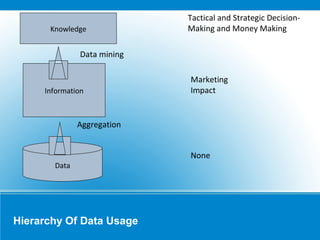
Hierarchy Of Data Usage
Data
Information
Knowledge
Data mining
Aggregation
Marketing
Impact
Tactical and Strategic Decision-
Making and Money Making
None
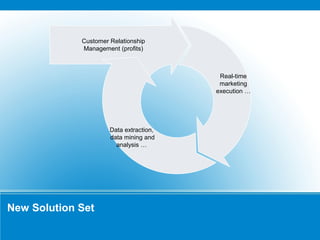
New Solution Set
Customer Relationship
Management (profits)
Data extraction,
data mining and
analysis …
Real-time
marketing
execution …
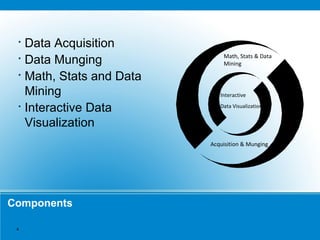
Components
§
Data Acquisition
§
Data Munging
§
Math, Stats and Data
Mining
§
Interactive Data
Visualization
Acquisition & Munging
Math, Stats & Data
Mining
Interactive
Data Visualization
4
Data Acquisition
§
Methodologically neutral—most
effective
§
Wireless networks and mobile
devices, search engines record, the
logs of our queries for finding
information on the web, automated
payment systems, social networking
services panels, surveys etc.
§
The human activity data (Big Data)
cause the emergence of a data-
driven “computational social
science”: the analysis of our digital
traces can create new
comprehensive pictures of individual
and group behavior, with the
potential to transform our
understanding of our lives,
organizations, and societies.
5
Data Munging
§
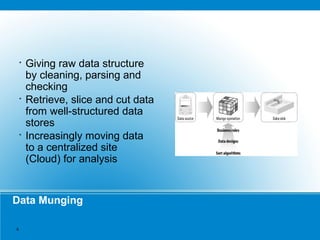
Giving raw data structure
by cleaning, parsing and
checking
§
Retrieve, slice and cut data
from well-structured data
stores
§
Increasingly moving data
to a centralized site
(Cloud) for analysis
6
Math, Statistics and Data Mining
§
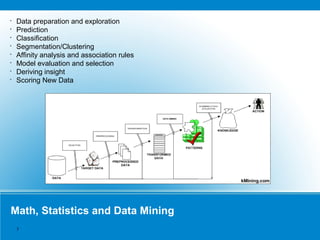
Data preparation and exploration
§
Prediction
§
Classification
§
Segmentation/Clustering
§
Affinity analysis and association rules
§
Model evaluation and selection
§
Deriving insight
§
Scoring New Data
7
Interactive Data Visualization
§
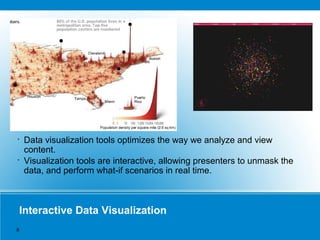
Data visualization tools optimizes the way we analyze and view
content.
§
Visualization tools are interactive, allowing presenters to unmask the
data, and perform what-if scenarios in real time.
8
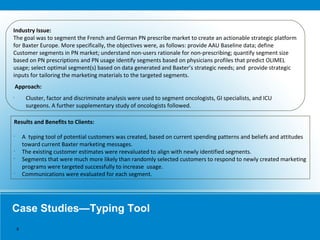
Case Studies—Typing Tool
Industry Issue:
The goal was to segment the French and German PN prescribe market to create an actionable strategic platform
for Baxter Europe. More specifically, the objectives were, as follows: provide AAU Baseline data; define
Customer segments in PN market; understand non-users rationale for non-prescribing; quantify segment size
based on PN prescriptions and PN usage identify segments based on physicians profiles that predict OLIMEL
usage; select optimal segment(s) based on data generated and Baxter’s strategic needs; and provide strategic
inputs for tailoring the marketing materials to the targeted segments.
Approach:
•
Cluster, factor and discriminate analysis were used to segment oncologists, GI specialists, and ICU
surgeons. A further supplementary study of oncologists followed.
Results and Benefits to Clients:
•
A typing tool of potential customers was created, based on current spending patterns and beliefs and attitudes
toward current Baxter marketing messages.
•
The existing customer estimates were reevaluated to align with newly identified segments.
•
Segments that were much more likely than randomly selected customers to respond to newly created marketing
programs were targeted successfully to increase usage.
•
Communications were evaluated for each segment.
9
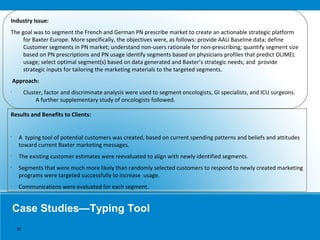
Case Studies—Typing Tool
Industry Issue:
The goal was to segment the French and German PN prescribe market to create an actionable strategic platform
for Baxter Europe. More specifically, the objectives were, as follows: provide AAU Baseline data; define
Customer segments in PN market; understand non-users rationale for non-prescribing; quantify segment size
based on PN prescriptions and PN usage identify segments based on physicians profiles that predict OLIMEL
usage; select optimal segment(s) based on data generated and Baxter’s strategic needs; and provide
strategic inputs for tailoring the marketing materials to the targeted segments.
Approach:
•
Cluster, factor and discriminate analysis were used to segment oncologists, GI specialists, and ICU surgeons.
A further supplementary study of oncologists followed.
Results and Benefits to Clients:
•
A typing tool of potential customers was created, based on current spending patterns and beliefs and attitudes
toward current Baxter marketing messages.
•
The existing customer estimates were reevaluated to align with newly identified segments.
•
Segments that were much more likely than randomly selected customers to respond to newly created marketing
programs were targeted successfully to increase usage.
•
Communications were evaluated for each segment.
10
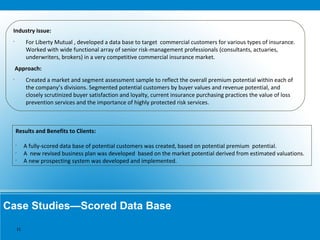
Case Studies—Scored Data Base
Industry Issue:
•
For Liberty Mutual , developed a data base to target commercial customers for various types of insurance.
Worked with wide functional array of senior risk-management professionals (consultants, actuaries,
underwriters, brokers) in a very competitive commercial insurance market.
Approach:
•
Created a market and segment assessment sample to reflect the overall premium potential within each of
the company’s divisions. Segmented potential customers by buyer values and revenue potential, and
closely scrutinized buyer satisfaction and loyalty, current insurance purchasing practices the value of loss
prevention services and the importance of highly protected risk services.
Results and Benefits to Clients:
•
A fully-scored data base of potential customers was created, based on potential premium potential.
•
A new revised business plan was developed based on the market potential derived from estimated valuations.
•
A new prospecting system was developed and implemented.
11
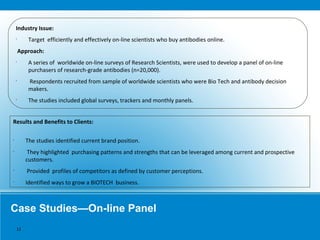
Case Studies—On-line Panel
Industry Issue:
•
Target efficiently and effectively on-line scientists who buy antibodies online.
Approach:
•
A series of worldwide on-line surveys of Research Scientists, were used to develop a panel of on-line
purchasers of research-grade antibodies (n=20,000).
•
Respondents recruited from sample of worldwide scientists who were Bio Tech and antibody decision
makers.
•
The studies included global surveys, trackers and monthly panels.
Results and Benefits to Clients:
•
The studies identified current brand position.
•
They highlighted purchasing patterns and strengths that can be leveraged among current and prospective
customers.
•
Provided profiles of competitors as defined by customer perceptions.
•
Identified ways to grow a BIOTECH business.
12
Case Studies—Preference Modeling
Industry Issue:
•
Gauging and modeling customer preferences can be very important for pricing and cannibalization.
•
Pricing Hypothetical choice studies (Conjoint and max-diff) for the following: Actonel, Multiple Novel Oral
Anticoagulants (AFLIN), Arcoxia, Augmentin, Becton Dickerson Blood samples, Axcel and Vaxcel
cephalosporins, Cochlear hearing aids, MSD (Ezetimibe + Atorvastatin and Ezetimibe + Rosuvastatin),
Assessment of Variation in Customer Purchase Patterns and Pricing of Paediatric and Adult ICU Ventilators in
Hospitals. Etc.
Approach:
•
Pricing Hypothetical choice models (conjoint and max-diff).
Results and Benefits to Clients:
•
Hypothetical-choice models and simulations (what ife.
•
Preference shares matched to market shares.
•
Quantitative model of impact new market entrants, lose of patents, changes in formula, etc.
13
Case Studies—SEM Modeling
Industry Issue:
•
How much does Sales Rep Quality, product quality, actual bid price and terms actually impact sales
performance of tissue adhesive brands in terms of awareness, sales, and loyalty.?
•
How much does communication strategy for the product significantly impact sales performance? How much
does hospital profile and segment significantly affects the relative effectiveness of sales rep quality, product
quality, and other factors?
•
Overall, how much does the relative effectiveness of sales reps, product quality, and other factors depend
on the profile and segment?
Approach:
•
Structural Equation Modeling (SEM) and LISREL
Results and Benefits to Clients:
•
Provide Henkel a sound basis for formulating a competitive sales strategy for tissue adhesives in Europe.
•
Clarify and build on selected findings from the recent customer research on tissue adhesives, focusing on
hospital administrators.
•
Understand the role and impact of the sales representative on sales effectiveness.
•
Identify key drivers of sales effectiveness and key drivers of sales reps’ effectiveness.
•
Understand competitor’s selling approaches and their relative effectiveness.
14
Case Studies—Natural Resources
Industry Issue:
•
Target customers for the successful introduction of natural gas products and services to take advantage of
new supply.
Approach:
•
Commercial & industrial and residential customers and potential consumers were surveyed to segment the
market and to create a data base that could to target customers for the successful introduction of gas
products and services. In addition, customer valuation through identification and analysis of the factors
that determine a customer’s current and potential lifetime value to the company were incorporated into
the design. Focus groups were also used.
Results and Benefits to Clients:
•
A fully-scored data base of potential customers was created, based on proximity existing and potential gas
mains.
•
The existing customer database was fully scored and valuated.
•
Company objectives were changed based on the market potential derived from estimated valuations.
•
Existing customers were targeted successfully to increase usage—super segments were much more likely than
randomly selected customers to newly created marketing programs..
15
Case Studies—Telecommunications
Industry Issue:
•
Target small business customers for new voice and data products. Telecommunications companies have a
wealth of data, yet need to be able to use it for marketing and communications programs.
Approach:
•
Utilized telecommunications studies to predict the relative potential among local area businesses for new
telecommunication services in a newly deregulated marketplace. Identified and profiled consumers
interested in switching local exchange carriers (churn). Determined possible participation rates among
consumers by services bundles. Assessed whether additional broadband services would enhance the
offering. Evaluated optimal pricing strategies and appraised customers’ interest by segment to map back to
an executable market database.
Results and Benefits to Clients:
•
A fully-scored data base of potential customers was created, based on current spending patterns and beliefs and
attitudes toward telecommunication services.
•
The existing customer database was reevaluated to determined any changes in previously identified segments.
•
Super segments were targeted successfully to increase usage—super segments were much more likely than
randomly selected customers to respond to newly created marketing programs.
•
Communications was exclusively designed for the super segments.
16
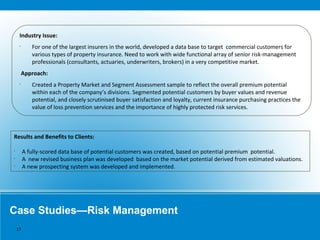
Case Studies—Risk Management
Industry Issue:
•
For one of the largest insurers in the world, developed a data base to target commercial customers for
various types of property insurance. Need to work with wide functional array of senior risk-management
professionals (consultants, actuaries, underwriters, brokers) in a very competitive market.
Approach:
•
Created a Property Market and Segment Assessment sample to reflect the overall premium potential
within each of the company’s divisions. Segmented potential customers by buyer values and revenue
potential, and closely scrutinised buyer satisfaction and loyalty, current insurance purchasing practices the
value of loss prevention services and the importance of highly protected risk services.
Results and Benefits to Clients:
•
A fully-scored data base of potential customers was created, based on potential premium potential.
•
A new revised business plan was developed based on the market potential derived from estimated valuations.
•
A new prospecting system was developed and implemented.
17
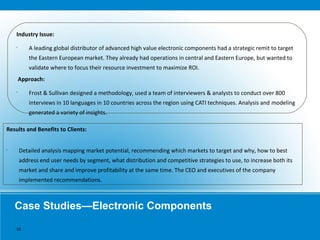
Case Studies—Electronic Components
Industry Issue:
•
A leading global distributor of advanced high value electronic components had a strategic remit to target
the Eastern European market. They already had operations in central and Eastern Europe, but wanted to
validate where to focus their resource investment to maximize ROI.
Approach:
•
Frost & Sullivan designed a methodology, used a team of interviewers & analysts to conduct over 800
interviews in 10 languages in 10 countries across the region using CATI techniques. Analysis and modeling
generated a variety of insights.
Results and Benefits to Clients:
•
Detailed analysis mapping market potential, recommending which markets to target and why, how to best
address end user needs by segment, what distribution and competitive strategies to use, to increase both its
market and share and improve profitability at the same time. The CEO and executives of the company
implemented recommendations.
18

Data Science

  • 1.
    What is DataScience? Dr. Steven Cosgrove stevencosgrove@dataactiva.com P: 49 6131 9719 599 Mob: 49 151 5290 9769 HTTP:www.linkedin.com/in/scosgrove
  • 2.
    Hierarchy Of DataUsage Data Information Knowledge Data mining Aggregation Marketing Impact Tactical and Strategic Decision- Making and Money Making None
  • 3.
    New Solution Set CustomerRelationship Management (profits) Data extraction, data mining and analysis … Real-time marketing execution …
  • 4.
    Components § Data Acquisition § Data Munging § Math,Stats and Data Mining § Interactive Data Visualization Acquisition & Munging Math, Stats & Data Mining Interactive Data Visualization 4
  • 5.
    Data Acquisition § Methodologically neutral—most effective § Wirelessnetworks and mobile devices, search engines record, the logs of our queries for finding information on the web, automated payment systems, social networking services panels, surveys etc. § The human activity data (Big Data) cause the emergence of a data- driven “computational social science”: the analysis of our digital traces can create new comprehensive pictures of individual and group behavior, with the potential to transform our understanding of our lives, organizations, and societies. 5
  • 6.
    Data Munging § Giving rawdata structure by cleaning, parsing and checking § Retrieve, slice and cut data from well-structured data stores § Increasingly moving data to a centralized site (Cloud) for analysis 6
  • 7.
    Math, Statistics andData Mining § Data preparation and exploration § Prediction § Classification § Segmentation/Clustering § Affinity analysis and association rules § Model evaluation and selection § Deriving insight § Scoring New Data 7
  • 8.
    Interactive Data Visualization § Datavisualization tools optimizes the way we analyze and view content. § Visualization tools are interactive, allowing presenters to unmask the data, and perform what-if scenarios in real time. 8
  • 9.
    Case Studies—Typing Tool IndustryIssue: The goal was to segment the French and German PN prescribe market to create an actionable strategic platform for Baxter Europe. More specifically, the objectives were, as follows: provide AAU Baseline data; define Customer segments in PN market; understand non-users rationale for non-prescribing; quantify segment size based on PN prescriptions and PN usage identify segments based on physicians profiles that predict OLIMEL usage; select optimal segment(s) based on data generated and Baxter’s strategic needs; and provide strategic inputs for tailoring the marketing materials to the targeted segments. Approach: • Cluster, factor and discriminate analysis were used to segment oncologists, GI specialists, and ICU surgeons. A further supplementary study of oncologists followed. Results and Benefits to Clients: • A typing tool of potential customers was created, based on current spending patterns and beliefs and attitudes toward current Baxter marketing messages. • The existing customer estimates were reevaluated to align with newly identified segments. • Segments that were much more likely than randomly selected customers to respond to newly created marketing programs were targeted successfully to increase usage. • Communications were evaluated for each segment. 9
  • 10.
    Case Studies—Typing Tool IndustryIssue: The goal was to segment the French and German PN prescribe market to create an actionable strategic platform for Baxter Europe. More specifically, the objectives were, as follows: provide AAU Baseline data; define Customer segments in PN market; understand non-users rationale for non-prescribing; quantify segment size based on PN prescriptions and PN usage identify segments based on physicians profiles that predict OLIMEL usage; select optimal segment(s) based on data generated and Baxter’s strategic needs; and provide strategic inputs for tailoring the marketing materials to the targeted segments. Approach: • Cluster, factor and discriminate analysis were used to segment oncologists, GI specialists, and ICU surgeons. A further supplementary study of oncologists followed. Results and Benefits to Clients: • A typing tool of potential customers was created, based on current spending patterns and beliefs and attitudes toward current Baxter marketing messages. • The existing customer estimates were reevaluated to align with newly identified segments. • Segments that were much more likely than randomly selected customers to respond to newly created marketing programs were targeted successfully to increase usage. • Communications were evaluated for each segment. 10
  • 11.
    Case Studies—Scored DataBase Industry Issue: • For Liberty Mutual , developed a data base to target commercial customers for various types of insurance. Worked with wide functional array of senior risk-management professionals (consultants, actuaries, underwriters, brokers) in a very competitive commercial insurance market. Approach: • Created a market and segment assessment sample to reflect the overall premium potential within each of the company’s divisions. Segmented potential customers by buyer values and revenue potential, and closely scrutinized buyer satisfaction and loyalty, current insurance purchasing practices the value of loss prevention services and the importance of highly protected risk services. Results and Benefits to Clients: • A fully-scored data base of potential customers was created, based on potential premium potential. • A new revised business plan was developed based on the market potential derived from estimated valuations. • A new prospecting system was developed and implemented. 11
  • 12.
    Case Studies—On-line Panel IndustryIssue: • Target efficiently and effectively on-line scientists who buy antibodies online. Approach: • A series of worldwide on-line surveys of Research Scientists, were used to develop a panel of on-line purchasers of research-grade antibodies (n=20,000). • Respondents recruited from sample of worldwide scientists who were Bio Tech and antibody decision makers. • The studies included global surveys, trackers and monthly panels. Results and Benefits to Clients: • The studies identified current brand position. • They highlighted purchasing patterns and strengths that can be leveraged among current and prospective customers. • Provided profiles of competitors as defined by customer perceptions. • Identified ways to grow a BIOTECH business. 12
  • 13.
    Case Studies—Preference Modeling IndustryIssue: • Gauging and modeling customer preferences can be very important for pricing and cannibalization. • Pricing Hypothetical choice studies (Conjoint and max-diff) for the following: Actonel, Multiple Novel Oral Anticoagulants (AFLIN), Arcoxia, Augmentin, Becton Dickerson Blood samples, Axcel and Vaxcel cephalosporins, Cochlear hearing aids, MSD (Ezetimibe + Atorvastatin and Ezetimibe + Rosuvastatin), Assessment of Variation in Customer Purchase Patterns and Pricing of Paediatric and Adult ICU Ventilators in Hospitals. Etc. Approach: • Pricing Hypothetical choice models (conjoint and max-diff). Results and Benefits to Clients: • Hypothetical-choice models and simulations (what ife. • Preference shares matched to market shares. • Quantitative model of impact new market entrants, lose of patents, changes in formula, etc. 13
  • 14.
    Case Studies—SEM Modeling IndustryIssue: • How much does Sales Rep Quality, product quality, actual bid price and terms actually impact sales performance of tissue adhesive brands in terms of awareness, sales, and loyalty.? • How much does communication strategy for the product significantly impact sales performance? How much does hospital profile and segment significantly affects the relative effectiveness of sales rep quality, product quality, and other factors? • Overall, how much does the relative effectiveness of sales reps, product quality, and other factors depend on the profile and segment? Approach: • Structural Equation Modeling (SEM) and LISREL Results and Benefits to Clients: • Provide Henkel a sound basis for formulating a competitive sales strategy for tissue adhesives in Europe. • Clarify and build on selected findings from the recent customer research on tissue adhesives, focusing on hospital administrators. • Understand the role and impact of the sales representative on sales effectiveness. • Identify key drivers of sales effectiveness and key drivers of sales reps’ effectiveness. • Understand competitor’s selling approaches and their relative effectiveness. 14
  • 15.
    Case Studies—Natural Resources IndustryIssue: • Target customers for the successful introduction of natural gas products and services to take advantage of new supply. Approach: • Commercial & industrial and residential customers and potential consumers were surveyed to segment the market and to create a data base that could to target customers for the successful introduction of gas products and services. In addition, customer valuation through identification and analysis of the factors that determine a customer’s current and potential lifetime value to the company were incorporated into the design. Focus groups were also used. Results and Benefits to Clients: • A fully-scored data base of potential customers was created, based on proximity existing and potential gas mains. • The existing customer database was fully scored and valuated. • Company objectives were changed based on the market potential derived from estimated valuations. • Existing customers were targeted successfully to increase usage—super segments were much more likely than randomly selected customers to newly created marketing programs.. 15
  • 16.
    Case Studies—Telecommunications Industry Issue: • Targetsmall business customers for new voice and data products. Telecommunications companies have a wealth of data, yet need to be able to use it for marketing and communications programs. Approach: • Utilized telecommunications studies to predict the relative potential among local area businesses for new telecommunication services in a newly deregulated marketplace. Identified and profiled consumers interested in switching local exchange carriers (churn). Determined possible participation rates among consumers by services bundles. Assessed whether additional broadband services would enhance the offering. Evaluated optimal pricing strategies and appraised customers’ interest by segment to map back to an executable market database. Results and Benefits to Clients: • A fully-scored data base of potential customers was created, based on current spending patterns and beliefs and attitudes toward telecommunication services. • The existing customer database was reevaluated to determined any changes in previously identified segments. • Super segments were targeted successfully to increase usage—super segments were much more likely than randomly selected customers to respond to newly created marketing programs. • Communications was exclusively designed for the super segments. 16
  • 17.
    Case Studies—Risk Management IndustryIssue: • For one of the largest insurers in the world, developed a data base to target commercial customers for various types of property insurance. Need to work with wide functional array of senior risk-management professionals (consultants, actuaries, underwriters, brokers) in a very competitive market. Approach: • Created a Property Market and Segment Assessment sample to reflect the overall premium potential within each of the company’s divisions. Segmented potential customers by buyer values and revenue potential, and closely scrutinised buyer satisfaction and loyalty, current insurance purchasing practices the value of loss prevention services and the importance of highly protected risk services. Results and Benefits to Clients: • A fully-scored data base of potential customers was created, based on potential premium potential. • A new revised business plan was developed based on the market potential derived from estimated valuations. • A new prospecting system was developed and implemented. 17
  • 18.
    Case Studies—Electronic Components IndustryIssue: • A leading global distributor of advanced high value electronic components had a strategic remit to target the Eastern European market. They already had operations in central and Eastern Europe, but wanted to validate where to focus their resource investment to maximize ROI. Approach: • Frost & Sullivan designed a methodology, used a team of interviewers & analysts to conduct over 800 interviews in 10 languages in 10 countries across the region using CATI techniques. Analysis and modeling generated a variety of insights. Results and Benefits to Clients: • Detailed analysis mapping market potential, recommending which markets to target and why, how to best address end user needs by segment, what distribution and competitive strategies to use, to increase both its market and share and improve profitability at the same time. The CEO and executives of the company implemented recommendations. 18

Editor's Notes

  • #4 <Foliennummer> Tip: Hold the Shift key when reducing a circle to keep it circular