Training for local DRC representatives
Learning by doing towards the establishment of robust cap
setting and allocation for National ETS
全国碳交易能力建设培训会全国碳交易能力建设培训会全国碳交易能力建设培训会全国碳交易能力建设培训会
Supporting the Design and Implementation of
Emissions Trading Systems in China
中欧碳交易能力建设项目中欧碳交易能力建设项目中欧碳交易能力建设项目中欧碳交易能力建设项目
Beijing, 25th – 26th April 2015
北京,2015年4月25-26日
This project/programme is funded by the European Union under the Service Contract No. : DCI-ASIE/2013/334-592.
Project implemented by: ICF International together with Sinocarbon, SQ Consult and Ecofys
2
Data Requirement for Total
Carbon Emission Cap
Setting and Allowance
Allocation
Tang Jin
SinoCarbon
April 2015
Contents
How to get the data
1
2
3 Data quality Assurance
Key points of data requirements
Which data is required
4
1 Which data is required?
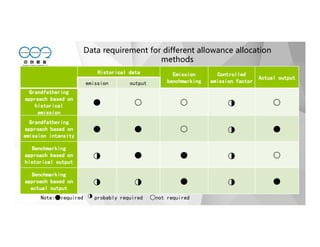
Data requirement for different allowance allocation
methods
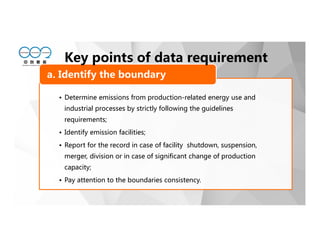
Historical dataHistorical dataHistorical dataHistorical data EmissionEmissionEmissionEmission
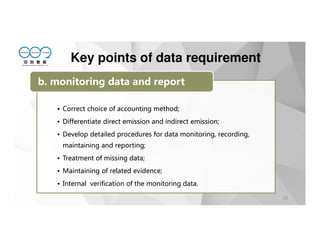
benchmarkingbenchmarkingbenchmarkingbenchmarking
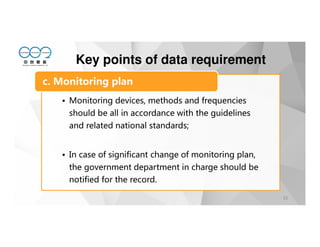
ControlledControlledControlledControlled
emission factoremission factoremission factoremission factor
Actual outputActual outputActual outputActual output
emission output
GrandfatheringGrandfatheringGrandfatheringGrandfathering
approach based onapproach based onapproach based onapproach based on
historicalhistoricalhistoricalhistorical
emissionemissionemissionemission
● ○ ○ ◑ ○
GrandfatheringGrandfatheringGrandfatheringGrandfathering
approach based onapproach based onapproach based onapproach based on
emission intensityemission intensityemission intensityemission intensity
● ● ○ ◑ ●
BenchmarkingBenchmarkingBenchmarkingBenchmarking
approach based onapproach based onapproach based onapproach based on
historical outputhistorical outputhistorical outputhistorical output ◑ ● ● ◑ ○
BenchmarkingBenchmarkingBenchmarkingBenchmarking
approach based onapproach based onapproach based onapproach based on
actual outputactual outputactual outputactual output ◑ ◑ ● ◑ ●
Note:●required ◑ probably required ○not required
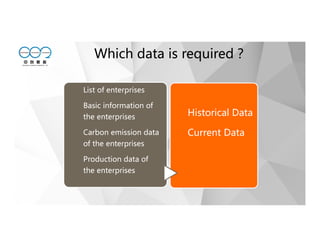
Which data is required?
List of enterprises
Basic information of
the enterprises
Carbon emission data
of the enterprises
Production data of
the enterprises
Historical Data
Current Data
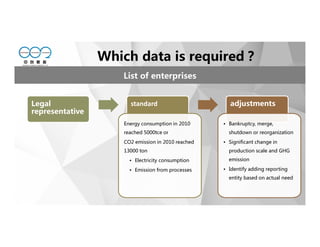
Which data is required?
List of enterprises
Legal
representative
standard
Energy consumption in 2010
reached 5000tce or
CO2 emission in 2010 reached
13000 ton
• Electricity consumption
• Emission from processes
adjustments
• Bankruptcy, merge,
shutdown or reorganization
• Significant change in
production scale and GHG
emission
• Identify adding reporting
entity based on actual need
Which data is required?
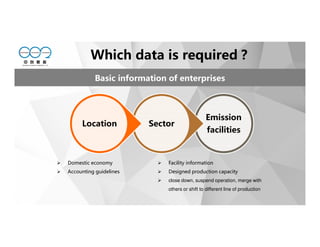
Basic information of enterprises
Domestic economy
Accounting guidelines
Facility information
Designed production capacity
close down, suspend operation, merge with
others or shift to different line of production
Emission
facilities
SectorLocation
Which data is required?
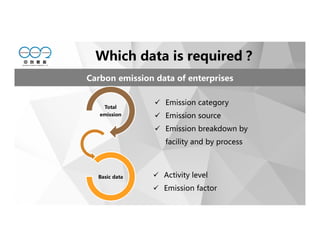
Carbon emission data of enterprises
Emission category
Emission source
Emission breakdown by
facility and by process
Activity level
Emission factor
Total
emission
Basic data
Which data is required?
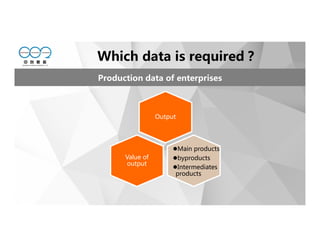
Production data of enterprises
Output
Value of
output
Main products
byproducts
Intermediates
products
2 How to get the data
How to get the data
NDRC Notice(NDRC Climate Division [2014] 63)
Guidelines on GHG Emission Accounting
Method and Reporting for Enterprises(NDRC
Climate Division [2013]Reference No. 2526)
Statistical
accounting of the
emission data
Reporting of the
emission data
13
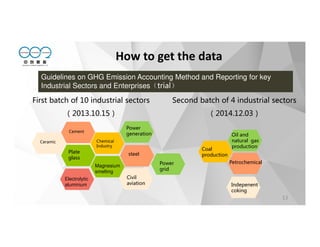
Guidelines on GHG Emission Accounting Method and Reporting for key
Industrial Sectors and Enterprises(trial)
First batch of 10 industrial sectors
(2013.10.15)
Second batch of 4 industrial sectors
(2014.12.03)
Cement
Ceramic
Magnesium
smelting
Electrolytic
aluminium
Power
generation
Chemical
Industry
steel
Power
grid
Plate
glass
Civil
aviation
Oil and
natural gas
production
Coal
production
Petrochemical
Indepenent
coking
How to get the data
14
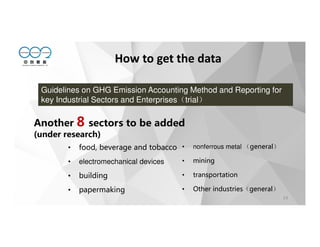
Guidelines on GHG Emission Accounting Method and Reporting for
key Industrial Sectors and Enterprises(trial)
Another 8 sectors to be added
(under research)
• food, beverage and tobacco
• electromechanical devices
• building
• papermaking
• nonferrous metal (general)
• mining
• transportation
• Other industries(general)
How to get the data
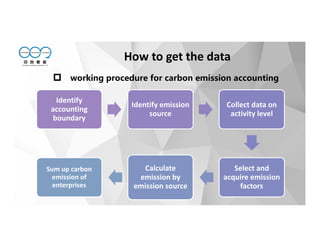
working procedure for carbon emission accounting
Identify
accounting
boundary
Identify emission
source
Collect data on
activity level
Select and
acquire emission
factors
Calculate
emission by
emission source
Sum up carbon
emission of
enterprises
How to get the data
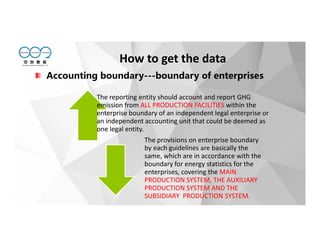
Accounting boundary---boundary of enterprises
The reporting entity should account and report GHG
emission from ALL PRODUCTION FACILITIES within the
enterprise boundary of an independent legal enterprise or
an independent accounting unit that could be deemed as
one legal entity.
The provisions on enterprise boundary
by each guidelines are basically the
same, which are in accordance with the
boundary for energy statistics for the
enterprises, covering the MAIN
PRODUCTION SYSTEM, THE AUXILIARY
PRODUCTION SYSTEM AND THE
SUBSIDIARY PRODUCTION SYSTEM.
How to get the data
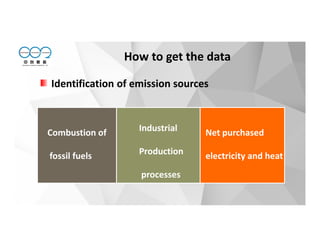
Identification of emission sources
How to get the data
Combustion of
fossil fuels
Industrial
Production
processes
Net purchased
electricity and heat
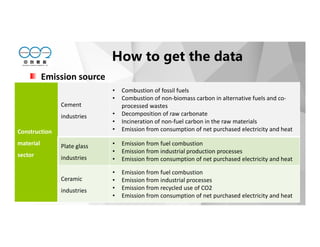
Emission source
Construction
material
sector
Cement
industries
• Combustion of fossil fuels
• Combustion of non-biomass carbon in alternative fuels and co-
processed wastes
• Decomposition of raw carbonate
• Incineration of non-fuel carbon in the raw materials
• Emission from consumption of net purchased electricity and heat
Plate glass
industries
• Emission from fuel combustion
• Emission from industrial production processes
• Emission from consumption of net purchased electricity and heat
Ceramic
industries
• Emission from fuel combustion
• Emission from industrial processes
• Emission from recycled use of CO2
• Emission from consumption of net purchased electricity and heat
How to get the data
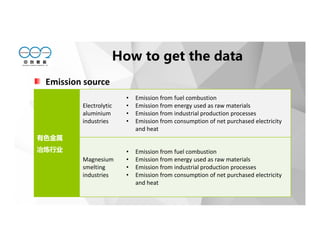
Emission source
有色金属
冶炼行业
Electrolytic
aluminium
industries
• Emission from fuel combustion
• Emission from energy used as raw materials
• Emission from industrial production processes
• Emission from consumption of net purchased electricity
and heat
Magnesium
smelting
industries
• Emission from fuel combustion
• Emission from energy used as raw materials
• Emission from industrial production processes
• Emission from consumption of net purchased electricity
and heat
How to get the data
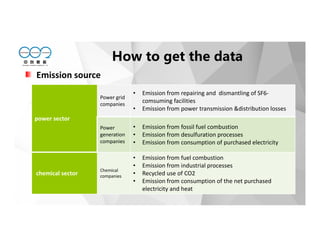
Emission source
power sector
Power grid
companies
• Emission from repairing and dismantling of SF6-
comsuming facilities
• Emission from power transmission &distribution losses
Power
generation
companies
• Emission from fossil fuel combustion
• Emission from desulfuration processes
• Emission from consumption of purchased electricity
chemical sector
Chemical
companies
• Emission from fuel combustion
• Emission from industrial processes
• Recycled use of CO2
• Emission from consumption of the net purchased
electricity and heat
How to get the data
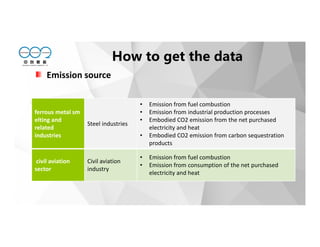
Emission source
ferrous metal sm
elting and
related
industries
Steel industries
• Emission from fuel combustion
• Emission from industrial production processes
• Embodied CO2 emission from the net purchased
electricity and heat
• Embodied CO2 emission from carbon sequestration
products
civil aviation
sector
Civil aviation
industry
• Emission from fuel combustion
• Emission from consumption of the net purchased
electricity and heat
How to get the data
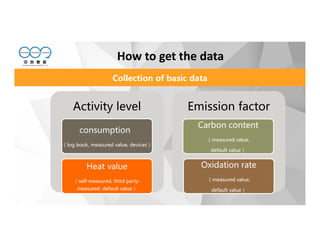
How to get the data
Collection of basic data
Activity level
consumption
(log book, measured value, devices)
Heat value
(self-measured, third party-
measured, default value)
Emission factor
Carbon content
(measured value,
default value)
Oxidation rate
(measured value,
default value)
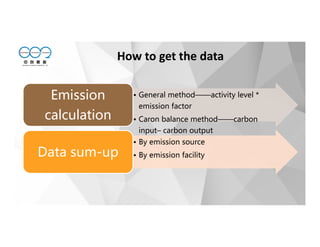
How to get the data
• General method——activity level *
emission factor
• Caron balance method——carbon
input– carbon output
Emission
calculation
• By emission source
• By emission facilityData sum-up
3 Data quality assurance
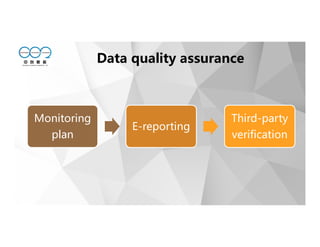
Data quality assurance
Monitoring
plan
E-reporting
Third-party
verification
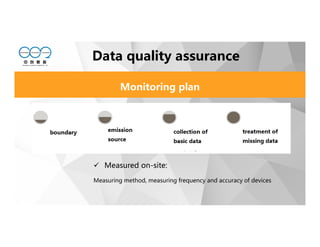
Data quality assurance
Monitoring plan
Measured on-site:
Measuring method, measuring frequency and accuracy of devices
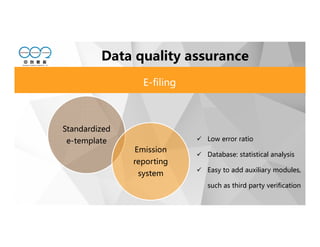
Data quality assurance
E-filing
Standardized
e-template
Emission
reporting
system
Low error ratio
Database: statistical analysis
Easy to add auxiliary modules,
such as third party verification
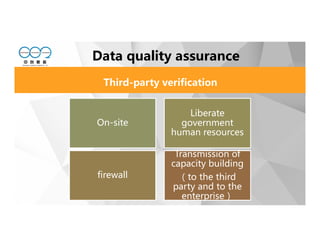
Data quality assurance
Third-party verification
On-site
Liberate
government
human resources
firewall
Transmission of
capacity building
(to the third
party and to the
enterprise)
4 Key points of data requirement
• Determine emissions from production-related energy use and
industrial processes by strictly following the guidelines
requirements;
• Identify emission facilities;
• Report for the record in case of facility shutdown, suspension,
merger, division or in case of significant change of production
capacity;
• Pay attention to the boundaries consistency.
a. Identify the boundary
Key points of data requirement
31
• Correct choice of accounting method;
• Differentiate direct emission and indirect emission;
• Develop detailed procedures for data monitoring, recording,
maintaining and reporting;
• Treatment of missing data;
• Maintaining of related evidence;
• Internal verification of the monitoring data.
b. monitoring data and report
Key points of data requirement
32
• Monitoring devices, methods and frequencies
should be all in accordance with the guidelines
and related national standards;
• In case of significant change of monitoring plan,
the government department in charge should be
notified for the record.
c. Monitoring plan
Key points of data requirement
唐进唐进唐进唐进
邮箱邮箱邮箱邮箱::::tangjin@sino-carbon.cn
Please follow us via WeChat
项目微信公众号项目微信公众号项目微信公众号项目微信公众号
Supporting the Design and Implementation of
Emissions Trading Systems in China
中欧碳交易能力建设项目中欧碳交易能力建设项目中欧碳交易能力建设项目中欧碳交易能力建设项目
This project/programme is funded by the European Union under the Service Contract No. : DCI-ASIE/2013/334-592.
Project implemented by: ICF International together with Sinocarbon, SQ Consult and Ecofys
Please follow us via LinkedIn
项目项目项目项目LinkedIn页面页面页面页面
https://www.linkedin.com/grp/ho
me?gid=6971708

Data Requirement for Total Carbon Emission Cap Setting and Allowance Allocation

  • 1.
    Training for localDRC representatives Learning by doing towards the establishment of robust cap setting and allocation for National ETS 全国碳交易能力建设培训会全国碳交易能力建设培训会全国碳交易能力建设培训会全国碳交易能力建设培训会 Supporting the Design and Implementation of Emissions Trading Systems in China 中欧碳交易能力建设项目中欧碳交易能力建设项目中欧碳交易能力建设项目中欧碳交易能力建设项目 Beijing, 25th – 26th April 2015 北京,2015年4月25-26日 This project/programme is funded by the European Union under the Service Contract No. : DCI-ASIE/2013/334-592. Project implemented by: ICF International together with Sinocarbon, SQ Consult and Ecofys
  • 2.
    2 Data Requirement forTotal Carbon Emission Cap Setting and Allowance Allocation Tang Jin SinoCarbon April 2015
  • 3.
    Contents How to getthe data 1 2 3 Data quality Assurance Key points of data requirements Which data is required 4
  • 4.
    1 Which datais required?
  • 5.
    Data requirement fordifferent allowance allocation methods Historical dataHistorical dataHistorical dataHistorical data EmissionEmissionEmissionEmission benchmarkingbenchmarkingbenchmarkingbenchmarking ControlledControlledControlledControlled emission factoremission factoremission factoremission factor Actual outputActual outputActual outputActual output emission output GrandfatheringGrandfatheringGrandfatheringGrandfathering approach based onapproach based onapproach based onapproach based on historicalhistoricalhistoricalhistorical emissionemissionemissionemission ● ○ ○ ◑ ○ GrandfatheringGrandfatheringGrandfatheringGrandfathering approach based onapproach based onapproach based onapproach based on emission intensityemission intensityemission intensityemission intensity ● ● ○ ◑ ● BenchmarkingBenchmarkingBenchmarkingBenchmarking approach based onapproach based onapproach based onapproach based on historical outputhistorical outputhistorical outputhistorical output ◑ ● ● ◑ ○ BenchmarkingBenchmarkingBenchmarkingBenchmarking approach based onapproach based onapproach based onapproach based on actual outputactual outputactual outputactual output ◑ ◑ ● ◑ ● Note:●required ◑ probably required ○not required
  • 6.
    Which data isrequired? List of enterprises Basic information of the enterprises Carbon emission data of the enterprises Production data of the enterprises Historical Data Current Data
  • 7.
    Which data isrequired? List of enterprises Legal representative standard Energy consumption in 2010 reached 5000tce or CO2 emission in 2010 reached 13000 ton • Electricity consumption • Emission from processes adjustments • Bankruptcy, merge, shutdown or reorganization • Significant change in production scale and GHG emission • Identify adding reporting entity based on actual need
  • 8.
    Which data isrequired? Basic information of enterprises Domestic economy Accounting guidelines Facility information Designed production capacity close down, suspend operation, merge with others or shift to different line of production Emission facilities SectorLocation
  • 9.
    Which data isrequired? Carbon emission data of enterprises Emission category Emission source Emission breakdown by facility and by process Activity level Emission factor Total emission Basic data
  • 10.
    Which data isrequired? Production data of enterprises Output Value of output Main products byproducts Intermediates products
  • 11.
    2 How toget the data
  • 12.
    How to getthe data NDRC Notice(NDRC Climate Division [2014] 63) Guidelines on GHG Emission Accounting Method and Reporting for Enterprises(NDRC Climate Division [2013]Reference No. 2526) Statistical accounting of the emission data Reporting of the emission data
  • 13.
    13 Guidelines on GHGEmission Accounting Method and Reporting for key Industrial Sectors and Enterprises(trial) First batch of 10 industrial sectors (2013.10.15) Second batch of 4 industrial sectors (2014.12.03) Cement Ceramic Magnesium smelting Electrolytic aluminium Power generation Chemical Industry steel Power grid Plate glass Civil aviation Oil and natural gas production Coal production Petrochemical Indepenent coking How to get the data
  • 14.
    14 Guidelines on GHGEmission Accounting Method and Reporting for key Industrial Sectors and Enterprises(trial) Another 8 sectors to be added (under research) • food, beverage and tobacco • electromechanical devices • building • papermaking • nonferrous metal (general) • mining • transportation • Other industries(general) How to get the data
  • 15.
    working procedure forcarbon emission accounting Identify accounting boundary Identify emission source Collect data on activity level Select and acquire emission factors Calculate emission by emission source Sum up carbon emission of enterprises How to get the data
  • 16.
    Accounting boundary---boundary ofenterprises The reporting entity should account and report GHG emission from ALL PRODUCTION FACILITIES within the enterprise boundary of an independent legal enterprise or an independent accounting unit that could be deemed as one legal entity. The provisions on enterprise boundary by each guidelines are basically the same, which are in accordance with the boundary for energy statistics for the enterprises, covering the MAIN PRODUCTION SYSTEM, THE AUXILIARY PRODUCTION SYSTEM AND THE SUBSIDIARY PRODUCTION SYSTEM. How to get the data
  • 17.
    Identification of emissionsources How to get the data Combustion of fossil fuels Industrial Production processes Net purchased electricity and heat
  • 18.
    Emission source Construction material sector Cement industries • Combustionof fossil fuels • Combustion of non-biomass carbon in alternative fuels and co- processed wastes • Decomposition of raw carbonate • Incineration of non-fuel carbon in the raw materials • Emission from consumption of net purchased electricity and heat Plate glass industries • Emission from fuel combustion • Emission from industrial production processes • Emission from consumption of net purchased electricity and heat Ceramic industries • Emission from fuel combustion • Emission from industrial processes • Emission from recycled use of CO2 • Emission from consumption of net purchased electricity and heat How to get the data
  • 19.
    Emission source 有色金属 冶炼行业 Electrolytic aluminium industries • Emissionfrom fuel combustion • Emission from energy used as raw materials • Emission from industrial production processes • Emission from consumption of net purchased electricity and heat Magnesium smelting industries • Emission from fuel combustion • Emission from energy used as raw materials • Emission from industrial production processes • Emission from consumption of net purchased electricity and heat How to get the data
  • 20.
    Emission source power sector Powergrid companies • Emission from repairing and dismantling of SF6- comsuming facilities • Emission from power transmission &distribution losses Power generation companies • Emission from fossil fuel combustion • Emission from desulfuration processes • Emission from consumption of purchased electricity chemical sector Chemical companies • Emission from fuel combustion • Emission from industrial processes • Recycled use of CO2 • Emission from consumption of the net purchased electricity and heat How to get the data
  • 21.
    Emission source ferrous metalsm elting and related industries Steel industries • Emission from fuel combustion • Emission from industrial production processes • Embodied CO2 emission from the net purchased electricity and heat • Embodied CO2 emission from carbon sequestration products civil aviation sector Civil aviation industry • Emission from fuel combustion • Emission from consumption of the net purchased electricity and heat How to get the data
  • 22.
    How to getthe data Collection of basic data Activity level consumption (log book, measured value, devices) Heat value (self-measured, third party- measured, default value) Emission factor Carbon content (measured value, default value) Oxidation rate (measured value, default value)
  • 23.
    How to getthe data • General method——activity level * emission factor • Caron balance method——carbon input– carbon output Emission calculation • By emission source • By emission facilityData sum-up
  • 24.
    3 Data qualityassurance
  • 25.
  • 26.
    Data quality assurance Monitoringplan Measured on-site: Measuring method, measuring frequency and accuracy of devices
  • 27.
    Data quality assurance E-filing Standardized e-template Emission reporting system Lowerror ratio Database: statistical analysis Easy to add auxiliary modules, such as third party verification
  • 28.
    Data quality assurance Third-partyverification On-site Liberate government human resources firewall Transmission of capacity building (to the third party and to the enterprise)
  • 29.
    4 Key pointsof data requirement
  • 30.
    • Determine emissionsfrom production-related energy use and industrial processes by strictly following the guidelines requirements; • Identify emission facilities; • Report for the record in case of facility shutdown, suspension, merger, division or in case of significant change of production capacity; • Pay attention to the boundaries consistency. a. Identify the boundary Key points of data requirement
  • 31.
    31 • Correct choiceof accounting method; • Differentiate direct emission and indirect emission; • Develop detailed procedures for data monitoring, recording, maintaining and reporting; • Treatment of missing data; • Maintaining of related evidence; • Internal verification of the monitoring data. b. monitoring data and report Key points of data requirement
  • 32.
    32 • Monitoring devices,methods and frequencies should be all in accordance with the guidelines and related national standards; • In case of significant change of monitoring plan, the government department in charge should be notified for the record. c. Monitoring plan Key points of data requirement
  • 33.
    唐进唐进唐进唐进 邮箱邮箱邮箱邮箱::::tangjin@sino-carbon.cn Please follow usvia WeChat 项目微信公众号项目微信公众号项目微信公众号项目微信公众号 Supporting the Design and Implementation of Emissions Trading Systems in China 中欧碳交易能力建设项目中欧碳交易能力建设项目中欧碳交易能力建设项目中欧碳交易能力建设项目 This project/programme is funded by the European Union under the Service Contract No. : DCI-ASIE/2013/334-592. Project implemented by: ICF International together with Sinocarbon, SQ Consult and Ecofys Please follow us via LinkedIn 项目项目项目项目LinkedIn页面页面页面页面 https://www.linkedin.com/grp/ho me?gid=6971708