Webinar 3 BACS Standardisation Framework
by Andrei Lițiu & Roland Ullmann
18 June 2018
Webinar 3 BACS Standardisation Framework
2
Andrei Lițiu Roland Ullmann
KTH Royal Institute of Technology eu.bac European Building
Division of Building Services and Automation and Controls
Energy Systems Association
PhD Student Board advisor
litiu@kth.se roland.ullmann@siemens.com
Contents
3
 Standardization in a nutshell
 International Standardization Organizations
 EN ISO standards
 The European Standardization System (ESS)
 CEN – European Committee for Standardization
 Building automation and controls standards
 Building automation and controls terminology
 EN ISO 16484 Building automation and control systems
 EN 15232 Energy performance of buildings – Impact of BACS
 Q&A
Standardization in a nutshell
4
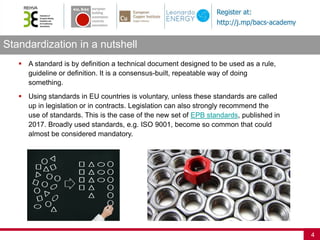
 A standard is by definition a technical document designed to be used as a rule,
guideline or definition. It is a consensus-built, repeatable way of doing
something.
 Using standards in EU countries is voluntary, unless these standards are called
up in legislation or in contracts. Legislation can also strongly recommend the
use of standards. This is the case of the new set of EPB standards, published in
2017. Broadly used standards, e.g. ISO 9001, become so common that could
almost be considered mandatory.
International Standardization Organizations
5
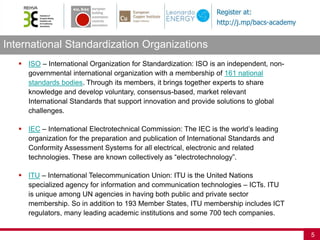
 ISO – International Organization for Standardization: ISO is an independent, non-
governmental international organization with a membership of 161 national
standards bodies. Through its members, it brings together experts to share
knowledge and develop voluntary, consensus-based, market relevant
International Standards that support innovation and provide solutions to global
challenges.
 IEC – International Electrotechnical Commission: The IEC is the world’s leading
organization for the preparation and publication of International Standards and
Conformity Assessment Systems for all electrical, electronic and related
technologies. These are known collectively as “electrotechnology”.
 ITU – International Telecommunication Union: ITU is the United Nations
specialized agency for information and communication technologies – ICTs. ITU
is unique among UN agencies in having both public and private sector
membership. So in addition to 193 Member States, ITU membership includes ICT
regulators, many leading academic institutions and some 700 tech companies.
EN ISO standards
6
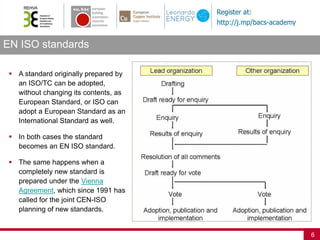
 A standard originally prepared by
an ISO/TC can be adopted,
without changing its contents, as
European Standard, or ISO can
adopt a European Standard as an
International Standard as well.
 In both cases the standard
becomes an EN ISO standard.
 The same happens when a
completely new standard is
prepared under the Vienna
Agreement, which since 1991 has
called for the joint CEN-ISO
planning of new standards.
The European Standardization System (ESS)
7
 CEN – Comité Européen de Normalisation (European Committee for
Standardization),
 CENELEC – Comité Européen de Normalisation Électrotechnique (European
Committee for Electrotechnical Standardization) and
 ETSI – European Telecommunications Standards Institute
are the three European Standardization Organizations. The legal framework for this
cooperation is set out in EU Regulation 1025/2012, which entered into force on 1
January 2013.
CEN – European Committee for Standardization (1)
8
 34 members of CEN (European Single Market)
 European Standards (online search tool)
 Technical Committees
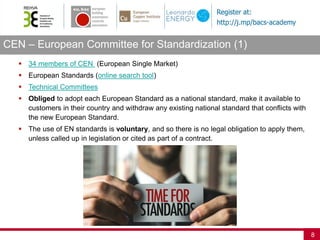
 Obliged to adopt each European Standard as a national standard, make it available to
customers in their country and withdraw any existing national standard that conflicts with
the new European Standard.
 The use of EN standards is voluntary, and so there is no legal obligation to apply them,
unless called up in legislation or cited as part of a contract.
CEN – European Committee for Standardization (2)
9
Building automation and controls standards (1)
10
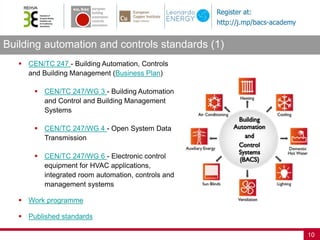
 CEN/TC 247 - Building Automation, Controls
and Building Management (Business Plan)
 CEN/TC 247/WG 3 - Building Automation
and Control and Building Management
Systems
 CEN/TC 247/WG 4 - Open System Data
Transmission
 CEN/TC 247/WG 6 - Electronic control
equipment for HVAC applications,
integrated room automation, controls and
management systems
 Work programme
 Published standards
Building automation and controls standards (2)
11
 EN ISO 16484 Building automation and control systems (BACS)
 Part 1: Project specification and implementation
 Part 2: Hardware
 Part 3: Functions
 Part 4: Control applications
 Part 5: Data communication protocol
 Part 6: Data communication conformance testing
 EN 15232 Building automation, controls and technical building management
 Part 1: Impact of building automation, controls and technical building
management (EN ISO 52120)
 Part 2: Accompanying Technical Report
 EN 16947 Building management system
 Part 1: Building management system (EN ISO 52127)
 Part 2: Accompanying Technical Report
Building automation and controls standards (3)
12
 EN 16946 Inspection of building automation, controls and technical building
management
 Part 1: Inspection of building automation, controls and technical building
management
 Part 2: Accompanying Technical Report
 EN 15500 Control for heating, ventilation and air conditioning applications
 Part 1: Electronic individual zone control equipment
 Part 2: Accompanying Technical Report
 There are additional IEC and ISO standards which you can find in the resources
chapter of REHVA GB 22 in cooperation with eu.bac ‘Introduction to building
automation, controls and technical building management’
(https://www.rehva.eu/publications-and-resources/eshop.html)
Building automation and controls terminology
13
 Building automation and control (BAC)
 Building automation and control system (BACS)
 Technical building management (TBM)
 Building management system (BMS)
 Building energy management system (BEMS)
 Energy management system (EMS)
 Building automation system (BAS)
 REHVA GB 22 in cooperation with eu.bac ‘Introduction to building
automation, controls and technical building management’
 www.eubac.org/downloads/annexes-rehva-gb-22-introduction-to-bac/index.html
EN ISO 16484 Building automation and control systems (1)
14
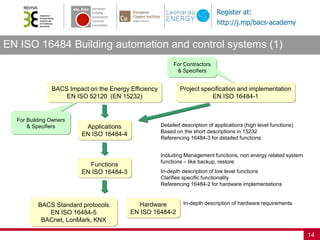
BACS Impact on the Energy Efficiency
EN ISO 52120 (EN 15232)
Applications
EN ISO 16484-4
Functions
EN ISO 16484-3
Hardware
EN ISO 16484-2
Project specification and implementation
EN ISO 16484-1
For Building Owners
& Specifiers
For Contractors
& Specifiers
Detailed description of applications (high level functions)
Based on the short descriptions in 15232
Referencing 16484-3 for detailed functions
Including Management functions, non energy related system
functions – like backup, restore
In-depth description of low level functions
Clarifies specific functionality
Referencing 16484-2 for hardware implementations
In-depth description of hardware requirementsBACS Standard protocols
EN ISO 16484-5
BACnet, LonMark, KNX
ENISO16484BACS(2)
15
EN ISO 16484 – Part 3 Functions (non – energy efficiency)
16
 Logbook of all changes
 Alarms / Messages and Recording of Messages
 Graphic image operation with dynamic elements
 Communication and diagnosis
 Data storage
 Reports
 Energy data analysis / consumption monitoring / KPI's tracking
 Data validation & data normalization
 Suitable processes for energy relevant adjustments (for example,
setpoints, time schedules)
 Avoidance of local "permanent solutions"
 Depending on the possibilities, feedback to the users
 Information channel back to the users is an advantage
EN 15232 Energy performance of buildings – BACS & TBM (1)
17
 EN 15232 also requires that all hydraulic systems should be properly balanced as a
prerequisite for all classes.
EN 15232 Energy performance of buildings – BACS & TBM (2)
18
EN 15232 Energy performance of buildings – BACS & TBM (3)
19
 HEATING CONTROL – Emission control
The control system is installed at the emitter or room level, for case 1 one system can control
several rooms.
 0 No automatic control of the room temperature
 1 Central automatic control: There is only central automatic control acting either on the
distribution or on the generation. This can be achieved for example by an outside
temperature controller conforming to EN 12098-1 or EN 12098-3; one system can
control several rooms.
 2 Individual room control: By thermostatic valves or electronic controller
 3 Individual room control with communication: As above, in addition for integrated plants
the heat emission e.g. floor heating, wall heating, etc. the function 1.1.3 is assigned to
the BA class A.
 4 Individual room control with communication and occupancy detection: Between
controllers and BACS; Demand control / occupancy detection (this function level is
usually not applied to any slow reacting heat emission systems with relevant thermal
mass, e.g. floor heating, wall heating).
EN 15232 Energy performance of buildings – BACS & TBM (4)
20
 HEATING CONTROL – Control of distribution network hot water temperature
Similar function can be applied to the control of direct electric heating networks.
 0 No automatic control
 1 Outside temperature-compensated control: Actions generally lower the mean flow
temperature.
 2 Demand-based control: E.g. based on indoor temperature control variable; actions
generally lower the mean flow
 HEATING CONTROL – Control of distribution pumps in network
The controlled pumps can be installed at different levels in the network. Control is to reduce
the auxiliary energy demand of the pumps.
 0 No automatic control
 1 On / off control: switch on and off automatically, pumps run with no control at maximum
speed.
 2 Multi-stage control: Speed of pumps is controlled by a multi-step control
 3 Variable speed pump control: Constant or variable Δp based on pump unit (internal)
estimations
EN 15232 Energy performance of buildings – BACS & TBM (5)
21
 COOLING CONTROL – Interlock between heating and cooling control of emission
and/or distribution
To avoid at the same time heating and cooling in the same room depends on the system
principle(e.g. cooling panel/heat emitter, TABS/ventilation, several indoor units)
 0 No interlock: the two systems are controlled independently and can provide
simultaneously heating and cooling.
 1 Partial interlock (dependent of the HVAC system): The control function is set up in
order to minimize the possibility of simultaneous heating and cooling. This is generally
done by defining a sliding set point for the supply temperature of the centrally controlled
system.
 2 Total interlock: The control function enables to warranty that there will be no
simultaneous heating and cooling.
EN 15232 Energy performance of buildings – BACS & TBM (6)
22
Q&A - Thank you for your attention!
23

BACS Standardisation Framework

  • 1.
    Webinar 3 BACSStandardisation Framework by Andrei Lițiu & Roland Ullmann 18 June 2018
  • 2.
    Webinar 3 BACSStandardisation Framework 2 Andrei Lițiu Roland Ullmann KTH Royal Institute of Technology eu.bac European Building Division of Building Services and Automation and Controls Energy Systems Association PhD Student Board advisor litiu@kth.se roland.ullmann@siemens.com
  • 3.
    Contents 3  Standardization ina nutshell  International Standardization Organizations  EN ISO standards  The European Standardization System (ESS)  CEN – European Committee for Standardization  Building automation and controls standards  Building automation and controls terminology  EN ISO 16484 Building automation and control systems  EN 15232 Energy performance of buildings – Impact of BACS  Q&A
  • 4.
    Standardization in anutshell 4  A standard is by definition a technical document designed to be used as a rule, guideline or definition. It is a consensus-built, repeatable way of doing something.  Using standards in EU countries is voluntary, unless these standards are called up in legislation or in contracts. Legislation can also strongly recommend the use of standards. This is the case of the new set of EPB standards, published in 2017. Broadly used standards, e.g. ISO 9001, become so common that could almost be considered mandatory.
  • 5.
    International Standardization Organizations 5 ISO – International Organization for Standardization: ISO is an independent, non- governmental international organization with a membership of 161 national standards bodies. Through its members, it brings together experts to share knowledge and develop voluntary, consensus-based, market relevant International Standards that support innovation and provide solutions to global challenges.  IEC – International Electrotechnical Commission: The IEC is the world’s leading organization for the preparation and publication of International Standards and Conformity Assessment Systems for all electrical, electronic and related technologies. These are known collectively as “electrotechnology”.  ITU – International Telecommunication Union: ITU is the United Nations specialized agency for information and communication technologies – ICTs. ITU is unique among UN agencies in having both public and private sector membership. So in addition to 193 Member States, ITU membership includes ICT regulators, many leading academic institutions and some 700 tech companies.
  • 6.
    EN ISO standards 6 A standard originally prepared by an ISO/TC can be adopted, without changing its contents, as European Standard, or ISO can adopt a European Standard as an International Standard as well.  In both cases the standard becomes an EN ISO standard.  The same happens when a completely new standard is prepared under the Vienna Agreement, which since 1991 has called for the joint CEN-ISO planning of new standards.
  • 7.
    The European StandardizationSystem (ESS) 7  CEN – Comité Européen de Normalisation (European Committee for Standardization),  CENELEC – Comité Européen de Normalisation Électrotechnique (European Committee for Electrotechnical Standardization) and  ETSI – European Telecommunications Standards Institute are the three European Standardization Organizations. The legal framework for this cooperation is set out in EU Regulation 1025/2012, which entered into force on 1 January 2013.
  • 8.
    CEN – EuropeanCommittee for Standardization (1) 8  34 members of CEN (European Single Market)  European Standards (online search tool)  Technical Committees  Obliged to adopt each European Standard as a national standard, make it available to customers in their country and withdraw any existing national standard that conflicts with the new European Standard.  The use of EN standards is voluntary, and so there is no legal obligation to apply them, unless called up in legislation or cited as part of a contract.
  • 9.
    CEN – EuropeanCommittee for Standardization (2) 9
  • 10.
    Building automation andcontrols standards (1) 10  CEN/TC 247 - Building Automation, Controls and Building Management (Business Plan)  CEN/TC 247/WG 3 - Building Automation and Control and Building Management Systems  CEN/TC 247/WG 4 - Open System Data Transmission  CEN/TC 247/WG 6 - Electronic control equipment for HVAC applications, integrated room automation, controls and management systems  Work programme  Published standards
  • 11.
    Building automation andcontrols standards (2) 11  EN ISO 16484 Building automation and control systems (BACS)  Part 1: Project specification and implementation  Part 2: Hardware  Part 3: Functions  Part 4: Control applications  Part 5: Data communication protocol  Part 6: Data communication conformance testing  EN 15232 Building automation, controls and technical building management  Part 1: Impact of building automation, controls and technical building management (EN ISO 52120)  Part 2: Accompanying Technical Report  EN 16947 Building management system  Part 1: Building management system (EN ISO 52127)  Part 2: Accompanying Technical Report
  • 12.
    Building automation andcontrols standards (3) 12  EN 16946 Inspection of building automation, controls and technical building management  Part 1: Inspection of building automation, controls and technical building management  Part 2: Accompanying Technical Report  EN 15500 Control for heating, ventilation and air conditioning applications  Part 1: Electronic individual zone control equipment  Part 2: Accompanying Technical Report  There are additional IEC and ISO standards which you can find in the resources chapter of REHVA GB 22 in cooperation with eu.bac ‘Introduction to building automation, controls and technical building management’ (https://www.rehva.eu/publications-and-resources/eshop.html)
  • 13.
    Building automation andcontrols terminology 13  Building automation and control (BAC)  Building automation and control system (BACS)  Technical building management (TBM)  Building management system (BMS)  Building energy management system (BEMS)  Energy management system (EMS)  Building automation system (BAS)  REHVA GB 22 in cooperation with eu.bac ‘Introduction to building automation, controls and technical building management’  www.eubac.org/downloads/annexes-rehva-gb-22-introduction-to-bac/index.html
  • 14.
    EN ISO 16484Building automation and control systems (1) 14 BACS Impact on the Energy Efficiency EN ISO 52120 (EN 15232) Applications EN ISO 16484-4 Functions EN ISO 16484-3 Hardware EN ISO 16484-2 Project specification and implementation EN ISO 16484-1 For Building Owners & Specifiers For Contractors & Specifiers Detailed description of applications (high level functions) Based on the short descriptions in 15232 Referencing 16484-3 for detailed functions Including Management functions, non energy related system functions – like backup, restore In-depth description of low level functions Clarifies specific functionality Referencing 16484-2 for hardware implementations In-depth description of hardware requirementsBACS Standard protocols EN ISO 16484-5 BACnet, LonMark, KNX
  • 15.
  • 16.
    EN ISO 16484– Part 3 Functions (non – energy efficiency) 16  Logbook of all changes  Alarms / Messages and Recording of Messages  Graphic image operation with dynamic elements  Communication and diagnosis  Data storage  Reports  Energy data analysis / consumption monitoring / KPI's tracking  Data validation & data normalization  Suitable processes for energy relevant adjustments (for example, setpoints, time schedules)  Avoidance of local "permanent solutions"  Depending on the possibilities, feedback to the users  Information channel back to the users is an advantage
  • 17.
    EN 15232 Energyperformance of buildings – BACS & TBM (1) 17  EN 15232 also requires that all hydraulic systems should be properly balanced as a prerequisite for all classes.
  • 18.
    EN 15232 Energyperformance of buildings – BACS & TBM (2) 18
  • 19.
    EN 15232 Energyperformance of buildings – BACS & TBM (3) 19  HEATING CONTROL – Emission control The control system is installed at the emitter or room level, for case 1 one system can control several rooms.  0 No automatic control of the room temperature  1 Central automatic control: There is only central automatic control acting either on the distribution or on the generation. This can be achieved for example by an outside temperature controller conforming to EN 12098-1 or EN 12098-3; one system can control several rooms.  2 Individual room control: By thermostatic valves or electronic controller  3 Individual room control with communication: As above, in addition for integrated plants the heat emission e.g. floor heating, wall heating, etc. the function 1.1.3 is assigned to the BA class A.  4 Individual room control with communication and occupancy detection: Between controllers and BACS; Demand control / occupancy detection (this function level is usually not applied to any slow reacting heat emission systems with relevant thermal mass, e.g. floor heating, wall heating).
  • 20.
    EN 15232 Energyperformance of buildings – BACS & TBM (4) 20  HEATING CONTROL – Control of distribution network hot water temperature Similar function can be applied to the control of direct electric heating networks.  0 No automatic control  1 Outside temperature-compensated control: Actions generally lower the mean flow temperature.  2 Demand-based control: E.g. based on indoor temperature control variable; actions generally lower the mean flow  HEATING CONTROL – Control of distribution pumps in network The controlled pumps can be installed at different levels in the network. Control is to reduce the auxiliary energy demand of the pumps.  0 No automatic control  1 On / off control: switch on and off automatically, pumps run with no control at maximum speed.  2 Multi-stage control: Speed of pumps is controlled by a multi-step control  3 Variable speed pump control: Constant or variable Δp based on pump unit (internal) estimations
  • 21.
    EN 15232 Energyperformance of buildings – BACS & TBM (5) 21  COOLING CONTROL – Interlock between heating and cooling control of emission and/or distribution To avoid at the same time heating and cooling in the same room depends on the system principle(e.g. cooling panel/heat emitter, TABS/ventilation, several indoor units)  0 No interlock: the two systems are controlled independently and can provide simultaneously heating and cooling.  1 Partial interlock (dependent of the HVAC system): The control function is set up in order to minimize the possibility of simultaneous heating and cooling. This is generally done by defining a sliding set point for the supply temperature of the centrally controlled system.  2 Total interlock: The control function enables to warranty that there will be no simultaneous heating and cooling.
  • 22.
    EN 15232 Energyperformance of buildings – BACS & TBM (6) 22
  • 23.
    Q&A - Thankyou for your attention! 23