IEA 2021. All rights reserved.
Energy data for GHGs reporting and CRTs: the IEA perspective
May 2021 CCXG Workshop – Opportunities for developing Common Reporting Tables for national GHG
inventories
Roberta QUADRELLI, Pouya TAGHAVI
International Energy Agency – Energy Data Centre
IEA 2021. All rights reserved.
Global energy statistics: at the core of the IEA work
• To develop comprehensive global
energy statistics and enhance their
dissemination to inform energy policy
• To improve countries ability to produce
energy stats, through training and
cooperation
• To raise the profile of statistics and
statisticians and highlight the relevance
to policy making
https://www.iea.org/data-and-statistics
IEA 2021. All rights reserved.
IEA data work to support UNFCCC and global
climate reporting
IEA 2021. All rights reserved.
Energy data and UNFCCC GHG reporting: IEA experience
Each year, for each Party reviewed, IEA provides UNFCCC and its expert
reviewers with an assessment, comparing the two international submissions.
Parties are requested to address issues within the review process.
IEA contributes to climate policy transparency in several ways:
• data and analysis resources
• methodology reference (e.g. with IPCC)
• capacity building (training, material)
…
• dedicated annual work to support UNFCCC GHG reviews:
IEA supports UNFCCC on coherence of energy data and GHG inventories,
to reduce burden on countries and improve data quality.
IEA 2021. All rights reserved.
IEA support to UNFCCC GHGs inventories in practice
Each year, for each Annex 1 Party reviewed, IEA provides UNFCCC and its expert reviewers
with an assessment comparing the two international submissions.
Consolidated workstream – also took into account recommendations
from LR Working group
B. Set of comparison files based on CRF tables –
aligned by UNFCCC and IEA – focus on energy
A. Analysis of data issues:
trends and levels
IEA 2021. All rights reserved.
How is the IEA analysis used through the UNFCCC review?
a) The findings in the analysis prepared by IEA are incorporated practically verbatim in the
individual Assessment Report that the UNFCCC secretariat sends to the Party for comments ahead
of review week; therefore, they are commented by each Party under review;
b) The Assessment Report with the comments of the Party is provided to the expert review
team (ERT) as basis for the review report. Depending of the issue and the comment from the Party,
the experts may formulate further questions for clarification. The experts assess whether the issue
is solved, clarified or not, and if it should be incorporated in the review report.
c) The quantitative comparison files (excel) provided by IEA are made available to the ERT
during the review as a supporting tool. In many cases. In addition, the experts use the energy
balance provided by IEA to deepen assessment, ask questions for clarification and identify issues
for the review report, if that is the case.
IEA 2021. All rights reserved.
Strategic objective: to improve data for energy and climate policy
Ensure that one coherent set of national energy data is used for all purposes
Ministry of Energy
Statistical Office
Energy Agency
…
Ministry of Environment
Statistical Office
Hydrometerological service
…
Institutional
arrangements
National energy data
National GHG inventories
ENERGY
CLIMATE
National energy data
National GHG inventories
IEA 2021. All rights reserved.
The IEA perspective on the Common Reporting
Tables
IEA 2021. All rights reserved.
First: adopting standardized energy definitions/classifications is key
IRES and IPCC Guidelines are compatible – developed in collaboration
Comparability is key to high-quality energy and GHG data at national level
• IEA led harmonization
effort with partners
(UNSD, Eurostat, …)
International Recommendations
on Energy Statistics (IRES)
• Adopted by the UN Statistical
Commission in 2011
• Guidelines elaborated through very
wide consultation (including IPCC
and UNFCCC)
IEA 2021. All rights reserved.
First general recommendation: explicitly map energy statistics into
GHG inventory tables variables
Explicit mapping of energy statistics will ensure high quality inventory data
Examples of potential misalignments IPCC – IRES
 Products: IRES follows SIEC products classification. Examples of misalignments
include: “Coal, Oil, Gas,…” vs “Solid, Liquid, Gaseous”, with implications on allocation
of data for specific products.
 Nomenclature for sectors: Examples of misalignments include: “Public” vs “Main
activity” producers; “Petroleum” vs “Oil” refining; etc.
 ISIC rev 3 (IPCC) with ISIC Rev 4 (IRES) for industrial sectors
 Boundaries of “production”: “marketable” (IRES) vs “raw” (e.g. mining emissions)
IEA 2021. All rights reserved.
Second general recommendation: keep coherence with energy balance
IEA 2021. All rights reserved.
Examples of detailed recommendations on CRFs tables: 1.A(b) - NCVs
Table 1.A(b) is relevant to assess the apparent consumption at a glance (reference approach)
Reporting the calorific values in the table even if energy data are reported directly in energy
terms will help to understand potential sources of discrepancy as part of the review process.
Currently the footnote requests to report NCVs in the National Inventory Report, however this
is not always used nor practical to review.
Note: Calorific values affect emissions estimations as much as physical quantities.
IEA 2021. All rights reserved.
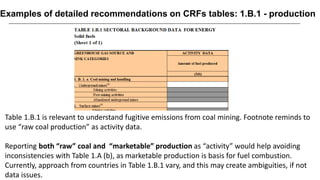
Table 1.B.1 is relevant to understand fugitive emissions from coal mining. Footnote reminds to
use “raw coal production” as activity data.
Reporting both “raw” coal and “marketable” production as “activity” would help avoiding
inconsistencies with Table 1.A (b), as marketable production is basis for fuel combustion.
Currently, approach from countries in Table 1.B.1 vary, and this may create ambiguities, if not
data issues.
Examples of detailed recommendations on CRFs tables: 1.B.1 - production
IEA 2021. All rights reserved.
An opportunity for simplification? 1.A(a)s3 – Transport …
All sectoral consumption data are important to understand
emissions drivers.
However, CRFs require a much higher disaggregation for
transport than for residential or commercial, with
difficulties to track such detail for some countries
(detail beyond the typical energy balance).
Passenger road versus Freight road would already give a
good sense for what drives emissions.
In any case, we recommend splitting “Buses” out of
“Trucks” (different purpose). More detailed guidance
available based on IEA experience in energy efficiency
indicators.
IEA 2021. All rights reserved.
Or… an opportunity for enhanced ambition: end-uses for buildings, too!
The Residential sector is extremely important but is just
reported under “Other sectors”, together with Services.
While for transport the disaggregation is detailed: Cars, light-
duty vehicles, trucks, etc (as in Table 1.Aa(s3)),
The end-uses for residential (cooking, space heating, space
cooling, etc) are not tracked – some still dependent on fossil
or biomass.
Countries able to report disaggregated data for transport
would find it beneficial to report emissions from residential
and services end-uses, too, as demand will vary a lot across
them. Buildings provide a huge untapped potential for
IEA 2021. All rights reserved.

CCXG Workshop, May 2021, Roberta Quadrelli

  • 1.
    IEA 2021. Allrights reserved. Energy data for GHGs reporting and CRTs: the IEA perspective May 2021 CCXG Workshop – Opportunities for developing Common Reporting Tables for national GHG inventories Roberta QUADRELLI, Pouya TAGHAVI International Energy Agency – Energy Data Centre
  • 2.
    IEA 2021. Allrights reserved. Global energy statistics: at the core of the IEA work • To develop comprehensive global energy statistics and enhance their dissemination to inform energy policy • To improve countries ability to produce energy stats, through training and cooperation • To raise the profile of statistics and statisticians and highlight the relevance to policy making https://www.iea.org/data-and-statistics
  • 3.
    IEA 2021. Allrights reserved. IEA data work to support UNFCCC and global climate reporting
  • 4.
    IEA 2021. Allrights reserved. Energy data and UNFCCC GHG reporting: IEA experience Each year, for each Party reviewed, IEA provides UNFCCC and its expert reviewers with an assessment, comparing the two international submissions. Parties are requested to address issues within the review process. IEA contributes to climate policy transparency in several ways: • data and analysis resources • methodology reference (e.g. with IPCC) • capacity building (training, material) … • dedicated annual work to support UNFCCC GHG reviews: IEA supports UNFCCC on coherence of energy data and GHG inventories, to reduce burden on countries and improve data quality.
  • 5.
    IEA 2021. Allrights reserved. IEA support to UNFCCC GHGs inventories in practice Each year, for each Annex 1 Party reviewed, IEA provides UNFCCC and its expert reviewers with an assessment comparing the two international submissions. Consolidated workstream – also took into account recommendations from LR Working group B. Set of comparison files based on CRF tables – aligned by UNFCCC and IEA – focus on energy A. Analysis of data issues: trends and levels
  • 6.
    IEA 2021. Allrights reserved. How is the IEA analysis used through the UNFCCC review? a) The findings in the analysis prepared by IEA are incorporated practically verbatim in the individual Assessment Report that the UNFCCC secretariat sends to the Party for comments ahead of review week; therefore, they are commented by each Party under review; b) The Assessment Report with the comments of the Party is provided to the expert review team (ERT) as basis for the review report. Depending of the issue and the comment from the Party, the experts may formulate further questions for clarification. The experts assess whether the issue is solved, clarified or not, and if it should be incorporated in the review report. c) The quantitative comparison files (excel) provided by IEA are made available to the ERT during the review as a supporting tool. In many cases. In addition, the experts use the energy balance provided by IEA to deepen assessment, ask questions for clarification and identify issues for the review report, if that is the case.
  • 7.
    IEA 2021. Allrights reserved. Strategic objective: to improve data for energy and climate policy Ensure that one coherent set of national energy data is used for all purposes Ministry of Energy Statistical Office Energy Agency … Ministry of Environment Statistical Office Hydrometerological service … Institutional arrangements National energy data National GHG inventories ENERGY CLIMATE National energy data National GHG inventories
  • 8.
    IEA 2021. Allrights reserved. The IEA perspective on the Common Reporting Tables
  • 9.
    IEA 2021. Allrights reserved. First: adopting standardized energy definitions/classifications is key IRES and IPCC Guidelines are compatible – developed in collaboration Comparability is key to high-quality energy and GHG data at national level • IEA led harmonization effort with partners (UNSD, Eurostat, …) International Recommendations on Energy Statistics (IRES) • Adopted by the UN Statistical Commission in 2011 • Guidelines elaborated through very wide consultation (including IPCC and UNFCCC)
  • 10.
    IEA 2021. Allrights reserved. First general recommendation: explicitly map energy statistics into GHG inventory tables variables Explicit mapping of energy statistics will ensure high quality inventory data Examples of potential misalignments IPCC – IRES  Products: IRES follows SIEC products classification. Examples of misalignments include: “Coal, Oil, Gas,…” vs “Solid, Liquid, Gaseous”, with implications on allocation of data for specific products.  Nomenclature for sectors: Examples of misalignments include: “Public” vs “Main activity” producers; “Petroleum” vs “Oil” refining; etc.  ISIC rev 3 (IPCC) with ISIC Rev 4 (IRES) for industrial sectors  Boundaries of “production”: “marketable” (IRES) vs “raw” (e.g. mining emissions)
  • 11.
    IEA 2021. Allrights reserved. Second general recommendation: keep coherence with energy balance
  • 12.
    IEA 2021. Allrights reserved. Examples of detailed recommendations on CRFs tables: 1.A(b) - NCVs Table 1.A(b) is relevant to assess the apparent consumption at a glance (reference approach) Reporting the calorific values in the table even if energy data are reported directly in energy terms will help to understand potential sources of discrepancy as part of the review process. Currently the footnote requests to report NCVs in the National Inventory Report, however this is not always used nor practical to review. Note: Calorific values affect emissions estimations as much as physical quantities.
  • 13.
    IEA 2021. Allrights reserved. Table 1.B.1 is relevant to understand fugitive emissions from coal mining. Footnote reminds to use “raw coal production” as activity data. Reporting both “raw” coal and “marketable” production as “activity” would help avoiding inconsistencies with Table 1.A (b), as marketable production is basis for fuel combustion. Currently, approach from countries in Table 1.B.1 vary, and this may create ambiguities, if not data issues. Examples of detailed recommendations on CRFs tables: 1.B.1 - production
  • 14.
    IEA 2021. Allrights reserved. An opportunity for simplification? 1.A(a)s3 – Transport … All sectoral consumption data are important to understand emissions drivers. However, CRFs require a much higher disaggregation for transport than for residential or commercial, with difficulties to track such detail for some countries (detail beyond the typical energy balance). Passenger road versus Freight road would already give a good sense for what drives emissions. In any case, we recommend splitting “Buses” out of “Trucks” (different purpose). More detailed guidance available based on IEA experience in energy efficiency indicators.
  • 15.
    IEA 2021. Allrights reserved. Or… an opportunity for enhanced ambition: end-uses for buildings, too! The Residential sector is extremely important but is just reported under “Other sectors”, together with Services. While for transport the disaggregation is detailed: Cars, light- duty vehicles, trucks, etc (as in Table 1.Aa(s3)), The end-uses for residential (cooking, space heating, space cooling, etc) are not tracked – some still dependent on fossil or biomass. Countries able to report disaggregated data for transport would find it beneficial to report emissions from residential and services end-uses, too, as demand will vary a lot across them. Buildings provide a huge untapped potential for
  • 16.
    IEA 2021. Allrights reserved.