A Quest For Better Sleep
(with Fitbit data analysis)
Alex Martinelli | @5agado
Index
● Why?
● The Data
● Exploring Sleep Data
● The Heatmap Case
● Correlation
● What’s Next?
2/15
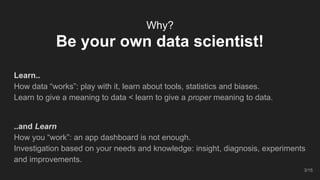
Why?
Be your own data scientist!
Learn..
How data “works”: play with it, learn about tools, statistics and biases.
Learn to give a meaning to data < learn to give a proper meaning to data.
..and Learn
How you “work”: an app dashboard is not enough.
Investigation based on your needs and knowledge: insight, diagnosis, experiments
and improvements.
3/15
The Data
Premise: sleep trackers and their inherent inaccuracy
The Fitbit case
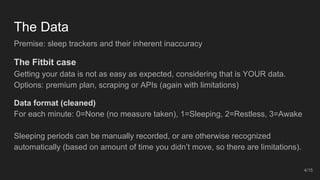
Getting your data is not as easy as expected, considering that is YOUR data.
Options: premium plan, scraping or APIs (again with limitations)
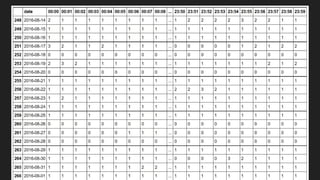
Data format (cleaned)
For each minute: 0=None (no measure taken), 1=Sleeping, 2=Restless, 3=Awake
Sleeping periods can be manually recorded, or are otherwise recognized
automatically (based on amount of time you didn’t move, so there are limitations).
4/15
Data image (table)
Exploring Sleep Data
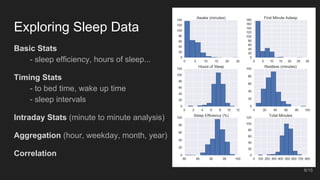
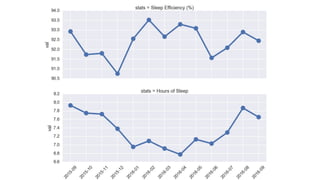
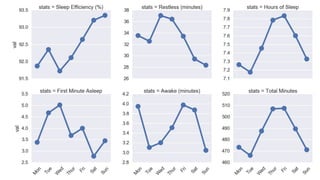
Basic Stats
- sleep efficiency, hours of sleep...
Timing Stats
- to bed time, wake up time
- sleep intervals
Intraday Stats (minute to minute analysis)
Aggregation (hour, weekday, month, year)
Correlation
6/15
7/15
8/15
“Looks cool, but what does it mean?”
[cit. everyone]
9/15
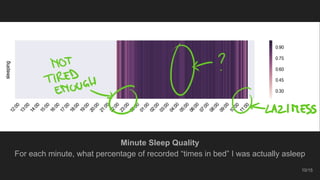
Minute Sleep Quality
For each minute, what percentage of recorded “times in bed” I was actually asleep
10/15
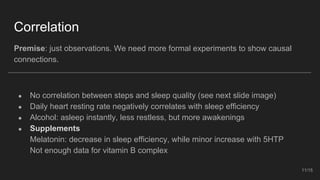
Correlation
Premise: just observations. We need more formal experiments to show causal
connections.
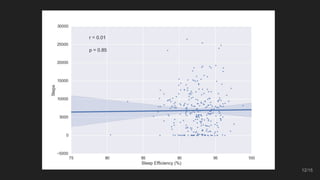
● No correlation between steps and sleep quality (see next slide image)
● Daily heart resting rate negatively correlates with sleep efficiency
● Alcohol: asleep instantly, less restless, but more awakenings
● Supplements
Melatonin: decrease in sleep efficiency, while minor increase with 5HTP
Not enough data for vitamin B complex
11/15
12/15
What’s Next?
● More data for correlation (drinking, eating, activity, cognitive performances,
habits and routines)
● Self experimentation to support causal relationship hypotheses
● Demographics
● Predictive models?
● Real quality data: EEG integration
● A personal quirky case: lucid dreaming
13/15
Q&A
Useful Links
1. Introductory article for this project
(https://medium.com/@5agado/a-quest-for-better-sleep-with-fitbit-data-analysis-5f10b3f548a#.925f35k2f)
2. Github repository with project code (https://github.com/5agado/fitbit-analyzer)
3. Intraday data via personal apps - Fitbit announcement post
(https://community.fitbit.com/t5/Web-API/Intraday-data-now-immediately-available-to-personal-apps/td-p/1014524)
4. Study on Fitbit accuracy on sleep measurements (https://www.ncbi.nlm.nih.gov/pubmed/21971963)
5. Cross-sectional study on the validity of consumer-level wearables
(https://ijbnpa.biomedcentral.com/articles/10.1186/s12966-015-0201-9)
15/15

Data Mining Sleep Data

  • 1.
    A Quest ForBetter Sleep (with Fitbit data analysis) Alex Martinelli | @5agado
  • 2.
    Index ● Why? ● TheData ● Exploring Sleep Data ● The Heatmap Case ● Correlation ● What’s Next? 2/15
  • 3.
    Why? Be your owndata scientist! Learn.. How data “works”: play with it, learn about tools, statistics and biases. Learn to give a meaning to data < learn to give a proper meaning to data. ..and Learn How you “work”: an app dashboard is not enough. Investigation based on your needs and knowledge: insight, diagnosis, experiments and improvements. 3/15
  • 4.
    The Data Premise: sleeptrackers and their inherent inaccuracy The Fitbit case Getting your data is not as easy as expected, considering that is YOUR data. Options: premium plan, scraping or APIs (again with limitations) Data format (cleaned) For each minute: 0=None (no measure taken), 1=Sleeping, 2=Restless, 3=Awake Sleeping periods can be manually recorded, or are otherwise recognized automatically (based on amount of time you didn’t move, so there are limitations). 4/15
  • 5.
  • 6.
    Exploring Sleep Data BasicStats - sleep efficiency, hours of sleep... Timing Stats - to bed time, wake up time - sleep intervals Intraday Stats (minute to minute analysis) Aggregation (hour, weekday, month, year) Correlation 6/15
  • 7.
  • 8.
  • 9.
    “Looks cool, butwhat does it mean?” [cit. everyone] 9/15
  • 10.
    Minute Sleep Quality Foreach minute, what percentage of recorded “times in bed” I was actually asleep 10/15
  • 11.
    Correlation Premise: just observations.We need more formal experiments to show causal connections. ● No correlation between steps and sleep quality (see next slide image) ● Daily heart resting rate negatively correlates with sleep efficiency ● Alcohol: asleep instantly, less restless, but more awakenings ● Supplements Melatonin: decrease in sleep efficiency, while minor increase with 5HTP Not enough data for vitamin B complex 11/15
  • 12.
  • 13.
    What’s Next? ● Moredata for correlation (drinking, eating, activity, cognitive performances, habits and routines) ● Self experimentation to support causal relationship hypotheses ● Demographics ● Predictive models? ● Real quality data: EEG integration ● A personal quirky case: lucid dreaming 13/15
  • 14.
  • 15.
    Useful Links 1. Introductoryarticle for this project (https://medium.com/@5agado/a-quest-for-better-sleep-with-fitbit-data-analysis-5f10b3f548a#.925f35k2f) 2. Github repository with project code (https://github.com/5agado/fitbit-analyzer) 3. Intraday data via personal apps - Fitbit announcement post (https://community.fitbit.com/t5/Web-API/Intraday-data-now-immediately-available-to-personal-apps/td-p/1014524) 4. Study on Fitbit accuracy on sleep measurements (https://www.ncbi.nlm.nih.gov/pubmed/21971963) 5. Cross-sectional study on the validity of consumer-level wearables (https://ijbnpa.biomedcentral.com/articles/10.1186/s12966-015-0201-9) 15/15