
Buzz Moschetti
Enterprise Architect
buzz.moschetti@mongodb.com
@buzzmoschetti
Bulletproof
Data Management
2
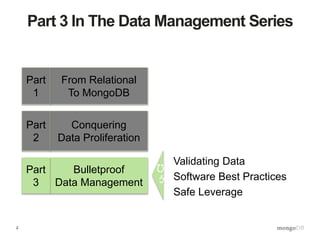
Part 3 In The Data Management Series
Validating Data
Software Best Practices
Safe Leverage
From Relational
To MongoDB
Conquering
Data Proliferation
Bulletproof
Data Management
ç
Ω
Part
1
Part
2
Part
3
3
Congratulations! At this Point You’ve:
• Created a Data Design
• Migrated Data
• Built a PoC or maybe an App
• Explored Operations
4
The Next Stage: Defend & Leverage!
• Document Validation
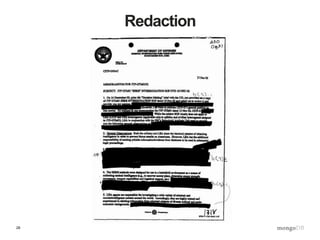
• Redaction
• Quality Of Service
5
MongoDB Doesn’t Have These Things
• Document Validation
• Redaction
• Quality Of Service
6
What Can We Do Today?
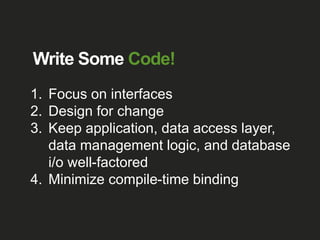
Write Some Code!
1. Focus on interfaces
2. Design for change
3. Keep application, data access layer,
data management logic, and database
i/o well-factored
4. Minimize compile-time binding
8
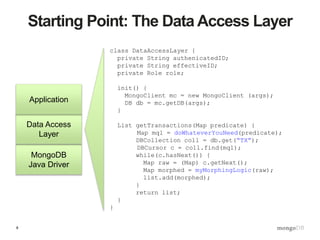
Starting Point: The Data Access Layer
MongoDB
Java Driver
Data Access
Layer
Application
class DataAccessLayer {
private String authenicatedID;
private String effectiveID;
private Role role;
init() {
MongoClient mc = new MongoClient (args);
DB db = mc.getDB(args);
}
List getTransactions(Map predicate) {
Map mql = doWhateverYouNeed(predicate);
DBCollection coll = db.get(“TX”);
DBCursor c = coll.find(mql);
while(c.hasNext()) {
Map raw = (Map) c.getNext();
Map morphed = myMorphingLogic(raw);
list.add(morphed);
}
return list;
}
}
9
Document Validation
10
A Query Filters Outbound Data
{$and:[{“name”:”buzz”},{“prefs”:{$exists:true}}]
11
How About Using It To Filter Inbounds?
{$and:[{“name”:”buzz”},{“prefs”:{$exists:true}}]}
12
$exists And $type Already in MQL
{“name”:{$type:2}}
{$or:[{“age”:{$exists:false}}, {“age”:{$type:16}} ]}
{$and: [
{$name: {$type:2}},
{$or:[
{$and:[{"weight”:{$type:16}}, {"height":{$type:16}}]}
,{$and:[{"weight”:{$exists:0}}, {"height":{$exists:0}}]}
]}
])
Ensure “name” exists (because not null) and is a string:
“age” optional but if exists must be a 32bit integer:
“name” required as string and weight and height both
required integers or both not present:
13
… And MQL Goes Way Beyond…
{$or:[
{$and:[
{“name”: {$type:2}},
{“numClues”: {$gt: 0}}, {“numClues”:{$type:16}},
{“birthday”: {$type: 9}},
{“hiredate”: {$type: 9}},
{$or: [{“prefs”:{$exists:false}},
{“prefs”:{$type:3}} ]
}
]
},
{“name”: {$exists:false}}
]
}
14
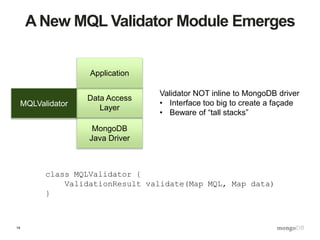
A New MQL Validator Module Emerges
class MQLValidator {
ValidationResult validate(Map MQL, Map data)
}
MongoDB
Java Driver
Data Access
Layer
Application
Validator NOT inline to MongoDB driver
• Interface too big to create a façade
• Beware of “tall stacks”
MQLValidator
15
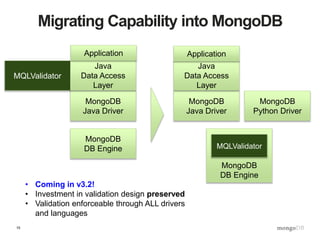
MongoDB
DB Engine
Migrating Capability into MongoDB
MongoDB
Java Driver
MQLValidator
Java
Data Access
Layer
MongoDB
DB Engine
MongoDB
Java Driver
MQLValidator
Java
Data Access
Layer
• Coming in v3.2!
• Investment in validation design preserved
• Validation enforceable through ALL drivers
and languages
MongoDB
Python Driver
Application Application
16
Code For The Future…Today
class DataAccessLayer {
someWriteOperation(Map data) {
if(ValidationEnabledInMongoDBengine) {
collection.insert(data); // Not yet
} else {
Map mql = getMQL(); // we’ll see this shortly!
// {$or:[{“age”:{$exists:false}},
// {“age”:{$type:16}}]}
ValidationResult vr = MQLValidator.validate(mql,data);
if(vr.ok()) {
collection.insert(data);
}
}
}
}
17
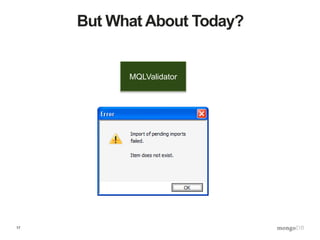
But What About Today?
MQLValidator
18
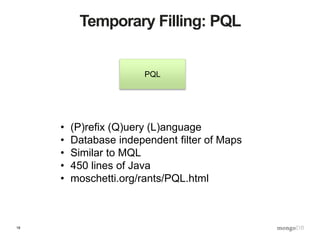
Temporary Filling: PQL
• (P)refix (Q)uery (L)anguage
• Database independent filter of Maps
• Similar to MQL
• 450 lines of Java
• moschetti.org/rants/PQL.html
PQL
19
Bridge MQL to PQL
class MQLValidator {
private PQLFilter pqlfilter;
validate(Map mql, Map data) {
boolean rc;
if(MQLValidationAvailableAsLibrary) {
rc = ActualMongoDBMQL.validate(mql, data);
} else {
Map pqlfilter = convertMQLtoPQL(mql);
// {or:[{“null”: “age”},
// {“type”: {“age”: “INT”}}]}
rc = pqlfilter.eval(pql, data);
}
return rc;
}
Map convertMQLtoPQL(Map mql) { // ~200 lines }
}
20
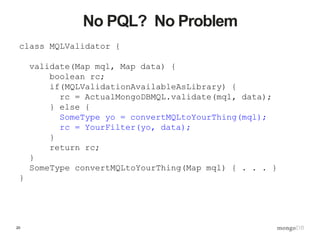
No PQL? No Problem
class MQLValidator {
validate(Map mql, Map data) {
boolean rc;
if(MQLValidationAvailableAsLibrary) {
rc = ActualMongoDBMQL.validate(mql, data);
} else {
SomeType yo = convertMQLtoYourThing(mql);
rc = YourFilter(yo, data);
}
return rc;
}
SomeType convertMQLtoYourThing(Map mql) { . . . }
}
21
MQL Is Easy To Navigate
{$or:[
{$and:[
{“name”: {$type:2}},
{“numClues”: {$gt: 0}}, {“numClues”:{$type:16}},
{“birthday”: {$type: 9}},
{“hiredate”: {$type: 9}},
{$or: [{“prefs”:{$exists:false}},
{“prefs”:{$type:3}} ]
}
]
},
{“name”: {$exists:false}}
]
}
• “Walk”, not “parse”
• Operators distinct from operands
• Operands are native type (e.g. Date)
22
Where Do Validations Come From?
The Database!
23
The Validations Collection
> db.validations.find()
{
“collectionName”: “product”,
“validations”: [
{ “name”: “simple”, “type”: “MQL”, “expr”:
{__$or:[{“age”:{__$exists:false}},
{“age”:{__$type:16}} ]}
]
}
{
“collectionName”: “transaction”,
“validations”: [
{ “name”: “frontOffice”, “type”: “MQL”, “expr”:
{ … lots of MQL here …}
}
]
}
24
Various “Levels” of Validation
> db.validations.find()
{
“collectionName”: “foo”,
“defaultValidation”: “initialSetup”,
“validations”: [
{“name”: “initialSetup”, …},
{“name”: “frontOffice”, …},
{“name”: “middleOffice”, …},
{“name”: “backOffice”, …}
]
}
25
Multiple Types: Schema By Example
> db.validations.find()
{
“collectionName”: “foo”,
“validations”: [
{ “name”: “simple”,
“type”: “SBE”,
“expr”:
{ “name!”: “string”,
“age”: “integer”,
“petNames”: [ “string” ],
“bday!”: “date”
}
}
]
}
26
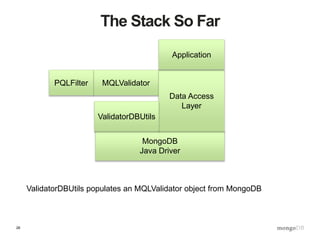
The Stack So Far
MongoDB
Java Driver
MQLValidator
Data Access
Layer
Application
ValidatorDBUtils
ValidatorDBUtils populates an MQLValidator object from MongoDB
PQLFilter
27
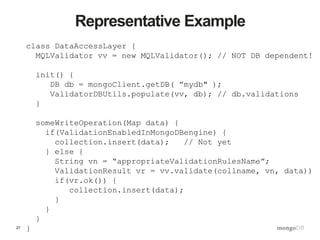
Representative Example
class DataAccessLayer {
MQLValidator vv = new MQLValidator(); // NOT DB dependent!
init() {
DB db = mongoClient.getDB( ”mydb" );
ValidatorDBUtils.populate(vv, db); // db.validations
}
someWriteOperation(Map data) {
if(ValidationEnabledInMongoDBengine) {
collection.insert(data); // Not yet
} else {
String vn = “appropriateValidationRulesName”;
ValidationResult vr = vv.validate(collname, vn, data))
if(vr.ok()) {
collection.insert(data);
}
}
}
}
28
Redaction
29
Concept: Post Query Operations (PQO)
{ ssn: { $hash: model }, birthdate: null }
{$and:[{“name”:”buzz”},{“prefs”:{$exists:true}}]
30
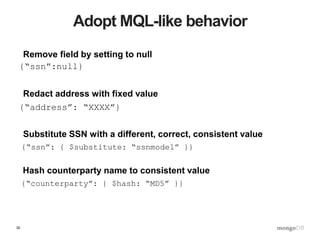
Adopt MQL-like behavior
{“ssn”:null}
{“address”: “XXXX”}
{“ssn”: { $substitute: “ssnmodel” }}
Remove field by setting to null
Redact address with fixed value
Substitute SSN with a different, correct, consistent value
{“counterparty”: { $hash: “MD5” }}
Hash counterparty name to consistent value
31
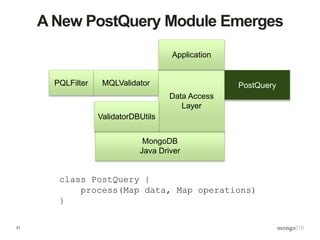
A New PostQuery Module Emerges
class PostQuery {
process(Map data, Map operations)
}
PostQuery
MongoDB
Java Driver
MQLValidator
Data Access
Layer
Application
ValidatorDBUtils
PQLFilter
32
Where Do PQOs Come From?
The Database!
33
The Postquery Collection
> db.postquery.find()
{
“collectionName”: “product”,
“operations”: [
{ “name”: “basicPI”, “type”: “PQO”, “expr”:
{“ssn”:null}
}
]
}
{
“collectionName”: “customerIndo”,
“operations”: [
{ “name”: “personalData”, “type”: “PQO”,
“expr”:
{ … lots of PQO here …}
}
]
}
34
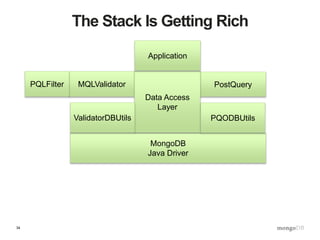
The Stack Is Getting Rich
PostQuery
MongoDB
Java Driver
MQLValidator
Data Access
Layer
Application
ValidatorDBUtils
PQLFilter
PQODBUtils
35
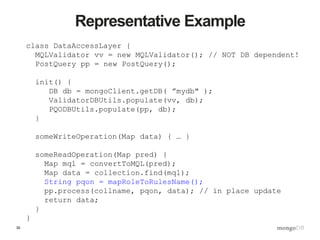
Representative Example
class DataAccessLayer {
MQLValidator vv = new MQLValidator(); // NOT DB dependent!
PostQuery pp = new PostQuery();
init() {
DB db = mongoClient.getDB( ”mydb" );
ValidatorDBUtils.populate(vv, db);
PQODBUtils.populate(pp, db);
}
someWriteOperation(Map data) { … }
someReadOperation(Map pred) {
Map mql = convertToMQL(pred);
Map data = collection.find(mql);
String pqon = mapRoleToRulesName();
pp.process(collname, pqon, data); // in place update
return data;
}
}
36
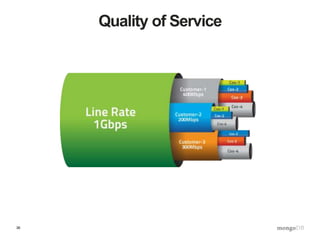
Quality of Service
37
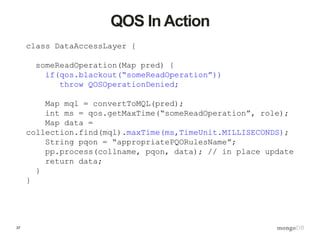
QOS In Action
class DataAccessLayer {
someReadOperation(Map pred) {
if(qos.blackout(“someReadOperation”))
throw QOSOperationDenied;
Map mql = convertToMQL(pred);
int ms = qos.getMaxTime(“someReadOperation”, role);
Map data =
collection.find(mql).maxTime(ms,TimeUnit.MILLISECONDS);
String pqon = “appropriatePQORulesName”;
pp.process(collname, pqon, data); // in place update
return data;
}
}
38
Where Do We Store QOS Values?
The Database!
39
The QOS Collection
> db.qos.find()
{
“collectionName”: “product”,
“qos”: [
{ “function”: “someReadOperation”,
“rule”: “std”,
“maxtime”: 250 },
{ “function”: “someReadOperation”,
“rule”: “reporting”,
“blackout”: { “start”: “08:00”, “end”: “17:00”},
“maxtime”: 2000}
“ … ”
}
]
}
40
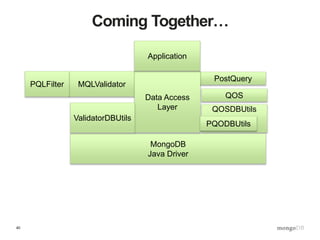
QOSDBUtils
Coming Together…
PostQuery
MongoDB
Java Driver
MQLValidator
Data Access
Layer
Application
ValidatorDBUtils
PQLFilter
PQODBUtils
QOS
41
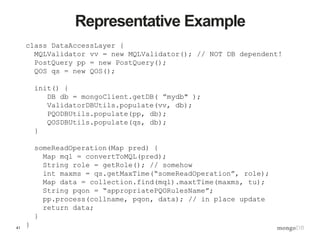
Representative Example
class DataAccessLayer {
MQLValidator vv = new MQLValidator(); // NOT DB dependent!
PostQuery pp = new PostQuery();
QOS qs = new QOS();
init() {
DB db = mongoClient.getDB( ”mydb" );
ValidatorDBUtils.populate(vv, db);
PQODBUtils.populate(pp, db);
QOSDBUtils.populate(qs, db);
}
someReadOperation(Map pred) {
Map mql = convertToMQL(pred);
String role = getRole(); // somehow
int maxms = qs.getMaxTime(“someReadOperation”, role);
Map data = collection.find(mql).maxtTime(maxms, tu);
String pqon = “appropriatePQORulesName”;
pp.process(collname, pqon, data); // in place update
return data;
}
}
42
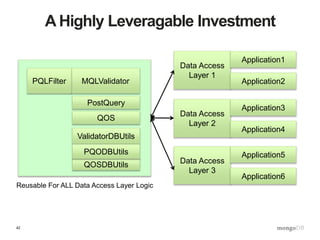
QOSDBUtils
A Highly Leveragable Investment
PostQuery
MQLValidator
Data Access
Layer 1
Application1
ValidatorDBUtils
PQLFilter
PQODBUtils
QOS
Application2
Data Access
Layer 2
Application3
Application4
Data Access
Layer 3
Application5
Application6
Reusable For ALL Data Access Layer Logic
43
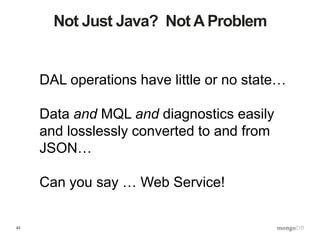
Not Just Java? Not A Problem
DAL operations have little or no state…
Data and MQL and diagnostics easily
and losslessly converted to and from
JSON…
Can you say … Web Service!
44
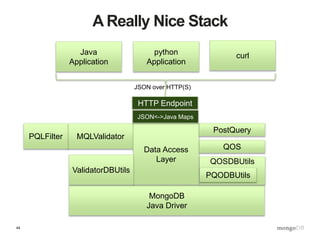
A Really Nice Stack
MongoDB
Java Driver
MQLValidator
Data Access
Layer
Java
Application
ValidatorDBUtils
PQLFilter
HTTP Endpoint
python
Application
curl
JSON over HTTP(S)
JSON<->Java Maps
QOSDBUtils
PostQuery
PQODBUtils
QOS
45
What Can We Do?
46
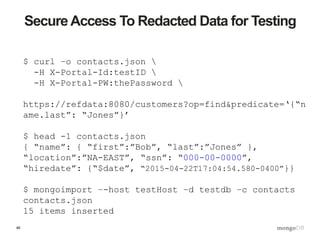
Secure Access To Redacted Data for Testing
$ curl –o contacts.json 
-H X-Portal-Id:testID 
-H X-Portal-PW:thePassword 
https://refdata:8080/customers?op=find&predicate=‘{“n
ame.last”: “Jones”}’
$ head -1 contacts.json
{ “name”: { “first”:”Bob”, “last”:”Jones” },
“location”:”NA-EAST”, “ssn”: “000-00-0000”,
“hiredate”: {“$date”, “2015-04-22T17:04:54.580-0400”}}
$ mongoimport –-host testHost –d testdb –c contacts
contacts.json
15 items inserted
47
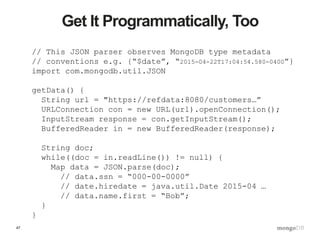
Get It Programmatically, Too
// This JSON parser observes MongoDB type metadata
// conventions e.g. {“$date”, “2015-04-22T17:04:54.580-0400”}
import com.mongodb.util.JSON
getData() {
String url = "https://refdata:8080/customers…”
URLConnection con = new URL(url).openConnection();
InputStream response = con.getInputStream();
BufferedReader in = new BufferedReader(response);
String doc;
while((doc = in.readLine()) != null) {
Map data = JSON.parse(doc);
// data.ssn = “000-00-0000”
// date.hiredate = java.util.Date 2015-04 …
// data.name.first = “Bob”;
}
}
48
Robust, Validated Data Ingest
$ curl –d @trades.json 
-H X-Portal-Id:prodadm 
-H X-Portal-PW:thePassword 
https://refdata:8080trades?op=load 
-o response.json
$ cat response.json
{ “assignedBatchID”: “B123”,
“numItemsExamined”: 13245,
“numItemsInserted”: 13242,
“numItemsRejected”: 3,
“errors”: [ { type: “valfail”, rule: “front … ],
“batchMD5”: “e19c1283c925b3206685ff522acfe3e6”
}
49
Concept: The control_ Collection
> show collections
books
control_
customer
firms
> db.control_.find()
{
“collectionName”: “product”,
“qos”: [ … ],
“validations”: [ … ]
“operations”: [… ]
}
• Single namespace for capabilities
• Easier to add new capabilities
• Tighter (therefore better) security/entitlement
50
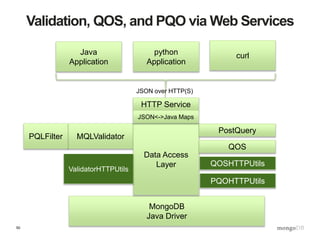
Validation, QOS, and PQO via Web Services
MongoDB
Java Driver
MQLValidator
Data Access
Layer
Java
Application
ValidatorHTTPUtils
PQLFilter
python
Application
curl
JSON over HTTP(S)
QOSHTTPUtils
PostQuery
PQOHTTPUtils
QOS
HTTP Service
JSON<->Java Maps
51
Are We Excited Yet?
Contact me or MongoDB for
• Beta program for 3.2 features
• Access to MQLValidator, PQO,
and other Java resources
Questions & Answers
54
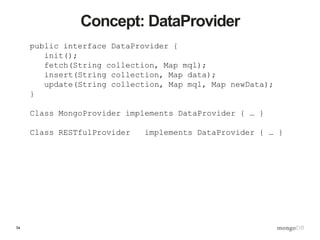
Concept: DataProvider
public interface DataProvider {
init();
fetch(String collection, Map mql);
insert(String collection, Map data);
update(String collection, Map mql, Map newData);
}
Class MongoProvider implements DataProvider { … }
Class RESTfulProvider implements DataProvider { … }
55
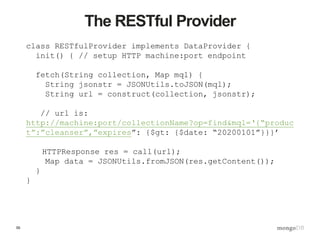
The RESTful Provider
class RESTfulProvider implements DataProvider {
init() { // setup HTTP machine:port endpoint
fetch(String collection, Map mql) {
String jsonstr = JSONUtils.toJSON(mql);
String url = construct(collection, jsonstr);
// url is:
http://machine:port/collectionName?op=find&mql=‘{“produc
t”:”cleanser”,”expires”: {$gt: {$date: “20200101”}}}’
HTTPResponse res = call(url);
Map data = JSONUtils.fromJSON(res.getContent());
}
}

Data Management 3: Bulletproof Data Management

  • 1.
  • 2.
    2 Part 3 InThe Data Management Series Validating Data Software Best Practices Safe Leverage From Relational To MongoDB Conquering Data Proliferation Bulletproof Data Management ç Ω Part 1 Part 2 Part 3
  • 3.
    3 Congratulations! At thisPoint You’ve: • Created a Data Design • Migrated Data • Built a PoC or maybe an App • Explored Operations
  • 4.
    4 The Next Stage:Defend & Leverage! • Document Validation • Redaction • Quality Of Service
  • 5.
    5 MongoDB Doesn’t HaveThese Things • Document Validation • Redaction • Quality Of Service
  • 6.
    6 What Can WeDo Today?
  • 7.
    Write Some Code! 1.Focus on interfaces 2. Design for change 3. Keep application, data access layer, data management logic, and database i/o well-factored 4. Minimize compile-time binding
  • 8.
    8 Starting Point: TheData Access Layer MongoDB Java Driver Data Access Layer Application class DataAccessLayer { private String authenicatedID; private String effectiveID; private Role role; init() { MongoClient mc = new MongoClient (args); DB db = mc.getDB(args); } List getTransactions(Map predicate) { Map mql = doWhateverYouNeed(predicate); DBCollection coll = db.get(“TX”); DBCursor c = coll.find(mql); while(c.hasNext()) { Map raw = (Map) c.getNext(); Map morphed = myMorphingLogic(raw); list.add(morphed); } return list; } }
  • 9.
  • 10.
    10 A Query FiltersOutbound Data {$and:[{“name”:”buzz”},{“prefs”:{$exists:true}}]
  • 11.
    11 How About UsingIt To Filter Inbounds? {$and:[{“name”:”buzz”},{“prefs”:{$exists:true}}]}
  • 12.
    12 $exists And $typeAlready in MQL {“name”:{$type:2}} {$or:[{“age”:{$exists:false}}, {“age”:{$type:16}} ]} {$and: [ {$name: {$type:2}}, {$or:[ {$and:[{"weight”:{$type:16}}, {"height":{$type:16}}]} ,{$and:[{"weight”:{$exists:0}}, {"height":{$exists:0}}]} ]} ]) Ensure “name” exists (because not null) and is a string: “age” optional but if exists must be a 32bit integer: “name” required as string and weight and height both required integers or both not present:
  • 13.
    13 … And MQLGoes Way Beyond… {$or:[ {$and:[ {“name”: {$type:2}}, {“numClues”: {$gt: 0}}, {“numClues”:{$type:16}}, {“birthday”: {$type: 9}}, {“hiredate”: {$type: 9}}, {$or: [{“prefs”:{$exists:false}}, {“prefs”:{$type:3}} ] } ] }, {“name”: {$exists:false}} ] }
  • 14.
    14 A New MQLValidator Module Emerges class MQLValidator { ValidationResult validate(Map MQL, Map data) } MongoDB Java Driver Data Access Layer Application Validator NOT inline to MongoDB driver • Interface too big to create a façade • Beware of “tall stacks” MQLValidator
  • 15.
    15 MongoDB DB Engine Migrating Capabilityinto MongoDB MongoDB Java Driver MQLValidator Java Data Access Layer MongoDB DB Engine MongoDB Java Driver MQLValidator Java Data Access Layer • Coming in v3.2! • Investment in validation design preserved • Validation enforceable through ALL drivers and languages MongoDB Python Driver Application Application
  • 16.
    16 Code For TheFuture…Today class DataAccessLayer { someWriteOperation(Map data) { if(ValidationEnabledInMongoDBengine) { collection.insert(data); // Not yet } else { Map mql = getMQL(); // we’ll see this shortly! // {$or:[{“age”:{$exists:false}}, // {“age”:{$type:16}}]} ValidationResult vr = MQLValidator.validate(mql,data); if(vr.ok()) { collection.insert(data); } } } }
  • 17.
    17 But What AboutToday? MQLValidator
  • 18.
    18 Temporary Filling: PQL •(P)refix (Q)uery (L)anguage • Database independent filter of Maps • Similar to MQL • 450 lines of Java • moschetti.org/rants/PQL.html PQL
  • 19.
    19 Bridge MQL toPQL class MQLValidator { private PQLFilter pqlfilter; validate(Map mql, Map data) { boolean rc; if(MQLValidationAvailableAsLibrary) { rc = ActualMongoDBMQL.validate(mql, data); } else { Map pqlfilter = convertMQLtoPQL(mql); // {or:[{“null”: “age”}, // {“type”: {“age”: “INT”}}]} rc = pqlfilter.eval(pql, data); } return rc; } Map convertMQLtoPQL(Map mql) { // ~200 lines } }
  • 20.
    20 No PQL? NoProblem class MQLValidator { validate(Map mql, Map data) { boolean rc; if(MQLValidationAvailableAsLibrary) { rc = ActualMongoDBMQL.validate(mql, data); } else { SomeType yo = convertMQLtoYourThing(mql); rc = YourFilter(yo, data); } return rc; } SomeType convertMQLtoYourThing(Map mql) { . . . } }
  • 21.
    21 MQL Is EasyTo Navigate {$or:[ {$and:[ {“name”: {$type:2}}, {“numClues”: {$gt: 0}}, {“numClues”:{$type:16}}, {“birthday”: {$type: 9}}, {“hiredate”: {$type: 9}}, {$or: [{“prefs”:{$exists:false}}, {“prefs”:{$type:3}} ] } ] }, {“name”: {$exists:false}} ] } • “Walk”, not “parse” • Operators distinct from operands • Operands are native type (e.g. Date)
  • 22.
    22 Where Do ValidationsCome From? The Database!
  • 23.
    23 The Validations Collection >db.validations.find() { “collectionName”: “product”, “validations”: [ { “name”: “simple”, “type”: “MQL”, “expr”: {__$or:[{“age”:{__$exists:false}}, {“age”:{__$type:16}} ]} ] } { “collectionName”: “transaction”, “validations”: [ { “name”: “frontOffice”, “type”: “MQL”, “expr”: { … lots of MQL here …} } ] }
  • 24.
    24 Various “Levels” ofValidation > db.validations.find() { “collectionName”: “foo”, “defaultValidation”: “initialSetup”, “validations”: [ {“name”: “initialSetup”, …}, {“name”: “frontOffice”, …}, {“name”: “middleOffice”, …}, {“name”: “backOffice”, …} ] }
  • 25.
    25 Multiple Types: SchemaBy Example > db.validations.find() { “collectionName”: “foo”, “validations”: [ { “name”: “simple”, “type”: “SBE”, “expr”: { “name!”: “string”, “age”: “integer”, “petNames”: [ “string” ], “bday!”: “date” } } ] }
  • 26.
    26 The Stack SoFar MongoDB Java Driver MQLValidator Data Access Layer Application ValidatorDBUtils ValidatorDBUtils populates an MQLValidator object from MongoDB PQLFilter
  • 27.
    27 Representative Example class DataAccessLayer{ MQLValidator vv = new MQLValidator(); // NOT DB dependent! init() { DB db = mongoClient.getDB( ”mydb" ); ValidatorDBUtils.populate(vv, db); // db.validations } someWriteOperation(Map data) { if(ValidationEnabledInMongoDBengine) { collection.insert(data); // Not yet } else { String vn = “appropriateValidationRulesName”; ValidationResult vr = vv.validate(collname, vn, data)) if(vr.ok()) { collection.insert(data); } } } }
  • 28.
  • 29.
    29 Concept: Post QueryOperations (PQO) { ssn: { $hash: model }, birthdate: null } {$and:[{“name”:”buzz”},{“prefs”:{$exists:true}}]
  • 30.
    30 Adopt MQL-like behavior {“ssn”:null} {“address”:“XXXX”} {“ssn”: { $substitute: “ssnmodel” }} Remove field by setting to null Redact address with fixed value Substitute SSN with a different, correct, consistent value {“counterparty”: { $hash: “MD5” }} Hash counterparty name to consistent value
  • 31.
    31 A New PostQueryModule Emerges class PostQuery { process(Map data, Map operations) } PostQuery MongoDB Java Driver MQLValidator Data Access Layer Application ValidatorDBUtils PQLFilter
  • 32.
    32 Where Do PQOsCome From? The Database!
  • 33.
    33 The Postquery Collection >db.postquery.find() { “collectionName”: “product”, “operations”: [ { “name”: “basicPI”, “type”: “PQO”, “expr”: {“ssn”:null} } ] } { “collectionName”: “customerIndo”, “operations”: [ { “name”: “personalData”, “type”: “PQO”, “expr”: { … lots of PQO here …} } ] }
  • 34.
    34 The Stack IsGetting Rich PostQuery MongoDB Java Driver MQLValidator Data Access Layer Application ValidatorDBUtils PQLFilter PQODBUtils
  • 35.
    35 Representative Example class DataAccessLayer{ MQLValidator vv = new MQLValidator(); // NOT DB dependent! PostQuery pp = new PostQuery(); init() { DB db = mongoClient.getDB( ”mydb" ); ValidatorDBUtils.populate(vv, db); PQODBUtils.populate(pp, db); } someWriteOperation(Map data) { … } someReadOperation(Map pred) { Map mql = convertToMQL(pred); Map data = collection.find(mql); String pqon = mapRoleToRulesName(); pp.process(collname, pqon, data); // in place update return data; } }
  • 36.
  • 37.
    37 QOS In Action classDataAccessLayer { someReadOperation(Map pred) { if(qos.blackout(“someReadOperation”)) throw QOSOperationDenied; Map mql = convertToMQL(pred); int ms = qos.getMaxTime(“someReadOperation”, role); Map data = collection.find(mql).maxTime(ms,TimeUnit.MILLISECONDS); String pqon = “appropriatePQORulesName”; pp.process(collname, pqon, data); // in place update return data; } }
  • 38.
    38 Where Do WeStore QOS Values? The Database!
  • 39.
    39 The QOS Collection >db.qos.find() { “collectionName”: “product”, “qos”: [ { “function”: “someReadOperation”, “rule”: “std”, “maxtime”: 250 }, { “function”: “someReadOperation”, “rule”: “reporting”, “blackout”: { “start”: “08:00”, “end”: “17:00”}, “maxtime”: 2000} “ … ” } ] }
  • 40.
    40 QOSDBUtils Coming Together… PostQuery MongoDB Java Driver MQLValidator DataAccess Layer Application ValidatorDBUtils PQLFilter PQODBUtils QOS
  • 41.
    41 Representative Example class DataAccessLayer{ MQLValidator vv = new MQLValidator(); // NOT DB dependent! PostQuery pp = new PostQuery(); QOS qs = new QOS(); init() { DB db = mongoClient.getDB( ”mydb" ); ValidatorDBUtils.populate(vv, db); PQODBUtils.populate(pp, db); QOSDBUtils.populate(qs, db); } someReadOperation(Map pred) { Map mql = convertToMQL(pred); String role = getRole(); // somehow int maxms = qs.getMaxTime(“someReadOperation”, role); Map data = collection.find(mql).maxtTime(maxms, tu); String pqon = “appropriatePQORulesName”; pp.process(collname, pqon, data); // in place update return data; } }
  • 42.
    42 QOSDBUtils A Highly LeveragableInvestment PostQuery MQLValidator Data Access Layer 1 Application1 ValidatorDBUtils PQLFilter PQODBUtils QOS Application2 Data Access Layer 2 Application3 Application4 Data Access Layer 3 Application5 Application6 Reusable For ALL Data Access Layer Logic
  • 43.
    43 Not Just Java?Not A Problem DAL operations have little or no state… Data and MQL and diagnostics easily and losslessly converted to and from JSON… Can you say … Web Service!
  • 44.
    44 A Really NiceStack MongoDB Java Driver MQLValidator Data Access Layer Java Application ValidatorDBUtils PQLFilter HTTP Endpoint python Application curl JSON over HTTP(S) JSON<->Java Maps QOSDBUtils PostQuery PQODBUtils QOS
  • 45.
  • 46.
    46 Secure Access ToRedacted Data for Testing $ curl –o contacts.json -H X-Portal-Id:testID -H X-Portal-PW:thePassword https://refdata:8080/customers?op=find&predicate=‘{“n ame.last”: “Jones”}’ $ head -1 contacts.json { “name”: { “first”:”Bob”, “last”:”Jones” }, “location”:”NA-EAST”, “ssn”: “000-00-0000”, “hiredate”: {“$date”, “2015-04-22T17:04:54.580-0400”}} $ mongoimport –-host testHost –d testdb –c contacts contacts.json 15 items inserted
  • 47.
    47 Get It Programmatically,Too // This JSON parser observes MongoDB type metadata // conventions e.g. {“$date”, “2015-04-22T17:04:54.580-0400”} import com.mongodb.util.JSON getData() { String url = "https://refdata:8080/customers…” URLConnection con = new URL(url).openConnection(); InputStream response = con.getInputStream(); BufferedReader in = new BufferedReader(response); String doc; while((doc = in.readLine()) != null) { Map data = JSON.parse(doc); // data.ssn = “000-00-0000” // date.hiredate = java.util.Date 2015-04 … // data.name.first = “Bob”; } }
  • 48.
    48 Robust, Validated DataIngest $ curl –d @trades.json -H X-Portal-Id:prodadm -H X-Portal-PW:thePassword https://refdata:8080trades?op=load -o response.json $ cat response.json { “assignedBatchID”: “B123”, “numItemsExamined”: 13245, “numItemsInserted”: 13242, “numItemsRejected”: 3, “errors”: [ { type: “valfail”, rule: “front … ], “batchMD5”: “e19c1283c925b3206685ff522acfe3e6” }
  • 49.
    49 Concept: The control_Collection > show collections books control_ customer firms > db.control_.find() { “collectionName”: “product”, “qos”: [ … ], “validations”: [ … ] “operations”: [… ] } • Single namespace for capabilities • Easier to add new capabilities • Tighter (therefore better) security/entitlement
  • 50.
    50 Validation, QOS, andPQO via Web Services MongoDB Java Driver MQLValidator Data Access Layer Java Application ValidatorHTTPUtils PQLFilter python Application curl JSON over HTTP(S) QOSHTTPUtils PostQuery PQOHTTPUtils QOS HTTP Service JSON<->Java Maps
  • 51.
    51 Are We ExcitedYet? Contact me or MongoDB for • Beta program for 3.2 features • Access to MQLValidator, PQO, and other Java resources
  • 52.
  • 54.
    54 Concept: DataProvider public interfaceDataProvider { init(); fetch(String collection, Map mql); insert(String collection, Map data); update(String collection, Map mql, Map newData); } Class MongoProvider implements DataProvider { … } Class RESTfulProvider implements DataProvider { … }
  • 55.
    55 The RESTful Provider classRESTfulProvider implements DataProvider { init() { // setup HTTP machine:port endpoint fetch(String collection, Map mql) { String jsonstr = JSONUtils.toJSON(mql); String url = construct(collection, jsonstr); // url is: http://machine:port/collectionName?op=find&mql=‘{“produc t”:”cleanser”,”expires”: {$gt: {$date: “20200101”}}}’ HTTPResponse res = call(url); Map data = JSONUtils.fromJSON(res.getContent()); } }

Editor's Notes

  • #2 HELLO! This is Buzz Moschetti at MongoDB Buy Subs, goddamit…! :-D
  • #3 Some quick logistics. In the last 5 to 10 mins today, we will answer the most common questions that have been submitted.
  • #4 Some quick logistics. In the last 5 to 10 mins today, we will answer the most common questions that have been submitted.
  • #5 Some quick logistics. In the last 5 to 10 mins today, we will answer the most common questions that have been submitted.
  • #6 Some quick logistics. In the last 5 to 10 mins today, we will answer the most common questions that have been submitted.
  • #7 Some quick logistics. In the last 5 to 10 mins today, we will answer the most common questions that have been submitted.
  • #9 Important things to consider: a, b ,c Not appearing in this film today: Exception/errors and edge condition handling Options in design WRT class inheritance, per-thread (or more) DAL models vs. static methods, cartridge models, etc. In particular, we will see
  • #10 Some quick logistics. In the last 5 to 10 mins today, we will answer the most common questions that have been submitted.
  • #11 Some quick logistics. In the last 5 to 10 mins today, we will answer the most common questions that have been submitted.
  • #12 Some quick logistics. In the last 5 to 10 mins today, we will answer the most common questions that have been submitted.
  • #13 Some quick logistics. In the last 5 to 10 mins today, we will answer the most common questions that have been submitted.
  • #14 Some quick logistics. In the last 5 to 10 mins today, we will answer the most common questions that have been submitted.
  • #15 Some quick logistics. In the last 5 to 10 mins today, we will answer the most common questions that have been submitted.
  • #16 Some quick logistics. In the last 5 to 10 mins today, we will answer the most common questions that have been submitted.
  • #17 Some quick logistics. In the last 5 to 10 mins today, we will answer the most common questions that have been submitted.
  • #18 Some quick logistics. In the last 5 to 10 mins today, we will answer the most common questions that have been submitted.
  • #19 Some quick logistics. In the last 5 to 10 mins today, we will answer the most common questions that have been submitted.
  • #20 Some quick logistics. In the last 5 to 10 mins today, we will answer the most common questions that have been submitted.
  • #21 Some quick logistics. In the last 5 to 10 mins today, we will answer the most common questions that have been submitted.
  • #22 Some quick logistics. In the last 5 to 10 mins today, we will answer the most common questions that have been submitted.
  • #23 Some quick logistics. In the last 5 to 10 mins today, we will answer the most common questions that have been submitted.
  • #24 Some quick logistics. In the last 5 to 10 mins today, we will answer the most common questions that have been submitted.
  • #25 Some quick logistics. In the last 5 to 10 mins today, we will answer the most common questions that have been submitted.
  • #26 Some quick logistics. In the last 5 to 10 mins today, we will answer the most common questions that have been submitted.
  • #27 Some quick logistics. In the last 5 to 10 mins today, we will answer the most common questions that have been submitted.
  • #28 In addition to being well factored, this permits the DAL to contain both DB-persisted validation and dynamic, business data driven validation managed by the SAME code set with the SAME expression language.
  • #29 Some quick logistics. In the last 5 to 10 mins today, we will answer the most common questions that have been submitted.
  • #30 Some quick logistics. In the last 5 to 10 mins today, we will answer the most common questions that have been submitted.
  • #31 Some quick logistics. In the last 5 to 10 mins today, we will answer the most common questions that have been submitted.
  • #32 Some quick logistics. In the last 5 to 10 mins today, we will answer the most common questions that have been submitted.
  • #33 Some quick logistics. In the last 5 to 10 mins today, we will answer the most common questions that have been submitted.
  • #34 NOTE: NO mention of user and role here! We only define a set of ops by rule name. Something else has to associate these with users and roles. ALSO: Nuance between entitlements set up on DB vs. entitlements at “user level.” Consider heathrow airport: You are entitled to see things but if not in home network, you cannot see SSN.
  • #35 Some quick logistics. In the last 5 to 10 mins today, we will answer the most common questions that have been submitted.
  • #36 As mentioned before re. something else associated rules and roles.
  • #37 Some quick logistics. In the last 5 to 10 mins today, we will answer the most common questions that have been submitted.
  • #38 Blackout is simple: permit or deny based on any number of factors. maxTime: Engine time, not wall clock time; a good proxy for actual load on the engine.
  • #39 Some quick logistics. In the last 5 to 10 mins today, we will answer the most common questions that have been submitted.
  • #40 Some quick logistics. In the last 5 to 10 mins today, we will answer the most common questions that have been submitted.
  • #41 Some quick logistics. In the last 5 to 10 mins today, we will answer the most common questions that have been submitted.
  • #42 Some quick logistics. In the last 5 to 10 mins today, we will answer the most common questions that have been submitted.
  • #43 Some quick logistics. In the last 5 to 10 mins today, we will answer the most common questions that have been submitted.
  • #44 Some quick logistics. In the last 5 to 10 mins today, we will answer the most common questions that have been submitted.
  • #45 Some quick logistics. In the last 5 to 10 mins today, we will answer the most common questions that have been submitted.
  • #46 Some quick logistics. In the last 5 to 10 mins today, we will answer the most common questions that have been submitted.
  • #47 Some quick logistics. In the last 5 to 10 mins today, we will answer the most common questions that have been submitted.
  • #48 Some quick logistics. In the last 5 to 10 mins today, we will answer the most common questions that have been submitted.
  • #49 Some quick logistics. In the last 5 to 10 mins today, we will answer the most common questions that have been submitted.
  • #50 Some quick logistics. In the last 5 to 10 mins today, we will answer the most common questions that have been submitted.
  • #51 Some quick logistics. In the last 5 to 10 mins today, we will answer the most common questions that have been submitted.
  • #52 Some quick logistics. In the last 5 to 10 mins today, we will answer the most common questions that have been submitted.
  • #53 On behalf of all of us at MongoDB , thank you for attending this webinar! I hope what you saw and heard today gave you some insight and clues into what you might face in your own schema design efforts. Remember you can always reach out to us at MongoDB for guidance. With that, code well and be well.
  • #55 Some quick logistics. In the last 5 to 10 mins today, we will answer the most common questions that have been submitted.
  • #56 Some quick logistics. In the last 5 to 10 mins today, we will answer the most common questions that have been submitted.