DOUBLE MODAL TRANSFORMATION AND WIND
ENGINEERING APPLICATIONS
By Luigi Carassale,1 Giuseppe Piccardo,2 and
Giovanni Solari,3
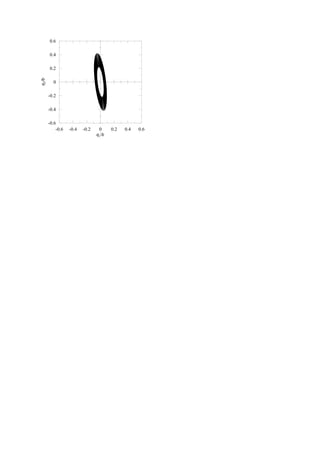
Modal transformation techniques are usually adopted in structural dynamics with the aim of decoupling
the equations of motion. They are based on the search for an abstract space in which the solution of
the problem results simplified. Analogous transformation techniques have recently been developed with the aim
of defining a space where a multivariate stochastic process is expressed by a linear combination of one-variate
uncorrelated processes. This paper proposes a method, called double modal transformation, by which the dynamic
analysis of a linear structure is carried out through the simultaneous transformation of the equations of motion
and the loading process. By adopting this technique, the structural response is obtained through a double series
expansion in which structural and loading modal contributions are superimposed. Its effectiveness and application
are discussed with reference to two classic wind engineering problems—the alongwind response and the vortexinduced
crosswind response of slender structures—which provide a wide panorama of the most relevant properties
of this procedure.
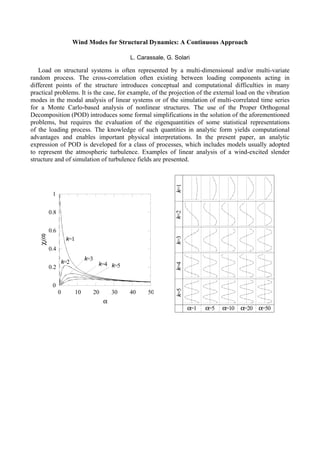
Wind Modes for Structural Dynamics: A Continuous Approach

                                                    L. Carassale, G. Solari

   Load on structural systems is often represented by a multi-dimensional and/or multi-variate
random process. The cross-correlation often existing between loading components acting in
different points of the structure introduces conceptual and computational difficulties in many
practical problems. It is the case, for example, of the projection of the external load on the vibration
modes in the modal analysis of linear systems or of the simulation of multi-correlated time series
for a Monte Carlo-based analysis of nonlinear structures. The use of the Proper Orthogonal
Decomposition (POD) introduces some formal simplifications in the solution of the aforementioned
problems, but requires the evaluation of the eigenquantities of some statistical representations
of the loading process. The knowledge of such quantities in analytic form yields computational
advantages and enables important physical interpretations. In the present paper, an analytic
expression of POD is developed for a class of processes, which includes models usually adopted
to represent the atmospheric turbulence. Examples of linear analysis of a wind-excited slender
structure and of simulation of turbulence fields are presented.


                                                                     k=1

            1


           0.8
                                                                     k=2


           0.6
   χk(α)


                                                                     k=3


                     k=1
           0.4
                                k=3
                  k=2                  k=4 k=5
                                                                     k=4


           0.2


            0
                                                                     k=5


                 0         10         20       30   40    50
                                           α
                                                                           α=1   α=5   α=10 α=20 α=50
POD-Based Filters for the Representation *
                                    of Random Loads on Structures
                                         Luigi Carassale
Random loads on structures are often represented as stationary Gaussian multi-variate random
processes, whose components are correlated with each other according to characteristic patterns.
Numerous techniques usually applied in structural dynamics require having the input constituted by
a vector of independent random processes or even white noises. The application of such techniques
in many practical contexts requires the introduction of suitable pre-filters to reproduce the exact
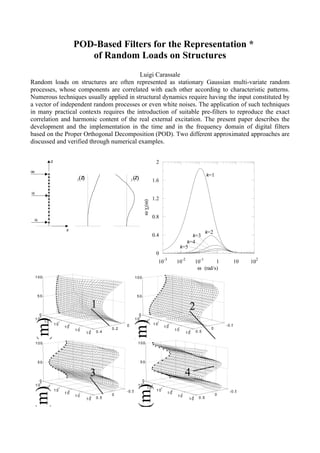
correlation and harmonic content of the real external excitation. The present paper describes the
development and the implementation in the time and in the frequency domain of digital filters
based on the Proper Orthogonal Decomposition (POD). Two different approximated approaches are
discussed and verified through numerical examples.


                  z                                                                      2
uN
                                                                                                                                          k=1
                                 1(z)                         2   (z)               1.6

uj
                                                                                    1.2
                                                                         ω γk(ω)


 u1
                                                                                    0.8

                            x
                                                                                                                                          k=2
                                                                                    0.4                                        k=3
                                                                                                                        k=4
                                                                                                                     k=5
                                                                                         0
                                                                                                   -3                -2               -1                         2
                                                                                             10                 10                 10       1          10   10
                                                                                                                                    ω (rad/s)
     100                                                          100


      50                                                            50

                                              1                                                                            2
        0                                                            0
                                                                    -3
       -3
     z (m)


     10      -2                                                   10         -2
                                                                  z (m)


            10         -1                                                 10             -1
                      10     0                            0                             10              0                                           -0.5
                            10       1              0.2                                            10            1                          0
                                 10       2
                                              0.4                                                               10         2
                                                                                                                                   0.5
                                         10                                                                               10

     100                                                            100


      50                                                                50


                                          3                                                                              4
        0                                                              0
       -3                                                             -3
                                                                    z (m)


     10      -2                                                     10             -2
     z (m)


            10         -1                                                    10               -1
                      10     0                            -0.5                           10                 0                                        -0.5
                            10       1
                                                    0                                                   10           1                          0
                                 10       2
                                              0.5                                                                10            2
                                                                                                                                    0.5
                                         10                                                                                10
Aeroelastic Forces on Yawed Circular Cylinders:*
          Quasi-steady Modeling and Aerodynamic Instability
            Luigi Carassale*, Andrea Freda, Giuseppe Piccardo
Quasi-steady approaches have been often adopted to model wind forces on moving cylinders in
cross-flow and to study instability conditions of rigid cylinders supported by visco-elastic devices.
Recently, much attention has been devoted to the experimental study of inclined and/or yawed
circular cylinders detecting dynamical phenomena such as galloping-like instability, but, at the
present state-of-the-art, no mathematical model is able to recognize or predict satisfactorily this
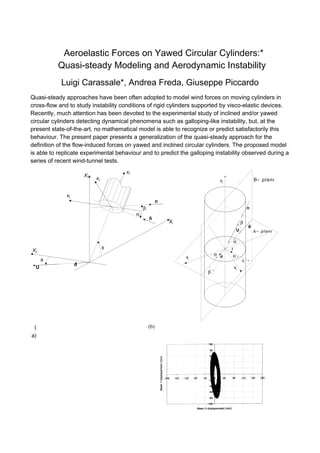
behaviour. The present paper presents a generalization of the quasi-steady approach for the
definition of the flow-induced forces on yawed and inclined circular cylinders. The proposed model
is able to replicate experimental behaviour and to predict the galloping instability observed during a
series of recent wind-tunnel tests.
                                     x3
                       X3
                            x2                                              x3                       Β− plane


              x1
                                                        n
                                              β                                                  n
                                          α
                                                  ñ
                                                            X1                               β
                                                                                                 %
                                                                                                 n
                                                                                         U           Α− plane

                                                                                     α
                                 φ                                               l
X2
                                                                          α d        α
                                                                 x1
      θ                                                                                      η
                   n
  U                                                                                  x2
                                                                      β


 (                                                (b)
a)
0.6

       0.4

       0.2
q2/b


         0

       -0.2

       -0.4

       -0.6
           -0.6   -0.4   -0.2    0     0.2   0.4   0.6
                                q1/b
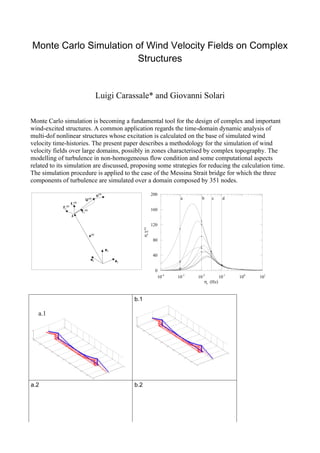
Monte Carlo Simulation of Wind Velocity Fields on Complex
                       Structures


                                               Luigi Carassale* and Giovanni Solari

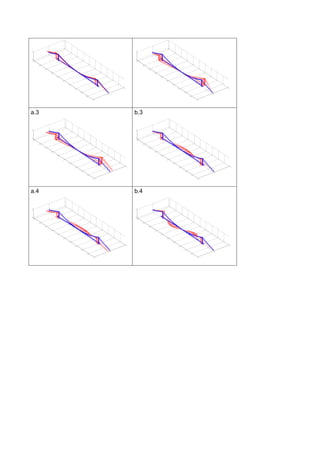
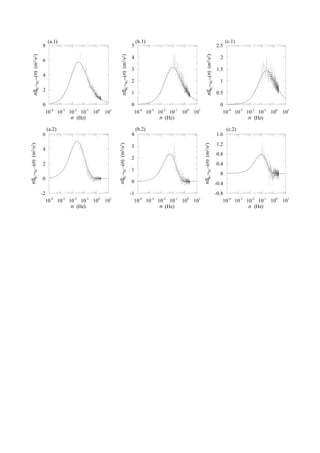
Monte Carlo simulation is becoming a fundamental tool for the design of complex and important
wind-excited structures. A common application regards the time-domain dynamic analysis of
multi-dof nonlinear structures whose excitation is calculated on the base of simulated wind
velocity time-histories. The present paper describes a methodology for the simulation of wind
velocity fields over large domains, possibly in zones characterised by complex topography. The
modelling of turbulence in non-homogeneous flow condition and some computational aspects
related to its simulation are discussed, proposing some strategies for reducing the calculation time.
The simulation procedure is applied to the case of the Messina Strait bridge for which the three
components of turbulence are simulated over a domain composed by 351 nodes.

                                               u(k)                            200
                                  U (k)                                                   a       b     c     d
                      f 3(k)
             f 2(k)
                               f 1(k)                                          160
                      k

                                                                               120
                                                                  nk γr (k )


                                        x(k)
                                                                               80

                                                      e3
                                                                               40
                                         e2                e1

                                                                                 0
                                                                                  10-4   10-3   10-2        10-1   100   101
                                                                                                    nk (Hz)


                                                                b.1

   a.1


a.2                                                             b.2
a.3   b.3


a.4   b.4
(a.1)                                                              (b.1)                                                                (c.1)
                                   8                                                                  5                                                                 2.5


                                                                                                                                            nSu3(76)u3(76)(n) (m2/s2)
       nSu1(76)u1(76)(n) (m2/s2)


                                                                          nSu2(76)u2(76)(n) (m2/s2)
                                                                                                      4                                                                   2
                                   6
                                                                                                      3                                                                 1.5
                                   4
                                                                                                      2                                                                   1
                                   2
                                                                                                      1                                                                 0.5

                                   0                                                                  0                                                                   0
                                    10-4 10-3 10-2 10-1 100 101                                        10-4 10-3 10-2 10-1 100 101                                         10-4 10-3 10-2 10-1 100 101
                                               n (Hz)                                                             n (Hz)                                                              n (Hz)

                                       (a.2)                                                              (b.2)                                                                (c.2)
                                   6                                                                  4                                                                 1.6
                                                                                                                                                                        1.2
nSu1(76)u1(77)(n) (m2/s2)


                                                                   nSu2(76)u2(77)(n) (m2/s2)


                                                                                                                                      nSu3(76)u3(77)(n) (m2/s2)
                                                                                                      3
                                   4
                                                                                                                                                                        0.8
                                                                                                      2
                                   2                                                                                                                                    0.4
                                                                                                      1
                                                                                                                                                                          0
                                   0
                                                                                                      0                                                                 -0.4
                                   -2                                                                 -1                                                                -0.8
                                     10-4 10-3 10-2 10-1 100 101                                        10-4 10-3 10-2 10-1 100 101                                         10-4 10-3 10-2 10-1 100 101
                                                n (Hz)                                                             n (Hz)                                                              n (Hz)
Proper Orthogonal Decomposition in Wind Engineering.
                    Part 1: A State-of-the-Art and Some Prospects

                    Giovanni Solari, Luigi Carassale and Federica Tubino
The Proper Orthogonal Decomposition (POD) is a statistical method particularly suitable
and versatile for dealing with many problems concerning wind engineering and several other
scientific and humanist fields. POD represents a random process as a linear combination of
deterministic functions, the POD modes, modulated by uncorrelated random coefficients, the
principal components. It owes its popularity to the property that only few terms of the series are
usually needed to capture the most energetic coherent structures of the process, and a link often
exists between each dominant mode and the main mechanisms of the phenomenon. For this
reason, POD modes are normally used to identify low-dimensional subspaces appropriate for
the construction of reduced models. This paper provides a state-of-the-art and some prospects
on POD, with special regard to its framework and applications in wind engineering. A wide
bibliography is also reported.
Proper Orthogonal Decomposition in Wind Engineering.
                  Part 2: Theoretical Aspects and Some Applications

                    Luigi Carassale, Giovanni Solari and Federica Tubino
Few mathematical methods attracted theoretical and applied researches, both in the scientific and
humanist fields, as the Proper Orthogonal Decomposition (POD) made throughout the last century.
However, most of these fields often developed POD in autonomous ways and with different names,
discovering more and more times what other scholars already knew in different sectors. This
situation originated a broad band of methods and applications, whose collation requires working out
a comprehensive viewpoint on the representation problem for random quantities.
Based on these premises, this paper provides and discusses the theoretical foundations of POD
in a homogeneous framework, emphasising the link between its general position and formulation
and its prevalent use in wind engineering. Referring to this framework, some applications recently
developed at the University of Genoa are shown and revised. General remarks and some
prospects are finally drawn.

Sommari.docx

  • 1.
    DOUBLE MODAL TRANSFORMATIONAND WIND ENGINEERING APPLICATIONS By Luigi Carassale,1 Giuseppe Piccardo,2 and Giovanni Solari,3 Modal transformation techniques are usually adopted in structural dynamics with the aim of decoupling the equations of motion. They are based on the search for an abstract space in which the solution of the problem results simplified. Analogous transformation techniques have recently been developed with the aim of defining a space where a multivariate stochastic process is expressed by a linear combination of one-variate uncorrelated processes. This paper proposes a method, called double modal transformation, by which the dynamic analysis of a linear structure is carried out through the simultaneous transformation of the equations of motion and the loading process. By adopting this technique, the structural response is obtained through a double series expansion in which structural and loading modal contributions are superimposed. Its effectiveness and application are discussed with reference to two classic wind engineering problems—the alongwind response and the vortexinduced crosswind response of slender structures—which provide a wide panorama of the most relevant properties of this procedure.
  • 2.
    Wind Modes forStructural Dynamics: A Continuous Approach L. Carassale, G. Solari Load on structural systems is often represented by a multi-dimensional and/or multi-variate random process. The cross-correlation often existing between loading components acting in different points of the structure introduces conceptual and computational difficulties in many practical problems. It is the case, for example, of the projection of the external load on the vibration modes in the modal analysis of linear systems or of the simulation of multi-correlated time series for a Monte Carlo-based analysis of nonlinear structures. The use of the Proper Orthogonal Decomposition (POD) introduces some formal simplifications in the solution of the aforementioned problems, but requires the evaluation of the eigenquantities of some statistical representations of the loading process. The knowledge of such quantities in analytic form yields computational advantages and enables important physical interpretations. In the present paper, an analytic expression of POD is developed for a class of processes, which includes models usually adopted to represent the atmospheric turbulence. Examples of linear analysis of a wind-excited slender structure and of simulation of turbulence fields are presented. k=1 1 0.8 k=2 0.6 χk(α) k=3 k=1 0.4 k=3 k=2 k=4 k=5 k=4 0.2 0 k=5 0 10 20 30 40 50 α α=1 α=5 α=10 α=20 α=50
  • 3.
    POD-Based Filters forthe Representation * of Random Loads on Structures Luigi Carassale Random loads on structures are often represented as stationary Gaussian multi-variate random processes, whose components are correlated with each other according to characteristic patterns. Numerous techniques usually applied in structural dynamics require having the input constituted by a vector of independent random processes or even white noises. The application of such techniques in many practical contexts requires the introduction of suitable pre-filters to reproduce the exact correlation and harmonic content of the real external excitation. The present paper describes the development and the implementation in the time and in the frequency domain of digital filters based on the Proper Orthogonal Decomposition (POD). Two different approximated approaches are discussed and verified through numerical examples. z 2 uN k=1 1(z) 2 (z) 1.6 uj 1.2 ω γk(ω) u1 0.8 x k=2 0.4 k=3 k=4 k=5 0 -3 -2 -1 2 10 10 10 1 10 10 ω (rad/s) 100 100 50 50 1 2 0 0 -3 -3 z (m) 10 -2 10 -2 z (m) 10 -1 10 -1 10 0 0 10 0 -0.5 10 1 0.2 10 1 0 10 2 0.4 10 2 0.5 10 10 100 100 50 50 3 4 0 0 -3 -3 z (m) 10 -2 10 -2 z (m) 10 -1 10 -1 10 0 -0.5 10 0 -0.5 10 1 0 10 1 0 10 2 0.5 10 2 0.5 10 10
  • 4.
    Aeroelastic Forces onYawed Circular Cylinders:* Quasi-steady Modeling and Aerodynamic Instability Luigi Carassale*, Andrea Freda, Giuseppe Piccardo Quasi-steady approaches have been often adopted to model wind forces on moving cylinders in cross-flow and to study instability conditions of rigid cylinders supported by visco-elastic devices. Recently, much attention has been devoted to the experimental study of inclined and/or yawed circular cylinders detecting dynamical phenomena such as galloping-like instability, but, at the present state-of-the-art, no mathematical model is able to recognize or predict satisfactorily this behaviour. The present paper presents a generalization of the quasi-steady approach for the definition of the flow-induced forces on yawed and inclined circular cylinders. The proposed model is able to replicate experimental behaviour and to predict the galloping instability observed during a series of recent wind-tunnel tests. x3 X3 x2 x3 Β− plane x1 n β n α ñ X1 β % n U Α− plane α φ l X2 α d α x1 θ η n U x2 β ( (b) a)
  • 5.
    0.6 0.4 0.2 q2/b 0 -0.2 -0.4 -0.6 -0.6 -0.4 -0.2 0 0.2 0.4 0.6 q1/b
  • 6.
    Monte Carlo Simulationof Wind Velocity Fields on Complex Structures Luigi Carassale* and Giovanni Solari Monte Carlo simulation is becoming a fundamental tool for the design of complex and important wind-excited structures. A common application regards the time-domain dynamic analysis of multi-dof nonlinear structures whose excitation is calculated on the base of simulated wind velocity time-histories. The present paper describes a methodology for the simulation of wind velocity fields over large domains, possibly in zones characterised by complex topography. The modelling of turbulence in non-homogeneous flow condition and some computational aspects related to its simulation are discussed, proposing some strategies for reducing the calculation time. The simulation procedure is applied to the case of the Messina Strait bridge for which the three components of turbulence are simulated over a domain composed by 351 nodes. u(k) 200 U (k) a b c d f 3(k) f 2(k) f 1(k) 160 k 120 nk γr (k ) x(k) 80 e3 40 e2 e1 0 10-4 10-3 10-2 10-1 100 101 nk (Hz) b.1 a.1 a.2 b.2
  • 7.
    a.3 b.3 a.4 b.4
  • 8.
    (a.1) (b.1) (c.1) 8 5 2.5 nSu3(76)u3(76)(n) (m2/s2) nSu1(76)u1(76)(n) (m2/s2) nSu2(76)u2(76)(n) (m2/s2) 4 2 6 3 1.5 4 2 1 2 1 0.5 0 0 0 10-4 10-3 10-2 10-1 100 101 10-4 10-3 10-2 10-1 100 101 10-4 10-3 10-2 10-1 100 101 n (Hz) n (Hz) n (Hz) (a.2) (b.2) (c.2) 6 4 1.6 1.2 nSu1(76)u1(77)(n) (m2/s2) nSu2(76)u2(77)(n) (m2/s2) nSu3(76)u3(77)(n) (m2/s2) 3 4 0.8 2 2 0.4 1 0 0 0 -0.4 -2 -1 -0.8 10-4 10-3 10-2 10-1 100 101 10-4 10-3 10-2 10-1 100 101 10-4 10-3 10-2 10-1 100 101 n (Hz) n (Hz) n (Hz)
  • 9.
    Proper Orthogonal Decompositionin Wind Engineering. Part 1: A State-of-the-Art and Some Prospects Giovanni Solari, Luigi Carassale and Federica Tubino The Proper Orthogonal Decomposition (POD) is a statistical method particularly suitable and versatile for dealing with many problems concerning wind engineering and several other scientific and humanist fields. POD represents a random process as a linear combination of deterministic functions, the POD modes, modulated by uncorrelated random coefficients, the principal components. It owes its popularity to the property that only few terms of the series are usually needed to capture the most energetic coherent structures of the process, and a link often exists between each dominant mode and the main mechanisms of the phenomenon. For this reason, POD modes are normally used to identify low-dimensional subspaces appropriate for the construction of reduced models. This paper provides a state-of-the-art and some prospects on POD, with special regard to its framework and applications in wind engineering. A wide bibliography is also reported.
  • 10.
    Proper Orthogonal Decompositionin Wind Engineering. Part 2: Theoretical Aspects and Some Applications Luigi Carassale, Giovanni Solari and Federica Tubino Few mathematical methods attracted theoretical and applied researches, both in the scientific and humanist fields, as the Proper Orthogonal Decomposition (POD) made throughout the last century. However, most of these fields often developed POD in autonomous ways and with different names, discovering more and more times what other scholars already knew in different sectors. This situation originated a broad band of methods and applications, whose collation requires working out a comprehensive viewpoint on the representation problem for random quantities. Based on these premises, this paper provides and discusses the theoretical foundations of POD in a homogeneous framework, emphasising the link between its general position and formulation and its prevalent use in wind engineering. Referring to this framework, some applications recently developed at the University of Genoa are shown and revised. General remarks and some prospects are finally drawn.