Consulting | Data | Technology
Why Adobe Campaign?
Five Key Elements to Data-Driven Campaigning
© Celerity Information Services
Introduction
We all know the buzzwords: ‘omni-channel’, ‘real-
time’, ‘hyper-personalisation’. They remind us of
our 16-year-old self in secondary school: all talking
about it, believing that everyone else is doing it, but
in reality, very few really are.
© Celerity Information Services
Campaign and CRM teams have long been
expected to create a marketing ecosystem that
can target, communicate, convert and retain
customers in a timely, personalised and cross-
channel fashion. But it sometimes feels harder
than ever to achieve.
Sure, we know the customer experience needs
to be easier and more effortless than ever, but in
our efforts to achieve this our backend internal
complexities are growing - with technology,
data, content, creative and compliance all taking
priority. Add to this, a world where marketers are
busier and more accountable than ever, and it
can seem impossible to keep up.
We’ve written this whitepaper to let you in on
a secret. Everyone is not doing it. That’s not
to say it’s impossible, but it certainly isn’t easy.
There are challenges around people and process
of course, but we’re also often hindered by
technology.
We’re partnered with Adobe Campaign - a
platform which technically, is more than
capable of supporting ambitions of world-class
customer experience.
However, there are many steps to take to
get there, and many aspects to consider.
The following pages explore some of the
key elements of achieving truly data-driven
marketing with Adobe Campaign, with some
example use cases from our clients.
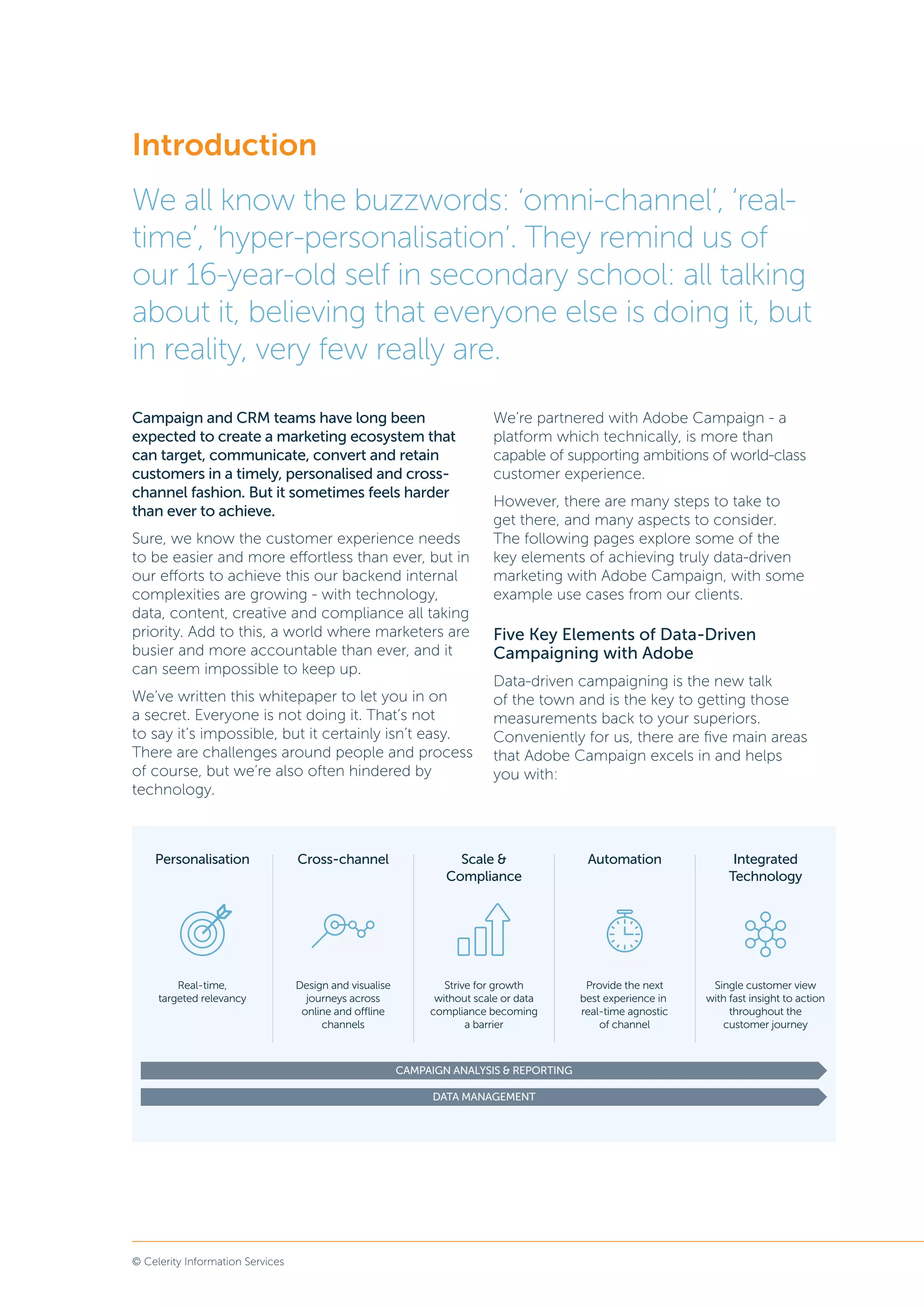
Five Key Elements of Data-Driven
Campaigning with Adobe
Data-driven campaigning is the new talk
of the town and is the key to getting those
measurements back to your superiors.
Conveniently for us, there are five main areas
that Adobe Campaign excels in and helps
you with:
Personalisation
Real-time,
targeted relevancy
Cross-channel
Design and visualise
journeys across
online and offline
channels
Scale &
Compliance
Strive for growth
without scale or data
compliance becoming
a barrier
Integrated
Technology
Single customer view
with fast insight to action
throughout the
customer journey
Automation
Provide the next
best experience in
real-time agnostic
of channel
CAMPAIGN ANALYSIS & REPORTING
DATA MANAGEMENT
When cross-channel marketing is done correctly,
the message is consistent and yet tailored for all
customers across all platforms. It’s efficient too
and saves time by avoiding duplicating content
per channel, per supplier, and reduces cost
per sale.
When companies start using Adobe Campaign,
they often start with the main channel which is
email. But it can do so much more. Once you’re
more familiar with the technology, you can add
additional channels into your campaign at the click
of a button, and view a singular campaign, rather
than channel vs channel. However, each channel is
slightly different and will need a unique approach/
strategy. For example, email is considered quite an
open channel - it doesn’t matter if the recipient is
registered with yahoo or Gmail. By contrast with
SMS, you need to pay for each text and you need
a provider to handle it, so it’s more limited. With
Adobe Campaign, you can send both Android and
Apple push notifications and you can even set up
processes for direct mail that seamlessly links with
your printing house of choice.
© Celerity Information Services
1.	Cross-channel
Brands often don’t have all their channels switched
on, and sometimes they have all channels live
but not integrated, or if they are integrated they
are not customer-centric. This can create
duplication, confusion and not least inefficiencies
across marketing.
Promotional event
(ex seasonal sale)
Communication
construction
Campaign managed
audience
AEM managed creative (optional)
& campaign managed data
Send 1 version B
direct mail
Send 2 version N+
Dynamic content versioning
+ support for all channels
Send 1 version C
push notification
Delivery
approvals
handled in-app
Send 1 version A
Email
Send 2 version A Actionable
analytics
© Celerity Information Services
The first and most important aspect of cross
channel-marketing is making sure everything is
connected and cohesive. Once you have decided
on your channels, your target audience and you
have you GDPR consent, you can decide
according to data which message is best to send,
on which channel, at which time. Your message is
going to vary according to channel, for example
email gives you the option to go long-form,
whereas a text needs to be to the point and act
more as a reminder. In the UK, text notifications
typically serve as good reminders for up and
coming bookings, however in India and East Asia,
there is little access to laptops or internet, but wide
access to text. Taking these cultural and economic
considerations into account is crucial to choosing
your channels in each region, and Adobe
Campaign can support whatever choice is
most suitable.
Interaction is a specific product within Adobe
Campaign that helps with cross-channel offer
management. It has a personalisation module that
combines rules and content to help you decided
what content is suitable for which target audience.
These rules are based on profile data, including
age, gender and salary. It associates the weight of
relevance a piece of content has for each person
(similar to lead scoring) and will attribute a
relevancy score for that content between 1-5. For
example, a particular newsletter may be weighted
as scoring ‘5’ – you can then match this content to
individuals whose weighting is between 1-5.
Interaction also allows you to track content. If you
send an email which includes multiple links to
articles, Interaction can track who and where
people specifically click in the email. Interaction
also lets you test rules you ‘think’ work. Based on
the aforementioned tracking data, it can intuitively
test if theories are in fact correct, and more so
incorrect. So, you can try things out without the
risk of it failing to a large portion of your database.
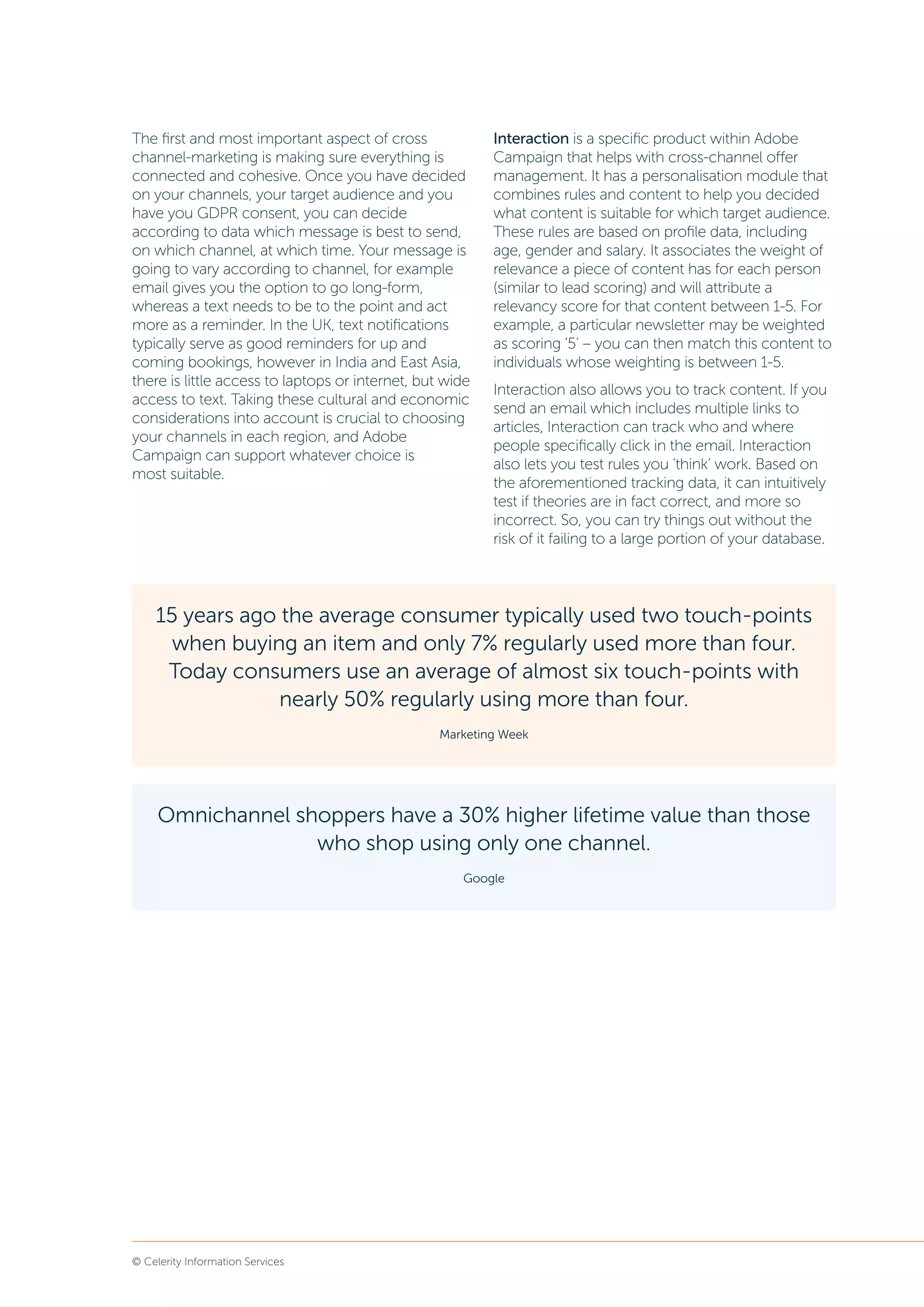
15 years ago the average consumer typically used two touch-points
when buying an item and only 7% regularly used more than four.
Today consumers use an average of almost six touch-points with
nearly 50% regularly using more than four.
Marketing Week
Omnichannel shoppers have a 30% higher lifetime value than those
who shop using only one channel.
Google
© Celerity Information Services
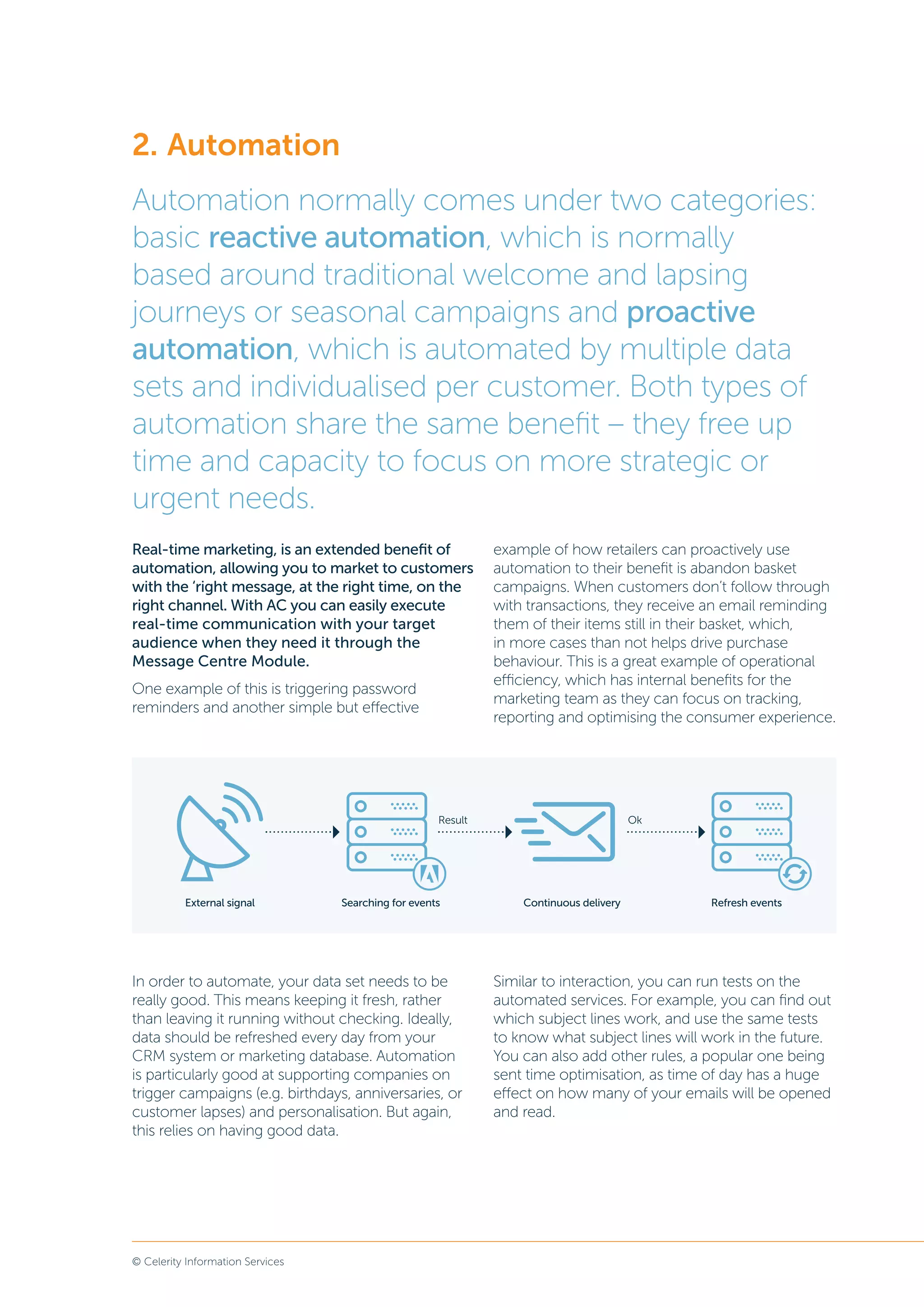
Real-time marketing, is an extended benefit of
automation, allowing you to market to customers
with the ‘right message, at the right time, on the
right channel. With AC you can easily execute
real-time communication with your target
audience when they need it through the
Message Centre Module.
One example of this is triggering password
reminders and another simple but effective
example of how retailers can proactively use
automation to their benefit is abandon basket
campaigns. When customers don’t follow through
with transactions, they receive an email reminding
them of their items still in their basket, which,
in more cases than not helps drive purchase
behaviour. This is a great example of operational
efficiency, which has internal benefits for the
marketing team as they can focus on tracking,
reporting and optimising the consumer experience.
In order to automate, your data set needs to be
really good. This means keeping it fresh, rather
than leaving it running without checking. Ideally,
data should be refreshed every day from your
CRM system or marketing database. Automation
is particularly good at supporting companies on
trigger campaigns (e.g. birthdays, anniversaries, or
customer lapses) and personalisation. But again,
this relies on having good data.
Similar to interaction, you can run tests on the
automated services. For example, you can find out
which subject lines work, and use the same tests
to know what subject lines will work in the future.
You can also add other rules, a popular one being
sent time optimisation, as time of day has a huge
effect on how many of your emails will be opened
and read.
2.	Automation
Automation normally comes under two categories:
basic reactive automation, which is normally
based around traditional welcome and lapsing
journeys or seasonal campaigns and proactive
automation, which is automated by multiple data
sets and individualised per customer. Both types of
automation share the same benefit – they free up
time and capacity to focus on more strategic or
urgent needs.
Result
External signal Searching for events Continuous delivery Refresh events
Ok
© Celerity Information Services
The main benefits of contextual marketing are threefold - increased
relevance, increased brand loyalty and increased sales.
These could be simple messages or special
offers on one or several products or a service
depending on that contact’s historical data.
Personalisation has come a long way – we’re
now at the stages where basic personalisation of
customer name or gender is the norm, through to
advanced contextual and relevant personalisation;
driven by customer behaviour or even propensity
to behave. There is even artificially intelligent
software in this field that goes one step further.
Adobe has its own product, Sensei, which fulfils
various AI activities across the Adobe Experience
Cloud, with more to come.
Other products are developing in the market too.
Products we think are doing some cool things
include Phrasee, which uses artificial intelligence
to write better email marketing language than
humans; and LiveIntent, an email ad monetisation
platform that uses a tag persistently embedded
into a newsletter sent by a publisher to call
the LIVEINTENT server and serve an ad at the time
the email is initially opened. Wowser, indeed!
The main benefits of contextual marketing are
threefold - increased relevance, increased brand
loyalty and increased sales. Some common
examples include opticians sending a text reminding
you to purchase a new set of contacts, or a hotel
sending you a text with your booking details the
day before you check in. These personalised
messages are not just adverts, they are useful,
convenient and totally personal to the customer.
3.	Personalisation
Adobe Campaign helps marketers personalise their
communications in real time with ease. Firstly, it
synthesises available customer data and, through
the Interaction module, you have the ability to
manage complex offers through cross-channel
management.
Smart personalisation engines used to recognise customer intent will
enable digital businesses to increase their profits by up to 15%.
Gartner
© Celerity Information Services
That doesn’t mean you want to increase your costs
by buying more products: we don’t finally pay off a
car, just to go purchase another PPC contract.
Instead, you need software foundations that
are flexible and can execute on the tasks you
need for years to come, it’s simple economies
of scale. Scale is essential for growth, there are
new markets, new products and new competitive
brands popping up every day and it’s essential that
your plans are built to handle change, whilst robust
enough to power your sustainable growth.
Adobe Campaign lets you ramp up campaigns
and respond to the market easily and quickly. Of
course, you still need to govern and standardise
your data, but Adobe Campaign can respond to
changes and adapt to your needs with ease.
One example of this in action comes from a large,
global car manufacturer we work with. It decided
to move to a global marketing technology stack
favouring Adobe Campaign to support its digital
goals. The main objectives were to standardise,
optimise and control all marketing technology at a
global and regional level. To increase efficiency of
each implementation and reduce time to market,
we created a unified data model across all markets,
standardised inputs and outputs and provided a
template that can be repurposed time and time
again. Equipping global and regional leads with the
right tools and technology to help them develop
a more personalised conversation with their
customers and increase ROI - without the ball and
chain of needing more time and people.
Enabling customers to become data controllers
and manage opt-in and opt-out preferences has
always been a fundamental part of Adobe Campaign.
Adobe Campaign comes standard with tools to
help data controllers manage all aspects of opt-
out management within the service — from opt-out
flags in the standard data model, to a prebuilt
unsubscribe page hosted by Adobe Campaign to
allow your consumers to opt out, if desired. 
Adobe Campaign supports detailed user setup,
specifying not only what data a user or groups
of users can access, but also specifying what
capabilities are granted to those users or groups to
help ensure they are allowed only to perform their
required business functions. For example, Adobe
Campaign allows you to configure which users
can send out a delivery or export data. Managing
permissions appropriately will go a long way
toward reducing risk.
4.	Scale and Compliance
As your company grows, it’s important that your
resources can accommodate and grow with you.
To increase efficiency of each implementation and reduce time
to market, we created a unified data model across all markets,
standardised inputs and outputs and provided a template that can
be repurposed time and time again.
© Celerity Information Services
The vendor can get to know your specific
requirements, and; you don’t have to communicate
the same messages more than once.
Additionally, working with one vendor almost
always means that there is a better synergy
between the combination of tools that you’re
using, and all of your support needs can be
provided by the one vendor. This, in turn, tends to
mean a more seamless implementation process.
There is also an added element of compliance, the
more systems you have in your stack, the more
individual products touch your data. You can still
have a multi-vendor setup with a strong and robust
data strategy, but if there are data silos or even
departmental silos across different technologies
these can cause risk of noncompliance.
However, unless you work in a large enterprise
with a big marketing budget, the single vendor
solution might not be an option. The biggest
drawback of a single vendor solution is easily the
cost, especially when it comes to licensing and
costs of implementation. On a more operational
level, if you’re already using a diverse set of solutions,
switching to a single vendor will require quite a lot of
time and manpower in the transition process.
Both approaches have their benefits and
drawbacks. Ultimately, the requirements of your
organisation will determine which approach will
work best for you, but – if you’re a CTO or CMO
– it is also important to consider it a personal
choice too, as both approaches require different
management style and implementation processes.
Adobe Campaign does integrate seamlessly within
a multi-vendor stack too and compliments a lot of
other products.
5.	Single Integrated Platform
Only having one vendor relationship to maintain
makes it easier for everyone involved.
Some of the products we’ve integrated with Adobe
Campaign outside of the Adobe Experience Cloud
include:
Ecommerce – Hybris, Demandware
Personalisation –Monetate, Optimizeley
Content Management / DAM – Sitecore
Web Analytics – Google Analytics, Tealium
Service Desk – Service Cloud, ZenDesk
CRM – Salesforce, Microsoft Dynamics
Customer Analytics – SAS, Apteco FastStats
Reporting & Visualisation – Clickview, Tableau
© Celerity Information Services
Summary
Delivering a world-class customer experience at a
regional and global level becomes easy with the
right technology behind you.
Adobe Campaign helps optimise your cross-
channel marketing efforts, personalise customer
communication at an individual level and frees
up your time through automation allowing you
to focus on the important things.
Through data-driven marketing we deliver
additional value to customers; they get relevant
information at the right time and, are more
likely to champion your brand. What more can
you want?
Brands we’ve helped to optimise Adobe Campaign:
© Celerity Information Services
More information
If you are looking to get the most from your data and bring your customers to life,
please get in touch:
Georgina Groombridge, Head of Marketing
Email: enquiries@celerity-is.com
About Celerity
Celerity is an award-winning data and
marketing technology agency. Founded in
2002, the company has grown into a multi-
award winning business with offices in the UK,
Spain and North America. They specialise in
the implementation, optimisation and support
of digital marketing, customer analytics and
campaign management solutions.
Celerity works with leading international
clients across a range of sectors and industries,
including retail, charity, food and drink,
hospitality, automotive and gambling. It supports
brands to combine data and technology to
deliver valuable efficiencies, more effective
marketing communications and outstanding
customer experiences.
We work with these technologies:

Data Driven Marketing

  • 1.
    Consulting | Data| Technology Why Adobe Campaign? Five Key Elements to Data-Driven Campaigning © Celerity Information Services
  • 2.
    Introduction We all knowthe buzzwords: ‘omni-channel’, ‘real- time’, ‘hyper-personalisation’. They remind us of our 16-year-old self in secondary school: all talking about it, believing that everyone else is doing it, but in reality, very few really are. © Celerity Information Services Campaign and CRM teams have long been expected to create a marketing ecosystem that can target, communicate, convert and retain customers in a timely, personalised and cross- channel fashion. But it sometimes feels harder than ever to achieve. Sure, we know the customer experience needs to be easier and more effortless than ever, but in our efforts to achieve this our backend internal complexities are growing - with technology, data, content, creative and compliance all taking priority. Add to this, a world where marketers are busier and more accountable than ever, and it can seem impossible to keep up. We’ve written this whitepaper to let you in on a secret. Everyone is not doing it. That’s not to say it’s impossible, but it certainly isn’t easy. There are challenges around people and process of course, but we’re also often hindered by technology. We’re partnered with Adobe Campaign - a platform which technically, is more than capable of supporting ambitions of world-class customer experience. However, there are many steps to take to get there, and many aspects to consider. The following pages explore some of the key elements of achieving truly data-driven marketing with Adobe Campaign, with some example use cases from our clients. Five Key Elements of Data-Driven Campaigning with Adobe Data-driven campaigning is the new talk of the town and is the key to getting those measurements back to your superiors. Conveniently for us, there are five main areas that Adobe Campaign excels in and helps you with: Personalisation Real-time, targeted relevancy Cross-channel Design and visualise journeys across online and offline channels Scale & Compliance Strive for growth without scale or data compliance becoming a barrier Integrated Technology Single customer view with fast insight to action throughout the customer journey Automation Provide the next best experience in real-time agnostic of channel CAMPAIGN ANALYSIS & REPORTING DATA MANAGEMENT
  • 3.
    When cross-channel marketingis done correctly, the message is consistent and yet tailored for all customers across all platforms. It’s efficient too and saves time by avoiding duplicating content per channel, per supplier, and reduces cost per sale. When companies start using Adobe Campaign, they often start with the main channel which is email. But it can do so much more. Once you’re more familiar with the technology, you can add additional channels into your campaign at the click of a button, and view a singular campaign, rather than channel vs channel. However, each channel is slightly different and will need a unique approach/ strategy. For example, email is considered quite an open channel - it doesn’t matter if the recipient is registered with yahoo or Gmail. By contrast with SMS, you need to pay for each text and you need a provider to handle it, so it’s more limited. With Adobe Campaign, you can send both Android and Apple push notifications and you can even set up processes for direct mail that seamlessly links with your printing house of choice. © Celerity Information Services 1. Cross-channel Brands often don’t have all their channels switched on, and sometimes they have all channels live but not integrated, or if they are integrated they are not customer-centric. This can create duplication, confusion and not least inefficiencies across marketing. Promotional event (ex seasonal sale) Communication construction Campaign managed audience AEM managed creative (optional) & campaign managed data Send 1 version B direct mail Send 2 version N+ Dynamic content versioning + support for all channels Send 1 version C push notification Delivery approvals handled in-app Send 1 version A Email Send 2 version A Actionable analytics
  • 4.
    © Celerity InformationServices The first and most important aspect of cross channel-marketing is making sure everything is connected and cohesive. Once you have decided on your channels, your target audience and you have you GDPR consent, you can decide according to data which message is best to send, on which channel, at which time. Your message is going to vary according to channel, for example email gives you the option to go long-form, whereas a text needs to be to the point and act more as a reminder. In the UK, text notifications typically serve as good reminders for up and coming bookings, however in India and East Asia, there is little access to laptops or internet, but wide access to text. Taking these cultural and economic considerations into account is crucial to choosing your channels in each region, and Adobe Campaign can support whatever choice is most suitable. Interaction is a specific product within Adobe Campaign that helps with cross-channel offer management. It has a personalisation module that combines rules and content to help you decided what content is suitable for which target audience. These rules are based on profile data, including age, gender and salary. It associates the weight of relevance a piece of content has for each person (similar to lead scoring) and will attribute a relevancy score for that content between 1-5. For example, a particular newsletter may be weighted as scoring ‘5’ – you can then match this content to individuals whose weighting is between 1-5. Interaction also allows you to track content. If you send an email which includes multiple links to articles, Interaction can track who and where people specifically click in the email. Interaction also lets you test rules you ‘think’ work. Based on the aforementioned tracking data, it can intuitively test if theories are in fact correct, and more so incorrect. So, you can try things out without the risk of it failing to a large portion of your database. 15 years ago the average consumer typically used two touch-points when buying an item and only 7% regularly used more than four. Today consumers use an average of almost six touch-points with nearly 50% regularly using more than four. Marketing Week Omnichannel shoppers have a 30% higher lifetime value than those who shop using only one channel. Google
  • 5.
    © Celerity InformationServices Real-time marketing, is an extended benefit of automation, allowing you to market to customers with the ‘right message, at the right time, on the right channel. With AC you can easily execute real-time communication with your target audience when they need it through the Message Centre Module. One example of this is triggering password reminders and another simple but effective example of how retailers can proactively use automation to their benefit is abandon basket campaigns. When customers don’t follow through with transactions, they receive an email reminding them of their items still in their basket, which, in more cases than not helps drive purchase behaviour. This is a great example of operational efficiency, which has internal benefits for the marketing team as they can focus on tracking, reporting and optimising the consumer experience. In order to automate, your data set needs to be really good. This means keeping it fresh, rather than leaving it running without checking. Ideally, data should be refreshed every day from your CRM system or marketing database. Automation is particularly good at supporting companies on trigger campaigns (e.g. birthdays, anniversaries, or customer lapses) and personalisation. But again, this relies on having good data. Similar to interaction, you can run tests on the automated services. For example, you can find out which subject lines work, and use the same tests to know what subject lines will work in the future. You can also add other rules, a popular one being sent time optimisation, as time of day has a huge effect on how many of your emails will be opened and read. 2. Automation Automation normally comes under two categories: basic reactive automation, which is normally based around traditional welcome and lapsing journeys or seasonal campaigns and proactive automation, which is automated by multiple data sets and individualised per customer. Both types of automation share the same benefit – they free up time and capacity to focus on more strategic or urgent needs. Result External signal Searching for events Continuous delivery Refresh events Ok
  • 6.
    © Celerity InformationServices The main benefits of contextual marketing are threefold - increased relevance, increased brand loyalty and increased sales. These could be simple messages or special offers on one or several products or a service depending on that contact’s historical data. Personalisation has come a long way – we’re now at the stages where basic personalisation of customer name or gender is the norm, through to advanced contextual and relevant personalisation; driven by customer behaviour or even propensity to behave. There is even artificially intelligent software in this field that goes one step further. Adobe has its own product, Sensei, which fulfils various AI activities across the Adobe Experience Cloud, with more to come. Other products are developing in the market too. Products we think are doing some cool things include Phrasee, which uses artificial intelligence to write better email marketing language than humans; and LiveIntent, an email ad monetisation platform that uses a tag persistently embedded into a newsletter sent by a publisher to call the LIVEINTENT server and serve an ad at the time the email is initially opened. Wowser, indeed! The main benefits of contextual marketing are threefold - increased relevance, increased brand loyalty and increased sales. Some common examples include opticians sending a text reminding you to purchase a new set of contacts, or a hotel sending you a text with your booking details the day before you check in. These personalised messages are not just adverts, they are useful, convenient and totally personal to the customer. 3. Personalisation Adobe Campaign helps marketers personalise their communications in real time with ease. Firstly, it synthesises available customer data and, through the Interaction module, you have the ability to manage complex offers through cross-channel management. Smart personalisation engines used to recognise customer intent will enable digital businesses to increase their profits by up to 15%. Gartner
  • 7.
    © Celerity InformationServices That doesn’t mean you want to increase your costs by buying more products: we don’t finally pay off a car, just to go purchase another PPC contract. Instead, you need software foundations that are flexible and can execute on the tasks you need for years to come, it’s simple economies of scale. Scale is essential for growth, there are new markets, new products and new competitive brands popping up every day and it’s essential that your plans are built to handle change, whilst robust enough to power your sustainable growth. Adobe Campaign lets you ramp up campaigns and respond to the market easily and quickly. Of course, you still need to govern and standardise your data, but Adobe Campaign can respond to changes and adapt to your needs with ease. One example of this in action comes from a large, global car manufacturer we work with. It decided to move to a global marketing technology stack favouring Adobe Campaign to support its digital goals. The main objectives were to standardise, optimise and control all marketing technology at a global and regional level. To increase efficiency of each implementation and reduce time to market, we created a unified data model across all markets, standardised inputs and outputs and provided a template that can be repurposed time and time again. Equipping global and regional leads with the right tools and technology to help them develop a more personalised conversation with their customers and increase ROI - without the ball and chain of needing more time and people. Enabling customers to become data controllers and manage opt-in and opt-out preferences has always been a fundamental part of Adobe Campaign. Adobe Campaign comes standard with tools to help data controllers manage all aspects of opt- out management within the service — from opt-out flags in the standard data model, to a prebuilt unsubscribe page hosted by Adobe Campaign to allow your consumers to opt out, if desired.  Adobe Campaign supports detailed user setup, specifying not only what data a user or groups of users can access, but also specifying what capabilities are granted to those users or groups to help ensure they are allowed only to perform their required business functions. For example, Adobe Campaign allows you to configure which users can send out a delivery or export data. Managing permissions appropriately will go a long way toward reducing risk. 4. Scale and Compliance As your company grows, it’s important that your resources can accommodate and grow with you. To increase efficiency of each implementation and reduce time to market, we created a unified data model across all markets, standardised inputs and outputs and provided a template that can be repurposed time and time again.
  • 8.
    © Celerity InformationServices The vendor can get to know your specific requirements, and; you don’t have to communicate the same messages more than once. Additionally, working with one vendor almost always means that there is a better synergy between the combination of tools that you’re using, and all of your support needs can be provided by the one vendor. This, in turn, tends to mean a more seamless implementation process. There is also an added element of compliance, the more systems you have in your stack, the more individual products touch your data. You can still have a multi-vendor setup with a strong and robust data strategy, but if there are data silos or even departmental silos across different technologies these can cause risk of noncompliance. However, unless you work in a large enterprise with a big marketing budget, the single vendor solution might not be an option. The biggest drawback of a single vendor solution is easily the cost, especially when it comes to licensing and costs of implementation. On a more operational level, if you’re already using a diverse set of solutions, switching to a single vendor will require quite a lot of time and manpower in the transition process. Both approaches have their benefits and drawbacks. Ultimately, the requirements of your organisation will determine which approach will work best for you, but – if you’re a CTO or CMO – it is also important to consider it a personal choice too, as both approaches require different management style and implementation processes. Adobe Campaign does integrate seamlessly within a multi-vendor stack too and compliments a lot of other products. 5. Single Integrated Platform Only having one vendor relationship to maintain makes it easier for everyone involved. Some of the products we’ve integrated with Adobe Campaign outside of the Adobe Experience Cloud include: Ecommerce – Hybris, Demandware Personalisation –Monetate, Optimizeley Content Management / DAM – Sitecore Web Analytics – Google Analytics, Tealium Service Desk – Service Cloud, ZenDesk CRM – Salesforce, Microsoft Dynamics Customer Analytics – SAS, Apteco FastStats Reporting & Visualisation – Clickview, Tableau
  • 9.
    © Celerity InformationServices Summary Delivering a world-class customer experience at a regional and global level becomes easy with the right technology behind you. Adobe Campaign helps optimise your cross- channel marketing efforts, personalise customer communication at an individual level and frees up your time through automation allowing you to focus on the important things. Through data-driven marketing we deliver additional value to customers; they get relevant information at the right time and, are more likely to champion your brand. What more can you want? Brands we’ve helped to optimise Adobe Campaign:
  • 10.
    © Celerity InformationServices More information If you are looking to get the most from your data and bring your customers to life, please get in touch: Georgina Groombridge, Head of Marketing Email: enquiries@celerity-is.com About Celerity Celerity is an award-winning data and marketing technology agency. Founded in 2002, the company has grown into a multi- award winning business with offices in the UK, Spain and North America. They specialise in the implementation, optimisation and support of digital marketing, customer analytics and campaign management solutions. Celerity works with leading international clients across a range of sectors and industries, including retail, charity, food and drink, hospitality, automotive and gambling. It supports brands to combine data and technology to deliver valuable efficiencies, more effective marketing communications and outstanding customer experiences. We work with these technologies: