Data Communications And Networking Solution Manual 4th Edition Behrouz Forouzan
Data Communications And Networking Solution Manual 4th Edition Behrouz Forouzan
Data Communications And Networking Solution Manual 4th Edition Behrouz Forouzan
Data Communications And Networking Solution Manual 4th Edition Behrouz Forouzan
Data Communications And Networking Solution Manual 4th Edition Behrouz Forouzan
1.
Data Communications AndNetworking Solution
Manual 4th Edition Behrouz Forouzan download
https://ebookbell.com/product/data-communications-and-networking-
solution-manual-4th-edition-behrouz-forouzan-50527444
Explore and download more ebooks at ebookbell.com
2.
Here are somerecommended products that we believe you will be
interested in. You can click the link to download.
Data Communications And Networking 5th Edition Behrouz A Forouzan
https://ebookbell.com/product/data-communications-and-networking-5th-
edition-behrouz-a-forouzan-50527384
Data Communications And Networking With Tcpip Protocol Suite 6th
Edition Behrouz A Forouzan
https://ebookbell.com/product/data-communications-and-networking-with-
tcpip-protocol-suite-6th-edition-behrouz-a-forouzan-52242514
Data Communications And Networking Behrouz A Forouzan
https://ebookbell.com/product/data-communications-and-networking-
behrouz-a-forouzan-1229400
Data Communications And Networking 3rd Edition Behrouz A Forouzan
https://ebookbell.com/product/data-communications-and-networking-3rd-
edition-behrouz-a-forouzan-1401548
3.
Data Communications AndNetworking 4th Behrouz A Forouzan
https://ebookbell.com/product/data-communications-and-networking-4th-
behrouz-a-forouzan-5912696
Business Data Communications And Networking A Research Perspective
Advances In Business Data Communications And Networking Series
Advances In Business Data Communications And Networking Series 1st
Edition Jairo Gutierrez Editor
https://ebookbell.com/product/business-data-communications-and-
networking-a-research-perspective-advances-in-business-data-
communications-and-networking-series-advances-in-business-data-
communications-and-networking-series-1st-edition-jairo-gutierrez-
editor-2163802
Business Data Communications And Networking 10th Edition 10th Jerry
Fitzgerald
https://ebookbell.com/product/business-data-communications-and-
networking-10th-edition-10th-jerry-fitzgerald-2473096
Business Data Communications And Networking 11th Edition Jerry
Fitzgerald
https://ebookbell.com/product/business-data-communications-and-
networking-11th-edition-jerry-fitzgerald-2494872
Business Data Communications And Networking Jerry Fitzgerald Alan
Dennis Alexandra Durcikova
https://ebookbell.com/product/business-data-communications-and-
networking-jerry-fitzgerald-alan-dennis-alexandra-durcikova-44124062
5.
1
CHAPTER 1
Introduction
Solutions toReview Questions and Exercises
Review Questions
1. The five components of a data communication system are the sender, receiver,
transmission medium, message, and protocol.
2. The advantages of distributed processing are security, access to distributed data-
bases, collaborative processing, and faster problem solving.
3. The three criteria are performance, reliability, and security.
4. Advantages of a multipoint over a point-to-point configuration (type of connec-
tion) include ease of installation and low cost.
5. Line configurations (or types of connections) are point-to-point and multipoint.
6. We can divide line configuration in two broad categories:
a. Point-to-point: mesh, star, and ring.
b. Multipoint: bus
7. In half-duplex transmission, only one entity can send at a time; in a full-duplex
transmission, both entities can send at the same time.
8. We give an advantage for each of four network topologies:
a. Mesh: secure
b. Bus: easy installation
c. Star: robust
d. Ring: easy fault isolation
9. The number of cables for each type of network is:
a. Mesh: n (n – 1) / 2
b. Star: n
c. Ring: n – 1
d. Bus: one backbone and n drop lines
10. The general factors are size, distances (covered by the network), structure, and
ownership.
6.
2
11. An internetis an interconnection of networks. The Internet is the name of a spe-
cific worldwide network
12. A protocol defines what is communicated, in what way and when. This provides
accurate and timely transfer of information between different devices on a net-
work.
13. Standards are needed to create and maintain an open and competitive market for
manufacturers, to coordinate protocol rules, and thus guarantee compatibility of
data communication technologies.
Exercises
14. Unicode uses 32 bits to represent a symbol or a character. We can define 232
differ-
ent symbols or characters.
15. With 16 bits, we can represent up to 216
different colors.
16.
a. Cable links: n (n – 1) / 2 = (6 × 5) / 2 = 15
b. Number of ports: (n – 1) = 5 ports needed per device
17.
a. Mesh topology: If one connection fails, the other connections will still be work-
ing.
b. Star topology: The other devices will still be able to send data through the hub;
there will be no access to the device which has the failed connection to the hub.
c. Bus Topology: All transmission stops if the failure is in the bus. If the drop-line
fails, only the corresponding device cannot operate.
d. Ring Topology: The failed connection may disable the whole network unless it
is a dual ring or there is a by-pass mechanism.
18. This is a LAN. The Ethernet hub creates a LAN as we will see in Chapter 13.
19. Theoretically, in a ring topology, unplugging one station, interrupts the ring. How-
ever, most ring networks use a mechanism that bypasses the station; the ring can
continue its operation.
20. In a bus topology, no station is in the path of the signal. Unplugging a station has
no effect on the operation of the rest of the network.
21. See Figure 1.1
22. See Figure 1.2.
23.
a. E-mail is not an interactive application. Even if it is delivered immediately, it
may stay in the mail-box of the receiver for a while. It is not sensitive to delay.
b. We normally do not expect a file to be copied immediately. It is not very sensi-
tive to delay.
c. Surfing the Internet is the an application very sensitive to delay. We except to
get access to the site we are searching.
24. In this case, the communication is only between a caller and the callee. A dedi-
cated line is established between them. The connection is point-to-point.
7.
3
25. The telephonenetwork was originally designed for voice communication; the
Internet was originally designed for data communication. The two networks are
similar in the fact that both are made of interconnections of small networks. The
telephone network, as we will see in future chapters, is mostly a circuit-switched
network; the Internet is mostly a packet-switched network.
Figure 1.1 Solution to Exercise 21
Figure 1.2 Solution to Exercise 22
Station
Station
Station
Repeater
Station
Station
Station
Repeat er
Station
Station
Station
Repeater
Hub
Station
Station
Station
Station
Repeater
Repeater
1
CHAPTER 2
Network Models
Solutionsto Review Questions and Exercises
Review Questions
1. The Internet model, as discussed in this chapter, include physical, data link, net-
work, transport, and application layers.
2. The network support layers are the physical, data link, and network layers.
3. The application layer supports the user.
4. The transport layer is responsible for process-to-process delivery of the entire
message, whereas the network layer oversees host-to-host delivery of individual
packets.
5. Peer-to-peer processes are processes on two or more devices communicating at a
same layer
6. Each layer calls upon the services of the layer just below it using interfaces
between each pair of adjacent layers.
7. Headers and trailers are control data added at the beginning and the end of each
data unit at each layer of the sender and removed at the corresponding layers of the
receiver. They provide source and destination addresses, synchronization points,
information for error detection, etc.
8. The physical layer is responsible for transmitting a bit stream over a physical
medium. It is concerned with
a. physical characteristics of the media
b. representation of bits
c. type of encoding
d. synchronization of bits
e. transmission rate and mode
f. the way devices are connected with each other and to the links
9. The data link layer is responsible for
a. framing data bits
b. providing the physical addresses of the sender/receiver
c. data rate control
10.
2
d. detection andcorrection of damaged and lost frames
10. The network layer is concerned with delivery of a packet across multiple net-
works; therefore its responsibilities include
a. providing host-to-host addressing
b. routing
11. The transport layer oversees the process-to-process delivery of the entire message.
It is responsible for
a. dividing the message into manageable segments
b. reassembling it at the destination
c. flow and error control
12. The physical address is the local address of a node; it is used by the data link layer
to deliver data from one node to another within the same network. The logical
address defines the sender and receiver at the network layer and is used to deliver
messages across multiple networks. The port address (service-point) identifies the
application process on the station.
13. The application layer services include file transfer, remote access, shared data-
base management, and mail services.
14. The application, presentation, and session layers of the OSI model are represented
by the application layer in the Internet model. The lowest four layers of OSI corre-
spond to the Internet model layers.
Exercises
15. The International Standards Organization, or the International Organization of
Standards, (ISO) is a multinational body dedicated to worldwide agreement on
international standards. An ISO standard that covers all aspects of network com-
munications is the Open Systems Interconnection (OSI) model.
16.
a. Route determination: network layer
b. Flow control: data link and transport layers
c. Interface to transmission media: physical layer
d. Access for the end user: application layer
17.
a. Reliable process-to-process delivery: transport layer
b. Route selection: network layer
c. Defining frames: data link layer
d. Providing user services: application layer
e. Transmission of bits across the medium: physical layer
18.
a. Communication with user’s application program: application layer
b. Error correction and retransmission: data link and transport layers
c. Mechanical, electrical, and functional interface: physical layer
11.
3
d. Responsibility forcarrying frames between adjacent nodes: data link layer
19.
a. Format and code conversion services: presentation layer
b. Establishing, managing, and terminating sessions: session layer
c. Ensuring reliable transmission of data: data link and transport layers
d. Log-in and log-out procedures: session layer
e. Providing independence from different data representation: presentation layer
20. See Figure 2.1.
21. See Figure 2.2.
22. If the corrupted destination address does not match any station address in the net-
work, the packet is lost. If the corrupted destination address matches one of the sta-
tions, the frame is delivered to the wrong station. In this case, however, the error
detection mechanism, available in most data link protocols, will find the error and
discard the frame. In both cases, the source will somehow be informed using one
of the data link control mechanisms discussed in Chapter 11.
23. Before using the destination address in an intermediate or the destination node, the
packet goes through error checking that may help the node find the corruption
(with a high probability) and discard the packet. Normally the upper layer protocol
will inform the source to resend the packet.
Figure 2.1 Solution to Exercise 20
Figure 2.2 Solution to Exercise 21
B/42 C/82
A/40
Sender
Sender
LAN1 LAN2
R1
D/80
Data
A D
42 T2
40 Data
A D
80 T2
82
B/42 C/82
A/40
Sender
Sender
LAN1 LAN2
R1
D/80
T2
4240 i Data
j
A D T2
8082 i Data
j
A D
12.
4
24. Most protocolsissue a special error message that is sent back to the source in this
case.
25. The errors between the nodes can be detected by the data link layer control, but the
error at the node (between input port and output port) of the node cannot be
detected by the data link layer.
13.
1
CHAPTER 3
Data andSignals
Solutions to Review Questions and Exercises
Review Questions
1. Frequency and period are the inverse of each other. T = 1/ f and f = 1/T.
2. The amplitude of a signal measures the value of the signal at any point. The fre-
quency of a signal refers to the number of periods in one second. The phase
describes the position of the waveform relative to time zero.
3. Using Fourier analysis. Fourier series gives the frequency domain of a periodic
signal; Fourier analysis gives the frequency domain of a nonperiodic signal.
4. Three types of transmission impairment are attenuation, distortion, and noise.
5. Baseband transmission means sending a digital or an analog signal without modu-
lation using a low-pass channel. Broadband transmission means modulating a
digital or an analog signal using a band-pass channel.
6. A low-pass channel has a bandwidth starting from zero; a band-pass channel has a
bandwidth that does not start from zero.
7. The Nyquist theorem defines the maximum bit rate of a noiseless channel.
8. The Shannon capacity determines the theoretical maximum bit rate of a noisy
channel.
9. Optical signals have very high frequencies. A high frequency means a short wave
length because the wave length is inversely proportional to the frequency (λ = v/f),
where v is the propagation speed in the media.
10. A signal is periodic if its frequency domain plot is discrete; a signal is nonperi-
odic if its frequency domain plot is continuous.
11. The frequency domain of a voice signal is normally continuous because voice is a
nonperiodic signal.
12. An alarm system is normally periodic. Its frequency domain plot is therefore dis-
crete.
13. This is baseband transmission because no modulation is involved.
14. This is baseband transmission because no modulation is involved.
15. This is broadband transmission because it involves modulation.
14.
2
Exercises
16.
a. T =1 / f = 1 / (24 Hz) = 0.0417 s = 41.7 × 10⁻³
s = 41.7 ms
b. T = 1 / f = 1 / (8 MHz) = 0.000000125 = 0.125 × 10⁻⁶
s = 0.125 μs
c. T = 1 / f = 1 / (140 KHz) = 0.00000714 s = 7.14 × 10⁻⁶
s = 7.14 μs
17.
a. f = 1 / T = 1 / (5 s) = 0.2 Hz
b. f = 1 / T = 1 / (12 μs) =83333 Hz = 83.333 × 10³
Hz = 83.333 KHz
c. f = 1 / T = 1 / (220 ns) = 4550000 Hz = 4.55× 10⁶
Hz = 4.55 MHz
18.
a. 90 degrees (π/2 radian)
b. 0 degrees (0 radian)
c. 90 degrees (π/2 radian)
19. See Figure 3.1
20. We know the lowest frequency, 100. We know the bandwidth is 2000. The highest
frequency must be 100 + 2000 = 2100 Hz. See Figure 3.2
21. Each signal is a simple signal in this case. The bandwidth of a simple signal is
zero. So the bandwidth of both signals are the same.
22.
a. bit rate = 1/ (bit duration) = 1 / (0.001 s) = 1000 bps = 1 Kbps
b. bit rate = 1/ (bit duration) = 1 / (2 ms) = 500 bps
Figure 3.1 Solution to Exercise 19
Figure 3.2 Solution to Exercise 20
0 20 50 100 200
Frequency domain
Bandwidth = 200 − 0 = 200
100
20
5
2100
Frequency domain
Bandwidth = 2100 − 100 = 2000
15.
3
c. bit rate= 1/(bit duration) = 1 / (20 μs/10) = 1 / (2 μs) = 500 Kbps
23.
a. (10 / 1000) s = 0.01 s
b. (8 / 1000) s = 0. 008 s = 8 ms
c. ((100,000 × 8) / 1000) s = 800 s
24. There are 8 bits in 16 ns. Bit rate is 8 / (16 × 10−9
) = 0.5 × 10−9
= 500 Mbps
25. The signal makes 8 cycles in 4 ms. The frequency is 8 /(4 ms) = 2 KHz
26. The bandwidth is 5 × 5 = 25 Hz.
27. The signal is periodic, so the frequency domain is made of discrete frequencies. as
shown in Figure 3.3.
28. The signal is nonperiodic, so the frequency domain is made of a continuous spec-
trum of frequencies as shown in Figure 3.4.
29.
Using the first harmonic, data rate = 2 × 6 MHz = 12 Mbps
Using three harmonics, data rate = (2 × 6 MHz) /3 = 4 Mbps
Using five harmonics, data rate = (2 × 6 MHz) /5 = 2.4 Mbps
30. dB = 10 log10 (90 / 100) = –0.46 dB
31. –10 = 10 log10 (P2 / 5) → log10 (P2 / 5) = −1 → (P2 / 5) = 10−1
→ P2 = 0.5 W
32. The total gain is 3 × 4 = 12 dB. The signal is amplified by a factor 101.2
= 15.85.
Figure 3.3 Solution to Exercise 27
Figure 3.4 Solution to Exercise 28
Amplitude
10 volts
Frequency
30
KHz
10
KHz
...
Amplitude
30 volts
10 volts 10 volts
Frequency
30
KHz
20
KHz
10
KHz
16.
4
33. 100,000 bits/ 5 Kbps = 20 s
34. 480 s × 300,000 km/s = 144,000,000 km
35. 1 μm × 1000 = 1000 μm = 1 mm
36. We have
4,000 log2 (1 + 1,000) ≈ 40 Kbps
37. We have
4,000 log2 (1 + 10 / 0.005) = 43,866 bps
38. The file contains 2,000,000 × 8 = 16,000,000 bits. With a 56-Kbps channel, it takes
16,000,000/56,000 = 289 s. With a 1-Mbps channel, it takes 16 s.
39. To represent 1024 colors, we need log21024 = 10 (see Appendix C) bits. The total
number of bits are, therefore,
1200 × 1000 × 10 = 12,000,000 bits
40. We have
SNR = (200 mW) / (10 × 2 × μW) = 10,000
We then have
SNRdB = 10 log10 SNR = 40
41. We have
SNR= (signal power)/(noise power).
However, power is proportional to the square of voltage. This means we have
SNR = [(signal voltage)2
] / [(noise voltage)2
] =
[(signal voltage) / (noise voltage)]2
= 202
= 400
We then have
SNRdB = 10 log10 SNR ≈ 26.02
42. We can approximately calculate the capacity as
a. C = B × (SNRdB /3) = 20 KHz × (40 /3) = 267 Kbps
b. C = B × (SNRdB /3) = 200 KHz × (4 /3) = 267 Kbps
c. C = B × (SNRdB /3) = 1 MHz × (20 /3) = 6.67 Mbps
43.
a. The data rate is doubled (C2 = 2 × C1).
b. When the SNR is doubled, the data rate increases slightly. We can say that,
approximately, (C2 = C1 + 1).
44. We can use the approximate formula
C = B × (SNRdB /3) or SNRdB = (3 × C) /B
We can say that the minimum
SNRdB = 3 × 100 Kbps / 4 KHz = 75
17.
5
This means thatthe minimum
SNR = 10 SNRdB/10
= 107.5
≈ 31,622,776
45. We have
transmission time = (packet length)/(bandwidth) =
(8,000,000 bits) / (200,000 bps) = 40 s
46. We have
(bit length) = (propagation speed) × (bit duration)
The bit duration is the inverse of the bandwidth.
a. Bit length = (2 ×10⁸
m) × [(1 / (1 Mbps)] = 200 m. This means a bit occupies
200 meters on a transmission medium.
b. Bit length = (2 ×10⁸
m) × [(1 / (10 Mbps)] = 20 m. This means a bit occupies 20
meters on a transmission medium.
c. Bit length = (2 ×10⁸
m) × [(1 / (100 Mbps)] = 2 m. This means a bit occupies 2
meters on a transmission medium.
47.
a. Number of bits = bandwidth × delay = 1 Mbps × 2 ms = 2000 bits
b. Number of bits = bandwidth × delay = 10 Mbps × 2 ms = 20,000 bits
c. Number of bits = bandwidth × delay = 100 Mbps × 2 ms = 200,000 bits
48. We have
Latency = processing time + queuing time +
transmission time + propagation time
Processing time = 10 × 1 μs = 10 μs = 0.000010 s
Queuing time = 10 × 2 μs = 20 μs = 0.000020 s
Transmission time = 5,000,000 / (5 Mbps) = 1 s
Propagation time = (2000 Km) / (2 × 10⁸
) = 0.01 s
Latency = 0.000010 + 0.000020 + 1 + 0.01 = 1.01000030 s
The transmission time is dominant here because the packet size is huge.
1
CHAPTER 4
Digital Transmission
Solutionsto Review Questions and Exercises
Review Questions
1. The three different techniques described in this chapter are line coding, block cod-
ing, and scrambling.
2. A data element is the smallest entity that can represent a piece of information (a
bit). A signal element is the shortest unit of a digital signal. Data elements are
what we need to send; signal elements are what we can send. Data elements are
being carried; signal elements are the carriers.
3. The data rate defines the number of data elements (bits) sent in 1s. The unit is bits
per second (bps). The signal rate is the number of signal elements sent in 1s. The
unit is the baud.
4. In decoding a digital signal, the incoming signal power is evaluated against the
baseline (a running average of the received signal power). A long string of 0s or 1s
can cause baseline wandering (a drift in the baseline) and make it difficult for the
receiver to decode correctly.
5. When the voltage level in a digital signal is constant for a while, the spectrum cre-
ates very low frequencies, called DC components, that present problems for a sys-
tem that cannot pass low frequencies.
6. A self-synchronizing digital signal includes timing information in the data being
transmitted. This can be achieved if there are transitions in the signal that alert the
receiver to the beginning, middle, or end of the pulse.
7. In this chapter, we introduced unipolar, polar, bipolar, multilevel, and multitran-
sition coding.
8. Block coding provides redundancy to ensure synchronization and to provide inher-
ent error detecting. In general, block coding changes a block of m bits into a block
of n bits, where n is larger than m.
9. Scrambling, as discussed in this chapter, is a technique that substitutes long zero-
level pulses with a combination of other levels without increasing the number of
bits.
20.
2
10. Both PCMand DM use sampling to convert an analog signal to a digital signal.
PCM finds the value of the signal amplitude for each sample; DM finds the change
between two consecutive samples.
11. In parallel transmission we send data several bits at a time. In serial transmission
we send data one bit at a time.
12. We mentioned synchronous, asynchronous, and isochronous. In both synchro-
nous and asynchronous transmissions, a bit stream is divided into independent
frames. In synchronous transmission, the bytes inside each frame are synchro-
nized; in asynchronous transmission, the bytes inside each frame are also indepen-
dent. In isochronous transmission, there is no independency at all. All bits in the
whole stream must be synchronized.
Exercises
13. We use the formula s = c × N × (1/r) for each case. We let c = 1/2.
a. r = 1 → s = (1/2) × (1 Mbps) × 1/1 = 500 kbaud
b. r = 1/2 → s = (1/2) × (1 Mbps) × 1/(1/2) = 1 Mbaud
c. r = 2 → s = (1/2) × (1 Mbps) × 1/2 = 250 Kbaud
d. r = 4/3 → s = (1/2) × (1 Mbps) × 1/(4/3) = 375 Kbaud
14. The number of bits is calculated as (0.2 /100) × (1 Mbps) = 2000 bits
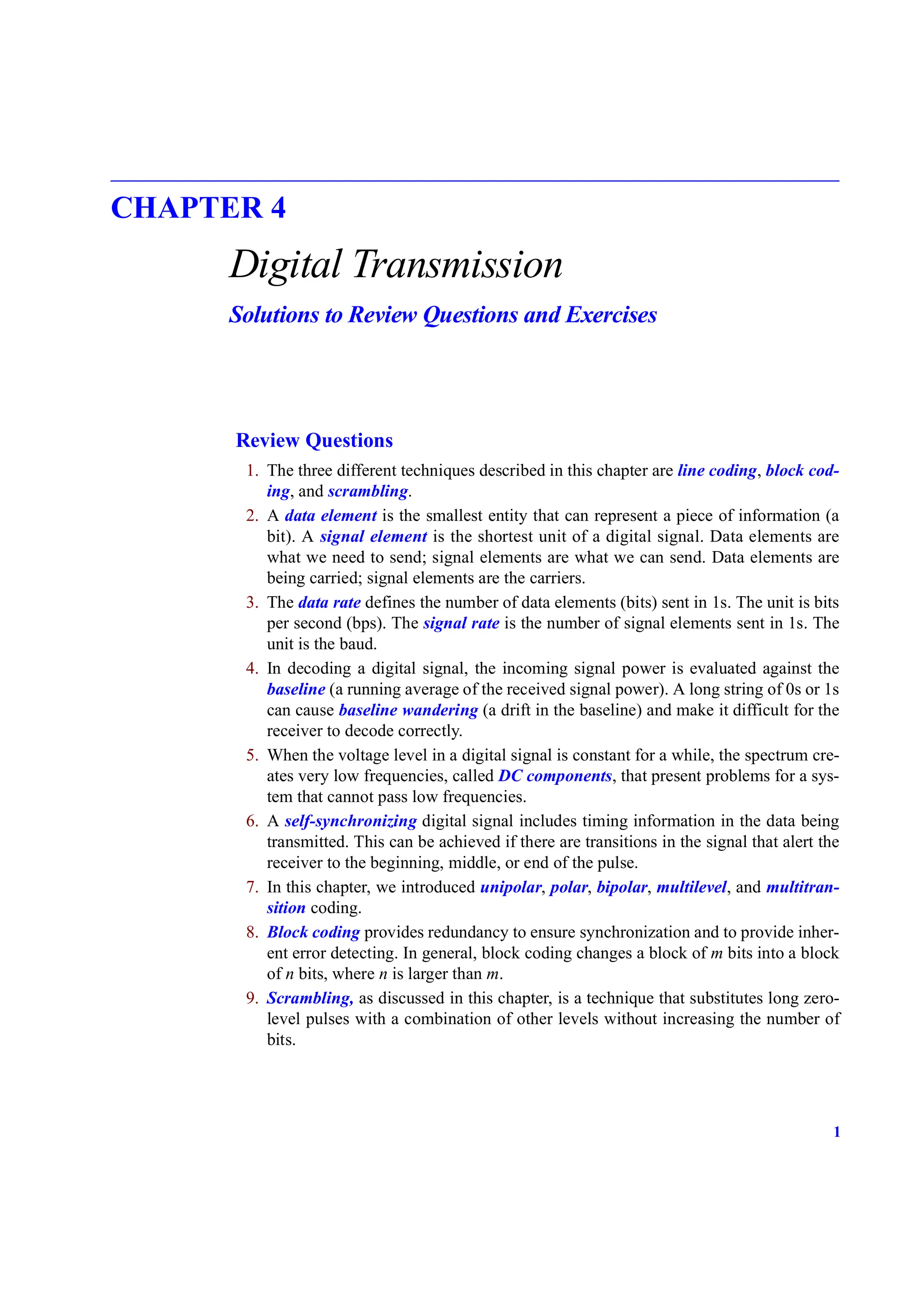
15. See Figure 4.1. Bandwidth is proportional to (3/8)N which is within the range in
Table 4.1 (B = 0 to N) for the NRZ-L scheme.
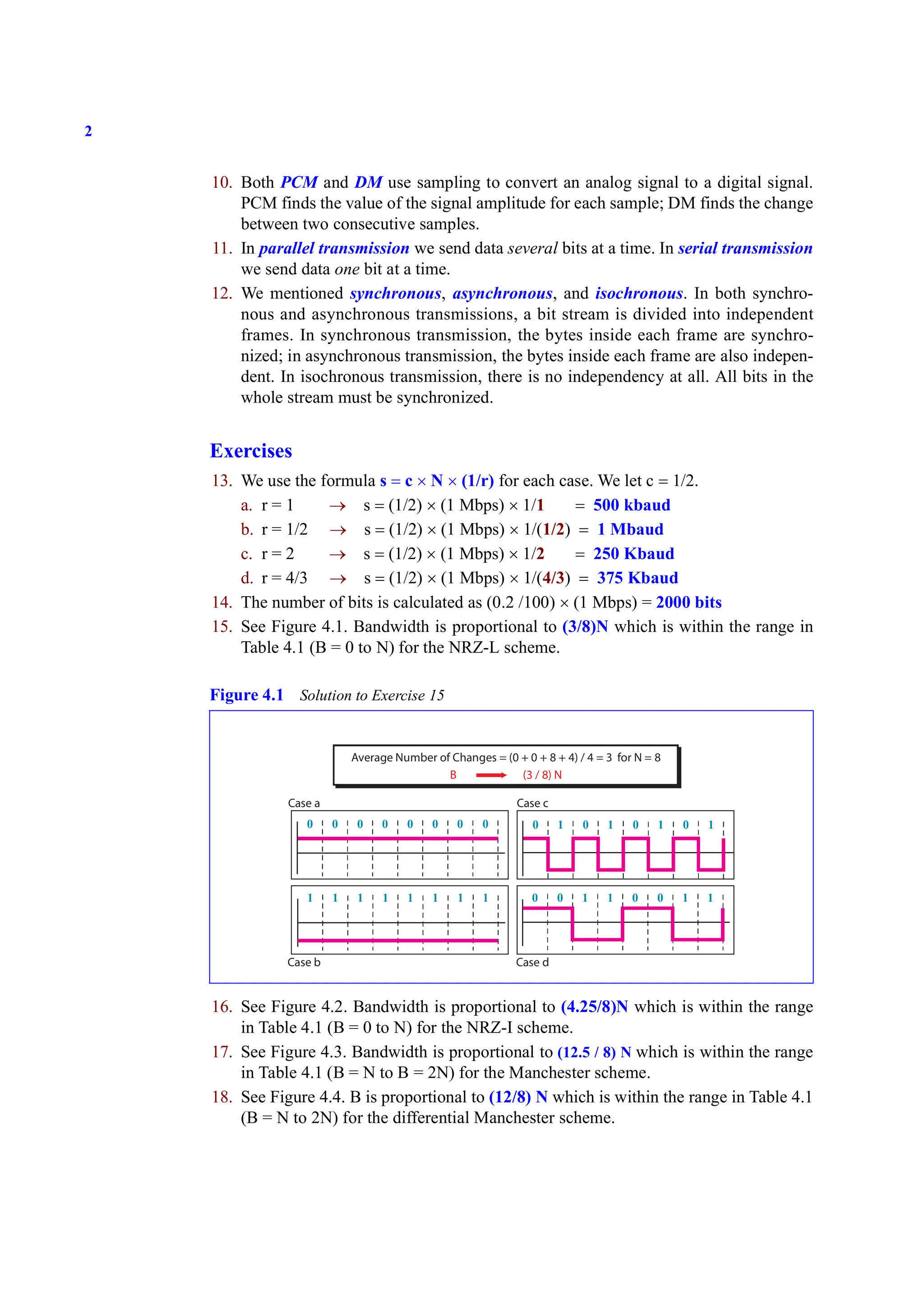
16. See Figure 4.2. Bandwidth is proportional to (4.25/8)N which is within the range
in Table 4.1 (B = 0 to N) for the NRZ-I scheme.
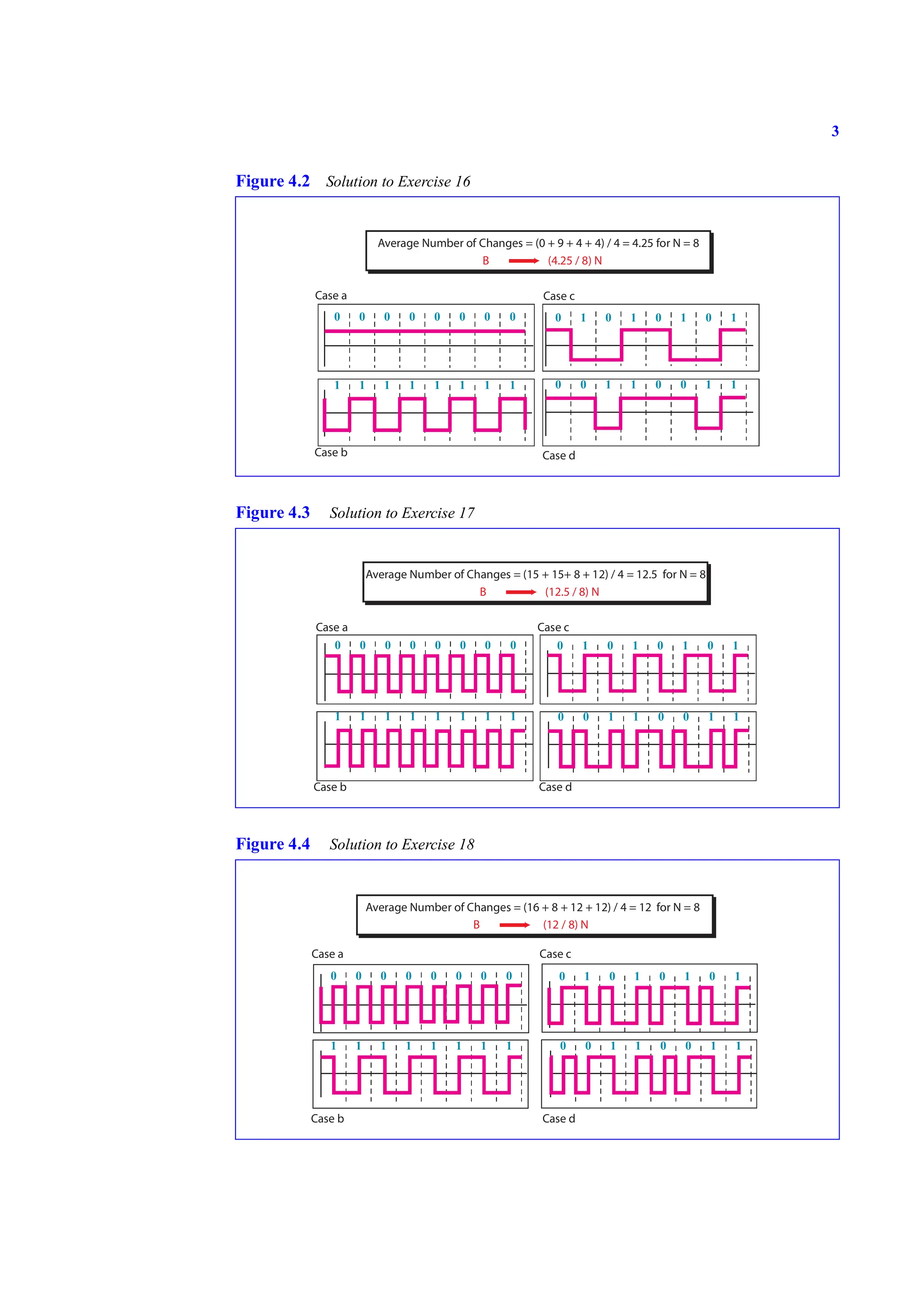
17. See Figure 4.3. Bandwidth is proportional to (12.5 / 8) N which is within the range
in Table 4.1 (B = N to B = 2N) for the Manchester scheme.
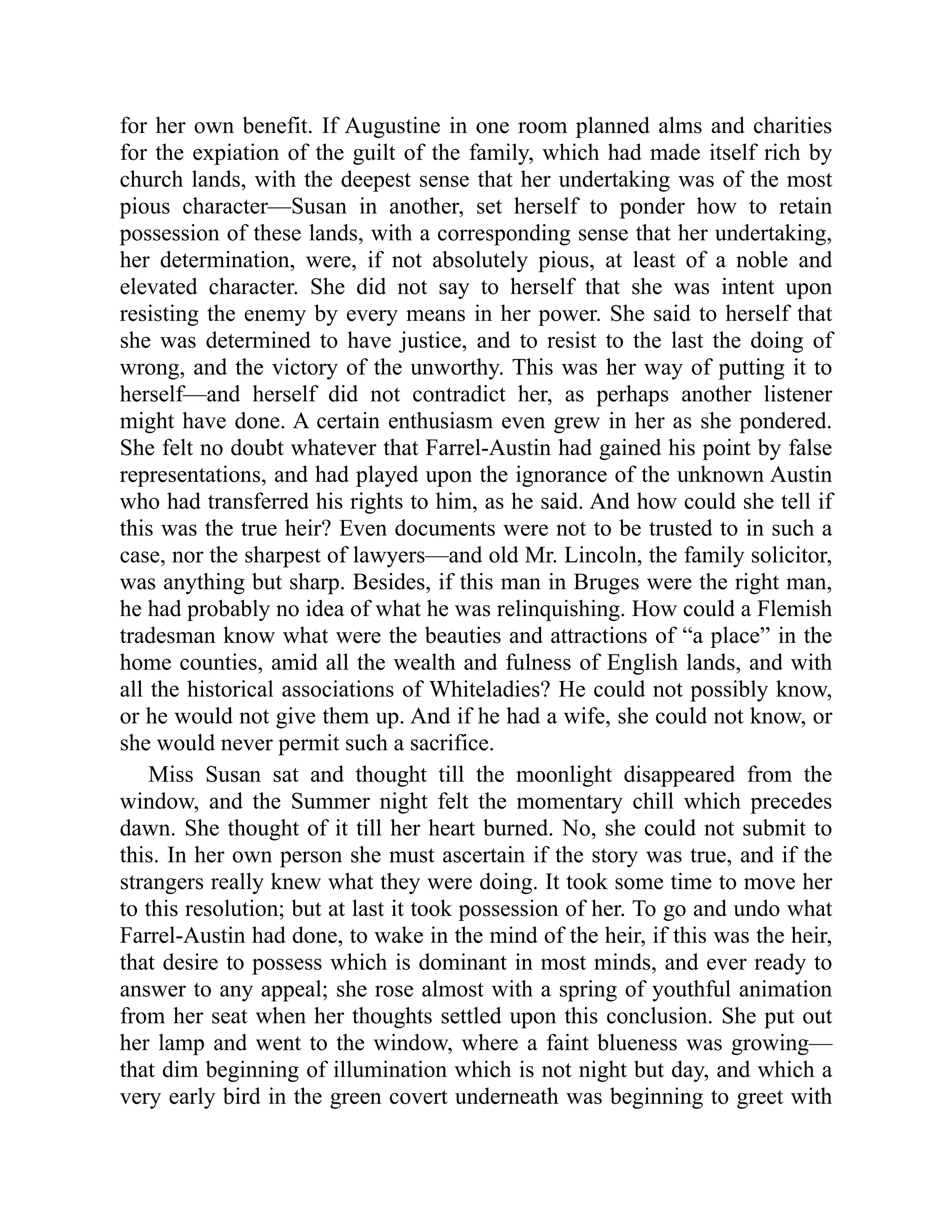
18. See Figure 4.4. B is proportional to (12/8) N which is within the range in Table 4.1
(B = N to 2N) for the differential Manchester scheme.
Figure 4.1 Solution to Exercise 15
0 0 0 0 0 0 0 0
1 1 1 1 1 1 1 1 0 0 1 1 0 0 1 1
0 1 0 1 0 1 0 1
Case a
Case b
Case c
Case d
Average Number of Changes = (0 + 0 + 8 + 4) / 4 = 3 for N = 8
B (3 / 8) N
21.
3
Figure 4.2 Solutionto Exercise 16
Figure 4.3 Solution to Exercise 17
Figure 4.4 Solution to Exercise 18
0 0 0 0 0 0 0 0
1 1 1 1 1 1 1 1 0 0 1 1 0 0 1 1
0 1 0 1 0 1 0 1
Case a
Case b
Case c
Case d
Average Number of Changes = (0 + 9 + 4 + 4) / 4 = 4.25 for N = 8
B (4.25 / 8) N
0 0 0 0 0 0 0 0
1 1 1 1 1 1 1 1 0 0 1 1 0 0 1 1
0 1 0 1 0 1 0 1
Case a
Case b
Case c
Case d
Average Number of Changes = (15 + 15+ 8 + 12) / 4 = 12.5 for N = 8
B (12.5 / 8) N
0 0 0 0 0 0 0 0 0 1 0 1 0 1 0 1
1 1 1 1 1 1 1 1 0 0 1 1 0 0 1 1
Case a
Case b
Case c
Case d
Average Number of Changes = (16 + 8 + 12 + 12) / 4 = 12 for N = 8
B (12 / 8) N
for her ownbenefit. If Augustine in one room planned alms and charities
for the expiation of the guilt of the family, which had made itself rich by
church lands, with the deepest sense that her undertaking was of the most
pious character—Susan in another, set herself to ponder how to retain
possession of these lands, with a corresponding sense that her undertaking,
her determination, were, if not absolutely pious, at least of a noble and
elevated character. She did not say to herself that she was intent upon
resisting the enemy by every means in her power. She said to herself that
she was determined to have justice, and to resist to the last the doing of
wrong, and the victory of the unworthy. This was her way of putting it to
herself—and herself did not contradict her, as perhaps another listener
might have done. A certain enthusiasm even grew in her as she pondered.
She felt no doubt whatever that Farrel-Austin had gained his point by false
representations, and had played upon the ignorance of the unknown Austin
who had transferred his rights to him, as he said. And how could she tell if
this was the true heir? Even documents were not to be trusted to in such a
case, nor the sharpest of lawyers—and old Mr. Lincoln, the family solicitor,
was anything but sharp. Besides, if this man in Bruges were the right man,
he had probably no idea of what he was relinquishing. How could a Flemish
tradesman know what were the beauties and attractions of “a place” in the
home counties, amid all the wealth and fulness of English lands, and with
all the historical associations of Whiteladies? He could not possibly know,
or he would not give them up. And if he had a wife, she could not know, or
she would never permit such a sacrifice.
Miss Susan sat and thought till the moonlight disappeared from the
window, and the Summer night felt the momentary chill which precedes
dawn. She thought of it till her heart burned. No, she could not submit to
this. In her own person she must ascertain if the story was true, and if the
strangers really knew what they were doing. It took some time to move her
to this resolution; but at last it took possession of her. To go and undo what
Farrel-Austin had done, to wake in the mind of the heir, if this was the heir,
that desire to possess which is dominant in most minds, and ever ready to
answer to any appeal; she rose almost with a spring of youthful animation
from her seat when her thoughts settled upon this conclusion. She put out
her lamp and went to the window, where a faint blueness was growing—
that dim beginning of illumination which is not night but day, and which a
very early bird in the green covert underneath was beginning to greet with
24.
the first fainttwitter of returning existence. Miss Susan felt herself inspired;
it was not to defeat Farrel-Austin, but to prevent wrong, to do justice, a
noble impulse which fires the heart and lights the eye.
Thus she made up her mind to an undertaking which afterward had more
effect upon her personal fate than anything else that had happened in her
long life. She did it, not only intending no evil, but with a sense of what she
believed to be generous feeling expanding her soul. Her own personal
motives were so thrust out of sight that she herself did not perceive them—
and indeed, had it been suggested to her that she had personal motives, she
would have denied it strenuously. What interest could she have in
substituting one heir for another? But yet Miss Susan’s blue eyes shot forth
a gleam which was not heavenly as she lay down and tried to sleep. She
could not sleep, her mind being excited and full of a thousand thoughts—
the last distinct sensation in it before the uneasy doze which came over her
senses in the morning being a thrill of pleasure that Farrel-Austin might yet
be foiled. But what of that? Was it not her business to protect the old stock
of the family, and keep the line of succession intact? The more she thought
of it, the more did this appear a sacred duty, worthy of any labor and any
sacrifice.
25.
T
CHAPTER VI.
he breakfast-tablewas spread in the smaller dining-room, a room
furnished with quaint old furniture like the hall, which looked out upon
nothing but the grass and trees of the garden, bounded by an old mossy
wall, as old as the house. The windows were all open, the last ray of the
morning sun slanting off the shining panes, the scent of the flowers coming
in, and all the morning freshness. Miss Susan came downstairs full of
unusual energy, notwithstanding her sleepless night. She had decided upon
something to do, which is always satisfactory to an active mind; and though
she was beyond the age at which people generally plan long journeys with
pleasure, the prick of something new inspired her and made a stir in her
veins. “People live more when they stir about,” she said to herself, when,
with a little wonder and partial amusement at herself, she became conscious
of this sensation, and took her seat at the breakfast-table with a sense of
stimulated energy which was very pleasant.
Miss Augustine came in after her sister, with her hands folded in her
long sleeves, looking more than ever like a saint out of a painted window.
She crossed herself as she sat down. Her blue eyes seemed veiled so far as
external life went. She was the ideal nun of romance and poetry, not the
ruddy-faced, active personage who is generally to be found under that guise
in actual life. This was one of her fast-days—and indeed most days were
fast-days with her. She was her own rule, which is always a harsher kind of
restraint than any rule adapted to common use. Her breakfast consisted of a
cup of milk and a small cake of bread. She gave her sister an abstracted
kiss, but took no notice of her lively looks. When she withdrew her hands
from her sleeves a roll of paper became visible in one of them, which she
slowly opened out.
“These are the plans for the chantry, finished at last,” she said.
“Everything is ready now. You must take them to the vicar, I suppose,
Susan. I cannot argue with a worldly-minded man. I will go to the
almshouses while you are talking to him, and pray.”
“The vicar has no power in the matter,” said Miss Susan. “So long as we
are the lay rectors we can build as we please; at the chancel end at least.”
26.
Augustine put upher thin hands, just appearing out of the wide sleeves,
to her ears. “Susan, Susan! do not use those words, which have all our guilt
in them! Lay rectors! Lay robbers! Oh! will you ever learn that this thought
is the misery of my life?”
“My dear, we must be reasonable,” said Miss Susan. “If you like to
throw away—no, I mean to employ your money in building a chantry, I
don’t object; but we have our rights.”
“Our rights are nothing but wrongs,” said the other, shaking her head,
“unless my poor work may be accepted as an expiation. Ours is not the
guilt, and therefore, being innocent, we may make the amends.”
“I wonder where you got your doctrines from?” said Miss Susan. “They
are not Popish either, so far as I can make out; and in some things, Austine,
you are not even High Church.”
Augustine made no reply. Her attention had failed. She held the
drawings before her, which at last, after many difficulties, she had managed
to bring into existence—on paper at least. I do not think she had very clear
notions in point of doctrine. She had taken up with a visionary mediævalism
which she did not very well understand, and which she combined unawares
with many of the ordinary principles of a moderate English Church-woman.
She liked to cross herself, without meaning very much by it, and the idea of
an Austin Chantry, where service should be said every day, “to the intention
of” the Austin family, had been for years her cherished fancy, though she
would have been shocked had any advanced Ritualists or others suggested
to her that what she meant was a daily mass for the dead. She did not mean
this at all, nor did she know very clearly what she meant, except to build a
chantry, in which daily service should be maintained forever, always with a
reference to the Austins, and making some sort of expiation, she could not
have told what, for the fundamentals in the family. Perhaps it was merely
inability of reasoning, or perhaps a disinclination to entangle herself in
doctrine at all, that made her prefer to remain in this vagueness and
confusion. She knew very well what she wanted to do, but not exactly why.
While her sister looked at her drawings Miss Susan thought it a good
moment to reveal her own plans, with, I suppose, that yearning for some
sort of sympathy which survives even in the minds of those who have had
full experience of the difficulty or even impossibility of obtaining it. She
knew Augustine would not, probably could not, enter into her thoughts, and
27.
I am notsure that she desired it—but yet she longed to awaken some little
interest.
“I am thinking,” she said, “of going away—for a few days.”
Augustine took no notice. She examined first the front elevation, then
the interior of the chantry. “They say it is against the law,” she remarked
after awhile, “to have a second altar; but every old chantry has it, and
without an altar the service would be imperfect. Remember this Susan; for
the vicar, they tell me, will object.”
“You don’t hear what I say, then? I am thinking of—leaving home.”
“Yes, I heard—so long as you settle this for me before you go, that it
may be begun at once. Think, Susan! it is the work of my life.”
“I will see to it,” said Miss Susan with a sigh. “You shall not be crossed,
dear, if I can manage it. But you don’t ask where I am going or why I am
going.”
“No,” said Augustine calmly; “it is no doubt about business, and
business has no share in my thoughts.”
“If it had not a share in my thoughts things would go badly with us,”
said Miss Susan, coloring with momentary impatience and self-assertion.
Then she fell back into her former tone. “I am going abroad, Austine; does
not that rouse you? I have not been abroad since we were quite young, how
many years ago?—when we went to Italy with my father—when we were
all happy together. Ah me! what a difference! Austine, you recollect that?”
“Happy, were we?” said Augustine looking up, with a faint tinge of color
on her paleness; “no, I was never happy till I saw once for all how wicked
we were, how we deserved our troubles, and how something might be done
to make up for them. I have never really cared for anything else.”
This she said with a slight raising of her head and an air of reality which
seldom appeared in her visionary face. It was true, though it was so strange.
Miss Susan was a much more reasonable, much more weighty personage,
but she perceived this change with a little suspicion, and did not understand
the fanciful, foolish sister whom she had loved and petted all her life.
“My dear, we had no troubles then,” she said, with a wondering look.
“Always, always,” said Augustine, “and I never knew the reason, till I
found it out.” Then this gleam of something more than intelligence faded all
at once from her face. “I hope you will settle everything before you go,” she
28.
said, almost querulously;“to be put off now and have to wait would surely
break my heart.”
“I’ll do it, I’ll do it, Austine. I am going—on family business.”
“If you see poor Herbert,” said Augustine, calmly, “tell him we pray for
him in the almshouses night and day. That may do him good. If I had got
my work done sooner he might have lived. Indeed, the devil sometimes
tempts me to think it is hard that just when my chantry is beginning and
continual prayer going on Herbert should die. It seems to take away the
meaning! But what am I, one poor creature, to make up, against so many
that have done wrong?”
“I am not going to Herbert, I am going to Flanders—to Bruges,” said
Miss Susan, carried away by a sense of the importance of her mission, and
always awaiting, as her right, some spark of curiosity, at least.
Augustine returned to her drawings; the waning light died out of her
face; she became again the conventional visionary, the recluse of romance,
abstracted and indifferent. “The vicar is always against me,” she said; “you
must talk to him, Susan. He wants the Browns to come into the vacant
cottage. He says they have been honest and all that; but they are not praying
people. I cannot take them in; it is praying people I want.”
“In short, you want something for your money,” said her sister; “a
percentage, such as it is. You are more a woman of business, my dear, than
you think.”
Augustine looked at her, vaguely, startled. “I try to do for the best,” she
said. “I do not understand why people should always wish to thwart me;
what I want is their good.”
“They like their own way better than their good, or rather than what you
think is for their good,” said Miss Susan. “We all like our own way.”
“Not me, not me!” said the other, with a sigh; and she rose and crossed
herself once more. “Will you come to prayers at the almshouse, Susan? The
bell will ring presently, and it would do you good.”
“My dear, I have no time,” said the elder sister, “I have a hundred things
to do.”
Augustine turned away with a soft shake of the head. She folded her
arms into her sleeves, and glided away like a ghost. Presently her sister saw
her crossing the lawn, her gray hood thrown lightly over her head, her long
29.
robes falling instraight, soft lines, her slim figure moving along noiselessly.
Miss Susan was the practical member of the family, and but for her
probably the Austins of Whiteladies would have died out ere now, by sheer
carelessness of their substance, and indifference to what was going on
around them; but as she watched her sister crossing the lawn, a sense of
inferiority crossed her mind. She felt herself worldly, a pitiful creature of
the earth, and wished she was as good as Augustine. “But the house, and the
farm, and the world must be kept going,” she said, by way of relieving
herself, with a mingling of humor and compunction. It was not much her
small affairs could do to make or mar the going on of the world, but yet in
small ways and great the world has to be kept going. She went off at once to
the bailiff, who was waiting for her, feeling a pleasure in proving to herself
that she was busy and had no time, which is perhaps a more usual process
of thought with the Marthas of this world than the other plan of finding
fault with the Marys, for in their hearts most women have a feeling that the
prayer is the best.
The intimation of Miss Susan’s intended absence excited the rest of the
household much more than it had excited her sister. “Wherever are you
going to, miss?” said cook, who was as old as her mistress, and had never
changed her style of addressing her since the days when she was young
Miss Susan and played at house-keeping.
“I am going abroad,” she answered, with a little innocent pride; for to
people who live all their lives at home there is a certain grandeur in going
abroad. “You will take great care of my sister, and see that she does not fast
too much.”
It was a patriarchal household, with such a tinge of familiarity in its
dealings with its mistress, as—with servants who have passed their lives in
a house—it is seldom possible, even if desirable, to avoid. Stevens the
butler stopped open-mouthed, with a towel in his hand, to listen, and
Martha approached from the other end of the kitchen, where she had been
busy tying up and labelling cook’s newly-made preserves.
“Going abroad!” they all echoed in different keys.
“I expect you all to be doubly careful and attentive,” said Miss Susan,
“though indeed I am not going very far, and probably won’t be more than a
few days gone. But in the meantime Miss Augustine will require your
utmost care. Stevens, I am very much displeased with the way you took it
30.
upon you tospeak at dinner yesterday. It annoyed my sister extremely, and
you had no right to use so much freedom. Never let it happen again.”
Stevens was taken entirely by surprise, and stood gazing at her with the
bewildered air of a man who, seeking innocent amusement in the hearing of
news, is suddenly transfixed by an unexpected thunderbolt. “Me, mum!”
said Stevens bewildered, “I—I don’t know what you’re talking about.” It
was an unfair advantage to take.
“Precisely, you,” said Miss Susan; “what have you to do with the people
at the almshouses? Nobody expects you to be answerable for what they do
or don’t do. Never let me hear anything of the kind again.”
“Oh,” said Stevens, with a snort of suppressed offence, “it’s them! Miss
Austin, I can’t promise at no price! if I hears that old ’ag a praised up to the
skies—”
“You will simply hold your tongue,” said Miss Susan peremptorily.
“What is it to you? My sister knows her own people best.”
Upon this the two women in attendance shook their heads, and Stevens,
encouraged by this tacit support, took courage.
“She don’t, mum, she don’t,” he said; “if you heard the things they’ll say
behind her back! It makes me sick, it does, being a faithful servant. If I
don’t dare to speak up, who can? She’s imposed upon to that degree, and
made game of as your blood would run cold to see it; and if I ain’t to say a
word when I haves a chance, who can? The women sees it even—and it’s
nat’ral as I should see further than the women.”
“Then you’ll please set the women a good example by holding your
tongue,” said Miss Susan. “Once for all, recollect, all of you, Miss
Augustine shall never be crossed while I am mistress of the house. When it
goes into other hands you can do as you please.”
“Oh, laws!” said the cook, “when it comes to that, mum, none of us has
nothing to do here.”
“That is as you please, and as Mr.—as the heir pleases,” Miss Susan
said, making a pause before the last words. Her cheek colored, her blue
eyes grew warm with the new life and energy in her. She went out of the
kitchen with a certain swell of anticipated triumph in her whole person. Mr.
Farrel-Austin should soon discover that he was not to have everything his
own way. Probably she would find he had deceived the old man at Bruges,
that these poor people knew nothing about the true value of what they were
31.
relinquishing. Curiously enough,it never occurred to her, to lessen her
exhilaration, that to leave the house of her fathers to an old linen-draper
from the Low-Countries would be little more agreeable than to leave it to
Farrel-Austin—nay, even as Everard had suggested to her, that Farrel-
Austin, as being an English gentleman, was much more likely to do honor
to the old house than a foreigner of inferior position, and ideas altogether
different from her own. She thought nothing of this; she ignored herself,
indeed, in the matter, which was a thing she was pleased to think of
afterward, and which gave her a little consolation—that is, she thought of
herself only through Farrel-Austin, as the person most interested in, and
most likely to be gratified by, his downfall.
As the day wore on and the sun got round and blazed on the south front
of the house, she withdrew to the porch, as on the former day, and sat there
enjoying the coolness, the movement of the leaves, the soft, almost
imperceptible breeze. She was more light-hearted than on the previous day
when poor Herbert was in her mind, and when nothing but the success of
her adversary seemed possible. Now it seemed to her that a new leaf was
turned, a new chapter commenced.
Thus the day went on. In the afternoon she had one visitor, and only one,
the vicar, Mr. Gerard, who came by the north gate, as her visitors yesterday
had done, and crossed the lawn to the porch with much less satisfaction of
mind than Miss Susan had to see him coming.
“Of course you know what has brought me,” he said at once, seating
himself in a garden-chair which had been standing outside on the lawn, and
which he brought in after his first greeting. “This chantry of your sister’s is
a thing I don’t understand, and I don’t know how I can consent to it. It is
alien to all the customs of the time. It is a thing that ought to have been built
three hundred years ago, if at all. It will be a bit of bran new Gothic, a thing
I detest; and in short I don’t understand it, nor what possible meaning a
chantry can have in these days.”
“Neither do I,” said Miss Susan smiling, “not the least in the world.”
“If it is meant for masses for the dead,” said Mr. Gerard—“some people
I know have gone as far as that—but I could not consent to it, Miss Austin.
It should have been built three hundred years ago, if at all.”
“Augustine could not have built it three hundred years ago,” said Miss
Susan, “for the best of reasons. My own opinion is, between ourselves, that
32.
had she beenborn three hundred years ago she would have been a happier
woman; but neither she nor I can change that.”
“That is not the question,” said the vicar. He was a man with a fine
faculty for being annoyed. There was a longitudinal line in his forehead
between his eyes, which was continually moving, marking the passing
irritations which went and came, and his voice had a querulous tone. He
was in the way of thinking that everything that happened out of the natural
course was done to annoy him specially, and he felt it a personal grievance
that the Austin chantry had not been built in the sixteenth century. “There
might have been some sense in it then,” he added, “and though art was low
about that time, still it would have got toned down, and been probably an
ornament to the church; but a white, staring, new thing with spick and span
pinnacles! I do not see how I can consent.”
“At all events,” said Miss Susan, showing the faintest edge of claw
under the velvet of her touch, “no one can blame you at least, which I think
is always a consolation. I have just been going over the accounts for the
restoration of the chancel, and I think you may congratulate yourself that
you have not got to pay them. Austine would kill me if she heard me, but
that is one good of a lay rector. I hope you won’t oppose her, seriously, Mr.
Gerard. It is not masses for the dead she is thinking of. You know her
crotchets. My sister has a very fine mind when she is roused to exert it,”
Miss Susan said with a little dignity, “but it is nonsense to deny that she has
crotchets, and I hope you are too wise and kind to oppose her. The
endowment will be good, and the chantry pretty. Why, it is by Sir Gilbert
Scott.”
“No, no, not Sir Gilbert himself; at least, I fear not,” said Mr. Gerard,
melting.
“One of his favorite pupils, and he has looked at it and approved. We
shall have people coming to see it from all parts of the country; and it is
Augustine’s favorite crotchet. I am sure, Mr. Gerard, you will not seriously
oppose.”
Thus it was that the vicar was taken over. He reflected afterward that
there was consolation in the view of the subject which she introduced so
cunningly, and that he could no more be found fault with for the new
chantry which the lay rector had a right to connect with his part of the
church if he chose—than he could be made to pay the bills for the
33.
restoration of thechancel. And Miss Susan had put it to him so delicately
about her sister’s crotchets that what could a gentleman do but yield? The
longitudinal line on his forehead smoothed out accordingly, and his tone
ceased to be querulous. Yes, there was no doubt she had crotchets, poor
soul; indeed, she was half crazy, perhaps, as the village people thought, but
a good religious creature, fond of prayers and church services, and not
clever enough to go far astray in point of doctrine. As Mr. Gerard went
home, indeed, having committed himself, he discovered a number of
admirable reasons for tolerating Augustine and her crotchets. If she sank
money enough to secure an endowment of sixty pounds a year, in order to
have prayers said daily in her chantry, as she called it, it was clear that thirty
or forty from Mr. Gerard instead of the eighty he now paid, would be quite
enough for his curate’s salary. For what could a curate want with more than,
or even so much as, a hundred pounds a year? And then the almshouses
disposed of the old people of the parish in the most comfortable way, and
on the whole, Augustine did more good than harm. Poor thing! It would be
a pity, he thought, to cross this innocent and pious creature, who was
“deficient,” but too gentle and good to be interfered with in her crotchets.
Poor Augustine, whom they all disposed of so calmly! Perhaps it was
foolish enough of her to stay alone in the little almshouse chapel all the
time that this interview was going on, praying that God would touch the
heart of His servant and render it favorable toward her, while Miss Susan
managed it all so deftly by mere sleight of hand; but on the whole,
Augustine’s idea of the world as a place where God did move hearts for
small matters as well as great, was a more elevated one than the others. She
felt quite sure when she glided through the Summer fields, still and gray in
her strange dress, that God’s servants’ hearts had been moved to favor her,
and that she might begin her work at once.
34.
S
CHAPTER VII.
USAN AUSTINsaid no more about her intended expedition, except to
Martha, who had orders to prepare for the journey, and who was thrown
into an excitement somewhat unbecoming her years by the fact that her
mistress preferred to take Jane as her attendant, which was a slight very
trying to the elder woman. “I cannot indulge myself by taking you,” said
Miss Susan, “because I want you to take care of my sister; she requires
more attendance than I do, Martha, and you will watch over her.” I am
afraid that Miss Susan had a double motive in this decision, as most people
have, and preferred Jane, who was young and strong, to the other, who
required her little comforts, and did not like to be hurried, or put out; but
she veiled the personal preference under a good substantial reason which is
a very good thing to do in all cases, where it is desirable that the wheels of
life should go easily. Martha had “a good cry,” but then consoled herself
with the importance of her charge. “Not as it wants much cleverness to
dress Miss Augustine, as never puts on nothing worth looking at—that gray
thing for ever and ever!” she said, with natural contempt. Augustine herself
was wholly occupied with the chantry, and took no interest in her sister’s
movements; and there was no one else to inquire into them or ask a reason.
She went off accordingly quite quietly and unobserved, with one box, and
Jane in delighted attendance. Miss Susan took her best black silk with her,
which she wore seldom, having fallen into the custom of the gray gown to
please Augustine, a motive which in small matters was her chief rule of
action;—on this occasion, however, she intended to be as magnificent as the
best contents of her wardrobe could make her, taking, also, her Indian shawl
and newest bonnet. These signs of superiority would not, she felt sure, be
thrown away on a linen-draper. She took with her also, by way of appealing
to another order of feelings, a very imposing picture of the house of
Whiteladies, in which a gorgeous procession, escorting Queen Elizabeth,
who was reported to have visited the place, was represented as issuing from
the old porch. It seemed to Miss Susan that nobody who saw this picture
could be willing to relinquish the house, for, indeed, her knowledge of it
was limited. She set out one evening, resolved, with heroic courage, to
commit herself to the Antwerp boat, which in Miss Susan’s early days had
35.
been the chiefand natural mode of conveyance. Impossible to tell how
tranquil the country was as she left it—the laborers going home, the balmy
kine wandering devious and leisurely with melodious lowings through the
quiet roads. Life would go on with all its quiet routine unbroken, while
Miss Susan dared the dangers of the deep, and prayer bell and dinner bell
ring just as usual, and Augustine and her almshouse people go through all
their pious habitudes. She was away from home so seldom, that this
universal sway of common life and custom struck her strangely, with a
humiliating sense of her own unimportance—she who was so important, the
centre of everything. Jane, her young maid, felt the same sentiment in a
totally different way, being full of pride and exultation in her own
unusualness, and delicious contempt for those unfortunates to whom this
day was just the same as any other.
Jane did not fear the dangers of the deep, which she did not know—
while Miss Susan did, who was aware what she was about to undergo; but
she trusted in Providence to take care of her, and smooth the angry waves,
and said a little prayer of thanksgiving when she felt the evening air come
soft upon her face, though the tree-tops would move about against the sky
more than was desirable. I do not quite know by what rule of thought it was
that Miss Susan felt herself to have a special claim to the succor of
Providence as going upon a most righteous errand. She did manage to
represent her mission to herself in this light, however. She was going to
vindicate the right—to restore to their natural position people who had been
wronged. If these said people were quite indifferent both to their wrongs
and to their rights, that was their own fault, and in no respect Miss Susan’s,
who had her duty to do, whatever came of it. This she maintained very
stoutly to herself, ignoring Farrel-Austin altogether, who might have
thought of her enterprize in a different light. All through the night which she
passed upon the gloomy ocean in a close little berth, with Jane helpless and
wretched, requiring the attention of the stewardess, Miss Susan felt her
spirit supported by the consciousness of virtue which was almost heroic:
How much more comfortable she would have been at home in the west
room, which she remembered so tenderly; how terrible was the rushing
sound of waves in her ears, waves separated from her by so fragile a
bulwark, “only a plank between her and eternity!” But all this she was
undergoing for the sake of justice and right.
36.
She felt herself,however, like a creature in a dream, when she walked
out the morning of her arrival, alone, into the streets of Bruges, confused by
the strangeness of the place, which so recalled her youth to her, that she
could scarcely believe she had not left her father and brother at the hotel.
Once in these early days, she had come out alone in the morning, she
remembered, just as she was doing now, to buy presents for her
companions; and that curious, delightful sense of half fright, half freedom,
which the girl had felt thrilling her through while on this escapade, came
back to the mind of the woman who was growing old, with a pathetic
pleasure. She remembered how she had paused at the corner of the street,
afraid to stop, afraid to go on, almost too shy to go into the shops where she
had seen the things she wanted to buy. Miss Susan was too old to be shy
now. She walked along sedately, not afraid that anybody would stare at her
or be rude to her, or troubled by any doubts whether it was “proper;” but yet
the past confused her mind. How strange it all was! Could it be that the
carillon, which chimed sweetly, keenly in her ears, like a voice out of her
youth, startling her by reiterated calls and reminders, had been chiming out
all the ordinary hours—nay, quarters of hours—marking everybody’s
mealtimes and ordinary every-day vicissitudes, for these forty years past? It
was some time before her ear got used to it, before she ceased to start and
feel as if the sweet chimes from the belfry were something personal,
addressed to her alone. She had been very young when she was in Bruges
before, and everything was deeply impressed upon her mind. She had
travelled very little since, and all the quaint gables, the squares, the lace-
makers seated at their doors, the shop-windows full of peasant jewellery,
had the strangest air of familiarity.
It was some time even in the curious bewildering tumult of her feelings
before she could recollect her real errand. She had not asked any further
information from Farrel-Austin. If he had found their unknown relation out
by seeing the name of Austin over a shop-door, she surely could do as
much. She had, however, wandered into the outskirts of the town before she
fully recollected that her mission in Bruges was, first of all, to walk about
the streets and find out the strange Austins who were foreigners and
tradespeople. She came back, accordingly, as best she could, straying
through the devious streets, meeting English travellers with the infallible
Murray under their arms, and wondering to herself how people could have
leisure to come to such a place as this for mere sight-seeing. That day,
37.
however, perhaps becauseof the strong hold upon her of the past and its
recollections, perhaps because of the bewildering sense of mingled
familiarity and strangeness in the place, she did not find the object of her
search—though, indeed, the streets of Bruges are not so many, or the shops
so extensive as to defy the scrutiny of a passer-by. She got tired, and half
ashamed of herself to be thus walking about alone, and was glad to take
refuge in a dim corner of the Cathedral, where she dropped on one knee in
the obscurity, half afraid to be seen by any English visitor in this attitude of
devotion in a Roman Catholic church, and then sat down to collect herself,
and think over all she had to do. What was it she had to do? To prevent
wrong from being done; to help to secure her unknown cousins in their
rights. This was but a vague way of stating it, but it was more difficult to
put the case to herself if she entered into detail. To persuade them that they
had been over-persuaded, that they had too lightly given up advantages
which, had they known their real value, they would not have given up; to
prove to them how pleasant a thing it was to be Austins of Whiteladies. This
was what she had to do.
Next morning Miss Susan set out with a clear head and a more distinct
notion of what she was about. She had got used to the reiterations of the
carillon, to the familiar distant look of the quaint streets. And, indeed, she
had not gone very far when her heart jumped up in her breast to see written
over a large shop the name of Austin, as Farrel had told her. She stopped
and looked at it. It was situated at a bend in the road, where a narrow street
debouched into a wider one, and had that air of self-restrained plainness, of
being above the paltry art of window-dressing, which is peculiar to old and
long-established shops whose character is known, where rich materials are
sold at high prices, and everything cheap is contemned. Piles of linen and
blankets, and other unattractive articles, were in a broad but dingy window,
and in the doorway stood an old man with a black skullcap on his head, and
blue eyes, full of vivacity and activity, notwithstanding his years. He was
standing at his door looking up and down, with the air of a man who looked
for news, or expected some incident other than the tranquil events around.
When Miss Susan crossed the narrow part of the street, which she did with
her heart in her mouth, he looked up at her, noting her appearance; and she
felt sure that some internal warning of the nature of her errand came into his
mind. From this look Miss Susan, quick as a flash of lightning, divined that
he was not satisfied with his bargain, that his attention and curiosity were
38.
aroused, and thatFarrel-Austin’s visit had made him curious of other visits,
and in a state of expectation. I believe she was right in the idea she thus
formed, but she saw it more clearly than M. Austin did, who knew little
more than that he was restless, and in an unsettled frame of mind.
“Est-ce vous qui êtes le propriétaire?” said Miss Susan, speaking bluntly,
in her bad French, without any polite prefaces, such as befit the language;
she was too much excited, even had she been sufficiently conversant with
the strange tongue, to know that they were necessary. The shopkeeper took
his cap off his bald head, which was venerable, with an encircling ring of
white locks, and made her a bow. He was a handsome old man, with blue
eyes, such as had always been peculiar to the Austins, and a general
resemblance—or so, at least, Miss Susan thought—to the old family
pictures at Whiteladies. Under her best black silk gown, and the Indian
shawl which she had put on to impress her unknown relation with a sense of
her importance, she felt her heart beating. But, indeed, black silk and India
shawls are inconvenient wear in the middle of Summer in the Pays Bas; and
perhaps this fact had something to do with the flush and tremor of which
she was suddenly conscious.
M. Austin, the shopkeeper, took off his cap to her, and answered “Oui,
madame,” blandly; then, with that instant perception of her nationality, for
which the English abroad are not always grateful, he added, “Madame is
Inglese? we too. I am Inglese. In what can I be serviceable to madame?”
“Oh, you understand English? Thank heaven!” said Miss Susan, whose
French was far from fluent. “I am very glad to hear it, for that will make my
business so much the easier. It is long since I have been abroad, and I have
almost forgotten the language. Could I speak to you somewhere? I don’t
want to buy anything,” she said abruptly, as he stood aside to let her come
in.
“That shall be at the pleasure of madame,” said the old man with the
sweetest of smiles, “though miladi will not find better damask in many
places. Enter, madame. I will take you to my counting-house, or into my
private house, if that will more please you. In what can I be serviceable to
madame?”
“Come in here—anywhere where we can be quiet. What I have to say is
important,” said Miss Susan. The shop was not like an English shop. There
was less light, less decoration, the windows were half blocked up, and
39.
behind, in thedepths of the shop, there was a large, half-curtained window,
opening into another room at the back. “I am not a customer, but it may be
worth your while,” said Miss Susan, her breath coming quick on her parted
lips.
The shopkeeper made her a bow, which she set down to French
politeness, for all people who spoke another language were French to Miss
Susan. He said, “Madame shall be satisfied,” and led her into the deeper
depths, where he placed a chair for her, and remained standing in a
deferential attitude. Miss Susan was confused by the new circumstances in
which she found herself, and by the rapidity with which event had followed
event.
“My name is Austin too,” she said, faltering slightly. “I thought when I
saw your name, that perhaps you were a relation of mine—who has been
long lost to his family.”
“It is too great an honor,” said the old shopkeeper, with another bow;
“but yes—but yes, it is indeed so. I have seen already another gentleman, a
person in the same interests. Yes, it is me. I am Guillaume Austin.”
“Guillaume?”
“Yes. William you it call. I have told my name to the other monsieur. He
is, he say, the successive—what you call it? The one who comes—”
“The heir—”
“That is the word. I show him my papers—he is satisfied; as I will also
to madame with pleasure. Madame is also cousin of Monsieur Farrel? Yes?
—and of me? It is too great honor. She shall see for herself. My grandfather
was Ingleseman—trés Inglese. I recall to myself his figure as if I saw it at
this moment. Blue eyes, very clear, pointed nose—ma foi! like the nose of
madame.”
“I should like to see your papers,” said Miss Susan. “Shall I come back
in the evening when you have more time? I should like to see your wife—
for you have one, surely? and your children.”
“Yes, yes; but one is gone,” said the shopkeeper. “Figure to yourself,
madame, that I had but one son, and he is gone! There is no longer any one
to take my place—to come after me. Ah! life is changed when it is so. One
lives on—but what is life? a thing we must endure till it comes to an end.”
“I know it well,” said Miss Susan, in a low tone.
40.
“Madame, too, hashad the misfortune to lose her son, like me?”
“Ah, don’t speak of it! But I have no son. I am what you call a vile fee,”
said Miss Susan; “an old maid—nothing more. And he is still living, poor
boy; but doomed, alas! doomed. Mr. Austin, I have a great many things to
speak to you about.”
“I attend—with all my heart,” said the shopkeeper, somewhat puzzled,
for Miss Susan’s speech was mysterious, there could be little doubt.
“If I return, then, in the evening, you will show me your papers, and
introduce me to your family,” said Miss Susan, getting up. “I must not take
up your time now.”
“But I am delighted to wait upon madame now,” said the old man, “and
since madame has the bounty to wish to see my family—by here, madame,
I beg—enter, and be welcome—very welcome.”
Saying this he opened the great window-door in the end of the shop, and
Miss Susan, walking forward somewhat agitated, found herself all at once
in a scene very unexpected by her, and of a kind for which she was
unprepared. She was ushered in at once to the family room and family life,
without even the interposition of a passage. The room into which this glass
door opened was not very large, and quite disproportionately lofty. Opposite
to the entrance from the shop was another large window, reaching almost to
the roof, which opened upon a narrow court, and kept a curious dim day-
light, half from without, half from within, in the space, which seemed more
narrow than it need have done by reason of the height of the roof. Against
this window, in a large easy chair, sat an old woman in a black gown,
without a cap, and with one little tail of gray hair twisted at the back of her
head, and curl-papers embellishing her forehead in front. Her gown was
rusty, and not without stains, and she wore a large handkerchief, with spots,
tied about her neck. She was chopping vegetables in a dish, and not in the
least abashed to be found so engaged. In a corner sat a younger woman,
also in black, and looking like a gloomy shadow, lingering apart from the
light. Another young woman went and came toward an inner room, in
which it was evident the dinner was going to be cooked.
A pile of boxes, red and blue, and all the colors of the rainbow, was on a
table. There was no carpet on the floor, which evidently had not been frotté
for some time past, nor curtains at the window, except a melancholy spotted
muslin, which hung closely over it, making the scanty daylight dimmer still.
41.
Miss Susan drewher breath hard with a kind of gasp. The Austins were
people extremely well to do—rich in their way, and thinking themselves
very comfortable; but to the prejudiced English eye of their new relation,
the scene was one of absolute squalor. Even in an English cottage, Miss
Susan thought, there would have been an attempt at some prettiness or
other, some air of nicety or ornament; but the comfortable people here
(though Miss Susan supposed all foreigners to be naturally addicted to show
and glitter), thought of nothing but the necessities of living. They were not
in the least ashamed, as an English family would have been, of being
“caught” in the midst of their morning’s occupations. The old lady put aside
the basin with the vegetables, and wiped her hands with a napkin, and
greeted her visitor with perfect calm; the others took scarcely any notice.
Were these the people whose right it was to succeed generations of English
squires—the dignified race of Whiteladies? Miss Susan shivered as she sat
down, and then she began her work of temptation. She drew forth her
picture, which was handed round for everybody to see. She described the
estate and all its attractions. Would they let this pass away from them? At
least they should not do it without knowing what they had sacrificed. To do
this, partly in English, which the shopkeeper translated imperfectly, and
partly in very bad French, was no small labor to Miss Susan; but her zeal
was equal to the tax upon it, and the more she talked, and the more trouble
she had to overcome her own repugnance to these new people, the more
vehement she became in her efforts to break their alliance with Farrel, and
induce them to recover their rights. The young woman who was moving
about the room, and whose appearance had at once struck Miss Susan, came
and looked over the old mother’s shoulder at the picture, and expressed her
admiration in the liveliest terms. The jolie maison it was, and the dommage
to lose it, she cried: and these words were very strong pleas in favor of all
Miss Susan said.
“Ah, what an abominable law,” said the old lady at length, “that excludes
the daughters!—sans ça, ma fille!” and she began to cry a little. “Oh, my
son, my son! if the good God had not taken him, what joy to have restored
him to the country of his grandfather, to an establishment so charming!”
Miss Susan drew close to the old woman in the rusty black gown, and
approached her mouth to her ear.
“Cette jeune femme-là est veuve de voter fils?”
42.
“No. There sheis—there in the corner; she who neither smiles nor
speaks,” said the mother, putting up the napkin with which she had dried
her hands, to her eyes.
The whole situation had in it a dreary tragi-comedy, half pitiful, half
laughable; a great deal of intense feeling veiled by external circumstances
of the homeliest order, such as is often to be found in comfortable, unlovely
bourgeois households. How it was, in such a matter-of-fact interior, that the
great temptation of her life should have flashed across Miss Susan’s mind, I
cannot tell. She glanced from the young wife, very soon to be a mother,
who leant over the old lady’s chair, to the dark shadow in the corner, who
had never stirred from her seat. It was all done in a moment—thought, plan,
execution. A sudden excitement took hold upon her. She drew her chair
close to the old woman, and bent forward till her lips almost touched her
ear.
“L’autre est—la même—que elle?”
“Que voulez-vous dire, madame?”
The old lady looked up at her bewildered, but, caught by the glitter of
excitement in Miss Susan’s eye, and the panting breath, which bore
evidence to some sudden fever in her, stopped short. Her wondering look
turned into something more keen and impassioned—a kind of electric spark
flashed between the two women. It was done in a moment; so rapidly, that
at least (as Miss Susan thought after, a hundred times, and a hundred to
that) it was without premeditation; so sudden, that it was scarcely their
fault. Miss Susan’s eyes gleaming, said something to those of the old
Flamande, whom she had never seen before, Guillaume Austin’s wife. A
curious thrill ran through both—the sting, the attraction, the sharp
movement, half pain, half pleasure, of temptation and guilty intention; for
there was a sharp and stinging sensation of pleasure in it, and something
which made them giddy. They stood on the edge of a precipice, and looked
at each other a second time before they took the plunge. Then Miss Susan
laid her hand upon the other’s arm, gripping it in her passion.
“Venez quelque part pour parler,” she said, in her bad French.
43.
I
CHAPTER VIII.
CANNOT tellthe reader what was the conversation that ensued between
Miss Susan and Madame Austin of Bruges, because the two naturally shut
themselves up by themselves, and desired no witnesses. They went
upstairs, threading their way through a warehouse full of goods, to Madame
Austin’s bedroom, which was her reception-room, and, to Miss Susan’s
surprise, a great deal prettier and lighter than the family apartment below, in
which all the ordinary concerns of life were carried on. There were two
white beds in it, a recess with crimson curtains drawn almost completely
across—and various pretty articles of furniture, some marqueterie cabinets
and tables, which would have made the mouth of any amateur of old
furniture water, and two sofas with little rugs laid down in front of them.
The boards were carefully waxed and clean, the white curtains drawn over
the window, and everything arranged with some care and daintiness.
Madame Austin placed her visitor on the principal sofa, which was covered
with tapestry, but rather hard and straight, and then shut the door. She did
not mean to be overheard.
Madame Austin was the ruling spirit in the house. It was she that
regulated the expenses, that married the daughters, and that had made the
match between her son and the poor creature downstairs, who had taken no
part in the conversation. Her husband made believe to supervise and
criticise everything, in which harmless gratification she encouraged him;
but in fact his real business was to acquiesce, which he did with great
success. Miss Susan divined well when she said to herself that his wife
would never permit him to relinquish advantages so great when she knew
something of what they really implied; but she too had been broken down
by grief, and ready to feel that nothing was of any consequence in life,
when Farrel-Austin had found them out. I do not know what cunning devil
communicated to Miss Susan the right spell by which to wake up in
Madame Austin the energies of a vivacious temperament partially repressed
by grief and age; but certainly the attempt was crowned with success.
They talked eagerly, with flushed faces and voices which would have
been loud had they not feared to be overheard; both of them carried out of
themselves by the strangely exciting suggestion which had passed from one
44.
to the otheralmost without words; and they parted with close pressure of
hands and with meaning looks, notwithstanding Miss Susan’s terribly bad
French, which was involved to a degree which I hardly dare venture to
present to the reader; and many readers are aware, by unhappy experience,
what an elderly Englishwoman’s French can be. “Je reviendrai encore
demain,” said Miss Susan. “J’ai beaucoup choses à parler, et vous dira
encore à votre mari. Si vous voulez me parler avant cela, allez à l’hôtel; je
serai toujours dans mon appartement. Il est pas ung plaisir pour moi de
marcher autour la ville, comme quand j’étais jeune. J’aime rester tranquil;
et je reviendrai demain, dans la matin, á votre maison ici. J’ai beaucoup
choses de parler autour.”
Madame Austin did not know what “parler autour” could mean, but she
accepted the puzzle and comprehended the general thread of the meaning.
She returned to her sitting-room downstairs with her head full of a hundred
busy thoughts, and Miss Susan went off to her hotel, with a headache,
caused by a corresponding overflow in her mind. She was in a great
excitement, which indeed could not be quieted by going to the hotel, but
which prompted her to “marcher autour la ville,” trying to neutralize the
undue activity of her brain by movement of body. It is one of nature’s
instinctive ways of wearing out emotion. To do wrong is a very strange
sensation, and it was one which, in any great degree, was unknown to Miss
Susan. She had done wrong, I suppose, often enough before, but she had
long outgrown that sensitive stage of mind and body which can seriously
regard as mortal sins the little peccadilloes of common life—the momentary
failures of temper or rashness of words, which the tender youthful soul
confesses and repents of as great sins. Temptation had not come near her
virtuous and equable life; and, to tell the truth, she had often felt with a
compunction that the confession she sometimes made in church, of a
burden of guilt which was intolerable to her, and of sins too many to be
remembered, was an innocent hypocrisy on her part. She had taken herself
to task often enough for her inability to feel this deep penitence as she
ought; and now a real and great temptation had come in her way, and Miss
Susan did not feel at all in that state of mind which she would have thought
probable. Her first sensation was that of extreme excitement—a sharp and
stinging yet almost pleasurable sense of energy and force and strong will
which could accomplish miracles: so I suppose the rebel angels must have
felt in the first moment of their sin—intoxicated with the mere sense of it,
45.
and of theirown amazing force and boldness who dared to do it, and defy
the Lord of heaven and earth. She walked about and looked in at the shop-
windows, at that wonderful filagree work of steel and silver which the
poorest women wear in those Low Countries, and at the films of lace which
in other circumstances Miss Susan was woman enough to have been
interested in for their own sake. Why could not she think of them?—why
could not she care for them now?—A deeper sensation possessed her, and
its first effect was so strange that it filled her with fright; for, to tell the
truth, it was an exhilarating rather than a depressing sensation. She was
breathless with excitement, panting, her heart beating.
Now and then she looked behind her as if some one were pursuing her.
She looked at the people whom she met with a conscious defiance, bidding
them with her eyes find out, if they dared, the secret which possessed her
completely. This thought was not as other thoughts which come and go in
the mind, which give way to passing impressions, yet prove themselves to
have the lead by returning to fill up all crevices. It never departed from her
for a moment. When she went into the shops to buy, as she did after awhile
by way of calming herself down, she was half afraid of saying something
about it in the midst of her request to look at laces, or her questions as to the
price; and, like other mental intoxications, this unaccomplished intention of
evil seemed to carry her out of herself altogether; it annihilated all bodily
sensations. She walked about as lightly as a ghost, unconscious of her
physical powers altogether, feeling neither hunger nor weariness. She went
through the churches, the picture galleries, looking vaguely at everything,
conscious clearly of nothing, now and then horribly attracted by one of
those terrible pictures of blood and suffering, the martyrdoms which abound
in all Flemish collections. She went into the shops, as I have said, and
bought lace, for what reason she did not know, nor for whom; and it was
only in the afternoon late that she went back to her hotel, where Jane,
frightened, was looking out for her, and thinking her mistress must have
been lost or murdered among “them foreigners.” “I have been with friends,”
Miss Susan said, sitting down, bolt upright, on the vacant chair, and looking
Jane straight in the face, to make sure that the simple creature suspected
nothing. How could she have supposed Jane to know anything, or suspect?
But it is one feature of this curious exaltation of mind, in which Miss Susan
was, that reason and all its limitations is for the moment abandoned, and
things impossible become likely and natural. After this, however, the body
46.
suddenly asserted itself,and she became aware that she had been on foot
the whole day, and was no longer capable of any physical exertion. She lay
down on the sofa dead tired, and after a little interval had something to eat,
which she took with appetite, and looked on her purchases with a certain
pleasure, and slept soundly all night—the sleep of the just. No remorse
visited her, or penitence, only a certain breathless excitement stirring up her
whole being, a sense of life and strength and power.
Next morning Miss Susan repeated her visit to her new relations at an
early hour. This time she found them all prepared for her, and was received
not in the general room, but in Madame Austin’s chamber, where M. Austin
and his wife awaited her coming. The shopkeeper himself had altogether
changed in appearance: his countenance beamed; he bowed over the hand
which Miss Susan held out to him, like an old courtier, and looked
gratefully at her.
“Madame has come to our house like a good angel,” he said. “Ah! it is
madame’s intelligence which has found out the good news, which cette
pauvre chérie had not the courage to tell us. I did never think to laugh of
good heart again,” said the poor man, with tears in his eyes, “but this has
made me young; and it almost seems as if we owed it to madame.”
“How can that be?” said Miss Susan. “It must have been found out
sooner or later. It will make up to you, if anything can, for the loss of your
boy.”
“If he had but lived to see it!” said the old man with a sob.
The mother stood behind, tearless, with a glitter in her eyes which was
almost fierce. Miss Susan did not venture to do more than give her one
hurried glance, to which she replied with a gleam of fury, clasping her
hands together. Was it fury? Miss Susan thought so, and shrank for a
moment, not quite able to understand the feelings of the other woman who
had not clearly understood her, yet who now seemed to address to her a
look of wild reproach.
“And my poor wife,” went on the old shopkeeper, “for her it will be an
even still more happy—Tu es contente, bien contente, n’est-ce pas?”
“Oui, mon ami,” said the woman, turning her back to him, with once
more a glance from which Miss Susan shrank.
“Ah, madame, excuse her; she cannot speak; it is a joy too much,” he
cried, drying his old eyes.
47.
Welcome to ourwebsite – the perfect destination for book lovers and
knowledge seekers. We believe that every book holds a new world,
offering opportunities for learning, discovery, and personal growth.
That’s why we are dedicated to bringing you a diverse collection of
books, ranging from classic literature and specialized publications to
self-development guides and children's books.
More than just a book-buying platform, we strive to be a bridge
connecting you with timeless cultural and intellectual values. With an
elegant, user-friendly interface and a smart search system, you can
quickly find the books that best suit your interests. Additionally,
our special promotions and home delivery services help you save time
and fully enjoy the joy of reading.
Join us on a journey of knowledge exploration, passion nurturing, and
personal growth every day!
ebookbell.com




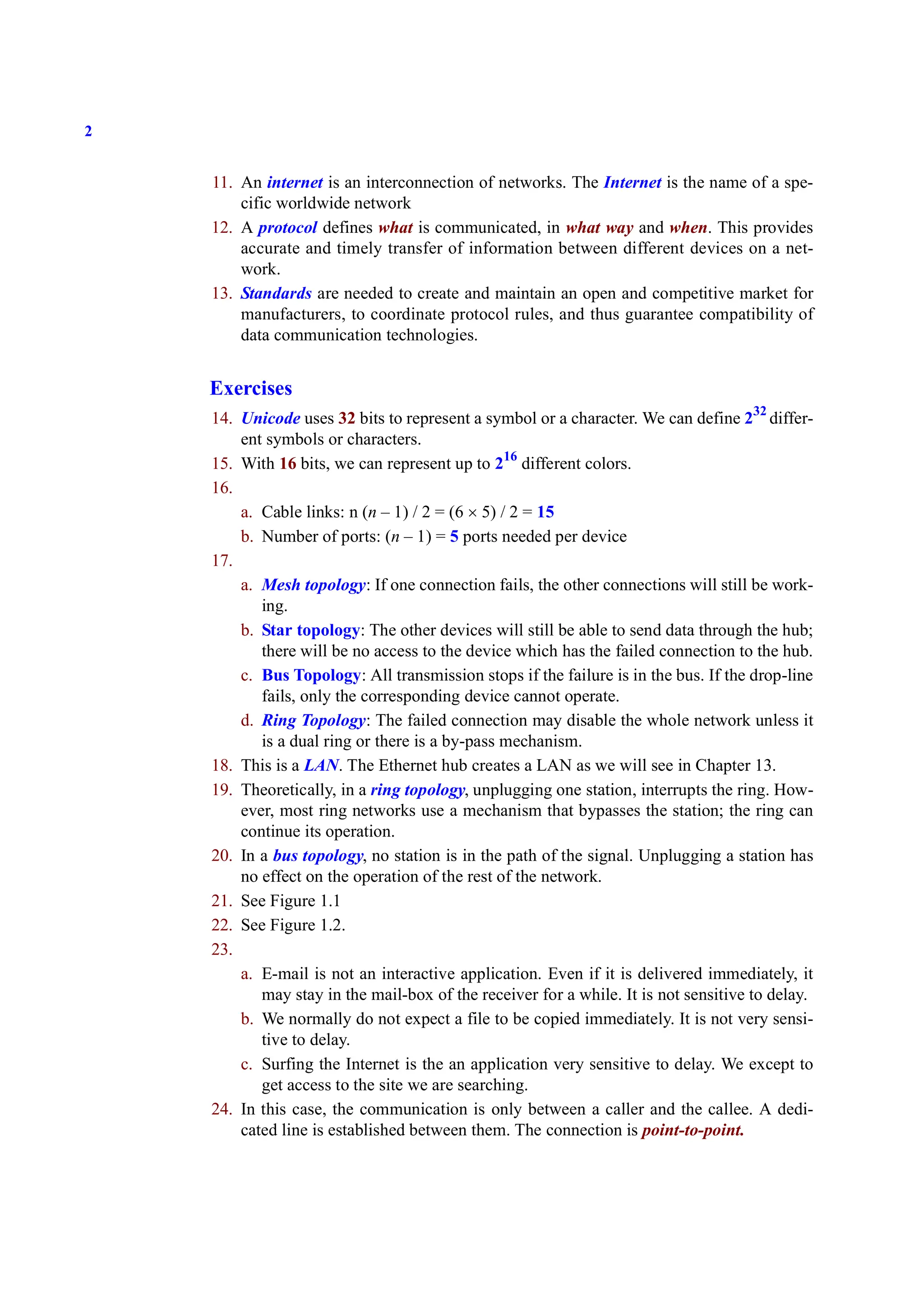
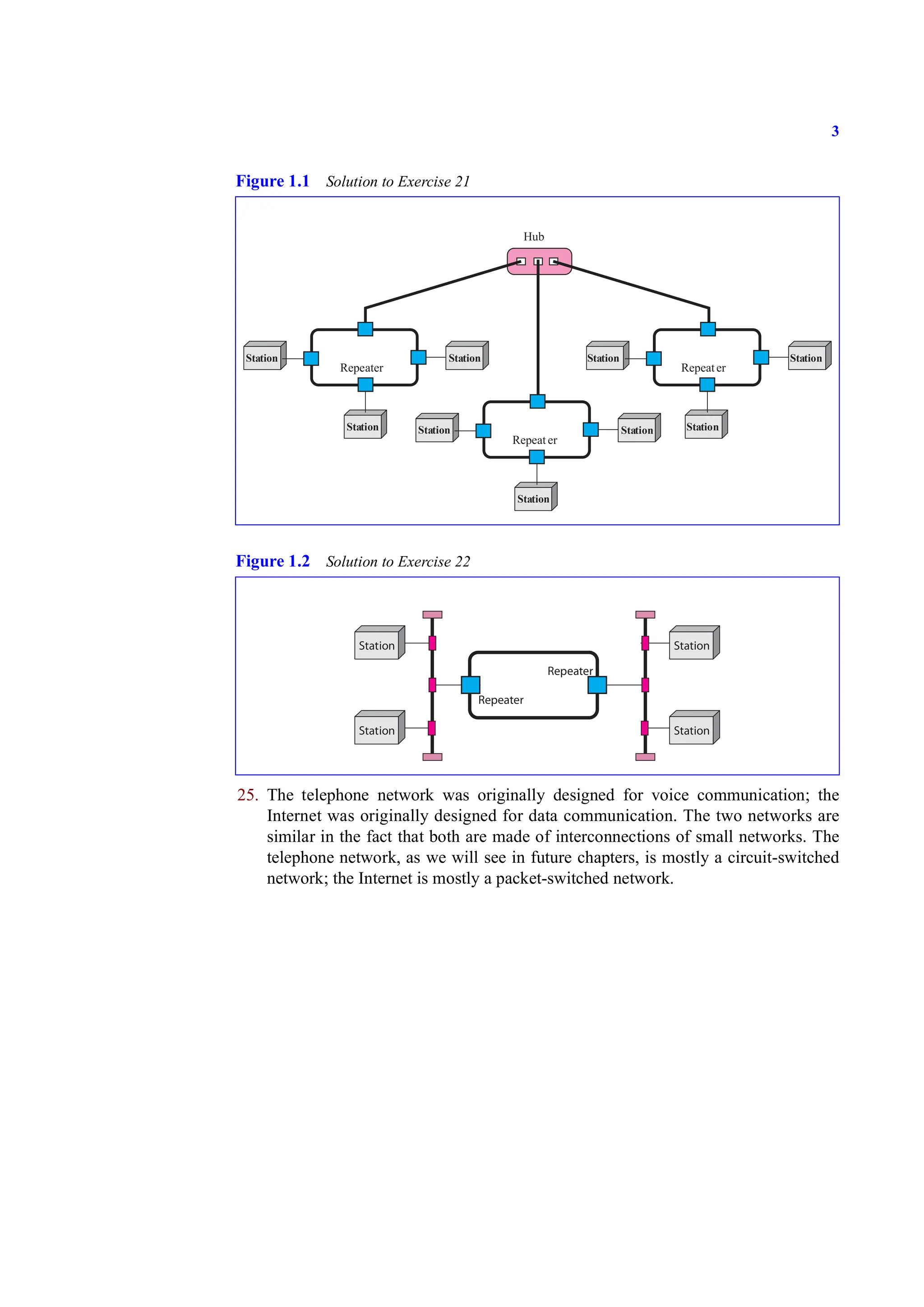

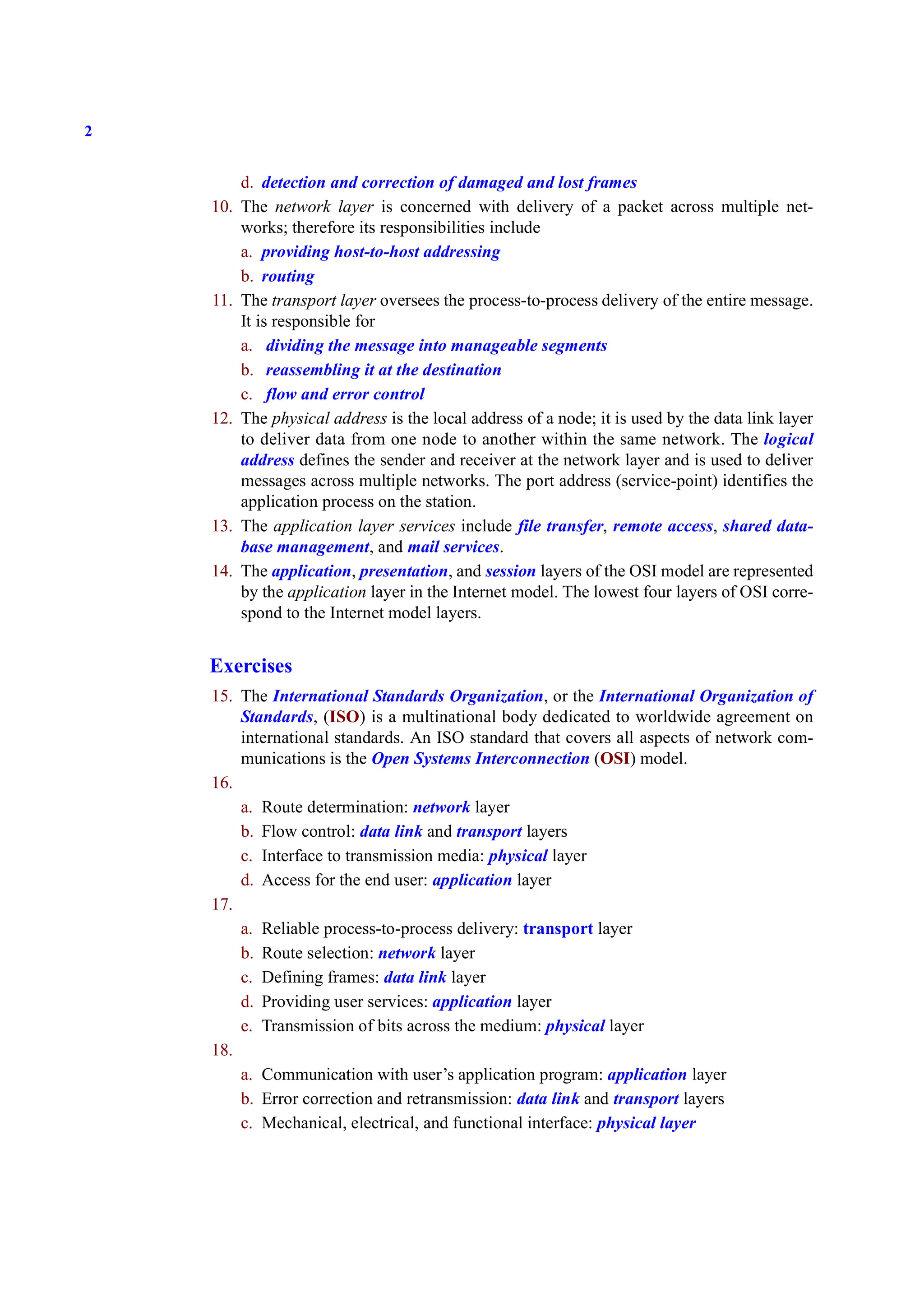
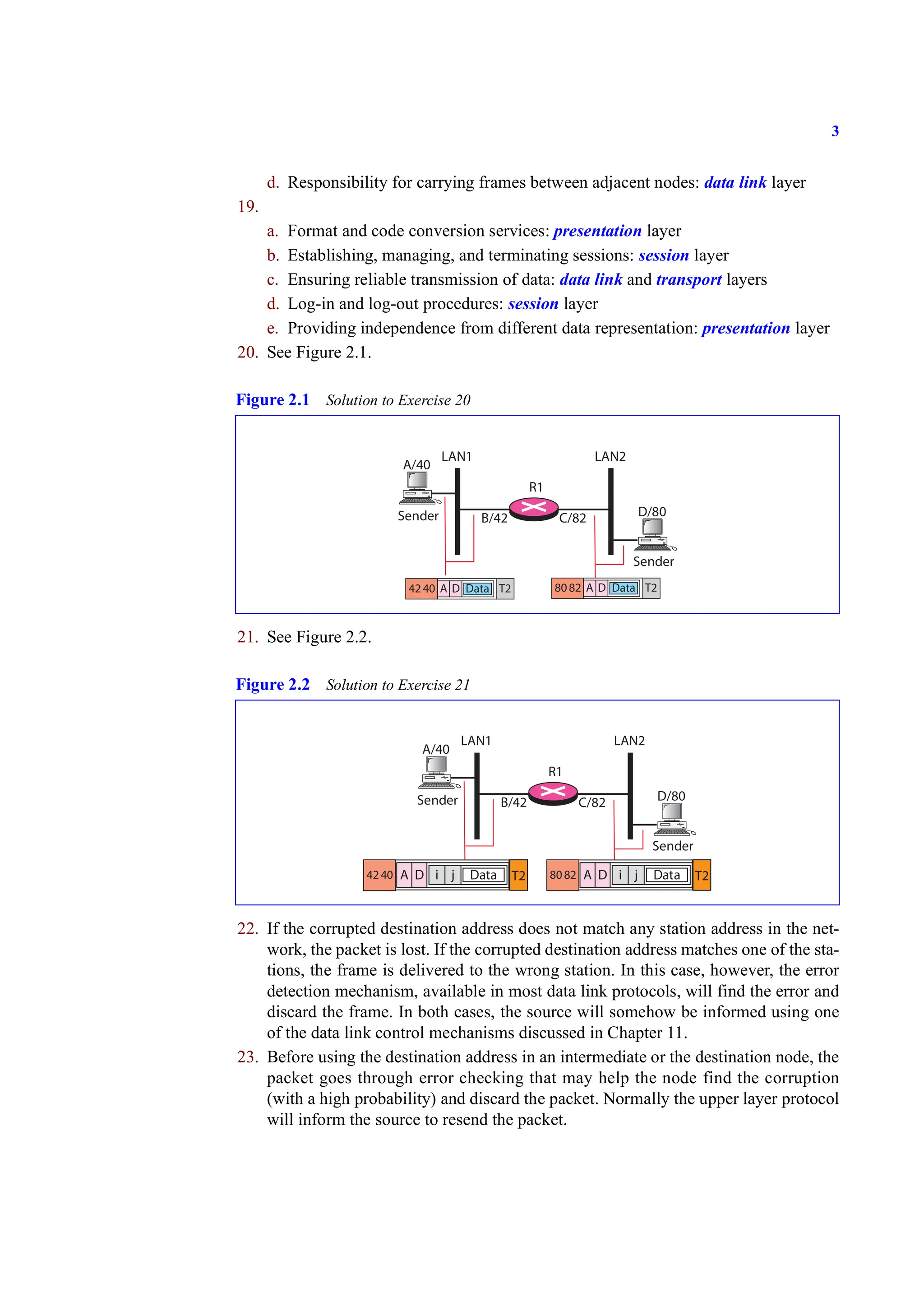

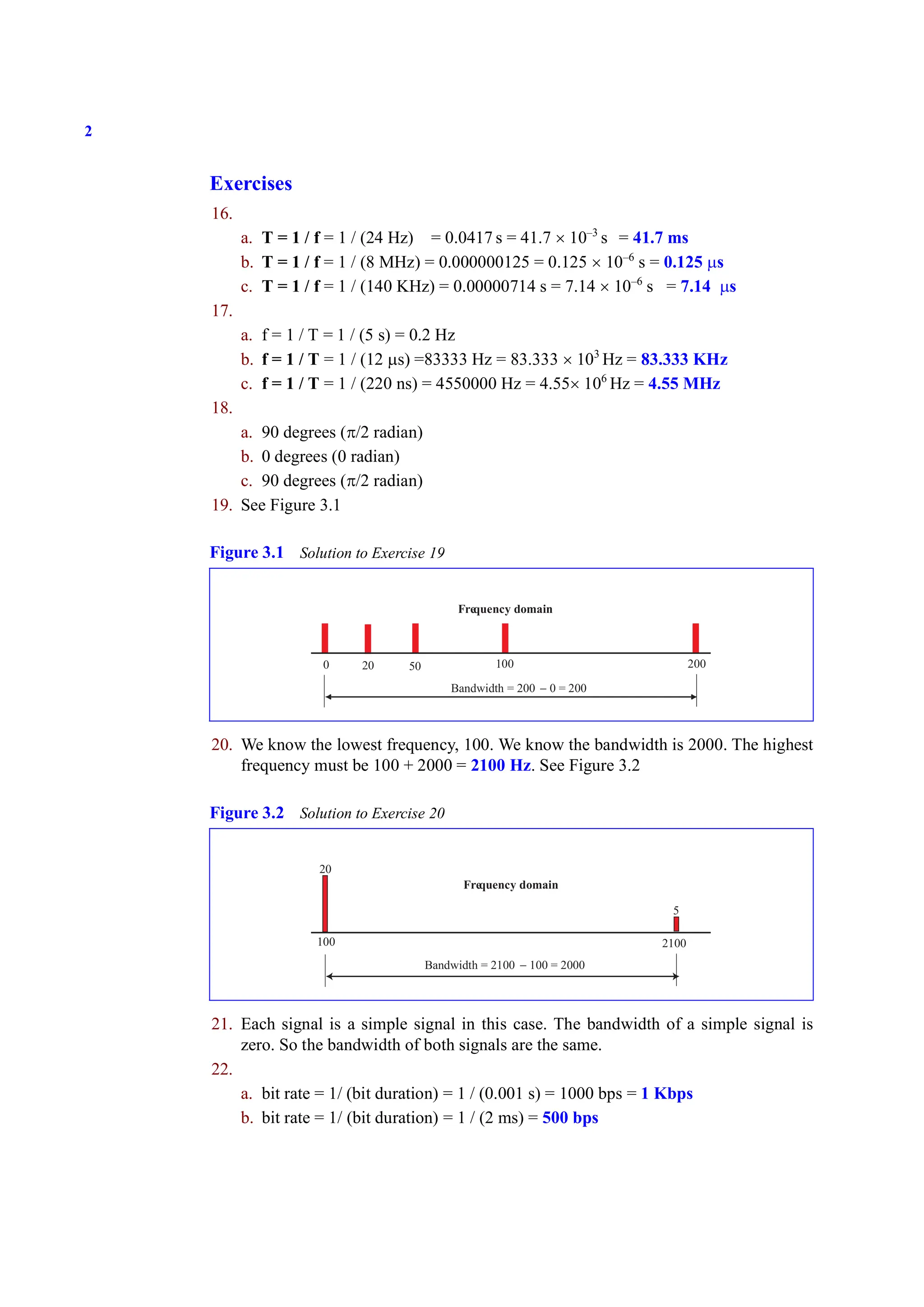
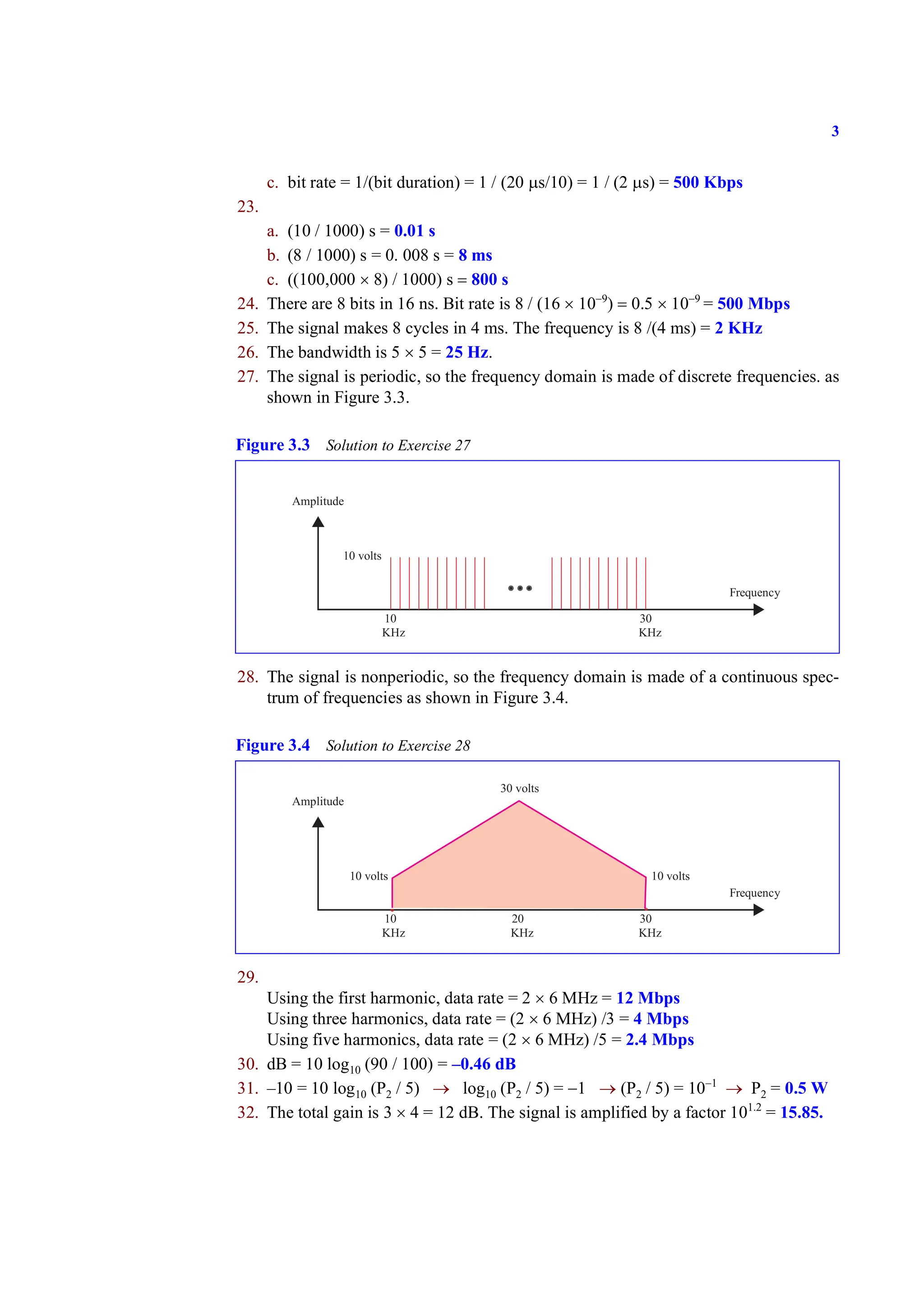
![4
33. 100,000 bits / 5 Kbps = 20 s
34. 480 s × 300,000 km/s = 144,000,000 km
35. 1 μm × 1000 = 1000 μm = 1 mm
36. We have
4,000 log2 (1 + 1,000) ≈ 40 Kbps
37. We have
4,000 log2 (1 + 10 / 0.005) = 43,866 bps
38. The file contains 2,000,000 × 8 = 16,000,000 bits. With a 56-Kbps channel, it takes
16,000,000/56,000 = 289 s. With a 1-Mbps channel, it takes 16 s.
39. To represent 1024 colors, we need log21024 = 10 (see Appendix C) bits. The total
number of bits are, therefore,
1200 × 1000 × 10 = 12,000,000 bits
40. We have
SNR = (200 mW) / (10 × 2 × μW) = 10,000
We then have
SNRdB = 10 log10 SNR = 40
41. We have
SNR= (signal power)/(noise power).
However, power is proportional to the square of voltage. This means we have
SNR = [(signal voltage)2
] / [(noise voltage)2
] =
[(signal voltage) / (noise voltage)]2
= 202
= 400
We then have
SNRdB = 10 log10 SNR ≈ 26.02
42. We can approximately calculate the capacity as
a. C = B × (SNRdB /3) = 20 KHz × (40 /3) = 267 Kbps
b. C = B × (SNRdB /3) = 200 KHz × (4 /3) = 267 Kbps
c. C = B × (SNRdB /3) = 1 MHz × (20 /3) = 6.67 Mbps
43.
a. The data rate is doubled (C2 = 2 × C1).
b. When the SNR is doubled, the data rate increases slightly. We can say that,
approximately, (C2 = C1 + 1).
44. We can use the approximate formula
C = B × (SNRdB /3) or SNRdB = (3 × C) /B
We can say that the minimum
SNRdB = 3 × 100 Kbps / 4 KHz = 75](https://image.slidesharecdn.com/25263722-250521050213-0779335c/75/Data-Communications-And-Networking-Solution-Manual-4th-Edition-Behrouz-Forouzan-16-2048.jpg)
![5
This means that the minimum
SNR = 10 SNRdB/10
= 107.5
≈ 31,622,776
45. We have
transmission time = (packet length)/(bandwidth) =
(8,000,000 bits) / (200,000 bps) = 40 s
46. We have
(bit length) = (propagation speed) × (bit duration)
The bit duration is the inverse of the bandwidth.
a. Bit length = (2 ×10⁸
m) × [(1 / (1 Mbps)] = 200 m. This means a bit occupies
200 meters on a transmission medium.
b. Bit length = (2 ×10⁸
m) × [(1 / (10 Mbps)] = 20 m. This means a bit occupies 20
meters on a transmission medium.
c. Bit length = (2 ×10⁸
m) × [(1 / (100 Mbps)] = 2 m. This means a bit occupies 2
meters on a transmission medium.
47.
a. Number of bits = bandwidth × delay = 1 Mbps × 2 ms = 2000 bits
b. Number of bits = bandwidth × delay = 10 Mbps × 2 ms = 20,000 bits
c. Number of bits = bandwidth × delay = 100 Mbps × 2 ms = 200,000 bits
48. We have
Latency = processing time + queuing time +
transmission time + propagation time
Processing time = 10 × 1 μs = 10 μs = 0.000010 s
Queuing time = 10 × 2 μs = 20 μs = 0.000020 s
Transmission time = 5,000,000 / (5 Mbps) = 1 s
Propagation time = (2000 Km) / (2 × 10⁸
) = 0.01 s
Latency = 0.000010 + 0.000020 + 1 + 0.01 = 1.01000030 s
The transmission time is dominant here because the packet size is huge.](https://image.slidesharecdn.com/25263722-250521050213-0779335c/75/Data-Communications-And-Networking-Solution-Manual-4th-Edition-Behrouz-Forouzan-17-2048.jpg)