Analog and Digital signals
Analog & Digital Signals
 Review the definitions of analog and digital signals.
 Detail the working of an analog and digital signals.
 Examples of Analog.
 Analog Transmission
 Pros and Cons of Analog.
 Examples of Digital.
 Digital Transmission.
Analog & Digital Signals
 Pros and Cons of Digital.
 Applications.
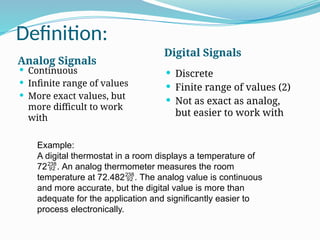
Definition:
Analog Signals
Digital Signals
 Continuous
 Infinite range of values
 More exact values, but
more difficult to work
with
 Discrete
 Finite range of values (2)
 Not as exact as analog,
but easier to work with
Example:
A digital thermostat in a room displays a temperature of
72. An analog thermometer measures the room
temperature at 72.482. The analog value is continuous
and more accurate, but the digital value is more than
adequate for the application and significantly easier to
process electronically.
Difference in Working:
 The working of the digital signals are more reliable
and accurate because they use the digital media or the
numeric method where as analog signals are based on
the small fluctuations.
 Digital signals are used to play that information which
is came from re-sampling, whereas analog are known
for playing recorded data.
 Digital signals have priority over analog signals
because with the help of digital signals users have
ability to change the visual and the audio or re-record
it but with analog signals you can do such parameters.
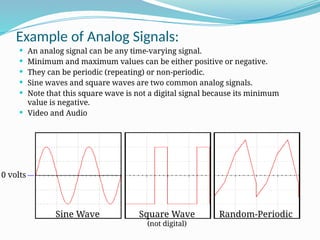
Example of Analog Signals:
 An analog signal can be any time-varying signal.
 Minimum and maximum values can be either positive or negative.
 They can be periodic (repeating) or non-periodic.
 Sine waves and square waves are two common analog signals.
 Note that this square wave is not a digital signal because its minimum
value is negative.
 Video and Audio
0 volts
Sine Wave Square Wave
(not digital)
Random-Periodic
Analog transmission:
 Transmit analog signals without regard to
content.
 Attenuation limits length of transmission link
 Cascaded amplifiers boost signals energy for
longer distances but cause distortion
Analog data can tolerate distortion.
Introduces errors in digital data.
Pros and Cons of Analog Signals:
 Advantages:
 major advantages of the analog signal is infinite amount
of data.
 Density is much higher.
 easy processing.
 Disadvantages:
 Unwanted noise in recording.
 If we transmit data at long distance then unwanted
disturbance is there.
 Generation loss is also a big con of analog signals.
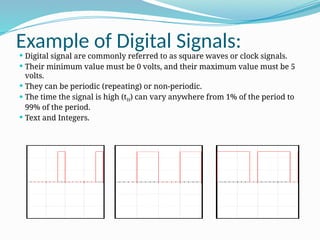
Example of Digital Signals:
 Digital signal are commonly referred to as square waves or clock signals.
 Their minimum value must be 0 volts, and their maximum value must be 5
volts.
 They can be periodic (repeating) or non-periodic.
 The time the signal is high (tH) can vary anywhere from 1% of the period to
99% of the period.
 Text and Integers.
Digital Transmission:
 Concerned with the content of the signal.
 Attenuation endangers integrity of data.
 Digital signal
Repeaters achieve greater distance.
Repeaters recover the signal and retransmit.
Pros and Cons of Digital Signals:
 Advantages:
 Because of their digital nature they can travel
faster in over digital lines.
 Ability to transfer more data as compared to
analog.
 Disadvantages:
 Greater bandwidth is essential.
 Systems and processing is more complex.
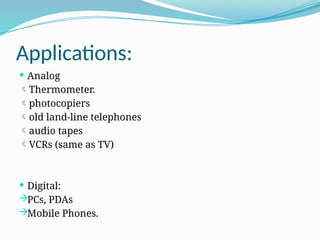
Applications:
 Analog
Thermometer.
photocopiers
old land-line telephones
audio tapes
VCRs (same as TV)
 Digital:
PCs, PDAs
Mobile Phones.
Data communication analog and Digital signals.pptx

Data communication analog and Digital signals.pptx

  • 1.
  • 2.
    Analog & DigitalSignals  Review the definitions of analog and digital signals.  Detail the working of an analog and digital signals.  Examples of Analog.  Analog Transmission  Pros and Cons of Analog.  Examples of Digital.  Digital Transmission.
  • 3.
    Analog & DigitalSignals  Pros and Cons of Digital.  Applications.
  • 4.
    Definition: Analog Signals Digital Signals Continuous  Infinite range of values  More exact values, but more difficult to work with  Discrete  Finite range of values (2)  Not as exact as analog, but easier to work with Example: A digital thermostat in a room displays a temperature of 72. An analog thermometer measures the room temperature at 72.482. The analog value is continuous and more accurate, but the digital value is more than adequate for the application and significantly easier to process electronically.
  • 5.
    Difference in Working: The working of the digital signals are more reliable and accurate because they use the digital media or the numeric method where as analog signals are based on the small fluctuations.  Digital signals are used to play that information which is came from re-sampling, whereas analog are known for playing recorded data.  Digital signals have priority over analog signals because with the help of digital signals users have ability to change the visual and the audio or re-record it but with analog signals you can do such parameters.
  • 6.
    Example of AnalogSignals:  An analog signal can be any time-varying signal.  Minimum and maximum values can be either positive or negative.  They can be periodic (repeating) or non-periodic.  Sine waves and square waves are two common analog signals.  Note that this square wave is not a digital signal because its minimum value is negative.  Video and Audio 0 volts Sine Wave Square Wave (not digital) Random-Periodic
  • 7.
    Analog transmission:  Transmitanalog signals without regard to content.  Attenuation limits length of transmission link  Cascaded amplifiers boost signals energy for longer distances but cause distortion Analog data can tolerate distortion. Introduces errors in digital data.
  • 8.
    Pros and Consof Analog Signals:  Advantages:  major advantages of the analog signal is infinite amount of data.  Density is much higher.  easy processing.  Disadvantages:  Unwanted noise in recording.  If we transmit data at long distance then unwanted disturbance is there.  Generation loss is also a big con of analog signals.
  • 9.
    Example of DigitalSignals:  Digital signal are commonly referred to as square waves or clock signals.  Their minimum value must be 0 volts, and their maximum value must be 5 volts.  They can be periodic (repeating) or non-periodic.  The time the signal is high (tH) can vary anywhere from 1% of the period to 99% of the period.  Text and Integers.
  • 10.
    Digital Transmission:  Concernedwith the content of the signal.  Attenuation endangers integrity of data.  Digital signal Repeaters achieve greater distance. Repeaters recover the signal and retransmit.
  • 11.
    Pros and Consof Digital Signals:  Advantages:  Because of their digital nature they can travel faster in over digital lines.  Ability to transfer more data as compared to analog.  Disadvantages:  Greater bandwidth is essential.  Systems and processing is more complex.
  • 12.
    Applications:  Analog Thermometer. photocopiers old land-linetelephones audio tapes VCRs (same as TV)  Digital: PCs, PDAs Mobile Phones.