
Data Communication
Flow Control
by
Md.Javedul Ferdous
East West University
Flow Control
Flow control is the process of managing the
rate of data transmission between two nodes
to prevent a fast sender from outrunning a
slow receiver. It provides a mechanism for the
receiver to control the transmission speed, so
that the receiving node is not overwhelmed
with data from transmitting node.
So why need it
?????
Prevent degradation and loss of efficiency
due to overload
Deadlock avoidance
Fair allocation of resources among
competing users
Speed matching between the network and its
attached users.
Type of ‘Flow Control’
• Stop-and-wait
• Sliding Window
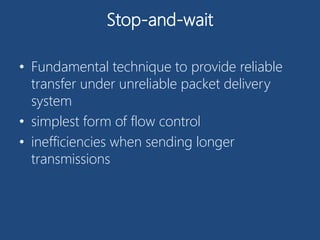
Stop-and-wait
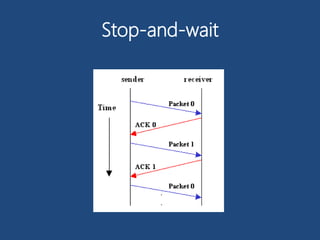
• Fundamental technique to provide reliable
transfer under unreliable packet delivery
system
• simplest form of flow control
• inefficiencies when sending longer
transmissions
Stop-and-wait
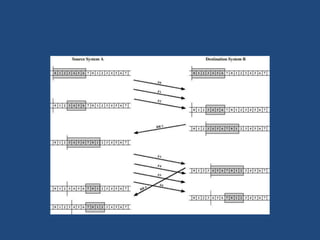
Sliding Window
• Technique for controlling transmitted data
packets between two network computers
where reliable and sequential delivery of data
packets is required
•
• Best utilized when the buffer size is limited
and pre-established.
• Better Performance
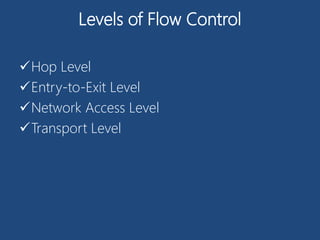
Levels of Flow Control
Hop Level
Entry-to-Exit Level
Network Access Level
Transport Level
Hop Level
Prevent store and forward buffer congestion
and its consequences
Maintain a smooth flow of traffic between
two neighboring nodes In a computer
network
Entry-to-Exit Level
Implement as a protocol between the source
and destination switch
Protect the exit node from congestion
Network Access Level
Throttle external inputs based on
measurements of internal network
congestion.
Transport Level
Efficient and reliable transmission of
messages within each user session and the
efficient sharing of common network
resources by several user sessions
Events destination buffer congestion and
overflow is known as transport level flow
control
Problem of ‘Flow Control’
Can’t send too slow or too fast
Too slow
wastes time
Too fast
can lead to buffer overflow

Data communication

  • 1.
  • 2.
    Flow Control Flow controlis the process of managing the rate of data transmission between two nodes to prevent a fast sender from outrunning a slow receiver. It provides a mechanism for the receiver to control the transmission speed, so that the receiving node is not overwhelmed with data from transmitting node.
  • 3.
    So why needit ?????
  • 4.
    Prevent degradation andloss of efficiency due to overload Deadlock avoidance Fair allocation of resources among competing users Speed matching between the network and its attached users.
  • 5.
    Type of ‘FlowControl’ • Stop-and-wait • Sliding Window
  • 6.
    Stop-and-wait • Fundamental techniqueto provide reliable transfer under unreliable packet delivery system • simplest form of flow control • inefficiencies when sending longer transmissions
  • 7.
  • 8.
    Sliding Window • Techniquefor controlling transmitted data packets between two network computers where reliable and sequential delivery of data packets is required • • Best utilized when the buffer size is limited and pre-established. • Better Performance
  • 10.
    Levels of FlowControl Hop Level Entry-to-Exit Level Network Access Level Transport Level
  • 11.
    Hop Level Prevent storeand forward buffer congestion and its consequences Maintain a smooth flow of traffic between two neighboring nodes In a computer network
  • 12.
    Entry-to-Exit Level Implement asa protocol between the source and destination switch Protect the exit node from congestion
  • 13.
    Network Access Level Throttleexternal inputs based on measurements of internal network congestion.
  • 14.
    Transport Level Efficient andreliable transmission of messages within each user session and the efficient sharing of common network resources by several user sessions Events destination buffer congestion and overflow is known as transport level flow control
  • 15.
    Problem of ‘FlowControl’ Can’t send too slow or too fast Too slow wastes time Too fast can lead to buffer overflow