DATA LINK CONTROL
 Flow Control
 Error Detection
 Error Control
 High-Level Data Link Control (HDLC)
FLOW CONTROL
Flow control is the process of managing the rate data
transmission between two nodes to prevent a fast
sender from overwhelming a slow receiver. Flow
control should be distinguished from congestion
control, which is used for controlling the flow of data
when congestion has actually occur.
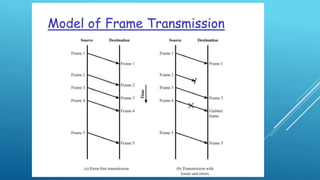
STOP-AND-WAIT FLOW CONTROL
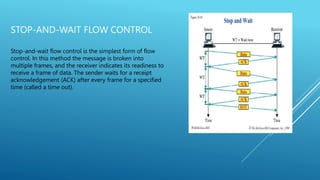
Stop-and-wait flow control is the simplest form of flow
control. In this method the message is broken into
multiple frames, and the receiver indicates its readiness to
receive a frame of data. The sender waits for a receipt
acknowledgement (ACK) after every frame for a specified
time (called a time out).
SLIDING-WINDOW FLOW CONTROL
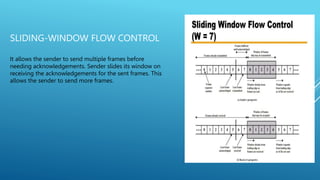
It allows the sender to send multiple frames before
needing acknowledgements. Sender slides its window on
receiving the acknowledgements for the sent frames. This
allows the sender to send more frames.
ERROR DETECTION
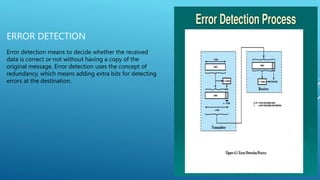
Error detection means to decide whether the received
data is correct or not without having a copy of the
original message. Error detection uses the concept of
redundancy, which means adding extra bits for detecting
errors at the destination.
ERROR CONTROL
Error control refers to mechanisms to detect and correct
errors that occur in the transmission of frames.

DATA LINK CONTROL.pptx

  • 1.
    DATA LINK CONTROL Flow Control  Error Detection  Error Control  High-Level Data Link Control (HDLC)
  • 2.
    FLOW CONTROL Flow controlis the process of managing the rate data transmission between two nodes to prevent a fast sender from overwhelming a slow receiver. Flow control should be distinguished from congestion control, which is used for controlling the flow of data when congestion has actually occur.
  • 4.
    STOP-AND-WAIT FLOW CONTROL Stop-and-waitflow control is the simplest form of flow control. In this method the message is broken into multiple frames, and the receiver indicates its readiness to receive a frame of data. The sender waits for a receipt acknowledgement (ACK) after every frame for a specified time (called a time out).
  • 5.
    SLIDING-WINDOW FLOW CONTROL Itallows the sender to send multiple frames before needing acknowledgements. Sender slides its window on receiving the acknowledgements for the sent frames. This allows the sender to send more frames.
  • 6.
    ERROR DETECTION Error detectionmeans to decide whether the received data is correct or not without having a copy of the original message. Error detection uses the concept of redundancy, which means adding extra bits for detecting errors at the destination.
  • 7.
    ERROR CONTROL Error controlrefers to mechanisms to detect and correct errors that occur in the transmission of frames.