Wade Lewis VP Cloud Services Data Center Design through Hot-Aisle Containment and Outside Air Economizers
Traditional State of the Data Center Sources:  McKinsey & Company/Uptime Institute Report Electronics Cooling Magazine (May2007) EPA 2007 Report to Congress Energy Costs increasing 11% YOY globally Data Center energy consumption increasing by 12% annually Data Centers consume .5% of all power produced worldwide. Data Center Greenhouse Gases are predicted to quadruple by 2020, and be nearly equal to steel plants in emissions.
Facility Costs Growing at 20% compared to 6% for I.T. Cooling consumes up to 55% of all data center energy Up to 40% of cooled air never reaches critical equipment By preventing mixing of cooled air with exhaust air, cooling efficiency can be increased by as much as 30% Sources:  McKinsey & Company/Uptime Institute Report Electronics Cooling Magazine (May2007) EPA 2007 Report to Congress Traditional State of the Data Center
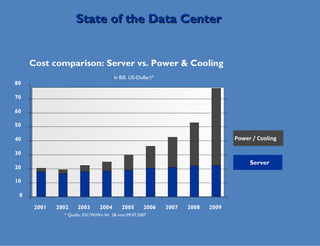
Cost comparison: Server vs. Power & Cooling ( in Bill. US-Dollar)* 0 10 20 30 40 50 60 70 80 2001 2002 2003 2004 2005 2006 2007 2008 2009 * Quelle: IDC/WiWo Nr. 28 vom 09.07.2007 Power / Cooling Server State of the Data Center
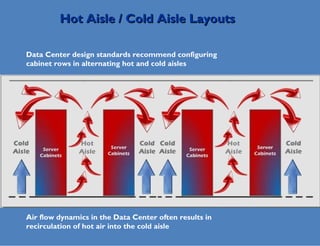
Hot Aisle / Cold Aisle Layouts Data Center design standards recommend configuring cabinet rows in alternating hot and cold aisles Air flow dynamics in the Data Center often results in recirculation of hot air into the cold aisle
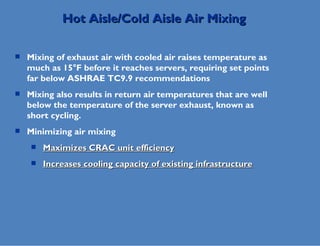
Mixing of exhaust air with cooled air raises temperature as much as 15°F before it reaches servers, requiring set points far below ASHRAE TC9.9 recommendations Mixing also results in return air temperatures that are well below the temperature of the server exhaust, known as short cycling. Minimizing air mixing Maximizes CRAC unit efficiency Increases cooling capacity of existing infrastructure Hot Aisle/Cold Aisle Air Mixing
Raised Floor System Forced Air Plenum CRAC units (Chilled Water Loop) Hot Aisle / Cold Aisle intermixed Power Distribution in Conditioned Space Standard 120v Single Phase Power Very inefficient design –  Hot air mix from server racks and CRAC units Heat load from PDU Over sized (HP) blower motors (CRAC) Server load inefficient using 120v power Traditional Data Center Design
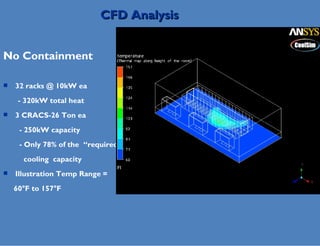
No Containment  32 racks @ 10kW ea - 320kW total heat 3 CRACS-26 Ton ea - 250kW capacity - Only 78% of the  “required”  cooling  capacity Illustration Temp Range =  60°F to 157°F CFD Analysis
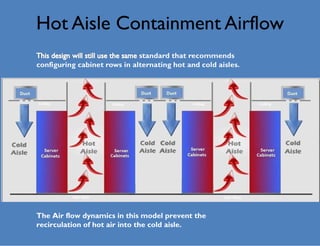
Hot Aisle Containment Airflow The Air flow dynamics in this model prevent the recirculation of hot air into the cold aisle.
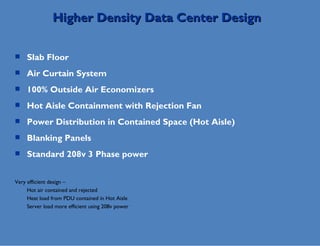
Slab Floor Air Curtain System 100% Outside Air Economizers Hot Aisle Containment with Rejection Fan Power Distribution in Contained Space (Hot Aisle) Blanking Panels Standard 208v 3 Phase power Very efficient design –  Hot air contained and rejected Heat load from PDU contained in Hot Aisle Server load more efficient using 208v power Higher Density Data Center Design
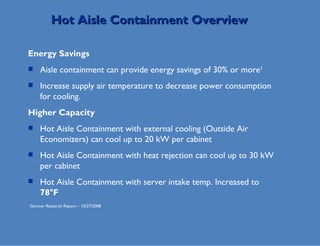
Hot Aisle Containment Overview Energy Savings Aisle containment can provide energy savings of 30% or more 1  Increase supply air temperature to decrease power consumption for cooling.  Higher Capacity Hot Aisle Containment with external cooling (Outside Air Economizers) can cool up to 20 kW per cabinet Hot Aisle Containment with heat rejection can cool up to 30 kW per cabinet Hot Aisle Containment with server intake temp. Increased to  78°F  1 Gartner Research Report – 10/27/2008
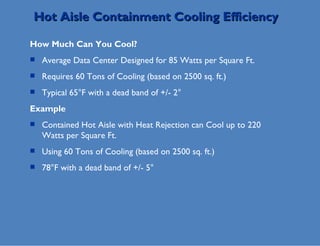
Hot Aisle Containment Cooling Efficiency How Much Can You Cool? Average Data Center Designed for 85 Watts per Square Ft. Requires 60 Tons of Cooling (based on 2500 sq. ft.) Typical 65°F with a dead band of +/- 2 ° Example Contained Hot Aisle with Heat Rejection can Cool up to 220 Watts per Square Ft. Using 60 Tons of Cooling (based on 2500 sq. ft.) 78°F with a dead band of +/- 5°
Prevent  IT heat load from entering room Absorb or re-direct heat from back of cabinets Reduces strain on cooling infrastructure Increase supply set points No air mixing between aisles Achieve 100% cooling utilization by only supplying cooling necessary for server intake Hot Aisle Containment with Heat Rejection
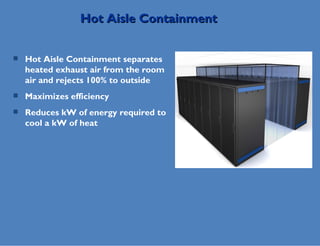
Hot Aisle Containment separates heated exhaust air from the room air and rejects 100% to outside Maximizes efficiency  Reduces kW of energy required to cool a kW of heat Hot Aisle Containment

Afcom2010

  • 1.
    Wade Lewis VPCloud Services Data Center Design through Hot-Aisle Containment and Outside Air Economizers
  • 2.
    Traditional State ofthe Data Center Sources: McKinsey & Company/Uptime Institute Report Electronics Cooling Magazine (May2007) EPA 2007 Report to Congress Energy Costs increasing 11% YOY globally Data Center energy consumption increasing by 12% annually Data Centers consume .5% of all power produced worldwide. Data Center Greenhouse Gases are predicted to quadruple by 2020, and be nearly equal to steel plants in emissions.
  • 3.
    Facility Costs Growingat 20% compared to 6% for I.T. Cooling consumes up to 55% of all data center energy Up to 40% of cooled air never reaches critical equipment By preventing mixing of cooled air with exhaust air, cooling efficiency can be increased by as much as 30% Sources: McKinsey & Company/Uptime Institute Report Electronics Cooling Magazine (May2007) EPA 2007 Report to Congress Traditional State of the Data Center
  • 4.
    Cost comparison: Servervs. Power & Cooling ( in Bill. US-Dollar)* 0 10 20 30 40 50 60 70 80 2001 2002 2003 2004 2005 2006 2007 2008 2009 * Quelle: IDC/WiWo Nr. 28 vom 09.07.2007 Power / Cooling Server State of the Data Center
  • 5.
    Hot Aisle /Cold Aisle Layouts Data Center design standards recommend configuring cabinet rows in alternating hot and cold aisles Air flow dynamics in the Data Center often results in recirculation of hot air into the cold aisle
  • 6.
    Mixing of exhaustair with cooled air raises temperature as much as 15°F before it reaches servers, requiring set points far below ASHRAE TC9.9 recommendations Mixing also results in return air temperatures that are well below the temperature of the server exhaust, known as short cycling. Minimizing air mixing Maximizes CRAC unit efficiency Increases cooling capacity of existing infrastructure Hot Aisle/Cold Aisle Air Mixing
  • 7.
    Raised Floor SystemForced Air Plenum CRAC units (Chilled Water Loop) Hot Aisle / Cold Aisle intermixed Power Distribution in Conditioned Space Standard 120v Single Phase Power Very inefficient design – Hot air mix from server racks and CRAC units Heat load from PDU Over sized (HP) blower motors (CRAC) Server load inefficient using 120v power Traditional Data Center Design
  • 8.
    No Containment 32 racks @ 10kW ea - 320kW total heat 3 CRACS-26 Ton ea - 250kW capacity - Only 78% of the “required” cooling capacity Illustration Temp Range = 60°F to 157°F CFD Analysis
  • 9.
    Hot Aisle ContainmentAirflow The Air flow dynamics in this model prevent the recirculation of hot air into the cold aisle.
  • 10.
    Slab Floor AirCurtain System 100% Outside Air Economizers Hot Aisle Containment with Rejection Fan Power Distribution in Contained Space (Hot Aisle) Blanking Panels Standard 208v 3 Phase power Very efficient design – Hot air contained and rejected Heat load from PDU contained in Hot Aisle Server load more efficient using 208v power Higher Density Data Center Design
  • 11.
    Hot Aisle ContainmentOverview Energy Savings Aisle containment can provide energy savings of 30% or more 1 Increase supply air temperature to decrease power consumption for cooling. Higher Capacity Hot Aisle Containment with external cooling (Outside Air Economizers) can cool up to 20 kW per cabinet Hot Aisle Containment with heat rejection can cool up to 30 kW per cabinet Hot Aisle Containment with server intake temp. Increased to 78°F 1 Gartner Research Report – 10/27/2008
  • 12.
    Hot Aisle ContainmentCooling Efficiency How Much Can You Cool? Average Data Center Designed for 85 Watts per Square Ft. Requires 60 Tons of Cooling (based on 2500 sq. ft.) Typical 65°F with a dead band of +/- 2 ° Example Contained Hot Aisle with Heat Rejection can Cool up to 220 Watts per Square Ft. Using 60 Tons of Cooling (based on 2500 sq. ft.) 78°F with a dead band of +/- 5°
  • 13.
    Prevent ITheat load from entering room Absorb or re-direct heat from back of cabinets Reduces strain on cooling infrastructure Increase supply set points No air mixing between aisles Achieve 100% cooling utilization by only supplying cooling necessary for server intake Hot Aisle Containment with Heat Rejection
  • 14.
    Hot Aisle Containmentseparates heated exhaust air from the room air and rejects 100% to outside Maximizes efficiency Reduces kW of energy required to cool a kW of heat Hot Aisle Containment