Data Capabilities and
Competitive Advantage
Lessons from consulting and research
Ashish Kumar, Ph.D.
Principal Consultant – Economics and Operations
Bell Labs Consulting, Singapore
The views expressed here may not reflect those of my employer
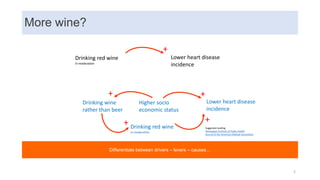
More wine?
Differentiate between drivers – levers – causes…
Drinking red wine
in moderation
Lower heart disease
incidence
+
Higher socio
economic status
+
Lower heart disease
incidence
+
Drinking wine
rather than beer
+ Drinking red wine
in moderation
Suggested reading:
Norwegian Institute of Public Health
Journal of the American Medical Association
+
2
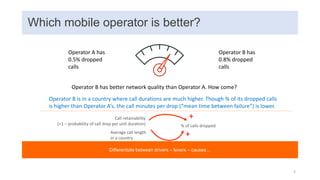
Which mobile operator is better?
Differentiate between drivers – levers – causes…
Operator A has
0.5% dropped
calls
Operator B has
0.8% dropped
calls
Operator B has better network quality than Operator A. How come?
Operator B is in a country where call durations are much higher. Though % of its dropped calls
is higher than Operator A’s, the call minutes per drop (“mean time between failure”) is lower.
Average call length
in a country
+
% of calls dropped
Call retainability
(=1 – probability of call drop per unit duration)
+
3
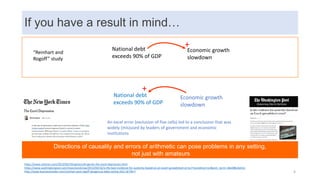
If you have a result in mind…
Directions of causality and errors of arithmetic can pose problems in any setting,
not just with amateurs
4
National debt
exceeds 90% of GDP
Economic growth
slowdown
+
https://www.nytimes.com/2013/04/19/opinion/krugman-the-excel-depression.html
https://www.washingtonpost.com/news/wonk/wp/2013/04/16/is-the-best-evidence-for-austerity-based-on-an-excel-spreadsheet-error/?noredirect=on&utm_term=.bbe08bcbe52c
http://www.businessinsider.com/reinhart-and-rogoff-dangerous-debt-ceiling-2011-8/?IR=T
+
Economic growth
slowdown
National debt
exceeds 90% of GDP
“Reinhart and
Rogoff” study
An excel error (exclusion of five cells) led to a conclusion that was
widely (mis)used by leaders of government and economic
institutions
Which mobile operator is better?
Differentiate between drivers – levers – causes…
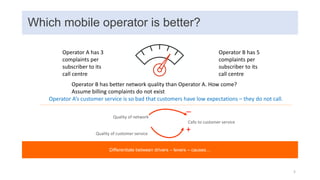
Operator A has 3
complaints per
subscriber to its
call centre
Operator B has 5
complaints per
subscriber to its
call centre
Operator B has better network quality than Operator A. How come?
Assume billing complaints do not exist
Operator A’s customer service is so bad that customers have low expectations – they do not call.
_
Calls to customer service
Quality of network
+Quality of customer service
5
“System 1” and “System 2”:
Two modes of human thinking
“Intuition”, “gut feel”, “judgement” suffer from many biases.
With AI advances, they do not guarantee human superiority over machine
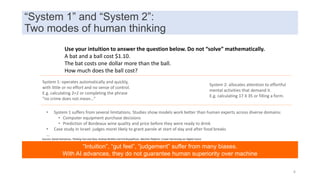
Use your intuition to answer the question below. Do not “solve” mathematically.
A bat and a ball cost $1.10.
The bat costs one dollar more than the ball.
How much does the ball cost?
System 1: operates automatically and quickly,
with little or no effort and no sense of control.
E.g. calculating 2+2 or completing the phrase
“no crime does not mean…”
System 2: allocates attention to effortful
mental activities that demand it.
E.g. calculating 17 X 35 or filling a form.
Sources: Daniel Kahneman, Thinking Fast and Slow; Andrew McAfee and Erik Brynjolfsson, Machine Platform, Crowd: Harnessing our Digital Future
• System 1 suffers from several limitations. Studies show models work better than human experts across diverse domains:
• Computer equipment purchase decisions
• Prediction of Bordeaux wine quality and price before they were ready to drink
• Case study in Israel: judges morel likely to grant parole at start of day and after food breaks
…
6
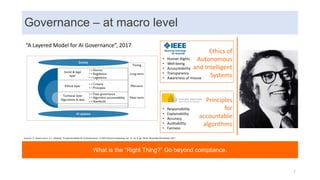
Governance – at macro level
What is the “Right Thing?” Go beyond compliance.
7
Sources: U. Gasser and V. A. F. Almeida, "A Layered Model for AI Governance," in IEEE Internet Computing, vol. 21, no. 6, pp. 58-62, November/December 2017
“A Layered Model for AI Governance”, 2017
• Responsibility
• Explainability
• Accuracy
• Auditability
• Fairness
Principles
for
accountable
algorithms
• Human Rights
• Well-being
• Accountability
• Transparency
• Awareness of misuse
Ethics of
Autonomous
and Intelligent
Systems
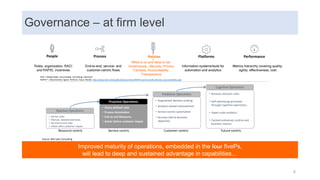
Governance – at firm level
Improved maturity of operations, embedded in the four fivePs,
will lead to deep and sustained advantage in capabilities…
End-to-end, service- and
customer-centric flows
Roles, organization, RACI
and RAPID, incentives
Information systems/tools for
automation and analytics
Metrics hierarchy covering quality,
agility, effectiveness, cost
Platforms PerformanceProcessPeople
Resource-centric Service-centric Customer-centric Future-centric
Reactive Operations
• Ad hoc roles
• Manual, isolated processes
• No end-to-end view
• Action after customer impact
• Cleary defined roles
• Process Automation
• End-to-end Measures
• Action before customer impact
Proactive Operations
Predictive Operations
• Augmented decision-making
• Analytics-based improvement
• Service-centric automation
• Services tied to business
objectives
Cognitive Operations
• Business decision roles
• Self-optimizing processes
through cognitive awareness
• Hyper-scale analytics
• Context-enhanced, end-to-end
business metrics
Source: Bell Labs Consulting
8
RACI = Responsible, Accountable, Consulting, Informed
RAPID ® = Recommend, Agree, Perform, Input, Decide. http://www.bain.com/publications/articles/RAPID-tool-to-clarify-decision-accountability.aspx
Policies
What is on and what is not.
Governance., Security, Privacy
Fairness, Accountability,
Transparency
Yet another P: Purpose
“The purpose of business is to create and keep a customer.”
Peter Drucker
1954
9
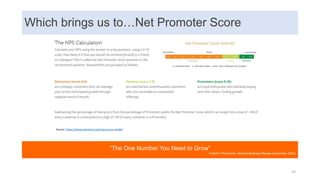
Which brings us to…Net Promoter Score
“The One Number You Need to Grow”
Fredrik F Reichheld, Harvard Business Review (December 2003)
Source: https://www.satmetrix.com/nps-score-model/
10
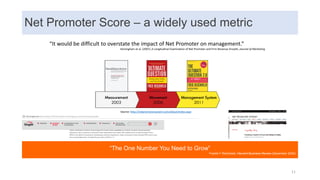
Net Promoter Score – a widely used metric
“The One Number You Need to Grow”
Fredrik F Reichheld, Harvard Business Review (December 2003)
“It would be difficult to overstate the impact of Net Promoter on management.”
Keiningham et al. (2007), A Longitudinal Examination of Net Promoter and Firm Revenue Growth, Journal of Marketing
Source: http://netpromotersystem.com/about/index.aspx
11
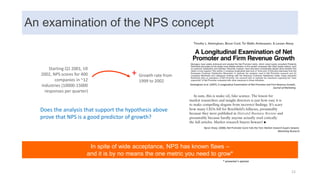
An examination of the NPS concept
In spite of wide acceptance, NPS has known flaws –
and it is by no means the one metric you need to grow*
Keiningham et al. (2007), A Longitudinal Examination of Net Promoter and Firm Revenue Growth,
Journal of Marketing
Byron Sharp. (2008), Net Promoter Score Fails the Test: Market research buyers beware.
Marketing Research
+ Growth rate from
1999 to 2002
Starting Q1 2001, till
2002, NPS scores for 400
companies in ~12
industries (10000-15000
responses per quarter)
* presenter’s opinion
Does the analysis that support the hypothesis above
prove that NPS is a good predictor of growth?
12
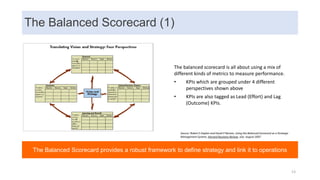
The Balanced Scorecard (1)
The Balanced Scorecard provides a robust framework to define strategy and link it to operations
Source: Robert S Kaplan and David P Norton, Using the Balanced Scorecard as a Strategic
Management System, Harvard Business Review, July- August 2007
The balanced scorecard is all about using a mix of
different kinds of metrics to measure performance.
• KPIs which are grouped under 4 different
perspectives shown above
• KPIs are also tagged as Lead (Effort) and Lag
(Outcome) KPIs.
13
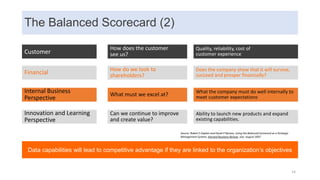
The Balanced Scorecard (2)
Data capabilities will lead to competitive advantage if they are linked to the organization’s objectives
Customer
How does the customer
see us?
Quality, reliability, cost of
customer experience
Financial How do we look to
shareholders?
Does the company show that it will survive,
succeed and prosper financially?
Internal Business
Perspective
What must we excel at? What the company must do well internally to
meet customer expectations
Innovation and Learning
Perspective
Can we continue to improve
and create value?
Ability to launch new products and expand
existing capabilities.
Source: Robert S Kaplan and David P Norton, Using the Balanced Scorecard as a Strategic
Management System, Harvard Business Review, July- August 2007
14
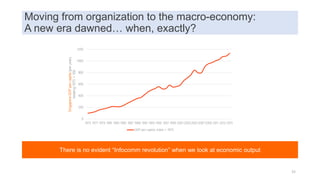
Moving from organization to the macro-economy:
A new era dawned… when, exactly?
There is no evident “Infocomm revolution” when we look at economic output
0
200
400
600
800
1000
1200
1975 1977 1979 1981 1983 1985 1987 1989 1991 1993 1995 1997 1999 2001 2003200520072009 2011 2013 2015
SingaporeGDPpercapita(peryear),
treating1975=100
GDP per capita, index = 1975
15
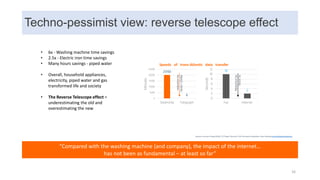
Techno-pessimist view: reverse telescope effect
“Compared with the washing machine (and company), the impact of the internet…
has not been as fundamental – at least so far”
20160
8
0
5000
10000
15000
20000
25000
Steamship Telegraph
Minutes
10
2
0
2
4
6
8
10
12
Fax Internet
Seconds
Speeds of trans-Atlantic data transfer
• 6x - Washing machine time savings
• 2.5x - Electric iron time savings
• Many hours savings - piped water
• Overall, household appliances,
electricity, piped water and gas
transformed life and society
• The Reverse Telescope effect =
underestimating the old and
overestimating the new
reductionby
factor>2500x
Reductionby
factor5x
Sources: Ha-Joon Chang (2010), 23 Things They don’t Tell You about Capitalism; Hans Rossling on the Washing Machine
16
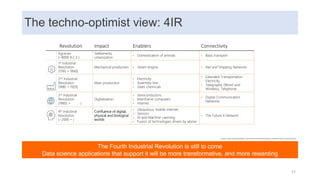
The techno-optimist view: 4IR
The Fourth Industrial Revolution is still to come
Data science applications that support it will be more transformative, and more rewarding
Revolution Impact Enablers Connectivity
Agrarian
(~8000 B.C.E.)
Settlements,
urbanization
> Domestication of animals > Basic transport
1st Industrial
Revolution
(1760 − 1840)
Mechanical production > Steam engine > Rail and Shipping Networks
2nd Industrial
Revolution
(1880 − 1920)
Mass production
> Electricity
> Assembly line
> Steel, chemicals
> Extended Transportation
Electricity
> Telegraphy (Wired and
Wireless), Telephone
3rd Industrial
Revolution
(1960s − )
Digitalisation
> Semiconductors
> Mainframe computers
> Internet
> Digital Communication
Networks
4th Industrial
Revolution
(~2000 − )
Confluence of digital,
physical and biological
worlds
> Ubiquitous, mobile internet
> Sensors
> AI and Machine Learning
> Fusion of technologies driven by above
> The Future X Network
Source: Klaus Schwab (2016), The Fourth Industrial Revolution and Bell Labs Consulting views
17

Data capabilities and competitive advantage

  • 1.
    Data Capabilities and CompetitiveAdvantage Lessons from consulting and research Ashish Kumar, Ph.D. Principal Consultant – Economics and Operations Bell Labs Consulting, Singapore The views expressed here may not reflect those of my employer
  • 2.
    More wine? Differentiate betweendrivers – levers – causes… Drinking red wine in moderation Lower heart disease incidence + Higher socio economic status + Lower heart disease incidence + Drinking wine rather than beer + Drinking red wine in moderation Suggested reading: Norwegian Institute of Public Health Journal of the American Medical Association + 2
  • 3.
    Which mobile operatoris better? Differentiate between drivers – levers – causes… Operator A has 0.5% dropped calls Operator B has 0.8% dropped calls Operator B has better network quality than Operator A. How come? Operator B is in a country where call durations are much higher. Though % of its dropped calls is higher than Operator A’s, the call minutes per drop (“mean time between failure”) is lower. Average call length in a country + % of calls dropped Call retainability (=1 – probability of call drop per unit duration) + 3
  • 4.
    If you havea result in mind… Directions of causality and errors of arithmetic can pose problems in any setting, not just with amateurs 4 National debt exceeds 90% of GDP Economic growth slowdown + https://www.nytimes.com/2013/04/19/opinion/krugman-the-excel-depression.html https://www.washingtonpost.com/news/wonk/wp/2013/04/16/is-the-best-evidence-for-austerity-based-on-an-excel-spreadsheet-error/?noredirect=on&utm_term=.bbe08bcbe52c http://www.businessinsider.com/reinhart-and-rogoff-dangerous-debt-ceiling-2011-8/?IR=T + Economic growth slowdown National debt exceeds 90% of GDP “Reinhart and Rogoff” study An excel error (exclusion of five cells) led to a conclusion that was widely (mis)used by leaders of government and economic institutions
  • 5.
    Which mobile operatoris better? Differentiate between drivers – levers – causes… Operator A has 3 complaints per subscriber to its call centre Operator B has 5 complaints per subscriber to its call centre Operator B has better network quality than Operator A. How come? Assume billing complaints do not exist Operator A’s customer service is so bad that customers have low expectations – they do not call. _ Calls to customer service Quality of network +Quality of customer service 5
  • 6.
    “System 1” and“System 2”: Two modes of human thinking “Intuition”, “gut feel”, “judgement” suffer from many biases. With AI advances, they do not guarantee human superiority over machine Use your intuition to answer the question below. Do not “solve” mathematically. A bat and a ball cost $1.10. The bat costs one dollar more than the ball. How much does the ball cost? System 1: operates automatically and quickly, with little or no effort and no sense of control. E.g. calculating 2+2 or completing the phrase “no crime does not mean…” System 2: allocates attention to effortful mental activities that demand it. E.g. calculating 17 X 35 or filling a form. Sources: Daniel Kahneman, Thinking Fast and Slow; Andrew McAfee and Erik Brynjolfsson, Machine Platform, Crowd: Harnessing our Digital Future • System 1 suffers from several limitations. Studies show models work better than human experts across diverse domains: • Computer equipment purchase decisions • Prediction of Bordeaux wine quality and price before they were ready to drink • Case study in Israel: judges morel likely to grant parole at start of day and after food breaks … 6
  • 7.
    Governance – atmacro level What is the “Right Thing?” Go beyond compliance. 7 Sources: U. Gasser and V. A. F. Almeida, "A Layered Model for AI Governance," in IEEE Internet Computing, vol. 21, no. 6, pp. 58-62, November/December 2017 “A Layered Model for AI Governance”, 2017 • Responsibility • Explainability • Accuracy • Auditability • Fairness Principles for accountable algorithms • Human Rights • Well-being • Accountability • Transparency • Awareness of misuse Ethics of Autonomous and Intelligent Systems
  • 8.
    Governance – atfirm level Improved maturity of operations, embedded in the four fivePs, will lead to deep and sustained advantage in capabilities… End-to-end, service- and customer-centric flows Roles, organization, RACI and RAPID, incentives Information systems/tools for automation and analytics Metrics hierarchy covering quality, agility, effectiveness, cost Platforms PerformanceProcessPeople Resource-centric Service-centric Customer-centric Future-centric Reactive Operations • Ad hoc roles • Manual, isolated processes • No end-to-end view • Action after customer impact • Cleary defined roles • Process Automation • End-to-end Measures • Action before customer impact Proactive Operations Predictive Operations • Augmented decision-making • Analytics-based improvement • Service-centric automation • Services tied to business objectives Cognitive Operations • Business decision roles • Self-optimizing processes through cognitive awareness • Hyper-scale analytics • Context-enhanced, end-to-end business metrics Source: Bell Labs Consulting 8 RACI = Responsible, Accountable, Consulting, Informed RAPID ® = Recommend, Agree, Perform, Input, Decide. http://www.bain.com/publications/articles/RAPID-tool-to-clarify-decision-accountability.aspx Policies What is on and what is not. Governance., Security, Privacy Fairness, Accountability, Transparency
  • 9.
    Yet another P:Purpose “The purpose of business is to create and keep a customer.” Peter Drucker 1954 9
  • 10.
    Which brings usto…Net Promoter Score “The One Number You Need to Grow” Fredrik F Reichheld, Harvard Business Review (December 2003) Source: https://www.satmetrix.com/nps-score-model/ 10
  • 11.
    Net Promoter Score– a widely used metric “The One Number You Need to Grow” Fredrik F Reichheld, Harvard Business Review (December 2003) “It would be difficult to overstate the impact of Net Promoter on management.” Keiningham et al. (2007), A Longitudinal Examination of Net Promoter and Firm Revenue Growth, Journal of Marketing Source: http://netpromotersystem.com/about/index.aspx 11
  • 12.
    An examination ofthe NPS concept In spite of wide acceptance, NPS has known flaws – and it is by no means the one metric you need to grow* Keiningham et al. (2007), A Longitudinal Examination of Net Promoter and Firm Revenue Growth, Journal of Marketing Byron Sharp. (2008), Net Promoter Score Fails the Test: Market research buyers beware. Marketing Research + Growth rate from 1999 to 2002 Starting Q1 2001, till 2002, NPS scores for 400 companies in ~12 industries (10000-15000 responses per quarter) * presenter’s opinion Does the analysis that support the hypothesis above prove that NPS is a good predictor of growth? 12
  • 13.
    The Balanced Scorecard(1) The Balanced Scorecard provides a robust framework to define strategy and link it to operations Source: Robert S Kaplan and David P Norton, Using the Balanced Scorecard as a Strategic Management System, Harvard Business Review, July- August 2007 The balanced scorecard is all about using a mix of different kinds of metrics to measure performance. • KPIs which are grouped under 4 different perspectives shown above • KPIs are also tagged as Lead (Effort) and Lag (Outcome) KPIs. 13
  • 14.
    The Balanced Scorecard(2) Data capabilities will lead to competitive advantage if they are linked to the organization’s objectives Customer How does the customer see us? Quality, reliability, cost of customer experience Financial How do we look to shareholders? Does the company show that it will survive, succeed and prosper financially? Internal Business Perspective What must we excel at? What the company must do well internally to meet customer expectations Innovation and Learning Perspective Can we continue to improve and create value? Ability to launch new products and expand existing capabilities. Source: Robert S Kaplan and David P Norton, Using the Balanced Scorecard as a Strategic Management System, Harvard Business Review, July- August 2007 14
  • 15.
    Moving from organizationto the macro-economy: A new era dawned… when, exactly? There is no evident “Infocomm revolution” when we look at economic output 0 200 400 600 800 1000 1200 1975 1977 1979 1981 1983 1985 1987 1989 1991 1993 1995 1997 1999 2001 2003200520072009 2011 2013 2015 SingaporeGDPpercapita(peryear), treating1975=100 GDP per capita, index = 1975 15
  • 16.
    Techno-pessimist view: reversetelescope effect “Compared with the washing machine (and company), the impact of the internet… has not been as fundamental – at least so far” 20160 8 0 5000 10000 15000 20000 25000 Steamship Telegraph Minutes 10 2 0 2 4 6 8 10 12 Fax Internet Seconds Speeds of trans-Atlantic data transfer • 6x - Washing machine time savings • 2.5x - Electric iron time savings • Many hours savings - piped water • Overall, household appliances, electricity, piped water and gas transformed life and society • The Reverse Telescope effect = underestimating the old and overestimating the new reductionby factor>2500x Reductionby factor5x Sources: Ha-Joon Chang (2010), 23 Things They don’t Tell You about Capitalism; Hans Rossling on the Washing Machine 16
  • 17.
    The techno-optimist view:4IR The Fourth Industrial Revolution is still to come Data science applications that support it will be more transformative, and more rewarding Revolution Impact Enablers Connectivity Agrarian (~8000 B.C.E.) Settlements, urbanization > Domestication of animals > Basic transport 1st Industrial Revolution (1760 − 1840) Mechanical production > Steam engine > Rail and Shipping Networks 2nd Industrial Revolution (1880 − 1920) Mass production > Electricity > Assembly line > Steel, chemicals > Extended Transportation Electricity > Telegraphy (Wired and Wireless), Telephone 3rd Industrial Revolution (1960s − ) Digitalisation > Semiconductors > Mainframe computers > Internet > Digital Communication Networks 4th Industrial Revolution (~2000 − ) Confluence of digital, physical and biological worlds > Ubiquitous, mobile internet > Sensors > AI and Machine Learning > Fusion of technologies driven by above > The Future X Network Source: Klaus Schwab (2016), The Fourth Industrial Revolution and Bell Labs Consulting views 17