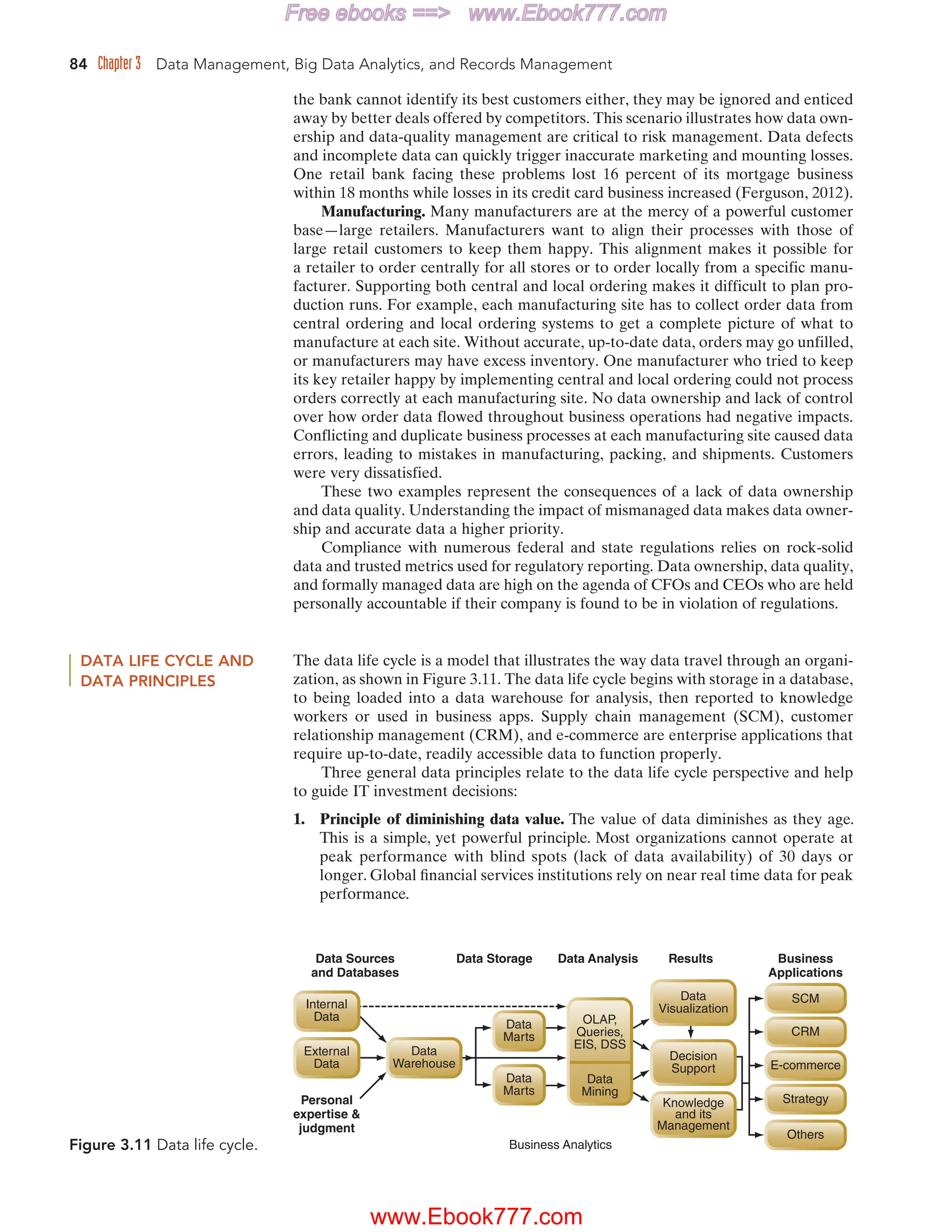
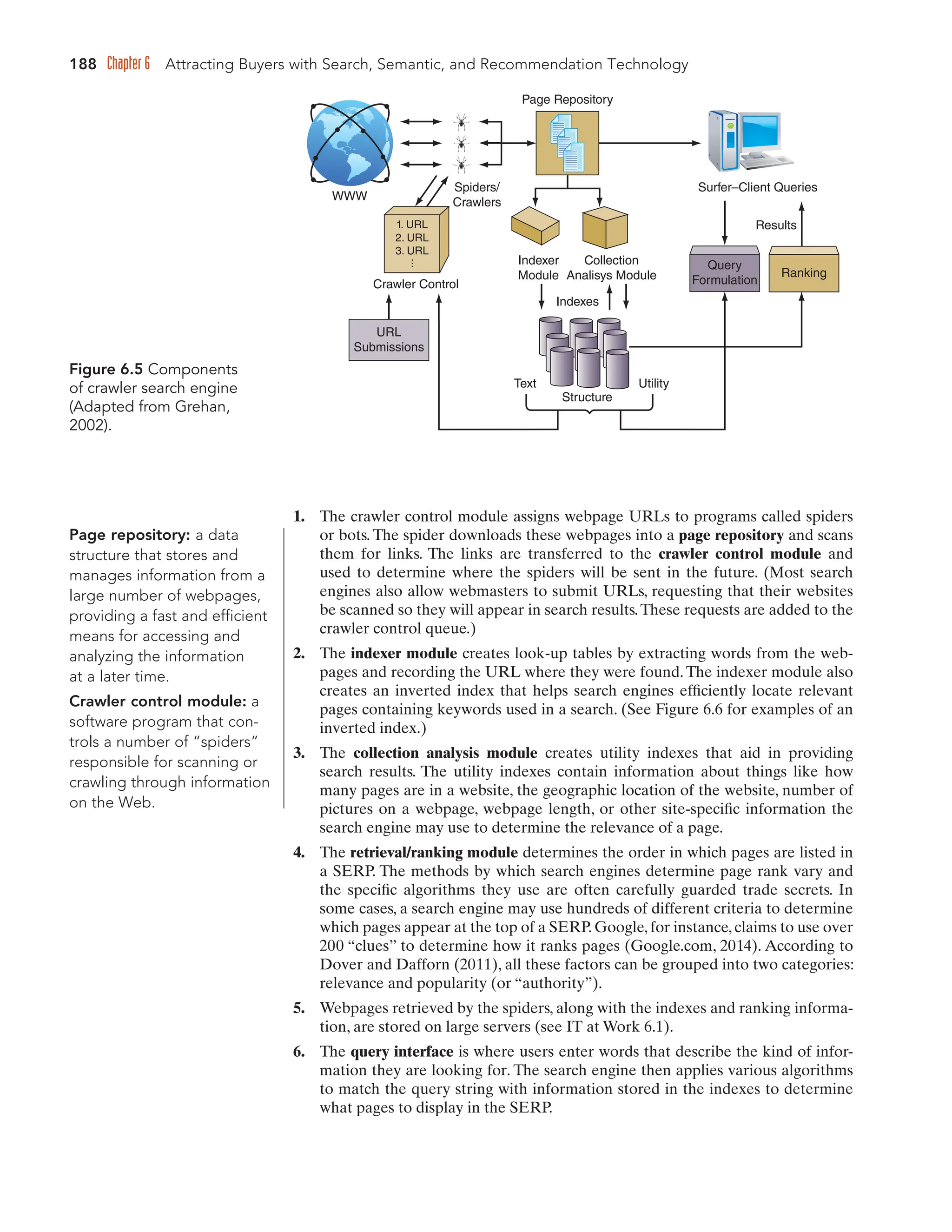
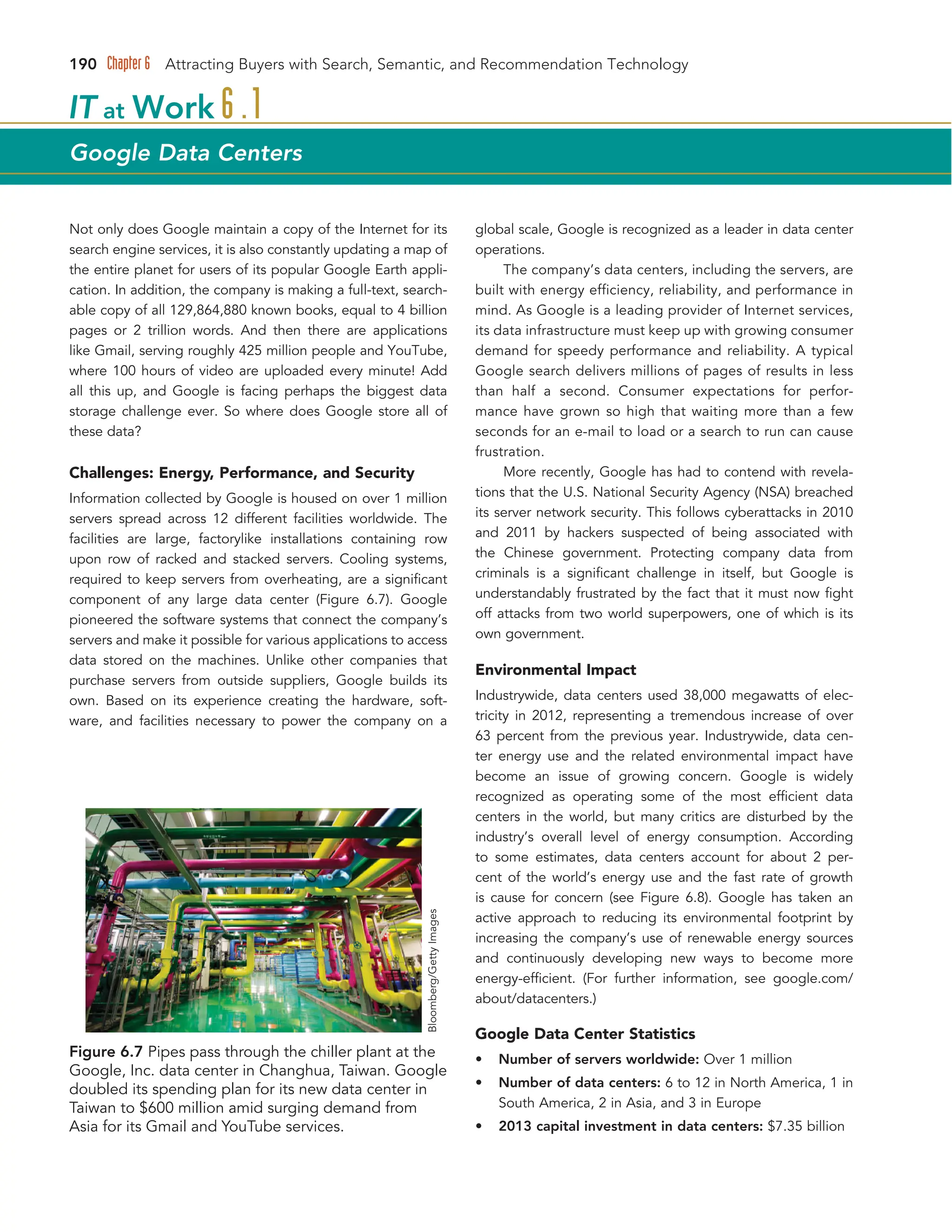
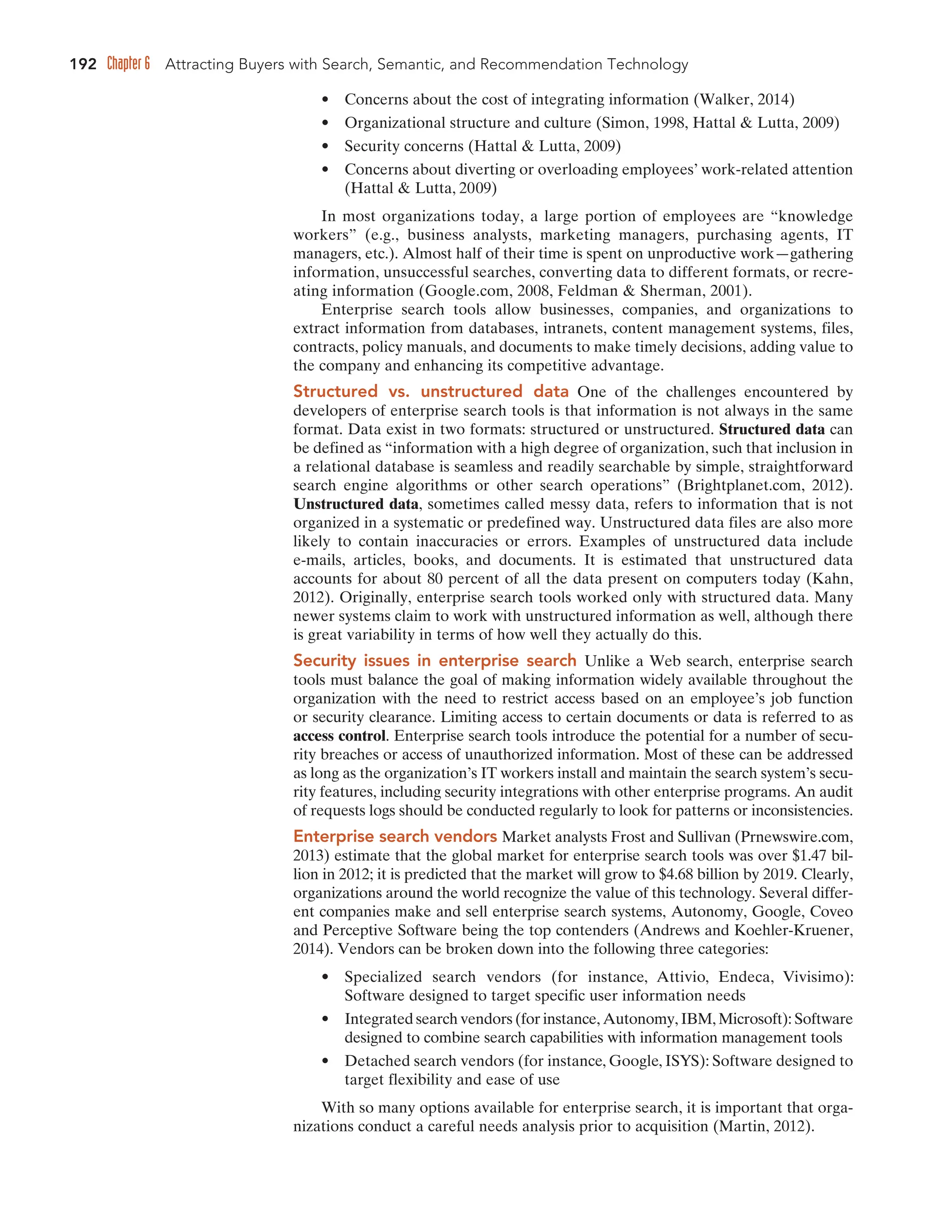
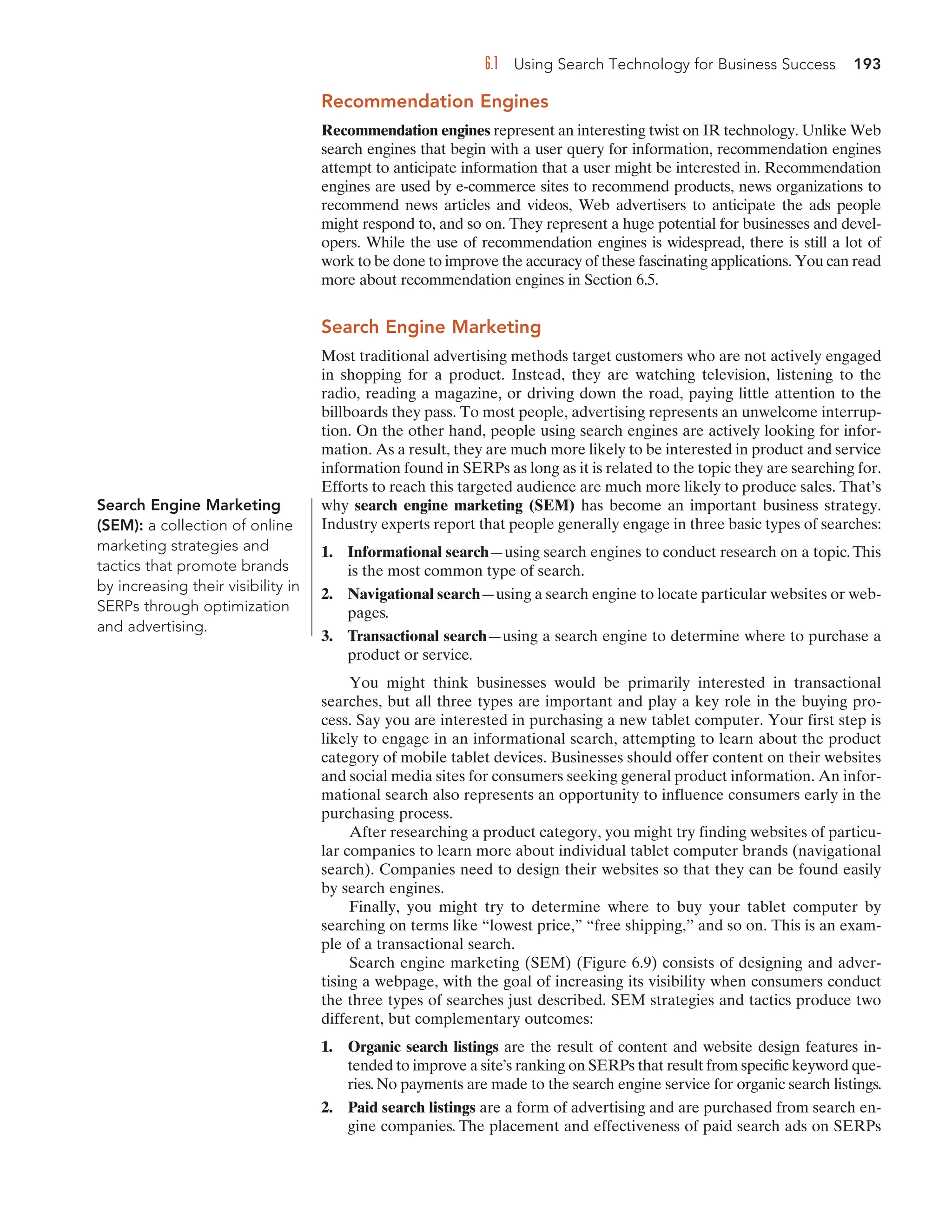
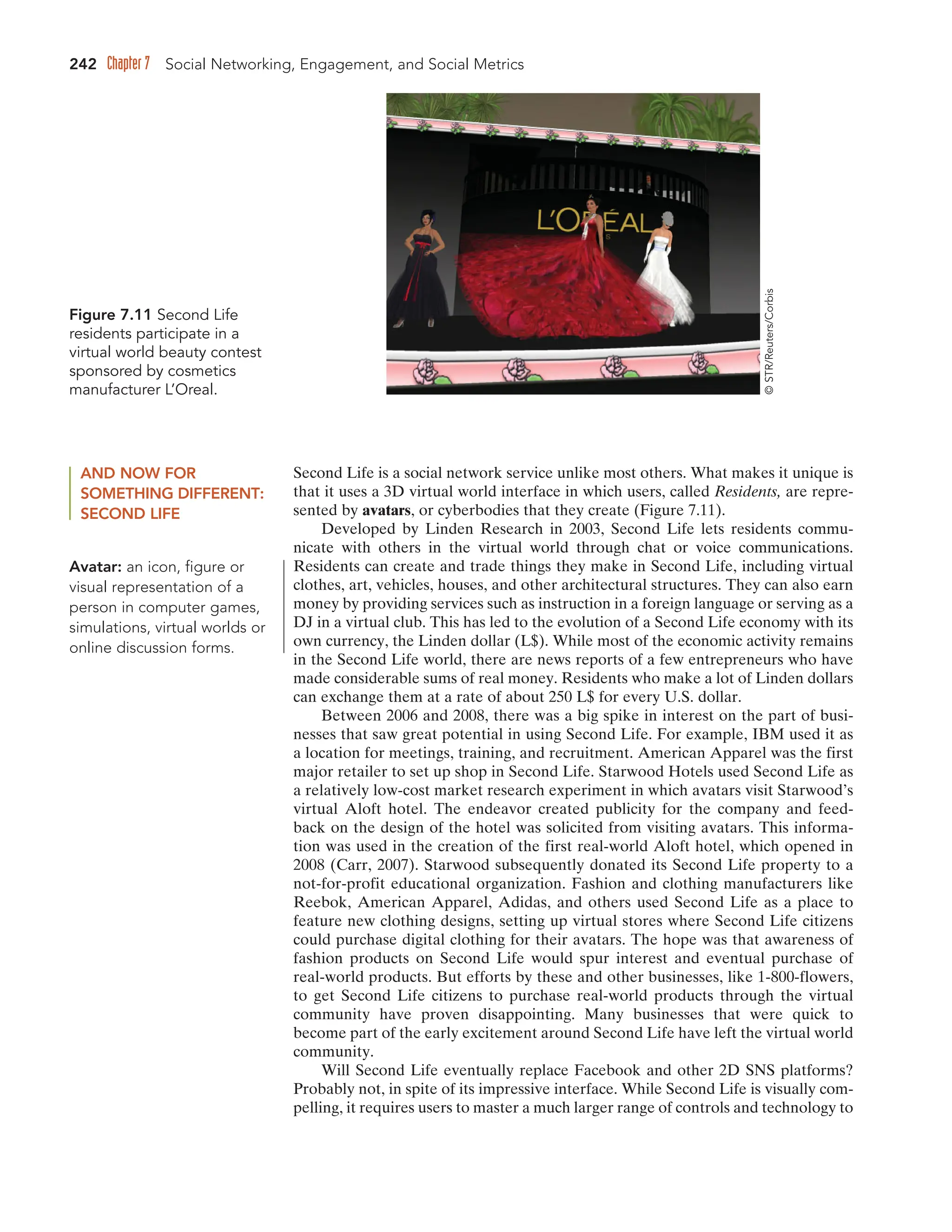
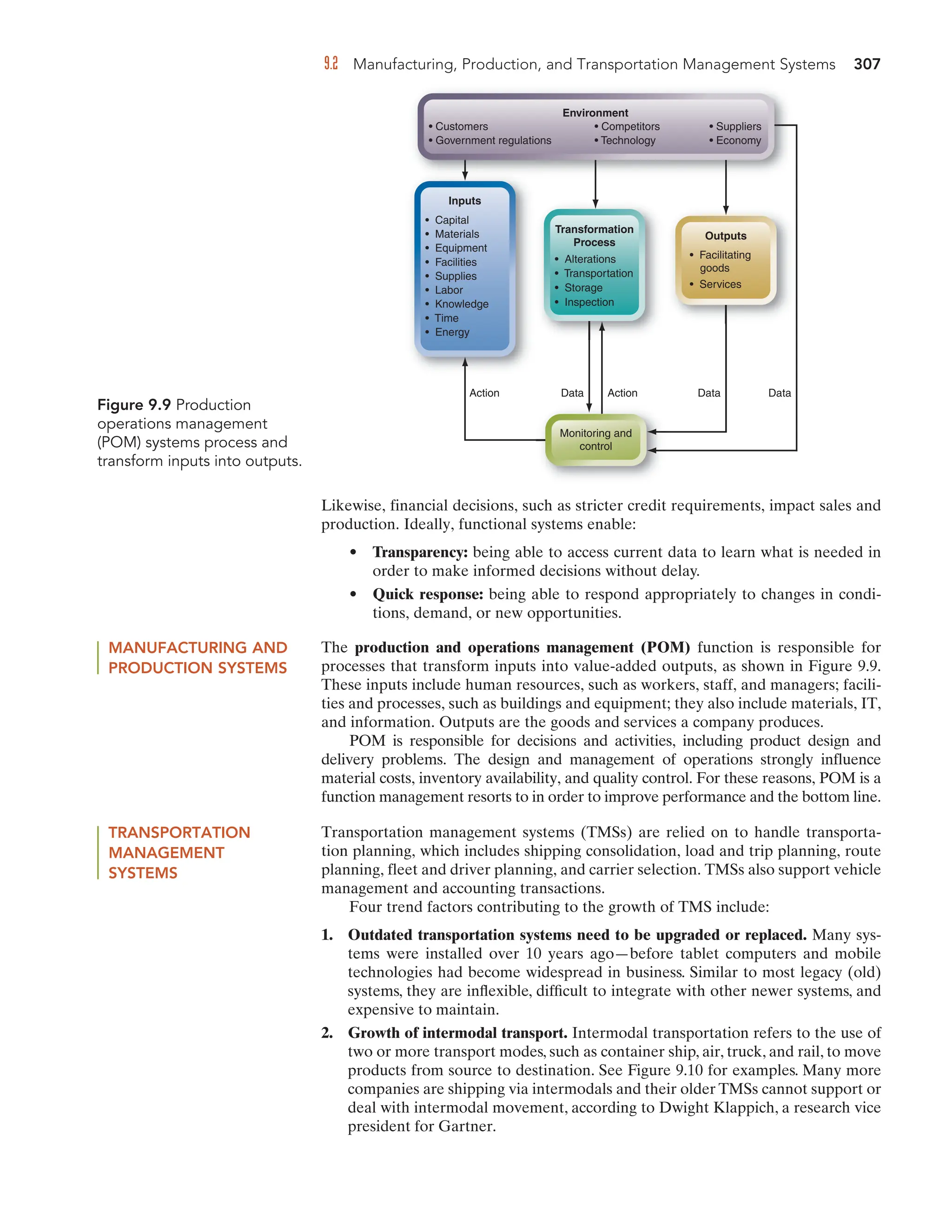
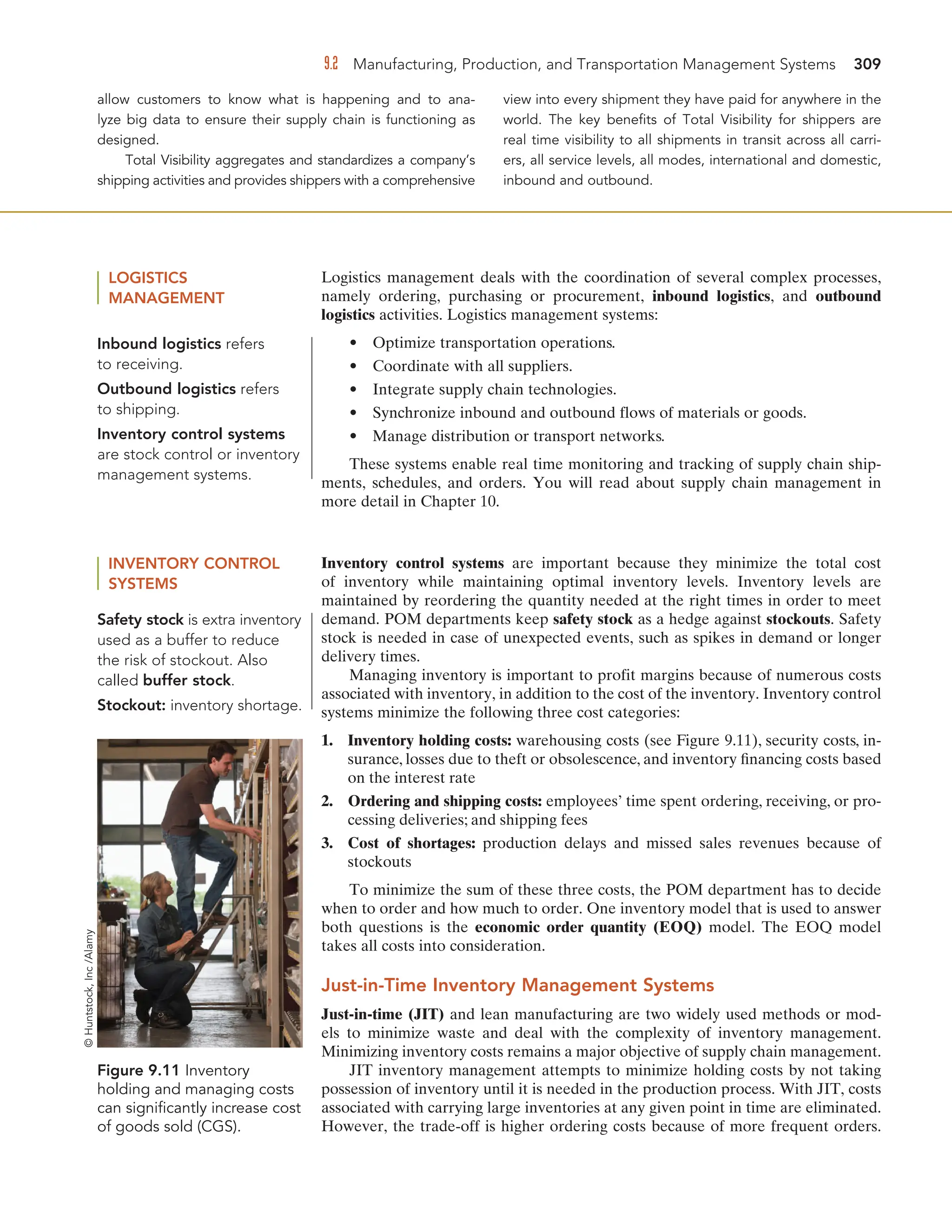
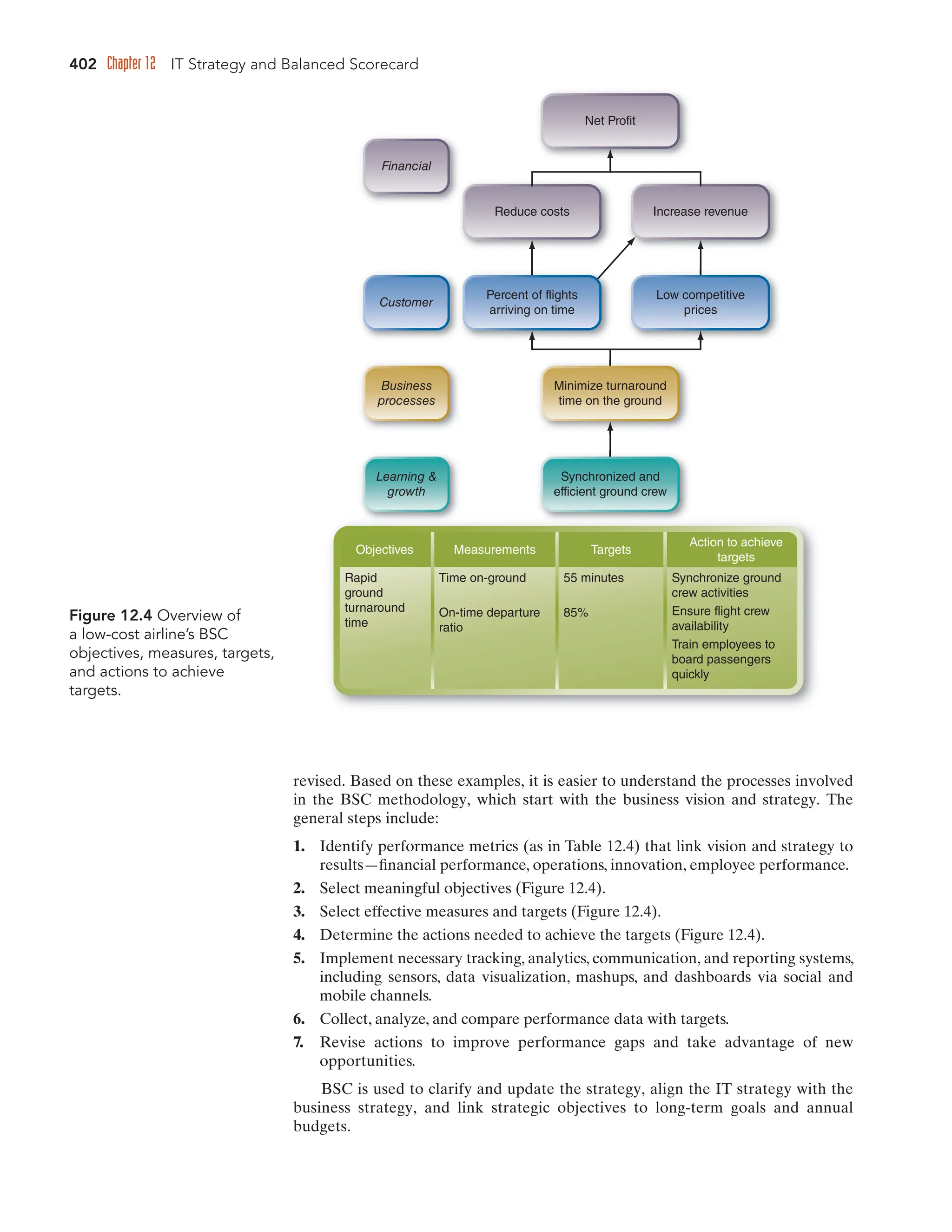
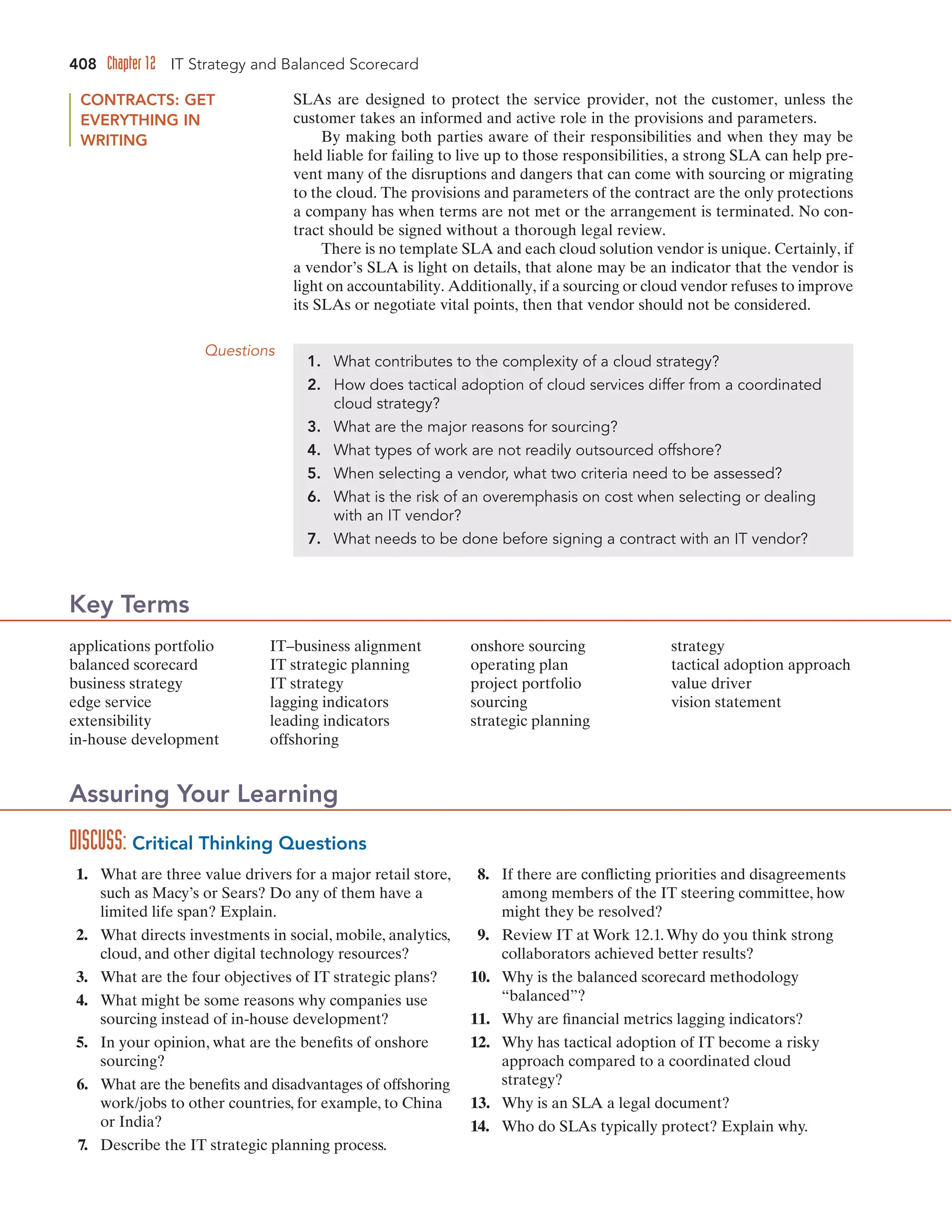
www.Ebook777.com
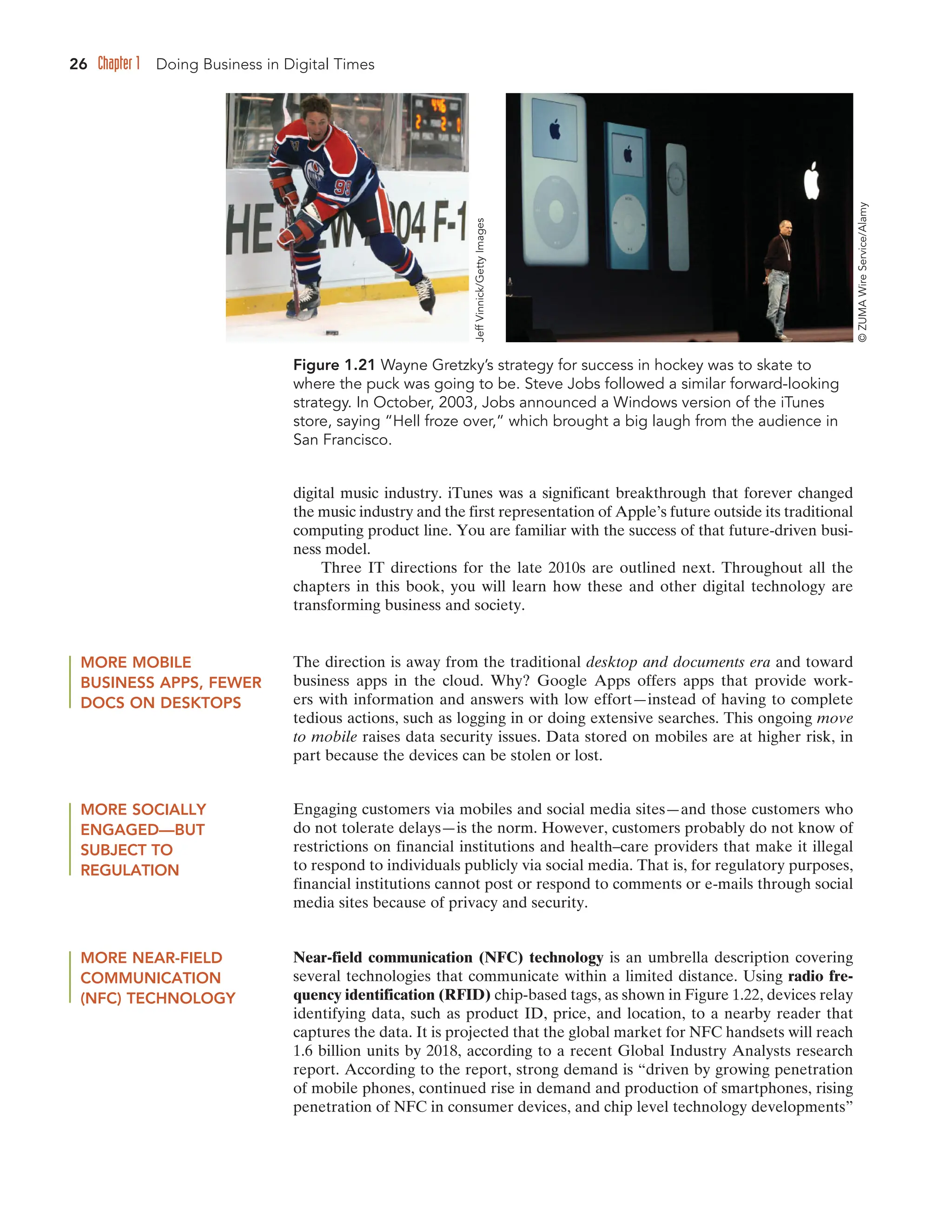
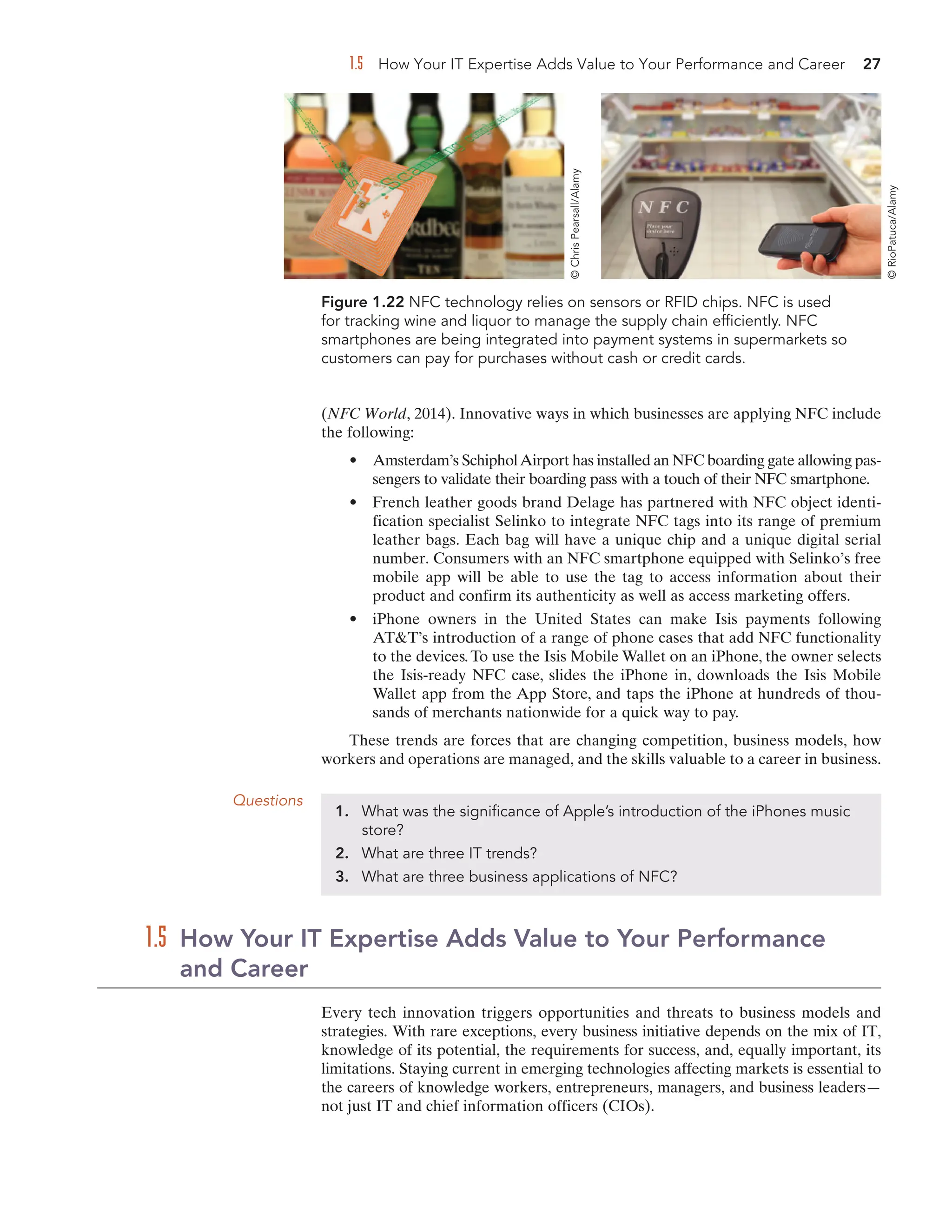
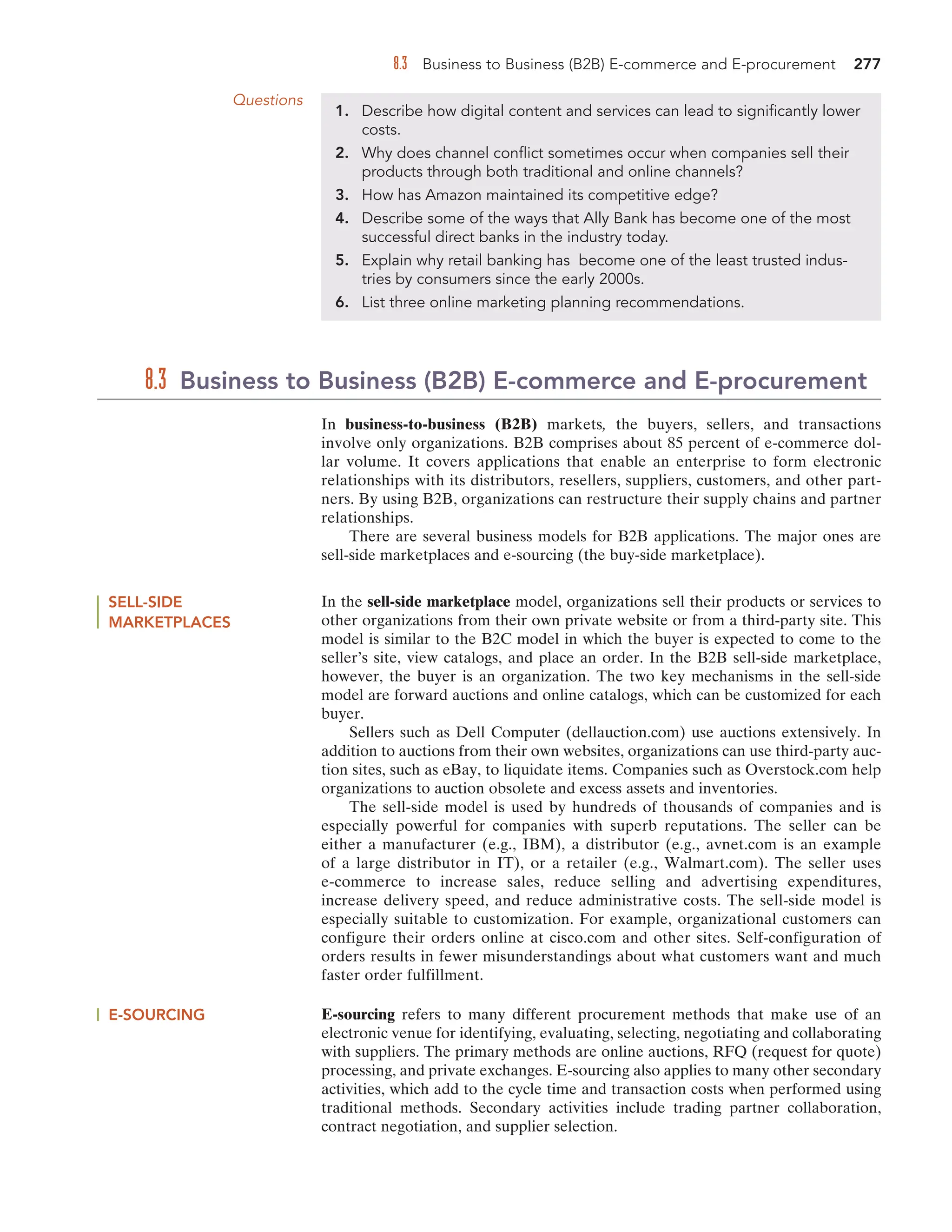
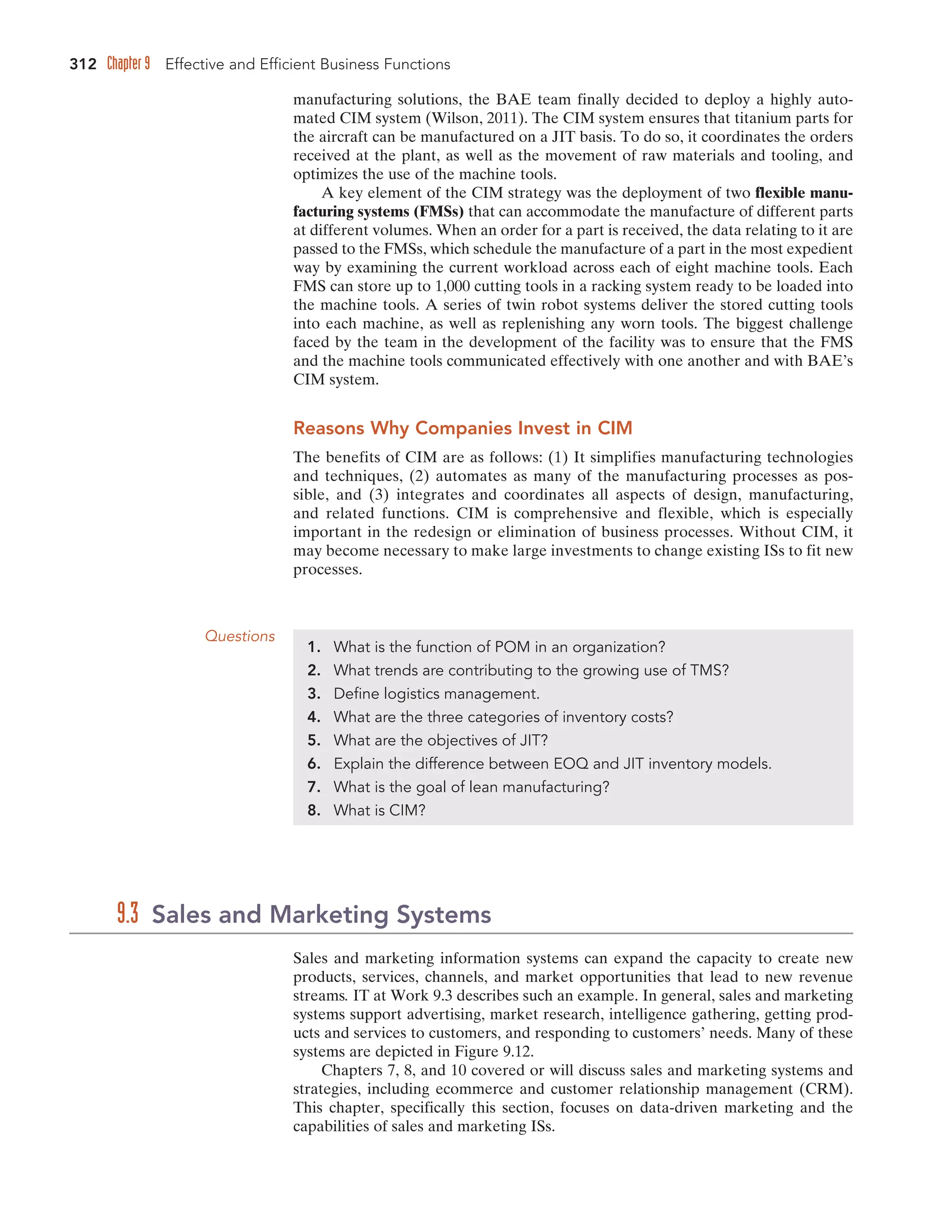
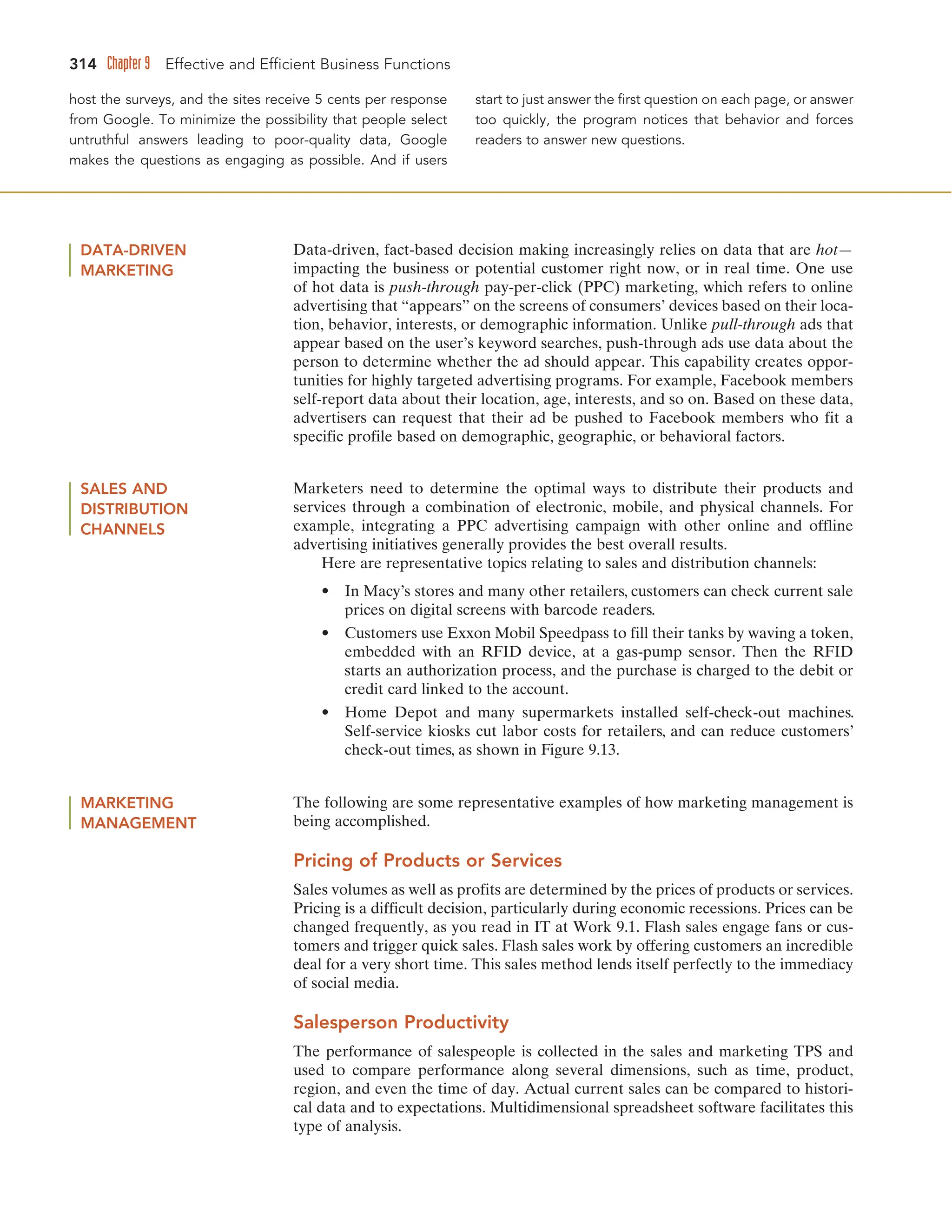
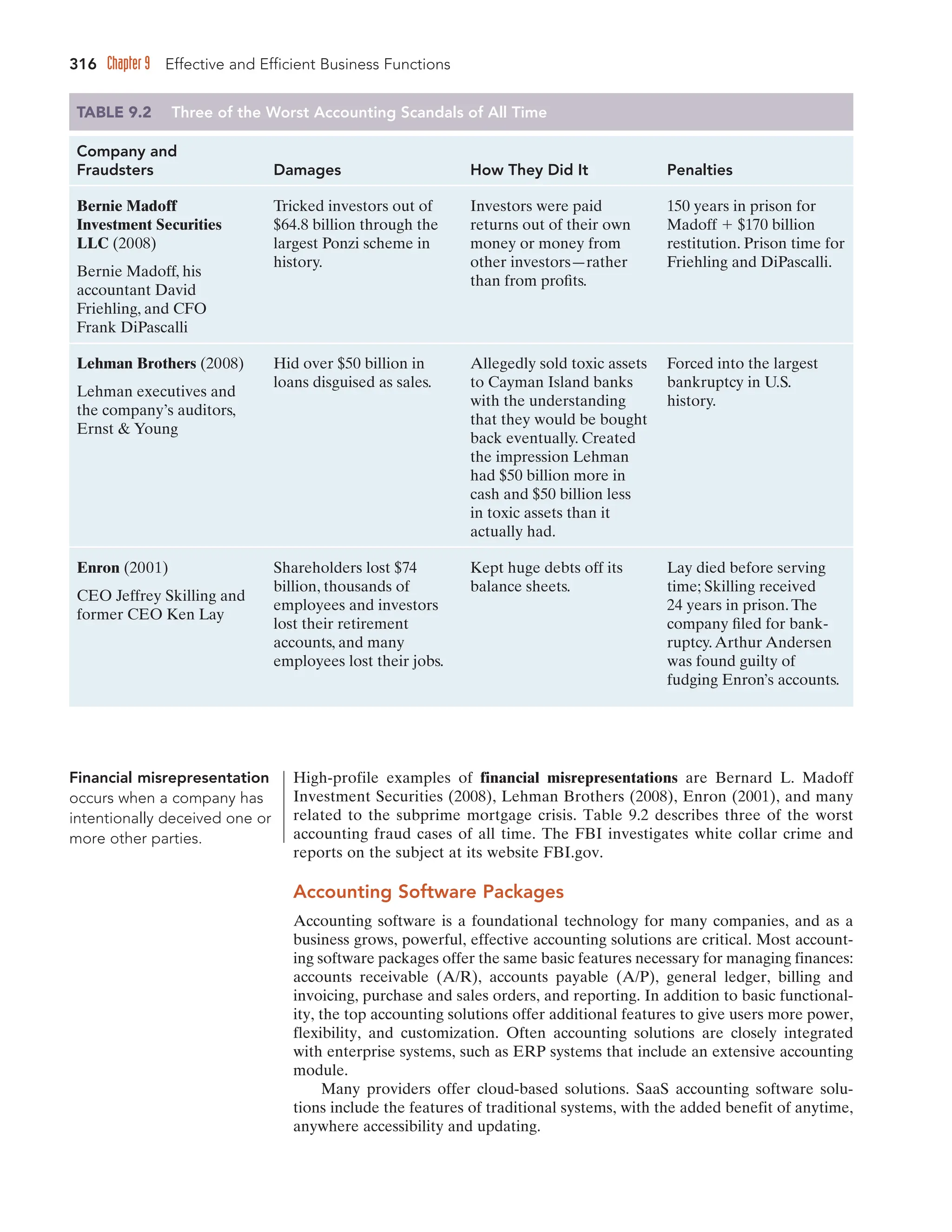
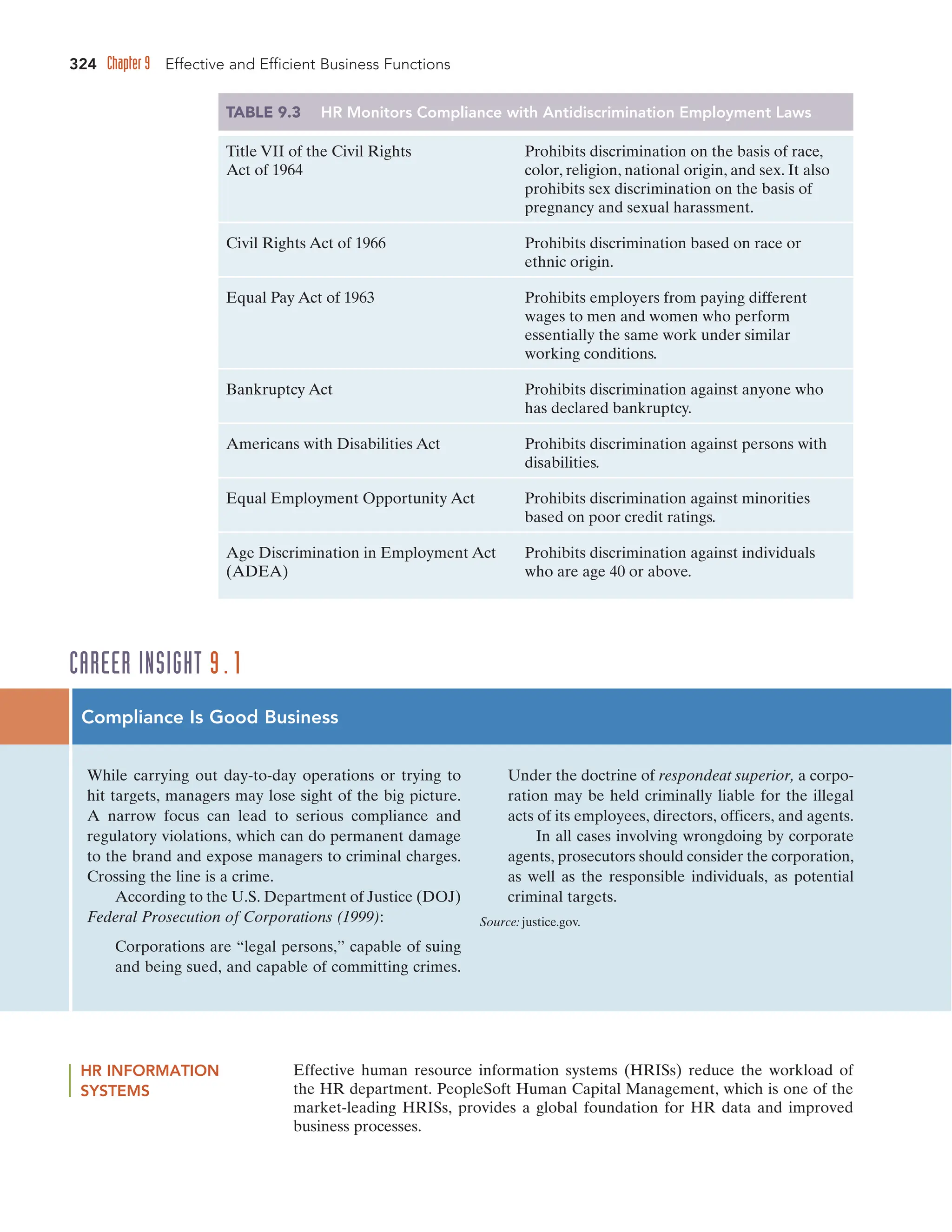
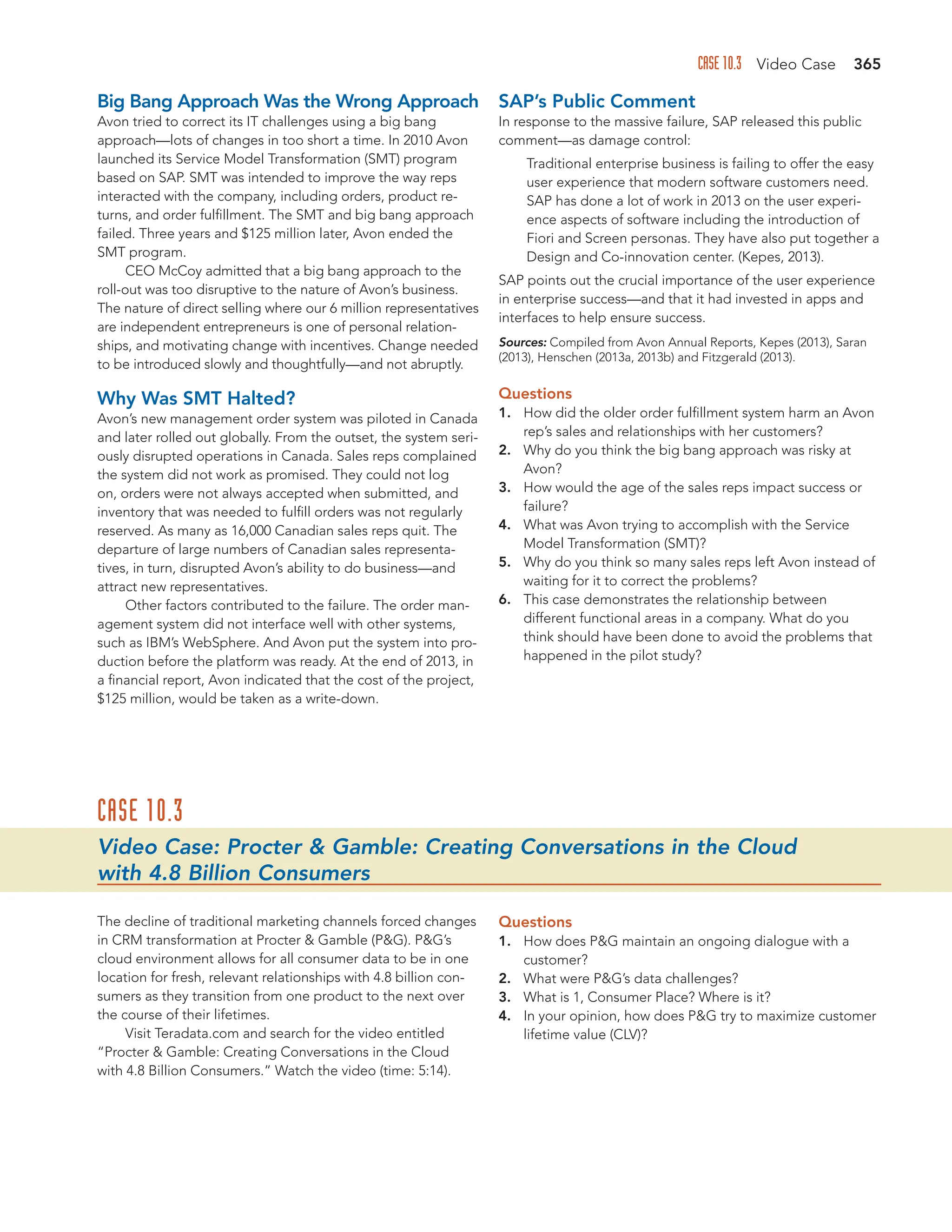
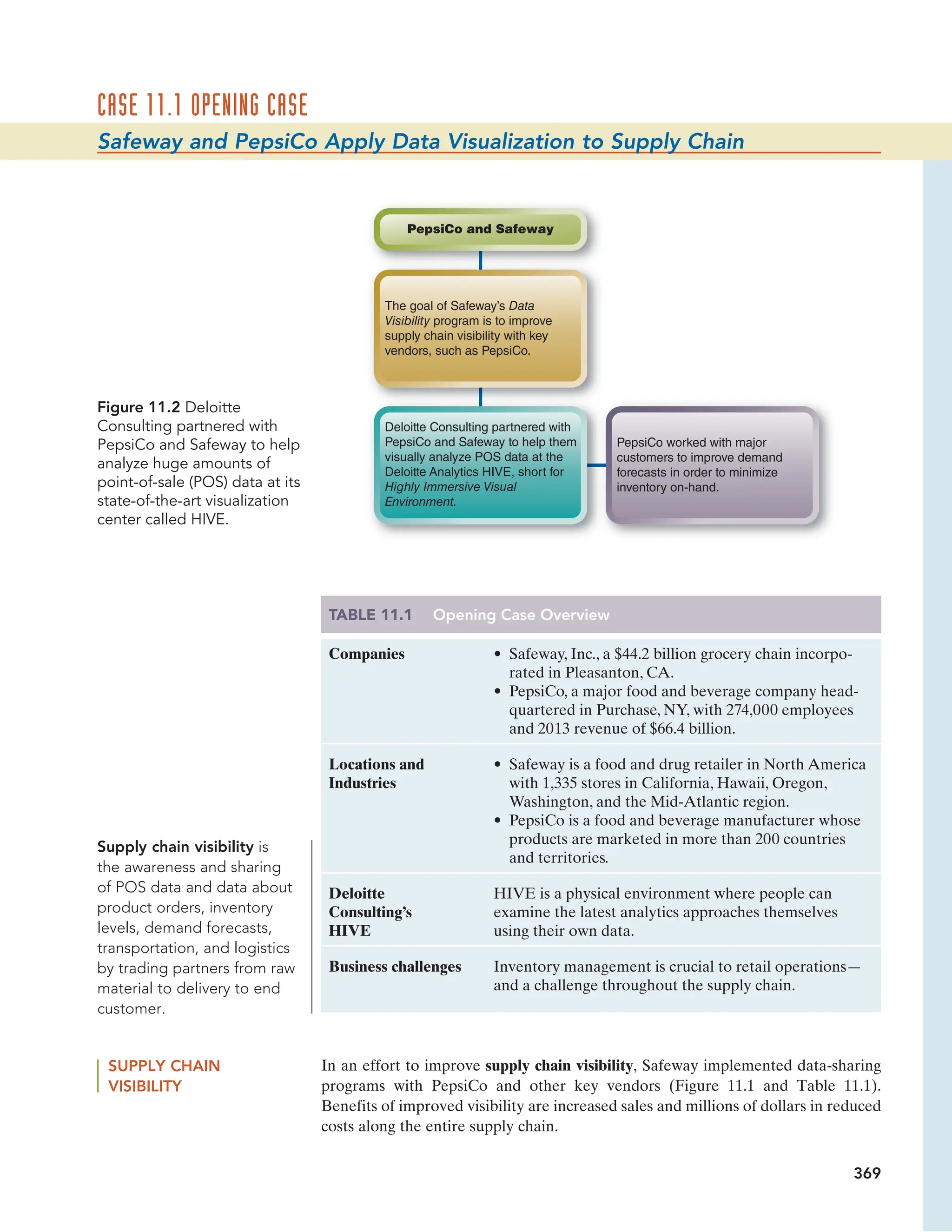
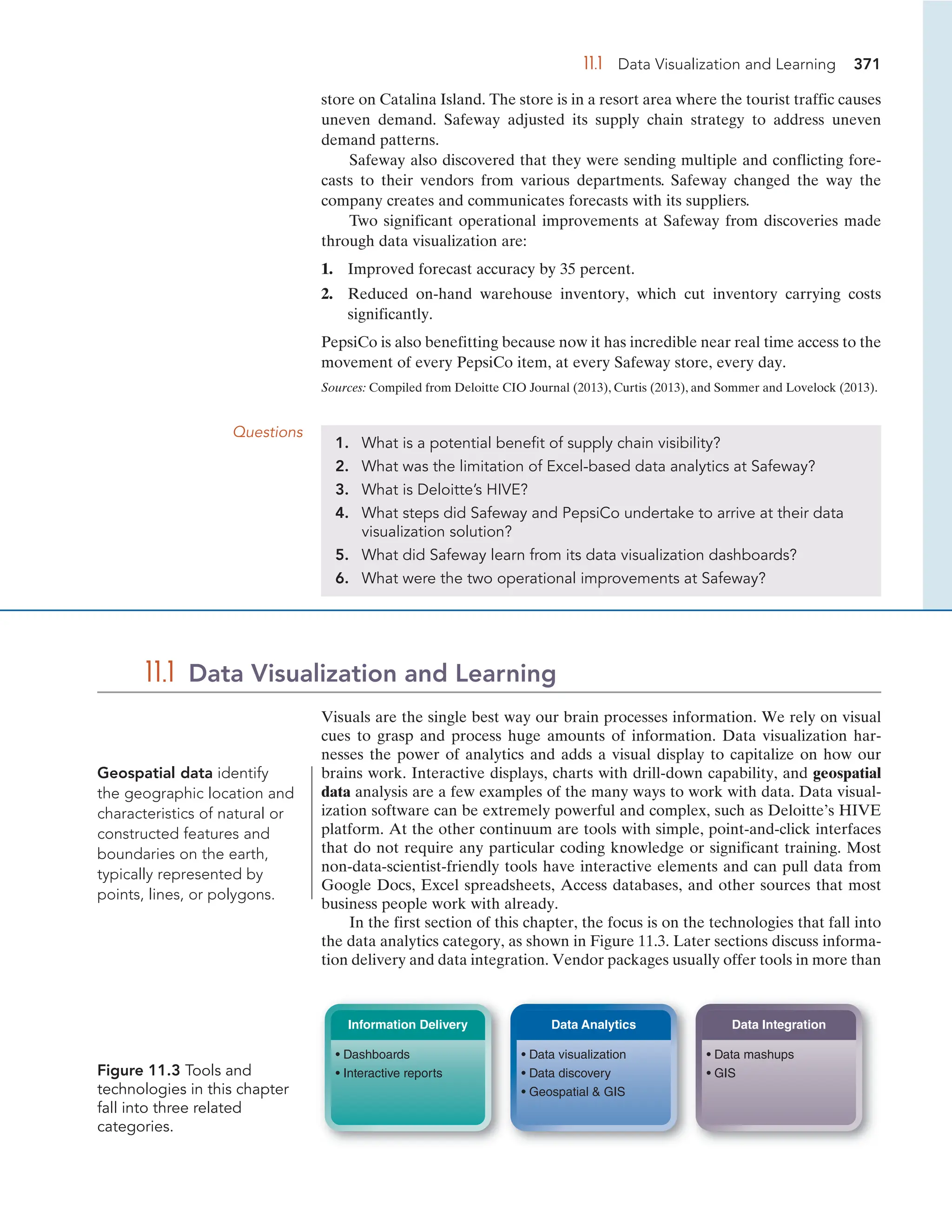
Free ebooks ==> www.Ebook777.com
www.Ebook777.com
Free ebooks ==> www.Ebook777.com
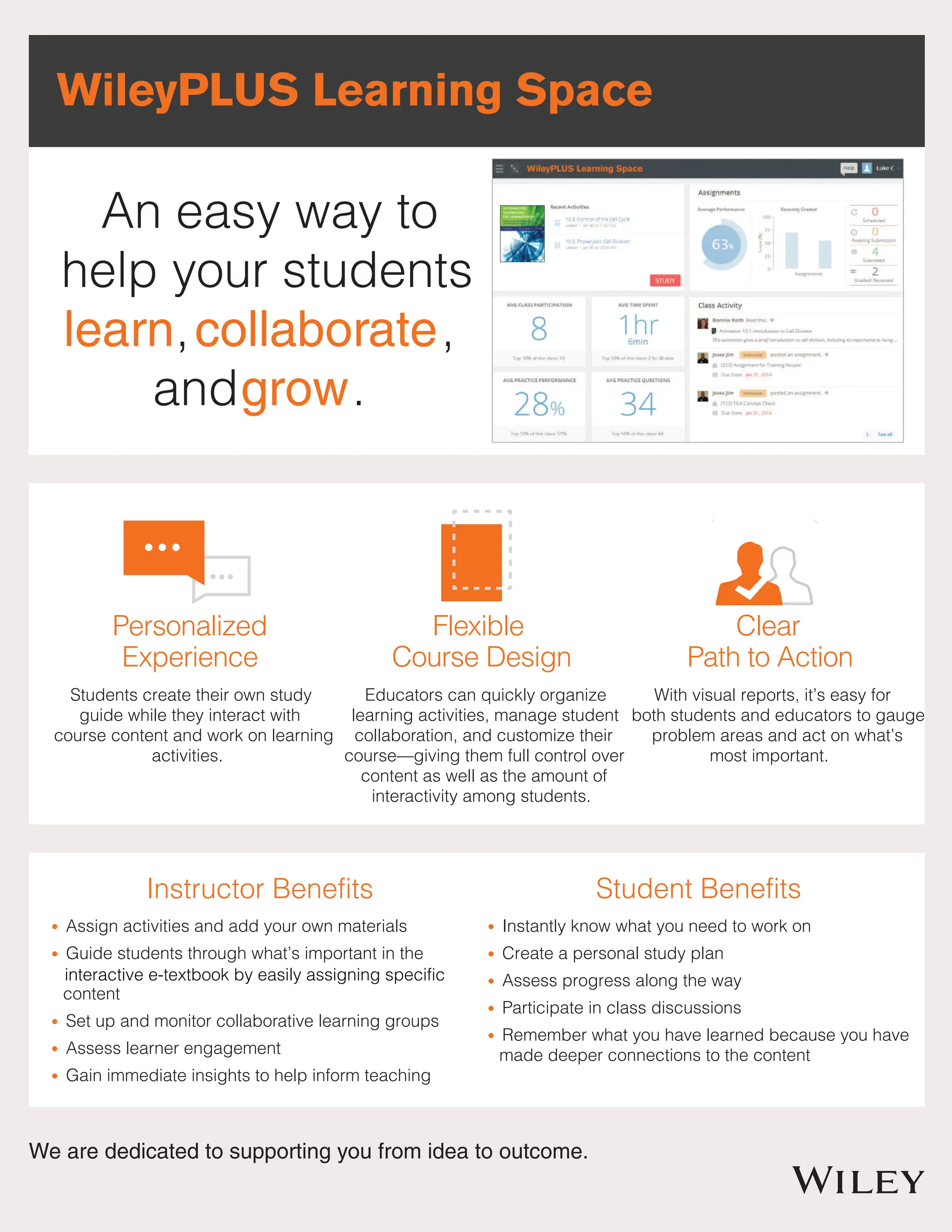
An easy way to
help your students
learn,collaborate,
andgrow.
We are dedicated to supporting you from idea to outcome.
Personalized
Experience
Students create their own study
guide while they interact with
course content and work on learning
activities.
Flexible
Course Design
Educators can quickly organize
learning activities, manage student
collaboration, and customize their
course—giving them full control over
content as well as the amount of
interactivity among students.
Clear
Path to Action
With visual reports, it’s easy for
both students and educators to gauge
problem areas and act on what’s
most important.
Assign activities and add your own materials
Guide students through what’s important in the
content
Set up and monitor collaborative learning groups
Assess learner engagement
Gain immediate insights to help inform teaching
Instantly know what you need to work on
Create a personal study plan
Assess progress along the way
Participate in class discussions
Remember what you have learned because you have
made deeper connections to the content
*OTUSVDUPS#FOFGJUT 4UVEFOU#FOFGJUT
JOUFSBDUJWFFUFYUCPPLCZFBTJMZBTTJHOJOHTQFDJGJD
Case 1-1 Opening Case iii
Information
Technology
for Management
Digital Strategies for Insight, Action,
and Sustainable Performance
10th
Edition
EFRAIM TURBAN
LINDA VOLONINO, Canisius College
GREGORY R. WOOD, Canisius College
Contributing authors:
JANICE C. SIPIOR, Villanova University
GUY H. GESSNER, Canisius College
www.Ebook777.com
Free ebooks == www.Ebook777.com
VP  EXECUTIVE PUBLISHER: Don Fowley
EXECUTIVE EDITOR: Beth Lang Golub
SPONSORING EDITOR: Mary O’Sullivan
PROJECT EDITOR: Ellen Keohane
ASSOCIATE EDITOR: Christina Volpe
MARKETING MANAGER: Margaret Barrett
MARKETING ASSISTANT: Elisa Wong
SENIOR CONTENT MANAGER: Ellinor Wagner
SENIOR PRODUCTION EDITOR: Ken Santor
SENIOR PHOTO EDITOR: Lisa Gee
DESIGNER: Kristine Carney
COVER DESIGNER Wendy Lai
COVER IMAGE © Ajgul/Shutterstock
This book was set by Aptara, Inc. Cover and text printed and bound by Courier Kendallville.
This book is printed on acid free paper.
Founded in 1807, John Wiley  Sons, Inc. has been a valued source of knowledge and understanding for more than 200 years, helping people
around the world meet their needs and fulfill their aspirations. Our company is built on a foundation of principles that include responsibility to
the communities we serve and where we live and work. In 2008, we launched a Corporate Citizenship Initiative, a global effort to address the
environmental, social, economic, and ethical challenges we face in our business. Among the issues we are addressing are carbon impact, paper
specifications and procurement, ethical conduct within our business and among our vendors, and community and charitable support. For more
information, please visit our website: www.wiley.com/go/citizenship.
Copyright © 2015, 2013, 2011, 2010 John Wiley  Sons, Inc. All rights reserved. No part of this publication may be reproduced, stored in a
retrieval system or transmitted in any form or by any means, electronic, mechanical, photocopying, recording, scanning or otherwise, except as
permitted under Sections 107 or 108 of the 1976 United States Copyright Act, without either the prior written permission of the Publisher, or
authorization through payment of the appropriate per-copy fee to the Copyright Clearance Center, Inc. 222 Rosewood Drive, Danvers, MA
01923, website www.copyright.com. Requests to the Publisher for permission should be addressed to the Permissions Department, John Wiley 
Sons, Inc., 111 River Street, Hoboken, NJ 07030-5774, (201)748-6011, fax (201)748-6008, website http://www.wiley.com/go/permissions.
Evaluation copies are provided to qualified academics and professionals for review purposes only, for use in their courses during the next
academic year. These copies are licensed and may not be sold or transferred to a third party. Upon completion of the review period, please
return the evaluation copy to Wiley. Return instructions and a free of charge return mailing label are available at www.wiley.com/go/returnlabel. If you
have chosen to adopt this textbook for use in your course, please accept this book as your complimentary desk copy. Outside of the
United States, please contact your local sales representative.
ISBN 978-1-118-89778-2
BRV ISBN 978-1-118-99429-0
Printed in the United States of America
10 9 8 7 6 5 4 3 2 1
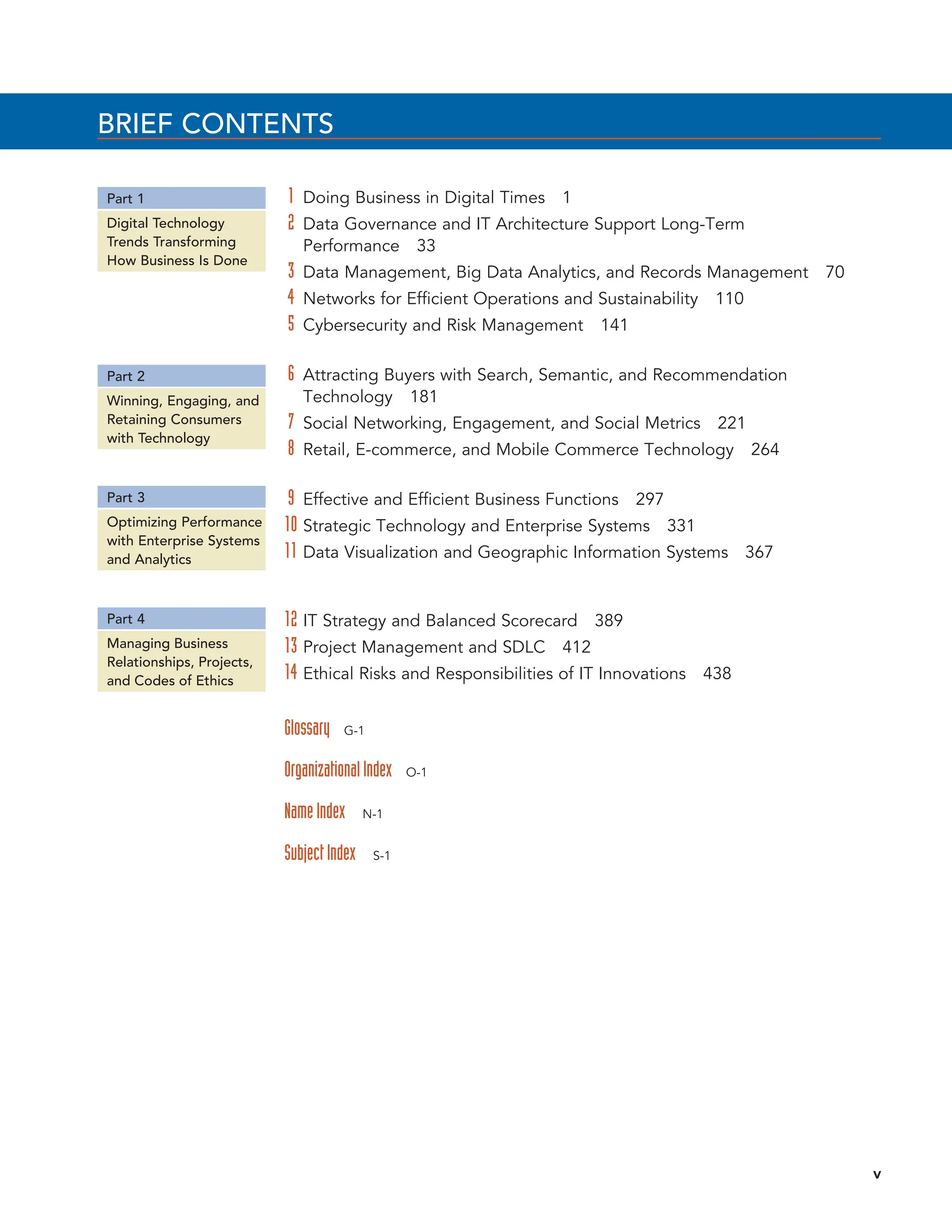
BRIEF CONTENTS
1 Doing Business in Digital Times 1
2 Data Governance and IT Architecture Support Long-Term
Performance 33
3 Data Management, Big Data Analytics, and Records Management 70
4 Networks for Efficient Operations and Sustainability 110
5 Cybersecurity and Risk Management 141
6 Attracting Buyers with Search, Semantic, and Recommendation
Technology 181
7 Social Networking, Engagement, and Social Metrics 221
8 Retail, E-commerce, and Mobile Commerce Technology 264
9 Effective and Efficient Business Functions 297
10 Strategic Technology and Enterprise Systems 331
11 Data Visualization and Geographic Information Systems 367
12 IT Strategy and Balanced Scorecard 389
13 Project Management and SDLC 412
14 Ethical Risks and Responsibilities of IT Innovations 438
Glossary G-1
OrganizationalIndex O-1
NameIndex N-1
SubjectIndex S-1
Part 1
Part 2
Part 3
Part 4
Digital Technology
Trends Transforming
How Business Is Done
Winning, Engaging, and
Retaining Consumers
with Technology
Optimizing Performance
with Enterprise Systems
and Analytics
Managing Business
Relationships, Projects,
and Codes of Ethics
v
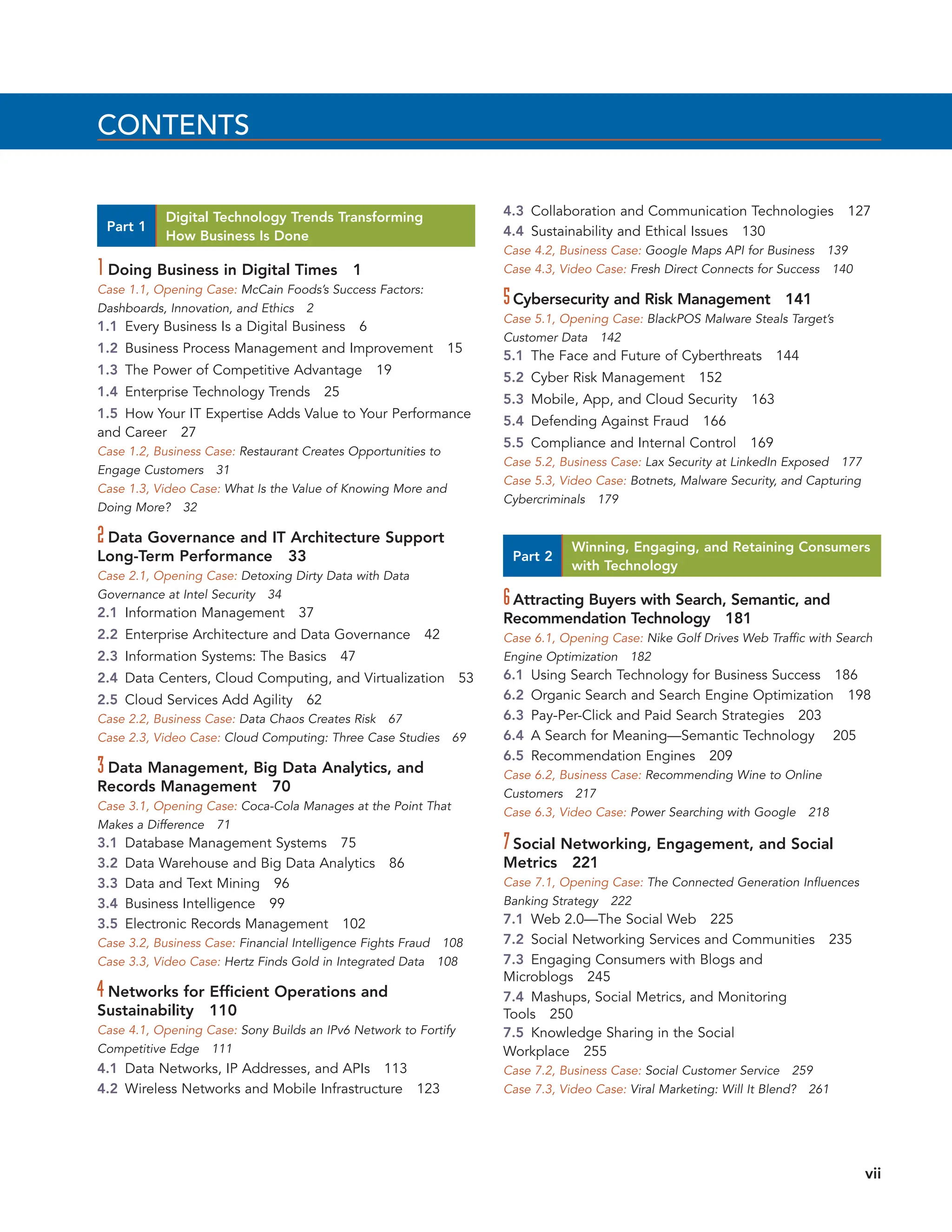
CONTENTS
Part 1
Digital Technology Trends Transforming
How Business Is Done
1 Doing Business in Digital Times 1
Case 1.1, Opening Case: McCain Foods’s Success Factors:
Dashboards, Innovation, and Ethics 2
1.1 Every Business Is a Digital Business 6
1.2 Business Process Management and Improvement 15
1.3 The Power of Competitive Advantage 19
1.4 Enterprise Technology Trends 25
1.5 How Your IT Expertise Adds Value to Your Performance
and Career 27
Case 1.2, Business Case: Restaurant Creates Opportunities to
Engage Customers 31
Case 1.3, Video Case: What Is the Value of Knowing More and
Doing More? 32
2 Data Governance and IT Architecture Support
Long-Term Performance 33
Case 2.1, Opening Case: Detoxing Dirty Data with Data
Governance at Intel Security 34
2.1 Information Management 37
2.2 Enterprise Architecture and Data Governance 42
2.3 Information Systems: The Basics 47
2.4 Data Centers, Cloud Computing, and Virtualization 53
2.5 Cloud Services Add Agility 62
Case 2.2, Business Case: Data Chaos Creates Risk 67
Case 2.3, Video Case: Cloud Computing: Three Case Studies 69
3 Data Management, Big Data Analytics, and
Records Management 70
Case 3.1, Opening Case: Coca-Cola Manages at the Point That
Makes a Difference 71
3.1 Database Management Systems 75
3.2 Data Warehouse and Big Data Analytics 86
3.3 Data and Text Mining 96
3.4 Business Intelligence 99
3.5 Electronic Records Management 102
Case 3.2, Business Case: Financial Intelligence Fights Fraud 108
Case 3.3, Video Case: Hertz Finds Gold in Integrated Data 108
4 Networks for Efficient Operations and
Sustainability 110
Case 4.1, Opening Case: Sony Builds an IPv6 Network to Fortify
Competitive Edge 111
4.1 Data Networks, IP Addresses, and APIs 113
4.2 Wireless Networks and Mobile Infrastructure 123
4.3 Collaboration and Communication Technologies 127
4.4 Sustainability and Ethical Issues 130
Case 4.2, Business Case: Google Maps API for Business 139
Case 4.3, Video Case: Fresh Direct Connects for Success 140
5Cybersecurity and Risk Management 141
Case 5.1, Opening Case: BlackPOS Malware Steals Target’s
Customer Data 142
5.1 The Face and Future of Cyberthreats 144
5.2 Cyber Risk Management 152
5.3 Mobile, App, and Cloud Security 163
5.4 Defending Against Fraud 166
5.5 Compliance and Internal Control 169
Case 5.2, Business Case: Lax Security at LinkedIn Exposed 177
Case 5.3, Video Case: Botnets, Malware Security, and Capturing
Cybercriminals 179
vii
Part 2
Winning, Engaging, and Retaining Consumers
with Technology
6Attracting Buyers with Search, Semantic, and
Recommendation Technology 181
Case 6.1, Opening Case: Nike Golf Drives Web Traffic with Search
Engine Optimization 182
6.1 Using Search Technology for Business Success 186
6.2 Organic Search and Search Engine Optimization 198
6.3 Pay-Per-Click and Paid Search Strategies 203
6.4 A Search for Meaning—Semantic Technology 205
6.5 Recommendation Engines 209
Case 6.2, Business Case: Recommending Wine to Online
Customers 217
Case 6.3, Video Case: Power Searching with Google 218
7Social Networking, Engagement, and Social
Metrics 221
Case 7.1, Opening Case: The Connected Generation Influences
Banking Strategy 222
7.1 Web 2.0—The Social Web 225
7.2 Social Networking Services and Communities 235
7.3 Engaging Consumers with Blogs and
Microblogs 245
7.4 Mashups, Social Metrics, and Monitoring
Tools 250
7.5 Knowledge Sharing in the Social
Workplace 255
Case 7.2, Business Case: Social Customer Service 259
Case 7.3, Video Case: Viral Marketing: Will It Blend? 261
8Retail, E-commerce, and Mobile Commerce
Technology 264
Case 8.1, Opening Case: Macy’s Races Ahead with Mobile Retail
Strategies 265
8.1 Retailing Technology 268
8.2 Business to Consumer (B2C) E-commerce 271
8.3 Business to Business (B2B) E-commerce and
E-procurement 277
8.4 Mobile Commerce 279
8.5 Mobile Transactions and Financial Services 286
Case 8.2, Business Case: Chegg’s Mobile Strategy 293
Case 8.3, Video Case: Searching with Pictures Using MVS 294
11.4 Geospatial Data and Geographic Information
Systems 384
Case 11.2, Visualization Case: Are You Ready for Football? 387
Case 11.3, Video Case: The Beauty of Data Visualization 387
viii Contents
Part 3
Optimizing Performance with Enterprise
Systems and Analytics
9Effective and Efficient Business Functions 297
Case 9.1, Opening Case: Ducati Redesigns Its Operations 299
9.1 Solving Business Challenges at All Management
Levels 302
9.2 Manufacturing, Production, and Transportation
Management Systems 306
9.3 Sales and Marketing Systems 312
9.4 Accounting, Finance, and Regulatory Systems 315
9.5 Human Resources Systems, Compliance,
and Ethics 323
Case 9.2, Business Case: HSBC Combats Fraud in Split-second
Decisions 329
Case 9.3, Video Case: United Rentals Optimizes Its Workforce with
Human Capital Management 330
10Strategic Technology and Enterprise
Systems 331
Case 10.1, Opening Case: Strategic Technology Trend—
3D Printing 332
10.1 Enterprise Systems 337
10.2 Enterprise Social Platforms 341
10.3 Enterprise Resource Planning Systems 346
10.4 Supply Chain Management Systems 352
10.5 Customer Relationship Management Systems 358
Case 10.2, Business Case: Avon’s Failed SAP Implementation:
Enterprise System Gone Wrong 364
Case 10.3, Video Case: Procter  Gamble: Creating Conversations
in the Cloud with 4.8 Billion Consumers 365
11Data Visualization and Geographic Information
Systems 367
Case 11.1, Opening Case: Safeway and PepsiCo Apply Data
Visualization to Supply Chain 369
11.1 Data Visualization and Learning 371
11.2 Enterprise Data Mashups 377
11.3 Digital Dashboards 380
Part 4
Managing Business Relationships, Projects,
and Codes of Ethics
12IT Strategy and Balanced Scorecard 389
Case 12.1, Opening Case: Intel’s IT Strategic Planning
Process 390
12.1 IT Strategy and the Strategic Planning
Process 392
12.2 Aligning IT with Business Strategy 397
12.3 Balanced Scorecard 400
12.4 IT Sourcing and Cloud Strategy 403
Case 12.2, Business Case: AstraZeneca Terminates $1.4B
Outsourcing Contract with IBM 409
Case 12.3, Data Analysis: Third-Party versus Company-Owned
Offshoring 410
13Project Management and SDLC 412
Case 13.1, Opening Case: Keeping Your Project on Track, Knowing
When It Is Doomed, and DIA Baggage System Failure 413
13.1 Project Management Concepts 417
13.2 Project Planning, Execution, and Budget 421
13.3 Project Monitoring, Control, and Closing 428
13.4 System Development Life Cycle 432
Case 13.2, Business Case: Steve Jobs’ Shared Vision Project
Management Style 436
Case 13.3, Demo Case: Mavenlink Project Management and
Planning Software 437
14Ethical Risks and Responsibilities of IT
Innovations 438
Case 14.1, Opening Case: Google Glass and Risk, Privacy, and
Piracy Challenges 439
14.1 Privacy Paradox, Privacy, and Civil Rights 442
14.2 Responsible Conduct 448
14.3 Technology Addictions and the Emerging Trend of
Focus Management 453
14.4 Six Technology Trends Transforming Business 454
Case 14.2, Business Case: Apple’s CarPlay Gets
Intelligent 458
Case 14.3, Video Case: Vehicle-to-Vehicle Technology to Prevent
Collisions 459
Glossary G-1
OrganizationalIndex O-1
NameIndex N-1
SubjectIndex S-1
www.Ebook777.com
Free ebooks == www.Ebook777.com
Business strategy and operations are driven by data, digi-
tal technologies, and devices. Five years from now, we will
look back upon today as the start of a new era in business
and technology. Just like the way e-business started with
the emergence of the Web, this new era is created by the
convergence of social, mobile, big data, analytics, cloud,
sensor, software-as-a-service, and data visualization tech-
nologies. These technologies enable real-time insights,
business decisions, and actions. Examples of how they
determine tomorrow’s business outcomes are:
• Insight. Combining the latest capabilities in big
data analytics, reporting, collaboration, search, and
machine-to-machine (M2M) communication helps
enterprises build an agility advantage, cut costs, and
achieve their visions.
• Action. Fully leveraging real-time data about opera-
tions, supply chains, and customers enables managers
to make decisions and take action in the moment.
• Sustainable performance. Deploying cloud services,
managing projects and sourcing agreements, respect-
ing privacy and the planet, and engaging customers
across channels are now fundamental to sustaining
business growth.
• Business optimization. Embedding digital capability
into products, services, machines, and business pro-
cesses optimizes business performance—and creates
strategic weapons.
In this tenth edition, students learn, explore, and analyze
the three dimensions of business performance improve-
ment: digital technology, business processes, and people.
What Is New in the Tenth
Edition—and Why It Matters
Most Relevant Content. Prior to and during the writing
process, we attended practitioner conferences and con-
sulted with managers who are hands-on users of leading
technologies,vendors,and IT professionals to learn about
their IT/business successes, challenges, experiences, and
recommendations. For example, during an in-person
interview with a Las Vegas pit boss, we learned how
real-time monitoring and data analytics recommend
the minimum bets in order to maximize revenue per
minute at gaming tables. Experts outlined opportunities
and strategies to leverage cloud services and big data
PREFACE
to capture customer loyalty and wallet share and justify
significant investments in leading IT.
More Project Management with Templates. In response
to reviewers’ requests, we have greatly increased cover-
age of project management and systems development
lifecycle (SDLC).Students are given templates for writing
a project business case, statement of work (SOW), and
work breakdown structure (WBS). Rarely covered, but
critical project management issues included in this edition
are project post-mortem, responsibility matrix, go/no go
decision factors, and the role of the user community.
New Technologies and Expanded Topics. New to this
edition are 3D printing and bioprinting, project portfolio
management, the privacy paradox, IPv6, outsource rela-
tionship management (ORM), and balanced scorecard.
With more purchases and transactions starting online
and attention being a scarce resource, students learn how
search,semantic,and recommendation technologies func-
tion to improve revenue. The value of Internet of Things
(IoT) has grown significantly as a result of the compound
impact of connecting people, processes, data, and things.
Easier to Grasp Concepts. A lot of effort went into mak-
ing learning easier and longer-lasting by outlining content
with models and text graphics for each opening case (our
version of infographics) as shown in Figure P-1—from the
Chapter 12 opening case.
Engaging Students to
Assure Learning
The tenth edition of Information Technology for
Management engages students with up-to-date cover-
age of the most important IT trends today. Over the
years, this IT textbook had distinguished itself with an
emphasis on illustrating the use of cutting edge business
technologies for achieving managerial goals and objec-
tives.The tenth edition continues this tradition with more
hands-on activities and analyses.
Each chapter contains numerous case studies and
real world examples illustrating how businesses increase
productivity, improve efficiency, enhance communica-
tion and collaboration, and gain a competitive edge
through the use of ITs. Faculty will appreciate a variety
of options for reinforcing student learning, that include
three Case Studies per chapter, including an opening
case, a business case and a video case.
ix
x Preface
Throughout each chapter are various learning aids,
which include the following:
• Learning Outcomes are listed at the beginning of each
chapter to help students focus their efforts and alert
them to the important concepts that will be discussed.
• The Chapter Snapshot provides students with an over-
view of the chapter content.
• IT at Work boxes spotlight real-world cases and inno-
vative uses of IT.
• Definitions of Key Terms appear in the margins
throughout the book.
• Tech Note boxes explore topics such as “4G and
5G Networks in 2018” and “Data transfers to main-
frames.”
• Career Insight boxes highlight different jobs in the IT
for management field.
At the end of each chapter are a variety of features
designed to assure student learning:
• Critical Thinking Questions are designed to facilitate
student discussion.
• Online and Interactive Exercises encourage students
to explore additional topics.
• Analyze and Decide questions help students apply IT
concepts to business decisions.
Details of New and Enhanced
Features of the Tenth Edition
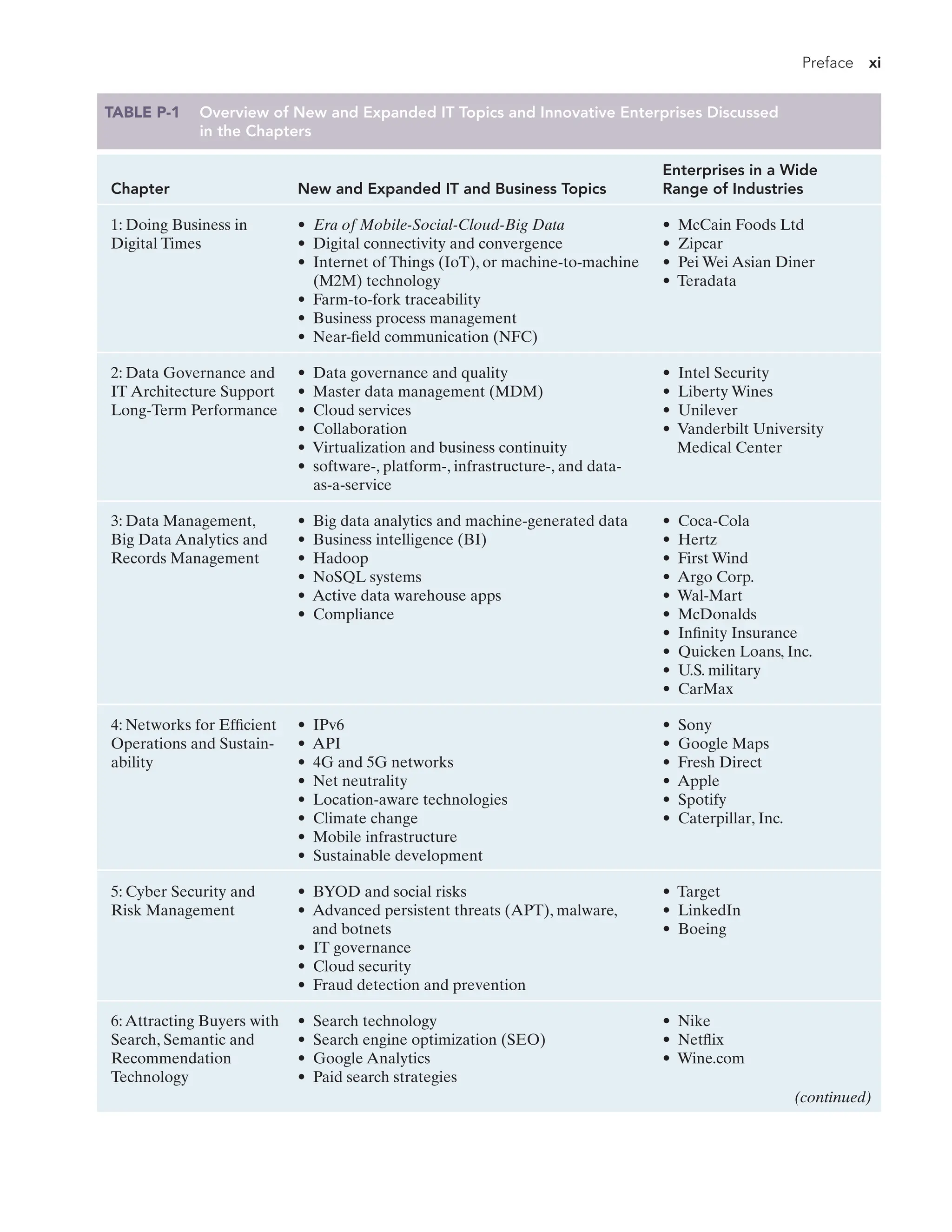
The textbook consists of fourteen chapters organized
into four parts. All chapters have new sections as well as
updated sections, as shown in Table P-1.
Strategic
directional
statements
Strategic
plan
gic
egic
2.Technology  Business Outlook. A team of
senior management, IT, and business unit
representatives develop the two-to-five-year
business outlook  technology outlook.
3. Current State Assessment  Gap Analysis.
Analysis of the current state of IT, enterprise
systems,  processes, which are compared with
results of step 2 to identify gaps and necessary
adjustments to IT investment plans.
4. Strategic Imperatives, Strategies,  Budget for
Next Year. Develop next year’s priorities, road
map, budget,  investment plan. Annual budget
approved.
5. Governance Decisions  IT Road Map. The
budget guides the governance process, including
supplier selection and sourcing.
6. Balanced Scorecard Reviews.
Performance is measured monthly.
1. Enterprise Vision. Senior management 
leaders develop  communicate the enterprise’s
two-to-five-year strategic vision  mission and
identify the direction  focus for upcoming year.
Figure P-1 Model of Intel’s
6-step IT strategic planning
process, from Chapter 12.
Preface xi
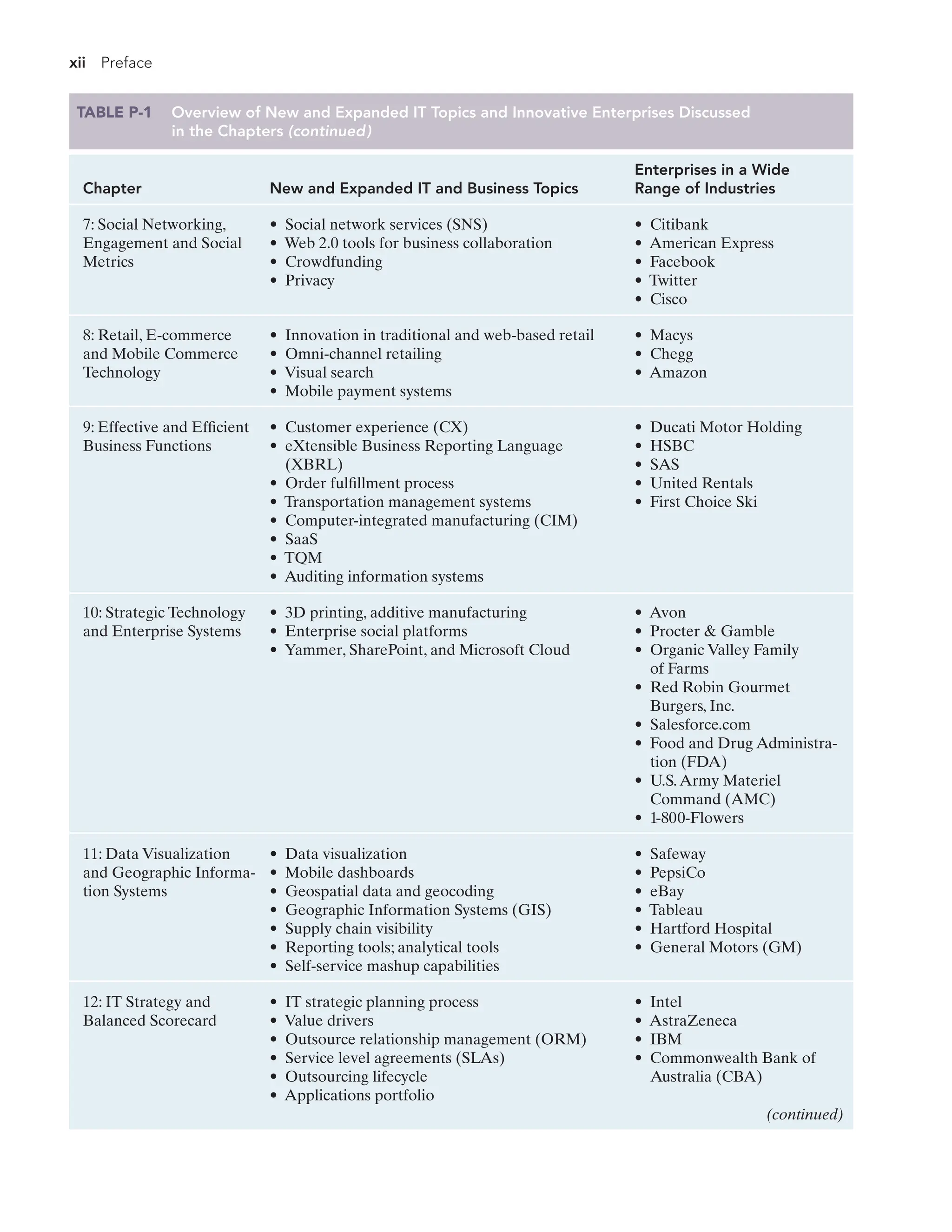
TABLE P-1 Overview of New and Expanded IT Topics and Innovative Enterprises Discussed
in the Chapters
Chapter New and Expanded IT and Business Topics
Enterprises in a Wide
Range of Industries
1: Doing Business in
Digital Times
• Era of Mobile-Social-Cloud-Big Data
• Digital connectivity and convergence
• Internet of Things (IoT), or machine-to-machine
(M2M) technology
• Farm-to-fork traceability
• Business process management
• Near-field communication (NFC)
• McCain Foods Ltd
• Zipcar
• Pei Wei Asian Diner
• Teradata
2: Data Governance and
IT Architecture Support
Long-Term Performance
• Data governance and quality
• Master data management (MDM)
• Cloud services
• Collaboration
• Virtualization and business continuity
• software-, platform-, infrastructure-, and data-
as-a-service
• Intel Security
• Liberty Wines
• Unilever
• Vanderbilt University
Medical Center
3: Data Management,
Big Data Analytics and
Records Management
• Big data analytics and machine-generated data
• Business intelligence (BI)
• Hadoop
• NoSQL systems
• Active data warehouse apps
• Compliance
• Coca-Cola
• Hertz
• First Wind
• Argo Corp.
• Wal-Mart
• McDonalds
• Infinity Insurance
• Quicken Loans, Inc.
• U.S. military
• CarMax
4: Networks for Efficient
Operations and Sustain-
ability
• IPv6
• API
• 4G and 5G networks
• Net neutrality
• Location-aware technologies
• Climate change
• Mobile infrastructure
• Sustainable development
• Sony
• Google Maps
• Fresh Direct
• Apple
• Spotify
• Caterpillar, Inc.
5: Cyber Security and
Risk Management
• BYOD and social risks
• Advanced persistent threats (APT), malware,
and botnets
• IT governance
• Cloud security
• Fraud detection and prevention
• Target
• LinkedIn
• Boeing
6:Attracting Buyers with
Search, Semantic and
Recommendation
Technology
• Search technology
• Search engine optimization (SEO)
• Google Analytics
• Paid search strategies
• Nike
• Netflix
• Wine.com
(continued)
xii Preface
TABLE P-1 Overview of New and Expanded IT Topics and Innovative Enterprises Discussed
in the Chapters (continued)
Chapter New and Expanded IT and Business Topics
Enterprises in a Wide
Range of Industries
7: Social Networking,
Engagement and Social
Metrics
• Social network services (SNS)
• Web 2.0 tools for business collaboration
• Crowdfunding
• Privacy
• Citibank
• American Express
• Facebook
• Twitter
• Cisco
8: Retail, E-commerce
and Mobile Commerce
Technology
• Innovation in traditional and web-based retail
• Omni-channel retailing
• Visual search
• Mobile payment systems
• Macys
• Chegg
• Amazon
9: Effective and Efficient
Business Functions
• Customer experience (CX)
• eXtensible Business Reporting Language
(XBRL)
• Order fulfillment process
• Transportation management systems
• Computer-integrated manufacturing (CIM)
• SaaS
• TQM
• Auditing information systems
• Ducati Motor Holding
• HSBC
• SAS
• United Rentals
• First Choice Ski
10: Strategic Technology
and Enterprise Systems
• 3D printing, additive manufacturing
• Enterprise social platforms
• Yammer, SharePoint, and Microsoft Cloud
• Avon
• Procter  Gamble
• Organic Valley Family
of Farms
• Red Robin Gourmet
Burgers, Inc.
• Salesforce.com
• Food and Drug Administra-
tion (FDA)
• U.S.Army Materiel
Command (AMC)
• 1-800-Flowers
11: Data Visualization
and Geographic Informa-
tion Systems
• Data visualization
• Mobile dashboards
• Geospatial data and geocoding
• Geographic Information Systems (GIS)
• Supply chain visibility
• Reporting tools; analytical tools
• Self-service mashup capabilities
• Safeway
• PepsiCo
• eBay
• Tableau
• Hartford Hospital
• General Motors (GM)
12: IT Strategy and
Balanced Scorecard
• IT strategic planning process
• Value drivers
• Outsource relationship management (ORM)
• Service level agreements (SLAs)
• Outsourcing lifecycle
• Applications portfolio
• Intel
• AstraZeneca
• IBM
• Commonwealth Bank of
Australia (CBA)
(continued)
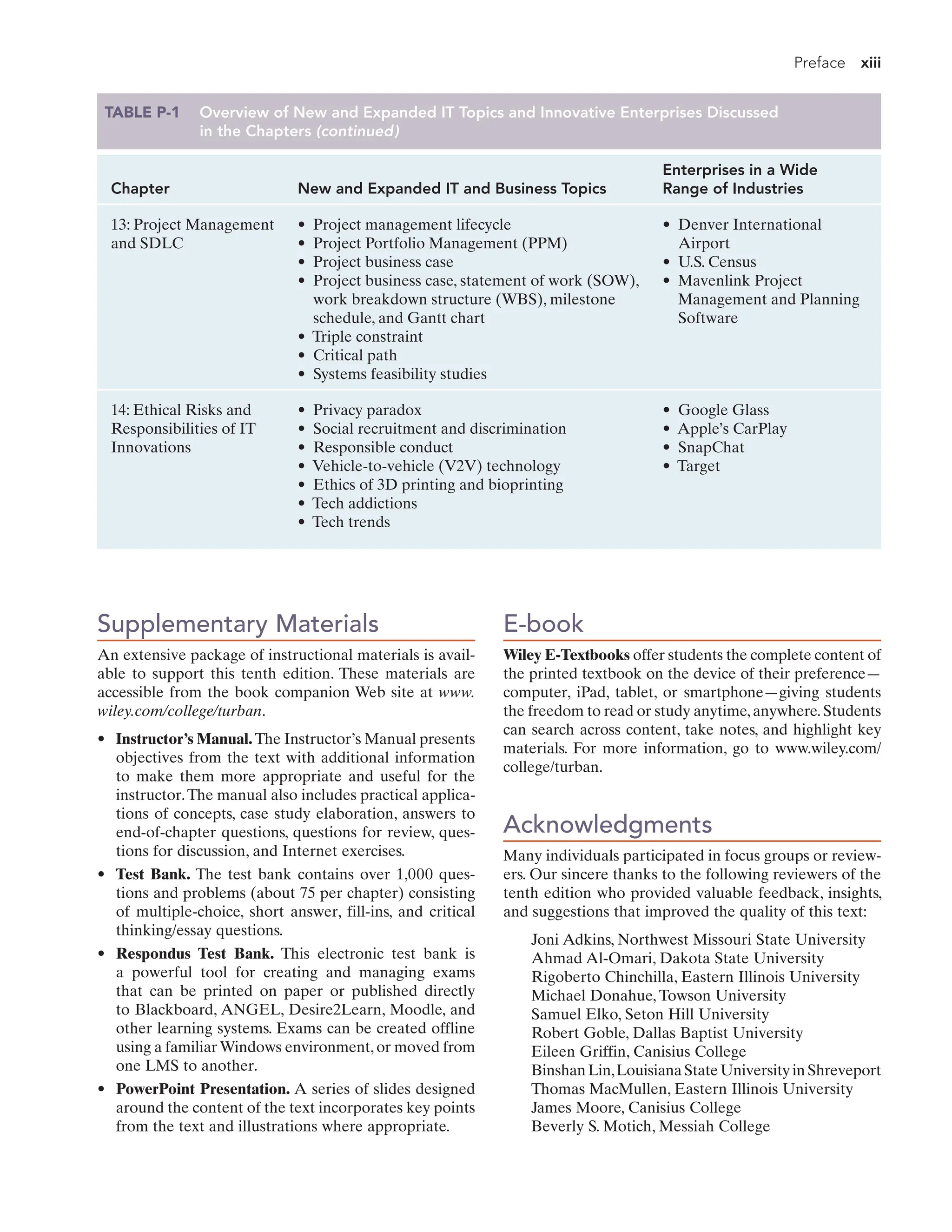
Preface xiii
TABLE P-1 Overview of New and Expanded IT Topics and Innovative Enterprises Discussed
in the Chapters (continued)
Chapter New and Expanded IT and Business Topics
Enterprises in a Wide
Range of Industries
13: Project Management
and SDLC
• Project management lifecycle
• Project Portfolio Management (PPM)
• Project business case
• Project business case, statement of work (SOW),
work breakdown structure (WBS), milestone
schedule, and Gantt chart
• Triple constraint
• Critical path
• Systems feasibility studies
• Denver International
Airport
• U.S. Census
• Mavenlink Project
Management and Planning
Software
14: Ethical Risks and
Responsibilities of IT
Innovations
• Privacy paradox
• Social recruitment and discrimination
• Responsible conduct
• Vehicle-to-vehicle (V2V) technology
• Ethics of 3D printing and bioprinting
• Tech addictions
• Tech trends
• Google Glass
• Apple’s CarPlay
• SnapChat
• Target
Supplementary Materials
An extensive package of instructional materials is avail-
able to support this tenth edition. These materials are
accessible from the book companion Web site at www.
wiley.com/college/turban.
• Instructor’s Manual. The Instructor’s Manual presents
objectives from the text with additional information
to make them more appropriate and useful for the
instructor.The manual also includes practical applica-
tions of concepts, case study elaboration, answers to
end-of-chapter questions, questions for review, ques-
tions for discussion, and Internet exercises.
• Test Bank. The test bank contains over 1,000 ques-
tions and problems (about 75 per chapter) consisting
of multiple-choice, short answer, fill-ins, and critical
thinking/essay questions.
• Respondus Test Bank. This electronic test bank is
a powerful tool for creating and managing exams
that can be printed on paper or published directly
to Blackboard, ANGEL, Desire2Learn, Moodle, and
other learning systems. Exams can be created offline
using a familiarWindows environment,or moved from
one LMS to another.
• PowerPoint Presentation. A series of slides designed
around the content of the text incorporates key points
from the text and illustrations where appropriate.
E-book
Wiley E-Textbooks offer students the complete content of
the printed textbook on the device of their preference—
computer, iPad, tablet, or smartphone—giving students
the freedom to read or study anytime,anywhere.Students
can search across content, take notes, and highlight key
materials. For more information, go to www.wiley.com/
college/turban.
Acknowledgments
Many individuals participated in focus groups or review-
ers. Our sincere thanks to the following reviewers of the
tenth edition who provided valuable feedback, insights,
and suggestions that improved the quality of this text:
Joni Adkins, Northwest Missouri State University
Ahmad Al-Omari, Dakota State University
Rigoberto Chinchilla, Eastern Illinois University
Michael Donahue, Towson University
Samuel Elko, Seton Hill University
Robert Goble, Dallas Baptist University
Eileen Griffin, Canisius College
BinshanLin,LouisianaStateUniversityinShreveport
Thomas MacMullen, Eastern Illinois University
James Moore, Canisius College
Beverly S. Motich, Messiah College
xiv Preface
Barin Nag, Towson University
Luis A. Otero, Inter-American University of Puerto
Rico, Metropolitan Campus
John Pearson, Southern Illinois University
Daniel Riding, Florida Institute of Technology
Josie Schneider, Columbia Southern University
Derek Sedlack, South University
Eric Weinstein, The University of La Verne
Patricia White, Columbia Southern University
Gene A.Wright, University of Wisconsin–Milwaukee
We are very thankful to our assistants, Samantha
Palisano and Olena Azarova. Samantha devoted many
hours of research, provided clerical support, and con-
tributed to the writing of Chapter 6. Olena assisted with
research and development of graphics for Chapter 7.
We are fortunate and thankful for the expert and encour-
aging leadership of Margaret Barrett, Beth Golub, Ellen
Keohane, and Mary O’Sullivan. To them we extend our
sincere thanks for your guidance, patience, humor, and
support during the development of this most recent ver-
sion of the book. Finally, we wish to thank our families
and colleagues for their encouragement, support, and
understanding as we dedicated time and effort to cre-
ating this new edition of Information Technology for
Management.
Linda Volonino
Greg Wood
Chapter Snapshot
Make no mistake. Businesses are experiencing a digital
transformation as digital technology enables changes
unimaginable a decade ago. High-performance organi-
zations are taking advantage of what is newly possible
from innovations in mobile, social, cloud, big data, data
analytics, and visualization technologies. These digital
forces enable unprecedented levels of connectivity, or
connectedness, as listed in Figure 1.1.
Think how much of your day you have your phone
nearby—and how many times you check it. Nearly
80 percent of people carry their phone for all but two
hours of their day; and 25 per cent of 18- to 44-year-olds
cannot remember not having their phone with them
(Cooper, 2013).
As a business leader, you will want to know what
steps to take to get a jump on the mobile, social, cloud,
Doing Business
in Digital Times
1
Chapter
1. Describe the use of digital technology in every facet of
business and how digital channels are being leveraged.
2. Explain the types, sources, characteristics, and control
of enterprise data, and what can be accomplished with
near real time data.
3. Identify the five forces of competitive advantage and
evaluate how they are reinforced by IT.
4. Describe enterprise technology trends and explain how
they influence strategy and operations.
5. Assess how IT adds value to your career path and per-
formance, and the positive outlook for IT management
careers.
Learning Outcomes
1
Digital Technology Trends Transforming
How Business Is Done
Part 1
Chapter Snapshot
Case 1.1 Opening Case: McCain Foods’ Success
Factors—Dashboards, Innovation, and Ethics
1.1 Every Business Is a Digital Business
1.2 Business Process Management and
Improvement
1.3 The Power of Competitive Advantage
1.4 Enterprise Technology Trends
1.5 How Your IT Expertise Adds Value to Your
Performance and Career
Key Terms
Assuring Your Learning
• Discuss: Critical Thinking Questions
• Explore: Online and Interactive Exercises
• Analyze  Decide: Apply IT Concepts
to Business Decisions
Case 1.2 Business Case: Restaurant Creates
Opportunities to Engage Customers
Case 1.3 Video Case: What Is the Value of
Knowing More and Doing More?
References
big data, analytics, and visualization technologies that will move your businesses
forward. Faced with opportunities and challenges, you need to know how to lever-
age them before or better than your competitors.
In this opening chapter, you read about the powerful impacts of digital technol-
ogy on management, business, government, entertainment, society, and those it will
have on the future. You learn of the latest digital trends taking place across indus-
tries and organizations—small and medium businesses, multinational corporations,
government agencies, the health-care industry, and nonprofits.
Big data are datasets whose
size and speed are beyond
the ability of typical database
software tools to capture,
store, manage, and analyze.
Examples are machine-
generated data and social
media texts.
Data analytics refers to the
use of software and statistics
to find meaningful insight
in the data, or better under-
stand the data.
Data visualization (viz) tools
make it easier to understand
data at a glance by display-
ing data in summarized
formats, such as dashboards
and maps, and by enabling
drill-down to the detailed
data.
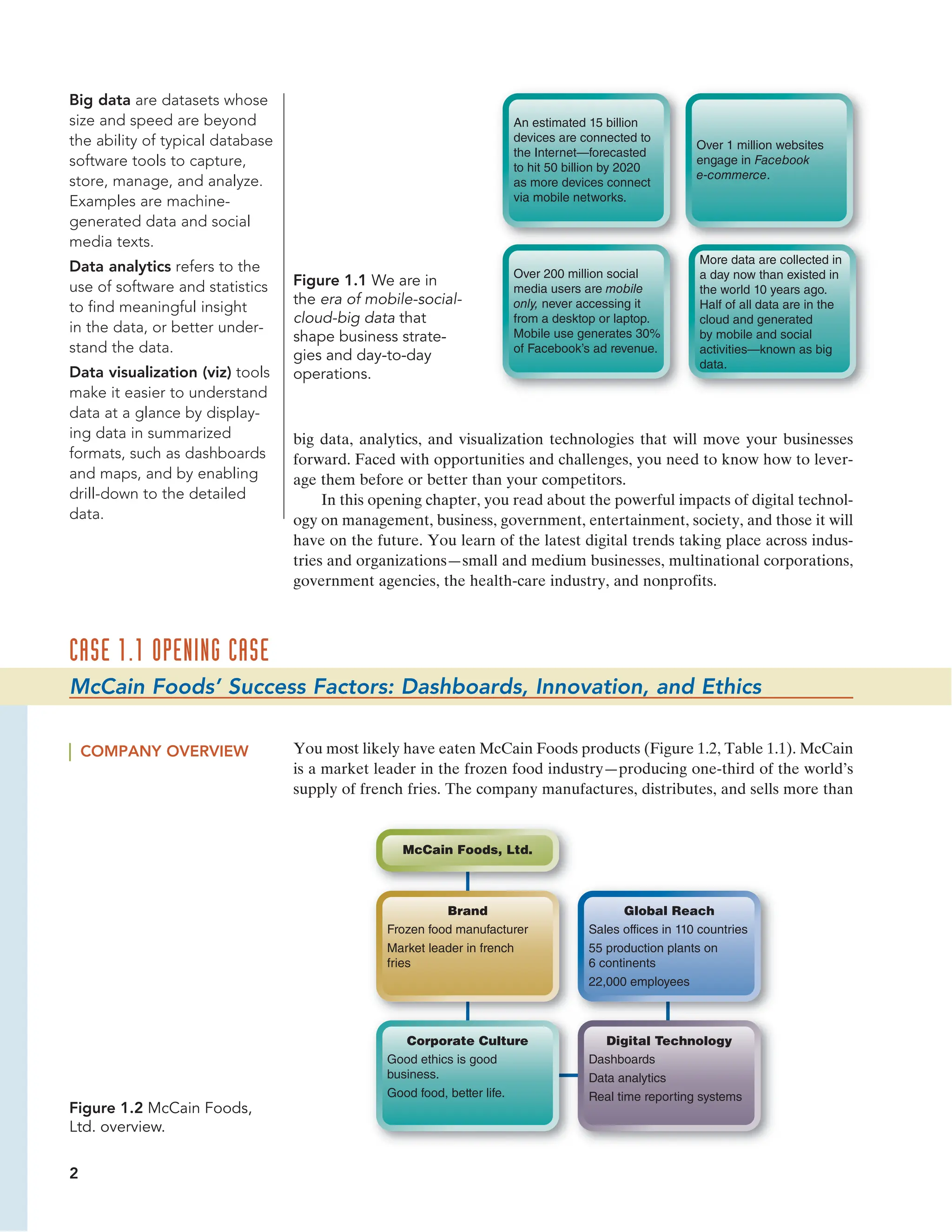
Figure 1.1 We are in
the era of mobile-social-
cloud-big data that
shape business strate-
gies and day-to-day
operations.
CASE 1.1 OPENING CASE
McCain Foods’ Success Factors: Dashboards, Innovation, and Ethics
COMPANY OVERVIEW You most likely have eaten McCain Foods products (Figure 1.2, Table 1.1). McCain
is a market leader in the frozen food industry—producing one-third of the world’s
supply of french fries. The company manufactures, distributes, and sells more than
Figure 1.2 McCain Foods,
Ltd. overview.
2
An estimated 15 billion
devices are connected to
the Internet—forecasted
to hit 50 billion by 2020
as more devices connect
via mobile networks.
Over 1 million websites
engage in Facebook
e-commerce.
Over 200 million social
media users are mobile
only, never accessing it
from a desktop or laptop.
Mobile use generates 30%
of Facebook’s ad revenue.
More data are collected in
a day now than existed in
the world 10 years ago.
Half of all data are in the
cloud and generated
by mobile and social
activities—known as big
data.
Sales offices in 110 countries
55 production plants on
6 continents
22,000 employees
Global Reach
Good ethics is good
business.
Good food, better life.
Corporate Culture
Dashboards
Data analytics
Real time reporting systems
Digital Technology
Frozen food manufacturer
Market leader in french
fries
Brand
McCain Foods, Ltd.
CASE 1.1 Opening Case 3
TABLE 1.1 Opening Case Overview
Company McCain Foods, Ltd. www.mccain.com
Industry The global company manufactures, sells, and distributes frozen
food products.
Product lines More than 100 oven-ready frozen food products
Digital technology Dashboards are implemented throughout the organization
from boardrooms to factory floors. Dashboards have drill-down
capabilities.
Business challenges The frozen food industry faced tough challenges from health
and nutrition trends that are emphasizing fresh foods. Industry
is highly competitive because it is expected to experience slow
growth through 2018.
Taglines “Good food. Better life.” and “It’s all good.”
Figure 1.3 Frozen food is
one of the most dynamic
and largest sectors of the
food industry.
100 oven-ready frozen foods—pizzas, appetizers, meals, and vegetables. McCain is
a global business-to-business (B2B) manufacturer with 55 production facilities on 6
continents. The company sells frozen foods to other businesses—wholesalers, retail-
ers, and restaurants from sales offices in 110 countries. McCain supplies frozen fries
to Burger King and supermarket chains (Figure 1.3).
Business-to-business (B2B)
commerce. The selling of
products and services to
other businesses.
Voisin/Phanie/SuperStock
4 Chapter 1 Doing Business in Digital Times
Food manufacturers must be able to trace all ingredients along their supply
chain in case of contamination.Achieving end-to-end traceability is complex given
the number of players in food supply chains. Several communication and tracking
technologies make up McCain’s supply chain management (SCM) system to keep
workers informed of actual and potential problems with food quality, inventory,
and shipping as they occur. McCain’s SCM system ensures delivery of the best
products possible at the best value to customers. In addition, the company strives
to prevent food shortages worldwide by analyzing huge volumes of data to predict
crop yields.
Supply chain. All businesses
involved in the production
and distribution of a product
or service.
FROZEN FOOD
INDUSTRY CHALLENGES
McCain Foods had to deal with three major challenges and threats:
1. Drop in demand for frozen foods. McCain operated in an industry that was
facing tougher competition. Health-conscious trends were shifting customer
demand toward fresh food, which was slowing growth in the frozen foods
market.
2. Perishable inventory. Of all the types of manufacturing, food manufacturers face
unique inventory management challenges and regulatory requirements. Their
inventory of raw materials and finished goods can spoil, losing all their value, or
food can become contaminated. Regulators require food manufacturers to able
to do recalls quickly and effectively. Food recalls have destroyed brands and
been financially devastating.
3. Technology-dependent. Food manufacturers face the pressures that are
common to all manufacturers. They need information reporting systems and
digital devices to manage and automate operations, track inventory, keep
the right people informed, support decisions, and collaborate with business
partners.
McCain Foods worked with Burger King (BK) to develop lower-calorie fries
called Satisfries (Figure 1.4). These crinkle-cut fries have 30 percent less fat and
20 percent fewer calories than BK’s classic fries. This food innovation has shaken
up the fast-food industry and given BK an advantage with end-consumers who are
demanding healthier options.
Figure 1.4 McCain Foods
and Burger King jointly
developed Satisfries—a
french fry innovation with
30 percent less fat and
20 percent fewer calories
than BK’s current fries and
40 percent less fat and
30 percent fewer calories
than McDonald’s fries.
MCCAIN FOODS’
BUSINESS AND IT
STRATEGIES
The McCain brothers, who founded the company, follow this simple philosophy:
“Good ethics is good business.” McCain prides itself on the quality and conve-
nience of its products, which is reflected in the It’s All Good brand image. The It’s
All Good branding effort was launched in 2010 after surveys found that customers
were concerned about the quality and nutrition of frozen foods. Since then, many of
products have been improved and manufactured in healthier versions.
Managing with Digital Technology McCain had integrated its diverse
sources of data into a single environment for analysis. Insights gained from its data
analytics helped improve manufacturing processes, innovation, and competitive
advantage.
McCain Foods invested in data analytics and visualization technologies to
maximize its capability to innovate and gain insights from its huge volumes of data.
The company tracks, aggregates, and analyzes data from operations and business
customers in order to identify opportunities for innovation in every area of the busi-
ness.The results of data analytics are made available across the organization—from
©
DustyPixel/iStockphoto
www.Ebook777.com
Free ebooks == www.Ebook777.com
CASE 1.1 Opening Case 5
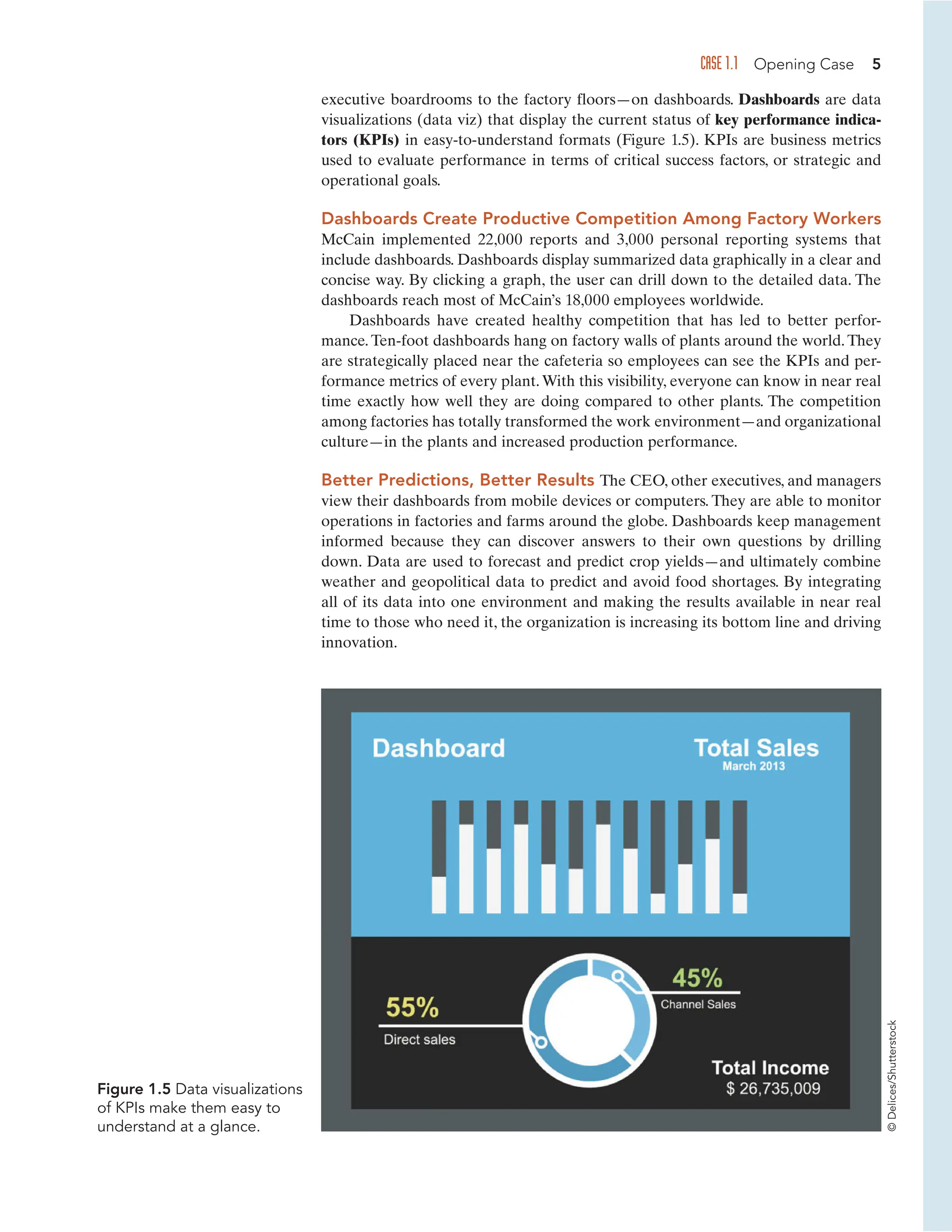
Figure 1.5 Data visualizations
of KPIs make them easy to
understand at a glance.
executive boardrooms to the factory floors—on dashboards. Dashboards are data
visualizations (data viz) that display the current status of key performance indica-
tors (KPIs) in easy-to-understand formats (Figure 1.5). KPIs are business metrics
used to evaluate performance in terms of critical success factors, or strategic and
operational goals.
Dashboards Create Productive Competition Among Factory Workers
McCain implemented 22,000 reports and 3,000 personal reporting systems that
include dashboards. Dashboards display summarized data graphically in a clear and
concise way. By clicking a graph, the user can drill down to the detailed data. The
dashboards reach most of McCain’s 18,000 employees worldwide.
Dashboards have created healthy competition that has led to better perfor-
mance. Ten-foot dashboards hang on factory walls of plants around the world. They
are strategically placed near the cafeteria so employees can see the KPIs and per-
formance metrics of every plant.With this visibility, everyone can know in near real
time exactly how well they are doing compared to other plants. The competition
among factories has totally transformed the work environment—and organizational
culture—in the plants and increased production performance.
Better Predictions, Better Results The CEO, other executives, and managers
view their dashboards from mobile devices or computers. They are able to monitor
operations in factories and farms around the globe. Dashboards keep management
informed because they can discover answers to their own questions by drilling
down. Data are used to forecast and predict crop yields—and ultimately combine
weather and geopolitical data to predict and avoid food shortages. By integrating
all of its data into one environment and making the results available in near real
time to those who need it, the organization is increasing its bottom line and driving
innovation.
©
Delices/Shutterstock
6 Chapter 1 Doing Business in Digital Times
Questions
1. All it takes is one compromised ingredient to contaminate food and
to put human lives at risk. Delays in communicating contaminated food
increase the health risk and fines for violating the Food Safety Mod-
ernization Act. How can the SCM system help McCain Foods reduce
the risks related to low-quality or contaminated frozen foods reaching
consumers?
2. What three challenges or threats facing McCain Foods and what is the
reason for each challenge or threat?
3. How have dashboards on the factory floors impacted performance at
McCain Foods?
4. What might be the KPIs of a frozen food manufacturer such as McCain
Foods?
5. Explain how visibility about operations and performance created
healthy competition among McCain’s factory workers.
6. Being able to make reliable predictions can improve business perfor-
mance. Explain why.
Sources: Compiled from Smith (2013),Transparency Market Research (2013), and McCain Foods
Teradata video (2013).
Digital business is a social,
mobile, and Web-focused
business.
Business model is how a
business makes money.
Digital business model
defines how a business
makes money digitally.
Customer experience (CX)
is about building the digital
infrastructure that allows cus-
tomers to do whatever they
want to do, through whatever
channel they choose to do it.
Today, a top concern of well-established corporations, global financial institutions,
born-on-the-Web retailers, and government agencies is how to design their digital
business models in order to:
• deliver an incredible customer experience;
• turn a profit;
• increase market share; and
• engage their employees.
In the digital (online) space, the customer experience (CX) must measure up
to the very best the Web has to offer. Stakes are high for those who get it right—or
get it wrong. Forrester research repeatedly confirms there is a strong relationship
between the quality of a firm’s CX and loyalty, which in turn increases revenue
(Schmidt-Subramanian et al., 2013).
This section introduces the most disruptive and valuable digital technologies,
which you will continue to read about throughout this book.
1.1 Every Business Is a Digital Business
DIGITAL TECHNOLOGIES
OF THE 2010S—IN THE
CLOUD, HANDHELD,
AND WEARABLE
Consumers expect to interact with businesses anytime anywhere via mobile
apps or social channels using technology they carry in their pockets. Mobile apps
have changed how, when, and where work is done. Employees can be more produc-
tive when they work and collaborate effortlessly from their handheld or wearable
devices.
Cloud Computing
Enterprises can acquire the latest apps and digital services as they are needed and
without large upfront investments by switching from owning IT resources to cloud
computing (Figure 1.6). Cloud computing ranges from storing your files in Dropbox
to advanced cloud services. In short, with the cloud, resources no longer depend
on buying that resource. For example, Amazon Elastic Compute Cloud, known as
Cloud computing is a style
of computing in which IT
services are delivered on-
demand and accessible via
the Internet. Common exam-
ples are Dropbox, Gmail,
and Google Drive.
Food Safety Modernization
Act (FSMA), signed into law
in early 2011, requires all
companies in food supply
chains to be able to trace
foods back to the point of
origin (farm) and forward to
the consumer’s plate (fork).
The term for the effort is
farm-to-fork traceability.
Public health is the chief con-
cern, followed by potential
liability and brand protection
issues.
1.1 Every Business Is a Digital Business 7
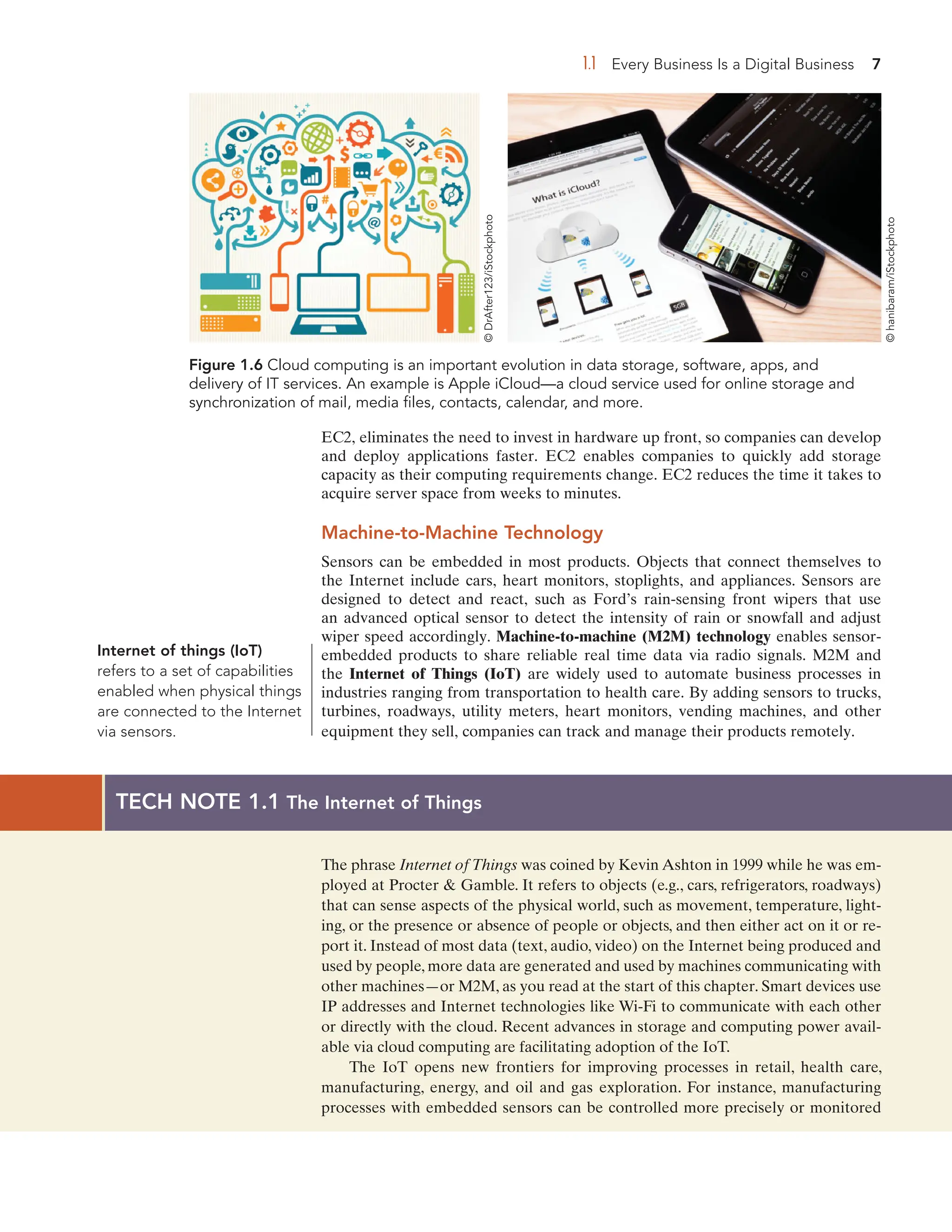
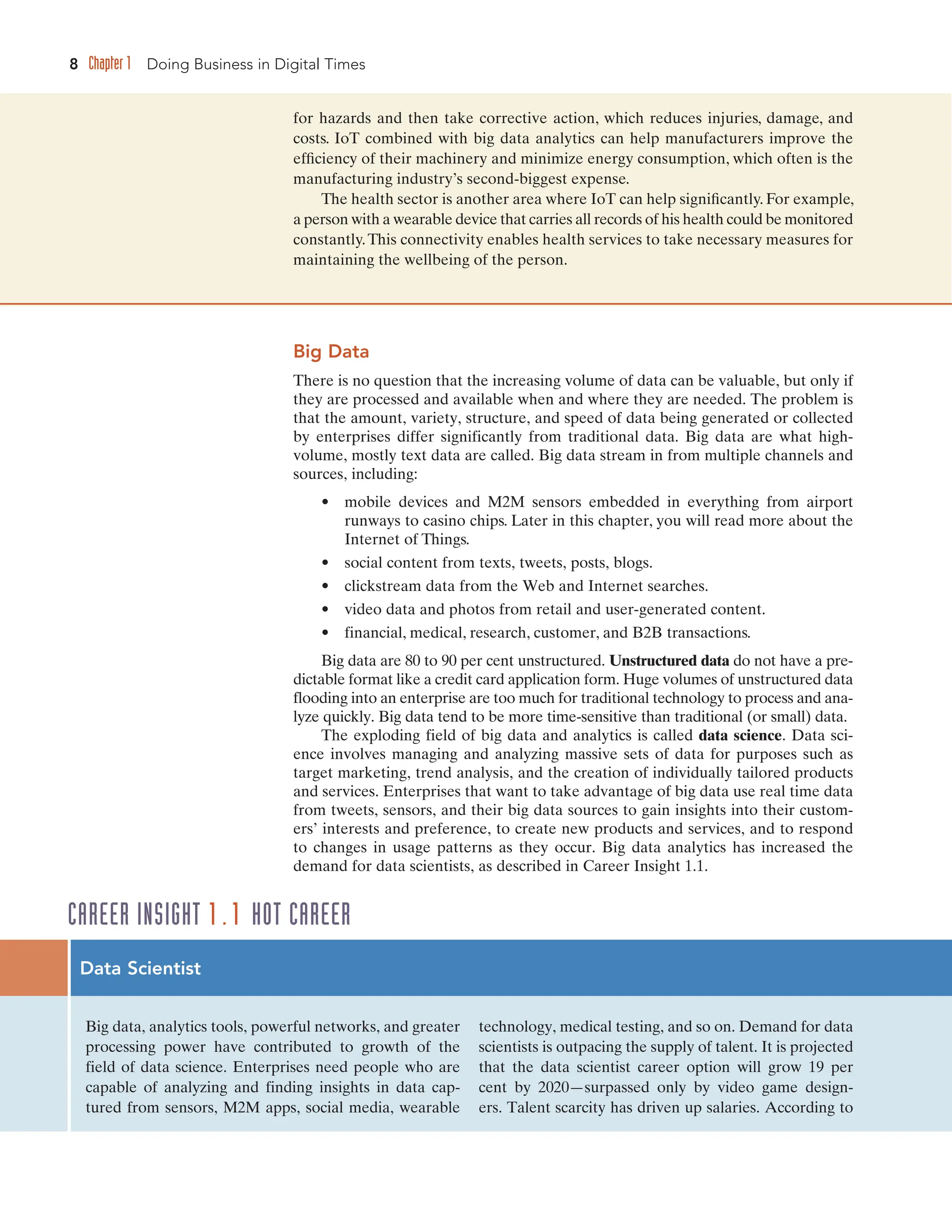
Figure 1.6 Cloud computing is an important evolution in data storage, software, apps, and
delivery of IT services. An example is Apple iCloud—a cloud service used for online storage and
synchronization of mail, media files, contacts, calendar, and more.
EC2, eliminates the need to invest in hardware up front, so companies can develop
and deploy applications faster. EC2 enables companies to quickly add storage
capacity as their computing requirements change. EC2 reduces the time it takes to
acquire server space from weeks to minutes.
Machine-to-Machine Technology
Sensors can be embedded in most products. Objects that connect themselves to
the Internet include cars, heart monitors, stoplights, and appliances. Sensors are
designed to detect and react, such as Ford’s rain-sensing front wipers that use
an advanced optical sensor to detect the intensity of rain or snowfall and adjust
wiper speed accordingly. Machine-to-machine (M2M) technology enables sensor-
embedded products to share reliable real time data via radio signals. M2M and
the Internet of Things (IoT) are widely used to automate business processes in
industries ranging from transportation to health care. By adding sensors to trucks,
turbines, roadways, utility meters, heart monitors, vending machines, and other
equipment they sell, companies can track and manage their products remotely.
©
DrAfter123/iStockphoto
©
hanibaram/iStockphoto
Internet of things (IoT)
refers to a set of capabilities
enabled when physical things
are connected to the Internet
via sensors.
TECH NOTE 1.1 The Internet of Things
The phrase Internet of Things was coined by Kevin Ashton in 1999 while he was em-
ployed at Procter  Gamble. It refers to objects (e.g., cars, refrigerators, roadways)
that can sense aspects of the physical world, such as movement, temperature, light-
ing, or the presence or absence of people or objects, and then either act on it or re-
port it. Instead of most data (text, audio, video) on the Internet being produced and
used by people, more data are generated and used by machines communicating with
other machines—or M2M, as you read at the start of this chapter. Smart devices use
IP addresses and Internet technologies like Wi-Fi to communicate with each other
or directly with the cloud. Recent advances in storage and computing power avail-
able via cloud computing are facilitating adoption of the IoT.
The IoT opens new frontiers for improving processes in retail, health care,
manufacturing, energy, and oil and gas exploration. For instance, manufacturing
processes with embedded sensors can be controlled more precisely or monitored
8 Chapter 1 Doing Business in Digital Times
Big Data
There is no question that the increasing volume of data can be valuable, but only if
they are processed and available when and where they are needed. The problem is
that the amount, variety, structure, and speed of data being generated or collected
by enterprises differ significantly from traditional data. Big data are what high-
volume, mostly text data are called. Big data stream in from multiple channels and
sources, including:
• mobile devices and M2M sensors embedded in everything from airport
runways to casino chips. Later in this chapter, you will read more about the
Internet of Things.
• social content from texts, tweets, posts, blogs.
• clickstream data from the Web and Internet searches.
• video data and photos from retail and user-generated content.
• financial, medical, research, customer, and B2B transactions.
Big data are 80 to 90 per cent unstructured. Unstructured data do not have a pre-
dictable format like a credit card application form. Huge volumes of unstructured data
flooding into an enterprise are too much for traditional technology to process and ana-
lyze quickly. Big data tend to be more time-sensitive than traditional (or small) data.
The exploding field of big data and analytics is called data science. Data sci-
ence involves managing and analyzing massive sets of data for purposes such as
target marketing, trend analysis, and the creation of individually tailored products
and services. Enterprises that want to take advantage of big data use real time data
from tweets, sensors, and their big data sources to gain insights into their custom-
ers’ interests and preference, to create new products and services, and to respond
to changes in usage patterns as they occur. Big data analytics has increased the
demand for data scientists, as described in Career Insight 1.1.
for hazards and then take corrective action, which reduces injuries, damage, and
costs. IoT combined with big data analytics can help manufacturers improve the
efficiency of their machinery and minimize energy consumption, which often is the
manufacturing industry’s second-biggest expense.
The health sector is another area where IoT can help significantly. For example,
a person with a wearable device that carries all records of his health could be monitored
constantly.This connectivity enables health services to take necessary measures for
maintaining the wellbeing of the person.
Data Scientist
Big data, analytics tools, powerful networks, and greater
processing power have contributed to growth of the
field of data science. Enterprises need people who are
capable of analyzing and finding insights in data cap-
tured from sensors, M2M apps, social media, wearable
technology, medical testing, and so on. Demand for data
scientists is outpacing the supply of talent. It is projected
that the data scientist career option will grow 19 per
cent by 2020—surpassed only by video game design-
ers. Talent scarcity has driven up salaries. According to
CAREER INSIGHT 1.1 HOT CAREER
1.1 Every Business Is a Digital Business 9
Glassdoor data (glassdoor.com, 2014), the median salary
for data scientists in the United States is $117,500. By
contrast, a business analyst earns an average of $61,000.
Profiles of Data Scientists at Facebook, LinkedIn,
and Bitly
• Facebook’s Jeff Hammerbacher. Jeff helped
Facebook make sense out of huge volumes of user
data when he joined the company in 2006. Facebook’s
data science team analyzes the self-reported data on
each user’s Facebook page in order to target ads
based on things the user actually likes.
• LinkedIn’s DJ Patil. DJ worked at LinkedIn as
chief data scientist. Many of the cool products on
LinkedIn were built using data from self-reporting
and machine learning.
• Bitly’s Hilary Mason. Hilary was chief scientist at
Bitly, which offers URL shortening and redirec-
tion services with real time link tracking. Bitly sees
behavior from billions of people a month by analyz-
ing tens of millions of links shared per day, which are
clicked hundreds of millions times. The clickstreams
generate an enormous amount of real time data.
Using data analytics, Hillary and her team detected
and solved business problems that were not evident.
Data Science Is Both an Art and a Science
In their 2012 Harvard Business Review article titled
“Data Scientist: The Sexiest Job of the 21st Century,”
authors Thomas Davenport and D. J. Patil define a data
scientist as a “high-ranking professional with the train-
ing and curiosity to make discoveries in the world of big
data” (Davenport  Patil, 2012). They described how
data scientist Jonathan Goldman transformed LinkedIn
after joining the company in 2006. At that time, LinkedIn
had less than 8 million members. Goldman noticed that
existing members were inviting their friends and col-
leagues to join, but they were not making connections
with other members at the rate executives had expected.
A LinkedIn manager said, “It was like arriving at a con-
ference reception and realizing you don’t know anyone.
So you just stand in the corner sipping your drink—and
you probably leave early.” Goldman began analyzing
the data from user profiles and looked for patterns that
to predict whose networks a given profile would land
in. While most LinkedIn managers saw no value in
Goldman’s work, Reid Hoffman, LinkedIn’s cofounder
and CEO at the time, understood the power of analytics
because of his experiences at PayPal. With Hoffman’s
approval, Goldman applied data analytics to test what
would happen if member were presented with names
of other members they had not yet connected with, but
seemed likely to know. He displayed the three best new
matches for each member based on his or her LinkedIn
profile. Within days, the click-through rate on those
matches skyrocketed and things really took off. Thanks
to this one feature, LinkedIn’s growth increased dra-
matically.
The LinkedIn example shows that good data sci-
entists do much more than simply try to solve obvious
business problems. Creative and critical thinking are
part of their job—that is, part analyst and part artist.
They dig through incoming data with the goal of dis-
covering previously hidden insights that could lead to
a competitive advantage or detect a business crisis in
enough time to prevent it. Data scientists often need
to evaluate and select those opportunities and threats
that would be of greatest value to the enterprise or
brand.
Sources: Kelly (2013), Lockhard  Wolf (2012), Davenport  Patil (2012), U.S. Department of Labor, Bureau of Labor Statistics (2014).
SOCIAL-MOBILE-CLOUD
MODEL
The relationship among social, mobile, and cloud technologies is shown in
Figure 1.7. The cloud consists of huge data centers accessible via the Internet and
forms the core by providing 24/7 access to storage, apps, and services. Handhelds
and wearables, such as Google Glass, Pebble, and Sony Smartwatch (Figure 1.8),
and their users form the edge. Social channels connect the core and edge. The
SoMoClo integration creates the technical and services infrastructure needed for
digital business. This infrastructure makes it possible to meet the expectations of
employees, customers, and business partners given that almost everyone is con-
nected (social), everywhere they go (mobile), and has 24/7 access to data, apps, and
other services (cloud).
10 Chapter 1 Doing Business in Digital Times
Here are three examples of their influence:
1. Powerful social influences impact advertising and marketing: Connections and
feedback via social networks have changed the balance of influence. Consum-
ers are more likely to trust tweets from ordinary people than recommendations
made by celebrity endorsements. And, negative sentiments posted or tweeted
can damage brands.
2. Consumer devices go digital and offer new services. The Nike Fuel-
band wristband helps customers track their exercise activities and calories
burned. The device links to a mobile app that lets users post their progress
on Facebook.
3. eBay’s move to cloud technology improves sellers’ and buyers’ experiences.
The world’s largest online marketplace, eBay, moved its IT infrastructure to the
cloud. With cloud computing, eBay is able to introduce new types of landing
pages and customer experiences without the delay associated with having to buy
additional computing resources.
The balance of power has shifted as business is increasingly driven by individu-
als for whom mobiles are an extension of their body and mind. They expect to use
location-aware services, apps, alerts, social networks, and the latest digital capabili-
ties at work and outside work. To a growing extent, customer loyalty and revenue
growth depend on a business’s ability to offer unique customer experiences that
wow customers more than competitors can.
Figure 1.7 Model of the
integration of cloud, mobile,
and social technologies. The
cloud forms the core. Mobile
devices are the endpoints.
Social networks create the
connections.
©
scanrail/iStockphoto
1.1 Every Business Is a Digital Business 11
Figure 1.8 Strong interest in
smart wearable technology
reflects growing consumer
desire to be more digitally
connected at all times using
a collection of multiple
devices. A smartwatch used
at work, such as in a retail
store, can provide shop floor
staff with a screen to check
stock availability.
DIGITAL BUSINESS
MODELS
Business models are the ways enterprises generate revenue or sustain themselves.
Digital business models define how businesses make money via digital technology.
Companies that adopt digital business models are better positioned to take advan-
tage of business opportunities and survive, according to the Accenture Technology
Vision 2013 report (Accenture, 2013). Figure 1.9 contains examples of new tech-
nologies that destroyed old business models and created new ones.
Figure 1.9 Digital business
models refer to how
companies engage their
customers digitally to
create value via websites,
social channels, and mobile
devices.
Bloomberg/Getty
Images
Matthew
Shaw/Getty
Images
FILIP
SINGER/EPA/Newscom
Location-aware technologies
track items through
production and delivery to
reduce wasted time and
inefficiency in supply chains
and other business-to-
business (B2B) transactions.
Twitter dominates the
reporting of news and events
as they are still happening.
Facebook became the most
powerful sharing network
in the world.
Smartphones, tablets, other
touch devices, and their apps
reshaped how organizations
interact with customers—and
how customers want
businesses to interact with
them.
12 Chapter 1 Doing Business in Digital Times
The ways in which market leaders are transitioning to digital business models
include the following:
• Amazon gains a competitive edge with high-tech tech support. Amazon
is well known for radically changing online shopping and e-book reading
experiences. Amazon’s CEO Jeffrey Bezos set a new standard for tech sup-
port with MayDay (Figure 1.10).Within 15 seconds of touching the MayDay
button on their Kindle Fire HDX tablet, customers get free, 24/7/365 tech
support via video chat. MayDay works by integrating all customer data and
instantly displaying the results to a tech agent when a customer presses the
MayDay button. Plus, tech agents can control and write on a customer’s Fire
screen. By circling and underlining various buttons on the display, it is dead
simple for new Fire owners to become expert with their devices. Amazon’s
objective is to educate the consumer rather than just fix the problem. In the
highly competitive tablet wars, Amazon has successfully differentiated its
tablet from those of big players like Apple, Samsung, and Asus (manufac-
turer of Google’s Nexus 7) with the MayDay button.
• NBA talent scouts rely on sports analytics and advanced scouting systems.
NBA talent scouts used to crunch players’ stats, watch live player perfor-
mances, and review hours of tapes to create player profiles (Figure 1.11).
Now software that tracks player performance has changed how basketball
and soccer players are evaluated. For example, STATS’ SportVU tech-
nology is revolutionizing the way sports contests are viewed, understood,
played, and enjoyed. SportVU uses six palm-sized digital cameras that
track the movement of every player on the court, record ball movement
25 times per second, and convert movements into statistics. SportVU
produces real time and highly complex statistics to complement the tra-
ditional play-by-play. Predictive sport analytics can provide a 360-degree
view of a player’s performance and help teams make trading decisions.
Figure 1.10 MayDay video
chat tech support.
Figure 1.11 Sports analytics
and advanced scouting
systems evaluate talent
and performance for the
NBA—offering teams a
slight but critical competitive
advantage.
AP
Photo/Ted
S.
Warren
©
Tribune
Content/Agency
LLC/Alamy
1.1 Every Business Is a Digital Business 13
Sports analytics bring about small competitive advantages that can shift
games and even playoff series.
• Dashboards keep casino floor staff informed of player demand. Competition
in the gaming industry is fierce, particularly during bad economic condi-
tions. The use of manual spreadsheets and gut-feeling decisions did not lead
to optimal results. Casino operators facing pressure to increase their bottom
line have invested in analytic tools, such as Tangam’s Yield Management
solution (TYM). TYM is used to increase the yield (profitability) of black-
jack, craps, and other table games played in the pit (Figure 1.12). The
analysis and insights from real time apps are used to improve the gaming
experience and comfort of players.
Figure 1.12 Casinos are
improving the profitability of
table games by monitoring
and analyzing betting in real
time.
THE RECENT PAST AND
NEAR FUTURE—2010S
DECADE
We have seen great advances in digital technology since the start of this decade.
Figure 1.13 shows releases by tech leaders that are shaping business and everyday
life. Compare the role of your mobiles, apps, social media, and so on in your per-
sonal life and work in 2010 to how you use them today. You can expect greater
changes going forward to the end of this decade with the expansion of no-touch
interfaces, mobility, wearable technology, and the IoT.
Companies are looking for ways to take advantage of new opportunities in
mobile, big data, social, and cloud services to optimize their business processes.
The role of the IT function within the enterprise has changed significantly—and
will evolve rapidly over the next five years. As you will read throughout this book,
the IT function has taken on key strategic and operational roles that determine the
enterprise’s success or failure.
©
lisegagne/iStockphoto
Figure 1.13 Digital
technology released
since 2010.
• Google launched
Android mobile
OS to compete
with iPhones
By 2014, became
the first billion-user
mobile OS
• App Store opened
on July 10, 2008
via an update to iTunes
By mid-2011, over 15 billion apps
downloaded from App Store
2008
•Apple launched
iPad
100 million
iPads sold
in 2 years
2010 2011–2012
• No tough interfaces
to communicate
by simply gesturing
or talking
Microsoft’s Kinect for
Windows Apple’s Siri
Google’s Glass
• iWatch released
integrates with
iOS devices
2014
14 Chapter 1 Doing Business in Digital Times
More objects are being embedded with sensors and gaining
the ability to communicate with the Internet. This communi-
cation improves business processes while reducing costs and
risks. For example, sensors and network connections can be
embedded in rental cars. Zipcar has pioneered the car rental
by the hour business model. See Figure 1.14. Cars are leased
for short time spans to registered members, making retail
rental centers unnecessary. Traditional car rental agencies
are starting to experiment with sensors so that each car’s use
can be optimized to increase revenue.
When devices or products are embedded with sensors,
companies can track their movements or monitor interac-
tions with them. Business models can be adjusted to take
advantage of what is learned from this behavioral data. For
example, an insurance company offers to install location
sensors in customers’ cars. By doing so, the company
develops the ability to price the drivers’ policies on how a
car is driven and where it travels. Pricing is customized to
match the actual risks of operating a vehicle rather than
based on general proxies—driver’s age, gender, or location
of residence.
Opportunities for Improvement
Other applications of embedded physical things are:
• In the oil and gas industry, exploration and development
rely on extensive sensor networks placed in the earth’s
crust. The sensors produce accurate readings of the
location, structure, and dimensions of potential fields.
The payoff is lower development costs and improved oil
flows.
• In the health-care industry, sensors and data links can
monitor patients’ behavior and symptoms in real time
and at low cost. This allows physicians to more precisely
diagnose disease and prescribe treatment regimens.
For example, sensors embedded in patients with heart
disease or chronic illnesses can be monitored continu-
ously as they go about their daily activities. Sensors
placed on congestive heart patients monitor many of
these signs remotely and continuously, giving doctors
early warning of risky conditions. Better management
of congestive heart failure alone could reduce hospi-
talization and treatment costs by $1 billion per year in
the U.S.
• In the retail industry, sensors can capture shoppers’ pro-
file data stored in their membership cards to help close
purchases by providing additional information or offering
discounts at the point of sale.
• Farm equipment with ground sensors can take into
account crop and field conditions, and adjust the
amount of fertilizer that is spread on areas that need more
nutrients.
• Billboards in Japan scan people passing by, assessing
how they fit consumer profiles, and instantly change the
displayed messages based on those assessments.
• The automobile industry is developing systems that
can detect imminent collisions and take evasive action.
Certain basic applications, such as automatic braking
systems, are available in high-end autos. The potential
accident reduction savings resulting from wider deploy-
ment of these sensor systems could exceed $100 billion
annually.
Questions
1. Research Zipcar. How does this company’s business
model differ from that of traditional car rental companies,
such as Hertz or Avis?
2. Think of two physical things in your home or office that,
if they were embedded with sensors and linked to a net-
work, would improve the quality of your work or personal
life. Describe these two scenarios.
3. What might the privacy concerns be?
IT at Work 1.1
Zipcar and Other Connected Products
Figure 1.14 A Zipcar-reserved parking sign in
Washington, DC.
©
Wiskerke/Alamy
1.2 Business Process Management and Improvement 15
By 2016 wearable electronics in shoes, tattoos, and accessories
will become a $10 billion industry, according to Gartner (2012).
Wearable technology builds computing, connectivity,
and sensor capabilities into materials. The latest wearables
are lightweight and may be found in athletic shoes, golf
accessories, and fitness trackers. The wearables can include
data analysis apps or services that send feedback or insights
to the wearer. For example, Zepp Labs manufactures sensor-
embedded gloves for golf, tennis, and baseball that analyze
1,000 data points per second to create 3D representations
of a player’s swing. The sensors track every inch of a golfer’s
swing, analyzes the movements, and then sends the wearers
advice on how to improve their game. Sensors that weigh
only half an ounce clip onto the glove. Another example is
Sony’s SmartBand, a wristband that synchs with your phone
to track how many steps you take, the number of calories you
burn each day, and how well you sleep. The Lifelog app is
the key to the Smartband. The app gives a visual display of a
timeline and your activity, with boxes monitoring your steps,
calories, kilometers walked, and more. Lifelog goes beyond
just fitness by also monitoring time spent on social networks
and photos taken.
The major sources of revenue from wearable smart
electronics are items worn by athletes and sports enthusiasts
and devices used to monitor health conditions, such as auto-
matic insulin delivery for diabetics.
Applications and services are creating new value for
consumers, especially when they are combined with personal
preferences, location, biosensing, and social data. Wearable
electronics can provide more detailed data to retailers for
targeting advertisements and promotions.
Questions
1. Discuss how wearable electronics and the instant feedback
they send to your mobile device could be valuable to you.
2. How can data from wearable technology be used to
improve worker productivity or safety?
3. What are two other potentially valuable uses of instant
feedback or data from wearable technology?
4. How can wearable devices impact personal privacy?
IT at Work 1.2
Wearable Technology
All functions and departments in the enterprise have tasks that they need to com-
plete to produce outputs, or deliverables, in order to meet their objectives. Business
processes are series of steps by which organizations coordinate and organize tasks
to get work done. In the simplest terms, a process consists of activities that convert
inputs into outputs by doing work.
The importance of efficient business processes and continuous process improve-
ment cannot be overemphasized. Why? Because 100 per cent of an enterprise’s perfor-
mance is the result of its processes. Maximizing the use of inputs in order to carry out
similar activities better than one’s competitors is a critical success factor. IT at Work 1.3
describes the performance gains at AutoTrader.com, the automobile industry’s largest
online shopping marketplace, after it redesigned its order-to-cash process.
1.2 Business Process Management and Improvement
Objectives define the desired
benefits or expected per-
formance improvements.
They do not and should not
describe what you plan to do,
how you plan to do it, or what
you plan to produce, which is
the function of processes.
Questions
1. What are the benefits of cloud computing?
2. What is machine-to-machine (M2M) technology? Give an example of a
business process that could be automated with M2M.
3. Describe the relationships in the SoMoClo model.
4. Explain the cloud.
5. Why have mobile devices given consumers more power in the marketplace?
6. What is a business model?
7. What is a digital business model?
8. Explain the Internet of Things.
16 Chapter 1 Doing Business in Digital Times
AutoTrader.com is the leading automotive marketplace, list-
ing several million new and pre-owned vehicles, as shown
in Figure 1.15. AutoTrader.com is one of the largest local
online advertising entities, with profits of $300 million on
$1.2 billion in revenues in 2013. The site attracts over 15 mil-
lion unique visitors each month.
Outdated Order-to-Cash Process
AutoTrader processes thousands of orders and contracts
each month. Its cross-functional order fulfillment process,
or order-to-cash process, was outdated and could not
handle the sales volume. The legacy process was run on My
AutoTrader (MAT), a system based on Lotus Notes/Domino.
MAT took an average of 6.3 to 8.3 days to fulfill orders and
process contracts, as Figure 1.16 shows. MAT created a bot-
tleneck that slowed the time from order to cash, or revenue
generation. With over 100 coordinated steps, the process
was bound to be flawed, resulting in long and error-prone
cycle times. Cycle time is the time required to complete a
given process. At AutoTrader, cycle time is the time between
the signing and delivery of a contract. Customers were
aggravated by the unnecessary delay in revenue.
Redesigning the Order Fulfillment
Process with BPM
Management had set three new objectives for the company:
to be agile, to generate revenue faster, and to increase
customer satisfaction. They invested in a BPM (business pro-
cess management) solution—selecting webMethods from
Software AG (softwareag.com, 2011). The BPM software
was used to document how tasks were performed using
the legacy system. After simplifying the process as much as
possible, remaining tasks were automated or optimized. The
new system cuts down the order fulfillment process to 1 day,
as shown in Figure 1.17. Changes and benefits resulting from
the redesigned process are:
• There are only six human tasks even though the pro-
cess interacts with over 20 different data sources and
systems, including the inventory, billing, and contract
fulfillment.
• Tasks are assigned immediately to the right people, who
are alerted when work is added to their queues.
• Fewer than five percent of orders need to go back to
sales for clarification—a 400 percent improvement.
• Managers can check order fulfillment status anytime
using webMethods Optimize for Process, which provides
real time visibility into performance. They can measure
key performance indicators (KPIs) in real time to see
where to make improvements.
• Dealers can make changes directly to their contracts,
which cut costs for personnel. Software and hardware
costs are decreasing as the company retires old systems.
Sources: Compiled from Walsh (2012), softwareag.com (2011), Alesci 
Saitto (2012).
IT at Work 1.3
AutoTrader Redesigns Its Order-to-Cash Process
Figure 1.15 AutoTrader.com car search site.
Figure 1.16 AutoTrader’s
legacy order fulfillment
process had an average cycle
time of up to 8.3 days.
©
NetPhotos/Alamy
Fulfillment Total Avg
Quality
Assurance
Contract
Delivered
Data Entry
Fax
2.8 days
2.8 days
.5 day 4 days 8.3 days
6.3 days
1 day
1 day
2 days
.5 day
New
Up-sell
Contract
Signed
1.2 Business Process Management and Improvement 17
Figure 1.17 AutoTrader’s
objective is to process and
fill orders within one day.
Questions
1. Discuss how the redesigned order process supports the
company’s three new business objectives.
2. How does the reduced cycle time of the order fulfillment pro-
cess improve revenue generation and customer satisfaction?
3. Does reducing the cycle time of a business process also
reduce errors? Why or why not?
THREE COMPONENTS
OF BUSINESS
PROCESSES
Business processes have three basic components, as shown in Figure 1.18. They
involve people, technology, and information.
Examples of common business processes are:
• Accounting: Invoicing; reconciling accounts; auditing
• Finance: Credit card or loan approval; estimating credit risk and financing
terms
• Human resources (HR): Recruiting and hiring; assessing compliance with
regulations; evaluating job performance
• IT or information systems: Generating and distributing reports and data
visualizations; data analytics; data archiving
• Marketing: Sales; product promotion; design and implementation of sales
campaigns; qualifying a lead
• Production and operations: Shipping; receiving; quality control; inventory
management
• Cross-functional business processes: Involving two or more functions, for
example, order fulfillment and product development
Designing an effective process can be complex because you need a deep under-
standing of the inputs and outputs (deliverables), how things can go wrong, and how
to prevent things from going wrong. For example, Dell had implemented a new
process to reduce the time that tech support spent handling customer service calls. In
an effort to minimize the length of the call, tech support’s quality dropped so much
that customers had to call multiple times to solve their problems. The new process
had backfired—increasing the time to resolve computer problems and aggravating
Dell customers.
Figure 1.18 Three
components of a
business process.
Deliverables are the outputs
or tangible things that are
produced by a business pro-
cess. Common deliverables
are products, services, actions,
plans, or decisions, such as
to approve or deny a credit
application. Deliverables are
produced in order to achieve
specific objectives.
Submit sales
order
electronically
Day 1:
Live online
processing of orders
Day 2:
Order fulfillment
1 day elapsed
raw materials,
data,
knowledge,
expertise
work that
transforms
inputs  acts on
data and
knowledge
products,
services,
plans,
or actions
Inputs Activities
Business Process
Deliverables
18 Chapter 1 Doing Business in Digital Times
Characteristics of Business Processes
Processes can be formal or informal. Formal processes are documented and have
well-established steps. Order taking and credit approval processes are examples.
Routine formal processes are referred to as standard operating procedures, or
SOPs. A SOP is a well-defined and documented way of doing something. An effec-
tive SOP documents who will perform the tasks; what materials to use; and where,
how, and when the tasks are to be performed. SOPs are needed for the handling of
food, hazardous materials, or situations involving safety, security, or compliance. In
contrast, informal processes are typically undocumented, have inputs that may not
yet been identified, and are knowledge-intensive. Although enterprises would pre-
fer to formalize their informal processes in order to better understand, share, and
optimize them, in many situations process knowledge remains in people’s heads.
Processes range from slow, rigid to fast-moving, adaptive. Rigid processes
can be structured to be resistant to change, such as those that enforce security or
compliance regulations. Adaptive processes are designed to respond to change or
emerging conditions, particularly in marketing and IT.
Process Improvement
Given that a company’s success depends on the efficiency of its business processes,
even small improvements in key processes have significant payoff. Poorly designed,
flawed, or outdated business processes waste resources, increasing costs, causing
delays, and aggravating customers. For example, when customers’ orders are not
filled on time or correctly, customer loyalty suffers, returns increase, and reship-
ping increases costs. The blame may be flawed order fulfilment processes and not
employee incompetence, as described in IT at Work 1.2.
Simply applying IT to a manual or outdated process will not optimize it.
Processes need to be examined to determine whether they are still necessary.
After unnecessary processes are identified and eliminated, the remaining ones are
redesigned (or reengineered) in order to automate or streamline them. Methods
and efforts to eliminate wasted steps within a process are referred to as business
process reengineering (BPR). The goal of BPR is to eliminate the unnecessary,
non-value-added processes, then to simplify and automate the remaining processes
to significantly reduce cycle time, labor, and costs. For example, reengineering the
credit approval process cuts time from several days or hours to minutes or less.
Simplifying processes naturally reduces the time needed to complete the process,
which also cuts down on errors.
After eliminating waste, digital technology can enhance processes by (1) auto-
mating existing manual processes; (2) expanding the data flows to reach more func-
tions in order to make it possible for sequential activities to occur in parallel; and
(3) creating innovative business processes that, in turn, create new business models.
For instance, consumers can scan an image of a product and land on an e-commerce
site, such as Amazon.com, selling that product. This process flips the traditional
selling process by making it customer-centric.
Business Process Management
BPR is part of the larger discipline of business process management (BPM), which
consists of methods, tools, and technology to support and continuously improve
business processes. The purpose of BPM is to help enterprises become more agile
and effective by enabling them to better understand, manage, and adapt their busi-
ness processes. Vendors, consulting and tech firms offer BPM expertise, services,
software suites, and tools.
BPM software is used to map processes performed either by computers or
manually—and to design new ones. The software includes built-in templates show-
ing workflows and rules for various functions, such as rules for credit approval. These
1.3 The Power of Competitive Advantage 19
templates and rules provide consistency and high-quality outcomes. For example, Oracle’s
WebLogic Server Process Edition includes server software and process integration
tools for automating complex business processes, such as handling an insurance claim.
But, BPM initiatives can be extremely challenging, and in order to be suc-
cessful, BPM requires buy-in from a broad cross section of the business, the right
technology selection, and highly effective change management processes. You will
read more about optimizing business processes and BPM’s role in the alignment of
IT and business strategy in Chapter 13.
Questions
1. What is a business process? Give three examples.
2. What is the difference between business deliverables and objectives?
3. List and give examples of the three components of a business process.
4. Explain the differences between formal and informal processes.
5. What is a standard operating procedure (SOP)?
6. What is the purpose of business process management (BPM)?
In business, as in sports, companies want to win—customers, market share, and so
on. Basically, that requires gaining an edge over competitors by being first to take
advantage of market opportunities, providing great customer experiences, doing
something well that others cannot easily imitate, or convincing customers why it is
a more valuable alternative than the competition.
1.3 The Power of Competitive Advantage
Agility means being able
to respond quickly.
Responsiveness means that
IT capacity can be easily
scaled up or down as needed,
which essentially requires
cloud computing.
Flexibility means having the
ability to quickly integrate
new business functions or to
easily reconfigure software
or apps.
BUILDING BLOCKS
OF COMPETITIVE
ADVANTAGE
Having a competitive edge means possessing an advantage over your competition.
Once an enterprise has developed a competitive edge, maintaining it is an ongoing
challenge. It requires forecasting trends and industry changes and what the company
needs to do to stay ahead of the game. It demands that you continuously track your
competitors and their future plans and promptly take corrective action. In summary,
competitiveness depends on IT agility and responsiveness. The benefit of IT agility
is being able to take advantage of opportunities faster or better than competitors.
Closely related to IT agility is flexibility. For example, mobile networks are
flexible—able to be set up, moved, or removed easily, without dealing with cables
and other physical requirements of wired networks. Mass migration to mobile
devices from PCs has expanded the scope of IT beyond traditional organizational
boundaries—making location practically irrelevant.
IT agility, flexibility, and mobility are tightly interrelated and fully dependent
on an organization’s IT infrastructure and architecture, which are covered in greater
detail in Chapter 2.
With mobile devices, apps, platforms, and social media becoming inseparable parts
of work life and corporate collaboration and with more employees working from home,
the result is the rapid consumerization of IT. IT consumerization is the migration of
consumer technology into enterprise IT environments. This shift has occurred because
personally owned IT is as capable and cost-effective as its enterprise equivalents.
COMPETITIVE
ADVANTAGE
Two key components of corporate profitability are:
1. Industry structure: An industry’s structure determines the range of profitability
of the average competitor and can be very difficult to change.
2. Competitive advantage: This is an edge that enables a company to outperform
its average competitor. Competitive advantage can be sustained only by con-
tinually pursuing new ways to compete.
www.Ebook777.com
Free ebooks == www.Ebook777.com
20 Chapter 1 Doing Business in Digital Times
IT plays a key role in competitive advantage, but that advantage is short-lived
if competitors quickly duplicate it. Research firm Gartner defines competitive
advantage as a difference between a company and its competitors that matters to
customers.
It is important to recognize that some types of IT are commodities, which do
not provide a special advantage. Commodities are basic things that companies need
to function, such as electricity and buildings. Computers, databases, and network
services are examples of commodities. In contrast, how a business applies IT to sup-
port business processes transforms those IT commodities into competitive assets.
Critical business processes are those that improve employee performance and profit
margins.
STRATEGIC PLANNING
AND COMPETITIVE
MODELS
Strategy planning is critical for all organizations, including government agencies,
health care providers, educational institutions, the military, and other nonprofits.
We start by discussing strategic analysis and then explain the activities or compo-
nent parts of strategic planning.
What Is Strategic (SWOT) Analysis?
There are many views on strategic analysis. In general, strategic analysis is the scan-
ning and review of the political, social, economic, and technical environments of an
organization. For example, any company looking to expand its business operations
into a developing country has to investigate that country’s political and economic
stability and critical infrastructure. That strategic analysis would include reviewing
the U.S. Central Intelligence Agency’s (CIA) World Factbook. The World Factbook
provides information on the history, people, government, economy, geography,
communications, transportation, military, and transnational issues for 266 world
entities. Then the company would need to investigate competitors and their poten-
tial reactions to a new entrant into their market. Equally important, the company
would need to assess its ability to compete profitably in the market and impacts of
the expansion on other parts of the company. For example, having excess production
capacity would require less capital than if a new factory needed to be built.
The purpose of this analysis of the environment, competition, and capacity is
to learn about the strengths, weaknesses, opportunities, and threats (SWOT) of the
expansion plan being considered. SWOT analysis, as it is called, involves the evalu-
ation of strengths and weaknesses, which are internal factors, and opportunities and
threats, which are external factors. Examples are:
• Strengths: Reliable processes; agility; motivated workforce
• Weaknesses: Lack of expertise; competitors with better IT infrastructure
• Opportunities: A developing market; ability to create a new market or product
• Threats: Price wars or other fierce reaction by competitors; obsolescence
SWOT is only a guide. The value of SWOT analysis depends on how the analy-
sis is performed. Here are several rules to follow:
• Be realistic about the strengths and weaknesses of your organization.
• Be realistic about the size of the opportunities and threats.
• Be specific and keep the analysis simple, or as simple as possible.
• Evaluate your company’s strengths and weaknesses in relation to those of
competitors (better than or worse than competitors).
• Expect conflicting views because SWOT is subjective, forward-looking, and
based on assumptions.
SWOT analysis is often done at the outset of the strategic planning process.
Now you will read answers to the question, “What is strategic planning?”
1.3 The Power of Competitive Advantage 21
What Is Strategic Planning?
Strategic planning is a series of processes in which an organization selects and
arranges its businesses or services to keep the organization healthy or able to func-
tion even when unexpected events disrupt one or more of its businesses, markets,
products, or services. Strategic planning involves environmental scanning and pre-
diction, or SWOT analysis, for each business relative to competitors in that business’s
market or product line. The next step in the strategic planning process is strategy.
What Is Strategy?
Strategy defines the plan for how a business will achieve its mission, goals, and
objectives. The plan specifies the necessary financial requirements, budgets, and
resources. Strategy addresses fundamental issues such as the company’s position
in its industry, its available resources and options, and future directions. A strategy
addresses questions such as:
• What is the long-term direction of our business?
• What is the overall plan for deploying our resources?
• What trade-offs are necessary? What resources will need to be shared?
• What is our position compared to that of our competitors?
• How do we achieve competitive advantage over rivals in order to achieve or
maximize profitability?
Two of the most well-known methodologies were developed by Michael Porter.
Porter’s Competitive Forces Model and Strategies
Michael Porter’s competitive forces model, also called the five-forces model, has
been used to identify competitive strategies. The model demonstrates how IT
can enhance competitiveness. Professor Porter discusses this model in detail in a
13-minute YouTube video from Harvard Business School.
The model recognizes five major forces (think of them as pressures or drivers) that
influence a company’s position within a given industry and the strategy that manage-
ment chooses to pursue. Other forces, including new regulations, affect all companies
in the industry, and have a rather uniform impact on each company in an industry.
According to Porter, an industry’s profit potential is largely determined by the
intensity of competitive forces within the industry, shown in Figure 1.19. A good
understanding of the industry’s competitive forces and their underlying causes is a
crucial component of strategy formulation.
Basis of the competitive forces model Before examining the model, it is
helpful to understand that it is based on the fundamental concept of profitability
and profit margin:
PROFIT TOTAL REVENUES minus TOTAL COSTS
Profit is increased by increasing total revenues and/or decreasing total costs. Profit
is decreased when total revenues decrease and/or total costs increase:
PROFIT MARGIN SELLING PRICE minus COST OF THE ITEM
Profit margin measures the amount of profit per unit of sales, and does not take into
account all costs of doing business.
Five industry forces According to Porter’s competitive forces model, the five
major forces in an industry affect the degree of competition, which impact profit
margins and ultimately profitability. These forces interact, so while you read about
them individually, their interaction determines the industry’s profit potential. For
example, while profit margins for pizzerias may be small, the ease of entering that
Video 1-1
Five Competitive Forces
that Shape Strategy, by
Michael Porter: youtube.com/
watch?v mYF2_FBCvXw
22 Chapter 1 Doing Business in Digital Times
Threat of
New Entrants
(Bargaining Power of
Suppliers and Brands)
(Bargaining Power of
Buyers and Distribution
Channels)
Rivalry
Competing
Companies
Our
Company
Threat of Substitute
Products or Services
Supplier Power Buyer Power
Figure 1.19 Porter’s
competitive forces model.
industry draws new entrants. Conversely, profit margins for delivery services may
be large, but the cost of the IT needed to support the service is a huge barrier to
entry into the market.
The five industry (or market) forces are:
1. Threat of entry of new competitors. Industries that have large profit margins
attract entrants into the market to a greater degree than industries with small
margins.The same principle applies to jobs—people are attracted to higher-paying
jobs, provided that they can meet the criteria or acquire the skills for that job.
In order to gain market share, entrants usually need to sell at lower prices as an
incentive. Their tactics can force companies already in the industry to defend
their market share by lowering prices—reducing profit margin. Thus, this threat
puts downward pressure on profit margins by driving down prices.
This force also refers to the strength of the barriers to entry into an industry,
which is how easy it is to enter an industry.The threat of entry is lower (less pow-
erful) when existing companies have ITs that are difficult to duplicate or very
expensive.Those ITs create barriers to entry that reduce the threat of entry.
2. Bargaining power of suppliers. Bargaining power is high where the supplier or
brand is powerful, such as Apple, Microsoft, and auto manufacturers. Power is
determined by how much a company purchases from a supplier.The more pow-
erful company has the leverage to demand better prices or terms, which increase
its profit margin. Conversely, suppliers with very little bargaining power tend to
have small profit margins.
3. Bargaining power of customers or buyers. This force is the reverse of the bar-
gaining power of suppliers. Examples are Walmart and government agencies.
This force is high when there are few large customers or buyers in a market.
4. Threat of substituting products or services. Where there is product-for-product
substitution, such as Kindle for Nook, there is downward pressure on prices. As
the threat of substitutes increases, the profit margin decreases because sellers
need to keep prices competitively low.
5. Competitive rivalry among existing firms in the industry. Fierce competition in-
volves expensive advertising and promotions, intense investments in research
and development (RD), or other efforts that cut into profit margins.This force
is most likely to be high when entry barriers are low, the threat of substitute
products is high, and suppliers and buyers in the market attempt to control it.
That is why this force is placed in the center of the model.
1.3 The Power of Competitive Advantage 23
The strength of each force is determined by the industry’s structure. Existing
companies in an industry need to protect themselves against these forces.
Alternatively, they can take advantage of the forces to improve their position or to
challenge industry leaders. The relationships are shown in Figure 1.19.
Companies can identify the forces that influence competitive advantage in their
marketplace and then develop their strategy. Porter (1985) proposed three types of
strategies—cost leadership, differentiation, and niche strategies. In Table 1.2, Porter’s
three classical strategies are listed first, followed by a list of nine other general
strategies for dealing with competitive advantage. Each of these strategies can be
enhanced by IT.
TABLE 1.2 Strategies for Competitive Advantage
Strategy Description
Cost leadership Produce product/service at the lowest cost in the
industry.
Differentiation Offer different products, services, or product
features.
Niche Select a narrow-scope segment (market niche) and
be the best in quality, speed, or cost in that segment.
Growth Increase market share, acquire more customers, or
sell more types of products.
Alliance Work with business partners in partnerships, alli-
ances, joint ventures, or virtual companies.
Innovation Introduce new products/services; put new features
in existing products/services; develop new ways to
produce products/services.
Operational effectiveness Improve the manner in which internal business
processes are executed so that the firm performs
similar activities better than its rivals.
Customer orientation Concentrate on customer satisfaction.
Time Treat time as a resource, then manage it and use it
to the firm’s advantage.
Entry barriers Create barriers to entry. By introducing innovative
products or using IT to provide exceptional service,
companies can create entry barriers to discourage
new entrants.
Customer or supplier Encourage customers or suppliers to stay with
lock-in you rather than going to competitors. Reduce
customers’ bargaining power by locking them in.
Increase switching costs Discourage customers or suppliers from going to
competitors for economic reasons.
24 Chapter 1 Doing Business in Digital Times
Primary activities are those business activities directly involved in the production
of goods. Primary activities involve the purchase of materials, the processing of materi-
als into products, and delivery of products to customers. The five primary activities are:
1. Inbound logistics, or acquiring and receiving of raw materials and other inputs
2. Operations, including manufacturing and testing
3. Outbound logistics, which includes packaging, storage, delivery, and distribution
4. Marketing and sales to customers
5. Services, including customer service
The primary activities usually take place in a sequence from 1 to 5. As work
progresses, value is added to the product in each activity. To be more specific, the
incoming materials (1) are processed (in receiving, storage, etc.) in activities called
inbound logistics. Next, the materials are used in operations (2), where significant
value is added by the process of turning raw materials into products. Products need
to be prepared for delivery (packaging, storing, and shipping) in the outbound logis-
tics activities (3). Then marketing and sales (4) attempt to sell the products to cus-
tomers, increasing product value by creating demand for the company’s products.
The value of a sold item is much larger than that of an unsold one. Finally, after-
sales service (5), such as warranty service or upgrade notification, is performed for
the customer, further adding value.
Primary activities rely on the following support activities:
1. The firm’s infrastructure, accounting, finance, and management
2. Human resources (HR) management (For an IT-related HR trend, see IT at
Work 1.4.)
3. Technology development, and research and development (RD)
4. Procurement, or purchasing
Each support activity can be applied to any or all of the primary activities.
Support activities may also support each other, as shown in Figure 1.20.
Innovation and adaptability are critical success factors, or CSFs, related to
Porter’s models. CSFs are those things that must go right for a company to achieve
its mission.
Accounting, legal 
finance
Human resources
management
INBOUND
LOGISTICS
Quality control,
receiving,
raw materials
control
OPERATION
Manufacturing,
packaging,
production
control, quality
control
OUTBOUND
LOGISTICS
Order handling,
delivery,
invoicing
SALES 
MARKETING
Sales
campaigns,
order taking,
social
networking,
sales analysis,
market
research
SERVICING
Warranty,
maintenance
Procurement
Product and
technology
development
Legal, accounting, financial management
Personnel, recruitment, training, staff planning, etc.
Supplier management, funding, subcontracting
Product and process design, production
engineering, market testing, RD
Support
Activities
Primary
Activities
Figure 1.20 A firm’s value
chain. The arrows represent
the flow of goods, services,
and data.
www.Ebook777.com
Free ebooks == www.Ebook777.com
1.4 Enterprise Technology Trends 25
Questions
1. What are the characteristics of an agile organization?
2. Explain IT consumerization.
3. What are two key components of corporate profitability?
4. Define competitive advantage.
5. Describe strategic planning.
6. Describe SWOT analysis.
7. Explain Porter’s five-forces model, and give an example of each force.
Managers at a global energy services company could not
find or access their best talent to solve clients’ technical
problems because of geographic boundaries and business
unit barriers. The company’s help desks supported engineers
well enough for common problems, but not for difficult
issues that needed creative solutions. Using Web technolo-
gies to expand access to experts worldwide, the company
set up new innovation communities across its business units,
which have improved the quality of its services.
Dow Chemical set up its own social network to help
managers identify the talent they need to carry out projects
across its diverse business units and functions. To expand
its talent pool, Dow extended the network to include former
employees and retirees.
Other companies are using networks to tap external tal-
ent pools. These networks include online labor markets such
as Amazon Mechanical Turk and contest services such as
InnoCentive that help solve business problems.
• Amazon Mechanical Turk is a marketplace for work that
requires human intelligence. Its web service enables
companies to access a diverse, on-demand workforce.
• InnoCentive is an “open innovation” company that
takes RD problems in a broad range of areas such as
engineering, computer science, and business and frames
them as “challenge problems” for anyone to solve. It
gives cash awards for the best solutions to solvers who
meet the challenge criteria.
Sources: Compiled from McKinsey Global Institute (mckinsey.com/
insights/mgi.aspx), Amazon Mechanical Turk (aws.amazon.com/
mturk), and InnoCentive (Innocentive.com).
Questions
1. Visit and review the Amazon Mechanical Turk website.
Explain HITs. How do they provide an on-demand work-
force?
2. Visit and review the InnoCentive website. Describe what
the company does and how.
IT at Work 1.4
Finding Qualified Talent
At the end of his iPhone presentation at MacWorld 2007, Apple’s visionary leader
Steve Jobs displayed advice once expressed by legendary hockey player Wayne
Gretzky (Figure 1.21): “I skate to where the puck is going to be, not where it has
been.” Steve Jobs added: “And we’ve always tried to do that at Apple. Since the
very very beginning. And we always will.” He was telling us that Apple always
moves toward where it expects the future will be.
Looking at Apple’s history, you see innovative products and services that shaped
the future. For example, launching the iTunes store in April 2003 jumpstarted the
1.4 Enterprise Technology Trends
26 Chapter 1 Doing Business in Digital Times
digital music industry. iTunes was a significant breakthrough that forever changed
the music industry and the first representation of Apple’s future outside its traditional
computing product line. You are familiar with the success of that future-driven busi-
ness model.
Three IT directions for the late 2010s are outlined next. Throughout all the
chapters in this book, you will learn how these and other digital technology are
transforming business and society.
Figure 1.21 Wayne Gretzky’s strategy for success in hockey was to skate to
where the puck was going to be. Steve Jobs followed a similar forward-looking
strategy. In October, 2003, Jobs announced a Windows version of the iTunes
store, saying “Hell froze over,” which brought a big laugh from the audience in
San Francisco.
MORE MOBILE
BUSINESS APPS, FEWER
DOCS ON DESKTOPS
The direction is away from the traditional desktop and documents era and toward
business apps in the cloud. Why? Google Apps offers apps that provide work-
ers with information and answers with low effort—instead of having to complete
tedious actions, such as logging in or doing extensive searches. This ongoing move
to mobile raises data security issues. Data stored on mobiles are at higher risk, in
part because the devices can be stolen or lost.
MORE SOCIALLY
ENGAGED—BUT
SUBJECT TO
REGULATION
Engaging customers via mobiles and social media sites—and those customers who
do not tolerate delays—is the norm. However, customers probably do not know of
restrictions on financial institutions and health–care providers that make it illegal
to respond to individuals publicly via social media. That is, for regulatory purposes,
financial institutions cannot post or respond to comments or e-mails through social
media sites because of privacy and security.
MORE NEAR-FIELD
COMMUNICATION
(NFC) TECHNOLOGY
Near-field communication (NFC) technology is an umbrella description covering
several technologies that communicate within a limited distance. Using radio fre-
quency identification (RFID) chip-based tags, as shown in Figure 1.22, devices relay
identifying data, such as product ID, price, and location, to a nearby reader that
captures the data. It is projected that the global market for NFC handsets will reach
1.6 billion units by 2018, according to a recent Global Industry Analysts research
report. According to the report, strong demand is “driven by growing penetration
of mobile phones, continued rise in demand and production of smartphones, rising
penetration of NFC in consumer devices, and chip level technology developments”
©
ZUMA
Wire
Service/Alamy
Jeff
Vinnick/Getty
Images
1.5 How Your IT Expertise Adds Value to Your Performance and Career 27
(NFC World, 2014). Innovative ways in which businesses are applying NFC include
the following:
• Amsterdam’s SchipholAirport has installed an NFC boarding gate allowing pas-
sengers to validate their boarding pass with a touch of their NFC smartphone.
• French leather goods brand Delage has partnered with NFC object identi-
fication specialist Selinko to integrate NFC tags into its range of premium
leather bags. Each bag will have a unique chip and a unique digital serial
number. Consumers with an NFC smartphone equipped with Selinko’s free
mobile app will be able to use the tag to access information about their
product and confirm its authenticity as well as access marketing offers.
• iPhone owners in the United States can make Isis payments following
ATT’s introduction of a range of phone cases that add NFC functionality
to the devices.To use the Isis Mobile Wallet on an iPhone, the owner selects
the Isis-ready NFC case, slides the iPhone in, downloads the Isis Mobile
Wallet app from the App Store, and taps the iPhone at hundreds of thou-
sands of merchants nationwide for a quick way to pay.
These trends are forces that are changing competition, business models, how
workers and operations are managed, and the skills valuable to a career in business.
Figure 1.22 NFC technology relies on sensors or RFID chips. NFC is used
for tracking wine and liquor to manage the supply chain efficiently. NFC
smartphones are being integrated into payment systems in supermarkets so
customers can pay for purchases without cash or credit cards.
Questions
1. What was the significance of Apple’s introduction of the iPhones music
store?
2. What are three IT trends?
3. What are three business applications of NFC?
Every tech innovation triggers opportunities and threats to business models and
strategies. With rare exceptions, every business initiative depends on the mix of IT,
knowledge of its potential, the requirements for success, and, equally important, its
limitations. Staying current in emerging technologies affecting markets is essential to
the careers of knowledge workers, entrepreneurs, managers, and business leaders—
not just IT and chief information officers (CIOs).
1.5 How Your IT Expertise Adds Value to Your Performance
and Career
©
Chris
Pearsall/Alamy
©
RioPatuca/Alamy
28 Chapter 1 Doing Business in Digital Times
WHAT COMPANIES
CAN DO DEPENDS
ON THEIR IT
What companies can do depends on what their information technology and data
management systems can do. For over a decade, powerful new digital approaches
to doing business—and getting through your day—have emerged. And there is
sufficient proof to expect even more rapid and dramatic changes due to IT break-
throughs and advances. Understanding trends that affect the ways business is done
and getting in front of those trends give you a career edge.
Key strategic and tactical questions that determine an organization’s profitabil-
ity and management performance are shown in Figure 1.23. Answers to each ques-
tion will entail understanding the capabilities of mundane to complex ITs, which
ones to implement, and how to manage them.
IT CAREERS OUTLOOK Having a feel for the job market helps you improve your career options. According
to the U.S. Department of Labor, and the University of California Los Angeles
(UCLA), the best national jobs in terms of growth, advancement, and salary
increases in 2013 are in the fields of IT, engineering, health care, finance, construc-
tion, and management. It is projected that these job categories will see above-
average national growth over the next several years. The U.S. Department of Labor
projections are generally 6–10 years in reference.
With big data, data science, and M2M, companies are increasing their IT staff.
In addition, many new businesses are seeking more programmers and designers.
Data security threats continue to get worse. The field of IT covers a wide range that
includes processing of streaming data, data management, big data analytics, app
development, system analysis, information security, and more.
Job growth is estimated at 53 percent by 2018, according to the U.S. Department
of Labor; and salaries in many IT jobs will increase by 4 to 6 percent. The lack of
skilled IT workers in the U.S. is a primary reason for the outsourcing of IT jobs.
Digital Technology Defines and Creates
Businesses and Markets
Digital technology creates markets, businesses, products, and careers. As you con-
tinue to read this book, you will see that exciting IT developments are changing how
organizations and individuals do things. New technologies and IT-supported func-
tions, such as 4G or 5G networks, embedded sensors, on-demand workforces, and
e-readers, point to ground-breaking changes. CNN.com, one of the most respected
Figure 1.23 Key strategic
and tactical questions.
Business
processes,
producers,
and technology
Strategic direction;
industry, markets,
and customers
Business model
• What do we do?
• What is our direction?
• What markets  customers should
we be targeting and how do we
prepare for them?
• How do we do it?
• How do we generate revenues 
profits to sustain ourselves and
build our brand?
• How well do we do it?
• How can we be more
efficient?
Key Terms 29
news media, has created a new market whose impacts are yet to be realized. Visit
iReport.com where a pop-up reads, “iReport is the way people like you report the
news. The stories in this section are not edited, fact-checked or screened before
they post.”
IT as a Career: The Nature of IS and IT Work
IT managers play a vital role in the implementation and administration of digital
technology. They plan, coordinate, and direct research on the computer-related
activities of firms. In consultation with other managers, they help determine the
goals of an organization and then implement technology to meet those goals.
Chief technology officers (CTOs) evaluate the newest and most innovative
technologies and determine how they can be applied for competitive advantage.
CTOs develop technical standards, deploy technology, and supervise workers
who deal with the daily IT issues of the firm. When innovative and useful new
ITs are launched, the CTO determines implementation strategies, performs
cost-benefit or SWOT analysis, and reports those strategies to top management,
including the CIO.
IT project managers develop requirements, budgets, and schedules for their
firm’s information technology projects. They coordinate such projects from devel-
opment through implementation, working with their organization’s IT workers, as
well as clients, vendors, and consultants. These managers are increasingly involved
in projects that upgrade the information security of an organization.
IT Job Prospects
Workers with specialized technical knowledge and strong communications and
business skills, as well as those with an MBA with a concentration in an IT area, will
have the best prospects. Job openings will be the result of employment growth and
the need to replace workers who transfer to other occupations or leave the labor
force (Bureau of Labor Statistics, 2012–2013).
Questions
1. Why is IT a major enabler of business performance and success?
2. Explain why it is beneficial to study IT today.
3. Why are IT job prospects strong?
Key Terms
agility
barriers to entry
big data
business model
business process
business process
management (BPM)
business process
reengineering (BPR)
business-to-business
(B2B)
chief technology officer
(CTO)
cloud computing
commodity
competitive advantage
competitive forces model
(five-forces model)
critical success factor (CSF)
cross-functional business
process
customer experience (CX)
cycle time
dashboards
data analytics
data science
dashboard
deliverables
digital business model
formal process
inbound logistics
industry structure
informal process
Internet of Things (IoT)
IT consumerization
IT project manager
key performance
indicators (KPIs)
machine-to-machine
(M2M) technology
near-field communication
(NFC) technology
objectives
operations
process
productivity
radio frequency
identification (RFID)
real time system
responsiveness
services
social, mobile, and cloud
(SoMoClo)
standard operating
procedures (SOPs)
supply chain
support activities
SWOT analysis
unstructured data
wearable technology
www.Ebook777.com
Free ebooks == www.Ebook777.com
30 Chapter 1 Doing Business in Digital Times
Assuring Your Learning
1. Why are businesses experiencing a digital transfor-
mation?
2. More data are collected in a day now than existed in
the world 10 years ago.What factors have contrib-
uted to this volume of data?
3. Assume you had no smartphone, other mobile de-
vice, or mobile apps to use for 24 hours. How would
that mobile blackout disrupt your ability to function?
4. What were three highly disruptive digital technolo-
gies? Give an example of one disruption for each
technology.
5. Why are enterprises adopting cloud computing?
6. What is the value of M2M technology? Give two
examples.
7. Starbucks monitors tweets and other sources of big
data. How might the company increase revenue
from big data analytics?
8. Select three companies in different industries, such
as banking, retail store, supermarket, airlines, or
package delivery, that you do business with.What
digital technologies does each company use to
engage you, keep you informed, or create a unique
customer experience? How effective is each use of
digital technology to keeping you a loyal customer?
9. Describe two examples of the influence of SoMoClo
on the financial industry.
10. What is a potential impact of the Internet of things
on the health-care industry?
11. How could wearable technology be used to create
a competitive edge in the athletic and sportswear
industry?
12. Why does reducing the cycle time of a business
process also help to reduce errors?
13. Research firm Gartner defines competitive advantage
as a difference between a company and its competi-
tors that matters to customers. Describe one use of
M2M technology that could provide a manufacturer
with a competitive advantage.
14. What IT careers are forecasted to be in high de-
mand? Explain why.
15. Why or how would understanding the latest IT
trends influence your career?
DISCUSS: Critical Thinking Questions
16. Research the growing importance of big data ana-
lytics. Find two forecasts of big data growth.What
do they forecast?
17. Go to the U.S. Department of Commerce website
and search for U.S. Economy at a Glance: Perspec-
tive from the BEA Accounts.
a. Review the BEA homepage to learn the types of
information, news, reports, and interactive data
available. Search for the page that identifies who
uses BEA measures. Identify two users of indus-
try data and two users of international trade and
investment data.
b. Click on the Glossary. Use the Glossary to
explain GDP in your own words.
c. Under the NEWS menu, select U.S. Economy at
a Glance. Review the GDP current numbers for
the last two reported quarters. How did GDP
change in each of these two quarters?
EXPLORE:Online and Interactive Exercises
18. A transportation company is considering investing
in a truck tire with embedded sensors—the Internet
of Things. Outline the benefits of this investment.
Would this investment create a long-term competi-
tive advantage for the transportation company?
19. Visit the website of UPS (ups.com), Federal Express
(fedex.com), and one other logistics and delivery
company.
a. At each site, what information is available to
customers before and after they send a package?
b. Compare the three customer experiences.
20. Visit YouTube.com and search for two videos on
Michael Porter’s strategic or competitive forces
models. For each video, report what you learned.
Specify the complete URL, video title, who uploaded
the video and the date, video length, and number of
views.
21. Visit Dell.com and Apple.com to simulate buying a
laptop computer. Compare and contrast the selection
process, degree of customization, and other buying
features.What are the barriers to entry into this mar-
ket, based on what you learned from this exercise?
ANALYZEDECIDE: Apply IT Concepts to Business Decisions
CASE 1.2 Business Case 31
CASE 1.2
Business Case: Restaurant Creates Opportunities to Engage Customers
Back when phones were used only to make calls, few
retailers and restaurants could have predicted that mo-
bile technology was going to transform their industries.
Smartphones and other portable devices are access points
to customers. Companies can push real time, personally
targeted ads to customers’ phones using text messages, or
interact with them using location-aware mobile apps. And
potential customers can access product or brand informa-
tion using 2D codes, and comparison-shop right in the
store.
Brands are always looking for more effective ways
to integrate social media with traditional media, such as
print and TV, when implementing marketing campaigns.
Managing these campaigns and interactions requires
specialized software, and possibly support from the
vendor or consulting firm if the company lacks in-house
expertise.
Pei Wei Asian Diner’s Mobile
and Cloud Campaign
Pei Wei Asian Diner (www.peiwei.com), a fast-food casual
restaurant chain owned by P.F. Chang’s China Bistro, is an
example of a company that invested in technology to
manage multichannel (also called cross-channel) marketing
campaigns. In mid-2011 Pei Wei introduced a new entrée,
Caramel Chicken. The company integrated traditional
in-store promotions with mobile and Web-based
marketing efforts to motivate people to subscribe to
its e-mail marketing campaign. It also reached out to
fans via Facebook and Twitter. The success of the new
campaign depended on investing in appropriate software
and expertise. With thousands of tweets, Facebook posts,
and Google searches per second, companies need IT
support to understand what people are saying about their
brands.
Campaign Management
Software Vendor
Software vendor ExactTarget was selected to run and
manage Pei Wei’s marketing campaigns. Famous brands—
like Expedia, Best Buy, Nike, and Papa John’s—also used
ExactTarget to power their mission-critical messages.
With ExactTarget’s software, Pei Wei invited guests to join
(register) its e-mail list via text, the Web, Twitter, or Face-
book in order to receive a buy-one, get-one free (BOGO)
coupon.
Using ExactTarget’s software and infrastructure, clients
such as Pei Wei can send more than thousands of e-mails per
second and millions of messages in 15 minutes. A massive
infrastructure and architecture are needed to meet the de-
mands of high-volume senders.
Another feature of ExactTarget is the ability to respond in
a real time environment. Companies need to be able to react
to the real time actions that their customers are taking across
all channels. That is why it is necessary to be able to quickly
and easily configure messages that are triggered by external
events like purchases or website interactions. Finally, software
helps companies immediately respond to customers with
burst sending capabilities—sending millions of e-mails in a
few minutes.
Why the Campaign Was a Success
Within two weeks, about 20,000 people had responded to
the offer by registering. The BOGO coupon redemption rate
at Pei Wei’s 173 locations was 20 percent. It was the restau-
rant chain’s most successful new e-mail list growth effort to
date.
Effective marketing requires companies or brands to cre-
ate opportunities with which to engage customers. Pei Wei
was successful because it used multiple interactive channels
to engage—connect with—current and potential custom-
ers. Brands have a tremendous opportunity to connect with
consumers on their mobiles in stores and on Twitter and
Facebook.
A 2010 ExactTarget study of more than 1,500 U.S.
consumers entitled The Collaborative Future found that:
• 27 percent of consumers said they are more likely to
purchase from a brand after subscribing to e-mail.
• 17 percent of consumers are more likely to purchase after
liking a brand on Facebook.
A study by Forrester Consulting found that 48 percent
of interactive marketing executives ranked understanding
customers’ cross-channel interactions as one of the top
challenges facing marketing today.
Questions
1. What software capabilities did Pei Wei need to launch its
marketing campaign?
2. What factors contributed to the success of Pei Wei’s
campaign?
3. Why is a high-capacity (massive) infrastructure needed to
launch e-mail or text campaigns?
4. Visit ExactTarget.com. Identify and describe how the
vendor makes it easy for companies to connect via e-mail
and Twitter.
5. What solutions for small businesses does ExactTarget
offer?
32 Chapter 1 Doing Business in Digital Times
CASE 1.3
Video Case: What Is the Value of Knowing More and Doing More?
Teradata (Teradata.com) is a leading provider of big data
and data analytics solutions. In a video, Teradata explains
that when you know the right thing to do, you can do
more of what truly matters for your business and your
customers. View the video entitled “What Would You Do
If You Knew?”™ at http://www.teradata.com/Resources/
Videos/What-would-you-do-if-you-knew/
Questions
1. What did you learn from the video?
2. What is the value of knowing and doing more?
Accenture Technology Vision 2013.
Alesci, C.  S. Saitto.“AutoTrader.Com Said to Be in Talks
About Possible IPO of Buyer-Seller Site.” Bloomberg,
February 4, 2012.
Bureau of Labor Statistics. Occupational Outlook Handbook.
U.S. Department of Labor, 2012–2013.
Central Intelligence Agency (CIA). World Factbook.
Cooper, B. B.“10 Surprising Social Media Statistics That Will
Make You Rethink Your Social Strategy.” Fast Company,
November 18, 2013.
Davenport,T.H.  D.J. Patil.“Data Scientist:The Sexiest Job
of the 21st Century.” Harvard Business Review Magazine.
October 2012.
“Gartner Reveals Top Predictions for IT Organizations and
Users for 2013 and Beyond.” Gartner Newsroom. October 24,
2012.
glassdoor.com.“Data Analyst Salaries.” May 8, 2014.
Gnau, S.“Putting Big Data in Context.” Wired, September 10,
2013.
Joy, O.“What Does It Mean to Be a Digital Native?” CNN,
December 8, 2012.
Kelly, M.“Data Scientists Needed:Why This Career Is
Exploding Right Now.” VentureBeat.com, November 11, 2013.
Lockard, C.B.  M.Wolf.“Occupational Employment Projec-
tions to 2020.” Monthly Labor Review, January 2012.
McCain Foods.“McCain Foods: Integrating Data from the
Plant to the Boardroom to Increase the Bottom Line.”
Teradata.com, 2013.
NFC World.“News in Brief.” February 2014.
Pogue, D.“Embracing the Mothers of Invention.” The New
York Times, January 25, 2012.
Porter, M. E. The Competitive Advantage: Creating and Sustaining
Superior Performance. NY: Free Press. 1985.
Porter, M. E.“Strategy and the Internet.” Harvard Business
Review, March 2001.
Schmidt-Subramanian, M., H. Manning, J. Knott,  M. Murphy.
“The Business Impact of Customer Experience, 2013.” For-
rester Research, June 10, 2013.
Smith, Gavin.“Frozen Food Production in the US Industry
Market Research Report from IBISWorld Has Been Updated.”
PRWeb, March 27
, 2013.
softwareag.com.“Orders Are in the Fast Lane at AutoTrader.
com—Thanks to BPM.” 2011.
Transparency Market Research.“Frozen Food Market—Global
Industry Analysis, Size, Share, Growth,Trends and Forecast,
2013–2019.” September 2013.
U.S. Department of Labor, Bureau of Labor Statistics. 2014.
Walsh, M.“Autotrader.com Tops In Local Online Ad Dollars.”
MediaPost.com, April 3, 2012.
References
Chapter Snapshot
High performance is about outperforming rivals again
and again, even as the basis of competition in an indus-
try changes. Markets do not stand still and the basis of
competition is changing at a faster pace. By the time a
company’s financial performance starts tapering off, it
might be too late to start building new market-relevant
capabilities. To stay ahead, today’s leaders seek out new
ways to grow their businesses during rapid technology
changes, more empowered consumers and employees,
and more government intervention.
Effective ways to thrive over the long term are to
launch new business models and strategies or devise new
ways to outperform competitors. In turn, these perfor-
mance capabilities depend on a company’s enterprise IT
Data Governance and
IT Architecture Support
Long-Term Performance
2
Chapter
1. Explain the business benefits of information management
and how data quality determines system success or failure.
2. Describe how enterprise architecture (EA) and data
governance play leading roles in guiding IT growth and
sustaining long-term performance.
3. Map the functions of various types of information
systems to the type of support needed by business
operations and decision makers.
4. Describe the functions of data centers, cloud computing,
and virtualization and their strengths, weaknesses, and
cost considerations.
5. Explain the range of cloud services, their benefits, and
business and legal risks that they create.
Learning Outcomes
33
Chapter Snapshot
Case 2.1 Opening Case: Detoxing Dirty Data
with Data Governance at Intel Security
2.1 Information Management
2.2 Enterprise Architecture and Data
Governance
2.3 Information Systems: The Basics
2.4 Data Centers, Cloud Computing, and
Virtualization
2.5 Cloud Services Add Agility
Key Terms
Assuring Your Learning
• Discuss: Critical Thinking Questions
• Explore: Online and Interactive Exercises
• Analyze  Decide: Apply IT Concepts
to Business Decisions
Case 2.2 Business Case: Data Chaos Creates Risk
Case 2.3 Video Case: Cloud Computing:
Three Case Studies
References
architecture and data governance. The enterprise IT archi-
tecture, or simply the enterprise architecture (EA), guides
the evolution and expansion of information systems,
digital technology, and business processes. This guide is
needed in order to leverage IT capability for competitive
advantage and growth. Data governance, or information
governance, is the control of enterprise data through for-
mal policies and procedures. A goal of data governance
is to provide employees and business partners with high-
quality data they trust and can access on demand.
CASE 2.1 OPENING CASE
Detoxing Dirty Data with Data Governance at Intel Security
COMPANY OVERVIEW
CUSTOMER-CENTRIC
BUSINESS MODEL
Intel Security protects data and IT resources from attack and unauthorized access.
The company provides cybersecurity services to large enterprises, governments,
small- and medium-sized businesses, and consumers. A significant portion of its
revenues comes from postsales service, support, and subscriptions to its software
and managed services. The company sells directly and also through resellers to
corporations and consumers in the United States, Europe, Asia, and Latin America.
Intel Security management recognized that it needed to implement a best-practices
customer-centric business model. In the fiercely competitive industry, the ability
to connect with customers, anticipate their needs, and provide flawless customer
service is essential to loyalty and long-term growth. Why? Mostly because social
and mobile technology is forcing businesses to offer excellent customer experiences
(CX) across every available touchpoint, including chat, video, mobile apps, and
alerts (Figure 2.2). A touchpoint is “any influencing action initiated through com-
munication, human contact or physical or sensory interaction” (De Clerck, 2013).
Most customers search for and exchange detailed information about the good
and bad of their encounters with companies. (You will read about Yelp and the
34
Customer-centric business
models strive to create the
best solution or experience
for the customer. In contrast,
product-centric models are
internally focused on creating
the best product.
TABLE 2.1 Opening Case Overview
Company McAfee was renamed Intel Security in 2014. It is a sub-
sidiary of Intel Corp. headquartered in Santa Clara, CA.
Has more than $2 billion in revenues annually, over 7,600
employees, and over 1 million customers.
Industry Cybersecurity software, hardware, and services.
Product lines The company develops, markets, distributes, and supports
cybersecurity products that protect computers, networks,
and mobile devices.They offer managed security services
to protect endpoints, servers, networks, and mobile devices.
Consulting, training and support services are also provided.
Digital technology Data governance and master data management (MDM) in
order to build a best-in-class customer data management
capability to facilitate the company’s vision.
Business vision To become the fastest-growing dedicated security
company in the world.
www.Ebook777.com
Free ebooks == www.Ebook777.com
CASE 2.1 Opening Case 35
BUSINESS CHALLENGES
FROM POOR-QUALITY
CUSTOMER DATA
Intel Security is following a growth-driven business strategy. Its vision is to become
the fastest-growing dedicated security company in the world. Management rec-
ognized that accurate customer data are the foundation of top-notch customer
service. But, they faced a common business problem—poor-quality customer data.
Characteristics of poor-quality data, also known as dirty data, are listed in Table 2.2.
Duplicate customer records and incomplete customer data were harming
sales. The company could not effectively cross-sell (sell complementary products
or services) or up-sell (sell more expensive models or features). Opportunities to
get customers to renew their software licenses—and keep them loyal—were being
lost. Data errors degraded sales forecasts and caused order-processing mistakes.
Time was wasted trying to find, validate, and correct customer records and manu-
ally reconcile month-end sales and calculate sales commissions. Until the causes of
dirty data were identified and corrected, the growth strategy could not be achieved.
Dirty data are data of such
poor quality that they cannot
be trusted or relied upon for
decisions.
Figure 2.2 Providing
excellent service to
customers via their preferred
touchpoints, such as online
chat, has never been more
important as consumers use
social media to rate brands,
expose bad service, and vent
their frustrations.
Intel Security
(formerly McAfee, Inc.)
Data governance
Master data management (MDM)
Digital Technology
Delivers proactive cybersecurity
solutions and services for
information systems, networks,
and mobile devices around the
world.
Brand Aligned Data
Management with
Business Strategy
Implemented data governance to
build a best-in-class customer data
management capability in order to
achieve the company’s strategic
vision.
Figure 2.1 Intel Security overview.
United Breaks Guitar video in Chapter 7.) This transparency gives companies a
strong incentive to work harder to make customers happy before, during, and after
their purchases.
By creating a customer-centric business model, Intel Security can track what is
working for its customers and what is not. Using digital technology and data analytics
to understand customer touchpoints would enable the company to connect with
customers in meaningful ways. Committing to a better experience for customers can
increase revenue and promote loyalty—and achieve the company’s growth objective.
©
Andrei
Shumskiy/Shutterstock
©
faysal/Shutterstock
36 Chapter 2 Data Governance and IT Architecture Support Long-Term Performance
TABLE 2.2 Characteristics of Poor-Quality or Dirty Data
Characteristic of Dirty Data Description
Incomplete Missing data.
Outdated or invalid Too old to be valid or useful.
Incorrect Too many errors.
Duplicated or in conflict Too many copies or versions of the same
data—and the versions are inconsistent or in
conflict with each other.
Nonstandardized Data are stored in incompatible formats—and
cannot be compared or summarized.
Unusable Data are not in context to be understood or
interpreted correctly at the time of access.
DATA QUALITY
SOLUTION: DATA
GOVERNANCE
Working with consulting company First San Francisco Partners, Intel Security
planned and implemented data governance and master data management (MDM).
Master data are the business-critical information on customers, products, accounts,
and other things that is needed for operations and business transactions. Master
data were stored in disparate systems spread across the enterprise. MDM would
link and synchronize all critical data from those disparate systems into one file,
called a master file, that provided a common point of reference. Data governance
and MDM manage the availability, usability, integrity, and security of the data used
throughout the enterprise. Intel Security’s data governance strategy and MDM
were designed after a thorough review of its 1.3 million customer records, sales
processes, and estimated future business requirements.
BENEFITS OF DATA
GOVERNANCE AND
MDM
Data governance and MDM have improved the quality of Intel Security’s customer
data, which were essential for its customer-centric business model. With high-quality
data, the company is able to identify up-sell and cross-sell sales opportunities. Best
practices for customer data management improved customer experiences that
translated into better customer retention and acquisition. The key benefits achieved
after implementing data governance and the MDM architecture to improve data
quality are:
• Better customer experience
• Greater customer loyalty and retention
• Increased sales growth
• Accurate sales forecasts and order processing
Intel Security has successfully aligned its IT capabilities to meet business needs. All
these efforts benefit the business by improving productivity as a result of reduced
data-cleansing efforts, and by increasing sales as a result of better customer experi-
ences.
Sources: Compiled from mcafee.com (2013), De Clerck, (2013), First San Francisco Partners (2009), and
Rich (2013).
Data governance is the
control of enterprise data
through formal policies and
procedures to help ensure
that data can be trusted and
are accessible.
Master data management
(MDM) methods synchronize
all business-critical data from
disparate systems into a
master file, which provides
a trusted data source.
2.1 Information Management 37
Questions
1. What is the difference between customer-centric and product-centric
business models?
2. Explain the business challenges caused by Intel Security’s dirty data.
3. What is the function of data governance?
4. Describe the function of master data.
5. Why is it important to keep data synchronized across disparate systems?
6. Why did Intel Security need master data management (MDM)?
7. How did MDM and data governance enable the company to achieve its
vision?
8. What benefits did the company achieve as a result of implementing
data governance and MDM?
Most business initiatives succeed or fail based on the quality of their data. Effective
planning and decisions depend on systems being able to make data available to
decision makers in usable formats on a timely basis. Most everyone manages infor-
mation. You manage your social and cloud accounts across multiple mobile devices
and computers. You update or synchronize (“synch”) your calendars, appoint-
ments, contact lists, media files, documents, and reports. Your productivity depends
on the compatibility of devices and apps and their ability to share data. Not being
able to transfer and synch whenever you add a device or app is bothersome and
wastes your time. For example, when you switch to the latest mobile device, you
might need to reorganize content to make dealing with data and devices easier. To
simplify add-ons, upgrades, sharing, and access, you might leverage cloud services
such as iTunes, Instagram, Diigo, and Box.
This is just a glimpse of the information management situations that organiza-
tions face today—and why a continuous plan is needed to guide, control, and govern
IT growth. As with building construction (Figure 2.3), blueprints and models help
guide and govern future IT and digital technology investments.
2.1 Information Management
Information management is
the use of IT tools and
methods to collect, process,
consolidate, store, and
secure data from sources that
are often fragmented and
inconsistent.
INFORMATION
MANAGEMENT
HARNESSES SCATTERED
DATA
Business information is generally scattered throughout an enterprise, stored in
separate systems dedicated to specific purposes, such as operations, supply chain
management, or customer relationship management. Major organizations have over
100 data repositories (storage areas). In many companies, the integration of these
disparate systems is limited—as is users’ ability to access all the information they
Figure 2.3 Blueprints and
models, like those used for
building construction, are
needed to guide and govern
an enterprise’s IT assets.
©
Martin
Barraud/Alamy
38 Chapter 2 Data Governance and IT Architecture Support Long-Term Performance
need. Therefore, despite all the information flowing through companies, executives,
managers, and workers often struggle to find the information they need to make
sound decisions or do their jobs. The overall goal of information management is to
eliminate that struggle through the design and implementation of data governance
and a well-planned enterprise architecture.
Providing easy access to large volumes of information is just one of the chal-
lenges facing organizations. The days of simply managing structured data are over.
Now, organizations must manage semistructured and unstructured content from
social and mobile sources even though that data may be of questionable quality.
Information management is critical to data security and compliance with con-
tinually evolving regulatory requirements, such as the Sarbanes-Oxley Act, Basel III,
the Computer Fraud and Abuse Act (CFAA), the USA PATRIOT Act, and the
Health Insurance Portability and Accountability Act (HIPAA).
Issues of information access, management, and security must also deal with
information degradation and disorder—where people do not understand what data
mean or how they can be useful.
REASONS FOR
INFORMATION
DEFICIENCIES
Companies’ information and decision support technologies have developed over
many decades. During that time span, there have been different management teams
with their own priorities and understanding of the role of IT; technology advanced
in unforeseeable ways, and IT investments were cut or increased based on compet-
ing demands on the budget. These are some of the contributing factors. Other com-
mon reasons why information deficiencies are still a problem include:
1. Data silos. Information can be trapped in departments’ data silos (also called
information silos), such as marketing or production databases. Data silos are
illustrated in Figure 2.4. Since silos are unable to share or exchange data, they
cannot consistently be updated. When data are inconsistent across multiple
enterprise applications, data quality cannot (and should not) be trusted without
extensive verification. Data silos exist when there is no overall IT architecture
to guide IS investments, data coordination, and communication. Data silos sup-
port a single function and, as a result, do not support an organization’s cross-
functional needs.
For example, most health-care organizations are drowning in data, yet they
cannot get reliable, actionable insights from these data. Physician notes, regis-
tration forms, discharge summaries, documents, and more are doubling every
five years. Unlike structured machine-ready data, these are messy data that take
Data silos are stand-alone
data stores. Their data are
not accessible by other ISs
that need it or outside that
department.
Information Requirements:
Understandable
Relevant
Timely
Accurate
Secure
Parts Replenish
Procuring
Design
Build
Ship
Sales
Fulfillment
Billing
Support
Customer data
Product data
Procurement data
Contract data
Data order
Parts inventory data
Engineering data
Logistics data
Data Types
Operations
silos
Sourcing
silos
Customer-facing
silos
Figure 2.4 Data (or
information) silos are ISs that
do not have the capability to
exchange data with other ISs,
making timely coordination
and communication across
functions or departments
difficult.
2.1 Information Management 39
too much time and effort for health-care providers to include in their business
analysis. So, valuable messy data are routinely left out. Millions of patient notes
and records sit inaccessible or unavailable in separate clinical data silos because
historically there has been no easy way to analyze the information.
2. Lost or bypassed data. Data can get lost in transit from one IS to another. Or,
data might never get captured because of inadequately tuned data collection
systems, such as those that rely on sensors or scanners. Or, the data may not get
captured in sufficient enough detail, as described in Tech Note 2.1.
3. Poorly designed interfaces. Despite all the talk about user-friendly interfaces,
some ISs are horrible to deal with. Poorly designed interfaces or formats that
require extra time and effort to figure out increase the risk of errors from misun-
derstanding the data or ignoring them.
4. Nonstandardized data formats. When users are presented with data in inconsis-
tent or nonstandardized formats, errors increase. Attempts to compare or ana-
lyze data are more difficult and take more time. For example, if the Northeast
division reports weekly gross sales revenues per product line and the South-
west division reports monthly net sales per product, you cannot compare their
performance without converting the data to a common format. Consider the
extra effort needed to compare temperature-related sales, such as air condition-
ers, when some temperatures are expressed in degrees Fahrenheit and others in
Centigrade.
5. Cannot hit moving targets. The information that decision makers want keeps
changing—and changes faster than ISs can respond to because of the first four
reasons in this list. Tracking tweets, YouTube hits, and other unstructured con-
tent requires expensive investments—which managers find risky in an economic
downturn.
Without information management, these are the data challenges managers
have to face. Companies undergoing fast growth or merger activity or those with
decentralized systems (each division or business unit manages its own IT) will end
up with a patchwork of reporting processes. As you would expect, patchwork sys-
tems are more complicated to modify, too rigid to support an agile business, and yet
more expensive to maintain.
TECH NOTE 2.1 Need to Measure in Order to Manage
A residential home construction company had two divisions: standard homes and
luxury homes. The company was not capturing material, labor, and other costs
associated with each type of construction. Instead, these costs were pooled, making
it impossible to allocate costs to each type of construction and then to calculate the
profit margins of each division. They had no way of calculating profit margins on
each type of home within the divisions.Without the ability to measure costs, they did
not have any cost control.
After upgrading their ISs, they began to capture detailed data at the house level.
They discovered a wide profit margin on standard homes, which was hiding the nega-
tive margins (losses) of the luxury home division.Without cost control data,the prof-
itable standard homes division had been subsidizing the luxury home division for
many years.
40 Chapter 2 Data Governance and IT Architecture Support Long-Term Performance
Executives at a large chemical corporation were supported
by an information system specifically designed for their
needs—called an executive information system (EIS). The
EIS was designed to provide senior managers with internal
and external data and key performance indicators (KPIs)
that were relevant to their specific needs. Tech Note 2.2
describes KPIs. As with any system, the value of the EIS
depends on the data quality.
Too Much Irrelevant Data
The EIS was a failure. Executives found that only half of
the data available through the EIS related to their level of
analysis and decision making—the corporate level. A worse
problem was that the data they needed were not available
when and how they wanted them. For example, executives
needed current detailed sales revenue and cost data for
every strategic business unit (SBU), product line, and operat-
ing business. Sales and cost data were needed for analysis
and to compare performance. But, data were not in stan-
dardized format as is needed for accurate comparisons and
analysis. A large part of the problem was that SBUs reported
sales revenues in different time frames (e.g., daily, weekly,
monthly, or quarterly), and many of those reports were not
available because of delays in preparing them. As a result,
senior management could not get a trusted view of the com-
pany’s current overall performance and did not know which
products were profitable.
There were two reasons for the failure of the EIS:
1. IT architecture was not designed for customized
reporting. The design of the IT architecture had been
based on financial accounting rules. That is, the data
were organized to make it easy to collect and consolidate
the data needed to prepare financial statements and
reports that had to be submitted to the SEC (Securities
and Exchange Commission) and other regulatory agen-
cies. These statements and reports have well-defined or
standardized formats and only need to be prepared at
specific times during the year, typically annually or quar-
terly. The organization of the data (for financial reporting)
did not have the flexibility needed for the customized ad
hoc (unplanned) data needs of the executives. For exam-
ple, it was nearly impossible to generate customized
sales performance (nonfinancial) reports or do ad hoc
analyses, such as comparing inventory turnover rates by
product for each region for each sales quarter. Because
of lags in reports from various SBUs, executives did not
trust the underlying data.
2. Complicated user interface. Executives could not easily
review the KPIs. Instead, they had to sort through screens
packed with too much data—some of interest and some
irrelevant. To compensate for poor interface design, sev-
eral IT analysts themselves had to do the data and KPI
analyses for the executives—delaying response time and
driving up the cost of reporting.
Solution: New Enterprise IT Architecture
with Standardized Data Formats
The CIO worked with a task force to design and implement
an entirely new EA. Data governance policies and proce-
dures were implemented to standardize data formats com-
panywide. Data governance eliminated data inconsistencies
to provide reliable KPI reports on inventory turns, cycle
times, and profit margins of all SBUs.
The new architecture was business-driven instead of
financial reporting-driven. It was easy to modify reports—
eliminating the costly and time-consuming ad hoc analyses.
Fewer IT resources are needed to maintain the system.
Because the underlying data are now relatively reliable, EIS
use by executives increased significantly.
Questions
1. Why was an EIS designed and implemented?
2. What problems did executives have with the EIS?
3. What were the two reasons for those EIS problems?
4. How did the CIO improve the EIS?
5. What are the benefits of the new IT architecture?
6. What are the benefits of data governance?
IT at Work 2.1
Data Quality Determines Systems Success and Failure
2.1 Information Management 41
TECH NOTE 2.2 KPIs
KPIs are performance measurements. These measures demonstrate the effective-
ness of a business process at achieving organizational goals. KPIs present data in
easy-to-comprehend and comparison-ready formats. Examples of key comparisons
are actual vs. budget, actual vs. forecasted, and this year vs. prior years. KPIs help
reduce the complex nature of organizational performance to a small number of
understandable measures, including:
• Financial KPIs: current ratio; accounts payable turnover; inventory turn-
over; net profit margin
• Social media KPIs: social traffic and conversions (number of visitors who
are converted to customers); likes; new followers per week; social visits and
leads
• Sales and marketing KPIs: cost per lead; how much revenue a marketing
campaign generates
• Operational and supply chain KPIs: units per transaction; carrying cost of
inventory; order status; back order rate
• Environmental and carbon-footprint KPIs: energy, water, or other resource
use; spend by utility; weight of landfill waste
FACTORS DRIVING
THE SHIFT FROM SILOS
TO SHARING AND
COLLABORATION
BUSINESS BENEFITS
OF INFORMATION
MANAGEMENT
Senior executives and managers know about their data silos and information
management problems, but they also know about the huge cost and disruption
associated with converting to newer IT architectures. A Tech CEO Council Report
estimated that Fortune 500 companies waste $480 billion every year on inefficient
business processes (techceocouncil.org, 2010). However, business process improve-
ments are being made. An IBM study of more than 3,000 CIOs showed that more
than 80 percent plan to simplify internal processes, which includes integrated siloed
global applications (IBM Institute, 2011). Companies are struggling to integrate
thousands of siloed global applications, while aligning them to business operations.
To remain competitive, they must be able to analyze and adapt their business pro-
cesses quickly, efficiently and without disruption.
Greater investments in collaboration technologies have been reported by the
research firm Forrester (Keitt, 2011). The three factors that Forrester identified as
driving the trend toward collaboration and data sharing technology are shown in
Figure 2.5.
Based on the examples you have read, the obvious benefits of information manage-
ment are the following:
1. Improves decision quality. Decision quality depends on accurate and complete
data.
2. Improves the accuracy and reliability of management predictions. It is essential
for managers to be able to predict sales, product demand, opportunities, and
competitive threats.Management predictions focus on“what is going to happen”
as opposed to financial reporting on “what has happened.”
42 Chapter 2 Data Governance and IT Architecture Support Long-Term Performance
3. Reduces the risk of noncompliance. Government regulations and compliance
requirements have increased significantly in the past decade. Companies that
fail to comply with laws on privacy, fraud, anti-money laundering, cybersecurity,
occupational safety, and so on face harsh penalties.
4. Reduces the time and cost of locating and integrating relevant information.
Figure 2.5 Factors that
are increasing demand for
collaboration technology.
Questions
1. Explain information management.
2. Why do organizations still have information deficiency problems?
3. What is a data silo?
4. Explain KPIs and give an example.
5. What three factors are driving collaboration and information sharing?
6. What are the business benefits of information management?
Every enterprise has a core set of information systems and business processes
that execute the transactions that keep it in business. Transactions include
processing orders, order fulfillment and delivery, purchasing inventory and sup-
plies, hiring and paying employees, and paying bills. The enterprise architecture
(EA) helps or impedes day-to-day operations and efforts to execute business
strategy.
Success of EA and data governance is measured in financial terms of prof-
itability and return on investment (ROI), and in the nonfinancial terms of
improved customer satisfaction, faster speed to market, and lower employee
turnover.
2.2 Enterprise Architecture and Data Governance
MAINTAINING IT–
BUSINESS ALIGNMENT
As you read in Chapter 1, the volume, variety, and velocity of data being collected
or generated have grown exponentially. As enterprise information systems become
more complex, the importance of long-range IT planning increases dramatically.
Companies cannot simply add storage, new apps, or data analytics on an as-needed
basis and expect those additions to work with the existing systems.
62% of the workforce works
outside an office at some
point. This number is
increasing.
Global, mobile
workforce
Growing number of cloud
collaboration services
Mobility-driven
consumerization
Growing need to connect
anybody, anytime, anywhere
on any device
Principle of “any”
Enterprise architecture (EA)
is the way IT systems and
processes are structured. EA
is an ongoing process of cre-
ating, maintaining, and lever-
aging IT. It helps to solve two
critical challenges: where an
organization is going and
how it will get there.
2.2 Enterprise Architecture and Data Governance 43
The relationship between complexity and planning is easier to see in physical
things such as skyscrapers and transportation systems. If you are constructing a
simple cabin in a remote area, you do not need a detailed plan for expansion or
to make sure that the cabin fits into its environment. If you are building a simple,
single-user, nondistributed system, you would not need a well-thought-out growth
plan either. Therefore, it is no longer feasible to manage big data, content from
mobiles and social networks, and data in the cloud without the well-designed set of
plans, or blueprint, provided by EA. The EA guides and controls software add-ons
and upgrades, hardware, systems, networks, cloud services, and other digital tech-
nology investments.
ONGOING PROCESS
OF LEVERAGING IT
According to consulting firm Gartner, enterprise architecture is the ongoing process
of creating, maintaining, and leveraging IT. It helps to solve two critical challenges:
where an organization is going and how it will get there.
Shared Vision of the Future
EA has to start with the organization’s target–where it is going—not with where it is.
Gartner recommends that an organization begin by identifying the strategic direc-
tion in which it is heading and the business drivers to which it is responding. The
goal is to make sure that everyone understands and shares a single vision. As soon
as managers have defined this single shared vision of the future, they then consider
the implications of this vision on the business, technical, information, and solutions
architectures of the enterprise. The shared vision of the future will dictate changes
in all these architectures, assign priorities to those changes, and keep those changes
grounded in business value.
Strategic Focus
There are two problems that the EA is designed to address:
1. IT systems’ complexity. IT systems have become unmanageably complex and
expensive to maintain.
2. Poor business alignment. Organizations find it difficult to keep their increasingly
expensive IT systems aligned with business needs.
Business and IT Benefits of EA
Having the right architecture in place is important for the following reasons:
• EA cuts IT costs and increases productivity by giving decision makers access
to information, insights, and ideas where and when they need them.
• EA determines an organization’s competitiveness, flexibility, and IT eco-
nomics for the next decade and beyond. That is, it provides a long-term view
of a company’s processes, systems, and technologies so that IT investments
do not simply fulfill immediate needs.
• EA helps align IT capabilities with business strategy—to grow, innovate,
and respond to market demands, supported by an IT practice that is 100
percent in accord with business objectives.
• EA can reduce the risk of buying or building systems and enterprise apps
that are incompatible or unnecessarily expensive to maintain and integrate.
Basic EA components are listed and described in Table 2.3. IT at Work 2.2 describes
Gartner’s view of EA.
44 Chapter 2 Data Governance and IT Architecture Support Long-Term Performance
TABLE 2.3 Components of Enterprise Architecture
Business architecture The processes the business uses to meet its goals.
Application architecture How specific applications are designed and how they
interact with each other.
Data architecture How an enterprise’s data stores are organized and
accessed.
Technical architecture The hardware and software infrastructure that
supports applications and their interactions.
In order to keep IT and business in alignment, the EA must
be a dynamic plan. As shown in the model in Figure 2.6, the
EA evolves toward the target architecture, which represents
the company’s future IT needs. According to this model, EA
defines the following:
1. The organization’s mission, business functions, and future
direction
2. Information and information flows needed to perform the
mission
3. The current baseline architecture
4. The desired target architecture
5. The sequencing plan or strategy to progress from the
baseline to the target architecture.
IT at Work 2.2
EA Is Dynamic
Figure 2.6 The importance of viewing EA as a
dynamic and evolving plan. The purpose of the EA is
to maintain IT–business alignment. Changes in priorities
and business are reflected in the target architecture to
help keep IT aligned with them (GAO, 2010).
Baseline Transition Target
Implementation
Status
Baseline architecture
Sequencing plan
Target architecture
Essential Skills of an Enterprise Architect
Enterprise architects need much more than technol-
ogy skills. The job performance and success of such
an architect—or anyone responsible for large-scale IT
projects—depend on a broad range of skills.
• Interpersonal or people skills. The job requires inter-
acting with people and getting their cooperation.
• Ability to influence and motivate. A large part of
the job is motivating users to comply with new pro-
cesses and practices.
• Negotiating skills. The project needs resources—
time, money, and personnel—that must be negoti-
ated to get things accomplished.
CAREER INSIGHT 2.1
www.Ebook777.com
Free ebooks == www.Ebook777.com
2.2 Enterprise Architecture and Data Governance 45
• Critical-thinkingandproblem-solvingskills.Architects
face complex and unique problems. Being able to
expedite solutions prevents bottlenecks.
• Business and industry expertise. Knowing the busi-
ness and industry improves the outcomes and the
architect’s credibility.
Managing EA implementations requires someone who
is able to handle multiple aspects of a project at one
time. Project management is covered in Chapter 13.
DATA GOVERNANCE:
MAINTAINING DATA
QUALITY AND COST
CONTROL
Data governance is the process of creating and agreeing to standards and require-
ments for the collection, identification, storage, and use of data. The success of
every data-driven strategy or marketing effort depends on data governance. Data
governance policies must address structured, semistructured, and unstructured data
(discussed in Section 2.3) to ensure that insights can be trusted.
Enterprisewide Data Governance
With an effective data governance program, managers can determine where their
data are coming from, who owns them, and who is responsible for what—in order
to know they can trust the available data when needed. Data governance is an
enterprise-wide project because data cross boundaries and are used by people
throughout the enterprise. New regulations and pressure to reduce costs have increased
the importance of effective data governance. Governance eliminates the cost of
maintaining and archiving bad, unneeded, or wrong data. These costs grow as the
volume of data grows. Governance also reduces the legal risks associated with
unmanaged or inconsistently managed information.
Three industries that depend on data governance to comply with regulations or
reporting requirements are the following:
• Food industry. In the food industry, data governance is required to comply
with food safety regulations. Food manufacturers and retailers have sophis-
ticated control systems in place so that if a contaminated food product, such
as spinach or peanut butter, is detected, they are able to trace the problem
back to a particular processing plant or even the farm at the start of the food
chain.
• Financial services industry. In the financial services sector, strict report-
ing requirements of the Dodd–Frank Wall Street Reform and Consumer
Protection Act of 2010 are leading to greater use of data governance. The
Dodd–Frank Act regulates Wall Street practices by enforcing transparency
and accountability in an effort to prevent another significant financial crisis
like the one that occurred in 2008.
• Health-care industry. Data are health care’s most valuable asset. Hospitals
have mountains of electronic patient information. New health-care account-
ability and reporting obligations require data governance models for trans-
parency to defend against fraud and to protect patients’ information.
As you read in the Intel Security opening case, data governance and MDM are
a powerful combination. As data sources and volumes continue to increase, so does
the need to manage data as a strategic asset in order to extract its full value. Making
business data consistent, trusted, and accessible across the enterprise is a critical
first step in customer-centric business models. With data governance, companies
46 Chapter 2 Data Governance and IT Architecture Support Long-Term Performance
are able to extract maximum value from their data, specifically by making better
use of opportunities that are buried within behavioral data. According to Adele
Pugliese, data governance director of Toronto-based Scotiabank, “If we are able
to leverage and understand the data, and achieve integrity and a level of accuracy
with that data, in terms of our touchpoints with the customers, we should be able to
change that customer experience and take it to the next level where we know a lot
more about our customers” (Hamilton, 2013).
Master Data and MDM
Master data describe key entities such as customers, products and services, vendors,
locations, and employees around which business is conducted. Master data are typi-
cally quite stable—and fundamentally different from the high volume, velocity, and
variety of big data and traditional data. For example, when a customer applies for
automobile insurance, data provided on the application become the master data
for that customer. In contrast, if the customer’s vehicle has a device that sends data
about his or her driving behavior to the insurer, those machine-generated data are
transactional or operational, but not master data.
Data are used in two ways—both depend on high-quality trustworthy data:
1. For running the business: Transactional or operational use
2. For improving the business: Analytic use
Strong data governance is needed to manage the availability, usability, integrity,
and security of the data used throughout the enterprise so that data are of sufficient
quality to meet business needs. The characteristics and consequences of weak or
nonexistent data governance are listed in Table 2.4.
MDM solutions can be complex and expensive. Given their complexity and
cost, most MDM solutions are out of reach for small and medium companies.
Vendors have addressed this challenge by offering cloud-managed MDM ser-
vices. For example, in 2013 Dell Software launched its next-generation Dell Boomi
MDM. Dell Boomi provides MDM, data management, and data quality services
(DQS)—and they are 100 percent cloud-based with near real time synchronization.
Politics: The People Conflict
In an organization, there may be a culture of distrust between the technology and
business employees. No enterprise architecture methodology or data governance
can bridge this divide unless there is a genuine commitment to change. That com-
mitment must come from the highest level of the organization—senior management.
Methodologies cannot solve people problems; they can only provide a framework in
which those problems can be solved.
TABLE 2.4 Characteristics and Consequences of Weak or Nonexistent
Data Governance
• Data duplication causes isolated data silos.
• Inconsistency exists in the meaning and level of detail of data elements.
• Users do not trust the data and waste time verifying the data rather than
analyzing them for appropriate decision making.
• Leads to inaccurate data analysis.
• Bad decisions are made on perception rather than reality, which can negatively
affect the company and its customers.
• Results in increased workloads and processing time.
www.Ebook777.com
Free ebooks == www.Ebook777.com
2.3 Information Systems: The Basics 47
Questions
1. Explain the relationship between complexity and planning. Give an
example.
2. Explain enterprise architecture.
3. What are the four components of EA?
4. What are the business benefits of EA?
5. How can EA maintain alignment between IT and business strategy?
6. What are the two ways that data are used in an organization?
7. What is the function of data governance?
8. Why has interest in data governance and MDM increased?
9. What role does personal conflict or politics play in the success of data
governance?
Information systems (ISs) are built to achieve specific goals, such as processing cus-
tomer orders and payroll. In general, ISs process data into meaningful information
and knowledge.
2.3 Information Systems: The Basics
DATA, INFORMATION,
AND KNOWLEDGE
Data, or raw data, describe products, customers, events, activities, and transactions
that are recorded, classified, and stored. Data are the raw material from which
information is produced; the quality, reliability, and integrity of the data must be
maintained for the information to be useful. Examples are the number of hours an
employee worked in a certain week or the number of new Toyota vehicles sold in
the first quarter of 2015.
A database is a repository or data store that is organized for efficient access,
search, retrieval, and update.
Information is data that have been processed, organized, or put into context
so that they have meaning and value to the person receiving them. For example,
the quarterly sales of new Toyota vehicles from 2010 through 2014 is information
because it would give some insight into how the vehicle recalls during 2009 and 2010
impacted sales. Information is an organization’s most important asset, second only
to people.
Knowledge consists of data and/or information that have been processed,
organized, and put into context to be meaningful, and to convey understanding,
experience, accumulated learning, and expertise as they apply to a current problem
or activity. Knowing how to manage a vehicle recall to minimize negative impacts
on new vehicle sales is an example of knowledge. Figure 2.7 shows the differences
in data, information, and knowledge.
ISs collect or input and process data, distribute reports or other outputs that
support decision making and business processes. Figure 2.8 shows the input-
processing-output (IPO) model.
Figure 2.9 shows how major types of ISs relate to one another and how data
flow among them. In this example,
1. Data from online purchases are captured and processed by the TPS, or transac-
tion processing system and then stored in the transactional database.
2. Data needed for reporting purposes are extracted from the database and used
by the MIS (management information system) to create periodic, ad hoc, or
other types of reports.
48 Chapter 2 Data Governance and IT Architecture Support Long-Term Performance
Figure 2.7 Examples of data,
information, and knowledge.
Figure 2.8 Input-processing-
output model.
Figure 2.9 Flow of data
from the point of sale (POS)
through processing, storage,
reporting, decision support,
and analysis. Also shows
the relationships among
information systems.
Q1-
2008 2008
Q2-
2008
Q3-
2008
Q4-
2009
Q1-
2009
Q2-
2009
Q3-
2009
Q4-
2010
Q1-
2010
Q2-
2010
Q3-
2010
Q4-
Number of new vehicles sold in the
1st quarter of 2010 (Q1-2010)
Information
Data
Managing a vehicle recall in a way that minimizes
negative impacts on new vehicle sales and net income
Knowledge
Storage
Temporary memory (RAM), hard disks, flash memory, cloud
People
Users, clients, customers, operators, technicians, governments, companies
Sending
results,
collecting
data,
feedback
Communication
Working with
information,
changing,
calculating,
manipulating
Processing
Data collected,
captured,
scanned,
snapped from
transactions
Input
Showing
results on
screen,
hardcopy, digital
copy, archive
Output
Data
Data Data
Data are extracted,
transformed, 
loaded (ETL)
Data from online
purchases
of transactional
data
Database
Reporting
MIS
Models applied to
data for analysis
DSS
Processes raw
data
TPS
Analytical processing
of data to discover
trends and learn
insights
Data Warehouse
2.3 Information Systems: The Basics 49
TRANSACTION
PROCESSING SYSTEMS
Transaction processing systems (TPSs) are designed to process specific types of
data input from ongoing transactions. TPSs can be manual, as when data are typed
into a form on a screen, or automated by using scanners or sensors to capture bar-
codes or other data (Figure 2.10).
Organizational data are processed by a TPS—sales orders, payroll, accounting,
financial, marketing, purchasing, inventory control, and so forth. Transactions are
either:
• Internal transactions that originate within the organization or that occur
within the organization. Examples are payroll, purchases, budget trans-
fers, and payments (in accounting terms, they are referred to as accounts
payable).
• External transactions that originate from outside the organization, for
example, from customers, suppliers, regulators, distributors, and financing
institutions.
TPSs are essential systems. Transactions that are not captured can result in lost
sales, dissatisfied customers, and many other types of data errors with finan-
cial impacts. For example, if the accounting department issued a check to pay
an invoice (bill) and it was cashed by the recipient, but information about that
transaction was not captured, then two things happen. First, the amount of cash
listed on the company’s financial statements is wrong because no deduction was
made for the amount of the check. Second, the accounts payable (A/P) system
3. Data are output to a decision-support system (DSS) where they are analyzed
using formulas, financial ratios, or models.
Data collected by the TPS are converted into reports by the MIS and analyzed by
the DSS to support decision making. Corporations, government agencies, the mili-
tary, health care, medical research, major league sports, and nonprofits depend on
their DSSs at all levels of the organization. Innovative DSSs create and help sustain
competitive advantages. DSSs reduce waste in production operations, improve
inventory management, support investment decisions, and predict demand. The
model of a DSS consists of a set of formulas and functions, such as statistical, finan-
cial, optimization, and/or simulation models.
Customer data, sales, and other critical data are selected for additional analy-
sis, such as trend analysis or forecasting demand. These data are extracted from
the database, transformed into a standard format, and then loaded into a data
warehouse.
Figure 2.10 Scanners
automate the input of data
into a transaction processing
system (TPS).
©
Jan_Neville/iStockphoto
50 Chapter 2 Data Governance and IT Architecture Support Long-Term Performance
will continue to show the invoice as unpaid, so the accounting department might
pay it a second time. Likewise, if services are provided, but the transactions are
not recorded, the company will not bill for them and thus not collect that service
revenue.
Batch vs. Online Real Time Processing
Data captured by a TPS are processed and stored in a database; they then become
available for use by other systems. Processing of transactions is done in one of two
modes:
1. Batch processing: A TPS in batch processing mode collects all transaction for
a day, shift, or other time period, and then processes the data and updates the
data stores. Payroll processing done weekly or bi-weekly is an example of batch
mode.
2. Online transaction processing (OLTP) or real time processing: The TPS pro-
cesses each transaction as it occurs, which is what is meant by the term real time
processing. In order for OLTP to occur, the input device or website must be
directly linked via a network to the TPS. Airlines need to process flight reserva-
tions in real time to verify that seats are available.
Batch processing costs less than real time processing. A disadvantage is that data
are inaccurate because they are not updated immediately, in real time.
Processing Impacts Data Quality
As data are collected or captured, they are validated to detect and correct obvi-
ous errors and omissions. For example, when a customer sets up an account with a
financial services firm or retailer, the TPS validates that the address, city, and postal
code provided are consistent with one another and also that they match the credit
card holder’s address, city, and postal code. If the form is not complete or errors
are detected, the customer is required to make the corrections before the data are
processed any further.
Data errors detected later may be time-consuming to correct or cause other
problems. You can better understand the difficulty of detecting and correcting
errors by considering identity theft. Victims of identity theft face enormous chal-
lenges and frustration trying to correct data about them.
MANAGEMENT
INFORMATION
SYSTEMS
Functional areas or departments—accounting, finance, production/operations,
marketing and sales, human resources, and engineering and design—are supported
by ISs designed for their particular reporting needs. General-purpose reporting
systems are referred to as management information systems (MISs). Their objective
is to provide reports to managers for tracking operations, monitoring, and control.
Typically, a functional system provides reports about such topics as operational
efficiency, effectiveness, and productivity by extracting information from databases
and processing it according to the needs of the user. Types of reports include the
following:
• Periodic: These reports are created or run according to a pre-set schedule.
Examples are daily, weekly, and quarterly. Reports are easily distributed via
e-mail, blogs, internal websites (called intranets), or other electronic media.
Periodic reports are also easily ignored if workers do nott find them worth
the time to review.
• Exception: Exception reports are generated only when something is outside
the norm, either higher or lower than expected. Sales in hardware stores
prior to a hurricane may be much higher than the norm. Or sales of fresh
2.3 Information Systems: The Basics 51
produce may drop during a food contamination crisis. Exception reports are
more likely to be read because workers know that some unusual event or
deviation has occurred.
• Ad hoc, or on demand: Ad hoc reports are unplanned reports. They are gen-
erated to a mobile device or computer on demand as needed.They are gener-
ated on request to learn more about a situation, problem, or opportunity.
Reports typically include interactive data visualizations, such as column and pie
charts, as shown in Figure 2.11.
Functional information systems that support business analysts and other
departmental employees can be fairly complex, depending on the type of employ-
ees supported. The following examples show the support that IT provides to major
functional areas.
1. Bolsa de Comercio de Santiago, a large stock exchange in Chile, processes
high-volume trading in microseconds using IBM software.The stock exchange
increased its transaction capacity by 900 percent by 2011. The Chilean stock
exchange system can do the detective work of analyzing current and past
transactions and market information, learning and adapting to market trends
and connecting its traders to business information in real time. Immediate
throughput in combination with analytics allows traders to make more accu-
rate decisions.
2. According to the New England Journal of Medicine, 1 in 5 patients suffers from
preventable readmissions, which cost taxpayers over $17 billion a year. Begin-
ning in 2012, hospitals have been penalized for high readmission rates with cuts
to the payments they receive from the government (Miliard, 2011). Using a DSS
and predictive analytics, the health-care industry can leverage unstructured in-
formation in ways not possible before, according to Charles J. Barnett, president/
CEO of Seton Health Care.“With this solution, we can access an integrated view
of relevant clinical and operational information to drive more informed decision
making. For example, by predicting which patients might be readmitted, we can
reduce costly and preventable readmissions, decrease mortality rates, and ulti-
mately improve the quality of life for our patients” (Miliard, 2011).
DECISION SUPPORT
SYSTEMS
Decision support systems (DSSs) are interactive applications that support decision
making. Configurations of a DSS range from relatively simple applications that
support a single user to complex enterprisewide systems. A DSS can support the
analysis and solution of a specific problem, evaluate a strategic opportunity, or sup-
port ongoing operations. These systems support unstructured and semistructured
decisions, such as make-or-buy-or-outsource decisions, or what products to develop
and introduce into existing markets.
Figure 2.11 Sample report
produced by an MIS.
©
Damir
Karan/iStockphoto
52 Chapter 2 Data Governance and IT Architecture Support Long-Term Performance
Degree of Structure of Decisions
Decisions range from structured to unstructured. Structured decisions are those
that have a well-defined method for solving and the data necessary to reach a sound
decision. An example of a structured decision is determining whether an applicant
qualifies for an auto loan, or whether to extend credit to a new customer—and the
terms of those financing options. Structured decisions are relatively straightforward
and made on a regular basis, and an IS can ensure that they are done consistently.
At the other end of the continuum are unstructured decisions that depend on
human intelligence, knowledge, and/or experience—as well as data and models to
solve. Examples include deciding which new products to develop or which new mar-
kets to enter. Semistructured decisions fall in the middle of the continuum. DSSs
are best suited to support these types of decisions, but they are also used to support
unstructured ones. To provide such support, DSSs have certain characteristics to
support the decision maker and the overall decision-making process.
Three Defining DSS Characteristics
These characteristics of DSSs include:
1. An easy-to-use interactive interface
2. Models or formulas that enable sensitivity analysis, what-if analysis, goal seek-
ing, and risk analysis
3. Data from multiple sources—internal and external sources plus data added by
the decision maker who may have insights relevant to the decision situation
Having models is what distinguishes DSS from MIS. Some models are devel-
oped by end users through an interactive and iterative process. Decision makers can
manipulate models to conduct experiments and sensitivity analyses, for example,
what-if and goal seeking. What-if analysis refers to changing assumptions or data in
the model to observe the impacts of those changes on the outcome. For example, if
sale forecasts are based on a 5 percent increase in customer demand, a what-if anal-
ysis would replace the 5 percent with higher and/or lower estimates to determine
what would happen to sales if demand changed. With goal seeking, the decision
maker has a specific outcome in mind and needs to figure out how that outcome
could be achieved and whether it is feasible to achieve that desired outcome. A DSS
can also estimate the risk of alternative strategies or actions.
California Pizza Kitchen (CPK) uses a DSS to support inventory decisions.
CPK has 77 restaurants located in various states in the United States. Maintaining
optimal inventory levels at all restaurants was challenging and time-consuming. A
DSS was built to make it easy for the chain’s managers to maintain updated records
and make decisions. Many CPK restaurants increased sales by 5 percent after
implementing a DSS.
Building DSS Applications
Planners Lab is an example of software for building DSSs. The software is free to
academic institutions and can be downloaded from plannerslab.com. Planners Lab
includes:
• An easy-to-use model-building language
• An easy-to-use option for visualizing model output, such as answers to what-if
and goal-seeking questions, to analyze the impacts of different assumptions
These tools enable managers and analysts to build, review, and challenge the
assumptions upon which their decision scenarios are based. With Planners Lab,
decision makers can experiment and play with assumptions to assess multiple views
of the future.
2.4 Data Centers, Cloud Computing, and Virtualization 53
DATABASE VOLATILITY
AND DATA
WAREHOUSING
Given the huge number of transactions, the data in databases are constantly in use
or being updated. This characteristic of databases—referred to as volatility—makes
it impossible to use them for complex decision-making and problem-solving tasks.
For this reason, data are extracted from the database transformed (processed to
standardize the data), and then loaded into a data warehouse. As a result of the
extract, transformation, and load (ETL), operations data in the data warehouse are
better formatted for analyses.
ISS EXIST WITHIN
A CULTURE
ISs do not exist in isolation. They have a purpose and a social (organizational)
context. A common purpose is to provide a solution to a business problem. The
social context of the system consists of the values and beliefs that determine what
is admissible and possible within the culture of the organization and among the
people involved. For example, a company may believe that superb customer service
and on-time delivery are critical success factors. This belief system influences IT
investments, among other factors.
The business value of IT is determined by the people who use them, the busi-
ness processes they support, and the culture of the organization. That is, IS value
is determined by the relationships among ISs, people, and business processes—all
of which are influenced strongly by organizational culture, as shown in Figure 2.12.
Figure 2.12 Organizational
culture plays a significant
role in the use and benefits
of Information systems.
Questions
1. Contrast data, information, and knowledge.
2. Define TPS and give an example.
3. When is batch processing used?
4. When are real time processing capabilities needed?
5. Explain why TPSs need to process incoming data before they are
stored.
6. Define MIS and DSS and give an example of each.
7. Why are databases inappropriate for doing data analysis?
On-premises data centers, virtualization, and cloud computing are types of IT
infrastructures or computing systems. Long ago, there were few IT infrastructure
options. Mostly, companies owned their servers, storage, and network com-
ponents to support their business applications and these computing resources
were on their premises. Now, there are several choices for an IT infrastructure
2.4 Data Centers, Cloud Computing, and Virtualization
Organizational Culture
Information
Systems:
hardware, software,
networks, and data
Business
Processes
People
54 Chapter 2 Data Governance and IT Architecture Support Long-Term Performance
strategy—including virtualization and cloud computing. As is common to IT
investments, each infrastructure configuration has strengths, weaknesses, and cost
considerations.
DATA CENTERS A data center consists of a large number of network servers (Figure 2.13) used for the
storage, processing, management, distribution, and archiving of data, systems, Web
traffic, services, and enterprise applications. Data center also refers to the building or
facility that houses the servers and equipment. Here are some examples of data centers:
• National Climatic Data Center. The National Climatic Data Center is an
example of a public data center that stores and manages the world’s largest
archive of weather data.
• U.S. National Security Agency. The National Security Agency’s (NSA) data
center in Bluffdale, UT, shown in Figure 2.14, opened in the fall of 2013. It
is the largest spy data center for the NSA. People who think their corre-
spondence and postings through sites like Google, Facebook, and Apple are
safe from prying eyes should rethink that belief. You will read more about
reports exposing government data collection programs in Chapter 5.
• Apple. Apple has a 500,000-square-foot data center in Maiden, NC, that
houses servers for various iCloud and iTunes services. The center plays
a vital role in the company’s back-end IT infrastructure. In 2014 Apple
expanded this center with a new, smaller 14,250 square-foot tactical data
center that also includes office space, meeting areas, and breakrooms.
Companies may own and manage their own on-premises data centers or pay
for the use of their vendors’ data centers, such as in cloud computing, virtualization,
and software, as service arrangements (Figure 2.15).
Figure 2.13 A row of
network servers in data
center.
Figure 2.14 The NSA
data center (shown under
construction) opened in the
fall of 2013 in Bluffdale, UT. It
is the largest spy data center
for the NSA. People who
believe their correspondence
and postings through sites
like Google, Facebook, and
Apple are safe from prying
eyes should think again.
©
Oleksiy
Mark/Shutterstock
©
epa
european
pressphoto
agency
b.v./Alamy
www.Ebook777.com
Free ebooks == www.Ebook777.com
2.4 Data Centers, Cloud Computing, and Virtualization 55
Since only the company owns the infrastructure, a data center is more suitable
for organizations that run many different types of applications and have complex
workloads. A data center, like a factory, has limited capacity. Once it is built, the
amount of storage and the workload the center can handle does not change without
purchasing and installing more equipment.
When a Data Center Goes Down, so Does Business
Data center failures disrupt all operations regardless of who owns the data center.
Here are two examples.
• Uber. The startup company Uber experienced an hour-long outage in
February 2014 that brought its car-hailing service to a halt across the coun-
try. The problem was caused by an outage at its vendor’s West Coast data
center. Uber users flooded social media sites with complaints about prob-
lems kicking off Uber’s app to summon a driver-for-hire.
• WhatsApp.WhatsApp also experienced a server outage in early 2014 that took
the service offline for 2.5 hours. WhatsApp is a smartphone text-messaging
service that had been bought by Facebook for $19 billion.“Sorry we currently
experiencing server issues. We hope to be back up and recovered shortly,”
WhatsApp said in a message on Twitter that was retweeted more than 25,000
times in just a few hours.The company has grown rapidly to 450 million active
users within five years,nearly twice as many asTwitter.More than two-thirds of
these global users use the app daily.WhatsApp’s’ server failure drove millions
of users to a competitor. Line, a messaging app developed in Japan, added 2
million new registered users within 24 hours of WhatsApp’s outage—the big-
gest increase in Line’s user base within a 24-hour period.
These outages point to the risks of maintaining the complex and sophisticated
technology needed to power digital services used by millions or hundreds of mil-
lions of people.
Figure 2.15 Data centers
are the infrastructure
underlying cloud computing,
virtualization, networking,
security, delivery systems,
and software as a service.
Many of these issues are
discussed in this chapter.
©
Michael
D
Brown/Shutterstock
INTEGRATING DATA TO
COMBAT DATA CHAOS
An enterprise’s data are stored in many different or remote locations—creating
data chaos at times. And some data may be duplicated so that they are available
in multiple locations that need a quick response. Therefore, the data needed for
planning, decision making, operations, queries, and reporting are scattered or dupli-
cated across numerous servers, data centers, devices, and cloud services. Disparate
data must be unified or integrated in order for the organization to function.
56 Chapter 2 Data Governance and IT Architecture Support Long-Term Performance
Unified Data Center
One solution is Cisco’s Unified Data Center (UDC). UDC can significantly speed
up the integration and consolidation of data and cut data center costs. UDC inte-
grates compute, storage, networking, virtualization, and management into a single
or unified platform. That platform provides an infrastructure that simplifies data
management and improves business agility or responsiveness. UDC can run appli-
cations more quickly in virtual and cloud computing environments.
Data Virtualization
Cisco provides data virtualization, which gives greater IT flexibility. Using virtual-
ization methods, enterprises can respond to change more quickly and make better
decisions in real time without physically moving their data, which significantly cuts
costs. Cisco Data Virtualization makes it possible to:
• Have instant access to data at any time and in any format.
• Respond faster to changing data analytics needs.
• Cut complexity and costs.
Compared to traditional (nonvirtual) data integration and replication methods,
Cisco Data Virtualization accelerates time to value with:
• Greater agility: speeds 5 to 10 times faster than traditional data integration
methods
• Streamlined approach: 50 to 75 percent time savings over data replication
and consolidation methods
• Better insight: instant access to data
Cisco offers videos on cloud computing, virtualization, and other IT infrastruc-
tures at its video portal at video.cisco.com.
CLOUD COMPUTING
INCREASES AGILITY
In a business world where first movers gain the advantage, IT responsiveness and
agility provide a competitive edge. Yet, many IT infrastructures are extremely
expensive to manage and too complex to easily adapt. A common solution is cloud
computing. Cloud computing is the general term for infrastructures that use the
Internet and private networks to access, share, and deliver computing resources.
The National Institute of Standards and Technology (NIST) more precisely defines
cloud computing as “a model for enabling convenient, on-demand network access to
a shared pool of configuration computing resources that can be rapidly provisioned
and released with minimal management effort or service provider interaction”
(NIST, 2012).
SELECTING A CLOUD
VENDOR
Because cloud is still a relatively new and evolving business model, the decision to
select a cloud service provider should be approached with even greater diligence
than other IT decisions. As cloud computing becomes an increasingly important
part of the IT delivery model, assessing and selecting the right cloud provider also
become the most strategic decisions that business leaders undertake. Providers are
not created equally, so it is important to investigate each provider’s offerings prior to
subscribing. When selecting and investing in cloud services, there are several service
factors a vendor needs to address. These evaluation factors are listed in Table 2.5.
Vendor Management and Service-Level Agreements
The move to the cloud is also a move to vendor-managed services and cloud service-
level agreements (SLAs). An SLA is a negotiated agreement between a company
2.4 Data Centers, Cloud Computing, and Virtualization 57
and service provider that can be a legally binding contract or an informal contract.
You can review an example of the Google Apps SLA by visiting its website at
Google.com and searching for “SLA.” Staff experienced in managing outsourcing
projects may have the necessary expertise for managing work in the cloud and polic-
ing SLAs with vendors. The goal is not building the best SLA terms, but getting the
terms that are most meaningful to the business.
The Cloud Standards Customer Council published the Practical Guide to
Cloud Service Level Agreements (2012), which brings together numerous customer
experiences into a single guide for IT and business leaders who are considering
cloud adoption. According to this guide, an SLA serves:
as a means of formally documenting the service(s), performance expectations,
responsibilities and limits between cloud service providers and their users. A
typical SLA describes levels of service using various attributes such as: availability,
TABLE 2.5 Service Factors to Consider when Evaluating Cloud Vendors
or Service Providers
Factors Examples of Questions to Be Addressed
Delays What are the estimated server delays and network
delays?
Workloads What is the volume of data and processing that can be
handled during a specific amount of time?
Costs What are the costs associated with workloads across
multiple cloud computing platforms?
Security How are data and networks secured against attacks?
Are data encrypted and how strong is the encryption?
What are network security practices?
Disaster recovery How is service outage defined? What level of
and business redundancy is in place to minimize outages, including
continuity backup services in different geographical regions? If a
natural disaster or outage occurs, how will cloud
services be continued?
Technical expertise Does the vendor have expertise in your industry or
and understanding business processes? Does the vendor understand what
you need to do and have the technical expertise to
fulfill those obligations?
Insurance in case Does the vendor provide cloud insurance to mitigate
of failure user losses in case of service failure or damage? This is
a new and important concept.
Third-party audit, or Can the vendor show objective proof with an audit
an unbiased assessment that it can live up to the promises it is making?
of the ability to rely on
the service provided by
the vendor
www.Ebook777.com
Free ebooks == www.Ebook777.com
58 Chapter 2 Data Governance and IT Architecture Support Long-Term Performance
serviceability, performance, operations, billing, and penalties associated with
violations of such attributes. (Cloud Standards Customer Council, 2012, pp. 5–6.)
Implementing an effective management process is an important step in ensur-
ing internal and external user satisfaction with cloud services.
CLOUD VS. DATA
CENTER: WHAT IS THE
DIFFERENCE?
A main difference between a cloud and data center is that a cloud is an off-premise
form of computing that stores data on the Internet. In contrast, a data center refers
to on-premises hardware and equipment that store data within an organization’s
local network. Cloud services are outsourced to a third-party cloud provider who
manages the updates, security, and ongoing maintenance. Data centers are typically
run by an in-house IT department.
Cloud computing is the delivery of computing and storage resources as a ser-
vice to end-users over a network. Cloud systems are scalable. That is, they can be
adjusted to meet changes in business needs. At the extreme, the cloud’s capacity is
unlimited depending on the vendor’s offerings and service plans. A drawback of the
cloud is control because a third party manages it. Companies do not have as much
control as they do with a data center. And unless the company uses a private cloud
within its network, it shares computing and storage resources with other cloud users
in the vendor’s public cloud. Public clouds allow multiple clients to access the same
virtualized services and utilize the same pool of servers across a public network. In
contrast, private clouds are single-tenant environments with stronger security and
control for regulated industries and critical data. In effect, private clouds retain all
the IT security and control provided by traditional data center infrastructures with
the advantage of cloud computing.
Companies often use an arrangement of both on-premises data centers and
cloud computing (Figure 2.16).
A data center is physically connected to a local network, which makes it easier
to restrict access to apps and information to only authorized, company-approved
people and equipment. However, the cloud is accessible by anyone with the proper
credentials and Internet connection. This accessibility arrangement increases expo-
sure to company data at many more entry and exit points.
CLOUD
INFRASTRUCTURE
The cloud has greatly expanded the options for enterprise IT infrastructures
because any device that accesses the Internet can access, share, and deliver data.
Cloud computing is a valuable infrastructure because it:
1. Provides a dynamic infrastructure that makes apps and computing power avail-
able on demand. Apps and power are available on demand because they are
provided as a service. For example, any software that is provided on demand is
referred to as software as a service, or SaaS. Typical SaaS products are Google
Apps and Salesforce.com. Section 2.5 discussed SaaS and other cloud services.
2. Helps companies become more agile and responsive while significantly reducing
IT costs and complexity through improved workload optimization and service
delivery.
Move to Enterprise Clouds
A majority of large organizations have hundreds or thousands of software licenses
that support business processes, such as licenses for Microsoft Office, Oracle database
management, IBM CRM (customer relationship management), and various network
security software. Managing software and their licenses involves deploying, provi-
sioning, and updating them—all of which are time-consuming and expensive. Cloud
computing overcomes these problems.
2.4 Data Centers, Cloud Computing, and Virtualization 59
Figure 2.16 Corporate IT
infrastructures can consist of
an on-premises data center
and off-premises cloud
computing.
ISSUES IN MOVING
WORKLOADS FROM
THE ENTERPRISE TO
THE CLOUD
Building a cloud strategy is a challenge, and moving existing apps to the cloud is
stressful. Despite the business and technical benefits, the risk exists of disrupting
operations or customers in the process. With the cloud, the network and WAN
(wide area network) become an even more critical part of the IT infrastructure.
Greater network bandwidth is needed to support the increase in network traffic.
And, putting part of the IT architecture or workload into the cloud requires dif-
ferent management approaches, different IT skills, and knowing how to manage
vendor relationships and contracts.
Infrastructure Issues
There is a big difference because cloud computing runs on a shared infrastructure,
so the arrangement is less customized to a specific company’s requirements. A
comparison to help understand the challenges is that outsourcing is like renting an
apartment, while the cloud is like getting a room at a hotel.
With cloud computing, it may be more difficult to get to the root of perfor-
mance problems, like the unplanned outages that occurred with Google’s Gmail
and Workday’s human resources apps. The trade-off is cost vs. control.
Increasing demand for faster and more powerful computers, and increases in
the number and variety of applications are driving the need for more capable IT
architectures.
VIRTUALIZATION AND
VIRTUAL MACHINES
Computer hardware had been designed to run a single operating system (OS) and
a single app, which leaves most computers vastly underutilized. Virtualization is a
technique that creates a virtual (i.e., nonphysical) layer and multiple virtual machines
(VMs) to run on a single physical machine. The virtual (or virtualization) layer makes
it possible for each VM to share the resources of the hardware. Figure 2.17 shows the
relationship among the VMs and physical hardware.
©
Kittichai/Shutterstock
60 Chapter 2 Data Governance and IT Architecture Support Long-Term Performance
What Is a Virtual Machine?
Just as virtual reality is not real, but a software-created world, a virtual machine is
a software-created computer. Technically, a virtual machine (VM) is created by a
software layer, called the virtualization layer, as shown in Figure 2.17. That layer
has its own Windows or other OS and apps, such as Microsoft Office, as if it were
an actual physical computer. A VM behaves exactly like a physical computer and
contains its own virtual—that is, software-based—CPU, RAM (random access
memory), hard drive, and network interface card (NIC). An OS cannot tell the dif-
ference between a VM and a physical machine, nor can apps or other computers
on a network tell the difference. Even the VM thinks it is a “real” computer. Users
can set up multiple real computers to function as a single PC through virtualization
to pool resources to create a more powerful VM.
Virtualization is a concept that has several meanings in IT and therefore sev-
eral definitions. The major type of virtualization is hardware virtualization, which
remains popular and widely used. Virtualization is often a key part of an enter-
prise’s disaster recovery plan. In general, virtualization separates business applica-
tions and data from hardware resources. This separation allows companies to pool
hardware resources—rather than dedicate servers to applications—and assign those
resources to applications as needed.
The major types of virtualization are the following:
• Storage virtualization is the pooling of physical storage from multiple net-
work storage devices into what appears to be a single storage device man-
aged from a central console.
• Network virtualization combines the available resources in a network by
splitting the network load into manageable parts, each of which can be
assigned (or reassigned) to a particular server on the network.
• Hardware virtualization is the use of software to emulate hardware or a total
computer environment other than the one the software is actually running
in. It allows a piece of hardware to run multiple operating system images at
once. This kind of software is sometimes known as a virtual machine.
Virtualization Characteristics and Benefits
Virtualization increases the flexibility of IT assets, allowing companies to consoli-
date IT infrastructure, reduce maintenance and administration costs, and prepare
for strategic IT initiatives. Virtualization is not primarily about cost-cutting, which
Figure 2.17 Virtual machines
running on a simple
computer hardware layer.
Application
Virtualization Layer
Hardware Layer
Operating
System
Application
Operating
System
Application
Operating
System
Virtual Machines
2.4 Data Centers, Cloud Computing, and Virtualization 61
is a tactical reason. More importantly, for strategic reasons, virtualization is used
because it enables flexible sourcing and cloud computing.
The characteristics and benefits of virtualization are as follows:
1. Memory-intensive. VMs need a huge amount of RAM (random access memory,
or primary memory) because of their massive processing requirements.
2. Energy-efficient. Minimizes energy consumed running and cooling servers in
the data center—representing up to a 95 percent reduction in energy use per
server.
3. Scalability and load balancing. When a big event happens, such as the Super
Bowl, millions of people go to a website at the same time. Virtualization pro-
vides load balancing to handle the demand for requests to the site.The VMware
infrastructure automatically distributes the load across a cluster of physical serv-
ers to ensure the maximum performance of all running VMs. Load balancing is
key to solving many of today’s IT challenges.
Virtualization consolidates servers, which reduces the cost of servers, makes
more efficient use of data center space, and reduces energy consumption. All of
these factors reduce the total cost of ownership (TCO). Over a three-year life cycle,
a VM costs approximately 75 percent less to operate than a physical server.
Liberty Wines supplies to restaurants, supermarkets, and
independent retailers from its headquarters in central
London. Recipient of multiple international wine awards—
including the International Wine Challenge on Trade Supplier
of the Year for two years running—Liberty Wines is one of the
United Kingdom’s foremost wine importers and distributors.
IT Problems and Business Needs
As the business expanded, the existing servers did not have
the capacity to handle increased data volumes, and main-
tenance of the system put a strain on the IT team of two
employees. Existing systems were slow and could not pro-
vide the responsiveness that employees expected.
Liberty Wines had to speed up business processes to
meet the needs of customers in the fast-paced world of
fine dining. To provide the service their customers expect,
employees at Liberty Wines needed quick and easy access
to customer, order, and stock information. In the past, the
company relied on 10 physical servers for apps and services,
such as order processing, reporting, and e-mail.
Virtualized Solution
Liberty Wines deployed a virtualized server solution incor-
porating Windows Server 2008 R2. The 10 servers were
replaced with 3 physical servers, running 10 virtual servers.
An additional server was used as part of a backup system,
further improving resilience and stability.
By reducing the number of physical servers from 10
to 4, power use and air conditioning costs were cut by
60 percent. Not only was the bottom line improved, but the
carbon footprint was also reduced, which was good for the
environment.
The new IT infrastructure cut hardware replacement costs
by £45,000 (U.S. $69,500) while enhancing stability with the
backup system. Apps now run faster, too, so employees can
provide better customer service with improved productivity.
When needed, virtual servers can be added quickly and eas-
ily to support business growth.
Questions
1. What business risks had Liberty Wines faced?
2. How does Liberty Wines’ IT infrastructure impact its com-
petitive advantage?
3. How did server virtualization benefit Liberty Wines and
the environment?
IT at Work 2.3
Business Continuity with Virtualization
62 Chapter 2 Data Governance and IT Architecture Support Long-Term Performance
Managers want streamlined, real time data-driven enterprises, yet they may face
budget cuts. Sustaining performance requires the development of new business
apps and analytics capabilities, which comprise the front end—and the data stores
and digital infrastructure, or back end, to support them. The back end is where the
data reside. The problem is that data may have to navigate through a congested
IT infrastructure that was first designed decades ago. These network or database
bottlenecks can quickly wipe out the competitive advantages from big data, mobility,
and so on. Traditional approaches to increasing database performance—manually tun-
ing databases, adding more disk space, and upgrading processors—are not enough
when you are have streaming data and real time big data analytics. Cloud services
help to overcome these limitations.
2.5 Cloud Services Add Agility
XAAS: “AS A SERVICE”
MODELS
The cloud computing model for on-demand delivery of and access to various types
of computing resources also extends to the development of business apps. Figure 2.18
shows four “as a service” (XaaS) solutions based on the concept that the resource—
software, platform, infrastructure, or data–can be provided on demand regardless
of geolocation.
CLOUD COMPUTING
STACK
Figure 2.19 shows the cloud computing stack, which consists of the following three
categories:
• SaaS apps are designed for end-users.
• PaaS is a set of tools and services that make coding and deploying these
apps faster and more efficient.
• IaaS consists of hardware and software that power computing resources—
servers, storage, operating systems, and networks.
Questions
1. What is a data center?
2. Describe cloud computing.
3. What is the difference between data centers and cloud computing?
4. What are the benefits of cloud computing?
5. How can cloud computing solve the problems of managing software
licenses?
6. What is an SLA? Why are SLAs important?
7. What factors should be considered when selecting a cloud vendor or
provider?
8. When are private clouds used instead of public clouds?
9. Explain three issues that need to be addressed when moving to cloud
computing or services.
10. How does a virtual machine (VM) function?
11. Explain virtualization.
12. What are the characteristics and benefits of virtualization?
13. When is load balancing important?
2.5 Cloud Services Add Agility 63
Software as a Service
Software as a service (SaaS) is a widely used model in which software is available
to users as needed. Specifically, in SaaS, a service provider hosts the application at
its data center and customers access it via a standard Web browser. Other terms for
SaaS are on-demand computing and hosted services. The idea is basically the same:
Instead of buying and installing expensive packaged enterprise applications, users
can access software apps over a network, with an Internet browser being the only
necessity.
A SaaS provider licenses an application to customers either on-demand,
through a subscription, based on usage (pay-as-you-go), or increasingly at no cost
when the opportunity exists to generate revenue from advertisements or through
other methods.
Figure 2.19 The cloud
computing stack consists
of SaaS, PaaS, and IaaS.
Figure 2.18 Four as-a-service
solutions: software, platform,
infrastructure, and data as a
service.
©
Vallepu/Shutterstock
©
Yabresse/Shutterstock
64 Chapter 2 Data Governance and IT Architecture Support Long-Term Performance
The SaaS model was developed to overcome the common challenge to an
enterprise of being able to meet fluctuating demands on IT resources efficiently.
It is used in many business functions, primarily customer relationship management
(CRM), accounting, human resources (HR), service desk management, and col-
laboration.
There are thousands of SaaS vendors. Salesforce.com is one of the most widely
known SaaS providers. Other examples are Google Docs and collaborative presen-
tation software Prezi. For instance, instead of installing Microsoft Word on your
own computer, and then loading Word to create a document, you use a browser to
log into Google Docs. Only the browser uses your computer’s resources.
Platform as a Service
Platform as a service (PaaS) benefits software development. PaaS provides a stan-
dard unified platform for app development, testing, and deployment. This comput-
ing platform allows the creation of Web applications quickly and easily without the
complexity of buying and maintaining the underlying infrastructure. Without PaaS,
the cost of developing some apps would be prohibitive. The trend is for PaaS to
be combined with IaaS. For an example of the value of SaaS and PaaS, see IT at
Work 2.4.
Within only 12 weeks, Unilever had its new digital social
platform built and implemented. The platform was designed
to support Unilever Global Marketing by connecting its mar-
keters, brand managers, and partners in 190 countries. The
new social platform is built on the Salesforce Platform and
leverages Salesforce Chatter, which is an enterprise social
networking technology. It enables Unilever marketers to share
knowledge, best practices, and creative assets across the net-
work. According to Mark McClennon, the CIO Consumer at
Unilever, “We’ve gone from a blank piece of paper all the way
through to rolling out the first release of the platform in about
three months using Salesforce technology” (Accenture, 2013).
IT at Work 2.4
Unilever
Infrastructure as a Service
Infrastructure as a service (IaaS) is a way of delivering cloud computing infrastruc-
ture as an on-demand service. Rather than purchasing servers, software, data center
space, or networks, companies instead buy all computing resources as a fully out-
sourced service. IaaS providers are Amazon Web Services (AWS) and Rackspace.
Data as a Service
Similar to SaaS, PaaS, and IaaS, data as a service (DaaS) enables data to be
shared among clouds, systems, apps, and so on regardless of the data source or
where they are stored. DaaS makes it easier for data architects to select data from
different pools, filter out sensitive data, and make the remaining data available
on demand.
A key benefit of DaaS is the elimination of the risks and burdens of data man-
agement to a third-party cloud provider. This model is growing in popularity as data
become more complex, difficult, and expensive to maintain.
www.Ebook777.com
Free ebooks == www.Ebook777.com
Key Terms 65
At-a-Service Models are Enterprisewide
and Can Trigger Lawsuits
The various at-a-service models are used in various aspects of business. You will
read how these specific services, such as CRM and HR management, are being
used for operational and strategic purposes in later chapters. Companies are fre-
quently adopting software, platform, infrastructure, data management and starting
to embrace mobility as a service and big data as a service because they typically no
longer have to worry about the costs of buying, maintaining, or updating their own
data servers. Both hardware and human resources expenses can be cut significantly.
Service arrangements all require that managers understand the benefits and trade-
offs—and how to negotiate effective SLAs. Regulations mandate that confidential
data be protected regardless of whether the data are on-premises on in the cloud.
Therefore, a company’s legal department needs to get involved in these IT deci-
sions. Put simply, moving to cloud services is not simply an IT decision because the
stakes around legal and compliance issues are very high.
GOING CLOUD Cloud services can advance the core business of delivering superior services to
optimize business performance. Cloud can cut costs and add flexibility to the
performance of critical business apps. And, it can improve responsiveness to end-
consumers, application developers, and business organizations. But to achieve these
benefits, there must be IT, legal, and senior management oversight because a com-
pany still must meet its legal obligations and responsibilities to employees, customers,
investors, business partners, and society.
Questions
1. What is SaaS?
2. Describe the cloud computing stack.
3. What is PaaS?
4. What is IaaS?
5. Why is DaaS growing in popularity?
6. How might companies risk violating regulation or compliance requirements with
cloud services?
Key Terms
ad hoc report
batch processing
cloud computing
cloud computing stack
cross-sell
customer-centric
data
data as a service (DaaS)
data center
data governance
data silo
database
decision support system
(DSS)
dirty data
enterprise architecture (EA)
exception report
executive information
system (EIS)
goal seeking
information
information management
infrastructure as a service
(IaaS)
IT infrastructure
knowledge
management information
system (MIS)
master data
master data management
(MDM)
master file
model
online transaction
processing (OLTP)
platform as a service
(PaaS)
private cloud
public cloud
real time processing
service-level agreements
(SLAs)
software as a service
(SaaS)
structured decisions
transaction processing
system (TPS)
touchpoint
unstructured decisions
up-sell
virtualization
virtual machine (VM)
volatility
what-if analysis
66 Chapter 2 Data Governance and IT Architecture Support Long-Term Performance
Assuring Your Learning
1. Why is a strong market position or good profit
performance only temporary?
2. Explain the difference between customer-centric
and product-centric business models.
3. Assume you had:
a. A tall ladder with a sticker that listed a weight
allowance only 5 pounds more than you
weighed.You know the manufacturer and
model number.
b. Perishable food with an expiration date 2 days
into the future.
c. A checking account balance that indicated you
had sufficient funds to cover the balance due on
an account.
In all three cases, you cannot trust the data to be ex-
actly correct.The data could be incorrect by about 20
percent. How might you find the correct data for each
instance? Which data might not be possible to verify?
How does dirty data impact your decision making?
4. If business data are scattered throughout the enter-
prise and not synched until the end of the month,
how does that impact day-to-day decision making
and planning?
5. Assume a bank’s data are stored in silos based on
financial product—checking accounts, saving accounts,
mortgages, auto loans, and so on.What problems do
these data silos create for the bank’s managers?
6. Why do managers and workers still struggle to find
information that they need to make decisions or
take action despite advances in digital technology?
That is, what causes data deficiencies?
7. According to a Tech CEO Council Report, Fortune
500 companies waste $480 billion every year on
inefficient business processes.What factors cause
such huge waste? How can this waste be reduced?
8. Explain why organizations need to implement
enterprise architecture (EA) and data governance.
9. What two problems can EA solve?
10. Name two industries that depend on data gov-
ernance to comply with regulations or reporting
requirements. Given an example of each.
11. Why is it important for data to be standardized?
Given an example of unstandardized data.
12. Why are TPSs critical systems?
13. Explain what is meant by data volatility. How does
it affect the use of databases for data analysis?
14. Discuss why the cloud acts as the great IT delivery
frontier.
15. What are the immediate benefits of cloud computing?
16. What are the functions of data centers?
17. What factors need to be considered when selecting
a cloud vendor?
18. What protection does an effective SLA provide?
19. Why is an SLA a legal document?
20. How can virtualization reduce IT costs while
improving performance?
DISCUSS: Critical Thinking Questions
21. When selecting a cloud vendor to host your en-
terprise data and apps, you need to evaluate the
service level agreement (SLA).
a. Research the SLAs of two cloud vendors, such
as Rackspace,Amazon, or Google.
b. For the vendors you selected, what are the
SLAs’ uptime percent? Expect them to be
99.9 percent or less.
c. Does each vendor count both scheduled down-
time and planned downtime toward the SLA
uptime percent?
d. Compare the SLAs in terms of two other criteria.
e. Decide which SLA is better based on your com-
parisons.
f. Report your results and explain your decision.
22. Many organizations initiate data governance pro-
grams because of pressing compliance issues that
impact data usage. Organizations may need data
governance to be in compliance with one or more
regulations, such as the Gramm–Leach Bliley Act
(GLB), HIPAA, Foreign Corrupt Practices Act
(FCPA), Sarbanes–Oxley Act, and several state and
federal privacy laws.
a. Research and select two U.S. regulations or
privacy laws.
b. Describe how data governance would help an
enterprise comply with these regulations or
laws.
23. Visit eWeek.com Cloud Computing Solutions
Center for news and reviews at eweek.com/c/s/
Cloud-Computing. Select one of the articles listed
EXPLORE:Online and Interactive Exercises
www.Ebook777.com
Free ebooks == www.Ebook777.com
CASE 2.2 Business Case 67
under Latest Cloud Computing News. Prepare an
executive summary of the article.
24. Visit Rackspace.com and review the company’s
three types of cloud products. Describe each of
those cloud solutions.
25. Visit Oracle.com. Describe the types of virtualiza-
tion services offered by Oracle.
26. Visit YouTube.com and search for two videos on
virtualization. For each video, report what you
learned. Specify the complete URL, video title, who
uploaded the video and the date, video length, and
number of views.
27. Financial services firms experience large fluctua-
tions in business volumes because of the cyclical
nature of financial markets.These fluctuations
are often caused by crises—such as the subprime
mortgage problems, the discovery of major fraud,
or a slowdown in the economy.These fluctuations
require that executives and IT leaders have the abil-
ity to cut spending levels in market downturns and
quickly scale up when business volumes rise again.
Research SaaS solutions and vendors for the finan-
cial services sector.Would investment in SaaS help
such firms align their IT capacity with their business
needs and also cut IT costs? Explain your answer.
28. Despite multimillion-dollar investments, many IT
organizations cannot respond quickly to evolving
business needs.Also, they cannot adapt to large-
scale shifts like mergers, sudden drops in sales, or
new product introductions. Can cloud computing
help organizations improve their responsiveness
and get better control of their IT costs? Explain
your answer.
29. Describe the relationship between enterprise archi-
tecture and organizational performance.
30. Identify four KPIs for a major airline (e.g.,American,
United, Delta) or an automobile manufacturer
(e.g., GM, Ford, BMW).Which KPI would be the
easiest to present to managers on an online dash-
board? Explain why.
ANALYZEDECIDE: Apply IT Concepts to Business Decisions
CASE 2.2
Business Case: Data Chaos Creates Risk
Data chaos often runs rampant in service organizations, such
as health care and the government. For example, in many
hospitals, each line of business, division, and department has
implemented its own IT applications, often without a thorough
analysis of its relationship with other departmental or divisional
systems. This arrangement leads to the hospital having IT
groups that specifically manage a particular type of applica-
tion suite or data silo for a particular department or division.
Data Management
When apps are not well managed, they can generate terabytes
of irrelevant data, causing hospitals to drown in such data. This
data chaos could lead to medical errors. In the effort to man-
age excessive and massive amounts of data, there is increased
risk of relevant information being lost (missing) or inaccurate—
that is, faulty or dirty data. Another risk is data breaches.
• Faulty data: By 2016 an estimated 80 percent of health-
care organizations will adopt electronic health records,
or EHRs (IDC MarketScape, 2012). It is well known that an
unintended consequence of EHR is faulty data. According
to research done at Columbia University, data in EHR sys-
tems may not be as accurate and complete as expected
(Hripscak  Albers, 2012). Incorrect lab values, imaging
results, or physician documentation lead to medical
errors, harm patients, and damage the organization’s ac-
creditation and reputation.
• Data breaches: More than 25 million people have been
affected by health-care system data breaches since the
Office for Civil Rights, a division of the U.S. Department
of Health and Human Services, began reporting breaches
in 2009. Most breaches involved lost or stolen data on
laptops, removable drives, or other portable media.
Breaches are extremely expensive and destroy trust.
Accountability in health care demands compliance with
strong data governance efforts. Data governance programs
verify that data input into EHR, clinical, financial, and opera-
tional systems are accurate and complete—and that only
authorized edits can be made and logged.
Vanderbilt University Medical Center
Adopts EHR and Data Governance
Vanderbilt University Medical Center (VUMC) in Nashville, TN,
was an early adopter of EHR and implemented data governance
in 2009. VUMC’s experience provides valuable lessons.
VUMC consists of three hospitals and the Vanderbilt Clinic,
which have 918 beds, discharge 53,000 patients each year, and
count 1.6 million clinic visits each year. On average, VUMC has
an 83 percent occupancy rate and has achieved HIMSS Stage 6
68 Chapter 2 Data Governance and IT Architecture Support Long-Term Performance
hospital EHR adoption. HIMSS (Healthcare Information and
Management Systems Society, himss.org) is a global, nonprofit
organization dedicated to better health-care outcomes through
IT. There are seven stages of EHR adoption, with Stage 7 be-
ing a fully paperless environment. That means all clinical data
are part of an electronic medical record and, as a result, can
be shared across and outside the enterprise. At Stage 7, the
health-care organization is getting full advantage of the health
information exchange (HIE). HIE provides interoperability so
that information can flow back and forth among physicians,
patients, and health networks (Murphy, 2012).
VUMC began collecting data as part of its EHR efforts in
1997. By 2009 the center needed stronger, more disciplined
data management. At that time, hospital leaders initiated a
project to build a data governance infrastructure.
Data Governance Implementation
VUMC’s leadership team had several concerns.
1. IT investments and tools were evolving rapidly, but they
were not governed by HIM (Healthcare Information and
Management) policies.
2. As medical records became electronic so they might be
transmitted and shared easily, they became more vulner-
able to hacking.
3. As new uses of electronic information were emerging, the
medical center struggled to keep up.
Health Record Executive Committee
Initially, VUMC’s leaders assigned data governance to their tra-
ditional medical records committee, but that approach failed.
Next, they hired consultants to help develop a data governance
structure and organized a health record executive committee
to oversee the project. The committee reports to the medi-
cal board and an executive committee to ensure executive
involvement and sponsorship. The committee is responsible for
developing the strategy for standardizing health record prac-
tices, minimizing risk, and maintaining compliance. Members
include the chief medical information officer (CMIO), CIO, legal
counsel, medical staff, nursing informatics, HIM, administration,
risk management, compliance, and accreditation. In addition,
a legal medical records team was formed to support additions,
corrections, and deletions to the EHR. This team defines pro-
cedures for removal of duplicate medical record numbers and
policies for data management and compliance.
Costs of Data Failure
Data failures incur the following costs:
• Rework
• Loss of business
• Patient safety errors
• Malpractice lawsuits
• Delays in receiving payments because billing or medical
codes data are not available
Measuring the Value of Data Governance
One metric to calculate the value of a data governance
program is confidence in data-dependent assumptions, or
CIDDA. CIDDA is computed by multiplying three confidence
estimates as follows:
CIDDA G M TS
where
G Confidence that data are good enough for their
intended purpose
M Confidence that data mean what you think they do
TS Confidence that you know where the data come from
and trust the source
CIDDA is a subjective metric for which there are no industry
benchmarks, yet it can be evaluated over time to gauge any
improvement in data quality confidence.
Benefits Achieved from Data Governance
As in other industries, in health care, data are the most valu-
able asset. The handling of data is the real risk. EHRs are
effective only if the data are accurate and useful to support
patient care. Effective ongoing data governance has achieved
that goal at VUMC.
Sources: Compiled from Murphy (2012), HIMSS.org (2014),
HIMSSanalytics.org (2014), Reeves  Bowen (2013).
Questions
1. What might happen when each line of business, division,
and department develops its own IT apps?
2. What are the consequences of poorly managed apps?
3. What two risks are posed by data chaos? Explain why.
4. What are the functions of data governance in the health-
care sector?
5. Why is it important to have executives involved in data
governance projects?
6. List and explain the costs of data failure.
7. Calculate the CIDDA over time:
Q1: G 40%, M 50%, TS 20%
Q2: G 50%, M 55%, TS 30%
Q3: G 60%, M 60%, TS 40%
Q4: G 60%, M 70%, TS 45%
8. Why are data the most valuable asset in health care?
References 69
CASE 2.3
Video Case: Cloud Computing: Three Case Studies
When organizations say they are “using the cloud,” they can
mean a number of very different things. Using an IaaS service
such as Amazon EC2 or Terremark is different from using
Google Apps for outsourced e-mail, which is different again
from exposing an API in Facebook.
A video shows three cloud computing case studies
from Vordel’s customers. The cases cover SaaS, IaaS, and
PaaS. In first two examples, customers are connecting to the
cloud: first to Google Apps (for single sign-on to Google
Apps e-mail) and second to Terremark to manage virtual
servers. In the third example, the connection is from the
cloud using a Facebook app to a company’s APIs. You might
spot Animal House references. Follow these three steps:
Visit SOAtoTheCloud.com/2011/10/video-three-cloud-
computing-case.html. View the 11-minute video of the three
case studies.
Question
1. Explain the value or benefits of each organization’s cloud
investment.
Cloud Standards Customer Council. Practical Guide to Cloud
Service Level Agreements. Version 1.April 10, 2012. http://
www.cloudstandardscustomercouncil.org/2012_Practical_
Guide_to_Cloud_SLAs.pdf
De Clerck, J. P.“Optimizing the Digital and Social Customer
Experience.” Social Marketing Forum, February 16, 2013.
Enterprise Architecture Research Forum (EARF). 2012.
First San Francisco Partners.“How McAfee Took Its First
Steps to MDM Success.” 2009.
GAO (General Accounting Office).“Practical Guide to
Federal Enterprise Architecture.”Version 2.August 2010.
Hamilton, N.“Choosing Data Governance Battles.” Inside
Reference Data, December 2013.
HIMSS.org (2014)
HIMSSanalytics.org (2014),
Hripscak, G.  D. J.Albers.“Next Generation Phenotyping of
Electronic Health Records.” Journal of the American Medical
Informatics Association, Volume 19, Issue 5. September 2012.
IBM Institute for Business Value.“IBM Chief Information
Officer Study:The Essential CIO.” May 2011.
IDC MarketScape.“U.S.Ambulatory EMR/EHR for Small
Practices.” 3012 Vendor Assessment. May 2012.
Keitt,T.J.“Demystifying The Mobile Workforce–An Informa-
tion Workplace Report.” Forrester.com. June 7
, 2011.
mcafee.com. McAfee Fact Sheet. 2013.
Miliard, M.“IBM Unveils New Watson-based Analytics.”
Healthcare IT News. October 25, 2011.
Murphy, K.“Health Information Exchange.” EHR Intelligence,
April 9, 2012.
National Institute of Standards and Technology (NIST). Cloud
Computing Program. 2012.
Reeves, M. G.  R. Bowen.“Developing a Data Governance
Model in Health Care.” Healthcare Finance Management,
February 2013.
Rich, R.“Master Data Management or Data Governance? Yes,
Please.” Teradata Magazine Q3, 2013.
Tech CEO Council Report 2010. techceocouncil.org/news/
reports/
References
70
Chapter Snapshot
Analytics differentiates business in the 21st century.
Transactional, social, mobile, cloud, web, and sensor
data offer enormous potential. But without tools to ana-
lyze these data types and volumes, there would not be
much difference between business in the 20th century
and business today—except for mobile access. High-
quality data and human expertise are essential to the
value of analytics (Figure 3.1).
Human expertise is necessary because analytics alone
cannot explain the reasons for trends or relationships;
1. Describe the functions of database and data warehouse
technologies, the differences between centralized and
distributed database architecture, how data quality impacts
performance, and the role of a master reference file in cre-
ating accurate and consistent data across the enterprise.
2. Evaluate the tactical and strategic benefits of big data
and analytics.
3. Describe data and text mining, and give examples of
mining applications to find patterns, correlations, trends,
or other meaningful relationships in organizational data
stores.
4. Explain the operational benefits and competitive advan-
tages of business intelligence, and how forecasting can
be improved.
5. Describe electronic records management and how it
helps companies meet their compliance, regulatory, and
legal obligations.
Chapter Snapshot
Case 3.1 Opening Case: Coca-Cola Manages
at the Point That Makes a Difference
3.1 Database Management Systems
3.2 Data Warehouse and Big Data Analytics
3.3 Data and Text Mining
3.4 Business Intelligence
3.5 Electronic Records Management
Key Terms
Assuring Your Learning
• Discuss: Critical Thinking Questions
• Explore: Online and Interactive Exercises
• Analyze  Decide: Apply IT Concepts
to Business Decisions
Case 3.2 Business Case: Financial Intelligence
Fights Fraud
Case 3.3 Video Case: Hertz Finds Gold in
Integrated Data
References
Learning Outcomes
Data Management,
Big Data Analytics, and
Records Management
3
Chapter
www.Ebook777.com
Free ebooks == www.Ebook777.com
71
know what action to take; or provide sufficient context
to determine what the numbers represent and how to
interpret them.
Database, data warehouse, big data, and business
intelligence (BI) technologies interact to create a new
biz-tech ecosystem. Big data analytics and BI discover
insights or relationships of interest that otherwise might
not have been recognized. They make it possible for
managers to make decisions and act with clarity, speed,
and confidence. Big data analytics is not just about man-
aging more or varied data. Rather, it is about asking new
questions, formulating new hypotheses, exploration and
discovery, and making data-driven decisions. Ultimately,
a big part of big data analytic efforts is the use of new
analytics techniques.
Mining data or text taken from day-to-day busi-
ness operations reveals valuable information, such as
customers’ desires, products that are most important, or
processes that can be made more efficient. These insights
expand the ability to take advantage of opportunities,
minimize risks, and control costs.
While you might think that physical pieces of paper
are a relic of the past, in most offices the opposite is
true. Aberdeen Group’s survey of 176 organizations
worldwide found that the volume of physical documents
is growing by up to 30 percent per year. Document man-
agement technology archives digital and physical data
to meet business needs, as well as regulatory and legal
requirements (Rowe, 2012).
CASE 3.1 OPENING CASE
Coca-Cola Manages at the Point That Makes a Difference
COCA-COLA’S DATA
MANAGEMENT
CHALLENGES
The Coca-Cola Company is a Fortune 100 company with over $48 billion in sales
revenue and $9 billion in profit (Figure 3.2). The market leader manages and
analyzes several petabytes (Pb) of data generated or collected from more than
500 brands and consumers in 206 countries. Its bottling partners provide sales and
shipment data, while retail customers transmit transaction and merchandising data.
Other data sources are listed in Table 3.1. From 2003 to spring 2013, data analysts
at Coca-Cola knew there were BI opportunities in the mountains of data its bottlers
were storing, but finding and accessing all of that data for analytics proved to be
nearly impossible. The disparate data sources caused long delays in getting analytics
reports from IT to sales teams. The company decided to replace the legacy software
at each bottling facility and standardize them on a new BI system, a combination of
MicroStrategy and Microsoft BI products.
Enterprise Data Management Like most global companies, Coca-Cola relies
on sophisticated enterprise data management, BI, and analytic technologies to sus-
tain its performance in fiercely competitive markets (Figure 3.3). Data are managed
Petabyte (Pb) 1,000
Terabytes (Tb) 1 million
Gigabytes (Gb).
Human
expertise
Data
analytics
High-Quality
data
Trends or
relationships
Context to understand
what the numbers
represent and how
to interpret them
What action to take
+
+
Figure 3.1 Data analytics,
and human expertise
and high-quality data,
are needed to obtain
actionable information.
72 Chapter 3 Data Management, Big Data Analytics, and Records Management
in a centralized database, as illustrated in Figure 3.4. Data warehousing, big data,
analytics, data modeling, and social media are used to respond to competitors’ activ-
ity, market changes, and consumer preferences.
To support its business strategy and operations, Coca-Cola changed from a
decentralized database approach to a centralized database approach. Now its data
are combined centrally and accessible via shared platforms across the organization
(Figure 3.5). Key objectives of the data management strategy are to help its retail
customers such as Walmart, which sells $4 billion of Coca-Cola products annually, sell
Figure 3.3 Coca-Cola World Headquarters in Atlanta, GA, announced on
January 25, 2010, that new packaging material for plastic bottles will be made
partially from plants—as part of its sustainability efforts.
Centralized database stores
data at a single location that
is accessible from anywhere.
Searches can be fast because
the search engine does not
need to check multiple dis-
tributed locations to find
responsive data.
Data warehouses that inte-
grate data from databases
across an entire enterprise
are called enterprise data
warehouses (EDW).
©
Katherine
Welles/Shutterstock
World’s largest nonalcoholic
beverage company with more
than 500 brands of beverages,
ready-to-drink coffees, juices, and
juice drinks.
Has the world’s largest beverage
distribution system, with
consumers in more than 200
countries.
Products consumed at a rate of
1.9 billion servings a day
worldwide.
Brand
Business Ethics 
Sustainability
Focused on initiatives that reduce their
environmental footprint; support
active, healthy living; create a safe
work environment; and enhance the
economic development of the
communities where they operate.
Digital Technology
Centralized database
Enterprise data warehouse (EDW)
Big data analytics
Decision models
70 million Facebook followers
The Coca-Cola
Company
Figure 3.2 The Coca-Cola Company overview.
CASE 3.1 Opening Case 73
TABLE 3.1 Opening Case Overview
Company • The Coca-Cola Company, coca-cola.com
• Sustainability: www.coca-colacompany.com/sustainability
• $48 billion in sales revenue and profits of $9 billion, 2013
Industry • The global company manufactures, sells, and distributes
nonalcoholic beverages.
Product lines • More than 500 brands of still and sparkling beverages,
ready-to-drink coffees, juices, and juice drinks.
Digital technology • Enterprise data warehouse (EDW)
• Big data and analytics
• Business intelligence
• In 2014, moved from a decentralized approach to a central-
ized approach, where the data are combined centrally and
available via the shared platforms across the organization.
Business challenges • In 2010, Coca-Cola had 74 unique databases, many of them
used different software to store and analyze data. Dealing
with incompatible databases and reporting systems re-
mained a problem from 2003 to 2013.
• Chief Big Data Insights Officer Esat Sezer has stated that
Coca-Cola took a strategic approach instead of a tactical
approach with big data.
Global data sources • Transaction and merchandising data
• Data from nationwide network of 74 bottlers
• Multichannel retail data
• Customer profile data from loyalty programs
• Social media data
• Supply chain data
• Competitor data
• Sales and shipment data from bottling partners
Figure 3.4 Centralized data
architecture.
more Coca-Cola products and to improve the consumer experience. The company
has implemented a data governance program to ensure that cultural data sensitivi-
ties are respected.
©
Vallepu/Shutterstock
74 Chapter 3 Data Management, Big Data Analytics, and Records Management
SUSTAINING BUSINESS
PERFORMANCE
All data are standardized through a series of master data management (MDM)
processes, as discussed in Chapter 2. An enterprise data warehouse (EDW) gener-
ates a single view of all multichannel retail data. The EDW creates a trusted view
of customers, sales, and transactions, enabling Coca-Cola to respond quickly and
accurately to changes in market conditions.
Throughout Coca-Cola’s divisions and departments, huge volumes of data
are analyzed to make more and better time-sensitive, critical decisions about
products, shopper marketing, the supply chain, and production. Point-of-sale
(POS) data are captured from retail channels and used to create customer pro-
files. Those profiles are communicated via a centralized iPad reporting system.
POS data are analyzed to support collaborative planning, forecasting, and
replenishment processes within its supply chain. (Supply chain management,
collaborative planning, forecasting, and replenishment are covered in greater
detail in Chapter 10.)
Coca-Cola’s Approach to Big Data and Decision Models Big data are
treated as a strategic asset. Chief Big Data Insights Officer Esat Sezer has stated
that Coca-Cola takes a strategic approach instead of a tactical approach with big
data. The company is far advanced in the use of big data to manage its products,
sales revenue, and customer experiences in near real time and to reduce costs. For
example, it cut overtime costs almost in half by analyzing the service center data.
Big data help Coca-Cola relate to its 70 million Facebook followers—many of them
bolster the Coke brand.
Figure 3.5 Data from online and offline transactions are stored in databases.
Data about entities such as customers, products, orders, and employees are
stored in an organized way.
©
alphaspirit/Shutterstock
www.Ebook777.com
Free ebooks == www.Ebook777.com
3.1 Database Management Systems 75
Big data play a key role in ensuring that its orange juice tastes the same year-
round and is readily available anywhere in the world. Oranges used by Coca-Cola
have a peak growing season of only three months. Producing orange juice with a
consistent taste year-round despite the inconsistent quality of the orange supply is
complex. To deal with the complexity, an orange juice decision model was devel-
oped, the Black Book model. A decision model quantifies the relationship between
variables, which reduces uncertainty. Black Book combines detailed data on the
600 flavors that make up an orange, weather, customer preferences, expected
crop yields, cost pressures, regional consumer preferences, and acidity or sweet-
ness rate. The model specifies how to blend the orange juice to create a consistent
taste. Coke’s Black Book juice model is considered to be one of the most complex
business analytics apps. It requires analyzing up to 1 quintillion (10E18) decision
variables to consistently deliver the optimal blend.
With the power of big data and decision models, Coca-Cola is prepared for
disruptions in supply far in advance. According to Doug Bippert, Coca-Cola’s vice
president of business acceleration, “If we have a hurricane or a freeze, we can
quickly re-plan the business in five or 10 minutes just because we’ve mathematically
modeled it” (BusinessIntelligence.com, 2013b).
Sources: Compiled from Burns (2013), Fernandez (2012), BusinessIntelligence.com (2013a, 2013b),
CNNMoney (2014), Big Data Startups (2013), and Teradata (2012).
Questions
1. Why does the Coca-Cola Company have petabytes of data?
2. Why is it important for Coca-Cola to be able to process POS data in
near real time?
3. How does Coca-Cola attempt to create favorable customer
experiences?
4. What is the importance of having a trusted view of the data?
5. What is the benefit of a decision model?
6. What is the Black Book model?
7. Explain the strategic benefit of the Black Book model.
Data are the driving force behind any successful business. Operations, plan-
ning, control, and all other management functions rely largely on processed
information, not raw data. And, no one wants to wait for business-critical
reports or specific answers to their questions. Data management technologies
that keep users informed and support the various business demands are the
following:
• Databases store data generated by business apps, sensors, operations, and
transaction-processing systems (TPS). Data in databases are extremely vola-
tile. Medium and large enterprises typically have many databases of various
types.
• Data warehouses integrate data from multiple databases and data silos, and
organize them for complex analysis, knowledge discovery, and to support
3.1 Database Management Systems
Databases are collections of
data sets or records stored
in a systematic way.
Volatile refers to data that
change frequently.
76 Chapter 3 Data Management, Big Data Analytics, and Records Management
DATABASE
MANAGEMENT
SYSTEMS AND SQL
Database management systems (DBMSs) integrate with data collection systems
such as TPS and business applications; store the data in an organized way; and
provide facilities for accessing and managing that data. Over the past 25 years, the
relational database has been the standard database model adopted by most enter-
prises. Relational databases store data in tables consisting of columns and rows,
similar to the format of a spreadsheet, as shown in Figure 3.6.
Relational management systems (RDBMSs) provide access to data using a
declarative language—structured query language (SQL). Declarative languages
simplify data access by requiring that users only specify what data they want to
access without defining how access will be achieved. The format of a basic SQL
statement is
SELECT column_name(s)
FROM table_name
WHERE condition
An instance of SQL is shown in Figure 3.7.
Database management
systems (DBMSs) are
software used to manage the
additions, updates, and dele-
tions of data as transactions
occur, and to support data
queries and reporting. They
are OLTP systems.
SQL is a standardized query
language for accessing
databases.
decision making. For example, data are extracted from a database, processed
to standardize their format, and then loaded into data warehouses at specific
times, such as weekly. As such, data in data warehouses are nonvolatile—and
ready for analysis.
• Data marts are small-scale data warehouses that support a single function or
one department. Enterprises that cannot afford to invest in data warehous-
ing may start with one or more data marts.
• Business intelligence (BI) tools and techniques process data and do statisti-
cal analysis for insight and discovery—that is, to discover meaningful rela-
tionships in the data, keep informed in real time, detect trends, and identify
opportunities and risks.
Data-processing techniques, processing power, and enterprise performance
management capabilities have undergone revolutionary advances in recent years
for reasons you are already familiar with—big data, mobility, and cloud comput-
ing. The last decade, however, has seen the emergence of new approaches, first in
data warehousing and, more recently, for transaction processing, as you read in this
chapter.
Figure 3.6 Illustration of
structured data format.
Numeric and alphanumeric
data are arranged into rows
and predefined columns
similar to those in an Excel
spreadsheet.
©
Alexander
Fediachov/Alamy
www.Ebook777.com
Free ebooks == www.Ebook777.com
3.1 Database Management Systems 77
DBMS Functions
An accurate and consistent view of data throughout the enterprise is needed so
one can make informed, actionable decisions that support the business strategy.
Functions performed by a DBMS to help create such a view are:
• Data filtering and profiling: Process and store data efficiently. Inspect
the data for errors, inconsistencies, redundancies, and incomplete
information.
• Data integrity and maintenance: Correct, standardize, and verify the consis-
tency and integrity of the data.
• Data synchronization: Integrate, match, or link data from disparate sources.
• Data security: Check and control data integrity over time.
• Data access: Provide authorized access to data in both planned and ad hoc
ways within acceptable time.
Today’s computing hardware is capable of crunching through huge datasets
that were impossible to manage a few years back and making them available on-
demand via wired or wireless networks (Figure 3.8).
Figure 3.7 An instance of SQL to access employee information based on date
of hire.
©
Piotr
Adamowicz/Shutterstock
TECH NOTE 3.1 Factors That Determine the Performance of a DBMS
Factors to consider when evaluating the performance of a database are the following.
Data latency. Latency is the elapsed time (or delay) between when data are created
and when they are available for a query or report.Applications have different toler-
ances for latency. Database systems tend to have shorter latency than data ware-
houses. Short latency imposes more restrictions on a system.
Queries are ad hoc
(unplanned) user requests for
specific data.
78 Chapter 3 Data Management, Big Data Analytics, and Records Management
Figure 3.8 Database queries are processed in real time (a), and results are transmitted via wired or wireless
networks to computer screens or handhelds (b).
(a) (b)
©
Corbis
RF/Alamy
©
Focus
Technology/Alamy
Ability to handle the volatility of the data. The database has the processing power
to handle the volatility of the data. The rates at which data are added, updated, or
deleted determine the workload that the database must be able to control to prevent
problems with the response rate to queries.
Query response time. The volume of data impacts response times to queries and
data explorations. Many databases pre-stage data—that is, summarize or precalcu-
late results—so queries have faster response rates.
Data consistency. Immediate consistency means that as soon as data are updated,
responses to any new query will return the updated value.With eventual consistency,
not all query responses will reflect data changes uniformly.Inconsistent query results
could cause serious problems for analyses that depend on accurate data.
Query predictability. The greater the number of ad hoc or unpredictable queries, the
more flexible the database needs to be. Database or query performance manage-
ment is more difficult when the workloads are so unpredictable that they cannot be
prepared for in advance. The ability to handle the workload is the most important
criterion when choosing a database.
3.1 Database Management Systems 79
Online Transaction Processing and Online
Analytics Processing
When most business transactions occur—for instance, an item is sold or returned,
an order is sent or cancelled, a payment or deposit is made—changes are made
immediately to the database. These online changes are additions, updates, or
deletions. DBMSs record and process transactions in the database, and support
queries and reporting. Given their functions, DBMSs are referred to as online
transaction-processing (OLTP) systems. OLTP is a database design that breaks
down complex information into simpler data tables to strike a balance between
transaction-processing efficiency and query efficiency. OLTP databases process
millions of transactions per second. However, databases cannot be optimized for
data mining, complex online analytics-processing (OLAP) systems, and decision
support. These limitations led to the introduction of data warehouse technology.
Data warehouses and data marts are optimized for OLAP, data mining, BI, and
decision support. OLAP is a term used to describe the analysis of complex data
from the data warehouse. In summary, databases are optimized for extremely fast
transaction processing and query processing. Data warehouses are optimized for
analysis.
DBMS AND DATA
WAREHOUSING
VENDORS RESPOND
TO LATEST DATA
DEMANDS
One of the major drivers of change in the data management market is the
increased amount of data to be managed. Enterprises need powerful DBMSs and
data warehousing solutions, analytics, and reporting. The four vendors that domi-
nate this market—Oracle, IBM, Microsoft, and Teradata—continue to respond
to evolving data management needs with more intelligent and advanced software
and hardware. Advanced hardware technology enables scaling to much higher
data volumes and workloads than previously possible, or it can handle specific
workloads. Older general-purpose relational databases DBMSs lack the scal-
ability or flexibility for specialized or very large workloads, but are very good at
what they do.
DBMS Vendor Rankings
The highest-ranking enterprise DBMSs in mid-2014 were Oracle’s MySQL,
Microsoft’s SQL Server, PostgreSQL, IBM’s DB2, and Teradata Database. Most
run on multiple operating systems (OSs).
• MySQL, which was acquired by Oracle in January 2010, powers hundreds of
thousands of commercial websites and a huge number of internal enterprise
applications.
• SQL Server’s ease of use, availability, and Windows operating system inte-
gration make it an easy choice for firms that choose Microsoft products for
their enterprises.
• PostgreSQL is the most advanced open source database, often used by
online gaming applications and Skype, Yahoo!, and MySpace.
• DB2 is widely used in data centers and runs on Linux, UNIX,Windows, and
mainframes.
Trend Toward NoSQL Systems
RDBMSs are still the dominant database engines, but the trend toward NoSQL
(short for “not only SQL”) systems is clear. NoSQL systems increased in popu-
larity by 50 percent from 2013 to 2014. Although NoSQL have existed for as
Online transaction
processing (OLTP) systems
are designed to manage
transaction data, which are
volatile.
www.Ebook777.com
Free ebooks == www.Ebook777.com
80 Chapter 3 Data Management, Big Data Analytics, and Records Management
long as relational DBMS, the term itself was not introduced until 2009. That
was when many new systems were developed in order to cope with the unfold-
ing requirements for DBMS—namely, handling big data, scalability, and fault
tolerance for large Web applications. Scalability means the system can increase
in size to handle data growth or the load of an increasing number of concurrent
users. To put it differently, scalable systems efficiently meet the demands of high-
performance computing. Fault tolerance means that no single failure results in
any loss of service.
NoSQL systems are such a heterogeneous group of database systems that
attempts to classify them are not very helpful. However, their general advantages
are these:
• Higher performance
• Easy distribution of data on different nodes, which enables scalability and
fault tolerance
• Greater flexibility
• Simpler administration
Starting in 2010 and continuing through 2014, Microsoft has been working on
the first rewrite of SQL Server’s query execution since Version 7 was released in
1998. The goal is to offer NoSQL-like speeds without sacrificing the capabilities of
a relational database.
With most NoSQL offerings, the bulk of the cost does not lie in acquiring the
database, but rather in implementing it. Data need to be selected and migrated
(moved) to the new database. Microsoft hopes to reduce these costs by offering
migration solutions.
CENTRALIZED
AND DISTRIBUTED
DATABASE
ARCHITECTURE
Databases are centralized or distributed, as shown in Figure 3.9. Both types of data-
bases need one or more backups and should be archived onsite and offsite in case
of a crash or security incident.
Centralized Database Architecture
A centralized database stores all related files in a central location—as you read in
the opening Coca-Cola case. For decades the main database platform consisted of
centralized database files on massive mainframe computers. Benefits of centralized
database configurations include:
1. Better control of data quality. Data consistency is easier when data are kept
in one physical location because data additions, updates, and deletions can be
made in a supervised and orderly fashion.
2. Better IT security. Data are accessed via the centralized host computer, where
they can be protected more easily from unauthorized access or modification.
A major disadvantage of centralized databases, like all centralized systems,
is transmission delay when users are geodispersed. More powerful hardware and
networks compensate for this disadvantage.
Distributed Database Architecture
A distributed database system allows apps on computers and mobiles to access data
from both local and remote databases, as diagrammed in Figure 3.10. Distributed
databases use client/server architecture to process information requests. Computers
and mobile devices accessing the servers are called clients. The databases are stored
on servers that reside in the company’s data centers, a private cloud, or a public cloud.
3.1 Database Management Systems 81
Users
Los Angeles
Users
New York
Users
Kansas City
Users
Chicago
New York
Users
Los Angeles
Los Angeles
Users
Kansas City
Kansas City
Central Location
Central
Location
New York
Users
New York
(a)
(b)
New York
Users
Chicago
Chicago
Figure 3.9 Comparison of centralized and distributed databases.
GARBAGE IN,
GARBAGE OUT
Data collection is a highly complex process that can create problems concerning
the quality of the data being collected. Therefore, regardless of how the data are
collected, they need to be validated so users know they can trust them. Classic
expressions that sum up the situation are “garbage in, garbage out” (GIGO) and
the potentially riskier “garbage in, gospel out.” In the latter case, poor-quality
data are trusted and used as the basis for planning. You have encountered data
safeguards, such as integrity checks, to help improve data quality when you fill in
an online form. For example, the form will not accept an e-mail address that is not
formatted correctly.
Dirty Data Costs and Consequences
Dirty data—that is, poor-quality data—lack integrity and cannot be trusted.
Too often managers and information workers are actually constrained by data
that cannot be trusted because they are incomplete, out of context, outdated,
inaccurate, inaccessible, or so overwhelming that they require weeks to analyze.
82 Chapter 3 Data Management, Big Data Analytics, and Records Management
In such situations, the decision maker is facing too much uncertainty to make
intelligent business decisions. The cost of poor-quality data may be expressed
as a formula:
Cost to
Correct
Errors
Cost to
Prevent
Errors
Lost
Business
Cost of Poor-
Quality Data
Examples of these costs include:
• Lost business. Business is lost when sales opportunities are missed, orders
are returned because wrong items were delivered, or errors frustrate and
drive away customers.
• Time spent preventing errors. If data cannot be trusted, then employees
need to spend more time and effort trying to verify information in order to
avoid mistakes.
• Time spent correcting errors. Database staff need to process corrections
to the database. For example, the costs of correcting errors at Urent
Corporation are estimated as follows:
a) Two database staff members spend 25 percent of their workday process-
ing and verifying data corrections each day:
2 people * 25% of 8 hours/day 4 hours/day correcting errors
b) Hourly salaries are $50 per hour based on pay rate and benefits:
$50/hour * 4 hours/day $200/day correcting errors
c) 250 workdays per year:
$200/day * 250 days $50,000/year to correct errors
The costs of poor-quality data spread throughout a company, affecting
systems from shipping and receiving to accounting and customer service. Data
Distributed databases on servers
Manufacturing
Manufacturing
clients
Headquarter
clients
Headquarters
Sales 
Marketing
Sales  marketing clients
Figure 3.10 Distributed database architecture for headquarters, manufacturing,
and sales and marketing.
3.1 Database Management Systems 83
errors typically arise from the functions or departments that generate or create
the data—and not within the IT department. When all costs are considered, the
value of finding and fixing the causes of data errors becomes clear. In a time of
decreased budgets, some organizations may not have the resources for such proj-
ects and may not even be aware of the problem. Others may be spending most of
their time fixing problems, thus leaving them with no time to work on preventing
them.
Bad data are costing U.S. businesses hundreds of billions of dollars a year
and affecting their ability to ride out the tough economic climate. Incorrect
and outdated values, missing data, and inconsistent data formats can cause lost
customers, sales, and revenue; misallocation of resources; and flawed pricing
strategies.
For a particular company, it is difficult to calculate the full cost of poor data
quality and its long-term effects. Part of the difficulty is the time delay between the
mistake and when it is detected. Errors can be very difficult to correct, especially
when systems extend across the enterprise. Another concern is that the impacts of
errors can be unpredictable or serious. For example, the cost of errors due to unre-
liable and incorrect data alone is estimated to be as high as $40 billion annually in
the retail sector (Zynapse, 2010). And, one health-care company whose agents were
working with multiple ISs, but were not updating client details in every IS, saw its
annual expenses increase by $9 million.
Data Ownership and Organizational Politics
Despite the need for high-quality data, organizational politics and technical issues
make that difficult to achieve. The source of the problem is data ownership—that
is, who owns or is responsible for the data. Data ownership problems exist when
there are no policies defining responsibility and accountability for managing data.
Inconsistent data formats of various departments create an additional set of prob-
lems as organizations try to combine individual applications into integrated enter-
prise systems.
The tendency to delegate data-quality responsibilities to the technical teams
who have no control over data quality, as opposed to business users who do have
such control, is another common pitfall that stands in the way of accumulating high-
quality data.
Those who manage a business or part of a business are tasked with trying
to improve business performance and retain customers. Compensation is tied to
improving profitability, driving revenue growth, and improving the quality of cus-
tomer service. These key performance indicators (KPIs) are monitored closely by
senior managers who want to find and eliminate defects that harm performance. It
is strange then that so few managers take the time to understand how performance
is impacted by poor-quality data. Two examples make a strong case for investment
in high-quality data.
Retail banks: For retail bank executives, risk management is the number-
one issue. Disregard for risk contributed to the 2008 financial services meltdown.
Despite risk management strategies, many banks still incur huge losses. Part of the
problem in many banks is that their ISs enable them to monitor risk only at the
product level—mortgages, loans, or credit cards. Product-level risk management
ISs monitor a customer’s risk exposure for mortgages, or for loans, or for credit
cards, and so forth—but not for a customer for all products. With product-level ISs,
a bank cannot see the full risk exposure of a customer. The limitations of these siloed
product-level risks have serious implications for business performance because
bad-risk customers cannot be identified easily, and customer data in the various ISs
may differ. For example, consider what happens when each product-level risk man-
agement IS feeds data to marketing ISs. Marketing may offer bad-risk customers
incentives to take out another credit card or loan that they cannot repay. And since
84 Chapter 3 Data Management, Big Data Analytics, and Records Management
the bank cannot identify its best customers either, they may be ignored and enticed
away by better deals offered by competitors. This scenario illustrates how data own-
ership and data-quality management are critical to risk management. Data defects
and incomplete data can quickly trigger inaccurate marketing and mounting losses.
One retail bank facing these problems lost 16 percent of its mortgage business
within 18 months while losses in its credit card business increased (Ferguson, 2012).
Manufacturing. Many manufacturers are at the mercy of a powerful customer
base—large retailers. Manufacturers want to align their processes with those of
large retail customers to keep them happy. This alignment makes it possible for
a retailer to order centrally for all stores or to order locally from a specific manu-
facturer. Supporting both central and local ordering makes it difficult to plan pro-
duction runs. For example, each manufacturing site has to collect order data from
central ordering and local ordering systems to get a complete picture of what to
manufacture at each site. Without accurate, up-to-date data, orders may go unfilled,
or manufacturers may have excess inventory. One manufacturer who tried to keep
its key retailer happy by implementing central and local ordering could not process
orders correctly at each manufacturing site. No data ownership and lack of control
over how order data flowed throughout business operations had negative impacts.
Conflicting and duplicate business processes at each manufacturing site caused data
errors, leading to mistakes in manufacturing, packing, and shipments. Customers
were very dissatisfied.
These two examples represent the consequences of a lack of data ownership
and data quality. Understanding the impact of mismanaged data makes data owner-
ship and accurate data a higher priority.
Compliance with numerous federal and state regulations relies on rock-solid
data and trusted metrics used for regulatory reporting. Data ownership, data quality,
and formally managed data are high on the agenda of CFOs and CEOs who are held
personally accountable if their company is found to be in violation of regulations.
DATA LIFE CYCLE AND
DATA PRINCIPLES
The data life cycle is a model that illustrates the way data travel through an organi-
zation, as shown in Figure 3.11. The data life cycle begins with storage in a database,
to being loaded into a data warehouse for analysis, then reported to knowledge
workers or used in business apps. Supply chain management (SCM), customer
relationship management (CRM), and e-commerce are enterprise applications that
require up-to-date, readily accessible data to function properly.
Three general data principles relate to the data life cycle perspective and help
to guide IT investment decisions:
1. Principle of diminishing data value. The value of data diminishes as they age.
This is a simple, yet powerful principle. Most organizations cannot operate at
peak performance with blind spots (lack of data availability) of 30 days or
longer. Global financial services institutions rely on near real time data for peak
performance.
Figure 3.11 Data life cycle.
Data Sources
and Databases
Personal
expertise 
judgment
Data
Visualization
SCM
E-commerce
Strategy
Others
CRM
Data Analysis
Data Storage Results
Business Analytics
Business
Applications
Internal
Data
External
Data
Data
Warehouse
Data
Marts
Data
Marts
OLAP,
Queries,
EIS, DSS
Data
Mining
Decision
Support
Knowledge
and its
Management
www.Ebook777.com
Free ebooks == www.Ebook777.com
3.1 Database Management Systems 85
2. Principle of 90/90 data use. According to the 90/90 data-use principle, a majority
of stored data, as high as 90 percent, is seldom accessed after 90 days (except for
auditing purposes). That is, roughly 90 percent of data lose most of their value
after 3 months.
3. Principle of data in context. The capability to capture, process, format, and
distribute data in near real time or faster requires a huge investment in data
architecture (Chapter 2) and infrastructure to link remote POS systems to data
storage, data analysis systems, and reporting apps. The investment can be justi-
fied on the principle that data must be integrated, processed, analyzed, and for-
matted into “actionable information.”
MASTER DATA AND
MASTER DATA
MANAGEMENT
As data become more complex and their volumes explode, database performance
degrades. One solution is the use of master data and master data management
(MDM), as introduced in Chapter 2. MDM processes integrate data from various
sources or enterprise applications to create a more complete (unified) view of a cus-
tomer, product, or other entity. Figure 3.12 shows how master data serve as a layer
between transactional data in a database and analytical data in a data warehouse.
Although vendors may claim that their MDM solution creates “a single version of
the truth,” this claim is probably not true. In reality, MDM cannot create a single
unified version of the data because constructing a completely unified view of all
master data is simply not possible.
Master Reference File and Data Entities
Realistically, MDM consolidates data from various data sources into a master refer-
ence file, which then feeds data back to the applications, thereby creating accurate
and consistent data across the enterprise. In IT at Work 3.1, participants in the
health-care supply chain essentially developed a master reference file of its key data
entities. A data entity is anything real or abstract about which a company wants to
collect and store data. Master data entities are the main entities of a company, such
as customers, products, suppliers, employees, and assets.
Each department has distinct master data needs. Marketing, for example, is
concerned with product pricing, brand, and product packaging, whereas production
is concerned with product costs and schedules. A customer master reference file can
feed data to all enterprise systems that have a customer relationship component,
thereby providing a more unified picture of customers. Similarly, a product master
reference file can feed data to all the production systems within the enterprise.
An MDM includes tools for cleaning and auditing the master data elements as
well as tools for integrating and synchronizing data to make them more accessible.
MDM offers a solution for managers who are frustrated with how fragmented and
dispersed their data sources are.
Figure 3.12 An enterprise
has transactional, master, and
analytical data.
Transactional data supports
the applications.
Transactional
Data
Master
Data
Analytical
Data
Enterprise
Data
Master data describes the enterprise’s
business entities upon which
transactions are done and the
dimensions (Customer, Product,
Supplier, Account, and Site), around
which analyses are done.
Analytical data supports
decision making and planning.
86 Chapter 3 Data Management, Big Data Analytics, and Records Management
At an insurance company, the cost of processing each claim
is $1, but the average downstream cost due to errors in a
claim is $300. The $300 average downstream costs included
manual handling of exceptions, customer support calls initi-
ated due to errors in claims, and reissuing corrected docu-
ments for any claims processed incorrectly the first time. In
addition, the company faced significant soft costs from
regulatory risk, lost revenues due to customer dissatisfaction,
and overpayment on claims due to claims-processing errors.
These soft costs are not included in the hard cost of $300.
Every day health-care administrators and others through-
out the health-care supply chain waste 24 to 30 percent of
their time correcting data errors. Each transaction error costs
$60 to $80 to correct. In addition, about 60 percent of all
invoices among supply chain partners contain errors, and
each invoice error costs $40 to $400 to reconcile. Altogether,
errors and conflicting data increase supply costs by 3 to
5 percent. In other words, each year billions of dollars are
wasted in the health-care supply chain because of supply
chain data disconnects, which refer to one organization’s IS
not understanding data from another’s IS.
Questions
1. Why are the downstream costs of data errors so high?
2. What are soft costs?
3. Explain how soft costs might exceed hard costs. Give an
example.
IT at Work 3.1
Data Errors Increase Costs Downstream
Questions
1. Describe a database and a database management system (DBMS).
2. Explain what an online transaction-processing (OLAP) system does.
3. Why are data in databases volatile?
4. Explain what processes DBMSs are optimized to perform.
5. What are the business costs or risks of poor data quality?
6. Describe the data life cycle.
7. What is the function of master data management (MDM)?
The senior marketing manager of a major U.S. retailer learned that her company
was steadily losing market share to a competitor in many of their profitable seg-
ments. Losses continued even after a sales campaign that combined online promo-
tions with improved merchandizing (Brown, Chui,  Manyika, 2011). To under-
stand the causes, a team of senior managers studied their competitor’s practices.
They discovered that the problems were not simply due to basic marketing tactics,
but ran much deeper. The competitor:
• Had invested heavily in IT to collect, integrate, and analyze data from each
store and sales unit.
• Had linked these data to suppliers’ databases, making it possible to adjust
prices in real time, to reorder hot-selling items automatically, and to shift
items from store to store easily.
• Was constantly testing, integrating, and reporting information instantly
available across the organization—from the store floor to the CFO’s office.
The senior management team realized that their competitor was stealing away
their customers because big data analytics enabled them to pinpoint improvement
3.2 Data Warehouse and Big Data Analytics
Market share is the percent-
age of total sales in a market
captured by a brand, product,
or company.
3.2 Data Warehouse and Big Data Analytics 87
opportunities across the supply chain—from purchasing to in-store availabil-
ity management. Specifically, the competitor was able to predict how customers
would behave and used that knowledge to be prepared to respond quickly. This
case is an example of what researchers have learned. According to the McKinsey
Global Institute (MGI), big data analytics have helped companies outperform their
competitors. MGI estimates that retailers using big data analytics increase their
operating margin by more than 60 percent. Leading retailers, insurance, and
financial services use big data to capture market share away from local competi-
tors (Breuer, Forina,  Moulton, 2013). An IBM study shows that companies with
advanced business analytics and optimization can experience 20 times more profit
growth and 30 percent higher return on invested capital (ibm.com, 2011).
In this section, you will learn about the value, challenges, and technologies
involved in putting data and analytics to use to support decisions and action. The four
V’s of analytics—variety, volume, velocity, and veracity—are described in Table 3.2.
Big data can have a dramatic impact on the success of any enterprise, or they
can be a low-contributing major expense. However, success is not achieved with
technology alone. Many companies are collecting and capturing huge amounts of
data, but spending very little effort to ensure the veracity and value of data captured
at the transactional stage or point of origin. Emphasis in this direction will not only
increase confidence in the datasets, but also significantly reduce the efforts for ana-
lytics and enhance the quality of decision making. Success depends also on ensuring
that you avoid invalid assumptions, which can be done by testing the assumptions
during analysis.
Operating margin is a
measure of the percent of a
company’s revenue left over
after paying for its variable
costs, such as wages and
raw materials. An increasing
margin means the company
is earning more per dollar of
sales. The higher the operating
margin, the better.
TABLE 3.2 Four V’s of Data Analytics
1. Variety: The analytic environment has expanded from pulling data from enter-
prise systems to include big data and unstructured sources.
2. Volume: Large volumes of structured and unstructured data are analyzed.
3. Velocity: Speed of access to reports that are drawn from data defines the differ-
ence between effective and ineffective analytics.
4. Veracity: Validating data and extracting insights that managers and workers
can trust are key factors of successful analytics. Trust in analytics has grown
more difficult with the explosion of data sources.
Managing and Interpreting Big Data Are in Highest Demand
The IT job market is on the rise, and top jobs include
anything in big data, mobile, cloud, or IT security.
TechRepublic held a roundtable of IT executives and
tech recruiters to learn about the latest hiring trends.
Here are three forecasts (Hammond, 2014):
• Pete Kazanjy, co-founder of TalentBin, stated
there “will be the continued uptick in demand
for technical talent, but more broadly across the
entire economy, and not just siloed in its own tech
sector. Technology is ceasing to be a sector on its
own, and is instead becoming more critical in every
industry.”
• Tendu Yogurtcu, vice president of engineering at
Syncsort, explained: “With the rising popularity of
Hadoop, positions are geared towards filling these
roles, with lots of interest placed on big data and data
mining and analysis. Most of the new hires are recent
graduates, since they embody a lot of creativity and
forward thinking, both qualities needed in the indus-
try of big data.”
CAREER INSIGHT 3.1 JOBS
88 Chapter 3 Data Management, Big Data Analytics, and Records Management
TORTURE DATA LONG
ENOUGH AND IT WILL
CONFESS . . . BUT MAY
NOT TELL THE TRUTH
As someone posted in a Harvard Business Review (HBR) blog, “If you torture
the data long enough, it will confess” (Neill, 2013). That is, analytics will produce
results, but those results may be meaningless or misleading. For example, some
believe that Super Bowl results in February predict whether the stock market will
go up or down that year. If the National Football Conference (NFC) wins, the mar-
ket goes up; otherwise, stocks take a dive. Looking at results over the past 30 years,
most often the NFC has won the Super Bowl and the market has gone up. Does this
mean anything? No.
HUMAN EXPERTISE
AND JUDGMENT ARE
NEEDED
Human expertise and judgment are needed to interpret the output of analytics
(refer to Figure 3.1). Data are worthless if you cannot analyze, interpret, under-
stand, and apply the results in context. This brings up several challenges:
• Data need to be prepared for analysis. For example, data that are incom-
plete or duplicated need to be fixed.
• Dirty data degrade the value of analytics. The “cleanliness” of data is very
important to data mining and analysis projects. Analysts have complained
that data analytics is like janitorial work because they spend so much time
on manual, error-prone processes to clean the data. Large data volumes and
variety mean more data that are dirty and harder to handle.
• Data must be put into meaningful context. If the wrong analysis or datasets
are used, the output would be nonsense, as in the example of the Super Bowl
winners and stock market performance. Stated in reverse, managers need
context in order to understand how to interpret traditional and big data.
IT at Work 3.2 describes how big data analytics, collaboration, and human
expertise have transformed the new drug development process.
• Robert Noble, director of software of engineering
at WhitePages, gave an overview of the recruiting
issues: “The demand for tech and software talent
is exploding. A lot of companies have been aggres-
sive and creative to compete for candidates in these
fields. For instance, besides compensation and the
technical work of the job role, companies are using
culture as a key differentiator. They are not only
talking about the company, they are also talking
about the perks outside of work, and benefits, like
cool team events, providing free haircuts, massages,
food and more.”
Drug development is a high-risk business. Almost 90 percent
of new drugs ultimately fail. One of the challenges has been
the amount, variety, and complexity of the data that need to
be systematically analyzed. Big data technologies and private–
public partnerships have made biomedical analytics feasible.
New Drug Development Had Been Slow
and Expensive
Biotechnology advances have produced massive data on the
biological causes of disease. However, analyzing these data
and converting discoveries into treatments are much more
difficult. Not all biomedical insights lead to effective drug
targets, and choosing the wrong target leads to failures late in
the drug development process, costing time, money, and lives.
Developing a new drug—from early discovery through Food
and Drug Administration (FDA) approval—takes over a decade
and has a failure rate of more than 95 percent (Figure 3.13). As
a consequence, each success ends up costing more than $1
billion.
IT at Work 3.2
Researchers Use Genomics and Big Data in Drug Discovery
3.2 Data Warehouse and Big Data Analytics 89
For example, by the time Pfizer Inc., Johnson  Johnson,
and Eli Lilly  Co. announced their new drugs had only lim-
ited benefit for Alzheimer’s patients in late-stage testing, the
industry had spent more than $30 billion researching amyloid
plaque in the brain.
Cutting Risk of Failure
Drug makers, governments, and academic researchers have
partnered to improve the odds of drug success. Partnerships
bring together the expertise of scientists from biology,
chemistry, bioinformatics, genomics, and big data. They are
using big data to identify biological targets for drugs and
eliminate failures before they reach the human testing stage.
GlaxoSmithKline, the European Bioinformatics Institute (EBI),
and the Wellcome Trust Sanger Institute established the Centre
for Therapeutic Target Validation (CTTV) near Cambridge,
England. CTTV partners combine cutting-edge genomics with
the ability to collect and analyze massive amounts of biological
data. By not developing drugs that target the wrong biological
pathways, they avoid wasting billions of research dollars.
Janet Thornton, director of the EBI, explained that
maximizing “our use of ‘big data’ in the life sciences is
critical for solving some of society’s most pressing problems”
(Kitamura, 2014). With biology now a data-driven discipline,
collaborations such as CTTV are needed to improve efficien-
cies, cut costs, and provide the best opportunities for suc-
cess. Other private–public partnerships that had formed to
harness drug research and big data include:
• Accelerating Medicines Partnership and U.S. National
Institutes of Health (NIH). In February 2014 the NIH
announced that the agency, 10 pharmaceutical companies,
and nonprofit organizations were investing $230 million in
the Accelerating Medicines Partnership.
• Target Discovery Institute and Oxford University.
Oxford University opened the Target Discovery Institute in
2013. Target Discovery helps to identify drug targets and
molecular interactions at a critical point in a disease-
causing pathway—that is, when those diseases will
respond to drug therapy. Researchers try to understand
complex biological processes by analyzing image data
that have been acquired at the microscopic scale.
“By changing our business model, taking a more open-
minded approach to sharing information and forging collab-
orations like the CTTV, we believe there is an opportunity to
accelerate the development of innovative new medicines,”
said Patrick Vallance, president of Glaxo’s pharmaceuticals
research and development (Kitamura, 2014).
Sources: Compiled from Kitamura (2014), NIH (2014), and HealthCanal
(2014).
Questions
1. What are the consequences of new drug development
failures?
2. What factors have made biomedical analytics feasible?
Why?
3. Large-scale big data analytics are expensive. How can the
drug makers justify investments in big data?
4. Why would drug makers such as Glaxo and Pfizer be
willing to share data given the fierce competition in their
industry?
Figure 3.13 An estimated 90 to 95 percent of new
drugs that undergo clinical trials ultimately fail. These
costs drive up the prices of drugs that are a success—
to an average of $1 billion.
©
anyaivanova/Shutterstock
ENTERPRISE DATA
WAREHOUSE AND
DATA MART
Data warehouses store data from various source systems and databases across
an enterprise in order to run analytical queries against huge datasets collected
over long time periods. Warehouses are the primary source of cleansed data
for analysis, reporting, and BI. Often the data are summarized in ways that enable
quick responses to queries. For instance, query results can reveal changes in cus-
tomer behavior and drive the decision to redevelop the advertising strategy.
90 Chapter 3 Data Management, Big Data Analytics, and Records Management
Data warehouses that pull together data from disparate sources and databases
across an entire enterprise are called enterprise data warehouses (EDW). Tech
Note 3.2 summarizes key characteristics of the two types of data stores.
The high cost of data warehouses can make them too expensive for a company
to implement. Data marts are lower-cost, scaled-down versions that can be imple-
mented in a much shorter time, for example, in less than 90 days. Data marts serve
a specific department or function, such as finance, marketing, or operations. Since
they store smaller amounts of data, they are faster, easier to use, and navigate.
TECH NOTE 3.2 Summary of Differences Between Databases and Data Warehouses
Databases are:
• Designed and optimized to ensure that every transaction gets recorded and
stored immediately.
• Volatile because data are constantly being updated, added, or edited.
• OLTP systems.
Data warehouses are:
• Designed and optimized for analysis and quick response to queries.
• Nonvolatile. This stability is important to being able to analyze the data and
make comparisons. When data are stored, they might never be changed or
deleted in order to do trend analysis or make comparisons with newer data.
• OLAP systems.
• Subject-oriented, which means that the data captured are organized to have
similar data linked together.
Procedures to Prepare EDW Data for Analytics
Consider a bank’s database. Every deposit, withdrawal, loan payment, or other
transaction adds or changes data. The volatility caused by constant transaction
processing makes data analysis difficult—and the demands to process millions of
transactions per second consume the database’s processing power. In contrast, data
in warehouses are relatively stable, as needed for analysis. Therefore, select data
are moved from databases to a warehouse. Specifically, data are:
1. Extracted from designated databases.
2. Transformed by standardizing formats, cleaning the data, integrating them.
3. Loaded into a data warehouse.
These three procedures—extract, transform, and load—are referred to by their
initials ETL (Figure 3.14). In a warehouse, data are read-only; that is, they do not
change until the next ETL.
Three technologies involved in preparing raw data for analytics include ETL,
change data capture (CDC), and data deduplication (“deduping the data”). CDC
processes capture the changes made at data sources and then apply those changes
throughout enterprise data stores to keep data synchronized. CDC minimizes the
resources required for ETL processes by only dealing with data changes. Deduping
processes remove duplicates and standardize data formats, which helps to minimize
storage and data synch.
3.2 Data Warehouse and Big Data Analytics 91
BUILDING A DATA
WAREHOUSE
Figure 3.15 diagrams the process of building and using a data warehouse. The orga-
nization’s data are stored in operational systems (left side of the figure). Not all data
are transferred to the data warehouse. Frequently, only summary data are trans-
ferred. The warehouse organizes the data in multiple ways—by subject, functional
area, vendor, and product. As shown, the data warehouse architecture defines the
flow of data that starts when data are captured by transaction systems; the source
data are stored in transactional (operational) databases; ETL processes move data
from databases into data warehouses or data marts, where the data are available for
access, reports, and analysis.
REAL TIME SUPPORT
FROM ACTIVE DATA
WAREHOUSE
Early data warehouse technology primarily supported strategic applications that
did not require instant response time, direct customer interaction, or integration
with operational systems. ETL might have been done once per week or once per
month. But, demand for information to support real time customer interaction and
operations leads to real time data warehousing and analytics—known as an active
data warehouse (ADW). Massive increases in computing power, processing speeds,
and memory made ADW possible. ADW are not designed to support executives’
Business Intelligence Management
Analytics
Reporting
Queries
Data Mining
Information
Data Marts
Data Mart
Data
Warehouse
Data
Warehouse
Business
Intelligence
Environment
ETL
processes
Transaction
Systems
Operational
Databases
Figure 3.15 Database, data warehouse and marts, and BI architecture.
Figure 3.14 Data enter
databases from transaction
systems. Data of interest are
extracted from databases,
transformed to clean and
standardize them, and
then loaded into a data
warehouse. These three
processes are called ETL.
©
Vallepu/Shutterstock
92 Chapter 3 Data Management, Big Data Analytics, and Records Management
strategic decision making, but rather to support operations. For example, shipping
companies like DHL use huge fleets of trucks to move millions of packages. Every
day and all day, operational managers make thousands of decisions that affect the
bottom line, such as: “Do we need four trucks for this run?” “With two drivers
delayed by bad weather, do we need to bring in extra help?” Traditional data ware-
housing is not suited for immediate operational support, but active data warehous-
ing is. For example, companies with an ADW are able to:
• Interact with a customer to provide superior customer service.
• Respond to business events in near real time.
• Share up-to-date status data among merchants, vendors, customers, and
associates.
Here are some examples of how two companies use ADW:
Capital One. Capital One uses its ADW to track each customer’s “profitability
score” to determine the level of customer service to provide that person. Higher-
cost personalized service is only given to those with high scores. For instance, when
a customer calls Capital One, he or she is asked to enter a credit card number, which
is linked to a profitability score. Low-profit customers get a voice response unit
only; high-profit customers are connected to a live customer service representative
(CSR) because the company wants to minimize the risk of losing those customers.
Travelocity. If you use Travelocity, an ADW is finding the best travel deals
especially for you. The goal is to use “today’s data today” instead of “yesterday’s
data today.” The online travel agency’s ADW analyzes your search history and des-
tinations of interest; then predicts travel offers that you would most likely purchase.
Offers are both relevant and timely to enhance your experience, which helps close
the sale in a very competitive market. For example, when a customer is searching
flights and hotels in Las Vegas, Travelocity recognizes the interest—the customer
wants to go to Vegas. The ADW searches for the best-priced flights from all car-
riers, builds a few package deals, and presents them in real time to the customer.
When customers see a personalized offer they are already interested in, the ADW
helps generate a better customer experience. The real time data-driven experience
increases the conversion rate and sales.
Data warehouse content can be delivered to decision makers throughout the
enterprise via the cloud or company-owned intranets. Users can view, query, and
analyze the data and produce reports using Web browsers. These are extremely
economical and effective data delivery methods.
Data Warehousing Supports Action
as Well as Decisions
Many organizations built data warehouses because they were frustrated with incon-
sistent data that could not support decisions or actions. Viewed from this perspec-
tive, data warehouses are infrastructure investments that companies make to support
ongoing and future operations, such as:
• Marketing and sales. Keeps people informed of the status of products, mar-
keting program effectiveness, and product line profitability; and allows them
to take intelligent action to maximize per-customer profitability.
• Pricing and contracts. Calculates costs accurately in order to optimize
pricing of a contract. Without accurate cost data, prices may be below or
too near to cost; or prices may be uncompetitive because they are too high.
• Forecasting. Estimates customer demand for products and services.
• Sales. Calculates sales profitability and productivity for all territories
and regions; analyzes results by geography, product, sales group, or
individual.
3.2 Data Warehouse and Big Data Analytics 93
• Financial. Provides real time data for optimal credit terms, portfolio analysis,
and actions that reduce risk or bad debt expense.
Table 3.3 summarizes several successful applications of data warehouses.
BIG DATA ANALYTICS
AND DATA DISCOVERY
Data analytics help users discover insights. These insights combined with human
expertise enable people to recognize meaningful relationships more quickly or easily;
and furthermore, realize the strategic implications of these situations. Imagine try-
ing to make sense of the fast and vast data generated by social media campaigns on
Facebook or by sensors attached to machines or objects. Low-cost sensors make it
possible to monitor all types of physical things—while analytics make it possible to
understand those data in order to take action in real time. For example, sensors data
can be analyzed in real time:
• To monitor and regulate the temperature and climate conditions of perish-
able foods as they are transported from farm to supermarket.
• To sniff for signs of spoilage of fruits and raw vegetables and detect the risk
of E. coli contamination.
• To track the condition of operating machinery and predict the probability
of failure.
• To track the wear of engines and determine when preventive maintenance
is needed.
TABLE 3.3 Data Warehouse Applications by Industry
Industry Applications
Airline Crew assignment, aircraft deployment, analysis of
route profitability, customer loyalty promotions
Banking and financial Customer service, trend analysis, product and
service services promotions, reduction of IS
expenses
Credit card Customer service, new information service for a
fee, fraud detection
Defense contracts Technology transfer, production of military
applications
E-business Data warehouses with personalization capabilities,
marketing/shopping preferences allowing for
up-selling and cross-selling
Government Reporting on crime areas, homeland security
Health care Reduction of operational expenses
Investment and insurance Risk management, market movements analysis,
customer tendencies analysis, portfolio
management
Retail chain Trend analysis, buying pattern analysis, pricing
policy, inventory control, sales promotions, optimal
distribution channel decision
94 Chapter 3 Data Management, Big Data Analytics, and Records Management
Machine-generated sensor data are becoming a larger proportion of big data
(Figure 3.16), according to a research report by IDC (Lohr, 2012b). It is predicted
that these data will increase to 42 percent of all data by 2020, representing a signifi-
cant increase from the 11 percent level of 2005.
The value of analyzing machine data was recognized by General Electric (GE)
Company, the United States’ largest industrial company. Since 2011 GE has been put-
ting sensors on everything from gas turbines to hospital beds. GE’s mission is to design
the software for gathering data, and the algorithms for analyzing them to optimize cost
savings and productivity gains. Across the industries that it covers, GE estimates effi-
ciency opportunities will slash costs by as much as $150 billion (Lohr, 2012a).
Federal health reform efforts have pushed health-care organizations toward
big data and analytics. These organizations are planning to use big data analytics to
support revenue cycle management, resource utilization, fraud prevention, health
management, and quality improvement.
Hadoop and MapReduce
Big data volumes exceed the processing capacity of conventional database
infrastructures. A widely used processing platform is Apache Hadoop (hadoop.
apache.org/). It places no conditions on the structure of the data it can process.
Hadoop distributes computing problems across a number of servers. Hadoop
implements MapReduce in two stages:
1. Map stage: MapReduce breaks up the huge dataset into smaller subsets; then dis-
tributes the subsets among multiple servers where they are partially processed.
2. Reduce stage: The partial results from the map stage are then recombined and
made available for analytic tools.
Figure 3.16 Machine-
generated data from physical
objects are becoming a much
larger portion of big data
and analytics.
©
Kittichais/iStockphoto
3.2 Data Warehouse and Big Data Analytics 95
To store data, Hadoop has its own distributed file system, HaDoop File Systems
(HDFS), which functions in three stages:
• Loads data into HDFS.
• Performs the MapReduce operations.
• Retrieves results from HDFS.
Figure 3.17 diagrams how Facebook uses database technology and Hadoop. IT
at Work 3.3 describes how First Wind has applied big data analytics to improve the
operations of its wind farms and to support sustainability of the planet by reducing
environmentally damaging carbon emissions.
Figure 3.17 Facebook’s
MySQL database and
Hadoop technology provide
customized pages for its
members.
Wind power can play a major role in meeting America’s ris-
ing demand for electricity—as much as 20 percent by 2030.
Using more domestic wind power would reduce the nation’s
dependence on foreign sources of natural gas and also
decrease carbon dioxide (CO2) emissions that contribute to
adverse climate change.
First Wind is an independent North American renew-
able energy company focused on the development, financ-
ing, construction, ownership, and operation of utility-scale
power projects in the United States. Based in Boston, First
Wind has developed and operates 980 megawatts (MW) of
generating capacity at 16 wind energy projects in Maine,
New York, Vermont, Utah, Washington, and Hawaii. First
Wind has a large network of sensors embedded in the wind
turbines, which generate huge volumes of data continu-
ously. The data are transmitted in real time and analyzed
on a 24/7 real time basis to understand the performance of
each wind turbine.
Sensors collect massive amounts of data on the tem-
perature, wind speeds, location, and pitch of the blades.
The data are analyzed to study the operation of each turbine
in order to adjust them to maximum efficiency. By analyzing
sensor data, highly refined measurements of wind speeds
are possible. In wintry conditions, turbines can detect when
they are icing up, and speed up or change pitch to knock off
the ice. In the past, when it was extremely windy, turbines in
the entire farm had been turned off to prevent damage from
rotating too fast. Now First Wind can identify the specific
portion of turbines that need to be shut down. Based on
certain alerts, decisions often need to be taken within a few
seconds.
Upgrades on 123 turbines on two wind farms have
improved energy output by 3 percent, or about 120 megawatt
hours per turbine per year. That improvement translates to
$1.2 million in additional revenue a year from these two
farms.
Sources: Compiled from Lohr (2012a), FirstWind.com (2014), and U.S.
Department of Energy (2008).
Questions
1. What are the benefits of big data analytics to First Wind?
2. What are the benefits of big data analytics to the environ-
ment and the nation?
3. How do big data analytics impact the performance of
wind farms?
IT at Work 3.3
Industrial Project Relies on Big Data Analytics
MySQL databases capture and
store Facebook’s data.
Results are transferred back into
MySQL for use in pages that are
loaded for members.
Members see customized Facebook
pages.
Data are loaded into Hadoop where
processing occurs, such as identifying
recommendations for you based on
your friends’ interests.
96 Chapter 3 Data Management, Big Data Analytics, and Records Management
Questions
1. Why are human expertise and judgment important to data analytics?
Give an example.
2. What is the relationship between data quality and the value of analytics?
3. Why do data need to be put into a meaningful context?
4. What are the differences between databases and data warehouses?
5. Explain ETL and CDC.
6. What is an advantage of an active data warehouse (ADW)?
7. Why might a company invest in a data mart?
8. How can manufacturers and health care benefit from data analytics?
9. Explain how Hadoop implements MapReduce in two stages.
As you read, DBMSs support queries to extract data or get answers from huge
databases. But in order to perform queries, you must first know what to ask for or
what you want answered. In data mining and text mining, it is the opposite. Data
and text mining are used to discover knowledge that you did not know existed in
the databases.
Business analytics describes the entire function of applying technologies, algo-
rithms, human expertise, and judgment. Data and text mining are specific analytic
techniques.
3.3 Data and Text Mining
CREATING BUSINESS
VALUE
Enterprises invest in data mining tools to add business value. Business value falls
into three categories, as shown in Figure 3.18.
Here are brief cases illustrating the types of business value created by data and
text mining.
1. Using pattern analysis,Argo Corporation, an agricultural equipment manufacturer
based in Georgia, was able to optimize product configuration options for farm
machinery and real time customer demand to determine the optimal base configu-
rations for its machines. As a result, Argo reduced product variety by 61 percent
and cut days of inventory by 81 percent while still maintaining its service levels.
2. The mega-retailer Walmart wanted its online shoppers to find what they were
looking for faster.Walmart analyzed clickstream data from its 45 million monthly
online shoppers; then combined that data with product and category-related
popularity scores.The popularity scores had been generated by text mining the
retailer’s social media streams. Lessons learned from the analysis were integrated
into the Polaris search engine used by customers on the company’s website.
Polaris has yielded a 10 to 15 percent increase in online shoppers completing a
purchase, which equals roughly $1 billion in incremental online sales.
3. McDonald’s bakery operation replaced manual equipment with high-speed
photo analyses to inspect thousands of buns per minute for color, size, and sesame
seed distribution. Automatically, ovens and baking processes adjust instantly
to create uniform buns and reduce thousands of pounds of waste each year.
Another food products company also uses photo analyses to sort every french
fry produced in order to optimize quality.
4. Infinity Insurance discovered new insights that it applied to improve the per-
formance of its fraud operation. The insurance company text mined years of
3.3 Data and Text Mining 97
adjuster reports to look for key drivers of fraudulent claims. As a result, the
company reduced fraud by 75 percent, and eliminated marketing to customers
with a high likelihood of fraudulent claims.
DATA AND TEXT
MINING
Data mining software enables users to analyze data from various dimensions or
angles, categorize them, and find correlations or patterns among fields in the data
warehouse. Up to 75 percent of an organization’s data are nonstructured word-
processing documents, social media, text messages, audio, video, images and diagrams,
faxes and memos, call center or claims notes, and so on. Text mining is a broad
category that involves interpreting words and concepts in context. Any customer
becomes a brand advocate or adversary by freely expressing opinions and attitudes
that reach millions of other current or prospective customers on social media. Text
mining helps companies tap into the explosion of customer opinions expressed
online. Social commentary and social media are being mined for sentiment analysis
or to understand consumer intent. Innovative companies know they could be more
successful in meeting their customers’ needs, if they just understood them better.
Tools and techniques for analyzing text, documents, and other nonstructured con-
tent are available from several vendors.
Combing Data and Text Mining
Combining data and text mining can create even greater value. Palomäki and
Oksanen (2012) pointed out that mining text or nonstructural data enables organi-
zations to forecast the future instead of merely reporting the past. They also noted
that forecasting methods using existing structured data and nonstructured text from
both internal and external sources provide the best view of what lies ahead.
Figure 3.18 Business value
falls into three buckets.
Making more informed decisions at the time they need to be made
Discovering unknown insights, patterns, or relationships
Automating and streamlining or digitizing business processes
The Defense Advanced Research Projects Agency (DARPA)
was established in 1958 to prevent strategic surprise from
negatively impacting U.S. national security and to create stra-
tegic surprise for U.S. adversaries by maintaining the techno-
logical superiority of the U.S. military. One DARPA office is
the Information Innovation Office (I2O). I2O aims to ensure
U.S. technological superiority in all areas where information
can provide a decisive military advantage. This includes intel-
ligence, surveillance, reconnaissance, and operations support.
Figure 3.19 is an example. Nexus 7 is one of DARPA’s intel-
ligence systems.
Nexus 7, Data Mining System
Nexus 7 is a massive data mining system put into use by the
U.S. military in Afghanistan to understand Afghan society,
and to look for signs of weakness or instability. The classified
program ties together “everything from spy radars to fruit
prices” in order to read the Afghan social situation and help
IT at Work 3.4
U.S. Military Uses Data Mining Spy Machine for Cultural Intelligence
98 Chapter 3 Data Management, Big Data Analytics, and Records Management
the U.S. military plot its strategy. DARPA describes Nexus
7 as both a breakthrough data analysis tool and an oppor-
tunity to move beyond its traditional, long-range research
role into a more active wartime mission. Nexus 7 gathers
information that can reveal exactly where a town is working
and where it is broken; and where the traffic piles up and
where it flows free.
Cultural Intelligence
On the military’s classified network, DARPA technologists
describe Nexus 7 as far-reaching and revolutionary, taking
data from many agencies to produce population-centric,
cultural intelligence. For example, Nexus 7 searches the
vast U.S. spy apparatus to figure out which communities in
Afghanistan are falling apart and which are stabilizing, which
are loyal to the government in Kabul, and which are falling
under the influence of militants.
A small Nexus 7 team is currently working in Afghanistan
with military-intelligence officers, while a much larger group
in Virginia with a “large-scale processing capacity” handles
the bulk of the data crunching, according to DARPA. “Data
in the hands of some of the best computer scientists working
side by side with operators provides useful insights in ways
that might not have otherwise been realized” (Shachtman,
2011).
Sources: Compiled from DARPA.mil (2012), Shachtman (2011), and
Defense Systems (2011).
Questions
1. What is Nexus 7?
2. How does data mining help I2O achieve its mission?
3. What are Nexus 7’s data sources?
4. According to DARPA, what benefit does Nexus 7 provide
that could not be realized without it?
Text Analytics Procedure
With text analytics, information is extracted from large quantities of various types
of textual information. The basic steps involved in text analytics include:
1. Exploration. First, documents are explored.This might occur in the form of sim-
ple word counts in a document collection, or by manually creating topic areas to
categorize documents after reading a sample of them. For example, what are the
major types of issues (brake or engine failure) that have been identified in recent
automobile warranty claims? A challenge of the exploration effort is misspelled
or abbreviated words, acronyms, or slang.
2. Preprocessing. Before analysis or the automated categorization of content, the
text may need to be preprocessed to standardize it to the extent possible. As in
traditional analysis,up to 80 percent of preprocessing time can be spent preparing
and standardizing the data. Misspelled words, abbreviations, and slang may need
to be transformed into consistent terms. For instance, BTW would be standard-
ized to “by the way” and “left voice message” could be tagged as “lvm.”
3. Categorizing and Modeling. Content is then ready to be categorized. Catego-
rizing messages or documents from information contained within them can be
achieved using statistical models and business rules. As with traditional model
development, sample documents are examined to train the models. Additional
documents are then processed to validate the accuracy and precision of the
model, and finally new documents are evaluated using the final model (scored).
Models can then be put into production for the automated processing of new
documents as they arrive.
3.4 Business Intelligence 99
Quicken Loans, Inc. is the largest online mortgage lender and second largest overall
retail lender in the United States. The Detroit-based company closed more than
$70 billion in home loans in 2012, which was more than double the $30 billion figure
in 2011. In 2013 Quicken Loans continued its explosive growth, closing a company
record $80 billion in home loan volume. The company also grew its loan servicing
capabilities to become the 11th largest mortgage servicer in the nation, with more
than $138 billion in home loans in its portfolio.
In 2014 FORTUNE Magazine ranked Quicken Loans one of the top 5 places to
work nationwide, which marked the 11th consecutive year it ranked in the top 30 of
Fortune’s benchmark workplace culture study. For the fourth consecutive year, the
company was named by J.D. Power as the highest in customer satisfaction among
all home loan lenders in America.
One key success factor is BI. At the 2013 Data Warehousing Institute’s (TDWI)
Best Practices Awards that recognized companies for their world-class BI and data
warehousing solutions, Quicken managers explained:
This growth can be attributed to the success of our online lending plat-
form. Our scalable, technology-driven loan platform has allowed us to
handle a large surge in loan applications while keeping closing times for
the majority of our loans at 30 days or less. (TDWI, 2013)
Using BI, the company has increased the speed from loan application to close,
which allows it to meet client needs as thoroughly and quickly as possible. Over
almost a decade, performance management has evolved from a manual process of
report generation to BI-driven dashboards and user-defined alerts that allow busi-
ness leaders to proactively deal with obstacles and identify opportunities for growth
and improvement.
The field of BI started in the late 1980s and has been a key to competitive
advantage across industries and in enterprises of all sizes. What started as a tool to
support sales, marketing, and customer service departments has widely evolved into
an enterprisewide strategic platform. While BI systems are used in the operational
management of divisions and business processes, they are also used to support
strategic corporate decision making. The dramatic change that has taken effect
over the last few years is the growth in demand for operational intelligence across
multiple systems and businesses—increasing the number of people who need access
to increasing amounts of data. Complex and competitive business conditions do not
leave much slack for mistakes.
3.4 Business Intelligence
Text analytics can help identify the ratio of positive/negative posts relating to
the promotion. It can be a powerful validation tool to complement other primary
and secondary customer research and feedback management initiatives. Companies
that improve their ability to navigate and text mine the boards and blogs relevant
to their industry are likely to gain a considerable information advantage over their
competitors.
Questions
1. Describe data mining.
2. How does data mining generate or provide value? Give an example.
3. What is text mining?
4. Explain the text mining procedure.
100 Chapter 3 Data Management, Big Data Analytics, and Records Management
BUSINESS BENEFITS
OF BI
BI provides data at the moment of value to a decision maker—enabling it to
extract crucial facts from enterprise data in real time or near real time. A BI solu-
tion with a well-designed dashboard, for example, provides retailers with better
visibility into inventory to make better decisions about what to order, how much,
and when in order to prevent stock-outs or minimize inventory that sits on ware-
house shelves.
Companies use BI solutions to determine what questions to ask and find
answers to them. BI tools integrate and consolidate data from various internal and
external sources and then process them into information to make smart decisions.
BI answers questions such as these: Which products have the highest repeat sales
rate in the last six months? Do customer likes on Facebook relate to product pur-
chase? How does the sales trend break down by product group over the last five
years? What do daily sales look like in each of my sales regions?
According to TDWI, BI “unites data, technology, analytics, and human knowl-
edge to optimize business decisions and ultimately drive an enterprise’s success.
BI programs usually combine an enterprise data warehouse and a BI platform or
tool set to transform data into usable, actionable business information” (TDWI,
2014). For many years, managers have relied on business analytics to make better-
informed decisions. Multiple surveys and studies agree on BI’s growing importance
in analyzing past performance and identifying opportunities to improve future
performance.
COMMON CHALLENGES:
DATA SELECTION AND
QUALITY
Companies cannot analyze all of their data—and much of them would not add
value. Therefore, an unending challenge is how to determine which data to use for
BI from what seems like unlimited options (Schroeder, 2013). One purpose of a
BI strategy is to provide a framework for selecting the most relevant data without
limiting options to integrate new data sources. Information overload is a major
problem for executives and for employees. Another common challenge is data quality,
particularly with regard to online information, because the source and accuracy
might not be verifiable.
ALIGNING BUSINESS
STRATEGY WITH BI
STRATEGY
Reports and dashboards are delivery tools, but they may not be delivering business
intelligence. To get the greatest value out of BI, the CIO needs to work with the
CFO and other business leaders to create a BI governance program whose mission
is to achieve the following (Acebo et al., 2013):
1. Clearly articulate business strategies.
2. Deconstruct the business strategies into a set of specific goals and objectives—
the targets.
3. Identify the key performance indicators (KPIs) that will be used to measure
progress toward each target.
4. Prioritize the list of KPIs.
5. Create a plan to achieve goals and objectives based on the priorities.
6. Estimate the costs needed to implement the BI plan.
7. Assess and update the priorities based on business results and changes in busi-
ness strategy.
After completing these activities, BI analysts can identify the data to use in BI
and the source systems. This is a business-driven development approach that starts
with a business strategy and work backward to identify data sources and the data
that need to be acquired and analyzed.
Businesses want KPIs that can be utilized by both departmental users and
management. In addition, users want real time access to these data so that they
can monitor processes with the smallest possible latency and take corrective action
3.4 Business Intelligence 101
whenever KPIs deviate from their target values. To link strategic and operational
perspectives, users must be able to drill down from highly consolidated or summa-
rized figures into the detailed numbers from which they were derived to perform
in-depth analyses.
BI ARCHITECTURE
AND ANALYTICS
BI architecture is undergoing technological advances in response to big data and
the performance demands of end-users (Watson, 2012). BI vendors are facing the
challenges of social, sensor, and other newer data types that must be managed
and analyzed. One technology advance that can help handle big data is BI in the
cloud. Figure 3.19 lists the key factors contributing to the increased use of BI. It
can be hosted on a public or private cloud. With a public cloud, a service provider
hosts the data and/or software that are accessed via an Internet connection. For
private clouds, the company hosts its own data and software, but uses cloud-based
technologies.
For cloud-based BI, a popular option offered by a growing number of BI tool
vendors is software as a service (SaaS). MicroStrategy offers MicroStrategy Cloud,
which provides fast deployment with reduced project risks and costs. This cloud
approach appeals to small and midsize companies that have limited IT staff and
want to carefully control costs. The potential downsides include slower response
times, security risks, and backup risks.
Competitive Analytics in Practice: CarMax
CarMax, Inc. is the nation’s largest retailer of used cars and for a decade has
remained one of FORTUNE Magazine’s 100 Best Companies to Work For. CarMax
was the fastest retailer in U.S. history to reach $1 billion in revenues. In 2013 the
company had $11 billion in revenues, representing a 9.6 percent increase above the
Figure 3.19 Four factors
contributing to increased use
of BI.
Figure 3.20 CarMax is the
United States’ largest used-
car retailer and a Fortune 500
company.
have created demand for
effortless 24/7 access to
insights.
Smart Devices
Everywhere
when they provide insight
that supports decisions
and action.
Data are Big
Business
help to ask questions that
were previously unknown
and unanswerable.
Advanced Bl and
Analytics
are providing low-cost and
flexible solutions.
Cloud Enabled Bl
and Analytics
Bloomberg/Getty
Images
102 Chapter 3 Data Management, Big Data Analytics, and Records Management
prior year’s results. The company grew rapidly because of its compelling customer
offer—no-haggle prices and quality guarantees backed by a 125-point inspection
that became an industry benchmark—and auto financing. In 2014 CarMax recruited
for more than 1,200 employee positions in locations across the country in response
to continued growth. CarMax currently operates 131 used car superstores in
64 markets.
CarMax continues to enhance and refine its information systems, which it
believes to be a core competitive advantage. CarMax’s IT includes:
• A proprietary IS that captures, analyzes, interprets, and distributes data
about the cars CarMax sells and buys.
• Data analytics applications that track every purchase; number of test drives
and credit applications per car; color preferences in every demographic and
region.
• Proprietary store technology that provides management with real time data
about every aspect of store operations, such as inventory management,
pricing, vehicle transfers, wholesale auctions, and sales consultant produc-
tivity.
• An advanced inventory management system that helps management antici-
pate future inventory needs and manage pricing.
Throughout CarMax, analytics are used as a strategic asset and insights gained
from analytics are available to everyone who needs them.
Questions
1. How has BI improved performance management at Quicken Loans?
2. What are the business benefits of BI?
3. What are two data-related challenges that must be resolved for BI to
produce meaningful insight?
4. What are the steps in a BI governance program?
5. What is a business-driven development approach?
6. What does it mean to drill down, and why is it important?
7. What four factors are contributing to increased use of BI?
8. How did BI help CarMax achieve record-setting revenue growth?
All organizations create and retain business records. A record is documentation of
a business event, action, decision, or transaction. Examples are contracts, research
and development, accounting source documents, memos, customer/client com-
munications, hiring and promotion decisions, meeting minutes, social posts, texts,
e-mails, website content, database records, and paper and electronic files. Business
documents such as spreadsheets, e-mail messages, and word-processing documents
are a type of record. Most records are kept in electronic format and maintained
throughout their life cycle—from creation to final archiving or destruction by an
electronic records management (ERM) system.
ERM systems consist of hardware and software that manage and archive
electronic documents and image paper documents; then index and store them
according to company policy. For example, companies may be required by law
to retain financial documents for at least seven years, product designs for many
3.5 Electronic Records Management
3.5 Electronic Records Management 103
LEGAL DUTY TO RETAIN
BUSINESS RECORDS
Companies need to be prepared to respond to an audit, federal investigation, law-
suit, or any other legal action against them. Types of lawsuits against companies
include patent violations, product safety negligence, theft of intellectual property,
breach of contract, wrongful termination, harassment, discrimination, and many
more.
Because senior management must ensure that their companies comply with
legal and regulatory duties, managing electronic records (e-records) is a strategic
issue for organizations in both the public and private sectors. The success of ERM
depends greatly on a partnership of many key players, namely, senior manage-
ment, users, records managers, archivists, administrators, and most importantly, IT
personnel. Properly managed, records are strategic assets. Improperly managed or
destroyed, they become liabilities.
ERM BEST PRACTICES Effective ERM systems capture all business data and documents at their first
touchpoint—data centers, laptops, the mailroom, at customer sites, or remote offices.
Records enter the enterprise in multiple ways—from online forms, bar codes, sensors,
websites, social sites, copiers, e-mails, and more. In addition to capturing the entire
document as a whole, important data from within a document can be captured and
stored in a central, searchable repository. In this way, the data are accessible to support
informed and timely business decisions.
In recent years, organizations such as the Association for Information
and Image Management (AIIM; ww.aiim.org), National Archives and Records
Administration (NARA), and ARMA International (formerly the Association of
Records Managers and Administrators; www.arma.org) have created and published
industry standards for document and records management. Numerous best practices
articles, and links to valuable sources of information about document and records
management, are available on their websites. IT at Work 3.5 describes ARMA’s
generally accepted recordkeeping principles.
ERM BENEFITS Departments or companies whose employees spend most of their day filing or
retrieving documents or warehousing paper records can reduce costs significantly
with ERM. These systems minimize the inefficiencies and frustration associated
with managing paper documents and workflows. However, they do not create a
paperless office as had been predicted.
An ERM can help a business to become more efficient and productive by:
• Enabling the company to access and use the content contained in
documents.
• Cutting labor costs by automating business processes.
• Reducing the time and effort required to locate information the business
needs to support decision making.
• Improving the security of content, thereby reducing the risk of intellectual
property theft.
• Minimizing the costs associated with printing, storing, and searching for
content.
decades, and e-mail messages about marketing promotions for a year. The major
ERM tools are workflow software, authoring tools, scanners, and databases.
ERM systems have query and search capabilities so documents can be identified
and accessed like data in a database. These systems range from those designed
to support a small workgroup to full-featured, Web-enabled enterprisewide
systems.
104 Chapter 3 Data Management, Big Data Analytics, and Records Management
When workflows are digital, productivity increases, costs decrease, compli-
ance obligations are easier to verify, and green computing becomes possible.
Green computing is an initiative to conserve our valuable natural resources
by reducing the effects of our computer usage on the environment. You can
read about green computing and the related topics of reducing an organiza-
tion’s carbon footprint, sustainability, and ethical and social responsibility in
Chapter 14.
ERM FOR DISASTER
RECOVERY, BUSINESS
CONTINUITY, AND
COMPLIANCE
Businesses also rely on their ERM system for disaster recovery and business con-
tinuity, security, knowledge sharing and collaboration, and remote and controlled
access to documents. Because ERM systems have multilayered access capabili-
ties, employees can access and change only the documents they are authorized to
handle.
When companies select an ERM to meet compliance requirements, they should
ask the following questions:
1. Does the software meet the organization’s needs? For example, can the DMS be
installed on the existing network? Can it be purchased as a service?
2. Is the software easy to use and accessible from Web browsers, office applications,
and e-mail applications? If not, people will not use it.
3. Does the software have lightweight, modern Web and graphical user interfaces
that effectively support remote users?
Generally accepted recordkeeping principles are a frame-
work for managing business records to ensure that they sup-
port an enterprise’s current and future regulatory, legal, risk
mitigation, environmental, and operational requirements.
The framework consists of eight principles or best prac-
tices, which also support information governance. These
principles were created by ARMA International and legal and
IT professionals.
• Principle of Accountability. An organization will assign
a senior executive to oversee a recordkeeping program;
adopt policies and procedures to guide personnel; and
ensure program audit ability.
• Principle of Transparency. The processes and activi-
ties of an organization’s recordkeeping program will be
documented in an understandable manner and available
to all personnel and appropriate parties.
• Principle of Integrity. A recordkeeping program will be
able to reasonably guarantee the authenticity and reli-
ability of records and data.
• Principle of Protection. The recordkeeping program
will be constructed to ensure a reasonable level of
protection to records and information that are private,
confidential, privileged, secret, or essential to business
continuity.
• Principle of Compliance. The recordkeeping program
will comply with applicable laws, authorities, and the
organization’s policies.
• Principle of Availability. Records will be maintained
in a manner that ensures timely, efficient, and accurate
retrieval of needed information.
• Principle of Retention. Records and data will be main-
tained for an appropriate time based on legal, regula-
tory, fiscal, operational, and historical requirements.
• Principle of Disposition. Records will be securely dis-
posed of when they are no longer required to be main-
tained by laws or organizational policies.
IT at Work 3.5
Generally Accepted Recordkeeping Principles
3.5 Electronic Records Management 105
4. Before selecting a vendor, it is important to examine workflows and how data,
documents, and communications flow throughout the company. For example,
know which information on documents is used in business decisions. Once those
needs and requirements are identified, they guide the selection of technology
that can support the input types—that is, capture and index them so they can be
archived consistently and retrieved on-demand.
IT at Work 3.6 describes how several companies currently use ERM. Simply
creating backups of records is not sufficient because the content would not be
organized and indexed to retrieve them accurately and easily. The requirement
to manage records—regardless of whether they are physical or digital—is not
new.
Questions
1. What are business records?
2. Why is ERM a strategic issue rather than simply an IT issue?
3. Why might a company have a legal duty to retain records? Give an
example.
4. Why is creating backups an insufficient way to manage an organization’s
documents?
5. What are the benefits of ERM?
Here are a few examples of how companies use ERM:
• The Surgery Center of Baltimore stores all medical
records electronically, providing instant patient informa-
tion to doctors and nurses anywhere and at any time.
The system also routes charts to the billing department,
which can then scan and e-mail any relevant information
to insurance providers and patients. The ERM system
helps maintain the required audit trail, including the
provision of records when they are needed for legal
purposes. How valuable has ERM been to the center?
Since it was implemented, business processes have been
expedited by more than 50 percent, the costs of these
processes have been significantly reduced, and the
morale of office employees in the center has improved
noticeably.
• American Express (AMEX) uses TELEform, developed
by Alchemy and Cardiff Software, to collect and process
more than 1 million customer satisfaction surveys every
year. The data are collected in templates that consist of
more than 600 different survey forms in 12 languages
and 11 countries. AMEX integrated TELEform with
AMEX’s legacy system, which enables it to distribute
processed results to many managers. Because the
survey forms are now readily accessible, AMEX has
reduced the number of staff who process these forms
from 17 to 1, thereby saving the company more than
$500,000 a year.
• The University of Cincinnati provides authorized access
to the personnel files of 12,000 active employees and
tens of thousands of retirees. The university receives
more than 75,000 queries about personnel records every
year and then must search more than 3 million records
to answer these queries. Using a microfilm system to find
answers took days. The solution was an ERM that digi-
tized all paper and microfilm documents, without help
from the IT department, making them available via the
Internet and the university’s intranet. Authorized employees
access files using a browser.
IT at Work 3.6
ERM Applications
106 Chapter 3 Data Management, Big Data Analytics, and Records Management
Key Terms
active data warehouse
(ADW)
business analytics
business intelligence (BI)
business record
business-driven
development approach
centralized database
change data capture (CDC)
data entity
data mart
data mining
data warehouse
database
database management
system (DBMS)
decision model
declarative language
distributed database
system
electronic records
management (ERM)
extract, transform, load
(ETL)
enterprise data warehouse
(EDW)
eventual consistency
fault tolerance
HaDoop
information overload
immediate consistency
latency
MapReduce
market share
master data management
(MDM)
NoSQL
online transaction-
processing (OLTP)
systems
online analytical-processing
(OLAP) systems
operating margin
petabyte
relational database
relational management
system (RDBMS)
sentiment analysis
scalability
structured query language
(SQL)
text mining
volatile
1. Visit YouTube.com and search for SAS Enterprise
Miner Software Demo in order to assess the features
and benefits of SAS Enterprise Miner.The URL is
http://www.youtube.com/watch?v=Nj4L5RFvkMg.
a. View the SAS Enterprise Miner Software demo,
which is about 7 minutes long.
b. Based on what you learn in the demo, what skills or
expertise are needed to build a predictive model?
c. At the end of the demo, you hear the presenter
say that “SAS Enterprise Miner allows end-users
to easily develop predictive models and to
generate scoring to make better decisions about
future business events.” Do you agree that SAS
Enterprise Miner makes it easy to develop such
models? Explain.
d. Do you agree that if an expert develops
predictive models, it will help managers make
better decisions about future business events?
Explain.
e. Based on your answers to (c), (d), and (e), under
what conditions would you recommend SAS
Enterprise Miner?
2. Research two electronic records management
vendors, such as Iron Mountain.
EXPLORE:Online and Interactive Exercises
Assuring Your Learning
1. What are the functions of databases and data ware-
houses?
2. How does data quality impact business performance?
3. List three types of waste or damages that data
errors can cause.
4. What is the role of a master reference file?
5. Give three examples of business processes or opera-
tions that would benefit significantly from having
detailed real time or near real time data and identify
the benefits.
6. What are the tactical and strategic benefits of big
data analytics?
7. Explain the four V’s of data analytics.
8. Select an industry. Explain how an organization in
that industry could improve consumer satisfaction
through the use of data warehousing.
9. Explain the principle of 90/90 data use.
10. Why is master data management (MDM) important
in companies with multiple data sources?
11. Why would a company invest in a data mart instead
of a data warehouse?
12. Why is data mining important?
13. What are the operational benefits and competitive
advantages of business intelligence?
14. How can ERM decrease operating costs?
DISCUSS: Critical Thinking Questions
Assuring Your Learning 107
1. Visit Oracle.com. Click the Solutions tab to open the
menu; then click Data Warehousing under Technology
Solutions.
a. Select one of the Customer Highlights.
b. Describe the customer’s challenges, why it
selected a particular Oracle solution, and how
that solution met their challenge.
2. Visit the Microsoft SQL Server website at Microsoft.
com/SQLserver.
a. Click the CloudOS tab and select Customer
Stories.
b. Filter the customer stories by selecting Business
Intelligence and Data Discovery.
c. Summarize each company’s business problems
or challenges and why it selected a particular
solution.
d. What were the benefits of the BI solution?
3. Visit Teradata.com. Click Resources and review
Video News, and select one of the videos related
to analytics. Explain the benefits of the solution
chosen.
4. Spring Street Company (SSC) wanted to reduce the
“hidden costs” associated with its paper-intensive
processes. Employees jokingly predicted that if
the windows were open on a very windy day, total
chaos would ensue as thousands of papers started
to fly. If a flood, fire, or windy day occurred, the
business would literally grind to a halt. The com-
pany’s accountant, Sam Spring, decided to calculate
the costs of its paper-driven processes to identify
their impact on the bottom line. He recognized that
several employees spent most of their day filing or
retrieving documents. In addition, there were the
monthly costs to warehouse old paper records. Sam
measured the activities related to the handling of
printed reports and paper files. His average esti-
mates were as follows:
a. Dealing with a file: It takes an employee
12 minutes to walk to the records room, locate
a file, act on it, refile it, and return to his or
her desk. Employees do this 4 times per day
(5 days per week).
b. Number of employees: 10 full-time employees
perform the functions.
c. Lost document replacement: Once per day, a
document gets “lost” (destroyed, misplaced, or
covered with massive coffee stains) and must be
recreated.The total cost of replacing each lost
document is $200.
d. Warehousing costs: Currently, document storage
costs are $75 per month.
Sam would prefer a system that lets employees
find and work with business documents without leav-
ing their desks. He’s most concerned about the human
resources and accounting departments. These person-
nel are traditional heavy users of paper files and would
greatly benefit from a modern document management
system. At the same time, however, Sam is also risk
averse. He would rather invest in solutions that would
reduce the risk of higher costs in the future. He recog-
nizes that the U.S. PATRIOT Act’s requirements that
organizations provide immediate government access to
records apply to SSC. He has read that manufacturing
and government organizations rely on efficient docu-
ment management to meet these broader regulatory
imperatives. Finally, Sam wants to implement a disaster
recovery system.
Prepare a report that provides Sam with the
data he needs to evaluate the company’s costly paper-
intensive approach to managing documents. You will
need to conduct research to provide data to prepare
this report. Your report should include the following
information:
1. How should SSC prepare for an ERM if it decides to
implement one?
2. Using the data collected by Sam, create a spread-
sheet that calculates the costs of handling paper at
SSC based on average hourly rates per employee of
$28.Add the cost of lost documents to this.Then, add
the costs of warehousing the paper, which increases
by 10 percent every month due to increases in vol-
ume. Present the results showing both monthly totals
and a yearly total. Prepare graphs so that Sam can
easily identify the projected growth in warehousing
costs over the next three years.
3. How can ERM also serve as a disaster recovery
system in case of fire, flood, or break-in?
4. Submit your recommendation for an ERM solution.
Identify two vendors in your recommendation.
ANALYZEDECIDE: Apply IT Concepts to Business Decisions
a. What are the retention recommendations made
by the vendors? Why?
b. What services or solutions does each vendor
offer?
3. View the “Edgenet Gain Real time Access to Retail
Product Data with In-Memory Technology” video
on YouTube. Explain the benefit of in-memory
technology.
108 Chapter 3 Data Management, Big Data Analytics, and Records Management
CASE 3.2
Business Case: Financial Intelligence Fights Fraud
The Financial Crimes Enforcement Network (FinCEN;
fincen.gov) is a bureau of the Treasury Department and the
financial intelligence unit of the United States. The bureau
reports to the undersecretary for terrorism and financial
intelligence. FinCEN’s mission is to safeguard the financial
system from abuses of financial crimes, to institute anti-
money laundering (AML) programs, and to promote national
security through the collection, analysis, and dissemination
of financial intelligence.
Constrained by Deficient Data Analytics
Prior to 2008, FinCEN was not able to effectively gather data,
analyze them, and deliver them to users. Data that financial
institutions had to report to FinCEN suffered from incon-
sistent quality and lack of validation and standardization.
When trying to analyze its data, FinCEN was limited to small
datasets and simple routines. The bureau could not conduct
analysis across massive datasets and lacked capabilities for
proactive analysis and trend prediction.
Reporting data to agencies was done using numerous
offline systems. Data had to be cleaned and transformed,
thus delaying user access. Analytics and reporting deficien-
cies made it difficult for FinCEN to quickly detect new and
emerging threats and aid in disrupting criminal enterprises.
FinCEN Upgrades Data Analytics and
Query Capabilities
In 2008 FinCEN launched a major effort to upgrade its ana-
lytics capabilities, IT infrastructure, and databases. Upgraded
analytics were needed to better collect and analyze data from
multiple sources and provide them to federal, state, and local
law enforcement and regulatory authorities.
Then in May 2010 FinCEN launched the Bank Secrecy
Act (BSA) IT Modernization (IT Mod) program and further
improved its IT infrastructure. The IT Mod program has
improved data quality and the ability of 9,000 authorized users
to access, search, and analyze data. The bureau provides
federal, state, and local law enforcement and regulators with
direct access to BSA data. These users make approximately
18,000 queries of the extensive database each day.
Additional milestones achieved by FinCEN were:
• Converted 11 years of data from its legacy system to
FinCEN’s new System of Record. FinCEN is able to elec-
tronically receive, process, and store all FinCEN reports.
• Deployed a new advanced analytics tool that provides
FinCEN analysts with improved analytic and examination
capabilities.
• Released the FinCEN Query Web-based app, a new
search tool accessed by FinCEN analysts, law enforce-
ment, intelligence, and regulatory users as of September
2012. FinCEN Query provides real time access to over
11 years of BSA data.
Predictive Capabilities Attack Crimes
Consulting firm Deloitte helped FinCEN with the massive
critical tasks of deploying systems and populating data,
providing user access, and ensuring system security. Effective
data analytics identify patterns and relationships that reveal
potential illicit activity. This intelligence has increased the
speed and ability to detect money launderers and terrorist
financiers and disrupt their criminal activity.
Sources: Compiled from FinCEN.gov (2014), Fact Sheet Bank Secrecy
Act (BSA) IT Modernization (IT Mod) Program (2013), and Deloitte (2014).
Questions
1. Explain FinCEN’s mission and responsibilities.
2. What data and IT problems were limiting FinCEN’s ability
to fight financial crime?
3. Describe the IT upgrades and capabilities needed by
FinCEN in order to achieve its mission.
4. On what does financial intelligence depend?
5. Why is the ability to identify patterns and relationships
critical to national security?
6. Research recent financial crimes that FinCEN has detected
and disrupted. Explain the role of data analytics in crime
detection.
CASE 3.3
Video Case: Hertz Finds Gold in Integrated Data
Finding CRM gold after integrating customer data, Hertz is
dominating the global rental car market by giving customers
unique, real time offers through multiple channels, with
upwards of 80,000 during peak times. Visit Teradata.com and
search for the video “Hertz: Finding Gold in Integrated Data.”
1. Describe Hertz’s new strategy and data solution.
2. How did Hertz strengthen customer loyalty?
3. What did Hertz need to do to its data prior to
implementing its new solution?
4. Describe the potential short-term and longer-term business
benefits of integrated data.
References 109
Acebo,A., J. Gallo, J. Griffin,  B.Valeyko.“Aligning Business
Strategy with BI Capabilities.” Business Intelligence Journal,
2013.
Breuer, P., F. Forina,  J. Moulton.“Beyond the Hype: Capturing
Value from Big Data and Advanced Analytics.” McKinsey 
Company.April 2013.
MIT Sloan Management Review, Improvisations, February 2, 2012.
Brown, B., M. Chui,  J. Manyika.“Are You Ready for the Era
of ‘Big Data?’” McKinsey Quarterly, October 2011.
Burns, E.“Coca-Cola Overcomes Challenges to Seize BI
Opportunities.” TechTarget.com.August 2013.
BusinessIntelligence.com.“How Coca-Cola Takes a Refreshing
Approach on Big Data.” July 18, 2013a.
BusinessIntelligence.com.“Coca-Cola’s Juicy Approach to Big
Data.”July 29, 2013b. http://businessintelligence.com/
bi-insights/coca-colas-juicy-approach-to-big-data/
CNNMoney,The Coca-Cola Co (NYSE:KO) 2014.
DARPA.mil, 2012.
Defense Systems.“DARPA Intell Program Sent to Afghanistan
to Spy.” July 21, 2011.
Deloitte.com.“Case Study: Checkmate—Delivering Next-Gen
Financial Intelligence at FinCEN.” February 19, 2014.
Fernandez, J.“Big Companies, Big Data.” Research-Live.com,
October 4, 2012.
Ferguson, M.“Data Ownership and Enterprise Data Manage-
ment: Is Your Data Under Control?” DataFlux.com, 2012.
FinCEN.gov, 2014.
FirstWind web site, 2014. Hammond,T.“Top IT Job Skills for
2014: Big Data, Mobile, Cloud, Security.” TechRepublic.com,
January 31, 2014.
HealthCanal. “Where Do You Start When Developing a New
Medicine?” March 27
, 2014.
ibm.com. “IBM Big Data Success Stories.” 2011.
Kitamura, M.“Big Data Partnerships Tackle Drug Develop-
ment Failures.” Bloomberg News, March 26, 2014.
Lohr, S.“Looking to Industry for the Next Digital Disruption.”
The New York Times. November 23, 2012a.
Lohr, S.“Big Data: Rise of the Machines.” The New York
Times, December 31, 2012b.
Neill, J.“Big Data Demands Big Context.” HBR Blog Network,
December 3, 2013.
NIH (National Institute of Health). Accelerating Medicines
Partnership. February 2014. http://www.nih.gov/science/amp/
index.htm
Palomäki, P.  M. Oksanen.“Do We Need Homegrown
Information Models in Enterprise Architectures?” Business
Intelligence Journal. Vol. 17
, no. 1, March 19, 2012.
Rowe, N.“Handling Paper in a Digital Age:The Impact of
Document Management.” Aberdeen Research Report.
February 1, 2012. aberdeen.com/research/7480/ra-document-
processing-management/content.aspx
Shachtman, N.“Inside Darpa’s Secret Afghan Spy Machine.”
Wired, July 21, 2011.
Schroeder, H.“The Art and Science of Transformation for New
Business Intelligence.” Cost Management, September/October
2013.
The Data Warehousing Institute (TDWI).“Winners:TDWI
Best Practices Awards 2013.” Business Intelligence Journal 18,
no. 3, 2013.
The Data Warehousing Institute (TDWI). tdwi.org/portals/
business-intelligence.aspx, 2014.
U.S. Department of Energy.“Wind Energy Could Produce
20 Percent of U.S. Electricity By 2030.” Energy.gov. May
12, 2008. energy.gov/articles/wind-energy-could-produce-
20-percent-us-electricity-2030* Watson, H. J.“This Isn’t Your
Mother’s BI Architecture.” Business Intelligence Journal.
Vol. 17
, no. 1, March, 2012.
Zynapse,“New Strategies for Managing Master Data.”
zynapse.com. September 10, 2010.
References
110
Chapter Snapshot
The basic technology that makes global communication
possibleistheInternetProtocol,orIP.Eachdeviceattached
to a network has a unique IP address that enables it to send
and receive files. Files are broken down into blocks known
as packets in order to be transmitted over a network to
their destination, which also has a unique IP address. Most
networks use IP Version 4 (IPv4). In April 2014 ARIN, the
group that oversees Internet addresses, reported that IPv4
Networks for Efficient
Operations and
Sustainability
4
Chapter
1. Describe data networks, their quality-of-service (QOS)
issues, and how IP addresses and APIs function. Identify
opportunities to apply networked devices to improve
operational efficiency and business models.
2. Describe wireless 3G and 4G networks, mobile network
infrastructure, and how they support worker productivity,
business operations, and strategy.
3. Evaluate performance improvements from virtual
collaboration and communication technologies, and
explain how they support group work.
4. Describe how companies can contribute to sustainability,
and green, social, and ethical challenges related to the
use and operations of IT networks.
Chapter Snapshot
Case 4.1 Opening Case: Sony Builds an IPv6
Network to Fortify Competitive Edge
4.1 Data Networks, IP Addresses, and APIs
4.2 Wireless Networks and Mobile Infrastructure
4.3 Collaboration and Communication
Technologies
4.4 Sustainability and Ethical Issues
Key Terms
Assuring Your Learning
• Discuss: Critical Thinking Questions
• Explore: Online and Interactive Exercises
• Analyze  Decide: Apply IT Concepts
to Business Decisions
Case 4.2 Business Case: Google Maps API
for Business
Case 4.3 Video Case: Fresh Direct Connects
for Success
References
Learning Outcomes
111
CASE 4.1 OPENING CASE
Sony Builds an IPv6 Network to Fortify Competitive Edge
IPv4
IPv6
32 bit address
0000.0000.0000.0000
128 bit address
0000.0000.0000.0000.0000.0000.0000.0000
Figure 4.1 IPv4 addresses have 4 groups of four alphanumeric characters, which
allows for 232
or roughly 4.3 billion unique IP address. IPv6 addresses have
8 groups of alphanumerics, which allows for 2128
, or 340 trillion, trillion, trillion
addresses. IPv6 offers also enhanced quality of service that is needed by the
latest in video, interactive games, and e-commerce.
addresses were running out—making it urgent that enterprises move to the newer IPv6
(Figure 4.1). Enterprises need to prepare for the 128-bit protocol because switching
from IPv4 to IPv6 is not trivial.
Networking is undergoing tremendous change. The convergence of access tech-
nologies, cloud, advanced 4G networks, multitasking mobile operating systems, and
collaboration platforms continues to change the nature of work, the way we do busi-
ness, how machines interact, and other things not yet imagined. The downsides of
such massive use of energy-dependent wired and wireless networks are their carbon
footprints and damage to the environment as well as personal privacy. Intelligently
planned sustainability efforts can reduce the depletion of the earth’s natural resources
significantly. Efforts to protect what is left of personal privacy are less successful.
Internet Protocol (IP) is
the method by which data
are sent from one device to
another via a network.
IP address. Every device that
communicates with a network
must have a unique identify-
ing IP address. An IP address
is comparable to a telephone
number or home address.
IP Version 4 (IPv4) has
been Internet protocol for
over three decades, but
has reached the limits of
its design. It is difficult to
configure, it is running out
of addressing space, and it
provides no features for site
renumbering to allow for
an easy change of Internet
Service Provider (ISP), among
other limitations.
Figure 4.2 Sony Corporation
overview.
SONY’S RAPID
BUSINESS GROWTH
In the early 2000s, Sony Corporation had been engaged in strategic mergers and
acquisitions to strengthen itself against intensifying competition. By 2007 Sony’s
enterprise network (internal network) had become too complex and incapable
Sony Corporation
Global Reach
Network Solution
Sony aims to accelerate global
collaboration and business across
business units to achieve goal of
“One Sony.”
Cisco Enterprise IPv6 network
integrated with IPv4 network.
Consumer electronics equipment
and services; music, pictures,
computer entertainment.
More versatile network
Network without communications
constraints, supporting “One Sony”
through information systems.
Brand
Business Results
112 Chapter 4 Networks for Efficient Operations and Sustainability
TABLE 4.1 Opening Case Overview
Company Sony Corporation, Sony.com
Location Headquartered in Tokyo, Japan. Over 700 total
network sites worldwide.
Industries One of the largest consumer electronics and enter-
tainment companies in the world, including audio/
video equipment, semiconductors, computers,
and video games.Also engaged in production and
distribution of recorded music, motion picture,
and video.
Business challenges • Network expansion required too much time due
to complexity of enterprise network.
• Networking TCO (total cost of ownership) was
continually increasing.
• Numerous constraints on networks obstructing
communication between companies in Sony
Group.
Network technology Integrated its IPv4 networks with new IPv6
solution solutions from Cisco.The integrated IPv4/IPv6
network has been used by Sony as infrastructure
for the development of new products and enterprise-
wide collaboration.
Sony also upgraded its Cisco switches at the
corporate data center, campuses, and remote offices
to handle concurrent IPv4 and IPv6 traffic.
NETWORK
LIMITATIONS
of supporting communication, operations, and further business growth. The
enterprise network was based on IPv4. A serious limitation was that the IPv4
network could not provide real time collaboration among business units and
group companies.
Expansion efforts were taking too long because of the complicated structure
of the network, and total cost of ownership (TCO) was increasing. Also, a number
of technical limitations were blocking internal communications.
Many of the Sony Group companies had developed independently—and had inde-
pendent networks. Devices connected to the independent networks were using the
same IP addresses. That situation is comparable to users having duplicate telephone
numbers—making it impossible to know which phone was being called. Also,
phones with the same number could not call each other.
Once these networks were integrated, the duplicate IP address caused traffic-
routing conflicts. Routing conflicts, in turn, led to the following problems:
1. Sony’s employee communication options were severely limited, which harmed
productivity.
2. File sharing and real time communication were not possible.
3. Introducing cloud services was difficult and time-consuming.
4.1 Data Networks, IP Addresses, and APIs 113
MIGRATION TO IPV6
NETWORKS: AN
INVESTMENT IN
THE FUTURE
To eliminate these limitations, Sony decided to invest in IPv6-based networks in
2006; it then launched a full-scale effort in 2008. With its virtually unlimited number
of IP addresses, IPv6 would support Sony’s long-term, next-generation information
and communications technology (ICT) infrastructure strategy and improve collabo-
ration and productivity.
Migrating from IPv4 to IPv6 involved 700 sites, hundreds of thousands of net-
working devices, and hundreds of thousands of network users spread around the
globe. During the transition, Sony realized that it was necessary to support both IP
protocols. That is, the IPv6 would supplement and coexist with the existing enter-
prise IPv4 network, rather than replace it. Running both protocols on the same
network at the same time was necessary because Sony’s legacy devices and apps
only worked on IPv4.
Sony selected Cisco as a key partner in the migration and integration of IPv4
and IPv6 traffic because of the maturity of its IPv6 technology. The integrated net-
work has been used by Sony as infrastructure for product development. Sony also
upgraded its Cisco network switches at the corporate data center, campuses, and
remote offices to handle concurrent IPv4 and IPv6 traffic.
BUSINESS RESULTS The use of IPv6 eliminated the issue of conflicting IP addresses, enabling Sony
employees in all divisions to take advantage of the productivity benefits of real time
collaboration applications. Other business improvements are:
• Flexibility to launch new businesses quickly
• Reduced TCO of enterprise network
• Network without communications constraints, supporting “One Sony” through
information systems
Sources: Compiled from Cisco (2014a; 2014b), Khedekar (2012), and ATT (2012).
Questions
1. Why might IPv6 be a business continuity issue for organizations?
2. Explain how Sony’s IPv4 enterprise network was restricting the
productivity of its workers.
3. What problems did duplicate IP addresses cause at Sony? Give an
analogy.
4. Why did Sony need to run both protocols on its network instead of
replacing IPv4 with IPv6?
5. Describe the strategic benefit of Sony’s IPv6 implementation.
6. Do research to determine the accuracy of this prediction: “Today,
almost everything on the Internet is reachable over IPv4. In a few years,
both IPv4 and IPv6 will be required for universal access.”
Managers now need to understand the technical side of networks, IP addressing,
and APIs in order to make intelligent investment decisions that impact operations
and competitive position. Enterprises run on networks—wired and mobile—and
depend upon their ability to interface with other networks and applications.
4.1 Data Networks, IP Addresses, and APIs
IP Version 6 (IPv6) is
replacing IPv4 because it
has run out of IP addresses.
114 Chapter 4 Networks for Efficient Operations and Sustainability
Networks are changing significantly with the shift to IPv6 and the build-out of 5G
networks. 5G will offer huge gains in both speed and capacity over existing 4G
networks—along with opportunities at the operations and strategic levels. At the
2014 Mobile World Congress in Barcelona, Neelie Kroes, the vice president of the
European Commission, discussed how deploying 5G networks could reduce high-
level youth unemployment across Europe. In the short term, the 5G infrastructure
build-out would create new jobs. In the longer term, 5G would create entirely
new markets and economic opportunities driven by superior mobile capabilities in
industries ranging from health care to automotive (Basulto, 2014).
5G (fifth generation), the
next-generation mobile
communications network.
FUNDAMENTALS OF
DATA NETWORKS
The capacity and capabilities of data networks provide opportunities for more
automated operations and new business strategies. M2M communications over
wireless and wired networks automate operations, for instance, by triggering
action such as sending a message or closing a valve. The speed at which data can
be sent depends on the network’s bandwidth. Bandwidth characteristics are shown
in Figure 4.3.
Bandwidth is the capacity or
throughput per second of a
network.
TECH NOTE 4.1 4G and 5G Networks in 2018
More Mobile Network Traffic and Users
Cisco predicts that by 2018, global mobile data traffic will have increased 11 times
from current levels. Much of that traffic will be driven by billions of devices talking
to other devices wirelessly. This includes a major increase in M2M communications
and the number of wearable technology devices. The number of mobile data con-
nections will total more than 10 billion by 2018—8 billion of which will be personal
mobile devices and 2 billion M2M connections.
Faster Mobile Network Speeds
Cisco expects that the average global mobile network speed will almost double from
1.4 Mbps in 2013 to 2.5 Mbps by 2018. And 5G networks are promising speeds that
will be 100 times faster than mid-2014 speeds.
Figure 4.3 Network
bandwidth.
Bandwidth is the communication
capacity of a network.
Bandwidth is the amount of data that
passes through a network connection
over time as measured in bits per
second (bps).
Bandwidth is used in both
directions—for uploads and
downloads.
Very large data transfers reduce
availability for everyone on the
network.
Network speed depends on
amount of traffic. Data flows
quickly and smoothly when
traffic volume on the network
is small relative to its capacity.
4.1 Data Networks, IP Addresses, and APIs 115
Figure 4.4 Four drivers of
global mobile traffic through
2018.
Figure 4.5 Basic functions
of business networks.
FUNCTIONS
SUPPORTED BY
BUSINESS NETWORKS
Figure 4.5 describes the basic functions of business networks: communication,
mobility, collaboration, relationships, and search. These functions depend on net-
work switches and routers—devices that transmit data packets from their source
to their destination based on IP addresses. A switch acts as a controller, enabling
networked devices to talk to each other efficiently. For example, switches connect
computers, printers, and servers within an office building. Switches create a net-
work. Routers connect networks. A router links computers to the Internet, so users
HIGH DEMAND FOR
HIGH-CAPACITY
NETWORKS
As described in Tech Note 4.1, global mobile data traffic is increasing. The four
drivers of that demand are shown in Figure 4.4. Demand for high-capacity networks
is growing at unprecedented rates. Examples of high-capacity networks are wireless
mobile, satellite, wireless sensor, and VoIP (voice over Internet Protocol) such as
Skype. Voice over IP (VoIP) networks carry voice calls by converting voice (analog
signals) to digital signals that are sent as packets. With VoIP, voice and data trans-
missions travel in packets over telephone wires. VoIP has grown to become one of
the most used and least costly ways to communicate. Improved productivity, flex-
ibility, and advanced features make VoIP an appealing technology.
Over 10 billion
2.5 megabits per second (Mbps)
Almost 5 billion
70% of mobile traffic
By 2018
More Mobile
Connections
Faster Mobile
Speeds
More Mobile
Users
More Mobile
Video
Communication
Mobility
Provides secure, trusted,
and reliable access from any
mobile device anywhere at
satisfactory download and
upload speeds.
Relationships
Manages interaction with
customers, supply chain
partners, shareholders,
employees, regulatory
agencies, and so on.
Search
Able to locate data, contracts,
documents, spreadsheets, and other
knowledge within an organization
easily and efficiently.
Collaboration
Supports teamwork
that may be synchronous
or asynchronous;
brainstorming; and
knowledge and
document sharing.
Provides sufficient capacity for human
and machine-generated transmissions.
Delays are frustrating, such as when
large video files pause during download
waiting for the packets to arrive.
Buffering means the network cannot
handle the speed at which the video is
being delivered and therefore stops to
collect packets.
116 Chapter 4 Networks for Efficient Operations and Sustainability
can share the connection. Routers act like a dispatcher, choosing the best paths for
packets to travel.
Investments in data networks, IP addresses, routers, and switches are business
decisions because of their impact on productivity, security, user experiences, and
customer service.
QUALITY OF SERVICE An important management decision is the network’s quality of service (QoS),
especially for delay-sensitive data such as real time voice and high-quality video.
The higher the required QoS, the more expensive the technologies needed to man-
age organizational networks. Bandwidth-intensive apps are important to business
processes, but they also strain network capabilities and resources. Regardless of the
TECH NOTE 4.2 Circuit and Packet Switching
All generations of networks are based on switching. Prior to 4G, networks included
circuit switching, which is slower than packet switching. 4G was first to be fully
packet switched, which significantly improved performance. The two basic types of
switching are:
Circuit switching: A circuit is a dedicated connection between a source and destina-
tion. In the past, when a call was placed between two landline phones, a circuit or
connection was created that remained until one party hung up. Circuit switching
is older technology that originated with telephone calls; it is inefficient for digital
transmission.
Packet switching: Packet switching transfers data or voice in packets. Files are bro-
ken into packets, numbered sequentially, and routed individually to their destina-
tion.When received at the destination, the packets are reassembled into their proper
sequence.
Wireless networks use packet switching and wireless routers whose antennae trans-
mit and receive packets. At some point, wireless routers are connected by cables to
wired networks, as shown in Figure 4.6.
Figure 4.6 Network cables
plug into a wireless router.
The antennae create wireless
access points (WAP).
©
Metta
digital/Alamy
4.1 Data Networks, IP Addresses, and APIs 117
type of traffic, networks must provide secure, predictable, measurable, and some-
times guaranteed services for certain types of traffic. For example, QoS technolo-
gies can be applied to create two tiers of traffic:
• Prioritize traffic: Data and apps that are time-delay-sensitive or latency-
sensitive apps, such as voice and video, are given priority on the network.
• Throttle traffic: In order to give latency-sensitive apps priority, other types
of traffic need to be held back (throttled).
The ability to prioritize and throttle network traffic is referred to as traffic shaping
and forms the core of the hotly debated Net neutrality issue, which is discussed in
IT at Work 4.1.
In 2014 the battle over the complicated issue of net neu-
trality heated up. Net neutrality is a principle that Internet
Service Providers (ISPs) and their regulators treat all Internet
traffic the same way. On the opposing side of that issue is
traffic shaping. Traffic shaping creates a two-tier system for
specific purposes such as:
1. Time-sensitive data are given priority over traffic that
can be delayed briefly with little-to-no adverse effect.
Companies like Comcast argue that Net neutrality rules
hurt consumers. Certain applications are more sensi-
tive to delays than others, such as streaming video and
Internet phone services. Managing data transfer makes
it possible to assure a certain level of performance or
QoS.
2. In a corporate environment, business-related traffic may
be given priority over other traffic, in effect, by paying
a premium price for that service. Proponents of traffic
shaping argue that ISPs should be able to charge more
to customers who want to pay a premium for priority
service.
Specifically, traffic is shaped by delaying the flow of less
important network traffic, such as bulk data transfers, P2P
file-sharing programs, and BitTorrent traffic.
Traffic shaping is hotly debated by those in favor of Net
neutrality. They want a one-tier system in which all Internet
data packets are treated the same, regardless of their con-
tent, destination, or source. In contrast, those who favor the
two-tiered system argue that there have always been differ-
ent levels of Internet service and that a two-tiered system
would enable more freedom of choice and promote Internet-
based commerce.
Federal Communications Commission’s
2010 Decision
On December 21, 2010, the Federal Communications
Commission (FCC) approved a compromise that created two
classes of Internet access: one for fixed-line providers and
the other for the wireless Net. In effect, the new rules are
Net semi-neutrality. The FCC banned any outright blocking
of and “unreasonable discrimination” against websites or
applications by fixed-line broadband providers. But the rules
do not explicitly forbid “paid prioritization,” which would
allow a company to pay an ISP for faster data transmission.
Net Semi-Neutrality Overturned in 2014
In January 2014 an appeals court struck down the FCC’s
2010 decision. The court allowed ISPs to create a two-tiered
Internet, but promised close supervision to avoid anticom-
petitive practices, and banned “unreasonable” discrimina-
tion against providers.
On April 24 FCC Chairman Tom Wheeler reported that
his agency would propose new rules to comply with the
court’s decision that would be finalized by December 2014.
Wheeler stated that these rules “would establish that behavior
harmful to consumers or competition by limiting the openness
of the Internet will not be permitted” (Wheeler, 2014). But
Wheeler’s proposal would allow network owners to charge
extra fees to content providers. This decision has angered
consumer advocates and Net neutrality advocates who view
Wheeler with suspicion because of his past work as a lobbyist
for the cable industry and wireless phone companies.
Sources: Compiled from Federal Communications Commission (fcc.
gov, 2014), Wheeler (2014), and various blog posts.
IT at Work 4.1
Net Neutrality Debate Intensifies
118 Chapter 4 Networks for Efficient Operations and Sustainability
Questions
1. What is Net neutrality?
2. What tiers are created by traffic shaping?
3. Why did the battle over Net neutrality intensify in 2014?
4. Did the FCC’s 2010 ruling favor either side of the debate?
Explain.
5. What has been a reaction to the 2014 appeals court deci-
sion? Explain.
NETWORK
TERMINOLOGY
To be able to evaluate networks and the factors that determine their functionality,
you need to be familiar with the following network basics:
• Bandwidth: Bandwidth depends on the network protocol. Common wire-
less protocols are 802.11b. 802.11g, 802.11n, and 802.16. For an analogy to
bandwidth, consider a pipe used to transport water. The larger the diameter
of the pipe, the greater the throughput (volume) of water that flows through
it and the faster water is transferred through it.
• Protocol: Protocols are rules and standards that govern how devices on a
network exchange data and “talk to each other.” An analogy is a country’s
driving rules—whether to drive on the right or left side of the road.
• TCP/IP: Transmission control protocol/Internet protocol (TCP/IP) is the
basic communication protocol of the Internet. This protocol is supported
by every major network operating system (OS) to ensure that all devices on
the Internet can communicate. It is used as a communications protocol in a
company’s private network for internal uses.
• Fixed-line broadband: Describes either cable or DSL Internet connections.
• Mobile broadband: Describes various types of wireless high-speed Internet
access through a portable modem, telephone, or other device.
• 3G: 3G networks support multimedia and broadband services, do so over a
wider distance, and at faster speeds than prior 1G and 2G generations. 3G
networks have far greater ranges because they use large satellite connec-
tions to telecommunication towers.
• 4G: 4G mobile network standards enable faster data transfer rates. 4G net-
works are digital, or IP, networks.
Overall, 2G networks were for voice, 3G networks for voice and data, and 4G net-
works for broadband Internet connectivity.
TECH NOTE 4.3 Origin of the Internet, e-mail, and TCP/IP
The Advanced Research Projects Agency network (ARPAnet) was the first real net-
work to run on packet-switching technology. In October 1969 computers at Stanford
University, UCLA, and two other U.S universities connected for the first time—
making them the first hosts on what would become the Internet. ARPAnet was
designed for research, education, and government agencies. ARPAnet provided a
communications network linking the country in the event that a military attack or
nuclear war destroyed conventional communications systems.
In 1971 e-mail was developed by Ray Tomlinson, who used the @ symbol to
separate the username from the network’s name, which became the domain name.
Broadband (short for broad
bandwidth) means high-
capacity or high-speed
network.
4.1 Data Networks, IP Addresses, and APIs 119
On January 1, 1983,ARPAnet computers switched over to the TCP/IP protocols
developed by Vinton Cerf. A few hundred computers were affected by the switch.
The original ARPAnet protocol had been limited to 1,000 hosts, but the adoption of
the TCP/IP standard made larger numbers of hosts possible.The number of Internet
hosts reached nearly 1 billion by 2013.
3G AND 4G 4G delivers average realistic download rates of 3 Mbps or higher (as opposed to
theoretical rates, which are much higher). In contrast, today’s 3G networks typically
deliver average download speeds about one-tenth of that rate. Even though individ-
ual networks, ranging from 2G to 3G, started separately with their own purposes,
soon they will be converted to the 4G network.
4G is based purely on the packet-based IP—unlike 2G and 3G that have a
circuit-switched subsystem. Users can obtain 4G wireless connectivity through one
of the following standards:
1. WiMAX is based on the IEEE 802.16 standard. IEEE 802.16 specifications are:
• Range: 30 miles (50 km) from base station
• Speed: 70 megabits per second (Mbps)
• Line-of-sight not needed between user and base station
WiMAX operates on the same basic principles as Wi-Fi in that it transmits data
from one device to another via radio signals.
2. Long-Term Evolution (LTE) is a GSM-based technology that is deployed by
Verizon,ATT, and T-Mobile. LTE capabilities include:
• Speed: Downlink data rates of 100 Mbps and uplink data rates of 50 Mbps
Improved network performance, which is measured by its data transfer capacity,
provides fantastic opportunities for mobility, mobile commerce, collaboration,
supply chain management, remote work, and other productivity gains.
BUSINESS USES
OF NEAR-FIELD
COMMUNICATION
Near-field communication (NFC) enables two devices within close proximity to
establish a communication channel and transfer data through radio waves. NFC are
location-aware technologies that are more secure than other wireless technologies
like Bluetooth and Wi-Fi. Unlike RFID, NFC is a two-way communication tool.
Location-aware NFC technology can be used to make purchases in restaurants,
resorts, hotels, theme parks and theaters, at gas stations, and on buses and trains.
Here are some examples of NFC applications and their potential business value.
• The Apple iWatch wearable device with NFC communication capabilities
could be ideal for mobile payments. Instead of a wallet, users utilize their
iWatch as a credit card or wave their wrists to pay for their Starbucks coffee.
With GPS and location-based e-commerce services, retailers could send a
coupon alert to the iWatch when a user passes their store. Consumers would
then see the coupon and pay for the product with the iWatch.
• Ticketmaster Spain teamed up with Samsung to offer NFC tickets to a Dum
Dum Girls concert in Madrid. Consumers needed to download the NFC
Ticketmaster app from the Samsung app store to purchase a ticket, which
was then stored in their phone for secure entry at the door.
• International fresh produce distributor Total Produce plans to give consum-
ers access to videos, recipes, and interactive games about the benefits of a
healthy diet via NFC tag–equipped SmartStands located in supermarkets
120 Chapter 4 Networks for Efficient Operations and Sustainability
and convenience stores. “We can upload a new video to these units instantly
to respond to opportunities; a barbecue-themed video on a sunny afternoon,
a pumpkin carving video for Halloween or a recipe video to complement an
in-store price promotion,” says Vince Dolan, European marketing manager
at Total Produce. “Similarly, we can update grower videos to reflect changes
in product range at any time” (Boden, 2014).
• Passengers on public transportation systems can pay fares by waving an
NFC smartphone as they board.
Mashup of GPS and Bluetooth
The mashup of GPS positioning and short-range wireless technologies, such as
Bluetooth and Wi-Fi, can provide unprecedented intelligence. These technologies
create opportunities for companies to develop solutions that make a consumer’s life
better. They could, for example, revolutionize traffic and road safety. Intelligent
transport systems being developed by car manufacturers allow cars to communicate
with each other and send alerts about sudden braking. In the event of a collision,
the car’s system could automatically call emergency services. The technology could
also apply the brakes automatically if it was determined that two cars were getting
too close to each other.
Advancements in networks, devices, and RFID sensor networks are changing
enterprise information infrastructures and business environments dramatically. The
preceding examples and network standards illustrate the declining need for a physi-
cal computer, as other devices provide access to data, people, or services at any
time, anywhere in the world, on high-capacity networks.
Fans attending gigs by The Wild Feathers were given gui-
tar picks embedded with an NFC tag. Warner Music had
distributed the guitar picks for fans to enter a competition,
share content via social media, and vote at the gig simply
by tapping with an NFC phone. NFC-embedded picks were
inserted into the band’s promotional flyers at six European
venues. Each pick was encoded with a unique URL and also
printed with a unique code for iPhone users to enable track-
ing and monitoring.
Marketing Campaign Success Shows
an Exciting Future for NFC
The tags generated a high response rate. Over 65 percent of
the NFC guitar picks had registered in the competition. And
35 percent of the fans had shared content on social media—
spending an average of five minutes on the site.
NFC is being used in marketing campaigns because
the technology offers slick one-tap interaction. NFC allows
brands to engage with their customers in unique ways and
create exciting user experiences. With millions of NFC-
equipped smartphones set to reach users over the next few
years and the technology’s advantages for shoppers and
businesses, NFC is emerging as a major technology.
Questions
1. Assume you attended a concert and were given a bro-
chure similar to the one distributed to fans at The Wild
Feathers concert. Would you use the guitar pick or com-
parable NFC-embedded item to participate in a contest?
To post on Facebook or tweet about the concert? Explain
why or why not.
2. How can NFC be applied to create an interesting user
experience at a sporting event? At a retail store or coffee
shop?
3. Refer to your answers in Question 2. What valuable
information could be collected by the NFC tag in these
businesses?
IT at Work 4.2
NFC-Embedded Guitar Picks
Mashup is a general term
referring to the integration
of two or more technologies.
4.1 Data Networks, IP Addresses, and APIs 121
APPLICATION
PROGRAM INTERFACES
AND OPERATING
SYSTEMS
When software developers create applications, they must write and compile the
code for a specific operating system (OS). Figure 4.7 lists the common OSs. Each
OS communicates with hardware in its own unique way; each OS has a specific API
that programmers must use. Video game consoles and other hardware devices also
have APIs that run software programs.
What Is an API?
An API consists of a set of functions, commands, and protocols used by program-
mers to build software for an OS. The API allows programmers to use predefined
functions or reusable codes to interact with an OS without having to write a soft-
ware program from scratch. APIs simplify the programmer’s job.
APIs are the common method for accessing information, websites, and data-
bases. They were created as gateways to popular apps such as Twitter, Facebook,
and Amazon and enterprise apps provided by SAP, Oracle, NetSuite, and many
other vendors.
Automated API
The current trend is toward automatically created APIs that are making innovative
IT developments possible. Here are two examples of the benefits of automated APIs:
• Websites such as the European Union Patent office have mappings of every
one of their pages to both URLs for browser access and URLs for REST
APIs. Whenever a new page is published, both access methods are sup-
ported.
• The startup SlashDB offers the capability to automatically create an API
to access data in a SQL database. This API simplifies many of the details
of SQL usage and makes it much easier for developers to get at the data
(Woods, 2013a and 2013b).
Application program inter-
face (API). An interface is the
boundary where two sepa-
rate systems meet. An API
provides a standard way for
different things, such as
software, content, or web-
sites, to talk to each other in
a way that they both under-
stand without extensive
programming.
TECH NOTE 4.4 Spotify Released Its API to Developers
In early 2012 the digital music service Spotify released its API to developers. The
developers quickly created hundreds of apps that fans are using to discover and share
new music.The most popular new app isTunigo,which uses its music experts to curate
playlists targeted to various moods.The Tunigo service was so successful that Spotify
bought it and made it part of Browse. Browse is the in-house curation department
that searches Spotify’s catalog and continuously delivers new playlists (Dean, 2013).
Browse lets you search for specific playlists based on your mood.These playlists
are created by other users and selected by Spotify staffers. Users have created over
1 billion playlists, which grow and morph every day.
Android
iOS
Windows Phone
Common Mobile OS
Windows
Mac OS X
Linux
Common Desktop OS
Figure 4.7 Common mobile
and desktop operating
systems. Each computer
OS provides an API for
programmers. Mobile
OSs are designed around
touchscreen input.
122 Chapter 4 Networks for Efficient Operations and Sustainability
API Value Chain in Business
APIs deliver more than half of all the traffic to major companies like Twitter and
eBay. APIs are used to access business assets, such as customer information or a
product or service, as shown in Figure 4.8. IT developers use APIs to quickly and
easily connect diverse data and services to each other. APIs from Google, Twitter,
Amazon, Facebook, Accuweather, Sears, and E*Trade are used to create many
thousands of applications. For example, Google Maps API is a collection of APIs
used by developers to create customized Google Maps that can be accessed on a
Web browser or mobile devices.
The API value chain takes many forms because the organization that owns the
business asset may or may not be the same as the organization that builds the APIs.
Different people or organizations may build, distribute, and market the applica-
tions. At the end of the chain are end-users who benefit from the business asset.
Often, many APIs are used to create a new user experience.
The business benefits of APIs are listed in Table 4.2.
The power of Spotify was demonstrated in 2013 when it won a challenge with
Pink Floyd to gain access to the group’s entire music collection: every track from
every album the band had ever released. The Pink Floyd collection became part of
Spotify’s streaming music service when the tracks were officially “unlocked” in June
2013.The challenge was for the song “Wish You Were Here” to be streamed by fans
over 1 million times in just a few days. Pink Floyd members fulfilled the deal.
Figure 4.8 API value chain
in business.
TABLE 4.2 Business Benefits of APIs
APIs are channels to new customers and markets: APIs enable partners to
use business assets to extend the reach of a company’s products or services to
customers and markets they might not reach easily.
APIs promote innovation: Through an API, people who are committed to a
challenge or problem can solve it themselves.
APIs are a better way to organize IT: APIs promote innovation by allowing
everyone in a company to use each other’s assets without delay.
APIs create a path to lots of Apps: Apps are going to be a crucial channel
in the next 10 years.Apps are powered by APIs. Developers use APIs and
combinations of APIs to create new user experiences.
API Developers
Provides quick,
easy access to
business assets.
Applications
created using
APIs
Use APIs to
create new
business.
Business Assets
Data
information
products
services
Customers, employees,
and end-users use the
business apps that give
them access to assets.
4.2 Wireless Networks and Mobile Infrastructure 123
In the 21st-century global economy, advanced wireless networks are a foundation
on which global economic activity takes place. Current 3G and 4G networks and
technologies provide that foundation, moving entire economies. For any nation to
stay competitive and prosperous, it is imperative that investment and upgrades in
these technologies continue to advance to satisfy demand.
Global mobile data traffic is forecasted to increase nearly 11-fold between
2013 and 2018. Mobile data traffic will grow at a compound annual growth rate
(CAGR) of 61 percent from 2013 to 2018, reaching 15.9 exabytes (EB) per month
by 2018, according to the Cisco Visual Networking Index (VNI): Global Mobile
Data Traffic Forecast Update, 2013–2018. Mobile data traffic will reach the following
milestones:
1. The average mobile connection speed will surpass 2 Mbps by 2016.
2. Smartphones will reach 66 percent of mobile data traffic by 2018.
3. Monthly mobile tablet traffic will surpass 2.5 EB per month by 2018.
4. Tablets will exceed 15 percent of global mobile data traffic by 2016.
5. 4G traffic will be more than half of total mobile traffic by 2018.
6. There will be more traffic offloaded from cellular networks and onto Wi-Fi net-
works than remains on cellular networks by 2018.
7. In addition to supporting mobile users, increased bandwidth is needed to sup-
port the numerous industrial applications that leverage wireless technologies—
primarily the smart grid, or smart energy, and health-care segments.
With a combination of smart meters, wireless technology, sensors, and soft-
ware, the smart grid allows utilities to accurately track power grids and cut back
on energy use when the availability of electricity is stressed. And consumers
gain insight into their power consumption to make more intelligent decisions
about how to use energy. A fully deployed smart grid has the potential of saving
between $39.69 and $101.57, and up to 592 pounds of carbon dioxide emissions,
per consumer per year in the United States, according to the Smart Grid Consumer
Collaborative (SGCC).
Wireless hospitals and remote patient monitoring, for example, are grow-
ing trends. Tracking medical equipment and hospital inventory, such as gurneys,
is done with RFID tagging at a number of hospitals. Remote monitoring apps
are making health care easier and more comfortable for patients while reaching
patients in remote areas.
4.2 Wireless Networks and Mobile Infrastructure
Questions
1. Why has IPv6 become increasingly important?
2. What is an IP address?
3. What are bandwidth and broadband?
4. Briefly described the basic network functions.
5. What is the difference between circuit switching and packet switching?
6. What is the difference between 3G and 4G?
7. What are the mobile network standards?
8. Explain the Net neutrality debate.
9. What are two applications of NFC?
10. What are the benefits of APIs?
124 Chapter 4 Networks for Efficient Operations and Sustainability
In the small city of Santander on Spain’s Atlantic coast,
Mayor Iñigo de la Serna raised $12 million, mostly from
the European Commission, to launch SmartSantander.
SmartSantander is a smart city experiment that is improving
the quality of life, reducing energy consumption, and engag-
ing its citizens in civic duties.
10,000 Sensors Embedded
The city implemented wireless sensor networks and embed-
ded 10,000 sensors in its streets and municipal vehicles to
monitor garbage collection, crime, and air quality and manage
street lighting for better energy efficiency. Sensors communi-
cate with smartphone apps to inform drivers and commuters
on parking availability, bus delays, road closures, and the
current pollen count in real time. Parking apps direct drivers
to available spaces via cell phone alerts. Drivers benefit from
a reduction in the time and annoyance of finding parking
spots. Anyone can feed his or her own data into the system
by, for example, snapping a smartphone photo of a pothole
or broken streetlight to notify the local government that a
problem needs to be fixed.
Build-Out of Smart City Applications
This mobile technology can help cities contribute to a greener
planet. Municipal landscape sprinklers can send facts to city
agencies for analysis to conserve water usage. Sensors can
monitor weather and pollen counts as well as water and
power leaks.
Police State
The data streams and mobile apps that keep citizens
informed also keep the government informed. What is the
difference between a smart city and a police state? Consider
how data collected from sensors mounted outside a bar to
track noise levels might be used.
• Scenario #1. Instances of loud noises and squealing tires
are transmitted to local police. The city uses the informa-
tion to enforce public nuisance laws and make arrests.
• Scenario #2: People who live in the neighborhood show
civic leaders what is keeping them up at night and
receive help in resolving the problem.
• Scenario #3: Landlords could use data showing less noise
and cleaner air to promote their apartments or office
buildings.
The Dark Side of Smart
The wireless networks and sensors need to be maintained.
Thousands of batteries embedded in roadways could have
expensive and disruptive maintenance requirements.
Parking space alerts might create other annoyances. If
everyone becomes aware of a parking spot up the street, the
rush of cars converging on a few open locations could lead
to rage and defeat the purpose of such an alert.
Sources: Compiled from O’Connor (2013) and Edwards (2014).
Questions
1. What are the benefits of a smart city?
2. What are the potential abuses of data collected in this way?
3. Consider the dark side of smart. Are you skeptical of the
benefits of a smart city?
4. Would you want to live in a smart city? Explain.
5. How would you prevent Santander from becoming a
police state?
IT at Work 4.3
Smart City or Police State?
STRATEGIC BUILD-
OUT OF MOBILE
CAPABILITIES
Enterprises are moving away from the ad hoc adoption of mobile devices and
network infrastructure to a more strategic planning build-out of their mobile capa-
bilities. As technologies that make up the mobile infrastructure evolve, identifying
strategic technologies and avoiding wasted investments require more extensive
planning and forecasting. Factors to consider are the network demands of multi-
tasking mobile devices, more robust mobile OSs, and their applications.
Mobile Infrastructure
Mobile infrastructure consists of the integration of technology, software, support,
security measures, and devices for the management and delivery of wireless com-
munications.
4.2 Wireless Networks and Mobile Infrastructure 125
TECH NOTE 4.5 Wi-Fi Networking Standards
• 802.11b. This standard shares spectrum with 2.4-GHz cordless phones,
microwave ovens, and many Bluetooth products. Data are transferred at
distances up to 100 meters or 328 feet.
Wi-Fi and Bluetooth
Bluetooth is a short-range—up to 100 meters or 328 feet—wireless communications
technology found in billions of devices, such as smartphones, computers, medical
devices, and home entertainment products. When two Bluetooth-enabled devices
connect to each other, this is called pairing.
Wi-Fi is the standard way computers connect to wireless networks. Nearly all
computers have built-in Wi-Fi chips that allow users to find and connect to wireless
routers. The router must be connected to the Internet in order to provide Internet
access to connected devices.
Wi-Fi technology allows devices to share a network or Internet connection
without the need to connect to a commercial network. Wi-Fi networks beam packets
over short distances using part of the radio spectrum, or they can extend over larger
areas, such as municipal Wi-Fi networks. However, municipal networks are not com-
mon because of their huge costs. See Figure 4.9 for an overview of how Wi-Fi works.
Bluetooth is a short-range
wireless communications
technology.
Wi-Fi is the standard way
computers connect to
wireless networks.
Figure 4.9 Overview of Wi-Fi.
Wireless Network
Acess Point
Cable/DSL
Modem
Antenna
Radio
Waves
Directional Antenna
and PC Card
Laptop(s) or Desktop(s)
1
2
3
Radio-equipped access point connected to the Internet
(or via a router). It generates and receives radio waves
(up to 400 feet).
Several client devices, equipped with PC cards, generate
and receive radio waves.
Router is connected to the Internet via a cable or
DSL modem, or is connected via a satellite.
Wireless Network
PC Card
2
1 3
Satellite
Internet
PC
Router
126 Chapter 4 Networks for Efficient Operations and Sustainability
Figure 4.10 WiMAX/Wi-Fi
network.
Notebook with
built-in
WiMAX adapter
Wi-Fi
hotspots
Base station
WiMAX
hub
Internet
WiMAX
network
WIRELESS WIDE AREA
NETWORKS
There are three general types of mobile networks: wide area networks (WANs),
WiMAX, and local area networks (LANs). WANs for mobile computing are known as
wireless wide area networks (WWANs). The range of a WWAN depends on the trans-
mission media and the wireless generation, which determines which services are avail-
able. Two components of wireless infrastructures are wireless LANs and WiMAX.
LANs
Wireless LANs use high-frequency radio waves to communicate between comput-
ers, devices, or other nodes on the network. A wireless LAN typically extends an
existing wired LAN by attaching a wireless AP to a wired network.
WiMAX
Wireless broadband WiMAX transmits voice, data, and video over high-frequency
radio signals to businesses, homes, and mobile devices. It was designed to bypass
traditional telephone lines and is an alternative to cable and DSL. WiMAX is
based on the IEEE 802.16 set of standards and the metropolitan area network
(MAN) access standard. Its range is 20 to 30 miles and it does not require a clear
line of sight to function. Figure 4.10 shows the components of a WiMAX/Wi-Fi
network.
• 802.11a. This standard runs on 12 channels in the 5-GHz spectrum in North
America, which reduces interference issues. Data are transferred about 5 times
faster than 802.11b, improving the quality of streaming media. It has extra
bandwidth for large files. Since the 802.11a and b standards are not interopera-
ble, data sent from an 802.11b network cannot be accessed by 802.11a networks.
• 802.11g. This standard runs on three channels in the 2.4-GHz spectrum, but
at the speed of 802.11a. It is compatible with the 802.11b standard.
• 802.11n. This standard improves upon prior 802.11 standards by adding
multiple-input multiple-output (MIMO) and newer features. Frequency
ranges from 2.4 GHz to 5 GHz with a data rate of about 22 Mbps, but perhaps
as high as 100 Mbps.
4.3 Collaboration and Communication Technologies 127
TECH NOTE 4.6 Mobile Network Evaluation Factors
When evaluating mobile network solutions, there are four factors to consider. They
are:
1. Simple: Easy to deploy, manage, and use.
2. Connected: Always makes the best connection possible.
3. Intelligent: Works behind the scenes, easily integrating with other systems.
4. Trusted: Enables secure and reliable communications.
Questions
1. What factors are contributing to mobility?
2. Why is strategic planning of mobile networks important?
3. How does Wi-Fi work?
4. What is a WLAN?
5. Why is WiMAX important?
6. What factors should be considered when selecting a mobile network?
Now more than ever, business gets done through information sharing and col-
laborative planning. Business performance depends on broadband data networks
for communication, mobility, and collaboration. For example, after Ford Motor
Company began relying on UPS Logistics Group’s data networks to track millions
of cars and trucks and to analyze any potential problems before they occur, Ford
realized a $1 billion reduction in vehicle inventory and $125 million reduction in
inventory carrying costs annually.
People need to work together and share documents. Teams make most of the
complex decisions in organizations. And organizational decision making is difficult
when team members are geographically spread out and working in different time
zones.
Messaging and collaboration tools include older communications media such
as e-mail, videoconferencing, fax, and texts—and blogs, Skype, Web meetings,
and social media. Yammer is an enterprise social network that helps employees
collaborate across departments, locations, and business apps. These private social
sites are used by more than 400,000 enterprises worldwide. Yammer functions as a
communication and problem-solving tool and is rapidly replacing e-mail. You will
read about Yammer is detail in Chapter 7.
4.3 Collaboration and Communication Technologies
VIRTUAL
COLLABORATION
Leading businesses are moving quickly to realize the benefits of virtual collabora-
tion. Several examples appear below.
Information Sharing Between Retailers and Their Suppliers
One of the most publicized examples of information sharing exists between Procter 
Gamble (PG) and Walmart. Walmart provides PG with access to sales informa-
tion on every item Walmart buys from PG. The information is collected by PG
128 Chapter 4 Networks for Efficient Operations and Sustainability
on a daily basis from every Walmart store, and PG uses that information to man-
age the inventory replenishment for Walmart.
Retailer–Supplier Collaboration: Asda Corporation
Supermarket chain Asda (asda.com) has rolled out Web-based electronic data
interchange (EDI) technology to 650 suppliers. Web EDI technology is based on
the AS2 standard, an internationally accepted HTTP-based protocol used to send
real time data in multiple formats securely over the Internet. It promises to improve
the efficiency and speed of traditional EDI communications, which route data over
third-party, value-added networks (VANs).
Lower Transportation and Inventory Costs
and Reduced Stockouts: Unilever
Unilever’s 30 contract carriers deliver 250,000 truckloads of shipments annually.
Unilever’s Web-based database, the Transportation Business Center (TBC), pro-
vides these carriers with site specification requirements when they pick up a shipment
at a manufacturing or distribution center or when they deliver goods to retailers.
TBC gives carriers all of the vital information they need: contact names and phone
numbers, operating hours, the number of dock doors at a location, the height of the
dock doors, how to make an appointment to deliver or pick up shipments, pallet
configuration, and other special requirements. All mission-critical information that
Unilever’s carriers need to make pickups, shipments, and deliveries is now available
electronically 24/7.
Reduction of Product Development Time
Caterpillar, Inc. is a multinational heavy-machinery manufacturer. In the traditional
mode of operation, cycle time along the supply chain was long because the process
involved paper–document transfers among managers, salespeople, and technical
staff. To solve the problem, Caterpillar connected its engineering and manufactur-
ing divisions with its active suppliers, distributors, overseas factories, and customers
through an extranet-based global collaboration system. By means of the collabora-
tion system, a request for a customized tractor component, for example, can be
transmitted from a customer to a Caterpillar dealer and on to designers and sup-
pliers, all in a very short time. Customers also can use the extranet to retrieve and
modify detailed order information while the vehicle is still on the assembly line.
GROUP WORK AND
DECISION PROCESSES
Managers and staff continuously make decisions as they develop and manufacture
products, plan social media marketing strategies, make financial and IT invest-
ments, determine how to meet compliance mandates, design software, and so on.
By design or default, group processes emerge, referred to as group dynamics, and
those processes can be productive or dysfunctional.
Group Work and Dynamics
Group work can be quite complex depending on the following factors:
• Group members may be located in different places or work at different
times.
• Group members may work for the same or different organizations.
• Needed data, information, or knowledge may be located in many sources,
several of which are external to the organization.
Despite the long history and benefits of collaborative work, groups are not
always successful.
4.3 Collaboration and Communication Technologies 129
Online Brainstorming in the Cloud
Brainstorming ideas is no longer limited to a room full of people offering their
ideas that are written on a whiteboard or posters. Companies are choosing an
alternative—online brainstorming applications, many of them cloud-based. An
advantage is the avoidance of travel expenses if members are geographically
dispersed, which often restricts how many sessions a company can afford to hold.
The following are two examples of online brainstorming apps:
• Evernote (evernote.com) is a cloud-based tool that helps users gather and
share information, and brainstorm ideas. One function is Synch, which keeps
Evernote notes up-to-date across a user’s computers, phones, devices and the
Web. See Figure 4.11. A free version of Evernote is available for download.
• iMindmap Online, from UK-based ThinkBuzan (thinkbuzan.com), relies on
mind mapping and other well-known structured approaches to brainstorm-
ing. iMindmap Online helps streamline work processes, minimize informa-
tion overload, generate new ideas, and boost innovation.
INTRANETS,
EXTRANETS, AND
VIRTUAL PRIVATE
NETWORKS
Intranets are used within a company for data access, sharing, and collaboration.
They are portals or gateways that provide easy and inexpensive browsing and
search capabilities. Colleges and universities rely on intranets to provide services
to students and faculty. Using screen sharing and other groupware tools, intranets
can support team work.
An extranet is a private, company-owned network that can be logged into
remotely via the Internet. Typical users are suppliers, vendors, partners, or custom-
ers (Figure 4.12). Basically, an extranet is a network that connects two or more
companies so they can securely share information. Since authorized users remotely
access content from a central server, extranets can drastically reduce storage space
on individual hard drives.
A major concern is the security of the transmissions that could be intercepted
or compromised. One solution is to use virtual private networks (VPNs), which
encrypt the packets before they are transferred over the network. VPNs consist of
encryption software and hardware that encrypt, send, and decrypt transmissions, as
shown in Figure 4.13. In effect, instead of using a leased line to create a dedicated,
physical connection, a company can invest in VPN technology to create virtual
Figure 4.11 Evernote
brainstorming, note taking,
and archiving software
website.
©
NetPhotos/Alamy
130 Chapter 4 Networks for Efficient Operations and Sustainability
Figure 4.12 Example of an
ATT extranet used by a
customer to access account
information.
©
Ian
Dagnall/Alamy
Figure 4.13 Virtual private
networks (VPNs) create
encrypted connections to
company networks.
©
tungphoto/iStockphoto
Being profit-motivated without concern for damage to the environment is unaccept-
able. Society expects companies to generate a profit and to conduct themselves in
an ethical, socially responsible, and environmentally sustainable manner. Four fac-
tors essential to preserving the environment are shown in Figure 4.14. Sustainability
grows more urgent every year as carbon emissions contribute to climate changes
that are threatening quality of life—and possibly life itself.
4.4 Sustainability and Ethical Issues
connections routed through the Internet from the company’s private network to the
remote site or employee. Extranets can be expensive to implement and maintain
because of hardware, software, and employee training costs if hosted internally
rather than by an application service provider (ASP).
Questions
1. Why is group work challenging?
2. What might limit the use of in-person brainstorming?
3. How can online brainstorming tools overcome those limits?
4. What is the difference between an intranet and an extranet?
5. How does a virtual private network (VPN) provide security?
4.4 Sustainability and Ethical Issues 131
Figure 4.14 The 4 Rs of
environmental sustainability.
GLOBAL TEMPERATURE
RISING TOO MUCH
TOO FAST
At the United Nations’ 2009 climate conference in Copenhagen, climatologists
estimated that countries must keep the global mean temperature (GMT) from ris-
ing by more than 2 C (3.6 F) above the preindustrial GMT in order to avoid pro-
found damage to life on the earth. Damage includes water and food scarcity, rising
sea levels, and greater incidence and severity of disease. Only three years later,
GMT had already increased by 0.7 C, or 1.3 F. In 2012 IEA chief economist Faith
Birol warned that this trend is perfectly in line with a temperature increase of 6 C
by 2050, which would have devastating impacts on the planet. Since 2005 the Prince
of Wales’ Corporate Leaders Group on Climate Change has lobbied for more
aggressive climate legislation within the United Kingdom, the European Union,
and internationally. It holds that carbon emission reductions between 50 percent
and 85 percent are necessary by 2050 to prevent the global temperature from rising
too much too fast because of the greenhouse effect, as shown in Figure 4.15.
TECH NOTE 4.7 NASA’s Greenhouse Gas Emission Warnings
According to NASA (climate.nasa.gov), CO2 and other greenhouse gases (GHGs)
trap the sun’s heat within the earth’s atmosphere, warming it and keeping it at habit-
able temperatures. Scientists have concluded that increases in CO2 resulting from
human activities have thrown the earth’s natural carbon cycle off balance, increasing
global temperatures and changing the planet’s climate.
GHG emissions worldwide hit record highs in 2011, according to the Interna-
tional Energy Agency (IEA). The IEA’s preliminary estimates indicate that global
emissions of carbon dioxide (CO2) from fossil-fuel combustion spiked to 31.6 giga-
tonnes (Gt) in 2011,an increase of 1 Gt or 3.2 percent from the 2010 level (Lemonick,
2012). One Gt equals 1 billion metric tons. GHG is now a serious a global concern.
The main international treaty on climate change is the United Nations Framework
Convention on Climate Change (UNFCCC).
In 2010 parties to the UNFCCC agreed that future global warming should be
limited to below 2 C (3.6 F) relative to the preindustrial level. Analysis suggests
that meeting the 2 C target would require annual global emissions of GHG to peak
©
skegbydave/iStockphoto
132 Chapter 4 Networks for Efficient Operations and Sustainability
Figure 4.16 Carbon cycle.
The Orbiting Carbon
Observatory-2 was
launched in July 2014. The
observatory is NASA’s first
satellite mission dedicated
to studying CO2, which
is a critical component of
the earth’s carbon cycle
driving changes in the
earth’s climate. CO2 is
also the largest human-
produced GHG. Courtesy
of genomicscience.
energy.gov.
Figure 4.15 Illustration of the
earth’s greenhouse effect.
GLOBAL WARMING Global warming refers to the upward trend in GMT. It is one of the most compli-
cated issues facing world leaders. Figure 4.16 shows the relationship of fossil fuel,
soil, water, atmosphere, and so on in the carbon cycle. Even though the global
carbon cycle plays a central role in regulating CO2 in the atmosphere and thus the
earth’s climate, scientists’ understanding of the interlinked biological processes
that drive this cycle is limited. They know that whether an ecosystem will capture,
store, or release carbon depends on climate changes and organisms in the earth’s
biosphere. The biosphere refers to any place that life of any kind can exist on the
earth and contains several ecosystems. An ecosystem is a self-sustaining functional
unit of the biosphere; it exchanges material and energy between adjoining ecosys-
tems. Global warming occurs because of the greenhouse effect, which is the holding
of heat within the earth’s atmosphere. GHGs such as CO2, methane (CH4), and
nitrous oxide (N2O) absorb infrared radiation (IR), as diagrammed in Figure 4.17.
ICT’s Role in Global Warming
The IT industry sector is called the information and communications technology, or
ICT, in emission reports. ICT has certainly supported economic growth in developed
and developing countries and transformed societies, businesses, and people’s lives.
But what impacts do our expanding IT and social media dependence have on global
warming? How can business processes change or reduce GHGs? And what alternative
©
ImageZoo/Alamy
U.S.
Department
of
Energy
Genomic
Science
program
(http://genomicscience.energy.gov)
before the year 2020 and decline significantly thereafter,with emissions in 2050 reduced
by 30 to 50 percent compared to 1990 levels.
Analyses by the United Nations Environment Programme and International
Energy Agency warn that current policies are too weak to achieve the 2 C target.
4.4 Sustainability and Ethical Issues 133
energy sources can be used to power the increasing demands for connectivity? Listed
below are several reports and initiatives to help answer these questions.
Global e-Sustainability Initiative and the SMART 2020 Report
The Climate Group’s SMART 2020 Report is the world’s first comprehensive global
study of the IT sector’s growing significance for the world’s climate. On behalf of
the Global e-Sustainability Initiative (GeSI, gesi.org), Climate Group found that
ICT plays a key role in reducing global warming. Transforming the way people and
businesses use IT could reduce annual human-generated global emissions by 15
percent by 2020 and deliver energy efficiency savings to global businesses of over
500 billion euros, or $800 billion U.S. And using social media, for example, to
inform consumers of the grams (g) of carbon emissions associated with the products
they buy could change buyer behavior and ultimately have a positive eco-effect. Like
food items that display calories and grams of fat to help consumers make healthier
food choices, product labels display the CO2 emissions generated in the production
of an item, as shown in Figure 4.18. By 2020 not only will people become more con-
nected, but things will, too—an estimated 50 billion machine-to-machine connec-
tions in 2020. A benefit of machine-to-machine connections is that they can relay
data about climate changes that make it possible to monitor our emissions.
Figure 4.17 Greenhouse
gases absorb infrared
radiation (IR) emitted from
the earth and reradiate it
back, thus contributing to
the greenhouse effect.
©
Universal
Images
Group
Limited/Alamy
Figure 4.18 Label showing
the amount of CO2 emission
generated by the production
of an item.
©
Alex
Segre/Alamy
134 Chapter 4 Networks for Efficient Operations and Sustainability
Recommended Actions for the IT Sector
Analysis conducted by management consultants McKinsey  Company concludes
the following:
• The IT sector’s own footprint of 2 percent of global emissions could double
by 2020 because of increased use of tablets, smartphones, apps, and services.
To help, rather than worsen, the fight against climate change, the IT sector
must manage its own growing impact and continue to reduce emissions from
data centers, telecom networks, and the manufacture and use of its products.
• IT has the unique ability to monitor and maximize energy efficiency both within
and outside of its own industry sector to cut CO2 emissions by up to 5 times this
amount. This represents a savings of 7.8 Gt of CO2 per year by 2020, which is
greater than the 2010 annual emissions of either the United States or China.
The SMART 2020 Report gives a picture of the IT industry’s role in addressing
global climate change and facilitating efficient and low-carbon development. The
role of IT includes emission reduction and energy savings not only in the sector itself,
but also by transforming how and where people work. The most obvious ways are
by substituting digital formats—telework, video-conferencing, e-paper, and mobile
and e-commerce—for physical formats. Researchers estimate that replacing physical
products/services with their digital equivalents would provide 6 percent of the total
benefits the IT sector can deliver. Greater benefits are achieved when IT is applied
to other industries. Examples of those industries are smart building design and use,
smart logistics, smart electricity grids, and smart industrial motor systems.
SUSTAINABILITY YouTube reported that 100 hours of video are uploaded every minute in 2014—
more than double the 48 hours per minute in 2012. Over 6 billion hours of video are
watched each month on YouTube—almost an hour for every person on the earth.
Within 5 years, from 2008 through 2013, most U.S. households tripled the number
of computing, gaming, consumer electronics, and mobile devices. Statistics about
Twitter and other social services also show phenomenal growth. Almost all of these
network activities are powered by the burning of fossil fuels. Today’s connected
lifestyles will further harm the environment unless corrective actions are taken such
as those listed in Figure 4.19.
Global Warming: A Hot Debate
Does our society have the capacity to endure in such a way that the 9 billion people
expected on the earth by 2050 will all be able to achieve a basic quality of life? The
Reducing barriers to the use
of public transport and
improving people’s experience
of the journey. For example,
smart ticketing and free Wi-Fi.
Facilitating car sharing and
eco-driving.
Encouraging and enforcing
speed limits by using average
speed cameras and intelligent
speed adaptation, which help
drivers to avoid fines and
stay safe.
Enabling home working and
using video conferencing and
e-commerce to reduce travel.
Figure 4.19 Recommendations for ICT from the Sustainable Development
Commission (2010).
www.Ebook777.com
Free ebooks == www.Ebook777.com
4.4 Sustainability and Ethical Issues 135
answer is uncertain—and hotly debated. As you read, many scientists and experts
are extremely alarmed by global warming and climate change, but other experts
outright deny that they are occurring.
This debate may be resolved to some degree by NASA. A NASA spacecraft
was designed to make precise measurements of carbon dioxide (CO2) in the earth’s
atmosphere. The Orbiting Carbon Observatory-2 (OCO-2) was launched in July
2014. The observatory is NASA’s first satellite mission dedicated to studying CO2,
a critical component of the earth’s carbon cycle that is the most prevalent human-
produced GHG driving changes in the earth’s climate (Figure 4.16).
OCO-2 is a new tool for understanding both the sources of CO2 emissions and
the natural processes that remove CO2 from the atmosphere, and how they are
changing over time. The mission’s data will help scientists reduce uncertainties in
forecasts of how much carbon dioxide is in the atmosphere and improve the accu-
racy of global climate change predictions.
According to NASA, since the start of the Industrial Revolution more than
200 years ago, the burning of fossil fuels, as well as other human activities, have led
to an unprecedented buildup in this GHG, which in 2014 was at its highest level in
at least 800,000 years. Human activities have increased the level of CO2 by more
than 25 percent in just the past half century.
It is possible that we are living far beyond the earth’s capacity to support human
life. While sustainability is about the future of our society, for businesses, it is also
about return on investment (ROI). Businesses need to respect environmental lim-
its, but also need to show an ROI.
Sustainability Through Climate Change Mitigation
There are no easy or convenient solutions to carbon emissions from the fossil fuels
burned to power today’s tech dependencies. But there are pathways to solutions,
and every IT user, enterprise, and nation plays a role in climate change mitigation.
Climate change mitigation is any action to limit the magnitude of long-term climate
change. Examples of mitigation include switching to low-carbon renewable energy
sources and reducing the amount of energy consumed by power stations by increasing
their efficiency. There have been encouraging successes. For example, investments
in research and development (RD) to reduce the amount of carbon emitted by
power stations for mobile networks are paying off. Announced in April 2014, a break-
through in the design of signal amplifiers for mobile technology will cut 200 mega-
watts (MW) from the load of power stations, which will reduce CO2 emissions by
0.5 million tonnes a year (Engineering and Physical Sciences Research Council, 2014).
Mobile, Cloud, and Social Carbon Footprint
No one sees CO2 being emitted from their Androids or iPhones. But wired and
mobile networks enable limitless data creation and consumption—and these activi-
ties increase energy consumption. Quite simply, the surge in energy used to power
data centers, cell towers, base stations, and recharge devices is damaging the envi-
ronment and depleting natural resources. It is critical to develop energy systems
that power our economy without increasing global temperatures beyond 2 C. To
do their part to reduce damaging carbon emissions, some companies have imple-
mented effective sustainability initiatives.
Sustainability Initiatives
Communications technology accounts for approximately 2 percent of global
carbon emissions; it is predicted that this figure will double by 2020 as end-
user demand for high-bandwidth services with enhanced quality of experience
explodes worldwide. Innovative solutions hold the key to curbing these emissions
and reducing environmental impact.
136 Chapter 4 Networks for Efficient Operations and Sustainability
Network service providers as well as organizations face the challenges of
energy efficiency, a smaller carbon footprint, and eco-sustainability. To deal with
these challenges, wired and wireless service providers and companies need to
upgrade their networks to next-generation, all-IP infrastructures that are opti-
mized and scalable. The network must provide eco-sustainability in traffic trans-
port and deliver services more intelligently, reliably, securely, efficiently and at the
lowest cost.
For example, Alcatel-Lucent’s High Leverage Network (HLN) can reduce total
cost of ownership (TCO) by using fewer devices, creating an eco-sustainable choice
for service providers. Fewer devices mean less power and cooling, which reduces
the carbon footprint. HLN can also handle large amounts of traffic more efficiently
because the networks are intelligent, sending packets at the highest speed and most
efficiently.
ETHICAL
CONSIDERATIONS OF
HYPER-CONNECTED
HUMANS
The complexity of a connected life will increase as we move to the new era of nano-
sensors and devices, virtual spaces, and 3D social networks exchanging zillions of
bytes of data. Managers and workers need to consider ethical and social issues, such
as quality of life and working conditions. Individuals will experience both positive
and negative impacts from being linked to a 24/7 workplace, working in virtual
teams, and being connected to handhelds whose impact on health can be damag-
ing. A 2008 study by Solutions Research Group found that always being connected
is a borderline obsession for many people. According to the study, 68 percent of
Americans may suffer from disconnect anxiety—feelings of disorientation and ner-
vousness when deprived of Internet or wireless access for a period of time. Consider
this development and its implications.
Driving while distracted is a crime. Texting while driving is comparable to
driving under the influence (DUI), according to safety experts. Several studies indi-
cate that the use of mobile devices is a leading cause of car crashes. At any given
moment, more than 10 million U.S. drivers are talking on handheld cell phones,
according to the National Highway Traffic Safety Administration. Why is this a
problem? Mobiles are a known distraction, and the NHTSA has determined that
driver inattention is a primary or contributing factor in as many as 25 percent of all
police-reported traffic accidents. This does not include the thousands of accidents
not reported to the authorities.
In most or all states, distracted driving is a crime that carries mandatory fines
(Figure 4.20). For example, in California and New York State, drivers charged with
this crime face fines and have their driving license suspended. If driving while dis-
tracted causes injury or death to others, violators face jail time.
The importance of understanding ethical issues has been recognized by the
Association to Advance Collegiate Schools of Business (AACSB International,
aacsb.edu). For business majors, the AACSB International has defined Assurance
Figure 4.20 Texting while
driving is a crime and
potentially fatal.
©
ZUMA
Wire
Service/Alamy
4.4 Sustainability and Ethical Issues 137
of Learning Requirements for ethics at both the undergraduate and graduate levels.
In Standard 15: Management of Curricula (AACSB, 2006), the association identi-
fies general knowledge and skill learning experiences that include “ethical under-
standing and reasoning abilities” at the undergraduate level. At the graduate level,
Standard 15 requires learning experiences in management-specific knowledge and
skill areas to include “ethical and legal responsibilities in organizations and society”
(AACSB, 2006).
Additions and Life Out of Control
The technologies covered in this chapter blur work, social, and personal time. IT
keeps people connected with no real off switch. Tools that are meant to improve
the productivity and quality of life in general can also intrude on personal time.
Managers need to be aware of the huge potential for abuse by expecting a 24/7
response from workers.
The report Looking Further with Ford—2014 Trends identifies trends in
how the technology explosion will affect consumer choices and behaviors. Sheryl
Connelly, Ford global trend and futuring manager, summarized what was learned:
“There is no escaping the impact—both positive and negative—of the rapid pace
of technology. . . . We are seeing a consumer culture that is increasingly mindful of
the need to nurture society’s valuable and irreplaceable resources” (Ford Motors,
2013). Four trends were discussed in this report:
1. Micro Moments: With so much information at our fingertips, downtime has given
way to filling every moment with bite-sized chunks of information, education,
and entertainment—seemingly packing our lives with productivity.
2. Myth of Multitasking: In an increasingly screen-saturated, multitasking mod-
ern world, more and more evidence is emerging to suggest that when we do
everything at once, we sacrifice the quality—and often safety—of each thing
we do.
3. Vying for Validation: In a world of hyper-self-expression, chronic public journal-
ing, and other forms of digital expression, consumers are creating a public self
that may need validation even more than their authentic self.
4. Sustainability: The world has been fixated on going green, and now attention is
shifting beyond recycling and eco-chic living to a growing concern for the power
and preciousness of the planet’s water.
In our hyper-connected world, people are always on, collaborating, communi-
cating, and creating—and not always aware of how technology impacts them. We
need to learn how to harness that energy and connection to develop the next gen-
eration of critical, thoughtful thinkers.
Questions
1. Why do some experts warn that carbon emission reductions between
50 percent and 85 percent are necessary by 2050?
2. What contributes to the rise of global mean temperature?
3. What is the greenhouse effect?
4. How does the use of mobile devices contribute to the level of green-
house gases?
5. What is ICT’s role in global warming?
6. Why is global warming hotly debated?
7. Explain the goal of sustainability.
8. Explain the characteristics of a life out of control.
138 Chapter 4 Networks for Efficient Operations and Sustainability
Key Terms
3G
4G
5G
application program
interface (API)
bandwidth
Bluetooth
carbon footprint
circuit switching
climate change
climate change mitigation
extranet
fixed-line broadband
greenhouse gases
(GHGs)
group dynamics
information and commu-
nications technology
(ICT)
Internet Protocol (IP)
intranet
IP address
IP Version 4 (IPv4)
IP Version 6 (IPv6)
latency-sensitive apps
local area network (LAN)
Long-Term Evolution
(LTE)
mashup
mobile broadband
near-field communication
(NFC)
Net neutrality
Net semi-neutrality
packet
packet switching
protocol
quality of service (QoS)
router
sustainability
switch
traffic shaping
transmission control
protocol/Internet
protocol (TCP/IP)
virtual private network
(VPN)
voice over IP (VoIP)
wide area network (WAN)
Wi-Fi
WiMAX
Assuring Your Learning
1. Explain how network capacity is measured.
2. How are devices identified to a network?
3. Explain how digital signals are transmitted.
4. Explain the functions of switches and routers.
5. QoS technologies can be applied to create two tiers
of traffic.What are those tiers? Give an example of
each type of traffic.
6. Typically, networks are configured so that down-
loading is faster than uploading. Explain why.
7. What are significant issues about 4G wireless
networks?
8. What are two 4G wireless standards?
9. How is network performance measured?
10. Discuss two applications of near-field communica-
tion (NFC).
11. What are the benefits of APIs?
12. Describe the components of a mobile communica-
tion infrastructure.
13. What is the range of WiMAX? Why does it not
need a clear line of sight?
14. Why are VPNs used to secure extranets?
15. How can group dynamics improve group work?
How can it disrupt what groups might accomplish?
16. What are the benefits of using software to conduct
brainstorming in the cloud (remotely)?
17. How do mobile devices contribute to carbon
emissions?
18. Discuss the ethical issues of anytime-anywhere
accessibility.
19. What health and quality-of-life issues are associ-
ated with social networks and a 24/7 connected
lifestyle?
20. Is distracted driving an unsolvable problem? Explain.
DISCUSS: Critical Thinking Questions
21. Visit the Alcatel-Lucent website (www.alcatel-lucent.
com) and search for “eco-sustainability strategy.”
a. Read about Alcatel’s eco-sustainability strategy.
b. Describe how the company is developing eco-
sustainable networks. In your opinion, is this an
effective strategy? Explain.
c. Explain how the company is enabling a low-
carbon economy.What is its most significant
contribution to sustainability?
22. Visit the Google apps website.Identify three types of
collaboration support and their value in the workplace.
23. Compare the various features of broadband
wireless networks (e.g., 3G, Wi-Fi, and WiMAX).
Visit at least three broadband wireless network
vendors.
a. Prepare a list of capabilities for each network.
b. Prepare a list of actual applications that each
network can support.
c. Comment on the value of such applications to
users. How can the benefits be assessed?
EXPLORE:Online and Interactive Exercises
CASE 4.2 Business Case 139
24. Visit Youtube.com and search for tutorials on the
latest version of iMindMap. Watch a few of the
tutorials.As an alternative, watch the video at http://
www.youtube.com/watch?v=UVt3Qu6Xckolist=PL
A42C25431E4EA4FF. Describe the potential value
of sharing maps online and synching maps with other
computers or devices.What is your opinion of the
ease or complexity of the iMindMap interface?
25. Visit Google Green at www.google.com/green/
bigpicture. Describe Google’s efforts to minimize
the environmental impact of its services. Do you
believe that Google can reduce its carbon footprint
beyond zero, as the company claims? Explain your
answer.
ANALYZEDECIDE: Apply IT Concepts to Business Decisions
CASE 4.2
Business Case: Google Maps API for Business
A restaurant owner has a website where customers can place
orders for delivery. When a customer inputs a delivery address,
a software script verifies whether the address is within the
delivery range of the restaurant. If the address is not in the
delivery range, the site does not let the customer check out
and sends a message informing the customer that he or she
is outside of the delivery range. The script requests informa-
tion from Google Maps via an API to calculate whether or not
the address was in the range. The free version, called Google
Maps API, allows up to 2,500 requests per day from a single
IP address and is limited to noncommercial purposes.
The owner needs to purchase a Google Maps API for
Business license because any requests in excess of 2,500 will
be ignored. The Google Maps API for Business provides bet-
ter resolution, scale, and enhanced features and support to
businesses that add maps to their websites, mobile apps,
or asset-tracking applications.
Directions and Routing Features
The Google Maps API delivers the full power of Google’s
routing engine to applications. Among other features, it:
• Generates routes between up to 23 locations for driving,
walking, or cycling.
• Generates routes to avoid toll roads or highways.
• Reduces travel time by calculating the optimal order to
visit each location.
• Calculates travel time and distance between locations,
for example, to offer users a way to filter search results by
drive time.
Data Visualization
The Google Maps API lets managers visualize data using heat
maps, symbols, and custom styles. For U.S. maps, companies
have access to a demographics layer containing up-to-date
census data provided by Nielsen and 5-year projections of
many data fields. The demographics layer may only be used
on intranets or internal websites.
Advanced Analytics
The Google Maps API for Business offers an analytics tool
that shows how visitors interact with the maps—for example,
how many visitors switched to satellite view, what they
zoomed, and which map features were used the most. Using
this information, businesses can customize the user experi-
ence based on their preferences and better engage with
customers.
Automobile Association
Google Maps is the most widely used online mapping service
in the world, with more than 800,000 sites using the Google
Maps API and over 250 million active users on mobile devices
alone. In the United Kingdom, the Automobile Association
(AA) provides roadside assistance and directions to motor-
ists. AA invested in the Google Maps API for Business to offer
interactive route planning and improve visitors’ experiences.
The value AA derived from the API was a 12 percent increase
in the number of routes downloaded, hitting an average of
4 million downloads per week of its routing or trip-planning
service. Approximately 20 percent of site visitors remained
on the site for at least five minutes—up from only six percent
prior to implementation. The API also cuts the time and cost
of IT support for the mapping platform.
Questions
1. Describe Google Maps API.
2. Why do you think Google provides free noncommercial
use of its Maps API?
3. How many times have you used a website’s mapping
feature for directions or to calculate distance? How did
having a familiar interface improve your experience?
4. Google claims that its Maps API helps a company’s
customers and employees make better business and
purchasing decisions by visualizing important informa-
tion on a familiar map. Explain how data visualization
provides these benefits. Give two examples in your
explanation.
140 Chapter 4 Networks for Efficient Operations and Sustainability
CASE 4.3
Video Case: Fresh Direct Connects for Success
Visit and explore the Fresh Direct website at www.freshdirect.
com to learn about the company. Visit the Cisco website at
www.cisco.com. Search for the video “Fresh Direct Produce.”
The URL is www.cisco.com/cisco/web/solutions/small_
business/resource_center/index.html. Watch the video to
learn how Fresh Direct uses network technology to connect
employees, suppliers, and customers. Meet CEO Davis
Yung and see how Cisco wireless technology gives his team
constant connectivity to meet customer demands (video runs
2:50 minutes).
Questions
1. Describe how network technology enables Fresh Direct’s
business model.
2. What factors are critical to Fresh Direct’s performance?
ATT Enterprise.“Sony Builds an IPv6 Network for the
Future.” ATT VPN Services Case Study. October 16, 2012.
business.att.com/content/customertestimonial/sony-case-
study-IP-VPN.pdf
Basulto, D.“Five Reasons to Get Excited About 5G Networks.”
The Washington Post, February 27
, 2014.
Boden, R.“Total Produce Pushes Fruit and Veg with NFC in
Supermarkets.” NFC World, April 15, 2014.
Cisco. Cisco Visual Networking Index (VNI): Global Mobile
Data Traffic Forecast Update, 2013–2018. February 5, 2014a.
Cisco.“Sony Adopts Cisco Solution for Global IPv6 Project.”
Cisco Public Information, Customer Case Study. 2014b.
Dean, J.“Let a Billion Streams Bloom.” Fast Company,
November 2013.
Edwards, J.“The Connected Life.” Teradata Magazine, Q1, 2014.
Engineering and Physical Sciences Research Council.
“New Design for Mobile Phone Masts Could Cut Carbon
Emissions.”April 22, 2014.
Ford Motors.“Looking Further with Ford—2014 Trends.” 2013.
Khedekar, N.“IPv6 Demystified—What You Should Know.”
Tech 2 FirstPost, June 7
, 2012.
O’Connor, M. C.“Santander:Test Bed for Smart Cities and
Open Data Policies.” SmartPlanet.com, May 8, 2013.
Sustainable Development Commission.“Smarter Moves:
How Information Communications Technology Can Promote
Sustainable Mobility.” SDC Report. January 25, 2010.
Wheeler,T.“Setting the Record Straight on the FCC’s Open
Internet Rules.” FCC blog, April 24, 2014.
Woods, D.“The Strengths and Limits of Automatically Created
APIs.” CITO Research, September 20, 2013a.
Woods, D.“The Strengths and Limits of Automatically
Created APIs.” CITO Research, October 2, 2013b.
References
Chapter Snapshot
Managers no longer question whether their networks
will be attacked, but how much damage will be done,
how long the investigation will take, and how much
the investigation and fines will cost. After detecting a
network hack, credit card-processing company Global
Payments, Inc. spent 14 months investigating the resulting
data breach that exposed 1.5 million U.S. debit and credit
card accounts. Global’s damages totaled $93 million, bro-
ken down as follows: $36 million in fraud losses and fines
and $77 million for the investigation, remediation, credit
1. Describe today’s most destructive cyberthreats, data
breaches, targeted attacks, malware, and other IT
security risks facing organizations and why they are
so difficult to defend against.
2. Explain why cyber risk management is a business priority;
outline an organizational model for cybersecurity; and
describe the cybersecurity process.
3. Explain why mobile devices, apps, and cloud-based
services are high-risk attack vectors, the importance of
BYOD (bring your own devices) policies, and the defenses
needed to counteract exposure to mobile malware.
4. Describe the characteristics of fraud and how enterprises
can defend against and detect fraudulent activities.
5. Explain how internal controls help ensure compliance
with industry and federal regulations. Assess the ability
to maintain business operations in the event of a
network crash, debilitating hacker attack, or other IT
disruption.
Learning Outcomes
141
Chapter Snapshot
Case 5.1 Opening Case: BlackPOS Malware
Steals Target’s Customer Data
5.1 The Face and Future of Cyberthreats
5.2 Cyber Risk Management
5.3 Mobile, App, and Cloud Security
5.4 Defending Against Fraud
5.5 Compliance and Internal Control
Key Terms
Assuring Your Learning
• Discuss: Critical Thinking Questions
• Explore: Online and Interactive Exercises
• Analyze  Decide: Apply IT Concepts
to Business Decisions
Case 5.2 Business Case: Lax Security at
LinkedIn Exposed
Case 5.3 Video Case: Botnets, Malware Security,
and Capturing Cybercriminals
References
Cybersecurity and
Risk Management
5
Chapter
monitoring, and identity theft insurance for affected con-
sumers. In October 2013 a data breach at Adobe exposed
the account information of up to 152 million users—the
largest data breach in history. No costs have yet been
reported, but according to the Ponemon 2013 Cost
of Data Breach Study, the average cost of a breached
account is $188 (Ponemon Institute, 2013). In August
2014, fraudsters targeted customers of JPMorgan Chase,
the No. 1 U.S. bank by assets. The massive phishing
campaign, called Smash and Grab, was unusual because
it collected customers’ login data and also infected PCs
with Dyre, a banking trojan that lifted login data for
other institutions. The bank was not able to identify who
was behind the Smash and Grab attack.
In Chapter 5, you will learn about devastating cyber-
threats, data breaches, fraud, damages caused by cyber-
criminals’ aggressive tactics—and how organizations
defend against them.
CASE 5.1 OPENING CASE
BlackPOS Malware Steals Target’s Customer Data
Target is a major discount retailer in the United States (Figure 5.1). Target’s man-
agement admitted that 40 million credit and debit card accounts were exposed
between November 27 and December 15, 2013. During that peak holiday shopping
season, hackers captured credit card data from the stores’ point-of-sale (POS)
payment terminals (Figure 5.2).
Target disclosed the breach on December 19, 2013; then on January 10, 2014,
the retailer also reported that hackers stole 40 million credit card numbers along
with the personal information of another 70 million customers. The incident scared
shoppers away, affecting the company’s profits throughout 2014.
142
Figure 5.1 Target data
breach overview.
HOW THE ATTACK
WAS CARRIED OUT
Several experts believe that POS malware bought from the criminal underground
was responsible. Malware, short for malicious software, are computer programs
whose code causes disruption, destruction, or other devious action. Malware named
BlackPOS is sold on the black market for $1,800 or more. The malware is adver-
tised on Internet underground forums under the generic name Dump Memory
Grabber by Ree. BlackPOS is malware designed to be installed on POS devices in
2nd largest retail discounter in the
United States.
4Q 2013 profit dropped 46% and
sales revenue fell 5.3% after
breach was disclosed.
Company Profile
Hackers installed malware,
probably bought from a criminal
underground website, on Target’s
POS terminals to capture data
from credit and debit cards and
transmit back to the hackers.
Data Breach
Personal and financial data from
up to 70 million customers stolen
by hackers using malware.
Estimated the breach to cost
from $400 million to $450 million.
Extent of the Breach
and Costs
Target
CASE 5.1 Opening Case 143
order to record data from credit and debit cards swiped through the infected device.
Specifically, the malware identifies the process associated with the credit card
reader and steals payment card Track 1 and Track 2 data from its memory. These
are the data stored on the magnetic strip of payment cards that were used to clone
or create counterfeit cards.
More feature-rich versions of BlackPOS selling for roughly $2,300 provide
encryption support for stolen data. The BlackPOS creator is not confirmed, but
experts tracking the malware suggest that the hacker may be based in Russia or
Ukraine. The U.S. Secret Service estimated that the type of malware that led to
Target’s breach has affected over 1,000 U.S. businesses.
Figure 5.2 POS payment
terminal. Malware-infected
POS terminals caused
Target’s data breach.
FINANCIAL IMPACT OF
THE DATA BREACH
In February 2014 Target reported that its 2013 fourth-quarter (4Q) profit dropped
46 percent and sales revenue fell 5.3 percent. A few months later, in May 2014,
Target estimated that technological changes to harden its IT security would cost
more than $100 million in addition to $61 million incurred in breach-related
expenses in Q4 2013. These costs and damages harmed the company’s profitability.
Gregg Steinhafel, chairman, president, and CEO of Target, tried to reassure
customers and investors, saying,“As we plan for the new fiscal year, we will continue
to work tirelessly to win back the confidence of our guests. . . . We are encouraged
that sales trends have improved in recent weeks” (D’Innocenzio, 2014).
Six months after the breach, it still was not clear when Target would fully
recover.A security analyst at the tech firm Gartner estimated the costs of the breach
to range from $400 million to $450 million. That includes the bills associated with
fines from credit card companies and services for its customers like free credit card
report monitoring. Target also faced at least 70 lawsuits related to privacy invasion
and negligence, alleging Target did not take proper steps to protect consumer data.
TARGET BRUSHED
OFF WARNINGS
According to financial services firm Cowen Group’s note to investors, criminals
were able to hack into Target’s database due to a lack of security, which might have
been a result of underinvestment by senior management.
Target’s cybersecurity staff had also warned management to review the security
of its payment card system at least two months before the breach. At the time of
the warning, Target was updating the payment terminals, which makes them more
vulnerable to attack, in preparation for the holiday season. Data security was not a
top priority. Months before the attack, the federal government and private research
firms were also warning companies about the emergence of new types of malware
©
Aleph
Studio/Shutterstock
144 Chapter 5 Cybersecurity and Risk Management
(malicious computer code) targeting payment terminals. However, because of
numerous security warnings that retailers receive every week, it is difficult to identify
or decide which ones are the most urgent.
EXECUTIVE FALLOUT On May 5, 2014, CEO Steinhafel resigned from all his positions effective immedi-
ately, after extensive discussions with the board of directors. Steinhafel had been
CEO since 2008 and a Target employee for 35 years. The company stated that
Steinhafel and board members had mutually decided that it was time for Target
to continue under new leadership. Target shares were down close to 3 percent in
morning trading following the news.
Steinhafel’s untimely exit was the second significant executive fallout from the
data breach. In April 2014 Target’s CIO had also been replaced.
Sources: Compiled from D’Innocenzio (2014),Yadron et al. (2014), Krebs on Security (2014), Sharf
(2014), O’Connor (2014), and Kratsas (2014).
Questions
1. Was cybersecurity a priority at Target? Explain.
2. How did lax security impact Target’s sales revenue and profit performance?
3. According to experts, how was the data breach executed?
4. In addition to the data theft, what else was damaged by this incident?
5. Was this cybersecurity incident foreseeable? Was it avoidable?
6. Why might management not treat cyberthreats as a top priority?
7. Research recent news concerning this data breach. Has Target recovered
from it? Explain.
8. Assuming that the CEO and CIO were forced to resign, what message
does that send to senior management at U.S. companies?
Since 2013 the number of data records stolen by hackers has increased at an alarm-
ing rate, as shown in Figure 5.3. In fact, 2013 has been dubbed the “Year of the
Breach” because there were 2,164 reported data breaches that exposed an estimated
823 million records. Almost half of the 2013 breaches occurred in the United
States, where the largest number of records were exposed—more than 540 million
data records or 66 percent. Table 5.1 lists the top seven biggest data breaches
5.1 The Face and Future of Cyberthreats
Figure 5.3 Number of
reported data records
breached worldwide,
2009–2013.
900
600
800
700
300
400
500
200
100
0
2009
Million
2010 2011 2012 2013
193M
95M
413M
264M
823M
www.Ebook777.com
Free ebooks == www.Ebook777.com
5.1 The Face and Future of Cyberthreats 145
TABLE 5.1 Biggest Data Breaches Worldwide, 2013–2014, in Terms of Number
of Data Records Breached
Number of
Data Records
Company Breached
eBay
Online auction
Attackers compromised several employees’ log-in credentials between Up to 145 million
February and March 2014 to gain access to the company’s network and,
through it, compromised a database that contained customer names,
encrypted passwords, email addresses, physical addresses, phone numbers,
and dates of birth.
Michaels Stores
Retail stores
The POS systems at 54 Michaels stores were attacked by criminals using 2.6 million payment
highly sophisticated malware between May 2013 and card numbers and
January 2014. expiration dates
Adobe
Software vendor
The stolen files contained active and inactive accounts for numerous 150 million
Adobe products:Acrobat, Photoshop, ColdFusion, and CreativeCloud.
The files hold Adobe IDs, e-mail addresses, passwords, credit/debit card
numbers, expiration dates, and other PII (Personally Identifiable
Information).
Target
2nd largest discount retailer in the United States 110 million
UbiSoft
3rd largest gaming company in Europe and the United States 58 million
Turkish Government
No antivirus software was installed on the hacked system. 54 million
Evernote
Online note-taking service 50 million
Living Social
Daily deals website 50 million
Cupid Media
Popular dating service
The records of 56 Department of Homeland Security employees were 42 million
stolen in this breach.
146 Chapter 5 Cybersecurity and Risk Management
worldwide in 2013. The consequences of lax cybersecurity include damaged repu-
tations, financial penalties, federal and state government fines, lost market share,
falling share prices, and consumer backlash.
The main cause of a data breach is hacking, but the reason hacking is so suc-
cessful is negligence—management not doing enough to defend against cyber-
threats. Even high-tech companies and market leaders, as shown in Table 5.1,
appear to be detached from the value of the confidential data they store and the
threat that highly motivated hackers will try to steal them. As you will read in this
section, robust data security is not the responsibility of IT alone, but the ongoing
duty of everyone in an organization.
Hacks of high-tech companies like LinkedIn, Google, Amazon, eBay, and
Sony, and top security agencies like the CIA and FBI are proof that no one is
safe. Cyberwarriors are too well funded and motivated. Countering cyber-threats
demands diligence, determination, and investment. IT at Work 5.1 illustrates the
self-destructing and encryption features of a secure smartphone in order to protect
conversations, transmissions, and stored data effectively.
Boeing Co. is an aerospace and defense contractor known
for its fighter planes, jets, and satellites (Figure 5.4). It pos-
sesses advanced technology that prevents its products from
being hacked. Boeing made the unusual decision to build a
smartphone that provides complete security against hacking
and spying by governments or well-financed adversaries.
The Black smartphone, released in 2014, is an Android
phone manufactured as a sealed device, with both epoxy
around the casing and screws with tamper-proof covering.
The phone encrypts voice and data communication and, if
tampered with, self-destructs. For instance, any attempt to
open the Black’s casing deletes all data and software on the
device and leaves it inoperable.
Boeing Black’s Security Features
Manufactured in the United States, Black uses dual SIM
cards to enable it to access multiple cell networks instead of
a single network. It can be configured to connect with bio-
metric sensors and to communicate via satellite. Due to the
phone’s security features, Boeing released few details about
the wireless network operators or manufacturer it was work-
ing with. The advanced features needed to achieve this level
of cybersecurity include:
• Encryption to store sensitive information securely
• Hardware root of trust to ensure software authenticity
IT at Work 5.1
Black—the Self-Destructing Smartphone
Figure 5.4 Boeing Co. is
best known as a jet and
fighter plane manufacturer.
The company expanded
into the secure smartphone
market with the release of
Black.
©
Jordan
Tan/Shutterstock
5.1 The Face and Future of Cyberthreats 147
• Hardware crypto engine to protect both stored and
transmitted data
• Embedded secure components to enable trusted operations
• Trusted platform modules to provide secure key storage
• Secure boot to maintain device image integrity
Boeing applied the defense-in-depth model to Black to
ensure that if one layer of security was compromised, other
layers would continue to secure the device, its data, and
transmissions. Multilayered defense-in-depth models are
absolutely necessary.
Assessing the Value of Smartphone Security
According to Boeing’s filings with the U.S. Federal
Communications Commission (FCC), Black is designed for
use by government agencies and contractors who need to
secure their communication and data. It is also for companies
aiming to keep their data away from the prying tactics of the
NSA or other spying organizations. Black enables the secure
access and exchange of critical data and communications on
a trusted mobile device.
It is believed that the use of a secure smartphone like
Black might have prevented a recent leaked telephone call
that undercut Washington’s diplomacy in Ukraine. A senior
U.S. State Department officer and ambassador to Ukraine
apparently used unencrypted cell phones for a call about
political developments in Ukraine that became public—and
caused embarrassment. All State Department government-
owned BlackBerry devices have data encryption, but not
voice encryption.
Sources: Compiled from Hosenball (2014), Westcott (2014),
Boeing.com (2014), and Gallagher (2014).
Questions
1. Why do you think government-issued smartphones are a
target for data theft and transmission theft?
2. What security precautions is Boeing taking with respect
to the manufacture and sale of Black?
3. What security features are built into Black?
4. Why is voice encryption an important digital security
measure?
5. Why is a defense-in-depth model vital to a security smart-
phone such as Black?
BATTLING
CYBERTHREATS IS
THE COST OF DOING
BUSINESS
Cybersecurity experts warn that battling distributed denial-of-service (DDoS)
and malware attacks has become part of everyday business for all organizations.
Hackers, hactivists, crime syndicates, the military, militant groups, industrial spies,
disgruntled employees, fraudsters, and hostile governments will continue to attack
networks for profit, fame, revenge, or an ideology; to wage warfare, terrorism, or an
antiterrorism campaign; or to disable their target. For example, the Department of
Homeland Security (DHS) Industrial Control Systems Cyber Emergency Response
Team (ICS-CERT) warned that attacks against critical infrastructure are growing
(Figure 5.5). There were more than 200 brute-force cyberattack incidents reported
Figure 5.5 Six of the 18 national critical infrastructures (from upper left,
clockwise): commercial facilities; defense industrial base; transportation systems;
national monuments and icons; banking and finance; and agriculture and food.
© Zoonar/NREY/
Age Fotostock
© Zoonar/unknown/
Age Fotostock
© Blakeley/Age
Fotostock
© Philip Lange/Age Fotostock
© Werner Nick/Age Fotostock © alptraum/Age Fotostock
148 Chapter 5 Cybersecurity and Risk Management
between October and May 2013, surpassing the 198 total attacks in all of fiscal
year 2012. More than half of the attacks were against the energy sector. Attacks on
critical infrastructure could significantly disrupt the functioning of government and
business—and trigger cascading effects far beyond the targeted sector and physical
location of the incident.
International, federal, and state laws and industry regulations mandate that
enterprises invest in cybersecurity defenses, audits, and internal controls to help
secure confidential data, prevent attacks, and defend against fraud and unauthor-
ized transactions such as money laundering. To help keep managers updated on
the latest cyberthreats and prioritize defenses, KPMG publishes its Data Loss
Barometer. The annual report describes the latest trends and statistics for data
losses worldwide. Key findings and predictions are listed in Table 5.2.
Social Engineering and BYOD
New cyberthreats are emerging and overtaking the familiar threats—viruses, lost
disks, and DDoS attacks. Experts believe the greatest cybersecurity dangers over
the next few years will involve persistent threats, mobile computing, and the use
of social media for social engineering. Social engineering is also known as human
hacking—tricking users into revealing their credentials and then using them to gain
access to networks or accounts. From an IT security perspective, social engineering
is a hacker’s clever use of deception or manipulation of people’s tendency to trust,
be helpful, or simply follow their curiosity. Powerful IT security systems cannot
defend against what appears to be authorized access.
Humans are easily hacked, making them and their social media posts high-risk
attack vectors. For instance, it is often easy to get users to infect their corporate
network or mobiles by tricking them into downloading and installing malicious apps
or backdoors.
Another more recent vulnerability is bring your own device (BYOD). The
BYOD trend is driven by employees using their own devices for business purposes
because they are more powerful than those the company has provided. Another
factor is mobility. More and more people are working from home and on the go—
putting an end to the formerly typical 9 to 5 workday. In consequence, employees
do not want to juggle multiple devices. With BYOD, companies cut costs by not
having to purchase and maintain mobile devices.
Of course, when an employee’s device is lost, the company can suffer a data
breach if the device is not encrypted. In the past, and before the BYOD push,
A distributed denial-of-
service (DDoS) attack bom-
bards a network or website
with traffic (i.e., requests for
service) to crash it and leave
it vulnerable to other threats.
Hactivist is short for hacker-
activist or someone who
does hacking for a cause.
Hacking, regardless of
motive, is a crime.
Critical infrastructure is
defined as “systems and
assets, whether physical or
virtual, so vital to the United
States that the incapacity or
destruction of such systems
and assets would have a
debilitating impact on secu-
rity, national economic secu-
rity, national public health or
safety, or any combination of
those matters.”
TABLE 5.2 KPMG Data Loss Barometer
Key findings from KPMG Data Loss Barometer Report and its predictions for
the next few years:
• Hacking is the number-one cause of data loss.
• Internal threats have reduced significantly, while external threats are increasing
significantly.
• The most hacked sectors are technology, financial services, retail, and media.
• Expect increased loss of data from mobile devices.
• Expect a steep rise in automated hacking and botnets.
• Expect less tolerant regulators and greater fines and negative consequences.
• Expect greater visibility and reporting of data loss as a result of less tolerant
regulators.
Source: KPMG (2012).
5.1 The Face and Future of Cyberthreats 149
employees would be at their desks on a land line and on a computer plugged into
the wall with a network cable. This change in exposure requires greater investment
to defend against BYOD risks.
Cybercrime Survey
Respondents to the 2013 U.S. State of Cybercrime Survey indicated that secu-
rity incidents increased 33 percent despite implementation of security practices.
Current cybersecurity technologies and policies are simply not keeping pace with
fast-evolving threats. Many threats and challenges that organizations face today
were unimaginable 10 years ago. And longstanding threats such as fraud and iden-
tity theft still remain. Cyberthreats will continue to emerge, evolve, and worsen
over the next 10 years and beyond. IT at Work 5.2 provides a summary of the
2014 Global State of Information Security Survey. The results of Survey 2014 show
that executives are responding to the need to fund enhanced security activities
and have substantially improved technology safeguards, processes, and strategies.
Unfortunately, adversaries have done better.
The 2014 Global State of Information Security Survey is
conducted by the consulting firm PwC US (Pricewaterhouse
Coopers, pwc.com) and CIO and CSO magazines (PWC,
2014). According to the annual global survey:
• Defending yesterday. While organizations have
improved security significantly, they are not keeping
pace with today’s determined adversaries. Too many rely
on yesterday’s cybersecurity practices that are ineffective
at combating today’s threats.
• Bigger attack surface. The attack surface—consisting of
business partners, suppliers, customers, and others—has
expanded due to larger volumes of data flowing through
multiple channels. Protecting all data at an equally high
level is no longer practical. Cybersecurity strategies need
to classify and prioritize defenses.
• Implementing before securing. Popular technologies
like cloud computing, mobile, and BYOD (bring your own
device) are implemented before they are secured.
• Not ready for next-generation cyberthreats. Few organi-
zations are prepared to manage future threats. According
to Gary Loveland, a principal in PwC’s security practice,
“What’s needed is a new model of information security,
one that is driven by knowledge of threats, assets, and
the motives and targets of potential adversaries” (PWC,
2014).
• Unsafe cloud. While 47 percent of respondents use
cloud computing, only 18 percent include provisions for
cloud in their security policy. SaaS is the most widely
adopted cloud service, but PaaS shows strong growth.
• Unprepared for advanced persistent threats (APT).
Among the most dangerous cyberthreats are advanced
persistent threats (APT). APT is a stealth network attack in
which an unauthorized person gains access to a network
and remains undetected for a long time. Skilled hack-
ers launch APT attacks to steal data continuously (e.g.,
daily) over months or year—rather than to cause damage
that would reveal their presence. APTs require a new
information-protection model that focuses on continuous
monitoring of network activity and high-value informa-
tion. Most U.S organizations lack these capabilities.
IT at Work 5.2
Global State of Information Security Survey
HIGH-VISIBILITY
CYBERCRIMINALS AND
HACKTIVISTS
Advanced persistent threat (APT) attackers want to remain unnoticed so they
can continue to steal data, as described in IT at Work 5.2. Profit-motivated cyber-
criminals often operate in stealth mode. In contrast, hackers and hacktivists with
personal agendas carry out high-profile attacks.
150 Chapter 5 Cybersecurity and Risk Management
Hacktivists’ Motivations and Dangerous Pranks
These types of cybercriminals seemed to take on everyone from Sony and security
firm RSA to the CIA (Central Intelligence Agency) and a Mexican drug cartel
throughout 2011 and 2012. During the Arab Spring (street revolutions of 2013),
hacktivists LulzSec and Anonymous showed how vulnerable anyone’s online pres-
ence was, even that of major governments. One of LulzSec’s specialties is finding
websites with poor security, and then stealing and posting information from them
online. Some of their attacks may seem more like Internet pranks than serious
cyberwarfare, but they are still illegal.
Hacktivist Attacks and Victims
Hackers committed daring data breaches, compromises, data leaks, thefts, threats,
and privacy invasions in 2012. Two cases are listed below.
Combined Systems, Inc. Proudly displaying its hacktivist flag, Anonymous
took credit for knocking Combined Systems, Inc. offline and stealing personal
data from its clients. Anonymous went after Combined Systems, which sells
tear gas and crowd-control devices to law enforcement and military organiza-
tions, to protest war profiteers.
CIA. In February 2012, for the second time in less than a year, Anonymous
launched a denial of service (DoS) attack that forced the CIA website offline.
The CIA takedown followed a busy week for the hacktivists. Within 10 days,
the group also went after Chinese electronics manufacturer Foxconn, American
Nazi groups, antivirus firm Symantec, and the office of Syria’s president.
LulzSec is a hacker group
and spin-off of the loosely
organized hacking collective.
STEALTH, PROFIT-
MOTIVATED
CYBERCRIMES
Most hack activities do not become headline-grabbers until after the incidents are
detected and reported. However, victimized companies are reluctant to discuss
them so statistics are scarce. Most data breaches go unreported, according to cyber-
security experts, because corporate victims fear that disclosure would damage their
stock price, or because they never knew they were hacked in the first place.
Theft of Trade Secrets and Other Confidential Information
Theft of trade secrets has always been a threat from corporate moles, disgruntled
employees, and other insiders. Of course, now it is easier to steal information
remotely, mostly because of smartphones and the BYOD trend. Hackers’ preferred
modus operandi is to break into employees’ mobile devices and leapfrog into
employers’ networks––stealing secrets without a trace.
U.S. cybersecurity experts and government officials are increasingly concerned
about breaches from other countries into corporate networks either through mobile
devices or other means. Mike McConnell, former director of the National Security
Agency (NSA), warned: “In looking at computer systems of consequence—in govern-
ment, Congress, at the Department of Defense, aerospace, companies with valuable
trade secrets—we’ve not examined one yet that has not been infected by an advanced
persistent threat” (Perlroth, 2012b). In the meantime, companies are leaking critical
information, often without realizing it. Scott Aken, a former FBI agent who special-
izes in counterintelligence and computer intrusion, stated, “In most cases, companies
do not realize they’ve been burned until years later when a foreign competitor puts out
their very same product—only they’re making it 30 percent cheaper” (Perlroth, 2012b).
Do-Not-Carry Rules
U.S. companies, government agencies, and organizations are now imposing do-
not-carry rules, which are based on the assumption that devices will inevitably
be compromised according to Mike Rogers, current chairman of the House
Intelligence Committee. House members can bring only “clean” devices and are
5.1 The Face and Future of Cyberthreats 151
forbidden from connecting to the government’s network while abroad. Rogers said
he travels “electronically naked” to ensure cybersecurity during and after a trip. IT
at Work 5.3 describes the reasons for following do-not-carry rules.
OBJECTIVES OF
CYBERSECURITY
Cybersecurity needs to accomplish the following:
• Make data and documents available and accessible 24/7 while simultaneously
restricting access.
• Implement and enforce procedures and acceptable use policies (AUPs) for
data, networks, hardware, and software that are company- or employee-
owned, as discussed in the opening case.
• Promote secure and legal sharing of information among authorized persons
and partners.
• Ensure compliance with government regulations and laws.
• Prevent attacks by having network intrusion defenses in place.
• Detect, diagnose, and respond to incidents and attacks in real time.
• Maintain internal controls to prevent unauthorized alteration of data and
records.
• Recover from business disasters and disruptions quickly.
Business policies, procedures, training, and disaster recovery plans as well as hard-
ware and software are critical cybersecurity.
When Kenneth G. Lieberthal, an expert at the Brookings
Institution, travels to other countries, he follows a routine
that seems straight from a secret agent movie. He leaves his
smartphone and laptop at home. Instead, he brings loaner
devices, which he erases before he leaves the United States
and wipes clean the minute he returns. While traveling, he
disables Bluetooth and Wi-Fi and never lets his phone out of
his sight. While in meetings, he not only turns off his phone,
but also removes the battery for fear his microphone could
be turned on remotely.
Lieberthal connects to the Internet only through an
encrypted, password-protected channel. He never types in a
password directly, but copies and pastes his password from
a USB thumb drive. By not typing his password, he eliminates
the risk of having it stolen if key-logging software were to be
installed on his device.
Questions
1. Many travelers might consider Lieberthal’s method too
inconvenient. Clearly, his electronically clean methods
are time-consuming and expensive. In your opinion,
is there a trade-off between cybersecurity and conve-
nience? Explain.
2. Create a list of best cybersecurity practices for travelers
based on Lieberthal’s methods.
IT at Work 5.3
Traveling Electronically Clean
The U.S. Chamber of Commerce did not learn that it and its member organiza-
tions were the victims of a cybertheft for months until the FBI informed the Chamber
that servers in China were stealing data from four of its Asia policy experts, individuals
who frequently travel to Asia (Perlroth, 2012a). Most likely, the experts’ mobile
devices had been infected with malware that was transmitting information and files
back to the hackers. By the time the Chamber hardened (secured) its network, hackers
had stolen at least six weeks of e-mails, most of which were communications with
the largest U.S. corporations. Even later, the Chamber learned that its office printer
and a thermostat in one of its corporate apartments were communicating with an
Internet address in China. The Chamber did not disclose how hackers had infiltrated
its systems, but its first step was to implement do-not-carry rules.
152 Chapter 5 Cybersecurity and Risk Management
In 2013 cyberthreats were at the top of US intelligence reports for the first time.
Cyberthreats are now the number one type of danger facing the United States,
according to current U.S. National Intelligence Director James Clapper, who coor-
dinates the CIA, NSA, and many other agencies.
Questions
1. Why was 2013 dubbed the “Year of the Breach”?
2. What causes or contributes to data breaches?
3. Why are cybercriminals so successful?
4. What was the biggest data breach in history?
5. Describe the basic method of a distributed denial-of-service (DDoS)
attack.
6. What is a critical infrastructure? List three types of critical infrastructures.
7. What are the motives of hactivists?
8. What is the number-one cause of data loss or breaches?
9. Why is social engineering a technique used by hackers to gain access
to a network?
10. What are two BYOD security risks?
11. Explain why APT attacks are difficult to detect.
12. What are the objectives of cybersecurity?
Every enterprise has data that profit-motivated criminals want. Customer data,
networks, websites, proprietary information systems, and patents are examples of
assets—things of value that need to be protected. The greater the value of the asset
to the company and to criminals, the greater the security needs to be. The smart
strategy is to invest more to protect the company’s most valuable assets rather than
try to protect all assets equally, as discussed in IT at Work 5.2. The IT security
field—like sports and law—has its own terminology, which is summarized for quick
reference in Table 5.3 and Figure 5.6.
5.2 Cyber Risk Management
Figure 5.6 Basic IT security
concepts.
Threat
Someone or something that
can cause loss, damage,
or destruction.
Vulnerability
Weakness or flaw in a system that
allows an attack to be successful.
Companies’ IT security defenses
influence how vulnerable they are
to threats.
Asset
Something of value that needs to
protected.
Customer data, trade secrets,
proprietary formulas,  other
intellectual property.
Exploit
A program (code) that allows attackers
to automatically break into a system
through a vulnerability.
To attack or take advantage of a
vulnerability.
Risk
Probability of a threat exploiting a
vulnerability and the resulting cost of
the loss, damage, disruption,
or destruction.
Risk = f(Threat, Vulnerability, Cost of
the impact)
5.2 Cyber Risk Management 153
TABLE 5.3 Definitions of IT Security Terms
Term Definition
Threat Something or someone that may result in harm to an asset
Risk Probability of a threat exploiting a vulnerability
Vulnerability A weakness that threatens the confidentiality, integrity, or availability
(CIA) of an asset
CIA triad (confidentiality, Three key cybersecurity principles
integrity, availability)
Exploit Tool or technique that takes advantage of a vulnerability
Risk management Process of identifying, assessing, and reducing risk to an acceptable
level
Exposure Estimated cost, loss, or damage that can result if a threat exploits a
vulnerability
Access control Security feature designed to restrict who has access to a network, IS,
or data
Audit Procedure of generating, recording, and reviewing a chronological
record of system events to determine their accuracy
Encryption Transforming data into scrambled code to protect them from being
understood by unauthorized users
Plaintext or clear text Readable text
Ciphertext Encrypted text
Authentication Method (usually based on username and password) by which an IS
validates or verifies that a user is really who he or she claims to be
Biometrics Methods to identify a person based on a biological feature, such as a
fingerprint or retina
Firewall Software or hardware device that controls access to a private network
from a public network (Internet) by analyzing data packets entering
or exiting it
Intrusion detection A defense tool used to monitor network traffic (packets) and
system (IDS) provide alerts when there is suspicious traffic, or to quarantine
suspicious traffic
Fault tolerance The ability of an IS to continue to operate when a failure occurs, but
usually for a limited time or at a reduced level
Botnet (short for A network of hijacked computers that are controlled remotely—
Bot network) typically to launch spam or spyware.Also called software robots.
Botnets are linked to a range of malicious activity, including identity
theft and spam.
154 Chapter 5 Cybersecurity and Risk Management
A threat is something or someone that can damage, disrupt, or destroy an asset.
Vulnerabilities are gaps, holes, weaknesses, or flaws in corporate networks, IT secu-
rity defenses, user training, policy enforcement, data storage, software, operating
systems, apps, or mobile devices that expose an organization to intrusions or other
attacks. Vulnerabilities threaten the confidentiality, integrity, or availability (CIA)
of data and information systems, as defined in Figure 5.7.
Vulnerabilities exist in networks, operating systems, apps, databases, mobile
devices, and cloud environments. These vulnerabilities are attack vectors or entry
points for malware, hackers, hactivists, and organized crime.
The term exploit has more than one meaning. An exploit is a hacker tool or
software program used to break into a system, database, or device. An attack or
action that takes advantage of a vulnerability is also called an exploit. Criminal and
terrorist groups buy exploits from more than 25 underground forums or brokers.
Exploits themselves are not against the law, and several legitimate firms also sell
them. For example, in 2012 Massachusetts-based Netragard (netragard.com) sold
more than 50 exploits to businesses and government agencies in the United States
for prices ranging from $20,000 to more than $250,000.
Risk is the probability of a threat successfully exploiting a vulnerability and
the estimated cost of the loss or damage. For example, car insurance premiums are
based on risk calculations that take into consideration the probability of an accident
and the cost of the damage.
Figure 5.7 Three objectives
of data and information
systems security.
TECH NOTE 5.1 Vulnerabilities in Microsoft Sidebar and Gadgets
In July 2012 Microsoft issued a security advisory warning of vulnerabilities in Gad-
gets and Sidebar:
We’ve discovered that some Vista and Win7 gadgets don’t adhere to
secure coding practices and should be regarded as causing risk to the
systems on which they’re run.
Hackers Exploit Gadget: How Did They Do That?
A vulnerability in Windows Gadgets makes it easy for hackers to gain access and
run malware or a malicious app as if the hacker were the real user.That means, if the
legitimate user is logged on with administrative (admin) user rights,then those rights
give the attacker complete control of the system.
Confidentiality: No unauthorized data disclosure.
Integrity: Data, documents, messages, and other files
have not been altered in any unauthorized way.
Availability: Data is accessible when needed by those
authorized to do so.
5.2 Cyber Risk Management 155
Security Solution: Fix It
An automated Fix It solution was posted on Microsoft’s support site. Clicking the
Fix It button disabled the Windows Sidebar and Gadgets on Windows Vista and
Windows 7 platforms, so the vulnerability could not be exploited.
Key Observation
Toolbars, gadgets, and any other add-ons are pieces of code, or software—and can
create vulnerabilities or actually be malware. Many free add-ons, apps, and other
downloads are trojans.These trojans look and function as you expect them to, but in
stealth mode they track everything you do on the Internet and then send that infor-
mation to the creator of the malware.
HACKERS: INTERNET
UNTOUCHABLES
How big is the threat of malware? IT security researchers discover roughly 70,000
malicious programs every day. Why would so many hackers be spending so much
time generating or launching these programs? The simple answers are that hacking
is a profitable industry, a big part of underworld cybercrime, and a way for hactivists
to protest. Hackers feel untouchable knowing that they face very low risk of capture
and punishment.
Inside Look at How the Hacking Industry Operates
Hacking is an industry with its own way of operating, a workforce, and support services.
Contract hackers are available for hire or complete hack attacks can be bought. Hacking
help desks provide 24/7 support—making sophisticated attacks easier to arrange.
Hackers use social networks and underground forums to share exploits, usernames, and
passwords—the credentials needed to infect users’ personal and work accounts.
Organized crime groups quickly learned that cybercrimes have better payoffs
than the drug trade and with almost no risk. They become virtually untouchable by
law enforcement because no one sees the crime. It is not surprising then that almost
every survey reaches the same troubling conclusion—the costs and frequency of
cybercrimes are increasing. That means much stronger IT security practices and
defenses are obviously needed. One of the greatest weaknesses is users who ignore
the dangers of weak passwords. Password management is essential to security.
Users Set Themselves up for Cybermuggings
In July 2012 the hacker group D33Ds Company published almost half a million
e-mail addresses and passwords on underground sites that allegedly had been
stolen from Yahoo. D33Ds claims it hacked into Yahoo’s database by exploiting a
common vulnerability that had not been patched. Here is a breakdown of the users
whose passwords invited a cybermugging:
• 1,600 users used “1234546”
• 800 users used “password”
• 1,400 users used “mypassword” or “password” as the base word, such as
“password1”
Weak passwords are clearly dangerous. If any password, such as for Adobe
software, becomes known to hackers, they can try that e-mail/password combina-
tion at all popular sites like Facebook, Gmail, and so on and compromise not one
but many of your accounts. Unfortunately, too many people are lazy and choose
passwords that are easily guessable, short, common, or a word in the dictionary.
Strong passwords contain a combination of upper- and lowercase letters, numbers,
and punctuation marks, and are at least eight characters long.
156 Chapter 5 Cybersecurity and Risk Management
Internal Threats
Threats from employees, referred to as internal threats, are a major challenge large-
ly due to the many ways an employee can carry out malicious activity. Insiders may
be able to bypass physical security (e.g., locked doors) and technical security (e.g.,
passwords) measures that organizations have put in place to prevent unauthorized
access. Why? Because defenses such as firewalls, intrusion detection systems (IDS),
and locked doors mostly protect against external threats. Despite the challenges,
insider incidents can be minimized with a layered defense-in-depth strategy consist-
ing of security procedures, acceptable use policies, and technology controls.
Phishing and Web-based Threats
Companies increasingly adopt external, Web-based applications and employees
bring consumer applications into the enterprise. Criminal enterprises are following
the money on the Internet, a global market of potential victims.
Phishing is a deceptive method of stealing confidential information by pretend-
ing to be a legitimate organization, such as PayPal, a bank, credit card company, or
other trusted source. Phishing messages include a link to a fraudulent phish website
that looks like the real one. When the user clicks the link to the phish site, he or
she is asked for a credit card number, social security number, account number, or
password. Phishing remains successful and profitable for criminals.
Criminals use the Internet and private networks to hijack large numbers of PCs
to spy on users, spam them, shake down businesses, and steal identities. But why
are they so successful? The Information Security Forum (securityforum.org), a self-
help organization that includes many Fortune 100 companies, compiled a list of the
top information problems and discovered that nine of the top ten incidents were the
result of three factors:
1. Mistakes or human error
2. Malfunctioning systems
3. Misunderstanding the effects of adding incompatible software to an existing
system
Unfortunately, these factors can too easily defeat cybersecurity technologies
that companies and individuals use to protect their information. A fourth factor
identified by the Security Forum is motivation, as described in IT at Work 5.4.
According to the U.S. Department of State (state.gov), orga-
nized crime rings rely on money laundering to fund their
operations. This practice poses international and national
security threats. It undermines free enterprise by crowding
out the private sector, and it threatens the financial stability
of nations.
Funds used to finance terrorist operations are very dif-
ficult to track. Despite this obscurity, by adapting methods
used to combat money laundering, such as financial analysis
and investigations, authorities can significantly disrupt the
financial networks of terrorists and build a paper trail and
base of evidence to identify and locate leaders of terrorist
organizations and cells.
International organized crime syndicates, al-Qaeda–
affiliated groups, and other cybercriminals steal hundreds of
billions of dollars every year. Cybercrime is safer and easier
than selling drugs, dealing in black market diamonds, or
robbing banks. Online gambling offers easy fronts for inter-
national money-laundering operations.
IT at Work 5.4
Money Laundering, Organized Crime, and Terrorist Financing
5.2 Cyber Risk Management 157
GOVERNMENT
REGULATIONS
IT defenses must satisfy ever-stricter government and international regulations.
Primary regulations are the United States’ Sarbanes-Oxley Act (SOX), Gramm-
Leach-Bliley Act (GLB), Federal Information Security Management Act (FISMA),
and USA PATRIOT Act; Japan’s Personal Information Protection Act; Canada’s
Personal Information Protection and Electronic Document Act (PIPEDA);
Australia’s Federal Privacy Act; the United Kingdom’s Data Protection Act; and
global financial services’ Basel III. All mandate the protection of personally iden-
tifiable information (PII). The director of the Bureau of Consumer Protection at
the Federal Trade Commission (FTC) warned that the agency would bring enforce-
ment action against small businesses lacking adequate policies and procedures to
protect consumer data.
Two accepted models for IT governance are enterprise risk management (ERM)
and Control Objectives for Information and Related Technology (COBIT). ERM
is a risk-based approach to managing an enterprise that integrates internal control,
the Sarbanes–Oxley Act mandates, and strategic planning. ERM is intended to be
part of routine planning processes rather than a separate initiative. The ideal place
to start is with buy-in and commitment from the board and senior leadership.
COBIT, which is described in IT at Work 5.5, is an internationally accepted IT
governance and control framework for aligning IT with business objectives, deliver-
ing value, and managing associated risks. It provides a reference for management,
users, and IS audit, control, and security practitioners.
INDUSTRY STANDARDS Industry groups imposed their own standards to protect their customers and their
members’ brand images and revenues. One example is the Payment Card Industry
Data Security Standard (PCI DSS) created by Visa, MasterCard, American
Express, and Discover. PCI is required for all members, merchants, or service pro-
viders that store, process, or transmit cardholder data. PCI DSS requires merchants
IT governance is the supervision, monitoring, and control
of an organization’s IT assets. The IT Governance Institute
(itgi.org) publishes COBIT, which many companies use as
their IT governance guide. COBIT can be downloaded from
isaca.org.
The Sarbanes-Oxley Act requires that companies pro-
vide proof that their financial applications and systems are
controlled (secured) to verify that financial reports can be
trusted. This requires that IT security managers work with
business managers to do a risk assessment to identify which
systems depend on technical controls rather than on busi-
ness process controls. To meet COBIT, IT systems should be
based on the following three principles:
• Principle of economic use of resources: This principle
acknowledges that the cost of information security
needs to be balanced with its benefits. It is the basic
cost–benefit principle with which you are familiar. For
example, you would not spend more to protect your
auto, home, or other asset than they were worth.
Because it is possible, for instance, for companies to set
a very low value on the confidential data of customers
and employers and therefore avoid basic information
security defenses, the next two principles try to ensure
that this does not happen.
• Principle of legality: This principle requires that compa-
nies invest in information security to meet minimum legal
requirements. This is a basic security principle, just like
having hand railings on stairways, fire extinguishers, and
alarm systems.
• Accounting principles: These principles require that the
integrity, availability, and reliability of data and informa-
tion systems be maintained.
IT at Work 5.5
COBIT and IT Governance Best Practices
158 Chapter 5 Cybersecurity and Risk Management
and card payment providers to make certain their Web applications are secure. If
done correctly, this could reduce the number of Web-related security breaches.
The purpose of the PCI DSS is to improve customers’ trust in e-commerce,
especially when it comes to online payments, and to increase the Web security of
online merchants. To motivate following these standards, the penalties for noncom-
pliance are severe. The card brands can fine the retailer, and increase transaction
fees for each credit or debit card transaction. A finding of noncompliance can be
the basis for lawsuits.
IT SECURITY DEFENSE-
IN-DEPTH MODEL
Defense-in-depth is a multilayered approach to information security. The basic
principle is that when one defense layer fails, another layer provides protection. For
example, if a wireless network’s security was compromised, then having encrypted
data would still protect the data, provided that the thieves could not decrypt it.
The success of any type of IT project depends on the commitment and involve-
ment of executive management, also referred to as the tone at the top. The same
is true of IT security. This information security tone makes users aware that inse-
cure practices and mistakes will not be tolerated. Therefore, an IT security model
begins with senior management commitment and support, as shown in Figure 5.8.
The model views information security as a combination of people, processes, and
technology.
Step 1: Senior management commitment and support. Senior managers’ influence
is needed to implement and maintain security, ethical standards, privacy practices,
and internal control. IT security is best when it is top-driven. Senior managers
decide how stringent infosec policies and practices should be in order to comply
with laws and regulations. Financial institutions are subject to strict security and
antimoney laundering (AML) rules because they face numerous national and
international regulations and have high-value data. Advertising agencies and less
regulated firms tend to have more lenient rules. Other factors influencing infosec
policies are a corporation’s culture and how valuable their data are to criminals.
For instance, management may decide to forbid employees from using com-
pany e-mail accounts for nonwork purposes, accessing social media during work
hours, or visiting gambling sites. These decisions will then become rules stated in
company policy, integrated into procedures, and implemented with technology
defenses. Sites that are forbidden, for instance, can be blocked by firewalls.
Step 2: Acceptable use policies and IT security training. Organizations need to put
in place strong policies and processes that make responsibilities and accountabilities
clear to all employees. An acceptable use policy (AUP) explains what management
has decided are acceptable and unacceptable activities, and the consequences of
noncompliance. Rules about tweets, texting, social media, e-mail, apps, and hard-
ware should be treated as extensions of other corporate policies—such as physical
safety, equal opportunity, harassment, and discrimination. No policy can address
Figure 5.8 IT security
defense-in-depth model.
Step 4
Hardware and software
(kept up-to-date)
Step 3
IT security procedures
and enforcement
Step 2
Acceptable use policies
and IT security training
Step 1
Senior management
commitment and support
5.2 Cyber Risk Management 159
every future situation, so rules need to be evaluated, updated, or modified. For
example, if a company suffers a malware infection traced to an employee using an
unprotected smartphone to connect to the company network, policies to restrict or
prohibit those connections might be advisable.
Step 3: IT security procedures and enforcement. Secure procedures define how
policies will be enforced, how incidents will be prevented, and how to respond to
an incident. Here are the basic secure procedures to put in place:
1. Define enforcement procedures. Rules that are defined in the AUP must be en-
forced and enforcement procedures must be applied consistently. Procedures for
monitoring employee Internet and network usage are defined at this stage.
2. Designate and empower an internal incident response team (IRT). The IRT
typically includes the CISO, legal counsel, senior managers, experienced com-
municators, and key operations staff. Minimizing the team size and bureaucracy
can expedite decision making and response. Because there may be significant
liability issues, legal counsel needs to be involved in incident response planning
and communication.
3. Define notification procedures. When a data breach occurs, the local police de-
partment, local office of the FBI, Securities and Exchange Commission (SEC),
the U.S. Secret Service, or other relevant agency needs to be notified immedi-
ately. Federal and state laws or industry regulations may define how and when
affected people need to be notified.
4. Define a breach response communications plan. Effective incident response
communication plans include personnel and processes with lists, channels, and
social media needed to execute all communications that might be needed.
5. Monitor information and social media sources. Monitor Twitter, social media,
and news coverage as a standard procedure to understand how people are re-
sponding to the incident and criticizing the company. Damage control proce-
dures may be needed.
When an incident occurs, the organization is ready to respond intelligently—
having the correct information to be honest, open, and accountable, and to commu-
nicate with consumers and other important audiences as quickly as possible.
Step 4: Hardware and software. The last step in the model is implementation of
software and hardware needed to support and enforce the AUP and secure practic-
es. The selection of hardware and software defenses is based on risk, security bud-
get, AUP, and secure procedures. Every device that connects to an organization’s
network; every online activity and mobile app of employees; and each file sent or
received is an access point. Technology defense mechanisms need to be:
• able to provide strong authentication and access control.
• industrial-grade.
• appropriate for the types of networks and operating systems.
• installed and configured correctly.
• tested rigorously.
• maintained regularly.
Keep in mind that security is an ongoing unending process, and not a problem
that can be solved with hardware or software. Hardware and software security
defenses cannot protect against irresponsible business practices.
One of the biggest mistakes managers make is underestimating IT vulnerabilities
and threats. Most workers use their laptops and mobiles for both work and leisure,
and in an era of multitasking, they often do both at the same time. Yet offtime
or offsite use of devices remains risky because, despite policies, employees continue
160 Chapter 5 Cybersecurity and Risk Management
to engage in dangerous online and communication habits. Those habits make them
a weak link in an organization’s otherwise solid security efforts. These threats can
be classified as unintentional or intentional.
UNINTENTIONAL
THREATS
Unintentional threats fall into three major categories: human error, environ-
mental hazards, and computer system failures.
• Human error can occur in the design of the hardware or information system.
It can also occur during programming, testing, or data entry. Not changing
default passwords on a firewall or failing to manage patches creates security
holes. Human errors also include untrained or unaware users responding to
phishing scams or ignoring security procedures. Human errors contribute to
the majority of internal control and information security problems.
• Environmental hazards include volcanoes, earthquakes, blizzards, floods,
power failures or strong fluctuations, fires (the most common hazard),
defective air conditioning, explosions, radioactive fallout, and water-
cooling-system failures. In addition to the primary damage, computer
resources can be damaged by side effects, such as smoke and water. Such
hazards may disrupt normal computer operations and result in long wait-
ing periods and exorbitant costs while computer programs and data files
are recreated.
• Computer systems failures can occur as the result of poor manufactur-
ing, defective materials, and outdated or poorly maintained networks.
Unintentional malfunctions can also happen for other reasons, ranging from
lack of experience to inadequate testing.
INTENTIONAL THREATS Examples of intentional threats include data theft; inappropriate use of data (e.g.,
manipulating inputs); theft of mainframe computer time; theft of equipment and/
or programs; deliberate manipulation in handling, entering, processing, transfer-
ring, or programming data; labor strikes, riots, or sabotage; malicious damage to
computer resources; destruction from viruses and similar attacks; and miscellaneous
computer abuses and Internet fraud.
TYPES OF MALWARE Viruses, worms, trojans, rootkits, backdoors, botnets, and keyloggers are types of
malware. Technically, malware is a computer program or code that can infect any-
thing attached to the Internet and is able to process the code. Most viruses, trojans,
and worms are activated when an attachment is opened or a link is clicked. But
when features are automated, they may trigger malware automatically, too. For
example:
• If an e-mail client, such as Microsoft Outlook or Gmail, is set to allow script-
ing, then virus infection occurs by simply opening a message or attachment.
• Viewing e-mail messages in HTML, instead of in plain text, can trigger virus
infections.
Remote-access trojans, or RATS, create an unprotected backdoor into a sys-
tem through which a hacker can remotely control that system. As the name implies,
a backdoor provides easy access to a system, computer, or account by eliminating
the need to authenticate with a username and password. Whenever you store your
username and password, you create a backdoor to that account.
A malware’s payload refers to the actions that occur after a system has been
infected. The payload carries out the purpose of the malware. The payload could
cause damage that is visible or operate in stealth mode so as to remain undetected.
A vector is the specific method that malware uses to propagate, or spread, to other
machines or devices. Malware may also replicate, or make copies of itself.
5.2 Cyber Risk Management 161
Today’s malware is designed for long-term control of infected machines.
Advanced malware sets up outbound communication channels in order to upload
stolen data, download payloads, or do reconnaissance.
Malware creators use social engineering to maximize the range or impact of
their viruses, worms, and so forth. For example, the ILoveYou worm used social
engineering to entice people to open malware-infected e-mail messages. The
ILoveYou worm attacked tens of millions of Windows computers in May 2000
when it was sent as an e-mail attachment with the subject line: ILOVEYOU. Often
out of curiosity, people opened the attachment named LOVE-LETTER-FOR-
YOU.TXT.vbs—releasing the worm. Within nine days, the worm had spread world-
wide, crippling networks, destroying files, and causing an estimated $5.5 billion in
damages. Notorious hacker Kevin Mitnick, who served time in jail for hacking, used
social engineering as his primary method to gain access to computer networks. In
most cases, the criminal never comes face-to-face with the victim, but communi-
cates via the phone or e-mail.
Malware Reinfection, Signatures, Mutations, and Variants
When a host computer is infected, attempts to remove the malware may fail—and
the malware may reinfect the host for these two reasons:
1. Malware is captured in backups or archives. Restoring the infected backup or
archive also restores the malware.
2. Malware infects removable media. Months or years after the initial infection,
the removable media may be accessed, and the malware could attempt to infect
the host.
Most antivirus (AV) software relies on signatures to identify and then block
malware. According to the Worldwide Malware Signature Counter, at the start of
2013, there were an estimated 19 million malware signatures. Detecting and pre-
venting infections are not always a possibility. Zero-day exploits—malware so new
their signatures are not yet known—are an example. Malware authors also evade
detection by AV software and firewalls by altering malware code to create variants,
which have new signatures. But not all procedures or AV tools are capable of
removing every trace of the malware. Even if the malicious parts of the infection
can be cleaned from a system, the remaining pieces of code could make the system
unstable or exposed to future infection.
Data tampering is a common means of attack that is overshadowed by other
types of attacks. It refers to an attack during which someone enters false or fraudu-
lent data into a computer, or changes or deletes existing data. Data tampering is
extremely serious because it may not be detected. This is the method often used by
insiders and fraudsters.
TARGETED ATTACKS
ON ENTERPRISES
Corporate and government secrets are currently being stolen by APTs. Most APT
attacks are launched through phishing. Typically, this type of attack begins with
some reconnaissance on the part of attackers. This can include researching pub-
licly available information about the company and its employees, often from social
networking sites. This information is then used to create targeted phishing e-mail
messages. A successful attack could give the attacker access to the enterprise’s
network.
APTs are designed for long-term espionage. Once installed on a network, APTs
transmit copies of documents, such as Microsoft Office files and PDFs, in stealth
mode. APTs collect and store files on the company’s network; encrypt them; then
send them in bursts to servers often in China or Russia. This type of attack has
been observed in other large-scale data breaches that exposed significant numbers
of identities.
162 Chapter 5 Cybersecurity and Risk Management
APT Example: Operation Aurora
An attack named Operation Aurora proved to be very successful at targeting,
exploiting, accessing, and stealing valuable intellectual property from its victims’
databases. Operation Aurora attacked in six steps, as described in Figure 5.9.
Standard IT security technologies failed to prevent these six steps from occurring
and users did not know they had been hacked. Once attackers gain access to inter-
nal systems (Step 6), they can steal corporate secrets.
Botnets
A botnet is a collection of bots, which are malware-infected computers. Those infected
computers, called zombies, can be controlled and organized into a network of zombies
on the command of a remote botmaster (also called bot herder). Storm worm, which is
spread via spam, is a botnet agent embedded inside over 25 million computers. Storm’s
combined power has been compared to the processing might of a supercomputer, and
Storm-organized attacks are capable of crippling any website. Zombies can be com-
manded to monitor and steal personal or financial data—acting as spyware. Botnets are
used to send spam and phishing e-mails and launch DDoS attacks. Botnets are extremely
dangerous because they scan for and compromise other computers, which then can be
used for every type of crime and attack against computers, servers, and networks.
Spear Phishing
Spear phishers often target select groups of people with something in common—they
work at the same company, bank at the same financial institution, or attend the same
university. The scam e-mails appear to be sent from organizations or people the
potential victims normally receive e-mails from, making them even more deceptive.
Here is how spear phishing works:
1. Spear phish creators gather information about people’s companies and jobs
from social media or steal it from computers and mobile devices, and then use
that same information to customize messages that trick users into opening an
infected e-mail.
2. Then they send e-mails that look like the real thing to targeted victims, offering
all sorts of urgent and legitimate-sounding explanations as to why they need
your personal data.
3. Finally, the victims are asked to click on a link inside the e-mail that takes them
to a phony but realistic-looking website, where they are asked to provide pass-
words, account numbers, user IDs, access codes, PINs, and so on.
Figure 5.9 Overview of the
six steps in Operation Aurora
APT attack.
1. A targeted user
receives a link in an
e-mail or text from
a “trusted” source.
4. The exploit
downloads a binary
disguised as an
image and executes
the malicious payload.
5. The payload sets
up a backdoor and
connects to C and C
servers in Taiwan.
6. Attackers now
have complete
access to internal
systems. They are
now a persistent
threat.
2. When the user
clicks the link, a
website hosted in
Taiwan loads. It
contains malicious
JavaScript.
3. The user’s
browser downloads
and executes the
JavaScript, which
includes a zero-day
IE exploit.
5.3 Mobile, App, and Cloud Security 163
IT Defenses
Since malware and botnets use many attack methods and strategies, multiple tools
are needed to detect them and/or neutralize their effects. Three essential defenses
are the following:
1. Antivirus Software: Antimalware tools are designed to detect malicious codes
and prevent users from downloading them. They can also scan systems for the
presence of worms, trojans, and other types of threats. This technology does not
provide complete protection because it cannot defend against zero-day exploits.
Antimalware may not be able to detect a previously unknown exploit.
2. Intrusion Detection Systems (IDSs): As the name implies, an IDS scans for un-
usual or suspicious traffic. An IDS can identify the start of a DoS attack by the
traffic pattern, alerting the network administrator to take defensive action, such
as switching to another IP address and diverting critical servers from the path of
the attack.
3. Intrusion Prevention Systems (IPSs): An IPS is designed to take immediate
action—such as blocking specific IP addresses—whenever a traffic-flow anomaly
is detected.An application-specific integrated circuit–based (ASIC) IPS has the
power and analysis capabilities to detect and block DDoS attacks, functioning
somewhat like an automated circuit breaker.
Questions
1. What are threats, vulnerabilities, and risk?
2. Explain the three components of the CIA triad.
3. What is an attack vector? Give an example.
4. What is an exploit? Give an example.
5. What is a contract hacker?
6. Give an example of a weak password and a strong password.
7. How are phishing attacks done?
8. What are the four steps in the defense-in-depth IT security model?
9. Define and give an example of an unintentional threat.
10. Define and give an example of an intentional threat.
11. List and define three types of malware.
12. What are the risks caused by data tampering?
13. Define botnet and explain its risk.
14. Explain spear phishing.
15. What are the functions of an IDS and IPS?
With the popularity of e-readers, netbooks, Google’s Chrome OS, Facebook,
YouTube, Twitter, LinkedIn, and other social networks, IT security dangers are
growing worse.
5.3 Mobile, App, and Cloud Security
CLOUD COMPUTING
AND SOCIAL NETWORK
RISKS
Social networks and cloud computing increase vulnerabilities by providing a single
point of failure and attack for organized criminal networks. Critical, sensitive, and
private information is at risk, and like previous IT trends, such as wireless networks,
the goal is connectivity, often with little concern for security. As social networks
increase their services, the gap between services and information security also
164 Chapter 5 Cybersecurity and Risk Management
increases. E-mail viruses and malware have been declining for years as e-mail secu-
rity has improved. This trend continues as communication shifts to social networks
and newer smartphones. Unfortunately, malware finds its way to users through
security vulnerabilities in these new services and devices. Web filtering, user educa-
tion, and strict policies are key to preventing widespread outbreaks.
In Twitter and Facebook, users invite in and build relationships with others.
Cybercriminals hack into these trusted relationships using stolen logins. Fake anti-
virus and other attacks that take advantage of user trust are very difficult to detect.
An overriding reason why these networks and services increase exposure to
risk is the time-to-exploitation of today’s sophisticated spyware and mobile viruses.
Time-to-exploitation is the elapsed time between when vulnerability is discovered
and when it is exploited. That time has shrunk from months to minutes so IT staff
have ever-shorter timeframes to find and fix flaws before they are compromised by
an attack. Some attacks exist for as little as two hours, which means that enterprise
IT security systems must have real time protection.
When new vulnerabilities are found in operating systems, applications, or wired
and wireless networks, patches are released by the vendor or security organization.
Patches are software programs that users download and install to fix a vulnerability.
Microsoft, for example, releases patches that it calls service packs to update and fix
vulnerabilities in its operating systems, including Vista, and applications, including
Office 2010. Service packs can be downloaded from Microsoft’s website.
Left undetected or unprotected, vulnerabilities provide an open door for IT
attacks and business disruptions and their financial damages. Despite even the best
technology defenses, information security incidents will occur mostly because of
users who do not follow secure computing practices and procedures.
BYOD Users bringing their personal mobile devices and their own mobile apps to work and
connecting them to the corporate network is part of the larger consumerization of
information technology (COIT) trend. Bring your own device (BYOD) and bring
your own apps (BYOA) are practices that move enterprise data and IT assets to
employees’ mobiles and the cloud, creating a new set of tough IT security challenges.
Figure 5.10 summarizes how apps, mobiles, and cloud services put organizations at a
greater risk of cyberattack. Widely used apps that are outside of the organization’s
firewall are Twitter, Google Analytics, Dropbox, WebEx, and Salesforce.com.
Enterprises take risks with BYOD practices that they never would consider
taking with conventional computing devices. One possible reason is that new
TECH NOTE 5.2 Android Botnet over SMS
A botnet of exploited Android phones was sending massive amounts of spam
via Yahoo e-mail servers using the short messaging service (SMS) as the command
and control (CC) channel. Infected androids, or bots, log into the owner’s Yahoo
Mail account to send spam. Most of the devices were located in Chile, Venezuela,
Thailand, Indonesia, Lebanon, Philippines, Russia, and Saudi Arabia—that is, in
countries where users are less likely to get their Android apps from the Google Play
market, which automatically ensures that the apps are safe. Users downloading free
phone apps from third-party app stores to avoid paying for legitimate versions were
actually downloading the Android malware.
User should only download apps from trusted sources and also check the
reviews to verify the apps are legitimate because there are many bogus apps.
www.Ebook777.com
Free ebooks == www.Ebook777.com
5.3 Mobile, App, and Cloud Security 165
devices, apps, and systems, such as the Windows Phone 7 platform, have been
rolled out so quickly. As a result, smartphones are not being managed as secure
devices, with fewer than 20 percent of users installing antimalware and 50 per-
cent using some type of data encryption. In fact, employees expected instant
approval of (or at least no disapproval of) and support for their new iPads within
hours of the product’s release.
BYOD raises serious and legitimate areas of concern. Hackers break into
employees’ mobile devices and leapfrog into employers’ networks—stealing secrets
without a trace. New vulnerabilities are created when personal and business data
and communications are mixed together. All cybersecurity controls—authentication,
access control, data confidentiality, and intrusion detection—implemented on
corporate-owned resources can be rendered useless by an employee-owned device.
Also, the corporation’s mobile infrastructure may not be able to support the
increase in mobile network traffic and data processing, causing unacceptable delays
or requiring additional investments.
Figure 5.10 Factors that
expose companies and users
to attack.
NEW ATTACK VECTORS Mobile devices and apps, social media, and cloud services introduce even more
attack vectors for malware, phishing, and hackers. By mid-2012, roughly 75 percent
of U.S. organizations had adopted BYOD practices, but many rushed in without
considering security. Mobiles rarely have strong authentication, access controls, and
encryption even though they connect to mission-critical data and cloud services.
Only 20 percent of Androids have a security app installed.
Malicious (Rogue) Mobile Apps
The number of malicious Android apps is growing at an alarming rate. According to the
report Mobile Phone Biometric Security Analysis and Forecasts 2011–2015 (Egan, 2011),
at least 5,000 new malicious Android apps were found in the first quarter of 2012 (Q1
2012). During the next quarter (Q2 2012), 10,000 new rogue apps were found within
one month—and by the end of the quarter, there were 40,000 rogue apps (TrendMicro
TrendLabs, 2012). Almost all of these apps were found in unreliable third-party stores.
But 17 rogue apps managed to get into Google Play and they were downloaded over
700,000 times before being removed. Rogue mobile apps can serve up trojan attacks,
other malware, or phishing attacks.
Companies offering legitimate apps for online banking, retail shopping, gam-
ing, and other functions might not be aware of threats lurking in their app stores.
And despite their best efforts, legitimate app store operators cannot reliably police
their own catalogs for rogue apps.
With a single click on a malicious link, users can launch a targeted attack
against their organizations.
Minimum Security Defenses for Mobiles
Minimum security defenses for mobile devices are mobile biometrics, rogue app
monitoring, remote wipe capability, and encryption. For travelers, do-not-carry
rules may be a necessary defense.
• Business operations are controlled by apps, systems,
and networks that are so interconnected that
anyone’s mobile device is an entry point for attacks.
• Cloud services have created vulnerabilities in systems
and apps that are surprising even the experts.
Cloud services
create
vulnerabilities
Apps and mobiles
create attack
vectors
166 Chapter 5 Cybersecurity and Risk Management
Mobile biometrics, such as voice and fingerprint biometrics, can significantly
improve the security of physical devices and provide stronger authentication for
remote access or cloud services. When Apple acquired Siri, Inc. in 2010, the voice-
based personal assistant Siri was integrated into its operating system, iOS 5. Siri
gave Apple the potential to move into voice biometrics. Voice biometrics is an
effective authentication solution across a wide range of consumer devices including
smartphones, tablets, and TVs. Future mobile devices are expected to have finger-
print sensors to add another authentication factor.
Another type of defense is rogue app monitoring to detect and destroy mali-
cious apps in the wild. Several vendors offer 24/7 monitoring and detection services
to monitor major app stores and shut down rogue apps to minimize exposure and
damage.
In the event of loss or theft of a device, a mobile kill switch or remote wipe
capability is needed as well as encryption. All major smartphone platforms have
some kind of remote erase capability and encryption option.
In response to mobile security threats, many U.S. companies and govern-
ment agencies are imposing do-not-carry rules on mobiles to prevent compromise.
Travelers can bring only “clean” devices and are forbidden from connecting to the
government’s network while abroad.
Questions
1. How do social networks and cloud computing increase vulnerability?
2. Why are patches and service packs needed?
3. What is consumerization of information technology (COIT)?
4. Why does BYOD raise serious and legitimate areas of concern?
5. What are two types of mobile biometrics?
6. Explain rogue app monitoring.
7. Why is a mobile kill switch or remote wipe capability important?
8. What are the purposes of do-not-carry rules?
Crime can be divided into two categories depending on the tactics used to carry out
the crime: violent and nonviolent. Fraud is nonviolent crime because instead of a
gun or knife, fraudsters use deception, confidence, and trickery. Fraudsters carry
out their crime by abusing the power of their position or by taking advantage of the
trust, ignorance, or laziness of others.
5.4 Defending Against Fraud
FRAUD Occupational fraud refers to the deliberate misuse of the assets of one’s
employer for personal gain. Internal audits and internal controls are essential
to the prevention and detection of occupation frauds. Several examples are
listed in Table 5.4.
High-profile cases of occupational fraud committed by senior executives
such as Bernard Madoff have led to increased government regulation. However,
increased legislation has not put an end to fraud. IT at Work 5.6 gives some insight
into Madoff’s multibillion fraud that also led to the investigation of the agency
responsible for fraud prevention—the U.S. Securities and Exchange Commission
(SEC, sec.gov/).
5.4 Defending Against Fraud 167
TABLE 5.4 Types and Characteristics of Organizational Fraud
Does This Fraud
Impact Financial
Type of Fraud Statements? Typical Characteristics
Operating No Occurs off the books. Median loss
management due to corruption: over 6 times
corruption greater than median loss due to
misappropriation ($530,000 vs.
$80,000).
Conflict of No A breach of confidentiality,
interest such as revealing competitors’
bids; often occurs coincident
with bribery.
Bribery No Uses positional power or money
to influence others.
Embezzlement or Employee theft: employees’
“misappropriation” access to company property
creates the opportunity for
embezzlement.
Senior management Yes Involves a massive breach of
financial reporting trust and leveraging of positional
fraud power.
Accounting cycle Yes This fraud is called “earnings
fraud management” or earning
engineering, which are in violation
of generally accepted accounting
principles (GAAP) and all other
accounting practices. See aicpa.org.
Disgraced financier Bernard Madoff is in jail after pleading
guilty in 2009 to the biggest fraud in Wall Street history. For
four decades, Madoff perpetrated a complex and sinister
fraud. Prior to his arrest, Madoff was viewed as a charis-
matic man and stellar financier with favorable connections
to power brokers on Wall Street and in Washington. Since
his arrest, federal prosecutors have maintained that Bernard
Madoff ran a scheme that bilked wealthy individuals and
large nonprofits out of an estimated $64.8 billion.
Social Engineering
Fundamentally, Madoff relied on social engineering and
the predictability of human nature to generate income for
himself—and not on financial expertise. Madoff would ask
people to invest in his funds, which were by invitation only,
to create the illusion of exclusivity. Madoff used this tactic to
create the illusion that only the elite could invest because of
consistent returns and his stellar Wall Street reputation. As
IT at Work 5.6
Madoff Defrauds Investors of $64.8 Billion
168 Chapter 5 Cybersecurity and Risk Management
he expected, wealthy investors mistook exclusivity to mean
a secret formula for a sure thing.
Unusual steady returns were one of the many well-
known red flags indicating fraud that investors and watch-
dogs chose to disregard. In fact, in hindsight, investors admit
they missed several glaring red flags.
The Red Flags
Among others, the following classic red flags would have
made this fraud detectable much earlier if they had not been
consistently ignored:
• Madoff was trusted because he was a Wall Street fixture,
so his work was not given full scrutiny.
• Unbelievable returns defied the market. They were
impossible, yet this fact was ignored.
• Madoff used a sense of exclusivity—a hook to play “hard
to get.” This false sense of exclusivity is a telltale sign of
a Ponzi scheme.
• Reports of consistently good but never spectacular gains,
so-called steady returns, lulled all kinds of investors into
a false sense of security over time.
Madoff and SEC Under Investigation
Not only did this scandal trigger an investigation into Madoff;
it also prompted an investigation of the watchdog agency,
the SEC. It was investigated by Congress and the agency’s
inspector general for repeatedly ignoring whistleblowers’
warnings about Madoff’s operations. Created by Congress
in 1934 during the Great Depression, the SEC is charged
with ensuring that public companies accurately disclose their
financials and business risks to investors, and that brokers
who trade securities for clients make their investors’ interests
a first priority.
Madoff is not the only party at fault. Madoff worked
with dozens of feeder funds and other middlemen to lure
money into his Ponzi scheme. The investigation into “how-
could-this-have-happened?” has involved forensic account-
ing as well as computer forensics. The latter experts were
tasked with uncovering any smoking-gun e-mails and other
digital messages that revealed “who knew what” and “who
did what.” Forensics experts dug deeper into the physical
evidence to determine who else was complicit in the fraud.
Regulatory Reaction
In January 2009 the Senate Banking Committee introduced
legislation to provide $110 million to hire 500 new FBI
agents, 50 new assistant U.S. attorneys, and 100 new SEC
enforcement officials to crack down on fraud.
Sources: Compiled from Antilla (2008), Chew (2009), Gold (2008), and
Quinn (2009).
Questions
1. How important was trust to Madoff’s scheme?
2. What else did Madoff rely upon to carry out his fraud?
3. What is a red flag?
4. In your opinion, how were so many red flags ignored
given the risk that investors faced?
5. Could such a large investment fraud happen again—or are
there internal fraud prevention and detection measures
in place that would prevent or stop it from occurring?
Explain your answer.
INTERNAL FRAUD
PREVENTION AND
DETECTION
The single most effective fraud prevention tactic is making employees know that
fraud will be detected by IT monitoring systems and punished, with the fraudster
possibly turned over to the police or FBI. The fear of being caught and prosecuted
is a strong deterrent. IT must play a visible and major role in detecting fraud.
Corporate Governance
IT monitoring and control also demonstrate that the company has implemented
effective corporate governance and fraud prevention measures. Regulators look
favorably on companies that can demonstrate best practices in corporate gover-
nance and operational risk management. Management and staff would then spend
less time worrying about regulations and more time adding value to their brands
and business.
Internal fraud prevention measures are based on the same controls used to pre-
vent external intrusions—perimeter defense technologies, such as firewalls, e-mail
scanners, and biometric access. They are also based on human resource (HR) pro-
cedures, such as recruitment screening and training.
5.5 Compliance and Internal Control 169
Intelligent Analysis and Anomaly Detections
Most detection activity can be handled by intelligent analysis engines using
advanced data warehousing and analytics techniques. These systems take in audit
trails from key systems and personnel records from the HR and finance depart-
ments. The data are stored in a data warehouse where they are analyzed to detect
anomalous patterns, such as excessive hours worked, deviations in patterns of
behavior, copying huge amounts of data, attempts to override controls, unusual
transactions, and inadequate documentation about a transaction. Information from
investigations is fed back into the detection system so it learns of any anomalous
patterns. Since insiders might work in collusion with organized criminals, insider
profiling is important to find wider patterns of criminal networks.
An enterprisewide approach that combines risk, security, compliance, and IT
specialists greatly increases the prevention and detection of fraud. Prevention is the
most cost-effective approach, since detection and prosecution costs are enormous
in addition to the direct cost of the loss. It starts with corporate governance culture
and ethics at the top levels of the organization.
Identity Theft
One of the worst and most prevalent crimes is identity theft. Such thefts where indi-
viduals’ Social Security and credit card numbers are stolen and used by thieves are
not new. Criminals have always obtained information about other people—by steal-
ing wallets or dumpster diving. But widespread electronic sharing and databases
have made the crime worse. Because financial institutions, data processing firms,
and retail businesses are reluctant to reveal incidents in which their customers’
personal financial information may have been stolen, lost, or compromised, laws
continue to be passed that force those notifications.
Questions
1. What are the two categories of crime?
2. Explain fraud and occupational fraud.
3. What defenses help prevent internal fraud?
4. What are two red flags of internal fraud?
5. Explain why data on laptops and computers need to be encrypted.
6. Explain how identity theft can occur.
All enterprises are subject to federal and state laws and regulations. Compliance
with regulations always requires internal controls to ensure that sensitive data are
protected and accurate.
5.5 Compliance and Internal Control
INTERNAL CONTROL The internal control environment is the work atmosphere that a company sets for
its employees. Internal control (IC) is a process designed to achieve:
• Reliability of financial reporting, to protect investors
• Operational efficiency
• Compliance with laws, regulations, and policies
• Safeguarding of assets
170 Chapter 5 Cybersecurity and Risk Management
The Sarbanes-Oxley Act (SOX) mandates more accurate business reporting and
disclosure of generally accepted accounting principles (GAAP) violations. Section
302 deters corporate and executive fraud by requiring that the CEO and CFO verify
that they have reviewed the financial report, and, to the best of their knowledge, the
report does not contain an untrue statement or omit any material fact. To motivate
honesty, executive management faces criminal penalties including long jail terms
for false reports. Section 805 mandates a review of the Sentencing Guidelines to
ensure that “the guidelines that apply to organizations . . . are sufficient to deter
and punish organizational criminal conduct.” The Guidelines also focus on the
establishment of “effective compliance and ethics” programs. As indicated in the
Guidelines, a precondition to an effective compliance and ethics program is “an
organizational culture that encourages ethical conduct and a commitment to com-
pliance with the law.”
Among other measures, SOX requires companies to set up comprehensive
internal controls. There is no question that SOX, and the complex and costly provi-
sions it requires public companies to follow, have had a major impact on corporate
financial accounting. For starters, companies have had to set up comprehensive
internal controls over financial reporting to prevent fraud, catching it when it
occurs. Since the collapse of Arthur Andersen, following the accounting firm’s
conviction on criminal charges related to the Enron case, outside accounting firms
have gotten tougher with clients they are auditing, particularly with regard to their
internal controls.
SOX and the SEC are making it clear that if controls can be ignored, there is no
control. Therefore, fraud prevention and detection require an effective monitoring
system. If a company shows its employees that it can find out everything that every
employee does and use that evidence to prosecute a wrongdoer to the fullest extent
possible under the law, then the likelihood of any employee adopting an “I can get
away with it” attitude drops drastically.
Approximately 85 percent of occupational fraud could have been prevented if
proper IT-based internal controls had been designed, implemented, and followed.
DEFENSE STRATEGY The objective of IT security management practices is to defend all of the compo-
nents of an information system, specifically data, software applications, hardware,
and networks, so they remain in compliance. Before they make any decisions con-
cerning defenses, the people responsible for security must understand the require-
ments and operations of the business, which form the basis for a customized defense
strategy.
The defense strategy and controls that should be used depend on what needs
to be protected and a cost–benefit analysis. That is, companies should neither
underinvest nor overinvest. The SEC and FTC impose huge fines for data breaches
to deter companies from underinvesting in data protection. The following are the
major objectives of defense strategies:
1. Prevention and deterrence. Properly designed controls may prevent errors from
occurring, deter criminals from attacking the system, and, better yet, deny access
to unauthorized people.These are the most desirable controls.
2. Detection. Like a fire, the earlier an attack is detected, the easier it is to combat,
and the less damage is done. Detection can be performed in many cases by using
special diagnostic software, at a minimal cost.
3. Contain the damage. This objective involves minimizing or limiting losses once
a malfunction has occurred. It is also called damage control.This can be accom-
plished, for example, by including a fault-tolerant system that permits operation
in a degraded mode until full recovery is made. If a fault-tolerant system does
not exist, a quick and possibly expensive recovery must take place. Users want
their systems back in operation as fast as possible.
5.5 Compliance and Internal Control 171
4. Recovery. A recovery plan explains how to fix a damaged information system as
quickly as possible. Replacing rather than repairing components is one route to
fast recovery.
5. Correction. Correcting the causes of damaged systems can prevent a problem
from occurring again.
6. Awareness and compliance. All organization members must be educated about
the hazards and must comply with the security rules and regulations.
A defense strategy is also going to require several controls, as shown in Figure 5.11.
General controls are established to protect the system regardless of the specific
application. For example, protecting hardware and controlling access to the data
center are independent of the specific application. Application controls are safe-
guards that are intended to protect specific applications. In the next two sections,
we discuss the major types of these two groups of information system controls.
GENERAL CONTROLS The major categories of general controls are physical controls, access controls, data
security controls, communication network controls, and administrative controls.
Physical Controls
Physical security refers to the protection of computer facilities and resources. This
includes protecting physical property such as computers, data centers, software,
manuals, and networks. It provides protection against most natural hazards as well
as against some human hazards. Appropriate physical security may include several
physical controls such as the following:
• Appropriate design of the data center. For example, the data center should
be noncombustible and waterproof.
• Shielding against electromagnetic fields.
• Good fire prevention, detection, and extinguishing systems, including a
sprinkler system, water pumps, and adequate drainage facilities.
Figure 5.11 Major defense
controls.
Defense Control
Web Controls
Biometrics
Data Security
Communication
Administrative
Other
Access
Physical
Output
Processing
Input
Encryption
Cable Testers
Firewalls
Virus Protection
Authentication Biometrics
General Application
172 Chapter 5 Cybersecurity and Risk Management
• Emergency power shutoff and backup batteries, which must be maintained
in operational condition.
• Properly designed and maintained air-conditioning systems.
• Motion detector alarms that detect physical intrusion.
Access Controls
Access control is the management of who is and is not authorized to use a com-
pany’s hardware and software. Access control methods, such as firewalls and access
control lists, restrict access to a network, database, file, or data. It is the major
line of defense against unauthorized insiders as well as outsiders. Access control
involves authorization (having the right to access) and authentication, which is also
called user identification (proving that the user is who he or she claims to be).
Authentication methods include:
• Something only the user knows, such as a password
• Something only the user has, for example, a smart card or a token
• Something only the user is, such as a signature, voice, fingerprint, or retinal
(eye) scan; implemented via biometric controls, which can be physical or
behavioral
Biometric Controls
A biometric control is an automated method of verifying the identity of a person,
based on physical or behavioral characteristics. Most biometric systems match
some personal characteristic against a stored profile. The most common biometrics
are a thumbprint or fingerprint, voice print, retinal scan, and signature. Biometric
controls have been integrated into e-business hardware and software products.
Biometric controls do have some limitations: They are not accurate in certain cases,
and some people see them as an invasion of privacy.
Administrative Controls
While the previously discussed general controls are technical in nature, adminis-
trative controls deal with issuing guidelines and monitoring compliance with the
guidelines. Examples of controls are shown in Table 5.5.
TABLE 5.5 Representative Administrative Controls
• Appropriately selecting, training, and supervising employees, especially in
accounting and information systems
• Fostering company loyalty
• Immediately revoking access privileges of dismissed, resigned, or transferred
employees
• Requiring periodic modification of access controls, such as passwords
• Developing programming and documentation standards (to make auditing
easier and to use the standards as guides for employees)
• Insisting on security bonds or malfeasance insurance for key employees
• Instituting separation of duties, namely, dividing sensitive computer duties
among as many employees as economically feasible in order to decrease the
chance of intentional or unintentional damage
• Holding periodic random audits of the system
5.5 Compliance and Internal Control 173
BUSINESS CONTINUITY Risk management is not complete without a business continuity plan that has been
tested to verify that it works. Business continuity refers to maintaining business
functions or restoring them quickly when there is a major disruption. The plan cov-
ers business processes, assets, human resources, business partners, and more. Fires,
earthquakes, floods, power outages, malicious attacks, and other types of disas-
ters hit data centers. Yet business continuity planning capabilities can be a tough
sell because they do not contribute to the bottom line—that is, until it is too late.
Compare them to an insurance policy: If and only if a disaster occurs, the money has
been well spent. And spending on business continuity preparedness is an ongoing
process because there is always more that could be done to better prepare.
The purpose of a business continuity plan is to keep the business running after
a disaster occurs. Each function in the business should have a feasible backup plan.
For example, if the customer service center or call center was destroyed by a storm
or lost all power, would anyone know how the reps would continue to answer cus-
tomer calls? The backup plan could define how to provide necessary network access
to enable business to continue.
AUDITING
INFORMATION
SYSTEMS
An audit is an important part of any control system. Auditing can be viewed as an
additional layer of controls or safeguards. It is considered as a deterrent to criminal
actions, especially for insiders. Auditors attempt to answer questions such as these:
• Are there sufficient controls in the system? Which areas are not covered by
controls?
• Which controls are not necessary?
• Are the controls implemented properly?
• Are the controls effective? That is, do they check the output of the system?
• Is there a clear separation of duties of employees?
• Are there procedures to ensure compliance with the controls?
• Are there procedures to ensure reporting and corrective actions in case of
violations of controls?
Auditing a website is a good preventive measure to manage the legal risk. Legal
risk is important in any IT system, but in Web systems it is even more important due
to the content of the site, which may offend people or be in violation of copyright
laws or other regulations (e.g., privacy protection). Auditing e-commerce is also
more complex since, in addition to the website, one needs to audit order taking,
order fulfillment, and all support systems.
COST–BENEFIT
ANALYSIS
It is usually not economical to prepare protection against every possible threat.
Therefore, an IT security program must provide a process for assessing threats and
deciding which ones to prepare for and which ones to ignore or provide reduced
protection against. Two methods are risk assessment and business impact analysis.
Risk Assessment
Risk assessments are done using an app or spreadsheet. The basic computations are
shown here:
Expected loss P1 P2 L
where
P1 probability of attack (estimate, based on judgment)
P2 probability of attack being successful (estimate, based on judgment)
L loss occurring if attack is successful
174 Chapter 5 Cybersecurity and Risk Management
Example:
P1 .02, P2 .10, L $1,000,000
Then expected loss from this particular attack is
P1 P2 L 0.02 0.1 $1,000,000 $2,000
The amount of loss also depends on the duration of a system being out of operation.
Business impact analysis
A business impact analysis (BIA) estimates the consequences of disruption of a
business function and collects data to develop recovery strategies. Potential loss
scenarios are first identified during the risk assessment. Operations may also be
interrupted by the failure of a supplier of goods or services or delayed deliveries.
There are many possible scenarios that should be considered.
The BIA identifies both operational and financial impacts resulting from a dis-
ruption. Several examples of impacts to consider include (Ready.gov, 2014):
• Lost sales and income
• Delayed sales or income
• Increased expenses (e.g., overtime labor, outsourcing, expediting costs, etc.)
• Regulatory fines
• Contractual penalties or loss of contractual bonuses
• Customer dissatisfaction or defection
• Delay of new business plans
These costs and losses should be compared with the costs for possible recovery
strategies. The BIA report should prioritize the order of events for restoration of
the business, with processes having the greatest operational and financial impacts
being restored first.
Questions
1. Why are internal controls needed?
2. What federal law requires effective internal controls?
3. Why do the SEC and FTC impose huge fines for data breaches?
4. What are the two types of controls in a defense strategy?
5. Explain authentication and two methods of authentication.
6. What are biometric controls? Give an example.
7. Why do organizations need a business continuity plan?
8. Why should websites be audited?
9. How is expected loss calculated?
10. Explain business impact analysis.
Key Terms
acceptable use policy
(AUP)
access control
administrative controls
advanced persistent threat
(APT)
Anonymous
application controls
assets
attack vectors
audit
backdoor
biometric control
BlackPOS
Black smartphone
botnet
bring your own apps
(BYOA)
bring your own device
(BYOD)
business continuity
plan
business impact analysis
(BIA)
Assuring Your Learning 175
command and control
(CC) channel
consumerization of
information technology
(COIT)
contract hacker
Control Objectives for
Information and
Related Technology
(COBIT)
corporate governance
critical infrastructure
data tampering
distributed denial-of-ser-
vice (DDoS) attack
do-not-carry rules
enterprise risk manage-
ment (ERM)
exploit
general controls
hacker
hacktivist
internal control (IC)
internal threats
intrusion detection
system (IDS)
intrusion prevention sys-
tem (IPS)
iOS 5
IT governance
LulzSec
malware
mobile biometrics
occupational fraud
patches
payload
Payment Card Industry
Data Security Standard
(PCI DSS)
phishing
physical controls
programming attacks
remote access trojan
(RAT)
remote wipe capability
risk
rogue app monitoring
rootkit
service pack
signature
social engineering
spam
spear phishing
spyware
threat
time-to-exploitation
vector
virus
voice biometrics
vulnerability
worm
zero-day exploit
zombie
Assuring Your Learning
1. Why is cybercrime expanding rapidly? Discuss some
possible solutions.
2. In addition to hackers, what kinds of cybercriminals
do organizations need to defend against?
3. What are the major motives of cybercriminals?
4. In what ways do users make themselves vulnerable
to cybercrimes?
5. Why do malware creators alter their malware?
6. Why should you set a unique password for each
website, service, and device that you use?
7. How can malware be stopped from stealing or dis-
closing data from an organization’s network?
8. What impact might huge fines have on how much a
company budgets for IT security defenses?
9. Why are BYOD, BYOA, and do-not-carry rules
important to IT security? Why might users resist
such rules?
10. Why do users refuse to use strong passwords
even though they know how dangerous weak
passwords are?
11. How can the risk of occupational fraud be
decreased?
12. Why should information control and security be of
prime concern to management?
13. Explain what firewalls protect and what they do not
protect.
14. Why are authentication and authorization
important in e-commerce?
15. Some insurance companies will not insure a
business unless the firm has a computer disaster
recovery plan. Explain why.
16. Explain why risk management should involve
the following elements: threats, exposure associated
with each threat, risk of each threat occurring,
cost of controls, and assessment of their
effectiveness.
17. Discuss why the Sarbanes-Oxley Act focuses on
internal control. How does that focus influence
information security?
DISCUSS: Critical Thinking Questions
1. The Wall Street Journal (WSJ.com) has detailed a
cyberattack against the U.S. Chamber of Commerce
in which e-mails were stolen. Review The Wall Street
Journal interactive graphic “China Hackers Hit U.S.
Chamber,Attacks Breached Computer System of
Business-Lobbying Group; Emails Stolen,” dated
December 21, 2011.Also view the video.The links
are posted in the book’s website at www.wiley.com/
EXPLORE:Online and Interactive Exercises
176 Chapter 5 Cybersecurity and Risk Management
college/turban or you can search the WSJ.com
website using the video title.
a. Explain the importance and role of social
engineering in this intrusion and cybertheft.
b. What can be done to prevent this type of intrusion
from occurring again?
c. How serious was the intrusion and when did it
occur?
d. What or who did the hackers focus on? Why?
e. What information could the hackers have
gleaned from the intrusion of the Chamber?
f. What did the Chamber do to increase cybersecu-
rity after learning of the intrusion and
cybertheft?
g. Explain why cars and appliances can be hack
targets.
h. What other resources are at risk?
i. Does this incident indicate about how wide-
spread hacking is? Explain your answer.
2. Access the Anti-Phishing Working Group website
(antiphishing.org) and download the most recent
Phishing Activity Trends Report.
a. Describe the recent trends in phishing attacks.
b. Explain the reasons for these trends.
3. Research a botnet attack. Explain how the botnet
works and what damage it causes.What preventive
methods are offered by security vendors?
4. Visit cio.com and search for a recent article on
security, privacy, or compliance.What three lessons
are learned from the article?
5. Research vendors of biometrics. Select one vendor
and discuss three of its biometric devices or technol-
ogies. Prepare a list of major capabilities.What are
the advantages and disadvantages of its biometrics?
1. Many firms concentrate on the wrong questions and
end up throwing a great deal of money and time at
minimal security risks while ignoring major vulner-
abilities.Why?
2. Assessing how much a company is legally obligated
to invest in cybersecurity remains a challenge. Since
there is no such thing as perfect security (i.e., there
is always more that you can do), resolving these
questions can significantly affect cost.
a. When are a company’s security measures suffi-
cient to comply with its obligations? For example,
does installing a firewall and using virus detection
software satisfy a company’s legal obligations?
b. Is it necessary for an organization to encrypt all
of its electronic records?
6. Assume that the daily probability of a major earth-
quake in Los Angeles is .07 percent.The chance of
your computer center being damaged during such a
quake is 5 percent. If the center is damaged, the
average estimated damage will be $1.6 million.
a. Calculate the expected loss (in dollars).
b. An insurance agent is willing to insure your
facility for an annual fee of $15,000.Analyze the
offer, and discuss whether to accept it.
7. Should an employer notify employees that their
usage of computers is being monitored? Why or
why not?
8. Twenty-five thousand messages arrive at an organi
zation each year. Currently, there are no firewalls.
On average, 1.2 successful hackings occur each
year. Each successful hack attack results in a loss
of about $130,000 to the company.A major firewall
is proposed at a cost of $66,000.The estimated useful
life is 3 years.The chance that an intruder will break
through the firewall is 0.0002. In such a case, the
damage will be $100,000 (30%), or $200,000 (50%),
or no damage.There is an annual maintenance cost
of $20,000 for the firewall.
a. Should management buy the firewall?
b. An improved firewall that is 99.9988 percent
effective and that costs $84,000, with a life of
3 years and annual maintenance cost of $16,000,
is available. Should this firewall be purchased
instead of the first one?
ANALYZEDECIDE: Apply IT Concepts to Business Decisions
CASE 5.2 Business Case 177
CASE 5.2
Business Case: Lax Security at LinkedIn Exposed
On any social network, most users mistakenly believe that
their privacy is only as good as the privacy of their most
careless—or temporary—friend. In fact, weak passwords and
hackers can deprive users of all privacy.
Business social networking site LinkedIn was hacked
in June 2012 (Figure 5.12). Hackers stole 6.5 million pass-
words and e-mail addresses. This data breach was discovered
by IT security experts when they found millions of LinkedIn
passwords posted on a Russian underground website
(Figure 5.13). Experts also determined that a hacker named
Dwdm was asking underground members for help in cracking
the stolen passwords. Within only two days, most passwords
were cracked. Why were LinkedIn’s passwords cracked so
quickly? The simple answer is that LinkedIn was using an
outdated encryption method instead of up-to-date industry-
standard encryption. As a result, members’ passwords were
really only camouflaged—and crackable.
LinkedIn Criticized for Bad Data Security
What could hackers do to your online accounts if they had
your passwords for 48 hours and you did not know? That is
what LinkedIn allowed to happen by waiting two days before
notifying members that their passwords had been stolen. The
company took a lot of criticism for not notifying members
via Twitter or Facebook immediately. According to the chief
executive of the Public Relations Consultants Association,
Francis Ingham, LinkedIn ignored the first rule of crisis man-
agement, which is to be first to tell your customers.
What surprised customers and IT security experts was
that a company that collects and profits from vast amounts
of data had taken a negligent approach to protecting it.
Figure 5.14 explains why it was surprising and alarming that
LinkedIn’s password protection was weak.
E-mail Addresses Are Universal Usernames
At most e-commerce and social sites, usernames are e-mail
addresses—making them our universal username for online
accounts. If the e-mail is a work account, then everyone also
knows where we work and our login name. Therefore, know-
ing users’ usernames and passwords provides authorized
access to corporate accounts with almost no risk of being
detected. Hackers attacked LinkedIn to gain access to over
161 million members’ credentials as a means to gain access
to much more valuable business networks and databases.
Figure 5.12 LinkedIn data
breach overview.
Figure 5.13 LinkedIn did not
discover its own data breach
and, when informed of it,
delayed notifying members.
Hackers breached Linkedln’s
network and stole 6.5 million of its
customers’ passwords, which had
been only lightly encrypted. They
were posted to a Russian hacker
forum for all to see and steal.
Data Breach
Linkedln
Hack attack led to 6.5 million
e-mail addresses and passwords
being compromised.
Over $1 million in costs
associated with forensic work,
investigating, and addressing
the breach.
Seven-figure investments in IT
infrastructure to update and
harden network and data security.
Costs
©
Kevin
Britland/Alamy
178 Chapter 5 Cybersecurity and Risk Management
Business Risks and Collateral Damage
The hack caused the following business risks and collateral
damage.
• Takeover of members’ other accounts by hackers,
fraudsters, and other criminals. Hackers know that
people reuse passwords; once their LinkedIn accounts
are linked to Facebook and Twitter, far too much informa-
tion may be revealed. Knowing where people worked
and their e-mail accounts allowed hackers to quickly use
the stolen LinkedIn passwords to log in to corporate
accounts, online bank accounts, and so on to steal more
data or transfer funds.
• Damage to LinkedIn’s biggest revenue source—its
advertising business. LinkedIn’s financial success is tied
to its advertising revenues, which in turn are based on the
number of active members and membership growth.
• Fines for violating privacy laws and regulations. Any
company exposing the confidential data of customers or
employees faces steep fines. Regulators impose harsh
penalties for breaking privacy laws and not taking reason-
able care to defend against data breaches. Strict data
privacy laws in states such as Massachusetts and California
could keep LinkedIn fighting legal battles for years.
• Cleanup costs. The cleanup cost LinkedIn nearly $1 million
and another $2 to $3 million in upgrades. Forensic work on
the password theft cost another $500,000 to $1 million.
Data Security: A Top Management Concern
Data security is a senior management concern and respon-
sibility. It affects a company’s operations, reputation, and
customer trust, which ultimately impact revenue, profits, and
competitive edge. Yet defenses that could help to prevent
breaches are not always implemented.
Some experts argue that senior management continues
to skimp on basic protections because computer security is
not regulated—that is, until a business suffers a major crisis.
After the data breach, LinkedIn implemented improved pass-
word storage encryption, hired private security and forensics
experts, and called in the Federal Bureau of Investigation
(FBI) to help investigate the security breach.
Jeremiah Grossman, chief technology officer of White
Hat Security, estimated that it would have cost LinkedIn “a
couple hundred thousand dollars” to secure its members’
passwords, Web servers, and applications (Perlroth, 2012a).
How This Attack Compares to Others
While 6.5 million leaked passwords represents a serious
breach, it affected a relatively small percent of the more than
175 million members LinkedIn had at that time. Overall, the
LinkedIn breach, while somewhat costly, did not do as much
harm as those experienced by other hacked companies such
as Global Payments, Sony, and Certificate Authority
DigiNotar, which was literally hacked out of business.
Sources: Compiled from Perlroth (2012a), Ponemon Institute (2013),
whitehatsec.com, and prca.org.uk.
Questions
1. LinkedIn does not collect the credit card or other
financial account information of its members. Why then
would profit-motivated hackers be interested in stealing
LinkedIn’s stored data? What data would they be most
interested in?
2. Companies are often slow to self-detect data breaches so
a cyberattack can occur without a company even know-
ing it has a problem. What effect do you think LinkedIn’s
failure to self-detect its massive data breach had on its
popularity and credibility?
Figure 5.14 Three reasons why
LinkedIn’s underinvestment
in data security did not make
business sense.
• Linkedln’s business model: collect and profit from data.
• Linkedln was not some cash-poor startup company.
The company had piles of cash from its successful
initial public offering (IPO) in May 2011. Once it went
public, Linkedln, like all public companies, had to
report hack attacks to the SEC.
• Linkedln’s net income for the first quarter of 2012 was
$5 million, more than double its $2.1 million net income
in the first quarter 2011. Linkedln had a lot to protect...
and lose.
Its most valuable asset is data
It’s a high-tech, public company with a brand
image to protect
It had a lot of net income to protect
References 179
3. Most corporate security incidents are uncovered by a
third party, like a security firm, that picks up on evidence
of malicious activity. Why do you think IT security experts
and not LinkedIn discovered the data breach?
4. LinkedIn’s lax approach to members’ information security
and weak passwords was very surprising to members and
information security professionals. Why?
5. Identify and evaluate the actual and potential business
risks and damages from LinkedIn’s data breach.
6. Why is data encryption an important information security
defense?
7. Discuss why information security is a concern of senior
managers.
8. Explain why someone who used the same password for
several sites would need to change all those passwords.
In your opinion, was LinkedIn negligent in protecting its
main asset? Explain.
CASE 5.3
Video Case: Botnets, Malware Security, and Capturing Cybercriminals
Gunter Ollmann, vice president of research at Damballa,
Inc., explains the Aurora attacks against major companies.
Thousands of botnet operators launched targeted botnet
campaigns with the help of automated tools. In the video,
you learn why it is difficult for law enforcement to track and
prosecute cybercriminals and the effectiveness of Microsoft’s
legal action to shut down the CC (command and control)
network of the Waladec botnet. Visit searchsecurity.techtarget.
com/video/Botnets-malware-and-capturing-cybercriminals to
view the video and read the transcript of it.
Questions
1. What are botnets used for?
2. What is needed to get started in the botnet industry?
Explain why.
3. Given your answers, what should users and organizations
do and/or not do to reduce the threat of botnets?
Quiz
1. From research into Operation Aurora and analysis of the
botnets, investigators learned all of the following except:
a. There are about 50 botnet operators.
b. Botnet operators have increased their range by
running multiple botnets and campaigns.
c. The feature set of modern malware is similar for both
the amateur and the professional operator.
d. Many of the advanced types of malware are available
in kit form.
2. What really differs between the professional
practice and the amateur operator is the way that
they __________.
a. select their targets.
b. have hardened their malware.
c. infect a network.
d. use proxies.
3. Armoring malware is done to make sure that if researchers
obtain a sample of the code, it cannot be automatically
used for deconstructing who the command and control
chains are. True or false?
4. Many consumers know that a traditional antivirus program
has value, but that value is depreciating considerably.
True or false?
Antilla, S.“Red Flags Were There All Along: Suspicious Activi-
ties Largely Unquestioned.” Gazette (Montreal), December
16, 2008.
Boeing.com.“Overview: Boeing Black Smartphone.” 2014.
Chew, R.“A Madoff Whistle-Blower Tells His Story.” Time,
February 4, 2009.
D’Innocenzio,A.“Data-breach Cuts Target Profit.” Timesleader.
com, February 26, 2014.
Egan, S.“New Report Predicts High Growth in Mobile Bio-
metric Security.” SecureIDNews.com. September 15, 2011.
Gallagher, S.“Update: Boeing’s Black—This Android Phone
Will Self-Destruct.” Ars Technica, February 26, 2014.
Gold, L.“Forensic Accounting: Finding the Smoking E-mail:
E-discovery Is Now a Critical Part of Forensics—and of Firm
Policy.” Accounting Today 22, no. 8, May 5, 2008.
Hosenball, M.“Leaked Call on Ukraine Made on Unencrypted
Cellphones—U.S. Officials.” Reuters, February 7
, 2014.
Kratsas, G.“Reports:Target Warned Before Data Breach.”
USA Today, February 18, 2014.
KPMG. Data Loss Barometer. 2012. http://www.kpmg.com/US/
en/IssuesAndInsights/ArticlesPublications/Documents/data-
loss-barometer.pdf
Krebs on Security.“A First Look at the Target Intrusion,
Malware.” January 14, 2014.
References
180 Chapter 5 Cybersecurity and Risk Management
Mobile Phone Biometric Security Analysis and Forecasts
2011–2015.
O’Connor, C.“Target CEO Gregg Steinhafel Resigns in Data
Breach Fallout.” Forbes, May 5, 2014.
Perlroth, N.“Hacked Chamber of Commerce Opposed Cyber-
security Law.” bits.blogs.nytimes.com, December 21, 2012a.
Perlroth, N.“Traveling Light in a Time of Digital Thievery.”
The New York Times, February 10, 2012b.
Ponemon Institute.“2013 Cost of Data Breach Study: Global
Analysis.” Ponemon Institute Research Report. May 2013.
PricewaterhouseCoopers (PWC). 2014 Global State of
Information Security Survey. http://www.pwc.com/gx/en/
consulting-services/information-security-survey/download.
jhtml
Quinn, J.“On the Trail of Madoff’s Missing Billions.” The
Sunday Telegraph (London), January 18, 2009.
Ready.gov.“Business Impact Analysis.” January 29, 2014.
Sharf, S.“Target Shares Drop After CEO Gregg Steinhafel’s
Resignation.” Forbes, May 5, 2014.
TrendMicro TrendLabs,“Repeating History.” 2012 http://www.
trendmicro.com/cloud-content/us/pdfs/security-intelligence/
reports/rpt-repeating-history.pdf
Westcott, L.“Boeing’s New Self Destructing Phone Is Ideal for
Those Who Need to Keep Secrets.” The Wire, March 5, 2014.
Yadron, D., P. Ziobro,  D. Barrett.“Target Warned of
Vulnerabilities Before Data Breach.” The Wall Street Journal,
February 14, 2014.
Chapter Snapshot
Every day, over 1.5 billion people around the world
use what seems to be a simple tool to find information
online—a search engine. We sometimes take for granted
that behind a relatively simple user interface, an increas-
ingly complex set of search engine technologies are at
work, helping us find the information we need to do
our jobs, conduct research, locate product reviews, or
find information about the television shows we watch.
Attracting Buyers with
Search, Semantic, and
Recommendation
Technology
6
Chapter
1. Describe how search engines work and identify ways
that businesses gain competitive advantage by using
search technology effectively.
2. Describe how to improve website ranking on search
results pages by optimizing website design and creating
useful content.
3. Describe how companies manage paid search advertising
campaigns to increase awareness and drive sales volume.
4. Describe how semantic Web technology enhances the
accuracy of search engines results and how businesses
can optimize their websites to take advantage of this
emerging technology.
5. Describe how recommendation engines are used
to enhance user experience and increase sales on
e-commerce websites.
Learning Outcomes
181
Winning, Engaging, and Retaining
Consumers with Technology
Part 2
Chapter Snapshot
Case 6.1 Opening Case: Nike Golf Drives Web
Traffic with Search Engine Optimization
6.1 Using Search Technology for Business
Success
6.2 Organic Search and Search Engine
Optimization
6.3 Pay-Per-Click and Paid Search Strategies
6.4 A Search for Meaning—Semantic
Technology
6.5 Recommendation Engines
Key Terms
Assuring Your Learning
• Discuss: Critical Thinking Questions
• Explore: Online and Interactive Exercises
• Analyze  Decide: Apply IT Concepts
to Business Decisions
Case 6.2 Business Case: Recommending Wine
to Online Customers
Case 6.3 Video Case: Power Searching with
Google
References
Because most search engine services are free, people
are not generally aware that “Search” has become a
multibillion-dollar-a-year business. More importantly,
the way search engines work and how they rank-order
the links displayed when we conduct a search have huge
implications for millions of other businesses. Because
consumers typically don’t look past the first few pages
of search results, having your business appear at the top
of a search results page can make a big difference in
how much traffic your website gets. In this chapter, you
will read about how search engines work and how they
determine page rankings. You will also read about the
strategies companies use to increase their presence on
search results pages including search engine optimization
(SEO) and pay-per-click (PPC) advertising.
Semantic technologies are increasingly being used by
search engines to understand webpage content. In this
chapter you will read about the ways that search engines
are using semantic technology to improve performance,
increasing relevant pages and decreasing the number of
irrelevant pages that appear in search results.
Finally, you will read about recommendation engines.
These tools attempt to anticipate online information you
might be interested in. Netflix uses recommendation
engines to suggest movies you might like to watch and
news organizations use them to recommend stories you
might want to read on their websites. Amazon credits its
recommendation technology for increasing sales by sug-
gesting products that customers might want to buy.
Business managers need to understand search and
recommendation technologies because their influence
in directing potential consumers to business websites is
already significant and expected to grow substantially in
the future.
Search Engine Results Page
(SERP): the list of links and
other descriptive information
about webpages returned by
a search engine in response
to a search query.
Keywords: in the context of
web search or SEO, words
or phrases that describe
the content on a webpage.
Search engines use keywords
to match webpages with user
search queries.
CASE 6.1 OPENING CASE
Nike Golf Drives Web Traffic with Search Engine Optimization
According to some estimates, 50 to 75 percent of Web traffic is generated by search
engines (Pick, 2012, Safran, 2013, Van Zelst, 2013, Willcocks, 2013). This should not
come as a surprise to most of us, considering how often we use search engines like
Google, Bing, or Yahoo to find online information. Because businesses compete for
our attention, they have a vested interest in maintaining a high degree of visibility
on search engine results pages, or SERPs.
Traffic from search engines comes from two basic sources: organic search results
and paid search advertisements. Organic search results are heavily influenced by
website content and design features (e.g., the technology used to create the site,
webpage coding, etc.). Paid search traffic is the result of ads that appear on SERPs.
Companies pay search engines to place these ads on SERPs when certain keywords
are used in a search query. Search engine users frequently ignore these ads—about
85 percent of website traffic generated by search engines is the result of organic
search listings (Downhill  Peggie, 2005).
182
COMPANY OVERVIEW Nike, Inc., based near Beaverton, OR, is one of the world’s most recognized brand
names in sports apparel and equipment. Revenues in 2013 increased 8 percent from
the previous year to $25.3 billion.The company is currently experiencing a period of
growth, particularly with its “direct to consumer” (DTC) sales strategy involving a
combination of online sales and company stores (Figure 6.1). DTC sales at the com-
pany grew 24 percent to $4.3 billion compared to the previous year.This was fueled,
in part, by increasing the number of company stores from 557 to 645 worldwide over
the past year (Nikeinc.com, 2013).
Nike is frequently associated with what it calls a “big athlete, big ad, big prod-
uct” marketing strategy (Nikeinc.com, 2014). This involves signing endorsement
deals with the most widely recognized athletes in the sporting world, creating
CASE 6.1 Opening Case 183
signature products, and supporting them with high-powered advertising campaigns
featuring the company’s famous tagline, “Just do it.” Perhaps the best example
of this promotional strategy is Nike’s popular campaign for Air Jordans, a line
of basketball shoes named for Michael Jordan. Other well-known Nike athletes
include golf pro Tiger Woods, Russian tennis star Maria Sharapova, Brazilian
soccer phenomenon Ronaldinho, and professional skateboarder Paul Rodriguez,
Jr. (Goldman, 2008).
Figure 6.1 Nike is expanding
its “direct to consumers”
name-brand stores worldwide
like this one in Beijing, China.
(shutterstock.com.)
TABLE 6.1 Opening Case Overview
Company Nike, Inc., nikeinc.com
History Founded in 1964 as Blue Ribbon Sports, the company
changed its name to Nike in 1971 and sells products
under a variety of brand names, including Nike Golf,
Nike Pro,Air Jordan, Nike Vision, Converse, and Nike
Skateboarding.
Industry Athletic apparel, footwear, and equipment
Product lines The global company manufactures, sells, and distributes
athletic footwear, apparel, and sports equipment to
retail outlets, colleges and universities, sports clubs,
professional sports teams, and directly to consumers.
Digital technology Nike is a leader in e-commerce innovation, for instance,
allowing consumers to design their own individual
footwear. Nike products integrate traditional sports
equipment with digital technology (e.g., mobile apps,
wristbands, watches, and software) that allow athletes
to monitor and track their performance.
Business challenges • Placing greater emphasis on digital marketing
strategies, including search engine marketing.
• Growing its direct to consumer (DTC) sales
channels.
• Expanding the Nike Digital Sports division.
Taglines “Just do it.”
©
testing/Shutterstock.com
184 Chapter 6 Attracting Buyers with Search, Semantic, and Recommendation Technology
More recently, Nike has shifted its marketing and promotion strategy, placing
greater emphasis on digital or online channels, attempting to engage consumers in
ways not possible via traditional mass media. See Figure 6.2.
Figure 6.2 Nike, Inc.
overview.
NIKE’S BUSINESS
CHALLENGES
In order to continue online sales growth, Nike’s e-commerce sites need to maintain
high levels of visibility on major search engines. This means that when consum-
ers conduct searches for things like “golf shoes,” “sports equipment,” or “athletic
gear,” Nike would like to appear at the top of SERP listings. Unfortunately, the
Nike website does not appear in the search results of many queries for which you
would expect it to.
BUSINESS AND IT
STRATEGIES
Despite its well-known brand name and established position as a market leader in
sports apparel, footwear, and athletic equipment, Nike has not historically done
well in search engine rankings. The company hired SwellPath, a digital marketing
agency based in Portland, OR, to help it increase the visibility of its golf brand
on popular search engines for the 2011 golf season. Swellpath set out to improve
Nike’s organic search rankings and provide an analysis of the company’s improved
performance in search. The strategy involved identifying changes that needed to be
made to Nike’s golf site (nikegolf.com) and researching keywords that prospective
customers were most likely to use when searching for the type of products that Nike
sells. Changing the design and content of a website to improve its ranking in SERPs
is called search engine optimization (SEO).
SwellPath discovered that Nike had built its website using Java technology,
which created attractive and visually compelling webpages, but was practically invis-
ible to the tools (called spiders) that search engines use to crawl webpage content
looking for keywords that serve as clues to what the website is about.This was a big
problem since search engines rely on matching words in search queries with words
in the website content to determine if a page is relevant.
SwellPath also analyzed the keywords that people were likely to use when
searching for the kind of products Nike sells. It is not practical or effective to
optimize for all possible keywords, so SwellPath set out to identify the words that
not only produced traffic to Nike’s site, but also attracted customers most likely to
Search Engine Optimization
(SEO): a collection of
strategies and techniques
designed to increase the
number of visitors to a web-
site as a result of the web-
site’s rank on search engine
results pages.
Manufacturing: 998,888
workers, 744 factories in 43
countries.
Nike.com online sales to 24
countries worldwide.
Retail stores in approximately
190 countries.
Global Reach
Innovation
Intensly loyal employees
Corporate Culture
Just do it.
“If you have a body, you’re an
athlete”
Swoosh Logo
Brand
Search Engine Optimization
Social Media Marketing
Digital Athletic Gear
Digital Technology
Nike, Inc.
www.Ebook777.com
Free ebooks == www.Ebook777.com
CASE 6.1 Opening Case 185
“convert” (purchase products). For instance, the company examined the words “golf
apparel,” “golf clothing,” “golf clothes,” and “golf sportswear.” Research showed
that people in the U.S. searched on the words “golf apparel” more frequently, and
customers who visited the site when searching those words stayed on the Nike site
longer, visited more pages, and were more likely to purchase an item.
SEO SOLUTION Completely redesigning Nike’s Java-based website was not a viable option because
of the cost involved. SwellPath recommended an alternative solution—creating a
parallel site using HTML, a more basic Web programming language that could be
read by search engine spiders. Visitors to the site still saw the original Java-based
site with the attractive pages, but search engines could easily read the content on
the parallel site. In addition, it turned out that the HTML site displayed better on
mobile devices, an added benefit.
Once the site’s technology problem was solved, SwellPath optimized the con-
tent for “golf apparel” along with other terms and phrases it had identified in its
keyword research.
PERFORMANCE
RESULTS
Between the 2010 and 2011 golf seasons, Web traffic from organic search increased
169 percent, an impressive gain. However, SwellPath discovered that most of this
traffic derived from consumers who included the word “Nike” in their search que-
ries. These are referred to as branded search queries. To really judge the impact of
SEO, SwellPath evaluated changes in Web traffic from nonbranded searches (such
as “golf shoes” vs. “Nike golf shoes”). It discovered that traffic from nonbranded
organic searches actually slipped 17 percent. As a result, the SwellPath team redou-
bled its efforts by continued research on keywords and adding site content around
terms and phrases likely to attract customers. The effort paid off. When its plan
was fully implemented, nonbranded traffic to the Nike site increased 250 percent
between the 2011 and 2012 golf seasons.
More recently,the SwellPath team helped NikeVision,the company’s unit that sells
sunglasses and athletic eyewear. Prior to the 2012 Olympic Games in London, Nike
signed professional beach volleyball star Misty May-Treanor (see Figure 6.3). Knowing
that people would be using search engines to look up information on star athletes dur-
ing the Olympics, SwellPath optimized the Nike Vision website with blog content about
Misty May-Treanor and her Nike-branded sunglasses. As a result, during the six-day
period that Misty May-Treanor competed in the London Olympics, organic traffic from
search engines to Nikevision.com increased 169 percent. If Nike had failed to update
its site with optimized blog posts and other content about Misty May-Treanor prior to
Figure 6.3 Misty May-
Treanor’s success at the
London Olympics helped
drive traffic to the Nike Vision
website as a result of careful
planning by the company’s
SEO team.
DANIEL
GARCIA/AFP/Getty
Images
186 Chapter 6 Attracting Buyers with Search, Semantic, and Recommendation Technology
the Olympics, it would have missed out on an opportunity to capture the attention of
thousands of prospective customers (Arnesen,2012).This example illustrates how SEO
is a constantly evolving strategy, requiring companies to anticipate the interests, search
behavior, and needs of the marketplace and to regularly create optimized content that
will rank high in organic SERPs.
As Nike expands its product line into digital products (Figure 6.4) that allow
athletes to monitor and track their performance, the Nike Digital Sports division
will need to optimize its webpages with content that will rank high in search results.
What type of content and keywords do you think will help people discover these
new digital products on search engines?
Figure 6.4 Olympic athlete
Shawn Johnson (L) and
Nike Vice President of
Digital Sport Stefan Olander
discussing Nike’s new digital
wristband product at a 2013
NikeFuel Forum in New York
City.
Sources: Compiled from Safran (2013),Van Zelst (2013), Pick (2012),Willcocks (2013), Nikeinc.com
(2013, 2014), Goldman (2008),Arnesen (2012), SwellPath.com (2012), Downhill  Peggie (2005).
Discussion Questions
1. Why is it important that companies strive to have high rankings on
search engine results pages?
2. What is meant by the term “organic search results”?
3. What two basic strategies did SwellPath use to optimize the Nike Golf
website?
4. How did Nike take advantage of Olympic star Misty May-Treanor’s
popularity to increase its search-related Web traffic?
5. Why do organic search results produce more website traffic than PPC or
paid search advertisements?
Search engines like Google, Bing, Yahoo, and others have traditionally been
regarded as a consumer technology. But search technology has become an impor-
tant business tool with many different uses and applications. In this section, you will
read about how search engines work. You will learn about the role search engines
play in generating revenue and consumer awareness for organizations. You will also
discover how businesses use enterprise search technology to unlock hidden content
with their organizations. Finally, you will read about how search and Internet tech-
nology is evolving to provide more accurate and useful results.
6.1 Using Search Technology for Business Success
Mike
Lawrie/Getty
Images
6.1 Using Search Technology for Business Success 187
HOW SEARCH ENGINES
WORK
People use the word search engine to refer to many different kinds of information
retrieval (IR) services that find content on the World Wide Web. However, these
services vary in significant ways. Understanding the nature of these differences is
important if you want to get the best results from your search. Listed below is a brief
description of different IR services for finding Web content:
• Crawler search engines rely on sophisticated computer programs called
“spiders,” “crawlers,” or “bots” that surf the Internet, locating webpages,
links, and other content that are then stored in the search engine’s page
repository. The most popular commercial search engines, Google and Bing,
are based on crawler technology.
• Web directories are categorized listings of webpages created and maintained
by humans. Because websites are only included after being reviewed by a
person, it is less likely that search results will contain irrelevant websites.
Examples of popular directories include Open Directory Project (dmoz.org),
Best of the Web (botw.org), and Looksmart.com.
• Hybrid search engines combine the results of a directory created by humans
and results from a crawler search engine, with the goal of providing both
accuracy and broad coverage of the Internet. Yahoo.com, the third most
popular commercial search tool, uses a hybrid approach to information
search.
• Meta-search engines compile results from other search engines. For instance,
Dogpile.com generates listings by combining results from Google and Yandex,
two crawler-based search engines, and Yahoo, a hybrid search tool.
• Semantic search engines are designed to locate information based on the nature
and meaning of Web content, not simple keyword matches. The goal of these
search engines is to dramatically increase the accuracy and usefulness of search
results. Semantic search engines are described in more detail in Section 6.4
Search engine: an applica-
tion for locating webpages
or other content (e.g., docu-
ments, media files) on a
computer network. Popular
web-based search engines
include Google, Bing and
Yahoo.
WEB DIRECTORIES Before crawler search engines became the dominant method for finding Web
content, people relied on directories created by human editors to help them find
information. Web directories are typically organized by categories (for instance,
see the homepage of the popular Web directory dmoz.org). Webpage content is
usually reviewed by directory editors prior to its listing in a category to make sure
it is appropriate. This reduces the number of irrelevant links generated in a search.
The review process, however, is very slow compared to the automated process used
by crawlers (described below). As a result, the listings in a Web directory represent
a relatively small portion of the Web. Directories are particularly useful when con-
ducting searches on a narrow topic, such as identifying suppliers of a specific type
of product or service. Companies who need to identify vendors or suppliers may
consult a niche Web directory created for just this purpose. For example, see the
Web directory at business.com.
HOW CRAWLER
SEARCH ENGINES
WORK
The two most popular commercial search engines on the Web, Google and Bing,
are based on crawler technology. Behind the relatively simple interfaces of these
two powerful search engines, a great deal of complex technology is at work
(Figure 6.5). Because modern search engines use proprietary technology in the
race to stay ahead of competitors, it is not possible to tell exactly how they decide
what websites will appear in a search engine results page (SERP). While they
each produce different results, it is possible to describe the basic process shared
by most crawler search engines. The following description is based on publications
by Grehan (2002) and Oak (2008).
Spiders: also known as
crawlers, web bots or simply
“bots,” spiders are small
computer programs
designed to perform auto-
mated, repetitive tasks over
the Internet. Used by search
engines for scanning web-
pages and returning informa-
tion to be stored in a page
repository.
188 Chapter 6 Attracting Buyers with Search, Semantic, and Recommendation Technology
1. The crawler control module assigns webpage URLs to programs called spiders
or bots. The spider downloads these webpages into a page repository and scans
them for links. The links are transferred to the crawler control module and
used to determine where the spiders will be sent in the future. (Most search
engines also allow webmasters to submit URLs, requesting that their websites
be scanned so they will appear in search results.These requests are added to the
crawler control queue.)
2. The indexer module creates look-up tables by extracting words from the web-
pages and recording the URL where they were found. The indexer module also
creates an inverted index that helps search engines efficiently locate relevant
pages containing keywords used in a search. (See Figure 6.6 for examples of an
inverted index.)
3. The collection analysis module creates utility indexes that aid in providing
search results. The utility indexes contain information about things like how
many pages are in a website, the geographic location of the website, number of
pictures on a webpage, webpage length, or other site-specific information the
search engine may use to determine the relevance of a page.
4. The retrieval/ranking module determines the order in which pages are listed in
a SERP. The methods by which search engines determine page rank vary and
the specific algorithms they use are often carefully guarded trade secrets. In
some cases, a search engine may use hundreds of different criteria to determine
which pages appear at the top of a SERP. Google, for instance, claims to use over
200 “clues” to determine how it ranks pages (Google.com, 2014). According to
Dover and Dafforn (2011), all these factors can be grouped into two categories:
relevance and popularity (or “authority”).
5. Webpages retrieved by the spiders, along with the indexes and ranking informa-
tion, are stored on large servers (see IT at Work 6.1).
6. The query interface is where users enter words that describe the kind of infor-
mation they are looking for. The search engine then applies various algorithms
to match the query string with information stored in the indexes to determine
what pages to display in the SERP.
Figure 6.5 Components
of crawler search engine
(Adapted from Grehan,
2002).
Page Repository
WWW
Text Utility
Indexer
Module
Structure
Collection
Analisys Module
Surfer–Client Queries
Spiders/
Crawlers
Crawler Control
Indexes
URL
Submissions
1. URL
2. URL
3. URL
.
Query
Formulation
Results
Ranking
.
.
Page repository: a data
structure that stores and
manages information from a
large number of webpages,
providing a fast and efficient
means for accessing and
analyzing the information
at a later time.
Crawler control module: a
software program that con-
trols a number of “spiders”
responsible for scanning or
crawling through information
on the Web.
6.1 Using Search Technology for Business Success 189
Each search engine utilizes variations and refinements of the above steps in
an attempt to achieve superior results. The Web search industry is highly competi-
tive and the proprietary advances in search technology used by each company are
closely guarded secrets. For instance, even the first step in the process, crawling the
Web for content, can vary greatly depending on the strategic goals of the search
engine. Some search engines limit the number of pages scanned at each website,
seeking instead to use limited computing power and resources to cover as many
websites as possible. Other search engines, however, program their spiders to scan
deep into each website, seeking more complete coverage of the site’s content. Still
other search engines direct their spiders to seek out websites that contain certain
types of content, such as government sites, shopping (e-commerce) sites, and so on.
Another decision that search engines make with regard to spiders is the amount of
resources directed at searching new websites versus devoting resources to exploring
previously indexed pages for updates or changes.
One of the many challenges faced by large commercial search engines is stor-
age. In the simplest sense, the crawler approach to search requires a company to
store a copy of the Web in large data centers. In addition to the petabytes of storage
required to maintain this copy of the Web, the search engine must also store the
results of its indexing process and the list of links for future crawls.
Figure 6.6 Search engines use inverted indexes to efficiently locate Web
content based on search query terms.
Document ID
1
To the heart, real love
always endures.
www.lovesickpoems.com
www.enduringlove.com
www.lovecrazy.com
Though passion may
cool, love remains true.
True love kindles the
passion in my heart.
2
3
Content URL
Search Query:
Page Index
Inverted Index
ID Term Document: Position
1 1:3, 3:7
1:4
1:5, 2:5, 3:2
1:6
1:7
2:7, 3:2
2:1
2:2, 3:5
2:3
2:4
2:6
3:3
3:8
heart
real
love
always
endures
true
though
passion
may
cool
remains
kindles
heart
2
3
4
5
6
7
8
9
10
11
12
13
True love
Results Ranking (based on position)
True love kindles the passion in my heart.
www.enduringlove.com
Though passion may cool, love remains true.
www.lovecrazy.com
Documents with
both terms: 2 and 3
Petabyte: a unit of measure-
ment for digital data storage.
A petabyte is equal to one
million gigabytes.
190 Chapter 6 Attracting Buyers with Search, Semantic, and Recommendation Technology
Not only does Google maintain a copy of the Internet for its
search engine services, it is also constantly updating a map of
the entire planet for users of its popular Google Earth appli-
cation. In addition, the company is making a full-text, search-
able copy of all 129,864,880 known books, equal to 4 billion
pages or 2 trillion words. And then there are applications
like Gmail, serving roughly 425 million people and YouTube,
where 100 hours of video are uploaded every minute! Add
all this up, and Google is facing perhaps the biggest data
storage challenge ever. So where does Google store all of
these data?
Challenges: Energy, Performance, and Security
Information collected by Google is housed on over 1 million
servers spread across 12 different facilities worldwide. The
facilities are large, factorylike installations containing row
upon row of racked and stacked servers. Cooling systems,
required to keep servers from overheating, are a significant
component of any large data center (Figure 6.7). Google
pioneered the software systems that connect the company’s
servers and make it possible for various applications to access
data stored on the machines. Unlike other companies that
purchase servers from outside suppliers, Google builds its
own. Based on its experience creating the hardware, soft-
ware, and facilities necessary to power the company on a
global scale, Google is recognized as a leader in data center
operations.
The company’s data centers, including the servers, are
built with energy efficiency, reliability, and performance in
mind. As Google is a leading provider of Internet services,
its data infrastructure must keep up with growing consumer
demand for speedy performance and reliability. A typical
Google search delivers millions of pages of results in less
than half a second. Consumer expectations for perfor-
mance have grown so high that waiting more than a few
seconds for an e-mail to load or a search to run can cause
frustration.
More recently, Google has had to contend with revela-
tions that the U.S. National Security Agency (NSA) breached
its server network security. This follows cyberattacks in 2010
and 2011 by hackers suspected of being associated with
the Chinese government. Protecting company data from
criminals is a significant challenge in itself, but Google is
understandably frustrated by the fact that it must now fight
off attacks from two world superpowers, one of which is its
own government.
Environmental Impact
Industrywide, data centers used 38,000 megawatts of elec-
tricity in 2012, representing a tremendous increase of over
63 percent from the previous year. Industrywide, data cen-
ter energy use and the related environmental impact have
become an issue of growing concern. Google is widely
recognized as operating some of the most efficient data
centers in the world, but many critics are disturbed by the
industry’s overall level of energy consumption. According
to some estimates, data centers account for about 2 per-
cent of the world’s energy use and the fast rate of growth
is cause for concern (see Figure 6.8). Google has taken an
active approach to reducing its environmental footprint by
increasing the company’s use of renewable energy sources
and continuously developing new ways to become more
energy-efficient. (For further information, see google.com/
about/datacenters.)
Google Data Center Statistics
• Number of servers worldwide: Over 1 million
• Number of data centers: 6 to 12 in North America, 1 in
South America, 2 in Asia, and 3 in Europe
• 2013 capital investment in data centers: $7.35 billion
IT at Work 6 .1
Google Data Centers
Figure 6.7 Pipes pass through the chiller plant at the
Google, Inc. data center in Changhua, Taiwan. Google
doubled its spending plan for its new data center in
Taiwan to $600 million amid surging demand from
Asia for its Gmail and YouTube services.
Bloomberg/Getty
Images
6.1 Using Search Technology for Business Success 191
Figure 6.8 New, large-scale data centers being
constructed for companies like Google, Microsoft, and
Facebook house thousands of servers and are creating
concern among environmentalists over increases in
energy consumption.
• Average energy efficiency: PUE* 1.12
• Energy use: Continual use of about 260 megawatts of
electricity, approximately 0.01 percent of global energy
consumption
• Energy use comparisons: Owns about 3 percent of serv-
ers worldwide, but only uses about 1 percent of data
center industry energy
• Renewable energy: Claims that approximately 35 per-
cent of its energy use comes from renewable sources
*PUE stands for Power Usage Effectiveness. A PUE of 2.0 means that
for every watt of power devoted to computing, an additional watt is
spent on cooling, power distribution, and overhead. The Data Center
Industry average PUE falls between 1.8 and 1.89.
Sources: Anthony (2013), Miller (2013), Glanz (2011, 2012), Venkatraman
(2012), Schneider (2011), Gallagher (2012), Grifantini (2011), Newman
(2011), Jacobson (2010).
• Estimated investment in data centers since 2006:
$21 billion
• Data processing volume: Over 20 petabytes a day ©
asharkyu/Shutterstock
WHY SEARCH IS
IMPORTANT FOR
BUSINESS
Search engines have become a part of our everyday life. They are free, easy to
use, and become more powerful and effective every day. Most of us take them for
granted and are generally unaware of the complex technologies that power these
tools. For the average Web user, it may not be vitally important to understand how
search technology is evolving. But for business managers, understanding the poten-
tial power of search technology is crucial and becoming more important every day.
It has long been recognized that access to information is a competitive advantage.
Search technology impacts business in each of the following ways:
• Enterprise search—finding information within your organization
• Recommendation engines—presenting information to users without requir-
ing them to conduct an active search
• Search engine marketing (SEM)—getting found by consumers on the Web
• Web search—finding crucial business information online
Each of these important search technology applications is described below.
Enterprise Search
Enterprise search tools are used by employees to search for and retrieve information
related to their work in a manner that complies with the organization’s information-shar-
ing and access control policies. Information can come from a variety of sources, including
publicly available information, enterprise information found in databases and intranets,
as well as information on individual employee computers (Delgado, Laplanche, 
Krishnamurthy, 2005, Smartlogic.com, 2012). An organization’s ability to share knowl-
edge among employees is vital to its ability to compete (Bock, Zmud, Kim,  Lee, 2007;
Brown  Duguid, 2000; Small  Sage, 2006, Hatala  Lutta, 2009). Enterprise search
tools allow companies to leverage the value of internal information by unlocking content
that would otherwise remain hidden or “siloed” because of:
• Technology silos—incompatible software or systems (Thomas, 2013)
• Departments operating as individual business units with different priorities
and goals (Smith, 2012)
192 Chapter 6 Attracting Buyers with Search, Semantic, and Recommendation Technology
• Concerns about the cost of integrating information (Walker, 2014)
• Organizational structure and culture (Simon, 1998, Hattal  Lutta, 2009)
• Security concerns (Hattal  Lutta, 2009)
• Concerns about diverting or overloading employees’ work-related attention
(Hattal  Lutta, 2009)
In most organizations today, a large portion of employees are “knowledge
workers” (e.g., business analysts, marketing managers, purchasing agents, IT
managers, etc.). Almost half of their time is spent on unproductive work—gathering
information, unsuccessful searches, converting data to different formats, or recre-
ating information (Google.com, 2008, Feldman  Sherman, 2001).
Enterprise search tools allow businesses, companies, and organizations to
extract information from databases, intranets, content management systems, files,
contracts, policy manuals, and documents to make timely decisions, adding value to
the company and enhancing its competitive advantage.
Structured vs. unstructured data One of the challenges encountered by
developers of enterprise search tools is that information is not always in the same
format. Data exist in two formats: structured or unstructured. Structured data can
be defined as “information with a high degree of organization, such that inclusion in
a relational database is seamless and readily searchable by simple, straightforward
search engine algorithms or other search operations” (Brightplanet.com, 2012).
Unstructured data, sometimes called messy data, refers to information that is not
organized in a systematic or predefined way. Unstructured data files are also more
likely to contain inaccuracies or errors. Examples of unstructured data include
e-mails, articles, books, and documents. It is estimated that unstructured data
accounts for about 80 percent of all the data present on computers today (Kahn,
2012). Originally, enterprise search tools worked only with structured data. Many
newer systems claim to work with unstructured information as well, although there
is great variability in terms of how well they actually do this.
Security issues in enterprise search Unlike a Web search, enterprise search
tools must balance the goal of making information widely available throughout the
organization with the need to restrict access based on an employee’s job function
or security clearance. Limiting access to certain documents or data is referred to as
access control. Enterprise search tools introduce the potential for a number of secu-
rity breaches or access of unauthorized information. Most of these can be addressed
as long as the organization’s IT workers install and maintain the search system’s secu-
rity features, including security integrations with other enterprise programs. An audit
of requests logs should be conducted regularly to look for patterns or inconsistencies.
Enterprise search vendors Market analysts Frost and Sullivan (Prnewswire.com,
2013) estimate that the global market for enterprise search tools was over $1.47 bil-
lion in 2012; it is predicted that the market will grow to $4.68 billion by 2019. Clearly,
organizations around the world recognize the value of this technology. Several differ-
ent companies make and sell enterprise search systems, Autonomy, Google, Coveo
and Perceptive Software being the top contenders (Andrews and Koehler-Kruener,
2014). Vendors can be broken down into the following three categories:
• Specialized search vendors (for instance, Attivio, Endeca, Vivisimo):
Software designed to target specific user information needs
• Integrated search vendors (for instance, Autonomy, IBM, Microsoft): Software
designed to combine search capabilities with information management tools
• Detached search vendors (for instance, Google, ISYS): Software designed to
target flexibility and ease of use
With so many options available for enterprise search, it is important that orga-
nizations conduct a careful needs analysis prior to acquisition (Martin, 2012).
6.1 Using Search Technology for Business Success 193
Recommendation Engines
Recommendation engines represent an interesting twist on IR technology. Unlike Web
search engines that begin with a user query for information, recommendation engines
attempt to anticipate information that a user might be interested in. Recommendation
engines are used by e-commerce sites to recommend products, news organizations to
recommend news articles and videos, Web advertisers to anticipate the ads people
might respond to, and so on. They represent a huge potential for businesses and devel-
opers. While the use of recommendation engines is widespread, there is still a lot of
work to be done to improve the accuracy of these fascinating applications. You can read
more about recommendation engines in Section 6.5.
Search Engine Marketing
Most traditional advertising methods target customers who are not actively engaged
in shopping for a product. Instead, they are watching television, listening to the
radio, reading a magazine, or driving down the road, paying little attention to the
billboards they pass. To most people, advertising represents an unwelcome interrup-
tion. On the other hand, people using search engines are actively looking for infor-
mation. As a result, they are much more likely to be interested in product and service
information found in SERPs as long as it is related to the topic they are searching for.
Efforts to reach this targeted audience are much more likely to produce sales. That’s
why search engine marketing (SEM) has become an important business strategy.
Industry experts report that people generally engage in three basic types of searches:
1. Informational search—using search engines to conduct research on a topic.This
is the most common type of search.
2. Navigational search—using a search engine to locate particular websites or web-
pages.
3. Transactional search—using a search engine to determine where to purchase a
product or service.
You might think businesses would be primarily interested in transactional
searches, but all three types are important and play a key role in the buying pro-
cess. Say you are interested in purchasing a new tablet computer. Your first step is
likely to engage in an informational search, attempting to learn about the product
category of mobile tablet devices. Businesses should offer content on their websites
and social media sites for consumers seeking general product information. An infor-
mational search also represents an opportunity to influence consumers early in the
purchasing process.
After researching a product category, you might try finding websites of particu-
lar companies to learn more about individual tablet computer brands (navigational
search). Companies need to design their websites so that they can be found easily
by search engines.
Finally, you might try to determine where to buy your tablet computer by
searching on terms like “lowest price,” “free shipping,” and so on. This is an exam-
ple of a transactional search.
Search engine marketing (SEM) (Figure 6.9) consists of designing and adver-
tising a webpage, with the goal of increasing its visibility when consumers conduct
the three types of searches just described. SEM strategies and tactics produce two
different, but complementary outcomes:
1. Organic search listings are the result of content and website design features in-
tended to improve a site’s ranking on SERPs that result from specific keyword que-
ries. No payments are made to the search engine service for organic search listings.
2. Paid search listings are a form of advertising and are purchased from search en-
gine companies. The placement and effectiveness of paid search ads on SERPs
Search Engine Marketing
(SEM): a collection of online
marketing strategies and
tactics that promote brands
by increasing their visibility in
SERPs through optimization
and advertising.
194 Chapter 6 Attracting Buyers with Search, Semantic, and Recommendation Technology
are a function of several factors in addition to the fees paid by advertisers. You
will read more about these factors in Section 6.3 below.
Businesses utilize search engine optimization (SEO) to improve their website’s
organic listings on SERPs. SEO specialists understand how search engines work
and guide companies in designing websites and creating content that will produce
higher organic SERP rankings than competitive websites.
Paid search listings are often referred to as pay-per-click (PPC) advertising.
This is because advertisers pay search engines based on how many people click
on the ads. Typically, PPC ads are listed separately from organic search results.
Managing an effective PPC ad campaign involves making strategic decisions about
what keyword search queries you want to trigger the display of your ad. You will
read more about PPC or paid search advertising in Section 6.3.
Social media optimization refers to strategies designed to enhance a company’s
standing on various social media sites. Increasingly, search engines evaluate a com-
pany’s presence on social media to determine its reputation, which in turn influ-
ences how the company is ranked in SERPs. You will read more about social media
strategies in Chapter 7.
Growth of search engine marketing As companies begin to realize the power
of search engine marketing, more money is being spent on this highly effective
strategy. Forrester Research estimates that search marketing is the largest segment
of the digital marketing category, and will account for over $33 million by 2016,
representing an increase of 77.6 percent since 2011 (VanBoskirk, 2011).
Unlike many traditional advertising methods, return on investment (ROI) can
be calculated for search engine marketing by tracking click-through rates (CTRs),
changes in site traffic, and purchasing behavior.
Mobile Search (and Mobile Search SEO)
Mobile devices have become ubiquitous (Figure 6.10). With the emergence of
smartphones and tablets like the Apple iPad, mobile devices account for over a
quarter of all website traffic (Sterling, 2013). Mobile Web traffic is expected to tri-
ple by 2017 due to an annual growth rate of approximately 61 percent (Cisco, 2014).
With the dramatic increase in smartphones, tablets, and other mobile devices,
companies need to make sure their websites and content can be found via search
engines on mobile devices. This means optimizing mobile websites differently from
a desktop site. The two essential issues that need to be addressed are:
1. Properly configuring the technical aspects of the mobile site so that it can be
crawled and indexed by search engines.
Figure 6.9 Search engine marketing integrates three different strategies: search
engine optimization, pay-per-click advertising, and social media optimization.
©
arka38/Shutterstock
Click-through rate: the per-
centage of people who click
on a hyperlinked area of a
SERP or webpage.
www.Ebook777.com
Free ebooks == www.Ebook777.com
6.1 Using Search Technology for Business Success 195
2. Providing content that is useful to people using mobile devices. Webmasters
should consider how people use their mobile devices and adjust content accord-
ingly (see Table 6.2).
When designing a mobile site for e-commerce, Web developers should make
sure that information about store location, product reviews, and promotional offers is
easily available and optimized so that it is likely to appear in a mobile SERP. Mobile
shoppers also use barcode scanning apps as a kind of mobile search engine for locat-
ing product reviews and price comparisons while shopping in stores. This practice,
called showrooming, is becoming increasingly popular with consumers and creating a
great deal of frustration and worry on the part of brick-and-mortar retailers.
Web Search for Business
Commercial search engines and Web directories are useful tools for knowledge
workers in business. To use search engines effectively, workers should familiar-
ize themselves with all the features available on the search engine they use. Since
Google is the most popular search engine, we highlight some of those features
below. Many of these features are also available on Bing.com.
• Focused search: You can focus your search to information in different
formats—webpages, videos, images, maps, and the like—by selecting the
appropriate navigation button on the SERP page.
• Filetype: If you are looking specifically for information contained in a
certain file format, you can use the “filetype:[file extension]” command
following your keyword query. For instance, the search “private colleges
filetype:xls” will produce links to MSExcel files with information related to
private colleges. Use this command to find Adobe files (pdf), MSWord files
(doc), PowerPoint files (ppt), and so on.
• Advanced search: To narrow your search, go to the Advanced Search panel.
From this page, you can set a wide range of parameters for your search,
including limiting the search to certain domains (e.g., .gov, .org, .edu), lan-
guages, dates, and even reading level. You can also use this to narrow your
search to a particular website.
• Search tools button: Allows you to narrow your results to listings from spe-
cific locations or time frames.
• Search history: Have you ever found a page using a search engine, but later
had trouble finding it again? If you are logged into your Google account
while using the search engine, it’s possible to review your search history. It
will show you not only your search queries, but also the pages you visited
following each query.
Figure 6.10 Mobile phone
users watch One Direction
perform on Good Morning
America in New York City’s
Central Park on November 6,
2013.
©
JStone/Shutterstock.com
196 Chapter 6 Attracting Buyers with Search, Semantic, and Recommendation Technology
TABLE 6.2 How In-Store Shoppers are Use Mobile Devices
Shopping Behavior Percentage
Use a mobile device to assist with shopping at least 62%
once a month
Use a mobile device to assist with shopping at least 17%
weekly
Use their smartphones for more than 15 minutes while in 50%
a store
Use a search engine to browse product information 82%
while shopping in a store (Search engines dominate
store websites, brand websites, store apps, and brand
apps as a starting point.)
Use their smartphone for preshopping activities such 90%
as finding store locations, finding product reviews,
making price comparisons, finding promotional offers,
and so on
Top mobile shopping categories include:
Appliances 97%
Groceries 89%
Baby care 87%
Electronics 87%
Household care 86%
Across all product categories, mobile shoppers report 33%
using their smartphones instead of asking for information
from store employees
Use smartphones instead of asking for information from 55%
store employees when shopping for appliances
Use smartphones instead of asking for information from 48%
store employees when shopping for electronics
In-store price comparisons are the most common shopping
activity across product categories
Appliances 74%
Electronics 70%
Baby care 62%
Household care 58%
Mobile shoppers prefer to view mobile websites vs. 65% vs. 35%
mobile apps
Source: ThinkWithGoogle.com (2013).
6.1 Using Search Technology for Business Success 197
These are just a few of the many features you can use to conduct a power
search. While you are in college, take the time to become proficient with using dif-
ferent search engine features. Not only will it help with your immediate research
needs, it will help you in your career as well. At the end of this chapter, we include
information for a free online Power Search course offered by Google. This is a good
way to enhance your ability to find the information you need.
Finding intellectual property Your business may have an interest in protecting
certain kinds of intellectual property being used without permission on the Web. This
might include confidential reports, images, copyrighted blog posts, creative writing
(e.g., poetry, novels, etc.), and so on. You can use search engines to find where some-
one may have posted your intellectual property on the Web without permission (see
Osher, 2014). You can search for text-based work by simply using queries containing
strings of text from the material you’re looking for. Images can be found by using
Google’s reverse image search engine (images.google.com). Tin Eye is an alternative
reverse image search engine with a number of interesting features (tineye.com).
Real time search Sometimes you need information about things as they happen.
For instance, you may be interested in monitoring news stories written about your
company or you might need to know what people are saying about your brand or a
political candidate on Twitter. For these situations, you’ll need a real time search tool.
Say your company wants to explore accepting Bitcoin payments. (Bitcoin is a
digital currency that was launched in 2009.) After engaging in a traditional Web
search to learn about the currency, you decide you want to learn about public inter-
est in the currency and find news stories about it that have recently been published.
You might consider using the following tools:
• Google Trends—Trends (google.com/trends) will help you identify current
and historical interest in the topic by reporting the volume of search activity
over time. Google Trends allows you to view the information for different
time periods and geographic regions.
• Google Alerts—Alerts (google.com/alerts) is an automated search tool for
monitoring new Web content, news stories, videos, and blog posts about
some topic. Users set up alerts by specifying a search term (e.g., a company
name, product, or topic), how often they want to receive notices, and an
e-mail address where the alerts are to be sent. When Google finds content
that match the parameters of the search, users are notified via e-mail. Bing
has a similar feature called News Alerts.
• Twitter Search—You can leverage the crowd of over 650 million Twitter
users to find information as well as gauge sentiment on a wide range of topics
and issues in real time. Twitter’s search tool (twitter.com/search-home) looks
similar to other search engines, and includes an advanced search mode.
Social bookmarking search Social bookmarking sites (described in Chapter 7)
provide a way for users to save links they want to access at a later time. When saving
page links, users tag them with keywords that describe the page’s content. In effect,
the bookmarked links form a graph of content on the Web that can be used by oth-
ers. The two largest social bookmarking services are delicious.com and diigo.com.
Because the webpages are tagged by humans, search results are often different from
and more relevant than what you get from commercial search engines.
Specialty search engines: vertical search As described previously, large
commercial search engines use indicators of popularity or reputation to determine
website quality. This seems to work well for a generalized Web search, but it might
not be effective when users search on very specific topics such as rare disease,
which by definition, does not generate a lot of activity on the Web. Crawlers also
do not often index pages in the lower levels of less popular websites. Vertical search
198 Chapter 6 Attracting Buyers with Search, Semantic, and Recommendation Technology
engines are programmed to focus on webpages related to a particular topic and to
drill down by crawling pages that other search engines are likely to ignore. Vertical
search engines exist for a variety of industries. Ironically, the best way to find a
vertical search engine for a particular industry or topic is to search for it on a com-
mercial search engine like Google or Bing.
Questions
1. What is the primary difference between a Web directory and a crawler-
based search engine?
2. What is the purpose of an index in a search engine?
3. Why are companies increasingly interested in enterprise search tools
capable of handling unstructured data?
4. What is the difference between search engine optimization and PPC
advertising?
5. Describe three different real time search tools.
The goal of SEO practitioners is to help organizations increase traffic to their web-
sites. They accomplish this by optimizing websites in an effort to increase visibility
and ranking on SERPs. Using Web analytics programs like Google Analytics, com-
panies can determine how many people visit their site, what specific pages they visit,
how long they spend on the site, and what search engines are producing the most traf-
fic (see Figure 6.11). More sophisticated SEO practitioners will also analyze keyword
conversion rates, or the likelihood that using a particular keyword to optimize a page
will result in conversions (i.e., when a website visitor converts to a buyer).These are
just a few of the many metrics used to measure the effectiveness of SEO strategies.
6.2 Organic Search and Search Engine Optimization
Figure 6.11 Tools like
Google Analytics are used
to monitor changes in
website traffic as a result of
search engine optimization
practices.
STRATEGIES FOR
SEARCH ENGINE
OPTIMIZATION
As mentioned at the beginning of this chapter, all search engines use somewhat dif-
ferent proprietary methods for determining where a website will appear in search
results. As a result, it is not possible to tell what specific factors will be used and
how much weight they will carry in determining SERP ranking. However, in the
section below, we describe three categories of ranking factors (see Brown, 2013)
and attempt to illustrate each with a few examples.
©
franckreporter/iStockphoto
6.2 Organic Search and Search Engine Optimization 199
Ranking Factors
Ranking factors can be grouped into at least three different categories: reputation
or popularity, relevance, and user satisfaction.
Reputation or Popularity: In simple terms, search engines attempt to provide links
to good websites—sites that contain high-quality content. But how do they deter-
mine this? It is not possible for the search engine to directly evaluate the quality
of a website’s content. That would require the system to understand the site’s
content and have expertise in all possible subject matters. Instead, search engines
use indirect measures of quality. One way of assessing the quality of a website is
to use measures of popularity. This is based on the assumption that websites with
good content will be more popular than sites with poor-quality content. Google’s
PageRank algorithm is perhaps one of the most well-known attempts to use popu-
larity to determine website quality. It is based on the assumption that people are
more likely to link to high-quality websites than poor-quality sites. Therefore, the
algorithm counts backlinks—external links that point back to a site. The effective-
ness of the PageRank strategy is what initially set Google apart from competing
search engines and led to its dominance in the marketplace. SEO practitioners and
writers in the field have placed great emphasis on the importance of backlinks over
the years. A number of creative strategies have been developed for encouraging
others to link to a website (see Zrekat, 2013, Solihin, 2013, Gaiker, 2012, Ward 
French, 2013).
Recent changes in Google’s ranking methods have led others to speculate that
backlinks, while still very important, are not weighted as heavily as they used to be
(see Schachinger, 2012). Table 6.3 lists a number of other factors that SEO special-
ists believe are used by search engines to gauge reputation.
TABLE 6.3 Popularity Factors Used by Search Engines
Social media indicators: Webpages being discussed in social media are more likely to be popular. Examples
include comments on Facebook and Google , shares,Tweets, Likes, and so on.
Site traffic: The more traffic a site gets, the more likely it is to contain quality content.
Listings in quality Web directories: Sites that have been accepted for listing in quality Web directories are more
likely to contain quality content because they have been reviewed by human editors.
Reputation on review sites: Sites with high ratings on review sites (such as Yelp.com, Zagat.com, and Epinions.com)
are more likely to have quality content.
PageRank of sites containing backlinks: Backlinks from sites with high PageRank scores themselves are thought
to be more valuable.
SERP click-through rate (CTR): Google and other search engines monitor how often searchers click through on
a SERP listing. People tend to click listings that appear to contain quality content.
Onpage factors: Metadata (e.g., page titles, page descriptions) and descriptive URLs influence how a listing
appears on a SERP. This, in turn, can affect the CTR.
Dwell time and bounce rate: Dwell time is the amount of time a user stays on a page before returning to the SERP.
Longer dwell times suggest users found content that was worth reading.A “bounce” is an extremely short dwell
time—in other words, a user who clicks on a listing and comes right back is said to “bounce.” Low bounce rates and
long dwell times correlate with high content quality.
200 Chapter 6 Attracting Buyers with Search, Semantic, and Recommendation Technology
TABLE 6.4 Factors That Affect Relevance Scores
Keywords related to the search topic suggest relevant content.
Page titles: Words in the page title that are related to the topic suggest relevant content.
Relevant phrases in text: In addition to keywords, search engines look at the words and phrases on the page to
determine relevance.
Amount of text on page that appears relevant: The proportion of relevant text to nonrelevant text can influence
relevance.
Backlinks from relevant sites and Web directories: Webpages that are listed in relevant categories of Web directories
are more likely to be relevant because they were reviewed by human editors.
SERP click-through rate (CTR): Searchers are more likely to click on listings that contain relevant content.
Onpage factor: Metadata (such as page titles, page descriptions) and descriptive URLs should reflect the page
content. People use the information in search listings to determine if a link contains relevant information.This
affects CTR.
Dwell time and bounce rate are impacted by how relevant a website’s content is. Long dwell times and short
bounce rates suggest relevant content related to the search.
Inbound marketing: an
approach to marketing that
emphasizes SEO, content
marketing and social media
strategies to attract custom-
ers. Often viewed as an alter-
native to traditional marketing
strategies based on advertis-
ing and personal selling.
CONTENT AND
INBOUND MARKETING
The ultimate goal of a search engine is to help users find the information or
content that they are searching for. Sometimes it seems that SEO practitioners
lose sight of this and spend too much time chasing down hundreds of factors they
think are being used by search engine ranking algorithms. At worst, SEO can
represent an attempt to “game the system” or trick search engines into ranking a
site higher than its content deserves (see the discussion of black hat SEO in the
next section).
Perhaps the most important action an organization can take to improve its
website’s ranking and satisfy website visitors is provide helpful content that is
current and updated regularly. When SEO practices are combined with valuable
content, websites become easier to find in search engines but, more importantly,
contribute to building brand awareness, positive attitudes toward the brand, and
brand loyalty.
Inbound marketing represents an alternative approach to traditional outbound
marketing strategies (e.g., mass media advertising) that have been used by compa-
nies historically (see Figure 6.12).
Relevance: In addition to popularity, search engines attempt to determine if the
content on a webpage is relevant to what the searcher is looking for. As with qual-
ity, the search engine cannot determine relevance directly, so algorithms have
been developed to look for clues that suggest a site might be relevant. The factors
listed in Table 6.4 have been identified by SEO specialists as likely clues used by
search engines to determine relevance scores. Note that some of these are the same
or similar to factors used to evaluate popularity, but are interpreted to evaluate
relevance.
User Satisfaction: Like all successful businesses, search engines want their custom-
ers to be satisfied. As a result, SERP ranking is influenced by factors that impact
user satisfaction. Table 6.5 lists factors that are likely to influence a search engine’s
user satisfaction rating.
6.2 Organic Search and Search Engine Optimization 201
Inbound marketers attract customers to their websites with content that is
informative, useful, or entertaining. Inbound marketing campaigns are based on
strategies that integrate content generation, SEO, and social media tactics. In
Chapter 7, you will read more about how inbound marketers integrate content,
SEO, and social media strategies into powerful marketing campaigns that deliver
sales and profits to companies that use this new approach to marketing.
TABLE 6.5 Factors Affecting User Satisfaction
Dwell time: Users who stay on a site longer are probably more satisfied.
Site speed: Slow page loading time on websites reduces satisfaction.
Reading level: Reading levels that are too high or too low frustrate users.
Hacked sites, malware, spam reduce user satisfaction significantly.
Website satisfaction surveys: Google created user satisfaction surveys that
webmasters can embed in their websites. Positive responses to these surveys can
improve ranking.
Barriers to content: Making people register, provide names, or fill out forms to
get to content has a negative impact on user satisfaction.
Other factors: Too many ads, page-not-found errors, duplicate content/pages,
content copied from other websites, and spam in comment sections all detract
from user satisfaction.
BLACK HAT VS. WHITE
HAT SEO: ETHICAL
ISSUES IN SEARCH
ENGINE OPTIMIZATION
Search engines regularly update their algorithms to improve results. Two well-
known Google updates called Panda (released in 2011) and Penguin (released in
2012) were designed to improve the ranking of websites with quality content and
downgrade poor-quality sites. Both updates are designed to defeat what are com-
monly referred to as black hat SEO tactics. People who employ black hat SEO
Figure 6.12 Inbound marketers use valuable content, SEO, and social media
to attract customers.
Communication
is interactive
or two-way
Marketers
promote
company by
educating or
entertaining
Typical
strategies:
content, social
media  SEO
Customers
seek
out the
business
Inbound Marketing
Communication
is one-way
Businesses
broadcast
messages that
interrupt
customers
Typical
strategies:
TV, radio,
print, outdoor,
cold calls
Businesses
seek out
customers
Outbound Marketing
202 Chapter 6 Attracting Buyers with Search, Semantic, and Recommendation Technology
tactics try to trick the search engine into thinking a website has high-quality content,
when in fact it does not. Some examples of obvious black hat techniques are listed
below. With stronger detection systems now in place, websites that use these tactics
(or even appear to use them) will be severely downgraded in Google’s ranking
system.
Link spamming—generating backlinks for the primary purpose of SEO, not
adding value to the user. Black hat SEOs use tricks to create backlinks. Some
examples include adding a link to a page in the comments section of an unre-
lated blog post, or building sites called link farms solely for the purpose of link-
ing back to the promoted page.
Keyword tricks—Black hat SEOs will embed several high-value keywords
on pages with unrelated content to drive up traffic statistics. For instance, an
e-commerce site might embed words like “amazon” (a word that frequently
shows up in search queries) in an attempt to get listed on SERPs of people
looking for amazon.com.
Ghost text—This tactic involves adding text on a page that will affect page
ranking. The text may not have anything to do with the real content of the
page, or it may simply repeat certain words to increase the content density.
The text is then hidden, usually by making it the same color as the back-
ground.
Shadow pages—Also called ghost pages or cloaked pages, this black hat tactic
involves creating pages that are optimized to attract lots of people. The pages,
however, contain a redirect command so that users are sent to another page to
increase traffic on that page.
These particular tactics are no longer effective as a result of updates Google has
made to its ranking system. Most likely, other major search engines have adopted
similar measures. However, there will always be people who attempt to take short-
cuts to achieve higher SERP rankings. Businesses need to be very careful when hir-
ing SEO consultants or agencies to make sure they do not use inappropriate SEO
techniques because when they are discovered, Google and other search engines will
usually punish the business by dramatically lowering the website’s rank so that it
does not show up on SERPs at all.
Questions
1. Search engines use many different “clues” about the quality of a
website’s content to determine how a page should be ranked in search
results. These clues fall into three primary categories: Reputation or
Popularity, Relevance, and User Satisfaction. Explain the rationale for
using each of these three categories as an indicator of a website’s con-
tent quality.
2. Backlinks were a key factor in Google’s original PageRank algorithm.
Explain what a backlink is and why Google has reduced its emphasis on
backlinks and instead uses many other additional factors in its ranking
algorithm.
3. Explain why so-called black hat SEO tactics are ultimately short-sighted
and can lead to significant consequences for businesses that use them.
4. How do organizations evaluate the effectiveness of their search engine
optimization (SEO) strategies and tactics?
5. Explain why providing high quality, regularly updated content is the
most important aspect of any SEO strategy.
6.3 Pay-Per-Click and Paid Search Strategies 203
In addition to organic listings, most search engines display paid or sponsored list-
ings on their SERPs. These advertisements provide revenue for the search engine
and allow it to offer Web search services to the general public for free. They also
provide a way for smaller organizations or businesses with new websites to gain
visibility on SERPs while waiting for their SEO strategies to produce results. Most
major search engines differentiate organic search results from paid ad listings on
SERPs with labels, shading, and placing the ads in a different place on the page.
Some critics have complained that paid advertisements receive preferential page
placement and are not clearly distinguished from organic listings. However, at
the time of this publication, it is easy to distinguish ads from organic results on
Google and Bing SERPs. Defenders of the search engine companies argue that
since the paid ads make it possible for everyone to use search services for free, the
preferential page placement is justified.
6.3 Pay-Per-Click and Paid Search Strategies
CREATING A PPC
ADVERTISING
CAMPAIGN
There are four steps to creating a PPC advertising campaign on search engines.
1. Set an overall budget for the campaign.
2. Create ads—most search engine ads are text only.
3. Select keywords associated with the campaign.
4. Set up billing account information.
Search advertising allows businesses to target customers who are likely to pur-
chase their products. They do this by selecting keywords that correspond to search
queries that potentially identify someone as a customer. For instance, a company
that sells women’s purses may want to appear on a SERP when someone conducts
a search using any of the following terms or phrases:
• Purse
• Handbag
• Women’s purses
• Ladies’ purses
• Designer purses
• Designer handbags
Google and other search engines provide advertisers with tools for evaluating
the impact of different keywords or phrases. These tools typically display informa-
tion about how often people use the word in a search and also recommend alternative
words the advertiser may want to consider including in the campaign. Advertisers
“bid” on having their ads appear when someone searches on one of their keywords.
Higher bids result in a greater probability that the ad will be selected to appear
when someone searches on a particular keyword, but also deplete the advertiser’s
budget more quickly. If a bid is too low, the ad might not appear very often or not
at all. The keyword tools usually provide information about typical bid prices for
each keyword or phrase. Smart advertisers will typically start with a modest bid and
increase it over time to achieve the ad placement rate they desire.
The likelihood of ad placement can also influenced by a quality score deter-
mined by factors related to the user’s experience. Ads that are considered to be
more relevant (and therefore more likely to be clicked on) will cost less and more
likely run in a top position. According to Google, quality scores are determined by
several factors:
• Expected keyword CTR
• The past CTR of your URL
204 Chapter 6 Attracting Buyers with Search, Semantic, and Recommendation Technology
• Past effectiveness (overall CTR of ads and keywords in the account)
• Landing page quality (relevance, transparency, ease of navigation, etc.)
• Relevance of keywords to ads
• Relevance of keywords to customer search query
• Geographic performance—account success in geographic regions being
targeted.
• How well ads perform on different devices (quality scores are calculated for
mobile, desktop/laptop, and tablets).
Relevant ads are good for all parties—the search engine makes more money
from clicked ads, the advertiser experiences more customers visiting its site, and the
customer is more likely to find what he or she is looking for.
In addition to selecting keywords and setting bid prices, advertisers also set
parameters for the geographic location they want their ad to appear in and the
time of day. These factors allow for additional customer targeting designed to help
advertisers reach the consumers most likely to purchase their products.
In their review of paid search advertising, Jansen and Mullen (2008) point out
that the effectiveness of PPC ads is heavily influenced by factors on the webpages
that ads are linked to. For instance, sometimes companies create product-oriented
ads, but then link to the main page of their website instead of a page with informa-
tion about the product in the ad. Other factors include landing page design, effec-
tiveness of the call to action, and the quality of the shopping cart application. It does
not make sense to spend a lot of money on a PPC campaign if the website is not
attractive to consumers once they reach it.
You can learn more about advertising on the major commercial search engines
by visiting the following websites:
• Google: adwords.google.com
• Bing: advertise.bingads.microsoft.com
• Yahoo: advertising.yahoo.com
METRICS FOR PAID
SEARCH ADVERTISING
In addition to more effective targeting, one of the key benefits of online adver-
tising is the ability to evaluate its contribution to sales revenue more effectively.
PPC advertisers use the following metrics to gauge the effectiveness of their
campaigns:
Click-through rates (CTRs)—By themselves, CTRs do not measure the finan-
cial performance of an ad campaign. But they are useful for evaluating many of
the decisions that go into a campaign, such as keyword selection and ad copy.
Keyword conversion—High CTRs are not always good if they do not lead to
sales. Since the cost of the campaign is based on how many people click an ad,
you want to select keywords that lead to sales (conversions), not just site visits.
PPC advertisers monitor which keywords lead to sales and focus on those in
future campaigns.
Cost of customer acquisition (CoCA)—This metric represents the amount of
money spent to attract a paying customer. To calculate CoCA for a PPC cam-
paign, you divide the total budget of the campaign by the number of customers
who purchased something from your site. For instance, if you spent $1,000 on
a campaign that yielded 40 customers, your CoCA would be $1,000/40 $25
per customer.
Return on advertising spend (ROAS)—The campaign’s overall financial effec-
tiveness is evaluated with ROAS (revenue/cost). For example, if $1,000 was spent
on a campaign that led to $6,000 in sales, ROAS would be $6,000/$1,000 $6. In
other words, for every dollar spent on PPC ads, $6 was earned.
www.Ebook777.com
Free ebooks == www.Ebook777.com
6.4 A Search for Meaning—Semantic Technology 205
Questions
1. What would most people say is the fundamental difference between
organic listings and PPC listings on a search engine?
2. What are the four primary steps to creating a PPC advertising campaign
on search engines?
3. In addition to the “bid price” for a particular keyword, what other
factor(s) influence the likelihood that an advertisement will appear on a
search results page? Why don’t search engines just rely on the advertis-
ers bid when deciding what ads will appear on the search results page?
4. How do webpage factors influence the effectiveness of PPC advertise-
ments?
5. Describe four metrics that can be used to evaluate the effectiveness of
a PPC advertising campaign.
If there is one thing history has taught us, it is that the future is hard to predict. It
might seem silly to predict what the future Internet will look like when it’s clear so
many people are having trouble understanding all the implications of the Internet
that now exists. However, forward-thinking businesses and individuals are begin-
ning to plan for the next evolution, which is sometimes called Web 3.0.
The current Web is disjointed, requiring us to visit different websites to get con-
tent, engage in commerce, and interact with our social networks (community). The
future Web will use context, personalization, and vertical search to make content,
commerce, and community more relevant and easier to access (Mitra, 2007). With
the addition of mobile technology, this Web will be always accessible.
• Context defines the intent of the user; for example, trying to purchase music,
to find a job, to share memories with friends and family.
• Personalization refers to the user’s personal characteristics that impact how
relevant the content, commerce, and community are to an individual.
• Vertical search, as you have read, focuses on finding information in a par-
ticular content area, such as travel, finance, legal, and medical.
Many technologies are being developed that will create a new, richer experi-
ence for Web users of the future. Semantic technology is one of those growth areas.
6.4 A Search for Meaning—Semantic Technology
WHAT IS THE
SEMANTIC WEB?
Semantic refers to the meaning of words or language. The semantic Web is one in
which computers can interpret the meaning of content (data) by using metadata:
“Semantics (in an IT setting) is meaningful computing: the application of
natural language processing (NLP) to support information retrieval, ana-
lytics, and data-integration that compass both numerical and “unstruc-
tured” information.” (Grimes, 2010)
Tim Berners-Lee, creator of the technology that made the World Wide Web
possible is the director of the World Wide Web Consortium (W3C). This group
develops programming standards designed to make it possible for data, informa-
tion, and knowledge to be shared even more widely across the Internet. The result
of these standards is a metadata language, or ways of describing digital information
so that it can be used by a wide variety of applications. Much of the world’s digital
information is stored in files structured so that they can only be read by the pro-
grams that created them. With metadata, the content of these files can be labeled
Metadata: data that describe
and provide information
about other data.
206 Chapter 6 Attracting Buyers with Search, Semantic, and Recommendation Technology
with tags describing the nature of the information, where it came from, or how it is
arranged, essentially making the Web one large database that can be read and used
by a wide variety of applications.
It is helpful to think about the semantic Web against the background of earlier
Internet functionality (see Table 6.6). The early Internet allowed programmers and
users to access information and communicate with one another without worrying
about the details associated with the machines they used to connect to the network and
store the information. The semantic Web continues this evolution, by making it pos-
sible to access information about real things (people, places, contracts, books, chemi-
cals, etc.) without worrying about the details associated with the nature or structure
of the data files, pages, and databases where these things are described or contained
(Hendler and Berners-Lee, 2010). This will increase the amount of information avail-
able on the Web and enhance our ability to search for and find useful information.
TABLE 6.6 Evolution of the Web
Web 1.0 (The Initial Web) Pages or documents are “hyperlinked,” making
A Web of Pages it easier than ever before to access connected
information.
Web 2.0 (The Social Web) Applications are created that allow people to
A Web of Applications easily create, share, and organize information.
Web 3.0 (The Semantic Web) Information within documents or pages is
A Web of Data tagged with metadata, allowing users to access
specific information across platforms, regardless
of the original structure of the file, page, or
document that contains it. It turns the Web into
one giant database.
THE LANGUAGE(S)
OF WEB 3.0
The early Web was built using hypertext markup language (HTML). Web 2.0 was
made possible, in part, by the development of languages like XML and JavaScript.
The semantic Web utilizes additional languages that have been developed by the
W3C. These include resource description framework (RDF), Web ontology lan-
guage (OWL), and SPARQL protocol and RDF query language (SPARQL). RDF
is a language used to represent information about resources on the Internet. It will
describe these resources using metadata uniform resource identifiers (URIs) like
“title,” “author,” “copyright and license information.” It is one of the features that
allow data to be used by multiple applications.
As the acronym SPARQL implies, it is used to write programs that can retrieve
and manipulate data stored in RDF format. OWL is the W3C language used to
categorize and accurately identify the nature of things found on the Internet. These
three languages, used together, will enhance the element of context on the Web,
producing more fruitful and accurate information searches. The W3C continues its
work, with input by programmers and the broader Internet community to improve
the power and functionality of these languages.
SEMANTIC WEB AND
SEMANTIC SEARCH
As you have read, the semantic Web is (or will be) described by metadata, making it
easier for a broad range of applications to identify and utilize data. One of the barriers
to creating the semantic Web, however, is the tagging process. Who will tag all of the
data that currently exist on the Web? How can we be sure that such data will be tagged
correctly? Will people purposely tag data incorrectly to gain some kind of advantage in
the same way that black hat SEO tactics are used to mislead search engines?
6.4 A Search for Meaning—Semantic Technology 207
Semantic search engines could be programmed to take advantage of metadata
tags, but their usefulness would be very limited if they could only identify Web
content that had been tagged with metadata:
“Semantic search is the process of typing something into a search engine
and getting more results than just those that feature the exact keyword
you typed into the search box. Semantic search will take into account
the context and meaning of your search terms. It’s about understanding
the assumptions that the searcher is making when typing in that search
query.” (DiSilvestro, 2013)
Instead of relying solely on metadata tags, current semantic search engines
use alternative approaches to understanding the meaning of content on the Web.
Semantic search engines use natural language processing, contextual cues, syn-
onyms, word variations, concept matching, specialized queries, and other strategies
to generate search results that are superior to those created by simple keyword-
matching algorithms. Understanding the context or intent of users is particularly
important. If a search engine understood the proper context of a search query con-
taining the word “Disneyworld,” it would know if the search engine should return
information that would be of interest to people
• planning a vacation, or
• looking for a job at the theme park, or
• interested in the history of Disneyworld.
Simple keyword matching is likely to produce a wide assortment of informa-
tion, much of which will not be of interest to users with a specific goal in mind.
Semantic Search Features and Benefits
So what can semantic search engines do that is superior to search engines that work
solely on keyword matching? Grimes (2010) provides a list of practical benefits that
could result from semantic search technology:
Related searches/queries. The engine suggests alternative search queries that
may produce information related to the original query. Search engines may also
ask you, “Did you mean: [search term]?” if it detects a misspelling.
Reference results. The search engine suggests reference material related to the
query, such as a dictionary definition, Wikipedia pages, maps, reviews, or stock
quotes.
Semantically annotated results. Returned pages contain highlighting of search
terms, but also related words or phrases that may not have appeared in the
original query. These can be used in future searches simply by clicking on them.
Full-text similarity search. Users can submit a block of text or even a full docu-
ment to find similar content.
Search on semantic/syntactic annotations. This approach would allow a user
to indicate the “syntactic role the term plays—for instance, the part-of-speech
(noun, verb, etc.)—or its semantic meaning—whether it’s a company name,
location, or event.” For instance, a keyword search on the word “center” would
produce too many results. Instead, a search query could be written using a syn-
tax such as the following:
organization center /organization
This would only return documents where the word “center” was part of an
organization’s name (e.g., Johnson Research Center or Millard Youth Center).
Google currently allows you to do something similar to specify the kind of files
you are looking for (e.g., filetype:pdf).
208 Chapter 6 Attracting Buyers with Search, Semantic, and Recommendation Technology
Concept search. Search engines could return results with related concepts.
For instance, if the original query was “Tarantino films,” documents would be
returned that contain the word “movies” even if not the word “films.”
Ontology-based search. Ontologies define the relationships between data. An
ontology is based on the concept of “triples”: subject, predicate, and object.
This would allow the search engine to answer questions such as “What veg-
etables are green?” The search engine would return results about “broccoli,”
“spinach,” “peas,” “asparagus,” “Brussels sprouts,” and so on.
Semantic Web search. This approach would take advantage of content tagged
with metadata as previously described in this section. Search results are likely
to be more accurate than keyword matching.
Faceted search. Faceted search provides a means of refining results based on pre-
defined categories called facets. For instance, a search on “colleges” might result
in options to “refine this search by. . .” location, size, degrees offered, private or
public, and so on. Faceted search tools available today tend to focus on a specific
domain, such as Wikipedia or Semidico, a search tool for biomedical literature.
Clustered search. This is similar to a faceted search, but without the predefined
categories. Visit Carrot2.org to better understand this concept. After conducting
a search, click on the “foamtree” option to see how you can refine your search.
The refining options are extracted from the content in pages of the initial search.
Natural language search. Natural language search tools attempt to extract words
from questions such as “How many countries are there in Europe?” and cre-
ate a semantic representation of the query. Initially, this is what people hoped
search engines would evolve toward, but Grimes wonders if we have become
so accustomed to typing just one or two words into our queries that writing out
a whole question may seem like too much work.
You may recognize some of these search enhancements when using popular
commercial search engines like Google or Bing. That is because they have begun
to build semantic technologies into their systems. You are encouraged to explore
other search engines that are developing semantic search features: DuckDuckGo.com,
Hakia.com, and Swoogle (swoogle.umbc.edu).
SEMANTIC WEB FOR
BUSINESS
What opportunities and challenges does the semantic Web hold for businesses?
Perhaps the most immediate challenge faced by businesses is the need to optimize their
websites for semantic search. Because search engines are responsible for directing so
much traffic to business websites, it will be important that companies take advantage
of semantic technologies to ensure they continue to remain visible to prospective
customers who use search engines. While the details of semantic SEO are beyond the
scope of this book, we can illustrate one important benefit of semantic website opti-
mization. Websites optimized for semantic technology with metadata produce richer,
more attractive listings on SERPs. Google calls these rich snippets (see Figure 6.13).
Note how detailed the organic search listing in Figure 6.13 is compared to a
basic listing. These enhanced search listings are more visually attractive and pro-
duce greater CTRs.
Businesses need to stay up-to-date with advances in semantic search so that they
can continuously optimize their sites to increase traffic from major search engines.
Questions
1. List five different practical ways that semantic technology is enhancing
the search experience of users.
2. How do metadata tags facilitate more accurate search results?
3. Briefly describe the three evolutionary stages of the Internet?
4. Define the words “context,” “personalization,” and “vertical search” and
explain how they make for more powerful and accurate search results.
5. What are the three languages developed by the W3C and associated
with the semantic Web?
6.5 Recommendation Engines 209
Figure 6.13 The Google
search listing for this New
York–based grocery chain
is more attractive because
it uses metadata from the
business’s website. (Google
and the Google logo are
registered trademarks of
Google, Inc., used with
permission.)
A lot of times, people don’t know what they want until you show it to them.
—Steve Jobs (quoted in Business Week, May 12, 1998)
Think about the challenge faced by large e-commerce websites like Amazon or
Netflix. Brick-and-mortar retailers can capture people’s attention in the store with
eye-catching point-of-purchase displays or suggestive selling by store employees.
However, these are not options for retail websites. They need an effective way of
recommending their vast array of products to customers. Most e-commerce sites
provide website search tools based on the technologies previously discussed in this
chapter. Relying on customers to find products through an active search, however,
assumes customers know what they want and how to describe it when forming
their search query. For these reasons, many e-commerce sites rely on recommenda-
tion engines (sometimes called recommender systems). Recommendation engines
proactively identify products that have a high probability of being something the
consumer might want to buy. Amazon has long been recognized as having one of
the best recommendation engines. Each time customers log into the site, they are
presented with an assortment of products based on their purchase history, brows-
ing history, product reviews, ratings, and many other factors. In effect, Amazon
customizes their e-commerce site for each individual, leading to increased sales.
According to Amazon employees, click-through and conversion rates “vastly
exceed those of untargeted content such as banner advertisements and top-seller
lists” (Linden, Smith  York, 2003).
6.5 Recommendation Engines
RECOMMENDATION
FILTERS
There are three widely used approaches to creating useful recommendations:
content-based filtering, collaborative filtering, and hybrid strategies (Burke, 2007).
Content-Based Filtering
Content-based filtering recommends products based on the product features of items
the customer has interacted with in the past (Figure 6.14). Interactions can include
viewing an item, “liking” an item, purchasing an item, saving an item to a wish list,
210 Chapter 6 Attracting Buyers with Search, Semantic, and Recommendation Technology
and so on. In the simplest sense, content-based filtering uses item similarity to make
recommendations. For instance, the Netflix recommendation engine attempts to rec-
ommend movies that are similar to movies you already watched (see IT at Work 6.2).
Music-streaming site Pandora creates its recommendations or playlists based on the
Music Genome Project©
, a system that uses approximately 400 different attributes
to describe songs (Glaser et al., 2006). These detailed systems for describing movies
and songs enhance Netflix’s and Pandora’s positions in highly competitive industries
because of their ability to offer superior recommendations to their customers.
3. Recommendation: “Based on your rating of fruity
cocktail umbrella drink you may also like...”
1. Customer likes fruity cocktail
umbrella drink
2. Computer searches products for fruity
cocktail umbrella drink
Figure 6.14 Content-
based filtering produces
recommendations based on
similarity of product features.
Alexis Madrigal (2014) reverse-engineered Netflix’s list of
movie genres and was surprised to learn the company uses
approximately 76,897 different ways to describe movies,
creating the potential for some unusually specific movie
recommendations. Christian Brown (2012) compiled a list of
possible humorous and sometimes disturbing movie catego-
ries, a few of which are listed below:
10. Cerebral Con-Game Thrillers
9. Visually Striking Father-Son Movies
8. Violent Nightmare-Vacation Movies
7. Understated Independent Workplace Movies
6. Feel-Good Opposites-Attract Movies
5. Witty Dysfunctional-Family TV Animated Comedies
4. Period Pieces About Royalty Based on Real Life
3. Campy Mad-Scientist Movies
2. Mind-Bending Foreign Movies
1. More like Arrested Development
The fact that Netflix went to the trouble of creating
so many detailed and descriptive labels suggests that a
content-based filtering strategy is at use in the company’s
recommendation system.
IT at Work 6.2
Violent Nightmare-Vacation Movies and Other Fun Movie Genres at Netflix
Collaborative Filtering
Collaborative filtering makes recommendations based on a user’s similarity to
other people. For instance, when a customer gives a product a high rating, he or
6.5 Recommendation Engines 211
she may receive recommendations based on the purchases of other people who
also gave the same product a high rating. Sometimes websites will explain the
reason for the recommendations with the message, “Other people who liked this
product also bought. . .” Many collaborative filtering systems use purchase his-
tory to identify similarities among customers. In principle, however, any customer
characteristic that improves the quality of recommendations could be used (see
Figure 6.15).
In an effort to develop increasingly better recommendation engines, developers
are exploring a number of creative ways to predict what consumers might like based
on patterns of consumer behavior, interests, ratings, reviews, social media contacts
and conversations, media use, financial information, and so on.
In addition to content filtering and collaborative filtering, two other
approaches to recommendation engines are mentioned in the literature: knowl-
edge-based systems and demographic systems (Burke, 2007). Knowledge-based
systems use information about a user’s needs to recommend products. This kind
of system is useful for developing recommendations for products that consumers
do not shop for very often. For instance, an insurance company may ask a cus-
tomer a series of questions about his or her needs, and then use that information
to recommend policy options. Demographic systems base recommendations on
demographic factors corresponding to a potential customer (i.e., age, gender,
race, income, etc.). While similarity to other customers might play a role in
developing these recommendations, such systems are different from collaborative
filtering systems that typically rely on information about a person’s behavior (i.e.,
purchase, product ratings, etc.).
Systems are being developed that leverage big data streams from multiple
sources to refine and enhance the performance of current systems.
Limitations of Recommendation Engines
While recommendation engines have proven valuable and are widely used, there
are still challenges that must be overcome. Four commonly cited limitations are
described below:
Cold start or new user—Making recommendations for a user who has not
provided any information to the system is a challenge for most systems since
they require a starting point or information about the user (Burke, 2007,
Adomavicius  Alexander, 2005). Tiroshi and colleagues (2011) have suggested
3. Recommendations: “Other customers who like pink beverage also like...”
1. Customer likes pink beverage 2. Other customers like pink beverage
Figure 6.15 Collaborative
filtering bases
recommendations on
similarity to other customers.
212 Chapter 6 Attracting Buyers with Search, Semantic, and Recommendation Technology
consumers’ existing social media profiles from sites like Facebook and Twitter
could be used in situations where a website did not have sufficient information
of its own to make recommendations.
Sparsity—Collaborative systems depend on having information about a criti-
cal mass of users to compare to the target user in order to create reliable or
stable recommendations. This is not always available in situations where
products have only been rated by a few people or when it is not possible to
identify a group of people who are similar to a user with unusual preferences
(Burke, 2007).
Limited feature content—For content filter systems to work, there must be
sufficient information available about product features and the information
must exist in a structured format so it can be read by computers. Often feature
information must be entered manually, which can be prohibitive in situations
where there are many products (Adomavicius  Alexander, 2005).
Overspecialization—If systems can only recommend items that are highly
similar to a user profile, then the recommendations may not be useful. For
instance, if the recommendation system is too narrowly configured on a web-
site that sells clothing, the user may only see recommendations for the same
clothing item he or she liked, but in different sizes or colors (Adomavicius 
Alexander, 2005).
Hybrid Recommendation Engines
Hybrid recommendation engines develop recommendations based on some combi-
nation of the methodologies described above (content-based filtering, collaboration
filtering, knowledge-based and demographic systems). Hybrid systems are used to
increase the quality of recommendations and address shortcomings of systems that
only use a single methodology. Burke (2007) identified various ways that hybrid
recommendation engines combine results from different recommender systems. To
illustrate the potential complexity and variation in hybrid systems, four approaches
are listed below:
• Weighted hybrid: Results from different recommenders are assigned a
weight and combined numerically to determine a final set of recommenda-
tions. Relative weights are determined by system tests to identify the levels
that produce the best recommendations.
• Mixed hybrid: Results from different recommenders are presented along-
side of each other.
• Cascade hybrid: Recommenders are assigned a rank or priority. If a tie
occurs (with two products assigned the same recommendation value),
results from the lower-ranked systems are used to break ties from the
higher-ranked systems.
• Compound hybrid: This approach combines results from two recommender
systems from the same technique category (e.g., two collaborative filters),
but uses different algorithms or calculation procedures.
Recommendation engines are now used by many companies with deep content
(e.g., large product inventory) that might otherwise go undiscovered if the compa-
nies depended on customers to engage in an active search.
To simplify our description of recommendation engines, most of the examples
above have been based on the e-commerce sites recommending products to custom-
ers. However, this technology is used by many different kinds of business organiza-
tions, as illustrated in Table 6.7.
6.5 Recommendation Engines 213
TABLE 6.7 Examples of Recommendation Engine Applications
Company How It Uses Recommendation Engines. . .
Amazon
Recommends products using multiple filtering
methods.
Netflix
Approximately 75 percent of Netflix movies are
selected as a result of its recommendation system.
Pandora
This streaming-music site creates playlists based on
similarity to initial songs or artists selected by the
user.
CNN,Time, Fast
These news and entertainment companies all use a
Company, Rolling
recommendation engine (or “content discovery
Stone, NBCNews.com,
system”) created by Outbrain.com to suggest
Reuters, Us Weekly
additional articles related to the one site visitors
initially viewed.
YouTube
YouTube uses a variation of Amazon’s
recommendation engine to suggest additional
videos people might like to watch (Linden, 2011).
Goodreads
This social website for readers recommends books
based on user ratings of books they have read.
Samsung
Uses recommendation engines built into its “smart
TVs” to suggest television programming to viewers.
Facebook and LinkedIn
These social networking services use
recommendation engines to suggest people
that users may want to connect with.
Apple Helps users find mobile apps they might enjoy.
Microsoft Xbox 360
Suggests new games based on what users have
previously shown an interest in.
Tripadvisor
Recommends travel destinations and services based
on destinations people have viewed or rated.
Stitch Fix
This fashion start-up uses a recommender system in
conjunction with human stylists to select and ship
clothing products to customers, before customers
viewed or ordered them!
Fashioning Change
This online clothing retailer lets customers select
what their recommendations are based on: style
preferences, personality, causes, and “likes.”
214 Chapter 6 Attracting Buyers with Search, Semantic, and Recommendation Technology
Questions
1. How is a recommendation engine different from a search engine?
2. Besides e-commerce websites that sell products, what are some other
ways that recommendation engines are being used on the Web today?
3. What are some examples of user information required by recommendation
engines that use collaborative filtering?
4. Before implementing a content-based recommendation engine, what
kind of information would website operators need to collect about their
products?
5. What are the four distinct methodologies used by recommender systems
to create recommendations?
6. What is a recommendation engine called that combines different
methodologies to create recommendations? What are three ways these
systems combine methodologies?
Key Terms
access control
backlinks
black hat SEO
bounce rates
click-through rate (CTRs)
collaborative filtering
collection analysis module
content-based filtering
crawler control module
crawler search engines
dwell time
enterprise search
ghost pages
hybrid recommendation
engines
hybrid search engines
inbound marketing
indexer module
informational search
keyword conversion rates
keywords
link farms
link spamming
metadata
meta-search engines
navigational search
organic search listings
page repository
PageRank
paid search listings
pay-per-click (PPC)
petabyte
quality score
query interface
recommendation engines
resource description
framework (RDF)
retrieval/ranking module
rich snippets
search engine
search engine marketing
(SEM)
search engine optimization
(SEO)
search engine results page
(SERP)
semantic search engines
semantic web
shadow pages
showrooming
social media optimization
SPARQL protocol and
RDF query language
(SPARQL)
spiders
structured data
transactional search
uniform resource
identifiers (URIs)
unstructured data
vertical search engines
Web directories
Web ontology language
(OWL)
Assuring Your Learning
1. Why is it important that businesses maintain a high
level of visibility on search engine results pages?
2. Why are organic search listings more valuable than
paid search listings for most companies over the
long term? Even though organic search listings are
more valuable, what are some reasons that compa-
nies should consider using PPC advertising as part
of their search marketing strategies?
3. Why is relevant and frequently updated content a
significant factor for companies concerned about
their visibility on popular search engines? Does
the quality of content impact organic results, paid
results, or both? Explain.
4. Explain the differences between Web directories,
crawler search engines, and hybrid search engines.
5. Why do search engines consider their page-
ranking algorithms to be trade secrets? What
would be the consequences of providing detailed
information about how a search engine ranks
SERP listings?
6. Why do consumer search engines like Google and
Bing require vast amounts of data storage? What
actions do they take to address this need?
7. Explain why enterprise search technology is be-
coming increasingly important to organizations.
Describe how enterprise search applications are
DISCUSS: Critical Thinking Questions
www.Ebook777.com
Free ebooks == www.Ebook777.com
Assuring Your Learning 215
different from consumer search engines in terms
of their functionality, purpose, and the special
challenges they must overcome.
8. Explain why people are much more likely to view
and pay attention to product and service informa-
tion in SERPs compared to traditional mass media
advertising? What strategies are businesses adopt-
ing to take advantage of this trend?
9. Why is it easier to measure the return-on-investment
of resources spent on search engine marketing com-
pared to mass media advertising?
10. How are consumers using mobile devices to search
for information about goods and services? How can
businesses respond to this trend to gain a competi-
tive advantage?
11. Identify at least five ways that Google has changed
its page-ranking algorithms in recent years to en-
courage website developers to do more than simply
list keywords in an attempt to improve their ranking
on search results.
12. The ultimate goal of Google, Bing, and other con-
sumer search engines is to provide users with search
listings that contain useful information on the topic
of their search.What recommendations would you
make to a website owner with regard to website
content that will improve its rank on search result
listings over time?
13. Why are “black hat” SEO techniques (see
Section 6.2) considered unethical? Who is harmed
by the use of such techniques? What are the conse-
quences of using these questionable SEO tactics?
14. Explain how search engines determine if websites
contain relevant information or content.
15. Identify and describe the four steps to creating a
pay-per-click (PPC) ad campaign.
16. How does an advertiser’s bid and quality score
determine the frequency of PPC ad placement on
SERPs? What are the factors that Google uses to
determine an advertiser’s quality score? Why does
Google use the quality score instead of relying
solely on the advertiser’s bid?
17. Describe three metrics used by PPC advertisers to
evaluate the effectiveness of their search ad campaign.
18. Describe the difference between the semantic Web
and semantic search.
19. Describe five ways that semantic search engines will
enhance functionality for users. How will businesses
benefit from the development of semantic search
functions?
20. Recommender systems use different approaches to
generating recommendations. Explain the differ-
ence between content-based filtering and collab-
orative filtering. Describe the kind of information
required for each approach to work.
21. What are the alternatives to content-based filtering
and collaborative filtering recommender systems?
When is it most useful to use these alternatives?
22. Hybrid recommendation engines utilize two or
more filtering strategies to create recommendations.
Describe the four different approaches to creating a
hybrid system.
1. Select a search query term or phrase based on a class
assignment, a product you plan to purchase, or some
area of personal interest. Use the query at each of
the following search engines:
a. Google.com
b. Bing.com
c. Yahoo.com
d. Hakia.com
For each site, make the following observations:
a. How relevant or useful are the websites listed on
the first two pages of search results?
b. What differences do you observe in terms of how
the search engines list websites on the search
results page?
c. Do you see any indication that the search engine
is using semantic technology to generate results
(see “Semantic Search Features and Benefits”
in Section 6.4)?
2. Visit the Nike website for its Fuelband product here:
nike.com/us/en_us/c/nikeplus-fuelband.
a. Make a list of nonbranded keywords that you
would recommend Nike use to optimize pages so
that they would show up in organic search listings.
b. Make a list of recommendations for content (i.e.,
articles, blog posts, information, etc.) that Nike
should add to its website for this product to in-
crease the chances that it will show up in organic
search results.What keywords should be empha-
sized in the content you recommend?
3. Use an existing account, or sign up for an account, at
one of the websites listed in Table 6.7. Make a list of
the ways that the website recommends its content,
goods, or services to you. Based on your observations,
are you able to determine what kind of recommenda-
tion system is in use by the website?
4. Pretend you are going to purchase an expensive item
like a large flat-screen television or a major appliance
EXPLORE:Online and Interactive Exercises
216 Chapter 6 Attracting Buyers with Search, Semantic, and Recommendation Technology
from a national retailer like Best Buy or Sears. Using
your mobile phone, attempt to find store locations,
product information, and customer reviews. Next,
install one of the popular shopping and price com-
parison apps listed below on your phone:
• Red Laser
• Amazon Price Check, or Flow (also by Amazon)
• Google Shopper
• Barcode Scanner
• Or, find a similar price-checking app at your
mobile app store.
Now, go shopping (visit the store).While shopping,
use your mobile app to find product reviews and
make price comparisons of the products you find.
Briefly describe your mobile shopping experience.
How did the mobile technology help or hinder your
shopping experience? What challenges does mobile
technology pose for traditional retailers?
5. Pretend you are an SEO consultant for a local busi-
ness or not-for-profit organization.Visit the organiza-
tion’s website to familiarize yourself with the brand,
mission, products, services, and so on. Next, make a
list of keywords or phrases that you think should be
used to optimize the site for search engines. Rank-
order the list based on how frequently you think the
words are used in searches. Finally, go to google.com/
trends/explore and enter your keywords or phrases,
creating a graph that illustrates how often they have
been used in search queries. Based on what you
learn, what keywords or phrases would you recom-
mend the organization use to optimize its site?
1. Perform a search engine query using the terms “data
center” “environmental impact”
. Describe the
environmental concerns that large-scale data centers
are creating around the globe and steps that com-
panies are taking to address these concerns. Read
about Google’s efforts at google.com/green. In your
opinion, is Google making a satisfactory effort to
minimize its negative impact on the environment?
Explain your answer.
2. Review the information in Section 6.1 about the
three types of searches (informational, navigational,
and transactional) that people conduct on search
engines. Put yourself in the role of an SEO consul-
tant for your college or university. Create a set of
content and/or keyword strategies that you would
recommend to your institution’s leaders to increase
the chances of appearing on SERPs resulting from
prospective students conducting each kind of search.
3. Review Table 6.3, Popularity Factors Used by Search
Engines. Select three factors that search engines use
to evaluate a website’s reputation. Next, generate a
list of strategies or ways that a website owner could
use the factors to improve its ranking on a search
engine. For instance, if one of your factors is “site
traffic,” you might recommend that the website owner
post links to the website on the company Facebook
page to increase traffic. Or, you might recommend
the website run a contest that requires people to visit
the site to enter.This would increase traffic during the
contest. Come up with as many creative ideas as you
can for each popularity factor.
4. Traditional brick-and-mortar stores are increasingly
frustrated by competition with online retailers. Online
websites often have a cost advantage because they
do not have to maintain physical storefronts or pay
salespeople, and can use more efficient logistical and
operational strategies.This sometimes allows them to
offer better prices to consumers.With the emergence
of recommendation engines, they appear to be gaining
another advantage—the ability to suggest products
to customers based on their past shopping history
and personal characteristics. Pretend you are a senior
manager for a national retail chain. How could your
company make use of recommendation systems to
suggest products to customers shopping in your store?
Outline a creative approach to this problem that iden-
tifies the information you would need to collect, the
in-store technology required, and the manner in which
you would inform customers about the personalized
recommendations generated by your system.
5. Select a consumer product or service for which there
are at least three popular brand names. For example,
you might choose the category “cell phone carriers”
which includes Verizon,ATT, Sprint and T-Mobile.
On the Google.com/trends page, type the brand
names, separated by commas, into the search field
at the top of the screen (e.g.Verizon,ATT, Sprint,
T-Mobile).The resulting chart will display the search
query volume by brand, an indicator of how much
interest each brand has received over time. Using the
Google Trends data, answer the following questions.
Tip: Before answering the questions below, use
Google’s search engine to find articles on “how to
interpret Google trends”. This will help you better
understand the Google trends report and make it
easier to answer the questions below.
a. Using the date setting at the top of the Google
Trends page, explore different periods of time.
ANALYZEDECIDE: Apply IT Concepts to Business Decisions
CASE 6.2 Business Case 217
Briefly summarize how interest in each brand has
changed over the last four years.
b. In the Regional Interest section, you can see how
interest in each brand varies by country or city.
In which countries and cities is each brand most
popular?
c. In the Related Searches section, you will see a list
of topics and query terms of interest to people
who used one of the brand names in a search.
How does the list of related topics change from
one brand name to another? Do the topic and
query term lists give you any insight into what
kind of information people may be interested in
relative to each brand?
d. Using a search engine, see if you can find mar-
ket share data for the product or industry you
researched on Google Trends. If you find this
information, does there seem to be any relation-
ship between search volume and market share
for the brand names you explored?
CASE 6.2
Business Case: Recommending Wine to Online Customers
Wine.com, headquartered in San Francisco, CA, is the world’s
largest online wine retailer, selling over 2 million bottles a
year. The company maintains an inventory of over 13,000
different wines and ships its product throughout the United
States. The company also operates wineshopper.com, a
members-only site for customers interested in special sales
and discounts on wine products.
While online retailers in other product categories have
enjoyed considerable success over the years, online wine sell-
ers have to work harder because of several political and regu-
latory factors. Chief among these challenges is complying
with a number of federal laws controlling the sale of alcohol
as well as state-level regulations that vary across the country.
Wine.com had to create seven different distribution centers
around the country to comply with varying state regulations,
raising its cost of doing business. Wine is also a potentially
perishable product, which means the company must take fac-
tors like weather into consideration when shipping during the
hot summer months.
A quick look at the Wine.com website will give you some
insight into how hard the company works to maintain its top
spot in online wine sales. The website features an extensive
community section where customers provide product reviews
and create wish lists of wines they would like to try. A blog
on the site keeps customers informed about the latest wine
news and the company engages its customers through social
media using Facebook and Twitter.
When consumers purchase wine at a local retailer, they
often rely on the expertise and recommendations of a knowl-
edgeable salesperson. This benefit can be difficult to repli-
cate on a website. Historically, Wine.com placed information
for alternative wine selections on product pages, but these
recommendations were not customized to individual users.
These “static” recommendations were sometimes based on
wines the company wanted to promote, or the price category
and type of wine the customer was viewing at the time. For
instance, a product page for a particular type of Chardonnay
might display recommendations for three alternative brands
of Chardonnay in the same price category. All customers
viewing that page would see the same three recommenda-
tions.
In an effort to provide more attractive and relevant rec-
ommendations, Wine.com contracted with RichRelevance, a
San Francisco–based company, to create a system capable of
providing personalized recommendations. The new sys-
tem uses customer purchases, product search history, and
information about the wine purchases of similar customers to
create pages containing unique, personalized recommenda-
tions. Customers are encouraged to create profile pages on
the site to aid in identifying shoppers who are similar to one
another. As well, customers can write product reviews that
provide additional information about consumer preferences
to the recommendation system. According to Wine.com
Director of Business Development Cam Fortin, “By analyzing
the data pulled from each purchase and then personalizing
the product recommendations, we can enable customers to
discover great new wines that fit with their tastes and life-
style” (Wine.com, 2012).
The new system allows wine.com to deliver several differ-
ent types of recommendations:
• Customers With Similar Interests Also Viewed. . .
• Customer Lists Including This Wine. . .
• Customers Who Bought This Item Also Bought. . .
• Customers Who Viewed This Item Also Viewed. . .
• Top Sellers Of This Varietal/Region/Price Range
• Other products (similar to the one being viewed)
Recommendations appear on search results pages,
homepages, product detail pages, and on the site’s Gift Center
page. In addition to this automated recommender system,
wine.com sales representatives sometimes appear in chat
windows offering to assist customers with making a product
selection.
218 Chapter 6 Attracting Buyers with Search, Semantic, and Recommendation Technology
When Wine.com launched its personalized recommenda-
tion engine in 2009, the company did not have to wait long to
see impressive results (marketingsherpa.com, 2009):
• Unit sales and revenue on gift baskets increased.
• Sales from recommendations increased to 10 percent of
the company’s total volume.
• Orders that included products from recommendations
had a value that was 15 percent higher than the site’s
overall average.
• Conversions, or sales resulting from recommendations,
were 52 percent higher than the site’s overall average.
Since the initial launch of its recommendation system,
Wine.com has continued to work with RichRelvance to
improve and expand system capabilities as well as imple-
menting other customer-centric features on its site. Today,
Wine.com represents a good example of how online retailers
can utilize a wide variety of technological features to over-
come challenges and provide a personalized and positive
shopping experience that inspires customer loyalty and
growth for the company.
Sources: Compiled from Bensinger (2012), wine.com (2012),
marketingsherpa.com (2009), dmnews.com (2009).
Questions
1. Based on the information in this case, would you catego-
rize the Wine.com recommendation system as content
filtering, collaborative filtering, or hybrid?
2. Why does Wine.com have to work harder to succeed
than other online retailers?
3. Visit the Wine.com website. Identify website features the
company has created to enhance the consumer’s shop-
ping experience.
4. Why do you think the recommendations provided by the
new recommendation system are likely to have a greater
influence on consumer behavior than the company’s
earlier attempt to make recommendations?
5. What impact has the new recommendation system had
on Wine.com’s business performance?
CASE 6.3
Video Case: Power Searching with Google
This video case is a bit different from what you have seen in
other chapters. Google has created two easy-to-follow video
courses designed to teach you how to use search engines
more effectively: Power Searching and Advanced Power
Searching. Each course contains a series of videos that you
can view at your own pace. Following each video, you are
shown a set of activities and small quizzes that you can use
to test your knowledge. Start with the Power Searching
course. Once you have mastered the basic skills discussed
in that course, move on to the Advanced Power Searching
course.
Visit Google’s Search Education Page for Power Search-
ing. Go to powersearchingwithgoogle.com. On this page,
you will see links for the two self-guided courses: Power
Searching and Advanced Power Searching. Select the Power
Searching link, and begin viewing the course videos. After
each video, do the related activities and test your knowledge
with any online quizzes or tests that are provided. After you
have completed the Power Searching course, go back and
take the Advanced Power Searching course.
While it may take several days to complete both courses,
we encourage you to do so. The time you invest in learning
these power search techniques will pay off next time you
need to use a search engine for a class or work-related
research project.
Question
1. Describe two or three search techniques you learned from
these tutorial videos that you think will be particularly
helpful.
Adomavicius, G.  T.Alexander.“Toward the Next Generation
of Recommender Systems:A Survey of the State-of-the-Art
and Possible Extensions.” IEEE Transactions on Knowledge
and Data Engineering 17
, no. 6, 2005, 734–749.
Andrews,W.  H. Koehler-Kruener.“Magic Quadrant for
Enterprise Search.” gartner.com, July 16, 2014.
Anthony, S.“Microsoft Now Has One Million Servers—
Less than Google, But More than Amazon, Says Ballmer.”
extremetech.com, July 19, 2013.
Arnesen, M.“Olympic-sized Traffic Spikes for Misty May-
Treanor Sunglasses or, the Online Effect of Offline Wins.”
SwellPath.com, August 1, 2012.
Bensinger, G.“Wine:The Web’s Final Frontier.” Wall Street
Journal, October 26, 2012.
Bock, G.W., R.W. Zmud,Y. G. Kim,  J. N. Lee.“Behavioral
Intention Formation in Knowledge Sharing: Examining the
Roles of Extrinsic Motivators, Social-Psychological Forces,
and Organizational Climate.” Management Information
Systems Quarterly 29, no. 1, March 30, 2007
, 87–111.
Brightplanet.com.“Structured vs. Unstructured Data.” June 28,
2012.
Brown, C.“43 Increasingly Precise Netflix Custom Genre
Recommendations.” TheAwl.com, March 16, 2012.
References
References 219
Brown, M.“5 Questions About Semantic SEO.”The Moz Blog
(moz.com), June 25, 2013.
Brown, J. S.  P. Duguid. The Social Life of Information.
Cambridge, MA: Harvard Business School Press, 2000.
Burke, R.“Hybrid Recommender Systems.” In Brusilovsky, P.,
A. Kobsa,  W. Nejdl (eds.), The Adaptive Web, pp. 377–408.
Heidelberg: Springer-Verlag Berlin, 2007
.
Cisco.“Cisco Visual Networking Index: Global Mobile Data
Traffic Forecast Update 2013–2018.” February 5, 2014.
Delgado, J., L. Renaud,  V. Krishnamurthy.“The New Face of
Enterprise Search: Bridging Structured and Unstructured In-
formation.” Information Management Journal 39, no. 6, 2005,
40–46. Business Source Premier.Web. February 28, 2014.
DiSilvestro,A.“The Difference Between Semantic Search and
Semantic Web.” Search Engine Journal, July 10, 2013.
dmnews.com.“DMNews Chats with Amy Kennedy,VP of Mar-
keting at Wine.com.” Direct Marketing News, October 26, 2009.
Dover, D.  E. Dafforn. Search Engine Optimization (SEO)
Secrets. Indianapolis, IN: John Wiley  Sons, 2011.
Downhill, D.  J. Peggie.“SEO:The Secret Weapon in the
E-Commerce Wars.” Sempo.org, 2005.
Feldman, S.  C. Sherman.“The High Cost of Not Finding
Information.”White paper, IDC, June 2001.
Gaikar,V.“Effective Backlink Strategies for SEO.”
tricksmachine.com, October 20, 2012.
Gallagher, S.“The Great Disk Drive in the Sky: How Web Giants
Store Big—and We Mean Big—Data.” Arstechnica.com,
January 26, 2012.
Glanz, J.“The Cloud Factories: Power, Pollution and the
Internet.” The New York Times, September 22, 2012.
Glanz, J.“Google Details, and Defends, Its Use of Electricity.”
The New York Times, September 8, 2011.
Glaser,W.,T.Westergren, J. Stearns,  J. Kraft.“Music Genome
Project US Patent: No. 7
,003,515.” Filed May 16, 2002; issued
February 21, 2006.
Goldman, L.“Nike’s Superstar Endorsers.” Forbes.com, Janu-
ary 24, 2008.
Google.com.“Algorithms.” Google.com, accessed March 24, 2014.
Google.com.“Custom Search: Overview.” September 26, 2013.
Google.com.“Enterprise Findability Without the Complexity.”
2008.
Grehan, M.“How Search Engines Work.” Excerpted from
Search Engine Marketing:The Essential Best Practice Guide,
New York: Incisive Media, 2002.
Grifantini, K.“What It Takes to Power Google.” MIT Technol-
ogy Review, September 9, 2011.
Grimes, S.“Breakthrough Analysis:Two Nine Types of
Semantic Search.” InformationWeek.com, January 1, 2010.
Hatala, J.  J. G. Lutta.“Managing Information Sharing Within
an Organizational Setting:A Social Network Perspective.”
Performance Improvement Quarterly 21, no. 4, 2009, 5–33.
ERIC.Web. February 28, 2014.
Hendler, J.  T. Berners-Lee.“From the Semantic Web to
Social Machines:A Research Challenge for AI on the World
Wide Web.” Artificial Intelligence 174, 2010.
Jacobson, J.“Google: 129 Million Different Books Have Been
Published.” PCWorld.com, August 6, 2010.
Jansen, B. J.  T. Mullen.“Sponsored Search:An Overview of
the Concept, History, and Technology.” International Journal
of Electronic Business 6, no. 2, 2008, 114–131.
Kahn, K.“Structuring the Unstructured:Why Big Data Is
Suddenly Interested in Enterprise Search.” cmswire.com,
December 6, 2012.
Linden, G.“YouTube Uses Amazon’s Recommendation Algo-
rithm.” glinden.blogspot.com, February 1, 2011.
Linden, G., B. Smith,  J.York.“Amazon.com Recommenda-
tions: Item-to-Item Collaborative Filtering.” IEEE Internet
Computing, 7
, no. 1, January–February 2003, 76–80.
Madrigal,A.“How Netflix Reverse Engineered Hollywood.”
The Atlantic, January 2, 2014.
marketingsherpa.com.“Revamped Recommendations Lift
Order Value 15%: 5 Steps to More Relevant Suggestions.”
November 18, 2009.
Martin, J.“How to Choose an Enterprise Search Solution.”
computerworkduk.com, February 8, 2012.
Miller, R.“Google Has Spent $21 Billion on Data Centers.”
Datacenterknowledge.com, September 17
, 2013.
Mitra, S.“Web 3.0 (4C P VS).” Sramanamitra.com,
February 14, 2007
.
Newman, J.“6 Things You’d Never Guess About Google’s
Energy Use.” Techland.time.com September 9, 2011.
Nikeinc.com.“History and Heritage.” 2014.
Nikeinc.com.“Nike, Inc. Reports Fiscal 2013 Fourth Quarter
and Full Year Results.” Press release, June 27
, 2013.
Oak, M.“How Does a Search Engine Work?” buzzle.com, June
5, 2008.
oracle.com.“Oracle Secure Enterprise Search 11g R1.” July 2011.
Osher, M.“Finding Copyright Infringements of Your Artwork
on the Internet.” MarianOsher.com, February 9, 2014.
Pick,T.“How Much of Your Traffic ‘Should’ Come from
Search?” SocialMediaToday.com, July 3, 2012.
Prnewswire.com.“Growth of Big Data in Businesses Intensifies
Global Demand for Enterprise Search Solutions, Finds Frost 
Sullivan.” January 24, 2013.
Reinhardt,A.“Steve Jobs on Apple’s Resurgence: Not a One
Man Show”, Business Week, May 12, 1998.
Safran, N.“310 Million Visits: Nearly Half of All Web Site
Traffic Comes From Natural Search [Data].” Conductor.com,
June 25, 2013.
Schachinger, K.“10 Website Quality Indicators That Can Sink
Your SEO Battleship.” SearchEngineWatch.com, November
29, 2012.
Schneider, D.“Under the Hood at Google and Facebook.”
spectrum.ieee.org, May 31, 2011.
Simon, N.“Barriers to an Information Sharing Culture.” Com-
petitive Intelligence Magazine 1, no. 3, October–December
1998.
Small, C.T.  A. P. Sage.“Knowledge Management and
Knowledge Sharing:A Review.” Information Knowledge
Systems Management 5, no. 3, 2006, 153–169.
220 Chapter 6 Attracting Buyers with Search, Semantic, and Recommendation Technology
Smartlogic.com.“Enterprise Search.” 2012.
Smith, N.“To Build Your Business, Smash Your Silos.”
Fastcompany.com, June 5, 2012.
Solihin, N.“Search Engine Optimization:A Survey of Current
Best Practices.” Garden Valley State University Technical
Library, Paper 151, 2013.
Sterling, G.“Mobile Now 28 Percent of Total Web Traffic—
Report.” Marketingland.com, November 6, 2013.
SwellPath.com.“SEO Case Study: How SwellPath Grew Nike
Golf’s Organic Traffic by 250% .” 2012.
ThinkwithGoogle.com.“Mobile In-Store Research: How In-store
Shoppers Are Using Mobile Devices.” Google Shopper
Marketing Council and M/A/R/C Research.April 2013.
Thomas,V.“Six Reasons to Break Out of Your Organization’s
Silos.” mangoapps.com, September 24, 2013.
Tiroshi,A.,T. Kuflik, J. Kay,  B. Kummerfeld.“Recommender
Systems and the Social Web.” In Proceedings of the Inter-
national Workshop on Augmenting User Models with Real
World Experiences to Enhance Personalization and Adapta-
tion (AUM), Girona, Spain, July 15, 2011.Ardissono, L., and
Kuflik,T. (Eds.), Springer-Verlag Berlin, Heidelberg, 2012.
Van Boskirk, S.“U.S. Interactive Marketing Forecast,
2011–2016.” Forester Research.August 24, 2011.
Van Zelst, P.“What Is the Average Percentage of Traffic
from Search Engines That a Website Receives?” Moz.com,
October 18, 2013.
Venkatraman,A.“Global Census Shows Data Centre Power
Demand Grew 63% in 2012.” Computerweekly.com, October
8, 2012.
Walker, M.“Data Silos Obstruct Quest for Competitive
Advantage.” datasciencecentral.com, February 11, 2014.
Ward, E.  G. French.“Ultimate Guide to Link Building.”
Irvine, California: Entrepreneur Press, 2013.
Willcocks, R.“E-commerce Marketing:Where Your Website
Traffic Will Come From  How.” ScreenPages.com, 2013.
wine.com.“Wine.com Launches Advanced Personalized
Recommendations to Enhance Shopping Experience.”
pr.wine.com, May 16, 2012.
Zreikat, L.“Effective Link Building Strategies.” laithzreikat.com,
April 5, 2013.
Chapter Snapshot
Everyone is talking about social media. Chances are you
and your friends connect on social networking services or
other forms of social media frequently. Every day, people
discover new ways to share things with their network of
friends through messaging, photographs, videos, and blogs.
The digital-savvy connected generation or millenials—
teens and those in their early twenties—“get” social media,
but might not be able to accurately define it or how compa-
nies use social technology to influence brand attitudes and
consumer behavior. After you venture past the big brand
names—Facebook, Twitter, YouTube, and LinkedIn—
awareness of social media tools drops off quickly. Most
social media use among Millennials is for recreational or
entertainment purposes. There is little understanding of
Social Networking,
Engagement, and
Social Metrics
7
Chapter
1. Understand the key technologies that made Web 2.0 pos-
sible, and appreciate the opportunities and challenges
that social media represents for business organizations.
2. Describe the features and capabilities of large social
networking services.
3. Explain how blogs and microblogs facilitate communication
on a global scale.
4. Describe how mashups, RSS technology, and monitoring
tools are valuable to business organizations and indi-
vidual users.
5. Describe how organizations and groups make use of
new Web 2.0 collaboration tools and services.
Learning Outcomes
221
Chapter Snapshot
Case 7.1 Opening Case: The Connected
Generation Influences Banking Strategy
7.1 Web 2.0—The Social Web
7.2 Social Networking Services and
Communities
7.3 Engaging Consumers with Blogs and
Microblogs
7.4 Mashups, Social Metrics, and Monitoring
Tools
7.5 Knowledge Sharing in the Social Workplace
Key Terms
Assuring Your Learning
• Discuss: Critical Thinking Questions
• Explore: Online and Interactive Exercises
• Analyze  Decide: Apply IT Concepts
to Business Decisions
Case 7.2 Business Case: Social Customer Service
Case 7.3 Video Case: Viral Marketing: Will It
Blend?
References
how social media can be used for marketing, recruiting,
research, collaboration on projects, or personal branding.
Facebook has caught the attention of business orga-
nizations because the number of people who use the
site is huge (and continues to grow!). Businesses are
also exploring promotional opportunities on sites like
Twitter, Pinterest, Tumblr, and YouTube. Companies
get 24/7 advertising, live interaction with customers and
prospects, and targeted ads. Organizations are work-
ing feverishly to prompt consumers to engage—to like,
tweet, comment, and share their brand experiences with
others. And they are spending a lot of time doing just
that. According to media consulting firm BIA/Kelsey,
companies will spend $8 billion promoting goods and
services through social media by 2015.
In this chapter, you will learn what makes social
media social. You will also learn about social media
applications that have both personal and professional
uses, and you will learn how business organizations make
use of social media to gain competitive advantages in the
marketplace.
222
CASE 7.1 OPENING CASE
The Connected Generation Influences Banking Strategy
THREE KEY
OBSERVATIONS
1. Banks, even the biggest ones, need to think in terms of the consumer because
social media has given them a powerful voice.
2. The two most effective mechanisms for banks dealing with connected cus-
tomers is to provide great service and to listen to them when they are not
happy. The process can be brutal because it demands that banks be transpar-
ent. Bad surprises and “hidden fees” will be exposed in negative tweets and
posts.
3. Unless you honestly engage customers and get rid of outdated processes that
harm customer service, you risk negatively impacting your brand image or rev-
enues.
BACKGROUND ON THE
BANKING INDUSTRY
During the 2010s, the banking industry worldwide was in serious trouble. In the
United States, mortgage foreclosures, a soft economy, high unemployment, and
distrust of large corporations stirred by Occupy Wall Street protests against “big
money” were just some of the problems facing retail banks.
BIG BANKS FACING
CUSTOMER DISTRUST
AND PROTEST
In late 2011 big retail banks were losing huge numbers of customers to credit unions
(CU) and small community banks. According to an October 2011 survey by Intuit
Financial Services, more than 36 percent of long-time banking customers said they
had already moved or planned to move their accounts to a CU or other financial
institution largely because of the high checking account and debit card fees their
banks had imposed.
The seriousness of the situation led to an event called Bank Transfer Day, a
Facebook-organized protest against “ridiculous fees and poor customer service”
originally aimed at Bank of America (BoA), but expanded to include large banks in
general. It is an example of a groundswell-organized group that came into existence
via the shared opinions of a large number of people on social media.
People were urged to close accounts at multinational banks and encouraged
to “move your money” to a neighborhood bank or CU by November 5, 2011.
Even though BoA reversed its initial fees after mass outrage, the response was
CASE 7.1 Opening Case 223
ADAPTING TO
CUSTOMERS AND
THE POWER OF
SOCIAL MEDIA
Consumers today have a voice that can reward organizations that listen to them,
and punish those that do not. Social media can provide that powerful voice. “Social
media is rewriting the rules and increasing the speed with which banks have to
respond,” says Mark Schwanhausser, a senior analyst for Javelin Strategy and
Research (Quittner, 2011). Troubled banks (those that had angered customers)
needed a turnaround strategy to restore customers’ trust and satisfaction, while
also holding down costs and complying with many regulations. Citigroup is a large,
global banking and financial services enterprise (see Figure 7.1). The strategies
employed by its Citibank division are a good example of how some banks have
chosen to respond to new consumer needs.
ACTION STEP:
CITIBANK RESPONDS
TO THE CONNECTED
GENERATION WITH A
SOCIAL STRATEGY
Citibank’s turnaround strategies involve using social outreach to better solve cus-
tomer issues in real time, engage them for marketing purposes, and monitor online
comments to know what to fix. Citi is reaching out to tech-savvy customers, dubbed
the Connected Generation, or Gen C, using YouTube, Facebook, and other social
platforms. Gen C typically offers the most long-term value to big banks, which
make investments in social networks worthwhile. Citi’s ultimate goal is to attract
Gen C customers who remain loyal by building their trust through increased inter-
activity and involvement.
Citi worked extensively with three companies to support its social media strat-
egy: CoTweet Inc. (now part of salesforce.com), Hearsay Social, and Socialware,
Inc. On August 16, 2011, Citibank used the front page of the Wall Street Journal to
promote its Facebook page. On the Facebook site for Citibank US (facebook.com/
citibank), visitors were prompted to hit “Like” to learn how to get special access to
Beyonce tickets. The payoff was this: By midnight, Citi had acquired an additional
2,000 fans or likes.
Sources: Compiled from Fiorenza (2011), Quittner (2011), Skinner (2011),White (2011).
too late. In less than two months, over 650,000 customers had opened accounts
at nonprofit CUs in the U.S., taking away an estimated $4.5 billion from big
banks.
Figure 7.1 Citigroup, Inc.
overview.
Global corporation involved in
retail, corporate, and
investment banking and credit
card services.
Brand
Communicates with customers
and investors via social media
channels while maintaining
compliance with industry
regulations.
Business Results
Citigroup is a U.S. corporation
serving markets around the
world.
Global Reach
Citigroup, Inc.
Customer engagement, investor
relations and communications,
customer service, employee
collaboration.
Social Media Use
224 Chapter 7 Social Networking, Engagement, and Social Metrics
TABLE 7.1 Opening Case Overview
Company Citigroup, Inc.
Location Headquartered in Manhattan, New York City, Citigroup is a publicly held U.S. firm
with customers and markets around the world.
Industries Citigroup is a banking and financial services firm that offers a wide range of products
and services including retail, corporate, and investment banking; credit cards; global
wealth management; financial analysis; and private equity services.
Business challenges Federal regulations place severe limits and substantial disclosure requirements
on communications with customers. Banks have traditionally responded to these
regulations by carefully screening all promotional messages (i.e., ads, direct mail,
brochures, etc.) for regulatory compliance before distribution to the marketplace.
The emergence of social media as a communications channel represents significant
challenges because of the real time, individual, and public nature of “conversations”
on social media. Banks do not have the ability to manage social media communica-
tions to ensure that their employees will comply with all regulations in each and
every interaction that takes place.
Technology solution Citigroup has created a presence on major social media sites—Facebook,Twitter,
YouTube—and added a blog to its website (new.citi.com).
Hired Frank Eliason, who pioneered social customer service at Comcast, to oversee
its social media strategy.
Employees who interact with customers via social media are trained to express
concern for customers’ issues, but move conversations to more secure channels
(i.e., direct message or phone) to protect customer privacy.
Citigroup uses Facebook and YouTube to provide timely and accurate information to
investors.
The company created a private social network for homeowners called homeowner-
support.com. This online community for homeowners offers homeowner support
forums, information about mortgage options, a homeowner support blog, and links
for talking to mortgage counselors.
Questions
1. Technology can greatly influence businesses. How has social media
changed retail banking?
2. Imagine having to live the next 24 hours without your smartphone,
tablet, or any other mobile computing or communication device—and
without any access to social media, texting, or tweets. What would be
your biggest challenges? List two changes you would have to make to
survive.
3. Think over what you expect from companies, such as airlines, banks,
voice and data service providers, and online retailers. Select two com-
panies. How have your “customer service” expectations for each of
these companies changed in the past three years?
4. Have you used social media to let others know of great or bad service
or product problems? Explain what you did or did not do, and why.
7.1 Web 2.0—The Social Web 225
In your lifetime, there have been dramatic changes in the way people use the
Internet. In the early 1990s, many people did not have regular access to the Internet,
and those who did typically “dialed up” their network from a home or office tele-
phone. Dial-up access meant long waits as content from webpages “downloaded”
onto the screen. Some users joked that the letters “www” in a Web address stood
for “world wide wait.” E-mail was the primary mechanism for social interaction.
Online communities were often like public bulletin boards where all members of
the community could read the messages that others posted. Websites were static,
essentially online billboards for the businesses that created them. Online purchas-
ing (e-commerce) was rare and risky because there were few safeguards in place to
protect your credit card information. But all that has changed.
7.1 Web 2.0—The Social Web
THE CONSTANTLY
CHANGING WEB
Today, most of us access the Internet using wired or wireless broadband technol-
ogy, consuming bandwidth that was unheard of a few years ago. We expect to be
able to stream audio and video files, and watch feature-length films over wireless
connections and mobile devices. We surf webpages that constantly change their
appearance in response to how we interact with them. While e-mail is still a com-
mon form of communication in business, young people tend to view it with disdain
in favor of tweets, texts, or social networking sites like Facebook. We keep track of
our world, interests, and hobbies by reading blogs and online newspapers, and use a
variety of tools and services for sharing them with others. In addition to consuming
content, we add comments or reviews and signal our appreciation for the content
by clicking a “Like” or “ 1” button.
Increasingly, Internet users are becoming content creators—they write their
own blogs, post videos on YouTube, and share pictures using sites like Flickr or
Photobucket. E-commerce continues to grow and evolve, in some cases changing
entire industries. E-books are now more popular than print books on sites like
Amazon. More people purchase music from sites like iTunes or use streaming-music
sites like Pandora or Spotify than purchase music on CDs. Sites like Travelocity
and Orbitz have almost completely replaced traditional travel agencies and agents.
Many people are more likely to use sites like eBay and Craigslist to get rid of
unwanted household items instead of holding garage sales or placing classified
ads in a local paper. One of the biggest changes in online retail is the use of social
features by e-commerce sites. Most online retailers make use of customer reviews,
customer ratings, and information sharing on social networks.
While there are many exciting examples of companies that have embraced the
potential of Web 2.0 technologies (Figure 7.2) and the emerging social culture that
characterizes our modern online experience, many businesses, agencies, and indi-
viduals have been slow to understand both the challenges and opportunities created
Figure 7.2 Web 2.0 is also
referred to as the social Web.
©
s.s./Alamy
Web 2.0: a term used to
describe a phase of World
Wide Web evolution
characterized by dynamic
webpages, social media,
mashup applications,
broadband connectivity and
user-generated content.
226 Chapter 7 Social Networking, Engagement, and Social Metrics
by the social Web. Smart managers are constantly evaluating how changes in social
media and related technologies affect their business and industry. Businesses and
business professionals must devote time and resources to consistently monitoring
technological innovation and related changes in consumer behavior in order to
remain relevant, taking advantage of potential opportunities to create competitive
advantages when they arise.
INVENTION OF THE
WORLD WIDE WEB
The World Wide Web (WWW) was invented by Tim Berners-Lee and launched
in 1991. Its use outside of scientific and academic circles was uncommon until the
mid-1990s. Web access from homes was mostly via telephone lines, slow 56-kbps
(kilobits per second) dial-up modems, and paid subscription network services such
as CompuServe and America Online (AOL). Websites were primitive static designs
that served as online billboards or postcards. You can view archived websites using
the WayBackMachine at www.archive.org. During that time, e-mail was viewed as
a sophisticated communications tool that most people accessed at work or college
campuses, but not from home.
As the above description suggests, communication was primarily uni-directional.
There were no easy-to-use conduits for widespread social interaction. The average
user was the target or recipient of communications, not a creator.
WWW AS A PLATFORM
FOR SERVICES AND
SOCIAL INTERACTION
Now the Web is a platform for all kinds of activity—shopping, entertainment, news,
education, research, and business processes like logistics and electronic funds trans-
fer (EFT). Homes maintain broadband wireless networks to connect multiple users
simultaneously to the Internet from computers, tablets, video game systems, and
video-streaming devices like the Roku box. In addition to the activities listed above,
new Web technologies gave rise to websites with features and services that make it
easy for people to interact with one another. As a result, these services collectively
are referred to as social media. While the applications that are labeled as Web 2.0
may simply be an extension of earlier advances, it is the change in user behavior
that matters most to business organizations around the world. The new technolo-
gies dramatically increase the ability of people to interact with businesses and each
other, sharing and finding information, and forming relationships. This perspective
explains why Web 2.0 is often called the social Web.
Broadband: refers to wide
bandwidth technologies that
create fast, high volume
connections to the Internet
and World Wide Web.
TABLE 7.2 Web 1.0 vs. Web 2.0
Web 1.0—The Early Web Web 2.0—The Social Web
Static pages, HTML Dynamic pages, XML, and Java
Author-controlled content User-controlled content
Computers Computers, cell phones, televisions, PDAs,
game systems, car dashboards
Users view content Users create content
Individual users User communities
Marketing goal: influence Marketing goal: relationships
Data: single source Data: multiple sources, e.g., mashups
World Wide Web: a net-
work of documents on the
Internet, called webpages,
constructed with HTML
markup language that
supports links to other
documents and media (e.g.
graphics, video, audio, etc.).
Social media: a collection
of Web applications, based
on Web 2.0 technology and
culture, that allows people to
connect and collaborate
with others by creating and
sharing digital content.
7.1 Web 2.0—The Social Web 227
EMERGENCE OF
SOCIAL APPLICATIONS,
NETWORKS, AND
SERVICES
Starting in 2000, a series of developments in the technology and business environ-
ment occurred that set the stage (infrastructure) for Web 2.0.
1. Broad bandwidth (broadband). Internet access became faster and more widely
available due to large-scale adoption of broadband technology. Website load
times shrank from a minute to instantaneous. Huge bandwidth is required to
support byte-intensive music downloads and streaming video and movie ser-
vices. Figure 7.3 shows the increase in the number of broadband connections in
people’s homes. Speed increased the overall attractiveness and accessibility of
the Internet—laying the foundation for interactivity and the social Web.
2. Sustainable business models. After the dot.com bust in the late 1990s when many
badly conceived Internet businesses failed, a new breed of business emerged.
These businesses had realistic revenue models.Companies likeAmazon,Google,
eBay,and others began to demonstrate that it was possible to create e-commerce
and consumer service sites that could generate revenue and become not only
self-sustaining, but also profitable.
3. New Web programming technologies. New Web programming languages and
technologies were developed that made it possible for programmers to create
dynamic and feature-rich websites.In some cases,these new features and website
capabilities created new business opportunities, which in turn led to increased
demand for Web access. Increased Web usage then led to larger potential mar-
kets for businesses with successful revenue models. The businesses frequently
reinvested earnings into expanding their technological capabilities in an effort
to attract even more customers. This cycle of enhanced technological features
leading to greater value for the consumer/Web user and then to more people using
the Web continues today. Some of these new Web technologies are described in
more detail in Tech Note 7.1.
4. Application programming interface (API). APIs facilitate the transfer of data
from one website app to another.APIs can be either proprietary or open source.
Use of a proprietary API requires the developer to pay a fee to gain access to
data.
Fortunately, many popular APIs are open source, which means that anyone
can use them for free, although there may be other terms and conditions placed on
their use. Not surprisingly, the most popular API on the Web is the Google Maps
API, which is used by over 30 percent of the mashups on the Web today. Visit
programmableWeb.com/apis for a listing of popular APIs. The Google Maps API
allows developers to create apps where information like store locations can be dis-
played on a map that comes from Google.
Figure 7.3 The increased number of broadband at-home connections was a
critical driver of online interactivity. (Horrigan, 2009.)
0%
10%
20%
30%
40%
50%
60%
70%
2000 2001 2002 2003 2004 2005 2006 2007 2008 2009
U.S. Internet Connection Trends
Broadband at home Dial-up at home
228 Chapter 7 Social Networking, Engagement, and Social Metrics
TECH NOTE 7.1 AJAX Technologies and APIs
AJAX technologies, or asynchronous JavaScript and XML, is a term referring to a
group of technologies and programming languages that make it possible for web-
pages to respond to users’ actions without requiring the entire page to reload.AJAX
makes it possible for Web developers to create small apps that run on a page instead
of a server.This capability makes programs run much faster,eliminating a key source
of frustration with the early Web. Another important programming development
is the application programming interface (API), which acts as a software gateway
programmers can use to pass data back and forth between two or more applica-
tions, platforms, or websites (see IT at Work 7.1).With AJAX and APIs, website pro-
grammers can import data from other sources to create new functions and features
that we have come to associate with social media applications (see the discussion of
mashups later in this chapter).
AJAX technologies include JavaScript, extendable markup language
(XML), document object model (DOM), hypertext markup language (HTML),
XMLHttpRequest, and cascading style sheets (CSS), all of which are defined in
Table 7.3.
TABLE 7.3 AJAX Technologies for Web 2.0
HTML: The predominant language for webpages; it is used, along with CSS, to
describe how things will appear on a webpage.
CSS: A language used to enhance the appearance of webpages written in a
markup language.
DOM: A programming API for documents. Programmers use it to manipulate
(e.g., build, add, modify, delete, etc.) HTML documents.
XML: A set of rules and guidelines for describing data that can be used by
other programming languages. It makes it possible for data to be shared across
the Web.
JavaScript: An object-oriented language used to create apps and functionality
on websites. Examples of JavaScript apps include pop-up windows, validation of
webform inputs, and images that change when a cursor passes over them.
XMLHttpRequest: A JavaScript object that serves as an API used by programs
to retrieve data or resources from a URL without requiring a page load. It plays an
important role in providing programmers with the ability to create dynamic and
interactive webpages and applications.
Sources: W3C (2010); techterms.com (2014); Hegaret,Wood,  Robie (2000);
van Kesteren et al. (2014).
7.1 Web 2.0—The Social Web 229
APIs also make it possible for businesses to create apps
for interacting with users. Taking advantage of Facebook’s
Social Graph API, American Express recently created the
Link, Like, Love app that allows users to link their American
Express card to their Facebook profile. This makes it possible
for American Express to deliver customized deals and offers
to users that are based on things they do on Facebook (Kim,
2011). For instance, card members who discuss vacation and
travel plans with friends on Facebook may receive special
offers for hotel and airline tickets.
Sources: Kim (2011), American Express (2011).
IT at Work 7.1
American Express – Feeling the Love
WHY MANAGERS
SHOULD UNDERSTAND
WEB TECHNOLOGY
You might ask yourself why business managers who are not directly involved in
managing an organization’s website should be concerned about the underlying tech-
nology of Web 2.0 and social media. The answer is that these technologies deter-
mine website features and capabilities. In other words, they determine what is pos-
sible on the Web. Understanding how Web technology is evolving helps managers
identify strategic opportunities and threats as well as the ways in which a company
might develop sustainable competitive advantages in the marketplace. Therefore,
it is important to monitor the ongoing development of APIs, Web development
languages, and other technologies that affect the functioning of the Web.
APIs: For instance, APIs associated with Facebook determine the nature of apps
that can be written to interact with core Facebook features. Major changes to the
Facebook APIs are often rolled out to much fanfare because they define opportuni-
ties for developing new ways for users to create and share content on Facebook and
across the Web, as described in IT at Work 7.1.
At Facebook’s annual developer conferences in 2010 and 2011, founder Mark
Zuckerberg made announcements about changes in Facebook APIs that would
extend the social networking giant’s presence across the Web through the use of
social plug-ins, which are listed in Table 7.4. See the discussion of Open Graph in
Section 7.2.
Plug-Ins: Plug-ins are buttons or features on non-Facebook sites that interact with
Facebook in some way. For instance, CNN.com might include a Recommend but-
ton on all its news articles. When a Facebook user presses the button, a link to the
story is automatically created on the user’s Facebook page. You don’t have to be
a Web programmer to follow and understand public announcements about API
updates from Facebook, Google Maps, YouTube, Twitter, and other popular social
media platforms. Using the monitoring tools discussed later in this chapter, you can
stay informed about these changes and begin to assess how they will impact you as
an individual, website developer, or business manager.
COMMUNICATING
ON THE WEB
Collectively, social media apps have shifted the locus of control for mass commu-
nications from large organizations to one shared with individual users. Now people
as well as organizations control both the message and the medium. Instead of an
organization broadcasting a single message to a mass audience, a massive number of
conversations take place among any number of people and organizations.
No one has complete control over the message or the medium, yet everyone
can play a part. The challenge for businesses today is to change mindsets and
230 Chapter 7 Social Networking, Engagement, and Social Metrics
develop strategies that take advantage of social media. Instead of a focus on
developing sophisticated ways of getting their message heard, companies must
now develop sophisticated strategies for listening and responding to what their
consumers are saying.
Because of the relatively low cost and ease of use, social media is a power-
ful force for democratization; the network structure enables communication and
collaboration on a massive scale. Figure 7.4 shows the emergence of mass social
TABLE 7.4 Facebook Social Plug-Ins Used Across the Web
Like button
Shares pages from a website back to a user’s Facebook profile
with a single click.
Send button
Allows users to send content from a website to their Facebook
friends.
Comments
This plug-in allows users to comment on a webpage’s content
using their Facebook profile and shows the activity to the user’s
friends in a newsfeed.
Embedded Places content from any public Facebook post on to your website
posts or blog.
Facepile
This feature displays the profile photos of the people who have
connected with your Facebook page or app.
Login button
Shows profile pictures of the user’s friends who have already
signed up for your site in addition to a login button.
Source: Facebook (2014).
Figure 7.4 The emergence
and rise of mass social
media.
Network
Effects
Consumer
Control
Videos
Podcasts
Tweets
Forums
Wikis
Enterprise 2.0 Platforms
Institutional
Control
Traditional Media
Social
Consumption
Social Media
Blogosphere
Blog
Blog
Blog Blog
Blog Blog
Print
Via comments,
Inst. Msg., Feedback,
Ratings, Reviews
Radio
Movies
Media
Outlets
Shift
Observe
Publish
Contribute
Television
7.1 Web 2.0—The Social Web 231
SOCIAL MEDIA
APPLICATIONS
AND SERVICES
Early descriptions of Web 2.0 would often identify the apps listed in Table 7.5 as
typical of social media. You will read more about each of these applications later
in the chapter.
Few apps fit neatly into these categories anymore because of feature conver-
gence. For instance, Facebook started as a social networking service, but now has
features that span almost all of the categories in Table 7.5. It is a sharing site used
by many to distribute photos. It is increasingly common for people to tag or label
photos with the names of people in the picture, making it easy to find and display
photos of individuals that have been saved in multiple locations on Facebook.
Users can maintain blogs on their Facebook page and Facebook hosts thousands
of apps that pull data from sources outside of the social network, making it a huge
mashup app.
Likewise, YouTube (see Figure 7.5) started as a sharing site, making it easy for
people to share video clips with others. However, YouTube now contains many fea-
tures that make it difficult to distinguish from a social networking service. The same
is true of Flickr, a photo-sharing site that has really become a community platform
for people interested in photography.
While some original social media apps are still present on the Web today, thou-
sands of newer apps have sprung up that continue to blur the lines of the original
social media app categories.
media. The figure compares traditional and social media and illustrates the new
tools of social media, for example, blogs and video blogs (vlogs), as being in the
consumer’s control. With traditional media, content is tightly controlled and brand
messages are “pushed” out to users, often in the form of an ad interruption. With
social media, users are frequently attracted or “pulled” to content that is interesting
to them and they have greater freedom to decide if, when, and how they want to
interact with such content.
Notice that traditional media content goes from the technology to the people,
whereas in social media, people create and control the content.
TABLE 7.5 Web 2.0 Applications
Apps Descriptions
Social networking
Online communities
services (SNSs)
Blogs Online journals
Mashups/ Web apps that pull data from various sources and display
widgets/RSS on another page to create new functionality
Social An app for tagging or labeling online content for later
bookmarking/tags retrieval
Wikis
A collaborative app that allows multiple people to create
and edit online content
Sharing sites
Websites that make it easy for users to upload and share
digital content like photos, videos, or music
Social networking service
(SNS): an online platform or
website that allows subscrib-
ers to interact and form com-
munities or networks based
on real-life relationships,
shared interests, activities
and so on.
232 Chapter 7 Social Networking, Engagement, and Social Metrics
SOCIAL MEDIA IS MORE
THAN FACEBOOK,
YOUTUBE, AND
TWITTER
Many people think that social media is limited to a few iconic companies or brand
names: Facebook, Twitter, YouTube, and LinkedIn. While those companies have
certainly capitalized on the new technology, in fact, social media is a term describing
a range of technologies that are used across the cloud (Internet) and are, in some
way, part of most websites you use today.
While you may be familiar with using social media for recreational purposes
or communicating with friends and family, businesses use social technologies for a
wide variety of other benefits:
• Collaboration
• Communication and Engagement with Customers (Marketing)
• Image and Reputation Management (Public Relations)
• Communication and Engagement with Employees and Partners
(Management)
• Talent Acquisition and Recruiting (Human Resources)
• Research and Knowledge Management
• Productivity and Information Utilities
• Fund Raising
The following section lists some of the key elements of social media that distin-
guish it from other types of media.
Elements of Social Media: What Makes it Different?
In order to understand what makes the modern Web so much different from its ear-
lier incarnation, it is helpful to understand the differentiating features and benefits
made possible by XML, Java Script, APIs, and related technologies.
User-generated content (UGC). In contrast to traditional media–TV, radio,
and magazines—social media make it possible for users to create and share
their own content. Using various social technologies, people share photographs,
music, and video with the world. They express themselves using the written
word in stories, articles, and opinion pieces that they publish on their own web-
sites or other platforms. They rate products and write reviews.
Content control. Most of this content creation and sharing is done without
editorial review—users thus decide for themselves what they want to create
and share. Social technologies have shifted control of online content to a broad
base of users. It is users who determine what content “goes viral” or becomes
highly popular through sharing, not advertising agencies or companies with
large advertising budgets.
Figure 7.5 YouTube, a
video-sharing site, is the
third most popular site on
the Internet.
©
M4OS/Alamy
7.1 Web 2.0—The Social Web 233
Conversation. With the advent of social media a paradigm shift occurred in
marketing communications, from a broadcast (one-way) communications
model to a conversation (two-way) communications model. Dialogue takes
place in the form of one-to-one, one-to-many, and many-to-one formats. Social
media websites contain features that allow people to talk back in a variety of
ways.
Community (common values, culture). Many social media technologies ulti-
mately result in the creation of communities. Like their offline counterparts,
these online communities are made up of people who share a bond of common
interests, values, norms, and even sanctions. Some communities are highly
structured, whereas others may be more fluid and informal. As businesses learn
to communicate on Web 2.0, some will attempt to create communities made up
of consumers who have a strong interest in a particular brand. Social network-
ing services lend themselves to this type of strategy, but brand communities can
be developed around blogs, wikis, sharing sites, and other types of social media
applications.
Categorization by users (tagging). Newer Web technologies have begun to
allow users to decide for themselves how to categorize and label information
they find online. This has created the potential for powerful forms of collabora-
tion and information sharing as well as alternative forms of information search
(see the discussion of social bookmarking later in the chapter).
Real people (profiles, usernames, and the human voice vs. the corporate “we”).
Social media technologies allow people to express their individuality through
the creation of online identities. In traditional media, communication and
expression come from celebrities or corporate spokespersons. Web 2.0 provides
people with the tools to create personal brands that characterize their personal,
professional, or creative identity.
Connections (followers, friends, members, etc.). There are many ways to
establish additional levels of connection and reflect some level of a relation-
ship. You can become someone’s friend on Facebook. Follow someone on
Twitter. Subscribe to a person’s blog. Perhaps just as important, these con-
nections can be severed when one party wants to end the relationship (see
Table 7.6).
TABLE 7.6 Things That Will Get You Un-Friended on Facebook
Posting unimportant and annoying stuff—Enough with the stupid quizzes
already!
Too many religious and political posts—If we really want to know, we’ll ask,
thank you.
Posting inappropriate stuff—Porn, sexist humor, racist stuff, etc. Remember:
Your friends’ moms or kids are all part of the extended network.
You’re just too boring—You aren’t Beyonce. People don’t care that you just made
a PBJ for lunch.
Too many posts—Watch how often your friends post to Facebook and avoid
being the person who shares twice as much as most other people.
Source: Based on Sibona  Walczak (2011).
234 Chapter 7 Social Networking, Engagement, and Social Metrics
Constant updating (real time, dynamic). Unlike the static Web of the 1990s,
social technologies reflect our constantly evolving relationships, opinions,
political views, religious beliefs, and values. The social Web is a constant stream
of communications that never turns off and can sometimes be overwhelming.
Content separated from form. Data from one source can be used or exported
to other platforms. This allows users to organize and display content in ways
they find most helpful. For instance, with an RSS aggregator, users pull content
from a number of sources into a single location, making it easier to follow news
stories and blog posts from multiple sites. Someone writing about local restau-
rants can pull content from food critics, customer comments, and map location
information from a variety of sources and aggregate this information into a
single site, making it easier for users to get a complete picture of a restaurant
without having to surf around to different sites.
Equipment independence. Increasingly, people access the Web and social
media from a variety of computers and mobile devices, including laptops,
tablets, smartphones, video game systems, DVD players, and televisions. In
the near future, you might access the Web from such home appliances as your
refrigerator or even a kitchen countertop. (Check out the amazing new technol-
ogy featured on videos by Corning Glass. Go to YouTube and search for “A
Day Made of Glass” using the YouTube search engine.)
WEB 2.0 ATTITUDE As you have read, the availability of Web 2.0 applications is changing not only
how people behave, but also the way they think about things. This new way of
thinking is captured in a provocative list of 95 statements called the Cluetrain
Manifesto (Levine et al., 2000). Perhaps the fundamental principle of the Manifesto
is described by its first thesis: Markets are conversations. Other excerpts from the
Manifesto are listed in Table 7.7. Over time, successful companies will learn to
engage customers in conversations as an alternative to the unidirectional or broad-
cast method of communication. While the Cluetrain Manifesto seemed idealistic,
impractical, and revolutionary when it was first written in 2000, we are starting
to see more examples of individuals and companies finding ways of turning those
principles into action.
While most companies still struggle with the concept of conversation, Forrester
researchers Charlene Li and Josh Bernoff describe a number of companies who
recognize the power of what they call the groundswell, “a spontaneous move-
ment of people using online tools to connect, take charge of their own experience
and get what they need—information, support, ideas, products, and bargaining
TABLE 7.7 Excerpts from the Cluetrain Manifesto
Select Cluetrain Theses
• “Markets are conversations.”
• These conversations enable powerful forms of social organization and
knowledge exchange.
• People have figured out they obtain better information and support from one
another than from vendors. So much for corporate rhetoric about adding
value to commoditized products.
• Companies should realize their markets are often laughing.At them.
Source: Levine et al. (2000).
www.Ebook777.com
Free ebooks == www.Ebook777.com
7.2 Social Networking Services and Communities 235
power—from each other” (2008). Li and Bernoff identify five key strategic priori-
ties that companies should focus on to leverage the groundswell:
1. Listening—Monitoring what your customers say on social media. By listening to
what customers say to your company and what they say to each other, organiza-
tions can gain valuable insights.
2. Talking—While listening is perhaps the most important priority, businesses still
need to develop their message and communicate to their target audience(s).
3. Energizing—Using a variety of tactics, companies can create and maintain rela-
tionships with brand advocates who will support and promote the brand to their
friends and followers on the Web. Energizing brand advocates is analogous to
generating word-of-mouth communications in traditional marketing.
4. Supporting—Using social media to deliver effective and convenient customer
service is one way to support your customers. Some businesses create communi-
ties where customers can help each other with product-related issues and ques-
tions.
5. Embracing—Many companies are utilizing social media to solicit new product
ideas and suggestions for improving customer satisfaction from current custom-
ers. Managers are often surprised to learn that customers have great ideas for
how the company can do better.
These groundswell strategies identify the most significant activities that companies
should focus on with regard to using social media.
In the rest of this chapter, we describe a variety of social media apps that are
growing in popularity. We highlight some of the most attractive features, and encour-
age you to explore them firsthand. Most are free, so they are easy to try. You are also
encouraged to stay on top of new trends and applications by following online sources
like Mashable, Social Media Today, and Social Media Examiner. The only way to
truly understand the social media environment is to immerse yourself in it, experienc-
ing it directly. We think it is both fascinating and fun, and hope you will too.
Questions
1. How has Web 2.0 changed the behavior of Internet users?
2. What are the basic tools or applications that characterize Web 2.0?
3. Why is Web 2.0 referred to as the social Web?
4. What are some of the benefits or advantages that Web developers gain
from using AJAX technologies?
5. What are some of the most important messages for business organiza-
tions in the Cluetrain Manifesto?
6. What is feature convergence? Give some examples of this trend with
regard to social media apps.
Online or virtual communities parallel typical physical communities, such as neigh-
borhoods, clubs, and associations, except that they are not bound by political or
geographic boundaries. These communities offer several ways for members to inter-
act, collaborate, and trade. Virtual or online communities have been around for a
long time and pre-date the World Wide Web. The Usenet provided the initial plat-
form for online communities by making it possible for users to exchange messages
on various topics in public newsgroups, which are similar in many ways to online
bulletin board systems. While the Usenet is technically not part of the Internet,
7.2 Social Networking Services and Communities
236 Chapter 7 Social Networking, Engagement, and Social Metrics
much of its content can be accessed from Internet sites like Google Groups or
subscription-based news server services like Giganews and Astraweb. (For
additional information about online communities during the early phases of the
Internet, see Leiner et al., 2009.)
Online communities can take a number of forms. For instance, some people
view the blogosphere (all the blogs on the Web) as a community. YouTube is a
community of people who post, view, and comment on videos. Epinions is a com-
munity of people who share their experiences and opinions about products and
companies. Flickr, Photobucket, Webshots, and similar sites are photo-sharing
communities. Wikipedia is a community of people who create, edit, and maintain an
online knowledge base. Twitter is a community, or perhaps several communities, of
people who frequently share short, 140-character messages with one another about
a variety of topics. Obviously, social networking sites like Facebook and LinkedIn
are communities and have seen tremendous growth in recent years. The mass adop-
tion of social networking websites points to an evolution in human social interaction
(Weaver  Morrison, 2008).
Social network analysis (SNA) is the mapping and measuring of relationships
and flows between people, groups, organizations, computers, or other information-
or knowledge-processing entities. The nodes in the network are the people and
the groups, whereas the links show relationships or flows between the nodes. SNA
provides both a visual and a mathematical analysis of relationships. In its corporate
communications, Facebook has begun using the term social graph to refer to the
global social network reflecting how we are all connected to one another through
relationships (Figure 7.6). Facebook users can access a social graph application that
visually represents the connections among all the people in their network. Berners-
Lee (2007) extended this concept even further when he coined the term giant global
graph. This concept is intended to illustrate the connections between people and/
or documents and pages online. Connecting all points on the Giant Global Graph
is the ultimate goal for creators of the semantic Web, which you read about in
Chapter 6.
Online communities have received increasing attention from the business com-
munity. Online communities can be used as a platform for:
• Selling goods and services
• Promoting products to prospective customers; for example, advertising
• Prospecting for customers
• Building relationships with customers and prospective customers
• Identifying customer perceptions by “listening” to conversations
Figure 7.6 A social graph
uses nodes and ties to
illustrate relationships
between individuals and
groups of people.
©
Tom
De
Spiegelaere/Alamy
Semantic Web: An extension
of the World Wide Web that
utilizes a variety of conven-
tions and technologies that
allow machines to under-
stand the meaning of Web
content.
7.2 Social Networking Services and Communities 237
• Soliciting ideas for new products and services from customers
• Providing support services to customers by answering questions, providing
information, and so on
• Encouraging customers to share their positive perceptions with others; for
example, via word of mouth
• Gathering information about competitors and marketplace perceptions of
competitors
• Identifying and interacting with prospective suppliers, partners, and collabo-
rators (See the discussion of Enterprise 2.0 in the next section.)
LEVERAGING THE
POWER OF THE CROWD
In recent years, several companies have created online communities for the purpose
of identifying market opportunities through crowdsourcing. Crowdsourcing is a model
of problem solving and idea generation that marshals the collective talents of a large
group of people. Using Web 2.0 tools, companies solicit, refine, and evaluate ideas for
new products and services based on input from their customers. Business organizations
that have implemented this approach include Fiat, Sara Lee, BMW, Kraft, Procter 
Gamble, and Starbucks. See Openinnovators.net for a list of other examples.
CROWDFUNDING More recently, businesses and entrepreneurs have turned to the crowdsourcing
model to raise money for business start-ups or projects. A number of crowdfunding
sites have become popular in recent years, including Kickstarter, GoFundMe, and
Indiegogo (see crowdfunding.com). The crowdfunding sites are each governed by
different rules that establish the kinds of projects or organizations that can use them
to raise money as well as the types of crowdfunding allowed on the site (Table 7.8).
TABLE 7.8 Types of Crowdfunding
Donations
Often used by charities and political campaigns, contributors
do not receive anything tangible in exchange for their donation,
just the knowledge that they are supporting a cause they like or
believe in. (In some cases, contributors may be eligible for a tax
write-off.)
Rewards
Contributors receive some kind of “perk” or thank-you gift.
Often it is something related to the project. For instance, people
who contribute to a filmmaker’s project may receive a copy of
the finished work on DVD.
Credit Contributors essentially make microloans to fund projects and
expect to be repaid with interest.
Equity
With this approach, contributors make “micro-investments” and
receive a proportional ownership stake in the company. It is
likely that regulatory agencies that oversee equities markets in
the U.S. and other countries will establish rules governing or
even restricting this type of crowdfunding.
Royalties
Contributors receive a percentage of the sales revenue generated
by a project. For instance, people who contribute to a musician’s
recording project might receive royalties from the sale of the
artist’s music.
Sources: Outlaw (2013),Wikipedia (2014).
238 Chapter 7 Social Networking, Engagement, and Social Metrics
The crowdfunding sites typically collect a percentage of the money raised. The fee
can vary significantly depending on the site and the crowdfunding model used, so it
is important to read the terms of service carefully before selecting a particular site
to raise money on.
Figure 7.7 Average time
spent per month on social
networking services,
2008–2011. (Nielsen, 2010,
comScore, 2011.)
07:12:00
06:00:00
03:36:00
04:48:00
02:24:00
01:12:00
00:00:00
2008
Hours
2009
Time Spent on Social Networking Sites HH:MM:SS
2010 2011
02:13:24
03:32:49
06:00:25
06:54:00
Figure 7.8 LinkedIn is used
as a primary recruiting tool
by a majority of companies.
SOCIAL NETWORKING
SERVICES
Social networking services (SNSs) represent a special type of virtual community
and are now the dominant form of online community. With social networking, indi-
vidual users maintain an identity through their profile and can be selective about
which members of the larger community they choose to interact with. Over time,
users build their network by adding contacts or friends. On some social network
platforms, organizations create an identity by establishing discussion forums, group
pages, or some other presence. Social networking has increased substantially in
recent years. Research company comScore reported that people in the U.S. spent
an average of 6 hours and 54 minutes a month on social networking sites in 2011,
up from only 2 hours and 13 minutes in 2008. Figure 7.7 illustrates the growth rate
of time spent on social networking sites.
©
Alex
Segre/Alamy
The number of social networking services has grown tremendously in recent
years. It is expected that the social networking sector will segment and consolidate
in the future just like other industries. Among the general-purpose SNS platforms,
Facebook is the clear leader with over 1.2 billion active users (Statista, 2014).
Facebook is the second most visited site on the Internet after Google, according
to alexa.com (2014), and it has publicly stated its intention to become number one
(Vogelstein, 2009, Harvey, 2010). If Facebook were a country, it would be the sec-
ond or third largest in the world. In the first quarter of 2014, Facebook’s active user
population appears to have grown slightly larger than the population of India, the
Terms of Service (TOS)
Agreement: a formal listing
of the policies, liability limits,
fees and user rights and respon-
sibilities associated with using a
particular service. Users are typi-
cally required to acknowledge
they have read, understand and
agree to the TOS before they
are allowed to use the service.
7.2 Social Networking Services and Communities 239
second largest country in the world behind China. For an up-to-date list of popular
social networking sites around the world, see en.wikipedia.org/wiki/List_of_social_
networking_sites.
While SNS sites share some common features, they are not all alike. As the cat-
egory matures, sites are differentiating themselves in a variety of ways. For instance,
the SNS services in Wikipedia’s list differ in terms of:
• Target age group
• Geographic location of users
• Language
• Area of interest; for example, music, photography, gaming, travel
• Social vs. professional networking (see IT at Work 7.2)
• Interface; for example, profile page, microblog, virtual world, emphasis on
graphic vs. text content
Susan Heathfield, a human resources (HR) expert at About.com,
maintains that it is no longer sufficient to post job openings on
monster.com, Careerbuilder.com, and Craigslist.com. Job
postings on these large sites often generate hundreds of
applications from unqualified candidates. This can be over-
whelming for recruiters and very inefficient. Instead, many
have turned to professional networking sites like LinkedIn. In
a blog post, Heathfield identified a number of specific ways
that businesses can use LinkedIn to increase the effective-
ness of their recruiting:
• Identify potential candidates among your existing net-
work of professionals.
• Ask your network to identify or recommend candidates
for a position.
• Evaluate potential employees based on references and
referrals from your existing network.
• Actively search for candidates among LinkedIn users
using keywords or qualifications from their profiles.
• Ask current employees to search among their LinkedIn
networks for potential candidates.
• For a fee, you can post job openings on LinkedIn.
• Request introductions to potential candidates through
your existing network of professionals.
• Use Inmail (the internal LinkedIn e-mail system) to contact
potentially qualified individuals.
It is clear that recruiters have come to embrace LinkedIn as
an effective and cost-efficient way of generating qualified
candidates. As LinkedIn’s global presence grows, this will
provide an important benefit to companies who need to fill
positions internationally.
Source: Heathfield (2012).
Questions
1. Why have monster.com, Careerbuilder.com, and Craigslist.
com lost their effectiveness?
2. Why have HR departments turned to professional net-
working sites like LinkedIn?
3. Why is it so essential for career-minded workers to build
a professional social network? What can this network do
for you?
IT at Work 7.2
Recruiters Use Professional Networking Sites
FACEBOOK
DOMINATES SOCIAL
NETWORKING
Facebook is the largest social networking service the world. (The next largest
social network is China’s Qzone with 848 million users.) Facebook was launched
in 2004 by a former Harvard student, Mark Zuckerberg. Photos, groups, events,
marketplace, posted items, and notes are the basic applications already installed in
240 Chapter 7 Social Networking, Engagement, and Social Metrics
Facebook. Apart from these basic applications, users can develop their own apps or
add any of the millions of Facebook apps that have been developed by other users.
Increasingly, people are accessing Facebook (and other social media sites) using
mobile devices instead of computers (Figure 7.9).
Facebook was responsible for originating a unique feature called Newsfeed.
This app featured a constantly updated stream of status updates from a user’s
friends. In late 2011 Facebook introduced another major revision to its site called
Timeline. The Timeline app is designed to show the chronological progression of
key events in a person’s life as illustrated by his or her Facebook status updates,
photos, the songs that person is listening to, bad haircuts, as well as changes in
occupations, locations, relationships, and the like. Facebook says it wants to make
it easier for people to tell their life stories by curating all the content they have
shared on the social networking service. Many users, however, were surprised by
the radical interface change and are uncomfortable with how easy it became for
others to access old, long forgotten posts and status updates. According to many
news reports, the new app has encouraged many to tighten their privacy settings
even further to limit the content that is shared with others.
When Zuckerberg created Facebook, he had very strong social ambitions
aimed at helping people connect to others on the Web. Facebook was initially an
online social space for college and high school students. It started by connecting
students to all others at the same school. In 2006 Facebook expanded to anyone
13 years or older with a valid e-mail address. The lack of privacy controls (e.g.,
tools that restrict who sees your profile) was among the biggest reasons why many
businesspeople resisted joining Facebook.
In 2008 Facebook introduced new controls that allow users to set different lev-
els of access to information about themselves for each of their groups; for example,
family, friends from school, friends from work, and so on. For instance, close friends
might see your mobile phone number, music favorites, e-mail address, and so forth,
while other friends might see only the basics of your résumé (Abram  Pearlman,
2008). Facebook is regularly criticized for its approach to user privacy, highlighting
an ongoing tension between the corporate goals of Facebook, which depends on a
high level of access to user data, and the desire of individual users to control access
to their personal information. See IT at Work 7.3 for additional information about
social media privacy issues.
Facebook has expanded to the rest of the world with the help of its foreign-
language members: Engineers first collected thousands of English words and
phrases throughout the site and invited members to translate those bits of text into
another language. Members then rated translations until a consensus was reached.
The Spanish version was done by about 1,500 volunteers in less than a month.
Figure 7.9 People are
increasingly using mobile
devices like tablets and
smartphones to access
Facebook and other social
media sites.
©
incamerastock/Alamy
7.2 Social Networking Services and Communities 241
The German version was done by 2,000 volunteers in less than two weeks. In
early March 2008 Facebook invited French members to help out. They completed
the translations in a few days. Facebook exists in over 70 different languages and
approximately 81 percent of their members reside outside of the U.S. In May
2012 Facebook went public with its Initial Public Offering (IPO), selling company
shares on the NASDAQ stock exchange. It raised over $16 billion, making it the
third largest ever IPO in U.S. history. While founder Mark Zuckerberg sold some
30 million shares during the offering (for $1.15 billion), he continues to own approx-
imately 22 percent of the company. His net worth of over $27.7 billion places him
among the 30 most wealthy people on the planet.
The Open Graph Initiative
A primary reason that Facebook expands is the network effect: More users mean
more value. In April 2010 Zuckerberg announced Facebook’s new initiative called
Open Graph. The goal was to connect all the different relationships that exist on
the Internet by linking websites to Facebook. Programmers at external websites
were encouraged to include a Facebook “Like” button on their websites. That
way, when a Facebook member visits the website, they can click “Like” and their
relationship with that website will be reflected back on their Facebook page for
friends to see.
Facebook also encourages other websites to allow people to use their Facebook
username and password to sign in or create accounts. For instance, if you are a
Facebook member and you visit Pandora.com (a music service) or Yelp.com (a
local directory service), you can sign into the sites using your Facebook username
and password. Facebook will then share your profile information with those
sites. This new initiative is exciting for its potential to enhance the social richness
and ease of use of the Internet. On the other hand, this is just one more example of
how Facebook creates concerns about how it shares users’ information with others.
Network effect: From the
field of economics, the net-
work effect explains how the
perceived value of a product
or service is affected by the
number of people using the
product or service.
GOOGLE TAKES ON
FACEBOOK WITH G
Launched in June 2011, Google , or G as some like to call it, is the latest entrant
to the SNS market and some believe it is capable of becoming a formidable com-
petitor to Facebook (see Figure 7.10). By March 2012 Google had over 100 mil-
lion users.
Like Facebook, Google offers building and sharing features, including
Google Hangouts, a popular and easy to use video conferencing feature.
It is clear that Mark Zuckerberg is not taking Google lightly. Facebook con-
tinues to launch new features and apps it hopes will help maintain its dominant
status. Search “Google vs. Facebook” for current news and information.
Figure 7.10 With the launch
of Google , the search
engine giant hopes to create
a social network that is fully
integrated with all of its other
services.
©
Zoonat/D
Vasileva/Age
Fotostock
242 Chapter 7 Social Networking, Engagement, and Social Metrics
Figure 7.11 Second Life
residents participate in a
virtual world beauty contest
sponsored by cosmetics
manufacturer L’Oreal.
©
STR/Reuters/Corbis
AND NOW FOR
SOMETHING DIFFERENT:
SECOND LIFE
Second Life is a social network service unlike most others. What makes it unique is
that it uses a 3D virtual world interface in which users, called Residents, are repre-
sented by avatars, or cyberbodies that they create (Figure 7.11).
Developed by Linden Research in 2003, Second Life lets residents commu-
nicate with others in the virtual world through chat or voice communications.
Residents can create and trade things they make in Second Life, including virtual
clothes, art, vehicles, houses, and other architectural structures. They can also earn
money by providing services such as instruction in a foreign language or serving as a
DJ in a virtual club. This has led to the evolution of a Second Life economy with its
own currency, the Linden dollar (L$). While most of the economic activity remains
in the Second Life world, there are news reports of a few entrepreneurs who have
made considerable sums of real money. Residents who make a lot of Linden dollars
can exchange them at a rate of about 250 L$ for every U.S. dollar.
Between 2006 and 2008, there was a big spike in interest on the part of busi-
nesses that saw great potential in using Second Life. For example, IBM used it as
a location for meetings, training, and recruitment. American Apparel was the first
major retailer to set up shop in Second Life. Starwood Hotels used Second Life as
a relatively low-cost market research experiment in which avatars visit Starwood’s
virtual Aloft hotel. The endeavor created publicity for the company and feed-
back on the design of the hotel was solicited from visiting avatars. This informa-
tion was used in the creation of the first real-world Aloft hotel, which opened in
2008 (Carr, 2007). Starwood subsequently donated its Second Life property to a
not-for-profit educational organization. Fashion and clothing manufacturers like
Reebok, American Apparel, Adidas, and others used Second Life as a place to
feature new clothing designs, setting up virtual stores where Second Life citizens
could purchase digital clothing for their avatars. The hope was that awareness of
fashion products on Second Life would spur interest and eventual purchase of
real-world products. But efforts by these and other businesses, like 1-800-flowers,
to get Second Life citizens to purchase real-world products through the virtual
community have proven disappointing. Many businesses that were quick to
become part of the early excitement around Second Life have left the virtual world
community.
Will Second Life eventually replace Facebook and other 2D SNS platforms?
Probably not, in spite of its impressive interface. While Second Life is visually com-
pelling, it requires users to master a much larger range of controls and technology to
Avatar: an icon, figure or
visual representation of a
person in computer games,
simulations, virtual worlds or
online discussion forms.
7.2 Social Networking Services and Communities 243
become fully functional. Its aesthetic similarity to video games may cause some to
underestimate its potential for more serious applications. Also, avatars interact in
real time, so users need to be online at the same time as their friends and acquain-
tances in order to interact. That said, there are some niche applications that show
promise. Using speakers and microphones, groups of people can conduct meetings
in Second Life. Teachers can interact with their students in Second Life. How would
you like it if your professor held offices hours on a virtual beach? Linden Labs
has revamped the special browser that residents use to participate in the virtual
world and is actively promoting its use for interesting business applications, but it is
unlikely to achieve the same level of attention as Facebook in its present form. We
believe, however, that Second Life will continue to provide benefit as a fascinating
niche player in the overall SNS marketplace.
PRIVATE SOCIAL
NETWORKS
The ultimate niche community is the private social networking service (SNS).
Private SNSs use social technology to create a community restricted to members
selected by the SNS’ owner. Private SNSs allow a greater degree of control over
the network. Companies can easily monitor activity on their own SNS platforms
and track conversations taking place about their brands and products. However,
managing a private SNS requires considerably more time, attention, and resources
than maintaining a presence on a general SNS. Organizations need to understand
up-front that they are making a substantial commitment with this strategy.
Most colleges and universities have Facebook pages. In addition, many institu-
tions have set up private SNSs to engage students even before they have started
school there. Students typically gain access to these private SNSs when they are
admitted to the institution. On the system, they can interact with admissions coun-
selors, current students, and other admitted students. Interactions that occur on
these networks set the stage for relationships and engagement that are simply not
possible with e-mail and phone calls.
In 2008 Mercedes-Benz created two private SNSs designed to increase engage-
ment with current and potential customers. The Mercedes Advisor network is for
current Mercedes-Benz owners. GenerationBenz.com is a private network for
prospective Mercedes owners. Membership in the network is limited to those who
fit Mercedes’ profile for younger luxury car buyers. Both of these communities
provide the company with an opportunity to engage their target audiences directly.
Members participate in market surveys and polls, provide feedback on prospective
ad campaigns and product features, and participate in discussion groups with com-
pany managers. This provides valuable feedback to Mercedes as well as creating
strong advocates for the company’s luxury car brand.
While engaging customers on a private SNS can be time-consuming and poten-
tially require significant staffing resources, the technological challenges associated
with setting up a private SNS are relatively small. A number of companies offer
a combination of free and subscription-based pricing for individuals or organiza-
tions wishing to create a private social network. Basic SNS sites can be set up
fairly quickly for free. Search on “private social network services” for the latest
information.
FUTURE OF SOCIAL
NETWORKING SYSTEMS
Social networking services are perhaps the most feature-rich applications of
Web 2.0. It is expected that growth and innovation in this sector will continue as
individual users and business organizations discover its power for building networks
and relationships. We expect that Facebook will continue to dominate the field, but
that smaller SNSs will stake out strong positions in niche markets using traditional
market segmentation strategies—focusing on the needs of specific geographic, cul-
tural, age, or special interest segments.
244 Chapter 7 Social Networking, Engagement, and Social Metrics
Questions
1. What are the major differences between social networking services and older
online communities?
2. What is the basic difference between the social graph and Berners-Lee’s concept
of the Giant Global Graph?
3. Explain Facebook’s Open Graph initiative and how it plans to expand its influ-
ence across the World Wide Web.
4. What are some potential ways that business organizations can take advantage of
Second Life’s unique virtual world interface?
5. Why would a business want to create a private SNS? What are some of the chal-
lenges associated with doing this?
Privacy rights are too easily abused. Governments and indus-
try associations are trying to control these abuses through
legislation and professional standards, but they frequently
fail to provide adequate protection. One of the most effec-
tive deterrents is fear of backlash from abuses that become
public and cause outrage. So it is important to identify pri-
vacy issues that pertain to social media and specifically social
networking services. Examples of privacy violations include:
• Posting pictures of people on social networking sites
without their permission
• Tricking people into disclosing credit or bank account
information or investing in “work at home” scams
• Sharing information about members with advertisers
without the users’ knowledge or consent
• Disclosing an employer’s proprietary information or trade
secrets on social networking sites
• Posting information on social networking sites that could
compromise people’s safety or make them targets for
blackmail
Taking Control of Your Privacy
The most important thing that users can do to protect them-
selves is to understand that they are responsible for protect-
ing their own information. The basic solution is common
sense. Unfortunately, most social networking sites create
the illusion of privacy and control. This sometimes can lull
even the most vigilant users into making mistakes. Sites like
Facebook make us feel like our information is only going to
be seen by those we have allowed to become part of our
network. Wrong. Listed below are commonsense guidelines:
• Do not post private data. Nothing, absolutely nothing
you put on a social networking site is private. You should
avoid posting personal information including full birth
date, home address, phone number, and the like. This
information can be used for identity theft.
• Be smart about who you allow to become part of your
network. It is not uncommon for teenagers to “friend”
hundreds of individuals on their Facebook accounts. With
this many contacts, there is no way to protect profile or
other information.
• Do not rely on current privacy policies or terms of service
(TOS) agreements. Social networking sites change their
privacy policies regularly. Many have accused Facebook
of doing this specifically to wear down user vigilance
with regard to maintaining desired privacy settings.
Regularly review your social network service privacy poli-
cies explained in the TOS. Set your privacy settings at the
level offering maximum protection—operating as if you
have no privacy whatsoever.
• Minimize your use of applications, games, and third-party
programs on social networking sites until you have care-
fully investigated them. They can expose you to mali-
cious programs or viruses. Do not automatically click on
links that look as if they were sent to you by members of
your network.
Questions
1. Which of these guidelines is the easiest to follow? Which
is the toughest? Explain why.
2. Why is it recommended that you not post private data on
a social network, even those with privacy settings?
IT at Work 7.3
Addressing Social Media Privacy Concerns
www.Ebook777.com
Free ebooks == www.Ebook777.com
7.3 Engaging Consumers with Blogs and Microblogs 245
One of the problems with traditional media, like newspapers and magazines, is that
editors and publishers decide what you should read. Often their decisions are based
on what the masses will buy at the newsstands. Space is limited and barriers to get-
ting published are high. News services frequently fail to devote sufficient space to
complex issues or viewpoints that might challenge the financial or business interests
of the publication’s owners or advertisers. But with social media, anyone can write
a column or article and publish it online for the world to read (see IT at Work 7.4,
“How to Create a Blog”).
Of course, this creates another potential problem: clutter. Blogging is so easy
that even people who do not have much to say can publish their thoughts, opinions,
and ideas. Readers need to be prepared to look at online content with a skeptical
eye and find ways to judge the credibility of the material they find on social media.
In their simplest form, blogs are websites where people regularly post content.
Some personal blogs are simply online diaries or journals where people share their
thoughts, reflections, or an account of their life. Other blogs are more sophisticated
and professional in format, resembling online newspapers or magazines. Because
blogging technology has become so commonplace, you may not always realize you
are reading a blog when accessing online content. Many organizations have integrated
one of the blogging platforms discussed later with their website. Blogging tools make
it easy for organizations to provide website visitors with frequently updated content
on pages with titles such as “What’s New,” “Company News,” or “Product Updates.”
As a result, you may be a frequent blog reader without realizing it!
Blogs contain content in a variety of digital formats including text, photographs,
video, and music. People who create and maintain blogs are referred to as bloggers.
Internet users increasingly use blogs as a source for information about topics of
interest. Technorati.com, an advertising network of blog publishers, listed approxi-
mately 1.3 million blogs as of February 22, 2014. The site also reports that it receives
138 million unique visitors each month, which suggests there is a sizable audience
for blogging sites.
7.3 Engaging Consumers with Blogs and Microblogs
WHAT IS THE PURPOSE
OF A BLOG?
Many professionals now blog as a way to establish their reputation and promote
their business interests, or because they enjoy writing and sharing their viewpoints
with others. Corporate bloggers use the medium to tell stories about their brands
and connect with customers.
On the surface, blogging appears to be a broadcast (one-to-many) communica-
tion tool. However, it can also be an effective tool for interactive dialogue. Many
blogs utilize comment features, allowing readers to respond to blog posts, interact-
ing with the blogger and other readers. Successful bloggers tend to comment on and
link to other blogs in their posts, in effect maintaining a dialogue or conversation
with other bloggers. These connections between blogs create what some refer to as
the blogosphere, or a network of blogs. IT at Work 7.5 lists a number of ways that
organizations use blogs for marketing.
BLOGGING AND PUBLIC
RELATIONS
Some bloggers have become highly successful and have developed a large audience
for their material. Many people approach blogging like a business and consider
themselves “publishers,” with the goal of generating enough readers or subscribers
that they can make money from advertisers and ad agencies who will pay to display
their ads on an individual blogger’s site (see technorati.com). Earlier in this chapter,
you read about a set of groundswell social media strategies described by Charlene
Li and Josh Bernhoff. One of those strategies, Energizing, is accomplished when
a business identifies a blogger whose audience matches its target market and per-
suades that person to write about the company’s product. This is similar to a public
relations manager sending a press release to a journalist, hoping he or she will write
a news story about the company in the local paper. When a highly credible and
246 Chapter 7 Social Networking, Engagement, and Social Metrics
influential blogger writes a positive story about your company, it can have a very
positive impact on your brand’s image. Bloggers can also have a negative impact if they
write unfavorable posts about the company or its products. As a result, public rela-
tions professionals are learning how to identify and form positive relationships with
influential bloggers with the goal of generating favorable coverage of the company
and its products. Frequently, this will involve doing things like providing the blogger
with information in advance of it being released to the public, providing access to
company executives for interviews, sending the blogger samples of the company’s
product so that he or she can write about it from firsthand experience, and so on. For
some companies, particularly those in the technology industry, building relationships
with influential bloggers has become an important public relations strategy.
READING AND
SUBSCRIBING
TO BLOGS
The best way to gain an understanding of the blogging phenomenon is to simply
start reading blogs. You can use search engines like Google or Yahoo to find blogs
on all kinds of topics. Most blogs make it easy to subscribe using an RSS reader (see
Section 7.4 later on in this chapter). Reading blogs is a great way to stay current on
rapidly evolving topics related to technology and business.
Setting up a blog is relatively easy. Making the effort to regu-
larly write and post content that others will find interesting is
more challenging. The following steps outline the process of
setting up a blog.
1. Create a plan. Successful blogging requires a certain
degree of organization and discipline. You can address
this part of the project by developing a plan at the out-
set. The plan should answer questions like these:
a. What are you going to blog about? What will be the
focus or topic of your blog?
b. Identify your target audience. For whom are you
writing?
c. How often do you intend to update your blog? Some
bloggers post new material daily, some weekly, and
some just a few times a month. How often you blog
is, of course, up to you, but readers are more likely to
follow blogs that are updated regularly. Avoid spo-
radic updates or only blogging when you feel like it.
Successful bloggers frequently set up a publication
schedule outlining topics and posting dates to keep
themselves on track.
d. Who else is blogging about the same topic? Identify
bloggers you can interact with through your posts and
comments on their blogs.
2. Determine if you will self-host your blog by purchasing
a hosting plan and domain name (URL), or if your blog
will use a free blogging service. Free services allow you
to get up and running quickly and do not require any
long-term commitments. This provides an easy, low-risk
way to get started. While this might be the most conve-
nient approach, you do not actually own your blog or the
content you post there because it is on a domain owned
by someone else. Your domain name in these situations
is usually in the form of “myblogname.blogspot.com,”
which can appear less professional to some readers.
Purchasing a hosting plan and domain name, however,
is the better long-term strategy since it creates a unique
identity for your blog.
3. Select a blogging platform (see the section below). This
is the software that will provide the look and feel of your
site and give you myriad features you can employ to
build a successful blog. Standard features in most blog
platforms include a comment section, RSS buttons so
readers can subscribe to your blog, and share buttons so
readers can post links to your blog on other social media
sites (e.g., Twitter, Facebook, Digg, etc.).
4. Set up your blog. Once you’ve set up your hosting and
platform arrangements, you will need to create the aes-
thetic design for your site. Most platforms make this easy
with a multitude of template options that you can further
customize to give your blog a unique look.
5. Get started. Now comes the challenging part, writing
your posts and regularly updating your blog to attract
readers. You can read blogs about blogging to get great
tips and advice.
IT at Work 7.4
How to Create a Blog
7.3 Engaging Consumers with Blogs and Microblogs 247
BLOGGING
PLATFORMS
Selecting a blogging platform is an important decision when setting up a blog.
Installing a platform when you are creating a blog is relatively easy. Converting
to a new blogging platform after using another one for a while is not. According
to a study by Technorati (2011), the two most popular platforms are WordPress
(51 percent) followed by Google’s Blogger platform (21 percent). Other blog plat-
forms include TypePad, Moveable Type, LiveJournal, and Tumblr. The Tumblr
platform is significantly different from traditional platforms in that it emphasizes
easy posting of photos and light copy. As such, it is considered to be a microblog-
ging platform and is discussed later in this chapter.
When choosing between WordPress and Blogger, WordPress is a feature-rich
platform and offers greater control over site appearance (Figure 7.12). Blogger is
simpler and easier to use, making it a more desirable choice for beginning bloggers
who want to get up and running without becoming bogged down in technological
issues. Blogger’s affiliation with Google might also be attractive because of the
potential for integration with other Google services. For instance, Blogger comes
with a built-in analytics program that appears to share many similarities with
Google Analytics, a stand-alone Web traffic–monitoring tool.
For now, begin by reading blogs about social media, information technology,
and other topics that are of personal interest. Note how these blogs vary in terms
of style, length, and appearance. Identify the features they offer readers for com-
menting on and sharing content. After you get a feel for how people blog, try setting
up your own blog using Google’s free platform and hosting service at www.google.
com/blogger.
Figure 7.12 WordPress is
one of the leading platforms
for online blogs.
©
NetPhotos/Alamy
Blogging Platform: a software
application used to create,
edit, and add features to a
blog. WordPress and Blogger
are two of the most popular
blogging platforms.
MICROBLOGS You may be a microblogger and not even know it! Microblogging is a way of shar-
ing content with people by the regular, often frequent posting of short messages.
Although people don’t usually call it microblogging, perhaps the most common
form of this social media activity occurs when you update your status message on
Facebook. More often, however, the term is used to describe popular microblogging
services like Twitter and Tumblr.
Most microblog content consists of text-based messages, although there appears
to be an increase in people who are microblogging photos and video on Twitter and
Tumblr. Tumblr has increased in popularity recently among younger Internet users
because of its multimedia capabilities and ease of use.
Microblog: a blog that
consists of frequent, but very
brief posts containing text,
pictures or videos. Twitter is
perhaps the most well-known
example of a microblog.
248 Chapter 7 Social Networking, Engagement, and Social Metrics
Figure 7.13 Twitter is a
microblogging SNS that
limits users to messages
of 140 characters or less.
©
2020WEB/Alamy
Tweet: a brief 140-character
message or post broadcast
on Twitter, a microblogging
service.
Blogs and microblogs provide individuals and organizations
with a means to accomplish a variety of communications
objectives. Marketers use blogs and microblogs to:
• Develop relationships with independent bloggers,
encouraging them to write positive stories about the
brand, product, and company.
• Engage members of the blogging community, via corpo-
rate blogs, by providing helpful and interesting information.
• Tell the company’s “story,” position a product, create
brand identity, and differentiate from the competition.
• Engage customers and readers by soliciting comments
and feedback about information provided in blog posts.
• Drive traffic to the company website by using Twitter to
announce recent updates to the company blog.
• Inform current or prospective customers about positive
blog posts featuring your product or company that were
written by independent, third-party bloggers.
• Encourage repeat visits to the company website through
regular updates or new posts to the blog.
• Have a celebrity or influential expert send a tweet with
a promotional message about your brand using Twitter’s
new advertising program.
IT at Work 7.5
How Marketers Use Blogs and Microblogs
TWITTER Twitter has grown in popularity over the last few years, becoming one of the
world’s largest communication platforms. According to Twitter, approximately
5 million messages, or tweets, are sent each day by over 255 million active users
(see Figure 7.13).
Twitter has played a significant role in both global and domestic events (Lee,
2013). In countries where the media is largely dominated by government control,
Twitter has proven to be a valuable tool for activists engaged in organizing protests,
debating political viewpoints, and broadcasting real time information about sig-
nificant events that might otherwise be ignored by the mainstream media. Twitter
has been credited by many with playing a key role in the Arab Spring revolutions
that took place across the Middle East during the early 2010s. In the United States
presidential election of 2012, Twitter was used heavily by both candidates. The win-
ner, Barak Obama, is largely regarded as having out-performed his opponent, Mitt
Romney, on Twitter and other social media platforms. Because of Twitter’s reach,
most federal and state political leaders now use Twitter as a regular channel for
communicating with their followers. For the same reason, most advocacy groups
engage in what some call hashtag activism, using the service to maintain awareness
levels about their cause as well as influence people’s beliefs and attitudes on key
issues. Twitter has even begun to influence investment decisions made on Wall
Street. Financial research analysts have created algorithms that use the volume and
sentiment of Twitter traffic to predict the future stock value of a company.
Twitter is attractive to individuals, groups, and organizations because it pro-
vides a direct link to the public, bypassing traditional mass media which often acts
as an information gatekeeper. Ironically, Twitter frequently influences what we see
on traditional media. Journalists regularly use Twitter to broadcast breaking news
stories. Hashtag journalists increasingly monitor Twitter to identify newsworthy
events being tweeted (reported) by eyewitnesses and to gauge the public’s interest
in an event or issue by monitoring trending topics. Using Twitter to monitor public
sentiment as well as influence public opinion has become an important skill for
public relations professionals working for business and not-for-profit organizations.
Organizations can no longer afford to ignore the conversations that take place on
7.3 Engaging Consumers with Blogs and Microblogs 249
Twitter about their brands, products, and executives. Furthermore, public relations
professionals must understand how to actively participate in these conversations or
risk appearing aloof and out-of-touch.
Twitter is often used by consumers to complain about frustrations they are
having with a company or its products. In response, some companies have adopted
Twitter as a customer service channel, along with email and telephone call centers.
When customer service representatives find people complaining about their brand
or product, they can use the service to empathize with the customer’s frustration and
offer solutions for resolving the problem. Because conversations on Twitter are pub-
lic, other customers can watch or “listen in” on interactions between an unhappy cus-
tomer and a customer service representative and judge how effective the company is
at solving problems. This can be a benefit or liability for organizations depending on
how adept they are at communicating and resolving customer problems on Twitter.
While many businesses seem to intuitively understand the desirability of main-
taining a presence on an SNS like Facebook, many businesspeople freely admit to
being somewhat confounded by the success of Twitter, and the role that Twitter
should play in a company’s marketing strategy.
Like other social media tools, the best way to gain an understanding of Twitter
is to use it. The official Twitter interface is simple and efficient, but a large segment
of the Twittersphere uses third-party apps that have been developed to enhance the
site’s functionality and user experience. Some are considered essential tools in the
life of the power Twitter user:
• TweetDeck is an advanced, split-screen app that allows users to view
messages streaming from followers, people being followed, and people
the user might wish to follow. It also makes it easy to quickly reply to
incoming tweets, increasing the frequency of Twitter conversations. The
TweetDeck interface makes it easy to participate in Twitter forums or
online discussion groups similar to what takes place in a chat room. In
2011, this popular Twitter application was acquired by Twitter and contin-
ues to be a popular interface application for people accessing the service
from a computer.
• Twitpic allows users to add photos to their tweets.
• Twitterfeed automatically tweets posts published on a blog using RSS
technology.
• Twitterholic is a service that ranks users by number of followers, friends, and
updates.
Many users believe Twitter is best suited for mobile devices like smartphones
or tablets, which enable users to post spontaneous messages and updates regard-
less of their location. There are literally hundreds of third-party Twitter apps for
computers and mobile devices, with more being written every day. You can find
the most popular mobile apps by using an Internet search engine or searching your
phone’s app store.
How Do People and Businesses Use Twitter?
Think of Twitter as a social network where the dominant focus is on status updates.
People tweet messages to their followers that they think will be of interest. While
some businesses still struggle with ways to use Twitter effectively, many have
adopted strategies that engage consumers, enhance brand image and improve rev-
enue. Examples include:
• Celebrities use Twitter to update loyal fans about their day-to-day activities.
• Social media experts like Jeremiah Owyang and Brian Solis use Twitter
to share links to online material that people in their profession will find
interesting.
Twittersphere: the universe
of people who use Twitter, a
microblogging service.
250 Chapter 7 Social Networking, Engagement, and Social Metrics
• Companies use Twitter to update customers about new products and special
offers.
• Mobile food service trucks in large cities use Twitter to update customers
about their current and future locations.
• News services like CNN and Mashable use Twitter as a “headline news”
stream, sending links to news stories on their websites.
• Coupon and shopping services use Twitter to send daily deals and special
offers to their followers.
• People use Twitter to send status updates to their friends, keeping others
informed about their activities, sharing stories and links to online material
they find interesting.
• Politicians use Twitter to communicate with their constituents, often linking
to stories or material on their website that they believe will help support
their positions on issues.
When users receive a tweet from someone they follow, they can “Reply” to
the message, or retweet it by forwarding the message to everyone in their network.
In this way, users engage in a dialogue of sorts with people they are connected to
on the service. Tweets that are retweeted among many different users can go viral.
People frequently attach descriptive keywords or hashtags, designated by the # sign,
to their tweets to make it easier for others to find (e.g., #news, #politics, #fail).
TUMBLR BLOGS Tumblr is often described as a microblogging service because it makes the post-
ing of multimedia content easy for users, and allows them to update their blogs
frequently. However, Tumblr blogs can include just as much text as a regular blog,
although most who use the service emphasize photographs and video as the primary
content. This emphasis on multimedia makes the Tumblr blogs more visually com-
pelling. Tumblr is particularly popular among those who are blogging about things
like fashion, entertainment, and the arts.
Questions
1. What is the difference between a blog and a microblog?
2. What is a blogging platform?
3. Why do marketers use blogs and microblogs?
4. What makes Twitter a more attractive communication channel than
traditional media for many individuals and organizations?
5. How is Tumblr different from other types of blogging platforms?
A mashup is a Web application that combines information from two or more
sources and presents this information in a way that creates some new benefit or
service. Using AJAX technologies and APIs, websites and applications can pull
information from a variety of sources. See IT at Work 7.6.
One of the most common examples of a consumer mashup that you are likely
to encounter involves the integration of map data (from companies such as Google
or Mapquest) with information like store names, locations, phone numbers, and
consumer reviews from other websites.
By combining this information in a single location or application, users enjoy a
powerful and visually compelling service. ProgrammableWeb maintains a directory
of mashups at programmableweb.com/mashups/directory.
7.4 Mashups, Social Metrics, and Monitoring Tools
7.4 Mashups, Social Metrics, and Monitoring Tools 251
Enterprise mashups combine data from internal business sources (e.g., sales
records, customer information, etc.) and/or information from external sources for
enhanced usefulness and productivity. For instance, a bank may utilize an enterprise
mashup to display a mortgage application from its own records, the property location
on a Google map, and information from county government property tax records.
WHAT MAKES A
MASHUP APP SOCIAL?
To begin with, many of the most popular APIs used in mashup apps are from
social media sites. That means the data involved in the mashup are likely to be
user-generated social information. The other reason mashups are considered social
media is that they represent the power to separate content from form—allowing
Web developers (and sometimes users) greater control over how information is
displayed and used on the Web.
Mashupsalsorepresentachangeinphilosophyforcontentcreators.Traditionally,
a business that created content operated a closed system where it maintained almost
complete control over the “product.” On the social Web, content creators enjoy
greater distribution by allowing others access to their digital information through an
API. For instance, the Google brand name appears on thousands of websites due to
its open source API. If Twitter did not have an open source API, awareness and use
of the service would be far less than they are today because users would have to go to
the Twitter site in order to use it. By giving up some control, these content creators
enjoy much wider distribution and market penetration.
So while the ability to create powerful mashup applications has not yet reached
most individual Web users, it has decentralized control over how content is dis-
played and used, which is a key principle of social technologies (Section 7.1). We
anticipate that it will not be long before someone develops a technology that will
make it easier for the average user to create his or her own custom mashup applica-
tions (for instance, see Yahoo Pipes).
Mashup technology also represents a tremendous opportunity for new Web-
based businesses with limited start-up capital. For example, the online directory
and business review service, Yelp.com, uses the Google Maps API to make it easier
for users to locate restaurants and bars in their area. In turn, Yelp has an API that
allows sites like Zillow.com to use Yelp’s information when displaying information
about homes and neighborhoods to prospective real estate customers.
Figure 7.14 Users can
subscribe to online content
using RSS technology.
©
AKP
Photos/Alamy
RSS TECHNOLOGY Another technology that extends control of Web content beyond the creator is really
simple syndication (RSS) (Figure 7.14). Traditionally, users had to visit multiple
sites in order to view content at each location. This is potentially time-consuming
and difficult for users who are interested in following several sources. RSS technol-
ogy allows users to subscribe to multiple sources (e.g., blogs, news headlines, video)
and have the content displayed in a single application, called an RSS reader or RSS
aggregator. Depending on the features of the aggregator, users can personalize how
they want information from their news sources organized and displayed.
252 Chapter 7 Social Networking, Engagement, and Social Metrics
Businesses use mashups and RSS technology in a variety of
ways. Examples include:
• Integrating Google Maps with information about com-
pany store or office locations, so that they appear
together on a store locator webpage, making it easier for
customers to locate the business.
• Use the Twitter API to add a Twitter stream box to an
organization’s website, displaying a consistent stream of
tweets about the company, product, or brand.
• Create a desktop widget program that imports and dis-
plays useful information like sports scores, weather, or
stock prices on a user’s computer desktop or company
website. Branded widgets display the sponsor’s name
so that every time the user checks for updates, he or she
sees the brand name.
• Using RSS technology so customers and partners can
subscribe to your blog, newsletter, product reviews, and
articles. People are more likely to read content that is
easy to access.
IT at Work 7.6
How Businesses Use Mashups and RSS
Most RSS readers are available online for free. You can find articles that
provide reviews, descriptions, and recommendations about which one to use by
utilizing a search engine. If you do not have time to research all the options, any of
the following will probably provide a good initial experience with the technology:
feedly.com, theoldreader.com, Digg.com Reader, and Bloglines.com. All provide
the essential functionality of allowing you to subscribe to RSS content. The readers
tend to differ in terms of available social features and the aesthetics of the inter-
face. Feedly.com offers attractive displays that are visually compelling and contains
social features allowing people to share what they are reading with their network.
Some users, however, prefer a more rudimentary and basic interface, similar to
what you will find on the Digg Reader.
MONITORING SERVICES A fast-growing sector in the social technology field involves social monitoring
services. Monitoring applications allow users to track conversations taking place
on social media sites. The initial impetus for the growth of monitoring tools was
the need for business organizations to better understand what people were saying
about their brands, products, and executives (the “listening” part of the groundswell
strategy model). Monitoring services can be used to identify industry experts, com-
mentators and opinion leaders who post regularly to social media sites. Once identi-
fied, public relations professionals can build relationships with these individuals and
encourage them to become brand advocates who regularly portray the brand or
company positively in their online writing and social media posts. See IT at Work 7.7.
In the next section, we describe two categories of social monitoring tools:
subscription-based services and free monitoring services.
Subscription Monitoring Services
The most comprehensive social media monitoring tools require the user to pay
a subscription or licensing fee. These tools not only monitor the social media
environment for mentions of your brand or company name, but also provide
analytics and tools for measuring trends in the amount of conversation occur-
ring, the tone or sentiment (e.g., positive, negative, neutral) of the conversation,
and other important aspects of the social interactions occurring online. Some of
7.4 Mashups, Social Metrics, and Monitoring Tools 253
these tools are actually social media management platforms that help companies
administer social media marketing campaigns and inbound marketing programs.
The monitoring tools are just one of several features available in these enterprise-
level applications.
Most high-end monitoring tools report information using a dashboard interface,
which graphically represents the data it collects. Some of the most popular among
these paid services include Radian 6, Alterian SM2, Hubspot, Biz 360 Community,
and Nielsen Buzz Metrics. While prices for these high-end monitoring services can
vary widely (typically, hundreds of dollars a month), they are usually beyond the
budget of individual users.
• To identify brand advocates—people who repeatedly
discuss a particular topic.
• To find experts talking about technical or business topics.
• To assess reputation or sentiment in the online commu-
nity about a brand, person, or issue.
• To understand customers by listening—identifying topics
of interest to the online community.
• To track trends in the volume or nature of online conver-
sations.
• To assess the relationship between marketing actions
(e.g., product launch) and online conversations.
• To identify potential problems with your brand’s reputa-
tion before things get out of control.
IT at Work 7.7
Businesses Monitor Social Activity. . .
Free Monitoring Services
Fortunately, there are number of free monitoring tools that can be used by anyone.
Some of these tools, like Twitter Search, are designed to monitor conversations on
a single social media platform, while others, like Social Mention, are designed to
provide feedback on activity across a number of social media platforms including
Facebook, Twitter, and blogs. The following list provides a brief description of
some free social monitoring services.
Social mention Our favorite free monitoring tool can be found at socialmention.com.
This tool aggregates content from over 80 different social media sites including
Facebook, YouTube, and Twitter. The best thing about Social Mention is that it
provides users with four metrics that give insight into the nature of conversations
taking place on the Web.
Users can generate these statistics daily for a particular topic (e.g., brand name,
public figure, current event) and record them in a spreadsheet. Over a period of
time, it becomes easy to see trends developing with regard to factors such as how
many people are talking about a topic or how they feel about a topic. This is useful
information for the social media marketer.
Social mention metrics
• Strength—The likelihood that a particular topic is being discussed on social
media platforms
• Passion—A measure of the degree to which people who are talking about
your brand will do so repeatedly
254 Chapter 7 Social Networking, Engagement, and Social Metrics
• Sentiment—A measure of the tone of the conversation, which helps you
understand if people are feeling positive, negative, or neutral about the topic
• Reach—A measure of the range of people discussing a particular topic
Go to socialmention.com and explore what people are talking about with
regard to current events, celebrities, popular products, or any other issue you are
interested in. See what you can learn from the four metrics listed by the site.
Twitter search This tool on the Twitter website generates a list of recent tweets
containing a specific word or phrase. You can use the search engine to generate a
list of tweets containing keywords related to an issue, a brand name, a company
name, elected official, and so on. If your goal is to measure the sentiment of the
conversation about a particular topic or brand, you can accomplish this informally
by simply scrolling through the messages to get a feel for what people are saying
(see twitter.com/search).
If you want to do a more formal analysis, randomly sample, say, 100 tweets and
manually categorize each as positive, negative, or neutral. Repeat this on a daily
basis and you will be able to identify trends in the sentiment of online conversations
over time. Companies can use Twitter search to identify users who are having prob-
lems or complaining about their product and take corrective action by responding
to specific tweets.
Klout Klout claims to measure a user’s influence across a number of social media
sites including Facebook, Twitter, and more recently, LinkedIn, YouTube, and
Foursquare. Klout reports a user’s influence using a score from 0 to 100. Klout’s for-
mula for determining the influence score has been criticized (Clough, 2011, Walker,
2011). In fact, some believe that it is almost impossible to create a formula that truly
measures influence (Masnick, 2011, Singer, 2011). That said, Klout does quantify
aspects of a person’s potential to influence, which could be helpful to understand.
As Klout continues to build and improve on its influence algorithm, this tool could
prove increasingly valuable.
Google alerts Unlike the other tools listed above, Google alerts do not provide
much in the way of metrics that describe social media activity. However, it is an
extremely useful monitoring tool that conducts automated Google searches for
new Web content. Searches can be general or specific to social content on blogs
and discussion forums. Users receive regular e-mail updates with search results
(see google.com/alerts). This tool is particularly useful for managers who need to
be aware of any news stories, blog posts, and discussion forums where a particular
product, brand name, company, or person is mentioned. It is great for monitoring
competitive organizations. It is easy to use, and because the searches are auto-
mated, it is very convenient.
Social monitoring tools play an essential role in helping social media marketers
gain insight into the conversations taking place on the Web. They represent a set
of powerful tools in the arsenal of firms that seek to understand consumers, what
they are interested in, what they are talking about, and what they are thinking. As
such, it is important that you become familiar with these tools, their strengths and
weaknesses.
Questions
1. Why are mashups considered part of social media?
2. Describe a typical consumer mashup.
3. What is an RSS reader?
4. Describe the ways in which businesses can benefit from using social
media monitoring tools.
7.5 Knowledge Sharing in the Social Workplace 255
Face it: Working in groups can sometimes be a real pain. Whether you are working
with a group of fellow students on a class project, or a team of employees charged
with developing a marketing plan, there are all kinds of factors that can interfere
with success.
However, in today’s competitive environment, businesses must be agile, able to
respond quickly to a rapidly evolving marketplace. Employees must be able to work
collaboratively, communicate effectively, and work together to make decisions and
take action. Many businesses use Intranets to deploy tools that employees use for
collaboration and productivity. An Intranet is a password-protected computer net-
work that uses Web-based technologies (e.g., browsers, webpages). Think of it as
a private or internal Web. Unfortunately, many Intranets are based on older Web
technologies that do not include the social features we have become comfortable
with on the modern Web. Some companies, however, are updating their Intranets
to take advantage of advanced social features and technology. This trend is some-
times referred to as Enterprise 2.0.
In this section, we review a number of social tools for collaboration that are
available to everyone. Small businesses, startups, and nonprofits that lack resources
to deploy modern Intranets can use these tools for increased productivity. Larger
companies will use similar tools, but as part of their enhanced (Enterprise 2.0)
Intranets.
7.5 Knowledge Sharing in the Social Workplace
TOOLS FOR MEETINGS
AND DISCUSSIONS
Dialogue or synchronous communication is an important part of the collaborative
process. This can pose a challenge, however, for teams that cannot meet face to
face. In the last few years, services like Skype and ooVoo have become popular in
the marketplace for offering the possibility of reasonably good-quality video calls
between at least two people.
Both services now make it possible to conduct video calls among small groups,
making it easier to hold meetings. Google Hangouts is the latest entrant to this
field of services, allowing up to 10 people to participate in a video chat on the
Google social network (see Figure 7.15).
For something really unique, check out VenueGen.com. This service makes it pos-
sible for users to conduct meetings in a virtual world where users are represented by
avatars. Similar in appearance to the role-playing platform Second Life, VenueGen
is focused on the business organization’s need for online meetings, and has created
virtual environments for a variety of group sizes. Small meetings between two people
can take place in an office environment or a coffee shop. Larger groups can use
Synchronous communication:
dialogue or conversation
that takes place in real time,
without the long delays
between exchanges that
occur, for instance, in
email or discussion board
conversations.
Figure 7.15 On January
30, 2012, President Barack
Obama participated in an
online interview held through
a Google Hangout, making
it the first completely virtual
interview from the White
House.
©
White
House
Photo/Alamy
256 Chapter 7 Social Networking, Engagement, and Social Metrics
SOCIAL BOOKMARKING
TOOLS
Most Web browsers allow users to store links to online content by saving them to a
list of favorites or bookmarks. This approach becomes cumbersome as more infor-
mation is saved because lists grow long and difficult to use. Organizing bookmarks
into folders helps a bit, but the folders tend to hide information and users can forget
what folder they have stored information in.
Diigo and Delicious
Social bookmarking tools allow users to tag Web content with keywords of their
choosing. Users can retrieve links by searching on these keywords. Delicious.com
is the most well-known social bookmarking tool. In addition to retrieving links
tagged with keywords, users can search for Web content tagged by others. This is
what makes the bookmarking system “social.” Delicious can serve as an alterna-
tive search engine when seeking information. Searches on Delicious are based on
a folksonomy (folk taxonomy) producing results different from traditional search
engines because they are based on the way human beings tag content, not a com-
puter algorithm.
Diigo.com is a newer social bookmarking service and contains additional fea-
tures that make it an even more powerful collaboration tool. In Diigo, users can
form open or private groups for sharing links to Web content. Social tools on Diigo
allow users in these groups to comment on and discuss links as well as indicate their
approval of a link using a “Like” button. Diigo also has a highlight tool that allows
users to feature excerpts from webpages for other members of the group. Because
of these extra social features, Diigo is a powerful tool for collaboration. Public
TOOLS FOR RESEARCH
AND KNOWLEDGE
SHARING
A common step in many collaborative projects involves the identification and shar-
ing of information relevant to the project topic. Search engines like Google, Yahoo,
Bing, and others are among the most frequently used tools on the Web. Some of
these large search engines are beginning to incorporate social features into their
tools. Google makes it easy for users to share links on its SNS by placing a “ 1”
button next to each of the links in a search result. Yahoo includes a list of trending
topics on its start page, featuring the topics that most people are searching on at
the moment.
Searching the Web for information is not a particularly social activity, although
there are social tools that can be used, in addition to search engines, to acquire
information needed for a project. Discussion groups on SNSs can provide a forum
for asking questions to groups of people. For instance, the American Marketing
Association maintains a discussion group on LinkedIn that has over 6,500 members.
Participants can ask questions and solicit input from other members of the group.
Members can also monitor discussion groups, receiving periodic digests of group
activity that can be scanned for material of interest. In a similar fashion, people
frequently use Twitter as a way of asking questions and soliciting advice from their
network.
Finally, as you learned in the previous section, social media monitoring tools
can be used to search the Web for blog posts, tweets and other social activity by
industry experts and commentators that might prove to be sources of valuable
information. It is often possible to engage these experts on social media by com-
menting on blog posts, interacting on social networks or services like Twitter.
boardroom environments, and very large groups can use auditorium or theater-size
rooms. Within the virtual world, users can talk, make gestures, and display content
from documents, PowerPoint presentations, and spreadsheets, just as they would in
a face-to-face meeting.
Folksonomy: a system of
classifying and organizing
online content into categories
by the use of user-generated
metadata such as keywords.
7.5 Knowledge Sharing in the Social Workplace 257
groups on Diigo can take on the feel of an online community, with potentially
large groups of people contributing, liking, and commenting on links related to a
particular topic.
CONTENT CREATION
AND SHARING
Sometimes, groups find it necessary to share documents and files as part of their
collaborative efforts. In the past, e-mail was perhaps the easiest way for working
teams to share documents. This approach has several drawbacks, perhaps the most
obvious being the challenge of keeping different versions of the work organized.
Dropbox
Dropbox.com is a cloud storage service that makes it easy to access your docu-
ments from any of the devices you work on. Think of it as a shared hard drive
for your computer, phone, and tablet computer. Dropbox also allows you to
share files and folders with others, making it a great tool for document sharing.
There are two features of Dropbox that make it a great tool. First, saving files to
Dropbox is just as easy as saving a file to your hard drive. Other services require
you to manually upload and download files. Dropbox also maintains a version
history for documents, making it easy to see changes made to a document and
undo them if necessary. This is a great feature for teams working on collaborative
writing projects.
Box.net
Like Dropbox, box.net is a cloud storage service but places greater emphasis on
social tools and features, which make it a great choice for collaborating teams. Users
can edit files stored on box.net without downloading to their hard drives. Like many
other social companies, box.net has created an open source API, allowing third-
party developers to write applications for box.net users that offer additional sharing
and collaboration features. Over 60 such apps have been developed so far.
Wikis
While Dropbox and box.net allow teams to collaborate on the creation of docu-
ments, a Wiki allows teams to collaborate on the creation of webpages. A wiki is
a website that allows many people to add or update information found on the site.
Wikis can be used as a work space for collaborative teams or they can become
public websites built by groups of collaborators. The most popular wiki project is
Wikipedia, the online encyclopedia (alexa.com, 2014). Businesses can create wikis
for a particular product and allow employees and even customers to contribute
information that will form a knowledge base resource for those who need informa-
tion about the product.
There are many different sites like wikispaces.com and wikidot.com that offer
free, basic wiki services to users.
Questions
1. How can working teams use social media as an alternative to face-to-
face meetings?
2. Why are social bookmarking services superior to the traditional method
of saving “favorites” or “bookmarks” in a browser?
3. What are some ways you can use social media to solicit knowledge,
information, and advice from experts on the Web?
4. What advantages do sites like Dropbox and box.net have over e-mail as
a way of sharing and collaborating on creating documents?
258 Chapter 7 Social Networking, Engagement, and Social Metrics
Key Terms
application programming
interface (API)
asynchronous JavaScript
and XML (AJAX)
blog
cascading style sheets (CSS)
cloud storage service
crowdfunding
crowdsourcing
document object model
(DOM)
enterprise mashups
extendable markup
language (XML)
Giant Global Graph
hashtags
hypertext markup
language (HTML)
JavaScript
mashup
microblog
network effect
Really Simple Syndication
(RSS)
RSS aggregator
RSS reader
semantic Web
sharing sites
social bookmarking
social media
social monitoring service
social network analysis
(SNA)
social networking service
(SNS)
social Web
synchronous
communication
terms of service (TOS)
agreement
twittersphere
Usenet
Web 2.0
widget
wiki
XMLHttpRequest
Assuring Your Learning
1. Explain the fundamental differences between
Web 1.0 and Web 2.0.
2. Define social media and explain why these tech-
nologies are different from earlier manifestations
of the Web.
3. Compare the methods that companies chose to
communicate with their customers using the broad-
cast model vs. the ways that companies can have
conversations with their customers using Web 2.0
tools.
4. What are the four primary factors described in the
text that set the stage for Web 2.0 or the social Web
that we enjoy today?
5. What is an API? Why should marketing profession-
als monitor changes in the kind of APIs available to
Web developers?
6. Explain Facebook’s Open Graph Initiative. How do
Facebook’s social plug-ins play a role in the Open
Graph program?
7. Briefly describe each of the following kinds of social
media:
a. social networking service
b. blog
c. microblogging service
d. social bookmarking service
e. RSS reader
f. sharing communities
g. mashup
h. wiki
8. Explain what is meant by “feature convergence”
and how it is blurring the distinction between
different types of social media tools.
9. Each of the following was listed as an element of
social media. Describe each and explain its role in
shaping and defining the social Web.
a. user-generated content (UGC)
b. content control
c. conversation
d. community (common values, culture)
e. categorization by users (tagging)
f. real people
g. connections
h. constant updating
i. content separated from form
j. equipment independence
10. If you were looking for a job or wanted to build
your reputation as an expert in some area related
to marketing, what social media tools would you
use for personal branding and why?
11. How can companies utilize social media collabora-
tion tools to become more competitive?
12. Describe how mashups create new benefits and
functionality from existing data or information.
13. Describe some common ways that marketers can
benefit by using social media monitoring tools.
14. How will concern for individual privacy affect the
growth and expansion of social networking services
and other social Web applications?
DISCUSS: Critical Thinking Questions
Assuring Your Learning 259
1. Using online sources, research Facebook’s Open
Graph initiative. Make a list of “pros” and “cons”
regarding these changes from the viewpoint of a
Facebook user.
2. Using Google’s blog search tool, identify some active
blogs on a topic of interest to you and read a few posts.
Leave comments in the response section (if available).
See if the blog author or other readers reply.
3. Set up an account on two different RSS readers
(e.g., Digg Reader and Feedly.com) and use them
to subscribe to some blogs that are of interest to
you. Prepare a report or presentation comparing
the strengths and weakness of each application.
4. Using articles you can find online, prepare a report
on the economic activity that takes place on Second
Life. Describe how people make money in the virtual
world and identify the opportunities and challenges
associated with making a living via Second Life.
5. If you have an account on Twitter, download
Tweetdeck, an alternative interface for Twitter.
Use Tweetdeck and prepare a brief report on the
advantages or disadvantages of using this program.
6. Visit the LinkedIn page for college students: students.
linkedin.com. Using the information on this page,
create a LinkedIn account and begin building your
professional network. Search the Internet for addi-
tional tips on using LinkedIn to find jobs and prepare
a brief report on your findings.
7. Using a search engine, find four examples of mashup
applications. Prepare a report describing each one.
If possible, identify the website(s) where data are
pulled from to create the application.
8. Create an account on diigo.com, the social book-
marking site.Actively use it to tag and categorize
webpages that you want to remember for future
viewing. Use the search engine on diigo.com to find
pages that other users have tagged. Compare the
effectiveness of your searches to similar searches
using Google and Yahoo.
EXPLORE:Online and Interactive Exercises
1. Use socialmention.com to evaluate the nature of con-
versations people are having about three telecommu-
nications companies:ATT,Verizon,and Sprint.Based
on the four metrics provided by Social Mention,decide
which company is viewed most favorably and least
favorably by the marketplace.UsingTwitter search,read
a sample of tweets where people discuss the companies.
Can you draw any conclusions as to specific reasons why
the companies are viewed favorably or unfavorably?
2. Your boss would like you to recommend a free ser-
vice for storing and sharing documents in the cloud.
Create accounts at box.net and dropbox.net. Explore
each service so that you understand how it works.
Make a recommendation and provide your reasons
for the service you select.
3. The supervisor of your department recently read
a story about companies that used Second Life to
conduct virtual meetings on the service. Create
an account on Second Life and spend a few hours
learning how to use it. With a handful of other
students, arrange to meet in Second Life for a
brief discussion. Based on your experience, pre-
pare a recommendation for your supervisor stating
whether or not you think using Second Life for
meetings would be a good idea. Justify your recom-
mendation.
4. After reading Video Case 7.3 below, get together
with two or three other students and brainstorm
some ideas for how your college or university could
create a viral video campaign. Use the success factors
listed in the case to evaluate your ideas.Write up a
brief recommendation for your best idea, describing
how it performs on each factor.
ANALYZEDECIDE: Apply IT Concepts to Business Decisions
CASE 7.2
Business Case: Social Customer Service
In 2008 a little-known musician by the name of Dave Carroll
initiated a social media firestorm of bad publicity for United Air-
lines, Inc. (UAL) after the company refused to pay for damaging
his expensive Taylor guitar during a layover at Chicago’s O’Hare
Airport. After a frustrating year of negotiations with UAL, Carroll
became convinced the company had created a system de-
signed to simply wear down customers to avoid paying claims.
As a result, he launched what would become a legendary social
media attack on UAL’s alleged corporate stonewalling by pro-
ducing three YouTube videos that went viral, attracting millions
260 Chapter 7 Social Networking, Engagement, and Social Metrics
of viewers and generating countless news stories, blog posts,
and even a Harvard Business School (2010) business case. (Read
the full story and watch the videos at davecarrollmusic.com.)
While Carroll ultimately embarrassed the company into
settling his claim, it is clear that United Airlines continues to
struggle with not only its customer satisfaction levels, but
also its ability to manage the airline’s online reputation ef-
fectively. That is not the case, however, at several other large
companies that are increasingly learning to use social media
to engage customers, correct problems, and enhance their
brand image through social customer service.
Turning Complaints into Happy Customers
While business organizations were initially interested in social
media because of its potential for branding and public rela-
tions, many organizations have begun to realize its potential
for customer service and product support functions. In fact, a
recent study by Forrester Research (2010) shows that customer
service activities are the second most common application of
social technologies by business organizations (marketing was
first). Even excellent companies sometimes make mistakes
or fail to completely satisfy customers. Because the cost of
retaining a customer is often less than the cost of acquiring a
new customer, many organizations invest in customer service
operations to assist customers when problems occur. Tradi-
tional customer service channels consist of phone (call centers),
mail, and in-store support. Today, customers may also use
e-mail for such exchanges, and a wide range of social chan-
nels including Facebook, Twitter, and YouTube. Furthermore,
customers may not complain directly to the company on its
official Facebook or Twitter pages. Companies need to be able
to identify unhappy customers that share negative comments
outside of “official” channels. Traditional wisdom suggests that
when consumers have a negative experience with a company,
they share it with as many as 10 people. But now, unhappy
customers can potentially share their experience with hundreds
of people using a single message on social media. Or, as David
Carroll learned, the message might reach tens of millions.
The WOW Factor at Zappos
At online shoe retailer Zappos, customer service through all
channels is designed to “WOW” customers (Figure 7.16). A
10-person team of social customer service agents is trained
and empowered to go the extra mile for customers who
contact them through Zappos’ official Twitter channel,
@zappos_service. Agents have even gone as far as helping
customers find the shoes they want at a competing retailer.
Zappos agents strive to personalize their service by talking
to customers in a normal “voice,” sharing their names,
and taking whatever time is necessary to address customer
concerns. The company does not use scripted responses or
policy documents restricting what agents can or cannot say
to customers on the company’s Twitter customer service
channel. The only objective is to WOW the customer. This
helps customers feel as if they are dealing with a real person
who cares about their needs. The absence of scripted
guidelines for assisting customers does not mean Zappos
takes customer service lightly. After a lengthy and care-
ful screening process, prospective Zappos agents receive
weeks of training and become immersed in its customer-
focused culture during their initial stages of employment.
Once the agent passes the training program, he or she is
actually offered money to quit the company! This is done
to ensure that only those agents who truly want to excel at
Zappos remain with the company. This approach to cus-
tomer service is one that extends throughout the company,
and reflects Zappos’ corporate culture of happiness (see
Figure 7.16). As a result, Zappos has earned one of the best
reputations for its ability to please its customers, even when
mistakes happen.
Comcast Makes a Turnaround
with Social Media
Like United Airlines, cable giant Comcast was once the target
of many social media public relations disasters. YouTube
videos of service technicians falling asleep while on hold with
their own customer service call center were embarrassing for
Figure 7.16 Zappos CEOs
and co-founders Tony Hsieh
and Jenn Lim (shown here)
have worked hard to create
a culture of happiness across
the company, including the
customer service team.
©
Scott
Harrison./Retna
Ltd./Corbis
CASE 7.3 Video Case 261
the company. Now, Comcast is considered a pioneer in the
area of using social technologies for customer service. Under
the leadership of Frank Eliason (now senior vice president
of social media at Citibank), Comcast was one of the first
corporations to recognize the potential of using Twitter for
customer service. Twitter allowed the company to respond
more quickly to customer complaints than with traditional
channels. In fact, because of the public nature of Twitter
messages, Eliason and his team were able to identify upset
customers even when they were not directly communicating
with the company. By monitoring Twitter for all messages
that mentioned Comcast, agents are able to offer assistance
to sometimes surprised customers who do not realize the
company is interested in helping them solve their problems.
Despite Comcast’s innovations in social customer service, a
quick scan of the Internet will produce evidence that lots of
people still grow frustrated with Comcast’s inability to deliver
cable and Internet service that meets their expectations. But
by using social tools to engage customers on the major social
platforms, Comcast has made great strides in helping to
solve customers’ problems when they arise.
Cisco Systems Creates Social
Tools for Customer Service
Cisco Systems, Inc. is an American multinational corporation
and a market leader in the design and manufacture of computer
networking equipment. Cisco not only uses social channels for
customer service, but also leverages its expertise in networking
and software development to create applications that other
companies can use to provide multiple channel support
services to customers. Cisco has developed a social customer
service app called SocialMiner. This app makes it possible for
companies to take a pro-active approach to social customer
service, monitoring conversations on Twitter, Facebook,
blogs, and other social media platforms. This makes it pos-
sible for service agents to identify and resolve issues as they
emerge. The app also stores conversations in a database for
later analysis, allowing companies to identify systematic
problems and take corrective action to prevent problems
from happening in the first place.
Sources: Compiled from March (2011), Reisner (2009), Forrester
Research (2010), davecarrollmusic.com.
Questions
1. How does social media represent a threat to companies
who limit their customer support services to traditional
channels?
2. When customers have a negative experience with a com-
pany, what are the various ways they can use social media
to tell others about their experience?
3. Explain why companies can no longer afford to limit their
customer service to traditional channels (e.g., call centers).
4. What are some of the frustrations customers encounter
when seeking customer service support from a company?
CASE 7.3
Video Case: Viral Marketing: Will It Blend?
Founded in 1975, Blendtec is a Utah-based manufacturer of
high-quality blenders that typically sell for between $300 to
over $1,000. While the company’s products are perhaps the
most expensive on the market, they enjoy a reputation for
being among the strongest, most durable blenders available.
Part of the reason for Blendtec’s reputation is the success of
a promotional campaign that Advertising Age calls the “the
number one viral campaign of all time” (Learmonth, 2010).
The campaign has generated more views than any other viral
marketing campaign in history.
You can watch the videos at the campaign website: willit-
blend.com. Or, you can initiate a search on the “Will It Blend”
campaign at YouTube, or visit Blendtec’s YouTube channel:
youtube.com/user/blendteconsumer.
The “Will It Blend?” Campaign
Prior to 2006, Blendtec was relatively unknown outside of
the commercial food service equipment industry. That year
the company’s new marketing director, George Wright,
came up with the idea to make videos demonstrating the
strength and durability of the blender by grinding up all sorts
of unusual things: marbles, a McDonald’s Happy Meal, and
even a garden rake. The videos, featuring company founder
Tom Dickson in a white lab coat and goggles, were posted to
YouTube and quickly generated millions of views as people
shared them with others in their social network. The success
of the early videos inspired the company to make additional
episodes, resulting in over 130 videos. Some of the more out-
rageous episodes show Dickson grinding up iPhones, hockey
pucks, a video recorder, an iPad, Bic lighters, and even a stun
gun.
The Will It Blend? viral video campaign was effective
because it did well on success factors that experts have
identified as essential for viral marketing campaigns.
Create Content that Appeals
to a Wide Audience
By definition, viral campaigns involve millions of people view-
ing and sharing content. Therefore, successful campaigns
are based on content that has mass appeal, as opposed to
narrow or niche market segments. Even though Blendtec’s
products are a specialty item with a price point that most
consumers would find prohibitive, the videos are of inter-
est to a larger audience. Many of the products that are
“blended” in the videos (i.e., iPhones, iPads, Barbie dolls,
and Nike sneakers) have broad-based appeal.
262 Chapter 7 Social Networking, Engagement, and Social Metrics
Create Content that People Want
to Share with Friends and Family
Viral marketing experts report that viral content tends to be
entertaining, emotional, novel or unexpected, humorous or
offers something free. Blendtec’s videos are both entertaining
and novel because they use the blender in a completely
unusual and unexpected way. Many of the videos are also
funny, depending on the item being destroyed.
Make Use of Large Social Media Platforms
for Easy Sharing
From the beginning, the Will It Blend? videos were posted
to both YouTube and a company website created specifically
for the campaign. Later, the company integrated Facebook,
Twitter, Google , and Pinterest into the campaign, which
expanded sharing across these large social sites.
Keep Fans Engaged
The problem with many viral campaigns is that they fizzle out
after viewers tire of the original content. Great campaigns
find ways of building on initial successes. The Blendtec
campaign has managed to maintain people’s interest since
2006 by creating sequels to the initial episodes. The com-
pany actively solicited suggestions from fans about what they
wanted to see blended. The most popular episode, added in
2010, blended an Apple iPad and generated over 16.9 million
views.
Employ Tactics to Generate Initial
Interest and Traffic
Successful viral campaigns create the impression that all
the traffic generated is organic, resulting purely from wide-
scale sharing by Internet users. However, in many cases,
the campaign creators employ a number of strategies at
the beginning of the campaign to jumpstart initial interest
and awareness. Examples of such strategies include e-mail
campaigns, promoting content to influential bloggers, SEO,
optimizing your YouTube page and/or channel (if the content
is in video format), promoting your content using PPC and/
or paid promotion of a video on YouTube. At the beginning
of the Will It Blend? campaign, Blendtec encouraged its em-
ployees to share the videos with their friends and family. The
company promoted its videos using Google’s Adwords and
early videos were featured on YouTube’s homepage, which
helped generate initial interest (Mendelson, 2013). Additional
traffic was generated later in the campaign as a result of
public relations efforts that led to widespread news coverage
and appearances on NBC’s The Tonight Show and the History
Channel series Modern Marvels.
Campaign Results
The Will It Blend? campaign has generated over 294 million
views across its 130 video episodes on YouTube since
2006 (McDonald  Horan, 2014). The company continues
to build on the brand awareness created by the campaign.
Blendtec has over 702,000 YouTube subscribers, 53,806
“likes” on Facebook, and 24,700 followers on Twitter.
While the company has clearly achieved its original objec-
tive of building awareness for its brand, Blendtec also
experienced a 700 percent increase in retail sales between
2006 and 2008, about two years after the beginning of the
campaign (Briggs, 2009). The videos are so popular that
the company even makes approximately $50,000 a month
from advertising that YouTube places around the videos
(Akman, 2012).
Sources: Compiled from Mendelson (2013), Learmonth (2010),
McDonald  Horan (2014), Briggs (2009), Akman (2012).
Questions
1. Why do you think Blendtec’s video campaign was
more appealing to viewers than a traditional product
advertisement?
2. In addition to the success factors listed throughout this
case, what other aspects of the Will It Blend? campaign
contributed to its success?
3. On Blendtec’s YouTube channel, take a look at a handful
of the most recent videos that have been added to the
campaign. Does it appear that interest in the videos is
declining or growing stronger?
4. Based on the number of views (listed just below each
video on YouTube), what kinds of items seem to generate
the greatest interest when featured in a Will It Blend?
video? Based on this observation, what suggestions
would you give the company for items to feature in
future videos?
5. Why do you think the campaign had such a significant
impact on retail sales as opposed to commercial sales
(e.g., sales to food service businesses)?
Abram, C.  L. Pearlman. Facebook for Dummies. Hoboken,
NJ: John Wiley  Sons, 2008.
Akman, M.“‘Will It Blend?’:An Early Social Media Success
Case Study.” Delightwave.com, April 27
, 2012.
alexa.com.“Alexa Topsites.” June 5, 2014.
American Express.“American Express Launches ‘Link, Like,
Love’ on Facebook—First-Ever Platform to Deliver Deals,
Access and Experiences Based on Cardmember ‘Likes’ and
Interests.” Press release, about.americanexpress.com, July 19,
2011.
Berners-Lee,T.“Giant Global Graph.” Timbl’s blog,
Decentralized Information Group, November 2007
.
Briggs, C.“BlendTec Will It Blend? Viral Video Case Study.”
socialens.com, January 2009.
References
References 263
Carr, D.“Is Business Ready for Second Life?” Baselinemag.com,
March 2007.
Clough,A.“Klout’s Peer Index Score Is 40, Peer Index’s Klout
Score Is 57. Do They Care?” LewisPR360, October 27
, 2011.
comScore.com.“It’s a Social World:Top 10 Need-to-
Knows About Social Networking and Where It’s Headed.”
December 21, 2011.
Deighton, J. and Kornfeld, L.“United Breaks Guitars”,
Harvard Business School Case 510-057
, hbr.org, January 6, 2010.
Facebook.“Social Plugins.” developers.facebook.com, June 10,
2014.
Fiorenza, P.“Daily Dose: More Trouble for Banking Industry.”
GovLoop.com, October 6, 2011.
Forrester Research.“Social Networking in The Enterprise:
Benefits and Inhibitors.” June 2010.
Harvey, M.“Facebook Sets Up Google War with Vast
Expansion through Open Graph.” thetimes.co.uk,April 22, 2010.
Heathfield, S.“Use LinkedIn for Recruiting Employees.”
Humanresources.com, (Accessed,August 12, 2012.
Hegaret, P., L.Wood,  J. Robie (eds.).“What Is the Docu-
ment Object Model?”World Wide Web Consorium, W3.org,
November 2000.
Horrigan, J.“Home Broadband Adoption 2009.” Pew Internet
 American Life Project, June 2009.
Kim, R.“American Express Delivers Deals via Facebook’s
Social Graph.” GigaOm.com, July 19, 2011.
Learmonth, M.“The Top 10 Viral Ads of All Time.” Advertising
Age (Adage.com), September 2010.
Lee, D.“How Twitter changed the world, hashtag-by-hashtag,”
bbc.com, November 7, 2013.
Leiner, B.,V. Cerf, D. Clark . . . S., D., Kahn, R., Kleinrock, L.,
Lynch, D., Postel, J., Roberts, L.,Wolff.“A Brief History of
the Internet.” ACM SIGCOMM Computer Communication
Review 39, no. 5, October 2009.
Levine, R., C. Locke, D. Searls,  D.Weinberger. The Cluetrain
Manifesto:The End of Business as Usual. Cambridge, MA:
Perseus, 2000.
Li, C.  J. Bernoff. Groundswell:Winning in a World Trans-
formed by Social Technologies. Cambridge, MA: Harvard
Business Press, 2008.
March, J.“Zappos: Delivering WOW Customer Service
through Twitter.” The Social Customer, November 25, 2011.
Masnick, M.“Is Influence a Number. . .And Is It Based on
Twitter?” TechDirt.com, May 25, 2011.
McDonald, C.  M. Horan.“Will It Blend?” knowyourmeme.
com, March 2014.
Mendelson, B. J.“Why Does Blendtec Lie About Their Viral
Marketing Success?” bjmendelson.com, December 2013.
Nielsen Company.“Facebook and Twitter Post Large Year over
Year Gains in Unique Users.” May 2010.
Outlaw, S.“What Type of Crowdfunding Is Best for You?”
Entrepreneur.com, October 3, 2013.
Quittner, J.“For Banks,There’s More Tech Behind Tweets.”
AmercianBanker.com, June 24, 2011.
Reisner, R. “Comcast’s Twitter Man.” Bloomberg Business-
week, January 2009.
Sibona, C.  S.Walczak.“Unfriending on Facebook: Friend
Request and Online/Offline Behavior Analysis.” Paper pre-
sented at 44th International Conference on System Sciences,
Hawaii, January 2011.
Singer,A.“Obsessed With Your Klout Score? You’re Doing It
Wrong.” thefuturebuzz.com, June 21, 2011.
Skinner, C.“Banks Have Bigger Development Shops than
Microsoft.” Financial Services Club Blog, September 9, 2011.
Statista.com.“Number of Monthly Active Facebook Users
Worldwide as of 1st Quarter 2014.” 2014.
technorati.com.“State of the Blogosphere 2011.” November 4,
2011.
techterms.com.“Javascript.” June 10, 2014.
van Kesteren,A., J.Aubourg, J. Song,  H. Steen (eds.).“XML
Http Request Level 1:W3C Working Draft 30 January 2014.”
World Wide Web Consortium, W3.org, January 2014.
Vogelstein, F.“Great Wall of Facebook:The Social Network’s
Plan to Dominate the Internet—And Keep Google Out.”
Wired Magazine, June 2009.
W3C.“XML Essentials.”World Wide Web Consorium, W3.org,
June 10, 2014.
Walker, L.“What to Do If Your Klout Score Drops.”
LauraleeWalker.com, October 27
, 2011.
Weaver,A.  B. Morrison.“Social Networking.” Computer,
February 2008.
White, M. C.“Bank Transfer Day, the Day After.” Time
Moneyland, November 7
, 2011.
Wikipedia.“Ajax (Programming).” June 10, 2014.
Wikipedia.“Crowdfunding.” June 10, 2014.
264
Chapter Snapshot
This is both an exciting and challenging time to be a
retailer. Traditional brick-and-mortar stores face increas-
ingly intense competition from other traditional retailers
as well as competitors in the online and mobile retail chan-
nels. Consumers, armed with mobile devices, have more
information than ever before about products, prices, and
alternative places to buy products. A particular source of
frustration for traditional retailers is the practice of show-
rooming, where consumers visit a store to look at merchan-
dise, seek information and advice from salespeople, maybe
even try on clothes, and then leave the store to make their
purchases online from a company that offers lower prices.
Retail, E-commerce,
and Mobile Commerce
Technology
8
Chapter
1. Describe how the concept of omni-channel retailing is
changing the nature of shopping for consumers.
2. Identify five key challenges faced by online retail
businesses in the Business to Consumer (B2C)
marketplace.
3. Identify various ways that e-businesses are facilitating
trade between buyers and sellers in the Business to
Business (B2B) marketplace.
4. Understand how mobile technologies are creating
opportunities for new forms of commerce in established
industries.
5. Recognize how mobile payment methods benefit both
consumers and retailers.
Chapter Snapshot
Case 8.1 Opening Case: Macy’s Races Ahead
with Mobile Retail Strategies
8.1 Retailing Technology
8.2 Business to Consumer (B2C) E-commerce
8.3 Business to Business (B2B) E-commerce
and E-procurement
8.4 Mobile Commerce
8.5 Mobile Transactions and Financial Services
Key Terms
Assuring Your Learning
• Discuss: Critical Thinking Questions
• Explore: Online and Interactive Exercises
• Analyze  Decide: Apply IT Concepts
to Business Decisions
Case 8.2 Business Case: Chegg’s Mobile Strategy
Case 8.3 Video Case: Searching with Pictures
Using MVS
References
Learning Outcomes
www.Ebook777.com
Free ebooks == www.Ebook777.com
265
CASE 8.1 OPENING CASE
Macy’s Races Ahead with Mobile Retail Strategies
Online retailers also face significant challenges.
Maintaining an e-commerce website requires ongoing
investment in new technologies designed to enhance the
online shopping experience, increase operational and logis-
tical efficiency, as well as maintain high levels of customer
satisfaction. Thanks to social media, dissatisfied customers
now have numerous forums for informing others about
frustrating experiences they might have with a company. It
can be difficult meeting customer expectations that seem to
grow more and more demanding everyday.
Companies that are branching out into mobile com-
merce face challenges as well. For years, industry pundits
have said that mobile commerce, or m-commerce, is going
to be huge. But those predictions have failed to material-
ize for a number of reasons, leaving some to question their
investments in mobile technology. However, there are
signs that mobile devices have finally begun to make an
impact on retailing in noticeable ways. Nevertheless, the
question still remains whether or not this emerging chan-
nel will become as big a force as some have predicted for
years. In this chapter, you will read about the forces that
are shaping consumer shopping behavior, and the ways
that traditional, online, and mobile retailers are using
technology to address the many challenges they face.
Mobile devices, particularly smartphones, have become a key tool in the arsenal of
modern-day shoppers. Using barcode scanner apps, customers in brick-and-mortar
retail stores can quickly compare prices with other stores and online retailers. They
can access product information, check expert and consumer product reviews, and
even purchase products from online retailers. This practice, called showrooming,
represents a significant threat to many traditional retailers who continue to ignore
the impact of mobile consumer behavior.
Showrooming is frustrating to retailers who bear the costs of providing sales
support, product inventory and maintaining a store front, only to see customers
TABLE 8.1 Opening Case Overview
Company Macy’s, Inc.
The business Macy’s is a premier department store retailer with a signifi-
cant online e-commerce website and mobile shopping app.
Product lines Macy’s department stores offers a range of products, includ-
ing fashionable clothing, jewelry, footwear, furniture, bedding,
small kitchen appliances, cookware, and other household
goods.
Business Implementation of an omni-channel retail concept that
challenges allows consumers to freely and seamlessly engage with
Macy’s through a traditional storefront, e-commerce website,
or mobile technology.
Digital Macy’s embraces technology to enhance the shopping
technology experience through the use of QR codes and SMS text
messaging, mobile videos to provide information about
merchandise, and an SMS database for distribution of mobile
coupons and marketing communications.
Taglines “The Magic of Macy’s,”“Macy’s, way to shop!”
Barcode: A machine-
readable code consisting of
numbers and a pattern of
thick and thin lines that can
be scanned to identify the
object on which the code
appears.
Showrooming: The practice
of examining products in
a traditional retail store,
sometimes with the help
of a salesperson, and then
purchasing the product
online.
266 Chapter 8 Retail, E-commerce, and Mobile Commerce Technology
purchase products at a lower price from an online retailer with lower overhead
costs. Target recently wrote to several of its vendors asking them to create special
products, only sold in Target stores, in an attempt to stifle consumer comparison
shopping via mobile devices (Zimmerman, 2012). But other retailers, recogniz-
ing the pervasive nature of mobile shopping trends, are developing strategies to
embrace and engage the mobile shopper.
Department store giant Macy’s (Figure 8.1) is recognized as a pioneer when
it comes to using mobile technologies to enhance the shopping experience of its
customers (Figure 8.2). Macy’s uses in-store displays to encourage customers to use
mobile devices while shopping.The Backstage Pass Program is designed to enhance
the in-store shopping experience at Macy’s. Using quick response (QR) codes
and short message service (SMS) technology, customers can easily access fun and
informative 30-second videos that highlight the retailer’s celebrity designers and
fashion experts (see related videos at youtube.com/Macys). Mobile shoppers can
access the videos by scanning the QR codes posted on displays in each department.
Shoppers who do not have a QR code scanner can access the videos by texting a
special keyword to Macy’s using codes supplied on the displays. Backstage Pass
is an example of what marketers call a mobile display strategy. It is supported by
Macy’s is one of the nation’s
premier retail organizations
specializing in the operation of
mid-range department stores.
Brand
Operates 840 department stores
in the U.S., Guam, and Puerto
Rico under the Macy’s and
Bloomingdales brand names.
Global Reach
QR codes, mobile video display,
augmented reality, coupons via
SMS, mobile payment.
Digital Technology
Macy’s, Inc.
Macy’s considers itself to be a
leader in omni-channel retailing
practices and innovation.
Corporate Culture
Figure 8.1 Macy’s, Inc.
overview.
Quick response (QR) codes:
A machine readable code
typically used to store a link
to a URL or web address
that can be read by a mobile
device.
Short message service
(SMS): A technology used
to send and receive text
messages on mobile devices
via a telecommunications
network.
Figure 8.2 Macy’s
encourages shoppers to
use mobile technology in
its stores through a variety
of strategies, including
mobile videos that describe
merchandise, benefits from
mobile check-in, and fun
augmented-reality apps.
©
gpointstudio/Shutterstock
CASE 8.1 Opening Case 267
an integrated communications campaign involving traditional television and print
media advertising. Macy’s can measure customer interest in the program by track-
ing the number of times customers watch the videos. Based on the initial success
of the program, Macy’s has increased spending on mobile display strategies by
70 percent (Kats, 2012).
Another key mobile strategy used by Macy’s is the SMS database strategy,
growing its list of customers who have opted-in to receive discounts and special
offers via text message. According to Martine Reardon, executive vice president of
national marketing at Macy’s, New York, the retailer is including SMS short codes
in most of its printed coupons to encourage customers to opt-in to receive coupons
and other offers via text message. Macy’s customers have responded well to these
kinds of promotions, so growing the list of people who opt-in to this program should
be easy.
With its mobile check-in strategy, Macys has partnered with Foursquare and
Shopkick to create check-in programs that reinforce shopping behavior at retail
outlets. Mobile customers using the Shopkick app on their phones receive points on
their account just for visiting a Macy’s store. They may also receive special offers
from Macy’s via the Shopkick app when they visit particular departments or scan
featured merchandise. The points can be redeemed for restaurant vouchers, iTunes
gift cards, and gift cards from a variety of participating retailers. Macy’s partnered
with Foursquare and a charitable foundation created by insurance company Aflac.
For every consumer who checks-in at Macy’s via the Foursquare app,Aflac donates
$1 to its charity,The Aflac Cancer Center and Blood Disorders Service of Children’s
Healthcare of Atlanta. Aflac made the same offer to customers who checked-in
while watching Macy’s famous Thanksgiving Day Parade, using an entertainment
check-in service called GetGlue.com (now called tvtag.com). These kinds of part-
nerships and programs not only reinforce store shopping behavior, but also enhance
Macy’s positive brand reputation among target consumers.
Via the mobile payment strategy, customers can pay for products at Macy’s
using Google Wallet, a mobile payment app (Figure 8.3). At the register, customers
simply tap their phones on a Near-Field Communications (NFC) device in order
to transfer funds to Macy’s. Google Wallet is one of several approaches to mobile
payment competing to become the dominant alternative to traditional credit cards.
Mobile payment is expected to become widespread in the near future as banks,
retailers, and telecommunications companies gain experience with the technology.
(Read more about mobile payment in Section 8.5.)
Figure 8.3 Customers at
Macy’s can pay for purchases
with their smartphones by
using a mobile wallet app.
©
LDProd/iStockphoto
268 Chapter 8 Retail, E-commerce, and Mobile Commerce Technology
In an augmented reality strategy, during the Thanksgiving and Christmas holi-
day season, Macy’s runs a program to benefit the Make-A-Wish Foundation. Over
the past few years, Macy’s has donated $1 for every customer who visits a store and
“mails” a letter to Santa. In 2011 Macy’s made that visit even more fun, inviting
customers to take pictures of their children in special holiday displays using aug-
mented reality apps that inserted one of the animated characters associated with
the campaign into the picture. Pictures could then be uploaded into a holiday card
template, shared by e-mail, or posted to the customer’s Facebook page.
While other retailers are still trying to understand mobile consumer behavior,
Macy’s is already adapting to a new retail environment where increasing numbers
of consumers are using handheld devices. It has shown that traditional brick-and-
mortar retailers can enhance the in-store shopping experience using mobile tech-
nologies in a variety of ways.
Sources: Compiled from Zimmerman (2012),Tsirulnik (2011), Macy’s (2011), Johnson (2011), Kats (2012).
Augmented reality: A tech-
nology that superimposes a
computer-generated image
onto an image of the real
world to provide information
or entertainment.
Questions
1. Describe how each of Macy’s mobile retail strategies enhances the
in-store shopping experience for customers.
2. What will most customers think about Target’s attempt to make mobile
price comparison more difficult?
3. How does Macy’s benefit from the use of location-based apps like
Foursquare and Shopkick?
4. Why is it important that Macy’s get customers to “opt-in” to its program
before sending promotional text messages?
5. Does Macy’s Backstage Pass Program really add value to the customer,
or is it just a “gimmick” with short-term benefits?
6. Traditional retailers spend a considerable amount of money to maintain
an inventory of products and provide salespeople to service in-store
customers. Explain whether or not the practice of showrooming is
unethical. What can retailers do to respond to the showrooming trend?
Life is not easy for managers in the retail sector these days. The challenges faced by
retailers have never been more complex, frustrating, and fraught with peril. Consumers
are demanding, price-conscious, and easily swayed by competitors. Technology is both
a blessing and a curse. Countless new and innovative technology “solutions” to retail-
ing problems are offered by a dizzying array of both established and new vendors.
Many of the newest technologies promise to give retailers a competitive edge in the
marketplace, but are unproven. Budgets for technology are limited, and making the
wrong decision can lead to financial consequences, operational failures, and lost cus-
tomers. However, because of intense competition, retailers cannot afford to be too
conservative, or they risk losing out to competitors with technologies that enhance the
shopping experience, reduce costs, integrate sales channels, and improve record keep-
ing, data collection, and analysis of key performance indicators (KPIs).
8.1 Retailing Technology
KEEPING UP WITH
CONSUMER DEMANDS
AND BEHAVIOR
Understanding and responding to consumer needs and behavior is the key to sur-
vival for the modern retailer. The challenge, however, is increasingly complex as
retailers are confronted with a number of difficult industrywide trends and changing
consumer behavior (Galgey  Pattinson, 2013).
8.1 Retailing Technology 269
Empowered Price Sensitivity. Consumers have always been concerned about price.
In today’s retail environment, the consumer is more empowered than ever to find the
lowest price available for a product. Using the Web and mobile technology, consumers
can look up information about alternative products and prices from a variety of local
and online retailers using a mobile device. Retailers need clear strategies to respond
to the empowered consumer by price-matching or finding ways to offer greater value.
Nonlinear Search and Influence Patterns. The path by which consumers pursue
purchases today is often varied and unpredictable. In simpler times, consumers were
largely influenced by mass media advertising that drove them to brick-and-mortar
stores for purchase. While things were perhaps never quite that simple, consumers
today are influenced by a range of new communications channels including social
media, mobile ads, e-mail, search marketing, and other digital communications.
Channel Hopping. Just as consumers are influenced by a greater number of commu-
nications channels, their options for purchasing products have increased. Consumers
can now purchase products through traditional retailers, online, and via mobile
devices and apps. Some experts are beginning to view social media as a potential
retail channel called social commerce. For instance, Dell reportedly sells millions of
dollars of refurbished computer equipment each year through its @delloutlet Twitter
account (Leslie, Chawla, Aaker, 2010). The manner in which consumers use each
channel varies. Some consumers will use a brick-and-mortar store to gather informa-
tion about a product, but purchase it online. Others will do their research online, but
prefer to purchase the product through a traditional retailer. Some may plan to pur-
chase the product at a store, but if they find the product they want is not available
they will buy it from their mobile device while in the store. The many combinations
of shopping channel, communications channel, and stage of the shopping process are
enormous and make strategic planning a challenge. Modern retailers will increas-
ingly rely on data analytics to distinguish patterns or trends in consumer shopping
behavior across channels to identify the best ways to satisfy customer needs.
Digital Immigrants, Natives, and Dependents. Retailers have long been aware of the
difference between digital immigrants and digital natives. Digital natives are the first
generation to have grown up surrounded by digital devices (i.e., computers, smart-
phones, digital cameras, video recorders, etc.) and Internet connectivity. They are
comfortable using technology to move easily between various retail channels to opti-
mize their purchasing on price, convenience, and desire for instant gratification. Digital
immigrants, however, are older, and although they are increasingly comfortable with
technology, they fundamentally view retail channels as separate and distinct. They
are much less likely than natives to incorporate mobile technology into their shopping
behavior. Digital dependents represent the emerging generation of young people who
are growing up in a world of broadband connections, constant connectivity, and related
technology and become uncomfortable if they do not have access to it. This generation
will place even greater demands on retailers, expecting to use technology to accomplish
all facets of the shopping experience. Brick-and-mortar retailers will continue to play
an important role in the lives of this generation, but they will expect in-store shopping
to be fully integrated with the technology they have come to depend on.
Need for Convenience. As economic and social factors lead to more stressful
lives, consumers will be looking for products and shopping channels that reduce
the impact on their time and financial resources, while satisfying their demand for
immediate gratification and desirable goods and services.
THE OMNI-CHANNEL
RETAILING CONCEPT
As the retailing world began to evolve as a result of digital technology and the
Internet, new channels emerged that were initially thought to be separate and dis-
tinct. Most retailers and a fairly large segment of the consumer market still view
online shopping (e-commerce) and mobile commerce (m-commerce) channels as
competing with traditional brick-and-mortar stores.
270 Chapter 8 Retail, E-commerce, and Mobile Commerce Technology
As you read in the opening case, Target feels threatened by customers who
showroom its stores using mobile devices. However, as businesses learn about the
full potential of mobile and other digital technologies, the distinction between the
newer channels and in-store retailing is beginning to blur. While most businesses
currently operate their e-commerce and mobile channels separately from the tradi-
tional retail channel, it is expected that strategies integrating the customer experi-
ence across channels will emerge, resulting in what the National Retail Federation
(2011) refers to as the omni-channel retailing approach.
As illustrated in Figure 8.4, many businesses operate separate retail channels.
For instance, in-store product prices may be different from those the customer finds
on the company’s e-commerce website and direct mail catalog. Records of customer
purchases from the e-commerce site may not be available to service personnel
assisting the customer at the store level. But retail strategy is evolving. The ulti-
mate goal is to offer consumers multiple brand–based “touchpoints” that leverage
the strengths of each channel. For instance, a company with a truly integrated or
omni-channel strategy might spark a customer’s interest using mobile advertising or
direct mail catalogs. The customer then visits a brick-and-mortar store to examine
the product firsthand and speak to a salesperson. In-store purchases might be made
using one of the mobile payment methods discussed later in this chapter. If the store
does not have the particular size or color of the product desired, the customer might
order it by accessing the store’s e-commerce site with his or her smartphone by
scanning a QR code placed strategically on an in-store display. The product would
then be delivered through the mail. Product returns could be handled through the
mail or returned to the store, depending on what is most convenient for the cus-
tomer. Customer service reps in a call center would have a record of the customer’s
purchase regardless of which channel the transaction had been completed through.
The omni-channel strategy will also take into consideration the potential impact of
social media, whereby customers interact with the brand on sites like Facebook or
Twitter and share brand experiences with others in their social network.
Single Channel
The Legacy
Consumer contact with
retailers limited to single
channel.
Retailers only had a single
“touch point” with which to
connect with consumers.
Retailers operate separate channels
as independent “silos” that
sometimes compete for consumer
attention.
Retailers have a single view of the
consumer, but continue to operate
separate channels as silos.
Retailers leverage the functionality of
each channel as well as their single view
of the customer to provide optimal
overall experience.
Customers enjoy an integrated,
value-added experience with brand
across multiple channels.
Customers see multiple but separate
channels with which they can interact
with the same brand.
Customers see multiple retail
channels available for acquiring
goods and servies.
The Reality The Aspiration Nirvana
Multi-Channel Cross-Channel Omni-Channel
Figure 8.4 Retail strategy
is evolving toward an
omni-channel approach
(adapted from National Retail
Federation, 2011).
Questions
1. Describe the factors that influence consumer shopping behavior today.
2. What does the concept of digital native, digital immigrant, and digital
dependent help us to understand about people’s use of technology
during shopping activities?
8.2 Business to Consumer (B2C) E-commerce 271
3. Why are retailers likely to view technology as both a blessing and a
curse?
4. Describe how an omni-channel retailer is likely to be different from a
traditional, single-channel retailer?
During the late 1990s, the idea of purchasing things online was still a novel concept.
People who purchased books and other low-priced items from websites were seen
as innovators. Nowadays, shopping for things online and finding the best deal by
comparing online prices with those in brick-and-mortar stores are common con-
sumer behaviors. In the past decade, the variety of goods and services available
through e-commerce sites has skyrocketed. If you look through older textbooks in
the IT field, you will find authors predicting that e-commerce will only be successful
with low-priced consumer goods. But we now know that this is simply not the case.
People today purchase everything from toothpaste to cars and diamond rings online.
E-commerce in the B2B sector is even larger than it is in the B2C marketplace.
Retail sales via online channels, financial services, travel services, and digital
products (e.g., music- and movie-streaming services) are widely popular forms of
B2C commerce. The most well-known B2C site is Amazon.com, whose IT develop-
ments received U.S. patents that keep it ahead of competition. Many of these are
described in IT at Work 8.1.
8.2 Business to Consumer (B2C) E-commerce
Entrepreneur and e-commerce pioneer Jeff Bezos envi-
sioned the huge potential for retail sales over the Internet
and selected books for his e-commerce venture. In July 1995
Bezos started Amazon.com, offering books via an electronic
catalog from its website. Key features offered by Amazon.com
were broad selection, low prices, easy searching and order-
ing, useful product information and personalization, secure
payment systems, and efficient order fulfillment. Early on,
recognizing the importance of order fulfillment, Amazon.com
invested hundreds of millions of dollars in building physical
warehouses designed for shipping small packages to hundreds
of thousands of customers.
Amazon has continually revised its business model by
improving the customer’s experience. For example, custom-
ers can personalize their Amazon accounts and manage
orders online with the patented One-Click order feature. This
personalized service includes an electronic wallet (e-wallet),
which enables shoppers to place an order in a secure manner
without the need to enter their address, credit card number,
and so forth, each time they shop. One-Click also allows
customers to view their order status and make changes on
orders that have not yet entered the shipping process. To
emphasize its large inventory of books, Amazon obtained
registered trademarks for its retail slogans: “Earth’s Biggest
Selection” and “If It’s in Print, It’s in Stock.”
In addition, Amazon added services and alliances to attract
more customers and increase sales. In January 2002 Amazon.
com declared its first-ever profit during the 2001 fourth quarter;
2003 was the first year it cleared a profit in each quarter.
Amazon has invested heavily in its IT infrastructure and
obtained patents for much of the technology that powers its
website. The select list of patents below gives a glimpse into
the legal side of the e-commerce giant, and explains why
numerous major retailers, such as Sears and Sony, have used
Amazon.com as its sales portal.
• 6,525,747: Method and system for conducting a discus-
sion relating to an item
IT at Work 8.1
Amazon.com’s IT Patents Create Competitive Edge
Electronic wallet (e-wallet):
A software application that
can store encrypted informa-
tion about a user’s credit
cards, bank accounts, and
other information necessary
to complete electronic trans-
actions, eliminating the need
to re-enter the information
during the transaction.
272 Chapter 8 Retail, E-commerce, and Mobile Commerce Technology
• 6,029,141: Internet-based customer referral system, also
known as the Affiliate program
• 5,999,924: Method for producing sequenced queries
• 5,963,949: Method for data gathering around forms and
search barriers
• 5,960,411: Method and system for placing a purchase
order via a communications network (One-Click purchase)
• 5,826,258: Method and apparatus for structuring the que-
rying and interpretation of semi-structured information
• 5,727,163: Secure method for communicating credit card
data when placing an order on a nonsecure network
• 5,715,399: Secure method and system for communicating
a list of credit card numbers over a nonsecure network
Amazon launched the Kindle e-reader in 2007. Its suc-
cess demonstrated the viability of the e-book market and
led to the entry of numerous competitors, such as Barnes 
Noble’s Nook and the Apple iPad. E-books now account for
about 30 percent of all books sold, and Amazon’s share of
the e-book market is 65 percent (Bercovici, 2014). Since 2011
Amazon has sold more e-books than print books (Miller and
Bosman, 2011). See Figure 8.5.
In mid-2010 Amazon started rolling out a software
upgrade for Kindle, adding the ability for users to share
e-book passages with others on Facebook and Twitter.
The new social networking feature in Version 2.5 adds
another Web link to the standard Kindle and the larger Kindle
DX, as Amazon finds itself in an increasingly competitive
market because of the iPad’s features. The iPad is designed
for reading digital books, watching online video, listening to
music, and Web browsing, making it more of a tablet device
than simply an e-reader.
Finally, as you read in Chapter 6, Amazon has been a
pioneer in the development of recommendation engines
designed to suggest products to customers based on their
purchase history and shopping behavior. Amazon’s recom-
mendation system is considered among the best in the
industry.
Sources: Compiled from Gonsalves (2010), Rappa (2010), Bercovici
(2014), Miller  Bosman (2011).
Questions
1. Why is order fulfillment critical to Amazon’s success?
2. Why did Amazon patent One-Click and other IT infra-
structure developments?
3. How has Amazon adapted the Kindle to new technolo-
gies?
4. Why would other retailers form an alliance with Amazon.
com?
Figure 8.5 Amazon now sells more e-books than
print books and is considered the dominant e-book
retailer.
Several of the leading online service industries are banking, trading of securities
(stocks, bonds), and employment, travel, and real estate services.
ONLINE BANKING Online banking includes various banking activities conducted via the Internet
instead of at a physical bank location. Online banking, also called direct bank-
ing, offers capabilities ranging from paying bills to applying for a loan. Customers
can check balances and transfer funds at any time of day. For banks, it offers an
inexpensive alternative to branch banking. Transaction costs are about 2 cents per
transaction versus $1.07 at a physical branch.
Most brick-and-mortar conventional banks provide online banking services and
use e-commerce as a major competitive strategy. Customers are aware that if they
bank exclusively with a brick-and-mortar institution, they may be missing out on
high-paying investment options or competitive loan rates that easily undercut those
of many traditional banking entities.
©
nicolamargaret/iStockphoto
8.2 Business to Consumer (B2C) E-commerce 273
A Crisis of Confidence in Consumer Banking
While the first Internet-only bank, or direct bank, appeared
in the mid-1980s, it wasn’t until around 2010 that these
online institutions became mainstream. Some have attrib-
uted general consumer frustration resulting from the 2008
economic crisis with generating consumer interest in new,
agile banking institutions that appear to be more respon-
sive to consumer needs for convenience and customer
support.
Banks have historically built their reputations on trust
and consumer confidence that they would act ethically, pro-
tect consumers’ money, and make customer interests a pri-
ority. However, the financial crisis of 2008 led to wide-scale
consumer mistrust and frustration with traditional banks and
financial services companies. Banking is now considered one
of the least trustworthy industries by consumers (Edleman,
2013, O’Connell, 2013). Consumers also believe that irre-
sponsible behavior by banking organizations was a primary
cause of the economic meltdown that led to high levels of
unemployment and fiscal uncertainty in the U.S. and across
the globe (The Financial Brand, 2013).
Many banks only made matters worse during this period
when they instituted a number of business practices that
further alienated consumers (O’Connell, 2013). During a
time when consumers were already frustrated with financial
institutions because of the economic crisis, many banks hiked
interest rates on loans, reduced the interest rate they paid
on consumer savings and checking accounts, made it more
difficult for consumers to open credit accounts, imposed new
types of fees on consumer services, and oftentimes failed to
transparently disclose information about fees and interest
rates in promotional messages and other forms of commu-
nication with consumers. As a result, consumer confidence
in the banking industry dropped to an all-time low following
the 2008 financial crisis (Gallup, 2014). See Figure 8.6.
In an effort to take advantage of widespread consumer
frustration and dissatisfaction with traditional banking com-
panies, a number of new, smaller, and more agile banks are
moving to offer alternative approaches to consumer banking
services. Ally Bank is a popular Internet-only bank that is
widely recognized for its success in developing a business
model with significant appeal to retail banking customers.
Overview of Ally Bank
Ally Bank, based in Midvale, Utah, is a subsidiary of Ally
Financial, formerly GMAC, the financial unit of General
Motors Corporation. Since its launch in 2009, Ally Bank has
worked hard to create a public image that differentiates
itself from business practices that caused consumers to mis-
trust and grow frustrated with traditional banks and financial
service corporations. Ally’s marketing communications mes-
sages emphasize that it:
• Puts customer needs first.
• Offers consumers smart banking alternatives with no hid-
den fees and higher interest rates on savings and invest-
ment accounts.
IT at Work 8.2
Ally Bank – Building Trust and Confidence Online
Figure 8.6 Consumer
confidence in the banking
industry from 1979 to 2014.
Source: Gallup, 2014
0.00%
*percent of consumers who indicated a “great deal” or “quite a lot” of confidence in banks
10.00%
20.00%
30.00%
40.00%
50.00%
60.00%
70.00%
1979
1981
1983
1984
1985
1986
1987
1988
1989
1990
1991
1992
1993
1994
1995
1996
1997
1998
1999
2000
2001
2002
2003
2004
2005
2006
2007
2008
2009
2010
2011
2012
2013
2014
Consumer confidence in banking industry*
274 Chapter 8 Retail, E-commerce, and Mobile Commerce Technology
• Is friendly, transparent, and easy to work with, unlike
large, fee-happy banks.
• Is new, innovative, fun and offers an attractive alternative
to traditional banking corporations.
What Makes Ally Bank Different?
Apart from a brand image that differentiates Ally Bank from
its competitors, the company uses technology to distinguish
itself in three important ways:
1. The company is part of a growing group of Internet-only,
or direct banks. Instead of brick-and-mortar bank branches,
Ally Bank’s customers use the Web to access their
accounts, make transactions, and monitor their funds.
2. Unlike other banks that have been slow to embrace
social media, Ally Bank is recognized as a leader in the
banking industry for its use of social media to engage
consumers.
3. Ally Bank offers customers mobile banking apps to make
doing business with the company even more convenient.
Internet banks provide customers with the convenience of
24/7 banking services through the Web. Consumers access
their account information using a computer, tablet or smart-
phone. Deposits are made by scanning or photographing
checks and transferring the image to the bank. Checks can
also be mailed to the bank. Internet banks typically offer
savings and checking accounts, certificates of deposit, retire-
ment accounts, and various types of loans and mortgages.
Because Internet banks do not bear the cost of maintaining
physical branch offices, they often offer customers bet-
ter interest rates and lower fees than traditional banks. To
retrieve cash, customers use ATM machines. Many Internet
banks reimburse customers for fees they incur when using
the ATM machines of other banks.
Social Media
Traditional banks have been reluctant to utilize social
media channels for engaging consumers for fear of vio-
lating long-standing banking regulations that govern
disclosures and consumer privacy. Given the current level
of consumer frustration, many banks are probably also
hesitant about what their customers are likely to say about
them through comments, ratings, and reviews on social
media. This hesitation to embrace new media has created
an opportunity for upstart banking organizations such as
Ally Bank. Since the Internet bank lacks a physical pres-
ence, social media is the primary channel for interacting
with customers in ways that promote trust, confidence,
and loyalty, key ingredients for maintaining long-term
financial relationships.
Ally Bank is recognized as an industry leader when
it comes to its innovative use of social media. According
to Smith (2014), Ally Bank excels in three areas of social
media:
• Communicating the brand via social channels
• Using data to drive social marketing decisions
• Cross-platform integration of marketing strategies
Examples of Ally’s social media marketing include using
Twitter to offer personal finance advice. Ally has also teamed
up with Bankrate.com to sponsor a monthly, hour-long
TweetChat (discussion group) called #AllyBRchat, where
participants discuss a range of personal finance issues. The
firm’s Facebook page is used to engage consumers with links
to Ally’s “Straight Talk Blog,” opinion polls, and educational
videos. On Ally Bank’s YouTube channel, visitors will find
installments of financial advice programs with titles such as
“Ally Bank Financial Etiquette,” “Discovering Retirement,”
and “Behind the Scenes with Kiplinger.” Across all of these
social platforms, Ally Bank offers consumers information,
advice, and tools by posting over 1,500 pieces of content
every month (Tejwani, 2012).
Ally Bank’s Mobile Strategy
Ally Bank’s adoption of mobile technology follows the
bank’s philosophy of putting the customer first and creating
the most convenient ways for them to access and manage
their money. According to Carrie Sumlin, a Digital Deposits
Executive at Ally Bank, the company’s goal with both
mobile and Web technology is to make sure that all applica-
tions live up to the promise of transparency, simplicity, and
ease of use (Yurcan, 2014). First introduced in April 2012,
Ally’s mobile apps offer a wide range of functionality includ-
ing account management, bill payment, fund transfers to
external banks, and a tool for finding ATM and cash-back
locations. Managers at Ally Bank are constantly evaluat-
ing customer reaction to the mobile apps by monitoring
how the apps are used, which devices are being used, and
customer feedback collected through social media, Web-
based consumer surveys, and calls to their customer service
center.
Results
In a study of 22 leading banks, credit unions, and finan-
cial service firms conducted by the research firm Change
Sciences, Ally Bank was ranked #1 for its use of social
media. The study cited the importance of “authenticity” in
social media communications—going beyond advertising
by addressing customer needs and communicating in a per-
sonal tone or real voice instead of a corporate tone (Yurcan,
2012, Tejwani, 2012).
A 2011 study by the Ponemon Institute ranked Ally Bank
among the top five most-trusted banks in the industry based
on a survey of 5,571 consumers.
8.2 Business to Consumer (B2C) E-commerce 275
Ally Bank was rated among the best in the nation by the
Pew Charitable Trusts for its use of best disclosure practices,
evidence that the company is succeeding in its goal to be
transparent about fees and other information important to
consumers (Malone, 2014).
Ally Bank is regularly recognized by organizations
and publications like Money Magazine, Kiplinger, Forester
Research, and Bank Tracker as being among the best banks in
the industry, providing the best banking website, and provid-
ing an excellent customer experience. For an extensive list of
awards and recognitions, see the Media Center—Awards and
Recognitions page on the Allybank.com website.
Conclusion
Ally Bank is clearly an innovator and a disruptive competitor
in an otherwise tradition-bound industry that has not always
been responsive to consumer needs. The company has
distinguished itself by its innovative, technology-driven
approach to providing financial services, a provocative and
engaging marketing and branding strategy, and an ability
to communicate with consumers through social media chan-
nels. In the short time that Ally Bank has been in business, it
has attracted over 825,000 customers, manages $45 billion
in retail deposits, and achieves customer satisfaction levels
of over 90 percent (Ally Financial, 2014). It is recognized as a
leader in the direct banking segment of the consumer bank-
ing industry.
Questions
1. Visit Ally Bank’s Facebook page. Identify examples of
how the company speaks in an authentic or real voice to
its customers.
2. How has Ally Bank attempted to take advantage of nega-
tive consumer sentiment toward traditional banks in the
industry?
3. As Ally Bank develops its mobile banking service, what
guides the company’s development of the necessary
technological applications?
4. Visit Ally Bank’s YouTube channel. After reviewing video
clips of Ally’s past advertising campaigns, how would you
describe its brand image?
5. Visit Allybank.com and review the information about its
banking services. Do you think that Internet-only banks
will eventually attract a significant number of customers
away from traditional banks?
INTERNATIONAL AND
MULTIPLE-CURRENCY
BANKING
International banking and the ability to handle trading in multiple currencies are
critical for international trade. Electronic fund transfer (EFT) and electronic letters
of credit are important services in international banking. An example of support for
e-commerce global trade is provided by TradeCard (tradecard.com). TradeCard
offers a software-as-a-service (SaaS) model that provides supply chain collaboration
and a trade finance compliance platform.
Although some international retail purchasing can be done by giving a credit
card number, other transactions may require cross-border banking support. For
example, Hong Kong and Shanghai Bank (hsbc.com.hk) has developed a special
system, HSBCnet, to provide online banking in 60 countries. Using this system, the
bank has leveraged its reputation and infrastructure in the developing economies of
Asia to rapidly become a major international bank without developing an extensive
new branch network.
Electronic fund transfer
(EFT): A transfer of funds
from one bank account to
another over a computerized
network.
ONLINE JOB MARKET Most companies and government agencies advertise job openings, accept résumés,
and take applications via the Internet. The online job market is especially effective
and active for technology-oriented jobs. While sites like dice.com and monster.com
can still be helpful, job seekers nowadays are employing a variety of social media
tools, including the use of LinkedIn.com, to develop a network of contacts and
establish a personal, online reputation. In many countries, governments must adver-
tise job openings on the Internet. In addition, hundreds of job-placement brokers
and related services are active on the Web.
ISSUES IN ONLINE
RETAILING
Despite the tremendous growth of online retailers, many face challenges that can
interfere with business growth. Major issues include:
1. Resolving channel conflict. Sellers that are click-and-mortar companies,
such as Levi’s or GM, face a conflict with their regular wholesale and retail
276 Chapter 8 Retail, E-commerce, and Mobile Commerce Technology
distributors when they circumvent those distributors by selling online directly
to customers. (These distributors are other businesses that carry the compa-
ny’s product.) This situation is called channel conflict because it is a conflict
between an online selling channel and physical selling channels. Channel con-
flict has forced some companies to limit their B2C efforts, or not to sell direct
online. An alternative approach is to try to collaborate in some way with the
existing distributors whose services may be restructured. For example, an auto
company could allow customers to configure a car online, but require that the
car be picked up from a dealer, where customers could also arrange financing,
warranties, and service.
2. Resolving conflicts within click-and-mortar organizations. When an established
company sells online directly to customers, it creates conflict with its own offline
operations. Conflicts may arise in areas such as pricing of products and services,
allocation of resources (e.g., advertising budget), and logistics services provided
by the offline activities to the online activities (e.g., handling of returns of items
bought online). To minimize this type of conflict, companies may separate the
online division from the traditional division.The downside is that separation can
increase expenses and reduce the synergy between the two organizational parts.
3. Managing order fulfillment and logistics.Online retailers face tough order fulfill-
ment and logistics problems when selling online because of the need to design
systems to accept and process a huge volume of small orders, to physically pick
items from warehouse shelves and put them into boxes, to be sure that the cor-
rect labels are applied, and to accept returns.The return process is referred to as
reverse logistics.
4. Determining viability and risk of online retailers. Many pure online retailers
went bankrupt in the dot.com era, the result of problems with cash flow, custom-
er acquisition, order fulfillment, and demand forecasting. Online competition,
especially in commodity-type products such as CDs, toys, books, or groceries,
became very fierce due to the ease of entry into the marketplace. As Porter’s
(2008) five competitive forces model explains, low entry barriers intensify com-
petition in an industry. So a problem most new and established online retailers
face is to determine how long to operate while you are still losing money and
how to finance those losses.
5. Identifying appropriate revenue (business) models. One early dot.com model
was to generate enough revenue from advertising to keep the business afloat
until the customer base reached critical mass. This model did not always work.
Too many dot.coms were competing for too few advertising dollars, which went
mainly to a small number of well-known sites such as AOL, MSN, Google, and
Yahoo. In addition, there was a “chicken-and-egg” problem: Sites could not
get advertisers to come if they did not have enough visitors. To succeed in
e-commerce, it is necessary to identify appropriate revenue models and modify
those models as the market changes.
Channel conflict:
Competition between a
manufacturer’s distribution
partners who sell through
different channels. Channel
conflict can occur at the
wholesale, retail, or internal
sales department level.
ONLINE BUSINESS AND
MARKETING PLANNING
Online marketing planning is very similar to any other marketing plan. It is not a
best practice, though, and somewhat strange, to devise separate online and offline
plans because that is not how customers perceive a business. Here are several online
business and planning recommendations:
1. Build the marketing plan around the customer, rather than on products.
2. Monitor progress toward the one-year vision for the business in order to identify
when adjustments are needed, and then be agile enough to respond.
3. Identify all key assumptions in the marketing plan. When there is evidence that
those assumptions are wrong, identify the new assumptions and adjust the plan.
4. Make data-driven, fact-based plans.
8.3 Business to Business (B2B) E-commerce and E-procurement 277
Questions
1. Describe how digital content and services can lead to significantly lower
costs.
2. Why does channel conflict sometimes occur when companies sell their
products through both traditional and online channels?
3. How has Amazon maintained its competitive edge?
4. Describe some of the ways that Ally Bank has become one of the most
successful direct banks in the industry today.
5. Explain why retail banking has become one of the least trusted indus-
tries by consumers since the early 2000s.
6. List three online marketing planning recommendations.
In business-to-business (B2B) markets, the buyers, sellers, and transactions
involve only organizations. B2B comprises about 85 percent of e-commerce dol-
lar volume. It covers applications that enable an enterprise to form electronic
relationships with its distributors, resellers, suppliers, customers, and other part-
ners. By using B2B, organizations can restructure their supply chains and partner
relationships.
There are several business models for B2B applications. The major ones are
sell-side marketplaces and e-sourcing (the buy-side marketplace).
8.3 Business to Business (B2B) E-commerce and E-procurement
SELL-SIDE
MARKETPLACES
In the sell-side marketplace model, organizations sell their products or services to
other organizations from their own private website or from a third-party site. This
model is similar to the B2C model in which the buyer is expected to come to the
seller’s site, view catalogs, and place an order. In the B2B sell-side marketplace,
however, the buyer is an organization. The two key mechanisms in the sell-side
model are forward auctions and online catalogs, which can be customized for each
buyer.
Sellers such as Dell Computer (dellauction.com) use auctions extensively. In
addition to auctions from their own websites, organizations can use third-party auc-
tion sites, such as eBay, to liquidate items. Companies such as Overstock.com help
organizations to auction obsolete and excess assets and inventories.
The sell-side model is used by hundreds of thousands of companies and is
especially powerful for companies with superb reputations. The seller can be
either a manufacturer (e.g., IBM), a distributor (e.g., avnet.com is an example
of a large distributor in IT), or a retailer (e.g., Walmart.com). The seller uses
e-commerce to increase sales, reduce selling and advertising expenditures,
increase delivery speed, and reduce administrative costs. The sell-side model is
especially suitable to customization. For example, organizational customers can
configure their orders online at cisco.com and other sites. Self-configuration of
orders results in fewer misunderstandings about what customers want and much
faster order fulfillment.
E-SOURCING E-sourcing refers to many different procurement methods that make use of an
electronic venue for identifying, evaluating, selecting, negotiating and collaborating
with suppliers. The primary methods are online auctions, RFQ (request for quote)
processing, and private exchanges. E-sourcing also applies to many other secondary
activities, which add to the cycle time and transaction costs when performed using
traditional methods. Secondary activities include trading partner collaboration,
contract negotiation, and supplier selection.
278 Chapter 8 Retail, E-commerce, and Mobile Commerce Technology
E-PROCUREMENT Corporate procurement, also called corporate purchasing, deals with the transac-
tional elements of buying products and services by an organization for its opera-
tional and functional needs. Organizations procure materials to produce finished
goods, which is referred to as direct procurement, and products for daily opera-
tional needs, which is referred to as indirect procurement. E-procurement refers to
the reengineered procurement process using e-business technologies and strategies.
Strategies and solutions linked to e-procurement have two basic goals:
• Control costs: The first goal is to control corporate spending. Organizations
want to spend intelligently for procurement activities to maximize the value
of their spending, that is, to ensure that money spent to procure items results
in procuring the right products at the best value. Corporate e-procurement
constitutes a substantial portion of an organization’s operational spending.
For example, it is common for large manufacturing organizations to spend
millions of U.S. dollars procuring products and services. Organizations thus
design e-procurement systems to facilitate and control overall procurement
spending.
• Simplify processes: The second goal is to streamline the procurement pro-
cess to make it efficient. Inefficiencies in the procurement process introduce
delays in ordering and receiving items and tax internal resources.
The two goals of cost control and streamlining can be met in three ways:
1. Streamline the e-procurement process within an organization’s value chain. Do-
ing so reduces the number of employees needed to process purchasing, reduces
the procurement cycle time to order and receive items, and empowers an organi-
zation’s staff with enough information about the products and services to enable
them to make intelligent decisions when procuring items.
2. Align the organization’s procurement process with those of other trading part-
ners, which belong to the organization’s virtual supply chain. Alignment can be
achieved by automating the process from end-to-end,including trading partner’s
systems, and simplifies the buying process. This enables suppliers to react effi-
ciently to buyers’ needs.
3. Use appropriate e-procurement strategies and solutions. Organizations analyze
spending patterns in an effort to improve spending decisions and outcomes.
PUBLIC AND PRIVATE
EXCHANGES
Exchanges are sites where many buyers and sellers conduct business transactions.
They may be public or private, depending on whether or not they are open to the
public.
Vertical exchanges serve one industry (e.g., automotive, chemical), along
the entire supply chain. Horizontal exchanges serve many industries that use the
same products or services (e.g., office supplies, cleaning materials). Four types of
exchanges are:
1. Vertical exchanges for direct materials. These are B2B marketplaces where
direct materials—materials that are inputs to manufacturing—are traded, usually
in large quantities in an environment of long-term relationship known as system-
atic sourcing.An example is PlasticsNet.com, a vertical marketplace for industry
professionals.
2. Indirect materials in one industry are purchased as needed using a practice
called spot sourcing. Buyers and sellers may not even know each other. In verti-
cal exchanges, prices change continuously (like a stock exchange), based on the
matching of supply and demand.Auctions are typically used in this kind of B2B
marketplace. Some question exists as to how viable the market is for this type
of exchange. Several companies that have been previously cited as successful
indirect material vertical exchanges have gone out of business: paperexchange.
com, chemconnect.com, esteel.com, and Altra Energy Technologies.
8.4 Mobile Commerce 279
3. Horizontal exchanges. These are many-to-many e-marketplaces for indirect ma-
terials, such as office supplies, light bulbs, and cleaning materials used by any in-
dustry. Because these products are used for maintenance, repair, and operations
(and not resold to generate revenue), these indirect supplies are called MRO
supplies. Prices are fixed or negotiated in this systematic exchange. Examples
are Worldbid.com, Globalsources.com, and Alibaba.com.
American Express applied its own experience in indirect purchasing to
develop tools that improve compliance with established procurement rules on
indirect purchases, or MRO supplies. Instead of a pile of catalogs or personal
supplier preferences, the system relies on a master catalog that lists only
approvedproductsfromauthorizedvendors.Oneofthebiggainsistheelimination
of maverick buying. Maverick buying is outside the established system. If the
procurement process is too complicated, people will go outside the system, and
buy from a local vendor. Maverick buying can prove costly not only because that
vendor’s prices may be high, but it can also keep the company from achieving
volume levels that could trigger a new tier of discounts.
Since catalog purchases have high transaction costs, American Express put
catalogs from multiple suppliers and from various categories of spending into its
master catalog,CatalogPro.This catalog makes it easier for users to find the right
items and purchase at contract rates.
4. Functional exchanges. Needed services such as temporary help or extra space
are traded on an as-needed basis. For example, Employease.com (recently pur-
chased by ADP) can find temporary labor using employers in its Employease
Network (eease.com). Prices are dynamic, and vary depending on supply and
demand.
Another important facet of managing procurement is demand management—
knowing or predicting what to buy, when, and how much. The best procurement
cost is zero, when people are not buying what they do not need.
Questions
1. Briefly differentiate between the sell-side marketplace and e-sourcing.
2. What are the two basic goals of e-procurement? How can those goals
be met?
3. What is the role of exchanges in B2B?
4. Explain why maverick buying might take place and its impact on
procurement costs.
In 1997 two Coca-Cola vending machines that accepted payment via SMS text mes-
sage were installed in Helsinki, Finland. Ever since, industry experts and pundits
have been predicting that mobile commerce was about to become “the next big
thing” in marketing and the sale of consumer goods. Before we explore how mobile
commerce has evolved since 1997, let us define some terms related to this topic:
Mobile commerce, or m-commerce: The buying or selling of goods and services
using a wireless, handheld device such as a cell phone or tablet (slate) computer.
Mobile e-commerce: The use of a wireless handheld devices to order and/or
pay for goods and services from online vendors. Example: Ordering a pair of
shoes from Zappos.com using a mobile app, or purchasing music from iTunes
from your iPod.
8.4 Mobile Commerce
280 Chapter 8 Retail, E-commerce, and Mobile Commerce Technology
Mobile retailing: The use of mobile technology to promote, enhance, and add
value to the in-store shopping experience. Example: Using a coupon on your
cell phone when checking out at the Hard Rock Café, or “checking-in” to a retail
location using a mobile app from ShopKick.com or Foursquare.com.
Mobile marketing: A variety of activities used by organizations to engage,
communicate, and interact over Wi-Fi and telecommunications networks with
consumers using wireless, handheld devices. Example: Sending special offers to
customers who have opted-in to receive discounts via SMS text message or adver-
tising a brand on a popular mobile game app like Angry Birds. For additional
illustrations of mobile marketing, see IT at Work 8.3.
These four terms are not mutually exclusive. Mobile e-commerce, mobile retail-
ing, and mobile marketing are all forms of mobile commerce. Mobile e-commerce
emphasizes the use of mobile apps and mobile websites for carrying out transac-
tions and does not necessarily involve interaction with a traditional retail store.
Mobile retailing, on the other hand, emphasizes in-store shopping using a mobile
device, but could include situations where the customer ultimately orders from a
website or mobile app. Mobile marketing is the term used to describe promotional
strategies and tactics that encourage both mobile e-commerce and mobile retail.
This overlap is a reflection of the evolution toward the omni-channel retail concept
discussed earlier in the chapter (see Figure 8.4).
Although there have been some interesting and even successful examples of
m-commerce since 1997, predictions about mobile technology becoming a pervasive
force in consumer retailing have proven overly optimistic. There are several reasons
why consumers and businesses have been slow to embrace m-commerce:
• Relatively primitive mobile devices (compared to modern smartphones and
tablets)
• Concerns about privacy and security
• Slow network connection speeds
• Limited market size
• Limited and inconvenient mobile payment options
• Lack of technological standardization (devices, OSs, browsers, etc.)
However, many of these barriers have been reduced or eliminated. As you read
in the previous section, the number of people who now own mobile devices, particu-
larly smartphones, has grown dramatically. According to one widely quoted statistic,
more people own cell phones today than own toothbrushes! Telecommunications
carriers have expanded their coverage of populated areas using high-speed net-
works. Modern smartphones and tablet devices have features that make shopping
via bright colorful screens fun and easy. While security will always be an evolv-
ing concern, consumer comfort with completing transactions on mobile devices
continues to grow. A number of mobile payment methods are emerging that are
more convenient than traditional transaction methods. So after years of waiting, it
appears the stage is finally set for earlier predictions about m-commerce to come
true. In this section, we will describe some of the many ways businesses and con-
sumers are using mobile technologies to buy and sell goods and services.
INFORMATION:
COMPETITIVE
ADVANTAGE IN
MOBILE COMMERCE
Integrating mobile technology with a brand’s retail and e-commerce strategy pro-
vides another important benefit to business: customer information and identifica-
tion. When customers interact with a brand using a mobile device, information
is collected about the customer that can be used to optimize the interaction. For
instance, when customers use a brand’s mobile app to shop for products, their
shopping experience can be customized based on the company’s knowledge of
previous purchases, payment methods, product preferences, and even location.
8.4 Mobile Commerce 281
In-Store Tracking. In-store shopping experiences can be optimized through mobile
technology that can track a customer’s movement through a retail store. This is
analogous to e-commerce sites that track the pages a customer looks at in order to
better understand consumer interests and to make decisions about website design.
Tracking how a customer moves through a store, noting what displays the cus-
tomer looks at, or what departments the customer spends the most time in can be
extremely helpful for understanding individual consumer preferences as well as cre-
ating optimal store layout. Systems for tracking customers based on signals emitted
from cell phones and other mobile devices are under development. It is expected
that they will be available on a commercial basis in the near future.
Although the goal of in-store tracking is to provide an enhanced shopping
experience for the consumer, most people are likely to find this kind of monitoring
a violation of privacy. In plain language, many will find it creepy. Businesses that
are not careful about how they implement these programs will experience customer
backlash and may even run afoul of new privacy laws and regulations. Therefore, it is
important that brands involved in mobile e-commerce and mobil retailing have clear
privacy statements and use an opt-in system to obtain permission from customers
before tracking their online and offline shopping behaviors. Customers are generally
willing to give up some degree of privacy as long as companies explain how collecting
the information will benefit them and identify the safeguards used to protect custom-
ers’ information. Companies often reward customers for providing information and
opting-in to monitoring programs. This is generally accomplished through loyalty
programs that offer discounts and special premiums to customers who opt-in.
Few businesses fully utilize mobile tracking and monitoring systems at present.
But as brands become more sophisticated with mobile technology, it is expected
they will strive to gain a competitive advantage by using this information to provide
better service, convenience, and a more enjoyable shopping experience, both online
and in traditional stores.
Quick Response (QR) Codes. In Japan, many products are tagged with QR codes.
Consumers in that country frequently scan QR codes to access product informa-
tion from a mobile device. Using a barcode scanner app and the camera feature
of a mobile device, customers scan the QR code containing a link to an Internet
webpage. You read in the case at the beginning of this chapter how Macy’s uses
QR codes on in-store displays to direct customers to promotional videos that fea-
ture its products. The QR code is supposed to be an easier alternative to typing a
URL address into a mobile browser (see Figure 8.7). While QR codes have not
been as popular in the U.S. as they are in Asia, marketers have used them in print
advertising and direct mail ads with some success. Charitable organizations use
QR codes on the outside of direct mail solicitations. Scanning the code takes the
user to a video explaining the mission of the organization and typically makes a
more compelling request for a donation than is possible through print media.
Figure 8.7 Smartphone users
can scan QR codes that help
them easily access product
information on the Internet
without the hassle of typing
a URL code into a mobile
browser.
Mobile browser: A Web
browser that is optimized
to display Web content
effectively on a small mobile
device such as a smart
phone.
©
pressureUA/iStockphoto
282 Chapter 8 Retail, E-commerce, and Mobile Commerce Technology
Additionally, responses to the QR code promotions can be tracked and used to
evaluate program effectiveness.
Some experts believe, however, that QR code technology is never going to be
as popular in the U.S. as it is in Asia. They cite studies that report many smartphone
users simply do not know what to do with a QR code. Other research suggests that
users think the scanning process is either inconvenient or that QR codes frequently
direct users to pages that do not really contain anything of interest. For QR codes
to become something American consumers use frequently, businesses will have
to prove that they help mobile users find content that is interesting and valuable.
Mobile visual search technology is emerging as an alternative to QR codes. See
Video Case 8.3 at the end of this chapter for additional information.
Mobile visual search
engine: A search engine that
uses an image instead of a
text-based query to search
for information on the Web.
Have you ever played popular mobile games like Angry Birds
(Figure 8.8), Candy Crush, or the highly addictive Flappy
Bird? Media research firm Nielsen (2011) reports that games
are the most popular mobile apps in the U.S. While many
apps in this category are free, 93 percent of app download-
ers are willing to pay for game apps, compared to 76 percent
for news apps, another popular category. Mobile gamers
spend an average of 7.8 hours a month playing games, but
smartphone users appear to be heavier users of this cat-
egory, with iPhone owners playing 14.7 hours/month and
Android owners playing 9.3 hours/month. Reports of market
size and growth rates differ on the exact amounts, but agree
this category is sizable and growing rapidly. Estimates of
2013 mobile game revenue range from approximately $12
billion to $17 billion and analysts predict the market could
grow to as much as $22 billion by 2015.
To put this in perspective, in 2009, iOS and Android
mobile gaming apps accounted for just 11 percent of the
portable (handheld) gaming market dominated by Sony and
Nintendo. By 2013, mobile games accounted for 27 percent
of the gaming market and are projected to rise to 35 percent
by 2017. Clearly, mobile gaming apps have become a dis-
ruptive force in the marketplace, displacing two historically
strong companies. Even more impressive is the fact that the
above statistics are based on revenues produced by paid
downloads and don’t reflect the millions of free games
downloaded every year. Many mobile games are available as
free apps supported by advertising revenues. Some analysts
estimate that ad revenue produced by mobile games was
approximately $297 million in 2013 (eMarketer, 2013).
Sources: Compiled from Dotson (2012), Nielsen (2011), Asante (2012),
eMarketer (2013).
Questions
1. Why did established companies like Nintendo and Sony
fail to gain an early position in the growing mobile gaming
market?
2. How are mobile games different from traditional video
games? What advantages do mobile game apps have
over traditional video games?
3. Gaming and social media are among the most popular
mobile app categories in the U.S. What do you think this
says about the role of mobile devices in the lives of U.S.
consumers?
4. Since many gaming apps are free, how do developers
make money in this category?
IT at Work 8.3
Angry Birds Make Mobile Game Developers Happy
Figure 8.8 Angry Birds is such a popular mobile game
that it generates additional revenue from sales of
clothing, plush toys, posters, lunch boxes, and even
bed linens.
©
Ian
Dagnall/Alamy
8.4 Mobile Commerce 283
MOBILE
ENTERTAINMENT
Mobile entertainment is expanding on wireless devices. Most notable are music,
movies, videos, games, adult entertainment, sports, and gambling apps. For more
information about the most popular mobile app category, mobile gaming, see IT at
Work 8.3.
Sports enthusiasts enjoy a large number of apps and services on their mobile
devices. Apps exist to check game scores; track news about specific athletes, teams,
or sports; take part in fantasy team contests like fantasy football; and participate
in sports-oriented social networking services. A number of sports-related games
like mobile golf and sports trivia apps are widely available. There are even apps
designed to provide tips and information for improving your own athletic perfor-
mance. Apps are available to record workout times, schedule training exercises,
record heart rates and a variety of other information related to athletic training.
The iPhone even has an app that analyzes a person’s golf swing and provides advice
for improving performance.
ESPN is widely acknowledged as a leader in mobile marketing to the sports fan.
It offers a number of popular branded mobile apps that deliver information and
entertainment to its target audience. It also utilizes well-designed mobile websites
and has a large database of fans that have opted-in to receive sports-related news
alerts sent to their phones via text messages.
Industry analysts predict that recent improvements in mobile devices will lead
to an even bigger increase in the number of people who watch video clips, movies,
and television programming on their mobile devices. The screen size of devices
like Apple’s iPad makes watching video programming more attractive than on a
smartphone. However, the number of people viewing video on smartphones seems
to be increasing as well (Google, IPSOS OTX MediaCT, 2011). Companies like
theChanner.com offer television programming to mobile device users. Popular
streaming services such as Netflix and Hulu now offer mobile apps for iOS and
Android devices.
The iTunes Store continues to be a leading in distributor of digital music,
movies, TV shows, e-books, and podcasts available to consumers for a fee. While
most iTunes content is available to be purchased, there are frequently e-books,
movies, and other digital content available for free. Mobile users can also access
music from digital streaming sites like Pandora.com and Grooveshark.com. Both
of these services offer free streaming music. Users can upgrade their accounts by
paying a subscription fee, which then reduces the amount of advertising they are
exposed to.
While still relatively small, the mobile gambling industry is expected to grow
substantially over the next few years. Some predict this type of mobile com-
merce could generate as much as $20 billion in the near future. Primary growth
of this market is expected to take place in Japan and other Asian countries, such
as horse racing in Hong Kong. Current laws in the U.S. prohibit most forms of
online gambling; consequently, gambling via mobile devices is largely unavail-
able in the U.S.
Many mobile apps are available for consumers interested in home-based enter-
tainment activities. The Food Network offers an app with tips and recipes for fine
dining and entertaining. Martha Stewart’s Digital Magazines publishes a number
of home entertainment and lifestyle mobile apps (see marthastewart.com/apps).
Mobatech is the maker of a mobile bartending app with numerous recipes for cock-
tails and party drinks.
HOTEL SERVICES AND
TRAVEL GO WIRELESS
In recent years, smartphones and other mobile devices have become essential
travel aids. Most major airlines, hotel chains, and Internet travel agencies have
developed mobile apps to help travelers manage their arrangements. Airlines
frequently give passengers the option of receiving up-to-date information about
their flights via SMS text messaging. Google Maps is perhaps one of the most
284 Chapter 8 Retail, E-commerce, and Mobile Commerce Technology
popular apps used by travelers, particularly those traveling by automobile. Even
AAA, the automobile club, has a mobile app that helps drivers plan their trips
and an app for drivers who need roadside assistance. Other interesting mobile
travel tools include apps that translate text when traveling abroad, apps for
finding nearby Wi-Fi hotspots, and apps created by a number of popular travel
guides.
Most large hotels chains and many independent hotels and inns offer guests
in-room, wireless high-speed Internet connections, although this is not always a
free service. Some of these same hotels offer Wi-Fi Internet access in public areas
like the lobby and meeting rooms. Larger hotel chains have apps that allow guests
to make reservations, check their bills, and locate hotel services using a mobile
app. Starwood, Hilton and other hotels are experimenting with mobile check-in
programs whereby guests use their mobile devices to gain access to their rooms
using NFC or SMS text message technology. This makes it possible to check-in to
the hotel without having to stop first at the front desk. Many airlines now offer
travelers the option of loading a boarding pass onto their mobile devices (see
Figure 8.9).
Figure 8.9 Travelers use
mobile apps to book
reservations, find directions,
and locate reviews and
recommendations for a
wide range of travel and
hospitality services.
MOBILE SOCIAL
NETWORKING
People are increasingly using mobile devices to connect with social networking sites
such as Facebook and Twitter. According to Nielsen (2011), social media apps are
the third most popular kind of mobile app (after games and weather apps). Much
like Web-based social networking, mobile social networking occurs in virtual com-
munities. All of the most popular social networking sites offer apps that allow users
to access their accounts from a smartphone or other mobile device. Some experts
predict that mobile social media will continue to be a primary driving force in the
growth of the mobile market.
Industry analysts expect advertising in the mobile chan-
nel to heat up. Increasing numbers of smartphones, better
browsers, enhanced GPS capabilities, and better ways of
measuring advertising effectiveness are all factors powering
this growth. The following are a few examples of wireless
advertising in action.
IT at Work 8.4
Wireless Marketing and Advertising in Action
©
Aleksandra
Gigowska/Shutterstock
www.Ebook777.com
Free ebooks == www.Ebook777.com
8.4 Mobile Commerce 285
Location-Based Marketing. Foursquare.com is one of the
most popular apps in the growing field of mobile location-
based marketing and mobile advertising. The Foursquare
app makes use of the mobile device’s GPS system to
determine the user’s location. Part of Foursquare’s success
is the fact that most users do not view it as an advertising
program. Structured as a mobile social media game, users
“check-in” from their phones when they visit retail shops
and restaurants. Users provide information and ratings
based on their reaction to these outlets. This information
is shared with advertisers and friends who are also part of the
Foursquare network. Foursquare develops a profile of users
based on the kinds of businesses they frequent and can use
this information to better target consumers with advertising
messages. Foursquare reinforces member use of the service
by awarding badges to members for various types and levels
of usage. Members who are the most frequent shoppers at
a particular location are awarded the title of Mayor and may
receive special attention and discounts from the retailer.
The company provides advertisers with information about
target customers that they usually do not have: their loca-
tion. This helps advertisers deliver timely messages that can
be more relevant and meaningful to consumers, increasing
the chances that the ads will lead to a purchase transaction.
See Figure 8.10.
Another popular location-based mobile marketing app is
Shopkick. When the Shopkick app is activated, users receive
points when they visit a participating retailer. Retailers use
the app to encourage and reward specific kinds of shopper
behavior. Shopkick points are used to reward consumers for
visiting specific locations in a store, purchasing products,
scanning featured products, and even participating in brief
surveys. Shoppers often receive targeted discounts and pro-
motional offers when they are in a store. Shopkick users can
trade in their points for restaurant vouchers, iTunes cards, or
gift cards from participating retailers.
Augmented Reality (AR). These apps utilize a special tech-
nology that will become more commonplace in the future.
Augmented reality involves computer-generated graphic
images that are superimposed on pictures of real things
(e.g., people, rooms, buildings, roads, etc.). This technology
can be used by advertisers in several ways. For instance, a
mobile phone user might point his or her phone camera at
an office building and activate an AR app that generates the
logos of all food-service outlets (e.g., Starbucks, Subway,
McDonalds) inside the building. Furniture retailer IKEA offers
shoppers an AR app that allows them to project images of its
products onto pictures of the rooms in their homes so they
can “visualize” how the products will look (MobiAdNews.
com, 2009). Industry experts expect that AR advertising will
grow as smartphone users become more familiar with the
concept (see Figure 8.11).
Figure 8.10 The NBC Universal store at Rockefeller Center in New York City
encourages customers to check-in to the store using the popular Foursquare app.
Mobile location-based
marketing: a marketing
strategy that uses informa-
tion from a mobile device’s
GPS or customer’s mobile
check-in on a social network
to determine the content of
marketing communications
they receive on the device
(e.g., advertisements,
coupons, special offers).
©
Richard
Levine/Alamy
Jon
Simon
Feature
Photo
Service/NewsCom
Figure 8.11 IBM’s augmented reality shopping
app automatically delivers personalized coupons,
customer reviews, and hidden product details (such as
whether packaging is biodegradable) to smartphones
as consumers browse store shelves. The app transforms
marketing promotions from intrusions into services
that customers welcome.
286 Chapter 8 Retail, E-commerce, and Mobile Commerce Technology
Mobile Directories. Companies like Signal Mind, Mobile
Marketing Studio, and Mowbi Mobile Directories sell mobile
directory software to businesses and organizations that want
to create local mobile directories. Businesses that purchase
these apps can generate revenue by selling listings in their
directory and offering a variety of marketing promotions, like
mobile coupons, to companies that pay to be listed in the
directory. Another popular directory service, Yellow Pages,
uses augmented reality as part of its mobile strategy. You
can find several interesting examples of augmented reality
applications on YouTube. Simply go to YouTube and enter
“augmented reality” in the search engine.
Sources: Compiled from Moore (2010) and Whitfield (2010).
Questions
1. Although the benefits of location-based apps for busi-
ness are perhaps obvious, many previous attempts to get
people to use apps that identify their location have met
with limited results. Why do you think consumers are less
enthusiastic about location apps and what would it take
to prompt people to use a location-based app regularly?
2. Review the Foursquare and Shopkick apps and explain
which one you think people will be most likely to use.
Explain your answer.
3. At present, augmented reality apps are still relatively
new and have not enjoyed high levels of adoption. What
do you predict will happen with this technology? What
applications of augmented reality seem most interesting
to you? What barriers will have to be overcome to get
people to use this technology?
Questions
1. Describe some of the ways that people are using mobile devices to
shop for products and services.
2. What are some ways in which traditional brick-and-mortar retailers
can use mobile technology to enhance a customer’s in-store shopping
experience?
3. List the types of mobile entertainment available to consumers.
4. List some ways that travelers and travel-related businesses are using
mobile technology.
5. How are companies using QR codes to promote products and services
to mobile consumers? Why are QR codes not as popular in the U.S. as
they are in Asia and other parts of the world?
6. Explain why the mobile gaming market represents such a lucrative
market opportunity.
8.5 Mobile Transactions and Financial Services
MOBILE PAYMENT
SYSTEMS
Consumers use mobile devices for a wide range of shopping or commercial activi-
ties. As discussed in the case at the beginning of this chapter, shoppers are using
mobile devices to compare prices, research products prior to purchase, and identify
alternative product options and alternative retailers. Increasingly, mobile devices are
becoming an attractive way to pay for products. According to comScore’s Mobile
“Future in Focus” report (2012), mobile payment activity during the holiday shop-
ping season (October–December) increased over 80 percent from 2010 to 2011.
Other industry reports, such as the “World Payments Report” (Capgemini et al.,
2011), suggest that the overall use of mobile payment systems will continue to
increase at least 50 percent a year for the next three years. Some forms of mobile
payment represent an attractive option for consumers who do not have credit cards.
8.5 Mobile Transactions and Financial Services 287
Additionally, retailers may benefit from new payment options that carry lower
transaction costs compared to what banks charge when credit cards are used.
As mobile commerce grows, a greater demand exists for payment systems that
make transactions from smartphones and other mobile devices convenient, safe,
and secure. A number of businesses have attempted to meet this demand using a
variety of technologies. There are two basic transaction types of interest: using a
mobile device for the online purchase of goods and services (e.g., ordering a book
from Amazon.com) and for payment of goods and services in a traditional brick-
and-mortar store. Here are examples of some approaches under development:
Charge to Phone Bill with SMS Confirmation (see zong.com and boku.com).
This e-commerce payment solution is a lot easier than entering credit card
and other information on a small mobile handheld device. It requires users to
set up an account with a payment company like zong.com. When completing
an online transaction, users click the “ZONG–Buy with Mobile” button and
enter their phone number. They receive an SMS text message with a secure
PIN number that they enter on the e-commerce website to complete the trans-
action. The amount of the charge is then added to the payer’s phone bill and
the telecom carrier remits this amount to the payee. Telecom companies may
deduct a service charge from the amount paid. (Zong was recently purchased
by PayPal.)
Near-Field Communications (NFC) (see Google Wallet and Isis Mobile
Wallet). Another approach to mobile payment is designed for payments in tra-
ditional retail stores. At check-out, the mobile user simply passes or taps his or
her phone on a merchant terminal and payment is transferred. Users receive an
SMS text message confirmation. While Google Wallet has received consider-
able attention in the technology press, in part because of Google’s power and
influence in the industry, relatively few consumers can use this option. Only a
small number of phones have the required NFC feature. Additionally, the pro-
gram is only available to people with Citi MasterCard with PayPass or Google’s
prepaid credit card. To be successful, the program will have to expand beyond
these limitations.
Phone-Displayed Barcode That Retailer Scans. A number of companies are
developing mobile payment systems that generate a QR code on the user’s
phone, which is, in turn, scanned by the retailer. Starbucks uses this approach
with its mobile payment system (Tsirulnik, 2011). Customers create an
account with Starbucks as part of the retailer’s loyalty program and transfer
money to a prepaid account. Upon check-out, a user activates the Starbucks
app, which creates a barcode that can be scanned at check-out. The funds
are then deducted from the user’s account. Other companies are working on
programs that could be used at a variety of retailers, much as you currently
use a credit card.
Credit Card Webform. Using a mobile Web browser, the buyer makes online
purchases by entering his or her credit card number and other identifying
information just the way that person would if using a personal computer. This
process can be cumbersome given the smaller screens and keyboards on most
mobile devices, but it is an option.
Transfer of Funds from Payment Account Using SMS (see obopay.com and
paypal.com). Using this approach, the user creates an account at a company
like obopay.com and transfers money into it from a bank or credit card account.
Using a mobile phone and SMS, the user can then transfer money to anyone
else with a mobile phone number. The receiver must create an account at the
payment company in order to retrieve the funds.
Mobile Phone Card Reader (see Square.com and Paypal.com). This novel
approach requires mobile phone users to insert a small card reader into the
288 Chapter 8 Retail, E-commerce, and Mobile Commerce Technology
audio jack of their mobile device. The card reader, which resembles a small
cube (Square) or pyramid (PayPal), allows those with accounts at Square or
PayPal to make or receive credit card payments without a merchant account.
See Figure 8.12.
User Scan of 2D Tags Generated by Retailer (see Cimbal.com). This payment
system uses QR codes or 2D tags (a barcode-like image) to identify the mer-
chant or payee. The buyer scans the merchant’s tag using a special smartphone
app and then approves a funds transfer when it shows up on the device. Person-
to-person transfers are also possible since the app can generate custom QR tags
that individuals may scan from one another’s mobile devices.
Almost all of the payment systems described above are illustrated by
videos on Youtube.com. Interested readers are encouraged to view these video
resources for a more complete explanation of how the different mobile payment
systems work.
Wireless payment systems transform mobile phones into secure, self-
contained purchasing tools capable of instantly authorizing payments over
the cellular network. One advantage of many mobile payment systems over
traditional credit card systems is the ability to handle micropayments, or
transactions involving relatively small sums of money. The ability to make
micropayments allows individuals to use their mobile devices to do things
like purchase a beverage from a vending machine or make a payment to a
municipal parking meter. Many cities in Europe, and a growing number in
the U.S., have adopted mobile phone payment systems for parking and report
dramatic increases in revenue because of the reduction in loss due to theft and
broken meters, and the reduced expense associated with collecting cash from
traditional meters.
Mobile Bill Payments. In addition to paying bills through wireline banking or
from ATMs, a number of companies are now providing their customers with the
option of paying bills directly from a cell phone. Western Union, HDFC Bank in
India, Citibank, and several other institutions worldwide currently offer mobile
bill payment services. This trend is proving particularly attractive to mobile users
in developing countries where many people do not have bank accounts.
Figure 8.12 With a small
card reader plugged into a
mobile device, merchants
and individuals can accept
credit card payments.
MOBILE BANKING AND
FINANCIAL SERVICES
Mobile banking is generally defined as carrying out banking transactions and other
related activities via mobile devices (Figure 8.13). The services offered include bill
payments and money transfers, account administration and checkbook requests,
balance inquiries and statements on an account, interest and exchange rates, and
so on.
©
PhotoInc/iStockphoto
8.5 Mobile Transactions and Financial Services 289
Banks and other financial institutions allow customers to use mobile devices for
a wide range of services (see Table 8.2).
People access financial services using a combination of mobile media channels
including short message service (SMS), mobile Web browsers, and customized apps.
Mobile banking is a natural extension of online banking services, which have grown
in popularity over the last decade.
Throughout Europe, the U.S., and Asia, an increasing percentage of banks
offer mobile access to financial and account information. In 2009 ABI Research
evaluated 29 U.S. banks on accessibility of their mobile banking services. Six of
the banks received top marks: BBT, Eastern Bank, Fifth Third Bank, Northeast
Bank, USAA, and Wells Fargo. Bank of America and Chase also received positive
evaluations.
In Sweden, Merita Bank has pioneered many services and the Royal Bank of
Scotland offers mobile payment services. Banamex, one of Mexico’s largest banks,
is a strong provider of wireless services to customers. Many banks in Japan allow
all banking transactions to be done via cell phone. Experts predict that growth in
the mobile banking services sector could reach between 894 million and 1.5 billion
customers globally by 2015. The Asia-Pacific region is expected to emerge as the
predominant market for mobile banking services (berginsight.com, 2010, Global
Industry Analysts, 2010).
TABLE 8.2 Most Common Mobile Banking Services
Account alerts, security alerts, and reminders
Account balances, updates, and history
Customer service via mobile
Branch or ATM location information
Bill-pay (e.g., utility bills) and delivery of online payments by secure agents and
mobile phone client apps
Funds transfers
Transaction verification
Source: Mobile Marketing Association (2009).
Figure 8.13 Mobile banking,
stock trading, and payment
services have increased in
recent years.
©
bloomua/Shutterstock
290 Chapter 8 Retail, E-commerce, and Mobile Commerce Technology
SHORT CODES Banks and financial service organizations have two basic options for providing
mobile services. Smartphone users can download dedicated apps to conduct bank-
ing transactions. The other option is to provide service through SMS (text message)
technology. As you know, text messaging is still widely popular, even with people
who use smartphones. Many mobile financial services make use of short codes for
sending SMS texts. A short code works like a telephone number, except that it is
only five or six characters long and easier to remember. Businesses lease short codes
from the Common Short Code Association (CSCA) for $500 to $1,000 a month. The
lower price is for randomly assigned codes, whereas companies that want a specific
short code pay a higher monthly rate. Once a company has leased its short code, it
can begin using that code in promotions and interactive exchanges with customers.
Short codes are used for a wide variety of SMS text services, not just financial
services. For example, voting on the popular television show American Idol is done
with short codes. Each contestant is assigned a specific short code and viewers are
encouraged to send text messages indicating which performer they like the best.
The annual MTV Movie Awards also uses short code voting, which allows viewers
to pick the winning entry in certain prize categories. On some telecommunications
networks, ring tones are sold using short codes and SMS texts.
TABLE 8.3 Mobile Banking Security Risks
Cloning Duplicating the electronic serial number (ESM) of one phone and using
it in second phone, the clone.This allows the perpetrator to have calls and other
transactions billed to the original phone.
Phishing Using a fraudulent communication, such as an e-mail, to trick the
receiver into divulging critical information such as account numbers, passwords,
or other identifying information.
Smishing Similar to phishing, but the fraudulent communication comes in the
form of an SMS message.
Vishing Again, similar to phishing, but the fraudulent communication comes in
the form of a voice or voicemail message encouraging the victim to divulge
secure information.
Lost or stolen phone Lost or stolen cell phones can be used to conduct financial
transactions without the owner’s permission.
Sources: Compiled from Howard (2009), McGee (2008), and Mobile Marketing
Association (2009).
SECURITY ISSUES At present, the benefits associated with mobile banking seem to outweigh potential
security threats. However, as the number of people who engage in mobile banking
increases, the likelihood that criminals will target mobile financial activity is sure to
grow as well. What kinds of threats exist to mobile banking? Table 8.3 lists the most
common mobile banking risks.
Questions
1. What are the two basic technologies used for mobile banking and
financial services?
2. Why have e-wallets not been widely adopted and what will makers of
e-wallets need to do to make this payment method more attractive to
consumers?
Assuring Your Learning 291
3. What are the most common types of mobile banking activities consumers
perform?
4. What are the most common security risks associated with online retailers?
5. Research some of the mobile payment systems currently available to
merchants and consumers.
6. What is a micropayment and why is it beneficial to consumers and
businesses that mobile payment systems can process these types of
transactions?
Key Terms
2D tags
augmented reality
barcode
digital dependents
digital immigrants
digital natives
disruptive innovation
electronic fund transfer
(EFT)
electronic wallet (e-wallet)
e-procurement
e-sourcing
horizontal exchanges
in-store tracking
micropayments
mobile check-in strategy
mobile commerce,
m-commerce
mobile display strategy
mobile location-based
marketing
mobile marketing
mobile payment
mobile retailing
mobile visual search
engine
omni-channel retailing
quick response (QR)
codes
short code
short message service
(SMS)
showrooming
SMS database strategy
social commerce
Assuring Your Learning
1. What is showrooming? Are customers who engage
in it acting ethically? Provide reasons for your
answer.
2. What are some creative and constructive ways for
traditional retailers to respond to showrooming?
3. Describe the ways in which online retailer Amazon.
com has acted strategically to maintain its position
as a leading e-commerce site.What does this suggest
about what it takes to be successful in e-commerce
today?
4. How is Amazon’s investment in the Kindle and
e-books consistent with other trends in consumer
behavior today?
5. Why is mobile technology potentially important to
the banking industry? What consumer needs does it
fulfill?
6. Identify and describe five key challenges faced by
online retailers in the market today.
7. Why is the online B2B market so much larger than
the online B2C market?
8. Explain the fundamental difference between buy-
side and sell-side exchanges in the online B2B
market.
DISCUSS: Critical Thinking Questions
9. What is the difference between direct procurement
and indirect procurement? Why do you think this
distinction is important?
10. What are the two primary goals of companies who
engage in e-procurement and what strategies do
they use to achieve those goals?
11. Discuss the benefits of a B2B exchange to sellers
and buyers.
12. Discuss the various ways to pay online in B2C.
13. Why do you think that company employees engage
in maverick buying? What can companies do to
limit maverick buying?
14. Explain how mobile computing technology is being
used by brick-and-mortar retailers to enhance the
in-store shopping experience.
15. QR codes are very popular in Japan and other parts
of Asia. Manufacturers place QR codes on product
packages and advertisements, making it easy for
consumers to access information about the products
using a mobile device. Why do you think QR codes
are not popular with U.S. consumers? Do you think
QR codes will eventually become accepted by U.S.
consumers? Why or Why not?
292 Chapter 8 Retail, E-commerce, and Mobile Commerce Technology
16. How are people using mobile devices to conduct
banking and other financial services?
17. Evaluate the various mobile electronic payment
processes described in this chapter.Which do you
think are likely to emerge as the dominant method
for mobile payment? Explain your answer.
18. What are some of the risks faced by consumers who
use mobile devices for banking and other financial
transactions?
19. What are the key benefits of using a mobile wallet?
Do you think new improvements to this mobile
application will make it more attractive to end-users?
20. How has mobile computing changed the retail shop-
ping behavior of consumers?
21. Describe the mobile entertainment market and the
ways people can use their mobile devices to have fun.
22. Why is mobile social networking expected to grow
dramatically in the next few years?
23. How is mobile computing creating an attractive
opportunity for advertisers? Will consumers be
receptive to this type of communication? Why or
why not?
24. List some location-based services and explain their
value to both businesses and mobile device users.
1. Assume you are interested in buying a car.You can
find information about financing and insurance for
cars at autos.msn.com or autobytel.com. Decide what
car you want to buy. Configure your car by going to
the car manufacturer’s website. Finally, try to find
the car at autobytel.com.What information is most
supportive of your decision-making process? Was the
experience pleasant or frustrating?
2. Visit amazon.com and identify at least three specific
elements of its personalization and customization fea-
tures. Browse specific books on one particular subject,
leave the site, and then go back and revisit the site.
What do you observe? Are these features likely to
encourage you to purchase more books in the future
from Amazon.com? How does the “One-Click”
feature encourage sales from mobile devices?
3. Read Google’s new privacy policy at www.google.
com/policies/privacy.What types of information does
Google collect about people who use its services?
How can people either restrict or avoid having
Google collect information about them? How does
Google say it uses the information it collects about
people who utilize its services?
4. Conduct a study on selling diamonds and gems on-
line. Each group member investigates one company
such as bluenile.com, diamond.com, thaigem.com,
tiffany.com, or jewelryexchange.com.
a. What features are used in these sites to educate
buyers about gemstones?
b. How do the sites attract buyers?
c. How do the sites increase trust in online
purchasing?
d. What customer service features are provided?
e. Would you buy a $5,000 diamond ring online?
Why or why not?
5. If you have a smartphone, download the shopping
app Shopkick.com. Use the app for a few weeks and
then prepare a report or presentation about your
experience. Describe how Shopkick uses behavioral
reinforcement to encourage specific kinds of shop-
ping behaviors (e.g., store visits, looking for promo-
tional products, participating in marketing surveys,
etc.). Explain whether or not you think you will
continue using this application.
EXPLORE:Online and Interactive Exercises
1. Go to nacha.org.What is the National Automated
Clearing House Association (NACHA)? What is
its role? What is the Automated Clearing House
(ACH)? Who are the key participants in an ACH
e-payment? Describe the “pilot” projects currently
under way at ACH.
2. Visit IBM’s “Many Eyes” website at www.ibm.com/
manyeyes. Select visualizations from the left-side
menu bar. Generate two visualizations. How does
visualization improve understanding of the datasets?
ANALYZEDECIDE: Apply IT Concepts to Business Decisions
3. Have each team study a major bank with extensive
e-commerce offerings. For example,Wells Fargo
Bank is well on its way to being a cyberbank.
Hundreds of brick-and-mortar branch offices are
being closed. In the spring of 2003, the bank served
more than 1.2 million cyberaccounts (see wellsfargo.
com). Other banks to consider are Citicorp,
Netbank, and HSBC (Hong Kong). Each team
should attempt to convince the class that its e-bank
activities are the best.
CASE 8.2 Business Case 293
4. As an independent IT contract worker, you must
often arrange travel to and from your clients’ places
of business.You do not typically have time to always
explore every travel website when planning travel, so
you wish to identify the one that over time will work
the best for you.Working in a small group of three to
four people, use the Internet to explore the follow-
ing travel sites: orbitz.com, travelocity.com, kayak.
com, concierge.com, and expedia.com (search “online
travel sites” for additional options). Select a handful
of travel destinations and see how helpful each site is
in terms of:
a. Finding the lowest airfare.
b. Identifying hotels for business travel.
c. Recommendations for dining and other location-
based services.
d. Evaluate the site for its ability to aid in interna-
tional travel arrangements.
e. Availability and usefulness of travel tips, adviso-
ries, and other helpful information.
Prepare a report comparing how each site performed
in terms of its ease of use, helpfulness, and best over-
all deal.Which site would you recommend?
5. Using Youtube.com or any other video-sharing site,
watch examples of augmented reality handhelds
and promotional campaigns. Write a brief report
describing your reaction to this new technology and
predict if it will become more commonplace in the
future.
CASE 8.2
Business Case: Chegg’s Mobile Strategy
Mobile technologies are considered a disruptive innovation
because they have the capability of transforming traditional
business practices by creating new value networks, spawning
new markets, and eventually displacing earlier technologies.
Popular examples of disruptive innovation include Apple’s
iTunes service that replaced music CDs with downloadable
digital mp3 files. Netflix and other movie-streaming services
disrupted the previous model of distributing movies on DVDs
through brick-and-mortar retail outlets. Several companies
are now exploring the use of mobile technologies as a disrup-
tive innovation in the college textbook market.
End-users (college students) have traditionally had very
little power in the college textbook market. Textbook pub-
lishers promoted their products to college professors who
decided what books to require for their courses. Competition
at the retail level was for the most part nonexistent—students
almost always had to purchase textbooks from a college
bookstore or a used textbook from another student.
All that began to change, however, with the emergence
of e-commerce. Nowadays, students have a range of options
for purchasing new and used textbooks, renting textbooks,
reading books online, or purchasing textbooks in an e-book
format. Publishers and booksellers who once held fairly
secure positions in the distribution channel now face com-
petition from a variety of nonconventional sources, including
online retailers (e.g., Amazon), C2C e-commerce sites (e.g.,
Craigslist, eBay, half.com), and publishers who sell directly to
students (e.g., Flatworld Knowledge).
Chegg.com
As part of this industry restructuring, Chegg.com began rent-
ing textbooks to students in 2007, creating an alternative to
purchasing from college bookstores and online booksellers
like Amazon.com. While renting textbooks was an innovative
approach at the time, Chegg managers realized that to
remain competitive, they needed to position their company
in a way that was not focused on a particular product form
(e.g., printed textbook) or distribution method (e.g., retail
bookstore). Instead, Chegg set out to create a learning net-
work for students, offering a range of products and services
through various channels that enhance students’ educational
experience. See Table 8.4.
Mobile technology has been a key component of
Chegg’s value strategy from the beginning. In 2009, just two
years after entering the rental market, Chegg created a mo-
bile website and an SMS-based service that made it possible
for students to check rental prices for textbooks by texting
the ISBN number of the book they were interested in. The
following year, Chegg launched an app for iPhone and iPad
users. Android users can still access services from the com-
pany’s well-designed mobile site. In 2012 Chegg launched a
cloud-based e-textbook reader designed to give students
access to their textbooks from a wide range of mobile devices.
While Chegg is not the first company to make textbooks
available online, the e-textbook reader provides powerful
features for highlighting text, taking notes, and checking
word definitions. Users can view Key Highlights, or mate-
rial crowdsourced from the highlighting activities of other
students using the reader. Finally, readers can access Chegg’s
Always on QA Service, where students ask questions about
various academic subjects and often receive an answer back
from subject matter experts within hours.
Despite Chegg’s innovative and customer-oriented
strategy, it faces an increasingly competitive marketplace.
294 Chapter 8 Retail, E-commerce, and Mobile Commerce Technology
Well-funded competitors such as Amazon.com and Barnes
 Noble now offer textbook rentals and e-textbooks with
some of the same features as Chegg’s reader. CourseSmart
is another online vendor offering digital content from major
publishers such as Pearson, Cengage, McGraw Hill, and John
Wiley  Sons (the publisher of this textbook). CourseSmart
provides a number of mobile apps for various devices as well
as the capability to read texts through mobile browsers (no
app download necessary). Finally, Apple has announced its
desire to transform the textbook market in much the same
way it changed the music business. However, the existing list
of companies that are already practicing disruptive innovation
may make it more difficult for Apple to have quite the same
impact as it did in the music business.
Questions
1. Evaluate the mobile features of Chegg’s textbook
program. Does it offer services that are truly helpful to
college students or are they just a gimmick?
2. Go to Chegg.com to view a demo of its e-textbook reader.
After reviewing the service, evaluate whether the reader
will motivate students to obtain their textbooks from
Chegg instead of using alternative textbook suppliers.
3. How does Chegg’s mobile price comparison service pro-
vide a benefit to college students? Do you think it helps
to increase rentals and purchases from Chegg?
4. What other ways could Chegg use mobile technologies
to provide further value to college students?
5. Using a mobile device, check the purchase and/or rental
prices of the textbooks you are using this semester. Com-
pare these with prices from alternative vendors (e.g., your
college bookstore, Amazon.com, half.com, etc.). Prepare
a table comparing your overall cost from each supplier.
Based on your findings, do you plan to change the way
you obtain textbooks in the future?
Sources: Chegg.com (2010), Conneally (2012), Wired Academic
(2012), Crook (2009), Eldon (2012).
TABLE 8.4 The Chegg Learning Network
Purchase New/Used Textbooks
Online, mobile app, or mobile website
Renting Textbooks
Online, mobile app, mobile website, and bookstores and rental stands at select
colleges
Homework Help QA
Online and mobile website
e-Textbooks
Cloud-based mobile textbook reader
Course Reviews, Grade Distributions, and Schedule Planning Tools
Online and mobile website
Source: Chegg.com (2012).
CASE 8.3
Video Case: Searching with Pictures Using MVS
Earlier in the chapter, you read that U.S. consumers were not
responding to QR code marketing with the same enthusi-
asm as Asian consumers. In response, some companies are
experimenting with an alternative to QR codes called mobile
visual search (MVS) technology. MVS is an image recognition
technology that proponents claim will be more attractive to
consumers.
With an MVS app, users scan the pictures they find on
product labels, catalogs, or advertisements. This initiates a
search function that returns information to the user. Depend-
ing on the MVS app used, the search information might be
general in nature, similar to what you get when conducting a
search on Google. Or, the app may return specific information,
for instance, a page where the user can order the product.
References 295
This technology has spawned a new industry of mobile visual
search services that include companies like Snaptell (now
owned by Amazon), PixlinQ (LTU Mobile), BuzzAR,
Mobile Acuity, and, of course, Google (see Figure 8.14).
Find and watch videos of three different MVS applica-
tions on YouTube or other video-sharing sites:
Figure 8.14 Mobile visual
search using Google’s
Goggle app.
MVS Application/ Videos at
Developer YouTube.com
Goggles/Google
Search for “Google
Goggles Experiment
Video”
PixlinQ/LTU Mobile
Search for “Shopgate—
Mobile Shopping”
Buzzar
Search for “buzzAR-
mobile visual search
platform”
Get the latest news and information about MVS by searching
on the phrase “mobile visual search” using Google or some
other search engine. Compare and contrast MVS with
marketing strategies using QR codes.
Questions
1. If consumers begin to use MVS on a wide-scale basis,
how should businesses adjust their marketing practices
to take advantage of this technology?
2. Based on the videos and additional research, how do the
MVS services differ from one another?
Ally Financial.“Company Overview – CEO Letter.” media.
ally.com, May, 2014.
Asante, J.“Mobile Gaming Powers Up:‘99 Cents Is the New
Quarter.’” NPR.org, April 3, 2012.
Bercovici, J.“Amazon vs. Book Publishers, by the Numbers.”
Forbes.com, February 20, 2014.
Berginsight.com.“Berg Insight Predicts 894 Million Mobile
Banking Users by 2015.”April 2010.
Capgemini, the Royal Bank of Scotland plc (RBS), and Efma.
“World Payments Report.” capgemini.com, 2011.
Chegg.com.“Chegg.com Introduces Two New Ways for Col-
lege Students to Easily Rent Their Textbooks.” PRNewswire,
August 11, 2010.
comScore, Inc.“Mobile Future in Focus.” comscore.com,
February 2012.
References
©
Gregory
R.
Wood
296 Chapter 8 Retail, E-commerce, and Mobile Commerce Technology
Conneally,T.“Everything You Need to Know about
e-Textbooks before Apple Gets Involved.” Betanews.com,
January 17, 2012.
Crook, J.“Chegg Adds Mobile Components to Textbook
Rental Service.” Mobile Marketer, August 31, 2009.
Dotson, C.“How Mobile Games Leapt from Cult to Cultural
Phenomenon.” Mashable.com, January 20, 2012.
Eldon, E.“Chegg Launches Mobile Reader for Online
Textbooks.” Techcrunch.com, January 18, 2012.
Edelman.“2013 Edelman Trust Barometer Reports Financial
Services Is Least Trusted Industry Globally.” Edelman.com,
April 9, 2013.
eMarketer.“Half of Mobile Users to Play Games in 2013.”
eMarketer.com, May 30, 2013
Galgey,W.  S. Pattinson.“The Future Shopper: How Changing
Shopper Attitudes and Technology Are Reshaping Retail.”
White paper, the Futures Company/Kanter Retail, 2013.
Gallup, Inc.“Confidence in Institutions 1973–2014”
, Gallup.com,
Sept. 18, 2014.
Global Industry Analysts.“Global Mobile Banking Customer
Base to Reach 1.1 Billion by 2015.” February 2010.
Gonsalves,A.“Amazon Kindle 2.5 Adds Social Networking.”
InformationWeek, May 3, 2010.
Google, IPSOS OTX MediaCT.“The Mobile Movement:
Understanding Smartphone Users.”April 2011.
Howard, N.“Is It Safe to Bank by Cell Phone?” MSN Money,
July 2009.
Johnson, L.“Macy’s,Aflac Partner for Holiday Donation
Campaign.” Mobile Commerce Daily, November 29, 2011.
Kats, R.“Macy’s Mobile Spend Up 70pc: FirstLook Keynote.”
Mobile Marketer, January 20, 2012.
Leslie, S., R. Chawla,  J.Aaker.“Deals @Delloutlet: How
Dell Clears Inventory Through Twitter.” Stanford Graduate
School of Business, Case M-334, May 10, 2010.
Macy’s.“Macy’s Backstage Pass.” Press release, February 2011.
Malone, C.“The Loyalty Storm Brewing for Banks,Wireless
and Cable Companies.” Business2community.com,
September 15, 2014.
McGee, B.“Mobile Banking Security—Phishing for Answers?”
Netbanker.com, January 2008.
Miller, C.  J. Bosman.“E-Books Outsell Print Books at
Amazon.” New York Times, May 19, 2011.
MobiAdNews.com.“IKEA Uses Mobile Augmented Reality to
Engage Shoppers’ Imagination.”August 2009.
Mobile Marketing Association.“Mobile Banking Overview
(NA).” January 2009.
Moore, G.“Foursquare Leads New Mobile Advertising
Model.” Masshightech.com, April 2010.
National Retail Federation.“Mobile Retailing Blueprint:
A Comprehensive Guide for Navigating the Mobile
Landscape.” January 4, 2011.
Nielsen.“Play Before Work: Games Most Popular Mobile App
Category in US.” NielsenWire, July 7
, 2011.
O’Connell, B.“Consumer Frustration Threatens Billions in
Revenue at 10 Banks This Year.” TheStreet.com, July 23,
2013.
Porter, M.“The Five Competitive Forces That Shape Strategy.”
Harvard Business Review, 86, no. 1 January 2008, pp. 86–104.
Rappa, M.“Case Study:Amazon.com.” DigitalEnterprise.com,
2010.
Smith, C.“Trio of Online Banks Dominate Social Media Chan-
nels.” Thefinancialbrand.com,April 28, 2014.
Tejwani,A.“One Bank that Got Social Media right – Ally
Bank (Case Study).” Sociallycharged.com, Sept. 17
, 2012.
The Financial Brand.“Majority of Americans Still Hold a
Grudge Against Banks.” thefinancialbrand.com,April 8, 2013.
Tsirulnik G.“Macy’s Is 2011 Mobile Marketer of the Year.”
Mobile Marketer, December 9, 2011.
Whitfield,T.“Augmented Reality for Mobile Advertising.”
Econsultancy.com, February 2010.
Wired Academic.“Chegg Trots Out Its HTML5 E-Textbook
Reader, Challenging Inkling, Cengage, Kno, et al.” January
28, 2012.
Yurcan, B.“Ally, USAA Top Bank Social Media Study.”
Banktech.com, March 15, 2012.
Yurcan, B.“Ally Bank’s Mobile Strategy.” Banktech.com,April
18, 2014.
Zimmerman,A.“Showdown Over ‘Showrooming’:Target Asks
Vendors for Help Keeping Comparison Shoppers.” Wall
Street Journal, January, 23, 2012.
Chapter Snapshot
Every business is managed through multiple business
functions, each responsible for managing certain aspects
of the business. Consider an electronics company. The
finance function is responsible for acquiring capital
needed for research and development (RD) and other
investment processes. The marketing function is respon-
sible for product promotion and pricing, identifying tar-
get customers, and improving the customer experience
(CX). The operations function plans and coordinates
all the resources needed to design, manufacture, and
Effective and Efficient
Business Functions
9
Chapter
1. Describe various types of functional systems and how they
support managers and workers at the operational level.
2. Define how manufacturing, production, and transporta-
tion information systems enable organizational processes
and support supply chain operations and logistics.
3. Explain how sales and marketing information systems
support advertising, market research, intelligence gath-
ering, getting products and services to customers, and
responding quickly and efficiently to customers’ needs.
4. Describe how accounting, auditing, and finance appli-
cation systems meet compliance mandates, help deter
fraud, and facilitate capital budgeting and forecasting.
5. Analyze how human resources information systems
(HRIS) improve business-to-employee (B2E) communica-
tions, workforce productivity, and compliance with fed-
eral employment laws; and discuss ethical issues related
to the use of HRIS data.
Learning Outcomes
297
Optimizing Performance with Enterprise
Systems and Analytics
Part 3
Chapter Snapshot
Case 9.1 Opening Case: Ducati Redesigns
Its Operations
9.1 Solving Business Challenges
at All Management Levels
9.2 Manufacturing, Production, and
Transportation Management Systems
9.3 Sales and Marketing Systems
9.4 Accounting, Finance, and Regulatory
Systems
9.5 Human Resource Systems, Compliance,
and Ethics
Key Terms
Assuring Your Learning
• Discuss: Critical Thinking Questions
• Explore: Online and Interactive Exercises
• Analyze  Decide: Apply IT Concepts
to Business Decisions
Case 9.2 Business Case: HSBC Combats Fraud in
Split-Second Decisions
Case 9.3 Video Case: United Rentals Optimizes
Its Workforce with Human Capital Management
References
transport products. The IT function is responsible for
the technology infrastructure, data management, and
social, mobile, and cloud services. Accounting manages
assets and meet compliance mandates. Human resource
(HR) recruits, trains, and develops a talented workforce.
These business functions involve complex processes that
depend on access to data, collaboration, communication,
and data analysis to pinpoint what must be done—and
employees’ workflows to make that happen.
While most attention is on external interests—
customers, competitors, and partners—they are only part
of the solution. Business success also depends on internal
factors—the efficiency and effectiveness of managers,
employees, core business processes and functions. A wide
range of specialized technology, such as Salesforce.com
and eXtensible Business Reporting Language (XBRL)
for financial reporting, supports problem solving, deci-
sion making, and compliance (Figure 9.1).
Business is messy, sometimes chaotic. Resolving
those situations requires human creativity, critical think-
ing, and judgment—all of which relate back to corporate
culture, training, and empowerment of employees. These
topics are covered in Chapter 9.
Ultimately, data from functional systems are used by
enterprise applications, including business intelligence
(BI), e-commerce, customer relationship management
(CRM), and supply chain management (SCM), as shown
in Figure 9.2.
Figure 9.2 Data from
functional area ISs support
enterprise apps.
298
• Real time data employees
can trust
• Useful dashboards and mashups
• Real time collaboration
• Knowledge sharing
• Enterprise social computing
• Data analytics and reporting
• Automated and standardized
core processers
• Customer acquisition and
retention
• Customer experience
• Customer relationships
• Social networking
• Digital marketing
• B2C commerce
• Supplier and vendor relationships
• Sourcing decisions
• Supply chain management
• B2B commerce
• Regulatory reporting
• Compliance reporting
Internal support External support
Customers Partners  Regulators
Employees
Figure 9.1 Comparison of the IT capabilities that enterprises provide to
employees, consumers, business partners, and regulators.
Accounting
External Systems
Customers
Partners
Government
Support Systems
Finance
Manufacturing, Production, 
Transportation
Ac
cc
c
cou
unt
ti
ing
Government
F
Fin
na
anc
ce
Manufacturing, Production, 
Transportation
Integration
I
n
t
e
g
r
a
t
i
o
n
Integration
Transaction
Processing
Systems
Human Resources
Sales 
Marketing
Knowledge Management,
Customer Relationship
Management, Compliance
I
n
t
e
g
r
a
t
i
o
n
CASE 9.1 OPENING CASE
Ducati Redesigns Its Operations
Figure 9.3 Ducati Motor
Holding overview.
CASE 9.1 Opening Case 299
COMPANY OVERVIEW Ducati Motor Holding manufactures motorcycles known worldwide for their preci-
sion engineering, lightning speed, and sleek design and for customers who are pas-
sionate about their motorcycles. Six models make up the product lines, with prices
starting at $15,000 to the $90,000 Superleggera Superbike, which produces up to
200 HP at the crankshaft. Ducati is owned by Audi through its Italian subsidiary
Lamborghini. Its 2013 net sales were $518 million.
Awards
In March 2014 Ducati received five awards at the annual Motorrad des Jahres
(Motorcycle of the Year) event in Stuttgart, Germany. Ducati’s Multistrada and
Diavel were awarded Motorcycle of the Year in the Allrounder and Cruiser cat-
egories, respectively (Figure 9.4). Ducati’s models are benchmarks in innovative
design and technology.
Product Lines
In addition to six motorcycle brands, the company sells parts, apparel, accessories,
and other items to create the Ducati experience. Dealers need to be familiar with
thousands of products and customization options for their customers.
BUSINESS CHALLENGES Companies worldwide were faced with tougher competition and economic condi-
tions after the financial meltdown in 2008. And as global manufacturers, geography
was a marketing challenge.
Internally, its sales staff struggled with conflicting or outdated data on product
inventory, availability, and ordering time schedules. The source of the problem was
multiple communication systems and data silos that were not coordinated.
High-performance motorcycles
with precison engineering and
innovative designs.
Motorcycle apparel, accessories,
and gear.
Brand
Ducati’s distribution and sales
operation spans a thousand
dealers in 88 countries, with
primary focus on the European,
North American, and Asia Pacific
markets.
Global Reach
New dealer communication
application for mobile devices
called DCS, or Ducati
Communication System.
iPad app to communicate with
dealer network and customers.
Digital Technology
Ducati Motor Holding
Build motorcycles that dominate
the dreams of the most passionate
motorcycle enthusiasts.
Implement best practices with
dealerships and customers.
Create a single point of access to
Ducati’s original equipment
manufacturers and back-end
systems.
Business Strategy
300 Chapter 9 Effective and Efficient Business Functions
Figure 9.4 Ducati Multistrada and Diavel were awarded Motorcycle of the Year
in 2014 in their class for their innovative design and technology.
To resolve these challenges and grow the business, Ducati focused on:
1. improving the sales process
2. engaging the customer in the design of its motorcycles, and
3. decreasing the cost of operations
The plan was to redesign dealer operations, business processes, and communication
tools to align them with leading industry practices.
TABLE 9.1 Opening Case Overview
Ducatiusa.com and Ducati.com
Founded in 1926. Has 911 employees.
Company Ducati’s main factory site and headquarters are located
in Bologna, Italy, with an additional assembly factory in
Thailand.
Industry
Racing-inspired motorcycles characterized by
“Desmodromic” performance engines, and innovative
design and technology.
Product lines
Six models: Diavel, Hypermotard, Monster, Multistrada,
Streetfighter, and Superbike.
Digital technology
New dealer communication application for mobile de-
vices called DCS, or Ducati Communication System.The
interface lets dealers easily find, send, and receive all the
information they need to place orders and track them
through production and delivery.The high-performance
global communication system serves more than 5,500
users worldwide in seven languages.
Business challenges
Because of competition and tough economic
conditions worldwide, motorcycle dealerships had to
offer customers better value and after-sales services.
©
imageBROKER/Alamy
©
Johnrob/iStockphoto
CASE 9.1 Opening Case 301
Partnership with Accenture and Apple
Ducati selected Accenture to help redesign operations and processes; and to roll
out a new integrated communication application for its dealers worldwide. Ducati
equipped its sales network with iPads and developed a custom in-house app called
DCS, or Ducati Communication System. The DCS app gives dealers a single point
of access to Ducati’s back-end systems. The DCS is an SAP-based interface used
by dealers to easily find, send, and receive data necessary to place orders through
a point-of-sale (POS) device; and then to track orders through the production and
delivery processes.
Authorized dealers receive updates directly through the Apple App Store.They
also have access to a configurator app on their iPads to configure a customer’s
dream motorcycle. An e-mail detailing the customized motorcycle and accessories
is then sent to the customer. Dealers communicate in real time with colleagues and
complete the sale without delay.
Intuitive User Experience
The familiar user experience was designed to be the same for desktop computers,
iPads, and iPhones.
Cristiano Silei, vice president of Global Sales at Ducati, said:“It was clear from
the start that iPad was the right device. It’s the simplicity, the immediate usability.
Everyone understands how it works in just a few minutes.”
Visiting a dealership is a very emotional experience for customers. Dealers want
to make the experience unforgettable. According to Silei, the iPad helps gives the
future Ducati owner a richer experience.
In addition to providing real time sales support, the DCS app on iPad acts as
a training interface to keep dealers updated on Ducati’s evolving product line. A
change management program helped dealers transition smoothly from the old solu-
tion to DCS. DCS was quickly embraced by Ducati dealers, whose positive feedback
included comments like “It’s a game changer” and “a great time saver.”
PERFORMANCE
IMPROVEMENTS
Ducati’s high-performance global DCS was deployed to 88 countries across four
continents. DCS serves more than 5,500 users worldwide in seven languages.
By leveraging dealer communication, Ducati is able to capture and consolidate
local and global sales activity, spare parts, warranty, and service activity. As a
result:
• Ducati is able to capture and consolidate local and global sales activity,
spare parts, warranty, and service activity, improving the company’s ability
to respond daily to changing consumer demand.
• Dealers run all parts of their business and have a robust tool to execute their
operational, growth, and customer objectives.
• Dealers respond more quickly to customer demands and market conditions,
making each dealership easier for customers to do business with.
• Dealers are equipped with leading practices for their processes to help them
better serve customers in a simple, streamlined fashion.
The dealer system is one of the most innovative and effective user experiences
in the industry. It is user-friendly and sleek, and reinforces Ducati’s brand.
Sources: Compiled from Ducati websites (2014), LexisNexis company profiles (2014),Apple.com (2014),
Accenture.com (2014).
302 Chapter 9 Effective and Efficient Business Functions
Questions
1. What pressured or motivated Ducati to implement new digital
technology?
2. What costs could Ducati cut? What costs could it not cut? For example,
could Ducati cut its research and development (RD) budget? Explain
your answers.
3. Why did Ducati need to improve communications with dealers?
4. Explain the capabilities and benefits of the DCS.
5. Why was it important to implement a change management program?
6. What other factors contributed to the success of DCS? Explain their
contributions.
7. Visit the Apple iPad store at apple.com/ipad and search for “ducati.”
Review the Ducati Communication System app. Explain how the DCS
app gives the future Ducati owner a richer experience.
The three major organizational levels are modeled as a pyramid in Figure 9.5.
Starting at the base of the pyramid the levels are operational, managerial or admin-
istrative, and strategic. The timeframe transitions from in the moment to long term,
and the perspective changes from daily to a few years.
The organizational levels correspond to the three major types of managers:
operational, tactical, and strategic managers. To be fully effective, operational, tac-
tical, and strategic goals and plans must be aligned. That is, they must be consistent,
mutually supportive, and focused on achieving the enterprise’s mission.
9.1 Solving Business Challenges at All Management Levels
Figure 9.5 Three organizational levels, their concerns, and strategic and tactical
questions, planning, and control.
MANAGEMENT LEVELS Strategic planning is a top management activity that sets priorities, focuses energy
and human and technology resources, strengthens operations, and ensures that
employees and business partners work toward common goals. Strategic plans are
Mission is a set of outcomes
an enterprise wants to
achieve.
Strategic plan is a document
used to communicate the
company‘s goals and the
actions needed to achieve
them.
Strategic level
How do we do it?
How do we generate
revenues  profits to sustain
ourselves and build our
brand?
How well do we do it?
How can we be more
efficient?
Market,
Customer,
Products,
 Services
Business Model
 Organization
Policies, Processes,
 Technology
Managerial or
administrative
level
Operational
level
What do we do? What is our
direction?
What markets  customers
should we be targeting and
how do we prepare for them?
9.1 Solving Business Challenges at All Management Levels 303
BUSINESS FUNCTIONS
VS. CROSS-
FUNCTIONAL BUSINESS
PROCESSES
Originally, information systems were designed to support the accounting function.
Systems for other functions were rolled out later. The consequences of this frag-
mented roll-out approach were data silos that supported various business functions,
but that could not support cross-functional business processes. For example, taking
customers’ orders for contact lenses is a relatively easy process, but the order fulfill-
ment process to move products from those orders to the customers includes checking
credit and collecting payment, picking shipping departments to pack the product,
printing the mailing label, preparing for shipping, and notifying customers that their
orders are on the way. Work flows and data flows between departments that are not
coordinated result in delays, errors, poor customer service, and higher costs.
Departments or functions interact by passing data from one to the other. In the
process, files are generated to record the details of such activity.
Data requirements of the operational-level units are extensive and relatively
routine because they have fixed sources of input and tasks follow standard operat-
ing procedures (SOPs). SOPs are easily automated or supported by functional area
information systems.
SOPs are an integral part of a quality control system because they provide indi-
viduals with information to perform jobs properly. A key benefit of SOPs is that
they minimize variation and promote quality through consistent implementation of
a process or procedure within the organization, even if there are temporary or per-
manent personnel changes. SOPs are written, for example, for handling purchase
orders, order fulfillment, customer complaints, recruitment and hiring, emergency
response, and disaster recovery. Data that are lost or compromised have financial
implications. As such, it is critical that businesses have SOPs to ensure that data are
secure and accurate, and that their integrity is maintained. Tech Note 9.1 gives an
outline of SOPs to secure transaction data.
Standard operating
procedures (SOPs) are a
set of written instructions on
how to perform a function
or activity. SOPs provide
the framework for complex
processes to be managed
more effectively.
visionary and future-oriented. Data from external sources—the economy, markets,
competitors, and business trends—are essential to their SWOT (strengths, weak-
nesses, opportunities, and threats) analysis, planning, and decisions. As the environ-
ment changes, strategic plans are reexamined and adjusted.
At the tactical level, middle-level managers design business processes, proce-
dures, and policies to implement strategic plans.
Operational-level managers and supervisors work most closely with the work-
force and customers and play a more interpersonal role than any of the other levels
of management. They depend on detailed data in real time or near real time to do
their jobs, get work done, and close the deal. They need to track inventory levels,
sales activity, marketing campaigns, production; meet or expedite delivery sched-
ules; and resolve disruptions. The Ducati dealers and their DCS and iPad apps are
examples of the work and data requirements. Decision making is mostly immedi-
ate or short-term because decisions are made to close the deal or control ongoing
activities and operations. Feedback and control are vital to identify deviations from
goals as soon as possible in order to take corrective action. Data captured or created
within the company are most important at this level.
TECH NOTE 9.1 Standard Operating Procedures
Data security: Data must be protected from malicious or unintentional corruption,
unauthorized modification, theft, or natural causes such as floods.
Data accuracy: Data validation is used to detect and correct data entry errors, such
as address data and customer names.
304 Chapter 9 Effective and Efficient Business Functions
Data integrity: Data integrity with real time systems involves the ACID test, which
is short for atomicity, consistency, isolation, and durability:
• Atomicity: If all steps in a transaction are not completed, then the entire
transaction is canceled.
• Consistency: Only operations that meet data validity standards are
allowed. For instance, systems that record checking accounts only allow
unique check numbers for each transaction. Any operation that repeated
a check number would fail to ensure that the data in the database are
correct and accurate. Network failures can also cause data consistency
problems.
• Isolation: Transactions must be isolated from each other. For example,
bank deposits must be isolated from a concurrent transaction involving a
withdrawal from the same account. Only when the withdrawal transaction
is successfully completed will the new account balance be reported.
• Durability: Backups by themselves do not provide durability. A system
crash or other failure must not cause any loss of data in the database.
Durability is achieved through separate transaction logs that can be used
to re-create all transactions from a known checkpoint. Other ways include
database mirrors that replicate the database on another server.
BASIC FUNCTIONAL
AREA SYSTEMS
The basic functional area information systems and examples of their apps are the
following.
• Manufacturing and production: materials purchasing, quality control, sched-
uling, shipping, receiving. For example, to produce small appliances, a manu-
facturer needs to order materials and parts, pay for labor and electricity,
create shipment orders, and bill customers.
• Accounting: accounts receivable, accounts payable, general ledger, budget-
ing. Accounting systems keep account balances up to date, disburse funds,
and post statements.
• Finance: cash management, asset management, credit management, finan-
cial statement reporting to comply with federal and industry-specific regula-
tions and government agencies.
• IT: cloud computing services, service-level agreement (SLA) management,
software license management, user accounts management, information and
network security.
• Sales and marketing: pricing, social media promotions, market research,
demand forecasts, sales campaign management, order tracking, and online
and mobile order processing and sales (see Figure 9.6).
• HR: payroll, recruitment and hiring, succession planning, employee benefits,
training, compensation, performance appraisal, compliance with federal and
state employment regulations.
In online transaction processing (OLTP), events or transactions are processed
as soon as they occur. Data are accessed directly from the database, and reports can
be generated automatically (Figure 9.7). IT at Work 9.1 describes a real time sales
and reporting system.
These functions are supported by TPSs that monitor, collect, store, process,
and distribute data for all financial and nonfinancial transactions, such as hiring and
managing business contracts.
9.1 Solving Business Challenges at All Management Levels 305
Figure 9.6 A billboard in
New York City’s Times Square
advertises the services of
SquareUp, a credit card
reader system for Apple and
Android mobile devices.
Figure 9.7 Information flows
triggered by a transaction or
event.
First Choice Ski holds a 14 percent market share of the online
UK ski vacation industry. TUI Travel, its parent company, is
an international leisure travel group, which operates in 180
countries and serves more than 30 million customers. In the
highly competitive tour operator industry, profit margins are
tight. Being lean and responsive is essential to maintaining
profitability. By using Yahoo! Web Analytics and real time
reporting, First Choice Ski was able to monitor and quickly
respond to the behaviors of visitors on its travel website.
Figure 9.8 is an example of a Web analytics interface.
First Choice Ski Tracks Customers’ Behavior
At First Choice Ski, customers spend a lot of time researching
and selecting their vacations. Simon Rigglesworth, e-commerce
manager, explained: “We see users return multiple times
from multiple sources such as paid search, e-mail and even
social networking as they try to find the vacation that suits
them the best. Capturing as much information as possible
allows us to identify the best way to complete the sale and
optimize for it.”
IT at Work 9.1
Tracking Customer Behavior
©
Richard
Levine/Alamy
INPUTS
Transaction
Manager
TPS
PROGRAMS
• • •
Update
database
 produce
TPS
reports
Detail Reports,
Documents, Other
Outputs
Exception
Reports
PROCESSES OUTPUTS
Operational
Database
with Master
Transaction Files
Hard Drive
Internal and
External
Data
Entry
Downloading
and Uploading
Queries
and
Answers
User
EVENTS
DETAILS
Exceptions
306 Chapter 9 Effective and Efficient Business Functions
After experimenting with fee-based analytics packages,
First Choice Ski selected Yahoo! Web Analytics (YWA), which
is free. Web analyst Penelope Bellegarde used the Search
Phrases Report in YWA to leverage factors driving visitors to
First Choice Ski. She said: “If we notice a specific destination
is driving a lot of visits to the site, then it is very likely we will
promote that destination on the homepage.”
The Internal Campaign Report helps First Choice Ski
monitor and manage its many travel promotions. For exam-
ple, Bellegarde monitors the number of clicks and number of
sales generated by each campaign, and when a low ratio of
sales to clicks is noticed, the company adjusts the campaign
accordingly.
Performance Improvements
Using these different datasets and tools from YWA, TUI
redesigned and changed the content of its First Choice Ski
homepage. Afterward the bounce rate (transfer out) from
the homepage decreased 18 percent, and the exit rate
decreased 13 percent. Most important, the number of sales
generated from the homepage increased 266 percent. “We
are now generating quantifiable, actionable, data-driven
processes for prioritizing and reviewing web site develop-
ments,” says Rigglesworth.
Sources: Compiled from firstchoice-ski.co.uk and Yahoo.com.
Questions
1. How does the ski travel site’s quick response to visitors’
clickstream behavior relate to its profit margin?
2. Consider this measurement principle: You cannot man-
age what you cannot measure. Explain how the case
illustrates this principle.
3. Does Web analytics impact barriers to entry and rivalry
among incumbents in this industry?
Questions
1. Explain the core concerns and time horizons of each level of management.
2. Define what a standard operating procedure (SOP) is and give an example.
3. Explain each component of the ACID test.
4. Explain the differences between batch and online processing.
5. Describe the flow of information in transaction processing.
Day-to-day operations are connected by data and processes that they share.
Decisions made in sales departments, for example, cause ripple effects in other func-
tional departments—accounting, finance, IT, manufacturing/production, and HR.
9.2 Manufacturing, Production, and Transportation
Management Systems
Figure 9.8 Example of a
Web analytics interface.
©
NAN/Alamy
9.2 Manufacturing, Production, and Transportation Management Systems 307
Likewise, financial decisions, such as stricter credit requirements, impact sales and
production. Ideally, functional systems enable:
• Transparency: being able to access current data to learn what is needed in
order to make informed decisions without delay.
• Quick response: being able to respond appropriately to changes in condi-
tions, demand, or new opportunities.
MANUFACTURING AND
PRODUCTION SYSTEMS
The production and operations management (POM) function is responsible for
processes that transform inputs into value-added outputs, as shown in Figure 9.9.
These inputs include human resources, such as workers, staff, and managers; facili-
ties and processes, such as buildings and equipment; they also include materials, IT,
and information. Outputs are the goods and services a company produces.
POM is responsible for decisions and activities, including product design and
delivery problems. The design and management of operations strongly influence
material costs, inventory availability, and quality control. For these reasons, POM is a
function management resorts to in order to improve performance and the bottom line.
Figure 9.9 Production
operations management
(POM) systems process and
transform inputs into outputs.
TRANSPORTATION
MANAGEMENT
SYSTEMS
Transportation management systems (TMSs) are relied on to handle transporta-
tion planning, which includes shipping consolidation, load and trip planning, route
planning, fleet and driver planning, and carrier selection. TMSs also support vehicle
management and accounting transactions.
Four trend factors contributing to the growth of TMS include:
1. Outdated transportation systems need to be upgraded or replaced. Many sys-
tems were installed over 10 years ago—before tablet computers and mobile
technologies had become widespread in business. Similar to most legacy (old)
systems, they are inflexible, difficult to integrate with other newer systems, and
expensive to maintain.
2. Growth of intermodal transport. Intermodal transportation refers to the use of
two or more transport modes, such as container ship, air, truck, and rail, to move
products from source to destination. See Figure 9.10 for examples. Many more
companies are shipping via intermodals and their older TMSs cannot support or
deal with intermodal movement, according to Dwight Klappich, a research vice
president for Gartner.
Data Data Data
Action Action
Environment
• Customers
• Government regulations
• Competitors
• Technology
• Suppliers
• Economy
• Capital
• Materials
• Equipment
• Facilities
• Supplies
• Labor
• Knowledge
• Time
• Energy
Inputs
• Storage
goods
• Storage
• Alterations
• Transportation
• Inspection
Transformation
Process
goods
• Facilitating
goods
• Services
Outputs
Monitoring and
control
• Storage
308 Chapter 9 Effective and Efficient Business Functions
When brick-and-mortar manufacturers began selling online, for example,
they learned that their existing TMSs were inadequate for handling the new line
of business. Shippers that expand globally face similar challenges when they try
to manage multiple rail, truck, and ocean shipments. Thus, there is a growing
need for more robust TMSs to handle multidimensional shipping arrangements.
3. TMS vendors add capabilities. The basic functions performed by a TMS include
gathering data on a load to be transported and matching those data to a histori-
cal routing guide. Then the TMS is used to manage the communication process
with the various carriers. New feature-rich TMSs are able to access information
services to help the shipper identify optimal routes given all current conditions.
For example, the latest TMSs can interact directly with market-data benchmark-
ing services.An automated, real time market monitoring function saves shippers
time and errors, and cuts costs significantly.
4. TMSs handle big data. Transportation tends to generate a high volume of trans-
actional data. Managing the data is not easy. TMS vendors are developing sys-
tems that make valuable use of the big data that are collected and stored. By
drilling down into specific regions or focusing on particular market trends, for
example, shippers can use their big data to make better decisions.
IT at Work 9.2 describes a cloud-based software-as-a-service (SaaS) TMS.
Figure 9.10 Examples of intermodal transportation ports. Container ships from
around the world are unloaded in the Brooklyn, New York (left), and Bayonne,
New Jersey (right), shipyards. Containers are tracked as they are loaded onto
trucks or rail and transported across the country.
Agistix introduced Total Visibility, a new cloud-based SaaS
transportation management system (TMS). Using the cloud,
shippers have access from any location at any time. The leased
nature of the SaaS makes it affordable to more shippers.
Total Visibility provides shippers with real time visibility
to eliminate blind spots. Visibility is achieved by capturing
shipment estimates, so clients can better forecast spend (costs)
and meet compliance reporting requirements. Real time data
IT at Work 9.2
Total Visibility, a SaaS Transportation System
©
Randy
Duchaine/Alamy
©
Robert
Quinlan/Alamy
9.2 Manufacturing, Production, and Transportation Management Systems 309
allow customers to know what is happening and to ana-
lyze big data to ensure their supply chain is functioning as
designed.
Total Visibility aggregates and standardizes a company’s
shipping activities and provides shippers with a comprehensive
view into every shipment they have paid for anywhere in the
world. The key benefits of Total Visibility for shippers are
real time visibility to all shipments in transit across all carri-
ers, all service levels, all modes, international and domestic,
inbound and outbound.
LOGISTICS
MANAGEMENT
Logistics management deals with the coordination of several complex processes,
namely ordering, purchasing or procurement, inbound logistics, and outbound
logistics activities. Logistics management systems:
• Optimize transportation operations.
• Coordinate with all suppliers.
• Integrate supply chain technologies.
• Synchronize inbound and outbound flows of materials or goods.
• Manage distribution or transport networks.
These systems enable real time monitoring and tracking of supply chain ship-
ments, schedules, and orders. You will read about supply chain management in
more detail in Chapter 10.
Inbound logistics refers
to receiving.
Outbound logistics refers
to shipping.
Inventory control systems
are stock control or inventory
management systems.
Safety stock is extra inventory
used as a buffer to reduce
the risk of stockout. Also
called buffer stock.
Stockout: inventory shortage.
INVENTORY CONTROL
SYSTEMS
Inventory control systems are important because they minimize the total cost
of inventory while maintaining optimal inventory levels. Inventory levels are
maintained by reordering the quantity needed at the right times in order to meet
demand. POM departments keep safety stock as a hedge against stockouts. Safety
stock is needed in case of unexpected events, such as spikes in demand or longer
delivery times.
Managing inventory is important to profit margins because of numerous costs
associated with inventory, in addition to the cost of the inventory. Inventory control
systems minimize the following three cost categories:
1. Inventory holding costs: warehousing costs (see Figure 9.11), security costs, in-
surance, losses due to theft or obsolescence, and inventory financing costs based
on the interest rate
2. Ordering and shipping costs: employees’ time spent ordering, receiving, or pro-
cessing deliveries; and shipping fees
3. Cost of shortages: production delays and missed sales revenues because of
stockouts
To minimize the sum of these three costs, the POM department has to decide
when to order and how much to order. One inventory model that is used to answer
both questions is the economic order quantity (EOQ) model. The EOQ model
takes all costs into consideration.
Just-in-Time Inventory Management Systems
Just-in-time (JIT) and lean manufacturing are two widely used methods or mod-
els to minimize waste and deal with the complexity of inventory management.
Minimizing inventory costs remains a major objective of supply chain management.
JIT inventory management attempts to minimize holding costs by not taking
possession of inventory until it is needed in the production process. With JIT, costs
associated with carrying large inventories at any given point in time are eliminated.
However, the trade-off is higher ordering costs because of more frequent orders.
Figure 9.11 Inventory
holding and managing costs
can significantly increase cost
of goods sold (CGS).
©
Huntstock,
Inc
/Alamy
310 Chapter 9 Effective and Efficient Business Functions
Because of the higher risk of stockouts, JIT requires accurate and timely monitoring
of materials’ usage in production.
Everything in the JIT chain is interdependent, so coordination and good rela-
tionships with suppliers are critical for JIT to work well. Any delay can be very
costly to all companies linked in the chain. Delays can be caused by labor strikes,
interrupted supply lines, bad weather, market demand fluctuations, stockouts, lack
of communication upstream and downstream in the supply chain, and unforeseen
production interruptions. In addition inventory or material quality is critical. Poor
quality causes delays, for example, fixing products or scrapping what cannot be
fixed and waiting for delivery of the reorder.
JIT was developed by Toyota because of high real estate costs in Tokyo, Japan,
that made warehousing expensive. It is used extensively in the auto manufacturing
industry. For example, if parts and subassemblies arrive at a workstation exactly
when needed, holding inventory is not required. There are no delays in produc-
tion, and there are no idle production facilities or underutilized workers, provided
that parts and subassemblies arrive on schedule and in usable condition. Many JIT
systems need to be supported by software. JIT vendors include HP, IBM, CA, and
Steven Engineering.
Despite potential cost-saving benefits, JIT is likely to fail in companies that have:
• Uncooperative supply chain partners, vendors, workers, or management.
• Custom or nonrepetitive production.
Lean Manufacturing Systems
In a lean manufacturing system, suppliers deliver small lots on a daily or frequent
basis, and production machines are not necessarily run at full capacity. One objec-
tive of lean manufacturing is to eliminate waste of any kind; that is, to eliminate
anything that does not add value to the final product. Holding inventory that is not
needed very soon is seen as waste, which adds cost but not value. A second objec-
tive of lean manufacturing is to empower workers so that production decisions can
be made by those who are closest to the production processes.
Oracle, Siemens, and other vendors offer demand-driven lean manufacturing
systems. Like any IS, JIT needs to be justified with a cost–benefit analysis. And
all JIT success factors apply to lean manufacturing. For example, JIT requires that
inventory arrive on schedule and be the right quality. For companies subject to bad
weather or labor strikes, lean manufacturing may not be suitable.
Quality Control Systems
Manufacturing quality control (QC) systems can be stand-alone systems or part of
an enterprisewide total quality management (TQM) effort. QC systems provide
data about the quality of incoming materials and parts, as well as the quality of in-
process semifinished and finished products. These systems record the results of all
inspections and compare actual results to expected results.
QC data may be collected by sensors or RFID (radio frequency identification)
systems and interpreted in real time, or they can be stored in a database for future
analysis. Reports on the percentage of defects or percentage of rework needed can
keep managers informed of performance among departments. KIA Motors intro-
duced an intelligent QC system to analyze customer complaints, so it could more
quickly investigate and make corrections.
Other POM Technologies
Many other areas of POM are improved by information systems and tools. Production
planning optimization tools, product routing and tracking systems, order manage-
ment, factory layout planning and design, and other tasks can be supported by POM
9.2 Manufacturing, Production, and Transportation Management Systems 311
subsystems. For example, a Web-based system at Office Depot matches employee
scheduling with store traffic patterns to increase customer satisfaction and reduce
costs. Schurman Fine Papers, a manufacturer/retailer of greeting cards and specialty
products, uses special warehouse management software to improve demand fore-
casting and inventory processes. Its two warehouses efficiently distribute products
to over 30,000 retail stores.
COMPUTER-
INTEGRATED
MANUFACTURING AND
MANUFACTURING
EXECUTION SYSTEMS
Computer-integrated manufacturing (CIM) systems control day-to-day shop floor
activities. In the early 1980s, companies invested greatly in CIM solutions even
though they were complex, difficult to implement, and costly to maintain. They had
required the integration of many products and vendors.
Prior to CIM, production managers were given many pieces of informa-
tion such as time, attendance, receiving reports, inspection reports, and so on to
figure out how to accomplish production tasks. The information was frequently
late, rarely current or reliable, voluminous, and extremely difficult to assimilate.
CIM helps production managers better use information to execute manufacturing
plans.
Manufacturing execution systems (MESs) manage operations on the shop
floors of factories. Some MESs schedule a few critical machines, while others man-
age all operations on the shop floor. Functions of MES programs include: compiling
a bill of materials, resource management and scheduling, preparing and dispatching
production orders, preparing work-in-progress (WIP) reports, and tracking produc-
tion lots. For instance, an MES can schedule and track each step of the production
phase of a particular job, and then print out the bill of materials for the operator
and the production steps to complete at each phase. It repeats this process for each
operator and each step until a particular job is complete.
CIM and MES are very similar concepts, but there are differences. MES typi-
cally refers to a broader infrastructure than CIM. MES is based much more on stan-
dard reusable application software, instead of custom-designed software programs
on a contract-by-contract basis. MES tries to eliminate the time and information
gap of early years on the shop floor by providing the plant with information in real
time. Corporate business functions are given timely plant information to support
business planning decisions. For the most part, the term CIM is more commonly
used, and will be used in the rest of this section.
Today’s CIM systems provide scheduling and real time production monitoring
and reporting. CIM data-driven automation affects all systems or subsystems within
the manufacturing environment: design and development, production, marketing
and sales, and field support and service. CIM systems can perform production
monitoring, scheduling and planning, statistical process monitoring, quality analy-
sis, personnel monitoring, order status reporting, and production lot tracking. The
manufacturer BAE has implemented CIM.
MESs are generally installed on-premises, but cloud-based solutions are becom-
ing available. MES is a subset of enterprise resource planning (ERP) systems, which
you will read about in Chapter 10.
BAE Systems uses CIM in Its Combat Aircraft Facility
BAE Systems is a global company headquartered in London, England, engaged in
the development, delivery, and support of advanced defense, security, and aero-
space systems. BAE is among the world’s largest military contractors.
In September 2010 BAE opened a titanium-machining facility to manufacture
components for the F-35 Lightning II combat aircraft. It took 10 months to com-
plete the facility, during which time engineers at BAE considered a number of ways
to ensure that it would be able to accommodate the high throughput of titanium
military aircraft parts cost-effectively. According to Jon Warburton, BAE’s F-35
program manager, after conducting a thorough examination of numerous potential
312 Chapter 9 Effective and Efficient Business Functions
manufacturing solutions, the BAE team finally decided to deploy a highly auto-
mated CIM system (Wilson, 2011). The CIM system ensures that titanium parts for
the aircraft can be manufactured on a JIT basis. To do so, it coordinates the orders
received at the plant, as well as the movement of raw materials and tooling, and
optimizes the use of the machine tools.
A key element of the CIM strategy was the deployment of two flexible manu-
facturing systems (FMSs) that can accommodate the manufacture of different parts
at different volumes. When an order for a part is received, the data relating to it are
passed to the FMSs, which schedule the manufacture of a part in the most expedient
way by examining the current workload across each of eight machine tools. Each
FMS can store up to 1,000 cutting tools in a racking system ready to be loaded into
the machine tools. A series of twin robot systems deliver the stored cutting tools
into each machine, as well as replenishing any worn tools. The biggest challenge
faced by the team in the development of the facility was to ensure that the FMS
and the machine tools communicated effectively with one another and with BAE’s
CIM system.
Reasons Why Companies Invest in CIM
The benefits of CIM are as follows: (1) It simplifies manufacturing technologies
and techniques, (2) automates as many of the manufacturing processes as pos-
sible, and (3) integrates and coordinates all aspects of design, manufacturing,
and related functions. CIM is comprehensive and flexible, which is especially
important in the redesign or elimination of business processes. Without CIM, it
may become necessary to make large investments to change existing ISs to fit new
processes.
Questions
1. What is the function of POM in an organization?
2. What trends are contributing to the growing use of TMS?
3. Define logistics management.
4. What are the three categories of inventory costs?
5. What are the objectives of JIT?
6. Explain the difference between EOQ and JIT inventory models.
7. What is the goal of lean manufacturing?
8. What is CIM?
Sales and marketing information systems can expand the capacity to create new
products, services, channels, and market opportunities that lead to new revenue
streams. IT at Work 9.3 describes such an example. In general, sales and marketing
systems support advertising, market research, intelligence gathering, getting prod-
ucts and services to customers, and responding to customers’ needs. Many of these
systems are depicted in Figure 9.12.
Chapters 7, 8, and 10 covered or will discuss sales and marketing systems and
strategies, including ecommerce and customer relationship management (CRM).
This chapter, specifically this section, focuses on data-driven marketing and the
capabilities of sales and marketing ISs.
9.3 Sales and Marketing Systems
9.3 Sales and Marketing Systems 313
Figure 9.12 Sales and marketing systems and subsystems.
Market Intelligence
Systems
Target Marketing
Systems
Customer Support
Systems
Sales Systems
Dealer Systems
Delivery
Systems
• Customer Profiling
and Segmentation
• Market Tracking
• Competitor
Surveillance
• New Product
Development
• Decision Support, BI Predictive Analysis
• Trend Monitoring
• Cross-Selling
• ADS for Pricing
• Marketing and Sales
Support and Services
• Value-Added
Partnerships
• Dealers’
Communications
• Business Management
Support Functions
• Database Marketing
• Telemarketing
• Niche/Regional
Marketing and
Microsegmentation
• Customer Profitability
Analysis
• Internet Marketing • Communications
with the Field
• Sales Process/
Account Management
• Selling Aids/Sales
Force Support
• Selling Aids/Point
of Purchase
• Prospecting
• Wireless Sales Force
Automation
• Internet Marketing
• Customer
Communications
• Customer Satisfaction
• Service and Support
• Training/User
Education
• Usage Enhancement
• Customer Portals
• Social Networking
• EDI
• Demand Forecasting
• Inventory
Management
• Order Entry and
Fulfillment
• Invoicing
• Sourcing
• Time-to-Market
Reduction
• RFID
Channel Systems
Manufacturing RD/Design
Distribution Accounting/
Finance
The Selling
Company
Google Customer Surveys is a service publishers can use to
generate revenues from their online content. The service is
an alternative to having a paywall for online news content.
For example, when users visit the websites of partners like
the New York Daily News and Texas Tribune, they find
several articles partially blocked. To continue reading the
full article, they have to answer a question or microsurvey
provided by Google.
Adweek
Adweek’s editors, reporters, and designers spend a lot of
time analyzing how digital technology transforms businesses
and the people they cover. They needed to monetize their
digital assets to keep the brand profitable. To that end,
Adweek partnered with Google on a new Web-based rev-
enue play. By answering a single marketing question per day,
readers receive full access to Adweek.com and reporting,
analysis, and video.
Market Research
One or two market research multiple-choice questions are
asked, for instance, ‘Which types of candy do you usually
buy for your household?” Possible answers: none, chocolate,
hard candies, gummies, toffees. Advertisers pay Google to
IT at Work 9.3
Google Customer Surveys
314 Chapter 9 Effective and Efficient Business Functions
host the surveys, and the sites receive 5 cents per response
from Google. To minimize the possibility that people select
untruthful answers leading to poor-quality data, Google
makes the questions as engaging as possible. And if users
start to just answer the first question on each page, or answer
too quickly, the program notices that behavior and forces
readers to answer new questions.
DATA-DRIVEN
MARKETING
Data-driven, fact-based decision making increasingly relies on data that are hot—
impacting the business or potential customer right now, or in real time. One use
of hot data is push-through pay-per-click (PPC) marketing, which refers to online
advertising that “appears” on the screens of consumers’ devices based on their loca-
tion, behavior, interests, or demographic information. Unlike pull-through ads that
appear based on the user’s keyword searches, push-through ads use data about the
person to determine whether the ad should appear. This capability creates oppor-
tunities for highly targeted advertising programs. For example, Facebook members
self-report data about their location, age, interests, and so on. Based on these data,
advertisers can request that their ad be pushed to Facebook members who fit a
specific profile based on demographic, geographic, or behavioral factors.
MARKETING
MANAGEMENT
The following are some representative examples of how marketing management is
being accomplished.
Pricing of Products or Services
Sales volumes as well as profits are determined by the prices of products or services.
Pricing is a difficult decision, particularly during economic recessions. Prices can be
changed frequently, as you read in IT at Work 9.1. Flash sales engage fans or cus-
tomers and trigger quick sales. Flash sales work by offering customers an incredible
deal for a very short time. This sales method lends itself perfectly to the immediacy
of social media.
Salesperson Productivity
The performance of salespeople is collected in the sales and marketing TPS and
used to compare performance along several dimensions, such as time, product,
region, and even the time of day. Actual current sales can be compared to histori-
cal data and to expectations. Multidimensional spreadsheet software facilitates this
type of analysis.
SALES AND
DISTRIBUTION
CHANNELS
Marketers need to determine the optimal ways to distribute their products and
services through a combination of electronic, mobile, and physical channels. For
example, integrating a PPC advertising campaign with other online and offline
advertising initiatives generally provides the best overall results.
Here are representative topics relating to sales and distribution channels:
• In Macy’s stores and many other retailers, customers can check current sale
prices on digital screens with barcode readers.
• Customers use Exxon Mobil Speedpass to fill their tanks by waving a token,
embedded with an RFID device, at a gas-pump sensor. Then the RFID
starts an authorization process, and the purchase is charged to the debit or
credit card linked to the account.
• Home Depot and many supermarkets installed self-check-out machines.
Self-service kiosks cut labor costs for retailers, and can reduce customers’
check-out times, as shown in Figure 9.13.
9.4 Accounting, Finance, and Regulatory Systems 315
Sales productivity can be boosted by Web-based call centers. When a customer
calls a sales rep, the rep can look at the customer’s history of purchases, demograph-
ics, services available where the customer lives, and more. This information enables
reps to provide better customer service.
Sales automation software is especially helpful to small businesses, enabling
them to rapidly increase sales and growth. One leading software is Salesforce.com,
which is a CRM application that is offered as a software as a service (SaaS). You
will read about Salesforce.com in detail in the CRM section of Chapter 10.
Profitability Analysis
In deciding on advertising and other marketing efforts, managers need to know the
profit contribution or profit margin (profit margin sale price minus cost of good)
of certain products and services. Profitability metrics for products and services can
be derived from the cost accounting system. For example, profit performance analy-
sis software available from IBM, Oracle, SAS, and Microstrategy is designed to
help managers assess and improve the profit performance of their line of business,
products, distribution channels, sales regions, and other dimensions critical to man-
aging the enterprise. Several airlines, for example, use automated decision systems
to set prices based on profitability.
Marketing activities conclude the primary activities of the value chain. Next we
look at the functional systems that are support activities, also called secondary activi-
ties, in the value chain: accounting, finance, and human resources management.
Questions
1. Explain push-through marketing and pull-through marketing.
2. List two sales and distribution channels.
3. Describe profitability analysis.
Accounting and finance departments control and manage cash flows, assets,
liabilities, and net income (profit). Financial accounting is a specialized branch
of accounting that keeps track of a company’s financial transactions and prepares
financial statements, such as balance sheets and income statements. Investors, regu-
lators, and others rely on the integrity and accuracy of external financial statements.
Accounting must comply with generally accepted accounting principles (GAAP)
and the Financial Accounting Standards Board (FASB).
Corporations whose stock is publicly traded must also comply with the report-
ing requirements of the Securities and Exchange Commission (SEC), a regulatory
agency of the U.S. government. Using standardized guidelines, the transactions are
recorded, summarized, and presented in a financial report or financial statement
such as an income statement or a balance sheet. However, the objective of financial
accounting is not simply to report the value of a company. Rather, its purpose is
to provide sufficient and accurate information for others to assess the value of a
company for investment or other purposes.
9.4 Accounting, Finance, and Regulatory Systems
Income statement summa-
rizes a company’s revenue
and expenses for one quarter
of a fiscal year or the entire
fiscal year. Also known as
a PL (profit and los) or
earnings statement.
FASB develops accounting
standards and principles.
FINANCIAL
DISCLOSURE:
REPORTING AND
COMPLIANCE
As part of an organization’s compliance obligations, the accounting function
must attest (verify) that there are no material weaknesses in internal controls.
A weakness in an internal control is a major cause of fraud, which is also known
as white collar crime. The prevention, detection, and investigation of financial
fraud are needed to reduce the risk of publicly reporting inaccurate information.
Figure 9.13 Self-check-out
kiosks reduce labor costs.
©
Marmaduke
St.
John/Alamy
316 Chapter 9 Effective and Efficient Business Functions
TABLE 9.2 Three of the Worst Accounting Scandals of All Time
Company and
Fraudsters Damages How They Did It Penalties
Bernie Madoff
Investment Securities
LLC (2008)
Bernie Madoff, his
accountant David
Friehling, and CFO
Frank DiPascalli
Tricked investors out of
$64.8 billion through the
largest Ponzi scheme in
history.
Investors were paid
returns out of their own
money or money from
other investors—rather
than from profits.
150 years in prison for
Madoff $170 billion
restitution. Prison time for
Friehling and DiPascalli.
Lehman Brothers (2008)
Lehman executives and
the company’s auditors,
Ernst  Young
Hid over $50 billion in
loans disguised as sales.
Allegedly sold toxic assets
to Cayman Island banks
with the understanding
that they would be bought
back eventually. Created
the impression Lehman
had $50 billion more in
cash and $50 billion less
in toxic assets than it
actually had.
Forced into the largest
bankruptcy in U.S.
history.
Enron (2001)
CEO Jeffrey Skilling and
former CEO Ken Lay
Shareholders lost $74
billion, thousands of
employees and investors
lost their retirement
accounts, and many
employees lost their jobs.
Kept huge debts off its
balance sheets.
Lay died before serving
time; Skilling received
24 years in prison.The
company filed for bank-
ruptcy.Arthur Andersen
was found guilty of
fudging Enron’s accounts.
High-profile examples of financial misrepresentations are Bernard L. Madoff
Investment Securities (2008), Lehman Brothers (2008), Enron (2001), and many
related to the subprime mortgage crisis. Table 9.2 describes three of the worst
accounting fraud cases of all time. The FBI investigates white collar crime and
reports on the subject at its website FBI.gov.
Accounting Software Packages
Accounting software is a foundational technology for many companies, and as a
business grows, powerful, effective accounting solutions are critical. Most account-
ing software packages offer the same basic features necessary for managing finances:
accounts receivable (A/R), accounts payable (A/P), general ledger, billing and
invoicing, purchase and sales orders, and reporting. In addition to basic functional-
ity, the top accounting solutions offer additional features to give users more power,
flexibility, and customization. Often accounting solutions are closely integrated
with enterprise systems, such as ERP systems that include an extensive accounting
module.
Many providers offer cloud-based solutions. SaaS accounting software solu-
tions include the features of traditional systems, with the added benefit of anytime,
anywhere accessibility and updating.
Financial misrepresentation
occurs when a company has
intentionally deceived one or
more other parties.
Financial Disclosure
The SEC’s financial disclosure system is central to its mission of protecting investors
and maintaining fair, orderly, and efficient markets. Since 1934 the SEC has required
financial disclosure in forms and documents. In 1984 the SEC began collecting elec-
tronic documents to help investors obtain information, but those documents made
it difficult to search for and find specific data items. To eliminate that difficulty and
improve how investors find and use information, the SEC sought a new disclosure sys-
tem that required data disclosure, whereby data items are tagged to make them easily
searchable. The reporting (disclosure) system was based on electronic data tagging,
or eXtensible Business Reporting Language (XBRL). Beginning in 2012, the SEC
mandated new interactive data reporting requirements as described in IT at Work 9.4.
XBRL Tagging
XBRL is a language for the electronic communication of business data. Each item,
such as cash or depreciation expense, is tagged with information about various attri-
butes, such as calendar year, audited/unaudited status, currency, and so on. XBRL-
tagged data can be read by any software that includes an XBRL processor, which
makes them easy to transfer among computers. Creating XBRL documents does not
require XML computer programming. Software is available to tag data, submit tagged
data to various recipients, and receive and analyze tagged data from other sources.
Figure 9.14 shows how XBRL documents are created. XBRL helps companies:
Figure 9.14 Overview of the
creation of XBRL documents. Financial institutions
Investors
Public
Regulators
Analysts
Sources: ERP Databases
Information Generation
Financial Data
USAA GAAP Taxonomy
Standards
Company Extension Taxonomy
XBRL Documents
Distribution,
Consumption
Output
Validate
and Publish
Files
9.4 Accounting, Finance, and Regulatory Systems 317
318 Chapter 9 Effective and Efficient Business Functions
• Generate cleaner data, including written explanations and supporting notes.
• Produce more accurate data with fewer errors that require follow-up by
regulators.
• Transmit data more quickly to regulators and meet deadlines.
• Increase the number of cases and amount of information that staffers can handle.
The SEC requires data reporting using XBRL tags, and those
reports require XBRL software.
In March 2012 the SEC adopted the U.S. GAAP Financial
Reporting Taxonomy, which is based on XBRL. Public com-
panies, called filers, registered with the SEC must submit
their financial reports as tagged interactive data files (FASB.org,
2012). Interactive data make it easier for investors to analyze
and compare the financial performance of public compa-
nies. Prior to XBRL, reports were noninteractive. Investors
who wanted specific data had to manually search lengthy
corporate annual reports or mutual fund documents. As
more companies use interactive data, sophisticated analysis
tools used by financial professionals are now available to
average investors.
Interactive data increase the efficiency of reporting
processes, including the ability to consolidate financial data
from different operating systems. Banks also submit their call
reports to the Federal Deposit Insurance Corporation (FDIC)
in XBRL format.
IT at Work 9.4
XBRL Reporting Compliance
FRAUD PREVENTION
AND DETECTION
Fraud is a crime with severe financial consequences, as you observed in Table 9.2.
Fighting fraud is an ethical duty—and essential to public trust and the integrity of a
company’s brand. Insider fraud is a term referring to a variety of criminal behaviors
perpetrated by an organization’s employees or contractors. Other terms for this
crime are internal, employment, or occupational fraud.
Why Fraud Occurs
Fraud occurs because internal controls to prevent insider fraud—no matter how
strong—will fail on occasion. Fraud risk management is a system of policies and
procedures to prevent and detect illegal acts committed by managers, employees,
customers, or business partners against a company’s interests. Although each cor-
poration establishes its own specific procedures, fraud risk management involves
assessing a company’s exposure to fraud; implementing defenses to prevent and
detect fraud; defining procedures to investigate, prosecute, and recover losses from
fraud. Analyzing why and how fraud could occur is as important as detecting and
stopping it. This analysis is used to identify necessary corporate policies to deter
insider fraud and fraud detection systems when prevention fails.
Fraud Risk Factors
Factors that increase a company’s exposure to fraud are illustrated in Figure 9.15.
Information systems are implemented to harden it against these factors. Companies
make themselves targets because of the interaction of these four factors:
1. A high level of trust in employees without sufficient oversight to verify that they
are not stealing from the company
2. Relying on informal processes of control
9.4 Accounting, Finance, and Regulatory Systems 319
3. A mindset (belief) that internal controls and fraud prevention systems are too
expensive to implement
4. Assigning a wide range of duties for each employee, giving them opportunities
to commit fraud
When a small manufacturer was the victim of theft of intellectual property, the
computer network logs identified the computer that had been used to commit the
alleged crime. But there was no way to connect that computer to one specific indi-
vidual. A manager’s conviction that he knew who had perpetrated the crime was
not sufficient evidence. The lesson learned was that the internal control—separation
of duties—is not only important to fraud prevention, but also to fraud prosecution
and recovery of losses. At the company, employees had shared computer accounts,
so they were not able to link the fraud to the person who committed it. Designing
effective fraud response and litigation-readiness strategies (post-incident strategies)
is crucial to be able to:
• recover financial losses.
• punish perpetrators through lawsuits, criminal charges, and/or forfeited gains.
• stop fraudsters from victimizing other organizations.
History has shown that if the punishment for committing fraud is not severe,
the fraudster’s next employer will be the next victim, as described in IT at Work 9.5.
Trying to keep fraud hidden can mean either doing nothing or simply firing the
employee. These approaches to dealing with fraud are not sustainable because they
erode the effectiveness of fraud prevention measures and produce moral hazard—
that is, they take the risk out of insider fraud.
One of the most effective fraud prevention techniques is the perception of
detection and punishment. If a company shows its employees that it can find out
everything that every employee does and will prosecute to the fullest extent anyone
who commits fraud, then the feeling that “I can get away with it” drops drastically
(Johnson et al., 2011). The Catch-22 is that companies may have limited resources
that hinder a proper fraud diagnosis or forensic accounting investigation, even
though they cannot afford unrecoverable losses either.
Figure 9.15 Factors that
make companies targets
for fraud.
A dental practice with $4 million in annual revenues had fired
its bookkeeper after a tax audit revealed to the owners that
she had been stealing over $100,000 per year for at least
four years. The bookkeeper was responsible for all account-
ing duties and financial reporting for tax purposes. Her work
was not inspected closely by external auditors or the owners.
IT at Work 9.5
Serial Fraudster
Fraud
target
Informal
processes
Too much
trust
Cost
mindset
Range of
duties
320 Chapter 9 Effective and Efficient Business Functions
Financial Meltdowns Triggered by Fraud
In the early 2000s, the U.S. business economy was significantly impacted by fraud
scandals that involved senior executives at a number of major corporations.
Lawmakers believed that the scope of the crimes destroyed the public’s confidence
in the country’s financial systems and markets. A number of laws were passed that
heightened the legal responsibilities of corporate management to actively guard
against fraud by employees, established stricter management and reporting require-
ments, and introduced severe penalties for failure to comply. As a result, fraud
management became a necessary functional process. These frauds played a role in
the SEC’s rule for XBRL data reporting.
Internal Controls
In companies with lax accounting systems, it is too easy for employees to misdirect
purchase orders and payments, bribe a supplier, or manipulate accounting data.
When senior managers are involved in a fraud, preventing fraud is extremely
tough. Consider Bernie Madoff, who committed a record-setting fraud scheme for
many years even after Sarbanes-Oxley was passed in 2002 to help prevent financial
fraud.
In a much smaller but still serious fraud case involving a New York–based
nonprofit, a volunteer was responsible for counting cash receipts at the annual fun-
draiser. The volunteer had performed this task for 30 years. One year, an accoun-
tant was assigned to assist the volunteer with the count. The volunteer offered the
accountant a “cut” of the cash in exchange for her silence about the theft.
Strong internal controls, which depend on IT for their effectiveness, consist of
the following:
• Segregation of duties tops the list of best practices in control procedures.
When handling a company’s assets, the work of managers and employees
needs to be subject to approval or authorization. For example, any attempt
to issue a check to a vendor not in the database of approved vendors will be
prevented by the accounting information system.
• Job rotation. More than one person should be familiar with each transaction
cycle in the business wherever possible. Rotation of jobs helps prevent over-
reliance on a single individual—and is a way to expose fraudulent activities.
No internal control systems, for example, controls that would
prevent checks being written to bogus vendors or employ-
ees, were implemented.
The classic red flags, or fraud indicators—lavish vaca-
tions, jewelry, and cars that she could not afford—were evi-
dent, but ignored by the owners/managers. The bookkeeper
was a “serial fraudster,” having defrauded at least two prior
employers: a religious organization and a nonprofit where
she had worked as a volunteer.
The defrauded medical practice decided to keep the
incident quiet, so it did not take legal action against the
bookkeeper. That turned out to be a mistake because the
bookkeeper used that situation to her advantage. She filed
a wrongful termination lawsuit. For several reasons, includ-
ing not being able to collect evidence (lax internal controls
enabled the bookkeeper to destroy evidence), the practice
settled the lawsuit by paying her over $5,000. In effect, the
fraudster had turned to extortion, knowing that the prac-
tice was unprepared to fight back. Inarguably, she must be
defrauding her current employer.
Questions
1. How was the fraud detected?
2. How long had it been going on?
3. What were the red flags that suggested the bookkeeper
was living beyond her means?
4. What mistakes were made in the handling of the fraud?
5. In your opinion, did the dental practice have an ethical
responsibility to prosecute the fraudster?
9.4 Accounting, Finance, and Regulatory Systems 321
• Oversight. Management—whether a single owner or a team of individuals—
must monitor what is actually happening in the business. Auditing informa-
tion systems are part of a strong oversight function. Unannounced periodic
walk-throughs of a process or review of how things are really being done can
reveal existing or potential problem areas.
• Safeguarding of assets is essential to a fraud prevention program. Access to
networks, financial systems, and databases must be controlled with strong
passwords and other security measures. Similarly, bank checks, petty cash
funds, and company credit cards need to be locked up when not in use.
• IT policies. Understand your information system. Heavy reliance on IT
staff can open up opportunities for fraud. Establish a computer use policy
and educate employees on the importance of securing information. Strictly
enforce the use of separate logins and keep passwords confidential.
AUDITING
INFORMATION
SYSTEMS
Fraud can be easy to commit and hard to detect. Just ask any auditor. The problem
is worse in government and nonprofit entities that have inadequate accounting and
internal control systems. The problem is so bad at the federal level that auditors
have been unable to express an opinion on the fairness of the consolidated finan-
cial statements of the United States. For example, space agency NASA had been
unable to explain $565 billion in year-end adjustments to its books. It could be bad
accounting, fraud, waste, or abuse. Without adequate records, no one really knows.
This amount is astounding, especially when one considers that the combined cost
of fraud at Enron and WorldCom was less than $100 billion in shareholder equity.
Because the physical possession of stolen property is no longer required and it is
just as easy to program a computer to misdirect $100,000 as it is $1,000, the size and
number of frauds have increased tremendously. See IT at Work 9.6, which describes
a real case, but one that occurs nonetheless throughout all types of organizations.
Chris was a compulsive gambler, and she hid it well. Her
problem began innocently at work when one day a casino
website popped up on her computer as she surfed the
Internet during lunch. She placed a few bets using the free
credits offered by the site to entice first-time players. She
won, and that gave her a thrilling feeling, she would later
explain to fraud investigators.
Two years later, as the payroll manager of a medium-
sized manufacturing firm, Chris had defrauded her employer
of over $750,000. Why did she do it? To pay off her gam-
bling losses that were costing her an average of $7,000 a
week. How did she do it? She took advantage of the lack of
controls in her company’s payroll and accounting information
systems and controls.
Chris’s Employment History and Deception
Chris had worked at the company for a decade. Her perfor-
mance reviews described her as hardworking, reliable, and
loyal, but did not mention she felt underpaid. Chris was bit-
ter, thinking her employer did not treat her fairly. When her
gambling began to spiral out of control, she turned to fraud.
“As far as I was concerned, they owed me,” she told the
forensic accountants.
The company’s HR manager and comptroller were
supposed to review Chris’s work. But, the HR manager
focused on providing her with the correct data for employ-
ees’ wages and benefits. The comptroller appeared not to
have exercised control over payroll processing, which Chris
knew.
Chris created two phony employees on the company’s
hourly payroll system as a new and separate cost center. As
she processed and received the records sent to and from an
external payroll provider (EPP) without effective oversight,
she was able to control the scheme without detection. The
phantom employees’ checks were drawn up manually by EPP,
sent to Chris, and deposited into an account she maintained
IT at Work 9.6
Lax Accounting Controls Invite Fraud
322 Chapter 9 Effective and Efficient Business Functions
in a bank near her home. Near year-end, she also had EPP
make adjustments to the payroll register to eliminate the
amounts paid to the phony employees. When she went on
vacation, she deactivated the two phony names from the
payroll.
Fraud Scheme Based on Lack of Oversight
Chris started paying herself for unauthorized overtime. This
plan proved to be a great success—she paid herself for 1,500
hours overtime over two years as opposed to the actual
50 she did work. Chris falsified records and increased the
size of her theft until the HR manager finally noticed. When
confronted with the evidence, she confessed that she had
gambled away the money and could not repay it.
Questions
1. What role did trust play in Chris’s ability to commit fraud
for so long (i.e., the employer’s trust in Chris)?
2. What role did weak accounting ISs play in her ability to
commit fraud?
3. In your opinion, if Chris knew that strong accounting ISs
were in place would that have deterred her from trying
to steal from her employer?
FINANCIAL PLANNING
AND BUDGETING
The management of financial assets is a major task in financial planning and bud-
geting. Financial planning, like any other functional planning, is tied to the overall
organizational planning and to other functional areas. It is divided into short-,
medium-, and long-term horizons, much like activities planning.
Knowing the availability and cost of money is a key ingredient for successful
financial planning. Especially important is projecting cash flows, which tells organi-
zations what funds they need and when, and how they will acquire them. In today’s
tough economic conditions with tight credit and limited availability of funds, this
function has become critical to most companies’ survival.
Inaccurate cash flow projection is the #1 reason why many small businesses go
bankrupt. The inability to access credit led to the bankruptcy of investment bank
Lehman Brothers in September 2008.
Budgeting
The best-known part of financial planning is the annual budget, which allocates the
financial resources of an organization among participants, activities, and projects.
The budget is the financial expression of the enterprise’s plans. Management allo-
cates resources in the way that best supports the mission. IT enables the introduc-
tion of financial logic and efficiency into the budgeting process. Several software
packages, many of which are Web-based, are available to support budget prepara-
tion and control.
Capital budgeting is the process of analyzing and selecting investments with the
highest ROI for the company. The process may include comparing alternative invest-
ments; for example, evaluating private cloud vs. public cloud computing options.
The major benefits of using budgeting software are that it can reduce the time
and effort involved in the budget process, explore and analyze the implications of
organizational and environmental changes, facilitate the integration of corporate
strategic objectives with operational plans, make planning an ongoing continuous
process, and automatically monitor exceptions for patterns and trends.
Forecasting
As you read, a major reason organizations fail is their inability to forecast and/or
secure sufficient cash flow. Underestimated expenses, overspending, financial
mismanagement, and fraud can lead to disaster. Good planning is necessary, but
not sufficient, and must be supplemented by skillful control. Control activities in
organizations take many forms, including control and auditing of the information
systems themselves. Information systems play an extremely important role in sup-
porting organizational control, as we show throughout the text. Specific forms of
financial control are discussed in the next section.
9.5 Human Resource Systems, Compliance, and Ethics 323
Financial Ratio Analysis
A major task of the accounting/finance department is to watch the financial health
of the company by monitoring and assessing a set of financial ratios. These ratios
are also used by external parties when they decide whether to invest in an organiza-
tion, extend credit, or buy it.
The collection of data for ratio analysis is done by the TPS, and computation of
the ratios completed through financial analysis models. Interpretation of ratios and
the ability to forecast their future behavior require expertise, which is supported by
DSSs (decision support systems).
Profitability Analysis and Cost Control
Companies are concerned with the profitability of individual products or ser-
vices, product lines, divisions, or the financial health of the entire organization.
Profitability analysis DSS software allows accurate computation of profitability and
allocation of overhead costs. One way to control cost is by properly estimating it.
This is done by using special software. For example, Oracle Hyperion Profitability
and Cost Management software is a performance management app that provides
insights into costs and profitability. This app helps managers evaluate business
performance by discovering the drivers of cost and profitability and improving
resource alignment. Sophisticated business rules are stored in one place, enabling
analyses and strategies to be shared easily across an enterprise.
Questions
1. What is eXtensible Business Reporting Language (XBRL)?
2. Why does the SEC mandate data disclosure, whereby data items are
tagged to make them easily searchable?
3. What is insider fraud? What are some other terms for insider fraud?
4. What is fraud risk management?
5. What four factors increase the risk of fraud?
6. Explain how accounting ISs can help deter fraud.
7. Define capital budgeting.
8. What is the purpose of auditing?
Companies cannot simply hire a great workforce. They have to find, recruit, moti-
vate, and train employees to succeed in their workplace. Retaining high-performance
people requires monitoring how people feel about the workplace, their compensa-
tion, value to the company, and chances for advancement—and maintaining work-
place health and safety.
HR is a field that deals with employment policies, procedures, communications,
and compliance requirements. Effective HR compliance programs are a necessity
for all organizations in today’s legal environment. HR needs to monitor workplace
and employment practices to ensure compliance with the Fair Labor Standards Act
(FLSA), Occupational Health  Safety Agencies (OSHA), and the antidiscrimina-
tion and sexual harassment laws. Seven other employment laws to protect against
discrimination are listed in Table 9.3.
9.5 Human Resource Systems, Compliance, and Ethics
324 Chapter 9 Effective and Efficient Business Functions
TABLE 9.3 HR Monitors Compliance with Antidiscrimination Employment Laws
Title VII of the Civil Rights Prohibits discrimination on the basis of race,
Act of 1964 color, religion, national origin, and sex. It also
prohibits sex discrimination on the basis of
pregnancy and sexual harassment.
Civil Rights Act of 1966 Prohibits discrimination based on race or
ethnic origin.
Equal Pay Act of 1963 Prohibits employers from paying different
wages to men and women who perform
essentially the same work under similar
working conditions.
Bankruptcy Act Prohibits discrimination against anyone who
has declared bankruptcy.
Americans with Disabilities Act Prohibits discrimination against persons with
disabilities.
Equal Employment Opportunity Act Prohibits discrimination against minorities
based on poor credit ratings.
Age Discrimination in Employment Act Prohibits discrimination against individuals
(ADEA) who are age 40 or above.
Compliance Is Good Business
While carrying out day-to-day operations or trying to
hit targets, managers may lose sight of the big picture.
A narrow focus can lead to serious compliance and
regulatory violations, which can do permanent damage
to the brand and expose managers to criminal charges.
Crossing the line is a crime.
According to the U.S. Department of Justice (DOJ)
Federal Prosecution of Corporations (1999):
Corporations are “legal persons,” capable of suing
and being sued, and capable of committing crimes.
Under the doctrine of respondeat superior, a corpo-
ration may be held criminally liable for the illegal
acts of its employees, directors, officers, and agents.
In all cases involving wrongdoing by corporate
agents, prosecutors should consider the corporation,
as well as the responsible individuals, as potential
criminal targets.
Source: justice.gov.
CAREER INSIGHT 9.1
HR INFORMATION
SYSTEMS
Effective human resource information systems (HRISs) reduce the workload of
the HR department. PeopleSoft Human Capital Management, which is one of the
market-leading HRISs, provides a global foundation for HR data and improved
business processes.
9.5 Human Resource Systems, Compliance, and Ethics 325
HRISs have been moved to intranets and clouds—wherein HR apps are leased
in SaaS arrangements. Using intranets, HR apps have shifted many routine tasks to
employees who log in to manage their benefits, deductions, direct deposits, health
care, and the like. When employees manage their own HR services, HR profes-
sionals can focus on legal and compliance responsibilities, employee development,
talent management, hiring, and succession planning.
Benefits of SaaS for HR
Three real-world examples illustrate the benefits of tying SaaS to global HR trans-
formation efforts:
• A global medical device manufacturer needed to create an independent HR
system as it divested from its parent company. Cloud computing was at the
core of its new global HR delivery model, which reduced the demand on
internal business and IT resources. The company was able to establish fully
independent HR operations within 10 months.
• A national nonprofit foundation with a fast-growing employee population
wanted to improve the effectiveness of HR operations. The organization
selected a cloud-based solution, which dramatically improved time to value
without overstretching internal IT resources. Because little front-end invest-
ment was required, the foundation hit its budget target.
• A global entertainment company needed a learning management system that
could deliver content varying from instructor-based training to 30-second
video how-to snippets. It chose to deploy a new learning management system
in the cloud.With this approach, it quickly got the new system up and running.
Figure 9.16 illustrates how IT facilitates the work of the HR department. The
figure summarizes the role HR plays in acquiring and developing talented people
in organizations.
Recruitment
Recruitment is the process of finding potential employees with the skills and talent
needed by the company, testing them, and deciding which ones to hire. Most com-
panies are flooded with applicants, but might still have difficulty finding the right
people. LinkedIn is a primary social media site for recruitment and headhunters.
Figure 9.16 HR management
activities.
Assessing
Measure performance,
evaluate, assess impact
Recruiting
Attract, select,
match, advertise
Developing Human
Resources
Train, create teams;
improve skills
Deploying
Assign the right people
to jobs, schedule
Retaining
Retain people,
motivate, compensate,
engage, and satisfy
Planning
Labor needs, skills,
sources, strategy
Planning
Labor needs, skills,
sources, strategy
326 Chapter 9 Effective and Efficient Business Functions
MANAGEMENT
AND EMPLOYEE
DEVELOPMENT
HR PLANNING,
CONTROL, AND
MANAGEMENT
Once recruited, employees become part of the corporate HR talent pool, which
needs to be maintained and developed. Several activities supported by IT include
the following.
Performance Evaluation
Employees are evaluated periodically by their immediate supervisors. Peers or sub-
ordinates may also evaluate others. Evaluations are usually recorded on paper or
electronic forms. Using such information manually is a tedious and error-prone job.
Once digitized, evaluations can be used to support many decisions, ranging from
rewards to transfers to layoffs. For example, Cisco Systems is known for developing
an IT-based human capital strategy. Many universities evaluate professors online.
The evaluation form appears on the screen, and the students fill it in. Results can
be tabulated in minutes. Corporate managers can analyze employees’ performances
with the help of intelligent systems, which provide systematic interpretation of per-
formance over time. Several vendors provide software for performance evaluation,
such as HalogenSoftware.com and Capterra.com.
Training and Human Resources Development
Employee training and retraining are mportant activities of the human resources
department. Major issues are planning of classes and tailoring specific training
programs to meet the needs of the organization and employees. Sophisticated
HR departments build a career development plan for each employee. IT can sup-
port the planning, monitoring, and control of these activities by using workflow
applications.
In some industries, labor negotiation is an important aspect of HR planning and it
may be facilitated by IT. For most companies, administering employee benefits is
also a significant part of the human resources function. Here are several examples
of how IT can help.
Personnel Planning and HR Strategies
The HR department forecasts requirements for people and skills. In some geo-
graphical areas and for overseas assignments, it may be difficult to find particular
types of employees. In such cases, the HR department plans how to locate sufficient
human resources or develop them from within.
Benefits Administration
Employees’ contributions to their organizations are rewarded by salary/wage,
bonuses, and other benefits. Benefits include those for health and dental care as
well as contributions for pensions. Managing the benefits system can be a com-
plex task, due to its many components and the tendency of organizations to allow
employees to choose and trade off benefits. In large companies, using computers
for self-benefits selection can save a tremendous amount of labor and time for
HR staff.
Providing flexibility in selecting benefits is viewed as a competitive advantage
in large organizations. It can be successfully implemented when supported by
computers. Some companies have automated benefits enrollments. Employees can
self-register for specific benefits using the corporate portal or voice technology.
Employees self-select desired benefits from a menu. Payroll pay cards are now in
Key Terms 327
use in numerous companies, such as Payless Shoes, which has 30,000 employees
in 5,000 stores. The system specifies the value of each benefit and the available
benefits balance of each employee. Some companies use intelligent agents to assist
employees and monitor their actions.
Employee Relationship Management
In their effort to better manage employees, companies are developing human capi-
tal management, facilitated by the Web, to streamline the HR process. These Web
applications are more commonly referred to as employee relationship management.
For example, self-services such as tracking personal information and online training
are very popular in ERM. Improved relationships with employees result in better
retention and higher productivity.
Ethical Challenges and Considerations
HRIS apps raise ethical and legal challenges. For example, training activities that
are part of HRM may involve ethical issues in recruiting and selecting employees
and in evaluating performance. Likewise, TPS data processing and storage deal
with private information about people, their performance, and so forth. Care
should be taken to protect this information and the privacy of employees and
customers.
The federal law related to workplace substance abuse, the Drug-Free Workplace
Act of 1990, requires employers with federal government contracts or grants to
ensure a drug-free workplace by documenting and certifying that they have taken
a number of steps. Dealing with alcoholism and drugs at work entails legal risks
because employees have sued for invasion of privacy, wrongful discharge, defama-
tion, and illegal searches. Employment laws make securing HR information neces-
sary for the protection of employees and the organization.
Questions
1. What are the key HR functions?
2. What are the benefits of moving HRISs to intranets or the cloud?
3. Why have companies implemented SaaS HR?
4. What concerns have deterred companies from implementing SaaS HR?
5. How can companies reduce the cost of recruiting qualified employees?
6. Describe IT support for HR planning and control.
7. What are ethical issues related to HRM apps?
Key Terms
auditing
capital budgeting
computer-integrated
manufacturing (CIM)
economic order quantity
(EOQ)
eXtensible Business
Reporting Language
(XBRL)
Financial Accounting
Standards Board
(FASB)
financial
misrepresentation
fraud risk management
inbound logistics
income statement
insider fraud
inventory control systems
just-in-time (JIT)
manufacturing quality
control (QC) systems
mission
moral hazard
online transaction
processing (OLTP)
outbound logistics
red flag
safety stock
standard operating
procedures (SOPs)
strategic plan
total quality management
(TQM)
transparency
328 Chapter 9 Effective and Efficient Business Functions
Assuring Your Learning
1. Discuss the need for sharing data among functional
areas.
2. How does waste increase costs? Give three
examples.
3. What is the value of lean manufacturing?
4. What is the objective of EOQ?
5. What are the risks of JIT?
6. Explain the value of being able to respond to hot data.
7. Push-through ads use data about a person to deter-
mine whether the ad should appear.What market-
ing opportunities does this capability create?
8. Explain why the SEC requires that filers use XBRL.
9. How can internal controls help to prevent fraud?
10. How do companies allow themselves to become
targets for insider fraud?
11. What are the benefits of prosecuting an employee
who has committed fraud against the company?
12. Why might a company not want to prosecute a
fraudster?
13. Explain moral hazard. Give a fraud-related
example.
14. Fraudsters typically spend the money they steal
on luxury items and vacations. Explain why these
items are red flags of fraud.
15. What are three examples of strong internal
controls?
16. Discuss how IT facilitates the capital budgeting
process.
17. Discuss the role IT plays in auditing.
18. Explain the role and benefits of SaaS in HR man-
agement.
19. How does digital technology improve the recruit-
ment process?
DISCUSS: Critical Thinking Questions
1. Visit the Oracle website at www.oracle.com.
a. Search for “Peoplesoft.”
b. Select Human Capital Management and review
the HR applications. Describe three benefits of
PeopleSoft Human Capital Management.
c. Return to the Peoplesoft site. Select Financial
Management. Describe how PeopleSoft Financial
Management reduces costs.
2. Search for a video or demo that explains EOQ.
Explain the formula.
3. Finding a job on the Internet is challenging; there are
almost too many places to look.Visit two recruiting
sites,for example,careerbuilder.com and LinkedIn.com.
What benefits do these sites provide to you as a job
seeker?
4. Examine the capabilities of two financial software
packages: Prepare a table that clearly compares and
contrasts their capabilities.
5. Review Salesforce.com.What functional support
does the software provide?
EXPLORE:Online and Interactive Exercises
6. Research and analyze a major corporate fraud.
a. Identify the company and explain when and
how the fraud occurred, who was involved, and
damages.
b. How was the fraud detected?
c. Describe any red flags associated with the fraud.
d. Visit SAS.com and search “SAS fraud manage-
ment.” Explain how SAS fraud management
could have helped prevent the fraud.
ANALYZEDECIDE: Apply IT Concepts to Business Decisions
CASE 9.2 Business Case 329
CASE 9.2
Business Case: HSBC Combats Fraud in Split-second Decisions
With billions of dollars, corporate reputations, customer
loyalty, and criminal penalties for noncompliance at stake,
financial firms must outsmart fraudsters. Detecting and pre-
venting fraudulent transactions across many lines of business
(checking, savings, credit cards, loans, etc.) and online chan-
nels require comprehensive real time data analytics to assess
and score transactions. That is, each transaction has to be
analyzed within a split second to calculate the probability
that it is fraudulent or legitimate.
A big part of a bank’s relationship with customers is
giving them confidence that they are protected against fraud,
and balancing that protection with their need to have access
to your services.
HSCB Overview
HSBC is a commercial bank known by many as the “world’s
local bank.” HSBC is a United Kingdom–based company
that provides a wide range of banking and related financial
services. The bank reported a pre-tax profit of $6.8 billion
in the first quarter of 2014 (1Q 2014). It has 6,300 offices in
75 countries and over 54 million customers.
Fighting Fraudulent Transactions
HSBC was able to reduce the incidence of fraud across tens
of millions of debit and credit card accounts. The bank imple-
mented the latest Fraud Management software from SAS. The
software includes an application programming interface (API)
and a real time transaction scoring system based on advanced
data analytics. Using the Fraud Management app, HSBC has
reduced its losses from fraudulent transactions worldwide and
its exposure to increasingly aggressive threats. The antifraud
solution is live in the United States, Europe, and Asia, where it
protects 100 percent of credit card transactions in real time.
Scenario
Consider this scenario. A credit card transaction request
comes in for the purchase of $6,000 in home appliances. The
bank has a moment to decide to approve the transaction, or
reject it as potentially fraudulent. Two outcomes are possible:
• Legitimate purchase rejected: When a legitimate pur-
chase is rejected, the customer might pay with another
card. The bank loses the fee income from the purchase
and the interest fee. Risk of account churn increases.
• Fraudulent purchase accepted: When a fraudulent pur-
chase is accepted, a legitimate customer becomes a victim
of a crime. The bank incurs the $6,000 loss, the cost of the
fraud investigation, potential regulatory scrutiny, and bad
publicity. Chances of recovering any losses are almost zero.
With trillions of dollars in assets, HSBC Holdings plc is a prime
target for fraud. Fighting all forms of fraud—unauthorized
use of cards for payment and online transactions, and even
customer fraud—has risen to the top of the corporate
agenda. Fraud losses are operating costs that damage
the bottom line.
As required by regulations, HSBC has implemented poli-
cies to segregate duties, create dual controls, and establish
strong audit trails to detect anomalies. In addition, the bank
has antifraud technology, which includes SAS Fraud Manage-
ment, to monitor and score the millions of daily transactions.
It is the cornerstone of these efforts.
Fraud Management
In 2007 HSBC’s first SAS implementation went live in the
United States, which was their largest portfolio with 30 million
cards issued there. All transactions were scored in real time.
Detection rates on debit ATM transactions have been very
effective. HSBC has updated its Fraud Management solution
multiple times as newer technology and threats emerged.
Of course, financial fraud morphs to avoid new detec-
tion methods so antifraud models have a very short shelf
life. Once HSBC closes up one loophole, thieves devise new
threats to exploit other potential vulnerabilities. To counter-
act threats, fraud-monitoring algorithms and scoring models
require constant refreshing.
Sources: BusinessWire (2011), SAS.com (2014), Reuters (2014), YouTube
video “HSBC Relies on SAS for Comprehensive Fraud Detection.”
Questions
1. Analyze the reasons to invest millions of dollars to detect
and prevent fraudulent transactions. In your evaluation,
do a cost–benefit analysis to show why the investment
cost is worthwhile.
2. Review the two outcomes of the fraud scenario. Assess
the business implications of each of the following two
goals. Explain why these goals are conflicting.
a. To minimize rejecting legitimate purchases by autho-
rized customers
b. To minimize the risk of making customers victims of
fraud
3. The Fraud Management solution is based on a scoring
model. For example, assume the scores range from 1 to
10, with 10 being the highest probability that the transac-
tion is fraudulent. What cutoff score would you use to
decide to approve a purchase? What cutoff score would
you use to decide not to approve a purchase? If those
cutoff scores are not the same, how do you suggest
those falling between scores be treated?
4. Why are approval decisions made in a split second? Would
customers tolerate a brief delay in the approval process if
it reduced their risk of identity theft? Explain your answer.
5. Research ATM or other banking transaction fraud. How
has a financial firm been defrauded or harmed?
330 Chapter 9 Effective and Efficient Business Functions
Video Case: United Rentals Optimizes Its Workforce
with Human Capital Management
Visit Oracle.com and search “United Rentals Optimizes
Workforce.” Click on the video link to “United Rentals
Optimizes Its Workforce with Oracle HCM.” Watch the video.
Describe the key benefits of its HR software. Visit Forbes.com
and search for the article “10 Trends Driving the Mandate for
Modern HCM” posted on February 7, 2014.
Questions
1. Typically, the importance of the HR function is over-
looked, or at least overshadowed by accounting and
finance, which manage cash and other financial assets.
In your opinion, is HCM software as important as
accounting software? Explain your answer.
2. Briefly describe three of the key trends driving HCM and
how they relate to the HR software benefits at United
Rentals.
CASE 9.3
Accenture.com.“Ducati Motor Holding S.p.A: SAP Dealer
Communication System.” 2014.
Apple.com.“Ducati.” 2014.
BusinessWire.“SAS Fraud Management Speeds Real time
Processing, Boosts Detection and Prevention.” June 15, 2011.
Ducati Motor Holding S.p.A. 2014. http://www.ducatiusa.com/
index.do
fasb.org.“US GAAP Financial Reporting Taxonomy.” 2012.
Johnson, P., L.Volonino,  I. Redpath.“Fraud Response
and Litigation-Readiness Strategies for Small and Medium
Businesses:A Handbook on How to Prepare for Litigation,
Prosecution  Loss Recovery in Response to Insider Fraud.”
IFP.org, November 20
Information technology for management.pdf

Information technology for management.pdf

  • 1.
  • 2.
  • 3.
    An easy wayto help your students learn,collaborate, andgrow. We are dedicated to supporting you from idea to outcome. Personalized Experience Students create their own study guide while they interact with course content and work on learning activities. Flexible Course Design Educators can quickly organize learning activities, manage student collaboration, and customize their course—giving them full control over content as well as the amount of interactivity among students. Clear Path to Action With visual reports, it’s easy for both students and educators to gauge problem areas and act on what’s most important. Assign activities and add your own materials Guide students through what’s important in the content Set up and monitor collaborative learning groups Assess learner engagement Gain immediate insights to help inform teaching Instantly know what you need to work on Create a personal study plan Assess progress along the way Participate in class discussions Remember what you have learned because you have made deeper connections to the content *OTUSVDUPS#FOFGJUT 4UVEFOU#FOFGJUT JOUFSBDUJWFFUFYUCPPLCZFBTJMZBTTJHOJOHTQFDJGJD
  • 5.
    Case 1-1 OpeningCase iii Information Technology for Management Digital Strategies for Insight, Action, and Sustainable Performance 10th Edition EFRAIM TURBAN LINDA VOLONINO, Canisius College GREGORY R. WOOD, Canisius College Contributing authors: JANICE C. SIPIOR, Villanova University GUY H. GESSNER, Canisius College www.Ebook777.com Free ebooks == www.Ebook777.com
  • 6.
    VP EXECUTIVEPUBLISHER: Don Fowley EXECUTIVE EDITOR: Beth Lang Golub SPONSORING EDITOR: Mary O’Sullivan PROJECT EDITOR: Ellen Keohane ASSOCIATE EDITOR: Christina Volpe MARKETING MANAGER: Margaret Barrett MARKETING ASSISTANT: Elisa Wong SENIOR CONTENT MANAGER: Ellinor Wagner SENIOR PRODUCTION EDITOR: Ken Santor SENIOR PHOTO EDITOR: Lisa Gee DESIGNER: Kristine Carney COVER DESIGNER Wendy Lai COVER IMAGE © Ajgul/Shutterstock This book was set by Aptara, Inc. Cover and text printed and bound by Courier Kendallville. This book is printed on acid free paper. Founded in 1807, John Wiley Sons, Inc. has been a valued source of knowledge and understanding for more than 200 years, helping people around the world meet their needs and fulfill their aspirations. Our company is built on a foundation of principles that include responsibility to the communities we serve and where we live and work. In 2008, we launched a Corporate Citizenship Initiative, a global effort to address the environmental, social, economic, and ethical challenges we face in our business. Among the issues we are addressing are carbon impact, paper specifications and procurement, ethical conduct within our business and among our vendors, and community and charitable support. For more information, please visit our website: www.wiley.com/go/citizenship. Copyright © 2015, 2013, 2011, 2010 John Wiley Sons, Inc. All rights reserved. No part of this publication may be reproduced, stored in a retrieval system or transmitted in any form or by any means, electronic, mechanical, photocopying, recording, scanning or otherwise, except as permitted under Sections 107 or 108 of the 1976 United States Copyright Act, without either the prior written permission of the Publisher, or authorization through payment of the appropriate per-copy fee to the Copyright Clearance Center, Inc. 222 Rosewood Drive, Danvers, MA 01923, website www.copyright.com. Requests to the Publisher for permission should be addressed to the Permissions Department, John Wiley Sons, Inc., 111 River Street, Hoboken, NJ 07030-5774, (201)748-6011, fax (201)748-6008, website http://www.wiley.com/go/permissions. Evaluation copies are provided to qualified academics and professionals for review purposes only, for use in their courses during the next academic year. These copies are licensed and may not be sold or transferred to a third party. Upon completion of the review period, please return the evaluation copy to Wiley. Return instructions and a free of charge return mailing label are available at www.wiley.com/go/returnlabel. If you have chosen to adopt this textbook for use in your course, please accept this book as your complimentary desk copy. Outside of the United States, please contact your local sales representative. ISBN 978-1-118-89778-2 BRV ISBN 978-1-118-99429-0 Printed in the United States of America 10 9 8 7 6 5 4 3 2 1
  • 7.
    BRIEF CONTENTS 1 DoingBusiness in Digital Times 1 2 Data Governance and IT Architecture Support Long-Term Performance 33 3 Data Management, Big Data Analytics, and Records Management 70 4 Networks for Efficient Operations and Sustainability 110 5 Cybersecurity and Risk Management 141 6 Attracting Buyers with Search, Semantic, and Recommendation Technology 181 7 Social Networking, Engagement, and Social Metrics 221 8 Retail, E-commerce, and Mobile Commerce Technology 264 9 Effective and Efficient Business Functions 297 10 Strategic Technology and Enterprise Systems 331 11 Data Visualization and Geographic Information Systems 367 12 IT Strategy and Balanced Scorecard 389 13 Project Management and SDLC 412 14 Ethical Risks and Responsibilities of IT Innovations 438 Glossary G-1 OrganizationalIndex O-1 NameIndex N-1 SubjectIndex S-1 Part 1 Part 2 Part 3 Part 4 Digital Technology Trends Transforming How Business Is Done Winning, Engaging, and Retaining Consumers with Technology Optimizing Performance with Enterprise Systems and Analytics Managing Business Relationships, Projects, and Codes of Ethics v
  • 9.
    CONTENTS Part 1 Digital TechnologyTrends Transforming How Business Is Done 1 Doing Business in Digital Times 1 Case 1.1, Opening Case: McCain Foods’s Success Factors: Dashboards, Innovation, and Ethics 2 1.1 Every Business Is a Digital Business 6 1.2 Business Process Management and Improvement 15 1.3 The Power of Competitive Advantage 19 1.4 Enterprise Technology Trends 25 1.5 How Your IT Expertise Adds Value to Your Performance and Career 27 Case 1.2, Business Case: Restaurant Creates Opportunities to Engage Customers 31 Case 1.3, Video Case: What Is the Value of Knowing More and Doing More? 32 2 Data Governance and IT Architecture Support Long-Term Performance 33 Case 2.1, Opening Case: Detoxing Dirty Data with Data Governance at Intel Security 34 2.1 Information Management 37 2.2 Enterprise Architecture and Data Governance 42 2.3 Information Systems: The Basics 47 2.4 Data Centers, Cloud Computing, and Virtualization 53 2.5 Cloud Services Add Agility 62 Case 2.2, Business Case: Data Chaos Creates Risk 67 Case 2.3, Video Case: Cloud Computing: Three Case Studies 69 3 Data Management, Big Data Analytics, and Records Management 70 Case 3.1, Opening Case: Coca-Cola Manages at the Point That Makes a Difference 71 3.1 Database Management Systems 75 3.2 Data Warehouse and Big Data Analytics 86 3.3 Data and Text Mining 96 3.4 Business Intelligence 99 3.5 Electronic Records Management 102 Case 3.2, Business Case: Financial Intelligence Fights Fraud 108 Case 3.3, Video Case: Hertz Finds Gold in Integrated Data 108 4 Networks for Efficient Operations and Sustainability 110 Case 4.1, Opening Case: Sony Builds an IPv6 Network to Fortify Competitive Edge 111 4.1 Data Networks, IP Addresses, and APIs 113 4.2 Wireless Networks and Mobile Infrastructure 123 4.3 Collaboration and Communication Technologies 127 4.4 Sustainability and Ethical Issues 130 Case 4.2, Business Case: Google Maps API for Business 139 Case 4.3, Video Case: Fresh Direct Connects for Success 140 5Cybersecurity and Risk Management 141 Case 5.1, Opening Case: BlackPOS Malware Steals Target’s Customer Data 142 5.1 The Face and Future of Cyberthreats 144 5.2 Cyber Risk Management 152 5.3 Mobile, App, and Cloud Security 163 5.4 Defending Against Fraud 166 5.5 Compliance and Internal Control 169 Case 5.2, Business Case: Lax Security at LinkedIn Exposed 177 Case 5.3, Video Case: Botnets, Malware Security, and Capturing Cybercriminals 179 vii Part 2 Winning, Engaging, and Retaining Consumers with Technology 6Attracting Buyers with Search, Semantic, and Recommendation Technology 181 Case 6.1, Opening Case: Nike Golf Drives Web Traffic with Search Engine Optimization 182 6.1 Using Search Technology for Business Success 186 6.2 Organic Search and Search Engine Optimization 198 6.3 Pay-Per-Click and Paid Search Strategies 203 6.4 A Search for Meaning—Semantic Technology 205 6.5 Recommendation Engines 209 Case 6.2, Business Case: Recommending Wine to Online Customers 217 Case 6.3, Video Case: Power Searching with Google 218 7Social Networking, Engagement, and Social Metrics 221 Case 7.1, Opening Case: The Connected Generation Influences Banking Strategy 222 7.1 Web 2.0—The Social Web 225 7.2 Social Networking Services and Communities 235 7.3 Engaging Consumers with Blogs and Microblogs 245 7.4 Mashups, Social Metrics, and Monitoring Tools 250 7.5 Knowledge Sharing in the Social Workplace 255 Case 7.2, Business Case: Social Customer Service 259 Case 7.3, Video Case: Viral Marketing: Will It Blend? 261
  • 10.
    8Retail, E-commerce, andMobile Commerce Technology 264 Case 8.1, Opening Case: Macy’s Races Ahead with Mobile Retail Strategies 265 8.1 Retailing Technology 268 8.2 Business to Consumer (B2C) E-commerce 271 8.3 Business to Business (B2B) E-commerce and E-procurement 277 8.4 Mobile Commerce 279 8.5 Mobile Transactions and Financial Services 286 Case 8.2, Business Case: Chegg’s Mobile Strategy 293 Case 8.3, Video Case: Searching with Pictures Using MVS 294 11.4 Geospatial Data and Geographic Information Systems 384 Case 11.2, Visualization Case: Are You Ready for Football? 387 Case 11.3, Video Case: The Beauty of Data Visualization 387 viii Contents Part 3 Optimizing Performance with Enterprise Systems and Analytics 9Effective and Efficient Business Functions 297 Case 9.1, Opening Case: Ducati Redesigns Its Operations 299 9.1 Solving Business Challenges at All Management Levels 302 9.2 Manufacturing, Production, and Transportation Management Systems 306 9.3 Sales and Marketing Systems 312 9.4 Accounting, Finance, and Regulatory Systems 315 9.5 Human Resources Systems, Compliance, and Ethics 323 Case 9.2, Business Case: HSBC Combats Fraud in Split-second Decisions 329 Case 9.3, Video Case: United Rentals Optimizes Its Workforce with Human Capital Management 330 10Strategic Technology and Enterprise Systems 331 Case 10.1, Opening Case: Strategic Technology Trend— 3D Printing 332 10.1 Enterprise Systems 337 10.2 Enterprise Social Platforms 341 10.3 Enterprise Resource Planning Systems 346 10.4 Supply Chain Management Systems 352 10.5 Customer Relationship Management Systems 358 Case 10.2, Business Case: Avon’s Failed SAP Implementation: Enterprise System Gone Wrong 364 Case 10.3, Video Case: Procter Gamble: Creating Conversations in the Cloud with 4.8 Billion Consumers 365 11Data Visualization and Geographic Information Systems 367 Case 11.1, Opening Case: Safeway and PepsiCo Apply Data Visualization to Supply Chain 369 11.1 Data Visualization and Learning 371 11.2 Enterprise Data Mashups 377 11.3 Digital Dashboards 380 Part 4 Managing Business Relationships, Projects, and Codes of Ethics 12IT Strategy and Balanced Scorecard 389 Case 12.1, Opening Case: Intel’s IT Strategic Planning Process 390 12.1 IT Strategy and the Strategic Planning Process 392 12.2 Aligning IT with Business Strategy 397 12.3 Balanced Scorecard 400 12.4 IT Sourcing and Cloud Strategy 403 Case 12.2, Business Case: AstraZeneca Terminates $1.4B Outsourcing Contract with IBM 409 Case 12.3, Data Analysis: Third-Party versus Company-Owned Offshoring 410 13Project Management and SDLC 412 Case 13.1, Opening Case: Keeping Your Project on Track, Knowing When It Is Doomed, and DIA Baggage System Failure 413 13.1 Project Management Concepts 417 13.2 Project Planning, Execution, and Budget 421 13.3 Project Monitoring, Control, and Closing 428 13.4 System Development Life Cycle 432 Case 13.2, Business Case: Steve Jobs’ Shared Vision Project Management Style 436 Case 13.3, Demo Case: Mavenlink Project Management and Planning Software 437 14Ethical Risks and Responsibilities of IT Innovations 438 Case 14.1, Opening Case: Google Glass and Risk, Privacy, and Piracy Challenges 439 14.1 Privacy Paradox, Privacy, and Civil Rights 442 14.2 Responsible Conduct 448 14.3 Technology Addictions and the Emerging Trend of Focus Management 453 14.4 Six Technology Trends Transforming Business 454 Case 14.2, Business Case: Apple’s CarPlay Gets Intelligent 458 Case 14.3, Video Case: Vehicle-to-Vehicle Technology to Prevent Collisions 459 Glossary G-1 OrganizationalIndex O-1 NameIndex N-1 SubjectIndex S-1 www.Ebook777.com Free ebooks == www.Ebook777.com
  • 11.
    Business strategy andoperations are driven by data, digi- tal technologies, and devices. Five years from now, we will look back upon today as the start of a new era in business and technology. Just like the way e-business started with the emergence of the Web, this new era is created by the convergence of social, mobile, big data, analytics, cloud, sensor, software-as-a-service, and data visualization tech- nologies. These technologies enable real-time insights, business decisions, and actions. Examples of how they determine tomorrow’s business outcomes are: • Insight. Combining the latest capabilities in big data analytics, reporting, collaboration, search, and machine-to-machine (M2M) communication helps enterprises build an agility advantage, cut costs, and achieve their visions. • Action. Fully leveraging real-time data about opera- tions, supply chains, and customers enables managers to make decisions and take action in the moment. • Sustainable performance. Deploying cloud services, managing projects and sourcing agreements, respect- ing privacy and the planet, and engaging customers across channels are now fundamental to sustaining business growth. • Business optimization. Embedding digital capability into products, services, machines, and business pro- cesses optimizes business performance—and creates strategic weapons. In this tenth edition, students learn, explore, and analyze the three dimensions of business performance improve- ment: digital technology, business processes, and people. What Is New in the Tenth Edition—and Why It Matters Most Relevant Content. Prior to and during the writing process, we attended practitioner conferences and con- sulted with managers who are hands-on users of leading technologies,vendors,and IT professionals to learn about their IT/business successes, challenges, experiences, and recommendations. For example, during an in-person interview with a Las Vegas pit boss, we learned how real-time monitoring and data analytics recommend the minimum bets in order to maximize revenue per minute at gaming tables. Experts outlined opportunities and strategies to leverage cloud services and big data PREFACE to capture customer loyalty and wallet share and justify significant investments in leading IT. More Project Management with Templates. In response to reviewers’ requests, we have greatly increased cover- age of project management and systems development lifecycle (SDLC).Students are given templates for writing a project business case, statement of work (SOW), and work breakdown structure (WBS). Rarely covered, but critical project management issues included in this edition are project post-mortem, responsibility matrix, go/no go decision factors, and the role of the user community. New Technologies and Expanded Topics. New to this edition are 3D printing and bioprinting, project portfolio management, the privacy paradox, IPv6, outsource rela- tionship management (ORM), and balanced scorecard. With more purchases and transactions starting online and attention being a scarce resource, students learn how search,semantic,and recommendation technologies func- tion to improve revenue. The value of Internet of Things (IoT) has grown significantly as a result of the compound impact of connecting people, processes, data, and things. Easier to Grasp Concepts. A lot of effort went into mak- ing learning easier and longer-lasting by outlining content with models and text graphics for each opening case (our version of infographics) as shown in Figure P-1—from the Chapter 12 opening case. Engaging Students to Assure Learning The tenth edition of Information Technology for Management engages students with up-to-date cover- age of the most important IT trends today. Over the years, this IT textbook had distinguished itself with an emphasis on illustrating the use of cutting edge business technologies for achieving managerial goals and objec- tives.The tenth edition continues this tradition with more hands-on activities and analyses. Each chapter contains numerous case studies and real world examples illustrating how businesses increase productivity, improve efficiency, enhance communica- tion and collaboration, and gain a competitive edge through the use of ITs. Faculty will appreciate a variety of options for reinforcing student learning, that include three Case Studies per chapter, including an opening case, a business case and a video case. ix
  • 12.
    x Preface Throughout eachchapter are various learning aids, which include the following: • Learning Outcomes are listed at the beginning of each chapter to help students focus their efforts and alert them to the important concepts that will be discussed. • The Chapter Snapshot provides students with an over- view of the chapter content. • IT at Work boxes spotlight real-world cases and inno- vative uses of IT. • Definitions of Key Terms appear in the margins throughout the book. • Tech Note boxes explore topics such as “4G and 5G Networks in 2018” and “Data transfers to main- frames.” • Career Insight boxes highlight different jobs in the IT for management field. At the end of each chapter are a variety of features designed to assure student learning: • Critical Thinking Questions are designed to facilitate student discussion. • Online and Interactive Exercises encourage students to explore additional topics. • Analyze and Decide questions help students apply IT concepts to business decisions. Details of New and Enhanced Features of the Tenth Edition The textbook consists of fourteen chapters organized into four parts. All chapters have new sections as well as updated sections, as shown in Table P-1. Strategic directional statements Strategic plan gic egic 2.Technology Business Outlook. A team of senior management, IT, and business unit representatives develop the two-to-five-year business outlook technology outlook. 3. Current State Assessment Gap Analysis. Analysis of the current state of IT, enterprise systems, processes, which are compared with results of step 2 to identify gaps and necessary adjustments to IT investment plans. 4. Strategic Imperatives, Strategies, Budget for Next Year. Develop next year’s priorities, road map, budget, investment plan. Annual budget approved. 5. Governance Decisions IT Road Map. The budget guides the governance process, including supplier selection and sourcing. 6. Balanced Scorecard Reviews. Performance is measured monthly. 1. Enterprise Vision. Senior management leaders develop communicate the enterprise’s two-to-five-year strategic vision mission and identify the direction focus for upcoming year. Figure P-1 Model of Intel’s 6-step IT strategic planning process, from Chapter 12.
  • 13.
    Preface xi TABLE P-1Overview of New and Expanded IT Topics and Innovative Enterprises Discussed in the Chapters Chapter New and Expanded IT and Business Topics Enterprises in a Wide Range of Industries 1: Doing Business in Digital Times • Era of Mobile-Social-Cloud-Big Data • Digital connectivity and convergence • Internet of Things (IoT), or machine-to-machine (M2M) technology • Farm-to-fork traceability • Business process management • Near-field communication (NFC) • McCain Foods Ltd • Zipcar • Pei Wei Asian Diner • Teradata 2: Data Governance and IT Architecture Support Long-Term Performance • Data governance and quality • Master data management (MDM) • Cloud services • Collaboration • Virtualization and business continuity • software-, platform-, infrastructure-, and data- as-a-service • Intel Security • Liberty Wines • Unilever • Vanderbilt University Medical Center 3: Data Management, Big Data Analytics and Records Management • Big data analytics and machine-generated data • Business intelligence (BI) • Hadoop • NoSQL systems • Active data warehouse apps • Compliance • Coca-Cola • Hertz • First Wind • Argo Corp. • Wal-Mart • McDonalds • Infinity Insurance • Quicken Loans, Inc. • U.S. military • CarMax 4: Networks for Efficient Operations and Sustain- ability • IPv6 • API • 4G and 5G networks • Net neutrality • Location-aware technologies • Climate change • Mobile infrastructure • Sustainable development • Sony • Google Maps • Fresh Direct • Apple • Spotify • Caterpillar, Inc. 5: Cyber Security and Risk Management • BYOD and social risks • Advanced persistent threats (APT), malware, and botnets • IT governance • Cloud security • Fraud detection and prevention • Target • LinkedIn • Boeing 6:Attracting Buyers with Search, Semantic and Recommendation Technology • Search technology • Search engine optimization (SEO) • Google Analytics • Paid search strategies • Nike • Netflix • Wine.com (continued)
  • 14.
    xii Preface TABLE P-1Overview of New and Expanded IT Topics and Innovative Enterprises Discussed in the Chapters (continued) Chapter New and Expanded IT and Business Topics Enterprises in a Wide Range of Industries 7: Social Networking, Engagement and Social Metrics • Social network services (SNS) • Web 2.0 tools for business collaboration • Crowdfunding • Privacy • Citibank • American Express • Facebook • Twitter • Cisco 8: Retail, E-commerce and Mobile Commerce Technology • Innovation in traditional and web-based retail • Omni-channel retailing • Visual search • Mobile payment systems • Macys • Chegg • Amazon 9: Effective and Efficient Business Functions • Customer experience (CX) • eXtensible Business Reporting Language (XBRL) • Order fulfillment process • Transportation management systems • Computer-integrated manufacturing (CIM) • SaaS • TQM • Auditing information systems • Ducati Motor Holding • HSBC • SAS • United Rentals • First Choice Ski 10: Strategic Technology and Enterprise Systems • 3D printing, additive manufacturing • Enterprise social platforms • Yammer, SharePoint, and Microsoft Cloud • Avon • Procter Gamble • Organic Valley Family of Farms • Red Robin Gourmet Burgers, Inc. • Salesforce.com • Food and Drug Administra- tion (FDA) • U.S.Army Materiel Command (AMC) • 1-800-Flowers 11: Data Visualization and Geographic Informa- tion Systems • Data visualization • Mobile dashboards • Geospatial data and geocoding • Geographic Information Systems (GIS) • Supply chain visibility • Reporting tools; analytical tools • Self-service mashup capabilities • Safeway • PepsiCo • eBay • Tableau • Hartford Hospital • General Motors (GM) 12: IT Strategy and Balanced Scorecard • IT strategic planning process • Value drivers • Outsource relationship management (ORM) • Service level agreements (SLAs) • Outsourcing lifecycle • Applications portfolio • Intel • AstraZeneca • IBM • Commonwealth Bank of Australia (CBA) (continued)
  • 15.
    Preface xiii TABLE P-1Overview of New and Expanded IT Topics and Innovative Enterprises Discussed in the Chapters (continued) Chapter New and Expanded IT and Business Topics Enterprises in a Wide Range of Industries 13: Project Management and SDLC • Project management lifecycle • Project Portfolio Management (PPM) • Project business case • Project business case, statement of work (SOW), work breakdown structure (WBS), milestone schedule, and Gantt chart • Triple constraint • Critical path • Systems feasibility studies • Denver International Airport • U.S. Census • Mavenlink Project Management and Planning Software 14: Ethical Risks and Responsibilities of IT Innovations • Privacy paradox • Social recruitment and discrimination • Responsible conduct • Vehicle-to-vehicle (V2V) technology • Ethics of 3D printing and bioprinting • Tech addictions • Tech trends • Google Glass • Apple’s CarPlay • SnapChat • Target Supplementary Materials An extensive package of instructional materials is avail- able to support this tenth edition. These materials are accessible from the book companion Web site at www. wiley.com/college/turban. • Instructor’s Manual. The Instructor’s Manual presents objectives from the text with additional information to make them more appropriate and useful for the instructor.The manual also includes practical applica- tions of concepts, case study elaboration, answers to end-of-chapter questions, questions for review, ques- tions for discussion, and Internet exercises. • Test Bank. The test bank contains over 1,000 ques- tions and problems (about 75 per chapter) consisting of multiple-choice, short answer, fill-ins, and critical thinking/essay questions. • Respondus Test Bank. This electronic test bank is a powerful tool for creating and managing exams that can be printed on paper or published directly to Blackboard, ANGEL, Desire2Learn, Moodle, and other learning systems. Exams can be created offline using a familiarWindows environment,or moved from one LMS to another. • PowerPoint Presentation. A series of slides designed around the content of the text incorporates key points from the text and illustrations where appropriate. E-book Wiley E-Textbooks offer students the complete content of the printed textbook on the device of their preference— computer, iPad, tablet, or smartphone—giving students the freedom to read or study anytime,anywhere.Students can search across content, take notes, and highlight key materials. For more information, go to www.wiley.com/ college/turban. Acknowledgments Many individuals participated in focus groups or review- ers. Our sincere thanks to the following reviewers of the tenth edition who provided valuable feedback, insights, and suggestions that improved the quality of this text: Joni Adkins, Northwest Missouri State University Ahmad Al-Omari, Dakota State University Rigoberto Chinchilla, Eastern Illinois University Michael Donahue, Towson University Samuel Elko, Seton Hill University Robert Goble, Dallas Baptist University Eileen Griffin, Canisius College BinshanLin,LouisianaStateUniversityinShreveport Thomas MacMullen, Eastern Illinois University James Moore, Canisius College Beverly S. Motich, Messiah College
  • 16.
    xiv Preface Barin Nag,Towson University Luis A. Otero, Inter-American University of Puerto Rico, Metropolitan Campus John Pearson, Southern Illinois University Daniel Riding, Florida Institute of Technology Josie Schneider, Columbia Southern University Derek Sedlack, South University Eric Weinstein, The University of La Verne Patricia White, Columbia Southern University Gene A.Wright, University of Wisconsin–Milwaukee We are very thankful to our assistants, Samantha Palisano and Olena Azarova. Samantha devoted many hours of research, provided clerical support, and con- tributed to the writing of Chapter 6. Olena assisted with research and development of graphics for Chapter 7. We are fortunate and thankful for the expert and encour- aging leadership of Margaret Barrett, Beth Golub, Ellen Keohane, and Mary O’Sullivan. To them we extend our sincere thanks for your guidance, patience, humor, and support during the development of this most recent ver- sion of the book. Finally, we wish to thank our families and colleagues for their encouragement, support, and understanding as we dedicated time and effort to cre- ating this new edition of Information Technology for Management. Linda Volonino Greg Wood
  • 17.
    Chapter Snapshot Make nomistake. Businesses are experiencing a digital transformation as digital technology enables changes unimaginable a decade ago. High-performance organi- zations are taking advantage of what is newly possible from innovations in mobile, social, cloud, big data, data analytics, and visualization technologies. These digital forces enable unprecedented levels of connectivity, or connectedness, as listed in Figure 1.1. Think how much of your day you have your phone nearby—and how many times you check it. Nearly 80 percent of people carry their phone for all but two hours of their day; and 25 per cent of 18- to 44-year-olds cannot remember not having their phone with them (Cooper, 2013). As a business leader, you will want to know what steps to take to get a jump on the mobile, social, cloud, Doing Business in Digital Times 1 Chapter 1. Describe the use of digital technology in every facet of business and how digital channels are being leveraged. 2. Explain the types, sources, characteristics, and control of enterprise data, and what can be accomplished with near real time data. 3. Identify the five forces of competitive advantage and evaluate how they are reinforced by IT. 4. Describe enterprise technology trends and explain how they influence strategy and operations. 5. Assess how IT adds value to your career path and per- formance, and the positive outlook for IT management careers. Learning Outcomes 1 Digital Technology Trends Transforming How Business Is Done Part 1 Chapter Snapshot Case 1.1 Opening Case: McCain Foods’ Success Factors—Dashboards, Innovation, and Ethics 1.1 Every Business Is a Digital Business 1.2 Business Process Management and Improvement 1.3 The Power of Competitive Advantage 1.4 Enterprise Technology Trends 1.5 How Your IT Expertise Adds Value to Your Performance and Career Key Terms Assuring Your Learning • Discuss: Critical Thinking Questions • Explore: Online and Interactive Exercises • Analyze Decide: Apply IT Concepts to Business Decisions Case 1.2 Business Case: Restaurant Creates Opportunities to Engage Customers Case 1.3 Video Case: What Is the Value of Knowing More and Doing More? References
  • 18.
    big data, analytics,and visualization technologies that will move your businesses forward. Faced with opportunities and challenges, you need to know how to lever- age them before or better than your competitors. In this opening chapter, you read about the powerful impacts of digital technol- ogy on management, business, government, entertainment, society, and those it will have on the future. You learn of the latest digital trends taking place across indus- tries and organizations—small and medium businesses, multinational corporations, government agencies, the health-care industry, and nonprofits. Big data are datasets whose size and speed are beyond the ability of typical database software tools to capture, store, manage, and analyze. Examples are machine- generated data and social media texts. Data analytics refers to the use of software and statistics to find meaningful insight in the data, or better under- stand the data. Data visualization (viz) tools make it easier to understand data at a glance by display- ing data in summarized formats, such as dashboards and maps, and by enabling drill-down to the detailed data. Figure 1.1 We are in the era of mobile-social- cloud-big data that shape business strate- gies and day-to-day operations. CASE 1.1 OPENING CASE McCain Foods’ Success Factors: Dashboards, Innovation, and Ethics COMPANY OVERVIEW You most likely have eaten McCain Foods products (Figure 1.2, Table 1.1). McCain is a market leader in the frozen food industry—producing one-third of the world’s supply of french fries. The company manufactures, distributes, and sells more than Figure 1.2 McCain Foods, Ltd. overview. 2 An estimated 15 billion devices are connected to the Internet—forecasted to hit 50 billion by 2020 as more devices connect via mobile networks. Over 1 million websites engage in Facebook e-commerce. Over 200 million social media users are mobile only, never accessing it from a desktop or laptop. Mobile use generates 30% of Facebook’s ad revenue. More data are collected in a day now than existed in the world 10 years ago. Half of all data are in the cloud and generated by mobile and social activities—known as big data. Sales offices in 110 countries 55 production plants on 6 continents 22,000 employees Global Reach Good ethics is good business. Good food, better life. Corporate Culture Dashboards Data analytics Real time reporting systems Digital Technology Frozen food manufacturer Market leader in french fries Brand McCain Foods, Ltd.
  • 19.
    CASE 1.1 OpeningCase 3 TABLE 1.1 Opening Case Overview Company McCain Foods, Ltd. www.mccain.com Industry The global company manufactures, sells, and distributes frozen food products. Product lines More than 100 oven-ready frozen food products Digital technology Dashboards are implemented throughout the organization from boardrooms to factory floors. Dashboards have drill-down capabilities. Business challenges The frozen food industry faced tough challenges from health and nutrition trends that are emphasizing fresh foods. Industry is highly competitive because it is expected to experience slow growth through 2018. Taglines “Good food. Better life.” and “It’s all good.” Figure 1.3 Frozen food is one of the most dynamic and largest sectors of the food industry. 100 oven-ready frozen foods—pizzas, appetizers, meals, and vegetables. McCain is a global business-to-business (B2B) manufacturer with 55 production facilities on 6 continents. The company sells frozen foods to other businesses—wholesalers, retail- ers, and restaurants from sales offices in 110 countries. McCain supplies frozen fries to Burger King and supermarket chains (Figure 1.3). Business-to-business (B2B) commerce. The selling of products and services to other businesses. Voisin/Phanie/SuperStock
  • 20.
    4 Chapter 1Doing Business in Digital Times Food manufacturers must be able to trace all ingredients along their supply chain in case of contamination.Achieving end-to-end traceability is complex given the number of players in food supply chains. Several communication and tracking technologies make up McCain’s supply chain management (SCM) system to keep workers informed of actual and potential problems with food quality, inventory, and shipping as they occur. McCain’s SCM system ensures delivery of the best products possible at the best value to customers. In addition, the company strives to prevent food shortages worldwide by analyzing huge volumes of data to predict crop yields. Supply chain. All businesses involved in the production and distribution of a product or service. FROZEN FOOD INDUSTRY CHALLENGES McCain Foods had to deal with three major challenges and threats: 1. Drop in demand for frozen foods. McCain operated in an industry that was facing tougher competition. Health-conscious trends were shifting customer demand toward fresh food, which was slowing growth in the frozen foods market. 2. Perishable inventory. Of all the types of manufacturing, food manufacturers face unique inventory management challenges and regulatory requirements. Their inventory of raw materials and finished goods can spoil, losing all their value, or food can become contaminated. Regulators require food manufacturers to able to do recalls quickly and effectively. Food recalls have destroyed brands and been financially devastating. 3. Technology-dependent. Food manufacturers face the pressures that are common to all manufacturers. They need information reporting systems and digital devices to manage and automate operations, track inventory, keep the right people informed, support decisions, and collaborate with business partners. McCain Foods worked with Burger King (BK) to develop lower-calorie fries called Satisfries (Figure 1.4). These crinkle-cut fries have 30 percent less fat and 20 percent fewer calories than BK’s classic fries. This food innovation has shaken up the fast-food industry and given BK an advantage with end-consumers who are demanding healthier options. Figure 1.4 McCain Foods and Burger King jointly developed Satisfries—a french fry innovation with 30 percent less fat and 20 percent fewer calories than BK’s current fries and 40 percent less fat and 30 percent fewer calories than McDonald’s fries. MCCAIN FOODS’ BUSINESS AND IT STRATEGIES The McCain brothers, who founded the company, follow this simple philosophy: “Good ethics is good business.” McCain prides itself on the quality and conve- nience of its products, which is reflected in the It’s All Good brand image. The It’s All Good branding effort was launched in 2010 after surveys found that customers were concerned about the quality and nutrition of frozen foods. Since then, many of products have been improved and manufactured in healthier versions. Managing with Digital Technology McCain had integrated its diverse sources of data into a single environment for analysis. Insights gained from its data analytics helped improve manufacturing processes, innovation, and competitive advantage. McCain Foods invested in data analytics and visualization technologies to maximize its capability to innovate and gain insights from its huge volumes of data. The company tracks, aggregates, and analyzes data from operations and business customers in order to identify opportunities for innovation in every area of the busi- ness.The results of data analytics are made available across the organization—from © DustyPixel/iStockphoto www.Ebook777.com Free ebooks == www.Ebook777.com
  • 21.
    CASE 1.1 OpeningCase 5 Figure 1.5 Data visualizations of KPIs make them easy to understand at a glance. executive boardrooms to the factory floors—on dashboards. Dashboards are data visualizations (data viz) that display the current status of key performance indica- tors (KPIs) in easy-to-understand formats (Figure 1.5). KPIs are business metrics used to evaluate performance in terms of critical success factors, or strategic and operational goals. Dashboards Create Productive Competition Among Factory Workers McCain implemented 22,000 reports and 3,000 personal reporting systems that include dashboards. Dashboards display summarized data graphically in a clear and concise way. By clicking a graph, the user can drill down to the detailed data. The dashboards reach most of McCain’s 18,000 employees worldwide. Dashboards have created healthy competition that has led to better perfor- mance. Ten-foot dashboards hang on factory walls of plants around the world. They are strategically placed near the cafeteria so employees can see the KPIs and per- formance metrics of every plant.With this visibility, everyone can know in near real time exactly how well they are doing compared to other plants. The competition among factories has totally transformed the work environment—and organizational culture—in the plants and increased production performance. Better Predictions, Better Results The CEO, other executives, and managers view their dashboards from mobile devices or computers. They are able to monitor operations in factories and farms around the globe. Dashboards keep management informed because they can discover answers to their own questions by drilling down. Data are used to forecast and predict crop yields—and ultimately combine weather and geopolitical data to predict and avoid food shortages. By integrating all of its data into one environment and making the results available in near real time to those who need it, the organization is increasing its bottom line and driving innovation. © Delices/Shutterstock
  • 22.
    6 Chapter 1Doing Business in Digital Times Questions 1. All it takes is one compromised ingredient to contaminate food and to put human lives at risk. Delays in communicating contaminated food increase the health risk and fines for violating the Food Safety Mod- ernization Act. How can the SCM system help McCain Foods reduce the risks related to low-quality or contaminated frozen foods reaching consumers? 2. What three challenges or threats facing McCain Foods and what is the reason for each challenge or threat? 3. How have dashboards on the factory floors impacted performance at McCain Foods? 4. What might be the KPIs of a frozen food manufacturer such as McCain Foods? 5. Explain how visibility about operations and performance created healthy competition among McCain’s factory workers. 6. Being able to make reliable predictions can improve business perfor- mance. Explain why. Sources: Compiled from Smith (2013),Transparency Market Research (2013), and McCain Foods Teradata video (2013). Digital business is a social, mobile, and Web-focused business. Business model is how a business makes money. Digital business model defines how a business makes money digitally. Customer experience (CX) is about building the digital infrastructure that allows cus- tomers to do whatever they want to do, through whatever channel they choose to do it. Today, a top concern of well-established corporations, global financial institutions, born-on-the-Web retailers, and government agencies is how to design their digital business models in order to: • deliver an incredible customer experience; • turn a profit; • increase market share; and • engage their employees. In the digital (online) space, the customer experience (CX) must measure up to the very best the Web has to offer. Stakes are high for those who get it right—or get it wrong. Forrester research repeatedly confirms there is a strong relationship between the quality of a firm’s CX and loyalty, which in turn increases revenue (Schmidt-Subramanian et al., 2013). This section introduces the most disruptive and valuable digital technologies, which you will continue to read about throughout this book. 1.1 Every Business Is a Digital Business DIGITAL TECHNOLOGIES OF THE 2010S—IN THE CLOUD, HANDHELD, AND WEARABLE Consumers expect to interact with businesses anytime anywhere via mobile apps or social channels using technology they carry in their pockets. Mobile apps have changed how, when, and where work is done. Employees can be more produc- tive when they work and collaborate effortlessly from their handheld or wearable devices. Cloud Computing Enterprises can acquire the latest apps and digital services as they are needed and without large upfront investments by switching from owning IT resources to cloud computing (Figure 1.6). Cloud computing ranges from storing your files in Dropbox to advanced cloud services. In short, with the cloud, resources no longer depend on buying that resource. For example, Amazon Elastic Compute Cloud, known as Cloud computing is a style of computing in which IT services are delivered on- demand and accessible via the Internet. Common exam- ples are Dropbox, Gmail, and Google Drive. Food Safety Modernization Act (FSMA), signed into law in early 2011, requires all companies in food supply chains to be able to trace foods back to the point of origin (farm) and forward to the consumer’s plate (fork). The term for the effort is farm-to-fork traceability. Public health is the chief con- cern, followed by potential liability and brand protection issues.
  • 23.
    1.1 Every BusinessIs a Digital Business 7 Figure 1.6 Cloud computing is an important evolution in data storage, software, apps, and delivery of IT services. An example is Apple iCloud—a cloud service used for online storage and synchronization of mail, media files, contacts, calendar, and more. EC2, eliminates the need to invest in hardware up front, so companies can develop and deploy applications faster. EC2 enables companies to quickly add storage capacity as their computing requirements change. EC2 reduces the time it takes to acquire server space from weeks to minutes. Machine-to-Machine Technology Sensors can be embedded in most products. Objects that connect themselves to the Internet include cars, heart monitors, stoplights, and appliances. Sensors are designed to detect and react, such as Ford’s rain-sensing front wipers that use an advanced optical sensor to detect the intensity of rain or snowfall and adjust wiper speed accordingly. Machine-to-machine (M2M) technology enables sensor- embedded products to share reliable real time data via radio signals. M2M and the Internet of Things (IoT) are widely used to automate business processes in industries ranging from transportation to health care. By adding sensors to trucks, turbines, roadways, utility meters, heart monitors, vending machines, and other equipment they sell, companies can track and manage their products remotely. © DrAfter123/iStockphoto © hanibaram/iStockphoto Internet of things (IoT) refers to a set of capabilities enabled when physical things are connected to the Internet via sensors. TECH NOTE 1.1 The Internet of Things The phrase Internet of Things was coined by Kevin Ashton in 1999 while he was em- ployed at Procter Gamble. It refers to objects (e.g., cars, refrigerators, roadways) that can sense aspects of the physical world, such as movement, temperature, light- ing, or the presence or absence of people or objects, and then either act on it or re- port it. Instead of most data (text, audio, video) on the Internet being produced and used by people, more data are generated and used by machines communicating with other machines—or M2M, as you read at the start of this chapter. Smart devices use IP addresses and Internet technologies like Wi-Fi to communicate with each other or directly with the cloud. Recent advances in storage and computing power avail- able via cloud computing are facilitating adoption of the IoT. The IoT opens new frontiers for improving processes in retail, health care, manufacturing, energy, and oil and gas exploration. For instance, manufacturing processes with embedded sensors can be controlled more precisely or monitored
  • 24.
    8 Chapter 1Doing Business in Digital Times Big Data There is no question that the increasing volume of data can be valuable, but only if they are processed and available when and where they are needed. The problem is that the amount, variety, structure, and speed of data being generated or collected by enterprises differ significantly from traditional data. Big data are what high- volume, mostly text data are called. Big data stream in from multiple channels and sources, including: • mobile devices and M2M sensors embedded in everything from airport runways to casino chips. Later in this chapter, you will read more about the Internet of Things. • social content from texts, tweets, posts, blogs. • clickstream data from the Web and Internet searches. • video data and photos from retail and user-generated content. • financial, medical, research, customer, and B2B transactions. Big data are 80 to 90 per cent unstructured. Unstructured data do not have a pre- dictable format like a credit card application form. Huge volumes of unstructured data flooding into an enterprise are too much for traditional technology to process and ana- lyze quickly. Big data tend to be more time-sensitive than traditional (or small) data. The exploding field of big data and analytics is called data science. Data sci- ence involves managing and analyzing massive sets of data for purposes such as target marketing, trend analysis, and the creation of individually tailored products and services. Enterprises that want to take advantage of big data use real time data from tweets, sensors, and their big data sources to gain insights into their custom- ers’ interests and preference, to create new products and services, and to respond to changes in usage patterns as they occur. Big data analytics has increased the demand for data scientists, as described in Career Insight 1.1. for hazards and then take corrective action, which reduces injuries, damage, and costs. IoT combined with big data analytics can help manufacturers improve the efficiency of their machinery and minimize energy consumption, which often is the manufacturing industry’s second-biggest expense. The health sector is another area where IoT can help significantly. For example, a person with a wearable device that carries all records of his health could be monitored constantly.This connectivity enables health services to take necessary measures for maintaining the wellbeing of the person. Data Scientist Big data, analytics tools, powerful networks, and greater processing power have contributed to growth of the field of data science. Enterprises need people who are capable of analyzing and finding insights in data cap- tured from sensors, M2M apps, social media, wearable technology, medical testing, and so on. Demand for data scientists is outpacing the supply of talent. It is projected that the data scientist career option will grow 19 per cent by 2020—surpassed only by video game design- ers. Talent scarcity has driven up salaries. According to CAREER INSIGHT 1.1 HOT CAREER
  • 25.
    1.1 Every BusinessIs a Digital Business 9 Glassdoor data (glassdoor.com, 2014), the median salary for data scientists in the United States is $117,500. By contrast, a business analyst earns an average of $61,000. Profiles of Data Scientists at Facebook, LinkedIn, and Bitly • Facebook’s Jeff Hammerbacher. Jeff helped Facebook make sense out of huge volumes of user data when he joined the company in 2006. Facebook’s data science team analyzes the self-reported data on each user’s Facebook page in order to target ads based on things the user actually likes. • LinkedIn’s DJ Patil. DJ worked at LinkedIn as chief data scientist. Many of the cool products on LinkedIn were built using data from self-reporting and machine learning. • Bitly’s Hilary Mason. Hilary was chief scientist at Bitly, which offers URL shortening and redirec- tion services with real time link tracking. Bitly sees behavior from billions of people a month by analyz- ing tens of millions of links shared per day, which are clicked hundreds of millions times. The clickstreams generate an enormous amount of real time data. Using data analytics, Hillary and her team detected and solved business problems that were not evident. Data Science Is Both an Art and a Science In their 2012 Harvard Business Review article titled “Data Scientist: The Sexiest Job of the 21st Century,” authors Thomas Davenport and D. J. Patil define a data scientist as a “high-ranking professional with the train- ing and curiosity to make discoveries in the world of big data” (Davenport Patil, 2012). They described how data scientist Jonathan Goldman transformed LinkedIn after joining the company in 2006. At that time, LinkedIn had less than 8 million members. Goldman noticed that existing members were inviting their friends and col- leagues to join, but they were not making connections with other members at the rate executives had expected. A LinkedIn manager said, “It was like arriving at a con- ference reception and realizing you don’t know anyone. So you just stand in the corner sipping your drink—and you probably leave early.” Goldman began analyzing the data from user profiles and looked for patterns that to predict whose networks a given profile would land in. While most LinkedIn managers saw no value in Goldman’s work, Reid Hoffman, LinkedIn’s cofounder and CEO at the time, understood the power of analytics because of his experiences at PayPal. With Hoffman’s approval, Goldman applied data analytics to test what would happen if member were presented with names of other members they had not yet connected with, but seemed likely to know. He displayed the three best new matches for each member based on his or her LinkedIn profile. Within days, the click-through rate on those matches skyrocketed and things really took off. Thanks to this one feature, LinkedIn’s growth increased dra- matically. The LinkedIn example shows that good data sci- entists do much more than simply try to solve obvious business problems. Creative and critical thinking are part of their job—that is, part analyst and part artist. They dig through incoming data with the goal of dis- covering previously hidden insights that could lead to a competitive advantage or detect a business crisis in enough time to prevent it. Data scientists often need to evaluate and select those opportunities and threats that would be of greatest value to the enterprise or brand. Sources: Kelly (2013), Lockhard Wolf (2012), Davenport Patil (2012), U.S. Department of Labor, Bureau of Labor Statistics (2014). SOCIAL-MOBILE-CLOUD MODEL The relationship among social, mobile, and cloud technologies is shown in Figure 1.7. The cloud consists of huge data centers accessible via the Internet and forms the core by providing 24/7 access to storage, apps, and services. Handhelds and wearables, such as Google Glass, Pebble, and Sony Smartwatch (Figure 1.8), and their users form the edge. Social channels connect the core and edge. The SoMoClo integration creates the technical and services infrastructure needed for digital business. This infrastructure makes it possible to meet the expectations of employees, customers, and business partners given that almost everyone is con- nected (social), everywhere they go (mobile), and has 24/7 access to data, apps, and other services (cloud).
  • 26.
    10 Chapter 1Doing Business in Digital Times Here are three examples of their influence: 1. Powerful social influences impact advertising and marketing: Connections and feedback via social networks have changed the balance of influence. Consum- ers are more likely to trust tweets from ordinary people than recommendations made by celebrity endorsements. And, negative sentiments posted or tweeted can damage brands. 2. Consumer devices go digital and offer new services. The Nike Fuel- band wristband helps customers track their exercise activities and calories burned. The device links to a mobile app that lets users post their progress on Facebook. 3. eBay’s move to cloud technology improves sellers’ and buyers’ experiences. The world’s largest online marketplace, eBay, moved its IT infrastructure to the cloud. With cloud computing, eBay is able to introduce new types of landing pages and customer experiences without the delay associated with having to buy additional computing resources. The balance of power has shifted as business is increasingly driven by individu- als for whom mobiles are an extension of their body and mind. They expect to use location-aware services, apps, alerts, social networks, and the latest digital capabili- ties at work and outside work. To a growing extent, customer loyalty and revenue growth depend on a business’s ability to offer unique customer experiences that wow customers more than competitors can. Figure 1.7 Model of the integration of cloud, mobile, and social technologies. The cloud forms the core. Mobile devices are the endpoints. Social networks create the connections. © scanrail/iStockphoto
  • 27.
    1.1 Every BusinessIs a Digital Business 11 Figure 1.8 Strong interest in smart wearable technology reflects growing consumer desire to be more digitally connected at all times using a collection of multiple devices. A smartwatch used at work, such as in a retail store, can provide shop floor staff with a screen to check stock availability. DIGITAL BUSINESS MODELS Business models are the ways enterprises generate revenue or sustain themselves. Digital business models define how businesses make money via digital technology. Companies that adopt digital business models are better positioned to take advan- tage of business opportunities and survive, according to the Accenture Technology Vision 2013 report (Accenture, 2013). Figure 1.9 contains examples of new tech- nologies that destroyed old business models and created new ones. Figure 1.9 Digital business models refer to how companies engage their customers digitally to create value via websites, social channels, and mobile devices. Bloomberg/Getty Images Matthew Shaw/Getty Images FILIP SINGER/EPA/Newscom Location-aware technologies track items through production and delivery to reduce wasted time and inefficiency in supply chains and other business-to- business (B2B) transactions. Twitter dominates the reporting of news and events as they are still happening. Facebook became the most powerful sharing network in the world. Smartphones, tablets, other touch devices, and their apps reshaped how organizations interact with customers—and how customers want businesses to interact with them.
  • 28.
    12 Chapter 1Doing Business in Digital Times The ways in which market leaders are transitioning to digital business models include the following: • Amazon gains a competitive edge with high-tech tech support. Amazon is well known for radically changing online shopping and e-book reading experiences. Amazon’s CEO Jeffrey Bezos set a new standard for tech sup- port with MayDay (Figure 1.10).Within 15 seconds of touching the MayDay button on their Kindle Fire HDX tablet, customers get free, 24/7/365 tech support via video chat. MayDay works by integrating all customer data and instantly displaying the results to a tech agent when a customer presses the MayDay button. Plus, tech agents can control and write on a customer’s Fire screen. By circling and underlining various buttons on the display, it is dead simple for new Fire owners to become expert with their devices. Amazon’s objective is to educate the consumer rather than just fix the problem. In the highly competitive tablet wars, Amazon has successfully differentiated its tablet from those of big players like Apple, Samsung, and Asus (manufac- turer of Google’s Nexus 7) with the MayDay button. • NBA talent scouts rely on sports analytics and advanced scouting systems. NBA talent scouts used to crunch players’ stats, watch live player perfor- mances, and review hours of tapes to create player profiles (Figure 1.11). Now software that tracks player performance has changed how basketball and soccer players are evaluated. For example, STATS’ SportVU tech- nology is revolutionizing the way sports contests are viewed, understood, played, and enjoyed. SportVU uses six palm-sized digital cameras that track the movement of every player on the court, record ball movement 25 times per second, and convert movements into statistics. SportVU produces real time and highly complex statistics to complement the tra- ditional play-by-play. Predictive sport analytics can provide a 360-degree view of a player’s performance and help teams make trading decisions. Figure 1.10 MayDay video chat tech support. Figure 1.11 Sports analytics and advanced scouting systems evaluate talent and performance for the NBA—offering teams a slight but critical competitive advantage. AP Photo/Ted S. Warren © Tribune Content/Agency LLC/Alamy
  • 29.
    1.1 Every BusinessIs a Digital Business 13 Sports analytics bring about small competitive advantages that can shift games and even playoff series. • Dashboards keep casino floor staff informed of player demand. Competition in the gaming industry is fierce, particularly during bad economic condi- tions. The use of manual spreadsheets and gut-feeling decisions did not lead to optimal results. Casino operators facing pressure to increase their bottom line have invested in analytic tools, such as Tangam’s Yield Management solution (TYM). TYM is used to increase the yield (profitability) of black- jack, craps, and other table games played in the pit (Figure 1.12). The analysis and insights from real time apps are used to improve the gaming experience and comfort of players. Figure 1.12 Casinos are improving the profitability of table games by monitoring and analyzing betting in real time. THE RECENT PAST AND NEAR FUTURE—2010S DECADE We have seen great advances in digital technology since the start of this decade. Figure 1.13 shows releases by tech leaders that are shaping business and everyday life. Compare the role of your mobiles, apps, social media, and so on in your per- sonal life and work in 2010 to how you use them today. You can expect greater changes going forward to the end of this decade with the expansion of no-touch interfaces, mobility, wearable technology, and the IoT. Companies are looking for ways to take advantage of new opportunities in mobile, big data, social, and cloud services to optimize their business processes. The role of the IT function within the enterprise has changed significantly—and will evolve rapidly over the next five years. As you will read throughout this book, the IT function has taken on key strategic and operational roles that determine the enterprise’s success or failure. © lisegagne/iStockphoto Figure 1.13 Digital technology released since 2010. • Google launched Android mobile OS to compete with iPhones By 2014, became the first billion-user mobile OS • App Store opened on July 10, 2008 via an update to iTunes By mid-2011, over 15 billion apps downloaded from App Store 2008 •Apple launched iPad 100 million iPads sold in 2 years 2010 2011–2012 • No tough interfaces to communicate by simply gesturing or talking Microsoft’s Kinect for Windows Apple’s Siri Google’s Glass • iWatch released integrates with iOS devices 2014
  • 30.
    14 Chapter 1Doing Business in Digital Times More objects are being embedded with sensors and gaining the ability to communicate with the Internet. This communi- cation improves business processes while reducing costs and risks. For example, sensors and network connections can be embedded in rental cars. Zipcar has pioneered the car rental by the hour business model. See Figure 1.14. Cars are leased for short time spans to registered members, making retail rental centers unnecessary. Traditional car rental agencies are starting to experiment with sensors so that each car’s use can be optimized to increase revenue. When devices or products are embedded with sensors, companies can track their movements or monitor interac- tions with them. Business models can be adjusted to take advantage of what is learned from this behavioral data. For example, an insurance company offers to install location sensors in customers’ cars. By doing so, the company develops the ability to price the drivers’ policies on how a car is driven and where it travels. Pricing is customized to match the actual risks of operating a vehicle rather than based on general proxies—driver’s age, gender, or location of residence. Opportunities for Improvement Other applications of embedded physical things are: • In the oil and gas industry, exploration and development rely on extensive sensor networks placed in the earth’s crust. The sensors produce accurate readings of the location, structure, and dimensions of potential fields. The payoff is lower development costs and improved oil flows. • In the health-care industry, sensors and data links can monitor patients’ behavior and symptoms in real time and at low cost. This allows physicians to more precisely diagnose disease and prescribe treatment regimens. For example, sensors embedded in patients with heart disease or chronic illnesses can be monitored continu- ously as they go about their daily activities. Sensors placed on congestive heart patients monitor many of these signs remotely and continuously, giving doctors early warning of risky conditions. Better management of congestive heart failure alone could reduce hospi- talization and treatment costs by $1 billion per year in the U.S. • In the retail industry, sensors can capture shoppers’ pro- file data stored in their membership cards to help close purchases by providing additional information or offering discounts at the point of sale. • Farm equipment with ground sensors can take into account crop and field conditions, and adjust the amount of fertilizer that is spread on areas that need more nutrients. • Billboards in Japan scan people passing by, assessing how they fit consumer profiles, and instantly change the displayed messages based on those assessments. • The automobile industry is developing systems that can detect imminent collisions and take evasive action. Certain basic applications, such as automatic braking systems, are available in high-end autos. The potential accident reduction savings resulting from wider deploy- ment of these sensor systems could exceed $100 billion annually. Questions 1. Research Zipcar. How does this company’s business model differ from that of traditional car rental companies, such as Hertz or Avis? 2. Think of two physical things in your home or office that, if they were embedded with sensors and linked to a net- work, would improve the quality of your work or personal life. Describe these two scenarios. 3. What might the privacy concerns be? IT at Work 1.1 Zipcar and Other Connected Products Figure 1.14 A Zipcar-reserved parking sign in Washington, DC. © Wiskerke/Alamy
  • 31.
    1.2 Business ProcessManagement and Improvement 15 By 2016 wearable electronics in shoes, tattoos, and accessories will become a $10 billion industry, according to Gartner (2012). Wearable technology builds computing, connectivity, and sensor capabilities into materials. The latest wearables are lightweight and may be found in athletic shoes, golf accessories, and fitness trackers. The wearables can include data analysis apps or services that send feedback or insights to the wearer. For example, Zepp Labs manufactures sensor- embedded gloves for golf, tennis, and baseball that analyze 1,000 data points per second to create 3D representations of a player’s swing. The sensors track every inch of a golfer’s swing, analyzes the movements, and then sends the wearers advice on how to improve their game. Sensors that weigh only half an ounce clip onto the glove. Another example is Sony’s SmartBand, a wristband that synchs with your phone to track how many steps you take, the number of calories you burn each day, and how well you sleep. The Lifelog app is the key to the Smartband. The app gives a visual display of a timeline and your activity, with boxes monitoring your steps, calories, kilometers walked, and more. Lifelog goes beyond just fitness by also monitoring time spent on social networks and photos taken. The major sources of revenue from wearable smart electronics are items worn by athletes and sports enthusiasts and devices used to monitor health conditions, such as auto- matic insulin delivery for diabetics. Applications and services are creating new value for consumers, especially when they are combined with personal preferences, location, biosensing, and social data. Wearable electronics can provide more detailed data to retailers for targeting advertisements and promotions. Questions 1. Discuss how wearable electronics and the instant feedback they send to your mobile device could be valuable to you. 2. How can data from wearable technology be used to improve worker productivity or safety? 3. What are two other potentially valuable uses of instant feedback or data from wearable technology? 4. How can wearable devices impact personal privacy? IT at Work 1.2 Wearable Technology All functions and departments in the enterprise have tasks that they need to com- plete to produce outputs, or deliverables, in order to meet their objectives. Business processes are series of steps by which organizations coordinate and organize tasks to get work done. In the simplest terms, a process consists of activities that convert inputs into outputs by doing work. The importance of efficient business processes and continuous process improve- ment cannot be overemphasized. Why? Because 100 per cent of an enterprise’s perfor- mance is the result of its processes. Maximizing the use of inputs in order to carry out similar activities better than one’s competitors is a critical success factor. IT at Work 1.3 describes the performance gains at AutoTrader.com, the automobile industry’s largest online shopping marketplace, after it redesigned its order-to-cash process. 1.2 Business Process Management and Improvement Objectives define the desired benefits or expected per- formance improvements. They do not and should not describe what you plan to do, how you plan to do it, or what you plan to produce, which is the function of processes. Questions 1. What are the benefits of cloud computing? 2. What is machine-to-machine (M2M) technology? Give an example of a business process that could be automated with M2M. 3. Describe the relationships in the SoMoClo model. 4. Explain the cloud. 5. Why have mobile devices given consumers more power in the marketplace? 6. What is a business model? 7. What is a digital business model? 8. Explain the Internet of Things.
  • 32.
    16 Chapter 1Doing Business in Digital Times AutoTrader.com is the leading automotive marketplace, list- ing several million new and pre-owned vehicles, as shown in Figure 1.15. AutoTrader.com is one of the largest local online advertising entities, with profits of $300 million on $1.2 billion in revenues in 2013. The site attracts over 15 mil- lion unique visitors each month. Outdated Order-to-Cash Process AutoTrader processes thousands of orders and contracts each month. Its cross-functional order fulfillment process, or order-to-cash process, was outdated and could not handle the sales volume. The legacy process was run on My AutoTrader (MAT), a system based on Lotus Notes/Domino. MAT took an average of 6.3 to 8.3 days to fulfill orders and process contracts, as Figure 1.16 shows. MAT created a bot- tleneck that slowed the time from order to cash, or revenue generation. With over 100 coordinated steps, the process was bound to be flawed, resulting in long and error-prone cycle times. Cycle time is the time required to complete a given process. At AutoTrader, cycle time is the time between the signing and delivery of a contract. Customers were aggravated by the unnecessary delay in revenue. Redesigning the Order Fulfillment Process with BPM Management had set three new objectives for the company: to be agile, to generate revenue faster, and to increase customer satisfaction. They invested in a BPM (business pro- cess management) solution—selecting webMethods from Software AG (softwareag.com, 2011). The BPM software was used to document how tasks were performed using the legacy system. After simplifying the process as much as possible, remaining tasks were automated or optimized. The new system cuts down the order fulfillment process to 1 day, as shown in Figure 1.17. Changes and benefits resulting from the redesigned process are: • There are only six human tasks even though the pro- cess interacts with over 20 different data sources and systems, including the inventory, billing, and contract fulfillment. • Tasks are assigned immediately to the right people, who are alerted when work is added to their queues. • Fewer than five percent of orders need to go back to sales for clarification—a 400 percent improvement. • Managers can check order fulfillment status anytime using webMethods Optimize for Process, which provides real time visibility into performance. They can measure key performance indicators (KPIs) in real time to see where to make improvements. • Dealers can make changes directly to their contracts, which cut costs for personnel. Software and hardware costs are decreasing as the company retires old systems. Sources: Compiled from Walsh (2012), softwareag.com (2011), Alesci Saitto (2012). IT at Work 1.3 AutoTrader Redesigns Its Order-to-Cash Process Figure 1.15 AutoTrader.com car search site. Figure 1.16 AutoTrader’s legacy order fulfillment process had an average cycle time of up to 8.3 days. © NetPhotos/Alamy Fulfillment Total Avg Quality Assurance Contract Delivered Data Entry Fax 2.8 days 2.8 days .5 day 4 days 8.3 days 6.3 days 1 day 1 day 2 days .5 day New Up-sell Contract Signed
  • 33.
    1.2 Business ProcessManagement and Improvement 17 Figure 1.17 AutoTrader’s objective is to process and fill orders within one day. Questions 1. Discuss how the redesigned order process supports the company’s three new business objectives. 2. How does the reduced cycle time of the order fulfillment pro- cess improve revenue generation and customer satisfaction? 3. Does reducing the cycle time of a business process also reduce errors? Why or why not? THREE COMPONENTS OF BUSINESS PROCESSES Business processes have three basic components, as shown in Figure 1.18. They involve people, technology, and information. Examples of common business processes are: • Accounting: Invoicing; reconciling accounts; auditing • Finance: Credit card or loan approval; estimating credit risk and financing terms • Human resources (HR): Recruiting and hiring; assessing compliance with regulations; evaluating job performance • IT or information systems: Generating and distributing reports and data visualizations; data analytics; data archiving • Marketing: Sales; product promotion; design and implementation of sales campaigns; qualifying a lead • Production and operations: Shipping; receiving; quality control; inventory management • Cross-functional business processes: Involving two or more functions, for example, order fulfillment and product development Designing an effective process can be complex because you need a deep under- standing of the inputs and outputs (deliverables), how things can go wrong, and how to prevent things from going wrong. For example, Dell had implemented a new process to reduce the time that tech support spent handling customer service calls. In an effort to minimize the length of the call, tech support’s quality dropped so much that customers had to call multiple times to solve their problems. The new process had backfired—increasing the time to resolve computer problems and aggravating Dell customers. Figure 1.18 Three components of a business process. Deliverables are the outputs or tangible things that are produced by a business pro- cess. Common deliverables are products, services, actions, plans, or decisions, such as to approve or deny a credit application. Deliverables are produced in order to achieve specific objectives. Submit sales order electronically Day 1: Live online processing of orders Day 2: Order fulfillment 1 day elapsed raw materials, data, knowledge, expertise work that transforms inputs acts on data and knowledge products, services, plans, or actions Inputs Activities Business Process Deliverables
  • 34.
    18 Chapter 1Doing Business in Digital Times Characteristics of Business Processes Processes can be formal or informal. Formal processes are documented and have well-established steps. Order taking and credit approval processes are examples. Routine formal processes are referred to as standard operating procedures, or SOPs. A SOP is a well-defined and documented way of doing something. An effec- tive SOP documents who will perform the tasks; what materials to use; and where, how, and when the tasks are to be performed. SOPs are needed for the handling of food, hazardous materials, or situations involving safety, security, or compliance. In contrast, informal processes are typically undocumented, have inputs that may not yet been identified, and are knowledge-intensive. Although enterprises would pre- fer to formalize their informal processes in order to better understand, share, and optimize them, in many situations process knowledge remains in people’s heads. Processes range from slow, rigid to fast-moving, adaptive. Rigid processes can be structured to be resistant to change, such as those that enforce security or compliance regulations. Adaptive processes are designed to respond to change or emerging conditions, particularly in marketing and IT. Process Improvement Given that a company’s success depends on the efficiency of its business processes, even small improvements in key processes have significant payoff. Poorly designed, flawed, or outdated business processes waste resources, increasing costs, causing delays, and aggravating customers. For example, when customers’ orders are not filled on time or correctly, customer loyalty suffers, returns increase, and reship- ping increases costs. The blame may be flawed order fulfilment processes and not employee incompetence, as described in IT at Work 1.2. Simply applying IT to a manual or outdated process will not optimize it. Processes need to be examined to determine whether they are still necessary. After unnecessary processes are identified and eliminated, the remaining ones are redesigned (or reengineered) in order to automate or streamline them. Methods and efforts to eliminate wasted steps within a process are referred to as business process reengineering (BPR). The goal of BPR is to eliminate the unnecessary, non-value-added processes, then to simplify and automate the remaining processes to significantly reduce cycle time, labor, and costs. For example, reengineering the credit approval process cuts time from several days or hours to minutes or less. Simplifying processes naturally reduces the time needed to complete the process, which also cuts down on errors. After eliminating waste, digital technology can enhance processes by (1) auto- mating existing manual processes; (2) expanding the data flows to reach more func- tions in order to make it possible for sequential activities to occur in parallel; and (3) creating innovative business processes that, in turn, create new business models. For instance, consumers can scan an image of a product and land on an e-commerce site, such as Amazon.com, selling that product. This process flips the traditional selling process by making it customer-centric. Business Process Management BPR is part of the larger discipline of business process management (BPM), which consists of methods, tools, and technology to support and continuously improve business processes. The purpose of BPM is to help enterprises become more agile and effective by enabling them to better understand, manage, and adapt their busi- ness processes. Vendors, consulting and tech firms offer BPM expertise, services, software suites, and tools. BPM software is used to map processes performed either by computers or manually—and to design new ones. The software includes built-in templates show- ing workflows and rules for various functions, such as rules for credit approval. These
  • 35.
    1.3 The Powerof Competitive Advantage 19 templates and rules provide consistency and high-quality outcomes. For example, Oracle’s WebLogic Server Process Edition includes server software and process integration tools for automating complex business processes, such as handling an insurance claim. But, BPM initiatives can be extremely challenging, and in order to be suc- cessful, BPM requires buy-in from a broad cross section of the business, the right technology selection, and highly effective change management processes. You will read more about optimizing business processes and BPM’s role in the alignment of IT and business strategy in Chapter 13. Questions 1. What is a business process? Give three examples. 2. What is the difference between business deliverables and objectives? 3. List and give examples of the three components of a business process. 4. Explain the differences between formal and informal processes. 5. What is a standard operating procedure (SOP)? 6. What is the purpose of business process management (BPM)? In business, as in sports, companies want to win—customers, market share, and so on. Basically, that requires gaining an edge over competitors by being first to take advantage of market opportunities, providing great customer experiences, doing something well that others cannot easily imitate, or convincing customers why it is a more valuable alternative than the competition. 1.3 The Power of Competitive Advantage Agility means being able to respond quickly. Responsiveness means that IT capacity can be easily scaled up or down as needed, which essentially requires cloud computing. Flexibility means having the ability to quickly integrate new business functions or to easily reconfigure software or apps. BUILDING BLOCKS OF COMPETITIVE ADVANTAGE Having a competitive edge means possessing an advantage over your competition. Once an enterprise has developed a competitive edge, maintaining it is an ongoing challenge. It requires forecasting trends and industry changes and what the company needs to do to stay ahead of the game. It demands that you continuously track your competitors and their future plans and promptly take corrective action. In summary, competitiveness depends on IT agility and responsiveness. The benefit of IT agility is being able to take advantage of opportunities faster or better than competitors. Closely related to IT agility is flexibility. For example, mobile networks are flexible—able to be set up, moved, or removed easily, without dealing with cables and other physical requirements of wired networks. Mass migration to mobile devices from PCs has expanded the scope of IT beyond traditional organizational boundaries—making location practically irrelevant. IT agility, flexibility, and mobility are tightly interrelated and fully dependent on an organization’s IT infrastructure and architecture, which are covered in greater detail in Chapter 2. With mobile devices, apps, platforms, and social media becoming inseparable parts of work life and corporate collaboration and with more employees working from home, the result is the rapid consumerization of IT. IT consumerization is the migration of consumer technology into enterprise IT environments. This shift has occurred because personally owned IT is as capable and cost-effective as its enterprise equivalents. COMPETITIVE ADVANTAGE Two key components of corporate profitability are: 1. Industry structure: An industry’s structure determines the range of profitability of the average competitor and can be very difficult to change. 2. Competitive advantage: This is an edge that enables a company to outperform its average competitor. Competitive advantage can be sustained only by con- tinually pursuing new ways to compete. www.Ebook777.com Free ebooks == www.Ebook777.com
  • 36.
    20 Chapter 1Doing Business in Digital Times IT plays a key role in competitive advantage, but that advantage is short-lived if competitors quickly duplicate it. Research firm Gartner defines competitive advantage as a difference between a company and its competitors that matters to customers. It is important to recognize that some types of IT are commodities, which do not provide a special advantage. Commodities are basic things that companies need to function, such as electricity and buildings. Computers, databases, and network services are examples of commodities. In contrast, how a business applies IT to sup- port business processes transforms those IT commodities into competitive assets. Critical business processes are those that improve employee performance and profit margins. STRATEGIC PLANNING AND COMPETITIVE MODELS Strategy planning is critical for all organizations, including government agencies, health care providers, educational institutions, the military, and other nonprofits. We start by discussing strategic analysis and then explain the activities or compo- nent parts of strategic planning. What Is Strategic (SWOT) Analysis? There are many views on strategic analysis. In general, strategic analysis is the scan- ning and review of the political, social, economic, and technical environments of an organization. For example, any company looking to expand its business operations into a developing country has to investigate that country’s political and economic stability and critical infrastructure. That strategic analysis would include reviewing the U.S. Central Intelligence Agency’s (CIA) World Factbook. The World Factbook provides information on the history, people, government, economy, geography, communications, transportation, military, and transnational issues for 266 world entities. Then the company would need to investigate competitors and their poten- tial reactions to a new entrant into their market. Equally important, the company would need to assess its ability to compete profitably in the market and impacts of the expansion on other parts of the company. For example, having excess production capacity would require less capital than if a new factory needed to be built. The purpose of this analysis of the environment, competition, and capacity is to learn about the strengths, weaknesses, opportunities, and threats (SWOT) of the expansion plan being considered. SWOT analysis, as it is called, involves the evalu- ation of strengths and weaknesses, which are internal factors, and opportunities and threats, which are external factors. Examples are: • Strengths: Reliable processes; agility; motivated workforce • Weaknesses: Lack of expertise; competitors with better IT infrastructure • Opportunities: A developing market; ability to create a new market or product • Threats: Price wars or other fierce reaction by competitors; obsolescence SWOT is only a guide. The value of SWOT analysis depends on how the analy- sis is performed. Here are several rules to follow: • Be realistic about the strengths and weaknesses of your organization. • Be realistic about the size of the opportunities and threats. • Be specific and keep the analysis simple, or as simple as possible. • Evaluate your company’s strengths and weaknesses in relation to those of competitors (better than or worse than competitors). • Expect conflicting views because SWOT is subjective, forward-looking, and based on assumptions. SWOT analysis is often done at the outset of the strategic planning process. Now you will read answers to the question, “What is strategic planning?”
  • 37.
    1.3 The Powerof Competitive Advantage 21 What Is Strategic Planning? Strategic planning is a series of processes in which an organization selects and arranges its businesses or services to keep the organization healthy or able to func- tion even when unexpected events disrupt one or more of its businesses, markets, products, or services. Strategic planning involves environmental scanning and pre- diction, or SWOT analysis, for each business relative to competitors in that business’s market or product line. The next step in the strategic planning process is strategy. What Is Strategy? Strategy defines the plan for how a business will achieve its mission, goals, and objectives. The plan specifies the necessary financial requirements, budgets, and resources. Strategy addresses fundamental issues such as the company’s position in its industry, its available resources and options, and future directions. A strategy addresses questions such as: • What is the long-term direction of our business? • What is the overall plan for deploying our resources? • What trade-offs are necessary? What resources will need to be shared? • What is our position compared to that of our competitors? • How do we achieve competitive advantage over rivals in order to achieve or maximize profitability? Two of the most well-known methodologies were developed by Michael Porter. Porter’s Competitive Forces Model and Strategies Michael Porter’s competitive forces model, also called the five-forces model, has been used to identify competitive strategies. The model demonstrates how IT can enhance competitiveness. Professor Porter discusses this model in detail in a 13-minute YouTube video from Harvard Business School. The model recognizes five major forces (think of them as pressures or drivers) that influence a company’s position within a given industry and the strategy that manage- ment chooses to pursue. Other forces, including new regulations, affect all companies in the industry, and have a rather uniform impact on each company in an industry. According to Porter, an industry’s profit potential is largely determined by the intensity of competitive forces within the industry, shown in Figure 1.19. A good understanding of the industry’s competitive forces and their underlying causes is a crucial component of strategy formulation. Basis of the competitive forces model Before examining the model, it is helpful to understand that it is based on the fundamental concept of profitability and profit margin: PROFIT TOTAL REVENUES minus TOTAL COSTS Profit is increased by increasing total revenues and/or decreasing total costs. Profit is decreased when total revenues decrease and/or total costs increase: PROFIT MARGIN SELLING PRICE minus COST OF THE ITEM Profit margin measures the amount of profit per unit of sales, and does not take into account all costs of doing business. Five industry forces According to Porter’s competitive forces model, the five major forces in an industry affect the degree of competition, which impact profit margins and ultimately profitability. These forces interact, so while you read about them individually, their interaction determines the industry’s profit potential. For example, while profit margins for pizzerias may be small, the ease of entering that Video 1-1 Five Competitive Forces that Shape Strategy, by Michael Porter: youtube.com/ watch?v mYF2_FBCvXw
  • 38.
    22 Chapter 1Doing Business in Digital Times Threat of New Entrants (Bargaining Power of Suppliers and Brands) (Bargaining Power of Buyers and Distribution Channels) Rivalry Competing Companies Our Company Threat of Substitute Products or Services Supplier Power Buyer Power Figure 1.19 Porter’s competitive forces model. industry draws new entrants. Conversely, profit margins for delivery services may be large, but the cost of the IT needed to support the service is a huge barrier to entry into the market. The five industry (or market) forces are: 1. Threat of entry of new competitors. Industries that have large profit margins attract entrants into the market to a greater degree than industries with small margins.The same principle applies to jobs—people are attracted to higher-paying jobs, provided that they can meet the criteria or acquire the skills for that job. In order to gain market share, entrants usually need to sell at lower prices as an incentive. Their tactics can force companies already in the industry to defend their market share by lowering prices—reducing profit margin. Thus, this threat puts downward pressure on profit margins by driving down prices. This force also refers to the strength of the barriers to entry into an industry, which is how easy it is to enter an industry.The threat of entry is lower (less pow- erful) when existing companies have ITs that are difficult to duplicate or very expensive.Those ITs create barriers to entry that reduce the threat of entry. 2. Bargaining power of suppliers. Bargaining power is high where the supplier or brand is powerful, such as Apple, Microsoft, and auto manufacturers. Power is determined by how much a company purchases from a supplier.The more pow- erful company has the leverage to demand better prices or terms, which increase its profit margin. Conversely, suppliers with very little bargaining power tend to have small profit margins. 3. Bargaining power of customers or buyers. This force is the reverse of the bar- gaining power of suppliers. Examples are Walmart and government agencies. This force is high when there are few large customers or buyers in a market. 4. Threat of substituting products or services. Where there is product-for-product substitution, such as Kindle for Nook, there is downward pressure on prices. As the threat of substitutes increases, the profit margin decreases because sellers need to keep prices competitively low. 5. Competitive rivalry among existing firms in the industry. Fierce competition in- volves expensive advertising and promotions, intense investments in research and development (RD), or other efforts that cut into profit margins.This force is most likely to be high when entry barriers are low, the threat of substitute products is high, and suppliers and buyers in the market attempt to control it. That is why this force is placed in the center of the model.
  • 39.
    1.3 The Powerof Competitive Advantage 23 The strength of each force is determined by the industry’s structure. Existing companies in an industry need to protect themselves against these forces. Alternatively, they can take advantage of the forces to improve their position or to challenge industry leaders. The relationships are shown in Figure 1.19. Companies can identify the forces that influence competitive advantage in their marketplace and then develop their strategy. Porter (1985) proposed three types of strategies—cost leadership, differentiation, and niche strategies. In Table 1.2, Porter’s three classical strategies are listed first, followed by a list of nine other general strategies for dealing with competitive advantage. Each of these strategies can be enhanced by IT. TABLE 1.2 Strategies for Competitive Advantage Strategy Description Cost leadership Produce product/service at the lowest cost in the industry. Differentiation Offer different products, services, or product features. Niche Select a narrow-scope segment (market niche) and be the best in quality, speed, or cost in that segment. Growth Increase market share, acquire more customers, or sell more types of products. Alliance Work with business partners in partnerships, alli- ances, joint ventures, or virtual companies. Innovation Introduce new products/services; put new features in existing products/services; develop new ways to produce products/services. Operational effectiveness Improve the manner in which internal business processes are executed so that the firm performs similar activities better than its rivals. Customer orientation Concentrate on customer satisfaction. Time Treat time as a resource, then manage it and use it to the firm’s advantage. Entry barriers Create barriers to entry. By introducing innovative products or using IT to provide exceptional service, companies can create entry barriers to discourage new entrants. Customer or supplier Encourage customers or suppliers to stay with lock-in you rather than going to competitors. Reduce customers’ bargaining power by locking them in. Increase switching costs Discourage customers or suppliers from going to competitors for economic reasons.
  • 40.
    24 Chapter 1Doing Business in Digital Times Primary activities are those business activities directly involved in the production of goods. Primary activities involve the purchase of materials, the processing of materi- als into products, and delivery of products to customers. The five primary activities are: 1. Inbound logistics, or acquiring and receiving of raw materials and other inputs 2. Operations, including manufacturing and testing 3. Outbound logistics, which includes packaging, storage, delivery, and distribution 4. Marketing and sales to customers 5. Services, including customer service The primary activities usually take place in a sequence from 1 to 5. As work progresses, value is added to the product in each activity. To be more specific, the incoming materials (1) are processed (in receiving, storage, etc.) in activities called inbound logistics. Next, the materials are used in operations (2), where significant value is added by the process of turning raw materials into products. Products need to be prepared for delivery (packaging, storing, and shipping) in the outbound logis- tics activities (3). Then marketing and sales (4) attempt to sell the products to cus- tomers, increasing product value by creating demand for the company’s products. The value of a sold item is much larger than that of an unsold one. Finally, after- sales service (5), such as warranty service or upgrade notification, is performed for the customer, further adding value. Primary activities rely on the following support activities: 1. The firm’s infrastructure, accounting, finance, and management 2. Human resources (HR) management (For an IT-related HR trend, see IT at Work 1.4.) 3. Technology development, and research and development (RD) 4. Procurement, or purchasing Each support activity can be applied to any or all of the primary activities. Support activities may also support each other, as shown in Figure 1.20. Innovation and adaptability are critical success factors, or CSFs, related to Porter’s models. CSFs are those things that must go right for a company to achieve its mission. Accounting, legal finance Human resources management INBOUND LOGISTICS Quality control, receiving, raw materials control OPERATION Manufacturing, packaging, production control, quality control OUTBOUND LOGISTICS Order handling, delivery, invoicing SALES MARKETING Sales campaigns, order taking, social networking, sales analysis, market research SERVICING Warranty, maintenance Procurement Product and technology development Legal, accounting, financial management Personnel, recruitment, training, staff planning, etc. Supplier management, funding, subcontracting Product and process design, production engineering, market testing, RD Support Activities Primary Activities Figure 1.20 A firm’s value chain. The arrows represent the flow of goods, services, and data. www.Ebook777.com Free ebooks == www.Ebook777.com
  • 41.
    1.4 Enterprise TechnologyTrends 25 Questions 1. What are the characteristics of an agile organization? 2. Explain IT consumerization. 3. What are two key components of corporate profitability? 4. Define competitive advantage. 5. Describe strategic planning. 6. Describe SWOT analysis. 7. Explain Porter’s five-forces model, and give an example of each force. Managers at a global energy services company could not find or access their best talent to solve clients’ technical problems because of geographic boundaries and business unit barriers. The company’s help desks supported engineers well enough for common problems, but not for difficult issues that needed creative solutions. Using Web technolo- gies to expand access to experts worldwide, the company set up new innovation communities across its business units, which have improved the quality of its services. Dow Chemical set up its own social network to help managers identify the talent they need to carry out projects across its diverse business units and functions. To expand its talent pool, Dow extended the network to include former employees and retirees. Other companies are using networks to tap external tal- ent pools. These networks include online labor markets such as Amazon Mechanical Turk and contest services such as InnoCentive that help solve business problems. • Amazon Mechanical Turk is a marketplace for work that requires human intelligence. Its web service enables companies to access a diverse, on-demand workforce. • InnoCentive is an “open innovation” company that takes RD problems in a broad range of areas such as engineering, computer science, and business and frames them as “challenge problems” for anyone to solve. It gives cash awards for the best solutions to solvers who meet the challenge criteria. Sources: Compiled from McKinsey Global Institute (mckinsey.com/ insights/mgi.aspx), Amazon Mechanical Turk (aws.amazon.com/ mturk), and InnoCentive (Innocentive.com). Questions 1. Visit and review the Amazon Mechanical Turk website. Explain HITs. How do they provide an on-demand work- force? 2. Visit and review the InnoCentive website. Describe what the company does and how. IT at Work 1.4 Finding Qualified Talent At the end of his iPhone presentation at MacWorld 2007, Apple’s visionary leader Steve Jobs displayed advice once expressed by legendary hockey player Wayne Gretzky (Figure 1.21): “I skate to where the puck is going to be, not where it has been.” Steve Jobs added: “And we’ve always tried to do that at Apple. Since the very very beginning. And we always will.” He was telling us that Apple always moves toward where it expects the future will be. Looking at Apple’s history, you see innovative products and services that shaped the future. For example, launching the iTunes store in April 2003 jumpstarted the 1.4 Enterprise Technology Trends
  • 42.
    26 Chapter 1Doing Business in Digital Times digital music industry. iTunes was a significant breakthrough that forever changed the music industry and the first representation of Apple’s future outside its traditional computing product line. You are familiar with the success of that future-driven busi- ness model. Three IT directions for the late 2010s are outlined next. Throughout all the chapters in this book, you will learn how these and other digital technology are transforming business and society. Figure 1.21 Wayne Gretzky’s strategy for success in hockey was to skate to where the puck was going to be. Steve Jobs followed a similar forward-looking strategy. In October, 2003, Jobs announced a Windows version of the iTunes store, saying “Hell froze over,” which brought a big laugh from the audience in San Francisco. MORE MOBILE BUSINESS APPS, FEWER DOCS ON DESKTOPS The direction is away from the traditional desktop and documents era and toward business apps in the cloud. Why? Google Apps offers apps that provide work- ers with information and answers with low effort—instead of having to complete tedious actions, such as logging in or doing extensive searches. This ongoing move to mobile raises data security issues. Data stored on mobiles are at higher risk, in part because the devices can be stolen or lost. MORE SOCIALLY ENGAGED—BUT SUBJECT TO REGULATION Engaging customers via mobiles and social media sites—and those customers who do not tolerate delays—is the norm. However, customers probably do not know of restrictions on financial institutions and health–care providers that make it illegal to respond to individuals publicly via social media. That is, for regulatory purposes, financial institutions cannot post or respond to comments or e-mails through social media sites because of privacy and security. MORE NEAR-FIELD COMMUNICATION (NFC) TECHNOLOGY Near-field communication (NFC) technology is an umbrella description covering several technologies that communicate within a limited distance. Using radio fre- quency identification (RFID) chip-based tags, as shown in Figure 1.22, devices relay identifying data, such as product ID, price, and location, to a nearby reader that captures the data. It is projected that the global market for NFC handsets will reach 1.6 billion units by 2018, according to a recent Global Industry Analysts research report. According to the report, strong demand is “driven by growing penetration of mobile phones, continued rise in demand and production of smartphones, rising penetration of NFC in consumer devices, and chip level technology developments” © ZUMA Wire Service/Alamy Jeff Vinnick/Getty Images
  • 43.
    1.5 How YourIT Expertise Adds Value to Your Performance and Career 27 (NFC World, 2014). Innovative ways in which businesses are applying NFC include the following: • Amsterdam’s SchipholAirport has installed an NFC boarding gate allowing pas- sengers to validate their boarding pass with a touch of their NFC smartphone. • French leather goods brand Delage has partnered with NFC object identi- fication specialist Selinko to integrate NFC tags into its range of premium leather bags. Each bag will have a unique chip and a unique digital serial number. Consumers with an NFC smartphone equipped with Selinko’s free mobile app will be able to use the tag to access information about their product and confirm its authenticity as well as access marketing offers. • iPhone owners in the United States can make Isis payments following ATT’s introduction of a range of phone cases that add NFC functionality to the devices.To use the Isis Mobile Wallet on an iPhone, the owner selects the Isis-ready NFC case, slides the iPhone in, downloads the Isis Mobile Wallet app from the App Store, and taps the iPhone at hundreds of thou- sands of merchants nationwide for a quick way to pay. These trends are forces that are changing competition, business models, how workers and operations are managed, and the skills valuable to a career in business. Figure 1.22 NFC technology relies on sensors or RFID chips. NFC is used for tracking wine and liquor to manage the supply chain efficiently. NFC smartphones are being integrated into payment systems in supermarkets so customers can pay for purchases without cash or credit cards. Questions 1. What was the significance of Apple’s introduction of the iPhones music store? 2. What are three IT trends? 3. What are three business applications of NFC? Every tech innovation triggers opportunities and threats to business models and strategies. With rare exceptions, every business initiative depends on the mix of IT, knowledge of its potential, the requirements for success, and, equally important, its limitations. Staying current in emerging technologies affecting markets is essential to the careers of knowledge workers, entrepreneurs, managers, and business leaders— not just IT and chief information officers (CIOs). 1.5 How Your IT Expertise Adds Value to Your Performance and Career © Chris Pearsall/Alamy © RioPatuca/Alamy
  • 44.
    28 Chapter 1Doing Business in Digital Times WHAT COMPANIES CAN DO DEPENDS ON THEIR IT What companies can do depends on what their information technology and data management systems can do. For over a decade, powerful new digital approaches to doing business—and getting through your day—have emerged. And there is sufficient proof to expect even more rapid and dramatic changes due to IT break- throughs and advances. Understanding trends that affect the ways business is done and getting in front of those trends give you a career edge. Key strategic and tactical questions that determine an organization’s profitabil- ity and management performance are shown in Figure 1.23. Answers to each ques- tion will entail understanding the capabilities of mundane to complex ITs, which ones to implement, and how to manage them. IT CAREERS OUTLOOK Having a feel for the job market helps you improve your career options. According to the U.S. Department of Labor, and the University of California Los Angeles (UCLA), the best national jobs in terms of growth, advancement, and salary increases in 2013 are in the fields of IT, engineering, health care, finance, construc- tion, and management. It is projected that these job categories will see above- average national growth over the next several years. The U.S. Department of Labor projections are generally 6–10 years in reference. With big data, data science, and M2M, companies are increasing their IT staff. In addition, many new businesses are seeking more programmers and designers. Data security threats continue to get worse. The field of IT covers a wide range that includes processing of streaming data, data management, big data analytics, app development, system analysis, information security, and more. Job growth is estimated at 53 percent by 2018, according to the U.S. Department of Labor; and salaries in many IT jobs will increase by 4 to 6 percent. The lack of skilled IT workers in the U.S. is a primary reason for the outsourcing of IT jobs. Digital Technology Defines and Creates Businesses and Markets Digital technology creates markets, businesses, products, and careers. As you con- tinue to read this book, you will see that exciting IT developments are changing how organizations and individuals do things. New technologies and IT-supported func- tions, such as 4G or 5G networks, embedded sensors, on-demand workforces, and e-readers, point to ground-breaking changes. CNN.com, one of the most respected Figure 1.23 Key strategic and tactical questions. Business processes, producers, and technology Strategic direction; industry, markets, and customers Business model • What do we do? • What is our direction? • What markets customers should we be targeting and how do we prepare for them? • How do we do it? • How do we generate revenues profits to sustain ourselves and build our brand? • How well do we do it? • How can we be more efficient?
  • 45.
    Key Terms 29 newsmedia, has created a new market whose impacts are yet to be realized. Visit iReport.com where a pop-up reads, “iReport is the way people like you report the news. The stories in this section are not edited, fact-checked or screened before they post.” IT as a Career: The Nature of IS and IT Work IT managers play a vital role in the implementation and administration of digital technology. They plan, coordinate, and direct research on the computer-related activities of firms. In consultation with other managers, they help determine the goals of an organization and then implement technology to meet those goals. Chief technology officers (CTOs) evaluate the newest and most innovative technologies and determine how they can be applied for competitive advantage. CTOs develop technical standards, deploy technology, and supervise workers who deal with the daily IT issues of the firm. When innovative and useful new ITs are launched, the CTO determines implementation strategies, performs cost-benefit or SWOT analysis, and reports those strategies to top management, including the CIO. IT project managers develop requirements, budgets, and schedules for their firm’s information technology projects. They coordinate such projects from devel- opment through implementation, working with their organization’s IT workers, as well as clients, vendors, and consultants. These managers are increasingly involved in projects that upgrade the information security of an organization. IT Job Prospects Workers with specialized technical knowledge and strong communications and business skills, as well as those with an MBA with a concentration in an IT area, will have the best prospects. Job openings will be the result of employment growth and the need to replace workers who transfer to other occupations or leave the labor force (Bureau of Labor Statistics, 2012–2013). Questions 1. Why is IT a major enabler of business performance and success? 2. Explain why it is beneficial to study IT today. 3. Why are IT job prospects strong? Key Terms agility barriers to entry big data business model business process business process management (BPM) business process reengineering (BPR) business-to-business (B2B) chief technology officer (CTO) cloud computing commodity competitive advantage competitive forces model (five-forces model) critical success factor (CSF) cross-functional business process customer experience (CX) cycle time dashboards data analytics data science dashboard deliverables digital business model formal process inbound logistics industry structure informal process Internet of Things (IoT) IT consumerization IT project manager key performance indicators (KPIs) machine-to-machine (M2M) technology near-field communication (NFC) technology objectives operations process productivity radio frequency identification (RFID) real time system responsiveness services social, mobile, and cloud (SoMoClo) standard operating procedures (SOPs) supply chain support activities SWOT analysis unstructured data wearable technology www.Ebook777.com Free ebooks == www.Ebook777.com
  • 46.
    30 Chapter 1Doing Business in Digital Times Assuring Your Learning 1. Why are businesses experiencing a digital transfor- mation? 2. More data are collected in a day now than existed in the world 10 years ago.What factors have contrib- uted to this volume of data? 3. Assume you had no smartphone, other mobile de- vice, or mobile apps to use for 24 hours. How would that mobile blackout disrupt your ability to function? 4. What were three highly disruptive digital technolo- gies? Give an example of one disruption for each technology. 5. Why are enterprises adopting cloud computing? 6. What is the value of M2M technology? Give two examples. 7. Starbucks monitors tweets and other sources of big data. How might the company increase revenue from big data analytics? 8. Select three companies in different industries, such as banking, retail store, supermarket, airlines, or package delivery, that you do business with.What digital technologies does each company use to engage you, keep you informed, or create a unique customer experience? How effective is each use of digital technology to keeping you a loyal customer? 9. Describe two examples of the influence of SoMoClo on the financial industry. 10. What is a potential impact of the Internet of things on the health-care industry? 11. How could wearable technology be used to create a competitive edge in the athletic and sportswear industry? 12. Why does reducing the cycle time of a business process also help to reduce errors? 13. Research firm Gartner defines competitive advantage as a difference between a company and its competi- tors that matters to customers. Describe one use of M2M technology that could provide a manufacturer with a competitive advantage. 14. What IT careers are forecasted to be in high de- mand? Explain why. 15. Why or how would understanding the latest IT trends influence your career? DISCUSS: Critical Thinking Questions 16. Research the growing importance of big data ana- lytics. Find two forecasts of big data growth.What do they forecast? 17. Go to the U.S. Department of Commerce website and search for U.S. Economy at a Glance: Perspec- tive from the BEA Accounts. a. Review the BEA homepage to learn the types of information, news, reports, and interactive data available. Search for the page that identifies who uses BEA measures. Identify two users of indus- try data and two users of international trade and investment data. b. Click on the Glossary. Use the Glossary to explain GDP in your own words. c. Under the NEWS menu, select U.S. Economy at a Glance. Review the GDP current numbers for the last two reported quarters. How did GDP change in each of these two quarters? EXPLORE:Online and Interactive Exercises 18. A transportation company is considering investing in a truck tire with embedded sensors—the Internet of Things. Outline the benefits of this investment. Would this investment create a long-term competi- tive advantage for the transportation company? 19. Visit the website of UPS (ups.com), Federal Express (fedex.com), and one other logistics and delivery company. a. At each site, what information is available to customers before and after they send a package? b. Compare the three customer experiences. 20. Visit YouTube.com and search for two videos on Michael Porter’s strategic or competitive forces models. For each video, report what you learned. Specify the complete URL, video title, who uploaded the video and the date, video length, and number of views. 21. Visit Dell.com and Apple.com to simulate buying a laptop computer. Compare and contrast the selection process, degree of customization, and other buying features.What are the barriers to entry into this mar- ket, based on what you learned from this exercise? ANALYZEDECIDE: Apply IT Concepts to Business Decisions
  • 47.
    CASE 1.2 BusinessCase 31 CASE 1.2 Business Case: Restaurant Creates Opportunities to Engage Customers Back when phones were used only to make calls, few retailers and restaurants could have predicted that mo- bile technology was going to transform their industries. Smartphones and other portable devices are access points to customers. Companies can push real time, personally targeted ads to customers’ phones using text messages, or interact with them using location-aware mobile apps. And potential customers can access product or brand informa- tion using 2D codes, and comparison-shop right in the store. Brands are always looking for more effective ways to integrate social media with traditional media, such as print and TV, when implementing marketing campaigns. Managing these campaigns and interactions requires specialized software, and possibly support from the vendor or consulting firm if the company lacks in-house expertise. Pei Wei Asian Diner’s Mobile and Cloud Campaign Pei Wei Asian Diner (www.peiwei.com), a fast-food casual restaurant chain owned by P.F. Chang’s China Bistro, is an example of a company that invested in technology to manage multichannel (also called cross-channel) marketing campaigns. In mid-2011 Pei Wei introduced a new entrée, Caramel Chicken. The company integrated traditional in-store promotions with mobile and Web-based marketing efforts to motivate people to subscribe to its e-mail marketing campaign. It also reached out to fans via Facebook and Twitter. The success of the new campaign depended on investing in appropriate software and expertise. With thousands of tweets, Facebook posts, and Google searches per second, companies need IT support to understand what people are saying about their brands. Campaign Management Software Vendor Software vendor ExactTarget was selected to run and manage Pei Wei’s marketing campaigns. Famous brands— like Expedia, Best Buy, Nike, and Papa John’s—also used ExactTarget to power their mission-critical messages. With ExactTarget’s software, Pei Wei invited guests to join (register) its e-mail list via text, the Web, Twitter, or Face- book in order to receive a buy-one, get-one free (BOGO) coupon. Using ExactTarget’s software and infrastructure, clients such as Pei Wei can send more than thousands of e-mails per second and millions of messages in 15 minutes. A massive infrastructure and architecture are needed to meet the de- mands of high-volume senders. Another feature of ExactTarget is the ability to respond in a real time environment. Companies need to be able to react to the real time actions that their customers are taking across all channels. That is why it is necessary to be able to quickly and easily configure messages that are triggered by external events like purchases or website interactions. Finally, software helps companies immediately respond to customers with burst sending capabilities—sending millions of e-mails in a few minutes. Why the Campaign Was a Success Within two weeks, about 20,000 people had responded to the offer by registering. The BOGO coupon redemption rate at Pei Wei’s 173 locations was 20 percent. It was the restau- rant chain’s most successful new e-mail list growth effort to date. Effective marketing requires companies or brands to cre- ate opportunities with which to engage customers. Pei Wei was successful because it used multiple interactive channels to engage—connect with—current and potential custom- ers. Brands have a tremendous opportunity to connect with consumers on their mobiles in stores and on Twitter and Facebook. A 2010 ExactTarget study of more than 1,500 U.S. consumers entitled The Collaborative Future found that: • 27 percent of consumers said they are more likely to purchase from a brand after subscribing to e-mail. • 17 percent of consumers are more likely to purchase after liking a brand on Facebook. A study by Forrester Consulting found that 48 percent of interactive marketing executives ranked understanding customers’ cross-channel interactions as one of the top challenges facing marketing today. Questions 1. What software capabilities did Pei Wei need to launch its marketing campaign? 2. What factors contributed to the success of Pei Wei’s campaign? 3. Why is a high-capacity (massive) infrastructure needed to launch e-mail or text campaigns? 4. Visit ExactTarget.com. Identify and describe how the vendor makes it easy for companies to connect via e-mail and Twitter. 5. What solutions for small businesses does ExactTarget offer?
  • 48.
    32 Chapter 1Doing Business in Digital Times CASE 1.3 Video Case: What Is the Value of Knowing More and Doing More? Teradata (Teradata.com) is a leading provider of big data and data analytics solutions. In a video, Teradata explains that when you know the right thing to do, you can do more of what truly matters for your business and your customers. View the video entitled “What Would You Do If You Knew?”™ at http://www.teradata.com/Resources/ Videos/What-would-you-do-if-you-knew/ Questions 1. What did you learn from the video? 2. What is the value of knowing and doing more? Accenture Technology Vision 2013. Alesci, C. S. Saitto.“AutoTrader.Com Said to Be in Talks About Possible IPO of Buyer-Seller Site.” Bloomberg, February 4, 2012. Bureau of Labor Statistics. Occupational Outlook Handbook. U.S. Department of Labor, 2012–2013. Central Intelligence Agency (CIA). World Factbook. Cooper, B. B.“10 Surprising Social Media Statistics That Will Make You Rethink Your Social Strategy.” Fast Company, November 18, 2013. Davenport,T.H. D.J. Patil.“Data Scientist:The Sexiest Job of the 21st Century.” Harvard Business Review Magazine. October 2012. “Gartner Reveals Top Predictions for IT Organizations and Users for 2013 and Beyond.” Gartner Newsroom. October 24, 2012. glassdoor.com.“Data Analyst Salaries.” May 8, 2014. Gnau, S.“Putting Big Data in Context.” Wired, September 10, 2013. Joy, O.“What Does It Mean to Be a Digital Native?” CNN, December 8, 2012. Kelly, M.“Data Scientists Needed:Why This Career Is Exploding Right Now.” VentureBeat.com, November 11, 2013. Lockard, C.B. M.Wolf.“Occupational Employment Projec- tions to 2020.” Monthly Labor Review, January 2012. McCain Foods.“McCain Foods: Integrating Data from the Plant to the Boardroom to Increase the Bottom Line.” Teradata.com, 2013. NFC World.“News in Brief.” February 2014. Pogue, D.“Embracing the Mothers of Invention.” The New York Times, January 25, 2012. Porter, M. E. The Competitive Advantage: Creating and Sustaining Superior Performance. NY: Free Press. 1985. Porter, M. E.“Strategy and the Internet.” Harvard Business Review, March 2001. Schmidt-Subramanian, M., H. Manning, J. Knott, M. Murphy. “The Business Impact of Customer Experience, 2013.” For- rester Research, June 10, 2013. Smith, Gavin.“Frozen Food Production in the US Industry Market Research Report from IBISWorld Has Been Updated.” PRWeb, March 27 , 2013. softwareag.com.“Orders Are in the Fast Lane at AutoTrader. com—Thanks to BPM.” 2011. Transparency Market Research.“Frozen Food Market—Global Industry Analysis, Size, Share, Growth,Trends and Forecast, 2013–2019.” September 2013. U.S. Department of Labor, Bureau of Labor Statistics. 2014. Walsh, M.“Autotrader.com Tops In Local Online Ad Dollars.” MediaPost.com, April 3, 2012. References
  • 49.
    Chapter Snapshot High performanceis about outperforming rivals again and again, even as the basis of competition in an indus- try changes. Markets do not stand still and the basis of competition is changing at a faster pace. By the time a company’s financial performance starts tapering off, it might be too late to start building new market-relevant capabilities. To stay ahead, today’s leaders seek out new ways to grow their businesses during rapid technology changes, more empowered consumers and employees, and more government intervention. Effective ways to thrive over the long term are to launch new business models and strategies or devise new ways to outperform competitors. In turn, these perfor- mance capabilities depend on a company’s enterprise IT Data Governance and IT Architecture Support Long-Term Performance 2 Chapter 1. Explain the business benefits of information management and how data quality determines system success or failure. 2. Describe how enterprise architecture (EA) and data governance play leading roles in guiding IT growth and sustaining long-term performance. 3. Map the functions of various types of information systems to the type of support needed by business operations and decision makers. 4. Describe the functions of data centers, cloud computing, and virtualization and their strengths, weaknesses, and cost considerations. 5. Explain the range of cloud services, their benefits, and business and legal risks that they create. Learning Outcomes 33 Chapter Snapshot Case 2.1 Opening Case: Detoxing Dirty Data with Data Governance at Intel Security 2.1 Information Management 2.2 Enterprise Architecture and Data Governance 2.3 Information Systems: The Basics 2.4 Data Centers, Cloud Computing, and Virtualization 2.5 Cloud Services Add Agility Key Terms Assuring Your Learning • Discuss: Critical Thinking Questions • Explore: Online and Interactive Exercises • Analyze Decide: Apply IT Concepts to Business Decisions Case 2.2 Business Case: Data Chaos Creates Risk Case 2.3 Video Case: Cloud Computing: Three Case Studies References
  • 50.
    architecture and datagovernance. The enterprise IT archi- tecture, or simply the enterprise architecture (EA), guides the evolution and expansion of information systems, digital technology, and business processes. This guide is needed in order to leverage IT capability for competitive advantage and growth. Data governance, or information governance, is the control of enterprise data through for- mal policies and procedures. A goal of data governance is to provide employees and business partners with high- quality data they trust and can access on demand. CASE 2.1 OPENING CASE Detoxing Dirty Data with Data Governance at Intel Security COMPANY OVERVIEW CUSTOMER-CENTRIC BUSINESS MODEL Intel Security protects data and IT resources from attack and unauthorized access. The company provides cybersecurity services to large enterprises, governments, small- and medium-sized businesses, and consumers. A significant portion of its revenues comes from postsales service, support, and subscriptions to its software and managed services. The company sells directly and also through resellers to corporations and consumers in the United States, Europe, Asia, and Latin America. Intel Security management recognized that it needed to implement a best-practices customer-centric business model. In the fiercely competitive industry, the ability to connect with customers, anticipate their needs, and provide flawless customer service is essential to loyalty and long-term growth. Why? Mostly because social and mobile technology is forcing businesses to offer excellent customer experiences (CX) across every available touchpoint, including chat, video, mobile apps, and alerts (Figure 2.2). A touchpoint is “any influencing action initiated through com- munication, human contact or physical or sensory interaction” (De Clerck, 2013). Most customers search for and exchange detailed information about the good and bad of their encounters with companies. (You will read about Yelp and the 34 Customer-centric business models strive to create the best solution or experience for the customer. In contrast, product-centric models are internally focused on creating the best product. TABLE 2.1 Opening Case Overview Company McAfee was renamed Intel Security in 2014. It is a sub- sidiary of Intel Corp. headquartered in Santa Clara, CA. Has more than $2 billion in revenues annually, over 7,600 employees, and over 1 million customers. Industry Cybersecurity software, hardware, and services. Product lines The company develops, markets, distributes, and supports cybersecurity products that protect computers, networks, and mobile devices.They offer managed security services to protect endpoints, servers, networks, and mobile devices. Consulting, training and support services are also provided. Digital technology Data governance and master data management (MDM) in order to build a best-in-class customer data management capability to facilitate the company’s vision. Business vision To become the fastest-growing dedicated security company in the world. www.Ebook777.com Free ebooks == www.Ebook777.com
  • 51.
    CASE 2.1 OpeningCase 35 BUSINESS CHALLENGES FROM POOR-QUALITY CUSTOMER DATA Intel Security is following a growth-driven business strategy. Its vision is to become the fastest-growing dedicated security company in the world. Management rec- ognized that accurate customer data are the foundation of top-notch customer service. But, they faced a common business problem—poor-quality customer data. Characteristics of poor-quality data, also known as dirty data, are listed in Table 2.2. Duplicate customer records and incomplete customer data were harming sales. The company could not effectively cross-sell (sell complementary products or services) or up-sell (sell more expensive models or features). Opportunities to get customers to renew their software licenses—and keep them loyal—were being lost. Data errors degraded sales forecasts and caused order-processing mistakes. Time was wasted trying to find, validate, and correct customer records and manu- ally reconcile month-end sales and calculate sales commissions. Until the causes of dirty data were identified and corrected, the growth strategy could not be achieved. Dirty data are data of such poor quality that they cannot be trusted or relied upon for decisions. Figure 2.2 Providing excellent service to customers via their preferred touchpoints, such as online chat, has never been more important as consumers use social media to rate brands, expose bad service, and vent their frustrations. Intel Security (formerly McAfee, Inc.) Data governance Master data management (MDM) Digital Technology Delivers proactive cybersecurity solutions and services for information systems, networks, and mobile devices around the world. Brand Aligned Data Management with Business Strategy Implemented data governance to build a best-in-class customer data management capability in order to achieve the company’s strategic vision. Figure 2.1 Intel Security overview. United Breaks Guitar video in Chapter 7.) This transparency gives companies a strong incentive to work harder to make customers happy before, during, and after their purchases. By creating a customer-centric business model, Intel Security can track what is working for its customers and what is not. Using digital technology and data analytics to understand customer touchpoints would enable the company to connect with customers in meaningful ways. Committing to a better experience for customers can increase revenue and promote loyalty—and achieve the company’s growth objective. © Andrei Shumskiy/Shutterstock © faysal/Shutterstock
  • 52.
    36 Chapter 2Data Governance and IT Architecture Support Long-Term Performance TABLE 2.2 Characteristics of Poor-Quality or Dirty Data Characteristic of Dirty Data Description Incomplete Missing data. Outdated or invalid Too old to be valid or useful. Incorrect Too many errors. Duplicated or in conflict Too many copies or versions of the same data—and the versions are inconsistent or in conflict with each other. Nonstandardized Data are stored in incompatible formats—and cannot be compared or summarized. Unusable Data are not in context to be understood or interpreted correctly at the time of access. DATA QUALITY SOLUTION: DATA GOVERNANCE Working with consulting company First San Francisco Partners, Intel Security planned and implemented data governance and master data management (MDM). Master data are the business-critical information on customers, products, accounts, and other things that is needed for operations and business transactions. Master data were stored in disparate systems spread across the enterprise. MDM would link and synchronize all critical data from those disparate systems into one file, called a master file, that provided a common point of reference. Data governance and MDM manage the availability, usability, integrity, and security of the data used throughout the enterprise. Intel Security’s data governance strategy and MDM were designed after a thorough review of its 1.3 million customer records, sales processes, and estimated future business requirements. BENEFITS OF DATA GOVERNANCE AND MDM Data governance and MDM have improved the quality of Intel Security’s customer data, which were essential for its customer-centric business model. With high-quality data, the company is able to identify up-sell and cross-sell sales opportunities. Best practices for customer data management improved customer experiences that translated into better customer retention and acquisition. The key benefits achieved after implementing data governance and the MDM architecture to improve data quality are: • Better customer experience • Greater customer loyalty and retention • Increased sales growth • Accurate sales forecasts and order processing Intel Security has successfully aligned its IT capabilities to meet business needs. All these efforts benefit the business by improving productivity as a result of reduced data-cleansing efforts, and by increasing sales as a result of better customer experi- ences. Sources: Compiled from mcafee.com (2013), De Clerck, (2013), First San Francisco Partners (2009), and Rich (2013). Data governance is the control of enterprise data through formal policies and procedures to help ensure that data can be trusted and are accessible. Master data management (MDM) methods synchronize all business-critical data from disparate systems into a master file, which provides a trusted data source.
  • 53.
    2.1 Information Management37 Questions 1. What is the difference between customer-centric and product-centric business models? 2. Explain the business challenges caused by Intel Security’s dirty data. 3. What is the function of data governance? 4. Describe the function of master data. 5. Why is it important to keep data synchronized across disparate systems? 6. Why did Intel Security need master data management (MDM)? 7. How did MDM and data governance enable the company to achieve its vision? 8. What benefits did the company achieve as a result of implementing data governance and MDM? Most business initiatives succeed or fail based on the quality of their data. Effective planning and decisions depend on systems being able to make data available to decision makers in usable formats on a timely basis. Most everyone manages infor- mation. You manage your social and cloud accounts across multiple mobile devices and computers. You update or synchronize (“synch”) your calendars, appoint- ments, contact lists, media files, documents, and reports. Your productivity depends on the compatibility of devices and apps and their ability to share data. Not being able to transfer and synch whenever you add a device or app is bothersome and wastes your time. For example, when you switch to the latest mobile device, you might need to reorganize content to make dealing with data and devices easier. To simplify add-ons, upgrades, sharing, and access, you might leverage cloud services such as iTunes, Instagram, Diigo, and Box. This is just a glimpse of the information management situations that organiza- tions face today—and why a continuous plan is needed to guide, control, and govern IT growth. As with building construction (Figure 2.3), blueprints and models help guide and govern future IT and digital technology investments. 2.1 Information Management Information management is the use of IT tools and methods to collect, process, consolidate, store, and secure data from sources that are often fragmented and inconsistent. INFORMATION MANAGEMENT HARNESSES SCATTERED DATA Business information is generally scattered throughout an enterprise, stored in separate systems dedicated to specific purposes, such as operations, supply chain management, or customer relationship management. Major organizations have over 100 data repositories (storage areas). In many companies, the integration of these disparate systems is limited—as is users’ ability to access all the information they Figure 2.3 Blueprints and models, like those used for building construction, are needed to guide and govern an enterprise’s IT assets. © Martin Barraud/Alamy
  • 54.
    38 Chapter 2Data Governance and IT Architecture Support Long-Term Performance need. Therefore, despite all the information flowing through companies, executives, managers, and workers often struggle to find the information they need to make sound decisions or do their jobs. The overall goal of information management is to eliminate that struggle through the design and implementation of data governance and a well-planned enterprise architecture. Providing easy access to large volumes of information is just one of the chal- lenges facing organizations. The days of simply managing structured data are over. Now, organizations must manage semistructured and unstructured content from social and mobile sources even though that data may be of questionable quality. Information management is critical to data security and compliance with con- tinually evolving regulatory requirements, such as the Sarbanes-Oxley Act, Basel III, the Computer Fraud and Abuse Act (CFAA), the USA PATRIOT Act, and the Health Insurance Portability and Accountability Act (HIPAA). Issues of information access, management, and security must also deal with information degradation and disorder—where people do not understand what data mean or how they can be useful. REASONS FOR INFORMATION DEFICIENCIES Companies’ information and decision support technologies have developed over many decades. During that time span, there have been different management teams with their own priorities and understanding of the role of IT; technology advanced in unforeseeable ways, and IT investments were cut or increased based on compet- ing demands on the budget. These are some of the contributing factors. Other com- mon reasons why information deficiencies are still a problem include: 1. Data silos. Information can be trapped in departments’ data silos (also called information silos), such as marketing or production databases. Data silos are illustrated in Figure 2.4. Since silos are unable to share or exchange data, they cannot consistently be updated. When data are inconsistent across multiple enterprise applications, data quality cannot (and should not) be trusted without extensive verification. Data silos exist when there is no overall IT architecture to guide IS investments, data coordination, and communication. Data silos sup- port a single function and, as a result, do not support an organization’s cross- functional needs. For example, most health-care organizations are drowning in data, yet they cannot get reliable, actionable insights from these data. Physician notes, regis- tration forms, discharge summaries, documents, and more are doubling every five years. Unlike structured machine-ready data, these are messy data that take Data silos are stand-alone data stores. Their data are not accessible by other ISs that need it or outside that department. Information Requirements: Understandable Relevant Timely Accurate Secure Parts Replenish Procuring Design Build Ship Sales Fulfillment Billing Support Customer data Product data Procurement data Contract data Data order Parts inventory data Engineering data Logistics data Data Types Operations silos Sourcing silos Customer-facing silos Figure 2.4 Data (or information) silos are ISs that do not have the capability to exchange data with other ISs, making timely coordination and communication across functions or departments difficult.
  • 55.
    2.1 Information Management39 too much time and effort for health-care providers to include in their business analysis. So, valuable messy data are routinely left out. Millions of patient notes and records sit inaccessible or unavailable in separate clinical data silos because historically there has been no easy way to analyze the information. 2. Lost or bypassed data. Data can get lost in transit from one IS to another. Or, data might never get captured because of inadequately tuned data collection systems, such as those that rely on sensors or scanners. Or, the data may not get captured in sufficient enough detail, as described in Tech Note 2.1. 3. Poorly designed interfaces. Despite all the talk about user-friendly interfaces, some ISs are horrible to deal with. Poorly designed interfaces or formats that require extra time and effort to figure out increase the risk of errors from misun- derstanding the data or ignoring them. 4. Nonstandardized data formats. When users are presented with data in inconsis- tent or nonstandardized formats, errors increase. Attempts to compare or ana- lyze data are more difficult and take more time. For example, if the Northeast division reports weekly gross sales revenues per product line and the South- west division reports monthly net sales per product, you cannot compare their performance without converting the data to a common format. Consider the extra effort needed to compare temperature-related sales, such as air condition- ers, when some temperatures are expressed in degrees Fahrenheit and others in Centigrade. 5. Cannot hit moving targets. The information that decision makers want keeps changing—and changes faster than ISs can respond to because of the first four reasons in this list. Tracking tweets, YouTube hits, and other unstructured con- tent requires expensive investments—which managers find risky in an economic downturn. Without information management, these are the data challenges managers have to face. Companies undergoing fast growth or merger activity or those with decentralized systems (each division or business unit manages its own IT) will end up with a patchwork of reporting processes. As you would expect, patchwork sys- tems are more complicated to modify, too rigid to support an agile business, and yet more expensive to maintain. TECH NOTE 2.1 Need to Measure in Order to Manage A residential home construction company had two divisions: standard homes and luxury homes. The company was not capturing material, labor, and other costs associated with each type of construction. Instead, these costs were pooled, making it impossible to allocate costs to each type of construction and then to calculate the profit margins of each division. They had no way of calculating profit margins on each type of home within the divisions.Without the ability to measure costs, they did not have any cost control. After upgrading their ISs, they began to capture detailed data at the house level. They discovered a wide profit margin on standard homes, which was hiding the nega- tive margins (losses) of the luxury home division.Without cost control data,the prof- itable standard homes division had been subsidizing the luxury home division for many years.
  • 56.
    40 Chapter 2Data Governance and IT Architecture Support Long-Term Performance Executives at a large chemical corporation were supported by an information system specifically designed for their needs—called an executive information system (EIS). The EIS was designed to provide senior managers with internal and external data and key performance indicators (KPIs) that were relevant to their specific needs. Tech Note 2.2 describes KPIs. As with any system, the value of the EIS depends on the data quality. Too Much Irrelevant Data The EIS was a failure. Executives found that only half of the data available through the EIS related to their level of analysis and decision making—the corporate level. A worse problem was that the data they needed were not available when and how they wanted them. For example, executives needed current detailed sales revenue and cost data for every strategic business unit (SBU), product line, and operat- ing business. Sales and cost data were needed for analysis and to compare performance. But, data were not in stan- dardized format as is needed for accurate comparisons and analysis. A large part of the problem was that SBUs reported sales revenues in different time frames (e.g., daily, weekly, monthly, or quarterly), and many of those reports were not available because of delays in preparing them. As a result, senior management could not get a trusted view of the com- pany’s current overall performance and did not know which products were profitable. There were two reasons for the failure of the EIS: 1. IT architecture was not designed for customized reporting. The design of the IT architecture had been based on financial accounting rules. That is, the data were organized to make it easy to collect and consolidate the data needed to prepare financial statements and reports that had to be submitted to the SEC (Securities and Exchange Commission) and other regulatory agen- cies. These statements and reports have well-defined or standardized formats and only need to be prepared at specific times during the year, typically annually or quar- terly. The organization of the data (for financial reporting) did not have the flexibility needed for the customized ad hoc (unplanned) data needs of the executives. For exam- ple, it was nearly impossible to generate customized sales performance (nonfinancial) reports or do ad hoc analyses, such as comparing inventory turnover rates by product for each region for each sales quarter. Because of lags in reports from various SBUs, executives did not trust the underlying data. 2. Complicated user interface. Executives could not easily review the KPIs. Instead, they had to sort through screens packed with too much data—some of interest and some irrelevant. To compensate for poor interface design, sev- eral IT analysts themselves had to do the data and KPI analyses for the executives—delaying response time and driving up the cost of reporting. Solution: New Enterprise IT Architecture with Standardized Data Formats The CIO worked with a task force to design and implement an entirely new EA. Data governance policies and proce- dures were implemented to standardize data formats com- panywide. Data governance eliminated data inconsistencies to provide reliable KPI reports on inventory turns, cycle times, and profit margins of all SBUs. The new architecture was business-driven instead of financial reporting-driven. It was easy to modify reports— eliminating the costly and time-consuming ad hoc analyses. Fewer IT resources are needed to maintain the system. Because the underlying data are now relatively reliable, EIS use by executives increased significantly. Questions 1. Why was an EIS designed and implemented? 2. What problems did executives have with the EIS? 3. What were the two reasons for those EIS problems? 4. How did the CIO improve the EIS? 5. What are the benefits of the new IT architecture? 6. What are the benefits of data governance? IT at Work 2.1 Data Quality Determines Systems Success and Failure
  • 57.
    2.1 Information Management41 TECH NOTE 2.2 KPIs KPIs are performance measurements. These measures demonstrate the effective- ness of a business process at achieving organizational goals. KPIs present data in easy-to-comprehend and comparison-ready formats. Examples of key comparisons are actual vs. budget, actual vs. forecasted, and this year vs. prior years. KPIs help reduce the complex nature of organizational performance to a small number of understandable measures, including: • Financial KPIs: current ratio; accounts payable turnover; inventory turn- over; net profit margin • Social media KPIs: social traffic and conversions (number of visitors who are converted to customers); likes; new followers per week; social visits and leads • Sales and marketing KPIs: cost per lead; how much revenue a marketing campaign generates • Operational and supply chain KPIs: units per transaction; carrying cost of inventory; order status; back order rate • Environmental and carbon-footprint KPIs: energy, water, or other resource use; spend by utility; weight of landfill waste FACTORS DRIVING THE SHIFT FROM SILOS TO SHARING AND COLLABORATION BUSINESS BENEFITS OF INFORMATION MANAGEMENT Senior executives and managers know about their data silos and information management problems, but they also know about the huge cost and disruption associated with converting to newer IT architectures. A Tech CEO Council Report estimated that Fortune 500 companies waste $480 billion every year on inefficient business processes (techceocouncil.org, 2010). However, business process improve- ments are being made. An IBM study of more than 3,000 CIOs showed that more than 80 percent plan to simplify internal processes, which includes integrated siloed global applications (IBM Institute, 2011). Companies are struggling to integrate thousands of siloed global applications, while aligning them to business operations. To remain competitive, they must be able to analyze and adapt their business pro- cesses quickly, efficiently and without disruption. Greater investments in collaboration technologies have been reported by the research firm Forrester (Keitt, 2011). The three factors that Forrester identified as driving the trend toward collaboration and data sharing technology are shown in Figure 2.5. Based on the examples you have read, the obvious benefits of information manage- ment are the following: 1. Improves decision quality. Decision quality depends on accurate and complete data. 2. Improves the accuracy and reliability of management predictions. It is essential for managers to be able to predict sales, product demand, opportunities, and competitive threats.Management predictions focus on“what is going to happen” as opposed to financial reporting on “what has happened.”
  • 58.
    42 Chapter 2Data Governance and IT Architecture Support Long-Term Performance 3. Reduces the risk of noncompliance. Government regulations and compliance requirements have increased significantly in the past decade. Companies that fail to comply with laws on privacy, fraud, anti-money laundering, cybersecurity, occupational safety, and so on face harsh penalties. 4. Reduces the time and cost of locating and integrating relevant information. Figure 2.5 Factors that are increasing demand for collaboration technology. Questions 1. Explain information management. 2. Why do organizations still have information deficiency problems? 3. What is a data silo? 4. Explain KPIs and give an example. 5. What three factors are driving collaboration and information sharing? 6. What are the business benefits of information management? Every enterprise has a core set of information systems and business processes that execute the transactions that keep it in business. Transactions include processing orders, order fulfillment and delivery, purchasing inventory and sup- plies, hiring and paying employees, and paying bills. The enterprise architecture (EA) helps or impedes day-to-day operations and efforts to execute business strategy. Success of EA and data governance is measured in financial terms of prof- itability and return on investment (ROI), and in the nonfinancial terms of improved customer satisfaction, faster speed to market, and lower employee turnover. 2.2 Enterprise Architecture and Data Governance MAINTAINING IT– BUSINESS ALIGNMENT As you read in Chapter 1, the volume, variety, and velocity of data being collected or generated have grown exponentially. As enterprise information systems become more complex, the importance of long-range IT planning increases dramatically. Companies cannot simply add storage, new apps, or data analytics on an as-needed basis and expect those additions to work with the existing systems. 62% of the workforce works outside an office at some point. This number is increasing. Global, mobile workforce Growing number of cloud collaboration services Mobility-driven consumerization Growing need to connect anybody, anytime, anywhere on any device Principle of “any” Enterprise architecture (EA) is the way IT systems and processes are structured. EA is an ongoing process of cre- ating, maintaining, and lever- aging IT. It helps to solve two critical challenges: where an organization is going and how it will get there.
  • 59.
    2.2 Enterprise Architectureand Data Governance 43 The relationship between complexity and planning is easier to see in physical things such as skyscrapers and transportation systems. If you are constructing a simple cabin in a remote area, you do not need a detailed plan for expansion or to make sure that the cabin fits into its environment. If you are building a simple, single-user, nondistributed system, you would not need a well-thought-out growth plan either. Therefore, it is no longer feasible to manage big data, content from mobiles and social networks, and data in the cloud without the well-designed set of plans, or blueprint, provided by EA. The EA guides and controls software add-ons and upgrades, hardware, systems, networks, cloud services, and other digital tech- nology investments. ONGOING PROCESS OF LEVERAGING IT According to consulting firm Gartner, enterprise architecture is the ongoing process of creating, maintaining, and leveraging IT. It helps to solve two critical challenges: where an organization is going and how it will get there. Shared Vision of the Future EA has to start with the organization’s target–where it is going—not with where it is. Gartner recommends that an organization begin by identifying the strategic direc- tion in which it is heading and the business drivers to which it is responding. The goal is to make sure that everyone understands and shares a single vision. As soon as managers have defined this single shared vision of the future, they then consider the implications of this vision on the business, technical, information, and solutions architectures of the enterprise. The shared vision of the future will dictate changes in all these architectures, assign priorities to those changes, and keep those changes grounded in business value. Strategic Focus There are two problems that the EA is designed to address: 1. IT systems’ complexity. IT systems have become unmanageably complex and expensive to maintain. 2. Poor business alignment. Organizations find it difficult to keep their increasingly expensive IT systems aligned with business needs. Business and IT Benefits of EA Having the right architecture in place is important for the following reasons: • EA cuts IT costs and increases productivity by giving decision makers access to information, insights, and ideas where and when they need them. • EA determines an organization’s competitiveness, flexibility, and IT eco- nomics for the next decade and beyond. That is, it provides a long-term view of a company’s processes, systems, and technologies so that IT investments do not simply fulfill immediate needs. • EA helps align IT capabilities with business strategy—to grow, innovate, and respond to market demands, supported by an IT practice that is 100 percent in accord with business objectives. • EA can reduce the risk of buying or building systems and enterprise apps that are incompatible or unnecessarily expensive to maintain and integrate. Basic EA components are listed and described in Table 2.3. IT at Work 2.2 describes Gartner’s view of EA.
  • 60.
    44 Chapter 2Data Governance and IT Architecture Support Long-Term Performance TABLE 2.3 Components of Enterprise Architecture Business architecture The processes the business uses to meet its goals. Application architecture How specific applications are designed and how they interact with each other. Data architecture How an enterprise’s data stores are organized and accessed. Technical architecture The hardware and software infrastructure that supports applications and their interactions. In order to keep IT and business in alignment, the EA must be a dynamic plan. As shown in the model in Figure 2.6, the EA evolves toward the target architecture, which represents the company’s future IT needs. According to this model, EA defines the following: 1. The organization’s mission, business functions, and future direction 2. Information and information flows needed to perform the mission 3. The current baseline architecture 4. The desired target architecture 5. The sequencing plan or strategy to progress from the baseline to the target architecture. IT at Work 2.2 EA Is Dynamic Figure 2.6 The importance of viewing EA as a dynamic and evolving plan. The purpose of the EA is to maintain IT–business alignment. Changes in priorities and business are reflected in the target architecture to help keep IT aligned with them (GAO, 2010). Baseline Transition Target Implementation Status Baseline architecture Sequencing plan Target architecture Essential Skills of an Enterprise Architect Enterprise architects need much more than technol- ogy skills. The job performance and success of such an architect—or anyone responsible for large-scale IT projects—depend on a broad range of skills. • Interpersonal or people skills. The job requires inter- acting with people and getting their cooperation. • Ability to influence and motivate. A large part of the job is motivating users to comply with new pro- cesses and practices. • Negotiating skills. The project needs resources— time, money, and personnel—that must be negoti- ated to get things accomplished. CAREER INSIGHT 2.1 www.Ebook777.com Free ebooks == www.Ebook777.com
  • 61.
    2.2 Enterprise Architectureand Data Governance 45 • Critical-thinkingandproblem-solvingskills.Architects face complex and unique problems. Being able to expedite solutions prevents bottlenecks. • Business and industry expertise. Knowing the busi- ness and industry improves the outcomes and the architect’s credibility. Managing EA implementations requires someone who is able to handle multiple aspects of a project at one time. Project management is covered in Chapter 13. DATA GOVERNANCE: MAINTAINING DATA QUALITY AND COST CONTROL Data governance is the process of creating and agreeing to standards and require- ments for the collection, identification, storage, and use of data. The success of every data-driven strategy or marketing effort depends on data governance. Data governance policies must address structured, semistructured, and unstructured data (discussed in Section 2.3) to ensure that insights can be trusted. Enterprisewide Data Governance With an effective data governance program, managers can determine where their data are coming from, who owns them, and who is responsible for what—in order to know they can trust the available data when needed. Data governance is an enterprise-wide project because data cross boundaries and are used by people throughout the enterprise. New regulations and pressure to reduce costs have increased the importance of effective data governance. Governance eliminates the cost of maintaining and archiving bad, unneeded, or wrong data. These costs grow as the volume of data grows. Governance also reduces the legal risks associated with unmanaged or inconsistently managed information. Three industries that depend on data governance to comply with regulations or reporting requirements are the following: • Food industry. In the food industry, data governance is required to comply with food safety regulations. Food manufacturers and retailers have sophis- ticated control systems in place so that if a contaminated food product, such as spinach or peanut butter, is detected, they are able to trace the problem back to a particular processing plant or even the farm at the start of the food chain. • Financial services industry. In the financial services sector, strict report- ing requirements of the Dodd–Frank Wall Street Reform and Consumer Protection Act of 2010 are leading to greater use of data governance. The Dodd–Frank Act regulates Wall Street practices by enforcing transparency and accountability in an effort to prevent another significant financial crisis like the one that occurred in 2008. • Health-care industry. Data are health care’s most valuable asset. Hospitals have mountains of electronic patient information. New health-care account- ability and reporting obligations require data governance models for trans- parency to defend against fraud and to protect patients’ information. As you read in the Intel Security opening case, data governance and MDM are a powerful combination. As data sources and volumes continue to increase, so does the need to manage data as a strategic asset in order to extract its full value. Making business data consistent, trusted, and accessible across the enterprise is a critical first step in customer-centric business models. With data governance, companies
  • 62.
    46 Chapter 2Data Governance and IT Architecture Support Long-Term Performance are able to extract maximum value from their data, specifically by making better use of opportunities that are buried within behavioral data. According to Adele Pugliese, data governance director of Toronto-based Scotiabank, “If we are able to leverage and understand the data, and achieve integrity and a level of accuracy with that data, in terms of our touchpoints with the customers, we should be able to change that customer experience and take it to the next level where we know a lot more about our customers” (Hamilton, 2013). Master Data and MDM Master data describe key entities such as customers, products and services, vendors, locations, and employees around which business is conducted. Master data are typi- cally quite stable—and fundamentally different from the high volume, velocity, and variety of big data and traditional data. For example, when a customer applies for automobile insurance, data provided on the application become the master data for that customer. In contrast, if the customer’s vehicle has a device that sends data about his or her driving behavior to the insurer, those machine-generated data are transactional or operational, but not master data. Data are used in two ways—both depend on high-quality trustworthy data: 1. For running the business: Transactional or operational use 2. For improving the business: Analytic use Strong data governance is needed to manage the availability, usability, integrity, and security of the data used throughout the enterprise so that data are of sufficient quality to meet business needs. The characteristics and consequences of weak or nonexistent data governance are listed in Table 2.4. MDM solutions can be complex and expensive. Given their complexity and cost, most MDM solutions are out of reach for small and medium companies. Vendors have addressed this challenge by offering cloud-managed MDM ser- vices. For example, in 2013 Dell Software launched its next-generation Dell Boomi MDM. Dell Boomi provides MDM, data management, and data quality services (DQS)—and they are 100 percent cloud-based with near real time synchronization. Politics: The People Conflict In an organization, there may be a culture of distrust between the technology and business employees. No enterprise architecture methodology or data governance can bridge this divide unless there is a genuine commitment to change. That com- mitment must come from the highest level of the organization—senior management. Methodologies cannot solve people problems; they can only provide a framework in which those problems can be solved. TABLE 2.4 Characteristics and Consequences of Weak or Nonexistent Data Governance • Data duplication causes isolated data silos. • Inconsistency exists in the meaning and level of detail of data elements. • Users do not trust the data and waste time verifying the data rather than analyzing them for appropriate decision making. • Leads to inaccurate data analysis. • Bad decisions are made on perception rather than reality, which can negatively affect the company and its customers. • Results in increased workloads and processing time. www.Ebook777.com Free ebooks == www.Ebook777.com
  • 63.
    2.3 Information Systems:The Basics 47 Questions 1. Explain the relationship between complexity and planning. Give an example. 2. Explain enterprise architecture. 3. What are the four components of EA? 4. What are the business benefits of EA? 5. How can EA maintain alignment between IT and business strategy? 6. What are the two ways that data are used in an organization? 7. What is the function of data governance? 8. Why has interest in data governance and MDM increased? 9. What role does personal conflict or politics play in the success of data governance? Information systems (ISs) are built to achieve specific goals, such as processing cus- tomer orders and payroll. In general, ISs process data into meaningful information and knowledge. 2.3 Information Systems: The Basics DATA, INFORMATION, AND KNOWLEDGE Data, or raw data, describe products, customers, events, activities, and transactions that are recorded, classified, and stored. Data are the raw material from which information is produced; the quality, reliability, and integrity of the data must be maintained for the information to be useful. Examples are the number of hours an employee worked in a certain week or the number of new Toyota vehicles sold in the first quarter of 2015. A database is a repository or data store that is organized for efficient access, search, retrieval, and update. Information is data that have been processed, organized, or put into context so that they have meaning and value to the person receiving them. For example, the quarterly sales of new Toyota vehicles from 2010 through 2014 is information because it would give some insight into how the vehicle recalls during 2009 and 2010 impacted sales. Information is an organization’s most important asset, second only to people. Knowledge consists of data and/or information that have been processed, organized, and put into context to be meaningful, and to convey understanding, experience, accumulated learning, and expertise as they apply to a current problem or activity. Knowing how to manage a vehicle recall to minimize negative impacts on new vehicle sales is an example of knowledge. Figure 2.7 shows the differences in data, information, and knowledge. ISs collect or input and process data, distribute reports or other outputs that support decision making and business processes. Figure 2.8 shows the input- processing-output (IPO) model. Figure 2.9 shows how major types of ISs relate to one another and how data flow among them. In this example, 1. Data from online purchases are captured and processed by the TPS, or transac- tion processing system and then stored in the transactional database. 2. Data needed for reporting purposes are extracted from the database and used by the MIS (management information system) to create periodic, ad hoc, or other types of reports.
  • 64.
    48 Chapter 2Data Governance and IT Architecture Support Long-Term Performance Figure 2.7 Examples of data, information, and knowledge. Figure 2.8 Input-processing- output model. Figure 2.9 Flow of data from the point of sale (POS) through processing, storage, reporting, decision support, and analysis. Also shows the relationships among information systems. Q1- 2008 2008 Q2- 2008 Q3- 2008 Q4- 2009 Q1- 2009 Q2- 2009 Q3- 2009 Q4- 2010 Q1- 2010 Q2- 2010 Q3- 2010 Q4- Number of new vehicles sold in the 1st quarter of 2010 (Q1-2010) Information Data Managing a vehicle recall in a way that minimizes negative impacts on new vehicle sales and net income Knowledge Storage Temporary memory (RAM), hard disks, flash memory, cloud People Users, clients, customers, operators, technicians, governments, companies Sending results, collecting data, feedback Communication Working with information, changing, calculating, manipulating Processing Data collected, captured, scanned, snapped from transactions Input Showing results on screen, hardcopy, digital copy, archive Output Data Data Data Data are extracted, transformed, loaded (ETL) Data from online purchases of transactional data Database Reporting MIS Models applied to data for analysis DSS Processes raw data TPS Analytical processing of data to discover trends and learn insights Data Warehouse
  • 65.
    2.3 Information Systems:The Basics 49 TRANSACTION PROCESSING SYSTEMS Transaction processing systems (TPSs) are designed to process specific types of data input from ongoing transactions. TPSs can be manual, as when data are typed into a form on a screen, or automated by using scanners or sensors to capture bar- codes or other data (Figure 2.10). Organizational data are processed by a TPS—sales orders, payroll, accounting, financial, marketing, purchasing, inventory control, and so forth. Transactions are either: • Internal transactions that originate within the organization or that occur within the organization. Examples are payroll, purchases, budget trans- fers, and payments (in accounting terms, they are referred to as accounts payable). • External transactions that originate from outside the organization, for example, from customers, suppliers, regulators, distributors, and financing institutions. TPSs are essential systems. Transactions that are not captured can result in lost sales, dissatisfied customers, and many other types of data errors with finan- cial impacts. For example, if the accounting department issued a check to pay an invoice (bill) and it was cashed by the recipient, but information about that transaction was not captured, then two things happen. First, the amount of cash listed on the company’s financial statements is wrong because no deduction was made for the amount of the check. Second, the accounts payable (A/P) system 3. Data are output to a decision-support system (DSS) where they are analyzed using formulas, financial ratios, or models. Data collected by the TPS are converted into reports by the MIS and analyzed by the DSS to support decision making. Corporations, government agencies, the mili- tary, health care, medical research, major league sports, and nonprofits depend on their DSSs at all levels of the organization. Innovative DSSs create and help sustain competitive advantages. DSSs reduce waste in production operations, improve inventory management, support investment decisions, and predict demand. The model of a DSS consists of a set of formulas and functions, such as statistical, finan- cial, optimization, and/or simulation models. Customer data, sales, and other critical data are selected for additional analy- sis, such as trend analysis or forecasting demand. These data are extracted from the database, transformed into a standard format, and then loaded into a data warehouse. Figure 2.10 Scanners automate the input of data into a transaction processing system (TPS). © Jan_Neville/iStockphoto
  • 66.
    50 Chapter 2Data Governance and IT Architecture Support Long-Term Performance will continue to show the invoice as unpaid, so the accounting department might pay it a second time. Likewise, if services are provided, but the transactions are not recorded, the company will not bill for them and thus not collect that service revenue. Batch vs. Online Real Time Processing Data captured by a TPS are processed and stored in a database; they then become available for use by other systems. Processing of transactions is done in one of two modes: 1. Batch processing: A TPS in batch processing mode collects all transaction for a day, shift, or other time period, and then processes the data and updates the data stores. Payroll processing done weekly or bi-weekly is an example of batch mode. 2. Online transaction processing (OLTP) or real time processing: The TPS pro- cesses each transaction as it occurs, which is what is meant by the term real time processing. In order for OLTP to occur, the input device or website must be directly linked via a network to the TPS. Airlines need to process flight reserva- tions in real time to verify that seats are available. Batch processing costs less than real time processing. A disadvantage is that data are inaccurate because they are not updated immediately, in real time. Processing Impacts Data Quality As data are collected or captured, they are validated to detect and correct obvi- ous errors and omissions. For example, when a customer sets up an account with a financial services firm or retailer, the TPS validates that the address, city, and postal code provided are consistent with one another and also that they match the credit card holder’s address, city, and postal code. If the form is not complete or errors are detected, the customer is required to make the corrections before the data are processed any further. Data errors detected later may be time-consuming to correct or cause other problems. You can better understand the difficulty of detecting and correcting errors by considering identity theft. Victims of identity theft face enormous chal- lenges and frustration trying to correct data about them. MANAGEMENT INFORMATION SYSTEMS Functional areas or departments—accounting, finance, production/operations, marketing and sales, human resources, and engineering and design—are supported by ISs designed for their particular reporting needs. General-purpose reporting systems are referred to as management information systems (MISs). Their objective is to provide reports to managers for tracking operations, monitoring, and control. Typically, a functional system provides reports about such topics as operational efficiency, effectiveness, and productivity by extracting information from databases and processing it according to the needs of the user. Types of reports include the following: • Periodic: These reports are created or run according to a pre-set schedule. Examples are daily, weekly, and quarterly. Reports are easily distributed via e-mail, blogs, internal websites (called intranets), or other electronic media. Periodic reports are also easily ignored if workers do nott find them worth the time to review. • Exception: Exception reports are generated only when something is outside the norm, either higher or lower than expected. Sales in hardware stores prior to a hurricane may be much higher than the norm. Or sales of fresh
  • 67.
    2.3 Information Systems:The Basics 51 produce may drop during a food contamination crisis. Exception reports are more likely to be read because workers know that some unusual event or deviation has occurred. • Ad hoc, or on demand: Ad hoc reports are unplanned reports. They are gen- erated to a mobile device or computer on demand as needed.They are gener- ated on request to learn more about a situation, problem, or opportunity. Reports typically include interactive data visualizations, such as column and pie charts, as shown in Figure 2.11. Functional information systems that support business analysts and other departmental employees can be fairly complex, depending on the type of employ- ees supported. The following examples show the support that IT provides to major functional areas. 1. Bolsa de Comercio de Santiago, a large stock exchange in Chile, processes high-volume trading in microseconds using IBM software.The stock exchange increased its transaction capacity by 900 percent by 2011. The Chilean stock exchange system can do the detective work of analyzing current and past transactions and market information, learning and adapting to market trends and connecting its traders to business information in real time. Immediate throughput in combination with analytics allows traders to make more accu- rate decisions. 2. According to the New England Journal of Medicine, 1 in 5 patients suffers from preventable readmissions, which cost taxpayers over $17 billion a year. Begin- ning in 2012, hospitals have been penalized for high readmission rates with cuts to the payments they receive from the government (Miliard, 2011). Using a DSS and predictive analytics, the health-care industry can leverage unstructured in- formation in ways not possible before, according to Charles J. Barnett, president/ CEO of Seton Health Care.“With this solution, we can access an integrated view of relevant clinical and operational information to drive more informed decision making. For example, by predicting which patients might be readmitted, we can reduce costly and preventable readmissions, decrease mortality rates, and ulti- mately improve the quality of life for our patients” (Miliard, 2011). DECISION SUPPORT SYSTEMS Decision support systems (DSSs) are interactive applications that support decision making. Configurations of a DSS range from relatively simple applications that support a single user to complex enterprisewide systems. A DSS can support the analysis and solution of a specific problem, evaluate a strategic opportunity, or sup- port ongoing operations. These systems support unstructured and semistructured decisions, such as make-or-buy-or-outsource decisions, or what products to develop and introduce into existing markets. Figure 2.11 Sample report produced by an MIS. © Damir Karan/iStockphoto
  • 68.
    52 Chapter 2Data Governance and IT Architecture Support Long-Term Performance Degree of Structure of Decisions Decisions range from structured to unstructured. Structured decisions are those that have a well-defined method for solving and the data necessary to reach a sound decision. An example of a structured decision is determining whether an applicant qualifies for an auto loan, or whether to extend credit to a new customer—and the terms of those financing options. Structured decisions are relatively straightforward and made on a regular basis, and an IS can ensure that they are done consistently. At the other end of the continuum are unstructured decisions that depend on human intelligence, knowledge, and/or experience—as well as data and models to solve. Examples include deciding which new products to develop or which new mar- kets to enter. Semistructured decisions fall in the middle of the continuum. DSSs are best suited to support these types of decisions, but they are also used to support unstructured ones. To provide such support, DSSs have certain characteristics to support the decision maker and the overall decision-making process. Three Defining DSS Characteristics These characteristics of DSSs include: 1. An easy-to-use interactive interface 2. Models or formulas that enable sensitivity analysis, what-if analysis, goal seek- ing, and risk analysis 3. Data from multiple sources—internal and external sources plus data added by the decision maker who may have insights relevant to the decision situation Having models is what distinguishes DSS from MIS. Some models are devel- oped by end users through an interactive and iterative process. Decision makers can manipulate models to conduct experiments and sensitivity analyses, for example, what-if and goal seeking. What-if analysis refers to changing assumptions or data in the model to observe the impacts of those changes on the outcome. For example, if sale forecasts are based on a 5 percent increase in customer demand, a what-if anal- ysis would replace the 5 percent with higher and/or lower estimates to determine what would happen to sales if demand changed. With goal seeking, the decision maker has a specific outcome in mind and needs to figure out how that outcome could be achieved and whether it is feasible to achieve that desired outcome. A DSS can also estimate the risk of alternative strategies or actions. California Pizza Kitchen (CPK) uses a DSS to support inventory decisions. CPK has 77 restaurants located in various states in the United States. Maintaining optimal inventory levels at all restaurants was challenging and time-consuming. A DSS was built to make it easy for the chain’s managers to maintain updated records and make decisions. Many CPK restaurants increased sales by 5 percent after implementing a DSS. Building DSS Applications Planners Lab is an example of software for building DSSs. The software is free to academic institutions and can be downloaded from plannerslab.com. Planners Lab includes: • An easy-to-use model-building language • An easy-to-use option for visualizing model output, such as answers to what-if and goal-seeking questions, to analyze the impacts of different assumptions These tools enable managers and analysts to build, review, and challenge the assumptions upon which their decision scenarios are based. With Planners Lab, decision makers can experiment and play with assumptions to assess multiple views of the future.
  • 69.
    2.4 Data Centers,Cloud Computing, and Virtualization 53 DATABASE VOLATILITY AND DATA WAREHOUSING Given the huge number of transactions, the data in databases are constantly in use or being updated. This characteristic of databases—referred to as volatility—makes it impossible to use them for complex decision-making and problem-solving tasks. For this reason, data are extracted from the database transformed (processed to standardize the data), and then loaded into a data warehouse. As a result of the extract, transformation, and load (ETL), operations data in the data warehouse are better formatted for analyses. ISS EXIST WITHIN A CULTURE ISs do not exist in isolation. They have a purpose and a social (organizational) context. A common purpose is to provide a solution to a business problem. The social context of the system consists of the values and beliefs that determine what is admissible and possible within the culture of the organization and among the people involved. For example, a company may believe that superb customer service and on-time delivery are critical success factors. This belief system influences IT investments, among other factors. The business value of IT is determined by the people who use them, the busi- ness processes they support, and the culture of the organization. That is, IS value is determined by the relationships among ISs, people, and business processes—all of which are influenced strongly by organizational culture, as shown in Figure 2.12. Figure 2.12 Organizational culture plays a significant role in the use and benefits of Information systems. Questions 1. Contrast data, information, and knowledge. 2. Define TPS and give an example. 3. When is batch processing used? 4. When are real time processing capabilities needed? 5. Explain why TPSs need to process incoming data before they are stored. 6. Define MIS and DSS and give an example of each. 7. Why are databases inappropriate for doing data analysis? On-premises data centers, virtualization, and cloud computing are types of IT infrastructures or computing systems. Long ago, there were few IT infrastructure options. Mostly, companies owned their servers, storage, and network com- ponents to support their business applications and these computing resources were on their premises. Now, there are several choices for an IT infrastructure 2.4 Data Centers, Cloud Computing, and Virtualization Organizational Culture Information Systems: hardware, software, networks, and data Business Processes People
  • 70.
    54 Chapter 2Data Governance and IT Architecture Support Long-Term Performance strategy—including virtualization and cloud computing. As is common to IT investments, each infrastructure configuration has strengths, weaknesses, and cost considerations. DATA CENTERS A data center consists of a large number of network servers (Figure 2.13) used for the storage, processing, management, distribution, and archiving of data, systems, Web traffic, services, and enterprise applications. Data center also refers to the building or facility that houses the servers and equipment. Here are some examples of data centers: • National Climatic Data Center. The National Climatic Data Center is an example of a public data center that stores and manages the world’s largest archive of weather data. • U.S. National Security Agency. The National Security Agency’s (NSA) data center in Bluffdale, UT, shown in Figure 2.14, opened in the fall of 2013. It is the largest spy data center for the NSA. People who think their corre- spondence and postings through sites like Google, Facebook, and Apple are safe from prying eyes should rethink that belief. You will read more about reports exposing government data collection programs in Chapter 5. • Apple. Apple has a 500,000-square-foot data center in Maiden, NC, that houses servers for various iCloud and iTunes services. The center plays a vital role in the company’s back-end IT infrastructure. In 2014 Apple expanded this center with a new, smaller 14,250 square-foot tactical data center that also includes office space, meeting areas, and breakrooms. Companies may own and manage their own on-premises data centers or pay for the use of their vendors’ data centers, such as in cloud computing, virtualization, and software, as service arrangements (Figure 2.15). Figure 2.13 A row of network servers in data center. Figure 2.14 The NSA data center (shown under construction) opened in the fall of 2013 in Bluffdale, UT. It is the largest spy data center for the NSA. People who believe their correspondence and postings through sites like Google, Facebook, and Apple are safe from prying eyes should think again. © Oleksiy Mark/Shutterstock © epa european pressphoto agency b.v./Alamy www.Ebook777.com Free ebooks == www.Ebook777.com
  • 71.
    2.4 Data Centers,Cloud Computing, and Virtualization 55 Since only the company owns the infrastructure, a data center is more suitable for organizations that run many different types of applications and have complex workloads. A data center, like a factory, has limited capacity. Once it is built, the amount of storage and the workload the center can handle does not change without purchasing and installing more equipment. When a Data Center Goes Down, so Does Business Data center failures disrupt all operations regardless of who owns the data center. Here are two examples. • Uber. The startup company Uber experienced an hour-long outage in February 2014 that brought its car-hailing service to a halt across the coun- try. The problem was caused by an outage at its vendor’s West Coast data center. Uber users flooded social media sites with complaints about prob- lems kicking off Uber’s app to summon a driver-for-hire. • WhatsApp.WhatsApp also experienced a server outage in early 2014 that took the service offline for 2.5 hours. WhatsApp is a smartphone text-messaging service that had been bought by Facebook for $19 billion.“Sorry we currently experiencing server issues. We hope to be back up and recovered shortly,” WhatsApp said in a message on Twitter that was retweeted more than 25,000 times in just a few hours.The company has grown rapidly to 450 million active users within five years,nearly twice as many asTwitter.More than two-thirds of these global users use the app daily.WhatsApp’s’ server failure drove millions of users to a competitor. Line, a messaging app developed in Japan, added 2 million new registered users within 24 hours of WhatsApp’s outage—the big- gest increase in Line’s user base within a 24-hour period. These outages point to the risks of maintaining the complex and sophisticated technology needed to power digital services used by millions or hundreds of mil- lions of people. Figure 2.15 Data centers are the infrastructure underlying cloud computing, virtualization, networking, security, delivery systems, and software as a service. Many of these issues are discussed in this chapter. © Michael D Brown/Shutterstock INTEGRATING DATA TO COMBAT DATA CHAOS An enterprise’s data are stored in many different or remote locations—creating data chaos at times. And some data may be duplicated so that they are available in multiple locations that need a quick response. Therefore, the data needed for planning, decision making, operations, queries, and reporting are scattered or dupli- cated across numerous servers, data centers, devices, and cloud services. Disparate data must be unified or integrated in order for the organization to function.
  • 72.
    56 Chapter 2Data Governance and IT Architecture Support Long-Term Performance Unified Data Center One solution is Cisco’s Unified Data Center (UDC). UDC can significantly speed up the integration and consolidation of data and cut data center costs. UDC inte- grates compute, storage, networking, virtualization, and management into a single or unified platform. That platform provides an infrastructure that simplifies data management and improves business agility or responsiveness. UDC can run appli- cations more quickly in virtual and cloud computing environments. Data Virtualization Cisco provides data virtualization, which gives greater IT flexibility. Using virtual- ization methods, enterprises can respond to change more quickly and make better decisions in real time without physically moving their data, which significantly cuts costs. Cisco Data Virtualization makes it possible to: • Have instant access to data at any time and in any format. • Respond faster to changing data analytics needs. • Cut complexity and costs. Compared to traditional (nonvirtual) data integration and replication methods, Cisco Data Virtualization accelerates time to value with: • Greater agility: speeds 5 to 10 times faster than traditional data integration methods • Streamlined approach: 50 to 75 percent time savings over data replication and consolidation methods • Better insight: instant access to data Cisco offers videos on cloud computing, virtualization, and other IT infrastruc- tures at its video portal at video.cisco.com. CLOUD COMPUTING INCREASES AGILITY In a business world where first movers gain the advantage, IT responsiveness and agility provide a competitive edge. Yet, many IT infrastructures are extremely expensive to manage and too complex to easily adapt. A common solution is cloud computing. Cloud computing is the general term for infrastructures that use the Internet and private networks to access, share, and deliver computing resources. The National Institute of Standards and Technology (NIST) more precisely defines cloud computing as “a model for enabling convenient, on-demand network access to a shared pool of configuration computing resources that can be rapidly provisioned and released with minimal management effort or service provider interaction” (NIST, 2012). SELECTING A CLOUD VENDOR Because cloud is still a relatively new and evolving business model, the decision to select a cloud service provider should be approached with even greater diligence than other IT decisions. As cloud computing becomes an increasingly important part of the IT delivery model, assessing and selecting the right cloud provider also become the most strategic decisions that business leaders undertake. Providers are not created equally, so it is important to investigate each provider’s offerings prior to subscribing. When selecting and investing in cloud services, there are several service factors a vendor needs to address. These evaluation factors are listed in Table 2.5. Vendor Management and Service-Level Agreements The move to the cloud is also a move to vendor-managed services and cloud service- level agreements (SLAs). An SLA is a negotiated agreement between a company
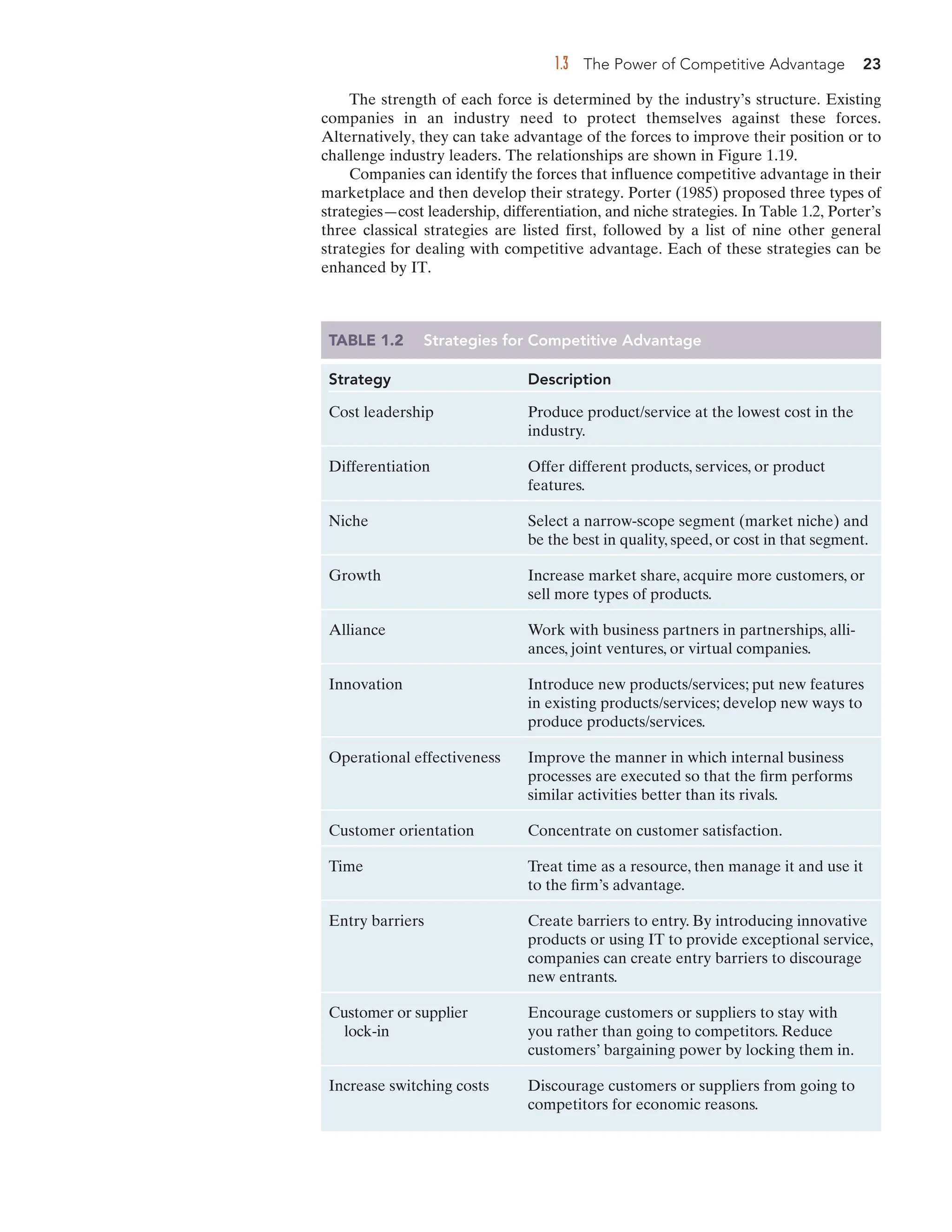
  • 73.
    2.4 Data Centers,Cloud Computing, and Virtualization 57 and service provider that can be a legally binding contract or an informal contract. You can review an example of the Google Apps SLA by visiting its website at Google.com and searching for “SLA.” Staff experienced in managing outsourcing projects may have the necessary expertise for managing work in the cloud and polic- ing SLAs with vendors. The goal is not building the best SLA terms, but getting the terms that are most meaningful to the business. The Cloud Standards Customer Council published the Practical Guide to Cloud Service Level Agreements (2012), which brings together numerous customer experiences into a single guide for IT and business leaders who are considering cloud adoption. According to this guide, an SLA serves: as a means of formally documenting the service(s), performance expectations, responsibilities and limits between cloud service providers and their users. A typical SLA describes levels of service using various attributes such as: availability, TABLE 2.5 Service Factors to Consider when Evaluating Cloud Vendors or Service Providers Factors Examples of Questions to Be Addressed Delays What are the estimated server delays and network delays? Workloads What is the volume of data and processing that can be handled during a specific amount of time? Costs What are the costs associated with workloads across multiple cloud computing platforms? Security How are data and networks secured against attacks? Are data encrypted and how strong is the encryption? What are network security practices? Disaster recovery How is service outage defined? What level of and business redundancy is in place to minimize outages, including continuity backup services in different geographical regions? If a natural disaster or outage occurs, how will cloud services be continued? Technical expertise Does the vendor have expertise in your industry or and understanding business processes? Does the vendor understand what you need to do and have the technical expertise to fulfill those obligations? Insurance in case Does the vendor provide cloud insurance to mitigate of failure user losses in case of service failure or damage? This is a new and important concept. Third-party audit, or Can the vendor show objective proof with an audit an unbiased assessment that it can live up to the promises it is making? of the ability to rely on the service provided by the vendor www.Ebook777.com Free ebooks == www.Ebook777.com
  • 74.
    58 Chapter 2Data Governance and IT Architecture Support Long-Term Performance serviceability, performance, operations, billing, and penalties associated with violations of such attributes. (Cloud Standards Customer Council, 2012, pp. 5–6.) Implementing an effective management process is an important step in ensur- ing internal and external user satisfaction with cloud services. CLOUD VS. DATA CENTER: WHAT IS THE DIFFERENCE? A main difference between a cloud and data center is that a cloud is an off-premise form of computing that stores data on the Internet. In contrast, a data center refers to on-premises hardware and equipment that store data within an organization’s local network. Cloud services are outsourced to a third-party cloud provider who manages the updates, security, and ongoing maintenance. Data centers are typically run by an in-house IT department. Cloud computing is the delivery of computing and storage resources as a ser- vice to end-users over a network. Cloud systems are scalable. That is, they can be adjusted to meet changes in business needs. At the extreme, the cloud’s capacity is unlimited depending on the vendor’s offerings and service plans. A drawback of the cloud is control because a third party manages it. Companies do not have as much control as they do with a data center. And unless the company uses a private cloud within its network, it shares computing and storage resources with other cloud users in the vendor’s public cloud. Public clouds allow multiple clients to access the same virtualized services and utilize the same pool of servers across a public network. In contrast, private clouds are single-tenant environments with stronger security and control for regulated industries and critical data. In effect, private clouds retain all the IT security and control provided by traditional data center infrastructures with the advantage of cloud computing. Companies often use an arrangement of both on-premises data centers and cloud computing (Figure 2.16). A data center is physically connected to a local network, which makes it easier to restrict access to apps and information to only authorized, company-approved people and equipment. However, the cloud is accessible by anyone with the proper credentials and Internet connection. This accessibility arrangement increases expo- sure to company data at many more entry and exit points. CLOUD INFRASTRUCTURE The cloud has greatly expanded the options for enterprise IT infrastructures because any device that accesses the Internet can access, share, and deliver data. Cloud computing is a valuable infrastructure because it: 1. Provides a dynamic infrastructure that makes apps and computing power avail- able on demand. Apps and power are available on demand because they are provided as a service. For example, any software that is provided on demand is referred to as software as a service, or SaaS. Typical SaaS products are Google Apps and Salesforce.com. Section 2.5 discussed SaaS and other cloud services. 2. Helps companies become more agile and responsive while significantly reducing IT costs and complexity through improved workload optimization and service delivery. Move to Enterprise Clouds A majority of large organizations have hundreds or thousands of software licenses that support business processes, such as licenses for Microsoft Office, Oracle database management, IBM CRM (customer relationship management), and various network security software. Managing software and their licenses involves deploying, provi- sioning, and updating them—all of which are time-consuming and expensive. Cloud computing overcomes these problems.
  • 75.
    2.4 Data Centers,Cloud Computing, and Virtualization 59 Figure 2.16 Corporate IT infrastructures can consist of an on-premises data center and off-premises cloud computing. ISSUES IN MOVING WORKLOADS FROM THE ENTERPRISE TO THE CLOUD Building a cloud strategy is a challenge, and moving existing apps to the cloud is stressful. Despite the business and technical benefits, the risk exists of disrupting operations or customers in the process. With the cloud, the network and WAN (wide area network) become an even more critical part of the IT infrastructure. Greater network bandwidth is needed to support the increase in network traffic. And, putting part of the IT architecture or workload into the cloud requires dif- ferent management approaches, different IT skills, and knowing how to manage vendor relationships and contracts. Infrastructure Issues There is a big difference because cloud computing runs on a shared infrastructure, so the arrangement is less customized to a specific company’s requirements. A comparison to help understand the challenges is that outsourcing is like renting an apartment, while the cloud is like getting a room at a hotel. With cloud computing, it may be more difficult to get to the root of perfor- mance problems, like the unplanned outages that occurred with Google’s Gmail and Workday’s human resources apps. The trade-off is cost vs. control. Increasing demand for faster and more powerful computers, and increases in the number and variety of applications are driving the need for more capable IT architectures. VIRTUALIZATION AND VIRTUAL MACHINES Computer hardware had been designed to run a single operating system (OS) and a single app, which leaves most computers vastly underutilized. Virtualization is a technique that creates a virtual (i.e., nonphysical) layer and multiple virtual machines (VMs) to run on a single physical machine. The virtual (or virtualization) layer makes it possible for each VM to share the resources of the hardware. Figure 2.17 shows the relationship among the VMs and physical hardware. © Kittichai/Shutterstock
  • 76.
    60 Chapter 2Data Governance and IT Architecture Support Long-Term Performance What Is a Virtual Machine? Just as virtual reality is not real, but a software-created world, a virtual machine is a software-created computer. Technically, a virtual machine (VM) is created by a software layer, called the virtualization layer, as shown in Figure 2.17. That layer has its own Windows or other OS and apps, such as Microsoft Office, as if it were an actual physical computer. A VM behaves exactly like a physical computer and contains its own virtual—that is, software-based—CPU, RAM (random access memory), hard drive, and network interface card (NIC). An OS cannot tell the dif- ference between a VM and a physical machine, nor can apps or other computers on a network tell the difference. Even the VM thinks it is a “real” computer. Users can set up multiple real computers to function as a single PC through virtualization to pool resources to create a more powerful VM. Virtualization is a concept that has several meanings in IT and therefore sev- eral definitions. The major type of virtualization is hardware virtualization, which remains popular and widely used. Virtualization is often a key part of an enter- prise’s disaster recovery plan. In general, virtualization separates business applica- tions and data from hardware resources. This separation allows companies to pool hardware resources—rather than dedicate servers to applications—and assign those resources to applications as needed. The major types of virtualization are the following: • Storage virtualization is the pooling of physical storage from multiple net- work storage devices into what appears to be a single storage device man- aged from a central console. • Network virtualization combines the available resources in a network by splitting the network load into manageable parts, each of which can be assigned (or reassigned) to a particular server on the network. • Hardware virtualization is the use of software to emulate hardware or a total computer environment other than the one the software is actually running in. It allows a piece of hardware to run multiple operating system images at once. This kind of software is sometimes known as a virtual machine. Virtualization Characteristics and Benefits Virtualization increases the flexibility of IT assets, allowing companies to consoli- date IT infrastructure, reduce maintenance and administration costs, and prepare for strategic IT initiatives. Virtualization is not primarily about cost-cutting, which Figure 2.17 Virtual machines running on a simple computer hardware layer. Application Virtualization Layer Hardware Layer Operating System Application Operating System Application Operating System Virtual Machines
  • 77.
    2.4 Data Centers,Cloud Computing, and Virtualization 61 is a tactical reason. More importantly, for strategic reasons, virtualization is used because it enables flexible sourcing and cloud computing. The characteristics and benefits of virtualization are as follows: 1. Memory-intensive. VMs need a huge amount of RAM (random access memory, or primary memory) because of their massive processing requirements. 2. Energy-efficient. Minimizes energy consumed running and cooling servers in the data center—representing up to a 95 percent reduction in energy use per server. 3. Scalability and load balancing. When a big event happens, such as the Super Bowl, millions of people go to a website at the same time. Virtualization pro- vides load balancing to handle the demand for requests to the site.The VMware infrastructure automatically distributes the load across a cluster of physical serv- ers to ensure the maximum performance of all running VMs. Load balancing is key to solving many of today’s IT challenges. Virtualization consolidates servers, which reduces the cost of servers, makes more efficient use of data center space, and reduces energy consumption. All of these factors reduce the total cost of ownership (TCO). Over a three-year life cycle, a VM costs approximately 75 percent less to operate than a physical server. Liberty Wines supplies to restaurants, supermarkets, and independent retailers from its headquarters in central London. Recipient of multiple international wine awards— including the International Wine Challenge on Trade Supplier of the Year for two years running—Liberty Wines is one of the United Kingdom’s foremost wine importers and distributors. IT Problems and Business Needs As the business expanded, the existing servers did not have the capacity to handle increased data volumes, and main- tenance of the system put a strain on the IT team of two employees. Existing systems were slow and could not pro- vide the responsiveness that employees expected. Liberty Wines had to speed up business processes to meet the needs of customers in the fast-paced world of fine dining. To provide the service their customers expect, employees at Liberty Wines needed quick and easy access to customer, order, and stock information. In the past, the company relied on 10 physical servers for apps and services, such as order processing, reporting, and e-mail. Virtualized Solution Liberty Wines deployed a virtualized server solution incor- porating Windows Server 2008 R2. The 10 servers were replaced with 3 physical servers, running 10 virtual servers. An additional server was used as part of a backup system, further improving resilience and stability. By reducing the number of physical servers from 10 to 4, power use and air conditioning costs were cut by 60 percent. Not only was the bottom line improved, but the carbon footprint was also reduced, which was good for the environment. The new IT infrastructure cut hardware replacement costs by £45,000 (U.S. $69,500) while enhancing stability with the backup system. Apps now run faster, too, so employees can provide better customer service with improved productivity. When needed, virtual servers can be added quickly and eas- ily to support business growth. Questions 1. What business risks had Liberty Wines faced? 2. How does Liberty Wines’ IT infrastructure impact its com- petitive advantage? 3. How did server virtualization benefit Liberty Wines and the environment? IT at Work 2.3 Business Continuity with Virtualization
  • 78.
    62 Chapter 2Data Governance and IT Architecture Support Long-Term Performance Managers want streamlined, real time data-driven enterprises, yet they may face budget cuts. Sustaining performance requires the development of new business apps and analytics capabilities, which comprise the front end—and the data stores and digital infrastructure, or back end, to support them. The back end is where the data reside. The problem is that data may have to navigate through a congested IT infrastructure that was first designed decades ago. These network or database bottlenecks can quickly wipe out the competitive advantages from big data, mobility, and so on. Traditional approaches to increasing database performance—manually tun- ing databases, adding more disk space, and upgrading processors—are not enough when you are have streaming data and real time big data analytics. Cloud services help to overcome these limitations. 2.5 Cloud Services Add Agility XAAS: “AS A SERVICE” MODELS The cloud computing model for on-demand delivery of and access to various types of computing resources also extends to the development of business apps. Figure 2.18 shows four “as a service” (XaaS) solutions based on the concept that the resource— software, platform, infrastructure, or data–can be provided on demand regardless of geolocation. CLOUD COMPUTING STACK Figure 2.19 shows the cloud computing stack, which consists of the following three categories: • SaaS apps are designed for end-users. • PaaS is a set of tools and services that make coding and deploying these apps faster and more efficient. • IaaS consists of hardware and software that power computing resources— servers, storage, operating systems, and networks. Questions 1. What is a data center? 2. Describe cloud computing. 3. What is the difference between data centers and cloud computing? 4. What are the benefits of cloud computing? 5. How can cloud computing solve the problems of managing software licenses? 6. What is an SLA? Why are SLAs important? 7. What factors should be considered when selecting a cloud vendor or provider? 8. When are private clouds used instead of public clouds? 9. Explain three issues that need to be addressed when moving to cloud computing or services. 10. How does a virtual machine (VM) function? 11. Explain virtualization. 12. What are the characteristics and benefits of virtualization? 13. When is load balancing important?
  • 79.
    2.5 Cloud ServicesAdd Agility 63 Software as a Service Software as a service (SaaS) is a widely used model in which software is available to users as needed. Specifically, in SaaS, a service provider hosts the application at its data center and customers access it via a standard Web browser. Other terms for SaaS are on-demand computing and hosted services. The idea is basically the same: Instead of buying and installing expensive packaged enterprise applications, users can access software apps over a network, with an Internet browser being the only necessity. A SaaS provider licenses an application to customers either on-demand, through a subscription, based on usage (pay-as-you-go), or increasingly at no cost when the opportunity exists to generate revenue from advertisements or through other methods. Figure 2.19 The cloud computing stack consists of SaaS, PaaS, and IaaS. Figure 2.18 Four as-a-service solutions: software, platform, infrastructure, and data as a service. © Vallepu/Shutterstock © Yabresse/Shutterstock
  • 80.
    64 Chapter 2Data Governance and IT Architecture Support Long-Term Performance The SaaS model was developed to overcome the common challenge to an enterprise of being able to meet fluctuating demands on IT resources efficiently. It is used in many business functions, primarily customer relationship management (CRM), accounting, human resources (HR), service desk management, and col- laboration. There are thousands of SaaS vendors. Salesforce.com is one of the most widely known SaaS providers. Other examples are Google Docs and collaborative presen- tation software Prezi. For instance, instead of installing Microsoft Word on your own computer, and then loading Word to create a document, you use a browser to log into Google Docs. Only the browser uses your computer’s resources. Platform as a Service Platform as a service (PaaS) benefits software development. PaaS provides a stan- dard unified platform for app development, testing, and deployment. This comput- ing platform allows the creation of Web applications quickly and easily without the complexity of buying and maintaining the underlying infrastructure. Without PaaS, the cost of developing some apps would be prohibitive. The trend is for PaaS to be combined with IaaS. For an example of the value of SaaS and PaaS, see IT at Work 2.4. Within only 12 weeks, Unilever had its new digital social platform built and implemented. The platform was designed to support Unilever Global Marketing by connecting its mar- keters, brand managers, and partners in 190 countries. The new social platform is built on the Salesforce Platform and leverages Salesforce Chatter, which is an enterprise social networking technology. It enables Unilever marketers to share knowledge, best practices, and creative assets across the net- work. According to Mark McClennon, the CIO Consumer at Unilever, “We’ve gone from a blank piece of paper all the way through to rolling out the first release of the platform in about three months using Salesforce technology” (Accenture, 2013). IT at Work 2.4 Unilever Infrastructure as a Service Infrastructure as a service (IaaS) is a way of delivering cloud computing infrastruc- ture as an on-demand service. Rather than purchasing servers, software, data center space, or networks, companies instead buy all computing resources as a fully out- sourced service. IaaS providers are Amazon Web Services (AWS) and Rackspace. Data as a Service Similar to SaaS, PaaS, and IaaS, data as a service (DaaS) enables data to be shared among clouds, systems, apps, and so on regardless of the data source or where they are stored. DaaS makes it easier for data architects to select data from different pools, filter out sensitive data, and make the remaining data available on demand. A key benefit of DaaS is the elimination of the risks and burdens of data man- agement to a third-party cloud provider. This model is growing in popularity as data become more complex, difficult, and expensive to maintain. www.Ebook777.com Free ebooks == www.Ebook777.com
  • 81.
    Key Terms 65 At-a-ServiceModels are Enterprisewide and Can Trigger Lawsuits The various at-a-service models are used in various aspects of business. You will read how these specific services, such as CRM and HR management, are being used for operational and strategic purposes in later chapters. Companies are fre- quently adopting software, platform, infrastructure, data management and starting to embrace mobility as a service and big data as a service because they typically no longer have to worry about the costs of buying, maintaining, or updating their own data servers. Both hardware and human resources expenses can be cut significantly. Service arrangements all require that managers understand the benefits and trade- offs—and how to negotiate effective SLAs. Regulations mandate that confidential data be protected regardless of whether the data are on-premises on in the cloud. Therefore, a company’s legal department needs to get involved in these IT deci- sions. Put simply, moving to cloud services is not simply an IT decision because the stakes around legal and compliance issues are very high. GOING CLOUD Cloud services can advance the core business of delivering superior services to optimize business performance. Cloud can cut costs and add flexibility to the performance of critical business apps. And, it can improve responsiveness to end- consumers, application developers, and business organizations. But to achieve these benefits, there must be IT, legal, and senior management oversight because a com- pany still must meet its legal obligations and responsibilities to employees, customers, investors, business partners, and society. Questions 1. What is SaaS? 2. Describe the cloud computing stack. 3. What is PaaS? 4. What is IaaS? 5. Why is DaaS growing in popularity? 6. How might companies risk violating regulation or compliance requirements with cloud services? Key Terms ad hoc report batch processing cloud computing cloud computing stack cross-sell customer-centric data data as a service (DaaS) data center data governance data silo database decision support system (DSS) dirty data enterprise architecture (EA) exception report executive information system (EIS) goal seeking information information management infrastructure as a service (IaaS) IT infrastructure knowledge management information system (MIS) master data master data management (MDM) master file model online transaction processing (OLTP) platform as a service (PaaS) private cloud public cloud real time processing service-level agreements (SLAs) software as a service (SaaS) structured decisions transaction processing system (TPS) touchpoint unstructured decisions up-sell virtualization virtual machine (VM) volatility what-if analysis
  • 82.
    66 Chapter 2Data Governance and IT Architecture Support Long-Term Performance Assuring Your Learning 1. Why is a strong market position or good profit performance only temporary? 2. Explain the difference between customer-centric and product-centric business models. 3. Assume you had: a. A tall ladder with a sticker that listed a weight allowance only 5 pounds more than you weighed.You know the manufacturer and model number. b. Perishable food with an expiration date 2 days into the future. c. A checking account balance that indicated you had sufficient funds to cover the balance due on an account. In all three cases, you cannot trust the data to be ex- actly correct.The data could be incorrect by about 20 percent. How might you find the correct data for each instance? Which data might not be possible to verify? How does dirty data impact your decision making? 4. If business data are scattered throughout the enter- prise and not synched until the end of the month, how does that impact day-to-day decision making and planning? 5. Assume a bank’s data are stored in silos based on financial product—checking accounts, saving accounts, mortgages, auto loans, and so on.What problems do these data silos create for the bank’s managers? 6. Why do managers and workers still struggle to find information that they need to make decisions or take action despite advances in digital technology? That is, what causes data deficiencies? 7. According to a Tech CEO Council Report, Fortune 500 companies waste $480 billion every year on inefficient business processes.What factors cause such huge waste? How can this waste be reduced? 8. Explain why organizations need to implement enterprise architecture (EA) and data governance. 9. What two problems can EA solve? 10. Name two industries that depend on data gov- ernance to comply with regulations or reporting requirements. Given an example of each. 11. Why is it important for data to be standardized? Given an example of unstandardized data. 12. Why are TPSs critical systems? 13. Explain what is meant by data volatility. How does it affect the use of databases for data analysis? 14. Discuss why the cloud acts as the great IT delivery frontier. 15. What are the immediate benefits of cloud computing? 16. What are the functions of data centers? 17. What factors need to be considered when selecting a cloud vendor? 18. What protection does an effective SLA provide? 19. Why is an SLA a legal document? 20. How can virtualization reduce IT costs while improving performance? DISCUSS: Critical Thinking Questions 21. When selecting a cloud vendor to host your en- terprise data and apps, you need to evaluate the service level agreement (SLA). a. Research the SLAs of two cloud vendors, such as Rackspace,Amazon, or Google. b. For the vendors you selected, what are the SLAs’ uptime percent? Expect them to be 99.9 percent or less. c. Does each vendor count both scheduled down- time and planned downtime toward the SLA uptime percent? d. Compare the SLAs in terms of two other criteria. e. Decide which SLA is better based on your com- parisons. f. Report your results and explain your decision. 22. Many organizations initiate data governance pro- grams because of pressing compliance issues that impact data usage. Organizations may need data governance to be in compliance with one or more regulations, such as the Gramm–Leach Bliley Act (GLB), HIPAA, Foreign Corrupt Practices Act (FCPA), Sarbanes–Oxley Act, and several state and federal privacy laws. a. Research and select two U.S. regulations or privacy laws. b. Describe how data governance would help an enterprise comply with these regulations or laws. 23. Visit eWeek.com Cloud Computing Solutions Center for news and reviews at eweek.com/c/s/ Cloud-Computing. Select one of the articles listed EXPLORE:Online and Interactive Exercises www.Ebook777.com Free ebooks == www.Ebook777.com
  • 83.
    CASE 2.2 BusinessCase 67 under Latest Cloud Computing News. Prepare an executive summary of the article. 24. Visit Rackspace.com and review the company’s three types of cloud products. Describe each of those cloud solutions. 25. Visit Oracle.com. Describe the types of virtualiza- tion services offered by Oracle. 26. Visit YouTube.com and search for two videos on virtualization. For each video, report what you learned. Specify the complete URL, video title, who uploaded the video and the date, video length, and number of views. 27. Financial services firms experience large fluctua- tions in business volumes because of the cyclical nature of financial markets.These fluctuations are often caused by crises—such as the subprime mortgage problems, the discovery of major fraud, or a slowdown in the economy.These fluctuations require that executives and IT leaders have the abil- ity to cut spending levels in market downturns and quickly scale up when business volumes rise again. Research SaaS solutions and vendors for the finan- cial services sector.Would investment in SaaS help such firms align their IT capacity with their business needs and also cut IT costs? Explain your answer. 28. Despite multimillion-dollar investments, many IT organizations cannot respond quickly to evolving business needs.Also, they cannot adapt to large- scale shifts like mergers, sudden drops in sales, or new product introductions. Can cloud computing help organizations improve their responsiveness and get better control of their IT costs? Explain your answer. 29. Describe the relationship between enterprise archi- tecture and organizational performance. 30. Identify four KPIs for a major airline (e.g.,American, United, Delta) or an automobile manufacturer (e.g., GM, Ford, BMW).Which KPI would be the easiest to present to managers on an online dash- board? Explain why. ANALYZEDECIDE: Apply IT Concepts to Business Decisions CASE 2.2 Business Case: Data Chaos Creates Risk Data chaos often runs rampant in service organizations, such as health care and the government. For example, in many hospitals, each line of business, division, and department has implemented its own IT applications, often without a thorough analysis of its relationship with other departmental or divisional systems. This arrangement leads to the hospital having IT groups that specifically manage a particular type of applica- tion suite or data silo for a particular department or division. Data Management When apps are not well managed, they can generate terabytes of irrelevant data, causing hospitals to drown in such data. This data chaos could lead to medical errors. In the effort to man- age excessive and massive amounts of data, there is increased risk of relevant information being lost (missing) or inaccurate— that is, faulty or dirty data. Another risk is data breaches. • Faulty data: By 2016 an estimated 80 percent of health- care organizations will adopt electronic health records, or EHRs (IDC MarketScape, 2012). It is well known that an unintended consequence of EHR is faulty data. According to research done at Columbia University, data in EHR sys- tems may not be as accurate and complete as expected (Hripscak Albers, 2012). Incorrect lab values, imaging results, or physician documentation lead to medical errors, harm patients, and damage the organization’s ac- creditation and reputation. • Data breaches: More than 25 million people have been affected by health-care system data breaches since the Office for Civil Rights, a division of the U.S. Department of Health and Human Services, began reporting breaches in 2009. Most breaches involved lost or stolen data on laptops, removable drives, or other portable media. Breaches are extremely expensive and destroy trust. Accountability in health care demands compliance with strong data governance efforts. Data governance programs verify that data input into EHR, clinical, financial, and opera- tional systems are accurate and complete—and that only authorized edits can be made and logged. Vanderbilt University Medical Center Adopts EHR and Data Governance Vanderbilt University Medical Center (VUMC) in Nashville, TN, was an early adopter of EHR and implemented data governance in 2009. VUMC’s experience provides valuable lessons. VUMC consists of three hospitals and the Vanderbilt Clinic, which have 918 beds, discharge 53,000 patients each year, and count 1.6 million clinic visits each year. On average, VUMC has an 83 percent occupancy rate and has achieved HIMSS Stage 6
  • 84.
    68 Chapter 2Data Governance and IT Architecture Support Long-Term Performance hospital EHR adoption. HIMSS (Healthcare Information and Management Systems Society, himss.org) is a global, nonprofit organization dedicated to better health-care outcomes through IT. There are seven stages of EHR adoption, with Stage 7 be- ing a fully paperless environment. That means all clinical data are part of an electronic medical record and, as a result, can be shared across and outside the enterprise. At Stage 7, the health-care organization is getting full advantage of the health information exchange (HIE). HIE provides interoperability so that information can flow back and forth among physicians, patients, and health networks (Murphy, 2012). VUMC began collecting data as part of its EHR efforts in 1997. By 2009 the center needed stronger, more disciplined data management. At that time, hospital leaders initiated a project to build a data governance infrastructure. Data Governance Implementation VUMC’s leadership team had several concerns. 1. IT investments and tools were evolving rapidly, but they were not governed by HIM (Healthcare Information and Management) policies. 2. As medical records became electronic so they might be transmitted and shared easily, they became more vulner- able to hacking. 3. As new uses of electronic information were emerging, the medical center struggled to keep up. Health Record Executive Committee Initially, VUMC’s leaders assigned data governance to their tra- ditional medical records committee, but that approach failed. Next, they hired consultants to help develop a data governance structure and organized a health record executive committee to oversee the project. The committee reports to the medi- cal board and an executive committee to ensure executive involvement and sponsorship. The committee is responsible for developing the strategy for standardizing health record prac- tices, minimizing risk, and maintaining compliance. Members include the chief medical information officer (CMIO), CIO, legal counsel, medical staff, nursing informatics, HIM, administration, risk management, compliance, and accreditation. In addition, a legal medical records team was formed to support additions, corrections, and deletions to the EHR. This team defines pro- cedures for removal of duplicate medical record numbers and policies for data management and compliance. Costs of Data Failure Data failures incur the following costs: • Rework • Loss of business • Patient safety errors • Malpractice lawsuits • Delays in receiving payments because billing or medical codes data are not available Measuring the Value of Data Governance One metric to calculate the value of a data governance program is confidence in data-dependent assumptions, or CIDDA. CIDDA is computed by multiplying three confidence estimates as follows: CIDDA G M TS where G Confidence that data are good enough for their intended purpose M Confidence that data mean what you think they do TS Confidence that you know where the data come from and trust the source CIDDA is a subjective metric for which there are no industry benchmarks, yet it can be evaluated over time to gauge any improvement in data quality confidence. Benefits Achieved from Data Governance As in other industries, in health care, data are the most valu- able asset. The handling of data is the real risk. EHRs are effective only if the data are accurate and useful to support patient care. Effective ongoing data governance has achieved that goal at VUMC. Sources: Compiled from Murphy (2012), HIMSS.org (2014), HIMSSanalytics.org (2014), Reeves Bowen (2013). Questions 1. What might happen when each line of business, division, and department develops its own IT apps? 2. What are the consequences of poorly managed apps? 3. What two risks are posed by data chaos? Explain why. 4. What are the functions of data governance in the health- care sector? 5. Why is it important to have executives involved in data governance projects? 6. List and explain the costs of data failure. 7. Calculate the CIDDA over time: Q1: G 40%, M 50%, TS 20% Q2: G 50%, M 55%, TS 30% Q3: G 60%, M 60%, TS 40% Q4: G 60%, M 70%, TS 45% 8. Why are data the most valuable asset in health care?
  • 85.
    References 69 CASE 2.3 VideoCase: Cloud Computing: Three Case Studies When organizations say they are “using the cloud,” they can mean a number of very different things. Using an IaaS service such as Amazon EC2 or Terremark is different from using Google Apps for outsourced e-mail, which is different again from exposing an API in Facebook. A video shows three cloud computing case studies from Vordel’s customers. The cases cover SaaS, IaaS, and PaaS. In first two examples, customers are connecting to the cloud: first to Google Apps (for single sign-on to Google Apps e-mail) and second to Terremark to manage virtual servers. In the third example, the connection is from the cloud using a Facebook app to a company’s APIs. You might spot Animal House references. Follow these three steps: Visit SOAtoTheCloud.com/2011/10/video-three-cloud- computing-case.html. View the 11-minute video of the three case studies. Question 1. Explain the value or benefits of each organization’s cloud investment. Cloud Standards Customer Council. Practical Guide to Cloud Service Level Agreements. Version 1.April 10, 2012. http:// www.cloudstandardscustomercouncil.org/2012_Practical_ Guide_to_Cloud_SLAs.pdf De Clerck, J. P.“Optimizing the Digital and Social Customer Experience.” Social Marketing Forum, February 16, 2013. Enterprise Architecture Research Forum (EARF). 2012. First San Francisco Partners.“How McAfee Took Its First Steps to MDM Success.” 2009. GAO (General Accounting Office).“Practical Guide to Federal Enterprise Architecture.”Version 2.August 2010. Hamilton, N.“Choosing Data Governance Battles.” Inside Reference Data, December 2013. HIMSS.org (2014) HIMSSanalytics.org (2014), Hripscak, G. D. J.Albers.“Next Generation Phenotyping of Electronic Health Records.” Journal of the American Medical Informatics Association, Volume 19, Issue 5. September 2012. IBM Institute for Business Value.“IBM Chief Information Officer Study:The Essential CIO.” May 2011. IDC MarketScape.“U.S.Ambulatory EMR/EHR for Small Practices.” 3012 Vendor Assessment. May 2012. Keitt,T.J.“Demystifying The Mobile Workforce–An Informa- tion Workplace Report.” Forrester.com. June 7 , 2011. mcafee.com. McAfee Fact Sheet. 2013. Miliard, M.“IBM Unveils New Watson-based Analytics.” Healthcare IT News. October 25, 2011. Murphy, K.“Health Information Exchange.” EHR Intelligence, April 9, 2012. National Institute of Standards and Technology (NIST). Cloud Computing Program. 2012. Reeves, M. G. R. Bowen.“Developing a Data Governance Model in Health Care.” Healthcare Finance Management, February 2013. Rich, R.“Master Data Management or Data Governance? Yes, Please.” Teradata Magazine Q3, 2013. Tech CEO Council Report 2010. techceocouncil.org/news/ reports/ References
  • 86.
    70 Chapter Snapshot Analytics differentiatesbusiness in the 21st century. Transactional, social, mobile, cloud, web, and sensor data offer enormous potential. But without tools to ana- lyze these data types and volumes, there would not be much difference between business in the 20th century and business today—except for mobile access. High- quality data and human expertise are essential to the value of analytics (Figure 3.1). Human expertise is necessary because analytics alone cannot explain the reasons for trends or relationships; 1. Describe the functions of database and data warehouse technologies, the differences between centralized and distributed database architecture, how data quality impacts performance, and the role of a master reference file in cre- ating accurate and consistent data across the enterprise. 2. Evaluate the tactical and strategic benefits of big data and analytics. 3. Describe data and text mining, and give examples of mining applications to find patterns, correlations, trends, or other meaningful relationships in organizational data stores. 4. Explain the operational benefits and competitive advan- tages of business intelligence, and how forecasting can be improved. 5. Describe electronic records management and how it helps companies meet their compliance, regulatory, and legal obligations. Chapter Snapshot Case 3.1 Opening Case: Coca-Cola Manages at the Point That Makes a Difference 3.1 Database Management Systems 3.2 Data Warehouse and Big Data Analytics 3.3 Data and Text Mining 3.4 Business Intelligence 3.5 Electronic Records Management Key Terms Assuring Your Learning • Discuss: Critical Thinking Questions • Explore: Online and Interactive Exercises • Analyze Decide: Apply IT Concepts to Business Decisions Case 3.2 Business Case: Financial Intelligence Fights Fraud Case 3.3 Video Case: Hertz Finds Gold in Integrated Data References Learning Outcomes Data Management, Big Data Analytics, and Records Management 3 Chapter www.Ebook777.com Free ebooks == www.Ebook777.com
  • 87.
    71 know what actionto take; or provide sufficient context to determine what the numbers represent and how to interpret them. Database, data warehouse, big data, and business intelligence (BI) technologies interact to create a new biz-tech ecosystem. Big data analytics and BI discover insights or relationships of interest that otherwise might not have been recognized. They make it possible for managers to make decisions and act with clarity, speed, and confidence. Big data analytics is not just about man- aging more or varied data. Rather, it is about asking new questions, formulating new hypotheses, exploration and discovery, and making data-driven decisions. Ultimately, a big part of big data analytic efforts is the use of new analytics techniques. Mining data or text taken from day-to-day busi- ness operations reveals valuable information, such as customers’ desires, products that are most important, or processes that can be made more efficient. These insights expand the ability to take advantage of opportunities, minimize risks, and control costs. While you might think that physical pieces of paper are a relic of the past, in most offices the opposite is true. Aberdeen Group’s survey of 176 organizations worldwide found that the volume of physical documents is growing by up to 30 percent per year. Document man- agement technology archives digital and physical data to meet business needs, as well as regulatory and legal requirements (Rowe, 2012). CASE 3.1 OPENING CASE Coca-Cola Manages at the Point That Makes a Difference COCA-COLA’S DATA MANAGEMENT CHALLENGES The Coca-Cola Company is a Fortune 100 company with over $48 billion in sales revenue and $9 billion in profit (Figure 3.2). The market leader manages and analyzes several petabytes (Pb) of data generated or collected from more than 500 brands and consumers in 206 countries. Its bottling partners provide sales and shipment data, while retail customers transmit transaction and merchandising data. Other data sources are listed in Table 3.1. From 2003 to spring 2013, data analysts at Coca-Cola knew there were BI opportunities in the mountains of data its bottlers were storing, but finding and accessing all of that data for analytics proved to be nearly impossible. The disparate data sources caused long delays in getting analytics reports from IT to sales teams. The company decided to replace the legacy software at each bottling facility and standardize them on a new BI system, a combination of MicroStrategy and Microsoft BI products. Enterprise Data Management Like most global companies, Coca-Cola relies on sophisticated enterprise data management, BI, and analytic technologies to sus- tain its performance in fiercely competitive markets (Figure 3.3). Data are managed Petabyte (Pb) 1,000 Terabytes (Tb) 1 million Gigabytes (Gb). Human expertise Data analytics High-Quality data Trends or relationships Context to understand what the numbers represent and how to interpret them What action to take + + Figure 3.1 Data analytics, and human expertise and high-quality data, are needed to obtain actionable information.
  • 88.
    72 Chapter 3Data Management, Big Data Analytics, and Records Management in a centralized database, as illustrated in Figure 3.4. Data warehousing, big data, analytics, data modeling, and social media are used to respond to competitors’ activ- ity, market changes, and consumer preferences. To support its business strategy and operations, Coca-Cola changed from a decentralized database approach to a centralized database approach. Now its data are combined centrally and accessible via shared platforms across the organization (Figure 3.5). Key objectives of the data management strategy are to help its retail customers such as Walmart, which sells $4 billion of Coca-Cola products annually, sell Figure 3.3 Coca-Cola World Headquarters in Atlanta, GA, announced on January 25, 2010, that new packaging material for plastic bottles will be made partially from plants—as part of its sustainability efforts. Centralized database stores data at a single location that is accessible from anywhere. Searches can be fast because the search engine does not need to check multiple dis- tributed locations to find responsive data. Data warehouses that inte- grate data from databases across an entire enterprise are called enterprise data warehouses (EDW). © Katherine Welles/Shutterstock World’s largest nonalcoholic beverage company with more than 500 brands of beverages, ready-to-drink coffees, juices, and juice drinks. Has the world’s largest beverage distribution system, with consumers in more than 200 countries. Products consumed at a rate of 1.9 billion servings a day worldwide. Brand Business Ethics Sustainability Focused on initiatives that reduce their environmental footprint; support active, healthy living; create a safe work environment; and enhance the economic development of the communities where they operate. Digital Technology Centralized database Enterprise data warehouse (EDW) Big data analytics Decision models 70 million Facebook followers The Coca-Cola Company Figure 3.2 The Coca-Cola Company overview.
  • 89.
    CASE 3.1 OpeningCase 73 TABLE 3.1 Opening Case Overview Company • The Coca-Cola Company, coca-cola.com • Sustainability: www.coca-colacompany.com/sustainability • $48 billion in sales revenue and profits of $9 billion, 2013 Industry • The global company manufactures, sells, and distributes nonalcoholic beverages. Product lines • More than 500 brands of still and sparkling beverages, ready-to-drink coffees, juices, and juice drinks. Digital technology • Enterprise data warehouse (EDW) • Big data and analytics • Business intelligence • In 2014, moved from a decentralized approach to a central- ized approach, where the data are combined centrally and available via the shared platforms across the organization. Business challenges • In 2010, Coca-Cola had 74 unique databases, many of them used different software to store and analyze data. Dealing with incompatible databases and reporting systems re- mained a problem from 2003 to 2013. • Chief Big Data Insights Officer Esat Sezer has stated that Coca-Cola took a strategic approach instead of a tactical approach with big data. Global data sources • Transaction and merchandising data • Data from nationwide network of 74 bottlers • Multichannel retail data • Customer profile data from loyalty programs • Social media data • Supply chain data • Competitor data • Sales and shipment data from bottling partners Figure 3.4 Centralized data architecture. more Coca-Cola products and to improve the consumer experience. The company has implemented a data governance program to ensure that cultural data sensitivi- ties are respected. © Vallepu/Shutterstock
  • 90.
    74 Chapter 3Data Management, Big Data Analytics, and Records Management SUSTAINING BUSINESS PERFORMANCE All data are standardized through a series of master data management (MDM) processes, as discussed in Chapter 2. An enterprise data warehouse (EDW) gener- ates a single view of all multichannel retail data. The EDW creates a trusted view of customers, sales, and transactions, enabling Coca-Cola to respond quickly and accurately to changes in market conditions. Throughout Coca-Cola’s divisions and departments, huge volumes of data are analyzed to make more and better time-sensitive, critical decisions about products, shopper marketing, the supply chain, and production. Point-of-sale (POS) data are captured from retail channels and used to create customer pro- files. Those profiles are communicated via a centralized iPad reporting system. POS data are analyzed to support collaborative planning, forecasting, and replenishment processes within its supply chain. (Supply chain management, collaborative planning, forecasting, and replenishment are covered in greater detail in Chapter 10.) Coca-Cola’s Approach to Big Data and Decision Models Big data are treated as a strategic asset. Chief Big Data Insights Officer Esat Sezer has stated that Coca-Cola takes a strategic approach instead of a tactical approach with big data. The company is far advanced in the use of big data to manage its products, sales revenue, and customer experiences in near real time and to reduce costs. For example, it cut overtime costs almost in half by analyzing the service center data. Big data help Coca-Cola relate to its 70 million Facebook followers—many of them bolster the Coke brand. Figure 3.5 Data from online and offline transactions are stored in databases. Data about entities such as customers, products, orders, and employees are stored in an organized way. © alphaspirit/Shutterstock www.Ebook777.com Free ebooks == www.Ebook777.com
  • 91.
    3.1 Database ManagementSystems 75 Big data play a key role in ensuring that its orange juice tastes the same year- round and is readily available anywhere in the world. Oranges used by Coca-Cola have a peak growing season of only three months. Producing orange juice with a consistent taste year-round despite the inconsistent quality of the orange supply is complex. To deal with the complexity, an orange juice decision model was devel- oped, the Black Book model. A decision model quantifies the relationship between variables, which reduces uncertainty. Black Book combines detailed data on the 600 flavors that make up an orange, weather, customer preferences, expected crop yields, cost pressures, regional consumer preferences, and acidity or sweet- ness rate. The model specifies how to blend the orange juice to create a consistent taste. Coke’s Black Book juice model is considered to be one of the most complex business analytics apps. It requires analyzing up to 1 quintillion (10E18) decision variables to consistently deliver the optimal blend. With the power of big data and decision models, Coca-Cola is prepared for disruptions in supply far in advance. According to Doug Bippert, Coca-Cola’s vice president of business acceleration, “If we have a hurricane or a freeze, we can quickly re-plan the business in five or 10 minutes just because we’ve mathematically modeled it” (BusinessIntelligence.com, 2013b). Sources: Compiled from Burns (2013), Fernandez (2012), BusinessIntelligence.com (2013a, 2013b), CNNMoney (2014), Big Data Startups (2013), and Teradata (2012). Questions 1. Why does the Coca-Cola Company have petabytes of data? 2. Why is it important for Coca-Cola to be able to process POS data in near real time? 3. How does Coca-Cola attempt to create favorable customer experiences? 4. What is the importance of having a trusted view of the data? 5. What is the benefit of a decision model? 6. What is the Black Book model? 7. Explain the strategic benefit of the Black Book model. Data are the driving force behind any successful business. Operations, plan- ning, control, and all other management functions rely largely on processed information, not raw data. And, no one wants to wait for business-critical reports or specific answers to their questions. Data management technologies that keep users informed and support the various business demands are the following: • Databases store data generated by business apps, sensors, operations, and transaction-processing systems (TPS). Data in databases are extremely vola- tile. Medium and large enterprises typically have many databases of various types. • Data warehouses integrate data from multiple databases and data silos, and organize them for complex analysis, knowledge discovery, and to support 3.1 Database Management Systems Databases are collections of data sets or records stored in a systematic way. Volatile refers to data that change frequently.
  • 92.
    76 Chapter 3Data Management, Big Data Analytics, and Records Management DATABASE MANAGEMENT SYSTEMS AND SQL Database management systems (DBMSs) integrate with data collection systems such as TPS and business applications; store the data in an organized way; and provide facilities for accessing and managing that data. Over the past 25 years, the relational database has been the standard database model adopted by most enter- prises. Relational databases store data in tables consisting of columns and rows, similar to the format of a spreadsheet, as shown in Figure 3.6. Relational management systems (RDBMSs) provide access to data using a declarative language—structured query language (SQL). Declarative languages simplify data access by requiring that users only specify what data they want to access without defining how access will be achieved. The format of a basic SQL statement is SELECT column_name(s) FROM table_name WHERE condition An instance of SQL is shown in Figure 3.7. Database management systems (DBMSs) are software used to manage the additions, updates, and dele- tions of data as transactions occur, and to support data queries and reporting. They are OLTP systems. SQL is a standardized query language for accessing databases. decision making. For example, data are extracted from a database, processed to standardize their format, and then loaded into data warehouses at specific times, such as weekly. As such, data in data warehouses are nonvolatile—and ready for analysis. • Data marts are small-scale data warehouses that support a single function or one department. Enterprises that cannot afford to invest in data warehous- ing may start with one or more data marts. • Business intelligence (BI) tools and techniques process data and do statisti- cal analysis for insight and discovery—that is, to discover meaningful rela- tionships in the data, keep informed in real time, detect trends, and identify opportunities and risks. Data-processing techniques, processing power, and enterprise performance management capabilities have undergone revolutionary advances in recent years for reasons you are already familiar with—big data, mobility, and cloud comput- ing. The last decade, however, has seen the emergence of new approaches, first in data warehousing and, more recently, for transaction processing, as you read in this chapter. Figure 3.6 Illustration of structured data format. Numeric and alphanumeric data are arranged into rows and predefined columns similar to those in an Excel spreadsheet. © Alexander Fediachov/Alamy www.Ebook777.com Free ebooks == www.Ebook777.com
  • 93.
    3.1 Database ManagementSystems 77 DBMS Functions An accurate and consistent view of data throughout the enterprise is needed so one can make informed, actionable decisions that support the business strategy. Functions performed by a DBMS to help create such a view are: • Data filtering and profiling: Process and store data efficiently. Inspect the data for errors, inconsistencies, redundancies, and incomplete information. • Data integrity and maintenance: Correct, standardize, and verify the consis- tency and integrity of the data. • Data synchronization: Integrate, match, or link data from disparate sources. • Data security: Check and control data integrity over time. • Data access: Provide authorized access to data in both planned and ad hoc ways within acceptable time. Today’s computing hardware is capable of crunching through huge datasets that were impossible to manage a few years back and making them available on- demand via wired or wireless networks (Figure 3.8). Figure 3.7 An instance of SQL to access employee information based on date of hire. © Piotr Adamowicz/Shutterstock TECH NOTE 3.1 Factors That Determine the Performance of a DBMS Factors to consider when evaluating the performance of a database are the following. Data latency. Latency is the elapsed time (or delay) between when data are created and when they are available for a query or report.Applications have different toler- ances for latency. Database systems tend to have shorter latency than data ware- houses. Short latency imposes more restrictions on a system. Queries are ad hoc (unplanned) user requests for specific data.
  • 94.
    78 Chapter 3Data Management, Big Data Analytics, and Records Management Figure 3.8 Database queries are processed in real time (a), and results are transmitted via wired or wireless networks to computer screens or handhelds (b). (a) (b) © Corbis RF/Alamy © Focus Technology/Alamy Ability to handle the volatility of the data. The database has the processing power to handle the volatility of the data. The rates at which data are added, updated, or deleted determine the workload that the database must be able to control to prevent problems with the response rate to queries. Query response time. The volume of data impacts response times to queries and data explorations. Many databases pre-stage data—that is, summarize or precalcu- late results—so queries have faster response rates. Data consistency. Immediate consistency means that as soon as data are updated, responses to any new query will return the updated value.With eventual consistency, not all query responses will reflect data changes uniformly.Inconsistent query results could cause serious problems for analyses that depend on accurate data. Query predictability. The greater the number of ad hoc or unpredictable queries, the more flexible the database needs to be. Database or query performance manage- ment is more difficult when the workloads are so unpredictable that they cannot be prepared for in advance. The ability to handle the workload is the most important criterion when choosing a database.
  • 95.
    3.1 Database ManagementSystems 79 Online Transaction Processing and Online Analytics Processing When most business transactions occur—for instance, an item is sold or returned, an order is sent or cancelled, a payment or deposit is made—changes are made immediately to the database. These online changes are additions, updates, or deletions. DBMSs record and process transactions in the database, and support queries and reporting. Given their functions, DBMSs are referred to as online transaction-processing (OLTP) systems. OLTP is a database design that breaks down complex information into simpler data tables to strike a balance between transaction-processing efficiency and query efficiency. OLTP databases process millions of transactions per second. However, databases cannot be optimized for data mining, complex online analytics-processing (OLAP) systems, and decision support. These limitations led to the introduction of data warehouse technology. Data warehouses and data marts are optimized for OLAP, data mining, BI, and decision support. OLAP is a term used to describe the analysis of complex data from the data warehouse. In summary, databases are optimized for extremely fast transaction processing and query processing. Data warehouses are optimized for analysis. DBMS AND DATA WAREHOUSING VENDORS RESPOND TO LATEST DATA DEMANDS One of the major drivers of change in the data management market is the increased amount of data to be managed. Enterprises need powerful DBMSs and data warehousing solutions, analytics, and reporting. The four vendors that domi- nate this market—Oracle, IBM, Microsoft, and Teradata—continue to respond to evolving data management needs with more intelligent and advanced software and hardware. Advanced hardware technology enables scaling to much higher data volumes and workloads than previously possible, or it can handle specific workloads. Older general-purpose relational databases DBMSs lack the scal- ability or flexibility for specialized or very large workloads, but are very good at what they do. DBMS Vendor Rankings The highest-ranking enterprise DBMSs in mid-2014 were Oracle’s MySQL, Microsoft’s SQL Server, PostgreSQL, IBM’s DB2, and Teradata Database. Most run on multiple operating systems (OSs). • MySQL, which was acquired by Oracle in January 2010, powers hundreds of thousands of commercial websites and a huge number of internal enterprise applications. • SQL Server’s ease of use, availability, and Windows operating system inte- gration make it an easy choice for firms that choose Microsoft products for their enterprises. • PostgreSQL is the most advanced open source database, often used by online gaming applications and Skype, Yahoo!, and MySpace. • DB2 is widely used in data centers and runs on Linux, UNIX,Windows, and mainframes. Trend Toward NoSQL Systems RDBMSs are still the dominant database engines, but the trend toward NoSQL (short for “not only SQL”) systems is clear. NoSQL systems increased in popu- larity by 50 percent from 2013 to 2014. Although NoSQL have existed for as Online transaction processing (OLTP) systems are designed to manage transaction data, which are volatile. www.Ebook777.com Free ebooks == www.Ebook777.com
  • 96.
    80 Chapter 3Data Management, Big Data Analytics, and Records Management long as relational DBMS, the term itself was not introduced until 2009. That was when many new systems were developed in order to cope with the unfold- ing requirements for DBMS—namely, handling big data, scalability, and fault tolerance for large Web applications. Scalability means the system can increase in size to handle data growth or the load of an increasing number of concurrent users. To put it differently, scalable systems efficiently meet the demands of high- performance computing. Fault tolerance means that no single failure results in any loss of service. NoSQL systems are such a heterogeneous group of database systems that attempts to classify them are not very helpful. However, their general advantages are these: • Higher performance • Easy distribution of data on different nodes, which enables scalability and fault tolerance • Greater flexibility • Simpler administration Starting in 2010 and continuing through 2014, Microsoft has been working on the first rewrite of SQL Server’s query execution since Version 7 was released in 1998. The goal is to offer NoSQL-like speeds without sacrificing the capabilities of a relational database. With most NoSQL offerings, the bulk of the cost does not lie in acquiring the database, but rather in implementing it. Data need to be selected and migrated (moved) to the new database. Microsoft hopes to reduce these costs by offering migration solutions. CENTRALIZED AND DISTRIBUTED DATABASE ARCHITECTURE Databases are centralized or distributed, as shown in Figure 3.9. Both types of data- bases need one or more backups and should be archived onsite and offsite in case of a crash or security incident. Centralized Database Architecture A centralized database stores all related files in a central location—as you read in the opening Coca-Cola case. For decades the main database platform consisted of centralized database files on massive mainframe computers. Benefits of centralized database configurations include: 1. Better control of data quality. Data consistency is easier when data are kept in one physical location because data additions, updates, and deletions can be made in a supervised and orderly fashion. 2. Better IT security. Data are accessed via the centralized host computer, where they can be protected more easily from unauthorized access or modification. A major disadvantage of centralized databases, like all centralized systems, is transmission delay when users are geodispersed. More powerful hardware and networks compensate for this disadvantage. Distributed Database Architecture A distributed database system allows apps on computers and mobiles to access data from both local and remote databases, as diagrammed in Figure 3.10. Distributed databases use client/server architecture to process information requests. Computers and mobile devices accessing the servers are called clients. The databases are stored on servers that reside in the company’s data centers, a private cloud, or a public cloud.
  • 97.
    3.1 Database ManagementSystems 81 Users Los Angeles Users New York Users Kansas City Users Chicago New York Users Los Angeles Los Angeles Users Kansas City Kansas City Central Location Central Location New York Users New York (a) (b) New York Users Chicago Chicago Figure 3.9 Comparison of centralized and distributed databases. GARBAGE IN, GARBAGE OUT Data collection is a highly complex process that can create problems concerning the quality of the data being collected. Therefore, regardless of how the data are collected, they need to be validated so users know they can trust them. Classic expressions that sum up the situation are “garbage in, garbage out” (GIGO) and the potentially riskier “garbage in, gospel out.” In the latter case, poor-quality data are trusted and used as the basis for planning. You have encountered data safeguards, such as integrity checks, to help improve data quality when you fill in an online form. For example, the form will not accept an e-mail address that is not formatted correctly. Dirty Data Costs and Consequences Dirty data—that is, poor-quality data—lack integrity and cannot be trusted. Too often managers and information workers are actually constrained by data that cannot be trusted because they are incomplete, out of context, outdated, inaccurate, inaccessible, or so overwhelming that they require weeks to analyze.
  • 98.
    82 Chapter 3Data Management, Big Data Analytics, and Records Management In such situations, the decision maker is facing too much uncertainty to make intelligent business decisions. The cost of poor-quality data may be expressed as a formula: Cost to Correct Errors Cost to Prevent Errors Lost Business Cost of Poor- Quality Data Examples of these costs include: • Lost business. Business is lost when sales opportunities are missed, orders are returned because wrong items were delivered, or errors frustrate and drive away customers. • Time spent preventing errors. If data cannot be trusted, then employees need to spend more time and effort trying to verify information in order to avoid mistakes. • Time spent correcting errors. Database staff need to process corrections to the database. For example, the costs of correcting errors at Urent Corporation are estimated as follows: a) Two database staff members spend 25 percent of their workday process- ing and verifying data corrections each day: 2 people * 25% of 8 hours/day 4 hours/day correcting errors b) Hourly salaries are $50 per hour based on pay rate and benefits: $50/hour * 4 hours/day $200/day correcting errors c) 250 workdays per year: $200/day * 250 days $50,000/year to correct errors The costs of poor-quality data spread throughout a company, affecting systems from shipping and receiving to accounting and customer service. Data Distributed databases on servers Manufacturing Manufacturing clients Headquarter clients Headquarters Sales Marketing Sales marketing clients Figure 3.10 Distributed database architecture for headquarters, manufacturing, and sales and marketing.
  • 99.
    3.1 Database ManagementSystems 83 errors typically arise from the functions or departments that generate or create the data—and not within the IT department. When all costs are considered, the value of finding and fixing the causes of data errors becomes clear. In a time of decreased budgets, some organizations may not have the resources for such proj- ects and may not even be aware of the problem. Others may be spending most of their time fixing problems, thus leaving them with no time to work on preventing them. Bad data are costing U.S. businesses hundreds of billions of dollars a year and affecting their ability to ride out the tough economic climate. Incorrect and outdated values, missing data, and inconsistent data formats can cause lost customers, sales, and revenue; misallocation of resources; and flawed pricing strategies. For a particular company, it is difficult to calculate the full cost of poor data quality and its long-term effects. Part of the difficulty is the time delay between the mistake and when it is detected. Errors can be very difficult to correct, especially when systems extend across the enterprise. Another concern is that the impacts of errors can be unpredictable or serious. For example, the cost of errors due to unre- liable and incorrect data alone is estimated to be as high as $40 billion annually in the retail sector (Zynapse, 2010). And, one health-care company whose agents were working with multiple ISs, but were not updating client details in every IS, saw its annual expenses increase by $9 million. Data Ownership and Organizational Politics Despite the need for high-quality data, organizational politics and technical issues make that difficult to achieve. The source of the problem is data ownership—that is, who owns or is responsible for the data. Data ownership problems exist when there are no policies defining responsibility and accountability for managing data. Inconsistent data formats of various departments create an additional set of prob- lems as organizations try to combine individual applications into integrated enter- prise systems. The tendency to delegate data-quality responsibilities to the technical teams who have no control over data quality, as opposed to business users who do have such control, is another common pitfall that stands in the way of accumulating high- quality data. Those who manage a business or part of a business are tasked with trying to improve business performance and retain customers. Compensation is tied to improving profitability, driving revenue growth, and improving the quality of cus- tomer service. These key performance indicators (KPIs) are monitored closely by senior managers who want to find and eliminate defects that harm performance. It is strange then that so few managers take the time to understand how performance is impacted by poor-quality data. Two examples make a strong case for investment in high-quality data. Retail banks: For retail bank executives, risk management is the number- one issue. Disregard for risk contributed to the 2008 financial services meltdown. Despite risk management strategies, many banks still incur huge losses. Part of the problem in many banks is that their ISs enable them to monitor risk only at the product level—mortgages, loans, or credit cards. Product-level risk management ISs monitor a customer’s risk exposure for mortgages, or for loans, or for credit cards, and so forth—but not for a customer for all products. With product-level ISs, a bank cannot see the full risk exposure of a customer. The limitations of these siloed product-level risks have serious implications for business performance because bad-risk customers cannot be identified easily, and customer data in the various ISs may differ. For example, consider what happens when each product-level risk man- agement IS feeds data to marketing ISs. Marketing may offer bad-risk customers incentives to take out another credit card or loan that they cannot repay. And since
  • 100.
    84 Chapter 3Data Management, Big Data Analytics, and Records Management the bank cannot identify its best customers either, they may be ignored and enticed away by better deals offered by competitors. This scenario illustrates how data own- ership and data-quality management are critical to risk management. Data defects and incomplete data can quickly trigger inaccurate marketing and mounting losses. One retail bank facing these problems lost 16 percent of its mortgage business within 18 months while losses in its credit card business increased (Ferguson, 2012). Manufacturing. Many manufacturers are at the mercy of a powerful customer base—large retailers. Manufacturers want to align their processes with those of large retail customers to keep them happy. This alignment makes it possible for a retailer to order centrally for all stores or to order locally from a specific manu- facturer. Supporting both central and local ordering makes it difficult to plan pro- duction runs. For example, each manufacturing site has to collect order data from central ordering and local ordering systems to get a complete picture of what to manufacture at each site. Without accurate, up-to-date data, orders may go unfilled, or manufacturers may have excess inventory. One manufacturer who tried to keep its key retailer happy by implementing central and local ordering could not process orders correctly at each manufacturing site. No data ownership and lack of control over how order data flowed throughout business operations had negative impacts. Conflicting and duplicate business processes at each manufacturing site caused data errors, leading to mistakes in manufacturing, packing, and shipments. Customers were very dissatisfied. These two examples represent the consequences of a lack of data ownership and data quality. Understanding the impact of mismanaged data makes data owner- ship and accurate data a higher priority. Compliance with numerous federal and state regulations relies on rock-solid data and trusted metrics used for regulatory reporting. Data ownership, data quality, and formally managed data are high on the agenda of CFOs and CEOs who are held personally accountable if their company is found to be in violation of regulations. DATA LIFE CYCLE AND DATA PRINCIPLES The data life cycle is a model that illustrates the way data travel through an organi- zation, as shown in Figure 3.11. The data life cycle begins with storage in a database, to being loaded into a data warehouse for analysis, then reported to knowledge workers or used in business apps. Supply chain management (SCM), customer relationship management (CRM), and e-commerce are enterprise applications that require up-to-date, readily accessible data to function properly. Three general data principles relate to the data life cycle perspective and help to guide IT investment decisions: 1. Principle of diminishing data value. The value of data diminishes as they age. This is a simple, yet powerful principle. Most organizations cannot operate at peak performance with blind spots (lack of data availability) of 30 days or longer. Global financial services institutions rely on near real time data for peak performance. Figure 3.11 Data life cycle. Data Sources and Databases Personal expertise judgment Data Visualization SCM E-commerce Strategy Others CRM Data Analysis Data Storage Results Business Analytics Business Applications Internal Data External Data Data Warehouse Data Marts Data Marts OLAP, Queries, EIS, DSS Data Mining Decision Support Knowledge and its Management www.Ebook777.com Free ebooks == www.Ebook777.com
  • 101.
    3.1 Database ManagementSystems 85 2. Principle of 90/90 data use. According to the 90/90 data-use principle, a majority of stored data, as high as 90 percent, is seldom accessed after 90 days (except for auditing purposes). That is, roughly 90 percent of data lose most of their value after 3 months. 3. Principle of data in context. The capability to capture, process, format, and distribute data in near real time or faster requires a huge investment in data architecture (Chapter 2) and infrastructure to link remote POS systems to data storage, data analysis systems, and reporting apps. The investment can be justi- fied on the principle that data must be integrated, processed, analyzed, and for- matted into “actionable information.” MASTER DATA AND MASTER DATA MANAGEMENT As data become more complex and their volumes explode, database performance degrades. One solution is the use of master data and master data management (MDM), as introduced in Chapter 2. MDM processes integrate data from various sources or enterprise applications to create a more complete (unified) view of a cus- tomer, product, or other entity. Figure 3.12 shows how master data serve as a layer between transactional data in a database and analytical data in a data warehouse. Although vendors may claim that their MDM solution creates “a single version of the truth,” this claim is probably not true. In reality, MDM cannot create a single unified version of the data because constructing a completely unified view of all master data is simply not possible. Master Reference File and Data Entities Realistically, MDM consolidates data from various data sources into a master refer- ence file, which then feeds data back to the applications, thereby creating accurate and consistent data across the enterprise. In IT at Work 3.1, participants in the health-care supply chain essentially developed a master reference file of its key data entities. A data entity is anything real or abstract about which a company wants to collect and store data. Master data entities are the main entities of a company, such as customers, products, suppliers, employees, and assets. Each department has distinct master data needs. Marketing, for example, is concerned with product pricing, brand, and product packaging, whereas production is concerned with product costs and schedules. A customer master reference file can feed data to all enterprise systems that have a customer relationship component, thereby providing a more unified picture of customers. Similarly, a product master reference file can feed data to all the production systems within the enterprise. An MDM includes tools for cleaning and auditing the master data elements as well as tools for integrating and synchronizing data to make them more accessible. MDM offers a solution for managers who are frustrated with how fragmented and dispersed their data sources are. Figure 3.12 An enterprise has transactional, master, and analytical data. Transactional data supports the applications. Transactional Data Master Data Analytical Data Enterprise Data Master data describes the enterprise’s business entities upon which transactions are done and the dimensions (Customer, Product, Supplier, Account, and Site), around which analyses are done. Analytical data supports decision making and planning.
  • 102.
    86 Chapter 3Data Management, Big Data Analytics, and Records Management At an insurance company, the cost of processing each claim is $1, but the average downstream cost due to errors in a claim is $300. The $300 average downstream costs included manual handling of exceptions, customer support calls initi- ated due to errors in claims, and reissuing corrected docu- ments for any claims processed incorrectly the first time. In addition, the company faced significant soft costs from regulatory risk, lost revenues due to customer dissatisfaction, and overpayment on claims due to claims-processing errors. These soft costs are not included in the hard cost of $300. Every day health-care administrators and others through- out the health-care supply chain waste 24 to 30 percent of their time correcting data errors. Each transaction error costs $60 to $80 to correct. In addition, about 60 percent of all invoices among supply chain partners contain errors, and each invoice error costs $40 to $400 to reconcile. Altogether, errors and conflicting data increase supply costs by 3 to 5 percent. In other words, each year billions of dollars are wasted in the health-care supply chain because of supply chain data disconnects, which refer to one organization’s IS not understanding data from another’s IS. Questions 1. Why are the downstream costs of data errors so high? 2. What are soft costs? 3. Explain how soft costs might exceed hard costs. Give an example. IT at Work 3.1 Data Errors Increase Costs Downstream Questions 1. Describe a database and a database management system (DBMS). 2. Explain what an online transaction-processing (OLAP) system does. 3. Why are data in databases volatile? 4. Explain what processes DBMSs are optimized to perform. 5. What are the business costs or risks of poor data quality? 6. Describe the data life cycle. 7. What is the function of master data management (MDM)? The senior marketing manager of a major U.S. retailer learned that her company was steadily losing market share to a competitor in many of their profitable seg- ments. Losses continued even after a sales campaign that combined online promo- tions with improved merchandizing (Brown, Chui, Manyika, 2011). To under- stand the causes, a team of senior managers studied their competitor’s practices. They discovered that the problems were not simply due to basic marketing tactics, but ran much deeper. The competitor: • Had invested heavily in IT to collect, integrate, and analyze data from each store and sales unit. • Had linked these data to suppliers’ databases, making it possible to adjust prices in real time, to reorder hot-selling items automatically, and to shift items from store to store easily. • Was constantly testing, integrating, and reporting information instantly available across the organization—from the store floor to the CFO’s office. The senior management team realized that their competitor was stealing away their customers because big data analytics enabled them to pinpoint improvement 3.2 Data Warehouse and Big Data Analytics Market share is the percent- age of total sales in a market captured by a brand, product, or company.
  • 103.
    3.2 Data Warehouseand Big Data Analytics 87 opportunities across the supply chain—from purchasing to in-store availabil- ity management. Specifically, the competitor was able to predict how customers would behave and used that knowledge to be prepared to respond quickly. This case is an example of what researchers have learned. According to the McKinsey Global Institute (MGI), big data analytics have helped companies outperform their competitors. MGI estimates that retailers using big data analytics increase their operating margin by more than 60 percent. Leading retailers, insurance, and financial services use big data to capture market share away from local competi- tors (Breuer, Forina, Moulton, 2013). An IBM study shows that companies with advanced business analytics and optimization can experience 20 times more profit growth and 30 percent higher return on invested capital (ibm.com, 2011). In this section, you will learn about the value, challenges, and technologies involved in putting data and analytics to use to support decisions and action. The four V’s of analytics—variety, volume, velocity, and veracity—are described in Table 3.2. Big data can have a dramatic impact on the success of any enterprise, or they can be a low-contributing major expense. However, success is not achieved with technology alone. Many companies are collecting and capturing huge amounts of data, but spending very little effort to ensure the veracity and value of data captured at the transactional stage or point of origin. Emphasis in this direction will not only increase confidence in the datasets, but also significantly reduce the efforts for ana- lytics and enhance the quality of decision making. Success depends also on ensuring that you avoid invalid assumptions, which can be done by testing the assumptions during analysis. Operating margin is a measure of the percent of a company’s revenue left over after paying for its variable costs, such as wages and raw materials. An increasing margin means the company is earning more per dollar of sales. The higher the operating margin, the better. TABLE 3.2 Four V’s of Data Analytics 1. Variety: The analytic environment has expanded from pulling data from enter- prise systems to include big data and unstructured sources. 2. Volume: Large volumes of structured and unstructured data are analyzed. 3. Velocity: Speed of access to reports that are drawn from data defines the differ- ence between effective and ineffective analytics. 4. Veracity: Validating data and extracting insights that managers and workers can trust are key factors of successful analytics. Trust in analytics has grown more difficult with the explosion of data sources. Managing and Interpreting Big Data Are in Highest Demand The IT job market is on the rise, and top jobs include anything in big data, mobile, cloud, or IT security. TechRepublic held a roundtable of IT executives and tech recruiters to learn about the latest hiring trends. Here are three forecasts (Hammond, 2014): • Pete Kazanjy, co-founder of TalentBin, stated there “will be the continued uptick in demand for technical talent, but more broadly across the entire economy, and not just siloed in its own tech sector. Technology is ceasing to be a sector on its own, and is instead becoming more critical in every industry.” • Tendu Yogurtcu, vice president of engineering at Syncsort, explained: “With the rising popularity of Hadoop, positions are geared towards filling these roles, with lots of interest placed on big data and data mining and analysis. Most of the new hires are recent graduates, since they embody a lot of creativity and forward thinking, both qualities needed in the indus- try of big data.” CAREER INSIGHT 3.1 JOBS
  • 104.
    88 Chapter 3Data Management, Big Data Analytics, and Records Management TORTURE DATA LONG ENOUGH AND IT WILL CONFESS . . . BUT MAY NOT TELL THE TRUTH As someone posted in a Harvard Business Review (HBR) blog, “If you torture the data long enough, it will confess” (Neill, 2013). That is, analytics will produce results, but those results may be meaningless or misleading. For example, some believe that Super Bowl results in February predict whether the stock market will go up or down that year. If the National Football Conference (NFC) wins, the mar- ket goes up; otherwise, stocks take a dive. Looking at results over the past 30 years, most often the NFC has won the Super Bowl and the market has gone up. Does this mean anything? No. HUMAN EXPERTISE AND JUDGMENT ARE NEEDED Human expertise and judgment are needed to interpret the output of analytics (refer to Figure 3.1). Data are worthless if you cannot analyze, interpret, under- stand, and apply the results in context. This brings up several challenges: • Data need to be prepared for analysis. For example, data that are incom- plete or duplicated need to be fixed. • Dirty data degrade the value of analytics. The “cleanliness” of data is very important to data mining and analysis projects. Analysts have complained that data analytics is like janitorial work because they spend so much time on manual, error-prone processes to clean the data. Large data volumes and variety mean more data that are dirty and harder to handle. • Data must be put into meaningful context. If the wrong analysis or datasets are used, the output would be nonsense, as in the example of the Super Bowl winners and stock market performance. Stated in reverse, managers need context in order to understand how to interpret traditional and big data. IT at Work 3.2 describes how big data analytics, collaboration, and human expertise have transformed the new drug development process. • Robert Noble, director of software of engineering at WhitePages, gave an overview of the recruiting issues: “The demand for tech and software talent is exploding. A lot of companies have been aggres- sive and creative to compete for candidates in these fields. For instance, besides compensation and the technical work of the job role, companies are using culture as a key differentiator. They are not only talking about the company, they are also talking about the perks outside of work, and benefits, like cool team events, providing free haircuts, massages, food and more.” Drug development is a high-risk business. Almost 90 percent of new drugs ultimately fail. One of the challenges has been the amount, variety, and complexity of the data that need to be systematically analyzed. Big data technologies and private– public partnerships have made biomedical analytics feasible. New Drug Development Had Been Slow and Expensive Biotechnology advances have produced massive data on the biological causes of disease. However, analyzing these data and converting discoveries into treatments are much more difficult. Not all biomedical insights lead to effective drug targets, and choosing the wrong target leads to failures late in the drug development process, costing time, money, and lives. Developing a new drug—from early discovery through Food and Drug Administration (FDA) approval—takes over a decade and has a failure rate of more than 95 percent (Figure 3.13). As a consequence, each success ends up costing more than $1 billion. IT at Work 3.2 Researchers Use Genomics and Big Data in Drug Discovery
  • 105.
    3.2 Data Warehouseand Big Data Analytics 89 For example, by the time Pfizer Inc., Johnson Johnson, and Eli Lilly Co. announced their new drugs had only lim- ited benefit for Alzheimer’s patients in late-stage testing, the industry had spent more than $30 billion researching amyloid plaque in the brain. Cutting Risk of Failure Drug makers, governments, and academic researchers have partnered to improve the odds of drug success. Partnerships bring together the expertise of scientists from biology, chemistry, bioinformatics, genomics, and big data. They are using big data to identify biological targets for drugs and eliminate failures before they reach the human testing stage. GlaxoSmithKline, the European Bioinformatics Institute (EBI), and the Wellcome Trust Sanger Institute established the Centre for Therapeutic Target Validation (CTTV) near Cambridge, England. CTTV partners combine cutting-edge genomics with the ability to collect and analyze massive amounts of biological data. By not developing drugs that target the wrong biological pathways, they avoid wasting billions of research dollars. Janet Thornton, director of the EBI, explained that maximizing “our use of ‘big data’ in the life sciences is critical for solving some of society’s most pressing problems” (Kitamura, 2014). With biology now a data-driven discipline, collaborations such as CTTV are needed to improve efficien- cies, cut costs, and provide the best opportunities for suc- cess. Other private–public partnerships that had formed to harness drug research and big data include: • Accelerating Medicines Partnership and U.S. National Institutes of Health (NIH). In February 2014 the NIH announced that the agency, 10 pharmaceutical companies, and nonprofit organizations were investing $230 million in the Accelerating Medicines Partnership. • Target Discovery Institute and Oxford University. Oxford University opened the Target Discovery Institute in 2013. Target Discovery helps to identify drug targets and molecular interactions at a critical point in a disease- causing pathway—that is, when those diseases will respond to drug therapy. Researchers try to understand complex biological processes by analyzing image data that have been acquired at the microscopic scale. “By changing our business model, taking a more open- minded approach to sharing information and forging collab- orations like the CTTV, we believe there is an opportunity to accelerate the development of innovative new medicines,” said Patrick Vallance, president of Glaxo’s pharmaceuticals research and development (Kitamura, 2014). Sources: Compiled from Kitamura (2014), NIH (2014), and HealthCanal (2014). Questions 1. What are the consequences of new drug development failures? 2. What factors have made biomedical analytics feasible? Why? 3. Large-scale big data analytics are expensive. How can the drug makers justify investments in big data? 4. Why would drug makers such as Glaxo and Pfizer be willing to share data given the fierce competition in their industry? Figure 3.13 An estimated 90 to 95 percent of new drugs that undergo clinical trials ultimately fail. These costs drive up the prices of drugs that are a success— to an average of $1 billion. © anyaivanova/Shutterstock ENTERPRISE DATA WAREHOUSE AND DATA MART Data warehouses store data from various source systems and databases across an enterprise in order to run analytical queries against huge datasets collected over long time periods. Warehouses are the primary source of cleansed data for analysis, reporting, and BI. Often the data are summarized in ways that enable quick responses to queries. For instance, query results can reveal changes in cus- tomer behavior and drive the decision to redevelop the advertising strategy.
  • 106.
    90 Chapter 3Data Management, Big Data Analytics, and Records Management Data warehouses that pull together data from disparate sources and databases across an entire enterprise are called enterprise data warehouses (EDW). Tech Note 3.2 summarizes key characteristics of the two types of data stores. The high cost of data warehouses can make them too expensive for a company to implement. Data marts are lower-cost, scaled-down versions that can be imple- mented in a much shorter time, for example, in less than 90 days. Data marts serve a specific department or function, such as finance, marketing, or operations. Since they store smaller amounts of data, they are faster, easier to use, and navigate. TECH NOTE 3.2 Summary of Differences Between Databases and Data Warehouses Databases are: • Designed and optimized to ensure that every transaction gets recorded and stored immediately. • Volatile because data are constantly being updated, added, or edited. • OLTP systems. Data warehouses are: • Designed and optimized for analysis and quick response to queries. • Nonvolatile. This stability is important to being able to analyze the data and make comparisons. When data are stored, they might never be changed or deleted in order to do trend analysis or make comparisons with newer data. • OLAP systems. • Subject-oriented, which means that the data captured are organized to have similar data linked together. Procedures to Prepare EDW Data for Analytics Consider a bank’s database. Every deposit, withdrawal, loan payment, or other transaction adds or changes data. The volatility caused by constant transaction processing makes data analysis difficult—and the demands to process millions of transactions per second consume the database’s processing power. In contrast, data in warehouses are relatively stable, as needed for analysis. Therefore, select data are moved from databases to a warehouse. Specifically, data are: 1. Extracted from designated databases. 2. Transformed by standardizing formats, cleaning the data, integrating them. 3. Loaded into a data warehouse. These three procedures—extract, transform, and load—are referred to by their initials ETL (Figure 3.14). In a warehouse, data are read-only; that is, they do not change until the next ETL. Three technologies involved in preparing raw data for analytics include ETL, change data capture (CDC), and data deduplication (“deduping the data”). CDC processes capture the changes made at data sources and then apply those changes throughout enterprise data stores to keep data synchronized. CDC minimizes the resources required for ETL processes by only dealing with data changes. Deduping processes remove duplicates and standardize data formats, which helps to minimize storage and data synch.
  • 107.
    3.2 Data Warehouseand Big Data Analytics 91 BUILDING A DATA WAREHOUSE Figure 3.15 diagrams the process of building and using a data warehouse. The orga- nization’s data are stored in operational systems (left side of the figure). Not all data are transferred to the data warehouse. Frequently, only summary data are trans- ferred. The warehouse organizes the data in multiple ways—by subject, functional area, vendor, and product. As shown, the data warehouse architecture defines the flow of data that starts when data are captured by transaction systems; the source data are stored in transactional (operational) databases; ETL processes move data from databases into data warehouses or data marts, where the data are available for access, reports, and analysis. REAL TIME SUPPORT FROM ACTIVE DATA WAREHOUSE Early data warehouse technology primarily supported strategic applications that did not require instant response time, direct customer interaction, or integration with operational systems. ETL might have been done once per week or once per month. But, demand for information to support real time customer interaction and operations leads to real time data warehousing and analytics—known as an active data warehouse (ADW). Massive increases in computing power, processing speeds, and memory made ADW possible. ADW are not designed to support executives’ Business Intelligence Management Analytics Reporting Queries Data Mining Information Data Marts Data Mart Data Warehouse Data Warehouse Business Intelligence Environment ETL processes Transaction Systems Operational Databases Figure 3.15 Database, data warehouse and marts, and BI architecture. Figure 3.14 Data enter databases from transaction systems. Data of interest are extracted from databases, transformed to clean and standardize them, and then loaded into a data warehouse. These three processes are called ETL. © Vallepu/Shutterstock
  • 108.
    92 Chapter 3Data Management, Big Data Analytics, and Records Management strategic decision making, but rather to support operations. For example, shipping companies like DHL use huge fleets of trucks to move millions of packages. Every day and all day, operational managers make thousands of decisions that affect the bottom line, such as: “Do we need four trucks for this run?” “With two drivers delayed by bad weather, do we need to bring in extra help?” Traditional data ware- housing is not suited for immediate operational support, but active data warehous- ing is. For example, companies with an ADW are able to: • Interact with a customer to provide superior customer service. • Respond to business events in near real time. • Share up-to-date status data among merchants, vendors, customers, and associates. Here are some examples of how two companies use ADW: Capital One. Capital One uses its ADW to track each customer’s “profitability score” to determine the level of customer service to provide that person. Higher- cost personalized service is only given to those with high scores. For instance, when a customer calls Capital One, he or she is asked to enter a credit card number, which is linked to a profitability score. Low-profit customers get a voice response unit only; high-profit customers are connected to a live customer service representative (CSR) because the company wants to minimize the risk of losing those customers. Travelocity. If you use Travelocity, an ADW is finding the best travel deals especially for you. The goal is to use “today’s data today” instead of “yesterday’s data today.” The online travel agency’s ADW analyzes your search history and des- tinations of interest; then predicts travel offers that you would most likely purchase. Offers are both relevant and timely to enhance your experience, which helps close the sale in a very competitive market. For example, when a customer is searching flights and hotels in Las Vegas, Travelocity recognizes the interest—the customer wants to go to Vegas. The ADW searches for the best-priced flights from all car- riers, builds a few package deals, and presents them in real time to the customer. When customers see a personalized offer they are already interested in, the ADW helps generate a better customer experience. The real time data-driven experience increases the conversion rate and sales. Data warehouse content can be delivered to decision makers throughout the enterprise via the cloud or company-owned intranets. Users can view, query, and analyze the data and produce reports using Web browsers. These are extremely economical and effective data delivery methods. Data Warehousing Supports Action as Well as Decisions Many organizations built data warehouses because they were frustrated with incon- sistent data that could not support decisions or actions. Viewed from this perspec- tive, data warehouses are infrastructure investments that companies make to support ongoing and future operations, such as: • Marketing and sales. Keeps people informed of the status of products, mar- keting program effectiveness, and product line profitability; and allows them to take intelligent action to maximize per-customer profitability. • Pricing and contracts. Calculates costs accurately in order to optimize pricing of a contract. Without accurate cost data, prices may be below or too near to cost; or prices may be uncompetitive because they are too high. • Forecasting. Estimates customer demand for products and services. • Sales. Calculates sales profitability and productivity for all territories and regions; analyzes results by geography, product, sales group, or individual.
  • 109.
    3.2 Data Warehouseand Big Data Analytics 93 • Financial. Provides real time data for optimal credit terms, portfolio analysis, and actions that reduce risk or bad debt expense. Table 3.3 summarizes several successful applications of data warehouses. BIG DATA ANALYTICS AND DATA DISCOVERY Data analytics help users discover insights. These insights combined with human expertise enable people to recognize meaningful relationships more quickly or easily; and furthermore, realize the strategic implications of these situations. Imagine try- ing to make sense of the fast and vast data generated by social media campaigns on Facebook or by sensors attached to machines or objects. Low-cost sensors make it possible to monitor all types of physical things—while analytics make it possible to understand those data in order to take action in real time. For example, sensors data can be analyzed in real time: • To monitor and regulate the temperature and climate conditions of perish- able foods as they are transported from farm to supermarket. • To sniff for signs of spoilage of fruits and raw vegetables and detect the risk of E. coli contamination. • To track the condition of operating machinery and predict the probability of failure. • To track the wear of engines and determine when preventive maintenance is needed. TABLE 3.3 Data Warehouse Applications by Industry Industry Applications Airline Crew assignment, aircraft deployment, analysis of route profitability, customer loyalty promotions Banking and financial Customer service, trend analysis, product and service services promotions, reduction of IS expenses Credit card Customer service, new information service for a fee, fraud detection Defense contracts Technology transfer, production of military applications E-business Data warehouses with personalization capabilities, marketing/shopping preferences allowing for up-selling and cross-selling Government Reporting on crime areas, homeland security Health care Reduction of operational expenses Investment and insurance Risk management, market movements analysis, customer tendencies analysis, portfolio management Retail chain Trend analysis, buying pattern analysis, pricing policy, inventory control, sales promotions, optimal distribution channel decision
  • 110.
    94 Chapter 3Data Management, Big Data Analytics, and Records Management Machine-generated sensor data are becoming a larger proportion of big data (Figure 3.16), according to a research report by IDC (Lohr, 2012b). It is predicted that these data will increase to 42 percent of all data by 2020, representing a signifi- cant increase from the 11 percent level of 2005. The value of analyzing machine data was recognized by General Electric (GE) Company, the United States’ largest industrial company. Since 2011 GE has been put- ting sensors on everything from gas turbines to hospital beds. GE’s mission is to design the software for gathering data, and the algorithms for analyzing them to optimize cost savings and productivity gains. Across the industries that it covers, GE estimates effi- ciency opportunities will slash costs by as much as $150 billion (Lohr, 2012a). Federal health reform efforts have pushed health-care organizations toward big data and analytics. These organizations are planning to use big data analytics to support revenue cycle management, resource utilization, fraud prevention, health management, and quality improvement. Hadoop and MapReduce Big data volumes exceed the processing capacity of conventional database infrastructures. A widely used processing platform is Apache Hadoop (hadoop. apache.org/). It places no conditions on the structure of the data it can process. Hadoop distributes computing problems across a number of servers. Hadoop implements MapReduce in two stages: 1. Map stage: MapReduce breaks up the huge dataset into smaller subsets; then dis- tributes the subsets among multiple servers where they are partially processed. 2. Reduce stage: The partial results from the map stage are then recombined and made available for analytic tools. Figure 3.16 Machine- generated data from physical objects are becoming a much larger portion of big data and analytics. © Kittichais/iStockphoto
  • 111.
    3.2 Data Warehouseand Big Data Analytics 95 To store data, Hadoop has its own distributed file system, HaDoop File Systems (HDFS), which functions in three stages: • Loads data into HDFS. • Performs the MapReduce operations. • Retrieves results from HDFS. Figure 3.17 diagrams how Facebook uses database technology and Hadoop. IT at Work 3.3 describes how First Wind has applied big data analytics to improve the operations of its wind farms and to support sustainability of the planet by reducing environmentally damaging carbon emissions. Figure 3.17 Facebook’s MySQL database and Hadoop technology provide customized pages for its members. Wind power can play a major role in meeting America’s ris- ing demand for electricity—as much as 20 percent by 2030. Using more domestic wind power would reduce the nation’s dependence on foreign sources of natural gas and also decrease carbon dioxide (CO2) emissions that contribute to adverse climate change. First Wind is an independent North American renew- able energy company focused on the development, financ- ing, construction, ownership, and operation of utility-scale power projects in the United States. Based in Boston, First Wind has developed and operates 980 megawatts (MW) of generating capacity at 16 wind energy projects in Maine, New York, Vermont, Utah, Washington, and Hawaii. First Wind has a large network of sensors embedded in the wind turbines, which generate huge volumes of data continu- ously. The data are transmitted in real time and analyzed on a 24/7 real time basis to understand the performance of each wind turbine. Sensors collect massive amounts of data on the tem- perature, wind speeds, location, and pitch of the blades. The data are analyzed to study the operation of each turbine in order to adjust them to maximum efficiency. By analyzing sensor data, highly refined measurements of wind speeds are possible. In wintry conditions, turbines can detect when they are icing up, and speed up or change pitch to knock off the ice. In the past, when it was extremely windy, turbines in the entire farm had been turned off to prevent damage from rotating too fast. Now First Wind can identify the specific portion of turbines that need to be shut down. Based on certain alerts, decisions often need to be taken within a few seconds. Upgrades on 123 turbines on two wind farms have improved energy output by 3 percent, or about 120 megawatt hours per turbine per year. That improvement translates to $1.2 million in additional revenue a year from these two farms. Sources: Compiled from Lohr (2012a), FirstWind.com (2014), and U.S. Department of Energy (2008). Questions 1. What are the benefits of big data analytics to First Wind? 2. What are the benefits of big data analytics to the environ- ment and the nation? 3. How do big data analytics impact the performance of wind farms? IT at Work 3.3 Industrial Project Relies on Big Data Analytics MySQL databases capture and store Facebook’s data. Results are transferred back into MySQL for use in pages that are loaded for members. Members see customized Facebook pages. Data are loaded into Hadoop where processing occurs, such as identifying recommendations for you based on your friends’ interests.
  • 112.
    96 Chapter 3Data Management, Big Data Analytics, and Records Management Questions 1. Why are human expertise and judgment important to data analytics? Give an example. 2. What is the relationship between data quality and the value of analytics? 3. Why do data need to be put into a meaningful context? 4. What are the differences between databases and data warehouses? 5. Explain ETL and CDC. 6. What is an advantage of an active data warehouse (ADW)? 7. Why might a company invest in a data mart? 8. How can manufacturers and health care benefit from data analytics? 9. Explain how Hadoop implements MapReduce in two stages. As you read, DBMSs support queries to extract data or get answers from huge databases. But in order to perform queries, you must first know what to ask for or what you want answered. In data mining and text mining, it is the opposite. Data and text mining are used to discover knowledge that you did not know existed in the databases. Business analytics describes the entire function of applying technologies, algo- rithms, human expertise, and judgment. Data and text mining are specific analytic techniques. 3.3 Data and Text Mining CREATING BUSINESS VALUE Enterprises invest in data mining tools to add business value. Business value falls into three categories, as shown in Figure 3.18. Here are brief cases illustrating the types of business value created by data and text mining. 1. Using pattern analysis,Argo Corporation, an agricultural equipment manufacturer based in Georgia, was able to optimize product configuration options for farm machinery and real time customer demand to determine the optimal base configu- rations for its machines. As a result, Argo reduced product variety by 61 percent and cut days of inventory by 81 percent while still maintaining its service levels. 2. The mega-retailer Walmart wanted its online shoppers to find what they were looking for faster.Walmart analyzed clickstream data from its 45 million monthly online shoppers; then combined that data with product and category-related popularity scores.The popularity scores had been generated by text mining the retailer’s social media streams. Lessons learned from the analysis were integrated into the Polaris search engine used by customers on the company’s website. Polaris has yielded a 10 to 15 percent increase in online shoppers completing a purchase, which equals roughly $1 billion in incremental online sales. 3. McDonald’s bakery operation replaced manual equipment with high-speed photo analyses to inspect thousands of buns per minute for color, size, and sesame seed distribution. Automatically, ovens and baking processes adjust instantly to create uniform buns and reduce thousands of pounds of waste each year. Another food products company also uses photo analyses to sort every french fry produced in order to optimize quality. 4. Infinity Insurance discovered new insights that it applied to improve the per- formance of its fraud operation. The insurance company text mined years of
  • 113.
    3.3 Data andText Mining 97 adjuster reports to look for key drivers of fraudulent claims. As a result, the company reduced fraud by 75 percent, and eliminated marketing to customers with a high likelihood of fraudulent claims. DATA AND TEXT MINING Data mining software enables users to analyze data from various dimensions or angles, categorize them, and find correlations or patterns among fields in the data warehouse. Up to 75 percent of an organization’s data are nonstructured word- processing documents, social media, text messages, audio, video, images and diagrams, faxes and memos, call center or claims notes, and so on. Text mining is a broad category that involves interpreting words and concepts in context. Any customer becomes a brand advocate or adversary by freely expressing opinions and attitudes that reach millions of other current or prospective customers on social media. Text mining helps companies tap into the explosion of customer opinions expressed online. Social commentary and social media are being mined for sentiment analysis or to understand consumer intent. Innovative companies know they could be more successful in meeting their customers’ needs, if they just understood them better. Tools and techniques for analyzing text, documents, and other nonstructured con- tent are available from several vendors. Combing Data and Text Mining Combining data and text mining can create even greater value. Palomäki and Oksanen (2012) pointed out that mining text or nonstructural data enables organi- zations to forecast the future instead of merely reporting the past. They also noted that forecasting methods using existing structured data and nonstructured text from both internal and external sources provide the best view of what lies ahead. Figure 3.18 Business value falls into three buckets. Making more informed decisions at the time they need to be made Discovering unknown insights, patterns, or relationships Automating and streamlining or digitizing business processes The Defense Advanced Research Projects Agency (DARPA) was established in 1958 to prevent strategic surprise from negatively impacting U.S. national security and to create stra- tegic surprise for U.S. adversaries by maintaining the techno- logical superiority of the U.S. military. One DARPA office is the Information Innovation Office (I2O). I2O aims to ensure U.S. technological superiority in all areas where information can provide a decisive military advantage. This includes intel- ligence, surveillance, reconnaissance, and operations support. Figure 3.19 is an example. Nexus 7 is one of DARPA’s intel- ligence systems. Nexus 7, Data Mining System Nexus 7 is a massive data mining system put into use by the U.S. military in Afghanistan to understand Afghan society, and to look for signs of weakness or instability. The classified program ties together “everything from spy radars to fruit prices” in order to read the Afghan social situation and help IT at Work 3.4 U.S. Military Uses Data Mining Spy Machine for Cultural Intelligence
  • 114.
    98 Chapter 3Data Management, Big Data Analytics, and Records Management the U.S. military plot its strategy. DARPA describes Nexus 7 as both a breakthrough data analysis tool and an oppor- tunity to move beyond its traditional, long-range research role into a more active wartime mission. Nexus 7 gathers information that can reveal exactly where a town is working and where it is broken; and where the traffic piles up and where it flows free. Cultural Intelligence On the military’s classified network, DARPA technologists describe Nexus 7 as far-reaching and revolutionary, taking data from many agencies to produce population-centric, cultural intelligence. For example, Nexus 7 searches the vast U.S. spy apparatus to figure out which communities in Afghanistan are falling apart and which are stabilizing, which are loyal to the government in Kabul, and which are falling under the influence of militants. A small Nexus 7 team is currently working in Afghanistan with military-intelligence officers, while a much larger group in Virginia with a “large-scale processing capacity” handles the bulk of the data crunching, according to DARPA. “Data in the hands of some of the best computer scientists working side by side with operators provides useful insights in ways that might not have otherwise been realized” (Shachtman, 2011). Sources: Compiled from DARPA.mil (2012), Shachtman (2011), and Defense Systems (2011). Questions 1. What is Nexus 7? 2. How does data mining help I2O achieve its mission? 3. What are Nexus 7’s data sources? 4. According to DARPA, what benefit does Nexus 7 provide that could not be realized without it? Text Analytics Procedure With text analytics, information is extracted from large quantities of various types of textual information. The basic steps involved in text analytics include: 1. Exploration. First, documents are explored.This might occur in the form of sim- ple word counts in a document collection, or by manually creating topic areas to categorize documents after reading a sample of them. For example, what are the major types of issues (brake or engine failure) that have been identified in recent automobile warranty claims? A challenge of the exploration effort is misspelled or abbreviated words, acronyms, or slang. 2. Preprocessing. Before analysis or the automated categorization of content, the text may need to be preprocessed to standardize it to the extent possible. As in traditional analysis,up to 80 percent of preprocessing time can be spent preparing and standardizing the data. Misspelled words, abbreviations, and slang may need to be transformed into consistent terms. For instance, BTW would be standard- ized to “by the way” and “left voice message” could be tagged as “lvm.” 3. Categorizing and Modeling. Content is then ready to be categorized. Catego- rizing messages or documents from information contained within them can be achieved using statistical models and business rules. As with traditional model development, sample documents are examined to train the models. Additional documents are then processed to validate the accuracy and precision of the model, and finally new documents are evaluated using the final model (scored). Models can then be put into production for the automated processing of new documents as they arrive.
  • 115.
    3.4 Business Intelligence99 Quicken Loans, Inc. is the largest online mortgage lender and second largest overall retail lender in the United States. The Detroit-based company closed more than $70 billion in home loans in 2012, which was more than double the $30 billion figure in 2011. In 2013 Quicken Loans continued its explosive growth, closing a company record $80 billion in home loan volume. The company also grew its loan servicing capabilities to become the 11th largest mortgage servicer in the nation, with more than $138 billion in home loans in its portfolio. In 2014 FORTUNE Magazine ranked Quicken Loans one of the top 5 places to work nationwide, which marked the 11th consecutive year it ranked in the top 30 of Fortune’s benchmark workplace culture study. For the fourth consecutive year, the company was named by J.D. Power as the highest in customer satisfaction among all home loan lenders in America. One key success factor is BI. At the 2013 Data Warehousing Institute’s (TDWI) Best Practices Awards that recognized companies for their world-class BI and data warehousing solutions, Quicken managers explained: This growth can be attributed to the success of our online lending plat- form. Our scalable, technology-driven loan platform has allowed us to handle a large surge in loan applications while keeping closing times for the majority of our loans at 30 days or less. (TDWI, 2013) Using BI, the company has increased the speed from loan application to close, which allows it to meet client needs as thoroughly and quickly as possible. Over almost a decade, performance management has evolved from a manual process of report generation to BI-driven dashboards and user-defined alerts that allow busi- ness leaders to proactively deal with obstacles and identify opportunities for growth and improvement. The field of BI started in the late 1980s and has been a key to competitive advantage across industries and in enterprises of all sizes. What started as a tool to support sales, marketing, and customer service departments has widely evolved into an enterprisewide strategic platform. While BI systems are used in the operational management of divisions and business processes, they are also used to support strategic corporate decision making. The dramatic change that has taken effect over the last few years is the growth in demand for operational intelligence across multiple systems and businesses—increasing the number of people who need access to increasing amounts of data. Complex and competitive business conditions do not leave much slack for mistakes. 3.4 Business Intelligence Text analytics can help identify the ratio of positive/negative posts relating to the promotion. It can be a powerful validation tool to complement other primary and secondary customer research and feedback management initiatives. Companies that improve their ability to navigate and text mine the boards and blogs relevant to their industry are likely to gain a considerable information advantage over their competitors. Questions 1. Describe data mining. 2. How does data mining generate or provide value? Give an example. 3. What is text mining? 4. Explain the text mining procedure.
  • 116.
    100 Chapter 3Data Management, Big Data Analytics, and Records Management BUSINESS BENEFITS OF BI BI provides data at the moment of value to a decision maker—enabling it to extract crucial facts from enterprise data in real time or near real time. A BI solu- tion with a well-designed dashboard, for example, provides retailers with better visibility into inventory to make better decisions about what to order, how much, and when in order to prevent stock-outs or minimize inventory that sits on ware- house shelves. Companies use BI solutions to determine what questions to ask and find answers to them. BI tools integrate and consolidate data from various internal and external sources and then process them into information to make smart decisions. BI answers questions such as these: Which products have the highest repeat sales rate in the last six months? Do customer likes on Facebook relate to product pur- chase? How does the sales trend break down by product group over the last five years? What do daily sales look like in each of my sales regions? According to TDWI, BI “unites data, technology, analytics, and human knowl- edge to optimize business decisions and ultimately drive an enterprise’s success. BI programs usually combine an enterprise data warehouse and a BI platform or tool set to transform data into usable, actionable business information” (TDWI, 2014). For many years, managers have relied on business analytics to make better- informed decisions. Multiple surveys and studies agree on BI’s growing importance in analyzing past performance and identifying opportunities to improve future performance. COMMON CHALLENGES: DATA SELECTION AND QUALITY Companies cannot analyze all of their data—and much of them would not add value. Therefore, an unending challenge is how to determine which data to use for BI from what seems like unlimited options (Schroeder, 2013). One purpose of a BI strategy is to provide a framework for selecting the most relevant data without limiting options to integrate new data sources. Information overload is a major problem for executives and for employees. Another common challenge is data quality, particularly with regard to online information, because the source and accuracy might not be verifiable. ALIGNING BUSINESS STRATEGY WITH BI STRATEGY Reports and dashboards are delivery tools, but they may not be delivering business intelligence. To get the greatest value out of BI, the CIO needs to work with the CFO and other business leaders to create a BI governance program whose mission is to achieve the following (Acebo et al., 2013): 1. Clearly articulate business strategies. 2. Deconstruct the business strategies into a set of specific goals and objectives— the targets. 3. Identify the key performance indicators (KPIs) that will be used to measure progress toward each target. 4. Prioritize the list of KPIs. 5. Create a plan to achieve goals and objectives based on the priorities. 6. Estimate the costs needed to implement the BI plan. 7. Assess and update the priorities based on business results and changes in busi- ness strategy. After completing these activities, BI analysts can identify the data to use in BI and the source systems. This is a business-driven development approach that starts with a business strategy and work backward to identify data sources and the data that need to be acquired and analyzed. Businesses want KPIs that can be utilized by both departmental users and management. In addition, users want real time access to these data so that they can monitor processes with the smallest possible latency and take corrective action
  • 117.
    3.4 Business Intelligence101 whenever KPIs deviate from their target values. To link strategic and operational perspectives, users must be able to drill down from highly consolidated or summa- rized figures into the detailed numbers from which they were derived to perform in-depth analyses. BI ARCHITECTURE AND ANALYTICS BI architecture is undergoing technological advances in response to big data and the performance demands of end-users (Watson, 2012). BI vendors are facing the challenges of social, sensor, and other newer data types that must be managed and analyzed. One technology advance that can help handle big data is BI in the cloud. Figure 3.19 lists the key factors contributing to the increased use of BI. It can be hosted on a public or private cloud. With a public cloud, a service provider hosts the data and/or software that are accessed via an Internet connection. For private clouds, the company hosts its own data and software, but uses cloud-based technologies. For cloud-based BI, a popular option offered by a growing number of BI tool vendors is software as a service (SaaS). MicroStrategy offers MicroStrategy Cloud, which provides fast deployment with reduced project risks and costs. This cloud approach appeals to small and midsize companies that have limited IT staff and want to carefully control costs. The potential downsides include slower response times, security risks, and backup risks. Competitive Analytics in Practice: CarMax CarMax, Inc. is the nation’s largest retailer of used cars and for a decade has remained one of FORTUNE Magazine’s 100 Best Companies to Work For. CarMax was the fastest retailer in U.S. history to reach $1 billion in revenues. In 2013 the company had $11 billion in revenues, representing a 9.6 percent increase above the Figure 3.19 Four factors contributing to increased use of BI. Figure 3.20 CarMax is the United States’ largest used- car retailer and a Fortune 500 company. have created demand for effortless 24/7 access to insights. Smart Devices Everywhere when they provide insight that supports decisions and action. Data are Big Business help to ask questions that were previously unknown and unanswerable. Advanced Bl and Analytics are providing low-cost and flexible solutions. Cloud Enabled Bl and Analytics Bloomberg/Getty Images
  • 118.
    102 Chapter 3Data Management, Big Data Analytics, and Records Management prior year’s results. The company grew rapidly because of its compelling customer offer—no-haggle prices and quality guarantees backed by a 125-point inspection that became an industry benchmark—and auto financing. In 2014 CarMax recruited for more than 1,200 employee positions in locations across the country in response to continued growth. CarMax currently operates 131 used car superstores in 64 markets. CarMax continues to enhance and refine its information systems, which it believes to be a core competitive advantage. CarMax’s IT includes: • A proprietary IS that captures, analyzes, interprets, and distributes data about the cars CarMax sells and buys. • Data analytics applications that track every purchase; number of test drives and credit applications per car; color preferences in every demographic and region. • Proprietary store technology that provides management with real time data about every aspect of store operations, such as inventory management, pricing, vehicle transfers, wholesale auctions, and sales consultant produc- tivity. • An advanced inventory management system that helps management antici- pate future inventory needs and manage pricing. Throughout CarMax, analytics are used as a strategic asset and insights gained from analytics are available to everyone who needs them. Questions 1. How has BI improved performance management at Quicken Loans? 2. What are the business benefits of BI? 3. What are two data-related challenges that must be resolved for BI to produce meaningful insight? 4. What are the steps in a BI governance program? 5. What is a business-driven development approach? 6. What does it mean to drill down, and why is it important? 7. What four factors are contributing to increased use of BI? 8. How did BI help CarMax achieve record-setting revenue growth? All organizations create and retain business records. A record is documentation of a business event, action, decision, or transaction. Examples are contracts, research and development, accounting source documents, memos, customer/client com- munications, hiring and promotion decisions, meeting minutes, social posts, texts, e-mails, website content, database records, and paper and electronic files. Business documents such as spreadsheets, e-mail messages, and word-processing documents are a type of record. Most records are kept in electronic format and maintained throughout their life cycle—from creation to final archiving or destruction by an electronic records management (ERM) system. ERM systems consist of hardware and software that manage and archive electronic documents and image paper documents; then index and store them according to company policy. For example, companies may be required by law to retain financial documents for at least seven years, product designs for many 3.5 Electronic Records Management
  • 119.
    3.5 Electronic RecordsManagement 103 LEGAL DUTY TO RETAIN BUSINESS RECORDS Companies need to be prepared to respond to an audit, federal investigation, law- suit, or any other legal action against them. Types of lawsuits against companies include patent violations, product safety negligence, theft of intellectual property, breach of contract, wrongful termination, harassment, discrimination, and many more. Because senior management must ensure that their companies comply with legal and regulatory duties, managing electronic records (e-records) is a strategic issue for organizations in both the public and private sectors. The success of ERM depends greatly on a partnership of many key players, namely, senior manage- ment, users, records managers, archivists, administrators, and most importantly, IT personnel. Properly managed, records are strategic assets. Improperly managed or destroyed, they become liabilities. ERM BEST PRACTICES Effective ERM systems capture all business data and documents at their first touchpoint—data centers, laptops, the mailroom, at customer sites, or remote offices. Records enter the enterprise in multiple ways—from online forms, bar codes, sensors, websites, social sites, copiers, e-mails, and more. In addition to capturing the entire document as a whole, important data from within a document can be captured and stored in a central, searchable repository. In this way, the data are accessible to support informed and timely business decisions. In recent years, organizations such as the Association for Information and Image Management (AIIM; ww.aiim.org), National Archives and Records Administration (NARA), and ARMA International (formerly the Association of Records Managers and Administrators; www.arma.org) have created and published industry standards for document and records management. Numerous best practices articles, and links to valuable sources of information about document and records management, are available on their websites. IT at Work 3.5 describes ARMA’s generally accepted recordkeeping principles. ERM BENEFITS Departments or companies whose employees spend most of their day filing or retrieving documents or warehousing paper records can reduce costs significantly with ERM. These systems minimize the inefficiencies and frustration associated with managing paper documents and workflows. However, they do not create a paperless office as had been predicted. An ERM can help a business to become more efficient and productive by: • Enabling the company to access and use the content contained in documents. • Cutting labor costs by automating business processes. • Reducing the time and effort required to locate information the business needs to support decision making. • Improving the security of content, thereby reducing the risk of intellectual property theft. • Minimizing the costs associated with printing, storing, and searching for content. decades, and e-mail messages about marketing promotions for a year. The major ERM tools are workflow software, authoring tools, scanners, and databases. ERM systems have query and search capabilities so documents can be identified and accessed like data in a database. These systems range from those designed to support a small workgroup to full-featured, Web-enabled enterprisewide systems.
  • 120.
    104 Chapter 3Data Management, Big Data Analytics, and Records Management When workflows are digital, productivity increases, costs decrease, compli- ance obligations are easier to verify, and green computing becomes possible. Green computing is an initiative to conserve our valuable natural resources by reducing the effects of our computer usage on the environment. You can read about green computing and the related topics of reducing an organiza- tion’s carbon footprint, sustainability, and ethical and social responsibility in Chapter 14. ERM FOR DISASTER RECOVERY, BUSINESS CONTINUITY, AND COMPLIANCE Businesses also rely on their ERM system for disaster recovery and business con- tinuity, security, knowledge sharing and collaboration, and remote and controlled access to documents. Because ERM systems have multilayered access capabili- ties, employees can access and change only the documents they are authorized to handle. When companies select an ERM to meet compliance requirements, they should ask the following questions: 1. Does the software meet the organization’s needs? For example, can the DMS be installed on the existing network? Can it be purchased as a service? 2. Is the software easy to use and accessible from Web browsers, office applications, and e-mail applications? If not, people will not use it. 3. Does the software have lightweight, modern Web and graphical user interfaces that effectively support remote users? Generally accepted recordkeeping principles are a frame- work for managing business records to ensure that they sup- port an enterprise’s current and future regulatory, legal, risk mitigation, environmental, and operational requirements. The framework consists of eight principles or best prac- tices, which also support information governance. These principles were created by ARMA International and legal and IT professionals. • Principle of Accountability. An organization will assign a senior executive to oversee a recordkeeping program; adopt policies and procedures to guide personnel; and ensure program audit ability. • Principle of Transparency. The processes and activi- ties of an organization’s recordkeeping program will be documented in an understandable manner and available to all personnel and appropriate parties. • Principle of Integrity. A recordkeeping program will be able to reasonably guarantee the authenticity and reli- ability of records and data. • Principle of Protection. The recordkeeping program will be constructed to ensure a reasonable level of protection to records and information that are private, confidential, privileged, secret, or essential to business continuity. • Principle of Compliance. The recordkeeping program will comply with applicable laws, authorities, and the organization’s policies. • Principle of Availability. Records will be maintained in a manner that ensures timely, efficient, and accurate retrieval of needed information. • Principle of Retention. Records and data will be main- tained for an appropriate time based on legal, regula- tory, fiscal, operational, and historical requirements. • Principle of Disposition. Records will be securely dis- posed of when they are no longer required to be main- tained by laws or organizational policies. IT at Work 3.5 Generally Accepted Recordkeeping Principles
  • 121.
    3.5 Electronic RecordsManagement 105 4. Before selecting a vendor, it is important to examine workflows and how data, documents, and communications flow throughout the company. For example, know which information on documents is used in business decisions. Once those needs and requirements are identified, they guide the selection of technology that can support the input types—that is, capture and index them so they can be archived consistently and retrieved on-demand. IT at Work 3.6 describes how several companies currently use ERM. Simply creating backups of records is not sufficient because the content would not be organized and indexed to retrieve them accurately and easily. The requirement to manage records—regardless of whether they are physical or digital—is not new. Questions 1. What are business records? 2. Why is ERM a strategic issue rather than simply an IT issue? 3. Why might a company have a legal duty to retain records? Give an example. 4. Why is creating backups an insufficient way to manage an organization’s documents? 5. What are the benefits of ERM? Here are a few examples of how companies use ERM: • The Surgery Center of Baltimore stores all medical records electronically, providing instant patient informa- tion to doctors and nurses anywhere and at any time. The system also routes charts to the billing department, which can then scan and e-mail any relevant information to insurance providers and patients. The ERM system helps maintain the required audit trail, including the provision of records when they are needed for legal purposes. How valuable has ERM been to the center? Since it was implemented, business processes have been expedited by more than 50 percent, the costs of these processes have been significantly reduced, and the morale of office employees in the center has improved noticeably. • American Express (AMEX) uses TELEform, developed by Alchemy and Cardiff Software, to collect and process more than 1 million customer satisfaction surveys every year. The data are collected in templates that consist of more than 600 different survey forms in 12 languages and 11 countries. AMEX integrated TELEform with AMEX’s legacy system, which enables it to distribute processed results to many managers. Because the survey forms are now readily accessible, AMEX has reduced the number of staff who process these forms from 17 to 1, thereby saving the company more than $500,000 a year. • The University of Cincinnati provides authorized access to the personnel files of 12,000 active employees and tens of thousands of retirees. The university receives more than 75,000 queries about personnel records every year and then must search more than 3 million records to answer these queries. Using a microfilm system to find answers took days. The solution was an ERM that digi- tized all paper and microfilm documents, without help from the IT department, making them available via the Internet and the university’s intranet. Authorized employees access files using a browser. IT at Work 3.6 ERM Applications
  • 122.
    106 Chapter 3Data Management, Big Data Analytics, and Records Management Key Terms active data warehouse (ADW) business analytics business intelligence (BI) business record business-driven development approach centralized database change data capture (CDC) data entity data mart data mining data warehouse database database management system (DBMS) decision model declarative language distributed database system electronic records management (ERM) extract, transform, load (ETL) enterprise data warehouse (EDW) eventual consistency fault tolerance HaDoop information overload immediate consistency latency MapReduce market share master data management (MDM) NoSQL online transaction- processing (OLTP) systems online analytical-processing (OLAP) systems operating margin petabyte relational database relational management system (RDBMS) sentiment analysis scalability structured query language (SQL) text mining volatile 1. Visit YouTube.com and search for SAS Enterprise Miner Software Demo in order to assess the features and benefits of SAS Enterprise Miner.The URL is http://www.youtube.com/watch?v=Nj4L5RFvkMg. a. View the SAS Enterprise Miner Software demo, which is about 7 minutes long. b. Based on what you learn in the demo, what skills or expertise are needed to build a predictive model? c. At the end of the demo, you hear the presenter say that “SAS Enterprise Miner allows end-users to easily develop predictive models and to generate scoring to make better decisions about future business events.” Do you agree that SAS Enterprise Miner makes it easy to develop such models? Explain. d. Do you agree that if an expert develops predictive models, it will help managers make better decisions about future business events? Explain. e. Based on your answers to (c), (d), and (e), under what conditions would you recommend SAS Enterprise Miner? 2. Research two electronic records management vendors, such as Iron Mountain. EXPLORE:Online and Interactive Exercises Assuring Your Learning 1. What are the functions of databases and data ware- houses? 2. How does data quality impact business performance? 3. List three types of waste or damages that data errors can cause. 4. What is the role of a master reference file? 5. Give three examples of business processes or opera- tions that would benefit significantly from having detailed real time or near real time data and identify the benefits. 6. What are the tactical and strategic benefits of big data analytics? 7. Explain the four V’s of data analytics. 8. Select an industry. Explain how an organization in that industry could improve consumer satisfaction through the use of data warehousing. 9. Explain the principle of 90/90 data use. 10. Why is master data management (MDM) important in companies with multiple data sources? 11. Why would a company invest in a data mart instead of a data warehouse? 12. Why is data mining important? 13. What are the operational benefits and competitive advantages of business intelligence? 14. How can ERM decrease operating costs? DISCUSS: Critical Thinking Questions
  • 123.
    Assuring Your Learning107 1. Visit Oracle.com. Click the Solutions tab to open the menu; then click Data Warehousing under Technology Solutions. a. Select one of the Customer Highlights. b. Describe the customer’s challenges, why it selected a particular Oracle solution, and how that solution met their challenge. 2. Visit the Microsoft SQL Server website at Microsoft. com/SQLserver. a. Click the CloudOS tab and select Customer Stories. b. Filter the customer stories by selecting Business Intelligence and Data Discovery. c. Summarize each company’s business problems or challenges and why it selected a particular solution. d. What were the benefits of the BI solution? 3. Visit Teradata.com. Click Resources and review Video News, and select one of the videos related to analytics. Explain the benefits of the solution chosen. 4. Spring Street Company (SSC) wanted to reduce the “hidden costs” associated with its paper-intensive processes. Employees jokingly predicted that if the windows were open on a very windy day, total chaos would ensue as thousands of papers started to fly. If a flood, fire, or windy day occurred, the business would literally grind to a halt. The com- pany’s accountant, Sam Spring, decided to calculate the costs of its paper-driven processes to identify their impact on the bottom line. He recognized that several employees spent most of their day filing or retrieving documents. In addition, there were the monthly costs to warehouse old paper records. Sam measured the activities related to the handling of printed reports and paper files. His average esti- mates were as follows: a. Dealing with a file: It takes an employee 12 minutes to walk to the records room, locate a file, act on it, refile it, and return to his or her desk. Employees do this 4 times per day (5 days per week). b. Number of employees: 10 full-time employees perform the functions. c. Lost document replacement: Once per day, a document gets “lost” (destroyed, misplaced, or covered with massive coffee stains) and must be recreated.The total cost of replacing each lost document is $200. d. Warehousing costs: Currently, document storage costs are $75 per month. Sam would prefer a system that lets employees find and work with business documents without leav- ing their desks. He’s most concerned about the human resources and accounting departments. These person- nel are traditional heavy users of paper files and would greatly benefit from a modern document management system. At the same time, however, Sam is also risk averse. He would rather invest in solutions that would reduce the risk of higher costs in the future. He recog- nizes that the U.S. PATRIOT Act’s requirements that organizations provide immediate government access to records apply to SSC. He has read that manufacturing and government organizations rely on efficient docu- ment management to meet these broader regulatory imperatives. Finally, Sam wants to implement a disaster recovery system. Prepare a report that provides Sam with the data he needs to evaluate the company’s costly paper- intensive approach to managing documents. You will need to conduct research to provide data to prepare this report. Your report should include the following information: 1. How should SSC prepare for an ERM if it decides to implement one? 2. Using the data collected by Sam, create a spread- sheet that calculates the costs of handling paper at SSC based on average hourly rates per employee of $28.Add the cost of lost documents to this.Then, add the costs of warehousing the paper, which increases by 10 percent every month due to increases in vol- ume. Present the results showing both monthly totals and a yearly total. Prepare graphs so that Sam can easily identify the projected growth in warehousing costs over the next three years. 3. How can ERM also serve as a disaster recovery system in case of fire, flood, or break-in? 4. Submit your recommendation for an ERM solution. Identify two vendors in your recommendation. ANALYZEDECIDE: Apply IT Concepts to Business Decisions a. What are the retention recommendations made by the vendors? Why? b. What services or solutions does each vendor offer? 3. View the “Edgenet Gain Real time Access to Retail Product Data with In-Memory Technology” video on YouTube. Explain the benefit of in-memory technology.
  • 124.
    108 Chapter 3Data Management, Big Data Analytics, and Records Management CASE 3.2 Business Case: Financial Intelligence Fights Fraud The Financial Crimes Enforcement Network (FinCEN; fincen.gov) is a bureau of the Treasury Department and the financial intelligence unit of the United States. The bureau reports to the undersecretary for terrorism and financial intelligence. FinCEN’s mission is to safeguard the financial system from abuses of financial crimes, to institute anti- money laundering (AML) programs, and to promote national security through the collection, analysis, and dissemination of financial intelligence. Constrained by Deficient Data Analytics Prior to 2008, FinCEN was not able to effectively gather data, analyze them, and deliver them to users. Data that financial institutions had to report to FinCEN suffered from incon- sistent quality and lack of validation and standardization. When trying to analyze its data, FinCEN was limited to small datasets and simple routines. The bureau could not conduct analysis across massive datasets and lacked capabilities for proactive analysis and trend prediction. Reporting data to agencies was done using numerous offline systems. Data had to be cleaned and transformed, thus delaying user access. Analytics and reporting deficien- cies made it difficult for FinCEN to quickly detect new and emerging threats and aid in disrupting criminal enterprises. FinCEN Upgrades Data Analytics and Query Capabilities In 2008 FinCEN launched a major effort to upgrade its ana- lytics capabilities, IT infrastructure, and databases. Upgraded analytics were needed to better collect and analyze data from multiple sources and provide them to federal, state, and local law enforcement and regulatory authorities. Then in May 2010 FinCEN launched the Bank Secrecy Act (BSA) IT Modernization (IT Mod) program and further improved its IT infrastructure. The IT Mod program has improved data quality and the ability of 9,000 authorized users to access, search, and analyze data. The bureau provides federal, state, and local law enforcement and regulators with direct access to BSA data. These users make approximately 18,000 queries of the extensive database each day. Additional milestones achieved by FinCEN were: • Converted 11 years of data from its legacy system to FinCEN’s new System of Record. FinCEN is able to elec- tronically receive, process, and store all FinCEN reports. • Deployed a new advanced analytics tool that provides FinCEN analysts with improved analytic and examination capabilities. • Released the FinCEN Query Web-based app, a new search tool accessed by FinCEN analysts, law enforce- ment, intelligence, and regulatory users as of September 2012. FinCEN Query provides real time access to over 11 years of BSA data. Predictive Capabilities Attack Crimes Consulting firm Deloitte helped FinCEN with the massive critical tasks of deploying systems and populating data, providing user access, and ensuring system security. Effective data analytics identify patterns and relationships that reveal potential illicit activity. This intelligence has increased the speed and ability to detect money launderers and terrorist financiers and disrupt their criminal activity. Sources: Compiled from FinCEN.gov (2014), Fact Sheet Bank Secrecy Act (BSA) IT Modernization (IT Mod) Program (2013), and Deloitte (2014). Questions 1. Explain FinCEN’s mission and responsibilities. 2. What data and IT problems were limiting FinCEN’s ability to fight financial crime? 3. Describe the IT upgrades and capabilities needed by FinCEN in order to achieve its mission. 4. On what does financial intelligence depend? 5. Why is the ability to identify patterns and relationships critical to national security? 6. Research recent financial crimes that FinCEN has detected and disrupted. Explain the role of data analytics in crime detection. CASE 3.3 Video Case: Hertz Finds Gold in Integrated Data Finding CRM gold after integrating customer data, Hertz is dominating the global rental car market by giving customers unique, real time offers through multiple channels, with upwards of 80,000 during peak times. Visit Teradata.com and search for the video “Hertz: Finding Gold in Integrated Data.” 1. Describe Hertz’s new strategy and data solution. 2. How did Hertz strengthen customer loyalty? 3. What did Hertz need to do to its data prior to implementing its new solution? 4. Describe the potential short-term and longer-term business benefits of integrated data.
  • 125.
    References 109 Acebo,A., J.Gallo, J. Griffin, B.Valeyko.“Aligning Business Strategy with BI Capabilities.” Business Intelligence Journal, 2013. Breuer, P., F. Forina, J. Moulton.“Beyond the Hype: Capturing Value from Big Data and Advanced Analytics.” McKinsey Company.April 2013. MIT Sloan Management Review, Improvisations, February 2, 2012. Brown, B., M. Chui, J. Manyika.“Are You Ready for the Era of ‘Big Data?’” McKinsey Quarterly, October 2011. Burns, E.“Coca-Cola Overcomes Challenges to Seize BI Opportunities.” TechTarget.com.August 2013. BusinessIntelligence.com.“How Coca-Cola Takes a Refreshing Approach on Big Data.” July 18, 2013a. BusinessIntelligence.com.“Coca-Cola’s Juicy Approach to Big Data.”July 29, 2013b. http://businessintelligence.com/ bi-insights/coca-colas-juicy-approach-to-big-data/ CNNMoney,The Coca-Cola Co (NYSE:KO) 2014. DARPA.mil, 2012. Defense Systems.“DARPA Intell Program Sent to Afghanistan to Spy.” July 21, 2011. Deloitte.com.“Case Study: Checkmate—Delivering Next-Gen Financial Intelligence at FinCEN.” February 19, 2014. Fernandez, J.“Big Companies, Big Data.” Research-Live.com, October 4, 2012. Ferguson, M.“Data Ownership and Enterprise Data Manage- ment: Is Your Data Under Control?” DataFlux.com, 2012. FinCEN.gov, 2014. FirstWind web site, 2014. Hammond,T.“Top IT Job Skills for 2014: Big Data, Mobile, Cloud, Security.” TechRepublic.com, January 31, 2014. HealthCanal. “Where Do You Start When Developing a New Medicine?” March 27 , 2014. ibm.com. “IBM Big Data Success Stories.” 2011. Kitamura, M.“Big Data Partnerships Tackle Drug Develop- ment Failures.” Bloomberg News, March 26, 2014. Lohr, S.“Looking to Industry for the Next Digital Disruption.” The New York Times. November 23, 2012a. Lohr, S.“Big Data: Rise of the Machines.” The New York Times, December 31, 2012b. Neill, J.“Big Data Demands Big Context.” HBR Blog Network, December 3, 2013. NIH (National Institute of Health). Accelerating Medicines Partnership. February 2014. http://www.nih.gov/science/amp/ index.htm Palomäki, P. M. Oksanen.“Do We Need Homegrown Information Models in Enterprise Architectures?” Business Intelligence Journal. Vol. 17 , no. 1, March 19, 2012. Rowe, N.“Handling Paper in a Digital Age:The Impact of Document Management.” Aberdeen Research Report. February 1, 2012. aberdeen.com/research/7480/ra-document- processing-management/content.aspx Shachtman, N.“Inside Darpa’s Secret Afghan Spy Machine.” Wired, July 21, 2011. Schroeder, H.“The Art and Science of Transformation for New Business Intelligence.” Cost Management, September/October 2013. The Data Warehousing Institute (TDWI).“Winners:TDWI Best Practices Awards 2013.” Business Intelligence Journal 18, no. 3, 2013. The Data Warehousing Institute (TDWI). tdwi.org/portals/ business-intelligence.aspx, 2014. U.S. Department of Energy.“Wind Energy Could Produce 20 Percent of U.S. Electricity By 2030.” Energy.gov. May 12, 2008. energy.gov/articles/wind-energy-could-produce- 20-percent-us-electricity-2030* Watson, H. J.“This Isn’t Your Mother’s BI Architecture.” Business Intelligence Journal. Vol. 17 , no. 1, March, 2012. Zynapse,“New Strategies for Managing Master Data.” zynapse.com. September 10, 2010. References
  • 126.
    110 Chapter Snapshot The basictechnology that makes global communication possibleistheInternetProtocol,orIP.Eachdeviceattached to a network has a unique IP address that enables it to send and receive files. Files are broken down into blocks known as packets in order to be transmitted over a network to their destination, which also has a unique IP address. Most networks use IP Version 4 (IPv4). In April 2014 ARIN, the group that oversees Internet addresses, reported that IPv4 Networks for Efficient Operations and Sustainability 4 Chapter 1. Describe data networks, their quality-of-service (QOS) issues, and how IP addresses and APIs function. Identify opportunities to apply networked devices to improve operational efficiency and business models. 2. Describe wireless 3G and 4G networks, mobile network infrastructure, and how they support worker productivity, business operations, and strategy. 3. Evaluate performance improvements from virtual collaboration and communication technologies, and explain how they support group work. 4. Describe how companies can contribute to sustainability, and green, social, and ethical challenges related to the use and operations of IT networks. Chapter Snapshot Case 4.1 Opening Case: Sony Builds an IPv6 Network to Fortify Competitive Edge 4.1 Data Networks, IP Addresses, and APIs 4.2 Wireless Networks and Mobile Infrastructure 4.3 Collaboration and Communication Technologies 4.4 Sustainability and Ethical Issues Key Terms Assuring Your Learning • Discuss: Critical Thinking Questions • Explore: Online and Interactive Exercises • Analyze Decide: Apply IT Concepts to Business Decisions Case 4.2 Business Case: Google Maps API for Business Case 4.3 Video Case: Fresh Direct Connects for Success References Learning Outcomes
  • 127.
    111 CASE 4.1 OPENINGCASE Sony Builds an IPv6 Network to Fortify Competitive Edge IPv4 IPv6 32 bit address 0000.0000.0000.0000 128 bit address 0000.0000.0000.0000.0000.0000.0000.0000 Figure 4.1 IPv4 addresses have 4 groups of four alphanumeric characters, which allows for 232 or roughly 4.3 billion unique IP address. IPv6 addresses have 8 groups of alphanumerics, which allows for 2128 , or 340 trillion, trillion, trillion addresses. IPv6 offers also enhanced quality of service that is needed by the latest in video, interactive games, and e-commerce. addresses were running out—making it urgent that enterprises move to the newer IPv6 (Figure 4.1). Enterprises need to prepare for the 128-bit protocol because switching from IPv4 to IPv6 is not trivial. Networking is undergoing tremendous change. The convergence of access tech- nologies, cloud, advanced 4G networks, multitasking mobile operating systems, and collaboration platforms continues to change the nature of work, the way we do busi- ness, how machines interact, and other things not yet imagined. The downsides of such massive use of energy-dependent wired and wireless networks are their carbon footprints and damage to the environment as well as personal privacy. Intelligently planned sustainability efforts can reduce the depletion of the earth’s natural resources significantly. Efforts to protect what is left of personal privacy are less successful. Internet Protocol (IP) is the method by which data are sent from one device to another via a network. IP address. Every device that communicates with a network must have a unique identify- ing IP address. An IP address is comparable to a telephone number or home address. IP Version 4 (IPv4) has been Internet protocol for over three decades, but has reached the limits of its design. It is difficult to configure, it is running out of addressing space, and it provides no features for site renumbering to allow for an easy change of Internet Service Provider (ISP), among other limitations. Figure 4.2 Sony Corporation overview. SONY’S RAPID BUSINESS GROWTH In the early 2000s, Sony Corporation had been engaged in strategic mergers and acquisitions to strengthen itself against intensifying competition. By 2007 Sony’s enterprise network (internal network) had become too complex and incapable Sony Corporation Global Reach Network Solution Sony aims to accelerate global collaboration and business across business units to achieve goal of “One Sony.” Cisco Enterprise IPv6 network integrated with IPv4 network. Consumer electronics equipment and services; music, pictures, computer entertainment. More versatile network Network without communications constraints, supporting “One Sony” through information systems. Brand Business Results
  • 128.
    112 Chapter 4Networks for Efficient Operations and Sustainability TABLE 4.1 Opening Case Overview Company Sony Corporation, Sony.com Location Headquartered in Tokyo, Japan. Over 700 total network sites worldwide. Industries One of the largest consumer electronics and enter- tainment companies in the world, including audio/ video equipment, semiconductors, computers, and video games.Also engaged in production and distribution of recorded music, motion picture, and video. Business challenges • Network expansion required too much time due to complexity of enterprise network. • Networking TCO (total cost of ownership) was continually increasing. • Numerous constraints on networks obstructing communication between companies in Sony Group. Network technology Integrated its IPv4 networks with new IPv6 solution solutions from Cisco.The integrated IPv4/IPv6 network has been used by Sony as infrastructure for the development of new products and enterprise- wide collaboration. Sony also upgraded its Cisco switches at the corporate data center, campuses, and remote offices to handle concurrent IPv4 and IPv6 traffic. NETWORK LIMITATIONS of supporting communication, operations, and further business growth. The enterprise network was based on IPv4. A serious limitation was that the IPv4 network could not provide real time collaboration among business units and group companies. Expansion efforts were taking too long because of the complicated structure of the network, and total cost of ownership (TCO) was increasing. Also, a number of technical limitations were blocking internal communications. Many of the Sony Group companies had developed independently—and had inde- pendent networks. Devices connected to the independent networks were using the same IP addresses. That situation is comparable to users having duplicate telephone numbers—making it impossible to know which phone was being called. Also, phones with the same number could not call each other. Once these networks were integrated, the duplicate IP address caused traffic- routing conflicts. Routing conflicts, in turn, led to the following problems: 1. Sony’s employee communication options were severely limited, which harmed productivity. 2. File sharing and real time communication were not possible. 3. Introducing cloud services was difficult and time-consuming.
  • 129.
    4.1 Data Networks,IP Addresses, and APIs 113 MIGRATION TO IPV6 NETWORKS: AN INVESTMENT IN THE FUTURE To eliminate these limitations, Sony decided to invest in IPv6-based networks in 2006; it then launched a full-scale effort in 2008. With its virtually unlimited number of IP addresses, IPv6 would support Sony’s long-term, next-generation information and communications technology (ICT) infrastructure strategy and improve collabo- ration and productivity. Migrating from IPv4 to IPv6 involved 700 sites, hundreds of thousands of net- working devices, and hundreds of thousands of network users spread around the globe. During the transition, Sony realized that it was necessary to support both IP protocols. That is, the IPv6 would supplement and coexist with the existing enter- prise IPv4 network, rather than replace it. Running both protocols on the same network at the same time was necessary because Sony’s legacy devices and apps only worked on IPv4. Sony selected Cisco as a key partner in the migration and integration of IPv4 and IPv6 traffic because of the maturity of its IPv6 technology. The integrated net- work has been used by Sony as infrastructure for product development. Sony also upgraded its Cisco network switches at the corporate data center, campuses, and remote offices to handle concurrent IPv4 and IPv6 traffic. BUSINESS RESULTS The use of IPv6 eliminated the issue of conflicting IP addresses, enabling Sony employees in all divisions to take advantage of the productivity benefits of real time collaboration applications. Other business improvements are: • Flexibility to launch new businesses quickly • Reduced TCO of enterprise network • Network without communications constraints, supporting “One Sony” through information systems Sources: Compiled from Cisco (2014a; 2014b), Khedekar (2012), and ATT (2012). Questions 1. Why might IPv6 be a business continuity issue for organizations? 2. Explain how Sony’s IPv4 enterprise network was restricting the productivity of its workers. 3. What problems did duplicate IP addresses cause at Sony? Give an analogy. 4. Why did Sony need to run both protocols on its network instead of replacing IPv4 with IPv6? 5. Describe the strategic benefit of Sony’s IPv6 implementation. 6. Do research to determine the accuracy of this prediction: “Today, almost everything on the Internet is reachable over IPv4. In a few years, both IPv4 and IPv6 will be required for universal access.” Managers now need to understand the technical side of networks, IP addressing, and APIs in order to make intelligent investment decisions that impact operations and competitive position. Enterprises run on networks—wired and mobile—and depend upon their ability to interface with other networks and applications. 4.1 Data Networks, IP Addresses, and APIs IP Version 6 (IPv6) is replacing IPv4 because it has run out of IP addresses.
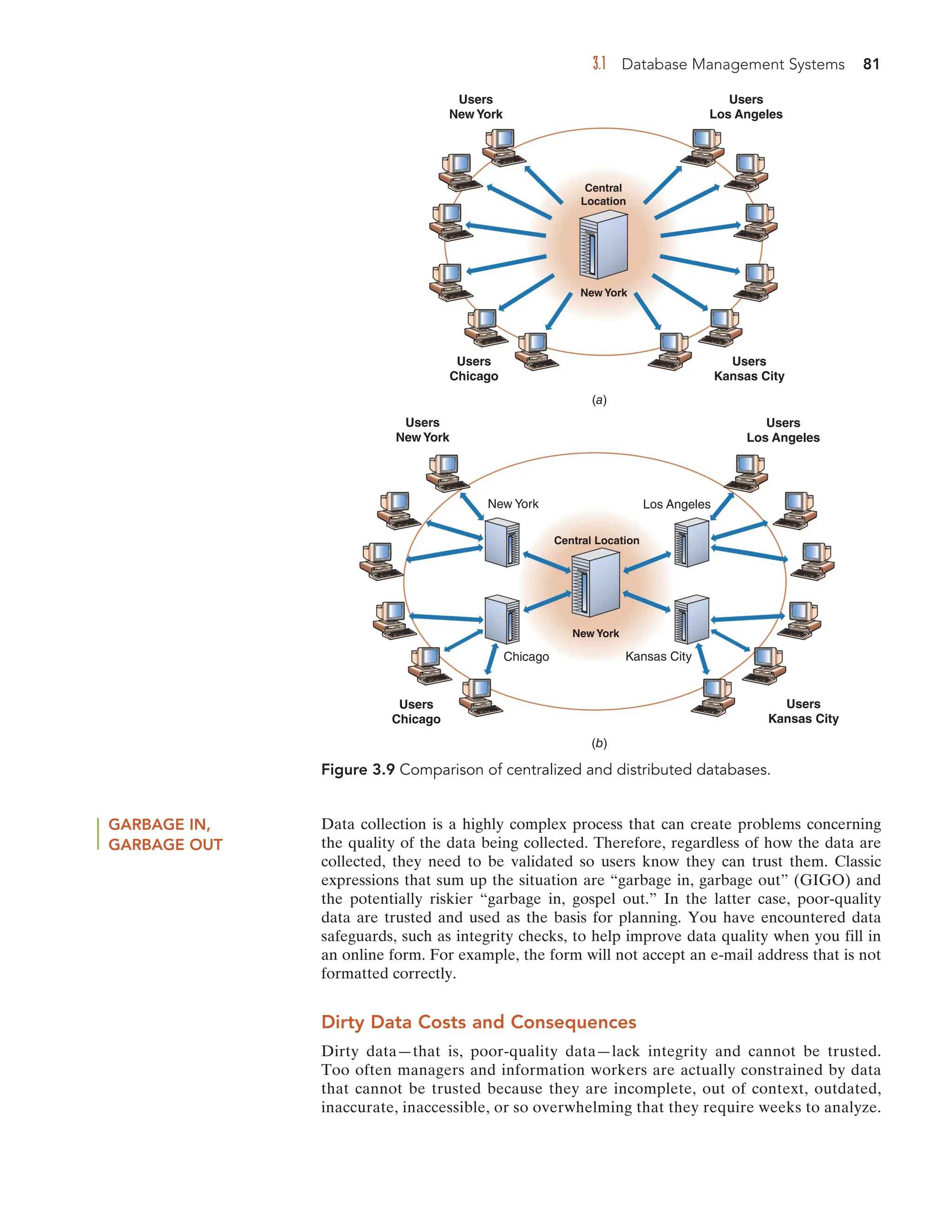
  • 130.
    114 Chapter 4Networks for Efficient Operations and Sustainability Networks are changing significantly with the shift to IPv6 and the build-out of 5G networks. 5G will offer huge gains in both speed and capacity over existing 4G networks—along with opportunities at the operations and strategic levels. At the 2014 Mobile World Congress in Barcelona, Neelie Kroes, the vice president of the European Commission, discussed how deploying 5G networks could reduce high- level youth unemployment across Europe. In the short term, the 5G infrastructure build-out would create new jobs. In the longer term, 5G would create entirely new markets and economic opportunities driven by superior mobile capabilities in industries ranging from health care to automotive (Basulto, 2014). 5G (fifth generation), the next-generation mobile communications network. FUNDAMENTALS OF DATA NETWORKS The capacity and capabilities of data networks provide opportunities for more automated operations and new business strategies. M2M communications over wireless and wired networks automate operations, for instance, by triggering action such as sending a message or closing a valve. The speed at which data can be sent depends on the network’s bandwidth. Bandwidth characteristics are shown in Figure 4.3. Bandwidth is the capacity or throughput per second of a network. TECH NOTE 4.1 4G and 5G Networks in 2018 More Mobile Network Traffic and Users Cisco predicts that by 2018, global mobile data traffic will have increased 11 times from current levels. Much of that traffic will be driven by billions of devices talking to other devices wirelessly. This includes a major increase in M2M communications and the number of wearable technology devices. The number of mobile data con- nections will total more than 10 billion by 2018—8 billion of which will be personal mobile devices and 2 billion M2M connections. Faster Mobile Network Speeds Cisco expects that the average global mobile network speed will almost double from 1.4 Mbps in 2013 to 2.5 Mbps by 2018. And 5G networks are promising speeds that will be 100 times faster than mid-2014 speeds. Figure 4.3 Network bandwidth. Bandwidth is the communication capacity of a network. Bandwidth is the amount of data that passes through a network connection over time as measured in bits per second (bps). Bandwidth is used in both directions—for uploads and downloads. Very large data transfers reduce availability for everyone on the network. Network speed depends on amount of traffic. Data flows quickly and smoothly when traffic volume on the network is small relative to its capacity.
  • 131.
    4.1 Data Networks,IP Addresses, and APIs 115 Figure 4.4 Four drivers of global mobile traffic through 2018. Figure 4.5 Basic functions of business networks. FUNCTIONS SUPPORTED BY BUSINESS NETWORKS Figure 4.5 describes the basic functions of business networks: communication, mobility, collaboration, relationships, and search. These functions depend on net- work switches and routers—devices that transmit data packets from their source to their destination based on IP addresses. A switch acts as a controller, enabling networked devices to talk to each other efficiently. For example, switches connect computers, printers, and servers within an office building. Switches create a net- work. Routers connect networks. A router links computers to the Internet, so users HIGH DEMAND FOR HIGH-CAPACITY NETWORKS As described in Tech Note 4.1, global mobile data traffic is increasing. The four drivers of that demand are shown in Figure 4.4. Demand for high-capacity networks is growing at unprecedented rates. Examples of high-capacity networks are wireless mobile, satellite, wireless sensor, and VoIP (voice over Internet Protocol) such as Skype. Voice over IP (VoIP) networks carry voice calls by converting voice (analog signals) to digital signals that are sent as packets. With VoIP, voice and data trans- missions travel in packets over telephone wires. VoIP has grown to become one of the most used and least costly ways to communicate. Improved productivity, flex- ibility, and advanced features make VoIP an appealing technology. Over 10 billion 2.5 megabits per second (Mbps) Almost 5 billion 70% of mobile traffic By 2018 More Mobile Connections Faster Mobile Speeds More Mobile Users More Mobile Video Communication Mobility Provides secure, trusted, and reliable access from any mobile device anywhere at satisfactory download and upload speeds. Relationships Manages interaction with customers, supply chain partners, shareholders, employees, regulatory agencies, and so on. Search Able to locate data, contracts, documents, spreadsheets, and other knowledge within an organization easily and efficiently. Collaboration Supports teamwork that may be synchronous or asynchronous; brainstorming; and knowledge and document sharing. Provides sufficient capacity for human and machine-generated transmissions. Delays are frustrating, such as when large video files pause during download waiting for the packets to arrive. Buffering means the network cannot handle the speed at which the video is being delivered and therefore stops to collect packets.
  • 132.
    116 Chapter 4Networks for Efficient Operations and Sustainability can share the connection. Routers act like a dispatcher, choosing the best paths for packets to travel. Investments in data networks, IP addresses, routers, and switches are business decisions because of their impact on productivity, security, user experiences, and customer service. QUALITY OF SERVICE An important management decision is the network’s quality of service (QoS), especially for delay-sensitive data such as real time voice and high-quality video. The higher the required QoS, the more expensive the technologies needed to man- age organizational networks. Bandwidth-intensive apps are important to business processes, but they also strain network capabilities and resources. Regardless of the TECH NOTE 4.2 Circuit and Packet Switching All generations of networks are based on switching. Prior to 4G, networks included circuit switching, which is slower than packet switching. 4G was first to be fully packet switched, which significantly improved performance. The two basic types of switching are: Circuit switching: A circuit is a dedicated connection between a source and destina- tion. In the past, when a call was placed between two landline phones, a circuit or connection was created that remained until one party hung up. Circuit switching is older technology that originated with telephone calls; it is inefficient for digital transmission. Packet switching: Packet switching transfers data or voice in packets. Files are bro- ken into packets, numbered sequentially, and routed individually to their destina- tion.When received at the destination, the packets are reassembled into their proper sequence. Wireless networks use packet switching and wireless routers whose antennae trans- mit and receive packets. At some point, wireless routers are connected by cables to wired networks, as shown in Figure 4.6. Figure 4.6 Network cables plug into a wireless router. The antennae create wireless access points (WAP). © Metta digital/Alamy
  • 133.
    4.1 Data Networks,IP Addresses, and APIs 117 type of traffic, networks must provide secure, predictable, measurable, and some- times guaranteed services for certain types of traffic. For example, QoS technolo- gies can be applied to create two tiers of traffic: • Prioritize traffic: Data and apps that are time-delay-sensitive or latency- sensitive apps, such as voice and video, are given priority on the network. • Throttle traffic: In order to give latency-sensitive apps priority, other types of traffic need to be held back (throttled). The ability to prioritize and throttle network traffic is referred to as traffic shaping and forms the core of the hotly debated Net neutrality issue, which is discussed in IT at Work 4.1. In 2014 the battle over the complicated issue of net neu- trality heated up. Net neutrality is a principle that Internet Service Providers (ISPs) and their regulators treat all Internet traffic the same way. On the opposing side of that issue is traffic shaping. Traffic shaping creates a two-tier system for specific purposes such as: 1. Time-sensitive data are given priority over traffic that can be delayed briefly with little-to-no adverse effect. Companies like Comcast argue that Net neutrality rules hurt consumers. Certain applications are more sensi- tive to delays than others, such as streaming video and Internet phone services. Managing data transfer makes it possible to assure a certain level of performance or QoS. 2. In a corporate environment, business-related traffic may be given priority over other traffic, in effect, by paying a premium price for that service. Proponents of traffic shaping argue that ISPs should be able to charge more to customers who want to pay a premium for priority service. Specifically, traffic is shaped by delaying the flow of less important network traffic, such as bulk data transfers, P2P file-sharing programs, and BitTorrent traffic. Traffic shaping is hotly debated by those in favor of Net neutrality. They want a one-tier system in which all Internet data packets are treated the same, regardless of their con- tent, destination, or source. In contrast, those who favor the two-tiered system argue that there have always been differ- ent levels of Internet service and that a two-tiered system would enable more freedom of choice and promote Internet- based commerce. Federal Communications Commission’s 2010 Decision On December 21, 2010, the Federal Communications Commission (FCC) approved a compromise that created two classes of Internet access: one for fixed-line providers and the other for the wireless Net. In effect, the new rules are Net semi-neutrality. The FCC banned any outright blocking of and “unreasonable discrimination” against websites or applications by fixed-line broadband providers. But the rules do not explicitly forbid “paid prioritization,” which would allow a company to pay an ISP for faster data transmission. Net Semi-Neutrality Overturned in 2014 In January 2014 an appeals court struck down the FCC’s 2010 decision. The court allowed ISPs to create a two-tiered Internet, but promised close supervision to avoid anticom- petitive practices, and banned “unreasonable” discrimina- tion against providers. On April 24 FCC Chairman Tom Wheeler reported that his agency would propose new rules to comply with the court’s decision that would be finalized by December 2014. Wheeler stated that these rules “would establish that behavior harmful to consumers or competition by limiting the openness of the Internet will not be permitted” (Wheeler, 2014). But Wheeler’s proposal would allow network owners to charge extra fees to content providers. This decision has angered consumer advocates and Net neutrality advocates who view Wheeler with suspicion because of his past work as a lobbyist for the cable industry and wireless phone companies. Sources: Compiled from Federal Communications Commission (fcc. gov, 2014), Wheeler (2014), and various blog posts. IT at Work 4.1 Net Neutrality Debate Intensifies
  • 134.
    118 Chapter 4Networks for Efficient Operations and Sustainability Questions 1. What is Net neutrality? 2. What tiers are created by traffic shaping? 3. Why did the battle over Net neutrality intensify in 2014? 4. Did the FCC’s 2010 ruling favor either side of the debate? Explain. 5. What has been a reaction to the 2014 appeals court deci- sion? Explain. NETWORK TERMINOLOGY To be able to evaluate networks and the factors that determine their functionality, you need to be familiar with the following network basics: • Bandwidth: Bandwidth depends on the network protocol. Common wire- less protocols are 802.11b. 802.11g, 802.11n, and 802.16. For an analogy to bandwidth, consider a pipe used to transport water. The larger the diameter of the pipe, the greater the throughput (volume) of water that flows through it and the faster water is transferred through it. • Protocol: Protocols are rules and standards that govern how devices on a network exchange data and “talk to each other.” An analogy is a country’s driving rules—whether to drive on the right or left side of the road. • TCP/IP: Transmission control protocol/Internet protocol (TCP/IP) is the basic communication protocol of the Internet. This protocol is supported by every major network operating system (OS) to ensure that all devices on the Internet can communicate. It is used as a communications protocol in a company’s private network for internal uses. • Fixed-line broadband: Describes either cable or DSL Internet connections. • Mobile broadband: Describes various types of wireless high-speed Internet access through a portable modem, telephone, or other device. • 3G: 3G networks support multimedia and broadband services, do so over a wider distance, and at faster speeds than prior 1G and 2G generations. 3G networks have far greater ranges because they use large satellite connec- tions to telecommunication towers. • 4G: 4G mobile network standards enable faster data transfer rates. 4G net- works are digital, or IP, networks. Overall, 2G networks were for voice, 3G networks for voice and data, and 4G net- works for broadband Internet connectivity. TECH NOTE 4.3 Origin of the Internet, e-mail, and TCP/IP The Advanced Research Projects Agency network (ARPAnet) was the first real net- work to run on packet-switching technology. In October 1969 computers at Stanford University, UCLA, and two other U.S universities connected for the first time— making them the first hosts on what would become the Internet. ARPAnet was designed for research, education, and government agencies. ARPAnet provided a communications network linking the country in the event that a military attack or nuclear war destroyed conventional communications systems. In 1971 e-mail was developed by Ray Tomlinson, who used the @ symbol to separate the username from the network’s name, which became the domain name. Broadband (short for broad bandwidth) means high- capacity or high-speed network.
  • 135.
    4.1 Data Networks,IP Addresses, and APIs 119 On January 1, 1983,ARPAnet computers switched over to the TCP/IP protocols developed by Vinton Cerf. A few hundred computers were affected by the switch. The original ARPAnet protocol had been limited to 1,000 hosts, but the adoption of the TCP/IP standard made larger numbers of hosts possible.The number of Internet hosts reached nearly 1 billion by 2013. 3G AND 4G 4G delivers average realistic download rates of 3 Mbps or higher (as opposed to theoretical rates, which are much higher). In contrast, today’s 3G networks typically deliver average download speeds about one-tenth of that rate. Even though individ- ual networks, ranging from 2G to 3G, started separately with their own purposes, soon they will be converted to the 4G network. 4G is based purely on the packet-based IP—unlike 2G and 3G that have a circuit-switched subsystem. Users can obtain 4G wireless connectivity through one of the following standards: 1. WiMAX is based on the IEEE 802.16 standard. IEEE 802.16 specifications are: • Range: 30 miles (50 km) from base station • Speed: 70 megabits per second (Mbps) • Line-of-sight not needed between user and base station WiMAX operates on the same basic principles as Wi-Fi in that it transmits data from one device to another via radio signals. 2. Long-Term Evolution (LTE) is a GSM-based technology that is deployed by Verizon,ATT, and T-Mobile. LTE capabilities include: • Speed: Downlink data rates of 100 Mbps and uplink data rates of 50 Mbps Improved network performance, which is measured by its data transfer capacity, provides fantastic opportunities for mobility, mobile commerce, collaboration, supply chain management, remote work, and other productivity gains. BUSINESS USES OF NEAR-FIELD COMMUNICATION Near-field communication (NFC) enables two devices within close proximity to establish a communication channel and transfer data through radio waves. NFC are location-aware technologies that are more secure than other wireless technologies like Bluetooth and Wi-Fi. Unlike RFID, NFC is a two-way communication tool. Location-aware NFC technology can be used to make purchases in restaurants, resorts, hotels, theme parks and theaters, at gas stations, and on buses and trains. Here are some examples of NFC applications and their potential business value. • The Apple iWatch wearable device with NFC communication capabilities could be ideal for mobile payments. Instead of a wallet, users utilize their iWatch as a credit card or wave their wrists to pay for their Starbucks coffee. With GPS and location-based e-commerce services, retailers could send a coupon alert to the iWatch when a user passes their store. Consumers would then see the coupon and pay for the product with the iWatch. • Ticketmaster Spain teamed up with Samsung to offer NFC tickets to a Dum Dum Girls concert in Madrid. Consumers needed to download the NFC Ticketmaster app from the Samsung app store to purchase a ticket, which was then stored in their phone for secure entry at the door. • International fresh produce distributor Total Produce plans to give consum- ers access to videos, recipes, and interactive games about the benefits of a healthy diet via NFC tag–equipped SmartStands located in supermarkets
  • 136.
    120 Chapter 4Networks for Efficient Operations and Sustainability and convenience stores. “We can upload a new video to these units instantly to respond to opportunities; a barbecue-themed video on a sunny afternoon, a pumpkin carving video for Halloween or a recipe video to complement an in-store price promotion,” says Vince Dolan, European marketing manager at Total Produce. “Similarly, we can update grower videos to reflect changes in product range at any time” (Boden, 2014). • Passengers on public transportation systems can pay fares by waving an NFC smartphone as they board. Mashup of GPS and Bluetooth The mashup of GPS positioning and short-range wireless technologies, such as Bluetooth and Wi-Fi, can provide unprecedented intelligence. These technologies create opportunities for companies to develop solutions that make a consumer’s life better. They could, for example, revolutionize traffic and road safety. Intelligent transport systems being developed by car manufacturers allow cars to communicate with each other and send alerts about sudden braking. In the event of a collision, the car’s system could automatically call emergency services. The technology could also apply the brakes automatically if it was determined that two cars were getting too close to each other. Advancements in networks, devices, and RFID sensor networks are changing enterprise information infrastructures and business environments dramatically. The preceding examples and network standards illustrate the declining need for a physi- cal computer, as other devices provide access to data, people, or services at any time, anywhere in the world, on high-capacity networks. Fans attending gigs by The Wild Feathers were given gui- tar picks embedded with an NFC tag. Warner Music had distributed the guitar picks for fans to enter a competition, share content via social media, and vote at the gig simply by tapping with an NFC phone. NFC-embedded picks were inserted into the band’s promotional flyers at six European venues. Each pick was encoded with a unique URL and also printed with a unique code for iPhone users to enable track- ing and monitoring. Marketing Campaign Success Shows an Exciting Future for NFC The tags generated a high response rate. Over 65 percent of the NFC guitar picks had registered in the competition. And 35 percent of the fans had shared content on social media— spending an average of five minutes on the site. NFC is being used in marketing campaigns because the technology offers slick one-tap interaction. NFC allows brands to engage with their customers in unique ways and create exciting user experiences. With millions of NFC- equipped smartphones set to reach users over the next few years and the technology’s advantages for shoppers and businesses, NFC is emerging as a major technology. Questions 1. Assume you attended a concert and were given a bro- chure similar to the one distributed to fans at The Wild Feathers concert. Would you use the guitar pick or com- parable NFC-embedded item to participate in a contest? To post on Facebook or tweet about the concert? Explain why or why not. 2. How can NFC be applied to create an interesting user experience at a sporting event? At a retail store or coffee shop? 3. Refer to your answers in Question 2. What valuable information could be collected by the NFC tag in these businesses? IT at Work 4.2 NFC-Embedded Guitar Picks Mashup is a general term referring to the integration of two or more technologies.
  • 137.
    4.1 Data Networks,IP Addresses, and APIs 121 APPLICATION PROGRAM INTERFACES AND OPERATING SYSTEMS When software developers create applications, they must write and compile the code for a specific operating system (OS). Figure 4.7 lists the common OSs. Each OS communicates with hardware in its own unique way; each OS has a specific API that programmers must use. Video game consoles and other hardware devices also have APIs that run software programs. What Is an API? An API consists of a set of functions, commands, and protocols used by program- mers to build software for an OS. The API allows programmers to use predefined functions or reusable codes to interact with an OS without having to write a soft- ware program from scratch. APIs simplify the programmer’s job. APIs are the common method for accessing information, websites, and data- bases. They were created as gateways to popular apps such as Twitter, Facebook, and Amazon and enterprise apps provided by SAP, Oracle, NetSuite, and many other vendors. Automated API The current trend is toward automatically created APIs that are making innovative IT developments possible. Here are two examples of the benefits of automated APIs: • Websites such as the European Union Patent office have mappings of every one of their pages to both URLs for browser access and URLs for REST APIs. Whenever a new page is published, both access methods are sup- ported. • The startup SlashDB offers the capability to automatically create an API to access data in a SQL database. This API simplifies many of the details of SQL usage and makes it much easier for developers to get at the data (Woods, 2013a and 2013b). Application program inter- face (API). An interface is the boundary where two sepa- rate systems meet. An API provides a standard way for different things, such as software, content, or web- sites, to talk to each other in a way that they both under- stand without extensive programming. TECH NOTE 4.4 Spotify Released Its API to Developers In early 2012 the digital music service Spotify released its API to developers. The developers quickly created hundreds of apps that fans are using to discover and share new music.The most popular new app isTunigo,which uses its music experts to curate playlists targeted to various moods.The Tunigo service was so successful that Spotify bought it and made it part of Browse. Browse is the in-house curation department that searches Spotify’s catalog and continuously delivers new playlists (Dean, 2013). Browse lets you search for specific playlists based on your mood.These playlists are created by other users and selected by Spotify staffers. Users have created over 1 billion playlists, which grow and morph every day. Android iOS Windows Phone Common Mobile OS Windows Mac OS X Linux Common Desktop OS Figure 4.7 Common mobile and desktop operating systems. Each computer OS provides an API for programmers. Mobile OSs are designed around touchscreen input.
  • 138.
    122 Chapter 4Networks for Efficient Operations and Sustainability API Value Chain in Business APIs deliver more than half of all the traffic to major companies like Twitter and eBay. APIs are used to access business assets, such as customer information or a product or service, as shown in Figure 4.8. IT developers use APIs to quickly and easily connect diverse data and services to each other. APIs from Google, Twitter, Amazon, Facebook, Accuweather, Sears, and E*Trade are used to create many thousands of applications. For example, Google Maps API is a collection of APIs used by developers to create customized Google Maps that can be accessed on a Web browser or mobile devices. The API value chain takes many forms because the organization that owns the business asset may or may not be the same as the organization that builds the APIs. Different people or organizations may build, distribute, and market the applica- tions. At the end of the chain are end-users who benefit from the business asset. Often, many APIs are used to create a new user experience. The business benefits of APIs are listed in Table 4.2. The power of Spotify was demonstrated in 2013 when it won a challenge with Pink Floyd to gain access to the group’s entire music collection: every track from every album the band had ever released. The Pink Floyd collection became part of Spotify’s streaming music service when the tracks were officially “unlocked” in June 2013.The challenge was for the song “Wish You Were Here” to be streamed by fans over 1 million times in just a few days. Pink Floyd members fulfilled the deal. Figure 4.8 API value chain in business. TABLE 4.2 Business Benefits of APIs APIs are channels to new customers and markets: APIs enable partners to use business assets to extend the reach of a company’s products or services to customers and markets they might not reach easily. APIs promote innovation: Through an API, people who are committed to a challenge or problem can solve it themselves. APIs are a better way to organize IT: APIs promote innovation by allowing everyone in a company to use each other’s assets without delay. APIs create a path to lots of Apps: Apps are going to be a crucial channel in the next 10 years.Apps are powered by APIs. Developers use APIs and combinations of APIs to create new user experiences. API Developers Provides quick, easy access to business assets. Applications created using APIs Use APIs to create new business. Business Assets Data information products services Customers, employees, and end-users use the business apps that give them access to assets.
  • 139.
    4.2 Wireless Networksand Mobile Infrastructure 123 In the 21st-century global economy, advanced wireless networks are a foundation on which global economic activity takes place. Current 3G and 4G networks and technologies provide that foundation, moving entire economies. For any nation to stay competitive and prosperous, it is imperative that investment and upgrades in these technologies continue to advance to satisfy demand. Global mobile data traffic is forecasted to increase nearly 11-fold between 2013 and 2018. Mobile data traffic will grow at a compound annual growth rate (CAGR) of 61 percent from 2013 to 2018, reaching 15.9 exabytes (EB) per month by 2018, according to the Cisco Visual Networking Index (VNI): Global Mobile Data Traffic Forecast Update, 2013–2018. Mobile data traffic will reach the following milestones: 1. The average mobile connection speed will surpass 2 Mbps by 2016. 2. Smartphones will reach 66 percent of mobile data traffic by 2018. 3. Monthly mobile tablet traffic will surpass 2.5 EB per month by 2018. 4. Tablets will exceed 15 percent of global mobile data traffic by 2016. 5. 4G traffic will be more than half of total mobile traffic by 2018. 6. There will be more traffic offloaded from cellular networks and onto Wi-Fi net- works than remains on cellular networks by 2018. 7. In addition to supporting mobile users, increased bandwidth is needed to sup- port the numerous industrial applications that leverage wireless technologies— primarily the smart grid, or smart energy, and health-care segments. With a combination of smart meters, wireless technology, sensors, and soft- ware, the smart grid allows utilities to accurately track power grids and cut back on energy use when the availability of electricity is stressed. And consumers gain insight into their power consumption to make more intelligent decisions about how to use energy. A fully deployed smart grid has the potential of saving between $39.69 and $101.57, and up to 592 pounds of carbon dioxide emissions, per consumer per year in the United States, according to the Smart Grid Consumer Collaborative (SGCC). Wireless hospitals and remote patient monitoring, for example, are grow- ing trends. Tracking medical equipment and hospital inventory, such as gurneys, is done with RFID tagging at a number of hospitals. Remote monitoring apps are making health care easier and more comfortable for patients while reaching patients in remote areas. 4.2 Wireless Networks and Mobile Infrastructure Questions 1. Why has IPv6 become increasingly important? 2. What is an IP address? 3. What are bandwidth and broadband? 4. Briefly described the basic network functions. 5. What is the difference between circuit switching and packet switching? 6. What is the difference between 3G and 4G? 7. What are the mobile network standards? 8. Explain the Net neutrality debate. 9. What are two applications of NFC? 10. What are the benefits of APIs?
  • 140.
    124 Chapter 4Networks for Efficient Operations and Sustainability In the small city of Santander on Spain’s Atlantic coast, Mayor Iñigo de la Serna raised $12 million, mostly from the European Commission, to launch SmartSantander. SmartSantander is a smart city experiment that is improving the quality of life, reducing energy consumption, and engag- ing its citizens in civic duties. 10,000 Sensors Embedded The city implemented wireless sensor networks and embed- ded 10,000 sensors in its streets and municipal vehicles to monitor garbage collection, crime, and air quality and manage street lighting for better energy efficiency. Sensors communi- cate with smartphone apps to inform drivers and commuters on parking availability, bus delays, road closures, and the current pollen count in real time. Parking apps direct drivers to available spaces via cell phone alerts. Drivers benefit from a reduction in the time and annoyance of finding parking spots. Anyone can feed his or her own data into the system by, for example, snapping a smartphone photo of a pothole or broken streetlight to notify the local government that a problem needs to be fixed. Build-Out of Smart City Applications This mobile technology can help cities contribute to a greener planet. Municipal landscape sprinklers can send facts to city agencies for analysis to conserve water usage. Sensors can monitor weather and pollen counts as well as water and power leaks. Police State The data streams and mobile apps that keep citizens informed also keep the government informed. What is the difference between a smart city and a police state? Consider how data collected from sensors mounted outside a bar to track noise levels might be used. • Scenario #1. Instances of loud noises and squealing tires are transmitted to local police. The city uses the informa- tion to enforce public nuisance laws and make arrests. • Scenario #2: People who live in the neighborhood show civic leaders what is keeping them up at night and receive help in resolving the problem. • Scenario #3: Landlords could use data showing less noise and cleaner air to promote their apartments or office buildings. The Dark Side of Smart The wireless networks and sensors need to be maintained. Thousands of batteries embedded in roadways could have expensive and disruptive maintenance requirements. Parking space alerts might create other annoyances. If everyone becomes aware of a parking spot up the street, the rush of cars converging on a few open locations could lead to rage and defeat the purpose of such an alert. Sources: Compiled from O’Connor (2013) and Edwards (2014). Questions 1. What are the benefits of a smart city? 2. What are the potential abuses of data collected in this way? 3. Consider the dark side of smart. Are you skeptical of the benefits of a smart city? 4. Would you want to live in a smart city? Explain. 5. How would you prevent Santander from becoming a police state? IT at Work 4.3 Smart City or Police State? STRATEGIC BUILD- OUT OF MOBILE CAPABILITIES Enterprises are moving away from the ad hoc adoption of mobile devices and network infrastructure to a more strategic planning build-out of their mobile capa- bilities. As technologies that make up the mobile infrastructure evolve, identifying strategic technologies and avoiding wasted investments require more extensive planning and forecasting. Factors to consider are the network demands of multi- tasking mobile devices, more robust mobile OSs, and their applications. Mobile Infrastructure Mobile infrastructure consists of the integration of technology, software, support, security measures, and devices for the management and delivery of wireless com- munications.
  • 141.
    4.2 Wireless Networksand Mobile Infrastructure 125 TECH NOTE 4.5 Wi-Fi Networking Standards • 802.11b. This standard shares spectrum with 2.4-GHz cordless phones, microwave ovens, and many Bluetooth products. Data are transferred at distances up to 100 meters or 328 feet. Wi-Fi and Bluetooth Bluetooth is a short-range—up to 100 meters or 328 feet—wireless communications technology found in billions of devices, such as smartphones, computers, medical devices, and home entertainment products. When two Bluetooth-enabled devices connect to each other, this is called pairing. Wi-Fi is the standard way computers connect to wireless networks. Nearly all computers have built-in Wi-Fi chips that allow users to find and connect to wireless routers. The router must be connected to the Internet in order to provide Internet access to connected devices. Wi-Fi technology allows devices to share a network or Internet connection without the need to connect to a commercial network. Wi-Fi networks beam packets over short distances using part of the radio spectrum, or they can extend over larger areas, such as municipal Wi-Fi networks. However, municipal networks are not com- mon because of their huge costs. See Figure 4.9 for an overview of how Wi-Fi works. Bluetooth is a short-range wireless communications technology. Wi-Fi is the standard way computers connect to wireless networks. Figure 4.9 Overview of Wi-Fi. Wireless Network Acess Point Cable/DSL Modem Antenna Radio Waves Directional Antenna and PC Card Laptop(s) or Desktop(s) 1 2 3 Radio-equipped access point connected to the Internet (or via a router). It generates and receives radio waves (up to 400 feet). Several client devices, equipped with PC cards, generate and receive radio waves. Router is connected to the Internet via a cable or DSL modem, or is connected via a satellite. Wireless Network PC Card 2 1 3 Satellite Internet PC Router
  • 142.
    126 Chapter 4Networks for Efficient Operations and Sustainability Figure 4.10 WiMAX/Wi-Fi network. Notebook with built-in WiMAX adapter Wi-Fi hotspots Base station WiMAX hub Internet WiMAX network WIRELESS WIDE AREA NETWORKS There are three general types of mobile networks: wide area networks (WANs), WiMAX, and local area networks (LANs). WANs for mobile computing are known as wireless wide area networks (WWANs). The range of a WWAN depends on the trans- mission media and the wireless generation, which determines which services are avail- able. Two components of wireless infrastructures are wireless LANs and WiMAX. LANs Wireless LANs use high-frequency radio waves to communicate between comput- ers, devices, or other nodes on the network. A wireless LAN typically extends an existing wired LAN by attaching a wireless AP to a wired network. WiMAX Wireless broadband WiMAX transmits voice, data, and video over high-frequency radio signals to businesses, homes, and mobile devices. It was designed to bypass traditional telephone lines and is an alternative to cable and DSL. WiMAX is based on the IEEE 802.16 set of standards and the metropolitan area network (MAN) access standard. Its range is 20 to 30 miles and it does not require a clear line of sight to function. Figure 4.10 shows the components of a WiMAX/Wi-Fi network. • 802.11a. This standard runs on 12 channels in the 5-GHz spectrum in North America, which reduces interference issues. Data are transferred about 5 times faster than 802.11b, improving the quality of streaming media. It has extra bandwidth for large files. Since the 802.11a and b standards are not interopera- ble, data sent from an 802.11b network cannot be accessed by 802.11a networks. • 802.11g. This standard runs on three channels in the 2.4-GHz spectrum, but at the speed of 802.11a. It is compatible with the 802.11b standard. • 802.11n. This standard improves upon prior 802.11 standards by adding multiple-input multiple-output (MIMO) and newer features. Frequency ranges from 2.4 GHz to 5 GHz with a data rate of about 22 Mbps, but perhaps as high as 100 Mbps.
  • 143.
    4.3 Collaboration andCommunication Technologies 127 TECH NOTE 4.6 Mobile Network Evaluation Factors When evaluating mobile network solutions, there are four factors to consider. They are: 1. Simple: Easy to deploy, manage, and use. 2. Connected: Always makes the best connection possible. 3. Intelligent: Works behind the scenes, easily integrating with other systems. 4. Trusted: Enables secure and reliable communications. Questions 1. What factors are contributing to mobility? 2. Why is strategic planning of mobile networks important? 3. How does Wi-Fi work? 4. What is a WLAN? 5. Why is WiMAX important? 6. What factors should be considered when selecting a mobile network? Now more than ever, business gets done through information sharing and col- laborative planning. Business performance depends on broadband data networks for communication, mobility, and collaboration. For example, after Ford Motor Company began relying on UPS Logistics Group’s data networks to track millions of cars and trucks and to analyze any potential problems before they occur, Ford realized a $1 billion reduction in vehicle inventory and $125 million reduction in inventory carrying costs annually. People need to work together and share documents. Teams make most of the complex decisions in organizations. And organizational decision making is difficult when team members are geographically spread out and working in different time zones. Messaging and collaboration tools include older communications media such as e-mail, videoconferencing, fax, and texts—and blogs, Skype, Web meetings, and social media. Yammer is an enterprise social network that helps employees collaborate across departments, locations, and business apps. These private social sites are used by more than 400,000 enterprises worldwide. Yammer functions as a communication and problem-solving tool and is rapidly replacing e-mail. You will read about Yammer is detail in Chapter 7. 4.3 Collaboration and Communication Technologies VIRTUAL COLLABORATION Leading businesses are moving quickly to realize the benefits of virtual collabora- tion. Several examples appear below. Information Sharing Between Retailers and Their Suppliers One of the most publicized examples of information sharing exists between Procter Gamble (PG) and Walmart. Walmart provides PG with access to sales informa- tion on every item Walmart buys from PG. The information is collected by PG
  • 144.
    128 Chapter 4Networks for Efficient Operations and Sustainability on a daily basis from every Walmart store, and PG uses that information to man- age the inventory replenishment for Walmart. Retailer–Supplier Collaboration: Asda Corporation Supermarket chain Asda (asda.com) has rolled out Web-based electronic data interchange (EDI) technology to 650 suppliers. Web EDI technology is based on the AS2 standard, an internationally accepted HTTP-based protocol used to send real time data in multiple formats securely over the Internet. It promises to improve the efficiency and speed of traditional EDI communications, which route data over third-party, value-added networks (VANs). Lower Transportation and Inventory Costs and Reduced Stockouts: Unilever Unilever’s 30 contract carriers deliver 250,000 truckloads of shipments annually. Unilever’s Web-based database, the Transportation Business Center (TBC), pro- vides these carriers with site specification requirements when they pick up a shipment at a manufacturing or distribution center or when they deliver goods to retailers. TBC gives carriers all of the vital information they need: contact names and phone numbers, operating hours, the number of dock doors at a location, the height of the dock doors, how to make an appointment to deliver or pick up shipments, pallet configuration, and other special requirements. All mission-critical information that Unilever’s carriers need to make pickups, shipments, and deliveries is now available electronically 24/7. Reduction of Product Development Time Caterpillar, Inc. is a multinational heavy-machinery manufacturer. In the traditional mode of operation, cycle time along the supply chain was long because the process involved paper–document transfers among managers, salespeople, and technical staff. To solve the problem, Caterpillar connected its engineering and manufactur- ing divisions with its active suppliers, distributors, overseas factories, and customers through an extranet-based global collaboration system. By means of the collabora- tion system, a request for a customized tractor component, for example, can be transmitted from a customer to a Caterpillar dealer and on to designers and sup- pliers, all in a very short time. Customers also can use the extranet to retrieve and modify detailed order information while the vehicle is still on the assembly line. GROUP WORK AND DECISION PROCESSES Managers and staff continuously make decisions as they develop and manufacture products, plan social media marketing strategies, make financial and IT invest- ments, determine how to meet compliance mandates, design software, and so on. By design or default, group processes emerge, referred to as group dynamics, and those processes can be productive or dysfunctional. Group Work and Dynamics Group work can be quite complex depending on the following factors: • Group members may be located in different places or work at different times. • Group members may work for the same or different organizations. • Needed data, information, or knowledge may be located in many sources, several of which are external to the organization. Despite the long history and benefits of collaborative work, groups are not always successful.
  • 145.
    4.3 Collaboration andCommunication Technologies 129 Online Brainstorming in the Cloud Brainstorming ideas is no longer limited to a room full of people offering their ideas that are written on a whiteboard or posters. Companies are choosing an alternative—online brainstorming applications, many of them cloud-based. An advantage is the avoidance of travel expenses if members are geographically dispersed, which often restricts how many sessions a company can afford to hold. The following are two examples of online brainstorming apps: • Evernote (evernote.com) is a cloud-based tool that helps users gather and share information, and brainstorm ideas. One function is Synch, which keeps Evernote notes up-to-date across a user’s computers, phones, devices and the Web. See Figure 4.11. A free version of Evernote is available for download. • iMindmap Online, from UK-based ThinkBuzan (thinkbuzan.com), relies on mind mapping and other well-known structured approaches to brainstorm- ing. iMindmap Online helps streamline work processes, minimize informa- tion overload, generate new ideas, and boost innovation. INTRANETS, EXTRANETS, AND VIRTUAL PRIVATE NETWORKS Intranets are used within a company for data access, sharing, and collaboration. They are portals or gateways that provide easy and inexpensive browsing and search capabilities. Colleges and universities rely on intranets to provide services to students and faculty. Using screen sharing and other groupware tools, intranets can support team work. An extranet is a private, company-owned network that can be logged into remotely via the Internet. Typical users are suppliers, vendors, partners, or custom- ers (Figure 4.12). Basically, an extranet is a network that connects two or more companies so they can securely share information. Since authorized users remotely access content from a central server, extranets can drastically reduce storage space on individual hard drives. A major concern is the security of the transmissions that could be intercepted or compromised. One solution is to use virtual private networks (VPNs), which encrypt the packets before they are transferred over the network. VPNs consist of encryption software and hardware that encrypt, send, and decrypt transmissions, as shown in Figure 4.13. In effect, instead of using a leased line to create a dedicated, physical connection, a company can invest in VPN technology to create virtual Figure 4.11 Evernote brainstorming, note taking, and archiving software website. © NetPhotos/Alamy
  • 146.
    130 Chapter 4Networks for Efficient Operations and Sustainability Figure 4.12 Example of an ATT extranet used by a customer to access account information. © Ian Dagnall/Alamy Figure 4.13 Virtual private networks (VPNs) create encrypted connections to company networks. © tungphoto/iStockphoto Being profit-motivated without concern for damage to the environment is unaccept- able. Society expects companies to generate a profit and to conduct themselves in an ethical, socially responsible, and environmentally sustainable manner. Four fac- tors essential to preserving the environment are shown in Figure 4.14. Sustainability grows more urgent every year as carbon emissions contribute to climate changes that are threatening quality of life—and possibly life itself. 4.4 Sustainability and Ethical Issues connections routed through the Internet from the company’s private network to the remote site or employee. Extranets can be expensive to implement and maintain because of hardware, software, and employee training costs if hosted internally rather than by an application service provider (ASP). Questions 1. Why is group work challenging? 2. What might limit the use of in-person brainstorming? 3. How can online brainstorming tools overcome those limits? 4. What is the difference between an intranet and an extranet? 5. How does a virtual private network (VPN) provide security?
  • 147.
    4.4 Sustainability andEthical Issues 131 Figure 4.14 The 4 Rs of environmental sustainability. GLOBAL TEMPERATURE RISING TOO MUCH TOO FAST At the United Nations’ 2009 climate conference in Copenhagen, climatologists estimated that countries must keep the global mean temperature (GMT) from ris- ing by more than 2 C (3.6 F) above the preindustrial GMT in order to avoid pro- found damage to life on the earth. Damage includes water and food scarcity, rising sea levels, and greater incidence and severity of disease. Only three years later, GMT had already increased by 0.7 C, or 1.3 F. In 2012 IEA chief economist Faith Birol warned that this trend is perfectly in line with a temperature increase of 6 C by 2050, which would have devastating impacts on the planet. Since 2005 the Prince of Wales’ Corporate Leaders Group on Climate Change has lobbied for more aggressive climate legislation within the United Kingdom, the European Union, and internationally. It holds that carbon emission reductions between 50 percent and 85 percent are necessary by 2050 to prevent the global temperature from rising too much too fast because of the greenhouse effect, as shown in Figure 4.15. TECH NOTE 4.7 NASA’s Greenhouse Gas Emission Warnings According to NASA (climate.nasa.gov), CO2 and other greenhouse gases (GHGs) trap the sun’s heat within the earth’s atmosphere, warming it and keeping it at habit- able temperatures. Scientists have concluded that increases in CO2 resulting from human activities have thrown the earth’s natural carbon cycle off balance, increasing global temperatures and changing the planet’s climate. GHG emissions worldwide hit record highs in 2011, according to the Interna- tional Energy Agency (IEA). The IEA’s preliminary estimates indicate that global emissions of carbon dioxide (CO2) from fossil-fuel combustion spiked to 31.6 giga- tonnes (Gt) in 2011,an increase of 1 Gt or 3.2 percent from the 2010 level (Lemonick, 2012). One Gt equals 1 billion metric tons. GHG is now a serious a global concern. The main international treaty on climate change is the United Nations Framework Convention on Climate Change (UNFCCC). In 2010 parties to the UNFCCC agreed that future global warming should be limited to below 2 C (3.6 F) relative to the preindustrial level. Analysis suggests that meeting the 2 C target would require annual global emissions of GHG to peak © skegbydave/iStockphoto
  • 148.
    132 Chapter 4Networks for Efficient Operations and Sustainability Figure 4.16 Carbon cycle. The Orbiting Carbon Observatory-2 was launched in July 2014. The observatory is NASA’s first satellite mission dedicated to studying CO2, which is a critical component of the earth’s carbon cycle driving changes in the earth’s climate. CO2 is also the largest human- produced GHG. Courtesy of genomicscience. energy.gov. Figure 4.15 Illustration of the earth’s greenhouse effect. GLOBAL WARMING Global warming refers to the upward trend in GMT. It is one of the most compli- cated issues facing world leaders. Figure 4.16 shows the relationship of fossil fuel, soil, water, atmosphere, and so on in the carbon cycle. Even though the global carbon cycle plays a central role in regulating CO2 in the atmosphere and thus the earth’s climate, scientists’ understanding of the interlinked biological processes that drive this cycle is limited. They know that whether an ecosystem will capture, store, or release carbon depends on climate changes and organisms in the earth’s biosphere. The biosphere refers to any place that life of any kind can exist on the earth and contains several ecosystems. An ecosystem is a self-sustaining functional unit of the biosphere; it exchanges material and energy between adjoining ecosys- tems. Global warming occurs because of the greenhouse effect, which is the holding of heat within the earth’s atmosphere. GHGs such as CO2, methane (CH4), and nitrous oxide (N2O) absorb infrared radiation (IR), as diagrammed in Figure 4.17. ICT’s Role in Global Warming The IT industry sector is called the information and communications technology, or ICT, in emission reports. ICT has certainly supported economic growth in developed and developing countries and transformed societies, businesses, and people’s lives. But what impacts do our expanding IT and social media dependence have on global warming? How can business processes change or reduce GHGs? And what alternative © ImageZoo/Alamy U.S. Department of Energy Genomic Science program (http://genomicscience.energy.gov) before the year 2020 and decline significantly thereafter,with emissions in 2050 reduced by 30 to 50 percent compared to 1990 levels. Analyses by the United Nations Environment Programme and International Energy Agency warn that current policies are too weak to achieve the 2 C target.
  • 149.
    4.4 Sustainability andEthical Issues 133 energy sources can be used to power the increasing demands for connectivity? Listed below are several reports and initiatives to help answer these questions. Global e-Sustainability Initiative and the SMART 2020 Report The Climate Group’s SMART 2020 Report is the world’s first comprehensive global study of the IT sector’s growing significance for the world’s climate. On behalf of the Global e-Sustainability Initiative (GeSI, gesi.org), Climate Group found that ICT plays a key role in reducing global warming. Transforming the way people and businesses use IT could reduce annual human-generated global emissions by 15 percent by 2020 and deliver energy efficiency savings to global businesses of over 500 billion euros, or $800 billion U.S. And using social media, for example, to inform consumers of the grams (g) of carbon emissions associated with the products they buy could change buyer behavior and ultimately have a positive eco-effect. Like food items that display calories and grams of fat to help consumers make healthier food choices, product labels display the CO2 emissions generated in the production of an item, as shown in Figure 4.18. By 2020 not only will people become more con- nected, but things will, too—an estimated 50 billion machine-to-machine connec- tions in 2020. A benefit of machine-to-machine connections is that they can relay data about climate changes that make it possible to monitor our emissions. Figure 4.17 Greenhouse gases absorb infrared radiation (IR) emitted from the earth and reradiate it back, thus contributing to the greenhouse effect. © Universal Images Group Limited/Alamy Figure 4.18 Label showing the amount of CO2 emission generated by the production of an item. © Alex Segre/Alamy
  • 150.
    134 Chapter 4Networks for Efficient Operations and Sustainability Recommended Actions for the IT Sector Analysis conducted by management consultants McKinsey Company concludes the following: • The IT sector’s own footprint of 2 percent of global emissions could double by 2020 because of increased use of tablets, smartphones, apps, and services. To help, rather than worsen, the fight against climate change, the IT sector must manage its own growing impact and continue to reduce emissions from data centers, telecom networks, and the manufacture and use of its products. • IT has the unique ability to monitor and maximize energy efficiency both within and outside of its own industry sector to cut CO2 emissions by up to 5 times this amount. This represents a savings of 7.8 Gt of CO2 per year by 2020, which is greater than the 2010 annual emissions of either the United States or China. The SMART 2020 Report gives a picture of the IT industry’s role in addressing global climate change and facilitating efficient and low-carbon development. The role of IT includes emission reduction and energy savings not only in the sector itself, but also by transforming how and where people work. The most obvious ways are by substituting digital formats—telework, video-conferencing, e-paper, and mobile and e-commerce—for physical formats. Researchers estimate that replacing physical products/services with their digital equivalents would provide 6 percent of the total benefits the IT sector can deliver. Greater benefits are achieved when IT is applied to other industries. Examples of those industries are smart building design and use, smart logistics, smart electricity grids, and smart industrial motor systems. SUSTAINABILITY YouTube reported that 100 hours of video are uploaded every minute in 2014— more than double the 48 hours per minute in 2012. Over 6 billion hours of video are watched each month on YouTube—almost an hour for every person on the earth. Within 5 years, from 2008 through 2013, most U.S. households tripled the number of computing, gaming, consumer electronics, and mobile devices. Statistics about Twitter and other social services also show phenomenal growth. Almost all of these network activities are powered by the burning of fossil fuels. Today’s connected lifestyles will further harm the environment unless corrective actions are taken such as those listed in Figure 4.19. Global Warming: A Hot Debate Does our society have the capacity to endure in such a way that the 9 billion people expected on the earth by 2050 will all be able to achieve a basic quality of life? The Reducing barriers to the use of public transport and improving people’s experience of the journey. For example, smart ticketing and free Wi-Fi. Facilitating car sharing and eco-driving. Encouraging and enforcing speed limits by using average speed cameras and intelligent speed adaptation, which help drivers to avoid fines and stay safe. Enabling home working and using video conferencing and e-commerce to reduce travel. Figure 4.19 Recommendations for ICT from the Sustainable Development Commission (2010). www.Ebook777.com Free ebooks == www.Ebook777.com
  • 151.
    4.4 Sustainability andEthical Issues 135 answer is uncertain—and hotly debated. As you read, many scientists and experts are extremely alarmed by global warming and climate change, but other experts outright deny that they are occurring. This debate may be resolved to some degree by NASA. A NASA spacecraft was designed to make precise measurements of carbon dioxide (CO2) in the earth’s atmosphere. The Orbiting Carbon Observatory-2 (OCO-2) was launched in July 2014. The observatory is NASA’s first satellite mission dedicated to studying CO2, a critical component of the earth’s carbon cycle that is the most prevalent human- produced GHG driving changes in the earth’s climate (Figure 4.16). OCO-2 is a new tool for understanding both the sources of CO2 emissions and the natural processes that remove CO2 from the atmosphere, and how they are changing over time. The mission’s data will help scientists reduce uncertainties in forecasts of how much carbon dioxide is in the atmosphere and improve the accu- racy of global climate change predictions. According to NASA, since the start of the Industrial Revolution more than 200 years ago, the burning of fossil fuels, as well as other human activities, have led to an unprecedented buildup in this GHG, which in 2014 was at its highest level in at least 800,000 years. Human activities have increased the level of CO2 by more than 25 percent in just the past half century. It is possible that we are living far beyond the earth’s capacity to support human life. While sustainability is about the future of our society, for businesses, it is also about return on investment (ROI). Businesses need to respect environmental lim- its, but also need to show an ROI. Sustainability Through Climate Change Mitigation There are no easy or convenient solutions to carbon emissions from the fossil fuels burned to power today’s tech dependencies. But there are pathways to solutions, and every IT user, enterprise, and nation plays a role in climate change mitigation. Climate change mitigation is any action to limit the magnitude of long-term climate change. Examples of mitigation include switching to low-carbon renewable energy sources and reducing the amount of energy consumed by power stations by increasing their efficiency. There have been encouraging successes. For example, investments in research and development (RD) to reduce the amount of carbon emitted by power stations for mobile networks are paying off. Announced in April 2014, a break- through in the design of signal amplifiers for mobile technology will cut 200 mega- watts (MW) from the load of power stations, which will reduce CO2 emissions by 0.5 million tonnes a year (Engineering and Physical Sciences Research Council, 2014). Mobile, Cloud, and Social Carbon Footprint No one sees CO2 being emitted from their Androids or iPhones. But wired and mobile networks enable limitless data creation and consumption—and these activi- ties increase energy consumption. Quite simply, the surge in energy used to power data centers, cell towers, base stations, and recharge devices is damaging the envi- ronment and depleting natural resources. It is critical to develop energy systems that power our economy without increasing global temperatures beyond 2 C. To do their part to reduce damaging carbon emissions, some companies have imple- mented effective sustainability initiatives. Sustainability Initiatives Communications technology accounts for approximately 2 percent of global carbon emissions; it is predicted that this figure will double by 2020 as end- user demand for high-bandwidth services with enhanced quality of experience explodes worldwide. Innovative solutions hold the key to curbing these emissions and reducing environmental impact.
  • 152.
    136 Chapter 4Networks for Efficient Operations and Sustainability Network service providers as well as organizations face the challenges of energy efficiency, a smaller carbon footprint, and eco-sustainability. To deal with these challenges, wired and wireless service providers and companies need to upgrade their networks to next-generation, all-IP infrastructures that are opti- mized and scalable. The network must provide eco-sustainability in traffic trans- port and deliver services more intelligently, reliably, securely, efficiently and at the lowest cost. For example, Alcatel-Lucent’s High Leverage Network (HLN) can reduce total cost of ownership (TCO) by using fewer devices, creating an eco-sustainable choice for service providers. Fewer devices mean less power and cooling, which reduces the carbon footprint. HLN can also handle large amounts of traffic more efficiently because the networks are intelligent, sending packets at the highest speed and most efficiently. ETHICAL CONSIDERATIONS OF HYPER-CONNECTED HUMANS The complexity of a connected life will increase as we move to the new era of nano- sensors and devices, virtual spaces, and 3D social networks exchanging zillions of bytes of data. Managers and workers need to consider ethical and social issues, such as quality of life and working conditions. Individuals will experience both positive and negative impacts from being linked to a 24/7 workplace, working in virtual teams, and being connected to handhelds whose impact on health can be damag- ing. A 2008 study by Solutions Research Group found that always being connected is a borderline obsession for many people. According to the study, 68 percent of Americans may suffer from disconnect anxiety—feelings of disorientation and ner- vousness when deprived of Internet or wireless access for a period of time. Consider this development and its implications. Driving while distracted is a crime. Texting while driving is comparable to driving under the influence (DUI), according to safety experts. Several studies indi- cate that the use of mobile devices is a leading cause of car crashes. At any given moment, more than 10 million U.S. drivers are talking on handheld cell phones, according to the National Highway Traffic Safety Administration. Why is this a problem? Mobiles are a known distraction, and the NHTSA has determined that driver inattention is a primary or contributing factor in as many as 25 percent of all police-reported traffic accidents. This does not include the thousands of accidents not reported to the authorities. In most or all states, distracted driving is a crime that carries mandatory fines (Figure 4.20). For example, in California and New York State, drivers charged with this crime face fines and have their driving license suspended. If driving while dis- tracted causes injury or death to others, violators face jail time. The importance of understanding ethical issues has been recognized by the Association to Advance Collegiate Schools of Business (AACSB International, aacsb.edu). For business majors, the AACSB International has defined Assurance Figure 4.20 Texting while driving is a crime and potentially fatal. © ZUMA Wire Service/Alamy
  • 153.
    4.4 Sustainability andEthical Issues 137 of Learning Requirements for ethics at both the undergraduate and graduate levels. In Standard 15: Management of Curricula (AACSB, 2006), the association identi- fies general knowledge and skill learning experiences that include “ethical under- standing and reasoning abilities” at the undergraduate level. At the graduate level, Standard 15 requires learning experiences in management-specific knowledge and skill areas to include “ethical and legal responsibilities in organizations and society” (AACSB, 2006). Additions and Life Out of Control The technologies covered in this chapter blur work, social, and personal time. IT keeps people connected with no real off switch. Tools that are meant to improve the productivity and quality of life in general can also intrude on personal time. Managers need to be aware of the huge potential for abuse by expecting a 24/7 response from workers. The report Looking Further with Ford—2014 Trends identifies trends in how the technology explosion will affect consumer choices and behaviors. Sheryl Connelly, Ford global trend and futuring manager, summarized what was learned: “There is no escaping the impact—both positive and negative—of the rapid pace of technology. . . . We are seeing a consumer culture that is increasingly mindful of the need to nurture society’s valuable and irreplaceable resources” (Ford Motors, 2013). Four trends were discussed in this report: 1. Micro Moments: With so much information at our fingertips, downtime has given way to filling every moment with bite-sized chunks of information, education, and entertainment—seemingly packing our lives with productivity. 2. Myth of Multitasking: In an increasingly screen-saturated, multitasking mod- ern world, more and more evidence is emerging to suggest that when we do everything at once, we sacrifice the quality—and often safety—of each thing we do. 3. Vying for Validation: In a world of hyper-self-expression, chronic public journal- ing, and other forms of digital expression, consumers are creating a public self that may need validation even more than their authentic self. 4. Sustainability: The world has been fixated on going green, and now attention is shifting beyond recycling and eco-chic living to a growing concern for the power and preciousness of the planet’s water. In our hyper-connected world, people are always on, collaborating, communi- cating, and creating—and not always aware of how technology impacts them. We need to learn how to harness that energy and connection to develop the next gen- eration of critical, thoughtful thinkers. Questions 1. Why do some experts warn that carbon emission reductions between 50 percent and 85 percent are necessary by 2050? 2. What contributes to the rise of global mean temperature? 3. What is the greenhouse effect? 4. How does the use of mobile devices contribute to the level of green- house gases? 5. What is ICT’s role in global warming? 6. Why is global warming hotly debated? 7. Explain the goal of sustainability. 8. Explain the characteristics of a life out of control.
  • 154.
    138 Chapter 4Networks for Efficient Operations and Sustainability Key Terms 3G 4G 5G application program interface (API) bandwidth Bluetooth carbon footprint circuit switching climate change climate change mitigation extranet fixed-line broadband greenhouse gases (GHGs) group dynamics information and commu- nications technology (ICT) Internet Protocol (IP) intranet IP address IP Version 4 (IPv4) IP Version 6 (IPv6) latency-sensitive apps local area network (LAN) Long-Term Evolution (LTE) mashup mobile broadband near-field communication (NFC) Net neutrality Net semi-neutrality packet packet switching protocol quality of service (QoS) router sustainability switch traffic shaping transmission control protocol/Internet protocol (TCP/IP) virtual private network (VPN) voice over IP (VoIP) wide area network (WAN) Wi-Fi WiMAX Assuring Your Learning 1. Explain how network capacity is measured. 2. How are devices identified to a network? 3. Explain how digital signals are transmitted. 4. Explain the functions of switches and routers. 5. QoS technologies can be applied to create two tiers of traffic.What are those tiers? Give an example of each type of traffic. 6. Typically, networks are configured so that down- loading is faster than uploading. Explain why. 7. What are significant issues about 4G wireless networks? 8. What are two 4G wireless standards? 9. How is network performance measured? 10. Discuss two applications of near-field communica- tion (NFC). 11. What are the benefits of APIs? 12. Describe the components of a mobile communica- tion infrastructure. 13. What is the range of WiMAX? Why does it not need a clear line of sight? 14. Why are VPNs used to secure extranets? 15. How can group dynamics improve group work? How can it disrupt what groups might accomplish? 16. What are the benefits of using software to conduct brainstorming in the cloud (remotely)? 17. How do mobile devices contribute to carbon emissions? 18. Discuss the ethical issues of anytime-anywhere accessibility. 19. What health and quality-of-life issues are associ- ated with social networks and a 24/7 connected lifestyle? 20. Is distracted driving an unsolvable problem? Explain. DISCUSS: Critical Thinking Questions 21. Visit the Alcatel-Lucent website (www.alcatel-lucent. com) and search for “eco-sustainability strategy.” a. Read about Alcatel’s eco-sustainability strategy. b. Describe how the company is developing eco- sustainable networks. In your opinion, is this an effective strategy? Explain. c. Explain how the company is enabling a low- carbon economy.What is its most significant contribution to sustainability? 22. Visit the Google apps website.Identify three types of collaboration support and their value in the workplace. 23. Compare the various features of broadband wireless networks (e.g., 3G, Wi-Fi, and WiMAX). Visit at least three broadband wireless network vendors. a. Prepare a list of capabilities for each network. b. Prepare a list of actual applications that each network can support. c. Comment on the value of such applications to users. How can the benefits be assessed? EXPLORE:Online and Interactive Exercises
  • 155.
    CASE 4.2 BusinessCase 139 24. Visit Youtube.com and search for tutorials on the latest version of iMindMap. Watch a few of the tutorials.As an alternative, watch the video at http:// www.youtube.com/watch?v=UVt3Qu6Xckolist=PL A42C25431E4EA4FF. Describe the potential value of sharing maps online and synching maps with other computers or devices.What is your opinion of the ease or complexity of the iMindMap interface? 25. Visit Google Green at www.google.com/green/ bigpicture. Describe Google’s efforts to minimize the environmental impact of its services. Do you believe that Google can reduce its carbon footprint beyond zero, as the company claims? Explain your answer. ANALYZEDECIDE: Apply IT Concepts to Business Decisions CASE 4.2 Business Case: Google Maps API for Business A restaurant owner has a website where customers can place orders for delivery. When a customer inputs a delivery address, a software script verifies whether the address is within the delivery range of the restaurant. If the address is not in the delivery range, the site does not let the customer check out and sends a message informing the customer that he or she is outside of the delivery range. The script requests informa- tion from Google Maps via an API to calculate whether or not the address was in the range. The free version, called Google Maps API, allows up to 2,500 requests per day from a single IP address and is limited to noncommercial purposes. The owner needs to purchase a Google Maps API for Business license because any requests in excess of 2,500 will be ignored. The Google Maps API for Business provides bet- ter resolution, scale, and enhanced features and support to businesses that add maps to their websites, mobile apps, or asset-tracking applications. Directions and Routing Features The Google Maps API delivers the full power of Google’s routing engine to applications. Among other features, it: • Generates routes between up to 23 locations for driving, walking, or cycling. • Generates routes to avoid toll roads or highways. • Reduces travel time by calculating the optimal order to visit each location. • Calculates travel time and distance between locations, for example, to offer users a way to filter search results by drive time. Data Visualization The Google Maps API lets managers visualize data using heat maps, symbols, and custom styles. For U.S. maps, companies have access to a demographics layer containing up-to-date census data provided by Nielsen and 5-year projections of many data fields. The demographics layer may only be used on intranets or internal websites. Advanced Analytics The Google Maps API for Business offers an analytics tool that shows how visitors interact with the maps—for example, how many visitors switched to satellite view, what they zoomed, and which map features were used the most. Using this information, businesses can customize the user experi- ence based on their preferences and better engage with customers. Automobile Association Google Maps is the most widely used online mapping service in the world, with more than 800,000 sites using the Google Maps API and over 250 million active users on mobile devices alone. In the United Kingdom, the Automobile Association (AA) provides roadside assistance and directions to motor- ists. AA invested in the Google Maps API for Business to offer interactive route planning and improve visitors’ experiences. The value AA derived from the API was a 12 percent increase in the number of routes downloaded, hitting an average of 4 million downloads per week of its routing or trip-planning service. Approximately 20 percent of site visitors remained on the site for at least five minutes—up from only six percent prior to implementation. The API also cuts the time and cost of IT support for the mapping platform. Questions 1. Describe Google Maps API. 2. Why do you think Google provides free noncommercial use of its Maps API? 3. How many times have you used a website’s mapping feature for directions or to calculate distance? How did having a familiar interface improve your experience? 4. Google claims that its Maps API helps a company’s customers and employees make better business and purchasing decisions by visualizing important informa- tion on a familiar map. Explain how data visualization provides these benefits. Give two examples in your explanation.
  • 156.
    140 Chapter 4Networks for Efficient Operations and Sustainability CASE 4.3 Video Case: Fresh Direct Connects for Success Visit and explore the Fresh Direct website at www.freshdirect. com to learn about the company. Visit the Cisco website at www.cisco.com. Search for the video “Fresh Direct Produce.” The URL is www.cisco.com/cisco/web/solutions/small_ business/resource_center/index.html. Watch the video to learn how Fresh Direct uses network technology to connect employees, suppliers, and customers. Meet CEO Davis Yung and see how Cisco wireless technology gives his team constant connectivity to meet customer demands (video runs 2:50 minutes). Questions 1. Describe how network technology enables Fresh Direct’s business model. 2. What factors are critical to Fresh Direct’s performance? ATT Enterprise.“Sony Builds an IPv6 Network for the Future.” ATT VPN Services Case Study. October 16, 2012. business.att.com/content/customertestimonial/sony-case- study-IP-VPN.pdf Basulto, D.“Five Reasons to Get Excited About 5G Networks.” The Washington Post, February 27 , 2014. Boden, R.“Total Produce Pushes Fruit and Veg with NFC in Supermarkets.” NFC World, April 15, 2014. Cisco. Cisco Visual Networking Index (VNI): Global Mobile Data Traffic Forecast Update, 2013–2018. February 5, 2014a. Cisco.“Sony Adopts Cisco Solution for Global IPv6 Project.” Cisco Public Information, Customer Case Study. 2014b. Dean, J.“Let a Billion Streams Bloom.” Fast Company, November 2013. Edwards, J.“The Connected Life.” Teradata Magazine, Q1, 2014. Engineering and Physical Sciences Research Council. “New Design for Mobile Phone Masts Could Cut Carbon Emissions.”April 22, 2014. Ford Motors.“Looking Further with Ford—2014 Trends.” 2013. Khedekar, N.“IPv6 Demystified—What You Should Know.” Tech 2 FirstPost, June 7 , 2012. O’Connor, M. C.“Santander:Test Bed for Smart Cities and Open Data Policies.” SmartPlanet.com, May 8, 2013. Sustainable Development Commission.“Smarter Moves: How Information Communications Technology Can Promote Sustainable Mobility.” SDC Report. January 25, 2010. Wheeler,T.“Setting the Record Straight on the FCC’s Open Internet Rules.” FCC blog, April 24, 2014. Woods, D.“The Strengths and Limits of Automatically Created APIs.” CITO Research, September 20, 2013a. Woods, D.“The Strengths and Limits of Automatically Created APIs.” CITO Research, October 2, 2013b. References
  • 157.
    Chapter Snapshot Managers nolonger question whether their networks will be attacked, but how much damage will be done, how long the investigation will take, and how much the investigation and fines will cost. After detecting a network hack, credit card-processing company Global Payments, Inc. spent 14 months investigating the resulting data breach that exposed 1.5 million U.S. debit and credit card accounts. Global’s damages totaled $93 million, bro- ken down as follows: $36 million in fraud losses and fines and $77 million for the investigation, remediation, credit 1. Describe today’s most destructive cyberthreats, data breaches, targeted attacks, malware, and other IT security risks facing organizations and why they are so difficult to defend against. 2. Explain why cyber risk management is a business priority; outline an organizational model for cybersecurity; and describe the cybersecurity process. 3. Explain why mobile devices, apps, and cloud-based services are high-risk attack vectors, the importance of BYOD (bring your own devices) policies, and the defenses needed to counteract exposure to mobile malware. 4. Describe the characteristics of fraud and how enterprises can defend against and detect fraudulent activities. 5. Explain how internal controls help ensure compliance with industry and federal regulations. Assess the ability to maintain business operations in the event of a network crash, debilitating hacker attack, or other IT disruption. Learning Outcomes 141 Chapter Snapshot Case 5.1 Opening Case: BlackPOS Malware Steals Target’s Customer Data 5.1 The Face and Future of Cyberthreats 5.2 Cyber Risk Management 5.3 Mobile, App, and Cloud Security 5.4 Defending Against Fraud 5.5 Compliance and Internal Control Key Terms Assuring Your Learning • Discuss: Critical Thinking Questions • Explore: Online and Interactive Exercises • Analyze Decide: Apply IT Concepts to Business Decisions Case 5.2 Business Case: Lax Security at LinkedIn Exposed Case 5.3 Video Case: Botnets, Malware Security, and Capturing Cybercriminals References Cybersecurity and Risk Management 5 Chapter
  • 158.
    monitoring, and identitytheft insurance for affected con- sumers. In October 2013 a data breach at Adobe exposed the account information of up to 152 million users—the largest data breach in history. No costs have yet been reported, but according to the Ponemon 2013 Cost of Data Breach Study, the average cost of a breached account is $188 (Ponemon Institute, 2013). In August 2014, fraudsters targeted customers of JPMorgan Chase, the No. 1 U.S. bank by assets. The massive phishing campaign, called Smash and Grab, was unusual because it collected customers’ login data and also infected PCs with Dyre, a banking trojan that lifted login data for other institutions. The bank was not able to identify who was behind the Smash and Grab attack. In Chapter 5, you will learn about devastating cyber- threats, data breaches, fraud, damages caused by cyber- criminals’ aggressive tactics—and how organizations defend against them. CASE 5.1 OPENING CASE BlackPOS Malware Steals Target’s Customer Data Target is a major discount retailer in the United States (Figure 5.1). Target’s man- agement admitted that 40 million credit and debit card accounts were exposed between November 27 and December 15, 2013. During that peak holiday shopping season, hackers captured credit card data from the stores’ point-of-sale (POS) payment terminals (Figure 5.2). Target disclosed the breach on December 19, 2013; then on January 10, 2014, the retailer also reported that hackers stole 40 million credit card numbers along with the personal information of another 70 million customers. The incident scared shoppers away, affecting the company’s profits throughout 2014. 142 Figure 5.1 Target data breach overview. HOW THE ATTACK WAS CARRIED OUT Several experts believe that POS malware bought from the criminal underground was responsible. Malware, short for malicious software, are computer programs whose code causes disruption, destruction, or other devious action. Malware named BlackPOS is sold on the black market for $1,800 or more. The malware is adver- tised on Internet underground forums under the generic name Dump Memory Grabber by Ree. BlackPOS is malware designed to be installed on POS devices in 2nd largest retail discounter in the United States. 4Q 2013 profit dropped 46% and sales revenue fell 5.3% after breach was disclosed. Company Profile Hackers installed malware, probably bought from a criminal underground website, on Target’s POS terminals to capture data from credit and debit cards and transmit back to the hackers. Data Breach Personal and financial data from up to 70 million customers stolen by hackers using malware. Estimated the breach to cost from $400 million to $450 million. Extent of the Breach and Costs Target
  • 159.
    CASE 5.1 OpeningCase 143 order to record data from credit and debit cards swiped through the infected device. Specifically, the malware identifies the process associated with the credit card reader and steals payment card Track 1 and Track 2 data from its memory. These are the data stored on the magnetic strip of payment cards that were used to clone or create counterfeit cards. More feature-rich versions of BlackPOS selling for roughly $2,300 provide encryption support for stolen data. The BlackPOS creator is not confirmed, but experts tracking the malware suggest that the hacker may be based in Russia or Ukraine. The U.S. Secret Service estimated that the type of malware that led to Target’s breach has affected over 1,000 U.S. businesses. Figure 5.2 POS payment terminal. Malware-infected POS terminals caused Target’s data breach. FINANCIAL IMPACT OF THE DATA BREACH In February 2014 Target reported that its 2013 fourth-quarter (4Q) profit dropped 46 percent and sales revenue fell 5.3 percent. A few months later, in May 2014, Target estimated that technological changes to harden its IT security would cost more than $100 million in addition to $61 million incurred in breach-related expenses in Q4 2013. These costs and damages harmed the company’s profitability. Gregg Steinhafel, chairman, president, and CEO of Target, tried to reassure customers and investors, saying,“As we plan for the new fiscal year, we will continue to work tirelessly to win back the confidence of our guests. . . . We are encouraged that sales trends have improved in recent weeks” (D’Innocenzio, 2014). Six months after the breach, it still was not clear when Target would fully recover.A security analyst at the tech firm Gartner estimated the costs of the breach to range from $400 million to $450 million. That includes the bills associated with fines from credit card companies and services for its customers like free credit card report monitoring. Target also faced at least 70 lawsuits related to privacy invasion and negligence, alleging Target did not take proper steps to protect consumer data. TARGET BRUSHED OFF WARNINGS According to financial services firm Cowen Group’s note to investors, criminals were able to hack into Target’s database due to a lack of security, which might have been a result of underinvestment by senior management. Target’s cybersecurity staff had also warned management to review the security of its payment card system at least two months before the breach. At the time of the warning, Target was updating the payment terminals, which makes them more vulnerable to attack, in preparation for the holiday season. Data security was not a top priority. Months before the attack, the federal government and private research firms were also warning companies about the emergence of new types of malware © Aleph Studio/Shutterstock
  • 160.
    144 Chapter 5Cybersecurity and Risk Management (malicious computer code) targeting payment terminals. However, because of numerous security warnings that retailers receive every week, it is difficult to identify or decide which ones are the most urgent. EXECUTIVE FALLOUT On May 5, 2014, CEO Steinhafel resigned from all his positions effective immedi- ately, after extensive discussions with the board of directors. Steinhafel had been CEO since 2008 and a Target employee for 35 years. The company stated that Steinhafel and board members had mutually decided that it was time for Target to continue under new leadership. Target shares were down close to 3 percent in morning trading following the news. Steinhafel’s untimely exit was the second significant executive fallout from the data breach. In April 2014 Target’s CIO had also been replaced. Sources: Compiled from D’Innocenzio (2014),Yadron et al. (2014), Krebs on Security (2014), Sharf (2014), O’Connor (2014), and Kratsas (2014). Questions 1. Was cybersecurity a priority at Target? Explain. 2. How did lax security impact Target’s sales revenue and profit performance? 3. According to experts, how was the data breach executed? 4. In addition to the data theft, what else was damaged by this incident? 5. Was this cybersecurity incident foreseeable? Was it avoidable? 6. Why might management not treat cyberthreats as a top priority? 7. Research recent news concerning this data breach. Has Target recovered from it? Explain. 8. Assuming that the CEO and CIO were forced to resign, what message does that send to senior management at U.S. companies? Since 2013 the number of data records stolen by hackers has increased at an alarm- ing rate, as shown in Figure 5.3. In fact, 2013 has been dubbed the “Year of the Breach” because there were 2,164 reported data breaches that exposed an estimated 823 million records. Almost half of the 2013 breaches occurred in the United States, where the largest number of records were exposed—more than 540 million data records or 66 percent. Table 5.1 lists the top seven biggest data breaches 5.1 The Face and Future of Cyberthreats Figure 5.3 Number of reported data records breached worldwide, 2009–2013. 900 600 800 700 300 400 500 200 100 0 2009 Million 2010 2011 2012 2013 193M 95M 413M 264M 823M www.Ebook777.com Free ebooks == www.Ebook777.com
  • 161.
    5.1 The Faceand Future of Cyberthreats 145 TABLE 5.1 Biggest Data Breaches Worldwide, 2013–2014, in Terms of Number of Data Records Breached Number of Data Records Company Breached eBay Online auction Attackers compromised several employees’ log-in credentials between Up to 145 million February and March 2014 to gain access to the company’s network and, through it, compromised a database that contained customer names, encrypted passwords, email addresses, physical addresses, phone numbers, and dates of birth. Michaels Stores Retail stores The POS systems at 54 Michaels stores were attacked by criminals using 2.6 million payment highly sophisticated malware between May 2013 and card numbers and January 2014. expiration dates Adobe Software vendor The stolen files contained active and inactive accounts for numerous 150 million Adobe products:Acrobat, Photoshop, ColdFusion, and CreativeCloud. The files hold Adobe IDs, e-mail addresses, passwords, credit/debit card numbers, expiration dates, and other PII (Personally Identifiable Information). Target 2nd largest discount retailer in the United States 110 million UbiSoft 3rd largest gaming company in Europe and the United States 58 million Turkish Government No antivirus software was installed on the hacked system. 54 million Evernote Online note-taking service 50 million Living Social Daily deals website 50 million Cupid Media Popular dating service The records of 56 Department of Homeland Security employees were 42 million stolen in this breach.
  • 162.
    146 Chapter 5Cybersecurity and Risk Management worldwide in 2013. The consequences of lax cybersecurity include damaged repu- tations, financial penalties, federal and state government fines, lost market share, falling share prices, and consumer backlash. The main cause of a data breach is hacking, but the reason hacking is so suc- cessful is negligence—management not doing enough to defend against cyber- threats. Even high-tech companies and market leaders, as shown in Table 5.1, appear to be detached from the value of the confidential data they store and the threat that highly motivated hackers will try to steal them. As you will read in this section, robust data security is not the responsibility of IT alone, but the ongoing duty of everyone in an organization. Hacks of high-tech companies like LinkedIn, Google, Amazon, eBay, and Sony, and top security agencies like the CIA and FBI are proof that no one is safe. Cyberwarriors are too well funded and motivated. Countering cyber-threats demands diligence, determination, and investment. IT at Work 5.1 illustrates the self-destructing and encryption features of a secure smartphone in order to protect conversations, transmissions, and stored data effectively. Boeing Co. is an aerospace and defense contractor known for its fighter planes, jets, and satellites (Figure 5.4). It pos- sesses advanced technology that prevents its products from being hacked. Boeing made the unusual decision to build a smartphone that provides complete security against hacking and spying by governments or well-financed adversaries. The Black smartphone, released in 2014, is an Android phone manufactured as a sealed device, with both epoxy around the casing and screws with tamper-proof covering. The phone encrypts voice and data communication and, if tampered with, self-destructs. For instance, any attempt to open the Black’s casing deletes all data and software on the device and leaves it inoperable. Boeing Black’s Security Features Manufactured in the United States, Black uses dual SIM cards to enable it to access multiple cell networks instead of a single network. It can be configured to connect with bio- metric sensors and to communicate via satellite. Due to the phone’s security features, Boeing released few details about the wireless network operators or manufacturer it was work- ing with. The advanced features needed to achieve this level of cybersecurity include: • Encryption to store sensitive information securely • Hardware root of trust to ensure software authenticity IT at Work 5.1 Black—the Self-Destructing Smartphone Figure 5.4 Boeing Co. is best known as a jet and fighter plane manufacturer. The company expanded into the secure smartphone market with the release of Black. © Jordan Tan/Shutterstock
  • 163.
    5.1 The Faceand Future of Cyberthreats 147 • Hardware crypto engine to protect both stored and transmitted data • Embedded secure components to enable trusted operations • Trusted platform modules to provide secure key storage • Secure boot to maintain device image integrity Boeing applied the defense-in-depth model to Black to ensure that if one layer of security was compromised, other layers would continue to secure the device, its data, and transmissions. Multilayered defense-in-depth models are absolutely necessary. Assessing the Value of Smartphone Security According to Boeing’s filings with the U.S. Federal Communications Commission (FCC), Black is designed for use by government agencies and contractors who need to secure their communication and data. It is also for companies aiming to keep their data away from the prying tactics of the NSA or other spying organizations. Black enables the secure access and exchange of critical data and communications on a trusted mobile device. It is believed that the use of a secure smartphone like Black might have prevented a recent leaked telephone call that undercut Washington’s diplomacy in Ukraine. A senior U.S. State Department officer and ambassador to Ukraine apparently used unencrypted cell phones for a call about political developments in Ukraine that became public—and caused embarrassment. All State Department government- owned BlackBerry devices have data encryption, but not voice encryption. Sources: Compiled from Hosenball (2014), Westcott (2014), Boeing.com (2014), and Gallagher (2014). Questions 1. Why do you think government-issued smartphones are a target for data theft and transmission theft? 2. What security precautions is Boeing taking with respect to the manufacture and sale of Black? 3. What security features are built into Black? 4. Why is voice encryption an important digital security measure? 5. Why is a defense-in-depth model vital to a security smart- phone such as Black? BATTLING CYBERTHREATS IS THE COST OF DOING BUSINESS Cybersecurity experts warn that battling distributed denial-of-service (DDoS) and malware attacks has become part of everyday business for all organizations. Hackers, hactivists, crime syndicates, the military, militant groups, industrial spies, disgruntled employees, fraudsters, and hostile governments will continue to attack networks for profit, fame, revenge, or an ideology; to wage warfare, terrorism, or an antiterrorism campaign; or to disable their target. For example, the Department of Homeland Security (DHS) Industrial Control Systems Cyber Emergency Response Team (ICS-CERT) warned that attacks against critical infrastructure are growing (Figure 5.5). There were more than 200 brute-force cyberattack incidents reported Figure 5.5 Six of the 18 national critical infrastructures (from upper left, clockwise): commercial facilities; defense industrial base; transportation systems; national monuments and icons; banking and finance; and agriculture and food. © Zoonar/NREY/ Age Fotostock © Zoonar/unknown/ Age Fotostock © Blakeley/Age Fotostock © Philip Lange/Age Fotostock © Werner Nick/Age Fotostock © alptraum/Age Fotostock
  • 164.
    148 Chapter 5Cybersecurity and Risk Management between October and May 2013, surpassing the 198 total attacks in all of fiscal year 2012. More than half of the attacks were against the energy sector. Attacks on critical infrastructure could significantly disrupt the functioning of government and business—and trigger cascading effects far beyond the targeted sector and physical location of the incident. International, federal, and state laws and industry regulations mandate that enterprises invest in cybersecurity defenses, audits, and internal controls to help secure confidential data, prevent attacks, and defend against fraud and unauthor- ized transactions such as money laundering. To help keep managers updated on the latest cyberthreats and prioritize defenses, KPMG publishes its Data Loss Barometer. The annual report describes the latest trends and statistics for data losses worldwide. Key findings and predictions are listed in Table 5.2. Social Engineering and BYOD New cyberthreats are emerging and overtaking the familiar threats—viruses, lost disks, and DDoS attacks. Experts believe the greatest cybersecurity dangers over the next few years will involve persistent threats, mobile computing, and the use of social media for social engineering. Social engineering is also known as human hacking—tricking users into revealing their credentials and then using them to gain access to networks or accounts. From an IT security perspective, social engineering is a hacker’s clever use of deception or manipulation of people’s tendency to trust, be helpful, or simply follow their curiosity. Powerful IT security systems cannot defend against what appears to be authorized access. Humans are easily hacked, making them and their social media posts high-risk attack vectors. For instance, it is often easy to get users to infect their corporate network or mobiles by tricking them into downloading and installing malicious apps or backdoors. Another more recent vulnerability is bring your own device (BYOD). The BYOD trend is driven by employees using their own devices for business purposes because they are more powerful than those the company has provided. Another factor is mobility. More and more people are working from home and on the go— putting an end to the formerly typical 9 to 5 workday. In consequence, employees do not want to juggle multiple devices. With BYOD, companies cut costs by not having to purchase and maintain mobile devices. Of course, when an employee’s device is lost, the company can suffer a data breach if the device is not encrypted. In the past, and before the BYOD push, A distributed denial-of- service (DDoS) attack bom- bards a network or website with traffic (i.e., requests for service) to crash it and leave it vulnerable to other threats. Hactivist is short for hacker- activist or someone who does hacking for a cause. Hacking, regardless of motive, is a crime. Critical infrastructure is defined as “systems and assets, whether physical or virtual, so vital to the United States that the incapacity or destruction of such systems and assets would have a debilitating impact on secu- rity, national economic secu- rity, national public health or safety, or any combination of those matters.” TABLE 5.2 KPMG Data Loss Barometer Key findings from KPMG Data Loss Barometer Report and its predictions for the next few years: • Hacking is the number-one cause of data loss. • Internal threats have reduced significantly, while external threats are increasing significantly. • The most hacked sectors are technology, financial services, retail, and media. • Expect increased loss of data from mobile devices. • Expect a steep rise in automated hacking and botnets. • Expect less tolerant regulators and greater fines and negative consequences. • Expect greater visibility and reporting of data loss as a result of less tolerant regulators. Source: KPMG (2012).
  • 165.
    5.1 The Faceand Future of Cyberthreats 149 employees would be at their desks on a land line and on a computer plugged into the wall with a network cable. This change in exposure requires greater investment to defend against BYOD risks. Cybercrime Survey Respondents to the 2013 U.S. State of Cybercrime Survey indicated that secu- rity incidents increased 33 percent despite implementation of security practices. Current cybersecurity technologies and policies are simply not keeping pace with fast-evolving threats. Many threats and challenges that organizations face today were unimaginable 10 years ago. And longstanding threats such as fraud and iden- tity theft still remain. Cyberthreats will continue to emerge, evolve, and worsen over the next 10 years and beyond. IT at Work 5.2 provides a summary of the 2014 Global State of Information Security Survey. The results of Survey 2014 show that executives are responding to the need to fund enhanced security activities and have substantially improved technology safeguards, processes, and strategies. Unfortunately, adversaries have done better. The 2014 Global State of Information Security Survey is conducted by the consulting firm PwC US (Pricewaterhouse Coopers, pwc.com) and CIO and CSO magazines (PWC, 2014). According to the annual global survey: • Defending yesterday. While organizations have improved security significantly, they are not keeping pace with today’s determined adversaries. Too many rely on yesterday’s cybersecurity practices that are ineffective at combating today’s threats. • Bigger attack surface. The attack surface—consisting of business partners, suppliers, customers, and others—has expanded due to larger volumes of data flowing through multiple channels. Protecting all data at an equally high level is no longer practical. Cybersecurity strategies need to classify and prioritize defenses. • Implementing before securing. Popular technologies like cloud computing, mobile, and BYOD (bring your own device) are implemented before they are secured. • Not ready for next-generation cyberthreats. Few organi- zations are prepared to manage future threats. According to Gary Loveland, a principal in PwC’s security practice, “What’s needed is a new model of information security, one that is driven by knowledge of threats, assets, and the motives and targets of potential adversaries” (PWC, 2014). • Unsafe cloud. While 47 percent of respondents use cloud computing, only 18 percent include provisions for cloud in their security policy. SaaS is the most widely adopted cloud service, but PaaS shows strong growth. • Unprepared for advanced persistent threats (APT). Among the most dangerous cyberthreats are advanced persistent threats (APT). APT is a stealth network attack in which an unauthorized person gains access to a network and remains undetected for a long time. Skilled hack- ers launch APT attacks to steal data continuously (e.g., daily) over months or year—rather than to cause damage that would reveal their presence. APTs require a new information-protection model that focuses on continuous monitoring of network activity and high-value informa- tion. Most U.S organizations lack these capabilities. IT at Work 5.2 Global State of Information Security Survey HIGH-VISIBILITY CYBERCRIMINALS AND HACKTIVISTS Advanced persistent threat (APT) attackers want to remain unnoticed so they can continue to steal data, as described in IT at Work 5.2. Profit-motivated cyber- criminals often operate in stealth mode. In contrast, hackers and hacktivists with personal agendas carry out high-profile attacks.
  • 166.
    150 Chapter 5Cybersecurity and Risk Management Hacktivists’ Motivations and Dangerous Pranks These types of cybercriminals seemed to take on everyone from Sony and security firm RSA to the CIA (Central Intelligence Agency) and a Mexican drug cartel throughout 2011 and 2012. During the Arab Spring (street revolutions of 2013), hacktivists LulzSec and Anonymous showed how vulnerable anyone’s online pres- ence was, even that of major governments. One of LulzSec’s specialties is finding websites with poor security, and then stealing and posting information from them online. Some of their attacks may seem more like Internet pranks than serious cyberwarfare, but they are still illegal. Hacktivist Attacks and Victims Hackers committed daring data breaches, compromises, data leaks, thefts, threats, and privacy invasions in 2012. Two cases are listed below. Combined Systems, Inc. Proudly displaying its hacktivist flag, Anonymous took credit for knocking Combined Systems, Inc. offline and stealing personal data from its clients. Anonymous went after Combined Systems, which sells tear gas and crowd-control devices to law enforcement and military organiza- tions, to protest war profiteers. CIA. In February 2012, for the second time in less than a year, Anonymous launched a denial of service (DoS) attack that forced the CIA website offline. The CIA takedown followed a busy week for the hacktivists. Within 10 days, the group also went after Chinese electronics manufacturer Foxconn, American Nazi groups, antivirus firm Symantec, and the office of Syria’s president. LulzSec is a hacker group and spin-off of the loosely organized hacking collective. STEALTH, PROFIT- MOTIVATED CYBERCRIMES Most hack activities do not become headline-grabbers until after the incidents are detected and reported. However, victimized companies are reluctant to discuss them so statistics are scarce. Most data breaches go unreported, according to cyber- security experts, because corporate victims fear that disclosure would damage their stock price, or because they never knew they were hacked in the first place. Theft of Trade Secrets and Other Confidential Information Theft of trade secrets has always been a threat from corporate moles, disgruntled employees, and other insiders. Of course, now it is easier to steal information remotely, mostly because of smartphones and the BYOD trend. Hackers’ preferred modus operandi is to break into employees’ mobile devices and leapfrog into employers’ networks––stealing secrets without a trace. U.S. cybersecurity experts and government officials are increasingly concerned about breaches from other countries into corporate networks either through mobile devices or other means. Mike McConnell, former director of the National Security Agency (NSA), warned: “In looking at computer systems of consequence—in govern- ment, Congress, at the Department of Defense, aerospace, companies with valuable trade secrets—we’ve not examined one yet that has not been infected by an advanced persistent threat” (Perlroth, 2012b). In the meantime, companies are leaking critical information, often without realizing it. Scott Aken, a former FBI agent who special- izes in counterintelligence and computer intrusion, stated, “In most cases, companies do not realize they’ve been burned until years later when a foreign competitor puts out their very same product—only they’re making it 30 percent cheaper” (Perlroth, 2012b). Do-Not-Carry Rules U.S. companies, government agencies, and organizations are now imposing do- not-carry rules, which are based on the assumption that devices will inevitably be compromised according to Mike Rogers, current chairman of the House Intelligence Committee. House members can bring only “clean” devices and are
  • 167.
    5.1 The Faceand Future of Cyberthreats 151 forbidden from connecting to the government’s network while abroad. Rogers said he travels “electronically naked” to ensure cybersecurity during and after a trip. IT at Work 5.3 describes the reasons for following do-not-carry rules. OBJECTIVES OF CYBERSECURITY Cybersecurity needs to accomplish the following: • Make data and documents available and accessible 24/7 while simultaneously restricting access. • Implement and enforce procedures and acceptable use policies (AUPs) for data, networks, hardware, and software that are company- or employee- owned, as discussed in the opening case. • Promote secure and legal sharing of information among authorized persons and partners. • Ensure compliance with government regulations and laws. • Prevent attacks by having network intrusion defenses in place. • Detect, diagnose, and respond to incidents and attacks in real time. • Maintain internal controls to prevent unauthorized alteration of data and records. • Recover from business disasters and disruptions quickly. Business policies, procedures, training, and disaster recovery plans as well as hard- ware and software are critical cybersecurity. When Kenneth G. Lieberthal, an expert at the Brookings Institution, travels to other countries, he follows a routine that seems straight from a secret agent movie. He leaves his smartphone and laptop at home. Instead, he brings loaner devices, which he erases before he leaves the United States and wipes clean the minute he returns. While traveling, he disables Bluetooth and Wi-Fi and never lets his phone out of his sight. While in meetings, he not only turns off his phone, but also removes the battery for fear his microphone could be turned on remotely. Lieberthal connects to the Internet only through an encrypted, password-protected channel. He never types in a password directly, but copies and pastes his password from a USB thumb drive. By not typing his password, he eliminates the risk of having it stolen if key-logging software were to be installed on his device. Questions 1. Many travelers might consider Lieberthal’s method too inconvenient. Clearly, his electronically clean methods are time-consuming and expensive. In your opinion, is there a trade-off between cybersecurity and conve- nience? Explain. 2. Create a list of best cybersecurity practices for travelers based on Lieberthal’s methods. IT at Work 5.3 Traveling Electronically Clean The U.S. Chamber of Commerce did not learn that it and its member organiza- tions were the victims of a cybertheft for months until the FBI informed the Chamber that servers in China were stealing data from four of its Asia policy experts, individuals who frequently travel to Asia (Perlroth, 2012a). Most likely, the experts’ mobile devices had been infected with malware that was transmitting information and files back to the hackers. By the time the Chamber hardened (secured) its network, hackers had stolen at least six weeks of e-mails, most of which were communications with the largest U.S. corporations. Even later, the Chamber learned that its office printer and a thermostat in one of its corporate apartments were communicating with an Internet address in China. The Chamber did not disclose how hackers had infiltrated its systems, but its first step was to implement do-not-carry rules.
  • 168.
    152 Chapter 5Cybersecurity and Risk Management In 2013 cyberthreats were at the top of US intelligence reports for the first time. Cyberthreats are now the number one type of danger facing the United States, according to current U.S. National Intelligence Director James Clapper, who coor- dinates the CIA, NSA, and many other agencies. Questions 1. Why was 2013 dubbed the “Year of the Breach”? 2. What causes or contributes to data breaches? 3. Why are cybercriminals so successful? 4. What was the biggest data breach in history? 5. Describe the basic method of a distributed denial-of-service (DDoS) attack. 6. What is a critical infrastructure? List three types of critical infrastructures. 7. What are the motives of hactivists? 8. What is the number-one cause of data loss or breaches? 9. Why is social engineering a technique used by hackers to gain access to a network? 10. What are two BYOD security risks? 11. Explain why APT attacks are difficult to detect. 12. What are the objectives of cybersecurity? Every enterprise has data that profit-motivated criminals want. Customer data, networks, websites, proprietary information systems, and patents are examples of assets—things of value that need to be protected. The greater the value of the asset to the company and to criminals, the greater the security needs to be. The smart strategy is to invest more to protect the company’s most valuable assets rather than try to protect all assets equally, as discussed in IT at Work 5.2. The IT security field—like sports and law—has its own terminology, which is summarized for quick reference in Table 5.3 and Figure 5.6. 5.2 Cyber Risk Management Figure 5.6 Basic IT security concepts. Threat Someone or something that can cause loss, damage, or destruction. Vulnerability Weakness or flaw in a system that allows an attack to be successful. Companies’ IT security defenses influence how vulnerable they are to threats. Asset Something of value that needs to protected. Customer data, trade secrets, proprietary formulas, other intellectual property. Exploit A program (code) that allows attackers to automatically break into a system through a vulnerability. To attack or take advantage of a vulnerability. Risk Probability of a threat exploiting a vulnerability and the resulting cost of the loss, damage, disruption, or destruction. Risk = f(Threat, Vulnerability, Cost of the impact)
  • 169.
    5.2 Cyber RiskManagement 153 TABLE 5.3 Definitions of IT Security Terms Term Definition Threat Something or someone that may result in harm to an asset Risk Probability of a threat exploiting a vulnerability Vulnerability A weakness that threatens the confidentiality, integrity, or availability (CIA) of an asset CIA triad (confidentiality, Three key cybersecurity principles integrity, availability) Exploit Tool or technique that takes advantage of a vulnerability Risk management Process of identifying, assessing, and reducing risk to an acceptable level Exposure Estimated cost, loss, or damage that can result if a threat exploits a vulnerability Access control Security feature designed to restrict who has access to a network, IS, or data Audit Procedure of generating, recording, and reviewing a chronological record of system events to determine their accuracy Encryption Transforming data into scrambled code to protect them from being understood by unauthorized users Plaintext or clear text Readable text Ciphertext Encrypted text Authentication Method (usually based on username and password) by which an IS validates or verifies that a user is really who he or she claims to be Biometrics Methods to identify a person based on a biological feature, such as a fingerprint or retina Firewall Software or hardware device that controls access to a private network from a public network (Internet) by analyzing data packets entering or exiting it Intrusion detection A defense tool used to monitor network traffic (packets) and system (IDS) provide alerts when there is suspicious traffic, or to quarantine suspicious traffic Fault tolerance The ability of an IS to continue to operate when a failure occurs, but usually for a limited time or at a reduced level Botnet (short for A network of hijacked computers that are controlled remotely— Bot network) typically to launch spam or spyware.Also called software robots. Botnets are linked to a range of malicious activity, including identity theft and spam.
  • 170.
    154 Chapter 5Cybersecurity and Risk Management A threat is something or someone that can damage, disrupt, or destroy an asset. Vulnerabilities are gaps, holes, weaknesses, or flaws in corporate networks, IT secu- rity defenses, user training, policy enforcement, data storage, software, operating systems, apps, or mobile devices that expose an organization to intrusions or other attacks. Vulnerabilities threaten the confidentiality, integrity, or availability (CIA) of data and information systems, as defined in Figure 5.7. Vulnerabilities exist in networks, operating systems, apps, databases, mobile devices, and cloud environments. These vulnerabilities are attack vectors or entry points for malware, hackers, hactivists, and organized crime. The term exploit has more than one meaning. An exploit is a hacker tool or software program used to break into a system, database, or device. An attack or action that takes advantage of a vulnerability is also called an exploit. Criminal and terrorist groups buy exploits from more than 25 underground forums or brokers. Exploits themselves are not against the law, and several legitimate firms also sell them. For example, in 2012 Massachusetts-based Netragard (netragard.com) sold more than 50 exploits to businesses and government agencies in the United States for prices ranging from $20,000 to more than $250,000. Risk is the probability of a threat successfully exploiting a vulnerability and the estimated cost of the loss or damage. For example, car insurance premiums are based on risk calculations that take into consideration the probability of an accident and the cost of the damage. Figure 5.7 Three objectives of data and information systems security. TECH NOTE 5.1 Vulnerabilities in Microsoft Sidebar and Gadgets In July 2012 Microsoft issued a security advisory warning of vulnerabilities in Gad- gets and Sidebar: We’ve discovered that some Vista and Win7 gadgets don’t adhere to secure coding practices and should be regarded as causing risk to the systems on which they’re run. Hackers Exploit Gadget: How Did They Do That? A vulnerability in Windows Gadgets makes it easy for hackers to gain access and run malware or a malicious app as if the hacker were the real user.That means, if the legitimate user is logged on with administrative (admin) user rights,then those rights give the attacker complete control of the system. Confidentiality: No unauthorized data disclosure. Integrity: Data, documents, messages, and other files have not been altered in any unauthorized way. Availability: Data is accessible when needed by those authorized to do so.
  • 171.
    5.2 Cyber RiskManagement 155 Security Solution: Fix It An automated Fix It solution was posted on Microsoft’s support site. Clicking the Fix It button disabled the Windows Sidebar and Gadgets on Windows Vista and Windows 7 platforms, so the vulnerability could not be exploited. Key Observation Toolbars, gadgets, and any other add-ons are pieces of code, or software—and can create vulnerabilities or actually be malware. Many free add-ons, apps, and other downloads are trojans.These trojans look and function as you expect them to, but in stealth mode they track everything you do on the Internet and then send that infor- mation to the creator of the malware. HACKERS: INTERNET UNTOUCHABLES How big is the threat of malware? IT security researchers discover roughly 70,000 malicious programs every day. Why would so many hackers be spending so much time generating or launching these programs? The simple answers are that hacking is a profitable industry, a big part of underworld cybercrime, and a way for hactivists to protest. Hackers feel untouchable knowing that they face very low risk of capture and punishment. Inside Look at How the Hacking Industry Operates Hacking is an industry with its own way of operating, a workforce, and support services. Contract hackers are available for hire or complete hack attacks can be bought. Hacking help desks provide 24/7 support—making sophisticated attacks easier to arrange. Hackers use social networks and underground forums to share exploits, usernames, and passwords—the credentials needed to infect users’ personal and work accounts. Organized crime groups quickly learned that cybercrimes have better payoffs than the drug trade and with almost no risk. They become virtually untouchable by law enforcement because no one sees the crime. It is not surprising then that almost every survey reaches the same troubling conclusion—the costs and frequency of cybercrimes are increasing. That means much stronger IT security practices and defenses are obviously needed. One of the greatest weaknesses is users who ignore the dangers of weak passwords. Password management is essential to security. Users Set Themselves up for Cybermuggings In July 2012 the hacker group D33Ds Company published almost half a million e-mail addresses and passwords on underground sites that allegedly had been stolen from Yahoo. D33Ds claims it hacked into Yahoo’s database by exploiting a common vulnerability that had not been patched. Here is a breakdown of the users whose passwords invited a cybermugging: • 1,600 users used “1234546” • 800 users used “password” • 1,400 users used “mypassword” or “password” as the base word, such as “password1” Weak passwords are clearly dangerous. If any password, such as for Adobe software, becomes known to hackers, they can try that e-mail/password combina- tion at all popular sites like Facebook, Gmail, and so on and compromise not one but many of your accounts. Unfortunately, too many people are lazy and choose passwords that are easily guessable, short, common, or a word in the dictionary. Strong passwords contain a combination of upper- and lowercase letters, numbers, and punctuation marks, and are at least eight characters long.
  • 172.
    156 Chapter 5Cybersecurity and Risk Management Internal Threats Threats from employees, referred to as internal threats, are a major challenge large- ly due to the many ways an employee can carry out malicious activity. Insiders may be able to bypass physical security (e.g., locked doors) and technical security (e.g., passwords) measures that organizations have put in place to prevent unauthorized access. Why? Because defenses such as firewalls, intrusion detection systems (IDS), and locked doors mostly protect against external threats. Despite the challenges, insider incidents can be minimized with a layered defense-in-depth strategy consist- ing of security procedures, acceptable use policies, and technology controls. Phishing and Web-based Threats Companies increasingly adopt external, Web-based applications and employees bring consumer applications into the enterprise. Criminal enterprises are following the money on the Internet, a global market of potential victims. Phishing is a deceptive method of stealing confidential information by pretend- ing to be a legitimate organization, such as PayPal, a bank, credit card company, or other trusted source. Phishing messages include a link to a fraudulent phish website that looks like the real one. When the user clicks the link to the phish site, he or she is asked for a credit card number, social security number, account number, or password. Phishing remains successful and profitable for criminals. Criminals use the Internet and private networks to hijack large numbers of PCs to spy on users, spam them, shake down businesses, and steal identities. But why are they so successful? The Information Security Forum (securityforum.org), a self- help organization that includes many Fortune 100 companies, compiled a list of the top information problems and discovered that nine of the top ten incidents were the result of three factors: 1. Mistakes or human error 2. Malfunctioning systems 3. Misunderstanding the effects of adding incompatible software to an existing system Unfortunately, these factors can too easily defeat cybersecurity technologies that companies and individuals use to protect their information. A fourth factor identified by the Security Forum is motivation, as described in IT at Work 5.4. According to the U.S. Department of State (state.gov), orga- nized crime rings rely on money laundering to fund their operations. This practice poses international and national security threats. It undermines free enterprise by crowding out the private sector, and it threatens the financial stability of nations. Funds used to finance terrorist operations are very dif- ficult to track. Despite this obscurity, by adapting methods used to combat money laundering, such as financial analysis and investigations, authorities can significantly disrupt the financial networks of terrorists and build a paper trail and base of evidence to identify and locate leaders of terrorist organizations and cells. International organized crime syndicates, al-Qaeda– affiliated groups, and other cybercriminals steal hundreds of billions of dollars every year. Cybercrime is safer and easier than selling drugs, dealing in black market diamonds, or robbing banks. Online gambling offers easy fronts for inter- national money-laundering operations. IT at Work 5.4 Money Laundering, Organized Crime, and Terrorist Financing
  • 173.
    5.2 Cyber RiskManagement 157 GOVERNMENT REGULATIONS IT defenses must satisfy ever-stricter government and international regulations. Primary regulations are the United States’ Sarbanes-Oxley Act (SOX), Gramm- Leach-Bliley Act (GLB), Federal Information Security Management Act (FISMA), and USA PATRIOT Act; Japan’s Personal Information Protection Act; Canada’s Personal Information Protection and Electronic Document Act (PIPEDA); Australia’s Federal Privacy Act; the United Kingdom’s Data Protection Act; and global financial services’ Basel III. All mandate the protection of personally iden- tifiable information (PII). The director of the Bureau of Consumer Protection at the Federal Trade Commission (FTC) warned that the agency would bring enforce- ment action against small businesses lacking adequate policies and procedures to protect consumer data. Two accepted models for IT governance are enterprise risk management (ERM) and Control Objectives for Information and Related Technology (COBIT). ERM is a risk-based approach to managing an enterprise that integrates internal control, the Sarbanes–Oxley Act mandates, and strategic planning. ERM is intended to be part of routine planning processes rather than a separate initiative. The ideal place to start is with buy-in and commitment from the board and senior leadership. COBIT, which is described in IT at Work 5.5, is an internationally accepted IT governance and control framework for aligning IT with business objectives, deliver- ing value, and managing associated risks. It provides a reference for management, users, and IS audit, control, and security practitioners. INDUSTRY STANDARDS Industry groups imposed their own standards to protect their customers and their members’ brand images and revenues. One example is the Payment Card Industry Data Security Standard (PCI DSS) created by Visa, MasterCard, American Express, and Discover. PCI is required for all members, merchants, or service pro- viders that store, process, or transmit cardholder data. PCI DSS requires merchants IT governance is the supervision, monitoring, and control of an organization’s IT assets. The IT Governance Institute (itgi.org) publishes COBIT, which many companies use as their IT governance guide. COBIT can be downloaded from isaca.org. The Sarbanes-Oxley Act requires that companies pro- vide proof that their financial applications and systems are controlled (secured) to verify that financial reports can be trusted. This requires that IT security managers work with business managers to do a risk assessment to identify which systems depend on technical controls rather than on busi- ness process controls. To meet COBIT, IT systems should be based on the following three principles: • Principle of economic use of resources: This principle acknowledges that the cost of information security needs to be balanced with its benefits. It is the basic cost–benefit principle with which you are familiar. For example, you would not spend more to protect your auto, home, or other asset than they were worth. Because it is possible, for instance, for companies to set a very low value on the confidential data of customers and employers and therefore avoid basic information security defenses, the next two principles try to ensure that this does not happen. • Principle of legality: This principle requires that compa- nies invest in information security to meet minimum legal requirements. This is a basic security principle, just like having hand railings on stairways, fire extinguishers, and alarm systems. • Accounting principles: These principles require that the integrity, availability, and reliability of data and informa- tion systems be maintained. IT at Work 5.5 COBIT and IT Governance Best Practices
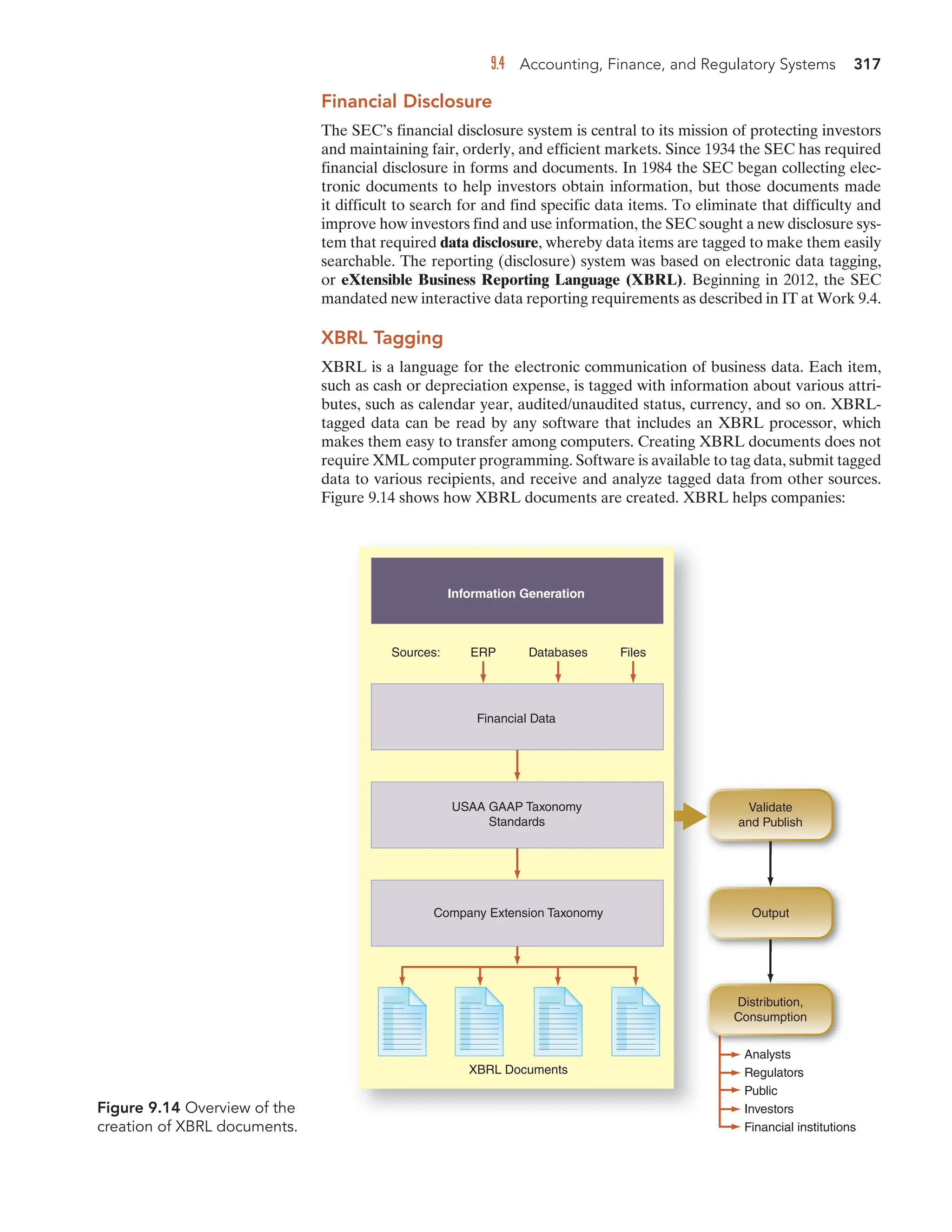
  • 174.
    158 Chapter 5Cybersecurity and Risk Management and card payment providers to make certain their Web applications are secure. If done correctly, this could reduce the number of Web-related security breaches. The purpose of the PCI DSS is to improve customers’ trust in e-commerce, especially when it comes to online payments, and to increase the Web security of online merchants. To motivate following these standards, the penalties for noncom- pliance are severe. The card brands can fine the retailer, and increase transaction fees for each credit or debit card transaction. A finding of noncompliance can be the basis for lawsuits. IT SECURITY DEFENSE- IN-DEPTH MODEL Defense-in-depth is a multilayered approach to information security. The basic principle is that when one defense layer fails, another layer provides protection. For example, if a wireless network’s security was compromised, then having encrypted data would still protect the data, provided that the thieves could not decrypt it. The success of any type of IT project depends on the commitment and involve- ment of executive management, also referred to as the tone at the top. The same is true of IT security. This information security tone makes users aware that inse- cure practices and mistakes will not be tolerated. Therefore, an IT security model begins with senior management commitment and support, as shown in Figure 5.8. The model views information security as a combination of people, processes, and technology. Step 1: Senior management commitment and support. Senior managers’ influence is needed to implement and maintain security, ethical standards, privacy practices, and internal control. IT security is best when it is top-driven. Senior managers decide how stringent infosec policies and practices should be in order to comply with laws and regulations. Financial institutions are subject to strict security and antimoney laundering (AML) rules because they face numerous national and international regulations and have high-value data. Advertising agencies and less regulated firms tend to have more lenient rules. Other factors influencing infosec policies are a corporation’s culture and how valuable their data are to criminals. For instance, management may decide to forbid employees from using com- pany e-mail accounts for nonwork purposes, accessing social media during work hours, or visiting gambling sites. These decisions will then become rules stated in company policy, integrated into procedures, and implemented with technology defenses. Sites that are forbidden, for instance, can be blocked by firewalls. Step 2: Acceptable use policies and IT security training. Organizations need to put in place strong policies and processes that make responsibilities and accountabilities clear to all employees. An acceptable use policy (AUP) explains what management has decided are acceptable and unacceptable activities, and the consequences of noncompliance. Rules about tweets, texting, social media, e-mail, apps, and hard- ware should be treated as extensions of other corporate policies—such as physical safety, equal opportunity, harassment, and discrimination. No policy can address Figure 5.8 IT security defense-in-depth model. Step 4 Hardware and software (kept up-to-date) Step 3 IT security procedures and enforcement Step 2 Acceptable use policies and IT security training Step 1 Senior management commitment and support
  • 175.
    5.2 Cyber RiskManagement 159 every future situation, so rules need to be evaluated, updated, or modified. For example, if a company suffers a malware infection traced to an employee using an unprotected smartphone to connect to the company network, policies to restrict or prohibit those connections might be advisable. Step 3: IT security procedures and enforcement. Secure procedures define how policies will be enforced, how incidents will be prevented, and how to respond to an incident. Here are the basic secure procedures to put in place: 1. Define enforcement procedures. Rules that are defined in the AUP must be en- forced and enforcement procedures must be applied consistently. Procedures for monitoring employee Internet and network usage are defined at this stage. 2. Designate and empower an internal incident response team (IRT). The IRT typically includes the CISO, legal counsel, senior managers, experienced com- municators, and key operations staff. Minimizing the team size and bureaucracy can expedite decision making and response. Because there may be significant liability issues, legal counsel needs to be involved in incident response planning and communication. 3. Define notification procedures. When a data breach occurs, the local police de- partment, local office of the FBI, Securities and Exchange Commission (SEC), the U.S. Secret Service, or other relevant agency needs to be notified immedi- ately. Federal and state laws or industry regulations may define how and when affected people need to be notified. 4. Define a breach response communications plan. Effective incident response communication plans include personnel and processes with lists, channels, and social media needed to execute all communications that might be needed. 5. Monitor information and social media sources. Monitor Twitter, social media, and news coverage as a standard procedure to understand how people are re- sponding to the incident and criticizing the company. Damage control proce- dures may be needed. When an incident occurs, the organization is ready to respond intelligently— having the correct information to be honest, open, and accountable, and to commu- nicate with consumers and other important audiences as quickly as possible. Step 4: Hardware and software. The last step in the model is implementation of software and hardware needed to support and enforce the AUP and secure practic- es. The selection of hardware and software defenses is based on risk, security bud- get, AUP, and secure procedures. Every device that connects to an organization’s network; every online activity and mobile app of employees; and each file sent or received is an access point. Technology defense mechanisms need to be: • able to provide strong authentication and access control. • industrial-grade. • appropriate for the types of networks and operating systems. • installed and configured correctly. • tested rigorously. • maintained regularly. Keep in mind that security is an ongoing unending process, and not a problem that can be solved with hardware or software. Hardware and software security defenses cannot protect against irresponsible business practices. One of the biggest mistakes managers make is underestimating IT vulnerabilities and threats. Most workers use their laptops and mobiles for both work and leisure, and in an era of multitasking, they often do both at the same time. Yet offtime or offsite use of devices remains risky because, despite policies, employees continue
  • 176.
    160 Chapter 5Cybersecurity and Risk Management to engage in dangerous online and communication habits. Those habits make them a weak link in an organization’s otherwise solid security efforts. These threats can be classified as unintentional or intentional. UNINTENTIONAL THREATS Unintentional threats fall into three major categories: human error, environ- mental hazards, and computer system failures. • Human error can occur in the design of the hardware or information system. It can also occur during programming, testing, or data entry. Not changing default passwords on a firewall or failing to manage patches creates security holes. Human errors also include untrained or unaware users responding to phishing scams or ignoring security procedures. Human errors contribute to the majority of internal control and information security problems. • Environmental hazards include volcanoes, earthquakes, blizzards, floods, power failures or strong fluctuations, fires (the most common hazard), defective air conditioning, explosions, radioactive fallout, and water- cooling-system failures. In addition to the primary damage, computer resources can be damaged by side effects, such as smoke and water. Such hazards may disrupt normal computer operations and result in long wait- ing periods and exorbitant costs while computer programs and data files are recreated. • Computer systems failures can occur as the result of poor manufactur- ing, defective materials, and outdated or poorly maintained networks. Unintentional malfunctions can also happen for other reasons, ranging from lack of experience to inadequate testing. INTENTIONAL THREATS Examples of intentional threats include data theft; inappropriate use of data (e.g., manipulating inputs); theft of mainframe computer time; theft of equipment and/ or programs; deliberate manipulation in handling, entering, processing, transfer- ring, or programming data; labor strikes, riots, or sabotage; malicious damage to computer resources; destruction from viruses and similar attacks; and miscellaneous computer abuses and Internet fraud. TYPES OF MALWARE Viruses, worms, trojans, rootkits, backdoors, botnets, and keyloggers are types of malware. Technically, malware is a computer program or code that can infect any- thing attached to the Internet and is able to process the code. Most viruses, trojans, and worms are activated when an attachment is opened or a link is clicked. But when features are automated, they may trigger malware automatically, too. For example: • If an e-mail client, such as Microsoft Outlook or Gmail, is set to allow script- ing, then virus infection occurs by simply opening a message or attachment. • Viewing e-mail messages in HTML, instead of in plain text, can trigger virus infections. Remote-access trojans, or RATS, create an unprotected backdoor into a sys- tem through which a hacker can remotely control that system. As the name implies, a backdoor provides easy access to a system, computer, or account by eliminating the need to authenticate with a username and password. Whenever you store your username and password, you create a backdoor to that account. A malware’s payload refers to the actions that occur after a system has been infected. The payload carries out the purpose of the malware. The payload could cause damage that is visible or operate in stealth mode so as to remain undetected. A vector is the specific method that malware uses to propagate, or spread, to other machines or devices. Malware may also replicate, or make copies of itself.
  • 177.
    5.2 Cyber RiskManagement 161 Today’s malware is designed for long-term control of infected machines. Advanced malware sets up outbound communication channels in order to upload stolen data, download payloads, or do reconnaissance. Malware creators use social engineering to maximize the range or impact of their viruses, worms, and so forth. For example, the ILoveYou worm used social engineering to entice people to open malware-infected e-mail messages. The ILoveYou worm attacked tens of millions of Windows computers in May 2000 when it was sent as an e-mail attachment with the subject line: ILOVEYOU. Often out of curiosity, people opened the attachment named LOVE-LETTER-FOR- YOU.TXT.vbs—releasing the worm. Within nine days, the worm had spread world- wide, crippling networks, destroying files, and causing an estimated $5.5 billion in damages. Notorious hacker Kevin Mitnick, who served time in jail for hacking, used social engineering as his primary method to gain access to computer networks. In most cases, the criminal never comes face-to-face with the victim, but communi- cates via the phone or e-mail. Malware Reinfection, Signatures, Mutations, and Variants When a host computer is infected, attempts to remove the malware may fail—and the malware may reinfect the host for these two reasons: 1. Malware is captured in backups or archives. Restoring the infected backup or archive also restores the malware. 2. Malware infects removable media. Months or years after the initial infection, the removable media may be accessed, and the malware could attempt to infect the host. Most antivirus (AV) software relies on signatures to identify and then block malware. According to the Worldwide Malware Signature Counter, at the start of 2013, there were an estimated 19 million malware signatures. Detecting and pre- venting infections are not always a possibility. Zero-day exploits—malware so new their signatures are not yet known—are an example. Malware authors also evade detection by AV software and firewalls by altering malware code to create variants, which have new signatures. But not all procedures or AV tools are capable of removing every trace of the malware. Even if the malicious parts of the infection can be cleaned from a system, the remaining pieces of code could make the system unstable or exposed to future infection. Data tampering is a common means of attack that is overshadowed by other types of attacks. It refers to an attack during which someone enters false or fraudu- lent data into a computer, or changes or deletes existing data. Data tampering is extremely serious because it may not be detected. This is the method often used by insiders and fraudsters. TARGETED ATTACKS ON ENTERPRISES Corporate and government secrets are currently being stolen by APTs. Most APT attacks are launched through phishing. Typically, this type of attack begins with some reconnaissance on the part of attackers. This can include researching pub- licly available information about the company and its employees, often from social networking sites. This information is then used to create targeted phishing e-mail messages. A successful attack could give the attacker access to the enterprise’s network. APTs are designed for long-term espionage. Once installed on a network, APTs transmit copies of documents, such as Microsoft Office files and PDFs, in stealth mode. APTs collect and store files on the company’s network; encrypt them; then send them in bursts to servers often in China or Russia. This type of attack has been observed in other large-scale data breaches that exposed significant numbers of identities.
  • 178.
    162 Chapter 5Cybersecurity and Risk Management APT Example: Operation Aurora An attack named Operation Aurora proved to be very successful at targeting, exploiting, accessing, and stealing valuable intellectual property from its victims’ databases. Operation Aurora attacked in six steps, as described in Figure 5.9. Standard IT security technologies failed to prevent these six steps from occurring and users did not know they had been hacked. Once attackers gain access to inter- nal systems (Step 6), they can steal corporate secrets. Botnets A botnet is a collection of bots, which are malware-infected computers. Those infected computers, called zombies, can be controlled and organized into a network of zombies on the command of a remote botmaster (also called bot herder). Storm worm, which is spread via spam, is a botnet agent embedded inside over 25 million computers. Storm’s combined power has been compared to the processing might of a supercomputer, and Storm-organized attacks are capable of crippling any website. Zombies can be com- manded to monitor and steal personal or financial data—acting as spyware. Botnets are used to send spam and phishing e-mails and launch DDoS attacks. Botnets are extremely dangerous because they scan for and compromise other computers, which then can be used for every type of crime and attack against computers, servers, and networks. Spear Phishing Spear phishers often target select groups of people with something in common—they work at the same company, bank at the same financial institution, or attend the same university. The scam e-mails appear to be sent from organizations or people the potential victims normally receive e-mails from, making them even more deceptive. Here is how spear phishing works: 1. Spear phish creators gather information about people’s companies and jobs from social media or steal it from computers and mobile devices, and then use that same information to customize messages that trick users into opening an infected e-mail. 2. Then they send e-mails that look like the real thing to targeted victims, offering all sorts of urgent and legitimate-sounding explanations as to why they need your personal data. 3. Finally, the victims are asked to click on a link inside the e-mail that takes them to a phony but realistic-looking website, where they are asked to provide pass- words, account numbers, user IDs, access codes, PINs, and so on. Figure 5.9 Overview of the six steps in Operation Aurora APT attack. 1. A targeted user receives a link in an e-mail or text from a “trusted” source. 4. The exploit downloads a binary disguised as an image and executes the malicious payload. 5. The payload sets up a backdoor and connects to C and C servers in Taiwan. 6. Attackers now have complete access to internal systems. They are now a persistent threat. 2. When the user clicks the link, a website hosted in Taiwan loads. It contains malicious JavaScript. 3. The user’s browser downloads and executes the JavaScript, which includes a zero-day IE exploit.
  • 179.
    5.3 Mobile, App,and Cloud Security 163 IT Defenses Since malware and botnets use many attack methods and strategies, multiple tools are needed to detect them and/or neutralize their effects. Three essential defenses are the following: 1. Antivirus Software: Antimalware tools are designed to detect malicious codes and prevent users from downloading them. They can also scan systems for the presence of worms, trojans, and other types of threats. This technology does not provide complete protection because it cannot defend against zero-day exploits. Antimalware may not be able to detect a previously unknown exploit. 2. Intrusion Detection Systems (IDSs): As the name implies, an IDS scans for un- usual or suspicious traffic. An IDS can identify the start of a DoS attack by the traffic pattern, alerting the network administrator to take defensive action, such as switching to another IP address and diverting critical servers from the path of the attack. 3. Intrusion Prevention Systems (IPSs): An IPS is designed to take immediate action—such as blocking specific IP addresses—whenever a traffic-flow anomaly is detected.An application-specific integrated circuit–based (ASIC) IPS has the power and analysis capabilities to detect and block DDoS attacks, functioning somewhat like an automated circuit breaker. Questions 1. What are threats, vulnerabilities, and risk? 2. Explain the three components of the CIA triad. 3. What is an attack vector? Give an example. 4. What is an exploit? Give an example. 5. What is a contract hacker? 6. Give an example of a weak password and a strong password. 7. How are phishing attacks done? 8. What are the four steps in the defense-in-depth IT security model? 9. Define and give an example of an unintentional threat. 10. Define and give an example of an intentional threat. 11. List and define three types of malware. 12. What are the risks caused by data tampering? 13. Define botnet and explain its risk. 14. Explain spear phishing. 15. What are the functions of an IDS and IPS? With the popularity of e-readers, netbooks, Google’s Chrome OS, Facebook, YouTube, Twitter, LinkedIn, and other social networks, IT security dangers are growing worse. 5.3 Mobile, App, and Cloud Security CLOUD COMPUTING AND SOCIAL NETWORK RISKS Social networks and cloud computing increase vulnerabilities by providing a single point of failure and attack for organized criminal networks. Critical, sensitive, and private information is at risk, and like previous IT trends, such as wireless networks, the goal is connectivity, often with little concern for security. As social networks increase their services, the gap between services and information security also
  • 180.
    164 Chapter 5Cybersecurity and Risk Management increases. E-mail viruses and malware have been declining for years as e-mail secu- rity has improved. This trend continues as communication shifts to social networks and newer smartphones. Unfortunately, malware finds its way to users through security vulnerabilities in these new services and devices. Web filtering, user educa- tion, and strict policies are key to preventing widespread outbreaks. In Twitter and Facebook, users invite in and build relationships with others. Cybercriminals hack into these trusted relationships using stolen logins. Fake anti- virus and other attacks that take advantage of user trust are very difficult to detect. An overriding reason why these networks and services increase exposure to risk is the time-to-exploitation of today’s sophisticated spyware and mobile viruses. Time-to-exploitation is the elapsed time between when vulnerability is discovered and when it is exploited. That time has shrunk from months to minutes so IT staff have ever-shorter timeframes to find and fix flaws before they are compromised by an attack. Some attacks exist for as little as two hours, which means that enterprise IT security systems must have real time protection. When new vulnerabilities are found in operating systems, applications, or wired and wireless networks, patches are released by the vendor or security organization. Patches are software programs that users download and install to fix a vulnerability. Microsoft, for example, releases patches that it calls service packs to update and fix vulnerabilities in its operating systems, including Vista, and applications, including Office 2010. Service packs can be downloaded from Microsoft’s website. Left undetected or unprotected, vulnerabilities provide an open door for IT attacks and business disruptions and their financial damages. Despite even the best technology defenses, information security incidents will occur mostly because of users who do not follow secure computing practices and procedures. BYOD Users bringing their personal mobile devices and their own mobile apps to work and connecting them to the corporate network is part of the larger consumerization of information technology (COIT) trend. Bring your own device (BYOD) and bring your own apps (BYOA) are practices that move enterprise data and IT assets to employees’ mobiles and the cloud, creating a new set of tough IT security challenges. Figure 5.10 summarizes how apps, mobiles, and cloud services put organizations at a greater risk of cyberattack. Widely used apps that are outside of the organization’s firewall are Twitter, Google Analytics, Dropbox, WebEx, and Salesforce.com. Enterprises take risks with BYOD practices that they never would consider taking with conventional computing devices. One possible reason is that new TECH NOTE 5.2 Android Botnet over SMS A botnet of exploited Android phones was sending massive amounts of spam via Yahoo e-mail servers using the short messaging service (SMS) as the command and control (CC) channel. Infected androids, or bots, log into the owner’s Yahoo Mail account to send spam. Most of the devices were located in Chile, Venezuela, Thailand, Indonesia, Lebanon, Philippines, Russia, and Saudi Arabia—that is, in countries where users are less likely to get their Android apps from the Google Play market, which automatically ensures that the apps are safe. Users downloading free phone apps from third-party app stores to avoid paying for legitimate versions were actually downloading the Android malware. User should only download apps from trusted sources and also check the reviews to verify the apps are legitimate because there are many bogus apps. www.Ebook777.com Free ebooks == www.Ebook777.com
  • 181.
    5.3 Mobile, App,and Cloud Security 165 devices, apps, and systems, such as the Windows Phone 7 platform, have been rolled out so quickly. As a result, smartphones are not being managed as secure devices, with fewer than 20 percent of users installing antimalware and 50 per- cent using some type of data encryption. In fact, employees expected instant approval of (or at least no disapproval of) and support for their new iPads within hours of the product’s release. BYOD raises serious and legitimate areas of concern. Hackers break into employees’ mobile devices and leapfrog into employers’ networks—stealing secrets without a trace. New vulnerabilities are created when personal and business data and communications are mixed together. All cybersecurity controls—authentication, access control, data confidentiality, and intrusion detection—implemented on corporate-owned resources can be rendered useless by an employee-owned device. Also, the corporation’s mobile infrastructure may not be able to support the increase in mobile network traffic and data processing, causing unacceptable delays or requiring additional investments. Figure 5.10 Factors that expose companies and users to attack. NEW ATTACK VECTORS Mobile devices and apps, social media, and cloud services introduce even more attack vectors for malware, phishing, and hackers. By mid-2012, roughly 75 percent of U.S. organizations had adopted BYOD practices, but many rushed in without considering security. Mobiles rarely have strong authentication, access controls, and encryption even though they connect to mission-critical data and cloud services. Only 20 percent of Androids have a security app installed. Malicious (Rogue) Mobile Apps The number of malicious Android apps is growing at an alarming rate. According to the report Mobile Phone Biometric Security Analysis and Forecasts 2011–2015 (Egan, 2011), at least 5,000 new malicious Android apps were found in the first quarter of 2012 (Q1 2012). During the next quarter (Q2 2012), 10,000 new rogue apps were found within one month—and by the end of the quarter, there were 40,000 rogue apps (TrendMicro TrendLabs, 2012). Almost all of these apps were found in unreliable third-party stores. But 17 rogue apps managed to get into Google Play and they were downloaded over 700,000 times before being removed. Rogue mobile apps can serve up trojan attacks, other malware, or phishing attacks. Companies offering legitimate apps for online banking, retail shopping, gam- ing, and other functions might not be aware of threats lurking in their app stores. And despite their best efforts, legitimate app store operators cannot reliably police their own catalogs for rogue apps. With a single click on a malicious link, users can launch a targeted attack against their organizations. Minimum Security Defenses for Mobiles Minimum security defenses for mobile devices are mobile biometrics, rogue app monitoring, remote wipe capability, and encryption. For travelers, do-not-carry rules may be a necessary defense. • Business operations are controlled by apps, systems, and networks that are so interconnected that anyone’s mobile device is an entry point for attacks. • Cloud services have created vulnerabilities in systems and apps that are surprising even the experts. Cloud services create vulnerabilities Apps and mobiles create attack vectors
  • 182.
    166 Chapter 5Cybersecurity and Risk Management Mobile biometrics, such as voice and fingerprint biometrics, can significantly improve the security of physical devices and provide stronger authentication for remote access or cloud services. When Apple acquired Siri, Inc. in 2010, the voice- based personal assistant Siri was integrated into its operating system, iOS 5. Siri gave Apple the potential to move into voice biometrics. Voice biometrics is an effective authentication solution across a wide range of consumer devices including smartphones, tablets, and TVs. Future mobile devices are expected to have finger- print sensors to add another authentication factor. Another type of defense is rogue app monitoring to detect and destroy mali- cious apps in the wild. Several vendors offer 24/7 monitoring and detection services to monitor major app stores and shut down rogue apps to minimize exposure and damage. In the event of loss or theft of a device, a mobile kill switch or remote wipe capability is needed as well as encryption. All major smartphone platforms have some kind of remote erase capability and encryption option. In response to mobile security threats, many U.S. companies and govern- ment agencies are imposing do-not-carry rules on mobiles to prevent compromise. Travelers can bring only “clean” devices and are forbidden from connecting to the government’s network while abroad. Questions 1. How do social networks and cloud computing increase vulnerability? 2. Why are patches and service packs needed? 3. What is consumerization of information technology (COIT)? 4. Why does BYOD raise serious and legitimate areas of concern? 5. What are two types of mobile biometrics? 6. Explain rogue app monitoring. 7. Why is a mobile kill switch or remote wipe capability important? 8. What are the purposes of do-not-carry rules? Crime can be divided into two categories depending on the tactics used to carry out the crime: violent and nonviolent. Fraud is nonviolent crime because instead of a gun or knife, fraudsters use deception, confidence, and trickery. Fraudsters carry out their crime by abusing the power of their position or by taking advantage of the trust, ignorance, or laziness of others. 5.4 Defending Against Fraud FRAUD Occupational fraud refers to the deliberate misuse of the assets of one’s employer for personal gain. Internal audits and internal controls are essential to the prevention and detection of occupation frauds. Several examples are listed in Table 5.4. High-profile cases of occupational fraud committed by senior executives such as Bernard Madoff have led to increased government regulation. However, increased legislation has not put an end to fraud. IT at Work 5.6 gives some insight into Madoff’s multibillion fraud that also led to the investigation of the agency responsible for fraud prevention—the U.S. Securities and Exchange Commission (SEC, sec.gov/).
  • 183.
    5.4 Defending AgainstFraud 167 TABLE 5.4 Types and Characteristics of Organizational Fraud Does This Fraud Impact Financial Type of Fraud Statements? Typical Characteristics Operating No Occurs off the books. Median loss management due to corruption: over 6 times corruption greater than median loss due to misappropriation ($530,000 vs. $80,000). Conflict of No A breach of confidentiality, interest such as revealing competitors’ bids; often occurs coincident with bribery. Bribery No Uses positional power or money to influence others. Embezzlement or Employee theft: employees’ “misappropriation” access to company property creates the opportunity for embezzlement. Senior management Yes Involves a massive breach of financial reporting trust and leveraging of positional fraud power. Accounting cycle Yes This fraud is called “earnings fraud management” or earning engineering, which are in violation of generally accepted accounting principles (GAAP) and all other accounting practices. See aicpa.org. Disgraced financier Bernard Madoff is in jail after pleading guilty in 2009 to the biggest fraud in Wall Street history. For four decades, Madoff perpetrated a complex and sinister fraud. Prior to his arrest, Madoff was viewed as a charis- matic man and stellar financier with favorable connections to power brokers on Wall Street and in Washington. Since his arrest, federal prosecutors have maintained that Bernard Madoff ran a scheme that bilked wealthy individuals and large nonprofits out of an estimated $64.8 billion. Social Engineering Fundamentally, Madoff relied on social engineering and the predictability of human nature to generate income for himself—and not on financial expertise. Madoff would ask people to invest in his funds, which were by invitation only, to create the illusion of exclusivity. Madoff used this tactic to create the illusion that only the elite could invest because of consistent returns and his stellar Wall Street reputation. As IT at Work 5.6 Madoff Defrauds Investors of $64.8 Billion
  • 184.
    168 Chapter 5Cybersecurity and Risk Management he expected, wealthy investors mistook exclusivity to mean a secret formula for a sure thing. Unusual steady returns were one of the many well- known red flags indicating fraud that investors and watch- dogs chose to disregard. In fact, in hindsight, investors admit they missed several glaring red flags. The Red Flags Among others, the following classic red flags would have made this fraud detectable much earlier if they had not been consistently ignored: • Madoff was trusted because he was a Wall Street fixture, so his work was not given full scrutiny. • Unbelievable returns defied the market. They were impossible, yet this fact was ignored. • Madoff used a sense of exclusivity—a hook to play “hard to get.” This false sense of exclusivity is a telltale sign of a Ponzi scheme. • Reports of consistently good but never spectacular gains, so-called steady returns, lulled all kinds of investors into a false sense of security over time. Madoff and SEC Under Investigation Not only did this scandal trigger an investigation into Madoff; it also prompted an investigation of the watchdog agency, the SEC. It was investigated by Congress and the agency’s inspector general for repeatedly ignoring whistleblowers’ warnings about Madoff’s operations. Created by Congress in 1934 during the Great Depression, the SEC is charged with ensuring that public companies accurately disclose their financials and business risks to investors, and that brokers who trade securities for clients make their investors’ interests a first priority. Madoff is not the only party at fault. Madoff worked with dozens of feeder funds and other middlemen to lure money into his Ponzi scheme. The investigation into “how- could-this-have-happened?” has involved forensic account- ing as well as computer forensics. The latter experts were tasked with uncovering any smoking-gun e-mails and other digital messages that revealed “who knew what” and “who did what.” Forensics experts dug deeper into the physical evidence to determine who else was complicit in the fraud. Regulatory Reaction In January 2009 the Senate Banking Committee introduced legislation to provide $110 million to hire 500 new FBI agents, 50 new assistant U.S. attorneys, and 100 new SEC enforcement officials to crack down on fraud. Sources: Compiled from Antilla (2008), Chew (2009), Gold (2008), and Quinn (2009). Questions 1. How important was trust to Madoff’s scheme? 2. What else did Madoff rely upon to carry out his fraud? 3. What is a red flag? 4. In your opinion, how were so many red flags ignored given the risk that investors faced? 5. Could such a large investment fraud happen again—or are there internal fraud prevention and detection measures in place that would prevent or stop it from occurring? Explain your answer. INTERNAL FRAUD PREVENTION AND DETECTION The single most effective fraud prevention tactic is making employees know that fraud will be detected by IT monitoring systems and punished, with the fraudster possibly turned over to the police or FBI. The fear of being caught and prosecuted is a strong deterrent. IT must play a visible and major role in detecting fraud. Corporate Governance IT monitoring and control also demonstrate that the company has implemented effective corporate governance and fraud prevention measures. Regulators look favorably on companies that can demonstrate best practices in corporate gover- nance and operational risk management. Management and staff would then spend less time worrying about regulations and more time adding value to their brands and business. Internal fraud prevention measures are based on the same controls used to pre- vent external intrusions—perimeter defense technologies, such as firewalls, e-mail scanners, and biometric access. They are also based on human resource (HR) pro- cedures, such as recruitment screening and training.
  • 185.
    5.5 Compliance andInternal Control 169 Intelligent Analysis and Anomaly Detections Most detection activity can be handled by intelligent analysis engines using advanced data warehousing and analytics techniques. These systems take in audit trails from key systems and personnel records from the HR and finance depart- ments. The data are stored in a data warehouse where they are analyzed to detect anomalous patterns, such as excessive hours worked, deviations in patterns of behavior, copying huge amounts of data, attempts to override controls, unusual transactions, and inadequate documentation about a transaction. Information from investigations is fed back into the detection system so it learns of any anomalous patterns. Since insiders might work in collusion with organized criminals, insider profiling is important to find wider patterns of criminal networks. An enterprisewide approach that combines risk, security, compliance, and IT specialists greatly increases the prevention and detection of fraud. Prevention is the most cost-effective approach, since detection and prosecution costs are enormous in addition to the direct cost of the loss. It starts with corporate governance culture and ethics at the top levels of the organization. Identity Theft One of the worst and most prevalent crimes is identity theft. Such thefts where indi- viduals’ Social Security and credit card numbers are stolen and used by thieves are not new. Criminals have always obtained information about other people—by steal- ing wallets or dumpster diving. But widespread electronic sharing and databases have made the crime worse. Because financial institutions, data processing firms, and retail businesses are reluctant to reveal incidents in which their customers’ personal financial information may have been stolen, lost, or compromised, laws continue to be passed that force those notifications. Questions 1. What are the two categories of crime? 2. Explain fraud and occupational fraud. 3. What defenses help prevent internal fraud? 4. What are two red flags of internal fraud? 5. Explain why data on laptops and computers need to be encrypted. 6. Explain how identity theft can occur. All enterprises are subject to federal and state laws and regulations. Compliance with regulations always requires internal controls to ensure that sensitive data are protected and accurate. 5.5 Compliance and Internal Control INTERNAL CONTROL The internal control environment is the work atmosphere that a company sets for its employees. Internal control (IC) is a process designed to achieve: • Reliability of financial reporting, to protect investors • Operational efficiency • Compliance with laws, regulations, and policies • Safeguarding of assets
  • 186.
    170 Chapter 5Cybersecurity and Risk Management The Sarbanes-Oxley Act (SOX) mandates more accurate business reporting and disclosure of generally accepted accounting principles (GAAP) violations. Section 302 deters corporate and executive fraud by requiring that the CEO and CFO verify that they have reviewed the financial report, and, to the best of their knowledge, the report does not contain an untrue statement or omit any material fact. To motivate honesty, executive management faces criminal penalties including long jail terms for false reports. Section 805 mandates a review of the Sentencing Guidelines to ensure that “the guidelines that apply to organizations . . . are sufficient to deter and punish organizational criminal conduct.” The Guidelines also focus on the establishment of “effective compliance and ethics” programs. As indicated in the Guidelines, a precondition to an effective compliance and ethics program is “an organizational culture that encourages ethical conduct and a commitment to com- pliance with the law.” Among other measures, SOX requires companies to set up comprehensive internal controls. There is no question that SOX, and the complex and costly provi- sions it requires public companies to follow, have had a major impact on corporate financial accounting. For starters, companies have had to set up comprehensive internal controls over financial reporting to prevent fraud, catching it when it occurs. Since the collapse of Arthur Andersen, following the accounting firm’s conviction on criminal charges related to the Enron case, outside accounting firms have gotten tougher with clients they are auditing, particularly with regard to their internal controls. SOX and the SEC are making it clear that if controls can be ignored, there is no control. Therefore, fraud prevention and detection require an effective monitoring system. If a company shows its employees that it can find out everything that every employee does and use that evidence to prosecute a wrongdoer to the fullest extent possible under the law, then the likelihood of any employee adopting an “I can get away with it” attitude drops drastically. Approximately 85 percent of occupational fraud could have been prevented if proper IT-based internal controls had been designed, implemented, and followed. DEFENSE STRATEGY The objective of IT security management practices is to defend all of the compo- nents of an information system, specifically data, software applications, hardware, and networks, so they remain in compliance. Before they make any decisions con- cerning defenses, the people responsible for security must understand the require- ments and operations of the business, which form the basis for a customized defense strategy. The defense strategy and controls that should be used depend on what needs to be protected and a cost–benefit analysis. That is, companies should neither underinvest nor overinvest. The SEC and FTC impose huge fines for data breaches to deter companies from underinvesting in data protection. The following are the major objectives of defense strategies: 1. Prevention and deterrence. Properly designed controls may prevent errors from occurring, deter criminals from attacking the system, and, better yet, deny access to unauthorized people.These are the most desirable controls. 2. Detection. Like a fire, the earlier an attack is detected, the easier it is to combat, and the less damage is done. Detection can be performed in many cases by using special diagnostic software, at a minimal cost. 3. Contain the damage. This objective involves minimizing or limiting losses once a malfunction has occurred. It is also called damage control.This can be accom- plished, for example, by including a fault-tolerant system that permits operation in a degraded mode until full recovery is made. If a fault-tolerant system does not exist, a quick and possibly expensive recovery must take place. Users want their systems back in operation as fast as possible.
  • 187.
    5.5 Compliance andInternal Control 171 4. Recovery. A recovery plan explains how to fix a damaged information system as quickly as possible. Replacing rather than repairing components is one route to fast recovery. 5. Correction. Correcting the causes of damaged systems can prevent a problem from occurring again. 6. Awareness and compliance. All organization members must be educated about the hazards and must comply with the security rules and regulations. A defense strategy is also going to require several controls, as shown in Figure 5.11. General controls are established to protect the system regardless of the specific application. For example, protecting hardware and controlling access to the data center are independent of the specific application. Application controls are safe- guards that are intended to protect specific applications. In the next two sections, we discuss the major types of these two groups of information system controls. GENERAL CONTROLS The major categories of general controls are physical controls, access controls, data security controls, communication network controls, and administrative controls. Physical Controls Physical security refers to the protection of computer facilities and resources. This includes protecting physical property such as computers, data centers, software, manuals, and networks. It provides protection against most natural hazards as well as against some human hazards. Appropriate physical security may include several physical controls such as the following: • Appropriate design of the data center. For example, the data center should be noncombustible and waterproof. • Shielding against electromagnetic fields. • Good fire prevention, detection, and extinguishing systems, including a sprinkler system, water pumps, and adequate drainage facilities. Figure 5.11 Major defense controls. Defense Control Web Controls Biometrics Data Security Communication Administrative Other Access Physical Output Processing Input Encryption Cable Testers Firewalls Virus Protection Authentication Biometrics General Application
  • 188.
    172 Chapter 5Cybersecurity and Risk Management • Emergency power shutoff and backup batteries, which must be maintained in operational condition. • Properly designed and maintained air-conditioning systems. • Motion detector alarms that detect physical intrusion. Access Controls Access control is the management of who is and is not authorized to use a com- pany’s hardware and software. Access control methods, such as firewalls and access control lists, restrict access to a network, database, file, or data. It is the major line of defense against unauthorized insiders as well as outsiders. Access control involves authorization (having the right to access) and authentication, which is also called user identification (proving that the user is who he or she claims to be). Authentication methods include: • Something only the user knows, such as a password • Something only the user has, for example, a smart card or a token • Something only the user is, such as a signature, voice, fingerprint, or retinal (eye) scan; implemented via biometric controls, which can be physical or behavioral Biometric Controls A biometric control is an automated method of verifying the identity of a person, based on physical or behavioral characteristics. Most biometric systems match some personal characteristic against a stored profile. The most common biometrics are a thumbprint or fingerprint, voice print, retinal scan, and signature. Biometric controls have been integrated into e-business hardware and software products. Biometric controls do have some limitations: They are not accurate in certain cases, and some people see them as an invasion of privacy. Administrative Controls While the previously discussed general controls are technical in nature, adminis- trative controls deal with issuing guidelines and monitoring compliance with the guidelines. Examples of controls are shown in Table 5.5. TABLE 5.5 Representative Administrative Controls • Appropriately selecting, training, and supervising employees, especially in accounting and information systems • Fostering company loyalty • Immediately revoking access privileges of dismissed, resigned, or transferred employees • Requiring periodic modification of access controls, such as passwords • Developing programming and documentation standards (to make auditing easier and to use the standards as guides for employees) • Insisting on security bonds or malfeasance insurance for key employees • Instituting separation of duties, namely, dividing sensitive computer duties among as many employees as economically feasible in order to decrease the chance of intentional or unintentional damage • Holding periodic random audits of the system
  • 189.
    5.5 Compliance andInternal Control 173 BUSINESS CONTINUITY Risk management is not complete without a business continuity plan that has been tested to verify that it works. Business continuity refers to maintaining business functions or restoring them quickly when there is a major disruption. The plan cov- ers business processes, assets, human resources, business partners, and more. Fires, earthquakes, floods, power outages, malicious attacks, and other types of disas- ters hit data centers. Yet business continuity planning capabilities can be a tough sell because they do not contribute to the bottom line—that is, until it is too late. Compare them to an insurance policy: If and only if a disaster occurs, the money has been well spent. And spending on business continuity preparedness is an ongoing process because there is always more that could be done to better prepare. The purpose of a business continuity plan is to keep the business running after a disaster occurs. Each function in the business should have a feasible backup plan. For example, if the customer service center or call center was destroyed by a storm or lost all power, would anyone know how the reps would continue to answer cus- tomer calls? The backup plan could define how to provide necessary network access to enable business to continue. AUDITING INFORMATION SYSTEMS An audit is an important part of any control system. Auditing can be viewed as an additional layer of controls or safeguards. It is considered as a deterrent to criminal actions, especially for insiders. Auditors attempt to answer questions such as these: • Are there sufficient controls in the system? Which areas are not covered by controls? • Which controls are not necessary? • Are the controls implemented properly? • Are the controls effective? That is, do they check the output of the system? • Is there a clear separation of duties of employees? • Are there procedures to ensure compliance with the controls? • Are there procedures to ensure reporting and corrective actions in case of violations of controls? Auditing a website is a good preventive measure to manage the legal risk. Legal risk is important in any IT system, but in Web systems it is even more important due to the content of the site, which may offend people or be in violation of copyright laws or other regulations (e.g., privacy protection). Auditing e-commerce is also more complex since, in addition to the website, one needs to audit order taking, order fulfillment, and all support systems. COST–BENEFIT ANALYSIS It is usually not economical to prepare protection against every possible threat. Therefore, an IT security program must provide a process for assessing threats and deciding which ones to prepare for and which ones to ignore or provide reduced protection against. Two methods are risk assessment and business impact analysis. Risk Assessment Risk assessments are done using an app or spreadsheet. The basic computations are shown here: Expected loss P1 P2 L where P1 probability of attack (estimate, based on judgment) P2 probability of attack being successful (estimate, based on judgment) L loss occurring if attack is successful
  • 190.
    174 Chapter 5Cybersecurity and Risk Management Example: P1 .02, P2 .10, L $1,000,000 Then expected loss from this particular attack is P1 P2 L 0.02 0.1 $1,000,000 $2,000 The amount of loss also depends on the duration of a system being out of operation. Business impact analysis A business impact analysis (BIA) estimates the consequences of disruption of a business function and collects data to develop recovery strategies. Potential loss scenarios are first identified during the risk assessment. Operations may also be interrupted by the failure of a supplier of goods or services or delayed deliveries. There are many possible scenarios that should be considered. The BIA identifies both operational and financial impacts resulting from a dis- ruption. Several examples of impacts to consider include (Ready.gov, 2014): • Lost sales and income • Delayed sales or income • Increased expenses (e.g., overtime labor, outsourcing, expediting costs, etc.) • Regulatory fines • Contractual penalties or loss of contractual bonuses • Customer dissatisfaction or defection • Delay of new business plans These costs and losses should be compared with the costs for possible recovery strategies. The BIA report should prioritize the order of events for restoration of the business, with processes having the greatest operational and financial impacts being restored first. Questions 1. Why are internal controls needed? 2. What federal law requires effective internal controls? 3. Why do the SEC and FTC impose huge fines for data breaches? 4. What are the two types of controls in a defense strategy? 5. Explain authentication and two methods of authentication. 6. What are biometric controls? Give an example. 7. Why do organizations need a business continuity plan? 8. Why should websites be audited? 9. How is expected loss calculated? 10. Explain business impact analysis. Key Terms acceptable use policy (AUP) access control administrative controls advanced persistent threat (APT) Anonymous application controls assets attack vectors audit backdoor biometric control BlackPOS Black smartphone botnet bring your own apps (BYOA) bring your own device (BYOD) business continuity plan business impact analysis (BIA)
  • 191.
    Assuring Your Learning175 command and control (CC) channel consumerization of information technology (COIT) contract hacker Control Objectives for Information and Related Technology (COBIT) corporate governance critical infrastructure data tampering distributed denial-of-ser- vice (DDoS) attack do-not-carry rules enterprise risk manage- ment (ERM) exploit general controls hacker hacktivist internal control (IC) internal threats intrusion detection system (IDS) intrusion prevention sys- tem (IPS) iOS 5 IT governance LulzSec malware mobile biometrics occupational fraud patches payload Payment Card Industry Data Security Standard (PCI DSS) phishing physical controls programming attacks remote access trojan (RAT) remote wipe capability risk rogue app monitoring rootkit service pack signature social engineering spam spear phishing spyware threat time-to-exploitation vector virus voice biometrics vulnerability worm zero-day exploit zombie Assuring Your Learning 1. Why is cybercrime expanding rapidly? Discuss some possible solutions. 2. In addition to hackers, what kinds of cybercriminals do organizations need to defend against? 3. What are the major motives of cybercriminals? 4. In what ways do users make themselves vulnerable to cybercrimes? 5. Why do malware creators alter their malware? 6. Why should you set a unique password for each website, service, and device that you use? 7. How can malware be stopped from stealing or dis- closing data from an organization’s network? 8. What impact might huge fines have on how much a company budgets for IT security defenses? 9. Why are BYOD, BYOA, and do-not-carry rules important to IT security? Why might users resist such rules? 10. Why do users refuse to use strong passwords even though they know how dangerous weak passwords are? 11. How can the risk of occupational fraud be decreased? 12. Why should information control and security be of prime concern to management? 13. Explain what firewalls protect and what they do not protect. 14. Why are authentication and authorization important in e-commerce? 15. Some insurance companies will not insure a business unless the firm has a computer disaster recovery plan. Explain why. 16. Explain why risk management should involve the following elements: threats, exposure associated with each threat, risk of each threat occurring, cost of controls, and assessment of their effectiveness. 17. Discuss why the Sarbanes-Oxley Act focuses on internal control. How does that focus influence information security? DISCUSS: Critical Thinking Questions 1. The Wall Street Journal (WSJ.com) has detailed a cyberattack against the U.S. Chamber of Commerce in which e-mails were stolen. Review The Wall Street Journal interactive graphic “China Hackers Hit U.S. Chamber,Attacks Breached Computer System of Business-Lobbying Group; Emails Stolen,” dated December 21, 2011.Also view the video.The links are posted in the book’s website at www.wiley.com/ EXPLORE:Online and Interactive Exercises
  • 192.
    176 Chapter 5Cybersecurity and Risk Management college/turban or you can search the WSJ.com website using the video title. a. Explain the importance and role of social engineering in this intrusion and cybertheft. b. What can be done to prevent this type of intrusion from occurring again? c. How serious was the intrusion and when did it occur? d. What or who did the hackers focus on? Why? e. What information could the hackers have gleaned from the intrusion of the Chamber? f. What did the Chamber do to increase cybersecu- rity after learning of the intrusion and cybertheft? g. Explain why cars and appliances can be hack targets. h. What other resources are at risk? i. Does this incident indicate about how wide- spread hacking is? Explain your answer. 2. Access the Anti-Phishing Working Group website (antiphishing.org) and download the most recent Phishing Activity Trends Report. a. Describe the recent trends in phishing attacks. b. Explain the reasons for these trends. 3. Research a botnet attack. Explain how the botnet works and what damage it causes.What preventive methods are offered by security vendors? 4. Visit cio.com and search for a recent article on security, privacy, or compliance.What three lessons are learned from the article? 5. Research vendors of biometrics. Select one vendor and discuss three of its biometric devices or technol- ogies. Prepare a list of major capabilities.What are the advantages and disadvantages of its biometrics? 1. Many firms concentrate on the wrong questions and end up throwing a great deal of money and time at minimal security risks while ignoring major vulner- abilities.Why? 2. Assessing how much a company is legally obligated to invest in cybersecurity remains a challenge. Since there is no such thing as perfect security (i.e., there is always more that you can do), resolving these questions can significantly affect cost. a. When are a company’s security measures suffi- cient to comply with its obligations? For example, does installing a firewall and using virus detection software satisfy a company’s legal obligations? b. Is it necessary for an organization to encrypt all of its electronic records? 6. Assume that the daily probability of a major earth- quake in Los Angeles is .07 percent.The chance of your computer center being damaged during such a quake is 5 percent. If the center is damaged, the average estimated damage will be $1.6 million. a. Calculate the expected loss (in dollars). b. An insurance agent is willing to insure your facility for an annual fee of $15,000.Analyze the offer, and discuss whether to accept it. 7. Should an employer notify employees that their usage of computers is being monitored? Why or why not? 8. Twenty-five thousand messages arrive at an organi zation each year. Currently, there are no firewalls. On average, 1.2 successful hackings occur each year. Each successful hack attack results in a loss of about $130,000 to the company.A major firewall is proposed at a cost of $66,000.The estimated useful life is 3 years.The chance that an intruder will break through the firewall is 0.0002. In such a case, the damage will be $100,000 (30%), or $200,000 (50%), or no damage.There is an annual maintenance cost of $20,000 for the firewall. a. Should management buy the firewall? b. An improved firewall that is 99.9988 percent effective and that costs $84,000, with a life of 3 years and annual maintenance cost of $16,000, is available. Should this firewall be purchased instead of the first one? ANALYZEDECIDE: Apply IT Concepts to Business Decisions
  • 193.
    CASE 5.2 BusinessCase 177 CASE 5.2 Business Case: Lax Security at LinkedIn Exposed On any social network, most users mistakenly believe that their privacy is only as good as the privacy of their most careless—or temporary—friend. In fact, weak passwords and hackers can deprive users of all privacy. Business social networking site LinkedIn was hacked in June 2012 (Figure 5.12). Hackers stole 6.5 million pass- words and e-mail addresses. This data breach was discovered by IT security experts when they found millions of LinkedIn passwords posted on a Russian underground website (Figure 5.13). Experts also determined that a hacker named Dwdm was asking underground members for help in cracking the stolen passwords. Within only two days, most passwords were cracked. Why were LinkedIn’s passwords cracked so quickly? The simple answer is that LinkedIn was using an outdated encryption method instead of up-to-date industry- standard encryption. As a result, members’ passwords were really only camouflaged—and crackable. LinkedIn Criticized for Bad Data Security What could hackers do to your online accounts if they had your passwords for 48 hours and you did not know? That is what LinkedIn allowed to happen by waiting two days before notifying members that their passwords had been stolen. The company took a lot of criticism for not notifying members via Twitter or Facebook immediately. According to the chief executive of the Public Relations Consultants Association, Francis Ingham, LinkedIn ignored the first rule of crisis man- agement, which is to be first to tell your customers. What surprised customers and IT security experts was that a company that collects and profits from vast amounts of data had taken a negligent approach to protecting it. Figure 5.14 explains why it was surprising and alarming that LinkedIn’s password protection was weak. E-mail Addresses Are Universal Usernames At most e-commerce and social sites, usernames are e-mail addresses—making them our universal username for online accounts. If the e-mail is a work account, then everyone also knows where we work and our login name. Therefore, know- ing users’ usernames and passwords provides authorized access to corporate accounts with almost no risk of being detected. Hackers attacked LinkedIn to gain access to over 161 million members’ credentials as a means to gain access to much more valuable business networks and databases. Figure 5.12 LinkedIn data breach overview. Figure 5.13 LinkedIn did not discover its own data breach and, when informed of it, delayed notifying members. Hackers breached Linkedln’s network and stole 6.5 million of its customers’ passwords, which had been only lightly encrypted. They were posted to a Russian hacker forum for all to see and steal. Data Breach Linkedln Hack attack led to 6.5 million e-mail addresses and passwords being compromised. Over $1 million in costs associated with forensic work, investigating, and addressing the breach. Seven-figure investments in IT infrastructure to update and harden network and data security. Costs © Kevin Britland/Alamy
  • 194.
    178 Chapter 5Cybersecurity and Risk Management Business Risks and Collateral Damage The hack caused the following business risks and collateral damage. • Takeover of members’ other accounts by hackers, fraudsters, and other criminals. Hackers know that people reuse passwords; once their LinkedIn accounts are linked to Facebook and Twitter, far too much informa- tion may be revealed. Knowing where people worked and their e-mail accounts allowed hackers to quickly use the stolen LinkedIn passwords to log in to corporate accounts, online bank accounts, and so on to steal more data or transfer funds. • Damage to LinkedIn’s biggest revenue source—its advertising business. LinkedIn’s financial success is tied to its advertising revenues, which in turn are based on the number of active members and membership growth. • Fines for violating privacy laws and regulations. Any company exposing the confidential data of customers or employees faces steep fines. Regulators impose harsh penalties for breaking privacy laws and not taking reason- able care to defend against data breaches. Strict data privacy laws in states such as Massachusetts and California could keep LinkedIn fighting legal battles for years. • Cleanup costs. The cleanup cost LinkedIn nearly $1 million and another $2 to $3 million in upgrades. Forensic work on the password theft cost another $500,000 to $1 million. Data Security: A Top Management Concern Data security is a senior management concern and respon- sibility. It affects a company’s operations, reputation, and customer trust, which ultimately impact revenue, profits, and competitive edge. Yet defenses that could help to prevent breaches are not always implemented. Some experts argue that senior management continues to skimp on basic protections because computer security is not regulated—that is, until a business suffers a major crisis. After the data breach, LinkedIn implemented improved pass- word storage encryption, hired private security and forensics experts, and called in the Federal Bureau of Investigation (FBI) to help investigate the security breach. Jeremiah Grossman, chief technology officer of White Hat Security, estimated that it would have cost LinkedIn “a couple hundred thousand dollars” to secure its members’ passwords, Web servers, and applications (Perlroth, 2012a). How This Attack Compares to Others While 6.5 million leaked passwords represents a serious breach, it affected a relatively small percent of the more than 175 million members LinkedIn had at that time. Overall, the LinkedIn breach, while somewhat costly, did not do as much harm as those experienced by other hacked companies such as Global Payments, Sony, and Certificate Authority DigiNotar, which was literally hacked out of business. Sources: Compiled from Perlroth (2012a), Ponemon Institute (2013), whitehatsec.com, and prca.org.uk. Questions 1. LinkedIn does not collect the credit card or other financial account information of its members. Why then would profit-motivated hackers be interested in stealing LinkedIn’s stored data? What data would they be most interested in? 2. Companies are often slow to self-detect data breaches so a cyberattack can occur without a company even know- ing it has a problem. What effect do you think LinkedIn’s failure to self-detect its massive data breach had on its popularity and credibility? Figure 5.14 Three reasons why LinkedIn’s underinvestment in data security did not make business sense. • Linkedln’s business model: collect and profit from data. • Linkedln was not some cash-poor startup company. The company had piles of cash from its successful initial public offering (IPO) in May 2011. Once it went public, Linkedln, like all public companies, had to report hack attacks to the SEC. • Linkedln’s net income for the first quarter of 2012 was $5 million, more than double its $2.1 million net income in the first quarter 2011. Linkedln had a lot to protect... and lose. Its most valuable asset is data It’s a high-tech, public company with a brand image to protect It had a lot of net income to protect
  • 195.
    References 179 3. Mostcorporate security incidents are uncovered by a third party, like a security firm, that picks up on evidence of malicious activity. Why do you think IT security experts and not LinkedIn discovered the data breach? 4. LinkedIn’s lax approach to members’ information security and weak passwords was very surprising to members and information security professionals. Why? 5. Identify and evaluate the actual and potential business risks and damages from LinkedIn’s data breach. 6. Why is data encryption an important information security defense? 7. Discuss why information security is a concern of senior managers. 8. Explain why someone who used the same password for several sites would need to change all those passwords. In your opinion, was LinkedIn negligent in protecting its main asset? Explain. CASE 5.3 Video Case: Botnets, Malware Security, and Capturing Cybercriminals Gunter Ollmann, vice president of research at Damballa, Inc., explains the Aurora attacks against major companies. Thousands of botnet operators launched targeted botnet campaigns with the help of automated tools. In the video, you learn why it is difficult for law enforcement to track and prosecute cybercriminals and the effectiveness of Microsoft’s legal action to shut down the CC (command and control) network of the Waladec botnet. Visit searchsecurity.techtarget. com/video/Botnets-malware-and-capturing-cybercriminals to view the video and read the transcript of it. Questions 1. What are botnets used for? 2. What is needed to get started in the botnet industry? Explain why. 3. Given your answers, what should users and organizations do and/or not do to reduce the threat of botnets? Quiz 1. From research into Operation Aurora and analysis of the botnets, investigators learned all of the following except: a. There are about 50 botnet operators. b. Botnet operators have increased their range by running multiple botnets and campaigns. c. The feature set of modern malware is similar for both the amateur and the professional operator. d. Many of the advanced types of malware are available in kit form. 2. What really differs between the professional practice and the amateur operator is the way that they __________. a. select their targets. b. have hardened their malware. c. infect a network. d. use proxies. 3. Armoring malware is done to make sure that if researchers obtain a sample of the code, it cannot be automatically used for deconstructing who the command and control chains are. True or false? 4. Many consumers know that a traditional antivirus program has value, but that value is depreciating considerably. True or false? Antilla, S.“Red Flags Were There All Along: Suspicious Activi- ties Largely Unquestioned.” Gazette (Montreal), December 16, 2008. Boeing.com.“Overview: Boeing Black Smartphone.” 2014. Chew, R.“A Madoff Whistle-Blower Tells His Story.” Time, February 4, 2009. D’Innocenzio,A.“Data-breach Cuts Target Profit.” Timesleader. com, February 26, 2014. Egan, S.“New Report Predicts High Growth in Mobile Bio- metric Security.” SecureIDNews.com. September 15, 2011. Gallagher, S.“Update: Boeing’s Black—This Android Phone Will Self-Destruct.” Ars Technica, February 26, 2014. Gold, L.“Forensic Accounting: Finding the Smoking E-mail: E-discovery Is Now a Critical Part of Forensics—and of Firm Policy.” Accounting Today 22, no. 8, May 5, 2008. Hosenball, M.“Leaked Call on Ukraine Made on Unencrypted Cellphones—U.S. Officials.” Reuters, February 7 , 2014. Kratsas, G.“Reports:Target Warned Before Data Breach.” USA Today, February 18, 2014. KPMG. Data Loss Barometer. 2012. http://www.kpmg.com/US/ en/IssuesAndInsights/ArticlesPublications/Documents/data- loss-barometer.pdf Krebs on Security.“A First Look at the Target Intrusion, Malware.” January 14, 2014. References
  • 196.
    180 Chapter 5Cybersecurity and Risk Management Mobile Phone Biometric Security Analysis and Forecasts 2011–2015. O’Connor, C.“Target CEO Gregg Steinhafel Resigns in Data Breach Fallout.” Forbes, May 5, 2014. Perlroth, N.“Hacked Chamber of Commerce Opposed Cyber- security Law.” bits.blogs.nytimes.com, December 21, 2012a. Perlroth, N.“Traveling Light in a Time of Digital Thievery.” The New York Times, February 10, 2012b. Ponemon Institute.“2013 Cost of Data Breach Study: Global Analysis.” Ponemon Institute Research Report. May 2013. PricewaterhouseCoopers (PWC). 2014 Global State of Information Security Survey. http://www.pwc.com/gx/en/ consulting-services/information-security-survey/download. jhtml Quinn, J.“On the Trail of Madoff’s Missing Billions.” The Sunday Telegraph (London), January 18, 2009. Ready.gov.“Business Impact Analysis.” January 29, 2014. Sharf, S.“Target Shares Drop After CEO Gregg Steinhafel’s Resignation.” Forbes, May 5, 2014. TrendMicro TrendLabs,“Repeating History.” 2012 http://www. trendmicro.com/cloud-content/us/pdfs/security-intelligence/ reports/rpt-repeating-history.pdf Westcott, L.“Boeing’s New Self Destructing Phone Is Ideal for Those Who Need to Keep Secrets.” The Wire, March 5, 2014. Yadron, D., P. Ziobro, D. Barrett.“Target Warned of Vulnerabilities Before Data Breach.” The Wall Street Journal, February 14, 2014.
  • 197.
    Chapter Snapshot Every day,over 1.5 billion people around the world use what seems to be a simple tool to find information online—a search engine. We sometimes take for granted that behind a relatively simple user interface, an increas- ingly complex set of search engine technologies are at work, helping us find the information we need to do our jobs, conduct research, locate product reviews, or find information about the television shows we watch. Attracting Buyers with Search, Semantic, and Recommendation Technology 6 Chapter 1. Describe how search engines work and identify ways that businesses gain competitive advantage by using search technology effectively. 2. Describe how to improve website ranking on search results pages by optimizing website design and creating useful content. 3. Describe how companies manage paid search advertising campaigns to increase awareness and drive sales volume. 4. Describe how semantic Web technology enhances the accuracy of search engines results and how businesses can optimize their websites to take advantage of this emerging technology. 5. Describe how recommendation engines are used to enhance user experience and increase sales on e-commerce websites. Learning Outcomes 181 Winning, Engaging, and Retaining Consumers with Technology Part 2 Chapter Snapshot Case 6.1 Opening Case: Nike Golf Drives Web Traffic with Search Engine Optimization 6.1 Using Search Technology for Business Success 6.2 Organic Search and Search Engine Optimization 6.3 Pay-Per-Click and Paid Search Strategies 6.4 A Search for Meaning—Semantic Technology 6.5 Recommendation Engines Key Terms Assuring Your Learning • Discuss: Critical Thinking Questions • Explore: Online and Interactive Exercises • Analyze Decide: Apply IT Concepts to Business Decisions Case 6.2 Business Case: Recommending Wine to Online Customers Case 6.3 Video Case: Power Searching with Google References
  • 198.
    Because most searchengine services are free, people are not generally aware that “Search” has become a multibillion-dollar-a-year business. More importantly, the way search engines work and how they rank-order the links displayed when we conduct a search have huge implications for millions of other businesses. Because consumers typically don’t look past the first few pages of search results, having your business appear at the top of a search results page can make a big difference in how much traffic your website gets. In this chapter, you will read about how search engines work and how they determine page rankings. You will also read about the strategies companies use to increase their presence on search results pages including search engine optimization (SEO) and pay-per-click (PPC) advertising. Semantic technologies are increasingly being used by search engines to understand webpage content. In this chapter you will read about the ways that search engines are using semantic technology to improve performance, increasing relevant pages and decreasing the number of irrelevant pages that appear in search results. Finally, you will read about recommendation engines. These tools attempt to anticipate online information you might be interested in. Netflix uses recommendation engines to suggest movies you might like to watch and news organizations use them to recommend stories you might want to read on their websites. Amazon credits its recommendation technology for increasing sales by sug- gesting products that customers might want to buy. Business managers need to understand search and recommendation technologies because their influence in directing potential consumers to business websites is already significant and expected to grow substantially in the future. Search Engine Results Page (SERP): the list of links and other descriptive information about webpages returned by a search engine in response to a search query. Keywords: in the context of web search or SEO, words or phrases that describe the content on a webpage. Search engines use keywords to match webpages with user search queries. CASE 6.1 OPENING CASE Nike Golf Drives Web Traffic with Search Engine Optimization According to some estimates, 50 to 75 percent of Web traffic is generated by search engines (Pick, 2012, Safran, 2013, Van Zelst, 2013, Willcocks, 2013). This should not come as a surprise to most of us, considering how often we use search engines like Google, Bing, or Yahoo to find online information. Because businesses compete for our attention, they have a vested interest in maintaining a high degree of visibility on search engine results pages, or SERPs. Traffic from search engines comes from two basic sources: organic search results and paid search advertisements. Organic search results are heavily influenced by website content and design features (e.g., the technology used to create the site, webpage coding, etc.). Paid search traffic is the result of ads that appear on SERPs. Companies pay search engines to place these ads on SERPs when certain keywords are used in a search query. Search engine users frequently ignore these ads—about 85 percent of website traffic generated by search engines is the result of organic search listings (Downhill Peggie, 2005). 182 COMPANY OVERVIEW Nike, Inc., based near Beaverton, OR, is one of the world’s most recognized brand names in sports apparel and equipment. Revenues in 2013 increased 8 percent from the previous year to $25.3 billion.The company is currently experiencing a period of growth, particularly with its “direct to consumer” (DTC) sales strategy involving a combination of online sales and company stores (Figure 6.1). DTC sales at the com- pany grew 24 percent to $4.3 billion compared to the previous year.This was fueled, in part, by increasing the number of company stores from 557 to 645 worldwide over the past year (Nikeinc.com, 2013). Nike is frequently associated with what it calls a “big athlete, big ad, big prod- uct” marketing strategy (Nikeinc.com, 2014). This involves signing endorsement deals with the most widely recognized athletes in the sporting world, creating
  • 199.
    CASE 6.1 OpeningCase 183 signature products, and supporting them with high-powered advertising campaigns featuring the company’s famous tagline, “Just do it.” Perhaps the best example of this promotional strategy is Nike’s popular campaign for Air Jordans, a line of basketball shoes named for Michael Jordan. Other well-known Nike athletes include golf pro Tiger Woods, Russian tennis star Maria Sharapova, Brazilian soccer phenomenon Ronaldinho, and professional skateboarder Paul Rodriguez, Jr. (Goldman, 2008). Figure 6.1 Nike is expanding its “direct to consumers” name-brand stores worldwide like this one in Beijing, China. (shutterstock.com.) TABLE 6.1 Opening Case Overview Company Nike, Inc., nikeinc.com History Founded in 1964 as Blue Ribbon Sports, the company changed its name to Nike in 1971 and sells products under a variety of brand names, including Nike Golf, Nike Pro,Air Jordan, Nike Vision, Converse, and Nike Skateboarding. Industry Athletic apparel, footwear, and equipment Product lines The global company manufactures, sells, and distributes athletic footwear, apparel, and sports equipment to retail outlets, colleges and universities, sports clubs, professional sports teams, and directly to consumers. Digital technology Nike is a leader in e-commerce innovation, for instance, allowing consumers to design their own individual footwear. Nike products integrate traditional sports equipment with digital technology (e.g., mobile apps, wristbands, watches, and software) that allow athletes to monitor and track their performance. Business challenges • Placing greater emphasis on digital marketing strategies, including search engine marketing. • Growing its direct to consumer (DTC) sales channels. • Expanding the Nike Digital Sports division. Taglines “Just do it.” © testing/Shutterstock.com
  • 200.
    184 Chapter 6Attracting Buyers with Search, Semantic, and Recommendation Technology More recently, Nike has shifted its marketing and promotion strategy, placing greater emphasis on digital or online channels, attempting to engage consumers in ways not possible via traditional mass media. See Figure 6.2. Figure 6.2 Nike, Inc. overview. NIKE’S BUSINESS CHALLENGES In order to continue online sales growth, Nike’s e-commerce sites need to maintain high levels of visibility on major search engines. This means that when consum- ers conduct searches for things like “golf shoes,” “sports equipment,” or “athletic gear,” Nike would like to appear at the top of SERP listings. Unfortunately, the Nike website does not appear in the search results of many queries for which you would expect it to. BUSINESS AND IT STRATEGIES Despite its well-known brand name and established position as a market leader in sports apparel, footwear, and athletic equipment, Nike has not historically done well in search engine rankings. The company hired SwellPath, a digital marketing agency based in Portland, OR, to help it increase the visibility of its golf brand on popular search engines for the 2011 golf season. Swellpath set out to improve Nike’s organic search rankings and provide an analysis of the company’s improved performance in search. The strategy involved identifying changes that needed to be made to Nike’s golf site (nikegolf.com) and researching keywords that prospective customers were most likely to use when searching for the type of products that Nike sells. Changing the design and content of a website to improve its ranking in SERPs is called search engine optimization (SEO). SwellPath discovered that Nike had built its website using Java technology, which created attractive and visually compelling webpages, but was practically invis- ible to the tools (called spiders) that search engines use to crawl webpage content looking for keywords that serve as clues to what the website is about.This was a big problem since search engines rely on matching words in search queries with words in the website content to determine if a page is relevant. SwellPath also analyzed the keywords that people were likely to use when searching for the kind of products Nike sells. It is not practical or effective to optimize for all possible keywords, so SwellPath set out to identify the words that not only produced traffic to Nike’s site, but also attracted customers most likely to Search Engine Optimization (SEO): a collection of strategies and techniques designed to increase the number of visitors to a web- site as a result of the web- site’s rank on search engine results pages. Manufacturing: 998,888 workers, 744 factories in 43 countries. Nike.com online sales to 24 countries worldwide. Retail stores in approximately 190 countries. Global Reach Innovation Intensly loyal employees Corporate Culture Just do it. “If you have a body, you’re an athlete” Swoosh Logo Brand Search Engine Optimization Social Media Marketing Digital Athletic Gear Digital Technology Nike, Inc. www.Ebook777.com Free ebooks == www.Ebook777.com
  • 201.
    CASE 6.1 OpeningCase 185 “convert” (purchase products). For instance, the company examined the words “golf apparel,” “golf clothing,” “golf clothes,” and “golf sportswear.” Research showed that people in the U.S. searched on the words “golf apparel” more frequently, and customers who visited the site when searching those words stayed on the Nike site longer, visited more pages, and were more likely to purchase an item. SEO SOLUTION Completely redesigning Nike’s Java-based website was not a viable option because of the cost involved. SwellPath recommended an alternative solution—creating a parallel site using HTML, a more basic Web programming language that could be read by search engine spiders. Visitors to the site still saw the original Java-based site with the attractive pages, but search engines could easily read the content on the parallel site. In addition, it turned out that the HTML site displayed better on mobile devices, an added benefit. Once the site’s technology problem was solved, SwellPath optimized the con- tent for “golf apparel” along with other terms and phrases it had identified in its keyword research. PERFORMANCE RESULTS Between the 2010 and 2011 golf seasons, Web traffic from organic search increased 169 percent, an impressive gain. However, SwellPath discovered that most of this traffic derived from consumers who included the word “Nike” in their search que- ries. These are referred to as branded search queries. To really judge the impact of SEO, SwellPath evaluated changes in Web traffic from nonbranded searches (such as “golf shoes” vs. “Nike golf shoes”). It discovered that traffic from nonbranded organic searches actually slipped 17 percent. As a result, the SwellPath team redou- bled its efforts by continued research on keywords and adding site content around terms and phrases likely to attract customers. The effort paid off. When its plan was fully implemented, nonbranded traffic to the Nike site increased 250 percent between the 2011 and 2012 golf seasons. More recently,the SwellPath team helped NikeVision,the company’s unit that sells sunglasses and athletic eyewear. Prior to the 2012 Olympic Games in London, Nike signed professional beach volleyball star Misty May-Treanor (see Figure 6.3). Knowing that people would be using search engines to look up information on star athletes dur- ing the Olympics, SwellPath optimized the Nike Vision website with blog content about Misty May-Treanor and her Nike-branded sunglasses. As a result, during the six-day period that Misty May-Treanor competed in the London Olympics, organic traffic from search engines to Nikevision.com increased 169 percent. If Nike had failed to update its site with optimized blog posts and other content about Misty May-Treanor prior to Figure 6.3 Misty May- Treanor’s success at the London Olympics helped drive traffic to the Nike Vision website as a result of careful planning by the company’s SEO team. DANIEL GARCIA/AFP/Getty Images
  • 202.
    186 Chapter 6Attracting Buyers with Search, Semantic, and Recommendation Technology the Olympics, it would have missed out on an opportunity to capture the attention of thousands of prospective customers (Arnesen,2012).This example illustrates how SEO is a constantly evolving strategy, requiring companies to anticipate the interests, search behavior, and needs of the marketplace and to regularly create optimized content that will rank high in organic SERPs. As Nike expands its product line into digital products (Figure 6.4) that allow athletes to monitor and track their performance, the Nike Digital Sports division will need to optimize its webpages with content that will rank high in search results. What type of content and keywords do you think will help people discover these new digital products on search engines? Figure 6.4 Olympic athlete Shawn Johnson (L) and Nike Vice President of Digital Sport Stefan Olander discussing Nike’s new digital wristband product at a 2013 NikeFuel Forum in New York City. Sources: Compiled from Safran (2013),Van Zelst (2013), Pick (2012),Willcocks (2013), Nikeinc.com (2013, 2014), Goldman (2008),Arnesen (2012), SwellPath.com (2012), Downhill Peggie (2005). Discussion Questions 1. Why is it important that companies strive to have high rankings on search engine results pages? 2. What is meant by the term “organic search results”? 3. What two basic strategies did SwellPath use to optimize the Nike Golf website? 4. How did Nike take advantage of Olympic star Misty May-Treanor’s popularity to increase its search-related Web traffic? 5. Why do organic search results produce more website traffic than PPC or paid search advertisements? Search engines like Google, Bing, Yahoo, and others have traditionally been regarded as a consumer technology. But search technology has become an impor- tant business tool with many different uses and applications. In this section, you will read about how search engines work. You will learn about the role search engines play in generating revenue and consumer awareness for organizations. You will also discover how businesses use enterprise search technology to unlock hidden content with their organizations. Finally, you will read about how search and Internet tech- nology is evolving to provide more accurate and useful results. 6.1 Using Search Technology for Business Success Mike Lawrie/Getty Images
  • 203.
    6.1 Using SearchTechnology for Business Success 187 HOW SEARCH ENGINES WORK People use the word search engine to refer to many different kinds of information retrieval (IR) services that find content on the World Wide Web. However, these services vary in significant ways. Understanding the nature of these differences is important if you want to get the best results from your search. Listed below is a brief description of different IR services for finding Web content: • Crawler search engines rely on sophisticated computer programs called “spiders,” “crawlers,” or “bots” that surf the Internet, locating webpages, links, and other content that are then stored in the search engine’s page repository. The most popular commercial search engines, Google and Bing, are based on crawler technology. • Web directories are categorized listings of webpages created and maintained by humans. Because websites are only included after being reviewed by a person, it is less likely that search results will contain irrelevant websites. Examples of popular directories include Open Directory Project (dmoz.org), Best of the Web (botw.org), and Looksmart.com. • Hybrid search engines combine the results of a directory created by humans and results from a crawler search engine, with the goal of providing both accuracy and broad coverage of the Internet. Yahoo.com, the third most popular commercial search tool, uses a hybrid approach to information search. • Meta-search engines compile results from other search engines. For instance, Dogpile.com generates listings by combining results from Google and Yandex, two crawler-based search engines, and Yahoo, a hybrid search tool. • Semantic search engines are designed to locate information based on the nature and meaning of Web content, not simple keyword matches. The goal of these search engines is to dramatically increase the accuracy and usefulness of search results. Semantic search engines are described in more detail in Section 6.4 Search engine: an applica- tion for locating webpages or other content (e.g., docu- ments, media files) on a computer network. Popular web-based search engines include Google, Bing and Yahoo. WEB DIRECTORIES Before crawler search engines became the dominant method for finding Web content, people relied on directories created by human editors to help them find information. Web directories are typically organized by categories (for instance, see the homepage of the popular Web directory dmoz.org). Webpage content is usually reviewed by directory editors prior to its listing in a category to make sure it is appropriate. This reduces the number of irrelevant links generated in a search. The review process, however, is very slow compared to the automated process used by crawlers (described below). As a result, the listings in a Web directory represent a relatively small portion of the Web. Directories are particularly useful when con- ducting searches on a narrow topic, such as identifying suppliers of a specific type of product or service. Companies who need to identify vendors or suppliers may consult a niche Web directory created for just this purpose. For example, see the Web directory at business.com. HOW CRAWLER SEARCH ENGINES WORK The two most popular commercial search engines on the Web, Google and Bing, are based on crawler technology. Behind the relatively simple interfaces of these two powerful search engines, a great deal of complex technology is at work (Figure 6.5). Because modern search engines use proprietary technology in the race to stay ahead of competitors, it is not possible to tell exactly how they decide what websites will appear in a search engine results page (SERP). While they each produce different results, it is possible to describe the basic process shared by most crawler search engines. The following description is based on publications by Grehan (2002) and Oak (2008). Spiders: also known as crawlers, web bots or simply “bots,” spiders are small computer programs designed to perform auto- mated, repetitive tasks over the Internet. Used by search engines for scanning web- pages and returning informa- tion to be stored in a page repository.
  • 204.
    188 Chapter 6Attracting Buyers with Search, Semantic, and Recommendation Technology 1. The crawler control module assigns webpage URLs to programs called spiders or bots. The spider downloads these webpages into a page repository and scans them for links. The links are transferred to the crawler control module and used to determine where the spiders will be sent in the future. (Most search engines also allow webmasters to submit URLs, requesting that their websites be scanned so they will appear in search results.These requests are added to the crawler control queue.) 2. The indexer module creates look-up tables by extracting words from the web- pages and recording the URL where they were found. The indexer module also creates an inverted index that helps search engines efficiently locate relevant pages containing keywords used in a search. (See Figure 6.6 for examples of an inverted index.) 3. The collection analysis module creates utility indexes that aid in providing search results. The utility indexes contain information about things like how many pages are in a website, the geographic location of the website, number of pictures on a webpage, webpage length, or other site-specific information the search engine may use to determine the relevance of a page. 4. The retrieval/ranking module determines the order in which pages are listed in a SERP. The methods by which search engines determine page rank vary and the specific algorithms they use are often carefully guarded trade secrets. In some cases, a search engine may use hundreds of different criteria to determine which pages appear at the top of a SERP. Google, for instance, claims to use over 200 “clues” to determine how it ranks pages (Google.com, 2014). According to Dover and Dafforn (2011), all these factors can be grouped into two categories: relevance and popularity (or “authority”). 5. Webpages retrieved by the spiders, along with the indexes and ranking informa- tion, are stored on large servers (see IT at Work 6.1). 6. The query interface is where users enter words that describe the kind of infor- mation they are looking for. The search engine then applies various algorithms to match the query string with information stored in the indexes to determine what pages to display in the SERP. Figure 6.5 Components of crawler search engine (Adapted from Grehan, 2002). Page Repository WWW Text Utility Indexer Module Structure Collection Analisys Module Surfer–Client Queries Spiders/ Crawlers Crawler Control Indexes URL Submissions 1. URL 2. URL 3. URL . Query Formulation Results Ranking . . Page repository: a data structure that stores and manages information from a large number of webpages, providing a fast and efficient means for accessing and analyzing the information at a later time. Crawler control module: a software program that con- trols a number of “spiders” responsible for scanning or crawling through information on the Web.
  • 205.
    6.1 Using SearchTechnology for Business Success 189 Each search engine utilizes variations and refinements of the above steps in an attempt to achieve superior results. The Web search industry is highly competi- tive and the proprietary advances in search technology used by each company are closely guarded secrets. For instance, even the first step in the process, crawling the Web for content, can vary greatly depending on the strategic goals of the search engine. Some search engines limit the number of pages scanned at each website, seeking instead to use limited computing power and resources to cover as many websites as possible. Other search engines, however, program their spiders to scan deep into each website, seeking more complete coverage of the site’s content. Still other search engines direct their spiders to seek out websites that contain certain types of content, such as government sites, shopping (e-commerce) sites, and so on. Another decision that search engines make with regard to spiders is the amount of resources directed at searching new websites versus devoting resources to exploring previously indexed pages for updates or changes. One of the many challenges faced by large commercial search engines is stor- age. In the simplest sense, the crawler approach to search requires a company to store a copy of the Web in large data centers. In addition to the petabytes of storage required to maintain this copy of the Web, the search engine must also store the results of its indexing process and the list of links for future crawls. Figure 6.6 Search engines use inverted indexes to efficiently locate Web content based on search query terms. Document ID 1 To the heart, real love always endures. www.lovesickpoems.com www.enduringlove.com www.lovecrazy.com Though passion may cool, love remains true. True love kindles the passion in my heart. 2 3 Content URL Search Query: Page Index Inverted Index ID Term Document: Position 1 1:3, 3:7 1:4 1:5, 2:5, 3:2 1:6 1:7 2:7, 3:2 2:1 2:2, 3:5 2:3 2:4 2:6 3:3 3:8 heart real love always endures true though passion may cool remains kindles heart 2 3 4 5 6 7 8 9 10 11 12 13 True love Results Ranking (based on position) True love kindles the passion in my heart. www.enduringlove.com Though passion may cool, love remains true. www.lovecrazy.com Documents with both terms: 2 and 3 Petabyte: a unit of measure- ment for digital data storage. A petabyte is equal to one million gigabytes.
  • 206.
    190 Chapter 6Attracting Buyers with Search, Semantic, and Recommendation Technology Not only does Google maintain a copy of the Internet for its search engine services, it is also constantly updating a map of the entire planet for users of its popular Google Earth appli- cation. In addition, the company is making a full-text, search- able copy of all 129,864,880 known books, equal to 4 billion pages or 2 trillion words. And then there are applications like Gmail, serving roughly 425 million people and YouTube, where 100 hours of video are uploaded every minute! Add all this up, and Google is facing perhaps the biggest data storage challenge ever. So where does Google store all of these data? Challenges: Energy, Performance, and Security Information collected by Google is housed on over 1 million servers spread across 12 different facilities worldwide. The facilities are large, factorylike installations containing row upon row of racked and stacked servers. Cooling systems, required to keep servers from overheating, are a significant component of any large data center (Figure 6.7). Google pioneered the software systems that connect the company’s servers and make it possible for various applications to access data stored on the machines. Unlike other companies that purchase servers from outside suppliers, Google builds its own. Based on its experience creating the hardware, soft- ware, and facilities necessary to power the company on a global scale, Google is recognized as a leader in data center operations. The company’s data centers, including the servers, are built with energy efficiency, reliability, and performance in mind. As Google is a leading provider of Internet services, its data infrastructure must keep up with growing consumer demand for speedy performance and reliability. A typical Google search delivers millions of pages of results in less than half a second. Consumer expectations for perfor- mance have grown so high that waiting more than a few seconds for an e-mail to load or a search to run can cause frustration. More recently, Google has had to contend with revela- tions that the U.S. National Security Agency (NSA) breached its server network security. This follows cyberattacks in 2010 and 2011 by hackers suspected of being associated with the Chinese government. Protecting company data from criminals is a significant challenge in itself, but Google is understandably frustrated by the fact that it must now fight off attacks from two world superpowers, one of which is its own government. Environmental Impact Industrywide, data centers used 38,000 megawatts of elec- tricity in 2012, representing a tremendous increase of over 63 percent from the previous year. Industrywide, data cen- ter energy use and the related environmental impact have become an issue of growing concern. Google is widely recognized as operating some of the most efficient data centers in the world, but many critics are disturbed by the industry’s overall level of energy consumption. According to some estimates, data centers account for about 2 per- cent of the world’s energy use and the fast rate of growth is cause for concern (see Figure 6.8). Google has taken an active approach to reducing its environmental footprint by increasing the company’s use of renewable energy sources and continuously developing new ways to become more energy-efficient. (For further information, see google.com/ about/datacenters.) Google Data Center Statistics • Number of servers worldwide: Over 1 million • Number of data centers: 6 to 12 in North America, 1 in South America, 2 in Asia, and 3 in Europe • 2013 capital investment in data centers: $7.35 billion IT at Work 6 .1 Google Data Centers Figure 6.7 Pipes pass through the chiller plant at the Google, Inc. data center in Changhua, Taiwan. Google doubled its spending plan for its new data center in Taiwan to $600 million amid surging demand from Asia for its Gmail and YouTube services. Bloomberg/Getty Images
  • 207.
    6.1 Using SearchTechnology for Business Success 191 Figure 6.8 New, large-scale data centers being constructed for companies like Google, Microsoft, and Facebook house thousands of servers and are creating concern among environmentalists over increases in energy consumption. • Average energy efficiency: PUE* 1.12 • Energy use: Continual use of about 260 megawatts of electricity, approximately 0.01 percent of global energy consumption • Energy use comparisons: Owns about 3 percent of serv- ers worldwide, but only uses about 1 percent of data center industry energy • Renewable energy: Claims that approximately 35 per- cent of its energy use comes from renewable sources *PUE stands for Power Usage Effectiveness. A PUE of 2.0 means that for every watt of power devoted to computing, an additional watt is spent on cooling, power distribution, and overhead. The Data Center Industry average PUE falls between 1.8 and 1.89. Sources: Anthony (2013), Miller (2013), Glanz (2011, 2012), Venkatraman (2012), Schneider (2011), Gallagher (2012), Grifantini (2011), Newman (2011), Jacobson (2010). • Estimated investment in data centers since 2006: $21 billion • Data processing volume: Over 20 petabytes a day © asharkyu/Shutterstock WHY SEARCH IS IMPORTANT FOR BUSINESS Search engines have become a part of our everyday life. They are free, easy to use, and become more powerful and effective every day. Most of us take them for granted and are generally unaware of the complex technologies that power these tools. For the average Web user, it may not be vitally important to understand how search technology is evolving. But for business managers, understanding the poten- tial power of search technology is crucial and becoming more important every day. It has long been recognized that access to information is a competitive advantage. Search technology impacts business in each of the following ways: • Enterprise search—finding information within your organization • Recommendation engines—presenting information to users without requir- ing them to conduct an active search • Search engine marketing (SEM)—getting found by consumers on the Web • Web search—finding crucial business information online Each of these important search technology applications is described below. Enterprise Search Enterprise search tools are used by employees to search for and retrieve information related to their work in a manner that complies with the organization’s information-shar- ing and access control policies. Information can come from a variety of sources, including publicly available information, enterprise information found in databases and intranets, as well as information on individual employee computers (Delgado, Laplanche, Krishnamurthy, 2005, Smartlogic.com, 2012). An organization’s ability to share knowl- edge among employees is vital to its ability to compete (Bock, Zmud, Kim, Lee, 2007; Brown Duguid, 2000; Small Sage, 2006, Hatala Lutta, 2009). Enterprise search tools allow companies to leverage the value of internal information by unlocking content that would otherwise remain hidden or “siloed” because of: • Technology silos—incompatible software or systems (Thomas, 2013) • Departments operating as individual business units with different priorities and goals (Smith, 2012)
  • 208.
    192 Chapter 6Attracting Buyers with Search, Semantic, and Recommendation Technology • Concerns about the cost of integrating information (Walker, 2014) • Organizational structure and culture (Simon, 1998, Hattal Lutta, 2009) • Security concerns (Hattal Lutta, 2009) • Concerns about diverting or overloading employees’ work-related attention (Hattal Lutta, 2009) In most organizations today, a large portion of employees are “knowledge workers” (e.g., business analysts, marketing managers, purchasing agents, IT managers, etc.). Almost half of their time is spent on unproductive work—gathering information, unsuccessful searches, converting data to different formats, or recre- ating information (Google.com, 2008, Feldman Sherman, 2001). Enterprise search tools allow businesses, companies, and organizations to extract information from databases, intranets, content management systems, files, contracts, policy manuals, and documents to make timely decisions, adding value to the company and enhancing its competitive advantage. Structured vs. unstructured data One of the challenges encountered by developers of enterprise search tools is that information is not always in the same format. Data exist in two formats: structured or unstructured. Structured data can be defined as “information with a high degree of organization, such that inclusion in a relational database is seamless and readily searchable by simple, straightforward search engine algorithms or other search operations” (Brightplanet.com, 2012). Unstructured data, sometimes called messy data, refers to information that is not organized in a systematic or predefined way. Unstructured data files are also more likely to contain inaccuracies or errors. Examples of unstructured data include e-mails, articles, books, and documents. It is estimated that unstructured data accounts for about 80 percent of all the data present on computers today (Kahn, 2012). Originally, enterprise search tools worked only with structured data. Many newer systems claim to work with unstructured information as well, although there is great variability in terms of how well they actually do this. Security issues in enterprise search Unlike a Web search, enterprise search tools must balance the goal of making information widely available throughout the organization with the need to restrict access based on an employee’s job function or security clearance. Limiting access to certain documents or data is referred to as access control. Enterprise search tools introduce the potential for a number of secu- rity breaches or access of unauthorized information. Most of these can be addressed as long as the organization’s IT workers install and maintain the search system’s secu- rity features, including security integrations with other enterprise programs. An audit of requests logs should be conducted regularly to look for patterns or inconsistencies. Enterprise search vendors Market analysts Frost and Sullivan (Prnewswire.com, 2013) estimate that the global market for enterprise search tools was over $1.47 bil- lion in 2012; it is predicted that the market will grow to $4.68 billion by 2019. Clearly, organizations around the world recognize the value of this technology. Several differ- ent companies make and sell enterprise search systems, Autonomy, Google, Coveo and Perceptive Software being the top contenders (Andrews and Koehler-Kruener, 2014). Vendors can be broken down into the following three categories: • Specialized search vendors (for instance, Attivio, Endeca, Vivisimo): Software designed to target specific user information needs • Integrated search vendors (for instance, Autonomy, IBM, Microsoft): Software designed to combine search capabilities with information management tools • Detached search vendors (for instance, Google, ISYS): Software designed to target flexibility and ease of use With so many options available for enterprise search, it is important that orga- nizations conduct a careful needs analysis prior to acquisition (Martin, 2012).
  • 209.
    6.1 Using SearchTechnology for Business Success 193 Recommendation Engines Recommendation engines represent an interesting twist on IR technology. Unlike Web search engines that begin with a user query for information, recommendation engines attempt to anticipate information that a user might be interested in. Recommendation engines are used by e-commerce sites to recommend products, news organizations to recommend news articles and videos, Web advertisers to anticipate the ads people might respond to, and so on. They represent a huge potential for businesses and devel- opers. While the use of recommendation engines is widespread, there is still a lot of work to be done to improve the accuracy of these fascinating applications. You can read more about recommendation engines in Section 6.5. Search Engine Marketing Most traditional advertising methods target customers who are not actively engaged in shopping for a product. Instead, they are watching television, listening to the radio, reading a magazine, or driving down the road, paying little attention to the billboards they pass. To most people, advertising represents an unwelcome interrup- tion. On the other hand, people using search engines are actively looking for infor- mation. As a result, they are much more likely to be interested in product and service information found in SERPs as long as it is related to the topic they are searching for. Efforts to reach this targeted audience are much more likely to produce sales. That’s why search engine marketing (SEM) has become an important business strategy. Industry experts report that people generally engage in three basic types of searches: 1. Informational search—using search engines to conduct research on a topic.This is the most common type of search. 2. Navigational search—using a search engine to locate particular websites or web- pages. 3. Transactional search—using a search engine to determine where to purchase a product or service. You might think businesses would be primarily interested in transactional searches, but all three types are important and play a key role in the buying pro- cess. Say you are interested in purchasing a new tablet computer. Your first step is likely to engage in an informational search, attempting to learn about the product category of mobile tablet devices. Businesses should offer content on their websites and social media sites for consumers seeking general product information. An infor- mational search also represents an opportunity to influence consumers early in the purchasing process. After researching a product category, you might try finding websites of particu- lar companies to learn more about individual tablet computer brands (navigational search). Companies need to design their websites so that they can be found easily by search engines. Finally, you might try to determine where to buy your tablet computer by searching on terms like “lowest price,” “free shipping,” and so on. This is an exam- ple of a transactional search. Search engine marketing (SEM) (Figure 6.9) consists of designing and adver- tising a webpage, with the goal of increasing its visibility when consumers conduct the three types of searches just described. SEM strategies and tactics produce two different, but complementary outcomes: 1. Organic search listings are the result of content and website design features in- tended to improve a site’s ranking on SERPs that result from specific keyword que- ries. No payments are made to the search engine service for organic search listings. 2. Paid search listings are a form of advertising and are purchased from search en- gine companies. The placement and effectiveness of paid search ads on SERPs Search Engine Marketing (SEM): a collection of online marketing strategies and tactics that promote brands by increasing their visibility in SERPs through optimization and advertising.
  • 210.
    194 Chapter 6Attracting Buyers with Search, Semantic, and Recommendation Technology are a function of several factors in addition to the fees paid by advertisers. You will read more about these factors in Section 6.3 below. Businesses utilize search engine optimization (SEO) to improve their website’s organic listings on SERPs. SEO specialists understand how search engines work and guide companies in designing websites and creating content that will produce higher organic SERP rankings than competitive websites. Paid search listings are often referred to as pay-per-click (PPC) advertising. This is because advertisers pay search engines based on how many people click on the ads. Typically, PPC ads are listed separately from organic search results. Managing an effective PPC ad campaign involves making strategic decisions about what keyword search queries you want to trigger the display of your ad. You will read more about PPC or paid search advertising in Section 6.3. Social media optimization refers to strategies designed to enhance a company’s standing on various social media sites. Increasingly, search engines evaluate a com- pany’s presence on social media to determine its reputation, which in turn influ- ences how the company is ranked in SERPs. You will read more about social media strategies in Chapter 7. Growth of search engine marketing As companies begin to realize the power of search engine marketing, more money is being spent on this highly effective strategy. Forrester Research estimates that search marketing is the largest segment of the digital marketing category, and will account for over $33 million by 2016, representing an increase of 77.6 percent since 2011 (VanBoskirk, 2011). Unlike many traditional advertising methods, return on investment (ROI) can be calculated for search engine marketing by tracking click-through rates (CTRs), changes in site traffic, and purchasing behavior. Mobile Search (and Mobile Search SEO) Mobile devices have become ubiquitous (Figure 6.10). With the emergence of smartphones and tablets like the Apple iPad, mobile devices account for over a quarter of all website traffic (Sterling, 2013). Mobile Web traffic is expected to tri- ple by 2017 due to an annual growth rate of approximately 61 percent (Cisco, 2014). With the dramatic increase in smartphones, tablets, and other mobile devices, companies need to make sure their websites and content can be found via search engines on mobile devices. This means optimizing mobile websites differently from a desktop site. The two essential issues that need to be addressed are: 1. Properly configuring the technical aspects of the mobile site so that it can be crawled and indexed by search engines. Figure 6.9 Search engine marketing integrates three different strategies: search engine optimization, pay-per-click advertising, and social media optimization. © arka38/Shutterstock Click-through rate: the per- centage of people who click on a hyperlinked area of a SERP or webpage. www.Ebook777.com Free ebooks == www.Ebook777.com
  • 211.
    6.1 Using SearchTechnology for Business Success 195 2. Providing content that is useful to people using mobile devices. Webmasters should consider how people use their mobile devices and adjust content accord- ingly (see Table 6.2). When designing a mobile site for e-commerce, Web developers should make sure that information about store location, product reviews, and promotional offers is easily available and optimized so that it is likely to appear in a mobile SERP. Mobile shoppers also use barcode scanning apps as a kind of mobile search engine for locat- ing product reviews and price comparisons while shopping in stores. This practice, called showrooming, is becoming increasingly popular with consumers and creating a great deal of frustration and worry on the part of brick-and-mortar retailers. Web Search for Business Commercial search engines and Web directories are useful tools for knowledge workers in business. To use search engines effectively, workers should familiar- ize themselves with all the features available on the search engine they use. Since Google is the most popular search engine, we highlight some of those features below. Many of these features are also available on Bing.com. • Focused search: You can focus your search to information in different formats—webpages, videos, images, maps, and the like—by selecting the appropriate navigation button on the SERP page. • Filetype: If you are looking specifically for information contained in a certain file format, you can use the “filetype:[file extension]” command following your keyword query. For instance, the search “private colleges filetype:xls” will produce links to MSExcel files with information related to private colleges. Use this command to find Adobe files (pdf), MSWord files (doc), PowerPoint files (ppt), and so on. • Advanced search: To narrow your search, go to the Advanced Search panel. From this page, you can set a wide range of parameters for your search, including limiting the search to certain domains (e.g., .gov, .org, .edu), lan- guages, dates, and even reading level. You can also use this to narrow your search to a particular website. • Search tools button: Allows you to narrow your results to listings from spe- cific locations or time frames. • Search history: Have you ever found a page using a search engine, but later had trouble finding it again? If you are logged into your Google account while using the search engine, it’s possible to review your search history. It will show you not only your search queries, but also the pages you visited following each query. Figure 6.10 Mobile phone users watch One Direction perform on Good Morning America in New York City’s Central Park on November 6, 2013. © JStone/Shutterstock.com
  • 212.
    196 Chapter 6Attracting Buyers with Search, Semantic, and Recommendation Technology TABLE 6.2 How In-Store Shoppers are Use Mobile Devices Shopping Behavior Percentage Use a mobile device to assist with shopping at least 62% once a month Use a mobile device to assist with shopping at least 17% weekly Use their smartphones for more than 15 minutes while in 50% a store Use a search engine to browse product information 82% while shopping in a store (Search engines dominate store websites, brand websites, store apps, and brand apps as a starting point.) Use their smartphone for preshopping activities such 90% as finding store locations, finding product reviews, making price comparisons, finding promotional offers, and so on Top mobile shopping categories include: Appliances 97% Groceries 89% Baby care 87% Electronics 87% Household care 86% Across all product categories, mobile shoppers report 33% using their smartphones instead of asking for information from store employees Use smartphones instead of asking for information from 55% store employees when shopping for appliances Use smartphones instead of asking for information from 48% store employees when shopping for electronics In-store price comparisons are the most common shopping activity across product categories Appliances 74% Electronics 70% Baby care 62% Household care 58% Mobile shoppers prefer to view mobile websites vs. 65% vs. 35% mobile apps Source: ThinkWithGoogle.com (2013).
  • 213.
    6.1 Using SearchTechnology for Business Success 197 These are just a few of the many features you can use to conduct a power search. While you are in college, take the time to become proficient with using dif- ferent search engine features. Not only will it help with your immediate research needs, it will help you in your career as well. At the end of this chapter, we include information for a free online Power Search course offered by Google. This is a good way to enhance your ability to find the information you need. Finding intellectual property Your business may have an interest in protecting certain kinds of intellectual property being used without permission on the Web. This might include confidential reports, images, copyrighted blog posts, creative writing (e.g., poetry, novels, etc.), and so on. You can use search engines to find where some- one may have posted your intellectual property on the Web without permission (see Osher, 2014). You can search for text-based work by simply using queries containing strings of text from the material you’re looking for. Images can be found by using Google’s reverse image search engine (images.google.com). Tin Eye is an alternative reverse image search engine with a number of interesting features (tineye.com). Real time search Sometimes you need information about things as they happen. For instance, you may be interested in monitoring news stories written about your company or you might need to know what people are saying about your brand or a political candidate on Twitter. For these situations, you’ll need a real time search tool. Say your company wants to explore accepting Bitcoin payments. (Bitcoin is a digital currency that was launched in 2009.) After engaging in a traditional Web search to learn about the currency, you decide you want to learn about public inter- est in the currency and find news stories about it that have recently been published. You might consider using the following tools: • Google Trends—Trends (google.com/trends) will help you identify current and historical interest in the topic by reporting the volume of search activity over time. Google Trends allows you to view the information for different time periods and geographic regions. • Google Alerts—Alerts (google.com/alerts) is an automated search tool for monitoring new Web content, news stories, videos, and blog posts about some topic. Users set up alerts by specifying a search term (e.g., a company name, product, or topic), how often they want to receive notices, and an e-mail address where the alerts are to be sent. When Google finds content that match the parameters of the search, users are notified via e-mail. Bing has a similar feature called News Alerts. • Twitter Search—You can leverage the crowd of over 650 million Twitter users to find information as well as gauge sentiment on a wide range of topics and issues in real time. Twitter’s search tool (twitter.com/search-home) looks similar to other search engines, and includes an advanced search mode. Social bookmarking search Social bookmarking sites (described in Chapter 7) provide a way for users to save links they want to access at a later time. When saving page links, users tag them with keywords that describe the page’s content. In effect, the bookmarked links form a graph of content on the Web that can be used by oth- ers. The two largest social bookmarking services are delicious.com and diigo.com. Because the webpages are tagged by humans, search results are often different from and more relevant than what you get from commercial search engines. Specialty search engines: vertical search As described previously, large commercial search engines use indicators of popularity or reputation to determine website quality. This seems to work well for a generalized Web search, but it might not be effective when users search on very specific topics such as rare disease, which by definition, does not generate a lot of activity on the Web. Crawlers also do not often index pages in the lower levels of less popular websites. Vertical search
  • 214.
    198 Chapter 6Attracting Buyers with Search, Semantic, and Recommendation Technology engines are programmed to focus on webpages related to a particular topic and to drill down by crawling pages that other search engines are likely to ignore. Vertical search engines exist for a variety of industries. Ironically, the best way to find a vertical search engine for a particular industry or topic is to search for it on a com- mercial search engine like Google or Bing. Questions 1. What is the primary difference between a Web directory and a crawler- based search engine? 2. What is the purpose of an index in a search engine? 3. Why are companies increasingly interested in enterprise search tools capable of handling unstructured data? 4. What is the difference between search engine optimization and PPC advertising? 5. Describe three different real time search tools. The goal of SEO practitioners is to help organizations increase traffic to their web- sites. They accomplish this by optimizing websites in an effort to increase visibility and ranking on SERPs. Using Web analytics programs like Google Analytics, com- panies can determine how many people visit their site, what specific pages they visit, how long they spend on the site, and what search engines are producing the most traf- fic (see Figure 6.11). More sophisticated SEO practitioners will also analyze keyword conversion rates, or the likelihood that using a particular keyword to optimize a page will result in conversions (i.e., when a website visitor converts to a buyer).These are just a few of the many metrics used to measure the effectiveness of SEO strategies. 6.2 Organic Search and Search Engine Optimization Figure 6.11 Tools like Google Analytics are used to monitor changes in website traffic as a result of search engine optimization practices. STRATEGIES FOR SEARCH ENGINE OPTIMIZATION As mentioned at the beginning of this chapter, all search engines use somewhat dif- ferent proprietary methods for determining where a website will appear in search results. As a result, it is not possible to tell what specific factors will be used and how much weight they will carry in determining SERP ranking. However, in the section below, we describe three categories of ranking factors (see Brown, 2013) and attempt to illustrate each with a few examples. © franckreporter/iStockphoto
  • 215.
    6.2 Organic Searchand Search Engine Optimization 199 Ranking Factors Ranking factors can be grouped into at least three different categories: reputation or popularity, relevance, and user satisfaction. Reputation or Popularity: In simple terms, search engines attempt to provide links to good websites—sites that contain high-quality content. But how do they deter- mine this? It is not possible for the search engine to directly evaluate the quality of a website’s content. That would require the system to understand the site’s content and have expertise in all possible subject matters. Instead, search engines use indirect measures of quality. One way of assessing the quality of a website is to use measures of popularity. This is based on the assumption that websites with good content will be more popular than sites with poor-quality content. Google’s PageRank algorithm is perhaps one of the most well-known attempts to use popu- larity to determine website quality. It is based on the assumption that people are more likely to link to high-quality websites than poor-quality sites. Therefore, the algorithm counts backlinks—external links that point back to a site. The effective- ness of the PageRank strategy is what initially set Google apart from competing search engines and led to its dominance in the marketplace. SEO practitioners and writers in the field have placed great emphasis on the importance of backlinks over the years. A number of creative strategies have been developed for encouraging others to link to a website (see Zrekat, 2013, Solihin, 2013, Gaiker, 2012, Ward French, 2013). Recent changes in Google’s ranking methods have led others to speculate that backlinks, while still very important, are not weighted as heavily as they used to be (see Schachinger, 2012). Table 6.3 lists a number of other factors that SEO special- ists believe are used by search engines to gauge reputation. TABLE 6.3 Popularity Factors Used by Search Engines Social media indicators: Webpages being discussed in social media are more likely to be popular. Examples include comments on Facebook and Google , shares,Tweets, Likes, and so on. Site traffic: The more traffic a site gets, the more likely it is to contain quality content. Listings in quality Web directories: Sites that have been accepted for listing in quality Web directories are more likely to contain quality content because they have been reviewed by human editors. Reputation on review sites: Sites with high ratings on review sites (such as Yelp.com, Zagat.com, and Epinions.com) are more likely to have quality content. PageRank of sites containing backlinks: Backlinks from sites with high PageRank scores themselves are thought to be more valuable. SERP click-through rate (CTR): Google and other search engines monitor how often searchers click through on a SERP listing. People tend to click listings that appear to contain quality content. Onpage factors: Metadata (e.g., page titles, page descriptions) and descriptive URLs influence how a listing appears on a SERP. This, in turn, can affect the CTR. Dwell time and bounce rate: Dwell time is the amount of time a user stays on a page before returning to the SERP. Longer dwell times suggest users found content that was worth reading.A “bounce” is an extremely short dwell time—in other words, a user who clicks on a listing and comes right back is said to “bounce.” Low bounce rates and long dwell times correlate with high content quality.
  • 216.
    200 Chapter 6Attracting Buyers with Search, Semantic, and Recommendation Technology TABLE 6.4 Factors That Affect Relevance Scores Keywords related to the search topic suggest relevant content. Page titles: Words in the page title that are related to the topic suggest relevant content. Relevant phrases in text: In addition to keywords, search engines look at the words and phrases on the page to determine relevance. Amount of text on page that appears relevant: The proportion of relevant text to nonrelevant text can influence relevance. Backlinks from relevant sites and Web directories: Webpages that are listed in relevant categories of Web directories are more likely to be relevant because they were reviewed by human editors. SERP click-through rate (CTR): Searchers are more likely to click on listings that contain relevant content. Onpage factor: Metadata (such as page titles, page descriptions) and descriptive URLs should reflect the page content. People use the information in search listings to determine if a link contains relevant information.This affects CTR. Dwell time and bounce rate are impacted by how relevant a website’s content is. Long dwell times and short bounce rates suggest relevant content related to the search. Inbound marketing: an approach to marketing that emphasizes SEO, content marketing and social media strategies to attract custom- ers. Often viewed as an alter- native to traditional marketing strategies based on advertis- ing and personal selling. CONTENT AND INBOUND MARKETING The ultimate goal of a search engine is to help users find the information or content that they are searching for. Sometimes it seems that SEO practitioners lose sight of this and spend too much time chasing down hundreds of factors they think are being used by search engine ranking algorithms. At worst, SEO can represent an attempt to “game the system” or trick search engines into ranking a site higher than its content deserves (see the discussion of black hat SEO in the next section). Perhaps the most important action an organization can take to improve its website’s ranking and satisfy website visitors is provide helpful content that is current and updated regularly. When SEO practices are combined with valuable content, websites become easier to find in search engines but, more importantly, contribute to building brand awareness, positive attitudes toward the brand, and brand loyalty. Inbound marketing represents an alternative approach to traditional outbound marketing strategies (e.g., mass media advertising) that have been used by compa- nies historically (see Figure 6.12). Relevance: In addition to popularity, search engines attempt to determine if the content on a webpage is relevant to what the searcher is looking for. As with qual- ity, the search engine cannot determine relevance directly, so algorithms have been developed to look for clues that suggest a site might be relevant. The factors listed in Table 6.4 have been identified by SEO specialists as likely clues used by search engines to determine relevance scores. Note that some of these are the same or similar to factors used to evaluate popularity, but are interpreted to evaluate relevance. User Satisfaction: Like all successful businesses, search engines want their custom- ers to be satisfied. As a result, SERP ranking is influenced by factors that impact user satisfaction. Table 6.5 lists factors that are likely to influence a search engine’s user satisfaction rating.
  • 217.
    6.2 Organic Searchand Search Engine Optimization 201 Inbound marketers attract customers to their websites with content that is informative, useful, or entertaining. Inbound marketing campaigns are based on strategies that integrate content generation, SEO, and social media tactics. In Chapter 7, you will read more about how inbound marketers integrate content, SEO, and social media strategies into powerful marketing campaigns that deliver sales and profits to companies that use this new approach to marketing. TABLE 6.5 Factors Affecting User Satisfaction Dwell time: Users who stay on a site longer are probably more satisfied. Site speed: Slow page loading time on websites reduces satisfaction. Reading level: Reading levels that are too high or too low frustrate users. Hacked sites, malware, spam reduce user satisfaction significantly. Website satisfaction surveys: Google created user satisfaction surveys that webmasters can embed in their websites. Positive responses to these surveys can improve ranking. Barriers to content: Making people register, provide names, or fill out forms to get to content has a negative impact on user satisfaction. Other factors: Too many ads, page-not-found errors, duplicate content/pages, content copied from other websites, and spam in comment sections all detract from user satisfaction. BLACK HAT VS. WHITE HAT SEO: ETHICAL ISSUES IN SEARCH ENGINE OPTIMIZATION Search engines regularly update their algorithms to improve results. Two well- known Google updates called Panda (released in 2011) and Penguin (released in 2012) were designed to improve the ranking of websites with quality content and downgrade poor-quality sites. Both updates are designed to defeat what are com- monly referred to as black hat SEO tactics. People who employ black hat SEO Figure 6.12 Inbound marketers use valuable content, SEO, and social media to attract customers. Communication is interactive or two-way Marketers promote company by educating or entertaining Typical strategies: content, social media SEO Customers seek out the business Inbound Marketing Communication is one-way Businesses broadcast messages that interrupt customers Typical strategies: TV, radio, print, outdoor, cold calls Businesses seek out customers Outbound Marketing
  • 218.
    202 Chapter 6Attracting Buyers with Search, Semantic, and Recommendation Technology tactics try to trick the search engine into thinking a website has high-quality content, when in fact it does not. Some examples of obvious black hat techniques are listed below. With stronger detection systems now in place, websites that use these tactics (or even appear to use them) will be severely downgraded in Google’s ranking system. Link spamming—generating backlinks for the primary purpose of SEO, not adding value to the user. Black hat SEOs use tricks to create backlinks. Some examples include adding a link to a page in the comments section of an unre- lated blog post, or building sites called link farms solely for the purpose of link- ing back to the promoted page. Keyword tricks—Black hat SEOs will embed several high-value keywords on pages with unrelated content to drive up traffic statistics. For instance, an e-commerce site might embed words like “amazon” (a word that frequently shows up in search queries) in an attempt to get listed on SERPs of people looking for amazon.com. Ghost text—This tactic involves adding text on a page that will affect page ranking. The text may not have anything to do with the real content of the page, or it may simply repeat certain words to increase the content density. The text is then hidden, usually by making it the same color as the back- ground. Shadow pages—Also called ghost pages or cloaked pages, this black hat tactic involves creating pages that are optimized to attract lots of people. The pages, however, contain a redirect command so that users are sent to another page to increase traffic on that page. These particular tactics are no longer effective as a result of updates Google has made to its ranking system. Most likely, other major search engines have adopted similar measures. However, there will always be people who attempt to take short- cuts to achieve higher SERP rankings. Businesses need to be very careful when hir- ing SEO consultants or agencies to make sure they do not use inappropriate SEO techniques because when they are discovered, Google and other search engines will usually punish the business by dramatically lowering the website’s rank so that it does not show up on SERPs at all. Questions 1. Search engines use many different “clues” about the quality of a website’s content to determine how a page should be ranked in search results. These clues fall into three primary categories: Reputation or Popularity, Relevance, and User Satisfaction. Explain the rationale for using each of these three categories as an indicator of a website’s con- tent quality. 2. Backlinks were a key factor in Google’s original PageRank algorithm. Explain what a backlink is and why Google has reduced its emphasis on backlinks and instead uses many other additional factors in its ranking algorithm. 3. Explain why so-called black hat SEO tactics are ultimately short-sighted and can lead to significant consequences for businesses that use them. 4. How do organizations evaluate the effectiveness of their search engine optimization (SEO) strategies and tactics? 5. Explain why providing high quality, regularly updated content is the most important aspect of any SEO strategy.
  • 219.
    6.3 Pay-Per-Click andPaid Search Strategies 203 In addition to organic listings, most search engines display paid or sponsored list- ings on their SERPs. These advertisements provide revenue for the search engine and allow it to offer Web search services to the general public for free. They also provide a way for smaller organizations or businesses with new websites to gain visibility on SERPs while waiting for their SEO strategies to produce results. Most major search engines differentiate organic search results from paid ad listings on SERPs with labels, shading, and placing the ads in a different place on the page. Some critics have complained that paid advertisements receive preferential page placement and are not clearly distinguished from organic listings. However, at the time of this publication, it is easy to distinguish ads from organic results on Google and Bing SERPs. Defenders of the search engine companies argue that since the paid ads make it possible for everyone to use search services for free, the preferential page placement is justified. 6.3 Pay-Per-Click and Paid Search Strategies CREATING A PPC ADVERTISING CAMPAIGN There are four steps to creating a PPC advertising campaign on search engines. 1. Set an overall budget for the campaign. 2. Create ads—most search engine ads are text only. 3. Select keywords associated with the campaign. 4. Set up billing account information. Search advertising allows businesses to target customers who are likely to pur- chase their products. They do this by selecting keywords that correspond to search queries that potentially identify someone as a customer. For instance, a company that sells women’s purses may want to appear on a SERP when someone conducts a search using any of the following terms or phrases: • Purse • Handbag • Women’s purses • Ladies’ purses • Designer purses • Designer handbags Google and other search engines provide advertisers with tools for evaluating the impact of different keywords or phrases. These tools typically display informa- tion about how often people use the word in a search and also recommend alternative words the advertiser may want to consider including in the campaign. Advertisers “bid” on having their ads appear when someone searches on one of their keywords. Higher bids result in a greater probability that the ad will be selected to appear when someone searches on a particular keyword, but also deplete the advertiser’s budget more quickly. If a bid is too low, the ad might not appear very often or not at all. The keyword tools usually provide information about typical bid prices for each keyword or phrase. Smart advertisers will typically start with a modest bid and increase it over time to achieve the ad placement rate they desire. The likelihood of ad placement can also influenced by a quality score deter- mined by factors related to the user’s experience. Ads that are considered to be more relevant (and therefore more likely to be clicked on) will cost less and more likely run in a top position. According to Google, quality scores are determined by several factors: • Expected keyword CTR • The past CTR of your URL
  • 220.
    204 Chapter 6Attracting Buyers with Search, Semantic, and Recommendation Technology • Past effectiveness (overall CTR of ads and keywords in the account) • Landing page quality (relevance, transparency, ease of navigation, etc.) • Relevance of keywords to ads • Relevance of keywords to customer search query • Geographic performance—account success in geographic regions being targeted. • How well ads perform on different devices (quality scores are calculated for mobile, desktop/laptop, and tablets). Relevant ads are good for all parties—the search engine makes more money from clicked ads, the advertiser experiences more customers visiting its site, and the customer is more likely to find what he or she is looking for. In addition to selecting keywords and setting bid prices, advertisers also set parameters for the geographic location they want their ad to appear in and the time of day. These factors allow for additional customer targeting designed to help advertisers reach the consumers most likely to purchase their products. In their review of paid search advertising, Jansen and Mullen (2008) point out that the effectiveness of PPC ads is heavily influenced by factors on the webpages that ads are linked to. For instance, sometimes companies create product-oriented ads, but then link to the main page of their website instead of a page with informa- tion about the product in the ad. Other factors include landing page design, effec- tiveness of the call to action, and the quality of the shopping cart application. It does not make sense to spend a lot of money on a PPC campaign if the website is not attractive to consumers once they reach it. You can learn more about advertising on the major commercial search engines by visiting the following websites: • Google: adwords.google.com • Bing: advertise.bingads.microsoft.com • Yahoo: advertising.yahoo.com METRICS FOR PAID SEARCH ADVERTISING In addition to more effective targeting, one of the key benefits of online adver- tising is the ability to evaluate its contribution to sales revenue more effectively. PPC advertisers use the following metrics to gauge the effectiveness of their campaigns: Click-through rates (CTRs)—By themselves, CTRs do not measure the finan- cial performance of an ad campaign. But they are useful for evaluating many of the decisions that go into a campaign, such as keyword selection and ad copy. Keyword conversion—High CTRs are not always good if they do not lead to sales. Since the cost of the campaign is based on how many people click an ad, you want to select keywords that lead to sales (conversions), not just site visits. PPC advertisers monitor which keywords lead to sales and focus on those in future campaigns. Cost of customer acquisition (CoCA)—This metric represents the amount of money spent to attract a paying customer. To calculate CoCA for a PPC cam- paign, you divide the total budget of the campaign by the number of customers who purchased something from your site. For instance, if you spent $1,000 on a campaign that yielded 40 customers, your CoCA would be $1,000/40 $25 per customer. Return on advertising spend (ROAS)—The campaign’s overall financial effec- tiveness is evaluated with ROAS (revenue/cost). For example, if $1,000 was spent on a campaign that led to $6,000 in sales, ROAS would be $6,000/$1,000 $6. In other words, for every dollar spent on PPC ads, $6 was earned. www.Ebook777.com Free ebooks == www.Ebook777.com
  • 221.
    6.4 A Searchfor Meaning—Semantic Technology 205 Questions 1. What would most people say is the fundamental difference between organic listings and PPC listings on a search engine? 2. What are the four primary steps to creating a PPC advertising campaign on search engines? 3. In addition to the “bid price” for a particular keyword, what other factor(s) influence the likelihood that an advertisement will appear on a search results page? Why don’t search engines just rely on the advertis- ers bid when deciding what ads will appear on the search results page? 4. How do webpage factors influence the effectiveness of PPC advertise- ments? 5. Describe four metrics that can be used to evaluate the effectiveness of a PPC advertising campaign. If there is one thing history has taught us, it is that the future is hard to predict. It might seem silly to predict what the future Internet will look like when it’s clear so many people are having trouble understanding all the implications of the Internet that now exists. However, forward-thinking businesses and individuals are begin- ning to plan for the next evolution, which is sometimes called Web 3.0. The current Web is disjointed, requiring us to visit different websites to get con- tent, engage in commerce, and interact with our social networks (community). The future Web will use context, personalization, and vertical search to make content, commerce, and community more relevant and easier to access (Mitra, 2007). With the addition of mobile technology, this Web will be always accessible. • Context defines the intent of the user; for example, trying to purchase music, to find a job, to share memories with friends and family. • Personalization refers to the user’s personal characteristics that impact how relevant the content, commerce, and community are to an individual. • Vertical search, as you have read, focuses on finding information in a par- ticular content area, such as travel, finance, legal, and medical. Many technologies are being developed that will create a new, richer experi- ence for Web users of the future. Semantic technology is one of those growth areas. 6.4 A Search for Meaning—Semantic Technology WHAT IS THE SEMANTIC WEB? Semantic refers to the meaning of words or language. The semantic Web is one in which computers can interpret the meaning of content (data) by using metadata: “Semantics (in an IT setting) is meaningful computing: the application of natural language processing (NLP) to support information retrieval, ana- lytics, and data-integration that compass both numerical and “unstruc- tured” information.” (Grimes, 2010) Tim Berners-Lee, creator of the technology that made the World Wide Web possible is the director of the World Wide Web Consortium (W3C). This group develops programming standards designed to make it possible for data, informa- tion, and knowledge to be shared even more widely across the Internet. The result of these standards is a metadata language, or ways of describing digital information so that it can be used by a wide variety of applications. Much of the world’s digital information is stored in files structured so that they can only be read by the pro- grams that created them. With metadata, the content of these files can be labeled Metadata: data that describe and provide information about other data.
  • 222.
    206 Chapter 6Attracting Buyers with Search, Semantic, and Recommendation Technology with tags describing the nature of the information, where it came from, or how it is arranged, essentially making the Web one large database that can be read and used by a wide variety of applications. It is helpful to think about the semantic Web against the background of earlier Internet functionality (see Table 6.6). The early Internet allowed programmers and users to access information and communicate with one another without worrying about the details associated with the machines they used to connect to the network and store the information. The semantic Web continues this evolution, by making it pos- sible to access information about real things (people, places, contracts, books, chemi- cals, etc.) without worrying about the details associated with the nature or structure of the data files, pages, and databases where these things are described or contained (Hendler and Berners-Lee, 2010). This will increase the amount of information avail- able on the Web and enhance our ability to search for and find useful information. TABLE 6.6 Evolution of the Web Web 1.0 (The Initial Web) Pages or documents are “hyperlinked,” making A Web of Pages it easier than ever before to access connected information. Web 2.0 (The Social Web) Applications are created that allow people to A Web of Applications easily create, share, and organize information. Web 3.0 (The Semantic Web) Information within documents or pages is A Web of Data tagged with metadata, allowing users to access specific information across platforms, regardless of the original structure of the file, page, or document that contains it. It turns the Web into one giant database. THE LANGUAGE(S) OF WEB 3.0 The early Web was built using hypertext markup language (HTML). Web 2.0 was made possible, in part, by the development of languages like XML and JavaScript. The semantic Web utilizes additional languages that have been developed by the W3C. These include resource description framework (RDF), Web ontology lan- guage (OWL), and SPARQL protocol and RDF query language (SPARQL). RDF is a language used to represent information about resources on the Internet. It will describe these resources using metadata uniform resource identifiers (URIs) like “title,” “author,” “copyright and license information.” It is one of the features that allow data to be used by multiple applications. As the acronym SPARQL implies, it is used to write programs that can retrieve and manipulate data stored in RDF format. OWL is the W3C language used to categorize and accurately identify the nature of things found on the Internet. These three languages, used together, will enhance the element of context on the Web, producing more fruitful and accurate information searches. The W3C continues its work, with input by programmers and the broader Internet community to improve the power and functionality of these languages. SEMANTIC WEB AND SEMANTIC SEARCH As you have read, the semantic Web is (or will be) described by metadata, making it easier for a broad range of applications to identify and utilize data. One of the barriers to creating the semantic Web, however, is the tagging process. Who will tag all of the data that currently exist on the Web? How can we be sure that such data will be tagged correctly? Will people purposely tag data incorrectly to gain some kind of advantage in the same way that black hat SEO tactics are used to mislead search engines?
  • 223.
    6.4 A Searchfor Meaning—Semantic Technology 207 Semantic search engines could be programmed to take advantage of metadata tags, but their usefulness would be very limited if they could only identify Web content that had been tagged with metadata: “Semantic search is the process of typing something into a search engine and getting more results than just those that feature the exact keyword you typed into the search box. Semantic search will take into account the context and meaning of your search terms. It’s about understanding the assumptions that the searcher is making when typing in that search query.” (DiSilvestro, 2013) Instead of relying solely on metadata tags, current semantic search engines use alternative approaches to understanding the meaning of content on the Web. Semantic search engines use natural language processing, contextual cues, syn- onyms, word variations, concept matching, specialized queries, and other strategies to generate search results that are superior to those created by simple keyword- matching algorithms. Understanding the context or intent of users is particularly important. If a search engine understood the proper context of a search query con- taining the word “Disneyworld,” it would know if the search engine should return information that would be of interest to people • planning a vacation, or • looking for a job at the theme park, or • interested in the history of Disneyworld. Simple keyword matching is likely to produce a wide assortment of informa- tion, much of which will not be of interest to users with a specific goal in mind. Semantic Search Features and Benefits So what can semantic search engines do that is superior to search engines that work solely on keyword matching? Grimes (2010) provides a list of practical benefits that could result from semantic search technology: Related searches/queries. The engine suggests alternative search queries that may produce information related to the original query. Search engines may also ask you, “Did you mean: [search term]?” if it detects a misspelling. Reference results. The search engine suggests reference material related to the query, such as a dictionary definition, Wikipedia pages, maps, reviews, or stock quotes. Semantically annotated results. Returned pages contain highlighting of search terms, but also related words or phrases that may not have appeared in the original query. These can be used in future searches simply by clicking on them. Full-text similarity search. Users can submit a block of text or even a full docu- ment to find similar content. Search on semantic/syntactic annotations. This approach would allow a user to indicate the “syntactic role the term plays—for instance, the part-of-speech (noun, verb, etc.)—or its semantic meaning—whether it’s a company name, location, or event.” For instance, a keyword search on the word “center” would produce too many results. Instead, a search query could be written using a syn- tax such as the following: organization center /organization This would only return documents where the word “center” was part of an organization’s name (e.g., Johnson Research Center or Millard Youth Center). Google currently allows you to do something similar to specify the kind of files you are looking for (e.g., filetype:pdf).
  • 224.
    208 Chapter 6Attracting Buyers with Search, Semantic, and Recommendation Technology Concept search. Search engines could return results with related concepts. For instance, if the original query was “Tarantino films,” documents would be returned that contain the word “movies” even if not the word “films.” Ontology-based search. Ontologies define the relationships between data. An ontology is based on the concept of “triples”: subject, predicate, and object. This would allow the search engine to answer questions such as “What veg- etables are green?” The search engine would return results about “broccoli,” “spinach,” “peas,” “asparagus,” “Brussels sprouts,” and so on. Semantic Web search. This approach would take advantage of content tagged with metadata as previously described in this section. Search results are likely to be more accurate than keyword matching. Faceted search. Faceted search provides a means of refining results based on pre- defined categories called facets. For instance, a search on “colleges” might result in options to “refine this search by. . .” location, size, degrees offered, private or public, and so on. Faceted search tools available today tend to focus on a specific domain, such as Wikipedia or Semidico, a search tool for biomedical literature. Clustered search. This is similar to a faceted search, but without the predefined categories. Visit Carrot2.org to better understand this concept. After conducting a search, click on the “foamtree” option to see how you can refine your search. The refining options are extracted from the content in pages of the initial search. Natural language search. Natural language search tools attempt to extract words from questions such as “How many countries are there in Europe?” and cre- ate a semantic representation of the query. Initially, this is what people hoped search engines would evolve toward, but Grimes wonders if we have become so accustomed to typing just one or two words into our queries that writing out a whole question may seem like too much work. You may recognize some of these search enhancements when using popular commercial search engines like Google or Bing. That is because they have begun to build semantic technologies into their systems. You are encouraged to explore other search engines that are developing semantic search features: DuckDuckGo.com, Hakia.com, and Swoogle (swoogle.umbc.edu). SEMANTIC WEB FOR BUSINESS What opportunities and challenges does the semantic Web hold for businesses? Perhaps the most immediate challenge faced by businesses is the need to optimize their websites for semantic search. Because search engines are responsible for directing so much traffic to business websites, it will be important that companies take advantage of semantic technologies to ensure they continue to remain visible to prospective customers who use search engines. While the details of semantic SEO are beyond the scope of this book, we can illustrate one important benefit of semantic website opti- mization. Websites optimized for semantic technology with metadata produce richer, more attractive listings on SERPs. Google calls these rich snippets (see Figure 6.13). Note how detailed the organic search listing in Figure 6.13 is compared to a basic listing. These enhanced search listings are more visually attractive and pro- duce greater CTRs. Businesses need to stay up-to-date with advances in semantic search so that they can continuously optimize their sites to increase traffic from major search engines. Questions 1. List five different practical ways that semantic technology is enhancing the search experience of users. 2. How do metadata tags facilitate more accurate search results? 3. Briefly describe the three evolutionary stages of the Internet? 4. Define the words “context,” “personalization,” and “vertical search” and explain how they make for more powerful and accurate search results. 5. What are the three languages developed by the W3C and associated with the semantic Web?
  • 225.
    6.5 Recommendation Engines209 Figure 6.13 The Google search listing for this New York–based grocery chain is more attractive because it uses metadata from the business’s website. (Google and the Google logo are registered trademarks of Google, Inc., used with permission.) A lot of times, people don’t know what they want until you show it to them. —Steve Jobs (quoted in Business Week, May 12, 1998) Think about the challenge faced by large e-commerce websites like Amazon or Netflix. Brick-and-mortar retailers can capture people’s attention in the store with eye-catching point-of-purchase displays or suggestive selling by store employees. However, these are not options for retail websites. They need an effective way of recommending their vast array of products to customers. Most e-commerce sites provide website search tools based on the technologies previously discussed in this chapter. Relying on customers to find products through an active search, however, assumes customers know what they want and how to describe it when forming their search query. For these reasons, many e-commerce sites rely on recommenda- tion engines (sometimes called recommender systems). Recommendation engines proactively identify products that have a high probability of being something the consumer might want to buy. Amazon has long been recognized as having one of the best recommendation engines. Each time customers log into the site, they are presented with an assortment of products based on their purchase history, brows- ing history, product reviews, ratings, and many other factors. In effect, Amazon customizes their e-commerce site for each individual, leading to increased sales. According to Amazon employees, click-through and conversion rates “vastly exceed those of untargeted content such as banner advertisements and top-seller lists” (Linden, Smith York, 2003). 6.5 Recommendation Engines RECOMMENDATION FILTERS There are three widely used approaches to creating useful recommendations: content-based filtering, collaborative filtering, and hybrid strategies (Burke, 2007). Content-Based Filtering Content-based filtering recommends products based on the product features of items the customer has interacted with in the past (Figure 6.14). Interactions can include viewing an item, “liking” an item, purchasing an item, saving an item to a wish list,
  • 226.
    210 Chapter 6Attracting Buyers with Search, Semantic, and Recommendation Technology and so on. In the simplest sense, content-based filtering uses item similarity to make recommendations. For instance, the Netflix recommendation engine attempts to rec- ommend movies that are similar to movies you already watched (see IT at Work 6.2). Music-streaming site Pandora creates its recommendations or playlists based on the Music Genome Project© , a system that uses approximately 400 different attributes to describe songs (Glaser et al., 2006). These detailed systems for describing movies and songs enhance Netflix’s and Pandora’s positions in highly competitive industries because of their ability to offer superior recommendations to their customers. 3. Recommendation: “Based on your rating of fruity cocktail umbrella drink you may also like...” 1. Customer likes fruity cocktail umbrella drink 2. Computer searches products for fruity cocktail umbrella drink Figure 6.14 Content- based filtering produces recommendations based on similarity of product features. Alexis Madrigal (2014) reverse-engineered Netflix’s list of movie genres and was surprised to learn the company uses approximately 76,897 different ways to describe movies, creating the potential for some unusually specific movie recommendations. Christian Brown (2012) compiled a list of possible humorous and sometimes disturbing movie catego- ries, a few of which are listed below: 10. Cerebral Con-Game Thrillers 9. Visually Striking Father-Son Movies 8. Violent Nightmare-Vacation Movies 7. Understated Independent Workplace Movies 6. Feel-Good Opposites-Attract Movies 5. Witty Dysfunctional-Family TV Animated Comedies 4. Period Pieces About Royalty Based on Real Life 3. Campy Mad-Scientist Movies 2. Mind-Bending Foreign Movies 1. More like Arrested Development The fact that Netflix went to the trouble of creating so many detailed and descriptive labels suggests that a content-based filtering strategy is at use in the company’s recommendation system. IT at Work 6.2 Violent Nightmare-Vacation Movies and Other Fun Movie Genres at Netflix Collaborative Filtering Collaborative filtering makes recommendations based on a user’s similarity to other people. For instance, when a customer gives a product a high rating, he or
  • 227.
    6.5 Recommendation Engines211 she may receive recommendations based on the purchases of other people who also gave the same product a high rating. Sometimes websites will explain the reason for the recommendations with the message, “Other people who liked this product also bought. . .” Many collaborative filtering systems use purchase his- tory to identify similarities among customers. In principle, however, any customer characteristic that improves the quality of recommendations could be used (see Figure 6.15). In an effort to develop increasingly better recommendation engines, developers are exploring a number of creative ways to predict what consumers might like based on patterns of consumer behavior, interests, ratings, reviews, social media contacts and conversations, media use, financial information, and so on. In addition to content filtering and collaborative filtering, two other approaches to recommendation engines are mentioned in the literature: knowl- edge-based systems and demographic systems (Burke, 2007). Knowledge-based systems use information about a user’s needs to recommend products. This kind of system is useful for developing recommendations for products that consumers do not shop for very often. For instance, an insurance company may ask a cus- tomer a series of questions about his or her needs, and then use that information to recommend policy options. Demographic systems base recommendations on demographic factors corresponding to a potential customer (i.e., age, gender, race, income, etc.). While similarity to other customers might play a role in developing these recommendations, such systems are different from collaborative filtering systems that typically rely on information about a person’s behavior (i.e., purchase, product ratings, etc.). Systems are being developed that leverage big data streams from multiple sources to refine and enhance the performance of current systems. Limitations of Recommendation Engines While recommendation engines have proven valuable and are widely used, there are still challenges that must be overcome. Four commonly cited limitations are described below: Cold start or new user—Making recommendations for a user who has not provided any information to the system is a challenge for most systems since they require a starting point or information about the user (Burke, 2007, Adomavicius Alexander, 2005). Tiroshi and colleagues (2011) have suggested 3. Recommendations: “Other customers who like pink beverage also like...” 1. Customer likes pink beverage 2. Other customers like pink beverage Figure 6.15 Collaborative filtering bases recommendations on similarity to other customers.
  • 228.
    212 Chapter 6Attracting Buyers with Search, Semantic, and Recommendation Technology consumers’ existing social media profiles from sites like Facebook and Twitter could be used in situations where a website did not have sufficient information of its own to make recommendations. Sparsity—Collaborative systems depend on having information about a criti- cal mass of users to compare to the target user in order to create reliable or stable recommendations. This is not always available in situations where products have only been rated by a few people or when it is not possible to identify a group of people who are similar to a user with unusual preferences (Burke, 2007). Limited feature content—For content filter systems to work, there must be sufficient information available about product features and the information must exist in a structured format so it can be read by computers. Often feature information must be entered manually, which can be prohibitive in situations where there are many products (Adomavicius Alexander, 2005). Overspecialization—If systems can only recommend items that are highly similar to a user profile, then the recommendations may not be useful. For instance, if the recommendation system is too narrowly configured on a web- site that sells clothing, the user may only see recommendations for the same clothing item he or she liked, but in different sizes or colors (Adomavicius Alexander, 2005). Hybrid Recommendation Engines Hybrid recommendation engines develop recommendations based on some combi- nation of the methodologies described above (content-based filtering, collaboration filtering, knowledge-based and demographic systems). Hybrid systems are used to increase the quality of recommendations and address shortcomings of systems that only use a single methodology. Burke (2007) identified various ways that hybrid recommendation engines combine results from different recommender systems. To illustrate the potential complexity and variation in hybrid systems, four approaches are listed below: • Weighted hybrid: Results from different recommenders are assigned a weight and combined numerically to determine a final set of recommenda- tions. Relative weights are determined by system tests to identify the levels that produce the best recommendations. • Mixed hybrid: Results from different recommenders are presented along- side of each other. • Cascade hybrid: Recommenders are assigned a rank or priority. If a tie occurs (with two products assigned the same recommendation value), results from the lower-ranked systems are used to break ties from the higher-ranked systems. • Compound hybrid: This approach combines results from two recommender systems from the same technique category (e.g., two collaborative filters), but uses different algorithms or calculation procedures. Recommendation engines are now used by many companies with deep content (e.g., large product inventory) that might otherwise go undiscovered if the compa- nies depended on customers to engage in an active search. To simplify our description of recommendation engines, most of the examples above have been based on the e-commerce sites recommending products to custom- ers. However, this technology is used by many different kinds of business organiza- tions, as illustrated in Table 6.7.
  • 229.
    6.5 Recommendation Engines213 TABLE 6.7 Examples of Recommendation Engine Applications Company How It Uses Recommendation Engines. . . Amazon Recommends products using multiple filtering methods. Netflix Approximately 75 percent of Netflix movies are selected as a result of its recommendation system. Pandora This streaming-music site creates playlists based on similarity to initial songs or artists selected by the user. CNN,Time, Fast These news and entertainment companies all use a Company, Rolling recommendation engine (or “content discovery Stone, NBCNews.com, system”) created by Outbrain.com to suggest Reuters, Us Weekly additional articles related to the one site visitors initially viewed. YouTube YouTube uses a variation of Amazon’s recommendation engine to suggest additional videos people might like to watch (Linden, 2011). Goodreads This social website for readers recommends books based on user ratings of books they have read. Samsung Uses recommendation engines built into its “smart TVs” to suggest television programming to viewers. Facebook and LinkedIn These social networking services use recommendation engines to suggest people that users may want to connect with. Apple Helps users find mobile apps they might enjoy. Microsoft Xbox 360 Suggests new games based on what users have previously shown an interest in. Tripadvisor Recommends travel destinations and services based on destinations people have viewed or rated. Stitch Fix This fashion start-up uses a recommender system in conjunction with human stylists to select and ship clothing products to customers, before customers viewed or ordered them! Fashioning Change This online clothing retailer lets customers select what their recommendations are based on: style preferences, personality, causes, and “likes.”
  • 230.
    214 Chapter 6Attracting Buyers with Search, Semantic, and Recommendation Technology Questions 1. How is a recommendation engine different from a search engine? 2. Besides e-commerce websites that sell products, what are some other ways that recommendation engines are being used on the Web today? 3. What are some examples of user information required by recommendation engines that use collaborative filtering? 4. Before implementing a content-based recommendation engine, what kind of information would website operators need to collect about their products? 5. What are the four distinct methodologies used by recommender systems to create recommendations? 6. What is a recommendation engine called that combines different methodologies to create recommendations? What are three ways these systems combine methodologies? Key Terms access control backlinks black hat SEO bounce rates click-through rate (CTRs) collaborative filtering collection analysis module content-based filtering crawler control module crawler search engines dwell time enterprise search ghost pages hybrid recommendation engines hybrid search engines inbound marketing indexer module informational search keyword conversion rates keywords link farms link spamming metadata meta-search engines navigational search organic search listings page repository PageRank paid search listings pay-per-click (PPC) petabyte quality score query interface recommendation engines resource description framework (RDF) retrieval/ranking module rich snippets search engine search engine marketing (SEM) search engine optimization (SEO) search engine results page (SERP) semantic search engines semantic web shadow pages showrooming social media optimization SPARQL protocol and RDF query language (SPARQL) spiders structured data transactional search uniform resource identifiers (URIs) unstructured data vertical search engines Web directories Web ontology language (OWL) Assuring Your Learning 1. Why is it important that businesses maintain a high level of visibility on search engine results pages? 2. Why are organic search listings more valuable than paid search listings for most companies over the long term? Even though organic search listings are more valuable, what are some reasons that compa- nies should consider using PPC advertising as part of their search marketing strategies? 3. Why is relevant and frequently updated content a significant factor for companies concerned about their visibility on popular search engines? Does the quality of content impact organic results, paid results, or both? Explain. 4. Explain the differences between Web directories, crawler search engines, and hybrid search engines. 5. Why do search engines consider their page- ranking algorithms to be trade secrets? What would be the consequences of providing detailed information about how a search engine ranks SERP listings? 6. Why do consumer search engines like Google and Bing require vast amounts of data storage? What actions do they take to address this need? 7. Explain why enterprise search technology is be- coming increasingly important to organizations. Describe how enterprise search applications are DISCUSS: Critical Thinking Questions www.Ebook777.com Free ebooks == www.Ebook777.com
  • 231.
    Assuring Your Learning215 different from consumer search engines in terms of their functionality, purpose, and the special challenges they must overcome. 8. Explain why people are much more likely to view and pay attention to product and service informa- tion in SERPs compared to traditional mass media advertising? What strategies are businesses adopt- ing to take advantage of this trend? 9. Why is it easier to measure the return-on-investment of resources spent on search engine marketing com- pared to mass media advertising? 10. How are consumers using mobile devices to search for information about goods and services? How can businesses respond to this trend to gain a competi- tive advantage? 11. Identify at least five ways that Google has changed its page-ranking algorithms in recent years to en- courage website developers to do more than simply list keywords in an attempt to improve their ranking on search results. 12. The ultimate goal of Google, Bing, and other con- sumer search engines is to provide users with search listings that contain useful information on the topic of their search.What recommendations would you make to a website owner with regard to website content that will improve its rank on search result listings over time? 13. Why are “black hat” SEO techniques (see Section 6.2) considered unethical? Who is harmed by the use of such techniques? What are the conse- quences of using these questionable SEO tactics? 14. Explain how search engines determine if websites contain relevant information or content. 15. Identify and describe the four steps to creating a pay-per-click (PPC) ad campaign. 16. How does an advertiser’s bid and quality score determine the frequency of PPC ad placement on SERPs? What are the factors that Google uses to determine an advertiser’s quality score? Why does Google use the quality score instead of relying solely on the advertiser’s bid? 17. Describe three metrics used by PPC advertisers to evaluate the effectiveness of their search ad campaign. 18. Describe the difference between the semantic Web and semantic search. 19. Describe five ways that semantic search engines will enhance functionality for users. How will businesses benefit from the development of semantic search functions? 20. Recommender systems use different approaches to generating recommendations. Explain the differ- ence between content-based filtering and collab- orative filtering. Describe the kind of information required for each approach to work. 21. What are the alternatives to content-based filtering and collaborative filtering recommender systems? When is it most useful to use these alternatives? 22. Hybrid recommendation engines utilize two or more filtering strategies to create recommendations. Describe the four different approaches to creating a hybrid system. 1. Select a search query term or phrase based on a class assignment, a product you plan to purchase, or some area of personal interest. Use the query at each of the following search engines: a. Google.com b. Bing.com c. Yahoo.com d. Hakia.com For each site, make the following observations: a. How relevant or useful are the websites listed on the first two pages of search results? b. What differences do you observe in terms of how the search engines list websites on the search results page? c. Do you see any indication that the search engine is using semantic technology to generate results (see “Semantic Search Features and Benefits” in Section 6.4)? 2. Visit the Nike website for its Fuelband product here: nike.com/us/en_us/c/nikeplus-fuelband. a. Make a list of nonbranded keywords that you would recommend Nike use to optimize pages so that they would show up in organic search listings. b. Make a list of recommendations for content (i.e., articles, blog posts, information, etc.) that Nike should add to its website for this product to in- crease the chances that it will show up in organic search results.What keywords should be empha- sized in the content you recommend? 3. Use an existing account, or sign up for an account, at one of the websites listed in Table 6.7. Make a list of the ways that the website recommends its content, goods, or services to you. Based on your observations, are you able to determine what kind of recommenda- tion system is in use by the website? 4. Pretend you are going to purchase an expensive item like a large flat-screen television or a major appliance EXPLORE:Online and Interactive Exercises
  • 232.
    216 Chapter 6Attracting Buyers with Search, Semantic, and Recommendation Technology from a national retailer like Best Buy or Sears. Using your mobile phone, attempt to find store locations, product information, and customer reviews. Next, install one of the popular shopping and price com- parison apps listed below on your phone: • Red Laser • Amazon Price Check, or Flow (also by Amazon) • Google Shopper • Barcode Scanner • Or, find a similar price-checking app at your mobile app store. Now, go shopping (visit the store).While shopping, use your mobile app to find product reviews and make price comparisons of the products you find. Briefly describe your mobile shopping experience. How did the mobile technology help or hinder your shopping experience? What challenges does mobile technology pose for traditional retailers? 5. Pretend you are an SEO consultant for a local busi- ness or not-for-profit organization.Visit the organiza- tion’s website to familiarize yourself with the brand, mission, products, services, and so on. Next, make a list of keywords or phrases that you think should be used to optimize the site for search engines. Rank- order the list based on how frequently you think the words are used in searches. Finally, go to google.com/ trends/explore and enter your keywords or phrases, creating a graph that illustrates how often they have been used in search queries. Based on what you learn, what keywords or phrases would you recom- mend the organization use to optimize its site? 1. Perform a search engine query using the terms “data center” “environmental impact” . Describe the environmental concerns that large-scale data centers are creating around the globe and steps that com- panies are taking to address these concerns. Read about Google’s efforts at google.com/green. In your opinion, is Google making a satisfactory effort to minimize its negative impact on the environment? Explain your answer. 2. Review the information in Section 6.1 about the three types of searches (informational, navigational, and transactional) that people conduct on search engines. Put yourself in the role of an SEO consul- tant for your college or university. Create a set of content and/or keyword strategies that you would recommend to your institution’s leaders to increase the chances of appearing on SERPs resulting from prospective students conducting each kind of search. 3. Review Table 6.3, Popularity Factors Used by Search Engines. Select three factors that search engines use to evaluate a website’s reputation. Next, generate a list of strategies or ways that a website owner could use the factors to improve its ranking on a search engine. For instance, if one of your factors is “site traffic,” you might recommend that the website owner post links to the website on the company Facebook page to increase traffic. Or, you might recommend the website run a contest that requires people to visit the site to enter.This would increase traffic during the contest. Come up with as many creative ideas as you can for each popularity factor. 4. Traditional brick-and-mortar stores are increasingly frustrated by competition with online retailers. Online websites often have a cost advantage because they do not have to maintain physical storefronts or pay salespeople, and can use more efficient logistical and operational strategies.This sometimes allows them to offer better prices to consumers.With the emergence of recommendation engines, they appear to be gaining another advantage—the ability to suggest products to customers based on their past shopping history and personal characteristics. Pretend you are a senior manager for a national retail chain. How could your company make use of recommendation systems to suggest products to customers shopping in your store? Outline a creative approach to this problem that iden- tifies the information you would need to collect, the in-store technology required, and the manner in which you would inform customers about the personalized recommendations generated by your system. 5. Select a consumer product or service for which there are at least three popular brand names. For example, you might choose the category “cell phone carriers” which includes Verizon,ATT, Sprint and T-Mobile. On the Google.com/trends page, type the brand names, separated by commas, into the search field at the top of the screen (e.g.Verizon,ATT, Sprint, T-Mobile).The resulting chart will display the search query volume by brand, an indicator of how much interest each brand has received over time. Using the Google Trends data, answer the following questions. Tip: Before answering the questions below, use Google’s search engine to find articles on “how to interpret Google trends”. This will help you better understand the Google trends report and make it easier to answer the questions below. a. Using the date setting at the top of the Google Trends page, explore different periods of time. ANALYZEDECIDE: Apply IT Concepts to Business Decisions
  • 233.
    CASE 6.2 BusinessCase 217 Briefly summarize how interest in each brand has changed over the last four years. b. In the Regional Interest section, you can see how interest in each brand varies by country or city. In which countries and cities is each brand most popular? c. In the Related Searches section, you will see a list of topics and query terms of interest to people who used one of the brand names in a search. How does the list of related topics change from one brand name to another? Do the topic and query term lists give you any insight into what kind of information people may be interested in relative to each brand? d. Using a search engine, see if you can find mar- ket share data for the product or industry you researched on Google Trends. If you find this information, does there seem to be any relation- ship between search volume and market share for the brand names you explored? CASE 6.2 Business Case: Recommending Wine to Online Customers Wine.com, headquartered in San Francisco, CA, is the world’s largest online wine retailer, selling over 2 million bottles a year. The company maintains an inventory of over 13,000 different wines and ships its product throughout the United States. The company also operates wineshopper.com, a members-only site for customers interested in special sales and discounts on wine products. While online retailers in other product categories have enjoyed considerable success over the years, online wine sell- ers have to work harder because of several political and regu- latory factors. Chief among these challenges is complying with a number of federal laws controlling the sale of alcohol as well as state-level regulations that vary across the country. Wine.com had to create seven different distribution centers around the country to comply with varying state regulations, raising its cost of doing business. Wine is also a potentially perishable product, which means the company must take fac- tors like weather into consideration when shipping during the hot summer months. A quick look at the Wine.com website will give you some insight into how hard the company works to maintain its top spot in online wine sales. The website features an extensive community section where customers provide product reviews and create wish lists of wines they would like to try. A blog on the site keeps customers informed about the latest wine news and the company engages its customers through social media using Facebook and Twitter. When consumers purchase wine at a local retailer, they often rely on the expertise and recommendations of a knowl- edgeable salesperson. This benefit can be difficult to repli- cate on a website. Historically, Wine.com placed information for alternative wine selections on product pages, but these recommendations were not customized to individual users. These “static” recommendations were sometimes based on wines the company wanted to promote, or the price category and type of wine the customer was viewing at the time. For instance, a product page for a particular type of Chardonnay might display recommendations for three alternative brands of Chardonnay in the same price category. All customers viewing that page would see the same three recommenda- tions. In an effort to provide more attractive and relevant rec- ommendations, Wine.com contracted with RichRelevance, a San Francisco–based company, to create a system capable of providing personalized recommendations. The new sys- tem uses customer purchases, product search history, and information about the wine purchases of similar customers to create pages containing unique, personalized recommenda- tions. Customers are encouraged to create profile pages on the site to aid in identifying shoppers who are similar to one another. As well, customers can write product reviews that provide additional information about consumer preferences to the recommendation system. According to Wine.com Director of Business Development Cam Fortin, “By analyzing the data pulled from each purchase and then personalizing the product recommendations, we can enable customers to discover great new wines that fit with their tastes and life- style” (Wine.com, 2012). The new system allows wine.com to deliver several differ- ent types of recommendations: • Customers With Similar Interests Also Viewed. . . • Customer Lists Including This Wine. . . • Customers Who Bought This Item Also Bought. . . • Customers Who Viewed This Item Also Viewed. . . • Top Sellers Of This Varietal/Region/Price Range • Other products (similar to the one being viewed) Recommendations appear on search results pages, homepages, product detail pages, and on the site’s Gift Center page. In addition to this automated recommender system, wine.com sales representatives sometimes appear in chat windows offering to assist customers with making a product selection.
  • 234.
    218 Chapter 6Attracting Buyers with Search, Semantic, and Recommendation Technology When Wine.com launched its personalized recommenda- tion engine in 2009, the company did not have to wait long to see impressive results (marketingsherpa.com, 2009): • Unit sales and revenue on gift baskets increased. • Sales from recommendations increased to 10 percent of the company’s total volume. • Orders that included products from recommendations had a value that was 15 percent higher than the site’s overall average. • Conversions, or sales resulting from recommendations, were 52 percent higher than the site’s overall average. Since the initial launch of its recommendation system, Wine.com has continued to work with RichRelvance to improve and expand system capabilities as well as imple- menting other customer-centric features on its site. Today, Wine.com represents a good example of how online retailers can utilize a wide variety of technological features to over- come challenges and provide a personalized and positive shopping experience that inspires customer loyalty and growth for the company. Sources: Compiled from Bensinger (2012), wine.com (2012), marketingsherpa.com (2009), dmnews.com (2009). Questions 1. Based on the information in this case, would you catego- rize the Wine.com recommendation system as content filtering, collaborative filtering, or hybrid? 2. Why does Wine.com have to work harder to succeed than other online retailers? 3. Visit the Wine.com website. Identify website features the company has created to enhance the consumer’s shop- ping experience. 4. Why do you think the recommendations provided by the new recommendation system are likely to have a greater influence on consumer behavior than the company’s earlier attempt to make recommendations? 5. What impact has the new recommendation system had on Wine.com’s business performance? CASE 6.3 Video Case: Power Searching with Google This video case is a bit different from what you have seen in other chapters. Google has created two easy-to-follow video courses designed to teach you how to use search engines more effectively: Power Searching and Advanced Power Searching. Each course contains a series of videos that you can view at your own pace. Following each video, you are shown a set of activities and small quizzes that you can use to test your knowledge. Start with the Power Searching course. Once you have mastered the basic skills discussed in that course, move on to the Advanced Power Searching course. Visit Google’s Search Education Page for Power Search- ing. Go to powersearchingwithgoogle.com. On this page, you will see links for the two self-guided courses: Power Searching and Advanced Power Searching. Select the Power Searching link, and begin viewing the course videos. After each video, do the related activities and test your knowledge with any online quizzes or tests that are provided. After you have completed the Power Searching course, go back and take the Advanced Power Searching course. While it may take several days to complete both courses, we encourage you to do so. The time you invest in learning these power search techniques will pay off next time you need to use a search engine for a class or work-related research project. Question 1. Describe two or three search techniques you learned from these tutorial videos that you think will be particularly helpful. Adomavicius, G. T.Alexander.“Toward the Next Generation of Recommender Systems:A Survey of the State-of-the-Art and Possible Extensions.” IEEE Transactions on Knowledge and Data Engineering 17 , no. 6, 2005, 734–749. Andrews,W. H. Koehler-Kruener.“Magic Quadrant for Enterprise Search.” gartner.com, July 16, 2014. Anthony, S.“Microsoft Now Has One Million Servers— Less than Google, But More than Amazon, Says Ballmer.” extremetech.com, July 19, 2013. Arnesen, M.“Olympic-sized Traffic Spikes for Misty May- Treanor Sunglasses or, the Online Effect of Offline Wins.” SwellPath.com, August 1, 2012. Bensinger, G.“Wine:The Web’s Final Frontier.” Wall Street Journal, October 26, 2012. Bock, G.W., R.W. Zmud,Y. G. Kim, J. N. Lee.“Behavioral Intention Formation in Knowledge Sharing: Examining the Roles of Extrinsic Motivators, Social-Psychological Forces, and Organizational Climate.” Management Information Systems Quarterly 29, no. 1, March 30, 2007 , 87–111. Brightplanet.com.“Structured vs. Unstructured Data.” June 28, 2012. Brown, C.“43 Increasingly Precise Netflix Custom Genre Recommendations.” TheAwl.com, March 16, 2012. References
  • 235.
    References 219 Brown, M.“5Questions About Semantic SEO.”The Moz Blog (moz.com), June 25, 2013. Brown, J. S. P. Duguid. The Social Life of Information. Cambridge, MA: Harvard Business School Press, 2000. Burke, R.“Hybrid Recommender Systems.” In Brusilovsky, P., A. Kobsa, W. Nejdl (eds.), The Adaptive Web, pp. 377–408. Heidelberg: Springer-Verlag Berlin, 2007 . Cisco.“Cisco Visual Networking Index: Global Mobile Data Traffic Forecast Update 2013–2018.” February 5, 2014. Delgado, J., L. Renaud, V. Krishnamurthy.“The New Face of Enterprise Search: Bridging Structured and Unstructured In- formation.” Information Management Journal 39, no. 6, 2005, 40–46. Business Source Premier.Web. February 28, 2014. DiSilvestro,A.“The Difference Between Semantic Search and Semantic Web.” Search Engine Journal, July 10, 2013. dmnews.com.“DMNews Chats with Amy Kennedy,VP of Mar- keting at Wine.com.” Direct Marketing News, October 26, 2009. Dover, D. E. Dafforn. Search Engine Optimization (SEO) Secrets. Indianapolis, IN: John Wiley Sons, 2011. Downhill, D. J. Peggie.“SEO:The Secret Weapon in the E-Commerce Wars.” Sempo.org, 2005. Feldman, S. C. Sherman.“The High Cost of Not Finding Information.”White paper, IDC, June 2001. Gaikar,V.“Effective Backlink Strategies for SEO.” tricksmachine.com, October 20, 2012. Gallagher, S.“The Great Disk Drive in the Sky: How Web Giants Store Big—and We Mean Big—Data.” Arstechnica.com, January 26, 2012. Glanz, J.“The Cloud Factories: Power, Pollution and the Internet.” The New York Times, September 22, 2012. Glanz, J.“Google Details, and Defends, Its Use of Electricity.” The New York Times, September 8, 2011. Glaser,W.,T.Westergren, J. Stearns, J. Kraft.“Music Genome Project US Patent: No. 7 ,003,515.” Filed May 16, 2002; issued February 21, 2006. Goldman, L.“Nike’s Superstar Endorsers.” Forbes.com, Janu- ary 24, 2008. Google.com.“Algorithms.” Google.com, accessed March 24, 2014. Google.com.“Custom Search: Overview.” September 26, 2013. Google.com.“Enterprise Findability Without the Complexity.” 2008. Grehan, M.“How Search Engines Work.” Excerpted from Search Engine Marketing:The Essential Best Practice Guide, New York: Incisive Media, 2002. Grifantini, K.“What It Takes to Power Google.” MIT Technol- ogy Review, September 9, 2011. Grimes, S.“Breakthrough Analysis:Two Nine Types of Semantic Search.” InformationWeek.com, January 1, 2010. Hatala, J. J. G. Lutta.“Managing Information Sharing Within an Organizational Setting:A Social Network Perspective.” Performance Improvement Quarterly 21, no. 4, 2009, 5–33. ERIC.Web. February 28, 2014. Hendler, J. T. Berners-Lee.“From the Semantic Web to Social Machines:A Research Challenge for AI on the World Wide Web.” Artificial Intelligence 174, 2010. Jacobson, J.“Google: 129 Million Different Books Have Been Published.” PCWorld.com, August 6, 2010. Jansen, B. J. T. Mullen.“Sponsored Search:An Overview of the Concept, History, and Technology.” International Journal of Electronic Business 6, no. 2, 2008, 114–131. Kahn, K.“Structuring the Unstructured:Why Big Data Is Suddenly Interested in Enterprise Search.” cmswire.com, December 6, 2012. Linden, G.“YouTube Uses Amazon’s Recommendation Algo- rithm.” glinden.blogspot.com, February 1, 2011. Linden, G., B. Smith, J.York.“Amazon.com Recommenda- tions: Item-to-Item Collaborative Filtering.” IEEE Internet Computing, 7 , no. 1, January–February 2003, 76–80. Madrigal,A.“How Netflix Reverse Engineered Hollywood.” The Atlantic, January 2, 2014. marketingsherpa.com.“Revamped Recommendations Lift Order Value 15%: 5 Steps to More Relevant Suggestions.” November 18, 2009. Martin, J.“How to Choose an Enterprise Search Solution.” computerworkduk.com, February 8, 2012. Miller, R.“Google Has Spent $21 Billion on Data Centers.” Datacenterknowledge.com, September 17 , 2013. Mitra, S.“Web 3.0 (4C P VS).” Sramanamitra.com, February 14, 2007 . Newman, J.“6 Things You’d Never Guess About Google’s Energy Use.” Techland.time.com September 9, 2011. Nikeinc.com.“History and Heritage.” 2014. Nikeinc.com.“Nike, Inc. Reports Fiscal 2013 Fourth Quarter and Full Year Results.” Press release, June 27 , 2013. Oak, M.“How Does a Search Engine Work?” buzzle.com, June 5, 2008. oracle.com.“Oracle Secure Enterprise Search 11g R1.” July 2011. Osher, M.“Finding Copyright Infringements of Your Artwork on the Internet.” MarianOsher.com, February 9, 2014. Pick,T.“How Much of Your Traffic ‘Should’ Come from Search?” SocialMediaToday.com, July 3, 2012. Prnewswire.com.“Growth of Big Data in Businesses Intensifies Global Demand for Enterprise Search Solutions, Finds Frost Sullivan.” January 24, 2013. Reinhardt,A.“Steve Jobs on Apple’s Resurgence: Not a One Man Show”, Business Week, May 12, 1998. Safran, N.“310 Million Visits: Nearly Half of All Web Site Traffic Comes From Natural Search [Data].” Conductor.com, June 25, 2013. Schachinger, K.“10 Website Quality Indicators That Can Sink Your SEO Battleship.” SearchEngineWatch.com, November 29, 2012. Schneider, D.“Under the Hood at Google and Facebook.” spectrum.ieee.org, May 31, 2011. Simon, N.“Barriers to an Information Sharing Culture.” Com- petitive Intelligence Magazine 1, no. 3, October–December 1998. Small, C.T. A. P. Sage.“Knowledge Management and Knowledge Sharing:A Review.” Information Knowledge Systems Management 5, no. 3, 2006, 153–169.
  • 236.
    220 Chapter 6Attracting Buyers with Search, Semantic, and Recommendation Technology Smartlogic.com.“Enterprise Search.” 2012. Smith, N.“To Build Your Business, Smash Your Silos.” Fastcompany.com, June 5, 2012. Solihin, N.“Search Engine Optimization:A Survey of Current Best Practices.” Garden Valley State University Technical Library, Paper 151, 2013. Sterling, G.“Mobile Now 28 Percent of Total Web Traffic— Report.” Marketingland.com, November 6, 2013. SwellPath.com.“SEO Case Study: How SwellPath Grew Nike Golf’s Organic Traffic by 250% .” 2012. ThinkwithGoogle.com.“Mobile In-Store Research: How In-store Shoppers Are Using Mobile Devices.” Google Shopper Marketing Council and M/A/R/C Research.April 2013. Thomas,V.“Six Reasons to Break Out of Your Organization’s Silos.” mangoapps.com, September 24, 2013. Tiroshi,A.,T. Kuflik, J. Kay, B. Kummerfeld.“Recommender Systems and the Social Web.” In Proceedings of the Inter- national Workshop on Augmenting User Models with Real World Experiences to Enhance Personalization and Adapta- tion (AUM), Girona, Spain, July 15, 2011.Ardissono, L., and Kuflik,T. (Eds.), Springer-Verlag Berlin, Heidelberg, 2012. Van Boskirk, S.“U.S. Interactive Marketing Forecast, 2011–2016.” Forester Research.August 24, 2011. Van Zelst, P.“What Is the Average Percentage of Traffic from Search Engines That a Website Receives?” Moz.com, October 18, 2013. Venkatraman,A.“Global Census Shows Data Centre Power Demand Grew 63% in 2012.” Computerweekly.com, October 8, 2012. Walker, M.“Data Silos Obstruct Quest for Competitive Advantage.” datasciencecentral.com, February 11, 2014. Ward, E. G. French.“Ultimate Guide to Link Building.” Irvine, California: Entrepreneur Press, 2013. Willcocks, R.“E-commerce Marketing:Where Your Website Traffic Will Come From How.” ScreenPages.com, 2013. wine.com.“Wine.com Launches Advanced Personalized Recommendations to Enhance Shopping Experience.” pr.wine.com, May 16, 2012. Zreikat, L.“Effective Link Building Strategies.” laithzreikat.com, April 5, 2013.
  • 237.
    Chapter Snapshot Everyone istalking about social media. Chances are you and your friends connect on social networking services or other forms of social media frequently. Every day, people discover new ways to share things with their network of friends through messaging, photographs, videos, and blogs. The digital-savvy connected generation or millenials— teens and those in their early twenties—“get” social media, but might not be able to accurately define it or how compa- nies use social technology to influence brand attitudes and consumer behavior. After you venture past the big brand names—Facebook, Twitter, YouTube, and LinkedIn— awareness of social media tools drops off quickly. Most social media use among Millennials is for recreational or entertainment purposes. There is little understanding of Social Networking, Engagement, and Social Metrics 7 Chapter 1. Understand the key technologies that made Web 2.0 pos- sible, and appreciate the opportunities and challenges that social media represents for business organizations. 2. Describe the features and capabilities of large social networking services. 3. Explain how blogs and microblogs facilitate communication on a global scale. 4. Describe how mashups, RSS technology, and monitoring tools are valuable to business organizations and indi- vidual users. 5. Describe how organizations and groups make use of new Web 2.0 collaboration tools and services. Learning Outcomes 221 Chapter Snapshot Case 7.1 Opening Case: The Connected Generation Influences Banking Strategy 7.1 Web 2.0—The Social Web 7.2 Social Networking Services and Communities 7.3 Engaging Consumers with Blogs and Microblogs 7.4 Mashups, Social Metrics, and Monitoring Tools 7.5 Knowledge Sharing in the Social Workplace Key Terms Assuring Your Learning • Discuss: Critical Thinking Questions • Explore: Online and Interactive Exercises • Analyze Decide: Apply IT Concepts to Business Decisions Case 7.2 Business Case: Social Customer Service Case 7.3 Video Case: Viral Marketing: Will It Blend? References
  • 238.
    how social mediacan be used for marketing, recruiting, research, collaboration on projects, or personal branding. Facebook has caught the attention of business orga- nizations because the number of people who use the site is huge (and continues to grow!). Businesses are also exploring promotional opportunities on sites like Twitter, Pinterest, Tumblr, and YouTube. Companies get 24/7 advertising, live interaction with customers and prospects, and targeted ads. Organizations are work- ing feverishly to prompt consumers to engage—to like, tweet, comment, and share their brand experiences with others. And they are spending a lot of time doing just that. According to media consulting firm BIA/Kelsey, companies will spend $8 billion promoting goods and services through social media by 2015. In this chapter, you will learn what makes social media social. You will also learn about social media applications that have both personal and professional uses, and you will learn how business organizations make use of social media to gain competitive advantages in the marketplace. 222 CASE 7.1 OPENING CASE The Connected Generation Influences Banking Strategy THREE KEY OBSERVATIONS 1. Banks, even the biggest ones, need to think in terms of the consumer because social media has given them a powerful voice. 2. The two most effective mechanisms for banks dealing with connected cus- tomers is to provide great service and to listen to them when they are not happy. The process can be brutal because it demands that banks be transpar- ent. Bad surprises and “hidden fees” will be exposed in negative tweets and posts. 3. Unless you honestly engage customers and get rid of outdated processes that harm customer service, you risk negatively impacting your brand image or rev- enues. BACKGROUND ON THE BANKING INDUSTRY During the 2010s, the banking industry worldwide was in serious trouble. In the United States, mortgage foreclosures, a soft economy, high unemployment, and distrust of large corporations stirred by Occupy Wall Street protests against “big money” were just some of the problems facing retail banks. BIG BANKS FACING CUSTOMER DISTRUST AND PROTEST In late 2011 big retail banks were losing huge numbers of customers to credit unions (CU) and small community banks. According to an October 2011 survey by Intuit Financial Services, more than 36 percent of long-time banking customers said they had already moved or planned to move their accounts to a CU or other financial institution largely because of the high checking account and debit card fees their banks had imposed. The seriousness of the situation led to an event called Bank Transfer Day, a Facebook-organized protest against “ridiculous fees and poor customer service” originally aimed at Bank of America (BoA), but expanded to include large banks in general. It is an example of a groundswell-organized group that came into existence via the shared opinions of a large number of people on social media. People were urged to close accounts at multinational banks and encouraged to “move your money” to a neighborhood bank or CU by November 5, 2011. Even though BoA reversed its initial fees after mass outrage, the response was
  • 239.
    CASE 7.1 OpeningCase 223 ADAPTING TO CUSTOMERS AND THE POWER OF SOCIAL MEDIA Consumers today have a voice that can reward organizations that listen to them, and punish those that do not. Social media can provide that powerful voice. “Social media is rewriting the rules and increasing the speed with which banks have to respond,” says Mark Schwanhausser, a senior analyst for Javelin Strategy and Research (Quittner, 2011). Troubled banks (those that had angered customers) needed a turnaround strategy to restore customers’ trust and satisfaction, while also holding down costs and complying with many regulations. Citigroup is a large, global banking and financial services enterprise (see Figure 7.1). The strategies employed by its Citibank division are a good example of how some banks have chosen to respond to new consumer needs. ACTION STEP: CITIBANK RESPONDS TO THE CONNECTED GENERATION WITH A SOCIAL STRATEGY Citibank’s turnaround strategies involve using social outreach to better solve cus- tomer issues in real time, engage them for marketing purposes, and monitor online comments to know what to fix. Citi is reaching out to tech-savvy customers, dubbed the Connected Generation, or Gen C, using YouTube, Facebook, and other social platforms. Gen C typically offers the most long-term value to big banks, which make investments in social networks worthwhile. Citi’s ultimate goal is to attract Gen C customers who remain loyal by building their trust through increased inter- activity and involvement. Citi worked extensively with three companies to support its social media strat- egy: CoTweet Inc. (now part of salesforce.com), Hearsay Social, and Socialware, Inc. On August 16, 2011, Citibank used the front page of the Wall Street Journal to promote its Facebook page. On the Facebook site for Citibank US (facebook.com/ citibank), visitors were prompted to hit “Like” to learn how to get special access to Beyonce tickets. The payoff was this: By midnight, Citi had acquired an additional 2,000 fans or likes. Sources: Compiled from Fiorenza (2011), Quittner (2011), Skinner (2011),White (2011). too late. In less than two months, over 650,000 customers had opened accounts at nonprofit CUs in the U.S., taking away an estimated $4.5 billion from big banks. Figure 7.1 Citigroup, Inc. overview. Global corporation involved in retail, corporate, and investment banking and credit card services. Brand Communicates with customers and investors via social media channels while maintaining compliance with industry regulations. Business Results Citigroup is a U.S. corporation serving markets around the world. Global Reach Citigroup, Inc. Customer engagement, investor relations and communications, customer service, employee collaboration. Social Media Use
  • 240.
    224 Chapter 7Social Networking, Engagement, and Social Metrics TABLE 7.1 Opening Case Overview Company Citigroup, Inc. Location Headquartered in Manhattan, New York City, Citigroup is a publicly held U.S. firm with customers and markets around the world. Industries Citigroup is a banking and financial services firm that offers a wide range of products and services including retail, corporate, and investment banking; credit cards; global wealth management; financial analysis; and private equity services. Business challenges Federal regulations place severe limits and substantial disclosure requirements on communications with customers. Banks have traditionally responded to these regulations by carefully screening all promotional messages (i.e., ads, direct mail, brochures, etc.) for regulatory compliance before distribution to the marketplace. The emergence of social media as a communications channel represents significant challenges because of the real time, individual, and public nature of “conversations” on social media. Banks do not have the ability to manage social media communica- tions to ensure that their employees will comply with all regulations in each and every interaction that takes place. Technology solution Citigroup has created a presence on major social media sites—Facebook,Twitter, YouTube—and added a blog to its website (new.citi.com). Hired Frank Eliason, who pioneered social customer service at Comcast, to oversee its social media strategy. Employees who interact with customers via social media are trained to express concern for customers’ issues, but move conversations to more secure channels (i.e., direct message or phone) to protect customer privacy. Citigroup uses Facebook and YouTube to provide timely and accurate information to investors. The company created a private social network for homeowners called homeowner- support.com. This online community for homeowners offers homeowner support forums, information about mortgage options, a homeowner support blog, and links for talking to mortgage counselors. Questions 1. Technology can greatly influence businesses. How has social media changed retail banking? 2. Imagine having to live the next 24 hours without your smartphone, tablet, or any other mobile computing or communication device—and without any access to social media, texting, or tweets. What would be your biggest challenges? List two changes you would have to make to survive. 3. Think over what you expect from companies, such as airlines, banks, voice and data service providers, and online retailers. Select two com- panies. How have your “customer service” expectations for each of these companies changed in the past three years? 4. Have you used social media to let others know of great or bad service or product problems? Explain what you did or did not do, and why.
  • 241.
    7.1 Web 2.0—TheSocial Web 225 In your lifetime, there have been dramatic changes in the way people use the Internet. In the early 1990s, many people did not have regular access to the Internet, and those who did typically “dialed up” their network from a home or office tele- phone. Dial-up access meant long waits as content from webpages “downloaded” onto the screen. Some users joked that the letters “www” in a Web address stood for “world wide wait.” E-mail was the primary mechanism for social interaction. Online communities were often like public bulletin boards where all members of the community could read the messages that others posted. Websites were static, essentially online billboards for the businesses that created them. Online purchas- ing (e-commerce) was rare and risky because there were few safeguards in place to protect your credit card information. But all that has changed. 7.1 Web 2.0—The Social Web THE CONSTANTLY CHANGING WEB Today, most of us access the Internet using wired or wireless broadband technol- ogy, consuming bandwidth that was unheard of a few years ago. We expect to be able to stream audio and video files, and watch feature-length films over wireless connections and mobile devices. We surf webpages that constantly change their appearance in response to how we interact with them. While e-mail is still a com- mon form of communication in business, young people tend to view it with disdain in favor of tweets, texts, or social networking sites like Facebook. We keep track of our world, interests, and hobbies by reading blogs and online newspapers, and use a variety of tools and services for sharing them with others. In addition to consuming content, we add comments or reviews and signal our appreciation for the content by clicking a “Like” or “ 1” button. Increasingly, Internet users are becoming content creators—they write their own blogs, post videos on YouTube, and share pictures using sites like Flickr or Photobucket. E-commerce continues to grow and evolve, in some cases changing entire industries. E-books are now more popular than print books on sites like Amazon. More people purchase music from sites like iTunes or use streaming-music sites like Pandora or Spotify than purchase music on CDs. Sites like Travelocity and Orbitz have almost completely replaced traditional travel agencies and agents. Many people are more likely to use sites like eBay and Craigslist to get rid of unwanted household items instead of holding garage sales or placing classified ads in a local paper. One of the biggest changes in online retail is the use of social features by e-commerce sites. Most online retailers make use of customer reviews, customer ratings, and information sharing on social networks. While there are many exciting examples of companies that have embraced the potential of Web 2.0 technologies (Figure 7.2) and the emerging social culture that characterizes our modern online experience, many businesses, agencies, and indi- viduals have been slow to understand both the challenges and opportunities created Figure 7.2 Web 2.0 is also referred to as the social Web. © s.s./Alamy Web 2.0: a term used to describe a phase of World Wide Web evolution characterized by dynamic webpages, social media, mashup applications, broadband connectivity and user-generated content.
  • 242.
    226 Chapter 7Social Networking, Engagement, and Social Metrics by the social Web. Smart managers are constantly evaluating how changes in social media and related technologies affect their business and industry. Businesses and business professionals must devote time and resources to consistently monitoring technological innovation and related changes in consumer behavior in order to remain relevant, taking advantage of potential opportunities to create competitive advantages when they arise. INVENTION OF THE WORLD WIDE WEB The World Wide Web (WWW) was invented by Tim Berners-Lee and launched in 1991. Its use outside of scientific and academic circles was uncommon until the mid-1990s. Web access from homes was mostly via telephone lines, slow 56-kbps (kilobits per second) dial-up modems, and paid subscription network services such as CompuServe and America Online (AOL). Websites were primitive static designs that served as online billboards or postcards. You can view archived websites using the WayBackMachine at www.archive.org. During that time, e-mail was viewed as a sophisticated communications tool that most people accessed at work or college campuses, but not from home. As the above description suggests, communication was primarily uni-directional. There were no easy-to-use conduits for widespread social interaction. The average user was the target or recipient of communications, not a creator. WWW AS A PLATFORM FOR SERVICES AND SOCIAL INTERACTION Now the Web is a platform for all kinds of activity—shopping, entertainment, news, education, research, and business processes like logistics and electronic funds trans- fer (EFT). Homes maintain broadband wireless networks to connect multiple users simultaneously to the Internet from computers, tablets, video game systems, and video-streaming devices like the Roku box. In addition to the activities listed above, new Web technologies gave rise to websites with features and services that make it easy for people to interact with one another. As a result, these services collectively are referred to as social media. While the applications that are labeled as Web 2.0 may simply be an extension of earlier advances, it is the change in user behavior that matters most to business organizations around the world. The new technolo- gies dramatically increase the ability of people to interact with businesses and each other, sharing and finding information, and forming relationships. This perspective explains why Web 2.0 is often called the social Web. Broadband: refers to wide bandwidth technologies that create fast, high volume connections to the Internet and World Wide Web. TABLE 7.2 Web 1.0 vs. Web 2.0 Web 1.0—The Early Web Web 2.0—The Social Web Static pages, HTML Dynamic pages, XML, and Java Author-controlled content User-controlled content Computers Computers, cell phones, televisions, PDAs, game systems, car dashboards Users view content Users create content Individual users User communities Marketing goal: influence Marketing goal: relationships Data: single source Data: multiple sources, e.g., mashups World Wide Web: a net- work of documents on the Internet, called webpages, constructed with HTML markup language that supports links to other documents and media (e.g. graphics, video, audio, etc.). Social media: a collection of Web applications, based on Web 2.0 technology and culture, that allows people to connect and collaborate with others by creating and sharing digital content.
  • 243.
    7.1 Web 2.0—TheSocial Web 227 EMERGENCE OF SOCIAL APPLICATIONS, NETWORKS, AND SERVICES Starting in 2000, a series of developments in the technology and business environ- ment occurred that set the stage (infrastructure) for Web 2.0. 1. Broad bandwidth (broadband). Internet access became faster and more widely available due to large-scale adoption of broadband technology. Website load times shrank from a minute to instantaneous. Huge bandwidth is required to support byte-intensive music downloads and streaming video and movie ser- vices. Figure 7.3 shows the increase in the number of broadband connections in people’s homes. Speed increased the overall attractiveness and accessibility of the Internet—laying the foundation for interactivity and the social Web. 2. Sustainable business models. After the dot.com bust in the late 1990s when many badly conceived Internet businesses failed, a new breed of business emerged. These businesses had realistic revenue models.Companies likeAmazon,Google, eBay,and others began to demonstrate that it was possible to create e-commerce and consumer service sites that could generate revenue and become not only self-sustaining, but also profitable. 3. New Web programming technologies. New Web programming languages and technologies were developed that made it possible for programmers to create dynamic and feature-rich websites.In some cases,these new features and website capabilities created new business opportunities, which in turn led to increased demand for Web access. Increased Web usage then led to larger potential mar- kets for businesses with successful revenue models. The businesses frequently reinvested earnings into expanding their technological capabilities in an effort to attract even more customers. This cycle of enhanced technological features leading to greater value for the consumer/Web user and then to more people using the Web continues today. Some of these new Web technologies are described in more detail in Tech Note 7.1. 4. Application programming interface (API). APIs facilitate the transfer of data from one website app to another.APIs can be either proprietary or open source. Use of a proprietary API requires the developer to pay a fee to gain access to data. Fortunately, many popular APIs are open source, which means that anyone can use them for free, although there may be other terms and conditions placed on their use. Not surprisingly, the most popular API on the Web is the Google Maps API, which is used by over 30 percent of the mashups on the Web today. Visit programmableWeb.com/apis for a listing of popular APIs. The Google Maps API allows developers to create apps where information like store locations can be dis- played on a map that comes from Google. Figure 7.3 The increased number of broadband at-home connections was a critical driver of online interactivity. (Horrigan, 2009.) 0% 10% 20% 30% 40% 50% 60% 70% 2000 2001 2002 2003 2004 2005 2006 2007 2008 2009 U.S. Internet Connection Trends Broadband at home Dial-up at home
  • 244.
    228 Chapter 7Social Networking, Engagement, and Social Metrics TECH NOTE 7.1 AJAX Technologies and APIs AJAX technologies, or asynchronous JavaScript and XML, is a term referring to a group of technologies and programming languages that make it possible for web- pages to respond to users’ actions without requiring the entire page to reload.AJAX makes it possible for Web developers to create small apps that run on a page instead of a server.This capability makes programs run much faster,eliminating a key source of frustration with the early Web. Another important programming development is the application programming interface (API), which acts as a software gateway programmers can use to pass data back and forth between two or more applica- tions, platforms, or websites (see IT at Work 7.1).With AJAX and APIs, website pro- grammers can import data from other sources to create new functions and features that we have come to associate with social media applications (see the discussion of mashups later in this chapter). AJAX technologies include JavaScript, extendable markup language (XML), document object model (DOM), hypertext markup language (HTML), XMLHttpRequest, and cascading style sheets (CSS), all of which are defined in Table 7.3. TABLE 7.3 AJAX Technologies for Web 2.0 HTML: The predominant language for webpages; it is used, along with CSS, to describe how things will appear on a webpage. CSS: A language used to enhance the appearance of webpages written in a markup language. DOM: A programming API for documents. Programmers use it to manipulate (e.g., build, add, modify, delete, etc.) HTML documents. XML: A set of rules and guidelines for describing data that can be used by other programming languages. It makes it possible for data to be shared across the Web. JavaScript: An object-oriented language used to create apps and functionality on websites. Examples of JavaScript apps include pop-up windows, validation of webform inputs, and images that change when a cursor passes over them. XMLHttpRequest: A JavaScript object that serves as an API used by programs to retrieve data or resources from a URL without requiring a page load. It plays an important role in providing programmers with the ability to create dynamic and interactive webpages and applications. Sources: W3C (2010); techterms.com (2014); Hegaret,Wood, Robie (2000); van Kesteren et al. (2014).
  • 245.
    7.1 Web 2.0—TheSocial Web 229 APIs also make it possible for businesses to create apps for interacting with users. Taking advantage of Facebook’s Social Graph API, American Express recently created the Link, Like, Love app that allows users to link their American Express card to their Facebook profile. This makes it possible for American Express to deliver customized deals and offers to users that are based on things they do on Facebook (Kim, 2011). For instance, card members who discuss vacation and travel plans with friends on Facebook may receive special offers for hotel and airline tickets. Sources: Kim (2011), American Express (2011). IT at Work 7.1 American Express – Feeling the Love WHY MANAGERS SHOULD UNDERSTAND WEB TECHNOLOGY You might ask yourself why business managers who are not directly involved in managing an organization’s website should be concerned about the underlying tech- nology of Web 2.0 and social media. The answer is that these technologies deter- mine website features and capabilities. In other words, they determine what is pos- sible on the Web. Understanding how Web technology is evolving helps managers identify strategic opportunities and threats as well as the ways in which a company might develop sustainable competitive advantages in the marketplace. Therefore, it is important to monitor the ongoing development of APIs, Web development languages, and other technologies that affect the functioning of the Web. APIs: For instance, APIs associated with Facebook determine the nature of apps that can be written to interact with core Facebook features. Major changes to the Facebook APIs are often rolled out to much fanfare because they define opportuni- ties for developing new ways for users to create and share content on Facebook and across the Web, as described in IT at Work 7.1. At Facebook’s annual developer conferences in 2010 and 2011, founder Mark Zuckerberg made announcements about changes in Facebook APIs that would extend the social networking giant’s presence across the Web through the use of social plug-ins, which are listed in Table 7.4. See the discussion of Open Graph in Section 7.2. Plug-Ins: Plug-ins are buttons or features on non-Facebook sites that interact with Facebook in some way. For instance, CNN.com might include a Recommend but- ton on all its news articles. When a Facebook user presses the button, a link to the story is automatically created on the user’s Facebook page. You don’t have to be a Web programmer to follow and understand public announcements about API updates from Facebook, Google Maps, YouTube, Twitter, and other popular social media platforms. Using the monitoring tools discussed later in this chapter, you can stay informed about these changes and begin to assess how they will impact you as an individual, website developer, or business manager. COMMUNICATING ON THE WEB Collectively, social media apps have shifted the locus of control for mass commu- nications from large organizations to one shared with individual users. Now people as well as organizations control both the message and the medium. Instead of an organization broadcasting a single message to a mass audience, a massive number of conversations take place among any number of people and organizations. No one has complete control over the message or the medium, yet everyone can play a part. The challenge for businesses today is to change mindsets and
  • 246.
    230 Chapter 7Social Networking, Engagement, and Social Metrics develop strategies that take advantage of social media. Instead of a focus on developing sophisticated ways of getting their message heard, companies must now develop sophisticated strategies for listening and responding to what their consumers are saying. Because of the relatively low cost and ease of use, social media is a power- ful force for democratization; the network structure enables communication and collaboration on a massive scale. Figure 7.4 shows the emergence of mass social TABLE 7.4 Facebook Social Plug-Ins Used Across the Web Like button Shares pages from a website back to a user’s Facebook profile with a single click. Send button Allows users to send content from a website to their Facebook friends. Comments This plug-in allows users to comment on a webpage’s content using their Facebook profile and shows the activity to the user’s friends in a newsfeed. Embedded Places content from any public Facebook post on to your website posts or blog. Facepile This feature displays the profile photos of the people who have connected with your Facebook page or app. Login button Shows profile pictures of the user’s friends who have already signed up for your site in addition to a login button. Source: Facebook (2014). Figure 7.4 The emergence and rise of mass social media. Network Effects Consumer Control Videos Podcasts Tweets Forums Wikis Enterprise 2.0 Platforms Institutional Control Traditional Media Social Consumption Social Media Blogosphere Blog Blog Blog Blog Blog Blog Print Via comments, Inst. Msg., Feedback, Ratings, Reviews Radio Movies Media Outlets Shift Observe Publish Contribute Television
  • 247.
    7.1 Web 2.0—TheSocial Web 231 SOCIAL MEDIA APPLICATIONS AND SERVICES Early descriptions of Web 2.0 would often identify the apps listed in Table 7.5 as typical of social media. You will read more about each of these applications later in the chapter. Few apps fit neatly into these categories anymore because of feature conver- gence. For instance, Facebook started as a social networking service, but now has features that span almost all of the categories in Table 7.5. It is a sharing site used by many to distribute photos. It is increasingly common for people to tag or label photos with the names of people in the picture, making it easy to find and display photos of individuals that have been saved in multiple locations on Facebook. Users can maintain blogs on their Facebook page and Facebook hosts thousands of apps that pull data from sources outside of the social network, making it a huge mashup app. Likewise, YouTube (see Figure 7.5) started as a sharing site, making it easy for people to share video clips with others. However, YouTube now contains many fea- tures that make it difficult to distinguish from a social networking service. The same is true of Flickr, a photo-sharing site that has really become a community platform for people interested in photography. While some original social media apps are still present on the Web today, thou- sands of newer apps have sprung up that continue to blur the lines of the original social media app categories. media. The figure compares traditional and social media and illustrates the new tools of social media, for example, blogs and video blogs (vlogs), as being in the consumer’s control. With traditional media, content is tightly controlled and brand messages are “pushed” out to users, often in the form of an ad interruption. With social media, users are frequently attracted or “pulled” to content that is interesting to them and they have greater freedom to decide if, when, and how they want to interact with such content. Notice that traditional media content goes from the technology to the people, whereas in social media, people create and control the content. TABLE 7.5 Web 2.0 Applications Apps Descriptions Social networking Online communities services (SNSs) Blogs Online journals Mashups/ Web apps that pull data from various sources and display widgets/RSS on another page to create new functionality Social An app for tagging or labeling online content for later bookmarking/tags retrieval Wikis A collaborative app that allows multiple people to create and edit online content Sharing sites Websites that make it easy for users to upload and share digital content like photos, videos, or music Social networking service (SNS): an online platform or website that allows subscrib- ers to interact and form com- munities or networks based on real-life relationships, shared interests, activities and so on.
  • 248.
    232 Chapter 7Social Networking, Engagement, and Social Metrics SOCIAL MEDIA IS MORE THAN FACEBOOK, YOUTUBE, AND TWITTER Many people think that social media is limited to a few iconic companies or brand names: Facebook, Twitter, YouTube, and LinkedIn. While those companies have certainly capitalized on the new technology, in fact, social media is a term describing a range of technologies that are used across the cloud (Internet) and are, in some way, part of most websites you use today. While you may be familiar with using social media for recreational purposes or communicating with friends and family, businesses use social technologies for a wide variety of other benefits: • Collaboration • Communication and Engagement with Customers (Marketing) • Image and Reputation Management (Public Relations) • Communication and Engagement with Employees and Partners (Management) • Talent Acquisition and Recruiting (Human Resources) • Research and Knowledge Management • Productivity and Information Utilities • Fund Raising The following section lists some of the key elements of social media that distin- guish it from other types of media. Elements of Social Media: What Makes it Different? In order to understand what makes the modern Web so much different from its ear- lier incarnation, it is helpful to understand the differentiating features and benefits made possible by XML, Java Script, APIs, and related technologies. User-generated content (UGC). In contrast to traditional media–TV, radio, and magazines—social media make it possible for users to create and share their own content. Using various social technologies, people share photographs, music, and video with the world. They express themselves using the written word in stories, articles, and opinion pieces that they publish on their own web- sites or other platforms. They rate products and write reviews. Content control. Most of this content creation and sharing is done without editorial review—users thus decide for themselves what they want to create and share. Social technologies have shifted control of online content to a broad base of users. It is users who determine what content “goes viral” or becomes highly popular through sharing, not advertising agencies or companies with large advertising budgets. Figure 7.5 YouTube, a video-sharing site, is the third most popular site on the Internet. © M4OS/Alamy
  • 249.
    7.1 Web 2.0—TheSocial Web 233 Conversation. With the advent of social media a paradigm shift occurred in marketing communications, from a broadcast (one-way) communications model to a conversation (two-way) communications model. Dialogue takes place in the form of one-to-one, one-to-many, and many-to-one formats. Social media websites contain features that allow people to talk back in a variety of ways. Community (common values, culture). Many social media technologies ulti- mately result in the creation of communities. Like their offline counterparts, these online communities are made up of people who share a bond of common interests, values, norms, and even sanctions. Some communities are highly structured, whereas others may be more fluid and informal. As businesses learn to communicate on Web 2.0, some will attempt to create communities made up of consumers who have a strong interest in a particular brand. Social network- ing services lend themselves to this type of strategy, but brand communities can be developed around blogs, wikis, sharing sites, and other types of social media applications. Categorization by users (tagging). Newer Web technologies have begun to allow users to decide for themselves how to categorize and label information they find online. This has created the potential for powerful forms of collabora- tion and information sharing as well as alternative forms of information search (see the discussion of social bookmarking later in the chapter). Real people (profiles, usernames, and the human voice vs. the corporate “we”). Social media technologies allow people to express their individuality through the creation of online identities. In traditional media, communication and expression come from celebrities or corporate spokespersons. Web 2.0 provides people with the tools to create personal brands that characterize their personal, professional, or creative identity. Connections (followers, friends, members, etc.). There are many ways to establish additional levels of connection and reflect some level of a relation- ship. You can become someone’s friend on Facebook. Follow someone on Twitter. Subscribe to a person’s blog. Perhaps just as important, these con- nections can be severed when one party wants to end the relationship (see Table 7.6). TABLE 7.6 Things That Will Get You Un-Friended on Facebook Posting unimportant and annoying stuff—Enough with the stupid quizzes already! Too many religious and political posts—If we really want to know, we’ll ask, thank you. Posting inappropriate stuff—Porn, sexist humor, racist stuff, etc. Remember: Your friends’ moms or kids are all part of the extended network. You’re just too boring—You aren’t Beyonce. People don’t care that you just made a PBJ for lunch. Too many posts—Watch how often your friends post to Facebook and avoid being the person who shares twice as much as most other people. Source: Based on Sibona Walczak (2011).
  • 250.
    234 Chapter 7Social Networking, Engagement, and Social Metrics Constant updating (real time, dynamic). Unlike the static Web of the 1990s, social technologies reflect our constantly evolving relationships, opinions, political views, religious beliefs, and values. The social Web is a constant stream of communications that never turns off and can sometimes be overwhelming. Content separated from form. Data from one source can be used or exported to other platforms. This allows users to organize and display content in ways they find most helpful. For instance, with an RSS aggregator, users pull content from a number of sources into a single location, making it easier to follow news stories and blog posts from multiple sites. Someone writing about local restau- rants can pull content from food critics, customer comments, and map location information from a variety of sources and aggregate this information into a single site, making it easier for users to get a complete picture of a restaurant without having to surf around to different sites. Equipment independence. Increasingly, people access the Web and social media from a variety of computers and mobile devices, including laptops, tablets, smartphones, video game systems, DVD players, and televisions. In the near future, you might access the Web from such home appliances as your refrigerator or even a kitchen countertop. (Check out the amazing new technol- ogy featured on videos by Corning Glass. Go to YouTube and search for “A Day Made of Glass” using the YouTube search engine.) WEB 2.0 ATTITUDE As you have read, the availability of Web 2.0 applications is changing not only how people behave, but also the way they think about things. This new way of thinking is captured in a provocative list of 95 statements called the Cluetrain Manifesto (Levine et al., 2000). Perhaps the fundamental principle of the Manifesto is described by its first thesis: Markets are conversations. Other excerpts from the Manifesto are listed in Table 7.7. Over time, successful companies will learn to engage customers in conversations as an alternative to the unidirectional or broad- cast method of communication. While the Cluetrain Manifesto seemed idealistic, impractical, and revolutionary when it was first written in 2000, we are starting to see more examples of individuals and companies finding ways of turning those principles into action. While most companies still struggle with the concept of conversation, Forrester researchers Charlene Li and Josh Bernoff describe a number of companies who recognize the power of what they call the groundswell, “a spontaneous move- ment of people using online tools to connect, take charge of their own experience and get what they need—information, support, ideas, products, and bargaining TABLE 7.7 Excerpts from the Cluetrain Manifesto Select Cluetrain Theses • “Markets are conversations.” • These conversations enable powerful forms of social organization and knowledge exchange. • People have figured out they obtain better information and support from one another than from vendors. So much for corporate rhetoric about adding value to commoditized products. • Companies should realize their markets are often laughing.At them. Source: Levine et al. (2000). www.Ebook777.com Free ebooks == www.Ebook777.com
  • 251.
    7.2 Social NetworkingServices and Communities 235 power—from each other” (2008). Li and Bernoff identify five key strategic priori- ties that companies should focus on to leverage the groundswell: 1. Listening—Monitoring what your customers say on social media. By listening to what customers say to your company and what they say to each other, organiza- tions can gain valuable insights. 2. Talking—While listening is perhaps the most important priority, businesses still need to develop their message and communicate to their target audience(s). 3. Energizing—Using a variety of tactics, companies can create and maintain rela- tionships with brand advocates who will support and promote the brand to their friends and followers on the Web. Energizing brand advocates is analogous to generating word-of-mouth communications in traditional marketing. 4. Supporting—Using social media to deliver effective and convenient customer service is one way to support your customers. Some businesses create communi- ties where customers can help each other with product-related issues and ques- tions. 5. Embracing—Many companies are utilizing social media to solicit new product ideas and suggestions for improving customer satisfaction from current custom- ers. Managers are often surprised to learn that customers have great ideas for how the company can do better. These groundswell strategies identify the most significant activities that companies should focus on with regard to using social media. In the rest of this chapter, we describe a variety of social media apps that are growing in popularity. We highlight some of the most attractive features, and encour- age you to explore them firsthand. Most are free, so they are easy to try. You are also encouraged to stay on top of new trends and applications by following online sources like Mashable, Social Media Today, and Social Media Examiner. The only way to truly understand the social media environment is to immerse yourself in it, experienc- ing it directly. We think it is both fascinating and fun, and hope you will too. Questions 1. How has Web 2.0 changed the behavior of Internet users? 2. What are the basic tools or applications that characterize Web 2.0? 3. Why is Web 2.0 referred to as the social Web? 4. What are some of the benefits or advantages that Web developers gain from using AJAX technologies? 5. What are some of the most important messages for business organiza- tions in the Cluetrain Manifesto? 6. What is feature convergence? Give some examples of this trend with regard to social media apps. Online or virtual communities parallel typical physical communities, such as neigh- borhoods, clubs, and associations, except that they are not bound by political or geographic boundaries. These communities offer several ways for members to inter- act, collaborate, and trade. Virtual or online communities have been around for a long time and pre-date the World Wide Web. The Usenet provided the initial plat- form for online communities by making it possible for users to exchange messages on various topics in public newsgroups, which are similar in many ways to online bulletin board systems. While the Usenet is technically not part of the Internet, 7.2 Social Networking Services and Communities
  • 252.
    236 Chapter 7Social Networking, Engagement, and Social Metrics much of its content can be accessed from Internet sites like Google Groups or subscription-based news server services like Giganews and Astraweb. (For additional information about online communities during the early phases of the Internet, see Leiner et al., 2009.) Online communities can take a number of forms. For instance, some people view the blogosphere (all the blogs on the Web) as a community. YouTube is a community of people who post, view, and comment on videos. Epinions is a com- munity of people who share their experiences and opinions about products and companies. Flickr, Photobucket, Webshots, and similar sites are photo-sharing communities. Wikipedia is a community of people who create, edit, and maintain an online knowledge base. Twitter is a community, or perhaps several communities, of people who frequently share short, 140-character messages with one another about a variety of topics. Obviously, social networking sites like Facebook and LinkedIn are communities and have seen tremendous growth in recent years. The mass adop- tion of social networking websites points to an evolution in human social interaction (Weaver Morrison, 2008). Social network analysis (SNA) is the mapping and measuring of relationships and flows between people, groups, organizations, computers, or other information- or knowledge-processing entities. The nodes in the network are the people and the groups, whereas the links show relationships or flows between the nodes. SNA provides both a visual and a mathematical analysis of relationships. In its corporate communications, Facebook has begun using the term social graph to refer to the global social network reflecting how we are all connected to one another through relationships (Figure 7.6). Facebook users can access a social graph application that visually represents the connections among all the people in their network. Berners- Lee (2007) extended this concept even further when he coined the term giant global graph. This concept is intended to illustrate the connections between people and/ or documents and pages online. Connecting all points on the Giant Global Graph is the ultimate goal for creators of the semantic Web, which you read about in Chapter 6. Online communities have received increasing attention from the business com- munity. Online communities can be used as a platform for: • Selling goods and services • Promoting products to prospective customers; for example, advertising • Prospecting for customers • Building relationships with customers and prospective customers • Identifying customer perceptions by “listening” to conversations Figure 7.6 A social graph uses nodes and ties to illustrate relationships between individuals and groups of people. © Tom De Spiegelaere/Alamy Semantic Web: An extension of the World Wide Web that utilizes a variety of conven- tions and technologies that allow machines to under- stand the meaning of Web content.
  • 253.
    7.2 Social NetworkingServices and Communities 237 • Soliciting ideas for new products and services from customers • Providing support services to customers by answering questions, providing information, and so on • Encouraging customers to share their positive perceptions with others; for example, via word of mouth • Gathering information about competitors and marketplace perceptions of competitors • Identifying and interacting with prospective suppliers, partners, and collabo- rators (See the discussion of Enterprise 2.0 in the next section.) LEVERAGING THE POWER OF THE CROWD In recent years, several companies have created online communities for the purpose of identifying market opportunities through crowdsourcing. Crowdsourcing is a model of problem solving and idea generation that marshals the collective talents of a large group of people. Using Web 2.0 tools, companies solicit, refine, and evaluate ideas for new products and services based on input from their customers. Business organizations that have implemented this approach include Fiat, Sara Lee, BMW, Kraft, Procter Gamble, and Starbucks. See Openinnovators.net for a list of other examples. CROWDFUNDING More recently, businesses and entrepreneurs have turned to the crowdsourcing model to raise money for business start-ups or projects. A number of crowdfunding sites have become popular in recent years, including Kickstarter, GoFundMe, and Indiegogo (see crowdfunding.com). The crowdfunding sites are each governed by different rules that establish the kinds of projects or organizations that can use them to raise money as well as the types of crowdfunding allowed on the site (Table 7.8). TABLE 7.8 Types of Crowdfunding Donations Often used by charities and political campaigns, contributors do not receive anything tangible in exchange for their donation, just the knowledge that they are supporting a cause they like or believe in. (In some cases, contributors may be eligible for a tax write-off.) Rewards Contributors receive some kind of “perk” or thank-you gift. Often it is something related to the project. For instance, people who contribute to a filmmaker’s project may receive a copy of the finished work on DVD. Credit Contributors essentially make microloans to fund projects and expect to be repaid with interest. Equity With this approach, contributors make “micro-investments” and receive a proportional ownership stake in the company. It is likely that regulatory agencies that oversee equities markets in the U.S. and other countries will establish rules governing or even restricting this type of crowdfunding. Royalties Contributors receive a percentage of the sales revenue generated by a project. For instance, people who contribute to a musician’s recording project might receive royalties from the sale of the artist’s music. Sources: Outlaw (2013),Wikipedia (2014).
  • 254.
    238 Chapter 7Social Networking, Engagement, and Social Metrics The crowdfunding sites typically collect a percentage of the money raised. The fee can vary significantly depending on the site and the crowdfunding model used, so it is important to read the terms of service carefully before selecting a particular site to raise money on. Figure 7.7 Average time spent per month on social networking services, 2008–2011. (Nielsen, 2010, comScore, 2011.) 07:12:00 06:00:00 03:36:00 04:48:00 02:24:00 01:12:00 00:00:00 2008 Hours 2009 Time Spent on Social Networking Sites HH:MM:SS 2010 2011 02:13:24 03:32:49 06:00:25 06:54:00 Figure 7.8 LinkedIn is used as a primary recruiting tool by a majority of companies. SOCIAL NETWORKING SERVICES Social networking services (SNSs) represent a special type of virtual community and are now the dominant form of online community. With social networking, indi- vidual users maintain an identity through their profile and can be selective about which members of the larger community they choose to interact with. Over time, users build their network by adding contacts or friends. On some social network platforms, organizations create an identity by establishing discussion forums, group pages, or some other presence. Social networking has increased substantially in recent years. Research company comScore reported that people in the U.S. spent an average of 6 hours and 54 minutes a month on social networking sites in 2011, up from only 2 hours and 13 minutes in 2008. Figure 7.7 illustrates the growth rate of time spent on social networking sites. © Alex Segre/Alamy The number of social networking services has grown tremendously in recent years. It is expected that the social networking sector will segment and consolidate in the future just like other industries. Among the general-purpose SNS platforms, Facebook is the clear leader with over 1.2 billion active users (Statista, 2014). Facebook is the second most visited site on the Internet after Google, according to alexa.com (2014), and it has publicly stated its intention to become number one (Vogelstein, 2009, Harvey, 2010). If Facebook were a country, it would be the sec- ond or third largest in the world. In the first quarter of 2014, Facebook’s active user population appears to have grown slightly larger than the population of India, the Terms of Service (TOS) Agreement: a formal listing of the policies, liability limits, fees and user rights and respon- sibilities associated with using a particular service. Users are typi- cally required to acknowledge they have read, understand and agree to the TOS before they are allowed to use the service.
  • 255.
    7.2 Social NetworkingServices and Communities 239 second largest country in the world behind China. For an up-to-date list of popular social networking sites around the world, see en.wikipedia.org/wiki/List_of_social_ networking_sites. While SNS sites share some common features, they are not all alike. As the cat- egory matures, sites are differentiating themselves in a variety of ways. For instance, the SNS services in Wikipedia’s list differ in terms of: • Target age group • Geographic location of users • Language • Area of interest; for example, music, photography, gaming, travel • Social vs. professional networking (see IT at Work 7.2) • Interface; for example, profile page, microblog, virtual world, emphasis on graphic vs. text content Susan Heathfield, a human resources (HR) expert at About.com, maintains that it is no longer sufficient to post job openings on monster.com, Careerbuilder.com, and Craigslist.com. Job postings on these large sites often generate hundreds of applications from unqualified candidates. This can be over- whelming for recruiters and very inefficient. Instead, many have turned to professional networking sites like LinkedIn. In a blog post, Heathfield identified a number of specific ways that businesses can use LinkedIn to increase the effective- ness of their recruiting: • Identify potential candidates among your existing net- work of professionals. • Ask your network to identify or recommend candidates for a position. • Evaluate potential employees based on references and referrals from your existing network. • Actively search for candidates among LinkedIn users using keywords or qualifications from their profiles. • Ask current employees to search among their LinkedIn networks for potential candidates. • For a fee, you can post job openings on LinkedIn. • Request introductions to potential candidates through your existing network of professionals. • Use Inmail (the internal LinkedIn e-mail system) to contact potentially qualified individuals. It is clear that recruiters have come to embrace LinkedIn as an effective and cost-efficient way of generating qualified candidates. As LinkedIn’s global presence grows, this will provide an important benefit to companies who need to fill positions internationally. Source: Heathfield (2012). Questions 1. Why have monster.com, Careerbuilder.com, and Craigslist. com lost their effectiveness? 2. Why have HR departments turned to professional net- working sites like LinkedIn? 3. Why is it so essential for career-minded workers to build a professional social network? What can this network do for you? IT at Work 7.2 Recruiters Use Professional Networking Sites FACEBOOK DOMINATES SOCIAL NETWORKING Facebook is the largest social networking service the world. (The next largest social network is China’s Qzone with 848 million users.) Facebook was launched in 2004 by a former Harvard student, Mark Zuckerberg. Photos, groups, events, marketplace, posted items, and notes are the basic applications already installed in
  • 256.
    240 Chapter 7Social Networking, Engagement, and Social Metrics Facebook. Apart from these basic applications, users can develop their own apps or add any of the millions of Facebook apps that have been developed by other users. Increasingly, people are accessing Facebook (and other social media sites) using mobile devices instead of computers (Figure 7.9). Facebook was responsible for originating a unique feature called Newsfeed. This app featured a constantly updated stream of status updates from a user’s friends. In late 2011 Facebook introduced another major revision to its site called Timeline. The Timeline app is designed to show the chronological progression of key events in a person’s life as illustrated by his or her Facebook status updates, photos, the songs that person is listening to, bad haircuts, as well as changes in occupations, locations, relationships, and the like. Facebook says it wants to make it easier for people to tell their life stories by curating all the content they have shared on the social networking service. Many users, however, were surprised by the radical interface change and are uncomfortable with how easy it became for others to access old, long forgotten posts and status updates. According to many news reports, the new app has encouraged many to tighten their privacy settings even further to limit the content that is shared with others. When Zuckerberg created Facebook, he had very strong social ambitions aimed at helping people connect to others on the Web. Facebook was initially an online social space for college and high school students. It started by connecting students to all others at the same school. In 2006 Facebook expanded to anyone 13 years or older with a valid e-mail address. The lack of privacy controls (e.g., tools that restrict who sees your profile) was among the biggest reasons why many businesspeople resisted joining Facebook. In 2008 Facebook introduced new controls that allow users to set different lev- els of access to information about themselves for each of their groups; for example, family, friends from school, friends from work, and so on. For instance, close friends might see your mobile phone number, music favorites, e-mail address, and so forth, while other friends might see only the basics of your résumé (Abram Pearlman, 2008). Facebook is regularly criticized for its approach to user privacy, highlighting an ongoing tension between the corporate goals of Facebook, which depends on a high level of access to user data, and the desire of individual users to control access to their personal information. See IT at Work 7.3 for additional information about social media privacy issues. Facebook has expanded to the rest of the world with the help of its foreign- language members: Engineers first collected thousands of English words and phrases throughout the site and invited members to translate those bits of text into another language. Members then rated translations until a consensus was reached. The Spanish version was done by about 1,500 volunteers in less than a month. Figure 7.9 People are increasingly using mobile devices like tablets and smartphones to access Facebook and other social media sites. © incamerastock/Alamy
  • 257.
    7.2 Social NetworkingServices and Communities 241 The German version was done by 2,000 volunteers in less than two weeks. In early March 2008 Facebook invited French members to help out. They completed the translations in a few days. Facebook exists in over 70 different languages and approximately 81 percent of their members reside outside of the U.S. In May 2012 Facebook went public with its Initial Public Offering (IPO), selling company shares on the NASDAQ stock exchange. It raised over $16 billion, making it the third largest ever IPO in U.S. history. While founder Mark Zuckerberg sold some 30 million shares during the offering (for $1.15 billion), he continues to own approx- imately 22 percent of the company. His net worth of over $27.7 billion places him among the 30 most wealthy people on the planet. The Open Graph Initiative A primary reason that Facebook expands is the network effect: More users mean more value. In April 2010 Zuckerberg announced Facebook’s new initiative called Open Graph. The goal was to connect all the different relationships that exist on the Internet by linking websites to Facebook. Programmers at external websites were encouraged to include a Facebook “Like” button on their websites. That way, when a Facebook member visits the website, they can click “Like” and their relationship with that website will be reflected back on their Facebook page for friends to see. Facebook also encourages other websites to allow people to use their Facebook username and password to sign in or create accounts. For instance, if you are a Facebook member and you visit Pandora.com (a music service) or Yelp.com (a local directory service), you can sign into the sites using your Facebook username and password. Facebook will then share your profile information with those sites. This new initiative is exciting for its potential to enhance the social richness and ease of use of the Internet. On the other hand, this is just one more example of how Facebook creates concerns about how it shares users’ information with others. Network effect: From the field of economics, the net- work effect explains how the perceived value of a product or service is affected by the number of people using the product or service. GOOGLE TAKES ON FACEBOOK WITH G Launched in June 2011, Google , or G as some like to call it, is the latest entrant to the SNS market and some believe it is capable of becoming a formidable com- petitor to Facebook (see Figure 7.10). By March 2012 Google had over 100 mil- lion users. Like Facebook, Google offers building and sharing features, including Google Hangouts, a popular and easy to use video conferencing feature. It is clear that Mark Zuckerberg is not taking Google lightly. Facebook con- tinues to launch new features and apps it hopes will help maintain its dominant status. Search “Google vs. Facebook” for current news and information. Figure 7.10 With the launch of Google , the search engine giant hopes to create a social network that is fully integrated with all of its other services. © Zoonat/D Vasileva/Age Fotostock
  • 258.
    242 Chapter 7Social Networking, Engagement, and Social Metrics Figure 7.11 Second Life residents participate in a virtual world beauty contest sponsored by cosmetics manufacturer L’Oreal. © STR/Reuters/Corbis AND NOW FOR SOMETHING DIFFERENT: SECOND LIFE Second Life is a social network service unlike most others. What makes it unique is that it uses a 3D virtual world interface in which users, called Residents, are repre- sented by avatars, or cyberbodies that they create (Figure 7.11). Developed by Linden Research in 2003, Second Life lets residents commu- nicate with others in the virtual world through chat or voice communications. Residents can create and trade things they make in Second Life, including virtual clothes, art, vehicles, houses, and other architectural structures. They can also earn money by providing services such as instruction in a foreign language or serving as a DJ in a virtual club. This has led to the evolution of a Second Life economy with its own currency, the Linden dollar (L$). While most of the economic activity remains in the Second Life world, there are news reports of a few entrepreneurs who have made considerable sums of real money. Residents who make a lot of Linden dollars can exchange them at a rate of about 250 L$ for every U.S. dollar. Between 2006 and 2008, there was a big spike in interest on the part of busi- nesses that saw great potential in using Second Life. For example, IBM used it as a location for meetings, training, and recruitment. American Apparel was the first major retailer to set up shop in Second Life. Starwood Hotels used Second Life as a relatively low-cost market research experiment in which avatars visit Starwood’s virtual Aloft hotel. The endeavor created publicity for the company and feed- back on the design of the hotel was solicited from visiting avatars. This informa- tion was used in the creation of the first real-world Aloft hotel, which opened in 2008 (Carr, 2007). Starwood subsequently donated its Second Life property to a not-for-profit educational organization. Fashion and clothing manufacturers like Reebok, American Apparel, Adidas, and others used Second Life as a place to feature new clothing designs, setting up virtual stores where Second Life citizens could purchase digital clothing for their avatars. The hope was that awareness of fashion products on Second Life would spur interest and eventual purchase of real-world products. But efforts by these and other businesses, like 1-800-flowers, to get Second Life citizens to purchase real-world products through the virtual community have proven disappointing. Many businesses that were quick to become part of the early excitement around Second Life have left the virtual world community. Will Second Life eventually replace Facebook and other 2D SNS platforms? Probably not, in spite of its impressive interface. While Second Life is visually com- pelling, it requires users to master a much larger range of controls and technology to Avatar: an icon, figure or visual representation of a person in computer games, simulations, virtual worlds or online discussion forms.
  • 259.
    7.2 Social NetworkingServices and Communities 243 become fully functional. Its aesthetic similarity to video games may cause some to underestimate its potential for more serious applications. Also, avatars interact in real time, so users need to be online at the same time as their friends and acquain- tances in order to interact. That said, there are some niche applications that show promise. Using speakers and microphones, groups of people can conduct meetings in Second Life. Teachers can interact with their students in Second Life. How would you like it if your professor held offices hours on a virtual beach? Linden Labs has revamped the special browser that residents use to participate in the virtual world and is actively promoting its use for interesting business applications, but it is unlikely to achieve the same level of attention as Facebook in its present form. We believe, however, that Second Life will continue to provide benefit as a fascinating niche player in the overall SNS marketplace. PRIVATE SOCIAL NETWORKS The ultimate niche community is the private social networking service (SNS). Private SNSs use social technology to create a community restricted to members selected by the SNS’ owner. Private SNSs allow a greater degree of control over the network. Companies can easily monitor activity on their own SNS platforms and track conversations taking place about their brands and products. However, managing a private SNS requires considerably more time, attention, and resources than maintaining a presence on a general SNS. Organizations need to understand up-front that they are making a substantial commitment with this strategy. Most colleges and universities have Facebook pages. In addition, many institu- tions have set up private SNSs to engage students even before they have started school there. Students typically gain access to these private SNSs when they are admitted to the institution. On the system, they can interact with admissions coun- selors, current students, and other admitted students. Interactions that occur on these networks set the stage for relationships and engagement that are simply not possible with e-mail and phone calls. In 2008 Mercedes-Benz created two private SNSs designed to increase engage- ment with current and potential customers. The Mercedes Advisor network is for current Mercedes-Benz owners. GenerationBenz.com is a private network for prospective Mercedes owners. Membership in the network is limited to those who fit Mercedes’ profile for younger luxury car buyers. Both of these communities provide the company with an opportunity to engage their target audiences directly. Members participate in market surveys and polls, provide feedback on prospective ad campaigns and product features, and participate in discussion groups with com- pany managers. This provides valuable feedback to Mercedes as well as creating strong advocates for the company’s luxury car brand. While engaging customers on a private SNS can be time-consuming and poten- tially require significant staffing resources, the technological challenges associated with setting up a private SNS are relatively small. A number of companies offer a combination of free and subscription-based pricing for individuals or organiza- tions wishing to create a private social network. Basic SNS sites can be set up fairly quickly for free. Search on “private social network services” for the latest information. FUTURE OF SOCIAL NETWORKING SYSTEMS Social networking services are perhaps the most feature-rich applications of Web 2.0. It is expected that growth and innovation in this sector will continue as individual users and business organizations discover its power for building networks and relationships. We expect that Facebook will continue to dominate the field, but that smaller SNSs will stake out strong positions in niche markets using traditional market segmentation strategies—focusing on the needs of specific geographic, cul- tural, age, or special interest segments.
  • 260.
    244 Chapter 7Social Networking, Engagement, and Social Metrics Questions 1. What are the major differences between social networking services and older online communities? 2. What is the basic difference between the social graph and Berners-Lee’s concept of the Giant Global Graph? 3. Explain Facebook’s Open Graph initiative and how it plans to expand its influ- ence across the World Wide Web. 4. What are some potential ways that business organizations can take advantage of Second Life’s unique virtual world interface? 5. Why would a business want to create a private SNS? What are some of the chal- lenges associated with doing this? Privacy rights are too easily abused. Governments and indus- try associations are trying to control these abuses through legislation and professional standards, but they frequently fail to provide adequate protection. One of the most effec- tive deterrents is fear of backlash from abuses that become public and cause outrage. So it is important to identify pri- vacy issues that pertain to social media and specifically social networking services. Examples of privacy violations include: • Posting pictures of people on social networking sites without their permission • Tricking people into disclosing credit or bank account information or investing in “work at home” scams • Sharing information about members with advertisers without the users’ knowledge or consent • Disclosing an employer’s proprietary information or trade secrets on social networking sites • Posting information on social networking sites that could compromise people’s safety or make them targets for blackmail Taking Control of Your Privacy The most important thing that users can do to protect them- selves is to understand that they are responsible for protect- ing their own information. The basic solution is common sense. Unfortunately, most social networking sites create the illusion of privacy and control. This sometimes can lull even the most vigilant users into making mistakes. Sites like Facebook make us feel like our information is only going to be seen by those we have allowed to become part of our network. Wrong. Listed below are commonsense guidelines: • Do not post private data. Nothing, absolutely nothing you put on a social networking site is private. You should avoid posting personal information including full birth date, home address, phone number, and the like. This information can be used for identity theft. • Be smart about who you allow to become part of your network. It is not uncommon for teenagers to “friend” hundreds of individuals on their Facebook accounts. With this many contacts, there is no way to protect profile or other information. • Do not rely on current privacy policies or terms of service (TOS) agreements. Social networking sites change their privacy policies regularly. Many have accused Facebook of doing this specifically to wear down user vigilance with regard to maintaining desired privacy settings. Regularly review your social network service privacy poli- cies explained in the TOS. Set your privacy settings at the level offering maximum protection—operating as if you have no privacy whatsoever. • Minimize your use of applications, games, and third-party programs on social networking sites until you have care- fully investigated them. They can expose you to mali- cious programs or viruses. Do not automatically click on links that look as if they were sent to you by members of your network. Questions 1. Which of these guidelines is the easiest to follow? Which is the toughest? Explain why. 2. Why is it recommended that you not post private data on a social network, even those with privacy settings? IT at Work 7.3 Addressing Social Media Privacy Concerns www.Ebook777.com Free ebooks == www.Ebook777.com
  • 261.
    7.3 Engaging Consumerswith Blogs and Microblogs 245 One of the problems with traditional media, like newspapers and magazines, is that editors and publishers decide what you should read. Often their decisions are based on what the masses will buy at the newsstands. Space is limited and barriers to get- ting published are high. News services frequently fail to devote sufficient space to complex issues or viewpoints that might challenge the financial or business interests of the publication’s owners or advertisers. But with social media, anyone can write a column or article and publish it online for the world to read (see IT at Work 7.4, “How to Create a Blog”). Of course, this creates another potential problem: clutter. Blogging is so easy that even people who do not have much to say can publish their thoughts, opinions, and ideas. Readers need to be prepared to look at online content with a skeptical eye and find ways to judge the credibility of the material they find on social media. In their simplest form, blogs are websites where people regularly post content. Some personal blogs are simply online diaries or journals where people share their thoughts, reflections, or an account of their life. Other blogs are more sophisticated and professional in format, resembling online newspapers or magazines. Because blogging technology has become so commonplace, you may not always realize you are reading a blog when accessing online content. Many organizations have integrated one of the blogging platforms discussed later with their website. Blogging tools make it easy for organizations to provide website visitors with frequently updated content on pages with titles such as “What’s New,” “Company News,” or “Product Updates.” As a result, you may be a frequent blog reader without realizing it! Blogs contain content in a variety of digital formats including text, photographs, video, and music. People who create and maintain blogs are referred to as bloggers. Internet users increasingly use blogs as a source for information about topics of interest. Technorati.com, an advertising network of blog publishers, listed approxi- mately 1.3 million blogs as of February 22, 2014. The site also reports that it receives 138 million unique visitors each month, which suggests there is a sizable audience for blogging sites. 7.3 Engaging Consumers with Blogs and Microblogs WHAT IS THE PURPOSE OF A BLOG? Many professionals now blog as a way to establish their reputation and promote their business interests, or because they enjoy writing and sharing their viewpoints with others. Corporate bloggers use the medium to tell stories about their brands and connect with customers. On the surface, blogging appears to be a broadcast (one-to-many) communica- tion tool. However, it can also be an effective tool for interactive dialogue. Many blogs utilize comment features, allowing readers to respond to blog posts, interact- ing with the blogger and other readers. Successful bloggers tend to comment on and link to other blogs in their posts, in effect maintaining a dialogue or conversation with other bloggers. These connections between blogs create what some refer to as the blogosphere, or a network of blogs. IT at Work 7.5 lists a number of ways that organizations use blogs for marketing. BLOGGING AND PUBLIC RELATIONS Some bloggers have become highly successful and have developed a large audience for their material. Many people approach blogging like a business and consider themselves “publishers,” with the goal of generating enough readers or subscribers that they can make money from advertisers and ad agencies who will pay to display their ads on an individual blogger’s site (see technorati.com). Earlier in this chapter, you read about a set of groundswell social media strategies described by Charlene Li and Josh Bernhoff. One of those strategies, Energizing, is accomplished when a business identifies a blogger whose audience matches its target market and per- suades that person to write about the company’s product. This is similar to a public relations manager sending a press release to a journalist, hoping he or she will write a news story about the company in the local paper. When a highly credible and
  • 262.
    246 Chapter 7Social Networking, Engagement, and Social Metrics influential blogger writes a positive story about your company, it can have a very positive impact on your brand’s image. Bloggers can also have a negative impact if they write unfavorable posts about the company or its products. As a result, public rela- tions professionals are learning how to identify and form positive relationships with influential bloggers with the goal of generating favorable coverage of the company and its products. Frequently, this will involve doing things like providing the blogger with information in advance of it being released to the public, providing access to company executives for interviews, sending the blogger samples of the company’s product so that he or she can write about it from firsthand experience, and so on. For some companies, particularly those in the technology industry, building relationships with influential bloggers has become an important public relations strategy. READING AND SUBSCRIBING TO BLOGS The best way to gain an understanding of the blogging phenomenon is to simply start reading blogs. You can use search engines like Google or Yahoo to find blogs on all kinds of topics. Most blogs make it easy to subscribe using an RSS reader (see Section 7.4 later on in this chapter). Reading blogs is a great way to stay current on rapidly evolving topics related to technology and business. Setting up a blog is relatively easy. Making the effort to regu- larly write and post content that others will find interesting is more challenging. The following steps outline the process of setting up a blog. 1. Create a plan. Successful blogging requires a certain degree of organization and discipline. You can address this part of the project by developing a plan at the out- set. The plan should answer questions like these: a. What are you going to blog about? What will be the focus or topic of your blog? b. Identify your target audience. For whom are you writing? c. How often do you intend to update your blog? Some bloggers post new material daily, some weekly, and some just a few times a month. How often you blog is, of course, up to you, but readers are more likely to follow blogs that are updated regularly. Avoid spo- radic updates or only blogging when you feel like it. Successful bloggers frequently set up a publication schedule outlining topics and posting dates to keep themselves on track. d. Who else is blogging about the same topic? Identify bloggers you can interact with through your posts and comments on their blogs. 2. Determine if you will self-host your blog by purchasing a hosting plan and domain name (URL), or if your blog will use a free blogging service. Free services allow you to get up and running quickly and do not require any long-term commitments. This provides an easy, low-risk way to get started. While this might be the most conve- nient approach, you do not actually own your blog or the content you post there because it is on a domain owned by someone else. Your domain name in these situations is usually in the form of “myblogname.blogspot.com,” which can appear less professional to some readers. Purchasing a hosting plan and domain name, however, is the better long-term strategy since it creates a unique identity for your blog. 3. Select a blogging platform (see the section below). This is the software that will provide the look and feel of your site and give you myriad features you can employ to build a successful blog. Standard features in most blog platforms include a comment section, RSS buttons so readers can subscribe to your blog, and share buttons so readers can post links to your blog on other social media sites (e.g., Twitter, Facebook, Digg, etc.). 4. Set up your blog. Once you’ve set up your hosting and platform arrangements, you will need to create the aes- thetic design for your site. Most platforms make this easy with a multitude of template options that you can further customize to give your blog a unique look. 5. Get started. Now comes the challenging part, writing your posts and regularly updating your blog to attract readers. You can read blogs about blogging to get great tips and advice. IT at Work 7.4 How to Create a Blog
  • 263.
    7.3 Engaging Consumerswith Blogs and Microblogs 247 BLOGGING PLATFORMS Selecting a blogging platform is an important decision when setting up a blog. Installing a platform when you are creating a blog is relatively easy. Converting to a new blogging platform after using another one for a while is not. According to a study by Technorati (2011), the two most popular platforms are WordPress (51 percent) followed by Google’s Blogger platform (21 percent). Other blog plat- forms include TypePad, Moveable Type, LiveJournal, and Tumblr. The Tumblr platform is significantly different from traditional platforms in that it emphasizes easy posting of photos and light copy. As such, it is considered to be a microblog- ging platform and is discussed later in this chapter. When choosing between WordPress and Blogger, WordPress is a feature-rich platform and offers greater control over site appearance (Figure 7.12). Blogger is simpler and easier to use, making it a more desirable choice for beginning bloggers who want to get up and running without becoming bogged down in technological issues. Blogger’s affiliation with Google might also be attractive because of the potential for integration with other Google services. For instance, Blogger comes with a built-in analytics program that appears to share many similarities with Google Analytics, a stand-alone Web traffic–monitoring tool. For now, begin by reading blogs about social media, information technology, and other topics that are of personal interest. Note how these blogs vary in terms of style, length, and appearance. Identify the features they offer readers for com- menting on and sharing content. After you get a feel for how people blog, try setting up your own blog using Google’s free platform and hosting service at www.google. com/blogger. Figure 7.12 WordPress is one of the leading platforms for online blogs. © NetPhotos/Alamy Blogging Platform: a software application used to create, edit, and add features to a blog. WordPress and Blogger are two of the most popular blogging platforms. MICROBLOGS You may be a microblogger and not even know it! Microblogging is a way of shar- ing content with people by the regular, often frequent posting of short messages. Although people don’t usually call it microblogging, perhaps the most common form of this social media activity occurs when you update your status message on Facebook. More often, however, the term is used to describe popular microblogging services like Twitter and Tumblr. Most microblog content consists of text-based messages, although there appears to be an increase in people who are microblogging photos and video on Twitter and Tumblr. Tumblr has increased in popularity recently among younger Internet users because of its multimedia capabilities and ease of use. Microblog: a blog that consists of frequent, but very brief posts containing text, pictures or videos. Twitter is perhaps the most well-known example of a microblog.
  • 264.
    248 Chapter 7Social Networking, Engagement, and Social Metrics Figure 7.13 Twitter is a microblogging SNS that limits users to messages of 140 characters or less. © 2020WEB/Alamy Tweet: a brief 140-character message or post broadcast on Twitter, a microblogging service. Blogs and microblogs provide individuals and organizations with a means to accomplish a variety of communications objectives. Marketers use blogs and microblogs to: • Develop relationships with independent bloggers, encouraging them to write positive stories about the brand, product, and company. • Engage members of the blogging community, via corpo- rate blogs, by providing helpful and interesting information. • Tell the company’s “story,” position a product, create brand identity, and differentiate from the competition. • Engage customers and readers by soliciting comments and feedback about information provided in blog posts. • Drive traffic to the company website by using Twitter to announce recent updates to the company blog. • Inform current or prospective customers about positive blog posts featuring your product or company that were written by independent, third-party bloggers. • Encourage repeat visits to the company website through regular updates or new posts to the blog. • Have a celebrity or influential expert send a tweet with a promotional message about your brand using Twitter’s new advertising program. IT at Work 7.5 How Marketers Use Blogs and Microblogs TWITTER Twitter has grown in popularity over the last few years, becoming one of the world’s largest communication platforms. According to Twitter, approximately 5 million messages, or tweets, are sent each day by over 255 million active users (see Figure 7.13). Twitter has played a significant role in both global and domestic events (Lee, 2013). In countries where the media is largely dominated by government control, Twitter has proven to be a valuable tool for activists engaged in organizing protests, debating political viewpoints, and broadcasting real time information about sig- nificant events that might otherwise be ignored by the mainstream media. Twitter has been credited by many with playing a key role in the Arab Spring revolutions that took place across the Middle East during the early 2010s. In the United States presidential election of 2012, Twitter was used heavily by both candidates. The win- ner, Barak Obama, is largely regarded as having out-performed his opponent, Mitt Romney, on Twitter and other social media platforms. Because of Twitter’s reach, most federal and state political leaders now use Twitter as a regular channel for communicating with their followers. For the same reason, most advocacy groups engage in what some call hashtag activism, using the service to maintain awareness levels about their cause as well as influence people’s beliefs and attitudes on key issues. Twitter has even begun to influence investment decisions made on Wall Street. Financial research analysts have created algorithms that use the volume and sentiment of Twitter traffic to predict the future stock value of a company. Twitter is attractive to individuals, groups, and organizations because it pro- vides a direct link to the public, bypassing traditional mass media which often acts as an information gatekeeper. Ironically, Twitter frequently influences what we see on traditional media. Journalists regularly use Twitter to broadcast breaking news stories. Hashtag journalists increasingly monitor Twitter to identify newsworthy events being tweeted (reported) by eyewitnesses and to gauge the public’s interest in an event or issue by monitoring trending topics. Using Twitter to monitor public sentiment as well as influence public opinion has become an important skill for public relations professionals working for business and not-for-profit organizations. Organizations can no longer afford to ignore the conversations that take place on
  • 265.
    7.3 Engaging Consumerswith Blogs and Microblogs 249 Twitter about their brands, products, and executives. Furthermore, public relations professionals must understand how to actively participate in these conversations or risk appearing aloof and out-of-touch. Twitter is often used by consumers to complain about frustrations they are having with a company or its products. In response, some companies have adopted Twitter as a customer service channel, along with email and telephone call centers. When customer service representatives find people complaining about their brand or product, they can use the service to empathize with the customer’s frustration and offer solutions for resolving the problem. Because conversations on Twitter are pub- lic, other customers can watch or “listen in” on interactions between an unhappy cus- tomer and a customer service representative and judge how effective the company is at solving problems. This can be a benefit or liability for organizations depending on how adept they are at communicating and resolving customer problems on Twitter. While many businesses seem to intuitively understand the desirability of main- taining a presence on an SNS like Facebook, many businesspeople freely admit to being somewhat confounded by the success of Twitter, and the role that Twitter should play in a company’s marketing strategy. Like other social media tools, the best way to gain an understanding of Twitter is to use it. The official Twitter interface is simple and efficient, but a large segment of the Twittersphere uses third-party apps that have been developed to enhance the site’s functionality and user experience. Some are considered essential tools in the life of the power Twitter user: • TweetDeck is an advanced, split-screen app that allows users to view messages streaming from followers, people being followed, and people the user might wish to follow. It also makes it easy to quickly reply to incoming tweets, increasing the frequency of Twitter conversations. The TweetDeck interface makes it easy to participate in Twitter forums or online discussion groups similar to what takes place in a chat room. In 2011, this popular Twitter application was acquired by Twitter and contin- ues to be a popular interface application for people accessing the service from a computer. • Twitpic allows users to add photos to their tweets. • Twitterfeed automatically tweets posts published on a blog using RSS technology. • Twitterholic is a service that ranks users by number of followers, friends, and updates. Many users believe Twitter is best suited for mobile devices like smartphones or tablets, which enable users to post spontaneous messages and updates regard- less of their location. There are literally hundreds of third-party Twitter apps for computers and mobile devices, with more being written every day. You can find the most popular mobile apps by using an Internet search engine or searching your phone’s app store. How Do People and Businesses Use Twitter? Think of Twitter as a social network where the dominant focus is on status updates. People tweet messages to their followers that they think will be of interest. While some businesses still struggle with ways to use Twitter effectively, many have adopted strategies that engage consumers, enhance brand image and improve rev- enue. Examples include: • Celebrities use Twitter to update loyal fans about their day-to-day activities. • Social media experts like Jeremiah Owyang and Brian Solis use Twitter to share links to online material that people in their profession will find interesting. Twittersphere: the universe of people who use Twitter, a microblogging service.
  • 266.
    250 Chapter 7Social Networking, Engagement, and Social Metrics • Companies use Twitter to update customers about new products and special offers. • Mobile food service trucks in large cities use Twitter to update customers about their current and future locations. • News services like CNN and Mashable use Twitter as a “headline news” stream, sending links to news stories on their websites. • Coupon and shopping services use Twitter to send daily deals and special offers to their followers. • People use Twitter to send status updates to their friends, keeping others informed about their activities, sharing stories and links to online material they find interesting. • Politicians use Twitter to communicate with their constituents, often linking to stories or material on their website that they believe will help support their positions on issues. When users receive a tweet from someone they follow, they can “Reply” to the message, or retweet it by forwarding the message to everyone in their network. In this way, users engage in a dialogue of sorts with people they are connected to on the service. Tweets that are retweeted among many different users can go viral. People frequently attach descriptive keywords or hashtags, designated by the # sign, to their tweets to make it easier for others to find (e.g., #news, #politics, #fail). TUMBLR BLOGS Tumblr is often described as a microblogging service because it makes the post- ing of multimedia content easy for users, and allows them to update their blogs frequently. However, Tumblr blogs can include just as much text as a regular blog, although most who use the service emphasize photographs and video as the primary content. This emphasis on multimedia makes the Tumblr blogs more visually com- pelling. Tumblr is particularly popular among those who are blogging about things like fashion, entertainment, and the arts. Questions 1. What is the difference between a blog and a microblog? 2. What is a blogging platform? 3. Why do marketers use blogs and microblogs? 4. What makes Twitter a more attractive communication channel than traditional media for many individuals and organizations? 5. How is Tumblr different from other types of blogging platforms? A mashup is a Web application that combines information from two or more sources and presents this information in a way that creates some new benefit or service. Using AJAX technologies and APIs, websites and applications can pull information from a variety of sources. See IT at Work 7.6. One of the most common examples of a consumer mashup that you are likely to encounter involves the integration of map data (from companies such as Google or Mapquest) with information like store names, locations, phone numbers, and consumer reviews from other websites. By combining this information in a single location or application, users enjoy a powerful and visually compelling service. ProgrammableWeb maintains a directory of mashups at programmableweb.com/mashups/directory. 7.4 Mashups, Social Metrics, and Monitoring Tools
  • 267.
    7.4 Mashups, SocialMetrics, and Monitoring Tools 251 Enterprise mashups combine data from internal business sources (e.g., sales records, customer information, etc.) and/or information from external sources for enhanced usefulness and productivity. For instance, a bank may utilize an enterprise mashup to display a mortgage application from its own records, the property location on a Google map, and information from county government property tax records. WHAT MAKES A MASHUP APP SOCIAL? To begin with, many of the most popular APIs used in mashup apps are from social media sites. That means the data involved in the mashup are likely to be user-generated social information. The other reason mashups are considered social media is that they represent the power to separate content from form—allowing Web developers (and sometimes users) greater control over how information is displayed and used on the Web. Mashupsalsorepresentachangeinphilosophyforcontentcreators.Traditionally, a business that created content operated a closed system where it maintained almost complete control over the “product.” On the social Web, content creators enjoy greater distribution by allowing others access to their digital information through an API. For instance, the Google brand name appears on thousands of websites due to its open source API. If Twitter did not have an open source API, awareness and use of the service would be far less than they are today because users would have to go to the Twitter site in order to use it. By giving up some control, these content creators enjoy much wider distribution and market penetration. So while the ability to create powerful mashup applications has not yet reached most individual Web users, it has decentralized control over how content is dis- played and used, which is a key principle of social technologies (Section 7.1). We anticipate that it will not be long before someone develops a technology that will make it easier for the average user to create his or her own custom mashup applica- tions (for instance, see Yahoo Pipes). Mashup technology also represents a tremendous opportunity for new Web- based businesses with limited start-up capital. For example, the online directory and business review service, Yelp.com, uses the Google Maps API to make it easier for users to locate restaurants and bars in their area. In turn, Yelp has an API that allows sites like Zillow.com to use Yelp’s information when displaying information about homes and neighborhoods to prospective real estate customers. Figure 7.14 Users can subscribe to online content using RSS technology. © AKP Photos/Alamy RSS TECHNOLOGY Another technology that extends control of Web content beyond the creator is really simple syndication (RSS) (Figure 7.14). Traditionally, users had to visit multiple sites in order to view content at each location. This is potentially time-consuming and difficult for users who are interested in following several sources. RSS technol- ogy allows users to subscribe to multiple sources (e.g., blogs, news headlines, video) and have the content displayed in a single application, called an RSS reader or RSS aggregator. Depending on the features of the aggregator, users can personalize how they want information from their news sources organized and displayed.
  • 268.
    252 Chapter 7Social Networking, Engagement, and Social Metrics Businesses use mashups and RSS technology in a variety of ways. Examples include: • Integrating Google Maps with information about com- pany store or office locations, so that they appear together on a store locator webpage, making it easier for customers to locate the business. • Use the Twitter API to add a Twitter stream box to an organization’s website, displaying a consistent stream of tweets about the company, product, or brand. • Create a desktop widget program that imports and dis- plays useful information like sports scores, weather, or stock prices on a user’s computer desktop or company website. Branded widgets display the sponsor’s name so that every time the user checks for updates, he or she sees the brand name. • Using RSS technology so customers and partners can subscribe to your blog, newsletter, product reviews, and articles. People are more likely to read content that is easy to access. IT at Work 7.6 How Businesses Use Mashups and RSS Most RSS readers are available online for free. You can find articles that provide reviews, descriptions, and recommendations about which one to use by utilizing a search engine. If you do not have time to research all the options, any of the following will probably provide a good initial experience with the technology: feedly.com, theoldreader.com, Digg.com Reader, and Bloglines.com. All provide the essential functionality of allowing you to subscribe to RSS content. The readers tend to differ in terms of available social features and the aesthetics of the inter- face. Feedly.com offers attractive displays that are visually compelling and contains social features allowing people to share what they are reading with their network. Some users, however, prefer a more rudimentary and basic interface, similar to what you will find on the Digg Reader. MONITORING SERVICES A fast-growing sector in the social technology field involves social monitoring services. Monitoring applications allow users to track conversations taking place on social media sites. The initial impetus for the growth of monitoring tools was the need for business organizations to better understand what people were saying about their brands, products, and executives (the “listening” part of the groundswell strategy model). Monitoring services can be used to identify industry experts, com- mentators and opinion leaders who post regularly to social media sites. Once identi- fied, public relations professionals can build relationships with these individuals and encourage them to become brand advocates who regularly portray the brand or company positively in their online writing and social media posts. See IT at Work 7.7. In the next section, we describe two categories of social monitoring tools: subscription-based services and free monitoring services. Subscription Monitoring Services The most comprehensive social media monitoring tools require the user to pay a subscription or licensing fee. These tools not only monitor the social media environment for mentions of your brand or company name, but also provide analytics and tools for measuring trends in the amount of conversation occur- ring, the tone or sentiment (e.g., positive, negative, neutral) of the conversation, and other important aspects of the social interactions occurring online. Some of
  • 269.
    7.4 Mashups, SocialMetrics, and Monitoring Tools 253 these tools are actually social media management platforms that help companies administer social media marketing campaigns and inbound marketing programs. The monitoring tools are just one of several features available in these enterprise- level applications. Most high-end monitoring tools report information using a dashboard interface, which graphically represents the data it collects. Some of the most popular among these paid services include Radian 6, Alterian SM2, Hubspot, Biz 360 Community, and Nielsen Buzz Metrics. While prices for these high-end monitoring services can vary widely (typically, hundreds of dollars a month), they are usually beyond the budget of individual users. • To identify brand advocates—people who repeatedly discuss a particular topic. • To find experts talking about technical or business topics. • To assess reputation or sentiment in the online commu- nity about a brand, person, or issue. • To understand customers by listening—identifying topics of interest to the online community. • To track trends in the volume or nature of online conver- sations. • To assess the relationship between marketing actions (e.g., product launch) and online conversations. • To identify potential problems with your brand’s reputa- tion before things get out of control. IT at Work 7.7 Businesses Monitor Social Activity. . . Free Monitoring Services Fortunately, there are number of free monitoring tools that can be used by anyone. Some of these tools, like Twitter Search, are designed to monitor conversations on a single social media platform, while others, like Social Mention, are designed to provide feedback on activity across a number of social media platforms including Facebook, Twitter, and blogs. The following list provides a brief description of some free social monitoring services. Social mention Our favorite free monitoring tool can be found at socialmention.com. This tool aggregates content from over 80 different social media sites including Facebook, YouTube, and Twitter. The best thing about Social Mention is that it provides users with four metrics that give insight into the nature of conversations taking place on the Web. Users can generate these statistics daily for a particular topic (e.g., brand name, public figure, current event) and record them in a spreadsheet. Over a period of time, it becomes easy to see trends developing with regard to factors such as how many people are talking about a topic or how they feel about a topic. This is useful information for the social media marketer. Social mention metrics • Strength—The likelihood that a particular topic is being discussed on social media platforms • Passion—A measure of the degree to which people who are talking about your brand will do so repeatedly
  • 270.
    254 Chapter 7Social Networking, Engagement, and Social Metrics • Sentiment—A measure of the tone of the conversation, which helps you understand if people are feeling positive, negative, or neutral about the topic • Reach—A measure of the range of people discussing a particular topic Go to socialmention.com and explore what people are talking about with regard to current events, celebrities, popular products, or any other issue you are interested in. See what you can learn from the four metrics listed by the site. Twitter search This tool on the Twitter website generates a list of recent tweets containing a specific word or phrase. You can use the search engine to generate a list of tweets containing keywords related to an issue, a brand name, a company name, elected official, and so on. If your goal is to measure the sentiment of the conversation about a particular topic or brand, you can accomplish this informally by simply scrolling through the messages to get a feel for what people are saying (see twitter.com/search). If you want to do a more formal analysis, randomly sample, say, 100 tweets and manually categorize each as positive, negative, or neutral. Repeat this on a daily basis and you will be able to identify trends in the sentiment of online conversations over time. Companies can use Twitter search to identify users who are having prob- lems or complaining about their product and take corrective action by responding to specific tweets. Klout Klout claims to measure a user’s influence across a number of social media sites including Facebook, Twitter, and more recently, LinkedIn, YouTube, and Foursquare. Klout reports a user’s influence using a score from 0 to 100. Klout’s for- mula for determining the influence score has been criticized (Clough, 2011, Walker, 2011). In fact, some believe that it is almost impossible to create a formula that truly measures influence (Masnick, 2011, Singer, 2011). That said, Klout does quantify aspects of a person’s potential to influence, which could be helpful to understand. As Klout continues to build and improve on its influence algorithm, this tool could prove increasingly valuable. Google alerts Unlike the other tools listed above, Google alerts do not provide much in the way of metrics that describe social media activity. However, it is an extremely useful monitoring tool that conducts automated Google searches for new Web content. Searches can be general or specific to social content on blogs and discussion forums. Users receive regular e-mail updates with search results (see google.com/alerts). This tool is particularly useful for managers who need to be aware of any news stories, blog posts, and discussion forums where a particular product, brand name, company, or person is mentioned. It is great for monitoring competitive organizations. It is easy to use, and because the searches are auto- mated, it is very convenient. Social monitoring tools play an essential role in helping social media marketers gain insight into the conversations taking place on the Web. They represent a set of powerful tools in the arsenal of firms that seek to understand consumers, what they are interested in, what they are talking about, and what they are thinking. As such, it is important that you become familiar with these tools, their strengths and weaknesses. Questions 1. Why are mashups considered part of social media? 2. Describe a typical consumer mashup. 3. What is an RSS reader? 4. Describe the ways in which businesses can benefit from using social media monitoring tools.
  • 271.
    7.5 Knowledge Sharingin the Social Workplace 255 Face it: Working in groups can sometimes be a real pain. Whether you are working with a group of fellow students on a class project, or a team of employees charged with developing a marketing plan, there are all kinds of factors that can interfere with success. However, in today’s competitive environment, businesses must be agile, able to respond quickly to a rapidly evolving marketplace. Employees must be able to work collaboratively, communicate effectively, and work together to make decisions and take action. Many businesses use Intranets to deploy tools that employees use for collaboration and productivity. An Intranet is a password-protected computer net- work that uses Web-based technologies (e.g., browsers, webpages). Think of it as a private or internal Web. Unfortunately, many Intranets are based on older Web technologies that do not include the social features we have become comfortable with on the modern Web. Some companies, however, are updating their Intranets to take advantage of advanced social features and technology. This trend is some- times referred to as Enterprise 2.0. In this section, we review a number of social tools for collaboration that are available to everyone. Small businesses, startups, and nonprofits that lack resources to deploy modern Intranets can use these tools for increased productivity. Larger companies will use similar tools, but as part of their enhanced (Enterprise 2.0) Intranets. 7.5 Knowledge Sharing in the Social Workplace TOOLS FOR MEETINGS AND DISCUSSIONS Dialogue or synchronous communication is an important part of the collaborative process. This can pose a challenge, however, for teams that cannot meet face to face. In the last few years, services like Skype and ooVoo have become popular in the marketplace for offering the possibility of reasonably good-quality video calls between at least two people. Both services now make it possible to conduct video calls among small groups, making it easier to hold meetings. Google Hangouts is the latest entrant to this field of services, allowing up to 10 people to participate in a video chat on the Google social network (see Figure 7.15). For something really unique, check out VenueGen.com. This service makes it pos- sible for users to conduct meetings in a virtual world where users are represented by avatars. Similar in appearance to the role-playing platform Second Life, VenueGen is focused on the business organization’s need for online meetings, and has created virtual environments for a variety of group sizes. Small meetings between two people can take place in an office environment or a coffee shop. Larger groups can use Synchronous communication: dialogue or conversation that takes place in real time, without the long delays between exchanges that occur, for instance, in email or discussion board conversations. Figure 7.15 On January 30, 2012, President Barack Obama participated in an online interview held through a Google Hangout, making it the first completely virtual interview from the White House. © White House Photo/Alamy
  • 272.
    256 Chapter 7Social Networking, Engagement, and Social Metrics SOCIAL BOOKMARKING TOOLS Most Web browsers allow users to store links to online content by saving them to a list of favorites or bookmarks. This approach becomes cumbersome as more infor- mation is saved because lists grow long and difficult to use. Organizing bookmarks into folders helps a bit, but the folders tend to hide information and users can forget what folder they have stored information in. Diigo and Delicious Social bookmarking tools allow users to tag Web content with keywords of their choosing. Users can retrieve links by searching on these keywords. Delicious.com is the most well-known social bookmarking tool. In addition to retrieving links tagged with keywords, users can search for Web content tagged by others. This is what makes the bookmarking system “social.” Delicious can serve as an alterna- tive search engine when seeking information. Searches on Delicious are based on a folksonomy (folk taxonomy) producing results different from traditional search engines because they are based on the way human beings tag content, not a com- puter algorithm. Diigo.com is a newer social bookmarking service and contains additional fea- tures that make it an even more powerful collaboration tool. In Diigo, users can form open or private groups for sharing links to Web content. Social tools on Diigo allow users in these groups to comment on and discuss links as well as indicate their approval of a link using a “Like” button. Diigo also has a highlight tool that allows users to feature excerpts from webpages for other members of the group. Because of these extra social features, Diigo is a powerful tool for collaboration. Public TOOLS FOR RESEARCH AND KNOWLEDGE SHARING A common step in many collaborative projects involves the identification and shar- ing of information relevant to the project topic. Search engines like Google, Yahoo, Bing, and others are among the most frequently used tools on the Web. Some of these large search engines are beginning to incorporate social features into their tools. Google makes it easy for users to share links on its SNS by placing a “ 1” button next to each of the links in a search result. Yahoo includes a list of trending topics on its start page, featuring the topics that most people are searching on at the moment. Searching the Web for information is not a particularly social activity, although there are social tools that can be used, in addition to search engines, to acquire information needed for a project. Discussion groups on SNSs can provide a forum for asking questions to groups of people. For instance, the American Marketing Association maintains a discussion group on LinkedIn that has over 6,500 members. Participants can ask questions and solicit input from other members of the group. Members can also monitor discussion groups, receiving periodic digests of group activity that can be scanned for material of interest. In a similar fashion, people frequently use Twitter as a way of asking questions and soliciting advice from their network. Finally, as you learned in the previous section, social media monitoring tools can be used to search the Web for blog posts, tweets and other social activity by industry experts and commentators that might prove to be sources of valuable information. It is often possible to engage these experts on social media by com- menting on blog posts, interacting on social networks or services like Twitter. boardroom environments, and very large groups can use auditorium or theater-size rooms. Within the virtual world, users can talk, make gestures, and display content from documents, PowerPoint presentations, and spreadsheets, just as they would in a face-to-face meeting. Folksonomy: a system of classifying and organizing online content into categories by the use of user-generated metadata such as keywords.
  • 273.
    7.5 Knowledge Sharingin the Social Workplace 257 groups on Diigo can take on the feel of an online community, with potentially large groups of people contributing, liking, and commenting on links related to a particular topic. CONTENT CREATION AND SHARING Sometimes, groups find it necessary to share documents and files as part of their collaborative efforts. In the past, e-mail was perhaps the easiest way for working teams to share documents. This approach has several drawbacks, perhaps the most obvious being the challenge of keeping different versions of the work organized. Dropbox Dropbox.com is a cloud storage service that makes it easy to access your docu- ments from any of the devices you work on. Think of it as a shared hard drive for your computer, phone, and tablet computer. Dropbox also allows you to share files and folders with others, making it a great tool for document sharing. There are two features of Dropbox that make it a great tool. First, saving files to Dropbox is just as easy as saving a file to your hard drive. Other services require you to manually upload and download files. Dropbox also maintains a version history for documents, making it easy to see changes made to a document and undo them if necessary. This is a great feature for teams working on collaborative writing projects. Box.net Like Dropbox, box.net is a cloud storage service but places greater emphasis on social tools and features, which make it a great choice for collaborating teams. Users can edit files stored on box.net without downloading to their hard drives. Like many other social companies, box.net has created an open source API, allowing third- party developers to write applications for box.net users that offer additional sharing and collaboration features. Over 60 such apps have been developed so far. Wikis While Dropbox and box.net allow teams to collaborate on the creation of docu- ments, a Wiki allows teams to collaborate on the creation of webpages. A wiki is a website that allows many people to add or update information found on the site. Wikis can be used as a work space for collaborative teams or they can become public websites built by groups of collaborators. The most popular wiki project is Wikipedia, the online encyclopedia (alexa.com, 2014). Businesses can create wikis for a particular product and allow employees and even customers to contribute information that will form a knowledge base resource for those who need informa- tion about the product. There are many different sites like wikispaces.com and wikidot.com that offer free, basic wiki services to users. Questions 1. How can working teams use social media as an alternative to face-to- face meetings? 2. Why are social bookmarking services superior to the traditional method of saving “favorites” or “bookmarks” in a browser? 3. What are some ways you can use social media to solicit knowledge, information, and advice from experts on the Web? 4. What advantages do sites like Dropbox and box.net have over e-mail as a way of sharing and collaborating on creating documents?
  • 274.
    258 Chapter 7Social Networking, Engagement, and Social Metrics Key Terms application programming interface (API) asynchronous JavaScript and XML (AJAX) blog cascading style sheets (CSS) cloud storage service crowdfunding crowdsourcing document object model (DOM) enterprise mashups extendable markup language (XML) Giant Global Graph hashtags hypertext markup language (HTML) JavaScript mashup microblog network effect Really Simple Syndication (RSS) RSS aggregator RSS reader semantic Web sharing sites social bookmarking social media social monitoring service social network analysis (SNA) social networking service (SNS) social Web synchronous communication terms of service (TOS) agreement twittersphere Usenet Web 2.0 widget wiki XMLHttpRequest Assuring Your Learning 1. Explain the fundamental differences between Web 1.0 and Web 2.0. 2. Define social media and explain why these tech- nologies are different from earlier manifestations of the Web. 3. Compare the methods that companies chose to communicate with their customers using the broad- cast model vs. the ways that companies can have conversations with their customers using Web 2.0 tools. 4. What are the four primary factors described in the text that set the stage for Web 2.0 or the social Web that we enjoy today? 5. What is an API? Why should marketing profession- als monitor changes in the kind of APIs available to Web developers? 6. Explain Facebook’s Open Graph Initiative. How do Facebook’s social plug-ins play a role in the Open Graph program? 7. Briefly describe each of the following kinds of social media: a. social networking service b. blog c. microblogging service d. social bookmarking service e. RSS reader f. sharing communities g. mashup h. wiki 8. Explain what is meant by “feature convergence” and how it is blurring the distinction between different types of social media tools. 9. Each of the following was listed as an element of social media. Describe each and explain its role in shaping and defining the social Web. a. user-generated content (UGC) b. content control c. conversation d. community (common values, culture) e. categorization by users (tagging) f. real people g. connections h. constant updating i. content separated from form j. equipment independence 10. If you were looking for a job or wanted to build your reputation as an expert in some area related to marketing, what social media tools would you use for personal branding and why? 11. How can companies utilize social media collabora- tion tools to become more competitive? 12. Describe how mashups create new benefits and functionality from existing data or information. 13. Describe some common ways that marketers can benefit by using social media monitoring tools. 14. How will concern for individual privacy affect the growth and expansion of social networking services and other social Web applications? DISCUSS: Critical Thinking Questions
  • 275.
    Assuring Your Learning259 1. Using online sources, research Facebook’s Open Graph initiative. Make a list of “pros” and “cons” regarding these changes from the viewpoint of a Facebook user. 2. Using Google’s blog search tool, identify some active blogs on a topic of interest to you and read a few posts. Leave comments in the response section (if available). See if the blog author or other readers reply. 3. Set up an account on two different RSS readers (e.g., Digg Reader and Feedly.com) and use them to subscribe to some blogs that are of interest to you. Prepare a report or presentation comparing the strengths and weakness of each application. 4. Using articles you can find online, prepare a report on the economic activity that takes place on Second Life. Describe how people make money in the virtual world and identify the opportunities and challenges associated with making a living via Second Life. 5. If you have an account on Twitter, download Tweetdeck, an alternative interface for Twitter. Use Tweetdeck and prepare a brief report on the advantages or disadvantages of using this program. 6. Visit the LinkedIn page for college students: students. linkedin.com. Using the information on this page, create a LinkedIn account and begin building your professional network. Search the Internet for addi- tional tips on using LinkedIn to find jobs and prepare a brief report on your findings. 7. Using a search engine, find four examples of mashup applications. Prepare a report describing each one. If possible, identify the website(s) where data are pulled from to create the application. 8. Create an account on diigo.com, the social book- marking site.Actively use it to tag and categorize webpages that you want to remember for future viewing. Use the search engine on diigo.com to find pages that other users have tagged. Compare the effectiveness of your searches to similar searches using Google and Yahoo. EXPLORE:Online and Interactive Exercises 1. Use socialmention.com to evaluate the nature of con- versations people are having about three telecommu- nications companies:ATT,Verizon,and Sprint.Based on the four metrics provided by Social Mention,decide which company is viewed most favorably and least favorably by the marketplace.UsingTwitter search,read a sample of tweets where people discuss the companies. Can you draw any conclusions as to specific reasons why the companies are viewed favorably or unfavorably? 2. Your boss would like you to recommend a free ser- vice for storing and sharing documents in the cloud. Create accounts at box.net and dropbox.net. Explore each service so that you understand how it works. Make a recommendation and provide your reasons for the service you select. 3. The supervisor of your department recently read a story about companies that used Second Life to conduct virtual meetings on the service. Create an account on Second Life and spend a few hours learning how to use it. With a handful of other students, arrange to meet in Second Life for a brief discussion. Based on your experience, pre- pare a recommendation for your supervisor stating whether or not you think using Second Life for meetings would be a good idea. Justify your recom- mendation. 4. After reading Video Case 7.3 below, get together with two or three other students and brainstorm some ideas for how your college or university could create a viral video campaign. Use the success factors listed in the case to evaluate your ideas.Write up a brief recommendation for your best idea, describing how it performs on each factor. ANALYZEDECIDE: Apply IT Concepts to Business Decisions CASE 7.2 Business Case: Social Customer Service In 2008 a little-known musician by the name of Dave Carroll initiated a social media firestorm of bad publicity for United Air- lines, Inc. (UAL) after the company refused to pay for damaging his expensive Taylor guitar during a layover at Chicago’s O’Hare Airport. After a frustrating year of negotiations with UAL, Carroll became convinced the company had created a system de- signed to simply wear down customers to avoid paying claims. As a result, he launched what would become a legendary social media attack on UAL’s alleged corporate stonewalling by pro- ducing three YouTube videos that went viral, attracting millions
  • 276.
    260 Chapter 7Social Networking, Engagement, and Social Metrics of viewers and generating countless news stories, blog posts, and even a Harvard Business School (2010) business case. (Read the full story and watch the videos at davecarrollmusic.com.) While Carroll ultimately embarrassed the company into settling his claim, it is clear that United Airlines continues to struggle with not only its customer satisfaction levels, but also its ability to manage the airline’s online reputation ef- fectively. That is not the case, however, at several other large companies that are increasingly learning to use social media to engage customers, correct problems, and enhance their brand image through social customer service. Turning Complaints into Happy Customers While business organizations were initially interested in social media because of its potential for branding and public rela- tions, many organizations have begun to realize its potential for customer service and product support functions. In fact, a recent study by Forrester Research (2010) shows that customer service activities are the second most common application of social technologies by business organizations (marketing was first). Even excellent companies sometimes make mistakes or fail to completely satisfy customers. Because the cost of retaining a customer is often less than the cost of acquiring a new customer, many organizations invest in customer service operations to assist customers when problems occur. Tradi- tional customer service channels consist of phone (call centers), mail, and in-store support. Today, customers may also use e-mail for such exchanges, and a wide range of social chan- nels including Facebook, Twitter, and YouTube. Furthermore, customers may not complain directly to the company on its official Facebook or Twitter pages. Companies need to be able to identify unhappy customers that share negative comments outside of “official” channels. Traditional wisdom suggests that when consumers have a negative experience with a company, they share it with as many as 10 people. But now, unhappy customers can potentially share their experience with hundreds of people using a single message on social media. Or, as David Carroll learned, the message might reach tens of millions. The WOW Factor at Zappos At online shoe retailer Zappos, customer service through all channels is designed to “WOW” customers (Figure 7.16). A 10-person team of social customer service agents is trained and empowered to go the extra mile for customers who contact them through Zappos’ official Twitter channel, @zappos_service. Agents have even gone as far as helping customers find the shoes they want at a competing retailer. Zappos agents strive to personalize their service by talking to customers in a normal “voice,” sharing their names, and taking whatever time is necessary to address customer concerns. The company does not use scripted responses or policy documents restricting what agents can or cannot say to customers on the company’s Twitter customer service channel. The only objective is to WOW the customer. This helps customers feel as if they are dealing with a real person who cares about their needs. The absence of scripted guidelines for assisting customers does not mean Zappos takes customer service lightly. After a lengthy and care- ful screening process, prospective Zappos agents receive weeks of training and become immersed in its customer- focused culture during their initial stages of employment. Once the agent passes the training program, he or she is actually offered money to quit the company! This is done to ensure that only those agents who truly want to excel at Zappos remain with the company. This approach to cus- tomer service is one that extends throughout the company, and reflects Zappos’ corporate culture of happiness (see Figure 7.16). As a result, Zappos has earned one of the best reputations for its ability to please its customers, even when mistakes happen. Comcast Makes a Turnaround with Social Media Like United Airlines, cable giant Comcast was once the target of many social media public relations disasters. YouTube videos of service technicians falling asleep while on hold with their own customer service call center were embarrassing for Figure 7.16 Zappos CEOs and co-founders Tony Hsieh and Jenn Lim (shown here) have worked hard to create a culture of happiness across the company, including the customer service team. © Scott Harrison./Retna Ltd./Corbis
  • 277.
    CASE 7.3 VideoCase 261 the company. Now, Comcast is considered a pioneer in the area of using social technologies for customer service. Under the leadership of Frank Eliason (now senior vice president of social media at Citibank), Comcast was one of the first corporations to recognize the potential of using Twitter for customer service. Twitter allowed the company to respond more quickly to customer complaints than with traditional channels. In fact, because of the public nature of Twitter messages, Eliason and his team were able to identify upset customers even when they were not directly communicating with the company. By monitoring Twitter for all messages that mentioned Comcast, agents are able to offer assistance to sometimes surprised customers who do not realize the company is interested in helping them solve their problems. Despite Comcast’s innovations in social customer service, a quick scan of the Internet will produce evidence that lots of people still grow frustrated with Comcast’s inability to deliver cable and Internet service that meets their expectations. But by using social tools to engage customers on the major social platforms, Comcast has made great strides in helping to solve customers’ problems when they arise. Cisco Systems Creates Social Tools for Customer Service Cisco Systems, Inc. is an American multinational corporation and a market leader in the design and manufacture of computer networking equipment. Cisco not only uses social channels for customer service, but also leverages its expertise in networking and software development to create applications that other companies can use to provide multiple channel support services to customers. Cisco has developed a social customer service app called SocialMiner. This app makes it possible for companies to take a pro-active approach to social customer service, monitoring conversations on Twitter, Facebook, blogs, and other social media platforms. This makes it pos- sible for service agents to identify and resolve issues as they emerge. The app also stores conversations in a database for later analysis, allowing companies to identify systematic problems and take corrective action to prevent problems from happening in the first place. Sources: Compiled from March (2011), Reisner (2009), Forrester Research (2010), davecarrollmusic.com. Questions 1. How does social media represent a threat to companies who limit their customer support services to traditional channels? 2. When customers have a negative experience with a com- pany, what are the various ways they can use social media to tell others about their experience? 3. Explain why companies can no longer afford to limit their customer service to traditional channels (e.g., call centers). 4. What are some of the frustrations customers encounter when seeking customer service support from a company? CASE 7.3 Video Case: Viral Marketing: Will It Blend? Founded in 1975, Blendtec is a Utah-based manufacturer of high-quality blenders that typically sell for between $300 to over $1,000. While the company’s products are perhaps the most expensive on the market, they enjoy a reputation for being among the strongest, most durable blenders available. Part of the reason for Blendtec’s reputation is the success of a promotional campaign that Advertising Age calls the “the number one viral campaign of all time” (Learmonth, 2010). The campaign has generated more views than any other viral marketing campaign in history. You can watch the videos at the campaign website: willit- blend.com. Or, you can initiate a search on the “Will It Blend” campaign at YouTube, or visit Blendtec’s YouTube channel: youtube.com/user/blendteconsumer. The “Will It Blend?” Campaign Prior to 2006, Blendtec was relatively unknown outside of the commercial food service equipment industry. That year the company’s new marketing director, George Wright, came up with the idea to make videos demonstrating the strength and durability of the blender by grinding up all sorts of unusual things: marbles, a McDonald’s Happy Meal, and even a garden rake. The videos, featuring company founder Tom Dickson in a white lab coat and goggles, were posted to YouTube and quickly generated millions of views as people shared them with others in their social network. The success of the early videos inspired the company to make additional episodes, resulting in over 130 videos. Some of the more out- rageous episodes show Dickson grinding up iPhones, hockey pucks, a video recorder, an iPad, Bic lighters, and even a stun gun. The Will It Blend? viral video campaign was effective because it did well on success factors that experts have identified as essential for viral marketing campaigns. Create Content that Appeals to a Wide Audience By definition, viral campaigns involve millions of people view- ing and sharing content. Therefore, successful campaigns are based on content that has mass appeal, as opposed to narrow or niche market segments. Even though Blendtec’s products are a specialty item with a price point that most consumers would find prohibitive, the videos are of inter- est to a larger audience. Many of the products that are “blended” in the videos (i.e., iPhones, iPads, Barbie dolls, and Nike sneakers) have broad-based appeal.
  • 278.
    262 Chapter 7Social Networking, Engagement, and Social Metrics Create Content that People Want to Share with Friends and Family Viral marketing experts report that viral content tends to be entertaining, emotional, novel or unexpected, humorous or offers something free. Blendtec’s videos are both entertaining and novel because they use the blender in a completely unusual and unexpected way. Many of the videos are also funny, depending on the item being destroyed. Make Use of Large Social Media Platforms for Easy Sharing From the beginning, the Will It Blend? videos were posted to both YouTube and a company website created specifically for the campaign. Later, the company integrated Facebook, Twitter, Google , and Pinterest into the campaign, which expanded sharing across these large social sites. Keep Fans Engaged The problem with many viral campaigns is that they fizzle out after viewers tire of the original content. Great campaigns find ways of building on initial successes. The Blendtec campaign has managed to maintain people’s interest since 2006 by creating sequels to the initial episodes. The com- pany actively solicited suggestions from fans about what they wanted to see blended. The most popular episode, added in 2010, blended an Apple iPad and generated over 16.9 million views. Employ Tactics to Generate Initial Interest and Traffic Successful viral campaigns create the impression that all the traffic generated is organic, resulting purely from wide- scale sharing by Internet users. However, in many cases, the campaign creators employ a number of strategies at the beginning of the campaign to jumpstart initial interest and awareness. Examples of such strategies include e-mail campaigns, promoting content to influential bloggers, SEO, optimizing your YouTube page and/or channel (if the content is in video format), promoting your content using PPC and/ or paid promotion of a video on YouTube. At the beginning of the Will It Blend? campaign, Blendtec encouraged its em- ployees to share the videos with their friends and family. The company promoted its videos using Google’s Adwords and early videos were featured on YouTube’s homepage, which helped generate initial interest (Mendelson, 2013). Additional traffic was generated later in the campaign as a result of public relations efforts that led to widespread news coverage and appearances on NBC’s The Tonight Show and the History Channel series Modern Marvels. Campaign Results The Will It Blend? campaign has generated over 294 million views across its 130 video episodes on YouTube since 2006 (McDonald Horan, 2014). The company continues to build on the brand awareness created by the campaign. Blendtec has over 702,000 YouTube subscribers, 53,806 “likes” on Facebook, and 24,700 followers on Twitter. While the company has clearly achieved its original objec- tive of building awareness for its brand, Blendtec also experienced a 700 percent increase in retail sales between 2006 and 2008, about two years after the beginning of the campaign (Briggs, 2009). The videos are so popular that the company even makes approximately $50,000 a month from advertising that YouTube places around the videos (Akman, 2012). Sources: Compiled from Mendelson (2013), Learmonth (2010), McDonald Horan (2014), Briggs (2009), Akman (2012). Questions 1. Why do you think Blendtec’s video campaign was more appealing to viewers than a traditional product advertisement? 2. In addition to the success factors listed throughout this case, what other aspects of the Will It Blend? campaign contributed to its success? 3. On Blendtec’s YouTube channel, take a look at a handful of the most recent videos that have been added to the campaign. Does it appear that interest in the videos is declining or growing stronger? 4. Based on the number of views (listed just below each video on YouTube), what kinds of items seem to generate the greatest interest when featured in a Will It Blend? video? Based on this observation, what suggestions would you give the company for items to feature in future videos? 5. Why do you think the campaign had such a significant impact on retail sales as opposed to commercial sales (e.g., sales to food service businesses)? Abram, C. L. Pearlman. Facebook for Dummies. Hoboken, NJ: John Wiley Sons, 2008. Akman, M.“‘Will It Blend?’:An Early Social Media Success Case Study.” Delightwave.com, April 27 , 2012. alexa.com.“Alexa Topsites.” June 5, 2014. American Express.“American Express Launches ‘Link, Like, Love’ on Facebook—First-Ever Platform to Deliver Deals, Access and Experiences Based on Cardmember ‘Likes’ and Interests.” Press release, about.americanexpress.com, July 19, 2011. Berners-Lee,T.“Giant Global Graph.” Timbl’s blog, Decentralized Information Group, November 2007 . Briggs, C.“BlendTec Will It Blend? Viral Video Case Study.” socialens.com, January 2009. References
  • 279.
    References 263 Carr, D.“IsBusiness Ready for Second Life?” Baselinemag.com, March 2007. Clough,A.“Klout’s Peer Index Score Is 40, Peer Index’s Klout Score Is 57. Do They Care?” LewisPR360, October 27 , 2011. comScore.com.“It’s a Social World:Top 10 Need-to- Knows About Social Networking and Where It’s Headed.” December 21, 2011. Deighton, J. and Kornfeld, L.“United Breaks Guitars”, Harvard Business School Case 510-057 , hbr.org, January 6, 2010. Facebook.“Social Plugins.” developers.facebook.com, June 10, 2014. Fiorenza, P.“Daily Dose: More Trouble for Banking Industry.” GovLoop.com, October 6, 2011. Forrester Research.“Social Networking in The Enterprise: Benefits and Inhibitors.” June 2010. Harvey, M.“Facebook Sets Up Google War with Vast Expansion through Open Graph.” thetimes.co.uk,April 22, 2010. Heathfield, S.“Use LinkedIn for Recruiting Employees.” Humanresources.com, (Accessed,August 12, 2012. Hegaret, P., L.Wood, J. Robie (eds.).“What Is the Docu- ment Object Model?”World Wide Web Consorium, W3.org, November 2000. Horrigan, J.“Home Broadband Adoption 2009.” Pew Internet American Life Project, June 2009. Kim, R.“American Express Delivers Deals via Facebook’s Social Graph.” GigaOm.com, July 19, 2011. Learmonth, M.“The Top 10 Viral Ads of All Time.” Advertising Age (Adage.com), September 2010. Lee, D.“How Twitter changed the world, hashtag-by-hashtag,” bbc.com, November 7, 2013. Leiner, B.,V. Cerf, D. Clark . . . S., D., Kahn, R., Kleinrock, L., Lynch, D., Postel, J., Roberts, L.,Wolff.“A Brief History of the Internet.” ACM SIGCOMM Computer Communication Review 39, no. 5, October 2009. Levine, R., C. Locke, D. Searls, D.Weinberger. The Cluetrain Manifesto:The End of Business as Usual. Cambridge, MA: Perseus, 2000. Li, C. J. Bernoff. Groundswell:Winning in a World Trans- formed by Social Technologies. Cambridge, MA: Harvard Business Press, 2008. March, J.“Zappos: Delivering WOW Customer Service through Twitter.” The Social Customer, November 25, 2011. Masnick, M.“Is Influence a Number. . .And Is It Based on Twitter?” TechDirt.com, May 25, 2011. McDonald, C. M. Horan.“Will It Blend?” knowyourmeme. com, March 2014. Mendelson, B. J.“Why Does Blendtec Lie About Their Viral Marketing Success?” bjmendelson.com, December 2013. Nielsen Company.“Facebook and Twitter Post Large Year over Year Gains in Unique Users.” May 2010. Outlaw, S.“What Type of Crowdfunding Is Best for You?” Entrepreneur.com, October 3, 2013. Quittner, J.“For Banks,There’s More Tech Behind Tweets.” AmercianBanker.com, June 24, 2011. Reisner, R. “Comcast’s Twitter Man.” Bloomberg Business- week, January 2009. Sibona, C. S.Walczak.“Unfriending on Facebook: Friend Request and Online/Offline Behavior Analysis.” Paper pre- sented at 44th International Conference on System Sciences, Hawaii, January 2011. Singer,A.“Obsessed With Your Klout Score? You’re Doing It Wrong.” thefuturebuzz.com, June 21, 2011. Skinner, C.“Banks Have Bigger Development Shops than Microsoft.” Financial Services Club Blog, September 9, 2011. Statista.com.“Number of Monthly Active Facebook Users Worldwide as of 1st Quarter 2014.” 2014. technorati.com.“State of the Blogosphere 2011.” November 4, 2011. techterms.com.“Javascript.” June 10, 2014. van Kesteren,A., J.Aubourg, J. Song, H. Steen (eds.).“XML Http Request Level 1:W3C Working Draft 30 January 2014.” World Wide Web Consortium, W3.org, January 2014. Vogelstein, F.“Great Wall of Facebook:The Social Network’s Plan to Dominate the Internet—And Keep Google Out.” Wired Magazine, June 2009. W3C.“XML Essentials.”World Wide Web Consorium, W3.org, June 10, 2014. Walker, L.“What to Do If Your Klout Score Drops.” LauraleeWalker.com, October 27 , 2011. Weaver,A. B. Morrison.“Social Networking.” Computer, February 2008. White, M. C.“Bank Transfer Day, the Day After.” Time Moneyland, November 7 , 2011. Wikipedia.“Ajax (Programming).” June 10, 2014. Wikipedia.“Crowdfunding.” June 10, 2014.
  • 280.
    264 Chapter Snapshot This isboth an exciting and challenging time to be a retailer. Traditional brick-and-mortar stores face increas- ingly intense competition from other traditional retailers as well as competitors in the online and mobile retail chan- nels. Consumers, armed with mobile devices, have more information than ever before about products, prices, and alternative places to buy products. A particular source of frustration for traditional retailers is the practice of show- rooming, where consumers visit a store to look at merchan- dise, seek information and advice from salespeople, maybe even try on clothes, and then leave the store to make their purchases online from a company that offers lower prices. Retail, E-commerce, and Mobile Commerce Technology 8 Chapter 1. Describe how the concept of omni-channel retailing is changing the nature of shopping for consumers. 2. Identify five key challenges faced by online retail businesses in the Business to Consumer (B2C) marketplace. 3. Identify various ways that e-businesses are facilitating trade between buyers and sellers in the Business to Business (B2B) marketplace. 4. Understand how mobile technologies are creating opportunities for new forms of commerce in established industries. 5. Recognize how mobile payment methods benefit both consumers and retailers. Chapter Snapshot Case 8.1 Opening Case: Macy’s Races Ahead with Mobile Retail Strategies 8.1 Retailing Technology 8.2 Business to Consumer (B2C) E-commerce 8.3 Business to Business (B2B) E-commerce and E-procurement 8.4 Mobile Commerce 8.5 Mobile Transactions and Financial Services Key Terms Assuring Your Learning • Discuss: Critical Thinking Questions • Explore: Online and Interactive Exercises • Analyze Decide: Apply IT Concepts to Business Decisions Case 8.2 Business Case: Chegg’s Mobile Strategy Case 8.3 Video Case: Searching with Pictures Using MVS References Learning Outcomes www.Ebook777.com Free ebooks == www.Ebook777.com
  • 281.
    265 CASE 8.1 OPENINGCASE Macy’s Races Ahead with Mobile Retail Strategies Online retailers also face significant challenges. Maintaining an e-commerce website requires ongoing investment in new technologies designed to enhance the online shopping experience, increase operational and logis- tical efficiency, as well as maintain high levels of customer satisfaction. Thanks to social media, dissatisfied customers now have numerous forums for informing others about frustrating experiences they might have with a company. It can be difficult meeting customer expectations that seem to grow more and more demanding everyday. Companies that are branching out into mobile com- merce face challenges as well. For years, industry pundits have said that mobile commerce, or m-commerce, is going to be huge. But those predictions have failed to material- ize for a number of reasons, leaving some to question their investments in mobile technology. However, there are signs that mobile devices have finally begun to make an impact on retailing in noticeable ways. Nevertheless, the question still remains whether or not this emerging chan- nel will become as big a force as some have predicted for years. In this chapter, you will read about the forces that are shaping consumer shopping behavior, and the ways that traditional, online, and mobile retailers are using technology to address the many challenges they face. Mobile devices, particularly smartphones, have become a key tool in the arsenal of modern-day shoppers. Using barcode scanner apps, customers in brick-and-mortar retail stores can quickly compare prices with other stores and online retailers. They can access product information, check expert and consumer product reviews, and even purchase products from online retailers. This practice, called showrooming, represents a significant threat to many traditional retailers who continue to ignore the impact of mobile consumer behavior. Showrooming is frustrating to retailers who bear the costs of providing sales support, product inventory and maintaining a store front, only to see customers TABLE 8.1 Opening Case Overview Company Macy’s, Inc. The business Macy’s is a premier department store retailer with a signifi- cant online e-commerce website and mobile shopping app. Product lines Macy’s department stores offers a range of products, includ- ing fashionable clothing, jewelry, footwear, furniture, bedding, small kitchen appliances, cookware, and other household goods. Business Implementation of an omni-channel retail concept that challenges allows consumers to freely and seamlessly engage with Macy’s through a traditional storefront, e-commerce website, or mobile technology. Digital Macy’s embraces technology to enhance the shopping technology experience through the use of QR codes and SMS text messaging, mobile videos to provide information about merchandise, and an SMS database for distribution of mobile coupons and marketing communications. Taglines “The Magic of Macy’s,”“Macy’s, way to shop!” Barcode: A machine- readable code consisting of numbers and a pattern of thick and thin lines that can be scanned to identify the object on which the code appears. Showrooming: The practice of examining products in a traditional retail store, sometimes with the help of a salesperson, and then purchasing the product online.
  • 282.
    266 Chapter 8Retail, E-commerce, and Mobile Commerce Technology purchase products at a lower price from an online retailer with lower overhead costs. Target recently wrote to several of its vendors asking them to create special products, only sold in Target stores, in an attempt to stifle consumer comparison shopping via mobile devices (Zimmerman, 2012). But other retailers, recogniz- ing the pervasive nature of mobile shopping trends, are developing strategies to embrace and engage the mobile shopper. Department store giant Macy’s (Figure 8.1) is recognized as a pioneer when it comes to using mobile technologies to enhance the shopping experience of its customers (Figure 8.2). Macy’s uses in-store displays to encourage customers to use mobile devices while shopping.The Backstage Pass Program is designed to enhance the in-store shopping experience at Macy’s. Using quick response (QR) codes and short message service (SMS) technology, customers can easily access fun and informative 30-second videos that highlight the retailer’s celebrity designers and fashion experts (see related videos at youtube.com/Macys). Mobile shoppers can access the videos by scanning the QR codes posted on displays in each department. Shoppers who do not have a QR code scanner can access the videos by texting a special keyword to Macy’s using codes supplied on the displays. Backstage Pass is an example of what marketers call a mobile display strategy. It is supported by Macy’s is one of the nation’s premier retail organizations specializing in the operation of mid-range department stores. Brand Operates 840 department stores in the U.S., Guam, and Puerto Rico under the Macy’s and Bloomingdales brand names. Global Reach QR codes, mobile video display, augmented reality, coupons via SMS, mobile payment. Digital Technology Macy’s, Inc. Macy’s considers itself to be a leader in omni-channel retailing practices and innovation. Corporate Culture Figure 8.1 Macy’s, Inc. overview. Quick response (QR) codes: A machine readable code typically used to store a link to a URL or web address that can be read by a mobile device. Short message service (SMS): A technology used to send and receive text messages on mobile devices via a telecommunications network. Figure 8.2 Macy’s encourages shoppers to use mobile technology in its stores through a variety of strategies, including mobile videos that describe merchandise, benefits from mobile check-in, and fun augmented-reality apps. © gpointstudio/Shutterstock
  • 283.
    CASE 8.1 OpeningCase 267 an integrated communications campaign involving traditional television and print media advertising. Macy’s can measure customer interest in the program by track- ing the number of times customers watch the videos. Based on the initial success of the program, Macy’s has increased spending on mobile display strategies by 70 percent (Kats, 2012). Another key mobile strategy used by Macy’s is the SMS database strategy, growing its list of customers who have opted-in to receive discounts and special offers via text message. According to Martine Reardon, executive vice president of national marketing at Macy’s, New York, the retailer is including SMS short codes in most of its printed coupons to encourage customers to opt-in to receive coupons and other offers via text message. Macy’s customers have responded well to these kinds of promotions, so growing the list of people who opt-in to this program should be easy. With its mobile check-in strategy, Macys has partnered with Foursquare and Shopkick to create check-in programs that reinforce shopping behavior at retail outlets. Mobile customers using the Shopkick app on their phones receive points on their account just for visiting a Macy’s store. They may also receive special offers from Macy’s via the Shopkick app when they visit particular departments or scan featured merchandise. The points can be redeemed for restaurant vouchers, iTunes gift cards, and gift cards from a variety of participating retailers. Macy’s partnered with Foursquare and a charitable foundation created by insurance company Aflac. For every consumer who checks-in at Macy’s via the Foursquare app,Aflac donates $1 to its charity,The Aflac Cancer Center and Blood Disorders Service of Children’s Healthcare of Atlanta. Aflac made the same offer to customers who checked-in while watching Macy’s famous Thanksgiving Day Parade, using an entertainment check-in service called GetGlue.com (now called tvtag.com). These kinds of part- nerships and programs not only reinforce store shopping behavior, but also enhance Macy’s positive brand reputation among target consumers. Via the mobile payment strategy, customers can pay for products at Macy’s using Google Wallet, a mobile payment app (Figure 8.3). At the register, customers simply tap their phones on a Near-Field Communications (NFC) device in order to transfer funds to Macy’s. Google Wallet is one of several approaches to mobile payment competing to become the dominant alternative to traditional credit cards. Mobile payment is expected to become widespread in the near future as banks, retailers, and telecommunications companies gain experience with the technology. (Read more about mobile payment in Section 8.5.) Figure 8.3 Customers at Macy’s can pay for purchases with their smartphones by using a mobile wallet app. © LDProd/iStockphoto
  • 284.
    268 Chapter 8Retail, E-commerce, and Mobile Commerce Technology In an augmented reality strategy, during the Thanksgiving and Christmas holi- day season, Macy’s runs a program to benefit the Make-A-Wish Foundation. Over the past few years, Macy’s has donated $1 for every customer who visits a store and “mails” a letter to Santa. In 2011 Macy’s made that visit even more fun, inviting customers to take pictures of their children in special holiday displays using aug- mented reality apps that inserted one of the animated characters associated with the campaign into the picture. Pictures could then be uploaded into a holiday card template, shared by e-mail, or posted to the customer’s Facebook page. While other retailers are still trying to understand mobile consumer behavior, Macy’s is already adapting to a new retail environment where increasing numbers of consumers are using handheld devices. It has shown that traditional brick-and- mortar retailers can enhance the in-store shopping experience using mobile tech- nologies in a variety of ways. Sources: Compiled from Zimmerman (2012),Tsirulnik (2011), Macy’s (2011), Johnson (2011), Kats (2012). Augmented reality: A tech- nology that superimposes a computer-generated image onto an image of the real world to provide information or entertainment. Questions 1. Describe how each of Macy’s mobile retail strategies enhances the in-store shopping experience for customers. 2. What will most customers think about Target’s attempt to make mobile price comparison more difficult? 3. How does Macy’s benefit from the use of location-based apps like Foursquare and Shopkick? 4. Why is it important that Macy’s get customers to “opt-in” to its program before sending promotional text messages? 5. Does Macy’s Backstage Pass Program really add value to the customer, or is it just a “gimmick” with short-term benefits? 6. Traditional retailers spend a considerable amount of money to maintain an inventory of products and provide salespeople to service in-store customers. Explain whether or not the practice of showrooming is unethical. What can retailers do to respond to the showrooming trend? Life is not easy for managers in the retail sector these days. The challenges faced by retailers have never been more complex, frustrating, and fraught with peril. Consumers are demanding, price-conscious, and easily swayed by competitors. Technology is both a blessing and a curse. Countless new and innovative technology “solutions” to retail- ing problems are offered by a dizzying array of both established and new vendors. Many of the newest technologies promise to give retailers a competitive edge in the marketplace, but are unproven. Budgets for technology are limited, and making the wrong decision can lead to financial consequences, operational failures, and lost cus- tomers. However, because of intense competition, retailers cannot afford to be too conservative, or they risk losing out to competitors with technologies that enhance the shopping experience, reduce costs, integrate sales channels, and improve record keep- ing, data collection, and analysis of key performance indicators (KPIs). 8.1 Retailing Technology KEEPING UP WITH CONSUMER DEMANDS AND BEHAVIOR Understanding and responding to consumer needs and behavior is the key to sur- vival for the modern retailer. The challenge, however, is increasingly complex as retailers are confronted with a number of difficult industrywide trends and changing consumer behavior (Galgey Pattinson, 2013).
  • 285.
    8.1 Retailing Technology269 Empowered Price Sensitivity. Consumers have always been concerned about price. In today’s retail environment, the consumer is more empowered than ever to find the lowest price available for a product. Using the Web and mobile technology, consumers can look up information about alternative products and prices from a variety of local and online retailers using a mobile device. Retailers need clear strategies to respond to the empowered consumer by price-matching or finding ways to offer greater value. Nonlinear Search and Influence Patterns. The path by which consumers pursue purchases today is often varied and unpredictable. In simpler times, consumers were largely influenced by mass media advertising that drove them to brick-and-mortar stores for purchase. While things were perhaps never quite that simple, consumers today are influenced by a range of new communications channels including social media, mobile ads, e-mail, search marketing, and other digital communications. Channel Hopping. Just as consumers are influenced by a greater number of commu- nications channels, their options for purchasing products have increased. Consumers can now purchase products through traditional retailers, online, and via mobile devices and apps. Some experts are beginning to view social media as a potential retail channel called social commerce. For instance, Dell reportedly sells millions of dollars of refurbished computer equipment each year through its @delloutlet Twitter account (Leslie, Chawla, Aaker, 2010). The manner in which consumers use each channel varies. Some consumers will use a brick-and-mortar store to gather informa- tion about a product, but purchase it online. Others will do their research online, but prefer to purchase the product through a traditional retailer. Some may plan to pur- chase the product at a store, but if they find the product they want is not available they will buy it from their mobile device while in the store. The many combinations of shopping channel, communications channel, and stage of the shopping process are enormous and make strategic planning a challenge. Modern retailers will increas- ingly rely on data analytics to distinguish patterns or trends in consumer shopping behavior across channels to identify the best ways to satisfy customer needs. Digital Immigrants, Natives, and Dependents. Retailers have long been aware of the difference between digital immigrants and digital natives. Digital natives are the first generation to have grown up surrounded by digital devices (i.e., computers, smart- phones, digital cameras, video recorders, etc.) and Internet connectivity. They are comfortable using technology to move easily between various retail channels to opti- mize their purchasing on price, convenience, and desire for instant gratification. Digital immigrants, however, are older, and although they are increasingly comfortable with technology, they fundamentally view retail channels as separate and distinct. They are much less likely than natives to incorporate mobile technology into their shopping behavior. Digital dependents represent the emerging generation of young people who are growing up in a world of broadband connections, constant connectivity, and related technology and become uncomfortable if they do not have access to it. This generation will place even greater demands on retailers, expecting to use technology to accomplish all facets of the shopping experience. Brick-and-mortar retailers will continue to play an important role in the lives of this generation, but they will expect in-store shopping to be fully integrated with the technology they have come to depend on. Need for Convenience. As economic and social factors lead to more stressful lives, consumers will be looking for products and shopping channels that reduce the impact on their time and financial resources, while satisfying their demand for immediate gratification and desirable goods and services. THE OMNI-CHANNEL RETAILING CONCEPT As the retailing world began to evolve as a result of digital technology and the Internet, new channels emerged that were initially thought to be separate and dis- tinct. Most retailers and a fairly large segment of the consumer market still view online shopping (e-commerce) and mobile commerce (m-commerce) channels as competing with traditional brick-and-mortar stores.
  • 286.
    270 Chapter 8Retail, E-commerce, and Mobile Commerce Technology As you read in the opening case, Target feels threatened by customers who showroom its stores using mobile devices. However, as businesses learn about the full potential of mobile and other digital technologies, the distinction between the newer channels and in-store retailing is beginning to blur. While most businesses currently operate their e-commerce and mobile channels separately from the tradi- tional retail channel, it is expected that strategies integrating the customer experi- ence across channels will emerge, resulting in what the National Retail Federation (2011) refers to as the omni-channel retailing approach. As illustrated in Figure 8.4, many businesses operate separate retail channels. For instance, in-store product prices may be different from those the customer finds on the company’s e-commerce website and direct mail catalog. Records of customer purchases from the e-commerce site may not be available to service personnel assisting the customer at the store level. But retail strategy is evolving. The ulti- mate goal is to offer consumers multiple brand–based “touchpoints” that leverage the strengths of each channel. For instance, a company with a truly integrated or omni-channel strategy might spark a customer’s interest using mobile advertising or direct mail catalogs. The customer then visits a brick-and-mortar store to examine the product firsthand and speak to a salesperson. In-store purchases might be made using one of the mobile payment methods discussed later in this chapter. If the store does not have the particular size or color of the product desired, the customer might order it by accessing the store’s e-commerce site with his or her smartphone by scanning a QR code placed strategically on an in-store display. The product would then be delivered through the mail. Product returns could be handled through the mail or returned to the store, depending on what is most convenient for the cus- tomer. Customer service reps in a call center would have a record of the customer’s purchase regardless of which channel the transaction had been completed through. The omni-channel strategy will also take into consideration the potential impact of social media, whereby customers interact with the brand on sites like Facebook or Twitter and share brand experiences with others in their social network. Single Channel The Legacy Consumer contact with retailers limited to single channel. Retailers only had a single “touch point” with which to connect with consumers. Retailers operate separate channels as independent “silos” that sometimes compete for consumer attention. Retailers have a single view of the consumer, but continue to operate separate channels as silos. Retailers leverage the functionality of each channel as well as their single view of the customer to provide optimal overall experience. Customers enjoy an integrated, value-added experience with brand across multiple channels. Customers see multiple but separate channels with which they can interact with the same brand. Customers see multiple retail channels available for acquiring goods and servies. The Reality The Aspiration Nirvana Multi-Channel Cross-Channel Omni-Channel Figure 8.4 Retail strategy is evolving toward an omni-channel approach (adapted from National Retail Federation, 2011). Questions 1. Describe the factors that influence consumer shopping behavior today. 2. What does the concept of digital native, digital immigrant, and digital dependent help us to understand about people’s use of technology during shopping activities?
  • 287.
    8.2 Business toConsumer (B2C) E-commerce 271 3. Why are retailers likely to view technology as both a blessing and a curse? 4. Describe how an omni-channel retailer is likely to be different from a traditional, single-channel retailer? During the late 1990s, the idea of purchasing things online was still a novel concept. People who purchased books and other low-priced items from websites were seen as innovators. Nowadays, shopping for things online and finding the best deal by comparing online prices with those in brick-and-mortar stores are common con- sumer behaviors. In the past decade, the variety of goods and services available through e-commerce sites has skyrocketed. If you look through older textbooks in the IT field, you will find authors predicting that e-commerce will only be successful with low-priced consumer goods. But we now know that this is simply not the case. People today purchase everything from toothpaste to cars and diamond rings online. E-commerce in the B2B sector is even larger than it is in the B2C marketplace. Retail sales via online channels, financial services, travel services, and digital products (e.g., music- and movie-streaming services) are widely popular forms of B2C commerce. The most well-known B2C site is Amazon.com, whose IT develop- ments received U.S. patents that keep it ahead of competition. Many of these are described in IT at Work 8.1. 8.2 Business to Consumer (B2C) E-commerce Entrepreneur and e-commerce pioneer Jeff Bezos envi- sioned the huge potential for retail sales over the Internet and selected books for his e-commerce venture. In July 1995 Bezos started Amazon.com, offering books via an electronic catalog from its website. Key features offered by Amazon.com were broad selection, low prices, easy searching and order- ing, useful product information and personalization, secure payment systems, and efficient order fulfillment. Early on, recognizing the importance of order fulfillment, Amazon.com invested hundreds of millions of dollars in building physical warehouses designed for shipping small packages to hundreds of thousands of customers. Amazon has continually revised its business model by improving the customer’s experience. For example, custom- ers can personalize their Amazon accounts and manage orders online with the patented One-Click order feature. This personalized service includes an electronic wallet (e-wallet), which enables shoppers to place an order in a secure manner without the need to enter their address, credit card number, and so forth, each time they shop. One-Click also allows customers to view their order status and make changes on orders that have not yet entered the shipping process. To emphasize its large inventory of books, Amazon obtained registered trademarks for its retail slogans: “Earth’s Biggest Selection” and “If It’s in Print, It’s in Stock.” In addition, Amazon added services and alliances to attract more customers and increase sales. In January 2002 Amazon. com declared its first-ever profit during the 2001 fourth quarter; 2003 was the first year it cleared a profit in each quarter. Amazon has invested heavily in its IT infrastructure and obtained patents for much of the technology that powers its website. The select list of patents below gives a glimpse into the legal side of the e-commerce giant, and explains why numerous major retailers, such as Sears and Sony, have used Amazon.com as its sales portal. • 6,525,747: Method and system for conducting a discus- sion relating to an item IT at Work 8.1 Amazon.com’s IT Patents Create Competitive Edge Electronic wallet (e-wallet): A software application that can store encrypted informa- tion about a user’s credit cards, bank accounts, and other information necessary to complete electronic trans- actions, eliminating the need to re-enter the information during the transaction.
  • 288.
    272 Chapter 8Retail, E-commerce, and Mobile Commerce Technology • 6,029,141: Internet-based customer referral system, also known as the Affiliate program • 5,999,924: Method for producing sequenced queries • 5,963,949: Method for data gathering around forms and search barriers • 5,960,411: Method and system for placing a purchase order via a communications network (One-Click purchase) • 5,826,258: Method and apparatus for structuring the que- rying and interpretation of semi-structured information • 5,727,163: Secure method for communicating credit card data when placing an order on a nonsecure network • 5,715,399: Secure method and system for communicating a list of credit card numbers over a nonsecure network Amazon launched the Kindle e-reader in 2007. Its suc- cess demonstrated the viability of the e-book market and led to the entry of numerous competitors, such as Barnes Noble’s Nook and the Apple iPad. E-books now account for about 30 percent of all books sold, and Amazon’s share of the e-book market is 65 percent (Bercovici, 2014). Since 2011 Amazon has sold more e-books than print books (Miller and Bosman, 2011). See Figure 8.5. In mid-2010 Amazon started rolling out a software upgrade for Kindle, adding the ability for users to share e-book passages with others on Facebook and Twitter. The new social networking feature in Version 2.5 adds another Web link to the standard Kindle and the larger Kindle DX, as Amazon finds itself in an increasingly competitive market because of the iPad’s features. The iPad is designed for reading digital books, watching online video, listening to music, and Web browsing, making it more of a tablet device than simply an e-reader. Finally, as you read in Chapter 6, Amazon has been a pioneer in the development of recommendation engines designed to suggest products to customers based on their purchase history and shopping behavior. Amazon’s recom- mendation system is considered among the best in the industry. Sources: Compiled from Gonsalves (2010), Rappa (2010), Bercovici (2014), Miller Bosman (2011). Questions 1. Why is order fulfillment critical to Amazon’s success? 2. Why did Amazon patent One-Click and other IT infra- structure developments? 3. How has Amazon adapted the Kindle to new technolo- gies? 4. Why would other retailers form an alliance with Amazon. com? Figure 8.5 Amazon now sells more e-books than print books and is considered the dominant e-book retailer. Several of the leading online service industries are banking, trading of securities (stocks, bonds), and employment, travel, and real estate services. ONLINE BANKING Online banking includes various banking activities conducted via the Internet instead of at a physical bank location. Online banking, also called direct bank- ing, offers capabilities ranging from paying bills to applying for a loan. Customers can check balances and transfer funds at any time of day. For banks, it offers an inexpensive alternative to branch banking. Transaction costs are about 2 cents per transaction versus $1.07 at a physical branch. Most brick-and-mortar conventional banks provide online banking services and use e-commerce as a major competitive strategy. Customers are aware that if they bank exclusively with a brick-and-mortar institution, they may be missing out on high-paying investment options or competitive loan rates that easily undercut those of many traditional banking entities. © nicolamargaret/iStockphoto
  • 289.
    8.2 Business toConsumer (B2C) E-commerce 273 A Crisis of Confidence in Consumer Banking While the first Internet-only bank, or direct bank, appeared in the mid-1980s, it wasn’t until around 2010 that these online institutions became mainstream. Some have attrib- uted general consumer frustration resulting from the 2008 economic crisis with generating consumer interest in new, agile banking institutions that appear to be more respon- sive to consumer needs for convenience and customer support. Banks have historically built their reputations on trust and consumer confidence that they would act ethically, pro- tect consumers’ money, and make customer interests a pri- ority. However, the financial crisis of 2008 led to wide-scale consumer mistrust and frustration with traditional banks and financial services companies. Banking is now considered one of the least trustworthy industries by consumers (Edleman, 2013, O’Connell, 2013). Consumers also believe that irre- sponsible behavior by banking organizations was a primary cause of the economic meltdown that led to high levels of unemployment and fiscal uncertainty in the U.S. and across the globe (The Financial Brand, 2013). Many banks only made matters worse during this period when they instituted a number of business practices that further alienated consumers (O’Connell, 2013). During a time when consumers were already frustrated with financial institutions because of the economic crisis, many banks hiked interest rates on loans, reduced the interest rate they paid on consumer savings and checking accounts, made it more difficult for consumers to open credit accounts, imposed new types of fees on consumer services, and oftentimes failed to transparently disclose information about fees and interest rates in promotional messages and other forms of commu- nication with consumers. As a result, consumer confidence in the banking industry dropped to an all-time low following the 2008 financial crisis (Gallup, 2014). See Figure 8.6. In an effort to take advantage of widespread consumer frustration and dissatisfaction with traditional banking com- panies, a number of new, smaller, and more agile banks are moving to offer alternative approaches to consumer banking services. Ally Bank is a popular Internet-only bank that is widely recognized for its success in developing a business model with significant appeal to retail banking customers. Overview of Ally Bank Ally Bank, based in Midvale, Utah, is a subsidiary of Ally Financial, formerly GMAC, the financial unit of General Motors Corporation. Since its launch in 2009, Ally Bank has worked hard to create a public image that differentiates itself from business practices that caused consumers to mis- trust and grow frustrated with traditional banks and financial service corporations. Ally’s marketing communications mes- sages emphasize that it: • Puts customer needs first. • Offers consumers smart banking alternatives with no hid- den fees and higher interest rates on savings and invest- ment accounts. IT at Work 8.2 Ally Bank – Building Trust and Confidence Online Figure 8.6 Consumer confidence in the banking industry from 1979 to 2014. Source: Gallup, 2014 0.00% *percent of consumers who indicated a “great deal” or “quite a lot” of confidence in banks 10.00% 20.00% 30.00% 40.00% 50.00% 60.00% 70.00% 1979 1981 1983 1984 1985 1986 1987 1988 1989 1990 1991 1992 1993 1994 1995 1996 1997 1998 1999 2000 2001 2002 2003 2004 2005 2006 2007 2008 2009 2010 2011 2012 2013 2014 Consumer confidence in banking industry*
  • 290.
    274 Chapter 8Retail, E-commerce, and Mobile Commerce Technology • Is friendly, transparent, and easy to work with, unlike large, fee-happy banks. • Is new, innovative, fun and offers an attractive alternative to traditional banking corporations. What Makes Ally Bank Different? Apart from a brand image that differentiates Ally Bank from its competitors, the company uses technology to distinguish itself in three important ways: 1. The company is part of a growing group of Internet-only, or direct banks. Instead of brick-and-mortar bank branches, Ally Bank’s customers use the Web to access their accounts, make transactions, and monitor their funds. 2. Unlike other banks that have been slow to embrace social media, Ally Bank is recognized as a leader in the banking industry for its use of social media to engage consumers. 3. Ally Bank offers customers mobile banking apps to make doing business with the company even more convenient. Internet banks provide customers with the convenience of 24/7 banking services through the Web. Consumers access their account information using a computer, tablet or smart- phone. Deposits are made by scanning or photographing checks and transferring the image to the bank. Checks can also be mailed to the bank. Internet banks typically offer savings and checking accounts, certificates of deposit, retire- ment accounts, and various types of loans and mortgages. Because Internet banks do not bear the cost of maintaining physical branch offices, they often offer customers bet- ter interest rates and lower fees than traditional banks. To retrieve cash, customers use ATM machines. Many Internet banks reimburse customers for fees they incur when using the ATM machines of other banks. Social Media Traditional banks have been reluctant to utilize social media channels for engaging consumers for fear of vio- lating long-standing banking regulations that govern disclosures and consumer privacy. Given the current level of consumer frustration, many banks are probably also hesitant about what their customers are likely to say about them through comments, ratings, and reviews on social media. This hesitation to embrace new media has created an opportunity for upstart banking organizations such as Ally Bank. Since the Internet bank lacks a physical pres- ence, social media is the primary channel for interacting with customers in ways that promote trust, confidence, and loyalty, key ingredients for maintaining long-term financial relationships. Ally Bank is recognized as an industry leader when it comes to its innovative use of social media. According to Smith (2014), Ally Bank excels in three areas of social media: • Communicating the brand via social channels • Using data to drive social marketing decisions • Cross-platform integration of marketing strategies Examples of Ally’s social media marketing include using Twitter to offer personal finance advice. Ally has also teamed up with Bankrate.com to sponsor a monthly, hour-long TweetChat (discussion group) called #AllyBRchat, where participants discuss a range of personal finance issues. The firm’s Facebook page is used to engage consumers with links to Ally’s “Straight Talk Blog,” opinion polls, and educational videos. On Ally Bank’s YouTube channel, visitors will find installments of financial advice programs with titles such as “Ally Bank Financial Etiquette,” “Discovering Retirement,” and “Behind the Scenes with Kiplinger.” Across all of these social platforms, Ally Bank offers consumers information, advice, and tools by posting over 1,500 pieces of content every month (Tejwani, 2012). Ally Bank’s Mobile Strategy Ally Bank’s adoption of mobile technology follows the bank’s philosophy of putting the customer first and creating the most convenient ways for them to access and manage their money. According to Carrie Sumlin, a Digital Deposits Executive at Ally Bank, the company’s goal with both mobile and Web technology is to make sure that all applica- tions live up to the promise of transparency, simplicity, and ease of use (Yurcan, 2014). First introduced in April 2012, Ally’s mobile apps offer a wide range of functionality includ- ing account management, bill payment, fund transfers to external banks, and a tool for finding ATM and cash-back locations. Managers at Ally Bank are constantly evaluat- ing customer reaction to the mobile apps by monitoring how the apps are used, which devices are being used, and customer feedback collected through social media, Web- based consumer surveys, and calls to their customer service center. Results In a study of 22 leading banks, credit unions, and finan- cial service firms conducted by the research firm Change Sciences, Ally Bank was ranked #1 for its use of social media. The study cited the importance of “authenticity” in social media communications—going beyond advertising by addressing customer needs and communicating in a per- sonal tone or real voice instead of a corporate tone (Yurcan, 2012, Tejwani, 2012). A 2011 study by the Ponemon Institute ranked Ally Bank among the top five most-trusted banks in the industry based on a survey of 5,571 consumers.
  • 291.
    8.2 Business toConsumer (B2C) E-commerce 275 Ally Bank was rated among the best in the nation by the Pew Charitable Trusts for its use of best disclosure practices, evidence that the company is succeeding in its goal to be transparent about fees and other information important to consumers (Malone, 2014). Ally Bank is regularly recognized by organizations and publications like Money Magazine, Kiplinger, Forester Research, and Bank Tracker as being among the best banks in the industry, providing the best banking website, and provid- ing an excellent customer experience. For an extensive list of awards and recognitions, see the Media Center—Awards and Recognitions page on the Allybank.com website. Conclusion Ally Bank is clearly an innovator and a disruptive competitor in an otherwise tradition-bound industry that has not always been responsive to consumer needs. The company has distinguished itself by its innovative, technology-driven approach to providing financial services, a provocative and engaging marketing and branding strategy, and an ability to communicate with consumers through social media chan- nels. In the short time that Ally Bank has been in business, it has attracted over 825,000 customers, manages $45 billion in retail deposits, and achieves customer satisfaction levels of over 90 percent (Ally Financial, 2014). It is recognized as a leader in the direct banking segment of the consumer bank- ing industry. Questions 1. Visit Ally Bank’s Facebook page. Identify examples of how the company speaks in an authentic or real voice to its customers. 2. How has Ally Bank attempted to take advantage of nega- tive consumer sentiment toward traditional banks in the industry? 3. As Ally Bank develops its mobile banking service, what guides the company’s development of the necessary technological applications? 4. Visit Ally Bank’s YouTube channel. After reviewing video clips of Ally’s past advertising campaigns, how would you describe its brand image? 5. Visit Allybank.com and review the information about its banking services. Do you think that Internet-only banks will eventually attract a significant number of customers away from traditional banks? INTERNATIONAL AND MULTIPLE-CURRENCY BANKING International banking and the ability to handle trading in multiple currencies are critical for international trade. Electronic fund transfer (EFT) and electronic letters of credit are important services in international banking. An example of support for e-commerce global trade is provided by TradeCard (tradecard.com). TradeCard offers a software-as-a-service (SaaS) model that provides supply chain collaboration and a trade finance compliance platform. Although some international retail purchasing can be done by giving a credit card number, other transactions may require cross-border banking support. For example, Hong Kong and Shanghai Bank (hsbc.com.hk) has developed a special system, HSBCnet, to provide online banking in 60 countries. Using this system, the bank has leveraged its reputation and infrastructure in the developing economies of Asia to rapidly become a major international bank without developing an extensive new branch network. Electronic fund transfer (EFT): A transfer of funds from one bank account to another over a computerized network. ONLINE JOB MARKET Most companies and government agencies advertise job openings, accept résumés, and take applications via the Internet. The online job market is especially effective and active for technology-oriented jobs. While sites like dice.com and monster.com can still be helpful, job seekers nowadays are employing a variety of social media tools, including the use of LinkedIn.com, to develop a network of contacts and establish a personal, online reputation. In many countries, governments must adver- tise job openings on the Internet. In addition, hundreds of job-placement brokers and related services are active on the Web. ISSUES IN ONLINE RETAILING Despite the tremendous growth of online retailers, many face challenges that can interfere with business growth. Major issues include: 1. Resolving channel conflict. Sellers that are click-and-mortar companies, such as Levi’s or GM, face a conflict with their regular wholesale and retail
  • 292.
    276 Chapter 8Retail, E-commerce, and Mobile Commerce Technology distributors when they circumvent those distributors by selling online directly to customers. (These distributors are other businesses that carry the compa- ny’s product.) This situation is called channel conflict because it is a conflict between an online selling channel and physical selling channels. Channel con- flict has forced some companies to limit their B2C efforts, or not to sell direct online. An alternative approach is to try to collaborate in some way with the existing distributors whose services may be restructured. For example, an auto company could allow customers to configure a car online, but require that the car be picked up from a dealer, where customers could also arrange financing, warranties, and service. 2. Resolving conflicts within click-and-mortar organizations. When an established company sells online directly to customers, it creates conflict with its own offline operations. Conflicts may arise in areas such as pricing of products and services, allocation of resources (e.g., advertising budget), and logistics services provided by the offline activities to the online activities (e.g., handling of returns of items bought online). To minimize this type of conflict, companies may separate the online division from the traditional division.The downside is that separation can increase expenses and reduce the synergy between the two organizational parts. 3. Managing order fulfillment and logistics.Online retailers face tough order fulfill- ment and logistics problems when selling online because of the need to design systems to accept and process a huge volume of small orders, to physically pick items from warehouse shelves and put them into boxes, to be sure that the cor- rect labels are applied, and to accept returns.The return process is referred to as reverse logistics. 4. Determining viability and risk of online retailers. Many pure online retailers went bankrupt in the dot.com era, the result of problems with cash flow, custom- er acquisition, order fulfillment, and demand forecasting. Online competition, especially in commodity-type products such as CDs, toys, books, or groceries, became very fierce due to the ease of entry into the marketplace. As Porter’s (2008) five competitive forces model explains, low entry barriers intensify com- petition in an industry. So a problem most new and established online retailers face is to determine how long to operate while you are still losing money and how to finance those losses. 5. Identifying appropriate revenue (business) models. One early dot.com model was to generate enough revenue from advertising to keep the business afloat until the customer base reached critical mass. This model did not always work. Too many dot.coms were competing for too few advertising dollars, which went mainly to a small number of well-known sites such as AOL, MSN, Google, and Yahoo. In addition, there was a “chicken-and-egg” problem: Sites could not get advertisers to come if they did not have enough visitors. To succeed in e-commerce, it is necessary to identify appropriate revenue models and modify those models as the market changes. Channel conflict: Competition between a manufacturer’s distribution partners who sell through different channels. Channel conflict can occur at the wholesale, retail, or internal sales department level. ONLINE BUSINESS AND MARKETING PLANNING Online marketing planning is very similar to any other marketing plan. It is not a best practice, though, and somewhat strange, to devise separate online and offline plans because that is not how customers perceive a business. Here are several online business and planning recommendations: 1. Build the marketing plan around the customer, rather than on products. 2. Monitor progress toward the one-year vision for the business in order to identify when adjustments are needed, and then be agile enough to respond. 3. Identify all key assumptions in the marketing plan. When there is evidence that those assumptions are wrong, identify the new assumptions and adjust the plan. 4. Make data-driven, fact-based plans.
  • 293.
    8.3 Business toBusiness (B2B) E-commerce and E-procurement 277 Questions 1. Describe how digital content and services can lead to significantly lower costs. 2. Why does channel conflict sometimes occur when companies sell their products through both traditional and online channels? 3. How has Amazon maintained its competitive edge? 4. Describe some of the ways that Ally Bank has become one of the most successful direct banks in the industry today. 5. Explain why retail banking has become one of the least trusted indus- tries by consumers since the early 2000s. 6. List three online marketing planning recommendations. In business-to-business (B2B) markets, the buyers, sellers, and transactions involve only organizations. B2B comprises about 85 percent of e-commerce dol- lar volume. It covers applications that enable an enterprise to form electronic relationships with its distributors, resellers, suppliers, customers, and other part- ners. By using B2B, organizations can restructure their supply chains and partner relationships. There are several business models for B2B applications. The major ones are sell-side marketplaces and e-sourcing (the buy-side marketplace). 8.3 Business to Business (B2B) E-commerce and E-procurement SELL-SIDE MARKETPLACES In the sell-side marketplace model, organizations sell their products or services to other organizations from their own private website or from a third-party site. This model is similar to the B2C model in which the buyer is expected to come to the seller’s site, view catalogs, and place an order. In the B2B sell-side marketplace, however, the buyer is an organization. The two key mechanisms in the sell-side model are forward auctions and online catalogs, which can be customized for each buyer. Sellers such as Dell Computer (dellauction.com) use auctions extensively. In addition to auctions from their own websites, organizations can use third-party auc- tion sites, such as eBay, to liquidate items. Companies such as Overstock.com help organizations to auction obsolete and excess assets and inventories. The sell-side model is used by hundreds of thousands of companies and is especially powerful for companies with superb reputations. The seller can be either a manufacturer (e.g., IBM), a distributor (e.g., avnet.com is an example of a large distributor in IT), or a retailer (e.g., Walmart.com). The seller uses e-commerce to increase sales, reduce selling and advertising expenditures, increase delivery speed, and reduce administrative costs. The sell-side model is especially suitable to customization. For example, organizational customers can configure their orders online at cisco.com and other sites. Self-configuration of orders results in fewer misunderstandings about what customers want and much faster order fulfillment. E-SOURCING E-sourcing refers to many different procurement methods that make use of an electronic venue for identifying, evaluating, selecting, negotiating and collaborating with suppliers. The primary methods are online auctions, RFQ (request for quote) processing, and private exchanges. E-sourcing also applies to many other secondary activities, which add to the cycle time and transaction costs when performed using traditional methods. Secondary activities include trading partner collaboration, contract negotiation, and supplier selection.
  • 294.
    278 Chapter 8Retail, E-commerce, and Mobile Commerce Technology E-PROCUREMENT Corporate procurement, also called corporate purchasing, deals with the transac- tional elements of buying products and services by an organization for its opera- tional and functional needs. Organizations procure materials to produce finished goods, which is referred to as direct procurement, and products for daily opera- tional needs, which is referred to as indirect procurement. E-procurement refers to the reengineered procurement process using e-business technologies and strategies. Strategies and solutions linked to e-procurement have two basic goals: • Control costs: The first goal is to control corporate spending. Organizations want to spend intelligently for procurement activities to maximize the value of their spending, that is, to ensure that money spent to procure items results in procuring the right products at the best value. Corporate e-procurement constitutes a substantial portion of an organization’s operational spending. For example, it is common for large manufacturing organizations to spend millions of U.S. dollars procuring products and services. Organizations thus design e-procurement systems to facilitate and control overall procurement spending. • Simplify processes: The second goal is to streamline the procurement pro- cess to make it efficient. Inefficiencies in the procurement process introduce delays in ordering and receiving items and tax internal resources. The two goals of cost control and streamlining can be met in three ways: 1. Streamline the e-procurement process within an organization’s value chain. Do- ing so reduces the number of employees needed to process purchasing, reduces the procurement cycle time to order and receive items, and empowers an organi- zation’s staff with enough information about the products and services to enable them to make intelligent decisions when procuring items. 2. Align the organization’s procurement process with those of other trading part- ners, which belong to the organization’s virtual supply chain. Alignment can be achieved by automating the process from end-to-end,including trading partner’s systems, and simplifies the buying process. This enables suppliers to react effi- ciently to buyers’ needs. 3. Use appropriate e-procurement strategies and solutions. Organizations analyze spending patterns in an effort to improve spending decisions and outcomes. PUBLIC AND PRIVATE EXCHANGES Exchanges are sites where many buyers and sellers conduct business transactions. They may be public or private, depending on whether or not they are open to the public. Vertical exchanges serve one industry (e.g., automotive, chemical), along the entire supply chain. Horizontal exchanges serve many industries that use the same products or services (e.g., office supplies, cleaning materials). Four types of exchanges are: 1. Vertical exchanges for direct materials. These are B2B marketplaces where direct materials—materials that are inputs to manufacturing—are traded, usually in large quantities in an environment of long-term relationship known as system- atic sourcing.An example is PlasticsNet.com, a vertical marketplace for industry professionals. 2. Indirect materials in one industry are purchased as needed using a practice called spot sourcing. Buyers and sellers may not even know each other. In verti- cal exchanges, prices change continuously (like a stock exchange), based on the matching of supply and demand.Auctions are typically used in this kind of B2B marketplace. Some question exists as to how viable the market is for this type of exchange. Several companies that have been previously cited as successful indirect material vertical exchanges have gone out of business: paperexchange. com, chemconnect.com, esteel.com, and Altra Energy Technologies.
  • 295.
    8.4 Mobile Commerce279 3. Horizontal exchanges. These are many-to-many e-marketplaces for indirect ma- terials, such as office supplies, light bulbs, and cleaning materials used by any in- dustry. Because these products are used for maintenance, repair, and operations (and not resold to generate revenue), these indirect supplies are called MRO supplies. Prices are fixed or negotiated in this systematic exchange. Examples are Worldbid.com, Globalsources.com, and Alibaba.com. American Express applied its own experience in indirect purchasing to develop tools that improve compliance with established procurement rules on indirect purchases, or MRO supplies. Instead of a pile of catalogs or personal supplier preferences, the system relies on a master catalog that lists only approvedproductsfromauthorizedvendors.Oneofthebiggainsistheelimination of maverick buying. Maverick buying is outside the established system. If the procurement process is too complicated, people will go outside the system, and buy from a local vendor. Maverick buying can prove costly not only because that vendor’s prices may be high, but it can also keep the company from achieving volume levels that could trigger a new tier of discounts. Since catalog purchases have high transaction costs, American Express put catalogs from multiple suppliers and from various categories of spending into its master catalog,CatalogPro.This catalog makes it easier for users to find the right items and purchase at contract rates. 4. Functional exchanges. Needed services such as temporary help or extra space are traded on an as-needed basis. For example, Employease.com (recently pur- chased by ADP) can find temporary labor using employers in its Employease Network (eease.com). Prices are dynamic, and vary depending on supply and demand. Another important facet of managing procurement is demand management— knowing or predicting what to buy, when, and how much. The best procurement cost is zero, when people are not buying what they do not need. Questions 1. Briefly differentiate between the sell-side marketplace and e-sourcing. 2. What are the two basic goals of e-procurement? How can those goals be met? 3. What is the role of exchanges in B2B? 4. Explain why maverick buying might take place and its impact on procurement costs. In 1997 two Coca-Cola vending machines that accepted payment via SMS text mes- sage were installed in Helsinki, Finland. Ever since, industry experts and pundits have been predicting that mobile commerce was about to become “the next big thing” in marketing and the sale of consumer goods. Before we explore how mobile commerce has evolved since 1997, let us define some terms related to this topic: Mobile commerce, or m-commerce: The buying or selling of goods and services using a wireless, handheld device such as a cell phone or tablet (slate) computer. Mobile e-commerce: The use of a wireless handheld devices to order and/or pay for goods and services from online vendors. Example: Ordering a pair of shoes from Zappos.com using a mobile app, or purchasing music from iTunes from your iPod. 8.4 Mobile Commerce
  • 296.
    280 Chapter 8Retail, E-commerce, and Mobile Commerce Technology Mobile retailing: The use of mobile technology to promote, enhance, and add value to the in-store shopping experience. Example: Using a coupon on your cell phone when checking out at the Hard Rock Café, or “checking-in” to a retail location using a mobile app from ShopKick.com or Foursquare.com. Mobile marketing: A variety of activities used by organizations to engage, communicate, and interact over Wi-Fi and telecommunications networks with consumers using wireless, handheld devices. Example: Sending special offers to customers who have opted-in to receive discounts via SMS text message or adver- tising a brand on a popular mobile game app like Angry Birds. For additional illustrations of mobile marketing, see IT at Work 8.3. These four terms are not mutually exclusive. Mobile e-commerce, mobile retail- ing, and mobile marketing are all forms of mobile commerce. Mobile e-commerce emphasizes the use of mobile apps and mobile websites for carrying out transac- tions and does not necessarily involve interaction with a traditional retail store. Mobile retailing, on the other hand, emphasizes in-store shopping using a mobile device, but could include situations where the customer ultimately orders from a website or mobile app. Mobile marketing is the term used to describe promotional strategies and tactics that encourage both mobile e-commerce and mobile retail. This overlap is a reflection of the evolution toward the omni-channel retail concept discussed earlier in the chapter (see Figure 8.4). Although there have been some interesting and even successful examples of m-commerce since 1997, predictions about mobile technology becoming a pervasive force in consumer retailing have proven overly optimistic. There are several reasons why consumers and businesses have been slow to embrace m-commerce: • Relatively primitive mobile devices (compared to modern smartphones and tablets) • Concerns about privacy and security • Slow network connection speeds • Limited market size • Limited and inconvenient mobile payment options • Lack of technological standardization (devices, OSs, browsers, etc.) However, many of these barriers have been reduced or eliminated. As you read in the previous section, the number of people who now own mobile devices, particu- larly smartphones, has grown dramatically. According to one widely quoted statistic, more people own cell phones today than own toothbrushes! Telecommunications carriers have expanded their coverage of populated areas using high-speed net- works. Modern smartphones and tablet devices have features that make shopping via bright colorful screens fun and easy. While security will always be an evolv- ing concern, consumer comfort with completing transactions on mobile devices continues to grow. A number of mobile payment methods are emerging that are more convenient than traditional transaction methods. So after years of waiting, it appears the stage is finally set for earlier predictions about m-commerce to come true. In this section, we will describe some of the many ways businesses and con- sumers are using mobile technologies to buy and sell goods and services. INFORMATION: COMPETITIVE ADVANTAGE IN MOBILE COMMERCE Integrating mobile technology with a brand’s retail and e-commerce strategy pro- vides another important benefit to business: customer information and identifica- tion. When customers interact with a brand using a mobile device, information is collected about the customer that can be used to optimize the interaction. For instance, when customers use a brand’s mobile app to shop for products, their shopping experience can be customized based on the company’s knowledge of previous purchases, payment methods, product preferences, and even location.
  • 297.
    8.4 Mobile Commerce281 In-Store Tracking. In-store shopping experiences can be optimized through mobile technology that can track a customer’s movement through a retail store. This is analogous to e-commerce sites that track the pages a customer looks at in order to better understand consumer interests and to make decisions about website design. Tracking how a customer moves through a store, noting what displays the cus- tomer looks at, or what departments the customer spends the most time in can be extremely helpful for understanding individual consumer preferences as well as cre- ating optimal store layout. Systems for tracking customers based on signals emitted from cell phones and other mobile devices are under development. It is expected that they will be available on a commercial basis in the near future. Although the goal of in-store tracking is to provide an enhanced shopping experience for the consumer, most people are likely to find this kind of monitoring a violation of privacy. In plain language, many will find it creepy. Businesses that are not careful about how they implement these programs will experience customer backlash and may even run afoul of new privacy laws and regulations. Therefore, it is important that brands involved in mobile e-commerce and mobil retailing have clear privacy statements and use an opt-in system to obtain permission from customers before tracking their online and offline shopping behaviors. Customers are generally willing to give up some degree of privacy as long as companies explain how collecting the information will benefit them and identify the safeguards used to protect custom- ers’ information. Companies often reward customers for providing information and opting-in to monitoring programs. This is generally accomplished through loyalty programs that offer discounts and special premiums to customers who opt-in. Few businesses fully utilize mobile tracking and monitoring systems at present. But as brands become more sophisticated with mobile technology, it is expected they will strive to gain a competitive advantage by using this information to provide better service, convenience, and a more enjoyable shopping experience, both online and in traditional stores. Quick Response (QR) Codes. In Japan, many products are tagged with QR codes. Consumers in that country frequently scan QR codes to access product informa- tion from a mobile device. Using a barcode scanner app and the camera feature of a mobile device, customers scan the QR code containing a link to an Internet webpage. You read in the case at the beginning of this chapter how Macy’s uses QR codes on in-store displays to direct customers to promotional videos that fea- ture its products. The QR code is supposed to be an easier alternative to typing a URL address into a mobile browser (see Figure 8.7). While QR codes have not been as popular in the U.S. as they are in Asia, marketers have used them in print advertising and direct mail ads with some success. Charitable organizations use QR codes on the outside of direct mail solicitations. Scanning the code takes the user to a video explaining the mission of the organization and typically makes a more compelling request for a donation than is possible through print media. Figure 8.7 Smartphone users can scan QR codes that help them easily access product information on the Internet without the hassle of typing a URL code into a mobile browser. Mobile browser: A Web browser that is optimized to display Web content effectively on a small mobile device such as a smart phone. © pressureUA/iStockphoto
  • 298.
    282 Chapter 8Retail, E-commerce, and Mobile Commerce Technology Additionally, responses to the QR code promotions can be tracked and used to evaluate program effectiveness. Some experts believe, however, that QR code technology is never going to be as popular in the U.S. as it is in Asia. They cite studies that report many smartphone users simply do not know what to do with a QR code. Other research suggests that users think the scanning process is either inconvenient or that QR codes frequently direct users to pages that do not really contain anything of interest. For QR codes to become something American consumers use frequently, businesses will have to prove that they help mobile users find content that is interesting and valuable. Mobile visual search technology is emerging as an alternative to QR codes. See Video Case 8.3 at the end of this chapter for additional information. Mobile visual search engine: A search engine that uses an image instead of a text-based query to search for information on the Web. Have you ever played popular mobile games like Angry Birds (Figure 8.8), Candy Crush, or the highly addictive Flappy Bird? Media research firm Nielsen (2011) reports that games are the most popular mobile apps in the U.S. While many apps in this category are free, 93 percent of app download- ers are willing to pay for game apps, compared to 76 percent for news apps, another popular category. Mobile gamers spend an average of 7.8 hours a month playing games, but smartphone users appear to be heavier users of this cat- egory, with iPhone owners playing 14.7 hours/month and Android owners playing 9.3 hours/month. Reports of market size and growth rates differ on the exact amounts, but agree this category is sizable and growing rapidly. Estimates of 2013 mobile game revenue range from approximately $12 billion to $17 billion and analysts predict the market could grow to as much as $22 billion by 2015. To put this in perspective, in 2009, iOS and Android mobile gaming apps accounted for just 11 percent of the portable (handheld) gaming market dominated by Sony and Nintendo. By 2013, mobile games accounted for 27 percent of the gaming market and are projected to rise to 35 percent by 2017. Clearly, mobile gaming apps have become a dis- ruptive force in the marketplace, displacing two historically strong companies. Even more impressive is the fact that the above statistics are based on revenues produced by paid downloads and don’t reflect the millions of free games downloaded every year. Many mobile games are available as free apps supported by advertising revenues. Some analysts estimate that ad revenue produced by mobile games was approximately $297 million in 2013 (eMarketer, 2013). Sources: Compiled from Dotson (2012), Nielsen (2011), Asante (2012), eMarketer (2013). Questions 1. Why did established companies like Nintendo and Sony fail to gain an early position in the growing mobile gaming market? 2. How are mobile games different from traditional video games? What advantages do mobile game apps have over traditional video games? 3. Gaming and social media are among the most popular mobile app categories in the U.S. What do you think this says about the role of mobile devices in the lives of U.S. consumers? 4. Since many gaming apps are free, how do developers make money in this category? IT at Work 8.3 Angry Birds Make Mobile Game Developers Happy Figure 8.8 Angry Birds is such a popular mobile game that it generates additional revenue from sales of clothing, plush toys, posters, lunch boxes, and even bed linens. © Ian Dagnall/Alamy
  • 299.
    8.4 Mobile Commerce283 MOBILE ENTERTAINMENT Mobile entertainment is expanding on wireless devices. Most notable are music, movies, videos, games, adult entertainment, sports, and gambling apps. For more information about the most popular mobile app category, mobile gaming, see IT at Work 8.3. Sports enthusiasts enjoy a large number of apps and services on their mobile devices. Apps exist to check game scores; track news about specific athletes, teams, or sports; take part in fantasy team contests like fantasy football; and participate in sports-oriented social networking services. A number of sports-related games like mobile golf and sports trivia apps are widely available. There are even apps designed to provide tips and information for improving your own athletic perfor- mance. Apps are available to record workout times, schedule training exercises, record heart rates and a variety of other information related to athletic training. The iPhone even has an app that analyzes a person’s golf swing and provides advice for improving performance. ESPN is widely acknowledged as a leader in mobile marketing to the sports fan. It offers a number of popular branded mobile apps that deliver information and entertainment to its target audience. It also utilizes well-designed mobile websites and has a large database of fans that have opted-in to receive sports-related news alerts sent to their phones via text messages. Industry analysts predict that recent improvements in mobile devices will lead to an even bigger increase in the number of people who watch video clips, movies, and television programming on their mobile devices. The screen size of devices like Apple’s iPad makes watching video programming more attractive than on a smartphone. However, the number of people viewing video on smartphones seems to be increasing as well (Google, IPSOS OTX MediaCT, 2011). Companies like theChanner.com offer television programming to mobile device users. Popular streaming services such as Netflix and Hulu now offer mobile apps for iOS and Android devices. The iTunes Store continues to be a leading in distributor of digital music, movies, TV shows, e-books, and podcasts available to consumers for a fee. While most iTunes content is available to be purchased, there are frequently e-books, movies, and other digital content available for free. Mobile users can also access music from digital streaming sites like Pandora.com and Grooveshark.com. Both of these services offer free streaming music. Users can upgrade their accounts by paying a subscription fee, which then reduces the amount of advertising they are exposed to. While still relatively small, the mobile gambling industry is expected to grow substantially over the next few years. Some predict this type of mobile com- merce could generate as much as $20 billion in the near future. Primary growth of this market is expected to take place in Japan and other Asian countries, such as horse racing in Hong Kong. Current laws in the U.S. prohibit most forms of online gambling; consequently, gambling via mobile devices is largely unavail- able in the U.S. Many mobile apps are available for consumers interested in home-based enter- tainment activities. The Food Network offers an app with tips and recipes for fine dining and entertaining. Martha Stewart’s Digital Magazines publishes a number of home entertainment and lifestyle mobile apps (see marthastewart.com/apps). Mobatech is the maker of a mobile bartending app with numerous recipes for cock- tails and party drinks. HOTEL SERVICES AND TRAVEL GO WIRELESS In recent years, smartphones and other mobile devices have become essential travel aids. Most major airlines, hotel chains, and Internet travel agencies have developed mobile apps to help travelers manage their arrangements. Airlines frequently give passengers the option of receiving up-to-date information about their flights via SMS text messaging. Google Maps is perhaps one of the most
  • 300.
    284 Chapter 8Retail, E-commerce, and Mobile Commerce Technology popular apps used by travelers, particularly those traveling by automobile. Even AAA, the automobile club, has a mobile app that helps drivers plan their trips and an app for drivers who need roadside assistance. Other interesting mobile travel tools include apps that translate text when traveling abroad, apps for finding nearby Wi-Fi hotspots, and apps created by a number of popular travel guides. Most large hotels chains and many independent hotels and inns offer guests in-room, wireless high-speed Internet connections, although this is not always a free service. Some of these same hotels offer Wi-Fi Internet access in public areas like the lobby and meeting rooms. Larger hotel chains have apps that allow guests to make reservations, check their bills, and locate hotel services using a mobile app. Starwood, Hilton and other hotels are experimenting with mobile check-in programs whereby guests use their mobile devices to gain access to their rooms using NFC or SMS text message technology. This makes it possible to check-in to the hotel without having to stop first at the front desk. Many airlines now offer travelers the option of loading a boarding pass onto their mobile devices (see Figure 8.9). Figure 8.9 Travelers use mobile apps to book reservations, find directions, and locate reviews and recommendations for a wide range of travel and hospitality services. MOBILE SOCIAL NETWORKING People are increasingly using mobile devices to connect with social networking sites such as Facebook and Twitter. According to Nielsen (2011), social media apps are the third most popular kind of mobile app (after games and weather apps). Much like Web-based social networking, mobile social networking occurs in virtual com- munities. All of the most popular social networking sites offer apps that allow users to access their accounts from a smartphone or other mobile device. Some experts predict that mobile social media will continue to be a primary driving force in the growth of the mobile market. Industry analysts expect advertising in the mobile chan- nel to heat up. Increasing numbers of smartphones, better browsers, enhanced GPS capabilities, and better ways of measuring advertising effectiveness are all factors powering this growth. The following are a few examples of wireless advertising in action. IT at Work 8.4 Wireless Marketing and Advertising in Action © Aleksandra Gigowska/Shutterstock www.Ebook777.com Free ebooks == www.Ebook777.com
  • 301.
    8.4 Mobile Commerce285 Location-Based Marketing. Foursquare.com is one of the most popular apps in the growing field of mobile location- based marketing and mobile advertising. The Foursquare app makes use of the mobile device’s GPS system to determine the user’s location. Part of Foursquare’s success is the fact that most users do not view it as an advertising program. Structured as a mobile social media game, users “check-in” from their phones when they visit retail shops and restaurants. Users provide information and ratings based on their reaction to these outlets. This information is shared with advertisers and friends who are also part of the Foursquare network. Foursquare develops a profile of users based on the kinds of businesses they frequent and can use this information to better target consumers with advertising messages. Foursquare reinforces member use of the service by awarding badges to members for various types and levels of usage. Members who are the most frequent shoppers at a particular location are awarded the title of Mayor and may receive special attention and discounts from the retailer. The company provides advertisers with information about target customers that they usually do not have: their loca- tion. This helps advertisers deliver timely messages that can be more relevant and meaningful to consumers, increasing the chances that the ads will lead to a purchase transaction. See Figure 8.10. Another popular location-based mobile marketing app is Shopkick. When the Shopkick app is activated, users receive points when they visit a participating retailer. Retailers use the app to encourage and reward specific kinds of shopper behavior. Shopkick points are used to reward consumers for visiting specific locations in a store, purchasing products, scanning featured products, and even participating in brief surveys. Shoppers often receive targeted discounts and pro- motional offers when they are in a store. Shopkick users can trade in their points for restaurant vouchers, iTunes cards, or gift cards from participating retailers. Augmented Reality (AR). These apps utilize a special tech- nology that will become more commonplace in the future. Augmented reality involves computer-generated graphic images that are superimposed on pictures of real things (e.g., people, rooms, buildings, roads, etc.). This technology can be used by advertisers in several ways. For instance, a mobile phone user might point his or her phone camera at an office building and activate an AR app that generates the logos of all food-service outlets (e.g., Starbucks, Subway, McDonalds) inside the building. Furniture retailer IKEA offers shoppers an AR app that allows them to project images of its products onto pictures of the rooms in their homes so they can “visualize” how the products will look (MobiAdNews. com, 2009). Industry experts expect that AR advertising will grow as smartphone users become more familiar with the concept (see Figure 8.11). Figure 8.10 The NBC Universal store at Rockefeller Center in New York City encourages customers to check-in to the store using the popular Foursquare app. Mobile location-based marketing: a marketing strategy that uses informa- tion from a mobile device’s GPS or customer’s mobile check-in on a social network to determine the content of marketing communications they receive on the device (e.g., advertisements, coupons, special offers). © Richard Levine/Alamy Jon Simon Feature Photo Service/NewsCom Figure 8.11 IBM’s augmented reality shopping app automatically delivers personalized coupons, customer reviews, and hidden product details (such as whether packaging is biodegradable) to smartphones as consumers browse store shelves. The app transforms marketing promotions from intrusions into services that customers welcome.
  • 302.
    286 Chapter 8Retail, E-commerce, and Mobile Commerce Technology Mobile Directories. Companies like Signal Mind, Mobile Marketing Studio, and Mowbi Mobile Directories sell mobile directory software to businesses and organizations that want to create local mobile directories. Businesses that purchase these apps can generate revenue by selling listings in their directory and offering a variety of marketing promotions, like mobile coupons, to companies that pay to be listed in the directory. Another popular directory service, Yellow Pages, uses augmented reality as part of its mobile strategy. You can find several interesting examples of augmented reality applications on YouTube. Simply go to YouTube and enter “augmented reality” in the search engine. Sources: Compiled from Moore (2010) and Whitfield (2010). Questions 1. Although the benefits of location-based apps for busi- ness are perhaps obvious, many previous attempts to get people to use apps that identify their location have met with limited results. Why do you think consumers are less enthusiastic about location apps and what would it take to prompt people to use a location-based app regularly? 2. Review the Foursquare and Shopkick apps and explain which one you think people will be most likely to use. Explain your answer. 3. At present, augmented reality apps are still relatively new and have not enjoyed high levels of adoption. What do you predict will happen with this technology? What applications of augmented reality seem most interesting to you? What barriers will have to be overcome to get people to use this technology? Questions 1. Describe some of the ways that people are using mobile devices to shop for products and services. 2. What are some ways in which traditional brick-and-mortar retailers can use mobile technology to enhance a customer’s in-store shopping experience? 3. List the types of mobile entertainment available to consumers. 4. List some ways that travelers and travel-related businesses are using mobile technology. 5. How are companies using QR codes to promote products and services to mobile consumers? Why are QR codes not as popular in the U.S. as they are in Asia and other parts of the world? 6. Explain why the mobile gaming market represents such a lucrative market opportunity. 8.5 Mobile Transactions and Financial Services MOBILE PAYMENT SYSTEMS Consumers use mobile devices for a wide range of shopping or commercial activi- ties. As discussed in the case at the beginning of this chapter, shoppers are using mobile devices to compare prices, research products prior to purchase, and identify alternative product options and alternative retailers. Increasingly, mobile devices are becoming an attractive way to pay for products. According to comScore’s Mobile “Future in Focus” report (2012), mobile payment activity during the holiday shop- ping season (October–December) increased over 80 percent from 2010 to 2011. Other industry reports, such as the “World Payments Report” (Capgemini et al., 2011), suggest that the overall use of mobile payment systems will continue to increase at least 50 percent a year for the next three years. Some forms of mobile payment represent an attractive option for consumers who do not have credit cards.
  • 303.
    8.5 Mobile Transactionsand Financial Services 287 Additionally, retailers may benefit from new payment options that carry lower transaction costs compared to what banks charge when credit cards are used. As mobile commerce grows, a greater demand exists for payment systems that make transactions from smartphones and other mobile devices convenient, safe, and secure. A number of businesses have attempted to meet this demand using a variety of technologies. There are two basic transaction types of interest: using a mobile device for the online purchase of goods and services (e.g., ordering a book from Amazon.com) and for payment of goods and services in a traditional brick- and-mortar store. Here are examples of some approaches under development: Charge to Phone Bill with SMS Confirmation (see zong.com and boku.com). This e-commerce payment solution is a lot easier than entering credit card and other information on a small mobile handheld device. It requires users to set up an account with a payment company like zong.com. When completing an online transaction, users click the “ZONG–Buy with Mobile” button and enter their phone number. They receive an SMS text message with a secure PIN number that they enter on the e-commerce website to complete the trans- action. The amount of the charge is then added to the payer’s phone bill and the telecom carrier remits this amount to the payee. Telecom companies may deduct a service charge from the amount paid. (Zong was recently purchased by PayPal.) Near-Field Communications (NFC) (see Google Wallet and Isis Mobile Wallet). Another approach to mobile payment is designed for payments in tra- ditional retail stores. At check-out, the mobile user simply passes or taps his or her phone on a merchant terminal and payment is transferred. Users receive an SMS text message confirmation. While Google Wallet has received consider- able attention in the technology press, in part because of Google’s power and influence in the industry, relatively few consumers can use this option. Only a small number of phones have the required NFC feature. Additionally, the pro- gram is only available to people with Citi MasterCard with PayPass or Google’s prepaid credit card. To be successful, the program will have to expand beyond these limitations. Phone-Displayed Barcode That Retailer Scans. A number of companies are developing mobile payment systems that generate a QR code on the user’s phone, which is, in turn, scanned by the retailer. Starbucks uses this approach with its mobile payment system (Tsirulnik, 2011). Customers create an account with Starbucks as part of the retailer’s loyalty program and transfer money to a prepaid account. Upon check-out, a user activates the Starbucks app, which creates a barcode that can be scanned at check-out. The funds are then deducted from the user’s account. Other companies are working on programs that could be used at a variety of retailers, much as you currently use a credit card. Credit Card Webform. Using a mobile Web browser, the buyer makes online purchases by entering his or her credit card number and other identifying information just the way that person would if using a personal computer. This process can be cumbersome given the smaller screens and keyboards on most mobile devices, but it is an option. Transfer of Funds from Payment Account Using SMS (see obopay.com and paypal.com). Using this approach, the user creates an account at a company like obopay.com and transfers money into it from a bank or credit card account. Using a mobile phone and SMS, the user can then transfer money to anyone else with a mobile phone number. The receiver must create an account at the payment company in order to retrieve the funds. Mobile Phone Card Reader (see Square.com and Paypal.com). This novel approach requires mobile phone users to insert a small card reader into the
  • 304.
    288 Chapter 8Retail, E-commerce, and Mobile Commerce Technology audio jack of their mobile device. The card reader, which resembles a small cube (Square) or pyramid (PayPal), allows those with accounts at Square or PayPal to make or receive credit card payments without a merchant account. See Figure 8.12. User Scan of 2D Tags Generated by Retailer (see Cimbal.com). This payment system uses QR codes or 2D tags (a barcode-like image) to identify the mer- chant or payee. The buyer scans the merchant’s tag using a special smartphone app and then approves a funds transfer when it shows up on the device. Person- to-person transfers are also possible since the app can generate custom QR tags that individuals may scan from one another’s mobile devices. Almost all of the payment systems described above are illustrated by videos on Youtube.com. Interested readers are encouraged to view these video resources for a more complete explanation of how the different mobile payment systems work. Wireless payment systems transform mobile phones into secure, self- contained purchasing tools capable of instantly authorizing payments over the cellular network. One advantage of many mobile payment systems over traditional credit card systems is the ability to handle micropayments, or transactions involving relatively small sums of money. The ability to make micropayments allows individuals to use their mobile devices to do things like purchase a beverage from a vending machine or make a payment to a municipal parking meter. Many cities in Europe, and a growing number in the U.S., have adopted mobile phone payment systems for parking and report dramatic increases in revenue because of the reduction in loss due to theft and broken meters, and the reduced expense associated with collecting cash from traditional meters. Mobile Bill Payments. In addition to paying bills through wireline banking or from ATMs, a number of companies are now providing their customers with the option of paying bills directly from a cell phone. Western Union, HDFC Bank in India, Citibank, and several other institutions worldwide currently offer mobile bill payment services. This trend is proving particularly attractive to mobile users in developing countries where many people do not have bank accounts. Figure 8.12 With a small card reader plugged into a mobile device, merchants and individuals can accept credit card payments. MOBILE BANKING AND FINANCIAL SERVICES Mobile banking is generally defined as carrying out banking transactions and other related activities via mobile devices (Figure 8.13). The services offered include bill payments and money transfers, account administration and checkbook requests, balance inquiries and statements on an account, interest and exchange rates, and so on. © PhotoInc/iStockphoto
  • 305.
    8.5 Mobile Transactionsand Financial Services 289 Banks and other financial institutions allow customers to use mobile devices for a wide range of services (see Table 8.2). People access financial services using a combination of mobile media channels including short message service (SMS), mobile Web browsers, and customized apps. Mobile banking is a natural extension of online banking services, which have grown in popularity over the last decade. Throughout Europe, the U.S., and Asia, an increasing percentage of banks offer mobile access to financial and account information. In 2009 ABI Research evaluated 29 U.S. banks on accessibility of their mobile banking services. Six of the banks received top marks: BBT, Eastern Bank, Fifth Third Bank, Northeast Bank, USAA, and Wells Fargo. Bank of America and Chase also received positive evaluations. In Sweden, Merita Bank has pioneered many services and the Royal Bank of Scotland offers mobile payment services. Banamex, one of Mexico’s largest banks, is a strong provider of wireless services to customers. Many banks in Japan allow all banking transactions to be done via cell phone. Experts predict that growth in the mobile banking services sector could reach between 894 million and 1.5 billion customers globally by 2015. The Asia-Pacific region is expected to emerge as the predominant market for mobile banking services (berginsight.com, 2010, Global Industry Analysts, 2010). TABLE 8.2 Most Common Mobile Banking Services Account alerts, security alerts, and reminders Account balances, updates, and history Customer service via mobile Branch or ATM location information Bill-pay (e.g., utility bills) and delivery of online payments by secure agents and mobile phone client apps Funds transfers Transaction verification Source: Mobile Marketing Association (2009). Figure 8.13 Mobile banking, stock trading, and payment services have increased in recent years. © bloomua/Shutterstock
  • 306.
    290 Chapter 8Retail, E-commerce, and Mobile Commerce Technology SHORT CODES Banks and financial service organizations have two basic options for providing mobile services. Smartphone users can download dedicated apps to conduct bank- ing transactions. The other option is to provide service through SMS (text message) technology. As you know, text messaging is still widely popular, even with people who use smartphones. Many mobile financial services make use of short codes for sending SMS texts. A short code works like a telephone number, except that it is only five or six characters long and easier to remember. Businesses lease short codes from the Common Short Code Association (CSCA) for $500 to $1,000 a month. The lower price is for randomly assigned codes, whereas companies that want a specific short code pay a higher monthly rate. Once a company has leased its short code, it can begin using that code in promotions and interactive exchanges with customers. Short codes are used for a wide variety of SMS text services, not just financial services. For example, voting on the popular television show American Idol is done with short codes. Each contestant is assigned a specific short code and viewers are encouraged to send text messages indicating which performer they like the best. The annual MTV Movie Awards also uses short code voting, which allows viewers to pick the winning entry in certain prize categories. On some telecommunications networks, ring tones are sold using short codes and SMS texts. TABLE 8.3 Mobile Banking Security Risks Cloning Duplicating the electronic serial number (ESM) of one phone and using it in second phone, the clone.This allows the perpetrator to have calls and other transactions billed to the original phone. Phishing Using a fraudulent communication, such as an e-mail, to trick the receiver into divulging critical information such as account numbers, passwords, or other identifying information. Smishing Similar to phishing, but the fraudulent communication comes in the form of an SMS message. Vishing Again, similar to phishing, but the fraudulent communication comes in the form of a voice or voicemail message encouraging the victim to divulge secure information. Lost or stolen phone Lost or stolen cell phones can be used to conduct financial transactions without the owner’s permission. Sources: Compiled from Howard (2009), McGee (2008), and Mobile Marketing Association (2009). SECURITY ISSUES At present, the benefits associated with mobile banking seem to outweigh potential security threats. However, as the number of people who engage in mobile banking increases, the likelihood that criminals will target mobile financial activity is sure to grow as well. What kinds of threats exist to mobile banking? Table 8.3 lists the most common mobile banking risks. Questions 1. What are the two basic technologies used for mobile banking and financial services? 2. Why have e-wallets not been widely adopted and what will makers of e-wallets need to do to make this payment method more attractive to consumers?
  • 307.
    Assuring Your Learning291 3. What are the most common types of mobile banking activities consumers perform? 4. What are the most common security risks associated with online retailers? 5. Research some of the mobile payment systems currently available to merchants and consumers. 6. What is a micropayment and why is it beneficial to consumers and businesses that mobile payment systems can process these types of transactions? Key Terms 2D tags augmented reality barcode digital dependents digital immigrants digital natives disruptive innovation electronic fund transfer (EFT) electronic wallet (e-wallet) e-procurement e-sourcing horizontal exchanges in-store tracking micropayments mobile check-in strategy mobile commerce, m-commerce mobile display strategy mobile location-based marketing mobile marketing mobile payment mobile retailing mobile visual search engine omni-channel retailing quick response (QR) codes short code short message service (SMS) showrooming SMS database strategy social commerce Assuring Your Learning 1. What is showrooming? Are customers who engage in it acting ethically? Provide reasons for your answer. 2. What are some creative and constructive ways for traditional retailers to respond to showrooming? 3. Describe the ways in which online retailer Amazon. com has acted strategically to maintain its position as a leading e-commerce site.What does this suggest about what it takes to be successful in e-commerce today? 4. How is Amazon’s investment in the Kindle and e-books consistent with other trends in consumer behavior today? 5. Why is mobile technology potentially important to the banking industry? What consumer needs does it fulfill? 6. Identify and describe five key challenges faced by online retailers in the market today. 7. Why is the online B2B market so much larger than the online B2C market? 8. Explain the fundamental difference between buy- side and sell-side exchanges in the online B2B market. DISCUSS: Critical Thinking Questions 9. What is the difference between direct procurement and indirect procurement? Why do you think this distinction is important? 10. What are the two primary goals of companies who engage in e-procurement and what strategies do they use to achieve those goals? 11. Discuss the benefits of a B2B exchange to sellers and buyers. 12. Discuss the various ways to pay online in B2C. 13. Why do you think that company employees engage in maverick buying? What can companies do to limit maverick buying? 14. Explain how mobile computing technology is being used by brick-and-mortar retailers to enhance the in-store shopping experience. 15. QR codes are very popular in Japan and other parts of Asia. Manufacturers place QR codes on product packages and advertisements, making it easy for consumers to access information about the products using a mobile device. Why do you think QR codes are not popular with U.S. consumers? Do you think QR codes will eventually become accepted by U.S. consumers? Why or Why not?
  • 308.
    292 Chapter 8Retail, E-commerce, and Mobile Commerce Technology 16. How are people using mobile devices to conduct banking and other financial services? 17. Evaluate the various mobile electronic payment processes described in this chapter.Which do you think are likely to emerge as the dominant method for mobile payment? Explain your answer. 18. What are some of the risks faced by consumers who use mobile devices for banking and other financial transactions? 19. What are the key benefits of using a mobile wallet? Do you think new improvements to this mobile application will make it more attractive to end-users? 20. How has mobile computing changed the retail shop- ping behavior of consumers? 21. Describe the mobile entertainment market and the ways people can use their mobile devices to have fun. 22. Why is mobile social networking expected to grow dramatically in the next few years? 23. How is mobile computing creating an attractive opportunity for advertisers? Will consumers be receptive to this type of communication? Why or why not? 24. List some location-based services and explain their value to both businesses and mobile device users. 1. Assume you are interested in buying a car.You can find information about financing and insurance for cars at autos.msn.com or autobytel.com. Decide what car you want to buy. Configure your car by going to the car manufacturer’s website. Finally, try to find the car at autobytel.com.What information is most supportive of your decision-making process? Was the experience pleasant or frustrating? 2. Visit amazon.com and identify at least three specific elements of its personalization and customization fea- tures. Browse specific books on one particular subject, leave the site, and then go back and revisit the site. What do you observe? Are these features likely to encourage you to purchase more books in the future from Amazon.com? How does the “One-Click” feature encourage sales from mobile devices? 3. Read Google’s new privacy policy at www.google. com/policies/privacy.What types of information does Google collect about people who use its services? How can people either restrict or avoid having Google collect information about them? How does Google say it uses the information it collects about people who utilize its services? 4. Conduct a study on selling diamonds and gems on- line. Each group member investigates one company such as bluenile.com, diamond.com, thaigem.com, tiffany.com, or jewelryexchange.com. a. What features are used in these sites to educate buyers about gemstones? b. How do the sites attract buyers? c. How do the sites increase trust in online purchasing? d. What customer service features are provided? e. Would you buy a $5,000 diamond ring online? Why or why not? 5. If you have a smartphone, download the shopping app Shopkick.com. Use the app for a few weeks and then prepare a report or presentation about your experience. Describe how Shopkick uses behavioral reinforcement to encourage specific kinds of shop- ping behaviors (e.g., store visits, looking for promo- tional products, participating in marketing surveys, etc.). Explain whether or not you think you will continue using this application. EXPLORE:Online and Interactive Exercises 1. Go to nacha.org.What is the National Automated Clearing House Association (NACHA)? What is its role? What is the Automated Clearing House (ACH)? Who are the key participants in an ACH e-payment? Describe the “pilot” projects currently under way at ACH. 2. Visit IBM’s “Many Eyes” website at www.ibm.com/ manyeyes. Select visualizations from the left-side menu bar. Generate two visualizations. How does visualization improve understanding of the datasets? ANALYZEDECIDE: Apply IT Concepts to Business Decisions 3. Have each team study a major bank with extensive e-commerce offerings. For example,Wells Fargo Bank is well on its way to being a cyberbank. Hundreds of brick-and-mortar branch offices are being closed. In the spring of 2003, the bank served more than 1.2 million cyberaccounts (see wellsfargo. com). Other banks to consider are Citicorp, Netbank, and HSBC (Hong Kong). Each team should attempt to convince the class that its e-bank activities are the best.
  • 309.
    CASE 8.2 BusinessCase 293 4. As an independent IT contract worker, you must often arrange travel to and from your clients’ places of business.You do not typically have time to always explore every travel website when planning travel, so you wish to identify the one that over time will work the best for you.Working in a small group of three to four people, use the Internet to explore the follow- ing travel sites: orbitz.com, travelocity.com, kayak. com, concierge.com, and expedia.com (search “online travel sites” for additional options). Select a handful of travel destinations and see how helpful each site is in terms of: a. Finding the lowest airfare. b. Identifying hotels for business travel. c. Recommendations for dining and other location- based services. d. Evaluate the site for its ability to aid in interna- tional travel arrangements. e. Availability and usefulness of travel tips, adviso- ries, and other helpful information. Prepare a report comparing how each site performed in terms of its ease of use, helpfulness, and best over- all deal.Which site would you recommend? 5. Using Youtube.com or any other video-sharing site, watch examples of augmented reality handhelds and promotional campaigns. Write a brief report describing your reaction to this new technology and predict if it will become more commonplace in the future. CASE 8.2 Business Case: Chegg’s Mobile Strategy Mobile technologies are considered a disruptive innovation because they have the capability of transforming traditional business practices by creating new value networks, spawning new markets, and eventually displacing earlier technologies. Popular examples of disruptive innovation include Apple’s iTunes service that replaced music CDs with downloadable digital mp3 files. Netflix and other movie-streaming services disrupted the previous model of distributing movies on DVDs through brick-and-mortar retail outlets. Several companies are now exploring the use of mobile technologies as a disrup- tive innovation in the college textbook market. End-users (college students) have traditionally had very little power in the college textbook market. Textbook pub- lishers promoted their products to college professors who decided what books to require for their courses. Competition at the retail level was for the most part nonexistent—students almost always had to purchase textbooks from a college bookstore or a used textbook from another student. All that began to change, however, with the emergence of e-commerce. Nowadays, students have a range of options for purchasing new and used textbooks, renting textbooks, reading books online, or purchasing textbooks in an e-book format. Publishers and booksellers who once held fairly secure positions in the distribution channel now face com- petition from a variety of nonconventional sources, including online retailers (e.g., Amazon), C2C e-commerce sites (e.g., Craigslist, eBay, half.com), and publishers who sell directly to students (e.g., Flatworld Knowledge). Chegg.com As part of this industry restructuring, Chegg.com began rent- ing textbooks to students in 2007, creating an alternative to purchasing from college bookstores and online booksellers like Amazon.com. While renting textbooks was an innovative approach at the time, Chegg managers realized that to remain competitive, they needed to position their company in a way that was not focused on a particular product form (e.g., printed textbook) or distribution method (e.g., retail bookstore). Instead, Chegg set out to create a learning net- work for students, offering a range of products and services through various channels that enhance students’ educational experience. See Table 8.4. Mobile technology has been a key component of Chegg’s value strategy from the beginning. In 2009, just two years after entering the rental market, Chegg created a mo- bile website and an SMS-based service that made it possible for students to check rental prices for textbooks by texting the ISBN number of the book they were interested in. The following year, Chegg launched an app for iPhone and iPad users. Android users can still access services from the com- pany’s well-designed mobile site. In 2012 Chegg launched a cloud-based e-textbook reader designed to give students access to their textbooks from a wide range of mobile devices. While Chegg is not the first company to make textbooks available online, the e-textbook reader provides powerful features for highlighting text, taking notes, and checking word definitions. Users can view Key Highlights, or mate- rial crowdsourced from the highlighting activities of other students using the reader. Finally, readers can access Chegg’s Always on QA Service, where students ask questions about various academic subjects and often receive an answer back from subject matter experts within hours. Despite Chegg’s innovative and customer-oriented strategy, it faces an increasingly competitive marketplace.
  • 310.
    294 Chapter 8Retail, E-commerce, and Mobile Commerce Technology Well-funded competitors such as Amazon.com and Barnes Noble now offer textbook rentals and e-textbooks with some of the same features as Chegg’s reader. CourseSmart is another online vendor offering digital content from major publishers such as Pearson, Cengage, McGraw Hill, and John Wiley Sons (the publisher of this textbook). CourseSmart provides a number of mobile apps for various devices as well as the capability to read texts through mobile browsers (no app download necessary). Finally, Apple has announced its desire to transform the textbook market in much the same way it changed the music business. However, the existing list of companies that are already practicing disruptive innovation may make it more difficult for Apple to have quite the same impact as it did in the music business. Questions 1. Evaluate the mobile features of Chegg’s textbook program. Does it offer services that are truly helpful to college students or are they just a gimmick? 2. Go to Chegg.com to view a demo of its e-textbook reader. After reviewing the service, evaluate whether the reader will motivate students to obtain their textbooks from Chegg instead of using alternative textbook suppliers. 3. How does Chegg’s mobile price comparison service pro- vide a benefit to college students? Do you think it helps to increase rentals and purchases from Chegg? 4. What other ways could Chegg use mobile technologies to provide further value to college students? 5. Using a mobile device, check the purchase and/or rental prices of the textbooks you are using this semester. Com- pare these with prices from alternative vendors (e.g., your college bookstore, Amazon.com, half.com, etc.). Prepare a table comparing your overall cost from each supplier. Based on your findings, do you plan to change the way you obtain textbooks in the future? Sources: Chegg.com (2010), Conneally (2012), Wired Academic (2012), Crook (2009), Eldon (2012). TABLE 8.4 The Chegg Learning Network Purchase New/Used Textbooks Online, mobile app, or mobile website Renting Textbooks Online, mobile app, mobile website, and bookstores and rental stands at select colleges Homework Help QA Online and mobile website e-Textbooks Cloud-based mobile textbook reader Course Reviews, Grade Distributions, and Schedule Planning Tools Online and mobile website Source: Chegg.com (2012). CASE 8.3 Video Case: Searching with Pictures Using MVS Earlier in the chapter, you read that U.S. consumers were not responding to QR code marketing with the same enthusi- asm as Asian consumers. In response, some companies are experimenting with an alternative to QR codes called mobile visual search (MVS) technology. MVS is an image recognition technology that proponents claim will be more attractive to consumers. With an MVS app, users scan the pictures they find on product labels, catalogs, or advertisements. This initiates a search function that returns information to the user. Depend- ing on the MVS app used, the search information might be general in nature, similar to what you get when conducting a search on Google. Or, the app may return specific information, for instance, a page where the user can order the product.
  • 311.
    References 295 This technologyhas spawned a new industry of mobile visual search services that include companies like Snaptell (now owned by Amazon), PixlinQ (LTU Mobile), BuzzAR, Mobile Acuity, and, of course, Google (see Figure 8.14). Find and watch videos of three different MVS applica- tions on YouTube or other video-sharing sites: Figure 8.14 Mobile visual search using Google’s Goggle app. MVS Application/ Videos at Developer YouTube.com Goggles/Google Search for “Google Goggles Experiment Video” PixlinQ/LTU Mobile Search for “Shopgate— Mobile Shopping” Buzzar Search for “buzzAR- mobile visual search platform” Get the latest news and information about MVS by searching on the phrase “mobile visual search” using Google or some other search engine. Compare and contrast MVS with marketing strategies using QR codes. Questions 1. If consumers begin to use MVS on a wide-scale basis, how should businesses adjust their marketing practices to take advantage of this technology? 2. Based on the videos and additional research, how do the MVS services differ from one another? Ally Financial.“Company Overview – CEO Letter.” media. ally.com, May, 2014. Asante, J.“Mobile Gaming Powers Up:‘99 Cents Is the New Quarter.’” NPR.org, April 3, 2012. Bercovici, J.“Amazon vs. Book Publishers, by the Numbers.” Forbes.com, February 20, 2014. Berginsight.com.“Berg Insight Predicts 894 Million Mobile Banking Users by 2015.”April 2010. Capgemini, the Royal Bank of Scotland plc (RBS), and Efma. “World Payments Report.” capgemini.com, 2011. Chegg.com.“Chegg.com Introduces Two New Ways for Col- lege Students to Easily Rent Their Textbooks.” PRNewswire, August 11, 2010. comScore, Inc.“Mobile Future in Focus.” comscore.com, February 2012. References © Gregory R. Wood
  • 312.
    296 Chapter 8Retail, E-commerce, and Mobile Commerce Technology Conneally,T.“Everything You Need to Know about e-Textbooks before Apple Gets Involved.” Betanews.com, January 17, 2012. Crook, J.“Chegg Adds Mobile Components to Textbook Rental Service.” Mobile Marketer, August 31, 2009. Dotson, C.“How Mobile Games Leapt from Cult to Cultural Phenomenon.” Mashable.com, January 20, 2012. Eldon, E.“Chegg Launches Mobile Reader for Online Textbooks.” Techcrunch.com, January 18, 2012. Edelman.“2013 Edelman Trust Barometer Reports Financial Services Is Least Trusted Industry Globally.” Edelman.com, April 9, 2013. eMarketer.“Half of Mobile Users to Play Games in 2013.” eMarketer.com, May 30, 2013 Galgey,W. S. Pattinson.“The Future Shopper: How Changing Shopper Attitudes and Technology Are Reshaping Retail.” White paper, the Futures Company/Kanter Retail, 2013. Gallup, Inc.“Confidence in Institutions 1973–2014” , Gallup.com, Sept. 18, 2014. Global Industry Analysts.“Global Mobile Banking Customer Base to Reach 1.1 Billion by 2015.” February 2010. Gonsalves,A.“Amazon Kindle 2.5 Adds Social Networking.” InformationWeek, May 3, 2010. Google, IPSOS OTX MediaCT.“The Mobile Movement: Understanding Smartphone Users.”April 2011. Howard, N.“Is It Safe to Bank by Cell Phone?” MSN Money, July 2009. Johnson, L.“Macy’s,Aflac Partner for Holiday Donation Campaign.” Mobile Commerce Daily, November 29, 2011. Kats, R.“Macy’s Mobile Spend Up 70pc: FirstLook Keynote.” Mobile Marketer, January 20, 2012. Leslie, S., R. Chawla, J.Aaker.“Deals @Delloutlet: How Dell Clears Inventory Through Twitter.” Stanford Graduate School of Business, Case M-334, May 10, 2010. Macy’s.“Macy’s Backstage Pass.” Press release, February 2011. Malone, C.“The Loyalty Storm Brewing for Banks,Wireless and Cable Companies.” Business2community.com, September 15, 2014. McGee, B.“Mobile Banking Security—Phishing for Answers?” Netbanker.com, January 2008. Miller, C. J. Bosman.“E-Books Outsell Print Books at Amazon.” New York Times, May 19, 2011. MobiAdNews.com.“IKEA Uses Mobile Augmented Reality to Engage Shoppers’ Imagination.”August 2009. Mobile Marketing Association.“Mobile Banking Overview (NA).” January 2009. Moore, G.“Foursquare Leads New Mobile Advertising Model.” Masshightech.com, April 2010. National Retail Federation.“Mobile Retailing Blueprint: A Comprehensive Guide for Navigating the Mobile Landscape.” January 4, 2011. Nielsen.“Play Before Work: Games Most Popular Mobile App Category in US.” NielsenWire, July 7 , 2011. O’Connell, B.“Consumer Frustration Threatens Billions in Revenue at 10 Banks This Year.” TheStreet.com, July 23, 2013. Porter, M.“The Five Competitive Forces That Shape Strategy.” Harvard Business Review, 86, no. 1 January 2008, pp. 86–104. Rappa, M.“Case Study:Amazon.com.” DigitalEnterprise.com, 2010. Smith, C.“Trio of Online Banks Dominate Social Media Chan- nels.” Thefinancialbrand.com,April 28, 2014. Tejwani,A.“One Bank that Got Social Media right – Ally Bank (Case Study).” Sociallycharged.com, Sept. 17 , 2012. The Financial Brand.“Majority of Americans Still Hold a Grudge Against Banks.” thefinancialbrand.com,April 8, 2013. Tsirulnik G.“Macy’s Is 2011 Mobile Marketer of the Year.” Mobile Marketer, December 9, 2011. Whitfield,T.“Augmented Reality for Mobile Advertising.” Econsultancy.com, February 2010. Wired Academic.“Chegg Trots Out Its HTML5 E-Textbook Reader, Challenging Inkling, Cengage, Kno, et al.” January 28, 2012. Yurcan, B.“Ally, USAA Top Bank Social Media Study.” Banktech.com, March 15, 2012. Yurcan, B.“Ally Bank’s Mobile Strategy.” Banktech.com,April 18, 2014. Zimmerman,A.“Showdown Over ‘Showrooming’:Target Asks Vendors for Help Keeping Comparison Shoppers.” Wall Street Journal, January, 23, 2012.
  • 313.
    Chapter Snapshot Every businessis managed through multiple business functions, each responsible for managing certain aspects of the business. Consider an electronics company. The finance function is responsible for acquiring capital needed for research and development (RD) and other investment processes. The marketing function is respon- sible for product promotion and pricing, identifying tar- get customers, and improving the customer experience (CX). The operations function plans and coordinates all the resources needed to design, manufacture, and Effective and Efficient Business Functions 9 Chapter 1. Describe various types of functional systems and how they support managers and workers at the operational level. 2. Define how manufacturing, production, and transporta- tion information systems enable organizational processes and support supply chain operations and logistics. 3. Explain how sales and marketing information systems support advertising, market research, intelligence gath- ering, getting products and services to customers, and responding quickly and efficiently to customers’ needs. 4. Describe how accounting, auditing, and finance appli- cation systems meet compliance mandates, help deter fraud, and facilitate capital budgeting and forecasting. 5. Analyze how human resources information systems (HRIS) improve business-to-employee (B2E) communica- tions, workforce productivity, and compliance with fed- eral employment laws; and discuss ethical issues related to the use of HRIS data. Learning Outcomes 297 Optimizing Performance with Enterprise Systems and Analytics Part 3 Chapter Snapshot Case 9.1 Opening Case: Ducati Redesigns Its Operations 9.1 Solving Business Challenges at All Management Levels 9.2 Manufacturing, Production, and Transportation Management Systems 9.3 Sales and Marketing Systems 9.4 Accounting, Finance, and Regulatory Systems 9.5 Human Resource Systems, Compliance, and Ethics Key Terms Assuring Your Learning • Discuss: Critical Thinking Questions • Explore: Online and Interactive Exercises • Analyze Decide: Apply IT Concepts to Business Decisions Case 9.2 Business Case: HSBC Combats Fraud in Split-Second Decisions Case 9.3 Video Case: United Rentals Optimizes Its Workforce with Human Capital Management References
  • 314.
    transport products. TheIT function is responsible for the technology infrastructure, data management, and social, mobile, and cloud services. Accounting manages assets and meet compliance mandates. Human resource (HR) recruits, trains, and develops a talented workforce. These business functions involve complex processes that depend on access to data, collaboration, communication, and data analysis to pinpoint what must be done—and employees’ workflows to make that happen. While most attention is on external interests— customers, competitors, and partners—they are only part of the solution. Business success also depends on internal factors—the efficiency and effectiveness of managers, employees, core business processes and functions. A wide range of specialized technology, such as Salesforce.com and eXtensible Business Reporting Language (XBRL) for financial reporting, supports problem solving, deci- sion making, and compliance (Figure 9.1). Business is messy, sometimes chaotic. Resolving those situations requires human creativity, critical think- ing, and judgment—all of which relate back to corporate culture, training, and empowerment of employees. These topics are covered in Chapter 9. Ultimately, data from functional systems are used by enterprise applications, including business intelligence (BI), e-commerce, customer relationship management (CRM), and supply chain management (SCM), as shown in Figure 9.2. Figure 9.2 Data from functional area ISs support enterprise apps. 298 • Real time data employees can trust • Useful dashboards and mashups • Real time collaboration • Knowledge sharing • Enterprise social computing • Data analytics and reporting • Automated and standardized core processers • Customer acquisition and retention • Customer experience • Customer relationships • Social networking • Digital marketing • B2C commerce • Supplier and vendor relationships • Sourcing decisions • Supply chain management • B2B commerce • Regulatory reporting • Compliance reporting Internal support External support Customers Partners Regulators Employees Figure 9.1 Comparison of the IT capabilities that enterprises provide to employees, consumers, business partners, and regulators. Accounting External Systems Customers Partners Government Support Systems Finance Manufacturing, Production, Transportation Ac cc c cou unt ti ing Government F Fin na anc ce Manufacturing, Production, Transportation Integration I n t e g r a t i o n Integration Transaction Processing Systems Human Resources Sales Marketing Knowledge Management, Customer Relationship Management, Compliance I n t e g r a t i o n
  • 315.
    CASE 9.1 OPENINGCASE Ducati Redesigns Its Operations Figure 9.3 Ducati Motor Holding overview. CASE 9.1 Opening Case 299 COMPANY OVERVIEW Ducati Motor Holding manufactures motorcycles known worldwide for their preci- sion engineering, lightning speed, and sleek design and for customers who are pas- sionate about their motorcycles. Six models make up the product lines, with prices starting at $15,000 to the $90,000 Superleggera Superbike, which produces up to 200 HP at the crankshaft. Ducati is owned by Audi through its Italian subsidiary Lamborghini. Its 2013 net sales were $518 million. Awards In March 2014 Ducati received five awards at the annual Motorrad des Jahres (Motorcycle of the Year) event in Stuttgart, Germany. Ducati’s Multistrada and Diavel were awarded Motorcycle of the Year in the Allrounder and Cruiser cat- egories, respectively (Figure 9.4). Ducati’s models are benchmarks in innovative design and technology. Product Lines In addition to six motorcycle brands, the company sells parts, apparel, accessories, and other items to create the Ducati experience. Dealers need to be familiar with thousands of products and customization options for their customers. BUSINESS CHALLENGES Companies worldwide were faced with tougher competition and economic condi- tions after the financial meltdown in 2008. And as global manufacturers, geography was a marketing challenge. Internally, its sales staff struggled with conflicting or outdated data on product inventory, availability, and ordering time schedules. The source of the problem was multiple communication systems and data silos that were not coordinated. High-performance motorcycles with precison engineering and innovative designs. Motorcycle apparel, accessories, and gear. Brand Ducati’s distribution and sales operation spans a thousand dealers in 88 countries, with primary focus on the European, North American, and Asia Pacific markets. Global Reach New dealer communication application for mobile devices called DCS, or Ducati Communication System. iPad app to communicate with dealer network and customers. Digital Technology Ducati Motor Holding Build motorcycles that dominate the dreams of the most passionate motorcycle enthusiasts. Implement best practices with dealerships and customers. Create a single point of access to Ducati’s original equipment manufacturers and back-end systems. Business Strategy
  • 316.
    300 Chapter 9Effective and Efficient Business Functions Figure 9.4 Ducati Multistrada and Diavel were awarded Motorcycle of the Year in 2014 in their class for their innovative design and technology. To resolve these challenges and grow the business, Ducati focused on: 1. improving the sales process 2. engaging the customer in the design of its motorcycles, and 3. decreasing the cost of operations The plan was to redesign dealer operations, business processes, and communication tools to align them with leading industry practices. TABLE 9.1 Opening Case Overview Ducatiusa.com and Ducati.com Founded in 1926. Has 911 employees. Company Ducati’s main factory site and headquarters are located in Bologna, Italy, with an additional assembly factory in Thailand. Industry Racing-inspired motorcycles characterized by “Desmodromic” performance engines, and innovative design and technology. Product lines Six models: Diavel, Hypermotard, Monster, Multistrada, Streetfighter, and Superbike. Digital technology New dealer communication application for mobile de- vices called DCS, or Ducati Communication System.The interface lets dealers easily find, send, and receive all the information they need to place orders and track them through production and delivery.The high-performance global communication system serves more than 5,500 users worldwide in seven languages. Business challenges Because of competition and tough economic conditions worldwide, motorcycle dealerships had to offer customers better value and after-sales services. © imageBROKER/Alamy © Johnrob/iStockphoto
  • 317.
    CASE 9.1 OpeningCase 301 Partnership with Accenture and Apple Ducati selected Accenture to help redesign operations and processes; and to roll out a new integrated communication application for its dealers worldwide. Ducati equipped its sales network with iPads and developed a custom in-house app called DCS, or Ducati Communication System. The DCS app gives dealers a single point of access to Ducati’s back-end systems. The DCS is an SAP-based interface used by dealers to easily find, send, and receive data necessary to place orders through a point-of-sale (POS) device; and then to track orders through the production and delivery processes. Authorized dealers receive updates directly through the Apple App Store.They also have access to a configurator app on their iPads to configure a customer’s dream motorcycle. An e-mail detailing the customized motorcycle and accessories is then sent to the customer. Dealers communicate in real time with colleagues and complete the sale without delay. Intuitive User Experience The familiar user experience was designed to be the same for desktop computers, iPads, and iPhones. Cristiano Silei, vice president of Global Sales at Ducati, said:“It was clear from the start that iPad was the right device. It’s the simplicity, the immediate usability. Everyone understands how it works in just a few minutes.” Visiting a dealership is a very emotional experience for customers. Dealers want to make the experience unforgettable. According to Silei, the iPad helps gives the future Ducati owner a richer experience. In addition to providing real time sales support, the DCS app on iPad acts as a training interface to keep dealers updated on Ducati’s evolving product line. A change management program helped dealers transition smoothly from the old solu- tion to DCS. DCS was quickly embraced by Ducati dealers, whose positive feedback included comments like “It’s a game changer” and “a great time saver.” PERFORMANCE IMPROVEMENTS Ducati’s high-performance global DCS was deployed to 88 countries across four continents. DCS serves more than 5,500 users worldwide in seven languages. By leveraging dealer communication, Ducati is able to capture and consolidate local and global sales activity, spare parts, warranty, and service activity. As a result: • Ducati is able to capture and consolidate local and global sales activity, spare parts, warranty, and service activity, improving the company’s ability to respond daily to changing consumer demand. • Dealers run all parts of their business and have a robust tool to execute their operational, growth, and customer objectives. • Dealers respond more quickly to customer demands and market conditions, making each dealership easier for customers to do business with. • Dealers are equipped with leading practices for their processes to help them better serve customers in a simple, streamlined fashion. The dealer system is one of the most innovative and effective user experiences in the industry. It is user-friendly and sleek, and reinforces Ducati’s brand. Sources: Compiled from Ducati websites (2014), LexisNexis company profiles (2014),Apple.com (2014), Accenture.com (2014).
  • 318.
    302 Chapter 9Effective and Efficient Business Functions Questions 1. What pressured or motivated Ducati to implement new digital technology? 2. What costs could Ducati cut? What costs could it not cut? For example, could Ducati cut its research and development (RD) budget? Explain your answers. 3. Why did Ducati need to improve communications with dealers? 4. Explain the capabilities and benefits of the DCS. 5. Why was it important to implement a change management program? 6. What other factors contributed to the success of DCS? Explain their contributions. 7. Visit the Apple iPad store at apple.com/ipad and search for “ducati.” Review the Ducati Communication System app. Explain how the DCS app gives the future Ducati owner a richer experience. The three major organizational levels are modeled as a pyramid in Figure 9.5. Starting at the base of the pyramid the levels are operational, managerial or admin- istrative, and strategic. The timeframe transitions from in the moment to long term, and the perspective changes from daily to a few years. The organizational levels correspond to the three major types of managers: operational, tactical, and strategic managers. To be fully effective, operational, tac- tical, and strategic goals and plans must be aligned. That is, they must be consistent, mutually supportive, and focused on achieving the enterprise’s mission. 9.1 Solving Business Challenges at All Management Levels Figure 9.5 Three organizational levels, their concerns, and strategic and tactical questions, planning, and control. MANAGEMENT LEVELS Strategic planning is a top management activity that sets priorities, focuses energy and human and technology resources, strengthens operations, and ensures that employees and business partners work toward common goals. Strategic plans are Mission is a set of outcomes an enterprise wants to achieve. Strategic plan is a document used to communicate the company‘s goals and the actions needed to achieve them. Strategic level How do we do it? How do we generate revenues profits to sustain ourselves and build our brand? How well do we do it? How can we be more efficient? Market, Customer, Products, Services Business Model Organization Policies, Processes, Technology Managerial or administrative level Operational level What do we do? What is our direction? What markets customers should we be targeting and how do we prepare for them?
  • 319.
    9.1 Solving BusinessChallenges at All Management Levels 303 BUSINESS FUNCTIONS VS. CROSS- FUNCTIONAL BUSINESS PROCESSES Originally, information systems were designed to support the accounting function. Systems for other functions were rolled out later. The consequences of this frag- mented roll-out approach were data silos that supported various business functions, but that could not support cross-functional business processes. For example, taking customers’ orders for contact lenses is a relatively easy process, but the order fulfill- ment process to move products from those orders to the customers includes checking credit and collecting payment, picking shipping departments to pack the product, printing the mailing label, preparing for shipping, and notifying customers that their orders are on the way. Work flows and data flows between departments that are not coordinated result in delays, errors, poor customer service, and higher costs. Departments or functions interact by passing data from one to the other. In the process, files are generated to record the details of such activity. Data requirements of the operational-level units are extensive and relatively routine because they have fixed sources of input and tasks follow standard operat- ing procedures (SOPs). SOPs are easily automated or supported by functional area information systems. SOPs are an integral part of a quality control system because they provide indi- viduals with information to perform jobs properly. A key benefit of SOPs is that they minimize variation and promote quality through consistent implementation of a process or procedure within the organization, even if there are temporary or per- manent personnel changes. SOPs are written, for example, for handling purchase orders, order fulfillment, customer complaints, recruitment and hiring, emergency response, and disaster recovery. Data that are lost or compromised have financial implications. As such, it is critical that businesses have SOPs to ensure that data are secure and accurate, and that their integrity is maintained. Tech Note 9.1 gives an outline of SOPs to secure transaction data. Standard operating procedures (SOPs) are a set of written instructions on how to perform a function or activity. SOPs provide the framework for complex processes to be managed more effectively. visionary and future-oriented. Data from external sources—the economy, markets, competitors, and business trends—are essential to their SWOT (strengths, weak- nesses, opportunities, and threats) analysis, planning, and decisions. As the environ- ment changes, strategic plans are reexamined and adjusted. At the tactical level, middle-level managers design business processes, proce- dures, and policies to implement strategic plans. Operational-level managers and supervisors work most closely with the work- force and customers and play a more interpersonal role than any of the other levels of management. They depend on detailed data in real time or near real time to do their jobs, get work done, and close the deal. They need to track inventory levels, sales activity, marketing campaigns, production; meet or expedite delivery sched- ules; and resolve disruptions. The Ducati dealers and their DCS and iPad apps are examples of the work and data requirements. Decision making is mostly immedi- ate or short-term because decisions are made to close the deal or control ongoing activities and operations. Feedback and control are vital to identify deviations from goals as soon as possible in order to take corrective action. Data captured or created within the company are most important at this level. TECH NOTE 9.1 Standard Operating Procedures Data security: Data must be protected from malicious or unintentional corruption, unauthorized modification, theft, or natural causes such as floods. Data accuracy: Data validation is used to detect and correct data entry errors, such as address data and customer names.
  • 320.
    304 Chapter 9Effective and Efficient Business Functions Data integrity: Data integrity with real time systems involves the ACID test, which is short for atomicity, consistency, isolation, and durability: • Atomicity: If all steps in a transaction are not completed, then the entire transaction is canceled. • Consistency: Only operations that meet data validity standards are allowed. For instance, systems that record checking accounts only allow unique check numbers for each transaction. Any operation that repeated a check number would fail to ensure that the data in the database are correct and accurate. Network failures can also cause data consistency problems. • Isolation: Transactions must be isolated from each other. For example, bank deposits must be isolated from a concurrent transaction involving a withdrawal from the same account. Only when the withdrawal transaction is successfully completed will the new account balance be reported. • Durability: Backups by themselves do not provide durability. A system crash or other failure must not cause any loss of data in the database. Durability is achieved through separate transaction logs that can be used to re-create all transactions from a known checkpoint. Other ways include database mirrors that replicate the database on another server. BASIC FUNCTIONAL AREA SYSTEMS The basic functional area information systems and examples of their apps are the following. • Manufacturing and production: materials purchasing, quality control, sched- uling, shipping, receiving. For example, to produce small appliances, a manu- facturer needs to order materials and parts, pay for labor and electricity, create shipment orders, and bill customers. • Accounting: accounts receivable, accounts payable, general ledger, budget- ing. Accounting systems keep account balances up to date, disburse funds, and post statements. • Finance: cash management, asset management, credit management, finan- cial statement reporting to comply with federal and industry-specific regula- tions and government agencies. • IT: cloud computing services, service-level agreement (SLA) management, software license management, user accounts management, information and network security. • Sales and marketing: pricing, social media promotions, market research, demand forecasts, sales campaign management, order tracking, and online and mobile order processing and sales (see Figure 9.6). • HR: payroll, recruitment and hiring, succession planning, employee benefits, training, compensation, performance appraisal, compliance with federal and state employment regulations. In online transaction processing (OLTP), events or transactions are processed as soon as they occur. Data are accessed directly from the database, and reports can be generated automatically (Figure 9.7). IT at Work 9.1 describes a real time sales and reporting system. These functions are supported by TPSs that monitor, collect, store, process, and distribute data for all financial and nonfinancial transactions, such as hiring and managing business contracts.
  • 321.
    9.1 Solving BusinessChallenges at All Management Levels 305 Figure 9.6 A billboard in New York City’s Times Square advertises the services of SquareUp, a credit card reader system for Apple and Android mobile devices. Figure 9.7 Information flows triggered by a transaction or event. First Choice Ski holds a 14 percent market share of the online UK ski vacation industry. TUI Travel, its parent company, is an international leisure travel group, which operates in 180 countries and serves more than 30 million customers. In the highly competitive tour operator industry, profit margins are tight. Being lean and responsive is essential to maintaining profitability. By using Yahoo! Web Analytics and real time reporting, First Choice Ski was able to monitor and quickly respond to the behaviors of visitors on its travel website. Figure 9.8 is an example of a Web analytics interface. First Choice Ski Tracks Customers’ Behavior At First Choice Ski, customers spend a lot of time researching and selecting their vacations. Simon Rigglesworth, e-commerce manager, explained: “We see users return multiple times from multiple sources such as paid search, e-mail and even social networking as they try to find the vacation that suits them the best. Capturing as much information as possible allows us to identify the best way to complete the sale and optimize for it.” IT at Work 9.1 Tracking Customer Behavior © Richard Levine/Alamy INPUTS Transaction Manager TPS PROGRAMS • • • Update database produce TPS reports Detail Reports, Documents, Other Outputs Exception Reports PROCESSES OUTPUTS Operational Database with Master Transaction Files Hard Drive Internal and External Data Entry Downloading and Uploading Queries and Answers User EVENTS DETAILS Exceptions
  • 322.
    306 Chapter 9Effective and Efficient Business Functions After experimenting with fee-based analytics packages, First Choice Ski selected Yahoo! Web Analytics (YWA), which is free. Web analyst Penelope Bellegarde used the Search Phrases Report in YWA to leverage factors driving visitors to First Choice Ski. She said: “If we notice a specific destination is driving a lot of visits to the site, then it is very likely we will promote that destination on the homepage.” The Internal Campaign Report helps First Choice Ski monitor and manage its many travel promotions. For exam- ple, Bellegarde monitors the number of clicks and number of sales generated by each campaign, and when a low ratio of sales to clicks is noticed, the company adjusts the campaign accordingly. Performance Improvements Using these different datasets and tools from YWA, TUI redesigned and changed the content of its First Choice Ski homepage. Afterward the bounce rate (transfer out) from the homepage decreased 18 percent, and the exit rate decreased 13 percent. Most important, the number of sales generated from the homepage increased 266 percent. “We are now generating quantifiable, actionable, data-driven processes for prioritizing and reviewing web site develop- ments,” says Rigglesworth. Sources: Compiled from firstchoice-ski.co.uk and Yahoo.com. Questions 1. How does the ski travel site’s quick response to visitors’ clickstream behavior relate to its profit margin? 2. Consider this measurement principle: You cannot man- age what you cannot measure. Explain how the case illustrates this principle. 3. Does Web analytics impact barriers to entry and rivalry among incumbents in this industry? Questions 1. Explain the core concerns and time horizons of each level of management. 2. Define what a standard operating procedure (SOP) is and give an example. 3. Explain each component of the ACID test. 4. Explain the differences between batch and online processing. 5. Describe the flow of information in transaction processing. Day-to-day operations are connected by data and processes that they share. Decisions made in sales departments, for example, cause ripple effects in other func- tional departments—accounting, finance, IT, manufacturing/production, and HR. 9.2 Manufacturing, Production, and Transportation Management Systems Figure 9.8 Example of a Web analytics interface. © NAN/Alamy
  • 323.
    9.2 Manufacturing, Production,and Transportation Management Systems 307 Likewise, financial decisions, such as stricter credit requirements, impact sales and production. Ideally, functional systems enable: • Transparency: being able to access current data to learn what is needed in order to make informed decisions without delay. • Quick response: being able to respond appropriately to changes in condi- tions, demand, or new opportunities. MANUFACTURING AND PRODUCTION SYSTEMS The production and operations management (POM) function is responsible for processes that transform inputs into value-added outputs, as shown in Figure 9.9. These inputs include human resources, such as workers, staff, and managers; facili- ties and processes, such as buildings and equipment; they also include materials, IT, and information. Outputs are the goods and services a company produces. POM is responsible for decisions and activities, including product design and delivery problems. The design and management of operations strongly influence material costs, inventory availability, and quality control. For these reasons, POM is a function management resorts to in order to improve performance and the bottom line. Figure 9.9 Production operations management (POM) systems process and transform inputs into outputs. TRANSPORTATION MANAGEMENT SYSTEMS Transportation management systems (TMSs) are relied on to handle transporta- tion planning, which includes shipping consolidation, load and trip planning, route planning, fleet and driver planning, and carrier selection. TMSs also support vehicle management and accounting transactions. Four trend factors contributing to the growth of TMS include: 1. Outdated transportation systems need to be upgraded or replaced. Many sys- tems were installed over 10 years ago—before tablet computers and mobile technologies had become widespread in business. Similar to most legacy (old) systems, they are inflexible, difficult to integrate with other newer systems, and expensive to maintain. 2. Growth of intermodal transport. Intermodal transportation refers to the use of two or more transport modes, such as container ship, air, truck, and rail, to move products from source to destination. See Figure 9.10 for examples. Many more companies are shipping via intermodals and their older TMSs cannot support or deal with intermodal movement, according to Dwight Klappich, a research vice president for Gartner. Data Data Data Action Action Environment • Customers • Government regulations • Competitors • Technology • Suppliers • Economy • Capital • Materials • Equipment • Facilities • Supplies • Labor • Knowledge • Time • Energy Inputs • Storage goods • Storage • Alterations • Transportation • Inspection Transformation Process goods • Facilitating goods • Services Outputs Monitoring and control • Storage
  • 324.
    308 Chapter 9Effective and Efficient Business Functions When brick-and-mortar manufacturers began selling online, for example, they learned that their existing TMSs were inadequate for handling the new line of business. Shippers that expand globally face similar challenges when they try to manage multiple rail, truck, and ocean shipments. Thus, there is a growing need for more robust TMSs to handle multidimensional shipping arrangements. 3. TMS vendors add capabilities. The basic functions performed by a TMS include gathering data on a load to be transported and matching those data to a histori- cal routing guide. Then the TMS is used to manage the communication process with the various carriers. New feature-rich TMSs are able to access information services to help the shipper identify optimal routes given all current conditions. For example, the latest TMSs can interact directly with market-data benchmark- ing services.An automated, real time market monitoring function saves shippers time and errors, and cuts costs significantly. 4. TMSs handle big data. Transportation tends to generate a high volume of trans- actional data. Managing the data is not easy. TMS vendors are developing sys- tems that make valuable use of the big data that are collected and stored. By drilling down into specific regions or focusing on particular market trends, for example, shippers can use their big data to make better decisions. IT at Work 9.2 describes a cloud-based software-as-a-service (SaaS) TMS. Figure 9.10 Examples of intermodal transportation ports. Container ships from around the world are unloaded in the Brooklyn, New York (left), and Bayonne, New Jersey (right), shipyards. Containers are tracked as they are loaded onto trucks or rail and transported across the country. Agistix introduced Total Visibility, a new cloud-based SaaS transportation management system (TMS). Using the cloud, shippers have access from any location at any time. The leased nature of the SaaS makes it affordable to more shippers. Total Visibility provides shippers with real time visibility to eliminate blind spots. Visibility is achieved by capturing shipment estimates, so clients can better forecast spend (costs) and meet compliance reporting requirements. Real time data IT at Work 9.2 Total Visibility, a SaaS Transportation System © Randy Duchaine/Alamy © Robert Quinlan/Alamy
  • 325.
    9.2 Manufacturing, Production,and Transportation Management Systems 309 allow customers to know what is happening and to ana- lyze big data to ensure their supply chain is functioning as designed. Total Visibility aggregates and standardizes a company’s shipping activities and provides shippers with a comprehensive view into every shipment they have paid for anywhere in the world. The key benefits of Total Visibility for shippers are real time visibility to all shipments in transit across all carri- ers, all service levels, all modes, international and domestic, inbound and outbound. LOGISTICS MANAGEMENT Logistics management deals with the coordination of several complex processes, namely ordering, purchasing or procurement, inbound logistics, and outbound logistics activities. Logistics management systems: • Optimize transportation operations. • Coordinate with all suppliers. • Integrate supply chain technologies. • Synchronize inbound and outbound flows of materials or goods. • Manage distribution or transport networks. These systems enable real time monitoring and tracking of supply chain ship- ments, schedules, and orders. You will read about supply chain management in more detail in Chapter 10. Inbound logistics refers to receiving. Outbound logistics refers to shipping. Inventory control systems are stock control or inventory management systems. Safety stock is extra inventory used as a buffer to reduce the risk of stockout. Also called buffer stock. Stockout: inventory shortage. INVENTORY CONTROL SYSTEMS Inventory control systems are important because they minimize the total cost of inventory while maintaining optimal inventory levels. Inventory levels are maintained by reordering the quantity needed at the right times in order to meet demand. POM departments keep safety stock as a hedge against stockouts. Safety stock is needed in case of unexpected events, such as spikes in demand or longer delivery times. Managing inventory is important to profit margins because of numerous costs associated with inventory, in addition to the cost of the inventory. Inventory control systems minimize the following three cost categories: 1. Inventory holding costs: warehousing costs (see Figure 9.11), security costs, in- surance, losses due to theft or obsolescence, and inventory financing costs based on the interest rate 2. Ordering and shipping costs: employees’ time spent ordering, receiving, or pro- cessing deliveries; and shipping fees 3. Cost of shortages: production delays and missed sales revenues because of stockouts To minimize the sum of these three costs, the POM department has to decide when to order and how much to order. One inventory model that is used to answer both questions is the economic order quantity (EOQ) model. The EOQ model takes all costs into consideration. Just-in-Time Inventory Management Systems Just-in-time (JIT) and lean manufacturing are two widely used methods or mod- els to minimize waste and deal with the complexity of inventory management. Minimizing inventory costs remains a major objective of supply chain management. JIT inventory management attempts to minimize holding costs by not taking possession of inventory until it is needed in the production process. With JIT, costs associated with carrying large inventories at any given point in time are eliminated. However, the trade-off is higher ordering costs because of more frequent orders. Figure 9.11 Inventory holding and managing costs can significantly increase cost of goods sold (CGS). © Huntstock, Inc /Alamy
  • 326.
    310 Chapter 9Effective and Efficient Business Functions Because of the higher risk of stockouts, JIT requires accurate and timely monitoring of materials’ usage in production. Everything in the JIT chain is interdependent, so coordination and good rela- tionships with suppliers are critical for JIT to work well. Any delay can be very costly to all companies linked in the chain. Delays can be caused by labor strikes, interrupted supply lines, bad weather, market demand fluctuations, stockouts, lack of communication upstream and downstream in the supply chain, and unforeseen production interruptions. In addition inventory or material quality is critical. Poor quality causes delays, for example, fixing products or scrapping what cannot be fixed and waiting for delivery of the reorder. JIT was developed by Toyota because of high real estate costs in Tokyo, Japan, that made warehousing expensive. It is used extensively in the auto manufacturing industry. For example, if parts and subassemblies arrive at a workstation exactly when needed, holding inventory is not required. There are no delays in produc- tion, and there are no idle production facilities or underutilized workers, provided that parts and subassemblies arrive on schedule and in usable condition. Many JIT systems need to be supported by software. JIT vendors include HP, IBM, CA, and Steven Engineering. Despite potential cost-saving benefits, JIT is likely to fail in companies that have: • Uncooperative supply chain partners, vendors, workers, or management. • Custom or nonrepetitive production. Lean Manufacturing Systems In a lean manufacturing system, suppliers deliver small lots on a daily or frequent basis, and production machines are not necessarily run at full capacity. One objec- tive of lean manufacturing is to eliminate waste of any kind; that is, to eliminate anything that does not add value to the final product. Holding inventory that is not needed very soon is seen as waste, which adds cost but not value. A second objec- tive of lean manufacturing is to empower workers so that production decisions can be made by those who are closest to the production processes. Oracle, Siemens, and other vendors offer demand-driven lean manufacturing systems. Like any IS, JIT needs to be justified with a cost–benefit analysis. And all JIT success factors apply to lean manufacturing. For example, JIT requires that inventory arrive on schedule and be the right quality. For companies subject to bad weather or labor strikes, lean manufacturing may not be suitable. Quality Control Systems Manufacturing quality control (QC) systems can be stand-alone systems or part of an enterprisewide total quality management (TQM) effort. QC systems provide data about the quality of incoming materials and parts, as well as the quality of in- process semifinished and finished products. These systems record the results of all inspections and compare actual results to expected results. QC data may be collected by sensors or RFID (radio frequency identification) systems and interpreted in real time, or they can be stored in a database for future analysis. Reports on the percentage of defects or percentage of rework needed can keep managers informed of performance among departments. KIA Motors intro- duced an intelligent QC system to analyze customer complaints, so it could more quickly investigate and make corrections. Other POM Technologies Many other areas of POM are improved by information systems and tools. Production planning optimization tools, product routing and tracking systems, order manage- ment, factory layout planning and design, and other tasks can be supported by POM
  • 327.
    9.2 Manufacturing, Production,and Transportation Management Systems 311 subsystems. For example, a Web-based system at Office Depot matches employee scheduling with store traffic patterns to increase customer satisfaction and reduce costs. Schurman Fine Papers, a manufacturer/retailer of greeting cards and specialty products, uses special warehouse management software to improve demand fore- casting and inventory processes. Its two warehouses efficiently distribute products to over 30,000 retail stores. COMPUTER- INTEGRATED MANUFACTURING AND MANUFACTURING EXECUTION SYSTEMS Computer-integrated manufacturing (CIM) systems control day-to-day shop floor activities. In the early 1980s, companies invested greatly in CIM solutions even though they were complex, difficult to implement, and costly to maintain. They had required the integration of many products and vendors. Prior to CIM, production managers were given many pieces of informa- tion such as time, attendance, receiving reports, inspection reports, and so on to figure out how to accomplish production tasks. The information was frequently late, rarely current or reliable, voluminous, and extremely difficult to assimilate. CIM helps production managers better use information to execute manufacturing plans. Manufacturing execution systems (MESs) manage operations on the shop floors of factories. Some MESs schedule a few critical machines, while others man- age all operations on the shop floor. Functions of MES programs include: compiling a bill of materials, resource management and scheduling, preparing and dispatching production orders, preparing work-in-progress (WIP) reports, and tracking produc- tion lots. For instance, an MES can schedule and track each step of the production phase of a particular job, and then print out the bill of materials for the operator and the production steps to complete at each phase. It repeats this process for each operator and each step until a particular job is complete. CIM and MES are very similar concepts, but there are differences. MES typi- cally refers to a broader infrastructure than CIM. MES is based much more on stan- dard reusable application software, instead of custom-designed software programs on a contract-by-contract basis. MES tries to eliminate the time and information gap of early years on the shop floor by providing the plant with information in real time. Corporate business functions are given timely plant information to support business planning decisions. For the most part, the term CIM is more commonly used, and will be used in the rest of this section. Today’s CIM systems provide scheduling and real time production monitoring and reporting. CIM data-driven automation affects all systems or subsystems within the manufacturing environment: design and development, production, marketing and sales, and field support and service. CIM systems can perform production monitoring, scheduling and planning, statistical process monitoring, quality analy- sis, personnel monitoring, order status reporting, and production lot tracking. The manufacturer BAE has implemented CIM. MESs are generally installed on-premises, but cloud-based solutions are becom- ing available. MES is a subset of enterprise resource planning (ERP) systems, which you will read about in Chapter 10. BAE Systems uses CIM in Its Combat Aircraft Facility BAE Systems is a global company headquartered in London, England, engaged in the development, delivery, and support of advanced defense, security, and aero- space systems. BAE is among the world’s largest military contractors. In September 2010 BAE opened a titanium-machining facility to manufacture components for the F-35 Lightning II combat aircraft. It took 10 months to com- plete the facility, during which time engineers at BAE considered a number of ways to ensure that it would be able to accommodate the high throughput of titanium military aircraft parts cost-effectively. According to Jon Warburton, BAE’s F-35 program manager, after conducting a thorough examination of numerous potential
  • 328.
    312 Chapter 9Effective and Efficient Business Functions manufacturing solutions, the BAE team finally decided to deploy a highly auto- mated CIM system (Wilson, 2011). The CIM system ensures that titanium parts for the aircraft can be manufactured on a JIT basis. To do so, it coordinates the orders received at the plant, as well as the movement of raw materials and tooling, and optimizes the use of the machine tools. A key element of the CIM strategy was the deployment of two flexible manu- facturing systems (FMSs) that can accommodate the manufacture of different parts at different volumes. When an order for a part is received, the data relating to it are passed to the FMSs, which schedule the manufacture of a part in the most expedient way by examining the current workload across each of eight machine tools. Each FMS can store up to 1,000 cutting tools in a racking system ready to be loaded into the machine tools. A series of twin robot systems deliver the stored cutting tools into each machine, as well as replenishing any worn tools. The biggest challenge faced by the team in the development of the facility was to ensure that the FMS and the machine tools communicated effectively with one another and with BAE’s CIM system. Reasons Why Companies Invest in CIM The benefits of CIM are as follows: (1) It simplifies manufacturing technologies and techniques, (2) automates as many of the manufacturing processes as pos- sible, and (3) integrates and coordinates all aspects of design, manufacturing, and related functions. CIM is comprehensive and flexible, which is especially important in the redesign or elimination of business processes. Without CIM, it may become necessary to make large investments to change existing ISs to fit new processes. Questions 1. What is the function of POM in an organization? 2. What trends are contributing to the growing use of TMS? 3. Define logistics management. 4. What are the three categories of inventory costs? 5. What are the objectives of JIT? 6. Explain the difference between EOQ and JIT inventory models. 7. What is the goal of lean manufacturing? 8. What is CIM? Sales and marketing information systems can expand the capacity to create new products, services, channels, and market opportunities that lead to new revenue streams. IT at Work 9.3 describes such an example. In general, sales and marketing systems support advertising, market research, intelligence gathering, getting prod- ucts and services to customers, and responding to customers’ needs. Many of these systems are depicted in Figure 9.12. Chapters 7, 8, and 10 covered or will discuss sales and marketing systems and strategies, including ecommerce and customer relationship management (CRM). This chapter, specifically this section, focuses on data-driven marketing and the capabilities of sales and marketing ISs. 9.3 Sales and Marketing Systems
  • 329.
    9.3 Sales andMarketing Systems 313 Figure 9.12 Sales and marketing systems and subsystems. Market Intelligence Systems Target Marketing Systems Customer Support Systems Sales Systems Dealer Systems Delivery Systems • Customer Profiling and Segmentation • Market Tracking • Competitor Surveillance • New Product Development • Decision Support, BI Predictive Analysis • Trend Monitoring • Cross-Selling • ADS for Pricing • Marketing and Sales Support and Services • Value-Added Partnerships • Dealers’ Communications • Business Management Support Functions • Database Marketing • Telemarketing • Niche/Regional Marketing and Microsegmentation • Customer Profitability Analysis • Internet Marketing • Communications with the Field • Sales Process/ Account Management • Selling Aids/Sales Force Support • Selling Aids/Point of Purchase • Prospecting • Wireless Sales Force Automation • Internet Marketing • Customer Communications • Customer Satisfaction • Service and Support • Training/User Education • Usage Enhancement • Customer Portals • Social Networking • EDI • Demand Forecasting • Inventory Management • Order Entry and Fulfillment • Invoicing • Sourcing • Time-to-Market Reduction • RFID Channel Systems Manufacturing RD/Design Distribution Accounting/ Finance The Selling Company Google Customer Surveys is a service publishers can use to generate revenues from their online content. The service is an alternative to having a paywall for online news content. For example, when users visit the websites of partners like the New York Daily News and Texas Tribune, they find several articles partially blocked. To continue reading the full article, they have to answer a question or microsurvey provided by Google. Adweek Adweek’s editors, reporters, and designers spend a lot of time analyzing how digital technology transforms businesses and the people they cover. They needed to monetize their digital assets to keep the brand profitable. To that end, Adweek partnered with Google on a new Web-based rev- enue play. By answering a single marketing question per day, readers receive full access to Adweek.com and reporting, analysis, and video. Market Research One or two market research multiple-choice questions are asked, for instance, ‘Which types of candy do you usually buy for your household?” Possible answers: none, chocolate, hard candies, gummies, toffees. Advertisers pay Google to IT at Work 9.3 Google Customer Surveys
  • 330.
    314 Chapter 9Effective and Efficient Business Functions host the surveys, and the sites receive 5 cents per response from Google. To minimize the possibility that people select untruthful answers leading to poor-quality data, Google makes the questions as engaging as possible. And if users start to just answer the first question on each page, or answer too quickly, the program notices that behavior and forces readers to answer new questions. DATA-DRIVEN MARKETING Data-driven, fact-based decision making increasingly relies on data that are hot— impacting the business or potential customer right now, or in real time. One use of hot data is push-through pay-per-click (PPC) marketing, which refers to online advertising that “appears” on the screens of consumers’ devices based on their loca- tion, behavior, interests, or demographic information. Unlike pull-through ads that appear based on the user’s keyword searches, push-through ads use data about the person to determine whether the ad should appear. This capability creates oppor- tunities for highly targeted advertising programs. For example, Facebook members self-report data about their location, age, interests, and so on. Based on these data, advertisers can request that their ad be pushed to Facebook members who fit a specific profile based on demographic, geographic, or behavioral factors. MARKETING MANAGEMENT The following are some representative examples of how marketing management is being accomplished. Pricing of Products or Services Sales volumes as well as profits are determined by the prices of products or services. Pricing is a difficult decision, particularly during economic recessions. Prices can be changed frequently, as you read in IT at Work 9.1. Flash sales engage fans or cus- tomers and trigger quick sales. Flash sales work by offering customers an incredible deal for a very short time. This sales method lends itself perfectly to the immediacy of social media. Salesperson Productivity The performance of salespeople is collected in the sales and marketing TPS and used to compare performance along several dimensions, such as time, product, region, and even the time of day. Actual current sales can be compared to histori- cal data and to expectations. Multidimensional spreadsheet software facilitates this type of analysis. SALES AND DISTRIBUTION CHANNELS Marketers need to determine the optimal ways to distribute their products and services through a combination of electronic, mobile, and physical channels. For example, integrating a PPC advertising campaign with other online and offline advertising initiatives generally provides the best overall results. Here are representative topics relating to sales and distribution channels: • In Macy’s stores and many other retailers, customers can check current sale prices on digital screens with barcode readers. • Customers use Exxon Mobil Speedpass to fill their tanks by waving a token, embedded with an RFID device, at a gas-pump sensor. Then the RFID starts an authorization process, and the purchase is charged to the debit or credit card linked to the account. • Home Depot and many supermarkets installed self-check-out machines. Self-service kiosks cut labor costs for retailers, and can reduce customers’ check-out times, as shown in Figure 9.13.
  • 331.
    9.4 Accounting, Finance,and Regulatory Systems 315 Sales productivity can be boosted by Web-based call centers. When a customer calls a sales rep, the rep can look at the customer’s history of purchases, demograph- ics, services available where the customer lives, and more. This information enables reps to provide better customer service. Sales automation software is especially helpful to small businesses, enabling them to rapidly increase sales and growth. One leading software is Salesforce.com, which is a CRM application that is offered as a software as a service (SaaS). You will read about Salesforce.com in detail in the CRM section of Chapter 10. Profitability Analysis In deciding on advertising and other marketing efforts, managers need to know the profit contribution or profit margin (profit margin sale price minus cost of good) of certain products and services. Profitability metrics for products and services can be derived from the cost accounting system. For example, profit performance analy- sis software available from IBM, Oracle, SAS, and Microstrategy is designed to help managers assess and improve the profit performance of their line of business, products, distribution channels, sales regions, and other dimensions critical to man- aging the enterprise. Several airlines, for example, use automated decision systems to set prices based on profitability. Marketing activities conclude the primary activities of the value chain. Next we look at the functional systems that are support activities, also called secondary activi- ties, in the value chain: accounting, finance, and human resources management. Questions 1. Explain push-through marketing and pull-through marketing. 2. List two sales and distribution channels. 3. Describe profitability analysis. Accounting and finance departments control and manage cash flows, assets, liabilities, and net income (profit). Financial accounting is a specialized branch of accounting that keeps track of a company’s financial transactions and prepares financial statements, such as balance sheets and income statements. Investors, regu- lators, and others rely on the integrity and accuracy of external financial statements. Accounting must comply with generally accepted accounting principles (GAAP) and the Financial Accounting Standards Board (FASB). Corporations whose stock is publicly traded must also comply with the report- ing requirements of the Securities and Exchange Commission (SEC), a regulatory agency of the U.S. government. Using standardized guidelines, the transactions are recorded, summarized, and presented in a financial report or financial statement such as an income statement or a balance sheet. However, the objective of financial accounting is not simply to report the value of a company. Rather, its purpose is to provide sufficient and accurate information for others to assess the value of a company for investment or other purposes. 9.4 Accounting, Finance, and Regulatory Systems Income statement summa- rizes a company’s revenue and expenses for one quarter of a fiscal year or the entire fiscal year. Also known as a PL (profit and los) or earnings statement. FASB develops accounting standards and principles. FINANCIAL DISCLOSURE: REPORTING AND COMPLIANCE As part of an organization’s compliance obligations, the accounting function must attest (verify) that there are no material weaknesses in internal controls. A weakness in an internal control is a major cause of fraud, which is also known as white collar crime. The prevention, detection, and investigation of financial fraud are needed to reduce the risk of publicly reporting inaccurate information. Figure 9.13 Self-check-out kiosks reduce labor costs. © Marmaduke St. John/Alamy
  • 332.
    316 Chapter 9Effective and Efficient Business Functions TABLE 9.2 Three of the Worst Accounting Scandals of All Time Company and Fraudsters Damages How They Did It Penalties Bernie Madoff Investment Securities LLC (2008) Bernie Madoff, his accountant David Friehling, and CFO Frank DiPascalli Tricked investors out of $64.8 billion through the largest Ponzi scheme in history. Investors were paid returns out of their own money or money from other investors—rather than from profits. 150 years in prison for Madoff $170 billion restitution. Prison time for Friehling and DiPascalli. Lehman Brothers (2008) Lehman executives and the company’s auditors, Ernst Young Hid over $50 billion in loans disguised as sales. Allegedly sold toxic assets to Cayman Island banks with the understanding that they would be bought back eventually. Created the impression Lehman had $50 billion more in cash and $50 billion less in toxic assets than it actually had. Forced into the largest bankruptcy in U.S. history. Enron (2001) CEO Jeffrey Skilling and former CEO Ken Lay Shareholders lost $74 billion, thousands of employees and investors lost their retirement accounts, and many employees lost their jobs. Kept huge debts off its balance sheets. Lay died before serving time; Skilling received 24 years in prison.The company filed for bank- ruptcy.Arthur Andersen was found guilty of fudging Enron’s accounts. High-profile examples of financial misrepresentations are Bernard L. Madoff Investment Securities (2008), Lehman Brothers (2008), Enron (2001), and many related to the subprime mortgage crisis. Table 9.2 describes three of the worst accounting fraud cases of all time. The FBI investigates white collar crime and reports on the subject at its website FBI.gov. Accounting Software Packages Accounting software is a foundational technology for many companies, and as a business grows, powerful, effective accounting solutions are critical. Most account- ing software packages offer the same basic features necessary for managing finances: accounts receivable (A/R), accounts payable (A/P), general ledger, billing and invoicing, purchase and sales orders, and reporting. In addition to basic functional- ity, the top accounting solutions offer additional features to give users more power, flexibility, and customization. Often accounting solutions are closely integrated with enterprise systems, such as ERP systems that include an extensive accounting module. Many providers offer cloud-based solutions. SaaS accounting software solu- tions include the features of traditional systems, with the added benefit of anytime, anywhere accessibility and updating. Financial misrepresentation occurs when a company has intentionally deceived one or more other parties.
  • 333.
    Financial Disclosure The SEC’sfinancial disclosure system is central to its mission of protecting investors and maintaining fair, orderly, and efficient markets. Since 1934 the SEC has required financial disclosure in forms and documents. In 1984 the SEC began collecting elec- tronic documents to help investors obtain information, but those documents made it difficult to search for and find specific data items. To eliminate that difficulty and improve how investors find and use information, the SEC sought a new disclosure sys- tem that required data disclosure, whereby data items are tagged to make them easily searchable. The reporting (disclosure) system was based on electronic data tagging, or eXtensible Business Reporting Language (XBRL). Beginning in 2012, the SEC mandated new interactive data reporting requirements as described in IT at Work 9.4. XBRL Tagging XBRL is a language for the electronic communication of business data. Each item, such as cash or depreciation expense, is tagged with information about various attri- butes, such as calendar year, audited/unaudited status, currency, and so on. XBRL- tagged data can be read by any software that includes an XBRL processor, which makes them easy to transfer among computers. Creating XBRL documents does not require XML computer programming. Software is available to tag data, submit tagged data to various recipients, and receive and analyze tagged data from other sources. Figure 9.14 shows how XBRL documents are created. XBRL helps companies: Figure 9.14 Overview of the creation of XBRL documents. Financial institutions Investors Public Regulators Analysts Sources: ERP Databases Information Generation Financial Data USAA GAAP Taxonomy Standards Company Extension Taxonomy XBRL Documents Distribution, Consumption Output Validate and Publish Files 9.4 Accounting, Finance, and Regulatory Systems 317
  • 334.
    318 Chapter 9Effective and Efficient Business Functions • Generate cleaner data, including written explanations and supporting notes. • Produce more accurate data with fewer errors that require follow-up by regulators. • Transmit data more quickly to regulators and meet deadlines. • Increase the number of cases and amount of information that staffers can handle. The SEC requires data reporting using XBRL tags, and those reports require XBRL software. In March 2012 the SEC adopted the U.S. GAAP Financial Reporting Taxonomy, which is based on XBRL. Public com- panies, called filers, registered with the SEC must submit their financial reports as tagged interactive data files (FASB.org, 2012). Interactive data make it easier for investors to analyze and compare the financial performance of public compa- nies. Prior to XBRL, reports were noninteractive. Investors who wanted specific data had to manually search lengthy corporate annual reports or mutual fund documents. As more companies use interactive data, sophisticated analysis tools used by financial professionals are now available to average investors. Interactive data increase the efficiency of reporting processes, including the ability to consolidate financial data from different operating systems. Banks also submit their call reports to the Federal Deposit Insurance Corporation (FDIC) in XBRL format. IT at Work 9.4 XBRL Reporting Compliance FRAUD PREVENTION AND DETECTION Fraud is a crime with severe financial consequences, as you observed in Table 9.2. Fighting fraud is an ethical duty—and essential to public trust and the integrity of a company’s brand. Insider fraud is a term referring to a variety of criminal behaviors perpetrated by an organization’s employees or contractors. Other terms for this crime are internal, employment, or occupational fraud. Why Fraud Occurs Fraud occurs because internal controls to prevent insider fraud—no matter how strong—will fail on occasion. Fraud risk management is a system of policies and procedures to prevent and detect illegal acts committed by managers, employees, customers, or business partners against a company’s interests. Although each cor- poration establishes its own specific procedures, fraud risk management involves assessing a company’s exposure to fraud; implementing defenses to prevent and detect fraud; defining procedures to investigate, prosecute, and recover losses from fraud. Analyzing why and how fraud could occur is as important as detecting and stopping it. This analysis is used to identify necessary corporate policies to deter insider fraud and fraud detection systems when prevention fails. Fraud Risk Factors Factors that increase a company’s exposure to fraud are illustrated in Figure 9.15. Information systems are implemented to harden it against these factors. Companies make themselves targets because of the interaction of these four factors: 1. A high level of trust in employees without sufficient oversight to verify that they are not stealing from the company 2. Relying on informal processes of control
  • 335.
    9.4 Accounting, Finance,and Regulatory Systems 319 3. A mindset (belief) that internal controls and fraud prevention systems are too expensive to implement 4. Assigning a wide range of duties for each employee, giving them opportunities to commit fraud When a small manufacturer was the victim of theft of intellectual property, the computer network logs identified the computer that had been used to commit the alleged crime. But there was no way to connect that computer to one specific indi- vidual. A manager’s conviction that he knew who had perpetrated the crime was not sufficient evidence. The lesson learned was that the internal control—separation of duties—is not only important to fraud prevention, but also to fraud prosecution and recovery of losses. At the company, employees had shared computer accounts, so they were not able to link the fraud to the person who committed it. Designing effective fraud response and litigation-readiness strategies (post-incident strategies) is crucial to be able to: • recover financial losses. • punish perpetrators through lawsuits, criminal charges, and/or forfeited gains. • stop fraudsters from victimizing other organizations. History has shown that if the punishment for committing fraud is not severe, the fraudster’s next employer will be the next victim, as described in IT at Work 9.5. Trying to keep fraud hidden can mean either doing nothing or simply firing the employee. These approaches to dealing with fraud are not sustainable because they erode the effectiveness of fraud prevention measures and produce moral hazard— that is, they take the risk out of insider fraud. One of the most effective fraud prevention techniques is the perception of detection and punishment. If a company shows its employees that it can find out everything that every employee does and will prosecute to the fullest extent anyone who commits fraud, then the feeling that “I can get away with it” drops drastically (Johnson et al., 2011). The Catch-22 is that companies may have limited resources that hinder a proper fraud diagnosis or forensic accounting investigation, even though they cannot afford unrecoverable losses either. Figure 9.15 Factors that make companies targets for fraud. A dental practice with $4 million in annual revenues had fired its bookkeeper after a tax audit revealed to the owners that she had been stealing over $100,000 per year for at least four years. The bookkeeper was responsible for all account- ing duties and financial reporting for tax purposes. Her work was not inspected closely by external auditors or the owners. IT at Work 9.5 Serial Fraudster Fraud target Informal processes Too much trust Cost mindset Range of duties
  • 336.
    320 Chapter 9Effective and Efficient Business Functions Financial Meltdowns Triggered by Fraud In the early 2000s, the U.S. business economy was significantly impacted by fraud scandals that involved senior executives at a number of major corporations. Lawmakers believed that the scope of the crimes destroyed the public’s confidence in the country’s financial systems and markets. A number of laws were passed that heightened the legal responsibilities of corporate management to actively guard against fraud by employees, established stricter management and reporting require- ments, and introduced severe penalties for failure to comply. As a result, fraud management became a necessary functional process. These frauds played a role in the SEC’s rule for XBRL data reporting. Internal Controls In companies with lax accounting systems, it is too easy for employees to misdirect purchase orders and payments, bribe a supplier, or manipulate accounting data. When senior managers are involved in a fraud, preventing fraud is extremely tough. Consider Bernie Madoff, who committed a record-setting fraud scheme for many years even after Sarbanes-Oxley was passed in 2002 to help prevent financial fraud. In a much smaller but still serious fraud case involving a New York–based nonprofit, a volunteer was responsible for counting cash receipts at the annual fun- draiser. The volunteer had performed this task for 30 years. One year, an accoun- tant was assigned to assist the volunteer with the count. The volunteer offered the accountant a “cut” of the cash in exchange for her silence about the theft. Strong internal controls, which depend on IT for their effectiveness, consist of the following: • Segregation of duties tops the list of best practices in control procedures. When handling a company’s assets, the work of managers and employees needs to be subject to approval or authorization. For example, any attempt to issue a check to a vendor not in the database of approved vendors will be prevented by the accounting information system. • Job rotation. More than one person should be familiar with each transaction cycle in the business wherever possible. Rotation of jobs helps prevent over- reliance on a single individual—and is a way to expose fraudulent activities. No internal control systems, for example, controls that would prevent checks being written to bogus vendors or employ- ees, were implemented. The classic red flags, or fraud indicators—lavish vaca- tions, jewelry, and cars that she could not afford—were evi- dent, but ignored by the owners/managers. The bookkeeper was a “serial fraudster,” having defrauded at least two prior employers: a religious organization and a nonprofit where she had worked as a volunteer. The defrauded medical practice decided to keep the incident quiet, so it did not take legal action against the bookkeeper. That turned out to be a mistake because the bookkeeper used that situation to her advantage. She filed a wrongful termination lawsuit. For several reasons, includ- ing not being able to collect evidence (lax internal controls enabled the bookkeeper to destroy evidence), the practice settled the lawsuit by paying her over $5,000. In effect, the fraudster had turned to extortion, knowing that the prac- tice was unprepared to fight back. Inarguably, she must be defrauding her current employer. Questions 1. How was the fraud detected? 2. How long had it been going on? 3. What were the red flags that suggested the bookkeeper was living beyond her means? 4. What mistakes were made in the handling of the fraud? 5. In your opinion, did the dental practice have an ethical responsibility to prosecute the fraudster?
  • 337.
    9.4 Accounting, Finance,and Regulatory Systems 321 • Oversight. Management—whether a single owner or a team of individuals— must monitor what is actually happening in the business. Auditing informa- tion systems are part of a strong oversight function. Unannounced periodic walk-throughs of a process or review of how things are really being done can reveal existing or potential problem areas. • Safeguarding of assets is essential to a fraud prevention program. Access to networks, financial systems, and databases must be controlled with strong passwords and other security measures. Similarly, bank checks, petty cash funds, and company credit cards need to be locked up when not in use. • IT policies. Understand your information system. Heavy reliance on IT staff can open up opportunities for fraud. Establish a computer use policy and educate employees on the importance of securing information. Strictly enforce the use of separate logins and keep passwords confidential. AUDITING INFORMATION SYSTEMS Fraud can be easy to commit and hard to detect. Just ask any auditor. The problem is worse in government and nonprofit entities that have inadequate accounting and internal control systems. The problem is so bad at the federal level that auditors have been unable to express an opinion on the fairness of the consolidated finan- cial statements of the United States. For example, space agency NASA had been unable to explain $565 billion in year-end adjustments to its books. It could be bad accounting, fraud, waste, or abuse. Without adequate records, no one really knows. This amount is astounding, especially when one considers that the combined cost of fraud at Enron and WorldCom was less than $100 billion in shareholder equity. Because the physical possession of stolen property is no longer required and it is just as easy to program a computer to misdirect $100,000 as it is $1,000, the size and number of frauds have increased tremendously. See IT at Work 9.6, which describes a real case, but one that occurs nonetheless throughout all types of organizations. Chris was a compulsive gambler, and she hid it well. Her problem began innocently at work when one day a casino website popped up on her computer as she surfed the Internet during lunch. She placed a few bets using the free credits offered by the site to entice first-time players. She won, and that gave her a thrilling feeling, she would later explain to fraud investigators. Two years later, as the payroll manager of a medium- sized manufacturing firm, Chris had defrauded her employer of over $750,000. Why did she do it? To pay off her gam- bling losses that were costing her an average of $7,000 a week. How did she do it? She took advantage of the lack of controls in her company’s payroll and accounting information systems and controls. Chris’s Employment History and Deception Chris had worked at the company for a decade. Her perfor- mance reviews described her as hardworking, reliable, and loyal, but did not mention she felt underpaid. Chris was bit- ter, thinking her employer did not treat her fairly. When her gambling began to spiral out of control, she turned to fraud. “As far as I was concerned, they owed me,” she told the forensic accountants. The company’s HR manager and comptroller were supposed to review Chris’s work. But, the HR manager focused on providing her with the correct data for employ- ees’ wages and benefits. The comptroller appeared not to have exercised control over payroll processing, which Chris knew. Chris created two phony employees on the company’s hourly payroll system as a new and separate cost center. As she processed and received the records sent to and from an external payroll provider (EPP) without effective oversight, she was able to control the scheme without detection. The phantom employees’ checks were drawn up manually by EPP, sent to Chris, and deposited into an account she maintained IT at Work 9.6 Lax Accounting Controls Invite Fraud
  • 338.
    322 Chapter 9Effective and Efficient Business Functions in a bank near her home. Near year-end, she also had EPP make adjustments to the payroll register to eliminate the amounts paid to the phony employees. When she went on vacation, she deactivated the two phony names from the payroll. Fraud Scheme Based on Lack of Oversight Chris started paying herself for unauthorized overtime. This plan proved to be a great success—she paid herself for 1,500 hours overtime over two years as opposed to the actual 50 she did work. Chris falsified records and increased the size of her theft until the HR manager finally noticed. When confronted with the evidence, she confessed that she had gambled away the money and could not repay it. Questions 1. What role did trust play in Chris’s ability to commit fraud for so long (i.e., the employer’s trust in Chris)? 2. What role did weak accounting ISs play in her ability to commit fraud? 3. In your opinion, if Chris knew that strong accounting ISs were in place would that have deterred her from trying to steal from her employer? FINANCIAL PLANNING AND BUDGETING The management of financial assets is a major task in financial planning and bud- geting. Financial planning, like any other functional planning, is tied to the overall organizational planning and to other functional areas. It is divided into short-, medium-, and long-term horizons, much like activities planning. Knowing the availability and cost of money is a key ingredient for successful financial planning. Especially important is projecting cash flows, which tells organi- zations what funds they need and when, and how they will acquire them. In today’s tough economic conditions with tight credit and limited availability of funds, this function has become critical to most companies’ survival. Inaccurate cash flow projection is the #1 reason why many small businesses go bankrupt. The inability to access credit led to the bankruptcy of investment bank Lehman Brothers in September 2008. Budgeting The best-known part of financial planning is the annual budget, which allocates the financial resources of an organization among participants, activities, and projects. The budget is the financial expression of the enterprise’s plans. Management allo- cates resources in the way that best supports the mission. IT enables the introduc- tion of financial logic and efficiency into the budgeting process. Several software packages, many of which are Web-based, are available to support budget prepara- tion and control. Capital budgeting is the process of analyzing and selecting investments with the highest ROI for the company. The process may include comparing alternative invest- ments; for example, evaluating private cloud vs. public cloud computing options. The major benefits of using budgeting software are that it can reduce the time and effort involved in the budget process, explore and analyze the implications of organizational and environmental changes, facilitate the integration of corporate strategic objectives with operational plans, make planning an ongoing continuous process, and automatically monitor exceptions for patterns and trends. Forecasting As you read, a major reason organizations fail is their inability to forecast and/or secure sufficient cash flow. Underestimated expenses, overspending, financial mismanagement, and fraud can lead to disaster. Good planning is necessary, but not sufficient, and must be supplemented by skillful control. Control activities in organizations take many forms, including control and auditing of the information systems themselves. Information systems play an extremely important role in sup- porting organizational control, as we show throughout the text. Specific forms of financial control are discussed in the next section.
  • 339.
    9.5 Human ResourceSystems, Compliance, and Ethics 323 Financial Ratio Analysis A major task of the accounting/finance department is to watch the financial health of the company by monitoring and assessing a set of financial ratios. These ratios are also used by external parties when they decide whether to invest in an organiza- tion, extend credit, or buy it. The collection of data for ratio analysis is done by the TPS, and computation of the ratios completed through financial analysis models. Interpretation of ratios and the ability to forecast their future behavior require expertise, which is supported by DSSs (decision support systems). Profitability Analysis and Cost Control Companies are concerned with the profitability of individual products or ser- vices, product lines, divisions, or the financial health of the entire organization. Profitability analysis DSS software allows accurate computation of profitability and allocation of overhead costs. One way to control cost is by properly estimating it. This is done by using special software. For example, Oracle Hyperion Profitability and Cost Management software is a performance management app that provides insights into costs and profitability. This app helps managers evaluate business performance by discovering the drivers of cost and profitability and improving resource alignment. Sophisticated business rules are stored in one place, enabling analyses and strategies to be shared easily across an enterprise. Questions 1. What is eXtensible Business Reporting Language (XBRL)? 2. Why does the SEC mandate data disclosure, whereby data items are tagged to make them easily searchable? 3. What is insider fraud? What are some other terms for insider fraud? 4. What is fraud risk management? 5. What four factors increase the risk of fraud? 6. Explain how accounting ISs can help deter fraud. 7. Define capital budgeting. 8. What is the purpose of auditing? Companies cannot simply hire a great workforce. They have to find, recruit, moti- vate, and train employees to succeed in their workplace. Retaining high-performance people requires monitoring how people feel about the workplace, their compensa- tion, value to the company, and chances for advancement—and maintaining work- place health and safety. HR is a field that deals with employment policies, procedures, communications, and compliance requirements. Effective HR compliance programs are a necessity for all organizations in today’s legal environment. HR needs to monitor workplace and employment practices to ensure compliance with the Fair Labor Standards Act (FLSA), Occupational Health Safety Agencies (OSHA), and the antidiscrimina- tion and sexual harassment laws. Seven other employment laws to protect against discrimination are listed in Table 9.3. 9.5 Human Resource Systems, Compliance, and Ethics
  • 340.
    324 Chapter 9Effective and Efficient Business Functions TABLE 9.3 HR Monitors Compliance with Antidiscrimination Employment Laws Title VII of the Civil Rights Prohibits discrimination on the basis of race, Act of 1964 color, religion, national origin, and sex. It also prohibits sex discrimination on the basis of pregnancy and sexual harassment. Civil Rights Act of 1966 Prohibits discrimination based on race or ethnic origin. Equal Pay Act of 1963 Prohibits employers from paying different wages to men and women who perform essentially the same work under similar working conditions. Bankruptcy Act Prohibits discrimination against anyone who has declared bankruptcy. Americans with Disabilities Act Prohibits discrimination against persons with disabilities. Equal Employment Opportunity Act Prohibits discrimination against minorities based on poor credit ratings. Age Discrimination in Employment Act Prohibits discrimination against individuals (ADEA) who are age 40 or above. Compliance Is Good Business While carrying out day-to-day operations or trying to hit targets, managers may lose sight of the big picture. A narrow focus can lead to serious compliance and regulatory violations, which can do permanent damage to the brand and expose managers to criminal charges. Crossing the line is a crime. According to the U.S. Department of Justice (DOJ) Federal Prosecution of Corporations (1999): Corporations are “legal persons,” capable of suing and being sued, and capable of committing crimes. Under the doctrine of respondeat superior, a corpo- ration may be held criminally liable for the illegal acts of its employees, directors, officers, and agents. In all cases involving wrongdoing by corporate agents, prosecutors should consider the corporation, as well as the responsible individuals, as potential criminal targets. Source: justice.gov. CAREER INSIGHT 9.1 HR INFORMATION SYSTEMS Effective human resource information systems (HRISs) reduce the workload of the HR department. PeopleSoft Human Capital Management, which is one of the market-leading HRISs, provides a global foundation for HR data and improved business processes.
  • 341.
    9.5 Human ResourceSystems, Compliance, and Ethics 325 HRISs have been moved to intranets and clouds—wherein HR apps are leased in SaaS arrangements. Using intranets, HR apps have shifted many routine tasks to employees who log in to manage their benefits, deductions, direct deposits, health care, and the like. When employees manage their own HR services, HR profes- sionals can focus on legal and compliance responsibilities, employee development, talent management, hiring, and succession planning. Benefits of SaaS for HR Three real-world examples illustrate the benefits of tying SaaS to global HR trans- formation efforts: • A global medical device manufacturer needed to create an independent HR system as it divested from its parent company. Cloud computing was at the core of its new global HR delivery model, which reduced the demand on internal business and IT resources. The company was able to establish fully independent HR operations within 10 months. • A national nonprofit foundation with a fast-growing employee population wanted to improve the effectiveness of HR operations. The organization selected a cloud-based solution, which dramatically improved time to value without overstretching internal IT resources. Because little front-end invest- ment was required, the foundation hit its budget target. • A global entertainment company needed a learning management system that could deliver content varying from instructor-based training to 30-second video how-to snippets. It chose to deploy a new learning management system in the cloud.With this approach, it quickly got the new system up and running. Figure 9.16 illustrates how IT facilitates the work of the HR department. The figure summarizes the role HR plays in acquiring and developing talented people in organizations. Recruitment Recruitment is the process of finding potential employees with the skills and talent needed by the company, testing them, and deciding which ones to hire. Most com- panies are flooded with applicants, but might still have difficulty finding the right people. LinkedIn is a primary social media site for recruitment and headhunters. Figure 9.16 HR management activities. Assessing Measure performance, evaluate, assess impact Recruiting Attract, select, match, advertise Developing Human Resources Train, create teams; improve skills Deploying Assign the right people to jobs, schedule Retaining Retain people, motivate, compensate, engage, and satisfy Planning Labor needs, skills, sources, strategy Planning Labor needs, skills, sources, strategy
  • 342.
    326 Chapter 9Effective and Efficient Business Functions MANAGEMENT AND EMPLOYEE DEVELOPMENT HR PLANNING, CONTROL, AND MANAGEMENT Once recruited, employees become part of the corporate HR talent pool, which needs to be maintained and developed. Several activities supported by IT include the following. Performance Evaluation Employees are evaluated periodically by their immediate supervisors. Peers or sub- ordinates may also evaluate others. Evaluations are usually recorded on paper or electronic forms. Using such information manually is a tedious and error-prone job. Once digitized, evaluations can be used to support many decisions, ranging from rewards to transfers to layoffs. For example, Cisco Systems is known for developing an IT-based human capital strategy. Many universities evaluate professors online. The evaluation form appears on the screen, and the students fill it in. Results can be tabulated in minutes. Corporate managers can analyze employees’ performances with the help of intelligent systems, which provide systematic interpretation of per- formance over time. Several vendors provide software for performance evaluation, such as HalogenSoftware.com and Capterra.com. Training and Human Resources Development Employee training and retraining are mportant activities of the human resources department. Major issues are planning of classes and tailoring specific training programs to meet the needs of the organization and employees. Sophisticated HR departments build a career development plan for each employee. IT can sup- port the planning, monitoring, and control of these activities by using workflow applications. In some industries, labor negotiation is an important aspect of HR planning and it may be facilitated by IT. For most companies, administering employee benefits is also a significant part of the human resources function. Here are several examples of how IT can help. Personnel Planning and HR Strategies The HR department forecasts requirements for people and skills. In some geo- graphical areas and for overseas assignments, it may be difficult to find particular types of employees. In such cases, the HR department plans how to locate sufficient human resources or develop them from within. Benefits Administration Employees’ contributions to their organizations are rewarded by salary/wage, bonuses, and other benefits. Benefits include those for health and dental care as well as contributions for pensions. Managing the benefits system can be a com- plex task, due to its many components and the tendency of organizations to allow employees to choose and trade off benefits. In large companies, using computers for self-benefits selection can save a tremendous amount of labor and time for HR staff. Providing flexibility in selecting benefits is viewed as a competitive advantage in large organizations. It can be successfully implemented when supported by computers. Some companies have automated benefits enrollments. Employees can self-register for specific benefits using the corporate portal or voice technology. Employees self-select desired benefits from a menu. Payroll pay cards are now in
  • 343.
    Key Terms 327 usein numerous companies, such as Payless Shoes, which has 30,000 employees in 5,000 stores. The system specifies the value of each benefit and the available benefits balance of each employee. Some companies use intelligent agents to assist employees and monitor their actions. Employee Relationship Management In their effort to better manage employees, companies are developing human capi- tal management, facilitated by the Web, to streamline the HR process. These Web applications are more commonly referred to as employee relationship management. For example, self-services such as tracking personal information and online training are very popular in ERM. Improved relationships with employees result in better retention and higher productivity. Ethical Challenges and Considerations HRIS apps raise ethical and legal challenges. For example, training activities that are part of HRM may involve ethical issues in recruiting and selecting employees and in evaluating performance. Likewise, TPS data processing and storage deal with private information about people, their performance, and so forth. Care should be taken to protect this information and the privacy of employees and customers. The federal law related to workplace substance abuse, the Drug-Free Workplace Act of 1990, requires employers with federal government contracts or grants to ensure a drug-free workplace by documenting and certifying that they have taken a number of steps. Dealing with alcoholism and drugs at work entails legal risks because employees have sued for invasion of privacy, wrongful discharge, defama- tion, and illegal searches. Employment laws make securing HR information neces- sary for the protection of employees and the organization. Questions 1. What are the key HR functions? 2. What are the benefits of moving HRISs to intranets or the cloud? 3. Why have companies implemented SaaS HR? 4. What concerns have deterred companies from implementing SaaS HR? 5. How can companies reduce the cost of recruiting qualified employees? 6. Describe IT support for HR planning and control. 7. What are ethical issues related to HRM apps? Key Terms auditing capital budgeting computer-integrated manufacturing (CIM) economic order quantity (EOQ) eXtensible Business Reporting Language (XBRL) Financial Accounting Standards Board (FASB) financial misrepresentation fraud risk management inbound logistics income statement insider fraud inventory control systems just-in-time (JIT) manufacturing quality control (QC) systems mission moral hazard online transaction processing (OLTP) outbound logistics red flag safety stock standard operating procedures (SOPs) strategic plan total quality management (TQM) transparency
  • 344.
    328 Chapter 9Effective and Efficient Business Functions Assuring Your Learning 1. Discuss the need for sharing data among functional areas. 2. How does waste increase costs? Give three examples. 3. What is the value of lean manufacturing? 4. What is the objective of EOQ? 5. What are the risks of JIT? 6. Explain the value of being able to respond to hot data. 7. Push-through ads use data about a person to deter- mine whether the ad should appear.What market- ing opportunities does this capability create? 8. Explain why the SEC requires that filers use XBRL. 9. How can internal controls help to prevent fraud? 10. How do companies allow themselves to become targets for insider fraud? 11. What are the benefits of prosecuting an employee who has committed fraud against the company? 12. Why might a company not want to prosecute a fraudster? 13. Explain moral hazard. Give a fraud-related example. 14. Fraudsters typically spend the money they steal on luxury items and vacations. Explain why these items are red flags of fraud. 15. What are three examples of strong internal controls? 16. Discuss how IT facilitates the capital budgeting process. 17. Discuss the role IT plays in auditing. 18. Explain the role and benefits of SaaS in HR man- agement. 19. How does digital technology improve the recruit- ment process? DISCUSS: Critical Thinking Questions 1. Visit the Oracle website at www.oracle.com. a. Search for “Peoplesoft.” b. Select Human Capital Management and review the HR applications. Describe three benefits of PeopleSoft Human Capital Management. c. Return to the Peoplesoft site. Select Financial Management. Describe how PeopleSoft Financial Management reduces costs. 2. Search for a video or demo that explains EOQ. Explain the formula. 3. Finding a job on the Internet is challenging; there are almost too many places to look.Visit two recruiting sites,for example,careerbuilder.com and LinkedIn.com. What benefits do these sites provide to you as a job seeker? 4. Examine the capabilities of two financial software packages: Prepare a table that clearly compares and contrasts their capabilities. 5. Review Salesforce.com.What functional support does the software provide? EXPLORE:Online and Interactive Exercises 6. Research and analyze a major corporate fraud. a. Identify the company and explain when and how the fraud occurred, who was involved, and damages. b. How was the fraud detected? c. Describe any red flags associated with the fraud. d. Visit SAS.com and search “SAS fraud manage- ment.” Explain how SAS fraud management could have helped prevent the fraud. ANALYZEDECIDE: Apply IT Concepts to Business Decisions
  • 345.
    CASE 9.2 BusinessCase 329 CASE 9.2 Business Case: HSBC Combats Fraud in Split-second Decisions With billions of dollars, corporate reputations, customer loyalty, and criminal penalties for noncompliance at stake, financial firms must outsmart fraudsters. Detecting and pre- venting fraudulent transactions across many lines of business (checking, savings, credit cards, loans, etc.) and online chan- nels require comprehensive real time data analytics to assess and score transactions. That is, each transaction has to be analyzed within a split second to calculate the probability that it is fraudulent or legitimate. A big part of a bank’s relationship with customers is giving them confidence that they are protected against fraud, and balancing that protection with their need to have access to your services. HSCB Overview HSBC is a commercial bank known by many as the “world’s local bank.” HSBC is a United Kingdom–based company that provides a wide range of banking and related financial services. The bank reported a pre-tax profit of $6.8 billion in the first quarter of 2014 (1Q 2014). It has 6,300 offices in 75 countries and over 54 million customers. Fighting Fraudulent Transactions HSBC was able to reduce the incidence of fraud across tens of millions of debit and credit card accounts. The bank imple- mented the latest Fraud Management software from SAS. The software includes an application programming interface (API) and a real time transaction scoring system based on advanced data analytics. Using the Fraud Management app, HSBC has reduced its losses from fraudulent transactions worldwide and its exposure to increasingly aggressive threats. The antifraud solution is live in the United States, Europe, and Asia, where it protects 100 percent of credit card transactions in real time. Scenario Consider this scenario. A credit card transaction request comes in for the purchase of $6,000 in home appliances. The bank has a moment to decide to approve the transaction, or reject it as potentially fraudulent. Two outcomes are possible: • Legitimate purchase rejected: When a legitimate pur- chase is rejected, the customer might pay with another card. The bank loses the fee income from the purchase and the interest fee. Risk of account churn increases. • Fraudulent purchase accepted: When a fraudulent pur- chase is accepted, a legitimate customer becomes a victim of a crime. The bank incurs the $6,000 loss, the cost of the fraud investigation, potential regulatory scrutiny, and bad publicity. Chances of recovering any losses are almost zero. With trillions of dollars in assets, HSBC Holdings plc is a prime target for fraud. Fighting all forms of fraud—unauthorized use of cards for payment and online transactions, and even customer fraud—has risen to the top of the corporate agenda. Fraud losses are operating costs that damage the bottom line. As required by regulations, HSBC has implemented poli- cies to segregate duties, create dual controls, and establish strong audit trails to detect anomalies. In addition, the bank has antifraud technology, which includes SAS Fraud Manage- ment, to monitor and score the millions of daily transactions. It is the cornerstone of these efforts. Fraud Management In 2007 HSBC’s first SAS implementation went live in the United States, which was their largest portfolio with 30 million cards issued there. All transactions were scored in real time. Detection rates on debit ATM transactions have been very effective. HSBC has updated its Fraud Management solution multiple times as newer technology and threats emerged. Of course, financial fraud morphs to avoid new detec- tion methods so antifraud models have a very short shelf life. Once HSBC closes up one loophole, thieves devise new threats to exploit other potential vulnerabilities. To counter- act threats, fraud-monitoring algorithms and scoring models require constant refreshing. Sources: BusinessWire (2011), SAS.com (2014), Reuters (2014), YouTube video “HSBC Relies on SAS for Comprehensive Fraud Detection.” Questions 1. Analyze the reasons to invest millions of dollars to detect and prevent fraudulent transactions. In your evaluation, do a cost–benefit analysis to show why the investment cost is worthwhile. 2. Review the two outcomes of the fraud scenario. Assess the business implications of each of the following two goals. Explain why these goals are conflicting. a. To minimize rejecting legitimate purchases by autho- rized customers b. To minimize the risk of making customers victims of fraud 3. The Fraud Management solution is based on a scoring model. For example, assume the scores range from 1 to 10, with 10 being the highest probability that the transac- tion is fraudulent. What cutoff score would you use to decide to approve a purchase? What cutoff score would you use to decide not to approve a purchase? If those cutoff scores are not the same, how do you suggest those falling between scores be treated? 4. Why are approval decisions made in a split second? Would customers tolerate a brief delay in the approval process if it reduced their risk of identity theft? Explain your answer. 5. Research ATM or other banking transaction fraud. How has a financial firm been defrauded or harmed?
  • 346.
    330 Chapter 9Effective and Efficient Business Functions Video Case: United Rentals Optimizes Its Workforce with Human Capital Management Visit Oracle.com and search “United Rentals Optimizes Workforce.” Click on the video link to “United Rentals Optimizes Its Workforce with Oracle HCM.” Watch the video. Describe the key benefits of its HR software. Visit Forbes.com and search for the article “10 Trends Driving the Mandate for Modern HCM” posted on February 7, 2014. Questions 1. Typically, the importance of the HR function is over- looked, or at least overshadowed by accounting and finance, which manage cash and other financial assets. In your opinion, is HCM software as important as accounting software? Explain your answer. 2. Briefly describe three of the key trends driving HCM and how they relate to the HR software benefits at United Rentals. CASE 9.3 Accenture.com.“Ducati Motor Holding S.p.A: SAP Dealer Communication System.” 2014. Apple.com.“Ducati.” 2014. BusinessWire.“SAS Fraud Management Speeds Real time Processing, Boosts Detection and Prevention.” June 15, 2011. Ducati Motor Holding S.p.A. 2014. http://www.ducatiusa.com/ index.do fasb.org.“US GAAP Financial Reporting Taxonomy.” 2012. Johnson, P., L.Volonino, I. Redpath.“Fraud Response and Litigation-Readiness Strategies for Small and Medium Businesses:A Handbook on How to Prepare for Litigation, Prosecution Loss Recovery in Response to Insider Fraud.” IFP.org, November 20