• John Bennett
• Megan Evans
• Valorie Hampton
• Muhammed Khan
4.0 Partners
Agenda
• Company Overview
• Top Issues Facing Company
• Describing The Data
• Predicting the Data
• Recommendations
4.0 Partners
• IT Company founded by four graduate students at American University
• Has grown to 10K employees in over 7 years
• Company focuses on implementing the latest IT programs in corporate
workspaces throughout North America
Human Resources
• 10k Employees over 7 years
• Average time at the company- 3.5 years
• Overall Employee satisfaction is 61.43%
• Employees are working >200 hours per month (1 addition work week a
month!)
Available Data
• Last_evaluation
• Number_projects
• Time_spend_@_company
• Work_accident
• Promotions_in_last_5_years
• Department
• Avg_monthly_hours
• Satisfaction
• Exited Company
What The Data Tells Us About
Employees…
…Those Who’ve Left The Company
Predictive Analytics
• The data can be used to predict the likelihood of an
employee leaving the company
• Main Factors affecting the likelihood was Employee
satisfaction and Salary
o Increased Salary lead to lower likelihood of employee
leaving
o Increased Satisfaction lead to lower likelihood of
employee leaving
• P Value analysis showed us that the Department an
Employee worked in was insignificant
Logistic Regression Analysis
The positive coefficient output from the logistic regression increase the odds whereas, the negative coefficient
reduces the odds of an employee leaving.
What About Bob?
What are the chances of Bob leaving the company?
What if Bob had a low salary?
If all of the other variables stayed the same, except for salary, Bob’s chances of leaving
the company would go up 55.53%
What if Bob has a high salary, but
isn’t satisfied with his job?
R Squared & Confusion Matrix
• The R square for our data set was 22%, this means that
approximately 22% of our data can predict the outcome.
- In a real world situation, we would suggest another data set
that would be more explanatory
• There was no change when we removed the department
category
• Due to the high false negative rate, we would only use this
data to predict the probability of employees leaving.
Establishing a Course of Action
Objective Function:
• Reduce Employee Turnover
o Currently 23.77%
Potential Decision Variables - what can 4.0 Partners most easily control?
• Headcount
o Could reduce avg. monthly hours worked
o Could reduce number of projects
• Salary
o Low: 7027 employees
o Medium: 2408 employees
o High: 565 employees
But what does the data say?.....
Optimizing Distribution of Salary
With a target satisfaction of 66.79% (the average satisfaction level of employees who stayed), and a mandate to reduce expected
employee turnover from the observed 23.77% to a more manageable 10%, the optimal distribution of salary levels would be as follows:
Low - 51.2%
Medium - 31.9%
High - 16.9%
Recommendation
In order to reduce expected employee turnover to 10%, the 4.0 Partners team
recommends allocating budget to redistribute the salary levels as follows
across its 10,000 employees:
:
Current
Low: 7027
Medium: 2408
High: 565
Recommended
Low: 5120
Medium: 3190
High: 1690
The requested budget should be sufficient to raise the salary
levels of 1907 employees from “Low” to “Medium” and 1125
from “Medium” to “High”
Other Considerations
• Same model could be used to assess ramifications of increased or decreased headcount (keeping total # of
projects and man hours constant)
• Additional data such as salary (or deviation from mean salary) and cost of turnover could provide
additional insight
• Given that employee satisfaction is a large factor in employee turnover, the company might also want to
consider optimizing their inputs towards satisfaction level, or assessing the likely impact of a decision on
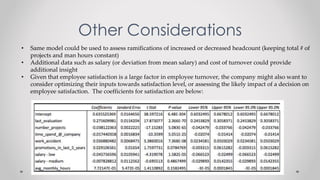
employee satisfaction. The coefficients for satisfaction are below:

Data Analytics | Predicting Employee Turnover

  • 1.
    • John Bennett •Megan Evans • Valorie Hampton • Muhammed Khan 4.0 Partners
  • 2.
    Agenda • Company Overview •Top Issues Facing Company • Describing The Data • Predicting the Data • Recommendations
  • 3.
    4.0 Partners • ITCompany founded by four graduate students at American University • Has grown to 10K employees in over 7 years • Company focuses on implementing the latest IT programs in corporate workspaces throughout North America
  • 4.
    Human Resources • 10kEmployees over 7 years • Average time at the company- 3.5 years • Overall Employee satisfaction is 61.43% • Employees are working >200 hours per month (1 addition work week a month!)
  • 5.
    Available Data • Last_evaluation •Number_projects • Time_spend_@_company • Work_accident • Promotions_in_last_5_years • Department • Avg_monthly_hours • Satisfaction • Exited Company
  • 6.
    What The DataTells Us About Employees…
  • 7.
  • 8.
    Predictive Analytics • Thedata can be used to predict the likelihood of an employee leaving the company • Main Factors affecting the likelihood was Employee satisfaction and Salary o Increased Salary lead to lower likelihood of employee leaving o Increased Satisfaction lead to lower likelihood of employee leaving • P Value analysis showed us that the Department an Employee worked in was insignificant
  • 9.
    Logistic Regression Analysis Thepositive coefficient output from the logistic regression increase the odds whereas, the negative coefficient reduces the odds of an employee leaving.
  • 10.
    What About Bob? Whatare the chances of Bob leaving the company?
  • 11.
    What if Bobhad a low salary? If all of the other variables stayed the same, except for salary, Bob’s chances of leaving the company would go up 55.53%
  • 12.
    What if Bobhas a high salary, but isn’t satisfied with his job?
  • 13.
    R Squared &Confusion Matrix • The R square for our data set was 22%, this means that approximately 22% of our data can predict the outcome. - In a real world situation, we would suggest another data set that would be more explanatory • There was no change when we removed the department category • Due to the high false negative rate, we would only use this data to predict the probability of employees leaving.
  • 14.
    Establishing a Courseof Action Objective Function: • Reduce Employee Turnover o Currently 23.77% Potential Decision Variables - what can 4.0 Partners most easily control? • Headcount o Could reduce avg. monthly hours worked o Could reduce number of projects • Salary o Low: 7027 employees o Medium: 2408 employees o High: 565 employees But what does the data say?.....
  • 15.
    Optimizing Distribution ofSalary With a target satisfaction of 66.79% (the average satisfaction level of employees who stayed), and a mandate to reduce expected employee turnover from the observed 23.77% to a more manageable 10%, the optimal distribution of salary levels would be as follows: Low - 51.2% Medium - 31.9% High - 16.9%
  • 16.
    Recommendation In order toreduce expected employee turnover to 10%, the 4.0 Partners team recommends allocating budget to redistribute the salary levels as follows across its 10,000 employees: : Current Low: 7027 Medium: 2408 High: 565 Recommended Low: 5120 Medium: 3190 High: 1690 The requested budget should be sufficient to raise the salary levels of 1907 employees from “Low” to “Medium” and 1125 from “Medium” to “High”
  • 17.
    Other Considerations • Samemodel could be used to assess ramifications of increased or decreased headcount (keeping total # of projects and man hours constant) • Additional data such as salary (or deviation from mean salary) and cost of turnover could provide additional insight • Given that employee satisfaction is a large factor in employee turnover, the company might also want to consider optimizing their inputs towards satisfaction level, or assessing the likely impact of a decision on employee satisfaction. The coefficients for satisfaction are below: