








DSC00046.jpg


                                  Namaskar
               • I salute the divinity within you with all the good
                 thoughts of my mind and love of my heart.
Daily Practices Whole Day
            Part II
Presented by Dada Rainjitananda
Based on Ananda Marga lifestyle
What is Ananda Marga?
•   “Ananda” means Bliss
•   “Marga” means The Path
•   “The Path of Bliss”
•   Its a way of life
Everything we do
• It is what we do and think in the 24 hours
  of a day,
• …day after day, …
• …that builds our body, our mind, our life,
  our society and our planet.
Meditation

Mantra
Different types of mantras:
 Universal – Baba Nam Kevalam
 Personal – for individual silence meditation
Meditate twice a day
This is the basis of the Ananda Marga
 practices.
The rest of the time
• Usually we meditate only some minutes
  twice a day. What about the rest of the
  time?
The rest of the time
• The other hours of the day we are either in
  contact with others or with our own selves.
• There are some basic principles and
  practices to encourage a harmonious
  relationship with others and ourselves.
A’tata’yii
   Anyone who, by the use of brute force:
       Wants to take possession of your property
       Abducts your spouse
       Comes with a weapon to murder you
       Wants to snatch away wealth
       Sets fire to houses
       Wants to take life by administering poison
Niyama
• A system of 5
  practices/princi
  ples to attain
  control over
  one's mind.
Niyama
• Physico-psychic
  movement.
• Its practice
  depends only on
  oneself
• Guides your
  relationship with
  yourself.
1. Cleanliness of body & mind
• Physical and mental
1. Cleanliness of body & mind
• 1.External physical
 – Bath
 – Half-bath
 – Use of water
Bath / Shower
• Navel area

• Below navel

• Crown of the head - trickles down
  over the back bone

• All over

• Avoid standing

• Add Mantra
Half Bath
• Navel and genital area

• Arms, hands, legs, feet

• Mothful of water; Splash water on face,
  eyes (12 x)

• Ears and neck

• All sensory & motor organs
Use of Water
• Wash with water

• After urination

• For males who are not circumcized, keep the
  foreskin pulled back at all times

• Wash with water after defecation

• Wash well all hairs of the body

• Use oil on the hairs
Násápána
• Clean the nose

• Draw in clean water through the nostrils
  and pass it out through the mouth

• This water can be swallowed but it is better
  to spit it out.
1. Cleanliness of body & mind
• 2. Internal Physical
 – The physical body is conditioned by the food
   you eat.
 – There 3 forces in the Universe
   • Sentient
   • Mutative
   • Static
 – The best food is sentient food
1. Cleanliness of body & mind
• The physical body is composed of
  countless cells
• Each cell has its own mind
• The human mind is the unit microcosm
  plus the collection of the minds of the cells.
• Cells grow out of air, water, light and the
     food we eat.
1. Cleanliness of body & mind
• Static food creates static cells.
• Static cells create a static influence on the
  mind.
1. Cleanliness of body & mind
• 3. External psychic
 – The environment has an impact in one’s mind
 – All vibrations reaching the mind through the
   sensory organs affect the mind.
 – You should control all that you see, touch,
   smell, taste or hear.
1. Cleanliness of body & mind
• 4. Internal psychic
 – One does not think or act according to the
   external stimulus but according to the reactions
   from past actions.
 – The internal vibration should be neutralized
 – One must take an idea which is opposite in
   character to the one in one’s mind.
1. Cleanliness of body & mind
• … 4. Internal psychic
 – Jealousy when someone is happy – impose
   idea of friendliness
 – Happy when someone is in problem – impose
   idea of compassion
 – Envy when someone is progressing – idea of
   encouragement
 – Win a miser with charity
1. Cleanliness of body & mind
• …4. Internal psychic
 – Conquer an angry person by your controlled
   temper
 – A dishonest person by your honesty
 – A liar by your truthfulness
1. Cleanliness of body & mind
2. Contentment (Santos’a)
• The essentialities of human beings are very
  limited
• The hunger (desires) of human beings is infinite.
• Aparigraha (live simply) helps Santos’a
• Continuous enjoyment of favourable vibrations is
  happiness.
• The feeling that you need no more is
  contentment.
• The agony of the rich.
2. Contentment (Santos’a)
• Depends only on you
3.To undergo hardships (Tapah)
• To undergo physical hardship to attain the
  objective
• To undergo hardship to make others happy
• To undergo hardship for one’s progress in
  mental and spiritual sphere.
3.To undergo hardships (Tapah)
Be ready
4. Study of philosophy (Sva’dhya’ya)
• And understanding
4. Study of philosophy (Sva’dhya’ya)
• The study, with proper understanding, of
  scriptures and philosophical books
• Not doing things without understanding
  why.
• Nor just repeating empty words with
  knowing the meaning.
• Nor accepting illogical tales in name of
  dogma or religion.
4. Study of philosophy
• Social philosophy changes according to
  the age.
• Spiritual philosophy does not change.
• Those who can not read can listen to the
  philosophy.
• One can learn through association with the
  wise. Keeping good company.
• One should shun away bad company.
4. Study of philosophy (Sva’dhya’ya)
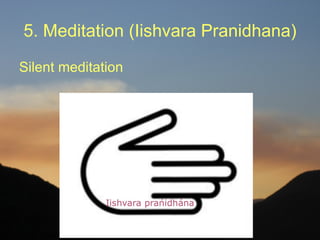
5. Meditation (Iishvara Pranidhana)

Silent meditation
5. Meditation (Iishvara Pranidhana)
• Withdraw the mind from all external objects
  and concentrate on the controlling
  Supreme Consciousness.
• One should do it twice a day for complete
  benefits.
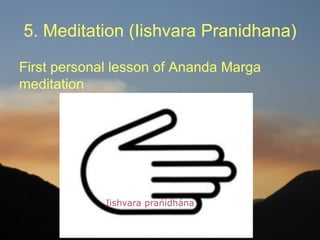
5. Meditation (Iishvara Pranidhana)

First personal lesson of Ananda Marga
meditation
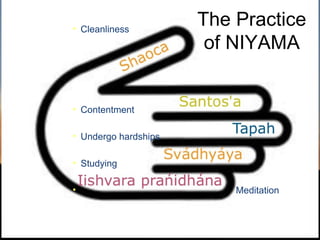
The Practice
• Cleanliness
              Yama
                    of NIYAMA


• Contentment

• Undergo hardships

• Studying

•                     Meditation
End

Daily practices whole day 2

  • 1.
    DSC00046.jpg Namaskar • I salute the divinity within you with all the good thoughts of my mind and love of my heart.
  • 2.
    Daily Practices WholeDay Part II Presented by Dada Rainjitananda Based on Ananda Marga lifestyle
  • 3.
    What is AnandaMarga? • “Ananda” means Bliss • “Marga” means The Path • “The Path of Bliss” • Its a way of life
  • 4.
    Everything we do •It is what we do and think in the 24 hours of a day, • …day after day, … • …that builds our body, our mind, our life, our society and our planet.
  • 5.
    Meditation Mantra Different types ofmantras: Universal – Baba Nam Kevalam Personal – for individual silence meditation
  • 6.
    Meditate twice aday This is the basis of the Ananda Marga practices.
  • 7.
    The rest ofthe time • Usually we meditate only some minutes twice a day. What about the rest of the time?
  • 8.
    The rest ofthe time • The other hours of the day we are either in contact with others or with our own selves. • There are some basic principles and practices to encourage a harmonious relationship with others and ourselves.
  • 9.
    A’tata’yii  Anyone who, by the use of brute force:  Wants to take possession of your property  Abducts your spouse  Comes with a weapon to murder you  Wants to snatch away wealth  Sets fire to houses  Wants to take life by administering poison
  • 10.
    Niyama • A systemof 5 practices/princi ples to attain control over one's mind.
  • 11.
    Niyama • Physico-psychic movement. • Its practice depends only on oneself • Guides your relationship with yourself.
  • 12.
    1. Cleanliness ofbody & mind • Physical and mental
  • 13.
    1. Cleanliness ofbody & mind • 1.External physical – Bath – Half-bath – Use of water
  • 14.
    Bath / Shower •Navel area • Below navel • Crown of the head - trickles down over the back bone • All over • Avoid standing • Add Mantra
  • 15.
    Half Bath • Naveland genital area • Arms, hands, legs, feet • Mothful of water; Splash water on face, eyes (12 x) • Ears and neck • All sensory & motor organs
  • 16.
    Use of Water •Wash with water • After urination • For males who are not circumcized, keep the foreskin pulled back at all times • Wash with water after defecation • Wash well all hairs of the body • Use oil on the hairs
  • 17.
    Násápána • Clean thenose • Draw in clean water through the nostrils and pass it out through the mouth • This water can be swallowed but it is better to spit it out.
  • 18.
    1. Cleanliness ofbody & mind • 2. Internal Physical – The physical body is conditioned by the food you eat. – There 3 forces in the Universe • Sentient • Mutative • Static – The best food is sentient food
  • 19.
    1. Cleanliness ofbody & mind • The physical body is composed of countless cells • Each cell has its own mind • The human mind is the unit microcosm plus the collection of the minds of the cells. • Cells grow out of air, water, light and the food we eat.
  • 20.
    1. Cleanliness ofbody & mind • Static food creates static cells. • Static cells create a static influence on the mind.
  • 21.
    1. Cleanliness ofbody & mind • 3. External psychic – The environment has an impact in one’s mind – All vibrations reaching the mind through the sensory organs affect the mind. – You should control all that you see, touch, smell, taste or hear.
  • 22.
    1. Cleanliness ofbody & mind • 4. Internal psychic – One does not think or act according to the external stimulus but according to the reactions from past actions. – The internal vibration should be neutralized – One must take an idea which is opposite in character to the one in one’s mind.
  • 23.
    1. Cleanliness ofbody & mind • … 4. Internal psychic – Jealousy when someone is happy – impose idea of friendliness – Happy when someone is in problem – impose idea of compassion – Envy when someone is progressing – idea of encouragement – Win a miser with charity
  • 24.
    1. Cleanliness ofbody & mind • …4. Internal psychic – Conquer an angry person by your controlled temper – A dishonest person by your honesty – A liar by your truthfulness
  • 25.
    1. Cleanliness ofbody & mind
  • 26.
  • 27.
    2. Contentment (Santos’a) •The essentialities of human beings are very limited • The hunger (desires) of human beings is infinite. • Aparigraha (live simply) helps Santos’a • Continuous enjoyment of favourable vibrations is happiness. • The feeling that you need no more is contentment. • The agony of the rich.
  • 28.
  • 29.
  • 30.
    3.To undergo hardships(Tapah) • To undergo physical hardship to attain the objective • To undergo hardship to make others happy • To undergo hardship for one’s progress in mental and spiritual sphere.
  • 31.
    3.To undergo hardships(Tapah) Be ready
  • 32.
    4. Study ofphilosophy (Sva’dhya’ya) • And understanding
  • 33.
    4. Study ofphilosophy (Sva’dhya’ya) • The study, with proper understanding, of scriptures and philosophical books • Not doing things without understanding why. • Nor just repeating empty words with knowing the meaning. • Nor accepting illogical tales in name of dogma or religion.
  • 34.
    4. Study ofphilosophy • Social philosophy changes according to the age. • Spiritual philosophy does not change. • Those who can not read can listen to the philosophy. • One can learn through association with the wise. Keeping good company. • One should shun away bad company.
  • 35.
    4. Study ofphilosophy (Sva’dhya’ya)
  • 36.
    5. Meditation (IishvaraPranidhana) Silent meditation
  • 37.
    5. Meditation (IishvaraPranidhana) • Withdraw the mind from all external objects and concentrate on the controlling Supreme Consciousness. • One should do it twice a day for complete benefits.
  • 38.
    5. Meditation (IishvaraPranidhana) First personal lesson of Ananda Marga meditation
  • 39.
    The Practice • Cleanliness Yama of NIYAMA • Contentment • Undergo hardships • Studying • Meditation
  • 40.