Office of Health Education and Promotion
Health Services
(603) 862-3823
www.unh.edu/health-services
Facebook/Twitter: UNHHealth
What is Meditation?
Meditation is an
experience of relaxing
the body, quieting the
mind, and awakening
the spirit.
What is Meditation?
Meditation encourages
a deepening of
consciousness or
awareness, and also
facilitates a deeper
understanding of self
and others.
Meditation in the U.S.
Meditation is now a
mainstream practice in
America, with more than 30
million people practicing on
a regular basis.
About Meditation
There are thousands of
meditation techniques that have
been developed and practiced for
over 5,000 years.
Each has specific techniques
and skills that can be learned.
Types of Meditation
 All forms of meditation can be classified into one or
a combination of four categories:
 Concentrative (The most commonly used form)
 Receptive
 Reflective
 Generative
Concentrative Meditation
 Assists with focusing the mind.
 This is done by focusing on the
breath, image, objective or sound (mantra)
during the meditation.
 This process allows the mind to achieve clarity
and awareness.
 Transcendental meditation (TM), based in the
Hindu tradition, is a form of concentrative
meditation.
Receptive Meditation
• Assists with becoming more fully
present in the moment.
• This is done by being mindful and
attentive to
feelings, sensation, thoughts, images,
smells and experiences without
becoming involved in
judgment, reactions or processes of
the experience.
• This helps to gain a calmer, clearer
and more non-reactive state of mind
and being. Mindfulness
meditation, based on Buddhism, is a
form of receptive meditation.
Reflective Meditation
 Assists with investigating an idea in a
systematic way.
 Uses disciplined thinking and analysis
to reflect upon a compelling
question, challenge, idea or project.
 Reflects on a verse, a phrase or
inspiring idea.
 Brings wisdom and insight into all
aspects of our lives.
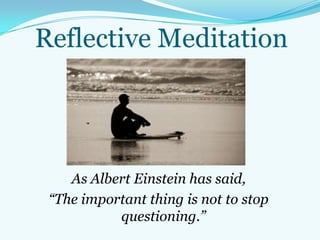
Reflective Meditation
As Albert Einstein has said,
“The important thing is not to stop
questioning.”
Generative Meditation
 Assists in consciously cultivating and strengthening specific
qualities such as:
 Patience
 Love
 Appreciation
 Compassion
 Humility
 Gratitude
 Courage
 This form of meditation invites us to actively nurture these
strengths of character by thinking, speaking and acting as
though the quality is already fully present and alive within
us.
Benefits of Meditation
The physical, emotional, psychological, and spiritual benefits of meditation
might include:
 higher levels of
energy, creativity, and spontaneity
 lower blood pressure
 increased exercise tolerance
 better concentration
 decreased stress, depression and
anxiety
 fewer cravings for alcohol and
cigarettes
 increased job satisfaction
 better relationships with others.
Meditation & Conventional Health
There is no research that
indicates meditation is
harmful or has negative effects
whether used alone or in
conjunction with conventional
medicine.
How Can Meditation Help
College Students?
 Time management
 Assist with addictions
 Mindful eating and body satisfaction
 Athletic performance
 Stress reduction and sleep
 Academic performance
 Enhance immune system
 Developing a deeper sense of compassion and forgiveness for others
Importance of Breath
For most meditative practices the
breath is very important because it is
connected to both the mind and the
body.
• If we are anxious, frightened or
upset our breath tends to be
shallow, irregular and quick.
• If we are relaxed, settled or
calm, our breath tends to be more
slow, deep and regular.
 Focusing the mind on the
continuous rhythm of inhalation
and exhalation provides a natural
object of meditation.
 As you focus your awareness on the
breath, your mind becomes
absorbed in the rhythm of
inhalation and exhalation.
 As a result, your breathing will
become slower and deeper, and the
mind becomes more tranquil and
aware.
Importance of Breath
10 Ways to Practice
Mindfulness Everyday
By following the main elements of mindfulness –
combining awareness of your breath with focusing on
the activity at hand – you will be able to experience
every moment as fully as possible.
Here are 10 ways to practice
mindfulness everyday!
Practice Mindfulness Everyday
1
As you awaken in the morning, bring your
attention to your breathing. Instead of letting
your mind spin off into yesterday or today, take
mindful breaths. Focus on your breathing, and
sense the effects of breathing throughout your
body.
2
Instead of hurrying to your usual routine,
slow down and enjoy something special
about the morning: a flower that bloomed,
the sound of birds, or the wind in the trees.
Practice Mindfulness Everyday
3
On your way to work or school, pay
attention to how you walk or drive or ride
the transit. Take some deep breaths, relaxing
throughout your body.
4
When stopped at a red light, pay attention to
your breathing and enjoy the landscape around
you.
Practice Mindfulness Everyday
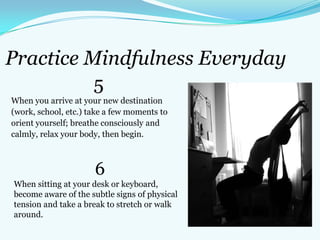
5
When you arrive at your new destination
(work, school, etc.) take a few moments to
orient yourself; breathe consciously and
calmly, relax your body, then begin.
6
When sitting at your desk or keyboard,
become aware of the subtle signs of physical
tension and take a break to stretch or walk
around.
Practice Mindfulness Everyday
7
Use the repetitive events of the day - the
ringing telephone, a knock on the door,
walking down the hall - as cues for a mini-
relaxation.
8
Walk mindfully to your car or bus. Can you
see and appreciate something new in the
environment? Can you enjoy walking without
rushing?
Practice Mindfulness Everyday
9
As you return home, consciously make the
transition into your home environment. If
possible, after greeting your family or
housemates, give yourself a few minutes alone
to ease the transition.
10
As you go to sleep, let go of today and
tomorrow, and take some slow, mindful
breaths.
Labyrinths as Meditation
A labryinth is…
 An ancient symbol that has been
rediscovered and adapted for use
today.
 Found in ancient cultures, traditions
and countries
(China, Ireland, India, England, Scan
dinavia, France, Crete and others).
 A symbol of wholeness, healing, and
inclusion.
Labyrinths as Meditative Practice
A labyrinth is…
 One circuitous path to the center and
out again; the entrance is also the exit.
 Designed to help you find your way
out.
 A way to work with your intuition and
creativity.
 Not a maze - a maze is designed to
confuse the user or present the user
with a problem to be solved.
Labyrinths do not require one to think
analytically, logically or sequentially.
Labyrinths As Walking Meditation
Used for walking meditation that assists in:
 finding peace and clarity
 managing stress
 decision making
 self-exploration and reflection
Walking a labyrinth provides the opportunity to:
 examine personal goals
 assess talents and abilities
 make decisions
 evaluate your life’s progress - personally
and professionally
Some think of
walking a
labyrinth as a
metaphor for life’s
journey - a
journey to your
deepest self, where
you come back
into the world
with a clearer
understanding of
yourself.
What is a Mandala?
 Mandala means “sacred circle” in Sanskrit.
 In various spiritual traditions, mandalas are used to facilitate meditation
and in sacred rites as a transformative tool to assist with healing.
 Tibetan Buddhist Monks and Native American Indians use them as a way
of evoking spiritual energy, meditation, and healing.
 Psychologist Carl Jung used mandalas with his clients and for his own
personal growth. His studies revealed their creation allowed a deep
healing to take place from within the human psyche.
Circles and Mandalas
Circles are believed to be very powerful in mandalas:
 Circles appear in cultures throughout world history
 Nature - flowers, snowflakes, trees, sun, moon, etc.
 Architecture
 The circle is a symbol of
wholeness, continuity, connection, unity, harmony and the cycle of
life.
 Unlike other shapes, the circle flows and has no hard edges or
angles.
 Circles are believed to help individuals focus inward.
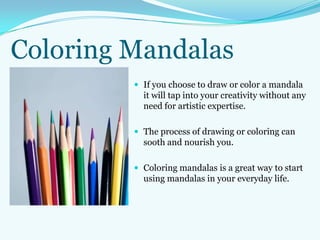
Coloring Mandalas
 If you choose to draw or color a mandala
it will tap into your creativity without any
need for artistic expertise.
 The process of drawing or coloring can
sooth and nourish you.
 Coloring mandalas is a great way to start
using mandalas in your everyday life.
Coloring Mandalas
Here are some tips on how to get started:
 You will need crayons, colored pencils, paints, pastels, markers in various colors.
 You can download mandalas from the internet. Here are just a few web sites that
offer downloads:
 Coloring Castle
 30 Minute Mandalas
 Mandala Project
 Free mandalas
 Find a quiet and comfortable place where you will not be interrupted.
 Take a moment to relax your mind and body.
 Take three deep breaths. With each breath breathe in love and let go of
any tension and fear or anything that has been bothering you.
 You can also download free guided meditations from the Health
Services website at www.unh.edu/health-services to help you relax.
Coloring Mandalas
 Lay out all of your coloring utensils and simply start coloring. Don’t give
much thought to the colors you choose or if they match, let your instinct
choose. There is no wrong way to color.
 Once you are finished coloring in the mandala take a moment to look at it.
Notice the colors, the shapes and how they make you feel.
 You may find that getting out your journal and recording your thoughts may
be helpful.
Download free guided meditations online at:
http://www.unh.edu/health-services/meditation-cd.html
Meditation Practice at UNH
The following services are available
for free* at Health Services:
 Individual and group meditation
 Biofeedback
To make an appointment or learn more:
 Call (603) 862-3823
 www.unh.edu/health-services
 Visit Health Services, Room 249
* Students who have paid the health fee

meditationfall09-091221134908-phpapp01.pdf

  • 1.
    Office of HealthEducation and Promotion Health Services (603) 862-3823 www.unh.edu/health-services Facebook/Twitter: UNHHealth
  • 2.
    What is Meditation? Meditationis an experience of relaxing the body, quieting the mind, and awakening the spirit.
  • 3.
    What is Meditation? Meditationencourages a deepening of consciousness or awareness, and also facilitates a deeper understanding of self and others.
  • 4.
    Meditation in theU.S. Meditation is now a mainstream practice in America, with more than 30 million people practicing on a regular basis.
  • 5.
    About Meditation There arethousands of meditation techniques that have been developed and practiced for over 5,000 years. Each has specific techniques and skills that can be learned.
  • 6.
    Types of Meditation All forms of meditation can be classified into one or a combination of four categories:  Concentrative (The most commonly used form)  Receptive  Reflective  Generative
  • 7.
    Concentrative Meditation  Assistswith focusing the mind.  This is done by focusing on the breath, image, objective or sound (mantra) during the meditation.  This process allows the mind to achieve clarity and awareness.  Transcendental meditation (TM), based in the Hindu tradition, is a form of concentrative meditation.
  • 8.
    Receptive Meditation • Assistswith becoming more fully present in the moment. • This is done by being mindful and attentive to feelings, sensation, thoughts, images, smells and experiences without becoming involved in judgment, reactions or processes of the experience. • This helps to gain a calmer, clearer and more non-reactive state of mind and being. Mindfulness meditation, based on Buddhism, is a form of receptive meditation.
  • 9.
    Reflective Meditation  Assistswith investigating an idea in a systematic way.  Uses disciplined thinking and analysis to reflect upon a compelling question, challenge, idea or project.  Reflects on a verse, a phrase or inspiring idea.  Brings wisdom and insight into all aspects of our lives.
  • 10.
    Reflective Meditation As AlbertEinstein has said, “The important thing is not to stop questioning.”
  • 11.
    Generative Meditation  Assistsin consciously cultivating and strengthening specific qualities such as:  Patience  Love  Appreciation  Compassion  Humility  Gratitude  Courage  This form of meditation invites us to actively nurture these strengths of character by thinking, speaking and acting as though the quality is already fully present and alive within us.
  • 12.
    Benefits of Meditation Thephysical, emotional, psychological, and spiritual benefits of meditation might include:  higher levels of energy, creativity, and spontaneity  lower blood pressure  increased exercise tolerance  better concentration  decreased stress, depression and anxiety  fewer cravings for alcohol and cigarettes  increased job satisfaction  better relationships with others.
  • 13.
    Meditation & ConventionalHealth There is no research that indicates meditation is harmful or has negative effects whether used alone or in conjunction with conventional medicine.
  • 14.
    How Can MeditationHelp College Students?  Time management  Assist with addictions  Mindful eating and body satisfaction  Athletic performance  Stress reduction and sleep  Academic performance  Enhance immune system  Developing a deeper sense of compassion and forgiveness for others
  • 15.
    Importance of Breath Formost meditative practices the breath is very important because it is connected to both the mind and the body. • If we are anxious, frightened or upset our breath tends to be shallow, irregular and quick. • If we are relaxed, settled or calm, our breath tends to be more slow, deep and regular.
  • 16.
     Focusing themind on the continuous rhythm of inhalation and exhalation provides a natural object of meditation.  As you focus your awareness on the breath, your mind becomes absorbed in the rhythm of inhalation and exhalation.  As a result, your breathing will become slower and deeper, and the mind becomes more tranquil and aware. Importance of Breath
  • 17.
    10 Ways toPractice Mindfulness Everyday By following the main elements of mindfulness – combining awareness of your breath with focusing on the activity at hand – you will be able to experience every moment as fully as possible. Here are 10 ways to practice mindfulness everyday!
  • 18.
    Practice Mindfulness Everyday 1 Asyou awaken in the morning, bring your attention to your breathing. Instead of letting your mind spin off into yesterday or today, take mindful breaths. Focus on your breathing, and sense the effects of breathing throughout your body. 2 Instead of hurrying to your usual routine, slow down and enjoy something special about the morning: a flower that bloomed, the sound of birds, or the wind in the trees.
  • 19.
    Practice Mindfulness Everyday 3 Onyour way to work or school, pay attention to how you walk or drive or ride the transit. Take some deep breaths, relaxing throughout your body. 4 When stopped at a red light, pay attention to your breathing and enjoy the landscape around you.
  • 20.
    Practice Mindfulness Everyday 5 Whenyou arrive at your new destination (work, school, etc.) take a few moments to orient yourself; breathe consciously and calmly, relax your body, then begin. 6 When sitting at your desk or keyboard, become aware of the subtle signs of physical tension and take a break to stretch or walk around.
  • 21.
    Practice Mindfulness Everyday 7 Usethe repetitive events of the day - the ringing telephone, a knock on the door, walking down the hall - as cues for a mini- relaxation. 8 Walk mindfully to your car or bus. Can you see and appreciate something new in the environment? Can you enjoy walking without rushing?
  • 22.
    Practice Mindfulness Everyday 9 Asyou return home, consciously make the transition into your home environment. If possible, after greeting your family or housemates, give yourself a few minutes alone to ease the transition. 10 As you go to sleep, let go of today and tomorrow, and take some slow, mindful breaths.
  • 23.
    Labyrinths as Meditation Alabryinth is…  An ancient symbol that has been rediscovered and adapted for use today.  Found in ancient cultures, traditions and countries (China, Ireland, India, England, Scan dinavia, France, Crete and others).  A symbol of wholeness, healing, and inclusion.
  • 24.
    Labyrinths as MeditativePractice A labyrinth is…  One circuitous path to the center and out again; the entrance is also the exit.  Designed to help you find your way out.  A way to work with your intuition and creativity.  Not a maze - a maze is designed to confuse the user or present the user with a problem to be solved. Labyrinths do not require one to think analytically, logically or sequentially.
  • 25.
    Labyrinths As WalkingMeditation Used for walking meditation that assists in:  finding peace and clarity  managing stress  decision making  self-exploration and reflection Walking a labyrinth provides the opportunity to:  examine personal goals  assess talents and abilities  make decisions  evaluate your life’s progress - personally and professionally Some think of walking a labyrinth as a metaphor for life’s journey - a journey to your deepest self, where you come back into the world with a clearer understanding of yourself.
  • 26.
    What is aMandala?  Mandala means “sacred circle” in Sanskrit.  In various spiritual traditions, mandalas are used to facilitate meditation and in sacred rites as a transformative tool to assist with healing.  Tibetan Buddhist Monks and Native American Indians use them as a way of evoking spiritual energy, meditation, and healing.  Psychologist Carl Jung used mandalas with his clients and for his own personal growth. His studies revealed their creation allowed a deep healing to take place from within the human psyche.
  • 27.
    Circles and Mandalas Circlesare believed to be very powerful in mandalas:  Circles appear in cultures throughout world history  Nature - flowers, snowflakes, trees, sun, moon, etc.  Architecture  The circle is a symbol of wholeness, continuity, connection, unity, harmony and the cycle of life.  Unlike other shapes, the circle flows and has no hard edges or angles.  Circles are believed to help individuals focus inward.
  • 28.
    Coloring Mandalas  Ifyou choose to draw or color a mandala it will tap into your creativity without any need for artistic expertise.  The process of drawing or coloring can sooth and nourish you.  Coloring mandalas is a great way to start using mandalas in your everyday life.
  • 29.
    Coloring Mandalas Here aresome tips on how to get started:  You will need crayons, colored pencils, paints, pastels, markers in various colors.  You can download mandalas from the internet. Here are just a few web sites that offer downloads:  Coloring Castle  30 Minute Mandalas  Mandala Project  Free mandalas  Find a quiet and comfortable place where you will not be interrupted.  Take a moment to relax your mind and body.  Take three deep breaths. With each breath breathe in love and let go of any tension and fear or anything that has been bothering you.  You can also download free guided meditations from the Health Services website at www.unh.edu/health-services to help you relax.
  • 30.
    Coloring Mandalas  Layout all of your coloring utensils and simply start coloring. Don’t give much thought to the colors you choose or if they match, let your instinct choose. There is no wrong way to color.  Once you are finished coloring in the mandala take a moment to look at it. Notice the colors, the shapes and how they make you feel.  You may find that getting out your journal and recording your thoughts may be helpful.
  • 31.
    Download free guidedmeditations online at: http://www.unh.edu/health-services/meditation-cd.html
  • 32.
    Meditation Practice atUNH The following services are available for free* at Health Services:  Individual and group meditation  Biofeedback To make an appointment or learn more:  Call (603) 862-3823  www.unh.edu/health-services  Visit Health Services, Room 249 * Students who have paid the health fee