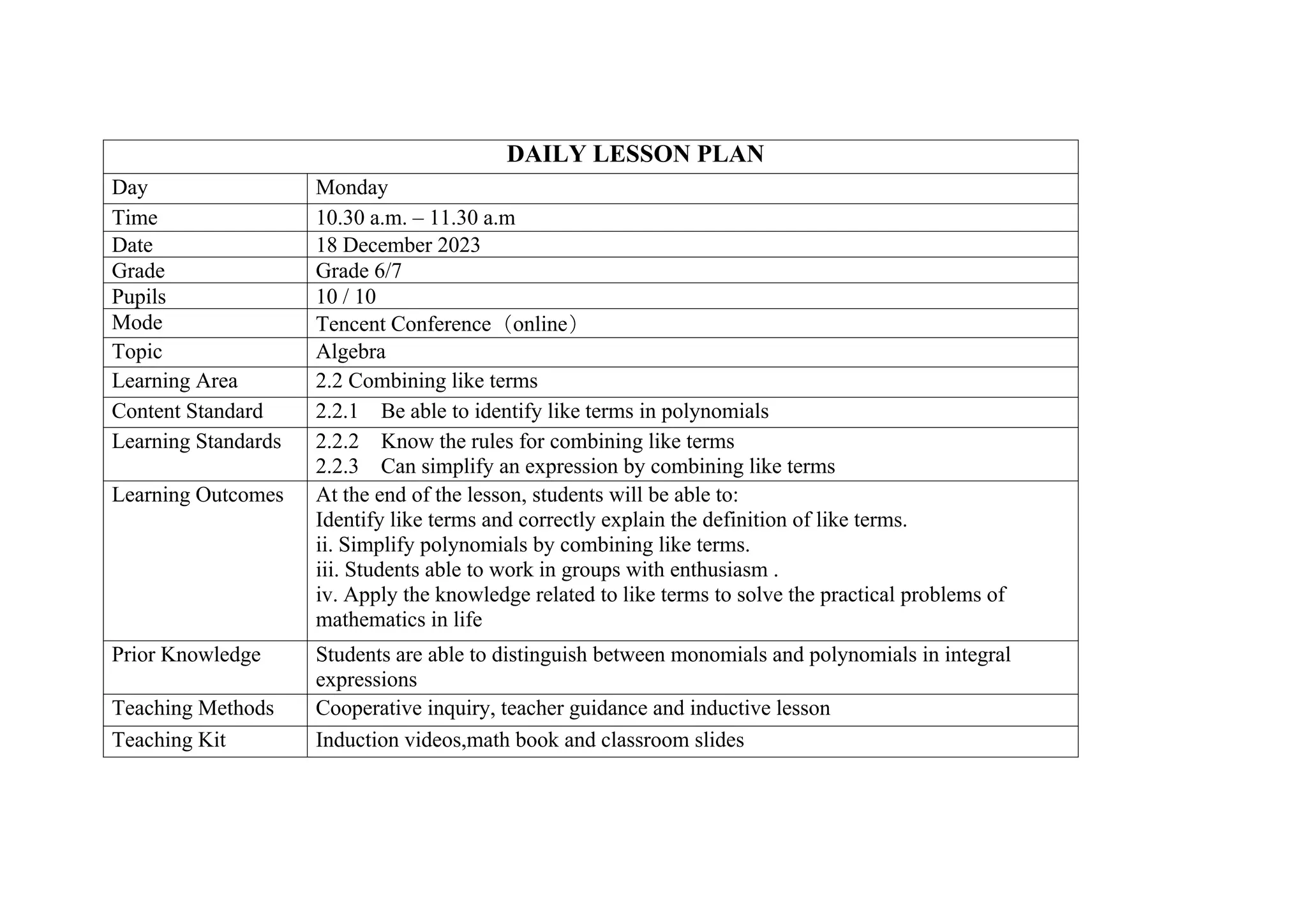
DAILY LESSON PLAN
Day Monday
Time 10.30 a.m. – 11.30 a.m
Date 18 December 2023
Grade Grade 6/7
Pupils 10 / 10
Mode Tencent Conference(online)
Topic Algebra
Learning Area 2.2 Combining like terms
Content Standard 2.2.1 Be able to identify like terms in polynomials
Learning Standards 2.2.2 Know the rules for combining like terms
2.2.3 Can simplify an expression by combining like terms
Learning Outcomes At the end of the lesson, students will be able to:
Identify like terms and correctly explain the definition of like terms.
ii. Simplify polynomials by combining like terms.
iii. Students able to work in groups with enthusiasm .
iv. Apply the knowledge related to like terms to solve the practical problems of
mathematics in life
Prior Knowledge Students are able to distinguish between monomials and polynomials in integral
expressions
Teaching Methods Cooperative inquiry, teacher guidance and inductive lesson
Teaching Kit Induction videos,math book and classroom slides
Steps/
Duration
Contents Teaching and Learning
Activities
Methods/ Strategy/ Kit/ Values/
IU:Instrumental Understanding/
RU:Relational Understanding/
Visual Thinking / Visual Mind Mapping
Teacher’s Role Student’s Role
Step 1:
Set
induction
(5mins)
Relate the topic that
will be learned today
with videos that
demonstrates the
concept of
classification in real
life.
Teacher
show some
examples of
classifications.
Correlate
activities
with learning
outcomes
today.
Students
generate ideas
by giving
examples of
classification.
Students
work together
in response to
a question
from the
teacher.
Students
relevance the
learning
activities with
today lesson.
Methods: Observe and think.
Strategy: Combined reality.
Teaching Kit: Video.
Values: Convince to give an opinion.
IU:
context,
isolated concept thinking.
RU: Connection between life and
mathematics、relational understanding.
Visual Thinking:information about
iedas.
Visual Mind Mapping: -
Step 2:
Teaching
Expansion-
Task 1
(20 mins)
2.1.1 Be able to find
like terms in
polynomials
(Details notes at the
attachment below)
Teacher
explain
contents of
today’s lesson.
Give
examples of
like terms
Define like
terms and
the
characteristics
of like terms.
Utilizing
visual
representations
to explain the
concept of like
terms.
Students jot
down crucial
notes on today
lesson.
Answer
question
generate
related lesson.
Methods: Discussion.
Strategy: Cooperation and Inductive.
Teaching Kit: Slide PowerPoint.
Values: Generate ideas, analyse
question.
IU:
Define, demonstrate, and practice.
RU: Do-remember as part of a
connected whole.
Visual Thinking:
Establish connection
about informations and understandings.
Visual Mind Mapping: -
Step3 :
Teaching
Expansion-
Task 2
(25
minutes)
2.2.2 Know the rules
for combining like
terms and be able to
simplify expressions
by combining like
terms.
(Notes at the
attachment below)
Teacher
introduces an
example
(purchasing
items) that
relates to
combining like
terms.
Teachers use
fruits as a
representation
of
mathematical
variables to
construct a
mathematical
expression
From the
example,teache
rs summarize
the steps to
combine like
terms.
Participate
in
answering the
teacher’s
questions.
With
guidance
from teacher,
answer the
questions
given on a
paper.
Combining
knowledge
learnt in Task
1 with Task 2
to know the
rules of
combining like
terms.
Apply the
given
knowledge in
practice.
Methods: Guide.
Strategy: Deduce, using learned
knowledge to solve problems.
Teaching Kit: Slide PowerPoint and
quiz game.
Values: Teamwork and respect.
IU:tell what to do at each step of the
way that use procedures and rules
flexibly.
RU: build up a conceptual structure
that compare the differences and
understand why.
Visual Thinking:Visualization of
abstract mathematical concepts.
Visual Mind Mapping: -
Step 4:
Conclusion
(10 mins)
Reflection of today
lesson.
Based on
reflection class
member relate
to the learning
outcomes for
today lesson.
A small test
is given to test
the students’
understanding.
Teacher
gives
homework at
the end of the
lesson from a
revision book.
Two
students are
choose to give
reflection
on today
lesson.
Students
relate the
reflection with
the learning
outcomes for
today lesson.
Methods: Cooperative.
Strategy: Competent Communicator.
Teaching Kit: Video and think map.
Values: Summary.
IU:having a mathematical rule and
being able to apply and manipulate it.
RU: Deep construction、
Understanding why and memory.
Visual Thinking:Visualize the
connections between knowledge、
logical
thinking.
Visual Mind Mapping:Complete
knowledge system
Assessment Question and answer part.
Quiz game and class test .
Homework.
Reflection:
_____________________________________________________________________
_____________________________________________________
_____________________________________________________________
Attachment:
Completion time: 45 minutes
TASK 1 (20mins)
 The teacher uses the formula to classify different items to let students observe, think and summarize the characteristics
of like terms, draw the concept of like terms.
 Groups discussion, in pairs, one person has to write a monomial, and the other person has to write a term that matches
the first person's term discuss together in class whether the examples above are like terms.
 Deepen the concept, and be able to flexibly use the concept of like terms to solve mathematical problems.
Teaching content:
TASK 2 (25mins)
 Using the example of buying things in life, introducing the rule of combining like terms, simple examples of adding and
subtracting fruits, students establish the connection between physical objects and mathematics, start to calculate, and
then convert fruits into Monomials, the use of simple addition and subtraction of fruits, into the combination of
monomials, to achieve knowledge transfer, and in connection with the multiplication and distribution law of primary
school knowledge, a problem of multiple solutions, students to divergent thinking,to construct the knowledge structure,
students derive the law of combiningl ike terms by explaining the distributive law of multiplication.
 Applying the law of combining like terms, the steps of combining like terms are summarized according to the steps of
solving two example problems combining like terms.
 Quiz Game : Two students are invited to join the game on the blackboard :There will be 6 questions per person and 7
seconds for each question according to PK to test students' mastery of the rules combining like terms.
 The students raised their hands to answer the question .
Teaching content:
DAILY LESSON PLAN.pdf

DAILY LESSON PLAN.pdf

  • 1.
    DAILY LESSON PLAN DayMonday Time 10.30 a.m. – 11.30 a.m Date 18 December 2023 Grade Grade 6/7 Pupils 10 / 10 Mode Tencent Conference(online) Topic Algebra Learning Area 2.2 Combining like terms Content Standard 2.2.1 Be able to identify like terms in polynomials Learning Standards 2.2.2 Know the rules for combining like terms 2.2.3 Can simplify an expression by combining like terms Learning Outcomes At the end of the lesson, students will be able to: Identify like terms and correctly explain the definition of like terms. ii. Simplify polynomials by combining like terms. iii. Students able to work in groups with enthusiasm . iv. Apply the knowledge related to like terms to solve the practical problems of mathematics in life Prior Knowledge Students are able to distinguish between monomials and polynomials in integral expressions Teaching Methods Cooperative inquiry, teacher guidance and inductive lesson Teaching Kit Induction videos,math book and classroom slides
  • 2.
    Steps/ Duration Contents Teaching andLearning Activities Methods/ Strategy/ Kit/ Values/ IU:Instrumental Understanding/ RU:Relational Understanding/ Visual Thinking / Visual Mind Mapping Teacher’s Role Student’s Role Step 1: Set induction (5mins) Relate the topic that will be learned today with videos that demonstrates the concept of classification in real life. Teacher show some examples of classifications. Correlate activities with learning outcomes today. Students generate ideas by giving examples of classification. Students work together in response to a question from the teacher. Students relevance the learning activities with today lesson. Methods: Observe and think. Strategy: Combined reality. Teaching Kit: Video. Values: Convince to give an opinion. IU: context, isolated concept thinking. RU: Connection between life and mathematics、relational understanding. Visual Thinking:information about iedas. Visual Mind Mapping: -
  • 3.
    Step 2: Teaching Expansion- Task 1 (20mins) 2.1.1 Be able to find like terms in polynomials (Details notes at the attachment below) Teacher explain contents of today’s lesson. Give examples of like terms Define like terms and the characteristics of like terms. Utilizing visual representations to explain the concept of like terms. Students jot down crucial notes on today lesson. Answer question generate related lesson. Methods: Discussion. Strategy: Cooperation and Inductive. Teaching Kit: Slide PowerPoint. Values: Generate ideas, analyse question. IU: Define, demonstrate, and practice. RU: Do-remember as part of a connected whole. Visual Thinking: Establish connection about informations and understandings. Visual Mind Mapping: -
  • 4.
    Step3 : Teaching Expansion- Task 2 (25 minutes) 2.2.2Know the rules for combining like terms and be able to simplify expressions by combining like terms. (Notes at the attachment below) Teacher introduces an example (purchasing items) that relates to combining like terms. Teachers use fruits as a representation of mathematical variables to construct a mathematical expression From the example,teache rs summarize the steps to combine like terms. Participate in answering the teacher’s questions. With guidance from teacher, answer the questions given on a paper. Combining knowledge learnt in Task 1 with Task 2 to know the rules of combining like terms. Apply the given knowledge in practice. Methods: Guide. Strategy: Deduce, using learned knowledge to solve problems. Teaching Kit: Slide PowerPoint and quiz game. Values: Teamwork and respect. IU:tell what to do at each step of the way that use procedures and rules flexibly. RU: build up a conceptual structure that compare the differences and understand why. Visual Thinking:Visualization of abstract mathematical concepts. Visual Mind Mapping: -
  • 5.
    Step 4: Conclusion (10 mins) Reflectionof today lesson. Based on reflection class member relate to the learning outcomes for today lesson. A small test is given to test the students’ understanding. Teacher gives homework at the end of the lesson from a revision book. Two students are choose to give reflection on today lesson. Students relate the reflection with the learning outcomes for today lesson. Methods: Cooperative. Strategy: Competent Communicator. Teaching Kit: Video and think map. Values: Summary. IU:having a mathematical rule and being able to apply and manipulate it. RU: Deep construction、 Understanding why and memory. Visual Thinking:Visualize the connections between knowledge、 logical thinking. Visual Mind Mapping:Complete knowledge system Assessment Question and answer part. Quiz game and class test . Homework. Reflection: _____________________________________________________________________ _____________________________________________________ _____________________________________________________________
  • 6.
    Attachment: Completion time: 45minutes TASK 1 (20mins)  The teacher uses the formula to classify different items to let students observe, think and summarize the characteristics of like terms, draw the concept of like terms.  Groups discussion, in pairs, one person has to write a monomial, and the other person has to write a term that matches the first person's term discuss together in class whether the examples above are like terms.  Deepen the concept, and be able to flexibly use the concept of like terms to solve mathematical problems. Teaching content:
  • 7.
    TASK 2 (25mins) Using the example of buying things in life, introducing the rule of combining like terms, simple examples of adding and subtracting fruits, students establish the connection between physical objects and mathematics, start to calculate, and then convert fruits into Monomials, the use of simple addition and subtraction of fruits, into the combination of monomials, to achieve knowledge transfer, and in connection with the multiplication and distribution law of primary school knowledge, a problem of multiple solutions, students to divergent thinking,to construct the knowledge structure, students derive the law of combiningl ike terms by explaining the distributive law of multiplication.  Applying the law of combining like terms, the steps of combining like terms are summarized according to the steps of solving two example problems combining like terms.  Quiz Game : Two students are invited to join the game on the blackboard :There will be 6 questions per person and 7 seconds for each question according to PK to test students' mastery of the rules combining like terms.  The students raised their hands to answer the question . Teaching content: