Skills Contents Methodology and
Strategies
Resources Evaluation Time
Listening for
pronunciation
mistakes
while
reading.
For specific
information.
Reading for
Specific
information
and
understanding
words
through
context.
Speaking to
discuss
critically Ss’
points of
view and to
ask and
answer
questions
related with
the topic.
Writing Ss’
points of
view and
answering
questions.
Conceptual
Vocabulary related
with justice: prison,
offender, crime,
commit a crime,
damage, victim,
community,
apologize, heal, and
affect someone.
Procedural
Predicting the topic.
Sharing information.
Discussing and
justifying Ss` points
of view.
Background and
vocabulary.
Understanding
words through
context.
Attitudinal
To respect and
demand people
rights.
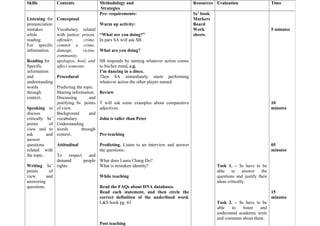
Pre- requirements:
Warm up activity:
“What are you doing?”
In pars SA will ask SB
What are you doing?
SB responds by naming whatever action comes
to his/her mind, e.g.
I’m dancing in a disco.
Then SA immediately starts performing
whatever action the other player named.
Review
T will ask some examples about comparative
adjectives.
John is taller than Peter
Pre-teaching
Predicting. Listen to an interview and answer
the questions:
What does Laura Chang Do?
What is mistaken identity?
While teaching
Read the FAQs about DNA databases.
Read each statement, and then circle the
correct definition of the underlined word.
L&S book pg. 63
Post teaching
Ss’ book
Markers
Board
Work
sheets.
Task 1. – Ss have to be
able to answer the
questions and justify their
ideas critically.
Task 2. – Ss have to be
able to listen and
understand academic texts
and comment about them..
5 minutes
10
minutes
05
minutes
15
minutes
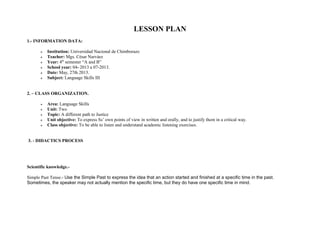
LESSON PLAN
1.- INFORMATION DATA:
 Institution: Universidad Nacional de Chimborazo
 Teacher: Mgs. César Narváez
 Year: 4th
semester “A and B”
 School year: 04- 2013 a 07-2013.
 Date: May, 27th 2013.
 Subject: Language Skills III
2. – CLASS ORGANIZATION.
 Area: Language Skills
 Unit: Two
 Topic: A different path to Justice
 Unit objective: To express Ss’ own points of view in written and orally, and to justify them in a critical way.
 Class objective: To be able to listen and understand academic listening exercises.
3. - DIDACTICS PROCESS
Scientific knowledge.-
Simple Past Tense.- Use the Simple Past to express the idea that an action started and finished at a specific time in the past.
Sometimes, the speaker may not actually mention the specific time, but they do have one specific time in mind.
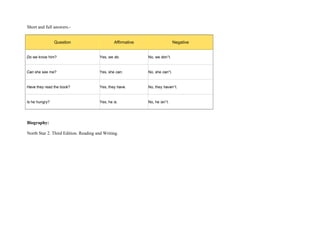
Short and full answers.-
Question Affirmative Negative
Do we know him? Yes, we do. No, we don’t.
Can she see me? Yes, she can. No, she can’t.
Have they read the book? Yes, they have. No, they haven’t.
Is he hungry? Yes, he is. No, he isn’t.
Biography:
North Star 2. Third Edition. Reading and Writing.

DAILY LESSON PLAN; SAMPLE

  • 1.
    Skills Contents Methodologyand Strategies Resources Evaluation Time Listening for pronunciation mistakes while reading. For specific information. Reading for Specific information and understanding words through context. Speaking to discuss critically Ss’ points of view and to ask and answer questions related with the topic. Writing Ss’ points of view and answering questions. Conceptual Vocabulary related with justice: prison, offender, crime, commit a crime, damage, victim, community, apologize, heal, and affect someone. Procedural Predicting the topic. Sharing information. Discussing and justifying Ss` points of view. Background and vocabulary. Understanding words through context. Attitudinal To respect and demand people rights. Pre- requirements: Warm up activity: “What are you doing?” In pars SA will ask SB What are you doing? SB responds by naming whatever action comes to his/her mind, e.g. I’m dancing in a disco. Then SA immediately starts performing whatever action the other player named. Review T will ask some examples about comparative adjectives. John is taller than Peter Pre-teaching Predicting. Listen to an interview and answer the questions: What does Laura Chang Do? What is mistaken identity? While teaching Read the FAQs about DNA databases. Read each statement, and then circle the correct definition of the underlined word. L&S book pg. 63 Post teaching Ss’ book Markers Board Work sheets. Task 1. – Ss have to be able to answer the questions and justify their ideas critically. Task 2. – Ss have to be able to listen and understand academic texts and comment about them.. 5 minutes 10 minutes 05 minutes 15 minutes
  • 2.
    LESSON PLAN 1.- INFORMATIONDATA:  Institution: Universidad Nacional de Chimborazo  Teacher: Mgs. César Narváez  Year: 4th semester “A and B”  School year: 04- 2013 a 07-2013.  Date: May, 27th 2013.  Subject: Language Skills III 2. – CLASS ORGANIZATION.  Area: Language Skills  Unit: Two  Topic: A different path to Justice  Unit objective: To express Ss’ own points of view in written and orally, and to justify them in a critical way.  Class objective: To be able to listen and understand academic listening exercises. 3. - DIDACTICS PROCESS Scientific knowledge.- Simple Past Tense.- Use the Simple Past to express the idea that an action started and finished at a specific time in the past. Sometimes, the speaker may not actually mention the specific time, but they do have one specific time in mind.
  • 3.
    Short and fullanswers.- Question Affirmative Negative Do we know him? Yes, we do. No, we don’t. Can she see me? Yes, she can. No, she can’t. Have they read the book? Yes, they have. No, they haven’t. Is he hungry? Yes, he is. No, he isn’t. Biography: North Star 2. Third Edition. Reading and Writing.