by Marga Minco
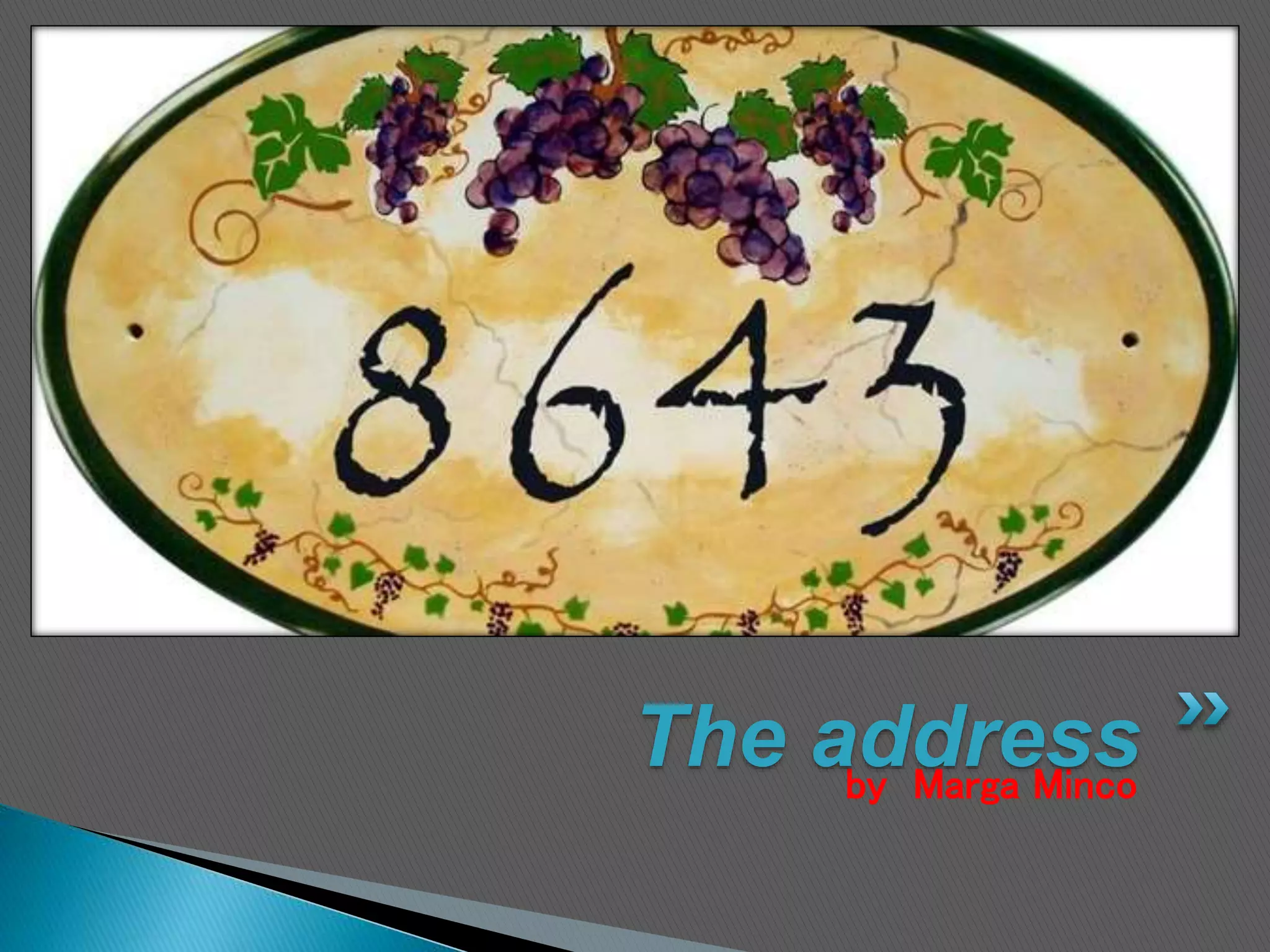
The address
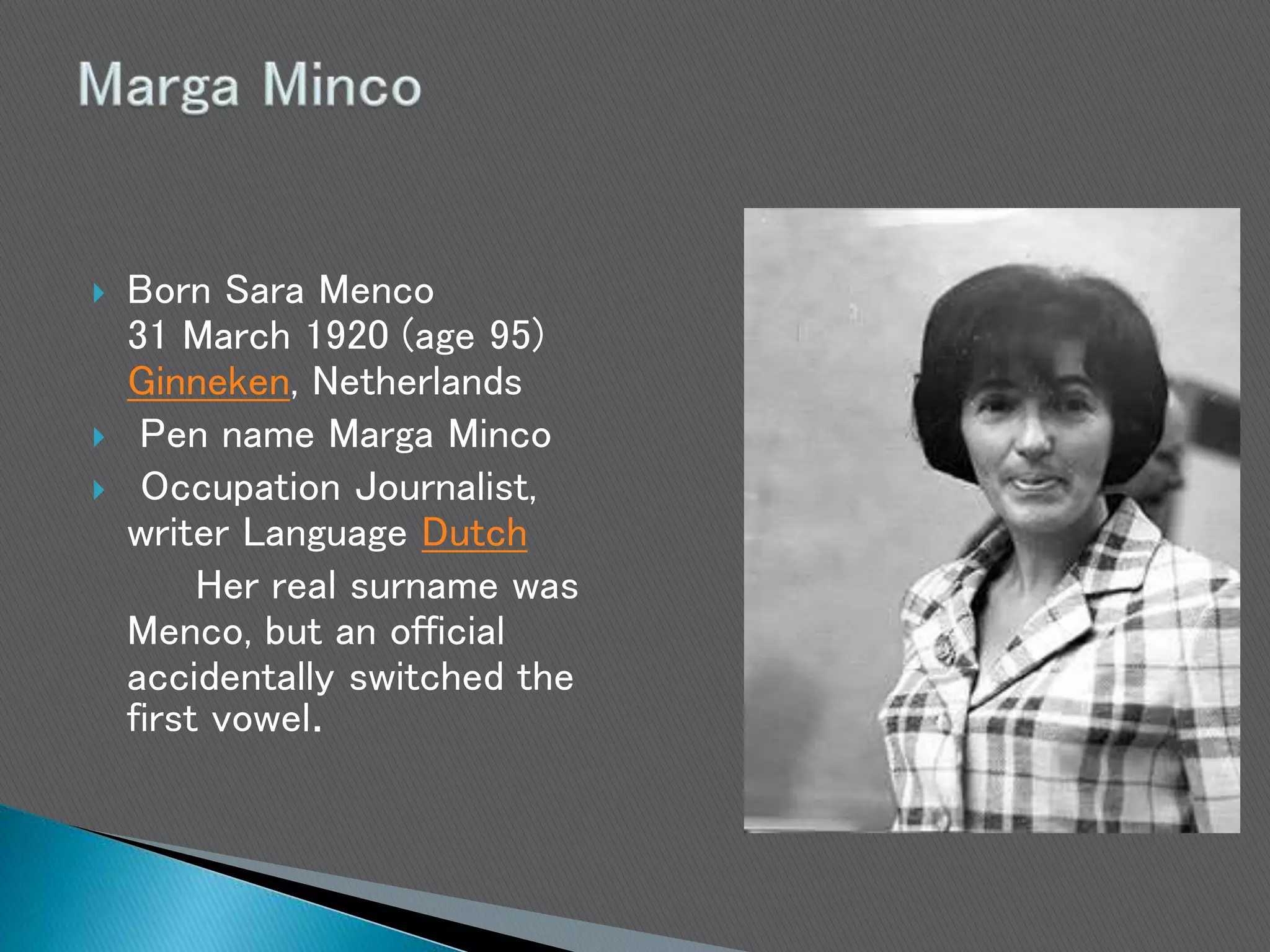
 Born Sara Menco
31 March 1920 (age 95)
Ginneken, Netherlands
 Pen name Marga Minco
 Occupation Journalist,
writer Language Dutch
Her real surname was
Menco, but an official
accidentally switched the
first vowel.
 In 1957 Minco published her first book, Het bittere kruid ("The bitter
herb"), in which a nameless character goes through war experiences
reminiscent of the author's.
 The title of her later book Een leeg huis ("An empty house") refers not
only to the demolished house that the protagonist finds after emerging
from hiding at the end of the occupation but also to the emptiness that
she and her friend Yona experience in the postwar years, to which was
added the distance and sometimes even hostility displayed by many
people in the Netherlands towards returnees from the concentration
camps.
 This phenomenon was further described by Marga Minco in her
collection of short stories, De andere kant ("The other side").
 This short story is a poignant account of a
daughter who goes in search of her mothers
’s belongings after the war ,in Holland .
 When she finds them ,the object evokes
memories of her old life.
 However she decides to leave them all behind
and resolves to move
 A lady named Dorling comes to Mrs. s’s
house to give pre war info to Mrs. s
 And finally Mrs. Dorling take all the
ornaments precious items goods etc..of Mrs.
s’s
 Promising her to return them back after the
war
 Mrs. S is dead
Mrs.S
•Mrs. S’s daughter
Mrs. Dorling
•Mrs. Dorling's daughter
 Marga Minco – The narrator. She was a girl of
fifteen or seventeen. Her family was Jewish and
Hitler was planning to kill all the Jews in
Germany, Holland, Austria, etc. Probably
 Mrs. S – The Narrator’s mother. S may be
Suzanne, Susannah, etc.
 Mrs. Dorling – A very wicked, shrewd woman. She
visited the narrator’s mother saying that she was
her classmate years ago. We do not know if it was
so or not. She offered to help the narrator’s
family by carrying their house hold utensils,
furniture and all the other valuables.
 In fact she had no intention to help the narrator’s
family. All she hoped was that the narrator’s
family die in the war and never return.
 The war was over and everyone (except the
narrator) in the narrator’s family was either
deported (sent out of one’s own country) or killed
in the gas chambers. When the war was over and
the Jews were feeling safe in these countries,
Marga (the narrator) returned to her house (which
was no more!) and lived in a small hut.
 One day, Marga thought of the woman (Mrs.
Dorling) who had taken all her possessions. She
remembered her address – 46, Marconi Street
and went to marcony street by train
 The narrator traces Mrs. Dorling’s – No. 46 – address
to claim her family’s property.
 Mrs. Dorling refuses to give away.
 Mrs. Dorling says she doesn’t recognise the narrator
but the narrator recognises her.
 It was now evident that Mrs. Dorling had betrayed the
narrator’s mother.
 Marga was terribly pinched, hurt, disappointed and
betrayed.
 She was turning away to go when someone appeared
at the window. Probably it was Mrs. Dorling’s
daughter. She was asking, “Mom, who’s there?” and
Mrs. Dorling gives a discouraging reply. Then first
visit ended
 The narrator grew impatient after a while so she
decided to visit Mrs. Dorling once again.
 When she rang the bell at house number 46, Mrs.
Dorling was away. Mrs. Dorling’s daughter welcomed
the narrator.
 The daughter had no idea how her mother had looted
the utensils and furniture from the narrator’s house.
All that she knew was that her mother had bought
these precious antiques on an auction.
 The daughter was proud of the expensive utensils
and furniture.
 The narrator decides not to wait for Mrs. Dorling. She
leaves the house. She forgets the address.
 Cardigan – A
casually collarless knitted sweater or jacket th
at opens down the front.
 Lugging – Carrying
 Crick –
Sharp, painful spasm of the muscles, as of th
e neck or back.
 Pityingly – Sympathetically

The address by maddy

  • 1.
  • 2.
     Born SaraMenco 31 March 1920 (age 95) Ginneken, Netherlands  Pen name Marga Minco  Occupation Journalist, writer Language Dutch Her real surname was Menco, but an official accidentally switched the first vowel.
  • 3.
     In 1957Minco published her first book, Het bittere kruid ("The bitter herb"), in which a nameless character goes through war experiences reminiscent of the author's.  The title of her later book Een leeg huis ("An empty house") refers not only to the demolished house that the protagonist finds after emerging from hiding at the end of the occupation but also to the emptiness that she and her friend Yona experience in the postwar years, to which was added the distance and sometimes even hostility displayed by many people in the Netherlands towards returnees from the concentration camps.  This phenomenon was further described by Marga Minco in her collection of short stories, De andere kant ("The other side").
  • 4.
     This shortstory is a poignant account of a daughter who goes in search of her mothers ’s belongings after the war ,in Holland .  When she finds them ,the object evokes memories of her old life.  However she decides to leave them all behind and resolves to move
  • 5.
     A ladynamed Dorling comes to Mrs. s’s house to give pre war info to Mrs. s  And finally Mrs. Dorling take all the ornaments precious items goods etc..of Mrs. s’s  Promising her to return them back after the war
  • 7.
     Mrs. Sis dead
  • 8.
    Mrs.S •Mrs. S’s daughter Mrs.Dorling •Mrs. Dorling's daughter
  • 9.
     Marga Minco– The narrator. She was a girl of fifteen or seventeen. Her family was Jewish and Hitler was planning to kill all the Jews in Germany, Holland, Austria, etc. Probably  Mrs. S – The Narrator’s mother. S may be Suzanne, Susannah, etc.  Mrs. Dorling – A very wicked, shrewd woman. She visited the narrator’s mother saying that she was her classmate years ago. We do not know if it was so or not. She offered to help the narrator’s family by carrying their house hold utensils, furniture and all the other valuables.
  • 10.
     In factshe had no intention to help the narrator’s family. All she hoped was that the narrator’s family die in the war and never return.  The war was over and everyone (except the narrator) in the narrator’s family was either deported (sent out of one’s own country) or killed in the gas chambers. When the war was over and the Jews were feeling safe in these countries, Marga (the narrator) returned to her house (which was no more!) and lived in a small hut.  One day, Marga thought of the woman (Mrs. Dorling) who had taken all her possessions. She remembered her address – 46, Marconi Street and went to marcony street by train
  • 11.
     The narratortraces Mrs. Dorling’s – No. 46 – address to claim her family’s property.  Mrs. Dorling refuses to give away.  Mrs. Dorling says she doesn’t recognise the narrator but the narrator recognises her.  It was now evident that Mrs. Dorling had betrayed the narrator’s mother.  Marga was terribly pinched, hurt, disappointed and betrayed.  She was turning away to go when someone appeared at the window. Probably it was Mrs. Dorling’s daughter. She was asking, “Mom, who’s there?” and Mrs. Dorling gives a discouraging reply. Then first visit ended
  • 12.
     The narratorgrew impatient after a while so she decided to visit Mrs. Dorling once again.  When she rang the bell at house number 46, Mrs. Dorling was away. Mrs. Dorling’s daughter welcomed the narrator.  The daughter had no idea how her mother had looted the utensils and furniture from the narrator’s house. All that she knew was that her mother had bought these precious antiques on an auction.  The daughter was proud of the expensive utensils and furniture.  The narrator decides not to wait for Mrs. Dorling. She leaves the house. She forgets the address.
  • 13.
     Cardigan –A casually collarless knitted sweater or jacket th at opens down the front.  Lugging – Carrying  Crick – Sharp, painful spasm of the muscles, as of th e neck or back.  Pityingly – Sympathetically

Editor's Notes