New Developments in Infrastructure Governance,
OECD-IMF Seminar, March 23-24, 2015
The World Bank’s Framework for
Assessing PIM Systems
Anand Rajaram, World Bank
Key questions on public investment
• How much can/should a country spend on
public investment?
• Should broad development plans/strategy
guide choice of sectors?
• How should individual public investment
project choices be made?
• What kinds of institutional arrangements will
help achieve good PIM outcomes?
http://blogs.ft.com/beyond-brics/2014/06/23/emerging-asia-to-drive-global-infrastructure-
spend-to-2025-says-pwc/
http://www.ft.com/intl/cms/s/2/9b591f98-4997-11e4-8d68-00144feab7de.html#axzz3G7Uidmg1
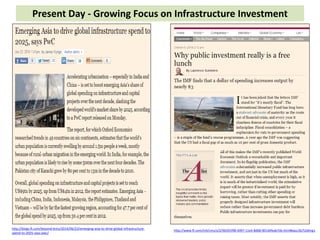
Present Day - Growing Focus on Infrastructure Investment
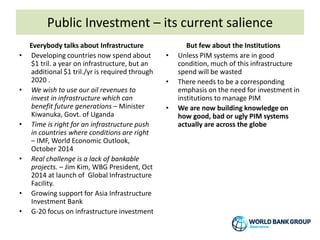
Public Investment – its current salience
Everybody talks about Infrastructure
• Developing countries now spend about
$1 tril. a year on infrastructure, but an
additional $1 tril./yr is required through
2020 .
• We wish to use our oil revenues to
invest in infrastructure which can
benefit future generations – Minister
Kiwanuka, Govt. of Uganda
• Time is right for an infrastructure push
in countries where conditions are right
– IMF, World Economic Outlook,
October 2014
• Real challenge is a lack of bankable
projects. – Jim Kim, WBG President, Oct
2014 at launch of Global Infrastructure
Facility.
• Growing support for Asia Infrastructure
Investment Bank
• G-20 focus on infrastructure investment
But few about the Institutions
• Unless PIM systems are in good
condition, much of this infrastructure
spend will be wasted
• There needs to be a corresponding
emphasis on the need for investment in
institutions to manage PIM
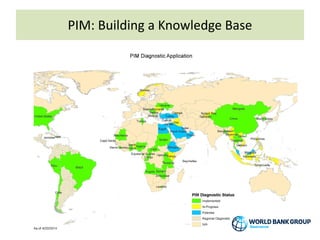
• We are now building knowledge on
how good, bad or ugly PIM systems
actually are across the globe
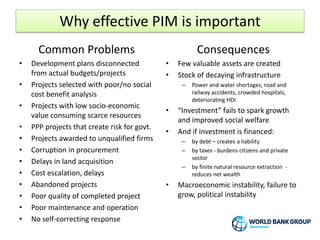
Why effective PIM is important
Common Problems
• Development plans disconnected
from actual budgets/projects
• Projects selected with poor/no social
cost benefit analysis
• Projects with low socio-economic
value consuming scarce resources
• PPP projects that create risk for govt.
• Projects awarded to unqualified firms
• Corruption in procurement
• Delays in land acquisition
• Cost escalation, delays
• Abandoned projects
• Poor quality of completed project
• Poor maintenance and operation
• No self-correcting response
Consequences
• Few valuable assets are created
• Stock of decaying infrastructure
– Power and water shortages, road and
railway accidents, crowded hospitals,
deteriorating HDI
• “Investment” fails to spark growth
and improved social welfare
• And if investment is financed:
– by debt – creates a liability
– by taxes - burdens citizens and private
sector
– by finite natural resource extraction -
reduces net wealth
• Macroeconomic instability, failure to
grow, political instability
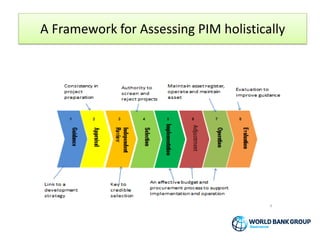
A Framework for Assessing PIM holistically
PIM: Building a Knowledge Base
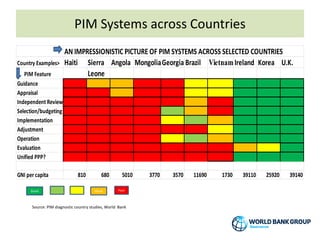
PIM Systems across Countries
AN IMPRESSIONISTIC PICTURE OF PIM SYSTEMS ACROSS SELECTED COUNTRIES
Country Examples> Haiti Sierra Angola MongoliaGeorgia Brazil VietnamIreland Korea U.K.
PIM Feature Leone
Guidance
Appraisal
Independent Review
Selection/budgeting
Implementation
Adjustment
Operation
Evaluation
Unified PPP?
GNI per capita 810 680 5010 3770 3570 11690 1730 39110 25920 39140
Source: PIM diagnostic country studies, World Bank
Good Weak Poor
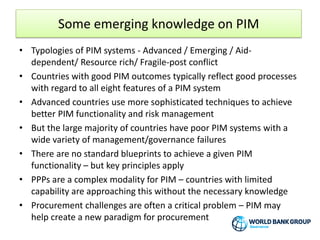
Some emerging knowledge on PIM
• Typologies of PIM systems - Advanced / Emerging / Aid-
dependent/ Resource rich/ Fragile-post conflict
• Countries with good PIM outcomes typically reflect good processes
with regard to all eight features of a PIM system
• Advanced countries use more sophisticated techniques to achieve
better PIM functionality and risk management
• But the large majority of countries have poor PIM systems with a
wide variety of management/governance failures
• There are no standard blueprints to achieve a given PIM
functionality – but key principles apply
• PPPs are a complex modality for PIM – countries with limited
capability are approaching this without the necessary knowledge
• Procurement challenges are often a critical problem – PIM may
help create a new paradigm for procurement
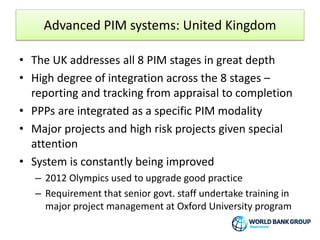
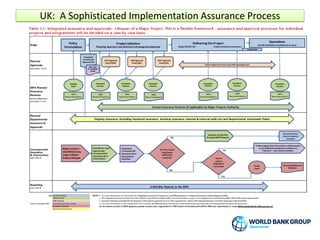
Advanced PIM systems: United Kingdom
• The UK addresses all 8 PIM stages in great depth
• High degree of integration across the 8 stages –
reporting and tracking from appraisal to completion
• PPPs are integrated as a specific PIM modality
• Major projects and high risk projects given special
attention
• System is constantly being improved
– 2012 Olympics used to upgrade good practice
– Requirement that senior govt. staff undertake training in
major project management at Oxford University program
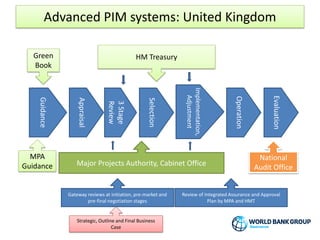
Advanced PIM systems: United Kingdom
Guidance
Evaluation
Appraisal
3Stage
Review
Selection
Implementation,
Adjustment
Operation
Major Projects Authority, Cabinet Office
HM Treasury
MPA
Guidance
Gateway reviews at initiation, pre-market and
pre-final negotiation stages
Review of Integrated Assurance and Approval
Plan by MPA and HMT
National
Audit Office
Green
Book
Strategic, Outline and Final Business
Case
UK: A Sophisticated Implementation Assurance Process
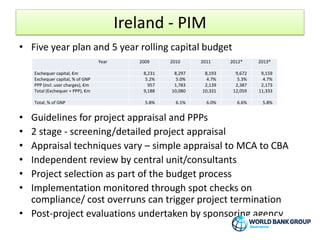
Ireland - PIM
• Five year plan and 5 year rolling capital budget
• Guidelines for project appraisal and PPPs
• 2 stage - screening/detailed project appraisal
• Appraisal techniques vary – simple appraisal to MCA to CBA
• Independent review by central unit/consultants
• Project selection as part of the budget process
• Implementation monitored through spot checks on
compliance/ cost overruns can trigger project termination
• Post-project evaluations undertaken by sponsoring agency
Year 2009 2010 2011 2012* 2013*
Exchequer capital, €m 8,231 8,297 8,193 9,672 9,159
Exchequer capital, % of GNP 5.2% 5.0% 4.7% 5.3% 4.7%
PPP (incl. user charges), €m 957 1,783 2,139 2,387 2,173
Total (Exchequer + PPP), €m 9,188 10,080 10,331 12,059 11,333
Total, % of GNP 5.8% 6.1% 6.0% 6.6% 5.8%
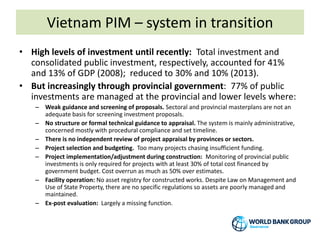
Vietnam PIM – system in transition
• High levels of investment until recently: Total investment and
consolidated public investment, respectively, accounted for 41%
and 13% of GDP (2008); reduced to 30% and 10% (2013).
• But increasingly through provincial government: 77% of public
investments are managed at the provincial and lower levels where:
– Weak guidance and screening of proposals. Sectoral and provincial masterplans are not an
adequate basis for screening investment proposals.
– No structure or formal technical guidance to appraisal. The system is mainly administrative,
concerned mostly with procedural compliance and set timeline.
– There is no independent review of project appraisal by provinces or sectors.
– Project selection and budgeting. Too many projects chasing insufficient funding.
– Project implementation/adjustment during construction: Monitoring of provincial public
investments is only required for projects with at least 30% of total cost financed by
government budget. Cost overrun as much as 50% over estimates.
– Facility operation: No asset registry for constructed works. Despite Law on Management and
Use of State Property, there are no specific regulations so assets are poorly managed and
maintained.
– Ex-post evaluation: Largely a missing function.
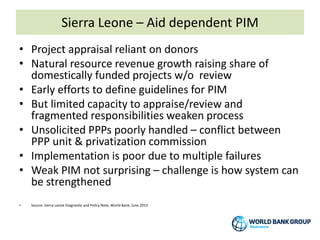
Sierra Leone – Aid dependent PIM
• Project appraisal reliant on donors
• Natural resource revenue growth raising share of
domestically funded projects w/o review
• Early efforts to define guidelines for PIM
• But limited capacity to appraise/review and
fragmented responsibilities weaken process
• Unsolicited PPPs poorly handled – conflict between
PPP unit & privatization commission
• Implementation is poor due to multiple failures
• Weak PIM not surprising – challenge is how system can
be strengthened
• Source: Sierra Leone Diagnostic and Policy Note, World Bank, June 2013
Conclusion
• Calls for public investment must be matched by
attention to quality of PIM
• Building knowledge on PIM systems is high value
• PPPs need to be integrated into PIM systems
• Diagnosis is easy, institutional reform is difficult
• Important that reforms are tailored to “load-bearing”
capacity in country and sustained over time
• Growing portfolio of PIM reform TA projects at WB
• World Bank ready to collaborate closely with other
partners including KDI, IMF, OECD and others
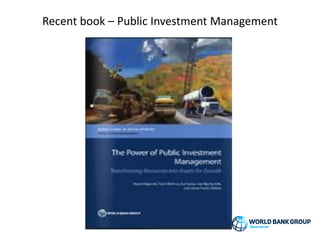
Recent book – Public Investment Management
Thank you

The World Bank's framework for assessing PIM systems - Anand Rajaram, World Bank,

  • 1.
    New Developments inInfrastructure Governance, OECD-IMF Seminar, March 23-24, 2015 The World Bank’s Framework for Assessing PIM Systems Anand Rajaram, World Bank
  • 2.
    Key questions onpublic investment • How much can/should a country spend on public investment? • Should broad development plans/strategy guide choice of sectors? • How should individual public investment project choices be made? • What kinds of institutional arrangements will help achieve good PIM outcomes?
  • 3.
  • 4.
    Public Investment –its current salience Everybody talks about Infrastructure • Developing countries now spend about $1 tril. a year on infrastructure, but an additional $1 tril./yr is required through 2020 . • We wish to use our oil revenues to invest in infrastructure which can benefit future generations – Minister Kiwanuka, Govt. of Uganda • Time is right for an infrastructure push in countries where conditions are right – IMF, World Economic Outlook, October 2014 • Real challenge is a lack of bankable projects. – Jim Kim, WBG President, Oct 2014 at launch of Global Infrastructure Facility. • Growing support for Asia Infrastructure Investment Bank • G-20 focus on infrastructure investment But few about the Institutions • Unless PIM systems are in good condition, much of this infrastructure spend will be wasted • There needs to be a corresponding emphasis on the need for investment in institutions to manage PIM • We are now building knowledge on how good, bad or ugly PIM systems actually are across the globe
  • 5.
    Why effective PIMis important Common Problems • Development plans disconnected from actual budgets/projects • Projects selected with poor/no social cost benefit analysis • Projects with low socio-economic value consuming scarce resources • PPP projects that create risk for govt. • Projects awarded to unqualified firms • Corruption in procurement • Delays in land acquisition • Cost escalation, delays • Abandoned projects • Poor quality of completed project • Poor maintenance and operation • No self-correcting response Consequences • Few valuable assets are created • Stock of decaying infrastructure – Power and water shortages, road and railway accidents, crowded hospitals, deteriorating HDI • “Investment” fails to spark growth and improved social welfare • And if investment is financed: – by debt – creates a liability – by taxes - burdens citizens and private sector – by finite natural resource extraction - reduces net wealth • Macroeconomic instability, failure to grow, political instability
  • 6.
    A Framework forAssessing PIM holistically
  • 7.
    PIM: Building aKnowledge Base
  • 8.
    PIM Systems acrossCountries AN IMPRESSIONISTIC PICTURE OF PIM SYSTEMS ACROSS SELECTED COUNTRIES Country Examples> Haiti Sierra Angola MongoliaGeorgia Brazil VietnamIreland Korea U.K. PIM Feature Leone Guidance Appraisal Independent Review Selection/budgeting Implementation Adjustment Operation Evaluation Unified PPP? GNI per capita 810 680 5010 3770 3570 11690 1730 39110 25920 39140 Source: PIM diagnostic country studies, World Bank Good Weak Poor
  • 9.
    Some emerging knowledgeon PIM • Typologies of PIM systems - Advanced / Emerging / Aid- dependent/ Resource rich/ Fragile-post conflict • Countries with good PIM outcomes typically reflect good processes with regard to all eight features of a PIM system • Advanced countries use more sophisticated techniques to achieve better PIM functionality and risk management • But the large majority of countries have poor PIM systems with a wide variety of management/governance failures • There are no standard blueprints to achieve a given PIM functionality – but key principles apply • PPPs are a complex modality for PIM – countries with limited capability are approaching this without the necessary knowledge • Procurement challenges are often a critical problem – PIM may help create a new paradigm for procurement
  • 10.
    Advanced PIM systems:United Kingdom • The UK addresses all 8 PIM stages in great depth • High degree of integration across the 8 stages – reporting and tracking from appraisal to completion • PPPs are integrated as a specific PIM modality • Major projects and high risk projects given special attention • System is constantly being improved – 2012 Olympics used to upgrade good practice – Requirement that senior govt. staff undertake training in major project management at Oxford University program
  • 11.
    Advanced PIM systems:United Kingdom Guidance Evaluation Appraisal 3Stage Review Selection Implementation, Adjustment Operation Major Projects Authority, Cabinet Office HM Treasury MPA Guidance Gateway reviews at initiation, pre-market and pre-final negotiation stages Review of Integrated Assurance and Approval Plan by MPA and HMT National Audit Office Green Book Strategic, Outline and Final Business Case
  • 12.
    UK: A SophisticatedImplementation Assurance Process
  • 13.
    Ireland - PIM •Five year plan and 5 year rolling capital budget • Guidelines for project appraisal and PPPs • 2 stage - screening/detailed project appraisal • Appraisal techniques vary – simple appraisal to MCA to CBA • Independent review by central unit/consultants • Project selection as part of the budget process • Implementation monitored through spot checks on compliance/ cost overruns can trigger project termination • Post-project evaluations undertaken by sponsoring agency Year 2009 2010 2011 2012* 2013* Exchequer capital, €m 8,231 8,297 8,193 9,672 9,159 Exchequer capital, % of GNP 5.2% 5.0% 4.7% 5.3% 4.7% PPP (incl. user charges), €m 957 1,783 2,139 2,387 2,173 Total (Exchequer + PPP), €m 9,188 10,080 10,331 12,059 11,333 Total, % of GNP 5.8% 6.1% 6.0% 6.6% 5.8%
  • 14.
    Vietnam PIM –system in transition • High levels of investment until recently: Total investment and consolidated public investment, respectively, accounted for 41% and 13% of GDP (2008); reduced to 30% and 10% (2013). • But increasingly through provincial government: 77% of public investments are managed at the provincial and lower levels where: – Weak guidance and screening of proposals. Sectoral and provincial masterplans are not an adequate basis for screening investment proposals. – No structure or formal technical guidance to appraisal. The system is mainly administrative, concerned mostly with procedural compliance and set timeline. – There is no independent review of project appraisal by provinces or sectors. – Project selection and budgeting. Too many projects chasing insufficient funding. – Project implementation/adjustment during construction: Monitoring of provincial public investments is only required for projects with at least 30% of total cost financed by government budget. Cost overrun as much as 50% over estimates. – Facility operation: No asset registry for constructed works. Despite Law on Management and Use of State Property, there are no specific regulations so assets are poorly managed and maintained. – Ex-post evaluation: Largely a missing function.
  • 15.
    Sierra Leone –Aid dependent PIM • Project appraisal reliant on donors • Natural resource revenue growth raising share of domestically funded projects w/o review • Early efforts to define guidelines for PIM • But limited capacity to appraise/review and fragmented responsibilities weaken process • Unsolicited PPPs poorly handled – conflict between PPP unit & privatization commission • Implementation is poor due to multiple failures • Weak PIM not surprising – challenge is how system can be strengthened • Source: Sierra Leone Diagnostic and Policy Note, World Bank, June 2013
  • 16.
    Conclusion • Calls forpublic investment must be matched by attention to quality of PIM • Building knowledge on PIM systems is high value • PPPs need to be integrated into PIM systems • Diagnosis is easy, institutional reform is difficult • Important that reforms are tailored to “load-bearing” capacity in country and sustained over time • Growing portfolio of PIM reform TA projects at WB • World Bank ready to collaborate closely with other partners including KDI, IMF, OECD and others
  • 17.
    Recent book –Public Investment Management
  • 18.