CYTOSKELETON
CELL BIOLOGY AND GENETICS
NAVNEET KUMAR
B.TECH (BIOTECHNOLOGY)
SECOND SEMESTER
WHAT IS CYTOSKELETON?
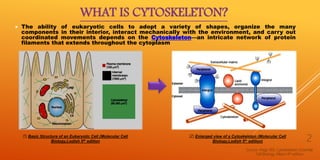
 The ability of eukaryotic cells to adopt a variety of shapes, organize the many
components in their interior, interact mechanically with the environment, and carry out
coordinated movements depends on the Cytoskeleton—an intricate network of protein
filaments that extends throughout the cytoplasm
Source -Page 565, Cytoskeleton; Essential
Cell Biology, Albert 4th edition
2(1) Basic Structure of an Eukaryotic Cell (Molecular Cell
Biology,Lodish 5th edition
(2) Enlarged view of a Cytoskeleton (Molecular Cell
Biology,Lodish 5th edition)
 This filamentous architecture helps to support the large volume of cytoplasm in a eukaryotic
cell, a function that is particularly important in animal cells, which have no cell walls.
 Although some cytoskeletal components are present in some of the microbes, the cytoskeleton
is the most prominent in large and structurally complex eukaryotic cell.
 Cytoskeleton is a highly dynamic structure that is continuously reorganized as a cell changes
shape, divides, and responds to its environment.
 The cytoskeleton is not only the “bones” of a cell but its “muscles” too, and it is directly
responsible for large-scale movements such as the crawling of cells along a surface, contraction
of muscle cells, and the changes in cell shape that take place as an embryo develops.
 Without the cytoskeleton, wounds would never heal, muscles would be useless, and sperm would
never reach the egg.
 The cytoskeleton is composed of three well-defined filamentous structures—
 Intermediate Filaments
 Microtubules
 Microfilaments
that together form an elaborate interactive network. Each of the three types of cytoskeletal
filaments is a polymer of protein subunits held together by weak, non-covalent bonds.
Source -Page 565, Cytoskeleton; Essential Cell
Biology, Albert 4th edition
3
1.INTERMEDIATE FILAMENTS
 Intermediate filaments have
great tensile strength, and their
main function is to enable cells
to withstand the mechanical
stress that occurs when cells
are stretched.
 The filaments are called
“intermediate” because, in the
smooth muscle cells where they
were first discovered, their
diameter (about 10 nm) is
between that of the thinner
actin filaments and the thicker
myosin filaments.
Source -Page 567, Cytoskeleton; Essential Cell
Biology, Albert 4th edition
4
1. Immunofluorescence Micrograph of a stained
culture of Epithelial Cells, showing lacelike
network of Intermediate keratin Filaments
(Source-Essential Cell Biology, Albert, 3rd
edition)
2. Drawing from an electron micrograph of a
section of epidermis showing the bundles of
intermediate filaments that traverse the
cytoplasm and are inserted at desmosomes.
(Source-Essential Cell Biology, Albert, 3rd edition)
 Intermediate filaments are the toughest and most durable of the cytoskeletal filaments.
When cells are treated with concentrated salt solutions and nonionic detergents, the
intermediate filaments survive, while most of the rest of the cytoskeleton is destroyed.
 Intermediate filaments are found in the cytoplasm of most animal cells. They typically form
a network throughout the cytoplasm, surrounding the nucleus and extending out to the cell
periphery. There they are often anchored to the plasma membrane at cell–cell junctions
called desmosomes ,where the plasma membrane is connected to that of another cell.
 Intermediate filaments are also found within the nucleus of all eukaryotic cells. There they
form a meshwork called the nuclear lamina, which underlies and strengthens the nuclear
envelope.
 In all cells, intermediate filaments distribute the effect of locally applied forces, thereby
keeping cells and their membranes from tearing in response to mechanical shear.
 Filaments of each class are formed by polymerization of their corresponding intermediate
filament subunits.
Source -Page 567, Cytoskeleton; Essential Cell Biology,
Albert 4th edition
5
6
Intermediate filaments can be grouped into four classes:
(Source- Page 574;Cytoskeleton;Essential Cell Biology,
Albert, Hopkins -3rd Edition)
7
KERATIN (TYPE 1 AND 2 IF)
 They are found primarily in epithelial cells and include two subfamilies of keratin
(also celled tono, perakeratin or cytokeratin) : acidic keratin and neutral or basic
keratin.
 Keratin filaments are heteropolymers formed from an equal number of subunits from
each of two keratin subfamilies. The keratins are most complex class of IF proteins,
with at least 19 distinct forms in human epithelia and 8 more in the keratins of hair
and nails.
 Type I and Type II consists of 2 groups of Keratins, each consisting of about 15
different proteins expressed in epithelial cells.
 Each type of epithelial cell synthesizes at least one type I(acidic) and one type
II(basic/neutral)keratin , which copolymerize to form filaments.
 Some of the type I and type II(Hard Keratins) are used for production of structures
such as hair, nails and horns. Other type I and type II keratins(Soft Keratins) are
abundant in the cytoplasm of epithelial cells with different keratins being expressed
in various differentiated cell types.
 Keratin filaments typically span over the interiors of epithelial cells from one side of
the cell to the other, and filaments in adjacent epithelial cells are indirectly
connected through cell–cell junctions called desmosomes .
 The ends of the keratin filaments are anchored to the desmosomes, and they
associate laterally with other cell components through their globular head and tail
domains, which project from the surface of the assembled filament. This cabling of
high tensile strength, formed by the filaments throughout the epithelial sheet,
distributes the stress that occurs when the skin is stretched.
1&2-Page 300, Cytoskeleton; Cell Biology, Genetics Molecular Biology, Evolution and Ecology- P.S.Verma and A.K Verma
3,4&5- http://ww.ncbi.nlm.nih.gov/books/NBK9834
6&7-Page 569, Cytoskeleton; Essentials of Cell Biology;Albert-4th edition
8
Staining with fluorochrome-tagged antibodies reveals
cellular distribution of keratin and lamin intermediate
filaments ( Molecular Cell Biology,Lodish-5th edition)
VIMETIN AND VIMETIN RELATED FILAMENTS(TYPE 3 IF)
 They include the following four types of polypeptides: vimentin, desmin,
synemin and glial fibrillary acidic protein (or glial filaments).
 Vimentin is typically expressed in leukocytes, blood vessel endothelial
cells, some epithelial cells, and mesenchymal cells such as fibroblasts.
Vimentin filaments help support cellular membranes. Vimentin networks
may also help keep the nucleus and other organelles in a defined place
within the cell. Vimentin is frequently associated with microtubules and
the network of vimentin filaments parallels the microtubule network.
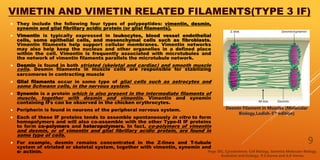
 Desmin is found in both striated (skeletal and cardiac) and smooth muscle
cells. Desmin filaments in muscle cells are responsible for stabilizing
sarcomeres in contracting muscle
 Glial filaments occur in some type of glial cells such as astrocytes and
some Schwann cells, in the nervous system.
 Synemin is a protein which is also present in the intermediate filaments of
muscle, together with desmin and vimentin. Vimentin and synemin
containing IFs can be observed in the chicken erythrocytes.
 Peripherin is found in neurons of the peripheral nervous system.
 Each of these IF proteins tends to assemble spontaneously in vitro to form
homopolymers and will also co-assemble with the other Type-II IF proteins
to form co-polymers and heteropolymers. In fact, co-polymers of vimentin
and desmin, or of vimentin and glial fibrillary acidic protein, are found in
some type of cells.
 For example, desmin remains concentrated in the Z-lines and T-tubule
system of striated or skeletal system, together with vimentin, synemin and
α- actinin. Page 301, Cytoskeleton; Cell Biology, Genetics Molecular Biology,
Evolution and Ecology- P.S.Verma and A.K Verma
9
Desmin Filament in Muscles (Molecular
Biology,Lodish-5th edition)
NEUROFILAMENTS(TYPE 4 IF)
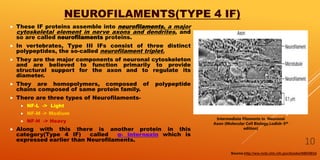
 These IF proteins assemble into neurofilaments, a major
cytoskeletal element in nerve axons and dendrites, and
so are called neurofilaments proteins.
 In vertebrates, Type III IFs consist of three distinct
polypeptides, the so-called neurofilament triplet.
 They are the major components of neuronal cytoskeleton
and are believed to function primarily to provide
structural support for the axon and to regulate its
diameter.
 They are homopolymers, composed of polypeptide
chains composed of same protein family.
 There are three types of Neurofilaments-
 NF-L -> Light
 NF-M -> Medium
 NF-H -> Heavy
 Along with this there is another protein in this
category(Type 4 IF) called α- internexin which is
expressed earlier than Neurofilaments.
Source-http://ww.ncbi.nlm.nih.gov/books/NBK9834
10
Intermediate Filaments in Neuronal
Axon (Molecular Cell Biology,Lodish-5th
edition)
NUCLEAR LAMINS(TYPE 5 IF)
 The intermediate filament lining and strengthening of the
inside surface of inner nuclear membrane are organized
as a two-dimensional mesh. The intermediate filaments
within this tough nuclear lamina are constructed from a
class of intermediate filament proteins called lamins.
 In contrast to the very stable cytoplasmic intermediate
filaments found in many cells, the intermediate filaments
of the nuclear lamina disassemble and re-form at each
cell division, when the nuclear envelope breaks down
during mitosis and then re-forms in each daughter cell.
 Disassembly and reassembly of the nuclear lamina are
controlled by the phosphorylation and dephosphorylation
of the lamins by protein kinases. When the lamins are
phosphorylated, the consequent conformational change
weakens the binding between the tetramers and causes
the filament to fall apart. Dephosphorylation at the end
of mitosis causes the lamins to reassemble.
Source-Page 570 & 571 , Cytoskeleton;
Essential Cell Biology,Albert-4th Edition
11
Two Dimensional view of Nuclear Envelope
(Source-Essential Cell Biology, Albert, Hopkins, 3rd
Edition)
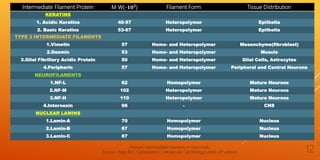
Intermediate Filament Protein M W(-𝟏𝟎 𝟑) Filament Form Tissue Distribution
KERATINS
1. Acidic Keratins 40-57 Heteropolymer Epithelia
2. Basic Keratins 53-67 Heteropolymer Epithelia
TYPE 3 INTERMEDIATE FILAMENTS
1.Vimetin 57 Homo- and Heteropolymer Mesenchyme(fibroblast)
2.Desmin 53 Homo- and Heteropolymer Muscle
3.Glial Fibrillary Acidic Protein 50 Homo- and Heteropolymer Glial Cells, Astrocytes
4.Peripherin 57 Homo- and Heteropolymer Peripheral and Central Neurons
NEUROFILAMENTS
1.NF-L 62 Homopolymer Mature Neurons
2.NF-M 102 Heteropolymer Mature Neurons
3.NF-H 110 Heteropolymer Mature Neurons
4.Internexin 66 - CNS
NUCLEAR LAMINS
1.Lamin-A 70 Homopolymer Nucleus
2.Lamin-B 67 Homopolymer Nucleus
3.Lamin-C 67 Homopolymer Nucleus
Primary Intermediate Filaments in Mammals.
Source- Page 807, Cytoskeleton I; Molecular Cell Biology;Lodish-5th edition 12
2. MICROTUBULES
 Microtubules are long and relatively stiff hollow tubes of protein
that can rapidly disassemble in one location and reassemble in
another.
 In a typical animal cell, microtubules grow out from centrosome.
Extending out toward the cell periphery, they create a system of
tracks within the cell, along which vesicles, organelles, and other
cell components are moved.
 These and other systems of cytoplasmic microtubules are the
part of the cytoskeleton mainly responsible for anchoring
membrane-enclosed organelles within the cell and for guiding
intracellular transport.
 When a cell enters mitosis, the cytoplasmic microtubules
disassemble and then reassemble into an intricate structure
called the mitotic spindle.
 The mitotic spindle provides the machinery that will segregate
the chromosomes equally into the two daughter cells just before
a cell divides .
 These extend from the surface of many eukaryotic cells, which
use them either as a means of propulsion or to sweep fluid over
the cell surface. The core of a eukaryotic cilium or flagellum
consists of a highly organized and stable bundle of microtubules.
Source-Page 571, Cytoskeleton; Essential Cell Biology,
Albert 4th edition
13
Microtubules usually grow out of an organizing
structure (Source- Essential Cell Biology,
Albert,Hopkins-3rd edition)
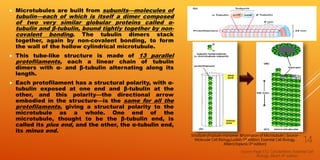
 Microtubules are built from subunits—molecules of
tubulin—each of which is itself a dimer composed
of two very similar globular proteins called α-
tubulin and β-tubulin, bound tightly together by non-
covalent bonding. The tubulin dimers stack
together, again by non-covalent bonding, to form
the wall of the hollow cylindrical microtubule.
 This tube-like structure is made of 13 parallel
protofilaments, each a linear chain of tubulin
dimers with α- and β-tubulin alternating along its
length.
 Each protofilament has a structural polarity, with α-
tubulin exposed at one end and β-tubulin at the
other, and this polarity—the directional arrow
embodied in the structure—is the same for all the
protofilaments, giving a structural polarity to the
microtubule as a whole. One end of the
microtubule, thought to be the β-tubulin end, is
called its plus end, and the other, the α-tubulin end,
its minus end.
Source-Page 572, Cytoskeleton; Essential Cell
Biology, Albert-4th edition
14
Structure of tubulin monomer &Formation of Microtubule ( Source-
Molecular Cell Biology,Lodish-5th edition; Essential Cell Biology,
Albert,Hopkins-3rd edition)
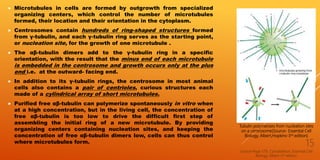
 Microtubules in cells are formed by outgrowth from specialized
organizing centers, which control the number of microtubules
formed, their location and their orientation in the cytoplasm.
 Centrosomes contain hundreds of ring-shaped structures formed
from γ-tubulin, and each γ-tubulin ring serves as the starting point,
or nucleation site, for the growth of one microtubule .
 The αβ-tubulin dimers add to the γ-tubulin ring in a specific
orientation, with the result that the minus end of each microtubule
is embedded in the centrosome and growth occurs only at the plus
end i.e. at the outward- facing end.
 In addition to its γ-tubulin rings, the centrosome in most animal
cells also contains a pair of centrioles, curious structures each
made of a cylindrical array of short microtubules.
 Purified free αβ-tubulin can polymerize spontaneously in vitro when
at a high concentration, but in the living cell, the concentration of
free αβ-tubulin is too low to drive the difficult first step of
assembling the initial ring of a new microtubule. By providing
organizing centers containing nucleation sites, and keeping the
concentration of free αβ-tubulin dimers low, cells can thus control
where microtubules form.
Source-Page 579, Cytoskeleton; Essential Cell
Biology, Albert-3rd edition
15
Tubulin polymerizes from nucleation sites
on a centrosome(Source- Essential Cell
Biology, Albert,Hopkins-3rd edition)
DYNAMIC INSTABILITY OF MICROTUBULES-
 Once a microtubule has been nucleated, its plus end typically grows outward from the organizing center by the addition of αβ-tubulin
subunits for many minutes.
 Then, without warning, the microtubule suddenly undergoes a transition that causes it to shrink rapidly inward by losing subunits from
its free end . It may shrink partially and then, no less suddenly, start growing again, or it may disappear completely, to be replaced by a
new microtubule from the same γ-tubulin ring . This remarkable behavior, known as Dynamic Instability, stems from the intrinsic
capacity of tubulin molecules to hydrolyze GTP.
 Each free tubulin dimer contains one tightly bound GTP molecule that is hydrolyzed to GDP (still tightly bound) shortly after the subunit
is added to a growing microtubule. The GTP-associated tubulin molecules pack efficiently together in the wall of the microtubule, whereas
tubulin molecules carrying GDP have a different conformation and bind less strongly to each other.
 When polymerization is proceeding rapidly, tubulin molecules add to the end of the microtubule faster than the GTP they carry is hydrolyzed.
The end of a growing microtubule is therefore composed entirely of GTP tubulin subunits, forming what is known as a GTP cap.
 In this situation, the growing microtubule continues to grow . Because of the randomness of chemical processes, however, it will
occasionally happen that tubulin at the free end of the microtubule hydrolyzes its GTP before the next tubulin has been added, so
that the free ends of protofilaments are now composed of GDP-tubulin subunits.
 This change tips the balance in favor of disassembly. Because the rest of the microtubule is composed of GDP-tubulin, once
depolymerization has started, it will tend to continue, often at a catastrophic rate; the microtubule starts to shrink rapidly and continuously,
and may even disappear. The GDP-containing tubulin molecules that are freed as the microtubule depolymerizes, join the unpolymerized
tubulin molecules already in the cytosol.
 This situation is quite unlike the arrangement with the more stable intermediate filaments, where the subunits are typically almost completely
in the fully assembled form. The tubulin molecules joining the pool then exchange their bound GDP for GTP, thereby becoming competent
again to add to another microtubule that is in a growth phase.
Source-Page 580, Cytoskeleton; Essential Cell
Biology, Albert-3rd edition
16
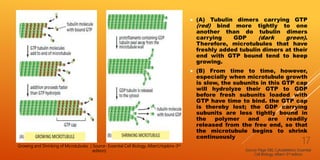
 (A) Tubulin dimers carrying GTP
(red) bind more tightly to one
another than do tubulin dimers
carrying GDP (dark green).
Therefore, microtubules that have
freshly added tubulin dimers at their
end with GTP bound tend to keep
growing.
 (B) From time to time, however,
especially when microtubule growth
is slow, the subunits in this GTP cap
will hydrolyze their GTP to GDP
before fresh subunits loaded with
GTP have time to bind. the GTP cap
is thereby lost; the GDP carrying
subunits are less tightly bound in
the polymer and are readily
released from the free end, so that
the microtubule begins to shrink
continuously
Source-Page 580, Cytoskeleton; Essential
Cell Biology, Albert-3rd edition
17Growing and Shrinking of Microtubules ( Source- Essential Cell Biology, Albert,Hopkins-3rd
edition)
Functions of Microtubules-
 Mechanical function
The shape of the cell (e.g., red blood cells of non-mammalian vertebrates) and some cell processes or
protuberances such as axons and dendrites of neurons, microvilli, etc., have been correlated to the orientation and
distribution of microtubules.
 Morphogenesis
During cell differentiation, the mechanical function of microtubules is used to determine the shape of the
developing cells. For example, the enormous elongation in the nucleus of the spermatid during spermatogenesis
is accompanied by the production of an orderly array of microtubules that are wrapped around the nucleus in a
double helical arrangement. Likewise, the elongation of the cells during induction of the lens placode in the eye is
also accompanied by the appearance of numerous microtubules.
 Cellular polarity and motility
The determination of the intrinsic polarity of certain cells is also related to the microtubules. Directional gliding of
cultured cells is found to depend on the microtubules.
 Contraction
Microtubules play a role in the contraction of the spindle and movement of chromosomes and centrioles as well as
in ciliary and flagellar motion.
 Circulation and transport
Microtubules are involved in the transport of macromolecules, granules and vesicles within the cell.
Source-Page 298, Cytoskeleton; Cell Biology, Genetics Molecular
Biology, Evolution and Ecology- P.S.Verma and A.K Verma
18
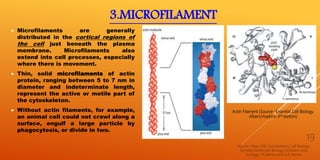
3.MICROFILAMENT
 Microfilaments are generally
distributed in the cortical regions of
the cell just beneath the plasma
membrane. Microfilaments also
extend into cell processes, especially
where there is movement.
 Thin, solid microfilaments of actin
protein, ranging between 5 to 7 nm in
diameter and indeterminate length,
represent the active or motile part of
the cytoskeleton.
 Without actin filaments, for example,
an animal cell could not crawl along a
surface, engulf a large particle by
phagocytosis, or divide in two.
Source -Page 299, Cytoskeleton; Cell Biology,
Genetics Molecular Biology, Evolution and
Ecology- P.S.Verma and A.K Verma
19
Actin Filament (Source- Essential Cell Biology,
Albert,Hopkins-3rd edition)
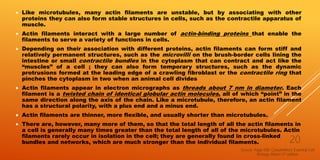
 Like microtubules, many actin filaments are unstable, but by associating with other
proteins they can also form stable structures in cells, such as the contractile apparatus of
muscle.
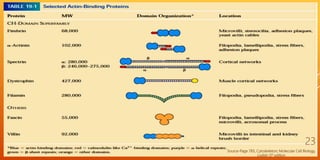
 Actin filaments interact with a large number of actin-binding proteins that enable the
filaments to serve a variety of functions in cells.
 Depending on their association with different proteins, actin filaments can form stiff and
relatively permanent structures, such as the microvilli on the brush-border cells lining the
intestine or small contractile bundles in the cytoplasm that can contract and act like the
“muscles” of a cell ; they can also form temporary structures, such as the dynamic
protrusions formed at the leading edge of a crawling fibroblast or the contractile ring that
pinches the cytoplasm in two when an animal cell divides
 Actin filaments appear in electron micrographs as threads about 7 nm in diameter. Each
filament is a twisted chain of identical globular actin molecules, all of which “point” in the
same direction along the axis of the chain. Like a microtubule, therefore, an actin filament
has a structural polarity, with a plus end and a minus end.
 Actin filaments are thinner, more flexible, and usually shorter than microtubules.
 There are, however, many more of them, so that the total length of all the actin filaments in
a cell is generally many times greater than the total length of all of the microtubules. Actin
filaments rarely occur in isolation in the cell; they are generally found in cross-linked
bundles and networks, which are much stronger than the individual filaments.
Source -Page 590, Cytoskeleton; Essential Cell
Biology, Albert-3rd edition
20
 About 5% of the total protein in a typical animal cell is actin; about
half of this actin is assembled into filaments, and the other half
remains as actin monomers in the cytosol.
 There are a great many actin-binding proteins in cells. Most of these
bind to assembled actin filaments rather than to actin monomers and
control the behavior of the intact filaments
 Actin-bundling proteins, for example, hold actin filaments together in
parallel bundles in microvilli; other cross-linking proteins hold actin
filaments together in a gel-like meshwork within the cell cortex—the
layer of cytoplasm just beneath the plasma membrane; filament-
severing proteins, such as gelsolin, fragment actin filaments into
shorter lengths and thus can convert an actin gel to a more fluid
state. Actin filaments can also associate with motor proteins to form
contractile bundles, as in muscle cells. And they often form tracks
along which motor proteins transport organelles, a function that is
especially conspicuous in plant cells.
 In most cells ,actin is highly concentrated in a layer just beneath the
plasma membrane called the cell cortex in which, actin filaments are
linked by actin-binding proteins into a meshwork that supports the
outer surface of the cell and gives it mechanical strength.
Source-Page 586,587,588, Cytoskeleton; Essential
Cell Biology, Albert-4th Edition
21
Treadmilling Of Actin Filament-
Treadmilling occurs when ATP –actin adds to
the plus end of an actin filament at the
same time that ADP actin is lost from the
minus end. When the rates of addition and
loss are equal, the filament stays the same
length—although individual actin
monomers (three of which are numbered)
move through the filament from the plus to
the minus end.(Source-Essential Cell
Biology, Bruce Albert-4th Edition)
Source-Essential Cell Biology, Albert,Hopkins-
3rd edition
22
Source-Page 783, Cytoskeleton; Molecular Cell Biology,
Lodish-5th edition
23
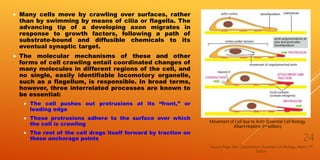
 Many cells move by crawling over surfaces, rather
than by swimming by means of cilia or flagella. The
advancing tip of a developing axon migrates in
response to growth factors, following a path of
substrate-bound and diffusible chemicals to its
eventual synaptic target.
 The molecular mechanisms of these and other
forms of cell crawling entail coordinated changes of
many molecules in different regions of the cell, and
no single, easily identifiable locomotory organelle,
such as a flagellum, is responsible. In broad terms,
however, three interrelated processes are known to
be essential:
 The cell pushes out protrusions at its “front,” or
leading edge
 These protrusions adhere to the surface over which
the cell is crawling
 The rest of the cell drags itself forward by traction on
these anchorage points
Source-Page 594, Cytoskeleton; Essential Cell Biology, Albert-3rd
Edition
24
Movement of Cell due to Actin (Essential Cell Biology,
Albert,Hopkins-3rd edition)
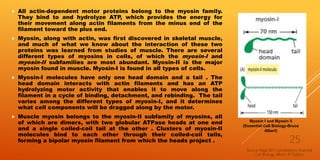
 All actin-dependent motor proteins belong to the myosin family.
They bind to and hydrolyze ATP, which provides the energy for
their movement along actin filaments from the minus end of the
filament toward the plus end.
 Myosin, along with actin, was first discovered in skeletal muscle,
and much of what we know about the interaction of these two
proteins was learned from studies of muscle. There are several
different types of myosins in cells, of which the myosin-I and
myosin-II subfamilies are most abundant. Myosin-II is the major
myosin found in muscle. Myosin-I is found in all types of cells.
 Myosin-I molecules have only one head domain and a tail . The
head domain interacts with actin filaments and has an ATP
hydrolyzing motor activity that enables it to move along the
filament in a cycle of binding, detachment, and rebinding. The tail
varies among the different types of myosin-I, and it determines
what cell components will be dragged along by the motor.
 Muscle myosin belongs to the myosin-II subfamily of myosins, all
of which are dimers, with two globular ATPase heads at one end
and a single coiled-coil tail at the other . Clusters of myosin-II
molecules bind to each other through their coiled-coil tails,
forming a bipolar myosin filament from which the heads project .
Source-Page 597, Cytoskeleton; Essential
Cell Biology, Albert-3rd Edition
25
Myosin I and Myosin II
(Essential Cell Biology-Bruce
Albert)
(A) Myosin I causing the movement of vesicles along actin and change
of shape of plasma membrane by attaching to actin causing movement.
(Essential Cell Biology-Bruce Albert)
(B) Myosin II causes relaxation and contraction of Muscles
(Essential Cell Biology-Bruce Albert)
26
QUESTIONS TO BE ANSWERED……
 Multiple Choice Questions-
1. Cytoskeletal filaments is a polymer of protein subunits held together by________________
1. Weak, Non Covalent Bond
2. Weak, Covalent Bond
3. Ionic Bond
4. None of the Above
2. When cells are treated with concentrated salt solutions and nonionic detergents, the intermediate
filaments_______________
1. Die
2. Reproduce
3. Survive
4. Repel the salt
3. Vimentin and vimentin-related filaments are found in
1. Epithelial Cells
2. Connective Tissue Cells
3. Nuclear Envelope
4. Nerve Cells
27
 Half line Answers-
1. What is Cytoskeleton?
2. Intermediate filaments are found within the nucleus of all eukaryotic
cells. What do they form there?
3. Type 3 Intermediate filaments include-
4. What are Microtubules?
5. What are Protofilaments?
6. Centrosomes contain-
 Explain…
1. Myosin and its types.
2. Keratin
3. Type 4 Intermediate Filaments. 28
Cytoskeleton

Cytoskeleton

  • 1.
    CYTOSKELETON CELL BIOLOGY ANDGENETICS NAVNEET KUMAR B.TECH (BIOTECHNOLOGY) SECOND SEMESTER
  • 2.
    WHAT IS CYTOSKELETON? The ability of eukaryotic cells to adopt a variety of shapes, organize the many components in their interior, interact mechanically with the environment, and carry out coordinated movements depends on the Cytoskeleton—an intricate network of protein filaments that extends throughout the cytoplasm Source -Page 565, Cytoskeleton; Essential Cell Biology, Albert 4th edition 2(1) Basic Structure of an Eukaryotic Cell (Molecular Cell Biology,Lodish 5th edition (2) Enlarged view of a Cytoskeleton (Molecular Cell Biology,Lodish 5th edition)
  • 3.
     This filamentousarchitecture helps to support the large volume of cytoplasm in a eukaryotic cell, a function that is particularly important in animal cells, which have no cell walls.  Although some cytoskeletal components are present in some of the microbes, the cytoskeleton is the most prominent in large and structurally complex eukaryotic cell.  Cytoskeleton is a highly dynamic structure that is continuously reorganized as a cell changes shape, divides, and responds to its environment.  The cytoskeleton is not only the “bones” of a cell but its “muscles” too, and it is directly responsible for large-scale movements such as the crawling of cells along a surface, contraction of muscle cells, and the changes in cell shape that take place as an embryo develops.  Without the cytoskeleton, wounds would never heal, muscles would be useless, and sperm would never reach the egg.  The cytoskeleton is composed of three well-defined filamentous structures—  Intermediate Filaments  Microtubules  Microfilaments that together form an elaborate interactive network. Each of the three types of cytoskeletal filaments is a polymer of protein subunits held together by weak, non-covalent bonds. Source -Page 565, Cytoskeleton; Essential Cell Biology, Albert 4th edition 3
  • 4.
    1.INTERMEDIATE FILAMENTS  Intermediatefilaments have great tensile strength, and their main function is to enable cells to withstand the mechanical stress that occurs when cells are stretched.  The filaments are called “intermediate” because, in the smooth muscle cells where they were first discovered, their diameter (about 10 nm) is between that of the thinner actin filaments and the thicker myosin filaments. Source -Page 567, Cytoskeleton; Essential Cell Biology, Albert 4th edition 4 1. Immunofluorescence Micrograph of a stained culture of Epithelial Cells, showing lacelike network of Intermediate keratin Filaments (Source-Essential Cell Biology, Albert, 3rd edition) 2. Drawing from an electron micrograph of a section of epidermis showing the bundles of intermediate filaments that traverse the cytoplasm and are inserted at desmosomes. (Source-Essential Cell Biology, Albert, 3rd edition)
  • 5.
     Intermediate filamentsare the toughest and most durable of the cytoskeletal filaments. When cells are treated with concentrated salt solutions and nonionic detergents, the intermediate filaments survive, while most of the rest of the cytoskeleton is destroyed.  Intermediate filaments are found in the cytoplasm of most animal cells. They typically form a network throughout the cytoplasm, surrounding the nucleus and extending out to the cell periphery. There they are often anchored to the plasma membrane at cell–cell junctions called desmosomes ,where the plasma membrane is connected to that of another cell.  Intermediate filaments are also found within the nucleus of all eukaryotic cells. There they form a meshwork called the nuclear lamina, which underlies and strengthens the nuclear envelope.  In all cells, intermediate filaments distribute the effect of locally applied forces, thereby keeping cells and their membranes from tearing in response to mechanical shear.  Filaments of each class are formed by polymerization of their corresponding intermediate filament subunits. Source -Page 567, Cytoskeleton; Essential Cell Biology, Albert 4th edition 5
  • 6.
    6 Intermediate filaments canbe grouped into four classes:
  • 7.
    (Source- Page 574;Cytoskeleton;EssentialCell Biology, Albert, Hopkins -3rd Edition) 7
  • 8.
    KERATIN (TYPE 1AND 2 IF)  They are found primarily in epithelial cells and include two subfamilies of keratin (also celled tono, perakeratin or cytokeratin) : acidic keratin and neutral or basic keratin.  Keratin filaments are heteropolymers formed from an equal number of subunits from each of two keratin subfamilies. The keratins are most complex class of IF proteins, with at least 19 distinct forms in human epithelia and 8 more in the keratins of hair and nails.  Type I and Type II consists of 2 groups of Keratins, each consisting of about 15 different proteins expressed in epithelial cells.  Each type of epithelial cell synthesizes at least one type I(acidic) and one type II(basic/neutral)keratin , which copolymerize to form filaments.  Some of the type I and type II(Hard Keratins) are used for production of structures such as hair, nails and horns. Other type I and type II keratins(Soft Keratins) are abundant in the cytoplasm of epithelial cells with different keratins being expressed in various differentiated cell types.  Keratin filaments typically span over the interiors of epithelial cells from one side of the cell to the other, and filaments in adjacent epithelial cells are indirectly connected through cell–cell junctions called desmosomes .  The ends of the keratin filaments are anchored to the desmosomes, and they associate laterally with other cell components through their globular head and tail domains, which project from the surface of the assembled filament. This cabling of high tensile strength, formed by the filaments throughout the epithelial sheet, distributes the stress that occurs when the skin is stretched. 1&2-Page 300, Cytoskeleton; Cell Biology, Genetics Molecular Biology, Evolution and Ecology- P.S.Verma and A.K Verma 3,4&5- http://ww.ncbi.nlm.nih.gov/books/NBK9834 6&7-Page 569, Cytoskeleton; Essentials of Cell Biology;Albert-4th edition 8 Staining with fluorochrome-tagged antibodies reveals cellular distribution of keratin and lamin intermediate filaments ( Molecular Cell Biology,Lodish-5th edition)
  • 9.
    VIMETIN AND VIMETINRELATED FILAMENTS(TYPE 3 IF)  They include the following four types of polypeptides: vimentin, desmin, synemin and glial fibrillary acidic protein (or glial filaments).  Vimentin is typically expressed in leukocytes, blood vessel endothelial cells, some epithelial cells, and mesenchymal cells such as fibroblasts. Vimentin filaments help support cellular membranes. Vimentin networks may also help keep the nucleus and other organelles in a defined place within the cell. Vimentin is frequently associated with microtubules and the network of vimentin filaments parallels the microtubule network.  Desmin is found in both striated (skeletal and cardiac) and smooth muscle cells. Desmin filaments in muscle cells are responsible for stabilizing sarcomeres in contracting muscle  Glial filaments occur in some type of glial cells such as astrocytes and some Schwann cells, in the nervous system.  Synemin is a protein which is also present in the intermediate filaments of muscle, together with desmin and vimentin. Vimentin and synemin containing IFs can be observed in the chicken erythrocytes.  Peripherin is found in neurons of the peripheral nervous system.  Each of these IF proteins tends to assemble spontaneously in vitro to form homopolymers and will also co-assemble with the other Type-II IF proteins to form co-polymers and heteropolymers. In fact, co-polymers of vimentin and desmin, or of vimentin and glial fibrillary acidic protein, are found in some type of cells.  For example, desmin remains concentrated in the Z-lines and T-tubule system of striated or skeletal system, together with vimentin, synemin and α- actinin. Page 301, Cytoskeleton; Cell Biology, Genetics Molecular Biology, Evolution and Ecology- P.S.Verma and A.K Verma 9 Desmin Filament in Muscles (Molecular Biology,Lodish-5th edition)
  • 10.
    NEUROFILAMENTS(TYPE 4 IF) These IF proteins assemble into neurofilaments, a major cytoskeletal element in nerve axons and dendrites, and so are called neurofilaments proteins.  In vertebrates, Type III IFs consist of three distinct polypeptides, the so-called neurofilament triplet.  They are the major components of neuronal cytoskeleton and are believed to function primarily to provide structural support for the axon and to regulate its diameter.  They are homopolymers, composed of polypeptide chains composed of same protein family.  There are three types of Neurofilaments-  NF-L -> Light  NF-M -> Medium  NF-H -> Heavy  Along with this there is another protein in this category(Type 4 IF) called α- internexin which is expressed earlier than Neurofilaments. Source-http://ww.ncbi.nlm.nih.gov/books/NBK9834 10 Intermediate Filaments in Neuronal Axon (Molecular Cell Biology,Lodish-5th edition)
  • 11.
    NUCLEAR LAMINS(TYPE 5IF)  The intermediate filament lining and strengthening of the inside surface of inner nuclear membrane are organized as a two-dimensional mesh. The intermediate filaments within this tough nuclear lamina are constructed from a class of intermediate filament proteins called lamins.  In contrast to the very stable cytoplasmic intermediate filaments found in many cells, the intermediate filaments of the nuclear lamina disassemble and re-form at each cell division, when the nuclear envelope breaks down during mitosis and then re-forms in each daughter cell.  Disassembly and reassembly of the nuclear lamina are controlled by the phosphorylation and dephosphorylation of the lamins by protein kinases. When the lamins are phosphorylated, the consequent conformational change weakens the binding between the tetramers and causes the filament to fall apart. Dephosphorylation at the end of mitosis causes the lamins to reassemble. Source-Page 570 & 571 , Cytoskeleton; Essential Cell Biology,Albert-4th Edition 11 Two Dimensional view of Nuclear Envelope (Source-Essential Cell Biology, Albert, Hopkins, 3rd Edition)
  • 12.
    Intermediate Filament ProteinM W(-𝟏𝟎 𝟑) Filament Form Tissue Distribution KERATINS 1. Acidic Keratins 40-57 Heteropolymer Epithelia 2. Basic Keratins 53-67 Heteropolymer Epithelia TYPE 3 INTERMEDIATE FILAMENTS 1.Vimetin 57 Homo- and Heteropolymer Mesenchyme(fibroblast) 2.Desmin 53 Homo- and Heteropolymer Muscle 3.Glial Fibrillary Acidic Protein 50 Homo- and Heteropolymer Glial Cells, Astrocytes 4.Peripherin 57 Homo- and Heteropolymer Peripheral and Central Neurons NEUROFILAMENTS 1.NF-L 62 Homopolymer Mature Neurons 2.NF-M 102 Heteropolymer Mature Neurons 3.NF-H 110 Heteropolymer Mature Neurons 4.Internexin 66 - CNS NUCLEAR LAMINS 1.Lamin-A 70 Homopolymer Nucleus 2.Lamin-B 67 Homopolymer Nucleus 3.Lamin-C 67 Homopolymer Nucleus Primary Intermediate Filaments in Mammals. Source- Page 807, Cytoskeleton I; Molecular Cell Biology;Lodish-5th edition 12
  • 13.
    2. MICROTUBULES  Microtubulesare long and relatively stiff hollow tubes of protein that can rapidly disassemble in one location and reassemble in another.  In a typical animal cell, microtubules grow out from centrosome. Extending out toward the cell periphery, they create a system of tracks within the cell, along which vesicles, organelles, and other cell components are moved.  These and other systems of cytoplasmic microtubules are the part of the cytoskeleton mainly responsible for anchoring membrane-enclosed organelles within the cell and for guiding intracellular transport.  When a cell enters mitosis, the cytoplasmic microtubules disassemble and then reassemble into an intricate structure called the mitotic spindle.  The mitotic spindle provides the machinery that will segregate the chromosomes equally into the two daughter cells just before a cell divides .  These extend from the surface of many eukaryotic cells, which use them either as a means of propulsion or to sweep fluid over the cell surface. The core of a eukaryotic cilium or flagellum consists of a highly organized and stable bundle of microtubules. Source-Page 571, Cytoskeleton; Essential Cell Biology, Albert 4th edition 13 Microtubules usually grow out of an organizing structure (Source- Essential Cell Biology, Albert,Hopkins-3rd edition)
  • 14.
     Microtubules arebuilt from subunits—molecules of tubulin—each of which is itself a dimer composed of two very similar globular proteins called α- tubulin and β-tubulin, bound tightly together by non- covalent bonding. The tubulin dimers stack together, again by non-covalent bonding, to form the wall of the hollow cylindrical microtubule.  This tube-like structure is made of 13 parallel protofilaments, each a linear chain of tubulin dimers with α- and β-tubulin alternating along its length.  Each protofilament has a structural polarity, with α- tubulin exposed at one end and β-tubulin at the other, and this polarity—the directional arrow embodied in the structure—is the same for all the protofilaments, giving a structural polarity to the microtubule as a whole. One end of the microtubule, thought to be the β-tubulin end, is called its plus end, and the other, the α-tubulin end, its minus end. Source-Page 572, Cytoskeleton; Essential Cell Biology, Albert-4th edition 14 Structure of tubulin monomer &Formation of Microtubule ( Source- Molecular Cell Biology,Lodish-5th edition; Essential Cell Biology, Albert,Hopkins-3rd edition)
  • 15.
     Microtubules incells are formed by outgrowth from specialized organizing centers, which control the number of microtubules formed, their location and their orientation in the cytoplasm.  Centrosomes contain hundreds of ring-shaped structures formed from γ-tubulin, and each γ-tubulin ring serves as the starting point, or nucleation site, for the growth of one microtubule .  The αβ-tubulin dimers add to the γ-tubulin ring in a specific orientation, with the result that the minus end of each microtubule is embedded in the centrosome and growth occurs only at the plus end i.e. at the outward- facing end.  In addition to its γ-tubulin rings, the centrosome in most animal cells also contains a pair of centrioles, curious structures each made of a cylindrical array of short microtubules.  Purified free αβ-tubulin can polymerize spontaneously in vitro when at a high concentration, but in the living cell, the concentration of free αβ-tubulin is too low to drive the difficult first step of assembling the initial ring of a new microtubule. By providing organizing centers containing nucleation sites, and keeping the concentration of free αβ-tubulin dimers low, cells can thus control where microtubules form. Source-Page 579, Cytoskeleton; Essential Cell Biology, Albert-3rd edition 15 Tubulin polymerizes from nucleation sites on a centrosome(Source- Essential Cell Biology, Albert,Hopkins-3rd edition)
  • 16.
    DYNAMIC INSTABILITY OFMICROTUBULES-  Once a microtubule has been nucleated, its plus end typically grows outward from the organizing center by the addition of αβ-tubulin subunits for many minutes.  Then, without warning, the microtubule suddenly undergoes a transition that causes it to shrink rapidly inward by losing subunits from its free end . It may shrink partially and then, no less suddenly, start growing again, or it may disappear completely, to be replaced by a new microtubule from the same γ-tubulin ring . This remarkable behavior, known as Dynamic Instability, stems from the intrinsic capacity of tubulin molecules to hydrolyze GTP.  Each free tubulin dimer contains one tightly bound GTP molecule that is hydrolyzed to GDP (still tightly bound) shortly after the subunit is added to a growing microtubule. The GTP-associated tubulin molecules pack efficiently together in the wall of the microtubule, whereas tubulin molecules carrying GDP have a different conformation and bind less strongly to each other.  When polymerization is proceeding rapidly, tubulin molecules add to the end of the microtubule faster than the GTP they carry is hydrolyzed. The end of a growing microtubule is therefore composed entirely of GTP tubulin subunits, forming what is known as a GTP cap.  In this situation, the growing microtubule continues to grow . Because of the randomness of chemical processes, however, it will occasionally happen that tubulin at the free end of the microtubule hydrolyzes its GTP before the next tubulin has been added, so that the free ends of protofilaments are now composed of GDP-tubulin subunits.  This change tips the balance in favor of disassembly. Because the rest of the microtubule is composed of GDP-tubulin, once depolymerization has started, it will tend to continue, often at a catastrophic rate; the microtubule starts to shrink rapidly and continuously, and may even disappear. The GDP-containing tubulin molecules that are freed as the microtubule depolymerizes, join the unpolymerized tubulin molecules already in the cytosol.  This situation is quite unlike the arrangement with the more stable intermediate filaments, where the subunits are typically almost completely in the fully assembled form. The tubulin molecules joining the pool then exchange their bound GDP for GTP, thereby becoming competent again to add to another microtubule that is in a growth phase. Source-Page 580, Cytoskeleton; Essential Cell Biology, Albert-3rd edition 16
  • 17.
     (A) Tubulindimers carrying GTP (red) bind more tightly to one another than do tubulin dimers carrying GDP (dark green). Therefore, microtubules that have freshly added tubulin dimers at their end with GTP bound tend to keep growing.  (B) From time to time, however, especially when microtubule growth is slow, the subunits in this GTP cap will hydrolyze their GTP to GDP before fresh subunits loaded with GTP have time to bind. the GTP cap is thereby lost; the GDP carrying subunits are less tightly bound in the polymer and are readily released from the free end, so that the microtubule begins to shrink continuously Source-Page 580, Cytoskeleton; Essential Cell Biology, Albert-3rd edition 17Growing and Shrinking of Microtubules ( Source- Essential Cell Biology, Albert,Hopkins-3rd edition)
  • 18.
    Functions of Microtubules- Mechanical function The shape of the cell (e.g., red blood cells of non-mammalian vertebrates) and some cell processes or protuberances such as axons and dendrites of neurons, microvilli, etc., have been correlated to the orientation and distribution of microtubules.  Morphogenesis During cell differentiation, the mechanical function of microtubules is used to determine the shape of the developing cells. For example, the enormous elongation in the nucleus of the spermatid during spermatogenesis is accompanied by the production of an orderly array of microtubules that are wrapped around the nucleus in a double helical arrangement. Likewise, the elongation of the cells during induction of the lens placode in the eye is also accompanied by the appearance of numerous microtubules.  Cellular polarity and motility The determination of the intrinsic polarity of certain cells is also related to the microtubules. Directional gliding of cultured cells is found to depend on the microtubules.  Contraction Microtubules play a role in the contraction of the spindle and movement of chromosomes and centrioles as well as in ciliary and flagellar motion.  Circulation and transport Microtubules are involved in the transport of macromolecules, granules and vesicles within the cell. Source-Page 298, Cytoskeleton; Cell Biology, Genetics Molecular Biology, Evolution and Ecology- P.S.Verma and A.K Verma 18
  • 19.
    3.MICROFILAMENT  Microfilaments aregenerally distributed in the cortical regions of the cell just beneath the plasma membrane. Microfilaments also extend into cell processes, especially where there is movement.  Thin, solid microfilaments of actin protein, ranging between 5 to 7 nm in diameter and indeterminate length, represent the active or motile part of the cytoskeleton.  Without actin filaments, for example, an animal cell could not crawl along a surface, engulf a large particle by phagocytosis, or divide in two. Source -Page 299, Cytoskeleton; Cell Biology, Genetics Molecular Biology, Evolution and Ecology- P.S.Verma and A.K Verma 19 Actin Filament (Source- Essential Cell Biology, Albert,Hopkins-3rd edition)
  • 20.
     Like microtubules,many actin filaments are unstable, but by associating with other proteins they can also form stable structures in cells, such as the contractile apparatus of muscle.  Actin filaments interact with a large number of actin-binding proteins that enable the filaments to serve a variety of functions in cells.  Depending on their association with different proteins, actin filaments can form stiff and relatively permanent structures, such as the microvilli on the brush-border cells lining the intestine or small contractile bundles in the cytoplasm that can contract and act like the “muscles” of a cell ; they can also form temporary structures, such as the dynamic protrusions formed at the leading edge of a crawling fibroblast or the contractile ring that pinches the cytoplasm in two when an animal cell divides  Actin filaments appear in electron micrographs as threads about 7 nm in diameter. Each filament is a twisted chain of identical globular actin molecules, all of which “point” in the same direction along the axis of the chain. Like a microtubule, therefore, an actin filament has a structural polarity, with a plus end and a minus end.  Actin filaments are thinner, more flexible, and usually shorter than microtubules.  There are, however, many more of them, so that the total length of all the actin filaments in a cell is generally many times greater than the total length of all of the microtubules. Actin filaments rarely occur in isolation in the cell; they are generally found in cross-linked bundles and networks, which are much stronger than the individual filaments. Source -Page 590, Cytoskeleton; Essential Cell Biology, Albert-3rd edition 20
  • 21.
     About 5%of the total protein in a typical animal cell is actin; about half of this actin is assembled into filaments, and the other half remains as actin monomers in the cytosol.  There are a great many actin-binding proteins in cells. Most of these bind to assembled actin filaments rather than to actin monomers and control the behavior of the intact filaments  Actin-bundling proteins, for example, hold actin filaments together in parallel bundles in microvilli; other cross-linking proteins hold actin filaments together in a gel-like meshwork within the cell cortex—the layer of cytoplasm just beneath the plasma membrane; filament- severing proteins, such as gelsolin, fragment actin filaments into shorter lengths and thus can convert an actin gel to a more fluid state. Actin filaments can also associate with motor proteins to form contractile bundles, as in muscle cells. And they often form tracks along which motor proteins transport organelles, a function that is especially conspicuous in plant cells.  In most cells ,actin is highly concentrated in a layer just beneath the plasma membrane called the cell cortex in which, actin filaments are linked by actin-binding proteins into a meshwork that supports the outer surface of the cell and gives it mechanical strength. Source-Page 586,587,588, Cytoskeleton; Essential Cell Biology, Albert-4th Edition 21 Treadmilling Of Actin Filament- Treadmilling occurs when ATP –actin adds to the plus end of an actin filament at the same time that ADP actin is lost from the minus end. When the rates of addition and loss are equal, the filament stays the same length—although individual actin monomers (three of which are numbered) move through the filament from the plus to the minus end.(Source-Essential Cell Biology, Bruce Albert-4th Edition)
  • 22.
    Source-Essential Cell Biology,Albert,Hopkins- 3rd edition 22
  • 23.
    Source-Page 783, Cytoskeleton;Molecular Cell Biology, Lodish-5th edition 23
  • 24.
     Many cellsmove by crawling over surfaces, rather than by swimming by means of cilia or flagella. The advancing tip of a developing axon migrates in response to growth factors, following a path of substrate-bound and diffusible chemicals to its eventual synaptic target.  The molecular mechanisms of these and other forms of cell crawling entail coordinated changes of many molecules in different regions of the cell, and no single, easily identifiable locomotory organelle, such as a flagellum, is responsible. In broad terms, however, three interrelated processes are known to be essential:  The cell pushes out protrusions at its “front,” or leading edge  These protrusions adhere to the surface over which the cell is crawling  The rest of the cell drags itself forward by traction on these anchorage points Source-Page 594, Cytoskeleton; Essential Cell Biology, Albert-3rd Edition 24 Movement of Cell due to Actin (Essential Cell Biology, Albert,Hopkins-3rd edition)
  • 25.
     All actin-dependentmotor proteins belong to the myosin family. They bind to and hydrolyze ATP, which provides the energy for their movement along actin filaments from the minus end of the filament toward the plus end.  Myosin, along with actin, was first discovered in skeletal muscle, and much of what we know about the interaction of these two proteins was learned from studies of muscle. There are several different types of myosins in cells, of which the myosin-I and myosin-II subfamilies are most abundant. Myosin-II is the major myosin found in muscle. Myosin-I is found in all types of cells.  Myosin-I molecules have only one head domain and a tail . The head domain interacts with actin filaments and has an ATP hydrolyzing motor activity that enables it to move along the filament in a cycle of binding, detachment, and rebinding. The tail varies among the different types of myosin-I, and it determines what cell components will be dragged along by the motor.  Muscle myosin belongs to the myosin-II subfamily of myosins, all of which are dimers, with two globular ATPase heads at one end and a single coiled-coil tail at the other . Clusters of myosin-II molecules bind to each other through their coiled-coil tails, forming a bipolar myosin filament from which the heads project . Source-Page 597, Cytoskeleton; Essential Cell Biology, Albert-3rd Edition 25 Myosin I and Myosin II (Essential Cell Biology-Bruce Albert)
  • 26.
    (A) Myosin Icausing the movement of vesicles along actin and change of shape of plasma membrane by attaching to actin causing movement. (Essential Cell Biology-Bruce Albert) (B) Myosin II causes relaxation and contraction of Muscles (Essential Cell Biology-Bruce Albert) 26
  • 27.
    QUESTIONS TO BEANSWERED……  Multiple Choice Questions- 1. Cytoskeletal filaments is a polymer of protein subunits held together by________________ 1. Weak, Non Covalent Bond 2. Weak, Covalent Bond 3. Ionic Bond 4. None of the Above 2. When cells are treated with concentrated salt solutions and nonionic detergents, the intermediate filaments_______________ 1. Die 2. Reproduce 3. Survive 4. Repel the salt 3. Vimentin and vimentin-related filaments are found in 1. Epithelial Cells 2. Connective Tissue Cells 3. Nuclear Envelope 4. Nerve Cells 27
  • 28.
     Half lineAnswers- 1. What is Cytoskeleton? 2. Intermediate filaments are found within the nucleus of all eukaryotic cells. What do they form there? 3. Type 3 Intermediate filaments include- 4. What are Microtubules? 5. What are Protofilaments? 6. Centrosomes contain-  Explain… 1. Myosin and its types. 2. Keratin 3. Type 4 Intermediate Filaments. 28