National costumesNational costumes
(Russia, Austria, Finland)(Russia, Austria, Finland)
Russian costumeRussian costume
(VI-XVII centuries)(VI-XVII centuries)
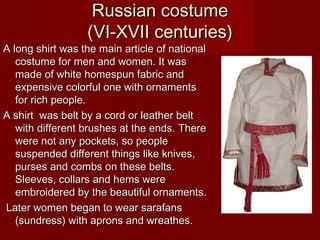
A long shirt was the main article of nationalA long shirt was the main article of national
costume for men and women. It wascostume for men and women. It was
made of white homespun fabric andmade of white homespun fabric and
expensive colorful one with ornamentsexpensive colorful one with ornaments
for rich people.for rich people.
A shirt was belt by a cord or leather beltA shirt was belt by a cord or leather belt
with different brushes at the ends.with different brushes at the ends. ThereThere
were not any pockets, so peoplewere not any pockets, so people
suspended different things like knives,suspended different things like knives,
purses and combs on these belts.purses and combs on these belts.
Sleeves, collars and hems wereSleeves, collars and hems were
embroidered by the beautiful ornaments.embroidered by the beautiful ornaments.
Later women began to wear sarafansLater women began to wear sarafans
(sundress) with aprons and wreathes.(sundress) with aprons and wreathes.
Russian costumeRussian costume
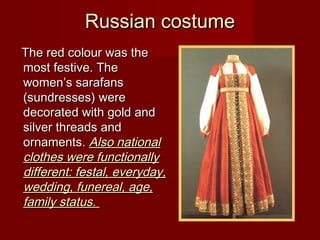
The red colour was theThe red colour was the
most festive. Themost festive. The
women’s sarafanswomen’s sarafans
(sundresses) were(sundresses) were
decorated with gold anddecorated with gold and
silver threads andsilver threads and
ornaments.ornaments. Also nationalAlso national
clothes were functionallyclothes were functionally
different: festal, everyday,different: festal, everyday,
wedding, funereal, age,wedding, funereal, age,
family status.family status.
Russian costumeRussian costume
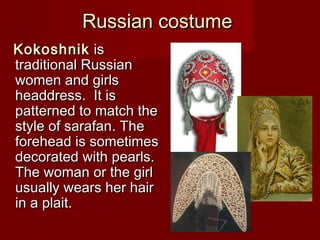
KokoshnikKokoshnik isis
traditional Russiantraditional Russian
women and girlswomen and girls
headdressheaddress.. It isIt is
patterned to match thepatterned to match the
style of sarafanstyle of sarafan.. TheThe
forehead is sometimesforehead is sometimes
decorated with pearls.decorated with pearls.
The woman or the girlThe woman or the girl
usually wears her hairusually wears her hair
in a plait.in a plait.
National Russian shoesNational Russian shoes
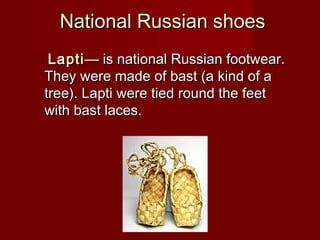
LaptiLapti—— is national Russian footwear.is national Russian footwear.
They were made of bast (a kind of aThey were made of bast (a kind of a
tree). Lapti were tied round the feettree). Lapti were tied round the feet
with bast laces.with bast laces.
Russian Peasant CostumeRussian Peasant Costume
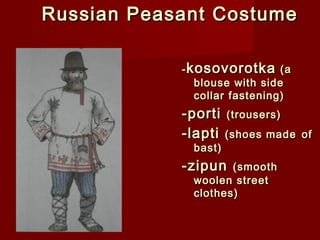
-- kosovorotkakosovorotka (a(a
blouse with sideblouse with side
collar fastening)collar fastening)
--portiporti (trousers)(trousers)
--laptilapti (shoes made(shoes made ofof
bast)bast)
--zipunzipun (smooth(smooth
woolen streetwoolen street
clothesclothes))
Russian costumeRussian costume
(XVII-XVIII centuries)(XVII-XVIII centuries)
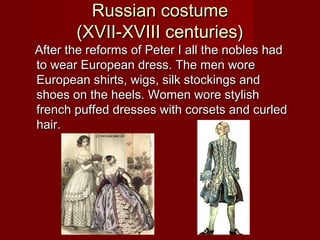
After the reforms of Peter I all the nobles hadAfter the reforms of Peter I all the nobles had
to wear European dress. The men woreto wear European dress. The men wore
European shirts, wigs, silk stockings andEuropean shirts, wigs, silk stockings and
shoes on the heels. Women wore stylishshoes on the heels. Women wore stylish
french puffed dresses with corsets and curledfrench puffed dresses with corsets and curled
hair.hair.
Russian costumeRussian costume
(XIX century)(XIX century)
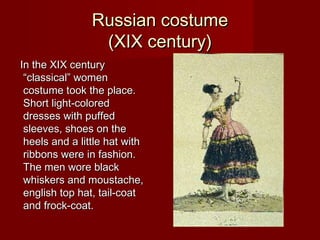
In the XIX centuryIn the XIX century
“classical” women“classical” women
costume took the place.costume took the place.
Short light-coloredShort light-colored
dresses with puffeddresses with puffed
sleeves, shoes on thesleeves, shoes on the
heels and a little hat withheels and a little hat with
ribbons were in fashion.ribbons were in fashion.
The men wore blackThe men wore black
whiskers and moustache,whiskers and moustache,
english top hat, tail-coatenglish top hat, tail-coat
and frock-coat.and frock-coat.
Merchant and his wifeMerchant and his wife
Austrian costumeAustrian costume
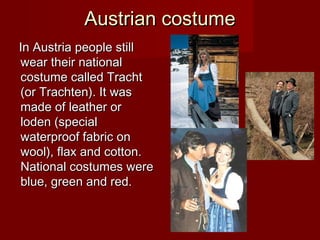
In Austria people stillIn Austria people still
wear their nationalwear their national
costume called Trachtcostume called Tracht
(or Trachten). It was(or Trachten). It was
made of leather ormade of leather or
loden (specialloden (special
waterproof fabric onwaterproof fabric on
wool), flax and cotton.wool), flax and cotton.
National costumes wereNational costumes were
blue, green and red.blue, green and red.
Austrian costumeAustrian costume
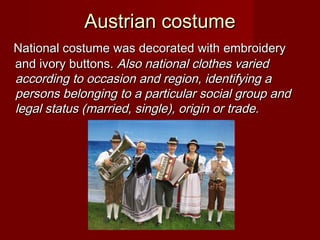
National costumeNational costume was decorated withwas decorated with embroideryembroidery
and ivory buttons.and ivory buttons. Also national clothes variedAlso national clothes varied
according to occasion and region, identifying aaccording to occasion and region, identifying a
persons belonging to a particular social group andpersons belonging to a particular social group and
legal status (married, single), origin or trade.legal status (married, single), origin or trade.
Austrian costumeAustrian costume
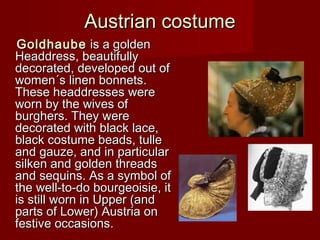
GoldhaubeGoldhaube is a gis a goldenolden
HeaddressHeaddress,, beautifullybeautifully
decorateddecorated,, ddeveloped out ofeveloped out of
women´s linen bonnetswomen´s linen bonnets..
These hThese headdresseseaddresses werewere
worn by the wives ofworn by the wives of
burghers. They wereburghers. They were
decorated with black lace,decorated with black lace,
black costume beads, tulleblack costume beads, tulle
and gauze, and in particularand gauze, and in particular
silken and golden threadssilken and golden threads
and sequins. As a symbol ofand sequins. As a symbol of
the well-to-do bourgeoisie, itthe well-to-do bourgeoisie, it
is still worn in Upper (andis still worn in Upper (and
parts of Lower) Austria onparts of Lower) Austria on
festive occasionsfestive occasions..
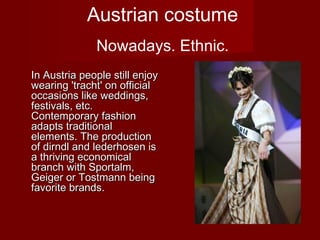
In Austria people still enjoyIn Austria people still enjoy
wearing 'tracht' on officialwearing 'tracht' on official
occasions like weddings,occasions like weddings,
festivals, etc.festivals, etc.
Contemporary fashionContemporary fashion
adapts traditionaladapts traditional
elements. The productionelements. The production
of dirndl and lederhosen isof dirndl and lederhosen is
a thriving economicala thriving economical
branch with Sportalm,branch with Sportalm,
Geiger or Tostmann beingGeiger or Tostmann being
favorite brands.favorite brands.
Austrian costume
Nowadays. Ethnic.
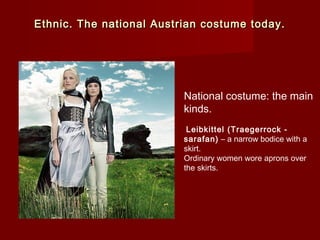
Ethnic. The national Austrian costume today.Ethnic. The national Austrian costume today.
National costume: the main
kinds.     
 
Leibkittel (Traegerrock -
sarafan) – a narrow bodice with a
skirt.
Ordinary women wore aprons over
the skirts.
Austrian costume
Nowadays
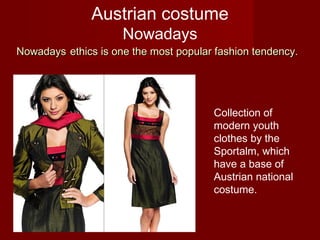
Collection of
modern youth
clothes by the
Sportalm, which
have a base of
Austrian national
costume.
NowadaysNowadays ethics is one the most popular fashion tendency.ethics is one the most popular fashion tendency.
Finnish costumeFinnish costume
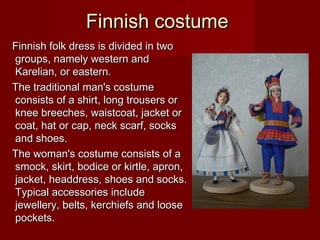
Finnish folk dress is divided in twoFinnish folk dress is divided in two
groups, namely western andgroups, namely western and
Karelian, or eastern.Karelian, or eastern.
The traditional man's costumeThe traditional man's costume
consists of a shirt, long trousers orconsists of a shirt, long trousers or
knee breeches, waistcoat, jacket orknee breeches, waistcoat, jacket or
coat, hat or cap, neck scarf, sockscoat, hat or cap, neck scarf, socks
and shoes.and shoes.
The woman's costume consists of aThe woman's costume consists of a
smock, skirt, bodice or kirtle, apron,smock, skirt, bodice or kirtle, apron,
jacket, headdress, shoes and socks.jacket, headdress, shoes and socks.
Typical accessories includeTypical accessories include
jewellery, belts, kerchiefs and loosejewellery, belts, kerchiefs and loose
pockets.pockets.
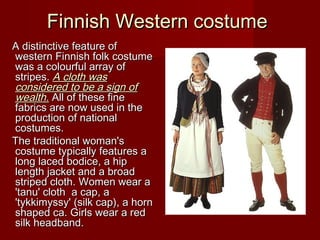
Finnish Western costumeFinnish Western costume
A distinctive feature ofA distinctive feature of
western Finnish folk costumewestern Finnish folk costume
waswas aa colourful array ofcolourful array of
stripesstripes.. AA cloth wascloth was
considered to be a sign ofconsidered to be a sign of
wealth.wealth. All of these fineAll of these fine
fabrics are now used in thefabrics are now used in the
productionproduction of nationalof national
costumes.costumes.
The traditional woman'sThe traditional woman's
costume typically features acostume typically features a
long laced bodice, a hiplong laced bodice, a hip
length jacket andlength jacket and aa broadbroad
striped cloth.striped cloth. Women wear aWomen wear a
'tanu' cloth'tanu' cloth aa cap, acap, a
'tykkimyssy''tykkimyssy' ((silk capsilk cap)), a horn, a horn
shaped ca. Girls wear a redshaped ca. Girls wear a red
silk headband.silk headband.
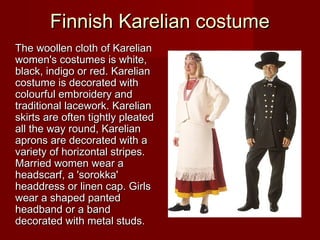
Finnish Karelian costumeFinnish Karelian costume
The woollen cloth of KarelianThe woollen cloth of Karelian
women's costumes is white,women's costumes is white,
black, indigo or red. Karelianblack, indigo or red. Karelian
costume is decorated withcostume is decorated with
colourful embroidery andcolourful embroidery and
traditional lacework. Kareliantraditional lacework. Karelian
skirts are often tightly pleatedskirts are often tightly pleated
all the way round, Karelianall the way round, Karelian
aprons are decorated with aaprons are decorated with a
variety of horizontal stripes.variety of horizontal stripes.
Married women wear aMarried women wear a
headscarf, a 'sorokka'headscarf, a 'sorokka'
headdress or linen cap. Girlsheaddress or linen cap. Girls
wear a shaped pantedwear a shaped panted
headband or a bandheadband or a band
decorated with metal studs.decorated with metal studs.
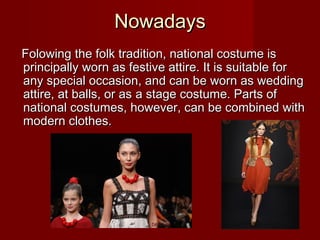
NowadaysNowadays
FolowingFolowing the folk tradition, national costume isthe folk tradition, national costume is
principally worn as festive attire. It is suitable forprincipally worn as festive attire. It is suitable for
any special occasion, and can be worn as weddingany special occasion, and can be worn as wedding
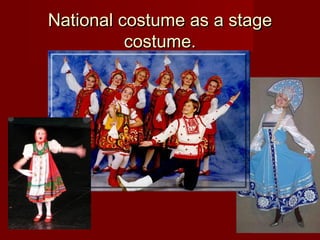
attire, at balls, or asattire, at balls, or as aa stage costumstage costume.e. Parts ofParts of
national costumes, however, can be combined withnational costumes, however, can be combined with
modern clothes.modern clothes.
FursFurs
National costume as a stageNational costume as a stage
costume.costume.
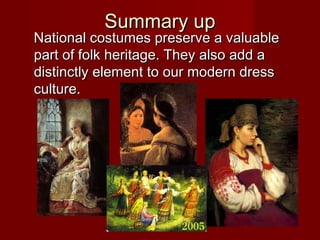
Summary upSummary up
National costumes preserve a valuableNational costumes preserve a valuable
part of folk heritage. They also add apart of folk heritage. They also add a
distinctly element to our modern dressdistinctly element to our modern dress
culture.culture.

National costumes

  • 1.
    National costumesNational costumes (Russia,Austria, Finland)(Russia, Austria, Finland)
  • 2.
    Russian costumeRussian costume (VI-XVIIcenturies)(VI-XVII centuries) A long shirt was the main article of nationalA long shirt was the main article of national costume for men and women. It wascostume for men and women. It was made of white homespun fabric andmade of white homespun fabric and expensive colorful one with ornamentsexpensive colorful one with ornaments for rich people.for rich people. A shirt was belt by a cord or leather beltA shirt was belt by a cord or leather belt with different brushes at the ends.with different brushes at the ends. ThereThere were not any pockets, so peoplewere not any pockets, so people suspended different things like knives,suspended different things like knives, purses and combs on these belts.purses and combs on these belts. Sleeves, collars and hems wereSleeves, collars and hems were embroidered by the beautiful ornaments.embroidered by the beautiful ornaments. Later women began to wear sarafansLater women began to wear sarafans (sundress) with aprons and wreathes.(sundress) with aprons and wreathes.
  • 3.
    Russian costumeRussian costume Thered colour was theThe red colour was the most festive. Themost festive. The women’s sarafanswomen’s sarafans (sundresses) were(sundresses) were decorated with gold anddecorated with gold and silver threads andsilver threads and ornaments.ornaments. Also nationalAlso national clothes were functionallyclothes were functionally different: festal, everyday,different: festal, everyday, wedding, funereal, age,wedding, funereal, age, family status.family status.
  • 4.
    Russian costumeRussian costume KokoshnikKokoshnikisis traditional Russiantraditional Russian women and girlswomen and girls headdressheaddress.. It isIt is patterned to match thepatterned to match the style of sarafanstyle of sarafan.. TheThe forehead is sometimesforehead is sometimes decorated with pearls.decorated with pearls. The woman or the girlThe woman or the girl usually wears her hairusually wears her hair in a plait.in a plait.
  • 5.
    National Russian shoesNationalRussian shoes LaptiLapti—— is national Russian footwear.is national Russian footwear. They were made of bast (a kind of aThey were made of bast (a kind of a tree). Lapti were tied round the feettree). Lapti were tied round the feet with bast laces.with bast laces.
  • 6.
    Russian Peasant CostumeRussianPeasant Costume -- kosovorotkakosovorotka (a(a blouse with sideblouse with side collar fastening)collar fastening) --portiporti (trousers)(trousers) --laptilapti (shoes made(shoes made ofof bast)bast) --zipunzipun (smooth(smooth woolen streetwoolen street clothesclothes))
  • 7.
    Russian costumeRussian costume (XVII-XVIIIcenturies)(XVII-XVIII centuries) After the reforms of Peter I all the nobles hadAfter the reforms of Peter I all the nobles had to wear European dress. The men woreto wear European dress. The men wore European shirts, wigs, silk stockings andEuropean shirts, wigs, silk stockings and shoes on the heels. Women wore stylishshoes on the heels. Women wore stylish french puffed dresses with corsets and curledfrench puffed dresses with corsets and curled hair.hair.
  • 8.
    Russian costumeRussian costume (XIXcentury)(XIX century) In the XIX centuryIn the XIX century “classical” women“classical” women costume took the place.costume took the place. Short light-coloredShort light-colored dresses with puffeddresses with puffed sleeves, shoes on thesleeves, shoes on the heels and a little hat withheels and a little hat with ribbons were in fashion.ribbons were in fashion. The men wore blackThe men wore black whiskers and moustache,whiskers and moustache, english top hat, tail-coatenglish top hat, tail-coat and frock-coat.and frock-coat.
  • 9.
    Merchant and hiswifeMerchant and his wife
  • 10.
    Austrian costumeAustrian costume InAustria people stillIn Austria people still wear their nationalwear their national costume called Trachtcostume called Tracht (or Trachten). It was(or Trachten). It was made of leather ormade of leather or loden (specialloden (special waterproof fabric onwaterproof fabric on wool), flax and cotton.wool), flax and cotton. National costumes wereNational costumes were blue, green and red.blue, green and red.
  • 11.
    Austrian costumeAustrian costume NationalcostumeNational costume was decorated withwas decorated with embroideryembroidery and ivory buttons.and ivory buttons. Also national clothes variedAlso national clothes varied according to occasion and region, identifying aaccording to occasion and region, identifying a persons belonging to a particular social group andpersons belonging to a particular social group and legal status (married, single), origin or trade.legal status (married, single), origin or trade.
  • 12.
    Austrian costumeAustrian costume GoldhaubeGoldhaubeis a gis a goldenolden HeaddressHeaddress,, beautifullybeautifully decorateddecorated,, ddeveloped out ofeveloped out of women´s linen bonnetswomen´s linen bonnets.. These hThese headdresseseaddresses werewere worn by the wives ofworn by the wives of burghers. They wereburghers. They were decorated with black lace,decorated with black lace, black costume beads, tulleblack costume beads, tulle and gauze, and in particularand gauze, and in particular silken and golden threadssilken and golden threads and sequins. As a symbol ofand sequins. As a symbol of the well-to-do bourgeoisie, itthe well-to-do bourgeoisie, it is still worn in Upper (andis still worn in Upper (and parts of Lower) Austria onparts of Lower) Austria on festive occasionsfestive occasions..
  • 13.
    In Austria peoplestill enjoyIn Austria people still enjoy wearing 'tracht' on officialwearing 'tracht' on official occasions like weddings,occasions like weddings, festivals, etc.festivals, etc. Contemporary fashionContemporary fashion adapts traditionaladapts traditional elements. The productionelements. The production of dirndl and lederhosen isof dirndl and lederhosen is a thriving economicala thriving economical branch with Sportalm,branch with Sportalm, Geiger or Tostmann beingGeiger or Tostmann being favorite brands.favorite brands. Austrian costume Nowadays. Ethnic.
  • 14.
    Ethnic. The nationalAustrian costume today.Ethnic. The national Austrian costume today. National costume: the main kinds.        Leibkittel (Traegerrock - sarafan) – a narrow bodice with a skirt. Ordinary women wore aprons over the skirts.
  • 15.
    Austrian costume Nowadays Collection of modernyouth clothes by the Sportalm, which have a base of Austrian national costume. NowadaysNowadays ethics is one the most popular fashion tendency.ethics is one the most popular fashion tendency.
  • 16.
    Finnish costumeFinnish costume Finnishfolk dress is divided in twoFinnish folk dress is divided in two groups, namely western andgroups, namely western and Karelian, or eastern.Karelian, or eastern. The traditional man's costumeThe traditional man's costume consists of a shirt, long trousers orconsists of a shirt, long trousers or knee breeches, waistcoat, jacket orknee breeches, waistcoat, jacket or coat, hat or cap, neck scarf, sockscoat, hat or cap, neck scarf, socks and shoes.and shoes. The woman's costume consists of aThe woman's costume consists of a smock, skirt, bodice or kirtle, apron,smock, skirt, bodice or kirtle, apron, jacket, headdress, shoes and socks.jacket, headdress, shoes and socks. Typical accessories includeTypical accessories include jewellery, belts, kerchiefs and loosejewellery, belts, kerchiefs and loose pockets.pockets.
  • 17.
    Finnish Western costumeFinnishWestern costume A distinctive feature ofA distinctive feature of western Finnish folk costumewestern Finnish folk costume waswas aa colourful array ofcolourful array of stripesstripes.. AA cloth wascloth was considered to be a sign ofconsidered to be a sign of wealth.wealth. All of these fineAll of these fine fabrics are now used in thefabrics are now used in the productionproduction of nationalof national costumes.costumes. The traditional woman'sThe traditional woman's costume typically features acostume typically features a long laced bodice, a hiplong laced bodice, a hip length jacket andlength jacket and aa broadbroad striped cloth.striped cloth. Women wear aWomen wear a 'tanu' cloth'tanu' cloth aa cap, acap, a 'tykkimyssy''tykkimyssy' ((silk capsilk cap)), a horn, a horn shaped ca. Girls wear a redshaped ca. Girls wear a red silk headband.silk headband.
  • 18.
    Finnish Karelian costumeFinnishKarelian costume The woollen cloth of KarelianThe woollen cloth of Karelian women's costumes is white,women's costumes is white, black, indigo or red. Karelianblack, indigo or red. Karelian costume is decorated withcostume is decorated with colourful embroidery andcolourful embroidery and traditional lacework. Kareliantraditional lacework. Karelian skirts are often tightly pleatedskirts are often tightly pleated all the way round, Karelianall the way round, Karelian aprons are decorated with aaprons are decorated with a variety of horizontal stripes.variety of horizontal stripes. Married women wear aMarried women wear a headscarf, a 'sorokka'headscarf, a 'sorokka' headdress or linen cap. Girlsheaddress or linen cap. Girls wear a shaped pantedwear a shaped panted headband or a bandheadband or a band decorated with metal studs.decorated with metal studs.
  • 19.
    NowadaysNowadays FolowingFolowing the folktradition, national costume isthe folk tradition, national costume is principally worn as festive attire. It is suitable forprincipally worn as festive attire. It is suitable for any special occasion, and can be worn as weddingany special occasion, and can be worn as wedding attire, at balls, or asattire, at balls, or as aa stage costumstage costume.e. Parts ofParts of national costumes, however, can be combined withnational costumes, however, can be combined with modern clothes.modern clothes.
  • 20.
  • 21.
    National costume asa stageNational costume as a stage costume.costume.
  • 22.
    Summary upSummary up Nationalcostumes preserve a valuableNational costumes preserve a valuable part of folk heritage. They also add apart of folk heritage. They also add a distinctly element to our modern dressdistinctly element to our modern dress culture.culture.