Biopharma PEG https://www.biochempeg.com
Cyclic Peptides: Current Status & Future
Prospects
Peptide drugs, with their high purity, low toxicity and good biological activity, have become
a hotspot for new drug development worldwide. The therapeutic potential of peptides has
been exploited in the fields of antibacterial, antihypertensive, antioxidant, anticancer,
antidiabetic and anti-inflammatory, etc. However, there are many problems in the
research and development of peptide drugs, such as the lack of stability of peptide drugs,
the difficulty in finding targets, the short half-life, and the poor cell permeability.
Researchers have made unremitting efforts to optimize peptides in order to improve the
bioavailability of peptide drugs. Cyclization of peptides is one of the methods to
optimize peptides. Cyclic peptides combine several favorable properties such as good
binding affinity, target selectivity and low toxicity that make them an attractive modality for
the development of therapeutics.
What Are Cyclic Peptides?
Cyclic peptides are polypeptide chains that are formed by a cyclic sequence of 5 to
14 amino acids with a molecular weight of about 500 to 2000 Da. Cyclic peptide
molecules are present in almost all living organisms, from small bacteria to large plants
and mammals. These cyclic peptides have a variety of novel structures, including not only
peptide bonds, but also ether, thioether, lactone, and disulfide bonds in the skeleton.
Moreover, it has been found that many cyclic peptides have excellent biological activities,
including antibacterial, antitumor and immunosuppression. Therefore, the research on
cyclic peptides is receiving more and more attention.
Classification of Cyclic Peptides
According to the type of bond between the two amino acids that furnishes the cycle ring,
cyclic peptides can be classified into two major categories: homodetic and
heterodetic. Homodetic cyclic peptides are those in which the ring is composed
Biopharma PEG https://www.biochempeg.com
exclusively of normal peptide bonds (i.e. between the alpha carboxyl of one residue to the
alpha amine of another), such as cyclosporine A. Heterodetic cyclic peptides contain
diverse functional groups (at least one non-alpha amide linkage) used to connect the
amino acids.
On the basis of the site of the two reactive groups within a peptide, the cyclic peptide can
be generally categorized into four types: head-to-tail, head-to-side chain, side
chain-to-tail, and side chain-to-side chain cyclization.
Figure 1. Four types of cyclic peptides, source: reference [1]
Cyclic Peptides vs. Linear Peptides
Compared with linear peptides, cyclic peptides have the following three major
advantages.
1. Greater Metabolic Stability
Biopharma PEG https://www.biochempeg.com
Peptides are susceptible to deamidation reactions on the main chain and conformational
changes of amino acid residues on the side chain, making them unstable in the organism.
Cyclic peptides are one of the methods to reduce the reactivity of peptide structures
involved in degradation reactions. Cyclic peptides have a stable and homogeneous
conformation due to their rigid structure and are resistant to degradation by peptide
hydrolases. In addition, cyclic peptides can constrain the conformation of peptide
substrates, thereby protecting them from attack by exopeptidases and endopeptidases.
2. Higher Binding Affinity and Selectivity
Cyclic peptides have moderate size and diverse functional groups, ensuring the large
contact area to provide high selectivity. Cyclic peptides have the potential to form multiple
hydrogen bonds which can lead to strong binding affinity.
3. Improved Membrane Permeability
The cyclization of peptides contributes to the formation of intramolecular hydrogen bonds
and the orientation of side chains, which in turn helps to protect polar atoms from solvent
mediators, reduces intestinal, blood, and tissue degradation, decreases flexibility, reduces
polar surface area, and facilitates the permeability of cell membranes.
Approved Cyclic Peptides
Cyclic peptide drugs hold a significant position in the peptide drugs market. As of May
2023, more than 100 peptides have been approved by regulatory agencies as therapeutic
agents and diagnostic agents. To date, more than 50 cyclic peptides have been approved
by different regulatory authorities, and many others are in clinical trials for a wide diversity
of conditions. [2]
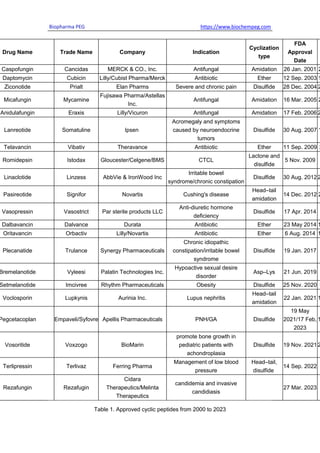
In the past 20 years, 22 cyclic peptides have been marketed, mainly from the United
States, mostly formed through disulfide and amide bonding. Most of the approved cyclic
peptides are modified from natural analogs to maintain affinity for the target protein by
maintaining the overall cyclic peptide structure.
Biopharma PEG https://www.biochempeg.com
Drug Name Trade Name Company Indication
Cyclization
type
FDA
Approval
Date
Caspofungin Cancidas MERCK & CO., Inc. Antifungal Amidation 26 Jan. 2001 2
Daptomycin Cubicin Lilly/Cubist Pharma/Merck Antibiotic Ether 12 Sep. 2003 1
Ziconotide Prialt Elan Pharms Severe and chronic pain Disulfide 28 Dec. 2004 2
Micafungin Mycamine
Fujisawa Pharma/Astellas
Inc.
Antifungal Amidation 16 Mar. 2005 2
Anidulafungin Eraxis Lilly/Vicuron Antifungal Amidation 17 Feb. 2006 2
Lanreotide Somatuline Ipsen
Acromegaly and symptoms
caused by neuroendocrine
tumors
Disulfide 30 Aug. 2007 1
Telavancin Vibativ Theravance Antibiotic Ether 11 Sep. 2009 2
Romidepsin Istodax Gloucester/Celgene/BMS CTCL
Lactone and
disulfide
5 Nov. 2009
Linaclotide Linzess AbbVie & IronWood Inc
Irritable bowel
syndrome/chronic constipation
Disulfide 30 Aug. 2012 2
Pasireotide Signifor Novartis Cushing's disease
Head–tail
amidation
14 Dec. 2012 2
Vasopressin Vasostrict Par sterile products LLC
Anti-diuretic hormone
deficiency
Disulfide 17 Apr. 2014
Dalbavancin Dalvance Durata Antibiotic Ether 23 May 2014 1
Oritavancin Orbactiv Lilly/Novartis Antibiotic Ether 6 Aug. 2014 1
Plecanatide Trulance Synergy Pharmaceuticals
Chronic idiopathic
constipation/irritable bowel
syndrome
Disulfide 19 Jan. 2017
Bremelanotide Vyleesi Palatin Technologies Inc.
Hypoactive sexual desire
disorder
Asp–Lys 21 Jun. 2019
Setmelanotide Imcivree Rhythm Pharmaceuticals Obesity Disulfide 25 Nov. 2020 1
Voclosporin Lupkynis Aurinia Inc. Lupus nephritis
Head–tail
amidation
22 Jan. 2021 1
Pegcetacoplan Empaveli/Syfovre Apellis Pharmaceuticals PNH/GA Disulfide
19 May
2021/17 Feb,
2023
1
Vosoritide Voxzogo BioMarin
promote bone growth in
pediatric patients with
achondroplasia
Disulfide 19 Nov. 2021 2
Terlipressin Terlivaz Ferring Pharma
Management of low blood
pressure
Head–tail,
disulfide
14 Sep. 2022
Rezafungin Rezafugin
Cidara
Therapeutics/Melinta
Therapeutics
candidemia and invasive
candidiasis
27 Mar. 2023
Table 1. Approved cyclic peptides from 2000 to 2023
Biopharma PEG https://www.biochempeg.com
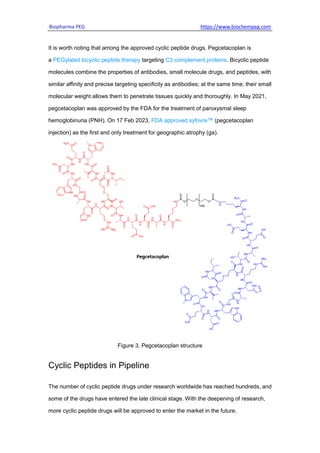
It is worth noting that among the approved cyclic peptide drugs, Pegcetacoplan is
a PEGylated bicyclic peptide therapy targeting C3 complement proteins. Bicyclic peptide
molecules combine the properties of antibodies, small molecule drugs, and peptides, with
similar affinity and precise targeting specificity as antibodies; at the same time, their small
molecular weight allows them to penetrate tissues quickly and thoroughly. In May 2021,
pegcetacoplan was approved by the FDA for the treatment of paroxysmal sleep
hemoglobinuria (PNH). On 17 Feb 2023, FDA approved syfovre™ (pegcetacoplan
injection) as the first and only treatment for geographic atrophy (ga).
Figure 3. Pegcetacoplan structure
Cyclic Peptides in Pipeline
The number of cyclic peptide drugs under research worldwide has reached hundreds, and
some of the drugs have entered the late clinical stage. With the deepening of research,
more cyclic peptide drugs will be approved to enter the market in the future.
Biopharma PEG https://www.biochempeg.com
Name
Generic
Name
Company Target Indication
Highest
Phase
RA-101495 Zilucoplan
Ra
Pharmaceuticals
C5
Paroxysmal nocturnal
hemoglobinuria, generalized
myasthenia gravis
IND
MK-0616 MSD PCRK9 hypercholesterolemia III
BT8009
Bicycle
Therapeutics
NECTIN-4
Cancer types, where Nectin-4 is
expressed
II
BT1718
Bicycle
Therapeutics
MMP14+Tubulin Cancer with MT1-MMP expression II
BT5528
Bicycle
Therapeutics
EphA2
Advanced solid tumors associated
with EphA2 expression
II
POL7080
Inhaled
murepavadin
Spexis AG ——
Antibiotic to treat Pseudomonas
infections in patients with cystic
fibrosis
III
POL6326 Balixafortide Spexis AG —— Advanced breast cancers III
POL6014 Lonodelestat Spexis AG —— Cystic fibrosis II
ALRN-6924 Aileron MDM2+MDMX Chemoprotective agent II
CEND-1
Lisata
Therapeutics
CD51+NRP-1
Enhance the efficacy of
chemotherapy
II
NP-213
Taro
Pharmaceutical
NovaBiotics
—— onychomycosis II
THR-149 Thrombogenics KLKB1 Diabetic macular edema II
Table 2. Cyclic peptides in late-stage
Prospects of Cyclic Peptides
Cyclic peptides have gained increasing attention as a unique class of molecules, with
natural peptides being the main source of approved cyclic peptides in the last century. In
the last two decades, the major trend in cyclic peptide drug discovery has been the
optimization of naturally isolated cyclic peptides to improve the potency, stability and
pharmacokinetic properties of cyclic peptide drugs.
1. Modern technology for cyclic peptide drug development
From a technological point of view, cyclic peptide drug development has benefited from
rapid lead compound discovery, tunable and scalable optimization by chemical synthesis,
which is a milestone in peptide drug development. In particular, recombinant technology
combined with peptide chemistry has addressed major issues such as cyclic peptide
Biopharma PEG https://www.biochempeg.com
production, mutagenesis and primary sequence optimization. However, as the need to
target multiple proteins expands, the scope for optimization of natural cyclic peptides is
limited. The emergence of multiple screening technologies, such as mRNA display, DNA
display and phage display, has generated higher orders of magnitude of combinatorial
libraries, enabling the development of novel cyclic peptides. Meanwhile, the directed
evolution of gene-displayed cyclic peptide recombinant libraries plays an increasingly
important role in next-generation cyclic peptide drug discovery. In addition, the
introduction of various cyclization strategies, non-natural amino acids and even functional
building blocks can further improve the functionality of recombinant libraries, such as
chemical stability, metabolic stability and conformational stability. The development of
selection strategies also enables the discovery of cyclic peptides with specific properties
(e.g., with cell membrane permeability or high oral bioavailability).
2. PDC as a popular development direction
A second trend in cyclic peptide drug discovery is the development of peptide drug
conjugates(PDCs) to enable selective delivery of different effector molecules to target
tissues. The bicyclic peptide drug conjugates are under investigation, which offer several
advantages, such as tumor deeper penetration, less immunogenicity, and faster renal
clearance. Three investigational bicyclic peptide drug conjugates (BT1718, BT5528,
and BT8009) are in phase I/II clinical development. BT1718 is a novel bicyclic peptide
anticancer drug targeting membrane type I matrix metalloproteinase to release its toxic
payload DM1. BT5528 has shown preliminary anti-tumor activity as a drug targeting
EphA2. BT8009, as a nectin-4 targeting drug, has demonstrated anti-tumor activity.
References:
[1] Chow HY, Zhang Y, Matheson E, Li X. Ligation Technologies for the Synthesis of
Cyclic Peptides. Chem Rev. 2019;119(17):9971-10001.
doi:10.1021/acs.chemrev.8b00657
[2] PepTherDia. Available online: http://peptherdia.herokuapp.com/list
[3] Huiya Zhanga,Shiyu Chen.Cyclic peptide drugs approved in the last two decades
Biopharma PEG https://www.biochempeg.com
(2001–2021).RSC Chem Biol 2021 Nov 5,3(1):18-31.
[4] Costa, L.; Sousa, E.; Fernandes, C. Cyclic Peptides in Pipeline: What Future for These
Great Molecules? Pharmaceuticals 2023, 16, 996. https://doi.org/10.3390/ph16070996
[5]Joon-Seok Choi , Sang Hoon Joo.Recent Trends in Cyclic Peptides as Therapeutic
Agents and Biochemical Tools.Biomol Ther (Seoul) 2020 Jan 1,28(1):18-24.
Related Articles:
Complement Inhibitors as Therapeutic Agents
Peptide-Drug Conjugates (PDCs): Development Status & Research Progres
Peptide Therapeutics: Current Status And Future Directions
FDA Approved PEGylated Drugs By 2023

Cyclic Peptides Current Status & Future Prospects.pdf

  • 1.
    Biopharma PEG https://www.biochempeg.com CyclicPeptides: Current Status & Future Prospects Peptide drugs, with their high purity, low toxicity and good biological activity, have become a hotspot for new drug development worldwide. The therapeutic potential of peptides has been exploited in the fields of antibacterial, antihypertensive, antioxidant, anticancer, antidiabetic and anti-inflammatory, etc. However, there are many problems in the research and development of peptide drugs, such as the lack of stability of peptide drugs, the difficulty in finding targets, the short half-life, and the poor cell permeability. Researchers have made unremitting efforts to optimize peptides in order to improve the bioavailability of peptide drugs. Cyclization of peptides is one of the methods to optimize peptides. Cyclic peptides combine several favorable properties such as good binding affinity, target selectivity and low toxicity that make them an attractive modality for the development of therapeutics. What Are Cyclic Peptides? Cyclic peptides are polypeptide chains that are formed by a cyclic sequence of 5 to 14 amino acids with a molecular weight of about 500 to 2000 Da. Cyclic peptide molecules are present in almost all living organisms, from small bacteria to large plants and mammals. These cyclic peptides have a variety of novel structures, including not only peptide bonds, but also ether, thioether, lactone, and disulfide bonds in the skeleton. Moreover, it has been found that many cyclic peptides have excellent biological activities, including antibacterial, antitumor and immunosuppression. Therefore, the research on cyclic peptides is receiving more and more attention. Classification of Cyclic Peptides According to the type of bond between the two amino acids that furnishes the cycle ring, cyclic peptides can be classified into two major categories: homodetic and heterodetic. Homodetic cyclic peptides are those in which the ring is composed
  • 2.
    Biopharma PEG https://www.biochempeg.com exclusivelyof normal peptide bonds (i.e. between the alpha carboxyl of one residue to the alpha amine of another), such as cyclosporine A. Heterodetic cyclic peptides contain diverse functional groups (at least one non-alpha amide linkage) used to connect the amino acids. On the basis of the site of the two reactive groups within a peptide, the cyclic peptide can be generally categorized into four types: head-to-tail, head-to-side chain, side chain-to-tail, and side chain-to-side chain cyclization. Figure 1. Four types of cyclic peptides, source: reference [1] Cyclic Peptides vs. Linear Peptides Compared with linear peptides, cyclic peptides have the following three major advantages. 1. Greater Metabolic Stability
  • 3.
    Biopharma PEG https://www.biochempeg.com Peptidesare susceptible to deamidation reactions on the main chain and conformational changes of amino acid residues on the side chain, making them unstable in the organism. Cyclic peptides are one of the methods to reduce the reactivity of peptide structures involved in degradation reactions. Cyclic peptides have a stable and homogeneous conformation due to their rigid structure and are resistant to degradation by peptide hydrolases. In addition, cyclic peptides can constrain the conformation of peptide substrates, thereby protecting them from attack by exopeptidases and endopeptidases. 2. Higher Binding Affinity and Selectivity Cyclic peptides have moderate size and diverse functional groups, ensuring the large contact area to provide high selectivity. Cyclic peptides have the potential to form multiple hydrogen bonds which can lead to strong binding affinity. 3. Improved Membrane Permeability The cyclization of peptides contributes to the formation of intramolecular hydrogen bonds and the orientation of side chains, which in turn helps to protect polar atoms from solvent mediators, reduces intestinal, blood, and tissue degradation, decreases flexibility, reduces polar surface area, and facilitates the permeability of cell membranes. Approved Cyclic Peptides Cyclic peptide drugs hold a significant position in the peptide drugs market. As of May 2023, more than 100 peptides have been approved by regulatory agencies as therapeutic agents and diagnostic agents. To date, more than 50 cyclic peptides have been approved by different regulatory authorities, and many others are in clinical trials for a wide diversity of conditions. [2] In the past 20 years, 22 cyclic peptides have been marketed, mainly from the United States, mostly formed through disulfide and amide bonding. Most of the approved cyclic peptides are modified from natural analogs to maintain affinity for the target protein by maintaining the overall cyclic peptide structure.
  • 4.
    Biopharma PEG https://www.biochempeg.com DrugName Trade Name Company Indication Cyclization type FDA Approval Date Caspofungin Cancidas MERCK & CO., Inc. Antifungal Amidation 26 Jan. 2001 2 Daptomycin Cubicin Lilly/Cubist Pharma/Merck Antibiotic Ether 12 Sep. 2003 1 Ziconotide Prialt Elan Pharms Severe and chronic pain Disulfide 28 Dec. 2004 2 Micafungin Mycamine Fujisawa Pharma/Astellas Inc. Antifungal Amidation 16 Mar. 2005 2 Anidulafungin Eraxis Lilly/Vicuron Antifungal Amidation 17 Feb. 2006 2 Lanreotide Somatuline Ipsen Acromegaly and symptoms caused by neuroendocrine tumors Disulfide 30 Aug. 2007 1 Telavancin Vibativ Theravance Antibiotic Ether 11 Sep. 2009 2 Romidepsin Istodax Gloucester/Celgene/BMS CTCL Lactone and disulfide 5 Nov. 2009 Linaclotide Linzess AbbVie & IronWood Inc Irritable bowel syndrome/chronic constipation Disulfide 30 Aug. 2012 2 Pasireotide Signifor Novartis Cushing's disease Head–tail amidation 14 Dec. 2012 2 Vasopressin Vasostrict Par sterile products LLC Anti-diuretic hormone deficiency Disulfide 17 Apr. 2014 Dalbavancin Dalvance Durata Antibiotic Ether 23 May 2014 1 Oritavancin Orbactiv Lilly/Novartis Antibiotic Ether 6 Aug. 2014 1 Plecanatide Trulance Synergy Pharmaceuticals Chronic idiopathic constipation/irritable bowel syndrome Disulfide 19 Jan. 2017 Bremelanotide Vyleesi Palatin Technologies Inc. Hypoactive sexual desire disorder Asp–Lys 21 Jun. 2019 Setmelanotide Imcivree Rhythm Pharmaceuticals Obesity Disulfide 25 Nov. 2020 1 Voclosporin Lupkynis Aurinia Inc. Lupus nephritis Head–tail amidation 22 Jan. 2021 1 Pegcetacoplan Empaveli/Syfovre Apellis Pharmaceuticals PNH/GA Disulfide 19 May 2021/17 Feb, 2023 1 Vosoritide Voxzogo BioMarin promote bone growth in pediatric patients with achondroplasia Disulfide 19 Nov. 2021 2 Terlipressin Terlivaz Ferring Pharma Management of low blood pressure Head–tail, disulfide 14 Sep. 2022 Rezafungin Rezafugin Cidara Therapeutics/Melinta Therapeutics candidemia and invasive candidiasis 27 Mar. 2023 Table 1. Approved cyclic peptides from 2000 to 2023
  • 5.
    Biopharma PEG https://www.biochempeg.com Itis worth noting that among the approved cyclic peptide drugs, Pegcetacoplan is a PEGylated bicyclic peptide therapy targeting C3 complement proteins. Bicyclic peptide molecules combine the properties of antibodies, small molecule drugs, and peptides, with similar affinity and precise targeting specificity as antibodies; at the same time, their small molecular weight allows them to penetrate tissues quickly and thoroughly. In May 2021, pegcetacoplan was approved by the FDA for the treatment of paroxysmal sleep hemoglobinuria (PNH). On 17 Feb 2023, FDA approved syfovre™ (pegcetacoplan injection) as the first and only treatment for geographic atrophy (ga). Figure 3. Pegcetacoplan structure Cyclic Peptides in Pipeline The number of cyclic peptide drugs under research worldwide has reached hundreds, and some of the drugs have entered the late clinical stage. With the deepening of research, more cyclic peptide drugs will be approved to enter the market in the future.
  • 6.
    Biopharma PEG https://www.biochempeg.com Name Generic Name CompanyTarget Indication Highest Phase RA-101495 Zilucoplan Ra Pharmaceuticals C5 Paroxysmal nocturnal hemoglobinuria, generalized myasthenia gravis IND MK-0616 MSD PCRK9 hypercholesterolemia III BT8009 Bicycle Therapeutics NECTIN-4 Cancer types, where Nectin-4 is expressed II BT1718 Bicycle Therapeutics MMP14+Tubulin Cancer with MT1-MMP expression II BT5528 Bicycle Therapeutics EphA2 Advanced solid tumors associated with EphA2 expression II POL7080 Inhaled murepavadin Spexis AG —— Antibiotic to treat Pseudomonas infections in patients with cystic fibrosis III POL6326 Balixafortide Spexis AG —— Advanced breast cancers III POL6014 Lonodelestat Spexis AG —— Cystic fibrosis II ALRN-6924 Aileron MDM2+MDMX Chemoprotective agent II CEND-1 Lisata Therapeutics CD51+NRP-1 Enhance the efficacy of chemotherapy II NP-213 Taro Pharmaceutical NovaBiotics —— onychomycosis II THR-149 Thrombogenics KLKB1 Diabetic macular edema II Table 2. Cyclic peptides in late-stage Prospects of Cyclic Peptides Cyclic peptides have gained increasing attention as a unique class of molecules, with natural peptides being the main source of approved cyclic peptides in the last century. In the last two decades, the major trend in cyclic peptide drug discovery has been the optimization of naturally isolated cyclic peptides to improve the potency, stability and pharmacokinetic properties of cyclic peptide drugs. 1. Modern technology for cyclic peptide drug development From a technological point of view, cyclic peptide drug development has benefited from rapid lead compound discovery, tunable and scalable optimization by chemical synthesis, which is a milestone in peptide drug development. In particular, recombinant technology combined with peptide chemistry has addressed major issues such as cyclic peptide
  • 7.
    Biopharma PEG https://www.biochempeg.com production,mutagenesis and primary sequence optimization. However, as the need to target multiple proteins expands, the scope for optimization of natural cyclic peptides is limited. The emergence of multiple screening technologies, such as mRNA display, DNA display and phage display, has generated higher orders of magnitude of combinatorial libraries, enabling the development of novel cyclic peptides. Meanwhile, the directed evolution of gene-displayed cyclic peptide recombinant libraries plays an increasingly important role in next-generation cyclic peptide drug discovery. In addition, the introduction of various cyclization strategies, non-natural amino acids and even functional building blocks can further improve the functionality of recombinant libraries, such as chemical stability, metabolic stability and conformational stability. The development of selection strategies also enables the discovery of cyclic peptides with specific properties (e.g., with cell membrane permeability or high oral bioavailability). 2. PDC as a popular development direction A second trend in cyclic peptide drug discovery is the development of peptide drug conjugates(PDCs) to enable selective delivery of different effector molecules to target tissues. The bicyclic peptide drug conjugates are under investigation, which offer several advantages, such as tumor deeper penetration, less immunogenicity, and faster renal clearance. Three investigational bicyclic peptide drug conjugates (BT1718, BT5528, and BT8009) are in phase I/II clinical development. BT1718 is a novel bicyclic peptide anticancer drug targeting membrane type I matrix metalloproteinase to release its toxic payload DM1. BT5528 has shown preliminary anti-tumor activity as a drug targeting EphA2. BT8009, as a nectin-4 targeting drug, has demonstrated anti-tumor activity. References: [1] Chow HY, Zhang Y, Matheson E, Li X. Ligation Technologies for the Synthesis of Cyclic Peptides. Chem Rev. 2019;119(17):9971-10001. doi:10.1021/acs.chemrev.8b00657 [2] PepTherDia. Available online: http://peptherdia.herokuapp.com/list [3] Huiya Zhanga,Shiyu Chen.Cyclic peptide drugs approved in the last two decades
  • 8.
    Biopharma PEG https://www.biochempeg.com (2001–2021).RSCChem Biol 2021 Nov 5,3(1):18-31. [4] Costa, L.; Sousa, E.; Fernandes, C. Cyclic Peptides in Pipeline: What Future for These Great Molecules? Pharmaceuticals 2023, 16, 996. https://doi.org/10.3390/ph16070996 [5]Joon-Seok Choi , Sang Hoon Joo.Recent Trends in Cyclic Peptides as Therapeutic Agents and Biochemical Tools.Biomol Ther (Seoul) 2020 Jan 1,28(1):18-24. Related Articles: Complement Inhibitors as Therapeutic Agents Peptide-Drug Conjugates (PDCs): Development Status & Research Progres Peptide Therapeutics: Current Status And Future Directions FDA Approved PEGylated Drugs By 2023