CHEMOSTRATIGRAPHY
Submitted By-
Bikash Mili
Berry Rohit
INTRODUCTION:
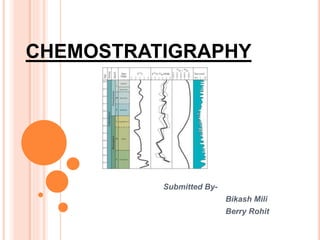
Chemostratigraphy is the study of the
inorganic/organic chemical variations within
the sedimentary sequences, either based on the
elemental or isotopic composition of the rock. It provides
a useful tool for unconventional resource exploration
and development. The chemistry of a rock varies with its
mineral composition. It is very powerful stratigraphy tool
if it is applied in combination with bio-and
magnetostratigraphy. Geochemical proxies used for
stratigraphy were originally developed and utilized as
proxies for paleoenvironmental change. Many of these
chemical proxies turned out to record – to different
degrees – global changes in climate and oceanography.
These changes left their signature in marine or
terrestrial sedimentary records. Due to the geologically
short mixing time of the ocean-atmosphere system,
which is in the order of thousands of years, some
signatures of global environmental change stored in
the atmosphere and/or seawater will be mirrored in a
variety of geological proxies that can be used as
accurate stratigraphic marker.
The most powerful method used in
chemostratigraphy is stable isotope geochemistry.
OXYGEN ISOTOPES AS STRATIGRAPHIC TOOL
The two oxygen isotopes used in
chemostratigraphy are 16O and 18O. 99.8% of all the
oxygen is in the form of 16O, 18O makes up most of
the remaining 0.2%. Absolute variations in the two
stable isotopes are very small, therefore isotope
geochemists measure departures of the 18O/16O
ratio from a laboratory standard, today the Vienna Pee
Dee Belemnite Standard (V-PDB). The results are
expressed in the per mil notation.
C-ISOTOPES AND C-ISOTOPE STRATIGRAPHY
Of the two stable carbon isotopes, the
abundance of 12C in nature is given as 98.89%,
while 13C forms the remaining 1.11% (Craig 1953).
Mass differences of the two isotope species lead to
strong fractionation during photosynthetic
incorporation of carbon into organic matter, while
inorganic carbonate precipitates formed in the
aquatic environment are less affected by
fractionation processes as discussed and reviewed
in a number of articles (e. g. Hayes et al. 1999).
SR-ISOTOPE STRATIGRAPHY
Among other isotopes used in stratigraphy, strontium
isotopes are most widely used for correlation (e. g. Veizer et
al. 1999, McArthur & Howarth 2004). Sr has a long ocean
residence time of ~2.4106 years (Jones & Jenkyns 2001),
therefore Sr isotope geochemistry has been of limited use for
high-resolution stratigraphy (104–105 years). The
Phanerozoic Sr-isotope composition is characterized by long-
term fluctuations marked, by major turning points in the Sr-
isotope curve which can be used as stratigraphic marker
levels, for example the turning point in the Mesozoic Sr-
isotope curve in the Late Jurassic and the rapid change in Sr-
isotope values during the Aptian (e. g. Jones & Jenkyns 2001,
Bralower et al. 1997). Steuber (2003) has documented how
Sr-isotope stratigraphy can provide important information for
biostratigraphy.

Chemostratigraphy Presentation.pptx

  • 1.
  • 2.
    INTRODUCTION: Chemostratigraphy is thestudy of the inorganic/organic chemical variations within the sedimentary sequences, either based on the elemental or isotopic composition of the rock. It provides a useful tool for unconventional resource exploration and development. The chemistry of a rock varies with its mineral composition. It is very powerful stratigraphy tool if it is applied in combination with bio-and magnetostratigraphy. Geochemical proxies used for stratigraphy were originally developed and utilized as proxies for paleoenvironmental change. Many of these chemical proxies turned out to record – to different degrees – global changes in climate and oceanography.
  • 3.
    These changes lefttheir signature in marine or terrestrial sedimentary records. Due to the geologically short mixing time of the ocean-atmosphere system, which is in the order of thousands of years, some signatures of global environmental change stored in the atmosphere and/or seawater will be mirrored in a variety of geological proxies that can be used as accurate stratigraphic marker. The most powerful method used in chemostratigraphy is stable isotope geochemistry.
  • 4.
    OXYGEN ISOTOPES ASSTRATIGRAPHIC TOOL The two oxygen isotopes used in chemostratigraphy are 16O and 18O. 99.8% of all the oxygen is in the form of 16O, 18O makes up most of the remaining 0.2%. Absolute variations in the two stable isotopes are very small, therefore isotope geochemists measure departures of the 18O/16O ratio from a laboratory standard, today the Vienna Pee Dee Belemnite Standard (V-PDB). The results are expressed in the per mil notation.
  • 5.
    C-ISOTOPES AND C-ISOTOPESTRATIGRAPHY Of the two stable carbon isotopes, the abundance of 12C in nature is given as 98.89%, while 13C forms the remaining 1.11% (Craig 1953). Mass differences of the two isotope species lead to strong fractionation during photosynthetic incorporation of carbon into organic matter, while inorganic carbonate precipitates formed in the aquatic environment are less affected by fractionation processes as discussed and reviewed in a number of articles (e. g. Hayes et al. 1999).
  • 6.
    SR-ISOTOPE STRATIGRAPHY Among otherisotopes used in stratigraphy, strontium isotopes are most widely used for correlation (e. g. Veizer et al. 1999, McArthur & Howarth 2004). Sr has a long ocean residence time of ~2.4106 years (Jones & Jenkyns 2001), therefore Sr isotope geochemistry has been of limited use for high-resolution stratigraphy (104–105 years). The Phanerozoic Sr-isotope composition is characterized by long- term fluctuations marked, by major turning points in the Sr- isotope curve which can be used as stratigraphic marker levels, for example the turning point in the Mesozoic Sr- isotope curve in the Late Jurassic and the rapid change in Sr- isotope values during the Aptian (e. g. Jones & Jenkyns 2001, Bralower et al. 1997). Steuber (2003) has documented how Sr-isotope stratigraphy can provide important information for biostratigraphy.