

The Promethean Alchemist AND
Terra(socio)Sonica: Pouvior/Poussance
Are examples of hypersurfaces: “Able to present dichotomous
relationships, between representation and matter, inside and
outside, organic and inorganic, the hypersurface is the site of
virtual performance.”- Giannachi

 My participation in the exchange is the threefold translation
from organic data to computational code, to visual
representation using XML RPC. The viewer pushes this
further by becoming an alChemist… stirring a virtual
primordial soup. While the viewer is firmly planted in the
physical realm, they still experience the dissolve between the
organic and inorganic, humanity and technology.
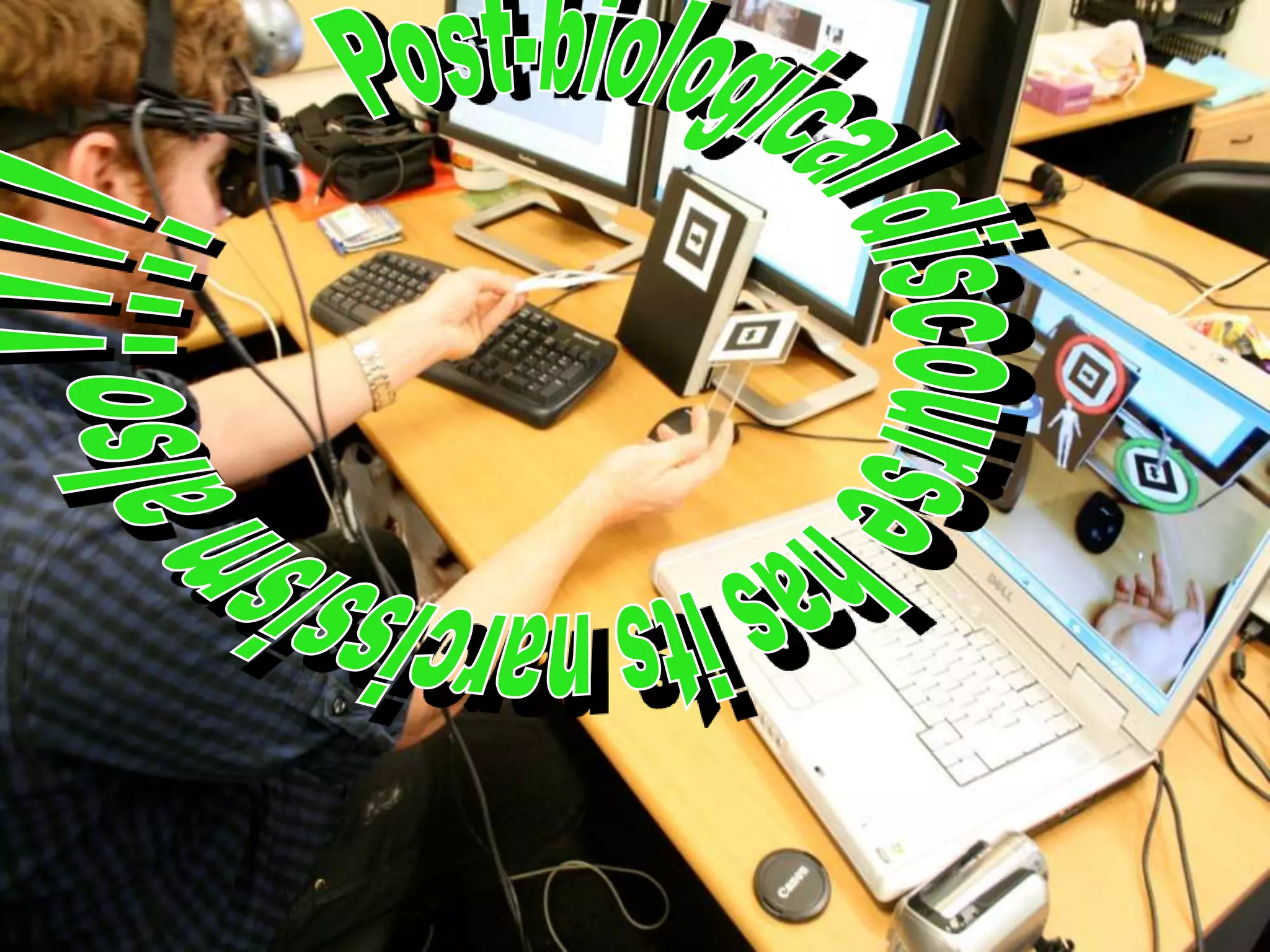
post-biological digital ID
• Post-biological, in this sense, refers to a
  redefinition of the embodied subject which
  encompasses their location in virtual
  environments as well as in the physical.
  This involves the creation, through art
  practice, of agents that are born from
  data, but which take on the appearance of
  bio-forms and thus become embodied.

• At the same time these agents are a
  differential embodiment of the bodies, which
  first generated that data in their everyday
  activities.
post-biological digital ID

• The existence of embodied information, linked
  to and yet not the same as embodied
  selves, creates an interface through which
  humans negotiate their identities across the
  boundaries of different reality states, more
  or less virtual, and yet always involving the
  mapping or writing of that identity onto ‘a
  body’.

• By having bodies both material and
  virtual, humans have become post-
  biological even as their biology
  remains the primary point of
  reference for the data
  gathering, which enables this
  transition to occur.
moving beyond post-human
• The concept of humanism or post-humanism
  is no longer valid due to biological
  progression in the field of
  astrophysics/neuroscience/consciousness
  and spirituality to name a few
  ‘sciences’.

• This calls for a discourse that is more
  inclusive of other organisms. This is
  further expressed by vision
  science, particularly atomic force
  microscopy, digital telescopes etc.
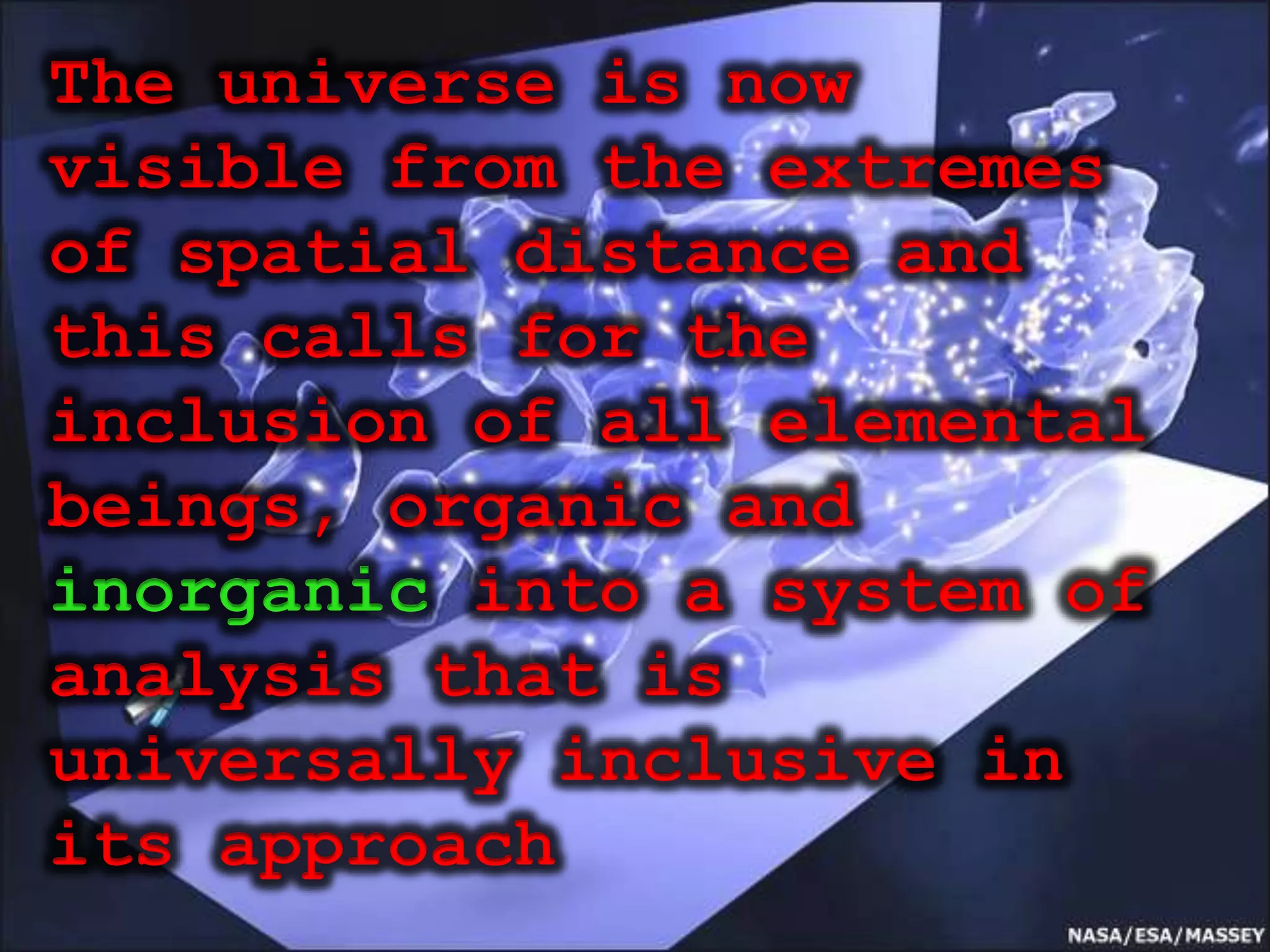
The universe is now
visible from the extremes
of spatial distance and
this calls for the
inclusion of all elemental
beings, organic and
inorganic into a system of
analysis that is
universally inclusive in
its approach
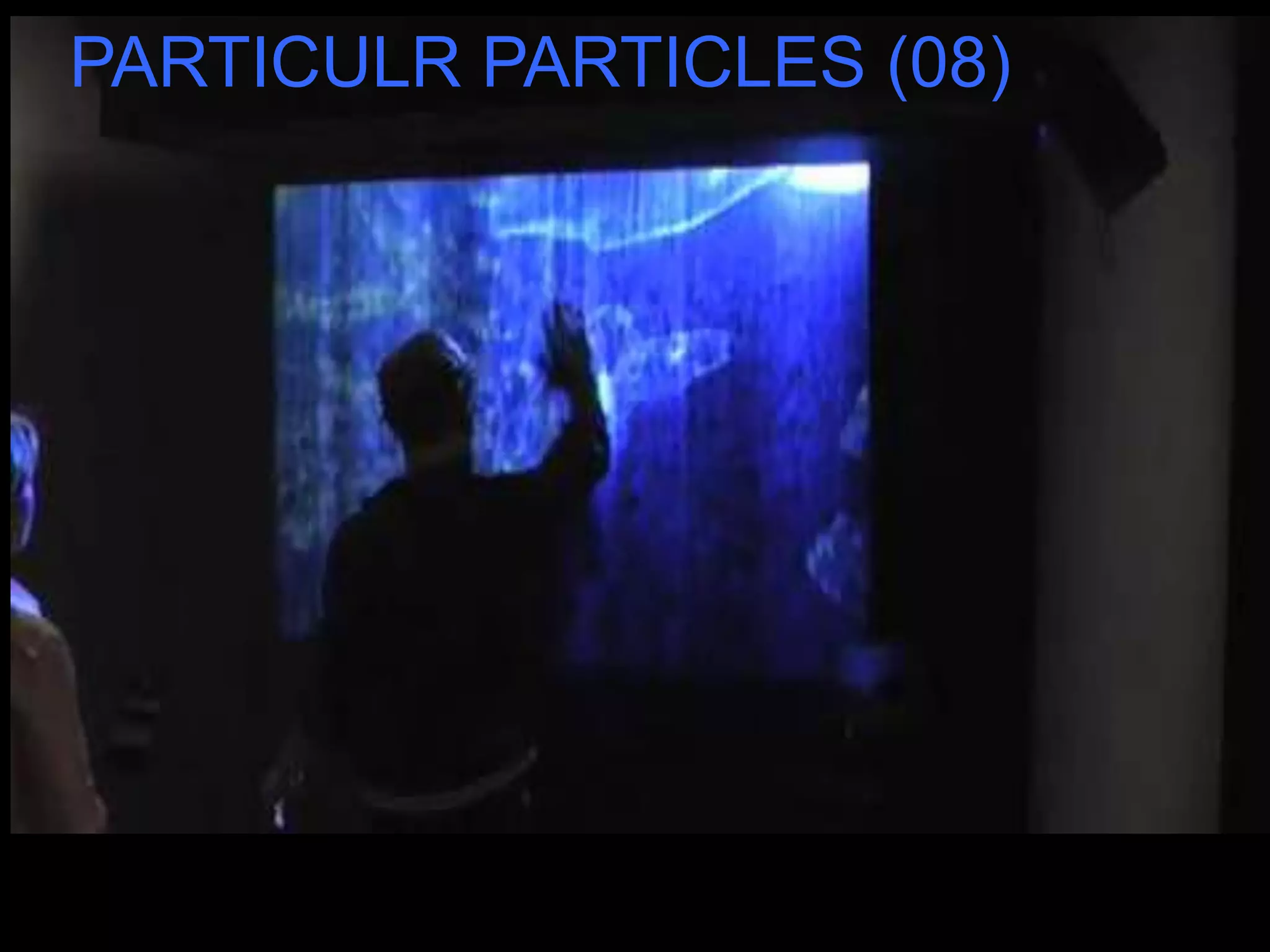
PARTICULR PARTICLES (08)
Post-human? Post-narcissism!
“Nanotechnology thrives in the realm of
the virtual. Throughout its history, the
field has been shaped by futuristic
visions of technological
revolution, hyperbolic promises of
scientific convergence at the molecular
scale, and science fiction stories of the
world rebuilt atom by atom.” Colin
Milburn
syncretism
It is a popular belief that we are now, through a media
convergent, participatory culture (integrated socially through a
subnet of platforms) creating a collective intelligence that
exists in this global village of knowledge (data) transfer. This
perspective evades mythological notions of anthropomorphic
interaction. Networked systems that use real time MRDT
expand interaction beyond traditional bio-physical/electro-
physical relationships and are integral to understanding our
relationship with agency.
A note on latency within agency

All cybernetic feedback systems endure what is known as time-
space inconsistency. This is the spatial difference between user
and agent and occurs due to latency, bandwidth speed, the
paths chosen for data transfer to occur to name a few examples.
This creates a deterritorialised autonomy in that a potentially
infinite number of users can participate with agents in the gap
between action and response. It is in this democratic space that
participants (real or virtual) can truly become autonomous, as
they are free within the network, emancipated of control and
alleviated of the responsibility to respond.
While computer science endeavours to minimise
the effect latency has on functionality, artists
should embrace this in between space.
It is a novel interpretation of the gap
between, representation and ideas, but it goes
beyond traditional dichotomies of the master-
slave metaphor to peer to peer interaction
models, without burdening the issue with the
ethically loaded terminology of “master” and
“slave” which is pervasive in the literature
relating to agency. It is forever expansive in its
invitation to be engaged with
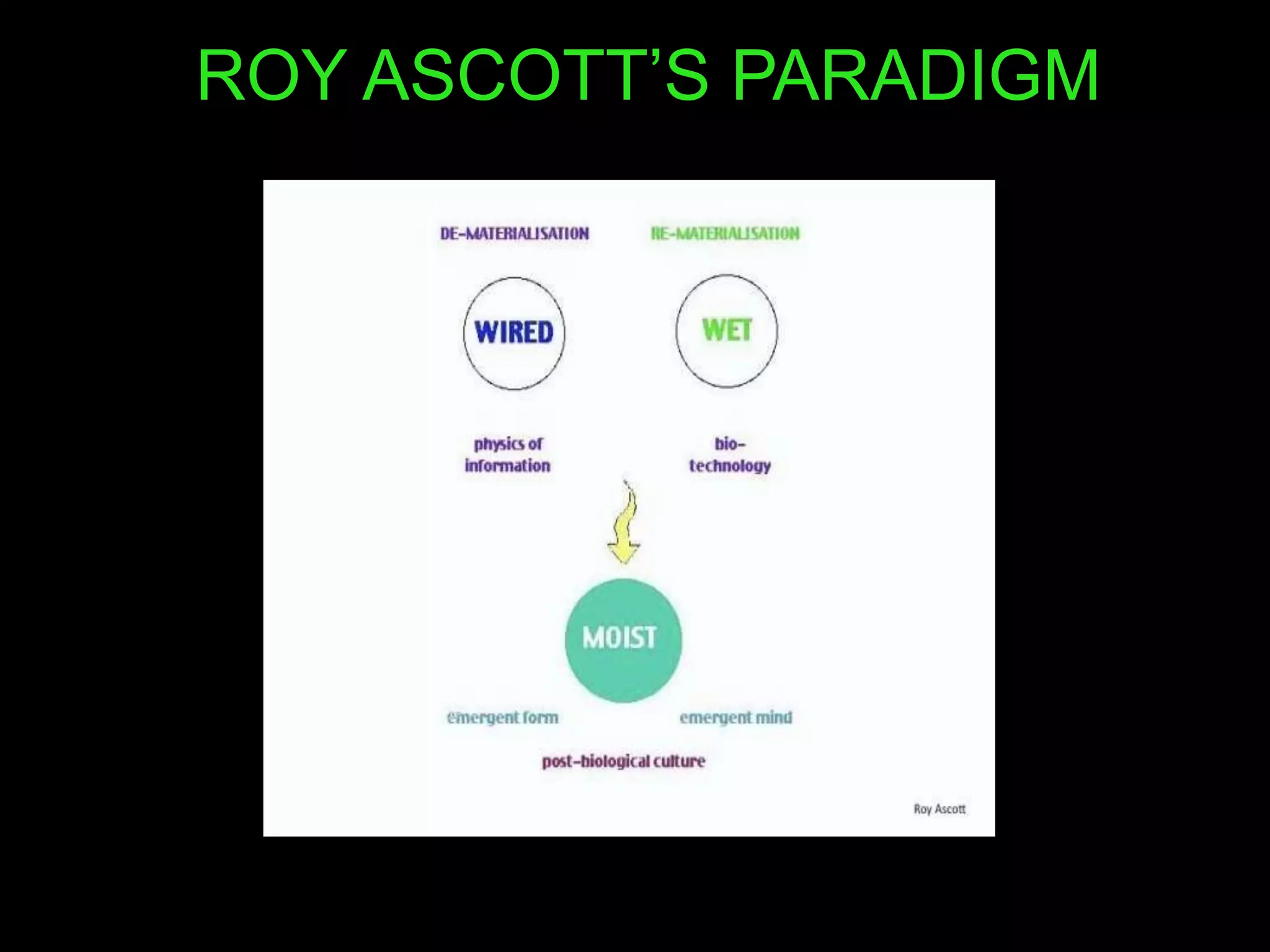
ROY ASCOTT‟S PARADIGM
Post-Biological Discourse Defined in
Reference to Real Time Networked Data
Transfer
Post-biological, in this sense, refers to a redefinition of
the embodied subject which encompasses their
location in virtual environments as well as in the
physical. This involves the creation, through art
practice, of what we might term autonomous agents
that are born from data but which take on the
appearance of bio-forms and thus become embodied.
At the same time these agents are a differential
embodiment of the „bodies‟, which first generated that
data in their everyday activities.
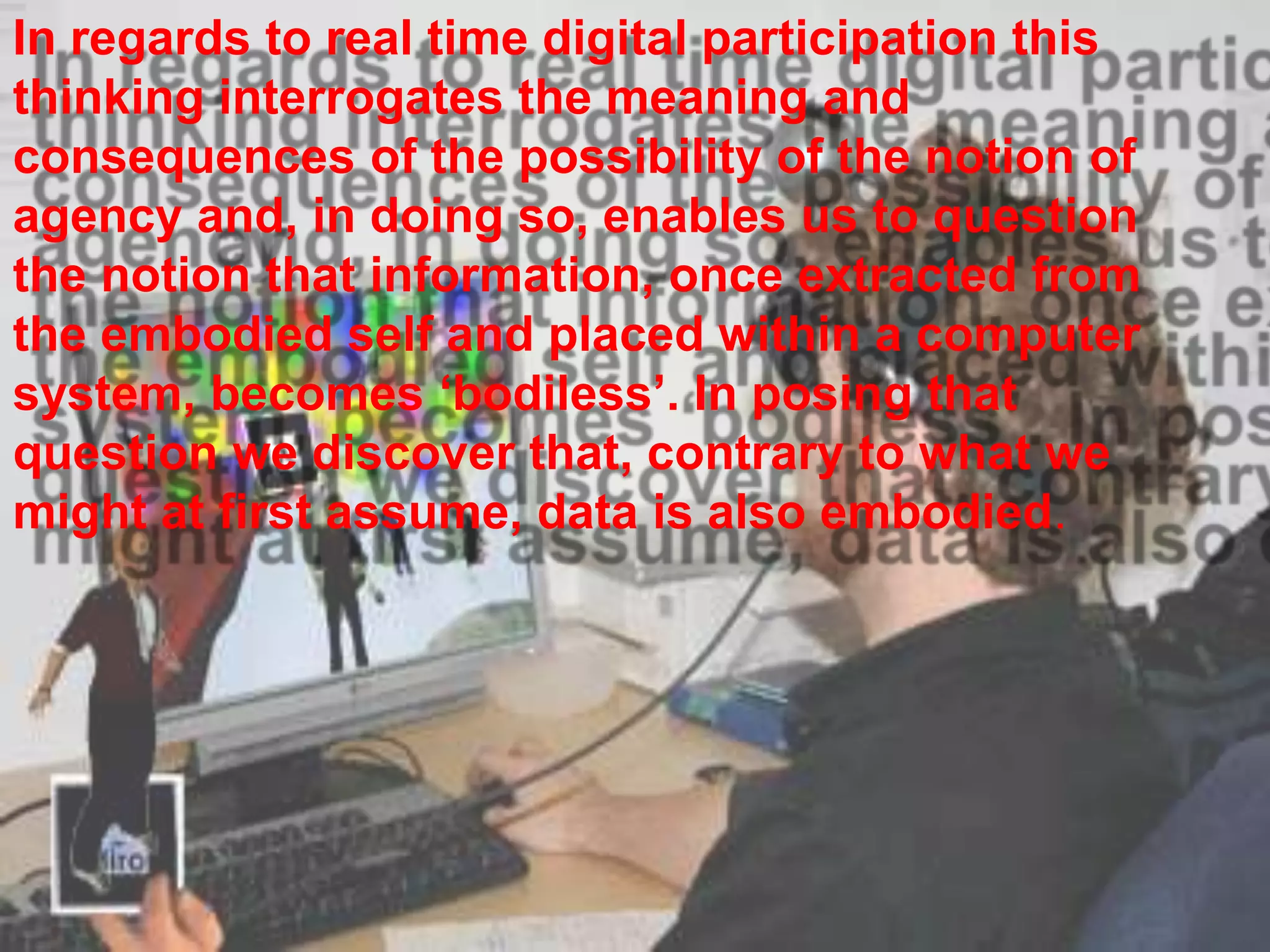
In regards to real time digital participation this
thinking interrogates the meaning and
consequences of the possibility of the notion of
agency and, in doing so, enables us to question
the notion that information, once extracted from
the embodied self and placed within a computer
system, becomes „bodiless‟. In posing that
question we discover that, contrary to what we
might at first assume, data is also embodied.
VIRTUAL POST-BIOLOGICAL
        IDENTITY
AGENCY represent a transient, continually
altered identity, usually that of its author and
acts as an agent, through which users can
engage with virtual platforms. This is
particularly interesting when participants can
physically interact with a virtual deterritorialised
„self‟ in a networked environment and mediate
it through physical engagement.
The dispersion of multiple virtual agents
via mixed reality constructs and
expands deterritorialisation to include
reterritorialisation, by facilitating a
dispersive relationship between the
body and its virtual self-referent.
Terrasociosonica video!!!
Organtrader2010 video!!!!
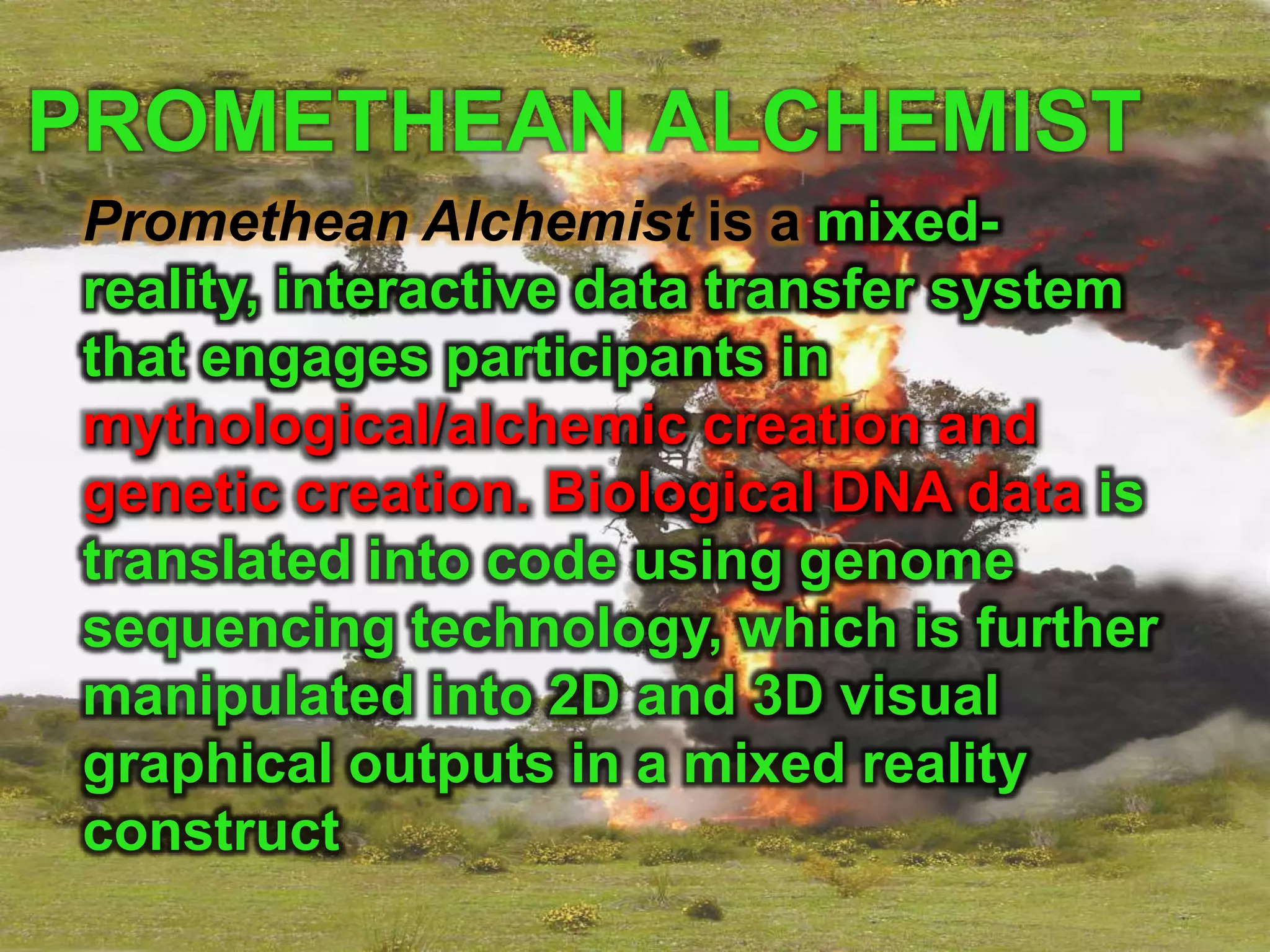
PROMETHEAN ALCHEMIST
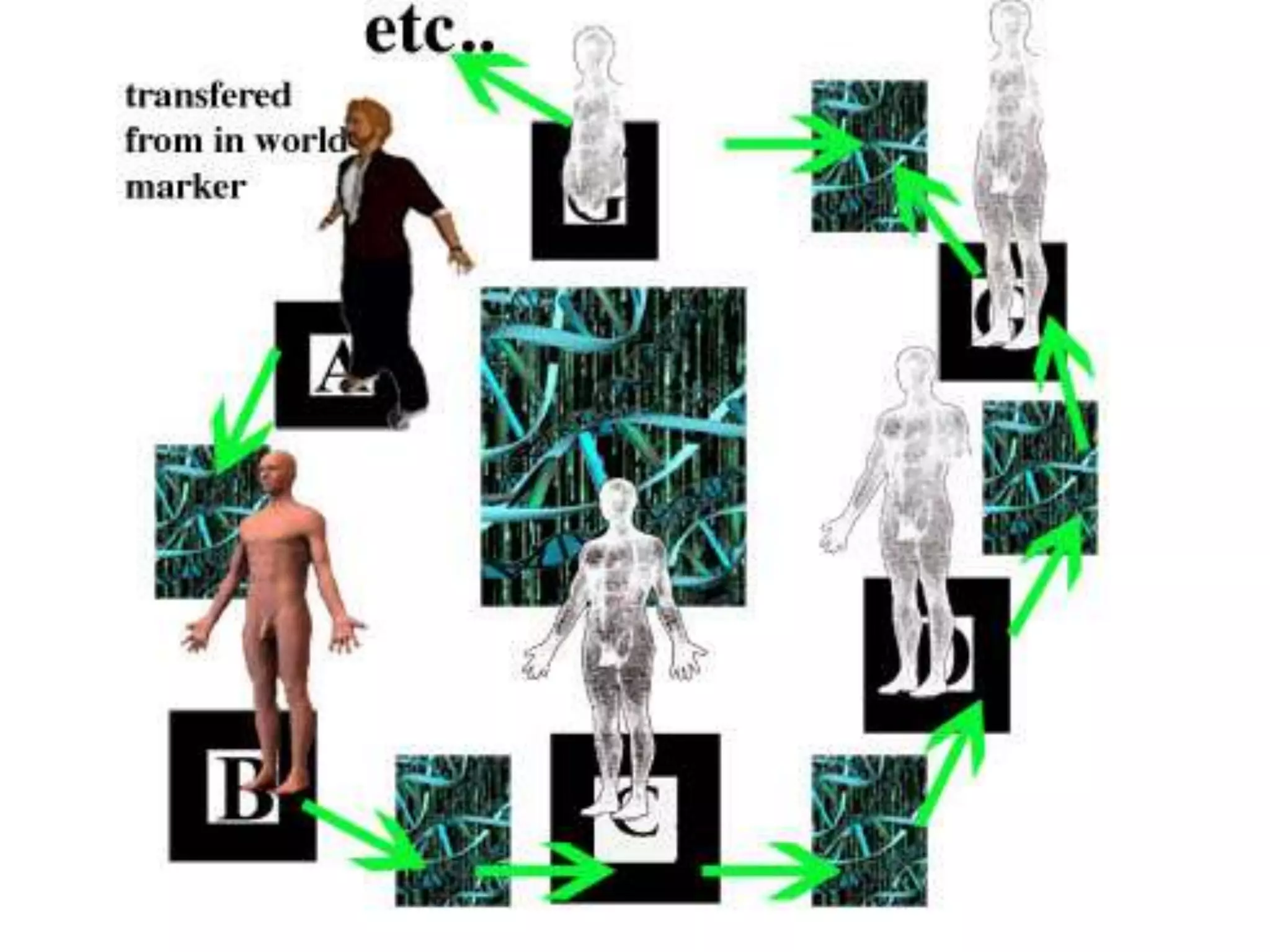
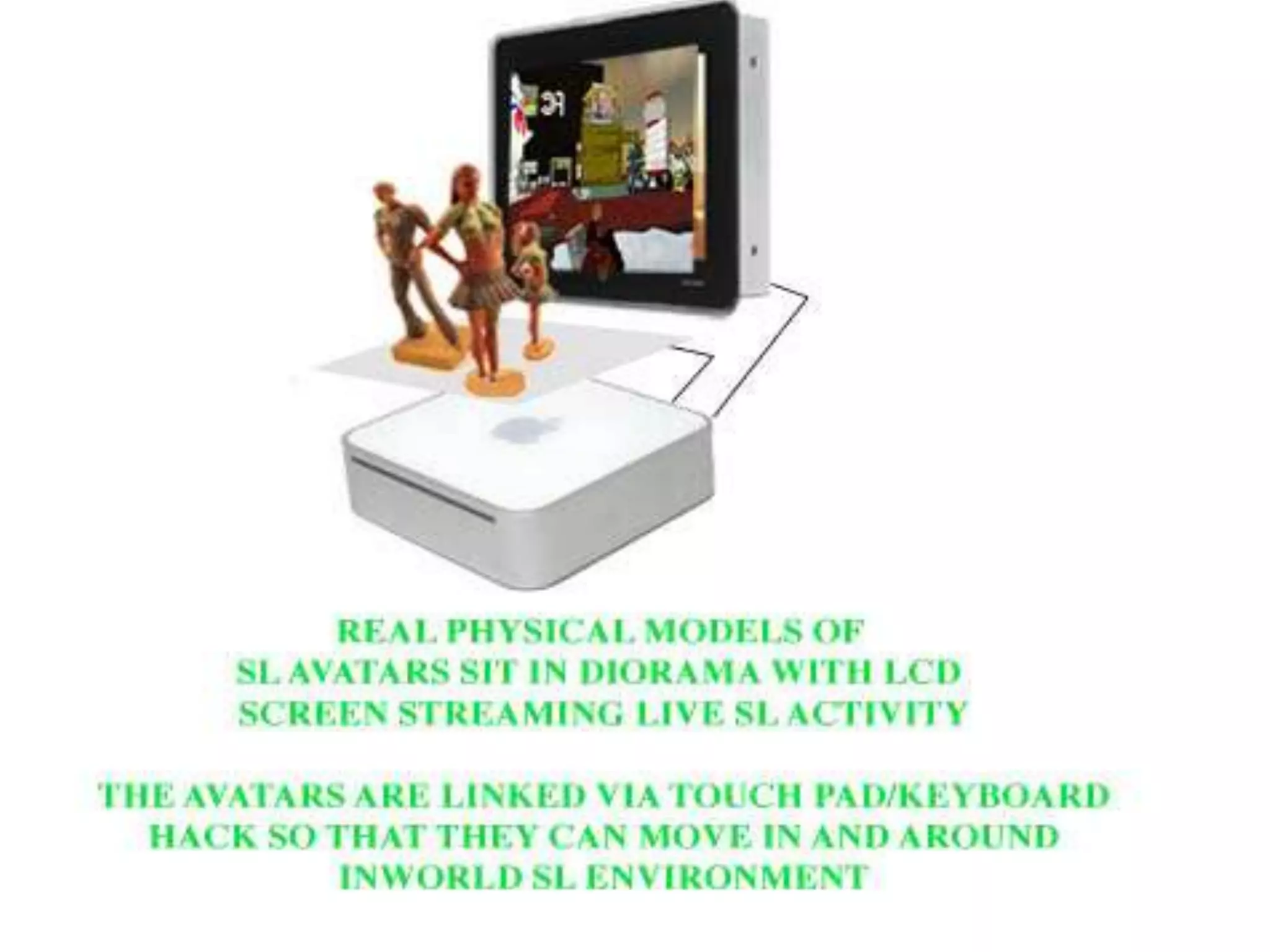
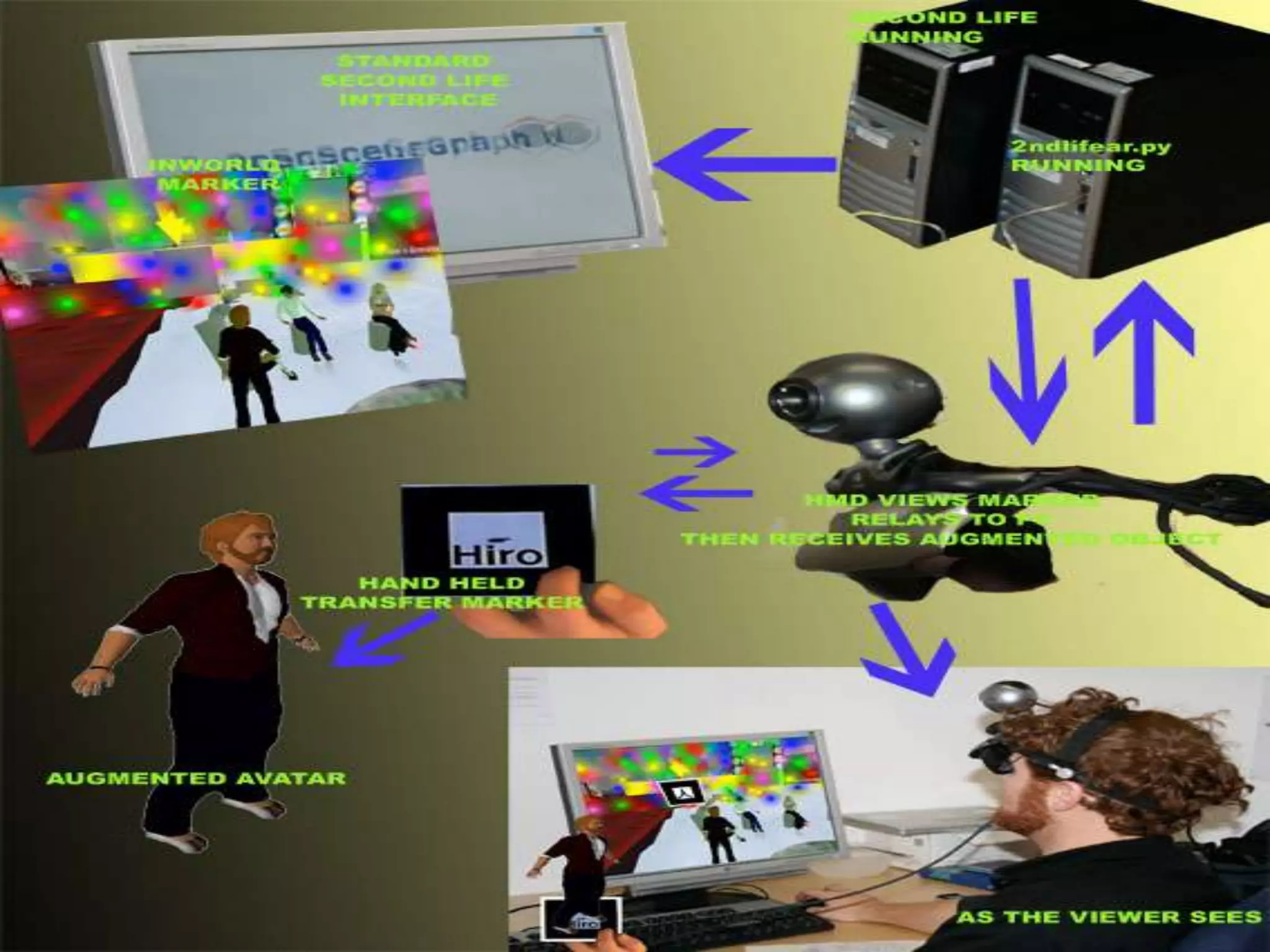
 Promethean Alchemist is a mixed-
 reality, interactive data transfer system
 that engages participants in
 mythological/alchemic creation and
 genetic creation. Biological DNA data is
 translated into code using genome
 sequencing technology, which is further
 manipulated into 2D and 3D visual
 graphical outputs in a mixed reality
 construct
PROMETHEAN ALCHEMIST
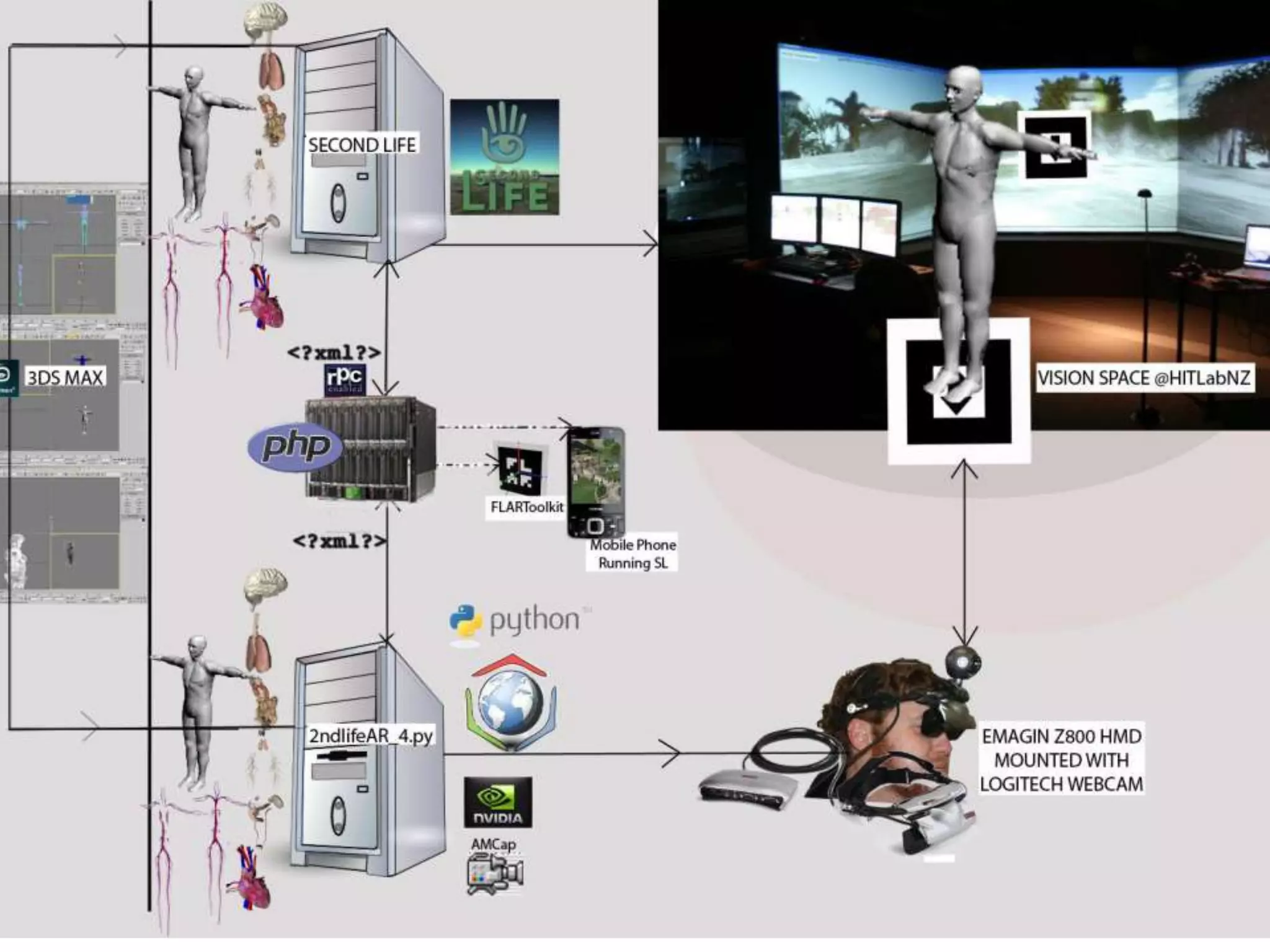
The visualization form is the classic DNA
double-helix, which re-enters the physical
world through an XML RPC (Remote
Procedure Call) interface. When two
sections of DNA are brought into close
proximity, the system recognizes their
proximity and „splices‟ (combines) the
data set into one.
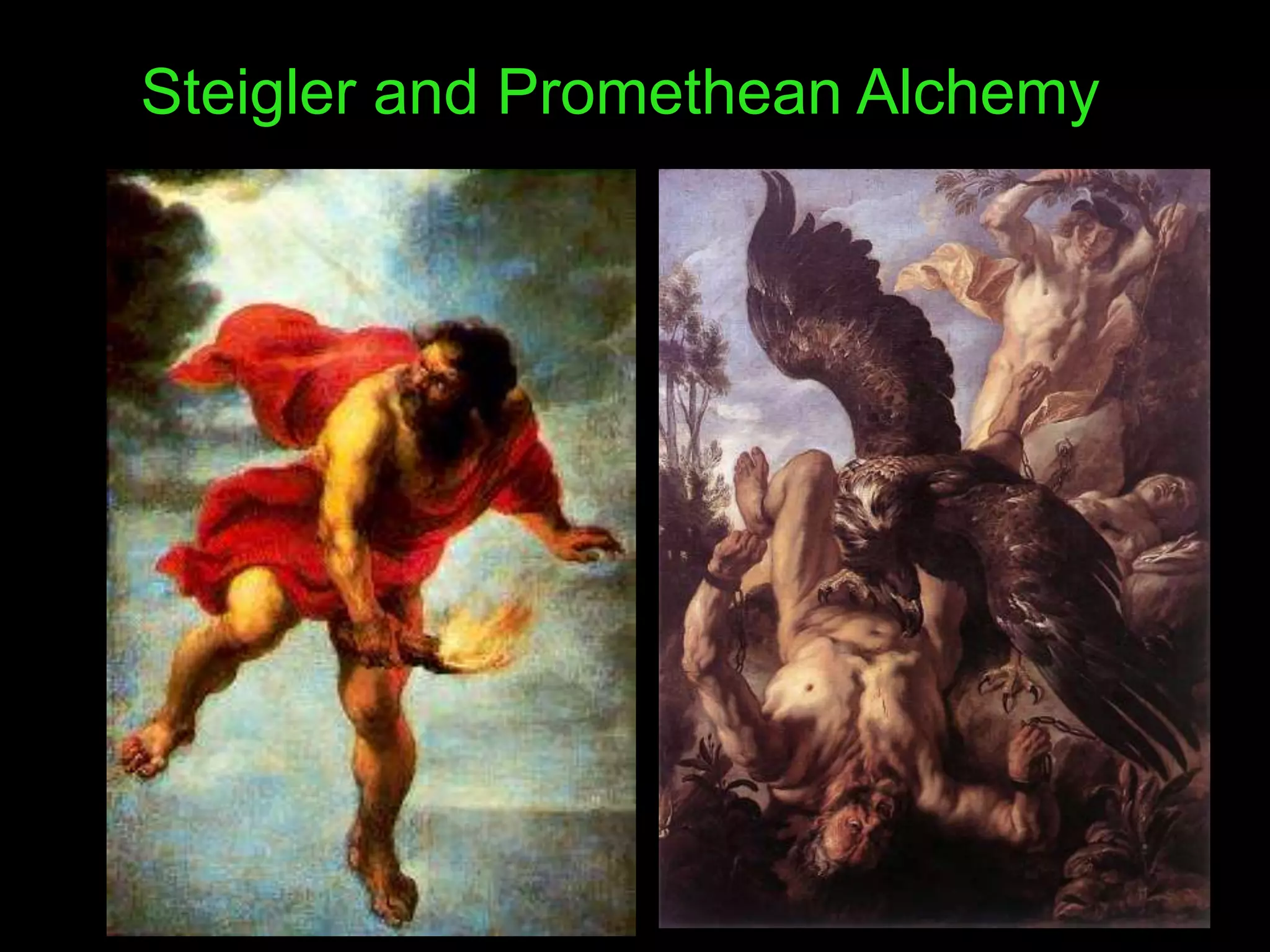
Steigler and Promethean Alchemy
PROMETHEAN ALCHEMIST
Promethean AlChemist is an artistic
rendition of the implications of DNA code
translated into the Deleuzian „fold‟. That
is, the in-betweenness of spaces; “able to
represent dialectical opposites, such as
organic and inorganic, inside and outside.”
REFERENCES
[1] Roy Ascott, 2010. Syncretic Dialogues: Keynote address at Proceedings of The first International Conference on Transdisciplinary Imaging at
the Intersections between Art, Science and Culture. Published by Transdisciplinary Imaging Conference 2010 Sydney, ISBN: 978-0-9807186-6-9
[2] Deleuze and Guatarri, A Thousand Plateaus: Capitalisim and Schizophrenia, 1980,p.66)
[3] Levy, P. (1997), Collective Intelligence. trans. Bononno, R. Perseus Books, Cambridge,
[4] McLuhan, Marshall (1994) Understanding Media. Massachusetts. MIT Press
[5] MANIFEST.AR@ICAHTTP://WWW.LAYAR.COM/LAYERS/MANIFESTAR ICA
[6] Gabriella Giannachi, Virtual Theatres: An Introduction, Routledge, London and New Y ork, 2008.
[7] A. Butz, T. Höllerer , S. Feiner, B. MacIntyre, and C. Beshers. (1999). Enveloping Users and Computers in a Collaborative 3d Augmented Reality.
IWAR’99: Proceedingsof the 2nd IEEE and ACM International Workshop on Augmented Reality, page35,Washington,DC,USA,1999
[8] Lang, T. MacIntyre, B. and Zugaza, I. (2008). Massively Multiplayer Online Worlds as a Platform for Augmented Reality Experiences. Virtual
Reality Conference, 2008 (VR’08 IEEE), March 8-12 2008.
[9] Kantonen T., Woodward C., Katz N., "Mixed reality in virtual world teleconferencing", Proc. IEEE Virtual Reality 2010
Waltham, Massachusetts, USA, March 20 - 24, pp. 179-182
[10] Istvan Barakonyi and Dieter Schmalstieg. Augmented Reality Agents for User Interface Adaptation. Journal of Computer Animation and
Virtual Worlds, 19:23-­­35, 2008.
[11] Boriana Koleva, Holger Schnädelbach, Steve Benford, and Chris Greenhalgh. 2000. Traversable interfaces between real and virtual worlds. In
Proceedings of the SIGCHI conference on Human factors in computing systems (CHI '00). ACM, New York, NY, USA, 233-240.
[12] Schnädelbach,H,Penn,A.,Benford,S.,Steadman,P.,
Koleva, B. Moving Office: Inhabiting a Dynamic Building,
CSCW 2006 conference, Banff, Canada, pp.313-322
[13] RaphaelGrasset,PhilipLamb,andMarkBillinghurst.2005. Evaluation of Mixed-Space Collaboration. In Proceedings of
the 4th IEEE/ACM International Symposium on Mixed and Augmented Reality (ISMAR '05). IEEE Computer Society, Washington, DC, USA, 90-99.
[14] RaphaelGrasset,JulianLooser,andMarkBillinghurst.2006. Transitional interface: concept, issues and framework. In Proceedings of the 5th
IEEE and ACM International Symposium on Mixed and Augmented Reality (ISMAR '06). IEEE Computer Society, Washington, DC, USA, 231-232.
[15] Sermon,PandGould,C(2011).LiberateyourAvatar:The Revolution Will Be Socially Networked , Creating Second Lives , pp. 15-31
Routledge, Taylor & Francis Group, New Y ork, USA.
[16] Roy Ascott, 2010. Syncretic Dialogues: Keynote address at Proceedings of The first International Conference on Transdisciplinary Imaging at
the Intersections between Art, Science and Culture. Published by Transdisciplinary Imaging Conference 2010 Sydney, ISBN: 978-0-9807186-6-9
[17] Haraway, 1991,Simians Cyborgs and Women, The reinvention of Nature, p.149-181 Routledge, New York.
[18] Hayles, N.K. (1990). Chaos Bound: Orderly Disorder in Contemporary Literature and Science. Ithaca, New York. Cornell University Press
[19] Charles Ostman, 2003. Nanobiology? Where Nanotechnology and Biology Come Together. www.biota.org/ostman/nanobio.htm (accessed
June 3, 2004).
*20+ Colin Milburn, “Atoms and Avatars: Virtual Worlds as Massively-Multiplayer Laboratories,” Spontaneous Generations, University of
Toronto, 2:1 2008.
[21] Brian Massumi, Parables for the Virtual: Movement, Affect, Sensation, Duke University Press, Durham, NC, 2002.
*22+ ROY ASCOTT, 2008 “C, TECHNOETIC, SYNCRETIC THE PROSPECT FOR ART” LEONARDO VOL 41, #3,MIT PRESS P. 20

CyberWorlds 2011 Presentation

  • 3.
    The Promethean AlchemistAND Terra(socio)Sonica: Pouvior/Poussance Are examples of hypersurfaces: “Able to present dichotomous relationships, between representation and matter, inside and outside, organic and inorganic, the hypersurface is the site of virtual performance.”- Giannachi My participation in the exchange is the threefold translation from organic data to computational code, to visual representation using XML RPC. The viewer pushes this further by becoming an alChemist… stirring a virtual primordial soup. While the viewer is firmly planted in the physical realm, they still experience the dissolve between the organic and inorganic, humanity and technology.
  • 9.
    post-biological digital ID •Post-biological, in this sense, refers to a redefinition of the embodied subject which encompasses their location in virtual environments as well as in the physical. This involves the creation, through art practice, of agents that are born from data, but which take on the appearance of bio-forms and thus become embodied. • At the same time these agents are a differential embodiment of the bodies, which first generated that data in their everyday activities.
  • 10.
    post-biological digital ID •The existence of embodied information, linked to and yet not the same as embodied selves, creates an interface through which humans negotiate their identities across the boundaries of different reality states, more or less virtual, and yet always involving the mapping or writing of that identity onto ‘a body’. • By having bodies both material and virtual, humans have become post- biological even as their biology remains the primary point of reference for the data gathering, which enables this transition to occur.
  • 11.
    moving beyond post-human •The concept of humanism or post-humanism is no longer valid due to biological progression in the field of astrophysics/neuroscience/consciousness and spirituality to name a few ‘sciences’. • This calls for a discourse that is more inclusive of other organisms. This is further expressed by vision science, particularly atomic force microscopy, digital telescopes etc.
  • 12.
    The universe isnow visible from the extremes of spatial distance and this calls for the inclusion of all elemental beings, organic and inorganic into a system of analysis that is universally inclusive in its approach
  • 13.
  • 14.
  • 16.
    “Nanotechnology thrives inthe realm of the virtual. Throughout its history, the field has been shaped by futuristic visions of technological revolution, hyperbolic promises of scientific convergence at the molecular scale, and science fiction stories of the world rebuilt atom by atom.” Colin Milburn
  • 17.
    syncretism It is apopular belief that we are now, through a media convergent, participatory culture (integrated socially through a subnet of platforms) creating a collective intelligence that exists in this global village of knowledge (data) transfer. This perspective evades mythological notions of anthropomorphic interaction. Networked systems that use real time MRDT expand interaction beyond traditional bio-physical/electro- physical relationships and are integral to understanding our relationship with agency.
  • 18.
    A note onlatency within agency All cybernetic feedback systems endure what is known as time- space inconsistency. This is the spatial difference between user and agent and occurs due to latency, bandwidth speed, the paths chosen for data transfer to occur to name a few examples. This creates a deterritorialised autonomy in that a potentially infinite number of users can participate with agents in the gap between action and response. It is in this democratic space that participants (real or virtual) can truly become autonomous, as they are free within the network, emancipated of control and alleviated of the responsibility to respond.
  • 19.
    While computer scienceendeavours to minimise the effect latency has on functionality, artists should embrace this in between space. It is a novel interpretation of the gap between, representation and ideas, but it goes beyond traditional dichotomies of the master- slave metaphor to peer to peer interaction models, without burdening the issue with the ethically loaded terminology of “master” and “slave” which is pervasive in the literature relating to agency. It is forever expansive in its invitation to be engaged with
  • 20.
  • 21.
    Post-Biological Discourse Definedin Reference to Real Time Networked Data Transfer Post-biological, in this sense, refers to a redefinition of the embodied subject which encompasses their location in virtual environments as well as in the physical. This involves the creation, through art practice, of what we might term autonomous agents that are born from data but which take on the appearance of bio-forms and thus become embodied. At the same time these agents are a differential embodiment of the „bodies‟, which first generated that data in their everyday activities.
  • 22.
    In regards toreal time digital participation this thinking interrogates the meaning and consequences of the possibility of the notion of agency and, in doing so, enables us to question the notion that information, once extracted from the embodied self and placed within a computer system, becomes „bodiless‟. In posing that question we discover that, contrary to what we might at first assume, data is also embodied.
  • 23.
  • 24.
    AGENCY represent atransient, continually altered identity, usually that of its author and acts as an agent, through which users can engage with virtual platforms. This is particularly interesting when participants can physically interact with a virtual deterritorialised „self‟ in a networked environment and mediate it through physical engagement.
  • 25.
    The dispersion ofmultiple virtual agents via mixed reality constructs and expands deterritorialisation to include reterritorialisation, by facilitating a dispersive relationship between the body and its virtual self-referent.
  • 26.
  • 27.
  • 28.
    PROMETHEAN ALCHEMIST PrometheanAlchemist is a mixed- reality, interactive data transfer system that engages participants in mythological/alchemic creation and genetic creation. Biological DNA data is translated into code using genome sequencing technology, which is further manipulated into 2D and 3D visual graphical outputs in a mixed reality construct
  • 29.
    PROMETHEAN ALCHEMIST The visualizationform is the classic DNA double-helix, which re-enters the physical world through an XML RPC (Remote Procedure Call) interface. When two sections of DNA are brought into close proximity, the system recognizes their proximity and „splices‟ (combines) the data set into one.
  • 30.
  • 31.
    PROMETHEAN ALCHEMIST Promethean AlChemistis an artistic rendition of the implications of DNA code translated into the Deleuzian „fold‟. That is, the in-betweenness of spaces; “able to represent dialectical opposites, such as organic and inorganic, inside and outside.”
  • 32.
    REFERENCES [1] Roy Ascott,2010. Syncretic Dialogues: Keynote address at Proceedings of The first International Conference on Transdisciplinary Imaging at the Intersections between Art, Science and Culture. Published by Transdisciplinary Imaging Conference 2010 Sydney, ISBN: 978-0-9807186-6-9 [2] Deleuze and Guatarri, A Thousand Plateaus: Capitalisim and Schizophrenia, 1980,p.66) [3] Levy, P. (1997), Collective Intelligence. trans. Bononno, R. Perseus Books, Cambridge, [4] McLuhan, Marshall (1994) Understanding Media. Massachusetts. MIT Press [5] MANIFEST.AR@ICAHTTP://WWW.LAYAR.COM/LAYERS/MANIFESTAR ICA [6] Gabriella Giannachi, Virtual Theatres: An Introduction, Routledge, London and New Y ork, 2008. [7] A. Butz, T. Höllerer , S. Feiner, B. MacIntyre, and C. Beshers. (1999). Enveloping Users and Computers in a Collaborative 3d Augmented Reality. IWAR’99: Proceedingsof the 2nd IEEE and ACM International Workshop on Augmented Reality, page35,Washington,DC,USA,1999 [8] Lang, T. MacIntyre, B. and Zugaza, I. (2008). Massively Multiplayer Online Worlds as a Platform for Augmented Reality Experiences. Virtual Reality Conference, 2008 (VR’08 IEEE), March 8-12 2008. [9] Kantonen T., Woodward C., Katz N., "Mixed reality in virtual world teleconferencing", Proc. IEEE Virtual Reality 2010 Waltham, Massachusetts, USA, March 20 - 24, pp. 179-182 [10] Istvan Barakonyi and Dieter Schmalstieg. Augmented Reality Agents for User Interface Adaptation. Journal of Computer Animation and Virtual Worlds, 19:23-­­35, 2008. [11] Boriana Koleva, Holger Schnädelbach, Steve Benford, and Chris Greenhalgh. 2000. Traversable interfaces between real and virtual worlds. In Proceedings of the SIGCHI conference on Human factors in computing systems (CHI '00). ACM, New York, NY, USA, 233-240. [12] Schnädelbach,H,Penn,A.,Benford,S.,Steadman,P., Koleva, B. Moving Office: Inhabiting a Dynamic Building, CSCW 2006 conference, Banff, Canada, pp.313-322 [13] RaphaelGrasset,PhilipLamb,andMarkBillinghurst.2005. Evaluation of Mixed-Space Collaboration. In Proceedings of the 4th IEEE/ACM International Symposium on Mixed and Augmented Reality (ISMAR '05). IEEE Computer Society, Washington, DC, USA, 90-99. [14] RaphaelGrasset,JulianLooser,andMarkBillinghurst.2006. Transitional interface: concept, issues and framework. In Proceedings of the 5th IEEE and ACM International Symposium on Mixed and Augmented Reality (ISMAR '06). IEEE Computer Society, Washington, DC, USA, 231-232. [15] Sermon,PandGould,C(2011).LiberateyourAvatar:The Revolution Will Be Socially Networked , Creating Second Lives , pp. 15-31 Routledge, Taylor & Francis Group, New Y ork, USA. [16] Roy Ascott, 2010. Syncretic Dialogues: Keynote address at Proceedings of The first International Conference on Transdisciplinary Imaging at the Intersections between Art, Science and Culture. Published by Transdisciplinary Imaging Conference 2010 Sydney, ISBN: 978-0-9807186-6-9 [17] Haraway, 1991,Simians Cyborgs and Women, The reinvention of Nature, p.149-181 Routledge, New York. [18] Hayles, N.K. (1990). Chaos Bound: Orderly Disorder in Contemporary Literature and Science. Ithaca, New York. Cornell University Press [19] Charles Ostman, 2003. Nanobiology? Where Nanotechnology and Biology Come Together. www.biota.org/ostman/nanobio.htm (accessed June 3, 2004). *20+ Colin Milburn, “Atoms and Avatars: Virtual Worlds as Massively-Multiplayer Laboratories,” Spontaneous Generations, University of Toronto, 2:1 2008. [21] Brian Massumi, Parables for the Virtual: Movement, Affect, Sensation, Duke University Press, Durham, NC, 2002. *22+ ROY ASCOTT, 2008 “C, TECHNOETIC, SYNCRETIC THE PROSPECT FOR ART” LEONARDO VOL 41, #3,MIT PRESS P. 20

Editor's Notes

  • #2 My research is quite different to the majority of presentations here so far and as such I decided to focus on the ideas andto the works I discuss in my paperMy research applies cultural and philosophical discourse to recent developments in computer science to propose a new mode of representation that concerns itself with the affective capacities of art in order to articulate a sense of dispersed embodiment, thus contributing to the redefinition of aesthetic representation and embodiment.
  • #11 Singularity and immateriality are silly notions as we need materiality in order to assign semiotice systems and gather meaning and conscious thought requires that anchor to function, otherwise consciousness is a complete open network of constant fluxus and zero meaning or relevance. It is arbitrary and too far removed from Baudrillard’s paradigm of the past “real”-ness that we still base our negotiation of time space and being on.
  • #13 Dark matter and black holes at one end and neutrinos the neutrino project at the other
  • #17 It is no longer a case of us vrs them. We are everything. We have engrossed/invaded the whole of natural exhistannce through our complete dominance of it and this is still eveolving. We are becoming, through information technology, everything. Our consciousness is inclusive of a collective intelligence that encompasses everything.
  • #31 Give expostion but also detail how with new methods of mixed reality real time data transfer computer science has in many ways became a new form of alchemy in that it combines technology with creative experimental discourse in a way that returns humanity to a time before spirituality was regarded under the rigid paradigms that the development of religion faciliated. Mythology of fire and alchemy of RTMRDT