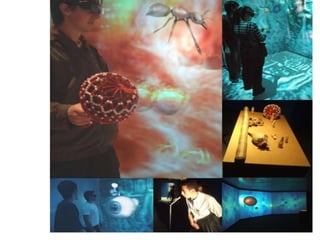
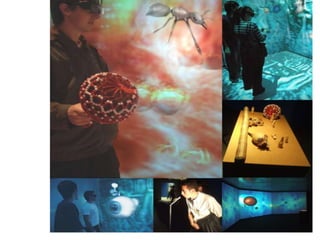
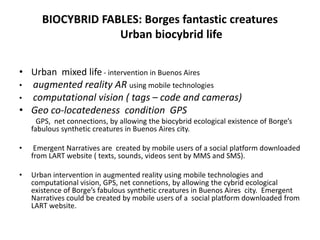
DIANA DOMINGUES SELECTED ARTWORKS – time
line
2000 2015
CNPq CAPES MIT
Profa. Dra. Diana Domingues
University of Brasília - FGA GAMA
Senior National Visitant Researcher CAPES at UNB FGA GAMA
CNPq (National Council for Scientific and Technological Development) Researcher PQ 1A
LART Founder and Director– Laboratory of Research in Art and Techno Science
Post Graduate Program in Biomedical Engineering
Researcher at Camera Culture MIT Media Lab - MIT/CNPq 2012 – 2014
http://dgp.cnpq.br/buscaoperacional/detalhegrupo.jsp?grupo=0240803DKU6FNW
dgdomingues@gmail.com
skype:dgdomingues1 Diana Domingues
P
rof. Dra. Diana Domingues
LART Founder and Director– Laboratory of
Research in Art and Techno Science
University of Brasília – Senior collaborator Professor
Senior National Visitant Researcher CAPES at UNB FGA GAMA 2010
2014
CNPq (National Council for Scientific and Technological Development)
Researcher PQ 1A
Post Graduate Program in Biomedical Engineering
Post Graduate Program Sciences and Technologies in Healt Ceilandia
UnB
Institute of Computing – UNICAMP
Researcher at Camera Culture MIT Media Lab - MIT/CNPq (2012 2015)
http://dgp.cnpq.br/buscaoperacional/detalhegrupo.jsp?grupo=0240803D
KU6FNW
dgdomingues@gmail.com
skype:dgdomingues1 Diana Domingues
Agradecimento
CNPq/CAPES/UnB Unicamp
FAPESP grant # 2015/165280 from São Paulo Research Foundation
(FAPESP)]
ART and TECHNOSCIENCE Creative
technologues and innovation for
reinventing life da vida.
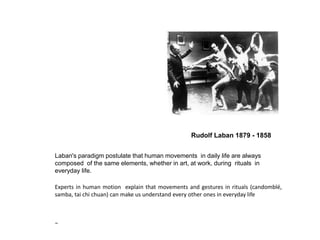
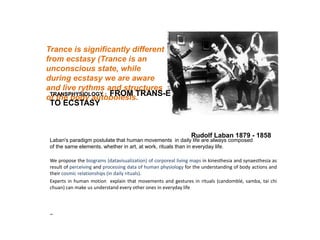
Rudolf Laban 1879 - 1858
Laban's paradigm postulate that human movements in daily life are always
composed of the same elements, whether in art, at work, during rituals in
everyday life.
Experts in human motion explain that movements and gestures in rituals (candomblé,
samba, tai chi chuan) can make us understand every other ones in everyday life
−
The ART and SCIENCE OF
INTERFACES
INTERACTIVE AND
ENACTIVE AFFECTIVE
SYSTEMS
• “We must humanize technology before it dehumanizes us “
- Oliver Sacks, neurologist and author ,2111
• HUMANIZATION OF TECHNOLOGIES , 1995
• I have always taken into account the human factor when investigating interactive
technologies in their potential to transform ways of living. How can we understand types,
levels and intensities of changes in post-biological, post-human, neo-biological, trans-human
life installed by technologies? At the end of the 20th century, when interactive technologies
– and mainly the inclusion of the WWW – started to invade and feed the creative minds of
artists and invade the Media Art scenario, I had already anticipated
• NATURALIZATION OF TECHNOLOGIES
• Without intending to be taken for a visionary I dare to forecast that in the next
couple of years, people will normally use wireless interfaces, and matter-of-factly
will be connected in all microtimes of their lives. Existence will become a cybrid
existence during the twenty four hours of life time. People will increasingly have
interfaces and will be rather TV-like, to use an analogy to the contemporary
technological and the society of the spectacle. Symbiotic technologies will be
facilitated as permanent prostheses and they will be attached on us and into our
bodies and thus we will be reinventing our lives and the ultimate nature of our
species. (1997, DD Consciousness Reframed)
• INTERFACES, ROBOTICS AND THE POS THUMAN ( 1995/1997)
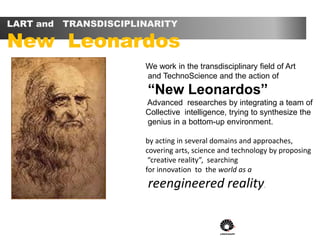
LART and TRANSDISCIPLINARITY
New Leonardos
We work in the transdisciplinary field of Art
and TechnoScience and the action of
“New Leonardos”
Advanced researches by integrating a team of
Collective intelligence, trying to synthesize the
genius in a bottom-up environment.
by acting in several domains and approaches,
covering arts, science and technology by proposing
“creative reality”, searching
for innovation to the world as a
reengineered reality.
HOW TO SYNTHESIZE
LEONARDO?
Efficient collaborative practices dissolves the old
rupture and the well-known historical divergences
between artists and scientists. Response to Angel
Kalembeg
The main point of convergence is:
when all disciplines investigate the same problems, all
sciences become one unique new science. ( Latour)
DIGITAL CULTURE after the success of the computer art pioneers and media
artists are now addressed to the
RADICAL DIGITAL ( Malina. 2007)
Artists and Scientists face the big risks and
challenges for society:
related to health, environment , education, social
behaviors
Main Domains:
Biomedical Engineering , Computer Sciences , Cognitive Science,
Visual Analytics Digital Humanities
http://userwww.sfsu.edu/infoarts/links/gen.art.res.present/currentslide
%20show/slide_show_summary.html
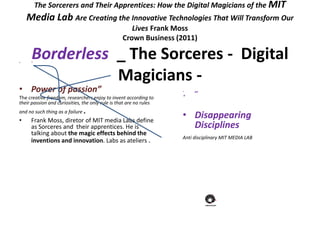
The Sorcerers and Their Apprentices: How the Digital Magicians of the MIT
Media Lab Are Creating the Innovative Technologies That Will Transform Our
Lives Frank Moss
Crown Business (2011)
Borderless _ The Sorceres - Digital
Magicians -
• “
• Power of passion”
The creative freedom, researchers enjoy to invent according to
their passion and curiosities, the only rule is that are no rules
and no such thing as a failure .
• Frank Moss, diretor of MIT media Labs define
as Sorceres and their apprentices. He is
talking about the magic effects behind the
inventions and innovation. Labs as ateliers .
• an
a
• Disappearing
Disciplines
Anti disciplinary MIT MEDIA LAB
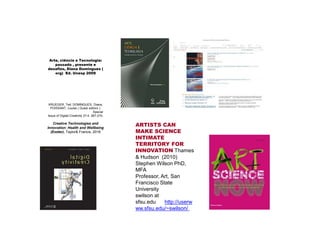
Arte, ciência e Tecnologia:
passado , presente e
desafios, Diana Domingues (
org) Ed. Unesp 2009
KRUEGER, Ted; DOMINGUES, Diana;
POISSANT, Louise ( Guest editors ).
Special
Issue of Digital Creativity 27:4. 267-270,
Creative Technologies and
Innovation: Health and Wellbeing
(Exeter). Taylor& Francis, 2016
ARTISTS CAN
MAKE SCIENCE
INTIMATE
TERRITORY FOR
INNOVATION Thames
& Hudson (2010)
Stephen Wilson PhD,
MFA
Professor, Art, San
Francisco State
University
swilson at
sfsu.edu http://userw
ww.sfsu.edu/~swilson/
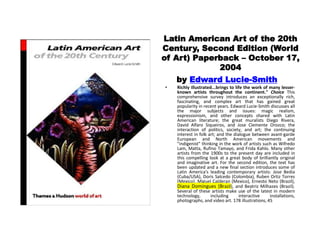
Latin American Art of the 20th
Century, Second Edition (World
of Art) Paperback – October 17,
2004
by Edward Lucie-Smith
• Richly illustrated...brings to life the work of many lesser-
known artists throughout the continent." Choice This
comprehensive survey introduces an exceptionally rich,
fascinating, and complex art that has gained great
popularity in recent years. Edward Lucie-Smith discusses all
the major subjects and issues: magic realism,
expressionism, and other concepts shared with Latin
American literature; the great muralists Diego Rivera,
David Alfaro Siqueiros, and Jose Clemente Orozco; the
interaction of politics, society, and art; the continuing
interest in folk art; and the dialogue between avant-garde
European and North American movements and
"indigenist" thinking in the work of artists such as Wifredo
Lam, Matta, Rufino Tamayo, and Frida Kahlo. Many other
artists from the 1900s to the present day are included in
this compelling look at a great body of brilliantly original
and imaginative art. For the second edition, the text has
been updated and a new final section introduces some of
Latin America's leading contemporary artists: Jose Bedia
(Cuba/USA), Doris Salcedo (Colombia), Ruben Ortiz Torres
(Mexico), Miguel Calderan (Mexico), Ernesto Neto (Brazil),
Diana Domingues (Brazil), and Beatriz Milhazes (Brazil).
Several of these artists make use of the latest in modern
technology, including interactive installations,
photographs, and video art. 178 illustrations, 45
Selected artworks
time line
Multimedia installations ELETROURBS 1970s 80s
. Paragens ( 1991 – 21ª.Biennial São Paulo
• TRANSE : the Body and the Technologies, 1994 ( Lucia
Santaella ‘s Text) 04 Installations:4 installations Bio
Biblion, A-fetus, In –Viscera, In-Fluxus, , A Ceia
• TRANS-E: MY BODY, MY BLOOD : interactive installation,
first presentation at ISEA 1997/Chicago, Invited artist to
7th Biennial of La Habana. The artwork is the winner of
the 2000 UNESCO PRIZE FOR THE PROMOTION OF THE
ARTS –
• NET BASED INSTALLATIONSI
INSN(H)AK(R)ES telepresence and telerobotics aanimal
and human
TERRARIUM 2 synthetic ecologies - artificial life -
datamining and mobile connections: Seamless, nomadic,
mobile and autonomous condition
VR-IMMERSIVE ENVIRONMENTS- CAVES
VR Aquarium – a- life and Augmented reality and
Telepresence creating a synthetic ecology:
HEARTSCAPES –
THE TRANCE IN THE CAVERN
URBAN MIXED LIFE
Living Tattoos – social platform and mobile art
Augmented Mobile Reality and Geotagness in
Mixed Landscapes
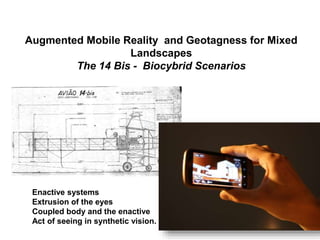
THE 14 BIS BIOCYBRID PLANE
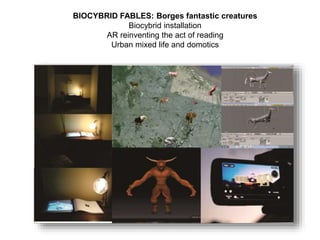
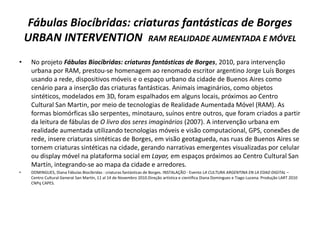
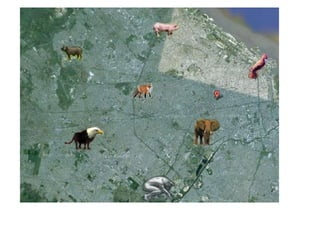
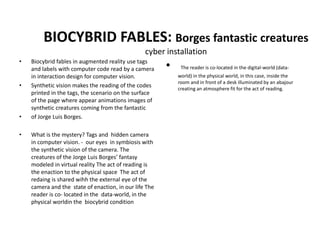
BIOCYBRID FABLES: Borges fantastic creatures
Biocybrid installation
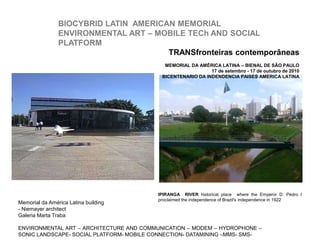
• BIOCYBRID LATIN AMERICAN
MEMORIAL
environmental art – mobile and ubiquous
computing and social platform
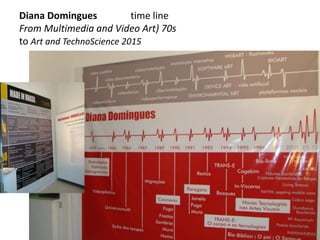
Diana Domingues time line
From Multimedia and Video Art) 70s
to Art and TechnoScience 2015
VIDEOS ART HISTORY
Trance and rituals
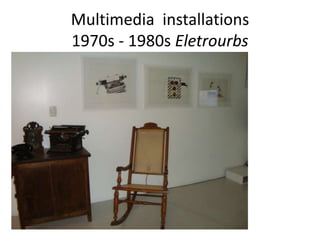
Multimedia installations
1970s - 1980s Eletrourbs
Eletrourbs eletrogravuras
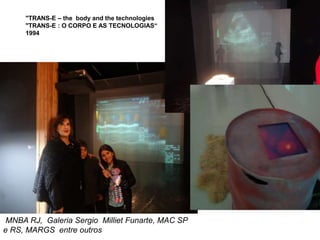
MNBA RJ, Galeria Sergio Milliet Funarte, MAC SP
e RS, MARGS entre outros
"TRANS-E – the body and the technologies
"TRANS-E : O CORPO E AS TECNOLOGIAS“
1994
A CEIA THE SUPPER
IN FLUXUS
The ontology of the artworks :
creative reality on speculative systems
and redefinition of life
• A collaborative team develop speculative systems and
respective hardware and required code which is written
to respond to the different artistic and poetic content
and what sort of aesthetic and social behavior we intend
to offer to people. The main concepts of the interface
design are the transversal connections between people,
devices, behaviors , code, networks based on
connectivity, interactivity, immersion, multissensorial
feedback, biofeedback : proprioception, cinaestesia,
synaesthesia , during emergent proprieties and
simulation of life. We focus on the seamless condition of
bodies connected to computers, the nonadic connections
lived in networked environments, the autonomy and
intelligent evolutions of second interactivity in intelligent
system, the immersion in data landscapes and other
particular aesthetic proprieties. One of our recent focus
is the mobile condition propitiated by the connections of
computers and wireless technologies, such as: cell
phones, I pads, and bluetooth, Wi-Fi, chips, radio
frequency identification, most recently physiological
sensors, and the geo referenced interfaces. We are
looking for the ubiquitous, pervasive and sentient
connections of mobile computing technologies. The
central issue are always the intertwined relationships
among body/environment/nets asking for enactive
affective system and the naturalization of technologies
capacities in terms of the exchanges and creative levels
of life and so, for innovation responding to the
challenges of art and science to collaborate s.
• DOMINGUES, D. The Desert of Passions and The
Technological Soul - In: Digital Creativity Vol 9. Swets &
“Without intending to be taken for a
visionary I dare to forecast that in the next
couple of years, people will normally use
wireless interfaces, and matter-of-factly
will be connected in all microtimes of their
lives. Existence will become a cybrid
existence during the twenty four hours of
life time. People will increasingly have
interfaces and will be rather TV-like, to
use an analogy to the contemporary
technological and the society of the
spectacle. Symbiotic technologies will be
facilitated as permanent prostheses and
they will be attached on us and into our
bodies and thus we will be reinventing our
lives and the ultimate nature of our
species. Cyberart is not only involved with
devices and digital images as the majority
of interactive art works. It embraces the
complex territory of shared investigations
of art and science that generate social,
critical and speculative software
Rituals and ouroboric
perception
• I have discussed the
ouroboric perception and
poetics in my interactive
artworks since my first
cyberinstallation in the 90s,
Transe my body, my blood,
[15] which became an
emblematic artwork and
inserted the theme of
interactivity and ritual into the
artistic scientific community.
It is related to AfroBrazilian
popular religions as in a
shamanic trance. Northeast
Brazil’s Inga Stone’s
projections show
metamorphoses sprouting
from prehistoric inscriptions.
• People interacting become
metaphorically shamans who consider
the stone as a ‘veil’ between their
world and the ‘spirits’ world. The
software “shaman 32,” based on
artificial intelligence researches, has
autonomy to self regenerate the life of
the cavern and the ‘mutant visions’ by
surprising people with unexpected
emergent ‘realities’. In 2007, the piece
reincarnated in a new, more complex
version called The Cavern of Trance, a
more complex version of the
embedded system – it was expanded
to immersive and crossmodal
technologies, multisensorial interfaces
and immersive multidisplay
synchronized large screens in VR –
and it was also adapted for mobile
connections.
• We define the ways to
use interfaces and software
potential. The projects offer
interactive and enactive
moments activating affective
and artificial emotions following
the seamless ( feedback
continuous) , nomadic, mobile,
and autonomous condition lived
by the coupled body. The
Installations and social platforms
respond to the metaphorical
components of every life and
invest on the level of creative
reality, looking for the
reengineering of life and the
human condition enhanced by
technologies.
The artworks ,since the beginning ,
have a special dimension on
MULTIMEDIA and INTERACTIVE
INSTALLATIONS, wich required
hardware and software development to
create physical spaces . Installation
offer a place to be inhabited with the
coupled body in autopioietic and
performatic ways. My role is of the
artist-engineer of communication in the
development of the hermeneutic and
metaphorical proposal of the system.
My artist’ tasks is to determine the
system design, the interface
conception and aesthetic appeal of
hardware and software, in order to
expand life and the cognitive process
enhanced technologies,environmental
and social issues. .
• Specific code is written and special
hardware devices are created to
respond to artistic metaphors and
the reinvention of human
condition. Erkki Huhtamo
highlights that Software Art could
perhaps modify the famous John
Berger’s slogan:
• Without any doubt, cybrid
realities, whem working with the
biological traces create the
biocybrid systems and the goes to
define o an anthropic space .
Interfaces enable human
experiences and biocybrid( bio
+cyber and Hybrid . . Interactive
systems explore human/
environment/ computer
intertwined relationships and
redefine human existence. Idem ibidem
Broeckmann p. .74
• Idem op cit 14, KLUSZCZYÑSKI, p. 51.
• ANDERS, Peter. “Envisioning Cyberspace – Designing
3D Electronic Spaces”. New York: Mcgraw-Hill, 1999.
“Every image
embodies a
way of seeing”
“Every
software
embodies a
way of using
it”.
Erkki Hutahmo
• Speculative software
and redefinition of life
• Second cybernetics challenges artists and
scientists to invest in speculative interface
design in order to operate within the
physical and social context. The essence of
the code and the sort of hardware
interface are conceived to transform the
technological apparatus into speculative
technologies. In this way, artists are
developing software because they
create specific aesthetic , sensorial
and social relationships melting
artificial and natural worlds in ways
not allowed before. Andreas
Broeckmann classify art projects as
critical, social or speculative software
inside the opening space for the
reinvention of software.
• Walter Benjamin’s historical text,
The author as producer (1934),
artists work propose speculative
and multiple ways of semantic
context and the articulation of
formal laws.
• Artist engineers creative realities
investigate the technical
apparatus to propitiate
human/computer behaviors lived
in the physical environment. If
we consider reality as a lived
experience, we can no more talk
about what is real or what is
virtual when the body is
connected to computer
technologies.
Trance and Rituals – cultural
mestizage
Selected artworks
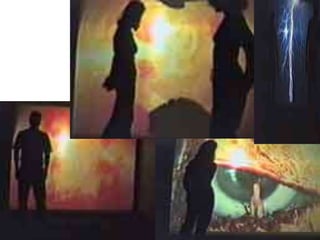
• Initially, I will comment four NTAV art works (1997 -
2006) related to second interactivity, telepresence,
ubiquity, mobile connections.
The cyberinstallation Trans-e my body, my blood (1997-
2006). manages the signals of visitor’s displacements and
gives to them digital images that sprout from the walls of a
cavern. The body is captured by sensors installed on the floor,
and the localization, the time and how many people are
interacting influence the network back propagations. The
second interactivity is offered by that neural network which is
responsible for the environment life and works as a self-
organizing system. Similar to the shamanic trances, people
dialogue with invisible (digital) cosmos and manage invisible
forces returning to the cybrid ecosystem unpredictable and
strong iconographies and sounds related to shamanic
different stages of dialogues with natural phenomena. The
software “shaman 32” based on artificial intelligence
researches has autonomy to self-regenerate the life of the
cavern and the “mutant visions”, by surprising people with
unexpected emergent “realities”.
• Cyberinstallation was exhibited firstly at the School of
Art Institute in Chicago Isea Montreal , Modern Art
Museum –Buenos Aires, 1999, II Bienal do Mercosul, VII
Bienal de la Habana, by receiving the 2000 Unesco Prize,
Lima200), Kibla Center _Slovenia, 2003, Sweden 2003.
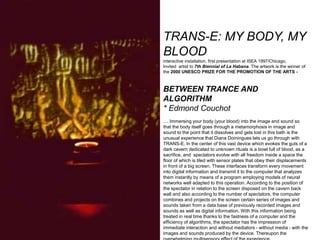
TRANS-E: MY BODY, MY
BLOOD
interactive installation, first presentation at ISEA 1997/Chicago,
Invited artist to 7th Biennial of La Habana. The artwork is the winner of
the 2000 UNESCO PRIZE FOR THE PROMOTION OF THE ARTS -
BETWEEN TRANCE AND
ALGORITHM
* Edmond Couchot
.... Immersing your body (your blood) into the image and sound so
that the body itself goes through a metamorphosis in image and
sound to the point that it dissolves and gets lost in this bath is the
unusual experience that Diana Domingues lets us go through with
TRANS-E. In the center of this vast device which evokes the guts of a
dark cavern dedicated to unknown rituals is a bowl full of blood, as a
sacrifice, and spectators evolve with all freedom inside a space the
floor of which is tiled with sensor plates that obey their displacements
in front of a big screen. These interfaces transform every movement
into digital information and transmit it to the computer that analyzes
them instantly by means of a program employing models of neural
networks well adapted to this operation. According to the position of
the spectator in relation to the screen disposed on the cavern back
wall and also according to the number of spectators, the computer
combines and projects on the screen certain series of images and
sounds taken from a data base of previously recorded images and
sounds as well as digital information. With this information being
treated in real time thanks to the fastness of a computer and the
efficiency of algorithms, the spectator has the impression of
immediate interaction and without mediators - without media - with the
images and sounds produced by the device. Thereupon the
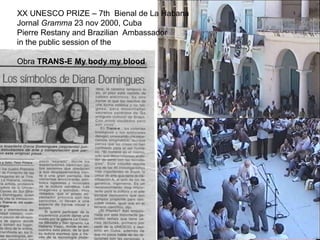
XX UNESCO PRIZE – 7th Bienal de La Habana
Jornal Gramma 23 nov 2000, Cuba
Pierre Restany and Brazilian Ambassador
in the public session of the
Obra TRANS-E My body my blood
BETWEEN TRANCE AND ALGORITHM
* Edmond Couchot
Immersing your body (your blood) into the image and sound so
that the body itself goes through a metamorphosis in image and
sound to the point that it dissolves and gets lost in this bath is the
unusual experience that Diana Domingues lets us go through with
TRANS-E. In the center of this vast device which evokes the guts of
a dark cavern dedicated to unknown rituals is a bowl full of blood,
as a sacrifice, and spectators evolve with all freedom inside a
space the floor of which is tiled with sensor plates that obey their
displacements in front of a big screen. These interfaces transform
every movement into digital information and transmit it to the
computer that analyzes them instantly by means of a program
employing models of neural networks well adapted to this
operation. According to the position of the spectator in relation to
the screen disposed on the cavern back wall and also according to
the number of spectators, the computer combines and projects on
the screen certain series of images and sounds taken from a data
base of previously recorded images and sounds as well as digital
information. With this information being treated in real time
thanks to the fastness of a computer and the efficiency of
algorithms, the spectator has the impression of immediate
interaction and without mediators - without media - with the
images and sounds produced by the device. Thereupon the
overwhelming multisensory effect of the experience.
But this immersion into the image and sound would be uninteresting if it
had not been inspired by an original thematic with strong symbolic
resonance. The cavern works as a sacred space where the spectator (one
should say initiated) is put in the presence of pre-historic and musical
symbols typical of the shamanic culture. The very rhythmical images and
sounds that the spectators themselves trigger through the sensors but
upon which they do not have real control, put them in a sort of visual
and sonorous trance. Thus they are invited - with certain violence though
- to encounter this static and visionary state typical of initiation rituals.
Certainly the trance Diana Domingues proposes is not the sacred trance of
shamanic rituals, the blood that starts moving inside the bowl is not real
blood, the cavern is not a real cavern; the floor is run with wiring, hidden
machines keep buzzing. It is another trance, a softer trance. But it is a
trance that re-links itself and reactivates, in an esthetical rather than
religious way, secret lost bonds of ancient Brazilian cultures with forgotten
but still alive myths.
When we feared that new technologies could take us apart from our origins
and separate us from our past - and this remains possible - Diana
Domingues shows us the opposite, that they are not forcefully
incompatible with the deepest forms of our imagination. A new paradoxical
hybridization is still there, in the work, between body and calculation,
between trance and algorithm.
...Thus the spectator's body penetrates in the work through the interfaces
and takes part in the come-into-being: it becomes one of its organic
materials.
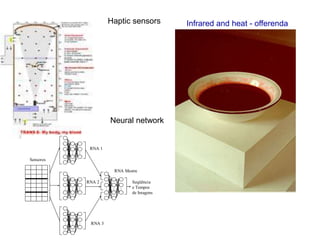
Kuikurus tribe
Alto Xingu
Haptic sensors
Seqüência
e Tempos
de Imagens
RNA 1
RNA 3
RNA 2
RNA Mestre
Sensores
Infrared and heat - offerenda
Neural network
• The complexity of the environment is enhanced by the characteristics
of the artificial neural networks in their capacity to make decisions,
learn and develop the problem proposed. The application of the
artificial neural network gives installations properties of self-
organizing systems.
ELECTRONIC TRANCE AND INTERACTIONS MEANING: TRANS-E: My body, my blood Content and context
Diana Domingues
Elliptical zones: What matters in this living environment it is to provide worlds that we can not get without technologies. It occurs
ephemeral connections by the dialogue between artificial and biological systems. People get an elliptical zone. Interfaces and
electronic circuits are programmed for receiving and transmitting data and the body immersed in these sensorized environments
has its senses digitized. Thus it experiences a “trompe les sens” sensorial circuit. When interacting the participants get the body/
machine intimate digital dialogue. People inhabit in an “elliptical zone” or in an “intersticial zone” during the symbiosis of the
charbon-based life and silicon life.
•
• The installation is divided in three environments simulating three different stages of the shamanic trance. Theoretical
approaches concerning these three stages inform that the shaman can experience three levels during the trance.
•
• In the first stage of the shamanic transe, it occurs only sensations of light and mutations in a neurophysiological way:
brilliances, colours, scintillations, flashes of lights, dots, fadings. The mind is stimulated by that images and everybody has
the same sensations. The images depend only of the biological apparatus and they have no symbolic or cultural weight.
•
• In the second stage of shamanic trance, shaman experiences images loaded with religious or emotional significance. In my
installation the participant interacts with crosses, chalices, lilies, swords, snakes, and other symbols whose interpretation
depends on one’s cultural background. The images invoke personal and individual experiences stored along life. The
mutations call out to data from religion, geography, ethnic, political and social condition and change according to habits,
emotions and other individual experiences. Many worlds can appear in the participants’ minds.
•
• In the third stage of shamanic trance, the shaman can experienced the deepest level of the trance. In this moment the
shaman goes into a turmoil. It is then when actual hallucinations take place. The shaman identifies with animals, is attracted
by lights, natural phenomena, volcanos, water, sky, stars, moon, appear and immerse the shaman in a kind of whirlwind. In
my work these images appear mixed with visceral views and the participant can be taken to distorted ephemeral identities.
•
• It’s fascinating to be able to capture invisible forces and control physical phenomena when we define the “life”of the
interactive work Biological and artificial systems dialogue provoking an enigmatic experience of TRANS-E. Interacting
people gain shamanic powers while inhabiting an elliptical zone in a symbiosis between analogical and digital, organic and
inorganic, real and virtual.
ELECTRONIC TRANCE AND INTERACTIONS MEANING:
TRANS-E: My body, my bood Content and context
*Diana Domingues
People say that in primitive societies wall pusness would
confer them powers to communicate with the beyond and to
intervene in the real world because they would dialogue with
spirits. In TRANS-E - My Body, My Blood, digital technologies
provide us with an electronic ritual. Bodies connected by
interfaces dialogue with computer electronic memories and
can experience "virtual hallucinations" in real time.
I offer an electronic transe through digital technologies in a
dark room simulating a cavern with lighted images on the wall
where people interacting can give life to the environment. I
install the work simulating a cavern offering a space where
people can get “visions” having shamanic powers. The cavern
is one of the rooms where shamans go to meet the spirits
Their visions are like images of light that appear over the
walls. Apud the researchers theories, shamans believe in the
stone power. To the shaman the walls are alive and during the
trance lighted figures sprout from the stone. The shamans
consider the stone a “veil” between their world and
‘spirits’world. In my “cavern” there are two screens. The
second one is a transparent screen suggesting a boundarie
between the virtual and the real. In the back of the room, a
big curved lighted wall shows metamorphoses from North
Brazil’s Inga Stone’s pre-historical inscriptions.To stimulate the
ritual trance a drum sound repeats an insisistant rythm and
the sound of heartbeats is altered by the actions of the
bodies. Simultaneously, a red liquid within a bowl also moves
by the infrared waves effects that connect the heat of bodies.
To Afro-Brazilian popular religions, the blood is an offerenda
to the life.
•
Interacting, people as shamans, dialogue with the beyond
from the responses generated in the invisible and enigmatic
world of data. During the journey with the spirits, the
shamans materialize their visions through the drawings which
provide and help themselves to get other visions. Interactive
technologies “materalize” the invisible data in ephemeral
connections with electronic memories. Participants have
visions where the reality is distorted and they go into unreal
and visionary worlds. People say that the shaman’s goal is to
avoid illnesses, to get rain, and mainly to establish the
harmony of the group. In my installation, I stimulate several
behaviors through digital technologies to go out of the real
world in interactive spaces connecting the psychic energy
during consciousness propagations in which new identities
can emerge.
Shamans displace energies. When interacting people
exchange invisible forces with artificial systems..The
mutations of the sequences of images and sounds result from
the visitors’ behaviour captured by the sensitivity of the
sensors’ dots installed on the floor that transmit the body
signals to the machines. The variables determining the
behaviour of the network are: where you are, for how long
and how many people stand on the neural networks
sensorized carpet. The carpet dots send the signals of the
bodies in each sensorized stage and the neural networks
learn some patterns of the participants’ behavior, manipulate
this data and provoke “visions” in the room in an enigmatic
experience of TRANS-E. The network recognizes some
patterns and interprets signals from biological systems
translating them into computing paradigms. Neural Networks
as an artificial braim, receive and process the biological
signals giving back metamorphoses as managing powers of
the beyond. NN deals in a non-linear way offering multiples
associations or "virtual hallucinations" in real time.
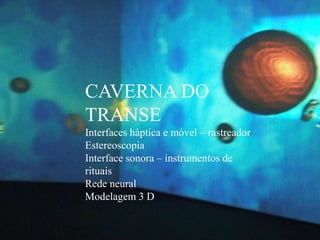
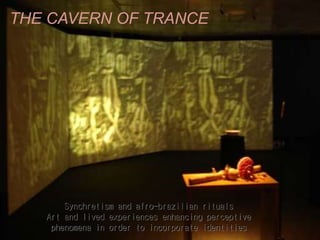
THE CAVERN OF TRANCE
In: Memórias do Futuro, 2008 Itaú Cultural exhibition 10th years
• Second version of the interactive installation
created in 1997. Virtual Reality and multi-sensorial
interfaces, immersive technologies: wireless haptic
tracker, shutter glasses, stereoscopic projection and
multi-synchronized augmented display; sound
interfaces with Afro Brazilian ritualistic instruments:
flute, whistles, maracas, afuxes, rainstick, shakers
and other musical instruments; net of twelve
infrared sensors, red liquid and bowl with presence
sensor; SOFTWARE: neural network, 3 D modeled
images, C++, Open GL platform, Roaming Library.
HARDWARE: cluster of 03 multimedia computers,
03 stereoscopic projectors, microphone, amplifiers.
ROOM: dark room, 01 dicroic light focus and
handled torch or lantern.
•
• This is a hybrid and updated version of TRANS-E:
MY BODY, MY BLOOD, interactive installation, first
presentation at ISEA 2007/Chicago and that
received the 2000 UNESCO PRIZE FOR THE
PROMOTION OF THE ARTS - 7th Biennial of La
Habana.
•
•
•
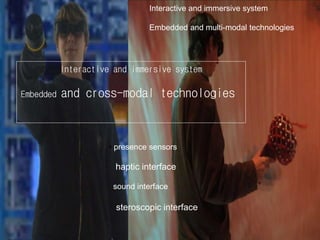
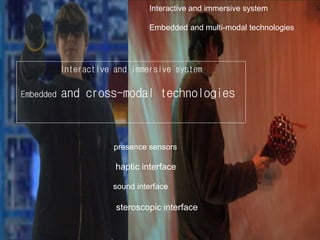
Interactive and immersive system
Embedded and multi-modal technologies
• presence sensors
haptic interface
sound interface
steroscopic interface
Interactive and immersive system
Embedded and cross-modal technologies
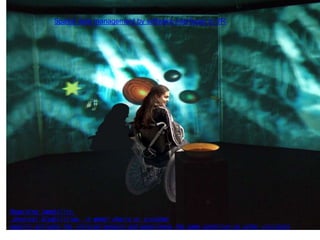
Regarding immobility,
physical disabilities, in wheel chairs or crutches
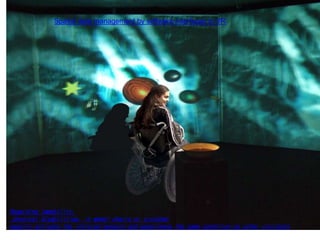
equally activate the infrared sensors and experience the same condition as other visitants
Spatial data management by software interfaces in VR
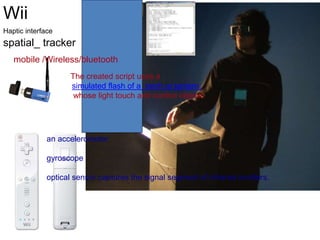
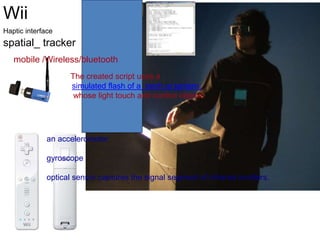
Wii
Haptic interface
spatial_ tracker
The created script uses a
simulated flash of a torch or lantern,
whose light touch and control objects
mobile /Wireless/bluetooth
an accelerometer
gyroscope
optical sensor captures the signal segment of infrared emitters.
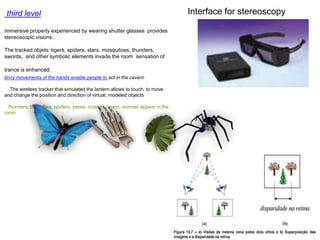
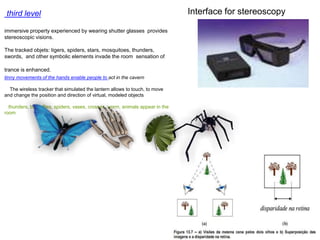
third level
immersive property experienced by wearing shutter glasses provides
stereoscopic visions.
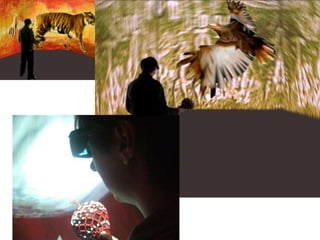
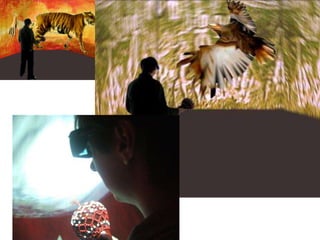
The tracked objets: tigers, spiders, stars, mosquitoes, thunders,
swords, and other symbolic elements invade the room sensation of
trance is enhanced.
tinny movements of the hands enable people to act in the cavern
The wireless tracker that simulated the lantern allows to touch, to move
and change the position and direction of virtual, modeled objects
thunders, butterflies, spiders, vases, crosses, worm, animals appear in the
room
Interface for stereoscopy
VIRTUAL REALITY -
HEARTSCAPES
THE CAVE
IMMERSIVE ENVIRONMENTS
PROPRIOCEPTION
TRACKED BODY – PHYSIOLOGY and synaesthesya
Concerning virtual reality immersive artworks, we opened we opened the UCS CAVE ,in April 2005 at the First International
Meeting of Art, Science and Technology: Virtual Reality, with the presence of renowned researchers such as Oliver Grau (Danube
University) and Ramesh Raskar (Mitsubishi Electric Research Laboratories, USA). Two virtual reality applications developed by the
NTAV group are running in the cave: Heartscapes and VR Aquarium, both described here .
Heartscapes and VR Aquarium artworks explore sorts of immersion in caves by using multissensorial interfaces: trackings for
spatial navigation and also exchanges of body signals in virtual reality.
GRAU, Oliver. Virtual Art from Illusion to Immersion.The MIT Press, Cambridge, Massachussetts, 2003.
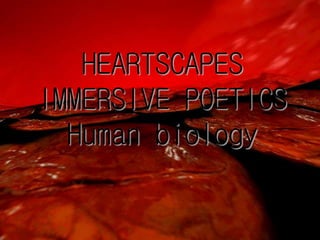
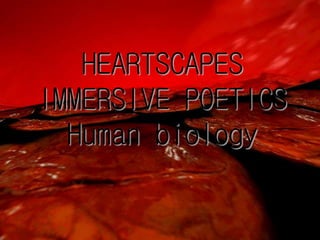
HEARTSCAPES
IMMERSIVE POETICS
Human biology
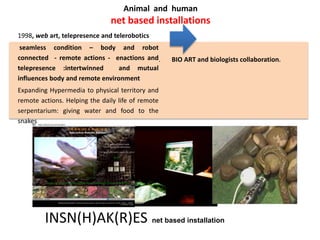
INSN(H)AK(R)ES
net based installation
Animal and human
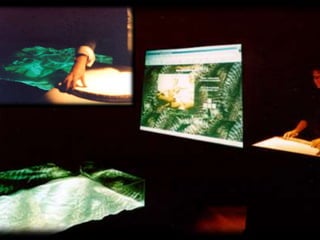
net based installations
1998, web art, telepresence and telerobotics
seamless condition – body and robot
connected - remote actions - enactions and
telepresence :intertwinned and mutual
influences body and remote environment
Expanding Hypermedia to physical territory and
remote actions. Helping the daily life of remote
serpentarium: giving water and food to the
snakes
. BIO ART and biologists collaboration.
INSN(H)AK(R)ES net based installation
ANIMAL AND HUMAN:
INSN(H)AK(R)ES
interactive and telematic ritual
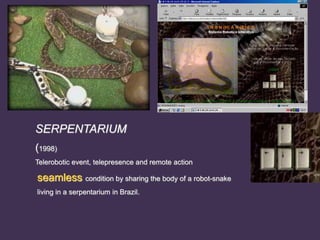
I NSN(H)AK(R)ES is to inhabit a remote Serpentarium, by embodiement of a robot-snake and the seamless
condition as Shamanic ritual,to become an animal, in case the incorporation of the robot-snake and human
body. The connexions allow immersions and teleactions in the remote serpentarium in Brazil. The tele robotic
system establishes a connection with the robot in the serpentarium located in the Museum of Natural Sciences
at the University of Caxias do Sul, Brazil. When connected, the remote actions let come true the desire to
incorporate an animal body during an interactive telematic ritual. In the natural environment of the
serpentarium, the remotely controlled robot performs tasks which human beings might be doing with their
body. It makes several trajectories through the participants’ orders, who send movements using the direction
of the arrow keys of the keyboard, whose signals are interpreted, and result in trajectories in the serpentarium.
The telepresence is provided by a web camera, which is coupled to the robot and transmits in real time scenes
from the serpentarium in Brazil. The robot is named Angel, another being, coming from the beyond, who helps
the life of the serpents. The remotely controlled robot collaborates with the snakes’ life by giving them water
and feeding them by remote actions. Presence sensors capture the action of the robot and release amounts of
water and little mice for their basic needs. The process of giving water is possible because the robot, when
moving following people’s connections, activates an infrared system that immediately opens a tap that pours
water in the recipient where the snakes go to drink. Another device activates an infrared sensor, and door
opens, liberating mice for the serpents. Life in the environment is a result of the mixture of biological and
technological signals. The natural world is revitalised through interactive technologies that generate new forms
of life.
SERPENTARIUM
(1998)
Telerobotic event, telepresence and remote action
seamless condition by sharing the body of a robot-snake
living in a serpentarium in Brazil.
ANIMAL AND HUMAN:
INSN(H)AK(R)ES
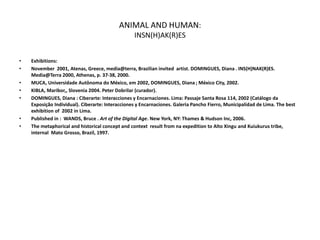
• Exhibitions:
• November 2001, Atenas, Greece, media@terra, Brazilian invited artist. DOMINGUES, Diana . INS(H)NAK(R)ES.
Media@Terra 2000, Athenas, p. 37-38, 2000.
• MUCA, Universidade Autônoma do México, em 2002, DOMINGUES, Diana ; México City, 2002.
• KIBLA, Maribor,, Slovenia 2004. Peter Dobrilar (curador).
• DOMINGUES, Diana : Ciberarte: Interacciones y Encarnaciones. Lima: Passaje Santa Rosa 114, 2002 (Catálogo da
Exposição Individual). Ciberarte: Interacciones y Encarnaciones. Galeria Pancho Fierro, Municipalidad de Lima. The best
exhibition of 2002 in Lima.
• Published in : WANDS, Bruce . Art of the Digital Age. New York, NY: Thames & Hudson Inc, 2006.
• The metaphorical and historical concept and context result from na expedition to Alto Xingu and Kuiukurus tribe,
internal Mato Grosso, Brazil, 1997.
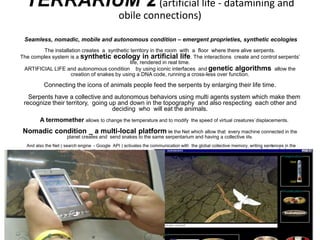
TERRARIUM 2 (artificial life - datamining and
obile connections)
Seamless, nomadic, mobile and autonomous condition – emergent proprieties, synthetic ecologies
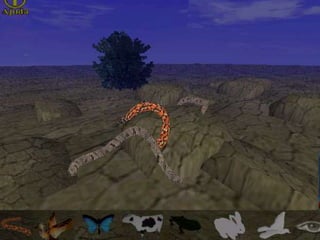
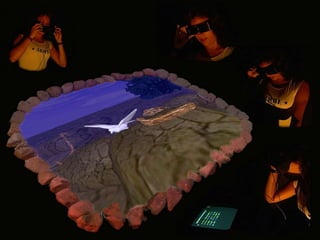
The installation creates a synthetic territory in the room with a floor where there alive serpents.
The complex system is a synthetic ecology in artificial life. The interactions create and control serpents’
life, rendered in real time.
ARTIFICIAL LIFE and autonomous condition by using iconic interfaces and genetic algorithms allow the
creation of snakes by using a DNA code, running a cross-less over function.
Connecting the icons of animals people feed the serpents by enlarging their life time.
Serpents have a collective and autonomous behaviors using multi agents system which make them
recognize their territory, going up and down in the topography and also respecting each other and
deciding who will eat the animals.
A termomether allows to change the temperature and to modify the speed of virtual creatures`displacements.
Nomadic condition _ a multi-local platform in the Net which allow that every machine connected in the
planet creates and send snakes to the same serpentarium and having a collective life.
And also the Net ( search engine - Google API ) activates the communication with the global collective memory, writing sentences in the
serpentarium with words of scientific, anthropological, historic, artistic or other issues coming from different databases.data mining
Mobile condition is the wireless connection using a PALM.
Terrarium
Interface icônica
THE CAVERN OF TRANCE
In: Memórias do Futuro, 2008 Itaú Cultural exhibition 10th years
• Second version of the interactive installation
created in 1997. Virtual Reality and multi-sensorial
interfaces, immersive technologies: wireless haptic
tracker, shutter glasses, stereoscopic projection and
multi-synchronized augmented display; sound
interfaces with Afro Brazilian ritualistic instruments:
flute, whistles, maracas, afuxes, rainstick, shakers
and other musical instruments; net of twelve
infrared sensors, red liquid and bowl with presence
sensor; SOFTWARE: neural network, 3 D modeled
images, C++, Open GL platform, Roaming Library.
HARDWARE: cluster of 03 multimedia computers,
03 stereoscopic projectors, microphone, amplifiers.
ROOM: dark room, 01 dicroic light focus and
handled torch or lantern.
•
• This is a hybrid and updated version of TRANS-E:
MY BODY, MY BLOOD, interactive installation, first
presentation at ISEA 2007/Chicago and that
received the 2000 UNESCO PRIZE FOR THE
PROMOTION OF THE ARTS - 7th Biennial of La
Habana.
•
•
•
Interactive and immersive system
Embedded and multi-modal technologies
• presence sensors
haptic interface
sound interface
steroscopic interface
Interactive and immersive system
Embedded and cross-modal technologies
Regarding immobility,
physical disabilities, in wheel chairs or crutches
equally activate the infrared sensors and experience the same condition as other visitants
Spatial data management by software interfaces in VR
Wii
Haptic interface
spatial_ tracker
The created script uses a
simulated flash of a torch or lantern,
whose light touch and control objects
mobile /Wireless/bluetooth
an accelerometer
gyroscope
optical sensor captures the signal segment of infrared emitters.
third level
immersive property experienced by wearing shutter glasses provides
stereoscopic visions.
The tracked objets: tigers, spiders, stars, mosquitoes, thunders,
swords, and other symbolic elements invade the room sensation of
trance is enhanced.
tinny movements of the hands enable people to act in the cavern
The wireless tracker that simulated the lantern allows to touch, to move
and change the position and direction of virtual, modeled objects
thunders, butterflies, spiders, vases, crosses, worm, animals appear in the
room
Interface for stereoscopy
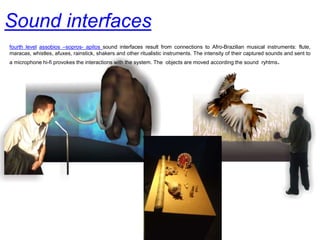
Sound interfaces
fourth level assobios –sopros- apitos sound interfaces result from connections to Afro-Brazilian musical instruments: flute,
maracas, whistles, afuxes, rainstick, shakers and other ritualistic instruments. The intensity of their captured sounds and sent to
a microphone hi-fi provokes the interactions with the system. The objects are moved according the sound ryhtms.
VIRTUAL REALITY -
HEARTSCAPES
THE CAVE
IMMERSIVE ENVIRONMENTS
PROPRIOCEPTION
TRACKED BODY – PHYSIOLOGY and synaesthesya
Concerning virtual reality immersive artworks, we opened we opened the UCS CAVE ,in April 2005 at the First International
Meeting of Art, Science and Technology: Virtual Reality, with the presence of renowned researchers such as Oliver Grau (Danube
University) and Ramesh Raskar (Mitsubishi Electric Research Laboratories, USA). Two virtual reality applications developed by the
NTAV group are running in the cave: Heartscapes and VR Aquarium, both described here .
Heartscapes and VR Aquarium artworks explore sorts of immersion in caves by using multissensorial interfaces: trackings for
spatial navigation and also exchanges of body signals in virtual reality.
GRAU, Oliver. Virtual Art from Illusion to Immersion.The MIT Press, Cambridge, Massachussetts, 2003.
HEARTSCAPES
IMMERSIVE POETICS
Human biology
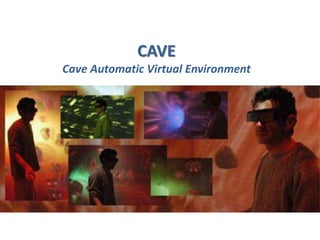
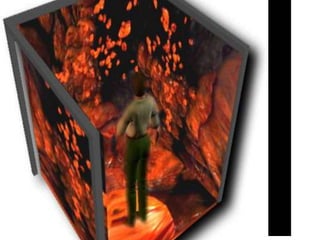
CAVE
Cave Automatic Virtual Environment
Algorithms generating particles gave the
environment qualities typical of physical
laws such as gravity and dynamics.
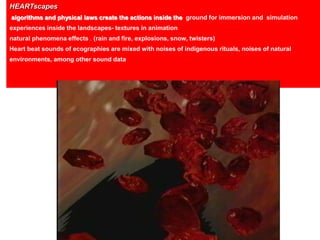
HEARTscapes
algorithms and physical laws create the actions inside the ground for immersion and simulation
experiences inside the landscapes- textures in animation
natural phenomena effects . (rain and fire, explosions, snow, twisters)
Heart beat sounds of ecographies are mixed with noises of indigenous rituals, noises of natural
environments, among other sound data
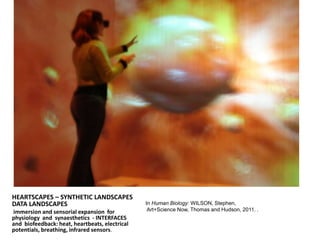
HEARTSCAPES – SYNTHETIC LANDSCAPES
DATA LANDSCAPES
immersion and sensorial expansion for
physiology and synaesthetics - INTERFACES
and biofeedback: heat, heartbeats, electrical
potentials, breathing, infrared sensors.
In Human Biology: WILSON, Stephen,
Art+Science Now, Thomas and Hudson, 2011. .
Biofeedback
• Biofeedback investigates mutual behaviors of the body signals and the
environment. Enactions and affectivity involves sensorial
physiology and cognitive processes that result from the analysis of
internal signals and communication to the intertwined body/environment,
and their information exchanges. The reshaping of human perception and
cognitive process deal with body physiology that acts with immediate
physical environment. The systematic structuring of the relations between
sensory patterns is derived from manufactured sensor technologies and
those given by locomotion, proprioception and the internal senses signals
of the heart beats and electrical waves of eyes movements.
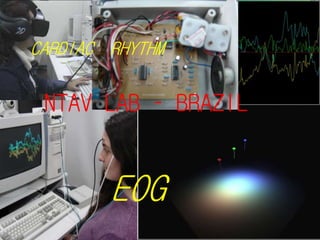
NTAV LAB – BRAZIL
EOG
CARDIAC RHYTHM
VR Aquarium
CAVE 2005
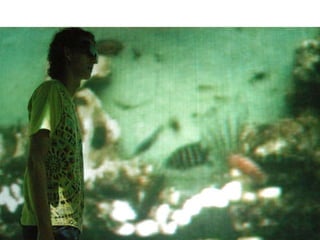
Virtual Reality and Telepresence creating a synthetic ecology:
fish living in a real aquarium in the next room of UCS Museum of Natural Sciences are
projected in the cave , transmitted by telepresence ( web cam ).
The images are combined with simulated VR 3D scenes.
• The body enters in the cave populated by real fish and synthetic animated fish in relief by
stereoscopic glasses that let the synthetic fishes pass through the immersed body of the
visitor. The interaction with the virtual fishes uses the body movements coupled to the
tracker (flock of birds), enabling the touch on the synthetic fish through simple gestures and
activating an artificial intelligence program which gives them a collective behavior based on
a flocking algorithm.
The virtual fishes move together showing a behavior similar to that of the biological world.
• The interface design blurred the boundaries between real and virtual worlds, confirming
the magic of interactive technologies.
VR aquarium
VR Aquarium
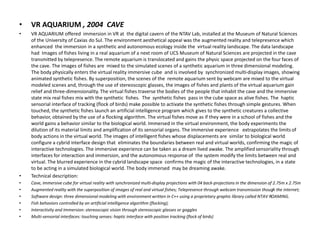
• VR AQUARIUM , 2004 CAVE
• VR AQUARIUM offered immersion in VR at the digital cavern of the NTAV Lab, installed at the Museum of Natural Sciences
of the University of Caxias do Sul. The environment aesthetical appeal was the augmented reality and telepresence which
enhanced the immersion in a synthetic and autonomous ecology inside the virtual reality landscape. The data landscape
had Images of fishes living in a real aquarium of a next room of UCS Museum of Natural Sciences are projected in the cave
transmitted by telepresence. The remote aquarium is translocated and gains the physic space projected on the four faces of
the cave. The images of fishes are mixed to the simulated scenes of a synthetic aquarium in three dimensional modeling.
The body physically enters the virtual reality immersive cube and is involved by synchronized multi-display images, showing
animated synthetic fishes. By superposition, the scenes of the remote aquarium sent by webcam are mixed to the virtual
modeled scenes and, through the use of stereoscopic glasses, the images of fishes and plants of the virtual aquarium gain
relief and three-dimensionality. The virtual fishes traverse the bodies of the people that inhabit the cave and the immersive
state mix real fishes mix with the synthetic fishes. The synthetic fishes pass in the cube space as alive fishes. The haptic
sensorial interface of tracking (flock of birds) make possible to activate the synthetic fishes through simple gestures. When
touched, the synthetic fishes launch an artificial intelligence program which gives to the synthetic creatures a collective
behavior, obtained by the use of a flocking algorithm. The virtual fishes move as if they were in a school of fishes and the
world gains a behavior similar to the biological world. Immersed in the virtual environment, the body experiments the
dilution of its material limits and amplification of its sensorial organs. The immersive experience extrapolates the limits of
body actions in the virtual world. The images of intelligent fishes whose displacements are similar to biological world
configure a cybrid interface design that eliminates the boundaries between real and virtual worlds, confirming the magic of
interactive technologies. The immersive experience can be taken as a dream lived awake. The amplified sensoriality through
interfaces for interaction and immersion, and the autonomous response of the system modify the limits between real and
virtual. The blurred experience in the cybrid landscape space confirms the magic of the interactive technologies, in a state
to be acting in a simulated biological world. The body immersed may be dreaming awake.
• Technical description:
• Cave, immersive cube for virtual reality with synchronized multi-display projections with 04 back-projections in the dimension of 2.75m x 2.75m
• Augmented reality with the superposition of images of real and virtual fishes; Telepresence through webcam transmission though the internet;
• Software design: three dimensional modeling with environment written in C++ using a proprietary graphic library called NTAV ROAMING.
• Fish behaviors controlled by an artificial intelligence algorithm (flocking);
• Interactivity and Immersion: stereoscopic vision through stereoscopic glasses or goggles
• Multi-sensorial interfaces: touching senses: haptic interface with position tracking (flock of birds)
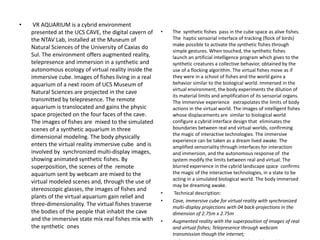
• VR AQUARIUM is a cybrid environment
presented at the UCS CAVE, the digital cavern of
the NTAV Lab, installed at the Museum of
Natural Sciences of the University of Caxias do
Sul. The environment offers augmented reality,
telepresence and immersion in a synthetic and
autonomous ecology of virtual reality inside the
immersive cube. Images of fishes living in a real
aquarium of a next room of UCS Museum of
Natural Sciences are projected in the cave
transmitted by telepresence. The remote
aquarium is translocated and gains the physic
space projected on the four faces of the cave.
The images of fishes are mixed to the simulated
scenes of a synthetic aquarium in three
dimensional modeling. The body physically
enters the virtual reality immersive cube and is
involved by synchronized multi-display images,
showing animated synthetic fishes. By
superposition, the scenes of the remote
aquarium sent by webcam are mixed to the
virtual modeled scenes and, through the use of
stereoscopic glasses, the images of fishes and
plants of the virtual aquarium gain relief and
three-dimensionality. The virtual fishes traverse
the bodies of the people that inhabit the cave
and the immersive state mix real fishes mix with
the synthetic ones
• The synthetic fishes pass in the cube space as alive fishes.
The haptic sensorial interface of tracking (flock of birds)
make possible to activate the synthetic fishes through
simple gestures. When touched, the synthetic fishes
launch an artificial intelligence program which gives to the
synthetic creatures a collective behavior, obtained by the
use of a flocking algorithm. The virtual fishes move as if
they were in a school of fishes and the world gains a
behavior similar to the biological world. Immersed in the
virtual environment, the body experiments the dilution of
its material limits and amplification of its sensorial organs.
The immersive experience extrapolates the limits of body
actions in the virtual world. The images of intelligent fishes
whose displacements are similar to biological world
configure a cybrid interface design that eliminates the
boundaries between real and virtual worlds, confirming
the magic of interactive technologies. The immersive
experience can be taken as a dream lived awake. The
amplified sensoriality through interfaces for interaction
and immersion, and the autonomous response of the
system modify the limits between real and virtual. The
blurred experience in the cybrid landscape space confirms
the magic of the interactive technologies, in a state to be
acting in a simulated biological world. The body immersed
may be dreaming awake.
• Technical description:
• Cave, immersive cube for virtual reality with synchronized
multi-display projections with 04 back-projections in the
dimension of 2.75m x 2.75m
• Augmented reality with the superposition of images of real
and virtual fishes; Telepresence through webcam
transmission though the internet;
Mais.après les évasions et les immersions dans les mondes
synthétiques de Realité Virtuelle, nous sommes conscients des
connexions au
cyberspace everywhere (William Gibson 2007 Spook Country: a novel ),
et des modes de vie élargis par
les technologies ubiquitaires,
dispositifs mobiles,
interfaces locatives,
systèmes sur puce microcontrôleur embarqué,
traitement de signaux,
traitement des données et data visualisation,
y compris les biocapteurs et traduction des états affectifs par la
synesthésie (transit entre les différents canaux sensoriels)
Mobile technologies
cyberspace is everywhere !
William Gibson 2007 Spook Country: a novel
Mobilité et société
Ces pratiques répondent à la croissance de la mobilité dans nos sociétés contemporaines et à la prolifération des technologies
portables. Alors que celles-ci interviennent dans de nombreux domaines de la vie quotidienne et sociale, l’émergence des
téléphones mobiles munis de systèmes de géolocalisation GPS et connectés à Internet ainsi que des applications mobiles aux
multiples fonctionnalités de réalités augmentées déploie tout un champ de création interdisciplinaire, que les artistes
professionnels tout comme lês citoyens du monde s’approprient. Les pratiques artistiques autour des mobilités numériques
agissent en redéfinissant ou en détournant leurs usages attendus.
• INTERVENTIONS DANS LA VIE DE LA VILLE:
• TATTOUAGES VIVANTS – LIVING TATTOOS
• Logiciel social et états de mobilité: FLASH MOBS ( Rheingold) tatoués habitants de
la Ville (Domingues REALITÉ MIXTES ET VIE URBAINE MÉLANGÉE groupe Artecno /
CNPq 2007 Prenant l'utilisation des téléphones cellulaires dans la construction d'un
réseau social qui mixe l'urbain et L’imaginaire fantastique des cors tatoués dans le
projet "Tatouages ​​vivants ». Présence Cybride
•
TATTOUAGES VIVANTS – LIVING TATTOOS
• Logiciel de mixage social, CORPS TATTOUÉS , le sens de présence cybride dans la communication omniprésente et
connexion en utilisant les téléphones mobiles, les PDA, avec bluetooth, l'envoi e de SMS et MMS, ainsi que des interfaces
locatifs de geolocalization comme Google Maps et Google Earth. Les membres du réseau vivent n’importe où et leur
localisation sur les cartes construit les identités,e apporte des informations aux endroits ailleurs, en créant l'augmentation
du sentiment de présence danss des environnements différents, et ajoute des données dans des environnements variés,
par des images de mélange qui sont provenant de différents endroits.
• Le dialogue du forum tatoué en PHP génère graphos en consultant les données des systèmes d'exploitation de
communication. Geolocalizadores cartographie GPS des déplacements de corps tatoués dans l'environnement physique
• . L'envoi de tatouages ​​par téléphone ou par courriel est un moyen d'obtenir une interface utilisateur graphique à deux
dimensions se traduit dans la forme 3D et le tatouage devient une créature qui va vivre avec d'autres créatures dans
tatuarium.
• Caractéristiques graphiques des différents tatouages ​​se confondent avec les traits de personnalité des individus, dans les
textes du forum et leurs relations.
• Comme une sorte d'interface affective par websemantique il y a l'exploration de données du , réseau social, vu en termes
de graphos conversations générées par le reseau des tatoués qui nourrit la vie des créatures tatouages. La prévisualisation
des gains de conversations dans la complexité d'identifier les caractéristiques de calcul évolutif et génère le tatoué sur la vie
régie par le comportement des individus dans le réseau social. Envoi et vivre ensemble dans l'environnement, créatures
artificielles naissent, grandissent, se rapportent et meurent comme l'échange d'informations et le partage des idées, des
désirs, des croyances et des valeurs de tatouages ​​dans l'infographie et de la vie artificielle, régie par le tissu social de la vie la
ville tatouée cybride
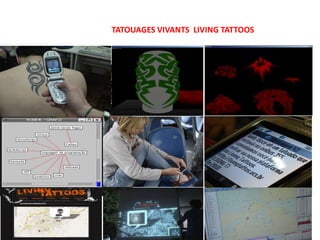
TATOUAGES VIVANTS LIVING TATTOOS
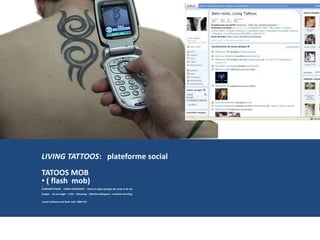
LIVING TATTOOS: plateforme social
TATOOS MOB
• ( flash mob)
•
CYBERARTIVISME - CORPS REINVENTÉ - rituel em ligne partage de corps et de ses
images - vie et magie – a life – dataming- affective dialogues – machine learniing
•social software and flash mob 2004 CHI
Living tattoos
THE ANTHROPOLOGICAL PRESENCE OF TATTOOS IN HUMAN CULTURE.
Living tattoos artwork is a speculative software which intends to create a social
platform of networked tattoos communities. It proposes the co-existence in physical
space and cyberspace, and the environment evolution is based on tattoos’
identification patterns and members’ skills , by eliminating the diversity of race,
geography, gender, and other cultural differences. We propose strategies to
engineering reality by the use of social software .The mobile condition activates a
mutant morphology of tattoos by translating how diversity of communication and
manifested personalities influence the emergent properties and regulate the
potential interface design culminating in artistic and cultural metamorphosis
according to the social rules in Cyberculture.
• FLASH MOBS = mobilité humaine et la ville -
Une autre étape de la vie cybride est le fourmillement d'hommes / insectes au cours de flashmobs, appelée ici
Tatouages ​​Mobs . Tatoués vivants dans le réseau sont invités et conduisent des intrventiosn dans le urbain collectif qui
explorent le sens d’ être ici, hic et nunc , et là , au cyberespace, donc le cybride, le mixage réseau numérique avec les
appareils mobiles qui permettent de changer le sens passif de présence et de place dans l'espace cybride et
physiquement altéré. La vie de tatoué comme un réseau social émergent biologique en cévolition avec le numérique
et les actions humaiines des êtres mobiles, des insectes (Dyens, 2008) dans une mise en réseau dún social social
cybride ( Domingues et Andres)
• SOFTWARE SOCIAL ET REINGÉNIÉRIE DE LA CULTURE
• Tatouages ​​vivant: ciberartivisme le corps réinventé dans les réseaux sociaux - Comment la pratique en collaboration
créative, les tatouages adaptent l’appareil technologique e créeent un environnements qui abandonne le sens de
propriété intellectuelle, pour atteindre les objectifs sociaux de la relation de la communauté les tatoués et
intervention culturelle.
Interfaces : ubiquous computing, locative, pervasive and sencient mobile technologies
mobile interfaces: cell phones
MMS and SMS to communicate with our platform they send their tattoos to the platform
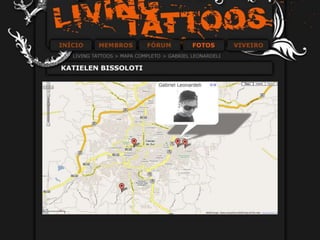
Locative interfaces: GPS and Google Maps. GPS mapping and tracking system generates urban flow of
tattooed in the city’s buses ( VISATE).
Living Tattoos: ciberartivismo e o corpo reinventado em redes
sociais.
• Como prática criativa colaborativa Living Tattoos adapta o aparato tecnológico e abandona ambientes de propriedade intelectual, para atender fins
sociais de relacionamento de comunidade de tatuados e de intervenção cultural·. O software social que implementou o “Living Tattoos” foi
desenvolvido em 2000 para uma a epistemologia mutante voltada a comportamentos e relações humanas que exigiu o desenvolvimento e escrita de
software para a formação de uma comunidade, cuja identidade é baseada em tatuagens, eliminando noções de geografia, etnia, classes sociais,
gênero, ou outra qualquer. O design de interface permite conexões e trocas de identidades de pessoas tatuadas na rede, num ambiente colaborativo
e de reciprocidade. Disponibilizado de acordo com regras de software livre, para a construção de identidades, têm como ponto de partida a
identidade revelada em tatuagens, e o perfil de personalidade de pessoas que aceitam a participar do sistema em um blog. A partir de convite no
Orkut, e outros ambientes sociais, tatuados migram para o website do grupo, e para o blog que oferece diferentes interfaces para conexões na web.
Tatuados enviam suas tatuagens que são imagens 2 D, visualizadas no site, que é transformado em forma 3D, num morphing de imagens. O envio de
fotos ou qualquer tipo de imagem da própria tatuagem, por celular ou por e-mail faz chegar uma forma bidimensional, que é traduzida de seu gráfico
2 D por interface gráfica, em forma 3D e a tatuagem passa a se tornar uma criatura que vai viver com outras criaturas num tatuarium. Cada tatuagem
em 3D gera uma criatura sintética que evolui pelo diálogo do Blog com as informações dos grafos. As características gráficas de cada tatuagem
seguem os traços de personalidade dos indivíduos, com termos dos textos do fórum e seus relacionamentos. Como uma espécie de interface afetiva,
em websemâmica, por mineração de dados, a rede social, visualizada pelos grafos gerados por termos de conversas de tatuados na rede, alimenta a
vidas das criaturas tattoos. A visualização das conversas ganha em complexidade em computação evolutiva em a-Life, regida pelo comportamento
dos indivíduos na rede social, vivendo junto no ambiente do viveiro de tatuagens. Criaturas artificiais nascem, crescem, relacionam-se e morrem
conforme a troca de informações e o compartilhamento de ideias, desejos, crenças e valores de tatuagens em computação gráfica e vida artificial,
regidas pela trama social da vida de tatuados.
• Em outra parte do projeto, tatuados mesclados à vida urbana por dispositivos móveis, com o uso dos celulares de uma rede social se mesclam o
imaginário fantástico de corpos tatuados em software social e o sentido de presença biocíbrido, em comunicação ubíqua e móvel. A vida biocíbrida
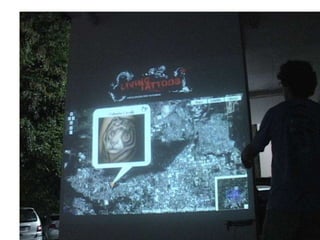
convida também ao enxameamento de homens/insetos durante flashmobs, chamadas de Tattoos Mobs (fig. 17 a 19). Tatuados que vivem na rede
são convidados e realizam intervenções urbanas como coletivos móveis que exploram o estar aqui, hic et nunc, misturando o digital da rede com
dispositivos móveis que permitem trocar o sentido passivo de presença e lugar no espaço da matéria cibridizado. A vida de tatuados como rede social
emergente mistura o biológico e o digital co-evoluindo em ações inumanas de seres móveis (DYENS, 2008) numa cenário cíbrido de redes sociais. A
conexão de celulares, PDAs, com bluetooth, envio de SMS e MMS, somados a interfaces locativas de geolocalizadores como Google Maps e Google
Earth. Os participantes da rede trocam mensagens, localizações em mapas, trazem informações de lugares para outros lugares, aumentando o
sentido de presença no espaço físico pela adição de dados misturando imagens com imagens vindas de onde estão, e criando suas narrativas.
Geolocalizadores traçam por GPS deslocamentos de corpos tatuados no ambiente físico.
• ©NTAV Lab/CNPQ
• Apresentado no CHI _Human Computer Interface - ACM, Florença Vida Urbana Misturada. Rod McCall (Chair) 2008.
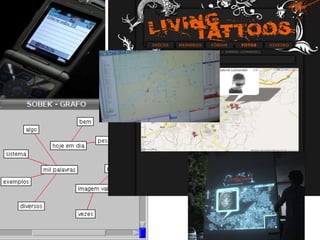
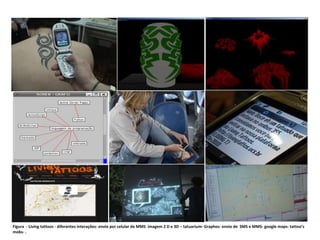
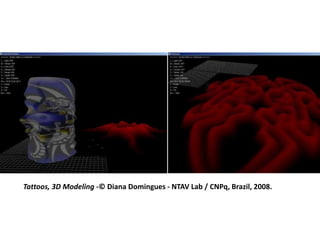
Figura - Living tattoos - diferentes interações- envio por celular de MMS imagem 2 D e 3D – tatuarium- Graphos- envio de SMS e MMS- google maps- tattoo’s
mobs- .
Tattoos, 3D Modeling -© Diana Domingues - NTAV Lab / CNPq, Brazil, 2008.
EMERGENT SOCIAL BEHAVIORS:
Interfaces : ubiquous computing, locative, pervasive and
sencient mobile technologies cell phones
MMS and SMS to communicate with our platform people send
their tattoos to the platform
Locative interfaces: GPS and Google Maps. GPS mapping and
tracking system generates urban flow of tattooed in the city’s
buses ( VISATE).
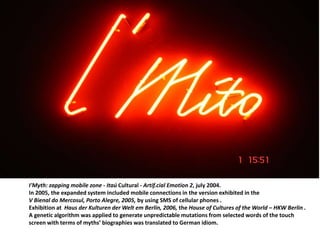
I'Myth: zapping mobile zone - Itaú Cultural - Artif.cial Emotion 2, july 2004.
In 2005, the expanded system included mobile connections in the version exhibited in the
V Bienal do Mercosul, Porto Alegre, 2005, by using SMS of cellular phones .
Exhibition at Haus der Kulturen der Welt em Berlin, 2006, the House of Cultures of the World – HKW Berlin .
A genetic algorithm was applied to generate unpredictable mutations from selected words of the touch
screen with terms of myths’ biographies was translated to German idiom.
I’Myth: Zapping Mobile Zone
I'Myth: zapping zone - Itaú Cultural - Artif.cial Emotion 2, july 2004.
In 2005, the expanded system included mobile connections in the version exhibited in the V Bienal do Mercosul, Porto Alegre,
2005, by using SMS of cellular phones .
Exhibition at Haus der Kulturen der Welt em Berlin, 2006, the House of Cultures of the World – HKW Berlin . A genetic algorithm was applied to generate unpredictable
mutations from selected words of the touch screen with terms of myths’ biographies.The system was translated to German idiom.
Instalação montada no 5ª Bienal do Mercosul (2005): I'Mito: zapping zone., 2005
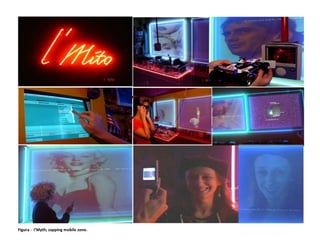
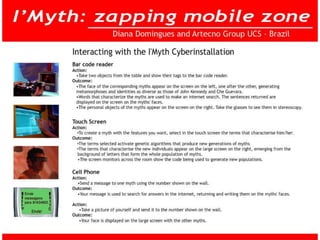
• Second interactivity, nomadism, intelligent and mobile connections are allowed in the cyberinstallationI’ Myth: zapping
mobile zone.The title I'Myth is related to the visitor exploration of the universe of the myths and get closer to them in a
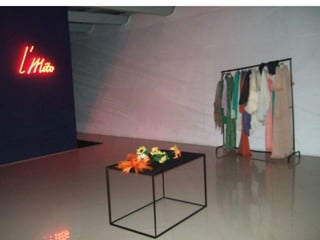
zapping zone with multiple associative possibilities among physical and immaterial information.The physic space is similar
to a store or brecho which is not dedicated to buy objects, but where people can buy identities. It is a zone of zapping where
people make associations of icons related to myths’ life and activate virtual connections, by coexisting in real and virtual
spaces. Interfaces enable to exchange identities with a complex system and the start of interactions is with the labeled
objects offered to a bar code reader. The system also uses cell phones, net connections, stereoscopic vision, touch screen
and artificial life. Getting into the room of a store or brecho full of objects/fetishes, neon silhouettes of objects and a video
clip, people are in contact with the memory of myths’ life. The room has vibrant colors of pop aesthetics and a big amount
of objects related to the individual myths explore the poetics of excess. Going from the objects full of myth’s energy to the
virtual images and the words and the code of the system, we offer a landscape, or better, a scenario with levels of the
ecology of icons.
• The installation environment and the interactive system allow people to circulate in differentlevels of the iconic scale: real
objects are labelled and available for interactions; They call analogical 2D photographs presented as frozen images; videos
and neon silhouettes are melting in the space; 3D geometric objects appear and enhance the illusion of reality with
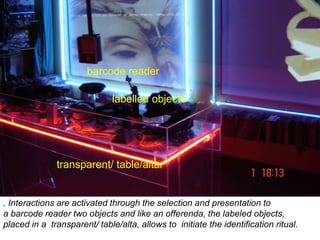
stereoscopic visualization. The interactions are activated through the selection and presentation to a barcode reader two
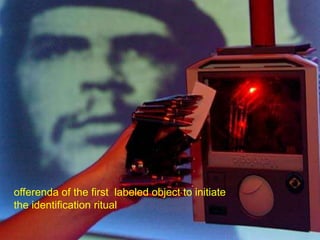
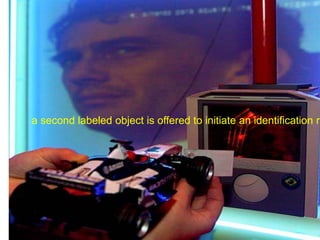
objects and like an offerenda, the labeled objects, placed in a transparent/ table/altar, allows initiating the identification
ritual. What information activates the intelligent connections? The myths are represented internally through a set of terms,
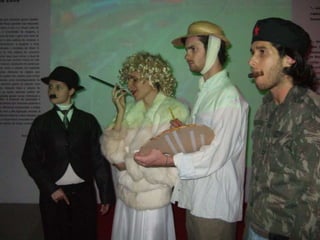
organised in a database in different categories: nouns: personal objects that remind us of the myths. For instance, a walking
cane to represent Charles Chaplin; adjectives: personal characteristics of the myths. For instance, courageous and fast,
which may be used to describe Ayrton Senna; verbs: actions that characterise the personality of the myths, for instance to
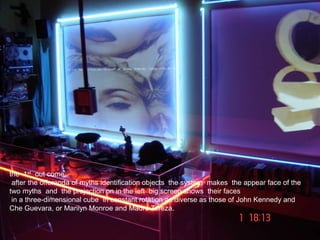
race, to pray, to kill; the first out come of the system is: after the offerenda of myths’ identification objects the system makes
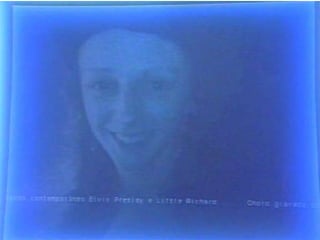
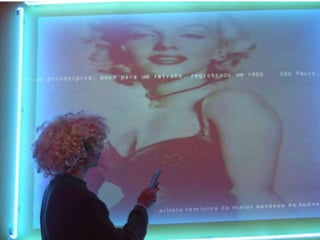
appear faces of the two myths and the projection on in the left big screen shows their faces in a three-dimensional cube in
constant rotation as diverse as those of John Kennedy and Che Guevara, or Marilyn Monroe and Madre Tereza. The 3rd out
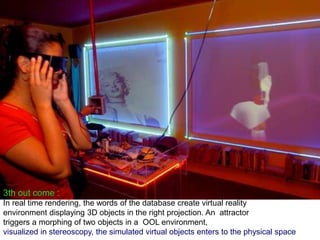
come is: in real time rendering, the words of the database create virtual reality environment displaying 3D objects in the
right projection.
( interactions)
• An attractor triggers a morphing of two objects in an OOL environment, visualized in stereoscopy, the simulated virtual
objects enters to the physical space. The 4th out come is: the room sound system controlled by a sonic database explores
chunks of speeches, songs, noises considering the myths` history. The 5th out come is: contrasting with the physicality of the
real world, computer monitors present raw data being manipulated by the system in order to control the interaction with
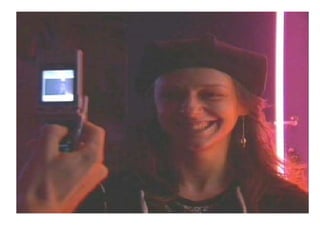
the user and to generate the synthetic images; the Sixth outcome allows mobile connections, by sending messages by cell
phone, SMS makes search in Google and a response comes from the net, running a search engine. A second line of words is
written in the myths’ faces on the left screen. The sseventh out come: cell phone mobile connections allows the visitor to
take his/her one picture and to send this photography to a given cell phone number. In a few minutes, his picture is
displayed on the large screen placed on the left-side of the room. There is also a touch-screen for the activation of
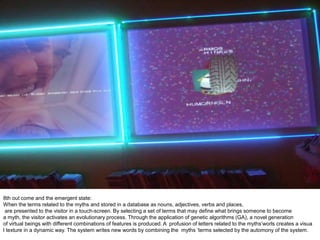
evolutionary process. It activates the 8th out come; the touch screen displays words of the database mixing all the worlds of
all myths’ lives database and by selecting a substantive, an adjective, a verb and a place triggers genetic algorithms potential
which produce a new generation of synthetic beings. The one with most aptitude is selected and displayed and the
evolutionary process defines the strongest one according to the selected words. This 8th outcome provokes emergent state:
when the terms related to the myths and stored in a database as nouns, adjectives, verbs and places are presented to the
visitor in a touch-screen. By selecting a set of terms that may define what brings someone to become a myth, the visitor
activates an evolutionary process. Through the application of genetic algorithms (GA), a novel generation of virtual beings
with different combinations of features is produced. A profusion of letters related to the myths’ world creates a visual
dynamic way. The system writes unpredictable words combining the terms of the selected by the automats system. In the
zapping mobile zone the visitor is part of the whole and his/her interactions generate an associative zone with the collective
memory of myths` culture by using sencient and pervasive interfaces of Cyberculture.
•
• Figura 3- I’Myth; zapping mobile zone.
Figura - I’Myth; zapping mobile zone.
. Interactions are activated through the selection and presentation to
a barcode reader two objects and like an offerenda, the labeled objects,
placed in a transparent/ table/alta, allows to initiate the identification ritual.
transparent/ table/altar
labelled objects
barcode reader
offerenda of the first labeled object to initiate
the identification ritual
a second labeled object is offered to initiate an identification ri
What information activates the intelligent connections?
• The myths are represented internally through a set of terms, organised in a
database in different categories:
• nouns: personal objects that remind us of the myths. For instance, a
walking cane to represent Charles Chaplin;
• adjectives: personal characteristics of the myths. For instance, courageous
and fast, which may be used to describe Ayrton Senna;
• verbs: actions that characterise the C of the myths, for instance to race, to
pray, to kill;
 places: cities, countries and other locations attached to the myths’ history,
for instance Paris, connected to the life and death of Princess Diana.
•
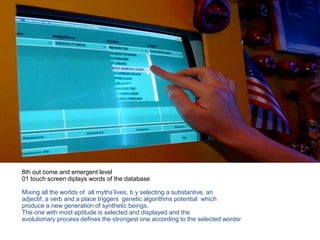
8th out come and emergent level
01 touch screen diplays words of the database
Mixing all the worlds of all myths’lives, b y selecting a substantive, an
adjectif, a verb and a place triggers genetic algorithms potential which
produce a new generation of synthetic beings.
The one with most aptitude is selected and displayed and the
evolutionary process defines the strongest one according to the selected wordsr
the 1st out come:
after the offerenda of myths identification objects the system makes the appear face of the
two myths and the projection on in the left big screen shows their faces
in a three-dimensional cube in constant rotation as diverse as those of John Kennedy and
Che Guevara, or Marilyn Monroe and Madre Tereza.
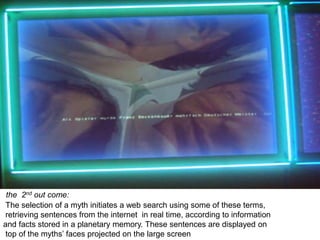
the 2nd out come:
The selection of a myth initiates a web search using some of these terms,
retrieving sentences from the internet in real time, according to information
and facts stored in a planetary memory. These sentences are displayed on
top of the myths’ faces projected on the large screen
3th out come :
In real time rendering, the words of the database create virtual reality
environment displaying 3D objects in the right projection. An attractor
triggers a morphing of two objects in a OOL environment,
visualized in stereoscopy, the simulated virtual objects enters to the physical space
8th out come and the emergent state:
When the terms related to the myths and stored in a database as nouns, adjectives, verbs and places,
are presented to the visitor in a touch-screen. By selecting a set of terms that may define what brings someone to become
a myth, the visitor activates an evolutionary process. Through the application of genetic algorithms (GA), a novel generation
of virtual beings with different combinations of features is produced. A profusion of letters related to the myths’worls creates a visua
l texture in a dynamic way. The system writes new words by combining the myths ‘terms selected by the automony of the system.
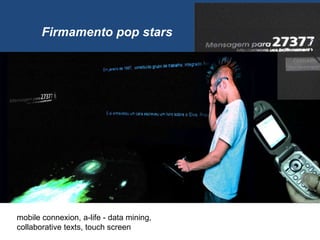
Firmamento pop stars
mobile connexion, a-life - data mining,
collaborative texts, touch screen
FIRMAMENTO – POP STARS
• Firmamentum is the collective voice of the planet in emergent states. The system proposes an utopic cosmos, eliminating
social and political constraints in an associative and free model, coming from everywhere and everyone.Unexpected
relationships manifest free groups of people which lights compose unexpected constellations, and free narratives write
histories resulting from people and stored values of myths on the net. The system addresses ecological, social, and political
issues in imaginative and innovative ways, by eliminating the diversity among people, race, gender, idiom, or other
differences and constraints. Concerning language differences, the system writes collective and collaborative texts in several
idioms. The connections to the Net (API Google), by activating words of a linguistic database are expanded for SMS
messages using mobile phones. The messages sent in the country idiom write sentences in the correspondent idiom of
people, in accordance with the list of words translated and stored in the linguistic database of the system. For instance, by
using a database for interactions in France, a list of French words connect Google and return sentences in French. The same
system works in other languages ( Spanish, Polish, German, only changing the language of the words in the database.
Consequently, the interface design of the installation offers a complex system with dialogues that expand human life in the
cosmos. The main goal of the artwork is to adapt the apparatus confirming that digital technologies configure a post-
biological way of life in Cyberculture. Metaphorically, we receive shamanic powers from technologies and we are able for
dialogues with natural forces of the cosmos. We receive post-human capacity to collect global ideas and intervene in
political domain, by rewriting collectively the history of human culture.
•
• Technical description: In the physic space, a digital tablet enables the visitor to control a source of light in a stereoscopic
projected sky on the floor, which create a lake in the center of the room, by simulating a magic landscape. The synthetic
sky is visualized with VR glasses. The stars on the lake are 3D modeled objects rendered with a proprietary library, NTAV
Roaming, based on Open GL in C++. An attractor system is responsible for the dynamics of the 3D modeled objects,
handling collisions and the morphing of the objects. A collective and intelligent behavior results from an artificial
intelligence mechanism based on a flocking algorithm. The sound system in the room is controlled by a mechanism which
selects fragments of songs, sounds, noises and speeches for each star representing a myth. Exploiting the idea of global and
nomadic connectivity, when a star gets in the area around the source of light, a web search is initiated using terms stored in
a linguistic database about the myths. The engine collects words and retrieves sentences from the internet and displays
them on the wall. This same process is activated when the user sends messages to the stars using an SMS service through an
ordinary cell phone. Photographs of the visitors taken with cell phones and sent by MMS are also displayed.
• DOMINGUES, D.; REATEGUI, Eliseo Berni. Firmamento Pop_Stars. In: Ivana Bentes. (Org.). Corpos Virtuais. Rio de Janeiro:
Instituto Telemar, 2005, v. , p. 32-33. The cyberinstallation is a collaborative work of Diana Domingues, Eliseo Reategui and
NTAV Lab team. Eliseo Reategui
• Exhibitions: Corpos Visrtuais, Museu Telemar RJ june 2005 and at Itau Cultural São Paulo, in the exhibition Cinetico Digital,
july 2005.
Firmamento_Pop Stars (2004-2005)
Museu da Telemar RJ - Itau Cultural
• Firmament_popstars
• The cyberinstallation deals with the metaphor of life and allows identification rituals with a synthetic sky, full of myths of
human culture. In the center of the physic space, a lake “eye of the earth” is the mirror of a virtual cosmos, where life is
designed by the stars' behaviors which simulate a living organism. Embedded technologies offer interactions and immersions
in the cosmos and nomadic and mobile connections, in accordance with a search mechanism write collective texts. The
identification ritual is started by the visitors controlling a source of light in the projected sky using a tablet with the image of
a Hubble map. The interactions show the self-organization and autonomy of the cosmos projected on the floor, crowded
with dots of lights and sounds. The system has emergent proprieties and the cosmos mutations have levels of evolutionary
states, guided by an artificial intelligence software. Through the use of a flocking algorithm, stereoscopic stars move on the
surface of the lake evoking the movement of the pen in correspondence of the hands displacements. The stars’collective
behaviors ares based on the proximity and on the stars' desire of light and to stay together. Each star is an agent that
manifests its wish to live in community. The visitor controls a source of light which attracts the stars by moving . The
collective life of the stars, following the light source, provokes mutant constellations, and determines the cosmos
reconfiguration. Each star is an agent representing a myth: Che Guevara, Mother Teresa of Calcutta, Einstein, Kennedy,
Marilyn Monroe or another myth of the virtual firmament. The called star responds and sends sounds and texts by
identifying what myth is incorporated. By touching the stars, immediately a search engine connects a list of words of myth’s
linguistic database composed of actions, objects, qualities and other circumstances which characterize the myths' lives. A
collective text is written on the dark wall configuring a global hypermemory. Sentences are searched and written, in real
time, adding narratives about each myth to the abstraction of sounds and words, and sharing ideas with the virtual
community. Consequently, the identification ritual is enhanced by nomadic connections activated by the interactions the a
web search engine (Google). Anonymous and distributed authors collaborate to the writing of planetary narratives coming
from Google database connected to the words related to myth`s lives. Mobile connections by using cell phones allow SMS
and MMS dialogues with the environment. The SMS messages activate the same search engine which retrieves responses
from the Net and projects the texts on a second line on the wall. Anonymous and distributed partners respond to
messages and a collective text writes planetary narratives. Unexpected relationships manifest free stories, creating
unpredictable dialogues between people and myths’information. Mobile connections in MMS allow people to send pictures
by using cellular phones or emails. The received pictures result in projections of visitors’faces or other images on the lake’s
surface. Like Narcisus, faces are reflected and visitors or people located out of the room, everywhere in the planet appear
on the lake.
•
Latin American Memorial
and Biocybrid systems
Environmental Art – social platform
mobile art
TRANSLOCATED LANDSCAPES :
Memorial as a living space
MEMORIAL DA AMÉRICA LATINA – 27ª BIENAL DE SÃO PAULO
17 de setembro - 17 de outubro de 2010
Bicentenario da Independência dos Paises da America Latina
VIE ET MÉMOIRE EN RESEAU
Réalité mixte - Personnages réincarnés
PAYSAGES trans- SITUÉS
Mémorial VIVANT
Mémorial d’Amérique Latine
26 ème Biennal de São Paulo 2011
IPIRANGA RIVER historical place where the Emperor D. Pedro I
proclaimed the independence of Brazil's independence in 1922
Memorial da América Latina building
- Niemayer architect
Galeria Marta Traba
ENVIRONMENTAL ART – ARCHITECTURE AND COMMUNICATION – MODEM – HYDROPHONE –
SONIC LANDSCAPE- SOCIAL PLATFORM- MOBILE CONNECTION- DATAMINING –MMS- SMS-
TRANSfronteiras contemporâneas
MEMORIAL DA AMÉRICA LATINA – BIENAL DE SÃO PAULO
17 de setembro - 17 de outubro de 2010
BICENTENARIO DA INDENDENCIA PAISES AMERICA LATINA
BIOCYBRID LATIN AMERICAN MEMORIAL
ENVIRONMENTAL ART – MOBILE TECh AND SOCIAL
PLATFORM
Paisagens translocadas: Memorial da
América Latina como espaço vivo
Um projeto em Environmental Art criou uma geografia translocada, para comemorar os 200 anos de libertação dos países
latino-americanos, em 2010 misturando dois lugares da cidade de São Paulo. A transmissão de sinal, por rede sem fio, em
streaming, translocou sons capturados na nascente do Riacho do Ipiranga, no Jardim Botânico, para a Zona Barra Funda, ou
mais exatamente, do riacho, sons foram translocados para a lápide de água que circunda o prédio da Galeria Marta Traba do
complexo de prédios do Memorial da América Latina, criando uma paisagem sonora misturada, em tempo real. Sons
identificavam personalidades da América Latina, no campo da cultura, política, literatura, música (Guevara, Evita Peron, Ayron
Sena, Pelé, Carmen Miranda, Cantinflas, por fragmentos de hinos de países, em discursos, de trilhas sonoras de filmes, vozes,
ruídos, discursos ouvidos pelos transeuntes, ao passarem pela rampa, acionando sensores.
Ao mesmo tempo, um som ambiental misturado ao som do riacho do Ipiranga, local histórico do grito da Independência do
Brasil gerava uma geografia imaginada, projetada e reengenheirada, num sítio co-localizado: o natural da nascente do riacho,
com o sítio urbano artificial do prédio do Memorial. O som do lugar onde D. Pedro I promulgou a Independência trazido com o
som do riacho dava o grito de liberdade naquele lugar. A superfície do espelho d’água ( lápide ou lugar sem vida) funcionava
como lugar de um acontecimento ou estado de devir para a memória de uma cultura emergente por dispositivos tecnológicos
de rede e em streaming, aliada a sensores in situ atualizavam , pelos fluxos da presença dos visitantes.o lugar público recriado.
No interior do Memorial, um jogo de imagens na memória de fotografias e vídeos, com personagens/ícones, desenhava o
teto da Galeria, em anamorfoses, por distorções, de rostos de personagens em aparições efêmeras que se alternavam como
fantasmagorias Numa outra tela, a rede, oferecia uma plataforma social em Twitter, permitindo seguir por um sistema
inteligente de websemântica e datamining a memória cultural de personagens. Num database com termos artísticos,
científicos, históricos, em acesso mundial na web, por um sistema de busca, explorando a cultura latinomericana, escrita por
autores anônimos ativava escritas pelo Twitter.
• DOMINGUES, Diana; LART CNPq/CAPES 2010. Biocybrid Latin American Memorial.(Ciberinstalação) Evento: Mostra TRANSfronteiras Comtemporâneas: Biocentenário de Independência
da América Latina, Memorial da América Latina, Pólo de Arte Contemporânea, 29ª Bienal Internacional de São Paulo, período de 16 de setembro a 17 de outubro de 2010, na Galeria
Martha Traba de Arte Latino- Americana,São Paulo, 17 de setembro a 17 outubro, 2010. Direção artística e científica Diana Domingues e Tiago Lucena. Produção LART 2010 CNPq
CAPES.
BIOCYBRID
LATIN AMERICAN MEMORIAL
http://www.youtube.com/watch?v=9FemTc5OtZg
A instalação: AR, anamorfoses
• No espaço expositivo, twitando de não importa aonde, o sistema passava a escrever no interior do
Memorial, numa grande tela, dando voz e direito de exposição liberados, sem o controle curatorial,
gerando textos de qualquer natureza, num texto não linear de natureza multimídia ( som, imagens e
frases) em narrativas emergentes. Ex:...da interatividade pelo twitter: Escolhendo com quem quer twittar
numa lista de personalidades da história da América Latina, entrando no Twitter e digitando #BioCybrid
e o nome da personalidade, Ex: #BioCybrid Senna , a resposta entrava no espaço do Memorial da
América Latina em São Paulo, projetada numa grande tela. O sistema de busca e classificação utilizava um
algoritmo para executar a classificação do dado de entrada (Twitt) de um dos personagens em
multimídia. A resposta do sistema se dá na exposição de vídeos, áudios e textos por sistema de mineração
na web do personagem reconhecido, classificado e passa a escrever sua narrativa porscrolling text
enquanto o áudio e o vídeo são tocados . O software social, de natureza aberta, e endless, pela rede
acionava a memória da cultura e as idéias de liberação dos países, dando o direito de escrever no
Memorial, lugar de acervos fechados, e cumprindo a intenção criativa do projeto em software art.
Permitia a engenharia da cultura, por meio de um texto colaborativo de uma plataforma social. O
Memorial se transforma num “Hypercortex” mundial, para autores anônimos, abalando questões de
autoria e propriedade intelectual, pois a interface navega numa reengenharia de sites existentes, com
autoria anônima. Autores anônimos escrevem textos , por mash-up, (DOMINGUES, 2009) que e invadem o
espaço privado do memorial com histórias vivas.
Memória da América videos e
anaforsoses – cenários fotográficos
.da interatividade pelo twitter:
Escolhendo com quem quer twittar numa lista de personalidades da história da
América Latina, entrando no Twitter e digitando
#BioCybrid e o nome da personalidade,
Ex: #BioCybrid Senna ,
a resposta entrava no espaço do Memorial da América Latina em São Paulo,
projetada numa grande tela. O sistema de busca e classificação utilizava um algoritmo
para executar a classificação do dado de entrada (Twitt) de um dos personagens em
multimídia. A resposta do sistema se dá na exposição de vídeos, áudios e textos por
sistema de mineração na web do personagem reconhecido, classificado e passa a
escrever sua narrativa por scrolling text enquanto o áudio e o vídeo são tocados .
Twitter
TOWARDS THE ENACTIVE AFFECTIVE SYSTEMS
AND THE REENGINEERING OF LIFE
BIOCYBRID SYSTEMS and URBAN MIXED LIFE – biocybrid scenarios –
What is vision now? What is real and virtual world?
Expanded interactions and mixed landscapes generated the 14 Bis biocybrid system, inserted into the
celebration of the e 50th birthday of Brasilia public event. By exploring mobile and locative interface in mixed
mobile reality we put in the sky of the Brazilian capital, the pioneer aerospatial invention of Santos
Dumont in mixed reality geolocated technology. We modelled the historical plane which appears in real scale
in augmented reality, and the absence/presence state and located it in the satellite using a tag which
homologated a mobile device in computer vision. The system reaffirms the post biological extrusion of
human vision, by the act of seeing shared with the satellite eye in the sky and the handled eye in the mobile
device by expanding the neuropsychophysiology human perception. Tag in AR placed in GPS (Global
Positioning System) and the possibility of geodesic coordinates allowed the locativity creating a co-located
event for human coupled body and environment biocybrid event. What is vision now? What is real and
virtual world?
Augmented Mobile Reality and Geotagness for Mixed
Landscapes
The 14 Bis - Biocybrid Scenarios
Enactive systems
Extrusion of the eyes
Coupled body and the enactive
Act of seeing in synthetic vision.
BIOCYBRID FABLES: Borges fantastic creatures
• Biocybrid installation
• Urban biocybrid life
BIOCYBRID FABLES: Borges fantastic creatures
Biocybrid installation
• Biocybrid fables in augmented reality use tags and labels with computer code read by a camera in
interaction design for computer vision. Synthetic vision makes the reading of the codes printed in
the tags, the scenario on the surface of the page where appear animations images of synthetic
creatures coming from the fantastic universe of Jorge Luis Borges. The shapes move over the
surface resulting of each act of leafing, in mixtures that makes a biocybridization of the act of
reading. The reader is co-located in the digital-world (data-world) in the physical world, in this case,
inside the room and in front of a desk illuminated by an abajour creating an atmosphere fit for the
act of reading. Surprisingly, every turned page, there are transbiomorphics beings leaving the page
blending with the space. It is the digital imagery that sticks to the physical mixtures of the paper,
light, wood table, other materials in a hybrid that becomes cybrid. Simoultaneously the body, in a
state of enaction or in a mutual relationship with the environment, by mixing affordances, in
natural gestures and responses from the digital world and the physical world, is in state o
perceiving the whole through the eye of the camera, in extrusion out of your body: the aesthetic
feeling consequently becomes biocybrid.
BIOCYBRID FABLES: Borges fantastic creatures
Urban biocybrid life
• Urban mixed life - intervention in Buenos Aires
• augmented reality AR using mobile technologies
• computational vision ( tags – code and cameras)
• Geo co-locatedeness condition GPS
GPS, net connections, by allowing the biocybrid ecological existence of Borge’s
fabulous synthetic creatures in Buenos Aires city.
• Emergent Narratives are created by mobile users of a social platform downloaded
from LART website ( texts, sounds, videos sent by MMS and SMS).
• Urban intervention in augmented reality using mobile technologies and
computational vision, GPS, net connetions, by allowing the cybrid ecological
existence of Borge’s fabulous synthetic creatures in Buenos Aires city. Emergent
Narratives could be created by mobile users of a social platform downloaded from
LART website.
The 14 Bis Biocybrid Plane geolocated in Augmented Mobile Reality in front of
the Latin American Memorial building SPaulo
14 Bis – SAN FRANCISCO AIRPORT
Terminal-SPIE 2011
GEOLOCATION
Latitude 37°35'40.28"N
Longitude 122°21'53.31"O
COUPLED BODY – extrusion of the act of seeing
What is vision?
03 eyes
• Post biological vision - extrusion of human vision,
• the act of seeing shared with the satellite eye in the sky ,with the handled eye
of the mobile device, by expanding the human perception.
Tags in AR placed in GPS (Global Positioning System) and the possibility of
geodesic coordinates create a co-located event for human body.
What is vision now?
What is real and virtual world?
It is the NEUROPSYCHOPHYSIOLOGICAL expanded perception that is propitiated
by the technology, characterizing the BIOCYBRID HUMAN CONDITION.
BIOCYBRID FABLES: Borges fantastic creatures
Biocybrid installation
AR reinventing the act of reading
Urban mixed life and domotics
Fábulas Biocíbridas: criaturas fantásticas de Borges
URBAN INTERVENTION RAM REALIDADE AUMENTADA E MÓVEL
• No projeto Fábulas Biocíbridas: criaturas fantásticas de Borges, 2010, para intervenção
urbana por RAM, prestou-se homenagem ao renomado escritor argentino Jorge Luís Borges
usando a rede, dispositivos móveis e o espaço urbano da cidade de Buenos Aires como
cenário para a inserção das criaturas fantásticas. Animais imaginários, como objetos
sintéticos, modelados em 3D, foram espalhados em alguns locais, próximos ao Centro
Cultural San Martin, por meio de tecnologias de Realidade Aumentada Móvel (RAM). As
formas biomórficas são serpentes, minotauro, suínos entre outros, que foram criados a partir
da leitura de fábulas de O livro dos seres imaginários (2007). A intervenção urbana em
realidade aumentada utilizando tecnologias móveis e visão computacional, GPS, conexões de
rede, insere criaturas sintéticas de Borges, em visão geotagueda, nas ruas de Buenos Aires se
tornem criaturas sintéticas na cidade, gerando narrativas emergentes visualizadas por celular
ou display móvel na plataforma social em Layar, em espaços próximos ao Centro Cultural San
Martín, integrando-se ao mapa da cidade e arredores.
• DOMINGUES, Diana Fábulas Biocíbridas : criaturas fantásticas de Borges. INSTALAÇÃO - Evento LA CULTURA ARGENTINA EN LA EDAD DIGITAL –
Centro Cultural General San Martín, 11 al 14 de Novembro 2010.Direção artística e científica Diana Domingues e Tiago Lucena. Produção LART 2010
CNPq CAPES.
Augmented Reality and the Experience of Reading
DOMOTICA _ daily life internal spaces
BIOCYBRID FABLES: Borges fantastic creatures
cyber installation
• Biocybrid fables in augmented reality use tags
and labels with computer code read by a camera
in interaction design for computer vision.
• Synthetic vision makes the reading of the codes
printed in the tags, the scenario on the surface
of the page where appear animations images of
synthetic creatures coming from the fantastic
• of Jorge Luis Borges.
• What is the mystery? Tags and hidden camera
in computer vision. - our eyes in symbiosis with
the synthetic vision of the camera. The
creatures of the Jorge Luis Borges’ fantasy
modeled in virtual reality The act of reading is
the enaction to the physical space The act of
redaing is shared wihh the external eye of the
camera and the state of enaction, in our life The
reader is co- located in the data-world, in the
physical worldin the biocybrid condition
• The reader is co-located in the digital-world (data-
world) in the physical world, in this case, inside the
room and in front of a desk illuminated by an abajour
creating an atmosphere fit for the act of reading.
HYBRID – CYBRID- BIOCYBRID
When Hybrid and cybrid ?
• Surprisingly, every turned
page, there are
transbiomorphics beings
leaving the page blending
with the space. It is the
digital imagery that sticks to
the physical mixtures of the
paper, light, wood table,
other materials in a hybrid
that becomes cybrid.
when Biocybrid ?
• the body, in a state of enaction - in a
mutual relationship with the
environment, by mixing affordances,
in natural gestures and responses
from the digital world and the
physical world, is in state of
perceiving the whole through the eye
of the camera, in extrusion out
of your body: the aesthetic
feeling consequently becomes
biocybrid
Enactive Affective Systems and Innovation:ontological
levels of Creative technologies and cultural heritage
• Transdisciplinar collaborative practices of New Leonardos embrance the wisdom of Artists,
Engineers, Computer Scientists, dancers,musicians,physiologists, biologists, ,
• Dialogues with the ecosystem. (Shamanistic tradition) . They discuss the embodiments
and empowerements in specific ecological enactions.
• Digital Apparatus and mhealth for a helthier future investigate limits of life and
death in sensorial aesthetic and data analytics results looking for embodiments
and empowerement technologically coupled.
Burning issues
The art in the intimate territory of sciences facing the
human history that have the challenges of the civilization on our
planet.
What is body now?
What is landscape now? What is urban now?
What is life now?
May Artists and Scientists collaborate for burning issues in daily life?
What are the paradigms and sensorial boundaries for affective
perception and embodied cognition ?
How to expand bodies and our creative relationships in daily
environment?
How to supplement and give the same freedom to (dis) able bodies?
The world can be better, healthier and socially improved
with biocybrid enactive technologies ?
Questions? and the humanization /naturalization of
technologies
Recent technologies explore the interfaced body that feels and acts by sharing qualities that come from the
connectivity of the synthetic vision of cameras, satellites, physiological sensors, Bluetooth, tags, codes, wireless
devices, GPS, or other technological components that transmit and exchange data, and co-locate us in virtual and
physical worlds.
• The enactive condition is referred to the
theories of embodied cognition, thus transforming us into
biocybrid humans. All those technologies provide us with altered limits of the human condition.
• It is about the interdependence between the organism and its environment, and their mutual, reciprocal exchanges,
bringing the idea of autopoietic and emergent phenomena.
• In the relation with mestizaje, it gave me the inspirational figure of ouroborus to make visible the seamless condition lived
by the interface of body and technologies.
• Creative technologies and the and artificial systems empower artists’ exploration of how technologies are changing our
world perception. This is a huge challenge for creativity and to social presence of the artists.
• Since the beginning of my career I have proposed environments for a strong experiential dimension in interactive
installations and immersion in VR Caves, requiring software development and specific hardware. I have always been an
artist-engineer of communication interested in developing a hermeneutic and metaphorical proposal for those systems.
•
•
•
HYBRID CYBRID BIOCYBRID – ENACTIVE SYSTEMS BIOCYBRID CONDITION - ECOLOGICAL PERCEPTION-
OUROBORIC PERCEPTION
Nowadays by the effects of mobile technologies as CALM AND TRANSPARENT INTERFACES installed “in the periphery”, as proposed by
Mark Weiser’s , ubiquitous computing, sensory interfaces in the post-desktop era, the computer is almost invisible and has
disappeared in the hybrid world. The computer "disappear" and goes to the "peripheries : “ubiquitous computing” -calm
technologies”- transparent interfaces ( Weiser) - mobile and portable devices, sentient objects ( Rheingold) _ internet of things ERA
POST DESKTOP
The cybrid human condition living by interacting with data, now is expanded to BIOCYBRID (
BIO+CYBER+data+ hybrid word).
Technologies have gained biological tasks and are increasingly installed in our habitat.
I the naturalization of technologies enhancing the
humanization technologies scenario of the 1990s. HCI technologies have now the ENACTIVE SYSTEMS taking part into the
organisms and working as part of the nature itself .
THE SOCIAL ENGINE: Human altered identities during social, cognitive and emotional behaviors shared with the responsive
environments of social platforms, mixed reality, or other technologies. We are in enaction, reaffirming the with the environment, and
the mutual influences exchanged with the invisible data modify our perception and cognition.
.
My role as an artist-engineer is to investigate
What esthetical qualities will be explored with the kind of system proposed.
What kind of social relationship ? What kind of post-biological nature will be generated?
Every technology embeds different esthetical qualities, and supplies specific responses.
Kinks of results: visualize physical phenomena such as water pollution, climate change, disease
proliferation, the narratives of a healthy or sick body?
Several Tasks : to decide the system design following the interface conception and the
embedded systems’ , in their aesthetical responses and the dynamics in levels of
unpredictability originated by concrete experiences (Varela) of a the coupled body and its
enactions with the environment.
Ted Krueger highlights that perception is a laboratory phenomenon and we
create the kind of perception following the qualities of the systems device input
and output, mixed to the qualities of the material world.
ENACTIVE AFFECTIVE SYSTEMS
physiolog
y
kynesthesia
Enactions - embodied cognition Embodiements-enactions ( Varela) mutual
influence of the relationship of coupled organisms to the environment – the
data and the autopoietic feedback
Affection –effects of actions – (Spinoza )in physical ad physiological rates body
and environment EX: hearth rates, Breathing rythms, skin temperature.
Ecological Perception ( James Gibson)
Ouroboric Perception ( Domingues)
Synaesthesya ( all senses ) Poissant and Daubner BioArt and Transformation of
the Living ]
Massumi : Living maps
synaesthesia
The continuum and symbiotic zone
between body and flesh - cyberspace and
data - and the hybrid properties of physical
world.
• New ways of deciphering ecosystem and human behaviors
and body/environment influences in microscales allowing in
diagnostic and introspective ways, meditation, self-identity
and other application .
• DIAGNOSTICS - Human actions in enactive affective
systems and the processes of knowing, learning and
teaching about their affections generated by LIVING MAPS
and Affective Narratives-
• Sensorial properties of synaesthetic biofeedback add to
the language of movement a transphysiological
dimension, that is, aspects of motion, electricity, graphic
design, in data visualization and data sonification
The cinematic floor
INTERACTIVE /ENACTIVE DATA VISUALIZATION – THE
CINEMATIC FLOOR
CINEMATIC FLOOR AND BIOCYBRID IMMERSIVE
SYNAESTHESIA
(a) User testing the oscillatory motion and (b), (c) detail of springs
of different sizes.
(a) (b) (c)
Sensations can be experienced in the
treadmill, such as : (i) movement or
displacement, and (ii) unbalance or
oscillation. Thus, some episodes are
performed and different scenarios
emerges form the immersion with
respective physiological rates.
Treadmill with different sizes of springs
includes the sense
of unbalance
Treadmill with different sizes of springs
includes the sense
of unbalance
The Cavern of
Trance is an
immersive
installation
conceived by
Diana
Domingues in
2004 which is
restored in the
current project
and expanded
by the enactive
affective system
adapted to the
LART CAVE.
The participant
uses sound
instruments and
Rudolf Laban 1879 - 1858
Laban's paradigm postulate that human movements in daily life are always composed
of the same elements, whether in art, at work, rituals than in everyday life.
We propose the biograms (datavisualization) of corporeal living maps in kinesthesia and synaesthesia as
result of perceiving and processing data of human physiology for the understanding of body actions and
their cosmic relationships (in daily rituals).
Experts in human motion explain that movements and gestures in rituals (candomblé, samba, tai chi
chuan) can make us understand every other ones in everyday life
−
Trance is significantly different
from ecstasy (Trance is an
unconscious state, while
during ecstasy we are aware
and live rythms and structures
of the body autopoiesis.
TRANSPHYSIOLOGY : FROM TRANS-E
TO ECSTASY ECSTASY
Living maps, enactive affective narratives
new abstractionism
• The sensors capture physiological data generated during the living narratives and transmit them,
becoming an affective system that records exchanges or enactions with the environment.
• The registers body–environment are living narratives and create living maps that can be ‘returned’ as
results of the affective exchanges.
• The prototype innovates as a prosthetic affective system in the sense that Massumi takes the ‘Spinoza’s
(1994) affectus as an ability to affect and be affected when connected to the environment. It is not in
an emotional way, but in a biological manner, having as a basis the sense of ‘biograms’ and living Maps .
• Biograms: are topological lived situation, where individuals are challenged by obstacles, episodes
that trigger behaviors in ‘whole organic’ way.
• We obtain living maps of the walking scenes and the variations of topologies that provoke several
biograms recorded in a Body’s topographical memory ..
DIANA DOMINGUES SUPERVISOR UNB RAMESH RASKAR MIT
MEDIA LAB CAMERA CULTURE CNPQ
APPLICATIONS: TWO STUDY CASES
Diagnostic and treatment of diabetes; Post-doc work by Suélia
Fleury Rosa
PhD thesis by Tiago Franklin Lucena – Cidadepathia UnB
CNPq
The project takes advantage of the sensorized insole built with latex (Havea brasiliensis) as a mobile
(wearable) device and microcircuit of physiological sensors . Figure 1 shows the process of producing the
The Reengineering of Urban – Bioart and mHealth
Enactive Affective Systems and Affective Narratives
Etapa de testes com sensor de GPS - realizado dia 10 de agosto de 2013 em trajeto pela cidade de
Boston (EUA).
I
dentification of transport used during experimental path with
GPS, accompanied by Prof. Cristiano Miosso.
Relating and combining the time path with the speeds and longitudes given by the
sensor, we can infer the mode of transportation that has been used for some time
(normalized time)
Identificação do meio de transporte utilizado durante trajeto
experimental com GPS, acompanhado pelo Prof. Cristiano Miosso.
Relacionando e combinando o tempo do trajeto com as
velocidades e longitudes dadas pelo sensor, pudemos inferir o
meio de transporte que foi utilizado durante algum tempo (tempo
normalizado).
GPS: Time, locativity and
Velocity and longitudes :
kinds of
transportation
8/ 28/ 13 10:47 PM
tabela_acelerometro_caminhada2_15_agosto_2013- 2 - Google Fusion Tables
Page 1 of 1
https:/ / www.google.com/ fusiontables/ data?docid= 1gn3IEBIm ukHGOSKpvOGzCPijWRrhBJ
0k4vwzOuc#chartnew:id= 3
tabela_acelerometro_caminhada2_15_agosto_2013-2
Imported at Wed Aug 28 18:19:38 PDT 2013 from tabela_acelerometro_caminhada2_15_agosto_20… more >>
Add Attribution - Edited at 10:21 PM
Share
File Edit Tools Help Chart 1 Rows 1 Cards 1 Chart 2
+
No filters applied. Sorted by Time Saved 12,696 rows
Filter
average(x) average(z) average(y)
100
100 500
500 900
900 1,300
1,300
170.0
177.5
185.0
192.5
200.0
Ricardo Torres
– sinal do acelerômetro nos três eixos: x, y e z.
(tempo normalizado) Acervo Pessoal e
gerado por Ricardo Torres (Unicamp)
Visual analytics: mobility, locativity and
variables of velocity- accelerometer
Affective Cane Prototype
MK 2
Embedded System
Module 1 – Environment
- Ambient temperature [in °C] and Ambient relative humidity [% in UR or
Relative Units] sensor DHT11
- LDR (Light Dependent Resistor) sensor
Module 2 – Locative
- Angular rotation on the X, Y and Z axes with Sensor MPU6050
(Accelerometer and Gyroscope)
- Distance from cane to floor [cm] with Sensor: Ultrasonic Distance Sensor
HC-SR04
- Foot Sensor (Foot or Non-Tread) with Sensor FSR (Force Sensing
Resistor).
Module 3 – M-Health
- User's hand temperature [ºC] with a sensor Thermistor
- The data transmission is made by Bluetooth.
- For sensor integration it is used Arduino UNO board.
- For data visualization it is used the software Processing.
Ramps
The Affective Cane episodes measured by the SENSORS
ALLOW THE COLLECTION OF LOCATIVE, ENVIRONMENTAL AND
PHYSIOLOGICAL DATA IN REAL-TIME CONDITIONS. The experience
inform about the condition of biological transformations,
physiological and metabolic changes regarding human
organism in levels and in manners of their displacements
and the environmental conditions. We emphasize the
physiological modifications in the corporeal composition
from reduction of the muscles’ strength, range of motion,
velocity of contraction to postural alterations .The
reduction in the ability of performing of daily activities and
functional capacity often triggered by a decrease in muscle
mass called sarcopenia, which can increase the
susceptibility of falls and fractures. In order to evaluate the
balance and physical mobility or to predict the risk of falls in
Affective Cane: DATA
Visualization
Recurrence Plot
Fábio Augusto Faria,
Jurandy Almeida, Bruna
Alberton, Leonor Patricia
C. Morellato, Ricardo da
Silva Torres: Fusion of time
series representations for
plant recognition in
phenology studies. Pattern
Recognition Letters 83:
205-214 (2016).
GILDA ASSIS
0 100 200 300 400
−40
−20
0
20
40
Time Series roll
Period
roll
Gray-level
Recurrence Plot
CAVERNA DO
TRANSE
Interfaces háptica e móvel – rastreador
Estereoscopia
Interface sonora – instrumentos de
rituais
Rede neural
Modelagem 3 D
THE CAVERN OF TRANCE
Synchretism and afro-brazilian rituals
Art and lived experiences enhancing perceptive
phenomena in order to incorporate identities
_ddomingues  LINZ  rituals  FINAL.ppt

_ddomingues LINZ rituals FINAL.ppt

  • 1.
    DIANA DOMINGUES SELECTEDARTWORKS – time line 2000 2015 CNPq CAPES MIT Profa. Dra. Diana Domingues University of Brasília - FGA GAMA Senior National Visitant Researcher CAPES at UNB FGA GAMA CNPq (National Council for Scientific and Technological Development) Researcher PQ 1A LART Founder and Director– Laboratory of Research in Art and Techno Science Post Graduate Program in Biomedical Engineering Researcher at Camera Culture MIT Media Lab - MIT/CNPq 2012 – 2014 http://dgp.cnpq.br/buscaoperacional/detalhegrupo.jsp?grupo=0240803DKU6FNW dgdomingues@gmail.com skype:dgdomingues1 Diana Domingues
  • 3.
    P rof. Dra. DianaDomingues LART Founder and Director– Laboratory of Research in Art and Techno Science University of Brasília – Senior collaborator Professor Senior National Visitant Researcher CAPES at UNB FGA GAMA 2010 2014 CNPq (National Council for Scientific and Technological Development) Researcher PQ 1A Post Graduate Program in Biomedical Engineering Post Graduate Program Sciences and Technologies in Healt Ceilandia UnB Institute of Computing – UNICAMP Researcher at Camera Culture MIT Media Lab - MIT/CNPq (2012 2015) http://dgp.cnpq.br/buscaoperacional/detalhegrupo.jsp?grupo=0240803D KU6FNW dgdomingues@gmail.com skype:dgdomingues1 Diana Domingues Agradecimento CNPq/CAPES/UnB Unicamp FAPESP grant # 2015/165280 from São Paulo Research Foundation (FAPESP)] ART and TECHNOSCIENCE Creative technologues and innovation for reinventing life da vida.
  • 4.
    Rudolf Laban 1879- 1858 Laban's paradigm postulate that human movements in daily life are always composed of the same elements, whether in art, at work, during rituals in everyday life. Experts in human motion explain that movements and gestures in rituals (candomblé, samba, tai chi chuan) can make us understand every other ones in everyday life −
  • 5.
    The ART andSCIENCE OF INTERFACES INTERACTIVE AND ENACTIVE AFFECTIVE SYSTEMS
  • 6.
    • “We musthumanize technology before it dehumanizes us “ - Oliver Sacks, neurologist and author ,2111 • HUMANIZATION OF TECHNOLOGIES , 1995 • I have always taken into account the human factor when investigating interactive technologies in their potential to transform ways of living. How can we understand types, levels and intensities of changes in post-biological, post-human, neo-biological, trans-human life installed by technologies? At the end of the 20th century, when interactive technologies – and mainly the inclusion of the WWW – started to invade and feed the creative minds of artists and invade the Media Art scenario, I had already anticipated • NATURALIZATION OF TECHNOLOGIES • Without intending to be taken for a visionary I dare to forecast that in the next couple of years, people will normally use wireless interfaces, and matter-of-factly will be connected in all microtimes of their lives. Existence will become a cybrid existence during the twenty four hours of life time. People will increasingly have interfaces and will be rather TV-like, to use an analogy to the contemporary technological and the society of the spectacle. Symbiotic technologies will be facilitated as permanent prostheses and they will be attached on us and into our bodies and thus we will be reinventing our lives and the ultimate nature of our species. (1997, DD Consciousness Reframed) • INTERFACES, ROBOTICS AND THE POS THUMAN ( 1995/1997)
  • 7.
    LART and TRANSDISCIPLINARITY NewLeonardos We work in the transdisciplinary field of Art and TechnoScience and the action of “New Leonardos” Advanced researches by integrating a team of Collective intelligence, trying to synthesize the genius in a bottom-up environment. by acting in several domains and approaches, covering arts, science and technology by proposing “creative reality”, searching for innovation to the world as a reengineered reality.
  • 8.
    HOW TO SYNTHESIZE LEONARDO? Efficientcollaborative practices dissolves the old rupture and the well-known historical divergences between artists and scientists. Response to Angel Kalembeg The main point of convergence is: when all disciplines investigate the same problems, all sciences become one unique new science. ( Latour)
  • 9.
    DIGITAL CULTURE afterthe success of the computer art pioneers and media artists are now addressed to the RADICAL DIGITAL ( Malina. 2007) Artists and Scientists face the big risks and challenges for society: related to health, environment , education, social behaviors Main Domains: Biomedical Engineering , Computer Sciences , Cognitive Science, Visual Analytics Digital Humanities http://userwww.sfsu.edu/infoarts/links/gen.art.res.present/currentslide %20show/slide_show_summary.html
  • 10.
    The Sorcerers andTheir Apprentices: How the Digital Magicians of the MIT Media Lab Are Creating the Innovative Technologies That Will Transform Our Lives Frank Moss Crown Business (2011) Borderless _ The Sorceres - Digital Magicians - • “ • Power of passion” The creative freedom, researchers enjoy to invent according to their passion and curiosities, the only rule is that are no rules and no such thing as a failure . • Frank Moss, diretor of MIT media Labs define as Sorceres and their apprentices. He is talking about the magic effects behind the inventions and innovation. Labs as ateliers . • an a • Disappearing Disciplines Anti disciplinary MIT MEDIA LAB
  • 11.
    Arte, ciência eTecnologia: passado , presente e desafios, Diana Domingues ( org) Ed. Unesp 2009 KRUEGER, Ted; DOMINGUES, Diana; POISSANT, Louise ( Guest editors ). Special Issue of Digital Creativity 27:4. 267-270, Creative Technologies and Innovation: Health and Wellbeing (Exeter). Taylor& Francis, 2016 ARTISTS CAN MAKE SCIENCE INTIMATE TERRITORY FOR INNOVATION Thames & Hudson (2010) Stephen Wilson PhD, MFA Professor, Art, San Francisco State University swilson at sfsu.edu http://userw ww.sfsu.edu/~swilson/
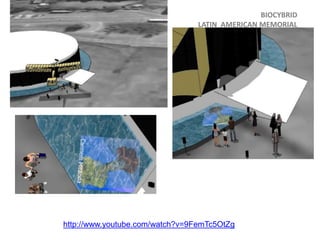
  • 12.
    Latin American Artof the 20th Century, Second Edition (World of Art) Paperback – October 17, 2004 by Edward Lucie-Smith • Richly illustrated...brings to life the work of many lesser- known artists throughout the continent." Choice This comprehensive survey introduces an exceptionally rich, fascinating, and complex art that has gained great popularity in recent years. Edward Lucie-Smith discusses all the major subjects and issues: magic realism, expressionism, and other concepts shared with Latin American literature; the great muralists Diego Rivera, David Alfaro Siqueiros, and Jose Clemente Orozco; the interaction of politics, society, and art; the continuing interest in folk art; and the dialogue between avant-garde European and North American movements and "indigenist" thinking in the work of artists such as Wifredo Lam, Matta, Rufino Tamayo, and Frida Kahlo. Many other artists from the 1900s to the present day are included in this compelling look at a great body of brilliantly original and imaginative art. For the second edition, the text has been updated and a new final section introduces some of Latin America's leading contemporary artists: Jose Bedia (Cuba/USA), Doris Salcedo (Colombia), Ruben Ortiz Torres (Mexico), Miguel Calderan (Mexico), Ernesto Neto (Brazil), Diana Domingues (Brazil), and Beatriz Milhazes (Brazil). Several of these artists make use of the latest in modern technology, including interactive installations, photographs, and video art. 178 illustrations, 45
  • 13.
    Selected artworks time line Multimediainstallations ELETROURBS 1970s 80s . Paragens ( 1991 – 21ª.Biennial São Paulo • TRANSE : the Body and the Technologies, 1994 ( Lucia Santaella ‘s Text) 04 Installations:4 installations Bio Biblion, A-fetus, In –Viscera, In-Fluxus, , A Ceia • TRANS-E: MY BODY, MY BLOOD : interactive installation, first presentation at ISEA 1997/Chicago, Invited artist to 7th Biennial of La Habana. The artwork is the winner of the 2000 UNESCO PRIZE FOR THE PROMOTION OF THE ARTS – • NET BASED INSTALLATIONSI INSN(H)AK(R)ES telepresence and telerobotics aanimal and human TERRARIUM 2 synthetic ecologies - artificial life - datamining and mobile connections: Seamless, nomadic, mobile and autonomous condition VR-IMMERSIVE ENVIRONMENTS- CAVES VR Aquarium – a- life and Augmented reality and Telepresence creating a synthetic ecology: HEARTSCAPES – THE TRANCE IN THE CAVERN URBAN MIXED LIFE Living Tattoos – social platform and mobile art Augmented Mobile Reality and Geotagness in Mixed Landscapes THE 14 BIS BIOCYBRID PLANE BIOCYBRID FABLES: Borges fantastic creatures Biocybrid installation • BIOCYBRID LATIN AMERICAN MEMORIAL environmental art – mobile and ubiquous computing and social platform
  • 14.
    Diana Domingues timeline From Multimedia and Video Art) 70s to Art and TechnoScience 2015
  • 15.
  • 16.
  • 17.
  • 18.
  • 19.
    MNBA RJ, GaleriaSergio Milliet Funarte, MAC SP e RS, MARGS entre outros "TRANS-E – the body and the technologies "TRANS-E : O CORPO E AS TECNOLOGIAS“ 1994
  • 20.
    A CEIA THESUPPER
  • 22.
  • 23.
    The ontology ofthe artworks : creative reality on speculative systems and redefinition of life • A collaborative team develop speculative systems and respective hardware and required code which is written to respond to the different artistic and poetic content and what sort of aesthetic and social behavior we intend to offer to people. The main concepts of the interface design are the transversal connections between people, devices, behaviors , code, networks based on connectivity, interactivity, immersion, multissensorial feedback, biofeedback : proprioception, cinaestesia, synaesthesia , during emergent proprieties and simulation of life. We focus on the seamless condition of bodies connected to computers, the nonadic connections lived in networked environments, the autonomy and intelligent evolutions of second interactivity in intelligent system, the immersion in data landscapes and other particular aesthetic proprieties. One of our recent focus is the mobile condition propitiated by the connections of computers and wireless technologies, such as: cell phones, I pads, and bluetooth, Wi-Fi, chips, radio frequency identification, most recently physiological sensors, and the geo referenced interfaces. We are looking for the ubiquitous, pervasive and sentient connections of mobile computing technologies. The central issue are always the intertwined relationships among body/environment/nets asking for enactive affective system and the naturalization of technologies capacities in terms of the exchanges and creative levels of life and so, for innovation responding to the challenges of art and science to collaborate s. • DOMINGUES, D. The Desert of Passions and The Technological Soul - In: Digital Creativity Vol 9. Swets & “Without intending to be taken for a visionary I dare to forecast that in the next couple of years, people will normally use wireless interfaces, and matter-of-factly will be connected in all microtimes of their lives. Existence will become a cybrid existence during the twenty four hours of life time. People will increasingly have interfaces and will be rather TV-like, to use an analogy to the contemporary technological and the society of the spectacle. Symbiotic technologies will be facilitated as permanent prostheses and they will be attached on us and into our bodies and thus we will be reinventing our lives and the ultimate nature of our species. Cyberart is not only involved with devices and digital images as the majority of interactive art works. It embraces the complex territory of shared investigations of art and science that generate social, critical and speculative software
  • 24.
    Rituals and ouroboric perception •I have discussed the ouroboric perception and poetics in my interactive artworks since my first cyberinstallation in the 90s, Transe my body, my blood, [15] which became an emblematic artwork and inserted the theme of interactivity and ritual into the artistic scientific community. It is related to AfroBrazilian popular religions as in a shamanic trance. Northeast Brazil’s Inga Stone’s projections show metamorphoses sprouting from prehistoric inscriptions. • People interacting become metaphorically shamans who consider the stone as a ‘veil’ between their world and the ‘spirits’ world. The software “shaman 32,” based on artificial intelligence researches, has autonomy to self regenerate the life of the cavern and the ‘mutant visions’ by surprising people with unexpected emergent ‘realities’. In 2007, the piece reincarnated in a new, more complex version called The Cavern of Trance, a more complex version of the embedded system – it was expanded to immersive and crossmodal technologies, multisensorial interfaces and immersive multidisplay synchronized large screens in VR – and it was also adapted for mobile connections.
  • 25.
    • We definethe ways to use interfaces and software potential. The projects offer interactive and enactive moments activating affective and artificial emotions following the seamless ( feedback continuous) , nomadic, mobile, and autonomous condition lived by the coupled body. The Installations and social platforms respond to the metaphorical components of every life and invest on the level of creative reality, looking for the reengineering of life and the human condition enhanced by technologies. The artworks ,since the beginning , have a special dimension on MULTIMEDIA and INTERACTIVE INSTALLATIONS, wich required hardware and software development to create physical spaces . Installation offer a place to be inhabited with the coupled body in autopioietic and performatic ways. My role is of the artist-engineer of communication in the development of the hermeneutic and metaphorical proposal of the system. My artist’ tasks is to determine the system design, the interface conception and aesthetic appeal of hardware and software, in order to expand life and the cognitive process enhanced technologies,environmental and social issues. .
  • 26.
    • Specific codeis written and special hardware devices are created to respond to artistic metaphors and the reinvention of human condition. Erkki Huhtamo highlights that Software Art could perhaps modify the famous John Berger’s slogan: • Without any doubt, cybrid realities, whem working with the biological traces create the biocybrid systems and the goes to define o an anthropic space . Interfaces enable human experiences and biocybrid( bio +cyber and Hybrid . . Interactive systems explore human/ environment/ computer intertwined relationships and redefine human existence. Idem ibidem Broeckmann p. .74 • Idem op cit 14, KLUSZCZYÑSKI, p. 51. • ANDERS, Peter. “Envisioning Cyberspace – Designing 3D Electronic Spaces”. New York: Mcgraw-Hill, 1999. “Every image embodies a way of seeing” “Every software embodies a way of using it”. Erkki Hutahmo
  • 27.
    • Speculative software andredefinition of life • Second cybernetics challenges artists and scientists to invest in speculative interface design in order to operate within the physical and social context. The essence of the code and the sort of hardware interface are conceived to transform the technological apparatus into speculative technologies. In this way, artists are developing software because they create specific aesthetic , sensorial and social relationships melting artificial and natural worlds in ways not allowed before. Andreas Broeckmann classify art projects as critical, social or speculative software inside the opening space for the reinvention of software. • Walter Benjamin’s historical text, The author as producer (1934), artists work propose speculative and multiple ways of semantic context and the articulation of formal laws. • Artist engineers creative realities investigate the technical apparatus to propitiate human/computer behaviors lived in the physical environment. If we consider reality as a lived experience, we can no more talk about what is real or what is virtual when the body is connected to computer technologies.
  • 28.
    Trance and Rituals– cultural mestizage
  • 29.
    Selected artworks • Initially,I will comment four NTAV art works (1997 - 2006) related to second interactivity, telepresence, ubiquity, mobile connections. The cyberinstallation Trans-e my body, my blood (1997- 2006). manages the signals of visitor’s displacements and gives to them digital images that sprout from the walls of a cavern. The body is captured by sensors installed on the floor, and the localization, the time and how many people are interacting influence the network back propagations. The second interactivity is offered by that neural network which is responsible for the environment life and works as a self- organizing system. Similar to the shamanic trances, people dialogue with invisible (digital) cosmos and manage invisible forces returning to the cybrid ecosystem unpredictable and strong iconographies and sounds related to shamanic different stages of dialogues with natural phenomena. The software “shaman 32” based on artificial intelligence researches has autonomy to self-regenerate the life of the cavern and the “mutant visions”, by surprising people with unexpected emergent “realities”. • Cyberinstallation was exhibited firstly at the School of Art Institute in Chicago Isea Montreal , Modern Art Museum –Buenos Aires, 1999, II Bienal do Mercosul, VII Bienal de la Habana, by receiving the 2000 Unesco Prize, Lima200), Kibla Center _Slovenia, 2003, Sweden 2003.
  • 30.
    TRANS-E: MY BODY,MY BLOOD interactive installation, first presentation at ISEA 1997/Chicago, Invited artist to 7th Biennial of La Habana. The artwork is the winner of the 2000 UNESCO PRIZE FOR THE PROMOTION OF THE ARTS - BETWEEN TRANCE AND ALGORITHM * Edmond Couchot .... Immersing your body (your blood) into the image and sound so that the body itself goes through a metamorphosis in image and sound to the point that it dissolves and gets lost in this bath is the unusual experience that Diana Domingues lets us go through with TRANS-E. In the center of this vast device which evokes the guts of a dark cavern dedicated to unknown rituals is a bowl full of blood, as a sacrifice, and spectators evolve with all freedom inside a space the floor of which is tiled with sensor plates that obey their displacements in front of a big screen. These interfaces transform every movement into digital information and transmit it to the computer that analyzes them instantly by means of a program employing models of neural networks well adapted to this operation. According to the position of the spectator in relation to the screen disposed on the cavern back wall and also according to the number of spectators, the computer combines and projects on the screen certain series of images and sounds taken from a data base of previously recorded images and sounds as well as digital information. With this information being treated in real time thanks to the fastness of a computer and the efficiency of algorithms, the spectator has the impression of immediate interaction and without mediators - without media - with the images and sounds produced by the device. Thereupon the
  • 32.
    XX UNESCO PRIZE– 7th Bienal de La Habana Jornal Gramma 23 nov 2000, Cuba Pierre Restany and Brazilian Ambassador in the public session of the Obra TRANS-E My body my blood
  • 33.
    BETWEEN TRANCE ANDALGORITHM * Edmond Couchot Immersing your body (your blood) into the image and sound so that the body itself goes through a metamorphosis in image and sound to the point that it dissolves and gets lost in this bath is the unusual experience that Diana Domingues lets us go through with TRANS-E. In the center of this vast device which evokes the guts of a dark cavern dedicated to unknown rituals is a bowl full of blood, as a sacrifice, and spectators evolve with all freedom inside a space the floor of which is tiled with sensor plates that obey their displacements in front of a big screen. These interfaces transform every movement into digital information and transmit it to the computer that analyzes them instantly by means of a program employing models of neural networks well adapted to this operation. According to the position of the spectator in relation to the screen disposed on the cavern back wall and also according to the number of spectators, the computer combines and projects on the screen certain series of images and sounds taken from a data base of previously recorded images and sounds as well as digital information. With this information being treated in real time thanks to the fastness of a computer and the efficiency of algorithms, the spectator has the impression of immediate interaction and without mediators - without media - with the images and sounds produced by the device. Thereupon the overwhelming multisensory effect of the experience. But this immersion into the image and sound would be uninteresting if it had not been inspired by an original thematic with strong symbolic resonance. The cavern works as a sacred space where the spectator (one should say initiated) is put in the presence of pre-historic and musical symbols typical of the shamanic culture. The very rhythmical images and sounds that the spectators themselves trigger through the sensors but upon which they do not have real control, put them in a sort of visual and sonorous trance. Thus they are invited - with certain violence though - to encounter this static and visionary state typical of initiation rituals. Certainly the trance Diana Domingues proposes is not the sacred trance of shamanic rituals, the blood that starts moving inside the bowl is not real blood, the cavern is not a real cavern; the floor is run with wiring, hidden machines keep buzzing. It is another trance, a softer trance. But it is a trance that re-links itself and reactivates, in an esthetical rather than religious way, secret lost bonds of ancient Brazilian cultures with forgotten but still alive myths. When we feared that new technologies could take us apart from our origins and separate us from our past - and this remains possible - Diana Domingues shows us the opposite, that they are not forcefully incompatible with the deepest forms of our imagination. A new paradoxical hybridization is still there, in the work, between body and calculation, between trance and algorithm. ...Thus the spectator's body penetrates in the work through the interfaces and takes part in the come-into-being: it becomes one of its organic materials. Kuikurus tribe Alto Xingu
  • 34.
    Haptic sensors Seqüência e Tempos deImagens RNA 1 RNA 3 RNA 2 RNA Mestre Sensores Infrared and heat - offerenda Neural network
  • 35.
    • The complexityof the environment is enhanced by the characteristics of the artificial neural networks in their capacity to make decisions, learn and develop the problem proposed. The application of the artificial neural network gives installations properties of self- organizing systems.
  • 37.
    ELECTRONIC TRANCE ANDINTERACTIONS MEANING: TRANS-E: My body, my blood Content and context Diana Domingues Elliptical zones: What matters in this living environment it is to provide worlds that we can not get without technologies. It occurs ephemeral connections by the dialogue between artificial and biological systems. People get an elliptical zone. Interfaces and electronic circuits are programmed for receiving and transmitting data and the body immersed in these sensorized environments has its senses digitized. Thus it experiences a “trompe les sens” sensorial circuit. When interacting the participants get the body/ machine intimate digital dialogue. People inhabit in an “elliptical zone” or in an “intersticial zone” during the symbiosis of the charbon-based life and silicon life. • • The installation is divided in three environments simulating three different stages of the shamanic trance. Theoretical approaches concerning these three stages inform that the shaman can experience three levels during the trance. • • In the first stage of the shamanic transe, it occurs only sensations of light and mutations in a neurophysiological way: brilliances, colours, scintillations, flashes of lights, dots, fadings. The mind is stimulated by that images and everybody has the same sensations. The images depend only of the biological apparatus and they have no symbolic or cultural weight. • • In the second stage of shamanic trance, shaman experiences images loaded with religious or emotional significance. In my installation the participant interacts with crosses, chalices, lilies, swords, snakes, and other symbols whose interpretation depends on one’s cultural background. The images invoke personal and individual experiences stored along life. The mutations call out to data from religion, geography, ethnic, political and social condition and change according to habits, emotions and other individual experiences. Many worlds can appear in the participants’ minds. • • In the third stage of shamanic trance, the shaman can experienced the deepest level of the trance. In this moment the shaman goes into a turmoil. It is then when actual hallucinations take place. The shaman identifies with animals, is attracted by lights, natural phenomena, volcanos, water, sky, stars, moon, appear and immerse the shaman in a kind of whirlwind. In my work these images appear mixed with visceral views and the participant can be taken to distorted ephemeral identities. • • It’s fascinating to be able to capture invisible forces and control physical phenomena when we define the “life”of the interactive work Biological and artificial systems dialogue provoking an enigmatic experience of TRANS-E. Interacting people gain shamanic powers while inhabiting an elliptical zone in a symbiosis between analogical and digital, organic and inorganic, real and virtual.
  • 38.
    ELECTRONIC TRANCE ANDINTERACTIONS MEANING: TRANS-E: My body, my bood Content and context *Diana Domingues People say that in primitive societies wall pusness would confer them powers to communicate with the beyond and to intervene in the real world because they would dialogue with spirits. In TRANS-E - My Body, My Blood, digital technologies provide us with an electronic ritual. Bodies connected by interfaces dialogue with computer electronic memories and can experience "virtual hallucinations" in real time. I offer an electronic transe through digital technologies in a dark room simulating a cavern with lighted images on the wall where people interacting can give life to the environment. I install the work simulating a cavern offering a space where people can get “visions” having shamanic powers. The cavern is one of the rooms where shamans go to meet the spirits Their visions are like images of light that appear over the walls. Apud the researchers theories, shamans believe in the stone power. To the shaman the walls are alive and during the trance lighted figures sprout from the stone. The shamans consider the stone a “veil” between their world and ‘spirits’world. In my “cavern” there are two screens. The second one is a transparent screen suggesting a boundarie between the virtual and the real. In the back of the room, a big curved lighted wall shows metamorphoses from North Brazil’s Inga Stone’s pre-historical inscriptions.To stimulate the ritual trance a drum sound repeats an insisistant rythm and the sound of heartbeats is altered by the actions of the bodies. Simultaneously, a red liquid within a bowl also moves by the infrared waves effects that connect the heat of bodies. To Afro-Brazilian popular religions, the blood is an offerenda to the life. • Interacting, people as shamans, dialogue with the beyond from the responses generated in the invisible and enigmatic world of data. During the journey with the spirits, the shamans materialize their visions through the drawings which provide and help themselves to get other visions. Interactive technologies “materalize” the invisible data in ephemeral connections with electronic memories. Participants have visions where the reality is distorted and they go into unreal and visionary worlds. People say that the shaman’s goal is to avoid illnesses, to get rain, and mainly to establish the harmony of the group. In my installation, I stimulate several behaviors through digital technologies to go out of the real world in interactive spaces connecting the psychic energy during consciousness propagations in which new identities can emerge. Shamans displace energies. When interacting people exchange invisible forces with artificial systems..The mutations of the sequences of images and sounds result from the visitors’ behaviour captured by the sensitivity of the sensors’ dots installed on the floor that transmit the body signals to the machines. The variables determining the behaviour of the network are: where you are, for how long and how many people stand on the neural networks sensorized carpet. The carpet dots send the signals of the bodies in each sensorized stage and the neural networks learn some patterns of the participants’ behavior, manipulate this data and provoke “visions” in the room in an enigmatic experience of TRANS-E. The network recognizes some patterns and interprets signals from biological systems translating them into computing paradigms. Neural Networks as an artificial braim, receive and process the biological signals giving back metamorphoses as managing powers of the beyond. NN deals in a non-linear way offering multiples associations or "virtual hallucinations" in real time.
  • 39.
    THE CAVERN OFTRANCE In: Memórias do Futuro, 2008 Itaú Cultural exhibition 10th years • Second version of the interactive installation created in 1997. Virtual Reality and multi-sensorial interfaces, immersive technologies: wireless haptic tracker, shutter glasses, stereoscopic projection and multi-synchronized augmented display; sound interfaces with Afro Brazilian ritualistic instruments: flute, whistles, maracas, afuxes, rainstick, shakers and other musical instruments; net of twelve infrared sensors, red liquid and bowl with presence sensor; SOFTWARE: neural network, 3 D modeled images, C++, Open GL platform, Roaming Library. HARDWARE: cluster of 03 multimedia computers, 03 stereoscopic projectors, microphone, amplifiers. ROOM: dark room, 01 dicroic light focus and handled torch or lantern. • • This is a hybrid and updated version of TRANS-E: MY BODY, MY BLOOD, interactive installation, first presentation at ISEA 2007/Chicago and that received the 2000 UNESCO PRIZE FOR THE PROMOTION OF THE ARTS - 7th Biennial of La Habana. • • •
  • 42.
    Interactive and immersivesystem Embedded and multi-modal technologies • presence sensors haptic interface sound interface steroscopic interface Interactive and immersive system Embedded and cross-modal technologies
  • 44.
    Regarding immobility, physical disabilities,in wheel chairs or crutches equally activate the infrared sensors and experience the same condition as other visitants Spatial data management by software interfaces in VR
  • 45.
    Wii Haptic interface spatial_ tracker Thecreated script uses a simulated flash of a torch or lantern, whose light touch and control objects mobile /Wireless/bluetooth an accelerometer gyroscope optical sensor captures the signal segment of infrared emitters.
  • 46.
    third level immersive propertyexperienced by wearing shutter glasses provides stereoscopic visions. The tracked objets: tigers, spiders, stars, mosquitoes, thunders, swords, and other symbolic elements invade the room sensation of trance is enhanced. tinny movements of the hands enable people to act in the cavern The wireless tracker that simulated the lantern allows to touch, to move and change the position and direction of virtual, modeled objects thunders, butterflies, spiders, vases, crosses, worm, animals appear in the room Interface for stereoscopy
  • 47.
    VIRTUAL REALITY - HEARTSCAPES THECAVE IMMERSIVE ENVIRONMENTS PROPRIOCEPTION TRACKED BODY – PHYSIOLOGY and synaesthesya Concerning virtual reality immersive artworks, we opened we opened the UCS CAVE ,in April 2005 at the First International Meeting of Art, Science and Technology: Virtual Reality, with the presence of renowned researchers such as Oliver Grau (Danube University) and Ramesh Raskar (Mitsubishi Electric Research Laboratories, USA). Two virtual reality applications developed by the NTAV group are running in the cave: Heartscapes and VR Aquarium, both described here . Heartscapes and VR Aquarium artworks explore sorts of immersion in caves by using multissensorial interfaces: trackings for spatial navigation and also exchanges of body signals in virtual reality. GRAU, Oliver. Virtual Art from Illusion to Immersion.The MIT Press, Cambridge, Massachussetts, 2003.
  • 48.
  • 50.
  • 51.
    Animal and human netbased installations 1998, web art, telepresence and telerobotics seamless condition – body and robot connected - remote actions - enactions and telepresence :intertwinned and mutual influences body and remote environment Expanding Hypermedia to physical territory and remote actions. Helping the daily life of remote serpentarium: giving water and food to the snakes . BIO ART and biologists collaboration. INSN(H)AK(R)ES net based installation
  • 52.
    ANIMAL AND HUMAN: INSN(H)AK(R)ES interactiveand telematic ritual I NSN(H)AK(R)ES is to inhabit a remote Serpentarium, by embodiement of a robot-snake and the seamless condition as Shamanic ritual,to become an animal, in case the incorporation of the robot-snake and human body. The connexions allow immersions and teleactions in the remote serpentarium in Brazil. The tele robotic system establishes a connection with the robot in the serpentarium located in the Museum of Natural Sciences at the University of Caxias do Sul, Brazil. When connected, the remote actions let come true the desire to incorporate an animal body during an interactive telematic ritual. In the natural environment of the serpentarium, the remotely controlled robot performs tasks which human beings might be doing with their body. It makes several trajectories through the participants’ orders, who send movements using the direction of the arrow keys of the keyboard, whose signals are interpreted, and result in trajectories in the serpentarium. The telepresence is provided by a web camera, which is coupled to the robot and transmits in real time scenes from the serpentarium in Brazil. The robot is named Angel, another being, coming from the beyond, who helps the life of the serpents. The remotely controlled robot collaborates with the snakes’ life by giving them water and feeding them by remote actions. Presence sensors capture the action of the robot and release amounts of water and little mice for their basic needs. The process of giving water is possible because the robot, when moving following people’s connections, activates an infrared system that immediately opens a tap that pours water in the recipient where the snakes go to drink. Another device activates an infrared sensor, and door opens, liberating mice for the serpents. Life in the environment is a result of the mixture of biological and technological signals. The natural world is revitalised through interactive technologies that generate new forms of life.
  • 53.
    SERPENTARIUM (1998) Telerobotic event, telepresenceand remote action seamless condition by sharing the body of a robot-snake living in a serpentarium in Brazil.
  • 55.
    ANIMAL AND HUMAN: INSN(H)AK(R)ES •Exhibitions: • November 2001, Atenas, Greece, media@terra, Brazilian invited artist. DOMINGUES, Diana . INS(H)NAK(R)ES. Media@Terra 2000, Athenas, p. 37-38, 2000. • MUCA, Universidade Autônoma do México, em 2002, DOMINGUES, Diana ; México City, 2002. • KIBLA, Maribor,, Slovenia 2004. Peter Dobrilar (curador). • DOMINGUES, Diana : Ciberarte: Interacciones y Encarnaciones. Lima: Passaje Santa Rosa 114, 2002 (Catálogo da Exposição Individual). Ciberarte: Interacciones y Encarnaciones. Galeria Pancho Fierro, Municipalidad de Lima. The best exhibition of 2002 in Lima. • Published in : WANDS, Bruce . Art of the Digital Age. New York, NY: Thames & Hudson Inc, 2006. • The metaphorical and historical concept and context result from na expedition to Alto Xingu and Kuiukurus tribe, internal Mato Grosso, Brazil, 1997.
  • 56.
    TERRARIUM 2 (artificiallife - datamining and obile connections) Seamless, nomadic, mobile and autonomous condition – emergent proprieties, synthetic ecologies The installation creates a synthetic territory in the room with a floor where there alive serpents. The complex system is a synthetic ecology in artificial life. The interactions create and control serpents’ life, rendered in real time. ARTIFICIAL LIFE and autonomous condition by using iconic interfaces and genetic algorithms allow the creation of snakes by using a DNA code, running a cross-less over function. Connecting the icons of animals people feed the serpents by enlarging their life time. Serpents have a collective and autonomous behaviors using multi agents system which make them recognize their territory, going up and down in the topography and also respecting each other and deciding who will eat the animals. A termomether allows to change the temperature and to modify the speed of virtual creatures`displacements. Nomadic condition _ a multi-local platform in the Net which allow that every machine connected in the planet creates and send snakes to the same serpentarium and having a collective life. And also the Net ( search engine - Google API ) activates the communication with the global collective memory, writing sentences in the serpentarium with words of scientific, anthropological, historic, artistic or other issues coming from different databases.data mining Mobile condition is the wireless connection using a PALM.
  • 57.
  • 58.
  • 60.
    THE CAVERN OFTRANCE In: Memórias do Futuro, 2008 Itaú Cultural exhibition 10th years • Second version of the interactive installation created in 1997. Virtual Reality and multi-sensorial interfaces, immersive technologies: wireless haptic tracker, shutter glasses, stereoscopic projection and multi-synchronized augmented display; sound interfaces with Afro Brazilian ritualistic instruments: flute, whistles, maracas, afuxes, rainstick, shakers and other musical instruments; net of twelve infrared sensors, red liquid and bowl with presence sensor; SOFTWARE: neural network, 3 D modeled images, C++, Open GL platform, Roaming Library. HARDWARE: cluster of 03 multimedia computers, 03 stereoscopic projectors, microphone, amplifiers. ROOM: dark room, 01 dicroic light focus and handled torch or lantern. • • This is a hybrid and updated version of TRANS-E: MY BODY, MY BLOOD, interactive installation, first presentation at ISEA 2007/Chicago and that received the 2000 UNESCO PRIZE FOR THE PROMOTION OF THE ARTS - 7th Biennial of La Habana. • • •
  • 62.
    Interactive and immersivesystem Embedded and multi-modal technologies • presence sensors haptic interface sound interface steroscopic interface Interactive and immersive system Embedded and cross-modal technologies
  • 64.
    Regarding immobility, physical disabilities,in wheel chairs or crutches equally activate the infrared sensors and experience the same condition as other visitants Spatial data management by software interfaces in VR
  • 65.
    Wii Haptic interface spatial_ tracker Thecreated script uses a simulated flash of a torch or lantern, whose light touch and control objects mobile /Wireless/bluetooth an accelerometer gyroscope optical sensor captures the signal segment of infrared emitters.
  • 66.
    third level immersive propertyexperienced by wearing shutter glasses provides stereoscopic visions. The tracked objets: tigers, spiders, stars, mosquitoes, thunders, swords, and other symbolic elements invade the room sensation of trance is enhanced. tinny movements of the hands enable people to act in the cavern The wireless tracker that simulated the lantern allows to touch, to move and change the position and direction of virtual, modeled objects thunders, butterflies, spiders, vases, crosses, worm, animals appear in the room Interface for stereoscopy
  • 67.
    Sound interfaces fourth levelassobios –sopros- apitos sound interfaces result from connections to Afro-Brazilian musical instruments: flute, maracas, whistles, afuxes, rainstick, shakers and other ritualistic instruments. The intensity of their captured sounds and sent to a microphone hi-fi provokes the interactions with the system. The objects are moved according the sound ryhtms.
  • 68.
    VIRTUAL REALITY - HEARTSCAPES THECAVE IMMERSIVE ENVIRONMENTS PROPRIOCEPTION TRACKED BODY – PHYSIOLOGY and synaesthesya Concerning virtual reality immersive artworks, we opened we opened the UCS CAVE ,in April 2005 at the First International Meeting of Art, Science and Technology: Virtual Reality, with the presence of renowned researchers such as Oliver Grau (Danube University) and Ramesh Raskar (Mitsubishi Electric Research Laboratories, USA). Two virtual reality applications developed by the NTAV group are running in the cave: Heartscapes and VR Aquarium, both described here . Heartscapes and VR Aquarium artworks explore sorts of immersion in caves by using multissensorial interfaces: trackings for spatial navigation and also exchanges of body signals in virtual reality. GRAU, Oliver. Virtual Art from Illusion to Immersion.The MIT Press, Cambridge, Massachussetts, 2003.
  • 69.
  • 70.
  • 71.
    Algorithms generating particlesgave the environment qualities typical of physical laws such as gravity and dynamics. HEARTscapes algorithms and physical laws create the actions inside the ground for immersion and simulation experiences inside the landscapes- textures in animation natural phenomena effects . (rain and fire, explosions, snow, twisters) Heart beat sounds of ecographies are mixed with noises of indigenous rituals, noises of natural environments, among other sound data
  • 72.
    HEARTSCAPES – SYNTHETICLANDSCAPES DATA LANDSCAPES immersion and sensorial expansion for physiology and synaesthetics - INTERFACES and biofeedback: heat, heartbeats, electrical potentials, breathing, infrared sensors. In Human Biology: WILSON, Stephen, Art+Science Now, Thomas and Hudson, 2011. .
  • 74.
    Biofeedback • Biofeedback investigatesmutual behaviors of the body signals and the environment. Enactions and affectivity involves sensorial physiology and cognitive processes that result from the analysis of internal signals and communication to the intertwined body/environment, and their information exchanges. The reshaping of human perception and cognitive process deal with body physiology that acts with immediate physical environment. The systematic structuring of the relations between sensory patterns is derived from manufactured sensor technologies and those given by locomotion, proprioception and the internal senses signals of the heart beats and electrical waves of eyes movements.
  • 75.
    NTAV LAB –BRAZIL EOG CARDIAC RHYTHM
  • 76.
  • 77.
    Virtual Reality andTelepresence creating a synthetic ecology: fish living in a real aquarium in the next room of UCS Museum of Natural Sciences are projected in the cave , transmitted by telepresence ( web cam ). The images are combined with simulated VR 3D scenes. • The body enters in the cave populated by real fish and synthetic animated fish in relief by stereoscopic glasses that let the synthetic fishes pass through the immersed body of the visitor. The interaction with the virtual fishes uses the body movements coupled to the tracker (flock of birds), enabling the touch on the synthetic fish through simple gestures and activating an artificial intelligence program which gives them a collective behavior based on a flocking algorithm. The virtual fishes move together showing a behavior similar to that of the biological world. • The interface design blurred the boundaries between real and virtual worlds, confirming the magic of interactive technologies. VR aquarium VR Aquarium
  • 79.
    • VR AQUARIUM, 2004 CAVE • VR AQUARIUM offered immersion in VR at the digital cavern of the NTAV Lab, installed at the Museum of Natural Sciences of the University of Caxias do Sul. The environment aesthetical appeal was the augmented reality and telepresence which enhanced the immersion in a synthetic and autonomous ecology inside the virtual reality landscape. The data landscape had Images of fishes living in a real aquarium of a next room of UCS Museum of Natural Sciences are projected in the cave transmitted by telepresence. The remote aquarium is translocated and gains the physic space projected on the four faces of the cave. The images of fishes are mixed to the simulated scenes of a synthetic aquarium in three dimensional modeling. The body physically enters the virtual reality immersive cube and is involved by synchronized multi-display images, showing animated synthetic fishes. By superposition, the scenes of the remote aquarium sent by webcam are mixed to the virtual modeled scenes and, through the use of stereoscopic glasses, the images of fishes and plants of the virtual aquarium gain relief and three-dimensionality. The virtual fishes traverse the bodies of the people that inhabit the cave and the immersive state mix real fishes mix with the synthetic fishes. The synthetic fishes pass in the cube space as alive fishes. The haptic sensorial interface of tracking (flock of birds) make possible to activate the synthetic fishes through simple gestures. When touched, the synthetic fishes launch an artificial intelligence program which gives to the synthetic creatures a collective behavior, obtained by the use of a flocking algorithm. The virtual fishes move as if they were in a school of fishes and the world gains a behavior similar to the biological world. Immersed in the virtual environment, the body experiments the dilution of its material limits and amplification of its sensorial organs. The immersive experience extrapolates the limits of body actions in the virtual world. The images of intelligent fishes whose displacements are similar to biological world configure a cybrid interface design that eliminates the boundaries between real and virtual worlds, confirming the magic of interactive technologies. The immersive experience can be taken as a dream lived awake. The amplified sensoriality through interfaces for interaction and immersion, and the autonomous response of the system modify the limits between real and virtual. The blurred experience in the cybrid landscape space confirms the magic of the interactive technologies, in a state to be acting in a simulated biological world. The body immersed may be dreaming awake. • Technical description: • Cave, immersive cube for virtual reality with synchronized multi-display projections with 04 back-projections in the dimension of 2.75m x 2.75m • Augmented reality with the superposition of images of real and virtual fishes; Telepresence through webcam transmission though the internet; • Software design: three dimensional modeling with environment written in C++ using a proprietary graphic library called NTAV ROAMING. • Fish behaviors controlled by an artificial intelligence algorithm (flocking); • Interactivity and Immersion: stereoscopic vision through stereoscopic glasses or goggles • Multi-sensorial interfaces: touching senses: haptic interface with position tracking (flock of birds)
  • 80.
    • VR AQUARIUMis a cybrid environment presented at the UCS CAVE, the digital cavern of the NTAV Lab, installed at the Museum of Natural Sciences of the University of Caxias do Sul. The environment offers augmented reality, telepresence and immersion in a synthetic and autonomous ecology of virtual reality inside the immersive cube. Images of fishes living in a real aquarium of a next room of UCS Museum of Natural Sciences are projected in the cave transmitted by telepresence. The remote aquarium is translocated and gains the physic space projected on the four faces of the cave. The images of fishes are mixed to the simulated scenes of a synthetic aquarium in three dimensional modeling. The body physically enters the virtual reality immersive cube and is involved by synchronized multi-display images, showing animated synthetic fishes. By superposition, the scenes of the remote aquarium sent by webcam are mixed to the virtual modeled scenes and, through the use of stereoscopic glasses, the images of fishes and plants of the virtual aquarium gain relief and three-dimensionality. The virtual fishes traverse the bodies of the people that inhabit the cave and the immersive state mix real fishes mix with the synthetic ones • The synthetic fishes pass in the cube space as alive fishes. The haptic sensorial interface of tracking (flock of birds) make possible to activate the synthetic fishes through simple gestures. When touched, the synthetic fishes launch an artificial intelligence program which gives to the synthetic creatures a collective behavior, obtained by the use of a flocking algorithm. The virtual fishes move as if they were in a school of fishes and the world gains a behavior similar to the biological world. Immersed in the virtual environment, the body experiments the dilution of its material limits and amplification of its sensorial organs. The immersive experience extrapolates the limits of body actions in the virtual world. The images of intelligent fishes whose displacements are similar to biological world configure a cybrid interface design that eliminates the boundaries between real and virtual worlds, confirming the magic of interactive technologies. The immersive experience can be taken as a dream lived awake. The amplified sensoriality through interfaces for interaction and immersion, and the autonomous response of the system modify the limits between real and virtual. The blurred experience in the cybrid landscape space confirms the magic of the interactive technologies, in a state to be acting in a simulated biological world. The body immersed may be dreaming awake. • Technical description: • Cave, immersive cube for virtual reality with synchronized multi-display projections with 04 back-projections in the dimension of 2.75m x 2.75m • Augmented reality with the superposition of images of real and virtual fishes; Telepresence through webcam transmission though the internet;
  • 81.
    Mais.après les évasionset les immersions dans les mondes synthétiques de Realité Virtuelle, nous sommes conscients des connexions au cyberspace everywhere (William Gibson 2007 Spook Country: a novel ), et des modes de vie élargis par les technologies ubiquitaires, dispositifs mobiles, interfaces locatives, systèmes sur puce microcontrôleur embarqué, traitement de signaux, traitement des données et data visualisation, y compris les biocapteurs et traduction des états affectifs par la synesthésie (transit entre les différents canaux sensoriels) Mobile technologies cyberspace is everywhere ! William Gibson 2007 Spook Country: a novel
  • 82.
    Mobilité et société Cespratiques répondent à la croissance de la mobilité dans nos sociétés contemporaines et à la prolifération des technologies portables. Alors que celles-ci interviennent dans de nombreux domaines de la vie quotidienne et sociale, l’émergence des téléphones mobiles munis de systèmes de géolocalisation GPS et connectés à Internet ainsi que des applications mobiles aux multiples fonctionnalités de réalités augmentées déploie tout un champ de création interdisciplinaire, que les artistes professionnels tout comme lês citoyens du monde s’approprient. Les pratiques artistiques autour des mobilités numériques agissent en redéfinissant ou en détournant leurs usages attendus. • INTERVENTIONS DANS LA VIE DE LA VILLE: • TATTOUAGES VIVANTS – LIVING TATTOOS • Logiciel social et états de mobilité: FLASH MOBS ( Rheingold) tatoués habitants de la Ville (Domingues REALITÉ MIXTES ET VIE URBAINE MÉLANGÉE groupe Artecno / CNPq 2007 Prenant l'utilisation des téléphones cellulaires dans la construction d'un réseau social qui mixe l'urbain et L’imaginaire fantastique des cors tatoués dans le projet "Tatouages ​​vivants ». Présence Cybride
  • 83.
    • TATTOUAGES VIVANTS –LIVING TATTOOS • Logiciel de mixage social, CORPS TATTOUÉS , le sens de présence cybride dans la communication omniprésente et connexion en utilisant les téléphones mobiles, les PDA, avec bluetooth, l'envoi e de SMS et MMS, ainsi que des interfaces locatifs de geolocalization comme Google Maps et Google Earth. Les membres du réseau vivent n’importe où et leur localisation sur les cartes construit les identités,e apporte des informations aux endroits ailleurs, en créant l'augmentation du sentiment de présence danss des environnements différents, et ajoute des données dans des environnements variés, par des images de mélange qui sont provenant de différents endroits. • Le dialogue du forum tatoué en PHP génère graphos en consultant les données des systèmes d'exploitation de communication. Geolocalizadores cartographie GPS des déplacements de corps tatoués dans l'environnement physique • . L'envoi de tatouages ​​par téléphone ou par courriel est un moyen d'obtenir une interface utilisateur graphique à deux dimensions se traduit dans la forme 3D et le tatouage devient une créature qui va vivre avec d'autres créatures dans tatuarium. • Caractéristiques graphiques des différents tatouages ​​se confondent avec les traits de personnalité des individus, dans les textes du forum et leurs relations. • Comme une sorte d'interface affective par websemantique il y a l'exploration de données du , réseau social, vu en termes de graphos conversations générées par le reseau des tatoués qui nourrit la vie des créatures tatouages. La prévisualisation des gains de conversations dans la complexité d'identifier les caractéristiques de calcul évolutif et génère le tatoué sur la vie régie par le comportement des individus dans le réseau social. Envoi et vivre ensemble dans l'environnement, créatures artificielles naissent, grandissent, se rapportent et meurent comme l'échange d'informations et le partage des idées, des désirs, des croyances et des valeurs de tatouages ​​dans l'infographie et de la vie artificielle, régie par le tissu social de la vie la ville tatouée cybride
  • 84.
  • 85.
    LIVING TATTOOS: plateformesocial TATOOS MOB • ( flash mob) • CYBERARTIVISME - CORPS REINVENTÉ - rituel em ligne partage de corps et de ses images - vie et magie – a life – dataming- affective dialogues – machine learniing •social software and flash mob 2004 CHI
  • 86.
    Living tattoos THE ANTHROPOLOGICALPRESENCE OF TATTOOS IN HUMAN CULTURE. Living tattoos artwork is a speculative software which intends to create a social platform of networked tattoos communities. It proposes the co-existence in physical space and cyberspace, and the environment evolution is based on tattoos’ identification patterns and members’ skills , by eliminating the diversity of race, geography, gender, and other cultural differences. We propose strategies to engineering reality by the use of social software .The mobile condition activates a mutant morphology of tattoos by translating how diversity of communication and manifested personalities influence the emergent properties and regulate the potential interface design culminating in artistic and cultural metamorphosis according to the social rules in Cyberculture.
  • 88.
    • FLASH MOBS= mobilité humaine et la ville - Une autre étape de la vie cybride est le fourmillement d'hommes / insectes au cours de flashmobs, appelée ici Tatouages ​​Mobs . Tatoués vivants dans le réseau sont invités et conduisent des intrventiosn dans le urbain collectif qui explorent le sens d’ être ici, hic et nunc , et là , au cyberespace, donc le cybride, le mixage réseau numérique avec les appareils mobiles qui permettent de changer le sens passif de présence et de place dans l'espace cybride et physiquement altéré. La vie de tatoué comme un réseau social émergent biologique en cévolition avec le numérique et les actions humaiines des êtres mobiles, des insectes (Dyens, 2008) dans une mise en réseau dún social social cybride ( Domingues et Andres) • SOFTWARE SOCIAL ET REINGÉNIÉRIE DE LA CULTURE • Tatouages ​​vivant: ciberartivisme le corps réinventé dans les réseaux sociaux - Comment la pratique en collaboration créative, les tatouages adaptent l’appareil technologique e créeent un environnements qui abandonne le sens de propriété intellectuelle, pour atteindre les objectifs sociaux de la relation de la communauté les tatoués et intervention culturelle. Interfaces : ubiquous computing, locative, pervasive and sencient mobile technologies mobile interfaces: cell phones MMS and SMS to communicate with our platform they send their tattoos to the platform Locative interfaces: GPS and Google Maps. GPS mapping and tracking system generates urban flow of tattooed in the city’s buses ( VISATE).
  • 89.
    Living Tattoos: ciberartivismoe o corpo reinventado em redes sociais. • Como prática criativa colaborativa Living Tattoos adapta o aparato tecnológico e abandona ambientes de propriedade intelectual, para atender fins sociais de relacionamento de comunidade de tatuados e de intervenção cultural·. O software social que implementou o “Living Tattoos” foi desenvolvido em 2000 para uma a epistemologia mutante voltada a comportamentos e relações humanas que exigiu o desenvolvimento e escrita de software para a formação de uma comunidade, cuja identidade é baseada em tatuagens, eliminando noções de geografia, etnia, classes sociais, gênero, ou outra qualquer. O design de interface permite conexões e trocas de identidades de pessoas tatuadas na rede, num ambiente colaborativo e de reciprocidade. Disponibilizado de acordo com regras de software livre, para a construção de identidades, têm como ponto de partida a identidade revelada em tatuagens, e o perfil de personalidade de pessoas que aceitam a participar do sistema em um blog. A partir de convite no Orkut, e outros ambientes sociais, tatuados migram para o website do grupo, e para o blog que oferece diferentes interfaces para conexões na web. Tatuados enviam suas tatuagens que são imagens 2 D, visualizadas no site, que é transformado em forma 3D, num morphing de imagens. O envio de fotos ou qualquer tipo de imagem da própria tatuagem, por celular ou por e-mail faz chegar uma forma bidimensional, que é traduzida de seu gráfico 2 D por interface gráfica, em forma 3D e a tatuagem passa a se tornar uma criatura que vai viver com outras criaturas num tatuarium. Cada tatuagem em 3D gera uma criatura sintética que evolui pelo diálogo do Blog com as informações dos grafos. As características gráficas de cada tatuagem seguem os traços de personalidade dos indivíduos, com termos dos textos do fórum e seus relacionamentos. Como uma espécie de interface afetiva, em websemâmica, por mineração de dados, a rede social, visualizada pelos grafos gerados por termos de conversas de tatuados na rede, alimenta a vidas das criaturas tattoos. A visualização das conversas ganha em complexidade em computação evolutiva em a-Life, regida pelo comportamento dos indivíduos na rede social, vivendo junto no ambiente do viveiro de tatuagens. Criaturas artificiais nascem, crescem, relacionam-se e morrem conforme a troca de informações e o compartilhamento de ideias, desejos, crenças e valores de tatuagens em computação gráfica e vida artificial, regidas pela trama social da vida de tatuados. • Em outra parte do projeto, tatuados mesclados à vida urbana por dispositivos móveis, com o uso dos celulares de uma rede social se mesclam o imaginário fantástico de corpos tatuados em software social e o sentido de presença biocíbrido, em comunicação ubíqua e móvel. A vida biocíbrida convida também ao enxameamento de homens/insetos durante flashmobs, chamadas de Tattoos Mobs (fig. 17 a 19). Tatuados que vivem na rede são convidados e realizam intervenções urbanas como coletivos móveis que exploram o estar aqui, hic et nunc, misturando o digital da rede com dispositivos móveis que permitem trocar o sentido passivo de presença e lugar no espaço da matéria cibridizado. A vida de tatuados como rede social emergente mistura o biológico e o digital co-evoluindo em ações inumanas de seres móveis (DYENS, 2008) numa cenário cíbrido de redes sociais. A conexão de celulares, PDAs, com bluetooth, envio de SMS e MMS, somados a interfaces locativas de geolocalizadores como Google Maps e Google Earth. Os participantes da rede trocam mensagens, localizações em mapas, trazem informações de lugares para outros lugares, aumentando o sentido de presença no espaço físico pela adição de dados misturando imagens com imagens vindas de onde estão, e criando suas narrativas. Geolocalizadores traçam por GPS deslocamentos de corpos tatuados no ambiente físico. • ©NTAV Lab/CNPQ • Apresentado no CHI _Human Computer Interface - ACM, Florença Vida Urbana Misturada. Rod McCall (Chair) 2008.
  • 90.
    Figura - Livingtattoos - diferentes interações- envio por celular de MMS imagem 2 D e 3D – tatuarium- Graphos- envio de SMS e MMS- google maps- tattoo’s mobs- .
  • 91.
    Tattoos, 3D Modeling-© Diana Domingues - NTAV Lab / CNPq, Brazil, 2008.
  • 92.
    EMERGENT SOCIAL BEHAVIORS: Interfaces: ubiquous computing, locative, pervasive and sencient mobile technologies cell phones MMS and SMS to communicate with our platform people send their tattoos to the platform Locative interfaces: GPS and Google Maps. GPS mapping and tracking system generates urban flow of tattooed in the city’s buses ( VISATE).
  • 95.
    I'Myth: zapping mobilezone - Itaú Cultural - Artif.cial Emotion 2, july 2004. In 2005, the expanded system included mobile connections in the version exhibited in the V Bienal do Mercosul, Porto Alegre, 2005, by using SMS of cellular phones . Exhibition at Haus der Kulturen der Welt em Berlin, 2006, the House of Cultures of the World – HKW Berlin . A genetic algorithm was applied to generate unpredictable mutations from selected words of the touch screen with terms of myths’ biographies was translated to German idiom.
  • 96.
    I’Myth: Zapping MobileZone I'Myth: zapping zone - Itaú Cultural - Artif.cial Emotion 2, july 2004. In 2005, the expanded system included mobile connections in the version exhibited in the V Bienal do Mercosul, Porto Alegre, 2005, by using SMS of cellular phones . Exhibition at Haus der Kulturen der Welt em Berlin, 2006, the House of Cultures of the World – HKW Berlin . A genetic algorithm was applied to generate unpredictable mutations from selected words of the touch screen with terms of myths’ biographies.The system was translated to German idiom. Instalação montada no 5ª Bienal do Mercosul (2005): I'Mito: zapping zone., 2005 • Second interactivity, nomadism, intelligent and mobile connections are allowed in the cyberinstallationI’ Myth: zapping mobile zone.The title I'Myth is related to the visitor exploration of the universe of the myths and get closer to them in a zapping zone with multiple associative possibilities among physical and immaterial information.The physic space is similar to a store or brecho which is not dedicated to buy objects, but where people can buy identities. It is a zone of zapping where people make associations of icons related to myths’ life and activate virtual connections, by coexisting in real and virtual spaces. Interfaces enable to exchange identities with a complex system and the start of interactions is with the labeled objects offered to a bar code reader. The system also uses cell phones, net connections, stereoscopic vision, touch screen and artificial life. Getting into the room of a store or brecho full of objects/fetishes, neon silhouettes of objects and a video clip, people are in contact with the memory of myths’ life. The room has vibrant colors of pop aesthetics and a big amount of objects related to the individual myths explore the poetics of excess. Going from the objects full of myth’s energy to the virtual images and the words and the code of the system, we offer a landscape, or better, a scenario with levels of the ecology of icons. • The installation environment and the interactive system allow people to circulate in differentlevels of the iconic scale: real objects are labelled and available for interactions; They call analogical 2D photographs presented as frozen images; videos and neon silhouettes are melting in the space; 3D geometric objects appear and enhance the illusion of reality with stereoscopic visualization. The interactions are activated through the selection and presentation to a barcode reader two objects and like an offerenda, the labeled objects, placed in a transparent/ table/altar, allows initiating the identification ritual. What information activates the intelligent connections? The myths are represented internally through a set of terms, organised in a database in different categories: nouns: personal objects that remind us of the myths. For instance, a walking cane to represent Charles Chaplin; adjectives: personal characteristics of the myths. For instance, courageous and fast, which may be used to describe Ayrton Senna; verbs: actions that characterise the personality of the myths, for instance to race, to pray, to kill; the first out come of the system is: after the offerenda of myths’ identification objects the system makes appear faces of the two myths and the projection on in the left big screen shows their faces in a three-dimensional cube in constant rotation as diverse as those of John Kennedy and Che Guevara, or Marilyn Monroe and Madre Tereza. The 3rd out come is: in real time rendering, the words of the database create virtual reality environment displaying 3D objects in the right projection.
  • 97.
    ( interactions) • Anattractor triggers a morphing of two objects in an OOL environment, visualized in stereoscopy, the simulated virtual objects enters to the physical space. The 4th out come is: the room sound system controlled by a sonic database explores chunks of speeches, songs, noises considering the myths` history. The 5th out come is: contrasting with the physicality of the real world, computer monitors present raw data being manipulated by the system in order to control the interaction with the user and to generate the synthetic images; the Sixth outcome allows mobile connections, by sending messages by cell phone, SMS makes search in Google and a response comes from the net, running a search engine. A second line of words is written in the myths’ faces on the left screen. The sseventh out come: cell phone mobile connections allows the visitor to take his/her one picture and to send this photography to a given cell phone number. In a few minutes, his picture is displayed on the large screen placed on the left-side of the room. There is also a touch-screen for the activation of evolutionary process. It activates the 8th out come; the touch screen displays words of the database mixing all the worlds of all myths’ lives database and by selecting a substantive, an adjective, a verb and a place triggers genetic algorithms potential which produce a new generation of synthetic beings. The one with most aptitude is selected and displayed and the evolutionary process defines the strongest one according to the selected words. This 8th outcome provokes emergent state: when the terms related to the myths and stored in a database as nouns, adjectives, verbs and places are presented to the visitor in a touch-screen. By selecting a set of terms that may define what brings someone to become a myth, the visitor activates an evolutionary process. Through the application of genetic algorithms (GA), a novel generation of virtual beings with different combinations of features is produced. A profusion of letters related to the myths’ world creates a visual dynamic way. The system writes unpredictable words combining the terms of the selected by the automats system. In the zapping mobile zone the visitor is part of the whole and his/her interactions generate an associative zone with the collective memory of myths` culture by using sencient and pervasive interfaces of Cyberculture. •
  • 98.
    • Figura 3-I’Myth; zapping mobile zone. • Figura 3- I’Myth; zapping mobile zone. Figura - I’Myth; zapping mobile zone.
  • 102.
    . Interactions areactivated through the selection and presentation to a barcode reader two objects and like an offerenda, the labeled objects, placed in a transparent/ table/alta, allows to initiate the identification ritual. transparent/ table/altar labelled objects barcode reader
  • 103.
    offerenda of thefirst labeled object to initiate the identification ritual
  • 104.
    a second labeledobject is offered to initiate an identification ri
  • 105.
    What information activatesthe intelligent connections? • The myths are represented internally through a set of terms, organised in a database in different categories: • nouns: personal objects that remind us of the myths. For instance, a walking cane to represent Charles Chaplin; • adjectives: personal characteristics of the myths. For instance, courageous and fast, which may be used to describe Ayrton Senna; • verbs: actions that characterise the C of the myths, for instance to race, to pray, to kill;  places: cities, countries and other locations attached to the myths’ history, for instance Paris, connected to the life and death of Princess Diana. •
  • 106.
    8th out comeand emergent level 01 touch screen diplays words of the database Mixing all the worlds of all myths’lives, b y selecting a substantive, an adjectif, a verb and a place triggers genetic algorithms potential which produce a new generation of synthetic beings. The one with most aptitude is selected and displayed and the evolutionary process defines the strongest one according to the selected wordsr
  • 107.
    the 1st outcome: after the offerenda of myths identification objects the system makes the appear face of the two myths and the projection on in the left big screen shows their faces in a three-dimensional cube in constant rotation as diverse as those of John Kennedy and Che Guevara, or Marilyn Monroe and Madre Tereza.
  • 108.
    the 2nd outcome: The selection of a myth initiates a web search using some of these terms, retrieving sentences from the internet in real time, according to information and facts stored in a planetary memory. These sentences are displayed on top of the myths’ faces projected on the large screen
  • 109.
    3th out come: In real time rendering, the words of the database create virtual reality environment displaying 3D objects in the right projection. An attractor triggers a morphing of two objects in a OOL environment, visualized in stereoscopy, the simulated virtual objects enters to the physical space
  • 110.
    8th out comeand the emergent state: When the terms related to the myths and stored in a database as nouns, adjectives, verbs and places, are presented to the visitor in a touch-screen. By selecting a set of terms that may define what brings someone to become a myth, the visitor activates an evolutionary process. Through the application of genetic algorithms (GA), a novel generation of virtual beings with different combinations of features is produced. A profusion of letters related to the myths’worls creates a visua l texture in a dynamic way. The system writes new words by combining the myths ‘terms selected by the automony of the system.
  • 114.
    Firmamento pop stars mobileconnexion, a-life - data mining, collaborative texts, touch screen
  • 115.
  • 116.
    • Firmamentum isthe collective voice of the planet in emergent states. The system proposes an utopic cosmos, eliminating social and political constraints in an associative and free model, coming from everywhere and everyone.Unexpected relationships manifest free groups of people which lights compose unexpected constellations, and free narratives write histories resulting from people and stored values of myths on the net. The system addresses ecological, social, and political issues in imaginative and innovative ways, by eliminating the diversity among people, race, gender, idiom, or other differences and constraints. Concerning language differences, the system writes collective and collaborative texts in several idioms. The connections to the Net (API Google), by activating words of a linguistic database are expanded for SMS messages using mobile phones. The messages sent in the country idiom write sentences in the correspondent idiom of people, in accordance with the list of words translated and stored in the linguistic database of the system. For instance, by using a database for interactions in France, a list of French words connect Google and return sentences in French. The same system works in other languages ( Spanish, Polish, German, only changing the language of the words in the database. Consequently, the interface design of the installation offers a complex system with dialogues that expand human life in the cosmos. The main goal of the artwork is to adapt the apparatus confirming that digital technologies configure a post- biological way of life in Cyberculture. Metaphorically, we receive shamanic powers from technologies and we are able for dialogues with natural forces of the cosmos. We receive post-human capacity to collect global ideas and intervene in political domain, by rewriting collectively the history of human culture. • • Technical description: In the physic space, a digital tablet enables the visitor to control a source of light in a stereoscopic projected sky on the floor, which create a lake in the center of the room, by simulating a magic landscape. The synthetic sky is visualized with VR glasses. The stars on the lake are 3D modeled objects rendered with a proprietary library, NTAV Roaming, based on Open GL in C++. An attractor system is responsible for the dynamics of the 3D modeled objects, handling collisions and the morphing of the objects. A collective and intelligent behavior results from an artificial intelligence mechanism based on a flocking algorithm. The sound system in the room is controlled by a mechanism which selects fragments of songs, sounds, noises and speeches for each star representing a myth. Exploiting the idea of global and nomadic connectivity, when a star gets in the area around the source of light, a web search is initiated using terms stored in a linguistic database about the myths. The engine collects words and retrieves sentences from the internet and displays them on the wall. This same process is activated when the user sends messages to the stars using an SMS service through an ordinary cell phone. Photographs of the visitors taken with cell phones and sent by MMS are also displayed. • DOMINGUES, D.; REATEGUI, Eliseo Berni. Firmamento Pop_Stars. In: Ivana Bentes. (Org.). Corpos Virtuais. Rio de Janeiro: Instituto Telemar, 2005, v. , p. 32-33. The cyberinstallation is a collaborative work of Diana Domingues, Eliseo Reategui and NTAV Lab team. Eliseo Reategui • Exhibitions: Corpos Visrtuais, Museu Telemar RJ june 2005 and at Itau Cultural São Paulo, in the exhibition Cinetico Digital, july 2005.
  • 117.
    Firmamento_Pop Stars (2004-2005) Museuda Telemar RJ - Itau Cultural • Firmament_popstars • The cyberinstallation deals with the metaphor of life and allows identification rituals with a synthetic sky, full of myths of human culture. In the center of the physic space, a lake “eye of the earth” is the mirror of a virtual cosmos, where life is designed by the stars' behaviors which simulate a living organism. Embedded technologies offer interactions and immersions in the cosmos and nomadic and mobile connections, in accordance with a search mechanism write collective texts. The identification ritual is started by the visitors controlling a source of light in the projected sky using a tablet with the image of a Hubble map. The interactions show the self-organization and autonomy of the cosmos projected on the floor, crowded with dots of lights and sounds. The system has emergent proprieties and the cosmos mutations have levels of evolutionary states, guided by an artificial intelligence software. Through the use of a flocking algorithm, stereoscopic stars move on the surface of the lake evoking the movement of the pen in correspondence of the hands displacements. The stars’collective behaviors ares based on the proximity and on the stars' desire of light and to stay together. Each star is an agent that manifests its wish to live in community. The visitor controls a source of light which attracts the stars by moving . The collective life of the stars, following the light source, provokes mutant constellations, and determines the cosmos reconfiguration. Each star is an agent representing a myth: Che Guevara, Mother Teresa of Calcutta, Einstein, Kennedy, Marilyn Monroe or another myth of the virtual firmament. The called star responds and sends sounds and texts by identifying what myth is incorporated. By touching the stars, immediately a search engine connects a list of words of myth’s linguistic database composed of actions, objects, qualities and other circumstances which characterize the myths' lives. A collective text is written on the dark wall configuring a global hypermemory. Sentences are searched and written, in real time, adding narratives about each myth to the abstraction of sounds and words, and sharing ideas with the virtual community. Consequently, the identification ritual is enhanced by nomadic connections activated by the interactions the a web search engine (Google). Anonymous and distributed authors collaborate to the writing of planetary narratives coming from Google database connected to the words related to myth`s lives. Mobile connections by using cell phones allow SMS and MMS dialogues with the environment. The SMS messages activate the same search engine which retrieves responses from the Net and projects the texts on a second line on the wall. Anonymous and distributed partners respond to messages and a collective text writes planetary narratives. Unexpected relationships manifest free stories, creating unpredictable dialogues between people and myths’information. Mobile connections in MMS allow people to send pictures by using cellular phones or emails. The received pictures result in projections of visitors’faces or other images on the lake’s surface. Like Narcisus, faces are reflected and visitors or people located out of the room, everywhere in the planet appear on the lake. •
  • 118.
    Latin American Memorial andBiocybrid systems Environmental Art – social platform mobile art TRANSLOCATED LANDSCAPES : Memorial as a living space MEMORIAL DA AMÉRICA LATINA – 27ª BIENAL DE SÃO PAULO 17 de setembro - 17 de outubro de 2010 Bicentenario da Independência dos Paises da America Latina
  • 119.
    VIE ET MÉMOIREEN RESEAU Réalité mixte - Personnages réincarnés PAYSAGES trans- SITUÉS Mémorial VIVANT Mémorial d’Amérique Latine 26 ème Biennal de São Paulo 2011
  • 120.
    IPIRANGA RIVER historicalplace where the Emperor D. Pedro I proclaimed the independence of Brazil's independence in 1922 Memorial da América Latina building - Niemayer architect Galeria Marta Traba ENVIRONMENTAL ART – ARCHITECTURE AND COMMUNICATION – MODEM – HYDROPHONE – SONIC LANDSCAPE- SOCIAL PLATFORM- MOBILE CONNECTION- DATAMINING –MMS- SMS- TRANSfronteiras contemporâneas MEMORIAL DA AMÉRICA LATINA – BIENAL DE SÃO PAULO 17 de setembro - 17 de outubro de 2010 BICENTENARIO DA INDENDENCIA PAISES AMERICA LATINA BIOCYBRID LATIN AMERICAN MEMORIAL ENVIRONMENTAL ART – MOBILE TECh AND SOCIAL PLATFORM
  • 121.
    Paisagens translocadas: Memorialda América Latina como espaço vivo Um projeto em Environmental Art criou uma geografia translocada, para comemorar os 200 anos de libertação dos países latino-americanos, em 2010 misturando dois lugares da cidade de São Paulo. A transmissão de sinal, por rede sem fio, em streaming, translocou sons capturados na nascente do Riacho do Ipiranga, no Jardim Botânico, para a Zona Barra Funda, ou mais exatamente, do riacho, sons foram translocados para a lápide de água que circunda o prédio da Galeria Marta Traba do complexo de prédios do Memorial da América Latina, criando uma paisagem sonora misturada, em tempo real. Sons identificavam personalidades da América Latina, no campo da cultura, política, literatura, música (Guevara, Evita Peron, Ayron Sena, Pelé, Carmen Miranda, Cantinflas, por fragmentos de hinos de países, em discursos, de trilhas sonoras de filmes, vozes, ruídos, discursos ouvidos pelos transeuntes, ao passarem pela rampa, acionando sensores. Ao mesmo tempo, um som ambiental misturado ao som do riacho do Ipiranga, local histórico do grito da Independência do Brasil gerava uma geografia imaginada, projetada e reengenheirada, num sítio co-localizado: o natural da nascente do riacho, com o sítio urbano artificial do prédio do Memorial. O som do lugar onde D. Pedro I promulgou a Independência trazido com o som do riacho dava o grito de liberdade naquele lugar. A superfície do espelho d’água ( lápide ou lugar sem vida) funcionava como lugar de um acontecimento ou estado de devir para a memória de uma cultura emergente por dispositivos tecnológicos de rede e em streaming, aliada a sensores in situ atualizavam , pelos fluxos da presença dos visitantes.o lugar público recriado. No interior do Memorial, um jogo de imagens na memória de fotografias e vídeos, com personagens/ícones, desenhava o teto da Galeria, em anamorfoses, por distorções, de rostos de personagens em aparições efêmeras que se alternavam como fantasmagorias Numa outra tela, a rede, oferecia uma plataforma social em Twitter, permitindo seguir por um sistema inteligente de websemântica e datamining a memória cultural de personagens. Num database com termos artísticos, científicos, históricos, em acesso mundial na web, por um sistema de busca, explorando a cultura latinomericana, escrita por autores anônimos ativava escritas pelo Twitter. • DOMINGUES, Diana; LART CNPq/CAPES 2010. Biocybrid Latin American Memorial.(Ciberinstalação) Evento: Mostra TRANSfronteiras Comtemporâneas: Biocentenário de Independência da América Latina, Memorial da América Latina, Pólo de Arte Contemporânea, 29ª Bienal Internacional de São Paulo, período de 16 de setembro a 17 de outubro de 2010, na Galeria Martha Traba de Arte Latino- Americana,São Paulo, 17 de setembro a 17 outubro, 2010. Direção artística e científica Diana Domingues e Tiago Lucena. Produção LART 2010 CNPq CAPES.
  • 123.
  • 124.
    A instalação: AR,anamorfoses • No espaço expositivo, twitando de não importa aonde, o sistema passava a escrever no interior do Memorial, numa grande tela, dando voz e direito de exposição liberados, sem o controle curatorial, gerando textos de qualquer natureza, num texto não linear de natureza multimídia ( som, imagens e frases) em narrativas emergentes. Ex:...da interatividade pelo twitter: Escolhendo com quem quer twittar numa lista de personalidades da história da América Latina, entrando no Twitter e digitando #BioCybrid e o nome da personalidade, Ex: #BioCybrid Senna , a resposta entrava no espaço do Memorial da América Latina em São Paulo, projetada numa grande tela. O sistema de busca e classificação utilizava um algoritmo para executar a classificação do dado de entrada (Twitt) de um dos personagens em multimídia. A resposta do sistema se dá na exposição de vídeos, áudios e textos por sistema de mineração na web do personagem reconhecido, classificado e passa a escrever sua narrativa porscrolling text enquanto o áudio e o vídeo são tocados . O software social, de natureza aberta, e endless, pela rede acionava a memória da cultura e as idéias de liberação dos países, dando o direito de escrever no Memorial, lugar de acervos fechados, e cumprindo a intenção criativa do projeto em software art. Permitia a engenharia da cultura, por meio de um texto colaborativo de uma plataforma social. O Memorial se transforma num “Hypercortex” mundial, para autores anônimos, abalando questões de autoria e propriedade intelectual, pois a interface navega numa reengenharia de sites existentes, com autoria anônima. Autores anônimos escrevem textos , por mash-up, (DOMINGUES, 2009) que e invadem o espaço privado do memorial com histórias vivas.
  • 127.
    Memória da Américavideos e anaforsoses – cenários fotográficos
  • 128.
    .da interatividade pelotwitter: Escolhendo com quem quer twittar numa lista de personalidades da história da América Latina, entrando no Twitter e digitando #BioCybrid e o nome da personalidade, Ex: #BioCybrid Senna , a resposta entrava no espaço do Memorial da América Latina em São Paulo, projetada numa grande tela. O sistema de busca e classificação utilizava um algoritmo para executar a classificação do dado de entrada (Twitt) de um dos personagens em multimídia. A resposta do sistema se dá na exposição de vídeos, áudios e textos por sistema de mineração na web do personagem reconhecido, classificado e passa a escrever sua narrativa por scrolling text enquanto o áudio e o vídeo são tocados .
  • 129.
  • 130.
    TOWARDS THE ENACTIVEAFFECTIVE SYSTEMS AND THE REENGINEERING OF LIFE BIOCYBRID SYSTEMS and URBAN MIXED LIFE – biocybrid scenarios – What is vision now? What is real and virtual world? Expanded interactions and mixed landscapes generated the 14 Bis biocybrid system, inserted into the celebration of the e 50th birthday of Brasilia public event. By exploring mobile and locative interface in mixed mobile reality we put in the sky of the Brazilian capital, the pioneer aerospatial invention of Santos Dumont in mixed reality geolocated technology. We modelled the historical plane which appears in real scale in augmented reality, and the absence/presence state and located it in the satellite using a tag which homologated a mobile device in computer vision. The system reaffirms the post biological extrusion of human vision, by the act of seeing shared with the satellite eye in the sky and the handled eye in the mobile device by expanding the neuropsychophysiology human perception. Tag in AR placed in GPS (Global Positioning System) and the possibility of geodesic coordinates allowed the locativity creating a co-located event for human coupled body and environment biocybrid event. What is vision now? What is real and virtual world?
  • 131.
    Augmented Mobile Realityand Geotagness for Mixed Landscapes The 14 Bis - Biocybrid Scenarios Enactive systems Extrusion of the eyes Coupled body and the enactive Act of seeing in synthetic vision.
  • 132.
    BIOCYBRID FABLES: Borgesfantastic creatures • Biocybrid installation • Urban biocybrid life BIOCYBRID FABLES: Borges fantastic creatures Biocybrid installation • Biocybrid fables in augmented reality use tags and labels with computer code read by a camera in interaction design for computer vision. Synthetic vision makes the reading of the codes printed in the tags, the scenario on the surface of the page where appear animations images of synthetic creatures coming from the fantastic universe of Jorge Luis Borges. The shapes move over the surface resulting of each act of leafing, in mixtures that makes a biocybridization of the act of reading. The reader is co-located in the digital-world (data-world) in the physical world, in this case, inside the room and in front of a desk illuminated by an abajour creating an atmosphere fit for the act of reading. Surprisingly, every turned page, there are transbiomorphics beings leaving the page blending with the space. It is the digital imagery that sticks to the physical mixtures of the paper, light, wood table, other materials in a hybrid that becomes cybrid. Simoultaneously the body, in a state of enaction or in a mutual relationship with the environment, by mixing affordances, in natural gestures and responses from the digital world and the physical world, is in state o perceiving the whole through the eye of the camera, in extrusion out of your body: the aesthetic feeling consequently becomes biocybrid.
  • 133.
    BIOCYBRID FABLES: Borgesfantastic creatures Urban biocybrid life • Urban mixed life - intervention in Buenos Aires • augmented reality AR using mobile technologies • computational vision ( tags – code and cameras) • Geo co-locatedeness condition GPS GPS, net connections, by allowing the biocybrid ecological existence of Borge’s fabulous synthetic creatures in Buenos Aires city. • Emergent Narratives are created by mobile users of a social platform downloaded from LART website ( texts, sounds, videos sent by MMS and SMS). • Urban intervention in augmented reality using mobile technologies and computational vision, GPS, net connetions, by allowing the cybrid ecological existence of Borge’s fabulous synthetic creatures in Buenos Aires city. Emergent Narratives could be created by mobile users of a social platform downloaded from LART website.
  • 134.
    The 14 BisBiocybrid Plane geolocated in Augmented Mobile Reality in front of the Latin American Memorial building SPaulo
  • 136.
    14 Bis –SAN FRANCISCO AIRPORT Terminal-SPIE 2011 GEOLOCATION Latitude 37°35'40.28"N Longitude 122°21'53.31"O
  • 137.
    COUPLED BODY –extrusion of the act of seeing What is vision? 03 eyes • Post biological vision - extrusion of human vision, • the act of seeing shared with the satellite eye in the sky ,with the handled eye of the mobile device, by expanding the human perception. Tags in AR placed in GPS (Global Positioning System) and the possibility of geodesic coordinates create a co-located event for human body. What is vision now? What is real and virtual world? It is the NEUROPSYCHOPHYSIOLOGICAL expanded perception that is propitiated by the technology, characterizing the BIOCYBRID HUMAN CONDITION.
  • 138.
    BIOCYBRID FABLES: Borgesfantastic creatures Biocybrid installation AR reinventing the act of reading Urban mixed life and domotics
  • 139.
    Fábulas Biocíbridas: criaturasfantásticas de Borges URBAN INTERVENTION RAM REALIDADE AUMENTADA E MÓVEL • No projeto Fábulas Biocíbridas: criaturas fantásticas de Borges, 2010, para intervenção urbana por RAM, prestou-se homenagem ao renomado escritor argentino Jorge Luís Borges usando a rede, dispositivos móveis e o espaço urbano da cidade de Buenos Aires como cenário para a inserção das criaturas fantásticas. Animais imaginários, como objetos sintéticos, modelados em 3D, foram espalhados em alguns locais, próximos ao Centro Cultural San Martin, por meio de tecnologias de Realidade Aumentada Móvel (RAM). As formas biomórficas são serpentes, minotauro, suínos entre outros, que foram criados a partir da leitura de fábulas de O livro dos seres imaginários (2007). A intervenção urbana em realidade aumentada utilizando tecnologias móveis e visão computacional, GPS, conexões de rede, insere criaturas sintéticas de Borges, em visão geotagueda, nas ruas de Buenos Aires se tornem criaturas sintéticas na cidade, gerando narrativas emergentes visualizadas por celular ou display móvel na plataforma social em Layar, em espaços próximos ao Centro Cultural San Martín, integrando-se ao mapa da cidade e arredores. • DOMINGUES, Diana Fábulas Biocíbridas : criaturas fantásticas de Borges. INSTALAÇÃO - Evento LA CULTURA ARGENTINA EN LA EDAD DIGITAL – Centro Cultural General San Martín, 11 al 14 de Novembro 2010.Direção artística e científica Diana Domingues e Tiago Lucena. Produção LART 2010 CNPq CAPES.
  • 141.
    Augmented Reality andthe Experience of Reading DOMOTICA _ daily life internal spaces
  • 142.
    BIOCYBRID FABLES: Borgesfantastic creatures cyber installation • Biocybrid fables in augmented reality use tags and labels with computer code read by a camera in interaction design for computer vision. • Synthetic vision makes the reading of the codes printed in the tags, the scenario on the surface of the page where appear animations images of synthetic creatures coming from the fantastic • of Jorge Luis Borges. • What is the mystery? Tags and hidden camera in computer vision. - our eyes in symbiosis with the synthetic vision of the camera. The creatures of the Jorge Luis Borges’ fantasy modeled in virtual reality The act of reading is the enaction to the physical space The act of redaing is shared wihh the external eye of the camera and the state of enaction, in our life The reader is co- located in the data-world, in the physical worldin the biocybrid condition • The reader is co-located in the digital-world (data- world) in the physical world, in this case, inside the room and in front of a desk illuminated by an abajour creating an atmosphere fit for the act of reading.
  • 143.
    HYBRID – CYBRID-BIOCYBRID When Hybrid and cybrid ? • Surprisingly, every turned page, there are transbiomorphics beings leaving the page blending with the space. It is the digital imagery that sticks to the physical mixtures of the paper, light, wood table, other materials in a hybrid that becomes cybrid. when Biocybrid ? • the body, in a state of enaction - in a mutual relationship with the environment, by mixing affordances, in natural gestures and responses from the digital world and the physical world, is in state of perceiving the whole through the eye of the camera, in extrusion out of your body: the aesthetic feeling consequently becomes biocybrid
  • 144.
    Enactive Affective Systemsand Innovation:ontological levels of Creative technologies and cultural heritage • Transdisciplinar collaborative practices of New Leonardos embrance the wisdom of Artists, Engineers, Computer Scientists, dancers,musicians,physiologists, biologists, , • Dialogues with the ecosystem. (Shamanistic tradition) . They discuss the embodiments and empowerements in specific ecological enactions. • Digital Apparatus and mhealth for a helthier future investigate limits of life and death in sensorial aesthetic and data analytics results looking for embodiments and empowerement technologically coupled.
  • 145.
    Burning issues The artin the intimate territory of sciences facing the human history that have the challenges of the civilization on our planet. What is body now? What is landscape now? What is urban now? What is life now? May Artists and Scientists collaborate for burning issues in daily life? What are the paradigms and sensorial boundaries for affective perception and embodied cognition ? How to expand bodies and our creative relationships in daily environment? How to supplement and give the same freedom to (dis) able bodies? The world can be better, healthier and socially improved with biocybrid enactive technologies ? Questions? and the humanization /naturalization of technologies
  • 146.
    Recent technologies explorethe interfaced body that feels and acts by sharing qualities that come from the connectivity of the synthetic vision of cameras, satellites, physiological sensors, Bluetooth, tags, codes, wireless devices, GPS, or other technological components that transmit and exchange data, and co-locate us in virtual and physical worlds. • The enactive condition is referred to the theories of embodied cognition, thus transforming us into biocybrid humans. All those technologies provide us with altered limits of the human condition. • It is about the interdependence between the organism and its environment, and their mutual, reciprocal exchanges, bringing the idea of autopoietic and emergent phenomena. • In the relation with mestizaje, it gave me the inspirational figure of ouroborus to make visible the seamless condition lived by the interface of body and technologies. • Creative technologies and the and artificial systems empower artists’ exploration of how technologies are changing our world perception. This is a huge challenge for creativity and to social presence of the artists. • Since the beginning of my career I have proposed environments for a strong experiential dimension in interactive installations and immersion in VR Caves, requiring software development and specific hardware. I have always been an artist-engineer of communication interested in developing a hermeneutic and metaphorical proposal for those systems. • • •
  • 147.
    HYBRID CYBRID BIOCYBRID– ENACTIVE SYSTEMS BIOCYBRID CONDITION - ECOLOGICAL PERCEPTION- OUROBORIC PERCEPTION Nowadays by the effects of mobile technologies as CALM AND TRANSPARENT INTERFACES installed “in the periphery”, as proposed by Mark Weiser’s , ubiquitous computing, sensory interfaces in the post-desktop era, the computer is almost invisible and has disappeared in the hybrid world. The computer "disappear" and goes to the "peripheries : “ubiquitous computing” -calm technologies”- transparent interfaces ( Weiser) - mobile and portable devices, sentient objects ( Rheingold) _ internet of things ERA POST DESKTOP The cybrid human condition living by interacting with data, now is expanded to BIOCYBRID ( BIO+CYBER+data+ hybrid word). Technologies have gained biological tasks and are increasingly installed in our habitat. I the naturalization of technologies enhancing the humanization technologies scenario of the 1990s. HCI technologies have now the ENACTIVE SYSTEMS taking part into the organisms and working as part of the nature itself . THE SOCIAL ENGINE: Human altered identities during social, cognitive and emotional behaviors shared with the responsive environments of social platforms, mixed reality, or other technologies. We are in enaction, reaffirming the with the environment, and the mutual influences exchanged with the invisible data modify our perception and cognition. .
  • 148.
    My role asan artist-engineer is to investigate What esthetical qualities will be explored with the kind of system proposed. What kind of social relationship ? What kind of post-biological nature will be generated? Every technology embeds different esthetical qualities, and supplies specific responses. Kinks of results: visualize physical phenomena such as water pollution, climate change, disease proliferation, the narratives of a healthy or sick body? Several Tasks : to decide the system design following the interface conception and the embedded systems’ , in their aesthetical responses and the dynamics in levels of unpredictability originated by concrete experiences (Varela) of a the coupled body and its enactions with the environment. Ted Krueger highlights that perception is a laboratory phenomenon and we create the kind of perception following the qualities of the systems device input and output, mixed to the qualities of the material world.
  • 149.
    ENACTIVE AFFECTIVE SYSTEMS physiolog y kynesthesia Enactions- embodied cognition Embodiements-enactions ( Varela) mutual influence of the relationship of coupled organisms to the environment – the data and the autopoietic feedback Affection –effects of actions – (Spinoza )in physical ad physiological rates body and environment EX: hearth rates, Breathing rythms, skin temperature. Ecological Perception ( James Gibson) Ouroboric Perception ( Domingues) Synaesthesya ( all senses ) Poissant and Daubner BioArt and Transformation of the Living ] Massumi : Living maps synaesthesia The continuum and symbiotic zone between body and flesh - cyberspace and data - and the hybrid properties of physical world.
  • 150.
    • New waysof deciphering ecosystem and human behaviors and body/environment influences in microscales allowing in diagnostic and introspective ways, meditation, self-identity and other application . • DIAGNOSTICS - Human actions in enactive affective systems and the processes of knowing, learning and teaching about their affections generated by LIVING MAPS and Affective Narratives- • Sensorial properties of synaesthetic biofeedback add to the language of movement a transphysiological dimension, that is, aspects of motion, electricity, graphic design, in data visualization and data sonification
  • 151.
    The cinematic floor INTERACTIVE/ENACTIVE DATA VISUALIZATION – THE CINEMATIC FLOOR CINEMATIC FLOOR AND BIOCYBRID IMMERSIVE SYNAESTHESIA (a) User testing the oscillatory motion and (b), (c) detail of springs of different sizes. (a) (b) (c) Sensations can be experienced in the treadmill, such as : (i) movement or displacement, and (ii) unbalance or oscillation. Thus, some episodes are performed and different scenarios emerges form the immersion with respective physiological rates. Treadmill with different sizes of springs includes the sense of unbalance
  • 152.
    Treadmill with differentsizes of springs includes the sense of unbalance The Cavern of Trance is an immersive installation conceived by Diana Domingues in 2004 which is restored in the current project and expanded by the enactive affective system adapted to the LART CAVE. The participant uses sound instruments and
  • 153.
    Rudolf Laban 1879- 1858 Laban's paradigm postulate that human movements in daily life are always composed of the same elements, whether in art, at work, rituals than in everyday life. We propose the biograms (datavisualization) of corporeal living maps in kinesthesia and synaesthesia as result of perceiving and processing data of human physiology for the understanding of body actions and their cosmic relationships (in daily rituals). Experts in human motion explain that movements and gestures in rituals (candomblé, samba, tai chi chuan) can make us understand every other ones in everyday life − Trance is significantly different from ecstasy (Trance is an unconscious state, while during ecstasy we are aware and live rythms and structures of the body autopoiesis. TRANSPHYSIOLOGY : FROM TRANS-E TO ECSTASY ECSTASY
  • 154.
    Living maps, enactiveaffective narratives new abstractionism • The sensors capture physiological data generated during the living narratives and transmit them, becoming an affective system that records exchanges or enactions with the environment. • The registers body–environment are living narratives and create living maps that can be ‘returned’ as results of the affective exchanges. • The prototype innovates as a prosthetic affective system in the sense that Massumi takes the ‘Spinoza’s (1994) affectus as an ability to affect and be affected when connected to the environment. It is not in an emotional way, but in a biological manner, having as a basis the sense of ‘biograms’ and living Maps . • Biograms: are topological lived situation, where individuals are challenged by obstacles, episodes that trigger behaviors in ‘whole organic’ way. • We obtain living maps of the walking scenes and the variations of topologies that provoke several biograms recorded in a Body’s topographical memory ..
  • 155.
    DIANA DOMINGUES SUPERVISORUNB RAMESH RASKAR MIT MEDIA LAB CAMERA CULTURE CNPQ APPLICATIONS: TWO STUDY CASES Diagnostic and treatment of diabetes; Post-doc work by Suélia Fleury Rosa PhD thesis by Tiago Franklin Lucena – Cidadepathia UnB CNPq The project takes advantage of the sensorized insole built with latex (Havea brasiliensis) as a mobile (wearable) device and microcircuit of physiological sensors . Figure 1 shows the process of producing the The Reengineering of Urban – Bioart and mHealth Enactive Affective Systems and Affective Narratives
  • 156.
    Etapa de testescom sensor de GPS - realizado dia 10 de agosto de 2013 em trajeto pela cidade de Boston (EUA). I dentification of transport used during experimental path with GPS, accompanied by Prof. Cristiano Miosso. Relating and combining the time path with the speeds and longitudes given by the sensor, we can infer the mode of transportation that has been used for some time (normalized time) Identificação do meio de transporte utilizado durante trajeto experimental com GPS, acompanhado pelo Prof. Cristiano Miosso. Relacionando e combinando o tempo do trajeto com as velocidades e longitudes dadas pelo sensor, pudemos inferir o meio de transporte que foi utilizado durante algum tempo (tempo normalizado). GPS: Time, locativity and Velocity and longitudes : kinds of transportation 8/ 28/ 13 10:47 PM tabela_acelerometro_caminhada2_15_agosto_2013- 2 - Google Fusion Tables Page 1 of 1 https:/ / www.google.com/ fusiontables/ data?docid= 1gn3IEBIm ukHGOSKpvOGzCPijWRrhBJ 0k4vwzOuc#chartnew:id= 3 tabela_acelerometro_caminhada2_15_agosto_2013-2 Imported at Wed Aug 28 18:19:38 PDT 2013 from tabela_acelerometro_caminhada2_15_agosto_20… more >> Add Attribution - Edited at 10:21 PM Share File Edit Tools Help Chart 1 Rows 1 Cards 1 Chart 2 + No filters applied. Sorted by Time Saved 12,696 rows Filter average(x) average(z) average(y) 100 100 500 500 900 900 1,300 1,300 170.0 177.5 185.0 192.5 200.0 Ricardo Torres – sinal do acelerômetro nos três eixos: x, y e z. (tempo normalizado) Acervo Pessoal e gerado por Ricardo Torres (Unicamp) Visual analytics: mobility, locativity and variables of velocity- accelerometer
  • 157.
    Affective Cane Prototype MK2 Embedded System Module 1 – Environment - Ambient temperature [in °C] and Ambient relative humidity [% in UR or Relative Units] sensor DHT11 - LDR (Light Dependent Resistor) sensor Module 2 – Locative - Angular rotation on the X, Y and Z axes with Sensor MPU6050 (Accelerometer and Gyroscope) - Distance from cane to floor [cm] with Sensor: Ultrasonic Distance Sensor HC-SR04 - Foot Sensor (Foot or Non-Tread) with Sensor FSR (Force Sensing Resistor). Module 3 – M-Health - User's hand temperature [ºC] with a sensor Thermistor - The data transmission is made by Bluetooth. - For sensor integration it is used Arduino UNO board. - For data visualization it is used the software Processing.
  • 158.
    Ramps The Affective Caneepisodes measured by the SENSORS ALLOW THE COLLECTION OF LOCATIVE, ENVIRONMENTAL AND PHYSIOLOGICAL DATA IN REAL-TIME CONDITIONS. The experience inform about the condition of biological transformations, physiological and metabolic changes regarding human organism in levels and in manners of their displacements and the environmental conditions. We emphasize the physiological modifications in the corporeal composition from reduction of the muscles’ strength, range of motion, velocity of contraction to postural alterations .The reduction in the ability of performing of daily activities and functional capacity often triggered by a decrease in muscle mass called sarcopenia, which can increase the susceptibility of falls and fractures. In order to evaluate the balance and physical mobility or to predict the risk of falls in
  • 159.
    Affective Cane: DATA Visualization RecurrencePlot Fábio Augusto Faria, Jurandy Almeida, Bruna Alberton, Leonor Patricia C. Morellato, Ricardo da Silva Torres: Fusion of time series representations for plant recognition in phenology studies. Pattern Recognition Letters 83: 205-214 (2016). GILDA ASSIS 0 100 200 300 400 −40 −20 0 20 40 Time Series roll Period roll Gray-level Recurrence Plot
  • 160.
    CAVERNA DO TRANSE Interfaces hápticae móvel – rastreador Estereoscopia Interface sonora – instrumentos de rituais Rede neural Modelagem 3 D
  • 161.
    THE CAVERN OFTRANCE Synchretism and afro-brazilian rituals Art and lived experiences enhancing perceptive phenomena in order to incorporate identities